Christine Dahlin Wildlife Habitat Management Recommendations, April 2015 1
Prepared by:
Prepared For:
Property Address:
Wildlife Habitat
Management
Recommendations
Andrew Dinkel, Taylor
Litzinger, Lewis Pell
University of Pittsburgh in
Johnstown
Wildlife Management Lab
450 Schoolhouse Road,
Johnstown, PA 15904
1-(814)-269-7000
Christine R. Dahlin
450 Schoolhouse Road,
Johnstown, PA 15904
(814)-269-2910
cdahlin@pitt.edu
450 Schoolhouse Rd.
Johnstown, PA 15904
Latitude: 40.267365
Longitude: -78.733538
Christine Dahlin Wildlife Habitat Management Recommendations, April 2015 2
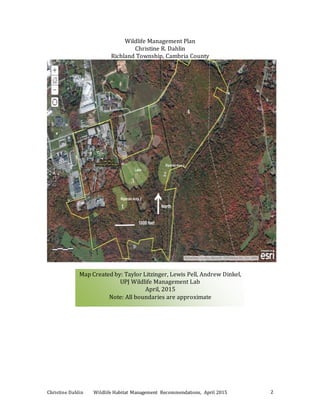
Wildlife Management Plan
Christine R. Dahlin
Richland Township, Cambria County
Map Created by: Taylor Litzinger, Lewis Pell, Andrew Dinkel,
UPJ Wildlife Management Lab
April, 2015
Note: All boundaries are approximate
4
3
1
2
Christine Dahlin Wildlife Habitat Management Recommendations, April 2015 3
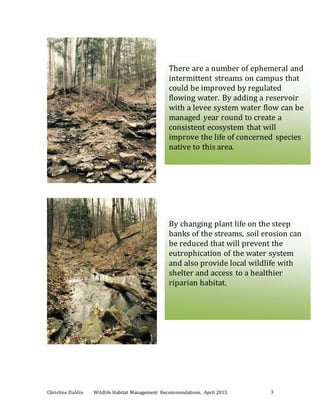
There are a number of ephemeral and
intermittent streams on campus that
could be improved by regulated
flowing water. By adding a reservoir
with a levee system water flow can be
managed year round to create a
consistent ecosystem that will
improve the life of concerned species
native to this area.
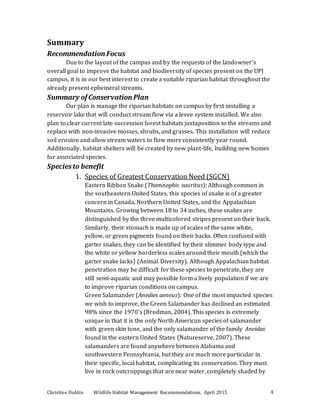
By changing plant life on the steep
banks of the streams, soil erosion can
be reduced that will prevent the
eutrophication of the water system
and also provide local wildlife with
shelter and access to a healthier
riparian habitat.
Christine Dahlin Wildlife Habitat Management Recommendations, April 2015 4
Summary
Recommendation Focus
Due to the layout of the campus and by the requests of the landowner’s
overall goal to improve the habitat and biodiversity of species present on the UPJ
campus, it is in our best interest to create a suitable riparian habitat throughout the
already present ephemeral streams.
Summary of Conservation Plan
Our plan is manage the riparian habitats on campus by first installing a
reservoir lake that will conduct stream flow via a levee system installed. We also
plan to clear current late succession forest habitats juxtaposition to the streams and
replace with non-invasive mosses, shrubs, and grasses. This installation will reduce
soil erosion and allow stream waters to flow more consistently year round.
Additionally, habitat shelters will be created by new plant-life, building new homes
for associated species.
Speciesto benefit
1. Species of Greatest Conservation Need (SGCN)
Eastern Ribbon Snake (Thamnophis sauritus): Although common in
the southeastern United States, this species of snake is of a greater
concern in Canada, Northern United States, and the Appalachian
Mountains. Growing between 18 to 34 inches, these snakes are
distinguished by the three multicolored stripes present on their back.
Similarly, their stomach is made up of scales of the same white,
yellow, or green pigments found on their backs. Often confused with
garter snakes, they can be identified by their slimmer body type and
the white or yellow borderless scales around their mouth (which the
garter snake lacks) (Animal Diversity). Although Appalachian habitat
penetration may be difficult for these species to penetrate, they are
still semi-aquatic and may possible form a lively population if we are
to improve riparian conditions on campus.
Green Salamander (Anedies aeneus): One of the most impacted species
we wish to improve, the Green Salamander has declined an estimated
98% since the 1970’s (Brodman, 2004). This species is extremely
unique in that it is the only North American species of salamander
with green skin tone, and the only salamander of the family Aneidas
found in the eastern United States (Natureserve, 2007). These
salamanders are found anywhere between Alabama and
southwestern Pennsylvania, but they are much more particular in
their specific, local habitat, complicating its conservation. They must
live in rock outcroppings that are near water, completely shaded by
Christine Dahlin Wildlife Habitat Management Recommendations, April 2015 5
the sun, either from dense vegetation or other rock outcroppings. Due
to our desired habitat’s already present rocky surface, and cover from
sunlight, we will be able to house these rare salamanders if we are to
increase vegetation in the area.
Olive-sided flycatcher (Contopus cooperi): Listed as a species of
immediate concern (PA, WAP), these birds are declining at an average
rate of (4.1%) per year (Paul Brandy, Flycatcher). This may be a result
of loss of habitat in breeding grounds, found in the northeastern
United States and Canada. Migrating from Central and South America,
they prefer to breed in the north at high altitude locations near rivers
and streams which they can use for hunting insects. They like to perch
on coniferous trees, which are abundant on campus, so by increasing
the riparian habitat we will design an adequate habitat for this species
(All About Birds).
Queen Snake (Regina septemvittata): Although there are two separate
populations between eastern and western Pennsylvania, we aim to
improve the habitat presence of the western, Appalachian subspecies.
These nonvenomous snakes prey predominately on crayfish, so they
require clean, running water as a part of their habitat. Similar to the
garter snake in appearance, they have olive, brown, and creamy
yellow scales, seven stripes that run the length of its body, and will
grow between 12-24 inches (Hulse, 2001).
2. Associated Wildlife
Chickadee (Poecile atricapillus): Pennsylvania is home to the most
fifteenth abundant species of chickadee, but the black-capped chicken
can be found year round in the northern United States (R.L. Curry,
Black-capped Chickadee). They are present in a habitat with trees or
woody shrubs, feeding on insects, as well as their pupae and eggs, and
will eat seeds and berries for sustenance in the winter (All About
Birds). They are very small birds, only about 2.5 inches and size, and
as its name suggests, has a black “cap” on its head, with white
adorning the sides of its face.
Crayfish (Astacoideae): Despite the prevalence of crayfish in
Pennsylvania (13 present species), there is surprisingly little known
about their distribution and abundance. The Wild Resource
Conservation Fund assumes that numbers may be declining due to
changes in river dynamics, including acid mine drainage that is ever
present in the Pennsylvania Appalachians. Data is currently being
collected to estimate their possible decline, as they are second only to
fresh water mussels in predicted life data models (PA Fish and Boat
Christine Dahlin Wildlife Habitat Management Recommendations, April 2015 6
Commission, 2015). They live in lotic ponds and streams with a rocky
substrate (Dietz, 2003), which describes our proposed plan nicely.
Additionally, because they are a large prey item of the Queen Snake,
their benefit in habitat will have an additive effect on one of our
species of most concern.
White-Tailed Deer (Odocoileus virginianus): White-tailed Deer have a
home range of only one half, to 2 miles in size, but the actual species
can be found all throughout North America and as far south as Peru
and Bolivia. Only in the western United States is it outcompeted by
Black-Tailed Deer. Due to lack of predators, there is a massive
overabundance of deer, Pennsylvania being no exception. To address
their numbers, we must take great care in providing a habitat that is
resilient to deer over grazing that has devastated much of
Pennsylvania’s woods. Although, what we propose to do in terms of
adding shrubs and vegetation will provide the deer with much more
effective deer yards during winter months.
3. Endangered and Threatened
In preparation of this plan a Pennsylvania Natural Diversity Index
(PNDI) database search was conducted for all known occurrences of
species of concern in Pennsylvania. The intent of this database search
is to ensure that the provided recommendations do not result in any
negative ecological impacts. The attached results indicate no known
impacts to endangered or threatened species on this property.
Stand Number Description Acreage
1 Riparian Stream 10.6
2 Riparian Stream 25.0
3 Lake 32.2
4 Forested Succession 277.5
5 Campus 109.5
Treatment Acreage(in priority order)
Treatment Type Stand # Acreage
Reservoir Creation 3 32.2
Stream Improvement 1 1, 3, 4 49.7
Stream Improvement 2 2, 3, 4 64.6
Funding Opportunities
 Owner’s Expense (Dr. Dahlin won the lottery)
 University of Pittsburgh funding
Christine Dahlin Wildlife Habitat Management Recommendations, April 2015 7
Goals
We wish to improve the overall biodiversity and riparian habitat present on
the UPJ campus. In particular, we would like to encourage an environment that may
promote the growth of our listed species of greatest concern. We would like to
create a reservoir on the campus with a levee system that encourages water flow
year round through the south eastern portion of campus. In their current design,
they streams present are ephemeral and do not have a constant flow.
Land Use History and Past Habitat Projects
The campus was a gift from the Wilmore Coal and Real Estate Companies, in
1960. Campus was constructed in 1963-1967, where much of it has been allowed to
continue with natural succession, and only a portion of the campus has been
developed for student housing and education. The landscape is controlled by the
University of Pittsburgh in Johnstown, and the University of Pittsburgh. Part of the
area we wish to develop is currently being used as athletic fields for baseball and
track and field.
Landscape Context
The property is located in Richland, a suburb eight miles southeast of
Johnstown, and is in southern Cambria County. It is a part of the Appalachian
Mountains, which have been primarily used in coal mining, and as a result rivers in
the area suffer from acid-mine drainage. The developed portion of the campus sits at
the highest point, while where we wish to preform habitat reconstruction is
composed of a large slope from 2200-1800 feet. The streams present will flow into
the Little Paint Creek, combining with the Stonycreek River, which flows into the
Conemaugh River. The campus is only several miles away from Gallitzin State
Forest, which lies adjacent to Blue Knob State Park.
Habitat Description
Part of the campus is developed for student education and activities. The
remained of the campus is mostly late succession forest habitat, mixed mesophytic
forest and stream, and composed mainly of red maple trees. Several serpentine
paths transect the forest portion of the campus and are mowed regularly, creating
edge habitat and preventing succession. In the southern portion of the property,
there is a region of early succession habitat, but it is excluded from our example.
There are small bodies of water on campus, and ephemeral streams, but these likely
only move water during the spring after the snow melts.
Christine Dahlin Wildlife Habitat Management Recommendations, April 2015 8
Management Strategies
The following strategies are what we believe to be the best methods in
obtaining our goals for the land owner and to provide the most benefit for species of
greatest concern.
Strategy 1 – Installation of Reservoir (Stands 1, 2, 3, 4)
This property is exquisite for the creation of riparian habitat if several
changes are made to encourage the flow of water on site year round. Many semi-
aquatic species, including amphibians, birds, and reptiles, will greatly benefit from a
nearby water source and the reliable creeks it creates.
Implementation 1 – Create a lake habitat at current athletic fields.
This location is most effective for our proposed plan due to its position
between the two already present ephemeral streams and the wetland habitat that
surrounds those fields. Due to their location, those athletic fields are already prone
to flooding and collecting water, so by creating a reservoir system a lake could easily
form in that area. Storm drains that collect water from other areas around campus
and funnels it to our proposed reservoir will not only keep the rest of student
occupied campus dry, but will fill our reservoir.
Implementation 2 – design levee system leading to adjacent streams
There are two ephemeral streams that are located both east and south of our
proposed reservoir. By building a levee system, we can mitigate the flow of water
down both of these streams, controlling the flow that will prevent flooding in wet
months, and continue movement of water throughout dry ones.
Implementation 3 – Clear current stream paths
Due to erosion and haphazard flow of water that varies from season to
season, there is a large amount of obstructions that litter the pathways of these
streams. By relocating some of the material to the bands of the stream, we will
simultaneously promote the flow of water, prevent standing water, and create
shelter and hibernacula for amphibious and reptilian species next to the creek.
Strategy 2 – Adjusting surround plant life (stands 1, 2, and 4)
Erosion along the steep banks of these rivers have allowed the
eutrophication of the creek waters, making them shallower and not suitable year
round for the wildlife we aim to conserve. By changing the plants to mosses and
grasses that prevent erosion we can improve the quality of the stream.
Implementation 1 – Removal of Old Forrest
Either through the process of clear cutting or controlled burn we should
remove the large maple and other deciduous trees present along the stream banks.
This will reset the habitat back to an early succession which our proposed plants
Christine Dahlin Wildlife Habitat Management Recommendations, April 2015 9
will grow in that environment more easily. Patches of conifers should be left alone
due to their contribution as deer yards and shelter for other species, as should
several select deciduous trees that are preferred by Olive-sided Flycatcher for
roosting.
Implementation 2 – Addition of new plant species
Deeprooted perennial grasses are essential for our plan, in that they hold soil
together and prevent erosion. If we want these streams to be present in years to
come, erosion must be avoided to keep them from filling it. Grasses such as Indian
Grass (Sorghastrum Nectans) and Big Blue Stem (Andropogan Genardi) both fit that
niche. Native plants, mosses, and ferns all increase the biodiversity of the ecosystem,
and hold soil together more effectively than the current wooded trees, so they
should also be installed. Species such as the Golden Rogwart (Senecio), Crossvine
(Bignonia Capreolata), Trumpet Creeper (Campsis Radican), Honeysuckle (Lonicera),
Marsh Fern (Thelyperis Palustriis), and New York Fern (Telyperis Novebaracensis)
are native species that we could restore into the habitat and will simultaneously
provide cover for other associated species. Mosses, such as Sphagmum,
Audacomnium Palustre, and hypmum Curvifolium (Sheet Moss), are other native
species that have adapted different life strategies than most plants and are also
important to ecosystem structure.
Implementation 3 – Addition of conifers
Overall, the campus lacks any strong presence of conifers. Although our plans
focus is not explicitly that of conifers, there are several of them in segregated
patches following the flow of the creeks. By planting more conifers in these selected
areas we can increase the overall winter cover that greatly benefits deer
populations and any other species that overwinters in Pennsylvania.
Christine Dahlin Wildlife Habitat Management Recommendations, April 2015 10
Reference
NatureServe. 2007. NatureServe Explorer: An online encyclopedia of life [web
application]. Version 6.2. NatureServe, Arlington, Virginia. Available
http://www.natureserve.org/explorer.
Brodman Robert. Conservation Assessment. R9 Species Conservation Assessment
for the Green Salamander. Jan. 6 2004.
http://www.fs.usda.gov/Internet/FSE_DOCUMENTS/fsm91_054400.pdf
Hulse, A.C., Cj. McCroy and E. Censky 2001. Amphibians and Reptiles of
Pennsylvania and the Northeast. Cornell University Press. Ithaca
"Olive-sided Flycatcher." , Life History, All About Birds. Web. 31 Mar. 2015.
<http://www.allaboutbirds.org/guide/Olive-sided_Flycatcher/lifehistory>.
Brandy, Paul. "Population Status." Population Status. Web. 31 Mar. 2015.
<http://www.prbo.org/calpif/htmldocs/species/conifer/osflacct.html>.
"Black-capped Chickadee." , Identification, All About Birds. Web. 31 Mar. 2015.
<http://www.allaboutbirds.org/guide/Black-capped_Chickadee/id>.
Curry, R.L. "Black-capped Chickadee." Black- Capped Chickadee. 1 Jan. 2004. Web. 31
Mar. 2015.
<http://www98.homepage.villanova.edu/robert.curry/Documents/RLCpubs/Curry.
2012.BCCH2ndPA.pdf>.
“Crayfish.” Pennsylvania Fish and Boat Commission. Last Updated, 2015. Accessed
3/30/15.
http://www.fish.state.pa.us/images/pages/qa/amp_rep/crayfish.htm
Dietz, Walt. “Smart Angler’s Notebook Crazy Crayfish.” Pennsylvania Angler and
Boater. September-October 2003.
http://www.fish.state.pa.us/education/catalog/crazycrayfish.pdf
“Thamnophis Sauritus Eastern Ribbon Snake” Animal Diversity Web. Last Updated
August 31, 2005. Accessed 3/30/15.
http://animaldiversity.org/accounts/Thamnophis_sauritus/
Riparian Life Zones Plants and Trees. (n.d.). Retrieved April 14, 2015, from
http://shelledy.mesa.k12.co.us/staff/computerlab/ColoradoLifeZones_Riparian_Pl
ants.html#Higher_Elevation

mgmt plan

  • 1.
    Christine Dahlin WildlifeHabitat Management Recommendations, April 2015 1 Prepared by: Prepared For: Property Address: Wildlife Habitat Management Recommendations Andrew Dinkel, Taylor Litzinger, Lewis Pell University of Pittsburgh in Johnstown Wildlife Management Lab 450 Schoolhouse Road, Johnstown, PA 15904 1-(814)-269-7000 Christine R. Dahlin 450 Schoolhouse Road, Johnstown, PA 15904 (814)-269-2910 cdahlin@pitt.edu 450 Schoolhouse Rd. Johnstown, PA 15904 Latitude: 40.267365 Longitude: -78.733538
  • 2.
    Christine Dahlin WildlifeHabitat Management Recommendations, April 2015 2 Wildlife Management Plan Christine R. Dahlin Richland Township, Cambria County Map Created by: Taylor Litzinger, Lewis Pell, Andrew Dinkel, UPJ Wildlife Management Lab April, 2015 Note: All boundaries are approximate 4 3 1 2
  • 3.
    Christine Dahlin WildlifeHabitat Management Recommendations, April 2015 3 There are a number of ephemeral and intermittent streams on campus that could be improved by regulated flowing water. By adding a reservoir with a levee system water flow can be managed year round to create a consistent ecosystem that will improve the life of concerned species native to this area. By changing plant life on the steep banks of the streams, soil erosion can be reduced that will prevent the eutrophication of the water system and also provide local wildlife with shelter and access to a healthier riparian habitat.
  • 4.
    Christine Dahlin WildlifeHabitat Management Recommendations, April 2015 4 Summary Recommendation Focus Due to the layout of the campus and by the requests of the landowner’s overall goal to improve the habitat and biodiversity of species present on the UPJ campus, it is in our best interest to create a suitable riparian habitat throughout the already present ephemeral streams. Summary of Conservation Plan Our plan is manage the riparian habitats on campus by first installing a reservoir lake that will conduct stream flow via a levee system installed. We also plan to clear current late succession forest habitats juxtaposition to the streams and replace with non-invasive mosses, shrubs, and grasses. This installation will reduce soil erosion and allow stream waters to flow more consistently year round. Additionally, habitat shelters will be created by new plant-life, building new homes for associated species. Speciesto benefit 1. Species of Greatest Conservation Need (SGCN) Eastern Ribbon Snake (Thamnophis sauritus): Although common in the southeastern United States, this species of snake is of a greater concern in Canada, Northern United States, and the Appalachian Mountains. Growing between 18 to 34 inches, these snakes are distinguished by the three multicolored stripes present on their back. Similarly, their stomach is made up of scales of the same white, yellow, or green pigments found on their backs. Often confused with garter snakes, they can be identified by their slimmer body type and the white or yellow borderless scales around their mouth (which the garter snake lacks) (Animal Diversity). Although Appalachian habitat penetration may be difficult for these species to penetrate, they are still semi-aquatic and may possible form a lively population if we are to improve riparian conditions on campus. Green Salamander (Anedies aeneus): One of the most impacted species we wish to improve, the Green Salamander has declined an estimated 98% since the 1970’s (Brodman, 2004). This species is extremely unique in that it is the only North American species of salamander with green skin tone, and the only salamander of the family Aneidas found in the eastern United States (Natureserve, 2007). These salamanders are found anywhere between Alabama and southwestern Pennsylvania, but they are much more particular in their specific, local habitat, complicating its conservation. They must live in rock outcroppings that are near water, completely shaded by
  • 5.
    Christine Dahlin WildlifeHabitat Management Recommendations, April 2015 5 the sun, either from dense vegetation or other rock outcroppings. Due to our desired habitat’s already present rocky surface, and cover from sunlight, we will be able to house these rare salamanders if we are to increase vegetation in the area. Olive-sided flycatcher (Contopus cooperi): Listed as a species of immediate concern (PA, WAP), these birds are declining at an average rate of (4.1%) per year (Paul Brandy, Flycatcher). This may be a result of loss of habitat in breeding grounds, found in the northeastern United States and Canada. Migrating from Central and South America, they prefer to breed in the north at high altitude locations near rivers and streams which they can use for hunting insects. They like to perch on coniferous trees, which are abundant on campus, so by increasing the riparian habitat we will design an adequate habitat for this species (All About Birds). Queen Snake (Regina septemvittata): Although there are two separate populations between eastern and western Pennsylvania, we aim to improve the habitat presence of the western, Appalachian subspecies. These nonvenomous snakes prey predominately on crayfish, so they require clean, running water as a part of their habitat. Similar to the garter snake in appearance, they have olive, brown, and creamy yellow scales, seven stripes that run the length of its body, and will grow between 12-24 inches (Hulse, 2001). 2. Associated Wildlife Chickadee (Poecile atricapillus): Pennsylvania is home to the most fifteenth abundant species of chickadee, but the black-capped chicken can be found year round in the northern United States (R.L. Curry, Black-capped Chickadee). They are present in a habitat with trees or woody shrubs, feeding on insects, as well as their pupae and eggs, and will eat seeds and berries for sustenance in the winter (All About Birds). They are very small birds, only about 2.5 inches and size, and as its name suggests, has a black “cap” on its head, with white adorning the sides of its face. Crayfish (Astacoideae): Despite the prevalence of crayfish in Pennsylvania (13 present species), there is surprisingly little known about their distribution and abundance. The Wild Resource Conservation Fund assumes that numbers may be declining due to changes in river dynamics, including acid mine drainage that is ever present in the Pennsylvania Appalachians. Data is currently being collected to estimate their possible decline, as they are second only to fresh water mussels in predicted life data models (PA Fish and Boat
  • 6.
    Christine Dahlin WildlifeHabitat Management Recommendations, April 2015 6 Commission, 2015). They live in lotic ponds and streams with a rocky substrate (Dietz, 2003), which describes our proposed plan nicely. Additionally, because they are a large prey item of the Queen Snake, their benefit in habitat will have an additive effect on one of our species of most concern. White-Tailed Deer (Odocoileus virginianus): White-tailed Deer have a home range of only one half, to 2 miles in size, but the actual species can be found all throughout North America and as far south as Peru and Bolivia. Only in the western United States is it outcompeted by Black-Tailed Deer. Due to lack of predators, there is a massive overabundance of deer, Pennsylvania being no exception. To address their numbers, we must take great care in providing a habitat that is resilient to deer over grazing that has devastated much of Pennsylvania’s woods. Although, what we propose to do in terms of adding shrubs and vegetation will provide the deer with much more effective deer yards during winter months. 3. Endangered and Threatened In preparation of this plan a Pennsylvania Natural Diversity Index (PNDI) database search was conducted for all known occurrences of species of concern in Pennsylvania. The intent of this database search is to ensure that the provided recommendations do not result in any negative ecological impacts. The attached results indicate no known impacts to endangered or threatened species on this property. Stand Number Description Acreage 1 Riparian Stream 10.6 2 Riparian Stream 25.0 3 Lake 32.2 4 Forested Succession 277.5 5 Campus 109.5 Treatment Acreage(in priority order) Treatment Type Stand # Acreage Reservoir Creation 3 32.2 Stream Improvement 1 1, 3, 4 49.7 Stream Improvement 2 2, 3, 4 64.6 Funding Opportunities  Owner’s Expense (Dr. Dahlin won the lottery)  University of Pittsburgh funding
  • 7.
    Christine Dahlin WildlifeHabitat Management Recommendations, April 2015 7 Goals We wish to improve the overall biodiversity and riparian habitat present on the UPJ campus. In particular, we would like to encourage an environment that may promote the growth of our listed species of greatest concern. We would like to create a reservoir on the campus with a levee system that encourages water flow year round through the south eastern portion of campus. In their current design, they streams present are ephemeral and do not have a constant flow. Land Use History and Past Habitat Projects The campus was a gift from the Wilmore Coal and Real Estate Companies, in 1960. Campus was constructed in 1963-1967, where much of it has been allowed to continue with natural succession, and only a portion of the campus has been developed for student housing and education. The landscape is controlled by the University of Pittsburgh in Johnstown, and the University of Pittsburgh. Part of the area we wish to develop is currently being used as athletic fields for baseball and track and field. Landscape Context The property is located in Richland, a suburb eight miles southeast of Johnstown, and is in southern Cambria County. It is a part of the Appalachian Mountains, which have been primarily used in coal mining, and as a result rivers in the area suffer from acid-mine drainage. The developed portion of the campus sits at the highest point, while where we wish to preform habitat reconstruction is composed of a large slope from 2200-1800 feet. The streams present will flow into the Little Paint Creek, combining with the Stonycreek River, which flows into the Conemaugh River. The campus is only several miles away from Gallitzin State Forest, which lies adjacent to Blue Knob State Park. Habitat Description Part of the campus is developed for student education and activities. The remained of the campus is mostly late succession forest habitat, mixed mesophytic forest and stream, and composed mainly of red maple trees. Several serpentine paths transect the forest portion of the campus and are mowed regularly, creating edge habitat and preventing succession. In the southern portion of the property, there is a region of early succession habitat, but it is excluded from our example. There are small bodies of water on campus, and ephemeral streams, but these likely only move water during the spring after the snow melts.
  • 8.
    Christine Dahlin WildlifeHabitat Management Recommendations, April 2015 8 Management Strategies The following strategies are what we believe to be the best methods in obtaining our goals for the land owner and to provide the most benefit for species of greatest concern. Strategy 1 – Installation of Reservoir (Stands 1, 2, 3, 4) This property is exquisite for the creation of riparian habitat if several changes are made to encourage the flow of water on site year round. Many semi- aquatic species, including amphibians, birds, and reptiles, will greatly benefit from a nearby water source and the reliable creeks it creates. Implementation 1 – Create a lake habitat at current athletic fields. This location is most effective for our proposed plan due to its position between the two already present ephemeral streams and the wetland habitat that surrounds those fields. Due to their location, those athletic fields are already prone to flooding and collecting water, so by creating a reservoir system a lake could easily form in that area. Storm drains that collect water from other areas around campus and funnels it to our proposed reservoir will not only keep the rest of student occupied campus dry, but will fill our reservoir. Implementation 2 – design levee system leading to adjacent streams There are two ephemeral streams that are located both east and south of our proposed reservoir. By building a levee system, we can mitigate the flow of water down both of these streams, controlling the flow that will prevent flooding in wet months, and continue movement of water throughout dry ones. Implementation 3 – Clear current stream paths Due to erosion and haphazard flow of water that varies from season to season, there is a large amount of obstructions that litter the pathways of these streams. By relocating some of the material to the bands of the stream, we will simultaneously promote the flow of water, prevent standing water, and create shelter and hibernacula for amphibious and reptilian species next to the creek. Strategy 2 – Adjusting surround plant life (stands 1, 2, and 4) Erosion along the steep banks of these rivers have allowed the eutrophication of the creek waters, making them shallower and not suitable year round for the wildlife we aim to conserve. By changing the plants to mosses and grasses that prevent erosion we can improve the quality of the stream. Implementation 1 – Removal of Old Forrest Either through the process of clear cutting or controlled burn we should remove the large maple and other deciduous trees present along the stream banks. This will reset the habitat back to an early succession which our proposed plants
  • 9.
    Christine Dahlin WildlifeHabitat Management Recommendations, April 2015 9 will grow in that environment more easily. Patches of conifers should be left alone due to their contribution as deer yards and shelter for other species, as should several select deciduous trees that are preferred by Olive-sided Flycatcher for roosting. Implementation 2 – Addition of new plant species Deeprooted perennial grasses are essential for our plan, in that they hold soil together and prevent erosion. If we want these streams to be present in years to come, erosion must be avoided to keep them from filling it. Grasses such as Indian Grass (Sorghastrum Nectans) and Big Blue Stem (Andropogan Genardi) both fit that niche. Native plants, mosses, and ferns all increase the biodiversity of the ecosystem, and hold soil together more effectively than the current wooded trees, so they should also be installed. Species such as the Golden Rogwart (Senecio), Crossvine (Bignonia Capreolata), Trumpet Creeper (Campsis Radican), Honeysuckle (Lonicera), Marsh Fern (Thelyperis Palustriis), and New York Fern (Telyperis Novebaracensis) are native species that we could restore into the habitat and will simultaneously provide cover for other associated species. Mosses, such as Sphagmum, Audacomnium Palustre, and hypmum Curvifolium (Sheet Moss), are other native species that have adapted different life strategies than most plants and are also important to ecosystem structure. Implementation 3 – Addition of conifers Overall, the campus lacks any strong presence of conifers. Although our plans focus is not explicitly that of conifers, there are several of them in segregated patches following the flow of the creeks. By planting more conifers in these selected areas we can increase the overall winter cover that greatly benefits deer populations and any other species that overwinters in Pennsylvania.
  • 10.
    Christine Dahlin WildlifeHabitat Management Recommendations, April 2015 10 Reference NatureServe. 2007. NatureServe Explorer: An online encyclopedia of life [web application]. Version 6.2. NatureServe, Arlington, Virginia. Available http://www.natureserve.org/explorer. Brodman Robert. Conservation Assessment. R9 Species Conservation Assessment for the Green Salamander. Jan. 6 2004. http://www.fs.usda.gov/Internet/FSE_DOCUMENTS/fsm91_054400.pdf Hulse, A.C., Cj. McCroy and E. Censky 2001. Amphibians and Reptiles of Pennsylvania and the Northeast. Cornell University Press. Ithaca "Olive-sided Flycatcher." , Life History, All About Birds. Web. 31 Mar. 2015. <http://www.allaboutbirds.org/guide/Olive-sided_Flycatcher/lifehistory>. Brandy, Paul. "Population Status." Population Status. Web. 31 Mar. 2015. <http://www.prbo.org/calpif/htmldocs/species/conifer/osflacct.html>. "Black-capped Chickadee." , Identification, All About Birds. Web. 31 Mar. 2015. <http://www.allaboutbirds.org/guide/Black-capped_Chickadee/id>. Curry, R.L. "Black-capped Chickadee." Black- Capped Chickadee. 1 Jan. 2004. Web. 31 Mar. 2015. <http://www98.homepage.villanova.edu/robert.curry/Documents/RLCpubs/Curry. 2012.BCCH2ndPA.pdf>. “Crayfish.” Pennsylvania Fish and Boat Commission. Last Updated, 2015. Accessed 3/30/15. http://www.fish.state.pa.us/images/pages/qa/amp_rep/crayfish.htm Dietz, Walt. “Smart Angler’s Notebook Crazy Crayfish.” Pennsylvania Angler and Boater. September-October 2003. http://www.fish.state.pa.us/education/catalog/crazycrayfish.pdf “Thamnophis Sauritus Eastern Ribbon Snake” Animal Diversity Web. Last Updated August 31, 2005. Accessed 3/30/15. http://animaldiversity.org/accounts/Thamnophis_sauritus/ Riparian Life Zones Plants and Trees. (n.d.). Retrieved April 14, 2015, from http://shelledy.mesa.k12.co.us/staff/computerlab/ColoradoLifeZones_Riparian_Pl ants.html#Higher_Elevation