Goat Meat: America’s Hottest Commodity


         Dr. Frank Pinkerton
   AKGA Annual Meeting, June 2010
            Batesville, MS
We are short of goat meat, really!
• In 2009 we harvested over 800,000 goats in
  federal and state inspected plants
• We estimate an additional 100,000 goats were
  killed, but unreported (informal slaughter)
• We also imported over 700,000 goat carcasses
  from Australia in various forms
• On 1 January, 2010 we had just over
  3,000,000 goats (about 2,600,000 meat goats)
Goat meat marketing
• The aggregate demand for goat meat is
  currently unknown
• We do not how much would be taken if
  ‘sufficient’ supplies were available across time
• In economic parlance, goat meat prices are
  supply-driven, not demand-driven (beware
  the ‘glass ceiling’ effect on consumer demand)
Estimating demand for goat meat
• Research is underway at LSU to determine the
  aggregate demand for goat meat
• The project will investigate seasonality of
  demand and consumer preferences across
  groups and venues
• There will additional investigations on
  preferred carcass characteristics and value-
  added products (cite producer participation)
Future demand for goat meat
• An ‘ethnic’ is one whose folks got here after
  your folks got here; many have strong
  preferences for goat meat; more ethnics,
  more goat sales
• Ethnic numbers and family incomes are
  trending upward; distribution is ‘spreading’
• Non-ethnic consumption of goat meat is also
  increasing, but at a much slower rate
Opportunities for increasing the
     domestic supply of goat meat
1. Expand the number of farms producing goats
2. Expand the number of goats on existing
   farms and ranches
3. Expand the off-take/farm by increasing
   reproductive efficiency (more kids born,
   better survival rates)
Continuation
4. Increase the average selling weight of
  slaughter kids via management fiat, through
  improved genetic quality and possibly by
  better nutrition
5. Increase percent of boneless yield/carcass via
  genetic selection (improved meat-to-bone
  ratio and, possibly, improved dressing
  percent)
continuation
6. Generate more doelings from a herd via AI by
  using ‘modified’ semen.
A commercial semen processing company,
  SexingTechnologies.com at Navasota, TX has
  apparently modified goat semen which
  PVAMU is using to obtain an atypically high
  ratio of female-to-male offspring; results are
  pending, but promising (97:3 for dairy heifers)
Constraints to increasing the supply of
         domestic goat meat
• Options 1 and 2 (more goat farms, more goats
  per farms) require reallocation of resources
• Adaption rates would be dependent on the
  expected cost-benefit ratios to be realized
• To make cost-benefit estimates, one can
  readily find information on selling prices (as
  influenced by season, weight, and grade), but
Cost-benefit analysis (continued)
• There is a near total absence of reliable
  information about the real costs of market kid
  production in various geographical venues
• University researchers have been notoriously
  reluctant to undertake such economic studies
• As a consequence, University extension
  specialists are better at offering technical
  recommendations than economic assessments
Budget formats for estimating cost-
            benefit ratios
• Most Universities have ‘how to do a budget’
  info for livestock enterprises; some have
  computerized versions. The logistics and the
  calculations are relatively simple
• The difficulty is finding accurate cost input
  data (what? how much? cost/unit?).
• Even experienced goat farmers are not much
  better ‘advisors’, largely because they don’t
  know how much it costs them to raise a kid
Options 3, 4, 5 necessitate:
• Producers to combine improved management
  practices; more specifically, improvement in
  the genetic quality of their herd is crucial
• Producers can ‘do something’ about nutrition,
  health, and facilities, etc., but…
• Improving genetic worth is much more
  difficult and certainly slower
• How does one improve genetic worth?
Selection of breeding stock
• Visually evaluating the ‘breeding value’ of a
  goat is somewhat akin to assessing
  pornography for content (with experience, it
  may be doable, but it is pure hell to describe)
• I can usually beat a gate-cut (by looking at
  structure, conformation, and udder and
  mouth soundness), but truthfully, not by
  much
Selection, continued
• The fact is that neither I, nor you, can really
  ‘see’ certain crucial traits affecting
  performance (longevity, fertility, mothering
  ability, milk yield, DFI and FCE (ADG)
• This being the case, the correlation between
  ‘phenotypic appearance’ and genotype-driven
  performance is neither high nor reliable
Selection, continued
• On-farm performance testing is the best way
  to make rapid improvement in genetic value
• You can do this by weighing kids at near 90
  days of age and recording this information by
  dam and by sire, with necessary ‘adjustments’
• KSU-Frankfort will do these computations for
  you, for free, and send you a sire and dam
  summary ranking their performance
Option 4: Increasing carcass size
• This is the fastest way to increase goat meat
  supply, but there are constraints
• Larger slaughter goats have poorer FCE and
  thus larger feed cost/lb of gain
• Larger goats reduce by some measure the
  number of does/farm and thus fewer kids
• Larger goats have more internal fat and
  somewhat lower dressing percent (waste)
Major constraint to adding carcass wt
• Culturally-induced consumer resistance to
  changes from traditional preferences
• preferred carcass weights 20-30 lb
• discrimination against excessive fat
• aversion to fabricated cuts (rear leg, shoulder,
  back-strip, etc.)
• limited interest in ground meat and ‘sausage’
Positive aspects of larger carcasses
• Reduced processing costs/lb
• Creation of larger primal cuts for sale as chops
  & roasts; more ‘trim’ for sausage products
• But, the current preference is for smaller
  carcasses or, with increasing retail prices, for
  halves and quarters
• Larger, aged, or lower quality carcasses are
  ‘cubed’ for sale, and also for cookery
Paramount constraint to more goats
• Insufficient rates of return to capital,
  management, and labor
• The major reason for the poor rate of return is
  not supplemental feed or health costs, or,
  until recently, low live-goat prices, but rather
  the
• high cost of land needed to provide forage
• The cost of land is increasingly divorced from
  its agricultural productivity (has been, will be)
Continued
• The cost of land to provide a forage-based
  ‘home’ for a doe can rarely, if ever, be
  recovered from the sale of her offspring
• Indeed, it is increasingly difficult to recover
  interest cost (and taxes)
• To illustrate, land costing $3,000/acre and
  able to support 3 does ‘year-round’ results in
  an ‘opportunity cost’ of $135/acre/year (3,000
  x 4.5% tax-free bond) or $45/doe/year (135/3)
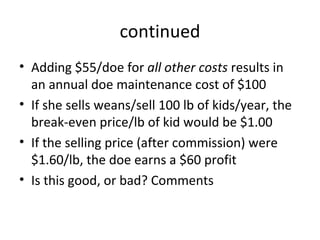
continued
• Adding $55/doe for all other costs results in
  an annual doe maintenance cost of $100
• If she sells weans/sell 100 lb of kids/year, the
  break-even price/lb of kid would be $1.00
• If the selling price (after commission) were
  $1.60/lb, the doe earns a $60 profit
• Is this good, or bad? Comments
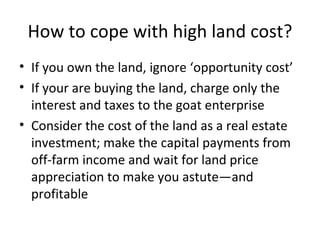
How to cope with high land cost?
• If you own the land, ignore ‘opportunity cost’
• If your are buying the land, charge only the
  interest and taxes to the goat enterprise
• Consider the cost of the land as a real estate
  investment; make the capital payments from
  off-farm income and wait for land price
  appreciation to make you astute—and
  profitable
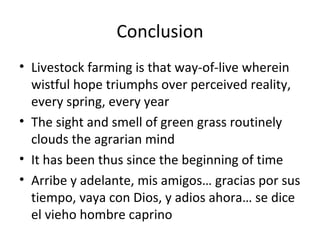
Conclusion
• Livestock farming is that way-of-live wherein
  wistful hope triumphs over perceived reality,
  every spring, every year
• The sight and smell of green grass routinely
  clouds the agrarian mind
• It has been thus since the beginning of time
• Arribe y adelante, mis amigos… gracias por sus
  tiempo, vaya con Dios, y adios ahora… se dice
  el vieho hombre caprino

Goat meat america's hottest commodity

  • 1.
    Goat Meat: America’sHottest Commodity Dr. Frank Pinkerton AKGA Annual Meeting, June 2010 Batesville, MS
  • 2.
    We are shortof goat meat, really! • In 2009 we harvested over 800,000 goats in federal and state inspected plants • We estimate an additional 100,000 goats were killed, but unreported (informal slaughter) • We also imported over 700,000 goat carcasses from Australia in various forms • On 1 January, 2010 we had just over 3,000,000 goats (about 2,600,000 meat goats)
  • 3.
    Goat meat marketing •The aggregate demand for goat meat is currently unknown • We do not how much would be taken if ‘sufficient’ supplies were available across time • In economic parlance, goat meat prices are supply-driven, not demand-driven (beware the ‘glass ceiling’ effect on consumer demand)
  • 4.
    Estimating demand forgoat meat • Research is underway at LSU to determine the aggregate demand for goat meat • The project will investigate seasonality of demand and consumer preferences across groups and venues • There will additional investigations on preferred carcass characteristics and value- added products (cite producer participation)
  • 5.
    Future demand forgoat meat • An ‘ethnic’ is one whose folks got here after your folks got here; many have strong preferences for goat meat; more ethnics, more goat sales • Ethnic numbers and family incomes are trending upward; distribution is ‘spreading’ • Non-ethnic consumption of goat meat is also increasing, but at a much slower rate
  • 6.
    Opportunities for increasingthe domestic supply of goat meat 1. Expand the number of farms producing goats 2. Expand the number of goats on existing farms and ranches 3. Expand the off-take/farm by increasing reproductive efficiency (more kids born, better survival rates)
  • 7.
    Continuation 4. Increase theaverage selling weight of slaughter kids via management fiat, through improved genetic quality and possibly by better nutrition 5. Increase percent of boneless yield/carcass via genetic selection (improved meat-to-bone ratio and, possibly, improved dressing percent)
  • 8.
    continuation 6. Generate moredoelings from a herd via AI by using ‘modified’ semen. A commercial semen processing company, SexingTechnologies.com at Navasota, TX has apparently modified goat semen which PVAMU is using to obtain an atypically high ratio of female-to-male offspring; results are pending, but promising (97:3 for dairy heifers)
  • 9.
    Constraints to increasingthe supply of domestic goat meat • Options 1 and 2 (more goat farms, more goats per farms) require reallocation of resources • Adaption rates would be dependent on the expected cost-benefit ratios to be realized • To make cost-benefit estimates, one can readily find information on selling prices (as influenced by season, weight, and grade), but
  • 10.
    Cost-benefit analysis (continued) •There is a near total absence of reliable information about the real costs of market kid production in various geographical venues • University researchers have been notoriously reluctant to undertake such economic studies • As a consequence, University extension specialists are better at offering technical recommendations than economic assessments
  • 11.
    Budget formats forestimating cost- benefit ratios • Most Universities have ‘how to do a budget’ info for livestock enterprises; some have computerized versions. The logistics and the calculations are relatively simple • The difficulty is finding accurate cost input data (what? how much? cost/unit?). • Even experienced goat farmers are not much better ‘advisors’, largely because they don’t know how much it costs them to raise a kid
  • 12.
    Options 3, 4,5 necessitate: • Producers to combine improved management practices; more specifically, improvement in the genetic quality of their herd is crucial • Producers can ‘do something’ about nutrition, health, and facilities, etc., but… • Improving genetic worth is much more difficult and certainly slower • How does one improve genetic worth?
  • 13.
    Selection of breedingstock • Visually evaluating the ‘breeding value’ of a goat is somewhat akin to assessing pornography for content (with experience, it may be doable, but it is pure hell to describe) • I can usually beat a gate-cut (by looking at structure, conformation, and udder and mouth soundness), but truthfully, not by much
  • 14.
    Selection, continued • Thefact is that neither I, nor you, can really ‘see’ certain crucial traits affecting performance (longevity, fertility, mothering ability, milk yield, DFI and FCE (ADG) • This being the case, the correlation between ‘phenotypic appearance’ and genotype-driven performance is neither high nor reliable
  • 15.
    Selection, continued • On-farmperformance testing is the best way to make rapid improvement in genetic value • You can do this by weighing kids at near 90 days of age and recording this information by dam and by sire, with necessary ‘adjustments’ • KSU-Frankfort will do these computations for you, for free, and send you a sire and dam summary ranking their performance
  • 16.
    Option 4: Increasingcarcass size • This is the fastest way to increase goat meat supply, but there are constraints • Larger slaughter goats have poorer FCE and thus larger feed cost/lb of gain • Larger goats reduce by some measure the number of does/farm and thus fewer kids • Larger goats have more internal fat and somewhat lower dressing percent (waste)
  • 17.
    Major constraint toadding carcass wt • Culturally-induced consumer resistance to changes from traditional preferences • preferred carcass weights 20-30 lb • discrimination against excessive fat • aversion to fabricated cuts (rear leg, shoulder, back-strip, etc.) • limited interest in ground meat and ‘sausage’
  • 18.
    Positive aspects oflarger carcasses • Reduced processing costs/lb • Creation of larger primal cuts for sale as chops & roasts; more ‘trim’ for sausage products • But, the current preference is for smaller carcasses or, with increasing retail prices, for halves and quarters • Larger, aged, or lower quality carcasses are ‘cubed’ for sale, and also for cookery
  • 19.
    Paramount constraint tomore goats • Insufficient rates of return to capital, management, and labor • The major reason for the poor rate of return is not supplemental feed or health costs, or, until recently, low live-goat prices, but rather the • high cost of land needed to provide forage • The cost of land is increasingly divorced from its agricultural productivity (has been, will be)
  • 20.
    Continued • The costof land to provide a forage-based ‘home’ for a doe can rarely, if ever, be recovered from the sale of her offspring • Indeed, it is increasingly difficult to recover interest cost (and taxes) • To illustrate, land costing $3,000/acre and able to support 3 does ‘year-round’ results in an ‘opportunity cost’ of $135/acre/year (3,000 x 4.5% tax-free bond) or $45/doe/year (135/3)
  • 21.
    continued • Adding $55/doefor all other costs results in an annual doe maintenance cost of $100 • If she sells weans/sell 100 lb of kids/year, the break-even price/lb of kid would be $1.00 • If the selling price (after commission) were $1.60/lb, the doe earns a $60 profit • Is this good, or bad? Comments
  • 22.
    How to copewith high land cost? • If you own the land, ignore ‘opportunity cost’ • If your are buying the land, charge only the interest and taxes to the goat enterprise • Consider the cost of the land as a real estate investment; make the capital payments from off-farm income and wait for land price appreciation to make you astute—and profitable
  • 23.
    Conclusion • Livestock farmingis that way-of-live wherein wistful hope triumphs over perceived reality, every spring, every year • The sight and smell of green grass routinely clouds the agrarian mind • It has been thus since the beginning of time • Arribe y adelante, mis amigos… gracias por sus tiempo, vaya con Dios, y adios ahora… se dice el vieho hombre caprino