/HASHMAT-KHAN
Wireless & Mobile Communications
Handover Management
Handover/Handoff Management
 Introduction
 Handover Decisions
 Types of Handover/Handoff
o Hard & Soft Handovers
o Intra-cell handover
o Inter-cell, intra-BSC handover
o Inter-BSC, intra-MSC handover
o Inter-MSC handover
 References
Introduction
Basically, Handover means the giving of control
of or responsibility for to someone else.
Similarly, The process of changing point of
communication while communicating is known
as handover in cellular network.
Handover Decisions
There are numerous methods for performing
handoff. From the decision process point of
view, one can find at least three different kinds
of handoff/handover decisions.
Network-Controlled Handoff
Mobile-Assisted Handoff
Mobile-Controlled Handoff
https://www.slideshare.net/AnkitaKhadatkar/handover-in-telecom
Network-Controlled Handoff
 Network measures the transmission quality
via base stations and decides when handover
should be executed.
 In general, the handover process takes 100-
200 ms.
 Network-controlled handoff is used in first-
generaion analog systems such as AMPS
(Advanced Mobile Phone System), TACS
(Total Access Communication System), and
NMT (Nordic Mobile Telephone).
https://www.slideshare.net/AnkitaKhadatkar/handover-in-telecom
Mobile-Assisted Handoff
In a mobile-assisted handoff process, the MS
makes measurements and the network makes
the decision.
In the circuit-switched GSM (global system
mobile), the BS controller (BSC) is in charge of
some functions including handoff management.
The handoff time between handoff decision and
execution in a GSM is approximatelyy 1 second.
https://www.slideshare.net/AnkitaKhadatkar/handover-in-telecom
Mobile-Controlled Handoff
In mobile-controlled handoff, each MS is completely
in control of the handoff process.
This type of handoff has a short reaction time (in the
order of 0.1 second).
A handoff can be initiated if the signal strength of
the serving BS is slower than that of another BS.
https://www.slideshare.net/AnkitaKhadatkar/handover-in-telecom
Hard Handover
 It is used in GSM (2G).
 Break before make.
/MPIRICAL
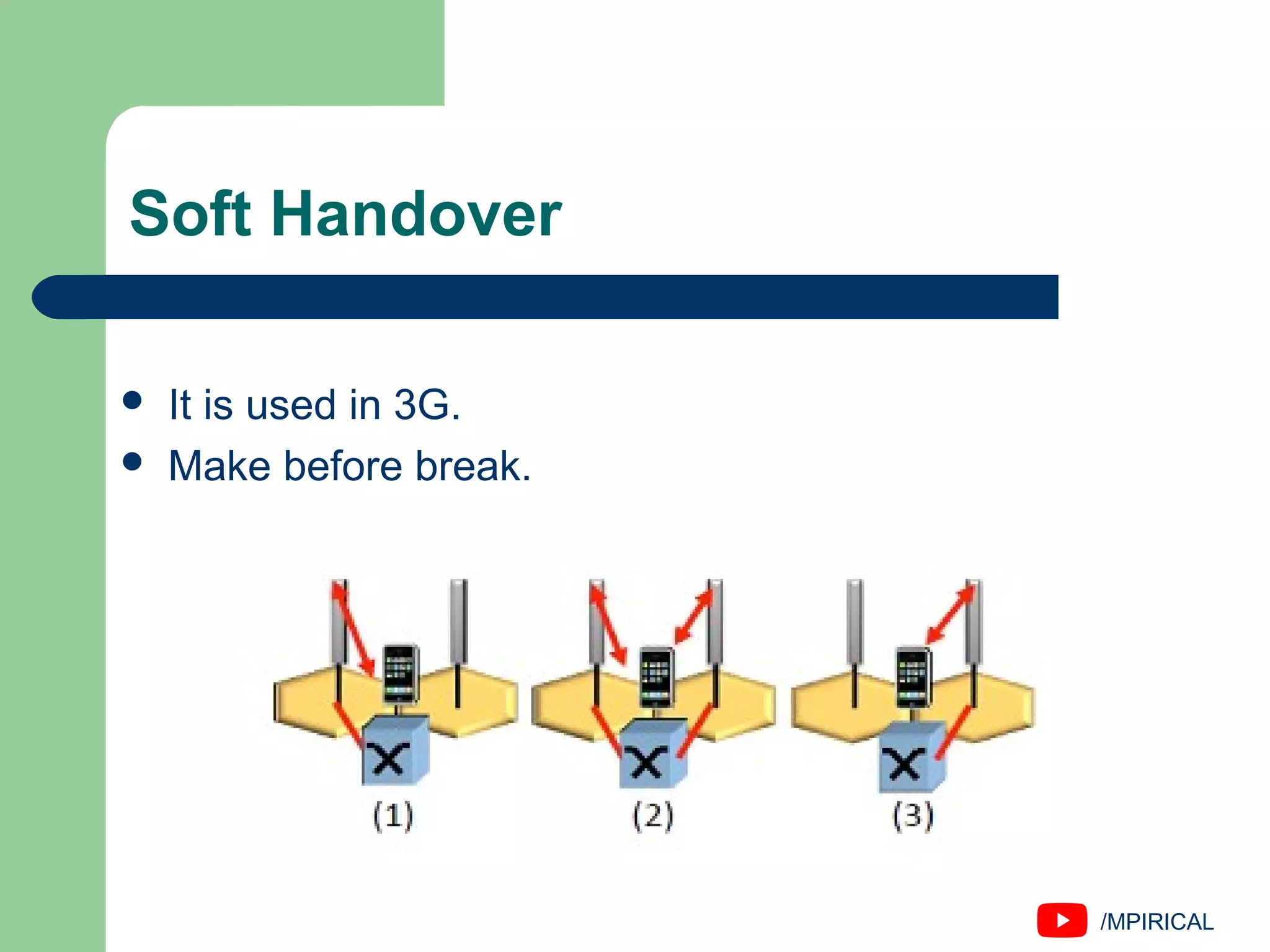
Soft Handover
 It is used in 3G.
 Make before break.
/MPIRICAL
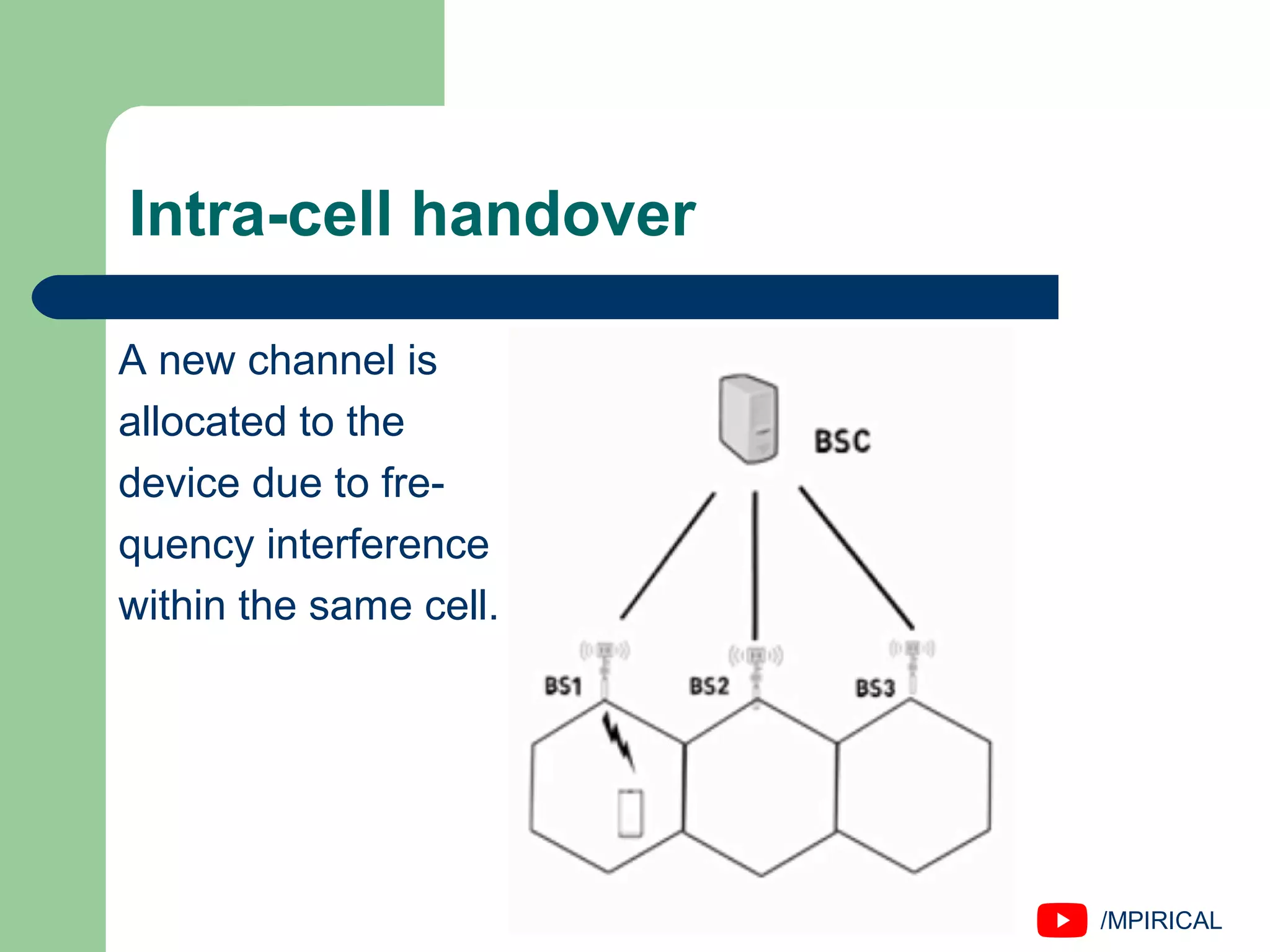
Intra-cell handover
A new channel is
allocated to the
device due to fre-
quency interference
within the same cell.
/MPIRICAL
Inter-cell, intra-BSC handover
The mobile device
move from one cell
to another cell in
same BSC area.
/MPIRICAL
Inter-BSC, intra-MSC handover
/MPIRICAL
The mobile station
moves from one cell
of a BSC to another
sell of another BSC
within same MSC
area.
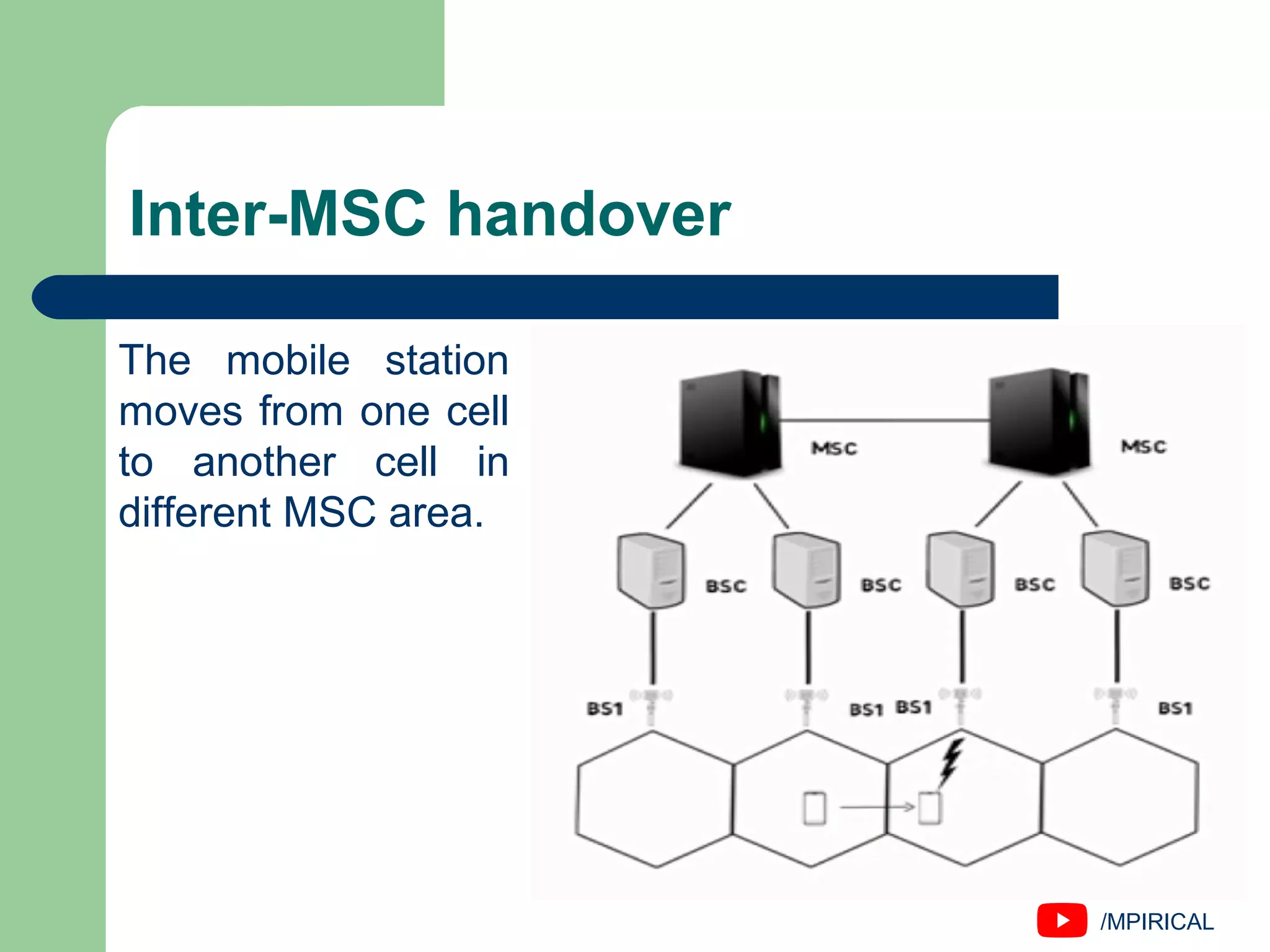
Inter-MSC handover
/MPIRICAL
The mobile station
moves from one cell
to another cell in
different MSC area.
References
 Website
 https://www.youtube.com/channel/MPIRICAL
 https://www.slideshare.net/AnkitaKhadatkar/handover-
in-telecom
https://www.mpirical.com/
Questions ?

Handover management

  • 1.
    /HASHMAT-KHAN Wireless & MobileCommunications Handover Management
  • 2.
    Handover/Handoff Management  Introduction Handover Decisions  Types of Handover/Handoff o Hard & Soft Handovers o Intra-cell handover o Inter-cell, intra-BSC handover o Inter-BSC, intra-MSC handover o Inter-MSC handover  References
  • 3.
    Introduction Basically, Handover meansthe giving of control of or responsibility for to someone else. Similarly, The process of changing point of communication while communicating is known as handover in cellular network.
  • 4.
    Handover Decisions There arenumerous methods for performing handoff. From the decision process point of view, one can find at least three different kinds of handoff/handover decisions. Network-Controlled Handoff Mobile-Assisted Handoff Mobile-Controlled Handoff https://www.slideshare.net/AnkitaKhadatkar/handover-in-telecom
  • 5.
    Network-Controlled Handoff  Networkmeasures the transmission quality via base stations and decides when handover should be executed.  In general, the handover process takes 100- 200 ms.  Network-controlled handoff is used in first- generaion analog systems such as AMPS (Advanced Mobile Phone System), TACS (Total Access Communication System), and NMT (Nordic Mobile Telephone). https://www.slideshare.net/AnkitaKhadatkar/handover-in-telecom
  • 6.
    Mobile-Assisted Handoff In amobile-assisted handoff process, the MS makes measurements and the network makes the decision. In the circuit-switched GSM (global system mobile), the BS controller (BSC) is in charge of some functions including handoff management. The handoff time between handoff decision and execution in a GSM is approximatelyy 1 second. https://www.slideshare.net/AnkitaKhadatkar/handover-in-telecom
  • 7.
    Mobile-Controlled Handoff In mobile-controlledhandoff, each MS is completely in control of the handoff process. This type of handoff has a short reaction time (in the order of 0.1 second). A handoff can be initiated if the signal strength of the serving BS is slower than that of another BS. https://www.slideshare.net/AnkitaKhadatkar/handover-in-telecom
  • 8.
    Hard Handover  Itis used in GSM (2G).  Break before make. /MPIRICAL
  • 9.
    Soft Handover  Itis used in 3G.  Make before break. /MPIRICAL
  • 10.
    Intra-cell handover A newchannel is allocated to the device due to fre- quency interference within the same cell. /MPIRICAL
  • 11.
    Inter-cell, intra-BSC handover Themobile device move from one cell to another cell in same BSC area. /MPIRICAL
  • 12.
    Inter-BSC, intra-MSC handover /MPIRICAL Themobile station moves from one cell of a BSC to another sell of another BSC within same MSC area.
  • 13.
    Inter-MSC handover /MPIRICAL The mobilestation moves from one cell to another cell in different MSC area.
  • 14.
    References  Website  https://www.youtube.com/channel/MPIRICAL https://www.slideshare.net/AnkitaKhadatkar/handover- in-telecom https://www.mpirical.com/
  • 15.