Social Media Research Methods.
New Approaches and Open Challenges

Dr. Katrin Weller
katrin.weller@gesis.org, @kwelle,
http://katrinweller.net
Presentation at Advanced Course
“Uses and effects of social media”
HHU Düsseldorf
26.11.2013
Background
Facebook vs. Twitter

Scopus (26.11.2013)
(TITLE-ABS-KEY(Twitter) AND PUBYEAR > 2006)
(TITLE-ABS-KEY(Facebook) AND PUBYEAR > 2004)
Facebook AND Twitter

4975

2007-2013
Scopus: Facebook
Scopus: Twitter
scopus: Facebook AND Twitter

1274

4975
4136
1274

4136
Scopus: TITLE-ABS-KEY(facebook), searched on 26.11.2013
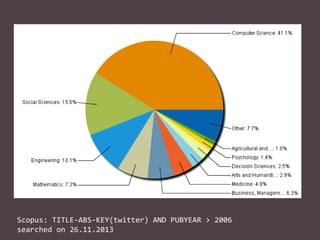
Scopus: TITLE-ABS-KEY(twitter) AND PUBYEAR > 2006
searched on 26.11.2013
Researching Social Media?
What is being studied?
•
•
•
•
•
•
•
•
•
•

User groups
Events
Audiences
Practices
Information flow
Influence
Opinions and sentiments
Networks
Interactions
…
How to study social media?
„information
disclosure
and privacy
on Facebook“

„Election
prediction
with Twitter
data“
Social Media Data?
Social Media Data
•
•
•
•
•
•
•

Texts
Images
Videos
Mixed formats
Connections I (friends, followers)
Connections II (links/URLs)
Connections/Actions (likes, favs,
comments, downloads)
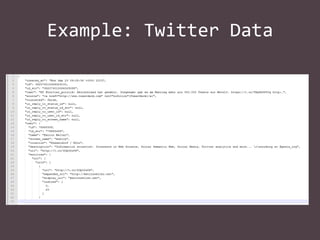
Example: Twitter Data
Data Collection and Access?

API
https://dev.twitter.com/console
Research Methods
Approaches
•
•
•
•

Surveys
Experiments
Interviews
Web ethnography

• Content analysis
• Network analysis
• Linguistic analyses (eg. sentiment
analysis)
 Rather rarely used in combination
Content Analysis
• E.g. with MAXQDA, QDAMiner, ATLAS.ti,
Qualrus, Nvivo
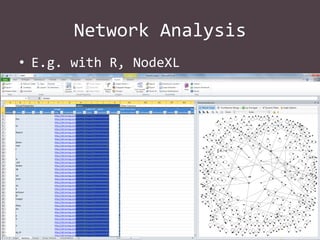
Network Analysis
• E.g. with R, NodeXL
Sentiment Analysis
• Mainly based on dictionaries such
as ANEW

http://link.springer.com/article/10.1007%2Fs
10902-009-9150-9/fulltext.html
Top 4 Chances
#1
Observing spontaneous
interactions and ephemeral
communication
#2
Access to data for a variety
of contexts and questions
#3
Rich data: multimedia
content plus networks plus
interactions
#4
Interdisciplinary field,
option to experiment with
new and combined methods
Top 4 Challenges
#1
Lack of theoretical
background
#2
data haves, data have-nots

boyd, danah and Kate
Crawford. (2012).
“Critical Questions for
Big Data”
#3
Representativeness?
#4
Missing standards (on
different levels)
Exciting work ahead!

Katrin Weller
@kwelle
katrin.weller@gesis.org
http://katrinweller.net
www.gesis.org
References
•
•

•

•

•
•

•

Ackland, R. (2013). Web Social Science. Los Angeles et al: SAGE.
Boyd, D., & Crawford, K. (2012). Critical questions for big data:
Provocations for a cultural, technological, and scholarly phenomenon.
Information, Communication, & Society, 15(5), 662-679.
Bruns, A. (2013). Faster than the speed of print: Reconciling ‘big data’
social media analysis and academic scholarship. First Monday 10(18).
Available http://firstmonday.org/ojs/index.php/fm/article/view/4879
Giglietto, F., Rossi, L., & Bennato, D. (2012). The Open Laboratory:
Limits and Possibilities of Using Facebook, Twitter, and YouTube as a
Research Data Source. Journal of Technology in Human Services, 30(3-4),
145–159.
Karpf, D. (2012). Social science research methods in internet time.
Information, Communication & Society, 5(15), 639-661.
Weller, K., Bruns, A., Burgess, J., Mahrt, M., & Puschmann, C. (2014).
Twitter and Society. New York et al.: Peter Lang.
Williams, S. A., Terras, M. M., Warwick, C. (2013). What do people study
when they study Twitter? Classifying Twitter related academic papers.
Journal of Documentation, 69(3), 384-410.

Social Media Research Methods