It’s a good question, and it speaks to a common con-
fusion. A forecast is not a prediction and at IFTF, we
generally correct anyone who uses the term. A predic-
tion is a statement that something will happen, and
these statements are almost always wrong. Journalists
and others love to highlight predictions that didn’t
come true, but why are they surprised? If we have
learned anything from forecasting, it is that nobody
can predict the future. Predicting the future is more
entertainment than research. Fortunetellers predict the
future; forecasters don’t.
A forecast is a plausible, internally consistent view of
what might happen. It’s designed not to be predictive
but to be provocative, able to inspire your imagina-
tion and challenge your assumptions. It should open
up new thoughts: new insights, new possible actions,
new ways of thinking. When you really think about it, a
prediction can be pretty useless—either you want it to
happen or you don’t, but you aren’t given any agency.
A forecast, in being plausible, highlights the inherent
ambiguity of the future, and ultimately, the ambiguity
of the present. Dilemmas are everywhere, and we just
need to be attuned to them. Once we recognize them,
we can engage with them as opportunities. Even within
broad trends and driving forces, there’s a lot of room
for innovation and creativity, and that’s what forecasts
are supposed to stimulate.
For example, think about how worried some people
are about the baby boomers and their looming retire-
ment. Social Security crashing, businesses losing top
talent, the retirement economy strained. These pos-
sibilities are real, and if we ignored them, we wouldn’t
respect the ambiguity of this situation, but we can also
recognize that baby boomers will have a large amount
of wealth, a desire to keep active and engaged, and
many more years to live. Life expectancy is high
enough that retirees have years ahead of them, entirely
new lifestages. They’ll want to stay involved in society
and politics and culture. We can start thinking of cre-
ative ways to involve them in these discourses, to help
them redefine retirement, to carve new spaces in the
economy.
A forecast doesn’t need to “come true” to be worth-
while. In fact, you don’t need to agree with a forecast
to find it useful. Herman Kahn, who invented modern
scenario planning at the RAND Corporation, had a
unique disclaimer in the front of some of his reports
that read something like this: “Some of the ideas in this
report are deliberately misleading, in order to provoke
thought.”
One of Kahn’s most important books is Thinking
About the Unthinkable. Forecasting is a way to help
us all think in ways we don’t normally think. Kahn’s
unthinkable thinking fueled military strategy. He framed
the debate about thermonuclear war in new ways
by describing a frightening future in a vivid way that
helped policy makers consider the future implica-
tions of their action or inaction. The scenarios were
designed for the military, but they proved just as useful
for war protesters—if they were open-minded enough
to read them.
What a wonderful leadership skill: the ability to think
the unthinkable and create futures that nobody else
can imagine—or to prepare for futures that nobody
else thought to protect themselves against. Forecasting
is about learning to be comfortable with ambiguity so
that you can make better decisions in the present.
Ten-year forecasting is about leadership, not manage-
ment. It provides a unique perspective—a futures
context—that helps you create a distinctive and
guiding vision for your own organization.
The ten-year time horizon is an important choice.
Looking ten years ahead, we can see patterns more
clearly, even if the details are unclear. To be most use-
ful, a forecast should be far enough in the future to
go beyond an organization’s normal planning horizon
but not so far ahead that it becomes unbelievable or
irrelevant. Most of our forecasts focus ten years ahead,
is a Ph.D. social scientist who has led IFTF
through the earliest computer-conferencing
field trials to today’s efforts to bring intelligence
about the future to some of the top leaders in
organizations around the world.
Bob’s forthcoming book on the foresight-to-insight-to-action process recently created a perfect opportunity for our
newest member of the Ten-Year Forecast team, Matt Chwierut to “learn the ropes” of forecasting. Here Matt poses
some basic questions about the topics in the book.
though our range for recent forecasts has been from
three to 50 years. Generally speaking, looking ten years
ahead balances between being accessible and being
provocative. It can be best at highlighting the dilemmas
that are most important.
Modern strategic dilemmas have several key character-
istics. They tend to be unsolvable, recurrent, complex,
and often messy. They are both threatening and puz-
zling. They offer multiple choices, and in many cases,
more than one of those choices is attractive.
It’s important to distinguish a dilemma from a problem.
A problem is a question or a puzzle that needs to be
solved. Typically, at least in current thinking, a problem
has a binary (either/or) solution, or at least a clear solu-
tion. It is fun to solve problems, and you get a sense of
accomplishment. As we’re taught by dictionaries and
our modern culture, problems feel like they “need to be
solved.”
In a world of dilemmas, we still have many options for
response, but usually the options aren’t simple, and
usually they don’t come in pairs. Yes/no is not enough.
What’s beyond the yes/no? What might be a third way,
or a fourth, or a fifth? Expecting a binary solution can
get you in big trouble in the world of dilemmas.
Today’s leaders must learn how to thrive in uncertain
spaces—while listening to and perceiving what is going
on—without jumping to judgment too soon. Rapid judg-
ment is great when it’s appropriate to the situation,
but premature judgment can be downright dangerous.
When so many people are hungry for a simple moral
equation, the times are ripe for premature judgments.
Unless you are in an extreme situation, reflection is
usually more useful than reaction. Dilemmas can be a
source of insight and inspiration, if you can figure out
how to engage with and learn from them. You need
to cultivate an ability to hold, listen, and learn—while
resisting the temptation to know too soon. In addition,
you need the courage to decide when the time is right.
Dilemmas are messy and frustrating, but they are also
fertile ground for new insights and new inspiration, to
create strategy that succeeds—even when you can-
not solve. Dilemmas must be held in one’s mind and
exercised. Dilemmas cannot be resolved with quick
judgment or analytics. As Voltaire said, “Doubt is not a
pleasant condition, but certainty is absurd.”
Forecasting is a particularly useful method for engag-
ing with dilemmas because it’s all about sensing and
sensemaking, about becoming aware of what’s around
you. Sensemaking isn’t complete comprehension,
but rather finding frameworks that generate insights.
True sensing is hard work because it requires not only
watching and listening but also rethinking your own
frame for understanding what you’re seeing and hear-
ing. Sensing is a discipline of waiting actively—but
acting when the timing is right.
The biggest challenge for leaders today is to learn to
live with—and even embrace—the tensions inherent
in dilemmas. The foresight-to-insight-to-action cycle
is a framework for sensing and making sense out of
dilemmas—even if you can’t fully understand or control
what’s going on. The key is holding complexity in your
mind while still making strategic decisions. Foresight
helps you identify dilemmas and acknowledge ambi-
guity—indeed, it forces you to confront ambiguity. If
you resist the impulse to jump to conclusions, you
find yourself asking good questions, which yield good
insights. Insights are “a-ha” moments, which foster
innovation. You start to see dilemmas as opportunities,
and you come up with creative approaches. Then you
can start to craft your strategy—your action in the pres-
ent to engage productively with dilemmas.
a recent Stanford University graduate in inter-
disciplinary studies, with a particular interest in
social entrepreneurism, has joined the Ten-Year
Forecast team as a research editor.
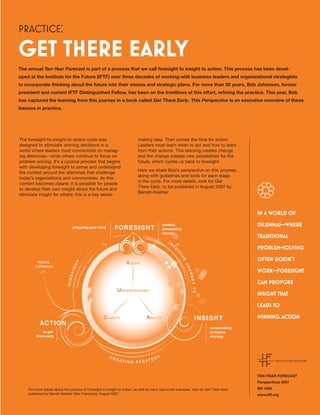
The foresight-to-insight-to-action cycle was
designed to stimulate winning decisions in a
world where leaders must concentrate on manag-
ing dilemmas—while others continue to focus on
problem solving. It’s a cyclical process that begins
with developing foresight to sense and understand
the context around the dilemmas that challenge
today’s organizations and communities. As this
context becomes clearer, it is possible for people
to develop their own insight about the future and
stimulate insight for others; this is a key sense-
making step. Then comes the time for action.
Leaders must learn when to act and how to learn
from their actions. This learning creates change
and the change creates new possibilities for the
future, which cycles us back to foresight.
Here we share Bob’s perspective on this process,
along with guidelines and tools for each stage
in the cycle. For more details, look for Get
There Early, to be published in August 2007 by
Berrett-Koehler.
TEN-YEAR FORECAST
Perspectives 2007
SR-1064
www.iftf.org
The annual Ten-Year Forecast is part of a process that we call foresight to insight to action. This process has been devel-
oped at the Institute for the Future (IFTF) over three decades of working with business leaders and organizational strategists
to incorporate thinking about the future into their visions and strategic plans. For more than 30 years, Bob Johansen, former
has captured the learning from this journey in a book called Get There Early. This Perspective is an executive overview of these
lessons in practice.
C R E A T I N G S T R A T E G Y
INSIGHT
ACTION
FORESIGHT
VISION
UNDERSTANDING
CLARITY AGILITY
HINDSIGHT
I N
T
U
IT
IVE
JOURNEYTO
Making
a difference
to get
there early
sensemaking
to inspire
strategy
sensing
provocative
futures
preparing your mind
For somewhat mysterious reasons, small groups are par-
ticularly good at listening for the future in creative ways,
to generate insights and seed innovation. In an interactive
workshop setting, a group of 7–25 people can be amazingly
productive—if they can learn to engage constructively with
one another. An ideal foresight-to-insight-to-action work-
shop involves about 20 smart and engaging people from
varied generations and backgrounds.
When planning, start by assessing where you’d like to
focus. In IFTF’s work with top executives, a typical
workshop will have the following emphasis: 40% on
foresight that is provocative for this particular organization,
40% on insight provoked by the foresight, and 20% on
possible actions.
Next, figure out who the meeting owner is and what his or
her goal is. Target an outcome. Invite a diverse group of
participants. If possible, use a content facilitator who both
knows the content and understands how to guide a group
through the variety of exercises that lead from foresight to
insight to action. And of course, make sure you have a good
forecast to work with.
Then explore the techniques shown here to meet the small
group challenges and achieve your goals.
Introductions for a familiar
group, where most people know
one another.
Introductions for an unfamiliar
group, where most people don’t
know one another.
Presentations where there is a
lot of complex material that is
new to participants.
Exploring possibilities or
stories, leveraging the group’s
experience to do so.
Focusing on individual learnings,
rather than group decision
making.
Focusing on group learning and
decision making.
Focusing on experience-based
learning.
Prioritizing insights or agreeing
on action steps.
Generating new insights or
possible action steps.
Going for actions, with sign-ups
regarding who will do what by
when.
Routine introductions can be short, but establishing a voice for each participant
is important. For example, “Tell us something that your colleagues do not know
about you.”
Introductions should be longer in order to engage the group. Keep the introductions
personal and draw links to content when appropriate.
Allow for very brief presentations to share material, and for discussion so people
can ask clarifying questions and make links to their own work situations (individual
learning), or to the situation or challenge under discussion (group learning).
Use small-group work for scenario-creation activities. Provide clear guidelines and,
in some cases, an example to stimulate people’s thinking. Imaginative activities are
usually most effective when people have had an opportunity to review new material
before being asked to create scenarios or stories.
Provide tools such as learning journals and time to allow people to gather their
thoughts. Allow time for individuals to work on their own to develop their ideas,
and use small-group discussions and sharing to enable people to learn from one
another.
Use the time to go back and forth between sharing information and both large- and
small-group discussion. When you break into small groups, allow time for reporting
out and discussion that builds on the ideas developed in the small-group setting.
Small groups can leverage the diversity of expertise in the room to dig deeper into
specific topics.
Use group immersive experiences with time to debrief and share the lessons. For
example, consumer home visits or shop-alongs can be used to explore new product
possibilities.
Include dot voting on ideas or strategies once they are presented and discussed,
and include both small- and large-group discussion to build shared understanding
and consensus. Small groups can be effective at advancing complex ideas,
particularly when you have a lot of material to cover.
Divide people into small groups to maximize creativity. Use the large-group work
to share new ideas and explore critical questions. If needed, use the large group to
stimulate new discussion.
If participants are responsible for making sure the work gets done, use part of your
session to sign people up for next steps. Encourage your outcome owner to have a
list of people he believes could successfully implement any actions you agree
to take.
For more details about the practice of Foresight to Insight to Action, as well as many real-world examples, look for Get There Early,
published by Berrett-Koehler (San Francisco), August 2007.
© 2007 Institute for the Future. All rights reserved. All brands and trademarks are the property of their respective owners. Reproduction is prohibited without written permission.
Even before you begin a forecasting exercise,
a first step is to prepare the mind for the
always uncertain future. A prepared mind is
ready to think the unthinkable. It’s also able to
hold multiple realities without jumping to judg-
ment too early.
Preparing your mind is a readiness exercise,
to probe where you are as a leader—at any
level of your organization. It’s also about
probing where the organization is. Once you
know where you are, it is much easier to
sense where to start in the vast array of future
options that you might consider.
The best sensing is done with an open mind
that resists judgment long enough to figure
out what’s going on—even if what’s going on
doesn’t fit your expectations or honor your
values. Often, the most innovative ideas come
from engaging with what feels most foreign,
from those moments when you have a strange
sense in the pit of your stomach that some-
thing doesn’t fit.
You can always be working to prepare your
mind, especially in tough situations. A key
practice is to resist shutting down or respond-
ing instinctively when what is going on
catches you off guard. The first question to
ask when you arrive early in a new situation
is, “What’s going on here?” If you’re having
strong reactions, ask yourself, “Why am I
reacting this way? Which of my assumptions
are being challenged? Do those assumptions
deserve to be challenged?”
Deep sensing is difficult because we are often
rushing for judgment and are rewarded for
speed in decision making. Sensing requires
a pause, sometimes a long pause. Sensing
requires reflection to get beneath surface
reactions and see what is really going on,
beneath what it looks like is going on or what
others might like you to believe is going on.
Sensing requires the discipline to hold at the
perception stage just long enough, before
moving to judgment. Foresight encourages
you to spend more time sensing, to develop
skills in asking questions that matter and
resisting answers that don’t. The quest is to
avoid answers that are premature, answers
that reflect only your assumptions—and get
to the new insight that might be revealed from
more careful consideration.
Preparing your mind may be the most impor-
tant stage in creating a forecast that is truly
useful.
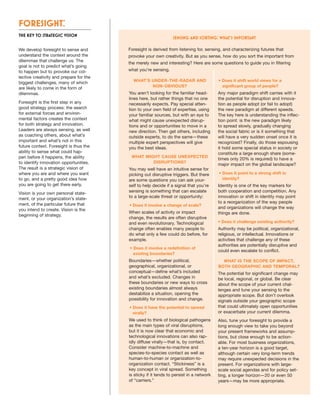
We develop foresight to sense and
understand the context around the
dilemmas that challenge us. The
goal is not to predict what’s going
to happen but to provoke our col-
lective creativity and prepare for the
biggest challenges, many of which
are likely to come in the form of
dilemmas.
Foresight is the first step in any
good strategy process: the search
for external forces and environ-
mental factors creates the context
for both strategy and innovation.
Leaders are always sensing, as well
as coaching others, about what’s
important and what’s not in this
future context. Foresight is thus the
ability to sense what could hap-
pen before it happens, the ability
to identify innovation opportunities.
The result is a strategic vision of
where you are and where you want
to go, and a pretty good idea how
you are going to get there early.
Vision is your own personal state-
ment, or your organization’s state-
ment, of the particular future that
you intend to create. Vision is the
beginning of strategy.
Even in a world of dilemmas,
decisions need to be made.
But leaders must be tuned to
the emergent realities around
them in order to decide
what to do and when to act.
Connection is key, and leaders
are always connecting: people
to people, ideas to ideas. Many
innovations are simply connec-
tions that are made for the first
time. Leaders need a flexible
learn-as-you-go style—since
most dilemmas keep changing
faces. Strategy leads to deci-
sions and action—in order to
make a difference. Even when
the action begins, it must be
carried out with agility—in
order to respond to the inevi-
table corrections that will be
required. Firm action is need-
ed, with an ability to flex.
Action is aimed at results, at
making a difference. In the
business environment, making
a difference can mean mak-
ing a certain amount of money
within a designated timeframe,
but making money can be
defined in many different ways,
with different processes: out-
comes, return on investment,
implementation, shareholder
value, rollout, change, com-
mercialization, institutionaliza-
tion, or execution. These are
all outcome oriented, but even
outcomes often come about in
stages.
The ultimate basis for evaluat-
ing a forecast is not what you
got right in the forecast but
whether the forecast helped
leaders make better decisions
that led to action that made a
difference.
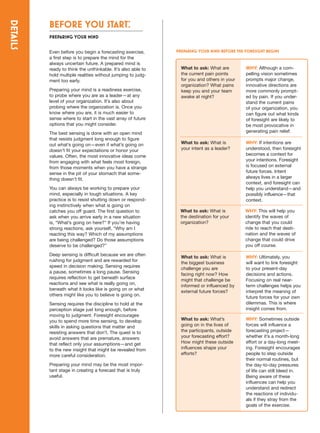
What to ask: What are
the current pain points
for you and others in your
organization? What pains
keep you and your team
awake at night?
WHY: Although a com-
pelling vision sometimes
prompts major change,
innovative directions are
more commonly prompt-
ed by pain. If you under-
stand the current pains
of your organization, you
can figure out what kinds
of foresight are likely to
be most provocative in
generating pain relief.
What to ask: What is
your intent as a leader?
WHY: If intentions are
understood, then foresight
becomes a context for
your intentions. Foresight
is focused on external
future forces. Intent
always lives in a larger
context, and foresight can
help you understand—and
possibly influence—that
context.
What to ask: What is
the destination for your
organization?
WHY: This will help you
identify the waves of
change that you could
ride to reach that desti-
nation and the waves of
change that could drive
you off course.
What to ask: What is
the biggest business
challenge you are
facing right now? How
might that challenge be
informed or influenced by
external future forces?
WHY: Ultimately, you
will want to link foresight
to your present-day
decisions and actions.
Focusing on real near-
term challenges helps you
interpret the meaning of
future forces for your own
dilemmas. This is where
insight comes from.
What to ask: What’s
going on in the lives of
the participants, outside
your forecasting effort?
How might these outside
influences shape your
efforts?
WHY: Sometimes outside
forces will influence a
forecasting project—
whether it’s a month-long
effort or a day-long meet-
ing. Foresight encourages
people to step outside
their normal routines, but
the day-to-day pressures
of life can still bleed in.
Being aware of these
influences can help you
understand and redirect
the reactions of individu-
als if they stray from the
goals of the exercise.
WHAT’S UNDER-THE-RADAR AND
NON-OBVIOUS?
You aren’t looking for the familiar head-
lines here, but rather things that no one
necessarily expects. Pay special atten-
tion to your own field of expertise, using
your familiar sources, but with an eye to
what might cause unexpected disrup-
tions and or opportunities to move in a
new direction. Then get others, including
outside experts, to do the same—these
multiple expert perspectives will give
you the best ideas.
WHAT MIGHT CAUSE UNEXPECTED
DISRUPTIONS?
You may well have an intuitive sense for
picking out disruptive triggers. But there
are some questions you can ask your-
self to help decide if a signal that you’re
sensing is something that can escalate
to a large-scale threat or opportunity:
• Does it involve a change of scale?
When scales of activity or impact
change, the results are often disruptive
and even revolutionary. Technological
change often enables many people to
do what only a few could do before, for
example.
• Does it involve a redefinition of
existing boundaries?
Boundaries—whether political,
geographical, organizational, or
conceptual—define what’s included
and what’s excluded. Changes in
these boundaries or new ways to cross
existing boundaries almost always
destabilize a situation, opening the
possibility for innovation and change.
• Does it have the potential to spread
virally?
We used to think of biological pathogens
as the main types of viral disruptions,
but it is now clear that economic and
technological innovations can also rap-
idly diffuse virally—that is, by contact.
Consider machine-to-machine and
species-to-species contact as well as
human-to-human or organization-to-
organization contact. “Stickiness” is a
key concept in viral spread. Something
is sticky if it tends to persist in a network
of “carriers.”
• Does it shift world views for a
significant group of people?
Any major paradigm shift carries with it
the potential for disruption and innova-
tion as people adopt (or fail to adopt)
the new paradigm at different speeds.
The key here is understanding the inflec-
tion point: is the new paradigm likely
to spread slowly, gradually changing
the social fabric or is it something that
will have a very sudden onset once it is
recognized? Finally, do those espousing
it hold some special status in society or
constitute a large enough share (some-
times only 20% is required) to have a
major impact on the global landscape?
• Does it point to a strong shift in
identity?
Identity is one of the key markers for
both cooperation and competition. Any
innovation or shift in identity may point
to a reorganization of the way people
and organizations will change the way
things are done.
• Does it challenge existing authority?
Authority may be political, organizational,
religious, or intellectual. Innovations or
activities that challenge any of these
authorities are potentially disruptive and
could even escalate to conflict.
WHAT IS THE SCOPE OF IMPACT,
BOTH GEOGRAPHIC AND TEMPORAL?
The potential for significant change may
be local, regional, or global. Be clear
about the scope of your current chal-
lenges and tune your sensing to the
appropriate scope. But don’t overlook
signals outside your geographic scope
that could ultimately open opportunities
or exacerbate your current dilemma.
Also, tune your foresight to provide a
long enough view to take you beyond
your present frameworks and assump-
tions, but close enough to be action-
able. For most business organizations,
a ten-year horizon is a good target,
although certain very long-term trends
may require unexpected decisions in the
present. For organizations with large-
scale social agendas and for policy set-
ting, a longer horizon—20 or even 50
years—may be more appropriate.
Foresight is derived from listening for, sensing, and characterizing futures that
provoke your own creativity. But as you sense, how do you sort the important from
the merely new and interesting? Here are some questions to guide you in filtering
what you’re sensing.
Leaders are sensemakers: They
help others make sense—often by
asking penetrating questions. It
turns out that foresight is a particu-
larly good way to stimulate insight,
to help make sense out of dilem-
mas and imagine what you might
do next.
Sensemaking is, essentially, a
search for an “a-ha!” that contrib-
utes to your strategy and seeds
innovation. Insight is the core ele-
ment of any good strategy, but
insight is scarce, and it doesn’t just
happen. Insight is most likely to
happen as a result of hard work,
open-mindedness toward future
possibilities, intuition, and a touch
of serendipity.
Foresight is inherently provocative,
but leaders must draw lessons from
the provocation if they are to create
a clear, compelling, and productive
way forward. This is insight, and it
must be communicated clearly so
that not only you understand it but
so also do those whom you need to
engage.
In the end, insight is a necessary
prerequisite for a winning strategy.
Juxtaposition and cross impacts
Sometimes just putting two seemingly
unrelated forecasts side by side can pro-
voke an insight. Simple questions can
guide you: What happens when these
two things intersect? And what does that
mean for us?
You can also juxtapose forecasts to cur-
rent practices and situations. A good
way to do this is to make a two-column
list. The first column is a list of current
practices and assumptions; label this
column “What we’re moving from.” Then
juxtapose elements of the forecast with
each of the practices to see where they
might lead; put these new practices in the
second column and label it “What we’re
moving to.” These kinds of from–to state-
ments are a form of insight.
Finally, you can do this much more sys-
tematically in a cross-impact matrix. Put
your most important current assumptions
and practices on one axis and the most
important forecasts on the other. Then
explore the cells, asking “How might this
forecast change this practice? Each cell is
a potential insight.
Clustering and connecting the dots
Clustering is similar to juxtaposition, but
it involves finding the relationships among
multiple forecast elements. In the process
of trying to cluster, the mind automatically
draws on intuition, and as this intuition
rises to the surface, insights often emerge.
Clustering can be done by one person or
many. With many people, it’s more dif-
ficult because tapping on intuition tends
to draw one’s attention inside; in a group
environment, it’s hard to create space for
this “going inside.” One way to do this
is an exercise we call “silent clustering.”
In this exercise, dozens or maybe even a
hundred forecast elements are placed on
sticky cards and posted randomly on a
wall. Then everyone in the group begins
to move the cards around to cluster
them, all without speaking. Over about a
half hour, stable clusters tend to emerge,
and participants can begin to label them.
Sometimes the labels themselves rep-
resent an insight. Sometimes the insight
emerges from probing how all of the cards
in a cluster are related and what those
relationships mean for your practices—or
for any dilemmas you may be facing.
Scenarios and storytelling
Scenarios and storytelling take cluster-
ing to a more refined level. Instead of just
grouping forecast elements together, they
engage our “what if?” thinking to picture
the combined impacts and possibilities
in a “real-life” situation. Scenarios can
be very simple or very complex, but one
practice that can help in drawing out
insights is creating a little vignette—a
story that is populated with imaginary
people in the future who are coping with
a dilemma.
These peopled stories, like real-word
examples, make the abstract concrete.
Everybody likes examples because they
provide a hook to hang a lot of ideas on.
Sometimes present-day examples are
compelling enough to produce an insight.
But when they’re not—or when the fore-
cast diverges significantly from the future,
examples may not be readily available.
Then vignettes can fill the gap, again
drawing out our own intuitions and linking
them to foresight to produce insight.
Immersion experiences
When you’re immersed in a situation, all
your channels of knowing and sensing are
receiving signals. This complex feed of
environmental information can often reor-
ganize the way you think about the world.
So a very effective way of using foresight
to provoke insight is to find present-day
situations that suggest or point to the
future, and immerse yourself in them.
These immersion experiences can be
short field trips or extended stays. Many
organizations are increasingly interested in
ethnography as a way to get these immer-
sive experiences. Guided by forecasts—
for example, a forecast about the growing
importance of a region—ethnographic vis-
its can provide a multi-dimensional sense-
picture of an unfamiliar landscape that
has elements of the future landscape. This
sense-picture is another form of insight.
Simulations, which come in many
forms, offer another form of immersion.
Simulations create a low-risk environment
where people can learn in a first-person
way. These can range from 3-D virtual
worlds to alternate-reality and role-playing
games. They can be particularly effective
at developing new skills. You can practice
without the pressure of real-world conse-
quences, and this can prepare you to face
real challenges.
Example
Biotechnology at
Procter & Gamble
In 1999, our forecasts suggested
that biotech was becoming
increasingly important and that it
was mixing in very creative ways
with information technologies, as
we can see much more clearly
today. We presented this forecast
to the Global Leadership Council
of Procter & Gamble (P&G). Our
foresight for P&G was that bio-
tech would become increasingly
important for many P&G products.
The top 12 people at P&G looked
around the table and realized that
none of them had the expertise
needed to make good business
decisions with regard to biotech.
This was an insight, an “a-ha!”
moment, for P&G.
The action was to create a
Biotech Reverse Mentoring
Program for the top 12 people
at P&G. We located young Ph.D.
biotech scientists, all of them at
P&G, who were willing to become
reverse mentors for their senior
executive colleagues—meeting
about once a month for one year.
The result was a considerable
increase in the biotech expertise
of the top executives: they did
not become scientists, but they
certainly knew a lot more about
the business implications of this
new area of science. At the end
of the year, P&G had a biotech
strategy, and you can now see the
results of this strategy reflected
in many P&G products, especially
in detergents and hair care prod-
ucts. One of the top executives,
A. G. Lafley, continued to use his
reverse mentor, Len Sauers, as
an informal science adviser even
after he became CEO of Procter &
Gamble.
Example
Campbell’s Soup and Healthy,
Portable, Nutritious Eating
In 2005, Campbell’s Soup execu-
tives looked at the marketplace
for their products and thought ten
years ahead. As part of this pro-
cess, they concluded that healthy,
portable, and nutritious eating will
be an important driver for the food
industry. They also concluded that
Campbell’s should be at the cen-
ter of this space.
The future of food will go to
those providers who do not view
taste and nutritional value as an
either/or choice. Rather, the most
successful foods will be both
tasty and nutritious. In the health
economy, more and more con-
sumers will use health as a filter to
evaluate products and services for
purchase. Food companies must
engage with the dilemma of creat-
ing healthy foods that taste good.
IFTF works with Campbell’s to do
forecasts of external future forces
affecting the concept of portable
nutritious foods like soup. We
also helped Campbell’s organize
a Future State Advisory Board to
advise it on external future forces.
The Campbell’s USA leadership
team developed a destination
statement, thinking ten years
ahead. The focus was on where
they wanted to be as a brand and
as a product line in ten years. The
essence of this destination is the
slogan “Nourishing people’s lives
everywhere, everyday.”
Around this core statement, spe-
cific dimensions of success were
developed, including measures
that could be used to track their
progress. This process was a use-
ful approach to strategic foresight,
where Campbell’s began with a
careful analysis of where they
wanted to be in ten years. From
that destination statement, they
could work backward to figure out
what they needed to do between
now and ten years from now in
order to reach their destination.