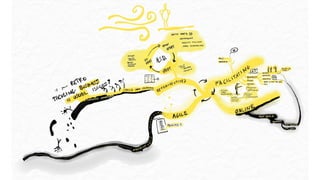
Responding to emergent challenges
With Perpetual Inquiry
Facilitating
Online Agile
Retrospectives
Hi, I am
Enrico Teotti!
● I am an agile coach and (visual)
facilitator with a background in
product management and
software development starting
in 2001
● worked and lived in Europe (6
years), Australia (7 years), and
the US (6 years)
“midwife of problems rather than the
offerer of therapies”
agenteo
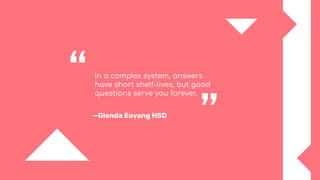
In a complex system, answers
have short shelf-lives, but good
questions serve you forever.
—Glenda Eoyang HSD
“
”
01
Facilitating Online
Agile
Retrospectives
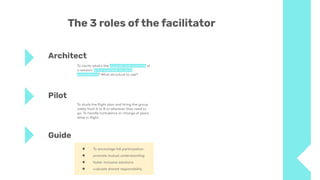
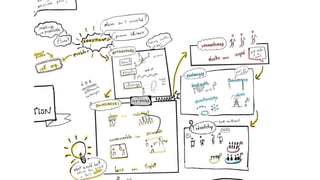
The 3 roles of the facilitator
Architect
Pilot
To study the flight plan and bring the group
safely from A to B or wherever they need to
go. To handle turbulence or change of plans
while in flight.
To clarify what’s the purpose and outcome of
a session. Is it a business as usual
conversation? What structure to use?
● To encourage full participation
● promote mutual understanding
● foster inclusive solutions
● cultivate shared responsibility.
Guide
So what’s your mandate?
● A tech lead?
● A scrum master?
● The team’s product manager?
● A contractor helping facilitate the retro?
● What’s your relationship with the group?
● Are they reporting to you?
● To encourage full participation
● promote mutual understanding
● foster inclusive solutions
● cultivate shared responsibility.
Understand not if
but how much your bias is
gonna affect your
facilitation.
Your
bias
● To encourage full participation
● promote mutual understanding
● foster inclusive solutions
● cultivate shared responsibility.
Clarifying your stake is critical so the group (and yourself) can be
aware of it and your bias.
Some ideas to manage your bias
What would it be like to co-facilitate?
What would it be like to rotate the facilitator role within
the team at regular cadence? Would the team be willing
and fit in a facilitation role? Would they like to learn about
it?
What would it be like to use a virtual background, visual
effect, wear or hold something to indicate when you’re
talking as “Enrico the product manager” instead of “Enrico
the session facilitator”?
When would you be better off with an external facilitator?
Perhaps from another team in your organization.
● To encourage full participation
● promote mutual understanding
● foster inclusive solutions
● cultivate shared responsibility.
02
Facilitating Online

Agile

Retrospectives
It’s not virtual
digital
constraints
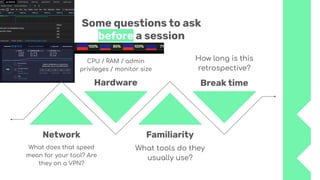
Some questions to ask
before a session
What does that speed
mean for your tool? Are
they on a VPN?
Network
Hardware
Familiarity
Break time
CPU / RAM / admin
privileges / monitor size
What tools do they
usually use?
How long is this
retrospective?
which
interactive
approach
Where are you now?
Where do you want to be?
How can you get there?
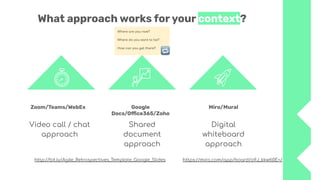
What approach works for your context?
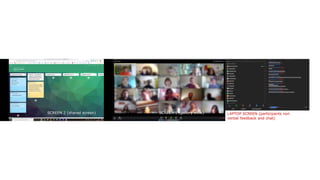
Video call / chat
approach
Google
Docs/Office365/Zoho
Shared
document
approach
Digital
whiteboard
approach
Zoom/Teams/WebEx Miro/Mural
http://bit.ly/Agile_Retrospectives_Template_Google_Slides https://miro.com/app/board/o9J_kkwtl0E=/
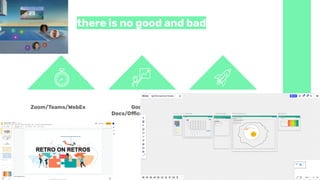
there is no good and bad
Google
Docs/Office365/Zoho
Zoom/Teams/WebEx Miro/Mural
03
Facilitating Online
Agile
Retrospectives
“Defined the best
buzzword after pizza”
embrace
uncertainty
inspect
and adapt
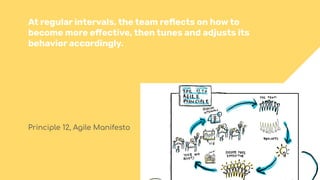
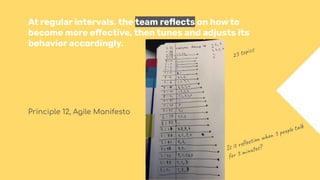
At regular intervals, the team reflects on how to
become more effective, then tunes and adjusts its
behavior accordingly.
Principle 12, Agile Manifesto
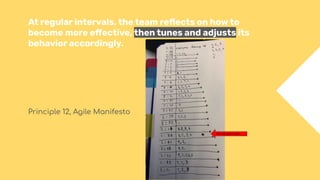
At regular intervals, the team reflects on how to
become more effective, then tunes and adjusts its
behavior accordingly.
Principle 12, Agile Manifesto
Is it reflection when 3 people talk
for 3 minutes?
23 topics
At regular intervals, the team reflects on how to
become more effective, then tunes and adjusts its
behavior accordingly.
Principle 12, Agile Manifesto
The one action item
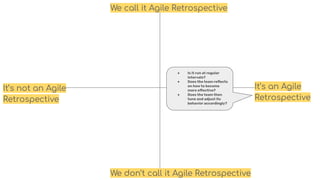
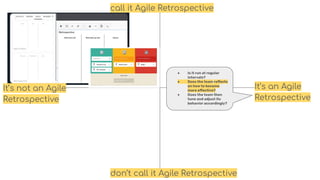
We call it Agile Retrospective
We don’t call it Agile Retrospective
It’s an Agile
Retrospective
It’s not an Agile
Retrospective
● Is it run at regular
intervals?
● Does the team reflects
on how to become
more effective?
● Does the team then
tune and adjust its
behavior accordingly?
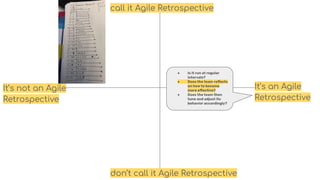
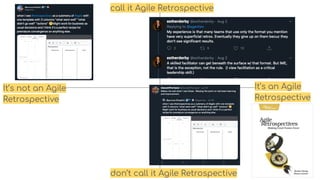
call it Agile Retrospective
don’t call it Agile Retrospective
It’s an Agile
Retrospective
It’s not an Agile
Retrospective
● Is it run at regular
intervals?
● Does the team reflects
on how to become
more effective?
● Does the team then
tune and adjust its
behavior accordingly?
call it Agile Retrospective
don’t call it Agile Retrospective
It’s an Agile
Retrospective
It’s not an Agile
Retrospective
● Is it run at regular
intervals?
● Does the team reflects
on how to become
more effective?
● Does the team then
tune and adjust its
behavior accordingly?
call it Agile Retrospective
don’t call it Agile Retrospective
It’s an Agile
Retrospective
It’s not an Agile
Retrospective
04
Facilitating Online
Agile
Retrospectives
At regular intervals, the team
reflects on how to become more
effective, then tunes and adjusts its
behavior accordingly.
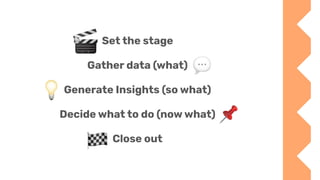
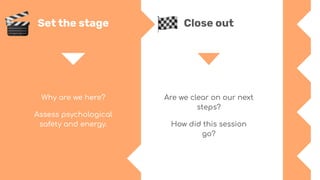
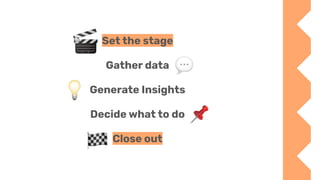
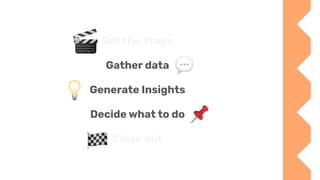
Set the stage
Gather data (what)
Generate Insights (so what)
Decide what to do (now what)
Close out
Why are we here?
Assess psychological
safety and energy.
Are we clear on our next
steps?
How did this session
go?
Set the stage Close out
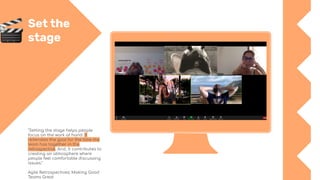
Set the
stage
"Setting the stage helps people
focus on the work at hand. It
reiterates the goal for the time the
team has together in the
retrospective. And, it contributes to
creating an atmosphere where
people feel comfortable discussing
issues."
Agile Retrospectives: Making Good
Teams Great
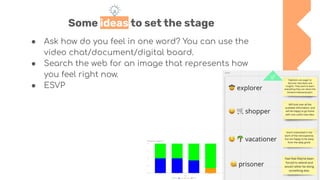
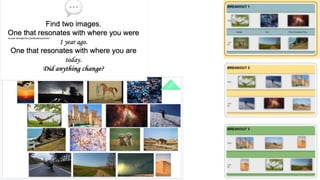
Some ideas to set the stage
● Ask how do you feel in one word? You can use the
video chat/document/digital board.
● Search the web for an image that represents how
you feel right now.
● ESVP
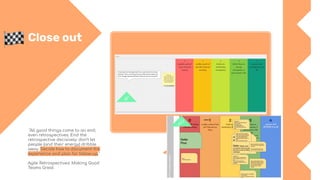
Close out
"All good things come to an end,
even retrospectives. End the
retrospective decisively: don’t let
people (and their energy) dribble
away. Decide how to document the
experience and plan for follow-up."
Agile Retrospectives: Making Good
Teams Great
S.M.A.R.T. F.I.N.E.
Close out
"All good things come to an end,
even retrospectives. End the
retrospective decisively: don’t let
people (and their energy) dribble
away. Decide how to document the
experience and plan for follow-up."
Agile Retrospectives: Making Good
Teams Great
S.M.A.R.T. F.I.N.E.
Close out
"All good things come to an end,
even retrospectives. End the
retrospective decisively: don’t let
people (and their energy) dribble
away. Decide how to document the
experience and plan for follow-up."
Agile Retrospectives: Making Good
Teams Great
Set the stage
Gather data
Generate Insights
Decide what to do
Close out
Set the stage
Gather data
Generate Insights
Decide what to do
Close out
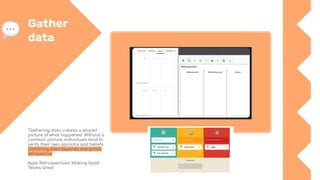
Gather
data
"Gathering data creates a shared
picture of what happened. Without a
common picture, individuals tend to
verify their own opinions and beliefs.
Gathering data expands everyone’s
perspective."
Agile Retrospectives: Making Good
Teams Great
Google
Slides
Where are you now?
Where do you want to be?
How can you get there?
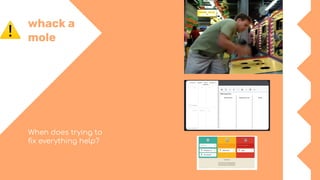
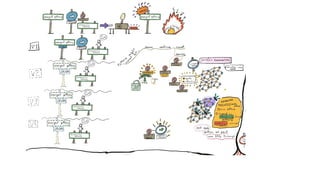
whack a
mole
When does trying to
fix everything help?
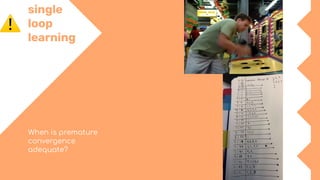
single
loop
learning
When is premature
convergence
adequate?
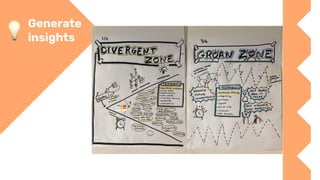
Generate
insights
"It’s easy for people to jump to
solutions once problems emerge.
First solutions may be correct, but
often they’re not. The work of this
phase is to consider additional
possibilities, look at causes and
effects, and think about them
analytically. It’s also a time for the
team to think together. These
insights help the team see how to
work more effectively—which is the
ultimate goal of any retrospective."
Agile Retrospectives: Making Good
Teams Great
Where are you now?
Where do you want to be?
How can you get there?
Generate
insights
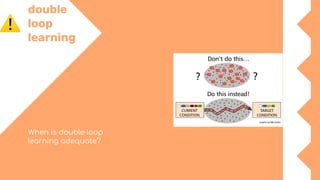
double
loop
learning
When is double loop
learning adequate?
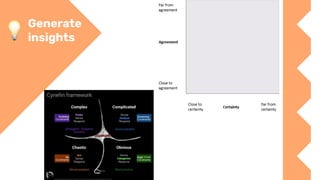
Generate
insights
Generate
insights
Imagine the next iteration is
perfect. What is it like? What did
you do?
Imagine you could time travel to
the end of the next iteration (or
release). You learn that it was the
best, most productive iteration
yet! How do your future selves
describe it? What do you see and
hear?
Give the team a little time to
imagine this state and jot down
some keywords to aid their
memory. Then let everyone
describe their vision of a perfect
iteration.
Follow up with What changes did
we implement that resulted in
such a productive and satisfying
future?
Write down the answers to use in
the next phase.
one idea
Decide
what to
do
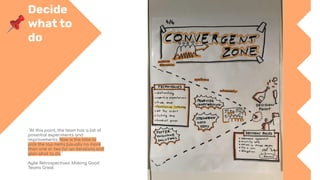
"At this point, the team has a list of
potential experiments and
improvements. Now is the time to
pick the top items (usually no more
than one or two for an iteration) and
plan what to do."
Agile Retrospectives: Making Good
Teams Great
Decide
what to
do
one activity idea
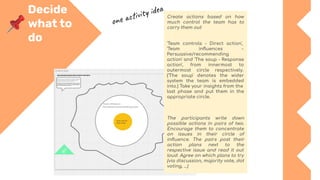
Create actions based on how
much control the team has to
carry them out
'Team controls - Direct action',
'Team influences -
Persuasive/recommending
action' and 'The soup - Response
action', from innermost to
outermost circle respectively.
('The soup' denotes the wider
system the team is embedded
into.) Take your insights from the
last phase and put them in the
appropriate circle.
The participants write down
possible actions in pairs of two.
Encourage them to concentrate
on issues in their circle of
influence. The pairs post their
action plans next to the
respective issue and read it out
loud. Agree on which plans to try
(via discussion, majority vote, dot
voting, ...)
Decide
what to
do
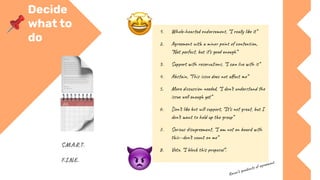
1. Whole-hearted endorsement, “I really like it”
2. Agreement with a minor point of contention,
“Not perfect, but it’s good enough”
3. Support with reservations, “I can live with it”
4. Abstain, “This issue does not affect me”
5. More discussion needed, “I don’t understand the
issue well enough yet”
6. Don’t like but will support, “It’s not great, but I
don’t want to hold up the group”
7. Serious disagreement, “I am not on board with
this--don’t count on me”
8. Veto, “I block this proposal”.
Kaner’s gradients of agreement
S.M.A.R.T.
F.I.N.E.
Facilitating Online Agile Retrospectives
● What’s the purpose and outcome of your retrospective?
● What’s your mandate with the team?
● What’s the group tech status? Proficiency, network speed,
CPU, screens etc etc?
● Where are you now? Where do you want to be? How can you
get there?
● What’s something I said that made you shake your head?
Why?
● What’s something I said that made you nod in agreement?
Why?
CREDITS:
This presentation template
was created by Slidesgo,
including icons by Flaticon,
infographics & images by Freepik
and illustrations by Stories
Thanks!
Do you have any questions?
enrico.teotti@avanscoperta.it
https://twitter.com/agenteo
https://teotti.com
Please keep this slide for attribution
Resources
https://miro.com/app/board/o9J_kkwtl0E=/
Online
Facilitation
Lean Coffee
1h every 2 weeks
capped to 10 people
Join us in a space to share experiences and
questions about facilitating online sessions.
This time is dedicated to tech leads, scrum
masters, product managers and all folks
interested or involved in online sessions.
You will be able to:
● bounce ideas off other peers
● share new ideas
● just tune in and listen
This is an experiment that will run for 2
months and will be hosted and visually
facilitated by Enrico Teotti.
At the end of the 2 months we will run a
retrospective open to all to decide what to
do with this space.
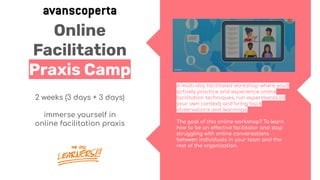
Online
Facilitation
Praxis Camp
2 weeks (3 days + 3 days)
immerse yourself in
online facilitation praxis
A multi-day facilitated workshop where you’ll
actively practice and experience online
facilitation techniques, run experiments (in
your own context) and bring back
observations and learnings.
The goal of this online workshop? To learn
how to be an effective facilitator and stop
struggling with online conversations
between individuals in your team and the
rest of the organization.
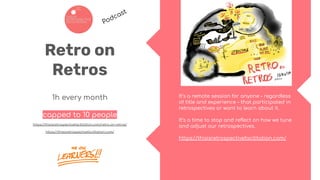
Retro on
Retros
1h every month
capped to 10 people
https://thisisretrospectivefacilitation.com/retro-on-retros/
https://thisisretrospectivefacilitation.com/
It’s a remote session for anyone – regardless
of title and experience – that participated in
retrospectives or want to learn about it.
It’s a time to stop and reflect on how we tune
and adjust our retrospectives.
https://thisisretrospectivefacilitation.com/
Podcast
Where is your Online
Facilitation of Agile
Retrospectives?
Where do you want it to be?
How do you get there?

Facilitating online agile retrospectives

  • 1.
    Responding to emergentchallenges With Perpetual Inquiry Facilitating Online Agile Retrospectives
  • 2.
    Hi, I am EnricoTeotti! ● I am an agile coach and (visual) facilitator with a background in product management and software development starting in 2001 ● worked and lived in Europe (6 years), Australia (7 years), and the US (6 years) “midwife of problems rather than the offerer of therapies”
  • 3.
  • 6.
    In a complexsystem, answers have short shelf-lives, but good questions serve you forever. —Glenda Eoyang HSD “ ”
  • 7.
  • 8.
    The 3 rolesof the facilitator Architect Pilot To study the flight plan and bring the group safely from A to B or wherever they need to go. To handle turbulence or change of plans while in flight. To clarify what’s the purpose and outcome of a session. Is it a business as usual conversation? What structure to use? ● To encourage full participation ● promote mutual understanding ● foster inclusive solutions ● cultivate shared responsibility. Guide
  • 9.
    So what’s yourmandate? ● A tech lead? ● A scrum master? ● The team’s product manager? ● A contractor helping facilitate the retro? ● What’s your relationship with the group? ● Are they reporting to you? ● To encourage full participation ● promote mutual understanding ● foster inclusive solutions ● cultivate shared responsibility.
  • 10.
    Understand not if buthow much your bias is gonna affect your facilitation. Your bias ● To encourage full participation ● promote mutual understanding ● foster inclusive solutions ● cultivate shared responsibility. Clarifying your stake is critical so the group (and yourself) can be aware of it and your bias.
  • 11.
    Some ideas tomanage your bias What would it be like to co-facilitate? What would it be like to rotate the facilitator role within the team at regular cadence? Would the team be willing and fit in a facilitation role? Would they like to learn about it? What would it be like to use a virtual background, visual effect, wear or hold something to indicate when you’re talking as “Enrico the product manager” instead of “Enrico the session facilitator”? When would you be better off with an external facilitator? Perhaps from another team in your organization. ● To encourage full participation ● promote mutual understanding ● foster inclusive solutions ● cultivate shared responsibility.
  • 12.
  • 13.
  • 14.
    Some questions toask before a session What does that speed mean for your tool? Are they on a VPN? Network Hardware Familiarity Break time CPU / RAM / admin privileges / monitor size What tools do they usually use? How long is this retrospective?
  • 16.
  • 18.
    Where are younow? Where do you want to be? How can you get there? What approach works for your context? Video call / chat approach Google Docs/Office365/Zoho Shared document approach Digital whiteboard approach Zoom/Teams/WebEx Miro/Mural http://bit.ly/Agile_Retrospectives_Template_Google_Slides https://miro.com/app/board/o9J_kkwtl0E=/
  • 19.
    there is nogood and bad Google Docs/Office365/Zoho Zoom/Teams/WebEx Miro/Mural
  • 20.
  • 22.
  • 23.
  • 24.
    At regular intervals,the team reflects on how to become more effective, then tunes and adjusts its behavior accordingly. Principle 12, Agile Manifesto
  • 25.
    At regular intervals,the team reflects on how to become more effective, then tunes and adjusts its behavior accordingly. Principle 12, Agile Manifesto Is it reflection when 3 people talk for 3 minutes? 23 topics
  • 26.
    At regular intervals,the team reflects on how to become more effective, then tunes and adjusts its behavior accordingly. Principle 12, Agile Manifesto The one action item
  • 27.
    We call itAgile Retrospective We don’t call it Agile Retrospective It’s an Agile Retrospective It’s not an Agile Retrospective ● Is it run at regular intervals? ● Does the team reflects on how to become more effective? ● Does the team then tune and adjust its behavior accordingly?
  • 28.
    call it AgileRetrospective don’t call it Agile Retrospective It’s an Agile Retrospective It’s not an Agile Retrospective ● Is it run at regular intervals? ● Does the team reflects on how to become more effective? ● Does the team then tune and adjust its behavior accordingly?
  • 29.
    call it AgileRetrospective don’t call it Agile Retrospective It’s an Agile Retrospective It’s not an Agile Retrospective ● Is it run at regular intervals? ● Does the team reflects on how to become more effective? ● Does the team then tune and adjust its behavior accordingly?
  • 30.
    call it AgileRetrospective don’t call it Agile Retrospective It’s an Agile Retrospective It’s not an Agile Retrospective
  • 31.
    04 Facilitating Online Agile Retrospectives At regularintervals, the team reflects on how to become more effective, then tunes and adjusts its behavior accordingly.
  • 32.
    Set the stage Gatherdata (what) Generate Insights (so what) Decide what to do (now what) Close out
  • 33.
    Why are wehere? Assess psychological safety and energy. Are we clear on our next steps? How did this session go? Set the stage Close out
  • 34.
    Set the stage "Setting thestage helps people focus on the work at hand. It reiterates the goal for the time the team has together in the retrospective. And, it contributes to creating an atmosphere where people feel comfortable discussing issues." Agile Retrospectives: Making Good Teams Great
  • 35.
    Some ideas toset the stage ● Ask how do you feel in one word? You can use the video chat/document/digital board. ● Search the web for an image that represents how you feel right now. ● ESVP
  • 37.
    Close out "All goodthings come to an end, even retrospectives. End the retrospective decisively: don’t let people (and their energy) dribble away. Decide how to document the experience and plan for follow-up." Agile Retrospectives: Making Good Teams Great S.M.A.R.T. F.I.N.E.
  • 38.
    Close out "All goodthings come to an end, even retrospectives. End the retrospective decisively: don’t let people (and their energy) dribble away. Decide how to document the experience and plan for follow-up." Agile Retrospectives: Making Good Teams Great S.M.A.R.T. F.I.N.E.
  • 39.
    Close out "All goodthings come to an end, even retrospectives. End the retrospective decisively: don’t let people (and their energy) dribble away. Decide how to document the experience and plan for follow-up." Agile Retrospectives: Making Good Teams Great
  • 40.
    Set the stage Gatherdata Generate Insights Decide what to do Close out
  • 41.
    Set the stage Gatherdata Generate Insights Decide what to do Close out
  • 42.
    Gather data "Gathering data createsa shared picture of what happened. Without a common picture, individuals tend to verify their own opinions and beliefs. Gathering data expands everyone’s perspective." Agile Retrospectives: Making Good Teams Great
  • 43.
    Google Slides Where are younow? Where do you want to be? How can you get there?
  • 44.
    whack a mole When doestrying to fix everything help?
  • 45.
  • 46.
    Generate insights "It’s easy forpeople to jump to solutions once problems emerge. First solutions may be correct, but often they’re not. The work of this phase is to consider additional possibilities, look at causes and effects, and think about them analytically. It’s also a time for the team to think together. These insights help the team see how to work more effectively—which is the ultimate goal of any retrospective." Agile Retrospectives: Making Good Teams Great Where are you now? Where do you want to be? How can you get there?
  • 47.
  • 48.
    double loop learning When is doubleloop learning adequate?
  • 49.
  • 51.
    Generate insights Imagine the nextiteration is perfect. What is it like? What did you do? Imagine you could time travel to the end of the next iteration (or release). You learn that it was the best, most productive iteration yet! How do your future selves describe it? What do you see and hear? Give the team a little time to imagine this state and jot down some keywords to aid their memory. Then let everyone describe their vision of a perfect iteration. Follow up with What changes did we implement that resulted in such a productive and satisfying future? Write down the answers to use in the next phase. one idea
  • 52.
    Decide what to do "At thispoint, the team has a list of potential experiments and improvements. Now is the time to pick the top items (usually no more than one or two for an iteration) and plan what to do." Agile Retrospectives: Making Good Teams Great
  • 53.
    Decide what to do one activityidea Create actions based on how much control the team has to carry them out 'Team controls - Direct action', 'Team influences - Persuasive/recommending action' and 'The soup - Response action', from innermost to outermost circle respectively. ('The soup' denotes the wider system the team is embedded into.) Take your insights from the last phase and put them in the appropriate circle. The participants write down possible actions in pairs of two. Encourage them to concentrate on issues in their circle of influence. The pairs post their action plans next to the respective issue and read it out loud. Agree on which plans to try (via discussion, majority vote, dot voting, ...)
  • 54.
    Decide what to do 1. Whole-heartedendorsement, “I really like it” 2. Agreement with a minor point of contention, “Not perfect, but it’s good enough” 3. Support with reservations, “I can live with it” 4. Abstain, “This issue does not affect me” 5. More discussion needed, “I don’t understand the issue well enough yet” 6. Don’t like but will support, “It’s not great, but I don’t want to hold up the group” 7. Serious disagreement, “I am not on board with this--don’t count on me” 8. Veto, “I block this proposal”. Kaner’s gradients of agreement S.M.A.R.T. F.I.N.E.
  • 55.
    Facilitating Online AgileRetrospectives ● What’s the purpose and outcome of your retrospective? ● What’s your mandate with the team? ● What’s the group tech status? Proficiency, network speed, CPU, screens etc etc? ● Where are you now? Where do you want to be? How can you get there? ● What’s something I said that made you shake your head? Why? ● What’s something I said that made you nod in agreement? Why?
  • 56.
    CREDITS: This presentation template wascreated by Slidesgo, including icons by Flaticon, infographics & images by Freepik and illustrations by Stories Thanks! Do you have any questions? enrico.teotti@avanscoperta.it https://twitter.com/agenteo https://teotti.com Please keep this slide for attribution
  • 57.
  • 58.
    Online Facilitation Lean Coffee 1h every2 weeks capped to 10 people Join us in a space to share experiences and questions about facilitating online sessions. This time is dedicated to tech leads, scrum masters, product managers and all folks interested or involved in online sessions. You will be able to: ● bounce ideas off other peers ● share new ideas ● just tune in and listen This is an experiment that will run for 2 months and will be hosted and visually facilitated by Enrico Teotti. At the end of the 2 months we will run a retrospective open to all to decide what to do with this space.
  • 59.
    Online Facilitation Praxis Camp 2 weeks(3 days + 3 days) immerse yourself in online facilitation praxis A multi-day facilitated workshop where you’ll actively practice and experience online facilitation techniques, run experiments (in your own context) and bring back observations and learnings. The goal of this online workshop? To learn how to be an effective facilitator and stop struggling with online conversations between individuals in your team and the rest of the organization.
  • 60.
    Retro on Retros 1h everymonth capped to 10 people https://thisisretrospectivefacilitation.com/retro-on-retros/ https://thisisretrospectivefacilitation.com/ It’s a remote session for anyone – regardless of title and experience – that participated in retrospectives or want to learn about it. It’s a time to stop and reflect on how we tune and adjust our retrospectives. https://thisisretrospectivefacilitation.com/ Podcast
  • 61.
    Where is yourOnline Facilitation of Agile Retrospectives? Where do you want it to be? How do you get there?