WHISTLEBLOWING "Our lives begin to end the day we become  silent about things that matter."  -Martin Luther King, Jr.
Overview What is Whistleblowing? Reactions Laws Protecting whistle Blowing How to blow the whistle? Risks Statistics Ethical Dilemma Case Study:  Challenger Disaster 2002:  The Year of the Whistleblower
What is Whistleblowing? Whistleblowing is… 'raising concerns about misconduct within an organization or within an independent structure associated with it'  (Nolan Committee on Standards in Public Life) 'bringing an activity to a sharp conclusion as if by the blast of a whistle'  (Oxford English Dictionary) 'giving information (usually to the authorities) about illegal and underhand practices‘  (Chambers Dictionary)
TYPES OF WHISTLE-BLOWING Internal whistleblowing:   who report misconduct to a fellow employee or superior within their company.   External whistleblowing:   report misconduct to outside persons or entities.
REACTIONS Selfless Martyrs v/s Snitches IMPACT: Termination  Demotions Mistreatment No Future Promotions
LAWS PROTECTING WHISTLEBLOWERS Federal Whistleblower Protect Act 1989 Federal False Claims Act State Laws Whistleblower Protection Act of 2007
WHISTLEBLOWER WEEK IN WASHINGTON The week of May 13-19 2007, whistleblowers from all over the country gathered in Washington, D.C., to convince the United States Congress to pass stronger whistleblower protections for both government and private sector workers. During WWW dozens of nonprofit organizations, whistleblower groups and individual whistleblowers participated in a broad range of activities that included discussion panels, testimony, award ceremonies, a film night and book signing, and workshops in advocacy, stress management, whistleblower law, and mentoring.
What to think about The “mom” test: “I’m going to be in this industry a long time.  Will this damage my reputation with my boss, colleagues, future customers or employers?” The personal responsibility test: Weigh personal obligations to family and etc. that can only be met if you have an income.  “Will harm avoided by greater than harm incurred?”
How to Blow the Whistle Do it anonymously let the evidence speak for itself and protect yourself if possible Do it in a group charges have more weight and won’t seem like a personal vendetta. Present just the evidence leave interpretation of facts to others. Work through internal channels start with your immediate supervisor or follow the standard reporting procedure Work through external channels go public (biggest risk)
Risks of Whistleblowing WB rarely works out well for the whistleblower Viewed as a “rat” who ratted out the company Resented by coworkers Serious contemplation of job change or personal problematic activity (drinking, drugs, self-destructive behavior) Depends on the organization for a job, the job makes money, the family needs money to survive
Statistics Polling Group: 233 individuals polled, 40% responded Average age:  47 Employed for 6.5 years at job Almost all lost job
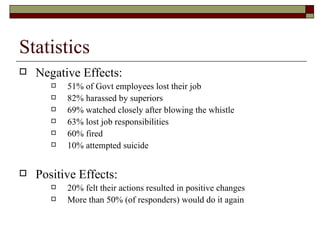
Statistics Negative Effects: 51% of Govt employees lost their job 82% harassed by superiors 69% watched closely after blowing the whistle 63% lost job responsibilities 60% fired 10% attempted suicide Positive Effects: 20% felt their actions resulted in positive changes More than 50% (of responders) would do it again
Ethical Dilemma The Mum Effect --reluctance to blow the whistle The Deaf Effect --reluctance to hear the whistle “ I wrote lots of reports.  I escalated things as much as I could, but in the end, they said, ‘We really appreciate your efforts, but thanks, but no thanks’” The Blind Effect --reluctance to see the need to blow the whistle Established audit functions do not operate effectively because they try to conceal the information from management
2002:  Year of the Whistleblower Cynthia Cooper  WorldCom Coleen Rowley FBI Sherron Watkins Enron
Sherron Watkins Former Vice President of Enron Corporation Alerted then-CEO Ken Lay in August 2001 to accounting irregularities within the company Warned that Enron 'might implode in a wave of accounting scandals.'  Testified before Congressional Committees from the House and Senate investigating Enron's demise.  Lauded in the press for her courageous actions, but left her job at Enron after a few months when she wasn't given much to do
Cynthia Cooper WorldCom’s Director of Internal Audit Her team discovered $3 billion in questionable expenses Met with 4 executives to track down and explain the undocumented expenses Disclosed findings, WorldCom stock frozen, corporate credit rating went from B+ to CCC- Remained as VP of Internal Audit, not promoted, no gratitude, resented by employees
Case Study:  Challenger January 28, 1986 Space Shuttle Challenger exploded 72 seconds into its flight, killing all 7 crew members.  The flight received much media  attention because a teacher, Christa  McAuliffe, was on board.
Challenger:  What Went Wrong Explosion caused by O-ring failure between segments of the booster rockets. Several employees of the manufacturer, Thiokol, had been aware of the O-ring deficiencies. No one listened to the engineers who knew about the problem
Challenger:  Major Players Roger Boisjoly, seal specialist at Thiokol Directed task force for a year to study the evidence that hot gases eroded O-rings Allan McDonald, manager of solid-rocket motor program Larry Mulloy, NASA official, manager of booster programs George Hardy, NASA official
Challenger:  Timeline July 31, 1985 Boisioly wrote a memo saying, “it is my honest and very real fear that if we do not take immediate action to solve the problem [the company could] stand in jeopardy of losing a flight.” No conclusive evidence to back up memo
Challenger:  Timeline  January 27, 1986, the day before lift-off McDonald was worried about temperatures dropping to 22 degrees overnight. 14 engineers “fought like hell” to get permission to present to NASA All 14 Thiokol engineers recommended postponing the launch Mulloy and Hardy challenged the recommendation Mulloy:  “When do you want me to launch, next April?” Hardy:  recommendation “appalled” him Thiokol:  Management reversed the recommendation for postponement What kind of dilemma was Thiokol forced into?
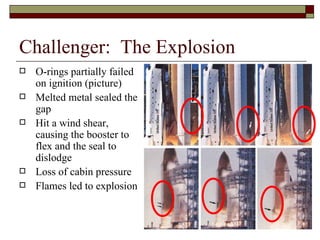
Challenger:  The Explosion O-rings partially failed on ignition (picture) Melted metal sealed the gap Hit a wind shear, causing the booster to flex and the seal to dislodge Loss of cabin pressure Flames led to explosion
Challenger:  Timeline After the explosion McDonald Went public Demoted by management Public outcry and Congressional investigation led to a reversal of that decision and a promotion instead Became spokesman for Thiokol and new rocket boosters Boisjoly “ I hope and pray that I have not risked my job and family security by being honest in my conviction” Never worked on a shuttle again because it was too painful Wondered if there was more he could have done, even though the record shows he minced no words Reassigned by management with altered responsibilities Took leave of absence, a year later went on disability
Challenger:  Questions What effects did Boisjoly and McDonald face when they blew the whistle? Why did NASA not listen to the engineers? Why did Thiokol to reverse its decision even though they knew it was incorrect? Would you have blown the whistle differently than Boisjoly and McDonald?  If so, how? Did McDonald go public at the right time?
THANK YOU

Whistleblowingfinal.....

  • 1.
    WHISTLEBLOWING "Our livesbegin to end the day we become silent about things that matter." -Martin Luther King, Jr.
  • 2.
    Overview What isWhistleblowing? Reactions Laws Protecting whistle Blowing How to blow the whistle? Risks Statistics Ethical Dilemma Case Study: Challenger Disaster 2002: The Year of the Whistleblower
  • 3.
    What is Whistleblowing?Whistleblowing is… 'raising concerns about misconduct within an organization or within an independent structure associated with it' (Nolan Committee on Standards in Public Life) 'bringing an activity to a sharp conclusion as if by the blast of a whistle' (Oxford English Dictionary) 'giving information (usually to the authorities) about illegal and underhand practices‘ (Chambers Dictionary)
  • 4.
    TYPES OF WHISTLE-BLOWINGInternal whistleblowing: who report misconduct to a fellow employee or superior within their company. External whistleblowing: report misconduct to outside persons or entities.
  • 5.
    REACTIONS Selfless Martyrsv/s Snitches IMPACT: Termination Demotions Mistreatment No Future Promotions
  • 6.
    LAWS PROTECTING WHISTLEBLOWERSFederal Whistleblower Protect Act 1989 Federal False Claims Act State Laws Whistleblower Protection Act of 2007
  • 7.
    WHISTLEBLOWER WEEK INWASHINGTON The week of May 13-19 2007, whistleblowers from all over the country gathered in Washington, D.C., to convince the United States Congress to pass stronger whistleblower protections for both government and private sector workers. During WWW dozens of nonprofit organizations, whistleblower groups and individual whistleblowers participated in a broad range of activities that included discussion panels, testimony, award ceremonies, a film night and book signing, and workshops in advocacy, stress management, whistleblower law, and mentoring.
  • 8.
    What to thinkabout The “mom” test: “I’m going to be in this industry a long time. Will this damage my reputation with my boss, colleagues, future customers or employers?” The personal responsibility test: Weigh personal obligations to family and etc. that can only be met if you have an income. “Will harm avoided by greater than harm incurred?”
  • 9.
    How to Blowthe Whistle Do it anonymously let the evidence speak for itself and protect yourself if possible Do it in a group charges have more weight and won’t seem like a personal vendetta. Present just the evidence leave interpretation of facts to others. Work through internal channels start with your immediate supervisor or follow the standard reporting procedure Work through external channels go public (biggest risk)
  • 10.
    Risks of WhistleblowingWB rarely works out well for the whistleblower Viewed as a “rat” who ratted out the company Resented by coworkers Serious contemplation of job change or personal problematic activity (drinking, drugs, self-destructive behavior) Depends on the organization for a job, the job makes money, the family needs money to survive
  • 11.
    Statistics Polling Group:233 individuals polled, 40% responded Average age: 47 Employed for 6.5 years at job Almost all lost job
  • 12.
    Statistics Negative Effects:51% of Govt employees lost their job 82% harassed by superiors 69% watched closely after blowing the whistle 63% lost job responsibilities 60% fired 10% attempted suicide Positive Effects: 20% felt their actions resulted in positive changes More than 50% (of responders) would do it again
  • 13.
    Ethical Dilemma TheMum Effect --reluctance to blow the whistle The Deaf Effect --reluctance to hear the whistle “ I wrote lots of reports. I escalated things as much as I could, but in the end, they said, ‘We really appreciate your efforts, but thanks, but no thanks’” The Blind Effect --reluctance to see the need to blow the whistle Established audit functions do not operate effectively because they try to conceal the information from management
  • 14.
    2002: Yearof the Whistleblower Cynthia Cooper WorldCom Coleen Rowley FBI Sherron Watkins Enron
  • 15.
    Sherron Watkins FormerVice President of Enron Corporation Alerted then-CEO Ken Lay in August 2001 to accounting irregularities within the company Warned that Enron 'might implode in a wave of accounting scandals.' Testified before Congressional Committees from the House and Senate investigating Enron's demise. Lauded in the press for her courageous actions, but left her job at Enron after a few months when she wasn't given much to do
  • 16.
    Cynthia Cooper WorldCom’sDirector of Internal Audit Her team discovered $3 billion in questionable expenses Met with 4 executives to track down and explain the undocumented expenses Disclosed findings, WorldCom stock frozen, corporate credit rating went from B+ to CCC- Remained as VP of Internal Audit, not promoted, no gratitude, resented by employees
  • 17.
    Case Study: Challenger January 28, 1986 Space Shuttle Challenger exploded 72 seconds into its flight, killing all 7 crew members. The flight received much media attention because a teacher, Christa McAuliffe, was on board.
  • 18.
    Challenger: WhatWent Wrong Explosion caused by O-ring failure between segments of the booster rockets. Several employees of the manufacturer, Thiokol, had been aware of the O-ring deficiencies. No one listened to the engineers who knew about the problem
  • 19.
    Challenger: MajorPlayers Roger Boisjoly, seal specialist at Thiokol Directed task force for a year to study the evidence that hot gases eroded O-rings Allan McDonald, manager of solid-rocket motor program Larry Mulloy, NASA official, manager of booster programs George Hardy, NASA official
  • 20.
    Challenger: TimelineJuly 31, 1985 Boisioly wrote a memo saying, “it is my honest and very real fear that if we do not take immediate action to solve the problem [the company could] stand in jeopardy of losing a flight.” No conclusive evidence to back up memo
  • 21.
    Challenger: Timeline January 27, 1986, the day before lift-off McDonald was worried about temperatures dropping to 22 degrees overnight. 14 engineers “fought like hell” to get permission to present to NASA All 14 Thiokol engineers recommended postponing the launch Mulloy and Hardy challenged the recommendation Mulloy: “When do you want me to launch, next April?” Hardy: recommendation “appalled” him Thiokol: Management reversed the recommendation for postponement What kind of dilemma was Thiokol forced into?
  • 22.
    Challenger: TheExplosion O-rings partially failed on ignition (picture) Melted metal sealed the gap Hit a wind shear, causing the booster to flex and the seal to dislodge Loss of cabin pressure Flames led to explosion
  • 23.
    Challenger: TimelineAfter the explosion McDonald Went public Demoted by management Public outcry and Congressional investigation led to a reversal of that decision and a promotion instead Became spokesman for Thiokol and new rocket boosters Boisjoly “ I hope and pray that I have not risked my job and family security by being honest in my conviction” Never worked on a shuttle again because it was too painful Wondered if there was more he could have done, even though the record shows he minced no words Reassigned by management with altered responsibilities Took leave of absence, a year later went on disability
  • 24.
    Challenger: QuestionsWhat effects did Boisjoly and McDonald face when they blew the whistle? Why did NASA not listen to the engineers? Why did Thiokol to reverse its decision even though they knew it was incorrect? Would you have blown the whistle differently than Boisjoly and McDonald? If so, how? Did McDonald go public at the right time?
  • 25.