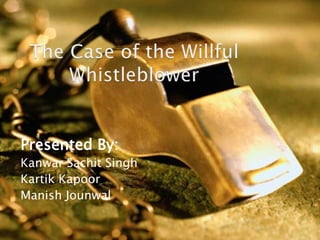
Presented By:
Kanwar Sachit Singh
Kartik Kapoor
Manish Jounwal
A whistleblower is defined as someone who exposes

wrongdoing, fraud, corruption or mismanagement.
• A whistleblower is a person who alleges misconduct
• Most whistleblowers are Internal whistleblowers, who report
misconduct to a fellow employee or superior within their company.

• External whistleblowers, however, report misconduct to outside
persons or entities like Media

• Whistle blowing is a strong means to deter corporate wrong doing
• Fairway Electric is among the most reputed companies in US
market for building nuclear power plants
• Jim Bower, loyal employee of Fairway Electric, accidentally
comes across an old Fairway report regarding a flaw in the

design of the Radon II reactor
• While it didn’t amount to a safety hazard, the flaw would’ve
resulted in additional costs for customers
• Jim brings the issue to the notice of his boss Bob, who
turns to the CEO Ken Deaver

• Ken tells Bob to suppress the issue
• Jim then takes matters into his own hand and anonymously
reports the issue to the media

• This results in a public outcry and damages the reputation
of the company

• Jim’s peers say they don’t wish to work with him
• At the end there is a talk of transfer/firing Jim
• Clients were kept in the dark about the structural
flaw even when Fairway became aware of it

• The additional costs resulting from the flaw would
not be borne by the company customers and the rate
payers

• Ken’s reaction to Jim’s discovery was to hush up the
entire matter as soon as possible
•

Ken’s priorities seemed to be focused on avoiding
any short term losses and not on company values

•

The identity of the whistle-blower was not kept
confidential and became common knowledge to

everyone in the company
•

No attempt was made to make the situation easier
for Jim, instead Ken directs Bob to transfer Jim to
another division to avoid any problems
•

Whistle blowing makes the organisation more responsible

•

Employees following unethical practices are caught and
actions can be taken on them

•

Companies having sound whistle blower policy are fined

much less in case of any stray event happening
•

Employees prefer using internal channel to highlight the
problem than taking it to outside media

•

Increased employee satisfaction as all instances of neglect is
noticed and acted upon

•

Helps strengthen employees as well as the customers trust
•

Whistle blowing can often bring to light issues

which are of great significance
•

This serves as a way to deter unethical practices by
companies

•

At times, new laws and practices are introduced
which may benefit the whole society

•

Having a whistleblower policy framework in place
keeps an internal check on the organization
•

Establish staff confidence that their issues will be taken seriously
by management

•

A clear and well-communicated anti-retribution policy

•

Staff involvement in the development of policies relating to whistle
blowing

•

Offering prompt and continuous responses to internal complaints

•

Promote organization's code of conduct

•

Switch from an internally operated anonymous tip hotline to one
that is managed by an outside party
•

Virtue ethics : Jim Bover

•

Teleological (Utilitarian) approach : Bob & Ken

•

Rationalizations :
o

“Best interest of the company”

o

“Not really illegal (no safety hazard)”

o

It is “safe” and will not be caught
◦ US: Whistleblower Protection Act of 1989, Corporate and

Criminal Fraud Accountability Act
◦ UK: Public Interest Disclosure Act of 1998
◦ India:


Public Interest Disclosure (Protection of Informers) Bill,
2009 was prepared by the department of personnel
and training (DoPT),



Central Agency (per Public Interest Disclosures and

Protection of Informers Resolution, 2004): CVC
case willful whistel blower

case willful whistel blower

  • 1.
    Presented By: Kanwar SachitSingh Kartik Kapoor Manish Jounwal
  • 2.
    A whistleblower isdefined as someone who exposes wrongdoing, fraud, corruption or mismanagement. • A whistleblower is a person who alleges misconduct • Most whistleblowers are Internal whistleblowers, who report misconduct to a fellow employee or superior within their company. • External whistleblowers, however, report misconduct to outside persons or entities like Media • Whistle blowing is a strong means to deter corporate wrong doing
  • 3.
    • Fairway Electricis among the most reputed companies in US market for building nuclear power plants • Jim Bower, loyal employee of Fairway Electric, accidentally comes across an old Fairway report regarding a flaw in the design of the Radon II reactor • While it didn’t amount to a safety hazard, the flaw would’ve resulted in additional costs for customers
  • 4.
    • Jim bringsthe issue to the notice of his boss Bob, who turns to the CEO Ken Deaver • Ken tells Bob to suppress the issue • Jim then takes matters into his own hand and anonymously reports the issue to the media • This results in a public outcry and damages the reputation of the company • Jim’s peers say they don’t wish to work with him • At the end there is a talk of transfer/firing Jim
  • 5.
    • Clients werekept in the dark about the structural flaw even when Fairway became aware of it • The additional costs resulting from the flaw would not be borne by the company customers and the rate payers • Ken’s reaction to Jim’s discovery was to hush up the entire matter as soon as possible
  • 6.
    • Ken’s priorities seemedto be focused on avoiding any short term losses and not on company values • The identity of the whistle-blower was not kept confidential and became common knowledge to everyone in the company • No attempt was made to make the situation easier for Jim, instead Ken directs Bob to transfer Jim to another division to avoid any problems
  • 7.
    • Whistle blowing makesthe organisation more responsible • Employees following unethical practices are caught and actions can be taken on them • Companies having sound whistle blower policy are fined much less in case of any stray event happening • Employees prefer using internal channel to highlight the problem than taking it to outside media • Increased employee satisfaction as all instances of neglect is noticed and acted upon • Helps strengthen employees as well as the customers trust
  • 8.
    • Whistle blowing canoften bring to light issues which are of great significance • This serves as a way to deter unethical practices by companies • At times, new laws and practices are introduced which may benefit the whole society • Having a whistleblower policy framework in place keeps an internal check on the organization
  • 9.
    • Establish staff confidencethat their issues will be taken seriously by management • A clear and well-communicated anti-retribution policy • Staff involvement in the development of policies relating to whistle blowing • Offering prompt and continuous responses to internal complaints • Promote organization's code of conduct • Switch from an internally operated anonymous tip hotline to one that is managed by an outside party
  • 10.
    • Virtue ethics :Jim Bover • Teleological (Utilitarian) approach : Bob & Ken • Rationalizations : o “Best interest of the company” o “Not really illegal (no safety hazard)” o It is “safe” and will not be caught
  • 11.
    ◦ US: WhistleblowerProtection Act of 1989, Corporate and Criminal Fraud Accountability Act ◦ UK: Public Interest Disclosure Act of 1998 ◦ India:  Public Interest Disclosure (Protection of Informers) Bill, 2009 was prepared by the department of personnel and training (DoPT),  Central Agency (per Public Interest Disclosures and Protection of Informers Resolution, 2004): CVC