• Definition
• Mechanism
• Causes
Izatty Lim
0308188
Batch 4

 Palpable and audible vibrations
 Musical in character
 Produced when airflow is restricted
DEFINITION
 The American Thoracic Society Committee
Wheeze: High pitched continuous sounds with a dominant
frequency of 400 Hz or more.

 MC: expiratory wheeze
 Typically reflect lower airway obstruction
 MC found with asthma & bronchiolitis
 Other causes: CHF & foreign body aspiration
 http://www.stethographics.com/main/physiology_ls_wheeze.html
 https://www.youtube.com/watch?v=BvnphT1QnNY
WHEEZE
Polyphonic Monophonic
Various pitch Single- pitch sound
Widespread narrowing of airways Narrowing of larger airways
Asthma Tracheomalacia, bronchomalacia
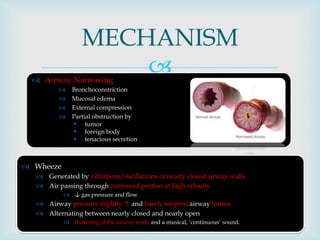
 Airway Narrowing
 Bronchoconstriction
 Mucosal edema
 External compression
 Partial obstruction by
 tumor
 foreign body
 tenacious secretion
MECHANISM
 Wheeze
 Generated by vibrations/oscillations of nearly closed airway walls
 Air passing through narrowed portion at high velocity
 ↓ gas pressure and flow
 Airway pressure slightly ↑ and barely reopens airway lumen
 Alternating between nearly closed and nearly open
 fluttering of the airway walls and a musical, ‘continuous’ sound.
 Wheeze
 Generated by vibrations/oscillations of nearly closed airway walls
 Air passing through narrowed portion at high velocity
 ↓ gas pressure and flow
 Airway pressure slightly ↑ and barely reopens airway lumen
 Alternating between nearly closed and nearly open
 fluttering of the airway walls and a musical, ‘continuous’ sound.
 Wheeze
 Generated by vibrations/oscillations of nearly closed airway walls
 Air passing through narrowed portion at high velocity
 ↓ gas pressure and flow
 Airway pressure slightly ↑ and barely reopens airway lumen
 Alternating between nearly closed and nearly open
 fluttering of the airway walls and a musical, ‘continuous’ sound.
 Wheeze
 Generated by vibrations/oscillations of nearly closed airway walls
 Air passing through narrowed portion at high velocity
 ↓ gas pressure and flow
 Airway pressure slightly ↑ and barely reopens airway lumen
 Alternating between nearly closed and nearly open
 fluttering of the airway walls and a musical, ‘continuous’ sound.

 Toy trumpet
 sound is produced by a vibrating reed.
 Pitch
• dependent on the mass and elasticity of the airway walls &
on the flow velocity.
 Wheeze production model  collapsible tube
• the fluttering of airways walls & fluid together, induced by a
critical airflow velocity.
 Many circumstances are suitable for the production of continuous adventitious
lung sounds. Thus, wheezes can be heard in several diseases, not only asthma.
MECHANISM

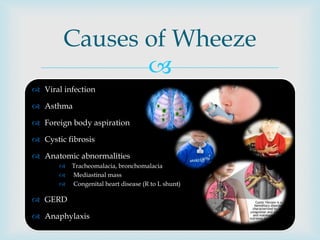
 Viral infection
 Asthma
 Foreign body aspiration
 Cystic fibrosis
 Anatomic abnormalities
 Tracheomalacia, bronchomalacia
 Mediastinal mass
 Congenital heart disease (R to L shunt)
 GERD
 Anaphylaxis
Causes of Wheeze

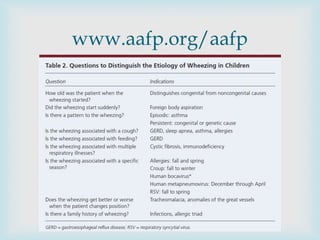
www.aafp.org/aafp

Done! Thank you.

 N M, al et. Wheezes. - PubMed [Internet]. 1995 [cited 2015 Jun 21].
Available from: http://www.ncbi.nlm.nih.gov/m/pubmed/8620967/
 O’Brien N, Gill D, Hickey D. Paediatric Clinical Examination Made Easy.
Edinburgh: Churchill Livingstone Elsevier; 2007.
 Zorc JJ, editor. Schwartz’s clinical handbook of pediatrics. Philadelphia:
Lippincott Williams and Wilkins; 2008.
 Lissauer, Tom, Graham Clayden, and Alan Craft. Illustrated Textbook Of
Paediatrics. Edinburgh: Mosby, 2012. Print.
 Weiss LN. The Diagnosis of Wheezing in Children - American Family
Physician [Internet]. [cited 2015 Jun 21]. Available from:
http://www.aafp.org/afp/2008/0415/p1109.html
References

Wheeze

  • 1.
    • Definition • Mechanism •Causes Izatty Lim 0308188 Batch 4
  • 2.
      Palpable andaudible vibrations  Musical in character  Produced when airflow is restricted DEFINITION  The American Thoracic Society Committee Wheeze: High pitched continuous sounds with a dominant frequency of 400 Hz or more.
  • 3.
      MC: expiratorywheeze  Typically reflect lower airway obstruction  MC found with asthma & bronchiolitis  Other causes: CHF & foreign body aspiration  http://www.stethographics.com/main/physiology_ls_wheeze.html  https://www.youtube.com/watch?v=BvnphT1QnNY WHEEZE Polyphonic Monophonic Various pitch Single- pitch sound Widespread narrowing of airways Narrowing of larger airways Asthma Tracheomalacia, bronchomalacia
  • 4.
     Airway Narrowing Bronchoconstriction  Mucosal edema  External compression  Partial obstruction by  tumor  foreign body  tenacious secretion MECHANISM  Wheeze  Generated by vibrations/oscillations of nearly closed airway walls  Air passing through narrowed portion at high velocity  ↓ gas pressure and flow  Airway pressure slightly ↑ and barely reopens airway lumen  Alternating between nearly closed and nearly open  fluttering of the airway walls and a musical, ‘continuous’ sound.  Wheeze  Generated by vibrations/oscillations of nearly closed airway walls  Air passing through narrowed portion at high velocity  ↓ gas pressure and flow  Airway pressure slightly ↑ and barely reopens airway lumen  Alternating between nearly closed and nearly open  fluttering of the airway walls and a musical, ‘continuous’ sound.  Wheeze  Generated by vibrations/oscillations of nearly closed airway walls  Air passing through narrowed portion at high velocity  ↓ gas pressure and flow  Airway pressure slightly ↑ and barely reopens airway lumen  Alternating between nearly closed and nearly open  fluttering of the airway walls and a musical, ‘continuous’ sound.  Wheeze  Generated by vibrations/oscillations of nearly closed airway walls  Air passing through narrowed portion at high velocity  ↓ gas pressure and flow  Airway pressure slightly ↑ and barely reopens airway lumen  Alternating between nearly closed and nearly open  fluttering of the airway walls and a musical, ‘continuous’ sound.
  • 5.
  • 6.
     Toy trumpet sound is produced by a vibrating reed.  Pitch • dependent on the mass and elasticity of the airway walls & on the flow velocity.  Wheeze production model  collapsible tube • the fluttering of airways walls & fluid together, induced by a critical airflow velocity.  Many circumstances are suitable for the production of continuous adventitious lung sounds. Thus, wheezes can be heard in several diseases, not only asthma. MECHANISM
  • 7.
      Viral infection Asthma  Foreign body aspiration  Cystic fibrosis  Anatomic abnormalities  Tracheomalacia, bronchomalacia  Mediastinal mass  Congenital heart disease (R to L shunt)  GERD  Anaphylaxis Causes of Wheeze
  • 8.
  • 9.
  • 10.
      N M,al et. Wheezes. - PubMed [Internet]. 1995 [cited 2015 Jun 21]. Available from: http://www.ncbi.nlm.nih.gov/m/pubmed/8620967/  O’Brien N, Gill D, Hickey D. Paediatric Clinical Examination Made Easy. Edinburgh: Churchill Livingstone Elsevier; 2007.  Zorc JJ, editor. Schwartz’s clinical handbook of pediatrics. Philadelphia: Lippincott Williams and Wilkins; 2008.  Lissauer, Tom, Graham Clayden, and Alan Craft. Illustrated Textbook Of Paediatrics. Edinburgh: Mosby, 2012. Print.  Weiss LN. The Diagnosis of Wheezing in Children - American Family Physician [Internet]. [cited 2015 Jun 21]. Available from: http://www.aafp.org/afp/2008/0415/p1109.html References

Editor's Notes

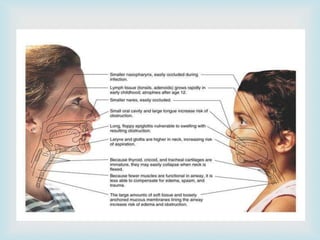
  • #6 Wheezing occurs during the prolonged expiratory phase by the rapid passage of air through airways that are narrowed to the point of closure. Children wheeze more often than adults because of physical differences. Infants' and young children's bronchi are small, resulting in higher peripheral airway resistance. As a result, diseases that affect the small airways have a proportionately greater impact on total airway resistance in these patients. Infants also have less elastic tissue recoil and fewer collateral airways, resulting in easier obstruction and atelectasis. The rib cage, trachea, and bronchi are also more compliant in infants and young children, and the diaphragm inserts horizontally instead of obliquely. All of these factors increase the likelihood of wheezing and respiratory distress in both of these groups.2
  • #7 Wheeze production model based on the mathematical analysis of the stability of airflow through a collapsible tube
  • #8 customized tracheal splints for each patient