EXACERBATION:Increase in the symptoms in
form of cough,wheeze and /breathlessness.
Based on severity: mild
moderate
severe
life threatening
ACUTE EXACERBATION
HOME TREATMENT
• Written action plan given
• Acute exacerbation:
– Increase in cough,wheeze, breathlessness
– PEFR: decreased by 15% from baseline
• Parents should administer short acting beta2-
agonist by MDI±spacer±facemask, one puff at a
time, repeated every 30-60 secs upto a maximum
of 10 puffs with monitoring of symptoms.
• If symptoms relieved or PEFR increased:
– Continue on salbutamol or terbutaline ever 4-6
hrs and visit physician
• If no or partial improvement or life
threatening attack, immediately transfer to
hospital.
• Life threatening attack or lack of
improvement: Single dose of prednisolone(1-
2mg/kg) before going to hospital advised
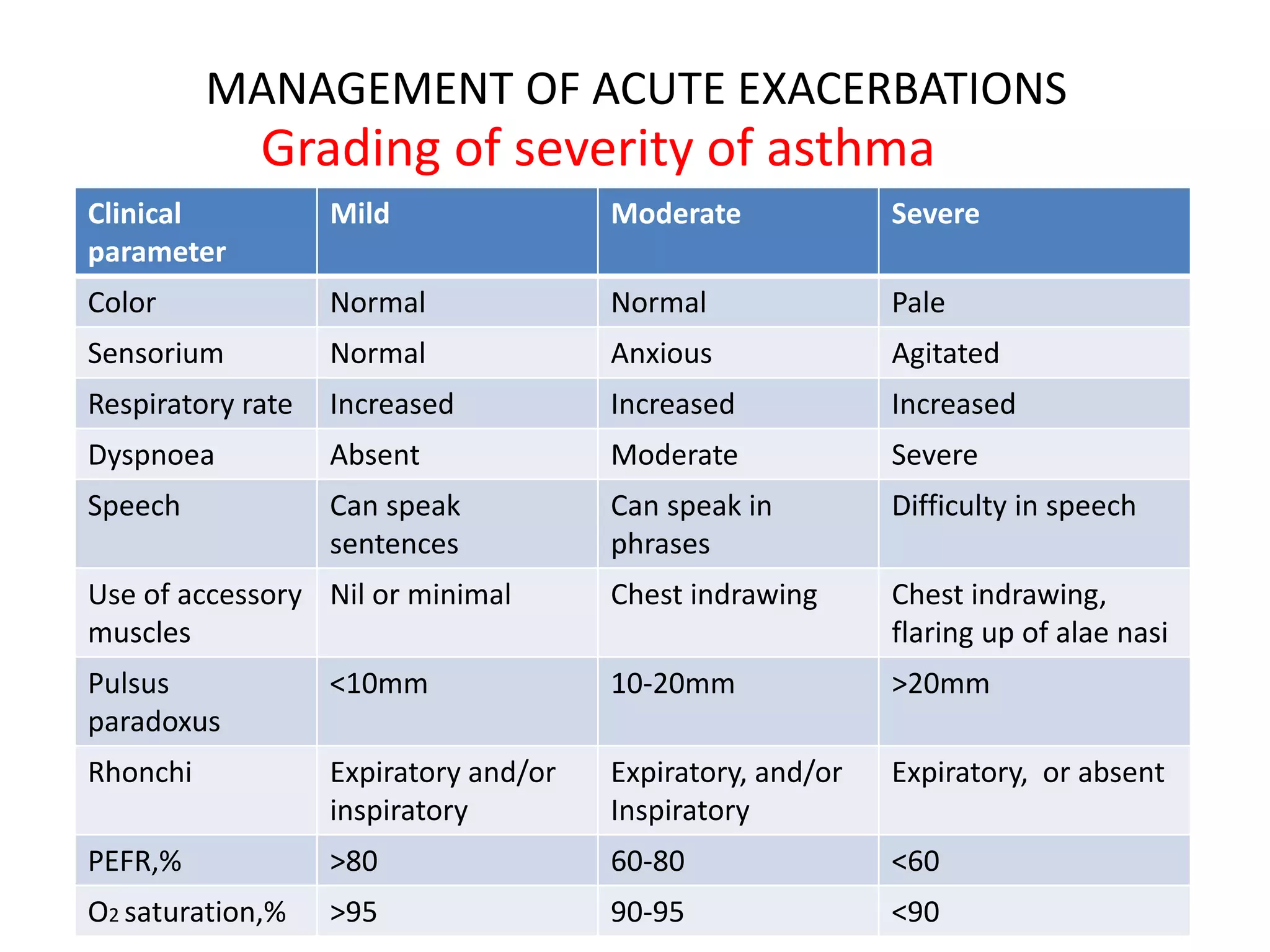
MANAGEMENT OF ACUTE EXACERBATIONS
Clinical
parameter
Mild Moderate Severe
Color Normal Normal Pale
Sensorium Normal Anxious Agitated
Respiratory rate Increased Increased Increased
Dyspnoea Absent Moderate Severe
Speech Can speak
sentences
Can speak in
phrases
Difficulty in speech
Use of accessory
muscles
Nil or minimal Chest indrawing Chest indrawing,
flaring up of alae nasi
Pulsus
paradoxus
<10mm 10-20mm >20mm
Rhonchi Expiratory and/or
inspiratory
Expiratory, and/or
Inspiratory
Expiratory, or absent
PEFR,% >80 60-80 <60
O2 saturation,% >95 90-95 <90
Grading of severity of asthma
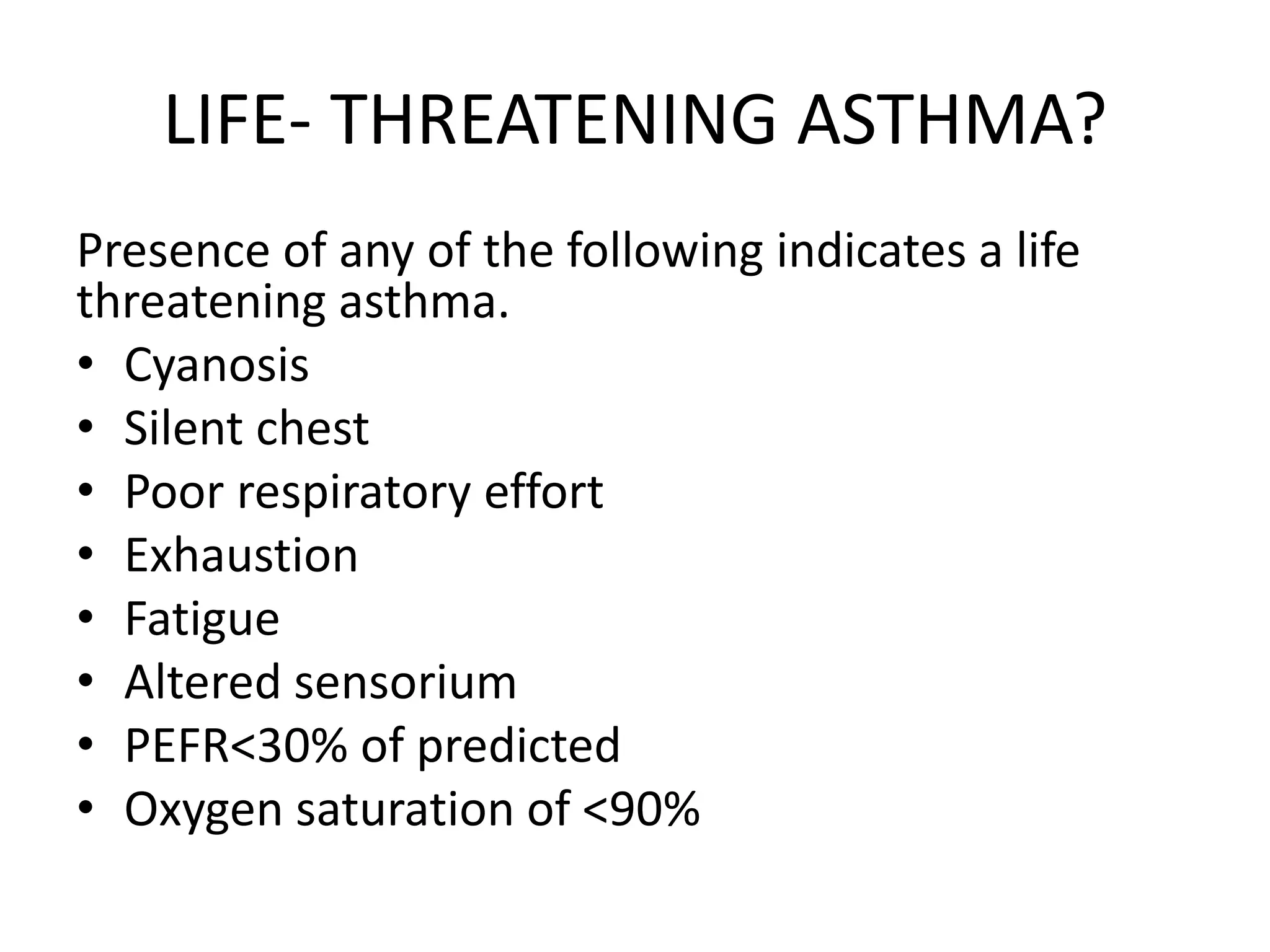
LIFE- THREATENING ASTHMA?
Presence of any of the following indicates a life
threatening asthma.
• Cyanosis
• Silent chest
• Poor respiratory effort
• Exhaustion
• Fatigue
• Altered sensorium
• PEFR<30% of predicted
• Oxygen saturation of <90%
Management of life threatening
asthma
• Immediate oxygen inhalation.
• Injection terbutaline or adrenaline
subcutaneously
• Inhalation of salbutamol or terbutaline and
ipratropium
• Hydrocortisone 5mg/kg given IV
• Transfer to ICU
• If improves:
– Salbutamol or terbutaline inhalation continued every 20-
30 mins
– Hydrocortisone(3-5mg/kg) every 6-8hr till patient accepts
orally.
• If no improvement or deteriorates:
– Slow IV infusion of magnesium sulphate(50mg/kg) over 30
min
– Alternatively, loading dose of theophylline is infused.
– Still no improvement:
• Prepare for mechanical ventilation
• Screen for causes of poor response- acidosis, pneumothorax,
electrolyte imbalance or infection.
MILD ACUTE ASTHMA
• Cough
• Rapid respiration
• Some wheeze
• No chest indrawing
• Able to speak,and drink well
• PEFR>80%
• Oxygen saturation>95%
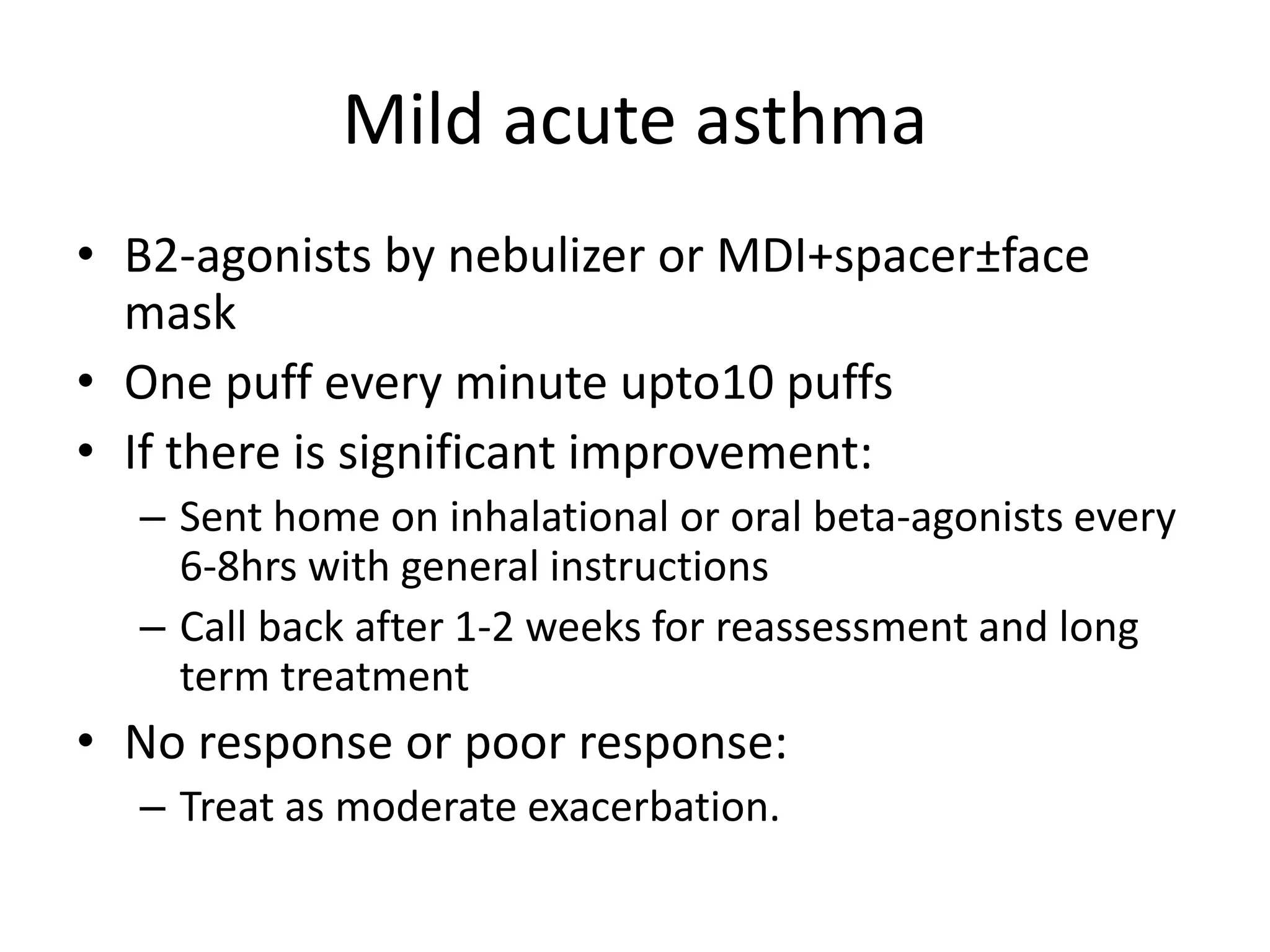
Mild acute asthma
• Β2-agonists by nebulizer or MDI+spacer±face
mask
• One puff every minute upto10 puffs
• If there is significant improvement:
– Sent home on inhalational or oral beta-agonists every
6-8hrs with general instructions
– Call back after 1-2 weeks for reassessment and long
term treatment
• No response or poor response:
– Treat as moderate exacerbation.
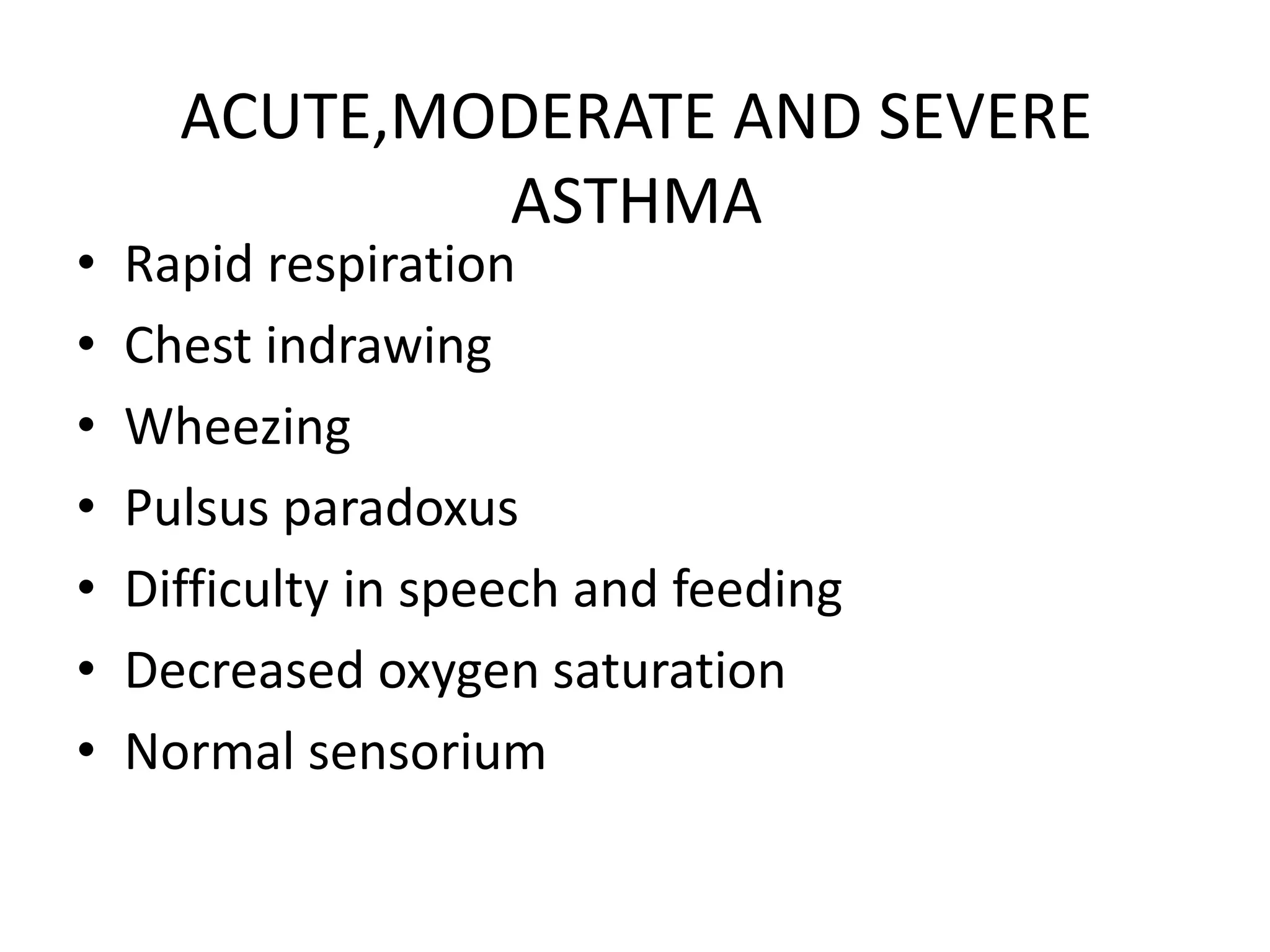
ACUTE,MODERATE AND SEVERE
ASTHMA
• Rapid respiration
• Chest indrawing
• Wheezing
• Pulsus paradoxus
• Difficulty in speech and feeding
• Decreased oxygen saturation
• Normal sensorium
Acute Moderate and Severe Asthma
• Inhalation beta-agonist as for mild asthma.
• Repeated every 20 min
• Begin oxygen inhalation
• Oral dose of prednisolone 1-2 mg/kg given
• Assess for improvement after 1 hr.
• If improves:
– Continue on inhalation of β2 agonists every 30 mins and
interval increased to 4-6 hrs.
– Oxygen inhalation stopped(if O2 saturation maintained
>95%)
– Prednisolone continued once daily for 5-7 days and
stopped without tapering.
• Patient can be discharged from hospital when:
– Need for bronchodilators is every 4-6 hourly
– Able to feed and speak well
– Maintains O2 saturation >95%
– PEFR>75% of predicted
– Educate about disease, for regular followup,
avoidance of triggers.
– Assessed for longterm treatment.
• If no improvement at the end of 1 hour:
– Salbutamol inhalation continued
– Ipratropium 250µg also added every 20 min
– Hydrocortisone(10 mg/kg) IV
– Reassess after 2 hours
– If good response:
• Treat like early responders.
– No response:
• Injectable theophylline bolus followed by continuous infusion
started.
• Respond well to magnesium infusion(50mg/kg) dissolved in
dextrose over 30 min
• No improvement:
– Prepared for possible mechanical ventilation
Monitoring during acute treatment
• Vital signs
– Heart rate
– Respiratory rate
• Chest indrawing
• Oxygen saturation
• Sensorium
THANK YOU

Acute exacerbation of asthma

  • 2.
    EXACERBATION:Increase in thesymptoms in form of cough,wheeze and /breathlessness. Based on severity: mild moderate severe life threatening
  • 4.
    ACUTE EXACERBATION HOME TREATMENT •Written action plan given • Acute exacerbation: – Increase in cough,wheeze, breathlessness – PEFR: decreased by 15% from baseline • Parents should administer short acting beta2- agonist by MDI±spacer±facemask, one puff at a time, repeated every 30-60 secs upto a maximum of 10 puffs with monitoring of symptoms.
  • 5.
    • If symptomsrelieved or PEFR increased: – Continue on salbutamol or terbutaline ever 4-6 hrs and visit physician • If no or partial improvement or life threatening attack, immediately transfer to hospital. • Life threatening attack or lack of improvement: Single dose of prednisolone(1- 2mg/kg) before going to hospital advised
  • 6.
    MANAGEMENT OF ACUTEEXACERBATIONS Clinical parameter Mild Moderate Severe Color Normal Normal Pale Sensorium Normal Anxious Agitated Respiratory rate Increased Increased Increased Dyspnoea Absent Moderate Severe Speech Can speak sentences Can speak in phrases Difficulty in speech Use of accessory muscles Nil or minimal Chest indrawing Chest indrawing, flaring up of alae nasi Pulsus paradoxus <10mm 10-20mm >20mm Rhonchi Expiratory and/or inspiratory Expiratory, and/or Inspiratory Expiratory, or absent PEFR,% >80 60-80 <60 O2 saturation,% >95 90-95 <90 Grading of severity of asthma
  • 7.
    LIFE- THREATENING ASTHMA? Presenceof any of the following indicates a life threatening asthma. • Cyanosis • Silent chest • Poor respiratory effort • Exhaustion • Fatigue • Altered sensorium • PEFR<30% of predicted • Oxygen saturation of <90%
  • 8.
    Management of lifethreatening asthma • Immediate oxygen inhalation. • Injection terbutaline or adrenaline subcutaneously • Inhalation of salbutamol or terbutaline and ipratropium • Hydrocortisone 5mg/kg given IV • Transfer to ICU
  • 9.
    • If improves: –Salbutamol or terbutaline inhalation continued every 20- 30 mins – Hydrocortisone(3-5mg/kg) every 6-8hr till patient accepts orally. • If no improvement or deteriorates: – Slow IV infusion of magnesium sulphate(50mg/kg) over 30 min – Alternatively, loading dose of theophylline is infused. – Still no improvement: • Prepare for mechanical ventilation • Screen for causes of poor response- acidosis, pneumothorax, electrolyte imbalance or infection.
  • 10.
    MILD ACUTE ASTHMA •Cough • Rapid respiration • Some wheeze • No chest indrawing • Able to speak,and drink well • PEFR>80% • Oxygen saturation>95%
  • 11.
    Mild acute asthma •Β2-agonists by nebulizer or MDI+spacer±face mask • One puff every minute upto10 puffs • If there is significant improvement: – Sent home on inhalational or oral beta-agonists every 6-8hrs with general instructions – Call back after 1-2 weeks for reassessment and long term treatment • No response or poor response: – Treat as moderate exacerbation.
  • 12.
    ACUTE,MODERATE AND SEVERE ASTHMA •Rapid respiration • Chest indrawing • Wheezing • Pulsus paradoxus • Difficulty in speech and feeding • Decreased oxygen saturation • Normal sensorium
  • 13.
    Acute Moderate andSevere Asthma • Inhalation beta-agonist as for mild asthma. • Repeated every 20 min • Begin oxygen inhalation • Oral dose of prednisolone 1-2 mg/kg given • Assess for improvement after 1 hr. • If improves: – Continue on inhalation of β2 agonists every 30 mins and interval increased to 4-6 hrs. – Oxygen inhalation stopped(if O2 saturation maintained >95%) – Prednisolone continued once daily for 5-7 days and stopped without tapering.
  • 14.
    • Patient canbe discharged from hospital when: – Need for bronchodilators is every 4-6 hourly – Able to feed and speak well – Maintains O2 saturation >95% – PEFR>75% of predicted – Educate about disease, for regular followup, avoidance of triggers. – Assessed for longterm treatment.
  • 15.
    • If noimprovement at the end of 1 hour: – Salbutamol inhalation continued – Ipratropium 250µg also added every 20 min – Hydrocortisone(10 mg/kg) IV – Reassess after 2 hours – If good response: • Treat like early responders. – No response: • Injectable theophylline bolus followed by continuous infusion started. • Respond well to magnesium infusion(50mg/kg) dissolved in dextrose over 30 min • No improvement: – Prepared for possible mechanical ventilation
  • 16.
    Monitoring during acutetreatment • Vital signs – Heart rate – Respiratory rate • Chest indrawing • Oxygen saturation • Sensorium
  • 17.