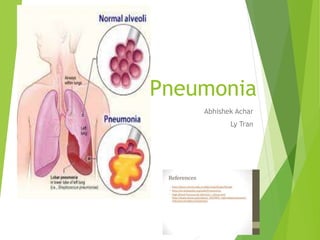
Pneumonia
Abhishek Achar
Ly Tran
Epidemiology
 More than 3 million cases occur annually in US
 Pneumonia is most relevant in winter months
 Incidence of Pneumonia is greater in Males than in females
 Total number of deaths due to pneumonia has been higher in
females since 1980s
 Individuals 65 years and older : Pneumonia and Influenza were
6th leading death in 2005
 Close to 90% of deaths due to pneumonia and influenza occur in
this age group
 Adjusted death rates for females: 17.9 deaths per 100,000
population
 23.9 deaths per 100,000 population for males
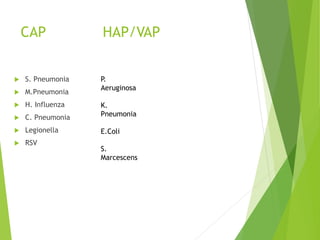
CAP HAP/VAP
 S. Pneumonia
 M.Pneumonia
 H. Influenza
 C. Pneumonia
 Legionella
 RSV
P.
Aeruginosa
K.
Pneumonia
E.Coli
S.
Marcescens
Pneumonia
Diagnosis
Treatment
Prevention
Diagnosis
● CAP vs. HCAP
– Community Acquired Pneumonia
● Pneumonia in a patient without extensive healthcare contact.
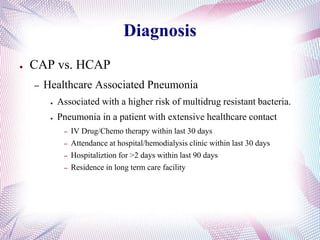
Diagnosis
● CAP vs. HCAP
– Healthcare Associated Pneumonia
● Associated with a higher risk of multidrug resistant bacteria.
● Pneumonia in a patient with extensive healthcare contact
– IV Drug/Chemo therapy within last 30 days
– Attendance at hospital/hemodialysis clinic within last 30 days
– Hospitaliztion for >2 days within last 90 days
– Residence in long term care facility
Diagnosis
● Common Clinical Symptoms
– Cough
– Pleuritic Chest Pain
– Dyspnea
– GI Upset
● Common Clinical Signs
– Fever
– Tachychardia
– Crackles in lungs
– Sputum Production
– AMS
Even combined, Signs and
Symptoms have a
sensitivity of <50%
Diagnosis
Gold Standard
CXR with presence of infiltrate
Diagnosis
Diagnosis
● Largely a clinical diagnosis
● Testing
– Outpatient: Optional
– Hospitalized: CBC (Leukocytes), Blood cultures, Sputum
Gram Strain
– Refractory: Legionella UAT, Pneumococcal UAT
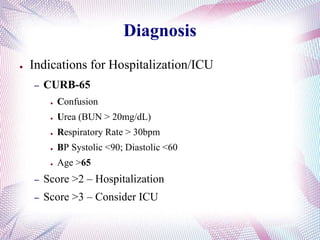
Diagnosis
● Indications for Hospitalization/ICU
– CURB-65
● Confusion
● Urea (BUN > 20mg/dL)
● Respiratory Rate > 30bpm
● BP Systolic <90; Diastolic <60
● Age >65
– Score >2 – Hospitalization
– Score >3 – Consider ICU
Treatment
● Empiric Treatment should be started on ALL
clinically suspected cases.
– Early diagnosis and treatment significantly reduced
Mortality and Length of Stay
● Antimicrobial choice based on:
– Most likely pathogens
– Clinical data
– Risk Factors for resistance
– Comorbidities
CAP Treatment
● Empiric Outpatient
– Previously healthy patient
1.Macrolides (A.C.E) OR
2.Doxycycline
– Comorbidities, DM, Alcoholism, Immunosuppression,
Prior ABx use
1.Fluoroquinolones (-floxacins, [Levaquin]) OR
2.Beta-lactam(Amoxicillin/Ceftriaxone) AND Macrolides
● Consider Antipseudomonal for COPD
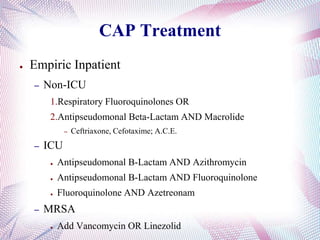
CAP Treatment
● Empiric Inpatient
– Non-ICU
1.Respiratory Fluoroquinolones OR
2.Antipseudomonal Beta-Lactam AND Macrolide
– Ceftriaxone, Cefotaxime; A.C.E.
– ICU
● Antipseudomonal B-Lactam AND Azithromycin
● Antipseudomonal B-Lactam AND Fluoroquinolone
● Fluoroquinolone AND Azetreonam
– MRSA
● Add Vancomycin OR Linezolid
CAP Treatment
● Empiric Inpatient
– Discharge appropriate when:
● Stable from pneumonia
● Tolerates PO meds
● No active medical conditions
● Safe environment for discharge
– There is no need for overnight observations when
switching from IV to PO meds.
HAP/VAP Treatment
● Empiric Inpatient
– One of the following (Gram Positive coverage):
● Antipseudomonal Cephalosporin: Cefepime, etc.
● Antipseudomonal Cabepenem: Imipenem, etc.
● Pipercillin-Tazobactam
● Penicillin Allergies
– Mild: Simple Graded Challenge
– Severe: Azetreonam
HAP/VAP Treatment
● Empiric Inpatient
– PLUS One of the following (B-lactam resistant Gram
Negative coverage):
● Antipseudomonal Fluoroquinolone: Ciprofloxacin
● Aminoglycoside: Gentamycin
– PLUS One of the following (MRSA coverage):
● Linezolid
● Vancomycin
● Telavacin
HAP/VAP Treatment
● Targeted Treatment
– MSSA: Naficillin, Oxacillin
– Legionella: Fluoroquinolone
– Anerobes (Aspiration): Clindamycin, Carbapenem
Prevention
● Risk Factor Reduction
– Smoking Cessation
– Vaccination
● Influenza
– Yearly, all patients
● Pneumococcal
– Once, Age <65, w/ indications
● Asplenia, Immunocomp., Smoker, Alcoholism, Cochlear Implants,
DM, etc
– Once/Again, Age >65, w/o indication
END

Pneumonia

  • 1.
  • 6.
    Epidemiology  More than3 million cases occur annually in US  Pneumonia is most relevant in winter months  Incidence of Pneumonia is greater in Males than in females  Total number of deaths due to pneumonia has been higher in females since 1980s  Individuals 65 years and older : Pneumonia and Influenza were 6th leading death in 2005  Close to 90% of deaths due to pneumonia and influenza occur in this age group  Adjusted death rates for females: 17.9 deaths per 100,000 population  23.9 deaths per 100,000 population for males
  • 17.
    CAP HAP/VAP  S.Pneumonia  M.Pneumonia  H. Influenza  C. Pneumonia  Legionella  RSV P. Aeruginosa K. Pneumonia E.Coli S. Marcescens
  • 18.
  • 19.
    Diagnosis ● CAP vs.HCAP – Community Acquired Pneumonia ● Pneumonia in a patient without extensive healthcare contact.
  • 20.
    Diagnosis ● CAP vs.HCAP – Healthcare Associated Pneumonia ● Associated with a higher risk of multidrug resistant bacteria. ● Pneumonia in a patient with extensive healthcare contact – IV Drug/Chemo therapy within last 30 days – Attendance at hospital/hemodialysis clinic within last 30 days – Hospitaliztion for >2 days within last 90 days – Residence in long term care facility
  • 21.
    Diagnosis ● Common ClinicalSymptoms – Cough – Pleuritic Chest Pain – Dyspnea – GI Upset ● Common Clinical Signs – Fever – Tachychardia – Crackles in lungs – Sputum Production – AMS Even combined, Signs and Symptoms have a sensitivity of <50%
  • 22.
    Diagnosis Gold Standard CXR withpresence of infiltrate
  • 23.
  • 24.
    Diagnosis ● Largely aclinical diagnosis ● Testing – Outpatient: Optional – Hospitalized: CBC (Leukocytes), Blood cultures, Sputum Gram Strain – Refractory: Legionella UAT, Pneumococcal UAT
  • 25.
    Diagnosis ● Indications forHospitalization/ICU – CURB-65 ● Confusion ● Urea (BUN > 20mg/dL) ● Respiratory Rate > 30bpm ● BP Systolic <90; Diastolic <60 ● Age >65 – Score >2 – Hospitalization – Score >3 – Consider ICU
  • 26.
    Treatment ● Empiric Treatmentshould be started on ALL clinically suspected cases. – Early diagnosis and treatment significantly reduced Mortality and Length of Stay ● Antimicrobial choice based on: – Most likely pathogens – Clinical data – Risk Factors for resistance – Comorbidities
  • 27.
    CAP Treatment ● EmpiricOutpatient – Previously healthy patient 1.Macrolides (A.C.E) OR 2.Doxycycline – Comorbidities, DM, Alcoholism, Immunosuppression, Prior ABx use 1.Fluoroquinolones (-floxacins, [Levaquin]) OR 2.Beta-lactam(Amoxicillin/Ceftriaxone) AND Macrolides ● Consider Antipseudomonal for COPD
  • 28.
    CAP Treatment ● EmpiricInpatient – Non-ICU 1.Respiratory Fluoroquinolones OR 2.Antipseudomonal Beta-Lactam AND Macrolide – Ceftriaxone, Cefotaxime; A.C.E. – ICU ● Antipseudomonal B-Lactam AND Azithromycin ● Antipseudomonal B-Lactam AND Fluoroquinolone ● Fluoroquinolone AND Azetreonam – MRSA ● Add Vancomycin OR Linezolid
  • 29.
    CAP Treatment ● EmpiricInpatient – Discharge appropriate when: ● Stable from pneumonia ● Tolerates PO meds ● No active medical conditions ● Safe environment for discharge – There is no need for overnight observations when switching from IV to PO meds.
  • 30.
    HAP/VAP Treatment ● EmpiricInpatient – One of the following (Gram Positive coverage): ● Antipseudomonal Cephalosporin: Cefepime, etc. ● Antipseudomonal Cabepenem: Imipenem, etc. ● Pipercillin-Tazobactam ● Penicillin Allergies – Mild: Simple Graded Challenge – Severe: Azetreonam
  • 31.
    HAP/VAP Treatment ● EmpiricInpatient – PLUS One of the following (B-lactam resistant Gram Negative coverage): ● Antipseudomonal Fluoroquinolone: Ciprofloxacin ● Aminoglycoside: Gentamycin – PLUS One of the following (MRSA coverage): ● Linezolid ● Vancomycin ● Telavacin
  • 32.
    HAP/VAP Treatment ● TargetedTreatment – MSSA: Naficillin, Oxacillin – Legionella: Fluoroquinolone – Anerobes (Aspiration): Clindamycin, Carbapenem
  • 33.
    Prevention ● Risk FactorReduction – Smoking Cessation – Vaccination ● Influenza – Yearly, all patients ● Pneumococcal – Once, Age <65, w/ indications ● Asplenia, Immunocomp., Smoker, Alcoholism, Cochlear Implants, DM, etc – Once/Again, Age >65, w/o indication
  • 34.