I Z AT T Y L I M
0 3 0 8 1 8 8
FORCEPS ASSISTED
DELIVERIES
LEARNING OUTCOMES
• Describe the types of obstetric forceps.
• State the indications, prerequisites, contraindications
and describe the technique of obstetric forceps assisted
delivery.
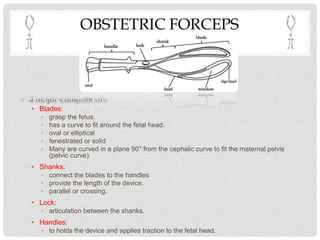
OBSTETRIC FORCEPS
• A double-bladed metal instrument used for extraction of
the fetal head
• Parts:
• Right and left branches
• Articulation with locking or sliding mechanism
• Handles connected to blades by shanks of variable lengths
• 2 curves of the blade: cephalic & pelvic curves
OBSTETRIC FORCEPS
• Blades:
• grasp the fetus.
• has a curve to fit around the fetal head.
• oval or elliptical
• fenestrated or solid
• Many are curved in a plane 90° from the cephalic curve to fit the maternal pelvis
(pelvic curve).
• Shanks:
• connect the blades to the handles
• provide the length of the device.
• parallel or crossing.
• Lock:
• articulation between the shanks.
• Handles:
• to holds the device and applies traction to the fetal head.
TYPES OF OBSTETRIC FORCEPS
• Low cavity forceps (Wrigley’s)
• Short and light
• Also used at cesarean section
• Mid-cavity non-rotational forceps (Neville-Barnes’, Haig Ferguson,
Simpson’s)
• Used when sagittal suture is in direct anteroposterior position (usually DOA)
• Malposition (DOP/DOL) can be corrected manually between contraction & the
blades applied once head is in DOA position
• Mid-cavity rotational forceps (Keilland’s)
• Almost no pelvic curve
• Allow rotation
• Helps to correct malposition & asynclitism (fetus head not in line with
mother’s pelvis)
• Only attempted by experienced operator
FORCEPS ASSISTED DELIVERY
:
• Left blade inserted first before the right blade with accoucheur’s
hand protecting vaginal wall from direct trauma
• Blades lie parallel to axis of fetal head and between the fetal
head & the pelvic wall
• Articulates and locks the blades, then check the application
before applying traction
• Traction applied intermittently in concert with uterine
contraction and maternal expulsive efforts
• Axis of traction:
• guided along ‘J’-shaped curve of pelvis
• Directed vertical as head begin to crown
FORCEPS ASSISTED DELIVERY
:
• Maternal.
• Maternal distress
• Exhaustion
• Undue prolongation of 2nd stage of labor
• Medically significant conditions
• Fetal.
• Malposition of fetal head (occipito-transverse and occipito-posterior)
• Fetal distress
FORCEPS ASSISTED DELIVERY
:
• Fully dilated cervix.
• Severe lacerations and hemorrhage may ensue if a rim of cervical tissue remains.
• Head engaged.
• The extraction of a mature fetus with a "high" (unengaged) head usually is disastrous.
• Vertex presentation or face presentation.
• Other presentations require wider-than-average pelvic diameters.
• Membranes ruptured.
• Ensure a firm grasp of the forceps on the fetal head.
• No cephalopelvic disproportion. If there is engagement, there must be no outlet
contracture or gross sacral deformity.
• Empty bladder and bowel.
• avoid laceration and fistula formation.
F Fully dilated os (10cm)
O Obstruction should be excluded (head ≤1/5 palpable)
R Rupture of membrane
C 1. Consent
2. Check instrument prior application
3. CPD excluded
4. Catheterize bladder
E 1. Explain procedure
2. Epidural (or pudendal) analgesia
3. Examine genital tract (exclude genital tract trauma)
P 1. Presentation & position identified
2. Pediatrician standby
S 1. Station of presenting part ( not above ischial spine )
2. Skillful operator and senior help available
FORCEPS ASSISTED DELIVERY
:
• Any contraindication to vaginal delivery
• Refusal of the patient to consent to the procedure
• Cervix not fully dilated/retracted
• Inability to determine the presentation & fetal head position
• Confirmed cephalopelvic disproportion
• Absence of adequate anesthesia/analgesia
• Inadequate facilities and support staff
• Inexperienced operator
REFERENCES
• Baker PN, Kenny LC(eds). Obstetrics by Ten Teachers. 19th ed. London: Hodder
Arnold; 2011.
• Collins S, Arulkumaran S, Hayes K, Jackson S, Impey L. Oxford Handbook of
Obstetrics and Gynaecology. 3rd ed. Collins S, Arulkumaran S, Hayes K, editors.
United Kingdom: Oxford University Press; 2013.
• Medscape: Forceps Delivery [online]. 11th December 2013. Extracted on 17th April
2015.
Available at: http://emedicine.medscape.com/article/263603-overview#a05
• Healthline: Types of Forceps Used in Delivery [online]. 15th March 2012.
Extracted on 17th April 2015.
Available at: http://www.healthline.com/health/pregnancy/assisted-delivery-types-
forceps#TypesofForceps1
• Brookside Associates: Obstetric and Newborn Care [online]. 2007. extracted on
17th April 2015.
Available at:
http://www.brooksidepress.org/Products/Obstetric_and_Newborn_Care_II/lesson_5_Section_1.htm

Assisted deliveries

  • 1.
    I Z ATT Y L I M 0 3 0 8 1 8 8 FORCEPS ASSISTED DELIVERIES
  • 2.
    LEARNING OUTCOMES • Describethe types of obstetric forceps. • State the indications, prerequisites, contraindications and describe the technique of obstetric forceps assisted delivery.
  • 3.
    OBSTETRIC FORCEPS • Adouble-bladed metal instrument used for extraction of the fetal head • Parts: • Right and left branches • Articulation with locking or sliding mechanism • Handles connected to blades by shanks of variable lengths • 2 curves of the blade: cephalic & pelvic curves
  • 4.
    OBSTETRIC FORCEPS • Blades: •grasp the fetus. • has a curve to fit around the fetal head. • oval or elliptical • fenestrated or solid • Many are curved in a plane 90° from the cephalic curve to fit the maternal pelvis (pelvic curve). • Shanks: • connect the blades to the handles • provide the length of the device. • parallel or crossing. • Lock: • articulation between the shanks. • Handles: • to holds the device and applies traction to the fetal head.
  • 5.
    TYPES OF OBSTETRICFORCEPS • Low cavity forceps (Wrigley’s) • Short and light • Also used at cesarean section • Mid-cavity non-rotational forceps (Neville-Barnes’, Haig Ferguson, Simpson’s) • Used when sagittal suture is in direct anteroposterior position (usually DOA) • Malposition (DOP/DOL) can be corrected manually between contraction & the blades applied once head is in DOA position • Mid-cavity rotational forceps (Keilland’s) • Almost no pelvic curve • Allow rotation • Helps to correct malposition & asynclitism (fetus head not in line with mother’s pelvis) • Only attempted by experienced operator
  • 7.
    FORCEPS ASSISTED DELIVERY : •Left blade inserted first before the right blade with accoucheur’s hand protecting vaginal wall from direct trauma • Blades lie parallel to axis of fetal head and between the fetal head & the pelvic wall • Articulates and locks the blades, then check the application before applying traction • Traction applied intermittently in concert with uterine contraction and maternal expulsive efforts • Axis of traction: • guided along ‘J’-shaped curve of pelvis • Directed vertical as head begin to crown
  • 8.
  • 9.
    FORCEPS ASSISTED DELIVERY : •Maternal. • Maternal distress • Exhaustion • Undue prolongation of 2nd stage of labor • Medically significant conditions • Fetal. • Malposition of fetal head (occipito-transverse and occipito-posterior) • Fetal distress
  • 10.
    FORCEPS ASSISTED DELIVERY : •Fully dilated cervix. • Severe lacerations and hemorrhage may ensue if a rim of cervical tissue remains. • Head engaged. • The extraction of a mature fetus with a "high" (unengaged) head usually is disastrous. • Vertex presentation or face presentation. • Other presentations require wider-than-average pelvic diameters. • Membranes ruptured. • Ensure a firm grasp of the forceps on the fetal head. • No cephalopelvic disproportion. If there is engagement, there must be no outlet contracture or gross sacral deformity. • Empty bladder and bowel. • avoid laceration and fistula formation.
  • 11.
    F Fully dilatedos (10cm) O Obstruction should be excluded (head ≤1/5 palpable) R Rupture of membrane C 1. Consent 2. Check instrument prior application 3. CPD excluded 4. Catheterize bladder E 1. Explain procedure 2. Epidural (or pudendal) analgesia 3. Examine genital tract (exclude genital tract trauma) P 1. Presentation & position identified 2. Pediatrician standby S 1. Station of presenting part ( not above ischial spine ) 2. Skillful operator and senior help available
  • 12.
    FORCEPS ASSISTED DELIVERY : •Any contraindication to vaginal delivery • Refusal of the patient to consent to the procedure • Cervix not fully dilated/retracted • Inability to determine the presentation & fetal head position • Confirmed cephalopelvic disproportion • Absence of adequate anesthesia/analgesia • Inadequate facilities and support staff • Inexperienced operator
  • 13.
    REFERENCES • Baker PN,Kenny LC(eds). Obstetrics by Ten Teachers. 19th ed. London: Hodder Arnold; 2011. • Collins S, Arulkumaran S, Hayes K, Jackson S, Impey L. Oxford Handbook of Obstetrics and Gynaecology. 3rd ed. Collins S, Arulkumaran S, Hayes K, editors. United Kingdom: Oxford University Press; 2013. • Medscape: Forceps Delivery [online]. 11th December 2013. Extracted on 17th April 2015. Available at: http://emedicine.medscape.com/article/263603-overview#a05 • Healthline: Types of Forceps Used in Delivery [online]. 15th March 2012. Extracted on 17th April 2015. Available at: http://www.healthline.com/health/pregnancy/assisted-delivery-types- forceps#TypesofForceps1 • Brookside Associates: Obstetric and Newborn Care [online]. 2007. extracted on 17th April 2015. Available at: http://www.brooksidepress.org/Products/Obstetric_and_Newborn_Care_II/lesson_5_Section_1.htm

Editor's Notes

  • #11 aortic valve disease with significant outflow obstruction or myasthenia gravis