‫الرحیم‬ ‫الرحمن‬ ‫هللا‬ ‫بسم‬
Wheat Rusts
6/1/2017
Wheat Rusts
Stem rust
Puccinia graminis
Stripe rust
Puccinia striiformis
Leaf rust
Puccinia triticina
Figure Source https://www.google.com.af/Stem rust/Stripe rust/Leaf Rust
“Rust never sleeps”
Father of Green Revolution
Dr Norman Borlaug.
Occurrence and importance
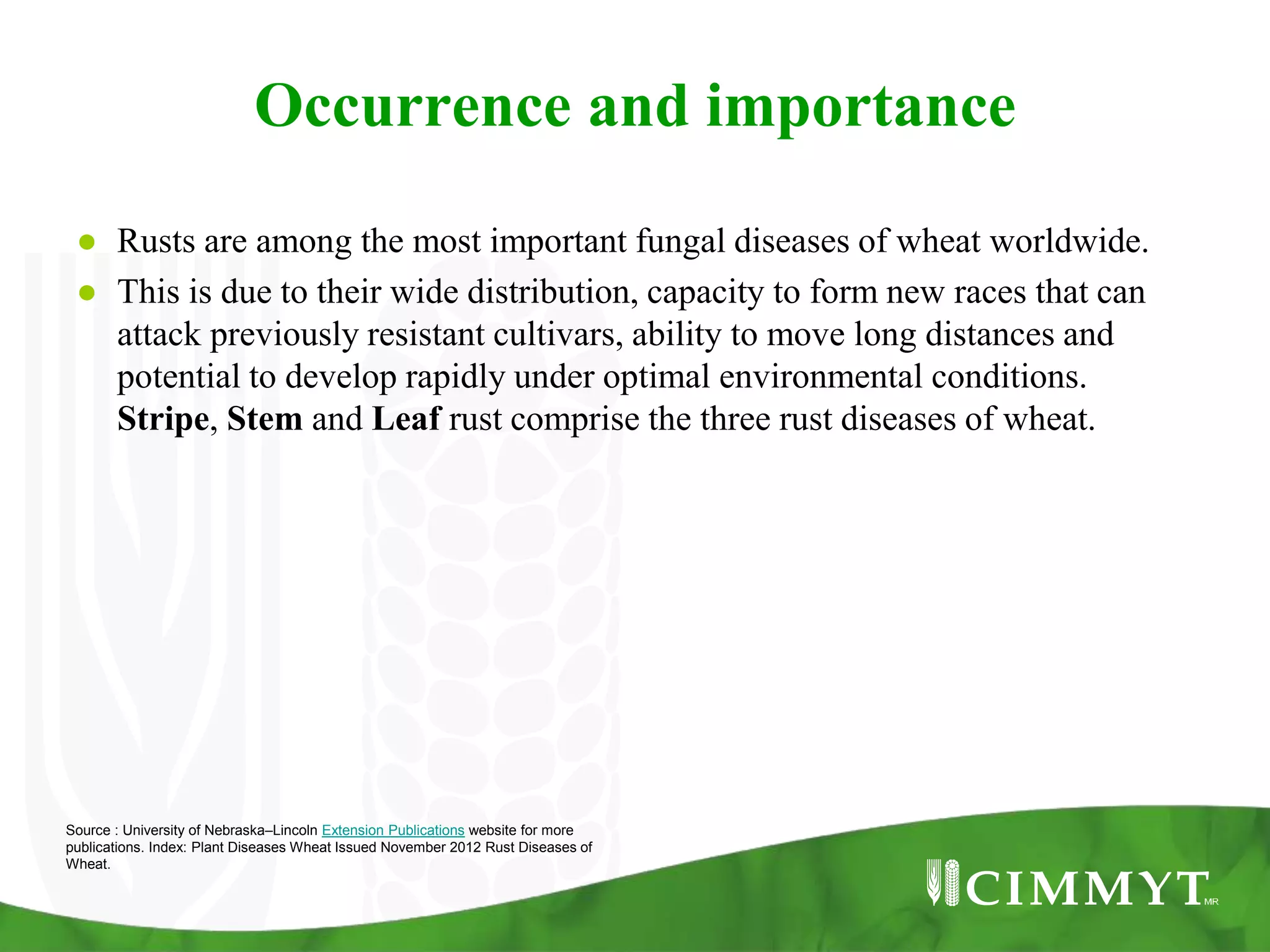
● Rusts are among the most important fungal diseases of wheat worldwide.
● This is due to their wide distribution, capacity to form new races that can
attack previously resistant cultivars, ability to move long distances and
potential to develop rapidly under optimal environmental conditions.
Stripe, Stem and Leaf rust comprise the three rust diseases of wheat.
Source : University of Nebraska–Lincoln Extension Publications website for more
publications. Index: Plant Diseases Wheat Issued November 2012 Rust Diseases of
Wheat.
Rust is a social issue
Dr, Robart Mcintosh
University of Sydney
Plant Breeding Institute
Yellow Rust:
● Yellow Rust (also called stripe rust) is caused by the fungus Puccinia
striiformis is a very important disease of wheat, particularly in Central and
West Asia and North Africa.
Figure Source https://www.google.com.af Epidemics of stem rust source
University of Nebraska–Lincoln Extension Publications website for more publications.
Index: Plant Diseases Wheat Issued November 2012 Rust Diseases of Wheat.
What is Fungus ?
● Eukaryotic
● Multi-cellular (with an exception )
● Heterotrophic ( Feed by absorption )
● Have Cell Walls
● Reproduce and disperse by Spores
● Diversity 80,000 known species probably 1 million species unknown
www.youtube.com What is Fungus video
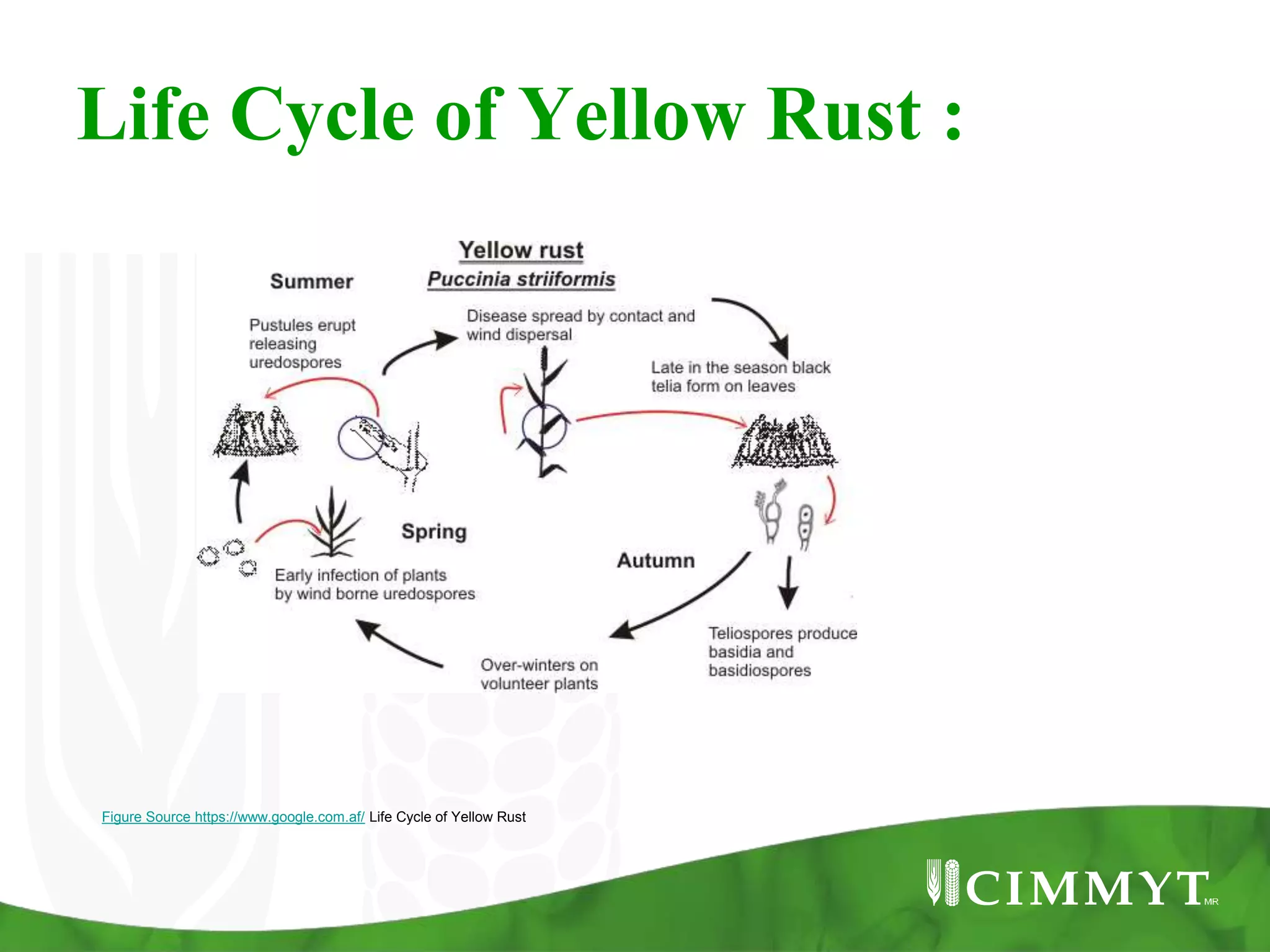
Life Cycle of Yellow Rust :
Figure Source https://www.google.com.af/ Life Cycle of Yellow Rust
Life Cycle of Rust
Yellow Rust Scoring Methods:
Figure Source : CIMMYT-Afghanistan Rust Scoring Guide
Epidemics of stripe Rust
● The good news is that major variety replacement programs are now finally
under way in Afghanistan, Ethiopia, India, Pakistan, Syria and Uzbekistan.
In Egypt, for example, the faster release and accelerated seed multiplication
of new resistant varieties - in just three years - has led to a seed production
program that can cover 30% of the country’s wheat growing area. The new
varieties being used have new resistance genes and mostly offer better
grain quality and higher yields - real inducements for enthusiastic farmer
adoption of them. Other countries need to follow suit.
Source :Synthesis of a dialog between policy makers and scientists from 31 countries at:
International Wheat Stripe Rust Symposium, Aleppo, Syria, April 2011 (ICARDA)
Stem Rust :
● Stem Rust (also called black rust), is caused by Puccinia graminis. It is
also referred to as summer rust due to the abundant production of shiny
black spores, which form at the end of the crop growing season.
● An apparently healthy crop three or four weeks before harvest can be
reduced to a black tangle of broken stems and shriveled grain. Harvest
losses of 100 percent can occur in susceptible crop varieties.
https://www.google com.af/ Stem Rust of wheat
Jin, Y., Szabo, L., Pretorius, Z.A., Singh, R.P. & Fetch, T. 2008a. Detection of virulence to
Sr24 within race TTKS of Puccinia graminis f. sp. tritici. Plant Disease 92: 923-926.
Life Cycle of Stem Rust :
Figure Source https://www.google.com.af/ Stem Rust Life Cycle
Stem Rust Scoring Methods:
Figure Source : CIMMYT-Afghanistan Rust Scoring Guide
Stem rust of wheat around the world map
Figure Source https://www.google.com.af/ Stem rust of wheat around the world map
Leaf Rust :
● Leaf Rust (Brown Rust) chiefly caused by Puccinia triticina and occurs to
some extent wherever wheat is grown. Leaf rust losses in grain yield are
primarily attributed to reduced flower set and to grain shriveling. In highly
susceptible wheat varieties, the crop can be killed by early epidemics. Crop
losses due to leaf rust are usually small (less than 10 percent), but have been
known to cause up to 30% crop losses.
Figure Source https://www.google.com.af/ Brown/Leaf Rust
Leaf Rust Life Cycle :
Figure Source https://www.google.com.af/ Brown/Leaf Rust Life Cycle
Leaf Rust Scoring Methods:
Figure Source : CIMMYT-Afghanistan Rust Scoring Guide
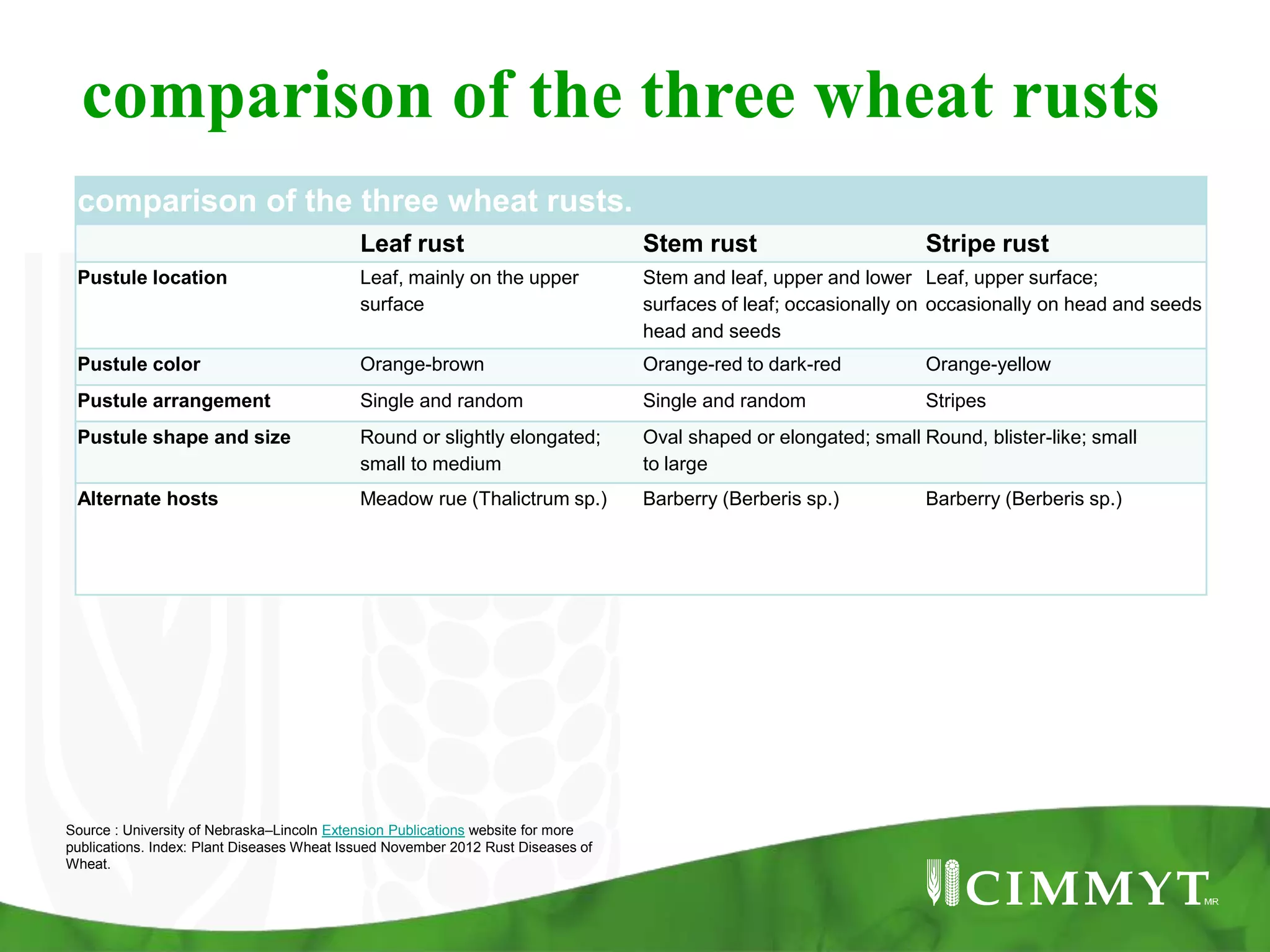
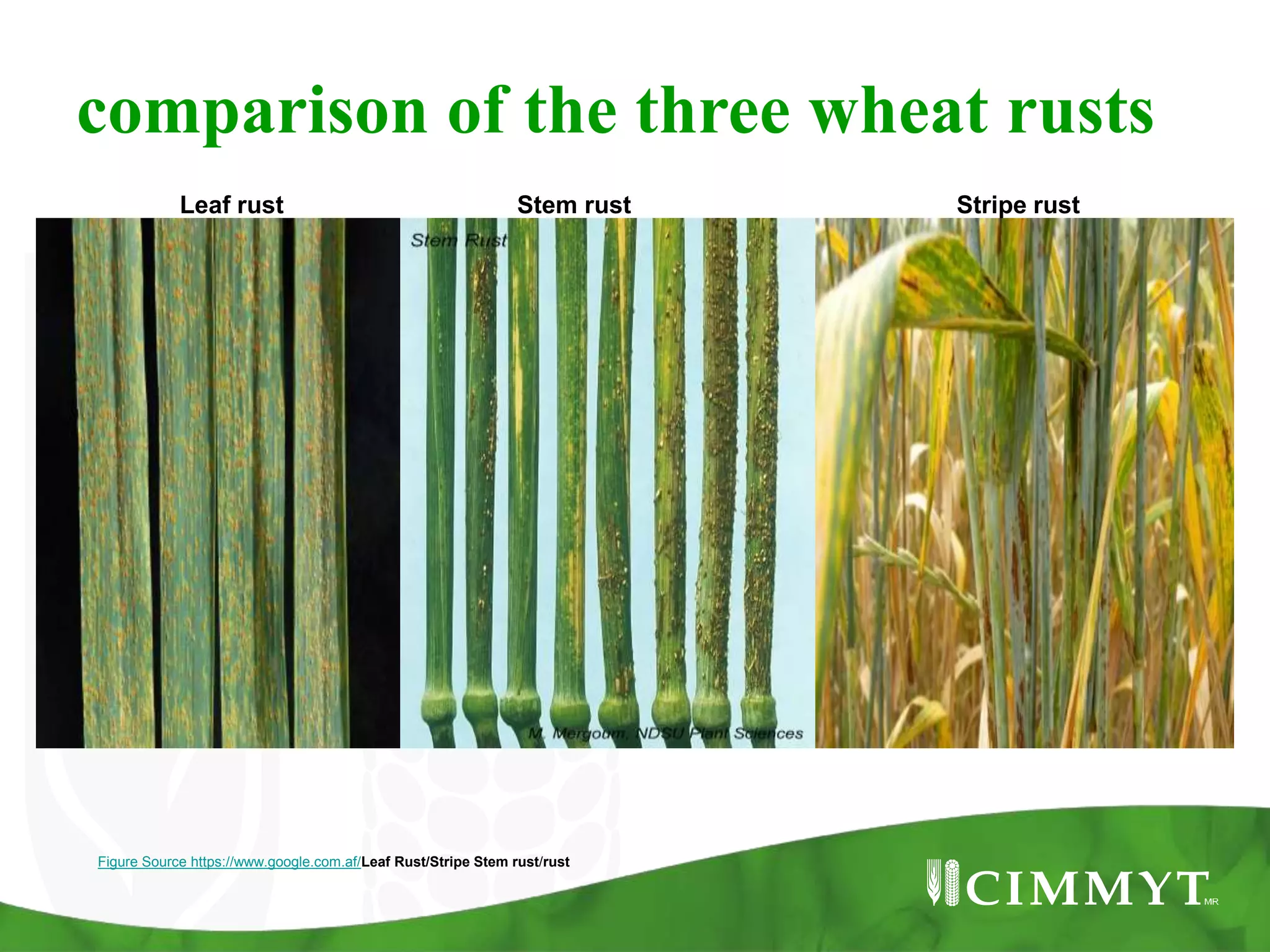
comparison of the three wheat rusts
comparison of the three wheat rusts.
Leaf rust Stem rust Stripe rust
Pustule location Leaf, mainly on the upper
surface
Stem and leaf, upper and lower
surfaces of leaf; occasionally on
head and seeds
Leaf, upper surface;
occasionally on head and seeds
Pustule color Orange-brown Orange-red to dark-red Orange-yellow
Pustule arrangement Single and random Single and random Stripes
Pustule shape and size Round or slightly elongated;
small to medium
Oval shaped or elongated; small
to large
Round, blister-like; small
Alternate hosts Meadow rue (Thalictrum sp.) Barberry (Berberis sp.) Barberry (Berberis sp.)
Source : University of Nebraska–Lincoln Extension Publications website for more
publications. Index: Plant Diseases Wheat Issued November 2012 Rust Diseases of
Wheat.
comparison of the three wheat rusts
Leaf rust Stem rust Stripe rust
Figure Source https://www.google.com.af/Leaf Rust/Stripe Stem rust/rust
Management of Wheat Rusts
● We can control the rust by tree ways.
1. Resistant Cultivars :
2. Using of fungicide:
3. Avoid excessive moisture :
Source : University of Nebraska–Lincoln Extension Publications website for more
publications. Index: Plant Diseases Wheat Issued November 2012 Rust Diseases of
Wheat. And Synthesis of a dialog between policy makers and scientists from 31 countries
at: International Wheat Stripe Rust Symposium, Aleppo, Syria, April 2011 (ICARDA)
Ghanizada-ARIA
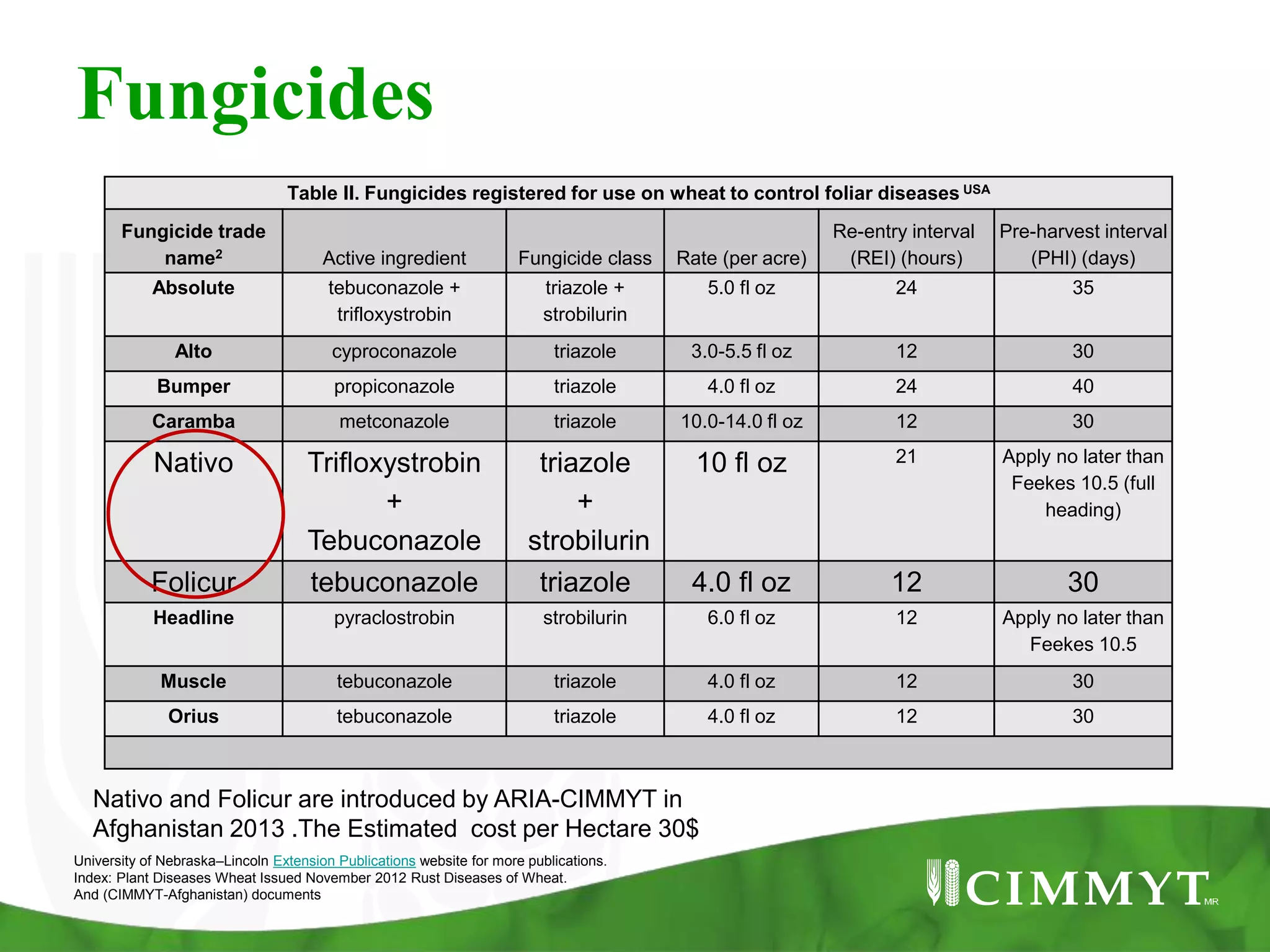
Fungicides
Table II. Fungicides registered for use on wheat to control foliar diseases USA
Fungicide trade
name2 Active ingredient Fungicide class Rate (per acre)
Re-entry interval
(REI) (hours)
Pre-harvest interval
(PHI) (days)
Absolute tebuconazole +
trifloxystrobin
triazole +
strobilurin
5.0 fl oz 24 35
Alto cyproconazole triazole 3.0-5.5 fl oz 12 30
Bumper propiconazole triazole 4.0 fl oz 24 40
Caramba metconazole triazole 10.0-14.0 fl oz 12 30
Nativo Trifloxystrobin
+
Tebuconazole
triazole
+
strobilurin
10 fl oz 21 Apply no later than
Feekes 10.5 (full
heading)
Folicur tebuconazole triazole 4.0 fl oz 12 30
Headline pyraclostrobin strobilurin 6.0 fl oz 12 Apply no later than
Feekes 10.5
Muscle tebuconazole triazole 4.0 fl oz 12 30
Orius tebuconazole triazole 4.0 fl oz 12 30
University of Nebraska–Lincoln Extension Publications website for more publications.
Index: Plant Diseases Wheat Issued November 2012 Rust Diseases of Wheat.
And (CIMMYT-Afghanistan) documents
Nativo and Folicur are introduced by ARIA-CIMMYT in
Afghanistan 2013 .The Estimated cost per Hectare 30$
In summary
1. what is needed to reduce the threat of wheat rust to our harvests and
people's livelihoods, is a sustained investment in strengthening
Surveillance and (information exchange between countries).
2. New capacity and skills development in ministries, extension services and
at the farm level to develop effective strategies for managing rust diseases.
3. Crop research for a continued, long-tern effort for developing of new
varieties that are resistant to the emerging races of wheat rusts.
Wheat rusts
Wheat rusts

Wheat rusts

  • 1.
  • 2.
    Wheat Rusts Stem rust Pucciniagraminis Stripe rust Puccinia striiformis Leaf rust Puccinia triticina Figure Source https://www.google.com.af/Stem rust/Stripe rust/Leaf Rust
  • 3.
    “Rust never sleeps” Fatherof Green Revolution Dr Norman Borlaug.
  • 4.
    Occurrence and importance ●Rusts are among the most important fungal diseases of wheat worldwide. ● This is due to their wide distribution, capacity to form new races that can attack previously resistant cultivars, ability to move long distances and potential to develop rapidly under optimal environmental conditions. Stripe, Stem and Leaf rust comprise the three rust diseases of wheat. Source : University of Nebraska–Lincoln Extension Publications website for more publications. Index: Plant Diseases Wheat Issued November 2012 Rust Diseases of Wheat.
  • 5.
    Rust is asocial issue Dr, Robart Mcintosh University of Sydney Plant Breeding Institute
  • 6.
    Yellow Rust: ● YellowRust (also called stripe rust) is caused by the fungus Puccinia striiformis is a very important disease of wheat, particularly in Central and West Asia and North Africa. Figure Source https://www.google.com.af Epidemics of stem rust source University of Nebraska–Lincoln Extension Publications website for more publications. Index: Plant Diseases Wheat Issued November 2012 Rust Diseases of Wheat.
  • 7.
    What is Fungus? ● Eukaryotic ● Multi-cellular (with an exception ) ● Heterotrophic ( Feed by absorption ) ● Have Cell Walls ● Reproduce and disperse by Spores ● Diversity 80,000 known species probably 1 million species unknown www.youtube.com What is Fungus video
  • 8.
    Life Cycle ofYellow Rust : Figure Source https://www.google.com.af/ Life Cycle of Yellow Rust
  • 9.
  • 10.
    Yellow Rust ScoringMethods: Figure Source : CIMMYT-Afghanistan Rust Scoring Guide
  • 11.
    Epidemics of stripeRust ● The good news is that major variety replacement programs are now finally under way in Afghanistan, Ethiopia, India, Pakistan, Syria and Uzbekistan. In Egypt, for example, the faster release and accelerated seed multiplication of new resistant varieties - in just three years - has led to a seed production program that can cover 30% of the country’s wheat growing area. The new varieties being used have new resistance genes and mostly offer better grain quality and higher yields - real inducements for enthusiastic farmer adoption of them. Other countries need to follow suit. Source :Synthesis of a dialog between policy makers and scientists from 31 countries at: International Wheat Stripe Rust Symposium, Aleppo, Syria, April 2011 (ICARDA)
  • 12.
    Stem Rust : ●Stem Rust (also called black rust), is caused by Puccinia graminis. It is also referred to as summer rust due to the abundant production of shiny black spores, which form at the end of the crop growing season. ● An apparently healthy crop three or four weeks before harvest can be reduced to a black tangle of broken stems and shriveled grain. Harvest losses of 100 percent can occur in susceptible crop varieties. https://www.google com.af/ Stem Rust of wheat Jin, Y., Szabo, L., Pretorius, Z.A., Singh, R.P. & Fetch, T. 2008a. Detection of virulence to Sr24 within race TTKS of Puccinia graminis f. sp. tritici. Plant Disease 92: 923-926.
  • 13.
    Life Cycle ofStem Rust : Figure Source https://www.google.com.af/ Stem Rust Life Cycle
  • 14.
    Stem Rust ScoringMethods: Figure Source : CIMMYT-Afghanistan Rust Scoring Guide
  • 15.
    Stem rust ofwheat around the world map Figure Source https://www.google.com.af/ Stem rust of wheat around the world map
  • 16.
    Leaf Rust : ●Leaf Rust (Brown Rust) chiefly caused by Puccinia triticina and occurs to some extent wherever wheat is grown. Leaf rust losses in grain yield are primarily attributed to reduced flower set and to grain shriveling. In highly susceptible wheat varieties, the crop can be killed by early epidemics. Crop losses due to leaf rust are usually small (less than 10 percent), but have been known to cause up to 30% crop losses. Figure Source https://www.google.com.af/ Brown/Leaf Rust
  • 17.
    Leaf Rust LifeCycle : Figure Source https://www.google.com.af/ Brown/Leaf Rust Life Cycle
  • 18.
    Leaf Rust ScoringMethods: Figure Source : CIMMYT-Afghanistan Rust Scoring Guide
  • 19.
    comparison of thethree wheat rusts comparison of the three wheat rusts. Leaf rust Stem rust Stripe rust Pustule location Leaf, mainly on the upper surface Stem and leaf, upper and lower surfaces of leaf; occasionally on head and seeds Leaf, upper surface; occasionally on head and seeds Pustule color Orange-brown Orange-red to dark-red Orange-yellow Pustule arrangement Single and random Single and random Stripes Pustule shape and size Round or slightly elongated; small to medium Oval shaped or elongated; small to large Round, blister-like; small Alternate hosts Meadow rue (Thalictrum sp.) Barberry (Berberis sp.) Barberry (Berberis sp.) Source : University of Nebraska–Lincoln Extension Publications website for more publications. Index: Plant Diseases Wheat Issued November 2012 Rust Diseases of Wheat.
  • 20.
    comparison of thethree wheat rusts Leaf rust Stem rust Stripe rust Figure Source https://www.google.com.af/Leaf Rust/Stripe Stem rust/rust
  • 21.
    Management of WheatRusts ● We can control the rust by tree ways. 1. Resistant Cultivars : 2. Using of fungicide: 3. Avoid excessive moisture : Source : University of Nebraska–Lincoln Extension Publications website for more publications. Index: Plant Diseases Wheat Issued November 2012 Rust Diseases of Wheat. And Synthesis of a dialog between policy makers and scientists from 31 countries at: International Wheat Stripe Rust Symposium, Aleppo, Syria, April 2011 (ICARDA) Ghanizada-ARIA
  • 22.
    Fungicides Table II. Fungicidesregistered for use on wheat to control foliar diseases USA Fungicide trade name2 Active ingredient Fungicide class Rate (per acre) Re-entry interval (REI) (hours) Pre-harvest interval (PHI) (days) Absolute tebuconazole + trifloxystrobin triazole + strobilurin 5.0 fl oz 24 35 Alto cyproconazole triazole 3.0-5.5 fl oz 12 30 Bumper propiconazole triazole 4.0 fl oz 24 40 Caramba metconazole triazole 10.0-14.0 fl oz 12 30 Nativo Trifloxystrobin + Tebuconazole triazole + strobilurin 10 fl oz 21 Apply no later than Feekes 10.5 (full heading) Folicur tebuconazole triazole 4.0 fl oz 12 30 Headline pyraclostrobin strobilurin 6.0 fl oz 12 Apply no later than Feekes 10.5 Muscle tebuconazole triazole 4.0 fl oz 12 30 Orius tebuconazole triazole 4.0 fl oz 12 30 University of Nebraska–Lincoln Extension Publications website for more publications. Index: Plant Diseases Wheat Issued November 2012 Rust Diseases of Wheat. And (CIMMYT-Afghanistan) documents Nativo and Folicur are introduced by ARIA-CIMMYT in Afghanistan 2013 .The Estimated cost per Hectare 30$
  • 23.
    In summary 1. whatis needed to reduce the threat of wheat rust to our harvests and people's livelihoods, is a sustained investment in strengthening Surveillance and (information exchange between countries). 2. New capacity and skills development in ministries, extension services and at the farm level to develop effective strategies for managing rust diseases. 3. Crop research for a continued, long-tern effort for developing of new varieties that are resistant to the emerging races of wheat rusts.