BOTANY ISA-1
Casual organism, symptoms and control of
Plant diseases
OCTOBER 15, 2020
WINONA MARIA CARVALHO
FY, BSc in Biotechnology
Favourable conditions:
▪ Temperatures of less
than 18°C (optimum 6-
12°C) with a minimum of
three hours of leaf-
wetness (for example,
dew).
▪ Once an infection is
established within the
leaf the fungus can
survive short periods of
temperatures as high as
40°C.
Yellow stripes,
raised pustules
appear on the
leaves,
especially on
the older leaves
lying low in the
canopy and can
be easily wiped
off onto a white
cloth or tissue
leaving a
yellow stain.
Alternate hosts:
▪ Agropyron
▪ Bromus
Yellow rust
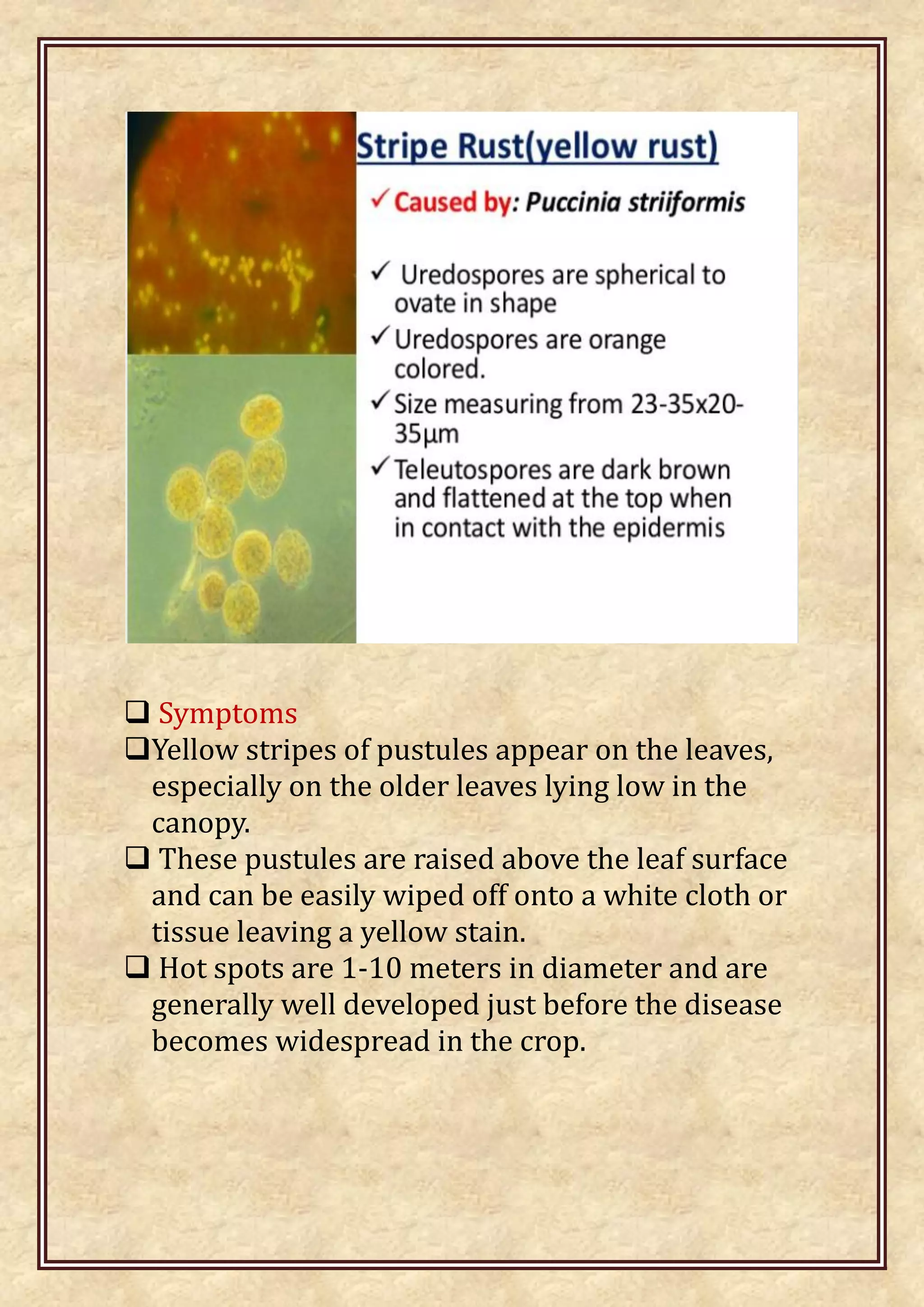
Disease: Stripe rust (Yellow rust)
Causal organism: Puccinia striiformis
❑ Symptoms
❑Yellow stripes of pustules appear on the leaves,
especially on the older leaves lying low in the
canopy.
❑ These pustules are raised above the leaf surface
and can be easily wiped off onto a white cloth or
tissue leaving a yellow stain.
❑ Hot spots are 1-10 meters in diameter and are
generally well developed just before the disease
becomes widespread in the crop.
Disease cycle of stripe
rust
Stripe rust is caused by the fungus Puccinia striiformis.
Stripe rust survives from one season to the next
predominantly on volunteer self-sown cereals, but can
also survive to a lesser extent on other cereal and grass
weeds that grow over summer.
Stripe rust epidemics are usually more severe in
seasons following wet summers that have supported the
‘green bridge.
During the season, conditions suitable for epidemic and
stripe rust can be expected in crops by January to April
in the years. For an infection of a plant to occur the spore
requires temperatures of less than 18°C (optimum 6-
12°C) with a minimum of three hours of leaf-wetness
(for example, dew).
Once an infection is established within the leaf the
fungus can survive short periods of temperatures as high
as 40°C.
Following infection of the leaf the fungus grows within
the leaf for 14 to 28 days (or longer depending on
temperature) until the spores appear on the leaf surface
as pustules.
The time between infection and symptom development
is known as the latent period, with the time reducing as
temperatures warm during the spring.
The spores are then dispersed by wind, allowing the
cycle to repeat multiple times during the season.
The Green Bridge
Stripe rust can only survive from one season to the
next on living plants: mostly wheat and to a lesser
extent barley, triticale, barley grass, brome grass
and phalaris. This is called the ‘green bridge’.
Stripe rust does not survive on seed, stubble or
soil. Therefore, the greater the number of
susceptible volunteer wheat plants growing during
summer/ autumn the greater the risk of a stripe
rust epidemic and the reason that stripe rust is
often more severe following wet summers.
The susceptibility of the volunteer wheat plants
over summer influences the quantity of inoculum
generated by the green bridge. If most varieties in
a district are resistant there will be considerably
less inoculum than if many plants are susceptible
or very susceptible.
Management Strategies to Minimize the Impact of
Stripe Rust
The following management strategies are
recommended to minimize the impact of stripe
rust:
▪ Remove volunteer wheat plants (the ‘green
bridge’) that will support stripe rust inoculum
in the 6 weeks prior to sowing
▪ Avoid Very Susceptible (VS) and Susceptible
(S) varieties by selecting more resistant
varieties
▪ Use a seed or fertilizer treatment to suppress
early infection
▪ Monitor crops during the growing season and
apply a foliar fungicide early in the epidemic, if
required.
Spray.
(azoxystrobin + propiconazole)/
(Tebuconazole+ Trifloxystrobin)/
azoxystrobin/
(azoxystrobin + tebuconazole)
0.2% at 7 to 10 days from flag leaf emergence to
early dough grain development stage or at earliest
sign of rust pustules development.
Brown or orange rust
Disease: leaf rust (Brown or orange rust)
Causal organism: Puccinia triticina (formally
Puccinia recondita)
Favourable conditions:
▪ Wet conditions and
▪ Temperatures of
approximately 15-22°C
Circular to oval,
orange-brown
pustules appear
scattered across
the leaf surface
that are raised
above the leaf
surface and these
pustules are
confined chiefly to
the upper surface
of the leaf.
❑Symptoms of leaf rust
▪ Circular to oval, orange-brown pustules
appear scattered across the leaf surface that
are raised above the leaf surface and these
pustules are confined chiefly to the upper
surface of the leaf.
▪ Later in the season, black teliospores develop
on mature plants, usually on the under surface
of the leaf or on the leaf sheath.
Teliospores play an
important role by either
infecting volunteer wheat
plants or barberry plants
Secondary cycles
Disease cycle of
leaf rust
▪ Leaf rust is caused by the fungus Puccinia
triticina (formally Puccinia recondita). Leaf
rust, like other cereal rusts, requires a living
host to survive from one season to the next.
▪ The most important hosts for rusts are
susceptible volunteer plants such as weeds,
wheat plants growing during the
summer/autumn. Rust cannot carry over from
one season to the next on seed, stubble or soil.
▪ Wheat varieties susceptible to leaf rust enable
inoculum levels to build up on volunteers
during the summer and autumn. This can be a
problem in seasons following wet summers
that favour the growth of self-sown wheat. The
plants that become heavily infected with rust
in the autumn provide a source of rust for the
new season’s wheat crop.
▪ If these conditions are followed by a mild
winter and a warm wet spring, then the
chances of a leaf rust epidemic are high.
Therefore, the chances of a rust epidemic are
greatest following a wet summer.
▪ Due to the absence of the alternate host, leaf
rust reproduces asexually. This reduces the
variability of the rusts in the field and
therefore increases the likelihood that
resistant varieties will be effective for a long
period of time.
▪ Rust spores are wind-blown and can be
spread over large areas in a short time. The
establishment of leaf rust epidemics within a
crop is favoured by wet conditions and
temperatures of approximately 15-22°C
❑Control or Management of leaf rust
Resistant Varieties
The best way to control leaf rust is to grow resistant
varieties. Widespread cultivation of resistant varieties
minimizes the levels of rust in the environment and
reduces the occurrence of new races.
Cultural Practices
Heavy grazing or the use of herbicides during autumn to
remove self-sown susceptible wheat will reduce the
amount of rust in following crops.
Seed Treatments
There are seed treatments available which will suppress
early infections of leaf rust. Seed treatments are
important in susceptible varieties, especially if they are
sown early or following a wet summer favouring growth
of volunteers.
Monitoring and fungicide spray
Spray (azoxystrobin + propiconazole)/(Tebuconazole +
Trifloxystrobin)/azoxystrobin/(azoxystrobin +
tebuconazole) 0.2% at 7 to 10 days from flag leaf
emergence to early dough grain development stage or at
earliest sign of rust pustules development.
Reddish-brown,
darker, powdery,
oblong pustules
having a
characteristic
torn margin that
can occur on
both sides of the
leaves, on the
stems and the
glumes.
Favourable conditions:
▪ Wet conditions and
▪ Temperatures of approximately 15-30°C
Alternate hosts:
▪ Berberis
▪ Mahonia
▪ Mahoberberis
Black rust
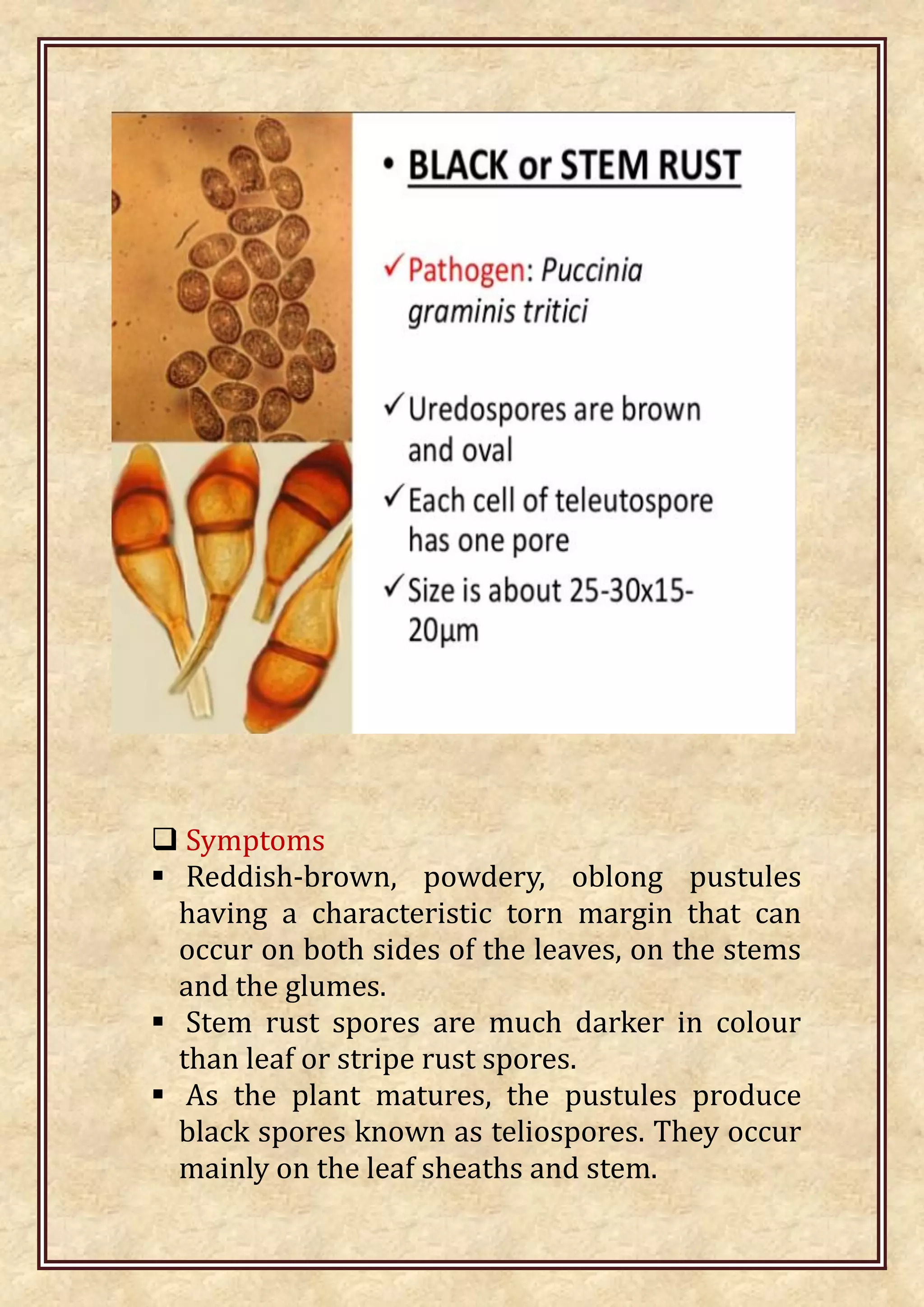
Disease: Stem rust (Black rust)
Causal organism: Puccinia graminis f.sp. tritici
❑ Symptoms
▪ Reddish-brown, powdery, oblong pustules
having a characteristic torn margin that can
occur on both sides of the leaves, on the stems
and the glumes.
▪ Stem rust spores are much darker in colour
than leaf or stripe rust spores.
▪ As the plant matures, the pustules produce
black spores known as teliospores. They occur
mainly on the leaf sheaths and stem.
Fungus
carries
over on
volunteer
cereals or
barberry
plant
Teliospores play an important role
by either infecting volunteer wheat
plants or barberry plants
Disease cycle of Stem
rust
Secondary cycles
Fungus carries over
on volunteer cereals
or barberry plant
Wet conditions and
Temperatures of
approximately 15-30°C
Management of stem rust
Stem rust can be managed using an integrated
approach that includes managing the green bridge,
avoiding susceptible cultivars and close monitoring
to enable timely fungicide sprays.
Removal of the Green Bridge
Rust can only survive from one season to the next
on living plant material (mainly self-sown cereals).
Therefore, the removal of the green bridge is
essential to reduce the amount of inoculum
present to infect a new crop.
Variety Selection
Sowing resistant varieties provides the best
protection against stem rust by reducing the
chance of new pathotypes occurence.
Monitoring and fungicide spray
Spray
(azoxystrobin + propiconazole)/ (Tebuconazole+
Trifloxystrobin)/azoxystrobin/ (azoxystrobin +
tebuconazole) 0.2% at 7 to 10 days from flag leaf
emergence to early dough grain development stage
or at earliest sign of rust pustules development.
Smut
Favourable conditions:
▪ Infection of seedlings is favored by earlier
sowing
▪ Drier and acidic soils
▪ Temperature (15-21°C)
Disease: Covered smut of barley
Causal organism: Ustilago hordei
Dark grey to
black
ears/heads
due to the
masses of
teliospores of
❑ Symptoms
▪ The presence of the disease is first noticed at
ear emergence when the ears appear dark
grey due to the masses of teliospores covered
by a thin membrane of tissue.
▪ The membrane splits at maturity, or during
threshing, releasing the spore mass into the
atmosphere.
▪ The spores are not readily wind-dispersed if
the membrane ruptures before harvest as they
stick together due to the presence of an oily
coating.
▪ Infected plants may be slightly shorter than
their healthy neighbors.
▪ Affected ears may emerge later than the
surrounding crop and in some cases remain
trapped within the sheath of the flag leaf.
▪ Infected ears are readily identified by their
dark color and shriveled awns.
▪ Sori can occasionally be found in stripes on
leaves and stem galling has also been reported.
❑ Control or Management of covered smut of
barley
▪ Spray
Mancozeb/Tebuconazole 0.2 t0 0.3% starting
just before emergence of the heads continue
for two or three times if the disease is severe.
▪ Treatment of barley seeds with Provax 2.5
g/kg seeds successfully
controls the disease.
▪ Use of disease resistant varieties also helps to
reduce losses.
▪ Sowing seeds in a moderately dry soil will
reduce the disease incidence,
since moist soils are favourable for infection.
▪ The rate of covered smut infection can be
reduced when barley is raised in a neutral or
alkaline soil than in an acid soil.
Smutted
heads, in
which grain
and glume
structures
are replaced
by masses
of black
teliospores
covered by a
gray
membrane,
emerge
several days
earlier than
contrasting
green
healthy
heads
The fragile
membrane
that covers
the spores
breaks off
soon after
heading
and the
spores
become
airborne or
are washed
off by rain,
eventually
leaving only
the empty
rachis as
evidence of
the disease.
Favourable conditions:
▪ Wind and moderate rain
▪ Cool temperatures (16–22 °C)
Loose smut
Disease name: Loose smut
Pathogen name: Ustilago tritici (Pers.)
Rostr.
Bare rachis after
blown off the
spores by wind and
water
Smutted head, where all
the structures except the
rachis are replaced by
spores
❑Symptoms
• Loose smut is a fungal disease in which full heads
are replaced by smut spores (teliospores).
Conspicuous loose smut symptoms are evident at
early heading.
• Smutted heads, in which grain and glume
structures are replaced by masses of black
teliospores covered by a gray membrane, emerge
several days earlier than contrasting green
healthy heads.
• The fragile membrane that covers the spores
breaks off soon after heading and the spores
become airborne or are washed off by rain,
eventually leaving only the empty rachis as
evidence of the disease.
• The loose smut symptoms can only be seen at
the time of flowering though the plants are
infected right after seed germination.
• The heads of the infected plants emerge earlier
than the healthy one. symptoms of the disease
• Yield lost in the infected heads is total. Diseased
heads produce no grain at all.
❑Management or Control
• Planting high-quality pathogen-free seed will
eliminate the inoculum source.
• Seeds should be treated with Propvax (Carboxin +
Thiram) /Tebuconazole (2.5g/kg seed) to eliminate
seed borne infection.
• Spray
(azoxystrobin + propiconazole)/
Folicur 25EC (Tebuconazole) + Trifloxystrobin)/
azoxystrobin/
(azoxystrobin + tebuconazole)
0.05 to 0.075% at 7 to 10 days from seedling to flag
leaf emergence stage or at earliest sign of loose smut
development.
• Using resistant cultivars helps reduce final
symptoms.
• Placing seed production fields away from
commercial fields helps avoid infection of the seed
from air-born spores, which can be carried long
distances by winds.
Foot rot
Disease: Foot rot
Causal organisms: Fusarium graminearum
Fusarium culmorum
Pythium graminicolum
P. arrhenomanes
Favourable conditions:
▪ High humidity
▪ Wet weather
▪ Warm, moist and poorly drained soils
Yellowing of the
seedlings due to
root rot
Common root rots
with black
discolouration with
sub-crown
internodes (arrows)
❑Symptoms:
▪ The first visible symptoms of common root rot are
the appearance of stunted seedlings with chlorotic
symptoms in the field as irregular patches.
▪ The symptoms of common root rot include dark
brown to black lesions in roots, sub crown
internodes and stem bases.
▪ The primary and secondary roots may appear
brown or blackened.
▪ The diagnostic symptoms of the Fusarium foot rot is
cottony pink mycelium that may appear on the stem
bases.
Common root rots
with black
discolouration (arrow)
❑Control or management
▪ Maintain balanced fertilization particularly by
reducing the application of nitrogenous fertilizer.
▪ Proper weeding to eliminate the alternate hosts and
weeds may predispose the plant roots to infection.
▪ Use certified or fungicides treated seeds.
▪ Rotate crops to reduce the Fusarium inoculum by
avowing the planting wheat following corn or
wheat.
▪ Seeds treatment with Provax (Carboxin + Thiram)
or Tebuconazole or Mancozeb + copper oxychloride
@ 2.5 g/Kg seeds.
▪ Soil can be drenched with 0.2-0.3% solution of
Mancozeb + Carbendazim at the seedling stage.
Late blight in Potato
Disease: Late blight in potato
Causal organisms: Phytophthora infestans
Favourable conditions:
The late blight pathogen is favored by free moisture
and cool to moderate temperatures.
❑ Symptoms
The first symptoms of late blight in the field are
small, light to dark green, circular to irregular-
shaped water-soaked spots. These lesions usually
appear first on the lower leaves. Lesions often begin
to develop near the leaf tips or edges, where dew is
retained the longest.
Initial
symptoms of
late blight are
small, light to
dark green,
circular to
irregular-
shaped water-
soaked spots.
Initial symptoms
of late blight are
small, light to dark
green, circular to
irregular-shaped
water-soaked
spots.
Leaf lesions
frequently are
surrounded by a
yellow chlorotic
halo
Late blight lesions
may be present on
petioles and stems
of the plant,
especially in new
growth where
moisture persists
During active late
blight growth,
especially in cool,
wet weather, a white
mildew-appearing
area is visible at the
edge of the lesions
Actively growing late
blight can cause a
white mildew-
appearing area along
petioles
Brown, dry lesions can develop following warm and
dry weather. A pale
green to yellow
border often
surrounds the
lesions. Often
produce a distinct
odour.
Late blight infection of
tubers is characterized
by irregularly shaped,
slightly depressed areas
that can vary
considerably from
brown to purplish of
variable size on the
skin
Late blight causes a tan
to reddish-brown rot
found under the skin.
The margin of the
diseased tissue is not
always distinct but can
be, particularly in seed
potatoes that have been
stored at cold storage
temperatures.
❑Management or control
Destroy all cull and volunteer potatoes.
• Plant late blight-free seed tubers.
• Do not mix seed lots because cutting can
transmit late blight.
• Use a seed piece fungicide treatment labelled
for control of late blight. Recommended seed
treatments include Revus, Reason and
mancozeb.
• Avoid planting problem areas that may
remain wet for extended periods or may be
difficult to spray (the centre of the pivot, along
powerlines and tree lines).
• Avoid excessive and/or night-time irrigation.
• Eliminate sources of inoculum such as hairy
nightshade weed species and volunteer
potatoes.
• Scout fields regularly, especially in low, wet
areas, along tree lines, at the centre of the
pivot and other areas that remain wet for
longer periods where late blight first may
occur.
• Use foliar fungicides on a regular and
continuing schedule. Once late blight is
present, only foliar fungicide applications can
manage late blight in the field. (A current list
of fungicides can be found in the NDSU
“Fungicide Guide,” PP622).
• Keep up to date on late blight forecasts.
• Quickly destroy hot spots of late blight.
• Kill vines completely two to three weeks
before harvest.
• Applying phosphorous acid to potatoes after
harvest and before piling can prevent
infection and the spread of late blight in
storage.
• Monitor home garden and market tomatoes
near you for late blight. Late blight can move
from these local sources to potato fields.
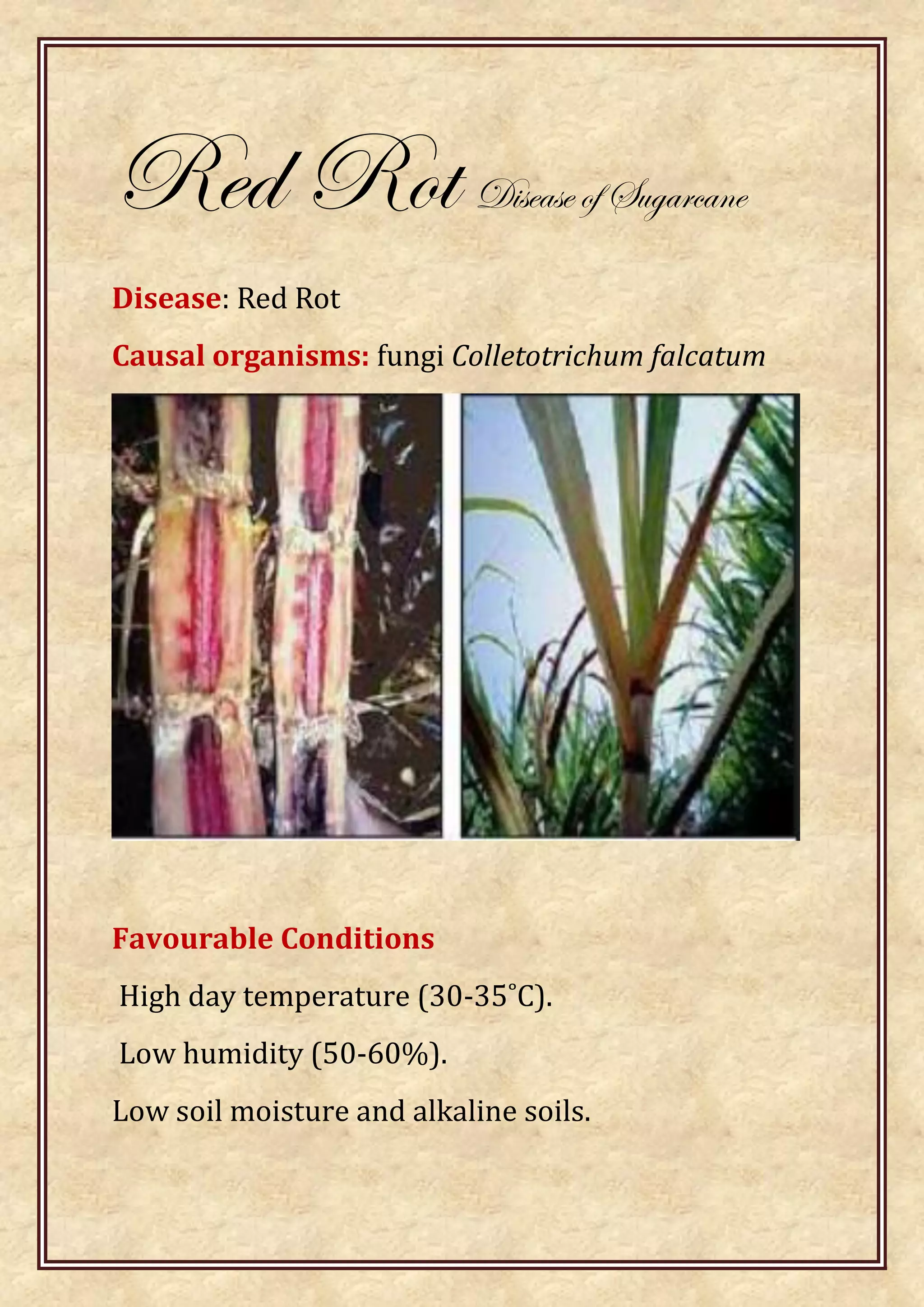
Red Rot Disease of Sugarcane
Disease: Red Rot
Causal organisms: fungi Colletotrichum falcatum
Favourable Conditions
High day temperature (30-35˚C).
Low humidity (50-60%).
Low soil moisture and alkaline soils.
❑ Symptoms
• The 3rd and 4th leaves (from the top) of the
infected plants display yellowing and drying. At
a later stage, show discoloured lesion on the
rind. Fungal spores develop on rind and nodes.
• If the diseased stalk split open, reddened
internal tissues with intermingled white spots
may be seen. The internal colour becomes
brown, pith cavity become larger, greyish
hyphae inside pith become visible. A sour and
alcoholic smell emanates from the infected
tissues.
❑Management or control
Red rot is often referred as cancer of sugarcane and
no effective method for its control is available yet.
However, the diseases can be managed by adopting
integrated red rot management practices.
• Cultivation of resistant varieties like Co 89003,
Co 98014, Co 0118, Co 0238, Co 0239, Co 0124,
etc will contain the disease.
• The disease spread through infected setts.
Therefore, always select seed canes from a
disease-free healthy crop. Any setts showing
reddening at the cut ends or at the nodal region
should be discarded.
• Raise seed crop from the seed canes treated in
moist hot aerated therapy unit at 54°C for 1
hour or soak the setts overnight in Thiophanate
Methyl (ROKO)+Pseudomonas.
• Resort to crop rotation with paddy and green
manure crops. Avoid ratooning.
• During rainy season, the disease spreads fast.
Bunding of affected field may be done to avoid
movement of pathogen through rain or
floodwater.
• Roguing of diseased plants showing spindle leaf
infection early during May-June and disinfecting
soil around the diseased clumps with 0.1%
Carbendazim solution.
Citrus canker
Disease: Citrus canker
Causal organisms: bacterial pathogen,
Xanthomonas citri (Hasse) Dows.
Symptoms:
Citrus canker causes lesions on citrus leaves, stems,
and fruit. Characteristic lesions are raised and
brown, have water-soaked margins, and usually
have a yellow halo surrounding the lesion. Older
lesions appear corky.
Management or Control:
• Sanitation:
Destruction of all affected trees by burning. Pruning
of infected parts, particularly during dry season
reduces source of inoculum.
• Spraying of Fungicides:
Spraying of fungicides like Bordeaux mixture and
lime-sulphur is often very effective to protect the
fruits against infection. It should be done during the
first three months of the development of fruits.
• Use of Disease Resistant Varieties:
There is a possibility that cultivation of disease
resistant citrus varieties may produce good results.
White rust of Crucifers
Disease: White rust
Causal organisms: Albugo candida
Symptoms:
Signs and symptoms of infection include chlorosis on leaf
surfaces, white blister-like growths on the underside of
leaves and on the stems of the plant and swelling of the
roots. In addition, abnormalities in the growth of the host
can occur with more serious infections.
Management or control:
Ploughing or disking diseased plants and plant parts results in
rapid decomposition of infected tissues and helps to
significantly reduce future white rust infection. Crop rotation
with non-cruciferous host plants is also effective. Weed
control and other sanitary methods are necessary
Thank You

Casual organisms: symptoms, life cycles and control of plant diseases

  • 1.
    BOTANY ISA-1 Casual organism,symptoms and control of Plant diseases OCTOBER 15, 2020 WINONA MARIA CARVALHO FY, BSc in Biotechnology
  • 2.
    Favourable conditions: ▪ Temperaturesof less than 18°C (optimum 6- 12°C) with a minimum of three hours of leaf- wetness (for example, dew). ▪ Once an infection is established within the leaf the fungus can survive short periods of temperatures as high as 40°C. Yellow stripes, raised pustules appear on the leaves, especially on the older leaves lying low in the canopy and can be easily wiped off onto a white cloth or tissue leaving a yellow stain. Alternate hosts: ▪ Agropyron ▪ Bromus Yellow rust Disease: Stripe rust (Yellow rust) Causal organism: Puccinia striiformis
  • 3.
    ❑ Symptoms ❑Yellow stripesof pustules appear on the leaves, especially on the older leaves lying low in the canopy. ❑ These pustules are raised above the leaf surface and can be easily wiped off onto a white cloth or tissue leaving a yellow stain. ❑ Hot spots are 1-10 meters in diameter and are generally well developed just before the disease becomes widespread in the crop.
  • 4.
    Disease cycle ofstripe rust
  • 5.
    Stripe rust iscaused by the fungus Puccinia striiformis. Stripe rust survives from one season to the next predominantly on volunteer self-sown cereals, but can also survive to a lesser extent on other cereal and grass weeds that grow over summer. Stripe rust epidemics are usually more severe in seasons following wet summers that have supported the ‘green bridge. During the season, conditions suitable for epidemic and stripe rust can be expected in crops by January to April in the years. For an infection of a plant to occur the spore requires temperatures of less than 18°C (optimum 6- 12°C) with a minimum of three hours of leaf-wetness (for example, dew). Once an infection is established within the leaf the fungus can survive short periods of temperatures as high as 40°C. Following infection of the leaf the fungus grows within the leaf for 14 to 28 days (or longer depending on temperature) until the spores appear on the leaf surface as pustules. The time between infection and symptom development is known as the latent period, with the time reducing as temperatures warm during the spring. The spores are then dispersed by wind, allowing the cycle to repeat multiple times during the season.
  • 6.
    The Green Bridge Striperust can only survive from one season to the next on living plants: mostly wheat and to a lesser extent barley, triticale, barley grass, brome grass and phalaris. This is called the ‘green bridge’. Stripe rust does not survive on seed, stubble or soil. Therefore, the greater the number of susceptible volunteer wheat plants growing during summer/ autumn the greater the risk of a stripe rust epidemic and the reason that stripe rust is often more severe following wet summers. The susceptibility of the volunteer wheat plants over summer influences the quantity of inoculum generated by the green bridge. If most varieties in a district are resistant there will be considerably less inoculum than if many plants are susceptible or very susceptible.
  • 7.
    Management Strategies toMinimize the Impact of Stripe Rust The following management strategies are recommended to minimize the impact of stripe rust: ▪ Remove volunteer wheat plants (the ‘green bridge’) that will support stripe rust inoculum in the 6 weeks prior to sowing ▪ Avoid Very Susceptible (VS) and Susceptible (S) varieties by selecting more resistant varieties ▪ Use a seed or fertilizer treatment to suppress early infection ▪ Monitor crops during the growing season and apply a foliar fungicide early in the epidemic, if required. Spray. (azoxystrobin + propiconazole)/ (Tebuconazole+ Trifloxystrobin)/ azoxystrobin/ (azoxystrobin + tebuconazole) 0.2% at 7 to 10 days from flag leaf emergence to early dough grain development stage or at earliest sign of rust pustules development.
  • 8.
    Brown or orangerust Disease: leaf rust (Brown or orange rust) Causal organism: Puccinia triticina (formally Puccinia recondita) Favourable conditions: ▪ Wet conditions and ▪ Temperatures of approximately 15-22°C Circular to oval, orange-brown pustules appear scattered across the leaf surface that are raised above the leaf surface and these pustules are confined chiefly to the upper surface of the leaf.
  • 9.
    ❑Symptoms of leafrust ▪ Circular to oval, orange-brown pustules appear scattered across the leaf surface that are raised above the leaf surface and these pustules are confined chiefly to the upper surface of the leaf. ▪ Later in the season, black teliospores develop on mature plants, usually on the under surface of the leaf or on the leaf sheath.
  • 10.
    Teliospores play an importantrole by either infecting volunteer wheat plants or barberry plants Secondary cycles Disease cycle of leaf rust
  • 11.
    ▪ Leaf rustis caused by the fungus Puccinia triticina (formally Puccinia recondita). Leaf rust, like other cereal rusts, requires a living host to survive from one season to the next. ▪ The most important hosts for rusts are susceptible volunteer plants such as weeds, wheat plants growing during the summer/autumn. Rust cannot carry over from one season to the next on seed, stubble or soil. ▪ Wheat varieties susceptible to leaf rust enable inoculum levels to build up on volunteers during the summer and autumn. This can be a problem in seasons following wet summers that favour the growth of self-sown wheat. The plants that become heavily infected with rust in the autumn provide a source of rust for the new season’s wheat crop. ▪ If these conditions are followed by a mild winter and a warm wet spring, then the chances of a leaf rust epidemic are high. Therefore, the chances of a rust epidemic are greatest following a wet summer.
  • 12.
    ▪ Due tothe absence of the alternate host, leaf rust reproduces asexually. This reduces the variability of the rusts in the field and therefore increases the likelihood that resistant varieties will be effective for a long period of time. ▪ Rust spores are wind-blown and can be spread over large areas in a short time. The establishment of leaf rust epidemics within a crop is favoured by wet conditions and temperatures of approximately 15-22°C
  • 13.
    ❑Control or Managementof leaf rust Resistant Varieties The best way to control leaf rust is to grow resistant varieties. Widespread cultivation of resistant varieties minimizes the levels of rust in the environment and reduces the occurrence of new races. Cultural Practices Heavy grazing or the use of herbicides during autumn to remove self-sown susceptible wheat will reduce the amount of rust in following crops. Seed Treatments There are seed treatments available which will suppress early infections of leaf rust. Seed treatments are important in susceptible varieties, especially if they are sown early or following a wet summer favouring growth of volunteers. Monitoring and fungicide spray Spray (azoxystrobin + propiconazole)/(Tebuconazole + Trifloxystrobin)/azoxystrobin/(azoxystrobin + tebuconazole) 0.2% at 7 to 10 days from flag leaf emergence to early dough grain development stage or at earliest sign of rust pustules development.
  • 14.
    Reddish-brown, darker, powdery, oblong pustules havinga characteristic torn margin that can occur on both sides of the leaves, on the stems and the glumes. Favourable conditions: ▪ Wet conditions and ▪ Temperatures of approximately 15-30°C Alternate hosts: ▪ Berberis ▪ Mahonia ▪ Mahoberberis Black rust Disease: Stem rust (Black rust) Causal organism: Puccinia graminis f.sp. tritici
  • 15.
    ❑ Symptoms ▪ Reddish-brown,powdery, oblong pustules having a characteristic torn margin that can occur on both sides of the leaves, on the stems and the glumes. ▪ Stem rust spores are much darker in colour than leaf or stripe rust spores. ▪ As the plant matures, the pustules produce black spores known as teliospores. They occur mainly on the leaf sheaths and stem.
  • 16.
    Fungus carries over on volunteer cereals or barberry plant Teliosporesplay an important role by either infecting volunteer wheat plants or barberry plants Disease cycle of Stem rust Secondary cycles Fungus carries over on volunteer cereals or barberry plant Wet conditions and Temperatures of approximately 15-30°C
  • 17.
    Management of stemrust Stem rust can be managed using an integrated approach that includes managing the green bridge, avoiding susceptible cultivars and close monitoring to enable timely fungicide sprays. Removal of the Green Bridge Rust can only survive from one season to the next on living plant material (mainly self-sown cereals). Therefore, the removal of the green bridge is essential to reduce the amount of inoculum present to infect a new crop. Variety Selection Sowing resistant varieties provides the best protection against stem rust by reducing the chance of new pathotypes occurence. Monitoring and fungicide spray Spray (azoxystrobin + propiconazole)/ (Tebuconazole+ Trifloxystrobin)/azoxystrobin/ (azoxystrobin + tebuconazole) 0.2% at 7 to 10 days from flag leaf emergence to early dough grain development stage or at earliest sign of rust pustules development.
  • 18.
    Smut Favourable conditions: ▪ Infectionof seedlings is favored by earlier sowing ▪ Drier and acidic soils ▪ Temperature (15-21°C) Disease: Covered smut of barley Causal organism: Ustilago hordei Dark grey to black ears/heads due to the masses of teliospores of
  • 19.
    ❑ Symptoms ▪ Thepresence of the disease is first noticed at ear emergence when the ears appear dark grey due to the masses of teliospores covered by a thin membrane of tissue. ▪ The membrane splits at maturity, or during threshing, releasing the spore mass into the atmosphere. ▪ The spores are not readily wind-dispersed if the membrane ruptures before harvest as they stick together due to the presence of an oily coating. ▪ Infected plants may be slightly shorter than their healthy neighbors. ▪ Affected ears may emerge later than the surrounding crop and in some cases remain trapped within the sheath of the flag leaf. ▪ Infected ears are readily identified by their dark color and shriveled awns. ▪ Sori can occasionally be found in stripes on leaves and stem galling has also been reported.
  • 20.
    ❑ Control orManagement of covered smut of barley ▪ Spray Mancozeb/Tebuconazole 0.2 t0 0.3% starting just before emergence of the heads continue for two or three times if the disease is severe. ▪ Treatment of barley seeds with Provax 2.5 g/kg seeds successfully controls the disease. ▪ Use of disease resistant varieties also helps to reduce losses. ▪ Sowing seeds in a moderately dry soil will reduce the disease incidence, since moist soils are favourable for infection. ▪ The rate of covered smut infection can be reduced when barley is raised in a neutral or alkaline soil than in an acid soil.
  • 21.
    Smutted heads, in which grain andglume structures are replaced by masses of black teliospores covered by a gray membrane, emerge several days earlier than contrasting green healthy heads The fragile membrane that covers the spores breaks off soon after heading and the spores become airborne or are washed off by rain, eventually leaving only the empty rachis as evidence of the disease. Favourable conditions: ▪ Wind and moderate rain ▪ Cool temperatures (16–22 °C) Loose smut Disease name: Loose smut Pathogen name: Ustilago tritici (Pers.) Rostr.
  • 22.
    Bare rachis after blownoff the spores by wind and water Smutted head, where all the structures except the rachis are replaced by spores
  • 24.
    ❑Symptoms • Loose smutis a fungal disease in which full heads are replaced by smut spores (teliospores). Conspicuous loose smut symptoms are evident at early heading. • Smutted heads, in which grain and glume structures are replaced by masses of black teliospores covered by a gray membrane, emerge several days earlier than contrasting green healthy heads. • The fragile membrane that covers the spores breaks off soon after heading and the spores become airborne or are washed off by rain, eventually leaving only the empty rachis as evidence of the disease. • The loose smut symptoms can only be seen at the time of flowering though the plants are infected right after seed germination. • The heads of the infected plants emerge earlier than the healthy one. symptoms of the disease • Yield lost in the infected heads is total. Diseased heads produce no grain at all.
  • 26.
    ❑Management or Control •Planting high-quality pathogen-free seed will eliminate the inoculum source. • Seeds should be treated with Propvax (Carboxin + Thiram) /Tebuconazole (2.5g/kg seed) to eliminate seed borne infection. • Spray (azoxystrobin + propiconazole)/ Folicur 25EC (Tebuconazole) + Trifloxystrobin)/ azoxystrobin/ (azoxystrobin + tebuconazole) 0.05 to 0.075% at 7 to 10 days from seedling to flag leaf emergence stage or at earliest sign of loose smut development. • Using resistant cultivars helps reduce final symptoms. • Placing seed production fields away from commercial fields helps avoid infection of the seed from air-born spores, which can be carried long distances by winds.
  • 27.
    Foot rot Disease: Footrot Causal organisms: Fusarium graminearum Fusarium culmorum Pythium graminicolum P. arrhenomanes Favourable conditions: ▪ High humidity ▪ Wet weather ▪ Warm, moist and poorly drained soils
  • 28.
    Yellowing of the seedlingsdue to root rot Common root rots with black discolouration with sub-crown internodes (arrows) ❑Symptoms: ▪ The first visible symptoms of common root rot are the appearance of stunted seedlings with chlorotic symptoms in the field as irregular patches. ▪ The symptoms of common root rot include dark brown to black lesions in roots, sub crown internodes and stem bases. ▪ The primary and secondary roots may appear brown or blackened. ▪ The diagnostic symptoms of the Fusarium foot rot is cottony pink mycelium that may appear on the stem bases. Common root rots with black discolouration (arrow)
  • 29.
    ❑Control or management ▪Maintain balanced fertilization particularly by reducing the application of nitrogenous fertilizer. ▪ Proper weeding to eliminate the alternate hosts and weeds may predispose the plant roots to infection. ▪ Use certified or fungicides treated seeds. ▪ Rotate crops to reduce the Fusarium inoculum by avowing the planting wheat following corn or wheat. ▪ Seeds treatment with Provax (Carboxin + Thiram) or Tebuconazole or Mancozeb + copper oxychloride @ 2.5 g/Kg seeds. ▪ Soil can be drenched with 0.2-0.3% solution of Mancozeb + Carbendazim at the seedling stage.
  • 30.
    Late blight inPotato Disease: Late blight in potato Causal organisms: Phytophthora infestans Favourable conditions: The late blight pathogen is favored by free moisture and cool to moderate temperatures.
  • 31.
    ❑ Symptoms The firstsymptoms of late blight in the field are small, light to dark green, circular to irregular- shaped water-soaked spots. These lesions usually appear first on the lower leaves. Lesions often begin to develop near the leaf tips or edges, where dew is retained the longest. Initial symptoms of late blight are small, light to dark green, circular to irregular- shaped water- soaked spots.
  • 32.
    Initial symptoms of lateblight are small, light to dark green, circular to irregular-shaped water-soaked spots. Leaf lesions frequently are surrounded by a yellow chlorotic halo Late blight lesions may be present on petioles and stems of the plant, especially in new growth where moisture persists
  • 33.
    During active late blightgrowth, especially in cool, wet weather, a white mildew-appearing area is visible at the edge of the lesions Actively growing late blight can cause a white mildew- appearing area along petioles Brown, dry lesions can develop following warm and dry weather. A pale green to yellow border often surrounds the lesions. Often produce a distinct odour.
  • 34.
    Late blight infectionof tubers is characterized by irregularly shaped, slightly depressed areas that can vary considerably from brown to purplish of variable size on the skin Late blight causes a tan to reddish-brown rot found under the skin. The margin of the diseased tissue is not always distinct but can be, particularly in seed potatoes that have been stored at cold storage temperatures.
  • 35.
    ❑Management or control Destroyall cull and volunteer potatoes. • Plant late blight-free seed tubers. • Do not mix seed lots because cutting can transmit late blight. • Use a seed piece fungicide treatment labelled for control of late blight. Recommended seed treatments include Revus, Reason and mancozeb. • Avoid planting problem areas that may remain wet for extended periods or may be difficult to spray (the centre of the pivot, along powerlines and tree lines). • Avoid excessive and/or night-time irrigation. • Eliminate sources of inoculum such as hairy nightshade weed species and volunteer potatoes. • Scout fields regularly, especially in low, wet areas, along tree lines, at the centre of the pivot and other areas that remain wet for longer periods where late blight first may occur. • Use foliar fungicides on a regular and continuing schedule. Once late blight is present, only foliar fungicide applications can manage late blight in the field. (A current list of fungicides can be found in the NDSU “Fungicide Guide,” PP622).
  • 36.
    • Keep upto date on late blight forecasts. • Quickly destroy hot spots of late blight. • Kill vines completely two to three weeks before harvest. • Applying phosphorous acid to potatoes after harvest and before piling can prevent infection and the spread of late blight in storage. • Monitor home garden and market tomatoes near you for late blight. Late blight can move from these local sources to potato fields.
  • 37.
    Red Rot Diseaseof Sugarcane Disease: Red Rot Causal organisms: fungi Colletotrichum falcatum Favourable Conditions High day temperature (30-35˚C). Low humidity (50-60%). Low soil moisture and alkaline soils.
  • 38.
    ❑ Symptoms • The3rd and 4th leaves (from the top) of the infected plants display yellowing and drying. At a later stage, show discoloured lesion on the rind. Fungal spores develop on rind and nodes. • If the diseased stalk split open, reddened internal tissues with intermingled white spots may be seen. The internal colour becomes brown, pith cavity become larger, greyish hyphae inside pith become visible. A sour and alcoholic smell emanates from the infected tissues.
  • 39.
    ❑Management or control Redrot is often referred as cancer of sugarcane and no effective method for its control is available yet. However, the diseases can be managed by adopting integrated red rot management practices. • Cultivation of resistant varieties like Co 89003, Co 98014, Co 0118, Co 0238, Co 0239, Co 0124, etc will contain the disease. • The disease spread through infected setts. Therefore, always select seed canes from a disease-free healthy crop. Any setts showing reddening at the cut ends or at the nodal region should be discarded. • Raise seed crop from the seed canes treated in moist hot aerated therapy unit at 54°C for 1 hour or soak the setts overnight in Thiophanate Methyl (ROKO)+Pseudomonas. • Resort to crop rotation with paddy and green manure crops. Avoid ratooning. • During rainy season, the disease spreads fast. Bunding of affected field may be done to avoid movement of pathogen through rain or floodwater. • Roguing of diseased plants showing spindle leaf infection early during May-June and disinfecting soil around the diseased clumps with 0.1% Carbendazim solution.
  • 40.
    Citrus canker Disease: Citruscanker Causal organisms: bacterial pathogen, Xanthomonas citri (Hasse) Dows.
  • 41.
    Symptoms: Citrus canker causeslesions on citrus leaves, stems, and fruit. Characteristic lesions are raised and brown, have water-soaked margins, and usually have a yellow halo surrounding the lesion. Older lesions appear corky.
  • 42.
    Management or Control: •Sanitation: Destruction of all affected trees by burning. Pruning of infected parts, particularly during dry season reduces source of inoculum. • Spraying of Fungicides: Spraying of fungicides like Bordeaux mixture and lime-sulphur is often very effective to protect the fruits against infection. It should be done during the first three months of the development of fruits. • Use of Disease Resistant Varieties: There is a possibility that cultivation of disease resistant citrus varieties may produce good results.
  • 43.
    White rust ofCrucifers Disease: White rust Causal organisms: Albugo candida
  • 44.
    Symptoms: Signs and symptomsof infection include chlorosis on leaf surfaces, white blister-like growths on the underside of leaves and on the stems of the plant and swelling of the roots. In addition, abnormalities in the growth of the host can occur with more serious infections. Management or control: Ploughing or disking diseased plants and plant parts results in rapid decomposition of infected tissues and helps to significantly reduce future white rust infection. Crop rotation with non-cruciferous host plants is also effective. Weed control and other sanitary methods are necessary
  • 45.