Discussion About
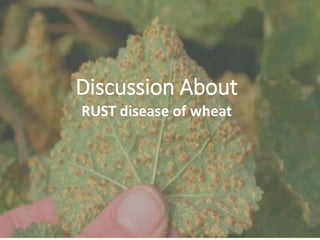
RUST disease of wheat
Introduction:
Rusts are plant diseases caused by pathogenic fungi of the
order Pucciniales (previously also known as Uredinales).
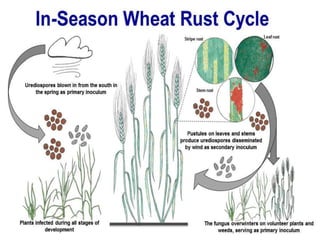
 Rust diseases of wheat are among the oldest plant diseases known to
humans.
Puccinia is an obligate parasite.
Required two alternate host
It has macro cyclic life cycle
Common name of “Rust” in other languages are Rati, Gerua, Tombora etc.
Characteristics of RUST disease:
• Rust is typically brownish-yellow to bright orange spots that form on
leaves. The spots are filled with a powdery substance. This substance
contains the spores that will spread to other plants if not treated.
Symptoms:
• Plants that have rust growth will not directly die from this type of fungi,
but it can contribute the decline of the plant.
• Some of the common symptoms include defoliation, stunted growth or
branch dieback. Leaving your plant exposed to rust will surely infect other
plants since rust is easily spread through the air.
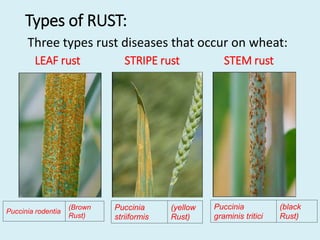
Types of RUST:
Three types rust diseases that occur on wheat:
LEAF rust STRIPE rust STEM rust
Puccinia
graminis tritici
(black
Rust)
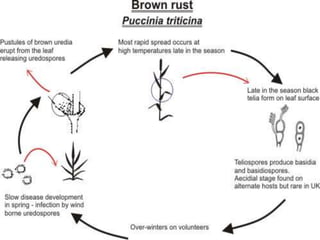
Puccinia rodentia
(Brown
Rust)
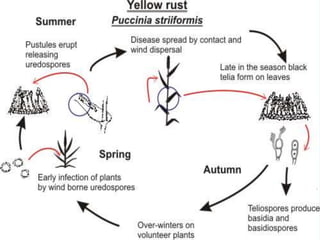
Puccinia
striiformis
(yellow
Rust)
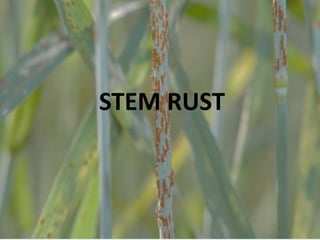
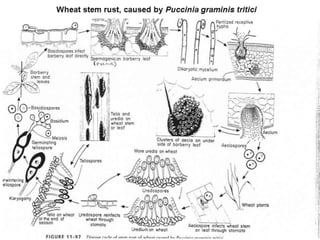
STEM RUST
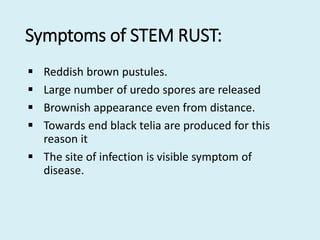
Symptoms of STEM RUST:
 Reddish brown pustules.
 Large number of uredo spores are released
 Brownish appearance even from distance.
 Towards end black telia are produced for this
reason it
 The site of infection is visible symptom of
disease.
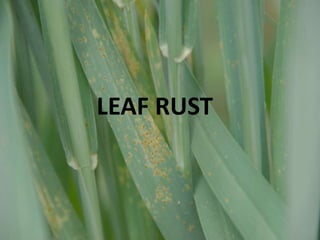
LEAF RUST
Symptoms of LEAF RUST:
• Generally found on leaves ,glumes and awns.
• Symptoms begin as small circular to oval yellow
spots on the upper leaf surface.
• As the disease progresses, the spots develop into
orange-colored pustules that may be surrounded
by a yellow halo
• An “orange dust” on the leaf surface or on clothes,
hands, and equipment.
Difference between STEM and
LEAF RUST
• Tiny orange lesions on seed heads in leaf rust do
not develop into erumpent pustules. But in stem
rust it developed
• This difference helps to distinguish leaf rust from
stem rust
STRIPE RUST
Symptoms of STRIPE RUST:
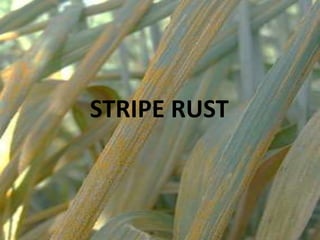
• Presence of light yellow, straight-sided pustules
• Occur in stripes on leaves and heads.
• These elongate pustules are narrow and vary in
length.
• As the pustules mature, yellow-orange spores are
produced (Figure 1)
• The arrangement of pustules into stripes is an
important distinguishing characteristic of this
disease.
Disease Development:
• Temperatures conducive for germination and
growth of the pathogen are required for disease
development.
• Stem rust is a warm-temperature disease that
develops optimally between 65 and 85°F;
• Leaf rust develops optimally at temperatures
between 59 and 71°F, and
• Stripe rust is a lower-temperature disease that is
generally found to develop 50 to 59°F
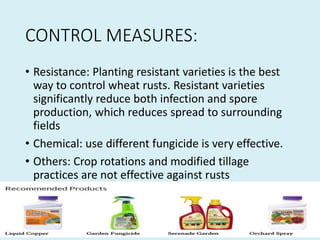
CONTROL MEASURES:
• Resistance: Planting resistant varieties is the best
way to control wheat rusts. Resistant varieties
significantly reduce both infection and spore
production, which reduces spread to surrounding
fields
• Chemical: use different fungicide is very effective.
• Others: Crop rotations and modified tillage
practices are not effective against rusts
Rust of wheat

Rust of wheat

  • 1.
  • 2.
    Introduction: Rusts are plantdiseases caused by pathogenic fungi of the order Pucciniales (previously also known as Uredinales).  Rust diseases of wheat are among the oldest plant diseases known to humans. Puccinia is an obligate parasite. Required two alternate host It has macro cyclic life cycle Common name of “Rust” in other languages are Rati, Gerua, Tombora etc.
  • 3.
    Characteristics of RUSTdisease: • Rust is typically brownish-yellow to bright orange spots that form on leaves. The spots are filled with a powdery substance. This substance contains the spores that will spread to other plants if not treated. Symptoms: • Plants that have rust growth will not directly die from this type of fungi, but it can contribute the decline of the plant. • Some of the common symptoms include defoliation, stunted growth or branch dieback. Leaving your plant exposed to rust will surely infect other plants since rust is easily spread through the air.
  • 4.
    Types of RUST: Threetypes rust diseases that occur on wheat: LEAF rust STRIPE rust STEM rust Puccinia graminis tritici (black Rust) Puccinia rodentia (Brown Rust) Puccinia striiformis (yellow Rust)
  • 5.
  • 6.
    Symptoms of STEMRUST:  Reddish brown pustules.  Large number of uredo spores are released  Brownish appearance even from distance.  Towards end black telia are produced for this reason it  The site of infection is visible symptom of disease.
  • 8.
  • 9.
    Symptoms of LEAFRUST: • Generally found on leaves ,glumes and awns. • Symptoms begin as small circular to oval yellow spots on the upper leaf surface. • As the disease progresses, the spots develop into orange-colored pustules that may be surrounded by a yellow halo • An “orange dust” on the leaf surface or on clothes, hands, and equipment.
  • 11.
    Difference between STEMand LEAF RUST • Tiny orange lesions on seed heads in leaf rust do not develop into erumpent pustules. But in stem rust it developed • This difference helps to distinguish leaf rust from stem rust
  • 12.
  • 13.
    Symptoms of STRIPERUST: • Presence of light yellow, straight-sided pustules • Occur in stripes on leaves and heads. • These elongate pustules are narrow and vary in length. • As the pustules mature, yellow-orange spores are produced (Figure 1) • The arrangement of pustules into stripes is an important distinguishing characteristic of this disease.
  • 16.
    Disease Development: • Temperaturesconducive for germination and growth of the pathogen are required for disease development. • Stem rust is a warm-temperature disease that develops optimally between 65 and 85°F; • Leaf rust develops optimally at temperatures between 59 and 71°F, and • Stripe rust is a lower-temperature disease that is generally found to develop 50 to 59°F
  • 17.
    CONTROL MEASURES: • Resistance:Planting resistant varieties is the best way to control wheat rusts. Resistant varieties significantly reduce both infection and spore production, which reduces spread to surrounding fields • Chemical: use different fungicide is very effective. • Others: Crop rotations and modified tillage practices are not effective against rusts