Putting Ug99 on the map: An update on current and future monitoringD.P. Hodson, K. Nazari, R.F. Park, J. Hansen, P. Lassen, J. Arista, T. Fetch, M. Hovmøller, Y Jin, Z.A. Pretorius and K. Sonder
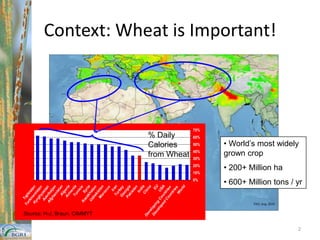
Context: Wheat is Important!2% Daily Calories from WheatSource: H-J, Braun, CIMMYT World’s most widely grown crop
 200+ Million ha
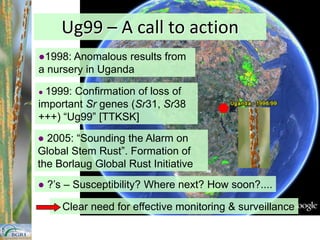
 600+ Million tons / yr Clear need for effective monitoring & surveillanceUg99 – A call to action1998: Anomalous results from a nursery in Uganda
1999: Confirmation of loss of important Sr genes (Sr31, Sr38 +++) “Ug99” [TTKSK]
2005: “Sounding the Alarm on Global Stem Rust”. Formation of the Borlaug Global Rust Initiative
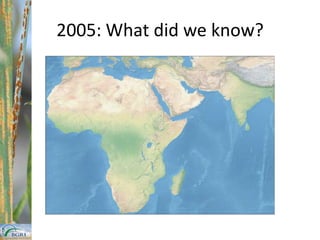
 ?’s – Susceptibility? Where next? How soon?....2005: What did we know?
2005: What did we know? Very little!
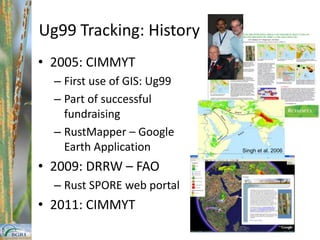
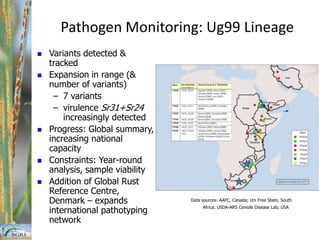
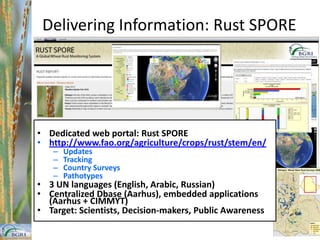
Sr31 virulent stem rust at 10-15 research stations in East AfricaUg99 Tracking: History2005: CIMMYT First use of GIS: Ug99Part of successful fundraisingRustMapper – Google Earth Application2009: DRRW – FAORust SPORE web portal2011: CIMMYTSingh et al. 2006
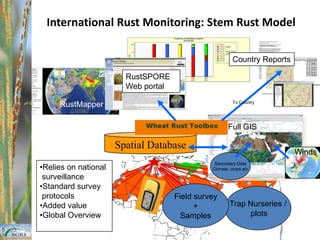
International Rust Monitoring: Stem Rust ModelCountry ReportsRustSPOREWeb portalRustMapperTo CountrySpatial DatabaseFull GISSecondary DataClimate, crops etcWindsRelies on national surveillanceStandard survey protocolsAdded value
Global OverviewField survey+SamplesTrap Nurseries / plots
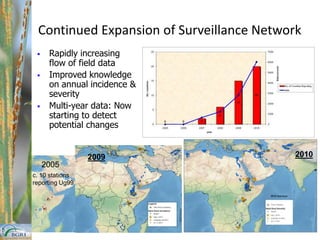
2005c. 10 stationsreporting Ug99Continued Expansion of Surveillance NetworkRapidly increasing flow of field data
Improved knowledge on annual incidence & severity
Multi-year data: Now starting to detect potential changes20102009
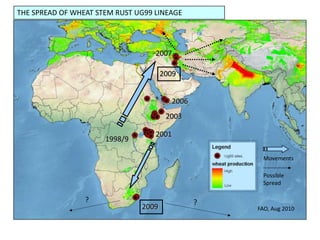
200720092006200320011998/9MovementsPossibleSpread??2009THE SPREAD OF WHEAT STEM RUST UG99 LINEAGEFAO, Aug 2010
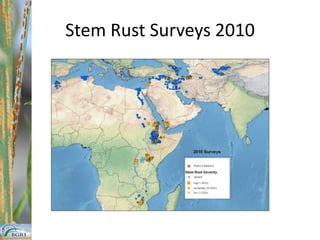
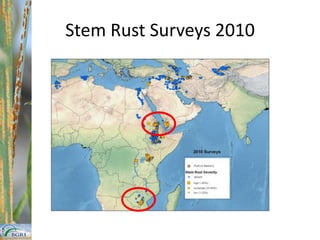
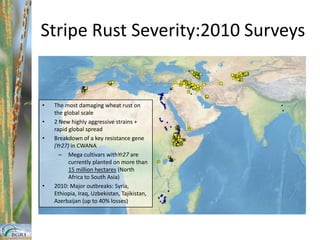
Stem Rust Surveys 2010
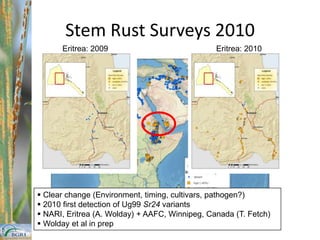
Stem Rust Surveys 2010Eritrea: 2009Eritrea: 2010 Clear change (Environment, timing, cultivars, pathogen?)
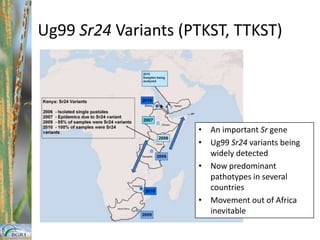
 2010 first detection of Ug99 Sr24 variants
 NARI, Eritrea (A. Wolday) + AAFC, Winnipeg, Canada (T. Fetch)
Wolday et al in prepStem Rust Surveys 2010 Clear change (Environment, timing, cultivars, pathogen?)
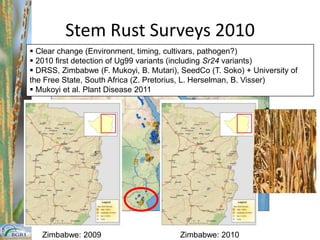
 2010 first detection of Ug99 variants (including Sr24 variants)
 DRSS, Zimbabwe (F. Mukoyi, B. Mutari), SeedCo (T. Soko) + University of the Free State, South Africa (Z. Pretorius, L. Herselman, B. Visser)
Mukoyi et al. Plant Disease 2011Zimbabwe: 2009Zimbabwe: 2010

Hodson putting ug99 on the mapv2

Editor's Notes

  • #10 Summary of the known status of Ug99 lineage racesMovements occurring in 2 directionsAlthough unproven, it is possible that repeat incursions can occur into Iran (report in 2009 may represent this? Air flows out of Yemen are conducive for repeat incursions into Iran)Spread of Ug99 variants (or other pathotypes in the future) expected to be similar
  • #11 Consolidated rust survey data for 2010Stem rust widespread and at high severity in Eritrea and the highlands of Yemen – pathotypes currently unknown, but under-going analysisEstablished or high stem rust populations in this region have implications for Iran
  • #12 Consolidated rust survey data for 2010Stem rust widespread and at high severity in Eritrea and the highlands of Yemen – pathotypes currently unknown, but under-going analysisEstablished or high stem rust populations in this region have implications for Iran
  • #13 Consolidated rust survey data for 2010Stem rust widespread and at high severity in Eritrea and the highlands of Yemen – pathotypes currently unknown, but under-going analysisEstablished or high stem rust populations in this region have implications for Iran
  • #14 Consolidated rust survey data for 2010Stem rust widespread and at high severity in Eritrea and the highlands of Yemen – pathotypes currently unknown, but under-going analysisEstablished or high stem rust populations in this region have implications for Iran
  • #16 Ug99 is both migrating and mutating7 variants are now known within the Ug99 lineageAdditional important stem rust resistance genes have been defeated by Ug99 – notable are Sr24 and Sr36 since both are widely deployed in wheat cultivars worldwideUg99 Sr24 variants are now the predominant stem rust races in eastern and southern Africa and there is rapid spreadIn Kenya, the original Sr24 variant went from trace amounts in 2006 to epidemic levels in 2007. All of the samples analyzed from Kenya in 2010 were Ug99 Sr24 variants.It is extremely likely that the Ug99 Sr24 variants will spread out of Africa in the near future, with Iran being one of the countries along the likely migration path
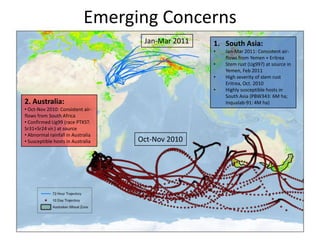
  • #17 2 areas of concern highlighted – both represent the very real risk of incursions into important wheat areas.There is no implication that Ug99 races have moved along these airflows, but they highlight the very real threats and possibilities.South Asia: During Jan-Mar 2011 there were consistent airflows from known stem rust (UG99) sites in Yemen and Eritrea. These airflows were reaching key wheat areas in south asia within 72 hours. Previous years of wind trajectory analysis have shown the tendency to move north-east out of Yemen, but this year the winds seemed stronger and much more consistent all the way into south Asia. Stem rust (most likely Ug99) was known to be present in at least one site in Yemen. In Eritrea very high incidence and severity of stem rust was observed in Oct 2010 - no information on the off-season stem rust situation, but it is not impossible there was disease at source. There is every chance that at some point we are going to see Ug99 move into south Asia. Mega-cultivars in south Asia (pbw343, inqualab-91) are highly susceptible + were being grown at the time of these air movements – pbw343 is so susceptible it is used as spreader in Kenya + Ethiopia!Australia. Important Ug99 races (PTKST – both SR31+Sr24) are building up in Southern Africa. SR24 important gene in Australia. Known historical movements from southern africa to australia. In Oct-Nov 2010 confirmed infections of PTKST at source in south Africa, airflows on several occasions reached Australian wheat areas (with susceptible wheat in the ground) in 6-8 days. Numerous rain fronts were moving across southern Australia at the same time (ie good potential for spore deposition). This type of combination of conditions are likely to account for the known historical incursions. Unknown factors are spore release to get into airflows, spore survival and deposition. With increasing Ug99 levels in southern Africa the probability of successful long-distance incursions increase. The first scenario above has obvious implications for Iran. It simply re-enforces the likely potential for movement of pathotypes from Yemen / Horn of Africa.This slide emphasizes the need for the global monitoring systems!
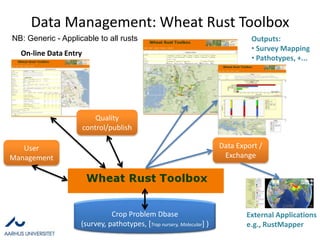
  • #19 Data management system developed by Aarhus University, Denmark in collaboration with BGRI / FAOSits on top of a centralized Crop Problem Dbase – currently holds survey and pathotype data but will be expanded to include trap nursery and molecular diagnostic data. Flexible dbase capable of holding all 3 rust diseases – expansion in progress to incorporate yellow rust data.Toolbox permits: user management (different access / permission levels); on-line data entry; data quality control and publishingOutputs: Series of data-base driven graphical tools. Currently: survey mapping, pathotype frequencies and distributions over time. Additional tools planned for the future. All outputs as iframes so seemelessly embedded in external websites eg Rust SPORE at FAO.Standard data export / exchange permitting direct connection to external applications eg RustMapper at CIMMYT.
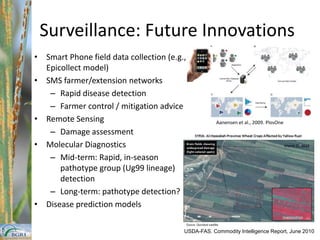
  • #21 A few ideas on possible future innovations re surveillance.