Student :
AKASHDEEP
SUTRADHAR
Dept. of Plant
Pathology
Teacher:
Dr. ADESH KUMAR
HOD, Dept. Of Plant
Pathology
CONTENT
 Classification.
 Economic significance.
 Etiology.
 Distribution.
 Symptoms.
 Favourable conditions.
 Diseases cycle.
 Management.
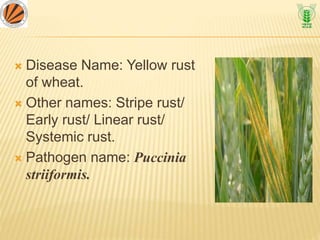
 Disease Name: Yellow rust
of wheat.
 Other names: Stripe rust/
Early rust/ Linear rust/
Systemic rust.
 Pathogen name: Puccinia
striiformis.
CLASSIFICATION
 Kingdom: Fungi
 Phylum: Basidiomycota
 Class: Urediniomycetes
 Subclass: Incertaesedis
 Order: Uredinales
 Family: Pucciniastraceae
 Genus: Puccinia
 Species: striiformis
ECONOMIC SIGNIFICANCE
 Losses can be 50%, but in severe situations
100% is vulnerable.
 In countries where wheat is grown in winters
or at high elevations, yellow rust is a
common threat, but not more significant than
wheat leaf rust and stem rust, which are
continuous threats in all wheat-growing
countries.
ETIOLOGY
 It is considered to be an obligate parasite.
 It is macrocyclic.
 Haterocious in nature.
 The fungus produces bright yellow to orange uredospores 30
to 35 μm in diameter . These spores have thick and
echinulated walls and are contained in pustules on the plant .
 Uredospore production usually is followed by teliospore
production late in the growing season.
 Teliospores are mainly stalked bicelled, dark brown, with
falttened apex.
 No alternate host is known. The pathogen survives in wheat
as dormant mycelium in cooler climates.
DISTRIBUTION
 In India,
Hills, plains of Punjab, Haryana, western UP and southern
hills zone also found in the Nilgiri hills of Tamil Nadu.
 In World,
European countries and Australia are mostly effected by
the diseases.
SYMPTOMS
 The first sign of stripe rust is the
appearance of yellow streaks (pre-
pustules), followed by small, bright
yellow, elongated uredial pustules
arranged in conspicuous rows on the
leaves, leaf sheaths, glumes.
 Mature pustules will break open and
release yellow-orange masses of
uredospores.
 The infected tissues may become brown
and dry as the plant matures or becomes
stressed.
 Severe early infection can result in plant
stunting.
FAVOURABLE CONDITIONS
 Puccinia striiformis. var. tritici. can survive as
dormant mycelium on wheat.
 Stripe rust is most common in higher elevations
and cooler climates. The pathogen is best
sustained when night time temperatures are
<15°C.
 Optimum uredospore germination occurs at 7-
15°C.
 Heavy dew or intermittent rains can speedup
the spread of the disease.
UREDOSPORE TELIOSPORES
PUSTULES
DISEASES CYCLE
MANAGEMENT
 Mixed cropping and crop rotation.
 Avoid excess Nitrogenous fertilizers.
 Growing Resistant varieties like Lerma Rojo,
Safed Lerma, Sonalika and Chotil.
 Sulphur dusting @ 35-40 kg/ha.
 Spray Mancozeb @ 2g/lit.
Stripe rust

Stripe rust

  • 1.
    Student : AKASHDEEP SUTRADHAR Dept. ofPlant Pathology Teacher: Dr. ADESH KUMAR HOD, Dept. Of Plant Pathology
  • 2.
    CONTENT  Classification.  Economicsignificance.  Etiology.  Distribution.  Symptoms.  Favourable conditions.  Diseases cycle.  Management.
  • 3.
     Disease Name:Yellow rust of wheat.  Other names: Stripe rust/ Early rust/ Linear rust/ Systemic rust.  Pathogen name: Puccinia striiformis.
  • 4.
    CLASSIFICATION  Kingdom: Fungi Phylum: Basidiomycota  Class: Urediniomycetes  Subclass: Incertaesedis  Order: Uredinales  Family: Pucciniastraceae  Genus: Puccinia  Species: striiformis
  • 5.
    ECONOMIC SIGNIFICANCE  Lossescan be 50%, but in severe situations 100% is vulnerable.  In countries where wheat is grown in winters or at high elevations, yellow rust is a common threat, but not more significant than wheat leaf rust and stem rust, which are continuous threats in all wheat-growing countries.
  • 6.
    ETIOLOGY  It isconsidered to be an obligate parasite.  It is macrocyclic.  Haterocious in nature.  The fungus produces bright yellow to orange uredospores 30 to 35 μm in diameter . These spores have thick and echinulated walls and are contained in pustules on the plant .  Uredospore production usually is followed by teliospore production late in the growing season.  Teliospores are mainly stalked bicelled, dark brown, with falttened apex.  No alternate host is known. The pathogen survives in wheat as dormant mycelium in cooler climates.
  • 7.
    DISTRIBUTION  In India, Hills,plains of Punjab, Haryana, western UP and southern hills zone also found in the Nilgiri hills of Tamil Nadu.  In World, European countries and Australia are mostly effected by the diseases.
  • 8.
    SYMPTOMS  The firstsign of stripe rust is the appearance of yellow streaks (pre- pustules), followed by small, bright yellow, elongated uredial pustules arranged in conspicuous rows on the leaves, leaf sheaths, glumes.  Mature pustules will break open and release yellow-orange masses of uredospores.  The infected tissues may become brown and dry as the plant matures or becomes stressed.  Severe early infection can result in plant stunting.
  • 9.
    FAVOURABLE CONDITIONS  Pucciniastriiformis. var. tritici. can survive as dormant mycelium on wheat.  Stripe rust is most common in higher elevations and cooler climates. The pathogen is best sustained when night time temperatures are <15°C.  Optimum uredospore germination occurs at 7- 15°C.  Heavy dew or intermittent rains can speedup the spread of the disease.
  • 10.
  • 11.
  • 13.
    MANAGEMENT  Mixed croppingand crop rotation.  Avoid excess Nitrogenous fertilizers.  Growing Resistant varieties like Lerma Rojo, Safed Lerma, Sonalika and Chotil.  Sulphur dusting @ 35-40 kg/ha.  Spray Mancozeb @ 2g/lit.