What to Know
Before Getting
Stem Cells
Dr. John Hughes, DO
December 14th, 2017
Outline of Lecture
Embryonic vs. Adult
Multipotent vs. Pluripotent
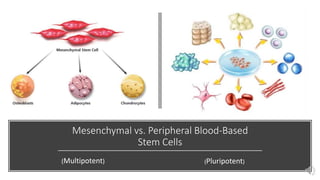
Mesenchymal vs. Peripheral Blood-Based
Making a Stem Cell Decision
What are Stem Cells?
• Undifferentiated biological cells that differentiate
into specialized cells or divide to produce more stem cells
• Have the ability to divide and generate all cell types of the
organ from which they originate
• Stem cell therapy can stimulate tissue re-growth and
greater blood flow to the affected areas
• Can be obtained from bone marrow, adipose tissue, blood,
or embryonic tissue
Embryonic
Stem Cells
• Derived from the fetus
• Require special regulatory approval
• Mostly used for research purposes
• Not readily available
• Expensive
• Not autologous
• Ethically controversial
Adult
Stem Cells
• Derived from bone, adipose, or blood
• Require physician expertise and quality control
• Mostly used for regenerative and cosmetic purposes
• Readily available
• Less expensive
• Autologous use is permitted in US (with restrictions)
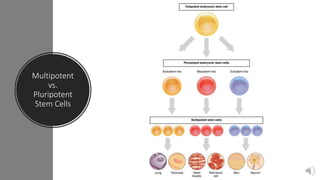
Multipotent
vs.
Pluripotent
Stem Cells
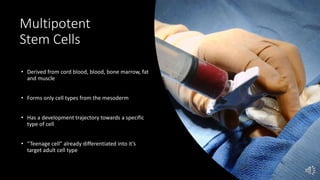
Multipotent
Stem Cells
• Derived from cord blood, blood, bone marrow, fat
and muscle
• Forms only cell types from the mesoderm
• Has a development trajectory towards a specific
type of cell
• “Teenage cell” already differentiated into it’s
target adult cell type
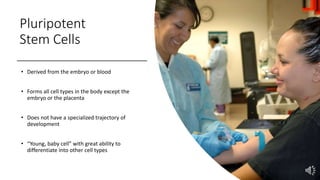
Pluripotent
Stem Cells
• Derived from the embryo or blood
• Forms all cell types in the body except the
embryo or the placenta
• Does not have a specialized trajectory of
development
• “Young, baby cell” with great ability to
differentiate into other cell types
Mesenchymal vs. Peripheral Blood-Based
Stem Cells
(Multipotent) (Pluripotent)
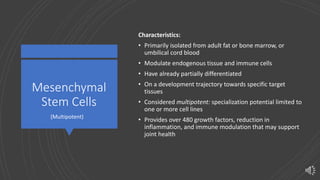
Mesenchymal
Stem Cells
Characteristics:
• Primarily isolated from adult fat or bone marrow, or
umbilical cord blood
• Modulate endogenous tissue and immune cells
• Have already partially differentiated
• On a development trajectory towards specific target
tissues
• Considered multipotent: specialization potential limited to
one or more cell lines
• Provides over 480 growth factors, reduction in
inflammation, and immune modulation that may support
joint health
(Multipotent)
Mesenchymal
Stem Cells
Clinical Indications / Side Effects:
• Most effective clinical use: same tissues transplantation
(bone marrow to bone marrow, fat to fat)
• Alternative clinical use: joint (if related to autoimmune or
systemic inflammation) and autoimmune disorders
• These cells do not develop into new cartilage cells
• Therapeutic effects are short-lived
• “Recent studies have suggested that less than 1% of
systemically administered MSCs persist for longer than a
week following injection” (Parekkadan & Milwid, 2010,
pg 2).
(Multipotent)
Mesenchymal
Stem Cells
Dangers:
• Harvesting of bone marrow and fat can be unpleasant
• Repeat harvesting is limited
• Immunomodulatory effects can predispose the patients to
more infections or even cancer (Sundin et al., 2006)
• Reduce inflammation for 6 months – 2 years but have
limited regenerative benefits
• Increased FDA restriction for non-homologous tissue use
(Multipotent)
Peripheral
Blood-Based
Stem Cells
Characteristics:
• Originate in bone marrow and present in peripheral blood
• Were thought only to exist in embryonic stem cells until Dr.
Young’s discovery of them in the peripheral blood in the
late 20th century (Young & Black, 2004)
• Forms cells from the three primary germ-layer lineages
• Lineage-uncommitted cells
• Also known as very small embryonic-like stem cells (VSELs)
or blastomere-like stem cells
• Have a long lifespan (can double more than 70 times)
• *Not derived from umbilical cord blood (mesenchymal)
(Pluripotent / Embryonic-Like)
Peripheral
Blood-Based
Stem Cells
(Pluripotent / Embryonic-Like)
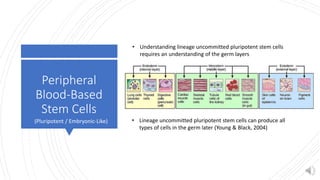
• Understanding lineage uncommitted pluripotent stem cells
requires an understanding of the germ layers
• Lineage uncommitted pluripotent stem cells can produce all
types of cells in the germ later (Young & Black, 2004)
Peripheral
Blood-Based
Stem Cells
Clinical indications:
• Regenerative in their applications unlike mesenchymal
• Actually develop into new target tissue such as organs,
cartilage, neurons, muscle, skin, etc.
• Conditions treated: traumatic brain injury, chronic pain,
ligament / tendon injuries, diabetes, osteoarthritis,
osteoporosis, Alzheimer’s disease, fertility, aging, etc.
(Pluripotent / Embryonic-Like)
Peripheral Blood-Based Stem Cells
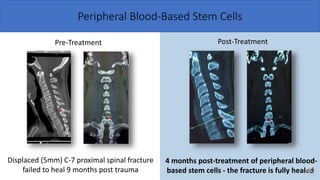
Displaced (5mm) C-7 proximal spinal fracture
failed to heal 9 months post trauma
Pre-Treatment Post-Treatment
4 months post-treatment of peripheral blood-
based stem cells - the fracture is fully healed
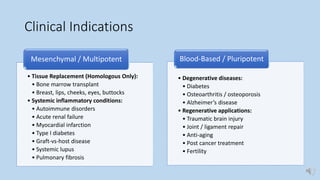
Clinical Indications
• Degenerative diseases:
• Diabetes
• Osteoarthritis / osteoporosis
• Alzheimer’s disease
• Regenerative applications:
• Traumatic brain injury
• Joint / ligament repair
• Anti-aging
• Post cancer treatment
• Fertility
Blood-Based / Pluripotent
• Tissue Replacement (Homologous Only):
• Bone marrow transplant
• Breast, lips, cheeks, eyes, buttocks
• Systemic inflammatory conditions:
• Autoimmune disorders
• Acute renal failure
• Myocardial infarction
• Type I diabetes
• Graft-vs-host disease
• Systemic lupus
• Pulmonary fibrosis
Mesenchymal / Multipotent
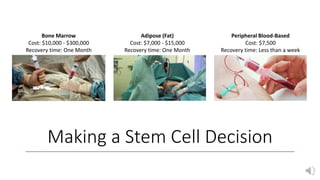
Making a Stem Cell Decision
Bone Marrow
Cost: $10,000 - $300,000
Recovery time: One Month
Adipose (Fat)
Cost: $7,000 - $15,000
Recovery time: One Month
Peripheral Blood-Based
Cost: $7,500
Recovery time: Less than a week
Q & A
Aspen Integrative Medicine
970-927-0308
aspenintegrativemedicine.com
TBI Therapy
303-447-1257
tbitherapy.com
aspenintegrativemedicine.com/what-to-know-stem-cells
References
Cell Applications. https://www.cellapplications.com/stem-0
Cellular Differentiation. http://oerpub.github.io/epubjs-demo-book/content/m46036.xhtml
Kunter, U., Rong, S., Boor, P., Eitner, F., Müller-Newen, G., Djuric, Z., ... & Milovanceva-
Popovska, M. (2007). Mesenchymal stem cells prevent progressive experimental renal failure
but maldifferentiate into glomerular adipocytes. Journal of the American Society of
Nephrology, 18(6), 1754-1764.
MacCord, K. (2012). Mesenchyme. The Embryo Project Encyclopedia. Retrieved from
https://embryo.asu.edu/pages/mesenchyme
Mesenchymal Stem Cell Reagents. Retrieved from http://www.sigmaaldrich.com/life-
science/cell-biology/cell-biology-products.html?TablePage=22692887
Murnaghan, I. (2016). Multipotent stem cells. Explore Stem Cells. Retrieved from
http://www.explorestemcells.co.uk/multipotentstemcells.html
Parekkadan B, Milwid JM. Mesenchymal Stem Cells as Therapeutics. Annual review of
biomedical engineering. 2010;12:87-117. doi:10.1146/annurev-bioeng-070909-105309.
Stout, C. L., Ashley, D. W., Morgan, J. H., Long, G. F., Collins, J. A., Limnios, J. I., ... & Young, H.
E. (2007). Primitive stem cells residing in the skeletal muscle of adult pigs are mobilized into
the peripheral blood after trauma. The American Surgeon, 73(11), 1106-1110.
Sundin, M., Örvell, C., Rasmusson, I., Sundberg, B., Ringden, O., & Le Blanc, K. (2006).
Mesenchymal stem cells are susceptible to human herpesviruses, but viral DNA cannot be
detected in the healthy seropositive individual. Bone marrow transplantation, 37(11), 1051-
1059.
Tithon Biotech (n.d.). Minutevideo retrieved from
http://mv.pac.io/post/55b2e2b41e1818650cc7b872
Tithon Human Sciences (2015). Peripheral blood derived pluripotent stem cell technology.
Rhttp://aspenintegrativemedicine.com/wp-content/uploads/Tithon-Human-Sciences-Ortho-
Case-Study.pdf
Young, H. E., Duplaa, C., Romero-Ramos, M., Chesselet, M. F., Vourc'h, P., Yost, M. J., ... &
Tamura-Ninomiya, S. (2004). Adult reserve stem cells and their potential for tissue
engineering. Cell biochemistry and biophysics, 40(1), 1-80.
Young, H. E., & Black, A. C. (2004). Adult stem cells. The Anatomical Record Part A:
Discoveries in Molecular, Cellular, and Evolutionary Biology, 276(1), 75-102.

What to know before getting stem cells - short version

  • 1.
    What to Know BeforeGetting Stem Cells Dr. John Hughes, DO December 14th, 2017
  • 2.
    Outline of Lecture Embryonicvs. Adult Multipotent vs. Pluripotent Mesenchymal vs. Peripheral Blood-Based Making a Stem Cell Decision
  • 3.
    What are StemCells? • Undifferentiated biological cells that differentiate into specialized cells or divide to produce more stem cells • Have the ability to divide and generate all cell types of the organ from which they originate • Stem cell therapy can stimulate tissue re-growth and greater blood flow to the affected areas • Can be obtained from bone marrow, adipose tissue, blood, or embryonic tissue
  • 4.
    Embryonic Stem Cells • Derivedfrom the fetus • Require special regulatory approval • Mostly used for research purposes • Not readily available • Expensive • Not autologous • Ethically controversial
  • 5.
    Adult Stem Cells • Derivedfrom bone, adipose, or blood • Require physician expertise and quality control • Mostly used for regenerative and cosmetic purposes • Readily available • Less expensive • Autologous use is permitted in US (with restrictions)
  • 6.
  • 7.
    Multipotent Stem Cells • Derivedfrom cord blood, blood, bone marrow, fat and muscle • Forms only cell types from the mesoderm • Has a development trajectory towards a specific type of cell • “Teenage cell” already differentiated into it’s target adult cell type
  • 8.
    Pluripotent Stem Cells • Derivedfrom the embryo or blood • Forms all cell types in the body except the embryo or the placenta • Does not have a specialized trajectory of development • “Young, baby cell” with great ability to differentiate into other cell types
  • 9.
    Mesenchymal vs. PeripheralBlood-Based Stem Cells (Multipotent) (Pluripotent)
  • 10.
    Mesenchymal Stem Cells Characteristics: • Primarilyisolated from adult fat or bone marrow, or umbilical cord blood • Modulate endogenous tissue and immune cells • Have already partially differentiated • On a development trajectory towards specific target tissues • Considered multipotent: specialization potential limited to one or more cell lines • Provides over 480 growth factors, reduction in inflammation, and immune modulation that may support joint health (Multipotent)
  • 11.
    Mesenchymal Stem Cells Clinical Indications/ Side Effects: • Most effective clinical use: same tissues transplantation (bone marrow to bone marrow, fat to fat) • Alternative clinical use: joint (if related to autoimmune or systemic inflammation) and autoimmune disorders • These cells do not develop into new cartilage cells • Therapeutic effects are short-lived • “Recent studies have suggested that less than 1% of systemically administered MSCs persist for longer than a week following injection” (Parekkadan & Milwid, 2010, pg 2). (Multipotent)
  • 12.
    Mesenchymal Stem Cells Dangers: • Harvestingof bone marrow and fat can be unpleasant • Repeat harvesting is limited • Immunomodulatory effects can predispose the patients to more infections or even cancer (Sundin et al., 2006) • Reduce inflammation for 6 months – 2 years but have limited regenerative benefits • Increased FDA restriction for non-homologous tissue use (Multipotent)
  • 13.
    Peripheral Blood-Based Stem Cells Characteristics: • Originatein bone marrow and present in peripheral blood • Were thought only to exist in embryonic stem cells until Dr. Young’s discovery of them in the peripheral blood in the late 20th century (Young & Black, 2004) • Forms cells from the three primary germ-layer lineages • Lineage-uncommitted cells • Also known as very small embryonic-like stem cells (VSELs) or blastomere-like stem cells • Have a long lifespan (can double more than 70 times) • *Not derived from umbilical cord blood (mesenchymal) (Pluripotent / Embryonic-Like)
  • 14.
    Peripheral Blood-Based Stem Cells (Pluripotent /Embryonic-Like) • Understanding lineage uncommitted pluripotent stem cells requires an understanding of the germ layers • Lineage uncommitted pluripotent stem cells can produce all types of cells in the germ later (Young & Black, 2004)
  • 15.
    Peripheral Blood-Based Stem Cells Clinical indications: •Regenerative in their applications unlike mesenchymal • Actually develop into new target tissue such as organs, cartilage, neurons, muscle, skin, etc. • Conditions treated: traumatic brain injury, chronic pain, ligament / tendon injuries, diabetes, osteoarthritis, osteoporosis, Alzheimer’s disease, fertility, aging, etc. (Pluripotent / Embryonic-Like)
  • 16.
    Peripheral Blood-Based StemCells Displaced (5mm) C-7 proximal spinal fracture failed to heal 9 months post trauma Pre-Treatment Post-Treatment 4 months post-treatment of peripheral blood- based stem cells - the fracture is fully healed
  • 17.
    Clinical Indications • Degenerativediseases: • Diabetes • Osteoarthritis / osteoporosis • Alzheimer’s disease • Regenerative applications: • Traumatic brain injury • Joint / ligament repair • Anti-aging • Post cancer treatment • Fertility Blood-Based / Pluripotent • Tissue Replacement (Homologous Only): • Bone marrow transplant • Breast, lips, cheeks, eyes, buttocks • Systemic inflammatory conditions: • Autoimmune disorders • Acute renal failure • Myocardial infarction • Type I diabetes • Graft-vs-host disease • Systemic lupus • Pulmonary fibrosis Mesenchymal / Multipotent
  • 18.
    Making a StemCell Decision Bone Marrow Cost: $10,000 - $300,000 Recovery time: One Month Adipose (Fat) Cost: $7,000 - $15,000 Recovery time: One Month Peripheral Blood-Based Cost: $7,500 Recovery time: Less than a week
  • 19.
    Q & A AspenIntegrative Medicine 970-927-0308 aspenintegrativemedicine.com TBI Therapy 303-447-1257 tbitherapy.com aspenintegrativemedicine.com/what-to-know-stem-cells
  • 20.
    References Cell Applications. https://www.cellapplications.com/stem-0 CellularDifferentiation. http://oerpub.github.io/epubjs-demo-book/content/m46036.xhtml Kunter, U., Rong, S., Boor, P., Eitner, F., Müller-Newen, G., Djuric, Z., ... & Milovanceva- Popovska, M. (2007). Mesenchymal stem cells prevent progressive experimental renal failure but maldifferentiate into glomerular adipocytes. Journal of the American Society of Nephrology, 18(6), 1754-1764. MacCord, K. (2012). Mesenchyme. The Embryo Project Encyclopedia. Retrieved from https://embryo.asu.edu/pages/mesenchyme Mesenchymal Stem Cell Reagents. Retrieved from http://www.sigmaaldrich.com/life- science/cell-biology/cell-biology-products.html?TablePage=22692887 Murnaghan, I. (2016). Multipotent stem cells. Explore Stem Cells. Retrieved from http://www.explorestemcells.co.uk/multipotentstemcells.html Parekkadan B, Milwid JM. Mesenchymal Stem Cells as Therapeutics. Annual review of biomedical engineering. 2010;12:87-117. doi:10.1146/annurev-bioeng-070909-105309. Stout, C. L., Ashley, D. W., Morgan, J. H., Long, G. F., Collins, J. A., Limnios, J. I., ... & Young, H. E. (2007). Primitive stem cells residing in the skeletal muscle of adult pigs are mobilized into the peripheral blood after trauma. The American Surgeon, 73(11), 1106-1110. Sundin, M., Örvell, C., Rasmusson, I., Sundberg, B., Ringden, O., & Le Blanc, K. (2006). Mesenchymal stem cells are susceptible to human herpesviruses, but viral DNA cannot be detected in the healthy seropositive individual. Bone marrow transplantation, 37(11), 1051- 1059. Tithon Biotech (n.d.). Minutevideo retrieved from http://mv.pac.io/post/55b2e2b41e1818650cc7b872 Tithon Human Sciences (2015). Peripheral blood derived pluripotent stem cell technology. Rhttp://aspenintegrativemedicine.com/wp-content/uploads/Tithon-Human-Sciences-Ortho- Case-Study.pdf Young, H. E., Duplaa, C., Romero-Ramos, M., Chesselet, M. F., Vourc'h, P., Yost, M. J., ... & Tamura-Ninomiya, S. (2004). Adult reserve stem cells and their potential for tissue engineering. Cell biochemistry and biophysics, 40(1), 1-80. Young, H. E., & Black, A. C. (2004). Adult stem cells. The Anatomical Record Part A: Discoveries in Molecular, Cellular, and Evolutionary Biology, 276(1), 75-102.