UNDERSTANDING TYPHOONS
module 2
 Overview
 Every year the Philippines is hit by typhoons.
No part of the country is spared.All provinces
have been visited by a typhoon at one time or
another. In recent years, the Philippines had
been overwhelmed by powerful tropical
cyclones.
Who could forget the terrible flood brought by
Tropical Storm Ondoy in 2009? Or the people
swept out to sea during Tropical Storm Sendong
in 2011? Or the poor community of New Bataan
buried in mud spawned by Typhoon Pablo in
2012?
According to the Philippine Atmospheric,
Geophysical, and Astronomical Services
Administration (PAGASA), about 20 tropical
cyclones enter the Philippine Area of
Responsibility each year. We have to be
knowledgeable about tropical cyclones if we
want to prevent the loss of more lives.
WHAT IS
TYPHOON?
Typhoon
 tropical storm: a violent tropical storm in the
western Pacific and Indian oceans.
 are known as tropical cyclones, which is the
general name for all such storms including
hurricanes and typhoons.
 Hurricane, name given to violent storms that
originate over the tropical or subtropical waters of
the Atlantic Ocean, Caribbean Sea, Gulf of Mexico,
or North Pacific Ocean east of the International
Date Line. Such storms over the North Pacific west
of the International Date Line are called typhoons.
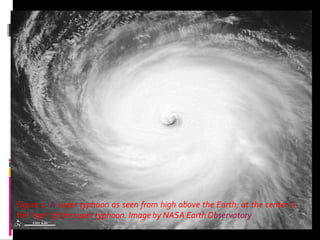
 We all know what a typhoon is. Or
more accurately, we know what to
expect when a typhoon comes. We
get a lot of rain and strong winds.
Now, you may not have noticed it but
the winds in a typhoon move in a
certain direction. They go around a
central area.
Figure 1. A super typhoon as seen from high above the Earth; at the center is
the “eye” of the super typhoon. Image by NASA Earth Observatory
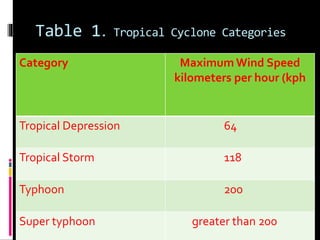
Table 1. Tropical Cyclone Categories
Category Maximum Wind Speed
kilometers per hour (kph
Tropical Depression 64
Tropical Storm 118
Typhoon 200
Super typhoon greater than 200
Ifthe wind speed is less, from 119 to 200 kph, then it is
called a typhoon. If the wind speed is between 65 and 118
kph, it is called a tropical storm. And when the wind
speed is between 35 to 64 kph, it is a tropical depression.
Tropical depression, tropical storm, typhoon, and super
typhoon are categories of tropical cyclones (Table 1). In
simple terms, a tropical cyclone is a system of
thunderstorms that are moving around a center. As the
winds intensify or weaken, the category is upgraded or
downgraded accordingly.
In a super typhoon, the wind speed is greater than 200
kilometers per hour (kph).
 The term typhoon is used only in the northwestern
part of the Pacific Ocean. In the northeastern part
of the Pacific Ocean and in the northern part of the
Atlantic Ocean, the equivalent term is hurricane.
Thus, a hurricane on one side of the Pacific Ocean
will be called a typhoon if it crosses into the other
side.
 In the Philippines, we use the same word for all
categories of tropical cyclones. We call it bagyo
whether it is a tropical depression, a tropical storm
or a typhoon.
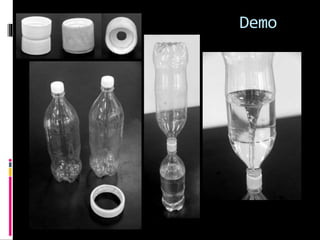
Demo

what is Typhoon

  • 1.
    UNDERSTANDING TYPHOONS module 2 Overview  Every year the Philippines is hit by typhoons. No part of the country is spared.All provinces have been visited by a typhoon at one time or another. In recent years, the Philippines had been overwhelmed by powerful tropical cyclones.
  • 2.
    Who could forgetthe terrible flood brought by Tropical Storm Ondoy in 2009? Or the people swept out to sea during Tropical Storm Sendong in 2011? Or the poor community of New Bataan buried in mud spawned by Typhoon Pablo in 2012? According to the Philippine Atmospheric, Geophysical, and Astronomical Services Administration (PAGASA), about 20 tropical cyclones enter the Philippine Area of Responsibility each year. We have to be knowledgeable about tropical cyclones if we want to prevent the loss of more lives.
  • 3.
  • 4.
    Typhoon  tropical storm:a violent tropical storm in the western Pacific and Indian oceans.  are known as tropical cyclones, which is the general name for all such storms including hurricanes and typhoons.  Hurricane, name given to violent storms that originate over the tropical or subtropical waters of the Atlantic Ocean, Caribbean Sea, Gulf of Mexico, or North Pacific Ocean east of the International Date Line. Such storms over the North Pacific west of the International Date Line are called typhoons.
  • 5.
     We allknow what a typhoon is. Or more accurately, we know what to expect when a typhoon comes. We get a lot of rain and strong winds. Now, you may not have noticed it but the winds in a typhoon move in a certain direction. They go around a central area.
  • 6.
    Figure 1. Asuper typhoon as seen from high above the Earth; at the center is the “eye” of the super typhoon. Image by NASA Earth Observatory
  • 7.
    Table 1. TropicalCyclone Categories Category Maximum Wind Speed kilometers per hour (kph Tropical Depression 64 Tropical Storm 118 Typhoon 200 Super typhoon greater than 200
  • 8.
    Ifthe wind speedis less, from 119 to 200 kph, then it is called a typhoon. If the wind speed is between 65 and 118 kph, it is called a tropical storm. And when the wind speed is between 35 to 64 kph, it is a tropical depression. Tropical depression, tropical storm, typhoon, and super typhoon are categories of tropical cyclones (Table 1). In simple terms, a tropical cyclone is a system of thunderstorms that are moving around a center. As the winds intensify or weaken, the category is upgraded or downgraded accordingly. In a super typhoon, the wind speed is greater than 200 kilometers per hour (kph).
  • 9.
     The termtyphoon is used only in the northwestern part of the Pacific Ocean. In the northeastern part of the Pacific Ocean and in the northern part of the Atlantic Ocean, the equivalent term is hurricane. Thus, a hurricane on one side of the Pacific Ocean will be called a typhoon if it crosses into the other side.  In the Philippines, we use the same word for all categories of tropical cyclones. We call it bagyo whether it is a tropical depression, a tropical storm or a typhoon.
  • 10.