Hydrometeorological Hazards
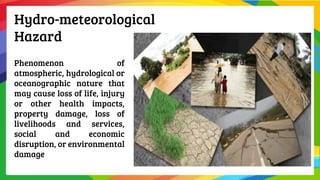
Phenomenon of
atmospheric, hydrological or
oceanographic nature that
may cause loss of life, injury
or other health impacts,
property damage, loss of
livelihoods and services,
social and economic
disruption, or environmental
damage
Hydro-meteorological
Hazard
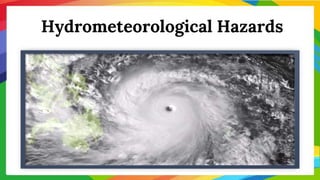
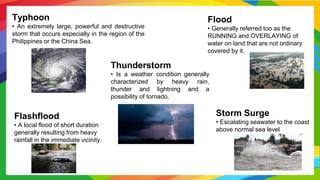
Typhoon
• An extremely large, powerful and destructive
storm that occurs especially in the region of the
Philippines or the China Sea.
Thunderstorm
• Is a weather condition generally
characterized by heavy rain,
thunder and lightning and a
possibility of tornado.
Flashflood
• A local flood of short duration
generally resulting from heavy
rainfall in the immediate vicinity.
Flood
• Generally referred too as the
RUNNING and OVERLAYING of
water on land that are not ordinary
covered by it.
Storm Surge
• Escalating seawater to the coast
above normal sea level
El Niño
• A flow of unusually warm water
along the western coast of South
America that causes many changes
in weather in other places.
La Niña
• La Niña is a climate pattern that describes the
cooling of surface ocean waters along the tropical
west coast of South America. La Nina is
considered to be the counterpart to El Nino, which
is characterized by unusually warm ocean
temperatures in the equatorial region of the Pacific
Ocean.
In this lesson,
We will be able to understand the Typhoon’s:
A. Definition
B. Anatomy
C. Formation
D. Categories
We will also find out:
A. Why Philippines is prone to typhoon?
B. How a typhoon dies?
C. What are the Public Storm Warning Signals in the Philippines?
Trivia Question: We hear weathercasters talk about
typhoons, hurricanes and cyclones – which of the
following is the true statement?
a. Typhoons are bigger than cyclones; cyclones are bigger
than hurricanes.
b. Hurricanes are stronger than typhoons and
cyclones.
c. Hurricanes, typhoons and cyclones occur in different
geographical areas.
The correct answer is C.
Typhoons, cyclones and hurricanes are the
same weather phenomenon – the difference is
the geographical area where they occur. They
are tropical cyclones with regionally specific
names.
PAG-ASA is the agency
responsible for assessing
and forecasting weather,
flood, and other
conditions essential to
the safety and welfare of
the people. It also
conducts research &
development projects
related to atmospheric
and allied data. It now
serves as one of the
Scientific and
Technological Services
Institutes of the
Department of Science
and Technology.
Did You Know That
In 1963 by the Philippine Weather Bureau through the use of four
sets of alphabetically arranged Filipino women nicknames ending in “ng”
that are alternately used every four years. In 1999, the Philippine
Atmospheric, Geophysical and Astronomical Services (PAGASA) held a
nationwide search for new generation tropical cyclone names. It was
dubbed as “Name the Bagyo Contest.” The result of the search which was
picked out from more than 18,000 entries was 140 no- gender-bias
names that will be used until 2016 by PAGASA.
Not so Fun Fact
According to the Philippine Atmospheric,
Geophysical, and Astronomical Services
Administration (PAGASA), about 20 tropical
cyclones enter the Philippine Area of
Responsibility each year.
What Is TYPHOON?
an intense circular storm
characterized by low atmospheric pressure,
heavy rain and high winds winds in a
counter-clockwise direction.
(counter-clockwise direction if northern hemisphere
and clockwise direction if southern hemisphere)
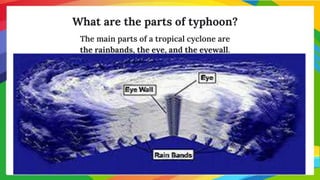
What are the parts of typhoon?
The main parts of a tropical cyclone are
the rainbands, the eye, and the eyewall.
How does a
typhoon
form?
A typhoon forms when
winds blow into areas of the
ocean where the water is
warm. These winds collect
moisture and rise, while
colder air moves in below.
This creates pressure, which
causes the winds to move
very quickly. ... In order for a
storm to be a typhoon, wind
speeds have to reach at least
74 miles per hour.
The Intertropical Convergence
Zone, or ITCZ, is the region that
circles the Earth, near the
equator, where the trade winds
of the Northern and Southern
Hemispheres come together. The
intense sun and warm water of
the equator heats the air in the
ITCZ, raising its humidity and
making it buoyant.
*Southwest monsoon winds and
Northeast monsoon winds
Philippine
Area of
Responsibility
Points Latitude, Longitude
A 5oN, 115oE
B 15oN, 115oE
C 21oN, 120oE
D 25oN, 120oE
E 25oN, 135oE
F 5oN, 135oE
Points of Philippine Area of Responsibility
A. If a typhoon is located at 15oN, 138oE, is it
within the PAR?
B. How about if the typhoon is at 19oN, 117oE, is it
inside the PAR?
Movement and Speed of Tropical Cyclone
Over the Philippine Sea, Tropical Cyclones tend to
move on a general west- northwest (WNW) direction
with an average speed of 19-20 km/hr.
Landfall
is the event of a storm moving over land after being over water. More
broadly, and in relation to human travel, it refers to 'the first land that is
reached or seen at the end of a journey across the sea or through the air, or
the fact of arriving there.
1. Where did the tropical cyclone form? On
land or in the ocean?
2. In what direction did the tropical
cyclones move?
3. Which part of the Philippines was hit by the
four tropical cyclones?
PUBLIC STORM
WARNING SIGNALS
in the Philippines
Hydrometeorological Hazard.pptx

Hydrometeorological Hazard.pptx

  • 1.
  • 4.
    Phenomenon of atmospheric, hydrologicalor oceanographic nature that may cause loss of life, injury or other health impacts, property damage, loss of livelihoods and services, social and economic disruption, or environmental damage Hydro-meteorological Hazard
  • 5.
    Typhoon • An extremelylarge, powerful and destructive storm that occurs especially in the region of the Philippines or the China Sea. Thunderstorm • Is a weather condition generally characterized by heavy rain, thunder and lightning and a possibility of tornado. Flashflood • A local flood of short duration generally resulting from heavy rainfall in the immediate vicinity. Flood • Generally referred too as the RUNNING and OVERLAYING of water on land that are not ordinary covered by it. Storm Surge • Escalating seawater to the coast above normal sea level
  • 6.
    El Niño • Aflow of unusually warm water along the western coast of South America that causes many changes in weather in other places. La Niña • La Niña is a climate pattern that describes the cooling of surface ocean waters along the tropical west coast of South America. La Nina is considered to be the counterpart to El Nino, which is characterized by unusually warm ocean temperatures in the equatorial region of the Pacific Ocean.
  • 7.
    In this lesson, Wewill be able to understand the Typhoon’s: A. Definition B. Anatomy C. Formation D. Categories We will also find out: A. Why Philippines is prone to typhoon? B. How a typhoon dies? C. What are the Public Storm Warning Signals in the Philippines?
  • 8.
    Trivia Question: Wehear weathercasters talk about typhoons, hurricanes and cyclones – which of the following is the true statement? a. Typhoons are bigger than cyclones; cyclones are bigger than hurricanes. b. Hurricanes are stronger than typhoons and cyclones. c. Hurricanes, typhoons and cyclones occur in different geographical areas.
  • 9.
    The correct answeris C. Typhoons, cyclones and hurricanes are the same weather phenomenon – the difference is the geographical area where they occur. They are tropical cyclones with regionally specific names.
  • 10.
    PAG-ASA is theagency responsible for assessing and forecasting weather, flood, and other conditions essential to the safety and welfare of the people. It also conducts research & development projects related to atmospheric and allied data. It now serves as one of the Scientific and Technological Services Institutes of the Department of Science and Technology.
  • 11.
    Did You KnowThat In 1963 by the Philippine Weather Bureau through the use of four sets of alphabetically arranged Filipino women nicknames ending in “ng” that are alternately used every four years. In 1999, the Philippine Atmospheric, Geophysical and Astronomical Services (PAGASA) held a nationwide search for new generation tropical cyclone names. It was dubbed as “Name the Bagyo Contest.” The result of the search which was picked out from more than 18,000 entries was 140 no- gender-bias names that will be used until 2016 by PAGASA.
  • 12.
    Not so FunFact According to the Philippine Atmospheric, Geophysical, and Astronomical Services Administration (PAGASA), about 20 tropical cyclones enter the Philippine Area of Responsibility each year.
  • 13.
  • 14.
    an intense circularstorm characterized by low atmospheric pressure, heavy rain and high winds winds in a counter-clockwise direction. (counter-clockwise direction if northern hemisphere and clockwise direction if southern hemisphere)
  • 15.
    What are theparts of typhoon? The main parts of a tropical cyclone are the rainbands, the eye, and the eyewall.
  • 17.
  • 18.
    A typhoon formswhen winds blow into areas of the ocean where the water is warm. These winds collect moisture and rise, while colder air moves in below. This creates pressure, which causes the winds to move very quickly. ... In order for a storm to be a typhoon, wind speeds have to reach at least 74 miles per hour.
  • 19.
    The Intertropical Convergence Zone,or ITCZ, is the region that circles the Earth, near the equator, where the trade winds of the Northern and Southern Hemispheres come together. The intense sun and warm water of the equator heats the air in the ITCZ, raising its humidity and making it buoyant. *Southwest monsoon winds and Northeast monsoon winds
  • 22.
  • 23.
    Points Latitude, Longitude A5oN, 115oE B 15oN, 115oE C 21oN, 120oE D 25oN, 120oE E 25oN, 135oE F 5oN, 135oE Points of Philippine Area of Responsibility
  • 24.
    A. If atyphoon is located at 15oN, 138oE, is it within the PAR? B. How about if the typhoon is at 19oN, 117oE, is it inside the PAR?
  • 26.
    Movement and Speedof Tropical Cyclone Over the Philippine Sea, Tropical Cyclones tend to move on a general west- northwest (WNW) direction with an average speed of 19-20 km/hr. Landfall is the event of a storm moving over land after being over water. More broadly, and in relation to human travel, it refers to 'the first land that is reached or seen at the end of a journey across the sea or through the air, or the fact of arriving there.
  • 28.
    1. Where didthe tropical cyclone form? On land or in the ocean? 2. In what direction did the tropical cyclones move? 3. Which part of the Philippines was hit by the four tropical cyclones?
  • 29.