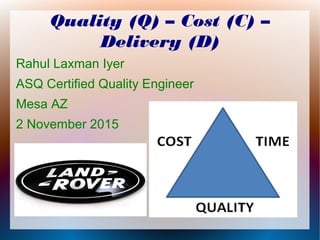
Quality (Q) – Cost (C) –
Delivery (D)
Rahul Laxman Iyer
ASQ Certified Quality Engineer
Mesa AZ
2 November 2015
Introduction
● Q-C-D is a management approach originally
developed to help companies within the
automobile sector
● Utilized to access different components of the
production process
● Used to provide accurate feedback in the form
of facts and figures that help senior managers
make logical and beneficial decisions
● Aids in prioritization of tasks required
● Focus of Lean Manufacturing
Benefits of Q-C-D
● Straight forward method of measuring processes
● Applicable to both simple and complicated business
processes
● Basis for comparing businesses & processes
(Benchmarking)
Basis of Quality (Q)
● Performance: ability to meet primary operating
characteristics
● Conformance: the degree to which a certain
product meets the customer’s expectations
● Special Features: additional features of a product
or service
● Aesthetics: the product’s looks, sound, feel, smell,
or taste
Basis of Quality (Q)--continued
● Durability: how long the product lasts before it has
to be replaced
● Reliability: the time until a product breaks down
and has to be repaired, but not replaced
● Serviceability: speed, courtesy, competence and
ease of repair
● Perceived quality: affected by the high price or the
good aesthetics of a product
Basis of Quality (Q)--continued
● Product components
– The quality of a product depends almost entirely on
the quality of the supplied materials
– One cannot produce a high-quality end product from
low-quality components
● Consequences of poor quality
– Business loss
– Reduced Productivity
– Increased Costs
Basis of Cost (C)
● Four Types Of Manufacturing Costs
– Raw materials
– Direct Labor
– Variable Overhead
– Fixed Overhead
● Cost Reduction
– Reducing material costs
– Adopting lean manufacturing
– Upgrading machine technology
– Implementing robot-based automation
Basis of Delivery (D)
● Being On Time When Promised Per Contract
– Not Being Late
– Not Being Early
Increasing profitability with
QCD
● Seven measures used to increase profitability ( "QCD:
measuring manufacturing performance" (PDF). http://nationalarchives.gov.uk
– Not right first time (NRFT): Wasted resources, effort and time –Cost of
Poor Quality (COQ, COPQ)
– Delivery schedule achievement (DSA): analyzes how well a supplier
delivers what the customer wants and when they want it
– People productivity (PP): The time it takes (in staff hours) to produce a
good quality product
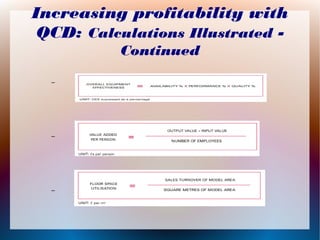
– Overall equipment effectiveness (OEE): Measure of how well a
company uses its equipment and staff (Availability, Performance,
Quality)
– Value added per person (VAPP): Measure of how well people are used
to turn raw materials into finished goods (Output Value, Input Value,
Number of Employees)
– Floor space utilisation (FSU): Measures the sales revenue generated by
a square meter of factory floor space
Increasing profitability with
QCD: Calculations Illustrated
–
–
–
–
Increasing profitability with
QCD: Calculations Illustrated -
Continued
–
–
–
Quality (Q) – Cost (C) –
Delivery (D)
● Q-C-D is a management methodology that can be
used for lean manufacturing and process
improvement
● Originated in automotive industry, but can be
applied to virtually almost any industry
● Emphasizes making decisions based upon data
● A tool to improve business profitability

Quality (Q), Cost (C), Delivery (D)---Q-C-D

  • 1.
    Quality (Q) –Cost (C) – Delivery (D) Rahul Laxman Iyer ASQ Certified Quality Engineer Mesa AZ 2 November 2015
  • 2.
    Introduction ● Q-C-D isa management approach originally developed to help companies within the automobile sector ● Utilized to access different components of the production process ● Used to provide accurate feedback in the form of facts and figures that help senior managers make logical and beneficial decisions ● Aids in prioritization of tasks required ● Focus of Lean Manufacturing
  • 3.
    Benefits of Q-C-D ●Straight forward method of measuring processes ● Applicable to both simple and complicated business processes ● Basis for comparing businesses & processes (Benchmarking)
  • 4.
    Basis of Quality(Q) ● Performance: ability to meet primary operating characteristics ● Conformance: the degree to which a certain product meets the customer’s expectations ● Special Features: additional features of a product or service ● Aesthetics: the product’s looks, sound, feel, smell, or taste
  • 5.
    Basis of Quality(Q)--continued ● Durability: how long the product lasts before it has to be replaced ● Reliability: the time until a product breaks down and has to be repaired, but not replaced ● Serviceability: speed, courtesy, competence and ease of repair ● Perceived quality: affected by the high price or the good aesthetics of a product
  • 6.
    Basis of Quality(Q)--continued ● Product components – The quality of a product depends almost entirely on the quality of the supplied materials – One cannot produce a high-quality end product from low-quality components ● Consequences of poor quality – Business loss – Reduced Productivity – Increased Costs
  • 7.
    Basis of Cost(C) ● Four Types Of Manufacturing Costs – Raw materials – Direct Labor – Variable Overhead – Fixed Overhead ● Cost Reduction – Reducing material costs – Adopting lean manufacturing – Upgrading machine technology – Implementing robot-based automation
  • 8.
    Basis of Delivery(D) ● Being On Time When Promised Per Contract – Not Being Late – Not Being Early
  • 9.
    Increasing profitability with QCD ●Seven measures used to increase profitability ( "QCD: measuring manufacturing performance" (PDF). http://nationalarchives.gov.uk – Not right first time (NRFT): Wasted resources, effort and time –Cost of Poor Quality (COQ, COPQ) – Delivery schedule achievement (DSA): analyzes how well a supplier delivers what the customer wants and when they want it – People productivity (PP): The time it takes (in staff hours) to produce a good quality product – Overall equipment effectiveness (OEE): Measure of how well a company uses its equipment and staff (Availability, Performance, Quality) – Value added per person (VAPP): Measure of how well people are used to turn raw materials into finished goods (Output Value, Input Value, Number of Employees) – Floor space utilisation (FSU): Measures the sales revenue generated by a square meter of factory floor space
  • 10.
    Increasing profitability with QCD:Calculations Illustrated – – – –
  • 11.
    Increasing profitability with QCD:Calculations Illustrated - Continued – – –
  • 12.
    Quality (Q) –Cost (C) – Delivery (D) ● Q-C-D is a management methodology that can be used for lean manufacturing and process improvement ● Originated in automotive industry, but can be applied to virtually almost any industry ● Emphasizes making decisions based upon data ● A tool to improve business profitability