NATURE OF ENERGY 
CATAPULT DESIGN/MOUSE TRAP 
COMPETITION
I. What is Energy?? 
A. Energy Basics 
1. Energy can be defined as the ability to do work. 
a. An example of work would be an object/organism 
exerting a force over a distance to move an a 
object….therefore the object uses energy. 
b. Electric charges in a current use energy as they move 
along a wire(we discussed this!!!) 
c. Energy can be measured in joules (J)… which is the 
same unit used to measure work.
2. In addition to objects using energy to do 
work, objects can energy because work is 
being done on them. 
a. If work is done an object, energy is given to that 
object. 
b. If you fling a ping pong ball with a 
mousetrap…you give the ping pong ball energy 
to make it move.
II. Forms of Energy 
A. Five main forms of Energy 
1. Mechanical 
2. Heat 
3. Chemical 
4. Electromagnetic 
5. Nuclear
B. Mechanical Energy 
1. Energy associated with motion is called 
mechanical energy. 
a. Water in a waterfall has great mechanical energy!!! 
b. Other examples include wind, automobiles, walking, 
swimming, blood flowing through your veins and 
LAUNCHING PING PONG BALLS from a mousetrap!!! 
c. **Sound is also a type of mechanical energy…sound 
waves move mechanically!!
C. HEAT ENERGY 
1. Internal motion of ATOMS is called heat energy. 
a. All matter is made up of atoms that are constantly moving. 
2. The faster the particles move…the more heat energy 
is produced. 
a. Using the friction between your hands….when you rub your 
hands together…you take the mechanical energy 
(movement of hands) and convert it into heat energy. 
3. Heat energy usually results from friction. 
4. Heat energy causes changes in temperature and may 
cause change in phase (solid to liquid, liquid to 
gas..etc. )
D. Chemical Energy (Think Bombs!!) 
1. Energy exists in the bonds that hold atoms together. 
2. This energy is called chemical energy. 
3. When bonds are broken this energy is released. 
4. When fuel is burned, chemical energy is released and 
converted into heat energy. 
5. Digestion of food is another example of chemical 
energy 
6. When you exercise (mechanical Energy) your body 
needs the chemical energy stored in your muscles.
E. Electromagnetic Energy 
1. Power lines carry electromagnetic energy into 
our homes in the form of electricity. 
2. Each color in visible light (ROYGBIV) is 
electromagnetic energy. 
a. Each color represents a different amount of energy. 
3. X-Rays, Microwaves, Infra-red, ultraviolet, and 
Gamma Rays are also examples.
F. Nuclear Energy 
1. The nucleus or center of the atom contains NUCLEAR 
ENERGY. 
2. When the nucleus splits, nuclear energy is released 
in the form of heat and light energy. 
a. This is called fission and is the main principal of nuclear 
reactors. 
3. Nuclear energy is also released then lightweight 
nuclei collide at high speeds and fuse (join). 
a. This is like the forming of the sun and called fusion. 
b. We cannot duplicate fusion.
QEUSTIONS YOU WILL NEED TO 
KNOW! 
1. What is energy? 
2. Can energy be transferred from one object to 
another? Explain (give examples) 
3. What are the different forms of energy? 
4. Why is energy measured in the same unit as 
work?
II. Kinetic Energy and Potential Energy 
1. Two STATES of energy are potential and 
kinetic. 
a. Our example will be a set mouse trap (or 
catapult). 
b. If you take your finger and hold the mousetrap 
back without setting it….even though the mouse 
trap is not moving there is a form of energy at 
rest keeping that mousetrap in that position……
2. Kinetic Energy 
a. The energy of motion is called kinetic energ 
b. Because the object is in motion it has the ability to 
do work….hence the term energy. 
c. Kinetic comes form the Greek root for movement. 
d. The faster an object moves the more kinetic energy 
it has. 
e. If the same person is runs for 2 miles, then crawls for 
2 miles…when do they have the most kinetic energy?
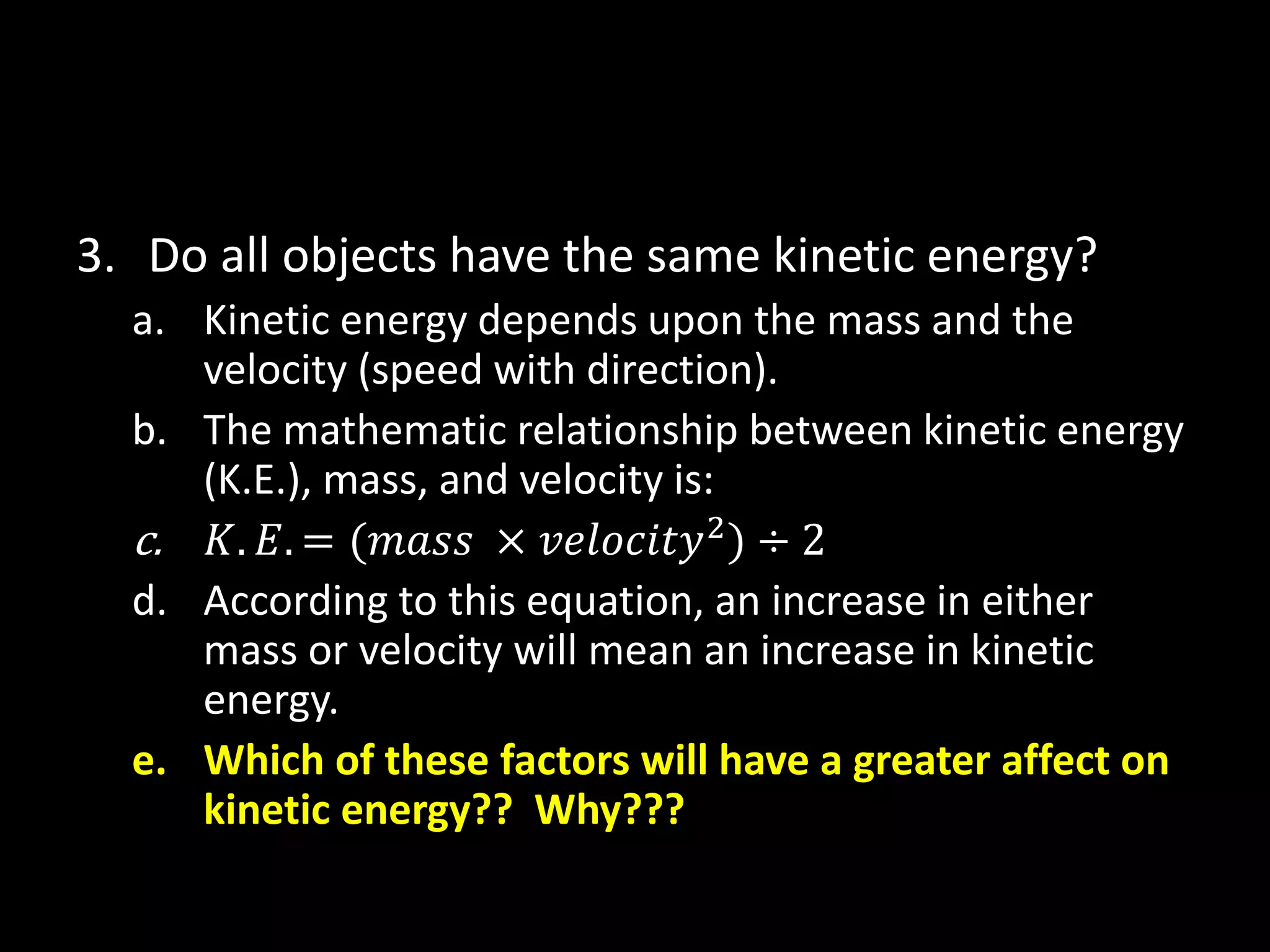
3. Do all objects have the same kinetic energy? 
a. Kinetic energy depends upon the mass and the 
velocity (speed with direction). 
b. The mathematic relationship between kinetic energy 
(K.E.), mass, and velocity is: 
c. 퐾. 퐸. = (푚푎푠푠 × 푣푒푙표푐푖푡푦2) ÷ 2 
d. According to this equation, an increase in either 
mass or velocity will mean an increase in kinetic 
energy. 
e. Which of these factors will have a greater affect on 
kinetic energy?? Why???
4. POTENTIAL Energy 
a. Potential energy is the energy of position, or 
energy at rest. 
b. The mousetrap that is set…but not moving has 
zero kinetic energy…but it does have potential 
energy. 
c. The chemical energy stored in food is also 
considered potential energy….give two more 
examples!!!
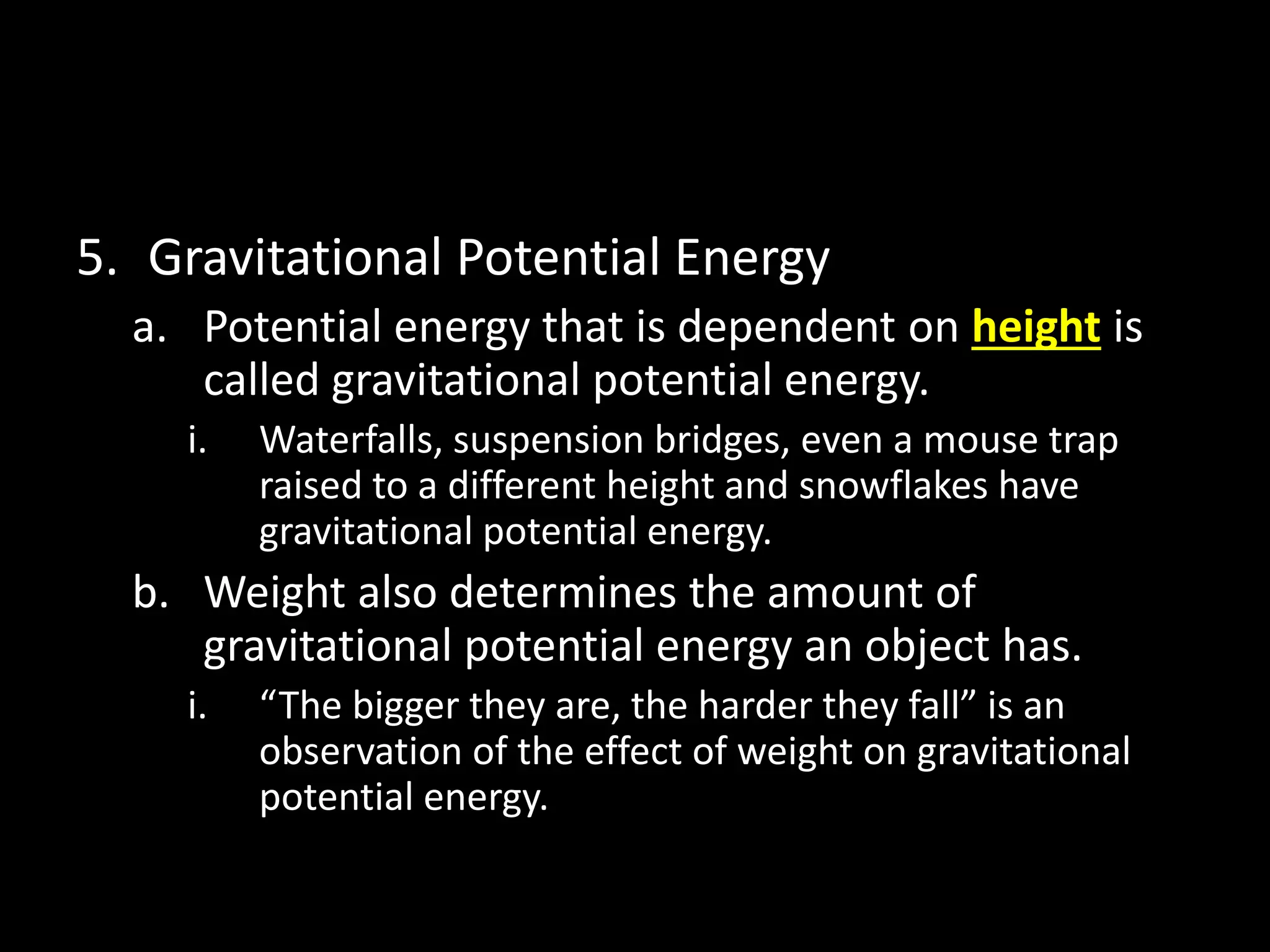
5. Gravitational Potential Energy 
a. Potential energy that is dependent on height is 
called gravitational potential energy. 
i. Waterfalls, suspension bridges, even a mouse trap 
raised to a different height and snowflakes have 
gravitational potential energy. 
b. Weight also determines the amount of 
gravitational potential energy an object has. 
i. “The bigger they are, the harder they fall” is an 
observation of the effect of weight on gravitational 
potential energy.
6. How to determine Gravitational Potential 
Energy 
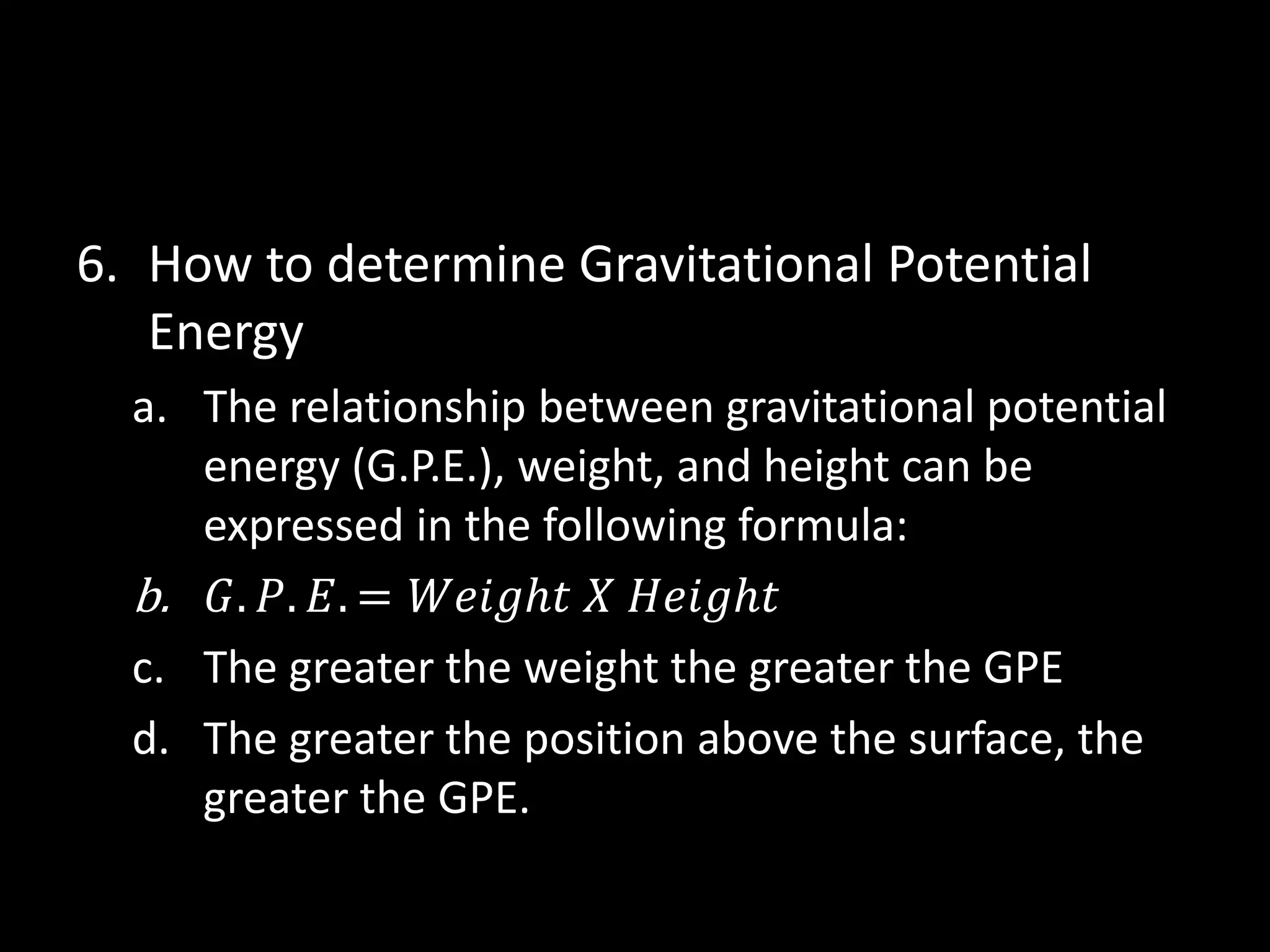
a. The relationship between gravitational potential 
energy (G.P.E.), weight, and height can be 
expressed in the following formula: 
b. 퐺. 푃. 퐸. = 푊푒푖푔ℎ푡 푋 퐻푒푖푔ℎ푡 
c. The greater the weight the greater the GPE 
d. The greater the position above the surface, the 
greater the GPE.
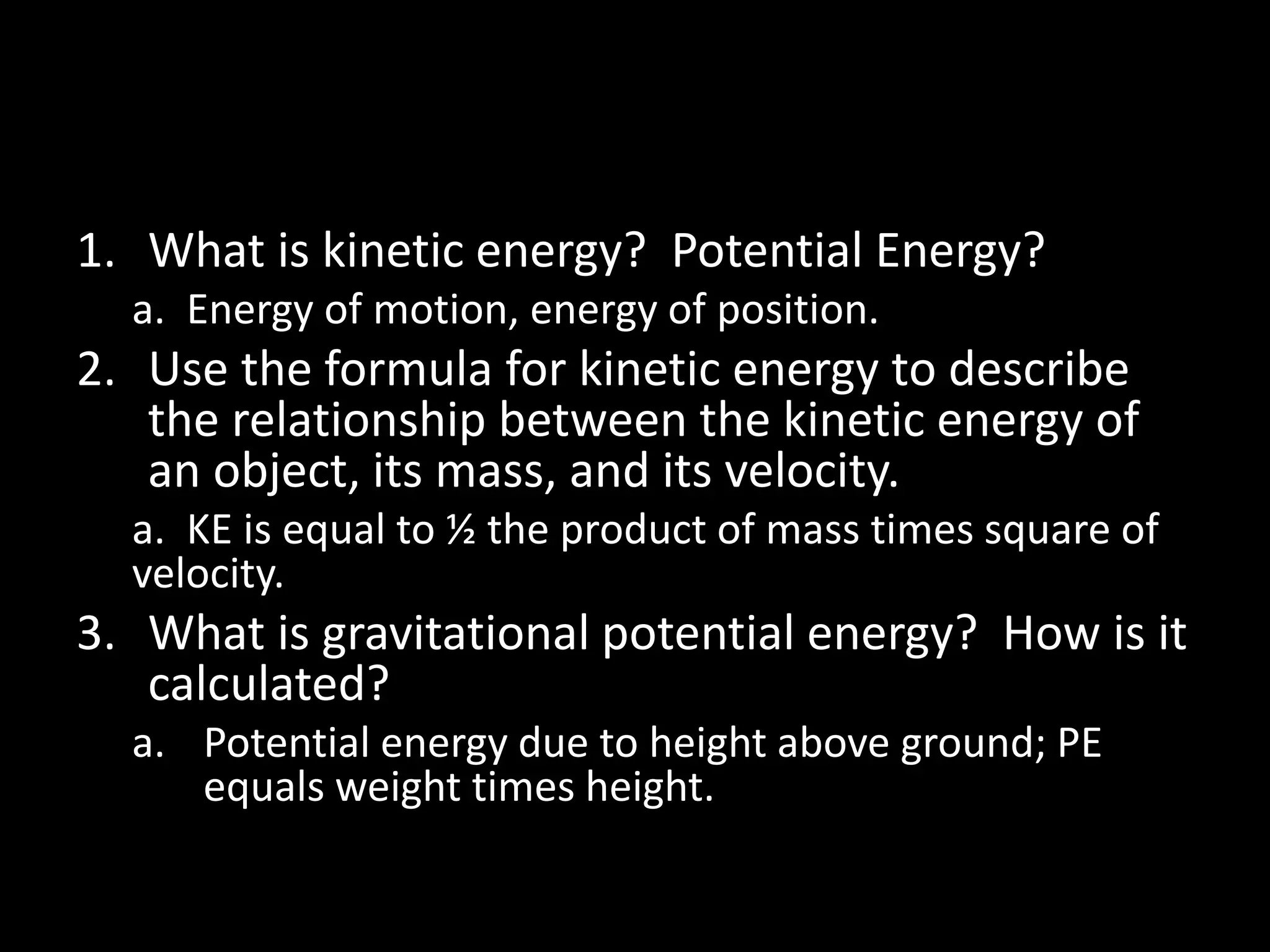
1. What is kinetic energy? Potential Energy? 
a. Energy of motion, energy of position. 
2. Use the formula for kinetic energy to describe 
the relationship between the kinetic energy of 
an object, its mass, and its velocity. 
a. KE is equal to ½ the product of mass times square of 
velocity. 
3. What is gravitational potential energy? How is it 
calculated? 
a. Potential energy due to height above ground; PE 
equals weight times height.
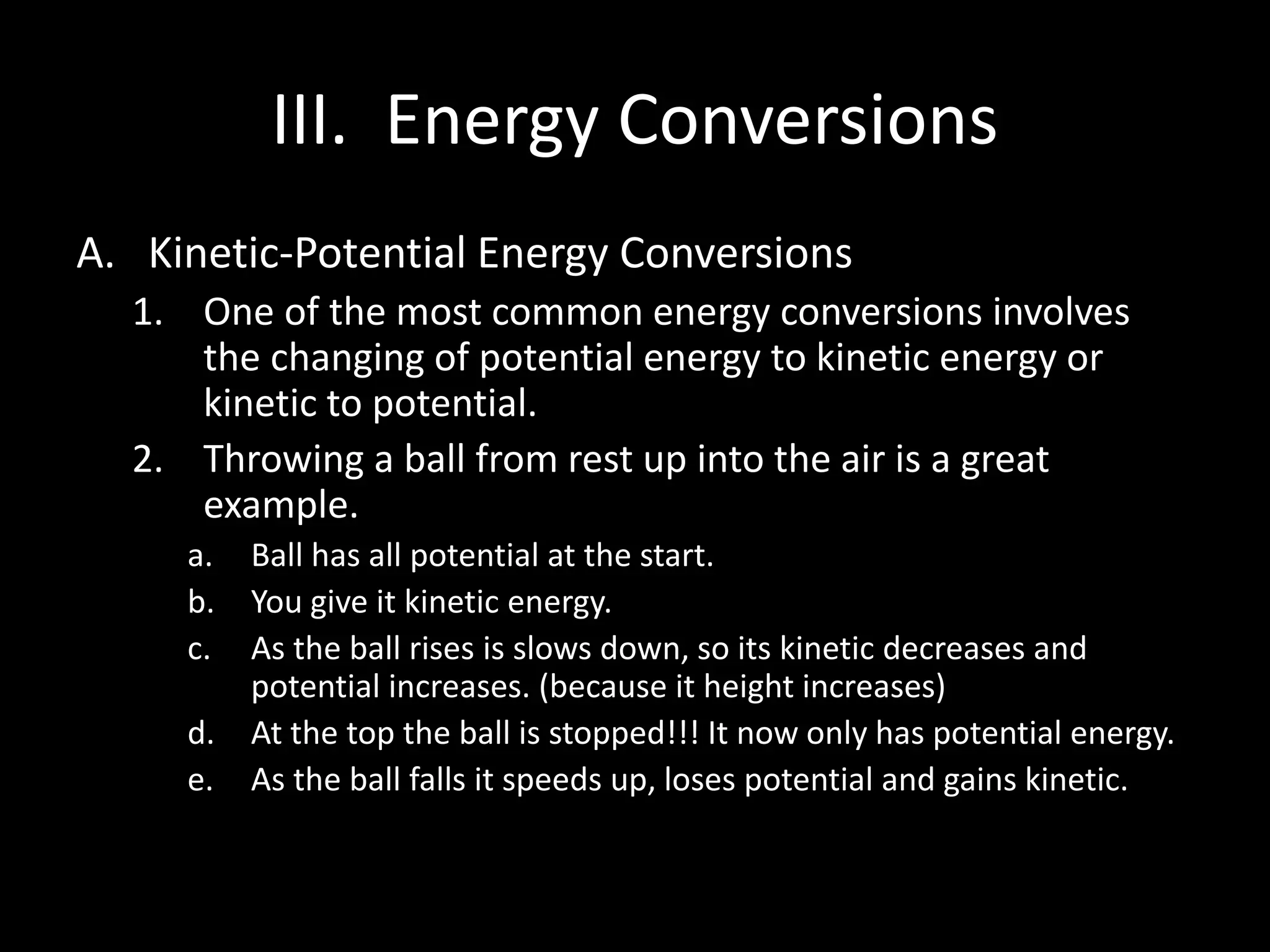
III. Energy Conversions 
A. Kinetic-Potential Energy Conversions 
1. One of the most common energy conversions involves 
the changing of potential energy to kinetic energy or 
kinetic to potential. 
2. Throwing a ball from rest up into the air is a great 
example. 
a. Ball has all potential at the start. 
b. You give it kinetic energy. 
c. As the ball rises is slows down, so its kinetic decreases and 
potential increases. (because it height increases) 
d. At the top the ball is stopped!!! It now only has potential energy. 
e. As the ball falls it speeds up, loses potential and gains kinetic.
B. Other conversions 
1. All forms of energy can be converted to other 
forms. 
a. Solar energy can be used as heat energy, light energy, 
chemical energy (photosynthesis),and converted into 
electricity. 
b. Electric motors: electromagnetic energy is converted 
to mechanical energy. 
c. Battery: chemical energy is converted to 
electromagnetic energy.
III. Things to know!!! 
1. Describe the conversions between potential 
and kinetic energy as a tennis ball drops, hits 
the ground, and bounces back up. 
a. Before the ball drops all of its energy is potential. 
As it falls, potential energy is converted into 
kinetic energy. When it hits the ground its 
kinetic energy is at the maximum. Then as it 
bounces back up, kinetic energy is converted into 
potential.
III. Things to know!!! 
2. What energy conversions take place in a 
pendulum? Why does the pendulum 
eventually stop? 
a. A pendulum converts potential energy into 
kinetic energy as it swings down, and kinetic 
energy into potential energy as it swings up. As 
it swings, it loses energy to friction caused by the 
particles of air and by the apparatus holding the 
top of the pendulum. Thus, it eventually slows 
down and stops.
III. Things to know!!! 
3. Describe the energy conversions that you 
think take place when a flashlight is turned 
on. 
a. Chemical energy in the batteries is converted 
into electromagnetic energy in the form of a 
current. The current is then converted into light.
IV. Conservation of Energy 
A. Law of Conservation of Energy 
1. Energy can be neither created nor destroyed by 
ordinary means. 
2. Energy can only be converted from one form to 
another. 
3. Energy is never lost, even when one form of 
energy is converted to another.
B. Albert Einstein 
1. 1905: According to Einstein even the tiniest 
mass can form a tremendous amount of energy. 
2. Einstein’s theory of relativity deals with the 
concept that mass and energy are DIRECTLY 
related. 
3. Einstein believes that mass and energy can be 
converted into each other. (deep….really deep 
thoughts!!)
B. Albert Einstein 
4. With this relationship Einstein clarified the LAW of 
conservation of energy. 
5. He showed that if matter is destroyed, energy is 
created and if energy is destroyed, matter is created. 
6. The total amount of mass and energy is conserved 
7. Mass is continuously changed to energy in our SUN 
through a process called nuclear fusion. 
a. During fusion a small loss in mass produces a HUGE amount 
of energy!!!
Think about this…… 
1. What is the law of conservation of energy? 
a. Energy can neither be created or destroyed by 
ordinary means. 
2. How does the law of conservation of energy 
relate to energy conversions? 
a. Energy conversions involve changes in the forms 
of energy. They occur without the loss or gain of 
energy.
Think about this…… 
3. Using the law of conservation of 
energy…..Explain why you become pushing a 
shopping cart 3 miles? 
a. Energy is neither created nor destroyed, you 
must be giving your energy to the cart. As you 
give up your energy (both chemical and 
mechanical) your muscles become tired.

What is energy (catapult intro) sections 1 to 4 only

  • 1.
    NATURE OF ENERGY CATAPULT DESIGN/MOUSE TRAP COMPETITION
  • 2.
    I. What isEnergy?? A. Energy Basics 1. Energy can be defined as the ability to do work. a. An example of work would be an object/organism exerting a force over a distance to move an a object….therefore the object uses energy. b. Electric charges in a current use energy as they move along a wire(we discussed this!!!) c. Energy can be measured in joules (J)… which is the same unit used to measure work.
  • 3.
    2. In additionto objects using energy to do work, objects can energy because work is being done on them. a. If work is done an object, energy is given to that object. b. If you fling a ping pong ball with a mousetrap…you give the ping pong ball energy to make it move.
  • 4.
    II. Forms ofEnergy A. Five main forms of Energy 1. Mechanical 2. Heat 3. Chemical 4. Electromagnetic 5. Nuclear
  • 5.
    B. Mechanical Energy 1. Energy associated with motion is called mechanical energy. a. Water in a waterfall has great mechanical energy!!! b. Other examples include wind, automobiles, walking, swimming, blood flowing through your veins and LAUNCHING PING PONG BALLS from a mousetrap!!! c. **Sound is also a type of mechanical energy…sound waves move mechanically!!
  • 6.
    C. HEAT ENERGY 1. Internal motion of ATOMS is called heat energy. a. All matter is made up of atoms that are constantly moving. 2. The faster the particles move…the more heat energy is produced. a. Using the friction between your hands….when you rub your hands together…you take the mechanical energy (movement of hands) and convert it into heat energy. 3. Heat energy usually results from friction. 4. Heat energy causes changes in temperature and may cause change in phase (solid to liquid, liquid to gas..etc. )
  • 7.
    D. Chemical Energy(Think Bombs!!) 1. Energy exists in the bonds that hold atoms together. 2. This energy is called chemical energy. 3. When bonds are broken this energy is released. 4. When fuel is burned, chemical energy is released and converted into heat energy. 5. Digestion of food is another example of chemical energy 6. When you exercise (mechanical Energy) your body needs the chemical energy stored in your muscles.
  • 8.
    E. Electromagnetic Energy 1. Power lines carry electromagnetic energy into our homes in the form of electricity. 2. Each color in visible light (ROYGBIV) is electromagnetic energy. a. Each color represents a different amount of energy. 3. X-Rays, Microwaves, Infra-red, ultraviolet, and Gamma Rays are also examples.
  • 9.
    F. Nuclear Energy 1. The nucleus or center of the atom contains NUCLEAR ENERGY. 2. When the nucleus splits, nuclear energy is released in the form of heat and light energy. a. This is called fission and is the main principal of nuclear reactors. 3. Nuclear energy is also released then lightweight nuclei collide at high speeds and fuse (join). a. This is like the forming of the sun and called fusion. b. We cannot duplicate fusion.
  • 10.
    QEUSTIONS YOU WILLNEED TO KNOW! 1. What is energy? 2. Can energy be transferred from one object to another? Explain (give examples) 3. What are the different forms of energy? 4. Why is energy measured in the same unit as work?
  • 11.
    II. Kinetic Energyand Potential Energy 1. Two STATES of energy are potential and kinetic. a. Our example will be a set mouse trap (or catapult). b. If you take your finger and hold the mousetrap back without setting it….even though the mouse trap is not moving there is a form of energy at rest keeping that mousetrap in that position……
  • 12.
    2. Kinetic Energy a. The energy of motion is called kinetic energ b. Because the object is in motion it has the ability to do work….hence the term energy. c. Kinetic comes form the Greek root for movement. d. The faster an object moves the more kinetic energy it has. e. If the same person is runs for 2 miles, then crawls for 2 miles…when do they have the most kinetic energy?
  • 13.
    3. Do allobjects have the same kinetic energy? a. Kinetic energy depends upon the mass and the velocity (speed with direction). b. The mathematic relationship between kinetic energy (K.E.), mass, and velocity is: c. 퐾. 퐸. = (푚푎푠푠 × 푣푒푙표푐푖푡푦2) ÷ 2 d. According to this equation, an increase in either mass or velocity will mean an increase in kinetic energy. e. Which of these factors will have a greater affect on kinetic energy?? Why???
  • 14.
    4. POTENTIAL Energy a. Potential energy is the energy of position, or energy at rest. b. The mousetrap that is set…but not moving has zero kinetic energy…but it does have potential energy. c. The chemical energy stored in food is also considered potential energy….give two more examples!!!
  • 15.
    5. Gravitational PotentialEnergy a. Potential energy that is dependent on height is called gravitational potential energy. i. Waterfalls, suspension bridges, even a mouse trap raised to a different height and snowflakes have gravitational potential energy. b. Weight also determines the amount of gravitational potential energy an object has. i. “The bigger they are, the harder they fall” is an observation of the effect of weight on gravitational potential energy.
  • 16.
    6. How todetermine Gravitational Potential Energy a. The relationship between gravitational potential energy (G.P.E.), weight, and height can be expressed in the following formula: b. 퐺. 푃. 퐸. = 푊푒푖푔ℎ푡 푋 퐻푒푖푔ℎ푡 c. The greater the weight the greater the GPE d. The greater the position above the surface, the greater the GPE.
  • 17.
    1. What iskinetic energy? Potential Energy? a. Energy of motion, energy of position. 2. Use the formula for kinetic energy to describe the relationship between the kinetic energy of an object, its mass, and its velocity. a. KE is equal to ½ the product of mass times square of velocity. 3. What is gravitational potential energy? How is it calculated? a. Potential energy due to height above ground; PE equals weight times height.
  • 18.
    III. Energy Conversions A. Kinetic-Potential Energy Conversions 1. One of the most common energy conversions involves the changing of potential energy to kinetic energy or kinetic to potential. 2. Throwing a ball from rest up into the air is a great example. a. Ball has all potential at the start. b. You give it kinetic energy. c. As the ball rises is slows down, so its kinetic decreases and potential increases. (because it height increases) d. At the top the ball is stopped!!! It now only has potential energy. e. As the ball falls it speeds up, loses potential and gains kinetic.
  • 19.
    B. Other conversions 1. All forms of energy can be converted to other forms. a. Solar energy can be used as heat energy, light energy, chemical energy (photosynthesis),and converted into electricity. b. Electric motors: electromagnetic energy is converted to mechanical energy. c. Battery: chemical energy is converted to electromagnetic energy.
  • 20.
    III. Things toknow!!! 1. Describe the conversions between potential and kinetic energy as a tennis ball drops, hits the ground, and bounces back up. a. Before the ball drops all of its energy is potential. As it falls, potential energy is converted into kinetic energy. When it hits the ground its kinetic energy is at the maximum. Then as it bounces back up, kinetic energy is converted into potential.
  • 21.
    III. Things toknow!!! 2. What energy conversions take place in a pendulum? Why does the pendulum eventually stop? a. A pendulum converts potential energy into kinetic energy as it swings down, and kinetic energy into potential energy as it swings up. As it swings, it loses energy to friction caused by the particles of air and by the apparatus holding the top of the pendulum. Thus, it eventually slows down and stops.
  • 22.
    III. Things toknow!!! 3. Describe the energy conversions that you think take place when a flashlight is turned on. a. Chemical energy in the batteries is converted into electromagnetic energy in the form of a current. The current is then converted into light.
  • 23.
    IV. Conservation ofEnergy A. Law of Conservation of Energy 1. Energy can be neither created nor destroyed by ordinary means. 2. Energy can only be converted from one form to another. 3. Energy is never lost, even when one form of energy is converted to another.
  • 24.
    B. Albert Einstein 1. 1905: According to Einstein even the tiniest mass can form a tremendous amount of energy. 2. Einstein’s theory of relativity deals with the concept that mass and energy are DIRECTLY related. 3. Einstein believes that mass and energy can be converted into each other. (deep….really deep thoughts!!)
  • 25.
    B. Albert Einstein 4. With this relationship Einstein clarified the LAW of conservation of energy. 5. He showed that if matter is destroyed, energy is created and if energy is destroyed, matter is created. 6. The total amount of mass and energy is conserved 7. Mass is continuously changed to energy in our SUN through a process called nuclear fusion. a. During fusion a small loss in mass produces a HUGE amount of energy!!!
  • 26.
    Think about this…… 1. What is the law of conservation of energy? a. Energy can neither be created or destroyed by ordinary means. 2. How does the law of conservation of energy relate to energy conversions? a. Energy conversions involve changes in the forms of energy. They occur without the loss or gain of energy.
  • 27.
    Think about this…… 3. Using the law of conservation of energy…..Explain why you become pushing a shopping cart 3 miles? a. Energy is neither created nor destroyed, you must be giving your energy to the cart. As you give up your energy (both chemical and mechanical) your muscles become tired.