Presented By: Maga Ram Patel
Department of Renewable Energy Engineering
College of Technology and Engineering, MPUAT, Udaipur
Presentation
on
“Basic Science of Energy Conversion”
What is Energy
 Energy can be defined as the ability to do work.
 If an object or organism does work (exerts a force over a
distance to move an object) the object or organism uses
energy.
 Because of the direct connection between energy and
work, energy is measured in the same unit as work:
joules (J).
 In addition to using energy to do work, objects gain
energy because work is being done on them.
The Law of Conservation of Energy
 Energy can be neither created nor destroyed by ordinary means. It can
only be converted from one form to another.
 If energy seems to disappear, then scientists look for it leading to
many important discoveries.
 In 1905, Albert Einstein said that mass and energy can be converted
into each other.
 He showed that if matter is destroyed, energy is created, and if energy
is destroyed mass is created.
E = MC²
where;
M= is the mass of the body
C= is the speed of light in vacuum
E= is the rest energy
States of Energy
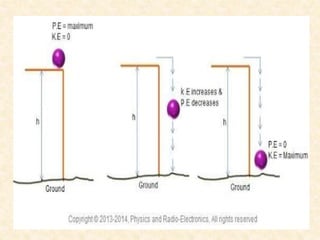
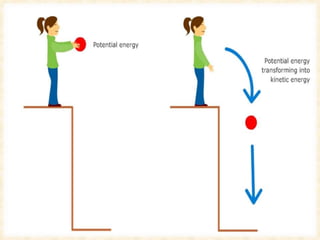
 The most common energy conversion is the conversion
between potential and kinetic energy.
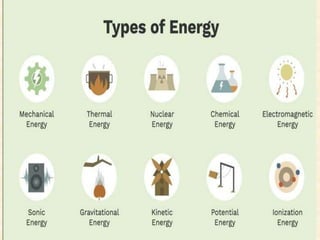
 All forms of energy can be in either of two states:
Potential
Kinetic
 Kinetic Energy is the energy of motion.
 Potential Energy is stored energy.
Kinetic Energy
 The energy of motion is called kinetic energy.
 The faster an object moves, the more kinetic energy it
has.
 The greater the mass of a moving object, the more
kinetic energy it has.
 Kinetic energy depends on both mass and velocity.
Potential Energy
 Potential Energy is stored energy.
 Stored chemically in fuel, the nucleus of atom, and in
foods.
 Or stored because of the work done on it:
Stretching a rubber band.
Winding a watch.
Pulling back on a bow’s arrow.
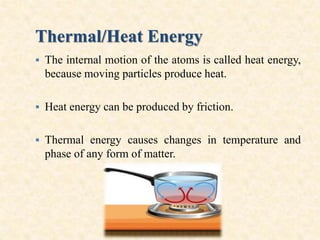
Thermal/Heat Energy
 The internal motion of the atoms is called heat energy,
because moving particles produce heat.
 Heat energy can be produced by friction.
 Thermal energy causes changes in temperature and
phase of any form of matter.
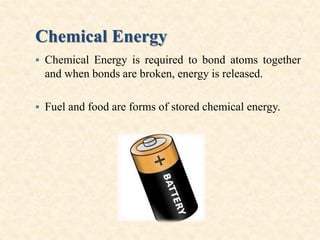
Chemical Energy
 Chemical Energy is required to bond atoms together
and when bonds are broken, energy is released.
 Fuel and food are forms of stored chemical energy.
Electromagnetic Energy
 Power lines carry electromagnetic energy into your
home in the form of electricity.
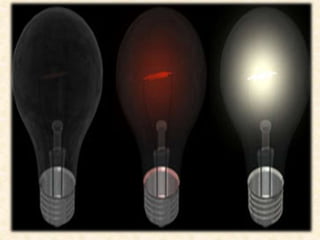
 Light is a form of electromagnetic energy.
 Each color of light represents a different amount of
electromagnetic energy.
 Electromagnetic Energy is also carried by X-rays,
radio waves, and laser light.
Nuclear Energy
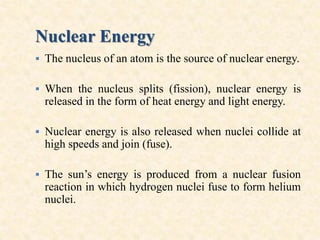
 The nucleus of an atom is the source of nuclear energy.
 When the nucleus splits (fission), nuclear energy is
released in the form of heat energy and light energy.
 Nuclear energy is also released when nuclei collide at
high speeds and join (fuse).
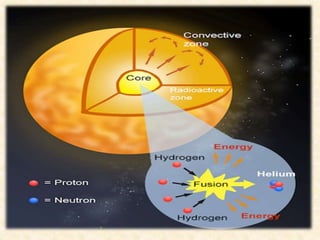
 The sun’s energy is produced from a nuclear fusion
reaction in which hydrogen nuclei fuse to form helium
nuclei.
Mechanical Energy
 When work is done to an object, it acquires energy.
The energy it acquires is known as mechanical energy.
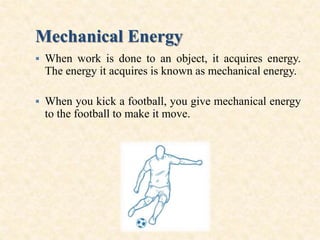
 When you kick a football, you give mechanical energy
to the football to make it move.
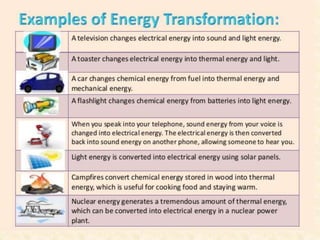
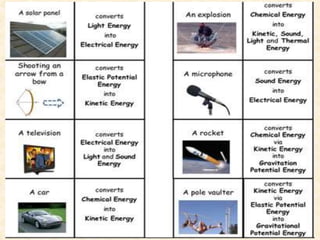
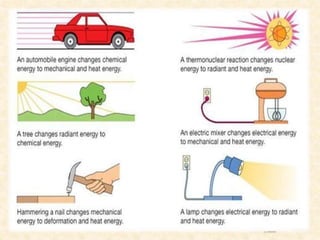
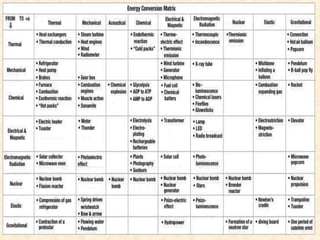
Energy Conversion
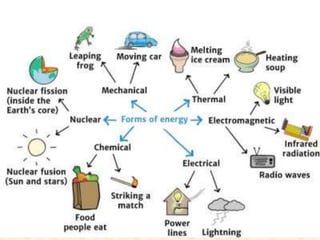
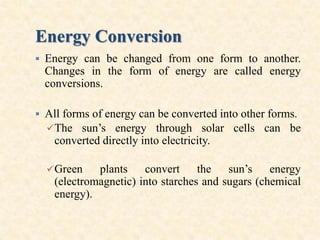
 Energy can be changed from one form to another.
Changes in the form of energy are called energy
conversions.
 All forms of energy can be converted into other forms.
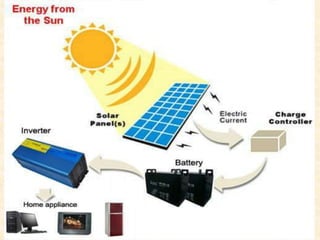
The sun’s energy through solar cells can be
converted directly into electricity.
Green plants convert the sun’s energy
(electromagnetic) into starches and sugars (chemical
energy).
“What we earn is not important but what we save is important.
Save Energy and Save Earth for your future generations”
Looking forward for your feed back soon
M:- 9672824488, E-mail:- patelmagaram1139@gmail.com

Energy

  • 1.
    Presented By: MagaRam Patel Department of Renewable Energy Engineering College of Technology and Engineering, MPUAT, Udaipur Presentation on “Basic Science of Energy Conversion”
  • 2.
    What is Energy Energy can be defined as the ability to do work.  If an object or organism does work (exerts a force over a distance to move an object) the object or organism uses energy.  Because of the direct connection between energy and work, energy is measured in the same unit as work: joules (J).  In addition to using energy to do work, objects gain energy because work is being done on them.
  • 3.
    The Law ofConservation of Energy  Energy can be neither created nor destroyed by ordinary means. It can only be converted from one form to another.  If energy seems to disappear, then scientists look for it leading to many important discoveries.  In 1905, Albert Einstein said that mass and energy can be converted into each other.  He showed that if matter is destroyed, energy is created, and if energy is destroyed mass is created. E = MC² where; M= is the mass of the body C= is the speed of light in vacuum E= is the rest energy
  • 4.
    States of Energy The most common energy conversion is the conversion between potential and kinetic energy.  All forms of energy can be in either of two states: Potential Kinetic  Kinetic Energy is the energy of motion.  Potential Energy is stored energy.
  • 5.
    Kinetic Energy  Theenergy of motion is called kinetic energy.  The faster an object moves, the more kinetic energy it has.  The greater the mass of a moving object, the more kinetic energy it has.  Kinetic energy depends on both mass and velocity.
  • 6.
    Potential Energy  PotentialEnergy is stored energy.  Stored chemically in fuel, the nucleus of atom, and in foods.  Or stored because of the work done on it: Stretching a rubber band. Winding a watch. Pulling back on a bow’s arrow.
  • 10.
    Thermal/Heat Energy  Theinternal motion of the atoms is called heat energy, because moving particles produce heat.  Heat energy can be produced by friction.  Thermal energy causes changes in temperature and phase of any form of matter.
  • 11.
    Chemical Energy  ChemicalEnergy is required to bond atoms together and when bonds are broken, energy is released.  Fuel and food are forms of stored chemical energy.
  • 12.
    Electromagnetic Energy  Powerlines carry electromagnetic energy into your home in the form of electricity.  Light is a form of electromagnetic energy.  Each color of light represents a different amount of electromagnetic energy.  Electromagnetic Energy is also carried by X-rays, radio waves, and laser light.
  • 14.
    Nuclear Energy  Thenucleus of an atom is the source of nuclear energy.  When the nucleus splits (fission), nuclear energy is released in the form of heat energy and light energy.  Nuclear energy is also released when nuclei collide at high speeds and join (fuse).  The sun’s energy is produced from a nuclear fusion reaction in which hydrogen nuclei fuse to form helium nuclei.
  • 16.
    Mechanical Energy  Whenwork is done to an object, it acquires energy. The energy it acquires is known as mechanical energy.  When you kick a football, you give mechanical energy to the football to make it move.
  • 17.
    Energy Conversion  Energycan be changed from one form to another. Changes in the form of energy are called energy conversions.  All forms of energy can be converted into other forms. The sun’s energy through solar cells can be converted directly into electricity. Green plants convert the sun’s energy (electromagnetic) into starches and sugars (chemical energy).
  • 24.
    “What we earnis not important but what we save is important. Save Energy and Save Earth for your future generations” Looking forward for your feed back soon M:- 9672824488, E-mail:- patelmagaram1139@gmail.com