
Presented by –
Abhishek Goyal
Harekrishan kumar
Prem Narayan
Shivam Gubrele
PRESTIGE INSTITUTE OF MANAGEMENT
GWALIOR
Aapka Paisa Aapke Haath
WHAT IS DBT ?
Mechanism of transferring subsidies
Transfer of the cash to the beneficiary's bank
account
No scope left for some corrupt people
DIRECT BENEFIT TRANSFER(DBT)
DIRECT CASH TRANSFER(DCT)
ELECTRONIC BENEFIT TRANSFER (EBT)
What will DBT do?
Direct Benefit cash Transfer or DBT is an anti-poverty
program launched by Government of India on 1 January 2013.
This program aims to transfer subsidies directly to the people
living below poverty Line.
"Aapka paisa aapke haath" concept has
brought happiness to the poor who have
received the benefits directly into
their bank accounts.
Initial Phase of DBTS
The direct benefit transfer scheme (DBTS) was
launched by the then prime minister of india
manmohan singh on 1 january 2013 in 20
districts of india. The scheme was
inaugurated in east godavari district on 6
january 2013. By the end of march 2013 it
was envisioned to be cover 26 social welfare
programmes in 43 districts of 16 states.
PRIMARY AIMS
• To bring transparency and terminate
corruption.
• In DBT, benefit or subsidy will be directly
transferred to the citizens living below
poverty line.
• No subsidy will be given to those people who
don't require it.
What is Aadhaar?
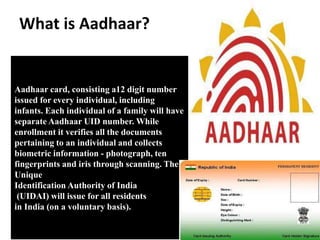
Aadhaar card, consisting a12 digit number
issued for every individual, including
infants. Each individual of a family will have
separate Aadhaar UID number. While
enrollment it verifies all the documents
pertaining to an individual and collects
biometric information - photograph, ten
fingerprints and iris through scanning. The
Unique
Identification Authority of India
(UIDAI) will issue for all residents
in India (on a voluntary basis).
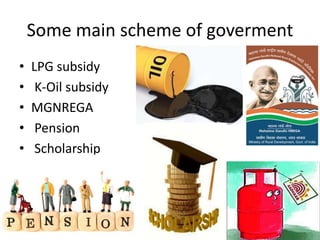
Some main scheme of goverment
• LPG subsidy
• K-Oil subsidy
• MGNREGA
• Pension
• Scholarship
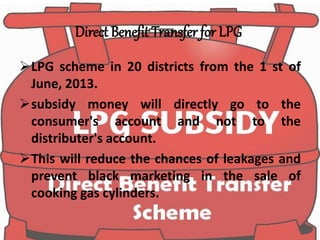
Direct Benefit Transfer for LPG
LPG scheme in 20 districts from the 1 st of
June, 2013.
subsidy money will directly go to the
consumer's account and not to the
distributer's account.
This will reduce the chances of leakages and
prevent black marketing in the sale of
cooking gas cylinders.
K-Oil subsidy
•Phase I – Direct Transfer of
Subsidy through State/ UT
Governments in the bank
account of beneficiaries. ƒ
• Phase II will aim at
transferring the cash
equivalent of subsidy directly
to beneficiaries through their
bank accounts by linking
transactions to Aadhaar.
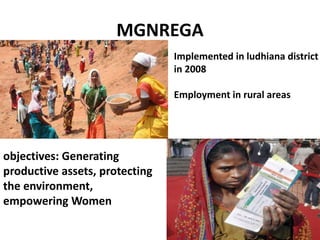
MGNREGA
Implemented in ludhiana district
in 2008
Employment in rural areas
objectives: Generating
productive assets, protecting
the environment,
empowering Women
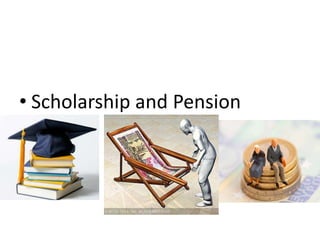
• Scholarship and Pension
• The money is directly transferred into bank accounts of
beneficiaries having Aadhar cards.
• LPG and kerosene subsidies, pension payments,
scholarships and employment guarantee scheme payments
as well as benefits under other government welfare
programmes will be made directly to beneficiaries.
• Under the DBT each and every beneficiary has to establish
his identity and eligibility many times by producing
multiple documents for verification. The verification of
such documents is done by multiple authorities.
• The main advantage of the DBT is that leakages
are avoided as the government directly provides
the fund to the beneficiary. Money is sent into
the bank account of the beneficiary.
• Another advantage of DBT is that it helps the
government to better target the beneficiary. Here
the facilitating mechanism is Aadhaar. Since
Aadhaar is the universal ID, government can
identity the beneficiary from his Aadhaar details
while connecting it with DBT.
SUCCESS OF DBT
IN INDIA
Presently, 66 Schemes
of 15 Ministries on DBT
Rs. 61,822 cr distributed to
31 cr beneficiaries in 2015-16
 Around 76 lakh students
got scholarship in 2015-16
 Over 36 lakh farmers have
registered themselves for DBT.
 It is estimated that over the
time it could save up to 1.2% of GDP
The program is inspired by
such successful schemes
existing in countries like
Brazil and Mexico and
cities like New York and
Washington. In India too,
introducing this new way of
physically-delivering subsidies
may seem a brilliant technological
shot to end the middlemen fraud.
What is dbt

What is dbt

  • 1.
    Presented by – AbhishekGoyal Harekrishan kumar Prem Narayan Shivam Gubrele PRESTIGE INSTITUTE OF MANAGEMENT GWALIOR
  • 2.
  • 3.
    WHAT IS DBT? Mechanism of transferring subsidies Transfer of the cash to the beneficiary's bank account No scope left for some corrupt people
  • 4.
    DIRECT BENEFIT TRANSFER(DBT) DIRECTCASH TRANSFER(DCT) ELECTRONIC BENEFIT TRANSFER (EBT)
  • 5.
    What will DBTdo? Direct Benefit cash Transfer or DBT is an anti-poverty program launched by Government of India on 1 January 2013. This program aims to transfer subsidies directly to the people living below poverty Line. "Aapka paisa aapke haath" concept has brought happiness to the poor who have received the benefits directly into their bank accounts.
  • 6.
    Initial Phase ofDBTS The direct benefit transfer scheme (DBTS) was launched by the then prime minister of india manmohan singh on 1 january 2013 in 20 districts of india. The scheme was inaugurated in east godavari district on 6 january 2013. By the end of march 2013 it was envisioned to be cover 26 social welfare programmes in 43 districts of 16 states.
  • 7.
    PRIMARY AIMS • Tobring transparency and terminate corruption. • In DBT, benefit or subsidy will be directly transferred to the citizens living below poverty line. • No subsidy will be given to those people who don't require it.
  • 8.
    What is Aadhaar? Aadhaarcard, consisting a12 digit number issued for every individual, including infants. Each individual of a family will have separate Aadhaar UID number. While enrollment it verifies all the documents pertaining to an individual and collects biometric information - photograph, ten fingerprints and iris through scanning. The Unique Identification Authority of India (UIDAI) will issue for all residents in India (on a voluntary basis).
  • 9.
    Some main schemeof goverment • LPG subsidy • K-Oil subsidy • MGNREGA • Pension • Scholarship
  • 10.
    Direct Benefit Transferfor LPG LPG scheme in 20 districts from the 1 st of June, 2013. subsidy money will directly go to the consumer's account and not to the distributer's account. This will reduce the chances of leakages and prevent black marketing in the sale of cooking gas cylinders.
  • 11.
    K-Oil subsidy •Phase I– Direct Transfer of Subsidy through State/ UT Governments in the bank account of beneficiaries. ƒ • Phase II will aim at transferring the cash equivalent of subsidy directly to beneficiaries through their bank accounts by linking transactions to Aadhaar.
  • 12.
    MGNREGA Implemented in ludhianadistrict in 2008 Employment in rural areas objectives: Generating productive assets, protecting the environment, empowering Women
  • 13.
  • 14.
    • The moneyis directly transferred into bank accounts of beneficiaries having Aadhar cards. • LPG and kerosene subsidies, pension payments, scholarships and employment guarantee scheme payments as well as benefits under other government welfare programmes will be made directly to beneficiaries. • Under the DBT each and every beneficiary has to establish his identity and eligibility many times by producing multiple documents for verification. The verification of such documents is done by multiple authorities.
  • 15.
    • The mainadvantage of the DBT is that leakages are avoided as the government directly provides the fund to the beneficiary. Money is sent into the bank account of the beneficiary. • Another advantage of DBT is that it helps the government to better target the beneficiary. Here the facilitating mechanism is Aadhaar. Since Aadhaar is the universal ID, government can identity the beneficiary from his Aadhaar details while connecting it with DBT.
  • 16.
    SUCCESS OF DBT ININDIA Presently, 66 Schemes of 15 Ministries on DBT Rs. 61,822 cr distributed to 31 cr beneficiaries in 2015-16
  • 17.
     Around 76lakh students got scholarship in 2015-16  Over 36 lakh farmers have registered themselves for DBT.  It is estimated that over the time it could save up to 1.2% of GDP
  • 18.
    The program isinspired by such successful schemes existing in countries like Brazil and Mexico and cities like New York and Washington. In India too, introducing this new way of physically-delivering subsidies may seem a brilliant technological shot to end the middlemen fraud.

Editor's Notes

  • #4  is an attempt to change the mechanism of transferring subsidies launched by Government of IndiA on 1 January 2013. This program aims to transfer subsidies directly to the people through their bank accounts. 'Direct Benefits Transfer' or 'DBT' means direct transfer of the cash to the beneficiary's bank account. The Central Government wants the money to go only to the beneficiary. Under DBT there is no scope left for some corrupt people to pocket the money meant for beneficiaries by fraudulent means. There are corrupt officers who demand 'commission' to give the beneficiary their entitlement. Now this cannot happen because money will be directly deposited to your bank account. Also in this case there is no scope for duplication. So it is 'Aap Ka Paisa Aap Ke Haath',
  • #10 MGNREGA aims at the enhancing the livelihood security of people in rural areas by guaranteeing 100 days of wage employment in financial year who is an adult member and is able to do unskilled work. It is currently operational in 632 districts, 6554 blocks and 2478528 gram panchayats. National Information Centers (NIC) along with the Ministry of Rural Development (MoRD) and the stakeholders conceptualized a web enabled management Information system known as NREGAsoft.
  • #11 Very soon people will start getting subsidy for cooking gas directly into their account. The central government has launched Direct Benefit Transfer for LPG scheme in 20 districts from the 1 st of June, 2013. But for that Aadhaar number is a must. Every one gets subsidy on cooking gas cylinder. At present the consumers are getting a subsidized gas cylinder from the market and the companies that provide the cylinders get the subsidy. But in this case the subsidy money will directly go to the consumer's account and not to the distributer's account. This will reduce the chances of leakages and prevent black marketing in the sale of cooking gas cylinders
  • #13 The Mahatma Gandhi National Rural Guarantee Act (NREGA ) was notifies in September 7, 2005 but this Act is implemented in Ludhiana District in 2008. The Mahatma Gandhi National Rural Employment Guarantee Act (hereafter MGNREGA) is a law whereby any adult who applies for employment in rural areas has to be given work on local public works within 15 days. If employment is not given, an unemployment allowance has to be paid. The employment guarantee subject to a limit of 100 days per household per year. Not that MGNREGA is a law and not just a scheme. The main objective of NREGA is to protect rural households from poverty and hunger. MGNREGA can also serve other objectives: Generating productive assets, protecting the environment, empowering Women, reducing rural urban migration and fostering social equity among others. Thus MGNREGA is not just an employment scheme: it is a tool of Economic and social change in rural areas.
  • #14 The Dilli Annashree Yojana (DAY) was started with the objective of providing assistance to 2 lakh BPL families.INR 600/- is transferred monthly to the bank accounts of the senior most female member of BPL households. It is also tied up with Business Correspondent (BC)in the process of financial inclusion. The Dilli Annashree Yojana was conceptualized using Aadhar card only as a unique identification mechanism with payments to be carried out through non-Aadhar banks. The scheme is targeted at providing fund National Child Labour Projectis being run for rehabilitation of child labour in several districts. Government of India has decided the amount of stipend to the beneficiaries covered under the Aadhar enabled DBTs.To familiarize the implementation of the Direct Benefit Transfer Scheme Training session of project directors was conducted on 5th March 2013
  • #15 It was launched by linking it with biometric-based Unique ID programme Aadhaar so as to eliminate ‘duplicates’, i.e., one person getting benefits multiple times, and ‘ghosts’, i.e., non-existent people getting benefits.