1
PRESENTATION BY: ROSHAN LAL
2
UNIQUE IDENTIFICATION
AUTHORITY 0F INDIA
It is the agency of central government .
It was established in 2007.
Its main aim is to provide unique identity
/number to all Indians
3
 It Is An Agency Of Central Government
 It was established on 28 jan. 2009,Nandan
Nilekani appointed the head of the project by
Indian govt.
 Its Main Aim Is To Provide Unique Identity
/Number To All Indians.
 It Is Considered The World's Largest National
Identification Number Project.
3
4
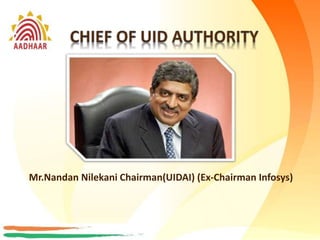
Mr.Nandan Nilekani Chairman(UIDAI) (Ex-Chairman Infosys)
5
VISION AND MISSION
• Vision
 To empower residents of India with a unique
identity and provide a digital platform to
authenticate anytime, anywhere.
• Mission
 Encourage innovation and provide a platform for
public and private agencies to develop AADHAAR
linked applications.
 Build a long term sustainable organization to carry
forward the vision and values of the UIDAI.
FEATURES OF AADHAAR
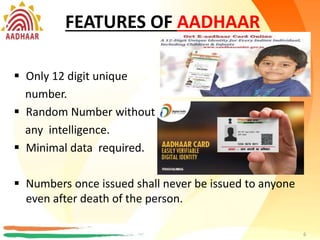
 Only 12 digit number.
 Random Number without any
intelligence.
 Minimal data required.
 Numbers once issued shall never be issued to anyone
even after death of the person.
6
FEATURES OF AADHAAR
 Only 12 digit unique
number.
 Random Number without
any intelligence.
 Minimal data required.
 Numbers once issued shall never be issued to anyone
even after death of the person.
6
FEATUERES OF AADHAAR
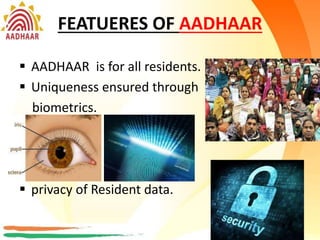
 AADHAAR is for all residents.
 Uniqueness ensured through
biometrics.
 privacy of Resident data.
7
AADHAAR as an Unifying Identifier
• Aadhaar can also be used to provide resident centric
information for analytics, single customer view, and
• Decision making in a number of service industries. For
services like healthcare, welfare programs and
• financial services; the service delivery efficiency can be
increased provided data can be correlated across various
sources and systems. However in the absence of universal
unique individual identifier, it
• is very challenging task both from accuracy and data
integration perspective. Adoption of Aadhaar by
• various services provides the opportunity to correlate data
across disparate systems accurately with minimal
integration.
8
AADHAAR as an Unifying Identifier
Why we need this type of technology ?
• Traditionally, residents of India have lacked a
nationally acceptable unique identity.
• The lack of easily verifiable identity has led to
exclusion of genuine beneficiaries on one hand and
inclusion of duplicates and fake entries in various
beneficiary databases on the other.
AADHAAR
1. Is robust enough to eliminate duplicate and fake
identities.
2. Can be verified and authenticated in an easy, cost-
effective way.
8
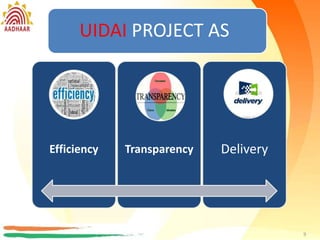
UIDAI PROJECT AS
Enhancing
1. Efficiency
2. Delivery
3. Productivity
4. transparency
9
Efficiency DeliveryTransparency
9
UIDAI PROJECT AS
10
EFFICIENCY
• Performance Improvement of Administrative
Staff
• 360o View of Beneficiaries
• Enhance access to services.
• The benefits arise from the reduction in
leakages that occur due to identification and
authentication issues.
11
EFFICIENCY
• Performance Improvement of Administrative
Staff
• 360o View of Beneficiaries .
• Enhance access to services.
• The benefits arise from the reduction in
leakages that occur due to identification and
authentication issues.
• Rural development .
11
EFFICIENCY
• Check daily outlay of goods/payments
(e.g.: Mid-Day Meals, MGNREGS wages) to
residents With Aadhaar
• Achieve greater financial inclusion.
• gives full traceability, audit, and no repudiation.
• Potentially change the course from Cash-
Intensive country to Cash-lite economy.
12
BENEFIT FOR POLICY MAKERS
EFFICIENCY
• Check daily outlay of goods/payments
(e.g.: Mid-Day Meals, MGNREGS wages) to
residents With Aadhaar
• Achieve greater financial inclusion.
• Give full traceability .
• Potentially change the course from Cash-
Intensive economy to Cash-less economy.
12
AADHAAR ENABLED SERVICES
• AePS/e-KYC - Use of Aadhaar authentication
for providing banking services
• Cashless AePDS
• Aadhaar for Fertilizer subsidy
• e-NPS - New Pension System (NPS) is now
made available online and a new beneficiary
can get registered using Aadhaar e-KYC.
13
AADHAAR ENABLED SERVICES
• e-KYC - Use of Aadhaar authentication for
providing banking services.
• JAM –(Jandhan Aadhaar & Mobile)
• launched by PM. Narendra Modi on 28th
august 2014.
• link the JanDhan account with aadhaar
card & mobile number of Indians to plug
the leakages of govt. subsidies.
(Provide OTP verification facility)
13
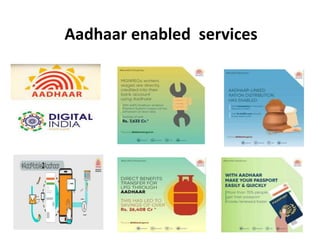
Aadhaar enabled services
15
16
17
17
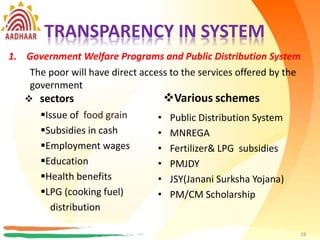
TRANSPARENCY IN SYSTEM
sectors
Issue of food grain
Subsidies in cash
Employment wages
Education
Health benefits
LPG (cooking fuel)
distribution
Various schemes
• Public Distribution System
• MNREGA
• Fertilizer& LPG subsidies
• PMJDY
• JSY(Janani Surksha Yojana)
• PM/CM Scholarship
18
1. Government Welfare Programs and Public Distribution System
The poor will have direct access to the services offered by the
government
TRANSPARENCY IN SYSTEM
 sectors
Issue of food grain
Subsidies in cash
Employment wages
Education
Health benefits
LPG (cooking fuel)
distribution
Various schemes
• Public Distribution System
• MNREGA
• Fertilizer& LPG subsidies
• PMJDY
• JSY(Janani Surksha Yojana)
• PM/CM Scholarship
18
1. Government Welfare Programs and Public Distribution System
The poor will have direct access to the services offered by the
government
• Reduced beneficiary harassment and bribing due
to reduced dependency on manual processes.
• Provides end-to-end visibility of transactions to
government ministries/departments to
beneficiaries.
19
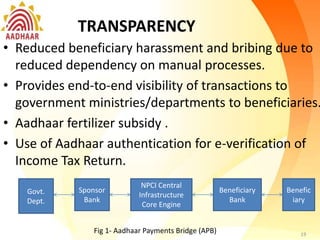
Govt.
Dept.
Sponsor
Bank
NPCI Central
Infrastructure
Core Engaine
Beneficiary
Bank
Benefic
iary
Fig 1- Aadhaar Payments Bridge (APB)
• Reduced beneficiary harassment and bribing due to
reduced dependency on manual processes.
• Provides end-to-end visibility of transactions to
government ministries/departments to beneficiaries.
• Aadhaar fertilizer subsidy .
• Use of Aadhaar authentication for e-verification of
Income Tax Return.
19
Govt.
Dept.
Sponsor
Bank
NPCI Central
Infrastructure
Core Engine
Beneficiary
Bank
Benefic
iary
Fig 1- Aadhaar Payments Bridge (APB)
TRANSPARENCY
Transparency
1. UID based solution will help in increase
transparency levels in the Service Delivery
Also Beneficiary Satisfaction.
2. Financial Inclusion and Electronic Payments:
3. Direct money transfer.
4. Online identity verification and electronic
payments
5. Circle of trust
6. Social security scheme
7. Data security
8. Service security
20
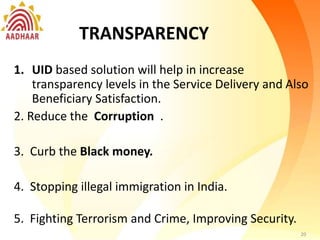
TRANSPARENCY
1. UID based solution will help in increase
transparency levels in the Service Delivery and Also
Beneficiary Satisfaction.
2. Reduce the Corruption .
3. Curb the Black money.
4. Stopping illegal immigration in India.
5. Fighting Terrorism and Crime, Improving Security.
20
21
21
22
AADHAR Enabled Service
(Benefit Delivery)
Problem faced on delivery of the services
 Difficulties in identifying duplicate, bogus/ghost and ineligible
beneficiaries etc.
 Difficulties in ensuring delivery of right quantity of goods
and services . What is meant for them is diverted to the open
market(black market).
 Difficulties in ensuring genuineness of beneficiary at the time
of delivery of goods.
 Difficulties in monitoring the operations Centrally because it
is very costly.
Solution based on AADHAAR
• More efficient service delivery process.
Reduced cost of identity establishment.
• Reduce cost of service delivery by using direct
payment to Aadhaar linked bank account of
beneficiaries.
• Reduced transaction fraud by enhancing
customer verification using Aadhaar
authentication.
23
Solution based on AADHAAR
• More efficient service delivery process and
Reduced cost of identity establishment.
• Reduce cost of service delivery by using direct
payment to Aadhaar linked bank account of
beneficiaries.
• Reduced transaction fraud by enhancing
customer verification using Aadhaar
authentication.
23
Solution Based on AADHAR
• Curbing Leakages through targeted delivery
example:PDS(Public Distribution services)
MGNREGA. Attendance
This usage would ensure that services are
delivered to right beneficiary
• Direct Benefits Transfer for LPG
• Aadhaar-enabled Public Distribution System
(AePDS).
24
Solution Based on AADHAAR
• Curbing Leakages through targeted delivery
example: PDS(Public Distribution services)
MGNREGA. Attendance etc.
This usage would ensure that services are
delivered to right beneficiary
• Direct Benefits Transfer for LPG and fertilizer
subsidies.
• Aadhaar-enabled Public Distribution System
(AePDS).
24
ISSUES
• Data protection issues and privacy.
25
DRAWBACKS
• Data protection issues and privacy.
• Authentication V/S Identification.
• The Cost.
• No Legal Basis.
• Rural areas are still unaware of this technology.
• Un authorized use.
25
CONCLUSION
26
• Helps in significantly reducing costs by increasing
administrative efficiency and reducing leakages.
• Can help to map skilled manpower, based on the
vocational training acquired by the individual, to
suitable job vacancies/ skill requirements of the
State
• Provides a single view of beneficiary data and
information, aiding in streamlining policy
decisions for the state.
CONCLUSION
26
• The UID project is an interesting example of
inclusive innovation in a country that is lagging
behind in provision of fundamental amenities to
its residents.
• Given the potential of its large-scale impact on
India’s economy, the UID project opens up
endless innovative opportunities.
• Not only the poor but also the other actors like
companies and emerging entrepreneurs stand to
gain from the UID ecosystem.
27

Uidai project (AADHAAR)

  • 1.
  • 2.
  • 3.
    UNIQUE IDENTIFICATION AUTHORITY 0FINDIA It is the agency of central government . It was established in 2007. Its main aim is to provide unique identity /number to all Indians 3  It Is An Agency Of Central Government  It was established on 28 jan. 2009,Nandan Nilekani appointed the head of the project by Indian govt.  Its Main Aim Is To Provide Unique Identity /Number To All Indians.  It Is Considered The World's Largest National Identification Number Project. 3
  • 4.
  • 5.
    5 VISION AND MISSION •Vision  To empower residents of India with a unique identity and provide a digital platform to authenticate anytime, anywhere. • Mission  Encourage innovation and provide a platform for public and private agencies to develop AADHAAR linked applications.  Build a long term sustainable organization to carry forward the vision and values of the UIDAI.
  • 6.
    FEATURES OF AADHAAR Only 12 digit number.  Random Number without any intelligence.  Minimal data required.  Numbers once issued shall never be issued to anyone even after death of the person. 6 FEATURES OF AADHAAR  Only 12 digit unique number.  Random Number without any intelligence.  Minimal data required.  Numbers once issued shall never be issued to anyone even after death of the person. 6
  • 7.
    FEATUERES OF AADHAAR AADHAAR is for all residents.  Uniqueness ensured through biometrics.  privacy of Resident data. 7
  • 8.
    AADHAAR as anUnifying Identifier • Aadhaar can also be used to provide resident centric information for analytics, single customer view, and • Decision making in a number of service industries. For services like healthcare, welfare programs and • financial services; the service delivery efficiency can be increased provided data can be correlated across various sources and systems. However in the absence of universal unique individual identifier, it • is very challenging task both from accuracy and data integration perspective. Adoption of Aadhaar by • various services provides the opportunity to correlate data across disparate systems accurately with minimal integration. 8 AADHAAR as an Unifying Identifier Why we need this type of technology ? • Traditionally, residents of India have lacked a nationally acceptable unique identity. • The lack of easily verifiable identity has led to exclusion of genuine beneficiaries on one hand and inclusion of duplicates and fake entries in various beneficiary databases on the other. AADHAAR 1. Is robust enough to eliminate duplicate and fake identities. 2. Can be verified and authenticated in an easy, cost- effective way. 8
  • 9.
    UIDAI PROJECT AS Enhancing 1.Efficiency 2. Delivery 3. Productivity 4. transparency 9 Efficiency DeliveryTransparency 9 UIDAI PROJECT AS
  • 10.
  • 11.
    EFFICIENCY • Performance Improvementof Administrative Staff • 360o View of Beneficiaries • Enhance access to services. • The benefits arise from the reduction in leakages that occur due to identification and authentication issues. 11 EFFICIENCY • Performance Improvement of Administrative Staff • 360o View of Beneficiaries . • Enhance access to services. • The benefits arise from the reduction in leakages that occur due to identification and authentication issues. • Rural development . 11
  • 12.
    EFFICIENCY • Check dailyoutlay of goods/payments (e.g.: Mid-Day Meals, MGNREGS wages) to residents With Aadhaar • Achieve greater financial inclusion. • gives full traceability, audit, and no repudiation. • Potentially change the course from Cash- Intensive country to Cash-lite economy. 12 BENEFIT FOR POLICY MAKERS EFFICIENCY • Check daily outlay of goods/payments (e.g.: Mid-Day Meals, MGNREGS wages) to residents With Aadhaar • Achieve greater financial inclusion. • Give full traceability . • Potentially change the course from Cash- Intensive economy to Cash-less economy. 12
  • 13.
    AADHAAR ENABLED SERVICES •AePS/e-KYC - Use of Aadhaar authentication for providing banking services • Cashless AePDS • Aadhaar for Fertilizer subsidy • e-NPS - New Pension System (NPS) is now made available online and a new beneficiary can get registered using Aadhaar e-KYC. 13 AADHAAR ENABLED SERVICES • e-KYC - Use of Aadhaar authentication for providing banking services. • JAM –(Jandhan Aadhaar & Mobile) • launched by PM. Narendra Modi on 28th august 2014. • link the JanDhan account with aadhaar card & mobile number of Indians to plug the leakages of govt. subsidies. (Provide OTP verification facility) 13
  • 14.
  • 15.
  • 16.
  • 17.
  • 18.
    TRANSPARENCY IN SYSTEM sectors Issueof food grain Subsidies in cash Employment wages Education Health benefits LPG (cooking fuel) distribution Various schemes • Public Distribution System • MNREGA • Fertilizer& LPG subsidies • PMJDY • JSY(Janani Surksha Yojana) • PM/CM Scholarship 18 1. Government Welfare Programs and Public Distribution System The poor will have direct access to the services offered by the government TRANSPARENCY IN SYSTEM  sectors Issue of food grain Subsidies in cash Employment wages Education Health benefits LPG (cooking fuel) distribution Various schemes • Public Distribution System • MNREGA • Fertilizer& LPG subsidies • PMJDY • JSY(Janani Surksha Yojana) • PM/CM Scholarship 18 1. Government Welfare Programs and Public Distribution System The poor will have direct access to the services offered by the government
  • 19.
    • Reduced beneficiaryharassment and bribing due to reduced dependency on manual processes. • Provides end-to-end visibility of transactions to government ministries/departments to beneficiaries. 19 Govt. Dept. Sponsor Bank NPCI Central Infrastructure Core Engaine Beneficiary Bank Benefic iary Fig 1- Aadhaar Payments Bridge (APB) • Reduced beneficiary harassment and bribing due to reduced dependency on manual processes. • Provides end-to-end visibility of transactions to government ministries/departments to beneficiaries. • Aadhaar fertilizer subsidy . • Use of Aadhaar authentication for e-verification of Income Tax Return. 19 Govt. Dept. Sponsor Bank NPCI Central Infrastructure Core Engine Beneficiary Bank Benefic iary Fig 1- Aadhaar Payments Bridge (APB) TRANSPARENCY
  • 20.
    Transparency 1. UID basedsolution will help in increase transparency levels in the Service Delivery Also Beneficiary Satisfaction. 2. Financial Inclusion and Electronic Payments: 3. Direct money transfer. 4. Online identity verification and electronic payments 5. Circle of trust 6. Social security scheme 7. Data security 8. Service security 20 TRANSPARENCY 1. UID based solution will help in increase transparency levels in the Service Delivery and Also Beneficiary Satisfaction. 2. Reduce the Corruption . 3. Curb the Black money. 4. Stopping illegal immigration in India. 5. Fighting Terrorism and Crime, Improving Security. 20
  • 21.
  • 22.
    22 AADHAR Enabled Service (BenefitDelivery) Problem faced on delivery of the services  Difficulties in identifying duplicate, bogus/ghost and ineligible beneficiaries etc.  Difficulties in ensuring delivery of right quantity of goods and services . What is meant for them is diverted to the open market(black market).  Difficulties in ensuring genuineness of beneficiary at the time of delivery of goods.  Difficulties in monitoring the operations Centrally because it is very costly.
  • 23.
    Solution based onAADHAAR • More efficient service delivery process. Reduced cost of identity establishment. • Reduce cost of service delivery by using direct payment to Aadhaar linked bank account of beneficiaries. • Reduced transaction fraud by enhancing customer verification using Aadhaar authentication. 23 Solution based on AADHAAR • More efficient service delivery process and Reduced cost of identity establishment. • Reduce cost of service delivery by using direct payment to Aadhaar linked bank account of beneficiaries. • Reduced transaction fraud by enhancing customer verification using Aadhaar authentication. 23
  • 24.
    Solution Based onAADHAR • Curbing Leakages through targeted delivery example:PDS(Public Distribution services) MGNREGA. Attendance This usage would ensure that services are delivered to right beneficiary • Direct Benefits Transfer for LPG • Aadhaar-enabled Public Distribution System (AePDS). 24 Solution Based on AADHAAR • Curbing Leakages through targeted delivery example: PDS(Public Distribution services) MGNREGA. Attendance etc. This usage would ensure that services are delivered to right beneficiary • Direct Benefits Transfer for LPG and fertilizer subsidies. • Aadhaar-enabled Public Distribution System (AePDS). 24
  • 25.
    ISSUES • Data protectionissues and privacy. 25 DRAWBACKS • Data protection issues and privacy. • Authentication V/S Identification. • The Cost. • No Legal Basis. • Rural areas are still unaware of this technology. • Un authorized use. 25
  • 26.
    CONCLUSION 26 • Helps insignificantly reducing costs by increasing administrative efficiency and reducing leakages. • Can help to map skilled manpower, based on the vocational training acquired by the individual, to suitable job vacancies/ skill requirements of the State • Provides a single view of beneficiary data and information, aiding in streamlining policy decisions for the state. CONCLUSION 26 • The UID project is an interesting example of inclusive innovation in a country that is lagging behind in provision of fundamental amenities to its residents. • Given the potential of its large-scale impact on India’s economy, the UID project opens up endless innovative opportunities. • Not only the poor but also the other actors like companies and emerging entrepreneurs stand to gain from the UID ecosystem.
  • 27.