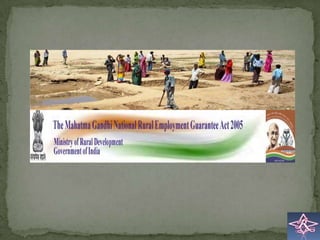
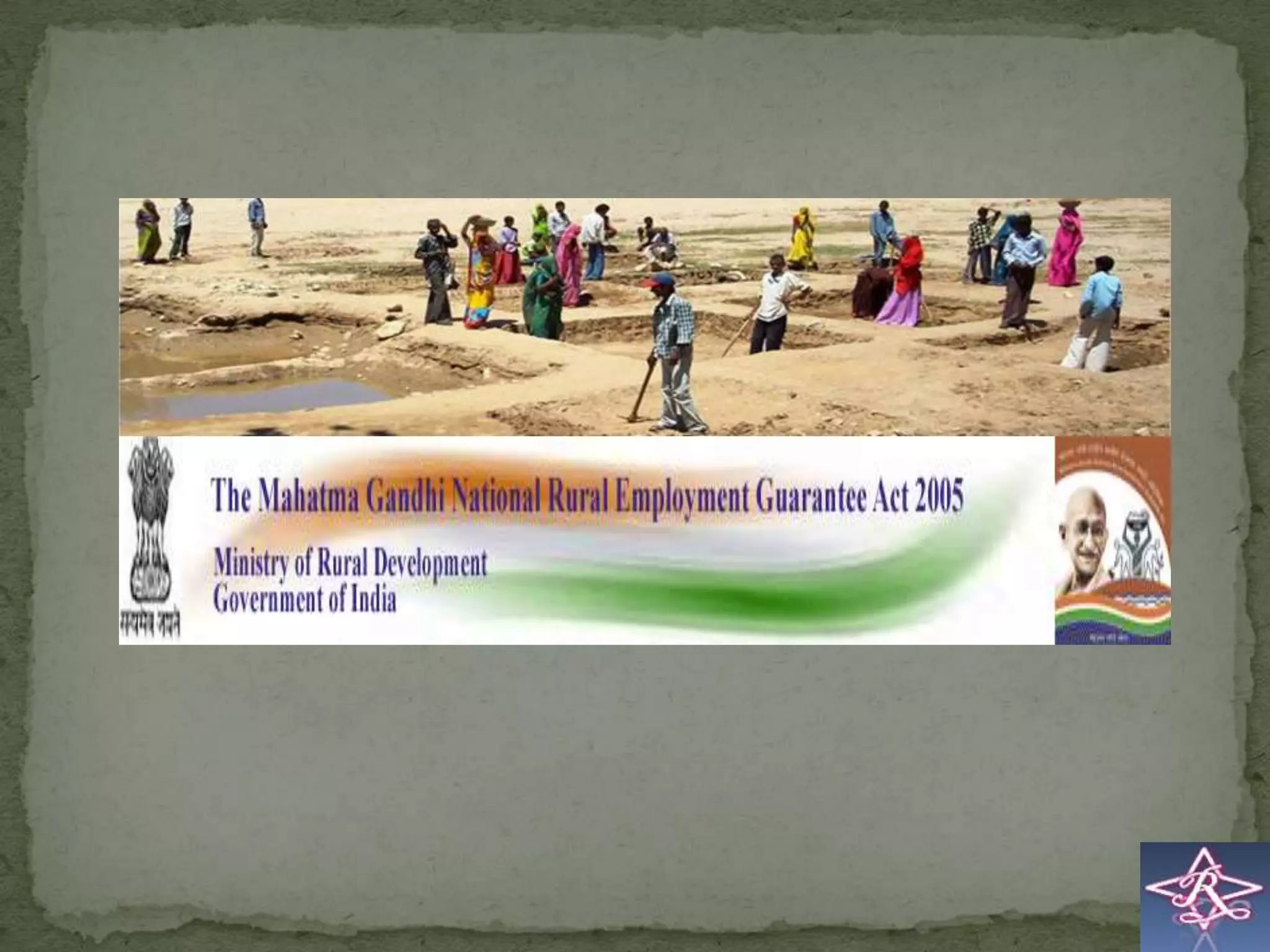
The Mahatma Gandhi National Rural Employment
Guarantee Act (MGNREGA) is an Indian job guarantee
scheme, enacted by legislation on August 25, 2005.
The scheme provides a legal guarantee for one hundred
days of employment in every financial year to adult members
of any rural household willing to do public work-related
unskilled manual work at the statutory minimum wage of
Rs 120 (US$2.64) per day in 2009 prices.
The Central government outlay for scheme is 40,000 crore
(US$8.8 billion) in FY 2010–11.

The law was initially called the National Rural Employment
Guarantee Act (NREGA) but was renamed on 2 October
2009.
The Plan
Under the MGNREGA the Central Government meets the
cost towards the payment of wage, 3/4 of material cost and
some percentage of administrative cost.
State Governments meet the cost of unemployment
allowance, 1/4 of material cost and administrative cost of
State council.
Since the State Governments pay the unemployment
allowance, they are heavily incentivized to offer employment
to workers.
However, it is up to the State Government to decide the
amount of unemployment allowance, subject to the stipulation
that it not be less than 1/4 the minimum wage for the first 30
days, and not less than 1/2 the minimum wage thereafter.
100 days of employment (or unemployment allowance) per
household must be provided to able and willing workers every
financial year.
Funding
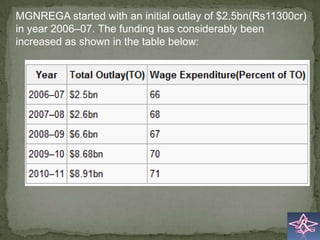
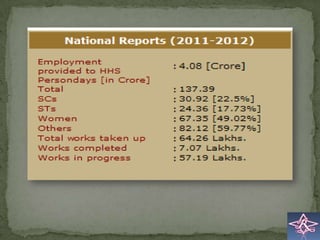
MGNREGA started with an initial outlay of $2.5bn(Rs11300cr)
in year 2006–07. The funding has considerably been
increased as shown in the table below:
Works
The MGNREGA achieves         twin   objectives   of   rural
development and employment.
The MGNREGA stipulates that works must be targeted
towards a set of specific rural development activities such as:

   •water conservation and harvesting
   •afforestation
   •rural connectivity
   •flood control
   •construction and repair of embankments etc.
   •Digging of new tanks/ponds
   •percolation tanks
   •construction of small check dams etc
Source:

  •www.nrega.nic.in

•www.en.wikipedia.org


     Thank You
COMING UP NEXT

           Indian oil corporation ltd

IF YOU HAVE ANY SUGGESTION, OPINION OR FEEDBACK
         PLEASE FEEL FREE TO WRITE US AT
          roshankumar.2007@rediffmail.com
Roshankumar S Pimpalkar

MGNREGA

  • 2.
    The Mahatma GandhiNational Rural Employment Guarantee Act (MGNREGA) is an Indian job guarantee scheme, enacted by legislation on August 25, 2005.
  • 3.
    The scheme providesa legal guarantee for one hundred days of employment in every financial year to adult members of any rural household willing to do public work-related unskilled manual work at the statutory minimum wage of Rs 120 (US$2.64) per day in 2009 prices.
  • 4.
    The Central governmentoutlay for scheme is 40,000 crore (US$8.8 billion) in FY 2010–11. The law was initially called the National Rural Employment Guarantee Act (NREGA) but was renamed on 2 October 2009.
  • 5.
  • 6.
    Under the MGNREGAthe Central Government meets the cost towards the payment of wage, 3/4 of material cost and some percentage of administrative cost.
  • 7.
    State Governments meetthe cost of unemployment allowance, 1/4 of material cost and administrative cost of State council.
  • 8.
    Since the StateGovernments pay the unemployment allowance, they are heavily incentivized to offer employment to workers.
  • 9.
    However, it isup to the State Government to decide the amount of unemployment allowance, subject to the stipulation that it not be less than 1/4 the minimum wage for the first 30 days, and not less than 1/2 the minimum wage thereafter.
  • 10.
    100 days ofemployment (or unemployment allowance) per household must be provided to able and willing workers every financial year.
  • 11.
  • 12.
    MGNREGA started withan initial outlay of $2.5bn(Rs11300cr) in year 2006–07. The funding has considerably been increased as shown in the table below:
  • 13.
  • 14.
    The MGNREGA achieves twin objectives of rural development and employment.
  • 15.
    The MGNREGA stipulatesthat works must be targeted towards a set of specific rural development activities such as: •water conservation and harvesting •afforestation •rural connectivity •flood control •construction and repair of embankments etc. •Digging of new tanks/ponds •percolation tanks •construction of small check dams etc
  • 17.
  • 18.
    COMING UP NEXT Indian oil corporation ltd IF YOU HAVE ANY SUGGESTION, OPINION OR FEEDBACK PLEASE FEEL FREE TO WRITE US AT roshankumar.2007@rediffmail.com
  • 19.