A Study on Direct Benefit Transfer
Nithin Venugopal
Research Scholar
St.Thomas College, Kozhencherry.
Delivery of financial services at an
affordable cost for the under privileged
and low income groups to improve and
achieve social inclusion.
The biggest step towards financial
inclusion in recent periods is Direct
Benefit Transfer Scheme (DBT).
What?
Transfer of benefits directly to beneficiary’s account.

When?
The scheme is operational from January 1st 2013.

Why?
To generate budget savings & reduce
leakages, corruption, eliminate middlemen, speed up
transfer of benefits to the deserved.

How?
With the help of a biometric Aadhaar linked bank account.
Subsidies
Pensions
Scholarships
MGNREGS Wages, etc.
Amount Transferred to
Poor

Re.1.

Amount Expended for
such transfer

Rs.3.65
Only 400m aadhaars has been issued which leaves 800m
to be issued before April 2014.

According to Dy.Gov of RBI only 40% of Indians have
bank account.
About 188000 villages had banking connectivity as on
Jun’2012 whereas India has 700000 villages.
For those who don’t have access to bank branches will
have to depend on ‘Banking Correspondents’ or ‘BCs’
Currently BCs cover only 70000 villages which require a
further 10 fold expansion.
The major hurdle involved in DBT is identifying the
actual beneficiary.
Last BPL census was done in 2002. The new list is list
would be ready only by 2013 end or in early quarter of 2014.
So the major challenge before Govt. is that whether it
should use the 2002 list or should it wait for the new one.
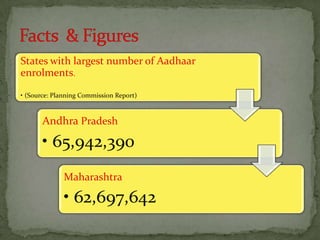
States with largest number of Aadhaar
enrolments.
• (Source: Planning Commission Report)

Andhra Pradesh

• 65,942,390
Maharashtra

• 62,697,642
THANK YOU

Direct Benefit Transfer - India

  • 1.
    A Study onDirect Benefit Transfer Nithin Venugopal Research Scholar St.Thomas College, Kozhencherry.
  • 2.
    Delivery of financialservices at an affordable cost for the under privileged and low income groups to improve and achieve social inclusion. The biggest step towards financial inclusion in recent periods is Direct Benefit Transfer Scheme (DBT).
  • 3.
    What? Transfer of benefitsdirectly to beneficiary’s account. When? The scheme is operational from January 1st 2013. Why? To generate budget savings & reduce leakages, corruption, eliminate middlemen, speed up transfer of benefits to the deserved. How? With the help of a biometric Aadhaar linked bank account.
  • 4.
  • 5.
    Amount Transferred to Poor Re.1. AmountExpended for such transfer Rs.3.65
  • 8.
    Only 400m aadhaarshas been issued which leaves 800m to be issued before April 2014. According to Dy.Gov of RBI only 40% of Indians have bank account. About 188000 villages had banking connectivity as on Jun’2012 whereas India has 700000 villages. For those who don’t have access to bank branches will have to depend on ‘Banking Correspondents’ or ‘BCs’ Currently BCs cover only 70000 villages which require a further 10 fold expansion.
  • 9.
    The major hurdleinvolved in DBT is identifying the actual beneficiary. Last BPL census was done in 2002. The new list is list would be ready only by 2013 end or in early quarter of 2014. So the major challenge before Govt. is that whether it should use the 2002 list or should it wait for the new one.
  • 10.
    States with largestnumber of Aadhaar enrolments. • (Source: Planning Commission Report) Andhra Pradesh • 65,942,390 Maharashtra • 62,697,642
  • 11.