What is ASHRAE 90.1?
Cannon Design is a Registered Provider with The American Institute of
             g         g
Architects Continuing Education Systems. Credit earned on completion of this
program will be reported to CES Records for AIA members. Certificates of
Completion for non-AIA members are available on request.

This program is registered with the AIA/CES for continuing professional
education. As such, it does not include content that may be deemed or
construed to be an approval or endorsement by the AIA of any material of
construction or any method or manner of handling, using, distributing, or
dealing in any material or product. Questions related to specific materials,
methods, and services will be addressed at the conclusion of this
presentation.


AIA HSW/SD LU = 1
PIE PDH = 1
Cannon Design


What is ASHRAE 90.1-2010?


               1
Learning Objectives

- P id an overview of ASHRAE Standard 90.1, including history,
  Provide          i    f          St d d 90 1 i l di hi t
  scope, and process for maintaining the standards
- Describe the energy savings comparison of 90.1-2010 to 90.1-2004
- Discuss approved changes to 90.1-2010
- Describe future improvements for 90.1-2013
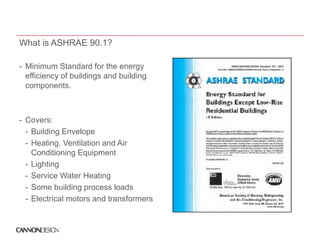
What is ASHRAE 90.1?

- Mi i
  Minimum St d d f the energy
             Standard for th
  efficiency of buildings and building
  components.


- Covers:
  - Building Envelope
  - Heating, Ventilation and Air
    Conditioning Equipment
  - Lighting
  - Service Water Heating
  - Some building process loads
  - Electrical motors and transformers
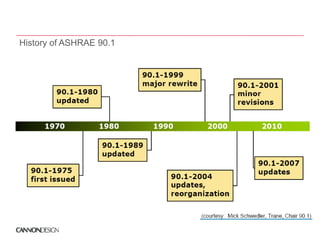
History of ASHRAE 90.1
Consensus Standard:
 - Stakeholders include: manufacturer’s, designers,
   code officials, trade organizations and user groups.
 - All changes must be moved forward and approved by
           g                                       y
   a majority of the members on the committee
 - Follows the requirements established by ANSI.


Cost effective:
 - All items are evaluated for cost effectiveness
 - Prescribed set of financial criteria updated every 3
   years
 - This is a unique feature of ASHRAE 90.1.
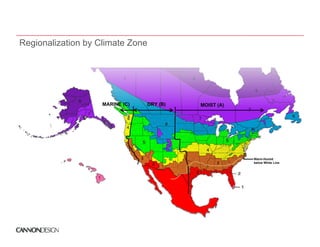
Regionalization by Climate Zone


                    MARINE (C)   DRY (B)   MOIST (A)


                                                       Warm-Humid
                                                       below White Line
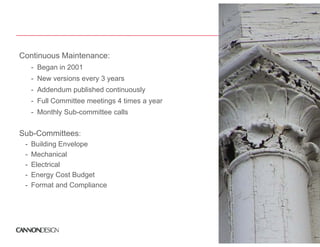
Continuous Maintenance:
     - Began in 2001
     - New versions every 3 years
                                     y
     - Addendum published continuously
     - Full Committee meetings 4 times a year
     - Monthly Sub-committee calls


Sub-Committees:
 -   Building Envelope
 -   Mechanical
 -   Electrical
 -   Energy Cost Budget
 -   Format and Compliance
     F      t dC       li
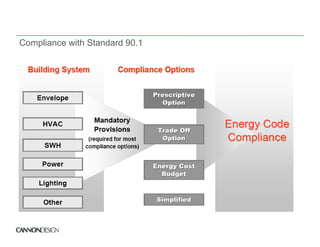
Compliance with Standard 90.1
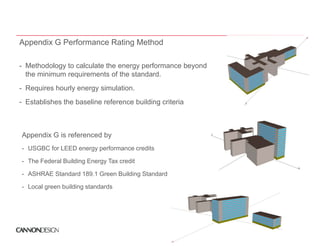
Appendix G Performance Rating Method

- M th d l
  Methodology t calculate th energy performance b
              to l l t the              f       beyond
                                                     d
  the minimum requirements of the standard.
- Requires hourly energy simulation.
- Establishes the baseline reference building criteria


Appendix G is referenced by
- USGBC for LEED energy performance credits

- The Federal Building Energy Tax credit

- ASHRAE Standard 189.1 Green Building Standard

- Local green building standards
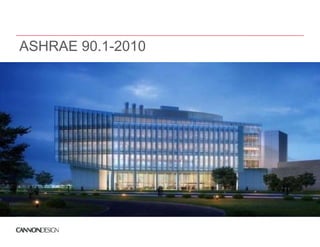
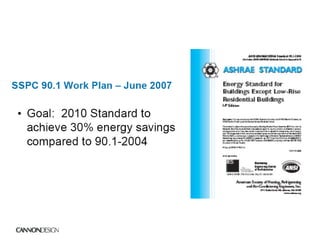
ASHRAE 90.1-2010
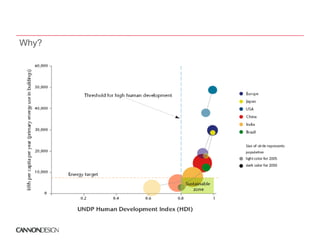
Why?
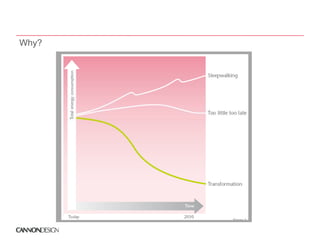
Why?
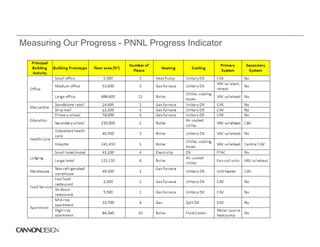
Measuring Our Progress - PNNL Progress Indicator
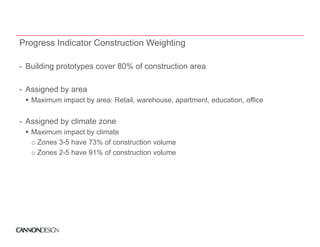
Progress Indicator Construction Weighting

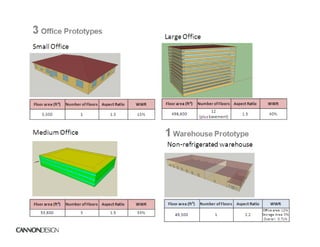
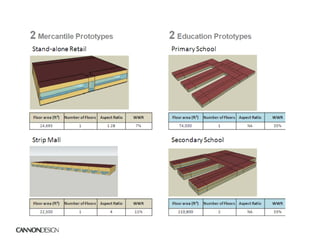
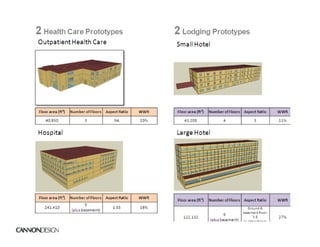
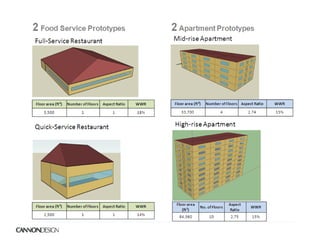
- B ildi prototypes cover 80% of construction area
  Building  t t                f     t ti

- Assigned by area
      g     y
   Maximum impact by area: Retail, warehouse, apartment, education, office


- Assigned by climate zone
   Maximum impact by climate
   o Zones 3-5 have 73% of construction volume
   o Zones 2-5 have 91% of construction volume
           25
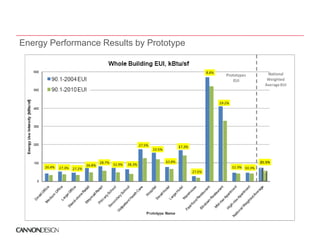
Energy Performance Results by Prototype
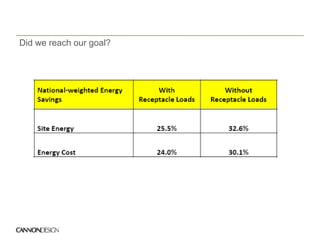
Did we reach our goal?
QUESTIONS?
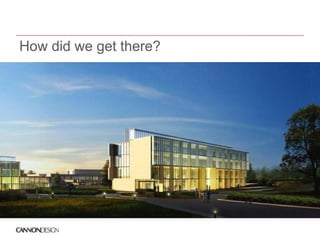
How did we get there?
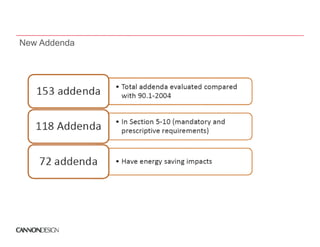
New Addenda
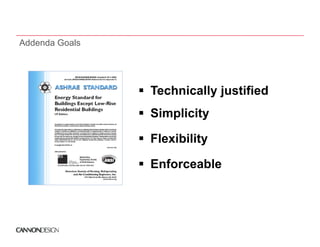
Addenda Goals


                Technically justified
                Simplicity

                Flexibility

                Enforceable
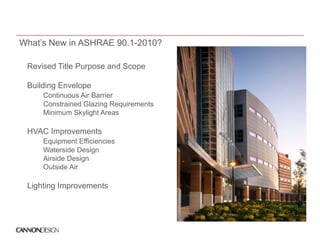
What’s New in ASHRAE 90.1-2010?

 Revised Title Purpose and S
 R i d Titl P            d Scope

 Building Envelope
     Continuous Ai B i
     C ti       Air Barrier
     Constrained Glazing Requirements
     Minimum Skylight Areas

 HVAC Improvements
     Equipment Efficiencies
                    g
     Waterside Design
     Airside Design
     Outside Air

 Lighting Improvements
 Li hti I           t
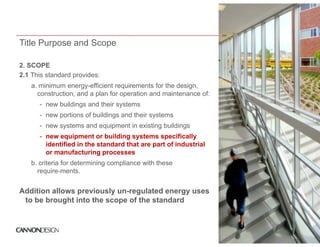
Title Purpose and Scope

2.
2 SCOPE
2.1 This standard provides:
   a. minimum energy-efficient requirements for the design,
     construction,
     construction and a plan for operation and maintenance of:
      - new buildings and their systems
      - new portions of buildings and their systems
      - new systems and equipment in existing b ildi
               t      d    i    ti     i ti buildings
      - new equipment or building systems specifically
        identified in the standard that are part of industrial
        or manufacturing processes
   b. criteria for determining compliance with these
     require-ments.


Addition allows previously un-regulated energy uses
 to be brought into the scope of the standard
Addenda Finished but not Approved


• BB – Envelope, opaque and fenestration*
• BU – Datacenters*
       Datacenters
• CX – 40% WWR option*
• CY – Economizers*
• DF – Elevators
* - Denotes high profile addenda
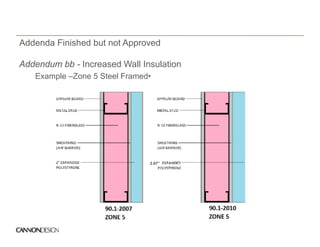
Addenda Finished but not Approved

Addendum bb - Increased Wall Insulation
   Example –Zone 5 Steel Framed•


                               2.67”
What’s New in 90.1-2010 – Building Envelope


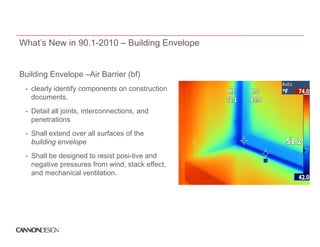
Building Envelope –Air Barrier (bf)
 - clearly identify components on construction
   documents.
 - Detail all joints, interconnections, and
   penetrations
 - Shall extend over all surfaces of the
   building envelope
 - Sh ll b d i
   Shall be designed t resist posi-tive and
                   d to    i t   i ti     d
   negative pressures from wind, stack effect,
   and mechanical ventilation.
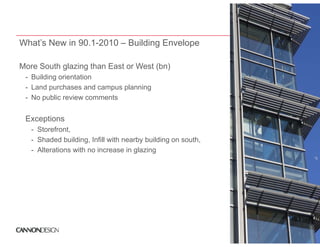
What’s New in 90.1-2010 – Building Envelope

More S th glazing th E t or W t (bn)
M    South l i than East West (b )
 - Building orientation
 - Land purchases and campus planning
 - No public review comments


 Exceptions
  - Storefront,
  - Shaded building, Infill with nearby building on south,
  - Alterations with no increase in glazing
                                    g     g
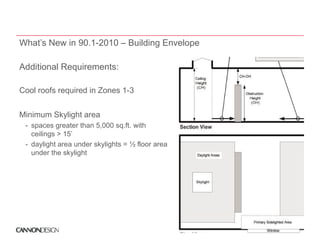
What’s New in 90.1-2010 – Building Envelope

Additional R
Addi i   l Requirements:
               i

Cool roofs required in Zones 1-3
             q


Minimum Skylight area
 - spaces greater than 5,000 sq.ft. with
                t th 5 000        ft ith
   ceilings > 15’
 - daylight area under skylights = ½ floor area
   under the skylight
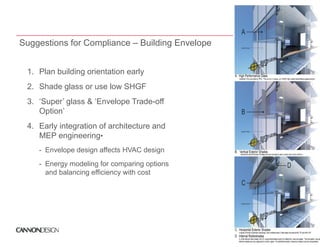
Suggestions for Compliance – Building Envelope


 1. Plan building orientation early
 2. Shade glass or use low SHGF
 3. ‘Super’ glass & ‘Envelope Trade-off
    Option’
 4. Early integration of architecture and
 4 E l i t       ti    f    hit t       d
    MEP engineering•
    - Envelope design affects HVAC design
            p      g                   g
    - Energy modeling for comparing options
      and balancing efficiency with cost
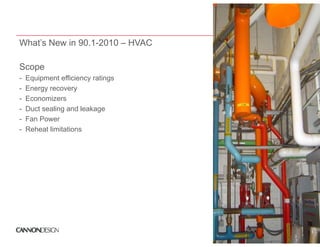
What’s New in 90.1-2010 – HVAC

Scope
-   Equipment efficiency ratings
-   Energy recovery
-   Economizers
-   Duct sealing and leakage
-   Fan Power
-   Reheat limitations
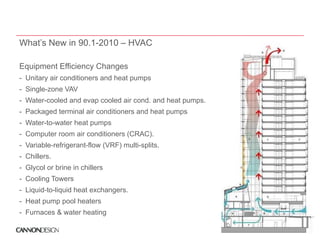
What’s New in 90.1-2010 – HVAC

Equipment Effi i
E i     t Efficiency Changes
                     Ch
- Unitary air conditioners and heat pumps
- Single-zone VAV
- Water-cooled and evap cooled air cond. and heat pumps.
- Packaged terminal air conditioners and heat pumps
- Water-to-water heat pumps
- Computer room air conditioners (CRAC).
- Variable-refrigerant-flow (VRF) multi-splits.
- Chillers.
- Glycol or brine in chillers
- Cooling Towers
- Liquid-to-liquid heat exchangers.
- Heat pump pool heaters
- Furnaces & water heating
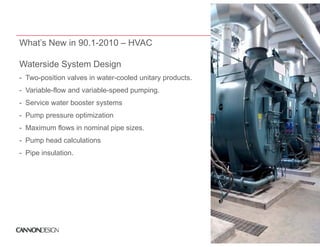
What’s New in 90.1-2010 – HVAC

Waterside System Design
- Two-position valves in water-cooled unitary products.
- Variable-flow and variable-speed p p g
                              p    pumping.
- Service water booster systems
- Pump pressure optimization
- Maximum flows in nominal pipe sizes.
- Pump head calculations
- Pipe insulation.
       insulation
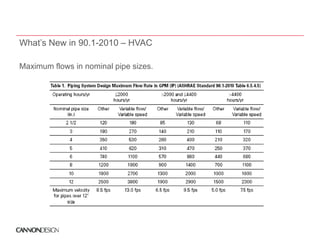
What’s New in 90.1-2010 – HVAC

Maximum fl
M i     flows i nominal pipe sizes.
              in   i l i      i
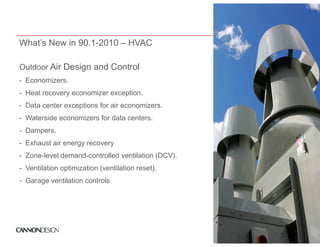
What’s New in 90.1-2010 – HVAC

Outdoor Ai D i
        Air Design and C
                     d Control
                             l
- Economizers.
- Heat recovery economizer exception
                           exception.
- Data center exceptions for air economizers.
- Waterside economizers for data centers.
- Dampers.
- Exhaust air energy recovery
- Z
  Zone-level d
       l   l demand-controlled ventilation (DCV)
                  d    t ll d     til ti (DCV).
- Ventilation optimization (ventilation reset).
- Garage ventilation controls
      g
What’s New in 90.1-2010 – HVAC

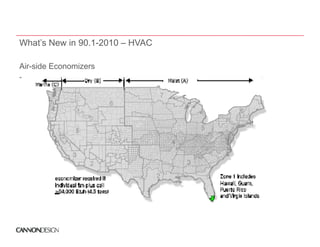
Air-side Economizers
Ai id E        i
-
What’s New in 90.1-2010 – HVAC

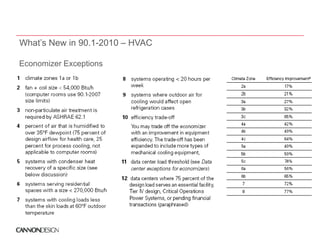
Economizer Exceptions
-
What’s New in 90.1-2010 – HVAC

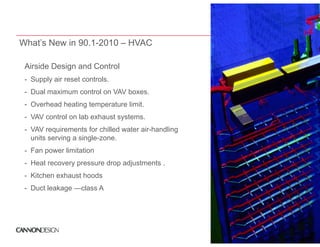
 Airside Design d Control
 Ai id D i and C t l
 - Supply air reset controls.
 - Dual maximum control on VAV boxes.
 - Overhead heating temperature limit.
 - VAV control on lab exhaust systems.
 - VAV requirements for chilled water air-handling
   units serving a single-zone.
 - Fan power limitation
       p
 - Heat recovery pressure drop adjustments .
 - Kitchen exhaust hoods
 - Duct leakage —class A
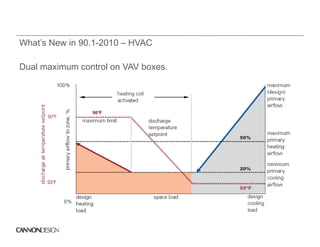
What’s New in 90.1-2010 – HVAC

Dual
D l maximum control on VAV b
       i          l        boxes.
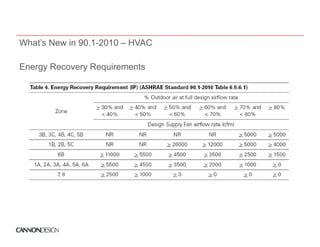
What’s New in 90.1-2010 – HVAC

Energy Recovery R
E      R        Requirements
                    i
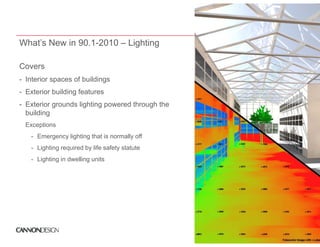
What’s New in 90.1-2010 – Lighting

Covers
- Interior spaces of buildings
- Exterior building features
- Exterior grounds lighting powered through the
  building
  Exceptions
  E    ti
   - Emergency lighting that is normally off
   - Lighting required by life safety statute
   - Lighting in dwelling units
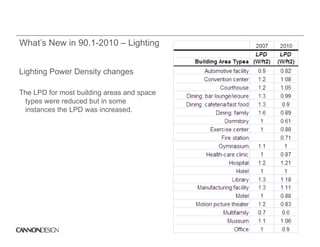
What’s New in 90.1-2010 – Lighting


Lighting Power Density changes

The LPD for most building areas and space
 types were reduced but in some
 instances the LPD was increased.
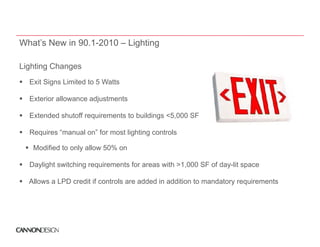
What’s New in 90.1-2010 – Lighting

Lighting Changes
Li hti Ch
  Exit Signs Limited to 5 Watts

  Exterior allowance adjustments

  Extended shutoff requirements to buildings <5,000 SF

  Requires “manual on” for most lighting controls

   Modified to only allow 50% on

  Daylight switching requirements for areas with >1,000 SF of day-lit space

  Allows a LPD credit if controls are added in addition to mandatory requirements
What’s New in 90.1-2010 – Lighting

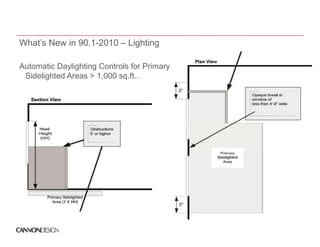
Automatic D li hti C t l f Primary
A t    ti Daylighting Controls for P i
 Sidelighted Areas > 1,000 sq.ft..
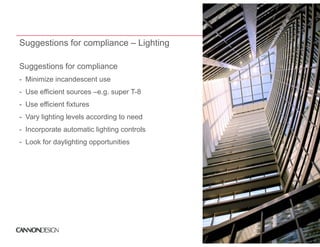
Suggestions for compliance – Lighting

Suggestions for compliance
S     ti    f       li
- Minimize incandescent use
- Use efficient sources –e.g. super T-8
                         e.g.       T8
- Use efficient fixtures
- Vary lighting levels according to need
- Incorporate automatic lighting controls
- Look for daylighting opportunities
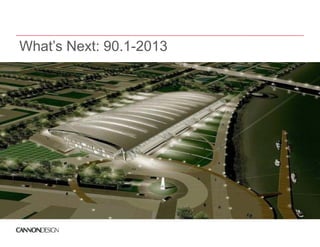
What’s Next: 90.1-2013
ASHRAE Standard 90.1-2013


                      Expand to new areas
                             Commercial/industrial equipment
                             Where to start
                             Identify & engage stakeholders


                      Workplan Goal –
                      40% Whole Building energy savings over 90.1-2004
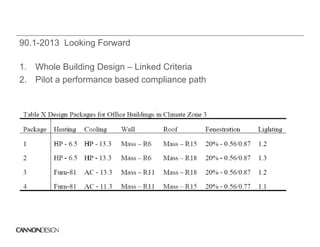
90.1-2013 Looking Forward

1. Whole B ildi Design Linked Criteria
1 Wh l Building D i – Li k d C i i
2. Pilot a performance based compliance path
90.1-2013 Looking Forward


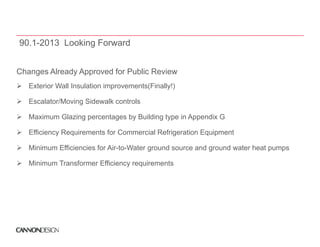
Changes Already Approved for Public Review
   Exterior Wall Insulation improvements(Finally!)

   Escalator/Moving Sidewalk controls

   Maximum Glazing percentages by Building type in Appendix G

   Efficiency Requirements for Commercial Refrigeration Equipment

   Minimum Efficiencies for Air-to-Water ground source and ground water heat pumps

   Minimum Transformer Efficiency requirements
90.1-2013 –   Looking Forward

              Ideas are welcome
Questions?

For more information please contact:

Mike Tillou
Cannon Design
716.774.3550
MTillou@cannondesign.com
MTillou@cannondesign com


This concludes The American Institute of Architects Continuing Education Systems Program

What is ASHRAE 90.1?

  • 1.
  • 2.
    Cannon Design isa Registered Provider with The American Institute of g g Architects Continuing Education Systems. Credit earned on completion of this program will be reported to CES Records for AIA members. Certificates of Completion for non-AIA members are available on request. This program is registered with the AIA/CES for continuing professional education. As such, it does not include content that may be deemed or construed to be an approval or endorsement by the AIA of any material of construction or any method or manner of handling, using, distributing, or dealing in any material or product. Questions related to specific materials, methods, and services will be addressed at the conclusion of this presentation. AIA HSW/SD LU = 1 PIE PDH = 1
  • 3.
    Cannon Design What isASHRAE 90.1-2010? 1
  • 4.
    Learning Objectives - Pid an overview of ASHRAE Standard 90.1, including history, Provide i f St d d 90 1 i l di hi t scope, and process for maintaining the standards - Describe the energy savings comparison of 90.1-2010 to 90.1-2004 - Discuss approved changes to 90.1-2010 - Describe future improvements for 90.1-2013
  • 5.
    What is ASHRAE90.1? - Mi i Minimum St d d f the energy Standard for th efficiency of buildings and building components. - Covers: - Building Envelope - Heating, Ventilation and Air Conditioning Equipment - Lighting - Service Water Heating - Some building process loads - Electrical motors and transformers
  • 6.
  • 7.
    Consensus Standard: -Stakeholders include: manufacturer’s, designers, code officials, trade organizations and user groups. - All changes must be moved forward and approved by g y a majority of the members on the committee - Follows the requirements established by ANSI. Cost effective: - All items are evaluated for cost effectiveness - Prescribed set of financial criteria updated every 3 years - This is a unique feature of ASHRAE 90.1.
  • 8.
    Regionalization by ClimateZone MARINE (C) DRY (B) MOIST (A) Warm-Humid below White Line
  • 9.
    Continuous Maintenance: - Began in 2001 - New versions every 3 years y - Addendum published continuously - Full Committee meetings 4 times a year - Monthly Sub-committee calls Sub-Committees: - Building Envelope - Mechanical - Electrical - Energy Cost Budget - Format and Compliance F t dC li
  • 10.
  • 11.
    Appendix G PerformanceRating Method - M th d l Methodology t calculate th energy performance b to l l t the f beyond d the minimum requirements of the standard. - Requires hourly energy simulation. - Establishes the baseline reference building criteria Appendix G is referenced by - USGBC for LEED energy performance credits - The Federal Building Energy Tax credit - ASHRAE Standard 189.1 Green Building Standard - Local green building standards
  • 12.
  • 14.
  • 15.
  • 16.
    Measuring Our Progress- PNNL Progress Indicator
  • 21.
    Progress Indicator ConstructionWeighting - B ildi prototypes cover 80% of construction area Building t t f t ti - Assigned by area g y Maximum impact by area: Retail, warehouse, apartment, education, office - Assigned by climate zone Maximum impact by climate o Zones 3-5 have 73% of construction volume o Zones 2-5 have 91% of construction volume 25
  • 22.
  • 23.
    Did we reachour goal?
  • 24.
  • 25.
    How did weget there?
  • 26.
  • 27.
    Addenda Goals Technically justified Simplicity Flexibility Enforceable
  • 28.
    What’s New inASHRAE 90.1-2010? Revised Title Purpose and S R i d Titl P d Scope Building Envelope Continuous Ai B i C ti Air Barrier Constrained Glazing Requirements Minimum Skylight Areas HVAC Improvements Equipment Efficiencies g Waterside Design Airside Design Outside Air Lighting Improvements Li hti I t
  • 29.
    Title Purpose andScope 2. 2 SCOPE 2.1 This standard provides: a. minimum energy-efficient requirements for the design, construction, construction and a plan for operation and maintenance of: - new buildings and their systems - new portions of buildings and their systems - new systems and equipment in existing b ildi t d i ti i ti buildings - new equipment or building systems specifically identified in the standard that are part of industrial or manufacturing processes b. criteria for determining compliance with these require-ments. Addition allows previously un-regulated energy uses to be brought into the scope of the standard
  • 30.
    Addenda Finished butnot Approved • BB – Envelope, opaque and fenestration* • BU – Datacenters* Datacenters • CX – 40% WWR option* • CY – Economizers* • DF – Elevators * - Denotes high profile addenda
  • 31.
    Addenda Finished butnot Approved Addendum bb - Increased Wall Insulation Example –Zone 5 Steel Framed• 2.67”
  • 32.
    What’s New in90.1-2010 – Building Envelope Building Envelope –Air Barrier (bf) - clearly identify components on construction documents. - Detail all joints, interconnections, and penetrations - Shall extend over all surfaces of the building envelope - Sh ll b d i Shall be designed t resist posi-tive and d to i t i ti d negative pressures from wind, stack effect, and mechanical ventilation.
  • 33.
    What’s New in90.1-2010 – Building Envelope More S th glazing th E t or W t (bn) M South l i than East West (b ) - Building orientation - Land purchases and campus planning - No public review comments Exceptions - Storefront, - Shaded building, Infill with nearby building on south, - Alterations with no increase in glazing g g
  • 34.
    What’s New in90.1-2010 – Building Envelope Additional R Addi i l Requirements: i Cool roofs required in Zones 1-3 q Minimum Skylight area - spaces greater than 5,000 sq.ft. with t th 5 000 ft ith ceilings > 15’ - daylight area under skylights = ½ floor area under the skylight
  • 35.
    Suggestions for Compliance– Building Envelope 1. Plan building orientation early 2. Shade glass or use low SHGF 3. ‘Super’ glass & ‘Envelope Trade-off Option’ 4. Early integration of architecture and 4 E l i t ti f hit t d MEP engineering• - Envelope design affects HVAC design p g g - Energy modeling for comparing options and balancing efficiency with cost
  • 36.
    What’s New in90.1-2010 – HVAC Scope - Equipment efficiency ratings - Energy recovery - Economizers - Duct sealing and leakage - Fan Power - Reheat limitations
  • 37.
    What’s New in90.1-2010 – HVAC Equipment Effi i E i t Efficiency Changes Ch - Unitary air conditioners and heat pumps - Single-zone VAV - Water-cooled and evap cooled air cond. and heat pumps. - Packaged terminal air conditioners and heat pumps - Water-to-water heat pumps - Computer room air conditioners (CRAC). - Variable-refrigerant-flow (VRF) multi-splits. - Chillers. - Glycol or brine in chillers - Cooling Towers - Liquid-to-liquid heat exchangers. - Heat pump pool heaters - Furnaces & water heating
  • 38.
    What’s New in90.1-2010 – HVAC Waterside System Design - Two-position valves in water-cooled unitary products. - Variable-flow and variable-speed p p g p pumping. - Service water booster systems - Pump pressure optimization - Maximum flows in nominal pipe sizes. - Pump head calculations - Pipe insulation. insulation
  • 39.
    What’s New in90.1-2010 – HVAC Maximum fl M i flows i nominal pipe sizes. in i l i i
  • 40.
    What’s New in90.1-2010 – HVAC Outdoor Ai D i Air Design and C d Control l - Economizers. - Heat recovery economizer exception exception. - Data center exceptions for air economizers. - Waterside economizers for data centers. - Dampers. - Exhaust air energy recovery - Z Zone-level d l l demand-controlled ventilation (DCV) d t ll d til ti (DCV). - Ventilation optimization (ventilation reset). - Garage ventilation controls g
  • 41.
    What’s New in90.1-2010 – HVAC Air-side Economizers Ai id E i -
  • 42.
    What’s New in90.1-2010 – HVAC Economizer Exceptions -
  • 43.
    What’s New in90.1-2010 – HVAC Airside Design d Control Ai id D i and C t l - Supply air reset controls. - Dual maximum control on VAV boxes. - Overhead heating temperature limit. - VAV control on lab exhaust systems. - VAV requirements for chilled water air-handling units serving a single-zone. - Fan power limitation p - Heat recovery pressure drop adjustments . - Kitchen exhaust hoods - Duct leakage —class A
  • 44.
    What’s New in90.1-2010 – HVAC Dual D l maximum control on VAV b i l boxes.
  • 45.
    What’s New in90.1-2010 – HVAC Energy Recovery R E R Requirements i
  • 46.
    What’s New in90.1-2010 – Lighting Covers - Interior spaces of buildings - Exterior building features - Exterior grounds lighting powered through the building Exceptions E ti - Emergency lighting that is normally off - Lighting required by life safety statute - Lighting in dwelling units
  • 47.
    What’s New in90.1-2010 – Lighting Lighting Power Density changes The LPD for most building areas and space types were reduced but in some instances the LPD was increased.
  • 48.
    What’s New in90.1-2010 – Lighting Lighting Changes Li hti Ch Exit Signs Limited to 5 Watts Exterior allowance adjustments Extended shutoff requirements to buildings <5,000 SF Requires “manual on” for most lighting controls Modified to only allow 50% on Daylight switching requirements for areas with >1,000 SF of day-lit space Allows a LPD credit if controls are added in addition to mandatory requirements
  • 49.
    What’s New in90.1-2010 – Lighting Automatic D li hti C t l f Primary A t ti Daylighting Controls for P i Sidelighted Areas > 1,000 sq.ft..
  • 50.
    Suggestions for compliance– Lighting Suggestions for compliance S ti f li - Minimize incandescent use - Use efficient sources –e.g. super T-8 e.g. T8 - Use efficient fixtures - Vary lighting levels according to need - Incorporate automatic lighting controls - Look for daylighting opportunities
  • 51.
  • 52.
    ASHRAE Standard 90.1-2013 Expand to new areas Commercial/industrial equipment Where to start Identify & engage stakeholders Workplan Goal – 40% Whole Building energy savings over 90.1-2004
  • 53.
    90.1-2013 Looking Forward 1.Whole B ildi Design Linked Criteria 1 Wh l Building D i – Li k d C i i 2. Pilot a performance based compliance path
  • 54.
    90.1-2013 Looking Forward ChangesAlready Approved for Public Review Exterior Wall Insulation improvements(Finally!) Escalator/Moving Sidewalk controls Maximum Glazing percentages by Building type in Appendix G Efficiency Requirements for Commercial Refrigeration Equipment Minimum Efficiencies for Air-to-Water ground source and ground water heat pumps Minimum Transformer Efficiency requirements
  • 55.
    90.1-2013 – Looking Forward Ideas are welcome
  • 56.
    Questions? For more informationplease contact: Mike Tillou Cannon Design 716.774.3550 MTillou@cannondesign.com MTillou@cannondesign com This concludes The American Institute of Architects Continuing Education Systems Program