Ontario Building Code
  Energy Efficiency in Buildings

              Presentation to the
Sustainable Buildings Canada Breakfast Meeting
              February 22, 2012

                H. R.(BOB) BACH


                                      SUSTAINABLE BUILDINGS CANADA
OVERVIEW

• Where the Building Code was in 2006
• Where the Building Code is in 2012
• Part 3 Options & Application Issues
• Impact on Overall Energy Utilization Intensity
• Where Will We Go for 2017


                                        SUSTAINABLE BUILDINGS CANADA
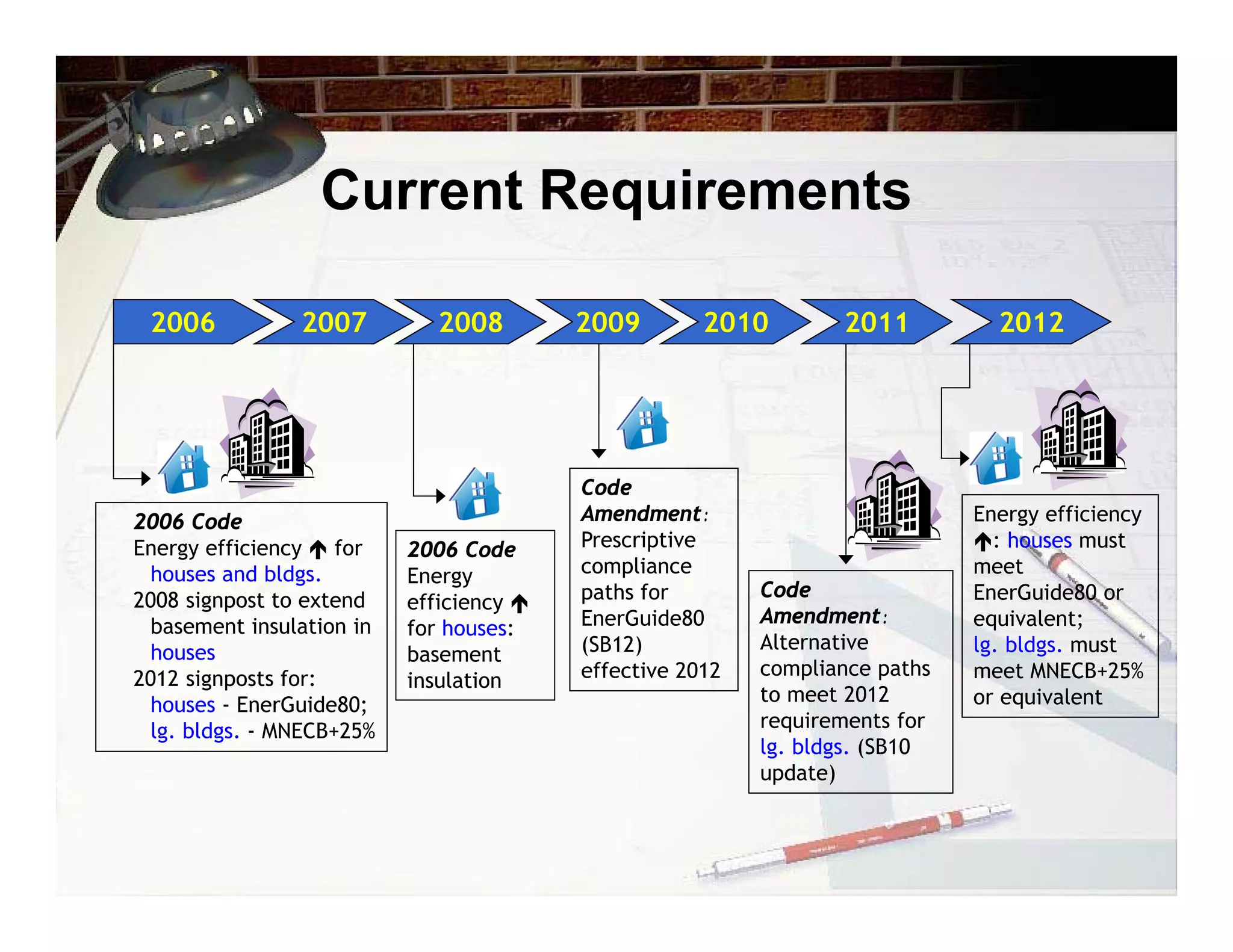
Current Requirements

 2006           2007          2008        2009        2010        2011          2012


                                          Code
2006 Code                                 Amendment:                          Energy efficiency
Energy efficiency  for    2006 Code      Prescriptive                        : houses must
  houses and bldgs.        Energy         compliance                          meet
2008 signpost to extend                   paths for        Code               EnerGuide80 or
                           efficiency 
  basement insulation in                  EnerGuide80      Amendment:         equivalent;
                           for houses:
  houses                                  (SB12)           Alternative        lg. bldgs. must
                           basement
2012 signposts for:                       effective 2012   compliance paths   meet MNECB+25%
                           insulation
  houses - EnerGuide80;                                    to meet 2012       or equivalent
  lg. bldgs. - MNECB+25%                                   requirements for
                                                           lg. bldgs. (SB10
                                                           update)
Part 3 Buildings:
  Background


                    SUSTAINABLE BUILDINGS CANADA
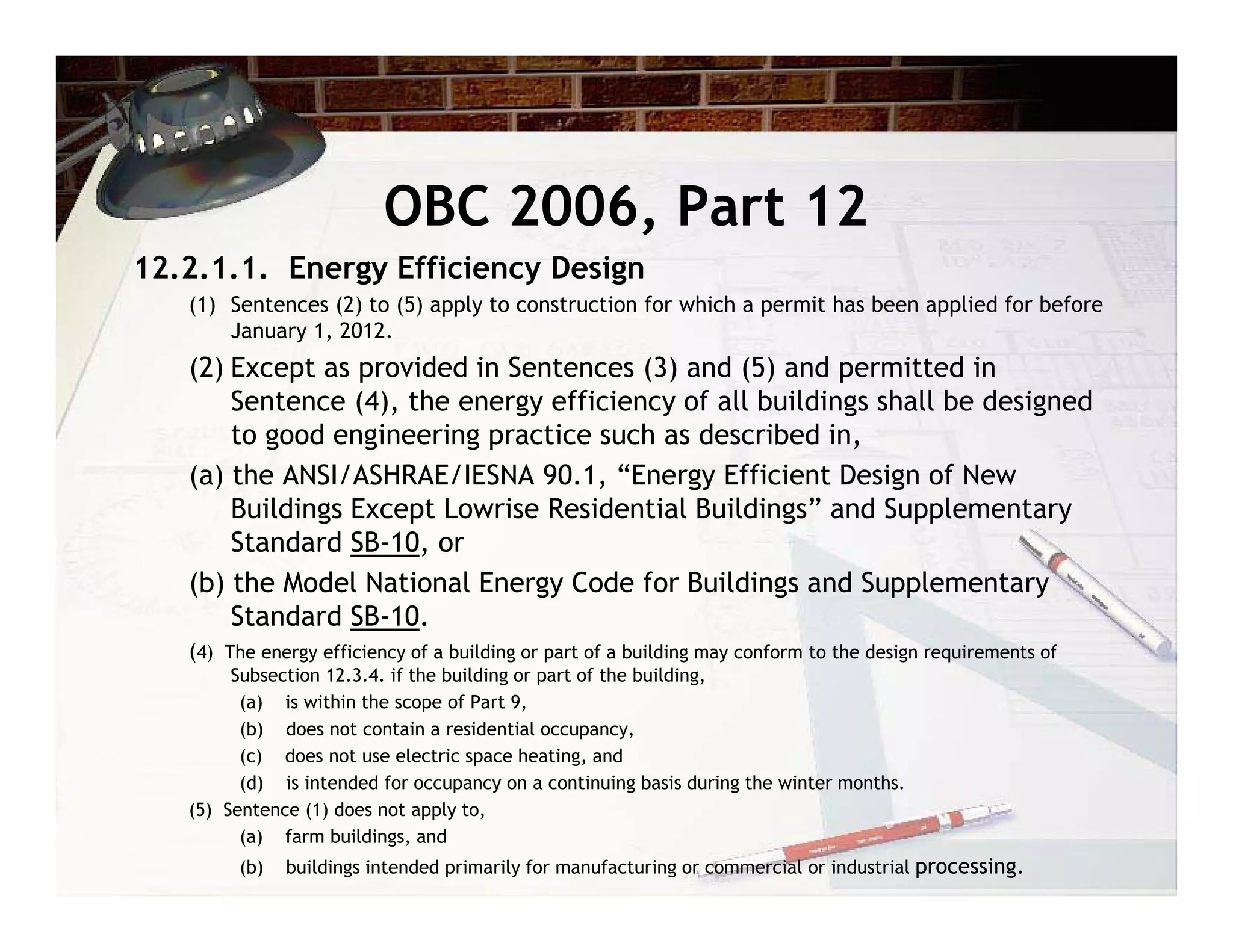
OBC 2006, Part 12
12.2.1.1. Energy Efficiency Design
   (1) Sentences (2) to (5) apply to construction for which a permit has been applied for before
       January 1, 2012.
   (2) Except as provided in Sentences (3) and (5) and permitted in
       Sentence (4), the energy efficiency of all buildings shall be designed
       to good engineering practice such as described in,
   (a) the ANSI/ASHRAE/IESNA 90.1, “Energy Efficient Design of New
       Buildings Except Lowrise Residential Buildings” and Supplementary
       Standard SB-10, or
   (b) the Model National Energy Code for Buildings and Supplementary
       Standard SB-10.
   (4) The energy efficiency of a building or part of a building may conform to the design requirements of
        Subsection 12.3.4. if the building or part of the building,
         (a) is within the scope of Part 9,
         (b) does not contain a residential occupancy,
         (c) does not use electric space heating, and
         (d) is intended for occupancy on a continuing basis during the winter months.
   (5) Sentence (1) does not apply to,
         (a) farm buildings, and
         (b)   buildings intended primarily for manufacturing or commercial or industrial processing.
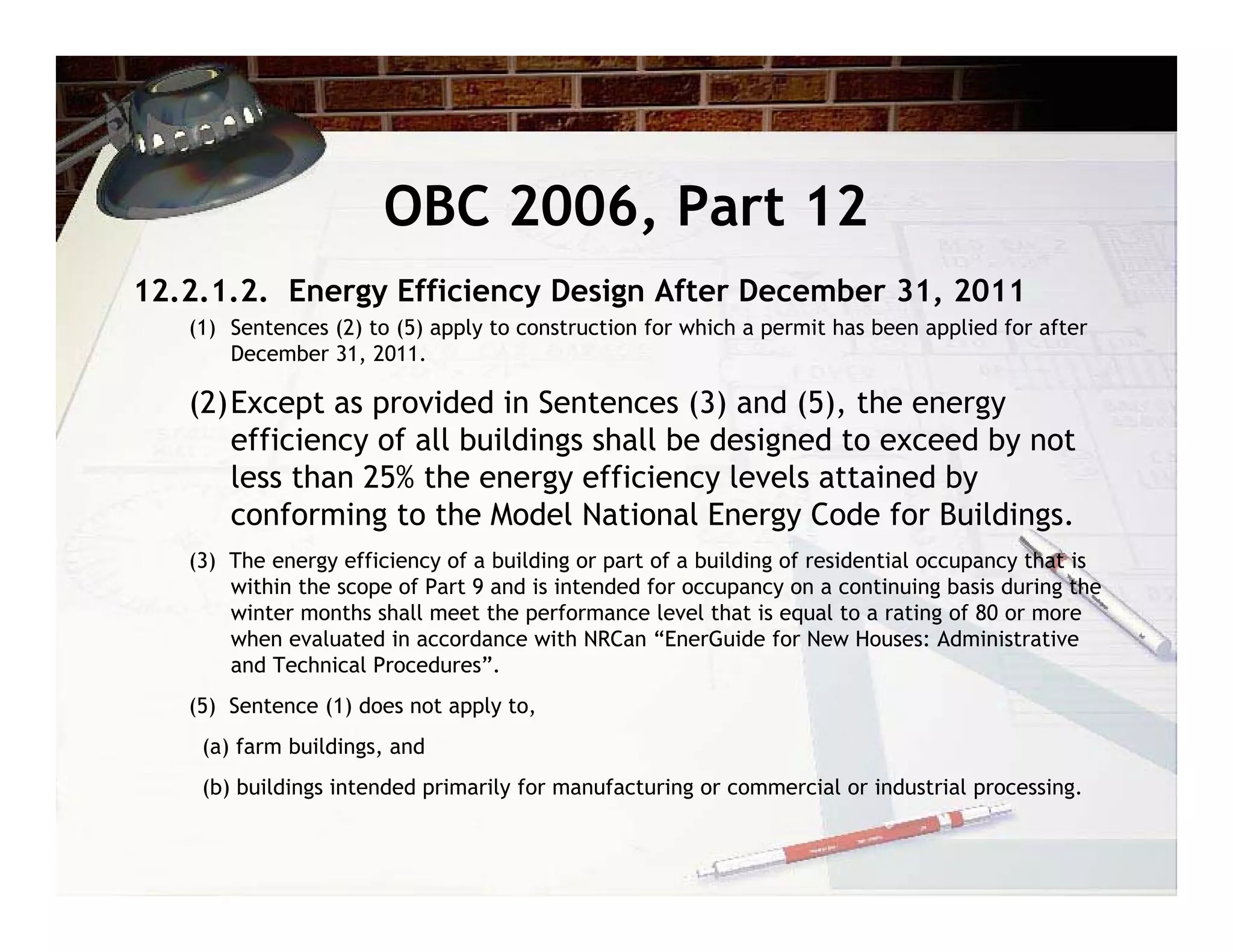
OBC 2006, Part 12
12.2.1.2. Energy Efficiency Design After December 31, 2011
   (1) Sentences (2) to (5) apply to construction for which a permit has been applied for after
       December 31, 2011.

   (2)Except as provided in Sentences (3) and (5), the energy
      efficiency of all buildings shall be designed to exceed by not
      less than 25% the energy efficiency levels attained by
      conforming to the Model National Energy Code for Buildings.
   (3) The energy efficiency of a building or part of a building of residential occupancy that is
       within the scope of Part 9 and is intended for occupancy on a continuing basis during the
       winter months shall meet the performance level that is equal to a rating of 80 or more
       when evaluated in accordance with NRCan “EnerGuide for New Houses: Administrative
       and Technical Procedures”.
   (5) Sentence (1) does not apply to,
    (a) farm buildings, and
    (b) buildings intended primarily for manufacturing or commercial or industrial processing.
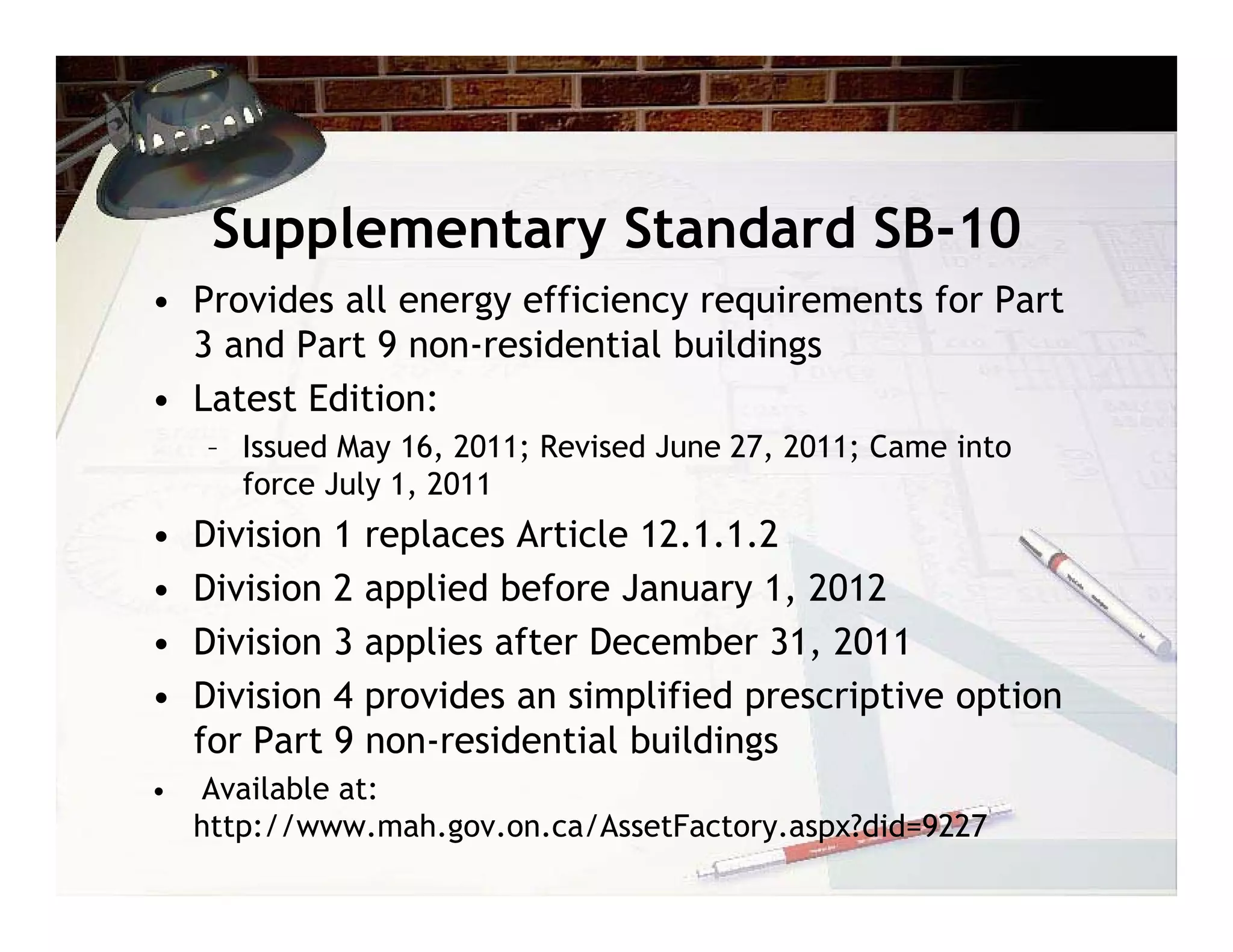
Supplementary Standard SB-10
• Provides all energy efficiency requirements for Part
  3 and Part 9 non-residential buildings
• Latest Edition:
    – Issued May 16, 2011; Revised June 27, 2011; Came into
      force July 1, 2011
•   Division 1 replaces Article 12.1.1.2
•   Division 2 applied before January 1, 2012
•   Division 3 applies after December 31, 2011
•   Division 4 provides an simplified prescriptive option
    for Part 9 non-residential buildings
•   Available at:
    http://www.mah.gov.on.ca/AssetFactory.aspx?did=9227
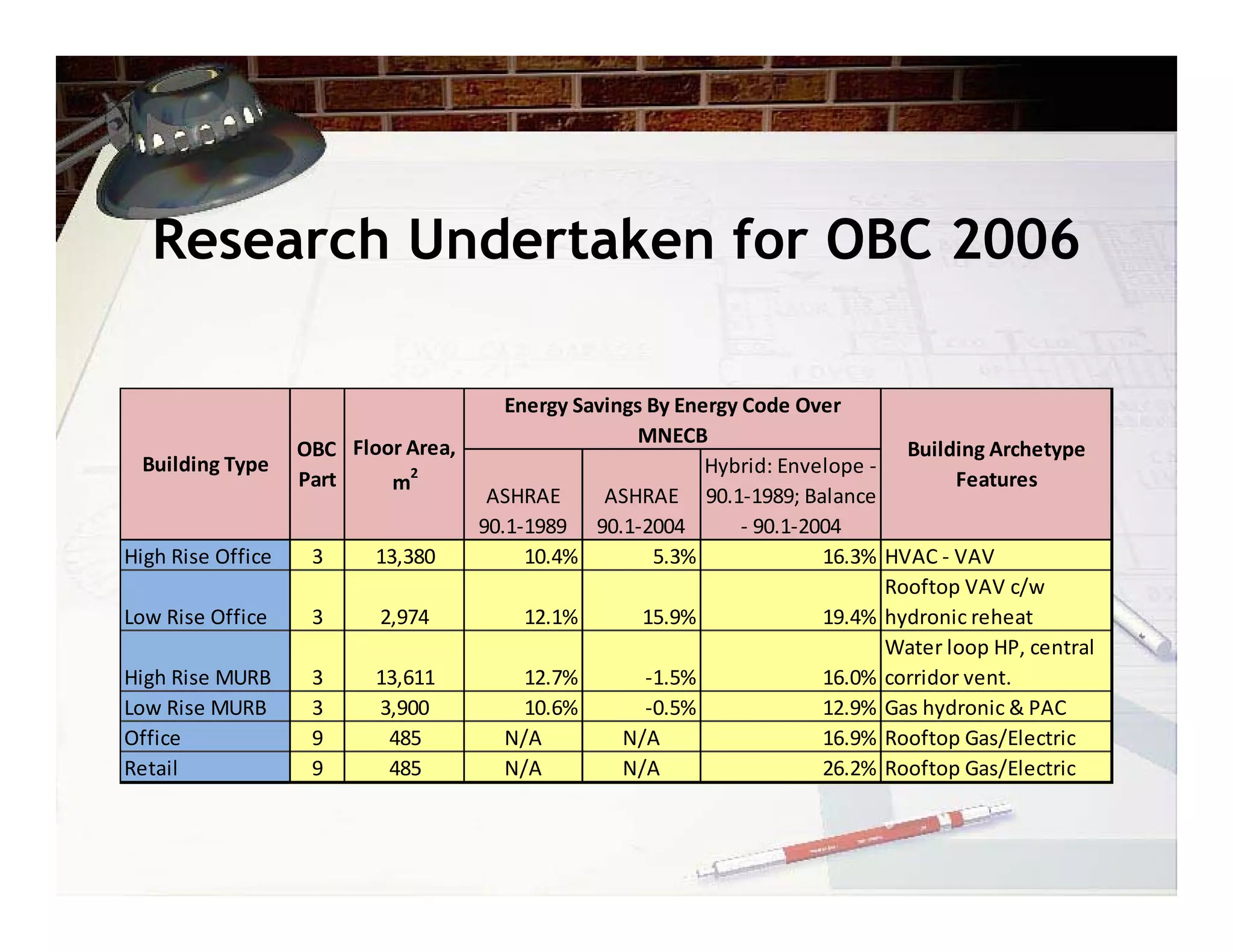
Research Undertaken for OBC 2006

                                        Energy Savings By Energy Code Over 
                                                     MNECB
                   OBC  Floor Area,                                                Building Archetype 
 Building Type                2                              Hybrid: Envelope ‐ 
                   Part     m                                                           Features
                                      ASHRAE      ASHRAE  90.1‐1989; Balance 
                                     90.1‐1989 90.1‐2004         ‐ 90.1‐2004 
High Rise Office    3     13,380          10.4%         5.3%              16.3% HVAC ‐ VAV
                                                                                 Rooftop VAV c/w 
Low Rise Office     3      2,974          12.1%       15.9%               19.4% hydronic reheat
                                                                                 Water loop HP, central 
High Rise MURB      3     13,611          12.7%        ‐1.5%              16.0% corridor vent.
Low Rise MURB       3      3,900          10.6%        ‐0.5%              12.9% Gas hydronic & PAC
Office              9       485         N/A         N/A                   16.9% Rooftop Gas/Electric
Retail              9       485         N/A         N/A                   26.2% Rooftop Gas/Electric
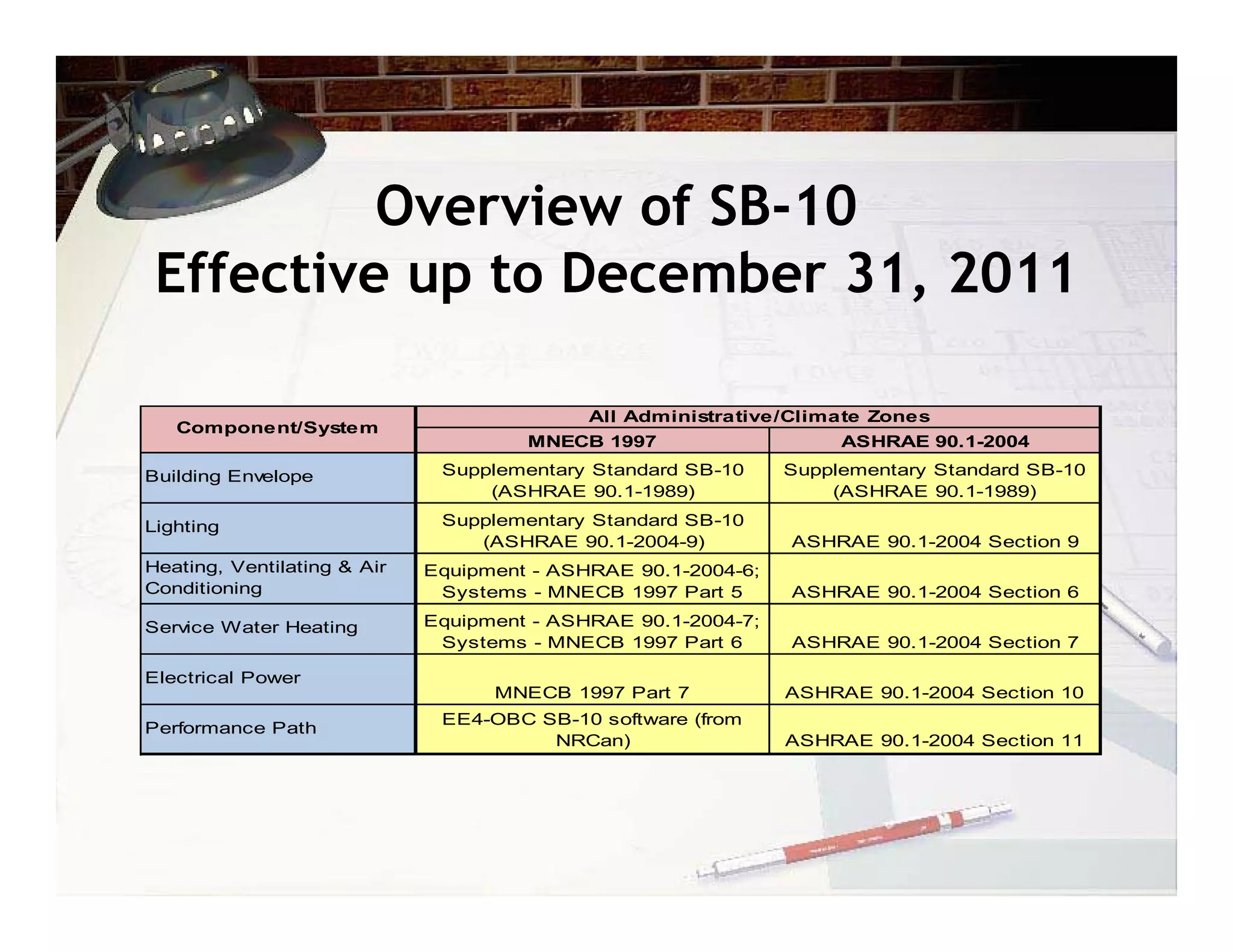
Overview of SB-10
 Effective up to December 31, 2011

                                            All Administrative/Climate Zones
   Component/System
                                      MNECB 1997                    ASHRAE 90.1-2004

Building Envelope             Supplementary Standard SB-10     Supplementary Standard SB-10
                                  (ASHRAE 90.1-1989)               (ASHRAE 90.1-1989)

Lighting                      Supplementary Standard SB-10
                                 (ASHRAE 90.1-2004-9)          ASHRAE 90.1-2004 Section 9
Heating, Ventilating & Air   Equipment - ASHRAE 90.1-2004-6;
Conditioning                  Systems - MNECB 1997 Part 5      ASHRAE 90.1-2004 Section 6

Service Water Heating        Equipment - ASHRAE 90.1-2004-7;
                              Systems - MNECB 1997 Part 6      ASHRAE 90.1-2004 Section 7

Electrical Power
                                   MNECB 1997 Part 7           ASHRAE 90.1-2004 Section 10
                              EE4-OBC SB-10 software (from
Performance Path
                                       NRCan)                  ASHRAE 90.1-2004 Section 11
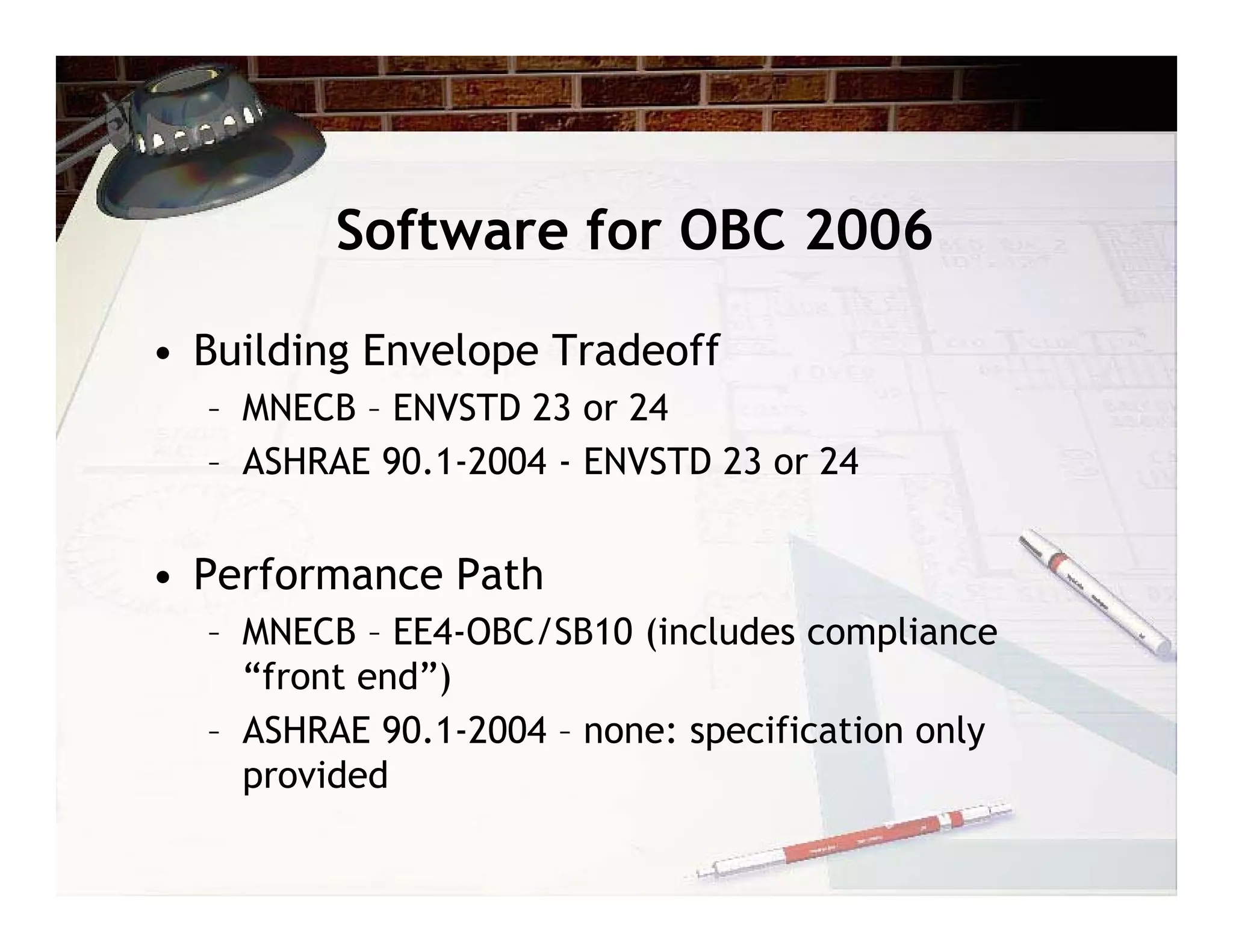
Software for OBC 2006

• Building Envelope Tradeoff
  – MNECB – ENVSTD 23 or 24
  – ASHRAE 90.1-2004 - ENVSTD 23 or 24


• Performance Path
  – MNECB – EE4-OBC/SB10 (includes compliance
    “front end”)
  – ASHRAE 90.1-2004 – none: specification only
    provided
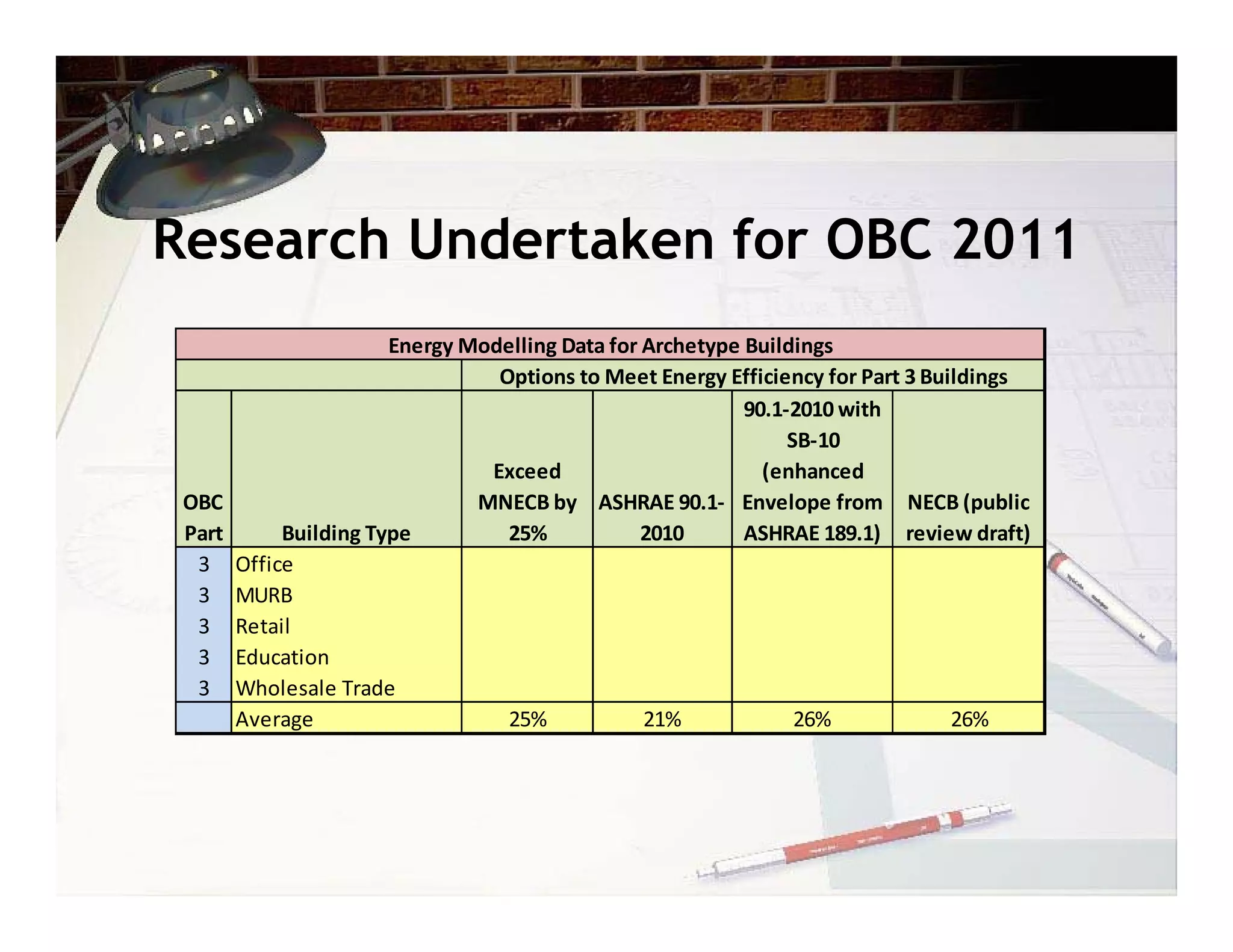
Research Undertaken for OBC 2011
                     Energy Modelling Data for Archetype Buildings
                               Options to Meet Energy Efficiency for Part 3 Buildings
                                                         90.1‐2010 with 
                                                              SB‐10 
                              Exceed                       (enhanced 
 OBC                         MNECB by  ASHRAE 90.1‐ Envelope from  NECB (public 
 Part     Building Type         25%            2010      ASHRAE 189.1) review draft)
  3 Office
  3 MURB
  3 Retail
  3 Education
  3 Wholesale Trade
      Average                   25%            21%             26%             26%
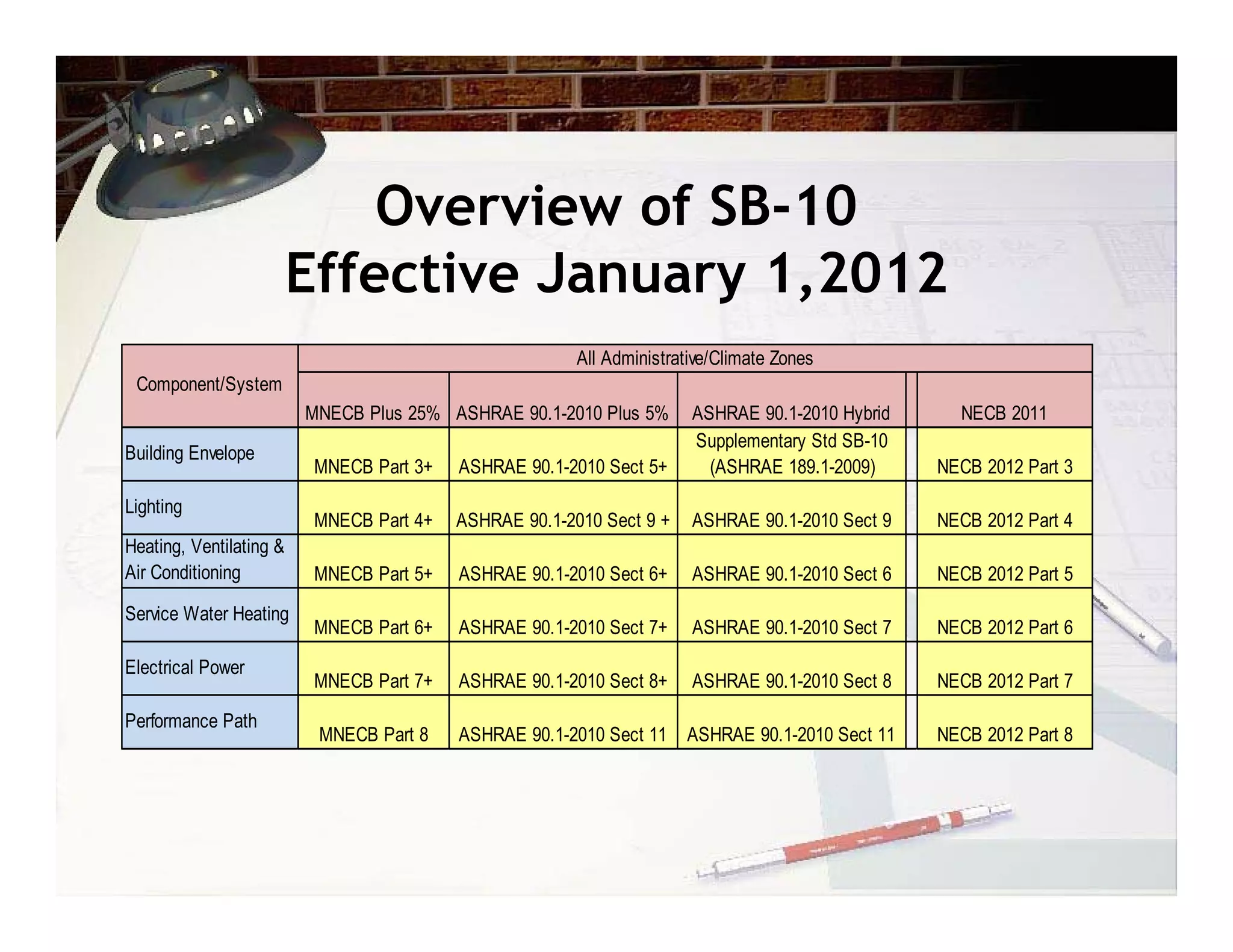
Overview of SB-10
                         Effective January 1,2012
                                                        All Administrative/Climate Zones
 Component/System
                         MNECB Plus 25% ASHRAE 90.1-2010 Plus 5%       ASHRAE 90.1-2010 Hybrid     NECB 2011
                                                                       Supplementary Std SB-10
Building Envelope
                          MNECB Part 3+   ASHRAE 90.1-2010 Sect 5+       (ASHRAE 189.1-2009)     NECB 2012 Part 3
Lighting
                          MNECB Part 4+   ASHRAE 90.1-2010 Sect 9 +    ASHRAE 90.1-2010 Sect 9   NECB 2012 Part 4
Heating, Ventilating &
Air Conditioning          MNECB Part 5+   ASHRAE 90.1-2010 Sect 6+     ASHRAE 90.1-2010 Sect 6   NECB 2012 Part 5
Service Water Heating
                          MNECB Part 6+   ASHRAE 90.1-2010 Sect 7+     ASHRAE 90.1-2010 Sect 7   NECB 2012 Part 6

Electrical Power
                          MNECB Part 7+   ASHRAE 90.1-2010 Sect 8+     ASHRAE 90.1-2010 Sect 8   NECB 2012 Part 7

Performance Path
                          MNECB Part 8    ASHRAE 90.1-2010 Sect 11    ASHRAE 90.1-2010 Sect 11   NECB 2012 Part 8
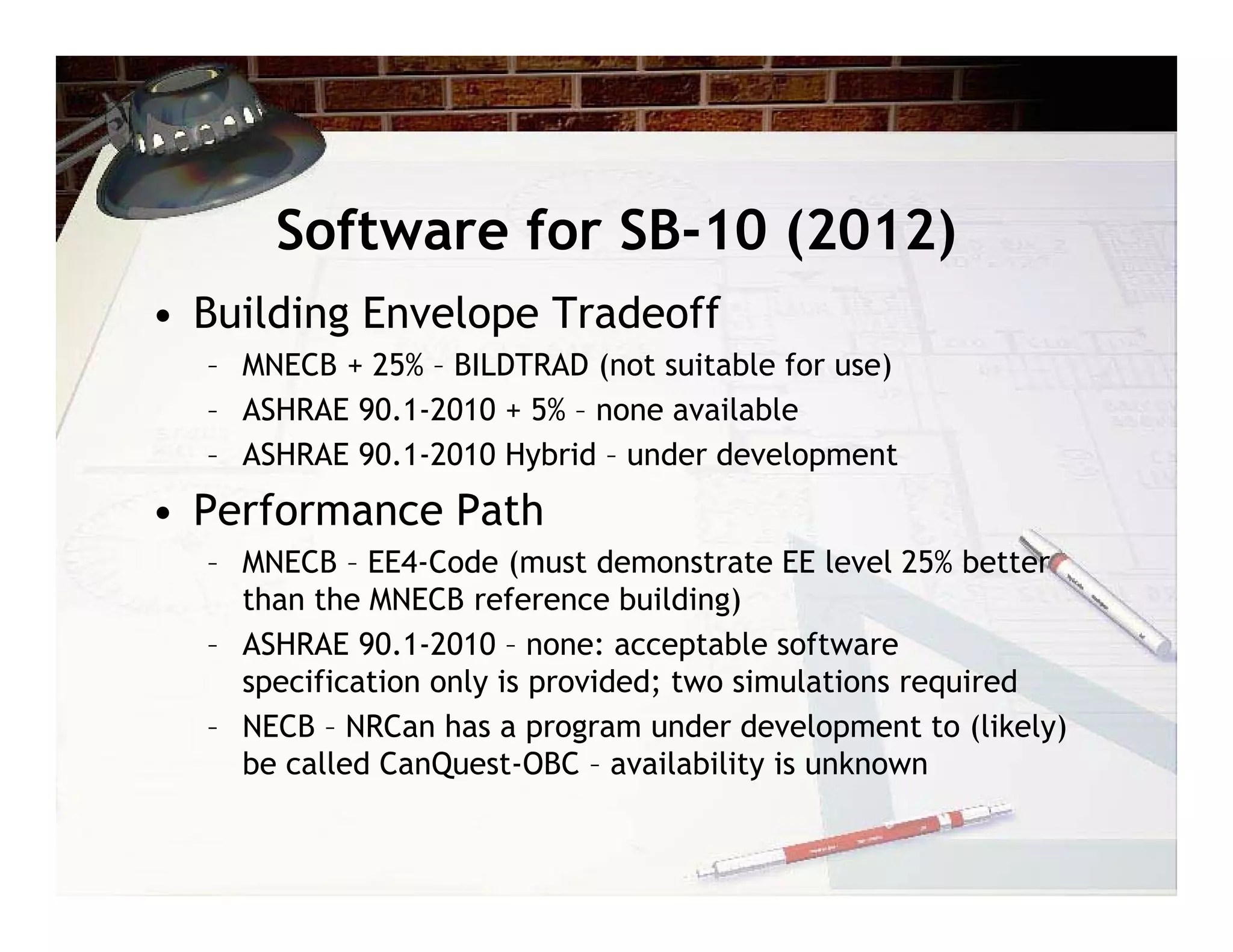
Software for SB-10 (2012)
• Building Envelope Tradeoff
  – MNECB + 25% – BILDTRAD (not suitable for use)
  – ASHRAE 90.1-2010 + 5% – none available
  – ASHRAE 90.1-2010 Hybrid – under development
• Performance Path
  – MNECB – EE4-Code (must demonstrate EE level 25% better
    than the MNECB reference building)
  – ASHRAE 90.1-2010 – none: acceptable software
    specification only is provided; two simulations required
  – NECB – NRCan has a program under development to (likely)
    be called CanQuest-OBC – availability is unknown
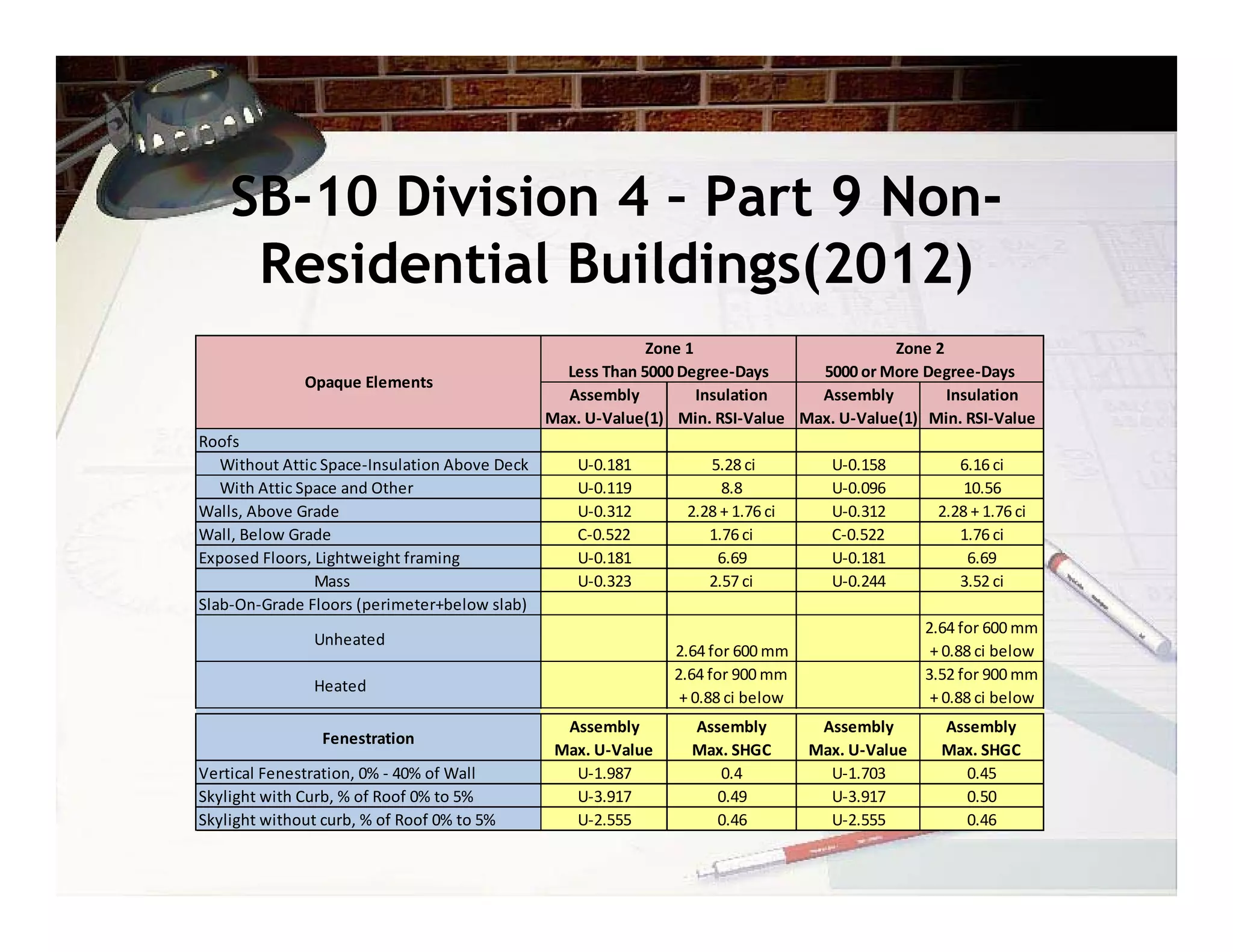
SB-10 Division 4 – Part 9 Non-
     Residential Buildings(2012)
                                                             Zone 1                        Zone 2
                                                  Less Than 5000 Degree‐Days     5000 or More Degree‐Days
              Opaque Elements
                                                  Assembly          Insulation   Assembly         Insulation
                                                Max. U‐Value(1) Min. RSI‐Value Max. U‐Value(1) Min. RSI‐Value
Roofs
   Without Attic Space‐Insulation Above Deck        U‐0.181          5.28 ci          U‐0.158         6.16 ci
   With Attic Space and Other                       U‐0.119           8.8             U‐0.096          10.56
Walls, Above Grade                                  U‐0.312      2.28 + 1.76 ci       U‐0.312      2.28 + 1.76 ci
Wall, Below Grade                                   C‐0.522         1.76 ci           C‐0.522         1.76 ci
Exposed Floors, Lightweight framing                 U‐0.181           6.69            U‐0.181          6.69
                Mass                                U‐0.323         2.57 ci           U‐0.244         3.52 ci
Slab‐On‐Grade Floors (perimeter+below slab)
                                                                                                  2.64 for 600 mm 
               Unheated
                                                                2.64 for 600 mm                    + 0.88 ci below
                                                                2.64 for 900 mm                   3.52 for 900 mm 
               Heated 
                                                                 + 0.88 ci below                   + 0.88 ci below
                                                  Assembly        Assembly          Assembly        Assembly 
                 Fenestration
                                                 Max. U‐Value     Max. SHGC        Max. U‐Value     Max. SHGC
Vertical Fenestration, 0% ‐ 40% of Wall            U‐1.987           0.4             U‐1.703           0.45
Skylight with Curb, % of Roof 0% to 5%             U‐3.917          0.49             U‐3.917           0.50
Skylight without curb, % of Roof 0% to 5%          U‐2.555          0.46             U‐2.555           0.46
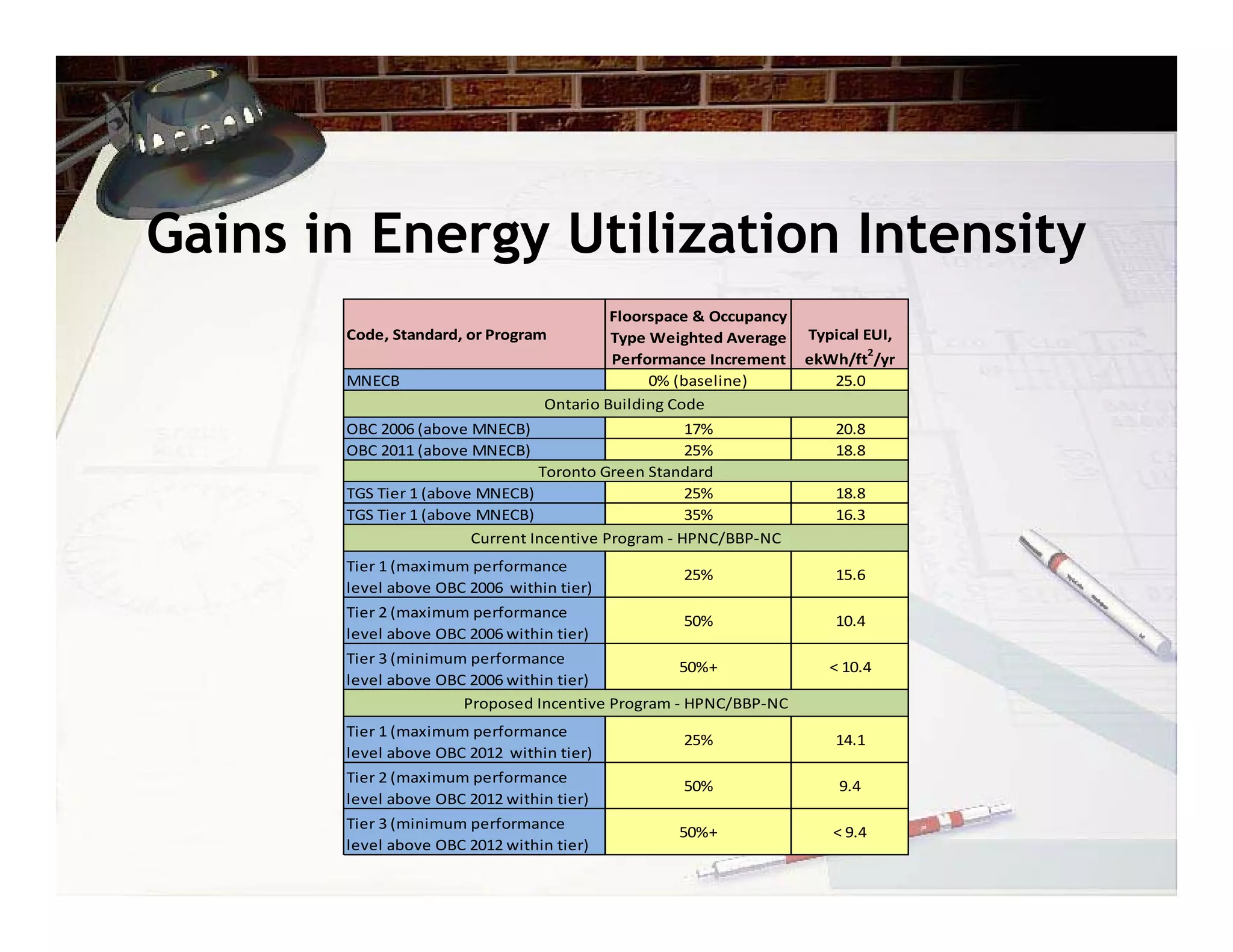
Gains in Energy Utilization Intensity
                                           Floorspace & Occupancy 
       Code, Standard, or Program          Type Weighted Average  Typical EUI,
                                                                           2
                                           Performance Increment ekWh/ft /yr
       MNECB                                    0% (baseline)        25.0
                                  Ontario Building Code 
       OBC 2006 (above MNECB)                        17%              20.8
       OBC 2011 (above MNECB)                        25%              18.8
                                 Toronto Green Standard
       TGS Tier 1 (above MNECB)                      25%              18.8
       TGS Tier 1 (above MNECB)                      35%              16.3
                        Current Incentive Program ‐ HPNC/BBP‐NC
       Tier 1 (maximum performance 
                                                   25%                15.6
       level above OBC 2006  within tier)
       Tier 2 (maximum performance 
                                                   50%                10.4
       level above OBC 2006 within tier)
       Tier 3 (minimum performance 
                                                  50%+               < 10.4
       level above OBC 2006 within tier)
                      Proposed Incentive Program ‐ HPNC/BBP‐NC
       Tier 1 (maximum performance 
                                                   25%                14.1
       level above OBC 2012  within tier)
       Tier 2 (maximum performance 
                                                   50%                9.4
       level above OBC 2012 within tier)
       Tier 3 (minimum performance 
                                                  50%+                < 9.4
       level above OBC 2012 within tier)
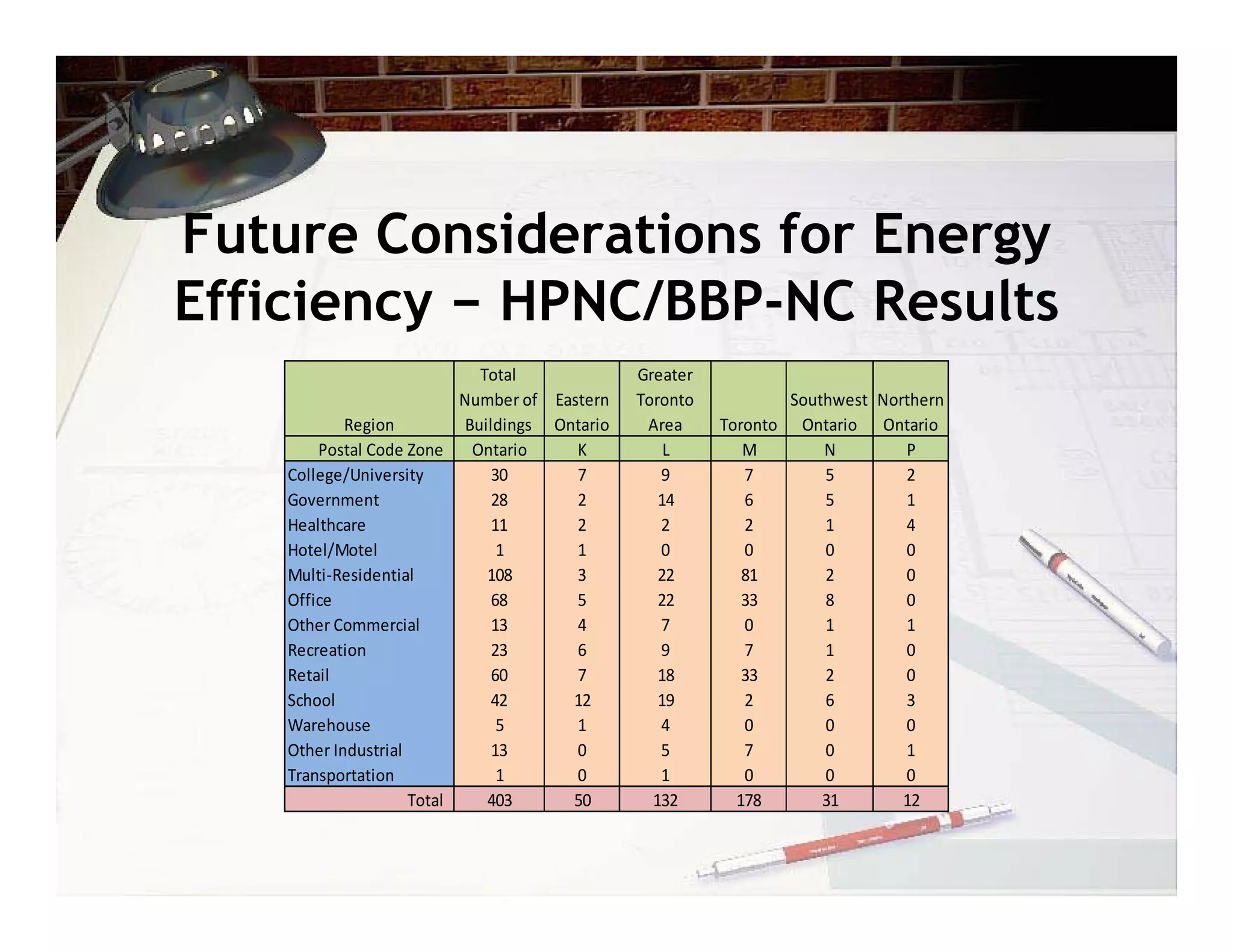
Future Considerations for Energy
Efficiency − HPNC/BBP-NC Results
                               Total               Greater 
                             Number of  Eastern    Toronto            Southwest  Northern 
            Region           Buildings Ontario      Area      Toronto Ontario Ontario
        Postal Code Zone   Ontario         K           L         M        N         P
    College/University           30        7          9          7        5         2
    Government                   28        2          14         6        5         1
    Healthcare                   11        2          2          2        1         4
    Hotel/Motel                   1        1          0          0        0         0
    Multi‐Residential           108        3          22         81       2         0
    Office                       68        5          22         33       8         0
    Other Commercial             13        4          7          0        1         1
    Recreation                   23        6          9          7        1         0
    Retail                       60        7          18         33       2         0
    School                      42        12          19         2        6         3
    Warehouse                     5        1          4          0        0         0
    Other Industrial            13         0          5          7        0         1
    Transportation                1        0          1          0        0         0
                     Total      403       50         132        178       31        12
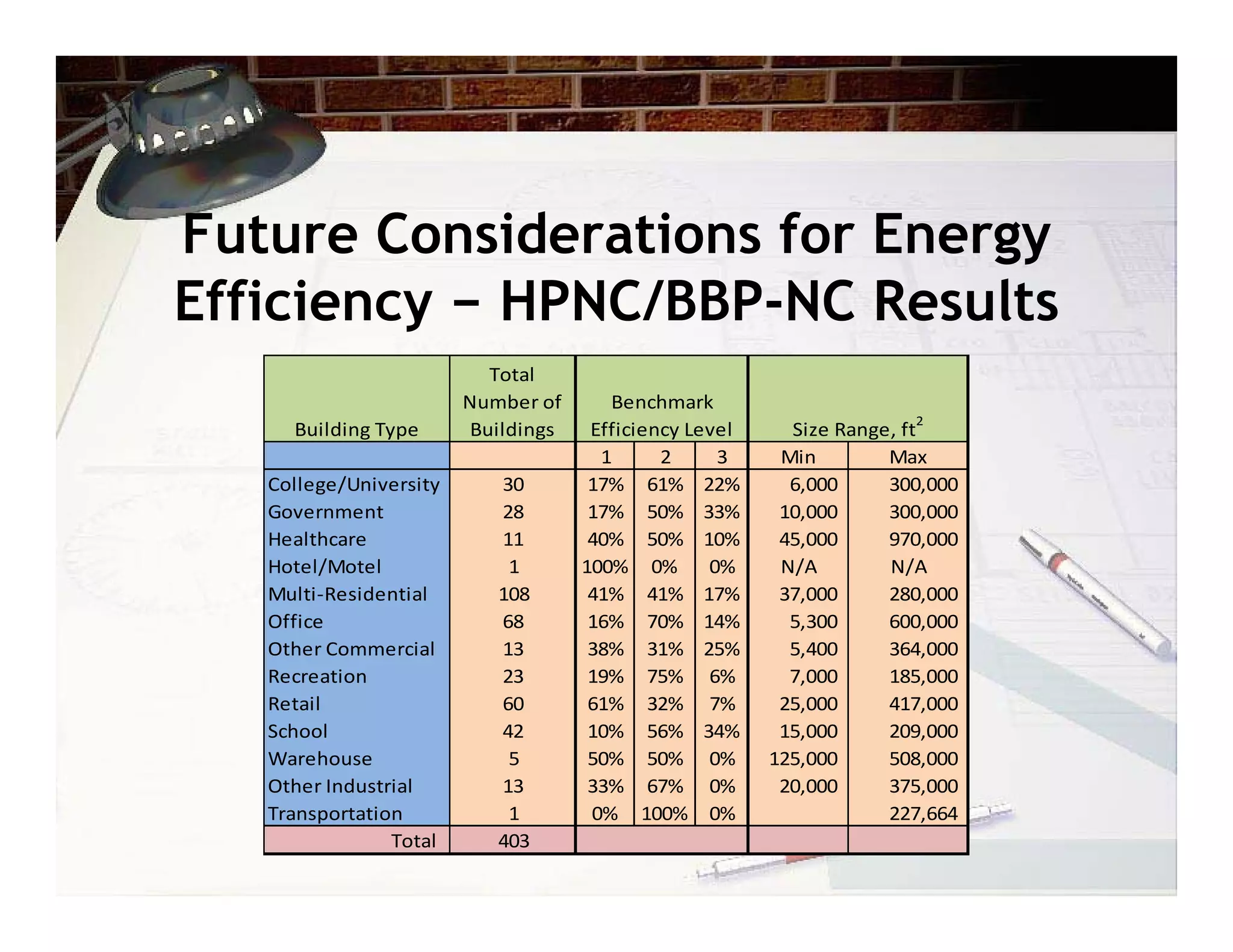
Future Considerations for Energy
Efficiency − HPNC/BBP-NC Results
                            Total 
                          Number of       Benchmark 
                                                                                2
     Building Type        Buildings     Efficiency Level          Size Range, ft
                                         1      2     3         Min             Max
   College/University        30         17% 61% 22%               6,000       300,000
   Government                28         17% 50% 33%             10,000       300,000
   Healthcare                11         40% 50% 10%             45,000       970,000
   Hotel/Motel                1        100% 0%       0%         N/A             N/A
   Multi‐Residential         108        41% 41% 17%             37,000       280,000
   Office                    68         16% 70% 14%               5,300       600,000
   Other Commercial          13         38% 31% 25%               5,400       364,000
   Recreation                23         19% 75% 6%                7,000       185,000
   Retail                    60         61% 32% 7%              25,000       417,000
   School                    42         10% 56% 34%             15,000       209,000
   Warehouse                  5         50% 50% 0%           125,000       508,000
   Other Industrial          13         33% 67% 0%              20,000       375,000
   Transportation             1         0% 100% 0%                              227,664
                Total        403
Next Edition of the
     Building Code (2012?)
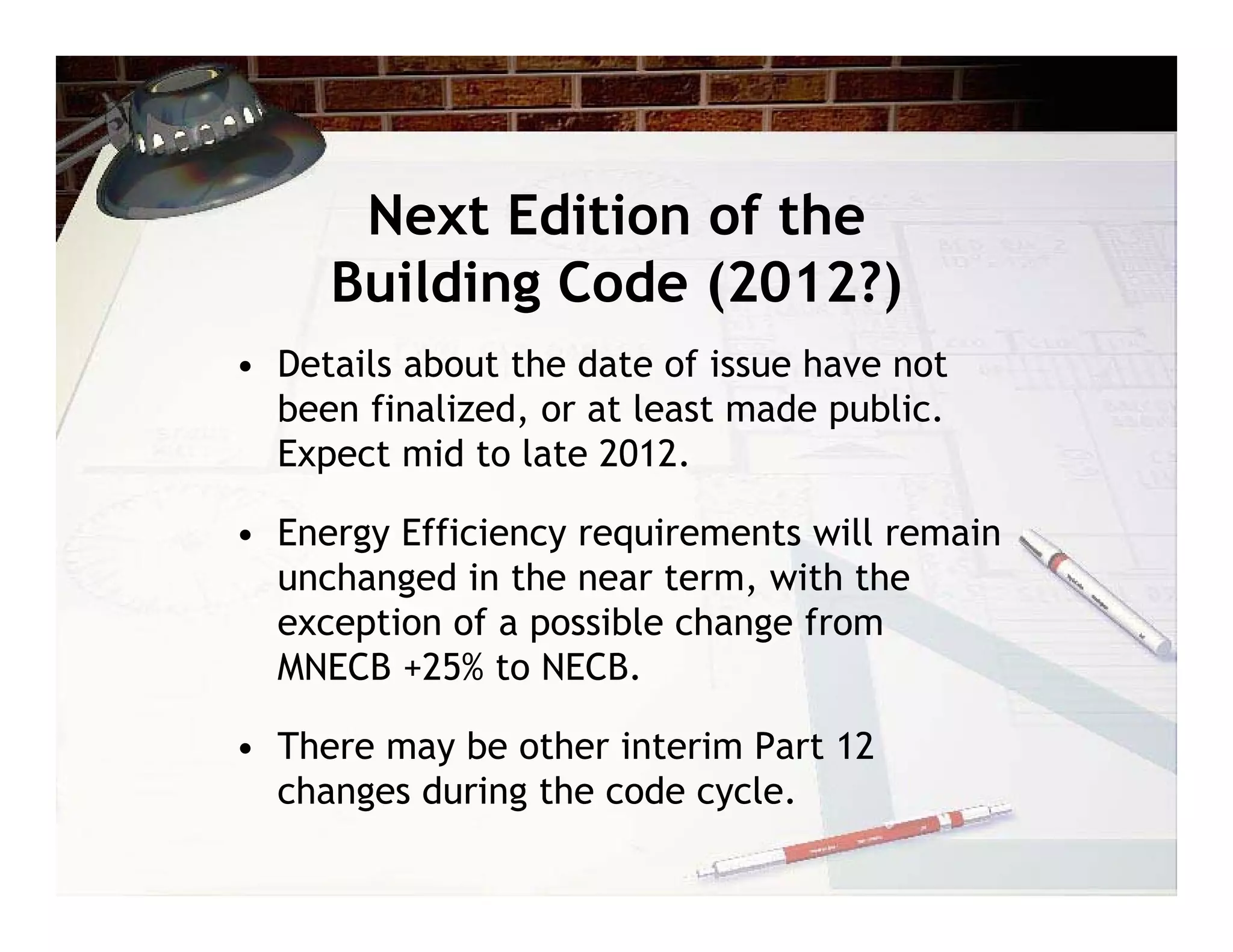
• Details about the date of issue have not
  been finalized, or at least made public.
  Expect mid to late 2012.

• Energy Efficiency requirements will remain
  unchanged in the near term, with the
  exception of a possible change from
  MNECB +25% to NECB.

• There may be other interim Part 12
  changes during the code cycle.
Subsequent Edition of the
          Building Code (2017?)
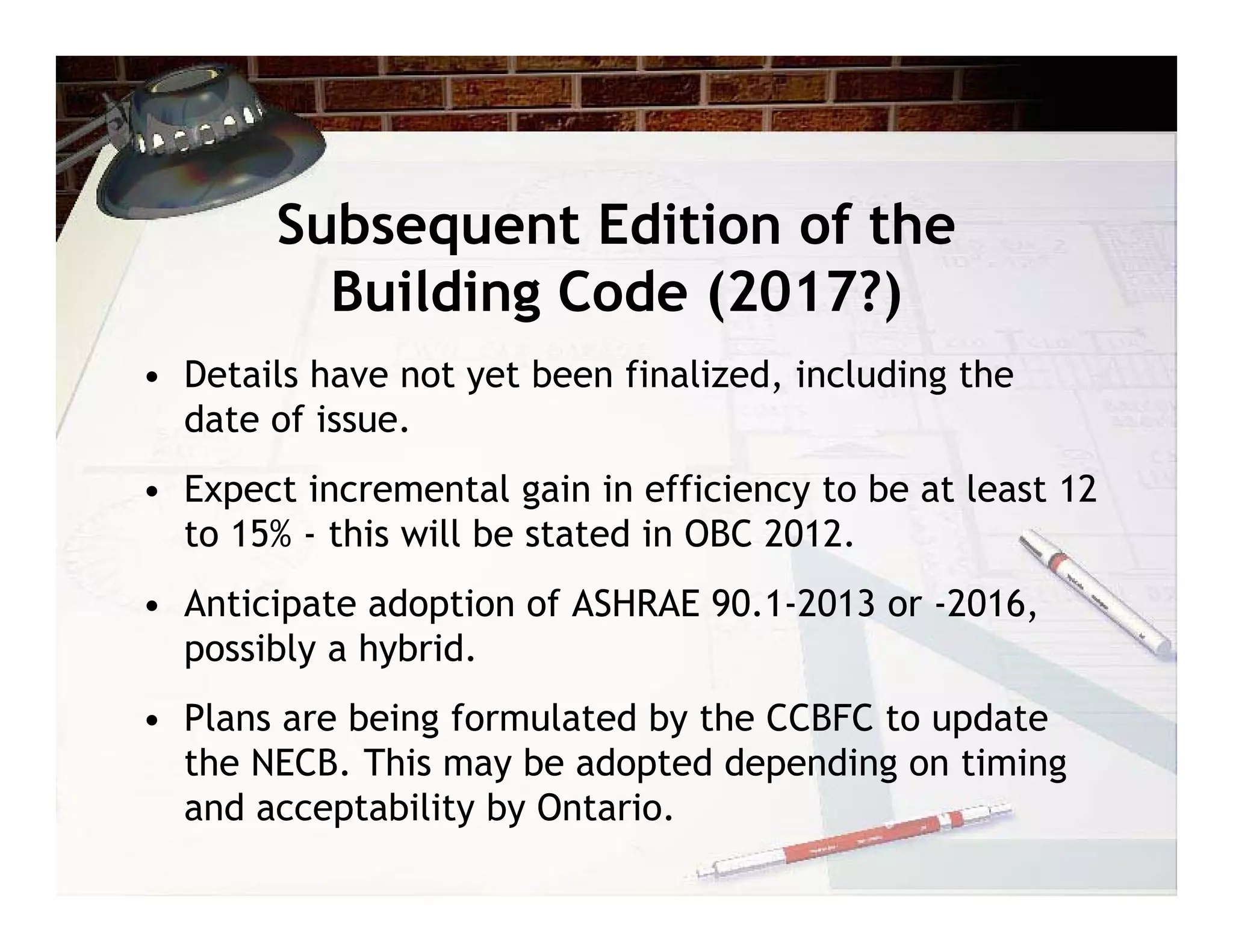
• Details have not yet been finalized, including the
  date of issue.
• Expect incremental gain in efficiency to be at least 12
  to 15% - this will be stated in OBC 2012.
• Anticipate adoption of ASHRAE 90.1-2013 or -2016,
  possibly a hybrid.
• Plans are being formulated by the CCBFC to update
  the NECB. This may be adopted depending on timing
  and acceptability by Ontario.
Compliance Issues
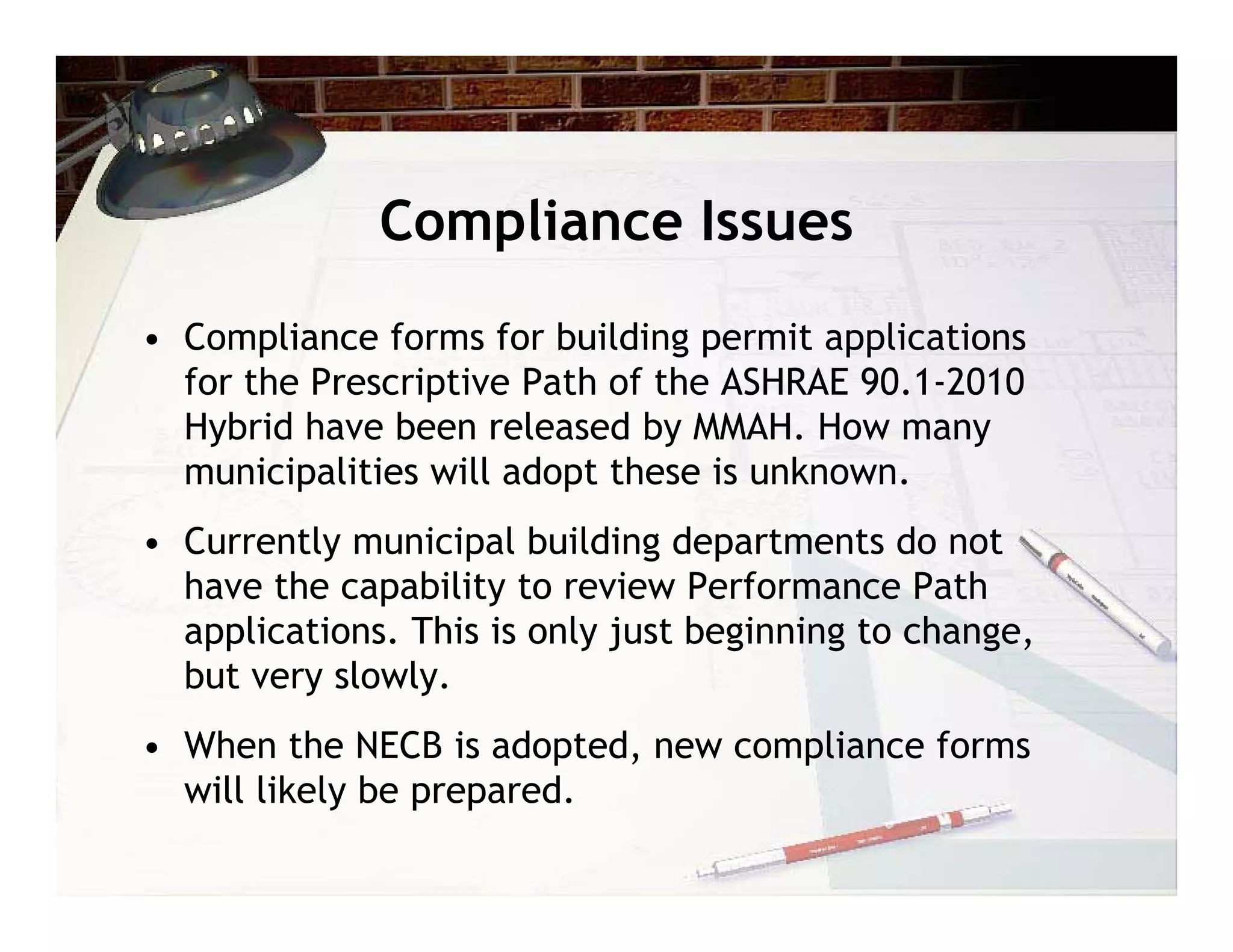
• Compliance forms for building permit applications
  for the Prescriptive Path of the ASHRAE 90.1-2010
  Hybrid have been released by MMAH. How many
  municipalities will adopt these is unknown.
• Currently municipal building departments do not
  have the capability to review Performance Path
  applications. This is only just beginning to change,
  but very slowly.
• When the NECB is adopted, new compliance forms
  will likely be prepared.
Questions?


             SUSTAINABLE BUILDINGS CANADA
bbach@energyprofiles.com


                      SUSTAINABLE BUILDINGS CANADA

Bob Bach: Energy Efficiency in the Ontario Building Code

  • 1.
    Ontario Building Code Energy Efficiency in Buildings Presentation to the Sustainable Buildings Canada Breakfast Meeting February 22, 2012 H. R.(BOB) BACH SUSTAINABLE BUILDINGS CANADA
  • 2.
    OVERVIEW • Where theBuilding Code was in 2006 • Where the Building Code is in 2012 • Part 3 Options & Application Issues • Impact on Overall Energy Utilization Intensity • Where Will We Go for 2017 SUSTAINABLE BUILDINGS CANADA
  • 3.
    Current Requirements 2006 2007 2008 2009 2010 2011 2012 Code 2006 Code Amendment: Energy efficiency Energy efficiency  for 2006 Code Prescriptive : houses must houses and bldgs. Energy compliance meet 2008 signpost to extend paths for Code EnerGuide80 or efficiency  basement insulation in EnerGuide80 Amendment: equivalent; for houses: houses (SB12) Alternative lg. bldgs. must basement 2012 signposts for: effective 2012 compliance paths meet MNECB+25% insulation houses - EnerGuide80; to meet 2012 or equivalent lg. bldgs. - MNECB+25% requirements for lg. bldgs. (SB10 update)
  • 4.
    Part 3 Buildings: Background SUSTAINABLE BUILDINGS CANADA
  • 5.
    OBC 2006, Part12 12.2.1.1. Energy Efficiency Design (1) Sentences (2) to (5) apply to construction for which a permit has been applied for before January 1, 2012. (2) Except as provided in Sentences (3) and (5) and permitted in Sentence (4), the energy efficiency of all buildings shall be designed to good engineering practice such as described in, (a) the ANSI/ASHRAE/IESNA 90.1, “Energy Efficient Design of New Buildings Except Lowrise Residential Buildings” and Supplementary Standard SB-10, or (b) the Model National Energy Code for Buildings and Supplementary Standard SB-10. (4) The energy efficiency of a building or part of a building may conform to the design requirements of Subsection 12.3.4. if the building or part of the building, (a) is within the scope of Part 9, (b) does not contain a residential occupancy, (c) does not use electric space heating, and (d) is intended for occupancy on a continuing basis during the winter months. (5) Sentence (1) does not apply to, (a) farm buildings, and (b) buildings intended primarily for manufacturing or commercial or industrial processing.
  • 6.
    OBC 2006, Part12 12.2.1.2. Energy Efficiency Design After December 31, 2011 (1) Sentences (2) to (5) apply to construction for which a permit has been applied for after December 31, 2011. (2)Except as provided in Sentences (3) and (5), the energy efficiency of all buildings shall be designed to exceed by not less than 25% the energy efficiency levels attained by conforming to the Model National Energy Code for Buildings. (3) The energy efficiency of a building or part of a building of residential occupancy that is within the scope of Part 9 and is intended for occupancy on a continuing basis during the winter months shall meet the performance level that is equal to a rating of 80 or more when evaluated in accordance with NRCan “EnerGuide for New Houses: Administrative and Technical Procedures”. (5) Sentence (1) does not apply to, (a) farm buildings, and (b) buildings intended primarily for manufacturing or commercial or industrial processing.
  • 7.
    Supplementary Standard SB-10 •Provides all energy efficiency requirements for Part 3 and Part 9 non-residential buildings • Latest Edition: – Issued May 16, 2011; Revised June 27, 2011; Came into force July 1, 2011 • Division 1 replaces Article 12.1.1.2 • Division 2 applied before January 1, 2012 • Division 3 applies after December 31, 2011 • Division 4 provides an simplified prescriptive option for Part 9 non-residential buildings • Available at: http://www.mah.gov.on.ca/AssetFactory.aspx?did=9227
  • 8.
    Research Undertaken forOBC 2006 Energy Savings By Energy Code Over  MNECB OBC  Floor Area,  Building Archetype  Building Type 2 Hybrid: Envelope ‐  Part m Features ASHRAE  ASHRAE  90.1‐1989; Balance  90.1‐1989 90.1‐2004 ‐ 90.1‐2004  High Rise Office 3 13,380 10.4% 5.3% 16.3% HVAC ‐ VAV Rooftop VAV c/w  Low Rise Office 3 2,974 12.1% 15.9% 19.4% hydronic reheat Water loop HP, central  High Rise MURB 3 13,611 12.7% ‐1.5% 16.0% corridor vent. Low Rise MURB 3 3,900 10.6% ‐0.5% 12.9% Gas hydronic & PAC Office 9 485 N/A N/A 16.9% Rooftop Gas/Electric Retail 9 485 N/A N/A 26.2% Rooftop Gas/Electric
  • 9.
    Overview of SB-10 Effective up to December 31, 2011 All Administrative/Climate Zones Component/System MNECB 1997 ASHRAE 90.1-2004 Building Envelope Supplementary Standard SB-10 Supplementary Standard SB-10 (ASHRAE 90.1-1989) (ASHRAE 90.1-1989) Lighting Supplementary Standard SB-10 (ASHRAE 90.1-2004-9) ASHRAE 90.1-2004 Section 9 Heating, Ventilating & Air Equipment - ASHRAE 90.1-2004-6; Conditioning Systems - MNECB 1997 Part 5 ASHRAE 90.1-2004 Section 6 Service Water Heating Equipment - ASHRAE 90.1-2004-7; Systems - MNECB 1997 Part 6 ASHRAE 90.1-2004 Section 7 Electrical Power MNECB 1997 Part 7 ASHRAE 90.1-2004 Section 10 EE4-OBC SB-10 software (from Performance Path NRCan) ASHRAE 90.1-2004 Section 11
  • 10.
    Software for OBC2006 • Building Envelope Tradeoff – MNECB – ENVSTD 23 or 24 – ASHRAE 90.1-2004 - ENVSTD 23 or 24 • Performance Path – MNECB – EE4-OBC/SB10 (includes compliance “front end”) – ASHRAE 90.1-2004 – none: specification only provided
  • 11.
    Research Undertaken forOBC 2011 Energy Modelling Data for Archetype Buildings Options to Meet Energy Efficiency for Part 3 Buildings 90.1‐2010 with  SB‐10  Exceed  (enhanced  OBC  MNECB by  ASHRAE 90.1‐ Envelope from  NECB (public  Part Building Type 25% 2010 ASHRAE 189.1) review draft) 3 Office 3 MURB 3 Retail 3 Education 3 Wholesale Trade Average 25% 21% 26% 26%
  • 12.
    Overview of SB-10 Effective January 1,2012 All Administrative/Climate Zones Component/System MNECB Plus 25% ASHRAE 90.1-2010 Plus 5% ASHRAE 90.1-2010 Hybrid NECB 2011 Supplementary Std SB-10 Building Envelope MNECB Part 3+ ASHRAE 90.1-2010 Sect 5+ (ASHRAE 189.1-2009) NECB 2012 Part 3 Lighting MNECB Part 4+ ASHRAE 90.1-2010 Sect 9 + ASHRAE 90.1-2010 Sect 9 NECB 2012 Part 4 Heating, Ventilating & Air Conditioning MNECB Part 5+ ASHRAE 90.1-2010 Sect 6+ ASHRAE 90.1-2010 Sect 6 NECB 2012 Part 5 Service Water Heating MNECB Part 6+ ASHRAE 90.1-2010 Sect 7+ ASHRAE 90.1-2010 Sect 7 NECB 2012 Part 6 Electrical Power MNECB Part 7+ ASHRAE 90.1-2010 Sect 8+ ASHRAE 90.1-2010 Sect 8 NECB 2012 Part 7 Performance Path MNECB Part 8 ASHRAE 90.1-2010 Sect 11 ASHRAE 90.1-2010 Sect 11 NECB 2012 Part 8
  • 13.
    Software for SB-10(2012) • Building Envelope Tradeoff – MNECB + 25% – BILDTRAD (not suitable for use) – ASHRAE 90.1-2010 + 5% – none available – ASHRAE 90.1-2010 Hybrid – under development • Performance Path – MNECB – EE4-Code (must demonstrate EE level 25% better than the MNECB reference building) – ASHRAE 90.1-2010 – none: acceptable software specification only is provided; two simulations required – NECB – NRCan has a program under development to (likely) be called CanQuest-OBC – availability is unknown
  • 14.
    SB-10 Division 4– Part 9 Non- Residential Buildings(2012) Zone 1 Zone 2 Less Than 5000 Degree‐Days 5000 or More Degree‐Days Opaque Elements Assembly Insulation Assembly Insulation Max. U‐Value(1) Min. RSI‐Value Max. U‐Value(1) Min. RSI‐Value Roofs Without Attic Space‐Insulation Above Deck  U‐0.181  5.28 ci  U‐0.158  6.16 ci With Attic Space and Other  U‐0.119 8.8 U‐0.096 10.56 Walls, Above Grade U‐0.312 2.28 + 1.76 ci U‐0.312 2.28 + 1.76 ci Wall, Below Grade C‐0.522 1.76 ci C‐0.522 1.76 ci Exposed Floors, Lightweight framing U‐0.181 6.69 U‐0.181 6.69 Mass  U‐0.323 2.57 ci U‐0.244 3.52 ci Slab‐On‐Grade Floors (perimeter+below slab) 2.64 for 600 mm  Unheated 2.64 for 600 mm + 0.88 ci below 2.64 for 900 mm  3.52 for 900 mm  Heated  + 0.88 ci below + 0.88 ci below Assembly  Assembly  Assembly  Assembly  Fenestration Max. U‐Value Max. SHGC Max. U‐Value Max. SHGC Vertical Fenestration, 0% ‐ 40% of Wall U‐1.987 0.4 U‐1.703 0.45 Skylight with Curb, % of Roof 0% to 5% U‐3.917 0.49 U‐3.917 0.50 Skylight without curb, % of Roof 0% to 5% U‐2.555 0.46 U‐2.555 0.46
  • 15.
    Gains in EnergyUtilization Intensity Floorspace & Occupancy  Code, Standard, or Program Type Weighted Average  Typical EUI, 2 Performance Increment ekWh/ft /yr MNECB 0% (baseline) 25.0 Ontario Building Code  OBC 2006 (above MNECB) 17% 20.8 OBC 2011 (above MNECB) 25% 18.8 Toronto Green Standard TGS Tier 1 (above MNECB) 25% 18.8 TGS Tier 1 (above MNECB) 35% 16.3 Current Incentive Program ‐ HPNC/BBP‐NC Tier 1 (maximum performance  25% 15.6 level above OBC 2006  within tier) Tier 2 (maximum performance  50% 10.4 level above OBC 2006 within tier) Tier 3 (minimum performance  50%+ < 10.4 level above OBC 2006 within tier) Proposed Incentive Program ‐ HPNC/BBP‐NC Tier 1 (maximum performance  25% 14.1 level above OBC 2012  within tier) Tier 2 (maximum performance  50% 9.4 level above OBC 2012 within tier) Tier 3 (minimum performance  50%+ < 9.4 level above OBC 2012 within tier)
  • 16.
    Future Considerations forEnergy Efficiency − HPNC/BBP-NC Results Total  Greater  Number of  Eastern  Toronto  Southwest  Northern  Region Buildings Ontario Area Toronto Ontario Ontario Postal Code Zone   Ontario K L M N P College/University 30 7 9 7 5 2 Government 28 2 14 6 5 1 Healthcare 11 2 2 2 1 4 Hotel/Motel 1 1 0 0 0 0 Multi‐Residential 108 3 22 81 2 0 Office 68 5 22 33 8 0 Other Commercial 13 4 7 0 1 1 Recreation 23 6 9 7 1 0 Retail 60 7 18 33 2 0 School 42 12 19 2 6 3 Warehouse 5 1 4 0 0 0 Other Industrial 13 0 5 7 0 1 Transportation 1 0 1 0 0 0 Total   403 50 132 178 31 12
  • 17.
    Future Considerations forEnergy Efficiency − HPNC/BBP-NC Results Total  Number of  Benchmark  2 Building Type Buildings Efficiency Level Size Range, ft 1 2 3 Min Max College/University 30 17% 61% 22%        6,000       300,000 Government 28 17% 50% 33%      10,000       300,000 Healthcare 11 40% 50% 10%      45,000       970,000 Hotel/Motel 1 100% 0% 0% N/A N/A Multi‐Residential 108 41% 41% 17%      37,000       280,000 Office 68 16% 70% 14%        5,300       600,000 Other Commercial 13 38% 31% 25%        5,400       364,000 Recreation 23 19% 75% 6%        7,000       185,000 Retail 60 61% 32% 7%      25,000       417,000 School 42 10% 56% 34%      15,000       209,000 Warehouse 5 50% 50% 0%   125,000       508,000 Other Industrial 13 33% 67% 0%      20,000       375,000 Transportation 1 0% 100% 0%       227,664 Total   403
  • 18.
    Next Edition ofthe Building Code (2012?) • Details about the date of issue have not been finalized, or at least made public. Expect mid to late 2012. • Energy Efficiency requirements will remain unchanged in the near term, with the exception of a possible change from MNECB +25% to NECB. • There may be other interim Part 12 changes during the code cycle.
  • 19.
    Subsequent Edition ofthe Building Code (2017?) • Details have not yet been finalized, including the date of issue. • Expect incremental gain in efficiency to be at least 12 to 15% - this will be stated in OBC 2012. • Anticipate adoption of ASHRAE 90.1-2013 or -2016, possibly a hybrid. • Plans are being formulated by the CCBFC to update the NECB. This may be adopted depending on timing and acceptability by Ontario.
  • 20.
    Compliance Issues • Complianceforms for building permit applications for the Prescriptive Path of the ASHRAE 90.1-2010 Hybrid have been released by MMAH. How many municipalities will adopt these is unknown. • Currently municipal building departments do not have the capability to review Performance Path applications. This is only just beginning to change, but very slowly. • When the NECB is adopted, new compliance forms will likely be prepared.
  • 21.
    Questions? SUSTAINABLE BUILDINGS CANADA
  • 22.
    bbach@energyprofiles.com SUSTAINABLE BUILDINGS CANADA