ECBC Training Workshop
Introduction
This presentation was prepared by International Resources Group (IRG) for the Energy Conservation
and Commercialization Project (ECO-III), and was made possible by the support of the American
People through the United States Agency for International Development (USAID). The contents of
this presentation are the sole responsibility of IRG and do not necessarily reflect the views of USAID
or the United States Government. The ECO-III Project would like to acknowledge Ministry of Power
and the Bureau of Energy Efficiency of Government of India for their support.
ACKNOWLEDGEMENT
All images, photographs, text and all viewable and non-viewable material, except that which has
been sourced from the references cited, is the property of USAID ECO-III Project and Bureau of
Energy Efficiency, Ministry of Power, Government of India. Reproduction of any part of this material
must acknowledge the creative owners. Reproduction of information, images, graphs, text and data
sourced from the references cited may have additional copyright protection.
Source format:
USAID ECO-III Project and Bureau of Energy Efficiency (2010): ECBC Professional Training Material,
New Delhi, India
COPYRIGHT
ECBC Training Workshop Objectives
» Energy Conservation Building Code (ECBC) Awareness
• Need for the ECBC : Energy Scenario Globally & in India
• ECBC Introduction
• ECBC & other building codes in India
• Impact of the ECBC
» Provide Administrative Guidance
• ECBC Scope & Administration
• Compliance Approaches (Mandatory, Prescriptive, and Whole Building Performance)
• Compliance requirements
» Provide Guidance for Code Compliance
• Technical examples/exercises, compliance forms etc.
9/22/2010 4ECBC Training Workshop: ECBC Awareness
ECBC Training Workshop Objectives
» Provide Technical Guidance
• Building thermal performance basics
• Energy efficiency tips
• Examples/Case Studies
» Provide Useful List of Resources and Reference Materials
» ECBC knowledge Evaluation
• Interactive Q & A sessions and quiz/test
9/22/2010 5ECBC Training Workshop: ECBC Awareness
ECBC Workshop Outline
MODULE 1: ECBC Awareness
MODULE 2: ECBC Scope & Administration
MODULE 3: Building Envelope
MODULE 4: Heating, Lighting & Ventilation (HVAC)
MODULE 5: Service Hot Water & Pumping
MODULE 6: Lighting
MODULE 7: Electric Power
MODULE 8: Demonstrating Compliance
9/22/2010 6ECBC Training Workshop: ECBC Awareness
ECBC Training Workshop
MODULE 1:
Energy Conservation Building Code (ECBC)
Awareness
ECBC Awareness: Outline
» WORLD Energy Scenario
» Energy Scenario in INDIA
» About the ECO-III Project
» Introduction to ECBC
» Significance of ECBC
9/22/2010 8ECBC Training Workshop: ECBC Awareness
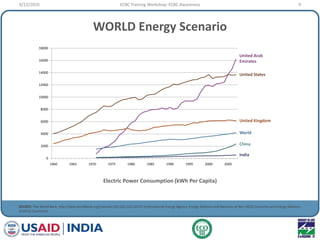
WORLD Energy Scenario
Electric Power Consumption (kWh Per Capita)
SOURCE: The World Bank. http://data.worldbank.org/indicator/EG.USE.ELEC.KH.PC (International Energy Agency, Energy Statistics and Balances of Non-OECD Countries and Energy Statistics
of OECD Countries)
0
2000
4000
6000
8000
10000
12000
14000
16000
18000
1960 1965 1970 1975 1980 1985 1990 1995 2000 2005
United Arab
Emirates
United States
United Kingdom
World
China
India
9/22/2010 9ECBC Training Workshop: ECBC Awareness
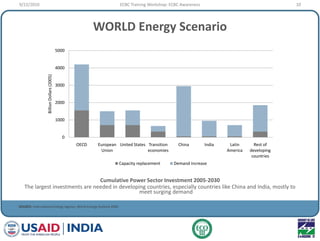
WORLD Energy Scenario
Cumulative Power Sector Investment 2005-2030
The largest investments are needed in developing countries, especially countries like China and India, mostly to
meet surging demand
SOURCE: International Energy Agency, World Energy Outlook 2006
0
1000
2000
3000
4000
5000
OECD European
Union
United States Transition
economies
China India Latin
America
Rest of
developing
countries
BillionDollars(2005)
Capacity replacement Demand increase
9/22/2010 10ECBC Training Workshop: ECBC Awareness
Energy Scenario in INDIA
» 16% of global population
» 4.5% Compound Annual Growth Rate (CAGR) in primary energy demand (1997-2007)
» Capital Investment needed on Supply Side - approx. $1 trillion
» Installed Capacity in India – approx. 160,000 MW
» Projected Capacity in 2030 – 800,000 MW
• 600 MW capacity addition each week for the next 20 years
» Continued deficit supply in 2007-08 (MoP)
• Peak power deficit of 16.6%
• Energy Deficit of 9.9%
» Capacity Added by China in last two years – 180,000 MW
• More than total installed capacity in India
» 66% of India’s Commercial Buildings Stock in 2030 has not been built yet
» No other country in the history would have encountered the growth in the AC load that India is
poised to experience
9/22/2010 11ECBC Training Workshop: ECBC Awareness
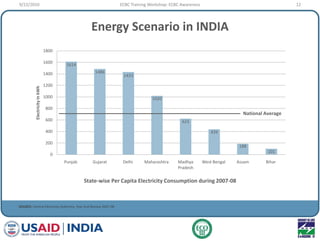
Energy Scenario in INDIA
State-wise Per Capita Electricity Consumption during 2007-08
SOURCE: Central Electricity Authority, Year End Review 2007-08
1614
1486
1433
1020
623
439
188
101
0
200
400
600
800
1000
1200
1400
1600
1800
Punjab Gujarat Delhi Maharashtra Madhya
Pradesh
West Bengal Assam Bihar
ElectricityinkWh
National Average
9/22/2010 12ECBC Training Workshop: ECBC Awareness
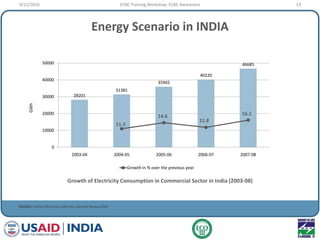
Energy Scenario in INDIA
Growth of Electricity Consumption in Commercial Sector in India (2003-08)
SOURCE: Central Electricity Authority, General Review 2009
28201
31381
35965
40220
46685
11.3
14.6
11.8
16.1
0
10000
20000
30000
40000
50000
2003-04 2004-05 2005-06 2006-07 2007-08
GWh
Growth in % over the previous year
9/22/2010 13ECBC Training Workshop: ECBC Awareness
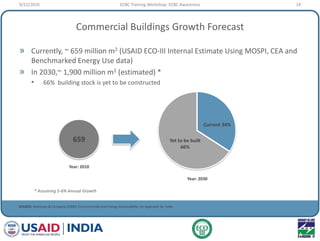
Commercial Buildings Growth Forecast
» Currently, ~ 659 million m2 (USAID ECO-III Internal Estimate Using MOSPI, CEA and
Benchmarked Energy Use data)
» In 2030,~ 1,900 million m2 (estimated) *
• 66% building stock is yet to be constructed
SOURCE: McKinsey & Company (2009), Environmental and Energy Sustainability: An Approach for India
Year: 2010
659
Year: 2030
* Assuming 5-6% Annual Growth
Current 34%
Yet to be built
66%
9/22/2010 14ECBC Training Workshop: ECBC Awareness
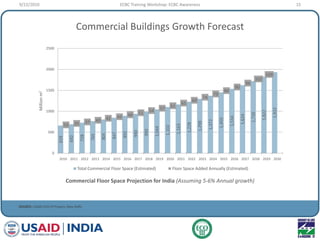
Commercial Buildings Growth Forecast
Commercial Floor Space Projection for India (Assuming 5-6% Annual growth)
SOURCE: USAID ECO-III Project, New Delhi
659
692
728
765
805
847
892
940
990
1,044
1,102
1,163
1,228
1,298
1,372
1,450
1,534
1,624
1,720
1,822
1,932
33 35 37 40 42 45 48 51 54 57
61
65
69
74
79
84
90
96
102
109
0
500
1000
1500
2000
2500
2010 2011 2012 2013 2014 2015 2016 2017 2018 2019 2020 2021 2022 2023 2024 2025 2026 2027 2028 2029 2030
Millionm2
Total Commercial Floor Space (Estimated) Floor Space Added Annually (Estimated)
9/22/2010 15ECBC Training Workshop: ECBC Awareness
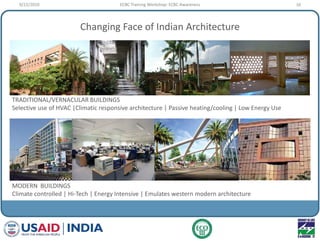
Changing Face of Indian Architecture
TRADITIONAL/VERNACULAR BUILDINGS
Selective use of HVAC |Climatic responsive architecture | Passive heating/cooling | Low Energy Use
MODERN BUILDINGS
Climate controlled | Hi-Tech | Energy Intensive | Emulates western modern architecture
9/22/2010 16ECBC Training Workshop: ECBC Awareness
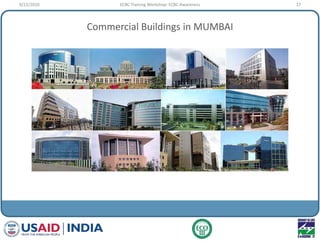
Commercial Buildings in MUMBAI
9/22/2010 17ECBC Training Workshop: ECBC Awareness
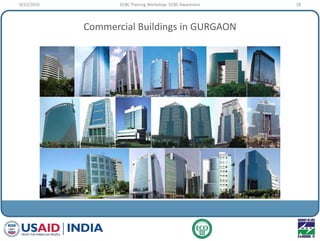
Commercial Buildings in GURGAON
9/22/2010 18ECBC Training Workshop: ECBC Awareness
About the ECO-III PROJECT
» Bilateral Project Between US and Govt. of India
• Implemented jointly with BEE
• Phase III started in Nov. 2006
• Implemented by IRG and its partners
» Focused on BEE Thrust Areas
• Energy Conservation Action Plan for Designated State Agencies (SDAs)
• Energy Efficiency in Buildings (new and existing)
• Energy Efficiency in Municipalities (Water Pumping & Street Lighting)
• Energy Efficiency in Small and Medium Enterprises (SME)
• Curriculum Enhancement of Academic Institutes
» Market transformation through innovative approaches
• Alliance for an Energy-Efficient Economy
• Regional Energy Efficiency Centers
• Capacity Building for Implementation of DSM Programs
9/22/2010 19ECBC Training Workshop: ECBC Awareness
ECBC Implementation: ECO-III Milestones
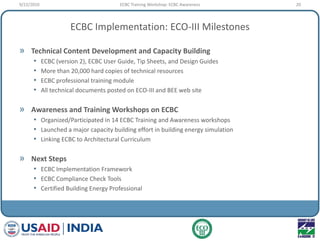
» Technical Content Development and Capacity Building
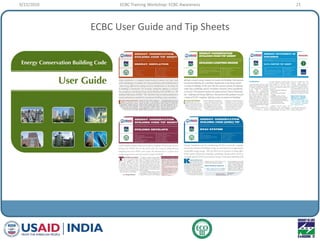
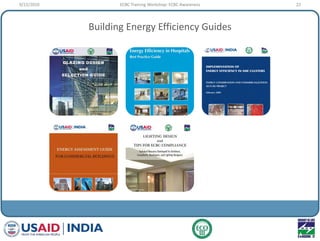
• ECBC (version 2), ECBC User Guide, Tip Sheets, and Design Guides
• More than 20,000 hard copies of technical resources
• ECBC professional training module
• All technical documents posted on ECO-III and BEE web site
» Awareness and Training Workshops on ECBC
• Organized/Participated in 14 ECBC Training and Awareness workshops
• Launched a major capacity building effort in building energy simulation
• Linking ECBC to Architectural Curriculum
» Next Steps
• ECBC Implementation Framework
• ECBC Compliance Check Tools
• Certified Building Energy Professional
9/22/2010 20ECBC Training Workshop: ECBC Awareness
ECBC User Guide and Tip Sheets
9/22/2010 21ECBC Training Workshop: ECBC Awareness
Building Energy Efficiency Guides
9/22/2010 22ECBC Training Workshop: ECBC Awareness
ECBC Introduction
» ECBC sets minimum energy efficiency standards for design and construction of
commercial buildings
» ECBC encourages energy efficient design or retrofit of buildings so that
• Does not constrain the building function, comfort, health, or the productivity of the occupants
• It has appropriate regard for economic considerations
» Addresses local design conditions and helps improve existing construction
practices
» Emphasis on Integrated Building Design approach
» First generation code – ease of use and continuous improvement
9/22/2010 23ECBC Training Workshop: ECBC Awareness
BACKGROUND: Energy Conservation Act 2001
» Government of India - creation of Bureau of Energy Efficiency (BEE)
» Powers and Functions of BEE vis-à-vis ECBC
• Prescribe ECBC for efficient use of energy
• Take suitable steps to prescribe guidelines for ECBC
• Link Energy Performance Index (from the EC Act) to the ECBC Prescriptive Compliance Approach
in order to facilitate the implementation of the Code
[On Page 5, clause (j) of the EC Act, 2001 currently reads:
"energy conservation building codes" means the norms and standards of energy consumption expressed in terms
of per square meter of the area wherein energy is used and includes the location of the building]
» Power of State Government:
The State Govt., in consultation with BEE, may
• amend ECBC to suit the regional and local climatic conditions with respect to use of energy in
the buildings
• direct the owner or occupier of a building (if notified as a Designated Consumer) to comply with
the provisions of ECBC
9/22/2010 24ECBC Training Workshop: ECBC Awareness
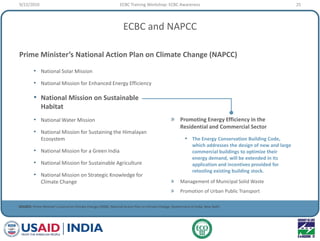
ECBC and NAPCC
• National Solar Mission
• National Mission for Enhanced Energy Efficiency
• National Mission on Sustainable
Habitat
• National Water Mission
• National Mission for Sustaining the Himalayan
Ecosystem
• National Mission for a Green India
• National Mission for Sustainable Agriculture
• National Mission on Strategic Knowledge for
Climate Change
» Promoting Energy Efficiency in the
Residential and Commercial Sector
• The Energy Conservation Building Code,
which addresses the design of new and large
commercial buildings to optimize their
energy demand, will be extended in its
application and incentives provided for
retooling existing building stock.
» Management of Municipal Solid Waste
» Promotion of Urban Public Transport
SOURCE: Prime Minister’s Council on Climate Change (2008), National Action Plan on Climate Change, Government of India, New Delhi
Prime Minister’s National Action Plan on Climate Change (NAPCC)
9/22/2010 25ECBC Training Workshop: ECBC Awareness
Development of ECBC
» Broad Stakeholder participation
• Building Industry, Manufacturers, Professionals, Govt. Agencies etc.
» ECO-II facilitated the development of ECBC
• ECBC committee of experts
» An extensive data collection was carried out for construction types and
materials, glass types, insulation materials, lighting and HVAC equipment
» Base case simulation models were developed
» The stringency analysis was done through detailed energy and life cycle cost
analysis
» A stringency level for each code component was established
9/22/2010 26ECBC Training Workshop: ECBC Awareness
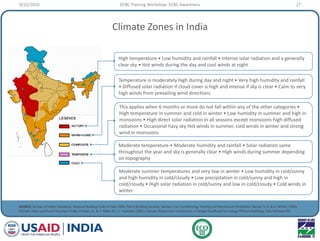
Climate Zones in India
SOURCE: Bureau of Indian Standards, National Building Code of India 2005, Part 8 Building Services, Section 3 Air Conditioning, Heating and Mechanical Ventilation; Bansal, N. K. & G. Minke (1990),
Climatic Zones and Rural Housing in India; Krishan, A., N. Y. Baker & S. V. Szokolay (2001), Climate Responsive Architecture: A Design Handbook for Energy Efficient Buildings, Tata McGraw Hill
High temperature • Low humidity and rainfall • Intense solar radiation and a generally
clear sky • Hot winds during the day and cool winds at night
Temperature is moderately high during day and night • Very high humidity and rainfall
• Diffused solar radiation if cloud cover is high and intense if sky is clear • Calm to very
high winds from prevailing wind directions
This applies when 6 months or more do not fall within any of the other categories •
High temperature in summer and cold in winter • Low humidity in summer and high in
monsoons • High direct solar radiation in all seasons except monsoons high diffused
radiation • Occasional hazy sky Hot winds in summer, cold winds in winter and strong
wind in monsoons
Moderate temperature • Moderate humidity and rainfall • Solar radiation same
throughout the year and sky is generally clear • High winds during summer depending
on topography
Moderate summer temperatures and very low in winter • Low humidity in cold/sunny
and high humidity in cold/cloudy • Low precipitation in cold/sunny and high in
cold/cloudy • High solar radiation in cold/sunny and low in cold/cloudy • Cold winds in
winter
9/22/2010 27ECBC Training Workshop: ECBC Awareness
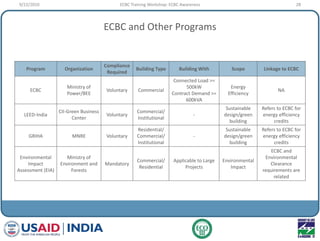
ECBC and Other Programs
Program Organization
Compliance
Required
Building Type Building With Scope Linkage to ECBC
ECBC
Ministry of
Power/BEE
Voluntary Commercial
Connected Load >=
500kW
Contract Demand >=
600kVA
Energy
Efficiency
NA
LEED-India
CII-Green Business
Center
Voluntary
Commercial/
Institutional
-
Sustainable
design/green
building
Refers to ECBC for
energy efficiency
credits
GRIHA MNRE Voluntary
Residential/
Commercial/
Institutional
-
Sustainable
design/green
building
Refers to ECBC for
energy efficiency
credits
Environmental
Impact
Assessment (EIA)
Ministry of
Environment and
Forests
Mandatory
Commercial/
Residential
Applicable to Large
Projects
Environmental
Impact
ECBC and
Environmental
Clearance
requirements are
related
9/22/2010 28ECBC Training Workshop: ECBC Awareness
Significance of ECBC
» Regulates building thermal performance & energy use according to climate zone
• Encourages climatic responsive building design
» Encourages use of daylighting, shading, natural ventilation, solar energy etc.
• Energy efficiency strategies appropriate for India
» Focuses on energy performance of buildings rather than green building design
• Material properties, water use, building site etc. not regulated
• Green Building Design standards will refer to ECBC for energy performance
9/22/2010 29ECBC Training Workshop: ECBC Awareness
ECBC and Energy Savings
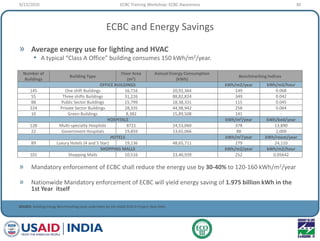
» Average energy use for lighting and HVAC
• A typical “Class A Office” building consumes 150 kWh/m2/year.
» Mandatory enforcement of ECBC shall reduce the energy use by 30-40% to 120-160 kWh/m2/year
» Nationwide Mandatory enforcement of ECBC will yield energy saving of 1.975 billion kWh in the
1st Year itself
SOURCE: Building Energy Benchmarking study undertaken by the USAID ECO-III Project, New Delhi
Number of
Buildings
Building Type
Floor Area
(m2)
Annual Energy Consumption
(kWh)
Benchmarking Indices
OFFICE BUILDINGS kWh/m2/year kWh/m2/hour
145 One shift Buildings 16,716 20,92,364 149 0.068
55 Three shifts Buildings 31,226 88,82,824 349 0.042
88 Public Sector Buildings 15,799 18,38,331 115 0.045
224 Private Sector Buildings 28,335 44,98,942 258 0.064
10 Green Buildings 8,382 15,89,508 141 -
HOSPITALS kWh/m2/year kWh/bed/year
128 Multi-specialty Hospitals 8721 24,53,060 378 13,890
22 Government Hospitals 19,859 13,65,066 88 2,009
HOTELS kWh/m2/year kWh/room/year
89 Luxury Hotels (4 and 5 Star) 19,136 48,65,711 279 24,110
SHOPPING MALLS kWh/m2/year kWh/m2/hour
101 Shopping Malls 10,516 23,40,939 252 0.05642
9/22/2010 30ECBC Training Workshop: ECBC Awareness
ECBC and Energy Savings
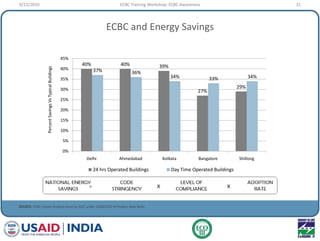
SOURCE: ECBC Impact Analysis done by IECC under USAID ECO-III Project, New Delhi
40% 40% 39%
27%
29%
37% 36%
34% 33% 34%
0%
5%
10%
15%
20%
25%
30%
35%
40%
45%
Delhi Ahmedabad Kolkata Bangalore Shillong
PercentSavingsVsTypicalBuildings
24 hrs Operated Buildings Day Time Operated Buildings
9/22/2010 31ECBC Training Workshop: ECBC Awareness
Impact of ECBC Compliance
» Market Development for EE products
• Building Insulation
• Energy Efficient Windows (Glass and Frames)
• High-Efficiency HVAC Equipment
» Improved Design Practices
• Lighting and Daylighting
• Natural Ventilation/Free-Cooling Systems
» Improved Building Performance
» Lesser addition of Power Generation Capacity
» Lower HVAC Loads, reduced energy consumption and costs
9/22/2010 32ECBC Training Workshop: ECBC Awareness
End of MODULE
» WORLD Energy Scenario
» Energy Scenario in INDIA
» About the ECO-III Project
» Introduction to ECBC
» Significance of ECBC
9/22/2010 33ECBC Training Workshop: ECBC Awareness
Content Development Team
USAID ECO-III Project
Dr. Satish Kumar
Sanyogita Manu
Aalok Deshmukh
Ravi Kapoor
Project Sub-consultants
Vasudha Lathey
Shruti Narayan
Anurag Bajpai
Contact Information
USAID ECO-III Project
AADI Building, Lower Ground Floor
2 Balbir Saxena Marg, Hauz Khas
New Delhi 110016
T: +91-11-2685-3110
F: +91-11-2685-3114
Email: eco3@irgssa.com
Website: www.eco3.org
Bureau of Energy Efficiency
Government of India, Ministry of Power
4th Floor, SEWA Bhawan, R. K. Puram
New Delhi 110066
T: +91-11-2617-9699
F: +91-11-2617-8352
Email: webmanager-bee@nic.in
Website: www.bee-india.nic.in

ECBC_01-Introduction

  • 1.
  • 2.
    This presentation wasprepared by International Resources Group (IRG) for the Energy Conservation and Commercialization Project (ECO-III), and was made possible by the support of the American People through the United States Agency for International Development (USAID). The contents of this presentation are the sole responsibility of IRG and do not necessarily reflect the views of USAID or the United States Government. The ECO-III Project would like to acknowledge Ministry of Power and the Bureau of Energy Efficiency of Government of India for their support. ACKNOWLEDGEMENT
  • 3.
    All images, photographs,text and all viewable and non-viewable material, except that which has been sourced from the references cited, is the property of USAID ECO-III Project and Bureau of Energy Efficiency, Ministry of Power, Government of India. Reproduction of any part of this material must acknowledge the creative owners. Reproduction of information, images, graphs, text and data sourced from the references cited may have additional copyright protection. Source format: USAID ECO-III Project and Bureau of Energy Efficiency (2010): ECBC Professional Training Material, New Delhi, India COPYRIGHT
  • 4.
    ECBC Training WorkshopObjectives » Energy Conservation Building Code (ECBC) Awareness • Need for the ECBC : Energy Scenario Globally & in India • ECBC Introduction • ECBC & other building codes in India • Impact of the ECBC » Provide Administrative Guidance • ECBC Scope & Administration • Compliance Approaches (Mandatory, Prescriptive, and Whole Building Performance) • Compliance requirements » Provide Guidance for Code Compliance • Technical examples/exercises, compliance forms etc. 9/22/2010 4ECBC Training Workshop: ECBC Awareness
  • 5.
    ECBC Training WorkshopObjectives » Provide Technical Guidance • Building thermal performance basics • Energy efficiency tips • Examples/Case Studies » Provide Useful List of Resources and Reference Materials » ECBC knowledge Evaluation • Interactive Q & A sessions and quiz/test 9/22/2010 5ECBC Training Workshop: ECBC Awareness
  • 6.
    ECBC Workshop Outline MODULE1: ECBC Awareness MODULE 2: ECBC Scope & Administration MODULE 3: Building Envelope MODULE 4: Heating, Lighting & Ventilation (HVAC) MODULE 5: Service Hot Water & Pumping MODULE 6: Lighting MODULE 7: Electric Power MODULE 8: Demonstrating Compliance 9/22/2010 6ECBC Training Workshop: ECBC Awareness
  • 7.
    ECBC Training Workshop MODULE1: Energy Conservation Building Code (ECBC) Awareness
  • 8.
    ECBC Awareness: Outline »WORLD Energy Scenario » Energy Scenario in INDIA » About the ECO-III Project » Introduction to ECBC » Significance of ECBC 9/22/2010 8ECBC Training Workshop: ECBC Awareness
  • 9.
    WORLD Energy Scenario ElectricPower Consumption (kWh Per Capita) SOURCE: The World Bank. http://data.worldbank.org/indicator/EG.USE.ELEC.KH.PC (International Energy Agency, Energy Statistics and Balances of Non-OECD Countries and Energy Statistics of OECD Countries) 0 2000 4000 6000 8000 10000 12000 14000 16000 18000 1960 1965 1970 1975 1980 1985 1990 1995 2000 2005 United Arab Emirates United States United Kingdom World China India 9/22/2010 9ECBC Training Workshop: ECBC Awareness
  • 10.
    WORLD Energy Scenario CumulativePower Sector Investment 2005-2030 The largest investments are needed in developing countries, especially countries like China and India, mostly to meet surging demand SOURCE: International Energy Agency, World Energy Outlook 2006 0 1000 2000 3000 4000 5000 OECD European Union United States Transition economies China India Latin America Rest of developing countries BillionDollars(2005) Capacity replacement Demand increase 9/22/2010 10ECBC Training Workshop: ECBC Awareness
  • 11.
    Energy Scenario inINDIA » 16% of global population » 4.5% Compound Annual Growth Rate (CAGR) in primary energy demand (1997-2007) » Capital Investment needed on Supply Side - approx. $1 trillion » Installed Capacity in India – approx. 160,000 MW » Projected Capacity in 2030 – 800,000 MW • 600 MW capacity addition each week for the next 20 years » Continued deficit supply in 2007-08 (MoP) • Peak power deficit of 16.6% • Energy Deficit of 9.9% » Capacity Added by China in last two years – 180,000 MW • More than total installed capacity in India » 66% of India’s Commercial Buildings Stock in 2030 has not been built yet » No other country in the history would have encountered the growth in the AC load that India is poised to experience 9/22/2010 11ECBC Training Workshop: ECBC Awareness
  • 12.
    Energy Scenario inINDIA State-wise Per Capita Electricity Consumption during 2007-08 SOURCE: Central Electricity Authority, Year End Review 2007-08 1614 1486 1433 1020 623 439 188 101 0 200 400 600 800 1000 1200 1400 1600 1800 Punjab Gujarat Delhi Maharashtra Madhya Pradesh West Bengal Assam Bihar ElectricityinkWh National Average 9/22/2010 12ECBC Training Workshop: ECBC Awareness
  • 13.
    Energy Scenario inINDIA Growth of Electricity Consumption in Commercial Sector in India (2003-08) SOURCE: Central Electricity Authority, General Review 2009 28201 31381 35965 40220 46685 11.3 14.6 11.8 16.1 0 10000 20000 30000 40000 50000 2003-04 2004-05 2005-06 2006-07 2007-08 GWh Growth in % over the previous year 9/22/2010 13ECBC Training Workshop: ECBC Awareness
  • 14.
    Commercial Buildings GrowthForecast » Currently, ~ 659 million m2 (USAID ECO-III Internal Estimate Using MOSPI, CEA and Benchmarked Energy Use data) » In 2030,~ 1,900 million m2 (estimated) * • 66% building stock is yet to be constructed SOURCE: McKinsey & Company (2009), Environmental and Energy Sustainability: An Approach for India Year: 2010 659 Year: 2030 * Assuming 5-6% Annual Growth Current 34% Yet to be built 66% 9/22/2010 14ECBC Training Workshop: ECBC Awareness
  • 15.
    Commercial Buildings GrowthForecast Commercial Floor Space Projection for India (Assuming 5-6% Annual growth) SOURCE: USAID ECO-III Project, New Delhi 659 692 728 765 805 847 892 940 990 1,044 1,102 1,163 1,228 1,298 1,372 1,450 1,534 1,624 1,720 1,822 1,932 33 35 37 40 42 45 48 51 54 57 61 65 69 74 79 84 90 96 102 109 0 500 1000 1500 2000 2500 2010 2011 2012 2013 2014 2015 2016 2017 2018 2019 2020 2021 2022 2023 2024 2025 2026 2027 2028 2029 2030 Millionm2 Total Commercial Floor Space (Estimated) Floor Space Added Annually (Estimated) 9/22/2010 15ECBC Training Workshop: ECBC Awareness
  • 16.
    Changing Face ofIndian Architecture TRADITIONAL/VERNACULAR BUILDINGS Selective use of HVAC |Climatic responsive architecture | Passive heating/cooling | Low Energy Use MODERN BUILDINGS Climate controlled | Hi-Tech | Energy Intensive | Emulates western modern architecture 9/22/2010 16ECBC Training Workshop: ECBC Awareness
  • 17.
    Commercial Buildings inMUMBAI 9/22/2010 17ECBC Training Workshop: ECBC Awareness
  • 18.
    Commercial Buildings inGURGAON 9/22/2010 18ECBC Training Workshop: ECBC Awareness
  • 19.
    About the ECO-IIIPROJECT » Bilateral Project Between US and Govt. of India • Implemented jointly with BEE • Phase III started in Nov. 2006 • Implemented by IRG and its partners » Focused on BEE Thrust Areas • Energy Conservation Action Plan for Designated State Agencies (SDAs) • Energy Efficiency in Buildings (new and existing) • Energy Efficiency in Municipalities (Water Pumping & Street Lighting) • Energy Efficiency in Small and Medium Enterprises (SME) • Curriculum Enhancement of Academic Institutes » Market transformation through innovative approaches • Alliance for an Energy-Efficient Economy • Regional Energy Efficiency Centers • Capacity Building for Implementation of DSM Programs 9/22/2010 19ECBC Training Workshop: ECBC Awareness
  • 20.
    ECBC Implementation: ECO-IIIMilestones » Technical Content Development and Capacity Building • ECBC (version 2), ECBC User Guide, Tip Sheets, and Design Guides • More than 20,000 hard copies of technical resources • ECBC professional training module • All technical documents posted on ECO-III and BEE web site » Awareness and Training Workshops on ECBC • Organized/Participated in 14 ECBC Training and Awareness workshops • Launched a major capacity building effort in building energy simulation • Linking ECBC to Architectural Curriculum » Next Steps • ECBC Implementation Framework • ECBC Compliance Check Tools • Certified Building Energy Professional 9/22/2010 20ECBC Training Workshop: ECBC Awareness
  • 21.
    ECBC User Guideand Tip Sheets 9/22/2010 21ECBC Training Workshop: ECBC Awareness
  • 22.
    Building Energy EfficiencyGuides 9/22/2010 22ECBC Training Workshop: ECBC Awareness
  • 23.
    ECBC Introduction » ECBCsets minimum energy efficiency standards for design and construction of commercial buildings » ECBC encourages energy efficient design or retrofit of buildings so that • Does not constrain the building function, comfort, health, or the productivity of the occupants • It has appropriate regard for economic considerations » Addresses local design conditions and helps improve existing construction practices » Emphasis on Integrated Building Design approach » First generation code – ease of use and continuous improvement 9/22/2010 23ECBC Training Workshop: ECBC Awareness
  • 24.
    BACKGROUND: Energy ConservationAct 2001 » Government of India - creation of Bureau of Energy Efficiency (BEE) » Powers and Functions of BEE vis-à-vis ECBC • Prescribe ECBC for efficient use of energy • Take suitable steps to prescribe guidelines for ECBC • Link Energy Performance Index (from the EC Act) to the ECBC Prescriptive Compliance Approach in order to facilitate the implementation of the Code [On Page 5, clause (j) of the EC Act, 2001 currently reads: "energy conservation building codes" means the norms and standards of energy consumption expressed in terms of per square meter of the area wherein energy is used and includes the location of the building] » Power of State Government: The State Govt., in consultation with BEE, may • amend ECBC to suit the regional and local climatic conditions with respect to use of energy in the buildings • direct the owner or occupier of a building (if notified as a Designated Consumer) to comply with the provisions of ECBC 9/22/2010 24ECBC Training Workshop: ECBC Awareness
  • 25.
    ECBC and NAPCC •National Solar Mission • National Mission for Enhanced Energy Efficiency • National Mission on Sustainable Habitat • National Water Mission • National Mission for Sustaining the Himalayan Ecosystem • National Mission for a Green India • National Mission for Sustainable Agriculture • National Mission on Strategic Knowledge for Climate Change » Promoting Energy Efficiency in the Residential and Commercial Sector • The Energy Conservation Building Code, which addresses the design of new and large commercial buildings to optimize their energy demand, will be extended in its application and incentives provided for retooling existing building stock. » Management of Municipal Solid Waste » Promotion of Urban Public Transport SOURCE: Prime Minister’s Council on Climate Change (2008), National Action Plan on Climate Change, Government of India, New Delhi Prime Minister’s National Action Plan on Climate Change (NAPCC) 9/22/2010 25ECBC Training Workshop: ECBC Awareness
  • 26.
    Development of ECBC »Broad Stakeholder participation • Building Industry, Manufacturers, Professionals, Govt. Agencies etc. » ECO-II facilitated the development of ECBC • ECBC committee of experts » An extensive data collection was carried out for construction types and materials, glass types, insulation materials, lighting and HVAC equipment » Base case simulation models were developed » The stringency analysis was done through detailed energy and life cycle cost analysis » A stringency level for each code component was established 9/22/2010 26ECBC Training Workshop: ECBC Awareness
  • 27.
    Climate Zones inIndia SOURCE: Bureau of Indian Standards, National Building Code of India 2005, Part 8 Building Services, Section 3 Air Conditioning, Heating and Mechanical Ventilation; Bansal, N. K. & G. Minke (1990), Climatic Zones and Rural Housing in India; Krishan, A., N. Y. Baker & S. V. Szokolay (2001), Climate Responsive Architecture: A Design Handbook for Energy Efficient Buildings, Tata McGraw Hill High temperature • Low humidity and rainfall • Intense solar radiation and a generally clear sky • Hot winds during the day and cool winds at night Temperature is moderately high during day and night • Very high humidity and rainfall • Diffused solar radiation if cloud cover is high and intense if sky is clear • Calm to very high winds from prevailing wind directions This applies when 6 months or more do not fall within any of the other categories • High temperature in summer and cold in winter • Low humidity in summer and high in monsoons • High direct solar radiation in all seasons except monsoons high diffused radiation • Occasional hazy sky Hot winds in summer, cold winds in winter and strong wind in monsoons Moderate temperature • Moderate humidity and rainfall • Solar radiation same throughout the year and sky is generally clear • High winds during summer depending on topography Moderate summer temperatures and very low in winter • Low humidity in cold/sunny and high humidity in cold/cloudy • Low precipitation in cold/sunny and high in cold/cloudy • High solar radiation in cold/sunny and low in cold/cloudy • Cold winds in winter 9/22/2010 27ECBC Training Workshop: ECBC Awareness
  • 28.
    ECBC and OtherPrograms Program Organization Compliance Required Building Type Building With Scope Linkage to ECBC ECBC Ministry of Power/BEE Voluntary Commercial Connected Load >= 500kW Contract Demand >= 600kVA Energy Efficiency NA LEED-India CII-Green Business Center Voluntary Commercial/ Institutional - Sustainable design/green building Refers to ECBC for energy efficiency credits GRIHA MNRE Voluntary Residential/ Commercial/ Institutional - Sustainable design/green building Refers to ECBC for energy efficiency credits Environmental Impact Assessment (EIA) Ministry of Environment and Forests Mandatory Commercial/ Residential Applicable to Large Projects Environmental Impact ECBC and Environmental Clearance requirements are related 9/22/2010 28ECBC Training Workshop: ECBC Awareness
  • 29.
    Significance of ECBC »Regulates building thermal performance & energy use according to climate zone • Encourages climatic responsive building design » Encourages use of daylighting, shading, natural ventilation, solar energy etc. • Energy efficiency strategies appropriate for India » Focuses on energy performance of buildings rather than green building design • Material properties, water use, building site etc. not regulated • Green Building Design standards will refer to ECBC for energy performance 9/22/2010 29ECBC Training Workshop: ECBC Awareness
  • 30.
    ECBC and EnergySavings » Average energy use for lighting and HVAC • A typical “Class A Office” building consumes 150 kWh/m2/year. » Mandatory enforcement of ECBC shall reduce the energy use by 30-40% to 120-160 kWh/m2/year » Nationwide Mandatory enforcement of ECBC will yield energy saving of 1.975 billion kWh in the 1st Year itself SOURCE: Building Energy Benchmarking study undertaken by the USAID ECO-III Project, New Delhi Number of Buildings Building Type Floor Area (m2) Annual Energy Consumption (kWh) Benchmarking Indices OFFICE BUILDINGS kWh/m2/year kWh/m2/hour 145 One shift Buildings 16,716 20,92,364 149 0.068 55 Three shifts Buildings 31,226 88,82,824 349 0.042 88 Public Sector Buildings 15,799 18,38,331 115 0.045 224 Private Sector Buildings 28,335 44,98,942 258 0.064 10 Green Buildings 8,382 15,89,508 141 - HOSPITALS kWh/m2/year kWh/bed/year 128 Multi-specialty Hospitals 8721 24,53,060 378 13,890 22 Government Hospitals 19,859 13,65,066 88 2,009 HOTELS kWh/m2/year kWh/room/year 89 Luxury Hotels (4 and 5 Star) 19,136 48,65,711 279 24,110 SHOPPING MALLS kWh/m2/year kWh/m2/hour 101 Shopping Malls 10,516 23,40,939 252 0.05642 9/22/2010 30ECBC Training Workshop: ECBC Awareness
  • 31.
    ECBC and EnergySavings SOURCE: ECBC Impact Analysis done by IECC under USAID ECO-III Project, New Delhi 40% 40% 39% 27% 29% 37% 36% 34% 33% 34% 0% 5% 10% 15% 20% 25% 30% 35% 40% 45% Delhi Ahmedabad Kolkata Bangalore Shillong PercentSavingsVsTypicalBuildings 24 hrs Operated Buildings Day Time Operated Buildings 9/22/2010 31ECBC Training Workshop: ECBC Awareness
  • 32.
    Impact of ECBCCompliance » Market Development for EE products • Building Insulation • Energy Efficient Windows (Glass and Frames) • High-Efficiency HVAC Equipment » Improved Design Practices • Lighting and Daylighting • Natural Ventilation/Free-Cooling Systems » Improved Building Performance » Lesser addition of Power Generation Capacity » Lower HVAC Loads, reduced energy consumption and costs 9/22/2010 32ECBC Training Workshop: ECBC Awareness
  • 33.
    End of MODULE »WORLD Energy Scenario » Energy Scenario in INDIA » About the ECO-III Project » Introduction to ECBC » Significance of ECBC 9/22/2010 33ECBC Training Workshop: ECBC Awareness
  • 34.
    Content Development Team USAIDECO-III Project Dr. Satish Kumar Sanyogita Manu Aalok Deshmukh Ravi Kapoor Project Sub-consultants Vasudha Lathey Shruti Narayan Anurag Bajpai
  • 35.
    Contact Information USAID ECO-IIIProject AADI Building, Lower Ground Floor 2 Balbir Saxena Marg, Hauz Khas New Delhi 110016 T: +91-11-2685-3110 F: +91-11-2685-3114 Email: eco3@irgssa.com Website: www.eco3.org Bureau of Energy Efficiency Government of India, Ministry of Power 4th Floor, SEWA Bhawan, R. K. Puram New Delhi 110066 T: +91-11-2617-9699 F: +91-11-2617-8352 Email: webmanager-bee@nic.in Website: www.bee-india.nic.in