Natural Ventilation
Research
Done by Azra Maliha
Definition
Types of ventilation
1.Wind driven
2.Buoyancy driven
3.Plants
Wind driven ventilation principles
1.Single-sided
2.Cross
3.Stack
Why natural ventilation?
Natural ventilation passive techniques
1.Windows, ventilators, skylight, exterior shades
2.Double-skin façade
3.Solar chimney
Ventilation system strategies
Complications of natural ventilation
When not to use natural ventilation?
Some more design recommendations:
Case study
1.Buildings in Rio De Janeirio
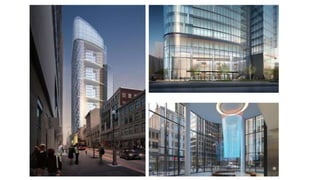
2.PNC Bank tower in Pittsburgh
Application – Fidal Law Office
References
Index
Definition
Natural ventilation is the process in which air is
supplied and removed from an indoor space by natural
means, meaning without the use of a fan or other
mechanical system. It uses outdoor air flow caused by
pressure differences between the building and its
surrounding to provide ventilation and space cooling.
This is a part of Passive Design.
Types of ventilations
1. Wind driven ventilation: When natural wind
blows across a building, the wind hits the
windward wall causing a direct positive
pressure, then moves around the building. If
there are any openings on the walls of the
building, fresh air will rush through the
windows of one side and come out from the
other side to balance the air pressure.
The building shape, placement of the windows
and types play crucial roles in this system.
Types of ventilations
2. Buoyancy driven ventilation: Stack
or buoyancy ventilation can be induced
by temperature or humidity (known as
cool tower). The temperature usage is the
most common. In this type, there is
temperature difference inside the space.
The less dense warm air rises up and the
cooler air gets sucked from the opening
below.
Types of ventilations
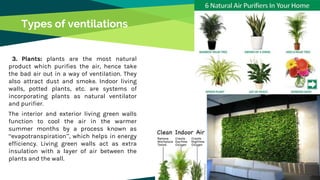
3. Plants: plants are the most natural
product which purifies the air, hence take
the bad air out in a way of ventilation. They
also attract dust and smoke. Indoor living
walls, potted plants, etc. are systems of
incorporating plants as natural ventilator
and purifier.
The interior and exterior living green walls
function to cool the air in the warmer
summer months by a process known as
“evapotranspiration”, which helps in energy
efficiency. Living green walls act as extra
insulation with a layer of air between the
plants and the wall.
Wind driven ventilation principles
There are different basic principles of natural ventilation. It depends upon the number of openings in a
space and the difference in outer and exterior pressure.
1. Single-sided ventilation: windows are situated in only on side of the room, and the ventilation
happens when fresh air enters through the open windows.
2. Cross-ventilation: The ventilation happens primarily by the wind, which creates differences in
wind pressure.
3. Stack-ventilation: This type of ventilation is primarily driven by warm air rising to the top
creating a pressure difference which drives the ventilation. For example, operable skylight
along with windows on different sides of a room.
Why natural ventilation?
•Lowered energy consumption. Natural ventilation requires less energy than a mechanical
ventilation system.
•Space utilization. Mechanical ventilation system takes up to 6.5% of a buildings floor to
0.2% for a natural ventilation system, so, we can use the space of floor plate, ceiling and walls
more efficiently as extra mechanical equipments are not required.
•Green profile. As per the strategies of LEED, BREEAM and other sustainable organizations,
natural ventilation system can contribute a lot in certifying a building as sustainable.
•Natural ventilation has very low carbon footprint, which saves 24-71% carbon emissions in a
building.
•Productivity. Fresh air helps in increasing productivity among the occupants.
• Lower expenditure and minimum maintenance, easy installations.
Natural ventilation passive techniques
(through architectural design)
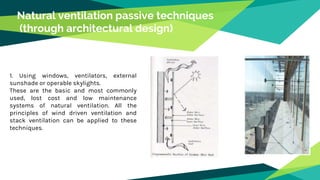
1. Using windows, ventilators, external
sunshade or operable skylights.
These are the basic and most commonly
used, lost cost and low maintenance
systems of natural ventilation. All the
principles of wind driven ventilation and
stack ventilation can be applied to these
techniques.
Natural ventilation passive techniques
(through architectural design)
2. Ventilated double-skin façade.
This is a concept in which the air movement
happens in the void between the two layers
of facades. This technique is widely used in
commercial buildings and skyscrapers.
Wind driven forces out the heat generated
in the air gap by radiation. Through drawing
warm air outside the building, system helps
in preventing heat transition into building
spaces.
Top hung inward opening
Top hung outward
opening
Side hung inward/
outward opening
Natural ventilation passive techniques
(through architectural design)
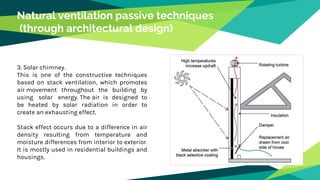
3. Solar chimney.
This is one of the constructive techniques
based on stack ventilation, which promotes
air movement throughout the building by
using solar energy. The air is designed to
be heated by solar radiation in order to
create an exhausting effect.
Stack effect occurs due to a difference in air
density resulting from temperature and
moisture differences from interior to exterior.
It is mostly used in residential buildings and
housings.
Ventilation system strategies
• To provide maximum air supply, no exterior (excessively close neighboring
house) or interior (furniture) obstruction should be present.
• Space planning must be done to include openings in the rooms.
• North side of the building must be optimized by architectural designs.
• Inlets should be located low in a room to supply air, whereas outlets should be
located across the room and at a higher level.
• Minimum of 3 meters of height should be allotted from floor to ceiling.
• Windows shouldn’t be installed with excessive shading systems. It should be
according to building regulations of the specified location.
• Building type and climate of the location should be kept in mind while
designing process.
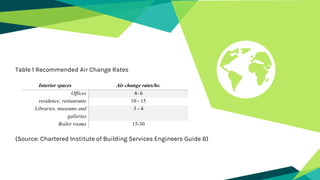
Interior spaces Air change rates/hr.
Offices 4- 6
residence, restaurants 10 - 15
Libraries, museums and
galleries
3 - 4
Boiler rooms 15-30
Table 1 Recommended Air Change Rates
(Source: Chartered Institute of Building Services Engineers Guide B)
Complications with natural ventilation
• Highly depended on weather and climate and easily disturbed during sudden
changes.
• Building configuration and site location issues.
• Managing of the openings can be complicated.
• If smart windows, facades and skylights are used to solve management issues,
those systems can be expensive.
• Allergic and immune compromised patients might experience discomfort.
• The calculations and measurements of ventilation rates.
• Safety sides for openings without railings.
“When not to use natural ventilation?
•If we consider a building situated in heavy traffic zone with high level of noise, natural
ventilation is less suitable in this situation, because large openings will make it tough to
block exterior noise. (Sometimes it can be solved using acoustical ventilation louvers.)
•Sites with poor air quality is not desirable to implement natural ventilation. It can be solved
using filters and ducting, but usually it requires mechanical fan systems, which will either
make it artificial ventilation or hybrid ventilation.
Some more design recommendations:
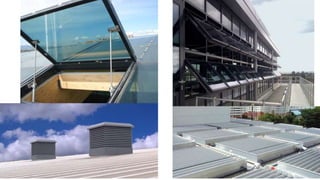
• Placing the ridge of a building perpendicular to the summer
winds can maximize wind-induced ventilation.
• Naturally ventilated buildings should be narrow because it is
difficult to distribute air to a very wide building using only
natural ventilation.
• Each space should have two separate openings for air supply
and exhaust. To maximize stack effect, the exhaust should be
higher than the inlet.
• In buildings with attics, ventilation greatly reduces heat transfer
to conditioned rooms below.
Case Study
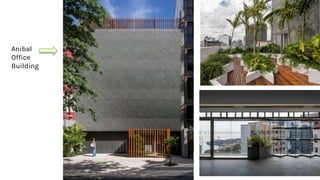
Natural ventilation in buildings of Rio, Brazil is not by choice, but by requirement. It’s the
design consideration which has to be there in any buildings of the city, which serves to cool
both building and its occupants, leading to increasing energy efficiency by reducing
dependence on air conditioners.
One of the major purposes of natural ventilation is to help us maintain thermal comfort
without making any change in the temperature. Natural ventilation is effective in Rio because
exposure to a light breeze removes heat from the human body by convection and evaporation.
This is suitable if the relative humidity does not exceed 80% and temperature do not cross 35
degree Celsius. Rio has temperature below 35 degree even in the hottest months, so this
technique suits the location too.
They have also implemented indoor plants and back-up air condition units, especially in
public areas if by any chance temperature increases abruptly.
1. Buildings in Rio De Janeiro
Anibal
Office
Building
A double-layered facade cloaks all the way around the PNC building, whose outer windows
automatically opens when they sense that temperature and humidity are at the right level
and air pollution is low. In the interior, vents flop open to let in fresh air. On warm days, a solar
chimney which is heated by sun on the roof, opens up, and draws hot air out of the building.
In winter season, the roof collects heat and send it out of the building through a system of
fans. The double-skin facade traps almost 3feet air between each layer, helping insulate the
building and reduce the need for heating or cooling.
The building is also has automatically operable blinds to let in the sun and block out heat.
92% of the office space receives natural sunlight. Artificial lights don't switch on unless
sensors detect that it's truly dim inside.
2. PNC Bank tower in Pittsburgh
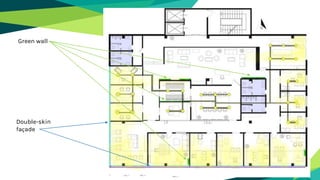
Application
The goal of designing this project was to make the
office space sustainable by optimizing all the possible
ways. For natural ventilation, two types of
technologies were used, Double-skin façade and Green
wall.
1. double-skin façade helps escape stale air from
inside and allows fresh air to enter through the
void made between the exterior and interior
glazing. This also acts as shading system.
2. Green wall uses the concept of implementing
plants as air purifier, especially for closed spaces.
Fidal Law Office
Green wall
Double-skin
façade
References
• https://www.trendcontrols.com/en-
GB/marketing/Documents/English%20Brochures/Eng%20Nat%20Vent%20Bro%20v1%20lo%20res.pdf
• https://www.ghdonline.org/uploads/2009-08-07_0915_Levin_NatVentTheory.pdf
• http://gbtech.emsd.gov.hk/english/utilize/natural.html
• http://www.windowmaster.com/solutions/natural-ventilation/advantages-of-natural-ventilation
• http://www.breathingbuildings.com/knowledge/
• http://www.cpas-egypt.com/pdf/MohamedDarder/Ms.c/Mohamed%20A.%20Dardir%20MSc%20Thesis%20MOD..pdf
• https://sustainabilityworkshop.autodesk.com/buildings/natural-ventilation
• https://www.wbdg.org/resources/natural-ventilation
• http://riorenewables.com/efficient-design/ventilation-airflow
• http://info.moffittcorp.com/blog/top-3-office-buildings-using-natural-ventilation
• https://www.fastcoexist.com/3052151/this-office-tower-could-be-the-greenest-high-rise-in-the-world-because-it-breathes

Natural ventilation

  • 1.
  • 2.
    Definition Types of ventilation 1.Winddriven 2.Buoyancy driven 3.Plants Wind driven ventilation principles 1.Single-sided 2.Cross 3.Stack Why natural ventilation? Natural ventilation passive techniques 1.Windows, ventilators, skylight, exterior shades 2.Double-skin façade 3.Solar chimney Ventilation system strategies Complications of natural ventilation When not to use natural ventilation? Some more design recommendations: Case study 1.Buildings in Rio De Janeirio 2.PNC Bank tower in Pittsburgh Application – Fidal Law Office References Index
  • 3.
    Definition Natural ventilation isthe process in which air is supplied and removed from an indoor space by natural means, meaning without the use of a fan or other mechanical system. It uses outdoor air flow caused by pressure differences between the building and its surrounding to provide ventilation and space cooling. This is a part of Passive Design.
  • 4.
    Types of ventilations 1.Wind driven ventilation: When natural wind blows across a building, the wind hits the windward wall causing a direct positive pressure, then moves around the building. If there are any openings on the walls of the building, fresh air will rush through the windows of one side and come out from the other side to balance the air pressure. The building shape, placement of the windows and types play crucial roles in this system.
  • 5.
    Types of ventilations 2.Buoyancy driven ventilation: Stack or buoyancy ventilation can be induced by temperature or humidity (known as cool tower). The temperature usage is the most common. In this type, there is temperature difference inside the space. The less dense warm air rises up and the cooler air gets sucked from the opening below.
  • 6.
    Types of ventilations 3.Plants: plants are the most natural product which purifies the air, hence take the bad air out in a way of ventilation. They also attract dust and smoke. Indoor living walls, potted plants, etc. are systems of incorporating plants as natural ventilator and purifier. The interior and exterior living green walls function to cool the air in the warmer summer months by a process known as “evapotranspiration”, which helps in energy efficiency. Living green walls act as extra insulation with a layer of air between the plants and the wall.
  • 7.
    Wind driven ventilationprinciples There are different basic principles of natural ventilation. It depends upon the number of openings in a space and the difference in outer and exterior pressure. 1. Single-sided ventilation: windows are situated in only on side of the room, and the ventilation happens when fresh air enters through the open windows. 2. Cross-ventilation: The ventilation happens primarily by the wind, which creates differences in wind pressure. 3. Stack-ventilation: This type of ventilation is primarily driven by warm air rising to the top creating a pressure difference which drives the ventilation. For example, operable skylight along with windows on different sides of a room.
  • 8.
    Why natural ventilation? •Loweredenergy consumption. Natural ventilation requires less energy than a mechanical ventilation system. •Space utilization. Mechanical ventilation system takes up to 6.5% of a buildings floor to 0.2% for a natural ventilation system, so, we can use the space of floor plate, ceiling and walls more efficiently as extra mechanical equipments are not required. •Green profile. As per the strategies of LEED, BREEAM and other sustainable organizations, natural ventilation system can contribute a lot in certifying a building as sustainable. •Natural ventilation has very low carbon footprint, which saves 24-71% carbon emissions in a building. •Productivity. Fresh air helps in increasing productivity among the occupants. • Lower expenditure and minimum maintenance, easy installations.
  • 9.
    Natural ventilation passivetechniques (through architectural design) 1. Using windows, ventilators, external sunshade or operable skylights. These are the basic and most commonly used, lost cost and low maintenance systems of natural ventilation. All the principles of wind driven ventilation and stack ventilation can be applied to these techniques.
  • 10.
    Natural ventilation passivetechniques (through architectural design) 2. Ventilated double-skin façade. This is a concept in which the air movement happens in the void between the two layers of facades. This technique is widely used in commercial buildings and skyscrapers. Wind driven forces out the heat generated in the air gap by radiation. Through drawing warm air outside the building, system helps in preventing heat transition into building spaces. Top hung inward opening Top hung outward opening Side hung inward/ outward opening
  • 11.
    Natural ventilation passivetechniques (through architectural design) 3. Solar chimney. This is one of the constructive techniques based on stack ventilation, which promotes air movement throughout the building by using solar energy. The air is designed to be heated by solar radiation in order to create an exhausting effect. Stack effect occurs due to a difference in air density resulting from temperature and moisture differences from interior to exterior. It is mostly used in residential buildings and housings.
  • 12.
    Ventilation system strategies •To provide maximum air supply, no exterior (excessively close neighboring house) or interior (furniture) obstruction should be present. • Space planning must be done to include openings in the rooms. • North side of the building must be optimized by architectural designs. • Inlets should be located low in a room to supply air, whereas outlets should be located across the room and at a higher level. • Minimum of 3 meters of height should be allotted from floor to ceiling. • Windows shouldn’t be installed with excessive shading systems. It should be according to building regulations of the specified location. • Building type and climate of the location should be kept in mind while designing process.
  • 13.
    Interior spaces Airchange rates/hr. Offices 4- 6 residence, restaurants 10 - 15 Libraries, museums and galleries 3 - 4 Boiler rooms 15-30 Table 1 Recommended Air Change Rates (Source: Chartered Institute of Building Services Engineers Guide B)
  • 14.
    Complications with naturalventilation • Highly depended on weather and climate and easily disturbed during sudden changes. • Building configuration and site location issues. • Managing of the openings can be complicated. • If smart windows, facades and skylights are used to solve management issues, those systems can be expensive. • Allergic and immune compromised patients might experience discomfort. • The calculations and measurements of ventilation rates. • Safety sides for openings without railings.
  • 15.
    “When not touse natural ventilation? •If we consider a building situated in heavy traffic zone with high level of noise, natural ventilation is less suitable in this situation, because large openings will make it tough to block exterior noise. (Sometimes it can be solved using acoustical ventilation louvers.) •Sites with poor air quality is not desirable to implement natural ventilation. It can be solved using filters and ducting, but usually it requires mechanical fan systems, which will either make it artificial ventilation or hybrid ventilation.
  • 16.
    Some more designrecommendations: • Placing the ridge of a building perpendicular to the summer winds can maximize wind-induced ventilation. • Naturally ventilated buildings should be narrow because it is difficult to distribute air to a very wide building using only natural ventilation. • Each space should have two separate openings for air supply and exhaust. To maximize stack effect, the exhaust should be higher than the inlet. • In buildings with attics, ventilation greatly reduces heat transfer to conditioned rooms below.
  • 18.
  • 19.
    Natural ventilation inbuildings of Rio, Brazil is not by choice, but by requirement. It’s the design consideration which has to be there in any buildings of the city, which serves to cool both building and its occupants, leading to increasing energy efficiency by reducing dependence on air conditioners. One of the major purposes of natural ventilation is to help us maintain thermal comfort without making any change in the temperature. Natural ventilation is effective in Rio because exposure to a light breeze removes heat from the human body by convection and evaporation. This is suitable if the relative humidity does not exceed 80% and temperature do not cross 35 degree Celsius. Rio has temperature below 35 degree even in the hottest months, so this technique suits the location too. They have also implemented indoor plants and back-up air condition units, especially in public areas if by any chance temperature increases abruptly. 1. Buildings in Rio De Janeiro
  • 20.
  • 21.
    A double-layered facadecloaks all the way around the PNC building, whose outer windows automatically opens when they sense that temperature and humidity are at the right level and air pollution is low. In the interior, vents flop open to let in fresh air. On warm days, a solar chimney which is heated by sun on the roof, opens up, and draws hot air out of the building. In winter season, the roof collects heat and send it out of the building through a system of fans. The double-skin facade traps almost 3feet air between each layer, helping insulate the building and reduce the need for heating or cooling. The building is also has automatically operable blinds to let in the sun and block out heat. 92% of the office space receives natural sunlight. Artificial lights don't switch on unless sensors detect that it's truly dim inside. 2. PNC Bank tower in Pittsburgh
  • 23.
  • 24.
    The goal ofdesigning this project was to make the office space sustainable by optimizing all the possible ways. For natural ventilation, two types of technologies were used, Double-skin façade and Green wall. 1. double-skin façade helps escape stale air from inside and allows fresh air to enter through the void made between the exterior and interior glazing. This also acts as shading system. 2. Green wall uses the concept of implementing plants as air purifier, especially for closed spaces. Fidal Law Office
  • 25.
  • 26.
    References • https://www.trendcontrols.com/en- GB/marketing/Documents/English%20Brochures/Eng%20Nat%20Vent%20Bro%20v1%20lo%20res.pdf • https://www.ghdonline.org/uploads/2009-08-07_0915_Levin_NatVentTheory.pdf •http://gbtech.emsd.gov.hk/english/utilize/natural.html • http://www.windowmaster.com/solutions/natural-ventilation/advantages-of-natural-ventilation • http://www.breathingbuildings.com/knowledge/ • http://www.cpas-egypt.com/pdf/MohamedDarder/Ms.c/Mohamed%20A.%20Dardir%20MSc%20Thesis%20MOD..pdf • https://sustainabilityworkshop.autodesk.com/buildings/natural-ventilation • https://www.wbdg.org/resources/natural-ventilation • http://riorenewables.com/efficient-design/ventilation-airflow • http://info.moffittcorp.com/blog/top-3-office-buildings-using-natural-ventilation • https://www.fastcoexist.com/3052151/this-office-tower-could-be-the-greenest-high-rise-in-the-world-because-it-breathes