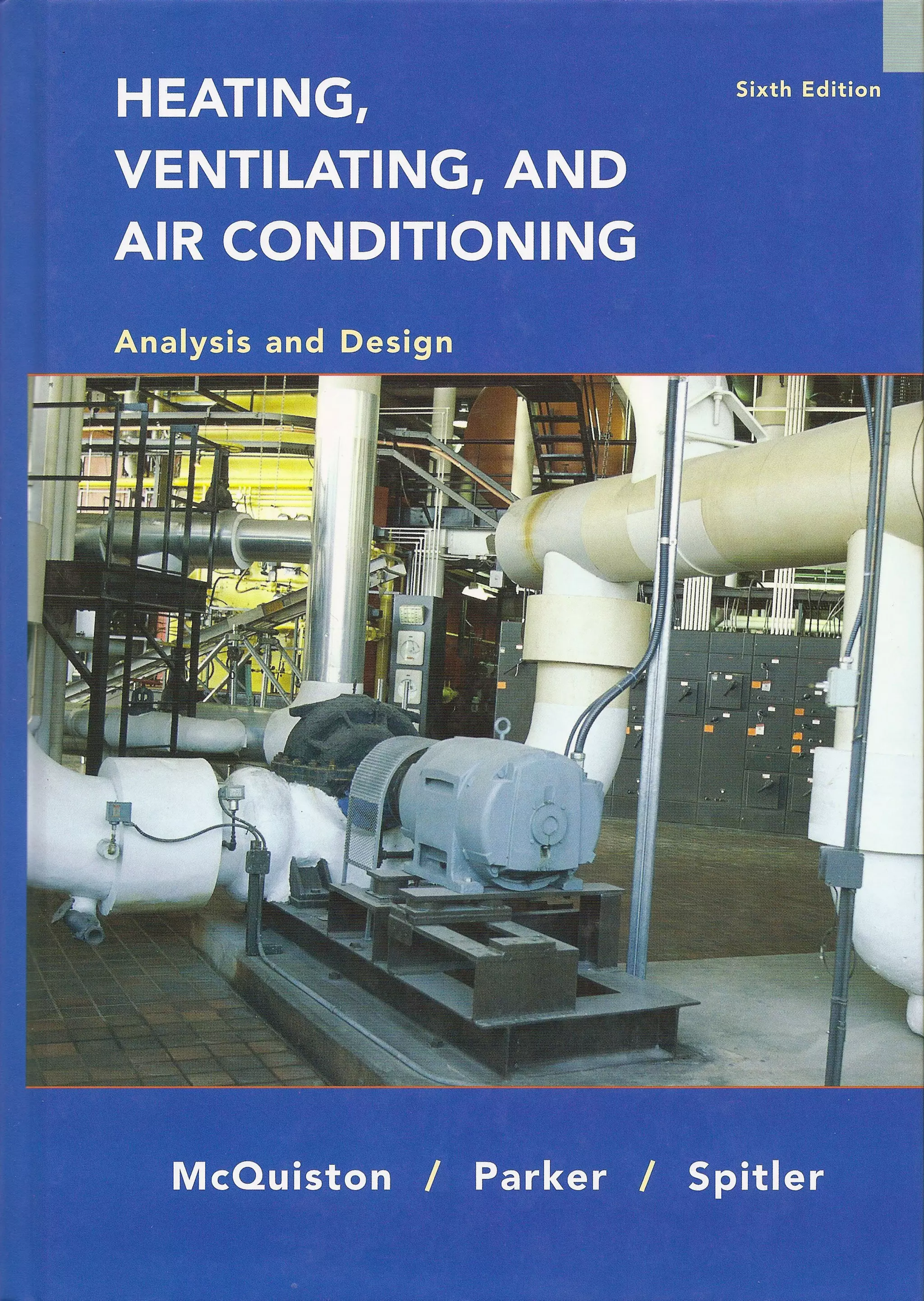
Heating, Ventilating, and
Air Conditioning
Analysis and Design
FrontMatter.qxd 6/15/04 4:06 PM Page i
Heating, Ventilating, and
Air Conditioning
Analysis and Design
Sixth Edition
Faye C. McQuiston
Oklahoma State University
Jerald D. Parker
Oklahoma Christian University
Jeffrey D. Spitler
Oklahoma State University
John Wiley & Sons, Inc.
FrontMatter.qxd 6/15/04 4:06 PM Page iii
Acquisitions Editor Joseph Hayton
Senior Production Editor Valerie A. Vargas
Marketing Manager Jennifer Powers
New Media Editor Thomas Kulesa
Senior Design Manager Harry Nolan
Production Services Argosy Publishing
Cover Image Photo by Eric Stoltenberg, P2S Engineering, Inc. Reproduced with permission.
This book was set in 10/12 Times Roman by Argosy Publishing and printed and bound by
Hamilton Printing. The cover was printed by Phoenix Color Corporation.
This book is printed on acid-free paper.
© 2005 JohnWiley & Sons, Inc. All rights reserved.
No part of this publication may be reproduced, stored in a retrieval system or transmitted
in any form or by any means, electronic, mechanical, photocopying, recording, scanning
or otherwise, except as permitted under Sections 107 or 108 of the 1976 United States
Copyright Act, without either the prior written permission of the Publisher, or
authorization through payment of the appropriate per-copy fee to the Copyright
Clearance Center, 222 Rosewood Drive, Danvers, MA 01923, (978) 750-8400, fax
(978) 646-8600. Requests to the Publisher for permission should be addressed to the
Permissions Department, John Wiley & Sons, Inc., 111 River Street, Hoboken, NJ
07030-5774, (201) 748-6011, fax (201) 748-6008. Mail: PERMREQ@WILEY.COM.
To order books or for customer service, please call 1-800-CALL-WILEY (225-5945).
Library of Congress Cataloging in Publication Data
McQuiston, Faye C.
Heating, ventilating, and air conditioning : analysis and design / Faye C. McQuiston,
Jerald D. Parker, Jeffrey D. Spitler.–6th ed.
p. cm.
Includes bibliographical references and index.
ISBN 0-471-47015-5 (cloth/CD-ROM : alk. paper)
1. Heating. 2. Ventilation. 3. Air conditioning. I. Parker, Jerald D. II. Spitler, Jeffrey
D. III. Title.
TH7222.M26 2005
697–dc22 2004048331
ISBN 0-471-47015-5
ISBN 0-471-66132-5 (WIE)
Printed in the United States of America.
10 9 8 7 6 5 4 3 2 1
FrontMatter.qxd 6/15/04 4:06 PM Page iv
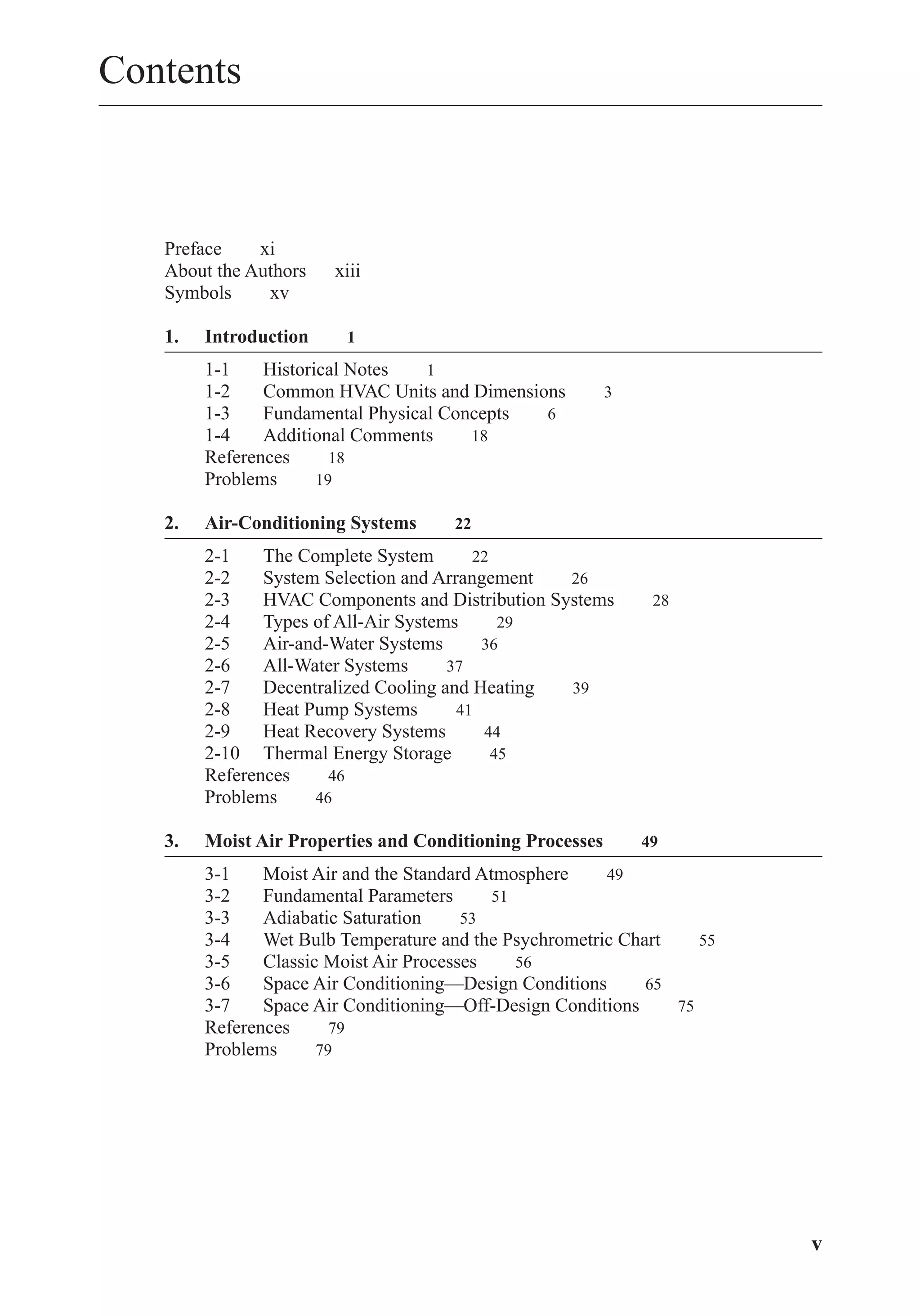
Contents
Preface xi
About the Authors xiii
Symbols xv
1. Introduction 1
1-1 Historical Notes 1
1-2 Common HVAC Units and Dimensions 3
1-3 Fundamental Physical Concepts 6
1-4 Additional Comments 18
References 18
Problems 19
2. Air-Conditioning Systems 22
2-1 The Complete System 22
2-2 System Selection and Arrangement 26
2-3 HVAC Components and Distribution Systems 28
2-4 Types of All-Air Systems 29
2-5 Air-and-Water Systems 36
2-6 All-Water Systems 37
2-7 Decentralized Cooling and Heating 39
2-8 Heat Pump Systems 41
2-9 Heat Recovery Systems 44
2-10 Thermal Energy Storage 45
References 46
Problems 46
3. Moist Air Properties and Conditioning Processes 49
3-1 Moist Air and the Standard Atmosphere 49
3-2 Fundamental Parameters 51
3-3 Adiabatic Saturation 53
3-4 Wet Bulb Temperature and the Psychrometric Chart 55
3-5 Classic Moist Air Processes 56
3-6 Space Air Conditioning—Design Conditions 65
3-7 Space Air Conditioning—Off-Design Conditions 75
References 79
Problems 79
v
FrontMatter.qxd 6/15/04 4:06 PM Page v
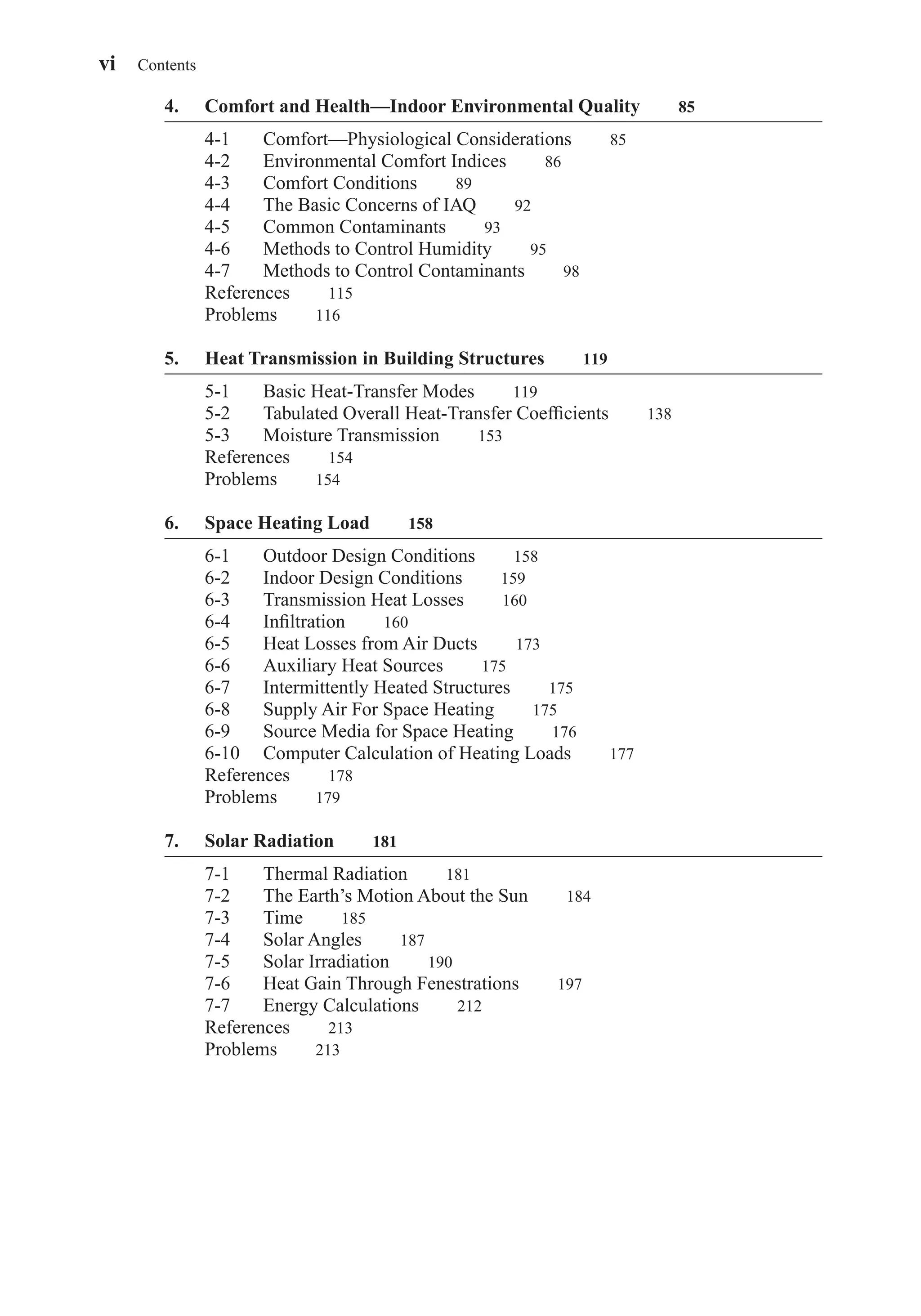
4. Comfort and Health—Indoor Environmental Quality 85
4-1 Comfort—Physiological Considerations 85
4-2 Environmental Comfort Indices 86
4-3 Comfort Conditions 89
4-4 The Basic Concerns of IAQ 92
4-5 Common Contaminants 93
4-6 Methods to Control Humidity 95
4-7 Methods to Control Contaminants 98
References 115
Problems 116
5. Heat Transmission in Building Structures 119
5-1 Basic Heat-Transfer Modes 119
5-2 Tabulated Overall Heat-Transfer Coefficients 138
5-3 Moisture Transmission 153
References 154
Problems 154
6. Space Heating Load 158
6-1 Outdoor Design Conditions 158
6-2 Indoor Design Conditions 159
6-3 Transmission Heat Losses 160
6-4 Infiltration 160
6-5 Heat Losses from Air Ducts 173
6-6 Auxiliary Heat Sources 175
6-7 Intermittently Heated Structures 175
6-8 Supply Air For Space Heating 175
6-9 Source Media for Space Heating 176
6-10 Computer Calculation of Heating Loads 177
References 178
Problems 179
7. Solar Radiation 181
7-1 Thermal Radiation 181
7-2 The Earth’s Motion About the Sun 184
7-3 Time 185
7-4 Solar Angles 187
7-5 Solar Irradiation 190
7-6 Heat Gain Through Fenestrations 197
7-7 Energy Calculations 212
References 213
Problems 213
vi Contents
FrontMatter.qxd 6/15/04 4:06 PM Page vi
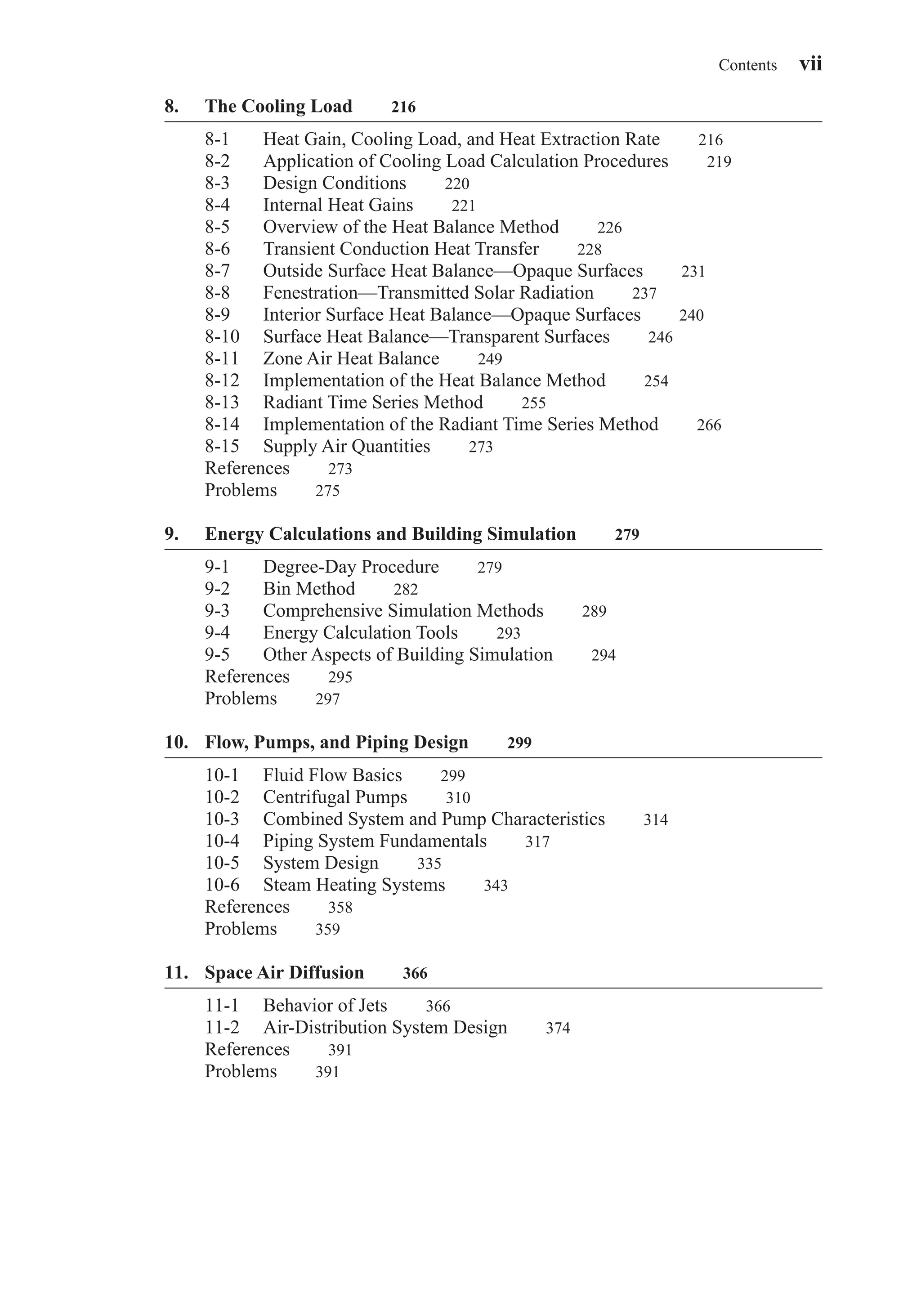
8. The Cooling Load 216
8-1 Heat Gain, Cooling Load, and Heat Extraction Rate 216
8-2 Application of Cooling Load Calculation Procedures 219
8-3 Design Conditions 220
8-4 Internal Heat Gains 221
8-5 Overview of the Heat Balance Method 226
8-6 Transient Conduction Heat Transfer 228
8-7 Outside Surface Heat Balance—Opaque Surfaces 231
8-8 Fenestration—Transmitted Solar Radiation 237
8-9 Interior Surface Heat Balance—Opaque Surfaces 240
8-10 Surface Heat Balance—Transparent Surfaces 246
8-11 Zone Air Heat Balance 249
8-12 Implementation of the Heat Balance Method 254
8-13 Radiant Time Series Method 255
8-14 Implementation of the Radiant Time Series Method 266
8-15 Supply Air Quantities 273
References 273
Problems 275
9. Energy Calculations and Building Simulation 279
9-1 Degree-Day Procedure 279
9-2 Bin Method 282
9-3 Comprehensive Simulation Methods 289
9-4 Energy Calculation Tools 293
9-5 Other Aspects of Building Simulation 294
References 295
Problems 297
10. Flow, Pumps, and Piping Design 299
10-1 Fluid Flow Basics 299
10-2 Centrifugal Pumps 310
10-3 Combined System and Pump Characteristics 314
10-4 Piping System Fundamentals 317
10-5 System Design 335
10-6 Steam Heating Systems 343
References 358
Problems 359
11. Space Air Diffusion 366
11-1 Behavior of Jets 366
11-2 Air-Distribution System Design 374
References 391
Problems 391
Contents vii
FrontMatter.qxd 6/15/04 4:06 PM Page vii
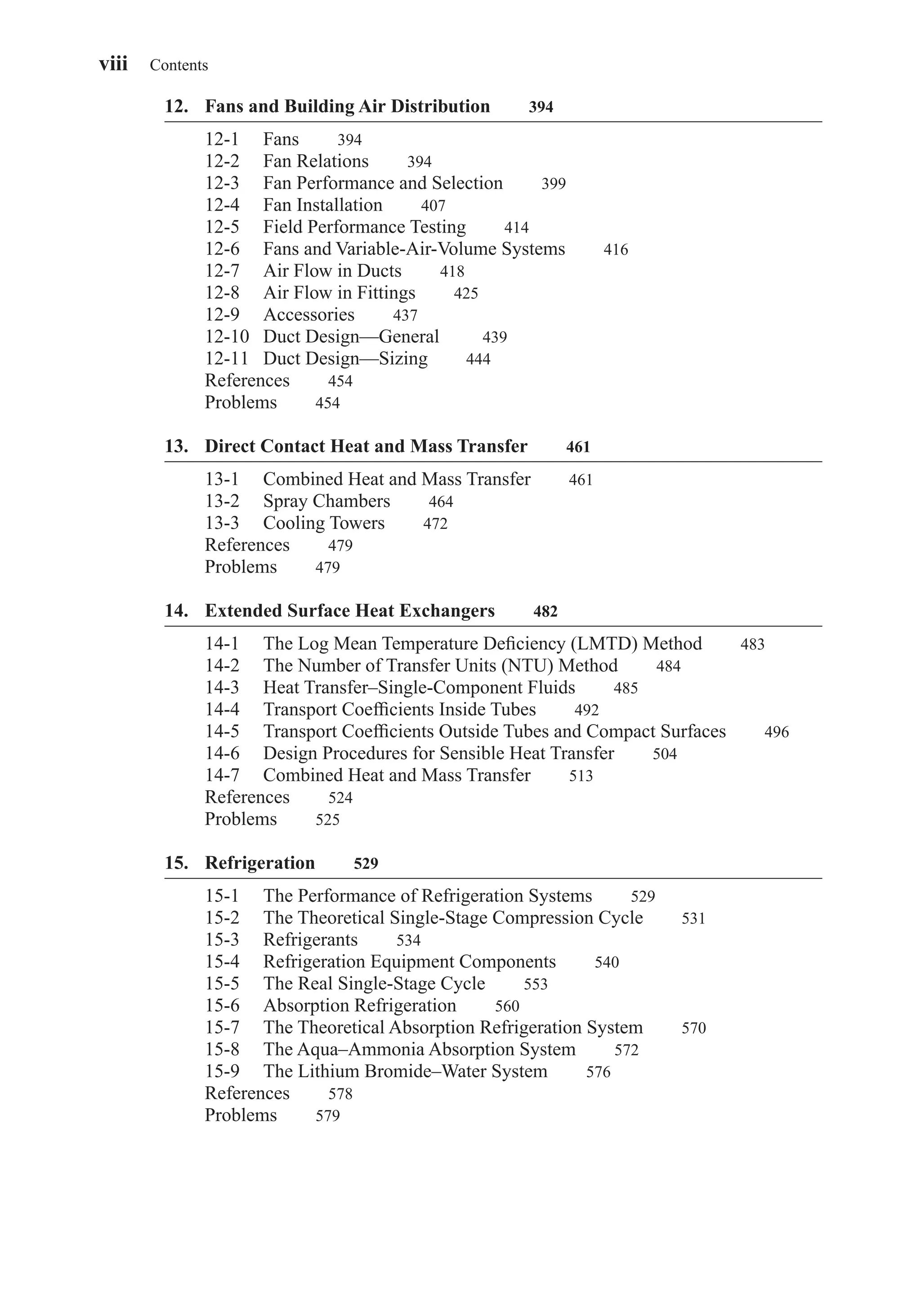
12. Fans and Building Air Distribution 394
12-1 Fans 394
12-2 Fan Relations 394
12-3 Fan Performance and Selection 399
12-4 Fan Installation 407
12-5 Field Performance Testing 414
12-6 Fans and Variable-Air-Volume Systems 416
12-7 Air Flow in Ducts 418
12-8 Air Flow in Fittings 425
12-9 Accessories 437
12-10 Duct Design—General 439
12-11 Duct Design—Sizing 444
References 454
Problems 454
13. Direct Contact Heat and Mass Transfer 461
13-1 Combined Heat and Mass Transfer 461
13-2 Spray Chambers 464
13-3 Cooling Towers 472
References 479
Problems 479
14. Extended Surface Heat Exchangers 482
14-1 The Log Mean Temperature Deficiency (LMTD) Method 483
14-2 The Number of Transfer Units (NTU) Method 484
14-3 Heat Transfer–Single-Component Fluids 485
14-4 Transport Coefficients Inside Tubes 492
14-5 Transport Coefficients Outside Tubes and Compact Surfaces 496
14-6 Design Procedures for Sensible Heat Transfer 504
14-7 Combined Heat and Mass Transfer 513
References 524
Problems 525
15. Refrigeration 529
15-1 The Performance of Refrigeration Systems 529
15-2 The Theoretical Single-Stage Compression Cycle 531
15-3 Refrigerants 534
15-4 Refrigeration Equipment Components 540
15-5 The Real Single-Stage Cycle 553
15-6 Absorption Refrigeration 560
15-7 The Theoretical Absorption Refrigeration System 570
15-8 The Aqua–Ammonia Absorption System 572
15-9 The Lithium Bromide–Water System 576
References 578
Problems 579
viii Contents
FrontMatter.qxd 6/15/04 4:06 PM Page viii
Appendix A. Thermophysical Properties 583
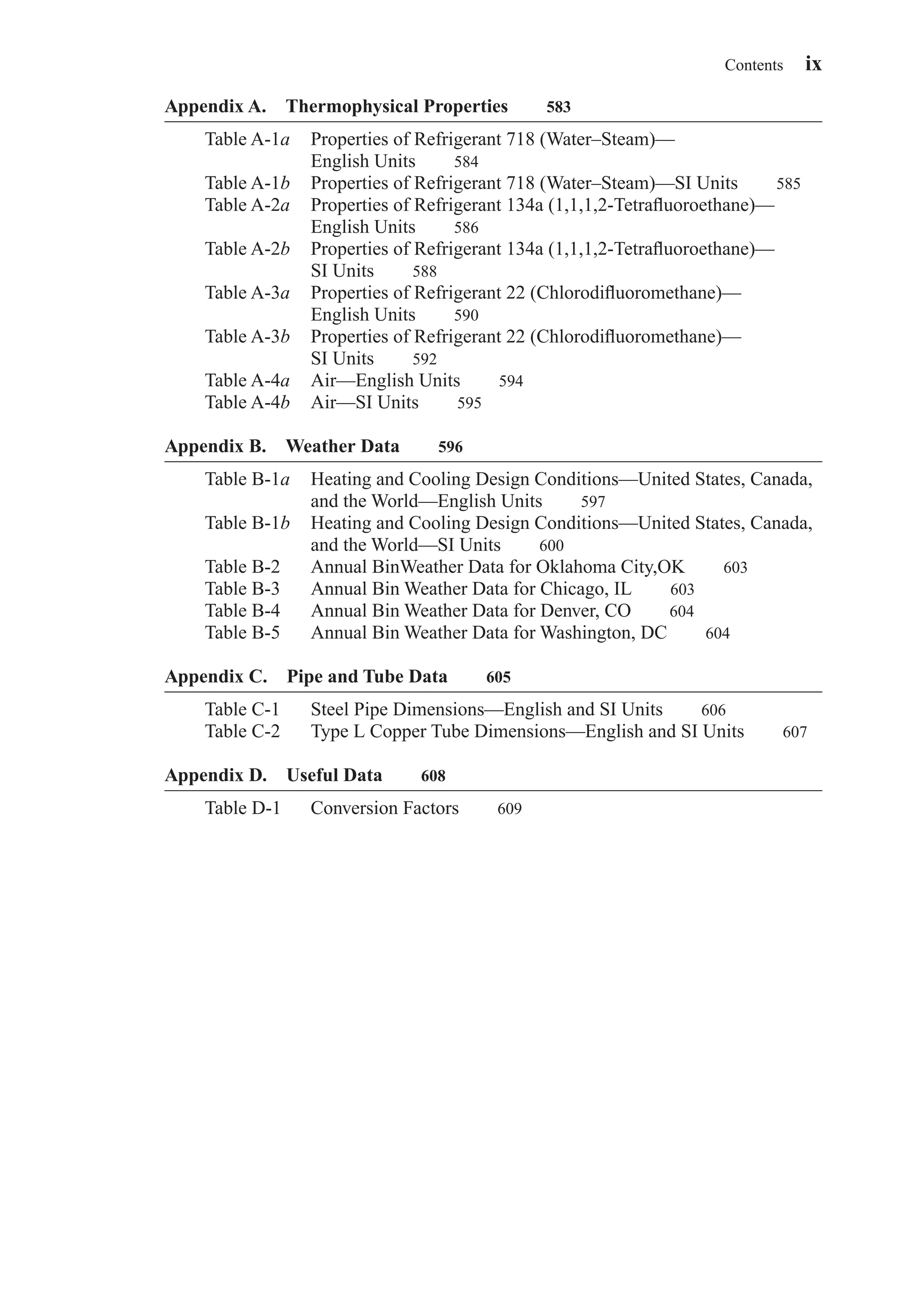
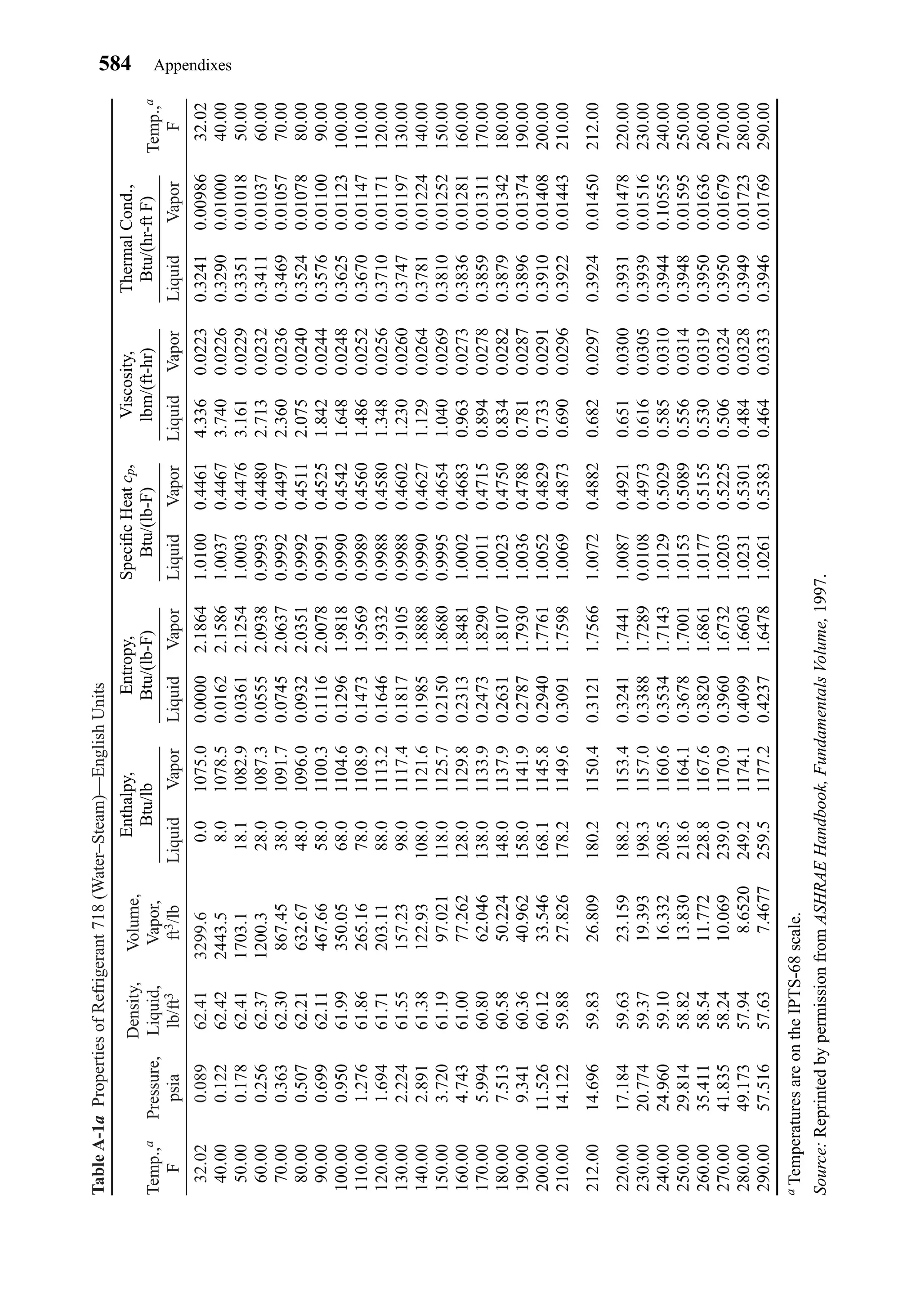
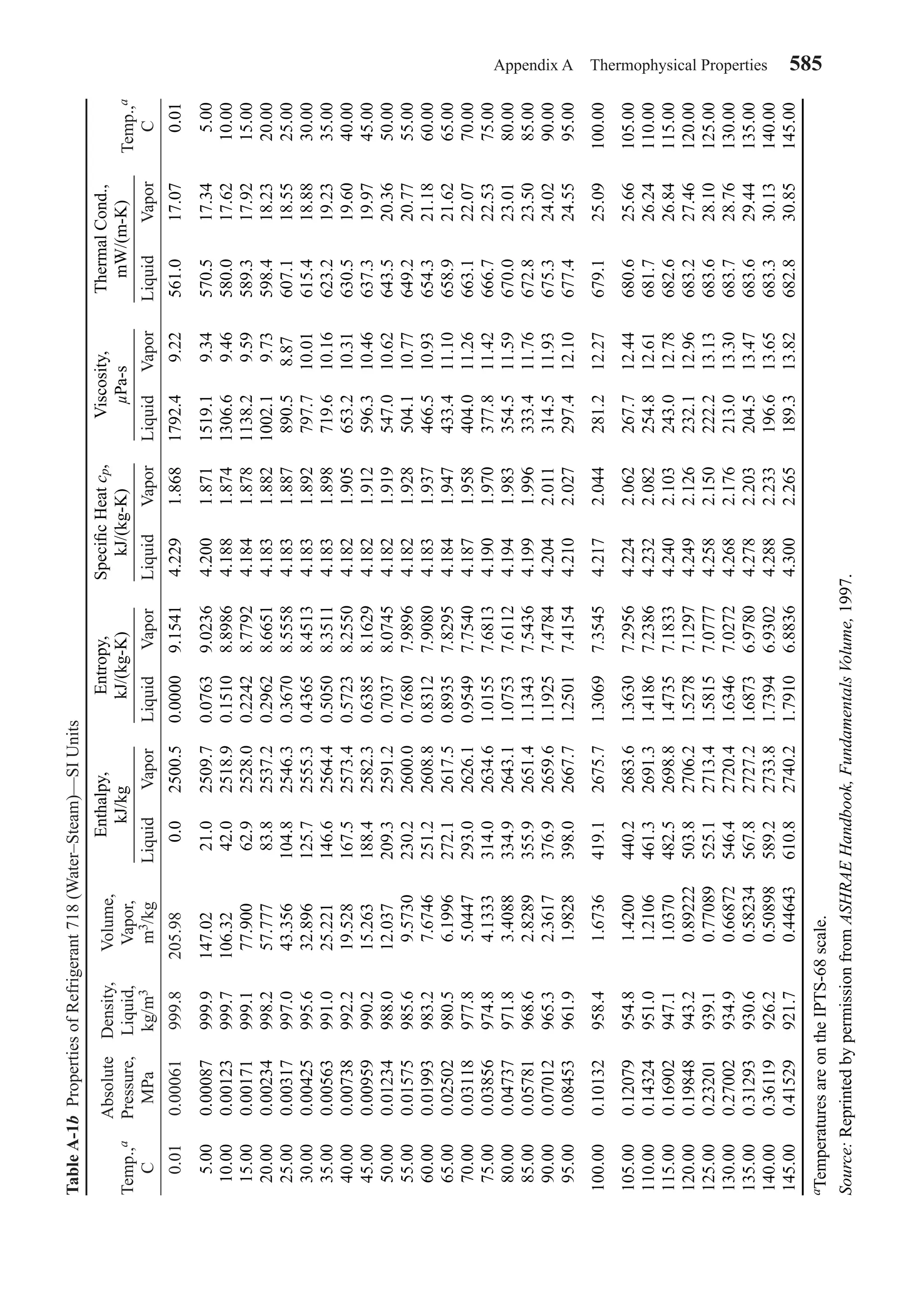
Table A-1a Properties of Refrigerant 718 (Water–Steam)—
English Units 584
Table A-1b Properties of Refrigerant 718 (Water–Steam)—SI Units 585
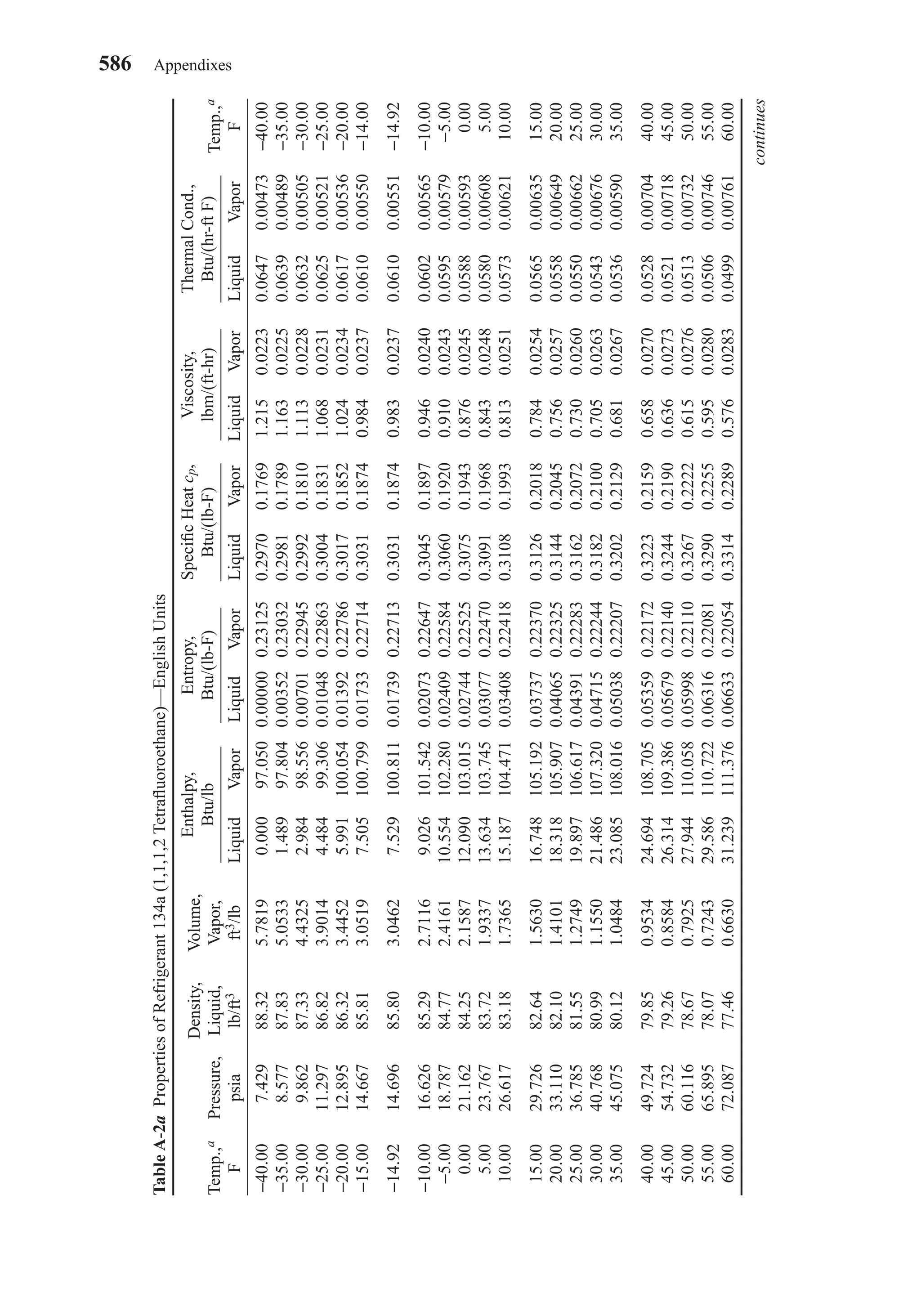
Table A-2a Properties of Refrigerant 134a (1,1,1,2-Tetrafluoroethane)—
English Units 586
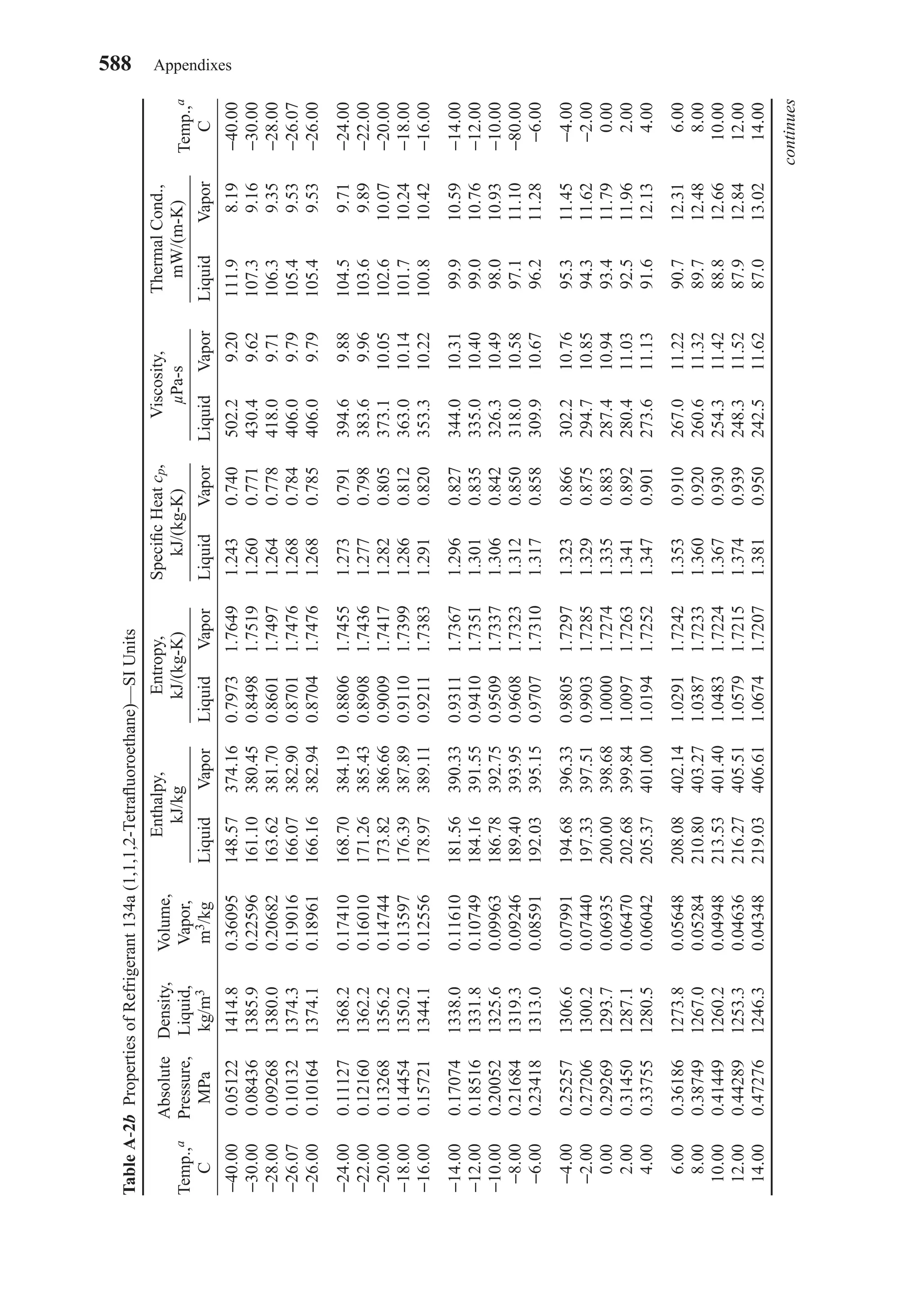
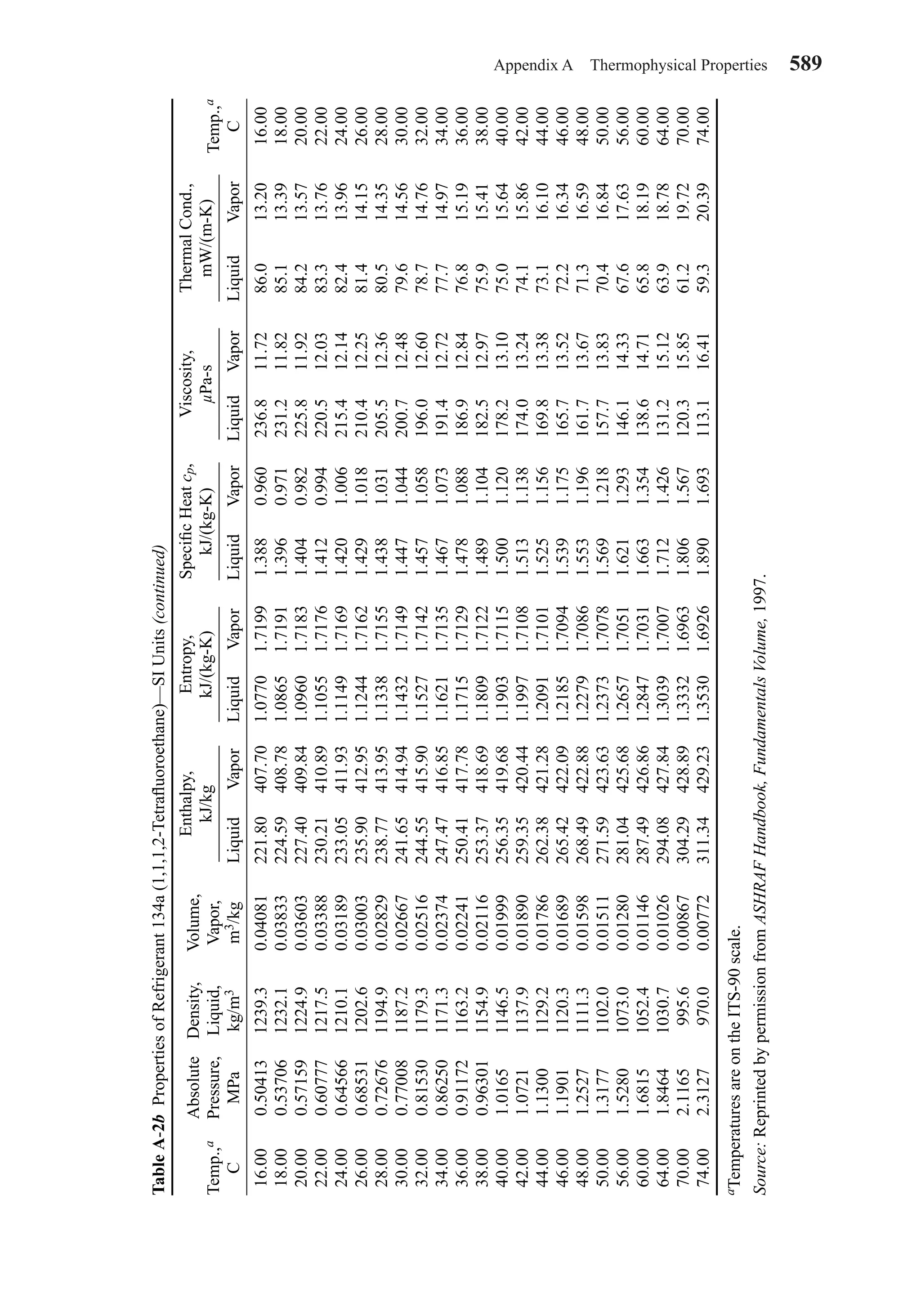
Table A-2b Properties of Refrigerant 134a (1,1,1,2-Tetrafluoroethane)—
SI Units 588
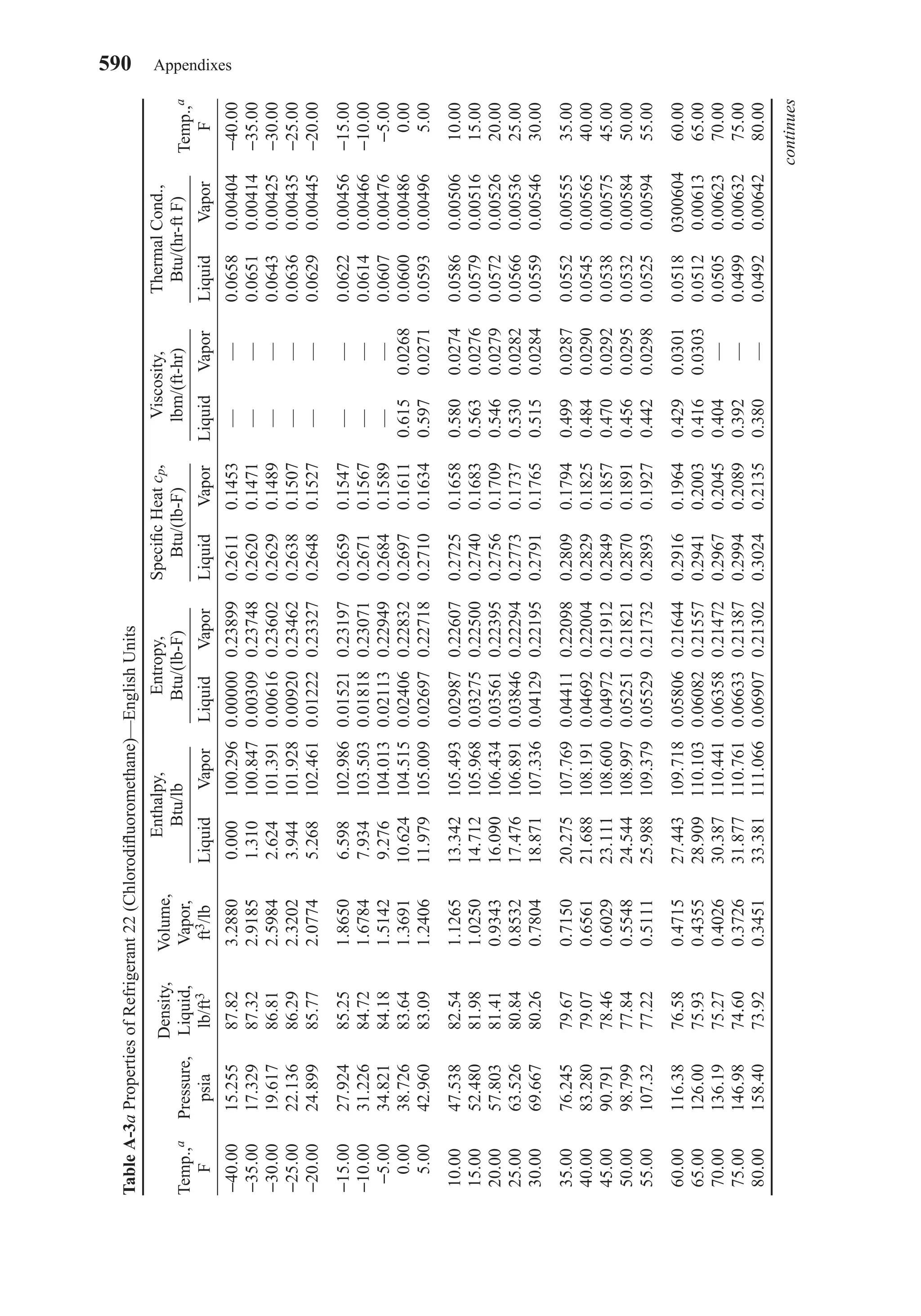
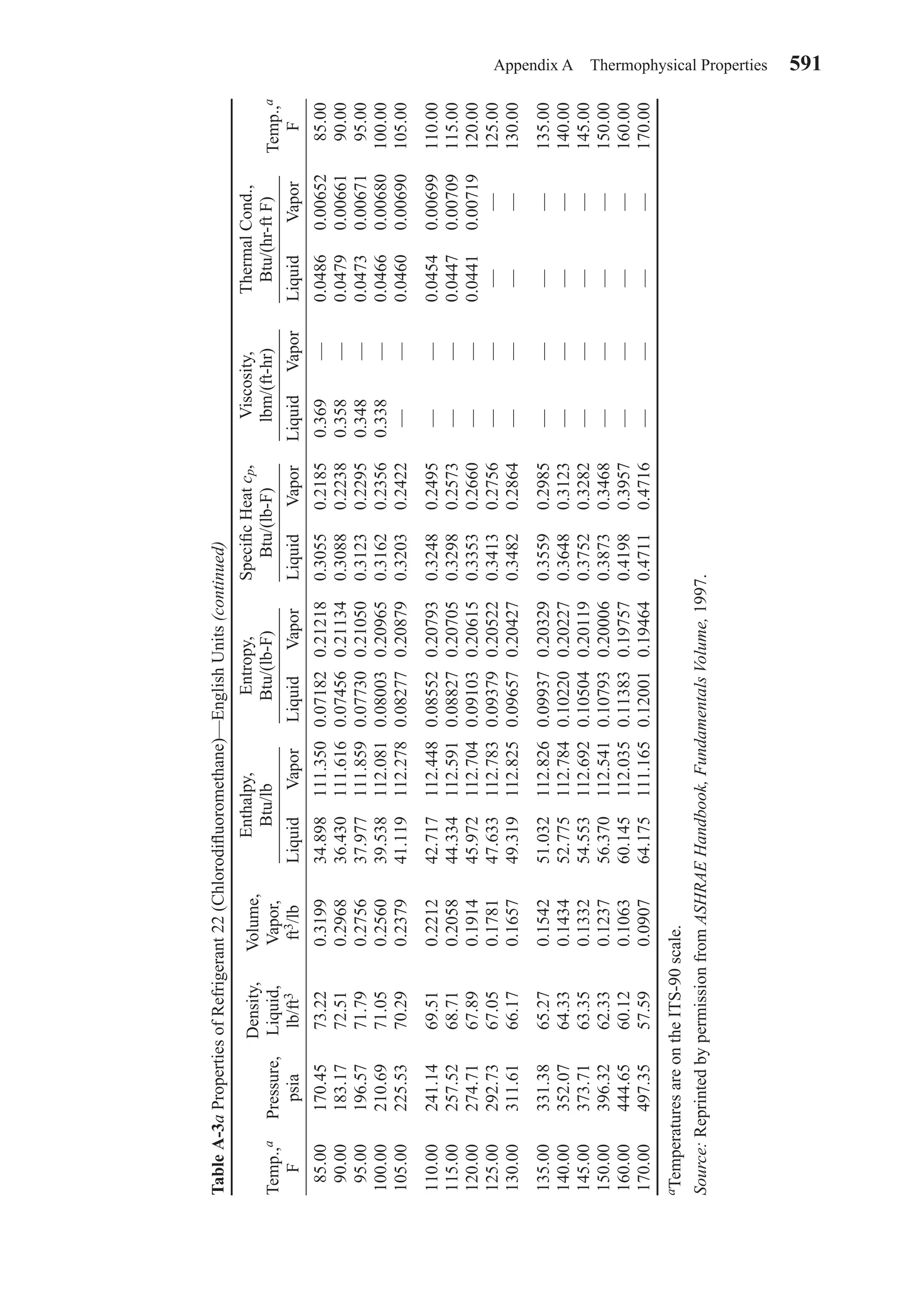
Table A-3a Properties of Refrigerant 22 (Chlorodifluoromethane)—
English Units 590
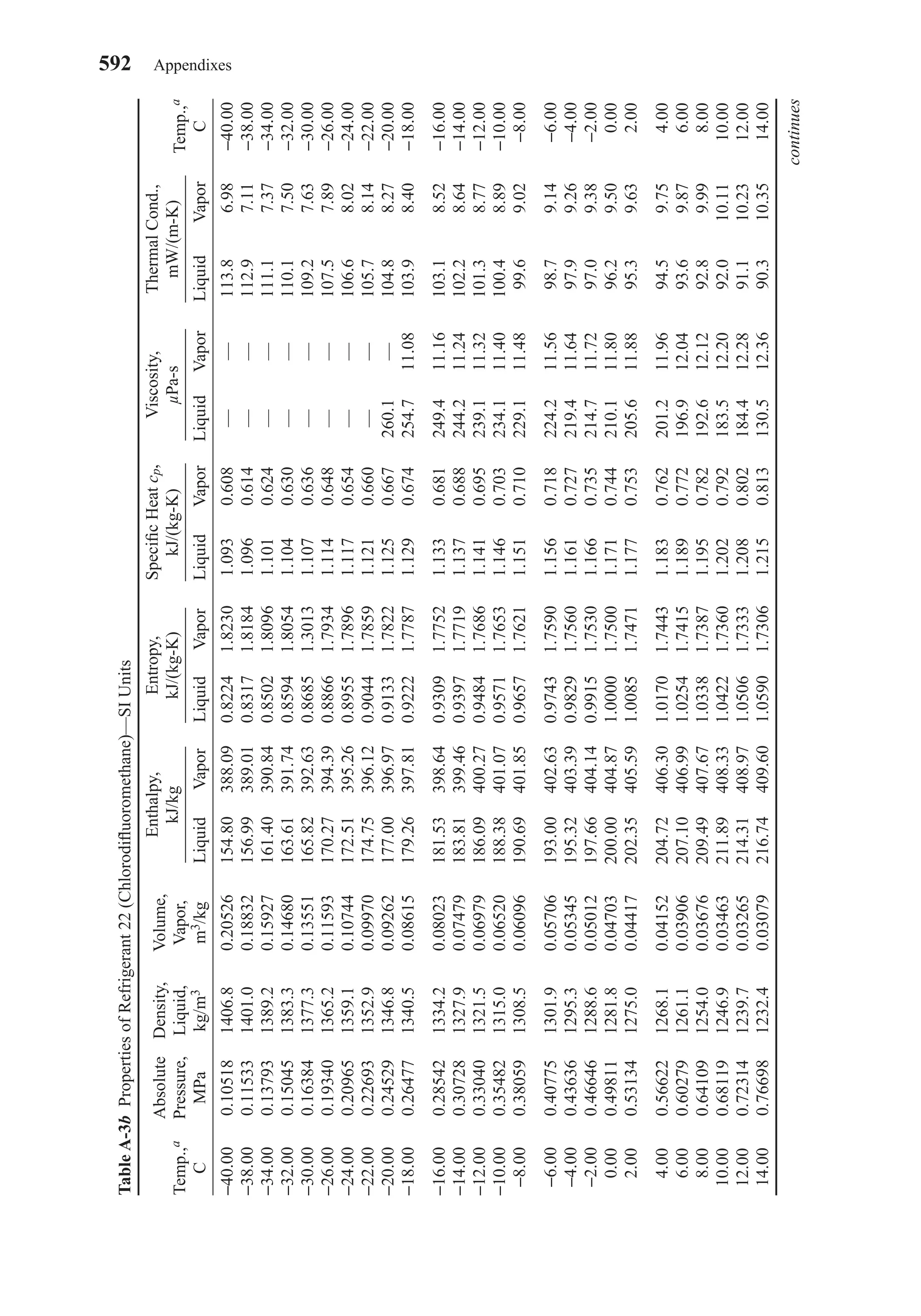
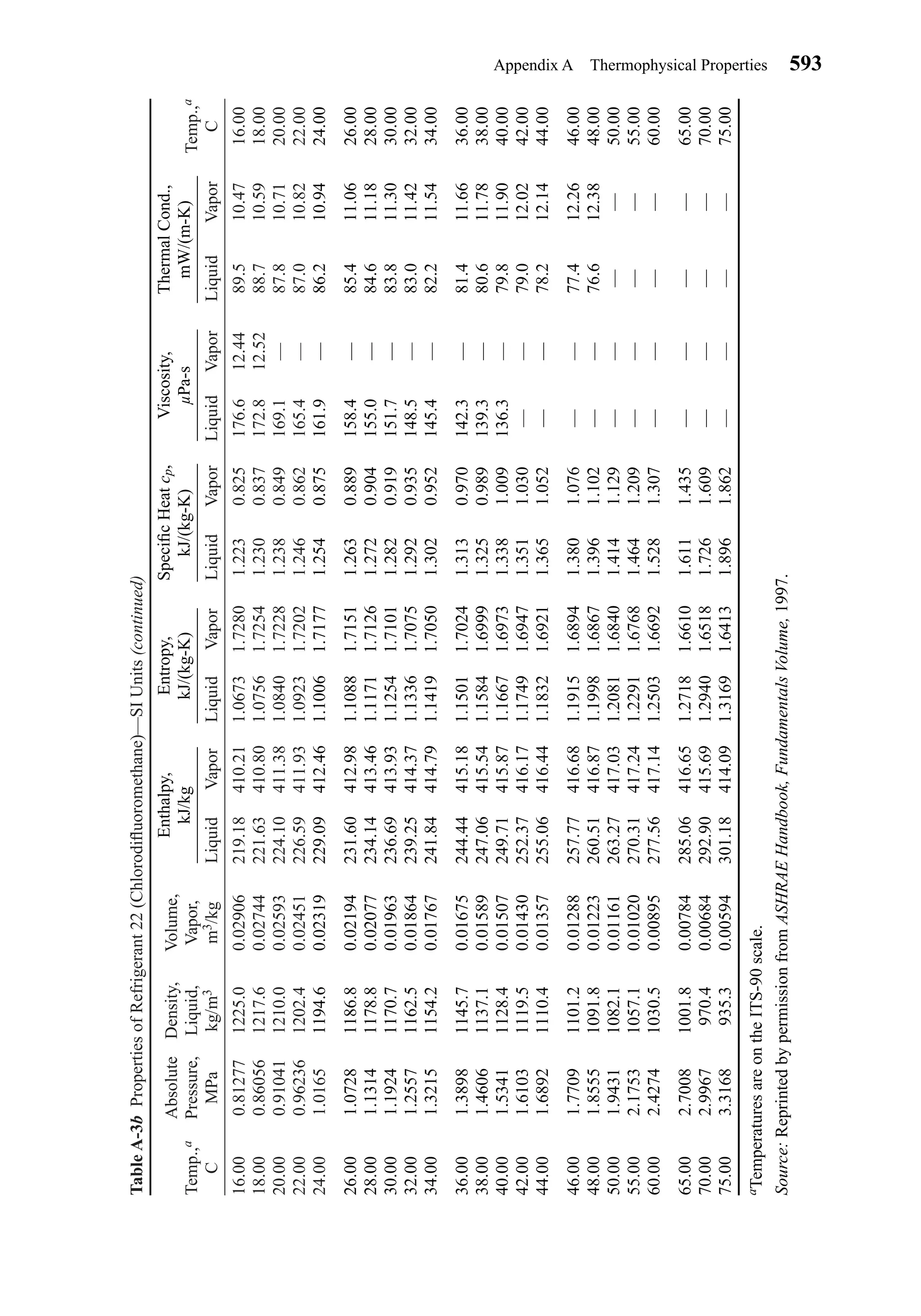
Table A-3b Properties of Refrigerant 22 (Chlorodifluoromethane)—
SI Units 592
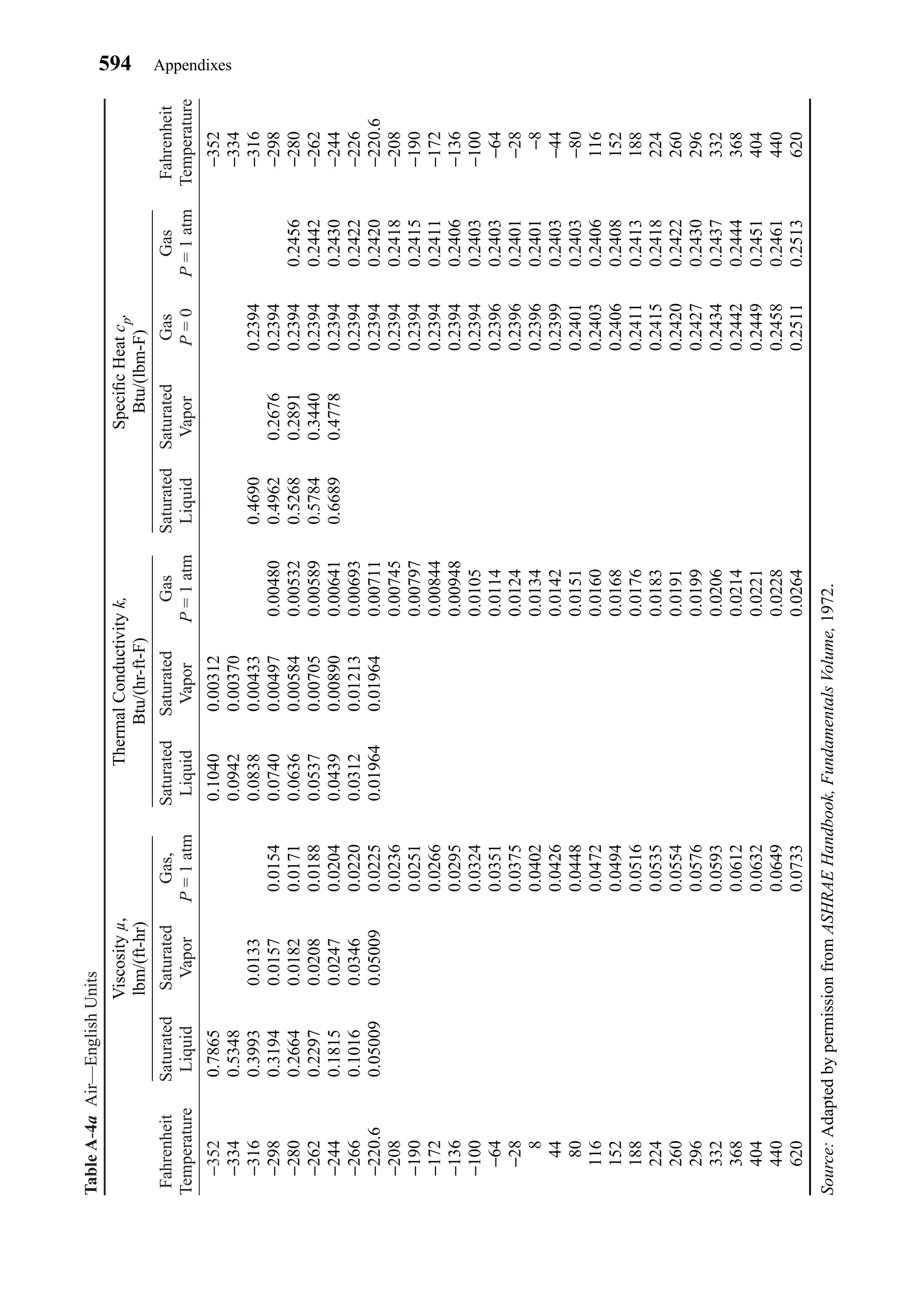
Table A-4a Air—English Units 594
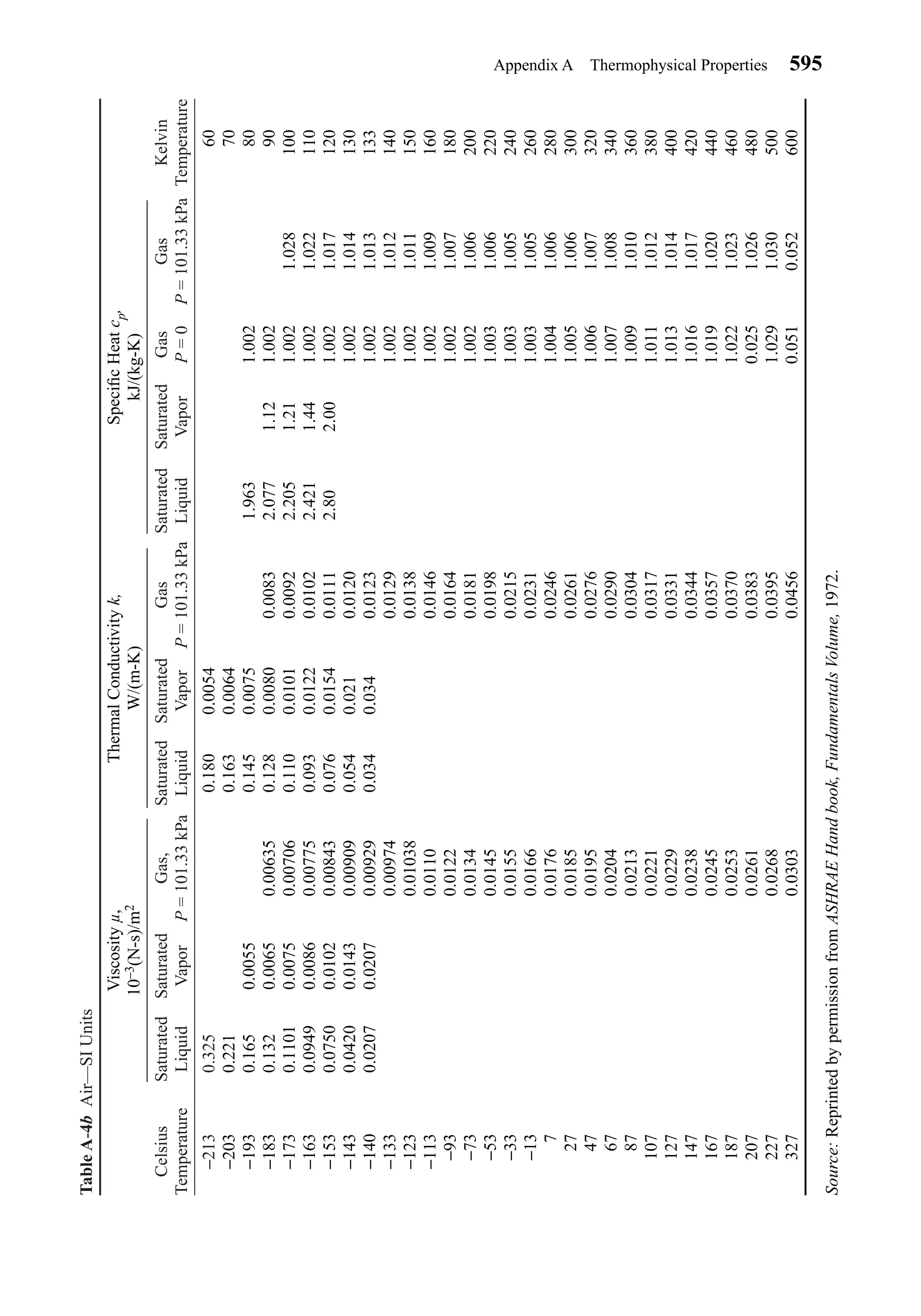
Table A-4b Air—SI Units 595
Appendix B. Weather Data 596
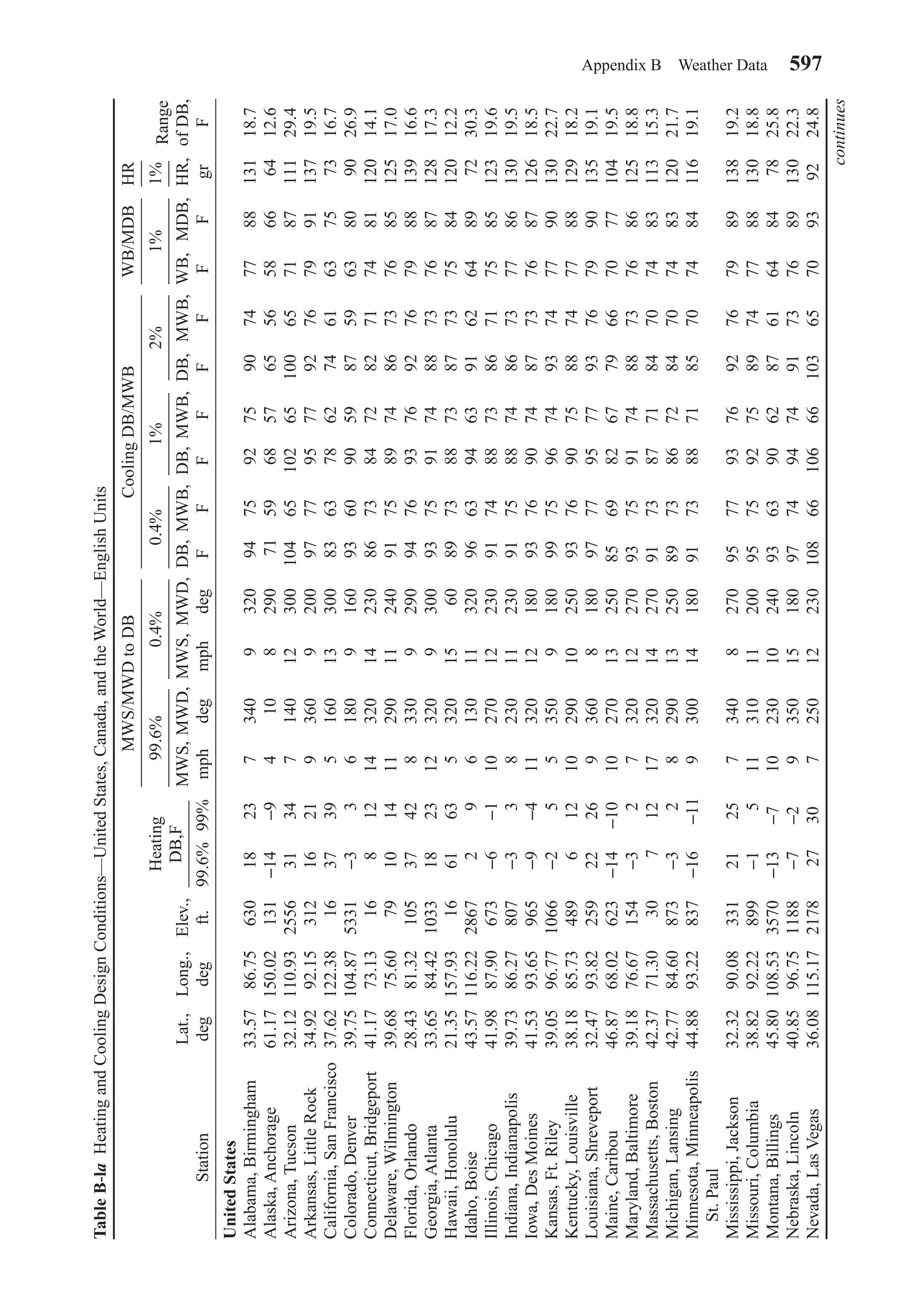
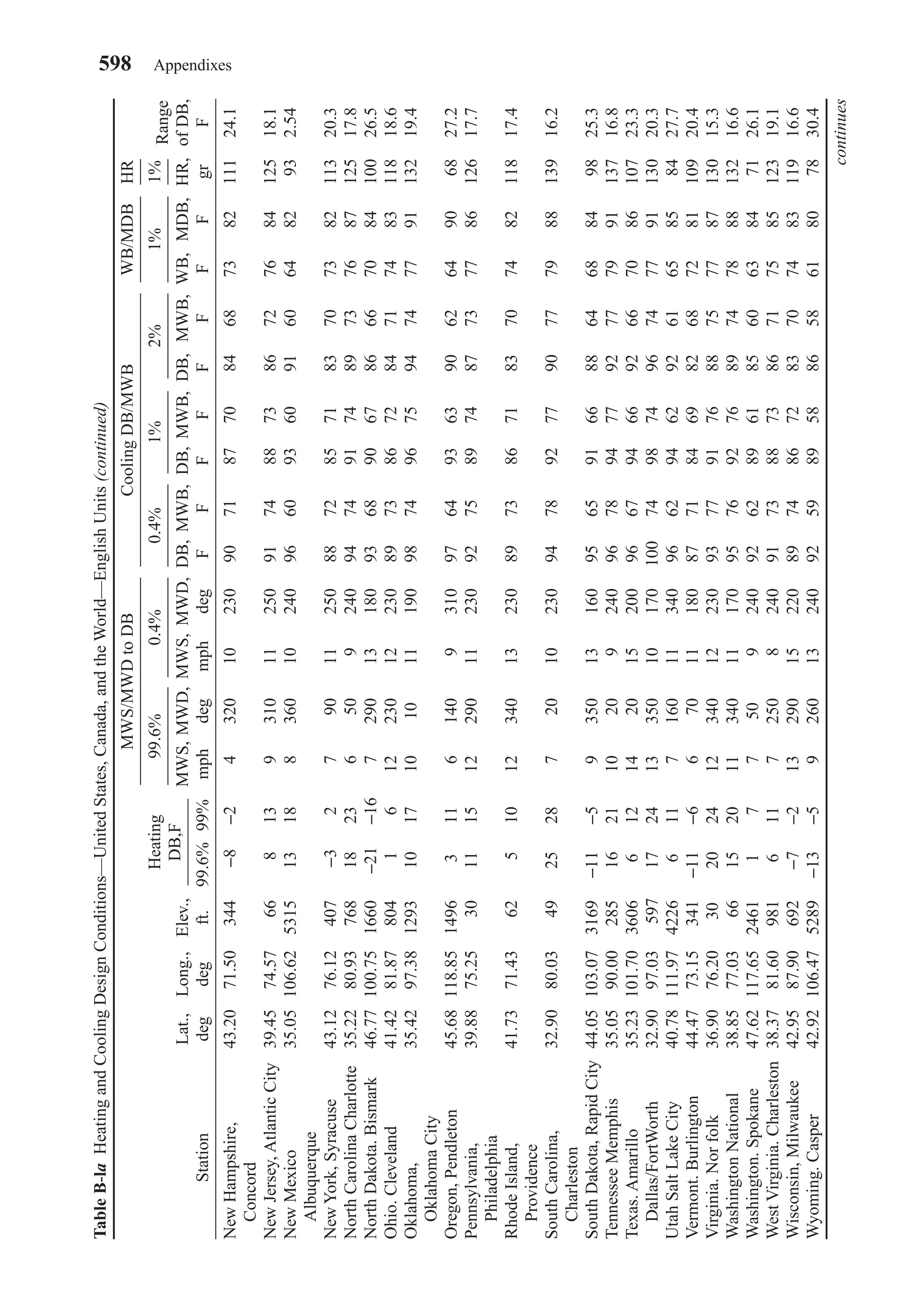
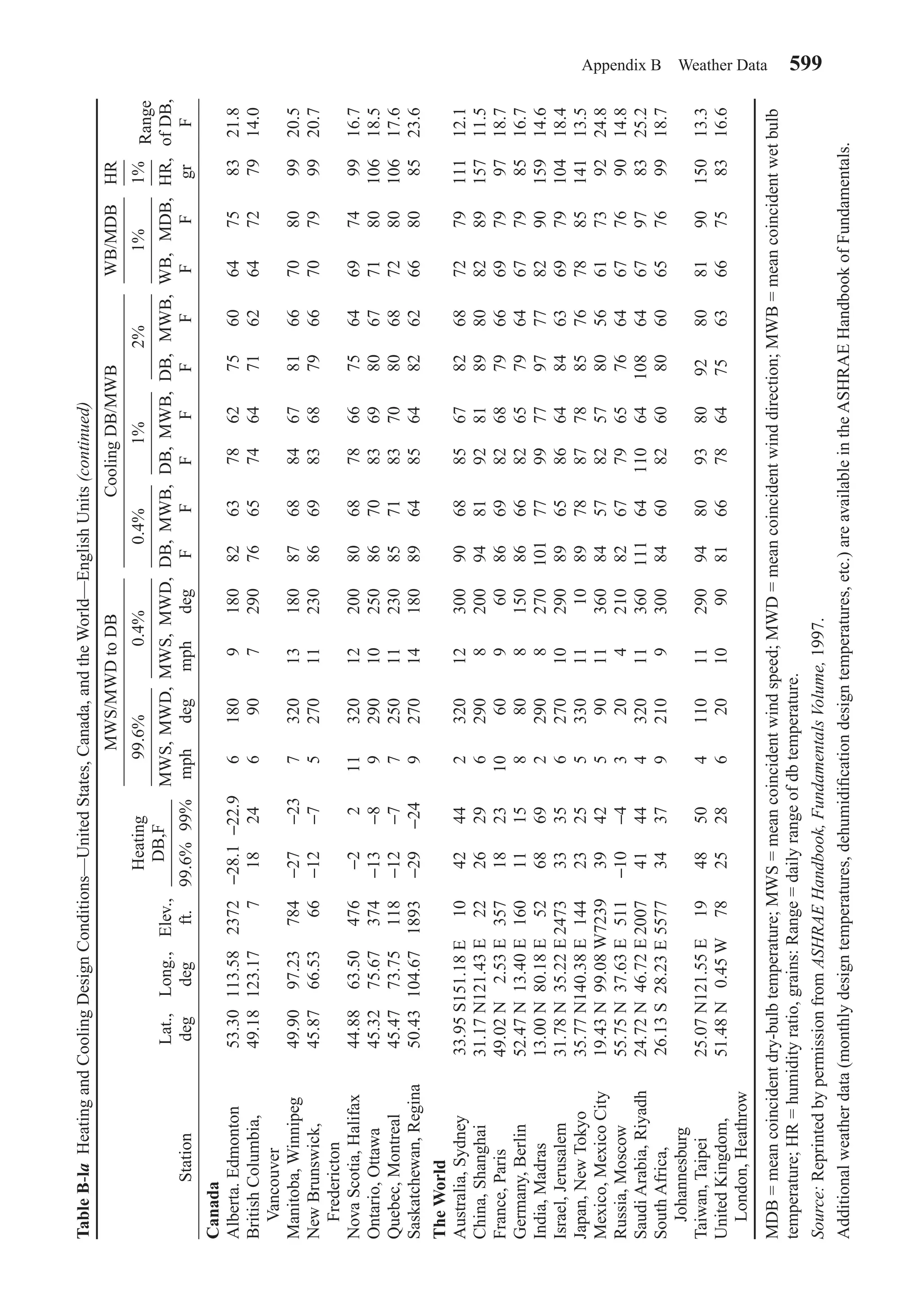
Table B-1a Heating and Cooling Design Conditions—United States, Canada,
and the World—English Units 597
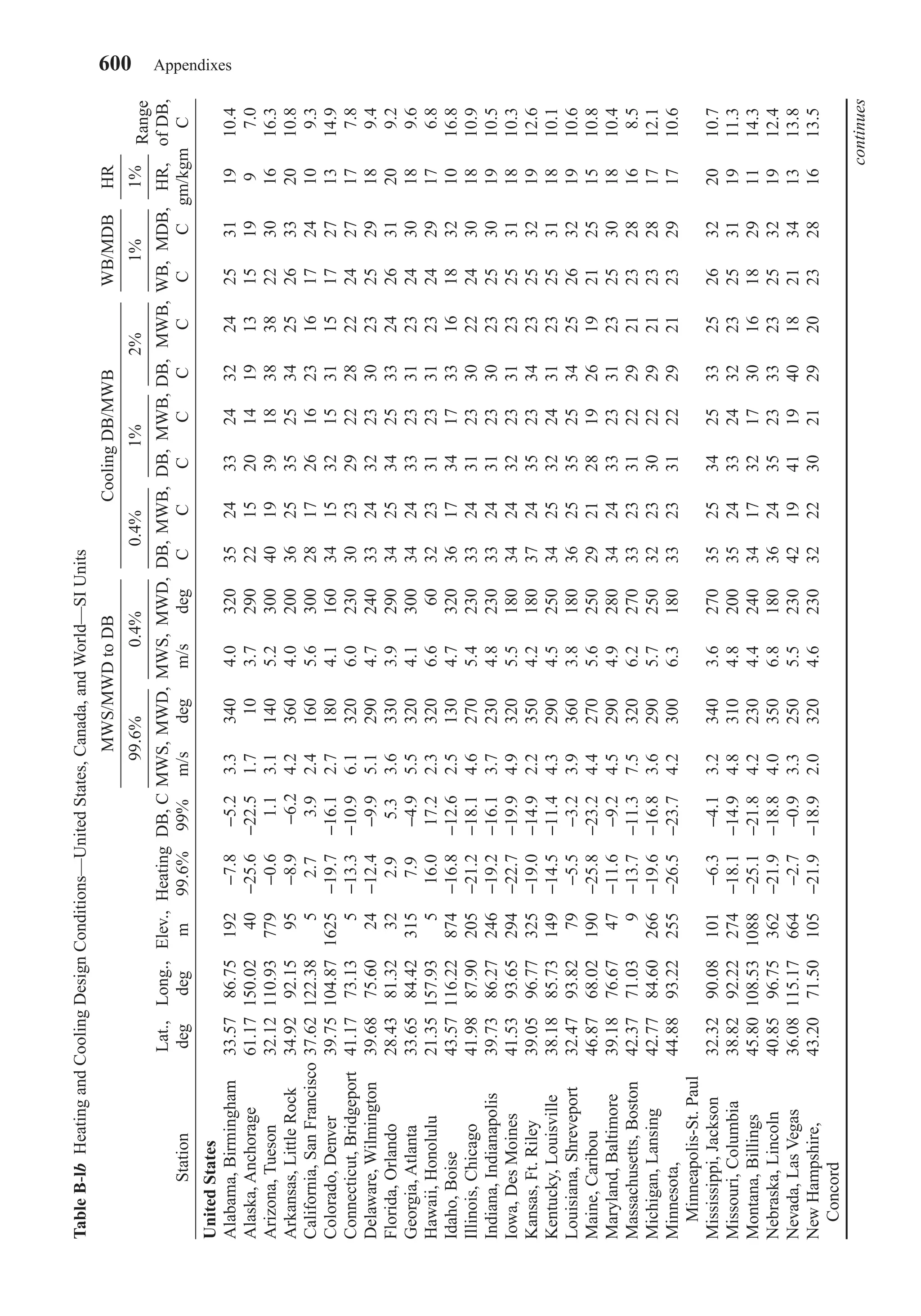
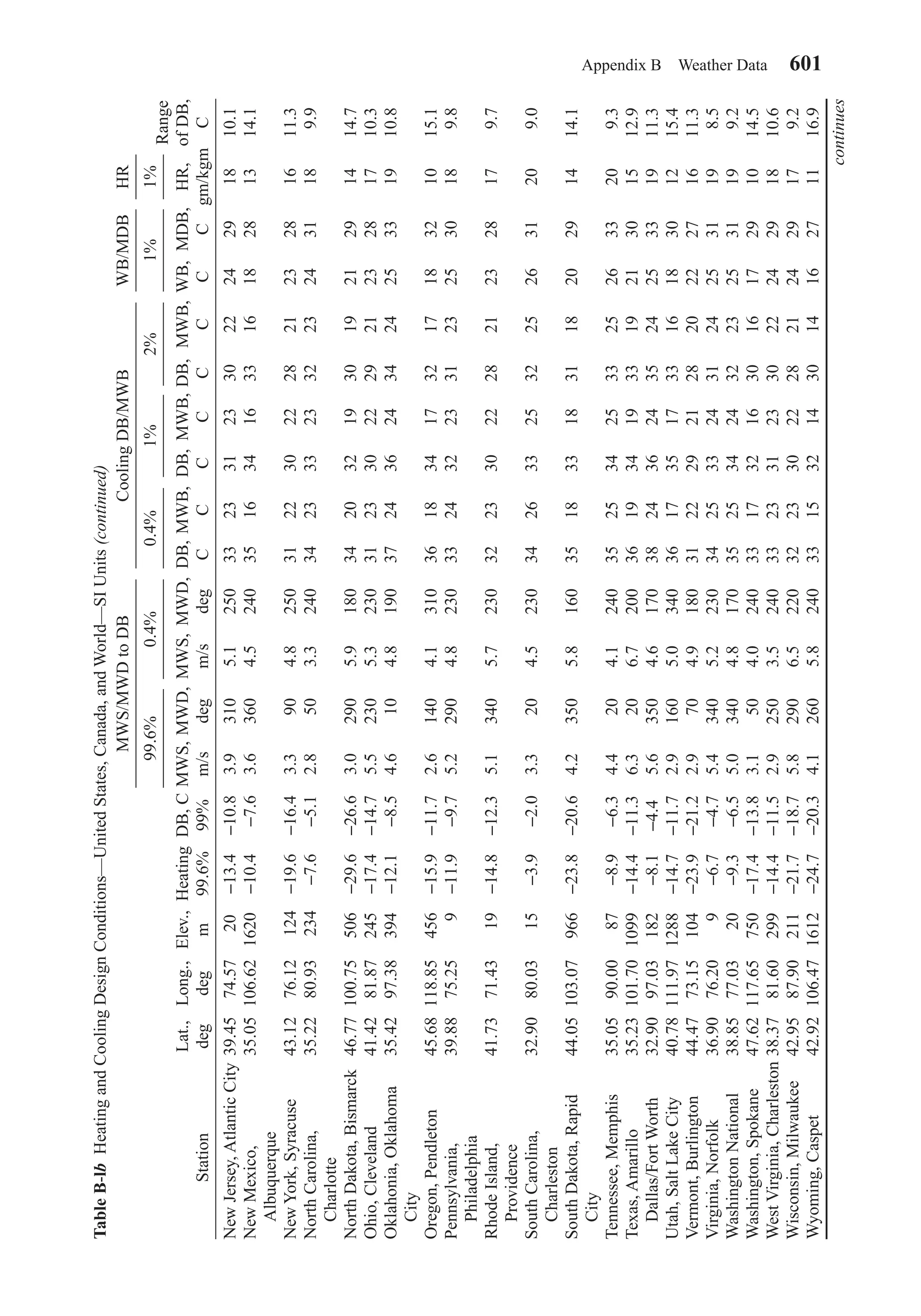
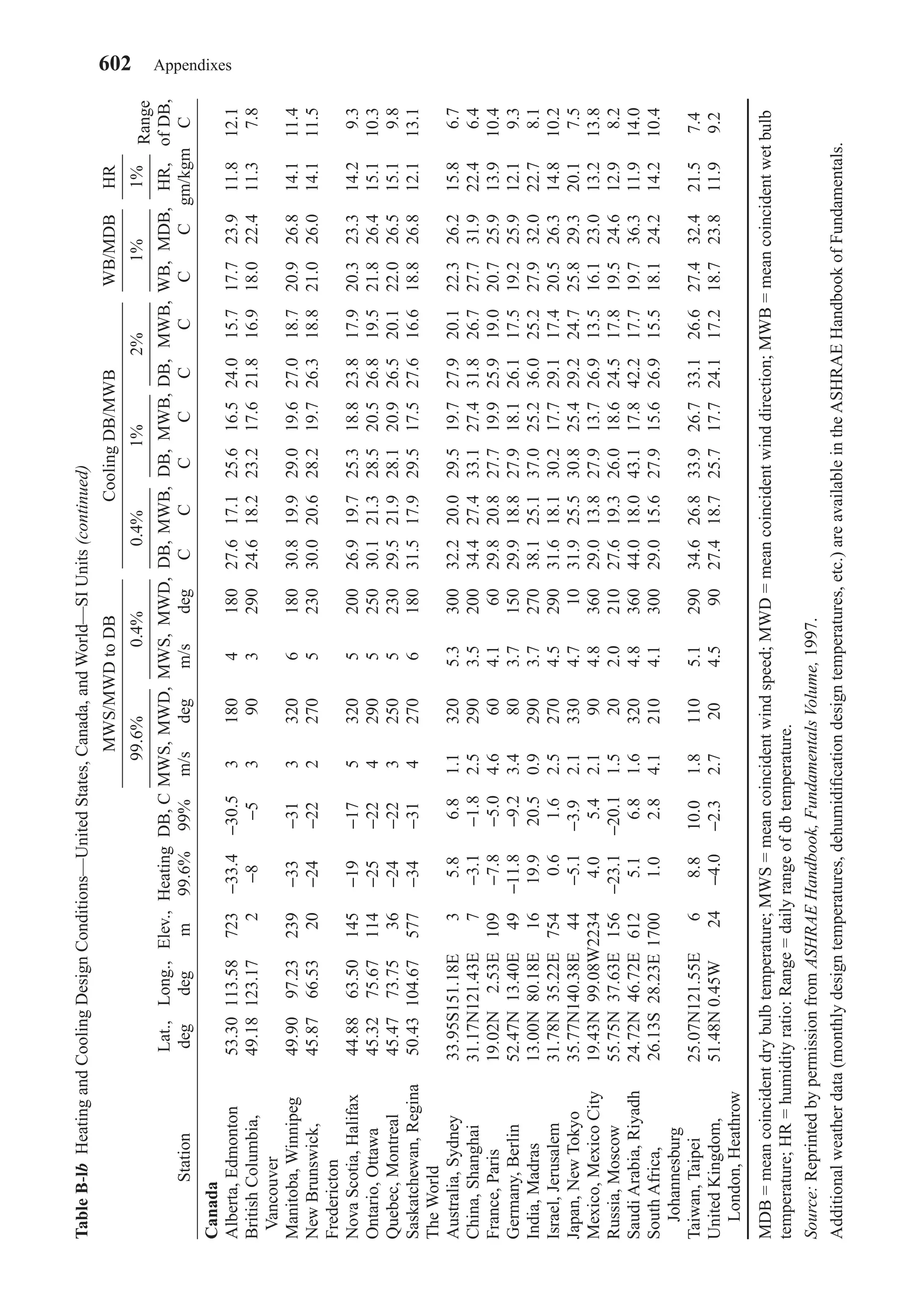
Table B-1b Heating and Cooling Design Conditions—United States, Canada,
and the World—SI Units 600
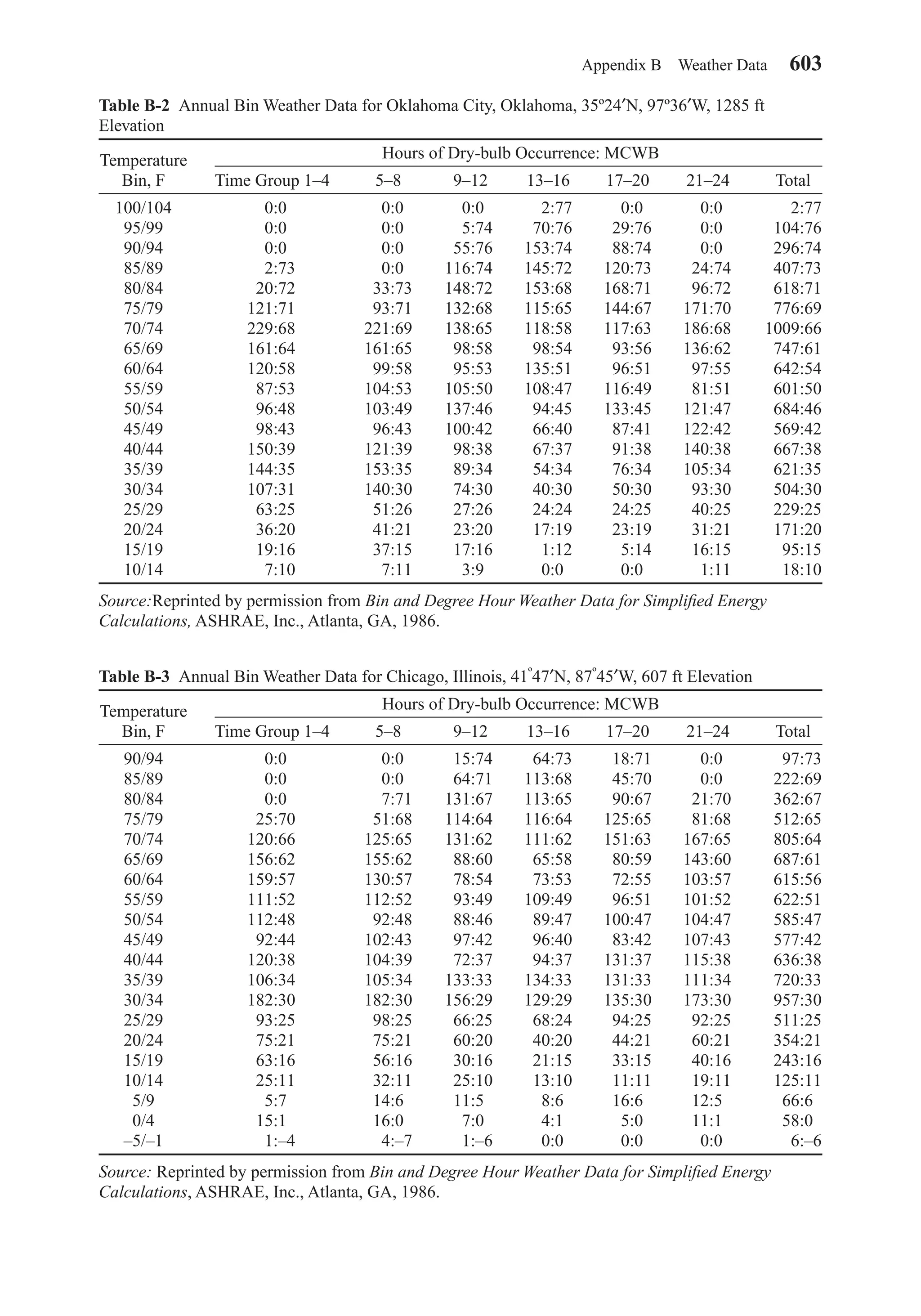
Table B-2 Annual BinWeather Data for Oklahoma City,OK 603
Table B-3 Annual Bin Weather Data for Chicago, IL 603
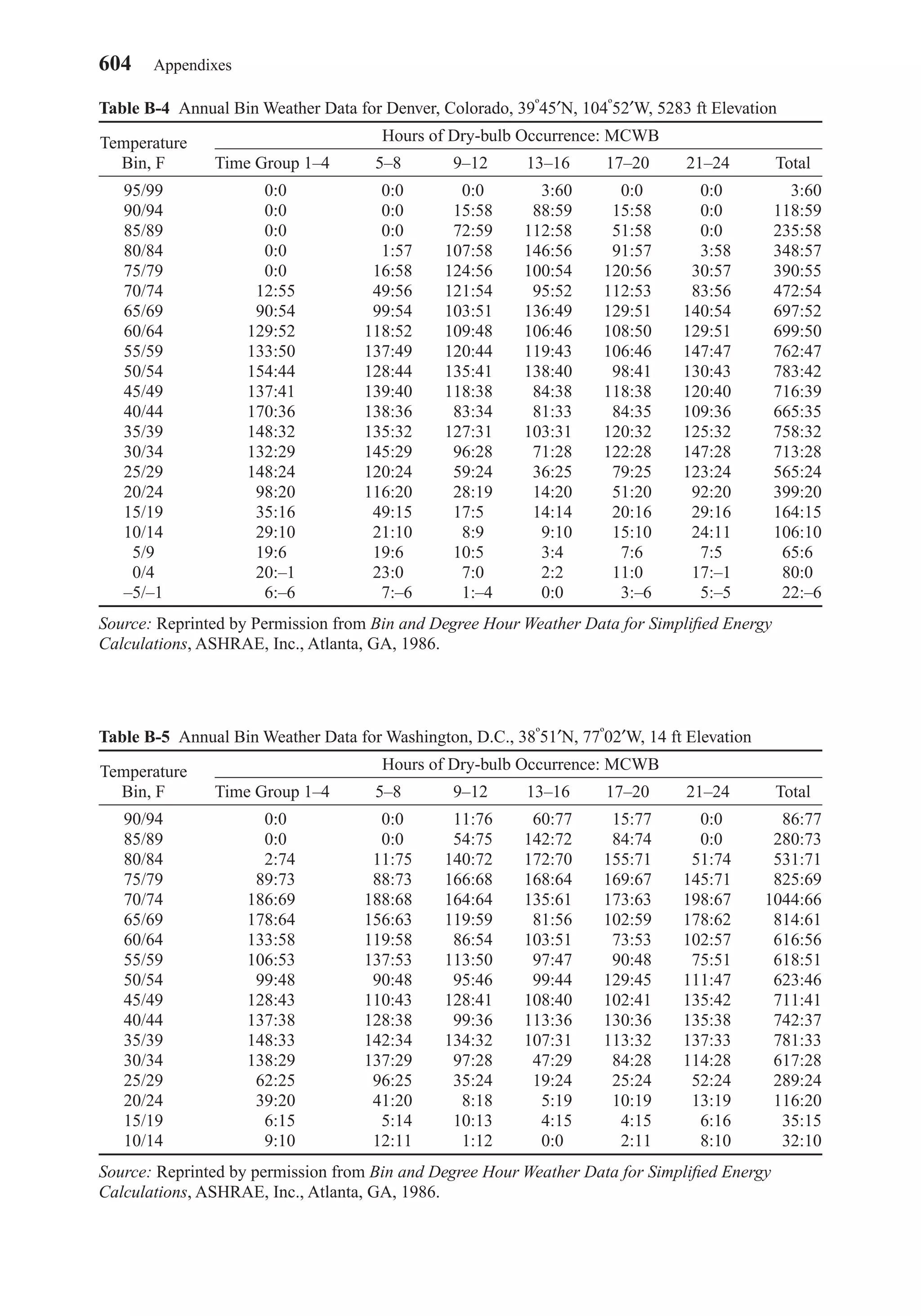
Table B-4 Annual Bin Weather Data for Denver, CO 604
Table B-5 Annual Bin Weather Data for Washington, DC 604
Appendix C. Pipe and Tube Data 605
Table C-1 Steel Pipe Dimensions—English and SI Units 606
Table C-2 Type L Copper Tube Dimensions—English and SI Units 607
Appendix D. Useful Data 608
Table D-1 Conversion Factors 609
Contents ix
FrontMatter.qxd 6/15/04 4:06 PM Page ix
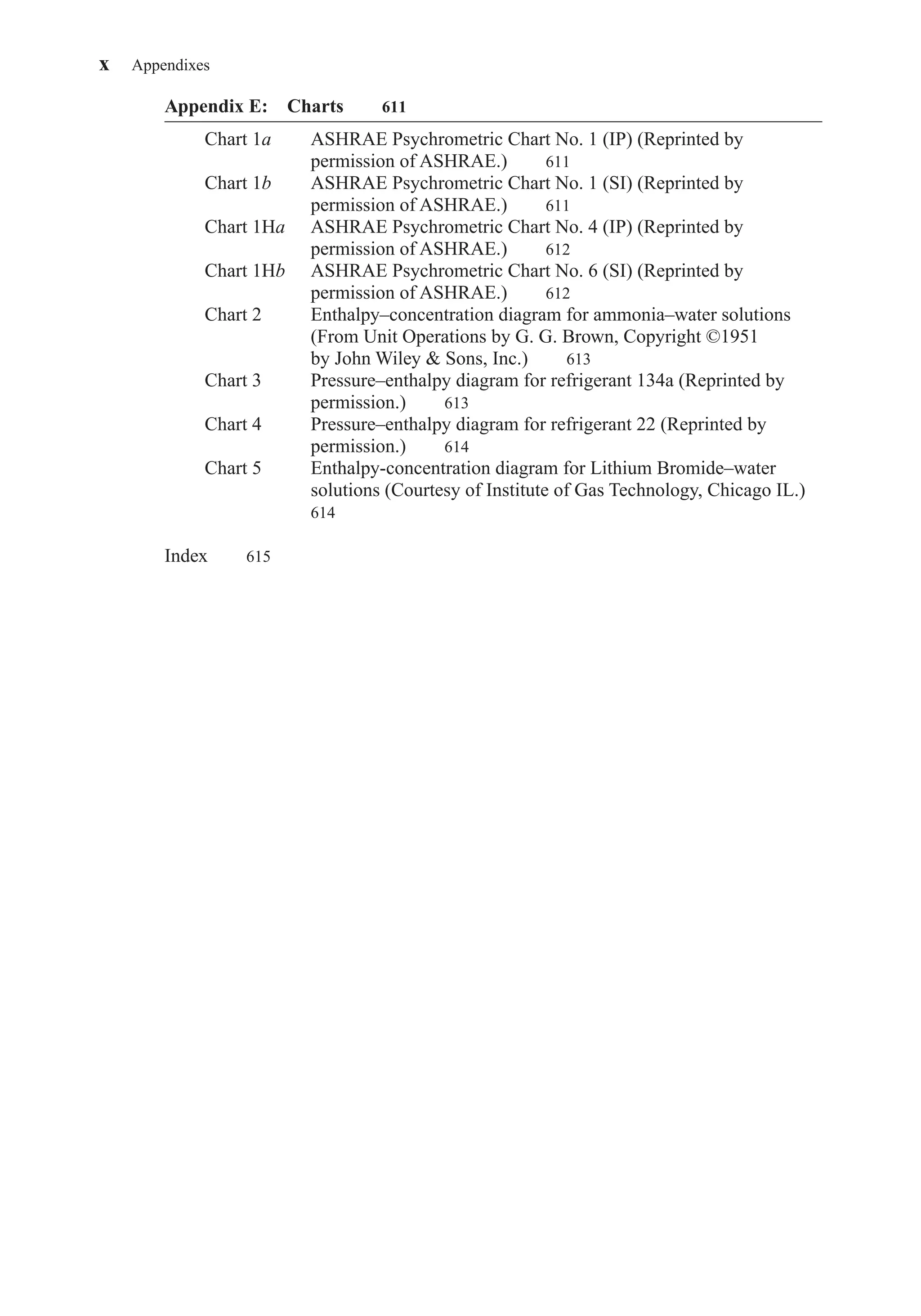
Appendix E: Charts 611
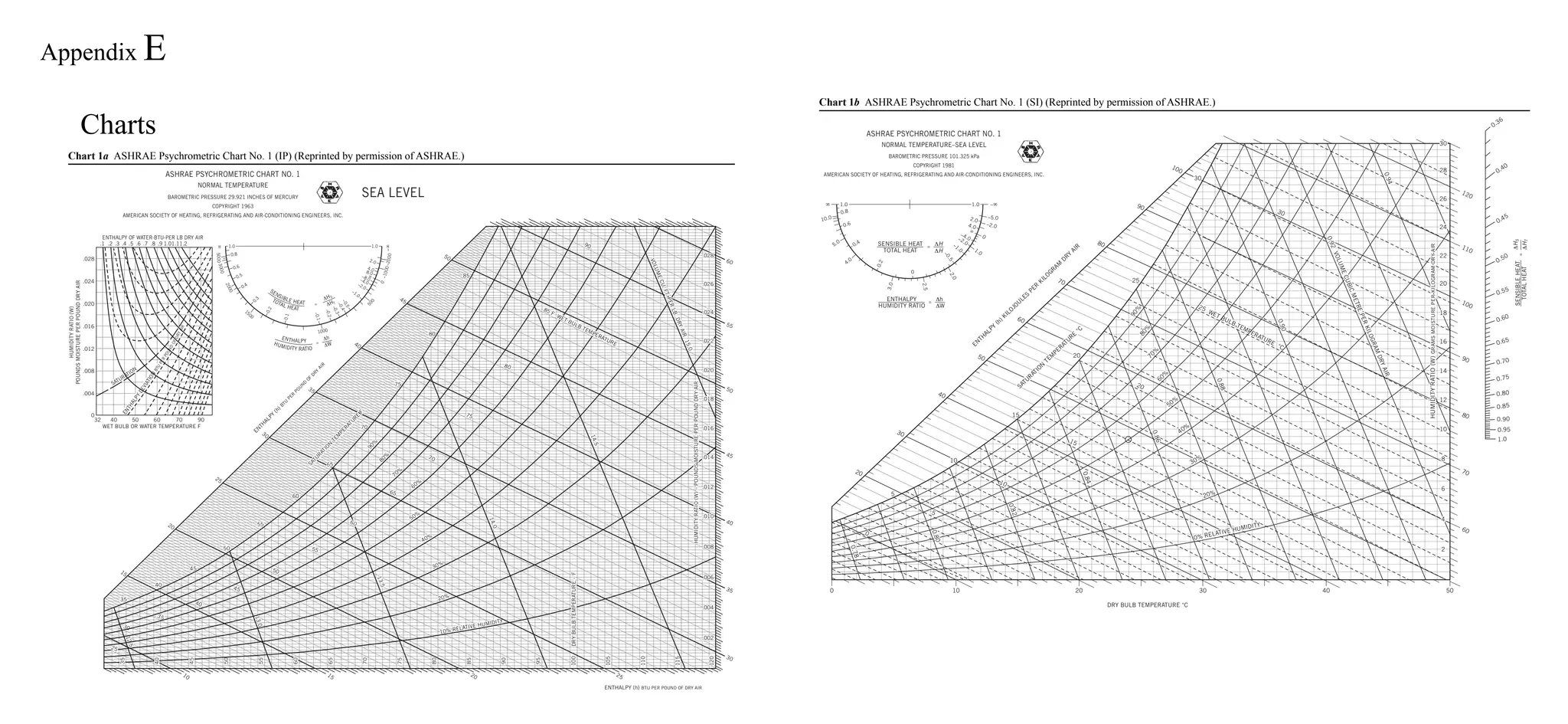
Chart 1a ASHRAE Psychrometric Chart No. 1 (IP) (Reprinted by
permission of ASHRAE.) 611
Chart 1b ASHRAE Psychrometric Chart No. 1 (SI) (Reprinted by
permission of ASHRAE.) 611
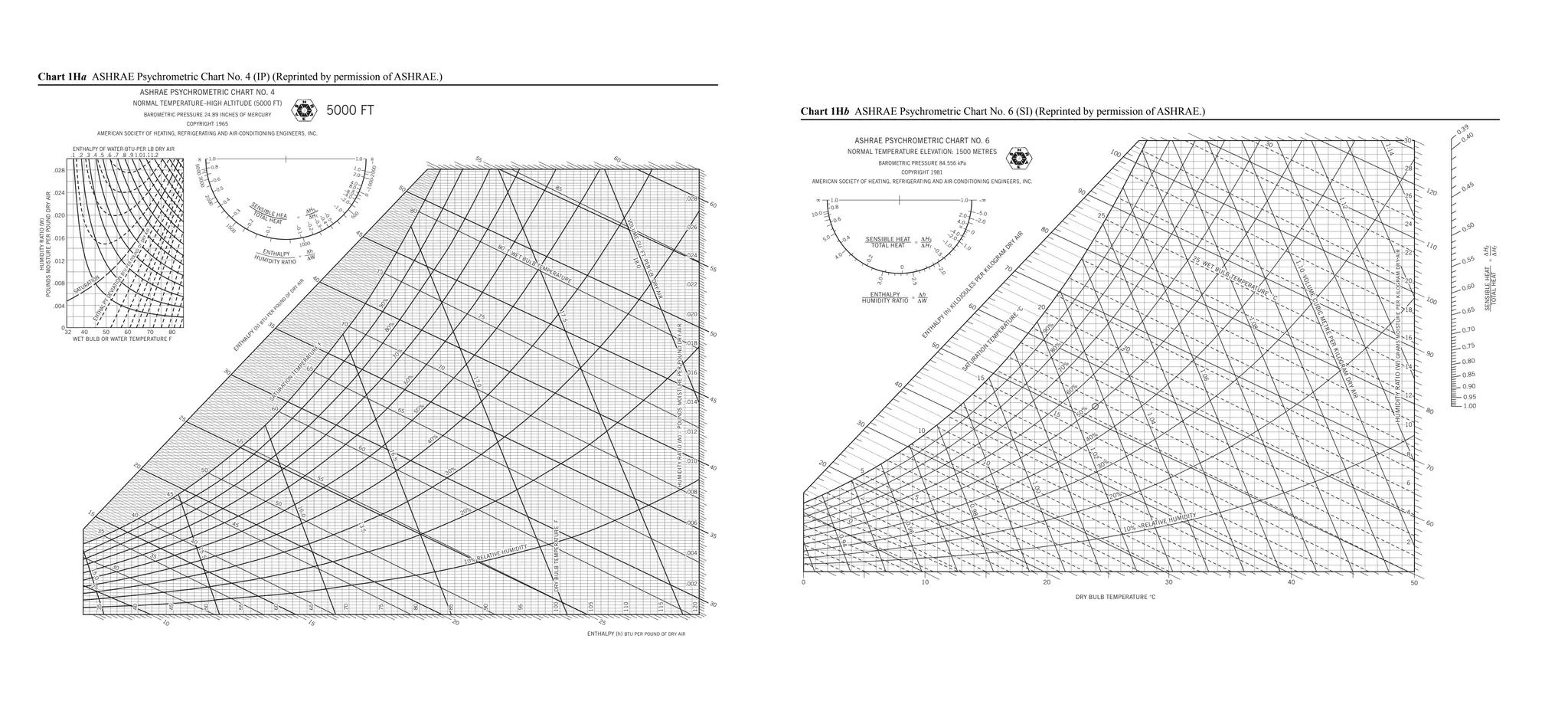
Chart 1Ha ASHRAE Psychrometric Chart No. 4 (IP) (Reprinted by
permission of ASHRAE.) 612
Chart 1Hb ASHRAE Psychrometric Chart No. 6 (SI) (Reprinted by
permission of ASHRAE.) 612
Chart 2 Enthalpy–concentration diagram for ammonia–water solutions
(From Unit Operations by G. G. Brown, Copyright ©1951
by John Wiley & Sons, Inc.) 613
Chart 3 Pressure–enthalpy diagram for refrigerant 134a (Reprinted by
permission.) 613
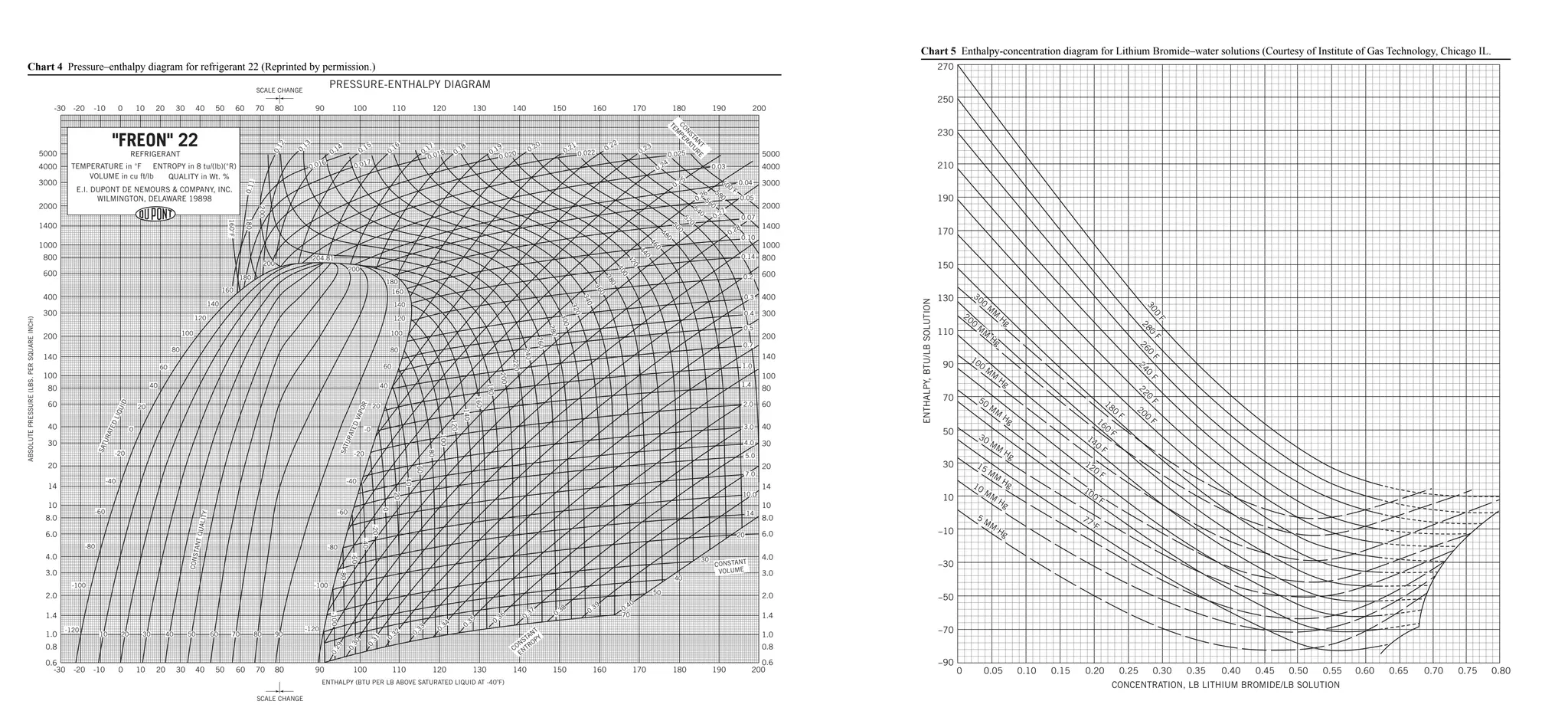
Chart 4 Pressure–enthalpy diagram for refrigerant 22 (Reprinted by
permission.) 614
Chart 5 Enthalpy-concentration diagram for Lithium Bromide–water
solutions (Courtesy of Institute of Gas Technology, Chicago IL.)
614
Index 615
x Appendixes
FrontMatter.qxd 6/15/04 4:06 PM Page x
Preface
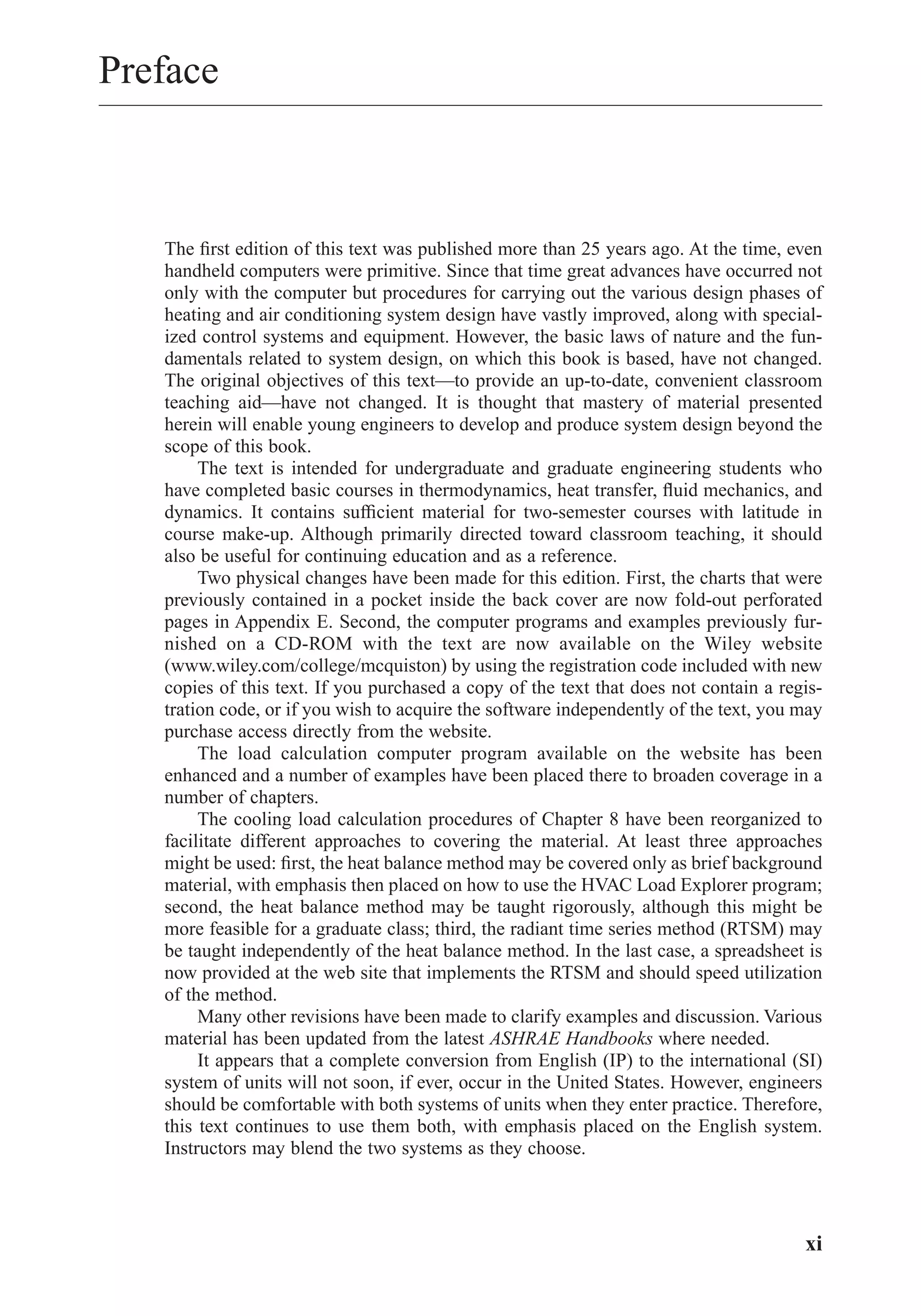
The first edition of this text was published more than 25 years ago. At the time, even
handheld computers were primitive. Since that time great advances have occurred not
only with the computer but procedures for carrying out the various design phases of
heating and air conditioning system design have vastly improved, along with special-
ized control systems and equipment. However, the basic laws of nature and the fun-
damentals related to system design, on which this book is based, have not changed.
The original objectives of this text—to provide an up-to-date, convenient classroom
teaching aid—have not changed. It is thought that mastery of material presented
herein will enable young engineers to develop and produce system design beyond the
scope of this book.
The text is intended for undergraduate and graduate engineering students who
have completed basic courses in thermodynamics, heat transfer, fluid mechanics, and
dynamics. It contains sufficient material for two-semester courses with latitude in
course make-up. Although primarily directed toward classroom teaching, it should
also be useful for continuing education and as a reference.
Two physical changes have been made for this edition. First, the charts that were
previously contained in a pocket inside the back cover are now fold-out perforated
pages in Appendix E. Second, the computer programs and examples previously fur-
nished on a CD-ROM with the text are now available on the Wiley website
(www.wiley.com/college/mcquiston) by using the registration code included with new
copies of this text. If you purchased a copy of the text that does not contain a regis-
tration code, or if you wish to acquire the software independently of the text, you may
purchase access directly from the website.
The load calculation computer program available on the website has been
enhanced and a number of examples have been placed there to broaden coverage in a
number of chapters.
The cooling load calculation procedures of Chapter 8 have been reorganized to
facilitate different approaches to covering the material. At least three approaches
might be used: first, the heat balance method may be covered only as brief background
material, with emphasis then placed on how to use the HVAC Load Explorer program;
second, the heat balance method may be taught rigorously, although this might be
more feasible for a graduate class; third, the radiant time series method (RTSM) may
be taught independently of the heat balance method. In the last case, a spreadsheet is
now provided at the web site that implements the RTSM and should speed utilization
of the method.
Many other revisions have been made to clarify examples and discussion. Various
material has been updated from the latest ASHRAE Handbooks where needed.
It appears that a complete conversion from English (IP) to the international (SI)
system of units will not soon, if ever, occur in the United States. However, engineers
should be comfortable with both systems of units when they enter practice. Therefore,
this text continues to use them both, with emphasis placed on the English system.
Instructors may blend the two systems as they choose.
xi
FrontMatter.qxd 6/15/04 4:06 PM Page xi
Publication of this text would not be possible without permission of the Ameri-
can Society of Heating, Refrigerating, and Air-Conditioning Engineers, Inc.
(ASHRAE) to reproduce copyrighted material from ASHRAE publications. This
material may not be reused in any way without the consent of ASHRAE.
We are grateful to the reviewers of the last several editions, who have provided
useful insights into making the text a more useful learning and reference tool:
Nidal Al-Masoud, University at Buffalo, State University of New York
William P. Bahnfleth, Pennsylvania State University
Harold Brandon, Washington University
Ronald DiPippo, University of Massachusetts–Dartmouth
Essam A. Ibrahim, Tuskegee University
Prassana V. Kadaba, Georgia Institute of Technology
Paul G. Menz, Villanova University
Samir Moujaes, University of Nevada–Las Vegas
Dennis O’Neal, Texas A&M University
Patrick E. Phelan, Arizona State University
Jim Rett, Portland Community College
Steve Ridenour, Temple University
Alfred M. Rodgers, Rochester Institute of Technology
Jelena Srebic, Pennsylvania State University
Maurice W. Wildin, University of New Mexico
Xudong Yang, University of Miami
Many other organizations and individuals have supported and contributed to this
work for more than 25 years. We are grateful to everyone.
Faye C. McQuiston
Jerald D. Parker
Jeffrey D. Spitler
xii Appendixes
FrontMatter.qxd 6/15/04 4:06 PM Page xii
About the Authors
Faye C. McQuiston is professor emeritus of Mechanical and Aerospace Engineering at
Oklahoma State University in Stillwater, Oklahoma. He received B.S. and M.S. degrees
in mechanical engineering from Oklahoma State University in 1958 and 1959 and a
Ph.D. in mechanical engineering from Purdue University in 1970. Dr. McQuiston joined
the Oklahoma State faculty in 1962 after three years in industry. He was a National Sci-
ence Foundation Faculty Fellow from 1967 to 1969. He is an active member of
the American Society of Heating, Refrigerating and Air-Conditioning Engineers
(ASHRAE). He has served the Society as vice-president; a director on the Board of
Directors; and a member on the Technology, Education, Member, and Publishing Coun-
cils. He is a past member of the Research and Technical, Education, and Standards Com-
mittees. He was honored with the Best Paper Award in 1979, the Region VIII Award of
Merit in 1981, the Distinguished Service Award in 1984, and the E. K. Campbell Award
in 1986. He was also elected to the grade of Fellow in 1986. Dr. McQuiston is a regis-
tered professional engineer and a consultant for system design and equipment manu-
facturing. He is recognized for his research related to the design of heating and
air-conditioning systems. He has written extensively on heating and air conditioning.
Jerald D. Parker is a professor emeritus of mechanical engineering at Oklahoma
Christian University after serving 33 years on the mechanical engineering faculty at
Oklahoma State University. He received B.S. and M.S. degrees in mechanical engi-
neering from Oklahoma State University in 1955 and 1958 and a Ph.D. in mechani-
cal engineering from Purdue University in 1961. During his tenure at Oklahoma State,
he spent one year on leave with the engineering department of Du Pont in Newark,
Delaware. He has been active at both the local and national level in ASME, where he
is a fellow. In ASHRAE he has served as chairman of the Technical Committee on
Fluid Mechanics and Heat Transfer, chairman of a standards project committee, and
a member of the Continuing Education Committee. He is a registered professional
engineer. He is coauthor of a basic text in fluid mechanics and heat transfer and has
contributed articles for handbooks, technical journals, and magazines. His research
has been involved with ground-coupled heat pumps, solar-heated asphalt storage sys-
tems, and chilled-water storage and distribution. He has served as a consultant in cases
involving performance and safety of heating, cooling, and process systems.
Jeffrey D. Spitler is the C. M. Leonard professor of mechanical and aerospace engi-
neering at Oklahoma State University, Stillwater. He received B.S., M.S., and Ph.D.
degrees in mechanical engineering at the University of Illinois, Urbana-Champaign,
in 1983, 1984, and 1990. He joined the Oklahoma State University faculty in 1990.
He is an active member of ASHRAE and has served as chair of the energy calcula-
tions technical committee, and as a member of several other technical committees, a
standards committee, the Student Activities Committee, and the Research Adminis-
tration Committee. He is the president of the International Building Performance Sim-
ulation Association. He is a registered professional engineer and has consulted on a
number of different projects. He is actively involved in research related to design load
calculations, ground source heat pump systems, and pavement heating systems.
xiii
FrontMatter.qxd 6/15/04 4:06 PM Page xiii
Symbols
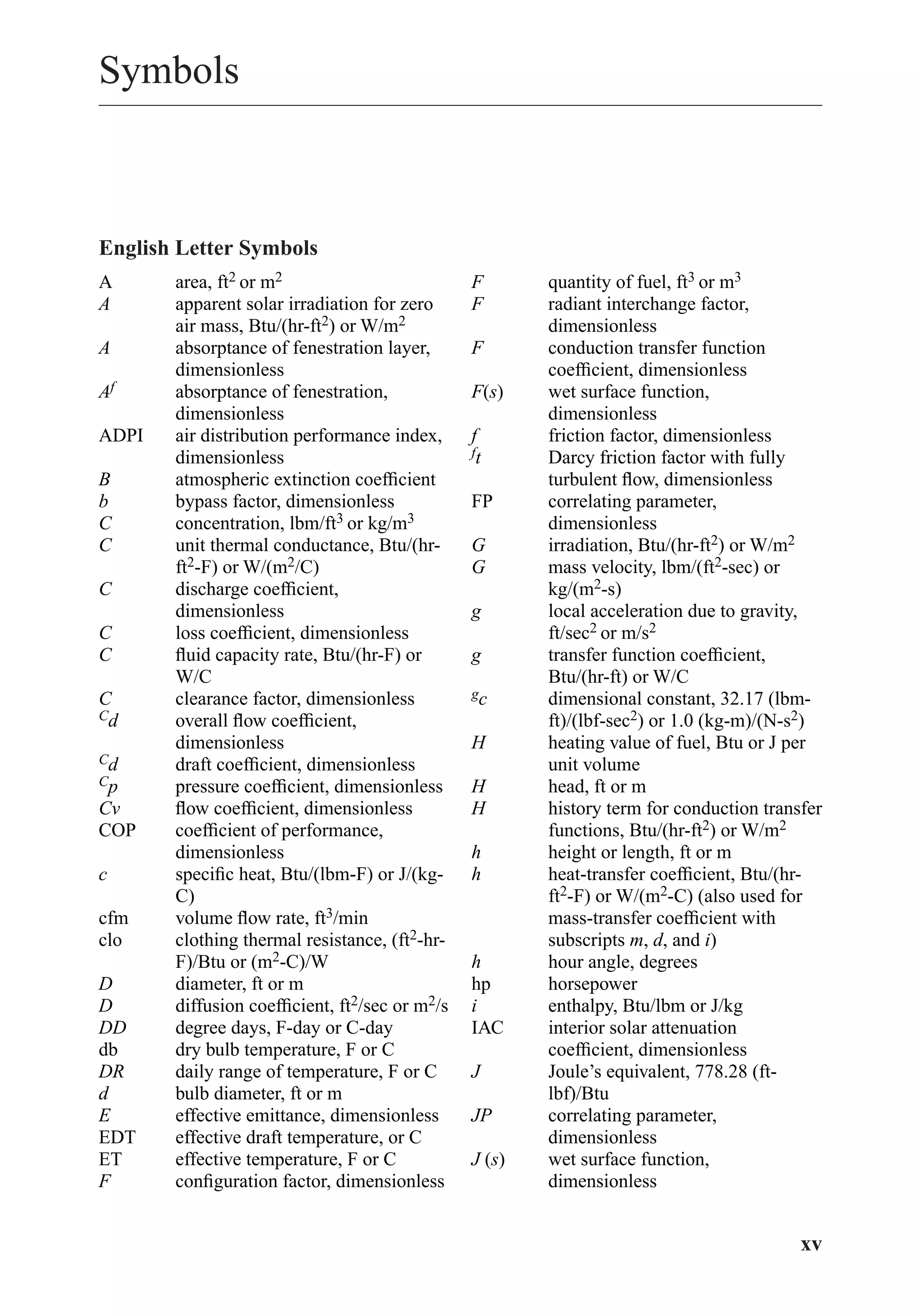
English Letter Symbols
xv
A area, ft2 or m2
A apparent solar irradiation for zero
air mass, Btu/(hr-ft2) or W/m2
A absorptance of fenestration layer,
dimensionless
Af absorptance of fenestration,
dimensionless
ADPI air distribution performance index,
dimensionless
B atmospheric extinction coefficient
b bypass factor, dimensionless
C concentration, lbm/ft3 or kg/m3
C unit thermal conductance, Btu/(hr-
ft2-F) or W/(m2/C)
C discharge coefficient,
dimensionless
C loss coefficient, dimensionless
C fluid capacity rate, Btu/(hr-F) or
W/C
C clearance factor, dimensionless
Cd overall flow coefficient,
dimensionless
Cd draft coefficient, dimensionless
Cp pressure coefficient, dimensionless
Cv flow coefficient, dimensionless
COP coefficient of performance,
dimensionless
c specific heat, Btu/(lbm-F) or J/(kg-
C)
cfm volume flow rate, ft3/min
clo clothing thermal resistance, (ft2-hr-
F)/Btu or (m2-C)/W
D diameter, ft or m
D diffusion coefficient, ft2/sec or m2/s
DD degree days, F-day or C-day
db dry bulb temperature, F or C
DR daily range of temperature, F or C
d bulb diameter, ft or m
E effective emittance, dimensionless
EDT effective draft temperature, or C
ET effective temperature, F or C
F configuration factor, dimensionless
F quantity of fuel, ft3 or m3
F radiant interchange factor,
dimensionless
F conduction transfer function
coefficient, dimensionless
F(s) wet surface function,
dimensionless
f friction factor, dimensionless
ft Darcy friction factor with fully
turbulent flow, dimensionless
FP correlating parameter,
dimensionless
G irradiation, Btu/(hr-ft2) or W/m2
G mass velocity, lbm/(ft2-sec) or
kg/(m2-s)
g local acceleration due to gravity,
ft/sec2 or m/s2
g transfer function coefficient,
Btu/(hr-ft) or W/C
gc dimensional constant, 32.17 (lbm-
ft)/(lbf-sec2) or 1.0 (kg-m)/(N-s2)
H heating value of fuel, Btu or J per
unit volume
H head, ft or m
H history term for conduction transfer
functions, Btu/(hr-ft2) or W/m2
h height or length, ft or m
h heat-transfer coefficient, Btu/(hr-
ft2-F) or W/(m2-C) (also used for
mass-transfer coefficient with
subscripts m, d, and i)
h hour angle, degrees
hp horsepower
i enthalpy, Btu/lbm or J/kg
IAC interior solar attenuation
coefficient, dimensionless
J Joule’s equivalent, 778.28 (ft-
lbf)/Btu
JP correlating parameter,
dimensionless
J (s) wet surface function,
dimensionless
FrontMatter.qxd 6/15/04 4:06 PM Page xv
Ji (s) wet surface function,
dimensionless
j Colburn j-factor, dimensionless
K color correction factor,
dimensionless
K resistance coefficient,
dimensionless
Kt unit-length conductance, Btu/(ft-hr-
F) or W/(m-C)
k thermal conductivity, (Btu-ft)/(ft2-
hr-F), (Btu-in.)/(ft2-hr-F), or
(W-m)/(m2-C)
k isentropic exponent, c p/cv,
dimensionless
L fin dimension, ft or m
L total length, ft or m
Le Lewis number, Sc/Pr,
dimensionless
LMTD log mean temperature difference, F
or C
l latitude, deg
l lost head, ft or m
M molecular mass, lbm/(lbmole) or
kg/(kgmole)
M fin dimension, ft or m
MRT mean radiant temperature, F or C
m mass, lbm or kg
m mass flow rate or mass transfer
rate, lbm/sec or kg/s
N number of hours or other integer
N inward-flowing fraction of
absorbed solar heat gain
Nu Nusselt number, hx/k,
dimensionless
NC noise criterion, dimensionless
NTU number of transfer units,
dimensionless
P pressure, lb/ft2 or psia or N/m2 or
Pa
P heat exchanger parameter,
dimensionless
P circumference, ft or m
Pr Prandtl number, µc p/k,
dimensionless
PD piston displacement, ft3/min or
m3/s
p partial pressure, lbf/ft2 or psia or Pa
p transfer function coefficient,
dimensionless
Q volume flow rate, ft3/sec or m3/s
q heat transfer, Btu/lbm or J/kg
q heat flux, Btu/(hr-ft2) or W/m2
q heat transfer rate, Btu/hr or W
R gas constant, (ft-lbf)/(lbm-R) or
J/(kg-K)
R unit thermal resistance, (ft2-hr-
F)/Btu or (m2-K)/W
R heat exchanger parameter,
dimensionless
R fin radius, ft or m
R thermal resistance, (hr-F)/Btu or
C/W
R gas constant, (ft-lbf)/(lbmole-R) or
J/(kgmole-K)
Rf front reflectance of fenestration,
dimensionless
Rb back reflectance of fenestration,
dimensionless
Re Reynolds number V D ¯ /µ,
dimensionless
Rf unit fouling resistance, (hr-ft2-
F)/Btu, or (m2-C)/W
r radius, ft or m
rpm revolutions per minute
S fin spacing, ft or m
S equipment characteristic, Btu/(hr-
F) or W/C
Sc Schmidt number, /D,
dimensionless
Sh Sherwood number, hmx/D,
dimensionless
SC shading coefficient, dimensionless
SHF sensible heat factor, dimensionless
SHGC solar heat gain coefficient,
dimensionless
s entropy, Btu/(lbm-R) or J/(kg-K)
T absolute temperature, R or K
T transmittance of fenestration,
dimensionless
t temperature, F or C
t* thermodynamic wet bulb
temperature, F or C
U overall heat transfer coefficient,
Btu/(hr-ft2-F) or W/(m2-C)
u velocity in x direction, ft/sec or m/s
V volume, ft3 or m3
V ¯ velocity, ft/sec or m/s
v specific volume, ft3/lbm or m3/kg
v transfer function coefficient,
dimensionless
xvi Symbols
FrontMatter.qxd 6/15/04 4:06 PM Page xvi
v velocity in y-direction, ft/sec or m/s
W humidity ratio, lbmv/lbma or
kgv/kga
W equipment characteristics, Btu/hr
or W
W power, Btu/hr or W
WBGT wet bulb globe temperature, F or C
w skin wettedness, dimensionless
w work, Btu, or ft-lbf, or J
w transfer function coefficient,
dimensionless
X normalized input, dimensionless
X fraction of daily range
X conduction transfer function
coefficient, Btu/(hr-ft2-F) or
W/(m2-K)
x mole fraction
x quality, lbmv/lbm or kgv/kg
x, y, z length, ft or m
Y normalized capacity, dimensionless
Y conduction transfer function
coefficient, Btu/(hr-ft2-F) or
W/(m2-K)
Z conduction transfer function
coefficient, Btu(hr-ft2-F) or
W/(m2-K)
Symbols xvii
Subscripts
a transverse dimension
a air
a average
a attic
as adiabatic saturation
as denotes change from dry air to
saturated air
ASHG absorbed solar heat gain from
fenestration
avg average
B barometric
b branch
b longitudinal dimension
b base
c cool or coil
c convection
c ceiling
c cross section or minimum free area
c cold
c condenser
c Carnot
c collector
c convection
CL cooling load
cl center line
D direct
D diameter
d dew point
d total heat
d diffuse
d design
d downstream
dry dry surface
e equivalent
e sol-air
e equipment
e evaporator
es exterior surface
ext exterior surface
f film
f friction
f fin
f fictitious surface
f frame
fg refers to change from saturated
liquid to saturated vapor
f l fluorescent light
f l floor
f r frontal
g refers to saturated vapor
g glazing
g globe
g ground
H horizontal
h heat
h hydraulic
h head
h heat transfer
h hot
i j-factor for total heat transfer
i inside or inward
i instantaneous
in inside
is inside surface
j exterior surface number
l latent
l liquid
m mean
FrontMatter.qxd 6/15/04 4:06 PM Page xvii
m mass transfer
m mechanical
ND direct normal
n integer
o outside
o total or stagnation
o initial condition
oh humid operative
P presure
p constant pressure
p pump
R reflected
R refrigerating
r radiation
r room air
s stack effect
s sensible
s saturated vapor or saturated air
s supply air
s shaft
s static
s surface
sc solar constant
s-g surface-to-ground
shd shade
SHG solar heat gain from fenestration
s-sky surface-to-sky
SL sunlit
sl sunlit
t temperature
t total
t contact
t tube
TSHG transmitted solar heat gain from
fenestration
u unheated
u upstream
V vertical
v vapor
v ventilation
v velocity
w wind
w wall
w liquid water
wet wet surface
x length
x extraction
Z Zenith angle
1, 2, 3 state of substance at boundary of a
control volume
1, 2, 3 a constituent in a mixture
8 free-stream condition
xviii Symbols
Greek Letter Symbols
α angle of tilt from horizontal, deg
α absorptivity or absorptance,
dimensionless
α total heat transfer area over total
volume, ft-1 or m-1
α thermal diffusivity, ft2/sec or m2/s
ß fin parameter, dimensionless
ß altitude angle, deg
γ surface solar azimuth angle, deg
∆ change in a quantity or property
δ boundary layer thickness, ft or m
δ sun’s declination, deg
ε heat exchanger effectiveness,
dimensionless
ε emittance or emissivity,
dimensionless
φ solar azimuth angle, deg clockwise
from north
η efficiency, dimensionless
θ angle, deg
θ angle of incidence, deg
θ time, sec
θ current time
µ degree of saturation, percent or
fraction
µ dynamic viscosity, lbm/(ft-sec) or
(N-s)/m2
ν kinematic viscosity, ft2/sec or m2/s
ρ mass density, lbm/ft3 or kg/m3
ρ reflectivity or reflectance,
dimensionless
Σ angle of tilt from horizontal, deg
σ Stefan–Boltzmann constant,
Btu/(hr-ft2-R4) or J/(s-m2-K4)
σ free flow over frontal area,
dimensionless
τ transmissivity or transmittance,
dimensionless
ϕ fin parameter, dimensionless
ϕ relative humidity, percent or
fraction
ψ surface azimuth angle, deg
clockwise from north
ψ fin parameter, dimensionless
FrontMatter.qxd 6/15/04 4:06 PM Page xviii
Chapter 1
Introduction
Many of our homes and most offices and commercial facilities would not be com-
fortable without year-round control of the indoor environment. The “luxury label”
attached to air conditioning in earlier decades has given way to appreciation of its
practicality in making our lives healthier and more productive. Along with rapid devel-
opment in improving human comfort came the realization that goods could be pro-
duced better, faster, and more economically in a properly controlled environment. In
fact, many goods today could not be produced if the temperature, humidity, and air
quality were not controlled within very narrow limits. The development and industri-
alization of the United States, especially the southern states, would never have been
possible without year-round control of the indoor climate. One has only to look for a
manufacturing or printing plant, electronics laboratory, or other high-technology facil-
ity or large office complex to understand the truth of that statement. Virtually every
residential, commercial, industrial, and institutional building in the industrial coun-
tries of the world has a controlled environment year-round.
Many early systems were designed with little attention to energy conservation,
since fuels were abundant and inexpensive. Escalating energy costs in more recent
times have caused increased interest in efficiency of operation. The need for closely
controlled environments in laboratories, hospitals, and industrial facilities has contin-
ued to grow. There has also been an increasing awareness of the importance of com-
fort and indoor air quality for both health and performance.
Present practitioners of the arts and sciences of heating, ventilating, and air-
conditioning (HVAC) system design and simulation are challenged as never before.
Developments in electronics, controls, and computers have furnished the tools allow-
ing HVAC to become a high-technology industry. Tools and methods continue to
change, and there has been a better understanding of the parameters that define com-
fort and indoor air quality. Many of the fundamentals of good system design have not
changed and still depend heavily on basic engineering matter. These basic elements
of HVAC system design are emphasized in this text. They furnish a basis for present-
ing some recent developments, as well as procedures for designing functional, well-
controlled, and energy-efficient systems.
1-1 HISTORICAL NOTES
Historically, air conditioning has implied cooling and humidity control for improving
the indoor environment during the warm months of the year. In modern times the term
has been applied to year-round heating, cooling, humidity control, and ventilating
required for desired indoor conditions. Stated another way, air conditioning refers
to the control of temperature, moisture content, cleanliness, air quality, and air circu-
lation as required by occupants, a process, or a product in the space. This definition
was first proposed by Willis Carrier, an early pioneer in air conditioning. Interesting
1
Chapter01.qxd 6/15/04 2:32 PM Page 1
biographical information on Carrier is given in his own book (1) and Ashley’s article
(2). Carrier is credited with the first successful attempt, in 1902, to reduce the humid-
ity of air and maintain it at a specified level. This marked the birth of true environ-
mental control as we know it today. Developments since that time have been rapid.
A compilation of a series of articles produced by the ASHRAE Journal that doc-
ument HVAC history from the 1890s to the present is available in book form (3).
(ASHRAE is an abbreviation for the American Society of Heating, Refrigerating and
Air-Conditioning Engineers, Incorporated.) Donaldson and Nagengast (4) also give an
interesting historical picture. Because of the wide scope and diverse nature of HVAC,
literally thousands of engineers have developed the industry. Their accomplishments
have led to selection of material for the ASHRAE Handbooks, consisting of four vol-
umes entitled HVAC Systems and Equipment (5), Fundamentals (6), Refrigeration (7),
and HVAC Applications (8). Research, manufacturing practice, and changes in design
and installation methods lead to updating of handbook materials on a four-year cycle.
Much of this work is sponsored by ASHRAE and monitored by ASHRAE members,
and one handbook is revised each year in sequence. The handbooks are also available
on CDs from ASHRAE Society Headquarters. This textbook follows material pre-
sented in the ASHRAE handbooks very closely.
As we prepared this sixth edition, great changes were taking place in the United
States and throughout the world, changes that affect both the near and distant future.
HVAC markets are undergoing worldwide changes (globalization), and environmen-
tal concerns such as ozone depletion and global warming are leading to imposed and
voluntary restrictions on some materials and methods that might be employed in
HVAC systems. There is increasing consumer sophistication, which places greater
demands upon system performance and reliability. Occupant comfort and safety are
increasingly significant considerations in the design and operation of building sys-
tems. The possibility of terrorist action and the resulting means needed to protect
building occupants in such cases causes the designer to consider additional safety fea-
tures not previously thought important. The possibility of litigation strongly influences
both design and operation, as occupants increasingly blame the working environment
for their illnesses and allergies. Dedicated outdoor air systems (DOAS) are becoming
a more common method of assuring that a system always provides the required
amount of suitable ventilation air. Mold damage to buildings and mold effect on
human health have given increased interest in humidity control by design engineers,
owners, and occupants of buildings.
HVAC system modification and replacement is growing at a rapid pace as aging
systems wear out or cannot meet the new requirements of indoor air quality, global
environmental impact, and economic competition. Energy service companies
(ESCOs) with performance contracting are providing ways for facility owners to
upgrade their HVAC systems within their existing budgets (9). Design and construc-
tion of the complete system or building by a single company (design–build) are
becoming more common. Quality assurance for the building owner is more likely to
occur through new building commissioning (8), a process with the objective of creat-
ing HVAC systems that can be properly operated and maintained throughout the life-
spans of buildings.
Computers are used in almost every phase of the industry, from conceptual study
to design to operating control of the building. HVAC component suppliers and man-
ufacturers furnish extensive amounts of software and product data on CDs or on
the internet. Building automation systems (BAS) now control the operation of most
large buildings, including the HVAC functions. A recent trend is the development of
2 Chapter 1 Introduction
Chapter01.qxd 6/15/04 2:32 PM Page 2
web-based tools that enable the sharing of information between the BAS and the gen-
eral business applications of the building (10). Computer consoles will soon replace
thermostats in many buildings as the means to control the indoor environment. Web-
accessible control systems (WACS) provide full accessibility to building automation
systems through an ordinary browser without proprietary software in the control and
monitoring computers (11). The security of networks has suddenly become important
as buildings increasingly become controlled over internet systems (12). Deregulation
of the gas and electric utility industries in the United States as well as instability in
most of the major oil-producing countries have left many questions unanswered. Future
costs and availability of these important sources of energy will have significant effects
on designs and selections of HVAC systems.
Graduates entering the industry will find interesting challenges as forces both seen
and unforeseen bring about changes likely to amaze even the most forward-thinking
and optimistic among us.
1-2 COMMON HVAC UNITS AND DIMENSIONS
In all engineering work, consistent units must be employed. A unit is a specific, quan-
titative measure of a physical characteristic in reference to a standard. Examples of
units to measure the physical characteristic length are the foot and meter. A physical
characteristic, such as length, is called a dimension. Other dimensions of interest in
HVAC computations are force, time, temperature, and mass.
In this text, as in the ASHRAE handbooks, two systems of units will be employed.
The first is called the English Engineering System, and is most commonly used in the
United States with some modification, such as use of inches instead of feet. The system
is sometimes referred to as the inch–pound or IP system. The second is the International
System or SI, for Système International d’Unitès, which is the system in use in engi-
neering practice throughout most of the world and widely adopted in the United States.
Equipment designed using IP units will be operational for years and even decades.
For the foreseeable future, then, it will be necessary for many engineers to work in
either IP or SI systems of units and to be able to make conversion from one system to
another. This text aims to permit the reader to work comfortably in whatever system
he or she may be working. Units that are commonly used in the United States include:
gpm (gallons per minute) for liquid volume flow rates
cfm (cubic feet per minute) for air volume flow rates
in.wg (inches water gauge) for pressure measurement in air-flow systems
ton (12,000 Btu per hour) for the description of cooling capacity or rate
ton-hr (12,000 Btu) for cooling energy
A dimensional technique used in this book is the inclusion of the dimensional con-
stant gc in certain equations where both pound force and pound mass units appear. This
allows the units most commonly used in the United States for pressure and for density
to be utilized simultaneously and directly in these equations and the units checked for
consistency. It is also sometimes convenient to put the symbol J in an equation where
mixed energy units occur. J stands for the Joule equivalent, 778.28 (ft-lbf)/Btu. In
other cases one must be careful that units of feet and inches are not incorrectly uti-
lized, as they might be in the case of the two more common units for pressure: psi
(pounds per square inch) and psf (pounds per square foot). The SI system of units is
described in detail in an ASHRAE document (13). Useful conversion factors involv-
ing both systems are given in the inside front and back covers of this text.
1-2 Common HVAC Units and Dimensions 3
Chapter01.qxd 6/15/04 2:32 PM Page 3
Energy Versus Power
Power is the rate at which energy is produced or consumed. With all other factors
being equal, the electrical power (kw) required by an HVAC system or component
depends on size. Alternate terms for size are capacity or load or demand. The energy
(kw-hr) used by an HVAC system depends not only on the size, but also on the frac-
tion of capacity or load at which it is operating and the amount of time that it runs.
The cost of running HVAC systems is often the largest part of the utility bills for
a building. Compressors, fans, boilers, furnaces, and pumps are responsible for much
of that cost. Natural gas, propane, and fuel oil are the more common fuels used for
heating, and natural gas is sometimes used as the fuel for steam- or gas-turbine–driven
chillers. All modern HVAC systems utilize some electrical energy. Electricity is fre-
quently the utility for which the most expense is involved, especially where large
amounts of cooling are involved. In many utility service areas, small users of elec-
tricity usually pay only a charge for the amount of energy used (kw-hrs) along with a
relatively small fixed (meter) charge. The amount charged by the utility for energy per
kw-hr may vary seasonally as well as with the monthly amount used.
Large users of electricity are almost always charged during certain months for the
maximum rate at which energy is used (maximum power) during defined critical peri-
ods of time. This is in addition to the charge for the amount of energy used. This
charge for maximum power or rate of use is referred to as a demand charge. The crit-
ical period when demand charges are the highest is called the peak demand period.
For example, the peak demand period in the southern United States might be between
the hours of 2:00 P.M. and 8:00 P.M. Monday through Friday from May 15th to Octo-
ber 15th. This would be typical of the time when the electrical utilities might have the
most difficulty meeting the requirements of their customers. Major holidays are usu-
ally exempt from these demand charges. Utilities with large amounts of electrical
resistance heating may have demand charges during winter months, when they are
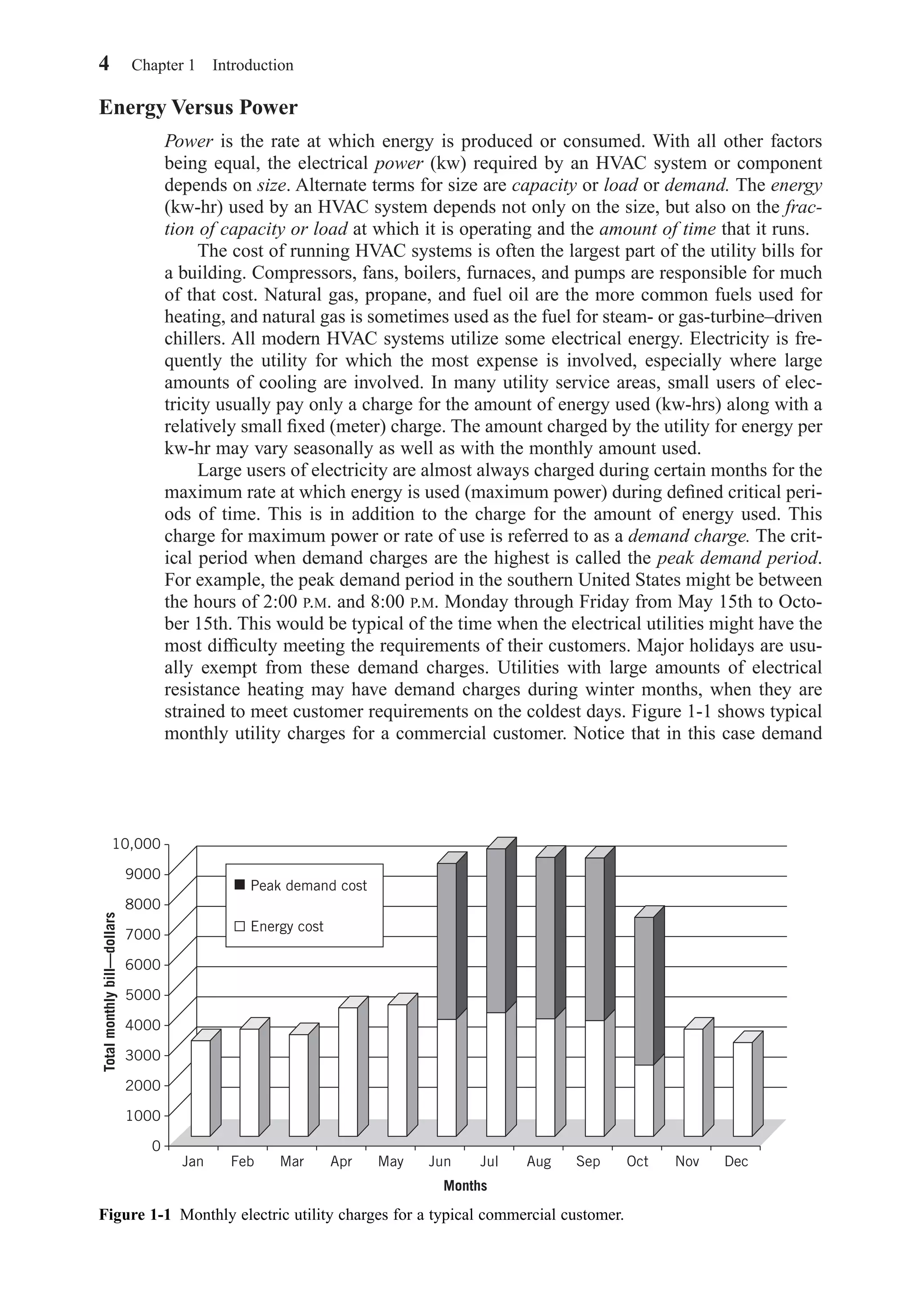
strained to meet customer requirements on the coldest days. Figure 1-1 shows typical
monthly utility charges for a commercial customer. Notice that in this case demand
4 Chapter 1 Introduction
Figure 1-1 Monthly electric utility charges for a typical commercial customer.
10,000
9000
8000
7000
6000
5000
4000
3000
2000
1000
0
Jan Feb Mar Apr May Jun Jul Aug
Months
Totalmonthlybill—dollars
Sep Oct Nov Dec
Peak demand cost
Energy cost
Chapter01.qxd 6/15/04 2:32 PM Page 4
charges make up about 38 percent of the total annual electrical bill. HVAC systems
must be designed and operated to incur reasonable utility charges consistent with sat-
isfactory performance in maintaining comfort. ASHRAE Guideline 14-2002, Mea-
surement of Energy and Demand Savings, gives guidance on reliably measuring
energy and demand savings of commercial equipment.
EXAMPLE 1-1
Determine the July electric utility bill for a facility that used 112,000 kw-hrs during
that month and which had a maximum power usage of 500 kw during the peak peri-
ods of time in that month. The utility has a fixed “meter” charge of $75 per month and
charges a flat rate of 5.0 cents per kw-hr for energy and $12.00 per kw for maximum
power usage during peak periods in July.
SOLUTION
The monthly bill is made up of a fixed meter charge, a charge for energy, and a charge
for peak demand.
Fixed monthly meter charge $75.00
Energy charge (112,000 kw-hrs × 0.05 $/kw-hr) $5600.00
Demand charge (500 kw × $12.00/kw) $6000.00
Total Monthly Electric Bill $11,675.00
Notice in this case that the peak demand charge is more than 50 percent of the total
bill. If the facility had been able to reduce the maximum power usage 10 percent by
“shifting” some of the peak load to an off-peak time, but still using the same amount
of energy, the savings for the month would amount to $600. This shifting can some-
times be accomplished by rescheduling or by thermal energy storage (TES), which
will be discussed in Chapter 2.
A course in engineering economy is good background for those who must make
investment decisions and studies of alternative designs involving energy costs. Typi-
cally decisions must be made involving the tradeoff between first cost and operating
costs or savings. A simple example involves the installation of additional insulation in
the building envelope to save energy. Analysis could determine whether the first cost
of installing the insulation would be economically justified by the reduction in gas
and/or electric bills.
Any proposed project will have initial or first costs, which are the amounts that
must be expended to build or bring the project into operation. After startup there will
be fixed charges and operating expenses spread out over the life of the project and per-
haps varying with the amount of usage or output. To determine feasibility or to com-
pare alternatives, one needs a basis on which to compare all of these costs, which
occur at different times and are usually spread out over years. The present value of
future costs and income can be determined by using suitable interest rates and dis-
counting formulas. For example, the present value P of a uniform series of payments
or income A made at the end of each year over a period of n years is given by
(1-1)
where i is the interest rate, compounded annually. If payments are to be made at the
end of each month instead of at the end of each year, change A to the monthly pay-
ment M, and substitute 12n for n and i/12 for i in Eq. 1-1.
P A i in= − + −[ ( ( )) ]( )1 1
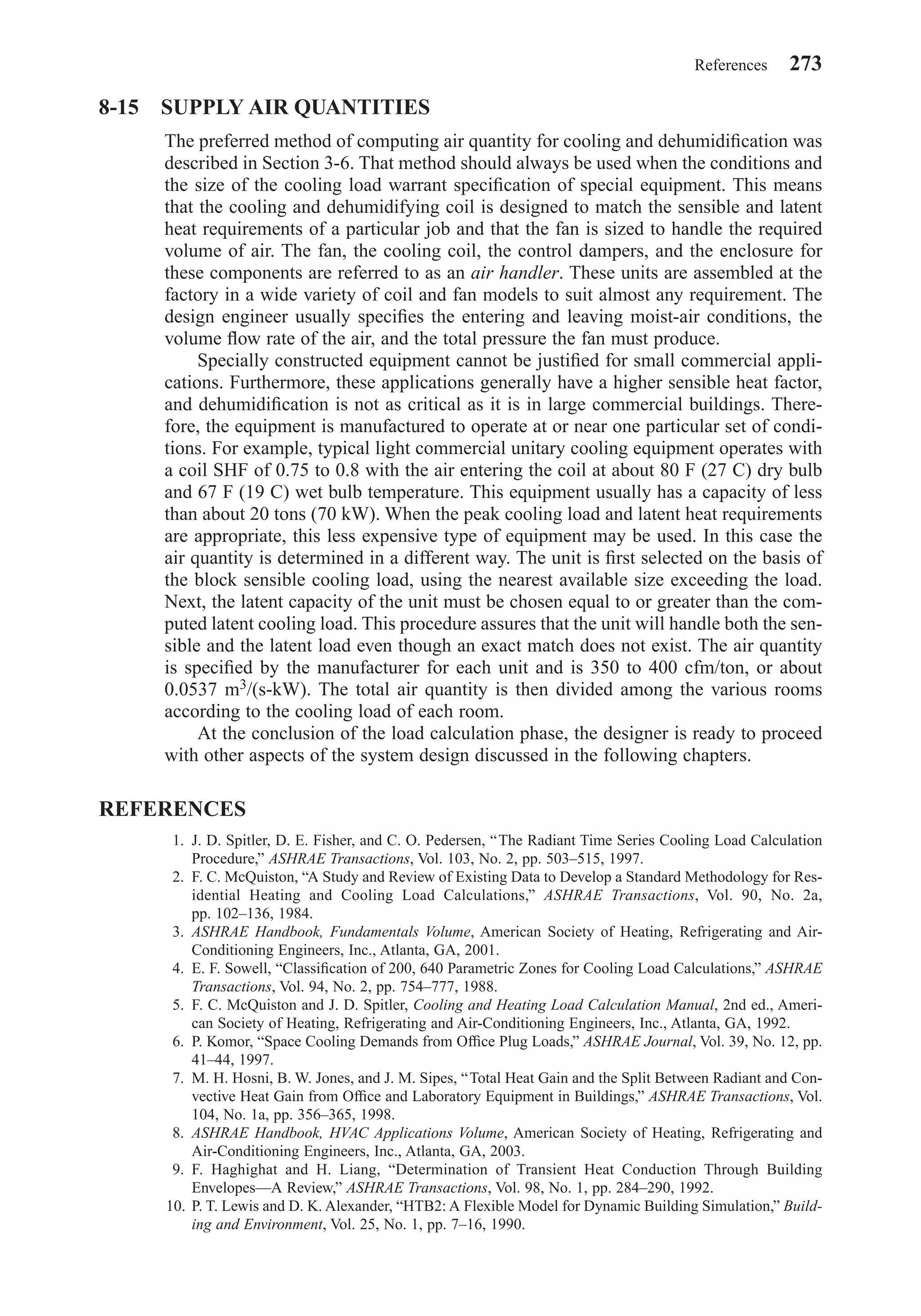
1-2 Common HVAC Units and Dimensions 5
Chapter01.qxd 6/15/04 2:32 PM Page 5
EXAMPLE 1-2
Proposed improvements to a heating system are estimated to cost $8000 and should
result in an annual savings to the owner of $720 over the 15-year life of the equip-
ment. The interest rate used for making the calculation is 9 percent per year and sav-
ings are assumed to occur uniformly at the end of each month as the utility bill is paid.
SOLUTION
Using Eq. 1-1 and noting that the savings is assumed to be $60 per month, the pres-
ent worth of the savings is computed.
P = ($60) [1 − (1 + (0.09/12))−(15)(12)] / (0.09/12)
P = $5916 < $8000
Since the present worth of the savings is less than the first cost, the proposed project
is not feasible. This is true even though the total savings over the entire 15 years is
($720)(15) = $10,800, more than the first cost in actual dollars. Dollars in the future
are worth less than dollars in the present. Notice that with a lower interest rate or
longer equipment life the project might have become feasible. Computations of this
type are important to businesses in making decisions about the expenditure of money.
Sometimes less obvious factors, such as increased productivity of workers due to
improved comfort, may have to be taken into account.
1-3 FUNDAMENTAL PHYSICAL CONCEPTS
Good preparation for a study of HVAC system design most certainly includes courses
in thermodynamics, fluid mechanics, heat transfer, and system dynamics. The first law
of thermodynamics leads to the important concept of the energy balance. In some
cases the balance will be on a closed system or fixed mass. Often the energy balance
will involve a control volume, with a balance on the mass flowing in and out consid-
ered along with the energy flow.
The principles of fluid mechanics, especially those dealing with the behavior of
liquids and gases flowing in pipes and ducts, furnish important tools. The economic
tradeoff in the relationship between flow rate and pressure loss will often be inter-
twined with the thermodynamic and heat transfer concepts. Behavior of individual
components or elements will be expanded to the study of complete fluid distribution
systems. Most problems will be presented and analyzed as steady-flow and steady-
state even though changes in flow rates and properties frequently occur in real sys-
tems. Where transient or dynamic effects are important, the computations are often
complex, and computer routines are usually used.
Some terminology is unique to HVAC applications, and certain terms have a spe-
cial meaning within the industry. This text will identify many of these special terms.
Those and others are defined in the ASHRAE Terminology of HVACR (14). Some of
the more important processes, components, and simplified systems required to main-
tain desired environmental conditions in spaces will be described briefly.
Heating
In space conditioning, heating is performed either (a) to bring a space up to a higher
temperature than existed previously, for example from an unoccupied nighttime
6 Chapter 1 Introduction
Chapter01.qxd 6/15/04 2:32 PM Page 6
period, or (b) to replace the energy being lost to colder surroundings by a space so that
a desired temperature range may be maintained. This process may occur in different
ways, such as by direct radiation and/or free convection to the space, by direct heat-
ing of forced circulated air to be mixed with cooler air in the space, or by the transfer
of electricity or heated water to devices in the space for direct or forced circulated air
heating. Heat transfer that is manifested solely in raising or maintaining the tempera-
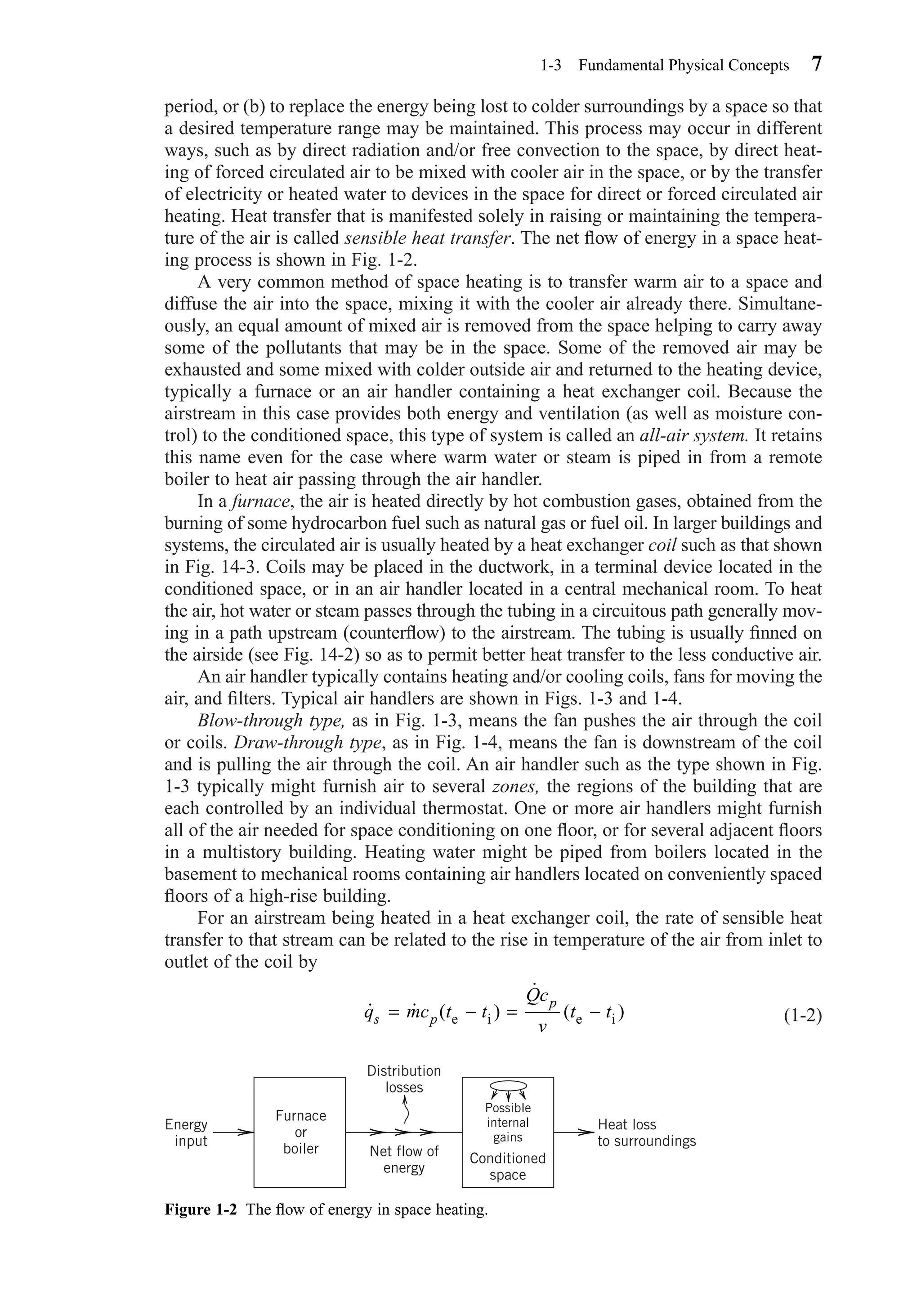
ture of the air is called sensible heat transfer. The net flow of energy in a space heat-
ing process is shown in Fig. 1-2.
A very common method of space heating is to transfer warm air to a space and
diffuse the air into the space, mixing it with the cooler air already there. Simultane-
ously, an equal amount of mixed air is removed from the space helping to carry away
some of the pollutants that may be in the space. Some of the removed air may be
exhausted and some mixed with colder outside air and returned to the heating device,
typically a furnace or an air handler containing a heat exchanger coil. Because the
airstream in this case provides both energy and ventilation (as well as moisture con-
trol) to the conditioned space, this type of system is called an all-air system. It retains
this name even for the case where warm water or steam is piped in from a remote
boiler to heat air passing through the air handler.
In a furnace, the air is heated directly by hot combustion gases, obtained from the
burning of some hydrocarbon fuel such as natural gas or fuel oil. In larger buildings and
systems, the circulated air is usually heated by a heat exchanger coil such as that shown
in Fig. 14-3. Coils may be placed in the ductwork, in a terminal device located in the
conditioned space, or in an air handler located in a central mechanical room. To heat
the air, hot water or steam passes through the tubing in a circuitous path generally mov-
ing in a path upstream (counterflow) to the airstream. The tubing is usually finned on
the airside (see Fig. 14-2) so as to permit better heat transfer to the less conductive air.
An air handler typically contains heating and/or cooling coils, fans for moving the
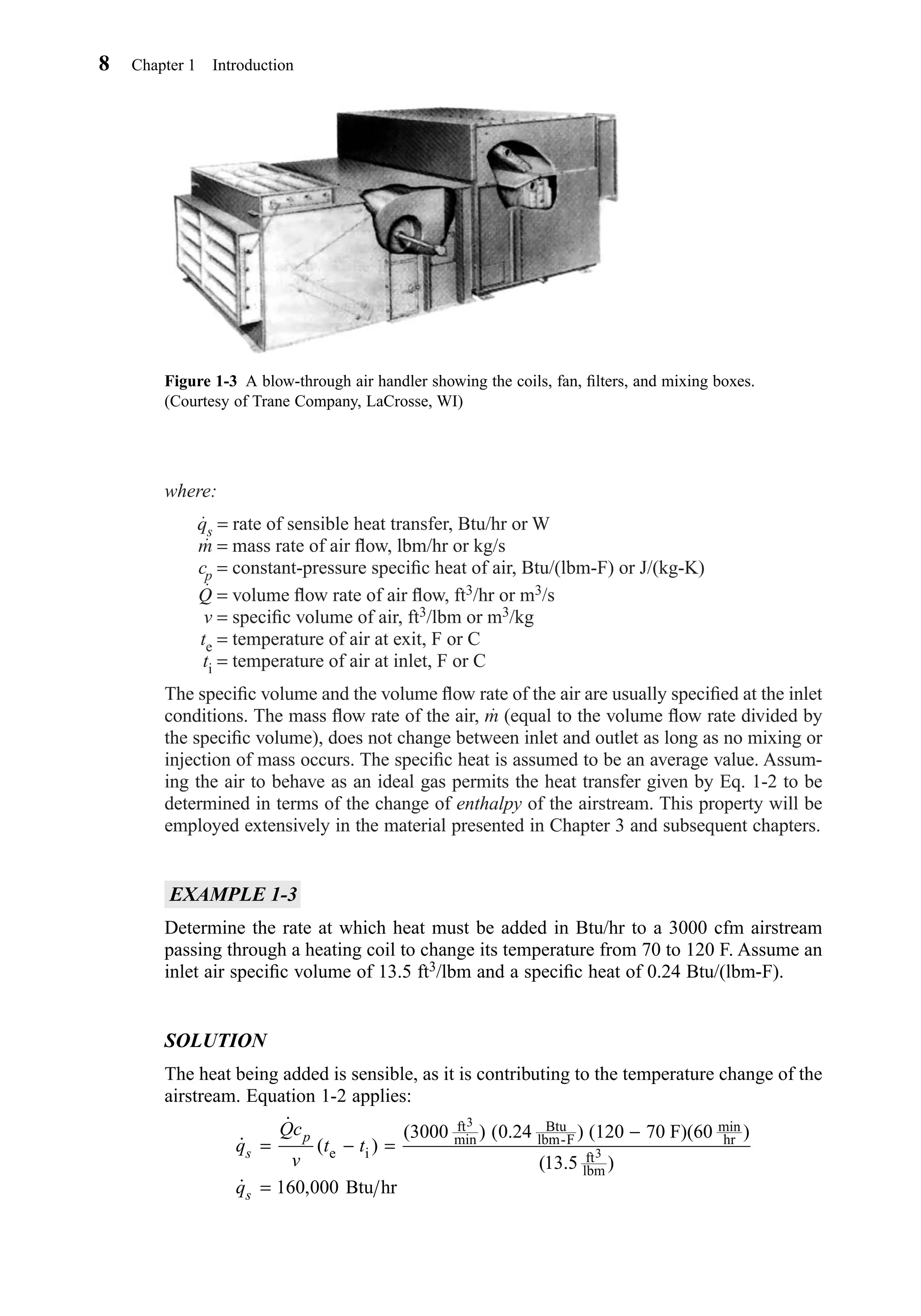
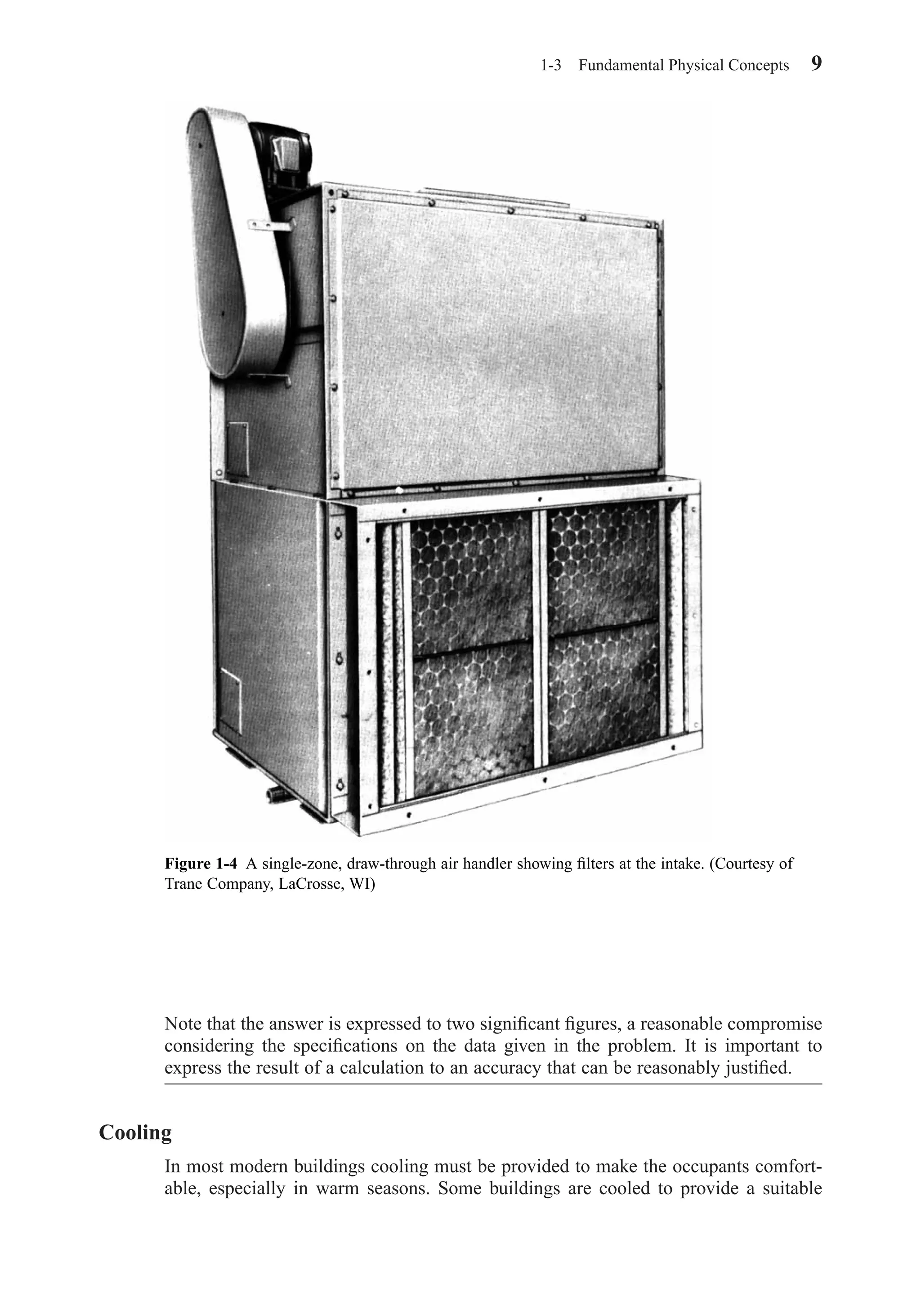
air, and filters. Typical air handlers are shown in Figs. 1-3 and 1-4.
Blow-through type, as in Fig. 1-3, means the fan pushes the air through the coil
or coils. Draw-through type, as in Fig. 1-4, means the fan is downstream of the coil
and is pulling the air through the coil. An air handler such as the type shown in Fig.
1-3 typically might furnish air to several zones, the regions of the building that are
each controlled by an individual thermostat. One or more air handlers might furnish
all of the air needed for space conditioning on one floor, or for several adjacent floors
in a multistory building. Heating water might be piped from boilers located in the
basement to mechanical rooms containing air handlers located on conveniently spaced
floors of a high-rise building.
For an airstream being heated in a heat exchanger coil, the rate of sensible heat
transfer to that stream can be related to the rise in temperature of the air from inlet to
outlet of the coil by
(1-2)˙ ˙ ( )
˙
( )q mc t t
Qc
v
t ts p
p
= − = −e i e i
1-3 Fundamental Physical Concepts 7
Figure 1-2 The flow of energy in space heating.
Furnace
or
boiler
Energy
input
Heat loss
to surroundings
Distribution
losses
Net flow of
energy
Possible
internal
gains
Conditioned
space
Chapter01.qxd 6/15/04 2:32 PM Page 7
where:
qs = rate of sensible heat transfer, Btu/hr or W
m = mass rate of air flow, lbm/hr or kg/s
cp = constant-pressure specific heat of air, Btu/(lbm-F) or J/(kg-K)
Q = volume flow rate of air flow, ft3/hr or m3/s
v = specific volume of air, ft3/lbm or m3/kg
te = temperature of air at exit, F or C
ti = temperature of air at inlet, F or C
The specific volume and the volume flow rate of the air are usually specified at the inlet
conditions. The mass flow rate of the air, m (equal to the volume flow rate divided by
the specific volume), does not change between inlet and outlet as long as no mixing or
injection of mass occurs. The specific heat is assumed to be an average value. Assum-
ing the air to behave as an ideal gas permits the heat transfer given by Eq. 1-2 to be
determined in terms of the change of enthalpy of the airstream. This property will be
employed extensively in the material presented in Chapter 3 and subsequent chapters.
EXAMPLE 1-3
Determine the rate at which heat must be added in Btu/hr to a 3000 cfm airstream
passing through a heating coil to change its temperature from 70 to 120 F. Assume an
inlet air specific volume of 13.5 ft3/lbm and a specific heat of 0.24 Btu/(lbm-F).
SOLUTION
The heat being added is sensible, as it is contributing to the temperature change of the
airstream. Equation 1-2 applies:
˙
˙
( )
( ) ( . ) )
( . )
˙ ,
q
Qc
v
t t
q
s
p
s
= − =
−
=
e i
ft
min
Btu
lbm-F
min
hr
ft
lbm
3
3
(120 70 F)(60
Btu hr
3000 0 24
13 5
160 000
8 Chapter 1 Introduction
Figure 1-3 A blow-through air handler showing the coils, fan, filters, and mixing boxes.
(Courtesy of Trane Company, LaCrosse, WI)
Chapter01.qxd 6/15/04 2:32 PM Page 8
Note that the answer is expressed to two significant figures, a reasonable compromise
considering the specifications on the data given in the problem. It is important to
express the result of a calculation to an accuracy that can be reasonably justified.
Cooling
In most modern buildings cooling must be provided to make the occupants comfort-
able, especially in warm seasons. Some buildings are cooled to provide a suitable
1-3 Fundamental Physical Concepts 9
Figure 1-4 A single-zone, draw-through air handler showing filters at the intake. (Courtesy of
Trane Company, LaCrosse, WI)
Chapter01.qxd 6/15/04 2:32 PM Page 9
environment for sensitive manufacturing or process control. Even in cold climates
there may be need for year-around cooling in interior spaces and in special applica-
tions. Cooling is the transfer of energy from a space, or from air supplied to a space,
to make up for the energy being gained by that space. Energy gain to a space is typi-
cally from warmer surroundings and sunlight or from internal sources within the
space, such as occupants, lights, and machinery. The flow of energy in a typical cool-
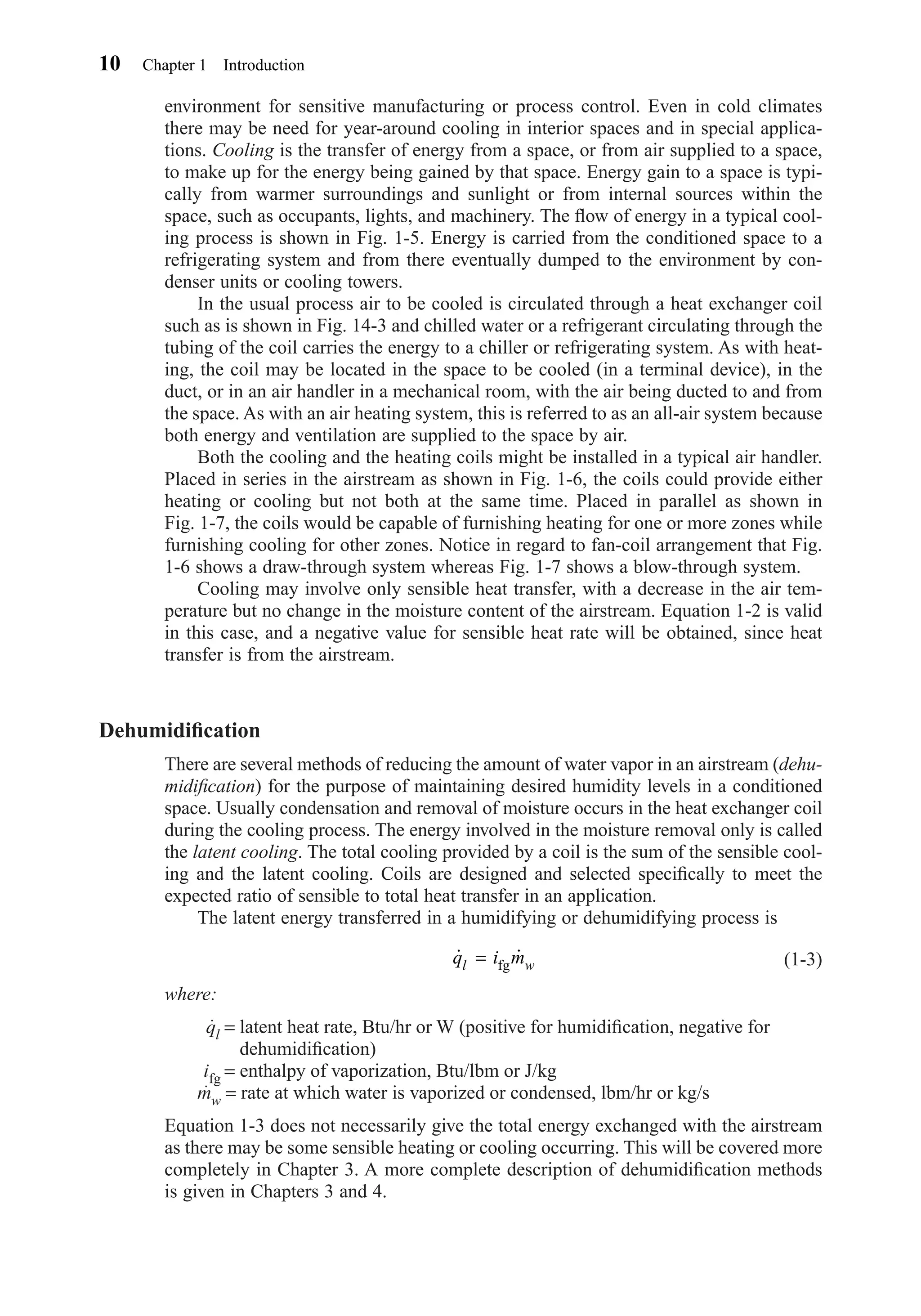
ing process is shown in Fig. 1-5. Energy is carried from the conditioned space to a
refrigerating system and from there eventually dumped to the environment by con-
denser units or cooling towers.
In the usual process air to be cooled is circulated through a heat exchanger coil
such as is shown in Fig. 14-3 and chilled water or a refrigerant circulating through the
tubing of the coil carries the energy to a chiller or refrigerating system. As with heat-
ing, the coil may be located in the space to be cooled (in a terminal device), in the
duct, or in an air handler in a mechanical room, with the air being ducted to and from
the space. As with an air heating system, this is referred to as an all-air system because
both energy and ventilation are supplied to the space by air.
Both the cooling and the heating coils might be installed in a typical air handler.
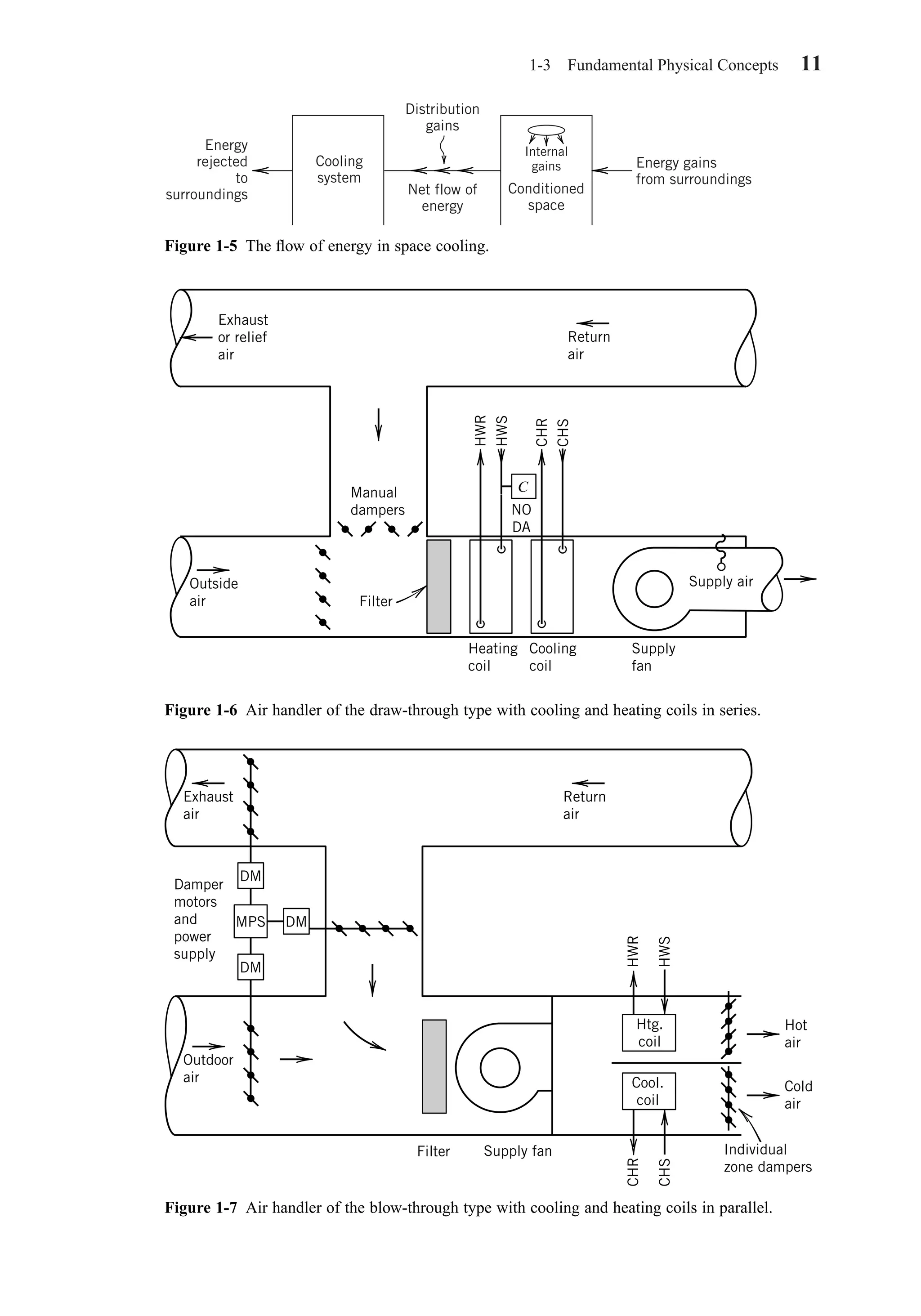
Placed in series in the airstream as shown in Fig. 1-6, the coils could provide either
heating or cooling but not both at the same time. Placed in parallel as shown in
Fig. 1-7, the coils would be capable of furnishing heating for one or more zones while
furnishing cooling for other zones. Notice in regard to fan-coil arrangement that Fig.
1-6 shows a draw-through system whereas Fig. 1-7 shows a blow-through system.
Cooling may involve only sensible heat transfer, with a decrease in the air tem-
perature but no change in the moisture content of the airstream. Equation 1-2 is valid
in this case, and a negative value for sensible heat rate will be obtained, since heat
transfer is from the airstream.
Dehumidification
There are several methods of reducing the amount of water vapor in an airstream (dehu-
midification) for the purpose of maintaining desired humidity levels in a conditioned
space. Usually condensation and removal of moisture occurs in the heat exchanger coil
during the cooling process. The energy involved in the moisture removal only is called
the latent cooling. The total cooling provided by a coil is the sum of the sensible cool-
ing and the latent cooling. Coils are designed and selected specifically to meet the
expected ratio of sensible to total heat transfer in an application.
The latent energy transferred in a humidifying or dehumidifying process is
(1-3)
where:
ql = latent heat rate, Btu/hr or W (positive for humidification, negative for
dehumidification)
ifg = enthalpy of vaporization, Btu/lbm or J/kg
mw = rate at which water is vaporized or condensed, lbm/hr or kg/s
Equation 1-3 does not necessarily give the total energy exchanged with the airstream
as there may be some sensible heating or cooling occurring. This will be covered more
completely in Chapter 3. A more complete description of dehumidification methods
is given in Chapters 3 and 4.
˙ ˙q i ml w= fg
10 Chapter 1 Introduction
Chapter01.qxd 6/15/04 2:32 PM Page 10
1-3 Fundamental Physical Concepts 11
Figure 1-5 The flow of energy in space cooling.
Cooling
system
Energy
rejected
to
surroundings
Energy gains
from surroundings
Distribution
gains
Net flow of
energy
Internal
gains
Conditioned
space
Figure 1-6 Air handler of the draw-through type with cooling and heating coils in series.
Exhaust
or relief
air
Manual
dampers
Filter
Supply air
Supply
fan
Cooling
coil
Heating
coil
NO
DA
HWR
CHR
CHS
HWS
Return
air
Outside
air
C
Figure 1-7 Air handler of the blow-through type with cooling and heating coils in parallel.
Damper
motors
and
power
supply
DM
MPS
DM
DM
Hot
air
Outdoor
air
Return
air
Supply fan
Htg.
coil
Cool.
coil
Cold
air
HWR
HWS
Individual
zone dampers
CHR
CHS
Exhaust
air
Filter
Chapter01.qxd 6/15/04 2:32 PM Page 11
Humidifying
In cold weather there is a tendency to have insufficient moisture in the conditioned
space for comfort. Water vapor is often transferred to the heated supply air in a process
referred to as humidification. Heat transfer is associated with this mass transfer
process and the term latent heat transfer is often used to describe the latent energy
required. This process is usually accomplished by injecting steam, by evaporating
water from wetted mats or plates, or by spraying a fine mist of droplets into the heated
circulating airstream. A device for injecting steam into an airstream for humidification
purposes is shown in Fig. 1-8.
EXAMPLE 1-4
Using saturated liquid water in a humidifier, it is desired to add 0.01 lbm of water
vapor to each pound of perfectly dry air flowing at the rate of 3000 cfm. Assuming a
value of 1061 Btu/lbm for the enthalpy of vaporization of water, estimate the rate of
latent energy input necessary to perform this humidification of the airstream.
SOLUTION
Since the rate of water addition is tied to the mass of the air, we must determine the
mass flow rate of the airstream. Let us assume that the specific volume of the air given
in Example 1-3, 13.5 ft3/lbm, is a suitable value to use in this case; then
˙
˙
m
Q
vair
ft
min
ft
lbm
3
3
13.5
= =
3000
12 Chapter 1 Introduction
Figure 1-8 A commercial steam humidifier. (Courtesy of Spirax Sarco, Inc.)
Chapter01.qxd 6/15/04 2:32 PM Page 12
and the latent heat transfer
More sophisticated methods to compute energy changes occurring in airstreams and
conditioned spaces will be discussed in Chapter 3.
Cleaning
The cleaning of air usually implies filtering, although it also may be necessary to
remove contaminant gases or odors from the air. Filtering is most often done by a
process in which solid particles are captured in a porous medium (filters). This is done
not only to improve the quality of the environment in the conditioned space but also
to prevent buildup on the closely-spaced finned surfaces of the heat exchanger coils.
Filters can be seen in the intake of the air handler shown in Fig. 1-4, and typical loca-
tions are shown schematically in Figs. 1-6 and 1-7. Air filters and air cleaning will be
discussed in more detail in Chapter 4.
Controls and Instrumentation
Because the loads in a building will vary with time, there must be controls to modulate
the output of the HVAC system to satisfy the loads. An HVAC system is designed to
meet the extremes in the demand, but most of the time it will be operating at part load
conditions. A properly designed control system will maintain good indoor air quality
and comfort under all anticipated conditions with the lowest possible life-cycle cost.
Controls may be energized in a variety of ways (pneumatic, electric, electronic),
or they may even be self-contained, so that no external power is required. Some HVAC
systems have combination systems, for example, pneumatic and electronic. The trend
in recent times is more and more toward the use of digital control, sometimes called
direct digital control or DDC (6, 8, 15, 16). Developments in both analog and digital
electronics and in computers have allowed control systems to become much more
sophisticated and permit an almost limitless variety of control sequences within the
physical capability of the HVAC equipment. Along with better control comes addi-
tional monitoring capability as well as energy management systems (EMS) and BAS.
These permit a better determination of unsafe operating conditions and better control
of the spread of contamination or fire. By minimizing human intervention in the oper-
ation of the system, the possibility of human error is reduced.
In order for there to be interoperability among different vendors’ products using
a computer network, there must be a set of rules (protocol) for data exchange.
ASHRAE has developed such a protocol, BACnet®, an acronym for “building automa-
tion and control networks.” The protocol is the basis for ANSI/ASHRAE Standard
135-2001, “BACnet®—A Data Communication Protocol for Building Automation and
Control Networks.” A BACnet® CD is available from ASHRAE in dual units (17). It
contains useful information to anyone involved in implementing or specifying BAC-
net®. This CD also contains the complete 135-2001 Standard as well as addenda, clar-
ifications, and errata. The language of BACnet® is described by DeJoannis (18). A
large number of manufacturers and groups have adopted BACnet®, while some are
˙ ( )
.
)(
,
min minql w
a
w
a
=








=
1061
3000
13 5
60
141 000
3
3
Btu
lbm
ft
ft
lbm
lbm
lbm hr
Btu
hr
(0.01
1-3 Fundamental Physical Concepts 13
Chapter01.qxd 6/15/04 2:32 PM Page 13
taking a wait-and-see attitude. Other “open” protocols such as LonMark® and Mod-
Bus® are supported by some manufacturers and groups and continue to be used. BAC-
net® has received widespread international acceptance and has been adopted as an ISO
standard (19). An update on BACnet® is given in a supplement to the October 2002
ASHRAE Journal.
HVAC networks designed to permit the use of components from a wide variety of
manufacturers are referred to as open networks. A gateway is a device needed between
two systems operating on different protocols to allow them to communicate (20).
More detailed information on HVAC controls can be found in the ASHRAE Hand-
books (6, 8) and books by Gupton (21) and Haines (22). Some common control meth-
ods and systems will be discussed in later sections of this text. A brief review of
control fundamentals may be helpful before proceeding further.
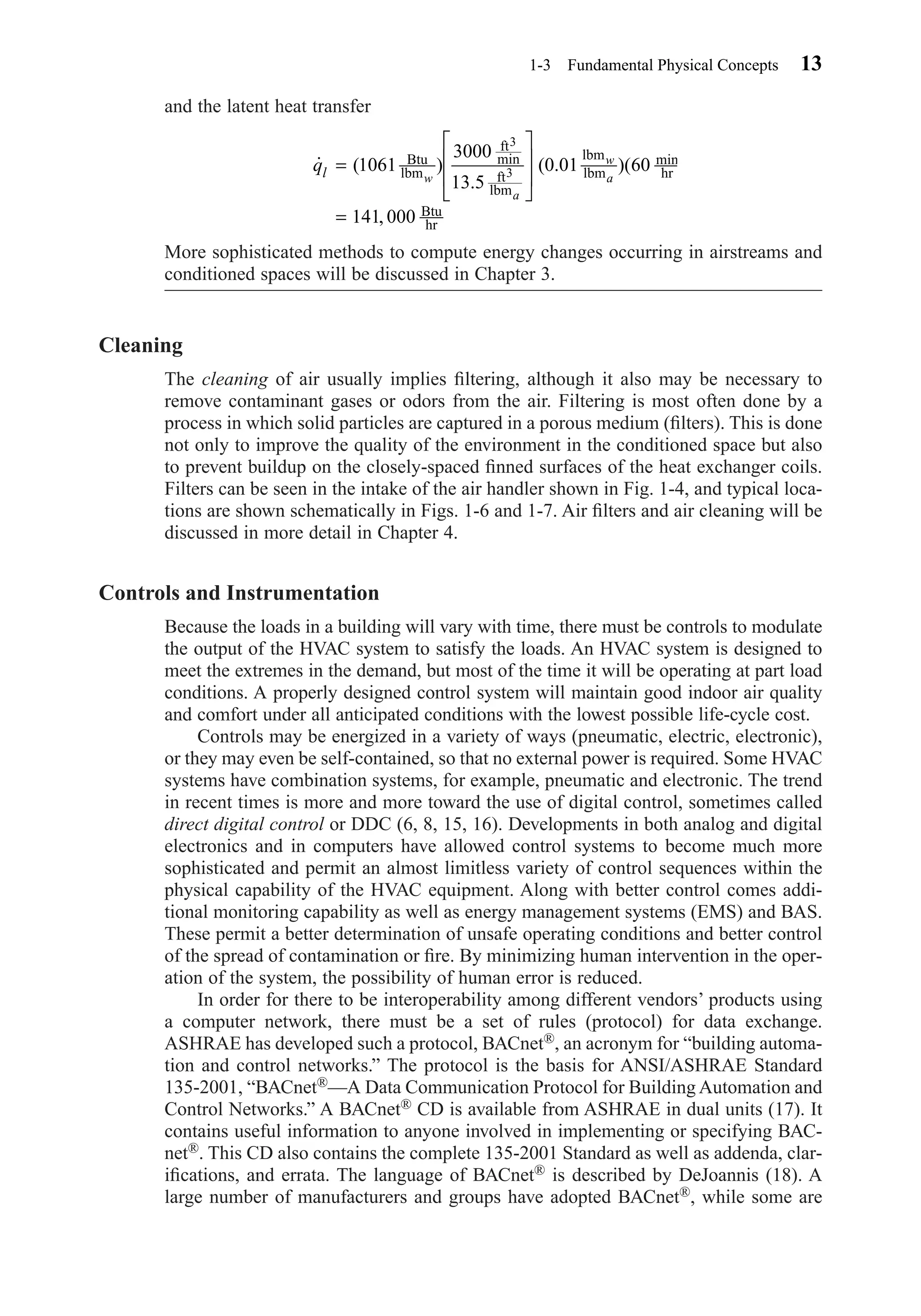
All control systems, even the simplest ones, have three necessary elements: sen-
sor, controller, and controlled device. Consider the control of the air temperature
downstream of a heating coil, as in Fig. 1-9. The position of the control valve deter-
mines the rate at which hot water circulates through the heating coil. As hot water
passes through the coil, the air (presumed to be flowing at a constant rate) will be
heated. A temperature sensor is located at a position downstream of the coil so as to
measure the temperature of the air leaving the coil. The temperature sensor sends a
signal (voltage, current, or resistance) to the controller that corresponds to the sensor’s
temperature. The controller has been given a set point equal to the desired downstream
air temperature and compares the signal from the sensor with the set point. If the tem-
perature described by the signal from the sensor is greater than the set point, the con-
troller will send a signal to partially close the control valve. This is a closed-loop
system because the change in the controlled device (the control valve) results in a
change in the downstream air temperature (the controlled variable), which in turn is
detected by the sensor. The process by which the change in output is sensed is called
feedback. In an open-loop, or feedforward, system the sensor is not directly affected
by the action of the controlled device. An example of an open-loop system is the sens-
ing of outdoor temperature to set the water temperature in a heating loop. In this case
adjustment of the water temperature has no effect on the outdoor temperature sensor.
Control actions may be classified as two-position or on–off action, timed two-
position action, floating action, or modulating action. The two-position or on–off
action is the simplest and most common type. An example is an electric heater turned
14 Chapter 1 Introduction
Figure 1-9 Elementary air-temperature control system.
V
Control
valve
Heating
coil
T
C Controller
Temperature
sensor
HWR
HWS
Air
flow
Chapter01.qxd 6/15/04 2:32 PM Page 14
on and off by a thermostat, or a pump turned on and off by a pressure switch. To pre-
vent rapid cycling when this type of action is used, there must be a difference between
the setting at which the controller changes to one position and the setting at which it
changes to the other. In some instances time delay may be necessary to avoid rapid
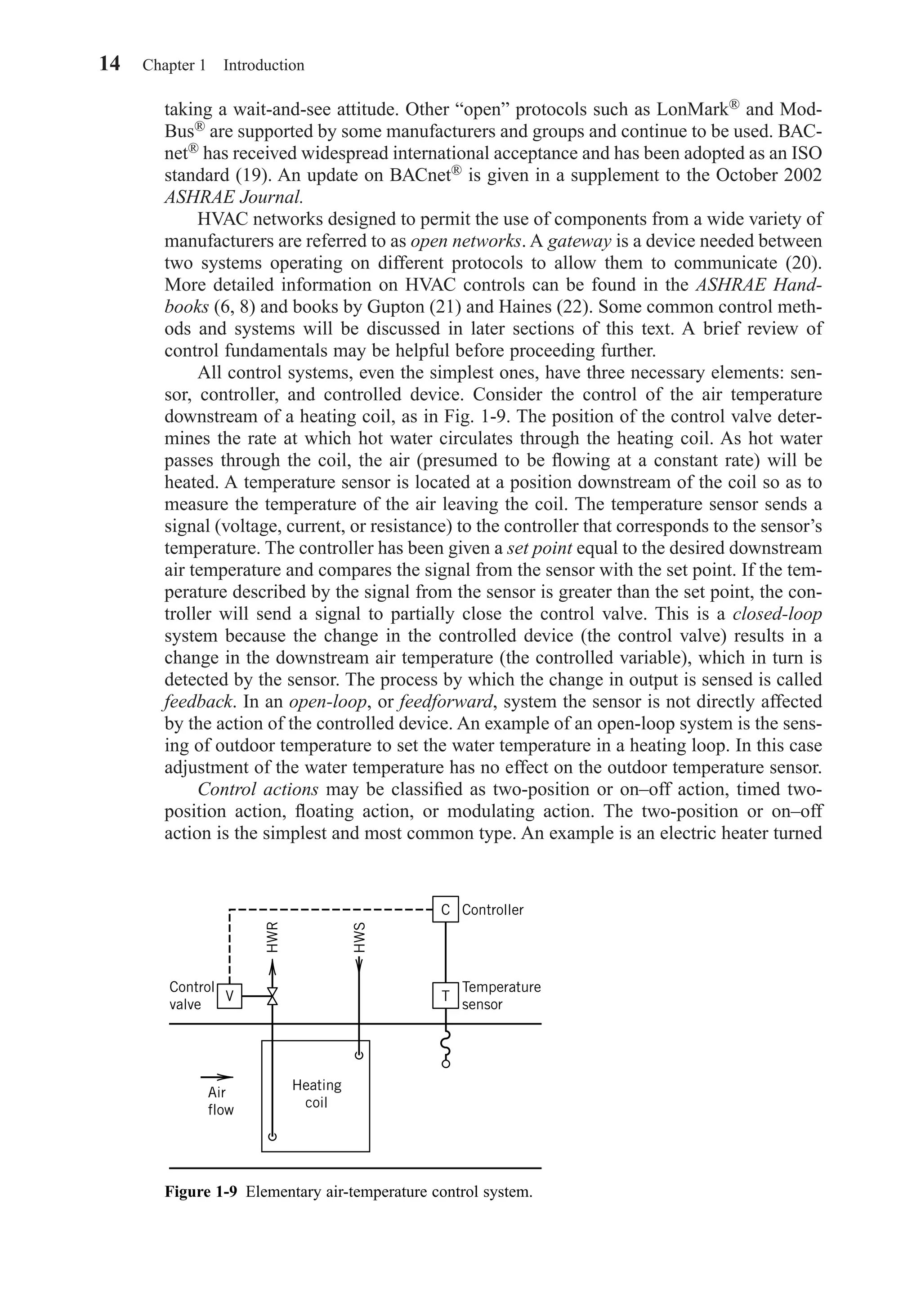
cycling. Figure 1-10 illustrates how the controlled variable might change with time
with two-position action. Note that there is a time lag in the response of the controlled
variable, resulting in the actual operating differential being greater than the set, or con-
trol, differential. This difference can be reduced by artificially shortening the on or off
time in anticipation of the system response. For example, a thermostat in the heating
mode may have a small internal heater activated during the on period, causing the off
signal to occur sooner than it would otherwise. With this device installed, the ther-
mostat is said to have an anticipator or heat anticipation.
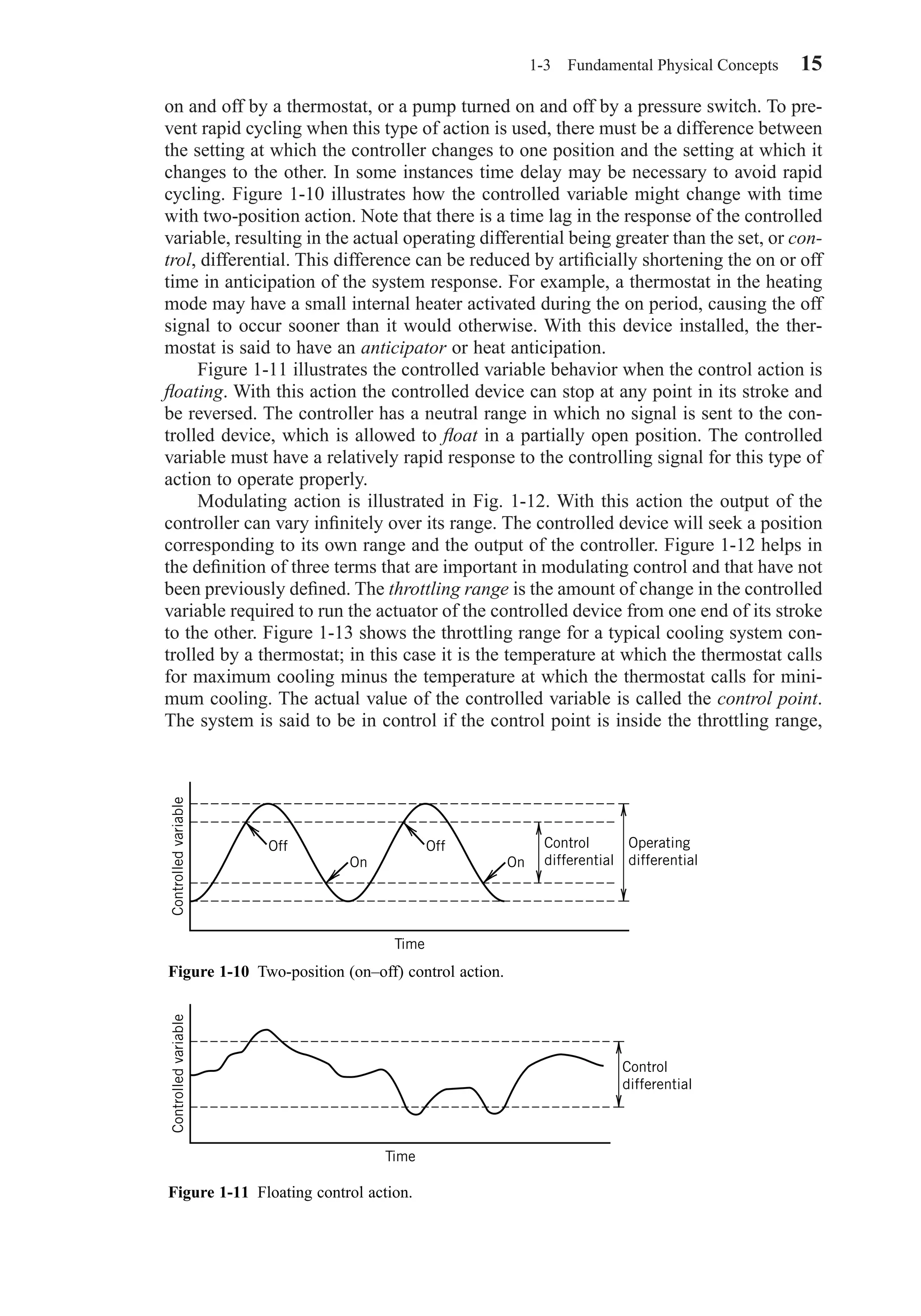
Figure 1-11 illustrates the controlled variable behavior when the control action is
floating. With this action the controlled device can stop at any point in its stroke and
be reversed. The controller has a neutral range in which no signal is sent to the con-
trolled device, which is allowed to float in a partially open position. The controlled
variable must have a relatively rapid response to the controlling signal for this type of
action to operate properly.
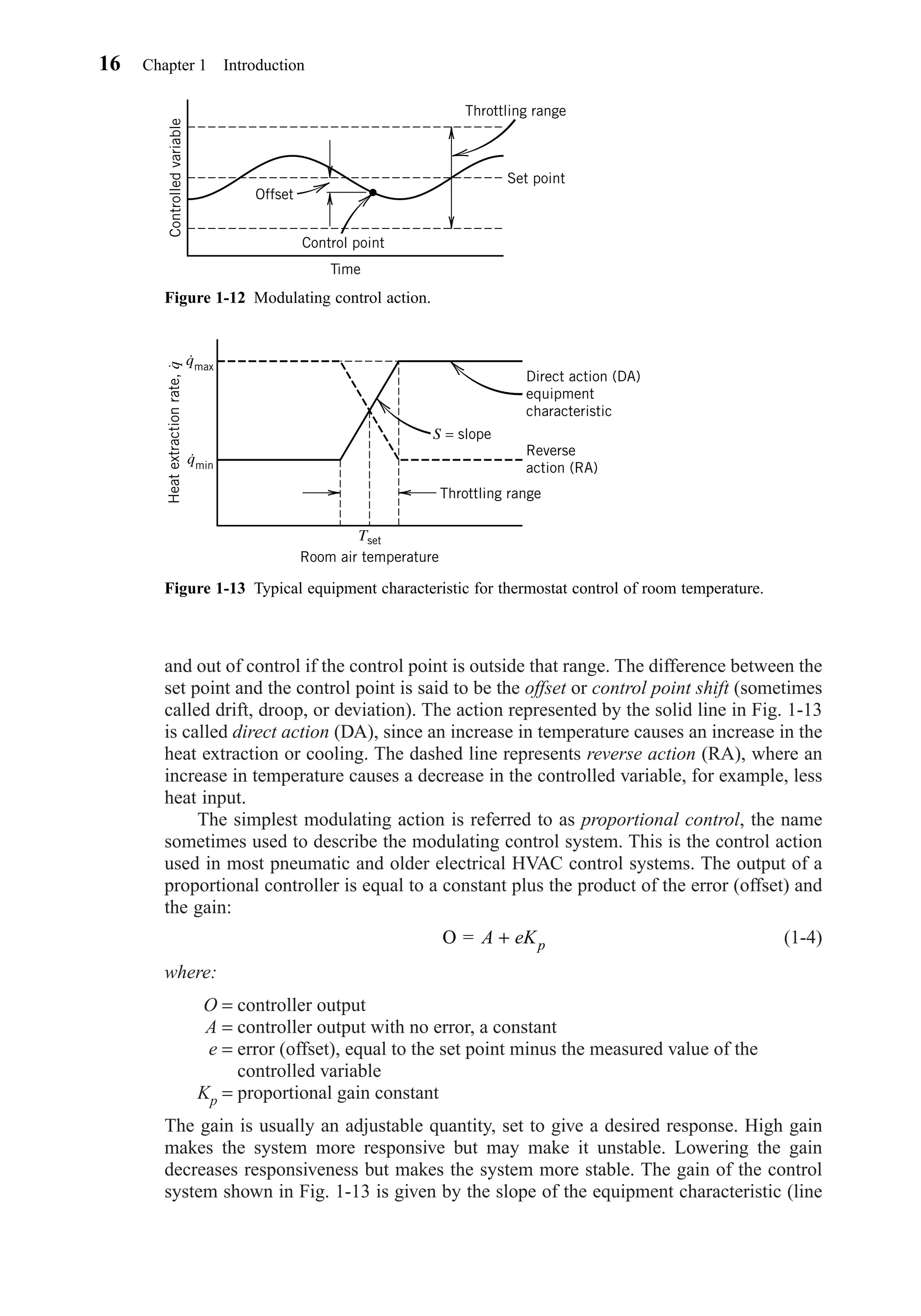
Modulating action is illustrated in Fig. 1-12. With this action the output of the
controller can vary infinitely over its range. The controlled device will seek a position
corresponding to its own range and the output of the controller. Figure 1-12 helps in
the definition of three terms that are important in modulating control and that have not
been previously defined. The throttling range is the amount of change in the controlled
variable required to run the actuator of the controlled device from one end of its stroke
to the other. Figure 1-13 shows the throttling range for a typical cooling system con-
trolled by a thermostat; in this case it is the temperature at which the thermostat calls
for maximum cooling minus the temperature at which the thermostat calls for mini-
mum cooling. The actual value of the controlled variable is called the control point.
The system is said to be in control if the control point is inside the throttling range,
1-3 Fundamental Physical Concepts 15
Figure 1-10 Two-position (on–off) control action.
Control
differential
Controlledvariable
Operating
differential
Time
Off Off
On On
Figure 1-11 Floating control action.
Control
differential
Controlledvariable
Time
Chapter01.qxd 6/15/04 2:32 PM Page 15
and out of control if the control point is outside that range. The difference between the
set point and the control point is said to be the offset or control point shift (sometimes
called drift, droop, or deviation). The action represented by the solid line in Fig. 1-13
is called direct action (DA), since an increase in temperature causes an increase in the
heat extraction or cooling. The dashed line represents reverse action (RA), where an
increase in temperature causes a decrease in the controlled variable, for example, less
heat input.
The simplest modulating action is referred to as proportional control, the name
sometimes used to describe the modulating control system. This is the control action
used in most pneumatic and older electrical HVAC control systems. The output of a
proportional controller is equal to a constant plus the product of the error (offset) and
the gain:
(1-4)
where:
O = controller output
A = controller output with no error, a constant
e = error (offset), equal to the set point minus the measured value of the
controlled variable
Kp = proportional gain constant
The gain is usually an adjustable quantity, set to give a desired response. High gain
makes the system more responsive but may make it unstable. Lowering the gain
decreases responsiveness but makes the system more stable. The gain of the control
system shown in Fig. 1-13 is given by the slope of the equipment characteristic (line
O = A eKp+
16 Chapter 1 Introduction
Figure 1-12 Modulating control action.
Controlledvariable
Time
Control point
Throttling range
Set point
Offset
Figure 1-13 Typical equipment characteristic for thermostat control of room temperature.
Tset
Throttling range
Reverse
action (RA)
Direct action (DA)
equipment
characteristic
S = slope
Room air temperature
Heatextractionrate,q
⋅
qmin
⋅
qmax
⋅
Chapter01.qxd 6/15/04 2:32 PM Page 16
S) in the throttling range. For this case the units of gain are those of heat rate per
degree, for example Btu/(hr-F) or W/C.
In Fig. 1-14 the controlled variable is shown with maximum error at time zero and
a response that brings the control point quickly to a stable value with a small offset.
Figure 1-15 illustrates an unstable system, where the control point continues to oscil-
late about the set point, never settling down to a constant, low-offset value as with the
stable system.
Some offset will always exist with proportional control systems. For a given
HVAC system the magnitude of the offset increases with decreases in the control sys-
tem gain and the load. System performance, comfort, and energy consumption may
be affected by this offset. Offset can be eliminated by the use of a refinement to pro-
portional control, referred to as proportional plus integral (PI) control. The controller
is designed to behave in the following manner:
(1-5)
where Ki is the integral gain constant.
In this mode the output of the controller is additionally affected by the error inte-
grated over time. This means that the error or offset will eventually be reduced for all
practical purposes to zero. The integral gain constant Ki is equal to x/t, where x is the
number of samples of the measured variable taken in the time t, sometimes called the
reset rate. In much of the HVAC industry, PI control has been referred to as propor-
tional with reset, but the correct term proportional plus integral is becoming more
widely used. Most electronic controllers and many pneumatic controllers use PI, and
computers can be easily programmed for this mode.
O A eK K e dtp i= + + ∫
1-3 Fundamental Physical Concepts 17
Figure 1-15 An unstable system under proportional control.
Controlledvariable
Control point
Set point
Time
Figure 1-14 A stable system under proportional control.
Controlledvariable
Time
Offset
Set point
Control point
Chapter01.qxd 6/15/04 2:32 PM Page 17
An additional correction involving the derivative of the error is used in the pro-
portional plus integral derivative (PID) mode. PID increases the rate of correction as
the error increases, giving rapid response where needed. Most HVAC systems are rel-
atively slow in response to changes in controller output, and PID systems may over-
control. Although many electronic controllers are available with PID mode, the extra
derivative feature is usually not helpful to good HVAC control.
System monitoring is closely related to system control, and it is important to pro-
vide adequate instrumentation for this purpose. At the time of installation all equip-
ment should be provided with adequate gages, thermometers, flow meters, and
balancing devices so that system performance is properly established. In addition,
capped thermometer wells, gage cocks, capped duct openings, and volume dampers
should be provided at strategic points for system balancing. A central system to
monitor and control a large number of control points should be considered for any
large and complex air-conditioning system. Fire detection and security systems as well
as business operations are often integrated with HVAC monitoring and control system
in BAS.
Testing, adjusting, and balancing (TAB) has become an important part of the
process of providing satisfactory HVAC systems to the customer. TAB is defined as
the process of checking and adjusting all the environmental systems in a building to
produce the design objectives (8). The National Environmental Balancing Bureau
(NEBB) provides an ongoing systematized body of information on TAB and related
subjects (23). ANSI/ASHRAE Standard 111-2001 covers practices for measurement,
testing adjusting, and balancing of building heating, ventilation, air conditioning, and
refrigeration systems (24).
1-4 ADDITIONAL COMMENTS
The material in this chapter has described the history of the HVAC industry and intro-
duced some of the fundamental concepts and terminology used by practitioners.
Hopefully we have sparked some interest on the reader’s part in pursuing a deeper
level of knowledge and, perhaps, in attaining skills to be able to contribute to this very
people-oriented profession. In describing the future of the HVAC industry, a former
ASHRAE president reminds us that we are in a people-oriented profession since our
designs have a direct impact on the people who occupy our buildings (25).
REFERENCES
1. Willis Carrier, Father of Air Conditioning, Fetter Printing Company, Louisville, KY, 1991.
2. Carlyle M. Ashley, “Recollections of Willis H. Carrier,” ASHRAE Journal, October 1994.
3. Harry H. Will, Editor, The First Century of Air Conditioning, ASHRAE Code 90415, American Soci-
ety of Heating, Refrigerating and Air-Conditioning Engineers, Inc., Atlanta, GA, 1999.
4. Barry Donaldson and Bern Nagengast, Heat and Cold: Mastering the Great Indoors, ASHRAE Code
40303, American Society of Heating, Refrigerating and Air-Conditioning Engineers, Inc., Atlanta,
GA, 1994.
5. ASHRAE Handbook, Systems and Equipment Volume, American Society of Heating, Refrigerating and
Air-Conditioning Engineers, Inc., Atlanta, GA, 2000.
6. ASHRAE Handbook, Fundamentals Volume, American Society of Heating, Refrigerating and Air-
Conditioning Engineers, Inc., Atlanta, GA, 2001.
7. ASHRAE Handbook, Refrigeration Volume, American Society of Heating, Refrigerating and Air-
Conditioning Engineers, Inc., Atlanta, GA, 2002.
8. ASHRAE Handbook, HVAC Applications Volume, American Society of Heating, Refrigerating and
Air-Conditioning Engineers, Inc., Atlanta, GA, 2003.
18 Chapter 1 Introduction
Chapter01.qxd 6/15/04 2:32 PM Page 18
9. Shirley J. Hansen, “Performance Contracting: Fantasy or Nightmare?,” HPAC Heating/Piping/Air
Conditioning, November 1998.
10. Scientific Computing, “Web Watching,” Engineered Systems, August 1998.
11. Michael G. Ivanovich and Scott Arnold, “20 Questions About WACS Answered,” HPAC Engineering,
April 2001.
12. Thomas Hartman, “Convergence: What Is It, What Will It Mean, and When Will It Happen?,”
Controlling Convergence, Engineered Systems, April 2003.
13. ASHRAE SI for HVAC and R, 6th ed., American Society of Heating, Refrigerating and Air-
Conditioning Engineers, Inc., Atlanta, GA, 1986.
14. ASHRAE Terminology of HVACR 1991, American Society of Heating, Refrigerating and Air-
Conditioning Engineers, Inc., Atlanta, GA, 1991.
15. Alex J. Zimmerman, “Fundamentals of Direct Digital Control,” Heating/Piping/Air Conditioning,
May 1996.
16. ASHRAE Guideline 13-2000, Specifying Direct Digital Control Systems, American Society of Heat-
ing, Refrigerating and Air-Conditioning Engineers, Inc., Atlanta, GA, 2000.
17. BACnet® CD, ASHRAE Code 94098, American Society of Heating, Refrigerating and Air-
Conditioning Engineers, Inc., Atlanta, GA, 2002.
18. Eugene DeJoannis, “BACnet 1, 2, 3,” Consulting, Specifying Engineer, September 2001.
19. Scott Siddens, “BACnet’s BIBBs Up Close,” Consulting, Specifying Engineer, June 2003.
20. Mike Donlon, “Standard Internet Protocols in Building Automation,” Engineered Systems, February
2002.
21. Guy W. Gupton, HVAC Controls: Operation and Maintenance, 2nd ed., Fairmont Press, Prentice-Hall,
Englewood Cliffs, NJ, 1996.
22. Roger W. Haines, Control Systems for Heating, Ventilating, and Air Conditioning, 4th ed., Van
Nostrand Reinhold, New York, 1987.
23. Andrew P. Nolfo, “A Primer on Testing, Adjusting and Balancing,” ASHRAE Journal, May 2001.
24. ANSI/ASHRAE Standard 111-2001, “Practices for Measurement, Testing, Adjusting, and Balancing
of Building Heating, Ventilation, Air Conditioning, and Refrigeration Systems,” American Society of
Heating, Refrigerating and Air-Conditioning Engineers, Inc., Atlanta, GA, 2001.
25. Richard B. Hayter, “The Future of the HVAC Industry,” Engineered Systems, December 2002.
PROBLEMS
1-1. Convert the following quantities from English to SI units:
(a) 98 Btu/(hr-ft-F) (d) 1050 Btu/lbm
(b) 0.24 Btu/(lbm-F) (e) 1.0 ton (cooling)
(c) 0.04 lbm/(ft-hr) (f) 14.7 lbf/in.2
1-2. Convert the following quantities from SI to English units:
(a) 120 kPa (d) 10−6 (N-s)/m2
(b) 100 W/(m-C) (e) 1200 kW
(c) 0.8 W/(m2-C) (f) 1000 kJ/kg
1-3. A pump develops a total head of 50 ft of water under a given operating condition. What pres-
sure is the pump developing in SI units and terminology?
1-4. A fan is observed to operate with a pressure difference of 4 in. of water. What is the pressure
difference in SI units and terminology?
1-5. The electric utility rate for a facility during the months of May through October is 4.5 cents
per kilowatt-hour for energy, $11.50 per kilowatt peak demand, and a $68.00 per month meter
charge. During the August billing period the facility used 96,000 kw-hrs and set a peak demand
of 624 kw during the time between 4:45 P.M. and 5:00 P.M. in the afternoon on August 15. Cal-
culate the August electric bill.
1-6. For the business whose monthly electrical energy use is described in Problem 1-5, estimate the
average rate of energy use in kw, assuming it uses energy only from 7:00 A.M. to 6:00 P.M.,
Monday through Friday in a 31-day month. Assume that the month starts on a Monday to give
Problems 19
Chapter01.qxd 6/15/04 2:32 PM Page 19
22 working days that month. Calculate the ratio of the peak demand set during that month to
the average rate of energy use. What reasons would likely cause the ratio to be high?
1-7. Determine the interest rate at which the project in Example 1-2 would become feasible. Do
higher interest rates make this project more feasible or less feasible? Would a longer life for
the equipment make this project more feasible or less feasible? What would a price escalation
in energy do to the project feasibility?
1-8. How much could a company afford to spend on an HVAC system that would bring monthly
savings of $1000 over the entire 12-year life of the equipment? The company uses an annual
interest rate of 12 percent in making investment projections.
1-9. Make the following volume and mass flow rate calculations in SI units. (a) Water flowing at an
average velocity of 2 m/s in nominal 21⁄2-in., type L copper tubing. (b) Standard air flowing at
an average velocity of 4 m/s in a 0.3 m inside diameter duct.
1-10. A room with dimensions of 3 × 10 × 20 m is estimated to have outdoor air brought in at an
infiltration rate of 1⁄4 volume change per hour. Determine the infiltration rate in m3/s.
1-11. Compute the heat transferred from water as it flows through a heat exchanger at a steady rate
of 1 m3/s. The decrease in temperature of the water is 5 C, and the mean bulk temperature is
60 C. Use SI units.
1-12. Air enters a heat exchanger at a rate of 5000 cubic feet per minute at a temperature of 50 F and
pressure of 14.7 psia. The air is heated by hot water flowing in the same exchanger at a rate of
11,200 pounds per hour with a decrease in temperature of 10 F. At what temperature does the
air leave the heat exchanger?
1-13. Water flowing at a rate of 1.5 kg/s through a heat exchanger heats air from 20 C to 30 C flow-
ing at a rate 2.4 m3/s. The water enters at a temperature of 90 C, and the air is at 0.1 MPa. At
what temperature does the water leave the exchanger?
1-14. Air at a mean temperature of 50 F flows over a thin-wall 1-in. O.D. tube, 10 feet in length,
which has condensing water vapor flowing inside at a pressure of 14.7 psia. Compute the heat
transfer rate if the average heat transfer coefficient between the air and tube surface is 10
Btu/(hr-ft2-F).
1-15. Repeat Problem 1-10 for air at 10 C, a tube with diameter 25 mm, a stream pressure of 101
kPa, and a tube length of 4 m, and find the heat transfer coefficient in SI units if the heat trans-
fer rate is 1250 W.
1-16. Air at 1 atm and 76 F is flowing at the rate of 5000 cfm. At what rate must energy be removed,
in Btu/hr, to change the temperature to 58 F, assuming that no dehumidification occurs?
1-17. Air flowing at the rate of 1000 cfm and with a temperature of 80 F is mixed with 600 cfm of
air at 50 F. Use Eq. 1-2 to estimate the final temperature of the mixed air. Assume cp = 0.24
Btu/(lbm-F) for both streams.
1-18. A chiller is providing 5 tons of cooling to an air handler by cooling water transfer between the
two devices. The chiller is drawing 3.5 kw of electrical power during this operation. At what
rate must the chiller dump energy to the environment (say to a cooling tower) in Btu/hr to sat-
isfy the first law of thermodynamics for that device? Notice that the cooling tower is rejecting
not only the energy removed from the cooled space but also the energy input to the chiller.
1-19. Air is delivered to a room at 58 F and the same amount of air is removed from the room at 76 F
in order to provide sensible cooling. The room requires 0.5 tons of cooling to remain at a steady
76 F. What must the airflow rate be in cfm? Assume an air density of 13.5 cubic feet per pound
mass and a cp = 0.24 Btu/(lbm-F).
1-20. A chiller is to provide 12 tons of cooling to a chilled water stream. What must the flow rate
through the chiller be, in gpm, if the temperature of the supply water from the chiller is 46 F
and the temperature of the water returning to the chiller is 60 F?
1-21. Air is being furnished to a 30-ft by 40-ft by 12-ft room at the rate of 600 cfm and mixes thor-
oughly with the existing air in the room before it is continuously removed at the same rate.
How many times does the air change completely each hour (air changes per hour)?
20 Chapter 1 Introduction
Chapter01.qxd 6/15/04 2:32 PM Page 20
1-22. If cold outside air at 20 F is leaking into a 20-ft by 30-ft by 10-ft room where the heating sys-
tem is trying to maintain a comfortable temperature of 72 F, then the same amount of air might
be assumed to be leaking out of the room. If one were to estimate that this rate of leakage
amounted to about 0.4 air changes per hour (see Problem 1-19), what load would this leakage
place on the heating system, in Btu/hr? Assume that the air lost is at the assumed room com-
fort temperature and is replaced by the cold outside air. Assume an air density of 13.5 cubic
feet per pound mass and a cp = 0.24 Btu/(lbm-F).
1-23. A Btu-meter is a device that measures water flow rate and the temperature difference between
the water entering and leaving the property of an energy customer. Over time the device meas-
ures and reads out the amount of energy used. Water enters the property at 140 F and leaves at
120 F and the total flow rate through the meter for a month is 900,000 gallons. What would be
the monthly energy bill if the charge for energy is 25 cents per million Btu?
1-24. A heat pump uses a 100,000-gallon swimming pool as a heat sink in the summer. When the
heat pump is running at full capacity it is dumping 6 tons of energy into the pool. Assuming
no heat loss by conduction or evaporation from the pool, what would be the temperature rise
of the pool per day if the heat pump were to run continuously at full capacity 16 hours per day?
1-25. A heat pump uses a 100,000-gallon swimming pool as a heat source in the winter. When the
heat pump is running at full capacity it is drawing 3.5 tons of energy from the pool. Assuming
no heat gain to the pool from sunlight or ground conduction, how long would it take the heat
pump, running at full capacity, to draw the pool temperature down 20 F?
Problems 21
Chapter01.qxd 6/15/04 2:32 PM Page 21
Chapter 2
Air-Conditioning Systems
HVAC systems generally share common basic elements even though they may differ
greatly in physical appearance and arrangement. These systems may also differ greatly
in the manner in which they are controlled and operated. HVAC systems are catego-
rized according to the manner by which they distribute energy and ventilation air, by
how they are controlled, and by their special equipment arrangements. A good refer-
ence in this area is the ASHRAE Handbook, Systems and Equipment (1). Some of the
most common basic concepts and elements of HVAC systems were discussed in Chap-
ter 1 of this text. This chapter primarily discusses the types of systems that are used
in HVAC practice to meet the requirements of different building types and uses, vari-
ations in heating and cooling needs, local building codes, and economics. Additional
basic elements will be introduced as appropriate.
2-1 THE COMPLETE SYSTEM
In the all-air heating and cooling systems, both energy and ventilating air are carried
by ductwork between the furnace or air handler and the conditioned space. The all-air
system may be adapted to all types of air-conditioning systems for comfort or process
work. It is applied in buildings requiring individual control of conditions and having
a multiplicity of zones, such as office buildings, schools and universities, laboratories,
hospitals, stores, hotels, and ships. All-air systems are also used for any special appli-
cations where a need exists for close control of temperature and humidity, including
clean rooms, computer rooms, hospital operating rooms, and factories.
Heating may be accomplished by the same duct system used for cooling, by a sep-
arate perimeter air system, or by a separate perimeter baseboard, reheat, or radiant sys-
tem using hot water, steam, or electric-resistance heat. Many commercial buildings
need no heating in interior spaces, but only a perimeter heating system to offset the
heat losses at the exterior envelopes of the buildings. During those times when heat is
required only in perimeter zones served by baseboard systems, the air system provides
the necessary ventilation and tempering of outdoor air.
Figure 2-1 is a schematic showing the major elements bringing energy to or
removing energy from the airstreams passing through air handlers, typical of the cen-
tral all-air commercial HVAC systems. The air-handling system, shown in the upper
right portion of Fig. 2-1, is one of several types to be shown later. This part of the sys-
tem will generally have means to heat, cool, humidify, dehumidify, clean (filter), and
distribute air to the various conditioned spaces in a zone or zones. The air-handling
system also has means to admit outdoor air and to exhaust air as needed.
As seen in Fig. 2-1, a fluid, usually water, carries energy away from the cooling
coil (heat exchanger) in the air handler to a chiller or chillers. Chillers remove energy
from that liquid, lowering its temperature, so that it can be returned to the air handler
for additional cooling of the airstream. A large centrifugal type chiller is shown in Fig.
22
Chapter02.qxd 6/15/04 2:32 PM Page 22
2-2. Energy removed by the chiller is carried by water through piping to a cooling
tower, Fig. 2-3, or the chiller may be built into or have a remote air-cooled condenser
as shown in Fig. 2-4. Since water can transport relatively large amounts of energy eco-
nomically, chillers and cooling towers may be located remotely from the individual
air handlers. Centrifugal pumps are most often used to circulate the liquid through the
piping. Cooling towers and condensers are located outdoors, on the ground or on the
roof, where the energy can ultimately be rejected to the atmosphere. It can be seen
that the net flow of energy in cooling a space is from the space through the return duct
to the air handler to the chiller and then to the cooling tower, where it is rejected to
the atmosphere.
A fluid brings energy from a boiler to the air-handler heating coil in the case of
space heating. The fluid is usually hot water or steam. Alternatively, the water circu-
lating to the air handler may be heated using boiler steam. The steam-to-water heat
exchanger used for this purpose, shown in Fig. 2-1, is called a converter. The fuel for
the boilers may be natural gas, liquified petroleum gas (LPG), fuel oil, or a solid fuel
such as coal or wood. A packaged fire-tube boiler is shown in Fig. 2-5.
2-1 The Complete System 23
Figure 2-1 Schematic of the equipment providing heating or cooling fluid to air handlers in typical all-air
commercial HVAC systems.
Fuel
and air Steam Converter
Outdoor air
Alternate
hot water
system
Condensate
return
Steam
boiler
Burner
assembly
Fuel
and air
Hot water
boiler
Condenser
Air cooled
chiller
Alternate chilled water system
Chilled water
Exhaust
air
Return
air fan
Return air
from zone
Air-conditioning and
distribution system
Supply
air to
zoneSupply
fan
Hot water supply and return
Flue
Condensing
water pump
Cooling
tower
Condensing water
supply and return
Chiller
electric or
steam driven Chilled
water
return
Chilled
water
pump
Chilled
water
supply
To other air
handlers
Hot
water
Filter
Heat coil
Cool coil
Humidifier
To other air
handlers
Hot water
pump
Chapter02.qxd 6/15/04 2:32 PM Page 23
24 Chapter 2 Air-Conditioning Systems
Figure 2-2 A large centrifugal chiller. (Courtesy of Trane Company, LaCrosse, WI)
Figure 2-3 A mechanical-draft cooling tower. (Courtesy of Marley Company, Mission, KS)
Chapter02.qxd 6/15/04 2:32 PM Page 24
2-1 The Complete System 25
Figure 2-4 A large air-cooled condensing unit. (Courtesy of Carrier Corp., Syracuse, NY)
Figure 2-5 A packaged fire-tube boiler. (Courtesy of Federal Corp., Oklahoma City, OK)
Chapter02.qxd 6/15/04 2:32 PM Page 25
2-2 SYSTEM SELECTION AND ARRANGEMENT
A first step in central system design involves determination of the individual zones to
be conditioned and the type and location of the HVAC equipment. Large buildings
with variable needs in the different zones can be served well with a central system, in
which most of the HVAC equipment is located in one or more mechanical rooms. The
energy and moisture addition or removal, the ventilation, and the removal of pollu-
tants can be accomplished by the equipment in the mechanical room. Normally
mechanical rooms are outside the conditioned area, in a basement, on the roof, or in
a service area at the core of the building. Mechanical rooms reduce the noise, spills,
and mechanical maintenance that might otherwise occur in the occupied spaces.
Equipment normally found in the central mechanical room includes:
• Fans or air handlers for moving air with associated dampers and filters
• Pumps for moving heated or chilled water and appropriate control valves
• Heat exchangers for transferring energy from one fluid stream to another
• Flow measuring and control devices
• Chillers and furnace or boiler equipment
Where cooling must be furnished to building spaces there must always be some way
to reject the energy to the surroundings. Lakes and rivers are sometimes used for an
energy sink. In most cases the energy is discharged to the atmosphere by means of
equipment placed outside the building, either on the ground or on the roof. Where the
energy exchange is direct from the refrigerant to the air, the outdoor unit is simply
called the condensing unit. With no external water evaporation used for cooling, the
unit would sometimes be called a dry condensing unit. Large systems typically trans-
fer energy from the chiller located indoors to circulating water and the energy is car-
ried outside by the water to a cooling tower.
A zone is a conditioned space under the control of a single thermostat. The ther-
mostat is a control device that senses the space temperature and sends a correcting sig-
nal if that temperature is not within some desired range. In some cases the zone
humidity may also be controlled by a humidistat. The temperatures within the area
conditioned by a central system may not be uniform if a single-zone duct system is
used, because air temperature is sensed only at that single location where the thermo-
stat is located. Because conditions vary in most typical zones, it is important that the
thermostat be in a location free from local disturbances or sunlight and where the tem-
perature is most nearly the average over the occupied space.
Uniform temperatures are more likely to be experienced in spaces with large open
areas and small external heat gains or losses, such as in theaters, auditoriums, depart-
ment stores, and public areas of most buildings. In large commercial buildings the
interior zones are usually fairly uniform if provisions are made to take care of local
heat sources such as large equipment or computers. Variations of temperature within
a zone can be reduced by adjusting the distribution of air to various parts of the zone,
or by changing local supply air temperatures.
Spaces with stringent requirements for cleanliness, humidity, temperature control,
and/or air distribution are usually isolated as separate zones within the larger building
and served by separate systems and furnished with precision controls. For applications
requiring close aseptic or contamination control of the environment, such as surgical
operating rooms, all-air systems generally are used to provide adequate dilution of the
air in the controlled space.
26 Chapter 2 Air-Conditioning Systems
Chapter02.qxd 6/15/04 2:32 PM Page 26
In spaces such as large office buildings, factories, and large department stores,
practical considerations require not only multiple zones but also multiple installation
of central systems. In the case of tall buildings, each central system may serve one or
more floors.
Large installations such as college campuses, military bases, and research facili-
ties may best be served by a central station or central plants, where chillers and boil-
ers provide chilled water and hot water or steam through a piping system to the entire
facility, often through underground piping. Since all buildings will probably not be in
full use at the same time, the total capacity of the equipment required in the central
plant is much less than the sum of the maximum requirements of all of the buildings.
This leads to the concept of a diversity factor, which is the ratio of the actual maxi-
mum demand of a facility to the sum of the maximum demands of the individual parts
of a facility. For large installations with a low diversity factor, central stations or plants
allow designs with much smaller total heating and cooling capacity and therefore
much lower capital (first) costs than isolated systems located in each individual build-
ing. In addition there is usually greater efficiency, less maintenance cost, and lower
labor costs than with individual central facilities in each building.
The choices described above are usually controlled by the economic factors intro-
duced in Chapter 1, involving a tradeoff between first costs and operating costs for the
installation. As the distance over which energy must be transported increases, the cost
of moving that energy tends to become more significant in comparison with the costs
of operating the chillers and boilers. As a general rule, the smaller systems tend to be
the most economical if they move the energy as directly as possible. For example, in
a small heating system the air will most likely be heated directly in a furnace and
transported through ducts to the controlled space. Likewise, in the smaller units the
refrigerating system will likely involve a direct exchange between the refrigerant and
the supply air (a D-X system). In installations where the energy must be moved over
greater distances, a liquid (or steam) transport system will probably be used. This is
because water, with a high specific heat and density, and steam, with a high enthalpy
of vaporization, can carry greater quantities of energy per unit volume than air. Not
only can pipe sizes be much smaller than ductwork, but the cost of power to move
steam or liquid is much less than for air. The required transfer of energy from fluid to
air does involve, however, extra heat exchangers and drops in temperature not required
in the direct exchange from refrigerant to air or from combustion gases to air.
Once the user’s needs have been appraised and zones have been defined, the cool-
ing and/or heating loads and air requirements can be calculated. With the most suit-
able type of overall system determined, the designer can start the process of selection
and arrangement of the various system components. The equipment should be suitable
for the particular application, sized properly, accessible for easy maintenance, and no
more complex in arrangement and control than necessary to meet the design criteria.
The economic tradeoff between initial investment and operating costs must always be
kept in mind.
Consideration of the type of fuel or energy source must be made at the same time
as the selection of the energy-consuming equipment to assure the least life-cycle cost
for the owner. For example, will the chillers be driven by gas or steam turbines or by
electric motors? Chapter 17 of the ASHRAE Handbook (2) gives the types and prop-
erties of fuels and energy sources and guidance in their proper use. This selection is
important not only from an economic standpoint but also in making the best use of
natural resources.
2-2 System Selection and Arrangement 27
Chapter02.qxd 6/15/04 2:32 PM Page 27
2-3 HVAC COMPONENTS AND DISTRIBUTION SYSTEMS
Description of some HVAC components given previously should make the material
below and the design and analysis material that follows this chapter more meaningful
and interesting. A description of some common arrangements of modern HVAC sys-
tems and some special equipment and systems will now be given.
Air-Handling Equipment
The general arrangement of a commercial central air-handling system is shown in the
upper right-hand corner of Fig. 2-1. Most of the components are available in sub-
assembled sections ready for assembly in the field or are completely assembled by the
manufacturer. The simplified schematic shows the fans, heating and cooling coils, fil-
ter, humidifier, and controlling dampers. The fan in this case is located downstream of
the coils, referred to as a draw-through configuration. A typical centrifugal fan is
shown in Fig. 2-6. Fan types will be looked at in more detail in Chapter 12.
The ductwork to deliver air is usually a unique design to fit a particular building.
The air ducts should deliver conditioned air to an area as quietly and economically as
possible. In some installations the air delivery system consumes a significant part of the
total energy, making good duct design and fan selection a very important part of the
engineering process. Design of the duct system must be coordinated with the building
design to avoid last-minute changes. Chapter 12 explains this part of the system design.
Pumps and Piping
Centrifugal pumps are usually used in air-conditioning systems where liquids must be
transported. Figure 2-7 shows a medium-size direct-coupled centrifugal pump. The
major HVAC applications for pumps are the movement of chilled water, hot water,
condenser water, steam condensate return, boiler feed water, and fuel oil.
Air-conditioning pipe systems can be made up of independent or interacting loops
with pumps serving the separate systems. Loops are sometimes referred to as primary,
secondary, or tertiary, depending on their location in the flow of energy. Piping may
28 Chapter 2 Air-Conditioning Systems
Figure 2-6 A centrifugal fan. (Courtesy of Trane
Company, LaCrosse, WI)
Chapter02.qxd 6/15/04 2:32 PM Page 28
be involved in transferring fuel, refrigerants, steam, or water. The procedures for
designing piping systems are developed in detail in Chapter 10.
2-4 TYPES OF ALL-AIR SYSTEMS
An all-air system has acquired that name since everything required in the conditioned
space—heating and humidification as well as cooling and dehumidification—may be
furnished to the space by air. Some systems require no heating and some require only
perimeter heating by baseboard, reheat coils, or radiant panels. It is common to refer
to cooling systems with such heating provisions as all-air systems. In most large
commercial systems liquid is used to transfer energy between the boilers or furnaces
and chillers and the air handlers, but it is air that transfers the energy and the ventila-
tion between the air handlers and the conditioned spaces. Figure 2-1 shows only part
of a typical all-air system. Not shown is the air distribution system (ductwork). The
ductwork arrangement between the air handler and the conditioned space determines
the type of all-air system. The main applications and the more important types will
now be discussed.
Single-Zone System
The simplest all-air system is a supply unit (air handler) serving a single zone. The
air-handling unit can be installed either within a zone or remote from the space it
serves and may operate with or without ductwork. A single-zone system responds to
2-3 HVAC Components and Distribution Systems 29
Figure 2-7 A single-inlet direct-coupled centrifugal pump. (Courtesy of Pacific Pump Company,
Oakland, CA)
Chapter02.qxd 6/15/04 2:32 PM Page 29
only one set of space conditions. Thus it is limited to applications where reasonably
uniform temperatures can be maintained throughout the zone. Figure 2-8 shows a
schematic of the air handler and associated dampers and controls for a single-zone
constant-volume all-air system. Definitions of abbreviations for Figs. 2-8 through 2-18
are given in Table 2-1.
In this particular system the room thermostat maintains the desired temperature
in the zone by control of the temperature of the air being supplied to the zone. The
discharge thermostat takes a signal from the zone thermostat and opens or closes the
30 Chapter 2 Air-Conditioning Systems
Figure 2-8 Air handler and associated controls for a simple single-zone constant-volume all-air system.
Exhaust
or relief
air
Manual
dampers
Filter
DM
From supply
fan starter
Supply air
Supply
fan
Cooling
coil
Heating
coil
T2NC
DA
NO
DA
C
Discharge
thermostat
T1
DA
Zone
thermostat
HWR
CHR
CHS
HWS
Return
air
Outside
air
C
Table 2-1 Definition of Abbreviations
in Fig. 2-8 Through 2-18
C Controller; Motor Starter
CHR Chilled Water Return
CHS Chilled Water Supply
DA Direct Acting
DM Damper Motor
DR Discriminator Relay
FS Fire Safety Switch
HWR Hot Water Return
HWS Hot Water Supply
LLT Low Temperature Safety
MPS Motor Positioning System
NC Normally Closed
NO Normally Open
P Pressure Switch or Sensor
RA Reverse Acting
V Coil for Solenoid Valve
Chapter02.qxd 6/15/04 2:32 PM Page 30
appropriate valve on the heating or cooling coil to maintain the desired room temper-
ature. Because the heating valve is normally open (NO) and direct acting and the zone
thermostat is direct acting, an increase in room temperature will cause the hot water
valve to close to a lower flow condition. The cold water valve will be closed as long
as there is a call for heat. When cooling is required, the hot water valve will be closed
and the cooling water valve will respond in the proper direction to the thermostat. The
discharge thermostat could be eliminated from the circuit and the zone thermostat con-
trol the valves directly, but response to space temperature changes would be slower.
It this case, where the air delivered by the fan is constant, the rate of outside air
intake is determined by the setting of the dampers. The outside dampers have a motor
to drive them from a closed position when the fan is off to the desired full open posi-
tion with the fan running. The dampers in the recirculated airstream are manually
adjustable in this case. They are often set to operate in tandem with the outside air
dampers and with the exhaust or relief dampers should they be present.
Reheat Systems
The reheat system is a modification of the single-zone constant-volume system. Its pur-
pose is to permit zone or space control for areas of unequal loading, or to provide heat-
ing or cooling of perimeter areas with different exposures. It is an excellent system in
which low humidities need to be maintained. As the word reheat implies, the applica-
tion of heat is a secondary process, being applied to either preconditioned (cooled) pri-
mary air or recirculated room air. A single low-pressure reheat system is produced when
a heating coil is inserted in the zone supply. The more sophisticated systems utilize
higher pressure duct designs and pressure-reduction devices to permit system balanc-
ing at the reheat zone. The medium for heating may be hot water, steam, or electricity.
Conditioned air is supplied from a central unit at a fixed cold air temperature suf-
ficiently low to take care of the zone having the maximum cooling load. The zone con-
trol thermostats in other zones activate their reheat units when zone temperatures fall
below the desired level. A schematic arrangement of the components for a typical
reheat system is shown in Fig. 2-9.
2-4 Types of All-Air Systems 31
Figure 2-9 Simplified control schematic for a constant-volume reheat system.
DM
MPS
DM
DM
Cooling
coil
C
Load
analyzer
CHR
VT1
Supply
fan
High
signal
T2
Plenum
Filter
Supply
duct
Reheat
coil
V
T3
Typical
reheat
zone
From other zones
Return
airExhaust
air
Outdoor
air
CHS
To other
zones
Chapter02.qxd 6/15/04 2:32 PM Page 31
ANSI/ASHRAE/IESNA Standard 90.1-2000 limits the applications where “new”
energy (not recovered from some other part of the system) can be used in reheat sys-
tems. Situations where it is allowed include smaller terminal equipment and mid-size
equipment that is capable of unloading to 50 percent capacity before reheat is used.
Reheat is also permitted in systems that serve applications, such as museums, surgi-
cal suites, and supermarkets, and in systems where at least 75 percent of the reheat
energy is recovered. Building codes should be consulted before considering reheat
systems.
Figure 2-9 also shows an economizer arrangement where outdoor air is used to
provide cooling when outdoor temperatures are sufficiently low. Sensor T1 determines
the damper positions and thus the outdoor air intake. The outdoor damper must always
be open sufficiently to provide the minimum outdoor air required for maintaining good
indoor air quality. Since humidity may be a problem, many designers provide a
humidistat on the outdoor air intake to assure that air is not used for cooling when out-
door humidities are too high for comfort in the controlled space.
Variable-Volume System
The variable-volume system compensates for variations in cooling requirement by
regulating (throttling) the volume of air supplied to each zone. Air is supplied from a
single-duct system and each zone has its own damper. Individual zone thermostats
control the damper and the amount of air to each zone. Figure 2-10 is a schematic of
a single-duct variable-air-volume (VAV) system with a throttling (damper only) ter-
minal unit. Some VAV systems have fan-powered terminal units. In fan-powered units,
as air flow is reduced from the main duct by damper action, more return air from the
32 Chapter 2 Air-Conditioning Systems
Figure 2-10 Simplified control schematic of a single-duct VAV system.
DM
MPS
DM
DM
Outdoor
air
Return
air
Exhaust
air
DR
T1
Supply fan with
inlet vane damper
From supply
fan starter
T3
Filter
To other
zones
Zone
volume
damper
Typical
zone
From selected
zone thermostats
NC
High
limit
RA
NO
FS
To supply
fan starter
T2DA
Low
limit
Cooling
coil
Heating
coil
HWR
HWS
DM
F
T
SPDMNO
V1
CHR
CHS
NC
V2
Discriminator
relay
Highest
Static pressure
controllerNC
Chapter02.qxd 6/15/04 2:32 PM Page 32
room is drawn into the box by the fan and mixed with the primary cold air supply to
give a constant air flow into the room (see Chapter 11).
A significant advantage of the variable-volume system is low initial and operat-
ing costs. The first cost of the system is far lower than that of other systems that pro-
vide individual space control because it requires only single runs of duct and a simple
control at the air terminal. Where diversity of loading occurs, lower-capacity central
equipment can be used, and operating costs are generally the lowest among all the air
systems. Fan speed is controlled by maintaining a fixed static pressure at some appro-
priate location in the ductwork. As cooling demand in individual zones drops and
dampers close, the increasing static pressure in the main duct gives a signal that causes
the fan speed to back off. Because the total volume of ducted air is reduced as the zone
loads decrease, the refrigeration and fan horsepower closely follow the actual air-
conditioning load of the building. There are significant fan power savings where fan
speed is reduced in relation to the volume of air being circulated. This topic is dis-
cussed in detail in Chapter 12.
During intermediate and cold seasons, the economizer arrangement discussed pre-
viously can be used with outdoor air for cooling. In addition, the VAV system is vir-
tually self-balancing, making the requirements of duct design less stringent.
Improvements in damper and outlet diffuser design and variable speed drives for fan
operation have allowed VAV systems to be throttled down to very low rates of flow
without being noisy and inefficient.
Although some heating may be done with a variable-volume system, it is prima-
rily a cooling system and should be applied only in locations where cooling is required
for the major part of the year. Buildings with internal spaces having large internal
loads are the best candidates. A secondary heating system, such as baseboard perime-
ter or radiant panel heat, should be provided for exterior zones. During the heating
season, VAV systems simply provide tempered ventilation air to these exterior spaces.
Reheat may be used in conjunction with the VAV system. In this case reheat takes over
to temper the air that has been throttled to some predetermined ratio.
Single-duct variable-volume systems should be considered in applications such as
office buildings, hotels, hospitals, apartments, and schools, where full advantage can
be taken of their low cost of installation and operation. Additional details of VAV sys-
tems may be obtained from the ASHRAE Handbook, Systems and Equipment (1).
Dual-Duct System
In the dual-duct (double-duct) system, the central equipment supplies warm air
through one duct run and cold air through the other. The temperature in an individual
space is controlled by mixing the warm and cool air in proper proportions. Variations
of the dual-duct system are possible; a simplified control schematic of one form is
shown in Fig. 2-11.
For best performance, some form of regulation should be incorporated into the
system to maintain a constant flow of air. Without this regulation the system is diffi-
cult to control because of the wide variations in system static pressure that occur as
load patterns change.
Many double-duct systems are installed in office buildings, hotels, hospitals,
schools, and large laboratories. Where there are multiple, highly variable sensible heat
loads this system provides great flexibility in satisfying the loads and in providing
prompt and opposite temperature response as required.
2-4 Types of All-Air Systems 33
Chapter02.qxd 6/15/04 2:32 PM Page 33
Space or zone thermostats may be set once to control year-round temperature con-
ditions. All outdoor air (an economizer) can be used when the outdoor temperature is
low enough to handle the cooling load.
The mixing of hot and cold air in dual-duct systems generally causes them to be
energy inefficient. Be sure to carefully consult Standard 90 or local building codes
before adopting a dual-duct system. To save energy a dual-duct system should be pro-
vided with control that will automatically reset the cold air supply to the highest tem-
perature acceptable and the hot air supply to the lowest temperature acceptable. Using
individual zone controls that supply either hot or cold air with a neutral or dead zone
where only minimum outdoor air is supplied gives energy conservation that is better
than with systems that mix hot and cold air.
Many dual-duct systems are in operation, but fewer are now being designed and
installed. Improved performance can be attained when the dual-duct system is com-
bined with the variable air-volume system. Two supply fans are usually used in this
case, one for the hot deck and one for the cold deck, with each controlled by the static
pressure downstream in each duct.
Multizone System
The multizone central units provide a single supply duct for each zone and obtain zone
control by mixing hot and cold air at the central unit in response to room or zone ther-
mostats. For a comparable number of zones, this system provides greater flexibility
34 Chapter 2 Air-Conditioning Systems
Figure 2-11 Simplified control schematic of a dual-duct system.
DM
MPS
DM
DM
Supply
air
Exhaust
air
Filter
T
Return
air
C
V
CHR
CHS
T
Heating
coil
Cooling
coil
Heated
supply air
Cooled
supply air
V T
C DM
Typical
zone
Mixing box
DR
Highest
signal
From
zones
Discriminator
relay
Lowest
signal
HWR
HWS
Supply
fan
T
Chapter02.qxd 6/15/04 2:32 PM Page 34
than the single duct and involves lower cost than the dual-duct system, but it is lim-
ited in the number of zones that may be provided at each central unit by the ducting
space requirements.
Multizone equipment is similar in some respects to the dual-duct system, but the
hot and cold airstreams are proportioned and mixed at the air handler instead of at
each zone served. Air for each zone is at the proper temperature to provide zone com-
fort as it leaves the equipment. Figure 2-12 shows a simplified control schematic of a
multizone system. The system conditions groups of rooms or zones by means of a
blow-through arrangement having heating and cooling coils in parallel downstream
from the fan.
The multizone system is best suited to applications having high sensible heat
loads and limited ventilation requirements. The use of multiple duct runs and control
systems can make initial costs of this system high compared to other all-air systems.
In addition, obtaining very close control of this system may require a larger capacity
in refrigeration and air-handling equipment, increasing both initial and operating
costs.
The use of these systems with simultaneous heating and cooling is now discour-
aged for reasons of energy conservation. However, through the use of outdoor air and
controls that limit supply to either heating or cooling, satisfactory performance has
been attained in many applications.
2-4 Types of All-Air Systems 35
Figure 2-12 Simplified control schematic of a multizone system with hot and cold plenum reset.
DM
MPS
DM
DM
Outdoor
air
Exhaust
air
T1
Filter
NC
NO
NC
RA
High
Limit
Return
air
FS
To supply
fan starter
T2 DA
Supply
fan
Low
limit
LLT
Low
temp.
safety
control
To supply
fan starter
From supply
fan starter
HWR
HWS
V1
NO
T3 DA
T5
Outdoor
thermostat
Reset
line
T4 DA
NO
CHR
CHS
DM
T6
Zone
thermostat
Duct to
each zone
Mixing
dampers
one set
per zone
NC
V2
Heating
coil
Cooling
coil
Chapter02.qxd 6/15/04 2:32 PM Page 35
2-5 AIR-AND-WATER SYSTEMS
In the all-air systems discussed in the previous section, the spaces within a building
are cooled solely by air supplied to them from the central air-conditioning equipment.
In contrast, in an air-and-water system both air and water are distributed to each space
to perform the cooling function. Generally the cooling water is furnished to carry
away most of the sensible energy from the conditioned space. The air provides the
ventilation required for air quality and carries away the moisture resulting from the
space latent load. The air may also provide some additional sensible cooling. Where
required these systems can also provide heating electrically or by hot circulating water
or steam carrying energy from a boiler or furnace. The air system can provide addi-
tional moisture (humidification) typically needed during heating seasons.
There are several basic reasons to use an air-and-water system. Because of the
greater specific heat and much greater density of water than of air, the space required
for the distribution pipes is much less than that required for ductwork to accomplish
the same cooling task. Consequently, less building space need be allocated for the
HVAC distribution system.
The reduced quantity of air can lead to a high velocity method of air distribution
to further minimize the space required. If the system is designed so that the air sup-
ply is equal to that needed to meet ventilation (outside air) requirements or to balance
exhaust (including building leakage) or both, the return air ductwork can be elimi-
nated. The pumping horsepower to circulate the water throughout the building is sig-
nificantly less than the fan horsepower to deliver and return the amount of air needed
for both energy and ventilation. Thus, not only space (initial cost) but also operating
cost savings can be realized. Space saving has made these systems particularly bene-
ficial in high-rise structures. Systems of this type have also been commonly applied
to office buildings, hospitals, hotels, schools, apartment houses, research laboratories,
and other buildings.
The air side of an air-and-water system is made of an air handler, with air intake,
filters, fan, heat exchanger coils, and a humidifier connected to a terminal device in
the conditioned space by a duct distribution system. As mentioned earlier, the duct
system may be a high-pressure, high-velocity supply system with no return ducting.
The air is supplied at constant volume and is often referred to as primary air to dis-
tinguish it from room air that is drawn in to the terminal device and recirculated to the
room.
The water side consists of a pump and piping to convey water to the heat transfer
surface within each conditioned space. The heat exchange surface may be a coil that is
an integral part of the air terminal (as with induction units), a completely separate com-
ponent within the conditioned space, or a combination of these (as is true of fan–coil
units). Entire surfaces of a room may be heated or cooled with radiant panels.
Individual room temperature control is obtained by varying the output of the ter-
minal device(s) within the room by regulation of either the water flow or the air flow.
The terminal device may be capable of providing heating service during the winter, or
a second heating device within the space may provide the required energy input for
heating.
Air–Water Induction System
In some situations a greater volume of heated or cooled air needs to be diffused into
a space to provide comfort than is required to maintain air quality in the space. In
an induction system, primary air from a central system provides for the air quality
36 Chapter 2 Air-Conditioning Systems
Chapter02.qxd 6/15/04 2:32 PM Page 36
and humidity level needed, and induced air from the space is utilized to provide the
quantity of air needed for air circulation and comfort. This allows the transporting of
much smaller quantities of air in the ducts from the central system, and no fans are
required in the conditioned space.
Fan–Coil Conditioner System
The fan–coil conditioner unit is a versatile room terminal that is applied to both
air–water and water-only systems. The basic elements of fan–coil units are a finned-
tube coil and a fan section, as in Fig. 2-13. The fan section recirculates air continu-
ously from within the perimeter space through the coil, which is supplied with either
hot or chilled water. In addition, the unit may contain an auxiliary heating coil, which
is usually of the electric resistance type but which can be of the steam or hot water
type. Thus the recirculated room air is either heated or cooled. Primary air made up of
outdoor air sufficient to maintain air quality is supplied by a separate central system
usually discharged at ceiling level. The primary air is normally tempered to room tem-
perature during the heating season, but is cooled and dehumidified in the cooling sea-
son. The primary air may be shut down during unoccupied periods to conserve energy.
2-6 ALL-WATER SYSTEMS
All-water systems are those with fan–coil, unit ventilator, or valance-type room ter-
minals, with unconditioned ventilation air supplied by an opening through the wall or
by infiltration. Cooling and dehumidification are provided by circulating chilled water
or brine through a finned coil in the unit. Heating is provided by supplying hot water
through the same or a separate coil using water distribution from central equipment.
Electric heating or a separate steam coil may also be used. Humidification is not prac-
tical in all-water systems unless a separate package humidifier is provided in each
room. The greatest advantage of the all-water system is its flexibility for adaptation to
many building module requirements and for remodeling work.
A fan-coil system applied without provision for positive ventilation or one taking
ventilation air through an aperture is one of the lowest-first-cost central station–type
perimeter systems in use today. It requires no ventilation air ducts, it is comparatively
2-6 All-Water Systems 37
Figure 2-13 Typical fan–coil unit.
1.
2.
3.
4.
5.
Finned tube coil
Fan scrolls
Filter
Fan motor
Auxiliary condensate pan
6.
7.
8.
9.
1
2
3
6
9
52 4
1
8
3
7
Coil connections
Return air opening
Discharge air opening
Water control valve
Chapter02.qxd 6/15/04 2:32 PM Page 37
easy to install in existing structures, and, as with any central station perimeter system
utilizing water in pipes instead of air ducts, its use results in considerable space sav-
ings throughout the building. However, this type may not meet today’s stringent
indoor air quality (IAQ) standards required by building codes.
All-water systems have individual room control with quick response to thermo-
stat settings and freedom from recirculation of air from other conditioned spaces. The
heating and chilling equipment is located remotely from the space, offering some
advantages in maintenance and safety. When fan–coil units are used, each in its own
zone with a choice of heating or cooling at all times, no seasonal changeover is
required. All-water systems can be installed in existing buildings with a minimum of
interference with the use of occupied space.
There is no positive ventilation unless openings to the outside are used, and then
ventilation can be affected by wind pressures and stack action on the building. Spe-
cial precautions are required at each unit to prevent freezing of the coil and water dam-
age from rain. Because of these problems, it is becoming standard practice to rely on
additional or alternate systems to provide outdoor air. All-water systems are not rec-
ommended for applications requiring high indoor air quality.
Some maintenance and service work has to be done in the occupied areas. Each
unit requires a condensate drain line. Filters are small and inefficient compared to cen-
tral systems filters and require frequent changing to maintain air volume.
Figure 2-14 illustrates a typical unit ventilator used in all-water systems, with two
separate coils, one used for heating and the other for cooling. In some cases the unit
ventilator may have only one coil, such as the fan–coil of Fig. 2-13.
The heating coil may use hot water, steam, or electricity. The cooling coil can be
either a chilled water coil or a direct expansion refrigerant coil. Unit ventilator capacity
38 Chapter 2 Air-Conditioning Systems
Figure 2-14 Typical air-conditioning unit ventilator with separate coils.
;;
Drain pan
Fan
Mixing
dampers
Conditioned
space
Outside
grill
Outside
air
Recirculated
air Floor
Cooling
coil
Heating
coil
Filter
;
;
Exterior
wall
Duct
Chapter02.qxd 6/15/04 2:32 PM Page 38
control is essentially the same as described for fan–coils in the previous section. Notice
that air for ventilation is obtained through a wall opening. Return air is mixed with the
outdoor air to give sufficient volume and exit velocity for better room mixing and uni-
form temperatures. Some unit ventilators tend to be noisy at high fan speeds.
2-7 DECENTRALIZED COOLING AND HEATING
Almost all types of buildings can be designed to utilize decentralized cooling and
heating systems. These usually involve the use of packaged systems, which are sys-
tems with an integral refrigeration cycle. Packaged system components are factory
designed and assembled into a unit that includes fans, filters, heating coil, cooling coil,
refrigerant compressor and controls, airside controls, and condenser.
The term packaged air conditioner is sometimes used interchangeably with the
term unitary air conditioner. The Air Conditioning and Refrigerating Institute (ARI)
defines a unitary air conditioner as one or more factory-made assemblies that normally
include an evaporator or cooling coil and a compressor and condenser combination.
The ARI classification system of unitary air conditioners depends on the location of
the compressor, evaporator, and condenser relative to each other and the presence or
absence of a fan or heating system and its location. Systems with both indoor and out-
door factory-made assemblies are called split systems. Heat pumps (Section 2-8) are
also offered in many of the same types and capacities as unitary air conditioners.
The following list of variations is indicative of the vast number of types of uni-
tary air conditioners available.
1. Arrangement: single or split (evaporator connected in the field).
2. Heat rejection: air-cooled, evaporative condenser, water-cooled.
3. Unit exterior: decorative for in-space application, functional for equipment
room and ducts, weatherproofed for outdoors.
4. Placement: floor-standing, wall-mounted, ceiling-suspended, roof-mounted.
5. Indoor air: vertical up-flow, counter flow, horizontal, 90- and 180-degree turns,
with fan, or for use with forced-air furnace.
6. Locations: indoor—exposed with plenums or furred-in ductwork, concealed in
closets, attics, crawl spaces, basements, garages, utility rooms, or equipment
rooms; wall—built-in, window, transom; outdoor—rooftop, wall-mounted, or
on ground.
7. Heat: intended for use with up-flow, horizontal, or counter-flow forced-air fur-
nace, combined with furnace, combined with electrical heat, combined with
hot water or steam coil.
The many combinations of coil configurations, evaporator temperatures, air-
handling arrangements, refrigerating capacities, and other variations that are available
in built-up central systems are not possible with standard unitary systems. Conse-
quently, in many respects more design ingenuity is required to obtain good system per-
formance using unitary equipment than using central systems.
Through-the-wall and window-mounted room air-conditioning units are common
in residences and in renovations of older buildings. Heavy-duty, commercial-grade
through-the-wall units, usually capable of providing both heating and cooling, are
sometimes referred to as packaged terminal air conditioners (PTAC).
Multiple packaged units may be installed for a single large space such as a retail
store or a gymnasium. Each unit provides heating or cooling for its own zone, part of
2-7 Decentralized Cooling and Heating 39
Chapter02.qxd 6/15/04 2:32 PM Page 39
the larger space. This arrangement, shown in Fig. 2-15, allows for some diversity as
energy may cross nonexistant zone boundaries and the outage of one unit can be com-
pensated for by other units. Rooftop units are a special class of package units that are
designed to be installed on the roofs of buildings. These may be ducted to provide
heating and/or cooling to multiple zones or the air may be supplied directly from the
unit into a zone. A large commercial packaged rooftop system is shown in Fig. 2-16.
40 Chapter 2 Air-Conditioning Systems
Figure 2-15 Multiple packaged units serving a single large space such as a store or gymnasium.
Unit 1
RA
Zone #1 Zone #2 Zone #3
RA RA
Unit 2 Unit 3
Ceiling supply
diffusers
Packaged rooftop HVAC units
Return air
ducts
Figure 2-16 A large commercial packaged air-conditioning system. (Courtesy of Carrier Corp., Syracuse,
NY)
Chapter02.qxd 6/15/04 2:32 PM Page 40
Interconnected room-by-room systems operate with a package unit in each zone
(such as an apartment) and these units have a common condensing and heat source
loop. Residential and light-commercial split systems (defined on page 39) have sepa-
rate units with the indoor evaporator and the outdoor condenser and compressor con-
nected by refrigerant tubing. Minisplit systems have one or more indoor evaporator
units tied to a single outside condenser and compressor system. These are sometimes
referred to as ductless systems.
Commercial self-contained (floor-by-floor) systems provide central air distribu-
tion, refrigeration, and system control on a zone or floor-by-floor basis. The individ-
ual package units contain the fans, filters, compressors, evaporators, and controls.
Condensing units within the packages are connected through piping to a common
cooling tower outdoors. Low-cost, quality-controlled, factory-tested products are
available in preestablished increments of capacity and performance parameters.
Custom-designed units, available for special requirements, are more expensive.
Packaged systems can be operated independent of the mode of operation of other
systems in the building and only one unit and the space it controls are affected if
equipment malfunctions. Systems are readily available and can be installed early in
construction. One manufacturer is responsible for the final equipment package. Sys-
tem operation is usually simple and trained operators are not required. Energy can be
easily metered to each tenant.
Packaged equipment has some disadvantages compared to central systems.
Advantage cannot be taken of the diversity of energy use among zones as each pack-
aged system typically can handle only its assigned loads. Humidity and ventilation
control is often not as good as central systems, especially at low loads, and control
systems tend to be on–off. Operating sound levels can be a problem. Since packaged
units tend to come in fixed sizes and fixed sensible-to-latent load ratios the systems
may not fit the zone requirement closely. A more complete list of advantages and dis-
advantages of packaged systems is given in Chapter 5 of the ASHRAE Handbook,
HVAC Applications (5).
2-8 HEAT PUMP SYSTEMS
Any refrigeration system is a heat pump in the sense that energy is moved from a low-
temperature source to a higher temperature sink. In HVAC the term heat pump most
often defines a system in which refrigeration equipment is used to both heat and
cool. The thermal cycle is identical to that of ordinary refrigeration; however, in
most heat pump systems a reversing valve permits flow reversal of refrigerant leav-
ing the compressor such that the evaporator and condenser roles are switched. In
some applications both the heating and cooling effects obtained in the cycle can be
utilized at the same time. Tremendous energy savings can occur since the heat pump
often provides more energy for heating than is required to operate the system (see
Chapter 15).
As with air conditioners, unitary (packaged) heat pumps (as opposed to applied
heat pumps) are shipped from the factory as a complete pre-assembled unit including
internal wiring, controls, and piping. Only the ductwork, external power wiring, and
piping (for water-source heat pumps) are required to complete the installation. For the
split system it is also necessary to connect the refrigerant piping between the indoor
and outdoor sections on site. In appearance and dimensions, casings of unitary heat
pumps closely resemble those of conventional air-conditioning units having equal
capacity.
2-8 Heat Pump Systems 41
Chapter02.qxd 6/15/04 2:32 PM Page 41
Heat Pump Types
The air-to-air heat pump is a common type. It is particularly suitable for unitary heat
pumps and has been widely used for residential and light commercial applications.
Outdoor air offers a universal heat-source–heat-sink medium for the heat pump.
Extended-surface, forced-convection heat transfer coils are normally employed to
transfer the heat between the air and the refrigerant.
The performance and capacity of an air-to-air heat pump are highly dependent on
the outdoor temperature. It is often necessary to provide supplemental heat at a low
outdoor temperature, usually electrical-resistance heat. This may be installed in the
air-handler unit and is designed to turn on automatically, sometimes in stages, as
the indoor temperature drops. Heat pumps that have fossil-fuel supplemental heat are
referred to as hybrid or dual-fuel heat pumps. The outdoor temperature at which the
changeover from heat pump to fossil-fuel heating occurs can be adjusted to reflect rel-
ative cost of the fossil fuel to electricity.
Air-to-water heat pumps are sometimes used in large buildings where zone con-
trol is necessary and for the production of hot or cold water in domestic or industrial
applications as well as heat reclaiming.
A water-to-air pump uses water as a heat source and sink and uses air to transmit
energy to or from the conditioned space. Water is in many cases an ideal heat source.
Well water is particularly attractive because of its relatively high and nearly constant
temperature, generally about 50 F (10 C) in northern areas and 60 F (16 C) and higher
in the south. Abundant sources of suitable water are not always available, limiting this
type of application. In some cases the condition of the water may cause corrosion in
heat exchangers or it may induce scale formation. Other considerations are the costs
of drilling, piping, and pumping and the means for disposing of used water. Lake or
river water may be utilized, but under reduced winter temperatures the cooling spread
between inlet and outlet must be limited to prevent freeze-up in the evaporator, which
is absorbing the heat. Waste process water, such as in laundries and warm condenser
discharge water, may be a source for specialized heat pump operations.
Closed-Loop and Ground-Coupled Systems
In some cases a building may require cooling in interior zones while needing heat in
exterior zones. The needs of the north zones of a building may also be different from
those of the south. In such cases a closed-loop heat pump system may be a good
choice. Individual water-to-air heat pumps in each room or zone accept energy from
or reject energy to a common water piping loop, depending on whether there is a call
for heating or for cooling. In the ideal case the loads from all zones will balance and
there will be no surplus or deficiency of energy in the loop. If cooling demand is such
that more energy is rejected to the loop than is required for heating, the surplus may
be rejected to the atmosphere by a cooling tower. In the case of a deficiency, an aux-
iliary boiler may make up the difference.
The earth itself is a near-ideal source or sink for heat pumps. The advantages and
disadvantages of using open-loop systems with wells, rivers, and lakes were described
earlier. Using a closed-loop system with piping buried in the ground, circulating water
either picks up energy for heating or loses energy for cooling. Water purity (and the
resultant corrosion and/or scaling) and disposal are not as serious a concern as in
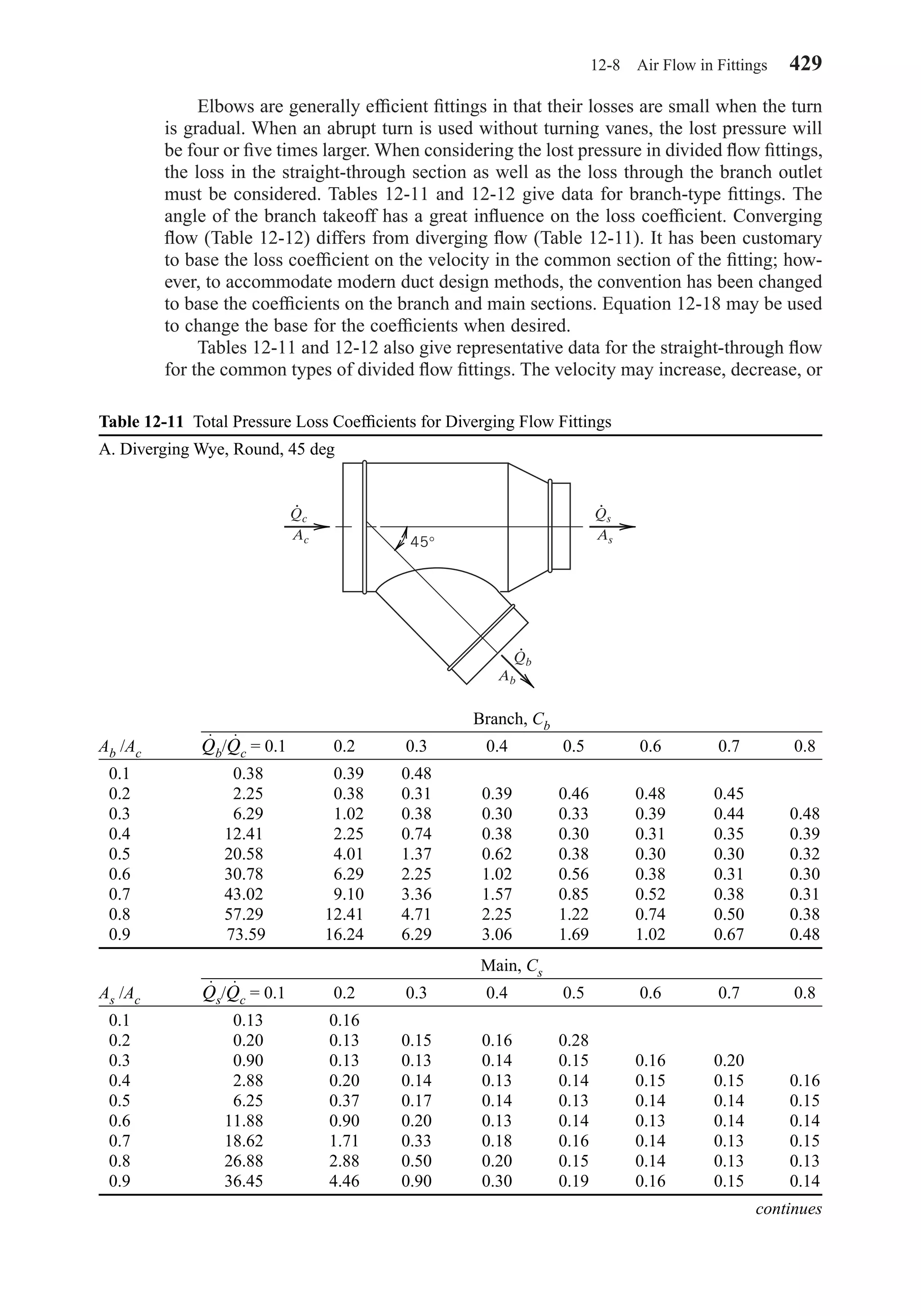
open-loop systems. Pumping costs are usually much lower since there is no net lift-
ing of the water and circulating pumps can be used in place of larger pumps.
42 Chapter 2 Air-Conditioning Systems
Chapter02.qxd 6/15/04 2:32 PM Page 42
A variety of schemes have been proposed for burial of the pipe in the ground (Fig.
2-17). The total amount of piping depends on such factors as the geometry and depth
selected, the capacity and duty cycle of the heat pump, the thermal properties of the
ground, and the local ground temperature. The use of dense polyethylene pipe has
allowed systems to be constructed with high reliability and long expected lifetime.
Economic feasibility is dependent upon the comparison of the higher first cost versus
the energy savings due to the improved heat pump performance. Many electric utili-
ties promote the use of ground source (ground-coupled) heat pumps because they uti-
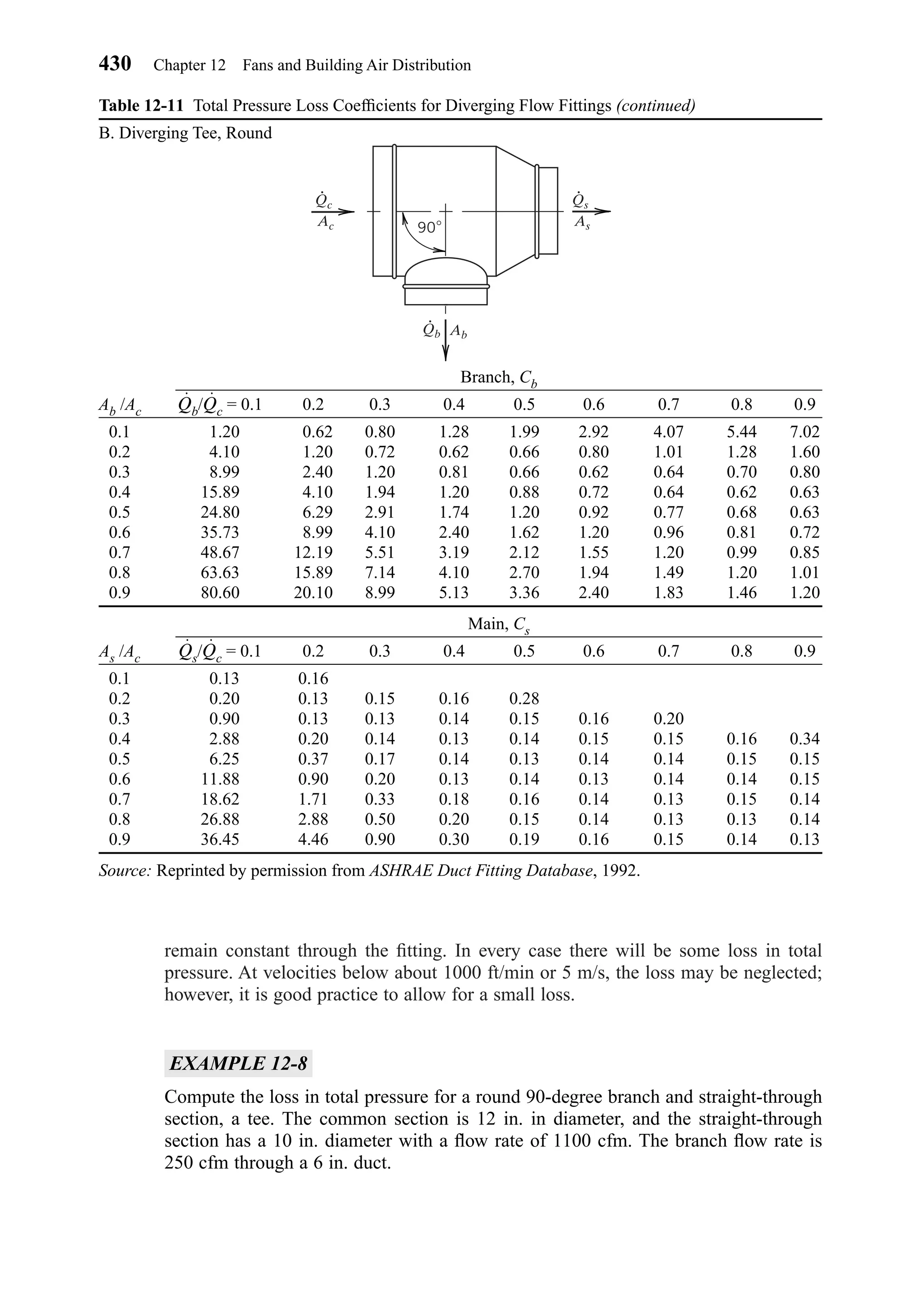
lize electrical power year-round and do not create the high-peak demands of air source
heat pumps. Kavanaugh (6, 7) has researched and published extensively in this area.
The International Ground Source Heat Pump Association (IGSHPA) under the direc-
tion of Bose (8) has produced a large amount of useful information, including design
documents. ASHRAE has supported research and also has several publications in this
field (9, 10, 11). Very strong interest in ground source heat pumps continues among
utilities, customers, installers, and manufacturers.
2-8 Heat Pump Systems 43
Figure 2-17 Typical underground tubing configurations for ground source heat pump systems.
Water flow
Heat pump
Heat pump
Chapter02.qxd 6/15/04 2:32 PM Page 43
2-9 HEAT RECOVERY SYSTEMS
It has been mentioned that large buildings often have heating and cooling occurring
at the same time. Redistribution of heat energy within a structure can be accomplished
through the use of heat pumps of the air-to-air or water-to-water type.
Because of the introduction of outdoor ventilation air it is necessary to exhaust
significant quantities of air from large buildings. In the heating season considerable
savings can be realized if the heat energy from the exhaust air can be recovered and
used in warming the exterior parts of the structure. In a similar manner energy can be
saved when outdoor temperatures are high by precooling ventilation air using the
cooler air exhausted from the building.
Recovery of heat energy from exhaust air is accomplished through the use of
rotating (periodic type) heat exchangers shown in Fig. 2-18, air-to-water heat
exchangers connected by a circulating water loop shown in Fig. 2-19, and air-to-air
heat exchangers shown in Fig. 2-20. The air-to-air and rotating systems are effective
in recovering energy but require that the intake and exhaust to the building be at the
same location unless ducting is utilized. The air-to-water system may have the exhaust
and intake at widely separated locations with no ducting but it has poorer heat trans-
fer effectiveness. Where freezing is possible brine must be introduced as the circulat-
ing fluid, which further reduces the heat transfer effectiveness of the air-to-water
system.
All of the previously described systems may also be effective during the cooling
season, when they function to cool and perhaps dehumidify the warm incoming ven-
tilation air.
44 Chapter 2 Air-Conditioning Systems
Figure 2-18 Rotating heat exchanger used for heat recovery.
Return
air
Exhaust
To air-
conditioning
equipment
Intake
Rotating wheel
Figure 2-19 Air-to-water heat recovery
system.
Return
air
Exhaust
To air
conditioning
equipment
Intake
air
Chapter02.qxd 6/15/04 2:32 PM Page 44
2-10 THERMAL ENERGY STORAGE
Demand charges and time-of-use rates were discussed in Chapter 1. This rate basis
encourages HVAC designers to develop systems that use more energy during off-peak
hours and less during on-peak hours. This can be accomplished for systems utilizing
chillers by running them off peak to make chilled water or ice, storing the chilled
water or ice, and utilizing its cooling capability during subsequent peak periods. Such
a method is referred to as thermal energy storage (TES). An additional advantage of
such systems is that they usually permit the installation of less chiller capacity, and
this means less initial investment cost in chillers. Of course, there is an additional cost
for the thermal storage equipment and the amount of increased energy that may be
required in the process. The economic feasibility depends upon whether the total first
costs are sufficiently low to justify the operating savings over the life of the system.
Sometimes incentives from the utilities tip the scales in favor of thermal storage.
The choice between chilled water and ice as the storage medium may also be fixed
by economics. Chilled water (sensible) storage requires large storage tanks, which
tend to be less expensive per unit volume of storage as the size increases. Thus chilled
water storage is usually most feasible for very large thermal storage systems, such as
for an institutional campus.
On the other hand, ice storage requires operating the chillers by leaving water
temperatures lower than normally required for humidity control. Most chillers oper-
ate less efficiently as the leaving water temperature is reduced. Ice storage also
requires better insulation than chilled water storage. However, since ice storage uti-
lizes the large amount of latent energy involved in phase change, these systems tend
to be compact for the amount of energy stored. Economic factors have tended to cause
most of the small- and moderate-size thermal storage systems to be ice systems.
2-10 Thermal Energy Storage 45
Figure 2-20 Air-to-air heat recovery system.
Exhaust
air
Outdoor
exhaust
air
Intake
air
Outdoor
intake
air
End view Side view
Exhaust
air
To air-
handler Air-to-air
heat exchanger
Chapter02.qxd 6/15/04 2:32 PM Page 45
In a parallel development there has been an increased interest in reducing the
delivery temperatures in air systems in order to reduce duct sizes and fan expenses as
well as to do a better job of dehumidifying. Such interests have worked to encourage
the use of ice storage systems, since they have the capability of producing very low
air temperatures for delivery to the occupied spaces.
ASHRAE has published a design guide for cool thermal storage (12), and a chap-
ter in the ASHRAE Handbook, Applications Volume, gives extensive references and a
bibliography (5). Several useful articles on thermal storage systems have appeared in
the literature (13, 14, 15, 16, 17). The piping and control arrangements for thermal
storage systems will be discussed further in Chapter 10.
REFERENCES
1. ASHRAE Handbook, Systems and Equipment Volume, American Society of Heating, Refrigerating and
Air-Conditioning Engineers, Inc., Atlanta, GA, 2000.
2. ASHRAE Handbook, Fundamentals Volume, American Society of Heating, Refrigerating and Air-Con-
ditioning Engineers, Inc., Atlanta, GA, 2001.
3. Lloyd T. Slattery, “A Look at Packaged Boilers,” Heating/Piping/Air Conditioning, p. 65, December
1995.
4. ASHRAE Handbook, Refrigeration Volume, American Society of Heating, Refrigerating and Air-Con-
ditioning Engineers, Inc., Atlanta, GA, 2002.
5. ASHRAE Handbook, HVAC Applications, American Society of Heating, Refrigerating and Air-Con-
ditioning Engineers, Inc., Atlanta, GA, 2003.
6. Steve Kavanaugh, “Ground Source Heat Pumps,” ASHRAE Journal, October 1998.
7. Steve Kavanaugh, “Water Loop Design for Ground-Coupled Heat Pumps,” ASHRAE Journal, May
1996.
8. IGSHPA, Design and Installation Standard for Closed Loop Geothermal Heat Pump Systems, Inter-
national Ground Source Heat Pump Association, Stillwater, OK, 1995.
9. ASHRAE, Ground-Source Heat Pumps: Design of Geothermal Heat Pump Systems for Commer-
cial/Institutional Buildings, American Society of Heating, Refrigerating and Air-Conditioning Engi-
neers, Inc., Atlanta, GA, 1997.
10. ASHRAE, Operating Experience with Commercial Ground-Source Heat Pump Systems, American
Society of Heating, Refrigerating and Air-Conditioning Engineers, Inc., Atlanta, GA, 1998.
11. ASHRAE Research Project 94, “Commissioning, Preventive Maintenance, and Troubleshooting
Guide for Commercial Ground-Source Heat Pump Systems,” Code 90302, American Society of Heat-
ing, Refrigerating and Air-Conditioning Engineers, Inc., Atlanta, GA, 2002.
12. Charles E. Dorgan and James S. Elleson, “ASHRAE’s New Design Guide for Cool Thermal Storage,”
ASHRAE Journal, May 1994.
13. David E. Knebel, “Predicting and Evaluating the Performance of Ice Harvesting Thermal Energy Stor-
age Systems,” ASHRAE Journal, May 1995.
14. Colin W. Carey, John W. Mitchell, and William A. Beckman, “The Control of Ice Storage Systems,”
ASHRAE Journal, May 1995.
15. Robert M. Lumpkin, “Thermal Storage: A Reversible Process,” Heating/Piping/Air Conditioning, Jan-
uary 1998.
16. D. P. Fiorino, “Energy Conservation with Thermally Stratified Storage,” ASHRAE Transactions
100(1): 1754–66, 1994.
17. Brian Silvetti, “Application Fundamentals of Ice-Based Thermal Storage,” ASHRAE Journal, Febru-
ary 2002.
PROBLEMS
2-1. Consider the small single-story office building in Fig. 2-21. Lay out an all-air central system
using an air handler with two zones. There is space between the ceiling and roof for ducts. The
air handler is equipped with a direct expansion cooling coil and a hot water heating coil. Show
all associated equipment schematically. Describe how the system might be controlled.
46 Chapter 2 Air-Conditioning Systems
Chapter02.qxd 6/15/04 2:32 PM Page 46
2-2. Suppose the building in Problem 2-1 is to use a combination air–water system where fan–coil
units in each room are used for heating. Schematically lay out this part of the system with
related equipment. Discuss the general method of control for (a) the supplied air and (b) the
fan–coil units.
2-3. Lay out a year-round all-water system for the building of Problem 2-1. Show all equipment
schematically. Discuss the control and operation of the system in the summer, in the winter,
and between seasons.
2-4. Apply single-package year-round rooftop type unit(s) to the single-story building in Fig. 2-21.
2-5. Suppose a VAV all-air system is to be used to condition the space shown in Fig. 2-22. Assume
that the space is the ground floor of a multistory office building. Describe the system using a
schematic diagram. The lighting and occupant load are variable. Discuss the general operation
of the system during (a) the colder months and (b) the warmer months.
2-6. Devise a central equipment arrangement for the system of Problem 2-5 that will save energy
during the winter months. Sketch the system schematically.
2-7. Suppose an air-to-water heat pump is used to condition each space of Fig. 2-22, where the water
side of each heat pump is connected to a common water circuit. Sketch this system schemati-
cally, showing all necessary additional equipment. Discuss the operation of this system during
the (a) colder months, (b) warmer months, and (c) intermediate months.
2-8. A building such as that shown in Fig. 2-22 requires some outdoor air. Explain and show
schematically how this may be done with the system of Problem 2-5. Incorporate some sort of
heat recovery device in the system. What controls would be necessary?
Problems 47
Figure 2-21 Floor plan of small office building.
Equipment
room
W
E
Figure 2-22 Schematic floor plan of one floor of a large building.
Pipe and
duct chase
Chapter02.qxd 6/15/04 2:32 PM Page 47
2-9. How can an economizer be used to advantage during (a) winter months, (b) summer months,
and (c) intermediate seasons?
2-10. The system proposed in Problem 2-7 requires the distribution of outdoor ventilation air to each
space. Sketch a central air-handler system for this purpose that has energy recovery equipment
and an economizer. Do not sketch the air distribution system. Discuss the control of this sys-
tem, assuming that the air will always be delivered at 72 F.
2-11. Make a single-line block diagram of an all-water cooling system. The system has unit ventila-
tors in each room with a packaged water chiller, and pumps. Explain how the system will be
controlled.
2-12. Sketch a diagram of an air–water system that uses fan–coils around the perimeter and an over-
head air distribution system from a central air handler. Show a hot water boiler, chiller, and
water distribution pumps. Explain the operation of the system in the summer and in the win-
ter. What kind of controls does the system need?
2-13. Make a sketch of a variable-volume system with a secondary perimeter heating system for a
perimeter zone. Discuss the operation and control of the system for the different seasons of the
year.
2-14. Diagram a combination air-to-air heat recovery and economizer system. Describe the operation
and control of the system for various times of the year.
2-15. A large manufacturing facility requires hot and chilled water and electricity in its operation.
Describe how internal combustion engines operating on natural gas could provide part or all of
these needs, using heat recovery and generating electricity. The objective would be to save
energy.
2-16. Thermal storage is often used to smooth the demand for cooling in large buildings. Imagine
that the chiller can also make ice during the nighttime hours for use later when the peak cool-
ing demand is high. Make a sketch of such a central plant, and describe its operation for a typ-
ical daily cycle. How would this system benefit the building owner? Describe the control
system.
2-17. Make a sketch of a single-zone system for a small building that uses a ground-coupled heat
pump. Show all the major parts of the system, including the ground heat exchanger. Discuss
operation of the system in summer and winter.
2-18. Sketch a variable-air-volume reheat system that has four zones. Discuss the operation of a typ-
ical zone.
2-19. Sketch a dual-duct VAV system. Show the fans and a typical zone. Describe a way to control
the speed of the fans as the terminal devices reduce the air flow to the various zones.
2-20. It is desirable for the water leaving a cooling coil to be at a fixed temperature for return to the
chiller. Sketch a coil, control valve, and so on to accomplish this action, and describe the oper-
ation of the system.
48 Chapter 2 Air-Conditioning Systems
Chapter02.qxd 6/15/04 2:32 PM Page 48
Chapter 3
Moist Air Properties and
Conditioning Processes
The ability to analyze the various processes involving moist atmospheric air is basic
to the HVAC engineer. Atmospheric air makes up the environment in almost every
design situation, and psychrometrics deals with the properties of moist air.
In 1911, Willis H. Carrier made a significant contribution to the air-conditioning
field when he published relations for moist air properties together with a psychromet-
ric chart. These formulas became fundamental to the industry.
In 1983, formulas of Hyland and Wexler were published (1, 2). These formulas,
developed at the National Bureau of Standards (now NIST) and based on the thermo-
dynamic temperature scale, are the basis for the thermodynamic properties of moist
air given in the 2001 ASHRAE Handbook, Fundamentals Volume (3). Threlkeld (4)
has shown that errors in calculation of the major properties will be less than 0.7 per-
cent when perfect gas relations are used. This chapter emphasizes the use of the per-
fect gas relations.
Material in this chapter involves primarily the thermodynamic analysis. That is,
only the states at the beginning and end of a process are considered. In a complete
analysis, rate processes (heat transfer, fluid mechanics, and mass transfer) must also
be included. These important parts of the problem are covered in Chapters 13 and 14.
Fundamental concepts and common moist air processes are covered followed by var-
ious combinations of processes used for space air conditioning. Both design and off-
design conditions are considered.
3-1 MOIST AIR AND THE STANDARD ATMOSPHERE
Atmospheric air is a mixture of many gases plus water vapor and countless pollutants.
Aside from the amount of water vapor and pollutants, which may vary considerably,
the composition of the gases making up dry air is nearly constant, varying slightly
with time, location, and altitude. In 1949, a standard composition of dry air was fixed
by the International Joint Committee on Psychrometric Data as shown in Table 3-1.
The ideal gas relation
(3-1)
has been shown to produce small errors when used to make psychrometric calcula-
tions. Based on the composition of air in Table 3-1, the molecular mass Ma of dry air
is 28.965, and the gas constant Ra is
(3-2)R R
Ma
a
= = = =
1545 32
28 965
53 352
.
.
. (ft-lbf)/(lbm-R) 287 J/(kg-K)
Pv P R Ta= =
ρ
49
Chapter03.qxd 6/15/04 2:31 PM Page 49
where R is the universal gas constant; R = 1545.32 (ft-lbf)/(lb mole-R) or 8314 J/ (kg
mole-K).
Most air-conditioning processes involve a mixture of dry air and water vapor. The
amount of water vapor may vary from zero to the saturated state, a maximum deter-
mined by the temperature and pressure of the mixture. Saturated air is a state of neutral
equilibrium between the moist air and any liquid or solid phase of water that may be
present. The molecular mass of water is 18.015 and the gas constant for water vapor is
(3-3)
The ASHRAE Handbook (3) gives the following definition of the U.S. Standard
atmosphere:
1. Acceleration due to gravity is constant at 32.174 ft/sec2 (9.807 m/s2).
2. Temperature at sea level is 59.0 F, 15 C, or 288.1 K.
3. Pressure at sea level is 29.921 in. Hg (101.039 kPa).*
4. The atmosphere consists of dry air, which behaves as a perfect gas.
Standard sea level density computed using Eq. 3-1 with the standard temperature and
pressure is 0.0765 lbm/ft3 (1.115 kg/m3). The ASHRAE Handbook (3) summarizes
standard atmospheric data for altitudes up to 60,000 ft (18,291 m). Atmospheric pres-
sure may be estimated as a function of elevation by the following relation:
(3-4)
where the constants a and b are given in Table 3-2 and H is the elevation above sea
level in feet or meters. The pressure P is in inches of mercury or kilopascals. Eleva-
tion above sea level is given in Table B-1a for many locations in the United States and
several other countries.
P a bH= +
Rv = = =
1545 32
18 015
85 78
.
.
. (ft-lbf)/(lbm-R) 462 J/kg-K
50 Chapter 3 Moist Air Properties and Conditioning Processes
Table 3-1 Composition of Dry Air
Constituent Molecular Mass Volume Fraction
Oxygen 32.000 0.2095
Nitrogen 28.016 0.7809
Argon 39.944 0.0093
Carbon dioxide 44.010 0.0003
*Standard atmospheric pressure is also commonly taken to be 14.696 lbf/in.2 or 101.325 kPa, which
corresponds to 30.0 in. Hg, and standard atmospheric temperature is sometimes assumed to be 70
F (21 C).
Table 3-2 Constants for Eq. 3-4
H ≤ 4000 ft H > 4000 ft
or 1220 m or 1220 m
Constant IP SI IP SI
a 29.920000 101.325000 29.4200 99.436
b −0.001025 −0.01153 −0.0009 −0.010
Chapter03.qxd 6/15/04 2:31 PM Page 50
3-2 FUNDAMENTAL PARAMETERS
Moist air up to about three atmospheres pressure obeys the perfect gas law with suf-
ficient accuracy for most engineering calculations. The Dalton law for a mixture of
perfect gases states that the mixture pressure is equal to the sum of the partial pres-
sures of the constituents:
(3-5)
For moist air
(3-6)
Because the various constituents of the dry air may be considered to be one gas, it fol-
lows that the total pressure of moist air is the sum of the partial pressures of the dry
air and the water vapor:
(3-7)
Each constituent in a mixture of perfect gases behaves as if the others were not pres-
ent. To compare values for moist air assuming ideal gas behavior with actual table val-
ues, consider a saturated mixture of air and water vapor at 80 F. Table A-1a gives the
saturation pressure ps of water as 0.507 lbf/in.2. For saturated air this is the partial
pressure pv of the vapor. The mass density is 1/v = 1/632.67 or 0.00158 lbm/ft3. By
using Eq. 3-1 we get
This result is accurate within about 0.25 percent. For nonsaturated conditions water
vapor is superheated and the agreement is better. Several useful terms are defined
below.
The humidity ratio W is the ratio of the mass mv of the water vapor to the mass
ma of the dry air in the mixture:
(3-8)
The relative humidity φ is the ratio of the mole fraction of the water vapor xv in a
mixture to the mole fraction xs of the water vapor in a saturated mixture at the same
temperature and pressure:
(3-9)
For a mixture of perfect gases, the mole fraction is equal to the partial pressure ratio
of each constituent. The mole fraction of the water vapor is
(3-10)
Using Eq. 3-9 and letting ps stand for the partial pressure of the water vapor in a sat-
urated mixture, we may express the relative humidity as
(3-11)
Since the temperature of the dry air and the water vapor are assumed to be the same
in the mixture,
(3-12)φ
ρ
ρ= = [ ]
p
p
t P
v RvT
s RvT
v
s
/
/ ,
φ = =
p
p
p
p
v P
s P
v
s
/
/
xv
p
P
v
=
φ = [ ]x
x
t P
v
s ,
W
m
m
v
a
=
1 0 507 144
85 78 459 67 80
0 001577
v
P
v
R
v
T
= = =
+
=ρ
. ( )
. ( . )
. lbm/ft3
P p pa v= +
P p p p p pv= + + + +N O CO Ar2 2 2
P p p p1 2 3= + +
3-2 Fundamental Parameters 51
Chapter03.qxd 6/15/04 2:31 PM Page 51
where the densities ρv and ρs are referred to as the absolute humidities of the water
vapor (mass of water per unit volume of mixture). Values of ρs may be obtained from
Table A-1a.
Using the perfect gas law, we can derive a relation between the relative humidity
φ and the humidity ratio W:
(3-13a)
and
(3-13b)
and
(3-14a)
For the air–water vapor mixture, Eq. 3-14a reduces to
(3-14b)
Combining Eqs. 3-11 and 3-14b gives
(3-15)
The degree of saturation µ is the ratio of the humidity ratio W to the humidity
ratio Ws of a saturated mixture at the same temperature and pressure:
(3-16)
The dew point td is the temperature of saturated moist air at the same pressure and
humidity ratio as the given mixture. As a mixture is cooled at constant pressure, the
temperature at which condensation first begins is the dew point. At a given mixture
(total) pressure, the dew point is fixed by the humidity ratio W or by the partial pres-
sure of the water vapor. Thus td, W, and pv are not independent properties.
The enthalpy i of a mixture of perfect gases is equal to the sum of the enthalpies
of each constituent,
(3-17)
and for the air–water vapor mixture is usually referenced to the mass of dry air. This
is because the amount of water vapor may vary during some processes but the amount
of dry air typically remains constant. Each term in Eq. 3-17 has the units of energy
per unit mass of dry air. With the assumption of perfect gas behavior, the enthalpy is
a function of temperature only. If 0 F or 0 C is selected as the reference state where
the enthalpy of dry air is 0, and if the specific heats cpa and cpv are assumed to be con-
stant, simple relations result:
(3-18)
(3-19)
where the enthalpy of saturated water vapor ig at 0 F is 1061.2 Btu/lbm and 2501.3
kJ/kg at 0 C.
i i c tv g pv= +
i c ta pa=
i i Wia v= +
µ = [ ]W
W
t Ps ,
φ =
Wp
p
a
s0 6219.
W
p
p
p
p
v
a
v
a
= =
18 015
28 965
0 6219
.
.
.
W
M p
M p
v v
a a
=
ma
p V
R T
p VM
RT
a
a
a a
= =
mv
p V
R T
p VM
RT
v
v
v v
= =
52 Chapter 3 Moist Air Properties and Conditioning Processes
Chapter03.qxd 6/15/04 2:31 PM Page 52
Using Eqs. 3-17, 3-18, and 3-19 with cpa and cpv taken as 0.240 and 0.444 Btu/
(lbm-F), respectively, we have
(3-20a)
In SI units, Eq. 3-20a becomes
(3-20b)
where cpa and cpv are 1.0 and 1.86 kJ/(kg-C), respectively.
EXAMPLE 3-1
Compute the enthalpy of saturated air at 60 F and standard atmospheric pressure.
SOLUTION
Equation 3-20a will be used to compute enthalpy; however, the humidity ratio Ws must
first be determined from Eq. 3-14b:
From Table A-1a, ps = 0.2563 psia and
The enthalpy calculated using ideal gas relations is about 0.25 percent low but quite
satisfactory for engineering calculations.
3-3 ADIABATIC SATURATION
The equations discussed in the previous section show that at a given pressure and dry
bulb temperature of an air–water vapor mixture, one additional property is required to
completely specify the state, except at saturation. Any of the parameters discussed (φ,
W, or i) would be acceptable; however, there is no practical way to measure any of
them. The concept of adiabatic saturation provides a convenient solution.
Consider the device shown in Fig. 3-1. The apparatus is assumed to operate so
that the air leaving at point 2 is saturated. The temperature t2, where the relative
W
i
s
s
=
−
=
= + +[ ] =
0 6219
0 2563
14 696 0 2563
0 01104
0 24 60 0 01104 1061 2 0 444 60 26 41
.
.
. .
.
( . ) . . ( . ) .
lbmv/lbma
Btu/lbma
Ws
p
p
p
P p
s
a
s
s
= = −0 6219 0 6219. .
i t W t= + +1 0 2501 3 1 86. ( . . ) kJ/kga
i t W t= + +0 240 1061 2 0 444. ( . . ) Btu/lbma
3-3 Adiabatic Saturation 53
Figure 3-1 Schematic of adiabatic saturation device.
1 2
1,t1,P1,W1φ φt2,Ws2,P2, 2* *
t2
Insulated
Liquid
water at t2
Chapter03.qxd 6/15/04 2:31 PM Page 53
humidity is 100 percent, is then defined as the adiabatic saturation temperature or
thermodynamic wet bulb temperature. If we assume that the device operates in a
steady-flow-steady-state manner, an energy balance on the control volume yields
(3-21a)
or
(3-21b)
where the * superscript refers to the adiabatic saturation temperature, and
(3-21c)
Solving for W1 yields
(3-21d)
It can be concluded that W1 is a function of t1, t*
2, P1, P2, since
(3-14b)
pv2 = ps2 at t*
2; the enthalpy of vaporization i*
fg2 depends only on t*
2; the enthalpy of the
vapor iv1 is a function of t1; and i*
w is a function of t*
2. Therefore, the humidity ratio of
an air–water vapor mixture can be determined from the entering and leaving temper-
atures and pressures of the adiabatic saturator. Consider the following example.
EXAMPLE 3-2
The pressure entering and leaving an adiabatic saturator is 14.696 lbf/in.2, the enter-
ing temperature is 80 F, and the leaving temperature is 64 F. Compute the humidity
ratio W1 and the relative humidity φ1.
SOLUTION
Because the mixture leaving the device is saturated, we have pv2 = ps2, and W2 can be
calculated using Eq. 3-14b:
Now using Eq. 3-21d and interpolating data from Table A-1a, we get
Then solving for pv1 using Eq. 3-14b, we have
W
p
p
p
v
v
v
1
1
1
1
0 6219
14 696
0 0092
0 2142
=
−
=
=
.
.
.
.
lbmv/lbma
psia
W
c t t W i
i i
pa s fg
v w
1
2 1 2 2
1
0 24 64 80 0 0129 1057 1
1096 32
0 0092
=
=
− + ×
−
=
− +
−
( )
. ( ) ( . . )
.
* * *
*
lbmv/lbm
Ws2 0 6219
0 299
14 696 0 299
0 0129* =
−
=.
.
. .
. lbmv/lbma
Ws
p
P p
v
v2
2
2 2
* = −0.6219
W
c t t W i
i i
pa s fg
v w
1
2 1 2 2
1
=
− +
−
( )* * *
*
W i i c t t W iv w pa s fg1 1 2 1 2 2( ) ( )− = − +* * * *
W i i c t t W i iv w pa s v w1 1 2 1 2 2( )− = − + −* * * * *( ) ( )
i W i W W i W i ia v s w s v a1 1 1 2 1 2 2 2+ + − = +( )* * * * *
t2
*,
54 Chapter 3 Moist Air Properties and Conditioning Processes
Chapter03.qxd 6/15/04 2:31 PM Page 54
Finally, from Eq. 3-11
It seems that the state of moist air could be completely determined from pressure
and temperature measurements. However, the adiabatic saturator is not a practical device,
because it would have to be infinitely long in the flow direction and very cumbersome.
3-4 WET BULB TEMPERATURE AND THE
PSYCHROMETRIC CHART
A practical device used in place of the adiabatic saturator is the psychrometer. This
apparatus consists of two thermometers, or other temperature-sensing elements, one
of which has a wetted cotton wick covering the bulb. The temperatures indicated by
the psychrometer are called the wet bulb and the dry bulb temperatures. The dry bulb
temperature corresponds to t1 in Fig. 3-1 and the wet bulb temperature is an approxi-
mation to t*
2 in Fig. 3-1, whereas P1 and P2 are equal to atmospheric. The combina-
tion heat-and-mass-transfer process from the wet bulb thermometer is not the same as
the adiabatic saturation process; however, the difference is relatively small when the
wet bulb thermometer is used under suitable conditions.
Threlkeld (4) has analyzed the problem and correlated wet bulb temperature with
the adiabatic saturation temperature. Threlkeld drew the following general conclusion:
For atmospheric temperature above freezing, where the wet bulb depression does
not exceed about 20 F (11 C) and where no unusual radiation circumstances exist,
twb − t*
2 should be less than about 0.5 F (0.27 C) for an unshielded mercury-in-glass
thermometer as long as the air velocity exceeds about 100 ft/min (0.5 m/s). If ther-
mocouples are used, the velocity may be somewhat lower with similar accuracy. A
psychrometer should be properly designed to meet the foregoing conditions.
Thus, for most engineering problems the wet bulb temperature obtained from a
properly operated, unshielded psychrometer may be used directly in Eq. 3-21d in
place of the adiabatic saturation temperature.
To facilitate engineering computations, a graphical representation of the proper-
ties of moist air has been developed and is known as a psychrometric chart. Richard
Mollier was the first to use such a chart with enthalpy as a coordinate. Modern-day
charts are somewhat different but still retain the enthalpy coordinate. ASHRAE has
developed five Mollier-type charts to cover the necessary range of variables. Charts
1a, 1b, 1Ha, and 1Hb for sea level, and 5000 ft (1500 m) elevations in English and SI
units are provided in Appendix E. ASHRAE Chart 1 covers the normal range of vari-
ables at standard atmospheric pressure. The charts are based on precise data, and
agreement with the perfect gas relations is very good. Details of the actual construc-
tion of the charts may be found in references 3 and 5. A computer program named
PSYCH is given on the website noted in the preface; it performs many of the more
common engineering calculations.
Dry bulb temperature is plotted along the horizontal axis of the charts. The dry bulb
temperature lines are straight but not exactly parallel and incline slightly to the left.
Humidity ratio is plotted along the vertical axis on the right-hand side of the charts. The
scale is uniform with horizontal lines. The saturation curve slopes upward from left to
right. Dry bulb, wet bulb, and dew point temperatures all coincide on the saturation
curve. Relative humidity lines with shapes similar to the saturation curve appear at reg-
ular intervals. The enthalpy scale is drawn obliquely on the left of the chart with paral-
φ1
1
1
0 2142
0 507
0 423 42 3= = =
p
p
v
s
.
.
. . %or
3-4 Wet Bulb Temperature and the Psychrometric Chart 55
Chapter03.qxd 6/15/04 2:31 PM Page 55
lel enthalpy lines inclined downward to the right. Although the wet bulb temperature
lines appear to coincide with the enthalpy lines, they diverge gradually in the body of
the chart and are not parallel to one another. The spacing of the wet bulb lines is not
uniform. Specific volume lines appear inclined from the upper left to the lower right and
are not parallel. A protractor with two scales appears at the upper left of the ASHRAE
charts. One scale gives the sensible heat ratio and the other the ratio of enthalpy differ-
ence to humidity ratio difference. The enthalpy, specific volume, and humidity ratio
scales are all based on a unit mass of dry air and not a unit mass of the moist air.
EXAMPLE 3-3
Read the properties of moist air at 75 F db, 60 F wb, and standard sea-level pressure
from ASHRAE Psychrometric Chart 1a (see Appendix E).
SOLUTION
The intersection of the 75 F db and 60 F wb lines defines the given state. This point
on the chart is the reference from which all the other properties are determined.
Humidity Ratio W. Move horizontally to the right and read W = 0.0077
lbmv/lbma on the vertical scale.
Relative Humidity φ. Interpolate between the 40 and 50 percent relative
humidity lines and read φ = 41 percent.
Enthalpy i. Follow a line of constant enthalpy upward to the left and read
i = 26.4 Btu/lbma on the oblique scale.
Specific Volume v. Interpolate between the 13.5 and 14.0 specific volume lines
and read v = 13.65 ft3/lbma.
Dew Point td. Move horizontally to the left from the reference point and read
td = 50 F on the saturation curve.
Enthalpy i (alternate method). The nomograph in the upper left-hand corner
of Chart 1a gives the difference D between the enthalpy of unsaturated moist
air and the enthalpy of saturated air at the same wet bulb temperature. Then
i = is + D. For this example is = 26.5 Btu/lbma, D = −0.1 Btu/lbma, and i =
26.5 − 0.1 = 26.4 Btu/lbma. Not all charts have this feature.
Although psychrometric charts are useful in several aspects of HVAC design, the
availability of computer programs to determine moist air properties has made some of
these steps easier to carry out (6). Computer programs give the additional convenience
of choice of units and arbitrary (atmospheric) pressures.
3-5 CLASSIC MOIST AIR PROCESSES
Two powerful analytical tools of the HVAC design engineer are the conservation of
energy or energy balance, and the conservation of mass or mass balance. These con-
servation laws are the basis for the analysis of moist air processes. In actual practice
the properties may not be uniform across the flow area, especially at the outlet, and a
considerable length may be necessary for complete mixing. It is customary to analyze
these processes by using the bulk average properties at the inlet and outlet of the
device being studied.
56 Chapter 3 Moist Air Properties and Conditioning Processes
Chapter03.qxd 6/15/04 2:31 PM Page 56
In this section we will consider the basic processes that are a part of the analysis
of most systems.
Heating or Cooling of Moist Air
When air is heated or cooled without the loss or gain of moisture, the process yields
a straight horizontal line on the psychrometric chart, because the humidity ratio is con-
stant. Such processes may occur when moist air flows through a heat exchanger. In
cooling, however, if part of the surface of the heat exchanger is below the dew point
of the air, condensation and the consequent dehumidification will occur. Figure 3-2
shows a schematic of a device used to heat or cool air. For steady-flow-steady-state
heating the energy balance becomes
(3-22)
However, the direction of the heat transfer may be implied by the terms heating and
cooling, with the heating process going from left to right and cooling from right to left
in Fig. 3-3. The enthalpy of the moist air, per unit mass of dry air, at sections 1 and 2
is given by
(3-23)
and
(3-24)i i W iva2 2 2 2= +
i i W ia v1 1 1 1= +
˙ ˙ ˙m i q m ia a2 1+ =
3-5 Classic Moist Air Processes 57
Figure 3-2 Schematic of a heating or cooling device.
Heating or cooling medium
W1
i1
q
ma
W2 – W1
i2
•
ma
•
1 2
Figure 3-3 Sensible heating and cooling process.
0.030
0.024
0.022
0.020
0.018
0.016
0.014
0.012
0.010
0.008
0.006
0.004
0.002
0.026
0.028
Humidityratio(W),poundsofmoistureperpoundofdryair
60555045403530
120
115
110
105
100
95
90
85
80
75
70
65
60
55
50
45
40
35
25
12.5
30
35
45
50
55
60
10 15 20
12
25
40
Drybulb,F
Dry bulb temperature, F
20%
75
80
85
70 F Wet bulb
14.5volume,ft3perpoundofdryair
15.0
40%
14.0
13.5
13.0
60%
Relative
hum
idity
80%
80
85
35
40
45
50
55
60
65
70
75
15
20
25
30
35
40
45
50
Saturation
tem
perature, F
Enthalpy, Btu
per pound
of dry air
Sens
ible heat =
SHF
Total heat
–0.1
–0.3–0.5–1.0
–2.0
–4.0
8.0
2.0
1.01.0
0.8
500030002000
1500
1000
0.6
0.5
0.4
0.3
0.2
0.1
i1
i2
t2 t1
W1 = W2
␾2
␾1
Chapter03.qxd 6/15/04 2:31 PM Page 57
Alternatively i1 and i2 may be obtained directly from the psychrometric chart. The
convenience of the chart is evident. Because the moist air has been assumed to be a
perfect gas, Eq. 3-22 may be arranged and written
(heating) (3-25a)
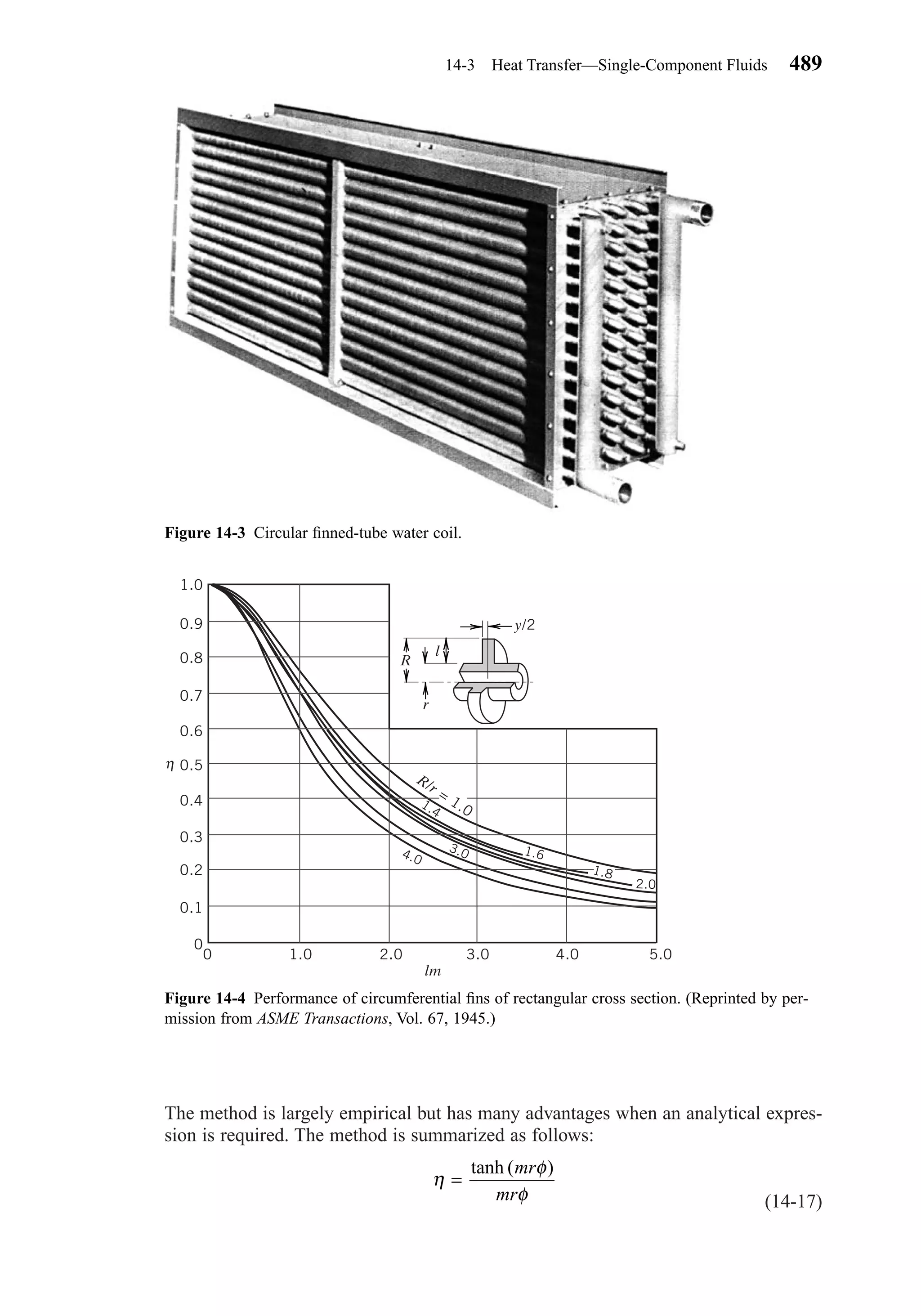
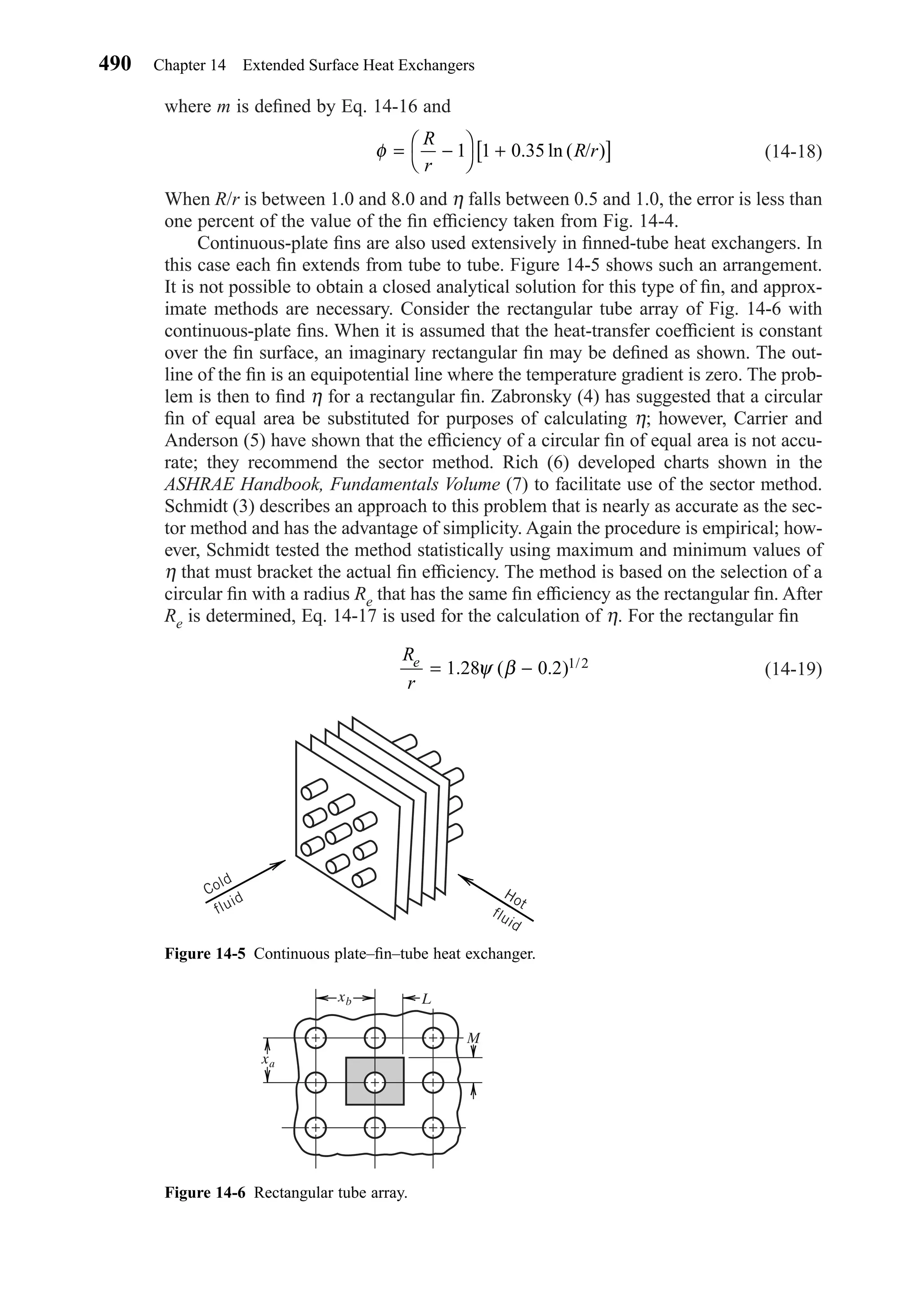
or
(cooling) (3-25b)
where
(3-26)
In the temperature range of interest, cpa = 0.240 Btu/(lbma-F) or 1.0 kJ/(kga-C),
cpv = 0.444 Btu/(lbmv-F) or 1.86 kJ/(kgv-C), and W is the order of 0.01. Then cp
is about 0.244 Btu/(lbma-F) or 1.02 kJ/(kga-C).
EXAMPLE 3-4
Find the heat transfer rate required to warm 1500 cfm (ft3/min) of air at 60 F and 90
percent relative humidity to 110 F without the addition of moisture.
SOLUTION
Equations 3-22 or 3-25 may be used to find the required heat transfer rate. First it is
necessary to find the mass flow rate of the dry air:
(3-27)
The specific volume is read from Chart 1a at t1 = 60 F and φ = 90 percent as 13.33
ft3/lbma:
Also from Chart 1a, i1 = 25.1 Btu/lbma and i2 = 37.4 Btu/lbma. Then by using
Eq. 3-22, we get
or if we had chosen to use Eq. 3-25,
Agreement between the two methods is within 1 percent.
We can see that the relative humidity decreases when the moist air is heated. The
reverse process of cooling results in an increase in relative humidity but the humidity
ratio is constant.
Cooling and Dehumidifying of Moist Air
When moist air is passed over a surface so that a part of the stream is cooled to a tem-
perature below its dew point, some of the water vapor will condense and may leave
˙ ( . )( ) ,q = − =6752 0 244 110 60 82 374 Btu/hr
˙ ( . . ) ,q = − =6752 37 4 25 1 83050 Btu/hr
˙
( )
.
ma = =
1500 60
13 33
6752 lbma/hr
˙
˙
ma
V A
v
Q
v= =1 1
1
1
1
c c Wcp pa pv= +
˙ ˙ ( )q m c t ts a p= −2 1
58 Chapter 3 Moist Air Properties and Conditioning Processes
Chapter03.qxd 6/15/04 2:31 PM Page 58
the airstream. Figure 3-4 shows a schematic of a cooling and dehumidifying device,
and Fig. 3-5 shows the process on the psychrometric chart. Although the actual
process path may vary considerably depending on the type of surface, surface tem-
perature, and flow conditions, the net heat and mass transfer can be expressed in terms
of the initial and final states, neither of which has to be at saturation conditions. By
referring to Fig. 3-4, we see that the energy balance gives
(3-28)
and the mass flow balance for the water in the air is
(3-29)
Combining Eqs. 3-28 and 3-29 yields
(3-30)
Equation 3-30 gives the total rate of heat transfer from the moist air. The last term on
the right-hand side of Eq. 3-30 is usually small compared to the others and is often
neglected. Example 3-5 illustrates this point.
EXAMPLE 3-5
Moist air at 80 F db and 67 F wb is cooled to 58 F db and 80 percent relative humid-
ity. The volume flow rate is 2000 cfm, and the condensate leaves at 60 F. Find the heat
transfer rate.
˙ ˙ ( ) ˙ ( )q m i i m W W ia a w= − − −1 2 1 2
˙ ˙ ˙m W m m Wa w a1 2= +
˙ ˙ ˙ ˙m i q m i m ia a w w1 2= + +
3-5 Classic Moist Air Processes 59
Figure 3-4 Schematic of a cooling and dehumidifying device.
ma
W1
i1
q
ma
W2
i2
mw
iw
1 2
Refrigerant
•
•
•
•
Figure 3-5 Cooling and dehumidifying process.
0.024
0.022
0.020
0.018
0.016
0.014
0.012
0.010
0.008
0.006
0.004
0.002
0.026
0.028
Humidityratio(W),poundsofmoistureperpoundofdryair
605550453530
120
115
110
105
100
95
90
85
80
75
70
65
60
55
50
45
40
35
25
12.5
30
35
45
50
55
60
10 15 20
3
1
2
25
40
Drybulb,F
Dry bulb temperature, F
20%
75
80
85
70 F Wet bulb14.5volume,ft3perpoundofdryair
15.0
40%
14.0
13.5
13.0
60%
Relative
hum
idity
80%
80
85
35
40
45
50
55
60
65
70
75
15
20
25
30
35
40
45
50
Saturation
tem
perature, F
Enthalpy, Btu
per pound
of dry air
Sens
ible heat =
SHF
Total heat
–0.1
–0.3–0.5–1.0
–2.0
–4.0
8.0
2.0
1.01.0
0.8
500030002000
1500
1000
0.6
0.5
0.4
0.3
0.2
0.1
i1
i3
i2
t2 t1 t3,
W2
W1
␾2
␾1
0.030
Chapter03.qxd 6/15/04 2:31 PM Page 59
SOLUTION
Equation 3-30 applies to this process, which is shown in Fig. 3-5. The following prop-
erties are read from Chart 1a: v1 = 13.85 ft3 lbma, i1 = 31.4 Btu/lbma, W1 = 0.0112
lbmv/lbma, i2 = 22.8 Btu/lbma, W2 = 0.0082 lbmv/lbma. The enthalpy of the conden-
sate is obtained from Table A-1a, iw = 28.08 Btu/lbmw. The mass flow rate ma is
obtained from Eq. 3-27:
Then
The last term, which represents the energy of the condensate, is seen to be small.
Neglecting the condensate term, q = 74,356 Btu/hr = 6.2 tons.
The cooling and dehumidifying process involves both sensible and latent heat
transfer; the sensible heat transfer rate is associated with the decrease in dry bulb tem-
perature, and the latent heat transfer rate is associated with the decrease in humidity
ratio. These quantities may be expressed as
(3-31)
and
(3-32)
By referring to Fig. 3-5 we may also express the latent heat transfer rate as
(3-33)
and the sensible heat transfer rate is given by
(3-34)
The energy of the condensate has been neglected. Obviously
(3-35)
The sensible heat factor (SHF) is defined as qs/q.This parameter is shown on the semi-
circular scale of Fig. 3-5. Note that the SHF can be negative. If we use the standard
sign convention that sensible or latent heat transfer to the system is positive and trans-
fer from the system is negative, the proper sign will result. For example, with the cool-
ing and dehumidifying process above, both sensible and latent heat transfer are away
from the air, qs and ql are both negative, and the SHF is positive. In a situation where
air is being cooled sensibly but a large latent heat gain is present, the SHF will be neg-
ative if the absolute value of ql is greater than qs. The use of this feature of the chart
is shown later.
Heating and Humidifying Moist Air
A device to heat and humidify moist air is shown schematically in Fig. 3-6. This
process is generally required to maintain comfort during the cold months of the year.
An energy balance on the device yields
(3-36)˙ ˙ ˙ ˙m i q m i m ia w w a1 2+ + =
˙ ˙ ˙q q qs l= +
˙ ˙ ( )q m i is a= −2 3
˙ ˙ ( )q m i il a= −3 1
˙ ˙ ( )q m W W il a fg= −2 1
˙ ˙ ( )q m c t ts a p= −2 1
˙ ( . . ) ( . . ) .
˙ ( . ) ( . )
q
q
= − − −[ ]
= −[ ]
8646 31 4 22 8 0 0112 0 0082 28 8
8646 8 6 0 084
˙
( )
.
ma = =
2000 60
13 88
8646 lbma/hr
60 Chapter 3 Moist Air Properties and Conditioning Processes
Chapter03.qxd 6/15/04 2:31 PM Page 60
and a mass balance on the water gives
(3-37)
Equations 3-36 and 3-37 may be combined to obtain
(3-38a)
or
(3-38b)
Equations 3-38a and 3-38b describe a straight line that connects the initial and final
states on the psychrometric chart. Figure 3-7 shows a combined heating and humidi-
fying process, states 1–2.
A graphical procedure makes use of the semicircular scale on Chart 1a to locate
the process line. The ratio of the change in enthalpy to the change in humidity ratio is
(3-39)
Figure 3-7 shows the procedure where a straight line is laid out parallel to the line on
the protractor through state 1. Although the process may be represented by one line
∆
∆
i
W
i i
W W
q
m
i
w
w=
−
−
= +2 1
2 1
˙
˙
i i
W W
q
m
i
w
w
2 1
2 1
−
−
= +
˙
˙
i i
W W
q
m W W
i
a
w
2 1
2 1 2 1
−
−
=
−
+
˙
˙ ( )
˙ ˙ ˙m W m m Wa w a1 2+ =
3-5 Classic Moist Air Processes 61
Figure 3-6 Schematic of a heating and humidifying device.
ma
W1
i1
ma
W2
i2
mw
q
iw
•
••
1 χ 2
Heating
medium
Figure 3-7 Combined heating and humidifying process.
0.024
0.022
0.020
0.018
0.016
0.014
0.012
0.010
0.008
0.006
0.004
0.002
0.026
0.028
Humidityratio(W),poundsofmoistureperpoundofdryair
60555045403530
120
115
110
105
100
95
90
85
80
75
70
65
60
55
50
45
40
35
25
12.5
30
35
45
50
55
60
10 15 20
1
2
x
25
40
Drybulb,F
Dry bulb temperature, F
20%
80
85
70 F Wet bulb
15.0
40%
14.0
13.5
13.0
80%
80
85
35
40
45
50
55
60
65
70
75
15
20
25
30
35
40
45
50
Saturation
tem
perature, F
Enthalpy, Btu
per pound
of dry air
Sens
ible heat =
SHF
Total heat
–0.1
–0.3–0.5–1.0
–2.0
–4.0
8.0
2.0
1.0
Parallel
1.0
0.8
500030002000
1500
1000
0.6
0.5
0.4
0.3
0.2
0.1
Parallel
i1
i2
ix
txt1 t2
W1
W2
0.030
60%
Relative
hum
idity
14.5volume,ft3perpoundofdryair
75
Chapter03.qxd 6/15/04 2:31 PM Page 61
from state 1 to state 2, it is not practical to perform it in that way. The heating and
humidification processes are usually carried out separately, shown in Figs. 3-6 and 3-7
as processes 1 − χ and χ − 2.
Adiabatic Humidification of Moist Air
When moisture is added to moist air without the addition of heat, Eq. 3-38b becomes
(3-40)
Close examination of the protractor on Chart 1a reveals that ∆i/∆W can vary from pos-
itive infinity on the left to negative infinity on the right. Therefore, in theory, the adi-
abatic humidification process can take many different paths depending on the
condition of the water used. In practice the water will vary from a liquid at about 50 F
(10 C) to a saturated vapor at about 250 F (120 C). The practical range of ∆i/∆W is
shown on the chart and protractor of Fig. 3-8.
EXAMPLE 3-6
Moist air at 60 F db and 20 percent relative humidity enters a heater and humidifier
at the rate of 1600 cfm. Heating of the air is followed by adiabatic humidification so
that it leaves at 115 F db and a relative humidity of 30 percent. Saturated water vapor
at 212 F is injected. Determine the required heat transfer rate and mass flow rate of
water vapor.
SOLUTION
Figure 3-6 is a schematic of the apparatus. Locate the states as shown in Fig. 3-7 from
the given information and Eq. 3-40 using the protractor feature of the psychrometric
chart. Process 1 − χ is sensible heating; therefore, a horizontal line to the right of
state 1 is constructed. Process χ − 2 is determined from Eq. 3-40 and the protractor:
i i
W W
i
i
Ww
2 1
2 1
−
−
= =
∆
∆
62 Chapter 3 Moist Air Properties and Conditioning Processes
Figure 3-8 Practical range of adiabatic humidifying processes.
0.030
0.024
0.022
0.020
0.018
0.016
0.014
0.012
0.010
0.008
0.006
0.004
0.002
0.026
0.028
Humidityratio(W),poundsofmoistureperpoundofdryair
60555045403530
120
115
110
105
100
95
90
85
80
75
70
65
60
55
50
45
40
35
25
12.5
30
35
45
50
55
60
10 15 20
1
2b
2a
x
25
40
Drybulb,F
Dry bulb temperature, F
20%
75
80
85
70 F Wet bulb
14.5volume,ft3perpoundofdryair
15.0
40%
14.0
13.5
13.0
60%
Relative
hum
idity
80%
80
85
35
40
45
50
55
60
65
70
75
15
20
25
30
35
40
45
50
Saturation
tem
perature, F
Enthalpy, Btu
per pound
of dry air
Sens
ible heat =
SHF
Total heat
–0.1
–0.3–0.5–1.0
–2.0
–4.0
8.0
2.0
1.0
Practical
range
1.0
0.8
500030002000
1500
1000
0.6
0.5
0.4
0.3
0.2
0.1
Chapter03.qxd 6/15/04 2:31 PM Page 62
where iw is read from Table A-1a. A parallel line is drawn from state 2 as shown in
Fig. 3-7. State χ is determined by the intersection on lines 1 − χ and χ − 2. The heat
transfer rate is then given by
where
and i1 and ix, read from Chart 1a, are 16.8 and 29.2 Btu/lbma, respectively. Then
The mass flow rate of the water vapor is given by
where W2 and W1 are read from Chart 1a as 0.0193 and 0.0022 lbmv/lbma, respectively.
Then
Adiabatic Mixing of Two Streams of Moist Air
The mixing of airstreams is quite common in air-conditioning systems. The mixing
usually occurs under steady, adiabatic flow conditions. Figure 3-9 illustrates the mix-
ing of two airstreams. An energy balance gives
(3-41)
The mass balance on the dry air is
(3-42)
and the mass balance on the water vapor is
(3-43)
Combining Eqs. 3-41, 3-42, and 3-43 and eliminating ma3 yields
(3-44)
i i
i i
W W
W W
m
m
a
a
2 3
3 1
2 3
3 1
1
2
−
−
=
−
−
=
˙
˙
˙ ˙ ˙m W m W m Wa a a1 1 2 2 3 3+ =
˙ ˙ ˙m m ma a a1 2 3+ =
˙ ˙ ˙m i m i m ia a a1 1 2 2 3 3+ =
˙ ( . . )mv = − =7296 0 0193 0 0022 125 lbmv/hr
˙ ˙ ( )m m W Wv a= −2 1
˙ ( . . ) ,q = − =7296 29 2 16 8 90 500 Btu/hr
˙
˙( )
.
m
Q
va = = =
60 1600
13 16
60 7296
1
lbma/hr
˙ ˙ ( )q m i ia x= − 1
∆
∆
i
W wi= = 1150 4. Btu/lbm
3-5 Classic Moist Air Processes 63
Figure 3-9 Schematic of the adiabatic mixing of two airstreams.
1
2 3
Adiabatic
i3
, i2
W3
, W2
ma3
⋅
i1
W1
ma1
⋅
ma2
⋅
Chapter03.qxd 6/15/04 2:31 PM Page 63
The state of the mixed streams lies on a straight line between states 1 and 2 (Fig. 3-10).
From Eq. 3-44 the lengths of the various line segments are proportional to the masses
of dry air mixed:
(3-45)
This is most easily shown by solving Eq. 3-44 for i3 and W3:
(3-44a)
(3-44b)
Clearly for given states 1 and 2, a straight line will be generated when any constant
value of ma1/ma2 is used and the result plotted on the psychrometric chart. It is also
clear that the location of state 3 on the line is dependent on ma1/ma2. This provides a
very convenient graphical procedure for solving mixing problems in contrast to the
use of Eqs. 3-44a and 3-44b.
Although the mass flow rate is used when the graphical procedure is employed,
the volume flow rates may be used to obtain good approximate results.
EXAMPLE 3-7
Two thousand cubic feet per minute (cfm) of air at 100 F db and 75 F wb are mixed with
1000 cfm of air at 60 F db and 50 F wb. The process is adiabatic, at a steady flow rate
and at standard sea-level pressure. Find the condition of the mixed streams.
W
m
m
W W
m
m
a
a
a
a
3
1
2
1 2
1
2
1
=
+
+
˙
˙
˙
˙
i
m
m
i i
m
m
a
a
a
a
3
1
2
1 2
1
2
1
=
+
+
˙
˙
˙
˙
˙
˙
,
˙
˙
,
˙
˙
m
m
m
m
m
m
a
a
a
a
a
a
1
2
1
3
2
3
32
13
32
12
13
12
= = =
64 Chapter 3 Moist Air Properties and Conditioning Processes
Figure 3-10 Adiabatic mixing process.
0.030
0.024
0.022
0.020
0.018
0.016
0.014
0.012
0.010
0.008
0.006
0.004
0.002
0.026
0.028
Humidityratio(W),poundsofmoistureperpoundofdryair
60555045403530
120
115
110
105
100
95
90
85
80
75
70
65
60
55
50
45
40
35
25
12.5
30
35
45
50
55
60
10 15 20
1
3
2
25
40
Drybulb,F
Dry bulb temperature, F
20%
75
80
85
70 F Wet bulb
14.5volume,ft3perpoundofdryair
15.0
40%
14.0
13.5
13.0
60%
Relative
hum
idity
80%
80
85
35
40
45
50
55
60
65
70
75
15
20
25
30
35
40
45
50
Saturation
tem
perature, F
Enthalpy, Btu
per pound
of dry air
Sens
ible heat =
SHF
Total heat
–0.1
–0.3–0.5–1.0
–2.0
–4.0
8.0
2.0
1.01.0
0.8
500030002000
1500
1000
0.6
0.5
0.4
0.3
0.2
0.1
i3
i2
i1
t1 t3
t2
W1
W2
W3
Chapter03.qxd 6/15/04 2:31 PM Page 64
SOLUTION
A combination graphical and analytical solution is first obtained. The initial states are
first located on Chart 1a as illustrated in Fig. 3-10 and connected with a straight line.
Using Eq. 3-44b or another form of Eqs. 3-42 and 3-43, we obtain
(3-46)
Using the property values from Chart 1a, we obtain
The intersection of W3 with the line connecting states 1 and 2 gives the mixture
state 3. The resulting dry bulb temperature is 86 F, and the wet bulb temperature is 68 F.
Equation 3-44a could have also been solved for i3 to locate the mixture state 3.
The complete graphical procedure could also be used, where
The lengths of line segments 12
—
and 13
—
depend on the scale of the psychrometric chart
used. However, when the length 13
—
is laid out along 12
—
from state 1, state 3 is accu-
rately determined. An excellent approximate solution for Example 3-7 may be obtained
by neglecting the effect of density and using the volume flow rates to find state 3.
A computer program named PSYCH is given on the website for this text. The pro-
gram carries out all of the processes presented so far, allowing for the variation of
barometric pressure and determination of other properties.
3-6 SPACE AIR CONDITIONING—DESIGN CONDITIONS
The complete air-conditioning system may involve two or more of the processes
just considered. For example, in the air conditioning of space during the summer, the
air supplied must have a sufficiently low temperature and moisture content to absorb
the total cooling load of the space. As the air flows through the space, it is heated
and humidified. Some outdoor air is usually mixed with the return air and sent to
the conditioning equipment, where it is cooled and dehumidified and supplied to the
space again. During the winter months the same general processes occur, but in
reverse. Systems described in Chapter 2 carry out these conditioning processes with
some variations.
13
12
2000
2000 1000
0 67 13 0 67 122
3
≈ =
+
= =
˙
˙ . . ( )
Q
Q
and
13
12
8332
8332 4542
0 65 13 0 65 122
3
= =
+
= =
˙
˙
. . ( )
m
m
a
a
or
˙
( )
.
˙
( )
.
. ( . . )
.
m
m
W
W
a
a
1
2
3
3
1000 60
13 21
4542
2000 60
14 4
8332
0 0054
8332
4542 8332
0 013 0 0054
0 0103
= =
= =
= +
+



 −
=
lbma/hr
lbma/hr
lbmv/lbma
W W
m
m
W Wa
a
3 1
2
3
2 1= + −
˙
˙
( )
3-6 Space Air Conditioning—Design Conditions 65
Chapter03.qxd 6/15/04 2:31 PM Page 65
Sensible Heat Factor
The sensible heat factor (SHF) was defined in Sec. 3-5 as the ratio of the sensible heat
transfer to the total heat transfer for a process:
(3-47)
If we recall Eqs. 3-33 and 3-34 and refer to Chart 1a, it is evident that the SHF is
related to the parameter ∆i/∆W. The SHF is plotted on the inside scale of the protrac-
tor on Chart 1a. The following examples will demonstrate the usefulness of the SHF.
EXAMPLE 3-8
Conditioned air is supplied to a space at 54 F db and 90 percent RH at the rate of 1500
cfm. The sensible heat factor for the space is 0.80, and the space is to be maintained
at 75 F db. Determine the sensible and latent cooling loads for the space.
SOLUTION
Chart 1a can be used to solve this problem conveniently. A line is drawn on the pro-
tractor through a value of 0.8 on the SHF scale. A parallel line is then drawn from the
initial state, 54 F db and 90 percent RH, to the intersection of the 75 F db line, which
defines the final state. Figure 3-11 illustrates the procedure. The total heat transfer rate
for the process is given by
and the sensible heat transfer rate is given by
and the mass flow rate of dry air is given by
˙ ( ) ˙q qs = SHF
˙ ˙ ( )q m i ia= −2 1
SHF =
+
=
˙
˙ ˙
˙
˙
q
q q
q
q
s
s l
s
66 Chapter 3 Moist Air Properties and Conditioning Processes
Figure 3-11 The condition line for the space in Example 3-8.
0.030
0.024
0.022
0.020
0.018
0.016
0.014
0.012
0.010
0.008
0.006
0.004
0.002
0.026
0.028
Humidityratio(W),poundsofmoistureperpoundofdryair
60555045403530
120
115
110
105
100
95
90
85
80
75
70
65
60
55
50
45
40
35
25
12.5
30
35
45
50
55
60
10 15 20
1
d
2
25
40
Drybulb,F
Dry bulb temperature, F
20%
75
80
85
70 F Wet bulb
14.5volume,ft3perpoundofdryair
15.0
40%
14.0
13.5
13.0
60%
Relative
hum
idity
80%
80
85
35
40
45
50
55
60
65
70
75
15
20
25
30
35
40
45
50
Saturation
tem
perature, F
Enthalpy, Btu
per pound
of dry air
Sens
ible heat =
SHF
Total heat
–0.1
–0.3–0.5–1.0
–2.0
–4.0
8.0
2.0
1.01.0
0.8
500030002000
1500
1000
0.6
0.5
0.4
0.3
0.2
0.1
Parallel
i1
i2
t2t1
Chapter03.qxd 6/15/04 2:31 PM Page 66
where v1 = 13.11 ft3/lbma is read from Chart 1a. Also from Chart 1a, i1 = 21.6 Btu/lbm
dry air and i2 = 27.8 Btu/lbm dry air. Then
and
The process 1–2 with its extension to the left is called the condition line for the
space. Assuming that state 2, the space condition, is fixed, air supplied at any state on
the condition line will satisfy the load requirements. However, as that state is changed,
different quantities of air must be supplied to the space. The closer point 1 is to point
2, the more air is required; the converse is also true.
We will now consider several examples of single-path, constant-flow systems. Heat
losses from and gains to the ducts and fan power will be neglected for the time being.
EXAMPLE 3-9
A given space is to be maintained at 78 F db and 65 F wb. The total heat gain to the
space has been determined to be 60,000 Btu/hr, of which 42,000 Btu/hr is sensible
heat transfer. The outdoor air requirement of the occupants is 500 cfm. The outdoor
air has a temperature and relative humidity of 90 F and 55 percent, respectively. Deter-
mine the quantity and the state of the air supplied to the space and the required capac-
ity of the cooling and dehumidifying equipment.
SOLUTION
A simplified schematic is shown in Fig. 3-12. The given quantities are shown and sta-
tions are numbered for reference. By Eq. 3-47 the sensible heat factor for the condi-
tioned space is
SHF = =
42 000
60 000
0 7
,
,
.
˙ ˙ ˙q q ql s= − = 8500 Btu/hr
˙ ( . . ) ,
˙ ˙( ) , ( . ) ,
q
q q SHFs
= − =
= = =
6865 27 8 21 6 42 600
42 600 0 8 34 100
Btu/hr
Btu/hr
˙
˙ ( )
.
m
Q
va = = =
1
1500 60
13 11
6865 lbma/hr
3-6 Space Air Conditioning—Design Conditions 67
Figure 3-12 Single-line sketch of cooling and dehumidifying system for Example 3-9.
2
35
1'1
4
0
Mixing
box
Exhaust Return
fan
Supply
fan
Conditioned
space
t3 = 78 F
t3wb = 65 F
t0 = 90 F
␾0 = 55%
Q0 = 500 cfm q = 60,000 Btu/hr
qs = 42,000 Btu/hr
Cooling and
dehumidifying
unit
Chapter03.qxd 6/15/04 2:31 PM Page 67
State 3 is located as shown in Fig. 3-13, where a line is drawn from point 3 and par-
allel to the SHF = 0.7 line on the protractor. State 2, which may be any point on that
line, fixes the quantity of air supplied to the space. Its location is determined by the
operating characteristics of the equipment, desired indoor air quality, and what will be
comfortable for the occupants. These aspects of the problem will be developed later.
For now assume that the dry bulb temperature of the entering air t2 is 20 F less than
the space temperature t3. Then t2 = 58 F, which fixes state 2. The air quantity required
may now be found from an energy balance on the space:
or
and
From Chart 1a, i3 = 30 Btu/lbma, i2 = 23 Btu/lbma, and
Also from Chart 1a, v2 = 13.21 ft3/lbma and the air volume flow rate required is
Before attention is directed to the cooling and dehumidifying process, state 1 must be
determined. A mass balance on the mixing section yields
˙ ˙ ˙ ˙
˙
˙
, .
m m m m
m
Q
v
v
a a a a
a
0 4 1 2
0
0
0
0 14 23
+ = =
= = ft /lbma3
˙ ˙
( . )
Q m va2 2 2
8570 13 21
60
1885 1890= = = or cfm
˙ ˙
,
m ma a2 3
60 000
30 23
8570= =
−
= lbma/hr
˙
˙
m
q
i ia2
3 2
=
−
˙ ˙ ( )q m i ia= −2 3 2
˙ ˙ ˙m i q m ia a2 2 3 3+ =
68 Chapter 3 Moist Air Properties and Conditioning Processes
Figure 3-13 Psychrometric processes for Example 3-9.
0.024
0.022
0.020
0.018
0.016
0.014
0.012
0.010
0.008
0.006
0.004
0.002
0.026
0.028
Humidityratio(W),poundsofmoistureperpoundofdryair
60555045403530
120
115
110
105
100
95
90
85
80
75
70
65
60
55
50
45
40
35
25
12.5
30
35
45
50
55
60
10 15 20
3
1
0
d
2
d
25
40
Drybulb,F
Dry bulb temperature, F
20%
75
80
85
70 F Wet bulb
14.5volume,ft3perpoundofdryair
15.0
40%
14.0
13.5
13.0
60%
Relative
hum
idity
80%
80
85
35
40
45
50
55
60
65
70
75
15
20
25
30
35
40
45
50
Saturation
tem
perature, F
Enthalpy, Btu
per pound
of dry air
Sens
ible heat =
SHF
Total heat
–0.1
–0.3–0.5–1.0
–2.0
–4.0
8.0
2.0
1.01.0
0.8
500030002000
1500
1000
0.6
0.5
0.4
0.3
0.2
0.1
Space, 0.7
Coil, 0.6
i1
i0
i3
i2
t2 t3td
t1 t0
W0
W3
W1
W2
0.030
Chapter03.qxd 6/15/04 2:31 PM Page 68
Then the recirculated air is
By using the graphical technique discussed in Example 3-7 and referring to Fig. 3-13,
we see that
State 1 is located at 81 F db and 68 F wb. A line constructed from state 1 to state
2 on Chart 1a then represents the process for the cooling coil. An energy balance
gives
Solving for the rate at which energy is removed in the cooling coil
From Chart 1a, i1 = 32.4 Btu/lbma and
The SHF for the cooling coil is found to be 0.6 using the protractor of Chart 1a
(Fig. 3-13). Then
and
The sum of qcs and qc1 is known as the coil refrigeration load. Notice that because
of outdoor air cooling the coil refrigeration load it is different from the space cooling
load. Problems of this type may be solved using the program PSYCH given on the
website.
An alternate approach to the analysis of the cooling coil in Example 3-9 uses the
so-called coil bypass factor. Note that when line 1–2 of Fig. 3-13 is extended, it inter-
sects the saturation curve at point d. This point represents the apparatus dew point (td)
of the cooling coil. The coil cannot cool all of the air passing through it to the coil sur-
face temperature. This fact makes the coil perform in a manner similar to what would
happen if a portion of the air were brought to saturation at the coil temperature and
the remainder bypassed the coil unchanged. Using Eq. 3-44 and the concept of mix-
ing described in the previous section, the resulting mixture is unsaturated air at point
2. In terms of the length of the line d–1, the length d–2 is proportional to the mass of
air bypassed, and the length 1–2 is proportional to the mass of air not bypassed.
Because dry bulb lines are not parallel, are inclined, and the line 1–2–d is not hori-
zontal, it is only approximately true that
(3-48)b
t t
t t
d
d
=
−
−
2
1
˙ , , ,qcl = − =80 600 48400 32 200 Btu/hr
˙ . ( , ) ,qcs = =0 6 80 600 48400 Btu/hr
˙ ( . ) , .qc = − =8570 32 4 23 80 600 6 7Btu/hr = tons
˙ ˙ ( )q m i ic a= −1 1 2
˙ ˙ ˙m i q m ia c a1 1 2 2= +
31
30
2108
8570
0 246
31 0 246 30
0
1
= = =
=
˙
˙
.
. ( )
m
m
a
a
˙ ˙ ˙m m ma a a4 2 0 8570 2108 6462= − = − = lbma/hr
˙
( )
.
ma0
500 60
14 23
2108= = lbma/hr
3-6 Space Air Conditioning—Design Conditions 69
Chapter03.qxd 6/15/04 2:31 PM Page 69
and
(3-49)
where b is the fraction of air bypassed, or the coil bypass factor, expressed as a deci-
mal, and where the temperatures are dry bulb values. The coil sensible heat transfer
rate is
(3-50a)
or
(3-50b)
The bypass factor is not used extensively for analysis. The ability to model coils with
a computer (Chapter 14) makes the procedure unnecessary. However, some manufac-
turers still use the concept in catalog data, where the bypass factor is determined from
simulation and experiment.
In an actual system fans are required to move the air, and some energy may be
gained from this. Referring to Fig. 3-12, the supply fan is located just downstream of
the cooling unit and the return fan is just upstream of the exhaust duct. All of the
power input to the fans is manifested as a sensible energy input to the air, just as if
heat were transferred. Heat may also be gained in the supply and return ducts. The
power input to the supply air fan and the heat gain to the supply air duct may be
summed as shown on Chart 1a, Fig. 3-14, as process 1′–2. It is assumed that all of the
supply fan power input is transformed to internal energy by the time the air reaches
the space, state 2. Likewise, heat is gained from point 3 to point 4, where the return
fan power also occurs, as shown in Fig. 3-14. The condition line for the space, 2–3, is
the same as it was before when the fans and heat gain were neglected. However, the
requirements of the cooling unit have changed. Process 1–1′ now shows that the
capacity of the coil must be greater to offset the fan power input and duct heat gain.
Example WS3-1 given on the website is similar to Example 3-9 and includes the sup-
ply and return fans with both IP and SI units.
˙ ˙ ( )( )q m c t t bcs a p d= − −1 1 1
˙ ˙ ( )q m c t tcs a p= −1 1 2
1 1 2
1
− =
−
−
b
t t
t td
70 Chapter 3 Moist Air Properties and Conditioning Processes
Figure 3-14 Psychrometric processes for Example 3-9, showing the effect of fans and heat gain.
0.024
0.022
0.020
0.018
0.016
0.014
0.012
0.010
0.008
0.006
0.004
0.002
0.026
0.028
Humidityratio(W),poundsofmoistureperpoundofdryair
60555045403530
120
115
110
105
100
95
90
85
80
75
70
65
60
55
50
45
40
35
25
12.5
30
35
45
50
55
60
10 15 20
3
4
1
0
d
21′
′
′
′
25
40
Drybulb,F
Dry bulb temperature, F
20%
75
80
85
70 F Wet bulb
14.5volume,ft3perpoundofdryair
15.0
40%
14.0
13.5
13.0
60%
Relative
hum
idity
80%
80
85
35
40
45
50
55
60
65
70
75
15
20
25
30
35
40
45
50
Saturation
tem
perature, F
Enthalpy, Btu
per pound
of dry air
Sens
ible heat =
SHF
Total heat
–0.1
–0.3–0.5–1.0
–2.0
–4.0
8.0
2.0
1.01.0
0.8
500030002000
1500
1000
0.6
0.5
0.4
0.3
0.2
0.1
W0
Space, 0.7
Coil, 0.65
i2
i3
i4
i0
i1
t2t1 t3 t4 t0
W3 = W4
W1 = W2
W1
0.030
Chapter03.qxd 6/15/04 2:31 PM Page 70
In Example 3-9 the outdoor air was hot and humid. This is not always the case,
and state 0 (outdoor air) can be almost anywhere on Chart 1a. For example, the south-
western part of the United States is hot and dry during the summer, and evaporative
cooling can often be used to advantage under these conditions. A simple system of
this type is shown in Fig. 3-15. The dry outdoor air flows through an adiabatic spray
chamber and is cooled and humidified. An energy balance on the spray chamber will
show that the enthalpies i0 and i1 are equal; therefore, the process is as shown in Fig.
3-16. Ideally the cooling process terminates at the space condition line. The air then
flows through the space and is exhausted. Large quantities of air are required, and this
system is not satisfactory where the outdoor relative humidity is high. If W0 is too
high, the process 0–1 cannot intersect the condition line.
Evaporative cooling can be combined with a conventional system as shown in Fig.
3-17 when outdoor conditions are suitable. There are a number of possibilities. First,
3-6 Space Air Conditioning—Design Conditions 71
Figure 3-15 A simple evaporative cooling system.
0 1 2
Conditioned
space
Figure 3-16 Psychrometric diagram for the evaporative cooling system of Fig. 3-15.
0.024
0.022
0.020
0.018
0.016
0.014
0.012
0.010
0.008
0.006
0.004
0.002
0.026
0.028
Humidityratio(W),poundsofmoistureperpoundofdryair
60555045403530
120
115
110
105
100
95
90
85
80
75
70
65
60
55
50
45
40
35
25
12.5
30
35
45
50
55
60
10 15 20
0
1d
2
25
40
Drybulb,F
Dry bulb temperature, F
20%
75
80
85
70 F Wet bulb
14.5volume,ft3perpoundofdryair
15.0
40%
14.0
13.5
13.0
60%
Relative
hum
idity
80%
80
85
35
40
45
50
55
60
65
70
75
15
20
25
30
35
40
45
50
Saturation
tem
perature, F
Enthalpy, Btu
per pound
of dry air
Sens
ible heat =
SHF
Total heat
–0.1
–0.3–0.5–1.0
–2.0
–4.0
8.0
2.0
1.01.0
0.8
500030002000
1500
1000
0.6
0.5
0.4
0.3
0.2
0.1
i1 == i0
W0
W2
0.030
Figure 3-17 Combination evaporative and regular cooling system.
2
35
10′
4
0
Evaporative
cooler
Exhaust
Conditioned
space
q
Cooling
coil
qc
Chapter03.qxd 6/15/04 2:31 PM Page 71
if the outdoor air is just mixed with return air without evaporative cooling, the ideal
result will be state 1 in Fig. 3-18. The air will require only sensible cooling to state 2
on the condition line. The outdoor air could ideally be evaporatively cooled all the way
to state 1′. This would require the least power for sensible cooling, and the air sup-
plied to the space would be 100 percent outdoor air.
EXAMPLE 3-10
A space is to be maintained at 75 F and 50 percent relative humidity. Heat losses from
the space are 225,000 Btu/hr sensible and 56,250 Btu/hr latent. The latent heat trans-
fer is due to the infiltration of cold, dry air. The outdoor air required is 1000 cfm at
35 F and 80 percent relative humidity. Determine the quantity of air supplied at 120 F,
the state of the supply air, the size of the furnace or heating coil, and the humidifier
characteristics.
SOLUTION
Figure 3-19 is a schematic for the problem; it contains the given information and ref-
erence points. First consider the conditioned space:
72 Chapter 3 Moist Air Properties and Conditioning Processes
Figure 3-18 Psychrometric diagram for Fig. 3-17.
0.024
0.022
0.020
0.018
0.016
0.014
0.012
0.010
0.008
0.006
0.004
0.002
0.026
0.028
Humidityratio(W),poundsofmoistureperpoundofdryair
60555045403530
120
115
110
105
100
95
90
85
80
75
70
65
60
55
50
45
40
35
25
12.5
30
35
45
50
55
60
10 15 20
0
12
1′
3
25
40
Drybulb,F
Dry bulb temperature, F
20%
75
80
85
70 F Wet bulb
14.5volume,ft3perpoundofdryair
15.0
40%
14.0
13.5
13.0
60%
Relative
hum
idity
80%
80
85
35
40
45
50
55
60
65
70
75
15
20
25
30
35
40
45
50
Saturation
tem
perature, F
Enthalpy, Btu
per pound
of dry air
Sens
ible heat =
SHF
Total heat
–0.1
–0.3–0.5–1.0
–2.0
–4.0
8.0
2.0
1.01.0
0.8
500030002000
1500
1000
0.6
0.5
0.4
0.3
0.2
0.1
i2
i3
t2 t3 t1t1' t0
W0
0.030
Figure 3-19 The heating and humidifying system for Example 3-10.
2
35
x1
4
0
Exhaust
Return
HumidifierFurnace
Conditioned
space
t3 = 75 F
␾3 = 50%
t2 = 120 F
t0 = 35 F
␾0 = 80%
qs = 225,000 Btu/hrQ0 = 1000 cfm
q1x mv
ql = 56,250 Btu/hr
Chapter03.qxd 6/15/04 2:31 PM Page 72
The state of the supply air lies on a line drawn through state point 3 parallel to the
SHF = 0.8 line on the protractor of Chart 1a. Figure 3-20 shows this construction.
State 2 is located at 120 F dry bulb and the intersection of this line. An energy bal-
ance on the space gives
or
From Chart 1a, i2 = 42 Btu/lbma, i3 = 28.2 Btu/lbma, and
From Chart 1a, v2 = 14.89 ft3/lbma, and
To find the conditions at state 1, the mixing process must be considered. A mass bal-
ance on the mixing section yields
or
˙ ˙ ˙
˙
˙
.
m m m
m
Q
v
and v
a a a
a
4 2 0
0
0
0
0 12 54
= −
= = ft /lbma3
˙ ˙ ˙ ˙m m m ma a a a0 4 1 2+ = =
˙ ,
.Q2
20 400
60
14 89 5060= × = cfm
˙
˙ ,
.
,m
q
i ia2
2 3
281250
42 28 2
20 400=
−
=
−
= lbma/hr
˙ ˙ ( )q m i ia= −2 2 3
˙ ˙ ˙m i q m ia a2 2 3 3= +
SHF =
+
=
225000
225000 56 250
0 80
,
, ,
.
3-6 Space Air Conditioning—Design Conditions 73
Figure 3-20 Psychrometric processes for Example 3-10.
0.024
0.022
0.020
0.018
0.016
0.014
0.012
0.010
0.008
0.006
0.004
0.002
0.026
0.028
Humidityratio(W),poundsofmoistureperpoundofdryair
60555045403530
120
115
110
105
100
95
90
85
80
75
70
65
60
55
50
45
40
35
25
12.5
30
35
45
50
55
60
10 15 20
d
0
1
3
2
x
25
40
Drybulb,F
Dry bulb temperature, F
20%
75
80
85
70 F Wet bulb
14.5volume,ft3perpoundofdryair
15.0
40%
14.0
13.5
13.0
60%
Relative
hum
idity
80%
80
85
35
40
45
50
55
60
65
70
75
15
20
25
30
35
40
45
50
Saturation
tem
perature, F
Enthalpy, Btu
per pound
of dry air
Sens
ible heat =
SHF
Total heat
–0.1
–0.3–0.5–1.0
–2.0
–4.0
8.0
2.0
1.01.0
0.8
500030002000
1500
1146
1000
0.6
0.5
0.4
0.3
0.2
0.1
Space, 0.8
i3
i2
t1
txt3t0
W2
W1 = Wx
0.030
Chapter03.qxd 6/15/04 2:31 PM Page 73
Using the graphical technique and referring to Fig. 3-20, we obtain
State 1 is then located at 65.5 F db and 57 F wb. A line 12
—
could be constructed on Chart
1a, Fig. 3-20, representing the combination heating and humidifying process that must
take place in the heating and humidifying unit. However, in practice the processes must
be carried out separately. Assume that saturated vapor at 200 F is used in the humidifier.
Then iw = 1145.8 Btu/lbm from Table A-1a. The required sensible heating is
The amount of water vapor supplied to the humidifier is given by
where W2 = 0.012 lbv/lba and W1 = 0.0078 lbv/lba from Chart 1a, so that
It is usually necessary to use a preheat coil to heat the outdoor air to a temperature
above the dew point of the air in the equipment room so that condensation will not
form on the air ducts upstream of the regular heating coil. Figure 3-21 shows this
arrangement. The outdoor air is heated to state 0′, where it is mixed with return air,
resulting in state 1. The mixed air is then heated to state x, where it is humidified to
state 2 on the condition line for supply to the space. Figure 3-22 shows the states on
Chart 1a.
Example CD3-5 illustrates a system with preheat of outdoor air. Examples of
other single-path systems such as VAV or multizone could be presented here; however,
under the full-flow design condition, these systems operate the same as the simple sys-
tem of Figs. 3-12 and 3-13. They will be discussed further in the following section on
part-load operation.
˙ , ( . . )mv = − =20 400 0 012 0 0078 86 lbv/hr
˙ ˙ ( )m m W Wv a= −2 1
˙ ˙ ˙ ( )
˙ , ( . )( . ) ,
q q m c t t
q
x s a pa x
s
1 1
20 400 0 244 119 65 5 266 000
= = −
= − = Btu/hr
31 30
4800
20 400
30 0 235 300
1
= = =
˙
˙ ,
. ( )
m
m
a
a
˙
( )
.
˙ , ,
m
m
a
a
0
4
1000 60
12 54
4800
20 400 4800 15600
= =
= − =
lbma/hr
lbma/hr
74 Chapter 3 Moist Air Properties and Conditioning Processes
Figure 3-21 Heating system with preheat of outdoor air.
2
35
x1
4
0 0′
Humidifier
Heating
coil
Preheat
coil
Conditioned
space
qs
q1x mv
ql
Chapter03.qxd 6/15/04 2:31 PM Page 74
3-7 SPACE AIR CONDITIONING—OFF-DESIGN CONDITIONS
The previous section treated the common space air-conditioning problem with the
assumption that the system was operating steadily at the design condition. Most of the
space requires only a part of the designed capacity of the conditioning equipment most
of the time. A control system functions to match the required cooling or heating of the
space to the conditioning equipment by varying one or more system parameters. The
reheat, variable volume, dual-duct, and multizone systems were discussed in Sec. 2-4.
These systems accommodate off-design partial load conditions, as well as nonstan-
dard conditions such as very high latent loads (low SHF). All of these systems gener-
ally depend on control of the flow of air and the heating and cooling fluids through
the coils common to all systems. Some general understanding of the behavior of heat-
ing and cooling coils is required. The physical geometry of a coil is usually dictated
by some design condition, probably the peak cooling or heating load. It is then nec-
essary to match the coil to the load under varying load conditions. The geometry is
fixed; therefore, only a limited number of variables remain for control purposes. These
are the fluid flow rates and entering fluid temperatures. The entering air temperature
is a function of the load condition and cannot be changed. The other fluid tempera-
ture, say water, cannot be varied rapidly enough for control and remains relatively
constant for finite periods of time. Thus, two practical methods remain to control the
coil. Changing either or both of the fluid flow rates changes the mean temperature dif-
ference between the fluids. For example, decreasing the flow rate of chilled water in
a coil will tend to raise its leaving temperature. Likewise, reducing the flow rate of the
air will tend to lower its leaving temperature. The overall effect is to reduce the coil
capacity. The flow rate of the water may be varied by a two-way throttling valve con-
trolled to maintain a fixed leaving temperature. The flow of air over the coil may be
varied by terminal units in the space or by coil bypass based on air temperature in the
space. The effects of these control methods are discussed below.
3-7 Space Air Conditioning—Off-Design Conditions 75
Figure 3-22 Psychrometric diagram for Fig. 3-21.
0.024
0.022
0.020
0.018
0.016
0.014
0.012
0.010
0.008
0.006
0.004
0.002
0.026
0.028
Humidityratio(W),poundsofmoistureperpoundofdryair
60555045403530
120
115
110
105
100
95
90
85
80
75
70
65
60
55
50
45
40
35
25
12.5
30
35
45
50
55
60
10 15 20
d
0 0'
1
3
2
x
25
40
Drybulb,F
Dry bulb temperature, F
20%
75
80
85
70 F Wet bulb
14.5volume,ft3perpoundofdryair
15.0
40%
14.0
13.5
13.0
60%
Relative
hum
idity
80%
80
85
35
40
45
50
55
60
65
70
75
15
20
25
30
35
40
45
50
Saturation
tem
perature, F
Enthalpy, Btu
per pound
of dry air
Sens
ible heat =
SHF
Total heat
–0.1
–0.3–0.5–1.0
–2.0
–4.0
8.0
2.0
1.01.0
0.8
500030002000
1500
1000
0.6
0.5
0.4
0.3
0.2
0.1
Space, 0.8
t0'
i1
i3
i2
iw
t0 t1 t3 tx
W1
W2
0.030
Chapter03.qxd 6/15/04 2:31 PM Page 75
Control of the coolant flow rate should be provided for all coils using fluids such
as water. This is also important to the operation of the chillers, hot water boilers, and
the associated piping systems. Consider what might occur when the load on a variable-
air-volume system decreases and the amount of air circulated to the space and across
the coil has decreased but the flow rate of chilled water remains constant. Due to the
lower air-flow rate through the coil, the air is cooled to a lower temperature and
humidity than normal. The space thermostat acts to maintain the space temperature,
but the humidity in the space will probably decrease. Further, the space SHF may
increase or decrease, complicating the situation even more. This explains why control
of the coolant flow rate is desirable. Decreasing the coolant flow rate will tend to
increase the leaving air temperature and humidity to a point where the space condi-
tion is nearer the design point.
The behavior of the coil in a constant-air-volume face and bypass system is sim-
ilar to the VAV system because the coil leaving air temperature and humidity decrease
with decreased air flow. However, bypassed air and air leaving the coil are mixed
before going to the space. As the space load decreases and more bypass air is used,
the space humidity will become quite high even though the design temperature in the
space will be maintained. Again, the SHF for the space may increase or decrease,
causing further complications. This is a disadvantage of a multizone face and bypass
system. Control of the coolant flow rate helps to correct this problem.
In the case of a constant-air-volume system with only coolant flow rate control,
the temperature and humidity of the air leaving the coil will both increase with
decreased load. The room humidity ratio cannot be maintained since the leaving
coolant temperature will increase, reducing the removal of moisture from the air. For
this reason, water control alone is not usually used in commercial applications, but is
used in conjunction with VAV and face and bypass as discussed earlier. The follow-
ing example illustrates the analysis of a VAV system with variable water temperature.
EXAMPLE 3-11
A VAV system operates as shown in Fig. 3-23. The solid lines show the full-load
design condition of 100 tons with a room SHF of 0.75. At the estimated minimum load
76 Chapter 3 Moist Air Properties and Conditioning Processes
Figure 3-23 Schematic psychrometric processes for Example 3-11.
0.024
0.022
0.020
0.018
0.016
0.014
0.012
0.010
0.008
0.006
0.004
0.002
0.026
0.028
Humidityratio(W),poundsofmoistureperpoundofdryair
60555045403530
120
115
110
105
100
95
90
85
80
75
70
65
60
55
50
45
40
35
25
12.5
30
35
45
50
55
60
10 15 20
d
d' 2'
2
3
1
0
25
40
Drybulb,F
Dry bulb temperature, F
20%
75
80
85
70 F Wet bulb
14.5volume,ft3perpoundofdryair
15.0
40%
14.0
13.5
13.0
60%
Relative
hum
idity
80%
80
85
35
40
45
50
55
60
65
70
75
15
20
25
30
35
40
45
50
Saturation
tem
perature, F
Enthalpy, Btu
per pound
of dry air
Sens
ible heat =
SHF
Total heat
–0.1
–0.3–0.5–1.0
–2.0
–4.0
8.0
2.0
1.01.0
0.8
500030002000
1500
1000
0.6
0.5
0.4
0.3
0.2
0.1
0.9
0.75
i2
i2'
i3
td t3 t1 t0t2'td' t2',
0.030
Chapter03.qxd 6/15/04 2:31 PM Page 76
of 15 tons with SHF of 0.9, the air-flow rate is decreased to 20 percent of the design
value and all outdoor air is shut off. Estimate the supply air temperature and appara-
tus dew point of the cooling coil for minimum load, assuming that state 3 does not
change.
SOLUTION
The solution is carried out using Chart 1a, as shown in Fig. 3-23. Because the outdoor
air is off during the minimum-load condition, the space condition and coil process
lines will coincide as shown by line 3–2′–d. This line is constructed by using the pro-
tractor of Chart 1a with a SHF of 0.9. The apparatus dew point is seen to be 55 F, as
compared with 50 F for the design condition. The air-flow rate for the design condi-
tion is given by
or
Then the minimum volume flow rate is
and the minimum mass flow rate may be estimated by assuming a value for v2′:
State point 2′ may then be determined by computing i2′:
Then, from Chart 1a, the air condition leaving the coil is 60.5 F db and 57.5 F wb.
Calculation of the coil water temperature is beyond the scope of this analysis; how-
ever, the mean water temperature would be increased by about 7 degrees from the
design to the minimum load condition due to decreased flow rate. The use of outdoor
air during part load is discussed below.
Reheat was mentioned as a variation on the simple constant-flow and VAV systems
to obtain control under part-load or low SHF conditions. Figure 3-24 shows how this
affects the psychrometric analysis for a typical zone. After the air leaves the cooling coil
at state 2, it is heated to state 2′ and enters the zone at a higher temperature to accom-
modate the required condition. Reheat may be utilized at the central terminal or at the
zone terminal boxes where air flow may be regulated as with a VAV reheat system.
A dual-duct system is similar to multizone operation except that mixing occurs at
the zone where VAV may also occur. Additional examples for reheat (Example
WS3-2), coil bypass (Example WS3-3), and dual-duct VAV (Example WS3-4) are
given on the website in both IP and SI units.
The economizer cycle is a system used during part-load conditions when outdoor
temperature and humidity are favorable to saving operating energy by using more
outdoor air than usual. One must be cautious in the application of such a system,
i i
q
m
m
m
′ = − = − =2 3 29 4 15 12 000 38400 24 7
˙
˙
. ( , )/ , . Btu/lbma
˙ ( )/ . ,mm = =8500 60 13 28 38400 lbma/ hr
˙ . ( , )Qm = =0 2 42 700 8500 cfm
˙ ˙ / , ( . )/ ,Q m v2 2 2 60 193550 13 25 60 42 700= = = cfm
˙ ˙( )
˙
( , )
. .
,
m q i i
m
2 3 2
2
100 12 000
29 4 23 2
193550
= −
=
−
= lbma/hr
3-7 Space Air Conditioning—Off-Design Conditions 77
Chapter03.qxd 6/15/04 2:31 PM Page 77
however, if the desired space conditions are to be maintained. Once the cooling equip-
ment and especially the coil have been selected, there are limitations on the quantity
and state of the outdoor air. The coil apparatus dew point can be used as a guide to
avoid impossible situations. For example, a system is designed to operate as shown by
the solid process lines in Fig. 3-25. Assume that the condition line 2–3 does not
change, but state 0 changes to state 0′. Theoretically a mixed state 1′ located anywhere
on the line 0′–3 could occur, but the air must be cooled and dehumidified to state 2.
To do this the coil apparatus dew point must be reasonable. Values below about 48 F
are not economical to attain. Therefore, state 1′ must be controlled to accommodate
the coil. It can be seen in Fig. 3-25 that moving state 1′ closer to state 0′ lowers the
coil apparatus dew point rapidly and soon reaches the condition where the coil process
line will not intersect the saturation curve, indicating an impossible condition. It is
obvious in Fig. 3-25 that less energy is required to cool the air from state 1′ to 2 than
from state 1 to 2. There are situations where the outdoor air may be very cool and dry,
such as state 0′′ in Fig. 3-25. There is no reasonable way to reach state 3 from state
78 Chapter 3 Moist Air Properties and Conditioning Processes
Figure 3-24 A simple constant-flow system with reheat.
0.024
0.022
0.020
0.018
0.016
0.014
0.012
0.010
0.008
0.006
0.004
0.002
0.026
0.028
Humidityratio(W),poundsofmoistureperpoundofdryair
60555045403530
120
115
110
105
100
95
90
85
80
75
70
65
60
55
50
45
40
35
25
12.5
30
35
45
50
55
60
10 15 20 25
40
Drybulb,F
Dry bulb temperature, F
20%
75
80
85
70 F Wet bulb
15.0
40%
13.5
13.0
60%
Relative
hum
idity
80%
80
85
35
40
45
50
55
60
65
70
75
15
20
25
30
35
40
45
50
Saturation
tem
perature, F
Enthalpy, Btu
per pound
of dry air
Sens
ible heat =
SHF
Total heat
–0.1
–0.3–0.5–1.0
–2.0
–4.0
8.0
2.0
1.01.0
0.8
500030002000
1500
1000
0.6
0.5
0.4
0.3
0.2
0.1
Reheat
3
2 2′
1
0
14.5volume,ft3perpoundofdryair
14.0
0.030
Figure 3-25 Psychrometric processes for an economizer cycle.
0.024
0.022
0.020
0.018
0.016
0.014
0.012
0.010
0.008
0.006
0.004
0.002
0.026
0.028
Humidityratio(W),poundsofmoistureperpoundofdryair
60555045403530
120
115
110
105
100
95
90
85
80
75
70
65
60
55
50
45
40
35
25
12.5
30
35
45
50
55
60
10 15 20
1'
0'
0"
1
0
3
2
25
40
Drybulb,F
Dry bulb temperature, F
20%
75
80
85
70 F Wet bulb
14.5volume,ft3perpoundofdryair
15.0
40%
14.0
13.5
13.0
60%
Relative
hum
idity
80%
80
85
35
40
45
50
55
60
65
70
75
15
20
25
30
35
40
45
50
Saturation
tem
perature, F
Enthalpy, Btu
per pound
of dry air
Sens
ible heat =
SHF
Total heat
–0.1
–0.3–0.5–1.0
–2.0
–4.0
8.0
2.0
1.01.0
0.8
500030002000
1500
1000
0.6
0.5
0.4
0.3
0.2
0.1
i2
i1
i1'
0.030
Chapter03.qxd 6/15/04 2:31 PM Page 78
0′′ and save energy. However, it may be acceptable to use all outdoor air, control the
space temperature, and let the space humidity float as it may. There are many other
possibilities, which must be analyzed on their own merits. Some may require more or
less outdoor air, humidification, or reheat to be satisfactory.
REFERENCES
1. R. W. Hyland and A. Wexler, “Formulations for the Thermodynamic Properties of the Saturated
Phases of H2O from 173.15 K to 473.15 K,” ASHRAE Transactions,Vol. 89, Part 2A, 1983.
2. R. W. Hyland and A. Wexler, “Formulations for the Thermodynamic Properties of Dry Air from
173.15 K to 473.15 K, and of Saturated Moist Air from 173.15 K to 372.15 K, at Pressures to 5 MPa,”
ASHRAE Transactions, Vol. 89, Part 2, 1983.
3. ASHRAE Handbook, Fundamentals Volume, American Society of Heating, Refrigerating and Air-
Conditioning Engineers, Inc., Atlanta, GA, 2001.
4. James L. Threlkeld, Thermal Environmental Engineering, 2nd ed., Prentice-Hall, Englewood Cliffs,
NJ, 1970.
5. R. B. Stewart, R. J. Jacobsen, and J. H. Becker, “Formulations for Thermodynamic Properties of Moist
Air at Low Pressures as Used for Construction of New ASHRAE SI Unit Psychrometric Charts,”
ASHRAE Transactions, Vol. 89, Part 2, 1983.
6. ASHRAE Psychrometric Analysis CD, American Society of Heating, Refrigerating and Air-
Conditioning Engineers, Inc., Atlanta, GA, 2002.
PROBLEMS
3-1. A space is at a temperature of 75 F (24 C), and the relative humidity is 45 percent. Find (a) the
partial pressures of the air and water vapor, (b) the vapor density, and (c) the humidity ratio of
the mixture. Assume standard sea-level pressure.
3-2. Determine the humidity ratio, enthalpy, and specific volume for saturated air at one standard
atmosphere using perfect gas relations for temperatures of (a) 80 F (27 C) and (b) 32 F (0 C).
3-3. Suppose the air of Problem 3-2 is at a pressure corresponding to an elevation of (a) 5000 ft and
(b) 1500 m.
3-4. What is the enthalpy of moist air at 70 F (20 C) and 75 percent relative humidity for an eleva-
tion of (a) sea level and (b) 5000 ft (1525 m).
3-5. The inside surface temperature of a window in a room is 40 F (4 C) where the air has a tem-
perature of 72 F (22 C) db, 50 percent relative humidity, and a pressure of 14.696 psia (100 kPa)
pressure. Will moisture condense on the window glass?
3-6. What is the mass flow rate of dry air flowing at a rate of 5000 ft3/min (2.36 m3/s) where the
dry bulb temperature is 55 F (13 C), the relative humidity is 80 percent, and the pressure inside
the duct corresponds to (a) sea level and (b) 6000 ft (1500 m)?
3-7. Determine the dew point of moist air at 80 F (27 C) and 60 percent relative humidity for pres-
sures corresponding to (a) sea level and (b) 5000 ft (1225 m).
3-8. A room is to be maintained at 72 F (22 C) db. It is estimated that the inside wall surface tem-
perature could be as low as 48 F (9 C). What maximum relative and specific humidities can be
maintained without condensation on the walls?
3-9. Air with a dry bulb temperature of 75 F and a wet bulb temperature of 65 F is at a barometric
pressure of 14.2 psia. Using the program PSYCH, find (a) the relative humidity of the air,
(b) enthalpy, (c) dew point, (d) humidity ratio, and (e) the mass density of the dry air.
3-10. One thousand cfm of air with a temperature of 100 F db and 10 percent relative humidity (RH)
at a barometric pressure of 14.7 psia is humidified under adiabatic steady-flow conditions to 40
percent relative humidity with saturated vapor at 14.7 psia. Use the program PSYCH to find:
(a) the final temperature of the air, (b) the mass of water vapor added to the air, and (c) the
leaving volume flow rate.
Problems 79
Chapter03.qxd 6/15/04 2:31 PM Page 79
3-11. Air is cooled from 80 F db and 67 F wb until it is saturated at 55 F. Using Chart 1a, find (a) the
moisture removed per pound of dry air, (b) the heat removed to condense the moisture, (c) the
sensible heat removed, and (d) the total amount of heat removed.
3-12. Conditions in a room are measured to be 80 F db and 65 F wb, respectively. Compute the
humidity ratio and relative humidity for the air at (a) sea level and (b) 5000 ft.
3-13. Complete Table 3-3 using the program PSYCH for (a) sea level, (b) 5000 ft elevation; (c) com-
pare parts (a) and (b).
3-14. The environmental conditions in a room are to be regulated so that the dry bulb temperature
will be greater than or equal to 72 F (22 C) and the dew point will be less than or equal to 52 F
(11 C). What maximum relative humidity can occur for standard barometric pressure?
3-15. Air enters a cooling coil at the rate of 5000 cfm (2.4 m3/s) at 80 F (27 C) db, 68 F (20 C) wb
and sea-level pressure. The air leaves the coil at 55 F (13 C) db, 54 F (12 C) wb. (a) Determine
the SHF and the apparatus dew point. (b) Compute the total and sensible heat transfer rates
from the air.
3-16. Air flowing in a duct has dry and wet bulb temperatures of 78 F (24 C) and 65 F (18 C), respec-
tively. Use psychrometric Charts 1a and 1b to find the enthalpy, specific volume, humidity ratio,
and relative humidity in (a) English units and (b) SI units.
3-17. The air in Problem 3-16 is cooled to a temperature of 54 F db and 52 F wb. Use the program
PSYCH to compute the heat transfer rate if 4000 ft3/min is flowing at state 1.
3-18. The air in Problem 3-16 is heated to 120 F. Use the program PSYCH to compute the heat trans-
fer rate if 4000 ft3/min is flowing at state 1.
3-19. Using the program PSYCH, investigate the effect of elevation on the relative humidity,
enthalpy, specific humidity, and density, assuming constant values of 85 F db and 68 F wb tem-
peratures at sea level and 6000 ft elevation. If 5000 cfm of air is flowing in a duct, how does
the mass flow rate vary between the two elevations?
3-20. Determine the heat transfer rate for a process where 5000 cfm of air is cooled from 85 F db
and 70 F wb to 60 F db and 57 F wb using the program PSYCH. (a) For 1000 ft elevation and
(b) for 6000 ft elevation. (c) Compute the percent difference relative to the heat transfer rate at
1000 ft elevation.
3-21. Air at 100 F (38 C) db, 65 F (18 C) wb, and sea-level pressure is humidified adiabatically with
steam. The steam supplied contains 20 percent moisture (quality of 0.80) at 14.7 psia
(101.3 kPa). The air is humidified to 60 percent relative humidity. Find the dry bulb tempera-
ture of the humidified air using (a) Chart 1a or 1b and (b) the program PSYCH.
3-22. Air is humidified with the dry bulb temperature remaining constant. Wet steam is supplied for
humidification at 20 psia (138 kPa). If the air is at 80 F (32 C) db, 60 F (16 C) wb, and sea-
level pressure, what quality must the steam have (a) to provide saturated air and (b) to provide
air at 70 percent relative humidity?
3-23. Air at 38 C db and 20 C wb is humidified adiabatically with liquid water supplied at 60 C in
such proportions that a relative humidity of 80 percent results. Find the final dry bulb
temperature.
80 Chapter 3 Moist Air Properties and Conditioning Processes
Table 3-3 Psychrometric Properties for Problem 3-13
Dry Wet Dew Humidity Ratio Enthalpy Relative Mass Density
Bulb, F Bulb, F Point, F W, lbv/bma i, Btu/bma Humidity, % ρ, bma/ft3
85 60
75 40
30 60
70 0.01143
100 50
Chapter03.qxd 6/15/04 2:31 PM Page 80
3-24. Two thousand cfm (1.0 m3/s) of air at an initial state of 60 F (16 C) db and relative humidity
of 30 percent is to be heated and humidified to a final state of 110 F (43 C) db and 30 percent
relative humidity. Assume sea-level pressure throughout. The air will first be heated followed
by adiabatic humidification using saturated vapor at 5 psia (34.5 kPa). Using the psychromet-
ric chart, find the heat transfer rate for the heating coil and the mass flow rate of the water vapor
and sketch the processes on a skeleton chart showing pertinent data. Use (a) English units and
(b) SI units.
3-25. Air at 40 F (5 C) db and 35 F (2 C) wb is mixed with warm air at 100 F (38 C) db and 77 F
(25 C) wb in the ratio of 2000 cfm cool air to 1000 cfm warm air. Find the resulting humidity
ratio and enthalpy using psychrometric Chart 1a on the basis of volume flow rates.
3-26. Rework Problem 3-25, using Chart 1a, with the mixture condition computed on the basis of the
mass flow rates rather than volume flow rates. What is the percent error in the mixture enthalpy
and humidity ratios?
3-27. The design cooling load for a zone in a building is 250,000 Btu/hr (73 kW), of which 200,000
Btu/hr (59 kW) is sensible cooling load. The space is to be maintained at 75 F (24 C) dry bulb
temperature and 50 percent relative humidity. Locate the space condition line on Charts 1a and
1b and draw the condition line.
3-28. Assume that the air in Problem 3-27 is supplied to the space at 53 F (12 C). Compute the vol-
ume flow rate of the air required in (a) English units and (b) SI units.
3-29. Reconsider Problems 3-27 and 3-28 using the program PSYCH for (a) sea level and (b) 2000
ft elevation, respectively. Assume a supply air temperature of 56 F.
3-30. Rework Problem 3-29 using the program PSYCH for 5000 ft elevation.
3-31. The sensible heat loss from a space is 500,000 Btu/hr (146 kW) and the latent heat loss due to
infiltration is 50,000 Btu/hr (14.6 kW). The space is to be maintained at 72 F (22 C) and 30
percent relative humidity. Construct the condition line on (a) Charts 1a and 1b. (b) If air is sup-
plied at 115 F (46 C), what is the volume flow rate?
3-32. Air enters a refrigeration coil at 90 F db and 75 F wb at a rate of 1400 cfm. The apparatus dew
point temperature of the coil is 55 F. If 5 tons of refrigeration are produced, what is the dry
bulb temperature of the air leaving the coil. Assume sea-level pressure.
3-33. Air at 80 F db and 50 percent relative humidity is recirculated from a room and mixed with
outdoor air at 97 F db and 83 F wb at a pressure corresponding to 2000 ft elevation. Use the
program PSYCH to determine the mixture dry bulb and wet bulb temperatures if the volume
of recirculated air is three times the volume of outdoor air.
3-34. A building has a calculated cooling load of 20 tons, of which 5 tons is latent load. The space
is to be maintained at 72 F db and 50 percent relative humidity. Ten percent by volume of the
air supplied to the space is outdoor air at 100 F db and 50 percent relative humidity. The air
supplied to the space cannot be less that 55 F db. Assume barometric pressure at sea level, and
using the program PSYCH, find (a) the minimum amount of air supplied to the space in cfm,
(b) the amounts of return air and outdoor air in cfm, (c) the conditions and volume flow rate
of the air entering the cooling coil, and (d) the capacity and SHF for the cooling coil. (HINT:
Estimate the amount of outdoor air and supply relative humidity and iterate.)
3-35. Rework Problem 3-34 for an elevation of 5000 feet.
3-36. A building has a total heating load of 200,000 Btu/hr. The sensible heat factor for the space is
0.8 and the space is to be maintained at 72 F db and 30 percent relative humidity. Outdoor air
at 40 F db and 20 percent relative humidity in the amount of 1000 cfm is required. Air is sup-
plied to the space at 120 F db. Water vapor with enthalpy of 1150 Btu/lbma is used to humid-
ify the air. Find (a) the conditions and amount of air supplied to the space, (b) the temperature
rise of the air through the furnace, (c) the amount of water vapor required, and (d) the capac-
ity of the furnace. Assume sea-level pressure.
3-37. Reconsider Problem 3-36 for an elevation of 5000 feet.
Problems 81
Chapter03.qxd 6/15/04 2:31 PM Page 81
3-38. The system of Problem 3-34 has a supply air fan located just downstream of the cooling coil.
The total power input to the fan is 4.0 hp. It is also estimated that heat gain to the supply duct
system is 1000 Btu/hr. Rework Problem 3-34 using Chart 1a, taking the fan and duct heat gain
into account. Make a sketch of the processes.
3-39. An evaporative cooling system is to be used to condition a large warehouse located in Denver,
Colo., (elevation = 5000 ft or 1500 m). The space is to be maintained at 80 F (27 C) and 50
percent relative humidity by a 100 percent outdoor air system. Outdoor design conditions are
90 F (32 C) db and 59 F (15 C) wb. The cooling load is estimated to be 110 tons (387 kW)
with a sensible heat factor of 0.8. The supply air fan is located just downstream of the spray
chamber and is estimated to require a power input of 30 hp (22.4 kW). Determine the volume
flow rate of air to the space, and sketch the processes on a skeleton psychrometric chart in (a)
English units and (b) SI units.
3-40. The summer design conditions for Shreveport, La., are 95 F (35 C) db and 77 F (25 C) wb tem-
perature. In Tucson, Ariz., the design conditions are 102 F (39 C) db and 65 F (18 C) wb
temperature. What is the lowest air temperature that can theoretically be attained in an evapo-
rative cooler for these design conditions in each city?
3-41. A cooling system is being designed for use at high elevation (5000 ft or 1500 m) where the
outdoor air is very dry. The space with a high latent load, SHF = 0.7, is to be maintained at
75 F (24 C) db and 40 percent relative humidity. Outdoor air at 100 F (38 C) and 10 percent
relative humidity is to be mixed with return air in a way that it can be cooled sensibly to 50 F
(10 C), where it crosses the condition line. The air is then supplied to the space. Sketch the
processes on Chart 1Ha or 1Hb and compute the volume flow rate of the supply air and the
percent outdoor air per ton of cooling load, in (a) English units and (b) SI units.
3-42. Consider a space heating system designed as shown in Fig. 3-21. The total space heating load
is 500,000 Btu/hr (145 kW), and the space design conditions are 70 F (21 C) and 30 percent
relative humidity (RH). Outdoor air enters the preheat coil at 6 F (–14 C) and essentially 0 per-
cent RH where it is heated to 60 F (16 C) and mixed with return air. The mixture is first heated
and then humidified in a separate process to 105 F (40 C) and 30 percent (RH) for supply to
the space. Saturated vapor at 2.0 psig is used for humidification. Twenty-five percent of the sup-
ply air is outdoor air by mass. Sketch the psychrometric processes, and compute the supply air
volume flow rate, the heat transfer rates in both coils, and the steam flow rate in (a) English
units and (b) SI units.
3-43. A variable-air-volume (VAV) cooling system is a type where the quantity of air supplied and
the supply air temperature are controlled. The space is to be maintained at 75 F (24 C) db and
63 F (17 C) wb. Under design conditions, the total cooling load is 15.0 tons (53.0 kW) with a
sensible heat factor of 0.6, and the supply air temperature is 60 F (16 C) db. At minimum load,
about 1.8 tons (6.3 kW) with SHF of 0.8, the air quantity may be reduced no more than 80 per-
cent by volume of the full load design value. Determine the supply air conditions for minimum
load. Show all the conditions on a psychrometric chart for (a) English units and (b) SI units.
Assume sea-level pressure.
3-44. Rework Problem 3-43 for an elevation of 5000 feet (1500 m).
3-45. The design condition for a space is 77 F (25 C) db and 50 percent relative humidity with 55 F
(13 C) db supply air at 90 percent relative humidity. A 50-ton, constant-volume space air-
conditioning system uses face and bypass and water temperature control. Outdoor air is sup-
plied at 95 F (35 C) db, 60 percent relative humidity with a ratio of 1 lbm (kg) to 5 lbm (kg)
return air. A part-load condition exists where the total space load decreases by 50 percent and
the SHF increases to 90 percent. The outdoor air condition changes to 85 F (29 C) db and 70
percent relative humidity. Assume sea-level pressure. (a) At what temperature must the air be
supplied to the space under the part-load condition? (b) If the air leaving the coil has a dry bulb
temperature of 60 F (15 C), what is the ratio of the air bypassed to that flowing through the
coil? (c) What is the apparatus dew point temperature for both the design and part-load condi-
tions? (d) Show all the processes on a psychrometric chart.
82 Chapter 3 Moist Air Properties and Conditioning Processes
Chapter03.qxd 6/15/04 2:31 PM Page 82
3-46. Rework Problem 3-45 for an elevation of 5000 feet (1500 m).
3-47. It is necessary to cool and dehumidify air from 80 F db and 67 F wb to 60 F db and 54 F wb.
(a) Discuss the feasibility of doing this in one process with a cooling coil. (HINT: Determine
the apparatus dew point temperature for the process.) (b) Describe a practical method of achiev-
ing the required process and sketch it on a psychrometric chart.
3-48. Conditions in one zone of a dual-duct conditioning system are to be maintained at 75 F (24 C)
and 50 percent relative humidity (RH). The cold deck air is at 52 F (11 C) and 90 percent RH,
while the hot deck air is outdoor air at 90 F (32 C) and 20 percent RH. The sensible heat fac-
tor for the zone is 0.65. Assume sea-level pressure. In what proportion must the warm and cold
air be mixed to satisfy the space condition? If the total zone load is 50 tons (176 kW), what is
the total volume flow rate of air supplied to the zone? Sketch the states and processes on a psy-
chrometric chart. Use (a) English units and (b) SI units.
3-49. Rework Problem 3-48 for an elevation of 5000 ft (1500 m).
3-50. A water coil in Problem 3-48 cools return air to the cold deck condition. Determine the coil
load (for the one zone) and sketch the processes for the entire system on a psychrometric chart.
Find the volume flow rate entering the coil in (a) English units and (b) SI units.
3-51. A multizone air handler provides air to several zones. One interior zone contains computer
equipment with only a sensible load. The coil in the unit cools air from 85 F (29 C) db and
70 F (21 C) wb to 53 F (12 C) db and 90% relative humidity (RH). (a) If the zone is to be main-
tained at 75 F (24 C) and 50% RH, what proportion of the supply air to the zone bypasses the
coil? The amount of air supplied to the zone is 2,500 cfm (1.18 m3/s). (b) What is the cooling
load for the zone? Assume standard sea-level pressure.
3-52. Under normal operating conditions a zone has a total cooling load of 120,000 Btu/hr (35 kW)
with a SHF of 0.8. The space is to be maintained at 74 F (23 C) db and 50% relative humidity
(RH). However, there are periods when the latent load is high and the SHF is estimated to be
as low as 0.6. Assume that air enters the cooling coil at 85 F (29 C) db and 71 F (22 C) wb and
the coil apparatus dew point is 48 F (9 C). (a) Devise a system and the associated psychro-
metric processes to cover the necessary range of operation. (b) Define the various air states and
show the processes on Chart 1a. (c) Compute air-flow rate, coil load, minimum zone load, and
any reheat that may be required. Assume constant air flow and standard sea-level pressure.
3-53. An interior zone of a large building is designed to have a supply air-flow rate of 5000 cfm
(2.4 m3/s). The cooling load is constant at 10 tons (35 kW) with a SHF of 0.8 year-round. Indoor
conditions are 75 F (24 C) db and 50 percent relative humidity (RH). (a) What is the maximum
air dry bulb temperature and humidity ratio that would satisfy the load condition using all out-
door air? (b) Consider a different time when the outdoor air has a temperature of 40 F (4 C) db
and 20 percent relative humidity. Return air and outdoor air may be mixed to cool the space, but
humidification will be required. Assume that saturated water vapor at 14.7 psia (101 kPa) is used
to humidify the mixed air, and compute the amounts of outdoor and return air in cfm (m3/s). (c)
At another time, outdoor air is at 65 F (18 C) db with a relative humidity of 90 percent. The
cooling coil is estimated to have a minimum apparatus dew point of 45 F (7.2 C). What amount
of outdoor and return air should be mixed before entering the coil to satisfy the given load con-
dition? (d) What is the refrigeration load for the coil of part (c) above?
3-54. Outdoor air is mixed with room return air to reduce the refrigeration load on a cooling coil.
(a) For a space condition of 77 F (25 C) db and 68 F (20 C) wb, describe the maximum wet
bulb and dry bulb temperatures that will reduce the coil load. (b) Suppose a system is designed
to supply 10,500 cfm (5 m3/s) at 64 F (18 C) db and 63 F (17 C) wb to a space maintained at
the conditions given in part (a) above. What amount of outdoor air at 68 F (20 C) db and 90 per-
cent relative humidity can be mixed with the return air if the coil SHF is 0.6? (c) What is the
apparatus dew point in part (b) above? (d) Compare the coil refrigeration load in part (b) above
with the outdoor air to that without outdoor air. Assume sea-level pressure.
3-55. Consider an enclosed swimming pool. The pool area has a sensible heat loss of 424,000 Btu/hr
(124 kW) and a latent heat gain of 530,000 Btu/hr (155 kW) on a design day when the outdoor
Problems 83
Chapter03.qxd 6/15/04 2:31 PM Page 83
air is at 35 F (2 C) and 20 percent relative humidity (RH). The space is to be maintained at 75 F
(24 C) and 50 percent RH. Outdoor air is to be heated to 60 F (16 C), mixed with recirculated
air from the conditioned space and the mixed air heated to supply conditions. (a) At what rate,
in cfm, is the air supplied to the space if the supply air temperature is 95 F (35 C)? (b) At what
rate, in cfm, is outdoor air and recirculated air flowing? (c) What is the heat transfer rate for
the preheat process? (d) What is the heat transfer rate for the mixed air heating process?
3-56. One particular zone served by a multizone air handler has a design cooling load of 1750 Btu/hr
(0.5 kW) with a SHF of 0.8. The coil has air entering at 84 F (29 C) db and 70 F (21 C) wb
with air leaving at 50 F (10 C) db and 90% relative humidity (RH). Zone conditions are 75 F
(24 C) db and 50% RH. (a) What amount of air must be supplied to the space? (b) At what
condition is the air supplied to the space? (c) How much air flows over the coil and how much
air bypasses the coil for this one zone? Assume sea-level pressure.
3-57. A research building requires 100 percent outdoor ventilation air 24 hours a day. This causes a
high latent cooling load relative to the sensible load. The peak cooling load is 100,000 Btu/hr
(29.3 kW) with a SHF of 0.5. A coil configuration available has an apparatus dew point tem-
perature of 45 F (7 C) and can cool outdoor air from 85 F (29 C) db, 70 F (21 C) wb, to 51 F
(11 C) wb. The space is to be maintained at 75 F (24 C) db and 50% relative humidity (RH).
Assume constant air flow and standard sea-level pressure. (a) Layout processes on Chart 1a for
a system to accommodate the given requirements. (b) What quantity of air must be supplied to
handle the peak load? (c) Determine other unknown quantities such as coil load, reheat, etc.
3-58. A space requires cooling in the amount of 120,000 Btu/hr (35.2 kW) with a SHF of 0.5. Room
conditions are 75 F (24 C); 50 percent relative humidity (RH). Outdoor air conditions are 90 F
db and 75 F wb (32 C db and 24 C wb, respectively). One-third of the supply air is outdoor air.
The coil SHF is 0.6 and can cool the air to 90 percent relative humidity (RH). Devise a system
of processes to condition the room using Chart 1a, and compute heat transfer and flow rates for
all the processes. Assume local elevation of 5000 ft (1500 m).
84 Chapter 3 Moist Air Properties and Conditioning Processes
Chapter03.qxd 6/15/04 2:31 PM Page 84
Chapter 4
Comfort and Health—
Indoor Environmental Quality
Comfort is a major concern of the HVAC industry. Experience has shown that not
everyone can be made completely comfortable by one set of conditions, but a fairly
clear understanding of what is involved in providing comfort to most of the occupants
in a controlled space has been developed. Comfort involves control of temperature,
humidity, air motion, and radiant sources interacting with the occupants. Odor, dust
(particulate matter), noise, and vibration are additional factors that may cause one to
feel uncomfortable. A well-designed HVAC system manages to keep these variables
within specified limits that have been set by the customer, building codes, and good
engineering judgment. Nonenvironmental factors such as dress and the activity level
of the occupants must be considered. Building owners are becoming increasingly
aware of the importance of comfort to those who will occupy the building, and engi-
neers are challenged to utilize all of the available information and tools to design sys-
tems that provide a comfortable environment.
In earlier days of the HVAC industry, comfort at reasonable cost was the single
primary concern. A comfortable environment was generally taken to be a healthy one.
In the 1970s the threat of energy shortages and economic factors led to tighter-spaced
buildings and reduced outdoor ventilation air. The importance of humidity control was
often ignored, and new materials and equipment were placed in buildings. The activ-
ities within buildings changed, and the HVAC systems that were in place were often
poorly maintained. All of these factors contributed to a variety of incidents involving
the health of building occupants. Litigation exposure, public awareness and sentiment,
economics, and regulations all combined to make everyone involved more conscious
of the need for good indoor air quality (IAQ) or a more general concept, good indoor
environmental quality (IEQ). The health of the occupants has become as much a con-
cern as comfort.
In this chapter we cover the factors that provide a comfortable and healthful envi-
ronment for building occupants. Industrial ventilation, specialized environments for
laboratories, and health facilities will not be specifically covered here but these and
other special cases are covered in the ASHRAE Handbook on Applications. Some
methods covered here may, however, have application in these special cases.
4-1 COMFORT—PHYSIOLOGICAL CONSIDERATIONS
The ASHRAE Handbook, Fundamentals (1) gives detailed information on the physio-
logical principles of human thermal comfort. Only brief, essential details will be given
here.
The amount of heat generated and dissipated by the human body varies consider-
ably with activity, age, size, and gender. The body has a complex regulating system
85
Chapter04.qxd 6/15/04 2:31 PM Page 85
acting to maintain the deep body temperature of about 98.6 F (36.9 C) regardless of
the environmental conditions. A normal, healthy person generally feels most com-
fortable when the environment is at conditions where the body can easily maintain a
thermal balance with that environment. ANSI/ASHRAE Standard 55-1992, “Thermal
Environmental Conditions for Human Occupancy” (2), is the basis for much of what
is presented in this section. The standard specifies conditions in which 80 percent or
more of the occupants will find the environment thermally acceptable. Comfort is thus
a subjective matter, depending upon the opinion or judgment of those affected.
The environmental factors that affect a person’s thermal balance and therefore
influence thermal comfort are
• The dry bulb temperature of the surrounding air
• The humidity of the surrounding air
• The relative velocity of the surrounding air
• The temperature of any surfaces that can directly view any part of the body and
thus exchange radiation
In addition the personal variables that influence thermal comfort are activity and
clothing.
Animal and human body temperatures are essentially controlled by a heat balance
that involves metabolism, blood circulation near the surface of the skin, respiration, and
heat and mass transfer from the skin. Metabolism determines the rate at which energy
is converted from chemical to thermal form within the body, and blood circulation con-
trols the rate at which the thermal energy is carried to the surface of the skin. In respi-
ration, air is taken in at ambient conditions and leaves saturated with moisture and very
near the body temperature. Heat transfer from the skin may be by conduction, con-
vection, or radiation. Sweating and the accompanying mass transfer play a very impor-
tant role in the rate at which energy can be carried away from the skin by air.
The energy generated by a person’s metabolism varies considerably with that per-
son’s activity. A unit to express the metabolic rate per unit of body surface area is the
met, defined as the metabolic rate of a sedentary person (seated, quiet): 1 met = 18.4
Btu/(hr-ft2) (58.2 W/m2). Metabolic heat generation rates typical of various activities
are given in the ASHRAE Handbook, Fundamentals Volume (1). The average adult is
assumed to have an effective surface area for heat transfer of 19.6 ft2 (1.82 m2) and
will therefore dissipate approximately 360 Btu/hr (106 W) when functioning in a
quiet, seated manner. A table of total average heat generation for various categories of
persons is given in Chapter 8 and the ASHRAE Handbook (1).
The other personal variable that affects comfort is the type and amount of cloth-
ing that a person is wearing. Clothing insulation is usually described as a single equiv-
alent uniform layer over the whole body. Its insulating value is expressed in terms of
clo units: 1 clo = 0.880 (F-ft2-hr)/Btu [0.155 (m2-C)/W]. Typical insulation values for
clothing ensembles are given in the ASHRAE Handbook (1). A heavy two-piece busi-
ness suit with accessories has an insulation value of about 1 clo, whereas a pair of
shorts has about 0.05 clo.
4-2 ENVIRONMENTAL COMFORT INDICES
In the previous section it was pointed out that, in addition to the personal factors of
clothing and activity that affect comfort, there are four environmental factors: tem-
perature, humidity, air motion, and radiation. The first of these, temperature, is easily
86 Chapter 4 Comfort and Health—Indoor Environmental Quality
Chapter04.qxd 6/15/04 2:31 PM Page 86
measured and is alternatively called the air temperature or the dry bulb temperature.
The second factor, humidity, can be described, for a given pressure and dry bulb tem-
perature, using some of the terms defined in Chapter 3. The wet bulb and dew point
temperatures can be measured directly. The relative humidity and humidity ratio must
be determined indirectly from measurement of directly measurable variables.
The third environmental comfort factor, air motion, can be determined from meas-
urement and, to a certain extent, predicted from the theories of fluid mechanics. Air
velocity measurements and the control of air flow in occupied spaces will be discussed
in Chapters 10 and 11.
The fourth environmental comfort factor involves the amount of radiant exchange
between a person and the surroundings. Cold walls or windows may cause a person to
feel cold even though the surrounding air may be at a comfortable level. Likewise, sun-
light or warm surfaces such as stoves or fireplaces or ceilings may cause a person to
feel warmer than the surrounding air temperature would indicate. Usually these sur-
faces do not surround a person but occur on only one or two sides. Exact description
of the physical condition is difficult and involves not only the surface temperatures but
how well the surfaces and the parts of one’s body see each other. Computation involves
the angle factor or configuration factor used in radiation heat transfer calculations.
The basic index used to describe the radiative conditions in a space is the mean
radiant temperature, the mean temperature of individual exposed surfaces in the envi-
ronment. The most commonly used instrument to determine the mean radiant tem-
perature is Vernon’s globe thermometer, which consists of a hollow sphere 6 in. in
diameter, flat black paint coating, and a thermocouple or thermometer bulb at its cen-
ter. The equilibrium temperature assumed by the globe (the globe temperature) results
from a balance in the convective and radiative heat exchanges between the globe and
its surroundings. Measurements of the globe thermometer, air temperature, and air
velocity can be combined as a practical way to estimate values of the mean radiant
temperature:
(4-1)
where
Tmrt = mean radiant temperature, R or K
Tg = globe temperature, R or K
Ta = ambient air temperature, R or K
V = air velocity, fpm or m/s
C = 0.103 × 10⁹ (English units) = 0.247 × 10⁹ (SI units)
Other indices have been developed to simplify description of the thermal envi-
ronment and to take into account the combined effects of two or more of the environ-
mental factors controlling human comfort: air temperature, humidity, air movement,
and thermal radiation. These indices fall into two categories, depending on how they
were developed. Rational indices depend on theoretical concepts already developed.
Empirical indices are based on measurements with subjects or on simplified relation-
ships that do not necessarily follow theory. The rational indices have the least direct
use in design, but they form a basis from which we can draw useful conclusions about
comfort conditions.
Considered to be the most common environmental index with the widest range of
application, the effective temperature ET* is the temperature of an environment at 50
percent relative humidity that results in the same total heat loss from the skin as in the
actual environment. It combines temperature and humidity into a single index so that
T T CV T Tmrt g g a
4 4 1 2= + −/ ( )
4-2 Environmental Comfort Indices 87
Chapter04.qxd 6/15/04 2:31 PM Page 87
two environments with the same effective temperature should produce the same ther-
mal response even though the temperatures and the humidities may not be the same.
Effective temperature depends on both clothing and activity; therefore, it is not possi-
ble to generate a universal chart utilizing the parameter. Calculations of ET* are tedious
and usually involve computer routines, and a standard effective temperature (SET) has
been defined for typical indoor conditions. These assumed conditions are: clothing
insulation = 0.6 clo, moisture permeability index = 0.4, metabolic activity level = 1.0
met, air velocity < 20 fpm, and ambient temperature = mean radiant temperature.
The operative temperature is the average of the mean radiant and ambient air
temperatures, weighted by their respective heat transfer coefficients. For the usual
practical applications, it is the mean of the radiant and dry bulb temperatures and is
sometimes referred to as the adjusted dry bulb temperature. It is the uniform temper-
ature of an imaginary enclosure with which an individual exchanges the same heat by
radiation and convection as in the actual environment. The effective temperature and
the operative temperature are used in defining comfort conditions in ASHRAE Stan-
dard 55-1992 (2).
The humid operative temperature is the temperature of a uniform environment at
100 percent relative humidity in which a person loses the same total amount of heat
from the skin as in the actual environment. It takes into account all three of the exter-
nal transfer mechanisms that the body uses to lose heat: radiation, convection, and
mass transfer. A similar index is the adiabatic equivalent temperature, the tempera-
ture of a uniform environment at 0 percent relative humidity in which a person loses
the same total amount of heat from the skin as in the actual environment. Notice that
these two indices have definitions similar to the effective temperature except for the
relative humidities.
The heat stress index is the ratio of the total evaporative heat loss required for
thermal equilibrium to the maximum evaporative heat loss possible for the environ-
ment, multiplied by 100, for steady-state conditions, and with the skin temperature
held constant at 95 F. Except for the factor of 100, the skin wettedness is essentially
the same as the heat stress index. It is the ratio of observed skin sweating to the max-
imum possible sweating for the environment as defined by the skin temperature, air
temperature, humidity, air motion, and clothing. Skin wettedness is more closely
related to the sense of discomfort or unpleasantness than to temperature sensation.
The wet bulb globe temperature twbg is an environmental heat stress index that
combines the dry bulb temperature tdb, a naturally ventilated wet bulb temperature
tnwb, and the globe temperature tg. It is a parameter that combines the effect of all four
environmental factors affecting comfort. The equation that defines this index is
(4-2)
Equation 4-2 is usually used where solar radiation is significant. In enclosed environ-
ments the index is calculated from
(4-3)
Equations 4-2 and 4-3 are valid for any consistent unit of temperature.
EXAMPLE 4-1
Determine the operative temperature for a workstation in a room near a large window
where the dry bulb and globe temperatures are measured to be 75 F and 81 F, respec-
tively. The air velocity is estimated to be 30 ft/min at the station.
t t twbg nwb g= +0 7 0 3. .
t t twbg nwb g db= + +0 7 0 2 0 1. . .
88 Chapter 4 Comfort and Health—Indoor Environmental Quality
Chapter04.qxd 6/15/04 2:31 PM Page 88
SOLUTION
The operative temperature depends on the mean radiant temperature, which is given
by Eq. 4-1:
or
Notice that in Eq. 4-1 absolute temperature must be used in the terms involving
the fourth power, but that temperature differences can be expressed in absolute or non-
absolute units.
A good estimate of the operative temperature is
The operative temperature shows the combined effect of the environment’s radiation
and air motion, which for this case gives a value 6 degrees F greater than the sur-
rounding air temperature. Fig. 4-2 shows that this is probably an uncomfortable envi-
ronment. The discomfort is caused by thermal radiation from surrounding warm
surfaces, not from the air temperature. The humidity has not been taken into account,
but at this operative temperature a person would likely be uncomfortable at any level
of humidity.
4-3 COMFORT CONDITIONS
ASHRAE Standard 55-1992 gives the conditions for an acceptable thermal environ-
ment. Most comfort studies involve use of the ASHRAE thermal sensation scale. This
scale relates words describing thermal sensations felt by a participant to a correspon-
ding number. The scale is:
+3 hot
+2 warm
+1 slightly warm
0 neutral
−1 slightly cool
−2 cool
−3 cold
Energy balance equations have been developed that use a predicted mean
vote (PMV) index. The PMV index predicts the mean response of a large group of
people according to the ASHRAE thermal sensation scale. The PMV can be used to
estimate the predicted percent dissatisfied (PPD). ISO Standard 7730 (3) includes com-
puter listings for facilitating the computation of PMV and PPD for a wide range of
parameters.
Acceptable ranges of operative temperature and humidity for people in typical
summer and winter clothing during light and primarily sedentary activity (≤ 1.2 met)
are given in Fig. 4-1. The ranges are based on a 10 percent dissatisfaction criterion.
This could be described as general thermal comfort. Local thermal comfort describes
t
t t
to
mrt a
o=
+
=
+
= =
2
86 75
2
80 5 81. , F
T T CV T T
T
mrt g g a
mrt
= + −
= + + × −[ ] = =
[ ( )]
( ) ( . ) ( ) ( )
/ /
/ /
4 1 2 1 4
4 9 1 2 1 4
81 460 0 103 10 30 81 75 546 86R F
T T CV T Tmrt g g a
4 4 1 2= + −/ ( )
4-3 Comfort Conditions 89
Chapter04.qxd 6/15/04 2:31 PM Page 89
the effect of thermal radiation asymmetry, drafts, vertical air temperature differences,
and floor surface temperatures.
In Fig. 4-1 the upper and lower humidity limits are based on considerations of dry
skin, eye irritation, respiratory health, microbial growth, and other moisture-related
phenomena. In selecting indoor design conditions, care must also be taken to avoid
condensation on building surfaces and materials by adjusting indoor dew points and
by controlling critical surface temperatures.
It can be seen that the winter and summer comfort zones overlap. In this region
people in summer dress tend to approach a slightly cool sensation, but those in win-
ter clothing would be near a slightly warm sensation. In reality the boundaries shown
in Fig. 4-2 should not be thought of as sharp, since individuals differ considerably in
their reactions to given conditions.
The operative temperatures and the clo values corresponding to the optimum com-
fort and the 80 percent acceptability limits are given in Fig. 4-2 from Standard
55-1992 (2).
For sedentary persons it is necessary to avoid the discomfort of drafts, but active
persons are less sensitive. Figure 4-3 shows the combined effect of air speed and
temperature on the comfort zone of Fig. 4-1. It can be seen that comfort may be
90 Chapter 4 Comfort and Health—Indoor Environmental Quality
Figure 4-1 Acceptable ranges of operative temperature and humidity for people in typical sum-
mer and winter clothing during light and primarily sedentary activity (≤ 1.2 met). (Reprinted by
permission from ASHRAE Standard 55-1992.)
5
0
Dewpoint
C
F
20
15
10
–5
–10
70
65
60
55
50
45
40
35
30
25
20
15
5
60
ET*
70 80 90 F
20 25 30 C
Operative temperature
Humidityratio
100%RH
70%
50%
RH
30%
68*F
(20*C)
0.015
0.010
0.005
0.0
ET*
Summer
Effectivetemperature
60%
68F(20C)
Wet bulb
64F(18C)
Wet bulb
Winter
79*F
(26*C)
Chapter04.qxd 6/15/04 2:31 PM Page 90
maintained when air temperatures are raised in the summer if air velocities are also
increased.
Acceptable operative temperatures for active persons can be calculated (for 1.2 <
met < 3) in degrees Fahrenheit from:
(4-4a)t to active o sedentary, , . (= − + −5 4 1 1 2clo)(met . ) F
4-3 Comfort Conditions 91
Figure 4-2 Clothing insulation for various levels of comfort at a given temperature during light
and primarily sedentary activities (≤ 1.2 met). (Reprinted by permission from ASHRAE Standard
55-1992.)
2.0
20 25 30
1.5
1.0
0.5
0
64 68 72 76 80 84
Operative temperature, C
Operative temperature, F
Clothinginsulation,clo
U
pper acceptability
lim
it
Optim
um
Sedentary (<1.2 met)
50% RH
V 30 fpm (0.15 m/s)≤
Lower acceptability
lim
it
Figure 4-3 Air speed required to offset increased temperature. (Reprinted by permission from
ASHRAE Standard 55-1992.)
Airspeed,fpm
Temperature rise, C
Airspeed,m/s
Temperature rise, F
0
1.1 2.2 3.3 4.4
300
250
200
150
100
50
0
0.0 2.0 6.04.0 8.0
0.0
0.6
0.3
0.9
1.2
1.5
–10 C
–18 F
–5 C
– 9 F
5 C
9 F
0
10 C
18 F
(tr – ta)
Limits for light,
primarily
sedentary
activity
Chapter04.qxd 6/15/04 2:31 PM Page 91
In degrees Celsius from:
(4-4b)
The minimum allowable operative temperature for these equations to apply is 59 F
(15 C). Met levels can be obtained from the ASHRAE Handbook, Fundamentals (1).
The combined effect of operative temperature, activity level, and clothing is shown in
Fig. 4-4. One might expect people to remove a part of their clothing when exercising
vigorously. People at high-activity levels are assumed to be able to accept higher
degrees of temperature nonuniformity than people with light, primarily sedentary
activity.
ASHRAE Standard 55-1992 (2) defines allowable rates of temperature change
and also describes acceptable measuring range, accuracy, and response time of the
instruments used for measuring the thermal parameters as well as locations where
measurements should be taken. Procedures for determining air speed and temperature
variations in building spaces are given in ASHRAE Standard 113-1990 (4). ASHRAE
has available a Thermal Comfort Tool CD that provides a user-friendly interface for
calculating thermal comfort parameters and making thermal comfort predictions using
several thermal comfort models (5). Maintaining thermal comfort is not just desirable
and helpful in assuring a productive work environment, but in many cases also has a
direct effect on the health of the building occupants. Other indoor environmental fac-
tors affecting health will now be discussed.
4-4 THE BASIC CONCERNS OF IAQ
ASHRAE Standard 62-1999, “Ventilation for Acceptable Indoor Air Quality” (6),
defines acceptable indoor air quality (IAQ) as air in which there are no known con-
taminants at harmful concentrations as determined by cognizant authorities and with
which a substantial majority (80 percent or more) of the people exposed do not express
dissatisfaction. With acceptable indoor air quality, not only are occupants comfortable,
but their environment is free of bothersome odors and harmful levels of contaminants.
t to active o sedentary, , . (= − + −3 0 1 1 2clo)(met . ) C
92 Chapter 4 Comfort and Health—Indoor Environmental Quality
Figure 4-4 Optimum operative temperatures for active people in low-air-movement environ-
ments (V < 30 fpm or 0.15 m/s). (Reprinted by permission from ASHRAE Standard 55-1992.)
85
80
75
70
65
60
55
50
1.51.0 2.0 2.5 3.0
Activity level, met
Operativetemperature,F
25
30
20
15
10
Operativetemperature,C
0.1 clo
0.5 clo
0.9 clo
V ≤ 30 fpm (0.15 m/s)
Minimum temperature limit
Chapter04.qxd 6/15/04 2:31 PM Page 92
HVAC systems, in addition to maintaining thermal comfort, must also provide a clean,
healthy, and odor-free indoor environment.
Maintaining good indoor air quality involves keeping gaseous and particulate con-
taminants below some acceptable level in the indoor environment. The contaminants
include such things as carbon dioxide, carbon monoxide, other gases and vapors,
radioactive materials, microorganisms, viruses, allergens, and suspended particulate
matter.
Contamination of indoor spaces is caused by human and animal occupancy, by
the release of contaminants in the space from the furnishings and accessories or from
processes taking place inside the space, and by the introduction of contaminated out-
door air. Contamination may also occur from the presence of fungal material (mold).
The contaminants may be apparent, as in the case of large particulate matter or where
odors are present, or they may be discernible only by instruments or by the effect that
they have on the occupants. Allergic reactions including symptoms such as headaches,
nausea, and irritations of the eyes or nose may be a clue that indoor air quality in a
building is poor. Buildings with an unusual number of occupants having physical
problems have come to be described as having sick building syndrome (7). Emphasis
on comfort and health in the workplace and increased litigation in this area place a
great responsibility on contractors, building owners, employers, and HVAC engineers
to be well informed, technically competent, and totally ethical in any actions affect-
ing indoor air quality. Building codes and standards must be carefully adhered to.
Good indoor air quality usually costs money, and the economic pressure to save on
initial and operating costs can sometimes cause poor decisions that lead to both human
suffering and even greater monetary costs.
4-5 COMMON CONTAMINANTS
Carbon Dioxide and Other Common Gases
Carbon dioxide (CO2) is an exhaled by-product of human (and all mammal) metabo-
lism, and therefore CO2 levels are typically higher in occupied interior spaces than for
outdoor air. In heavily occupied spaces such as auditoriums, CO2 levels will often be
a major concern. This is not because of any direct health risk, but because CO2 is an
easily measurable indicator of the effectiveness of ventilation of the space. As such, it
gives at least an indirect indication of potentially unacceptable levels of more harm-
ful gases. The Environmental Protection Agency (EPA) recommends a maximum level
of 1000 ppm (1.8 g/m3) for continuous CO2 exposure, specifically for school and res-
idential occupancy, and as a guideline for other building types.
Incomplete combustion of hydrocarbon fuels and tobacco smoking are two signif-
icant sources of carbon monoxide (CO), which unlike carbon dioxide is highly toxic.
Buildings with internal or nearby parking garages and loading docks are more likely to
have high levels of CO. HVAC outdoor air intakes at ground level where heavy street
traffic occurs can also draw unacceptable levels of CO into the building’s air system.
Improperly vented or leaking furnaces, chimneys, water heaters, and incinerators are
often the source of difficulty. Carbon monoxide levels near 15 ppm are harmful and can
significantly affect body chemistry. The reaction of humans to different CO levels
varies significantly, and the effects can be cumulative. Headaches and nausea are com-
mon symptoms in those exposed to quantities of CO above their tolerance.
Sulfur oxides are the result of combustion of fuels containing sulfur and may enter
a building through outdoor air intakes or from leaks in combustion systems within the
building. When hydrolyzed with water, sulfur oxides can form sulfuric acid, creating
4-5 Common Contaminants 93
Chapter04.qxd 6/15/04 2:31 PM Page 93
problems in the moist mucous membranes that may cause upper respiratory tract irri-
tation and induce episodic attacks in individuals with asthmatic tendencies.
Nitrous oxides are produced by combustion of fuel with air at high temperatures.
Ordinarily, these contaminants are brought in with outdoor air that has been contam-
inated by internal combustion engines and industrial effluents, but indoor combustion
sources frequently contribute significant amounts. Opinions seem to differ regarding
the health effects of different levels of nitrous oxides. Until these are determined more
precisely, it is wise to minimize indoor levels of nitrous oxide concentrations to the
extent practical.
Radon
Radon, a naturally occurring radioactive gas resulting from the decay of radium, is of
special concern in areas where concentrations have been found to be very high. The
primary concern with radon is the potential for causing lung cancer. In many areas of
the United States the indoor radon levels and therefore the risks are typically low. In
critical areas significant amounts of radon may enter a building from the soil through
cracks in slab floors and basement walls, or through the water supply, or from build-
ing materials containing uranium or thorium. The rate of entry from the soil depends
on pressure differences, and therefore pressurization of a space is one means of reduc-
ing radon levels in that space. Other preventive measures include the ventilating of
crawl spaces and under-floor areas and the sealing of floor cracks. For safety, radon
levels should be kept low enough to keep the exposure of occupants below 4 pico
curies per liter of air.
Volatile Organic Compunds (VOCs)
A variety of organic chemical species occur in a typical modern indoor environment,
resulting from combustion sources, pesticides, building materials and finishes, clean-
ing agents and solvents, and plants and animals. Fortunately, they usually exist at lev-
els that are below recommended standards. Some occupants, however, are
hypersensitive to particular chemicals, and for them some indoor environments create
problems. Formaldehyde gas, one of the more common VOCs, can be irritating to the
eyes and the mucous membranes. It seems to have caused a variety of problems such
as asthmatic and immunoneurological reactions and is considered to be a potential
cancer hazard. Formaldehyde, used in the manufacture of many items, seems to enter
buildings primarily in building products. These products continue to out-gas formalde-
hyde for long periods of time, but mostly during the first year. Acceptable limits are
in the range of 1 ppm as a time-weighted 8-hour average. For homes, levels of 0.1
ppm seem to be a more prudent upper limit.
Mycotoxins (Mold Poisons)
Some of the most serious and difficult cases of indoor air quality lawsuits have
involved claims for damages due to the presence of fungal or mold material in the
building. Claims that have alleged toxic effects from mold exposure include damage
to the immune system, changes in personality, short-term memory loss, cognitive
impairment, and bleeding from the respiratory system. Medical literature cites mold
as an increasing cause of asthma, allergies, hypersensitivity diseases, and infections.
Occupants often claim that symptoms do not subside even after extensive cleanup of
94 Chapter 4 Comfort and Health—Indoor Environmental Quality
Chapter04.qxd 6/15/04 2:31 PM Page 94
the visible mold-contaminated material. Two of the molds often cited in the literature
as particularly toxic are aspergillus fumigatus and stachybotrys chartarum. A primer
on how fungi are formed, how they spread in buildings, and how individuals react
through allergy symptoms, irritation, and toxicoses due to exposure is given in refer-
ence (16).
Particulate Matter
A typical sample of outdoor air might contain soot and smoke, silica, clay, decayed
animal and vegetable matter, lint and plant fibers, metallic fragments, mold spores,
bacteria, plant pollens, and other living material. The sizes of these particles may
range from less than 0.01 µm. (10−8 m) to the dimensions of leaves and insects. Fig-
ure 4-5 shows the very wide range of sizes of particles and particle dispersoids along
with types of gas cleaning equipment that might be effective in each case (6).
When particles are suspended in the air, the mixture is called an aerosol. Some
particulate material may be created in the indoor environment by human or animal
activity. Microbial and infectious organisms can persist and even multiply when
indoor conditions are favorable. Environmental tobacco smoke (ETS) has been one of
the major problems in maintaining good indoor air quality, and concern has been
heightened by increased evidence of its role in lung diseases, particularly cancer.
Allergies are a common problem in a modern society, and the indoor environment may
contain many of the particulates found outdoors. In addition, some occupants may be
sensitive to the particulates found primarily indoors, such as fibers, molds, and dust
from carpets and bedding.
4-6 METHODS TO CONTROL HUMIDITY
It has been shown in the previous section how the humidity level (especially the rela-
tive humidity) is a significant parameter in comfort. Relative humidity levels also affect
human and animal health in several ways. The respiratory system is adversely affected
when relative humidities are too low and the drying effect on nose and bronchial lin-
ings leads to increased incidence of disease. High relative humidities encourage con-
densation and the increased probability of the growth of harmful matter such as mold
and mildew. Many pests such as dust mites, bacteria, and viruses thrive at high relative
humidities. As a general rule indoor spaces with relative humidities around 50 percent
appear to be the most free from health problems of occupants (12). Recognition of the
importance of humidity control to the HVAC community has led ASHRAE to publish
a comprehensive humidity control design guide for commercial and institutional build-
ings (8). Attention should be given to designing HVAC systems to meet humidity
requirements as well as thermal loads. This will be discussed in Chapter 8.
In order to keep space-relative humidities within acceptable limits in temperate
climates, some moisture must generally be removed from all or part of the supply air
when cooling and moisture must generally be added when heating. The dehumidifi-
cation and humidification processes themselves can create additional health and mate-
rial damage problems if not carried out with care.
The most common method of dehumidification of an airstream occurs in the cool-
ing coil, where moisture is condensed from the airstream on the cold fin and coil sur-
faces when at least part of those surfaces are below the dew point temperature (see
Fig. 3-4). The typical system is designed so that the liquid water accumulating on the
coil surfaces falls by gravity to a pan below the coil and is drained away for disposal.
4-6 Methods to Control Humidity 95
Chapter04.qxd 6/15/04 2:31 PM Page 95
96 Chapter 4 Comfort and Health—Indoor Environmental Quality
Figure4-5Characteristicsofparticlesandparticledispersoids.(ASHRAEStandard62-1999©1999,AmericanSocietyofHeating,Refrigerat-
ingandAir-ConditioningEngineers,Inc.)
Solid:
Liquid:
AtterbergorInternationalStd.ClassificationSystem
adoptedbyInternat.Soc.SoilSci.since1934
Equlvalent
sizes
Electromagnetic
waves
Technical
definitions
Commonatmospheric
dispersoids
Typicalparticles
and
gasdispersoids
Typesof
gascleaning
equipment
H2
C0
H2
H20
S02
HC1
02C02C4H6
C4H10
F2CI2
65
65
503016
4020126
35
4828148
8
4
201063
3
4
1"
1"
400
400
250200
200
100170100
100170250
100
125
125
0.00010.0010.010.1110100100010,000
23456823456823456823456823456823456823456822334568
(1nm)
(1nm)(1cm)
Particlediametermicrometers(m)
Tylerscreenmesh
U.S.screenmesh
1''
––
4
1''
––
4
1''
––
4
1''
––
4
1''
––
4
1''
––
41101001,0001,0000
5,0001,250
2,500625
Theoreticalmesh
(usedveryinfrequently)
Angstromunits(Å)
Gas
disperiods
Soil:
SmogCloudsandfog
X-raysUltraviolet
Visible
NearinfraredFarinfraredMicrowaves(radar,etc.)
Solarradiation
FumeDust
SprayMist
Clay
MistRainDrizzle
Slit
Rosinsmoke
Oilsmokes
Tobacoosmoke
Finesand
Fertilizer,groundlimestone
CoarsesandGravel
Coaldust
Flyash
Metallurgicaldustandfumes
AmmoniumchloridefumeCementdust
Sulfuric
concentratormist
CarbonblackPulverizedcoal
Beachsand
Contact
Sulfuricmist
Paintpigments
Zincoxidefume
Flotationores
Collordal
silica
Insectidedust
Groundtalc
Spray-driedmilk
Plant
spores
Aitken
nuclei
AlkalifumePollens
Milledflour
Atmosphericdust
SeasaltnucleiNebulizerdrops
Combustion
Nuclei
Hydraulicnozzledrops
Lung-damaging
dust
Pneumatic
nozzledrops
Redbloodcelldiameter(adults):7.50.3m
VirusesBacteriaHumanhair
Ultrasonics
(verylimitedindustrialapplication)
Gas
molecules
(Moleculardiameterscalculated
fromviscoitydataatO.C
Settingchambers
Electricalprecipitators
Thermalprecipitation
(usedonlyforsampling)
High-efficiencyairfilters
Liquidscrubbers
Clothcollectors
Packedbeds
Commonairfilters
Impingementseparators
Mechanicalseparators
Centrifugalseparators
µ
µ
µ+–
Chapter04.qxd 6/15/04 2:31 PM Page 96
A problem may arise when liquid is blown from the coil by the airstream and into the
supply duct. If this liquid accumulates over time, it may cause the growth of fungus
or mold. The same problem can occur in the drain pan if it should not drain properly
and retain liquid or overflow. Additionally, if the refrigeration unit is cycling on
and off in short cycles because of low demand, moisture may be left on the coil to re-
evaporate into the air stream and be carried back into the conditioned space, keeping
the humidity high. Cooling coils that are continually wetted may develop growth of
mold on the coil surfaces. Ultraviolet (UV) lamps and specially treated surfaces have
been shown to be useful in preventing this growth.
Cooling coils are typically designed and selected to provide adequate latent cool-
ing (Sec. 3-6). Extremely humid outdoor conditions, or large requirements for outdoor
(makeup) air, or high ratios of internal latent to sensible loads (such as with an indoor
swimming pool) may require special dehumidification processes. One common
process is to simply lower the supply air to a temperature low enough to remove the
required amount of moisture and then to reheat that air back up to a temperature
required to meet the space cooling load. Using recovered condenser heat or other
waste energy makes this process more acceptable from an economic or energy con-
servation standpoint. Humidity can also be lowered by reduced fan speed (reduced air
flow) or by bypassing some of the air around the coil under special circumstances.
Another process is to use surface or liquid desiccants to remove water chemically
from humid makeup or recirculated air. A desiccant is a sorbent material that has a
particular affinity for water. Desiccants are particularly useful in HVAC systems where
• There is a high latent to sensible load ratio
• The cost of energy to regenerate the desiccant is low relative to the cost of
energy for using a refrigeration cycle for dehumidification
• Air might have to be chilled below the freezing point in an attempt to dehu-
midify it by refrigeration
• Air must be delivered continuously at subfreezing temperatures
Desiccants can also be used to remove other contaminants at the same time that mois-
ture is being removed. These processes are discussed in more detail in the ASHRAE
Handbook, Fundamentals (1) and Harriman et al. (8).
In the heating cycle, where humidification is most usually required, water spray
systems may be used (see Fig. 3-8). Some of the water sprayed into the airstream may
fail to evaporate and be blown into the ductwork downstream where, over time, the
liquid buildup creates mold problems. Humidification by injecting steam into the
airstream (see Fig. 1-8) offers some distinct advantages over water injection in terms
of avoiding liquid buildup. Types of humidifiers are covered in the ASHRAE Hand-
book on HVAC Systems and Equipment (13).
4-7 METHODS TO CONTROL CONTAMINANTS
There are four basic methods to control gaseous or particulate contaminants in order
to maintain good IAQ in buildings:
1. Source elimination or modification
2. Use of outdoor air
3. Space air distribution
4. Air cleaning
4-6 Methods to Control Humidity 97
Chapter04.qxd 6/15/04 2:31 PM Page 97
Source Elimination or Modification
Of the four basic methods listed above, source elimination or modification very often
is the most effective method for reducing some contaminants since it operates directly
on the source. In new building design or with retrofitting, this method involves spec-
ifying exactly what building materials and furnishings are to be allowed within the
building. It also involves care in design and construction that water cannot condense
or leak into the building in a way that will cause the growth of fungal material. In
existing buildings it involves finding and removing any undesirable contaminants not
essential to the functions taking place in the building. Elimination of smoking within
a building is an acceptable approach to improving IAQ in both public and private
buildings. Many states and cities have laws that prohibit smoking within certain types
of facilities. Some employers and building operators have provided special areas for
smoking, where the impact can be limited.
Storage of paints, solvents, cleaners, insecticides, and volatile compounds within
a building or near the outdoor air intakes can often lead to impairment of the IAQ of
the building. Removal or containment of these materials is necessary in some cases to
make the indoor environment acceptable.
Where mold or fungus has formed due to the presence of moisture, the cleanup
must be thorough, and the source of moisture eliminated. Ductwork may need thor-
ough cleaning. Contaminated material often must be removed, and in extreme cases,
entire buildings have been abandoned because the problem seemed to be beyond solu-
tion. In some cases, ultraviolet lamps are used to eliminate or reduce the growth of
mold.
Use of Outdoor Air
Outdoor air is used to dilute contaminants within a space. To help in the understand-
ing of the dilution process, Fig. 4-6 is used to define the various terms involved in the
air flow of a typical HVAC system. Supply air is the air delivered to the conditioned
space and used for ventilation, heating, cooling, humidification, or dehumidification.
Ventilation air is a portion of supply air that is outdoor air plus any recirculated air
that has been treated for the purpose of maintaining acceptable IAQ. Indoor spaces
occupied for any length of time require the intake of some outdoor air for dilution to
maintain air quality. It takes energy to condition outdoor air; therefore, economy in
operation usually requires the use of a minimum amount of outdoor air to meet the air
quality requirements. With economizers and with buildings that require cooling dur-
ing mild or cold weather, outdoor air is often used to meet the cooling load. In some
cases the amount of ventilation air required to maintain good indoor air quality may
be less than the supply air actually delivered to the space to maintain comfort. In other
situations the minimum rate of supply air may be fixed by the requirements of venti-
lation to maintain acceptable indoor air quality. In these cases the maintenance of good
IAQ is an additional cost above that of just maintaining comfort.
Outdoor air is air taken from the external atmosphere and therefore not previously
circulated through the system. Some outdoor air may enter a space by infiltration
through cracks and interstices and through ceilings, floors, and walls of a space or
building, but generally in air-conditioned buildings most outdoor air is brought into a
space by the supply air. It is usually assumed that outdoor air is free of contaminants
that might cause discomfort or harm to humans, but this is not always so. In some
localities where strong contaminant sources exist near a building, the air surrounding
a building may not be free of the contaminants for which there are concerns. The EPA
98 Chapter 4 Comfort and Health—Indoor Environmental Quality
Chapter04.qxd 6/15/04 2:31 PM Page 98
has published National Primary and Secondary Ambient-Air Quality Standards for
outdoor air (9). These values are listed in ASHRAE Standard 62-1999 and are shown
in Table 4-1. Unless otherwise stated, examples and problems in this text will assume
that the outdoor air meets the EPA ambient-air quality standards.
Recirculated air is the air removed from the conditioned space and intended for
reuse as supply air. It differs from return air only in that some of the return air may
be exhausted or relieved through dampers or by fans. Makeup air is outdoor air sup-
plied to replace exhaust air and exfiltration. Exfiltration is air leakage outward through
4-7 Methods to Control Contaminants 99
Figure 4-6 A typical HVAC ventilation system.
Make-up
outdoor air
Exhaust
(relief air)
Recirculated air
Exfiltration
Room
exhaust
air
Infiltration
Supply air (including ventilation air)
Cs – Concentration
of space
contaminants
Ce – Concentration
of contaminants
in entering air
N – Contaminant
generation rate
in space
Conditioned space
Fan
Filter
Heating
coil
Cooling
coil
Return
air
Qt
⋅
= Supply air rate + Infiltration rate
= Return air rate + Exfiltration rate
+ Room exhaust rate
Table 4-1 National Primary Ambient-Air Quality Standards for Outdoor Air as Set by the
U.S. Environmental Protection Agency (9)
Long-Term Concentration Short-Term Concentration
Contaminant µg/m3 ppm Averaging µg/m3 ppm Averaging
Sulfur dioxide 80 0.03 1 year 365a 0.14a 24 hours
Particles (PM 10) 50b — 1 year 150a — 24 hours
Carbon monoxide 40,000a 35a 1 hour
Carbon monoxide 10,000a 9a 8 hours
Oxidants (ozone) 235c 0.12c 1 hour
Nitrogen dioxide 100 0.055 1 year
Lead 1.5 — 3 monthsd
aNot to be exceeded more than once per year.
bArithmetic mean.
cStandard is attained when expected number of days per calendar year with maximal average
concentrations above 0.12 ppm (235 µg/m3) is equal to or less than 1.
dThree-month period is a calendar quarter.
Source: ASHRAE Standard 62-1999 © 1999, American Society of Heating, Refrigerating and
Air-Conditioning Engineers, Inc.
Chapter04.qxd 6/15/04 2:31 PM Page 99
cracks and interstices and through ceilings, floors, and walls of a space or building.
Some air may be removed from a space directly by room exhaust, usually with exhaust
fans. There must always be a balance between the amount of air mass entering and the
amount leaving a space as well as between the amount of air mass entering and leav-
ing the entire air supply system. Likewise there must be a balance on the mass of any
single contaminant entering and leaving a space and entering and leaving the entire
air supply system. If the supply air rate exceeds the return air rate the conditioned
space will be pressurized relative to the surroundings and exfiltration (leaking) will
occur to provide balance. This would be unacceptable if particularly harmful contam-
inants such as deadly bacteria existed within the space. If the return air rate exceeds
the supply air rate then the space will be at a pressure below the surrounding spaces
and infiltration will occur. This would be particularly bad in the case of clean rooms,
which are special facilities where contamination must be prevented, such as in the
manufacture of semiconductor devices.
The basic equation for contaminant concentration in a space is obtained using Fig.
4-6, making a balance on the concentrations entering and leaving the conditioned
space assuming complete mixing, a uniform rate of generation of the contaminant, and
uniform concentration of the contaminant within the space and in the entering air. All
balances should be on a mass basis; however, if densities are assumed constant, then
volume flow rates may be used. For the steady state case,
(4-5)
where:
Qt = rate at which air enters or leaves the space
Cs = average concentration of a contaminant within the space
N = rate of contaminant generation within the space
Ce = concentration of the contaminant of interest in the entering air
Equation 4-5 can be solved for the concentration level in the space Cs or for the nec-
essary rate Qt at which air must enter the space to maintain the desired concentration
level of a contaminant within the space. This fundamental equation may be used as
the basis for deriving more complex equations for more realistic cases.
EXAMPLE 4-2
A person breathes out carbon dioxide at the rate of 0.30 L/min. The concentration of
CO2 in the incoming ventilation air is 300 ppm (0.03 percent). It is desired to hold the
concentration in the room below 1000 ppm (0.1 percent). Assuming that the air in the
room is perfectly mixed, what is the minimum rate of air flow required to maintain
the desired level?
SOLUTION
Solving Eq. 4-5 for Qt:
˙
˙ . /min
( . . )( /min)
.
Q
N
C Ct
s e
=
−
=
−
= =
0 30
0 001 0 0003 60
7 1 15
L
s
L/s cfm
˙ ˙ ˙Q C N Q Ct e t s+ =
100 Chapter 4 Comfort and Health—Indoor Environmental Quality
Chapter04.qxd 6/15/04 2:31 PM Page 100
It can be seen from this calculation that the ASHRAE Standard 62-1999 requirement
of a maximum indoor level for CO2 of 1000 ppm is equivalent to a minimum outdoor
air requirement of 15 cfm/person, assuming that the normal CO2 production of a per-
son is approximately that given in the example problem.
In most HVAC systems emphasis is placed on maintaining the occupied zone at
a nearly uniform condition. The occupied zone is the region within an occupied space
between the floor and 72 in. (1800 mm) above the floor and more than 2 ft (600 mm)
from the wall or fixed air-conditioning equipment (2). In most cases perfect mixing of
the supply air with the room air does not occur, and some fraction S of the supply air
rate Qs bypasses and does not enter the occupied zone, as shown in Fig. 4-7. Because
of this, some of the outdoor air in the room supply air is exhausted without having
performed any useful reduction in the contaminants of the occupied zone. The effec-
tiveness Eoa with which outdoor air is used can be expressed as the fraction of the out-
door air entering the system that is utilized:
(4-6)
where:
Qo = rate at which outdoor air is taken in
Qoe = rate at which unused outdoor air is exhausted
From Fig. 4-7, with R equal to the fraction of return air Qr that is recirculated, the rate
at which outdoor air is supplied to the space Qos is
(4-7)
The amount of unused outdoor air that is exhausted Qoe is
(4-8)
Combining Eqs. 4-6, 4-7, and 4-8 yields
(4-9)E
S
RSoa =
−
−
1
1
˙ ( ) ˙Q R SQoe os= −1
˙ ˙ ˙Q Q RSQos o os= +
E
Q Q
Qoa
o oe
o
=
−˙ ˙
˙
4-7 Methods to Control Contaminants 101
Figure 4-7 Typical air distribution system. (ASHRAE Standard 62-1999 © 1999, American
Society of Heating, Refrigerating and Air-Conditioning Engineers, Inc.)
Return fan
ExfiltrationInfiltration
Supply fan
Exhaust
Dampers Qr
⋅
Qe
⋅
Qo
⋅
RQr
⋅
Qs
⋅
SQs
⋅
(1−S)Qs
⋅
Qr
⋅
Chapter04.qxd 6/15/04 2:31 PM Page 101
Equation 4-9 gives the effectiveness with which the outdoor air is circulated to the
occupied space in terms of the stratification factor S and the recirculation factor R. S
is sometimes called the occupied zone bypass factor. Using this simple model with no
stratification, S would equal zero and there would be total mixing of air, and the effec-
tiveness Eoa would be 1.0. Note also that as the exhaust flow becomes small, R
approaches 1.0 and the effectiveness again approaches 1.0. This simple model neg-
lects the effect of infiltration and assumes that the occupied space is perfectly mixed
air. Appropriate equations for the more general case where air cleaning occurs will be
developed in a forthcoming section.
EXAMPLE 4-3
For a given space it is determined that due to poor location of inlet diffusers relative
to the inlet for the air return, and due to partitions around each work space, about 50
percent of the supply air for a space is bypassed around the occupied zone. What frac-
tions of the outdoor air provided for the space are effectively utilized as the recircu-
lation rate is changed from 0.4 to 0.8?
SOLUTION
This is an application of Eq. 4-9, for which each term is dimensionless:
For R = 0.4
For R = 0.8
Ventilation Rate Procedure
Standard 62-1999 describes two procedures to achieve acceptable indoor air quality.
The first of these procedures, the Ventilation Rate Procedure, prescribes the rate at
which outdoor air must be delivered to different types of conditioned spaces and var-
ious means to condition that air. A sample of these rates, from Standard 62-1999, is
given in Table 4-2. These are derived from physiological considerations, subjective
evaluations, and professional judgments. The Ventilation Rate Procedure prescribes
• The outdoor air quality acceptable for ventilation or treated when necessary
• Ventilation rates for residential, commercial, institutional, vehicular, and indus-
trial spaces
• Criteria for reduction of outdoor air quantities when recirculated air is treated
• Criteria for variable ventilation when the air volume in the space can be used
as a reservoir to dilute contaminants
Eoa =
−
−
=
1 0 5
1 0 8 0 5
0 833
.
( . )( . )
.
Eoa =
−
−
=
1 0 5
1 0 4 0 5
0 625
.
( . )( . )
.
E
S
RSoa =
−
−
1
1
102 Chapter 4 Comfort and Health—Indoor Environmental Quality
Chapter04.qxd 6/15/04 2:31 PM Page 102
4-7 Methods to Control Contaminants 103
Table 4-2 Outdoor Air Requirements for Ventilationa—Commercial Facilities (Offices, Stores, Shops,
Hotels, Sports Facilities)
Est. Max.b
Occupancy,
persons
per 1000 ft2 cfm/ L/
Application or 100 m2 person (s-person) cfm/ft2 L/(s-m2) Comments
Food and Beverage
Service
Dining rooms 70 20 10
Cafeteria, fast food 100 20 10
Kitchens (cooking) 20 15 8 Makeup air for hood
exhaust may require
more ventilation air.
The sum of the outdoor
air and transfer air of
acceptable quality
from adjacent
spaces shall be
sufficient to provide
an exhaust rate of
not less than 1.5
cfm/ft2 [7.5L(s-m2)].
Garages, Repair,
Service Stations
Enclosed parking 1.50 7.5 Distribution among
garage people must consider
Auto repair rooms 1.50 7.5 worker location and
concentration of run-
ning engines; stands
where engines are run
must incorporate sys-
tems for positive
engine exhaust with-
drawal. Contaminant
sensors may be used to
control ventilation.
Hotels, Motels,
Resorts,
Dormitories
Cfm/ L/ Independent of room
room (s-room) size.
Bedrooms 30 15
Living rooms 30 15
Baths 35 18 Installed capacity for
intermittent use.
Lobbies 30 15 8
Conference rooms 50 20 10
Assembly rooms 120 15 8
Dormitory 20 15 8 See also food and
sleeping areas beverage services, mer-
chandising, barber and
beauty shops, garages.
continues
Outdoor-Air Requirements
Chapter04.qxd 6/15/04 2:31 PM Page 103
104 Chapter 4 Comfort and Health—Indoor Environmental Quality
Table 4-2 Outdoor Air Requirements for Ventilationa—Commercial Facilities (Offices, Stores, Shops,
Hotels, Sports Facilities) (continued)
Est. Max.b
Occupancy,
persons
per 1000 ft2 cfm/ L/
Application or 100 m2 person (s-person) cfm/ft2 L/(s-m2) Comments
Offices
Office space 7 20 10 Some office equipment
Reception areas 60 15 8 may require local
Telecommunication 60 20 10 exhaust.
centers and data
entry areas
Conference rooms 50 20 10 Supplementary smoke-
removal equipment
may be required.
Public Spaces
Corridors and 0.05 0.25
utilities
Public restrooms, 50 25 0.50 2.50 Normally supplied by
cfm/wc or transfer air.
cfm/urinal
Retail Stores,
Sales Floors,
and Show Room
Floors
Basement and street 30 0.30 1.50
Upper floors 20 0.20 1.00
Storage rooms 15 0.15 0.75
Malls and arcades 20 0.20 1.00
Warehouses 5 0.05 0.25
Specialty Shops
Barber 25 15 8
Beauty 25 25 13
Clothiers, furniture 0.30 1.50
Hardware, drugs, 8 15 8
fabric
Supermarkets 8 15 8
Pet Shops 1.00 5.00
Sports and
Amusement
Spectator areas 150 15 8 When internal
Game rooms 70 25 13 combustion
Ice arenas (playing 0.50 2.50 engines are operated
areas) for maintenance of
playing surfaces,
increased ventilation
rates may be
required.
Swimming pools 0.50 2.50 Higher values may
(pool and deck be required
area) for humidity control.
Outdoor-Air Requirements
Chapter04.qxd 6/15/04 2:31 PM Page 104
4-7 Methods to Control Contaminants 105
Table 4-2 Outdoor Air Requirements for Ventilationa—Commercial Facilities (Offices, Stores, Shops,
Hotels, Sports Facilities) (continued)
Est. Max.b
Occupancy,
persons
per 1000 ft2 cfm/ L/
Application or 100 m2 person (s-person) cfm/ft2 L/(s-m2) Comments
Theaters
Ticket booths 60 20 10 Special ventilation will
Lobbies 150 20 10 be needed to eliminate
Auditorium 150 15 8 special stage effects
Stages, studios 70 15 8 (e.g., dry-ice vapors,
mists, etc.)
Workrooms
Darkrooms 10 0.50 2.50
Pharmacy 20 15 8
Duplicating, printing 0.50 2.50 Installed equipment
must incorporate
positive exhaust and
control (as required)
of undesirable
contaminants (toxic or
otherwise).
Institutional Facilities
Education
Classroom 50 15 8
Laboratories 30 20 10 Special contaminant
Music rooms 50 15 8 control systems may be
Libraries 20 15 8 required for processes
Locker rooms 0.50 2.50 or functions including
Corridors 0.10 0.50 laboratory animal
Auditoriums 150 15 8 occupancy.
Hospitals, Nursing
and Convalescent
Homes
Patient rooms 10 25 13 Special requirements or
Medical procedure 20 15 8 codes and pressure
Operating rooms 20 30 15 relationships may
determine minimum
ventilation
aSupply rates of accceptable outdoor air required for acceptable indoor air quality. These values have
been chosen to control CO2 and other contaminants with an adequate margin of safety and to allow for
health variations among people, varied activity levels, and a moderate amount of smoking.
bNet occupiable space.
Source: ASHRAE Standard 62-1999 © 1999, American Society of Heating, Refrigerating and Air-
Conditioning Engineers, Inc.
Outdoor-Air Requirements
Chapter04.qxd 6/15/04 2:31 PM Page 105
Standard 62-1999 gives procedures by which the outdoor air can be evaluated for
acceptability. Table 4-1, taken from Standard 62-1999, lists the EPA standards (9) as
the contaminant concentrations allowed in outdoor air. Outdoor-air treatment is pre-
scribed where the technology is available and feasible for any concentrations exceed-
ing the values recommended. Where the best available, demonstrated, and proven
technology does not allow the removal of contaminants, outdoor-air rates may be
reduced during periods of high contaminant levels, but recognizing the need to follow
local regulations.
Indoor air quality is considered acceptable by the Ventilation Rate Procedure if the
required rates of acceptable outdoor air listed in Table 4-2 are provided for the occu-
pied space. Unusual indoor contaminants or sources should be controlled at the source,
or the Indoor Air Quality Procedure, described below, should be followed. Areas within
industrial facilities not covered by Table 4-2 should use threshold limit values of ref-
erence 4. Ventilation guidelines for health care facilities are given in reference 10.
For most of the cases in Table 4-2, outdoor air requirements are assumed to be in
proportion to the number of space occupants and are given in cfm (L/s) per person. In
the rest of the cases the outdoor air requirements are given in cfm/ft2 [L/(s-m2)], and
the contamination is presumed to be primarily due to other factors. Although estimated
maximum occupancy is given where appropriate for design purposes, the anticipated
occupancy should be used. For cases where more than one space is served by a com-
mon supply system, the Ventilation Rate Procedure in Standard 62-1999 provides a
means for calculating the outdoor air requirements for the system. Rooms provided
with exhaust air systems, such as toilet rooms and bathrooms, kitchens, and smoking
lounges, may be furnished with makeup air from adjacent occupiable spaces provided
the quantity of air supplied meets the requirements of Table 4-2.
Except for intermittent or variable occupancy, outdoor air requirements of Table
4-2 must be met under the Ventilation Rate Procedure. Rules for intermittent or vari-
able occupancy are described in Standard 62-1999. If cleaned, recirculated air is to be
used to reduce the outdoor-air rates below these values, then the Indoor Air Quality
Procedure, described below, must be used.
Indoor Air Quality Procedure
The second procedure of Standard 62-1999, the “Indoor Air Quality Procedure,” pro-
vides a direct solution to acceptable IAQ by restricting the concentration of all known
contaminants of concern to some specified acceptable levels. Both quantitative and
subjective evaluations are involved. The quantitative evaluation involves the use of
acceptable indoor contaminant levels from a variety of sources, some of which are tab-
ulated in Standard 62-1999. The subjective evaluation involves the response of impar-
tial observers to odors that might be present in the indoor environment, which can
obviously occur only after the building is complete and operational.
Air cleaning may be used to reduce outdoor air requirements below those given
in Table 4-2 and still maintain the indoor concentration of troublesome contaminants
below the levels needed to provide a safe environment. However, there may be some
contaminants that are not appreciably reduced by the air-cleaning system and that may
be the controlling factor in determining the minimum outdoor air rates required. For
example, the standard specifically requires a maximum of 1000 ppm of CO2, a gas not
commonly controlled by air cleaning. The rationale for this requirement on CO2
was shown in Example 4-2 and is documented in Appendix D of the Standard. The
calculations show that for assumed normal conditions, this maximum concentration
106 Chapter 4 Comfort and Health—Indoor Environmental Quality
Chapter04.qxd 6/15/04 2:31 PM Page 106
would require a minimum of 15 cfm of outdoor air per person. Notice that there are
no values below 15 cfm (or 8 L/s) in Table 4-2. A more active person would produce
more CO2 and would require even higher rates of outdoor air for dilution. In the
absence of CO2 removal by air cleaning, CO2 levels would need to be monitored in
order to permit operation below the 15 cfm/person level for outdoor air. The Standard
describes the documentation required of the design criteria and assumptions made
when using the Indoor Air Quality Procedure.
Because the Indoor Air Quality Procedure is difficult to implement and can be
fully verified only after the building is finished, most designers have followed the Ven-
tilation Rate Procedure. This is in spite of the fact that the large quantities of outdoor
air required can lead to high operating costs. Designers of variable air volume (VAV)
systems have a concern that their systems furnish the minimum air requirements of
Standard 62-1999 (Table 4-2) at low-load conditions. Because designers may have dif-
ficulty verifying that outdoor air requirements are always met, some have suggested
that the best and perhaps only safe procedure is to design a ventilation system sepa-
rate from the environmental comfort system (11). These are commonly being referred
to as dedicated outdoor air systems or DOAS. With such systems, proper ventilation
can more likely be assured regardless of the thermal loads in each zone.
ANSI/ASHRAE Standard 62-1999 created a lot of controversy after a major revi-
sion and release in 1989, primarily because of the requirements for larger quantities of
outdoor air than had been previously required. Almost immediately there was encour-
agement to revise the Standard again. After several years of intensive efforts and
increasing controversy, Standard 62-1999 was placed under continuous maintenance by
a Standing Standard Project Committee (SSPC). This means that the ASHRAE Stan-
dards Committee has established a documented program for regular publication of
addenda or revisions, including procedures for timely, documented, consensus action on
requests for change to any part of the Standard. More than thirty addenda have already
been approved. Changes to Standard 62-1999 will probably occur in smaller steps than
they might have under the usual revision procedures of ASHRAE. Standard 62-1999 is
a basis for many building codes and has a direct effect on most HVAC designs.
Space Air Distribution
Where contaminants exist in only a small portion of the conditioned space, it is desir-
able to minimize mixing of air within the occupied zone. This may be accomplished
to some degree by displacement ventilation, where air only slightly lower in temper-
ature than the desired occupied space temperature is supplied at low velocity from out-
lets near floor level. Returns are located in or near the ceiling. The movement of the
air is essentially vertical in the occupied (lower) zone. A vertical temperature gradi-
ent exists in the occupied zone, but good design of the system should hold the tem-
perature difference below 5 F (3 C). In some specialized areas such as clean rooms a
totally unidirectional (plug) flow is desirable. In such cases air may be supplied in the
ceiling and exhausted through the floor, or vice versa, or supplied through one wall
and exhausted through the opposite wall.
Localized ventilation is sometimes utilized to provide heating or cooling and/or
contaminant removal where a special need exists. In task conditioning systems, the
individuals may be given some control over their local environment by adjusting the
volume and direction of the supply air. There is a danger that by directing a jet toward
themselves to be comfortable a person may cause entrainment of contaminants within
the jet and a resulting worsening of the contamination problem.
4-7 Methods to Control Contaminants 107
Chapter04.qxd 6/15/04 2:31 PM Page 107
Where contaminant sources can be localized, the offending gas can be removed
from the conditioned space before it spreads into the occupied zone. This involves
control of the local air motion by the creation of pressure differentials, by exhaust
fans, or by careful location of inlet diffusers and air return inlets. (See the example for
Chapter 11 on the website.) Care is required in designing for this method of control,
and one should recognize that air is not easily directed by suction alone. Simply locat-
ing an air return inlet or exhaust fan near a contaminating source may not remove all
of the contaminant away from an occupant.
Air Cleaning
Some outdoor air is necessary in buildings to replenish the oxygen required for breath-
ing and to dilute the carbon dioxide and other wastes produced by the occupants. In
many cases it is desirable to clean or filter the incoming outdoor air. In combination
with the introduction of outdoor air, source reduction, and good air distribution, clean-
ing or filtration of the recirculated air can often provide a cost-effective approach to
the control of indoor air contaminants. Design of a proper system for gas cleaning is
often the final step in assuring that an HVAC system will provide a healthy and clean
indoor environment.
Gas Removal
The ASHRAE Handbook, HVAC Applications (12) has a detailed discussion of the
control of gaseous contaminants for indoor air. Industrial gas cleaning and air pollu-
tion control is discussed in the ASHRAE Handbook, HVAC Systems and Equipment
(13).
Contaminants may be removed from an air stream by absorption, physical
adsorption, chemisorption, catalysis, or combustion. Absorbers are commonly used in
the life-support systems of space vehicles and submarines. Both solid and liquid
absorbers may be used to reduce carbon dioxide and carbon monoxide to carbon,
returning the oxygen to the conditioned space. Air washers, whose purpose may be to
control temperature and humidity in buildings, not only remove contaminant gases
from an airstream by absorption, but can remove particulate matter as well. Contam-
inant gases are absorbed in liquids when the partial pressure of the contaminant in the
airstream is greater than the solution vapor pressure with or without additive for that
contaminant.
Although water, sometimes improved by the addition of reagents, is a common
liquid for washing and absorption, other liquids may be used. The liquids must be
maintained with a sufficiently low concentration of contaminants and must not trans-
fer undesirable odors to the air. New or regenerated liquid must be continuously added
to avoid these problems. Generally, large quantities of air must be moved through the
water without an excessive airstream pressure drop.
Adsorption is the adhesion of molecules to the surface of a solid (the adsorbent),
in contrast to absorption, in which the molecules are dissolved into or react with a sub-
stance. Good adsorbents must have large surface areas exposed to the gas being
adsorbed and therefore typically have porous surfaces. Activated charcoal is the most
widely used adsorbent because of its superior adsorbing properties. It is least effective
with the lighter gases such as ammonia and ethylene and most effective with gases
having high molecular mass. The charcoal may be impregnated with other substances
to permit better accommodation of chemically active gases.
108 Chapter 4 Comfort and Health—Indoor Environmental Quality
Chapter04.qxd 6/15/04 2:31 PM Page 108
Chemisorption is similar in many ways to physical adsorption. It differs in that
surface binding in chemisorption is by chemical reaction and therefore only certain
pollutant compounds will react with a given chemisorber. In contrast to physical
adsorption, chemisorption improves as temperature increases, does not generate heat
(but may require heat input), is not generally reversible, is helped by the presence of
water vapor, and is a monomolecular layer phenomenon.
Catalysis is closely related to chemisorption in that chemical reactions occur at
the surface of the catalyst; however, the gaseous pollutant does not react stoichiomet-
rically with the catalyst itself. Because the catalyst is not used up in the chemical reac-
tions taking place, this method of air purification has the potential for longer life than
with adsorbers or chemisorbers, assuming that an innocuous product is created in the
reaction. The chemical reactions may involve a breakdown of the contaminant into
smaller molecules or it may involve combining the contaminant gas with the oxygen
available in the airstream or with a supplied chemical. Only a few catalysts appear to
be effective for air purification at ambient temperatures. Catalytic combustion permits
the burning of the offending gas at temperatures lower than with unassisted combus-
tion and is widely used in automobiles to reduce urban air pollution.
In some cases odor rather than health may be a concern, or odors may persist even
when the levels of all known contaminants are reduced to otherwise acceptable lev-
els. In such cases odor masking or odor counteraction may be last resorts. This
involves introducing a pleasant odor to cover or mask an unpleasant one, or the mix-
ing of two odorous vapors together so that both odors tend to be diminished.
Particulate Removal: Filtering
The wide variety of suspended particles in both the outdoor and indoor environments
has been described previously. With such a wide range of particulate sizes, shapes, and
concentrations, it is impossible to design one type of air particulate cleaner (filter) that
would be suitable for all applications. Clean rooms in an electronic assembly process
require entirely different particulate removal systems than an office or a hospital. Air
cleaners for particulate contaminants are covered in more detail in the ASHRAE
Handbook, Systems and Equipment (13). A brief outline of this material is presented
here.
The most important characteristics of the aerosol affecting the performance of a
particulate air cleaner include the particle’s
• Size and shape
• Specific gravity
• Concentration
• Electrical properties
Particulate air cleaners vary widely in size, shape, initial cost, and operating cost. The
major factor influencing filter design and selection is the degree of air cleanliness
required. Generally, the cost of the filter system will increase as the size of the parti-
cles to be removed decreases. The three operating characteristics that can be used to
compare various types are
• Efficiency
• Air-flow resistance
• Dust-holding capacity
4-7 Methods to Control Contaminants 109
Chapter04.qxd 6/15/04 2:31 PM Page 109
Efficiency measures the ability of the air cleaner to remove particulate matter from
an airstream. Figure 4-8 shows the efficency of four different high-performance filters
as a function of particle size. It can be seen that smaller particles are the most diffi-
cult to filter. In applications with dry-type filters and with low dust concentrations, the
initial or clean filter efficiency should be considered for design, since the efficiency in
such cases increases with dust load. Average efficiency over the life of the filter is the
most meaningful for most types and applications.
The air-flow resistance is the loss in total pressure at a given air-flow rate. This is
an important factor in operating costs for the system since it is directly related to fan
energy requirements. Dust-holding capacity defines the amount of a particular type of
dust that an air cleaner can hold when it is operated at a specified air-flow rate to some
maximum resistance value or before its efficiency drops seriously as a result of the
collected dust. Methods for testing and rating low-efficiency air filters are given in
ASHRAE Standard 52.1-1992 (14). A newer Standard, ASHRAE Standard 52.2-1999
(15), primarily developed for high-efficiency filters, defines filter, efficiency in terms
of the minimum efficiency instead of the average value and defines a Minimum Effi-
ciency Reporting Value or MERV. Standard 52.2-1999 also introduces test methods
differing in some ways from Standard 52.1-1992, taking advantage of developing
technology and introducing new terms, materials, and devices not covered in the older
Standard. Development work will likely continue on both Standards.
Typical engineering data (physical size, flow rate at a stated pressure drop) for the
four filters shown in Fig. 4-8 are given in Table 4-3. The design requirements will
rarely be exactly one of the air-flow rates or the pressure losses shown in Table 4-3.
In these cases one can assume that the pressure loss across a filter element is propor-
tional to the square of the flow rate. Thus, letting the subscript r stand for rated con-
ditions, the pressure loss at any required rate of flow Q can be determined by
(4-10)∆p p Q Qr r= ∆ ( ˙/ ˙ )2
110 Chapter 4 Comfort and Health—Indoor Environmental Quality
Figure 4-8 Gravimetric efficiency of high-performance dry-media filters.
99.99
99.90
99.80
99.70
99
98
95
90
80
70
60
50
40
30
20
10
2
Efficiency,percent
4 5 6 8 20 40 8010
Particle size × 103
, mm
Mean particle size: 0-5, 5-10,
10-20, 20-40, 40-80
M
– 200
M
–
100
M–15
M–2
Chapter04.qxd 6/15/04 2:31 PM Page 110
4-7 Methods to Control Contaminants 111
Table4-3EngineeringData—High-PerformanceDry-MediaFilters(CorrespondstoEfficienceDataofFig.4-8)
RatedInchesof
Capacityaft3/minm3/sft3/minm3/sft3/minm3/sft3/minm3/sWaterPa
MediaM-2b9000.4210250.4817250.8120000.940.1537.4
TypeM-159000.4210250.4817250.8120000.940.3587.2
M-1006500.308750.4113250.6217000.800.40100.0
M-2004500.216300.299200.4312000.560.40100.0
Effectivefilteringarea
(allmediatypes):14.5ft21.35m220.8ft21.93m229.0ft22.69m241.7ft23.87m2
aFiltersmaybeoperatedfrom50to120percentoftheratedcapacitieswithcorrespondingchangesinpressuredrop.
bTheM-2isavailablein2-in.thicknessandstandardsizeswithanominalratingof0.28in.wgat500fpmfacevelocity.
PressureLoss0.6×0.6×0.3
24×24×12
0.6×0.6×0.2
24×24×8
0.3×0.6×0.3
12×24×12
0.3×0.6×0.2
12×24×8
Meter:
Inch:
StandardSize
Chapter04.qxd 6/15/04 2:31 PM Page 111
112 Chapter 4 Comfort and Health—Indoor Environmental Quality
The mechanisms by which particulate air filters operate include
• Straining
• Direct interception
• Inertial deposition
• Diffusion
• Electrostatic effects
The common types of particulate air cleaners may be put in one of four groups:
• Fibrous-media unit filters
• Renewable-media filters
• Electronic air cleaners
• Combination air cleaners
Air cleaning has been used for many years to improve the quality of air entering a
building, to protect components such as heat exchanger coils from particulate con-
tamination, and to remove contaminants introduced into the recirculated air from the
conditioned space. In more recent times, with the combined emphasis on indoor air
quality and economy of operation, there is increased interest in air cleaning as a means
to satisfy these requirements. Properly designed HVAC systems utilize air cleaning
along with source modification, dilution with outdoor air, and space air distribution to
give optimum performance with lowest cost.
The performance of an air cleaning system can be studied by using a model shown
in Fig. 4-9. This is a simplified model in which infiltration, exfiltration, and room
Figure 4-9 Recirculation and filtration. (ASHRAE Standard 62-1999 © 1999, American Society
of Heating, Refrigerating and Air-Conditioning Engineers, Inc.)
Q
C
E
Fr
N
R
⋅
(1 − R)Qr
⋅
Ef A
Qo Co
⋅ RQr
⋅
Ef B
FrQs
⋅
Bypass zone
Qs
⋅
(1 − Ev)
N, Cs
Occupied zone
Qr
⋅
Fr Qs Ev
⋅
= volumetric flow
= contaminate concentration
= efficiency or effectiveness
= flow reduction factor
= contaminate generation rate
= recirculation flow factor
f
o
r
s
v
= filter
= outdoor
= return
= supply
= ventilation
Subscripts
Chapter04.qxd 6/15/04 2:31 PM Page 112
4-7 Methods to Control Contaminants 113
exhaust are ignored and the air cleaner is assumed to be located either in the recircu-
lated airstream (location A) or in the supply airstream (location B). Ventilation effe-
ciency Ev, the fraction of supply air delivered to the occupied zone, depends on the
room shape, as well as on the location and design of the supply diffusers and the loca-
tion of the return inlets. These factors will be discussed in more detail in Chapter 11.
The ventilation efficiency can be seen to be equal to (1-S) in Fig. 4-7. Note that ven-
tilation efficiency Ev is not the same as the effectiveness of outdoor air use, Eoa.
Assuming that densities do not vary significantly, volume balances can be used in
place of mass balances. This seems to be a common assumption in air cleaning cal-
culations, but care should always be exercised to be sure significant errors are not
introduced. Making volume balances on the overall air-flow rates, and on any one con-
taminant of interest, Fig. 4-9 can be used to obtain equations for the required constant
outdoor-air rates for constant-air-volume systems:
Filter Location Required Outdoor Air Rate
A (4-11)
B (4-12)
Equations 4-11 and 4-12 can be used as an engineering basis for air cleaner (filter)
selection. A typical computation might be to determine the required outdoor air that
must be taken in by a system to maintain the desired air quality, assuming air cleaning
to occur. The equations can also be used to solve for space contaminant concentration,
required recirculation rate, or required filter efficiency. Standard 62-1999 gives five
additional equations for variable-air-volume systems with different filter arrangements.
EXAMPLE 4-4
A constant-air-volume system having a filter located in the supply duct (location B,
Fig. 4-9) and a filter efficiency of 70 percent for ETS is to be used to assist in hold-
ing the particulate level of the ETS in an occupied zone to below 220 µg/m3. Assume
that an average occupant (including smokers and nonsmokers) produces about 125
µg/min of ETS, and that 20 cfm of outdoor air per person is to be supplied. For a ven-
tilation effectiveness for the space of 0.65, determine the necessary rate of recircula-
tion assuming no ETS in the incoming outdoor air.
SOLUTION
Solving Eq. 4-12 for RQr,
for each person this is
RQ
t
RQ
r
r
˙ /min ( . )( )[( . )( ) ( ]( . )
( . )( . )( ) / ( . )
˙ .
=
+ − −
=
125 0 65 20 1 0 7 0 220 0 0283
0 65 0 7 220 0 0283
15 6
3 3 3
3 3 3
µ µ
µ
g cfm g/m m /ft
g m m /f
cfm/person
RQ
N E Q E C C
E E Cr
v o f o s
v f s
˙
˙ ˙ [( ) ]
=
+ − −1
˙
˙ ˙
[ ( ) ]
Q
N E RQ E C
E C E Co
v r f s
v s f o
=
−
− −1
˙
˙ ˙
( )
Q
N E RQ E C
E C Co
v r f s
v s o
=
−
−
Chapter04.qxd 6/15/04 2:31 PM Page 113
114 Chapter 4 Comfort and Health—Indoor Environmental Quality
The total rate of supply air to the room Qt = Qo + RQr = 20 + 15.6 = 35.6 cfm/person.
If we assumed that there were about 7 persons per 1000 square feet as typical for an
office (Table 4-2), the air flow to the space would be
This would probably be less than the supply air-flow rate typically required to meet
the cooling load. A less efficient filter might be considered. If the above filter were
used with the same rate of outdoor air but with increased supply and recirculation
rates, the air in the space would be better than the assumed level.
EXAMPLE 4-5
For Example 4-4 assume that the cooling load requires that 1.0 cfm/ft2 be supplied to
the space and determine the recirculation rate per person QrR and the concentration
level of the ETS in the space. Assume that the rate of outdoor air per person and the
filter efficiency remain unchanged.
SOLUTION
Solving Eq. 4-12 for Cs,
The extra recirculation of the air through the filter has reduced the space concentra-
tion level of the tobacco smoke considerably with no use of extra outdoor air.
EXAMPLE 4-6
Assume that the office in Example 4-5 is occupied by 70 persons and that a suitably
efficient filter was the M-15 filter of Fig. 4-8 and Table 4-3. Using this filter, design a
system that has a pressure loss of no more than 0.30 in. wg in the clean condition.
SOLUTION
Table 4-3 gives the application data needed. There are four sizes of M-15 filters to
choose from, and the rated cfm at 0.35 in. wg pressure loss is given for each size. We
must choose an integer number of filter elements. The total supply cfm required for
70 persons is
˙ (Qs = +123 20 70 10 000cfm/person persons cfm)( ) = ,
C
N E Q E C
E Q RQ Es
v o f o
v o r f
=
+ −
+
=
−
+
=
˙ ˙ ( )
( ˙ ˙ )
( )
{ . [ ( )( . )] }( . )
1 125
0 65 20 123 0 7 0 0283 3 3
µ
µ
g min person
cfm/person m /ft
64 g/m3Cs
RQ A Q A Q A t
RQ
r r o
r
˙ / ˙ / ˙ / . ( )( )/ .
˙ ( . )( )
= − = − =
= =
1 0 7 20 1000 0 86
0 86 1000
7
123
2
2 2
cfm/f
cfm/ft ft
persons
cfm/person
˙ /
( .
.Q A = =
35 6 7
1000
0 252
2cfm/person)( persons)
ft
cfm/ft
Chapter04.qxd 6/15/04 2:31 PM Page 114
It is desirable for the complete filter unit to have a reasonable geometric shape and
be as compact as possible. Therefore, choose the 24 × 24 × 12 elements for a trial
design. The rated cfm will first be adjusted to obtain a pressure loss of 0.30 in. wg
using Eq. 4-10:
Then the required number of elements is
Since n must be an integer, use 6 elements and the complete filter unit will have
dimensions of 48 × 72 in., a reasonable shape. The filter unit will have a pressure loss
less than the specified 0.30 in. wg. Again, using Eq. 4-10 the actual pressure loss will
be approximately
This is not an undesirable result and can be taken into account in the design of the air
distribution system.
In special applications such as clean rooms, nuclear facilities, and toxic-particulate
applications, very high-efficiency dry filters, HEPA (high-efficiency air particulate air)
filters, and ULPA (ultralow penetration air) filters are the standard to use. These filters
typically have relatively high resistance to air flow.
REFERENCES
1. ASHRAE Handbook, Fundamentals Volume, American Society of Heating, Refrigerating and Air-Con-
ditioning Engineers, Inc., Atlanta, GA, 2001.
2. ANSI/ASHRAE Standard 55-1992, “Thermal Environmental Conditions for Human Occupancy,”
American Society of Heating, Refrigerating and Air-Conditioning Engineers, Inc., Atlanta, GA, 1992.
3. ISO Standard 7730, “Moderate Thermal Environments—Determination of the PMV and PPD Indices
and Specifications of the Conditions for Thermal Comfort,” ISO, 1984.
4. ANSI/ASHRAE Standard 113-1990, “Method of Testing for Room Air Diffusion,” American Society
of Heating, Refrigerating and Air-Conditioning Engineers, Inc., Atlanta, GA, 1990.
5. ASHRAE Thermal Comfort Tool CD, ASHRAE Research Project 781, Code 94030, American Soci-
ety of Heating, Refrigerating and Air-Conditioning Engineers, Inc., Atlanta, GA, 1997.
6. ANSI/ASHRAE Standard 62-1999, “Ventilation for Acceptable Indoor Air Quality,” American Soci-
ety of Heating, Refrigerating and Air-Conditioning Engineers, Inc., Atlanta, GA, 1999.
7. Jan Sundell, “What We Know and Don’t Know About Sick Building Syndrome,” ASHRAE Journal,
pp. 51–57, June 1996.
8. Lew Harriman, Geoff Brundrett, and Reinhold Kittler, Humidity Control Design Guide for Commer-
cial and Institutional Buildings, American Society of Heating, Refrigerating and Air-Conditioning
Engineers, Inc., Atlanta, GA, 2001.
9. EPA, National Primary and Secondary Ambient-Air Quality Standards, Code of Federal Regulations,
Title 40, Part 50 (40 CFR 50) as amended July 1, 1987, U.S. Environmental Protection Agency.
10. AIA, Guidelines for Design and Construction of Hospital and Health Care Facilities, The American
Institute of Architects Press, Washington, DC, 2001.
11. William J. Coad, “Indoor Air Quality: A Design Parameter,” ASHRAE Journal, pp. 39–47, June 1996.
12. ASHRAE Handbook, HVAC Applications Volume, American Society of Heating, Refrigerating and
Air-Conditioning Engineers, Inc., Atlanta, GA, 2002.
13. ASHRAE Handbook, HVAC Systems and Equipment Volume, American Society of Heating, Refriger-
ating and Air-Conditioning Engineers, Inc., Atlanta, GA, 2000.
14. ANSI/ASHRAE Standard 52.1-1992, “Gravimetric and Dust-Spot Procedures for Testing Air Clean-
ing Devices Used in General Ventilation for Removing Particulate Matter,” American Society of Heat-
ing, Refrigerating and Air-Conditioning Engineers, Inc., Atlanta, GA, 1992.
∆ ∆p p Q Qr r= = =[ ˙/ ˙ ] . [( , / )/ ] .2 20 35 10 000 6 2000 0 24 in.wg
n Q Qs n= = =˙ / ˙ , / .10 000 1852 5 40 elements
˙ ˙ ( / ) ( . / . )/ /Q Q p pn r n r= = =∆ ∆ /1 2 1 22000 0 3 0 35 1852 cfm element
References 115
Chapter04.qxd 6/15/04 2:31 PM Page 115
15. ANSI/ASHRAE Standard 52.2-1999, “Method of Testing General Ventilation Air Cleaning Devices
for Removal Efficiency by Particle Size,” American Society of Heating, Refrigerating and Air-Condi-
tioning Engineers, Inc., Atlanta, GA, 1999.
16. Harriet A. Burge, “The Fungi: How They Grow and Their Effects On Human Health,” Heating/Pip-
ing/AirConditioning, July, 1997.
PROBLEMS
4-1. Using Fig. 4-1, draw a conclusion about the comfort of a mixed group of men and women in
typical seasonal clothing, with sedentary activity for the following cases:
(a) Summer, operative temperature 77 F, wb 64 F
(b) Winter, operative temperature, 77 F, wb 64 F
(c) Summer, operative temperature 75 F, dp 50 F
(d) Winter, operative temperature 73 F, dp 34 F
4-2. Using Fig. 4-1, draw a conclusion about the comfort of a mixed group of men and women in
typical seasonal clothing, with sedentary activity for the following cases:
(a) Summer, operative temperature 24 C, wb 18 C
(b) Winter, operative temperature 24 C, wb 18 C
(c) Summer, operative temperature 23 C, dp 10 C
(d) Winter, operative temperature 22 C, dp 1 C
4-3. Select comfortable summer design conditions (dry bulb and relative humidity) for a machine
shop where people in light clothing (clo = 0.5) will be engaged in active work such as ham-
mering, sawing, and walking around (met = 1.8). Begin by selecting an operative temperature
from Fig. 4-1. Assume that the mean radiant temperature is equal to the dry bulb temperature.
A supervisor who is much less active than the other workers will occupy a space in the same
environment. What is your suggestion for maintaining his or her comfort?
4-4. It is desired to use a space as a large classroom some of the time and a basketball court other
times. What thermostat settings would you recommend in summer and winter for each type of
use? Assume that the relative humidity can be maintained at 40 percent all of the time, includ-
ing for basketball: met = 3.0 and clo = 0.2.
4-5. An indoor tennis facility finds that it has excessive electrical charges for air conditioning the
courts to a temperature that is comfortable for its players (68 F or 20 C). Overhead fans will
increase the average air velocity at court level from zero to 100 fpm (0.50 m/s). What new ther-
mostat setting will give approximately the same comfort as before fan operation? Assume that
the mean radiant temperature is the same as the air temperature.
4-6. Work Problem 4-5 for an average air speed at court level of 200 fpm (1.0 m/s). After doing that
(assuming no radiant effect) compute a temperature assuming that the mean radiant tempera-
ture is 9 F (5 C) above the air temperature.
4-7. In an occupied space the mean air velocity is found to be 40 fpm (0.2 m/s), the dry bulb tem-
perature is 74 F (23 C) and the globe temperature is measured to be 78 F (26 C). Calculate the
operative temperature in both F and C.
4-8. An occupied space is being held at 76 F (24 C) and 50 percent relative humidity. A measure-
ment of the globe temperature gives 80 F (27 C), and the mean air velocity is determined to be
30 fpm (0.15 m/s). Is this facility comfortable for sedentary functions of a mixed group in light
clothing in the summer? If not, how would you attempt to change the situation?
4-9. What do you think is the best thermostat setting (air dry bulb temperature) in a shop where the
workmen are standing, walking, lifting, and performing various machining tasks? Assume that
a globe temperature measurement reads 72 F (22 C), the relative humidity will be in the 45 per-
cent range, and air motion will likely be around 30 ft/min (0.15 m/s). The men are dressed in
typical summer garments (clo = 0.5). Calculate the answer in F or C.
116 Chapter 4 Comfort and Health—Indoor Environmental Quality
Chapter04.qxd 6/15/04 2:31 PM Page 116
4-10. With the air conditioning running and the thermostat set at 78 F the wet bulb temperature is
found to be 68 F in an office space. Assuming no significant radiant effects, would you expect
the occupants to be comfortable in the summer? If not, comment on any remedial action you
might recommend, aside from simply turning down the thermostat, which would increase elec-
trical costs.
4-11. Discuss how an emergency government mandate to set all thermostats at 65 F (18 C) for win-
tertime heating would affect the following classes of people: (a) a person dressed in a business
suit and vest, (b) a typist who basically sits all day, (c) a worker on an automobile assembly
line, (d) a clerk in a grocery store, and (e) a patient in a doctor’s examination room clothed in
a gown.
4-12. In the heating seasons the heat loss from a building (and thus the heating cost) is strongly
dependent on the difference between the indoor and outdoor temperature. If the average out-
door temperature in a particular city during the heating season is 45 F (7 C), what is the effect
on heating cost percentage-wise if the thermostat setting is fixed at 74 F (23.3 F) instead of 68
F (20 C)?
4-13. Air motion can be good or bad, depending on the air temperature. Discuss the general effect of
increased or decreased air motion when the space temperature is (a) low in winter and (b) high
in the summer.
4-14. To save energy in large, chilled water systems, the water temperature delivered to the cooling
coils can be increased. A larger quantity of warmer supply air can remove the same energy from
a space as a smaller quantity of cooler air. What could happen to the humidity of the space?
Are there times during a daily cycle when the humidity load of certain spaces might be greatly
reduced? Discuss.
4-15. Overhead fans (Casablanca fans) are often reversed in the wintertime to give air flow in a
reversed direction to that of the summer time. Explain why this operation can make these fans
useful in both warm and cool seasons.
4-16. A school classroom is designed for 30 people. (a) What is the minimum amount of clean out-
door air required? (b) If the outdoor air ventilation requirement was based on floor area and the
classroom contained 500 square feet, what rate of air would be required?
4-17. Carbon dioxide is being generated in an occupied space at the rate 0.25 cfm (0.118 l/s) and out-
door air with a CO2 concentration of 220 ppm is being supplied to the space at the rate of 900
cfm (0.425 m3/s). What will be the steady-state concentration of CO2 in ppm if complete mix-
ing is assumed?
4-18. Each person in a room is assumed to be producing carbon dioxide at the average rate of 0.0107
cfm (5.0 ml/s) and air with a CO2 concentration of 280 ppm is being supplied to the room at
the rate of 6000 cfm (2.8 m3/s). It is desired to keep the concentration level of CO2 in the space
below 1000 ppm. Assuming complete mixing, determine how many persons could occupy the
room and not exceed the desired CO2 level.
4-19. An air-handling system must handle 2000 cfm with a pressure drop of 0.25 in. wg available for
the filter. The depth of the filter needs to be 8 inches or less. Select a filter system that will have
a gravimetric efficiency of at least 95 percent in the particle size range of 0–5 × 10⁻³ mm.
4-20. Work Problem 4-19, assuming that the system must handle 1.00 m3/s with a pressure drop of
60 Pa. The filter must be less than 0.2 m in depth.
4-21. How many filter modules will be required using the M-2 media (see footnote in Table 4-3) in
the size 12 × 24 × 8 if the pressure drop across the clean filter must be 0.10 in. wg or less when
the air flow is 5500 cfm? What would be the face velocity at the filter?
4-22. Work Problem 4-21 assuming that the filter is a 0.3 × 0.6 × 0.2 and the pressure drop must be
less than 24 Pa when the air flow is 2.8 m3/s.
4-23. The M-200, 0.6 × 0.6 × 0.2 filters of Table 4-3 are to be used with a system having a volume
flow rate of 0.40 m3/s. What pressure drop across the clean filter and what filter face velocity
would be expected?
Problems 117
Chapter04.qxd 6/15/04 2:31 PM Page 117
4-24. Investigate the feasibility of using 100 percent outdoor in the cooling and dehumidifying of a
laboratory whose computed heat gain is 3 tons and whose sensible heat factor is 0.7. The indoor
design conditions are 78 F db and 40 percent relative humidity. The outdoor design conditions
are 95 F db and 50 percent relative humidity. The direct expansion equipment to be used for
cooling has a fixed air-flow rate of 350 cfm per ton.
4-25. Work Problem 4-24 but replace the 100 percent outdoor air requirement with 25 percent out-
door air and use high-performance filters for the return air. Gravimetric efficiency must be at
least 99 percent in the 0–5 × 10⁻⁶ meter particle range. (a) Find the required air flow and
(b) design the filter system so that the maximum pressure loss with clean filters is less than
0.125 in. wg.
4-26. Using M-15 filter media and the requirement of 60 cfm per person of outdoor air for the case
of a designated smoking area for 55 persons, design a filter and air-circulation system allow-
ing the actual outdoor air rate to be reduced to 20 cfm per person. Assume outdoor and recir-
culated air are mixed before filtering and insignificant amounts of outdoor air contaminants are
present. The filter media must have a gravimetric efficiency of 80 percent in the 0–5 × 10⁻³ mm
particle size range. The filter pressure loss should not exceed 0.12 in. wg.
4-27. A filter system is available that will filter out 80 percent of the tobacco smoke present in the
air stream. Assume that the outdoor-like (fresh) air rate supplied to a smoking room must be
25 cfm and that 15 cfm of actual outdoor air must be utilized. With that information, compute
the recirculation rate and the rate at which supply air is furnished to the space.
4-28. A maximum of 10 smokers are anticipated in a smoking room and each is expected to con-
tribute about 150 µg/min of environmental tobacco smoke (ETS) to the space. It is desired to
hold the particulate level of ETS below 180 µg/m3 using filters with an effective efficiency of
80 percent and an intake of outdoor air at the rate of 20 cfm per person. Assuming a ventila-
tion effectiveness of 0.85 and the filter located downstream of the mixed recirculated and out-
door air, determine the required rate of supply air to the room.
4-29. Solve Ex. 4-4 assuming that the filter is in location A in Fig. 4-9.
4-30. Solve Problem 4-28 assuming that the filter is in location A in Fig. 4-9.
4-31. For a 3000-ft3 combination gym and exercise operation, it is desired to reduce the outdoor air
intake rate to a minimum by filtering and air recirculation. (a) Design a system using filters
having an efficiency of 0.50 and a pressure loss of 0.14 in. wg at 350 ft/min face velocity. Pres-
sure loss should not exceed 0.20 in. wg. Outdoor air contaminants are negligible. (b) Discuss
how the choice of a filter would be influenced in this case should the cooling load require a
larger supply air rate than the ventilation.
4-32. A classroom with a capacity of 225 people is isolated from the outdoors except for the incom-
ing ventilation air. The cooling load is 125,000 Btu/hr (37 kW) with a sensible heat factor of
0.7. The minimum 15 cfm/person (7.5 L/s per person) is assumed adequate. (a) Compute the
required amount of ventilation air (supply air) on the basis of the cooling load, assuming that
the space dry bulb is 75 F (24 C) and 50 percent relative humidity and that the air is supplied
at 90 percent relative humidity (RH). (b) What is the minimum air supply rate based on indoor
air quality requirements? (c) Compare parts (a) and (b) and discuss the best course of action.
118 Chapter 4 Comfort and Health—Indoor Environmental Quality
Chapter04.qxd 6/15/04 2:31 PM Page 118
Chapter 5
Heat Transmission
in Building Structures
In HVAC work the term building envelope refers to the walls, roof, floors, and any fen-
estrations that enclose the building. It is through these components of a building that
energy may enter or leave by heat transfer (transmission). Good estimates of the corre-
sponding heat transfer rates are necessary to design an acceptable air-conditioning sys-
tem. In the usual structure the walls and roofs are rather complex assemblies of
materials. Windows are often made of two or more layers of glass with air spaces
between them and usually have drapes or curtains. In basements, floors and walls are
in contact with the ground. Because of these conditions precise calculation of heat trans-
fer rates is difficult, but experience and experimental data make reliable estimates pos-
sible. The concept of thermal resistance is very useful and will be used extensively to
solve those types of problems. Because most of the calculations require a great deal of
repetitive work, tables that list coefficients and other data for typical situations are used.
Thermal capacitance is an important concept in all transient analysis computations;
however, discussion of it will be delayed and covered in Chapter 8.
Generally all three modes of heat transfer—conduction, convection, and radia-
tion—are important in building heat gain and loss. Solar radiation will be treated in
Chapter 6 before dealing with the cooling load. Long-wavelength radiation, such as
occurs in air gaps, will be considered in this chapter.
5-1 BASIC HEAT-TRANSFER MODES
In the usual situation all three modes of heat transfer occur simultaneously. In this sec-
tion, however, they will be considered separately for clarity and ease of presentation.
Thermal conduction is the mechanism of heat transfer between parts of a contin-
uum due to the transfer of energy between particles or groups of particles at the atomic
level. The Fourier equation expresses steady-state conduction in one dimension:
(5-1)
where:
q = heat transfer rate, Btu/hr or W
k = thermal conductivity, Btu/(hr-ft-F) or W/(m-C)
A = area normal to heat flow, ft2 or m2
= temperature gradient, F/ft or C/m
Equation 5-1 incorporates a negative sign because q flows in the positive direction of
x when is negative.dt
dx
dt
dx
˙q kA
dt
dx
= −
119
Chapter05.qxd 6/15/04 2:30 PM Page 119
Consider the flat wall of Fig. 5-1a, where uniform temperatures t1 and t2 are
assumed to exist on each surface. If the thermal conductivity, the heat transfer rate,
and the area are constant, Eq. 5-1 may be integrated to obtain
(5-2a)
A very useful form of Eq. 5-2a is
(5-2b)
where R′ is the thermal resistance defined by
(5-3a)
The thermal resistance for a unit area of material is very commonly used in hand-
books and in the HVAC literature. In this book this quantity, sometimes called the “R-
factor,” is referred to as the unit thermal resistance, or simply the unit resistance, R.
For a plane wall the unit resistance is
(5-3b)
Thermal resistance R′ is analogous to electrical resistance, and q and (t2 − t1) are anal-
ogous to current and potential difference in Ohm’s law. This analogy provides a very
convenient method of analyzing a wall or slab made up of two or more layers of dis-
similar material. Figure 5-1b shows a wall constructed of three different materials. The
heat transferred by conduction is given by Eq. 5-2b, where the resistances are in series
(5-4)
Although the foregoing discussion is limited to a plane wall where the cross-
sectional area is a constant, a similar procedure applies to a curved wall. Consider the
long, hollow cylinder shown in cross-section in Fig. 5-2. The surface temperatures ti
and to are assumed to be uniform and steady over each surface. The material is
assumed to be homogeneous with a constant value of thermal conductivity. Integra-
tion of Eq. 5-1 with k and q constant but A a function of r yields
(5-5)
where L is the length of the cylinder. Here the thermal resistance is
(5-6)
Cylinders made up of several layers may be analyzed in a manner similar to the plane
wall where resistances in series are summed as shown in Eq. 5-4, except that the indi-
vidual resistances are given by Eq. 5-6 with ro and ri becoming the outer and the inner
radius of each layer.
′ =
( )R
ln
kL
r
r
o
i
2π
˙ ( )q
kL
ln
t tr
r
i o
o
i
=
( )
−
2π
′ = ′ + ′ + ′ = + +R R R R
x
k A
x
k A
x
k A1 2 3
1
1
2
2
3
3
∆ ∆ ∆
R
x
k
=
∆
′ =
−
=R
x x
kA
x
kA
2 1 ∆
˙q
t t
R
=
−
′
2 1
˙
( )
q
kA t t
x x
=
− −
−
2 1
2 1
120 Chapter 5 Heat Transmission in Building Structures
Chapter05.qxd 6/15/04 2:30 PM Page 120
Tables 5-1a and 5-1b give the thermal conductivity k for a wide variety of build-
ing and insulating materials. Other useful data given in Tables 5-1a and 5-1b are the
unit thermal conductance C, the density ρ, and the specific heat cp. Note that k has the
units of (Btu-in.)/(hr-ft2-F) or W/(m-K). With ∆x given in inches or meters, respec-
tively, the unit thermal conductance C is given by
(5-7)
Thermal convection is the transport of energy by mixing in addition to conduc-
tion. Convection is associated with fluids in motion, generally through a pipe or duct
or along a surface. The transfer mechanism is complex and highly dependent on the
nature of the flow.
The usual, simplified approach in convection is to express the heat transfer rate as
(5-8a)
where:
q = heat transfer rate from fluid to wall, Btu/hr or W
h = film coefficient, Btu/(hr-ft2-F) or W/(m2-s)
t = bulk temperature of the fluid, F or C
tw = wall temperature, F or C
˙ ( )q hA t tw= −
C
R
k
x
= =
1
∆
Btu/(hr-ft -F) or W/(m -K)2 2
5-1 Basic Heat-Transfer Modes 121
Figure 5-1 Nomenclature for conduction in plane walls.
t1 t2
x2 – x1
k
(a)
x
t1 t2
x2∆
x1∆ x3∆
k2
(b)
k1 k3
x
Figure 5-2 Radial heat flow in a hollow cylinder.
ti
to
k
r
ro
ri
Chapter05.qxd 6/15/04 2:30 PM Page 121
122 Chapter 5 Heat Transmission in Building Structures
Table 5-1a Typical Thermal Properties of Common Building and Insulating Materials—Design Valuesa
Conductivity Conductance Specific
Density k, C, Heat,
Thickness, ρ, (Btu-in.)/ Btu/ Btu/
Description in. lbm/ft3 (hr-ft2-F) (hr-ft2-F) (lbm-F)
Building Board
Asbestos–cement board 0.250 120 — 16.500 0.24
Gypsum or plaster board 0.375 50 — 3.100 0.26
Gypsum or plaster board 0.500 50 — 2.220 0.26
Plywood (Douglas fir) — 34 0.80 — —
Plywood (Douglas fir) 0.250 34 — 3.200 —
Plywood (Douglas fir) 0.375 34 — 2.130 —
Plywood (Douglas fir) 0.500 34 — 1.600 —
Plywood or wood panels 0.750 34 — 1.070 0.29
Vegetable fiber board
Sheathing, regular density 0.500 18 — 0.760 0.31
Sheathing intermediate 0.50v 22 — 0.920 0.31
density
Sound deadening board 0.500 15 — 0.740 0.30
Hardboard
Medium density — 50 0.73 — 0.32
Service grade — 55 0.82 —
High-density, standard- — 63 1.00 — —
tempered grade
Particle board
Medium density — 50 0.94 — 0.31
Underlayment 0.625 40 — 1.220 0.29
Wood subfloor 0.750 — — 1.060 0.33
Building Membrane
Vapor-permeable felt — — 16.700 —
Vapor-seal, 2 layers of mopped — — — 8.350 —
15 lb felt
Finish Flooring Materials
Carpet and fibrous pad — — 0.480 0.34
Carpet and rubber pad — — — 0.810 0.33
Tile—asphalt, linoleum, vinyl, — — — 20.000 0.30
rubber
Wood, hardwood finish 0.75 — — 1.470 —
Insulating Materials
Blanket and Batt
Mineral fiber, fibrous form
processed from rock, slag,
or glass
approx. 3–4 in. — 0.4–2.0 — 0.091 —
approx. 3.5 in. — 1.2–1.6 — 0.067 —
approx. 5.5–6.5 in. — 0.4–2.0 — 0.053 —
approx. 5.5 in. — 0.6–1.0 — 0.048 —
approx. 6–7.5 in. — 0.4–2.0 — 0.045 —
approx 8.25–10 in. — 0.4–2.0 — 0.033 —
continues
Chapter05.qxd 6/15/04 2:30 PM Page 122
5-1 Basic Heat-Transfer Modes 123
Table 5-1a Typical Thermal Properties of Common Building and Insulating Materials—Design Valuesa
(continued)
Conductivity Conductance Specific
Density k, C, Heat,
Thickness, ρ, (Btu-in.)/ Btu/ Btu/
Description in. lbm/ft3 (hr-ft2-F) (hr-ft2-F) (lbm-F)
Board and Slabs
Cellular glass — 8.0 0.33 — 0.180
Glass fiber, organic bonded — 4.0–9.0 0.25 — 0.230
Expanded polystyrene, molded — 1.0 0.36 — —
beads.
Mineral fiber with resin binder — 15.0 0.29 — 0.170
Core or roof insulation — 16–17 0.34 — —
Acoustical tile 0.500 — — 0.800 0.310
Acoustical tile 0.750 — — 0.530 —
Loose Fill
Cellulosic insulation (milled — 2.3–32 0.27–0.32 — 0.330
paper or wood pulp)
Perlite, expanded — 2.0–4.1 0.27–0.31 — 0.260
— 4.1–7.4 0.31–0.36 — —
— 7.4–11.0 0.36–0.42 — —
Mineral fiber (rock, slag, or glass)
approx. 3.75–5 in. — 0.6–2.0 — 0.091 0.170
approx. 6.5–8.75 in. — 0.6–2.0 — 0.053 —
approx. 7.5–10 in. — 0.6–2.0 — 0.045 —
approx. 10.25–13.75 in. — 0.6–2.0 — 0.033 —
Mineral fiber (rock, slag, or glass)
approx. 3.5 in. (closed sidewall — 2.0–3.5 — 0.077 —
application)
Vermiculite, exfoliated — 7.0–8.2 0.47 — 0.320
— 4.0–6.0 0.44 — —
Metals
Aluminum (1100) — 171 1536 — 0.214
Steel, mild — 489 314 — 0.120
Steel, stainless — 494 108 — 0.109
Roofing
Asbestos–cement shingles — 120 — 4.760 0.240
Asphalt roll roofing — 70 — 6.500 0.360
Asphalt shingles — 70 — 2.270 0.300
Built-up roofing 0.375 70 — 3.000 0.350
Slate 0.500 — — 20.000 0.300
Wood shingles, plain and — — — 1.060 0.310
plastic-film-faced
Plastering Materials
Cement plaster, sand aggregate — 116 5.0 — 0.200
Sand aggregate 0.375 — — 13.300 0.200
Sand aggregate 0.750 — — 6.660 0.200
Gypsum plaster
Lightweight aggregate 0.500 45 — 3.120 —
Lightweight aggregate 0.625 45 — 2.670 —
Lightweight aggregate on 0.750 — — 2.130 —
metal lath
continues
Chapter05.qxd 6/15/04 2:30 PM Page 123
124 Chapter 5 Heat Transmission in Building Structures
Table 5-1a Typical Thermal Properties of Common Building and Insulating Materials—Design Valuesa
(continued)
Conductivity Conductance Specific
Density k, C, Heat,
Thickness, ρ, (Btu-in.)/ Btu/ Btu/
Description in. lbm/ft3 (hr-ft2-F) (hr-ft2-F) (lbm-F)
Masonry Materials
Masonry Units
Brick, fired clay — 130 6.4–7.8 — —
— 120 5.6–6.8 — 0.19
Clay tile, hollow
1 cell deep 4 — — 0.90 0.21
2 cells deep 6 — — 0.66 —
3 cells deep 8 — — 0.54 —
Concrete blocks
Normal weight aggregate — — — 0.90–1.03 0.22
(sand and gravel), 8 in.,
33–36 lb, 126–136 lb/ft3
concrete, 2 or 3 cores
Lightweight aggregate — — — 0.52–0.61 —
(expanded shale, clay, slate
or slag, pumice), 6 in.,
16–17 lb, 85–87 lb/ft3
concrete, 2 or 3 cores
Same with vermiculite-filled — — — 0.33 —
cores, 8 in., 19–22 lb,
72–86 lb/ft3 concrete — — — 0.32–0.54 0.21
Same with vermiculite-filled — — — 0.19–0.26 —
cores
Concretes
Sand and gravel or stone — 150 10.0–20.0 — —
aggregate concretes
(concretes with more than 50% — 140 9.0–18.0 — 0.19–0.24
quartz or quartzite sand have — 130 7.0–13.0 — —
conductivities in the higher
end of the range)
Limestone concretes — 120 7.9 — —
— 100 5.5 — —
Cement/lime, mortar, and — 100 6.7 — —
stucco — 80 4.5 — —
Lightweight aggregate — 120 6.4–9.1 — —
concretes
Expanded shale, clay, or slate; — 100 4.7–6.2 — 0.20
expanded slags; cinders; — 80 3.3–4.1 — 0.20
pumice (with density up to
100 lb/ft3); and scoria
(sanded concretes have
conductivities in the higher
end of the range)
continues
Chapter05.qxd 6/15/04 2:30 PM Page 124
5-1 Basic Heat-Transfer Modes 125
Table 5-1a Typical Thermal Properties of Common Building and Insulating Materials—Design Valuesa
(continued)
Conductivity Conductance Specific
Density k, C, Heat,
Thickness, ρ, (Btu-in.)/ Btu/ Btu/
Description in. lbm/ft3 (hr-ft2-F) (hr-ft2-F) (lbm-F)
Siding Materials (on Flat Surface)
Asbestos–cement shingles — 120 — 4.75 —
Wood, drop, 1 × 8 in. — — — 1.27 0.28
Aluminum, steel, or vinyl, over — — — 1.64 0.29
sheathing, hollow-backed
Insulating-board-backed, nominal — — — 0.55 0.32
0.375 in.
Insulating-board-backed, nominal — — — 0.34 —
0.375 in., foil backed
Architectural (soda–lime float) — 158 6.9 — 0.21
glass
Woods (12% Moisture Content)
Hardwoods
Oak — 41.2–46.8 1.12–1.25 — 0.39
Softwoods
Hemlock, fir, spruce, pine — 24.5–31.4 0.74–0.90 — 0.39
aValues are for a mean temperature of 75 F and are representative of dry materials for design but may
differ depending on installation and workmanship.
Source: Reprinted with permission from ASHRAE Handbook, Fundamentals Volume, 1997.
Table 5-1b Typical Thermal Properties of Common Building and Insulating Materials—Design Valuesa
Density Conductivity Conductance Specific
Thickness, ρ, k, C, Heat,
Description mm kg/m3 W/(m-C) W/(m2-C) kJ/(kg-C)
Building Board
Asbestos–cement board 6.4 1900 — 93.70 —
Gypsum or plaster board 9.5 800 — 17.60 1.09
Gypsum or plaster board 12.7 800 — 12.60 —
Plywood (Douglas fir) — 540 0.120 — 1.21
Plywood (Douglas fir) 6.4 540 — 18.20 —
Plywood (Douglas fir) 9.5 540 — 12.10 —
Plywood (Douglas fir) 12.7 540 — 9.10 —
Plywood or wood panels 19.0 540 — 6.10 —
Vegetable fiber board — — — — 1.21
Sheathing, regular density 12.7 290 — 4.30 —
Sheathing intermediate density 12.7 350 — 5.20 —
Sound deadening board 12.7 240 — 4.20 1.26
Tile and lay-in panels, plain — 290 0.058 — 0.59
or acoustic
Hardboard
Medium density — 800 0.105 9.50 —
High-density, standard- — 1010 0.144 6.93 —
tempered grade
continues
Chapter05.qxd 6/15/04 2:30 PM Page 125
Table 5-1b Typical Thermal Properties of Common Building and Insulating Materials—Design Valuesa
(continued)
Density Conductivity Conductance Specific
Thickness, ρ, k, C, Heat,
Description mm kg/m3 W/(m-C) W/(m2-C) kJ/(kg-C)
Particleboard
Medium density — 800 0.135 7.35 —
Underlayment 15.9 640 — 6.90 1.210
Wood subfloor 19.0 — — 6.00 1.380
Building Membrane
Vapor-permeable felt — — — 94.90 —
Vapor-seal, 2 layers of mopped — — — 47.40 —
0.73 kg/M2 felt
Finish Flooring Materials
Carpet and fibrous pad — — — 2.73 —
Carpet and rubber pad — — — 4.60 1.380
Tile—asphalt, linoleum, vinyl, — — — 113.60 1.260
rubber
Wood, hardwood finish 19.00 — — 8.35 0.112
Insulating Materials
Blanket and Batt
Mineral fiber, fibrous form
processed from rock, slag,
or glass
approx. 75–100 mm — 6.4–32 — 0.52 —
approx. 90 mm — 19–26 — 0.38 —
approx. 140–165 mm — 6.4–32 — 0.30 —
approx. 140 mm — 10–16 — 0.27 —
approx. 150–190 mm — 6.4–32 — 0.26 —
approx. 210–250 mm — 6.4–32 — 0.19 —
Board and Slabs
Cellular glass — 136 0.050 — —
Glass fiber, organic bonded — 64–140 0.036 — —
Expanded polystrene, molded beads — 16 0.037 — —
Mineral fiber with resin binder — 240 0.042 — —
Core or roof insulation — 260–270 0.049 — —
Acoustical tile 12.70 — — 4.50 —
Acoustical tile 19.00 — — 3.00 —
Loose Fill
Cellulosic insulation (milled — 37–51 0.039–0.046 — 1.398
paper or wood pulp)
Perlite, expanded — 32–66 0.039–0.045 — 1.090
— 66–120 0.045–0.052 — —
— 120–180 0.052–0.060 — —
Mineral fiber (rock, slag, or glass)
approx. 95–130 mm — 9.6–3.2 — 0.52 0.710
approx. 170–220 mm — 9.6–3.2 — 0.31 —
approx. 190–250 mm — 9.6–3.2 — 0.26 —
approx. 260–350 mm — 9.6–3.2 — 0.19 5.280
Mineral fiber (rock, slag or glass)
approx. 90 trim (closed — 32–56 2.1–2.5 — —
sidewall application)
continues
126 Chapter 5 Heat Transmission in Building Structures
Chapter05.qxd 6/15/04 2:30 PM Page 126
Table 5-1b Typical Thermal Properties of Common Building and Insulating Materials—Design Valuesa
(continued)
Density Conductivity Conductance Specific
Thickness, ρ, k, C, Heat,
Description mm kg/m3 W/(m-C) W/(m2-C) kJ/(kg-C)
Vermiculite, exfoliated — 110–130 0.068 — 1.34
— 64–96 0.063 15.7 —
Metals
Aluminum (1100) — 2660 221.5 — 0.90
Steel, mild — 7600 45.3 — 0.50
Steel, stainless — 7680 15.6 — 0.46
Roofing
Asbestos–cement shingles — 1900 — 27.0 1.00
Asphalt roll roofing — 1100 — 36.9 1.51
Asphalt shingles — 1100 — 12.9 1.26
Built-up roofing 10 1100 — 17.0 1.46
Slate 13 — — 11.4 1.26
Wood shingles, plain and — — — 6.0 1.30
plastic film faced
Plastering Materials
Cement plaster, sand aggregate — 1860 0.72 — 0.84
Sand aggregate 10 — — 75.5 0.84
Sand aggregate 20 — — 37.8 0.84
Gypsum plaster
Lightweight aggregate 13 720 — 17.7 —
Lightweight aggregate 16 720 — 15.2 —
Lightweight aggregate 19 — — 12.1 —
on metal lath
Masonry Materials
Masonry Units
Brick, fired clay — 2080 0.92–1.12 — —
— 1920 0.81–0.98 — 0.79
Clay tile, hollow
1 cell deep 100 — — 5.11 —
2 cells deep 150 — — 3.75 —
3 cells deep 200 — — 3.07 —
Concrete blocks
Normal mass aggregate (sand — — — 5.1–5.8 0.92
and gravel), 200 mm,
15–16 kg, 2020–2180 kg/m3
concrete, 2 or 3 cores
Low-mass aggregate (expanded — — — 3.0–3.5 —
shale, clay, slate or slag,
pumice), 150 mm, 7.3–7.7 kg,
360–1390 kg/m3 concrete,
2 or 3 cores
Same with vermiculite-filled — — — 1.87 —
cores, 200 mm, 8.6–10.0 mm, — — 1.8–3.1 — —
1150–1380 kg/m3 concrete
Same with vermiculite-filled
cores — — 1.1–1.5 0.93–0.69 —
continues
5-1 Basic Heat-Transfer Modes 127
Chapter05.qxd 6/15/04 2:31 PM Page 127
Table 5-1b Typical Thermal Properties of Common Building and Insulating Materials—Design Valuesa
(continued)
Density Conductivity Conductance Specific
Thickness, ρ, k, C, Heat,
Description mm kg/m3 W/(m-C) W/(m2-C) kJ/(kg-C)
Concretes
Sand and gravel or stone — 2400 1.4–2.9 — —
aggregate concretes
(concretes with more
than 50% quartz or
quartzite sand have
conductivities in the — 2240 1.3–2.6 — —
higher end of the range) — 2080 1.0–1.9 — —
Limestone concretes — 1920 1.14 — —
— 1600 0.79 — —
Cement/lime, mortar, and — 1600 0.97 1.04 —
stucco — 1280 0.65 1.54 —
Lightweight aggregate
concretes
Expanded shale, clay, or — 1920 0.9–1.3 1.08–0.76 —
slate; expanded slags;
cinders; pumice (with — 1600 0.68–0.89 1.48–1.12 —
density up to 1600 — 1280 0.48–1.19 — 0.84
kg/m3); and scoria
(sanded concretes have
conductivities in the higher
end of the range)
Siding Materials (on Flat Surface)
Asbestos–cement shingles — 1900 — 27.0 —
Wood, drop, 20 × 200 mm — — 7.21 — 1.17
Aluminum, steel, or vinyl, — — 9.13 — 1.22’1
over sheathing, hollow-
backed
Insulating-board backed
9.5 mm nominal — — 3.12 — 1.34
9.5 mm nominal, foil- — — 1.93 — —
backed
Architectural (soda–lime — — 56.8 — 0.84
float) glass
Woods (12% Moisture Content)
Hardwoods
Oak — 659–749 0.16–0.18 — 1.63
Softwood
Hem–fir, spruce–pine–fir — 392–502 0.107–0.130 — 1.63
aValues are for a mean temperature of 24 C and are representative of dry materials for design but may
differ depending on installation and workmanship.
Source: Reprinted with permission from ASHRAE Handbook, Fundamentals Volume, 1997.
128 Chapter 5 Heat Transmission in Building Structures
Chapter05.qxd 6/15/04 2:31 PM Page 128
The film coefficient h is sometimes called the unit surface conductance or alterna-
tively the convective heat transfer coefficient. Equation 5-8a may also be expressed in
terms of thermal resistance:
(5-8b)
where
(5-9a)
so that
(5-9b)
The thermal resistance given by Eq. 5-9a may be summed with the thermal resistances
arising from pure conduction given by Eqs. 5-3a or 5-6.
The film coefficient h appearing in Eqs. 5-8a and 5-9a depends on the fluid, the
fluid velocity, the flow channel or wall shape or orientation, and the degree of devel-
opment of the flow field (that is, the distance from the entrance or wall edge and from
the start of heating). Many correlations exist for predicting the film coefficient under
various conditions. Correlations for forced convection are given in Chapter 3 of the
ASHRAE Handbook (1) and in textbooks on heat transfer.
In convection the mechanism that is causing the fluid motion to occur is impor-
tant. When the bulk of the fluid is moving relative to the heat transfer surface, the
mechanism is called forced convection, because such motion is usually caused by a
blower, fan, or pump that is forcing the flow. In forced convection buoyancy forces are
negligible. In free convection, on the other hand, the motion of the fluid is due entirely
to buoyancy forces, usually confined to a layer near the heated or cooled surface. The
surrounding bulk of the fluid is stationary and exerts a viscous drag on the layer of
moving fluid. As a result inertia forces in free convection are usually small. Free con-
vection is often referred to as natural convection.
Natural or free convection is an important part of HVAC applications. However,
the predicted film coefficients have a greater uncertainty than those of forced convec-
tion. Various empirical relations for natural convection film coefficients can be found
in the ASHRAE Handbook (1) and in heat-transfer textbooks.
Most building structures have forced convection due to wind along outer walls or
roofs, and natural convection occurs inside narrow air spaces and on the inner walls.
There is considerable variation in surface conditions, and both the direction and magni-
tude of the air motion (wind) on outdoor surfaces are very unpredictable. The film coef-
ficient for these situations usually ranges from about 1.0 Btu/(hr-ft2-F) [6 W/(m2-C)] for
free convection up to about 6 Btu/(hr-ft2-F) [35 W/(m2-C)] for forced convection with
an air velocity of about 15 miles per hour (20 ft/sec, 6 m/s). With free convection film
coefficients are low, and the amount of heat transferred by thermal radiation may be
equal to or larger than that transferred by convection.
Thermal radiation is the transfer of thermal energy by electromagnetic waves,
an entirely different phenomenon from conduction and convection. In fact, thermal
R
h C
= =
1 1
*
( )/hr-ft -F Btu or (m -C)/W2 2
′ =R
hA
1
(hr-ft)/Btu or C/W
˙q
t t
R
w
=
−
′
5-1 Basic Heat-Transfer Modes 129
*Note that the symbol for conductance is C, in contrast to the symbol for the temperature in Celsius
degrees, C.
Chapter05.qxd 6/15/04 2:31 PM Page 129
radiation can occur in a perfect vacuum and is actually impeded by an intervening
medium. The direct net transfer of energy by radiation between two surfaces that see
only each other and that are separated by a nonabsorbing medium is given by
(5-10)
where:
σ = Boltzmann constant, 0.1713 × 10⁻⁸ Btu/(hr-ft2-R4) = 5.673 × 10⁻⁸ W/ (m2-K4)
T = absolute temperature, R or K
⑀ = emittance of surface 1 or surface 2
A = surface area, ft2 or m2
F = configuration factor, a function of geometry only (Chapter 6)
In Eq. 5-10 it is assumed that both surfaces are “gray” (where the emittance ⑀ equals
the absorptance α). This assumption often can be justified. The student is referred to
textbooks on heat transfer for a more complete discussion of thermal radiation. Fig-
ure 5-3 shows situations where radiation is considered to be a significant factor. For
the wall
and for the air space
The resistances can be combined to obtain an equivalent overall resistance R′ with
which the heat transfer rate can be computed using Eq. 5-2b:
The thermal resistance for radiation is not easily computed, however, because of the
fourth power temperature relationship of Eq. 5-10. For this reason and because of the
inherent uncertainty in describing the physical situation, theory and experiment have
been combined to develop combined or effective unit thermal resistances and unit
thermal conductances for many typical surfaces and air spaces. Table 5-2a gives
˙
( )
q
t t
R
o i
=
− −
′
˙ ˙ ˙ ˙q q q qi r c o= + +
˙ ˙ ˙ ˙q q q qi w r o= = +
˙
( )
q
T T
A A F A
12
1
4
2
4
1 1 11
1 1 1 12
2
2 2
=
−
+ +
− −
σ
⑀
⑀
⑀
⑀
130 Chapter 5 Heat Transmission in Building Structures
Figure 5-3 Wall and air space, illustrating thermal radiation effects.
qr
to
ho
ti
two twi
hi
qo
qo
qi
qc
qr
Rr
Ro
Rw Ri Ro Ri
Rr
Rc
qi
qw
k ko ki
Wall
Air
space
Chapter05.qxd 6/15/04 2:31 PM Page 130
5-1 Basic Heat-Transfer Modes 131
Table5-2aSurfaceUnitConductancesandUnitResistancesforAira
Direction
ofHeat
PositionofSurfaceFlowhr-ft2-Fm2-CBtuWhr-ft2-Fm2-CBtuWhr-ft2-Fm2-CBtuW
StillAir
HorizontalUpward1.639.260.610.1100.915.21.100.1940.764.31.320.232
Sloping—Upward1.609.090.620.1100.885.01.140.2000.734.11.370.241
45degrees
VerticalHorizontal1.468.290.680.1200.744.21.350.2380.593.41.700.298
Sloping—Downward1.327.500.760.1300.603.41.670.2940.452.62.220.391
45degrees
HorizontalDownward1.086.130.920.1600.372.12.700.4760.221.34.550.800
MovingAir
(anyposition)Any6.0034.00.170.029
Windis15mph
or6.7m/s
(forwinter)
Windis7mphAny4.0022.70.250.044
or3.4m/s
(forsummer)
aConductancesareforsurfacesofthestatedemittancefacingvirtualblackbodysurroundingsatthesametemperatureastheambientair.Valuesarebasedon
asurface–airtemperaturedifferenceof10Fandforasurfacetemperatureof70F.
Source:AdaptedbypermissionfromASHRAEHandbook,FundamentalsVolume,1989.
1
2
BtuWhr-ft2-Fm2-CBtuWhr-ft2-Fm2-CBtuWhr-ft2-Fm2-C
SurfaceEmittances
⑀=0.9⑀=0.05⑀=0.2
hRhRhR
Chapter05.qxd 6/15/04 2:31 PM Page 131
132 Chapter 5 Heat Transmission in Building Structures
surface film coefficients and unit thermal resistances as a function of wall position,
direction of heat flow, air velocity, and surface emittance for exposed surfaces such as
outside walls. Table 5-2b gives representative values of emittance ⑀ for some building
and insulating materials. For example, a vertical brick wall in still air has an emittance
⑀ of about 0.9. In still air the average film coefficient, from Table 5-2a, is about 1.46
Btu/(hr-ft2-F) or 8.29 W/(m2-C), and the unit thermal resistance is 0.68 (hr-ft2-F)/
Btu or 0.12 (m2-C)/W.
If the surface were highly reflective, ⑀ = 0.05, the film coefficient would be 0.59
Btu/(hr-ft2-F) [3.4 W/(m2-C)] and the unit thermal resistance would be 1.7 (hr-ft2-F)/
Btu [0.298 (m2-C)/W]. It is evident that thermal radiation is a large factor when nat-
ural convection occurs. If the air velocity were to increase to 15 mph (about 7 m/s),
the average film coefficient would increase to about 6 Btu/(hr-ft2-F) [34 W/(m2-C)].
With higher air velocities the relative effect of radiation diminishes. Radiation appears
to be very important in the heat gains through ceiling spaces.
Tables 5-3a and 5-3b give conductances and resistances for air spaces as a func-
tion of orientation, direction of heat flow, air temperature, and the effective emittance
of the space. The effective emittance E is given by
(5-11)
1 1 1
1
1 2E
− + −
⑀ ⑀
⑀
Table 5-2b Reflectance and Emittance of Various Surfaces and Effective Emittances of Air Spacea
With One
Average Surface Having With Both
Emittance Emittance ⑀ and Surfaces
Surface ⑀ Other 0.90 of Emittance ⑀
Aluminum foil, 0.05 0.05 0.03
bright
Aluminum foil, with 0.30b 0.29 —
condensate clearly
visible (> 0.7 gr/ft2)
Aluminum foil, with 0.7b 0.65 —
condensate clearly
visible (> 2.9 gr/ft2)
Regular glass 0.84 0.77 0.72
Aluminum sheet 0.12 0.12 0.06
Aluminum-coated 0.20 0.20 0.11
paper, polished
Steel, galvanized, 0.25 0.24 0.15
bright
Aluminum paint 0.50 0.47 0.35
Building materials— 0.90 0.82 0.82
wood, paper, masonry,
nonmetallic paints
aThese values apply in the 4–40 µm range of the electromagnetic spectrum.
bValues are based on data presented by Bassett and Trethowen (1984).
Source: ASHRAE Handbook–Fundamentals. © American Society of Heating, Refrigerating and Air-
Conditioning Engineers, Inc., 2001.
Effective Emittance E of Air Space
Chapter05.qxd 6/15/04 2:31 PM Page 132
where ⑀1 and ⑀2 are for each surface of the air space. The effect of radiation is quite
apparent in Tables 5-3a and 5-3b, where the thermal resistance may be observed to
decrease by a factor of two or three as E varies from 0.03 to 0.82.
The preceding paragraphs cover thermal resistances arising from conduction, con-
vection, and radiation. Equation 5-4 may be generalized to give the equivalent resist-
ance of n resistors in series:
(5-12)
Figure 5-4 (p. 136) is an example of a wall being heated or cooled by a combination
of convection and radiation on each surface and having five different resistances
through which the heat must be conducted. The equivalent thermal resistance for
the wall is given by Eq. 5-12 as
(5-13)′ = ′ + ′ + ′ + ′ + ′R R R R R Re i o1 2 3
′Re
′ = ′ + ′ + ′ + + ′R R R R Re n1 2 3 K
5-1 Basic Heat-Transfer Modes 133
Table 5-3a Thermal Resistances of Plane Air Spacesa
Orientation Direction Mean Temp.
of Air of Heat Temp., Diff., Eb =
Space Flow F F 0.03 0.05 0.2 0.5 0.82 0.03 0.05 0.2 0.5 0.82
Horiz. Up 90 10 2.13 2.03 1.51 0.99 0.73 2.34 2.22 1.61 1.04 0.75
50 30 1.62 1.57 1.29 0.96 0.75 1.71 1.66 1.35 0.99 0.77
50 10 2.13 2.05 1.60 1.11 0.84 2.30 2.21 1.70 1.16 0.87
0 20 1.73 1.70 1.45 1.12 0.91 1.83 1.79 1.52 1.16 0.93
0 10 2.10 2.04 1.70 1.27 1.00 2.23 2.16 1.78 1.31 1.02
–50 20 1.69 1.66 1.49 1.23 1.04 1.77 1.74 1.55 1.27 1.07
–50 10 2.04 2.00 1.75 1.40 1.16 2.16 2.11 1.84 1.46 1.20
45° Slope Up 90 10 2.44 2.31 1.65 1.06 0.76 2.96 2.78 1.88 1.15 0.81
50 30 2.06 1.98 1.56 1.10 0.83 1.99 1.92 1.52 1.08 0.82
50 10 2.55 2.44 1.83 1.22 0.90 2.90 2.75 2.00 1.29 0.94
0 20 2.20 2.14 1.76 1.30 1.02 2.13 2.07 1.72 1.28 1.00
0 10 2.63 2.54 2.03 1.44 1.10 2.72 2.62 2.08 1.47 1.12
–50 20 2.08 2.04 1.78 1.42 1.17 2.05 2.01 1.76 1.41 1.16
–50 10 2.62 2.56 2.17 1.66 1.33 2.53 2.47 2.10 1.62 1.30
Vertical Horiz. 90 10 2.47 2.34 1.67 1.06 0.77 3.50 3.24 2.08 1.22 0.84
50 30 2.57 2.46 1.84 1.23 0.90 2.91 2.77 2.01 1.30 0.94
50 10 2.66 2.54 1.88 1.24 0.91 3.70 3.46 2.35 1.43 1.01
0 20 2.82 2.72 2.14 1.50 1.13 3.14 3.02 2.32 1.58 1.18
0 10 2.93 2.82 2.20 1.53 1.15 3.77 3.59 2.64 1.73 1.26
–50 20 2.90 2.82 2.35 1.76 1.39 2.90 2.83 2.36 1.77 1.39
–50 10 3.20 3.10 2.54 1.87 1.46 3.72 3.60 2.87 2.04 1.56
45° Slope Down 90 10 2.48 2.34 1.67 1.06 0.77 3.53 3.27 2.10 1.22 0.84
50 30 2.64 2.52 1.87 1.24 0.91 3.43 3.23 2.24 1.39 0.99
50 10 2.67 2.55 1.89 1.25 0.92 3.81 3.57 2.40 1.45 1.02
0 20 2.91 2.80 2.19 1.52 1.15 3.75 3.57 2.63 1.72 1.26
0 10 2.94 2.83 2.21 1.53 1.15 4.12 3.91 2.81 1.80 1.30
–50 20 3.16 3.07 2.52 1.86 1.45 3.78 3.65 2.90 2.05 1.57
–50 10 3.26 3.16 2.58 1.89 1.47 4.35 4.18 3.22 2.21 1.66
continues
0.5 in. Air Space 0.75 in. Air Space
Air Space Thermal Resistance, (F-ft2-hr)/Btu
Chapter05.qxd 6/15/04 2:31 PM Page 133
134 Chapter 5 Heat Transmission in Building Structures
Table 5-3a Thermal Resistances of Plane Air Spacesa (continued)
Orientation Direction Mean Temp.
of Air of Heat Temp., Diff., Eb =
Space Flow F F 0.03 0.05 0.2 0.5 0.82 0.03 0.05 0.2 0.5 0.82
Horiz. Down 90 10 2.48 2.34 1.67 1.06 0.77 3.55 3.29 2.10 1.22 0.85
50 30 2.66 2.54 1.88 1.24 0.91 3.77 3.52 2.38 1.44 1.02
50 10 2.67 2.55 1.89 1.25 0.92 3.84 3.59 2.41 1.45 1.02
0 20 2.94 2.83 2.20 1.53 1.15 4.18 3.96 2.83 1.81 1.30
0 10 2.96 2.85 2.22 1.53 1.16 4.25 4.02 2.87 1.82 1.3
–50 20 3.25 115 2.58 1.89 1.47 4.60 4.41 3.36 2.28 1.69
–50 10 3.28 3.18 2.60 1.90 1.47 4.71 4.51 3.42 2.30 1.71
1.5 in. Air Space 3.5 in. Air Space
Horiz. Up 90 10 2.55 2.41 1.71 1.08 0.77 2.84 2.66 1.83 1.13 0.80
50 30 1.87 1.81 1.45 1.04 0.80 2.09 2.01 1.58 1.10 0.84
50 10 2.50 2.40 1.81 1.21 0.89 2.80 2.66 1.95 1.28 0.93
0 20 2.01 1.95 1.63 1.23 0.97 2.25 2.18 1.79 1.32 1.03
0 10 2.43 2.35 1.90 1.38 1.06 2.71 2.62 2.07 1.47 1.12
–50 20 1.94 1.91 1.68 1.36 1.13 2.19 2.14 1.86 1.47 1.20
–50 10 2.37 2.31 1.99 1.55 1.26 2.65 2.58 2.18 1.67 1.33
45° Slope Up 90 10 2.92 2.73 1.86 1.14 0.80 3.18 2.96 1.97 1.18 0.82
50 30 2.14 2.06 1.61 1.12 0.84 2.26 2.17 1.67 1.15 0.86
50 10 2.88 2.74 1.99 1.29 0.94 3.12 2.95 2.10 1.34 0.96
0 20 2.30 2.23 1.82 1.34 1.04 2.42 2.35 1.90 1.38 1.06
0 10 2.79 2.69 2.12 1.49 1.13 2.98 2.87 2.23 1.54 1.16
–50 20 2.22 2.17 1.88 1.49 1.21 2.34 2.29 1.97 1.54 1.25
–50 10 2.71 2.64 2.23 1.69 1.35 2.87 2.79 2.33 1.75 1.39
Vertical Horiz. 90 10 3.99 3.66 2.25 1.27 0.87 3.69 3.40 2.15 1.24 0.85
50 30 2.58 2.46 1.84 1.23 0.90 2.67 2.55 1.89 1.25 0.91
50 10 3.79 3.55 2.39 1.45 1.02 3.63 3.40 2.32 1.42 1.01
0 20 2.76 2.66 2.10 1.48 1.12 2.88 2.78 2.17 1.51 1.14
0 10 3.51 3.35 2.51 1.67 1.23 3.49 3.33 2.50 1.67 1.23
–50 20 2.64 2.58 2.18 1.66 1.33 2.82 2.75 2.30 1.73 1.37
–50 10 3.31 3.21 2.62 1.91 1.48 3.40 3.30 2.67 1.94 1.50
45° Slope Down 90 10 5.07 4.55 2.56 1.36 0.91 4.81 4.33 2.49 1.34 0.90
50 30 3.58 3.36 2.31 1.42 1.00 3.51 3.30 2.28 1.40 1.00
50 10 5.10 4.66 2.85 1.60 1.09 4.74 4.36 2.73 1.57 1.08
0 20 3.85 3.66 2.68 1.74 1.27 3.81 3.63 2.66 1.74 1.27
0 10 4.92 4.62 3.16 1.94 1.37 4.59 4.32 3.02 1.88 1.34
–50 20 3.62 3.50 2.80 2.01 1.54 3.77 3.64 2.90 2.05 1.57
–50 10 4.67 4.47 3.40 2.29 1.70 4.50 4.32 3.31 2.25 1.68
Horiz. Down 90 10 6.09 5.35 2.79 1.43 0.94 10.07 8.19 3.41 1.57 1.00
50 30 6.27 5.63 3.18 1.70 1.14 9.60 8.17 3.86 1.88 1.22
50 0 6.61 5.90 3.27 1.73 1.15 11.15 9.27 4.09 1.93 1.24
0 20 7.03 6.43 3.91 2.19 1.49 10.90 9.52 4.87 2.47 1.62
0 10 7.31 6.66 4.00 2.22 1.51 11.97 10.32 5.08 2.52 1.64
–50 20 7.73 7.20 4.77 2.85 1.99 11.64 10.49 6.02 3.25 2.18
–50 10 8.09 7.52 4.91 2.89 2.01 12.98 11.56 6.36 3.34 2.22
aFor multiple air spaces, each air space requires a separate resistance. Resistances of horizontal air
spaces with heat flow downward are substantially independent of temperature difference.
bEffective emittance.
Source: Reprinted by permission from ASHRAE Handbook, Fundamentals Volume, 1997.
0.5 in. Air Space 0.75 in. Air Space
Air Space Thermal Resistance, (F-ft2-hr)/Btu
Chapter05.qxd 6/15/04 2:31 PM Page 134
5-1 Basic Heat-Transfer Modes 135
Table 5-3b Thermal Resistances of Plane Air Spacesa
Orientation Direction Mean Temp.
of Air of Heat Temp., Diff., Eb =
Space Flow C C 0.03 0.05 0.2 0.5 0.82 0.03 0.05 0.2 0.5 0.82
Horiz. Up 32.2 5.6 0.37 0.36 0.27 0.17 0.13 0.41 0.39 0.28 0.18 0.13
10.0 16.7 0.29 0.28 0.23 0.17 0.13 0.30 0.29 0.24 0.17 0.14
10.0 5.6 0.37 0.36 0.28 0.20 0.15 0.40 0.39 0.30 0.20 0.15
–17.8 11.1 0.30 0.30 0.26 0.20 0.16 0.32 0.32 0.27 0.20 0.16
–17.8 5.6 0.37 0.36 0.30 0.22 0.18 0.39 0.38 0.31 0.23 0.18
–45.6 11.1 0.30 0.29 0.26 0.22 0.18 0.31 0.31 0.27 0.22 0.19
–45.6 5.6 0.36 0.35 0.31 0.25 0.20 0.38 0.37 0.32 0.26 0.21
45° Slope Up 32.2 5.6 0.43 0.41 0.29 0.19 0.13 0.52 0.49 0.33 0.20 0.14
10.0 15.7 0.36 0.35 0.27 0.19 0.15 0.35 0.34 0.27 0.19 0.14
10.0 5.6 0.45 0.43 0.32 0.21 0.16 0.51 0.48 0.35 0.23 0.17
–17.8 11.1 0.39 0.38 0.31 0.23 0.18 0.37 0.36 0.30 0.23 0.18
–17.8 5.6 0.46 0.45 0.36 0.25 0.19 0.48 0.46 0.37 0.26 0.20
–45.6 1.1 0.37 0.36 0.31 0.25 0.21 0.36 0.35 0.31 0.25 0.20
–45.6 3.6 0.46 0.45 0.38 0.29 0.23 0.45 0.43 0.37 0.29 0.23
Vertical Horiz. 32.2 5.6 0.43 0.41 0.29 0.19 0.14 0.62 0.57 0.37 0.21 0.15
10.0 16.7 0.45 0.43 0.32 0.22 0.16 0.51 0.49 0.35 0.23 0.17
10.0 5.6 0.47 0.45 0.33 0.22 0.16 0.65 0.61 0.41 0.25 0.18
–17.8 11.1 0.50 0.48 0.38 0.26 0.20 0.55 0.53 0.41 0.28 0.21
–17.8 5.6 0.52 0.50 0.39 0.27 0.20 0.66 0.63 0.46 0.30 0.22
–45.6 11.1 0.51 0.50 0.41 0.31 0.24 0.51 0.50 0.42 0.31 0.24
–45.6 5.6 0.56 0.55 0.45 0.33 0.26 0.65 0.63 0.51 0.36 0.27
45° Slope Down 32.2 5.6 0.44 0.41 0.29 0.19 0.14 0.62 0.58 0.37 0.21 0.15
10.0 16.7 0.46 0.44 0.33 0.22 0.16 0.60 0.57 0.39 0.24 0.17
10.0 5.6 0.47 0.45 0.33 0.22 0.16 0.67 0.63 0.42 0.26 0.18
–17.8 11.1 0.51 0.49 0.39 0.27 0.20 0.66 0.63 0.46 0.30 0.22
–17.8 5.6 0.52 0.50 0.39 0.27 0.20 0.73 0.69 0.49 0.32 0.23
–45.6 11.1 0.56 0.54 0.44 0.33 0.25 0.67 0.64 0.51 0.36 0.28
–45.6 5.6 0.57 0.56 0.45 0.33 0.26 0.77 0.74 0.57 0.39 0.29
Horiz. Down 32.2 5.6 0.44 0.41 0.29 0.19 0.14 0.62 0.58 0.37 0.21 0.15
10.0 16.7 0.47 0.45 0.33 0.22 0.16 0.66 0.62 0.42 0.25 0.18
10.0 5.6 0.47 0.45 0.33 0.22 0.16 0.68 0.63 0.42 0.26 0.18
–17.8 11.1 0.52 0.50 0.39 0.27 0.20 0.74 0.70 0.50 0.32 0.23
–17.8 5.6 0.52 0.50 0.39 0.27 0.20 0.75 0.71 0.51 0.32 0.23
–45.6 11.1 0.57 0.55 0.45 0.33 0.26 0.81 0.78 0.59 0.40 0.30
–45.6 5.6 0.58 0.56 0.46 0.33 0.26 0.83 0.79 0.60 0.40 0.30
40 mm Air Space 90 mm Air Space
Horiz. Up 32.2 5.6 0.45 0.42 0.30 0.19 0.14 0.50 0.47 0.32 0.20 0.14
10.0 16.7 0.33 0.32 0.26 0.18 0.14 0.27 0.35 0.28 0.19 0.15
10.0 1.6 0.44 0.42 0.32 0.21 0.16 0.49 0.47 0.34 0.23 0.16
17.8 11.1 0.35 0.34 0.29 0.22 0.17 0.40 0.38 0.32 0.23 0.18
–17.8 1.6 0.43 0.41 0.33 0.24 0.19 0.48 0.46 0.36 0.26 0.20
–45.6 11.1 0.34 0.34 0.30 0.24 0.20 0.39 0.38 0.33 0.26 0.21
–45.6 1.6 0.42 0.41 0.35 0.27 0.22 0.47 0.45 0.38 0.29 0.23
continues
13 mm Air Space 20 mm Air Space
Air Space Thermal Resistance, (C-m2)/W
Chapter05.qxd 6/15/04 2:31 PM Page 135
136 Chapter 5 Heat Transmission in Building Structures
Table 5-3b Thermal Resistances of Plane Air Spacesa (continued)
Orientation Direction Mean Temp.
of Air of Heat Temp., Diff., Eb =
Space Flow C C 0.03 0.05 0.2 0.5 0.82 0.03 0.05 0.2 0.5 0.82
45° Slope Up 32.2 16.0 0.51 0.48 0.33 0.20 0.14 0.56 0.52 0.35 0.21 0.14
10.0 7.0 0.38 0.36 0.28 0.20 0.15 0.40 0.38 0.29 0.20 0.15
10.0 6.0 0.51 0.48 0.35 0.23 0.17 0.55 0.52 0.37 0.24 0.17
–17.8 1.0 0.40 0.39 0.32 0.24 0.18 0.43 0.41 0.33 0.24 0.19
–17.8 6.0 0.49 0.47 0.37 0.26 0.20 0.52 0.51 0.39 0.27 0.20
–45.6 1.0 0.39 0.38 0.33 0.26 0.21 0.41 0.40 0.35 0.27 0.22
–45.6 6.0 0.48 0.46 0.39 0.30 0.24 0.51 0.49 0.41 0.31 0.24
Vertical Horiz. 32.2 6.0 0.70 0.64 0.40 0.22 0.15 0.65 0.60 0.38 0.22 0.15
10.0 7.0 0.45 0.43 0.32 0.22 0.16 0.47 0.45 0.33 0.22 0.16
10.0 6.0 0.67 0.62 0.42 0.26 0.18 0.64 0.60 0.41 0.25 0.18
–17.8 1.0 0.49 0.47 0.37 0.26 0.20 0.51 0.49 0.38 0.27 0.20
–17.8 6.0 0.62 0.59 0.44 0.29 0.22 0.61 0.59 0.44 0.29 0.22
–45.6 1.0 0.46 0.45 0.38 0.29 0.23 0.50 0.48 0.40 0.30 0.24
–45.6 6.0 0.58 0.56 0.46 0.34 0.26 0.60 0.58 0.47 0.34 0.26
45° Slope Down 32.2 6.0 0.89 0.80 0.45 0.24 0.16 0.85 0.76 0.44 0.24 0.16
10.0 7.0 0.63 0.59 0.41 0.25 0.18 0.62 0.58 0.40 0.25 0.18
10.0 6.0 0.90 0.82 0.50 0.28 0.19 0.83 0.77 0.48 0.28 0.19
–17.8 11.1 0.68 0.64 0.47 0.31 0.22 0.67 0.64 0.47 0.31 0.22
–17.8 5.6 0.87 0.81 0.56 0.34 0.24 0.81 0.76 0.53 0.33 0.24
–45.6 11.1 0.64 0.62 0.49 0.35 0.27 0.66 0.64 0.51 0.36 0.28
–45.6 5.6 0.82 0.79 0.60 0.40 0.30 0.79 0.76 0.58 0.40 0.30
Horiz. Down 32.2 5.6 1.07 0.94 0.49 0.25 0.17 1.77 1.44 0.60 0.28 0.18
10.0 16.7 1.10 0.99 0.56 0.30 0.20 1.69 1.44 0.68 0.33 0.21
10.0 5.6 1.16 1.04 0.58 0.30 0.20 1.96 1.63 0.72 0.34 0.22
–17.8 11.1 1.24 1.13 0.69 0.39 0.26 1.92 1.68 0.86 0.43 0.29
–17.8 5.6 1.29 1.17 0.70 0.39 0.27 2.11 1.82 0.89 0.44 0.29
–45.6 11.1 1.36 1.27 0.84 0.50 0.35 2.05 1.85 1.06 0.57 0.38
–45.6 5.6 1.42 1.32 0.86 0.51 0.35 2.28 2.03 1.12 0.59 0.39
aFor multiple air spaces, each air space requires a separate resistance. Resistances of horizontal air
spaces with heat flow downward are substantially independent of temperature difference.
bEffective emittance.
Source: Reprinted with permission from ASHRAE Handbook, Fundamentals Volume, 1997.
40 mm Air Space 90 mm Air Space
Air Space Thermal Resistance, (C-m2)/W
x2
x3 x1
to
ho
k2k3 k1
ti
hi
Air
Space
R2
∆ ∆
∆
Figure 5-4 Wall with thermal resistances in series.
Chapter05.qxd 6/15/04 2:31 PM Page 136
Each of the resistances may be expressed in terms of fundamental variables using Eqs.
5-3a and 5-9a:
(5-14)
The film coefficients may be read from Table 5-3a, the thermal conductivities from
Tables 5-1a and 5-1b, and the thermal resistance for the air space from Tables 5-3a
and 5-3b. For this case, a plane wall, the areas in Eq. 5-14 are all equal.
In the more general case the area normal to the heat flow that is properly a part
of the resistance may vary and unit thermal resistances may have to be adjusted. Con-
sider the insulated pipe shown in Fig. 5-5.
Convection occurs on the inside and outside surfaces while heat is conducted
through the pipe wall and insulation. The overall thermal resistance for the pipe of Fig.
5-5 is
(5-15)
or, using Eqs. 5-6 and 5-9a,
(5-16)
Equation 5-16 has a form quite similar to Eq. 5-14; however, the areas are all unequal.
The thermal resistance on the outside surface is reduced by the increasingly large area.
Where area changes occur in the direction of heat flow, unit resistances or conduc-
tances can be used only with appropriate area weighting factors.
Thermal resistances may also occur in parallel. In theory the parallel resistances
can be combined into an equivalent thermal resistance in the same way as electrical
resistances:
(5-17)
In most heat-transfer situations with apparent parallel heat flow paths, however, lat-
eral heat flow also occurs, which may invalidate Eq. 5-17. The effect of lateral heat
transfer between two thermal conductors is to lower the equivalent resistance in the
major heat flow direction. However, when the ratio of the larger to the smaller of the
1 1 1 1 1
1 2 3′
=
′
+
′
+
′
+ +
′R R R R Re n
K
′ = +
( ) +
( ) +R
h A
In
k L
In
k L h Ae
o o
r
r
r
r
i i
1
2 2
1
3
2
2
1
2 1π π
′ = ′ + ′ + ′ + ′R R R R Re o i2 1
′ = + + + +R
h A
x
k A
R
A
x
k A h Ae
i i
1 11
1 1
2
2
3
3 3 0 0
∆ ∆
5-1 Basic Heat-Transfer Modes 137
to
ho ti
hik1
k2
r1
r2
r3
Figure 5-5 Insulated pipe in convective environment.
Chapter05.qxd 6/15/04 2:31 PM Page 137
138 Chapter 5 Heat Transmission in Building Structures
thermal resistances is less than about 5, Eq. 5-18 gives a reasonable approximation of
the equivalent thermal resistance. A large variation in the thermal resistance of paral-
lel conduction paths is called a thermal bridge.
A thermal bridge is defined in the ASHRAE Handbook (1) as an envelope area
with a significantly higher rate of heat transfer than the contiguous enclosure. A steel
column in an insulated wall is an example of such a bridge, since the resistance for
heat transfer through the part of the wall containing the column is much less than that
of the wall containing only insulation.
Thermal bridges have two primary detrimental effects: they increase heat gain or
loss, and they can cause condensation inside or on the envelope surface. These effects
can be significant in the building’s energy cost or damage done to the building struc-
ture by moisture. Methods to mitigate the effects of thermal bridging include use of
lower-thermal-conductivity bridging material, changing the geometry or construction
system, and putting an insulating sheath around the bridge. For more detail and some
solution methods, see the chapter on building envelopes in the ASHRAE Handbook (1).
The concept of thermal resistance is very useful and convenient in the analysis of
complex arrangements of building materials. After the equivalent thermal resistance
has been determined for a specific configuration, however, the overall unit thermal
conductance, usually called the overall heat-transfer coefficient U, is frequently used
to describe each unique building component:
(5-18)
The heat transfer rate in each component is then given by
(5-19)
where:
UA = conductance, Btu/(hr-F) or W/C
A = surface area normal to flow, ft2 or m2
∆t = overall temperature difference, F or C
For a plane wall the area A is the same at any position through the wall. In dealing
with nonplane or nonparallel walls, a particular area, such as the outside surface area,
is selected for convenience of calculation. For example, in the problem of heat trans-
fer through the ceiling–attic–roof combination, it is usually most convenient to use the
ceiling area. The area selected is then used to determine the appropriate value of U for
Eq. 5-19.
5-2 TABULATED OVERALL HEAT-TRANSFER COEFFICIENTS
For convenience of the designer, tables have been constructed that give overall coef-
ficients for many common building sections, including walls and floors, doors, win-
dows, and skylights. The tables used in the ASHRAE Handbook (1) have a great deal
of flexibility and are summarized in the following pages.
Walls and Roofs
Walls and roofs vary considerably in the materials from which they are constructed.
Therefore, the thermal resistance or the overall heat transfer coefficient is usually
computed for each unique component using Eqs. 5-14 and 5-19. This procedure is
˙q UA t= ∆
U
R A R
=
′
=
1 1
Btu/(hr-ft -F) or W/(m -C)2 2
Chapter05.qxd 6/15/04 2:31 PM Page 138
demonstrated for a wall and a roof in Tables 5-4a and 5-4b. Note that in each case an
element has been changed. The tabular presentation makes it simple to recalculate the
thermal resistance due to the element change. In each case the unit thermal resistance
and the overall heat-transfer coefficient have been computed for one set of conditions.
EXAMPLE 5-1
A frame wall is modified to have in. of mineral fiber insulation between the studs.
Compute the overall heat-transfer coefficient U if the unit thermal resistance without
the insulation is 4.44 (hr-ft2-F)/Btu. Assume a mean temperature of 0 F and a tem-
perature difference of 20 F.
SOLUTION
Total unit resistance given 4.44
Deduct the air space unit resistance, Table 5-3 –1.14
Add insulation unit resistance given in Table 5-1a
R = 1/C = 1/0.067 = 14.93 14.93
Total R in (hr-ft2-F)/Btu 18.23
3 1
2
5-2 Tabulated Overall Heat-Transfer Coefficients 139
Table 5-4a Coefficients of Transmission U of Masonry Cavity Walls, Btu/(hr-ft2-F)a
Between At Between At
Item Furring Furring Furring Furring
1. Outside surface 0.17 0.17 0.17 0.17
(15 mph wind)
2. Face brick, 4 in. 0.44 0.44 0.44 0.44
3. Cement mortar, 0.5 in. 0.10 0.10 0.10 0.10
4. Concrete blockb 1.72 1.72 2.99 2.99
5. Reflective air space, 2.77 — 2.77 —
0.75 in. (50 F mean;
30 F temperature
difference)
6. Nominal 1 × 3 in. — 0.94 — 0.94
vertical furring
7. Gypsum wallboard, 0.45 0.45 0.45 0.45
0.5 in., foil backed
8. Inside surface (still air) 0.68 0.68 0.68 0.68
Total thermal resistance R Ri = 6.33 Rs = 4.50 Ri = 7.60 Rs = 5.77
Construction 1: Ui = 1/6.33 = 0.158; Us = 1/4.50 = 0.222. With 20% framing (typical of 1 × 3 in.
vertical furring on masonry @ 16 in. o.c.), Uav = 0.8(0.158) + 0.2(0.222) = 0.171
Construction 2: Ui = 1/7.60 = 0.132Us = 1/5.77 = 0.173.
With framing unchanged, Uav = 0.8(0.132) + 0.2(0.173) = 0.140
aU factor may be converted to W/(m2-C) by multiplying by 5.68.
b8 in. cinder aggregate in construction 1; 6 in. lightweight aggregate with cores filled in construction 2.
Source: Adapted by permission from ASHRAE Handbook, Fundamentals Volume, 1997.
Construction 1 Construction 2
Resistance R (hr-ft2-F)/Btu
1 2 543 876
Chapter05.qxd 6/15/04 2:31 PM Page 139
Then, based on one square foot, we see that
Equation 5-18 may be used to correct R or U for framing (2 × 4 studs on 16 in. centers):
where:
At = total area, using U corrected, Uc
Ab = area between studs, using Ub = U for wall section described
Af = area occupied by the studs, using Ut considering studs
The unit thermal resistance of a section through the 2 × 4 stud is equal to the total
resistance less the resistance of the air gap plus the resistance of the stud from Table
5-1a. A 2 × 4 stud is only in. deep and in. wide. Thus,
R
Uf
f
= = − + =
1
4 4 1 14 3 5 0 9 7 15. . . / . .
3 1
23 1
2
1 1 1
′
=
′
+
′
= +
R R R
or U A U A U A
c f
c t b b f f,
U
R
= = =
1 1
18 23
0 055
.
. Btu/(hr-ft -F)2
140 Chapter 5 Heat Transmission in Building Structures
Table 5-4b Coefficients of Transmission U of Flat Built-up Roofsa
Item Construction 1 Construction 2
1. Outside surface 0.17 0.17
(15 mph wind)
2. Built-up roofing, 0.375 in. 0.33 0.33
3. Rigid roof deck insulationb — 4.17
4. Concrete slab, lightweight 2.22 2.22
aggregate, 2 in.
5. Corrugated metal deck 0 0
6. Metal ceiling suspension 0c 0c
system with metal hanger rods
7. Nonreflective air space, 0.93d 0.93d
greater than 3.5 in. (50 F mean;
10 F temperature difference)
8. Metal lath and lightweight 0.47 0.47
aggregate plaster, 0.75 in.
9. Inside surface (still air) 0.61 0.61
Total thermal resistance R 4.73 8.90
Construction 1: Uavg = 1/4.73 = 0.211 Btu/(hr-ft2-F)e
Construction 2: Uavg = 1/8.90 = 0.112 Btu/(hr-ft2-F)e
aHeat flowup. Use largest air space (3.5 in.) value shown in Table 5-3a.
bIn construction 2 only.
cArea of hanger rods is negligible in relation to ceiling area.
dUse largest air space (3.5 in.) shown in Table 5-3a.
eU-factor may be converted to W/(m2-C) by multiplying by 5.68.
Resistance R
9 8 7 6 5 4 3 2 1
Chapter05.qxd 6/15/04 2:31 PM Page 140
so that
Then using Eq. 5-18 we get
EXAMPLE 5-2
Compute the overall average coefficient for the roof–ceiling combination shown in
Table 5-4b with 3.5 in. of mineral fiber batt insulation (R-15) in the ceiling space
rather than the rigid roof deck insulation.
SOLUTION
The total unit resistance of the ceiling–floor combination in Table 5-4b, construction
1, with no insulation is 4.73 (hr-ft2-F)/Btu. Assume an air space greater than 3.5 in.
Total resistance without insulation 4.73
Add mineral fiber insulation, 3.5 in. 15.00
Total R [(hr-ft2-F)/Btu] 19.73
Total U [Btu/(ft2-hr-F)] 0.05
The data given in Tables 5-4a and 5-4b and Examples 5-1 and 5-2 are based on
1. Steady-state heat transfer
2. Ideal construction methods
3. Surrounding surfaces at ambient air temperature
4. Variation of thermal conductivity with temperature negligible
Some caution should be exercised in applying calculated overall heat transfer coeffi-
cients such as those of Tables 5-4a and 5-4b, because the effects of poor workman-
ship and materials are not included. Although a safety factor is not usually applied, a
moderate increase in U may be justified in some cases.
The overall heat-transfer coefficients obtained for walls and roofs should always
be adjusted for thermal bridging, as shown in Tables 5-4a and 5-4b, using Eq. 5-18.
This adjustment will normally be 5 to 15 percent of the unadjusted coefficient.
The coefficients of Tables 5-4a and 5-4b have all been computed for a 15 mph
wind velocity on outside surfaces and should be adjusted for other velocities. The data
of Table 5-2a may be used for this purpose.
The following example illustrates the calculation of an overall heat-transfer coef-
ficient for an unvented roof–ceiling system.
EXAMPLE 5-3
Compute the overall heat-transfer coefficient for the roof–ceiling combination shown
in Fig. 5-6. The wall assembly is similar to Table 5-4a with an overall heat-transfer
Uc =
+
=
( . )( . ) ( . )( . )
.
0 055 14 5 0 140 1 5
16
0 063Btu/(hr-ft -F)2
Uf = 0 140. Btu/(hr-ft -F)2
5-2 Tabulated Overall Heat-Transfer Coefficients 141
Chapter05.qxd 6/15/04 2:31 PM Page 141
coefficient of 0.16 Btu/(hr-ft2-F). The roof assembly is similar to Table 5-4b without
the ceiling and has a conductance of 0.13 Btu/(hr-ft2-F) between the air space and the
outdoor air. The ceiling has a conductance of 0.2 Btu/(hr-ft2-F) between the condi-
tioned space and the ceiling air space. The air space is 2.0 ft in the vertical direction.
The ceiling has an area of 15,000 ft2 and a perimeter of 500 ft.
SOLUTION
It is customary to base the overall heat-transfer coefficient on the ceiling area. Note
that heat can enter or leave the air space through the roof or around the perimeter
through the wall enclosing the space. The thermal resistances of the roof and the wall
are in parallel and together are in series with the resistance of the ceiling. Then for
roof and wall, since R′ = 1/CA and conductances in parallel are summed,
The thermal resistance for the roof–wall assembly is
Further, the thermal resistance for the roof–wall–ceiling is
and
Substitution yields
′ =
+
+
′ = =
R
R
U A
o
o
o c
1
0 16 2 500 0 13 15 000
1
0 2 15 000
0 000807
1
( . )( )( ) ( . )( , ) ( . )( , )
.
′ =
+
+R
C A C A C Ao
w w r r c c
1 1
′ = ′ + ′R R Ro rw c
′ = =
+
R
C A C A C Arw
rw rw w w r r
1 1
C A C A C Arw rw w w r r= +
142 Chapter 5 Heat Transmission in Building Structures
Figure 5-6 Section of a roof–ceiling combination.
Roof assembly
Ceiling
Air space
Wall
assembly Conditioned
space
Chapter05.qxd 6/15/04 2:31 PM Page 142
Then
Ceiling spaces should be vented to remove potentially damaging moisture, but only
moderate ventilation rates are required. The effect of ventilation on the transfer of heat
through the air space above the ceiling is not significant provided the ceiling is insu-
lated with a unit thermal resistance of about 19 or more. This is true for both winter
and summer conditions. It once was thought that increased ventilation during the sum-
mer would dramatically reduce the heat gain to the inside space; however, this is
apparently incorrect (2). It is generally not economically feasible to use power venti-
lation. The main reason for the ineffectiveness of ventilation is the fact that most of
the heat transfer through the attic is by thermal radiation between the roof and the ceil-
ing insulation. The use of reflective surfaces is therefore much more useful in reduc-
ing heat transfer. It is recommended that calculation of the overall transmission
coefficient for ceiling spaces be computed using the approach of Example 5-3 with
appropriate unit resistances and assuming no ventilation.
Windows
Tables 5-5a and 5-5b contain overall heat-transfer coefficients for a range of fenes-
tration products for vertical installation. The values given are for winter design con-
ditions; however, when corrected for wind velocity using Table 5-7, the data are
appropriate for estimating design loads for summer conditions. The U-factors are
based on the rough opening area and account for the effect of the frame. Transmission
coefficients are given for the center and edge of the glass. Tables 5-5a and 5-5b apply
only for air-to-air heat transfer and do not account for solar radiation, which will be
discussed in Chapter 6.
Table 5-6 gives U-factors for only the frames of fenestrations that are useful in
some cooling load procedures (see Chapter 8).
Doors
Table 5-8 gives overall heat-transfer coefficients for common doors. The values are for
winter design conditions; however, they are also appropriate for estimating design
loads for summer conditions. Solar radiation has not been included.
Concrete Floors and Walls Below Grade
The heat transfer through basement walls and floors depends on the temperature differ-
ence between the inside air and the ground, the wall or floor material (usually concrete),
and the conductivity of the ground. All of these factors involve considerable uncertainty.
Mitalas (3) and Krarti and colleagues (4) have studied the below-grade heat-transfer
problem and developed methods that predict seasonal heat losses for basement walls and
floors below grade. However, these methods are not readily adapted to simple heat load
calculations. Tables 5-9 and 5-10 give reasonable results for load calculations but should
not be used for annual or seasonal load estimates. Judgment must be used in selecting
data for basement floors less than 5 ft (1.5 m) below grade since published data is not
available. The situation gradually changes from that of a basement floor to a slab near
Uo = =
1
0 000807 15 000
0 083
( . )( , )
. Btu/(hr-ft -F)2
5-2 Tabulated Overall Heat-Transfer Coefficients 143
Chapter05.qxd 6/15/04 2:31 PM Page 143
144 Chapter 5 Heat Transmission in Building Structures
Fixed
Frame:
Glass Only
Operable (Including Sliding and Swinging Glass Doors)
Table 5-5a U-Factors for Various Fenestration Products, Btu/(hr-ft2-F) (Vertical Installation)a
Aluminum Aluminum Reinforced
Center Edge without with Vinyl/ Insulated Insulated
of of Thermal Thermal Aluminum- Wood/ Fiberglass/ Fiberglass/
Glass Glass Break Break Clad Wood Vinyl Vinyl Vinyl
Single Glazing
in. glass 1.04 1.04 1.27 1.08 0.90 0.89 0.81 0.94
in. acrylic/ 0.88 0.88 1.14 0.96 0.79 0.78 0.71 0.81
polycarb
in. acrylic/ 0.96 0.96 1.21 1.02 0.85 0.83 0.76 0.87
polycarb
Double Glazing
in. air space 0.55 0.64 0.87 0.65 0.57 0.55 0.49 0.53
in. air space 0.48 0.59 0.81 0.60 0.53 0.51 0.44 0.48
in. argon space 0.51 0.61 0.84 0.62 0.55 0.53 0.46 0.50
Double Glazing, ⑀ = 0.60 on surface 2 or 3
in. air space 0.52 0.62 0.84 0.63 0.55 0.53 0.47 0.51
in. air space 0.44 0.56 0.78 0.57 0.50 0.48 0.42 0.45
in. argon space 0.47 0.58 0.81 0.59 0.52 0.50 0.44 0.47
Double Glazing, ⑀ = 0.10 on surface 2 or 3
in. air space 0.42 0.55 0.77 0.56 0.49 0.47 0.41 0.43
in. air space 0.32 0.48 0.69 0.49 0.42 0.40 0.35 0.35
in. argon space 0.35 0.50 0.71 0.51 0.44 0.42 0.36 0.37
in. argon space 0.27 0.44 0.65 0.45 0.39 0.37 0.31 0.31
Triple Glazing
in. air space 0.38 0.52 0.72 0.51 0.44 0.43 0.38 0.40
in. air space 0.31 0.47 0.67 0.46 0.40 0.39 0.34 0.34
in. argon space 0.34 0.49 0.69 0.48 0.42 0.41 0.35 0.36
Triple Glazing, ⑀ = 0.20 on surfaces 2 or 3 and 4 or 5
in. air space 0.29 0.45 0.65 0.44 0.38 0.37 0.32 0.32
in. air space 0.20 0.39 0.58 0.38 0.32 0.31 0.27 0.25
in. argon space 0.23 0.41 0.61 0.40 0.34 0.33 0.29 0.28
Triple Glazing, ⑀ = 0.10 on surfaces 2 or 3 and 4 or 5
in. air space 0.27 0.44 0.64 0.43 0.37 0.36 0.31 0.31
in. air space 0.18 0.37 0.57 0.36 0.31 0.30 0.25 0.23
in. air space 0.21 0.39 0.59 0.39 0.33 0.32 0.27 0.26
Quadruple Glazing, ⑀ = 0.10 on surfaces 2 or 3 and 4 or 5
in. air space 0.22 0.40 0.60 0.39 0.34 0.33 0.28 0.27
aHeat transmission coefficients are based on winter conditions of 0 F outdoors and 70 F indoors with
15 mph wind and zero solar flux. Small changes in the indoor and outdoor temperatures will not
significantly affect the overall U-factors. Glazing layers are numbered from outdoor to indoor.
Source: Reprinted by permission from ASHRAE Handbook, Fundamentals Volume, 1997.
1
4
1
4
1
2
1
4
1
4
1
2
1
4
1
4
1
2
1
4
1
2
1
4
1
2
1
4
1
4
1
2
1
4
1
4
1
2
1
4
1
8
1
4
1
8
Chapter05.qxd 6/15/04 2:31 PM Page 144
5-2 Tabulated Overall Heat-Transfer Coefficients 145
Table 5-5b U-Factors for Various Fenestration Products, W/(m2-K) (Vertical Installation)a
Aluminum Aluminum Reinforced
Center Edge without with Vinyl/ Insulated Insulated
of of Thermal Thermal Aluminum- Wood/ Fiberglass/ Fiberglass/
Glass Glass Break Break Clad Wood Vinyl Vinyl Vinyl
Single Glazing
3.2 mm glass 5.91 5.91 7.24 6.12 5.14 5.05 4.61 5.35
6.4 mm acrylic/ 5.00 5.00 6.49 5.43 4.51 4.42 4.01 4.58
polycarb
3.2 mm acrylic/ 5.45 5.45 6.87 5.77 4.82 4.73 4.31 4.97
polycarb
Double Glazing
6.4 mm air space 3.12 3.63 4.93 3.70 3.25 3.13 2.77 3.04
12.7 mm air space 2.73 3.36 4.62 3.42 3.00 2.87 2.53 2.72
6.4 mm argon 2.90 3.48 4.75 3.54 3.11 2.98 2.63 2.85
space
Double Glazing, ⑀ = 0.60 on surface 2 or 3
6.4 mm air space 2.95 3.52 4.80 3.58 3.14 3.02 2.67 2.90
12.7 mm air space 2.50 3.20 4.45 3.26 2.85 2.73 2.39 2.54
6.4 mm argon 2.67 3.32 4.58 3.38 2.96 2.84 2.49 2.67
space
Double Glazing, ⑀ = 0.10 on surface 2 or 3
6.4 mm air space 2.39 3.12 4.36 3.17 2.78 2.65 2.32 2.45
12.7 mm air space 1.82 2.71 3.92 2.77 2.41 2.28 1.96 1.99
6.4 mm argon 1.99 2.83 4.05 2.89 2.52 2.39 2.07 2.13
space
12.7 mm argon 1.59 2.49 3.70 2.56 2.22 2.10 1.79 1.76
space
Triple Glazing
6.4 mm air space 2.16 2.96 4.11 2.89 2.51 2.45 2.16 2.25
12.7 mm air space 1.76 2.67 3.80 2.60 2.25 2.19 1.91 1.93
6.4 mm argon 1.93 2.79 3.94 2.73 2.36 2.30 2.01 2.07
space
Triple Glazing, ⑀ = 0.20 on surfaces 2 or 3 and 4 or 5
6.4 mm air space 1.65 2.58 3.71 2.52 2.17 2.12 1.84 1.84
12.7 mm air space 1.14 2.19 3.31 2.15 1.84 1.78 1.52 1.43
6.4 mm argon 1.31 2.32 3.45 2.27 1.95 1.90 1.62 1.56
space
Triple Glazing, ⑀ = 0.10 on surfaces 2 or 3 and 4 or 5
6.4 mm air space 1.53 2.49 3.63 2.44 2.10 2.05 1.77 1.75
12.7 mm air space 1.02 2.10 3.22 2.07 1.76 1.71 1.45 1.33
6.4 mm argon 1.19 2.23 3.36 2.19 1.87 1.82 1.55 1.47
space
Quadruple Glazing, ⑀ = 0.10 on surfaces 2 or 3 and 4 or 5
6.4 mm air spaces 1.25 2.28 3.40 2.23 1.91 1.86 1.59 1.52
aHeat transmission coefficients are based on winter conditions of –18 C outdoors and 21 C indoors with
24 km/h wind and zero solar flux. Small changes in the indoor and outdoor temperatures will not
significantly affect the overall U-factors. Glazing layers are numbered from outdoor to indoor.
Source: Reprinted with permission from ASHRAE Handbook, Fundamentals Volume, 1997.
Fixed
Frame:
Glass Only
Operable (Including Sliding and Swinging Glass Doors)
Chapter05.qxd 6/15/04 2:31 PM Page 145
146 Chapter 5 Heat Transmission in Building Structures
Table 5-6 Representative Fenestration Frame U-Factors, Btu/(hr-ft2-F) or W/(m2-K)
(Vertical Installation)
Type of
Framed Material Spacer Singleb Doublec Tripled Singleb Doublec Tripled
Aluminum without All 2.38 2.27 2.20 1.92 1.80 1.74
thermal break (13.51) (12.89) (12.49) (10.90) (10.22) (9.88)
Aluminum with Metal 1.20 0.92 0.83 1.32 1.13 1.11
thermal breaka (6.81) (5.22) (4.71) (7.49) (6.42) (6.30)
Insulated n/a 0.88 0.77 n/a 1.04 1.02
(n/a) (5.00) (4.37) (n/a) (5.91) (5.79)
Aluminum-clad wood/ Metal 0.60 0.58 0.51 0.55 0.51 0.48
reinforced vinyl (3.41) (3.29) (2.90) (3.12) (2.90) (2.73)
Insulated n/a 0.55 0.48 n/a 0.48 0.44
(n/a) (3.12) (2.73) (n/a) (2.73) (2.50)
Wood vinyl Metal 0.55 0.51 0.48 0.55 0.48 0.42
(3.12) (2.90) (2.73) (3.12) (2.73) (2.38)
Insulated n/a 0.49 0.40 n/a 0.42 0.35
(n/a) (2.78) (2.27) (n/a) (2.38) (1.99)
Insulated fiberglass/ Metal 0.37 0.33 0.32 0.37 0.33 0.32
vinyl (2.10) (1.87) (1.82) (2.10) (1.87) (1.82)
Insulated n/a 0.32 0.26 n/a 0.32 0.26
(n/a) (1.82) (1.48) (n/a) (1.82) (1.48)
Note: This table should only be used as an estimating tool for the early phases of design.
aDepends strongly on width of thermal break. Value given is for in. (9.5 mm) (nominal).
bSingle glazing corresponds to individual glazing unit thickness of in. (3 mm) (nominal).
cDouble glazing corresponds to individual glazing unit thickness of in. (19 mm) (nominal).
dTriple glazing corresponds to individual glazing unit thickness of in. (34.9 mm) (nominal).
Source: ASHRAE Handbook, Fundamentals Volume. © American Society of Heating, Refrigerating and
Air-Conditioning Engineers, Inc., 2001.
1 3
8
3
4
1
8
3
8
Operable
Product Type/Number of Glazing Layers
Fixed
Table 5-7 Glazing U-Factor for Various Wind Speeds
U-Factor, Btu/(hr-ft2-F) [W/(m2-C)]
Wind Speed 15 (24) 7.5 (12) 0 mph (km/h)
0.10 (0.5) 0.10 (0.46) 0.10 (0.42)
0.20 (1.0) 0.20 (0.92) 0.19 (0.85)
0.30 (1.5) 0.29 (1.33) 0.28 (1.27)
0.40 (2.0) 0.38 (1.74) 0.37 (1.69)
0.50 (2.5) 0.47 (2.15) 0.45 (2.12)
0.60 (3.0) 0.56 (2.56) 0.53 (2.54)
0.70 (3.5) 0.65 (2.98) 0.61 (2.96)
0.80 (4.0) 0.74 (3.39) 0.69 (3.38)
0.90 (4.5) 0.83 (3.80) 0.78 (3.81)
1.0 (5.0) 0.92 (4.21) 0.86 (4.23)
1.1 (5.5) 1.01 (4.62) 0.94 (4.65)
1.2 (6.0) 1.10 (5.03) 1.02 (5.08)
1.3 (6.5) 1.19 (5.95) 1.10 (5.50)
Source: Reprinted with permission from ASHRAE
Handbook, Fundamentals Volume, 1997.
Chapter05.qxd 6/15/04 2:31 PM Page 146
5-2 Tabulated Overall Heat-Transfer Coefficients 147
Table 5-8 Transmission Coefficients U for Wood and Steel Doors
No Metal
Nominal Door Storm Storm
Thickness in. (mm) Description Door Door1a
Wood Doorsb,c Btu/(hr-ft2-F) [W/(m2-c)]
(35) Panel door with in. panelsd 0.57 (3.24) 0.37 (2.10)
(35) Hollow core flush door 0.47 (2.67) 0.32 (1.82)
(35) Solid core flush door 0.39 (2.21) 0.28 (1.59)
(45) Panel door with in. panelsd 0.54 (3.07) 0.36 (2.04)
(45) Hollow core flush door 0.46 (2.61) 0.32 (1.82)
(45) Panel door with in. panelsd 0.39 (2.21) 0.28 (1.59)
(45) Solid core flush door 0.40 (2.27) 0.26 (1.48)
(57) Solid core flush door 0.27 (1.53) 0.21 (1.19)
Steel Doorsc
(45) Fiberglass or mineral wool core with steel 0.60 (3.41) —
stiffeners, no thermal breake
(45) Paper honeycomb core without thermal breake 0.56 (3.18) —
(45) Solid urethane foam core without thermal breakb 0.40 (2.27) —
(45) Solid fire-rated mineral fiberboard core without 0.38 (2.16) —
thermal breake
(45) Polystyrene core without thermal break 0.35 (1.99) —
(18-gage commercial steel)e
(45) Polyurethane core without thermal break 0.29 (1.65) —
(18-gage commercial steel)e
(45) Polyurethane core without thermal break 0.29 (1.65) —
(24-gage commercial steel)e
(45) Polyurethane core with thermal break and wood 0.20 (1.14) —
perimeter (24-gage residential steel)e
(45) Solid urethane foam core with thermal breakb 0.20 (1.14) 0.16 (0.91)
Note: All U-factors are for exterior door with no glazing, except for the storm doors that are in addition
to the main exterior door. Any glazing area in exterior doors should be included with the appropriate
glass type and analyzed. Interpolation and moderate extrapolation are permitted for door thicknesses
other than those specified.
aValues for metal storm door are for any percent glass area.
bValues are based on a nominal 32 × 80 in. door size with no glazing.
cOutside air conditions: 15 mph wind speed, 0 F air temperature; inside air conditions: natural
convection, 70 F air temperature.
d55 percent panel area.
eASTM C 236 hotbox data on a nominal 3 × 7 ft door with no glazing.
Source: ASHRAE Handbook, Fundamentals Volume. © American Society of Heating, Refrigerating and
Air-Conditioning Engineers, Inc., 2001.
1 3
4
1 3
4
1 3
4
1 3
4
1 3
4
1 3
4
1 3
4
1 3
4
1 3
4
2 1
4
1 3
4
1 1
81 3
4
1 3
4
7
161 3
8
1 3
8
1 3
8
7
161 3
8
Chapter05.qxd 6/15/04 2:31 PM Page 147
148 Chapter 5 Heat Transmission in Building Structures
Table 5-9 Heat Loss Through Below-Grade Basement Wallsa
R-4.17 R-0.73 R-8.34 R-1.47 R-12.5 R-2.20
(hr-ft2-F)/ (m2-C)/ (hr-ft2-F)/ (m2-C)/ (hr-ft2-F)/ (m2-C)/
ft m Uninsulated Btu W Btu W Btu W
1 0.3 0.410 2.33 0.152 0.86 0.093 0.53 0.067 0.38
2 0.6 0.316 1.79 0.134 0.76 0.086 0.49 0.063 0.36
3 0.9 0.262 1.49 0.121 0.69 0.080 0.45 0.060 0.34
4 1.2 0.227 1.29 0.110 0.63 0.075 0.43 0.057 0.32
5 1.5 0.200 1.14 1.102 0.58 0.071 0.40 0.054 0.31
6 1.8 0.180 1.02 0.095 0.54 0.067 0.38 0.052 0.29
7 2.1 0.164 0.93 0.089 0.51 0.064 0.36 0.050 0.28
aLatta and Boileau, Canadian Building (5).
bSoil conductivity, 9.6 Btu-in./(hr-ft2-F) or 1.38 W/(m-C).
cAverage U-factor to the given depth.
d∆t = (ti − ta − A).
Source: Reprinted with permission from ASHRAE Handbook, Fundamentals Volume, 1997.
Average Heat Loss Coefficient, Btu/(hr-ft2-F)/Btu or W/(m2-C)b,c,d
Basement
Depth
Table 5-10 Heat Loss Through Basement Floorsa,b
ft m ft m ft m ft m
ft m 20.009 6.00 24.009 7.30 28.000 8.50 32.000 9.70
5 1.5 0.032 0.18 0.029 0.16 0.026 0.15 0.023 0.13
6 1.8 0.030 0.17 0.027 0.15 0.025 0.14 0.022 0.12
7 2.1 0.029 0.16 0.026 0.15 0.023 0.13 0.021 0.12
a Latta and Boileau, Canadian Building (6).
b∆t = (ti − ta − A).
Source: Reprinted with permission from ASHRAE Handbook, Fundamentals Volume, 1997.
Heat Loss Coefficient, Btu/(hr-ft2-F) or W/(m2-C)b
Shortest Width of Basement
Depth of
Basement
Wall below
Grade
Figure 5-7 Lines of constant amplitude of ground surface temperature variation. (Reprinted by
permission from ASHRAE Handbook, Fundamentals Volume, 1989.)
27 F (15 C)
18 F (10 C)
18 F (10 C)
9 F (5 C)
5 F (3 C)
60
40
20
10 20 30 40 50 60
14 F (8 C)
22 F (12 C)
Chapter05.qxd 6/15/04 2:31 PM Page 148
or on grade. It is reasonable to use slab on grade data, discussed below, down to about
3 ft (90 cm) and use the data of Table 5-10 for 5 ft (1.5 m) below 3 ft (90 cm).
Studies have shown that the heat losses from below-grade walls and floors are far
more dependent on the ground temperature near the surface than on the deep ground
temperature. Ground surface temperature is known to vary about a mean value by an
amplitude (Amp) that varies with geographic location (Fig. 5-7). The mean ground sur-
face temperature is assumed to be the average annual air temperature (1) (Table 5-11).
However, research by Kusuda (7) suggests that the mean ground temperatures are
about 10 F (6 C) higher.
The heat loss is given by
(5-20)
where:
U = overall heat-transfer coefficient from Tables 5-9 or 5-10, Btu/(hr-ft2-F) or
W/(m2-C)
A = wall or floor surface area below 3 ft (0.9 m), ft2 or m2
ti = inside air temperature, F or C
and
(5-21)
where:
tg = design ground surface temperature, F or C
tavg = average annual air temperature, F or C (Table 5-11)
Amp = amplitude of ground temperature variation about tavg, F or C (Fig. 5-7)
The minimum ground surface temperature in the northern hemisphere is assumed to
occur around February 1st, about the same time as the peak heating load occurs.
When basement spaces are conditioned as living space, the walls should be furred
and finished with a vapor barrier, insulating board, and some type of finish layer such
t t Ampg avg= −
˙ ( )q UA t ti g= −
5-2 Tabulated Overall Heat-Transfer Coefficients 149
Table 5-11 Average Annual Air Temperatures for
Selected Cities in the United Statesa
State and City F C
Arkansas, Little Rock 50.5 10.6
Colorado, Denver 37.6 3.44
District of Columbia, Washington 45.7 7.94
Illinois, Chicago 35.8 2.44
Kentucky, Louisville 44.0 6.70
Maine, Portland 33.0 0.6
Michigan, Alpena 29.7 −1.3
Minnesota, Duluth 23.4 −4.8
Montana, Glasgow 26.4 −3.1
New York, Syracuse 35.2 1.8
North Dakota, Minot 22.4 −5.3
Oklahoma, Oklahoma City 48.3 9.39
a Data from Monthly Normals of Temperature,
Precipitation and Heating Degree Days, 1962, for the
period 1931–1960.
Average Winter
Temperature
Chapter05.qxd 6/15/04 2:31 PM Page 149
as paneling. This will add thermal resistance to the wall. The basement floor should
also be finished by installing an insulating barrier and floor tile or carpet. The overall
coefficients for the finished wall or floor may be computed as
(5-22)
Floor Slabs at Grade Level
Analysis has shown that most of the heat loss is from the edge of a concrete floor slab.
When compared with the total heat losses of the structure, this loss may not be sig-
nificant; however, from the viewpoint of comfort the heat loss that lowers the floor
temperature is important. Proper insulation around the perimenter of the slab is essen-
tial in severe climates to ensure a reasonably warm floor.
Figure 5-8 shows typical placement of edge insulation and heat loss factors for a
floor slab. Location of the insulation in either the vertical or horizontal position has
′ = ′ + ′ = + ′ =R R R
UA
R
U Aa f f
a
1 1
150 Chapter 5 Heat Transmission in Building Structures
Figure 5-8 Heat loss factors for slab floors on grade. (Reprinted by permission from ASHRAE
Handbook, Systems and Equipment Volume, 2000.)
2.6
2.4
2.01.6
Insulation Conductance, W/(m2
− C)
Edgeheatlosscoefficient,Btu/(hr−ft−Ft)
Edgeheatlosscoefficient,W/(m−C)
0.8 1.2 2.25
2.2
2.0
1.8
1.6
1.4
1.2
0.6
0.7
0.8
0.9
1.0
1.1
1.2
1.3
1.4
1.5
0.40.3
Insulation conductance, Btu/(h−ft2−F)
0.20.1
Insulation at slab edge only (d = 0)
Heat loss = 1.8 Btu/(hr-ft-F)
[3.1 W/(m − C)] with no insulation
d = 1 ft (0.3 m)
d = 2 ft (0.61 m)
d = 3 ft (0.91 m)
Either way
Foundation
Grade
Slab
d
Earth
Chapter05.qxd 6/15/04 2:31 PM Page 150
about the same effect. Insulation may also be placed on the outside of the foundation
wall, extending down to the footing with about the same result. Sometimes heating
ducts are installed below the floor slab with air outlets near the perimeter. This will
increase the heat loss by 30 to 50 percent even with insulation as shown in Fig. 5-8.
Note that the heat-loss factors given in Fig. 5-8 are expressed as heat-transfer rate per
unit length of perimeter per degree temperature difference between the inside and out-
door design temperatures. For summer conditions the heat transfer to the floor slab is
negligible.
The heat loss from the slab is expressed as
(5-23)
where:
U′ = heat loss coefficient, Btu/(hr-ft-F) or W/(m-C)
P = Perimeter of slab, ft or m
ti = inside air temperature, F or C
to = outdoor design temperature, F or C
Crawl Spaces
The usual approach to determining the heat loss through a crawl space is to first esti-
mate its temperature. A heat balance on the crawl space taking into account the vari-
ous gains and losses will yield the temperature. Heat is transferred to the crawl space
through the floor and lost through the foundation wall and the ground, much as it is
through a slab on grade. Outdoor air may also infiltrate the crawl space and contribute
to the heat loss. The inside or outside of the foundation wall may be insulated, and
insulation may extend inward from the base of the foundation wall. The following
example illustrates the crawl space problem.
EXAMPLE 5-4
Estimate the temperature and heat loss through the crawl space of Fig. 5-9. The con-
ductance for the floor is 0.20 Btu/(hr-ft2-F) including the air film on each side. The
conductance for the foundation wall including the insulation and inside and outside
air film resistances is 0.12 Btu/(hr-ft2-F). Assume an indoor temperature of 70 F and
an outdoor temperature of −6 F in Chicago, IL. The building dimensions are 50 × 75 ft.
Neglect any infiltration of outdoor air.
SOLUTION
The first step is to make an energy balance on the crawl space as suggested above. We
have
or
C A t t C A t t U P t t
t
t CA t U P t CA
CA CA U P
fl fl i c fo fo c o o g
c
o fo o i fl
fl fo g
( ) ( ) ( )
( ) ( ) ( )
( ) ( ) ( )
− = − + ′ −
=
+ ′ +
+ + ′
˙ ˙ ˙q q qfl fo ground= +
˙ ( )q U P t ti o= ′ −
5-2 Tabulated Overall Heat-Transfer Coefficients 151
Chapter05.qxd 6/15/04 2:31 PM Page 151
Now the area of the floor is 50 × 75 = 3750 ft2, and assuming that the foundation wall
averages a height of 2 ft, the area of the foundation wall is 2[(2 × 50) + (2 × 75)] =
500 ft2. The perimeter of the building is (2 × 50) + (2 × 75) = 250 ft. Referring to
Fig. 5-8 for a slab floor, and assuming an insulation conductance of 0.15 Btu/(hr-ft2-F)
and a width of 2 ft, the heat loss coefficient is estimated to be 0.76 Btu/(hr-ft-F). Then
If the infiltration had been considered, the crawl-space temperature would be lower.
Many crawl spaces are ventilated to prevent moisture problems, and infiltration could
be significant even when the vents are closed. Finally, the heat loss from the space
above the floor is given by
Buried Pipe
To make calculations of the heat transfer to or from buried pipes it is necessary to
know the thermal properties of the earth. The thermal conductivity of soil varies con-
siderably with the analysis and moisture content. Typically the range is 0.33 to 1.33
Btu/(hr-ft-F) [0.58 to 2.3 W/(m-C)]. A reasonable estimate of the heat loss or gain for
a horizonally buried pipe may be obtained using the following relation for the thermal
resistance, :
(5-24)
where:
R′g = thermal resistance, (hr-F)/Btu or C/W
′ =
−
R
In
kLg
L
D
In L z
In L D( )[ ]( / )
( / )
2 2
21
2π
′Rg
˙ ( ) . ( ) ,q C A t tfl fl fl i c= − = × − =0 2 3750 70 51 14 250 Btu/hr
tc =
− × + × + ×
× + × + ×
=
6 0 12 500 0 76 250 70 0 20 3750
0 2 3750 0 12 500 0 76 250
51
[( . ) ( . )] ( . )
( . )( . ) ( . )
F
152 Chapter 5 Heat Transmission in Building Structures
Figure 5-9 A crawl space for a building.
Wall
assembly
Floor
Floor joist
Insulation
Concrete
foundation
wall
Concrete
footing
Crawl
space
Vapor
retardant
Chapter05.qxd 6/15/04 2:31 PM Page 152
L = pipe length, ft or m
D = pipe outside diameter, ft or m
z = depth of pipe from ground surface, ft or m
k = soil thermal conductivity, Btu/(hr-F-ft) or W/(m-C)
with the restriction of D 〈〈 z 〈〈 L. The heat transfer rate is then given by
(5-25)
where tg and ts are the ground surface temperature and the pipe surface temperature,
respectively. If the pipe is insulated and has a fluid flowing inside, then the thermal
resistance of the insulation (R′i), the pipe wall (R′w), and the fluid (R′f ) are summed with
R′g to estimate R′o. Then
(5-26)
where tg is as defined by Eq. 5-21. Thermal conductivity data for various soils and
moisture contents are given in the ASHRAE Handbook, Fundamentals Volume (1).
5-3 MOISTURE TRANSMISSION
The transfer of moisture through building materials and between the building surfaces
and moist air follows theory directly analogous to conductive and convective heat
transfer. Fick’s law, which has the same form as Eq. 5-1,
(5-27)
governs the diffusion of moisture in a substance. Convective transport of moisture may
be expressed as
(5-28)
which is similar to Eq. 5-4. This subject is discussed in Chapter 13. The important
point here is that moisture moves from a location where the concentration is high to
one where it is low. Moisture transmission will usually be in the form of vapor. When
the vapor comes in contact with a surface with a temperature below the dew point, it
will condense. This movement and accumulation of moisture can cause severe dam-
age to the structure and may lead to mold formation which can be toxic and harmful
to occupants.
During the coldest months, the moisture concentration tends to be greatest in the
interior space. Moisture is transferred to the walls and ceilings and, if not retarded,
diffuses outward into the insulation. The moisture reduces the thermal resistance of
the insulation, and in some cases it may freeze, causing structural failure due to an
accumulation of ice.
During the summer months, the moisture transfer process is reversed. This case
is not as severe as that for the winter; however, the moisture is still harmful to the insu-
lation, and condensation may occur on some inside surfaces.
The transfer of moisture and the resulting damage are controlled through the use
of barriers or retardants such as aluminum foil, thin plastic film, or other such mate-
rial, and through the use of ventilation. Analysis of the problem shows that the mois-
ture retarder should be near the warmest surface to prevent moisture from entering the
insulation. Because the winter months are often the most critical time, the barrier is
usually installed between the inside finish layer and the insulation. During the summer
˙ ( )m h A C Cw m w= −
˙m DA
dC
dxw = −
˙ ( )/q t t Rg s o= − ′
˙ ( )/q t t Rg s g= − ′
5-3 Moisture Transmission 153
Chapter05.qxd 6/15/04 2:31 PM Page 153
months, the problem can usually be controlled by natural ventilation or a semi-
permeable retardant outside the insulation. However, vapor retardants must not be
placed such that moisture is trapped and cannot escape readily. Control of moisture is
the most important reason for ventilating an attic in both summer and winter. About
0.5 cfm/ft2 [0.15 m3/(m2-min)] is required to remove the moisture from a typical attic.
This can usually be accomplished through natural effects. Walls sometimes have pro-
visions for a small amount of ventilation. A basic discussion of water vapor migration
and condensation control in buildings is given by Acker (6).
REFERENCES
1. ASHRAE Handbook, Fundamentals Volume, American Society of Heating, Refrigerating and Air-
Conditioning Engineers, Inc., Atlanta, GA, 2001.
2. “Summer Attics and Whole-House Ventilation,” NBS Special Publication 548, U.S. Department of
Commerce/National Bureau of Standards, Washington, DC, 1978.
3. G. P. Mitalas, “Basement Heat Loss Studies at DBR/NRC,” National Research Council of Canada,
Division of Building Research, Ottawa, 1982.
4. M. Krarti, D. E. Claridge, and J. F. Kreider, “A Foundation Heat Transfer Algorithm for Detailed
Building Energy Programs,” ASHRAE Trans., Vol. 100, Part 2, 1994.
5. J.K. Latta and G.G. Boileau, ”Heat Losses from House Basements,” Canadian Building, Vol. XIX,
No. 10, October, 1969.
6. William G. Acker, “Water Vapor Migration and Condensation Control in Buildings,” HPAC Heating/
Piping/Air Conditioning, June 1998.
7. T. Kusuda and P. R. Achenbach, “Earth Temperature and Thermal Diffusity at Selected Stations in the
United States,” ASHRAE Trans., Vol. 71, Part 1, 1965.
PROBLEMS
5-1. Determine the thermal conductivity of 4 in. (100 mm) of insulation with a unit conductance of
0.2 Btu/(hr-ft2-F) [1.14 W/(m2-C)] in (a) English units and (b) SI units.
5-2. Compute the unit conductance C for 5 in. (140 mm) of fiberboard with a thermal conductiv-
ity of 0.3 Btu-in./(hr-ft2-F) [0.043 W/(m-C)] in (a) English units and (b) SI units.
5-3. Compute the unit thermal resistance and the thermal resistance for 100 ft2 (9.3 m2) of the glass
fiberboard for Problem 5-2 in (a) English units and (b) SI units.
5-4. What is the unit thermal resistance for an inside partition made up of in. gypsum board on
each side of 6 in. lightweight aggregate blocks with vermiculite-filled cores?
5-5. Compute the thermal resistance per unit length for a 4 in. schedule 40 steel pipe with 1 in. of
insulation. The insulation has a thermal conductivity of 0.2 Btu-in./(hr-ft2-F).
5-6. Assuming that the blocks are not filled, compute the unit thermal resistance for the partition of
Problem 5-4.
5-7. The partition of Problem 5-4 has still air on one side and a 15 mph wind on the other side.
Compute the overall heat-transfer coefficient.
5-8. The pipe of Problem 5-5 has water flowing inside with a heat-transfer coefficient of 650
Btu/(hr-ft2-F) and is exposed to air on the outside with a film coefficient of 1.5 Btu/(hr-ft2-F).
Compute the overall heat-transfer coefficient based on the outer area.
5-9. Compute the overall thermal resistance of a wall made up of 100 mm brick (1920 kg/m3) and
200 mm normal weight concrete block with a 20 mm air gap between. There is 13 mm of gyp-
sum plaster on the inside. Assume a 7 m/s wind velocity on the outside and still air inside.
5-10. Compute the overall heat-transfer coefficient for a frame construction wall made of brick
veneer (120 lbm/ft3) with 3 in. insulation bats between the 2 × 4 studs on 16 in. centers; the
wind velocity is 15 mph.
1
2
3
8
1
2
154 Chapter 5 Heat Transmission in Building Structures
Chapter05.qxd 6/15/04 2:31 PM Page 154
5-11. Estimate what fraction of the heat transfer for a vertical wall is pure convection using the data
in Table 5-2a for still air. Explain.
5-12. Make a table similar to Table 5-4a showing standard frame wall construction for 2 × 4 studs
on 16 in. centers and 2 × 6 studs on 24 in. centers. Use 3 in. and 5 in. fibrous glass insula-
tion. Compare the two different constructions.
5-13. Estimate the unit thermal resistance for a vertical 1.5 in. (40 mm) air space. The air space is
near the inside surface of a wall of a heated space that has a large thermal resistance near the
outside surface. The outdoor temperature is 10 F (–12 C). Assume nonreflective surfaces.
5-14. Refer to Problem 5-13, and estimate the unit thermal resistance assuming the air space has one
bright aluminum foil surface.
5-15. A ceiling space is formed by a large flat roof and horizontal ceiling. The inside surface of the
roof has a temperature of 145 F (63 C), and the top side of the ceiling insulation has a tem-
perature of 110 F (43 C). Estimate the heat transferred by radiation and convection separately
and compare them. (a) Both surfaces have an emittance of 0.9. (b) Both surfaces have an emit-
tance of 0.05.
5-16. A wall is 20 ft (6.1 m) wide and 8 ft (2.4 m) high and has an overall heat-transfer coefficient
of 0.07 Btu/(hr-ft2-F) [0.40 W/(m2-C)]. It contains a solid urethane foam core steel door,
80 × 32 × 1 in. (203 × 81 × 2 cm), and a double glass window, 120 × 30 in. (305 × 76 cm).
The window is metal sash with no thermal break. Assuming parallel heat-flow paths for the
wall, door, and window, find the overall thermal resistance and overall heat-transfer coefficient
for the combination. Assume winter conditions.
5-17. Estimate the heat-transfer rate per square foot through a flat, built-up roof–ceiling combination
similar to that shown in Table 5-4b, construction 2. The ceiling is in. acoustical tile with 4 in.
fibrous glass batts above. Indoor and outdoor temperatures are 72 F and 5 F, respectively.
5-18. A wall exactly like the one described in Table 5-4a, construction 1, has dimensions of 15 × 3 m.
The wall has a total window area of 8 m2 made of double-insulating glass with a 13 mm air
space in an aluminum frame without thermal break. There is a urethane foam-core steel door
without thermal break, 2 × 1 m, 45 mm thick. Assuming winter conditions, compute the effec-
tive overall heat-transfer coefficient for the combination.
5-19. Refer to Table 5-4a, construction 2, and compute the overall transmission coefficient for the
same construction with aluminum siding, backed with 0.375 in. (9.5 mm) insulating board in
place of the brick.
5-20. Compute the overall heat-transfer coefficient for a 1 in. (35 mm) solid core wood door, and
compare with the value given in Table 5-8.
5-21. Compute the overall heat transfer for a single glass window, and compare with the values given
in Table 5-5a for the center of the glass. Assume the thermal conductivity of the glass is
10 Btu-in./(hr-ft2-F) [1.442 W/(m2-C)].
5-22. Determine the overall heat-transfer coefficient for (a) an ordinary vertical single-glass window
with thermal break. (b) Assume the window has a roller shade with a 3 in. (89 mm) air space
between the shade and the glass. Estimate the overall heat-transfer coefficient.
5-23. A basement is 20 × 20 ft (6 × 6 m) and 7 ft (2.13 m) below grade. The walls have R-4.17
(R-0.73) insulation on the outside. (a) Estimate the overall heat-transfer coefficients for the
walls and floor. (b) Estimate the heat loss from the basement assuming it is located in Chicago,
IL. Assume a heated basement at 72 F (22 C).
5-24. Estimate the overall heat-transfer coefficient for a 20 × 24 ft (6 × 7 m) basement floor 7 ft (2 m)
below grade that has been covered with carpet and fibrous pad.
5-25. Rework Problem 5-23 assuming that the walls are finished on the inside with R-11 (R-2) insu-
lation and in. (10 mm) gypsum board. The floor has a carpet and pad.
5-26. A heated building is built on a concrete slab with dimensions of 50 × 100 ft (15 × 30 m). The
slab is insulated around the edges with 1.5 in. (40 mm) expanded polystyrene, 2 ft (0.61 m) in
width. The outdoor design temperature is 10 F (−12 C). Estimate heat loss from the floor slab.
3
8
1
2
3
8
3
4
3
4
1
2
1
2
Problems 155
Chapter05.qxd 6/15/04 2:31 PM Page 155
5-27. A basement wall extends 6 ft (1.8 m) below grade and is insulated with R-12.5 (R-2.2). The
inside is finished with in. (12.7 mm) insulating board, plastic vapor seal, and in. (6 mm)
plywood paneling. Compute the overall heat-transfer coefficient for the wall.
5-28. A 24 × 40 ft (7.3 × 12.2 m) building has a full basement with uninsulated walls extending 5 ft
(1.5 m) below grade. The insides of the walls are finished with R-8 (R-0.7) insulation, a thin
vapor barrier, and in. (12.7 mm) gypsum board. Estimate an overall heat-transfer coefficient
for the walls.
5-29. The floor of the basement described in Problem 5-28 is finished with a thin vapor barrier, in.
(16 mm) particle-board underlayment, and carpet with rubber pad. Estimate an overall heat-
transfer coefficient for the floor.
5-30. Assume that the ground temperature tg is 40 F (10 C) and that the inside temperature is 68 F
(20 C) in Problem 5-28 and estimate the temperature between the wall and insulation and
between the gypsum board and insulation.
5-31. Use the temperatures given in Problem 5-30 and compute the temperature between the under-
layment and the carpet pad in Problem 5-29.
5-32. A small office building is constructed with a concrete slab floor. Estimate the heat loss per unit
length of perimeter. Assume (a) R-5 (R-0.88) vertical edge insulation 2 ft (60 cm) wide;
(b) edge insulation at slab edge only. Assume an outdoor design temperature of 5 F (−15 C)
and indoor temperature of 70 F (21 C).
5-33. A 100 ft length of buried, uninsulated steel pipe carries chilled water at a mean temperature of
42 F. The pipe is 30 in. deep and has a 4 in. diameter. The thermal conductivity of the earth is
about 8 Btu-in./(hr-ft2-F). Assume the temperature of the ground near the surface is 70 F and
estimate the heat transfer rate from the water.
5-34. Estimate the heat loss from 100 m of buried hot-water pipe. The mean water temperature is
60 C. The copper pipe with 20 mm of insulation, k = 0.05 W/(m-C), is buried 1 m below the
surface and is 50 mm in diameter. Assume a thermal conductivity of the earth of 1.4 W/(m-C)
and a ground surface temperature of 5 C.
5-35. A large beverage cooler resembles a small building and is to be maintained at about 35 F (2 C)
and a low relative humidity. The walls and ceiling are well insulated and are finished on the
inside with plywood. Assume that the outdoor temperature is generally higher than 35 F (2 C).
In what direction will moisture tend to migrate? Where should the vapor retardant be located?
Explain what might happen if the retardant is improperly located.
5-36. Consider the wall section shown in Fig. 5-10. (a) Compute the temperatures of surfaces 1 and
2. (b) Assuming that the moist air can diffuse through the gypsum and insulation from the
inside, would you expect moisture to condense on surface 1? Explain. (c) Would moisture con-
dense on surface 2? Explain. (d) Where should a vapor retardant be placed?
5-37. A building has floor plan dimensions of 30 × 60 ft. The concrete foundation has an average
height of 2 ft, and the wall is 6 in. thick. The infiltration rate is 20 cfm. Use a winter design
temperature of 10 F and an indoor temperature of 72 F. Estimate the temperature in the crawl
space.
5-38. Compute the temperature of the metal roof deck of the roof–ceiling assembly shown in Table
5-4b when the outdoor temperature is 0 F (−18 C) and the indoor temperature is 72 F (22 C)
with RH of 45 percent, (a) with the rigid insulation (construction 2) and (b) without the insu-
lation (construction 1). (c) Would you expect any condensation problems on the underside of
the metal deck in either case? Explain.
5-39. Consider the wall section shown in Fig. 5-4a, construction 1, and estimate the temperature of
the inside surface of the concrete block at the furring. The outdoor temperature is 1 F (−17 C)
and the inside temperature is 72 F (22 C) with a relative humidity of 45 percent. Would you
recommend a vapor retardant? If so, where would you place it? Explain.
5-40. Consider the knee space shown in Fig. 5-11. The vertical dimension is 8 ft, the horizontal
dimension is 3 ft, and the space is 20 ft long. The walls and roof surrounding the space all have
5
8
1
2
1
4
1
2
156 Chapter 5 Heat Transmission in Building Structures
Chapter05.qxd 6/15/04 2:31 PM Page 156
Problems 157
an overall heat-transfer coefficient of about 0.09 Btu/(hr-ft2-F). Assuming an outdoor temper-
ature of 0 F and an indoor temperature of 70 F, make a recommendation concerning the place-
ment of water pipes in the knee space.
5-41. Estimate the temperature in an unheated basement that is completely below ground level with
heated space above at 72 F (22 C). Assume no insulation and dimensions of 20 × 20 × 7 ft
(6 × 6 × 2 m). The basement is located in Denver, CO, 40 deg. latitude, 105 deg. longitude.
Figure 5-11 Sketch of building for Problem 5-40.
Heated
space
Heated
space
Knee
space
Attic
0.9 m
2.4m
Figure 5-10 Wall section for Problem 5-36.
1 2
Brick, R = 0.8
Sheathing, R = 1.0
Insulation, R = 11
Gypsum, R = 0.45
to = 10 F
ti = 70 F o = 90%φ
Air film, R = 0.17
R in units of (hr-ft2
-F)/Btu
Chapter05.qxd 6/15/04 2:31 PM Page 157
158 Chapter 5 Heat Transmission in Building Structures
Chapter05.qxd 6/15/04 2:31 PM Page 158
Chapter 6
Space Heating Load
Prior to the design of the heating system, an estimate must be made of the maximum
probable heat loss of each room or space to be heated. There are two kinds of heat
losses: (1) the heat transmitted through the walls, ceiling, floor, glass, or other sur-
faces; and (2) the heat required to warm outdoor air entering the space. The sum of
the heat losses is referred to as the heating load.
The actual heat loss problem is transient because the outdoor temperature, wind
velocity, and sunlight are constantly changing. The heat balance method discussed in
Chapter 8 in connection with the cooling load may be used under winter conditions
to allow for changing solar radiation, outdoor temperature, and the energy storage
capacity of the structure. During the coldest months, however, sustained periods of
very cold, cloudy, and stormy weather with relatively small variation in outdoor tem-
perature may occur. In this situation heat loss from the space will be relatively con-
stant, and in the absence of internal heat gains will peak during the early morning
hours. Therefore, for design purposes the heat loss is often estimated for the early
morning hours assuming steady-state heat transfer. Transient analyses are often used
to study the actual energy requirements of a structure in simulation studies. In such
cases solar effects and internal heat gains are taken into account.
The procedures for calculation of the heating load of a structure are outlined in
the following sections. The ASHRAE Cooling and Heating Load Calculation Manual
(1) may be consulted for further details related to the heating load.
6-1 OUTDOOR DESIGN CONDITIONS
The ideal heating system would provide just enough heat to match the heat loss from
the structure. However, weather conditions vary considerably from year to year, and
heating systems designed for the worst weather conditions on record would have a
great excess of capacity most of the time. The failure of a system to maintain design
conditions during brief periods of severe weather is usually not critical. However,
close regulation of indoor temperature may be critical for some industrial processes.
The tables in Appendix B contain outdoor temperatures that have been recorded
for selected locations in the United States, Canada, and the world. The data for
selected locations (2) are based on official weather station records for which hourly
observations were available for the past 12 years. The tables contain the basic design
conditions for both heating and cooling load calculations. Only those data for the heat-
ing load will be discussed here.
Columns 2 through 4 in the Appendix B tables, for heating design conditions, give
latitude, longitude, and elevation for each location. Columns 5 and 6 give 99.6 and 99
percent annual cumulative frequency of occurrence of the given dry bulb temperature.
That is, the given dry bulb temperature will be equaled or exceeded 99.6 or 99 percent
of the 8760 hours in an average year. Conversely, in an average year, the dry bulb tem-
158
Chapter06.qxd 6/15/04 2:35 PM Page 158
perature will fall below the 99.6 percent temperature for about 35 hours. Columns 7 and
8 give the mean wind speed (MWS) and prevailing wind direction in degrees measured
clockwise from north coincident with the 99.6 percent dry bulb temperature. The humid-
ity ratio outdoors for heating load calculations can be assumed equal to the value for sat-
urated air at the dry bulb temperature. A thorough discussion of ASHRAE weather data
is given in the ASHRAE Handbook, Fundamentals Volume (2) and Harriman III et al. (3).
The outdoor design temperature should generally be the 99 percent value as spec-
ified by ASHRAE Energy Standards. If, however, the structure is of lightweight con-
struction (low heat capacity), is poorly insulated, or has considerable glass, or if space
temperature control is critical, then the 99.6 percent values should be considered. The
designer must remember that should the outdoor temperature fall below the design
value for some extended period, the indoor temperature may do likewise. The per-
formance expected by the owner is a very important factor, and the designer should
make clear to the owner the various factors considered in the design.
Abnormal local conditions should be considered. It is good practice to seek local
knowledge relative to design conditions.
6-2 INDOOR DESIGN CONDITIONS
One purpose of Chapter 4 was to define indoor conditions that make most of the occu-
pants comfortable. Therefore, the theories and data presented there should serve as a
guide to the selection of the indoor temperature and humidity for heat loss calcula-
tion. It should be kept in mind, however, that the purpose of heat loss calculations is
to obtain data on which the heating system components are sized. Indeed, the system
may never operate at the design conditions. Therefore, the use and occupancy of the
space is a general consideration from the design temperature point of view. Later,
when the energy requirements of the building are computed, the actual conditions in
the space and outdoor environment, including internal heat gains, must be considered.
The indoor design temperature should be low enough that the heating equipment
will not be oversized. ASHRAE Standard 90.1 does not specify specific design tem-
perature and humidity conditions for load calculations, but does specify that the condi-
tions shall be in accordance with the comfort criteria established in ASHRAE Standard
55 (see Chapter 4). A design temperature of 70 F or 22 C is commonly used with rela-
tive humidity less than or equal to 30 percent. Although this is in the lower part of the
comfort zone, maintaining a higher humidity must be given careful consideration
because severe condensation may occur on windows and other surfaces, depending on
window and wall insulation and construction. Even properly sized equipment operates
under partial load, at reduced efficiency, most of the time; therefore, any oversizing
aggravates this condition and lowers the overall system efficiency. The indoor design
relative humidity should be compatible with a healthful environment and the thermal
and moisture integrity of the building envelope. Frequently, unheated rooms or spaces
exist in a structure. These spaces will be at temperatures between the indoor and out-
door design temperatures discussed earlier. The temperature in an unheated space is
needed to compute the heat loss and may be estimated, as described in Chapter 5, by
assuming steady-state heat transfer and making an energy balance on the space.
The temperature of unheated basements is generally between the ground temper-
ature (about 50 F, 10 C) and the inside design temperature unless there are many win-
dows. Therefore, a reasonable estimate of the basement temperature is not difficult.
However, for a more precise value, the energy balance procedure may be used with
data from Chapter 5.
6-2 Indoor Design Conditions 159
Chapter06.qxd 6/15/04 2:35 PM Page 159
6-3 TRANSMISSION HEAT LOSSES
The heat transferred through walls, ceilings, roof, window glass, floors, and doors is
all sensible heat transfer, referred to as transmission heat loss and computed from
(6-1)
The overall heat-transfer coefficient is determined as discussed in Chapter 5, where
the area A is the net area for the given component for which U was calculated. A sep-
arate calculation is made for each different surface in each room of the structure. To
ensure a thorough job in estimating the heat losses manually, a worksheet should be
used. A worksheet provides a convenient and orderly way of recording all the coeffi-
cients and areas. Summations are conveniently made by room and for the complete
structure. Likewise, this can be done with a spreadsheet, or with a computer program.
Many such programs are available, such as the one named HvacLoadExplorer given
on the website noted in the preface and described in Chapter 8. Section 6-10 discusses
the use of the program for heating load calculations.
6-4 INFILTRATION
Most structures have some air leakage or infiltration. This results in a heat loss,
because the cold dry outdoor air must be heated to the inside design temperature and
moisture must be added to increase the humidity to the design value. The sensible heat
required (to increase the temperature) is given by
(6-2a)
where:
mo = mass flow rate of the infiltrating air, lbm/hr or kg/s
cp = specfic heat of the air, Btu/(lbm-F) or J/(kg-C)
Infiltration is usually estimated on the basis of volume flow rate at outdoor con-
ditions. Equation 6-2a then becomes
(6-2b)
where:
Q = volume flow rate, ft3/hr or m3/s
vo = specfic volume, ft3/lbm or m3/kg
The latent heat required to humidify the air is given by
(6-3a)
where:
Wi − Wo = difference in design humidity ratio, lbmv/lbma or kgv/kga
ifg = latent heat of vaporization at indoor conditions, Btu/lbmv or J/kgv
In terms of volume flow rate of air, Eq. 6-3a becomes
(6-3b)˙
˙
( )q
Q
v
W W il
o
i o fg= −
˙ ˙ ( )q m W W il o i o fg= −
˙
˙ ( )
q
Qc t t
vs
p i o
o
=
−
˙ ˙ ( )q m c t ts o p i o= −
˙ ( )q U A t ti o= −
160 Chapter 6 Space Heating Load
Chapter06.qxd 6/15/04 2:35 PM Page 160
It is easy to show, using Eqs. 6-2a and 6-3a, that infiltration can account for a large
portion of the heating load.
Various methods are used in estimating air infiltration in building structures (2).
In this book two approaches to the problem will be discussed. In one method the esti-
mate is based on the characteristics of the windows, walls, and doors and the pressure
difference between inside and outside. This is known as the crack method because of
the cracks around window sashes and doors. The other approach is the air-change
method, which is based on an assumed number of air changes per hour based on expe-
rience. The crack method is generally considered to be the most accurate when the
crack and pressure characteristics can be properly evaluated. However, the accuracy
of predicting air infiltration is restricted by the limited information on the air leakage
characteristics of the many components that make up a structure (4). The pressure dif-
ferences are also difficult to predict because of variable wind conditions and stack
effect in tall buildings.
Air-Change Method
Experience and judgment are required to obtain satisfactory results with this method.
Experienced engineers will often simply make an assumption of the number of air
changes per hour (ACH) that a building will experience, based on their appraisal of
the building type, construction, and use. The range will usually be from 0.5 ACH (very
low) to 2.0 ACH (very high). Modern office buildings may experience infiltration rates
as low as 0.1 ACH. This approach is usually satisfactory for design load calculation
but not recommended for the beginner. The infiltration rate is related to ACH and
space volume as follows:
(6-4)
where:
Q = infiltration rate, cfm or m3/s
ACH = number of air changes per hour, hr−1
V = gross space volume, ft3 or m3
CT = constant, 60 for English units and 3600 for SI
Crack Method
Outdoor air infiltrates the indoor space through cracks around doors, windows, light-
ing fixtures, and joints between walls and floor, and even through the building mate-
rial itself. The amount depends on the total area of the cracks, the type of crack, and
the pressure difference across the crack. The volume flow rate of infiltration may be
calculated by
(6-5)
where:
A = effective leakage area of the cracks
C = flow coefficient, which depends on the type of crack and the nature of the
flow in the crack
∆P = outside − inside pressure difference, Po − Pi
n = exponent that depends on the nature of the flow in the crack, < 0.4 < n < 1.0.
˙Q AC Pn= ∆
˙ ( )( )/Q ACH V CT=
6-4 Infiltration 161
Chapter06.qxd 6/15/04 2:35 PM Page 161
Experimental data are required to use Eq. 6-5 directly; however, the relation is
useful in understanding the problem. For example, Fig. 6-1 shows the leakage rate for
some windows and doors as a function of the pressure difference and the type of crack.
The curves clearly exhibit the behavior of Eq. 6-5.
The pressure difference of Eq. 6-5 results from three different effects:
(6-6)
where:
∆Pw = pressure difference due to the wind
∆Ps = pressure difference due to the stack effect
∆Pp = difference due to building pressurization
Each of the pressure differences is taken as positive when it causes flow of air to the
inside of the building.
The pressure difference due to the wind results from an increase or decrease in air
velocity and is calculated by
(6-7a)
where ∆Pw has the unit of lbf/ft2 when consistent English units are used or Pa for SI
units. The velocity Vf is the velocity of the wind at the building boundary. Note that
∆Pw is positive when Vw > Vf , which gives an increase in pressure. The velocity Vf
is not known or easily predictable; therefore, it is assumed equal to zero in this appli-
cation and a pressure coefficient, defined by
(6-8)C P Pp w wt= ∆ ∆/
∆P
g
V Vw
c
w f= −
ρ
2
2 2( )
∆ ∆ ∆ ∆P P P Pw s p= + +
162 Chapter 6 Space Heating Load
Figure 6-1 Window and door infiltration characteristics. (Reprinted by permission, from ASHRAE
Cooling and Heating Load Calculation Manual, 2nd ed., 1992.)
2.4
2.2
2.0
1.8
1.6
1.4
1.2
1.0
0.8
0.6
0.4
0.2
0
0 0.04 0.08 0.12 0.16 0.20 0.24 0.28
3.5
3.0
2.5
2.0
1.5
1.0
0.5
0
K
=
6.0
K = 2.0
K = 1.0
P, inches of water
P, pascals
∆
∆
Q/L,L/(s-m)
⋅
Q/L,cfm/ft
⋅
0 25 50 70
Chapter06.qxd 6/15/04 2:35 PM Page 162
is used to allow for the fact that Vf is not zero. The pressure difference ∆Pwt is the
computed pressure difference when Vf is zero. The pressure coefficient may be posi-
tive or negative. Finally, Eq. 6-7a may be written
(6-7b)
The pressure coefficient depends on the shape and orientation of the building with
respect to the wind. To satisfy conditions of flow continuity, the air velocity must
increase as air flows around or over a building; therefore, the pressure coefficient will
change from a positive to a negative value in going from the windward to the leeward
side. The pressure coefficients will also depend on whether the wind approaches nor-
mal to the side of the building or at an angle. Figure 6-2 gives average wall pressure
coefficients for low-rise buildings. Buildings are classified as low-rise or high-rise,
where high-rise is defined as having height greater than three times the crosswind
width (H > 3W). The average roof pressure coefficient for a low-rise building with the
roof inclined less than 20 degrees is approximately 0.5. Figures 6-3 and 6-4 give aver-
age pressure coefficients for high-rise buildings. There is an increase in pressure coef-
ficient with height; however, the variation is well within the approximations of the data
in general.
The stack effect occurs when the air density differs between the inside and out-
side of a building. On winter days, the lower outdoor temperature causes a higher
pressure at ground level on the outside and consequent infiltration. Buoyancy of the
warm inside air leads to upward flow, a higher inside pressure at the top of the build-
ing, and exfiltration of air. In the summer, the process reverses with infiltration in the
upper portion of the building and exfiltration in the lower part.
Considering only the stack effect, there is a level in the building where no pres-
sure difference exists. This is defined as the neutral pressure level. Theoretically, the
neutral pressure level will be at the midheight of the building if the cracks and other
∆P
C g
Vw
p c
w=
ρ
2
2
6-4 Infiltration 163
Figure 6-2 Variation of wall averaged pressure coefficients for a low-rise building. (Reprinted by
permission from ASHRAE Cooling and Heating Load Calculation Manual, 2nd ed., 1992.)
0.5
0
–0.5
–1.0
20° 40° 60° 100° 140°80° 120° 160°
Approximate bound
to 90% of data
L
W
Wind
θ ,wind angle
Cp,averagewallpressurecoefficient
θ
Chapter06.qxd 6/15/04 2:35 PM Page 163
openings are distributed uniformly in the vertical direction. When larger openings pre-
dominate in the lower portion of the building, the neutral pressure level will be low-
ered. Similarly, the neutral pressure level will be raised by larger openings in the upper
portion of the building. Normally the larger openings will occur in the lower part of
164 Chapter 6 Space Heating Load
Figure 6-4 Average roof pressure coefficients for a tall building. (Reprinted by permission from
ASHRAE Cooling and Heating Load Calculation Manual, 2nd ed., 1992.)
0.25
–0.25
–0.50
–0.75
Cp,averageroofpressurecoefficient
0
0.50
0.75
W
Wind L
20° 40° 60° 80°
L/W= 1
4
1
2
1
Figure 6-3 Wall averaged pressure coefficients for a tall building. (Reprinted by permission from
ASHRAE Cooling and Heating Load Calculation Manual, 2nd ed., 1992.)
0.50
–0.25
–0.75
L
W
Wind
Cp,averagewallpressurecoefficient θ
–0.50
0
0.25
0.75
20° 40° 60° 80° 100° 120° 140° 160°
L/W=
1
4
L/W = 1
L/W = 4
Chapter06.qxd 6/15/04 2:35 PM Page 164
the building because of doors. The theoretical pressure difference with no internal sep-
arations is given by
(6-9)
where:
Po = outside pressure, psia or Pa
h = vertical distance, up or down, from neutral pressure level, ft or m
To = outside temperature, R or K
Ti = inside temperature, R or K
Ra = gas constant for air, (ft-lbf)/(lbm-R) or J/(kg-K)
The floors in a conventional building offer resistance to vertical air flow. Furthermore,
this resistance varies depending on how stairwells and elevator shafts are sealed. When
the resistance can be assumed equal for each floor, a single correction, called the draft
coefficient, can be used to relate the actual pressure difference ∆Ps to the theoretical
value ∆Pst:
(6-10)
The flow of air from floor to floor causes a decrease in pressure at each floor; there-
fore, ∆Ps is less than ∆Pst, and Cd is less than one. Using the draft coefficient, Eq. 6-9
becomes
(6-11)
Figure 6-5 is a plot of Eq. 6-11 for an inside temperature of 75 F or 24 C, sea-level
outside pressure, and winter temperatures; however, Fig. 6-5 can be used for summer
stack effect with little loss in accuracy.
The draft coefficient depends on the tightness of the doors in the stairwells and
elevator shafts. Values of Cd range from 1.0 for buildings with no doors in the stair-
wells to about 0.65–0.85 for modern office buildings.
Pressurization of the indoor space is accomplished by introducing more makeup
air than exhaust air and depends on the design of the air distribution system rather than
natural phenomena. The space may be depressurized by improper or maladjusted
equipment, which is usually undesirable. For purposes of design, the designer must
assume a value for ∆Pp, taking care to use a value that can actually be achieved in
practice. Often the space is pressurized in an attempt to offset infiltration, especially
with very tall buildings.
Calculation Aids
Figures 6-1, 6-6, and 6-7 and associated Tables 6-1, 6-2, and 6-3 give the infiltration
rates, based on experimental evidence, for windows and doors, curtain walls, and com-
mercial swinging doors. Note that the general procedure is the same in all cases,
except that curtain wall infiltration is given per unit of wall area rather than crack
length. The pressure differences are estimated by the methods discussed earlier, and
the values for the coefficient K are given in Tables 6-1, 6-2, and 6-3. The use of storm
sashes and storm doors is common. The addition of a storm sash with crack length
and a K-value equal to the prime window reduces infiltration by about 35 percent.
∆P
C P hg
R g T Ts
d o
a c o i
= −






1 1
C
P
Pd
s
st
=
∆
∆
∆P
P h
R
g
g T Tst
o
a c o i
= −






1 1
6-4 Infiltration 165
Chapter06.qxd 6/15/04 2:35 PM Page 165
Commercial buildings often have a rather large number of people going and com-
ing, which can increase infiltration significantly. Figures 6-8 and 6-9 have been devel-
oped to estimate this kind of infiltration for swinging doors. The infiltration rate per
door is given in Fig. 6-8 as a function of the pressure difference and a traffic coeffi-
cient that depends on the traffic rate and the door arrangement. Figure 6-9 gives the
traffic coefficients as a function of the traffic rate and two door types. Single-bank
doors open directly into the space; however, there may be two or more doors at one
location. Vestibule-type doors are best characterized as two doors in series so as to
form an air lock between them. These doors often appear as two pairs of doors in
series, which amounts to two vestibule-type doors.
The stack effect is small in low-rise buildings, and wall infiltration is usually very
low; therefore, only wind effects and crackage need be considered. In high-rise build-
ings the stack effect may be dominant, with a relatively large amount of leakage
through the walls and around fixed window panels. All pressure effects as well as win-
dow, door, and wall leakage should be considered for high-rise buildings.
Theoretically, it is possible to predict which sides of a building will experience
infiltration and which will experience exfiltration by use of the pressure coefficient.
166 Chapter 6 Space Heating Load
Figure 6-5 Pressure difference due to stack effect. (Reprinted by permission from ASHRAE Cool-
ing and Heating Load Calculation Manual, 2nd ed., 1992.)
0 40 80 120
0.100
0.075
0.050
0.025
0
0 25 50
30
20
75 100
∆ t = 10F
Distance from neutral pressure level, m
1.6
1.5
1.4
1.3
1.2
1.1
1.0
0.9
0.8
0.7
0.6
0.5
0.4
0.3
0.2
0.1
0
0 50 100 150 200250 300 350400450500
0
50
100
150
200
250
300
350
400Ps/Cd,pascals∆
Ps/Cd,inchesofwater∆
Distance from neutral pressure level, ft
100 (56)
90 (50)
80 (44)
70 (39)
60 (33)
50 (28)
40 (22)
30 (17)
20 (11)
t = 10 F (6 C)∆
Chapter06.qxd 6/15/04 2:35 PM Page 166
6-4 Infiltration 167
Figure 6-6 Curtain wall infiltration for one room or one floor. (Reprinted by permission from
ASHRAE Cooling and Heating Load Calculation Manual, 2nd ed., 1992.)
.48
.44
.40
.36
.32
.28
.24
0.2
0.16
0.12
0.8
0.04
0
0 0.04 0.08 0.12 0.16 0.2 0.24 0.28
0 25 50 70
2.4
2.0
1.5
1.0
0.5
0
P, inches of water∆
P, Pascals∆
Q/A,cfm/ft2⋅
Q/A,L/(s-m2
)
⋅
K
=
1.30
K = 0.66
K = 0.22
Figure 6-7 Infiltration through cracks around a closed swinging door. (Reprinted by permission
from ASHRAE Cooling and Heating Load Calculation Manual, 2nd ed., 1992.)
48
44
40
36
32
28
24
20
16
12
8
4
0
0 0.04 0.08 0.12 0.16 0.20 0.24 0.28
0
10
20
30
40
50
60
70
74
25 50 700
1/2-in.crack(K=160)
1/4-in. crack (K = 80)
1/8-in. crack (K = 40)
1/16-in. crack (K = 20)
P, Pascals∆
P, inches of water∆
Q/L,cfm/ft
⋅
Q/L,L/(s-m)
⋅
Chapter06.qxd 6/15/04 2:35 PM Page 167
168 Chapter 6 Space Heating Load
Table 6-1 Window Classification (For Fig. 6-1)
Wood Double-
hung (Locked) Other Types
Tight-fitting window Weatherstripped, Wood casement and awning windows,
K = 1.0 average gap weatherstripped
( in. crack) Metal casement windows; weatherstripped
Average-fitting Nonweatherstripped, All types of vertical and horizontal sliding windows,
window average gap weatherstripped. Note: If average gap ( in. crack),
K = 2.0 ( in. crack) this could be a tight-fitting window.
or
Weatherstripped, Metal casement windows, nonweatherstripped.
large gap Note: If large gap ( in. crack), this could be a loose-
( in. crack) fitting window.
Loose-fitting window Nonweatherstripped, Vertical and horizontal sliding windows,
K = 6.0 large gap nonweatherstripped
( in. crack)
Source: Reprinted by permission from ASHRAE Cooling and Heating Load Calculation Manual, 2nd
ed., 1992.
3
32
3
32
3
32
1
64
1
64
1
64
Table 6-3 Door Classification (For Fig. 6-7)
Tight-fitting door Very small perimeter gap and perfect fit weatherstripping—often characteristic
K = 1.0 of new doors
Average-fitting door Small perimeter gap having stop trim fitting properly around door and
K = 2.0 weatherstripped
Loose-fitting door Larger perimeter gap having poorly fitting stop trim and weatherstripped
K = 6.0 or
Small perimeter gap with no weatherstripping
Source: Reprinted by permission from ASHRAE Cooling and Heating Load Calculation Manual, 2nd
ed., 1992.
Table 6-2 Curtain Wall Classification (For Fig. 6-6)
Leakage
Coefficient Description Curtain Wall Construction
K = 0.22 Tight-fitting wall Constructed under close supervision of workmanship on wall
joints. When joint seals appear inadequate, they must be redone
K = 0.66 Average-fitting wall Conventional construction procedures are used
K = 1.30 Loose-fitting wall Poor construction quality control or an older building having
separated wall joints
Source: Reprinted by permission from ASHRAE Cooling and Heating Load Calculation Manual, 2nd
ed., 1992.
Chapter06.qxd 6/15/04 2:35 PM Page 168
6-4 Infiltration 169
Figure 6-8 Swinging-door infiltration characteristics with traffic. (Reprinted by permission from
ASHRAE Cooling and Heating Load Calculation Manual, 2nd ed., 1992.)
12
10
8
6
4
2
0
0 0.04 0.08 0.12 0.16 0.20 0.24 0.28
0
1
2
3
4
5
7050250
(Q/door)x10–3
,cfm
⋅
(Q/door)x10–3
,L/s
⋅
P, inches of water∆
P, pascals∆
C = 20,000
C = 15,000
C = 10,000
C = 5,000
Figure 6-9 Flow coefficient dependence on traffic rate. (Reprinted by permission from ASHRAE
Cooling and Heating Load Calculation Manual, 2nd ed., 1992.)
12
10
8
6
4
2
0
0 100 200 300 400 500 600 700
People per hour per door
CX10–3
Single-bank
t
ype
Vestibule
typ
e
Chapter06.qxd 6/15/04 2:35 PM Page 169
However, buildings usually do not have uniformly distributed openings on all sides.
This will be particularly true for low-rise buildings. It is recommended that the infil-
tration for low-rise buildings be based on double the identifiable crack length for win-
dows and doors to allow for other, obscure cracks. Assume that air infiltrates on all
sides and leaves through openings and cracks in and near the ceiling. Base the pres-
sure difference on wind alone for the windward side. There is room for innovation by
the designer in making infiltration calculations. Each situation must be evaluated and
a rational approach developed. The pressure coefficient approach is more feasible for
high-rise buildings because the stack effect tends to cause infiltration at the lower lev-
els and exfiltration at the higher levels in winter and the reverse in summer. Non-
uniformity of the cracks and openings tends to be less important for flow continuity
here. The following examples demonstrate the use of the data and methods described
previously.
EXAMPLE 6-1
A 12-story office building is 120 ft tall with plan dimensions of 120 × 80 ft. The struc-
ture is of conventional curtain wall construction with all windows fixed in place. There
are double vestibule-type doors on all four sides. Under winter design conditions, a
wind of 15 mph blows normal to one of the long dimensions. Estimate the pressure
differences for all walls for the first and twelfth floors. Consider only wind and stack
effects. The indoor–outdoor temperature difference is 60 F.
SOLUTION
The pressure difference for each effect must first be computed and then combined to
find the total. First consider the wind: Eq. 6-7b expresses the wind pressure difference
where the pressure coefficients may be obtained from Fig. 6-3 for a normal wind. Then
using standard sea-level density:
Windward Side: Cp = 0.60,
Leeward: Cp = −0.30,
Sides: Cp = −0.60
The wind effect will be assumed independent of height.
The pressure difference due to the stack effect can be computed from Eq. 6-11 or
more easily determined from Fig. 6-5. Because there are more openings in the lower
part of the building, assume that the neutral pressure level is at the fifth floor instead
of at the sixth. Also assume that the draft coefficient is 0.8. Then for the first floor,
h = 50 ft, and from Fig. 6-5
∆Pw =
−
= −
0 066 0 60
0 60
0 066
. ( . )
.
. in.wg
∆Pw = − = −
0 066
0 60
0 30 0 033
.
.
( . ) . in.wg
∆Pw =
×
=
0 60 0 0765 15 1 47 12
2 32 17 62 4
0 066
2. ( . )( . ) ( )
( . ) .
. in.wg
170 Chapter 6 Space Heating Load
Chapter06.qxd 6/15/04 2:35 PM Page 170
and
For the twelfth floor, h = 70 ft and
The negative sign indicates that the pressure is greater inside the building than outside.
The pressure differences may now be summarized for each side where ∆P =
∆Pw + ∆Ps in. wg:
Orientation 1st Floor 12th Floor
Windward 0.146 −0.030
Sides 0.014 −0.162
Leeward 0.047 −0.129
These results show that air will tend to infiltrate on most floors on the windward wall.
Infiltration will occur on about the lower four floors on the leeward wall. All other sur-
faces will have exfiltration.
EXAMPLE 6-2
Estimate the infiltration rate for the leeward doors of Example 6-1. The doors have
in. cracks, and the traffic rate is low except at 5:00 P.M., when the traffic rate is 350
people per hour per door for a short time.
SOLUTION
This problem is solved in two steps to allow for crack leakage and infiltration due to
traffic. For the design condition, the effect of traffic is negligible; however, it is of
interest to compute this component for 5:00 P.M. Figure 6-7 pertains to crack leakage
for commercial swinging doors. For a pressure difference of 0.047 in.wg and in.
cracks, the leakage rate is 8 cfm/ft. The crack length for standard double swinging
doors is
L = 3(6.75) + 2(6) = 32 ft
Then
Vestibule-type doors will tend to decrease the infiltration rate somewhat like a
storm sash or a storm door. Assume a 30 percent reduction; then
˙ ( . )Q = − =1 0 3 256 179 cfm
˙
˙
(Q
Q
L
L= = 8 32) = 256 cfm
1
8
1
8
∆
∆
P
C
P
s
d
s
= −
= − = −
0 12
0 12 0 8 0 096
.
. ( . ) . in.wg
∆Ps = =0 10 0 8 0 08. ( . ) . in.wg
∆P
C
s
d
= 0 10.
6-4 Infiltration 171
Chapter06.qxd 6/15/04 2:35 PM Page 171
Figures 6-8 and 6-9 are used to estimate the infiltration due to traffic. The traffic coef-
ficient C is read from Fig. 6-9 for 350 people per hour and for vestibule-type doors as
5000. Then, from Fig. 6-8 at a pressure difference of 0.047 in.wg,
and for two doors
A part of the crack leakage should be added to this; however, that is somewhat aca-
demic. Care should be exercised in including the traffic infiltration in the design heat-
ing load. It will usually be a short-term effect.
EXAMPLE 6-3
Estimate the leakage rate for the twelfth floor of the building in Example 6-1. Neglect
the roof.
SOLUTION
Referring to the pressure differences computed in Example 6-1, it is obvious that the
leakage will be from the inside out on the twelfth floor. Therefore, a great deal of
air must be entering the space from the stairwells and elevator shafts. Because the
twelfth floor has no movable openings, except to the roof, all leakage is assumed to
be through the walls. Figure 6-6 gives data for this case where K = 0.66 for conven-
tional construction.
Windward wall:
Side walls:
Leeward wall:
The net leakage rate is then
where the negative sign indicates that the flow is from the inside out. The net leakage
flow of 630 cfm entered the building at other locations where the heat loss should be
assigned.
˙Qnet cfm= − − − = −78 336 216 630
∆P Q A
Q
= − = −
= − = −
0 129 0 18
0 18 120 10 216
2. , ˙ / . / ,
˙ . ( )
in.wg cfm ft
cfm
∆P Q A
Q
= − = −
= − = −
0 162 0 210
0 21 80 10 2 336
. ˙/ . / ,
˙ . ( )( )
in.wg, cfm ft
cfm
2
∆P Q A
Q
= − = −
= − = −
0 030 0 065
0 065 120 10 78
. ˙/ .
˙ . ( )
in.wg, cfm/ft ,2
cfm
˙Q = 1600 cfm
˙ /Q door = 800 cfm/door
172 Chapter 6 Space Heating Load
Chapter06.qxd 6/15/04 2:35 PM Page 172
EXAMPLE 6-4
A single-story building is oriented so that a 15 mph wind approaches normal to the
windward sides. There are 120 ft of crack for the windows and 20 ft of crack for a
door on the windward and leeward sides. The sides have 130 ft of window cracks
and 18 ft of door crack. All windows and doors are average fitting. Estimate the
infiltration.
SOLUTION
The major portion of the infiltration for this kind of building will be through the
cracks. It is approximately true that air will enter on the sides and flow out, with most
of the heat loss imposed on the rooms where the air enters. As suggested, we will use
double the total crack length and assume that most of the air leaves through the ceil-
ing area with a pressure difference computed for a normal wind on the windward side.
Using Eq. 6-7b, Fig. 6-2, and Table 6-1,
where standard sea-level air density has been used. From Tables 6-1 and 6-3, the
K-factor for the windows and doors is read as 2.0. Then from Fig. 6-1, the leakage per
foot of crack is
and the total infiltration for the space is
Q1 = 0.36(250 + 38) = 104 cfm
Exhaust fans, chimneys, and flues can increase infiltration dramatically or neces-
sitate the introduction of outdoor air. In either case the heat loss of the structure is
increased. Direct-fired warm-air furnaces are sometimes installed within the confines
of the conditioned space. If combustion air is not brought in from outdoors, condi-
tioned air from the space will be drawn in and exhausted through the flue. Infiltration
or outdoor air must then enter the structure to make up the loss and contributes to a
higher heat loss. Many codes require that combustion air be introduced directly to the
furnace from outdoors. Indeed, this should always be the rule. For natural gas
(methane) the ratio of air to gas on a volume basis is about 10. This is equivalent to
10 ft3 or 0.28 m3 of air per 1000 Btu or 1.06 × 10⁶ J input to the furnace.
6-5 HEAT LOSSES FROM AIR DUCTS
The heat losses of a duct system can be considerable when the ducts are not in the
conditioned space. Proper insulation will reduce these losses but cannot completely
eliminate them. The loss may be estimated using the following relation:
(6-12)˙q UA ts m= ∆
˙
. /
Q
L
= 0 36 cfm ft
∆Pw =
×
=
0 60 0 0765 15 1 47 12
2 32 17 62 4
0 067
2. ( . )( . ) ( )
( . ) .
. in.wg
6-5 Heat Losses from Air Ducts 173
Chapter06.qxd 6/15/04 2:35 PM Page 173
where:
U = overall heat transfer coefficient, Btu/(hr-ft2-F) or W/(m2-C)
As = outside surface area of the duct, ft2 or m2
∆tm = mean temperature difference between the duct air and the environment,
F or C
When the duct is covered with 1 or 2 in. of fibrous glass insulation with a reflective
covering, the heat loss will usually be reduced sufficiently to assume that the mean
temperature difference is equal to the difference in temperature between the supply air
temperature and the environment temperature. Unusually long ducts should not be
treated in this manner, and a mean duct air temperature should be used instead.
EXAMPLE 6-5
Estimate the heat loss from 1000 cfm of air at 120 F flowing in a 16 in. round duct
25 ft in length. The duct has 1 in. of fibrous glass insulation, and the overall heat-
transfer coefficient is 0.2 Btu/(hr-ft2-F). The environment temperature is 12 F.
SOLUTION
Equation 6-12 will be used to estimate the heat loss, assuming that the mean temper-
ature difference is given approximately by
∆tm = ts − ta = 12 − 120 = −108 F
The surface area of the duct is
Then
The temperature of the air leaving the duct may be computed from
or
Although insulation drastically reduces the heat loss, the magnitude of the tempera-
ture difference and surface area must be considered in each case.
Minimum insulation of supply and return ducts is presently specified by ASHRAE
Standard 90.1.
All duct systems should be insulated to provide a thermal resistance, excluding
film resistance, as shown in Table 6-4, where ∆t is the design temperature differential
between the air in the duct and the surrounding air in F or C. Heat losses from the
t t
q
Q c
t
t
p
2 1
2
2
120
2540
1000 60 0 067 0 24
117
= +
= +
−
=
˙
˙
( )( . )( . )
ρ
F
˙ ( ) ˙ ( )q mc t t Q c t tp p= − = −2 1 2 1ρ
˙ . ( . )( ) /q = − = −0 2 117 8 108 2540 Btu hr
As =
+
=
π( )( )
.
16 2 25
12
117 8 2ft
174 Chapter 6 Space Heating Load
Chapter06.qxd 6/15/04 2:35 PM Page 174
supply ducts become part of the space heating load and should be summed with trans-
mission and infiltration heat losses. Heat losses from the return air ducts are not part
of the space heat loss but should be added to the heating equipment load.
6-6 AUXILIARY HEAT SOURCES
The heat energy supplied by people, lights, motors, and machinery may be estimated,
but any actual allowance for these heat sources requires careful consideration. People
may not occupy certain spaces in the evenings, weekends, or during other periods, but
these spaces must generally be heated to a reasonably comfortable temperature prior
to occupancy. In industrial plants any heat sources available during occupancy should
be substituted for part of the heating requirement. In fact, there are situations where
so much heat energy is available that outdoor air must be used to cool the space. How-
ever, sufficient heating equipment must still be provided to prevent freezing of water
pipes during periods when a facility is shut down.
6-7 INTERMITTENTLY HEATED STRUCTURES
To conserve energy it is a common practice to set back thermostats or to completely
shut down equipment during the late evening, early morning, and weekend hours. This
is effective and is accompanied by only small sacrifices in comfort when the periods
of shutdown are adjusted to suit outdoor conditions and the mass of the structure.
However, the heating equipment may have to be enlarged to assure that the tempera-
ture can be raised to a comfortable level within a reasonable period of time. The heat
capacity of the building and occupant comfort are important factors when considering
the use of intermittent heating. Occupants may feel discomfort if the mean radiant
temperature falls below the air temperature.
6-8 SUPPLY AIR FOR SPACE HEATING
Computing the air required for heating was discussed in Chapter 3 and took into
account sensible and latent effects as well as outdoor air. That procedure is always rec-
ommended. However, there are many cases when the air quantity Q is conveniently
computed using the sensible heating load:
(6-13a)
and
˙ ˙ ( )
˙
( )q mc t t
Qc
v
t tp s r
p
s
s r= − = −
6-8 Supply Air for Space Heating 175
Table 6-4 Duct Insulation Required
F C (hr-ft2-F)/Btu (m2-C)/W
<15 <8 None required None required
>15 >8 3.3 0.58
>40 >22 5.0 0.88
∆t R
Chapter06.qxd 6/15/04 2:35 PM Page 175
(6-13b)
where:
q = sensible heating load, Btu/hr or W
vs = specific volume of supplied air, ft3/lbm or m3/kg
ts = temperature of supplied air, F or C
tr = room temperature, F or C
The temperature difference (ts − tr) is normally less than 100 F (38 C). Light com-
mercial equipment operates with a temperature rise of 60 to 80 F (16 to 27 C), whereas
commercial applications will allow higher temperatures. The temperature of the air to
be supplied must not be high enough to cause discomfort to occupants before it
becomes mixed with room air.
With unit-type equipment typically used for small commercial buildings, each
size is able to circulate a nearly fixed quantity of air. Therefore, the air quantity is fixed
within a narrow range when the heating equipment is selected. These units have dif-
ferent capacities that change in increments of 10,000 to 20,000 Btu/hr (about 5 kW)
according to the model. A slightly oversized unit is usually selected with the capacity
to circulate a larger quantity of air than theoretically needed. Another condition that
leads to greater quantities of circulated air for heating than needed is the greater air
quantity usually required for cooling and dehumidifying. The same fan is used
throughout the year and must therefore be large enough for the maximum air quantity
required. Some units have different fan speeds for heating and for cooling.
After the total air-flow rate Q required for the complete structure has been deter-
mined, the next step is to allocate the correct portion of the air to each room or space.
This is necessary for design of the duct system. Obviously the air quantity for each
room should be apportioned according to the heating load for that space. Then
(6-14)
where:
Qn = volume flow rate of air supplied to room n, ft3/min or m3/s
qn = total heat loss of room n, Btu/hr or W
6-9 SOURCE MEDIA FOR SPACE HEATING
The amount of water, steam, or fuel required to heat the space must be determined in
order to design the system piping. This is needed for the heating coil or exchanger in
each air handler unit. For hot water, the following relation, from which mw or Qw can
be determined, is valid:
(6-15a)
where:
q = heating required, Btu/hr or W
mw = mass flow rate of hot water, lbm/hr or kg/s
cp = specific heat of water, Btu/lbm or kJ/(kg-C)
t2 = water temperature leaving coil, F or C
t1 = water temperature entering coil, F or C
˙ ˙ ( )q m c t tw p= −1 2
˙ ˙( ˙ / ˙)Q Q q qn n=
˙ ˙
( )
Q
qv
c t t
s
p s r
=
−
176 Chapter 6 Space Heating Load
Chapter06.qxd 6/15/04 2:35 PM Page 176
Equation 6-15 can be simplified for this special case by assuming that cp is constant
and changing from mw to Qw in gallons per minute (gpm) or liters per second (L/s).
Then for English units
(6-15b)
and in SI units
(6-15c)
For steam as the heating fluid, the required relation to determine mv is
(6-16)
where:
q = heating required, Btu/hr or W
mv = mass flow rate of the vapor, lbm/hr or kg/s
i2 = enthalpy of the vapor leaving the coil, Btu/lbm or kJ/kg
i1 = enthalpy of the vapor entering the coil, Btu/lbm or kJ/kg
When saturated vapor is the heating medium, the quantity i2 − i1 is equal to the
enthalpy of vaporization, ifg.
In the case of a furnace where combustion gases heat the air directly, the heating
value of the fuel and a furnace efficiency must be known. A general relation from
which mf can be found is
(6-17)
where:
qf = heating required, Btu/hr or W
mf = rate at which fuel is used, lbm/hr or kg/s
HV = heating value of the fuel, Btu/lbm or kJ/kg
η = furnace efficiency
For gaseous fuels the heating value (HV) is usually given on the basis of unit volume.
Then
(6-18)
where:
Qf = volume rate at which fuel is being used, ft3/min or m3/s
HV = heating value of the fuel, Btu/ft3 or kJ/m3
6-10 COMPUTER CALCULATION OF HEATING LOADS
As mentioned above, heating loads may be conveniently calculated with specialized
computer software. One such program, HvacLoadExplorer, is included on the web-
site. While primarily aimed at performing 24-hour dynamic cooling load calculations,
the program is quite capable of calculating heating loads also. While a user manual
may be found on the website, it may be useful to discuss general considerations for
calculating heating loads with HvacLoadExplorer. Most of these will also apply when
calculating heating loads with either a cooling load calculation program or building
˙ ˙ ( )q Qf f= HV η
˙ ˙ (q mf f= HV)η
˙ ˙ ( )q m i iv= −1 2
˙ . ˙( )q Q t t= −4 2 1 2
˙ ˙( )q Q t t= −500 1 2
6-10 Computer Calculation of Heating Loads 177
Chapter06.qxd 6/15/04 2:35 PM Page 177
energy analysis program. Since a steady-state heating load with no solar input or inter-
nal heat gains is usually desired, the following actions should be taken:
• Choose “Heating Load Calculation” in the building dialog box. This causes the
analysis to use the “Winter Conditions” weather data.
• Select the weather data. Usually, the peak temperature will be set as the 99.6
percent or 99 percent outdoor design temperature. The daily range will be set
to zero, which will make the outdoor air temperature constant for the entire 24-
hour analysis period. The solar radiation must also be set to zero—in Hvac-
LoadExplorer and many other programs, this may be achieved by setting the
clearness number to zero.
• Describe walls with studs or other two-dimensional elements. In Chapter 5, a
procedure for calculating the U-factor when the wall has parallel heat-flow
paths was described. In programs such as HvacLoadExplorer, it is common to
describe the wall in a layer-by-layer fashion. In this case, the layer that con-
tains the parallel paths (e.g., studs and insulation) should be replaced with an
equivalent layer. This equivalent layer should have a conductivity such that its
resistance, when added to resistances of the other layers, gives the correct total
resistance for the whole wall, as would be calculated with Eq. 5-18.
• Describe unconditioned spaces. For situations where an attic, crawlspace, or
garage is adjacent to conditioned space, the user can set up HvacLoadExplorer
to estimate the temperature similar to the procedure described in Example 5-4.
In order to do this, the attic or crawlspace should be placed in a “Free Floating
Zone.” This allows the zone temperature to be calculated without any system
input. Surfaces that transfer heat between the unconditioned space and the con-
ditioned space should be specified to have an external boundary condition of
type “TIZ.” In the conditioned space, the “other side temperatures” can be taken
from one of the unconditioned rooms. In the unconditioned space, the “other
side temperatures” can be specified to be at the conditioned space temperature.
• Set internal heat gains. For cooling load calculations it is necessary to account
for internal heat gains such as people, lights, and equipment. For heating load
calculations, these should be set to zero. In HvacLoadExplorer, in each internal
heat gain dialog box, there is a check box (labeled “Include in Heating”) that
may be left unchecked to zero out the heat gain in a heating load calculation.
• Specify interior design conditions. Interior design temperatures are set at the
zone level. For a steady-state heating load, they should be specified to be the
same for every hour. “Pick-up” loads may be estimated by scheduling the
design temperatures.
• Design air flow. At the zone level, a system supply air temperature for heating
may be set. The required air-flow rates will be determined based on the sensi-
ble loads.
Further information on the methodology employed for HvacLoadExplorer may be
found in Chapter 8.
REFERENCES
1. ASHRAE Cooling and Heating Load Calculation Manual, 2nd ed., American Society of Heating,
Refrigerating and Air-Conditioning Engineers, Inc., Atlanta, GA, 1992.
2. ASHRAE Handbook, Fundamentals Volume, American Society of Heating, Refrigerating and Air-
Conditioning Engineers, Inc., Atlanta, GA, 2001.
178 Chapter 6 Space Heating Load
Chapter06.qxd 6/15/04 2:35 PM Page 178
3. L. G. Harriman III, D. G. Colliver, and K. Q. Hart, “New Weather Data for Energy Calculations,”
ASHRAE Journal, Vol. 41, No. 3, March 1999.
4. P. E. Janssen et al., “Calculating Infiltration: An Examination of Handbook Models,” ASHRAE Trans-
actions, Vol. 86, Pt. 2, 1980.
PROBLEMS
6-1. Select normal heating design conditions for the cities listed below. List the dry bulb tempera-
ture, the mean wind speed and direction, and a suitable humidity ratio.
(a) Pendleton, OR (d) Norfolk, VA
(b) Milwaukee, WI (e) Albuquerque, NM
(c) Anchorage, AK (f) Charleston, SC
6-2. Select an indoor design relative humidity for structures located in the cities given below.
Assume an indoor design dry bulb temperature of 72 F. Windows in the building are double
glass, aluminum frame with thermal break. Other external surfaces are well insulated.
(a) Caribou, ME (e) San Francisco, CA
(b) Birmingham, AL (f) Bismarck, ND
(c) Cleveland, OH (g) Boise, ID
(d) Denver, CO
6-3. A large single-story business office is fitted with nine loose-fitting, double-hung wood sash
windows 3 ft wide by 5 ft high. If the outside wind is 15 mph at a temperature of 0 F, what is
the percent reduction in sensible heat loss if the windows are weather stripped? Assume an
inside temperature of 70 F. Base your solution on a quartering wind.
6-4. Using the crack method, compute the infiltration for a swinging door that is used occasionally,
assuming it is (a) tight-fitting, (b) average-fitting, and (c) loose-fitting. The door has dimen-
sions of 0.9 × 2.0 m and is on the windward side of a house exposed to a 13 m/s wind. Neglect
internal pressurization and stack effect. If the door is on a bank in Rapid City, SD, what is the
resulting heating load due to the door for each of the fitting classifications?
6-5. A room in a single-story building has three 2.5 × 4 ft double-hung wood windows of average
fit that are not weather-stripped. The wind is 23 mph and normal to the wall with negligible
pressurization of the room. Find the infiltration rate, assuming that the entire crack is admit-
ting air.
6-6. Refer to Example 6-1. (a) Estimate the total pressure difference for each wall for the third and
ninth floors. (b) Using design conditions for Billings, MT, estimate the heat load due to infil-
tration for the third and ninth floors.
6-7. Refer to Examples 6-1 and 6-2. (a) Estimate the infiltration rates for the windward and side
doors for a low traffic rate. (b) Estimate the curtain wall infiltration for the first floor. (c) Com-
pute the heating load due to infiltration for the first floor if the building is located in Charleston,
WV.
6-8. A 20-story office building has plan dimensions of 100 × 60 ft and is oriented at 45 degrees to
a 20 mph wind. All windows are fixed in place. There are double vestibule-type swinging doors
on the 60-ft walls. The walls are tight-fitting curtain wall construction, and the doors have about
in. cracks. (a) Compute the pressure differences for each wall due to wind and stack effect
for the first, fifth, fifteenth, and twentieth floors. Assume ti − to = 40 F. (b) Plot pressure dif-
ference versus height for each wall, and estimate which surfaces have infiltration and exfiltra-
tion. (c) Compute the total infiltration rate for the first floor, assuming 400 people per hour per
door. (d) Compute the infiltration rate for the fifteenth floor. (e) Compute the infiltration rate
for the twentieth floor. Neglect any leakage through the roof.
6-9. Refer to Problem 6-8. (a) Compute the heat gain due to infiltration for the first floor with the
building located in Minneapolis, MN. (b) Compute the heat gain due to infiltration for the fif-
teenth floor. (c) What is the heat gain due to infiltration for the twentieth floor?
1
8
Problems 179
Chapter06.qxd 6/15/04 2:35 PM Page 179
6-10. Compute the transmission heat loss for the structure described below. Use design conditions
recommended by ASHRAE Standards.
Location: Des Moines, IA
Walls: Table 5-4a, construction 2
Floor: Concrete slab with 2 in. vertical edge insulation
Windows: Double-insulating glass; in. air space; ⑀ = 0.6 on surface 2, 3 × 4 ft,
double-hung, reinforced vinyl frame; three on each side
Doors: Wood, in. with wood storm doors, three each, 3 × 6 ft
Roof–ceiling: Same as Example 5-3, height of 8 ft
House plan: Single story, 36 × 64 ft
6-11. Compute the design infiltration rate and heat loss for the house described in Problem 6-10,
assuming an orientation normal to a 15 mph wind. The windows and doors are tight fitting.
6-12. Rework Problem 6-10 for Halifax, Nova Scotia. Include infiltration in the analysis.
6-13. An exposed wall in a building in Memphis, TN, has dimensions of 10 × 40 ft (3 × 12 m) with
six 3 × 3 ft (0.9 × 0.9 m) windows of regular double glass, in. air space in an aluminum frame
without a thermal break. The wall is made of 4 in. (10 cm) lightweight concrete block and face
brick. The block is painted on the inside. There is a in. (2 cm) air space between the block
and brick. Estimate the heat loss for the wall and glass combination.
6-14. Consider Problem 6-13 with the wall located in Concord, NH. The air space between the block
and the brick is filled with in. (2 cm) of glass fiber insulation. Estimate the heat loss for the
wall and glass.
6-15. Compute the heating load for the structure described by the plans and specifications furnished
by the instructor.
6-16. A small commercial building has a computed heating load of 250,000 Btu/hr sensible and
30,000 Btu/hr latent. Assuming a 45 F temperature rise for the heating unit, compute the quan-
tity of air to be supplied by the unit using the following methods: (a) Use a psychrometric chart
with room conditions of 70 F and 30 percent relative humidity. (b) Calculate the air quantity
based on the sensible heat transfer.
6-17. Suppose a space has a sensible heat loss of 100,000 Btu/hr (29 kW) but has a latent heat gain
of 133,000 Btu/hr (39 kW). Air to ventilate the space is heated from 55 F (13 C), 35 percent
relative humidity to the required state for supply to the space. The space is to be maintained at
75 F (24 C) and 50 percent relative humidity. How much air must be supplied to satisfy the
load condition, in cfm (m3/s)?
3
4
3
4
1
2
3
41 3
4
1
4
180 Chapter 6 Space Heating Load
Chapter06.qxd 6/15/04 2:35 PM Page 180
Chapter 7
Solar Radiation
Solar radiation has important effects on both the heat gain and the heat loss of a build-
ing. These effects depend to a great extent on both the location of the sun in the sky
and the clearness of the atmosphere as well as on the nature and orientation of the
building. It is useful at this point to discuss ways of predicting the variation of the
sun’s location in the sky during the day and with the seasons for various locations on
the earth’s surface. It is also useful to know how to predict, for specified weather con-
ditions, the solar irradiation of a surface at any given time and location on the earth.
In making energy studies and in the design of solar passive homes and solar col-
lectors, the total radiation striking a surface over a specified period of time is required.
The designer should always be careful to distinguish between the maximum radiation
that might strike a surface at some specified time (needed for load calculations) and the
average values that might strike a surface (needed for energy calculations and for solar-
collector and passive design). Solar collectors are not discussed in this text, but Ben-
nett (1) has given methods for identifying cost-effective solar thermal technologies.
7-1 THERMAL RADIATION
Solar radiation is made up of several broad classes of electromagnetic radiation, all of
which have some common characteristics, but which differ in the effect they produce,
primarily because of their wavelength. These broad classes of the solar spectrum
include ultraviolet, visible light, and infrared. Overlapping the wavelengths of most of
the infrared, all of the visible light, and a part of the ultraviolet spectrum is a range
referred to as thermal radiation, since it is this part of the electromagnetic spectrum
that primarily creates a heating effect. In turn, when a substance has its thermal energy
level (temperature) increased, the electromagnetic radiation produced by this temper-
ature increase is primarily in the thermal radiation band. Thermal radiation is that por-
tion of the electromagnetic spectrum with wavelengths from 0.1 × 10⁻⁶ m up to
approximately 100 × 10–6 m. In both the IP and the SI systems the common unit for
wavelength is the micron (1 µm = 10–6 m); therefore, the approximate range of ther-
mal radiation is from 0.1 to 100 microns. A portion of the shorter wavelengths in this
range is visible to the human eye. To better understand the heating effect of solar
energy on a building we will review briefly the general characteristics of all thermal
radiation. This review may yield additional benefits, since it will be shown later that
aside from solar effects, thermal radiation plays an important role in heat exchanges
in attics and enclosed spaces as well as in the energy exchanges that occur in occu-
pied spaces of a building. For this discussion the terms radiant energy or radiation
should be understood to mean thermal radiation.
The total thermal radiation that impinges on a surface from all directions and from
all sources is called the total or global irradiation (G). Its units are Btu/(hr-ft2) or
W/m2.
181
Chapter07.qxd 6/15/04 4:10 PM Page 181
The thermal radiation energy that falls on a surface is subject to absorption and
reflection as well as transmission through transparent bodies. Absorption is the trans-
formation of the radiant energy into thermal energy stored by the molecules. Reflec-
tion is the return of radiation by a surface without change of frequency. In effect the
radiation is “bounced” off the surface. Transmission is the passage of radiation
through a medium without change of frequency. Energy falling on a surface must be
subject to one of these three actions; therefore,
(7-1)
where:
α = the absorptance, the fraction of the total incident thermal radiation absorbed
ρ = the reflectance, the fraction of the total incident thermal radiation reflected
τ = the transmittance, the fraction of the total incident radiation transmitted
through the body
When the material is optically smooth and of sufficient thickness to show no change
of reflectance or absorptance with increasing thickness, the terms reflectivity and
absorptivity are used to describe the reflectance and absorptance, respectively. In
much of the literature there is no distinction between these terms. Table 7-1 gives solar
absorptances for a range of materials in or around buildings.
Radiant energy originates at a surface or from the interior of a medium because
of the temperature of the material. The rate of emission of energy is stated in terms of
the total emissive power (E). Its value depends only on the temperature of the system
and the characteristics of the material of the system. Some surfaces emit more energy
than others at the same temperature. The units of E may be expressed in Btu/(hr-ft2)
or W/m2. E is the total energy emitted by the surface into the space and is a multi-
directional, total quantity.
It follows that radiant energy leaving an opaque surface (τ = 0) comes from two
sources: (1) the emitted energy and (2) the reflected irradiation.
A surface that reflects no radiation (ρ = 0) is said to be a blackbody, since in the
absence of emitted or transmitted radiation it puts forth no radiation visible to the eye
and thus appears black. A blackbody is a perfect absorber of radiation and is a useful
concept and standard for study of the subject of radiation heat transfer. It can be shown
that the perfect absorber of radiant energy is also a perfect emitter; thus, the perfect
radiant emitter is also given the name blackbody. For a given temperature T in degrees
R, a black emitter exhibits a maximum monochromatic emissive power at wavelength
λmax, given by
(7-2)
This equation is known as Wien’s displacement law. The maximum amount of radia-
tion is emitted in the wavelengths around the value of λmax. According to Wien’s dis-
placement law, as the temperature of a black emitter increases, the major part of the
radiation that is being emitted shifts to shorter wavelengths. This is an important con-
cept in engineering, since it may be applied to approximate the behavior of many non-
black emitters. It implies that higher-temperature surfaces are primarily emitters of
short-wavelength radiation, and lower-temperature surfaces are primarily emitters
of long-wavelength radiation. The sun, which has a surface temperature of approxi-
mately 10,000 F (6000 K), emits radiation with a maximum in the visible range.
Building surfaces, which are at a much lower temperature, emit radiation primarily at
much longer wavelengths.
λmax microns=
5215 6.
T
α ρ τ+ + = 1
182 Chapter 7 Solar Radiation
Chapter07.qxd 6/15/04 4:10 PM Page 182
Most surfaces are not blackbodies, but reflect some incoming radiation and emit
less radiation than a blackbody at the same temperature. For such real surfaces we
define one additional term, the emittance ⑀. The emittance is the fraction of the black-
body energy that a surface would emit at the same temperature, so that
(7-3)
The emittance can vary with the temperature of the surface and with its conditions,
such as roughness, degree of contamination, and the like.
For precise engineering work the radiation spectral properties (the monochromatic
properties) must be considered. For example, the monochromatic emittance ⑀λ is the
fraction of the energy that would be emitted by a blackbody in a very small wavelength
band about the specified wavelength. Similar properties include the monochromatic
E EB= ⑀
7-1 Thermal Radiation 183
Table 7-1 Solar Absorptances
Surface Absorptance
Brick, red (Purdue) a 0.63
Paint, cardinal redb 0.63
Paint, matte blackb 0.94
Paint, sandstoneb 0.50
Paint, white acrylica 0.26
Sheet metal, galvanized, newa 0.65
Sheet metal, galvanized, weathereda 0.80
Shingles, aspen grayb 0.82
Shingles, autumn brownb 0.91
Shingles, onyx blackb 0.97
Shingles, generic whiteb 0.75
Concretea,c 0.60–0.83
Asphaltc 0.90–0.95
Grasslandd 0.80–0.84
Deciduous forestd 0.80–0.85
Coniferous forestd 0.85–0.95
Snow, fresh fallenc 0.10–0.25
Snow, oldc 0.30–0.55
Water, incidence angle 30° 0.98
Water, incidence angle 60° 0.94
Water, incidence angle 70° 0.87
Water, incidence angle 85° 0.42
Sources
aF. P. Incropera and D. P. DeWitt, Fundamentals of
Heat and Mass Transfer, 3rd ed., John Wiley &
Sons, New York, 1990.
bD. S. Parker, J. E. R. McIlvaine, S. F. Barkaszi, D. J.
Beal, and M. T. Anello, “Laboratory Testing of the
Reflectance Properties of Roofing Material,” FSEC-
CR670-00, Florida Solar Energy Center, Cocoa, FL.
cA. Miller, Meteorology, 2nd ed., Charles E. Merrill
Publishing, Columbus, OH, 1971.
dJ. M. Moran, M. D. Morgan, and P. M. Pauley,
Meteorology—The Atmosphere and the Science of
Weather, 5th ed., Prentice Hall, Englewood Cliffs,
NJ, 1997.
Chapter07.qxd 6/15/04 4:10 PM Page 183
absorptance, the monochromatic reflectance, and the monochromatic transmittance.
The subscript λ on any radiation property indicates that the property is a monochro-
matic one. Absence of the subscript implies a total value, one that has been integrated
over all wavelengths. Since the total absorptance of a blackbody is 1.0 by definition, it
can be seen that the monochromatic absorptance of a blackbody must be 1.0 in every
wavelength band. It also follows that the monochromatic absorptance is equal to the
monochromatic emittance for each wavelength band, αλ = ⑀λ, for all real surfaces.
Although the emittance ⑀ and the absorptance α of a given surface are identical
for radiation at a given wavelength, the emittance of a building surface is most often
quite different from its absorptance for solar radiation. The sun, being at a much
higher temperature than a building surface, emits a predominance of radiation having
a short wavelength compared to that of the building surface. The ratio of absorptance
for sunlight to the emittance of a surface, combined with convection effects, controls
the outer surface temperature of a building in sunlight. Sunlight has an additional
important effect in transmitting energy into a building through openings (fenestra-
tions) such as windows, doors, and skylights.
7-2 THE EARTH’S MOTION ABOUT THE SUN
The sun’s position in the sky is a major factor in the effect of solar energy on a build-
ing. Equations for predicting the sun’s position are best understood by considering the
earth’s motion about the sun. The earth moves in a slightly elliptical orbit about the
sun (Fig. 7-1). The plane in which the earth rotates around the sun (approximately
once every days) is called the ecliptic plane or orbital plane. The mean distance
from the center of the earth to the center of the sun is approximately 92.9 × 10⁶ miles
(1.5 × 10⁸ km). The perihelion distance, when the earth is closest to the sun, is 98.3
percent of the mean distance and occurs on January 4. The aphelion distance, when
the earth is farthest from the sun, is 101.7 percent of the mean distance and occurs on
July 5. Because of this, the earth receives about 7 percent more total radiation in Jan-
uary than in July.
As the earth moves it also spins about its own axis at the rate of one revolution
every 24 hours. There is an additional motion because of a slow wobble or gyroscopic
precession of the earth. The earth’s axis of rotation is tilted 23.5 deg with respect to
the orbital plane. As a result of this dual motion and tilt, the position of the sun in the
sky, as seen by an observer on earth, varies with the observer’s location on the earth’s
surface and with the time of day and the time of year. For practical purposes the sun
is so small as seen by an observer on earth that it may be treated as a point source of
radiation.
At the time of the vernal equinox (March 21) and of the autumnal equinox (Sep-
tember 22 or 23), the sun appears to be directly overhead at the equator and the earth’s
poles are equidistant from the sun. Equinox means “equal nights,” and during the time
of the two equinoxes all points on the earth (except the poles) have exactly 12 hours
of darkness and 12 hours of daylight.
During the summer solstice (June 21 or 22) the North Pole is inclined 23.5 deg
toward the sun. All points on the earth’s surface north of 66.5 deg N latitude (the Arc-
tic Circle) are in continuous daylight, whereas all points south of 66.5 deg S latitude
(the Antarctic Circle) are in continuous darkness. Relatively warm weather occurs in
the northern hemisphere and relatively cold weather occurs in the southern hemi-
sphere. The word “solstice” means sun standing still.
During the summer solstice the sun appears to be directly overhead at noon along
the Tropic of Cancer, whereas during the winter solstice it is overhead at noon
365 1
4
184 Chapter 7 Solar Radiation
Chapter07.qxd 6/15/04 4:10 PM Page 184
along the Tropic of Capricorn. The torrid zone is the region between, where the sun
is at the zenith (directly overhead) at least once during the year. In the temperate zones
(between 23.5 and 66.5 deg latitude in each hemisphere) the sun is never directly over-
head but always appears above the horizon each day. The frigid zones are those zones
with latitude greater than 66.5 deg, where the sun is below the horizon for at least one
full day (24 hours) each year. In these two zones the sun is also above the horizon for
at least one full day each year.
7-3 TIME
Because of the earth’s rotation about its own axis, a fixed location on the earth’s sur-
face goes through a 24-hour cycle in relation to the sun. The earth is divided into 360
deg of circular arc by longitudinal lines passing through the poles. Thus, 15 deg of
longitude corresponds to of a day or 1 hour of time. A point on the earth’s surface
exactly 15 deg west of another point will see the sun in exactly the same position as
the first point after one hour of time has passed. Coordinated Universal Time (UTC),
or Greenwich civil time (GCT), is the time along the zero longitude line passing
1
24
7-3 Time 185
Figure 7-1 The effect of the earth’s tilt and rotation about the sun.
23.5 deg N
S
23.5 deg
Latitude
23.5 deg
0 deg
66.5 deg
66.5 deg Ant. Circle
Arc. Circle
Tropic of Capricorn
Tropic of CancerEquator
Plane
of orbit
Summer solstice
Summer
solstice
Autumnal
equinox
Vernal
equinox
Plane
Orbital
Winter
solstice
June 21 or 22
June 21 or 22
December 21 or 22
September 22 or 23
March 21
23.5 deg N
S
23.5 deg
Latitude23.5 deg
0 deg
66.5 deg
66.5 deg Ant. Circle
Arc. Circle
Tropic of Capricorn
Tropic of CancerEquator
Plane
of orbit
Winter solstice
December 21 or 22
Sun’s
rays
Sun’s
rays
Sun
Chapter07.qxd 6/15/04 4:10 PM Page 185
through Greenwich, England. Local civil time (LCT) is determined by the longitude
of the observer, the difference being four minutes of time for each degree of longi-
tude, the more advanced time being on meridians further east. Thus, when it is 12:00
P.M. GCT, it is 7:00 A.M. LCT along the seventy-fifth deg W longitude meridian.
Clocks are usually set for the same reading throughout a zone covering approxi-
mately 15 deg of longitude, although the borders of the time zone may be irregular to
accommodate local geographical features. The local civil time for a selected meridian
near the center of the zone is called the standard time. The four standard time zones
in the lower 48 states and their standard meridians (LS) are
Eastern standard time, EST 75 deg
Central standard time, CST 90 deg
Mountain standard time, MST 105 deg
Pacific standard time, PST 120 deg
In much of the United States clocks are advanced one hour during the late spring,
summer, and early fall season, leading to daylight savings time (DST). Local standard
time = Local DST − 1 hr.
Whereas civil time is based on days that are precisely 24 hours in length, solar
time has slightly variable days because of the nonsymmetry of the earth’s orbit, irreg-
ularities of the earth’s rotational speed, and other factors. Time measured by the posi-
tion of the sun is called solar time.
The local solar time (LST) can be calculated from the LCT with the help of a
quantity called the equation of time: LST = LCT + (equation of time). The following
relationship, developed from work by Spencer (2), may be used to determine the equa-
tion of time (EOT) in minutes:
(7-4)
where N = (n − 1)(360/365), and n is the day of the year, 1 ≤ n ≤ 365. In this formu-
lation, N is given in degrees. Values of the equation of time are given in Table 7-2 for
the twenty-first day of each month (3).
The procedure for finding LST at a location with longitude LL may be summa-
rized as follows:
If DST is in effect, Local Standard Time = Local DST − 1 hour (7-5)
LST = Local Standard Time − (LL − LS)(4 min/deg W) + EOT (7-6)
EXAMPLE 7-1
Determine the LST corresponding to 11:00 A.M. Central Daylight Savings Time
(CDST) on May 21 in Lincoln, NE (96.7 deg W longitude).
SOLUTION
It is first necessary to convert CDST to CST:
CST = CDST − 1 hour = 11:00 − 1 = 10:00 A.M.
From Table 7-2 the equation of time is 3.3 min. Then, using Eq. 7-6,
LST = 10:00 − (96.7 − 90)(4 min/deg W) + 0:03.3 = 9:37 A.M.
EOT N N
N N
= + −
− −
229 2 0 000075 0 001868 0 032077
0 014615 2 0 04089 2
. cos . sin
. cos . sin )
( . .
186 Chapter 7 Solar Radiation
Chapter07.qxd 6/15/04 4:10 PM Page 186
7-4 SOLAR ANGLES
The direction of the sun’s rays can be described if three fundamental quantities are
known:
1. Location on the earth’s surface
2. Time of day
3. Day of the year
It is convenient to describe these three quantities by giving the latitude, the hour
angle, and the sun’s declination, respectively. Figure 7-2 shows a point P located on
the surface of the earth in the northern hemisphere. The latitude l is the angle between
the line OP and the projection of OP on the equatorial plane. This is the same latitude
7-4 Solar Angles 187
Table 7-2 Solar Data for Twenty-First Day of Each Montha
Equation
of Time, Declination, B, C,
min degrees
Jan −11.2 −20.2 381.0 1202 0.141 0.103
Feb −13.9 −10.8 376.2 1187 0.142 0.104
Mar −7.5 0.0 368.9 1164 0.149 0.109
Apr 1.1 11.6 358.2 1130 0.164 0.120
May 3.3 20.0 350.6 1106 0.177 0.130
June −1.4 23.45 346.1 1092 0.185 0.137
July −6.2 20.6 346.4 1093 0.186 0.138
Aug −2.4 12.3 350.9 1107 0.182 0.134
Sep 7.5 0.0 360.1 1136 0.165 0.121
Oct 15.4 −10.5 369.6 1166 0.152 0.111
Nov 13.8 −19.8 377.2 1190 0.142 0.106
Dec 1.6 −23.45 381.6 1204 0.141 0.103
aA, B, C, coefficients are based on research by Machler and Iqbal (6).
Source: Reprinted by permission from ASHRAE Cooling and Heating Load
Calculation Manual, 2nd ed., 1992.
A,
Btu
hr-ft2
A,
W
m2 Dimensionless
Figure 7-2. Latitude, hour angle, and sun’s declination.
Equator
Sun’s rays
O
N
l
δ
p
h
Chapter07.qxd 6/15/04 4:10 PM Page 187
that is commonly used on globes and maps to describe the location of a point with
respect to the equator.
The hour angle h is the angle between the projection of P on the equatorial plane
and the projection on that plane of a line from the center of the sun to the center of
the earth. Fifteen degrees of hour angle corresponds to one hour of time. It is con-
venient for computational purposes to maintain a convention, with the hour angle
being negative in the morning and positive in the afternoon. The hour angle will be
zero at local solar noon, have its maximum value at sunset, and have its minimum
value at sunrise. However, the magnitude of the hour angles of sunrise and sunset on
a given day are identical.
The sun’s declination δ is the angle between a line connecting the center of the
sun and earth and the projection of that line on the equatorial plane. Figure 7-3 shows
how the sun’s declination varies throughout a typical year. On a given day in the year,
the declination varies slightly from year to year but for typical HVAC calculations the
values from any year are sufficiently accurate. The following equation, developed
from work by Spencer (2), may be used to determine declination in degrees:
(7-7)
where N = (n − 1)(360/365), and n is the day of the year, 1 ≤ n ≤ 365. In this formu-
lation, N is given in degrees. Table 7-2 shows typical values of the sun’s declination
for the twenty-first day of each month.
It is convenient in HVAC computations to define the sun’s position in the sky in
terms of the solar altitude β and the solar azimuth φ, which depend on the fundamen-
tal quantities l, h, and δ.
The solar altitude angle β is the angle between the sun’s ray and the projection
of that ray on a horizontal surface (Fig. 7-4). It is the angle of the sun above the hori-
zon. It can be shown by analytic geometry that the following relationship is true:
δ = − + −
+ − +
0 3963723 22 9132745 4 0254304 0 3872050 2
0 05196728 2 0 1545267 0 08479777 3
. . cos . sin . cos
. sin . . sin
N N N
N N Ncos 3
188 Chapter 7 Solar Radiation
Figure 7-3 Variation of sun’s declination.
September
22
December
22
March
22
June
22
September
22
30
Degrees
0
–30
Figure 7-4 The solar altitude angle β and azimuth angle φ.
Sun
W
E
N
Horizontal
surface
S
φ
β
θz
Chapter07.qxd 6/15/04 4:10 PM Page 188
(7-8)
The sun’s zenith angle θΖ is the angle between the sun’s rays and a perpendicu-
lar to the horizontal plane at point P (Fig. 7-4). Obviously
(7-9)
The daily maximum altitude (solar noon) of the sun at a given location can be
shown to be
(7-10)
where |l − δ| is the absolute value of l − δ.
The solar azimuth angle φ is the angle in the horizontal plane measured, in the
clockwise direction, between north and the projection of the sun’s rays on that plane
(Fig. 7-4). It might also be thought of as the facing direction of the sun. Again by ana-
lytic geometry it can be shown that
(7-11)
Note that, when calculating φ by taking the inverse of cos φ, it is necessary to
check which quadrant φ is in.
For a vertical or tilted surface the angle measured in the horizontal plane between
the projection of the sun’s rays on that plane and a normal to the surface is called the
surface solar azimuth γ. Figure 7-5 illustrates this quantity.
If ψ is the surface azimuth (facing direction) measured clockwise from north, then
obviously
(7-12)
The angle of incidence θ is the angle between the sun’s rays and the normal to the
surface, as shown in Fig. 7-5. The tilt angle α is the angle between the normal to the
surface and the normal to the horizontal surface. Then a flat roof has a tilt angle of
zero; a vertical wall has a tilt angle of 90 deg. It may be shown that
(7-13a)cos cos cos sin sin cosθ β γ α β α= +
γ φ ψ= −| |
cos
sin cos cos sin
cos
φ
δ δ
β
=
−l l hcos
β δnoon 90 degrees= − −| |l
β θ+ =Z 90 degrees
sin β δ δ= +cos cos cos sin sinl h l
7-4 Solar Angles 189
Figure 7-5 Surface solar azimuth γ, surface azimuth ψ,
and angle of tilt α for an arbitrary tilted surface.
␤
␪
␣
␥
␺␾
Normal to vertical surface
Projection of
sun’s rays
on horizontal
plane
Normal to horizontal
Normal to tilted surface
N
Chapter07.qxd 6/15/04 4:10 PM Page 189
Then for a vertical surface
(7-13b)
and for a horizontal surface
(7-13c)
EXAMPLE 7-2
Find the solar altitude and azimuth at 10:00 A.M. central daylight savings time on July
21 at 40 deg N latitude and 85 deg W longitude.
SOLUTION
The local civil time is
10:00 − 1:00 + 4(90 − 85) = 9:20 A.M.
The equation of time is −6.2 min; therefore, the local solar time to the nearest minute is
LST = 9:20 − 0:06 = 9:14 A.M.
The hour angle, h = −2 hr 46 min = −2.767 hr = −41.5 deg. The declination on July
21 from Table 7-2 is 20.6 deg.
β is calculated from Eq. 7-8:
β = sin−1 (cos 40 cos 41.5 cos 20.6 + sin 40 sin 20.6)
β = 49.7 deg
φ is calculated from Eq. 7-11:
7-5 SOLAR IRRADIATION
The mean solar constant Gsc is the rate of irradiation on the surface normal to the sun’s
rays beyond the earth’s atmosphere and at the mean earth–sun distance. The mean
solar constant is approximately
Gsc = 433.4 Btu/(hr-ft2)
= 1367 W/m2
The irradiation from the sun varies about ±3.5 percent because of the variation in
distance between the sun and earth. Because of the large amount of atmospheric
absorption of this radiation, and because this absorption is so variable and difficult to
predict, a precise value of the solar constant is not used directly in most HVAC
calculations.
The radiant energy emitted by the sun closely resembles the energy that would be
emitted by a blackbody (an ideal radiator) at about 9,940 F (5500 C). Figure 7-6 shows
the spectral distribution of the radiation from the sun as it arrives at the outer edge of
the earth’s atmosphere (the upper curve). The peak radiation occurs at a wavelength of
about 0.48 × 10⁻⁶ m in the green portion of the visible spectrum. Forty percent of the
total energy emitted by the sun occurs in the visible portion of the spectrum, between
φ =
−


 =−cos
sin . cos cos . sin cos .
cos .
. deg,1 20 6 40 20 6 40 41 5
49 7
106 3 CW from North
cos sinθ β=
cos cos cosθ β γ=
190 Chapter 7 Solar Radiation
Chapter07.qxd 6/15/04 4:10 PM Page 190
0.4 and 0.7 × 10⁻⁶ m. Fifty-one percent is in the near infrared region between 0.7 and
3.5 × 10⁻⁶ m. About 9 percent is in the ultraviolet below 0.4 × 10⁻⁶ m.
A part of the solar radiation entering the earth’s atmosphere is scattered by gas
and water vapor molecules and by cloud and dust particles. The blue color of the sky
is a result of the scattering of some of the shorter wavelengths from the visible por-
tion of the spectrum. The familiar red at sunset results from the scattering of longer
wavelengths by dust or cloud particles near the earth. Some radiation (particularly
ultraviolet) may be absorbed by ozone in the upper atmosphere, and other radiation is
absorbed by water vapor near the earth’s surface. That part of the radiation that is not
scattered or absorbed and reaches the earth’s surface is called direct or beam radia-
tion. It is accompanied by radiation that has been scattered or reemitted, called diffuse
radiation. Radiation may also be reflected onto a surface from nearby surfaces. The
total irradiation Gt on a surface normal to the sun’s rays is thus made up of normal
direct irradiation GND, diffuse irradiation Gd, and reflected irradiation GR:
(7-14)
The depletion of the sun’s rays by the earth’s atmosphere depends on the compo-
sition of the atmosphere (cloudiness, dust and pollutants present, atmospheric pres-
sure, and humidity). With a given composition on a clear day the depletion is also
strongly dependent on the length of the path of the rays through the atmosphere. In
the morning or evening, for example, the sun’s rays must travel along a much longer
path through the atmosphere than they would at noontime. Likewise the sun’s rays that
G G G Gt ND d R= + +
7-5 Solar Irradiation 191
Figure 7-6 Spectral distribution of direct solar irradiation at normal
incidence during clear days. (Adapted by permission from ASHRAE
Transactions, Vol. 64, p. 50.)
Chapter07.qxd 6/15/04 4:10 PM Page 191
hit the polar regions at midday have passed through a longer atmospheric path than
those that hit the tropical regions at midday. This length is described in terms of the
air mass m, the ratio of the mass of atmosphere in the actual sun–earth path to the
mass that would exist if the sun were directly overhead at sea level. The air mass, for
practical purposes, is equal to the cosecant of the solar altitude β multiplied by the
ratio of actual atmospheric pressure to standard atmospheric pressure.
Figure 7-6 also shows the spectral distribution of direct solar radiation normally
incident on a surface at sea level with air masses equal to 1 (β = 90 deg) and to 5
(β = 11.5 deg), for specified concentrations of water vapor (30 mm precipitable water)
and dust (400 particles per cubic centimeter) in the air denoted by w and d. The area
under each of the curves is proportional to the total irradiation that would strike a sur-
face under that particular condition. It can easily be seen that the total radiation is sig-
nificantly depleted and the spectral distribution is altered by the atmosphere.
ASHRAE Clear Sky Model
The value of the solar constant is for a surface outside the earth’s atmosphere and does
not take into account the absorption and scattering of the earth’s atmosphere, which
can be significant even for clear days. The value of the solar irradiation* at the surface
of the earth on a clear day is given by the ASHRAE Clear Sky Model (5):
(7-15)
where:
GND = normal direct irradiation, Btu/(hr-ft2) or W/m2
A = apparent solar irradiation at air mass equal to zero, Btu/(hr-ft2) or W/m2
B = atmospheric extinction coefficient
β = solar altitude
CN = clearness number
Values of A and B are given in Table 7-2 from Machler and Iqbal (6) for the
twenty-first day of each month. The data in Table 7-2, when used in Eq. 7-14, do not
give the maximum value of GND that can occur in any given month, but are represen-
tative of conditions on average cloudless days. The values of CN expressed as a per-
centage are given in Fig. 7-7 for nonindustrial locations in the United States (5).
On a surface of arbitrary orientation, the direct radiation, corrected for clearness, is:
(7-16a)
where θ is the angle of incidence between the sun’s rays and the normal to the sur-
face. Note that if cos θ is less than zero, there is no direct radiation incident on the
surface—it is in the shade. If implementing this in a computer program, it might be
more conveniently expressed as
(7-16b)
The diffuse irradiation on a horizontal surface is given by the use of the factor C
from Table 7-2:
(7-17)G C Gd ND= ( )( )
G GD ND= max(cos , )θ 0
G GD ND= cosθ
G
A
B
CND N=
exp( /sin )β
192 Chapter 7 Solar Radiation
*Some references refer to irradiation as “intensity”; however, most heat-transfer texts reserve that
term for a different quantity.
Chapter07.qxd 6/15/04 4:10 PM Page 192
where C is obviously the ratio of diffuse irradiation on a horizontal surface to direct
normal irradiation. The parameter C is assumed to be a constant for an average clear
day for a particular month. In reality the diffuse radiation varies directionally (7) and
changes during the day in a fairly predictable way. Galanis and Chatigny (9) suggest
dividing the right-hand side of Eq. 7-17 by the square of the clearness number. This
should be more accurate for conditions with a clearness number near 1 (i.e., under
clear sky conditions, within the intended range of the model), but if utilized with low
clearness numbers, it leads to physically impossible results. In particular, setting the
clearness number to zero, as is sometimes done to check heating loads, will give infi-
nite diffuse irradiation.
For locations outside the continental United States, where the clearness number
may not be known, Powell (8) recommends a modified procedure. The clearness num-
ber is replaced with an estimated optical air mass that depends on the elevation. Mach-
ler and Iqbal (6) recommend another modified procedure, where the horizontal
visibility is required as an input parameter. Galanis and Chatigny (9) also give an
expression for a cloudy sky model, using Eq. 7-16 as a starting point. This model
involves the use of cloud cover information reported in meteorological observations.
For nonhorizontal surfaces, the diffuse radiation Gdθ striking the surface may be
calculated assuming the sky is isotropic (uniformly bright, excepting the sun) or
anisotropic (brightness varies over the sky, e.g., around the sun and near the horizon).
The ASHRAE model assumes an isotropic sky for all nonvertical surfaces. Vertical
surfaces are treated as a special case with an anisotropic sky model.
First, to estimate the rate at which diffuse radiation Gdθ strikes a nonvertical sur-
face on a clear day, the following equation is used:
(7-18)
in which Fws is the configuration factor or angle factor between the wall and the sky.
The configuration factor is the fraction of the diffuse radiation leaving one surface that
G C G Fd ND wsθ =
7-5 Solar Irradiation 193
Figure 7-7 Estimated atmospheric clearness numbers CN in the United States for nonindus-
trial localities, percent. (Reprinted by permission from ASHRAE Handbook, Fundamentals
Volume, 1989.)
Chapter07.qxd 6/15/04 4:10 PM Page 193
would fall directly on another surface. This factor is sometimes referred to in the lit-
erature as the angle factor or the view, shape, interception, or geometrical factor. For
diffuse radiation this factor is a function only of the geometry of the surface or sur-
faces to which it is related. Because the configuration factor is useful for any type of
diffuse radiation, information obtained in illumination, radio, or nuclear engineering
studies is often useful to engineers interested in thermal radiation.
The symbol for configuration factor always has two subscripts designating the sur-
face or surfaces that it describes. For example, the configuration factor F12 applies to the
two surfaces numbered 1 and 2. Then F12 is the fraction of the diffuse radiation leaving
surface 1 that falls directly on surface 2. F11 is the fraction of the diffuse radiation leav-
ing surface 1 that falls on itself and obviously is zero except for nonplanar surfaces.
A very important and useful characteristic of configuration factors is the reci-
procity relationship:
(7-19)
Its usefulness is in determining configuration factors when the reciprocal factor is
known or when the reciprocal factor is more easily obtained than the desired factor.
For example, the fraction of the diffuse radiation in the sky that strikes a given
surface would be difficult to determine directly. The fraction of the energy that leaves
the surface and “strikes” the sky directly, Fws, however, can be easily determined from
the geometry:
(7-20)
where α is the tilt angle of the surface from horizontal in degrees.
The rate at which diffuse radiation from the sky strikes a given surface of area Aw
is, per unit area of surface,
By reciprocity
AsFsw = AwFws
Therefore,
Thus, although the computation involves the irradiation of the sky on the surface or
wall, the configuration factor most convenient to use is Fws, the one describing the frac-
tion of the surface radiation that strikes the sky.
The use of the configuration factor assumes that diffuse radiation comes uni-
formly from the sky in all directions—an isotropic sky. This, of course, is an approx-
imation. For vertical surfaces, the ASHRAE sky model takes into account the brighter
circumsolar region of the sky. This is represented by the curve given in Fig. 7-8,
which gives the ratio of diffuse sky radiation on a vertical surface to that incident on
a horizontal surface on a clear day (7). The curve may be approximated (5) by
(7-21)
when cos θ > −0.2; otherwise, GdV /GdH = 0.45.
G GdV dH/ . . cos . cos= + +0 55 0 437 0 313 2θ θ
˙q
A
G F
w
d ws=
˙q
A
A G F
Aw
s d sw
w
=
Fws =
+1
2
cosα
A F A F1 12 2 21=
194 Chapter 7 Solar Radiation
Chapter07.qxd 6/15/04 4:10 PM Page 194
Then, for vertical surfaces, the diffuse sky radiation is given by:
(7-22)
In determining the total rate at which radiation strikes a nonhorizontal surface at
any time, one must also consider the energy reflected from the ground or surround-
ings onto the surface. Assuming the ground and surroundings reflect diffusely, the
reflected radiation incident on the surface is:
(7-23)
where:
GR = rate at which energy is reflected onto the wall, Btu/(hr-ft2) or W/m2
GtH = rate at which the total radiation (direct plus diffuse) strikes the horizontal
surface or ground in front of the wall, Btu/(hr-ft2) or W/m2
ρg = reflectance of ground or horizontal surface
Fwg = configuration or angle factor from wall to ground, defined as the fraction
of the radiation leaving the wall of interest that strikes the horizontal
surface or ground directly
For a surface or wall at a tilt angle α to the horizontal,
(7-24)
To summarize, the total solar radiation incident on a nonvertical surface would be
found by adding the individual components: direct (Eq. 7-16a), sky diffuse (Eq. 7-18),
and reflected (Eq. 7-23):
(7-25)G G G G C F F C Gt D d R ws g wg ND= + + = + + +[ ]max(cos , ) (sin )θ ρ β0
Fwg =
−1
2
cosα
G G FR tH g wg= ρ
G
G
G
C Gd
dV
dH
NDθ =
7-5 Solar Irradiation 195
Figure 7-8 Ratio of diffuse sky radiation incident on a vertical surface to that incident on a
horizontal surface during clear days. (Reprinted by permission from ASHRAE Transactions,
Vol. 69, p. 29.)
1.4
1.2
1.0
0.8
Gdv/Gdh
0.6
0.4
0.2
–1.0 –0.8 –0.6 –0.4 –0.2 0
Cosine of sun’s incidence angle to vertical surface (cos , 0)
0.2 0.4 0.6 0.8 1.0
θ
Chapter07.qxd 6/15/04 4:10 PM Page 195
If sin β is less than zero, Gt may be taken to be zero. Of course, during the twilight
period, there will be some incident solar radiation, but it is so small as to be negligi-
ble for building load and energy calculations. It may also be noted that Eq. 7-25 may
be simplified for horizontal surfaces—the configuration factor between the surface
and the ground is zero.
Likewise, the total solar radiation incident on a vertical surface would be found
by adding the individual components: direct (Eq. 7-16a), sky diffuse (Eq. 7-22), and
reflected (Eq. 7-23):
(7-26)
EXAMPLE 7-3
Calculate the clear day direct, diffuse, and total solar radiation rate on a horizontal sur-
face at 40 deg N latitude and 97 deg W longitude on June 21 at 12:00 P.M. CST. The
clearness number, from Fig. 7-7, may be taken to be 1.
SOLUTION
First, the solar position must be calculated, and the local solar time found from
Eq. 7-6, with the Equation of Time taken from Table 7-2:
LST = 12:00 − (97 deg − 90 deg) (4 min/deg W) + (−1.4 min) = 11:30.7
Since the local solar time is 29.3 minutes before noon, the hour angle h is given by
The A and B coefficients are taken from Table 7-2; from Eq. 7-15, the normal direct
radiation, with CN = 1, is
For a horizontal surface, cos θ = sin β, so the direct radiation is:
GD = GND cosθ = (285)(0.953) = 272 Btu/(hr-ft2)
= (899)(0.953) = 857 W/m2
The C coefficient is also taken from Table 7-2; Eq. 7-17 gives:
Gd = CGND = (0.137)(272) = 37.1 Btu/(hr-ft2) = 118 W/m2
For a horizontal surface, the configuration factor to the sky is 1; the configuration fac-
tor to the ground is 0 and the surface will not receive any reflected radiation. The total
radiation is:
Gt = GD + Gd = 272 + 37.3 = 309 Btu/(hr-ft2) = 976 W/m2
G
A
ND B
=
( )
=
( )
= =
( )
=
exp
.
exp
sin
.
.β
346 1
285
1092
8990 185
0 952
Btu
hr-ft
0.185
0.952
2
W
m
2
2 2
exp
Btu
hr-ft
W
m
h
l h l
=
−
= − =
= +
= +
=
( . )( )
. deg . min
sin cos cos cos sin sin
sin ( . )( . )( . ) ( . )( . )
sin .
29 3 15
60
7 3 23 45
0 766 0 917 0 992 0 643 0 398
0 953
and δ
β δ δ
β
β
G G G G
G
G
C F C Gt D d R
dV
dH
g wg ND= + + = + + +








max(cos , ) (sin )θ ρ β0
196 Chapter 7 Solar Radiation
Chapter07.qxd 6/15/04 4:10 PM Page 196
EXAMPLE 7-4
Calculate the total incidence of solar radiation on a window facing south located 6 ft
above the ground. In front of the window is a concrete parking area that extends 50 ft
south and 50 ft to each side of the window. The window has no setback. The following
parameters have been previously computed: β = 69 degrees 13 min, φ = 197 degrees
18 min, GND = 278 Btu/(hr-ft2), GtH = 293 Btu/(hr-ft2), GdH = 33 Btu/(hr-ft2), CN = 1,
Fwg = 0.5. The reflectance of the concrete and surrounding ground may be taken as
ρg = 0.33.
SOLUTION
The angle of incidence for the window is first computed with Eqs. 7-12 and 7-13b:
γ = |φ − ψ|; ψ = 180
γ = 17 degrees 18 min
cos θ = cos β cos γ = 0.339
GDV = GND cos θ = 287 (0.339) = 94 Btu/(hr-ft2)
From Fig. 7-8
The reflected component is given by Eq. 7-20 where
GR = 0.33(293)(0.5) = 48 Btu/(hr-ft2)
Then
GtV = GDV + GdV + GR = 94 + 25 + 48 = 167 Btu/(hr-ft2)
7-6 HEAT GAIN THROUGH FENESTRATIONS
The term fenestration refers to any glazed aperture in a building envelope. The com-
ponents of fenestrations include:
• Glazing material, either glass or plastic
• Framing, mullions, muntins, and dividers
• External shading devices
• Internal shading devices
• Integral (between-glass) shading systems
Fenestrations are important for energy use in a building, since they affect rates of
heat transfer into and out of the building, are a source of air leakage, and provide day-
lighting, which may reduce the need for artificial lighting. The solar radiation passing
inward through the fenestration glazing permits heat gains into a building that are
quite different from the heat gains of the nontransmitting parts of the building enve-
lope. This behavior is best seen by referring to Fig. 7-9. When solar radiation strikes
an unshaded window (Fig. 7-9), about 8 percent of the radiant energy is typically
reflected back outdoors, from 5 to 50 percent is absorbed within the glass, depending
G
G
G
dV
dH
dV
=
= =
0 75
0 75 33 25
.
. ( ) )Btu/(hr-ft2
7-6 Heat Gain Through Fenestrations 197
Chapter07.qxd 6/15/04 4:10 PM Page 197
on the composition and thickness of the glass, and the remainder is transmitted
directly indoors, to become part of the cooling load. The solar gain is the sum of the
transmitted radiation and the portion of the absorbed radiation that flows inward.
Because heat is also conducted through the glass whenever there is an outdoor–indoor
temperature difference, the total rate of heat admission is
Total heat admission through glass = Radiation transmitted through glass
+ Inward flow of absorbed solar radiation + Conduction heat gain
The first two quantities on the right are related to the amount of solar radiation
falling on the glass, and the third quantity occurs whether or not the sun is shining. In
winter the conduction heat flow may well be outward rather than inward. The total
heat gain becomes
Total heat gain = Solar heat gain + Conduction heat gain
The inward flow of absorbed solar radiation and the conduction heat gain are not
independent, but they are often approximated as if they are. In this case, the conduc-
tion heat gain per unit area is simply the product of the overall coefficient of heat trans-
fer U for the existing fenestration and the outdoor–indoor temperature difference
(to − ti). Values of U for a number of widely used glazing systems are given in Tables
5-5a and b. Additional values may be found in the ASHRAE Handbook, Fundamentals
Volume (5) and in manufacturers’ literature. For a more detailed approach, which
accounts for the conduction heat gain simultaneously with the inward flowing absorbed
solar radiation, see Section 8-9, Interior Surface Heat Balance—Opaque Surfaces.
Solar Heat Gain Coefficients
The heat gain through even the simplest window is complicated by the fact that the
window is finite in size, it is framed, and the sunlight striking it does so at varying
angles throughout the day. To fully take all of the complexities into account requires
the use of not only spectral methods (using monochromatic radiation properties) but
198 Chapter 7 Solar Radiation
Figure 7-9 Distribution of solar radiation falling on clear plate glass.
Incoming solar
radiation—100%
Reflected
radiation—8%
Outward flow of
absorbed radiation—8%
Total solar heat
excluded—16%
Total solar heat
admitted—84%
Transmitted
solar radiation—80%
Inward flow of
absorbed radiation—4%
Chapter07.qxd 6/15/04 4:10 PM Page 198
also the angular radiation characteristics involved. The equations required become
quite complex, the required properties are sometimes difficult to determine, and
lengthy computer calculations are involved. Early steps in this process are described
by Harrison and van Wonderen (10) and by Arasteh (11). For a more complete descrip-
tion of the method refer to the fenestration chapter in the most recent edition of the
ASHRAE Handbook, Fundamentals Volume (5).
A simplified method utilizes a spectrally-averaged solar heat gain coefficient
(SHGC), the fraction of the incident irradiance (incident solar energy) that enters the
glazing and becomes heat gain:
(7-27)
The SHGC includes the directly transmitted portion, the inwardly flowing frac-
tion of the absorbed portion, and, in some forms, the inwardly flowing fraction of that
absorbed by the window frame. It does not include the portion of the fenestration heat
gain due to a difference in temperature between the inside and outside air. In multiple
pane glazings, the determination of the SHGC requires several assumptions to esti-
mate the inward flowing fraction of absorbed radiation for each of the layers. Values
of SHGC at a range of incidence angles for several types of glazings are found in Table
7-3. A broader selection may be found in the ASHRAE Handbook, Fundamentals Vol-
ume (5), or they may be calculated with the WINDOW 5.2 software (12).
It should be noted that, with respect to the procedures described here, it is usually
the case that window data provided by the manufacturer do not include incident angle-
dependent SHGC, transmittances, etc. Rather, it is more common to give SHGC for
normal irradiation; both SHGC and the U-factor are often given for the entire window,
including the frame. They may also be given for the center-of-glazing. If this is all
that is available, it is suggested that the engineer compare these numbers to those for
similar-type windows (e.g., number of panes, configuration, type of frame, coatings,
etc.) in Table 7-3 or the ASHRAE Handbook, Fundamentals Volume (5) and choose
angle-dependent properties for a similar window.
Unfortunately, the SHGC approach does not directly allow for separate treatment
of transmitted and absorbed components of the solar heat gain. However, for detailed
cooling load calculations, it is desirable to be able to separate the two components.
Fortunately, new data (transmittance and layer-by-layer absorptance) available in
Table 7-3 and the ASHRAE Handbook, Fundamentals Volume (5) and calculable for
any window with the WINDOW 5.2 software (12) do allow a separate estimation of
the transmitted and absorbed components. Two procedures are described below: a “sim-
plified” procedure that utilizes SHGC and, hence, blends together the transmitted and
absorbed components, and a “detailed” procedure that estimates them separately.
The procedure may be described from “outside to inside.” First, the direct and dif-
fuse solar radiation incident on an unshaded surface with the same orientation as the
window is calculated with the procedures described in Sections 7-3 through 7-5. Sec-
ond, the effects of external shading on the solar radiation incident on the window are
determined. Third, the solar radiation transmitted and absorbed is analyzed for the
window, assuming no internal shading. Fourth, if there is internal shading, its effects
on the total amount of solar radiation transmitted and absorbed are calculated. For the
third and fourth parts, both simplified and detailed procedures are described.
External Shading
A fenestration may be shaded by roof overhangs, awnings, side fins or other parts of
the building, trees, shrubbery, or another building. External shading of fenestrations is
q Gi i= ( )( )SHGC
7-6 Heat Gain Through Fenestrations 199
Chapter07.qxd 6/15/04 4:10 PM Page 199
Table 7-3 Solar Heat Gain Coefficient (SHGC), Solar Transmittance (T), Front Reflectance (Rf),
Back Reflectance (Rb), and Layer Absorptances (Afn) for Glazing Window Systems
Glass Thick.,
ID in. (mm)
1a 1/8 (3.2) Uncoated Single SHGC 0.86 0.84 0.82 0.78 0.67 0.42 0.78 0.75 0.78 0.64 0.75
Glazing, CLR T 0.83 0.82 0.80 0.75 0.64 0.39 0.75
Rf 0.08 0.08 0.10 0.14 0.25 0.51 0.14
Rb 0.08 0.08 0.10 0.14 0.25 0.51 0.14
Af
1 0.09 0.10 0.10 0.11 0.11 0.11 0.10
5a 1/8 (3.2) Uncoated Double SHGC 0.76 0.74 0.71 0.64 0.50 0.26 0.66 0.67 0.69 0.56 0.66
Glazing, CLR CLR T 0.70 0.68 0.65 0.58 0.44 0.21 0.60
Rf
0.13 0.14 0.16 0.23 0.36 0.61 0.21
Rb 0.13 0.14 0.16 0.23 0.36 0.61 0.21
Af
1 0.10 0.11 0.11 0.12 0.13 0.13 0.11
Af
2 0.07 0.08 0.08 0.08 0.07 0.05 0.07
5b 1/4 (6.4) Uncoated Double SHGC 0.70 0.67 0.64 0.58 0.45 0.23 0.60 0.61 0.63 0.52 0.61
Glazing, CLR CLR T 0.61 0.58 0.55 0.48 0.36 0.17 0.51
Rf 0.11 0.12 0.15 0.20 0.33 0.57 0.18
Rb 0.11 0.12 0.15 0.20 0.33 0.57 0.18
Af
1 0.17 0.18 0.19 0.20 0.21 0.20 0.19
Af
2 0.11 0.12 0.12 0.12 0.10 0.07 0.11
21a 1/8 (3.2) Low-e Double SHGC 0.65 0.64 0.62 0.56 0.43 0.23 0.57 0.48 0.50 0.41 0.47
Glazing, e = 0.1 on T 0.59 0.56 0.54 0.48 0.36 0.18 0.50
surface 2, LE CLR Rf 0.15 0.16 0.18 0.24 0.37 0.61 0.22
Rb 0.17 0.18 0.20 0.26 0.38 0.61 0.24
Af
1 0.20 0.21 0.21 0.21 0.20 0.16 0.20
Af
2 0.07 0.07 0.08 0.08 0.07 0.05 0.07
21c 1/8 (3.2) Low-e Double SHGC 0.60 0.58 0.56 0.51 0.40 0.22 0.52 0.53 0.55 0.45 0.53
Glazing, e = 0.1 on T 0.48 0.45 0.43 0.37 0.27 0.13 0.40
surface 3, CLR LE Rf 0.26 0.27 0.28 0.32 0.42 0.62 0.31
Rb 0.24 0.24 0.26 0.29 0.38 0.58 0.28
Af
1 0.12 0.13 0.14 0.14 0.15 0.15 0.13
Af
2 0.14 0.15 0.15 0.16 0.16 0.10 0.15
29a 1/8 (3.2) Triple Glazing, CLR SHGC 0.68 0.65 0.62 0.54 0.39 0.18 0.57 0.60 0.62 0.51 0.59
CLR CLR T 0.60 0.57 0.53 0.45 0.31 0.12 0.49
Rf 0.17 0.18 0.21 0.28 0.42 0.65 0.25
Rb 0.17 0.18 0.21 0.28 0.42 0.65 0.25
Af
1 0.10 0.11 0.12 0.13 0.14 0.14 0.12
Af
2 0.08 0.08 0.09 0.09 0.08 0.07 0.08
Af
3 0.06 0.06 0.06 0.06 0.05 0.03 0.06
29b 1/4 (6.4) Triple Glazing, CLR SHGC 0.61 0.58 0.55 0.48 0.35 0.16 0.51 0.54 0.56 0.46 0.53
CLR CLR T 0.49 0.45 0.42 0.35 0.24 0.09 0.39
Rf 0.14 0.15 0.18 0.24 0.37 0.59 0.22
Rb 0.14 0.15 0.18 0.24 0.37 0.59 0.22
Af
1 0.17 0.19 0.20 0.21 0.22 0.21 0.19
Af
2 0.12 0.13 0.13 0.13 0.12 0.08 0.12
Af
3 0.08 0.08 0.08 0.08 0.06 0.03 0.08
32a 1/8 (3.2) Triple Glazing, SHGC 0.60 0.58 0.55 0.48 0.35 0.17 0.51 0.53 0.55 0.45 0.53
e = 0.2 on surface 2, T 0.50 0.47 0.44 0.38 0.26 0.10 0.41
LE CLR CLR Rf 0.17 0.19 0.21 0.27 0.41 0.64 0.25
Rb 0.19 0.20 0.22 0.29 0.42 0.63 0.26
Af
1 0.20 0.20 0.20 0.21 0.21 0.17 0.20
Af
2 0.08 0.08 0.08 0.09 0.08 0.07 0.08
Af
3 0.06 0.06 0.06 0.06 0.05 0.03 0.06
32c 1/8 (3.2) Triple Glazing, SHGC 0.62 0.60 0.57 0.49 0.36 0.16 0.52 0.55 0.57 0.46 0.54
e = 0.2 on surface 5, T 0.50 0.47 0.44 0.38 0.26 0.10 0.41
CLR CLR LE Rf 0.19 0.20 0.22 0.29 0.42 0.63 0.26
Rb 0.18 0.19 0.21 0.27 0.41 0.64 0.25
Af
1 0.11 0.12 0.13 0.14 0.15 0.15 0.13
Af
2 0.09 0.10 0.10 0.10 0.10 0.08 0.10
Af
3 0.11 0.11 0.11 0.10 0.08 0.04 0.10
Source: ASHRAE Handbook, Fundamentals Volume © American Society of Heating, Refrigerating and
Air-Conditioning Engineers, Inc., 2001.
Normal
0.0
40.0
50.0
60.0
70.0
80.0
Diffuse
Operable
Fixed
Fixed
Operable
Glazing Systems
Aluminum
Other
Frames
Center-of-Glazing Properties
Incidence Angles
Total Window
SHGC at
Normal Incidence
Chapter07.qxd 6/15/04 4:10 PM Page 200
effective in reducing solar heat gain to a space and may produce reductions of up to
80 percent. In order to determine the solar radiation incident on the fenestration, it is
necessary to determine the area of the fenestration that is shaded and the area that is
sunlit. The areas on which external shade falls can be calculated from the geometry
of the external objects creating the shade and from knowledge of the sun angles for
that particular time and location. It is generally assumed that shaded areas have no
incident direct radiation, but that the diffuse irradiation incident on the shaded area is
the same as that on the sunlit area. This is a conservative approximation—if more
accuracy is desired, it would be possible to refine the configuration factor to the sky
defined in Eq. 7-20.
In general, shading devices may have almost any geometry. A general algorithm
for determining shading caused by any shape with any orientation is given by Walton
(13). Procedures for other specific shapes are given in references reviewed by Spitler
(14). Here, we will describe a procedure suitable for horizontal or vertical shading
devices that are long enough to cast a shadow along the entire fenestration.
Figure 7-10 illustrates a window that is set back into the structure, where shading
may occur on the sides and top, depending on the time of day and the direction the
window faces. It can be shown that the dimensions x and y in Fig. 7-10 are given by
(7-28)
(7-29)
where:
(7-30)
and where:
β = sun’s altitude angle from Eq. 7-8
γ = wall solar azimuth angle = |φ − ψ | from Eq. 7-12
φ = solar azimuth from Eq. 7-11, measured clockwise from north
ψ = wall azimuth, measured clockwise from north
tan
tan
cos
Ω =
β
γ
y b= tan Ω
x b= tan γ
7-6 Heat Gain Through Fenestrations 201
Figure 7-10 Shading of window set back from the plane of a building surface.
Sun`s
rays
γ
β
Ω
x
y
a
b
c
Chapter07.qxd 6/15/04 4:10 PM Page 201
If γ is greater than 90 deg, the surface is in the shade. Equations 7-29 and 7-30 can be
used for an overhang at the top and perpendicular to the window provided that the
overhang is wide enough for the shadow to extend completely across the window.
EXAMPLE 7-5
A 4 ft high × 5 ft wide double-glazed window faces southwest. The window has a
frame with width of 1.5 in. around the outside edge. (The actual glazed area has
dimensions of 3.75 ft high × 4.75 ft wide.) The top of the window has a 2 ft overhang
that extends a great distance on each side of the window. Compute the shaded area of
the frame and glazing on July 21 at 3:00 P.M. solar time at 40 deg N latitude.
SOLUTION
To find the area, the dimension y from Eq. 7-38 must be computed. From Eqs. 7-8 and
7-11, β and φ are 47.0 and 256.6 deg, respectively. The wall azimuth for a window
facing southwest is 225 deg. Then, for a wall facing west of south and for afternoon
hours on July 21 at 3:00 P.M. solar time at 40 deg N latitude,
γ = |φ − ψ | = |256.6 − 225| = 31.6 deg
Then
The shading on the window is illustrated in Fig. 7-11. For the shaded area of the frame,
Ash,f = 2.52 ft × 0.125 ft × 2 + 4.75 ft × 0.125 ft = 1.22 ft2
The sunlit portion of the frame has an area of
Asl,f = Af − Ash,f = 2.63 ft2 − 1.22 ft2 = 1.41 ft2
For the shaded area of the glazing,
Ash,g = (2.52 ft − 0.125 ft) × 4.75 ft = 11.38 ft2
y
b
y
= =
= =
β δ
β
γ
tan
tan
cos
tan .
cos .
.
2 47 0
31 6
2 52 ft
202 Chapter 7 Solar Radiation
Figure 7-11 Shading of window for Example 7-5.
Sunlit glass
Shaded glass
Frame
2.52 ft
Chapter07.qxd 6/15/04 4:10 PM Page 202
The sunlit portion of the glazing has an area of
Asl,g = Ag − Ash,g = 17.81 ft2 − 11.382 ft2 = 6.43 ft2
The shaded portion of a window is assumed to receive indirect (diffuse) radiation at
the same rate as an unshaded surface, but no direct (beam) radiation.
Transmission and Absorption of Fenestration
Without Internal Shading, Simplified
In order to determine solar heat gain with the simplified procedure, it is assumed that,
based on the procedures described above, the direct irradiance on the surface (GD),
the diffuse irradiance on the surface (Gd), the sunlit area of the glazing (Asl,g), and the
sunlit area of the frame (Asl,f) are all known. In addition, the areas of the glazing (Ag)
and frame (Af) and the basic window properties must be known.
The solar heat gain coefficient of the frame (SHGCf) may be estimated as
(7-31)
where Aframe is the projected area of the frame element, and Asurf is the actual surface
area. αs
f is the solar absorptivity of the exterior frame surface (see Table 7-1). Uf is the
U-factor of the frame element (see Table 5-6); hf is the overall exterior surface con-
ductance (see Table 5-2). If other frame elements like dividers exist, they may be ana-
lyzed in the same way.
The solar heat gain coefficient of the glazing may be taken from Table 7-3 for a
selection of sample windows. For additional windows, the reader should consult the
ASHRAE Handbook, Fundamentals Volume (5) as well as the WINDOW software
(12). There are actually two solar heat gain coefficients of interest, one for direct radi-
ation at the actual incidence angle (SHGCgD) and a second for diffuse radiation
(SHGCgd). SHGCgD may be determined from Table 7-3 by linear interpolation. Val-
ues of SHGCgd may be found in the column labeled “Diffuse.”
Once the values of SHGCf, SHGCgD, and SHGCgd have been determined, the total
solar heat gain of the window may be determined by applying direct radiation to the sun-
lit portion of the fenestration and direct and diffuse radiation to the entire fenestration:
(7-32)
To compute the total heat gain through the window, the conduction heat gain must be
added, which is estimated as
(7-33)
where U for the fenestration may be taken from Table 5-5, the ASHRAE Handbook,
Fundamentals Volume (5), or the WINDOW 5.2 software (12); and (to − ti) is the
outdoor–indoor temperature difference.
EXAMPLE 7-6
Consider the 4 ft high × 5 ft wide, fixed (inoperable) double-glazed window, facing
southwest from Example 7-5. The glass thickness is in., the two panes are separated
by a in. air space, and surface 2 (the inside of the outer pane) has a low-e coating
with an emissivity of 0.1. The frame, painted with white acrylic paint, is aluminum
1
4
1
8
˙ ( )q U t tCHG o i= −
˙ , ,q SHGC A SHGC A G SHGC A SHGC A GSHG gD sl g f sl f D gd g f f d= +[ ] + +[ ]θ θ
SHGC f f
s f frame
f surf
U A
h A
=





α
7-6 Heat Gain Through Fenestrations 203
Chapter07.qxd 6/15/04 4:10 PM Page 203
with thermal break; the spacer is insulated. The outer layer of glazing is set back from
the edge of the frame in. On July 21 at 3:00 P.M. solar time at 40 deg N latitude, the
incident angle is 54.5 deg, the incident direct irradiation is 155.4 Btu/hr-ft2, and the
incident diffuse irradiation is 60.6 Btu/hr-ft2. Find the solar heat gain of the window.
SOLUTION
The window corresponds to ID 21a in Table 7-3 and SHGCgD is found to be 0.59;
SHGCgd is 0.57. The frame U-factor may be determined from Table 5-6 to be 1.04
Btu/hr-ft2-F. The solar absorptance of white acrylic paint, from Table 7-1, is 0.26. The
outside surface conductance, from Table 5-2, is 4.0 Btu/hr-ft2-F. The projected area of
the frame is 2.63 ft2; the actual surface area, 2.81 ft2, is slightly larger, because the
glass is set back in. from the outer edge of the frame. SHGCf may be estimated with
Eq. 7-31
Then, from Eq. 7-32, the solar heat gain may be estimated:
Transmission and Absorption of Fenestration
Without Internal Shading, Detailed
In this section, procedures for determining the direct and diffuse solar radiation trans-
mitted and absorbed by a window will be described. Absorbed solar radiation may
flow into the space or back outside. Therefore, procedures for estimating the inward
flowing fraction will also be discussed.
The transmitted solar radiation depends on the angle of incidence—the transmit-
tance is typically highest when the angle is near zero, and falls off as the angle of inci-
dence increases. Transmittances are tabulated for a range of incidence angles for
several different glazing types in Table 7-3. In addition, the transmittance for diffuse
radiation Td, assuming it to be ideally diffuse (uniform in all directions), is also given.
To determine the transmittance TDθ for any given incidence angle, it is permissible to
linearly interpolate between the angles given in Table 7-3. Alternatively, the coeffi-
cients tj in Eq. 7-34 might be determined with an equation-fitting procedure to fit the
transmittance data. Then, Eq. 7-34 could be used to directly determine the direct trans-
mittance for any given angle.
(7-34)
Once the direct transmittance has been determined, the transmitted solar radiation
may be computed by summing the contributions of the direct radiation (only incident
on the sunlit area of the glazing) and the diffuse radiation (assumed incident over the
entire area of the glazing) as
(7-35)˙ , ,q T G A T G ATSHG g D D sl g d d g= +θ θ θ
T tD j
j
j
θ θ= [ ]
=
∑ cos
0
5
˙ . . . . . . . . . .
.
qSHG = × + ×[ ] + × + ×[ ]
=
0 59 6 43 0 063 1 41155 4 0 57 17 81 0 063 2 63 60 6
1228 6 or 1230
Btu
hr
SHGCf =
×
×




=0 26
1 04 2 63
4 0 2 81
0 063.
. .
. .
.
1
8
1
8
204 Chapter 7 Solar Radiation
Chapter07.qxd 6/15/04 4:10 PM Page 204
where qTSHG,g is the total transmitted solar radiation through the glazed area of
the fenestration, Asl,g is the sunlit area of the glazing, and Ag is the area of the glazing.
The absorbed solar radiation also depends on the incidence angle, and layer-by-
layer absorptances are also tabulated in Table 7-3. It should be noted that absorptances
apply to the solar radiation incident on the outside of the window; for the second and
third layers, the absorbed direct solar radiation in that layer would be calculated by
multiplying the absorptance by GDθ. The total solar radiation absorbed by the K glaz-
ing layers is then given by
(7-36)
where the absorptances for the kth layer, Af
k Dθ, are interpolated from Table 7-3. The
superscript f specifies that the absorptances apply for solar radiation coming from the
front or exterior of the window, not for reflected solar radiation coming from the back
of the window.
It is then necessary to estimate the inward flowing fraction, N. A simple estimate
may be made by considering the ratio of the conductances from the layer to the inside
and outside. For the kth layer, the inward flowing fraction is then given by
(7-37)
where U is the U-factor for the center-of-glazing and ho,k is the conductance between
the exterior environment and the kth glazing layer. Then the inward flowing fraction
for the entire window is given by
(7-38)
In addition to the solar radiation absorbed by the glazing, a certain amount is also
absorbed by the frame and conducted into the room. It may be estimated as
(7-39)
where Af is the projected area of the frame element, and Asurf is the actual surface
area. αs
f is the solar absorptivity of the exterior frame surface. Uf is the U-factor of
the frame element, and hf is the overall surface conductance. If other frame elements
such as dividers exist, they may be analyzed in the same way.
Finally, the total absorbed solar radiation for the fenestration is
(7-40)
EXAMPLE 7-7
Repeat Example 7-6, using the detailed analysis.
SOLUTION
To analyze the glazing, we will need to know the transmittance and layer-by-layer
absorptances for an incidence angle of 54.5 deg. By interpolating from Table 7-3, we
˙ ˙ ˙, , ,q N q qASHG gf ASHG g ASHG f= +
˙ , ,q G A G A
U A
h AASHG f D sl f d f f
s f f
f surf
= +[ ]





θ θ α
N
G N G N
G G
D k D
f
k d k d
f
k
K
k
K
k
D d
=
+








+
==
∑∑θ θ θ
θ θ
A A
11
N
U
hk
o k
=
,
˙ , ,q G A G AASHG g D sl g k D
f
k
K
d g k d
f
k
K
= +
= =
∑ ∑θ θ θA A
1 1
7-6 Heat Gain Through Fenestrations 205
Chapter07.qxd 6/15/04 4:10 PM Page 205
find TDθ = 0.51, Af
1Dθ = 0.21, and Af
2Dθ = 0.08. The diffuse properties are Td = 0.50,
Af
1d = 0.20, and Af
2d = 0.07. Then, the transmitted solar radiation may be found with
Eq. 7-35:
And the absorbed radiation may be found:
The U-factor for the center of glass is 0.42 Btu/hr-ft2-F from Table 5-5a. In order to
estimate the fraction of absorbed radiation, it is necessary to estimate the inward flow-
ing fraction. First, the inward flowing fraction must be estimated for each layer. To
use Eq. 7-37 it is necessary to estimate the conductance between the outer pane (layer
1) and the outside air, and the conductance between the inner pane (layer 2) and the
outside air. For layer 1, the conductance is simply the exterior surface conductance,
For layer 2, the conductance between layer 2 and the outside air may be estimated by
assuming that the resistance between the inner pane and the outside air is equal to the
total resistance of the window minus the resistance from the inner pane to the inside
air. (The resistances of the glass layers are assumed to be negligible.) Taking the value
of hi from Table 5-2a:
Then, the conductance from the inner pane to the outdoor air is:
The inward flowing fraction for the inner pane is:
As expected, much more of the absorbed radiation from the inner pane flows inward
than that absorbed by the outer pane. Now that N1 and N2 have been calculated, the
inward flowing fraction can be determined with Eq. 7-38:
The solar heat gain absorbed by the frame and conducted into the room may be esti-
mated with Eq. 7-39. Note that it is analogous to the calculation and use of the SHGCf
in the simplified procedure.
˙ . . . . .
. .
. .
.,qASHG f = × + ×[ ]
×
×




=155 4 1 41 60 6 2 63 0 26
1 04 2 63
4 0 2 81
23 9
Btu
hr
N =
× + × + × + ×[ ]
+
=
155 4 0 21 0 11 0 08 0 71 60 6 0 20 0 11 0 07 0 71
155 4 60 6
0 08
. ( . . . . ) . ( . . . . )
. .
.
N
U
ho
2
2
0 42
0 59
0 71= = =
,
.
.
.
Btu/hr-ft -F
Btu/hr-ft - F
2
2
h
Ro
o
,
,
.2
2
1
0 59= =
Btu
hr-ft -F2
R
U ho
i
,
. .
.2
1 1 1
0 42
1
1 46
1 7= − = − =
Btu
hr-ft -F
Btu
hr-ft -F
hr-ft -F
Btu
2 2
2
N
U
ho
1
1
0 42
4 0
0 11= = =
,
.
.
.
Btu/hr-ft -F
Btu/hr-ft -F
2
2
˙ . . ( . . ) . . ( . . )
.
,qASHG g = × × + + × × +
=
155 4 6 43 0 21 0 08 60 6 17 81 0 20 0 07
581 2 or 580 Btu/hr
˙ . . . . . . .,qTSHG g = × × + × × =0 51 155 4 6 43 0 50 60 6 17 81 1049 2 or 1050
Btu
hr
206 Chapter 7 Solar Radiation
Chapter07.qxd 6/15/04 4:10 PM Page 206
The absorbed heat gain may now be calculated with Eq. 7-40:
The total solar heat gain is the sum of the transmitted and absorbed components, or
1119.6 Btu/hr.
Transmission and Absorption of Fenestration
with Internal Shading, Simplified
Internal shading, such as Venetian blinds, roller shades, and draperies, further com-
plicate the analysis of solar heat gain. Shading devices are successful in reducing solar
heat gain to the degree that solar radiation is reflected back out through the window.
Solar radiation absorbed by the shading device will be quickly released to the room.
Limited availability of data precludes a very detailed analysis, and angle of incidence
dependence is usually neglected. To calculate the effect of internal shading, it is con-
venient to recast Eq. 7-32 to separate the heat gain due to the glazing and frame. Then,
the solar radiation transmitted and absorbed by the glazing is multiplied by an interior
solar attenuation coefficient (IAC).
(7-41)
Interior solar attenuation coefficients for Venetian blinds and roller shades may be
found in Table 7-4. Since the effect of the shading device depends partly on the win-
dow, the values of IAC given in Table 7-4 depend on both the shading device and the
type of glazing, characterized by configuration and SHGC at normal incidence.
For draperies, the IAC depends on the color and weave of the fabric. Although
other variables also have an effect, reasonable correlation has been obtained using
only color and openness of the weave. Figure 7-12 may be used to help characterize
openness. Openness is classified as open, I; semiopen, II; and closed, III. Color is clas-
sified as dark, D; medium, M; and light, L. A light-colored, closed-weave material
would then be classified IIIL. Once the category has been established, an index letter
(A to J) may be read and used to determine the IAC from Table 7-5. For any category,
several index letters may be chosen, and judgment based on the color and weave is
required in making a final selection.
EXAMPLE 7-8
If an opaque white roller shade were added to the window in Example 7-6, what would
be the effect on the solar heat gain?
SOLUTION
From Table 7-4, the interior solar attenuation coefficient for an opaque white roller
shade installed on a residential double-pane window is 0.41. From Eq. 7-41, the result-
ing solar heat gain may be calculated:
˙ . . . . . .
. . . . . . . .
qSHG = × × + × ×[ ]
+ × × + × ×[ ] =
0 063 1 41 155 4 0 063 2 63 60 6
0 59 6 43 155 4 0 57 17 81 60 6 0 41 493 9 490or Btu/hr
˙ ,
,
q SHGC A G SHGC A G
SHGC A G SHGC A G IAC
SHG f sl f D f f d
gD sl g D gd g d
= +[ ]
+ +[ ]
θ θ
θ θ
˙ . . . .,qASHG gf = × + =0 08 581 2 23 9 70 4 Btu/hr
7-6 Heat Gain Through Fenestrations 207
Chapter07.qxd 6/15/04 4:10 PM Page 207
208 Chapter 7 Solar Radiation
Table7-4InteriorSolarAttenuationCoefficients(IAC)forSingleorDoubleGlazingsShadedbyInteriorVenetianBlindsorRollerShades
Nominal
ThicknessbOuterSingleorGlazingOpaqueOpaqueTranslucent
GlazingSystemaEachPane,in.PaneInnerPaneSHGCbMediumLightDarkWhiteLight
SingleGlazingSystems
Clear,residentialc0.87to0.800.860.75d0.68d0.820.400.45
Clear,commercialto0.80to0.710.82
Clear,patternto0.87to0.79
Tinted,0.74,0.71
Aboveglazings,automatedblindse0.860.640.59
Aboveglazings,tightlyclosedverticalblinds0.850.300.26
Heatabsorbingf0.460.590.840.780.660.440.47
Reflectivecoatedglass0.26to0.520.830.75
DoubleGlazingSystemsg
Cleardouble,residential0.870.870.760.71d0.66d0.810.400.46
Cleardouble,commercial0.800.800.70
Heatabsorbingdoublef0.460.800.470.720.660.740.410.55
Reflectivedouble0.17to0.350.900.86
OtherGlazings(Approximate)0.830.770.740.450.52
RangeofVariationh0.150.170.160.210.21
aSystemslistedinthesametableblockhavethesameIAC.
bValuesorrangesgivenfordentificationorappropriateIACvalue;wherepaired,solartransmittancesandthicknessescorrespond.SHGCisforunshaded
glazingatnormalincidence.
cTypicalthicknessforresidentialglass.
dFrommeasurementsbyVanDykeandKonen(1980)for45degopenVenetianblinds,35degsolarincidence,and35degprofileangle.
eUsethesevaluesonlywhenoperationisautomatedforexclusionofbeamsolar(asopposedtodaylightmaximization).Alsoappliestotightlyclosed
horizontalbinds.
fReferstogray-,bronze-,andgreen-tintedheat-absorbingglass(onexteriorpaneindoubleglazing).
gApplieseithertofactory-fabricatedinsulatingglazingunitsortoprimewindowsplusstormwindows.
hThelistedapproximateIACvaluemaybehigherorlowerbythisamount,duetoglazing/shadinginteractionsandvariationsintheshadingproperties
(e.g.,manufacturingtolerances).
Source:ASHRAEHandbook,FundamentalsVolume.©AmericanSocietyofHeating,RefrigeratingandAir-ConditioningEngineers,Inc.,2001.
1
4
1
4
1
8
1
4
7
32
3
16
1
2
1
8
1
2
1
4
1
8
GlazingSolar
TransmittanceVenetianBlindsRollerShades
IAC
Chapter07.qxd 6/15/04 4:10 PM Page 208
This is 42 percent of the solar heat gain without the shade; the heat transfer through
the frame is not affected by the shade, so the reduction in the total heat gain is slightly
less than might be inferred from the IAC.
Transmission and Absorption of Fenestration with Internal Shading, Detailed
As discussed for the simplified approach, limited availability of data precludes a very
detailed analysis. Therefore, a comparatively simple analysis, but one that allows for
the transmitted and absorbed portions to be kept separate, will be described here. In
order to analyze the effects, it is necessary to make an estimate of the optical proper-
ties of the shade. Again, incidence angle dependent effects will be neglected. Table 7-
6 contains normal incidence properties for several types of internal shading devices.
For draperies, after finding the category, as described for the simplified approach, the
fabric transmittance and reflectance may be read directly from Fig. 7-13 (and, there-
fore, the fabric absorptance may be inferred from Eq. 7-1).
7-6 Heat Gain Through Fenestrations 209
Figure 7-12 Characterization of drapery fabrics. (Reprinted by permission from ASHRAE
Handbook, Fundamentals Volume. © American Society of Heating, Refrigerating and Air
Conditioning Engineers, Inc., 2001.)
IO
IIO
IIIO
Dark-colored
Yarn = D
0-25%
Open
weave
fabric
I
over
25%
Semi-
open
weave
fabric
II
7-25%
Closed
weave
fabric
III
0-7%
IM
IIM
IIIM
Medium-colored
Yarn = M
25-50%
Reflectance of yarn
Opennessfactoroffabric
IL
IIL
IIIL
Light-colored
Yarn = L
Over 50%
Note: Classes may be approximated by eye. With closed fabrics, no objects are
visible through the material but large light or dark areas may show. Semi-open
fabrics do not permit details to be seen, and large objects are clearly defined.
Open fabrics allow details to be seen, and the general view is relatively clear with
no confusion of vision. The yarn color or shade of light or dark may be observed to
determine whether the fabric is light, medium, or dark.
Chapter07.qxd 6/15/04 4:10 PM Page 209
Once the optical properties of the shading device have been determined, the trans-
mitted solar heat gain may be estimated by multiplying the transmitted solar heat gain
through the glazed area (see Eq. 7-35) by the transmittance of the shading device (Tshd).
(7-42)
The absorbed solar heat gain calculated with Eq. 7-40 will be increased by the shad-
ing device—first, the shading device will absorb some of the solar radiation, and
˙ ˙ ,q T qTSHG shd TSHG g=
210 Chapter 7 Solar Radiation
Table 7-5 Interior Solar Attenuation Coefficients for Single and Insulating Glass with Draperies
Glass Glazing
Trans- SHGC
Glazing mission (No Drapes) A B C D E F G H I J
Single glass
in. clear 0.86 0.87 0.87 0.82 0.74 0.69 0.64 0.59 0.53 0.48 0.42 0.37
in. clear 0.80 0.83 0.84 0.79 0.74 0.68 0.63 0.58 0.53 0.47 0.42 0.37
Reflective coated 0.52 0.95 0.90 0.85 0.82 0.77 0.72 0.68 0.63 0.60 0.55
0.35 0.90 0.88 0.85 0.83 0.80 0.75 0.73 0.70 0.68 0.65
Insulating glass, in.
air space ( in. out
and in. in) 0.76 0.77 0.84 0.80 0.73 0.71 0.64 0.60 0.54 0.51 0.43 0.40
Insulating glass, in.
air space
Clear out and clear in 0.64 0.72 0.80 0.75 0.70 0.67 0.63 0.58 0.54 0.51 0.45 0.42
Heat-absorbing out 0.37 0.48 0.89 0.85 0.82 0.78 0.75 0.71 0.67 0.64 0.60 0.58
and clear in
Reflective coated
0.35 0.95 0.93 0.93 0.90 0.85 0.80 0.78 0.73 0.70 0.70
0.26 0.97 0.93 0.90 0.90 0.87 0.87 0.83 0.83 0.80 0.80
0.17 0.95 0.95 0.90 0.90 0.85 0.85 0.80 0.80 0.75 0.75
Source: ASHRAE Handbook, Fundamentals Volume. © 2001 American Society of Heating,
Refrigerating and Air-Conditioning Engineers, Inc., 2001.
1
2
1
8
1
8
1
4
1
4
1
8
IAC
Table 7-6 Properties of Representative Indoor Shading Devices Shown in Table 7-4
Indoor Shade Transmittance Reflectance Absorptance
Venetian blindsa (ratio of slat width
to slat spacing 1.2, slat angle 45 deg)
Light colored slat 0.05 0.55 0.40
Medium colored slat 0.05 0.35 0.60
Vertical blinds
White louvers 0.00 0.77 0.23
Roller shades
Light shade (translucent) 0.25 0.60 0.15
White shade (opaque) 0.00 0.65 0.35
Dark colored shade (opaque) 0.00 0.20 0.80
aValues in this table and in Table 7-4 are based on horizontal Venetian blinds. However, tests show that
these values can be used for vertical blinds with good accuracy.
Source: ASHRAE Handbook, Fundamentals Volume. © American Society of Heating, Refrigerating and
Air-Conditioning Engineers, Inc., 2001.
Solar-Optical Properties (Normal Incidence)
Chapter07.qxd 6/15/04 4:10 PM Page 210
second, a portion of the solar radiation reflected back through the window will be
absorbed by the window, and part of that will flow back into the room. While the layer-
by-layer absorptances given in Table 7-3 only apply to forward flowing radiation, a
first approximation of the absorption of reflected radiation might be made by taking
the sum of the diffuse layer-by-layer absorptances. Likewise, the inward flowing frac-
tion will be different than that calculated by Eq. 7-38, but without the layer-by-layer
absorptances for solar radiation traveling from the interior to the exterior, a first
approximation may be made by assuming N is the same. Then, the total absorbed solar
heat gain might be approximated as
(7-43)
EXAMPLE 7-9
If an opaque white roller shade were added to the window in Example 7-7, what would
be the effect on the solar heat gain?
˙ ˙ ˙ ˙, , ,q q q q NASHG ASHG gf shd TSHG g shd TSHG g k
f
d
k
K
= + +
=
∑α ρ A
1
7-6 Heat Gain Through Fenestrations 211
Figure 7-13 Indoor shading properties of drapery fabrics. (Reprinted by permission from
ASHRAE Handbook, Fundamentals Volume, 1985.)
0.70
0.60
0.50
0.40
0.30
0.20
0.10
0
0 0.10 0.20 0.30 0.40 0.50 0.60 0.70
Fabrictransmittance
Fabric reflectance
Shading coefficient
index letter (see table)
Average openness
(curves)
Yarn
reflectance
(A)
(B)
(D)
(E)
(F)
(G)
(H)
(I)
(J)
0.50-(C)
0.25
0.07
.25 .50
.75
IL
ID
IM
IIL
IIM
IID
IIID
IIIL
III
0.01 limit
Chapter07.qxd 6/15/04 4:10 PM Page 211
SOLUTION
From Table 7-6, the properties of an opaque white roller shade are Tshd = 0,
ρshd = 0.65, and αshd = 0.35. Applying Eq. 7-42, it is immediately clear that qTSHG = 0.
From Eq. 7-43, the absorbed solar heat gain may be calculated:
This is 41 percent of the total solar heat gain without the shade, so the reduction in
heat gain is similar to what was predicted in Example 7-8. As expected, the transmit-
ted solar heat gain went to zero, but there was a substantial increase in the amount of
absorbed solar heat gain.
7-7 ENERGY CALCULATIONS
Equations 7-15 through 7-26 are useful for design purposes where cooling loads are
to be estimated, because these equations are for clear days, when solar conditions are
most severe. For building energy calculations and other purposes, it is often desirable
to be able to estimate the solar radiation for typical conditions, including both clear
and cloudy days. In such cases the best information is that based on historical weather
data for that location.
Historical weather data is available from a number of sources. Two types that may
be freely downloaded include Typical Meteorological Year (TMY2) data (16), avail-
able for 239 U.S. locations, and EnergyPlus Weather Files (17) available for over 550
locations worldwide.
It is often the case that only the total (or global) solar insolation on a horizontal
surface is measured. To use these data for making predictions of insolation on nonhor-
izontal surfaces, the direct and diffuse proportions of the total horizontal radiation must
be estimated, using a procedure such as that found in Erbs et al. (16). Each part can
then be used to determine the rate at which direct and diffuse radiation strikes the sur-
face of interest. In addition, the energy reflected onto the surface must be determined.
Figure 7-14 illustrates the logic involved. The total radiation on a horizontal sur-
face is first divided into the direct and diffuse components, step a. Step b has two parts.
First, with the total radiation thus divided, the direct normal radiation may be esti-
mated by dividing the direct horizontal radiation by sin β. Second, the direct radiation
on any surface can be determined by multiplying the direct normal by cos θ. The dif-
fuse radiation from the sky incident on a surface may be estimated (step c) by multi-
plying the diffuse horizontal radiation by the configuration factor between the surface
and the sky. Finally, the reflected radiation may be estimated by Eq. 7-23 (step d).
˙ . . . . . . . .
.
qASHG = + × + × × × +( )
=
70 4 0 35 1049 2 0 65 1049 2 0 08 0 20 0 07
460 3Btu/hr
212 Chapter 7 Solar Radiation
Figure 7-14 Conversion of horizontal insolation to insolation on tilted surface.
Total on
horizontal
a
Direct horizontal
Diffuse horizontal Diffuse tilted
Reflected on tiltReflectivity
Direct tiltedb
d
c
Total on
tilt
Chapter07.qxd 6/15/04 4:10 PM Page 212
REFERENCES
1. Carl Bennett, “Solar-Thermal Technology,” ASHRAE Journal, September 1995.
2. J. W. Spencer, “Fourier Series Representation of the Position of the Sun,” Search, Vol. 2, No. 5, p. 172,
1971.
3. U.S. Nautical Almanac Office, The American Ephemeris and Nautical Almanac, U.S. Naval Obser-
vatory, Washington, DC (published annually).
4. J. L. Threlkeld and R. C. Jordan, “Direct Solar Radiation Available on Clear Days,” ASHRAE Trans-
actions, Vol. 64, p. 50.
5. ASHRAE Handbook, Fundamentals Volume, Chapter 30, “Fenestration,” American Society of Heat-
ing, Refrigerating and Air-Conditioning Engineers, Inc., Atlanta, GA, 2001.
6. M. A. Machler and M. Iqbal, “A Modification of the ASHRAE Clear Sky Model,” ASHRAE Trans-
actions, Vol. 91, Pt. 1, 1985.
7. J. K. Threlkeld, “Solar Irradiation of Surfaces on Clear Days,” ASHRAE Transactions, Vol. 69,
p. 29.
8. Gary L. Powell, “The ASHRAE Clear Sky Model—An Evaluation,” ASHRAE Journal,
pp. 32–34, November 1982.
9. N. Galanis and R. Chatigny, “A Critical Review of the ASHRAE Solar Radiation Model,” ASHRAE
Transactions, Vol. 92, Pt. 1, 1986.
10. Stephen J. Harrison and Simon J. van Wonderen, “Determining Solar Heat Gain Coefficients,”
ASHRAE Journal, p. 26, August 1994.
11. Dariush K. Arasteh, “Rating the Thermal Performance of Fenestration Systems,” ASHRAE Journal,
p. 16, August 1994.
12. WINDOW 5.2 software, available from the Windows and Daylighting Group at Lawrence Berkeley
National Laboratory at http://windows.lbl.gov/software/window/window.html.
13. George Walton, “The Application of Homogeneous Coordinates to Shadowing Calculations,”
ASHRAE Transactions, Vol. 85, Pt. 1, pp. 174–180, 1979.
14. J. D. Spitler, Annotated Guide to Load Calculation Models and Algorithms, American Society of
Heating, Refrigerating and Air-Conditioning Engineers, Inc., Atlanta, GA, 1996.
15. Cooling and Heating Load Calculation Manual, 2nd ed., American Society of Heating, Refrigerating
and Air-Conditioning Engineers, Inc., Atlanta, GA, 1992.
16. TMY2 Weather Files, National Renewable Energy Laboratory, available online at http://
rredc.nrel.gov/solar/old_data/nsrdb/tmy2/.
17. EnergyPlus Weather Files, U.S. Department of Energy, available online at http://www.energyplus.gov.
18. D. G. Erbs, S. Klein, and J. A. Duffie, “Estimation of the Diffuse Radiation Fraction for Hourly, Daily
and Monthly-Average Global Radiation,” Solar Energy, 28, pp. 293–302, 1982.
PROBLEMS
7-1. Find the local solar time (LST) on August 21 for the following local times and locations:
(a) 9:00 A.M. EDST, Norfolk, VA
(b) 1:00 P.M. CDST, Lincoln, NE
(c) 10:00 A.M. MDST, Casper, WY
(d) 3:00 P.M. PDST, Pendleton, OR
(e) 7:00 P.M., British Summer Time, London, England (British Summer Time is the U.K.
equivalent of Daylight Savings Time, and is Greenwich Civil Time plus one hour)
7-2. What are the hour angles corresponding to the following local solar times: (a) 8:19 A.M.,
(b) 10:03 A.M., (c) 3:46 P.M., and (d) 12:01 P.M.?
7-3. Compute the time for sunrise and sunset on July 21 in (a) Billings, MT, (b) Orlando, FL,
(c) Anchorage, AL, and (d) Honolulu, HI.
7-4. Calculate the sun’s altitude and azimuth angles at 9:00 A.M. solar time on September 21 at
33 deg N latitude.
7-5. Determine the solar time and azimuth angle for sunrise at 58 deg N latitude on (a) June 21 and
(b) December 21.
7-6. On what month, day, and time does the maximum solar altitude angle β occur in (a) Denver,
CO, (b) Lansing, MI, and (c) Sydney, Australia?
Problems 213
Chapter07.qxd 6/15/04 4:10 PM Page 213
7-7. Compute the wall solar azimuth γ for a surface facing 12 deg west of south located at 37.5 deg
N latitude and 100 deg W longitude on November 21 at 3:30 P.M. Central Standard Time.
7-8. Calculate the angle of incidence for the surface of Problem 7-7 for (a) a vertical orientation and
(b) a 20-deg tilt from the vertical.
7-9. For Ottawa, Ontario, on July 21, determine (a) the incidence angle of the sun for a horizontal
surface at 4:00 P.M. Eastern Daylight Savings Time and (b) the time of sunset in Eastern Day-
light Savings Time.
7-10. Calculate the angle of incidence at 10:30 A.M. EDST on July 21 for Philadelphia, PA, for (a) a
horizontal surface, (b) a surface facing southeast, and (c) a surface inclined 40 deg from the
vertical and facing south.
7-11. Develop a computer program or spreadsheet to predict the altitude and azimuth angles for the
sun for a user-specified standard time, latitude, longitude, and standard meridian.
7-12. Extend the functionality of the program or spreadsheet for Problem 7-11 to plot solar posi-
tions for daylight hours. Check the results against the U.S. Naval Observatory (see http://
aa.usno.navy.mil/data/docs/AltAz.html).
7-13. Calculate the total clear sky irradiation of a surface tilted at an angle of 60 deg from the hori-
zontal located at Caribou, ME, on July 21 at 2:00 P.M. Eastern Daylight Savings Time. The sur-
face faces the southwest. Neglect reflected radiation.
7-14. Compute the reflected irradiation of a window facing southwest over a large lake on a clear
day. The location is 36 deg N latitude and 96 deg W longitude. The time is June 21 at 8:00 P.M.
CDST. This near to sunset, the water will have a fairly high reflectance, approximately 0.25.
7-15. Determine magnitudes of direct, diffuse, and reflected clear-day solar radiation incident on a
small vertical surface facing south on March 21 at solar noon for a location at 56 deg N lati-
tude having a clearness number of 0.95. The reflecting surface is snow-covered ground of infi-
nite extent with a diffuse reflectance of 0.7.
7-16. Estimate the total clear day irradiation of a roof with a one-to-one slope that faces southwest
at 32 deg N latitude. The date is August 21, and the time is 10:00 A.M. LST. Include reflected
radiation from the ground with a reflectance of 0.3.
7-17. Extend the program or spreadsheet from Problem 7-11 to also calculate direct and diffuse solar
irradiation for clear-days incident on a surface with user-specified direction and tilt. Include
reflected irradiation, and allow the solar reflectance to be specified as an input. Test for a south-
west-facing window at 32 deg N latitude, 90 deg W longitude for all daylight hours of a clear
day on July 21.
7-18. Determine the amount of diffuse, direct, and total radiation that would strike a south-facing sur-
face tilted at 45 deg on a clear April 21 in Louisville, KY:
(a) At 12 P.M. solar time
(b) At 3:00 P.M. solar time
(c) For all 24 hours
7-19. For all daylight hours, estimate the rate at which solar energy will strike an east-facing win-
dow, 3 ft wide by 5 ft high, with no setback. Assume a clear July 21 day in Boise, ID.
7-20. A south-facing window is 4 ft wide by 6 ft tall and is set back into the wall a distance of 1 ft.
For Shreveport, LA, estimate the percentage of the window that is shaded for
(a) April 21, 9:00 A.M. solar time
(b) July 21, 12:00 P.M. solar time
(c) September 21, 5:00 P.M. solar time
7-21. Work Problem 7-20 assuming a long 2 ft overhang located 2 ft above the top of the window.
7-22. Work Problem 7-20 assuming a 6 in. setback for the window.
7-23. Work Problem 7-20 for a clear day on December 21.
7-24. Work Problem 7-20 assuming a long overhang of 3 ft that is 2 ft above the top of the window.
214 Chapter 7 Solar Radiation
Chapter07.qxd 6/15/04 4:10 PM Page 214
7-25. Extend the computer program or spreadsheet from Problem 7-17 to predict the fraction of sun-
lit area of a vertical window that may face any arbitrary direction in the northern hemisphere.
Allow the overhang and/or setback dimensions to be input. Demonstrate the program works by
comparing to hand calculations.
7-26. Further extend the program or spreadsheet of Problem 7-17 to compute the transmitted and
absorbed solar heat gain for glazing system 5b in Table 7-3 for all 24 hours of the day.
7-27. For 3:00 P.M. solar time, on July 21, in Boise, ID, a 3 ft wide and 5 ft high window faces south-
west. (Actually, it faces southwest all the time!) The inoperable window has a 2 in. wide alu-
minum frame with a thermal break utilizing metal spacers. The glazing system is 21c in Table
7-3. There is no interior or exterior shading. Calculate the total solar heat gain, using the sim-
plified approach.
7-28. For the window in Problem 7-27, calculate the transmitted and absorbed solar heat gain, using
the detailed approach.
7-29. For the window in Problem 7-27, if light-colored Venetian blinds are added, what is the total
solar heat gain? (Use the simplified approach.)
7-30. For the window in Problem 7-27, if light-colored Venetian blinds are added, what is the trans-
mitted and absorbed solar heat gain? (Use the detailed approach.)
7-31. Work Problem 7-27 if the glazing system is 5b.
7-32. Work Problem 7-28 if the glazing system is 5b.
Problems 215
Chapter07.qxd 6/15/04 4:10 PM Page 215
Chapter 8
The Cooling Load
As explained in Chapter 6, estimations of heating loads are usually based on steady-
state heat transfer, and the results obtained are usually quite adequate. In design for
cooling, however, transient analysis must be used. The instantaneous heat gain into a
conditioned space is quite variable with time, primarily because of the strong transient
effect created by the hourly variation in solar radiation. There may be an appreciable
difference between the heat gain of the structure and the heat removed by the cooling
equipment at a particular time. This difference is caused by the storage and subsequent
transfer of energy from the structure and contents to the circulated air. If this is not
taken into account, the cooling and dehumidifying equipment will usually be grossly
oversized.
This chapter describes two different methods for calculating cooling loads: the
heat balance method (HBM) and the radiant time series method (RTSM). Of the two,
the heat balance method is the more detailed, relying on a rigorous treatment of
the building physics. The RTSM is a simplified approximation of the HBM. Readers
interested in either method should consult Sections 8-1 through 8-4 for topics of
general applicability. Then, Sections 8-5 through 8-12 cover the heat balance method
thoroughly, but may be skipped by the reader only interested in the RTSM, which
is covered in Sections 8-13 and 8-14. Finally, Section 8-15 covers determination of
supply air quantities once either procedure has been used to determine the cooling
loads.
8-1 HEAT GAIN, COOLING LOAD, AND HEAT EXTRACTION RATE
It is important to differentiate between heat gain, cooling load, and heat extraction
rate. Heat gain is the rate at which energy is transferred to or generated within a space.
It has two components, sensible heat and latent heat, which must be computed and
tabulated separately. Heat gains usually occur in the following forms:
1. Solar radiation through openings.
2. Heat conduction through boundaries with convection and radiation from the
inner surfaces into the space.
3. Sensible heat convection and radiation from internal objects.
4. Ventilation (outside air) and infiltration air.
5. Latent heat gains generated within the space.
The cooling load is the rate at which energy must be removed from a space to main-
tain the temperature and humidity at the design values. The cooling load will gener-
ally differ from the heat gain because the radiation from the inside surface of walls
216
Chapter08.qxd 6/15/04 4:06 PM Page 216
and interior objects as well as the solar radiation coming directly into the space
through openings does not heat the air within the space directly. This radiant energy
is mostly absorbed by floors, interior walls, and furniture, which are then cooled
primarily by convection as they attain temperatures higher than that of the room air.
Only when the room air receives the energy by convection does this energy become
part of the cooling load. Figure 8-1 illustrates the phenomenon. The heat storage and
heat transfer characteristics of the structure and interior objects determine the thermal
lag and therefore the relationship between heat gain and cooling load. For this reason
the thermal mass (product of mass and specific heat) of the structure and its contents
must be considered in such cases. The reduction in peak cooling load because of the
thermal lag can be quite important in sizing the cooling equipment.
Figure 8-2 shows the relation between heat gain and cooling load and the effect
of the mass of the structure. The heat gain is the transmitted solar for a northeast cor-
ner zone. The cooling loads have been calculated treating the heat gain as a steady
periodic—i.e., a series of days, all with the same solar heat gain. The attenuation and
delay of the peak heat gain is very evident, especially for heavy construction. Figure
8-3 shows the cooling load for fluorescent lights that are used only part of the time.
The sensible heat component from people and equipment acts in a similar way. The
part of the energy produced by the lights, equipment, or people that is radiant energy
is temporarily stored in the surroundings. The energy convected directly to the air by
the lights and people, and later by the surroundings, goes into the cooling load. The
areas under the heat gain and actual cooling load curves of Fig. 8-3 are approximately
equal. This means that about the same total amount of energy must be removed from
the structure during the day; however, a larger portion is removed during the evening
hours for heavier constructions.
The heat extraction rate is the rate at which energy is removed from the space by
the cooling and dehumidifying equipment. This rate is equal to the cooling load when
the space conditions are constant and the equipment is operating. However, that is
rarely the case for a number of reasons, including the fact that some fluctuation in
room temperature is necessary for the control system to operate. Because the cooling
8-1 Heat Gain, Cooling Load, and Heat Extraction Rate 217
Figure 8-1 Schematic relation of heat gain to cooling load.
Instantaneous
heat gain
Instantaneous
cooling load
Furnishings,
structure
variable heat
storage
Radiative
component
Convection
(with time delay)
Heat extraction
by equipment
Convective component
Chapter08.qxd 6/15/04 4:06 PM Page 217
load is also below the peak or design value most of the time, intermittent or variable
operation of the cooling equipment is required.
To obtain some insight into the nature of the problem, consider the heat conduc-
tion through a wall or roof with a variable outdoor temperature and with a variable
solar radiation input on the outside surface. Mathematical modeling leads to the heat
conduction equation with nonlinear, time-dependent boundary conditions. Walls are
usually a complex assembly of materials and may have two-dimensional characteris-
tics. However, if the wall or roof is a single homogeneous slab, the governing differ-
ential equation is
218 Chapter 8 The Cooling Load
Figure 8-2 Actual cooling load and solar heat gain for light, medium, and heavy construction.
61 16
Hour
Heat gain and cooling load for different weight zones
21
TSHG
11
Coolingload(Btu/hr)
2000.0
0.0
4000.0
6000.0
8000.0
10000.0
12000.0
LW zone clg. load
MW zone clg. load
HW zone clg. load
Figure 8-3 Actual cooling load from fluorescent lights.
Instantaneous heat gain Cooling load if
lights remain on
Actual cooling load
Stored
heat removed
Heat storage
Lights on Lights off
Time
Heatgainorcoolingload
Chapter08.qxd 6/15/04 4:06 PM Page 218
(8-1)
where:
t = local temperature at a point in the slab, F or C
θ = time, hr or s
k/ρcp = thermal diffusivity of the slab, ft2/hr or m2/s
x = length, ft or m
A nonlinear, time-dependent boundary condition at the outside surface is a significant
obstacle in obtaining a solution to Eq. 8-1. An elegant and computationally efficient
solution is discussed in Section 8-6. The problem is further complicated by the fact
that the boundary conditions—the exterior and interior surface temperatures—must be
determined simultaneously with the conduction solution. Some of the heat gains are
dependent on the surface temperatures and zone air temperature. This problem must
be solved with a digital computer. The overall solution framework is known as the heat
balance method.
The heat balance method requires the simultaneous solution of a large number of
equations. There may be times when a simpler method may be desirable. A simpler
alternative method, the radiant time series method (1), has been developed. Following
a discussion of general considerations, design conditions, and internal heat gains,
which are the same for both calculation methods, the two procedures will be
described.
8-2 APPLICATION OF COOLING LOAD CALCULATION
PROCEDURES
The application of either cooling load calculation procedure is partly dependent on the
type of mechanical system to be applied. For most commercial buildings, one or sev-
eral rooms with similar heat gain profiles may be controlled by a single thermostat.
The area to be served by a single thermostat is usually called a zone. The term “zone”
is also often used to mean the space analyzed by the heat balance method. This can
be either a single room or multiple rooms with similar heat gain profiles. If multiple
rooms are lumped together into a single zone, the cooling load for each room has to
be estimated by the designer. This approach should be used with care. For optimum
comfort, it is preferable to treat each room as a single zone.
However, some buildings will have multiple rooms with different heat gain pro-
files and only one thermostat. A commercial example might be a small retail building
or office building with six rooms and a single packaged rooftop unit. Most houses and
apartments fit into this category. In this case, the peak cooling load may be determined
by treating all of the rooms together to estimate the block load for the entire zone. The
equipment is then sized on the block load and the air flow rate is proportioned among
the rooms. Alternatively, each room can be modeled as a single zone. The loads for
each room each hour are then summed to find the hourly block load. The equipment
is sized according to the peak block load, and the air-flow to each zone is proportioned
according to the individual peak loads. However, more uniform space temperature
may be attained by proportioning the air to each room using a load-averaging tech-
nique (2) applicable to single-family residential houses. For this type of system, return
air should flow freely from all rooms to a central return.
∂
∂
=
∂
∂
t k
c
t
xpθ ρ
2
2
8-2 Application of Cooling Load Calculation Procedures 219
Chapter08.qxd 6/15/04 4:06 PM Page 219
Whenever a designer performs a load calculation, a number of questions may arise
related to estimation of parameters that may not be known precisely. These include:
• Which dimensions should be used for walls, roofs, etc.—inside or outside?
Since conduction heat transfer is modeled as a one-dimensional phenomenon,
corners and spaces such as the wall next to a floor are not modeled explicitly.
For most buildings there is little difference; the most conservative approach is
to use the outside dimensions, which will give the largest load. A slightly more
accurate approach is to use the mean (average between outside and inside)
dimensions.
• What will the infiltration really be? Buildings that are pressurized generally
have rather low, although not necessarily zero, infiltration rates. For buildings
that are not pressurized, an infiltration rate of less than ACH represents a very
tight building. Loose buildings tend to have infiltration rates between and 2
ACH. See Section 6-4 for further discussion.
• Can lighting be estimated with a Watts/ft2 rule of thumb? Perhaps, but such
information should be used carefully. It is preferable to use an actual lighting
plan for the space. Also, keep in mind that the building may be used differently
in the future.
• Can equipment heat gains be estimated with manufacturer’s nameplate data?
For most electronic equipment, this will tend to overestimate the heat gain sig-
nificantly. For office spaces, the guidelines given in Section 8-4 may be more
useful. For other spaces, an attempt to determine the actual equipment heat
gain should be made. It may be necessary to contact the manufacturer of the
equipment.
Considering the above items, it is easy to see how a load estimate may be grossly in
error. Because of the designer’s natural tendency to be conservative at each step and
to “round up,” oversized systems tend to be much more common than undersized sys-
tems. Since grossly oversized systems seldom perform as efficiently as correctly sized
systems, the designer should be careful in making estimates.
8-3 DESIGN CONDITIONS
Selecting outdoor design conditions for cooling presents a problem similar to that for
heating: it is not reasonable to design for the worst conditions on record because a
great excess of capacity will result. The heat storage capacity of the structure also
plays an important role in this regard. A massive structure will reduce the effect of
overload from short intervals of outdoor temperature above the design value. The
ASHRAE Handbook, Fundamentals Volume (3) gives extensive outdoor design data.
Tabulation of dry bulb and mean coincident wet bulb temperatures that equaled or
exceeded 0.4, 1, and 2 percent of the hours during a year are given. For example, a
normal year in Boise, ID, will have about 35 hours (0.4 percent of 8760 hours) at 96 F
dry bulb or greater, about 88 hours at 94 F or greater, and about 175 hours at 91 F or
greater. Table B-1 gives values for a small subset of the locations in the ASHRAE
Handbook. The daily range of temperature given in Table B-1 is the difference
between the average maximum and average minimum for the warmest month. The
daily range has an effect on the energy stored by the structure. The daily range is usu-
1
2
1
2
220 Chapter 8 The Cooling Load
Chapter08.qxd 6/15/04 4:06 PM Page 220
ally larger for the higher elevations and desert climates, where temperatures may be
quite low late at night and during the early morning hours.
Table B-1 gives the mean wind speed and wind direction coincident with the 0.4
percent design condition. The local wind velocity for summer conditions is often taken
to be about mph (3.4 m/s).
Note also that while the peak dry bulb and mean coincident wet bulb are appro-
priate for calculating cooling loads, peak wet bulb and dew-point temperatures are
useful for sizing cooling towers, evaporative coolers, fresh air ventilation systems, and
dessicant cooling and dehumidification systems. See the climatic design information
chapter of the ASHRAE Handbook, Fundamentals (3) for more information.
The hourly outdoor temperature is usually assumed to vary in an approximately
sinusoidal fashion between the outdoor design temperature and a minimum tempera-
ture, equal to the daily range subtracted from the outdoor design temperature. The
hourly outdoor temperature is given by
(8-2)
where:
td = design dry bulb temperature, F or C
DR = daily range, F or C
X = percentage of daily range, from Table 8-1, divided by 100
The indoor design conditions are governed by principles outlined in Chapter 4.
For the average job in the United States and Canada, a condition of 75 F (24 C) dry
bulb and relative humidity of 50 percent is typical when activity and dress of the occu-
pants are light. ASHRAE Standard 90.1 sets the indoor design temperature and rela-
tive humidity within the comfort envelope defined in Fig. 4-2. The designer should be
alert for unusual circumstances that may lead to uncomfortable conditions. Occupants
may be engaged in active work or required to wear heavy protective clothing, either
of which require lower design temperatures.
8-4 INTERNAL HEAT GAINS
Internal heat gains—people, lights, and equipment—are often a significant component
of the cooling load in commercial and institutional buildings. In fact, for many large
office buildings, the internal heat gains are the dominant source of cooling load; so
t to d= − DR(X)
7
1
2
8-4 Internal Heat Gains 221
Table 8-1 Percentage of the Daily Range
Time, hr Percent Time, hr Percent Time, hr Percent Time, hr Percent
1 87 7 93 13 11 19 34
2 92 8 84 14 3 20 47
3 96 9 71 15 0 21 58
4 99 10 56 16 3 22 68
5 100 11 39 17 10 23 76
6 98 12 23 18 21 24 82
Source: Reprinted by permission from ASHRAE Cooling and Heating Load Calculation Manual, 2nd
ed., 1992.
Chapter08.qxd 6/15/04 4:06 PM Page 221
much so that many large office buildings require cooling year-round, even in the mid-
dle of winter. Accordingly, internal heat gains form an important part of cooling load
calculations. Before showing how they are incorporated into the cooling load calcula-
tion, we will consider how the levels of these internal heat gains may be estimated.
People
The heat gain from people has two components: sensible and latent. The total and the
proportions of sensible and latent heat vary depending on the level of activity. Table
8-2 gives heat gain data from occupants in conditioned spaces. Note that the data in
the last three columns were adjusted according to the normally expected percentages
of men, women, and children for the listed application. These data are recommended
for typical load calculations. Although the data of Table 8-2 are reliable, large errors
222 Chapter 8 The Cooling Load
Table 8-2 Rates of Heat Gain from Occupants of Conditioned Spacesa
Degree of Activity Typical Application Btu/hr W Btu/hr W Btu/hr W Btu/hr W
Seated at theater Theater—matinee 390 114 330 97 225 66 105 31
Seated at theater Theater—evening 390 114 350 103 245 72 105 31
Seated, very light Offices, hotels, 450 132 400 117 245 72 155 45
work apartments
Moderately active Offices, hotels, 475 139 450 132 250 73 200 59
office work apartments
Standing, light work; Department store, 550 162 450 132 250 73 200 59
walking retail store
Walking; standing Drugstore, bank 550 162 500 146 250 73 250 73
Sedentary workc Restaurant 490 144 550 162 275 81 275 81
Light bench work Factory 800 235 750 220 275 81 475 139
Moderate dancing Dance hall 900 264 850 249 305 89 545 160
Walking 3 mph; light Factory 1000 293 1000 293 375 110 625 183
machine work
Bowlingd Bowling alley 1500 440 1450 425 580 170 870 255
Heavy work Factory 1500 440 1450 425 580 170 870 255
Heavy machine Factory 1600 469 1600 469 635 186 965 283
work; lifting
Athletics Gymnasium 2000 586 1800 528 710 208 1090 320
aTabulated values are based on 75 F room dry bulb temperature. For 80 F room dry bulb, the total heat
remains the same, but the sensible heat values should be decreased by approximately 20 percent, and
the latent heat values increased accordingly.
bAdjusted heat gain is based on normal percentage of men, women, and children for the application
listed, with the postulate that the gain from an adult female is 85 percent of that for an adult male, and
that the gain from a child is 75 percent of that for an adult male.
cAdjusted total gain for sedentary work, restaurant, includes 60 Btu/hr for food per individual
(30 Btu/hr sensible and 30 Btu/hr latent).
dFor bowling, figure one person per alley actually bowling, and all others sitting (400 Btu/hr) or
standing and walking slowly (550 Btu/hr).
Source: Reprinted by permission from ASHRAE Cooling and Heating Load Calculation Manual, 2nd
ed., 1992.
Total Heat
Adults,
Male
Total Heat
Adjustedb
Sensible
Heat
Latent
Heat
Chapter08.qxd 6/15/04 4:06 PM Page 222
are often made in the computation of heat gain from occupants because of poor esti-
mates of the periods of occupancy or the number of occupants. Care should be taken
to be realistic about the allowance for the number of people in a structure. It should
be kept in mind that rarely will a complete office staff be present or a classroom be
full. On the other hand, a theater may often be completely occupied and sometimes
may contain more occupants than it is designed for. Each design problem must be
judged on its own merits. With the exception of theaters and other high-occupancy
spaces, most spaces are designed with too large an allowance for their occupants. One
should not allow for more than the equivalent full-time occupants.
The latent and sensible heat gain for occupants should be computed separately
until estimating the building refrigeration load. The latent heat gain is assumed to
become cooling load instantly, whereas the sensible heat gain is partially delayed
depending on the nature of the conditioned space. The sensible heat gain for people
generally is assumed to be 30 percent convective (instant cooling load) and 70 percent
radiative (the delayed portion).
Lights
Since lighting is often the major internal load component, an accurate estimate of the
space heat gain it imposes is needed. The rate of heat gain at any given moment can
be quite different from the heat equivalent of power supplied instantaneously to those
lights.
Some of the energy emitted by the lights is in the form of radiation that is
absorbed by the building and contents. The absorbed energy is later transferred to the
air by convection. The manner in which the lights are installed, the type of air distri-
bution system, and the mass of the structure are important. A recessed light fixture will
tend to transfer heat to the surrounding structure, whereas a hanging fixture tends to
convect more heat directly to the air. Some light fixtures are designed so that space air
returns through them, carrying away heat that would otherwise go into the space.
Lights left on 24 hours a day approach an equilibrium condition where the cooling
load equals the power input. However, lights are often turned off to save energy, and
hence the cooling load only approaches the heat gain. Once the lights are turned off, the
cooling load decreases, but does not go to zero immediately, as shown in Fig. 8-3.
The primary source of heat from lighting comes from the light-emitting elements,
or lamps, although significant additional heat may be generated from associated com-
ponents in the light fixtures housing such lamps. Generally, the instantaneous rate of
heat gain from electric lighting may be calculated from
(8-3)
where:
q = heat gain, Btu/hr (to obtain heat gain in W, eliminate 3.41)
W = total installed light wattage, W
Fu = use factor, ratio of wattage in use to total installed wattage
Fs = special allowance factor (ballast factor in the case of fluorescent and metal
halide fixtures)
The total light wattage is obtained from the ratings of all lamps installed, both for gen-
eral illumination and for display use.
The use factor is the ratio of the wattage in use, for the conditions under which
the load estimate is being made, to the total installed wattage. For cooling load design
˙q WF Fu s= 3.41
8-4 Internal Heat Gains 223
Chapter08.qxd 6/15/04 4:06 PM Page 223
calculation programs, this number is usually taken from a schedule with 24 values,
one for each hour of the day.
The special allowance factor is for fluorescent and metal halide fixtures or for fix-
tures that are ventilated or installed so that only part of their heat goes to the conditioned
space. For fluorescent fixtures, the special allowance factor accounts primarily for bal-
last losses and can be as high as 2.19 for 32 W single-lamp high-output fixtures on 277 V
circuits. Rapid-start, 40 W lamp fixtures have special allowance factors varying from a
low of 1.18 for two lamps at 277 V to a high of 1.30 for one lamp at 118 V, with a rec-
ommended value of 1.20 for general applications. Industrial fixtures other than fluores-
cent, such as sodium lamps, may have special allowance factors varying from 1.04 to
1.37. Data should be sought from the manufacturer for a particular type of lamp.
For ventilated or recessed fixtures, manufacturer’s or other data must be sought to
establish the fraction of the total wattage expected to enter the conditioned space
directly (and subject to time lag effect) versus that which must be picked up by return
air or in some other appropriate manner. For ordinary design load estimation, the heat
gain for each component may simply be calculated as a fraction of the total lighting
load, by using judgment to estimate heat-to-space and heat-to-return percentage. The
heat from fixtures ranges from 40 to 60 percent heat-to-return for ventilated fixtures
down to 15 to 25 percent for unventilated fixtures.
The heat gain to the space from fluorescent fixtures is often assumed to be 59 per-
cent radiative and 41 percent convective (4). The heat gain from incandescent fixtures
is typically assumed to be 80 percent radiative and 20 percent convective (3).
Miscellaneous Equipment
Estimates of heat gain for miscellaneous equipment tend to be even more subjective
than for people and lights. However, considerable data are available, which, when used
judiciously, will yield reliable results (5, 6). At least two approaches are possible. The
preferable approach is to carefully evaluate the operating schedule and actual heat gain
for each piece of equipment in the space. An alternative approach, applicable for office
spaces with a mix of computers, printers, copiers, faxes, etc., is to estimate the equip-
ment heat gain on a watt-per-square-foot basis.
When equipment is operated by electric motor within a conditioned space, the
heat equivalent is calculated as
(8-4)
where:
qm = heat equivalent of equipment operation, Btu/hr or W
P = motor power rating (shaft), hp or W
Em = motor efficiency, as decimal fraction < 1.0
Fl = motor load factor
Fu = motor use factor
C = constant = 2545 (Btu/hr)/hp = 1.0 W/W
The motor use factor may be applied when motor use is known to be intermittent
with significant nonuse during all hours of operation (e.g., an overhead door opera-
tor). For conventional applications, its value is 1.0.
The motor load factor is the fraction of the rated load delivered under the condi-
tions of the cooling load estimate. This number may vary from hour to hour in the
cooling load calculation. In Eq. 8-4, both the motor and the driven equipment are
˙ ( / )q C P E F Fm m l u=
224 Chapter 8 The Cooling Load
Chapter08.qxd 6/15/04 4:06 PM Page 224
assumed to be within the conditioned space. If the motor is outside the space or
airstream with the driven equipment within the conditioned space,
(8-5a)
When the motor is in the conditioned space or airstream but the driven machine is out-
side,
(8-5b)
Equation 8-5b also applies to a fan or pump in the conditioned space that exhausts air
or pumps fluid outside that space.
Equipment heat gain is commonly assumed to be about 70 percent radiative and
30 percent convective for cooling load calculations. However, newer measurements
are available (7) for some pieces of office equipment. As might be expected, electronic
equipment that utilize fans for cooling have a higher fraction of convective heat gain.
The measured radiative fractions for a laser printer and copier were 11 and 14 percent,
respectively. Two computers with monitors had radiative fractions of 22 percent and
29 percent. Although not enough pieces of equipment were measured to make a com-
prehensive set of recommendations, it is clear that the radiative fraction of fan-cooled
electronic equipment is considerably lower than 70 percent.
In a cooling load estimate, heat gain from all appliances—electric, gas, or
steam—should be taken into account. The tremendous variety of appliances, applica-
tions, usage schedules, and installations makes estimates very subjective.
To establish a heat gain value, actual input data values and various factors, effi-
ciencies, or other judgmental modifiers are preferred. Where no data are available, the
maximum hourly heat gain can be estimated as 50 percent of the total nameplate or cat-
alog input ratings, because of the diversity of appliance use and the effect of thermo-
static controls, giving a usage factor of 0.50. Furthermore, for office equipment, the
nameplate often overestimates the steady-state electricity consumption. In the study (7)
described earlier, the actual steady-state heat gain varied between 14 and 35 percent of
the nameplate rating.
Radiation contributes up to 32 percent of the heat gain for hooded appliances. The
convective heat gain is assumed to be removed by the hood. Therefore, the heat gain
may be estimated for hooded steam and electric appliances to be
(8-6)
where qi is the catalog or nameplate input rating.
Direct fuel-fired cooking appliances require more energy input than electric or
steam equipment of the same type and size. In the case of gas fuel, the American Gas
Association has established an estimated increase of approximately 60 percent. Where
appliances are installed under an effective hood, only radiant heat adds to the cooling
load; air receiving the convected and latent heat from the cooking process and com-
bustion products is exhausted and these loads do not enter the kitchen. It is therefore
necessary to adjust Eq. 8-6 for use with hooded fuel-fired appliances, to compensate
for the 60 percent higher input ratings, since the appliance surface temperatures are
the same and the extra heat input from combustion products is exhausted to outdoors.
This correction is made by the introduction of a flue loss factor of 1.60. Then, for
hooded fuel-fired appliances,
(8-7)˙ . / . .q q qa i i= =0 16 1 6 0 1
˙ . ( . )q qa i= 0 5 0 32
˙ ( )
.
q C P
E
E
F Fm
m
m
l u=
−1 0
˙ ( )q C P F Fm l u=
8-4 Internal Heat Gains 225
Chapter08.qxd 6/15/04 4:06 PM Page 225
McQuiston and Spitler (5) give recommended rates of heat gain for restaurant equip-
ment, both hooded and unhooded. For unhooded appliances the sensible heat gain is
often divided into 70 percent radiant and 30 percent convective for cooling load esti-
mates. In the case of hooded appliances, all the heat gain to the space is assumed to
be radiant for that purpose.
As with large kitchen installations, hospital and laboratory equipment is a major
source of heat gain in conditioned spaces. Care must be taken in evaluating the prob-
ability and duration of simultaneous usage when many components are concentrated
in one area, such as in a laboratory, operating room, and so on. The chapters related
to health facilities and laboratories in the ASHRAE Handbook, HVAC Applications
Volume (8) should be consulted for further information.
ASHRAE Handbook, Fundamentals, Chapter 29(3) (5) gives recommended rates
of heat gain for hospital equipment. The sensible heat gain is usually assumed to be
approximately 70 percent radiative and 30 percent convective.
Recent research (6) has shown that most office buildings have office equipment
heat gains less than 3.4 Btu/(hr-ft2) (10 W/m2). Of 44 buildings studied, none had
office equipment heat gains higher than 4.1 Btu/(hr-ft2) (12 W/m2). However, it is pos-
sible that offices with high densities of equipment such as personal computers, print-
ers, and copiers may have heat gains as high as 15 Btu/(hr-ft2) (50 W/m2).
Computer rooms housing mainframe or minicomputer equipment must be con-
sidered individually. Computer manufacturers have data pertaining to various individ-
ual components. In addition, computer usage schedules and the like should be
considered. The chapter related to data processing systems of the ASHRAE Handbook,
HVAC Applications Volume (8) should be consulted for further information about
design of large computer rooms and facilities.
8-5 OVERVIEW OF THE HEAT BALANCE METHOD
The heat balance method ensures that all energy flows in each zone are balanced and
involves the solution of a set of energy balance equations for the zone air and the inte-
rior and exterior surfaces of each wall, roof, and floor. These energy balance equations
are combined with equations for transient conduction heat transfer through walls and
roofs and algorithms or data for weather conditions including outdoor air dry bulb
temperature, wet bulb temperature, solar radiation, and so on.
To illustrate the heat balance method, consider a simple zone with six surfaces:
four walls, a roof, and a floor. The zone has solar energy coming through windows,
heat conducted through the exterior walls and roof, and internal heat gains due to
lights, equipment, and occupants. The heat balances on both the interior and exterior
surfaces of a single wall or roof element are illustrated in Fig. 8-4. The heat balance
on the j exterior surface at time θ is represented conceptually by
(8-8)
where:
q′′conduction,ext, j,θ = conduction heat flux, Btu/(hr-ft2) or W/m2
q′′solar,ext, j,θ = absorbed solar heat flux, Btu/(hr-ft2) or W/m2
q′′convection,ext, j,θ = convection heat flux, Btu/(hr-ft2) or W/m2
q′′radiation,ext, j,θ = thermal radiation heat flux, Btu/(hr-ft2) or W/m2
Two features of Fig. 8-4 that should be noted are:
′′ = ′′ + ′′ + ′′q q q qconduction ext j solar ext j convection ext j radiation ext j, , , , , , , , , , , ,θ θ θ θ
226 Chapter 8 The Cooling Load
Chapter08.qxd 6/15/04 4:06 PM Page 226
• q′′conduction,ext, j,θ is not equal to q′′conduction,in, j,θ unless steady-state heat transfer
conditions prevail. This would be unusual for cooling load calculations.
• Both the interior surface and exterior surfaces may radiate to several surfaces
or objects. For this figure, only one interchange is shown.
Likewise, the interior surface heat balance on the jth surface at time θ may be repre-
sented conceptually as
(8-9)
where:
q′′conduction,in, j,θ = conduction heat flux, Btu/(hr-ft2) or W/m2
q′′solar,in, j,θ = absorbed solar heat flux, Btu/(hr-ft2) or W/m2
q′′convection,in, j,θ = convection heat flux, Btu/(hr-ft2) or W/m2
q′′radiation,in, j,θ = thermal radiation heat flux, Btu/(hr-ft2) or W/m2
In this case, solar radiation incident on the inside surface will have been transmitted
through fenestration first.
Finally, with the assumption that the zone air has negligible thermal storage
capacity, a heat balance on the zone air may be represented conceptually as
(8-10)
where:
Aj = area of the jth surface, ft2 or m2
qinfiltration,θ = heat gain due to infiltration, Btu/hr or W
qsystem,θ = heat gain due to the heating/cooling system, Btu/hr or W
qinternal,conv,θ = convective portion of internal heat gains due to people, lights, or
equipment, Btu/hr or W
In the following sections, the surface and zone air heat balance formulations will be fur-
ther refined. First, a solution for the transient conduction heat transfer will be discussed.
It will then be used in both the interior surface and exterior surface heat balances.
A q q q qj convection in j infiltration system internal conv
j
N
′′ + + + =
=
∑ , , , , , , ,
˙ ˙ ˙θ θ θ θ 0
1
′′ + ′′ = ′′ + ′′q q q qconduction in j solar in j convection in j radiation in j, , , , , , , , , , , ,θ θ θ θ
8-5 Overview of the Heat Balance Method 227
Figure 8-4 Graphical representation of the heat balance.
q′′convection,ext,j,
to ti
ts,j,
θ q′′convection,in,j, θq′′conduction,ext,j, θ q′′conduction,in,j, θ
θ
tis,j,θ
q′′ radiation,ext,j,
θ
q′′radiation,in,j,
θ
q′′solar,ext,j,
θ
q′′solar,in,j,θ
Exterior
surface
Interior
surface
Wall
Chapter08.qxd 6/15/04 4:06 PM Page 227
8-6 TRANSIENT CONDUCTION HEAT TRANSFER
Calculation of transient conduction heat transfer through walls and roofs may be per-
formed with a number of different methods. These methods include:
1. Lumped parameter methods—treating walls and roofs as a small number of
discrete resistances and lumped capacitances (9)
2. Numerical methods—finite difference and finite element methods (10,11,12,13)
3. Frequency response methods—analytical solutions requiring periodic bound-
ary conditions (14)
4. Z-transform methods—methods based on Z-transform theory, including
response factors and conduction transfer functions
Lumped parameter methods might be thought of as coarse-grid versions of the numer-
ical methods, both of which have been thought of as too costly from a computational
standpoint to be used in building simulation. With currently available computers, this
is probably not a significant issue. They do have the advantage of allowing variable
time steps and variable thermal properties. Frequency response methods have the
drawback of requiring periodic boundary conditions that can be represented as sinu-
soidal functions or Fourier series.
Due to their computational efficiency and accuracy, Z-transform methods have
been widely used in both design load calculations and building energy analysis appli-
cations. Z-transform methods result in one of two formulations, utilizing either
response factors or conduction transfer functions. Response factors may be thought of
as time series coefficients relating the current heat flux to past and present values of
interior and exterior temperatures. (The interior and exterior temperatures may be air
temperatures, sol–air temperatures, or surface temperatures, depending on the appli-
cation.) Particularly for thermally massive constructions, large numbers of response
factors may be required. Conduction transfer functions replace much of the required
temperature history with heat flux history. In other words, many of the response fac-
tors are replaced with coefficients that multiply past values of heat flux.
The use of either response factors or conduction transfer functions (CTFs) is rel-
atively straightforward and is explained below. A more difficult task is determining the
response factors or conduction transfer function coefficients. A detailed explanation
of an analytical procedure for determining response factors and conduction transfer
function coefficients of multilayer slabs is given by Hittle (15). Spitler (16) cites a
number of other methods. Seem et al. (17) and Carpenter et al. (18) describe devel-
opment of CTF coefficients for two- and three-dimensional surfaces. Strand and Ped-
ersen (19) describe development of conduction transfer functions for walls with
internal heat gain (e.g., radiant heating systems).
While the determination of conduction transfer function coefficients is relatively
complex, their use is relatively straightforward. The CTF coefficients multiply pres-
ent values of interior and exterior surface temperatures, past values of interior and
exterior surface temperatures, and past values of surface heat flux. The heat flux at the
jth exterior surface for time θ is given by
(8-11)
′′ = − − +
+ + ′′
−
=
−
=
−
=
∑
∑ ∑
q Y t Y t X t
X t q
conduction ext j is j n is j n
n
N
o es j
n es j n
n
N
n conduction ext j n
n
N
y
x q
, , , , , , , , ,
, , , , ,
θ θ θ δ θ
θ δ θ δ
0
1
1 1
Φ
228 Chapter 8 The Cooling Load
Chapter08.qxd 6/15/04 4:06 PM Page 228
and the heat flux at the jth interior surface for time θ is given by
(8-12)
where:
q′′conduction,ext, j,θ = heat flux at exterior surface, Btu/(hr-ft2) or W/m2
q′′conduction,in, j,θ = heat flux at interior surface, Btu/(hr-ft2) or W/m2
Yn = “cross” CTF coefficient, Btu/(hr-ft2-F) or W/m2K
Xn = “exterior” CTF coefficient, Btu/(hr-ft2-F) or W/m2K
Zn = “interior” CTF coefficient, Btu/(hr-ft2-F) or W/m2K
tis, j,θ = interior surface temperature, F or C
tes, j,θ = exterior surface temperature, F or C
Φn = flux coefficient, dimensionless
It should be noted that:
• One complicating feature is that current values of the interior and exterior sur-
face temperature are not usually known and must be determined simultane-
ously with the surface heat balances, described below.
• When a calculation is started, past values of the surface temperatures and heat
fluxes are not known. Therefore, it is usually necessary to assume past values
for the initial calculation and then to iterate on the first day of the calculation
until a steady periodic solution is reached.
• CTF coefficients may be obtained with the load calculation program on the
website.
• A quick check on CTF coefficients may be made based on what should happen
under steady-state conditions. Under steady-state conditions, the CTF formula-
tion must yield the same heat flux as the steady-state heat transfer equation:
(8-13)
From this, it follows that
(8-14)
and
(8-15)
EXAMPLE 8-1
A wall is made up of layers, as shown in Table 8-3, listed from outside to inside. Using
the HvacLoadExplorer computer program included on the website, determine the con-
duction transfer function coefficients for this wall.
U
Yn
n
N
n
n
N
y
q
=
−
=
=
∑
∑
0
1
1 Φ
X Y Zn n n
n
N
n
N
n
N zyx
= =
===
∑∑∑
000
′′ = ′′ = −q q U t tconduction ext j conduction in j os j is j, , , , , , , ,( )θ θ
′′ = − − +
+ + ′′
−
=
− −
==
∑
∑∑
q Z t Z t Y t
Y t q
conduction in j is j n is j n
n
N
o es j
n es j n n conduction in j n
n
N
n
N
z
qy
, , , , , , , , ,
, , , , ,
θ θ θ δ θ
θ δ θ δ
0
1
11
Φ
8-6 Transient Conduction Heat Transfer 229
Chapter08.qxd 6/15/04 4:06 PM Page 229
SOLUTION
Using the computer program, the CTF coefficients are found and shown in Table 8-4.
EXAMPLE 8-2
The wall from Example 8-1 has the exterior surface temperatures shown in Table 8-5
imposed on it each day. The interior surface temperature is held constant at 70 F. Find
the resulting heat flux at the interior surface each hour.
230 Chapter 8 The Cooling Load
Table 8-3 Wall Layers for Example 8-1, Listed from Outside to Inside
Conductivity,
Thickness, Density, (Btu-in.)/ Specific Heat,
Layer in. lbm/ft3 (hr-ft2-F) Btu/(lbm-F)
Brick, fired 4 130 7 0.19
clay
Expanded 1 1.0 0.26 0.29
polystyrene,
molded beads
Gypsum board 0.625 50 6.72 0.26
Table 8-4 CTF Coefficients for Examples 8-1 and 8-2
Xn, Yn, Zn,
n Btu/(hr-ft2-F) Btu/(hr-ft2-F) Btu/(hr-ft2-F) Φn
0 4.272898636 0.017826636 0 0.9109977
1 −5.060785206 0.068159843 0 −1.1936342 0.565973341
2 0.888952142 0.0112334200 0.3830144 −0.004684848
3 −0.003817070 2.84009E = 05 −0.0031295
Table 8-5 Exterior Surface
Temperatures for Example 8-2
Hour tes, j,θ , F Hour tes, j,θ , F
1 79.55 13 106.15
2 77.80 14 108.95
3 76.40 15 110.00
4 75.35 16 108.95
5 75.00 17 106.50
6 75.70 18 102.65
7 77.45 19 98.10
8 80.60 20 93.55
9 85.15 21 89.70
10 90.40 22 86.20
11 96.35 23 83.40
12 101.95 24 81.30
Chapter08.qxd 6/15/04 4:06 PM Page 230
SOLUTION
To start the calculation, we must assume something about the past values of the heat
flux. We will assume that prior to the first day of the calculation, the heat flux was
zero. For the second day of the calculation, we will use the values from the first day,
and so on until we reach a converged steady periodic solution.
For the first hour,
or,
q′′conduction,in,j,1 = −Z0tis,j,1 − Z1tis,j,24 − Z2tis,23 − Z3tis,j,22 + Y0tes,j,1 + Y1tes,j,24 + Y2tes,j,23
+ Y3tes,j,22 + Φ1q′′conduction,in,j,24 + Φ2q′′conduction,in,j,23
q′′conduction,in,j,1 = − (0.9109977)(79.55) − (−1.1936342)(81.30)
− (0.3830144)(83.40) − (−0.0031295)(86.20) + (0.017826636)(70)
+ (0.068159843)(70) + (0.01123342)(70) + (2.84009E-05)(70)
+ (0.565973341)(0) + (−0.004684848)(0) = 1.091 Btu/(hr-ft2)
The second hour is much the same as the first, except that the flux calculated for the
first hour is now part of the history.
q′′conduction,in,j,2 = − (0.9109977) (77.80) − (−1.1936342)(79.55) − (0.3830144)(81.30)
− (−0.0031295)(83.40) + (0.017826636)(70) + (0.068159843)(70)
+ (0.01123342)(70) + (2.84009E-05)(70) + (0.565973341)(1.091)
+ (−0.004684848)(0) = 1.535 Btu/(hr-ft2)
This is repeated each hour through the day. When the second day’s calculations are
started, the heat fluxes calculated for the first day are used as part of the history.
q′′conduction,in,j,1 = − (0.9109977) (79.55) − (−1.1936342)(81.30) − (0.3830144)(83.40)
− (−0.0031295)(86.20) + (0.017826636)(70) + (0.068159843)(70)
+ (0.01123342)(70) + (2.84009E-05)(70) + (0.565973341)(3.866)
+ (−0.004684848)(4.583) = 3.258 Btu/(hr-ft2)
As shown in Table 8-6, when this process is repeated for three days, the results
essentially converge to a steady periodic solution by the second day. (The third day
gives the same results to within 3 decimal places.)
The steady periodic solution is shown in Fig. 8-5. Note that while the exterior sur-
face temperature peaks at hour 15 (3:00 P.M.), the interior heat flux peaks at hour 17
(5:00 P.M.). Any wall with thermal mass has both a dampening and a delaying effect
on the interior conduction heat flux. In this case, there is a 2-hour delay in the peak
heat gain. To estimate the dampening effect, consider what the peak heat gain would
have been with no thermal mass:
q′′conduction,in, j = U(tes,j − tis, j) = 0.221 (110 − 70) = 8.84 Btu/(hr-ft2)
8-7 OUTSIDE SURFACE HEAT BALANCE—OPAQUE SURFACES
As discussed earlier, the outside surface heat balance insures that the heat transfer due
to absorbed solar heat gain, convection, and long wavelength radiation is balanced by
the conduction heat transfer. Ultimately, this comes about by solving for the surface
′′ = − − +
+ + ′′
−
=
− −
==
∑
∑∑
q Z t Z t Y t
Y t q
conduction in j o is j n is j n
n
o es j
n es j n n conduction in j n
nn
, , , , , , , , ,
, , , , ,
1 1 1
1
3
1
1
1
2
1
3
δ
θ δ δΦ
8-7 Outside Surface Heat Balance—Opaque Surfaces 231
Chapter08.qxd 6/15/04 4:06 PM Page 231
232 Chapter 8 The Cooling Load
Table 8-6 Interior Surface Heat
Fluxes for Example 8-2
Hour Day 1 Day 2 Day 3
1 1.091 3.258 3.258
2 1.535 2.743 2.743
3 1.617 2.291 2.291
4 1.527 1.903 1.903
5 1.383 1.592 1.592
6 1.278 1.395 1.395
7 1.295 1.360 1.360
8 1.488 1.524 1.524
9 1.912 1.933 1.933
10 2.591 2.602 2.602
11 3.488 3.494 3.494
12 4.557 4.561 4.561
13 5.682 5.684 5.684
14 6.712 6.713 6.713
15 7.547 7.548 7.548
16 8.099 8.100 8.100
17 8.305 8.305 8.305
18 8.171 8.171 8.171
19 7.723 7.723 7.723
20 7.036 7.036 7.036
21 6.219 6.219 6.219
22 5.384 5.384 5.384
23 4.583 4.583 4.583
24 3.866 3.866 3.866
Heat Flux, Btu/(hr-ft2)
Figure 8-5 Hourly conductive heat flux for Example 8-2.
9
8
7
6
5
4
3
2
1
0
Heatflux,Btu/(hr-ft2
)
1 3 5 7 9 11 13
Hour
15 17 19 21 23
Chapter08.qxd 6/15/04 4:06 PM Page 232
temperature that results in a heat balance being achieved. This section will discuss
how each heat transfer mechanism is modeled. For each mechanism, there are a num-
ber of possible models that could be used, ranging from very simple to very complex.
Selecting a suitable model can be challenging—the level of sophistication of the
model may depend on the problem at hand. We will follow the approach of selecting
a reasonably simple model for each heat transfer mechanism, and refer the reader to
other sources for more sophisticated and accurate models.
Absorbed Solar Heat Gain
Absorbed solar heat gain is calculated using the principles and algorithms described
in Chapter 7. Specifically,
(8-16)
where:
α = solar absorptivity of the surface, dimensionless
Gt = total solar irradiation incident on the surface, Btu/(hr-ft2) or W/m2
Typically, for design load calculations, the irradiation is calculated with the ASHRAE
Clear Sky Model described in Chapter 7. Since the irradiation must be calculated for
a specific time, yet represent the entire hour, it is usually calculated at the half hour.
Exterior Convection
Convection to exterior surfaces may be represented with a range of models, all of
which involve the use of a convection coefficient:
(8-17)
where hc is the convection coefficient.
McClellan and Pedersen (20) give a brief review. Given the very complex wind-
driven and buoyancy-driven air flows around a building, a convective heat transfer
model might be very complex and difficult to use. A correlation recently developed by
Yazdanian and Klems (21) seems to strike a reasonable balance between accuracy and
ease-of-use for low-rise buildings. The correlation takes the form
(8-18a)
where:
Ct = turbulent natural convection constant, given in Table 8-7
∆t = temperature difference between the exterior surface and the outside air, F or C
a, b = constants given in Table 8-7
Vo = wind speed at standard conditions, mph or m/s
For high-rise buildings, Loveday and Taki (22) recommend the correlation:
(8-18b)
where:
C
Vs
= = 



=
−
−
1 97 16 70 5
0 5
. ( ) ..
.
Btu
hr-ft -F
mph
W
m K
m
s
wind speed near surface, mph or m/s
2 2
h CVc s= 0 5.
h C t aVc t o
b= [ ] + [ ]( ) /∆ 1 3 2 2
′′ = −q h t tconvection ext j c o os j, , , , ,( )θ θ
′′ =q Gsolar ext j t, , ,θ α
8-7 Outside Surface Heat Balance—Opaque Surfaces 233
Chapter08.qxd 6/15/04 4:06 PM Page 233
The correlation was based on windspeeds between 0.5 mph (0.2 m/s) and 9 mph
(4 m/s). Loveday and Taki do not make a recommendation for windspeeds below
0.5 mph (0.2 m/s), but a minimum convection coefficient of 1.3 Btu/hr-ft2-F or
7.5 W/m2K might be inferred from their measurements.
Exterior Radiation
Long wavelength (thermal) radiation to and from exterior surfaces is also a very com-
plex phenomenon. The exterior surfaces radiate to and from the surrounding ground,
vegetation, parking lots, sidewalks, other buildings, and the sky. In order to make the
problem tractable, a number of assumptions are usually made:
• Each surface is assumed to be opaque, diffuse, and isothermal and to have uni-
form radiosity and irradiation.
• Each surface is assumed to be gray, having a single value of absorptivity and
emissivity that applies over the thermal radiation spectrum. (The surface may
have a different value of absorptivity that applies in the solar radiation spectrum.)
• Radiation to the sky, where the atmosphere is actually a participating medium,
may be modeled as heat transfer to a surface with an effective sky temperature.
• Lacking any more detailed information regarding surrounding buildings, it is
usually assumed that the building sits on a flat, featureless plane, so that a ver-
tical wall has a view factor between the wall and the ground of 0.5, and
between the wall and the sky of 0.5.
• Without a detailed model of the surrounding ground, it is usually assumed to
have the same temperature as the air. Obviously, for a wall with a significant
view to an asphalt parking lot, the ground temperature would be somewhat
higher.
With these assumptions, the net long wavelength radiation into the surface is given by
(8-19)
where:
⑀ = surface long wavelength emissivity
σ = Stefan–Boltzmann constant = 0.1714 × 10⁻⁸ Btu/(hr-ft2-R4)
= 5.67 × 10⁻⁸ W/(m2-K4)
Fs−g = view factor from the surface to the ground
Fs−sky = view factor from the surface to the sky
tg = ground temperature, R or K
tsky = effective sky temperature, R or K
tes, j,θ = surface temperature, R or K
′′ = −( )+ −( )[ ]− −q F t t F t tradiation ext j s g g es j s sky sky es j, , , , , , ,θ θ θσ⑀ 4 4 4 4
234 Chapter 8 The Cooling Load
Table 8-7 Convection Correlation Coefficients for MoWitt Model
Btu/ W/ Btu/ W/
Direction (hr-ft2-F4/3) (m2K4/3) (hr-ft2-F-mph) (m2-K-m/s) b
Windward 0.096 0.84 0.203 2.38 0.890
Leeward 0.096 0.84 0.335 2.86 0.617
Ct a
Chapter08.qxd 6/15/04 4:06 PM Page 234
Since it is usually assumed that the building sits on a featureless plain, the view fac-
tors are easy to determine:
(8-20)
(8-21)
where α is the tilt angle of the surface from horizontal. Note that the temperatures in
Eq. 8-19 are absolute temperatures.
It is often convenient to linearize this equation by introducing radiation heat trans-
fer coefficients:
(8-22)
(8-23)
Then Eq. 8-19 reduces to
(8-24)
If the radiation coefficients are determined simultaneously with the surface tempera-
ture, Eq. 8-24 will give identical results to Eq. 8-19.
A number of models are available (23) for estimating the effective sky tempera-
ture seen by a horizontal surface under clear sky conditions. Perhaps the simplest is
that used by the BLAST program (20), which simply assumes that the effective sky
temperature is the outdoor dry bulb temperature minus 10.8 R (6 K).
For surfaces that are not horizontal, the effective sky temperature will be affected
by the path length through the atmosphere. An approximate expression based on Wal-
ton’s heuristic model (24) is
(8-25)
where:
tsky,α = effective sky temperature for a tilted surface, R or K
tsky = effective sky temperature for a horizontal surface, R or K
to = outdoor air dry bulb temperature, R or K
Exterior Surface Heat Balance Formulation
Now that all of the individual terms in the exterior surface heat balance have been
explored, we may investigate how they may be put together and used in a design load
calculation. For any given hour, past values of the exterior surface temperature and
conduction heat flux will be known or assumed. Therefore, all the historical terms
from Eq. 8-11 may be gathered into a single term,
(8-26)H Y t X t qext j n is j n n es j n n conduction ext j n
n
N
n
N
n
N qxy
, , , , , , , , ,θ θ δ θ δ θ δ= − + + ′′− − −
===
∑∑∑ Φ
111
t t tsky sky o, cos cosα
α α
= 








 + − 








2
1
2
′′ = − + −−q h t t h t tradiation ext j r g g es j r sky sky es j, , , , , , , ,( ) ( )θ θ θ
h
F t t
t tr sky
s sky sky es j
sky es j
,
, ,
, ,
=
−( )
−








−
⑀σ
θ
θ
4 4
h
F t t
t tr g
s g g es j
g es j
,
, ,
, ,
=
−( )
−








−
⑀σ
θ
θ
4 4
Fs sky− =
+1
2
cosα
Fs g− =
−1
2
cosα
8-7 Outside Surface Heat Balance—Opaque Surfaces 235
Chapter08.qxd 6/15/04 4:06 PM Page 235
and Eq. 8-11 may be represented as
(8-27)
Then, by substituting the expressions for conduction heat flux (Eq. 8-27), absorbed
solar heat gain flux (Eq. 8-16), convection heat flux (Eq. 8-17), and radiation heat flux
(Eq. 8-24) into the exterior surface heat balance equation (Eq. 8-8) and recasting the
equation to solve for the exterior surface temperature, the following expression results:
(8-28)
Note that hc, hr −g, and hr −sky all depend on the exterior surface temperature.
While Eq. 8-28 might be solved simultaneously with Eqs. 8-18, 8-22, and 8-23 in a
number of different ways, it is usually convenient to solve them by successive substi-
tution. This involves assuming an initial value of the exterior surface temperature, then
computing hc, hr −g, and hr −sky with the assumed value, then solving Eq. 8-28 for the
exterior surface temperature, then computing hc, hr −g, and hr −sky with the updated
value of the exterior surface temperature, and so on until the value of the exterior sur-
face temperature converges.
Also, the current value of the interior surface temperature appears in Eq. 8-28. For
thermally massive walls, Yo will usually be zero. In this case, the exterior surface heat
balance may be solved independently of the current hour’s interior surface tempera-
ture. For thermally nonmassive walls, the exterior surface heat balance must usually
be solved simultaneously with the interior surface heat balance.
EXAMPLE 8-3
Performing an exterior surface heat balance on a wall or roof where transient
conduction heat transfer occurs requires the simultaneous solution of both the heat
balance equations and the CTF equations. However, if the wall or roof has no ther-
mal mass and the interior surface temperature is known, the problem is somewhat
simplified.
Consider a horizontal roof at 40 deg N latititude, 97 deg W longitude on June 21
at 12:00 P.M. CST. The roof has no thermal mass; its U-factor is 0.2 Btu/(hr-ft2-F). It
has an emissivity of 0.9 and a solar absorptivity of 0.8. The interior surface tempera-
ture is held at 72 F. The following environmental conditions apply:
• The total horizontal radiation is 315 Btu/(hr-ft2).
• Outdoor air dry bulb temperature = 85 F.
• Wind speed = 12 mph.
• Sky temperature, based on the simple BLAST model, is 85 F − 10.8 F = 74.2 F
Determine the exterior surface temperature, conductive heat flux, convective heat flux,
and radiative heat flux.
SOLUTION
Equation 8-28 was derived using conduction transfer functions to represent the tran-
sient conduction heat transfer. If, instead, steady-state heat transfer occurs, Eq. 8-28
may be reformulated as
t
Y t H G h t h t h t
X h h hes j
o is j ext j t c o r g g r sky sky
o c r g r sky
, ,
, , , ,
θ
θ θ α
=
− + + + +
+ + +
− −
− −
′′ = − + +q Y t X t Hconduction j o is j o es j ext j, , , , , , , ,θ θ θ θ
236 Chapter 8 The Cooling Load
Chapter08.qxd 6/15/04 4:06 PM Page 236
(8-29)
This is a well-insulated surface under a noonday sun in June, so an initial guess of
tes, j,θ = 150 F is used. The surface is perpendicular to the wind direction, so the wind-
ward coefficients for the convection heat transfer correlation will be used:
hr −g is zero, because the horizontal roof has no view to the ground. The view factor
from the surface to the sky is 1. After converting the surface and sky temperatures to
degrees Rankine, the surface-to-sky radiation coefficient is
The exterior surface temperature can now be estimated as
If the new estimate of surface temperature is utilized to calculate new values of the
convection and surface-to-sky radiation coefficients, we obtain
hc = 1.896 Btu/(hr-ft2-F)
hr,sky = 1.184 Btu/(hr-ft2-F)
tes,j,θ = 157.14 F
Although the answer is nearly converged after just two more iterations, a few more
iterations yield
hc = 1.896 Btu/(hr-ft2-F)
hr,sky = 1.181 Btu/(hr-ft2-F)
tes, j,θ = 157.20 F
The various heat fluxes can now be determined:
Finally, we may check our results to confirm that all of the heat fluxes balance:
8-8 FENESTRATION—TRANSMITTED SOLAR RADIATION
Before we can consider the interior surface heat balance, it is necessary to consider
one of the components: absorbed solar heat gain that has been transmitted through fen-
estration. The basic principles of estimating solar radiation incident on windows and
of determining the amount transmitted and absorbed have been covered in Chapter 7.
′′ = ′′ + ′′ + ′′
= − −
q q q qconduction ext j solar ext j convection ext j radition ext j, , , , , , , , , , , ,
. . . .
θ θ θ θ
17 0 252 0 136 9 98 1
′′ = − = × − =
′′ = − = × − =
′′ = =
q U t t
q h t t
q G
conduction ext j es j is j
convection ext j c o es j
solar ext j t
, , , , , , ,
, , , , ,
, , ,
( ) . ( . ) . )
( ) . ( . ) – . )
θ θ θ
θ θ
θ α
0 2 157 2 72 17 0
1 896 85 157 2 136 9
0
Btu/(hr-ft
Btu/(hr-ft
2
2
.. .
( ) . ( . . ) – ., , , , ,
8 315 252 0
1 181 74 2 157 20 98 1
× =
′′ = − = × − =−
Btu/(hr-ft )
Btu/(hr-ft )
2
2q h t tradiation ext j r sky sky es jθ θ
tes j, ,
. . . . .
. . .
.θ =
× + × + × + ×
+ +
=
0 2 72 0 8 315 1 893 85 1 158 74 2
0 2 1 893 1 158
157 85 F
hr sky, . .
. .
. .
.= × ×
−( )
−








=−0 9 0 1714 10
1 609 67 533 87
609 67 533 87
1 1588
4 4
Btu/(hr-ft -F)2
hc = −[ ] + ×[ ] =0 096 150 85 0 203 12 1 8931 3 2 0 89 2
. ( ) . ./ . Btu/(hr-ft -F)2
t
Ut G h t h t h t
U h h hes j
is j t c o r g g r sky sky
c r g r sky
, ,
, ,
θ
θ α
=
+ + + +
+ + +
− −
− −
8-8 Fenestration—Transmitted Solar Radiation 237
Chapter08.qxd 6/15/04 4:06 PM Page 237
In this section, we will consider how to apply those principles within a design cool-
ing load calculation and how to distribute the solar radiation once it has been trans-
mitted into the space. (The heat balance on fenestration surfaces will be considered in
Section 8-10.)
First, it is useful to consider the transmitted direct (beam) and diffuse radiation
separately, so Eqs. 7-35 and 7-42 may be recast to give the transmitted direct and dif-
fuse radiation separately:
(8-30)
(8-31)
If there is no interior shading device, then Tshd may be taken to be 1.
Once the amount of transmitted direct and diffuse solar radiation through a win-
dow has been calculated, it must be distributed. In other words, the amount of trans-
mitted solar radiation absorbed by each surface in the room must be determined. This
could be analyzed in a very detailed manner, accounting for exactly where the radia-
tion strikes each room surface, and then accounting for each reflection until it is all
absorbed. However, this level of detail is difficult to justify for most design cooling
load calculations. Therefore, a simpler model is employed. Specifically, we will
assume that all transmitted direct radiation is incident on the floor and absorbed in
proportion to the floor solar absorptance. The reflected portion will be assumed to be
diffuse reflected and uniformly absorbed by all surfaces. We will also assume that all
transmitted diffuse radiation is uniformly absorbed by all of the zone surfaces. (An
exception will be made for windows, where it may be assumed that some of the dif-
fuse radiation is transmitted back out of the space.)
If the total transmitted diffuse radiation and the reflected direct radiation (from the
floor) are divided by the total interior surface area of the zone and distributed uni-
formly, then for all surfaces except the floor,
(8-32)
where the summations in the numerator are for all windows in the zone. Since we are
assuming that all direct radiation is absorbed by the floor, the absorbed solar radiation
for the floor is given by
(8-33)
This is a fairly simple model for distribution of transmitted solar heat gain. A number
of improvements might be made, including determining which interior surfaces are
actually sunlit by the direct solar radiation, and allowing for additional reflection of
the beam radiation. Beyond that, more sophisticated algorithms are used for analysis
of daylighting and might be adapted for cooling load calculation use.
′′ =
+ −
+
∑∑
∑
∑
=
q
q q
A
q
A
solar in floor
TSHG diffuse floor TSHG direct
j
j
N
floor TSHG direct
floor
, , ,
, ,
,
˙ ( ) ˙
˙
θ
α
α
1
1
′′ =
+ − ∑∑
∑
=
q
q q
A
solar in j
TSHG diffuse floor TSHG direct
j
j
N, , ,
, ,
˙ ( ) ˙
θ
α1
1
˙ ,q T T G ATSHG diffuse shd d d g= θ
˙ , ,q T T G ATSHG direct shd D D sl g= θ θ
238 Chapter 8 The Cooling Load
Chapter08.qxd 6/15/04 4:06 PM Page 238
EXAMPLE 8-4
The building shown in Fig. 8-6 has a south-facing double-pane window, Type 21a
from Table 7-3. The frame is 1.5 in wide, and the total glazed area of the window is
71.4 ft2. The window has neither exterior nor interior shading. The south face of the
building has incident solar radiation as calculated in Example 7-4:
• Direct radiation, GdV = 94 Btu/(hr-ft2)
• Diffuse radiation, including diffuse from sky and diffuse reflected radiation,
GdV + GR = 73 Btu/(hr-ft2)
• cosθ = 0.339, θ = 70.18
If the floor has a solar absorptance of 0.8, estimate the absorbed solar radiation on
each interior surface.
SOLUTION
From Table 7-3, the transmittance (TDθ) at an incidence angle of 70 deg is 0.36; the
diffuse transmittance is 0.5. With no exterior shading, the sunlit area of the glazing is
the same as the glazing area. With no interior shading, TSHD is 1. The transmitted
direct solar heat gain may be calculated from Eq. 8-30:
The transmitted diffuse solar heat gain may be calculated from Eq. 8-31:
The sum of the area of all internal surfaces is 3240 ft2, and the area of the floor is
900 ft2. For all internal surfaces except the floor, from Eq. 8-32,
For the floor, from Eq. 8-33,
′′ =
+ −
+ =qsolar in floor, , ,
( . ) ( . )
.θ
2606 1 0 8 2416
3240
0 8 2416
900
3 10
Btu
hr
Btu
hr
2
Btu
hr
2
Btu
hr-ftft ft 2
′′ =
+ −
=qsolar in j, , ,
( . )
.θ
2606 1 0 8 2416
3240
0 95
Btu
hr
Btu
hr
2
Btu
hr-ftft 2
˙ ( )( . )( ))( . ),q T T G ATSHG diffuse shd d d g= = =θ 1 0 5 73 71 4 2606Btu/(hr-ft ft Btu/hr2 2
˙
( )( . )( ))( . )
, ,q T T G ATSHG direct shd D D sl g=
=
=
θ θ
1 0 36 94 71 4
2416
Btu/(hr-ft ft
Btu/hr
2 2
8-8 Fenestration—Transmitted Solar Radiation 239
Figure 8-6 Zone for Example 8-4 (dimensions in feet).
30
3020
4
N
12
Chapter08.qxd 6/15/04 4:06 PM Page 239
8-9 INTERIOR SURFACE HEAT BALANCE—OPAQUE SURFACES
Much like the outside surface heat balance, the inside surface heat balance insures that
the heat transfer due to absorbed solar heat gain, convection, and long wavelength
radiation is balanced by the conduction heat transfer. Again, this comes about by solv-
ing for the surface temperature that results in a heat balance being achieved. This sec-
tion will discuss how each heat transfer mechanism is modeled. For each mechanism,
there are a number of possible models that could be used, ranging from very simple
to very complex. We will again follow the approach of selecting a reasonably simple
model for each heat transfer mechanism and referring the reader to other sources for
more sophisticated and accurate models.
Convection
Interior convection heat transfer in rooms occurs under a wide range of conditions that
may result in natural convection, mixed convection, and forced convection. The air
flow may be laminar or turbulent. At present, there is no entirely satisfactory model
that covers the entire range of conditions. However, Beausoleil-Morrison (25) has
developed a model for rooms with ceiling diffusers that incorporates correlations (26,
27) from a range of different flow regimes. Fortunately, for many buildings the cool-
ing loads are only modestly sensitive to the interior convection coefficients. Buildings
that are highly glazed are a notable exception.
A relatively simple model, strictly applicable for natural convection conditions,
utilizes fixed convection coefficients extracted from the surface unit conductances in
Table 5-2a. The surface unit conductances, which are combined convection−radiation
coefficients, have a radiative component of about 0.9 Btu/(hr-ft2-F) or 5.1 W/(m2-K).
By subtracting the radiative component, we obtain the convective coefficients shown
in Table 8-8. Once the convective coefficient is obtained, the convective heat flux from
the wall to the zone air is
(8-34)
Surface-to-Surface Radiation
Radiation between surfaces in an enclosure is a fairly well-understood process, and an
elementary heat-transfer book (28) may be consulted for details. However, rooms are
seldom empty, and describing all of the interior surfaces and furnishings in detail is
likely to be burdensome to the designer and to have little point, as the arrangement of
the furnishings is not likely to remain constant over the life of the building. Therefore,
simpler methods (29, 30, 31, 32) are often used for estimating radiation heat transfer.
′′ = −q h t tconvection in j c is j i, , , , ,( )θ θ
240 Chapter 8 The Cooling Load
Table 8-8 Interior Surface Convection Coefficients for Use with
the Heat Balance Model
Orientation of Direction of
Surface Heat Flow
hc, hc,
Horizontal Upward .73 4.15
Sloping—45° Upward .70 3.98
Vertical Horizontal .56 3.18
Sloping—45° Downward .42 2.39
Horizontal Downward .18 1.02
W
m -K2
Btu
hr- ft -F2
Chapter08.qxd 6/15/04 4:06 PM Page 240
Two additional simplifications are usually made when analyzing radiation heat trans-
fer inside a room:
• Furnishings (e.g., desks, chairs, tables, shelves) are usually lumped into a sin-
gle surface, sometimes called “internal mass.”
• Radiation from equipment, lights, and people is usually treated separately. (See
the next section.)
A reasonably simple model with acceptable accuracy is Walton’s mean radiant
temperature/balance method (31). For each surface in the room, the model represents
all of the other surfaces as a single fictitious surface with a representative area, emis-
sivity, and temperature, the so-called mean radiant temperature (MRT) seen by the
surface. Note that while the idea behind the MRT used in this chapter is similar to the
mean radiant temperature defined in Chapter 4 for thermal comfort calculations, the
definition is different.
The area of the fictitious surface that exchanges radiation with the jth surface in
the room is the sum of the other areas of the other surfaces:
(8-35)
where:
N = number of surfaces in the room
Ai = area of the ith surface, ft2 or m2
δij = Kronecker delta =
The emissivity of the fictitious surface is an area-weighted average of the individual
surface emissivities, not including the ith surface
(8-36)
The temperature is an area–emissivity-weighted temperature
(8-37)
The radiation between the interior surface and its corresponding fictitious surface is
analyzed based on fundamental principles, although the area, emissivity, temperature,
and view factor of the fictitious surface are approximated. A radiation interchange fac-
tor is defined as
(8-38)Fj f A
A
j
j
j
f
f
f
, =
+ + 



− −
1
1
1 1⑀
⑀
⑀
⑀
t
A t
A
f j
i i i ij
i
N
i i ij
i
N,
( )
( )
=
−
−
=
=
∑
∑
⑀
⑀
1
1
δ
δ
1
1
⑀
⑀
f j
i i ij
i
N
i ij
i
N
A
A
,
( )
( )
=
−
−
=
=
∑
∑
1
1
1
1
δ
δ
1
0
if
if
i j
i j
=
≠



A Af j i ij
i
N
, ( )= −
=
∑ 1
1
δ
8-9 Interior Surface Heat Balance—Opaque Surfaces 241
Chapter08.qxd 6/15/04 4:06 PM Page 241
and a radiation coefficient may be defined as
(8-39)
where tj and tf, j are given in absolute temperature, R or K, and tj,avg is the average of tj
and tf, j, R or K. The net radiation leaving each surface for the other room surfaces is
then given by
(8-40)
If a check is made once the net radiation leaving each surface has been calculated,
some imbalance will be found, due to the approximations made in the method. Rather
than leave a net imbalance in the radiation, it is preferable to make a correction, adjust-
ing the radiative heat flux on each surface slightly, using the balancing factor
(8-41)
The net radiation leaving each surface is then given by
(8-42)
EXAMPLE 8-5
For the zone described in Example 8-4 with interior surface temperatures as shown in
Table 8-9, determine the net radiative heat flux leaving each surface, using the MRT/
balance method. All interior surfaces may be assumed to have an emissivity of 0.9.
SOLUTION
The first step is to calculate the area, emissivity, and temperature for each of the fic-
titious surfaces corresponding to a room surface, using Eqs. 8-35, 8-36, and 8-37.
These are shown in the second, third, and fourth columns of Table 8-10. Since all
′′ = − − ′′−q h t t qradiation surf in j r j j f j balance, , , , ,( )θ
′′ =
−
=
=
∑
∑
q
A h t t
A
balance
j r j j f j
j
N
j
j
N
, ,( )
1
1
′′ = −−q h t tradiation surf in j r j j f j, , , , ,( )θ
h F
t t
t t
F tr j j f
i f j
i f
j f j avg, ,
,
, ,
( )
( )=
−
−
≈σ
4 4
34σ
242 Chapter 8 The Cooling Load
Table 8-9 Zone Surface Description for
Example 8-5
Area, t,
Surface Name ft2 F
1 North wall 360 72
2 East wall 360 73
3 South wall 280 77
4 South window 80 85
5 West wall 360 76
6 Roof 900 78
7 Floor 900 72
Chapter08.qxd 6/15/04 4:06 PM Page 242
surfaces have an emissivity of 0.9, the fictitious surfaces also have an emissivity of
0.9. Then the radiation interchange factor is computed for each surface and shown in
the fifth column. The approximate expression for radiation coefficient is used. For sur-
face 1, for example,
Once all the radiation coefficients have been determined, all that remains is to calcu-
late the initial estimate of the radiative heat flux, find the net imbalance, and adjust
each flux slightly to eliminate the imbalance. The initial estimates of the radiative heat
flux are shown in the second column of Table 8-10. In order to determine the net
imbalance for the room, the net radiative heat transfer rate from each surface must be
found, and that is given in the third column of Table 8-10. When these are summed,
the net excess radiation heat transfer is seen to be 0.47 Btu/hr. The balance factor is
simply the net excess radiation divided by the total area of all the surfaces in the room:
This is the heat flux that must be subtracted from each surface’s net radiative heat flux
to force the radiation heat transfer to balance. (For this example, the balancing factor
′′ = =qbalance
0 47
0 000145
.
. )
Btu/hr
3240 ft
Btu/(hr-ft2
2
F
h F t
j f
r j j f j avg
, .
.
.
.
, , ,
.
( ) . ( . )( . )
.
=
+ + ( )
=
≈ = ×( )
=
− −
−
1
1
0 8889
4 4 0 1713 10 0 8889 533 34
0 924
1 0 9
0 9
360
2880
1 0 9
0 9
3 8 3σ
Btu/(hr-ft -F)2
8-9 Interior Surface Heat Balance—Opaque Surfaces 243
Table 8-10 Intermediate Variables for MRT/Balance Calculation
in Example 8-5
Af.j, εf,j tf,j, Fj,f tj,avg, hr,j, Btu/
Surface ft2 F R (hr-ft2-F)
1 2880 0.9 75.35 0.8889 533.34 0.924
2 2880 0.9 75.22 0.8889 533.78 0.926
3 2960 0.9 74.78 0.8916 535.56 0.938
4 3160 0.9 74.72 0.8977 539.53 0.966
5 2880 0.9 74.85 0.8889 535.09 0.933
6 2340 0.9 73.81 0.8667 535.58 0.912
7 2340 0.9 76.12 0.8667 533.73 0.903
Table 8-11 MRT/Balance Calculation for Example 8-5
Initial Estimate Initial Estimate q′′radiation – surf,in,j,θ qradiation – surf,in,j,θ
q′′radiation – surf,in,j,θ qradiation – surf,in,j,θ with Balance, with Balance,
Surface Btu/(hr-ft2) Btu/hr Btu/(hr-ft2) Btu/hr
1 −3.0929 −1113.46 −3.0931 −1113.51
2 −2.0585 −741.04 −2.0586 −741.10
3 2.0798 582.33 2.0796 582.29
4 9.9298 794.38 9.9296 794.37
5 1.0757 387.26 1.0756 387.21
6 3.8207 3438.63 3.8206 3438.50
7 −3.7196 −3347.63 −3.7197 −3347.76
Sum 0.47 0.00
Chapter08.qxd 6/15/04 4:06 PM Page 243
is very small. It will be larger in most cases.) Once that is done, the resulting net radia-
tive heat fluxes from each surface in the room are shown in the fourth column of Table
8-11. Finally, a check may be made by computing the net radiation heat transfer from
each surface (fifth column of Table 8-11) and summing the rates. The total should be
zero.
Internal Heat Gains—Radiation
Radiative heat gains from people, lights, and equipment are modeled in a fairly sim-
ple fashion. After internal heat gains from people, lights, and equipment are deter-
mined for a given hour, the radiative portions of the heat gains are distributed
uniformly on the interior surfaces. If this is cast with the opposite convention to that
for the surface-to-surface radiation (positive into the surface), then it will be repre-
sented as
(8-43)
where:
q′′radiation – ihg,in, j,θ = radiation flux due to internal heat gains for the jth surface at
time θ, Btu/(hr-ft2) or W/m2
qk,θ = heat gain for the kth internal heat gain element at time θ,
Btu/hr or W
Frad,k = radiative fraction for the kth internal heat gain element
Interior Surface Heat Balance Formulation
Like the exterior surface heat balance, the interior surface heat balance may be for-
mulated to solve for a specific surface temperature. First, a history term that contains
all of the historical terms for the interior CTF equation should be defined:
(8-44)
and then Eq. 8-12 may be represented as
(8-45)
Furthermore, the net radiation leaving the surface is the surface-to-surface radiation
minus the radiation due to internal heat gains:
(8-46)
Then, by substituting the expressions for conduction heat flux (Eq. 8-45), convection
heat flux (Eq. 8-34), radiation heat flux (Eqs. 8-41, 8-42, 8-43, 8-46), and absorbed
solar heat gain (Eqs. 8-32 or 8-33) into the interior surface heat balance (Eq. 8-9), and
solving for the interior surface temperature, we obtain
(8-47)
t
q Y t H h t h t q q
Z h his j
solar in j o es j in j c i r j f j balance radiation ihg in j
o c r j
, ,
, , , , , , , , , , , ,
,
θ
θ θ θ θ
=
′′ + + + + + ′′ + ′′
+ +
−
′′ = ′′ − ′′− −q q qradiation in j radiation surf in j radiation ihg in j, , , , , , , , ,θ θ θ
′′ = − + +q Z t Y t Hconduction in j o is j o es j in j, , , , , , , , ,θ θ θ θ
H Z t Y t qin j n is j n
n
N
n es j n
n
N
conduction in j n
n
N
z y q
, , , , , , , , ,θ θ δ θ δ θ δ= − + + ′′−
=
−
=
−
=
∑ ∑ ∑
1 1 1
Φ
′′ =−
=
=
∑
∑
q
q F
A
radiation ihg in j
k rad k
k
M
j
j
N, , ,
, ,
θ
θ
1
1
244 Chapter 8 The Cooling Load
Chapter08.qxd 6/15/04 4:06 PM Page 244
Note that hr,j, tf,j, and q′′balance all depend on the other surface temperatures as well as on
tis,j,θ . With a more sophisticated convection model, hc might also depend on the sur-
face temperature. As in the exterior heat balance, it is convenient to solve the equa-
tions iteratively with successive substitution.
EXAMPLE 8-6
The south wall of the zone used in Examples 8-4 and 8-5 has the same construction
as the wall in Example 8-1. For an hour, 1:00 P.M., when the surface temperatures of
the other surfaces in the zone, the exterior surface temperature, and the surface tem-
perature history for the south wall are known, find the interior surface temperature for
the south wall.
Known conditions for the zone include:
• Zone air temperature = 72 F.
• Radiative portion of internal heat gains = 1000 Btu/hr.
• q′′solar,in,j,θ = 0.95 Btu/(hr-ft2), from Example 8-4.
• Exterior surface temperatures for the current and recent hours are tes,3,13 =
106.15 F, tes,3,12 = 101.95 F, t es,3,11 = 96.35 F, t es,3,10 = 90.40 F. (The “3” in
the subscript represents surface 3, the south wall.)
• Recent interior surface temperatures are t is,3,12 = 75.5 F, tis,3,11 = 74.3 F, tis,3,10
= 73.1 F.
• Recent interior fluxes are q′′conduction,in,3,12 =2.48883Btu/(hr-ft2-F),q′′conduction,in,3,11
= 1.69258 Btu/(hr-ft2-F).
• CTF coefficients for the wall were given in Table 8-4.
• Surface temperatures for all surfaces except the south wall are those given as
part of Example 8-5, in Table 8-9.
SOLUTION
First, determine all parameters that are not dependent on the surface temperature:
• Hin,3,13 = Z1tis,3,12 − Z2tis,3,11 − Z3tis,3,10 + Y1tes,3,12 + Y2tes,3,11 + Y3tes,3,10
+ Φ1q′′conduction,in,3,12 + Φ2q′′conduction,in,3,11 = −(−1.1936342)(75.5)
− (0.3830144) × (74.3) − (−0.0031295(73.1)
+ (0.068159843)(101.95) + (0.01123342)(96.35)
+ (2.84009E-05)(90.40) + (0.565973341)(2.48883)
+ (−0.004684848)(1.69258)
= 71.325 Btu/(hr-ft2).
• Y0tes,3,13 = 0.017827(106.15) = 1.892 Btu/(hr-ft2).
• hc = 0.56 Btu/(hr-ft2-F), from Table 8-8.
• q′′radiation,ihg,in,j,θ = (1000 Btu/hr)/3240 ft2 = 0.309 Btu/(hr-ft2).
• tf,3 = 74.78 F, from Table 8-9. Since the other surface temperatures are all
known in advance, the fictitious surface temperature seen by the south wall is
fixed.
Then, using an initial guess for the surface temperature of 75.5 F, based on the previ-
ous hour’s surface temperature, perform an analysis using the MRT/balance method.
The analysis will be the same as that done in Example 8-5, except starting with an
8-9 Interior Surface Heat Balance—Opaque Surfaces 245
Chapter08.qxd 6/15/04 4:06 PM Page 245
interior surface temperature for the south wall of 75.5 F. This analysis results in hr,j =
0.934 Btu/(hr-ft2-F), q′′balance = 0.017 Btu/(hr-ft2).
A new guess for the surface temperature can be obtained by applying Eq. 8-47:
Now, the MRT/balance analysis may be repeated, yielding hr, j = 0.938 Btu/(hr-ft2-F),
q′′balance = 0.0026 Btu/(hr-ft2). The surface temperature is now recalculated:
This procedure may be repeated several times; after four iterations, the interior sur-
face temperature for the south wall converges to
tis,3,13 = 76.77 F
8-10 SURFACE HEAT BALANCE—TRANSPARENT SURFACES
The heat balance on windows must be treated differently than the heat balances on walls
and roofs. The primary reason for this is that solar radiation may be absorbed through-
out the window rather than just at the interior and exterior surfaces. This could lead to
some rather arduous calculations, so we will make some simplifying assumptions:
• A window contains very little thermal mass, so we will assume that it behaves
in a quasi-steady-state mode.
• Most of the overall thermal resistance of a window comes from the convective
and radiative resistances at the interior and exterior surfaces and (if a multiple-
pane window) between the panes. The conductive resistance of the glass or
other glazing materials is quite small in comparison. Therefore, we will neg-
lect the conductive resistance of the glass itself.
• Neglecting the conductive resistance causes each layer to have a uniform tem-
perature. Therefore, there will be a single heat balance equation for each layer
rather than an interior and an exterior surface heat balance equation for the
entire window system.
• Layer-by-layer absorptance data may not generally be available. If not, the
engineer will have to make an educated guess as to the distribution of absorbed
solar radiation in each layer.
Consider the thermal network for a double-pane window shown in Fig. 8-7. It has inci-
dent solar radiation from the outside, q′′solar,ext, j,θ, and solar radiation incident from the
inside, q′′solar,in, j,θ. The solar radiation incident from the inside was transmitted through
a window and possibly reflected before striking the inside surface of the window. For
both solar radiation fluxes, a certain amount is absorbed by both panes.
Chapter 7 describes a model (the “detailed” model in Section 7-6) that allows cal-
culation of absorptance for each layer separately. Note that absorptances are given for
each layer numbered from the outside to the inside, but that the data only apply to
solar radiation traveling from the outside to the inside. To estimate the absorptance of
each layer for solar radiation traveling from the inside to the outside, either an edu-
cated guess may be made, or the WINDOW 5.2 Software (33) may be consulted.
tis, ,
. . . . . . . . .
. . .
.
3 13
0 95 0 017827 106 15 71 325 0 56 72 0 938 74 784 0 0026 0 309
0 910998 0 56 0 938
76 77
=
+ × + + × + × + +
+ +
= F
tis, ,
. . . . . . . . .
. . .
.
3 13
0 95 0 017827 106 15 71 325 0 56 72 0 934 74 784 0 017 0 309
0 910998 0 56 0 934
76 78
=
+ × + + × + × + +
+ +
= F
246 Chapter 8 The Cooling Load
Chapter08.qxd 6/15/04 4:06 PM Page 246
In addition to the heat transfer modes addressed earlier in this chapter, Fig. 8-7
also shows radiation and convection heat transfer between the panes. For a typical
window, this might be estimated most simply from Table 5-3, which gives a combined
radiative and convective resistance for an air space. Alternatively, a more detailed
analysis (34, 35) could be performed. In either case, the resistances may be adjusted
according to the surface temperatures. A U-factor may be defined:
(8-48)
As done previously with convection and resistance coefficients, the value of Uairspace
may be updated between iterations.
The heat balance for each pane may then be defined in a manner analogous to the
heat balances previously developed for opaque exterior surfaces and opaque interior
surfaces. The heat balance for each pane may then be cast in a form to solve for the
pane temperatures:
(8-49)
(8-50)
A window with more panes would be analyzed in the same manner, but there would
be an additional heat balance equation for each additional pane. Likewise, for a single-
pane window, there would only be a single heat balance equation:
(8-51)
EXAMPLE 8-7
Consider the window, zone, and outdoor environmental conditions from Example 8-4.
The indoor surface temperatures are as given in Table 8-9, except the south window
t t
q h t h t h t h t h t q q
h h h h h
es j is j
absorbed j c o o r g g r sky sky c i i r j f j balance radiation ihg in j
c o r g r sky c i r j
, , , ,
, , , – – , , , – , , ,
, – , ,
θ θ
θ θ
=
=
′′ + + + + + + ′′ + ′′
+ + + +-
t
q U t h t h t q q
U h his j
absorbed in j airspace es j c i i r j f j balance radiation ihg in j
airspace c i r j
, ,
, , , , , , , , – , , ,
, ,
θ
θ θ θ
=
′′ + + + + ′′ + ′′
+ +
t
q U t h t h t h t
U h h hes j
absorbed ext j airspace is j c o o r g g r sky sky
airspace c o r g r sky
, ,
, , , , , , – –
,
θ
θ θ
=
′′ + + + +
′′ + + +− −
U
R Rairspace
r c
=
+
1
8-10 Surface Heat Balance—Transparent Surfaces 247
Figure 8-7 Heat balance for a double-paned window.
q′′convection,ext,j,
to ti
Rc
Rr
tos,j,
θ q′′convection,in,j,θ
q′′solar,ext,j,θ
q′′solar,in,j,θ
θ tis,j,θ
q′′radiation,ext,j,θ
q′′radiation,in,j,
θ
Exterior
pane
Interior
pane
Window
Chapter08.qxd 6/15/04 4:06 PM Page 247
temperature is to be determined in this example. The inside zone air temperature is
72 F, and the radiative portion of the internal heat gains is 1000 Btu/hr.
Assuming the solar radiation incident on the inside of the window is 0.95
Btu/hr-ft2, as estimated in Example 8-4, perform a heat balance on the window to
determine the temperature of the interior and exterior panes.
SOLUTION
First, knowing the incidence angle is 70 deg, the absorptance of both layers to direct
and diffuse incoming solar radiation may be found in Table 7-3:
αdirect,outer = Af
1(70 deg) = 0.16 αdiffuse,outer = Af
1,diffuse = 0.20
αdirect,inner = Af
2(70 deg) = 0.05 αdiffuse,inner = Af
2,diffuse = 0.07
Second, absorbed solar heat gain from outside-to-inside solar radiation may be deter-
mined by multiplying the absorptances by the incident solar radiation:
A reasonable guess at the absorptances for inside-to-outside solar radiation might be to
simply use the outer absorptance for the inner absorptance and vice versa. However,
given the fact that the estimated inside-to-outside solar radiation is only 0.95 Btu/hr-ft2
diffuse, the absorbed solar radiation at the inner pane may only increase by
(0.2)0.95 = 0.19 Btu/hr-ft2, and at the outer pane (0.07)0.95 = 0.7 Btu/hr-ft2. Therefore,
a best estimate of the absorbed solar heat gain at each pane might be:
Third, determine effective sky temperature for a vertical surface. From Eq. 8-25,
for a vertical surface where α = 90° and the sky temperature for a horizontal surface
is 74.2 F, we have tsky,α = 77.36 F.
Fourth, determine any constant coefficients or other constants. As described in
Table 7-3, window 21a has an emissivity of 0.1 on the inside of the outside pane.
Assuming the window has a 0.5 in. air space, and the other pane has an emissivity of
0.9, the thermal resistance of the airspace will be approximately 2 (hr-ft2-F)/Btu.
Fifth, make some initial assumption for the surface temperatures, and calculate
initial values of temperature-dependent coefficients. As an initial guess, let tes,j,θ =
90 F and tis,j,θ = 80 F. Then:
hc,o = 1.86 Btu/(hr-ft2-F), from Eq. 8-18,
assuming a 12 mph wind and the surface facing windward
hr,g = 0.505 Btu/(hr-ft2-F), from Eq. 8-22,
assuming a surface emissivity of 0.9
hr,sky = 0.491 Btu/(hr-ft2-F), from Eq. 8-23,
assuming a surface emissivity of 0.9
h
U a
q
c i
airspace
radiation ihg in j
,
, , , . )
= 0.56 Btu/(hr-ft -F), from Table 8-8
= 1/2 = 0.5 Btu/(hr-ft -F), from Table 5-3
Btu/hr
3240 ft
Btu/(hr-ft
2
2
2
2′′ = =− θ
1000
0 309
′′ =
′′ =
q
q
absorbed outer j
absorbed inner j
, , ,
, , ,
. )
. )
θ
θ
29 71
10 00
Btu/(hr-ft
Btu/(hr-ft
2
2
′′ = + =
′′ = + =
q
q
absorbed outer j
absorbed inner j
, , ,
, , ,
. ( ) . ( ) . )
. ( ) . ( ) . )
θ
θ
0 16 94 0 20 73 29 64
0 05 94 0 07 73 9 81
Btu/(hr-ft
Btu/(hr-ft
2
2
248 Chapter 8 The Cooling Load
Chapter08.qxd 6/15/04 4:06 PM Page 248
With these coefficients, an improved estimate of the exterior surface temperature can
be made (Eq. 8-49):
Then, performing an MRT/balance analysis:
hr,j = 0.949 Btu/(hr-ft2-F), from Eq. 8-39
tf,j = 74.35 F (constant, since all other temperatures are assumed fixed),
from Eq. 8-37
q′′balance = 0.340 Btw/(hr-ft2-F), from Eq. 8-41
Now, an improved estimate of the interior surface temperature can be made. Since an
updated value of the exterior surface temperature is now available, we will use it:
Finally, repeat the sixth step several times, computing new values of hc,o , hr,g, hr,sky,
hr,j, t f,j, and q′′balance. After five iterations, the final values are
tes, j,θ = 92.5 F and tis, j,θ = 83.4 F
8-11 ZONE AIR HEAT BALANCE
The basic form of the zone air heat balance was laid out in Eq. 8-10. The heat balance
may be cast in several forms:
• Solving for the required system capacity to maintain a fixed zone air temperature.
• Solving for the zone temperature when the system is off.
• Solving for the zone temperature and system capacity with a system that does
not maintain a fixed zone air temperature. As defined in Section 8-1, this is
equivalent to determining the heat extraction rate.
For the purposes of design cooling load calculations, the first formulation is usually
of the most interest. The second formulation may be useful when modeling setback
conditions or to help determine thermal comfort for naturally cooled buildings. The
third formulation is the most general—with a fairly simple model of the system it is
possible to model the first condition (by specifying a system with a very large capac-
ity) or to model the second condition (by specifying a system with zero capacity).
Also, while the first formulation is suitable for determining required system air-flow
rates and cooling coil capacities, it may be desirable to base the central plant equip-
ment sizes on actual heat extraction rates.
Before each formulation is covered, each of the heat transfer components will be
briefly discussed.
Convection from Surfaces
Convection from surfaces has already been discussed in Section 8-9. The total con-
vection heat transfer rate to the zone air is found by summing the contribution from
each of the N surfaces:
(8-52)˙ ( ), , , , , , , , , ,q A q A h t tconvection in j j convection in j
j
N
j c i j is j i
j
N
θ θ θ= ′′ = −
= =
∑ ∑
1 1
tis j, ,
. . ( . ) . ( ) . ( . ) . .
. . .
.θ =
+ + + + +
+ +
=
10 0 0 5 85 17 0 56 72 0 949 74 35 0 340 0 309
0 55 0 56 0 949
83 39 F
tos j, ,
. . ( ) . ( ) . ( ) . ( . )
. . . .
.θ =
+ + + +
+ + +
=
29 71 0 5 80 1 86 85 0 505 85 0 491 77 36
0 5 1 86 0 505 0 491
91 99 F
8-11 Zone Air Heat Balance 249
Chapter08.qxd 6/15/04 4:06 PM Page 249
Convection from Internal Heat Gains
Convection from internal heat gains is found by summing the convective portion of
each individual internal heat gain:
(8-53)
where:
qihg,conv,θ = convective heat transfer to the zone air from internal heat gains,
Btu/hr or W
qj,θ = heat gain for the jth internal heat gain element, Btu/hr or W
Fconv, j = convective fraction for the jth internal heat gain element
Heat Gain from Infiltration
The methods used to estimate the quantity of infiltration air were discussed in Chapter
6 when the heating load was considered. The same methods apply to cooling load
calculations. Both a sensible and latent heat gain will result and are computed as
follows:
(8-54)
(8-55)
Wind velocity and direction usually change from winter to summer, making an appre-
ciable difference in the computed infiltration rates for heating and cooling. The direc-
tion of the prevailing winds usually changes from winter to summer. This should be
considered in making infiltration estimates because the load will be imposed mainly
in the space where the air enters. During the summer, infiltration will enter the upper
floors of high-rise buildings instead of the lower floors.
System Heat Transfer
The system heat transfer is the rate that heat is transferred to the space by the heat-
ing/cooling system. Although, as will be shown below, the zone air heat balance can
be formulated to solve for system heat transfer when the zone air temperature is fixed,
it is convenient to be able to represent the system and determine the zone air temper-
ature and heat extraction rate simultaneously. Although this can be done by simulta-
neously modeling the zone and the system (36, 37), it is convenient to make a simple,
piecewise linear representation of the system known as a control profile. This usually
takes the form
(8-56)
where a and b are coefficients that apply over a certain range of zone air temperatures,
and ti is the zone air temperature. Note that qsystem,θ is positive when heating is pro-
vided to the space and negative when cooling is provided. When the zone air temper-
ature is fixed, it is equal in magnitude but opposite in sign to the zone cooling load.
˙ ,q a btsystem iθ = +
˙ ˙ ( )
˙
( ), ,q m W W i
Q
v
W W iinfiltration latent a o i fg
o
o i fgθ = − = −
˙ ˙ ( )
˙
( ),q m c t t
Qc
v
t tinfiltration a p o i
p
o
o iθ = − = −
˙ ˙, , , ,q q Fihg conv j conv j
j
M
θ θ=
=
∑
1
250 Chapter 8 The Cooling Load
Chapter08.qxd 6/15/04 4:06 PM Page 250
EXAMPLE 8-8
A small, variable air-volume system with electric reheat has the following operating
parameters and control strategy that apply to a particular zone:
supply air temperature = 59 F
electric reheat capacity for the zone = 3 kW = 10,235 Btu/hr
maximum flow to the zone = 800 cfm
minimum fraction = 0.3
Both the flow rates and minimum fraction are determined upstream of the reheat coil
(i.e., the density may be determined from the supply air temperature and an assumed
pressure of one atmosphere). It is controlled with the following strategy:
ti ≥ 76 F VAV terminal unit full open
76 F > ti > 72 F VAV terminal unit closes down
ti = 72 F VAV terminal unit at minimum fraction
70 F > ti > 67 F Electric reheat is modulated between 0 percent at 70 F
and 100 percent at 67 F
67 F > ti Electric reheat is full on
Assuming linear modulation of the terminal unit and the reheat coil, determine the
amount of heating or cooling provided by the system for the following zone temper-
atures: 50, 67, 70, 72, 76, 80 F. Then, calculate the coefficients a and b for the piece-
wise linear function
For purposes of determining thermodynamic properties, assume the air exiting the
cooling coil is approximately saturated.
SOLUTION
From Chart 1a, Appendix E, for saturated air at 59 F, the specific volume v is
13.3 ft3/lbm. The mass flow rate when the VAV terminal unit is fully open is
and the minimum mass flow rate at a fraction of 0.3 is 1080 lbm/hr.
From Eq. 3-26, cp = 0.24 + 0.0108(0.444) = 0.245.
The supply air temperature is 59 F when the zone air temperature is 70 F or
higher. When the zone air temperature is 67 F or lower, the reheat coil is full on. The
supply air temperature is then
The system heat transfer rate can be determined conveniently with a table showing
mass flow rate and actual supply air temperature to the zone at each temperature. The
system heat transfer rate at each temperature is calculated with
(8-57)
and given in Table 8-12.
˙ ˙ ( ),q m c t tsystem a p SA iθ = −
tSA =
×
=59
0 245
98F +
10, 235 Btu/hr
1083.1lbm/hr Btu/(lbm-F)
F
.
˙
/
min
min
mfull =
×
=
800 60
3600
ft
hr
3
lbm
hr
3
13.3ft lbm
˙ ,q a bt tsystem i iθ = + ≥ ≥for F F80 50
8-11 Zone Air Heat Balance 251
Chapter08.qxd 6/15/04 4:06 PM Page 251
The coefficients of the control profile can be determined by finding the equation
of a line between each of the two temperatures. The results are given in Table 8-13.
Zone Air Heat Balance Formulations
The simplest formulation of the zone air heat balance is to determine the cooling load
(i.e., for a fixed zone air temperature, determine the required system heat transfer). In
this case, Eqs. 8-52 and 8-54 can be substituted into Eq. 8-10 to give
(8-58)
EXAMPLE 8-9
Find the sensible cooling load for the zone from the preceding examples. The con-
vective portion of the internal heat gains is 1500 Btu/hr. The infiltration rate is 1 air
change per hour and the outdoor air is at 85 F, and has a specific volume of
13.9 ft3/lbm. The surface areas, temperatures, and convection coefficients are sum-
marized in Table 8-14.
SOLUTION
Taking the zone air temperature as 72 F and using the convection coefficients, surface
areas, and surface temperatures given in Table 8-14, the total convective heat gain to
the zone is 3201 Btu/hr. We have
1 air change per hour = 10,800 ft3/hr = 180 cfm
˙ ( ) ˙ ( ) ˙, , , , , , , ,q A h t t m c t t qsystem j c i j is j i a p o i ihg conv
j
N
θ θ θ= − − − − −
=
∑ infiltration
1
252 Chapter 8 The Cooling Load
Table 8-12 System Heat Transfer Rates for Example 8-8
Volumetric Mass
Flow Rate, Flow Rate, qsystem,θ,
ti tSA ft3/min lbm/hr Btu/hr
80.0 59.00 800 3610.2 ,−18575
76.0 59.00 800 3610.2 ,−15037
72.0 59.00 240 1083.1 ,−3450
70.0 59.00 240 1083.1 ,−2919
67.0 97.58 240 1083.1 , 8113
50.0 97.58 240 1083.1 12,624
Table 8-13 Control Profile
Coefficients for Example 8-8
Range a b
80 ≥ ti ≥ 76 52,185 −884.50
76 ≥ ti ≥ 72 205,115 −2896.74
72 ≥ ti ≥ 70 15,656 −265.35
70 ≥ ti ≥ 67 254,496 −3677.35
67 ≥ ti ≥ 50 25,892 −265.35
Chapter08.qxd 6/15/04 4:06 PM Page 252
From the psychrometric chart,
From Eq. 3-26,
The required system heat transfer is
Recall that our convention has assumed that qsystem,θ is positive when adding heat to
the zone air. A negative system heat transfer rate indicates that the system is cooling
the zone. The sensible cooling load is 7160 Btu/hr.
Likewise, the zone air heat balance can be formulated to determine the instanta-
neous zone temperature when there is no system heat transfer. Setting the system heat
transfer rate in Eq. 8-58 equal to zero and solving for the zone air temperature gives
(8-59)
EXAMPLE 8-10
Find the zone air temperature for the zone from Example 8-9 if there is no system heat
transfer. All other details (surface temperatures, infiltration rate, internal heat gains)
are the same.
SOLUTION
Since there is no system heat transfer, the heat balance as formulated in Eq. 8-59 can
be used to solve for the zone air temperature. All of the terms on the right-hand side
of Eq. 8-59 can readily be determined:
t
A h t m c t q
A h m c
i
j c i j is j a infiltration p o ihg conv
j
N
j c i j a infiltration p
j
N=
+ +
+
=
=
∑
∑
, , , , , , ,
, , ,
( ) ˙ ˙
˙
θ θ
1
1
˙ – – – –,qsystem θ = =3201 2459 1500 7160 Btu/hr
c
q
Qc
v
t t
p
infiltration
p
o
o i
= + =
= − = − =
0 24 0 0078 0 444 0 243
10 800 0 243
13 9
85 72 2459
. . ( . ) .
˙
˙
( )
, ( . )
.
( ),
Btu/(lbm-F)
Btu/hrθ
Wo ≈ 0 0078.
8-11 Zone Air Heat Balance 253
Table 8-14 Surface Information for Example 8-9
Surface Area, ft2 t, F hc,i , Btu(hr-ft2 − F)
1 North wall 360 72.00 0.56
2 East wall 360 73.00 0.56
3 South wall 280 77.00 0.56
4 South window 80 81.75 0.56
5 West wall 360 76.00 0.56
6 Roof 900 78.00 0.18
7 Floor 900 72.00 0.18
Chapter08.qxd 6/15/04 4:06 PM Page 253
Finally, the zone air heat balance can be formulated to determine the zone tempera-
ture when there is system heat transfer. Substituting the piecewise linear expression
for system capacity in Eq. 8-56 into the zone air heat balance (Eq. 8-58) and solving
for the zone air temperature gives
(8-60)
Note that the control profile coefficients depend on the value of the zone air temper-
ature. Therefore, it is usually necessary to choose a and b based on an intelligent guess
of the zone air temperature. Then, using those values of a and b, solve Eq. 8-60 for ti.
If the value of ti is not within the range for which a and b were chosen, then another
iteration must be made.
EXAMPLE 8-11
Find the zone air temperature for the zone from Example 8-9, if the system described
in Example 8-8 is operating. All other details (surface temperatures, infiltration rate,
internal heat gains) are the same.
SOLUTION
The terms on the right-hand side of Eq. 8-60 are the same as those calculated in
Example 8-10, except for the coefficients a and b of the control profile. An initial
guess may be made that the zone air temperature is between 76 and 72 F. From Table
8-13, a = 205,115 and b = − 2896.7. Then the zone air temperature may be estimated:
Since the answer is within the assumed range, no further iteration is necessary.
8-12 IMPLEMENTATION OF THE HEAT BALANCE METHOD
The discussion and examples so far have concentrated on various aspects of the heat
balance method in isolation. When the method is implemented in a computer program
for design cooling load calculations, all of the heat balance equations must be solved
ti =
+ + +
− − + +
=
205 115 84 590 777 0 243 85 1500
2896 7 1130 777 0 243
72 9
, , ( . )( )
( . ) ( . )
. F
t
a A h t m c t q
b A h m c
i
j c i j is j a infiltration p o internal conv
j
N
j c i j a infiltration p
j
N=
+ + +
− + +
=
=
∑
∑
, , , , , , ,
, , ,
( ) ˙ ˙
˙
θ θ
1
1
A h t
m
A h
t
j c i j is j
j
N
a infiltration
j c i j
j
N
i
, , , ,
,
, ,
( ) ,
˙
, /
/
, ( . )( )
( . )
.
θ
−
−
∑
∑
=
= =
=
=
+ +
+
=
1
1
84 590
10 800
777
1130
84 590 777 0 243 85 1500
1130 777 0 243
77 4
Btu/hr
ft hr
13.9 ft lbm
lbm/hr
Btu/(hr-F)
F
3
3
254 Chapter 8 The Cooling Load
Chapter08.qxd 6/15/04 4:06 PM Page 254
simultaneously. Various schemes may be used to solve the equations. The scheme used
by the program on the website, HvacLoadExplorer, is described by Pedersen et al.
(38). This scheme determines the cooling load for a fixed zone air temperature. First,
all zone parameters (surface areas, thermal properties, etc.) are determined. Second,
all temperature-independent quantities (transmitted and incident solar radiation, inter-
nal loads, infiltration rates, etc.) are determined for each hour. Then, surface temper-
atures are determined within a nested loop that repeats the day until a steady periodic
solution is achieved. For each hour of the day, the surface temperature heat balance
equations are iterated four times.
Some discussion of the use of the HvacLoadExplorer program for heating load
calculations was included in Section 6-10. When calculating cooling loads, the fol-
lowing should be considered:
• Choosing “Cooling Load Calculation” in the building dialog box. This causes
the analysis to use the “Summer Conditions” weather data.
• Selection of weather data. Usually, the peak temperature will be set as the 0.4
percent, 1 percent, or 2 percent outdoor design temperature. The daily range
will be chosen from the library or Table B-1.
• Description of walls with studs or other two-dimensional elements. In Chapter
5, a procedure for calculating the U-factor when the wall has parallel heat flow
paths was described. In programs such as HvacLoadExplorer, it is common to
describe the wall in a layer-by-layer fashion. In this case, the layer that con-
tains the parallel paths (e.g., studs and insulation) should be replaced with an
equivalent layer. This equivalent layer should have a conductivity such that its
resistance, when added to resistances of the other layers, gives the correct total
resistance for the whole wall, as would be calculated with Eq. 5-18.
• Attics and crawlspaces. For situations where an attic or crawlspace exists, the
user should describe the room as part of an uncontrolled zone. In this zone, all
the rooms will have their temperatures calculated assuming no system input.
Then, when specifying the rooms adjacent to the uncontrolled spaces, it is pos-
sible to choose “TIZ” boundary conditions and specify the room (e.g., attic or
crawlspace) from which to obtain the other-side air temperatures.
• Internal heat gains. For cooling load calculations it is necessary to account for
internal heat gains such as people, lights, and equipment. Make sure that the
check box (labeled “Include in Cooling”) is checked if the heat gain occurs
during cooling design conditions.
• Interior design conditions. Interior design temperatures are set at the zone level.
To determine cooling loads, they should be specified to be the same for every hour.
However, the required capacity to pull down the surface temperature from a higher
thermostat setting may be estimated by scheduling the design temperatures.
• Design air flow. At the zone level, a system supply air temperature for cooling
may be set. The required air-flow rates will be determined based on the sensi-
ble loads.
8-13 RADIANT TIME SERIES METHOD
The radiant time series method (RTSM) (1) discussed in this section is simpler to
apply than the heat balance method discussed earlier. While any method might, in the-
ory, be implemented by hand, in a spreadsheet, or in a standalone computer program,
this method is well suited for use in a spreadsheet, whereas the heat balance method
is best done in a standalone computer program.
8-13 Radiant Time Series Method 255
Chapter08.qxd 6/15/04 4:06 PM Page 255
The RTSM makes several simplifications to the heat transfer models in the heat
balance method. In the RTSM:
• There is no exterior heat balance. Instead of modeling convection to the out-
door air, radiation to the ground and sky, and solar radiation separately, they
are modeled as a single heat transfer between an “equivalent” temperature,
known as the sol–air temperature, and the surface temperature. This allows the
resistance between the sol–air temperature and the surface temperature to be
included as a resistance in the transient conduction analysis, and it allows the
exterior driving temperature for the transient conduction analysis to be deter-
mined prior to the load calculation. This has the limitation that a single fixed
combined convection and radiation coefficient must be used, independent of
the surface temperature, sky temperature, air temperature, wind speed, etc.
• There is no interior surface heat balance. Instead, for radiation purposes, it is
assumed that the other surfaces in the zone are effectively at the zone air tem-
perature. Then, a single, fixed value of the surface conductance is used, and
folded into the transient conduction analysis.
• Conduction transfer functions are replaced with periodic response factors. The
periodic response factors are developed specifically for the case of transient con-
duction heat transfer in a wall or roof with 24-hour periodic boundary conditions.
• There is no zone air heat balance. Cooling loads are determined directly, but
the zone air temperature is assumed to be constant.
• The storage and release of energy by the walls, roofs, floors, and internal ther-
mal mass are approximated with a predetermined zone response. Unlike the
heat balance method, this phenomenon is considered independently of the con-
duction heat transfer. This has a number of implications for the accuracy of the
calculation. In most cases, it results in a small overprediction of the cooling
load. In a few cases, particularly for zones with large quantities of high-
conductance surfaces, it results in a significant overprediction. For example,
the RTSM procedure will tend to overpredict (39, 40) the peak cooling load for
buildings with large amounts of glass.
Most of the simplifications are similar to those made by another simplified
method, the transfer function method (5). For a detailed discussion of the relationship
between the transfer function method and the RTSM, see Spitler and Fisher (41). In
addition to these simplifications, the RTSM takes advantage of the steady periodic
nature of the design cooling load calculation—the design day is assumed to be the
same as the previous days. Together, these simplifications allow the procedure to be
performed step by step, with no simultaneous solution of equations required as in the
heat balance method. This step-by-step procedure is diagrammed in Fig. 8-8. The
method may be organized around the following steps:
1. Determination of exterior boundary conditions—incident solar radiation and
sol–air temperatures (the first two column of boxes in Fig. 8-8).
2. Calculation of heat gains (the second column of boxes in Fig. 8-8).
3. Splitting of heat gains into radiative and convective portions (the tall thin box
in Fig. 8-8).
4. Determination of cooling loads due to the radiative portion of heat gains (the
box in the lower right-hand corner).
5. Summation of loads due to convective and radiative portions of heat gains (the
circle with the summation symbol and the box immediately above it).
256 Chapter 8 The Cooling Load
Chapter08.qxd 6/15/04 4:06 PM Page 256
Exterior Boundary Conditions—Opaque Surfaces
The effects of solar radiation, thermal radiation, and convection are all incorporated
into a single calculation. This is done by approximating the heat transfer to the exte-
rior surface as
(8-61)
where:
ho = combined exterior convection and radiation coefficient (usually determined
from Table 5-2), Btu/(hr-ft2-F) or W/(m2-K)
δR = difference between the thermal radiation incident on the surface from the
sky and surroundings and the radiation emitted by a blackbody at outdoor
air temperature, Btu/(hr-ft2) or W/(m2)
The sol–air temperature te is the effective temperature of outdoor air that would give
an equivalent heat flux:
(8-62)
Combining Eqs. 8-61 and 8-62 gives the sol–air temperature as
(8-63)
The thermal radiation correction term, ⑀δR/ho, is usually approximated as being 7 F
(3.9 C) for horizontal surfaces and 0 F (0 C) for vertical surfaces.
t t G h R he o t o o= + −α δ/ /⑀
′′ = −q h t tconduction ext j o e es j, , , , ,( )θ θ
′′ = + − −q G h t t Rconduction ext j t o o es j, , , , ,( )θ θα δ⑀
8-13 Radiant Time Series Method 257
Figure 8-8 Radiant time series method.
Determine infiltration
heat gain for each hour
Splitallheatgainsintoradiativeandconvectiveportions
Sum all convective
portions for each hour
Hourly
cooling
load
Process all of the radiative
heat gains with the appropriate
radiant time series. The results
are hourly cooling loads due to
the radiative heat gains.
Determine lighting,
occupant, and equipment
heat gains for each hour
Calculate the conduction
heat gain for each window
for each hour
Using PRF, calculate
conduction heat gain for
each exterior surface for
each hour
Calculate solar
intensities for
each hour for
each exterior
surface
Calculate solar heat
gain (qSHG) with Eq. 7-41
for each window for
each hour
Calculate sol–air
temperature for
each exterior
surface for
each hour
Σ
Chapter08.qxd 6/15/04 4:06 PM Page 257
EXAMPLE 8-12
Find the sol–air temperature for the horizontal roof in Example 8-3.
SOLUTION
From Example 8-3,
Gt = 315 Btu/(hr-ft2)
α = 0.8
to = 85 F
From Table 5-2,
ho = 4 Btu/(hr-ft2-F)
te = 85 + 0.8(315)/4 − 7 = 141 F
EXAMPLE 8-13
For a southwest-facing vertical surface with total incident solar radiation shown in the
second column of Table 8-15, a solar absorptivity 0.9, a surface conductance ho =
258 Chapter 8 The Cooling Load
Table 8-15 Data and Solution
for Example 8-13
Total Incident
Radiation on
Surface, to, te,
Hour Btu/(hr-ft2) F F
1 0.0 80.73 80.7
2 0.0 79.68 79.7
3 0.0 78.84 78.8
4 0.0 78.21 78.2
5 0.0 78.00 78.0
6 0.0 78.42 78.4
7 4.1 79.47 80.7
8 19.3 81.36 87.1
9 29.3 84.09 92.9
10 37.0 87.24 98.3
11 42.8 90.81 103.6
12 49.0 94.17 108.9
13 78.8 96.69 120.3
14 132.5 98.37 138.1
15 173.9 99.00 151.2
16 198.1 98.37 157.8
17 201.2 96.90 157.3
18 180.1 94.59 148.6
19 130.5 91.86 131.0
20 40.9 89.13 101.4
21 0.0 86.82 86.8
22 0.0 84.72 84.7
23 0.0 83.04 83.0
24 0.0 81.78 81.8
Chapter08.qxd 6/15/04 4:06 PM Page 258
3 Btu/(hr-ft2-F), a peak daily temperature of 99 F, and a daily range of 21 F, find the
hourly sol–air temperatures.
SOLUTION
Equation 8-2 is applied to find the outdoor air temperatures shown in column 3 of
Table 8-15. The sol–air temperature for each hour is obtained in the same way as the
previous example, except that the radiation correction for a vertical surface is zero.
Taking the 12th hour as an example,
Gt = 49 Btu/(hr-ft2)
α = 0.9
to = 99 − 0.23(21) = 94.2 F
ho = 3 Btu/(hr-ft2-F)
te = 94.2 + 0.9(49)/3 = 108.9 F
Fenestration
Heat gains due to solar radiation transmitted and absorbed by fenestration are calcu-
lated using the simplified approach described in Section 7-6, culminating in
Eq. 7-41.
Conduction Heat Gains
Once the sol–air temperatures for a surface have been determined for all 24 hours, the
conduction heat flux at the inside surface can be determined directly with periodic
response factors:
(8-64)
where:
YPn = nth response factor, Btu/(hr-ft2-F) or W/(m2-K)
te,j,θ−nδ = sol–air temperature, n hours ago, F or C
trc = presumed constant room air temperature, F or C
The conduction heat gain is:
(8-65)
Several sample walls are described in Tables 8-16 and 8-17; their periodic responses
given in Table 8-18. Periodic response factors for any multilayer wall can be found
using the computer program included on the website (HvacLoadExplorer) and another
computer program (42). In addition, periodic response factors for a range of walls and
roofs have been tabulated by Spitler and Fisher (43).
Since windows generally contain negligible thermal mass, conduction heat gains
for windows are estimated with
(8-66)
where the subscript f refers to the window frame, and g refers to the glazing.
˙ ( )( ), , ,q U A U A t tconduction in window f f g g o iθ = + −
˙ , , , , , ,q A qconduction in j j conduction in jθ θ= ′′
′′ = −−
=
∑q Y t tconduction in j pn e j n rc
n
, , , , ,( )θ θ δ
0
23
8-13 Radiant Time Series Method 259
Chapter08.qxd 6/15/04 4:06 PM Page 259
260 Chapter 8 The Cooling Load
Table 8-16 Description of Sample Walls
Conductivity, R,
Thickness, (Btu-in.)/ Density, Specific Heat, (F-ft2-hr)/
Surface Layera in. (hr-ft2-F) lbm/ft3 Btu/(lbm-F) Btu
Wall 1 Outside surface resistance 0.33
1 in. stucco 1.00 4.80 116.0 0.20 0.21
5 in. insulation 5.00 0.30 5.7 0.20 16.67
in. plaster or gypsum 0.75 5.04 100.0 0.20 0.15
Inside surface resistance 0.69
Wall 2 Outside surface resistance 0.33
4 in. face brick 4.00 9.24 125.0 0.22 0.43
1 in. insulation 1.00 0.30 5.7 0.20 3.33
4 in. lightweight concrete 4.00 2.64 38.0 0.20 1.51
block
in. plaster or gypsum 0.75 5.04 100.0 0.20 0.15
Inside surface resistance 0.69
Wall 3 Outside surface resistance 0.33
4 in. face brick 4.00 9.24 125.0 0.22 0.43
6 in. insulation 6.00 0.30 5.7 0.20 20.00
4 in. lightweight concrete 4.00 1.20 40.0 0.20 3.33
Inside surface resistance 0.69
aListed from outside to inside.
3
4
3
4
Table 8-17 Description of Sample Roofs
Conductivity, R,
Thickness, (Btu-in.)/ Density, Specific Heat, (F-ft2-hr)/
Surface Layera in. (hr-ft2-F) lbm/ft3 Btu/(lbm-F) Btu
Roof 1 Outside surface resistance 0.33
in. slag or stone 0.500 9.96 55.0 0.40 0.05
in. felt and membrane 0.375 1.32 70.0 0.40 1.29
2 in. heavyweight concrete 2.000 12.00 140.0 0.20 0.17
Ceiling air space 1.00
Acoustic tile 0.750 0.42 30.0 0.20 1.79
Inside surface resistance 0.69
Roof 2 Outside surface resistance 0.33
1 in. wood 1.000 0.84 37.0 0.60 1.19
Ceiling air space 1.00
6 in. insulation 6.000 0.30 5.7 0.20 20.00
in. plaster or gypsum 0.750 5.04 100.0 0.20 0.15
Inside surface resistance 0.69
Roof 3 Outside surface resistance 0.33
in. slag or stone 0.500 9.96 55.0 0.40 0.05
in. felt and membrane 0.375 1.32 70.0 0.40 0.29
2 in. insulation 2.000 0.30 5.7 0.20 6.67
6 in. heavyweight concrete 6.000 12.00 140.0 0.20 0.50
Inside surface resistance 0.69
aListed from outside to inside.
3
8
1
2
3
4
3
8
1
2
Chapter08.qxd 6/15/04 4:06 PM Page 260
EXAMPLE 8-14
If wall 1 from Table 8-16 is exposed to the sol–air temperatures shown in Table 8-15,
determine the conduction heat flux for each hour of the day. The constant indoor air
temperature is 72 F.
SOLUTION
For each hour, the solution is found in the same way. Taking the 15th hour as an exam-
ple, and applying Eq. 8-64,
Applying Eq. 8-64 for all hours of the day gives the results shown in Table 8-19.
Internal Heat Gains
Internal heat gains are determined as described in Section 8-4. As in the heat balance
method, the internal heat gains must be split into radiative and convective portions.
′′ = − + − + −
+ − +
′′ = − + −
+ − +
q Y t Y t Y t
Y t
q
conduction in j P e j P e j P e j
P e j
conduction in j
, , , , , , , , ,
, ,
, , ,
( ) ( ) ( )
( )
. ( . ) . ( . )
. ( . ) .
15 0 15 1 14 2 13
3 12
15
72 72 72
72
0 000156 151 2 72 0 005600 138 1 72
0 014795 120 3 72 0
L
014441014441 108 9 72
2 165
( . )
.
− +
=
L
Btu/(hr-ft -F)2
8-13 Radiant Time Series Method 261
Table 8-18 Periodic Response Factors for Sample Walls and Roofs
Y Wall 1 Wall 2 Wall 3 Roof 1 Roof 2 Roof 3
YP0 0.000156 0.000520 0.000530 0.006192 0.000004 0.001590
YP1 0.005600 0.001441 0.000454 0.044510 0.000658 0.002817
YP2 0.014795 0.006448 0.000446 0.047321 0.004270 0.006883
YP3 0.014441 0.012194 0.000727 0.035390 0.007757 0.009367
YP4 0.009628 0.015366 0.001332 0.026082 0.008259 0.009723
YP5 0.005414 0.016223 0.002005 0.019215 0.006915 0.009224
YP6 0.002786 0.015652 0.002544 0.014156 0.005116 0.008501
YP7 0.001363 0.014326 0.002884 0.010429 0.003527 0.007766
YP8 0.000647 0.012675 0.003039 0.007684 0.002330 0.007076
YP9 0.000301 0.010957 0.003046 0.005661 0.001498 0.006443
YP10 0.000139 0.009313 0.002949 0.004170 0.000946 0.005865
YP11 0.000063 0.007816 0.002783 0.003072 0.000591 0.005338
YP12 0.000029 0.006497 0.002576 0.002264 0.000366 0.004859
YP13 0.000013 0.005360 0.002349 0.001668 0.000225 0.004422
YP14 0.000006 0.004395 0.002116 0.001229 0.000138 0.004025
YP15 0.000003 0.003587 0.001889 0.000905 0.000085 0.003664
YP16 0.000001 0.002915 0.001672 0.000667 0.000052 0.003335
YP17 0.000001 0.002362 0.001471 0.000491 0.000032 0.003035
YP18 0.000000 0.001909 0.001286 0.000362 0.000019 0.002763
YP19 0.000000 0.001539 0.001119 0.000267 0.000012 0.002515
YP20 0.000000 0.001239 0.000970 0.000196 0.000007 0.002289
YP21 0.000000 0.000996 0.000838 0.000145 0.000004 0.002083
YP22 0.000000 0.000799 0.000721 0.000107 0.000003 0.001896
YP23 0.000000 0.000641 0.000619 0.000079 0.000002 0.001726
Chapter08.qxd 6/15/04 4:06 PM Page 261
Infiltration
Infiltration heat gain is estimated in the same way as described in Section 8-11, using
Eqs. 8-54 and 8-55, and the same considerations apply. All of the infiltration heat gain
is convective (in that it is transferred by the air and is assumed to instantaneously
become part of the cooling load).
Splitting of Heat Gains into Convective and Radiative Portions
Since the RTSM applies a radiant time series to the radiative portions of the heat gain,
all heat gains must be split by the designer into radiative and convective portions. Rec-
ommended radiative and convective fractions for different types of heat gains may be
found in Table 8-20.
Application of the Radiant Time Series
The RTSM estimates the cooling load due to the radiative portion of each heat gain
by applying a radiant time series. Analogous to the periodic response factors, which
are used to calculate the conduction heat flux based on the current and past values of
sol–air temperature, the radiant time factors (the coefficients of the radiant time series)
are used to calculate the cooling load based on the current and past values of radiative
heat gains:
(8-67)
where:
qθ,CL = cooling load at the current hour, Btu/hr or W
qθ−nδ = heat gain n hours ago, Btu/hr or W
rn = nth radiant time factor
Radiant time factors are calculated for a specific zone using a heat balance model. The
procedure is described by Spitler et al. (1). Essentially, with all walls having adiabatic
boundary conditions, the heat balance model is pulsed with heat gain for a single hour
˙ ˙ ˙ ˙ ˙ ˙,q r q r q r q r q r qCL oθ θ θ δ θ δ θ δ θ δ= + + + + +− − − −1 2 2 3 3 23 23K
262 Chapter 8 The Cooling Load
Table 8-19 Conduction Heat Fluxes for
Example 8-14
q′′, q′′,
Hour Btu/(hr-ft2) Hour Btu/(hr-ft2)
1 1.071 13 1.385
2 0.814 14 1.711
3 0.652 15 2.165
4 0.545 16 2.774
5 0.468 17 3.429
6 0.413 18 3.973
7 0.379 19 4.277
8 0.377 20 4.244
9 0.442 21 3.792
10 0.602 22 2.984
11 0.832 23 2.135
12 1.100 24 1.490
Chapter08.qxd 6/15/04 4:06 PM Page 262
every 24 hours. The response (hourly cooling load) is calculated until a steady peri-
odic pattern is obtained. If the resulting cooling loads are divided by the magnitude of
the heat gain pulse, the ratios for each hour are the radiant time factors.
In the original RTSM, two types of radiant time factors were utilized: solar and
nonsolar. The only difference in their computation is the assumed distribution of radi-
ant heat gain to each surface. The solar RTF were based on all of the gain being dis-
tributed to the floor; the nonsolar RTF were based on the gain being distributed
uniformly on all surfaces. In many zones, there was little difference between the two
types of factors. Differences between the two types of RTF were only significant to
the degree that the assumed radiative distributions were accurate (e.g., the transmitted
solar radiation was really absorbed by the floor and not intercepted by furnishings or
interior partitions) and the thermal response of the floor was different from other sur-
faces. As use of the two types of RTF complicates the RTS procedure and the solar
heat gain calculation procedure significantly, for limited improvement in accuracy, the
methodology has been simplified in this edition to use only one RTF series. For cases
where both a significant amount of the transmitted solar radiation is absorbed by the
floor, and where the floor has significantly different thermal response than the rest of
the zone, it is suggested that the heat balance procedure be used.
This procedure is implemented as part of the load calculation program HvacLoad-
Explorer, on the website. When specifying a zone merely for the purpose of obtaining
8-13 Radiant Time Series Method 263
Table 8-20 Recommended Radiative and Convective Fractions
Recommended Recommended
Radiative Convective
Heat Gain Type Fraction Fraction
Occupants (44) 0.70 0.30
Lighting (45):
Suspended fluorescent— 0.67 0.33
unvented
Recessed fluorescent— 0.59 0.41
vented to return air
Recessed fluorescent— 0.19 0.81
vented to supply and
return air
Incandescent 0.80 0.20
Equipment:
General (applicable for 0.70 0.30
equipment not internally
cooled with fans)
Computers/electronic 0.20 0.80
equipment with internal
fans
Conduction heat gain 0.63 0.37
through walls (1)
Conduction heat gain 0.84 0.16
through roofs (1)
Transmitted solar 1.00 0.00
radiation
Absorbed solar radiation 0.63 0.37
Infiltration 0.00 1.00
Chapter08.qxd 6/15/04 4:06 PM Page 263
the radiant time factors, the zone geometry and construction information, including
walls, roof or ceiling, floor, and internal mass, are important. The location, environ-
ment, and internal heat gain details are unimportant for determination of radiant time
factors. (They are important when applying the RTSM.)
Historically, many of the simplified load calculation methods used an analogous
procedure, with the results tabulated for a variety of zone types. This has sometimes
had less than satisfactory results. To date, no such procedure has been attempted with
the RTSM, and it is expected that the user of the method will use a computer program
to generate the radiant time factors. That the computer program could simply do the
load calculation should not be lost on the astute designer. Nevertheless, radiant time
factors for several sample zones are presented in Table 8-21. These are intended only
as samples for teaching purposes. For actual design load calculations, radiant time fac-
tors should be generated for the specific zone in question. The sample zones are a
lightweight zone, a mediumweight zone typical of construction in the United States
(MW 1), a mediumweight zone typical of construction in the United Kingdom (MW
2), and a very heavyweight zone. They correspond to zones used in a comprehensive
comparison (39) of several load calculation methods.
EXAMPLE 8-15
If a zone of type MW 2 from Table 8-21 has a lighting heat gain of 2000 W due to
unvented, suspended fluorescent lights from 8:00 A.M. to 5:00 P.M., and no lighting
heat gain between 5:00 P.M. and 8:00 A.M., determine the resulting cooling load.
264 Chapter 8 The Cooling Load
Table 8-21 Radiant Time Factors for Four Sample Zones
LW MW 1 MW 2 HW
r0 0.50619 0.51669 0.25509 0.22419
r1 0.22962 0.20833 0.11396 0.07686
r2 0.11864 0.10846 0.06959 0.05778
r3 0.06390 0.06232 0.05133 0.05019
r4 0.03533 0.03785 0.04259 0.04565
r5 0.01989 0.02373 0.03771 0.04243
r6 0.01134 0.01515 0.03461 0.03990
r7 0.00653 0.00977 0.03241 0.03779
r8 0.00380 0.00634 0.03071 0.03596
r9 0.00222 0.00413 0.02931 0.03433
r10 0.00131 0.00270 0.02809 0.03286
r11 0.00079 0.00177 0.02700 0.03151
r12 0.00048 0.00117 0.02598 0.03026
r13 0.00030 0.00078 0.02504 0.02910
r14 0.00020 0.00052 0.02414 0.02802
r15 0.00014 0.00036 0.02328 0.02700
r16 0.00010 0.00025 0.02246 0.02604
r17 0.00008 0.00018 0.02167 0.02513
r18 0.00007 0.00013 0.02091 0.02427
r19 0.00006 0.00010 0.02018 0.02345
r20 0.00006 0.00008 0.01948 0.02267
r21 0.00005 0.00007 0.01880 0.02192
r22 0.00005 0.00006 0.01815 0.02121
r23 0.00005 0.00005 0.01751 0.02052
Chapter08.qxd 6/15/04 4:06 PM Page 264
SOLUTION
First, the 2000 W of heat gain must be divided into radiant and convective portions.
Based on the information in Table 8-20, it is assumed to be 67 percent radiative and
33 percent convective. The radiative and convective heat gain for each hour are shown
in the third and fourth columns of Table 8-22. The resulting cooling load is calculated
by applying the radiant time factors to the radiative heat gain for each hour using Eq.
8-67. For hour 10 (9:00 A.M.–10:00 A.M.),
The resulting cooling loads are shown in the fifth column of Table 8-22. Then, the
cooling loads due to lighting are determined by adding the convective heat gain
(instantaneous cooling load) with the radiative cooling load (time-delayed cooling
load) as shown in the sixth column of Table 8-22. Finally, a plot of the results, show-
ing the comparison between the lighting heat gain and the cooling load due to light-
ing, is shown in Fig. 8-9. The results clearly show the time delay and damping effects
between the heat gain and the cooling load caused by the storage of energy in the ther-
mally massive elements of the zone.
˙ . ( ) . ( ) . ( ) .,q CLθ = + + + =0 25509 1340 0 11396 1340 0 06959 0 677 7L W
8-13 Radiant Time Series Method 265
Table 8-22 Solution for Example 8-15
Lighting Convective Radiative Radiative Cooling
Hour Heat Gain, W Heat Gain, W Heat Gain, W Cooling Load, W Load, W
1 0 0 0 316.3 316.3
2 0 0 0 304.2 304.2
3 0 0 0 292.9 292.9
4 0 0 0 282.3 282.3
5 0 0 0 272.2 272.2
6 0 0 0 262.6 262.6
7 0 0 0 253.4 253.4
8 0 0 0 244.5 244.5
9 2000 660 1340 555.1 1215.1
10 2000 660 1340 677.7 1337.7
11 2000 660 1340 741.9 1401.9
12 2000 660 1340 782.7 1442.7
13 2000 660 1340 812.7 1472.7
14 2000 660 1340 837.1 1497.1
15 2000 660 1340 858.3 1518.3
16 2000 660 1340 877.4 1537.4
17 2000 660 1340 895.1 1555.1
18 0 0 0 592.6 592.6
19 0 0 0 477.5 477.5
20 0 0 0 420.4 420.4
21 0 0 0 386.5 386.5
22 0 0 0 363.0 363.0
23 0 0 0 344.8 344.8
24 0 0 0 329.6 329.6
Chapter08.qxd 6/15/04 4:06 PM Page 265
8-14 IMPLEMENTATION OF THE RADIANT TIME SERIES METHOD
The radiant time series method may be implemented in a computer program or a
spreadsheet. As an example, a Microsoft® Excel spreadsheet has been developed to
work a single room example and is given on the website. Visual Basic for Applica-
tions (VBA), the macro language for Excel, has been utilized as a convenient way to
do the solar and radiant time series calculations. The source code for the VBA func-
tions may be inspected, and even modified, by the reader.
EXAMPLE 8-16
Calculate the sensible cooling load for the zone with the geometry shown in Fig. 8-10
constructed with the following features:
• Only the south wall and the roof are exposed to the outside.
• Walls are wall 1 from Table 8-16, solar absorptivity = 0.9, emissivity = 0.9.
• Roof is roof 2 from Table 8-17, solar absorptivity = 0.9, emissivity = 0.9.
• Floor is 4 in. concrete slab above conditioned space.
• There are four 4 ft. high, 5 ft. wide double-pane windows, of Type 21a, as
described in Example 8-7.
The building is located in Des Moines, IA, and the design conditions are as follows:
• Latitude 41.53 N, longitude 93.65 W
• Date: July 21
• 1 percent dry bulb temperature 90 F; mean coincident wet bulb temperature
74 F
• Daily range 18.5 F
266 Chapter 8 The Cooling Load
Figure 8-9 Results from Example 8-15.
2500
2000
1500
1000
500
0
Heatgainorcoolingload,W
0 6 12 18 24
Time, hours
Lighting heat gain (W)
Cooling load (W)
Chapter08.qxd 6/15/04 4:06 PM Page 266
• Ground reflectivity 0.2
• Zone air temperature 72 F
• 10 occupants, who are there from 8:00 A.M. to 5:00 P.M. doing moderately
active office work
• 1 W/ft2 heat gain from computers and other office equipment from 8:00 A.M.
to 5:00 P.M.
• 0.2 W/ft2 heat gain from computers and other office equipment from 5:00 P.M.
to 8:00 A.M.
• 1.5 W/ft2 heat gain from suspended fluorescent (unvented) lights from 8:00
A.M. to 5:00 P.M.
• 0.3 W/ft2 heat gain from suspended fluorescent (unvented) lights from 5:00 P.M.
to 8:00 A.M.
• 100 ft3/min infiltration
SOLUTION
The solution, which is summarized below, may be found in its entirety in the file
“RTS_Example_8-16” on the website. To start, the hourly outdoor air temperature
(from Eq. 8-2) and, for each exposed surface, the hourly incident solar radiation (from
Chapter 7) and hourly sol–air temperature (from Eq. 8-63) must be determined. The
results are shown in Table 8-23. Next, the solar heat gain for the south-facing window
may be determined, using the simplified approach discussed in Chapter 7; since there
is no shading, Eq. 7-32 may be used. The incident direct and diffuse irradiation and
window solar heat gain are tabulated in Table 8-24.
Using the calculated sol–air temperatures, the wall conduction heat fluxes and
conduction heat gains are determined using Eqs. 8-64 and 8-65. The conduction heat
gain from the window is estimated using Eq. 8-66. The U-factor for the glazing and
8-14 Implementation of the Radiant Time Series Method 267
Figure 8-10 Zone Geometry for Example 8-16 (all dimensions in feet).
5′
N
4′
12′
30′
30′
Chapter08.qxd 6/15/04 4:06 PM Page 267
frame are taken from Tables 5-5 and 5-6. The resulting conduction heat gains for the
three exterior surfaces are given in Table 8-25.
From Table 8-2, the occupant heat gains are estimated as 250 Btu/hr sensible and
200 Btu/hr latent. The other heat gains are estimated for each hour, based on the 900
ft2 zone floor area. The hourly internal heat gains are given in Table 8-26.
The infiltration sensible heat gain is based on 100 ft3/min of outdoor air. While
the specific volume of outdoor air changes each hour, it may be approximated at the
peak condition as vo = 14.2 ft3/lbm. (Recognizing that the infiltration rate is difficult,
at best, to estimate in advance, this is an acceptable approximation.) The resulting heat
gain, calculated from Eq. 8-54, is shown in the last column of Table 8-26.
Each heat gain must be split for each hour into radiative and convective portions.
The radiative–convective splits are as follows:
• Wall, window conduction—63 percent radiative : 37 percent convective
• Roof conduction—84 percent radiative : 16 percent convective
• People—70 percent radiative : 30 percent convective
• Lighting—67 percent radiative : 33 percent convective
268 Chapter 8 The Cooling Load
Table 8-23 Incident Solar Radiation and Sol–Air Temperatures for
Exposed Surfaces in Example 8-16
Outside
Temperature
Hour to, F South Wall Roof South Wall Roof
1 73.9 0.0 0.0 73.9 66.9
2 73.0 0.0 0.0 73.0 66.0
3 72.2 0.0 0.0 72.2 65.2
4 71.7 0.0 0.0 71.7 64.7
5 71.5 0.0 0.0 71.5 64.5
6 71.9 0.0 0.0 71.9 64.9
7 72.8 10.8 35.9 75.2 73.9
8 74.5 23.9 100.6 79.8 90.1
9 76.9 34.7 162.3 84.7 106.4
10 79.6 79.3 216.5 97.5 121.4
11 82.8 118.6 259.9 109.5 134.3
12 85.7 146.6 289.6 118.7 143.9
13 88.0 160.0 303.6 124.0 149.3
14 89.4 157.5 301.0 124.9 150.2
15 90.0 139.3 281.9 121.3 146.4
16 89.4 107.4 247.8 113.6 138.2
17 88.2 65.5 200.7 102.9 126.3
18 86.1 31.5 143.7 93.2 111.4
19 83.7 19.6 80.5 88.1 94.8
20 81.3 5.9 17.1 82.6 78.2
21 79.3 0.0 0.0 79.3 72.3
22 77.4 0.0 0.0 77.4 70.4
23 75.9 0.0 0.0 75.9 68.9
24 74.8 0.0 0.0 74.8 67.8
Incident Solar
Radiation,
Btu/(hr-ft2)
Sol–Air
Temperatures, F
Chapter08.qxd 6/15/04 4:06 PM Page 268
Table 8-24 Incident Irradiation and Solar Heat Gain for Windows
in Example 8-16
GD, Gd,
Local Solar θ, Btu/ Btu/ qshg,
Hour Time deg (hr-ft2) (hr-ft2) Btu/hr
1 −0.34 28.1 0.0 0.0 0.0
2 0.66 28.9 0.0 0.0 0.0
3 1.66 34.2 0.0 0.0 0.0
4 2.66 42.2 0.0 0.0 0.0
5 3.66 51.6 0.0 0.0 0.0
6 4.66 61.5 0.0 0.0 0.0
7 5.66 71.4 0.0 10.8 436
8 6.66 80.9 0.0 23.9 961
9 7.66 89.8 0.0 34.7 1396
10 8.66 97.7 35.3 44.0 1796
11 9.66 104.1 67.0 51.6 2123
12 10.66 108.6 89.6 56.9 2352
13 11.66 110.7 100.5 59.5 2462
14 12.66 110.3 98.5 59.0 2442
15 13.66 107.4 83.7 55.6 2293
16 14.66 102.3 57.9 49.5 2030
17 15.66 95.4 24.2 41.3 1678
18 16.66 87.1 0.0 31.5 1267
19 17.66 78.0 0.0 19.6 787
20 18.66 68.3 0.0 5.9 238
21 19.66 58.4 0.0 0.0 0.0
22 20.66 48.6 0.0 0.0 0.0
23 21.66 39.6 0.0 0.0 0.0
24 22.66 32.2 0.0 0.0 0.0
Table 8-25 Conduction Heat Gains for Example 8-16
South Wall, Roof, Window,
Hour Btu/hr Btu/hr Btu/hr
1 112 607 76
2 80 361 39
3 57 179 10
4 38 46 −13
5 23 −52 −20
6 11 −125 −5
7 3 −178 32
8 5 −209 99
9 25 −188 195
10 66 −68 307
11 134 175 433
12 243 525 551
13 382 945 641
14 524 1389 700
15 642 1811 722
16 718 2168 700
17 738 2425 648
18 699 2557 566
19 611 2551 470
20 499 2404 373
21 390 2125 292
22 293 1743 217
23 214 1320 158
24 155 928 114
Chapter08.qxd 6/15/04 4:06 PM Page 269
• Equipment—20 percent radiative : 80 percent convective
• Transmitted solar heat gain—100 percent radiative : 0 percent convective
• Absorbed solar heat gain—63 percent radiative : 37 percent convective
• Infiltration—0 percent radiative : 100 percent convective
These splits are applied, and the radiative portion of each heat gain is shown in Table
8-27. The radiative heat gains are converted to cooling loads with Eq. 8-67. The radi-
ant time factors, shown in Table 8-28, are determined with the computer program,
HvacLoadExplorer, included on the website. The resulting cooling loads due to the
radiative portion of the heat gains are shown in Table 8-29. Finally, the design cool-
ing loads are determined by combining the cooling loads due to the radiative portion
and the convective portion of the heat gains. The results are shown in Table 8-30. The
peak cooling load, 15,701 Btu/hr, occurs at 5:00 P.M. A cursory review reveals that, at
the peak, the loads are approximately due to internal heat gains, with the remainder
due to envelope heat gains.
2
3
270 Chapter 8 The Cooling Load
Table 8-26 Internal Heat Gains and Infiltration Heat Gain for Example 8-16
People People
Latent, Sensible, Lights, Equipment, Infiltration,
Hour Btu/hr Btu/hr Btu/hr Btu/hr Btu/hr
1 0 0 921 614 193
2 0 0 921 614 99
3 0 0 921 614 24
4 0 0 921 614 −32
5 0 0 921 614 −51
6 0 0 921 614 −13
7 0 0 921 614 81
8 0 0 921 614 250
9 2000 2500 4606 3071 493
10 2000 2500 4606 3071 775
11 2000 2500 4606 3071 1094
12 2000 2500 4606 3071 1394
13 2000 2500 4606 3071 1619
14 2000 2500 4606 3071 1769
15 2000 2500 4606 3071 1825
16 2000 2500 4606 3071 1769
17 2000 2500 4606 3071 1638
18 0 0 921 614 1431
19 0 0 921 614 1188
20 0 0 921 614 944
21 0 0 921 614 737
22 0 0 921 614 550
23 0 0 921 614 400
24 0 0 921 614 287
Chapter08.qxd 6/15/04 4:06 PM Page 270
8-14 Implementation of the Radiant Time Series Method 271
Table 8-28 Radiant Time Factors for Zone in Example 8-16
r RTF r RTF
r0 0.2462 r12 0.0141
r1 0.1607 r13 0.0117
r2 0.1192 r14 0.0096
r3 0.0919 r15 0.0080
r4 0.0723 r16 0.0066
r5 0.0578 r17 0.0054
r6 0.0466 r18 0.0045
r7 0.0379 r19 0.0037
r8 0.0309 r20 0.0031
r9 0.0253 r21 0.0025
r10 0.0208 r22 0.0021
r11 0.0171 r23 0.0017
Table 8-27 Radiative Portion of Heat Gains for Example 8-16
Wall Roof Window Window
Conduction, Conduction, People, Lights, Equipment, Conduction, SHG,
Hour Btu/hr Btu/hr Btu/hr Btu/hr Btu/hr Btu/hr Btu/hr
1 70 510 0 645 123 48 0
2 51 303 0 645 123 25 0
3 36 150 0 645 123 6 0
4 24 39 0 645 123 −8 0
5 14 − 44 0 645 123 −13 0
6 7 −105 0 645 123 −3 0
7 2 −149 0 645 123 20 392
8 3 −176 0 645 123 62 865
9 16 −158 1750 3224 614 123 1257
10 42 −57 1750 3224 614 193 1616
11 85 147 1750 3224 614 273 1911
12 153 441 1750 3224 614 347 2117
13 241 794 1750 3224 614 404 2216
14 330 1167 1750 3224 614 441 2198
15 405 1521 1750 3224 614 455 2064
16 452 1821 1750 3224 614 441 1827
17 465 2037 1750 3224 614 408 1510
18 441 2148 0 645 123 357 1141
19 385 2143 0 645 123 296 709
20 315 2019 0 645 123 235 215
21 246 1785 0 645 123 184 0
22 185 1464 0 645 123 137 0
23 135 1108 0 645 123 100 0
24 98 780 0 645 123 72 0
Chapter08.qxd 6/15/04 4:06 PM Page 271
Table 8-29 Cooling Loads Due to Radiative Portion of Heat Gains for Example 8-16
Wall Roof Window Window
Conduction, Conduction, People, Lights, Equipment, Conduction, SHG,
Hour Btu/hr Btu/hr Btu/hr Btu/hr Btu/hr Btu/hr Btu/hr
1 183 1120 252 1017 194 158 364
2 157 946 208 951 181 131 299
3 133 782 171 897 171 107 246
4 112 632 141 853 163 84 203
5 93 499 117 817 156 66 167
6 77 382 96 787 150 54 138
7 63 280 80 762 145 49 210
8 52 195 66 742 141 55 369
9 46 131 483 1357 258 73 570
10 48 105 753 1754 334 101 799
11 58 129 952 2048 390 140 1034
12 81 211 1105 2273 433 185 1257
13 118 349 1225 2450 467 232 1448
14 165 534 1321 2591 494 275 1588
15 217 750 1398 2705 515 310 1667
16 266 978 1460 2797 533 334 1678
17 305 1197 1511 2872 547 345 1619
18 329 1387 1125 2302 439 343 1497
19 336 1530 880 1942 370 329 1312
20 326 1613 701 1678 320 306 1065
21 304 1626 565 1478 282 278 839
22 276 1569 459 1321 252 247 674
23 244 1451 375 1197 228 216 546
24 213 1294 307 1097 209 186 445
Table 8-30 Hourly Cooling Loads for Example 8-16
Window Window
Wall, Roof, Conduction, SHG, People, Lights, Equipment, Infiltration, Total,
Hour Btu/hr Btu/hr Btu/hr Btu/hr Btu/hr Btu/hr Btu/hr Btu/hr Btu/hr
1 225 1220 186 364 252 1293 685 193 4418
2 186 1005 146 299 208 1227 672 99 3843
3 154 811 110 246 171 1173 662 24 3352
4 126 639 79 203 141 1129 654 −32 2940
5 101 490 58 167 117 1093 647 −51 2623
6 80 361 52 138 96 1063 641 −13 2419
7 64 251 61 254 80 1039 636 81 2465
8 54 160 92 465 66 1018 633 249 2737
9 56 101 145 710 1233 2738 2715 493 8190
10 72 94 215 978 1503 3136 2791 775 9562
11 107 157 300 1247 1702 3429 2847 1094 10883
12 171 297 389 1492 1855 3655 2889 1394 12143
13 259 504 469 1694 1975 3832 2923 1619 13275
14 359 762 533 1833 2071 3973 2950 1769 14250
15 454 1047 577 1897 2148 4087 2972 1825 15007
16 531 1334 593 1881 2210 4179 2989 1769 15486
17 578 1595 585 1787 2261 4254 3004 1638 15701
18 588 1806 553 1624 1125 2579 930 1431 10635
19 562 1948 503 1391 880 2218 861 1187 9550
20 511 2007 444 1089 701 1955 811 944 8460
21 449 1975 386 839 565 1754 773 737 7477
22 384 1854 327 674 459 1598 743 550 6588
23 323 1667 274 546 375 1473 719 400 5777
24 270 1446 228 445 307 1374 700 287 5057
Chapter08.qxd 6/15/04 4:06 PM Page 272
8-15 SUPPLY AIR QUANTITIES
The preferred method of computing air quantity for cooling and dehumidification was
described in Section 3-6. That method should always be used when the conditions and
the size of the cooling load warrant specification of special equipment. This means
that the cooling and dehumidifying coil is designed to match the sensible and latent
heat requirements of a particular job and that the fan is sized to handle the required
volume of air. The fan, the cooling coil, the control dampers, and the enclosure for
these components are referred to as an air handler. These units are assembled at the
factory in a wide variety of coil and fan models to suit almost any requirement. The
design engineer usually specifies the entering and leaving moist-air conditions, the
volume flow rate of the air, and the total pressure the fan must produce.
Specially constructed equipment cannot be justified for small commercial appli-
cations. Furthermore, these applications generally have a higher sensible heat factor,
and dehumidification is not as critical as it is in large commercial buildings. There-
fore, the equipment is manufactured to operate at or near one particular set of condi-
tions. For example, typical light commercial unitary cooling equipment operates with
a coil SHF of 0.75 to 0.8 with the air entering the coil at about 80 F (27 C) dry bulb
and 67 F (19 C) wet bulb temperature. This equipment usually has a capacity of less
than about 20 tons (70 kW). When the peak cooling load and latent heat requirements
are appropriate, this less expensive type of equipment may be used. In this case the
air quantity is determined in a different way. The unit is first selected on the basis of
the block sensible cooling load, using the nearest available size exceeding the load.
Next, the latent capacity of the unit must be chosen equal to or greater than the com-
puted latent cooling load. This procedure assures that the unit will handle both the sen-
sible and the latent load even though an exact match does not exist. The air quantity
is specified by the manufacturer for each unit and is 350 to 400 cfm/ton, or about
0.0537 m3/(s-kW). The total air quantity is then divided among the various rooms
according to the cooling load of each room.
At the conclusion of the load calculation phase, the designer is ready to proceed
with other aspects of the system design discussed in the following chapters.
REFERENCES
1. J. D. Spitler, D. E. Fisher, and C. O. Pedersen, “The Radiant Time Series Cooling Load Calculation
Procedure,” ASHRAE Transactions, Vol. 103, No. 2, pp. 503–515, 1997.
2. F. C. McQuiston, “A Study and Review of Existing Data to Develop a Standard Methodology for Res-
idential Heating and Cooling Load Calculations,” ASHRAE Transactions, Vol. 90, No. 2a,
pp. 102–136, 1984.
3. ASHRAE Handbook, Fundamentals Volume, American Society of Heating, Refrigerating and Air-
Conditioning Engineers, Inc., Atlanta, GA, 2001.
4. E. F. Sowell, “Classification of 200, 640 Parametric Zones for Cooling Load Calculations,” ASHRAE
Transactions, Vol. 94, No. 2, pp. 754–777, 1988.
5. F. C. McQuiston and J. D. Spitler, Cooling and Heating Load Calculation Manual, 2nd ed., Ameri-
can Society of Heating, Refrigerating and Air-Conditioning Engineers, Inc., Atlanta, GA, 1992.
6. P. Komor, “Space Cooling Demands from Office Plug Loads,” ASHRAE Journal, Vol. 39, No. 12, pp.
41–44, 1997.
7. M. H. Hosni, B. W. Jones, and J. M. Sipes, “Total Heat Gain and the Split Between Radiant and Con-
vective Heat Gain from Office and Laboratory Equipment in Buildings,” ASHRAE Transactions, Vol.
104, No. 1a, pp. 356–365, 1998.
8. ASHRAE Handbook, HVAC Applications Volume, American Society of Heating, Refrigerating and
Air-Conditioning Engineers, Inc., Atlanta, GA, 2003.
9. F. Haghighat and H. Liang, “Determination of Transient Heat Conduction Through Building
Envelopes—A Review,” ASHRAE Transactions, Vol. 98, No. 1, pp. 284–290, 1992.
10. P. T. Lewis and D. K. Alexander, “HTB2: A Flexible Model for Dynamic Building Simulation,” Build-
ing and Environment, Vol. 25, No. 1, pp. 7–16, 1990.
References 273
Chapter08.qxd 6/15/04 4:06 PM Page 273
11. J. A. Clarke, Energy Simulation in Building Design, 2nd ed., Butterworth-Heinemann, Oxford, 2001.
12. J. R. Waters and A. J. Wright, “Criteria for the Distribution of Nodes in Multilayer Walls in Finite-
Difference Thermal Modelling,” Building and Environment, Vol. 20, No. 3, pp. 151–162, 1985.
13. M. G. Davies, “A Rationale for Nodal Placement for Heat Flow Calculations in Walls,” Building and
Environment, Vol. 38, pp. 247–260, 2003.
14. M. G. Davies, “Transmission and Storage Characteristics of Sinusoidally Excited Walls—A Review,”
Applied Energy, Vol. 15, pp. 167–231, 1983.
15. D. C. Hittle, Response Factors and Conduction Transfer Functions, Unpublished, 1992.
16. J. D. Spitler, Annotated Guide to Load Calculation Models and Algorithms, American Society of
Heating, Refrigerating and Air-Conditioning Engineers, Inc., Atlanta, GA, 1996.
17. J. E. Seem et al., “Transfer Functions for Efficient Calculation of Multidimensional Transient Heat
Transfer,” Journal of Heat Transfer, Vol. 111, pp. 5–12, February 1989.
18. S. C. Carpenter, J. Kosny, and E. Kossecka, “Modeling Transient Performance of Two-Dimensional
and Three-Dimensional Building Assemblies,” ASHRAE Transactions, Vol. 109, No. 1, pp. 566–571,
2003.
19. R. K. Strand and C. O. Pedersen, “Implementation of a Radiant Heating and Cooling Model into an
Integrated Building Energy Analysis Program,” ASHRAE Transactions, Vol. 103, No. 1, pp. 949–958,
1997.
20. T. M. McClellan and C. O. Pedersen, “Investigation of Outside Heat Balance Models for Use in a Heat
Balance Cooling Load Calculation Procedure,” ASHRAE Transactions, Vol. 103, No. 2, pp. 469–484,
1997.
21. M. Yazdanian and J. Klems, “Measurement of the Exterior Convective Film Coefficient for Windows
in Low-Rise Buildings,” ASHRAE Transactions, Vol. 100, Pt. 1, pp. 1087–1096, 1994.
22. D. Loveday and A. Taki, “Outside Surface Resistance: Proposed New Value for Building Design,”
Building Services Engineering Research and Technology, Vol. 19, No. 1, pp. 23–29, 1998.
23. R. J. Cole, “The Longwave Radiative Environment Around Buildings,” Building and Environment,
Vol. 11, pp. 3–13, 1976.
24. G. Walton, Thermal Analysis Research Program Reference Manual, National Bureau of Standards,
1983.
25. Beausoleil-Morrison, “An Algorithm for Calculating Convection Coefficients for Internal Building
Surfaces for the Case of Mixed Flow in Rooms,” Energy and Buildings, Vol. 33, pp. 351–361, 2001.
26. F. Alamdari and G. P. Hammond, “Improved Data Correlations for Buoyancy-Driven Convection in
Rooms,” Building Services Engineering Research and Technology, Vol. 4, No. 3, pp. 106–112, 1983.
27. D. E. Fisher and C. O. Pedersen, “Convective Heat Transfer in Building Energy and Thermal Load
Calculations,” ASHRAE Transactions, Vol. 103, No. 2, 1997.
28. F. P. Incropera and D. P. DeWitt, Fundamentals of Heat and Mass Transfer, John Wiley & Sons, New
York, 1990.
29. J. A. Carroll, “An ‘MRT Method’of Computing Radiant Energy Exchange in Rooms,” in Systems Sim-
ulation and Economic Analysis, San Diego, CA, 1980.
30. M. G. Davies, “Design Models to Handle Radiative and Convective Exchange in a Room,” ASHRAE
Transactions, Vol. 94, No. 2, pp. 173–195, 1988.
31. G. N. Walton, “A New Algorithm for Radiant Interchange in Room Loads Calculations,” ASHRAE
Transactions, Vol. 86, No. 2, pp. 190–208, 1980.
32. R. J. Liesen and C. O. Pedersen, “An Evaluation of Inside Surface Heat Balance Models for Cooling
Load Calculations,” ASHRAE Transactions, Vol. 103, No. 2, pp. 485–502, 1997.
33. WINDOW 5.2 software. Available from the Windows and Daylighting Group at Lawrence Berkeley
National Laboratory at http://windows.lbl.gov/software/window/window.html.
34. D. K. Arasteh, M. S. Reilly, and M. D. Rubin, “A Versatile Procedure for Calculating Heat Transfer
Through Windows,” ASHRAE Transactions, Vol. 95, No. 2, pp. 755–765, 1989.
35. J. L. Wright, “A Correlation to Quantify Convective Heat Transfer Between Vertical Window Glaz-
ings,” ASHRAE Transactions, Vol. 102, No. 1, pp. 940–946, 1996.
36. R. D. Taylor et al., “Impact of Simultaneous Simulation of Buildings and Mechanical Systems in Heat
Balance Based Energy Analysis Programs on System Response and Control,” in Building Simulation
’91, IBPSA, Sophia Antipolis, Nice, France, 1991.
37. R. D. Taylor, C. O. Pedersen, and L. Lawrie, “Simultaneous Simulation of Buildings and Mechanical
Systems in Heat Balance Based Energy Analysis Programs,” in 3rd International Conference on Sys-
tem Simulation in Buildings, Liege, Belgium, 1990.
38. C. O. Pedersen, D. E. Fisher, J. D. Spitler, and R. J. Liesen, Cooling and Heating Load Calculation
Principles, American Society of Heating, Refrigerating and Air-Conditioning Engineers, Inc., Atlanta,
GA, 1998.
274 Chapter 8 The Cooling Load
Chapter08.qxd 6/15/04 4:06 PM Page 274
39. S. J. Rees, J. D. Spitler, and P. Haves, “Quantitative Comparison of North American and U.K. Cool-
ing Load Calculation Procedures—Results,” ASHRAE Transactions, Vol. 104, No. 2, pp. 47–61, 1998.
40. I. S. Iu, D. E. Fisher, C. Chantrasrisalai, and D. Eldridge, “Experimental Validation of Design Cooling
Load Procedures: The Radiant Time Series Method,” ASHRAE Transactions, Vol. 109, No. 2, 2003.
41. J. D. Spitler and D. E. Fisher, “On the Relationship Between the Radiant Time Series and Transfer
Function Methods for Design Cooling Load Calculations,” International Journal of Heating, Venti-
lating, Air-Conditioning and Refrigerating Research, Vol. 5, No. 2, pp. 125–138, 1999.
42. PRF/RTF Generator program. Available from http://www.hvac.okstate.edu, in the Resources section.
43. J. D. Spitler and D. E. Fisher, “Development of Periodic Response Factors for Use with the Radiant
Time Series Method,” ASHRAE Transactions, Vol. 105, No. 2, pp. 491–509, 1999.
PROBLEMS
8-1. Describe a situation where the heat gain to the space is (a) greater than the cooling load at a
given time, (b) less than the cooling load at a given time, and (c) equal to the cooling load at
a given time.
8-2. Southern coastal regions of the United States experience periods of very high humidity. Explain
how this might influence selection of design conditions.
8-3. Determine the ASHRAE Standard 90.1 design conditions for the following locations. Include
the maximum outdoor temperature, the outdoor mean coincident wet bulb temperature, the
indoor dry bulb temperature, the relative humidity, the elevation, and the latitude. (a) Norfolk,
VA, (b) Pendleton, OR, (c) Casper, WY, and (d) Shreveport, LA.
8-4. Determine the wall conduction transfer function coefficients for a wall composed of 4 in. brick
[k = 7 (Btu-in.)/(hr-ft2-F)], in. regular density sheathing (vegetable fiber board), in. min-
eral fiber insulation (R-13), and in. gypsum board.
8-5. Change the insulation in Problem 8-4 to R-19, and determine the conduction transfer function
coefficients.
8-6. A roof is composed of asphalt roll roofing, in. plywood, in. mineral fiber insulation (R-19),
and in. gypsum board. Determine the conduction transfer function coefficients.
8-7. The roof of Problem 8-6 is changed to have a suspended ceiling with a 12 in. air space above
it. Determine the conduction transfer function coefficients.
8-8. A roof is composed of asphalt roll roofing, 4 in. of 120 lb/ft3 limestone concrete, 2 in. of
expanded polystyrene, a in. airspace, and 0.5 in. of acoustical tile. Determine the conduc-
tion transfer function coefficients.
8-9. A wall has an incident solar radiation of 300 Btu/(hr-ft2), an outside air temperature of 98 F, and
an outside wind speed of 15 mph. The wall has a solar absorptivity of 0.6, a thermal emissivity of
0.9, negligible thermal mass, an outside-surface-to-inside-surface U-factor of 0.1 Btu/(hr-ft2-F),
and an inside surface temperature of 72 F. Determine the conduction heat flux.
8-10. Compute the solar irradiation for a west-facing wall in Albuquerque, NM, for each hour of the
day on July 21. Assume 0.4 percent outdoor design conditions. The wall has a solar absorptiv-
ity of 0.8, a thermal emissivity of 0.9, negligible thermal mass, an outside-surface-to-inside-
surface U-factor of 0.1 Btu/(hr-ft2-F), and an inside surface temperature of 72 F. Determine the
conduction heat flux for each hour.
8-11. Compute the solar irradiation for a south-facing wall in Boise, ID, for each hour of the day on
July 21. Assume 0.4 percent outdoor design conditions. The wall has a solar absorptivity of 0.9,
a thermal emissivity of 0.9, negligible thermal mass, an outside-surface-to-inside-surface
U-factor of 0.1 Btu/(hr-ft2-F), and an inside surface temperature of 72 F. Determine the con-
duction heat flux for each hour.
8-12. For the wall described in Problem 8-4, with an outside surface temperature profile given by
Table 8-5 and a constant inside surface temperature of 70 F, determine the inside conduction
heat flux for each hour.
3 1
2
1
2
5 1
2
1
2
1
2
3 1
2
1
2
Problems 275
Chapter08.qxd 6/15/04 4:06 PM Page 275
8-13. For the wall described in Problem 8-5, with an outside surface temperature profile given by
Table 8-5 and a constant inside surface temperature of 70 F, determine the inside conduction
heat flux for each hour.
8-14. On a warm sunny day, the metal surface of the roof of a car can become quite hot. If the roof
of the car has 330 Btu/(hr-ft2) total solar radiation incident on it, the outdoor air temperature is
95 F, and the windspeed is 7.5 mph, estimate the maximum possible surface temperature.
Assume the solar absorptivity and thermal emissivity are both 0.9.
8-15. A large office space has an average occupancy of 30 people from 8:00 A.M. to 5:00 P.M. Light-
ing is 1.5 W/ft2 of recessed, unvented fluorescent fixtures on from 8:00 A.M. to 6:00 P.M. Com-
puters, photocopiers, fax machines, etc. create a heat gain of 1 W/ft2. Compute the sensible and
latent heat gain at 4:00 P.M. for the space, assuming a floor area of 4000 ft2. For the sensible
heat gain, estimate the radiative and convective portions.
8-16. A space has occupancy of 35 people engaged in sedentary activity from 8:00 A.M. to 5:00 P.M.
The average light level is 15 W/m2 of vented fluorescent fixtures with a ceiling plenum return.
Office equipment amounts to 7 kW. Estimate the sensible and latent heat gain to the space for
a floor area of 750 m2 at 4:00 P.M. For the sensible heat gain, estimate the radiative and con-
vective portions.
8-17. A room has 6000 W of vented fluorescent light fixtures on from 6:00 A.M. to 6:00 P.M. The air
flows from the lights through a ducted return. Compute the heat gain to the space at 5:00 P.M.,
assuming that 20 percent of heat from the lights is convected to the return air.
8-18. A large office complex has a variable occupancy pattern. Forty people arrive at 8:00 A.M. and
leave at 4:00 P.M. Twenty people arrive at 10:00 A.M. and leave at 4:00 P.M. Ten people arrive
at 1:00 P.M. and leave at 5:00 P.M. Assume seated, light activity, and compute the sensible and
latent heat gains at 4:00 P.M. and 6:00 P.M.
8-19. The attic space shown in Fig. 8-11 has H = 6 ft, W = 28 ft, and L = 42 ft, and all interior sur-
faces have emissivities of 0.9. For a time when the inside surface temperatures are t1 = 122 F,
t2 = 143 F, t3 = 102 F, t4 = 92 F, and t5 = 95 F, estimate the net thermal radiation incident on
each surface using the MRT/balance method.
8-20. The attic space shown in Fig. 8-11 has H = 3 m, W = 12 m, and L = 18 m, and all interior sur-
faces have emissivities of 0.9. For a time when the inside surface temperatures are t1 = 43 C,
t2 = 50 C, t3 = 36 C, t4 = 38 C, and t5 = 32 C, estimate the net thermal radiation incident on
each surface using the MRT/balance method.
276 Chapter 8 The Cooling Load
Figure 8-11 Attic space for Problems 8-19, 8-20, 8-21, 8-22.
L W
H
N
Surfaces
1
2
3
4
5
North-facing pitched roof
South-facing pitched roof
West-facing end wall
East-facing end wall
Floor
Chapter08.qxd 6/15/04 4:06 PM Page 276
8-21. One approach to reducing attic heat transfer is to install a radiant barrier, e.g., aluminum foil
on one or more surfaces. If we were to line the inside of the pitched roof surfaces of Problem
8-19 with aluminum foil (⑀ = 0.1), and everything else were to remain the same, how would
the radiation flux incident on the attic floor change? Please answer quantitatively.
8-22. If we were to line the inside of the pitched roof surfaces of Problem 8-20 with aluminum foil
(⑀ = 0.1), and everything else were to remain the same, how would the radiation flux incident
on the attic floor change? Please answer quantitatively.
8-23. If the attic air temperature in Problem 8-19 is 85 F, estimate the convective heat flux from each
interior surface.
8-24. If the attic air temperature in Problem 8-20 is 29 C, estimate the convective heat flux from each
interior surface.
8-25. Using the detailed model presented in Section 8-10, estimate the solar radiation absorbed by
each pane of a double-pane window with in. sheet glass for 3:00 P.M. on July 21 in Amarillo,
TX. You may neglect the solar radiation incident from the inside of the window.
8-26. Using the detailed model presented in Section 8-10, estimate the solar radiation absorbed by
each pane of a double pane window with in. sheet glass for 3:00 P.M. on July 21 in Billings,
MT. You may neglect the solar radiation incident from the inside of the window.
8-27. Compute the hourly cooling loads for Example 8-16, using the heat balance method.
8-28. Example 8-16 uses low-e double-pane windows. If, instead, clear double-pane windows were
used, how would the peak cooling load and load profile change? Use either the heat balance
method or the radiant time series method, as directed by your instructor.
8-29. Compute the total hourly cooling loads for the building described by the plans and specifica-
tions furnished by your instructor, using the heat balance method.
8-30. Compute the sol–air temperatures for a west-facing wall in Albuquerque, NM, for each hour of
the day on July 21. Assume 0.4 percent outdoor design conditions. The wall has a solar absorp-
tivity of 0.8, a thermal emissivity of 0.9, and an exterior surface conductance of 4.0 Btu/
(hr-ft2-F).
8-31. Compute the sol–air temperatures for a south-facing wall in Boise, ID, for each hour of the day
on July 21. Assume 0.4 percent outdoor design conditions. The wall has a solar absorptivity of
0.9, a thermal emissivity of 0.9, and an exterior surface conductance of 6.0 Btu/(hr-ft2-F).
8-32. Compute the solar irradiation and sol–air temperatures for a flat roof for the conditions of Prob-
lem 8-30.
8-33. If wall 2 from Table 8-16 is exposed to the sol–air temperature profile shown in Table 8-15,
compute the conduction heat flux for hour 15. The room air temperature is 74 F. Use periodic
response factors.
8-34. If wall 3 from Table 8-16 is exposed to the sol–air temperature profile shown in Table 8-15,
compute the conduction heat flux for each hour of the day. The room air temperature is 72 F.
Use periodic response factors.
8-35. If roof 1 from Table 8-17 is exposed to the sol–air temperature profile shown in the last col-
umn of Table 8-23, compute the conduction heat flux for hour 12. The room air temperature is
72 F. Use periodic response factors.
8-36. If roof 2 from Table 8-17 is exposed to the sol–air temperature profile shown in the last col-
umn of Table 8-23, compute the conduction heat flux for each hour of the day. The room air
temperature is 72 F. Use periodic response factors.
8-37. If wall 2 from Table 8-16 is exposed to the sol–air temperature profile calculated in Problem
8-31, compute the conduction heat flux for each hour of the day. The room air temperature is
74 F. Use periodic response factors.
8-38. Determine the solar heat gain for an 8 ft wide, 4 ft high, nonoperable double-paned window
with a white vinyl frame, 2.5 in. in width, for 3:00 P.M. on July 21 in Albuquerque, NM. The
glazing is Type5b from Table 7-3. The frame is aluminum-clad wood with insulated spacers.
1
8
1
8
Problems 277
Chapter08.qxd 6/15/04 4:06 PM Page 277
8-39. Determine the solar heat gain for an 8 ft wide, 4 ft high, nonoperable triple-pane window with
a white vinyl frame, 2.5 in. in width, for 3:00 P.M. on July 21 in Boise, ID. The glazing is Type
29a from Table 7-3. The frame is aluminum-clad wood with insulated spacers.
8-40. For the conduction heat fluxes determined in Problem 8-33, determine the hourly conduction
heat gains if the wall area is 800 ft2, and determine the hourly cooling loads if the zone matches
the MW 2 zone from Table 8-21. Plot and compare the hourly heat gains vs. the hourly cool-
ing loads.
8-41. For the conduction heat fluxes determined in Problem 8-35, determine the hourly conduction
heat gains if the roof area is 1000 ft2, and determine the hourly cooling loads if the zone
matches the HW zone from Table 8-21. Plot and compare the hourly heat gains versus the
hourly cooling loads.
8-42. For the conduction heat fluxes determined in Problem 8-36, determine the hourly conduction
heat gains if the roof area is 1200 ft2, and determine the hourly cooling loads if the zone
matches the HW zone from Table 8-21. Plot and compare the hourly heat gains vs. the hourly
cooling loads.
8-43. For the hourly solar heat gains for the situation in Problem 8-38, determine the hourly cooling
loads if the zone matches the MW 1 zone from Table 8-21. Plot and compare the hourly heat
gains vs. the hourly cooling loads.
8-44. For the hourly solar heat gains for the situation in Problem 8-39, determine the hourly cooling
loads if the zone matches the MW 2 zone from Table 8-21. Plot and compare the hourly heat
gains vs. the hourly cooling loads.
8-45. A room has an internal heat gain of 2000 W, 50 percent radiative and 50 percent convective,
from 8:00 A.M. to 6:00 P.M., and 200 W with the same radiative–convective split the rest of the
day. If the room matches the MW 1 zone from Table 8-21, determine the hourly cooling loads.
Plot and compare the hourly heat gains vs. the hourly cooling loads.
8-46. A room has an internal heat gain of 2000 W, 50 percent radiative and 50 percent convective,
from 8:00 A.M. to 6:00 P.M., and 200 W with the same radiative–convective split the rest of the
day. If the room matches the HW zone from Table 8-21, determine the hourly cooling loads.
Plot and compare the hourly heat gains vs. the hourly cooling loads.
8-47. Compare the results from Problems 8-45 and 8-46. How do the damping and time delay effects
of the two zones compare?
8-48. For the heat gains specified in Problem 8-15, determine the hourly sensible and latent cooling
loads if the zone is the HW zone from Table 8-21.
8-49. For the heat gains specified in Problem 8-16, determine the hourly sensible and latent cooling
loads if the zone is the MW 2 zone from Table 8-21.
8-50. For the heat gains specified in Problem 8-17, determine the hourly sensible and latent cooling
loads if the zone is the MW 1 zone from Table 8-21.
8-51. For the heat gains specified in Problem 8-18, determine the hourly sensible and latent cooling
loads if the zone is the LW zone from Table 8-21.
8-52. Compute the total hourly cooling loads for the building described by the plans and specifica-
tions furnished by your instructor, using the RTSM.
278 Chapter 8 The Cooling Load
Chapter08.qxd 6/15/04 4:06 PM Page 278
Chapter 9
Energy Calculations
and Building Simulation
Following the calculation of the design heating and cooling loads and selection of the
HVAC system, it is often desirable to estimate the quantity of energy necessary to heat
and cool the structure under typical weather conditions and with typical inputs from
internal heat sources. This procedure has a different emphasis than design load calcu-
lations, which are usually made to determine size or capacity for one set of design con-
ditions. For energy calculations, we are more interested in what might happen over a
typical year, with constantly changing sky conditions and varying internal heat gains.
With the exception of two very simple methods, energy calculations involve sim-
ulation of the building and HVAC system—predicting over time, with hourly or
shorter time steps, the temperatures, energy flows, and energy consumption in the
building and system. Furthermore, building simulation may be extended to analyze
other related aspects of the building performance such as controls, thermal comfort,
air flow, lighting, daylighting, and visual comfort.
There are some cases, however, where a detailed computer simulation may not be
justified. Simple residential and light commercial buildings that are not highly glazed
may fall into this category. Reasonable results can be obtained in this case using sim-
ple methods such as the bin method.
Section 9-1 describes the degree-day procedure, which is primarily of interest for
historical purposes. Section 9-2 describes the bin method. Building simulation utilized
to perform energy calculations at the design stage is described in Section 9-3. Section
9-4 briefly describes a few freely available building simulation/energy calculation
tools. Finally, Section 9-5 gives a brief introduction to other aspects of building per-
formance simulation.
9-1 DEGREE-DAY PROCEDURE
The basis for the heating degree-day procedure (1) is discussed briefly here—mainly
for historical purposes, because the method has a number of shortcomings for energy
calculation. This was the first method developed to estimate energy requirements and
was intended to estimate heating energy for single-family residential houses. Some
refinements have been proposed (1), but the results will still be questionable, espe-
cially for commercial structures. Cooling degree-days have also been proposed (1),
but have limited use, due mainly to solar effects.
The original degree-day procedure was based on the assumption that on a long-
term basis, solar and internal gains for a residential structure will offset heat loss when
the mean daily outdoor temperature is 65 F (18 C). It was further assumed that fuel
consumption will be proportional to the difference between the mean daily tempera-
ture and 65 F or 18 C.
279
Chapter09.qxd 6/15/04 2:33 PM Page 279
For selected cities in the United States and Canada, Table 9-1 lists the average
number of degree days that have occurred over a period of many years; the yearly
totals of these averages are given for selected cities. Degree days are defined by the
relationship where N is the number of hours for which the average temperature ta is
computed and t is 65 F (18 C). Residential insulation and construction practices have
improved dramatically over the last 40 years, however, and internal heat gains have
increased. These changes indicate that a temperature less than 65 F should be used for
the base; nevertheless, the data now available are based on 65 F. Another factor, which
is not included, is the decrease in efficiency of fuel-fired furnaces and heat pumps
under partial load. The general relation for fuel calculations using this procedure is
(9-1)
(9-2)
where:
F = quantity of fuel required for the period desired (the units depend on H)
DD = degree days for period desired, F-day or C-day
q = total calculated heat loss based on design conditions ti and to, Btu/hr or W
η = an efficiency factor that includes the effects of rated full-load efficiency,
part-load performance, oversizing, and energy conservation devices
H = heating value of fuel, Btu or kW-hr per unit volume or mass
CD = interim correction factor for degree days based on 65 F or 18 C (Fig. 9-1)
Figure 9-1 gives values for the correction factor CD as a function of yearly degree
days. These values were calculated using typical modern single-family construction
(2). Note the high uncertainty implied by the +/− σ lines.
The efficiency factor η of Eq. 9-2 is empirical and will vary from about 0.6 for older
heating equipment to about 0.9 for new high-efficiency equipment. For electric-resist-
ance heat, η has a value of 1.0. The ASHRAE Handbook, Fundamentals Volume (1) out-
lines other methods to deal with furnace efficiency, balance point temperature, and
heating load. This method is not recommended for cooling-energy calculations at all.
It is recommended that more sophisticated methods of energy estimating be
considered even for residential structures. The availability and simplicity of personal
F
qC
t t H
D
i o
=
−
24( ) ˙
( )
DD
η
DD =
−( )t t Na
24
280 Chapter 9 Energy Calculations and Building Simulation
Table 9-1 Average Degree Days for Selected Cities
in the United States and Canada
Yearly Total
State and City F-days C-days
Arkansas, Little Rock 3219 1788
Colorado, Denver 6283 3491
District of Columbia, Washington 4224 2347
Illinois, Chicago 6639 3688
Kentucky, Louisville 4660 2589
Michigan, Lansing 6909 3838
Oklahoma, Stillwater 3725 2069
British Columbia, Vancouver 5515 3064
Ontario, Ottawa 8735 4853
Chapter09.qxd 6/15/04 2:33 PM Page 280
computers makes more refined methods practical. A serious shortcoming of the
degree-day method is its inability to model equipment whose performance depends on
outdoor ambient conditions. A heat pump is an example. Degree days are useful in
comparing the heating requirements from one location to another. Sometimes degree
days are used as a parameter in studying energy data such as utility costs.
EXAMPLE 9-1
Estimate the amount of natural gas required to heat a residence in Stillwater, OK,
using the modified degree-day method. The heating value of the fuel is 1000 Btu/std
ft3. The calculated heat loss from the house is 80,000 Btu/hr with indoor and outdoor
design temperatures of 70 F and 0 F, respectively. The furnace efficiency factor is
approximately 0.55.
SOLUTION
The degree days for Stillwater are estimated to be and 3725 from Table 9-1. Equation
9-2 will give an estimate of the fuel required by the prescribed method.
The correction factor CD is 0.66 from Fig. 9-1 for 3725 degree days:
or F = 123 mcf of natural gas.
Variable-Base Degree-Day Method
The variable-base degree-day procedure is a generalization of the degree-day method.
The concept is unchanged, but counts degree days based on the balance point, defined
F =
−
=
13 3725 80 000 0 66
0 55 70 0 1000
122 790 3( ) , ( . )
. ( )
, std ft
9-1 Degree-Day Procedure 281
Figure 9-1 Correction factor for use in Eq. 9-2. (Reprinted by permission from ASHRAE Hand-
book, Fundamentals Volume, 1989.)
1.2
1.0
0.8
0.6
0.4
0.2
0 2000 4000 6000 8000
Factor,CD
Fahrenheit, degree days
CD
+ σ
– σ
Chapter09.qxd 6/15/04 2:33 PM Page 281
as the temperature where the building requires neither heating nor cooling. This
method recognizes that internal heat gains that offset heating requirements may vary
from one building to another. Therefore, the procedure accounts for only the energy
required to offset the heat losses due to transmission and infiltration. The ASHRAE
Handbook, Fundamentals Volume (1) gives details of this method. Again, this method
is not recommended for heat pump or cooling applications.
9-2 BIN METHOD
The energy-estimating method discussed previously is based on average conditions
and does not take into account actual day-to-day weather variations and the effect of
temperature on equipment performance. The bin method is a computer- or hand-
calculation procedure where energy requirements are determined at many outdoor
temperature conditions. The ASHRAE Handbook, Fundamentals Volume (1) describes
this method in detail.
Weather data are required in the form of 5 F bins with the hours of occurrence for
each bin. The data may be divided into several shifts and the mean coincident wet bulb
temperature for each bin given so that latent load due to infiltration can be computed
if desired. Table B-2 is an example of annual bin data for Oklahoma City, OK.
The bin method is based on the concept that all the hours during a month, season,
or year when a particular temperature (bin) occurs can be grouped together and an
energy calculation made for those hours with the equipment operating under those
particular conditions. The bin method can be as simplified or complex as the situation
may require and applies to both heating and cooling energy calculations. A somewhat
simplified approach will be used to introduce the method.
The bin method requires a load profile for the building; that is, the heating or cool-
ing required to maintain the conditioned space at the desired conditions as a function
of outdoor temperature. Figure 9-2 shows a simplified profile. In some cases more than
one profile may be required to accommodate different uses of the building, such as
occupied and unoccupied periods. The load profiles may be determined in a number
of ways (1); however, more simplified profiles are often satisfactory when only heat-
ing is considered, and they will be used here. The design heating load represents an
estimate of one point on the unoccupied load profile, since the design load does not
include internal loads or solar effects and occurs in the early morning hours when the
building is not occupied. This is point d in Fig. 9-2. There is some outdoor tempera-
ture where the heating load will be zero, such as point 0 in Fig. 9-2. Solar effects influ-
ence the location of point 0. The occupied load profile d′–0′ is influenced by the
internal loads due to people and equipment as well as solar effects. For the present let
us rely on experience. For a residence the balance point is approximately 60 F (16 C).
The balance point for a commercial building will be lower, depending on occupancy
and other internal loads. Assuming that points d and 0 on the load profile have been
determined, a straight line may be drawn and a linear equation determined to express
the load as a function of outdoor temperature.
The hours of each day in a typical week are divided into six four-hour groups.
Assuming that two loads (occupied and unoccupied) are to be used, it is then neces-
sary to reduce the bin data in the six time groups (Table B-2) to two time groups or
shifts. This is most easily done as shown in Fig. 9-3, where the occupied and unoc-
cupied hours are shown schematically as A and B, respectively. Table 9-2 shows com-
putation of the fraction of the bin hours in each time group that fall in each shift.
Table 9-3a shows the calculation of the bin hours in each time group for each bin
and the summations for each shift. For convenience, Table 9-3b summarizes the
282 Chapter 9 Energy Calculations and Building Simulation
Chapter09.qxd 6/15/04 2:33 PM Page 282
9-2 Bin Method 283
Figure 9-2 Simplified load profiles.
Unoccupied
Occupied
Internal
load
d′
td
0′ 0
0
d
Heatingload,q
•
Outdoor temperature, to
Figure 9-3 Converting bin hours into shifts A and B.
1-4 5-8 9-12 13-16 17-20 21-24
B A B
Group
Hour
Sunday
Monday
Tuesday
Wednesday
Thursday
Friday
Saturday
I II III IV V VI
Table 9-2 Computation of Fraction of Bin Hours in Each Shift
Days
in Total
Hours in Shift A Occupied Total Shift A Shift B
Shift A in Hours in Hours Fraction Fraction
Time in Each Each Each in Each in Each in Each
Group Group Group Group Group Group Group
I 0 0 0 28 0.00 1.00
II 1 5 5 28 0.18 0.82
III 4 5 20 28 0.71 0.29
IV 4 5 20 28 0.71 0.29
V 2 5 10 28 0.36 0.64
VI 0 0 0 28 0.00 1.00
Chapter09.qxd 6/15/04 2:33 PM Page 283
284 Chapter 9 Energy Calculations and Building Simulation
Table 9-3a Calculation of Bin Hours for Each Shift
Bin Shift Shift
Temperature, I II III IV V VI A B
F 0.00a 0.18a 0.71a 0.71a 0.36a 0.00a Hours Hours
102 0 0 0 1 0 0 1 1
97 0 0 4 50 10 0 64 40
92 0 0 39 109 32 0 179 117
87 0 0 82 103 43 0 229 178
82 0 6 105 109 60 0 280 338
77 0 17 94 82 52 0 244 532
72 0 40 98 84 42 0 264 745
67 0 29 70 70 33 0 202 545
62 0 18 67 96 35 0 216 426
57 0 19 75 77 42 0 212 389
52 0 19 97 67 48 0 230 454
47 0 17 71 47 31 0 166 403
42 0 22 70 48 33 0 172 495
37 0 28 63 38 27 0 156 465
32 0 25 53 28 18 0 124 380
27 0 9 19 17 9 0 54 175
22 0 7 16 12 8 0 44 127
17 0 7 12 1 2 0 21 74
12 0 1 2 0 0 0 3 15
Total 2861 5899
a Shift A fraction.
Table 9-3b Annual Bin Hours for Oklahoma City, OK
Bin
Temperature, 1–4 5–8 9–12 13–16 17–20 21–24 Total
F I II III IV V VI Hours
102 0 0 0 2 0 0 2
97 0 0 5 70 29 0 104
92 0 0 55 153 88 0 296
87 2 0 116 145 120 24 407
82 20 33 148 153 168 96 618
77 121 93 132 115 144 171 776
72 229 221 138 118 117 186 1009
67 161 161 98 98 93 136 747
62 120 99 95 135 96 97 642
57 87 104 105 108 116 81 601
52 96 103 137 94 133 121 684
47 98 96 100 66 87 122 569
42 150 121 98 67 91 140 667
37 144 153 89 54 76 105 621
32 107 140 74 40 50 93 504
27 63 51 27 24 24 40 229
22 36 41 23 17 23 31 171
17 19 37 17 1 5 16 95
12 7 7 3 0 0 1 18
Shift A Hours Each Time Group
Time Group
Chapter09.qxd 6/15/04 2:33 PM Page 284
annual bin data for Oklahoma City, which was used to develop Table 9-3a. To sum-
marize, shift A bin hours are used with the occupied load profile and shift B bin hours
are used with the unoccupied load profile.
The operating characteristics of the heating equipment as a function of the outdoor
temperature are required. This information is supplied by the equipment manufacturer.
The efficiency of fossil-fueled equipment such as gas- or oil-fired boilers and furnaces
is relatively independent of outdoor temperature; however, the coefficient of perform-
ance (COP) of a heat pump is greatly dependent on outdoor conditions, and this must
be taken into account. Another factor that should be considered for all equipment is
the effect of operating at a partial load. Practically all manufacturers’ performance data
assume full-load steady-state operation when in fact the equipment operates at partial
load most of the time. Figure 9-4 shows the operating characteristics for an air-to-air
heat pump with fixed conditions for the heating coil. Table 9-4 is an example of
9-2 Bin Method 285
Figure 9-4 Heat pump operating characteristics.
Heating
Outdoor temperature
Heatingcapacity
Powerinput
Table 9-4 Heat Pump Heating Capacities at 6000 CFM
Outdoor
Temperature,
F 60 70 75 80 60 70 75 80
–3 70.5 68.8 68.0 67.2 12.9 13.3 13.5 13.7
2 78.7 76.9 75.9 75.0 13.4 13.8 14.0 14.2
7 87.0 84.9 83.9 82.9 13.8 14.2 14.5 14.7
12 95.2 93.0 91.8 90.7 14.3 14.7 14.9 15.2
17 103.0 101.0 99.8 98.6 14.7 15.2 15.4 15.7
22 111.0 109.0 108.0 106.0 15.0 15.5 15.7 16.0
27 120.0 117.0 115.0 114.0 15.3 15.8 16.0 16.3
32 128.0 125.0 123.0 121.0 15.5 16.0 16.3 16.6
37 140.0 136.0 135.0 133.0 16.0 16.6 16.8 17.1
42 158.0 154.0 152.0 150.0 16.9 17.4 17.7 18.0
47 176.0 172.0 170.0 168.0 17.7 18.3 18.6 18.9
52 188.0 184.0 182.0 179.0 18.2 18.8 19.1 19.4
57 201.0 196.0 193.0 191.0 18.7 19.3 19.7 20.0
62 213.0 208.0 205.0 202.0 19.2 19.9 20.2 20.5
67 225.0 219.0 217.0 214.0 19.7 20.4 20.7 21.0
Note: Correction factor: value at other air flow = value at 6000 CFM × (cor. fac.).
Total Power Input, kW,
at Indoor Dry Bulb
Temperature, F
Heating Capacity, Btu/hr × 1000, at
Indoor Dry Bulb Temperature, F
Chapter09.qxd 6/15/04 2:33 PM Page 285
air-to-air heat pump performance data from a manufacturer’s catalog from which the
curves of Fig. 9-4 may be plotted. Note that the performance depends on indoor tem-
perature and air-flow rate as well as outdoor temperature.
Detailed part-load performance of large equipment is often available from the
manufacturer; however, for smaller unit-type equipment a method developed at the
National Institute for Standards and Testing (NIST) is normally used. A part-load fac-
tor is defined as
(9-3)
The theoretical energy required at part load is based on the steady-state operating effi-
ciency, or the COP in case of a heat pump. The actual part-load energy required takes
into account the loss in efficiency due to startup and shutdown, or other part-load oper-
ation. To quantify Eq. 9-3,
(9-4)
where Dc is the degradation coefficient, which may be specified by the manufacturer
or taken as 0.25 as a default value. For unitary equipment that is controlled by start-
ing and stopping the unit, the part-load factor may also be expressed as
(9-5)
The bin calculation method can now be outlined for a typical bin:
1. Determine the building load from the profile shown in Fig. 9-2.
2. Determine the unit capacity from Fig. 9-4.
3. Compute the theoretical run-time fraction, as the ratio of building load to unit
capacity.
4. Compute the partial-load fraction from Eq. 9-4.
5. Compute the actual run-time fraction, Eq. 9-5.
6. Compute actual run time as (bin hours) × (actual run-time fraction).
7. Determine the rate of unit input from Fig. 9-4.
8. Compute the energy use, (unit input) × (actual run time).
9. Determine energy cost per unit of energy from local utility rate schedule.
10. Compute energy cost for this bin as ($/kWh) × (energy use).
11. Repeat steps 1 through 10 for all bins.
Certain refinements may be required. For example, a heat pump may not be able
to supply enough heat when the outdoor temperature is very low, and supplemental
electrical-resistance heat may be required. Often the fan energy associated with the
heat pump may not be accounted for in the performance data and must be added to
the calculation. Also, when the building load exceeds the unit capacity, the PLF is
assumed to be 1.0 because the unit will run continuously. The bin calculation proce-
dure may be carried out by hand; however, a personal computer with spreadsheet is
especially useful. An example for an air-to-air heat pump is presented next.
PLF
theoretical run time
actual run time
=
PLF
building load
unit capacity
= − −





1 1Dc
PLF =
theoretical energy required at part load
actual energy required at part load
286 Chapter 9 Energy Calculations and Building Simulation
Chapter09.qxd 6/15/04 2:33 PM Page 286
EXAMPLE 9-2
Consider a building in Oklahoma City, OK, which is operated on two shifts as shown
in Fig. 9-3. The load profiles as shown in Fig. 9-2 are given by
Shift A, Occupied
(9-6)
Shift B, Unoccupied
(9-7)
The heat pump performance is shown in Table 9-4 with a degradation coefficient of
0.25. Compute the energy required to heat the building, assuming all the applicable
bins in Table 9-3 occur during the heating season and the building is maintained at
70 F during both shifts.
SOLUTION
The load profiles are given in a convenient form for use with the bin method. The bal-
ance temperature for each shift may be found by setting qo and quo equal to zero.
Occupied:
and
Unoccupied:
Therefore, bin temperatures greater than 65 F do not have to be considered.
Equations to express the steady-state heat pump performance can be derived from
Table 9-4 as follows. Assuming linear dependence on the outdoor temperature, select
two operating capacities and temperatures such as 101,000 Btu/hr at 17 F and 172,000
Btu/hr at 47 F, and fit the points with a linear equation of the form Y = ax + b. For this
case the heating capacity is
(9-8)
Using the same approach for the power input,
(9-9)
Table 9-5 shows the calculation procedure in tabular form. The calculations and source
of data are explained for each of the numbered columns. Reading across for a single
bin makes the procedure evident. Note that there is a duplicate calculation for each
shift. Also note that supplemental heat in the form of electrical resistance is required
at about 32 F for each shift.
It should be noted that annual bin data have been used in the preceding example.
This was done for brevity and clarity. It would be more accurate to assemble the bin
data for all the months during the heating season, say October through April, for the
heating-energy calculation and to use data for the months of May through September
for a cooling-energy calculation. The reason for this is that a few hours where the bin
temperature is below the balance point for heating occur during the summer months,
P to= +0 103 13 4. . kW
C to= +2367 60 767, Btu/hr
tuo = =316 000 4860 65, / F
to = =267 000 4860 55, / F
˙ ,q tuo o= −316 000 4860 Btu/hr
˙ ,q to o= −267 000 4860 Btu/hr
9-2 Bin Method 287
Chapter09.qxd 6/15/04 2:33 PM Page 287
when heat will not actually be supplied. The same is true for cooling. A few hours
occur in the winter when cooling may be indicated but the air-conditioning system is
off. See ASHRAE’s Bin and Degree Hour Weather Data for Simplified Energy Cal-
culations (3) for bin data on a monthly basis.
288 Chapter 9 Energy Calculations and Building Simulation
Table 9-5 Bin Energy Calculation for Example 9-2
Occupied Unoccupied Equipment
Bin Occupied Unoccupied Load, Load, Capacity, Occupied
Temperature Hours Hours Btu/hr Btu/hr Btu/hr PLF
4 5 6 7
1 2 3 Given Given Given Eq. 9-4
Table 9-2 Table 9-2 Table 9-2 Eq. 9-6 Eq. 9-7 Eq. 9-8 Dc = 0.25
62 216 426 000,000 14,680 207,521 0.75
57 212 389 000,000 38,980 195,686 0.75
52 230 454 14,280 63,280 183,851 0.77
47 166 403 38,580 87,580 172,016 0.81
42 172 495 62,880 111,880 160,181 0.85
37 156 465 87,180 136,180 148,346 0.90
32 124 380 111,480 160,480 136,511 0.95
27 54 175 135,780 184,780 124,676 1.00
22 54 127 160,080 209,080 112,841 1.00
17 21 74 184,380 233,380 101,006 1.00
12 3 15 208,680 257,680 89,171 1.00
Occupied Unoccupied
Electrical- Electrical-
Power Resistance Resistance Total
Unoccupied Occupied Unoccupied Input, Input, Input, Energy,
PLF Run Time, hr Run Time, hr kW kW kW kWh
8 9 10 11 12 13 14
Eq. 9-4 (4 × 2)/ (5 × 3)/ Given 4–6 5–6 9 × (11 + 12) +
Dc = 0.29 (6 × 7) (6 × 8) Eq. 9-9 10 × (11 + 13)
0.77 0.0 39.3 19.8 776.7
0.80 0.0 96.9 19.3 1867.0
0.84 23.2 186.9 18.8 3941.1
0.88 46.2 233.9 18.2 5108.8
0.92 79.6 373.9 17.7 8039.4
0.98 102.2 435.8 17.2 9259.8
1.00 106.1 446.7 16.7 7.0 12,368.6
1.00 58.8 259.4 16.2 3.3 17.6 9908.6
1.00 62.4 235.3 15.7 13.8 28.2 12,165.8
1.00 38.3 171.0 15.2 24.4 38.8 10,741.5
1.00 7.0 43.3 14.6 35.0 49.4 3123.8
Total 77,301.1
Chapter09.qxd 6/15/04 2:33 PM Page 288
9-3 COMPREHENSIVE SIMULATION METHODS
Following design of the environmental control system for a building, it is often desir-
able to make a more detailed analysis of the anticipated energy requirements of the
structure for heating, cooling, lighting, and other powered equipment. This same
information is often required in energy conservation studies involving existing build-
ings. Simulation implies that the complete system configuration is already determined;
therefore, this type of analysis is distinctly different from design, where sizing of
components is the objective. However, simulation is a useful tool in design—the
design cooling load calculations described in Chapter 8 are simulations of the build-
ing for a single day. Furthermore, simulation may be used to optimize the design,
where alternatives are considered on the basis of energy use or operating cost.
To use simulation methods, the mathematical model of the building and its sys-
tems must represent the thermal behavior of the structure (the loads or building
model), the air-conditioning system (the secondary systems model), and the central
plant (the primary systems model). Each model is usually formulated so that input
quantities allow calculation of output quantities. The building description, weather,
and internal heat gain information are inputs to the building model, allowing calcula-
tion of zone air temperatures and sensible loads, which are inputs to the secondary
systems model. The secondary systems model uses this information to calculate the
chilled water, hot water, and steam loads on the primary systems. Finally, the primary
systems model uses these loads to predict hourly rates of electricity, gas, and other
energy inputs.
Figure 9-5 shows how the various models are commonly related. Dashed lines
show the control interaction paths. Capacity limits and control characteristics of the
system, in the form of a control profile as described in Chapter 8, affect the space load
and air temperature. Also, capacity limits and control characteristics of the central
plant can cause variation in secondary system performance, which in turn affect the
loads.
The economic model shown in Fig. 9-5 calculates energy costs based on the com-
puted input energy. Such a model, which may or may not actually be part of the build-
ing energy analysis program, can not only include time-of-day and other sophisticated
rate structures, but also sum the results to estimate monthly and annual energy usage
and costs.
For buildings in the design phase, simulation models are useful primarily for
comparing alternatives and predicting trends. Unknown factors usually prevent accurate
9-3 Comprehensive Simulation Methods 289
Figure 9-5 Flow diagram for simulation of building, secondary systems, primary systems, and
economics.
Loads
model
System control
interactions
Space
loads
Hot/
chilled
water,
steam demands
Input
energy
Cost
(annual and
life-cycle)
Internal
heat gains
Weather
Systems
model
Plant capacity
interactions
Plant
model
Economic
model
Chapter09.qxd 6/15/04 2:33 PM Page 289
prediction of utility costs. These might include factors such as the weather in the future
and parameters that are difficult to predict accurately such as the infiltration rate. For
buildings that are in operation, it is possible to calibrate (1, 4, 5) the building simula-
tion model to significantly improve the accuracy.
Modeling of the Building
Methods for modeling the building can be categorized as heat balance methods,
weighting factor methods, or thermal network methods. Each method is described
below briefly. The first two methods have also been used for design load calculations
(6, 7). However, the procedure will be applied differently:
• Instead of a single design day, a year’s worth of typical weather data will be
used.
• The typical weather data will contain actual solar radiation data, instead of con-
tinuous clear sky conditions.
• People, lighting, and equipment will be scheduled so that heat gain profiles can
change on an hourly and daily basis.
• Whereas the design load calculations assumed a repeating day, and hence used
the history from the same day, in an energy analysis program the simulation
will use history from the previous day, where appropriate. The annual simula-
tion is usually started by repeating the first day until a steady periodic conver-
gence is achieved.
The heat balance method applied to design cooling load calculations has been
described in some detail in Chapter 8. The heat balance method applied to building
simulation is fundamentally the same. However, as discussed in Chapter 8, a number
of the submodels may be replaced with more sophisticated versions. For example,
interior convection heat transfer may be modeled with a more sophisticated model (8);
wall models might include radiant heating elements (9); interior radiation heat trans-
fer might be modeled in a more accurate fashion (10) or with a more physical approx-
imation (11, 12); shading calculations may be performed for a much wider range of
geometries (13); etc. The heat balance method is utilized in the Building Loads Analy-
sis and System Thermodynamics (BLAST) program (14) and the EnergyPlus (15)
program.
The weighting factor method, also called the transfer function method, was devel-
oped as a computationally faster approximation to the heat balance method. The name
is derived from the room transfer function, which has coefficients called weighting
factors. The room transfer function approximates the response of the zone to a unit
heat pulse. The method is similar to the radiant time series design cooling load cal-
culation procedure described in Chapter 8, with the notable exception that it does not
assume a repeating design day. Like the RTSM, it utilizes sol–air temperatures, exte-
rior surface conductances, and interior surface conductances. The weighting factor
method is utilized in the DOE 2.1 (16) program.
Thermal network methods (17–21) discretize the building into a network of nodes
with interconnecting energy flow paths. The energy flow paths may include conduc-
tion, convection, radiation, and air flow. Thermal network methods may be thought of
as refined versions of the heat balance model. Where heat balance models generally
have one node representing the zone air, a thermal network model may have several.
Where heat balance models generally have a single exterior node and a single interior
290 Chapter 9 Energy Calculations and Building Simulation
Chapter09.qxd 6/15/04 2:33 PM Page 290
node, thermal network models may have additional nodes. Where heat balance mod-
els generally distribute radiation from lights in a simple manner, thermal network
models may model the lamp, ballast, and luminaire housing separately. Thermal net-
work methods are the most flexible of the three methods discussed here. However, the
added flexibility requires more computational time and, often, more user effort.
Modeling of the Secondary Systems
Secondary systems include all parts of the HVAC system except the central heating
and cooling plants. The secondary system is often, but not always, the same as the air-
handling system. HVAC systems that do not include a central heating and cooling
plant, such as packaged units, are modeled as part of the secondary system. Secondary
systems consist of a number of components, such as fans, pumps, ducts, pipes,
dampers, valves, cooling coils, and heating coils. Although there are many ways that
the components might be connected together, most secondary systems may be mod-
eled by connecting together a small number of component models.
Much of the theory behind the component modeling is covered in Chapters 10 and
12 through 15. Material aimed more directly at modeling of these components may be
found in a number of references (1, 22–26); perhaps the most useful is the ASHRAE
HVAC 2 Toolkit (26), as it provides theory, models, and source code for a number of
models. For many components, two approaches may be taken—modeling the compo-
nent with a very detailed model with an exhaustive representation of its physical char-
acteristics, or modeling it with a simpler model, using catalog data to fit parameters
in the model. The second approach is very useful for practicing engineers who may
not have access to all of the data required for the first approach. As an example, con-
sider a finned-tube heat exchanger—one might either specify the fin spacing, geome-
try, fin thickness, tube circuit configuration, etc., or merely specify 16 points from a
catalog (22) and fit parameters that take account of the fin spacing, etc.
There are at least two levels of detail on which an air-handling system may be
modeled—either the air-flow rates, pressures, damper positions, etc., may be solved
for using a detailed pressure–mass balance, or these values may be assumed to be
based on the heating–cooling requirements of the zone, and their effects may be
approximately modeled with part-load curves. Although techniques are available (27)
for performing the detailed analysis, most detailed energy analysis programs use the
latter approach.
Unitary equipment is often modeled as a secondary system. This might include
split systems (28), air-to-air heat pumps (29), water-to-air heat pumps (30), and sup-
porting components such as ground loop heat exchangers (31, 32) for ground-source
heat pump systems.
Modeling of the Primary Systems
Modeling of the central cooling and heating plant can become quite complex; how-
ever, this doesn’t have to be the case. The model should take into account the effect
of environmental conditions and load on the operating efficiency. For example, the
coefficient of performance of a water chiller depends on the chilled water temperature
and the condensing water temperature. The chilled water temperature may be rela-
tively constant, but the condensing water temperature may depend on the outdoor wet
bulb temperature and the load on the chiller. The performance of a boiler does not
depend as much on environmental conditions, but its efficiency does drop rapidly with
9-3 Comprehensive Simulation Methods 291
Chapter09.qxd 6/15/04 2:33 PM Page 291
decreasing load. The ASHRAE Handbook, Fundamentals Volume (1) outlines various
modeling approaches.
A useful and simple way of modeling all types of heating and cooling equipment
is to normalize the energy input and the capacity with the rated full-load input and
capacity. Then the normalized input is
(9-10)
and the normalized capacity is
(9-11)
These quantities may then be plotted and a curve fitted that forms a simple model. Fig-
ure 9-6 is an example of such a model for a hot water boiler and Fig. 9-7 is for a cen-
trifugal chiller. To construct the curves it is necessary to have performance data for
partial-load conditions. Most manufacturers can furnish such data. These models may
be called regression models; they do not depend on any special insight into the equip-
ment operation and performance.
X q qx x= ˙ ˙ ,max
Y E E= / max
292 Chapter 9 Energy Calculations and Building Simulation
Figure 9-6 A simple boiler model.
1.0
0.5
0
0 0.5 1.0
Output ratio, X
Inputratio,Y
Maximum input = 4 × 10⁶
Btu/hr
Maximum output = 3 × 10⁶
Btu/hr
Figure 9-7 A simple centrifugal chiller model.
Maximum input = 200 kW
Maximum output = 250 tons
Chilled water out, 45 F
Condenser water in variable
1.0
0.5
0
0 0.5 1.0
Output ratio, X
Outputratio,Y
Chapter09.qxd 6/15/04 2:33 PM Page 292
Recently, a number of models of chillers (33–35), water-to-water heat pumps (36,
37), boilers (38), and cooling towers (39, 40) have been developed that are based on
first principles, but depend on parameter estimation to establish the model parameters.
As compared to regression models, the first-principles models allow extrapolation
beyond the range of catalog data and a physical check on the model parameters.
The model for the central plant must also include pumps, fans, cooling towers,
and any auxiliary equipment that uses energy. The energy consumed by the lights is
also often included in the overall equipment model. An estimate of the total energy
consumption of the building is the overall objective. For existing buildings, the total
predicted energy usage may be compared with the actual utility data.
Overall Modeling Strategies
The sequence and procedures used to solve the various equations is referred to as the
overall modeling strategy. The accuracy of the results and the required computer
resources are greatly dependent on this.
Most programs today use the sequential approach. With this strategy, the loads are
first computed for every hour of the period, followed by simulation of the secondary
systems models for every hour of the period. Last, the central plant is simulated for
the entire period. Each sequence processes the fixed output of the preceding step.
Certain phenomena cannot be modeled precisely by this loads–systems–plant
sequence. For example, the systems model may not be able to meet the zone loads,
indicating that the zone is not actually maintained at the temperature predicted by the
building simulation. This is caused by the control profile not adequately representing
the system capacity to the building loads model. That may be unavoidable in some
cases (e.g., if the cold deck or hot deck temperatures are reset), but is probably caused
more often by user error. A similar problem can occur in plant simulation.
Research into simultaneous simulation of the building, secondary system, and pri-
mary system has been ongoing (15, 41–43) for some time. Both ESP-r (17, 44) and
EnergyPlus have implemented simultaneous simulation of the building and HVAC
systems.
9-4 ENERGY CALCULATION TOOLS
This section is intended to point the reader to a few free energy calculation tools, avail-
able for download on the Internet: eQUEST, EnergyPlus, and ESP-r. All of the tools
are powerful annual simulation programs that use an hourly or shorter time step.
Source code for all of the programs is available, although there is some cost and
restrictive licensing agreements associated with obtaining source code for eQUEST
and EnergyPlus. ESP-r is licensed under the GNU Public License and the source code
may be downloaded.
The first tool, eQUEST (45), provides a graphical user interface for the DOE 2.2
program, which uses the weighting factor method, and uses the sequential approach
represented in Fig. 9-5. It is capable of modeling a wide range of commercial build-
ings and systems. The user interface and “wizards” make it the easiest of the three pro-
grams to use. (Readers should understand that “easiest” is a relative term.) It is
recommended for any building that does not require the more advanced simulation
features found in the next two programs.
EnergyPlus (46) was developed by the U.S. Department of Energy and a multi-
university research team. It is based on the heat balance method, and allows
9-4 Energy Calculation Tools 293
Chapter09.qxd 6/15/04 2:33 PM Page 293
simultaneous simulation of the building and HVAC system. In addition, it has a num-
ber of advanced features, including subhourly time steps, radiant heating/cooling
models, an integrated network air-flow simulation, moisture adsorption/desorption by
building materials, and user-configurable HVAC systems. However, at press time, no
comprehensive graphical user interface is available; some tools are available to help
prepare text input files and postprocess result files.
ESP-r (47) has been under development by Professor Joe Clarke and colleagues
at the University of Strathclyde since the 1970s. It is based on the thermal network
method, and is the most flexible and powerful tool of the three described here. It has
a graphical user interface (which is a “native” UNIX application, but which can be run
on UNIX, Linux, or Windows machines). In addition to the advanced features listed
for EnergyPlus, it has a number of other advanced features, including 2-D and 3-D
conduction heat transfer (48), integrated computational fluid dynamics analysis (49),
moisture transport and mold growth (50), phase-change materials (40), and photo-
voltaic system/power-flow modeling (52–54).
9-5 OTHER ASPECTS OF BUILDING SIMULATION
In addition to energy calculations at the design stage, building simulation has increas-
ingly been used to investigate the performance of buildings in a number of other
related areas, including application to existing buildings and investigation of natural
ventilation and air flow; lighting/visualization; thermal comfort, moisture transport,
and mold growth; fire; and building-integrated renewable energy and acoustics. A sig-
nificant amount of research in this area has been reported at the bi-annual conferences
of the International Building Performance Simulation Association, and is available
online at http://www.ibpsa.org. Another useful resource is the BLDG-SIM mailing
list; see http://www.gard.com/ml/bldg-sim.htm. A very brief discussion of these areas
with citations to recent work follows:
• Existing buildings. Application of building simulation to existing buildings is
sometimes referred to as inverse modeling or calibrated simulation. A good
overview of work in this area is given in the ASHRAE Handbook, Fundamen-
tals Volume (1).
• Natural ventilation and air flow. In some climates, natural ventilation and air
flow can be used to eliminate or significantly reduce cooling system energy
consumption. Some type of air-flow network model (27, 44) is needed to pre-
dict air-flow rates and energy transport. This may be integrated with a CFD
model (55).
• Lighting, daylighting, and visualization. The ability to analyze the contribution
of daylighting to required lighting levels and the ability to visualize the effects
of lighting and daylighting at the design stage are important to architectural and
lighting design (56, 57).
• Thermal comfort. As discussed in Chapter 4, thermal comfort has been the
focus of much research over the years. Building simulation programs such as
EnergyPlus and ESP-r are capable of predicting occupant thermal comfort
throughout the year.
• Moisture transport and mold growth. Adsorption and desorption of water by
the building materials (58–61) is important, for some cases, in energy calcula-
tions. It also important for when trying to understand mold growth (58, 50).
294 Chapter 9 Energy Calculations and Building Simulation
Chapter09.qxd 6/15/04 2:33 PM Page 294
• Controls. The use of building simulation to understand the performance of con-
trol systems (62, 63) has become increasingly common.
• Fire. Modeling of fire (64, 65) and smoke (66–68) is an important part of the
design of smoke control systems.
• Building-integrated renewable energy. Photovoltaics incorporated into the
façade (52–54) produce electricity, modify the surface heat balance, and have
performance dependent on their surface temperature. To properly model this
system, an integrated simulation (52) is required. Ducted wind turbines (69)
are another example.
REFERENCES
1. ASHRAE Handbook, Fundamentals Volume, Chapter 31, “Energy Estimating and Modeling Methods,”
American Society of Heating, Refrigerating and Air-Conditioning Engineers, Inc., Atlanta, GA, 2001.
2. W. J. Kelnhofer, Evaluation of the ASHRAE Modified Degree Day Procedure for Predicting Energy
Usage by Residential Gas Heating Systems, American Gas Association, 1979.
3. Bin and Degree Hour Weather Data for Simplified Energy Calculations, American Society of Heat-
ing, Refrigerating and Air-Conditioning Engineers, Inc., Atlanta, GA, 1986.
4. T. Bou-Saada and J. S. Haberl, “An Improved Procedure for Developing Calibrated Hourly Simula-
tion Models,” in Building Simulation ’95, IBPSA, Madison, WI, 1995.
5. J. S. Haberl et al., “Graphical Tools to Help Calibrate the DOE-2 Simulation Program,” ASHRAE Jour-
nal, Vol. 35, No. 1, pp. 27–32, January 1993.
6. C. O. Pedersen, D. E. Fisher, and R. J. Liesen, “Development of a Heat Balance Procedure for Cal-
culating Cooling Loads,” ASHRAE Transactions, Vol. 103, No. 2, 1997.
7. F. C. McQuiston and J. D. Spitler, Cooling and Heating Load Calculation Manual, 2nd ed., Ameri-
can Society of Heating, Refrigeration and Air-Conditioning Engineers, Inc., Atlanta, GA, 1992.
8. D. E. Fisher and C. O. Pedersen, “Convective Heat Transfer in Building Energy and Thermal Load
Calculations,” ASHRAE Transactions, Vol. 103, No. 2, 1997.
9. R. K. Strand and C. O. Pedersen, “Implementation of a Radiant Heating and Cooling Model into
an Integrated Building Energy Analysis Program,” ASHRAE Transactions, Vol. 103, No. 1, pp.
949–958, 1997.
10. R. J. Liesen and C. O. Pedersen, “An Evaluation of Inside Surface Heat Balance Models for Cooling
Load Calculations,” ASHRAE Transactions, Vol. 103, Pt. 2, pp. 485–502, 1997.
11. M. G. Davies, “Design Models to Handle Radiative and Convective Exchange in a Room,” ASHRAE
Transactions, Vol. 94, Pt. 2, pp. 173–195, 1988.
12. M. G. Davies, Building Heat Transfer, Wiley, Chichester, 2004.
13. G. N. Walton, “The Application of Homogeneous Coordinates to Shadowing Calculations,” ASHRAE
Transactions, Vol. 85, Pt. 1, pp. 174–180, 1979.
14. BLAST Support Office, BLASTUser Reference, University of Illinois at Urbana-Champaign, 1991.
15. D. B. Crawley et al., “Beyond DOE-2 and BLAST: EnergyPlus, the New Generation Energy Simula-
tion Program,” in Summer Study on Energy Efficiency in Buildings, ACEE, Pacific Grove, CA, 1998.
16. D. A. York and C. C. Cappiello, DOE-2 Engineers Manual (Version 2.1A), Lawrence Berkeley Lab-
oratory and Los Alamos National Laboratory, 1981.
17. J. A. Clarke, Energy Simulation in Building Design, 2nd ed., Butterworth-Heinemann, Oxford, 2001.
18. G. N. Walton, Computer Programs for Simulation of Lighting/HVAC Interactions, National Institute
of Standards and Technology, 1992.
19. P. T. Lewis and D. K. Alexander, “HTB2: A Flexible Model for Dynamic Building Simulation,” Build-
ing and Environment, Vol. 25, No. 1, pp. 7–16, 1990.
20. E. F. Sowell, “Lights: A Numerical Lighting/HVAC Test Cell,” ASHRAE Transactions, Vol. 96, Pt. 2,
pp. 780–786, 1990.
21. C. Stetiu, H. E. Feustel, and F. C. Winkelmann, “Development of a Model to Simulate the Perfor-
mance of Hydronic Radiant Cooling Ceilings,” ASHRAE Transactions, Vol. 101, Pt. 2, pp. 730–743.
22. R. J. Rabehl, J. W. Mitchell, and W. A. Beckman, “Parameter Estimation and the Use of Catalog Data
in Modeling Heat Exchangers and Coils,” International Journal of Heating, Ventilating, Air-
Conditioning and Refrigerating Research, Vol. 5, No. 1, pp. 3–18, 1999.
23. P. Haves, “Component-Based Modeling of HVAC Systems,” in System Simulation in Buildings, Liege,
Belgium, 1995.
References 295
Chapter09.qxd 6/15/04 2:33 PM Page 295
24. E. F. Sowell and M. A. Moshier, “HVAC Component Model Libraries for Equation-Based Solvers,”
in Building Simulation ’95, Madison, WI, 1995.
25. D. R. Clark, HVACSIM+ Building Systems and Equipment Simulation Program Reference Manual,
National Bureau of Standards, 1985.
26. M. J. Brandemuehl, S. Gabel, and I. Andersen, A Toolkit for Secondary HVAC System Energy Calcu-
lations, ASHRAE, Atlanta, GA, 1992.
27. G. N. Walton, “Airflow Network Models for Element-Based Building Airflow Modelling,” ASHRAE
Transactions, Vol. 95, Pt. 2, pp. 611–620, 1989.
28. F. Garde, T. Mara, F. Lucas, A. P. Lauret, and A. Bastide, “Development of a Nondimensional Model
for Estimating the Cooling Capacity and Electric Consumption of Single-Speed Split Systems Incor-
porated in a Building Thermal Simulation Program,” ASHRAE Transactions, Vol. 108, Pt. 2, pp.
1128–1143, 2002.
29. R. R. Crawford and D. B. Shirey, “Dynamic Modeling of a Residential Heat Pump from Actual Sys-
tem Performance Data,” ASHRAE Transactions, Vol. 93, Pt. 2, pp. 1179–1190, 1987.
30. H. Jin, “Parameter Estimation Based Heat Pump Models,” Ph.D. Thesis, Oklahoma State University,
2002.
31. C. Yavuzturk and J. D. Spitler, “A Short Time Step Response Factor Model for Vertical Ground Loop
Heat Exchangers,” ASHRAE Transactions, Vol. 105, No. 2, pp. 475–485, 1999.
32. M. A. Bernier, “Ground-Coupled Heat Pump System Simulation,” ASHRAE Transactions, Vol. 107,
Pt. 1, pp. 605–616, 2001.
33. J.-P. H. Bourdouxhe, M. Grodent, J. Lebrun, C. Saavedra, and K. L. Silva, “A Toolkit for Primary
HVAC System Energy Calculation. Part 2—Reciprocating Chiller Models,” ASHRAE Transactions,
Vol. 100, Pt. 2, pp. 774–786, 1994.
34. J. M. Gordon and K. C. Ng, “Thermodynamic Modeling of Reciprocating Chillers,” Journal of
Applied Physics, Vol. 75, No. 6, pp. 2769–2774, 1994.
35. J. M. Gordon and K. C. Ng, “Predictive and Diagnostic Aspects of a Universal Thermodynamic Model
for Chillers,” International Journal of Heat and Mass Transfer, Vol. 38, No. 5, pp. 807–818, 1995.
36. H. Jin and J. D. Spitler, “A Parameter Estimation Based Model of Water-to-Water Heat Pumps for Use
in Energy Calculation Programs,” ASHRAE Transactions, Vol. 108, Pt. 1, pp. 3–17, 2002.
37. H. Jin and J. D. Spitler, “Parameter Estimation Based Model of Water-to-Water Heat Pumps with
Scroll Compressors and Water/Glycol Solutions,” Building Services Engineering Research and Tech-
nology, Vol. 24, No. 3, pp. 203–219, 2003.
38. J.-P. H. Bourdouxhe, M. Grodent, J. Lebrun, and C. Saavedra, “A Toolkit for Primary HVAC System
Energy Calculation. Part 1—Boiler Model,” ASHRAE Transactions, Vol. 100, Pt. 2, pp. 759–773,
1994.
39. J. E. Braun, S. A. Klein, and J. W. Mitchell, “Effectiveness Models for Cooling Towers and Cooling
Coils,” ASHRAE Transactions, Vol. 95, No. 2, 1989.
40. J.-P. H. Bourdouxhe, M. Grodent, J. Lebrun, and C. Saavedra, “Cooling Tower Model Developed in
a Toolkit for Primary HVAC System, Energy Calculation,” in System Simulation in Buildings, Liege,
Belgium, 1994.
41. M. Witte, C. O. Pedersen, and J. D. Spitler, “Techniques for Simultaneous Simulation of Buildings
and Mechanical Systems in Heat Balance Based Energy Analysis Programs,” in Building Simulation
’89, The International Building Performance Simulation Association, Vancouver, BC, 1989.
42. R. D. Taylor, C. O. Pedersen, and L. Lawrie, “Simultaneous Simulation of Buildings and Mechanical
Systems in Heat Balance Based Energy Analysis Programs,” in 3rd International Conference on Sys-
tem Simulation in Buildings, Liege, Belgium, 1990.
43. R. D. Taylor et al., “Impact of Simultaneous Simulation of Buildings and Mechanical Systems in Heat
Balance Based Energy Analysis Programs on System Response and Control,” in Building Simulation
’91, IBPSA, Sophia Antipolis, Nice, France.
44. J. L. M. Hensen, “On the Thermal Interaction of Building Structure and Heating and Ventilating Sys-
tems,” Technische Universiteit Eindhoven, 1991.
45. eQUEST. The program and documentation are available from http://www.doe2.com/equest/.
46. EnergyPlus. The program and documentation are available from http://www.energyplus.gov.
47. ESP-r. The program and documentation are available from http://www.esru.strath.ac.uk/.
48. P. Strachan, A. Nakhi, and C. Sanders, “Thermal Bridge Assessments,” Building Simulation ’95,
Madison, WI, pp. 563–570, 1995. Available online from http://www.ibpsa.org.
49. J. A. Clarke, W. M. Dempster, and C. Negrao, “The Implementation of a Computational Fluid Dynam-
ics Algorithm within the ESP-r System,” Building Simulation ‘95, Madison, WI, pp. 166–175, 1995.
Available online from http://www.ibpsa.org.
50. J. A. Clarke et al. “A Technique for the Prediction of the Conditions Leading to Mold Growth in Build-
ings,” Building and Environment, Vol. 34, No. 4, pp. 515–521, 1999.
296 Chapter 9 Energy Calculations and Building Simulation
Chapter09.qxd 6/15/04 2:33 PM Page 296
51. D. Heim and J. A. Clarke, “Numerical Modeling and Thermal Simulation of Phase Change Materials
with ESP-r,” Building Simulation 2003, Eindhoven, pp. 459–466, 2003.
52. N. J. Kelly, “Towards a Design Environment for Building-Integrated Energy Systems: The Integration
of Electrical Power Flow Modelling with Building Simulation,” Ph.D. Thesis, University of Strath-
clyde, 1998.
53. J. A. Clarke and N. J. Kelly, “Integrating Power Flow Modelling with Building Simulation,” Energy
and Buildings, Vol. 33, No. 4, pp. 333–340, 2001.
54. T. T. Chow, J. W. Hand, and P. A. Strachan, “Building-Integrated Photovoltaic and Thermal Applications
in a Subtropical Hotel Building,” Applied Thermal Engineering, Vol. 23, No. 16, pp. 2035–2049, 2003.
55. I. Beausoleil-Morrison, “The Adaptive Coupling of Computational Fluid Dynamics with Whole-
Building Thermal Simulation,” Building Simulation ’01, Rio de Janeiro, pp. 1259–1266, August 2001.
56. M. Janak and I. A. Macdonald, “Current State-of-the-art of Integrated Thermal and Lighting Simula-
tion and Future Issues,” Building Simulation ’99, Kyoto, pp. 1173–1180, 1999.
57. R. J. Hitchcock and W. L. Carroll, “Delight: A Daylighting and Electric Lighting Simulation Engine,”
Building Simulation 2003, Eindhoven, pp. 483–489, 2003.
58. H. J. Moon, “Evaluation of Hygrothermal Models for Mold Growth Avoidance Prediction,” Building
Simulation 2003, Eindhoven, pp. 895–902, 2003.
59. L. Mora, K. C. Mendonca, E. Wurtz, C. Inard, “SIMSPARK: An Object-Oriented Environment to Pre-
dict Coupled Heat and Mass Transfers in Buildings,” Building Simulation 2003, Eindhoven, pp.
903–910, 2003.
60. N. Mendes, R. C. L. F. Oliveira, G. H. dos Santos, “DOMUS 2.0: A Whole-Building Hygrothermal
Simulation Program,” Building Simulation 2003, Eindhoven, pp. 863–870, 2003.
61. A. N. Karagiozis, “Importance of Moisture Control in Building Performance,” Proceedings of eSim
2002 Conference, Montreal, pp. 163–170, 2002.
62 C. P. Underwood, “HVAC Control Systems: Modelling, Analysis and Design,” E&FN Spon, London,
1999.
63. P. Haves, L. K. Norford, and M. DeSimone, “A Standard Simulation Test Bed for the Evaluation of
Control Algorithms and Strategies,” ASHRAE Transactions, Vol. 104, Pt. 1, pp. 460–473, 1998.
64. E. de Tonkelaar, “Prediction of the Effect of Breaking Windows in a Double-Skin Façade as a Result
of Fire,” Building Simulation 2003, Eindhoven, pp. 1287–1291, 2003.
65. K. Kolsaker, “Recent Progress in Fire Simulations Using NMF and Automatic Translation to IDA,”
Building Simulation 1993, Adelaide, pp. 555–560, 1993.
66. G. Hadjisophocleous, Z. Fu, G. Lougheed, “Experimental Study and Zone Modeling of Smoke Move-
ment in a Model Atrium,” ASHRAE Transactions, Vol. 108, Pt. 2, pp. 865–871, 2002.
67. M. Ferreira, “Use of Multizone Modeling for High-Rise Smoke Control System Design,” ASHRAE
Transactions, Vol. 108, Pt. 2, pp. 837–846, 2002.
68. J. Klote, “Smoke Management Applications of CONTAM,” ASHRAE Transactions, Vol. 108, Pt. 2,
pp. 827–836, 2002.
69. A. Grant and N. Kelly, “The Development of a Ducted Wind Turbine Simulation Model,” Building
Simulation 2003, Eindhoven, pp. 407–414, 2003.
PROBLEMS
9-1. Using the degree-day method, estimate the quantity of natural gas required to heat a building
located in Denver, CO. Design conditions are 70 F indoor and 12 F outdoor temperatures. The
computed heat load is 225,000 Btu/hr. Assume an efficiency factor of 80 percent. The heating
value of the fuel is 1000 Btu/std ft3.
9-2. If electric resistance heat were used to heat the building mentioned in Problem 9-1, how much
energy would be required in kW-hr, assuming a 100 percent efficiency factor? If the electrical
energy costs 10 cents per kW-hr and natural gas costs $4.5 per mcf, what are the relative heat-
ing costs? Assuming a power plant efficiency of 33 percent, compare the total amounts of
energy in terms of mcf of gas required to heat the building using a gas furnace and an electric
furnace.
9-3. A light commercial building, located in Washington, DC, has construction and use character-
istics much like a residence and a design heat load of 120,000 Btu/hr (35 kW). The structure
is heated with a natural gas warm-air furnace and is considered energy efficient. Assuming stan-
dard design conditions, estimate the yearly heating fuel requirements.
Problems 297
Chapter09.qxd 6/15/04 2:33 PM Page 297
9-4. Refer to Problem 9-3 and determine the simplified unoccupied load profile assuming a balance
point temperature of 60 F (16 C).
9-5. Refer to Problems 9-3 and 9-4. The building has an average internal load of 20,000 But/hr
(6 kW) due to lights, equipment, and people. Determine the simplified occupied load profile.
9-6. Consider a building that operates on two shifts. The first shift begins at 10:00 A.M. and ends at
midnight, and the second shift includes all the remaining hours. Assume a five-day work week.
Compute the bin hours in each shift for Oklahoma City, OK. Consider bin temperatures of 62 F
and less.
9-7. Solve Problem 9-6 for (a) Denver, CO, (b) Washington, DC, and (c) Chicago, IL.
9-8. Solve Example 9-2 using the shifts of Problem 9-6.
9-9. Solve Example 9-2 for (a) Denver, CO, (b) Washington, DC, and (c) Chicago, IL.
9-10. Solve Example 9-2 using the shifts of Problem 9-6 for (a) Denver, CO, (b) Washington, DC,
and (c) Chicago, IL.
9-11. Estimate the energy requirements for the structure described by the plans and specifications fur-
nished by the instructor using a computer program.
298 Chapter 9 Energy Calculations and Building Simulation
Chapter09.qxd 6/15/04 2:33 PM Page 298
Chapter 10
Flow, Pumps, and Piping Design
The distribution of fluids by pipes, ducts, and conduits is essential to all heating and
cooling systems. The fluids encountered are gases, vapors, liquids, and mixtures of
liquid and vapor (two-phase flow). From the standpoint of overall design of the build-
ing system, water, vapor, and air are of greatest importance. This chapter deals with
the fundamentals of incompressible flow of fluids such as air and water in conduits,
considers the basics of centrifugal pumps, and develops simple design procedures for
water and steam piping systems. Basic principles of the control of fluid-circulating
systems—including variable flow, secondary pumping, and the relationship between
thermal and hydraulic performance of the system—are covered.
10-1 FLUID FLOW BASICS
The adiabatic, steady flow of a fluid in a pipe or conduit is governed by the first law
of thermodynamics, which leads to the equation
(10-1a)
where:
P = static pressure, lbf/ft2 or N/m2
ρ = mass density at a cross section, lbm/ft3 or kg/m3
V = average velocity at a cross section, ft/sec or m/s
g = local acceleration of gravity, ft/sec2 or m/s2
gc = constant = 32.17 (lbm-ft)/(lbf-sec2) = 1.0 (kg-m)/(N-s2)
z = elevation, ft or m
w = work, (ft-lbf)/lbm or J/kg
lf = lost head, ft or m
Each term of Eq. 10-1a has the units of energy per unit mass, or specific energy. The
last term on the right in Eq. 10-1a is the internal conversion of energy due to friction.
The first three terms on each side of the equality are the pressure energy, kinetic
energy, and potential energy, respectively. A sign convention has been selected such
that work done on the fluid is negative.
Another governing relation for steady flow in a conduit is the conservation of
mass. For one-dimensional flow along a single conduit the mass rate of flow at any
two cross sections 1 and 2 is given by
(10-2)
where:
m = mass flow rate, lbm/sec or kg/s
A = cross-sectional area normal to the flow, ft2 or m2
˙m V A V A= =ρ ρ1 1 1 2 2 2
P V
g
gz
g
P V
g
gz
g
w
g
g
l
c c c c c
f
1
1
1
2
1 2
2
2
2
2
2 2ρ ρ
+ + = + + + +
299
Chapter10.qxd 6/15/04 2:32 PM Page 299
When the fluid is incompressible, Eq. 10-2 becomes
(10-3)
where:
Equation 10-1a has other useful forms. If it is multiplied by the mass density,
assumed constant, an equation is obtained where each term has the units of pressure:
(10-1b)
In this form the first three terms on each side of the equality are the static pressure,
the velocity pressure, and the elevation pressure, respectively. The work term now has
units of pressure, and the last term on the right is the pressure lost due to friction.
Finally, if Eq. 10-1a is multiplied by gc/g, an equation results where each term has
the units of length, commonly referred to as head:
(10-1c)
The first three terms on each side of the equality are the static head, velocity head, and
elevation head, respectively. The work term is now in terms of head, and the last term
is the lost head due to friction.
Equations 10-1a and 10-2 are complementary because they have the common
variables of velocity and density. When Eq. 10-1a is multiplied by the mass flow rate
m and solved for mw = W, another useful form of the energy equation results, assum-
ing ρ = constant:
(10-4)
where:
All terms on the right-hand side of the equality may be positive or negative except the
lost energy, which must always be positive.
Some of the terms in Eqs. 10-1a and 10-4 may be zero or negligibly small. When
the fluid flowing is a liquid, such as water, the velocity terms are usually rather small
and can be neglected. In the case of flowing gases, such as air, the potential energy
terms are usually very small and can be neglected; however, the kinetic energy terms
may be quite important. Obviously the work term will be zero when no pump, turbine,
or fan is present.
The total pressure, a very important concept, is the sum of the static pressure and
the velocity pressure:
(10-5a)
In terms of head, Eq. 10-5a is written
(10-5b)
g P
g
g P
g
V
g
c c0
2
2
= +
P P
V
gc
0
2
2
= +
ρ
˙W = power (work per unit time),
ft-lbf
sec
or W
˙ ˙
( )
W m
P P V V
g
g z z
g
g
g
l
c c c
f=
−
+
−
+
−
−






1 2 1
2
2
2
1 2
2ρ
g
g
P V
g
z
g
g
P V
g
z
g w
g
lc c c
f
1
1
1
2
1
2
2
2
2
2
2 2ρ ρ
+ + = + + + +
P
V
g
gz
g
P
V
g
gz
g
w
gl
gc c c c
f
c
1
1 1
2
1 1
2
2 2
2
2 2
2 2
+ + = + + + +
ρ ρ ρ ρ
ρ
ρ
˙Q = volume flow rate, ft /sec or m /s3 3
˙Q V A V A= =1 1 2 2
300 Chapter 10 Flow, Pumps, and Piping Design
Chapter10.qxd 6/15/04 2:32 PM Page 300
Equations 10-1c and 10-4 may be written in terms of total head and with rearrange-
ment of terms become
(10-1d)
This form of the equation is much simpler to use with gases because the term z1 – z2
is negligible, and when no fan is in the system, the lost head equals the loss in total
pressure head.
Lost Head
For incompressible flow in pipes and ducts the lost head is expressed as
(10-6)
where:
f = Moody friction factor
L = length of the pipe or duct, ft or m
D = diameter of the pipe or duct, ft or m
V = average velocity in the conduit, ft/sec or m/s
g = acceleration due to gravity, ft/sec2 or m/s2
The lost head has the units of feet or meters of the fluid flowing. For conduits of non-
circular cross section, the hydraulic diameter Dh is a useful concept:
(10-7)
Usefulness of the hydraulic diameter concept is restricted to turbulent flow and cross-
sectional geometries without extremely sharp corners.
Figure 10-1 shows friction data correlated by Moody (1), which is commonly
referred to as the Moody diagram. Table 10-1 gives some values of absolute rough-
ness for common pipes and conduits. The relative roughness may be computed using
diameter data such as that in Tables C-1 and C-2.
The friction factor is a function of the Reynolds number (Re) and the relative
roughness e/D of the conduit in the transition zone; is a function of only the Reynolds
number for laminar flow; and is a function of only relative roughness in the complete
turbulence zone. Note that for high Reynolds numbers and relative roughness the
Dh =
4(cross-sectional area)
wetted perimeter
l f
L
D
V
gf =
2
2
g
g
P P
z z
g w
g
lc c
f
01 02
1 2
−
+ − = +
ρ
( )
10-1 Fluid Flow Basics 301
Table 10-1 Absolute Roughness Values for Some
Pipe Materials
Type Feet mm
Commercial Steel 0.000150 0.4570
Drawn Tubing or Plastic 0.000005 0.0015
Cast Iron 0.000850 0.2591
Galvanized Iron 0.000500 0.1524
Concrete 0.001000 0.3048
Absolute Roughness e
Chapter10.qxd 6/15/04 2:32 PM Page 301
friction factor becomes independent of the Reynolds number and can be read directly
from Fig. 10-1. Also, in this regime the friction factor can be expressed by
(10-8)
Values of the friction factor in the region between smooth pipes and complete turbu-
lence, rough pipes can be expressed by Colebrook’s natural roughness function
(10-9)
The Reynolds number is defined as
(10-10)
where:
ρ = mass density of the flowing fluid, lbm/ft3 or kg/m3
µ = dynamic viscosity, lbm/(ft-sec) or (N-s)/m2
␯ = kinematic viscosity, ft2/sec or m2/s
The hydraulic diameter is used to calculate Re when the conduit is noncircular. Appen-
dix A contains viscosity data for water, air, and refrigerants. The ASHRAE Handbook,
Fundamentals Volume (2) has data on a wide variety of fluids.
To prevent freezing it is often necessary to use a secondary coolant (brine solution),
possibly a mixture of ethylene glycol and water. Figure 10-2 gives specific gravity and
Re = =
ρ
µ
VD VD
v
1
1 14 2 2 1
9 3
f
D e
e D f
= + − +





. log( / ) log
.
Re( / )
1
1 14 2
f
D e= +. log( / )
302 Chapter 10 Flow, Pumps, and Piping Design
Figure 10-1 Friction factors for pipe flow.
Critical
zone
Transition
zone Complete turbulence, rough pipes
0.09
0.08
0.05
0.04
0.03
0.02
0.015
0.01
0.008
0.006
0.004
0.002
0.001
00008
0.0006
0.004
0.0002
0.0001
0.00005
0.00001
0.07
0.06
0.05
0.04
0.03
0.025
0.02
0.015
0.01
0.009
0.008
103
105
104
2 2 3 4 5 6 8 106
2 3 4 5 6 8 107
2 3 4 5 6 8 108
2 3 4 5 6 83 4 5 6 8
Smooth pipes
=64/Rr
Laminar
zone
Frictionfactorf
If
L
D
V2
2g
=
Relativeroughnesse/D
()
= 0.000001
e
D
= 0.000005
e
D
DVp
Reynolds number Re =
µ
ρ
Chapter10.qxd 6/15/04 2:32 PM Page 302
10-1 Fluid Flow Basics 303
Figure 10-2a Specific gravity of aqueous ethylene glycol solutions. (Adapted by permission from
ASHRAE Handbook, Fundamentals Volume, 1989.)
Figure 10-2b Viscosity of aqueous ethylene glycol solutions. (Adapted by permission from
ASHRAE Handbook, Fundamentals Volume, 1989.)
Chapter10.qxd 6/15/04 2:32 PM Page 303
viscosity data for water and various solutions of ethylene glycol and water. Note that
the viscosity is given in centipoise [1 lbm/(ft-sec) = 1490 centipoise and 103 centipoise
= 1 (N-s)/m2]. The following example demonstrates calculation of lost head for pipe
flow.
EXAMPLE 10-1
Compare the lost head for water and a 30 percent ethylene glycol solution flowing at
the rate of 110 gallons per minute (gpm) in a 3 in. standard (Schedule 40) commer-
cial steel pipe 200 ft in length. The temperature of the water is 50 F.
SOLUTION
Equation 10-6 will be used. From Table C-1 the inside diameter of 3 in. nominal diam-
eter Schedule 40 pipe is 3.068 in. and the inside cross-sectional area for flow is 0.0513
ft2. The Reynolds number is given by Eq. 10-10, and the average velocity in the pipe is
The absolute viscosity of pure water at 50 F is 1.4 centipoise, or 9.4 × 10⁻⁴ lbm/
(ft-sec), from Fig. 10-2b. Then
From Fig. 10-1 the absolute roughness e is 0.00015 for commercial steel pipe. The
relative roughness is then
e/D = 12(0.00015/3.068) = 0.00058
The flow is in the transition zone, and the friction factor f is 0.021 from Fig. 10-1. The
lost head for pure water is then computed using Eq. 10-6:
The absolute viscosity of the 30 percent ethylene glycol solution is 3.1 centipoise from
Fig. 10-2b, and its specific gravity is 1.042 from Fig. 10-2a. The Reynolds number for
this case is
and the friction factor is 0.024 from Fig. 10-1. Then
The increase in lost head with the brine solution is
Percent increase
100(6.94 5.83)
5.83
19 percent=
−
=
lfe = × × =
=
0 024
200
3 068 12
4 78
2 32 2
6 66
6 94
2
.
. /
( . )
( . )
.
.
ft of E.G.S.
ft of water
Re
. ( . ) ( . ) ( . / )
. /
.= = ×
1 042 62 4 4 78 3 068 12
3 1 1490
3 8 104
lfw = × × =0 021
200
3 068 12
4 78
2 32 2
5 83
2
.
. /
( . )
( . )
. ft of water
Re
. ( . ) ( . / )
.
.=
×
= ×−
62 4 4 78 3 068 12
9 4 10
8 1 104
4
V
Q
A
= = = =
˙
( .
.
110
7 48 5
287 4 78
gal/min
gal/ft )(0.0 13ft )
ft/min ft/sec3 2
304 Chapter 10 Flow, Pumps, and Piping Design
Chapter10.qxd 6/15/04 2:32 PM Page 304
System Characteristic
The behavior of a piping system may be conveniently represented by plotting total
head versus volume flow rate. Eq. 10-1d becomes
(10-1e)
where Hp represents the total head required to produce the change in static, velocity,
and elevation head and to offset the lost head. If a pump is present in the system, Hp
is the total head it must produce for a given volume flow rate. Since the lost head and
velocity head are proportional to the square of the velocity, the plot of total head ver-
sus flow rate is approximately parabolic, as shown in Fig. 10-3. Note that the eleva-
tion head is the same regardless of the flow rate. System characteristics are useful in
analyzing complex circuits such as the parallel arrangement of Fig. 10-4. Circuits 1a2
and 1b2 each have a characteristic as shown in Fig. 10-5. The total flow rate is equal
to the sum of Qa and Qb and the total head is the same for both circuits; therefore, the
characteristics are summed for various values of Hp to obtain the curve for the com-
plete system, shown as a + b. Series circuits have a common flow rate and the total
heads are additive (Fig. 10-6). More discussion of system characteristics will follow
the introduction of pumps in Section 10-2.
H
g P P
g
z z lp
c
f=
−
+ − −
( )
( )01 02
1 2
ρ
10-1 Fluid Flow Basics 305
Figure 10-3 Typical system characteristic.
TotalheadHp
z2 – z1
Q
•
Volume flow rate
Figure 10-4 Arbitrary parallel flow circuit.
21
a
b
Figure 10-5 System characteristic for parallel circuits.
TotalheadHp
Q
•
Volume flow rate
a a + bb
Q
•
b Q
•
a Q
•
ab
Chapter10.qxd 6/15/04 2:32 PM Page 305
Flow Measurement
Provisions for the measurement of flow rate in piping and duct systems are usually
required or indications of flow rate or velocity may be needed for control purposes.
Common devices for making these measurements are the pitot tube and the orifice, or
venturi meter. The pitot tube and the orifice meter will be discussed here. Figure 10-7
shows a pitot tube installed in a duct. The pitot tube senses both total and static pres-
sure. The difference, the velocity pressure, is measured with a manometer or sensed
electronically. The pitot tube is very small relative to the duct size so traverses usually
must be made when measuring flow rate. When Eq. 10-1a is applied to a streamline
between the tip of the pitot tube and a point a short distance upstream, the following
equation results (the head loss is assumed to be negligibly small, and the mass den-
sity constant):
(10-11a)
or
(10-11b)
P P V
g
P
c
v
02 1 1
2
2
−
= =
ρ
P V
g
P P
c
1 1
2
2 02
2ρ ρ ρ
+ = =
306 Chapter 10 Flow, Pumps, and Piping Design
Figure 10-6 System characteristic for series circuits.
TotalheadHp
Q
•
Volume flow rate
a
a + b
bHab
Hb
Ha
Figure 10-7 Pitot tube in a duct.
Static pressure holes
Static and
velocity tube
Manometer or
draft gage
Duct
Pu
Static
tube υ
Chapter10.qxd 6/15/04 2:32 PM Page 306
Solving for V1,
(10-12)
Equation 10-12 yields the velocity upstream of the pitot tube. It is generally necessary
to traverse the pipe or duct and to integrate either graphically or numerically to find
the average velocity in the duct (2). Equations 10-2 and 10-3 are then used to find the
mass or volume flow rate. When the pitot tube is used to measure velocity for control
purposes, a centerline value is sufficient.
EXAMPLE 10-2
A pitot tube is installed in an air duct on the center line. The velocity pressure as indi-
cated by an inclined gage is 0.32 in. of water, the air temperature is 60 F, and baro-
metric pressure is 29.92 in. of mercury. Assuming that fully developed turbulent flow
exists where the average velocity is approximately 82 percent of the center-line value,
compute the volume and mass flow rates for a 10 in. diameter duct.
SOLUTION
The mass and volume flow rates are obtained from the average velocity, using Eqs.
10-2 and 10-3. The average velocity is fixed by the center-line velocity in this case,
which is computed by using Eq. 10-12. Since the fluid flowing is air, the density term
in Eq. 10-12 is that for air, ρa. The pressure difference P02 – P1 is the measured pres-
sure indicated by the inclined gage as 0.32 in. of water (y). The pressure equivalent of
this column of water is given by
To get the density of the air we assume an ideal gas:
which neglects the slight pressurization of the air in the duct. The center-line velocity
is given by Eq. 10-12,
and the average velocity is
The mass flow rate is given by Eq. 10-2 with the area given by
V Vcl= = =0 82 0 82 37 6 30 8. ( . ) ( . ) . ft/sec
Vcl = 


 =
( ) ( . ) ( . )
.
.
/
2 32 2 1 644
0 076
37 6
1 2
ft/sec
ρa
a
a a
P
R T
= =
+
=
( . ) ( . ) ( )
( . ) ( )
.
29 92 0 491 144
53 35 60 460
0 076
lbma
ft3
P P y
g
g
w
P P
c
02 1
02 1
0 32
12
32 2
32 2
62 4
1 664
− =
− = 







=
ρ
. .
.
( . )
.
ft
lbf
lbmw
lbmw
ft
lbf
ft
3
2
V g
P P
c1
02 1
1 2
2=
−





ρ
/
10-1 Fluid Flow Basics 307
Chapter10.qxd 6/15/04 2:32 PM Page 307
The volume flow rate is
using Eq. 10-3.
Flow-measuring devices of the restrictive type use the pressure drop across an orifice,
nozzle, or venturi to predict flow rate. The square-edged orifice is widely used because
of its simplicity. Figure 10-8 shows such a meter with the location of the pressure taps
(3, 4). The flange-type pressure taps are widely used in HVAC piping systems and are
standard fittings available commercially. The orifice plate may be fabricated locally or
may be purchased. The American Society of Mechanical Engineers outlines the man-
ufacturing procedure in detail (3).
The orifice meter is far from being an ideal flow device and introduces an appre-
ciable loss in total pressure. An empirical discharge coefficient is
(10-13)
The ideal flow rate may be derived from Eq. 10-1a with the lost energy equal to zero.
Applying Eq. 10-1a between the cross sections defined by the pressure taps gives
(10-14)
To eliminate the velocity V1 from Eq. 10-14, Eq. 10-3 is recalled and
(10-13a)V V
A
A1 2
2
1
=
P V
g
P V
gc c
1 1
2
2 2
2
2 2ρ ρ
+ = +
C
Q
Q
actual
ideal
=
˙
˙
˙ . ( . )Q VA= = =30 8 0 545 60 1007 ft /min3
A
m VAa
= 



=
= = =
π
ρ
4
10
12
0 545
0 076 30 8 0 545 1 28
2
.
˙ . ( . ) . .
ft
lbm/sec
2
308 Chapter 10 Flow, Pumps, and Piping Design
Figure 10-8 Recommended location of pressure taps for use with thin-plate and square-edged ori-
fices according to the American Society of Mechanical Engineers (4).
Flange connections
OrificeD2D1
D1
P2P1
5 or 6D1
Inlet pressure
connection
1 in.
1 in.
Outlet pressure
connection
t
Vena contracta connections: P2 at vena contracta
1D, and 1
2
D, connections: P2 at D1/2
Chapter10.qxd 6/15/04 2:32 PM Page 308
Substitution of Eq. 10-3 into Eq. 10-14 and rearrangement yields
(10-15)
Then by using Eqs. 10-13 and 10-15 we get
(10-16)
The quantity [1 – (A2/A1)2]1/2 is referred to as the velocity-of-approach factor. In prac-
tice the discharge coefficient and velocity-of-approach factor are often combined and
called the flow coefficient Cd:
(10-17)
This is merely a convenience. For precise measurements other corrections and factors
may be applied, especially for compressible fluids (3, 4). Figure 10-9 shows repre-
sentative values of the flow coefficient Cd. The data apply to pipe diameters over a
wide range (1 to 8 in.) and to flange or radius taps within about 5 percent. When pre-
cise flow measurement is required, the American Society of Mechanical Engineers
Standards (3, 4) should be consulted for more accurate flow coefficients.
Venturi meters are also widely used for flow measurement and control purposes.
They operate on the same principle as orifice meters but with higher flow coefficients
due to a more streamlined design. The American Society of Mechanical Engineers
covers these devices (3, 4). There are specialty balancing valves with pressure taps and
calibration data that are frequently used in piping systems. They operate on the same
principle as orifice meters.
C
C
A Ad =
−[ ( / ) ] /1 2 1
2 1 2
˙
[ ( / ) ] /
/
Q
CA
A A
g
P P
cactual =
−
−





2
2 1
2 1 2
1 2
1 2
1
2
ρ
V
A A
g
P P
c2
2 1
2 1 2
1 2
1 2
1
1
2=
−
−





[ ( / ) ] /
/
ρ
10-1 Fluid Flow Basics 309
Figure 10-9 Flow coefficients for square-edged orifices.
40,000 80,000 120,000 160,000 200,000 240,000
D1
= 0.60
D2
D1
= 0.55
D2
D1
= 0.40
D2
D1
= 0.20
D2
0.67
0.66
0.65
0.64
0.63
0.62
0.61
0.60
0.59
0
FlowcoefficientCd
Reynolds number =
ρ
µ
V2D2
–
Chapter10.qxd 6/15/04 2:32 PM Page 309
10-2 CENTRIFUGAL PUMPS
The centrifugal pump is the most commonly used type of pump in HVAC systems.
The essential parts of a centrifugal pump are the rotating member, or impeller, and the
surrounding case. The impeller is usually driven by an electric motor, which may be
close-coupled (on the same shaft as the impeller) or flexible coupled. The fluid enters
the center of the rotating impeller, is thrown into the volute, and flows outward
through the diffuser (Fig. 10-10). The fluid leaving the impeller has high kinetic
energy that is converted to static pressure in the volute and diffuser. Although there
are various types of impellers and casings (5), the principle of operation is the same
for all pumps. The pump shown in Fig. 10-10 is a single-suction pump because the
fluid enters the impeller from only one side. The double-suction type has fluid enter-
ing from both sides.
Pump performance is most commonly given in the form of curves. Figure 10-11
is an example of such data for a pump that may be operated at two different speeds
with several different impellers. For each speed a different curve is given for each
impeller diameter. These curves give the total dynamic head, efficiency, shaft power,
and the net positive suction head as a function of capacity.
310 Chapter 10 Flow, Pumps, and Piping Design
Figure 10-10 Cutaway of single-inlet, flexible-coupled centrifugal pump. (Courtesy of ITT Bell
and Gossett, Skokie, IL.)
Chapter10.qxd 6/15/04 2:32 PM Page 310
The
total
dynamic
head
furnished by a pump can be understood by applying Eq. 10-1c to the fluid entering
and leaving the pump:
(10-18)
The elevation head is zero or negligible. The lost head is unavailable as useful energy
and is omitted from the equation. Losses are typically accounted for by the efficiency,
H
wg
g
g P P
g
V V
g
z zp
c c
= =
−
+
−
+ −
( )
( )1 2 1
2
2
2
1 2
2ρ
10-2 Centrifugal Pumps 311
Figure 10-11 (a) Centrifugal pump performance data for 1750 rpm. (b) Centrifugal pump per-
formance data for 3500 rpm.
40%50%60%65%68%70%
72%
72%
70%
68%
3500
rpm
20 hp
(14.91 kW)
15 hp (11.19 kW)
10 hp (7.46 kW)
(5.60 kW)
5 hp (3.73 kW)
6 in.
7 in.
3 hp (2.24 kW)NPSH required
NPSH,feet
NPSH,meters
65%
60%
55%
50%
73%
73%
74%
74%
74.5%
0
220
64
56
48
40
32
Totalhead,feet
Totalhead,meters
24
16
8
0
200
180
160
140
120
100
80
60
40
20
0
0 50 100 150 200 250 300 350 400 450
60
80
40
20
0
20
15
5
10
0
2 4 6 8 10 12 14 16 18 20 22
Capacity, liters per second
Capacity, U.S. gallons per minute
71
2
hp
6 1
2 in.
51
2 in.
41
2 in.
41
8 in.
5 in.
40%50%55%
60%
65% 67%
68%
69%69.5%
69%
68%
67%
65%
60%
55%
55%
40%
2hp (1.50 kW)
(1.12 kW)11
2
hp
3
4
hp
(0.56 kW)
1 hp
1750
rpm
NPSH required
(0.75 kW)
3 hp
(2.24 kW)
7 in.
6 in.
6 1
2 in.
51
2 in.
5 in.
60
50
40
30
20
10
0
18
16
14
12
10
8
6
4
2
0
Totalhead,feet
Totalhead,meters
0 50 100 150 200 250
0
10
10
5
0
20
30
NPSH,feet
NPSH,meters
0 2 4 6 8 10 12
Capacity, liters per second
Capacity, U.S gallons per minute
(a)
(b)
Chapter10.qxd 6/15/04 2:32 PM Page 311
defined as the ratio of the useful power actually imparted to the fluid to the shaft power
input:
(10-19)
The shaft power may be obtained from Eq. 10-19:
(10-20)
Therefore, a definite relationship exists between the curves for total head, efficiency,
and shaft power in Fig. 10-11.
If the static pressure of the fluid entering a pump approaches the vapor pressure
of the liquid too closely, vapor bubbles will form in the impeller passages. This con-
dition is detrimental to pump performance, and the collapse of the bubbles is noisy
and may damage the pump. This phenomenon is known as cavitation. The amount of
pressure in excess of the vapor pressure required to prevent cavitation (expressed as
head) is known as the required net positive suction head (NPSHR). This is a charac-
teristic of a given pump and varies considerably with speed and capacity. NPSHR is
determined by the actual testing of each model.
Whereas each pump has its own NPSHR, each system has its own available net
positive suction head (NPSHA):
(10-21a)
where:
Psgc /ρg = static head at the pump inlet, ft or m, absolute
V2
s/2g = velocity head at the pump inlet, ft or m
Pv gc /ρg = static vapor pressure head of the liquid at the pumping temperature,
ft or m, absolute
The net positive suction head available must always be greater than the NPSHR or
noise and cavitation will result.
EXAMPLE 10-3
Suppose the pump of Fig. 10-11 is installed in a system as shown in Fig. 10-12. The
pump is operating at 3500 rpm with the 6 in. impeller and delivering 200 gpm. The
suction line is standard 4 in. pipe that has an inside diameter of 4.026 in. Compute the
NPSHA, and compare it with the NPSHR. The water temperature is 60 F.
SOLUTION
From Fig. 10-11 the NPSHR is 10 ft of head. The available net positive suction head
is computed from Eq. 10-21a; however, the form will be changed slightly through the
application of Eq. 10-1c between the water surface and the pump inlet:
P g
g
P g
g
V
g
z lB c s c s
s f
ρ ρ
= + + +
2
2
NPSHA =
P g
g
V
g
P g
g
s c s v c
ρ ρ
+ −
2
2
˙ ˙ ˙ ˙
W
mw Qw QH
gs
p p p c
= = =
η
ρ
η
ρ
η
η
ρ
p
s s s
W
W
mw
W
Qw
W
= = =
˙
˙
˙
˙
˙
˙
312 Chapter 10 Flow, Pumps, and Piping Design
Chapter10.qxd 6/15/04 2:32 PM Page 312
or
Then Eq. 10-21a becomes
(10-21b)
Assuming standard barometric pressure,
where Pv is read from Table A-1a at 60 F. Then from Eq. 10-21b
NPSHA = 33.78 − 10 – 5 − 0.59 = 18.19 ft of water
which is almost twice as large as the NPSHR. However, if the water temperature is
increased to 160 F and other factors remain constant, the NPSHA becomes
and is less than the NSPHR of 10 ft. Cavitation will undoubtedly result.
In an open system such as a cooling tower, the pump suction (inlet) should be
flooded; that is, the inlet must be lower than the free water surface to prevent entrain-
ment of air from the vortex formed at the pipe entrance. An inlet velocity of less than
3 ft/sec (1 m/s) will minimize vortex formation. Long runs of suction piping should
be eliminated whenever possible, and care should be taken to eliminate trapping of air
on the suction side of the pump. Care must be taken to locate the pump in a space
where freezing will not occur and where maintenance may be easily performed.
The pump foundation, usually concrete, should be sufficiently rigid to support the
pump base plate. This is particularly important for flexible-coupled pumps to main-
tain alignment between the pump and motor. The pump foundation should weigh at
least 2 times the total pump and motor weight for vibration and sound control.1
2
NPSHA ft= − − −
×



=33 78 10 5
4 74 144
61
7 6.
.
.
P g
g
P g
g
B c
v c
␳
␳
= =
= =
29 92 13 55
12
33 78
0 2562 144
62 4
0 59
. ( . )
.
. ( )
.
.
ft of water
ft of water
NPSHA = − − −
P g
g
z l
P g
g
B c
s f
v c
ρ ρ
P g
g
V
g
P g
g
z ls c s B c
s f
ρ ρ
+ = − −
2
2
10-2 Centrifugal Pumps 313
Figure 10-12 An open system with suction lift.
PB
Ps
lf = 5 ft
z = 10 ft
Chapter10.qxd 6/15/04 2:32 PM Page 313
Expansion joints are required on both the suction and discharge sides of the pump
to isolate expansion and contraction forces, and the piping must be supported inde-
pendently of the pump housing.
10-3 COMBINED SYSTEM AND PUMP CHARACTERISTICS
The combination of the system and pump characteristics (head versus capacity) is very
useful in the analysis and design of piping systems. Figure 10-13 is an example of how
a system with parallel circuits behaves with a pump installed. Recall that the total head
Hp produced by the pump is given by Eq. 10-18. Note that the combination operates
at point t, where the characteristics cross. The pump and system must both operate on
their characteristics; therefore, the point where they cross is the only possible operat-
ing condition. This concept is very important in understanding more complex systems.
The flow rate for each of the parallel circuits in Fig. 10-13 is quite obvious, because
the required change in total head from 1 to 2 is the same for both circuits.
Figure 10-14 illustrates a series-type circuit. When the valve is open, the operating
point is at a with flow rate Qa and total head Ha. Partial closing of the valve introduces
314 Chapter 10 Flow, Pumps, and Piping Design
Figure 10-13 Combination of system and pump characteristics for parallel circuits.
1
2b
b
a
a
t
a + b
TotalheadHp
Ht
z2
z1
Q
•
Volume flow rate,
Qa Qb Qt
•••
Pump
Figure 10-14 Combination of system and pump characteristics for series circuits.
2
1
Qc
•
Qa
•
c
a
TotalheadHp
Hc
Ha
•
Volume flow rate, Q
Pump
Valve
partially
closed Valve
open
Chapter10.qxd 6/15/04 2:32 PM Page 314
additional flow resistance (head loss) and is similar to adding series resistance in an
electrical circuit. The new system characteristic crosses the pump curve at point c and
the flow rate is Qc with total head Hc.
A typical design problem is one of pump selection. The following example illus-
trates the procedure.
EXAMPLE 10-4
A water piping system has been designed to distribute 150 gpm, and the total head
requirement is 36 ft. Select a pump, using the data of Fig. 10-11, and specify the power
rating for the electric motor.
SOLUTION
Figure 10-15 shows the characteristic for the piping system as it was designed. Point
0 denotes the operating capacity desired. Examination of Fig. 10-11 indicates that the
low-speed version of the given pump covers the desired range. The desired operating
point lies between the curves for the and 7 in. impellers. The curves are sketched
in Fig. 10-15. Obviously, the pump with the 7 in. impeller must be selected, but the
flow rate will be about 160 gpm as indicated by point 1. Therefore, a valve must be
adjusted (closed slightly) to modify the system characteristic as shown, to obtain
150 gpm at about 40 ft of head, point 2. Referring to Fig. 10-11a, we read the shaft
power requirement as about 2.3 hp. Note that this pump will operate near the maxi-
mum efficiency, which is desirable. Electric motors usually have an efficiency of 85
to 90 percent, and a 3 hp motor should be specified. Sometimes when the disparity
between the impeller diameters is too great, the larger impeller may be trimmed to
more closely match the desired head and flow rate. This is discussed below.
61
2
10-3 Combined System and Pump Characteristics 315
Figure 10-15 Example of a pump selection for a given system.
System with
valve partially
closed
System
as designed
0
1
2
7 in. impeller
1750 rpm
6
1
2 in. impeller
1750 rpm
36
0
0 150
TotalheadHp,ft
•
Volume flow rate Q, gpm
Chapter10.qxd 6/15/04 2:32 PM Page 315
Affinity Laws
It is a common practice to modify the performance of a pump by changing the rota-
tional speed or impeller diameter. The flow rate, head, and shaft power are related to
the new and old speeds or impeller diameters. The laws governing this relationship are
known as the affinity laws for pumps. For a fixed impeller diameter they may be stated
as
(10-22)
(10-23)
(10-24)
For constant rotating speed,
(10-25)
(10-26)
(10-27)
The affinity laws may be used in conjunction with the system characteristic to gener-
ate a new pump head characteristic. The total system will operate where the new pump
characteristic and old system characteristic cross. The affinity laws are useful in con-
nection with variable flow pumping systems.
EXAMPLE 10-5
The 1750 rpm pump with 7 in. impeller of Fig. 10-11 is operating in a system as
shown as point 1 of Fig. 10-16. It is desired to reduce the pump speed until the flow
rate is 100 gpm. Find the new pump head, shaft power, and efficiency.
SOLUTION
From the system characteristic it may be observed that the pump must produce 25 ft
of head at a flow rate of 100 gpm. This is one point on the new pump characteristic.
The new pump speed can be found from either Eq. 10-22 or 10-23. Using Eq. 10-22,
The new shaft power is given by Eq. 10-24 with Wso = 2.1 hp from Fig. 10-11:
˙ . ( / ) .Wsn = =2 1 1346 1750 0 963 hp
rpm rpmn o n oQ Q=
= =
( ˙ / ˙ )
( / )1750 100 130 1346
˙W
D
Dsn
n
o
=








3
H
D
Dpn
n
o
=








2
˙ ˙Q Q
D
Dn o
n
o
=
˙ ˙W Wsn so
n
o
=








rpm
rpm
3
H Hpn po
n
o
=








rpm
rpm
2
˙ ˙Q Qn o
n
o
=
rpm
rpm
316 Chapter 10 Flow, Pumps, and Piping Design
Chapter10.qxd 6/15/04 2:32 PM Page 316
The pump efficiency could be recalculated using Eq. 10-19. However, it may be
deduced from the affinity laws that the efficiency will remain constant at about 69.4
percent. Thus
Multiple Pump Arrangements
Centrifugal pumps are often applied in parallel and sometimes in series to accommo-
date variable flow and head requirements of a system or to provide redundancy in case
of pump failure. Parallel arrangements are the most common because the variation in
system flow rate is usually the variable of interest. Also, the availability and use of
variable speed drives makes series pump operation unnecessary. In fact the operation
of pumps in series is to be avoided if at all possible as will be discussed later. Vari-
able speed drives are also used in conjunction with parallel pumps to provide even
more flexibility in operation. Pump characteristics for multiple pump applications are
obtained in the same way as discussed earlier for series and parallel system elements.
Figure 10-17 shows two identical pumps in parallel with their associated characteris-
tics. Note the use of check valves to allow operation of a single pump.
10-4 PIPING SYSTEM FUNDAMENTALS
There are many different types of piping systems used with HVAC components, and
there are many specialty items and refinements that make up these systems. Chapters
12 and 13 of the ASHRAE Handbook, HVAC Systems and Equipment Volume (5) give
a detailed description of various arrangements of the components making up the com-
plete system. Chapter 33 of the ASHRAE Handbook, Fundamentals Volume (2) per-
tains to the sizing of pipe. The main thrust of the discussion to follow is to develop
η
η
pn
po
n pn sn
o po so
Q H W
Q H W
= =
˙ / ˙
˙ / ˙ 1
10-4 Piping System Fundamentals 317
Figure 10-16 Pump and system characteristics for Example 10-5.
50
(43)
40
30
20
10
0
(25)
50 100 150(130)
7 in., 1750 rpm
System
Flow rate, gpm
Totalhead,ft
1
Chapter10.qxd 6/15/04 2:32 PM Page 317
methods for the design of basic piping systems used to distribute hot and chilled water.
The basic concepts will first be covered. The principles involved in designing larger
variable-flow systems using secondary pumping will then be discussed in Section 10-
5. Section 10-6 pertains to steam systems.
Basic Open-Loop System
A simple open-loop piping system is shown in Fig. 10-18. Characteristically an open-
loop system will have at least two points of interface between the water and the atmos-
phere. The cooling tower of Fig. 10-18 shows the usual valves, filters, and fittings
installed in this type of circuit. The isolation valves provide for maintenance without
complete drainage of the system, whereas a ball or plug valve should be provided at
the pump outlet for adjustment of the flow rate. Expansion joints and a rigid base sup-
port, to isolate the pump as previously discussed, are shown. Chapter 13 of the
ASHRAE Handbook, HVAC Systems and Equipment Volume (5) illustrates various
cooling tower arrangements.
318 Chapter 10 Flow, Pumps, and Piping Design
Figure 10-18 A simple open-loop condenser water system.
Strainer Expansion
joints
Cooling
tower
Drain
Condenser
Requlating
valve
Isolation
valves
Figure 10-17 Pump and system characteristics for parallel pumps.
Flow rate
Two-pump
curve
One-pump
curve
System
char.
Partialflow
Onepump
Fullflow
Twopumps
Head
Chapter10.qxd 6/15/04 2:32 PM Page 318
Basic Closed-Loop System
A closed-loop system has no more than one interface with a compressible gas or flex-
ible surface such as an open or closed expansion tank. There is no motivation of flow
by static head in a closed system and the entire system is filled with liquid. Figure
10-19 shows the fundamental components of a closed hydronic system. There are two
main groups of components: thermal and hydraulic. The thermal components are the
source, chiller or boiler, the load, cooling or heating coils, and the expansion tank. The
hydraulic components are the distribution system, the pump, and the expansion tank.
The expansion tank serves both the thermal and hydraulic functions. Actual systems
will have additional components such as isolation and control valves, flow meters,
expansion joints, pump and pipe supports, etc. Chapter 12 of the ASHRAE Handbook,
HVAC Systems and Equipment Volume (5) covers closed systems.
Pipe Sizing Criteria
Piping systems often pass through or near occupied spaces where noise generated by
the flowing fluid may be objectionable. A common recommendation sets a velocity
limit of 4 ft/sec or 1.2 m/s for pipes 2 in. and smaller. For larger sizes a limit on the
head loss of 4 ft per 100 ft of pipe is imposed. This corresponds to about 0.4 kPa/m
in SI units. These criteria should not be treated as hard rules but rather as guides. Noise
is caused by entrained air, locations where abrupt pressure drops occur, and turbulence
in general. If these factors can be minimized, the given criteria can be relaxed. Open
systems such as cooling tower circuits are remote from occupied spaces. Therefore,
somewhat higher velocities may be used in such a case. A reasonable effort to design
a balanced system will prevent drastic valve adjustments and will contribute to a qui-
eter system. The so-called reverse-return system, to be shown later, is often used to
aid balancing.
Pipe Sizing
After the piping layout has been completed, the problem of sizing the pipe consists
mostly of applying the design criteria discussed earlier. Where possible the pipes
should be sized so that drastic valve adjustments are not required. Often an ingenious
layout such as a reverse-return system helps in this respect. The system and pump
characteristics are also useful in the design process.
10-4 Piping System Fundamentals 319
Figure 10-19 The basic closed hydronic system.
Load
Heat Heat
Source
Chapter10.qxd 6/15/04 2:32 PM Page 319
To facilitate the actual pipe sizing and computation of head loss, charts such as
those shown in Figs. 10-20 and 10-21 for pipe and copper tubing have been devel-
oped. These figures are based on 60 F (16 C) water and give head losses that are about
10 percent high for hot water. Examination of Figs. 10-20 and 10-21 shows that head
loss may be obtained directly from the flow rate and nominal pipe size or from flow
rate and water velocity. When the head loss and flow rate are specified, a pipe size and
velocity may be obtained.
320 Chapter 10 Flow, Pumps, and Piping Design
Figure 10-20 Friction loss due to flow of water in commercial steel pipe (schedule 40).
(Reprinted by permission from ASHRAE Handbook, Fundamentals Volume, 1989.)
1
2in.
3
4in.
1
in.
1
4in.
1
1
2in.
1
1
2in.
2
2in.
3in.
4in.
5in.
6in.
8in.
10in.
12in.14in.16in.
2
ft./sec
1
ft./sec
3 ft./sec
4 ft./sec
6 ft./sec 8 ft./sec
10 ft./sec
15 ft./sec
20 ft./sec
0.1
30
Headlossperunitlength,
m/100morft/100ft
20
10
8
6
4
2
1.0
0.8
0.6
5 2 4 6 8 10 20 40 60 80100 200 400 600 800 2000 40006 8 10
0.2 2 4 6 8 10
Q, m3
/h
20 40 60 80100 200 400 60010000.4 0.6 0.81.0
•
Q, gpm
•
Figure 10-21 Friction loss due to flow of water in type L copper tubing. (Reprinted by permission
from ASHRAE Handbook, Fundamentals Volume, 1989.)
.05 .1 .2 .4 .6 .8 1.0 2.0 4.0 6.08.010 20 40 60
Headlossperunitlength,m/100morft/100ft
20
30
10
1.0
8
6
4
.8
.5
.6
2
.2 .4 .6 .8 1.0 2 4 6 8 10 20 40 60 80100 200
Q, m3
/h
•
Q, gpm
•
15 ft./sec
10 ft./sec
8 ft./sec
6 ft./sec
3
4in.
1
2in.
1
4in.
1
1
2 ft./sec
1
1
2in.
2
1
2in.
3
1
2in.
1
2in.
3in.
4in.
5in.
6in.
2
ft./sec
3 ft./sec
5
8in.
3
8in.
4 ft./sec
Chapter10.qxd 6/15/04 2:32 PM Page 320
Pipe fittings and valves also introduce losses in head. These losses are usually
allowed for by use of a resistance coefficient K, which is the number of velocity heads
lost because of the valve or fitting. Thus,
(10-28a)
Comparing this definition with Eq. 10-6, it can be seen that
(10-28b)
The ratio L/D is the equivalent length, in pipe diameters, of straight pipe that will
cause the same pressure loss as the valve or fitting under the same flow conditions.
This is a convenient concept to use when one is computing head loss in a piping sys-
tem. Representative values of resistance coefficients for some common valves and fit-
tings are given in Fig. 10-22a (6). Formulas and values of ft are given in Table 10-2
for use in Figure 10-22a. Conversions between K, L/D, and L can be obtained for var-
ious pipe sizes by the use of Fig. 10-22b. When using SI units it is suggested that the
L/D ratio be determined from Fig. 10-22b, using the nominal pipe size. The equiva-
lent length in meters may then be determined using the inside diameter D in meters.
The lost head for a given length of pipe of constant diameter and containing fittings
is computed as the product of the lost head per unit length from Figs. 10-20 and 10-21
and the total equivalent length of the pipe and fittings.
EXAMPLE 10-6
Compute the lost head for a 150 ft run of standard pipe, having a diameter of 3 in. The
pipe run has three standard 90-degree elbows, a globe valve, and a gate valve. One
hundred gpm of water flows in the pipe.
SOLUTION
The equivalent length of the various fittings will first be determined by using Figs.
10-22a and 10-22b.
Globe valve: K1 = 340 ft, ft = 0.018 (Fig. 10-22a and Table 10-2)
K1 = 340 (0.018) = 6.1
L = 86 ft (Fig. 10-22b)
Elbow: K = 30ft, ft = 0.018
K = 30(0.018) = 0.54
L = 8 ft
Gate valve: K1 = 8ft, ft = 0.018
K1 = 8(0.018) = 0.14
L = 2 ft
The total equivalent length is then
Actual length of pipe 150 ft
One globe valve 86 ft
Three elbows 24 ft
One gate valve 2 ft
Total 262 ft
K f
L
D
=
l K
V
gf =
2
2
10-4 Piping System Fundamentals 321
Chapter10.qxd 6/15/04 2:32 PM Page 321
322 Chapter 10 Flow, Pumps, and Piping Design
Figure 10-22a Resistance coefficients K for various valves and fittings. (Courtesy of the Crane Company,
Technical Paper No. 410.)
d2
Standard tees
Standard elbows
Pipe entrance
Pipe enxit
90° Pipe bends and
flanged or butt-welding 90° elbows
90°
Flow through run K = 20 ft
Flow through branch K = 60 ft
K = 0.78
Inward
projecting
K = 30 ft
D
r/D
1
2
3
4
6
8
The resistance coefficient KB for pipe bends other
than 90° may be determined as follows:
KB = (n – 1) (0.25 π fT + 0.5 K) + K
n = number of 90° bends
K = resistance coefficient for one 90° bend (per table)
r
D
r/D
10
12
14
16
18
20
K
20 ft
12 ft
12 ft
14 ft
17 ft
24 ft
K
30 ft
34 ft
38 ft
42 ft
46 ft
50 ft
If: = 1, = o, K1 = 3 ftβ θ
< 1 and 45°, K2 = Formula 1β
≤
≤
θ
< 1 and > 45° 180°, K2 = Formula 2β θ
Ball valves
r
r/D
0.00
0.02
0.04
0.06
0.10
0.15 & up
*
Sharp-edged*
K
0.5
0.28
0.24
0.15
0.09
0.04
d1 d2θ θ
45°
K = 16 ft
K = 1.0
Projecting
K = 1.0
Rounded
K = 1.0
Sharp-edged
For K,
see table
Flush
D
D2
D2D2
D2
D1
D2
D1
D2
If:
Gate valves
wedge disc, double disc or plug type
Globe and angle valves
– 1, = o, K1 = 8 ftβ θ
If: – 1, K1 = 340 ftβ
< 1 and 45°, K2 = Formula 1β
≤
≤
θ
< 1 and > 45° 180°, K2 = Formula 2β θ
D1
A1
A2
Chapter10.qxd 6/15/04 2:32 PM Page 322
10-4 Piping System Fundamentals 323
Figure 10-22b Equivalent lengths L and L/D and resistance coefficient K. (Courtesy of the Crane Company,
Technical Paper No. 410.)
K = 20
K = 18
K = 16
K = 14
K = 12
K = 10
K = 9.0
K = 8.0
K = 7.0
K = 6.0
K = 5.0
K = 4.5
K = 4.0
K = 3.5
K = 3.0
K = 2.5
K = 2.0
K = 1.5
K = 1.0
K = 0.9
K = 0.8
K = 0.7
K = 0.6
K = 0.5
K = 0.4
K = 0.3
K = 0.2
K = 0.15
K = 0.1
K = 0.09
K = 0.08
K = 0.07
K = 0.06
K = 0.05
K = 0.04
K = 25
1000
2000
1000
50
40
30
20
10
9
8
7
6
5
4
3
2
1.0
0.9
0.8
0.7
0.6
0.5
24
20
18
16
14
12
10
8
6
5
4
3
3
1
2
8000
6000
5000
4000
3000
2000
800
600
500
400
300
200
1000
80
60
50
40
30
20
100
8
6
5
4
3
2
10
0.8
0.6
0.5
0.4
0.3
0.2
10
0.1
900
800
700
600
500
400
300
200
100
90
80
70
60
50
40
30
20
10
9
8
7
6
5
4
3
2
1
2
1
2
1
1
2
1
1
4
3
4
1
2
3
8
3
8
1
2
3
4
1
4
1
2
1
1
2
3
1
4
5
6
8
10
12
16
24
Inside diameter of pipe, inches
Schedule 40 pipe size, inches
.4 .6 .81.0 10 20 302 3 4 6 8
L/D=equivalentlength,inpipediameters,forflowinzoneofcompleteturbulence
L=equivalentlength,infeet,ofpipe
D=insidediameterofpipe,ininches
NominalSchedule40pipesize,ininches
L/D L D
Chapter10.qxd 6/15/04 2:32 PM Page 323
From Fig. 10-20 the lost head l′f is 2.3 ft per 100 ft of length, or
l′f = 2.3 × 10⁻², ft/ft of length
The lost head for the complete pipe run is then given by
l′f = Lel′f = (262)2.3 × 10−2 = 6.0 ft
The lost head for control valves, check valves, strainers, and other such devices is
often given in terms of a coefficient Cv. The coefficient is numerically equal to the
flow rate of water at 60 F in gpm, which will give a pressure loss of 1 lbf/in.2 (2.31 ft
of water). Because the head loss is proportional to the square of the velocity, the pres-
sure loss or lost head may be computed at other flow rates:
(10-29)
In terms of the coefficient Cv,
(10-30)
where Q and Cv are both in gpm and lf is in feet of water.
It may be shown that the flow rate of any fluid is given by
(10-31)˙ ( . )
/
Q C
P
v=






∆ 62 4
1 2
ρ
l
Q
Cf
v
=





2 31
2
.
˙
l
l
Q
Q
f
f
1
2
1
2
2
=






˙
˙
324 Chapter 10 Flow, Pumps, and Piping Design
Table 10-2 Formulas, Definition of Terms, and Values of ft for
Fig. 10-22
Formula 1:
Formula 2:
; ;
D1 = smaller diameter
A1 = smaller area
Nominal Friction Nominal Friction
Size, in. Factor ft Size, in. Factor ft
0.027 4 0.017
0.025 5 0.016
1 0.023 6 0.015
0.022 8–10 0.014
0.021 12–16 0.013
2 0.019 18–24 0.012
, 3 0.0182 1
2
1 1
2
1 1
4
3
4
1
2
β2 1
2
2
1
2
=





 =
D
D
A
A
β =
D
D
1
2
K
K
2
1 2
2 2 2
4
0 5 1 1
=
+ ( ) − + −. sin ( ) ( )θ β β
β
K
K
2
1 2
2 2 2
4
0 8 1 2 6 1
=
+ ( ) − + −sin . ( ) . ( )θ β β
β
Chapter10.qxd 6/15/04 2:33 PM Page 324
where ∆P is in lbf/in.2 and ρ is in lbm/ft3.
There is a relationship between Cv and the resistance coefficient K. By using Eqs.
10-3 and 10-6, we can show that
(10-32a)
where D is in feet. In SI units a flow coefficient Cvs is defined as the flow rate of water
at 15 C in m3/s with a pressure loss of 1 kPa given by
(10-32b)
where D is in meters.
EXAMPLE 10-7
A strainer has a Cν rating of 60. It is to be used in a system to filter 50 gpm of water.
What head loss can be expected?
SOLUTION
Equation 10-30 will yield the desired result:
Heating and cooling units and terminal devices usually have head loss information fur-
nished by the manufacturer. The head loss is often used to indicate the flow rate for
adjustment of the system. Equation 10-29 may be used to estimate head loss at other
than specified conditions.
There is no one set procedure for pipe sizing. The following example will demon-
strate some approaches to the problem.
EXAMPLE 10-8
Figure 10-23 shows a closed, constant flow two-pipe water system such as might be
found in an equipment room. The terminal units a, b, and c are air-handling units that
contain air-to-water finned tube heat exchangers. An actual system could contain a hot
water generator or a chiller; a chiller is to be considered here. Size the piping and spec-
ify the pumping requirements.
SOLUTION
The first step is to select criteria for sizing of the pipe. Because the complete system
is confined to an equipment room where noise is not critical, the velocity and head
loss criteria may be relaxed somewhat. Let the maximum velocity be 5 ft/sec and the
maximum head loss be about 7 ft per 100 ft in the main run. Somewhat higher values
lf = 



=2 31
50
60
1 6
2
. . ft of water
C
D
Kvs = 1 11
2
.
C
D
Kv =
0 208 2.
10-4 Piping System Fundamentals 325
Chapter10.qxd 6/15/04 2:33 PM Page 325
may be used in the parallel circuits. The equivalent lengths for fittings, Lf, are assumed
values for this example. Using Fig. 10-20 we select pipe sizes and create Table 10-3.
The lost head for the three parallel circuits that begin at 3 and end at 8 may now be
determined from the data in the table:
Hc = l34 + l45 + lc + l67 + l78 = 0.98 + 5.42 + 10.0 + 2.08 + 0.98 = 19.46 ft
Hb = l34 + l47 + lb + l78 = 0.98 + 5.69 + 10.0 + 0.98 = 17.65 ft
Ha = l38 + la = 5.9 + 15.0 = 20.9 ft
326 Chapter 10 Flow, Pumps, and Piping Design
Figure 10-23 Two-pipe constant flow system design example.
a b c
Chiller
3
1
3
8
4 3'
3
6
5
(10)
(10)
(5)
(5)
(6) (6) (6)
(10)
(30) (10)
(10) (10)
(10)
(20)
Expansion
tank
Makeup
Pres.
req
Numbers in parentheses are
lengths in ft.
Piping is commercial steel, Sch 40
Unit Cv, 3-Way
Valves
Lost
head ft
Q
⋅
qpm
Chiller
a
b
c
30
20
10
60
15
10
10
14
25
18
8
Table 10-3 Sizing of Pipes for Example 10-8
Lost 3-Way
Head Fittings Valve
Pipe Flow Nominal Fluid per 100 Pipe Equiv. Total Lost Total
Section Rate, Size, Velocity, ft, Length, Length, Length, Head, Lost
No. gpm in. ft/sec ft/100ft ft ft ft ft Head, ft
8-1 60 4.0 2.6 55 20 75 — 1.95
2-3 60 4.0 2.6 35 30 65 — 1.70
3-4 30 4.8 6.5 10 5 15 — 0.98
7-8 30 4.8 6.5 10 5 15 — 0.98
4-5 10 1 3.8 6.5 10 18 28 3.6 5.42
6-7 10 1 3.8 6.5 16 16 32 — 2.08
4-7 20 4.0 6.2 6 39 45 2.9 5.69
3-8 30 4.8 6.5 6 34 40 3.3 5.90
Chiller 60 — 14.00
Unit a 30 — 15.00
Unit b 20 — 10.00
Unit c 10 — 10.00
1 1
2
1 1
4
1 1
2
1 1
2
2 1
2
2 1
2
Chapter10.qxd 6/15/04 2:33 PM Page 326
At this point notice that the three parallel paths have different lost heads, with the
specified flow rate for each coil. In order to balance out the required flow rates, paths
b and c require some adjustment by a balancing valve to increase their lost head to
that for path a, 20.9 ft. Each coil will then have the specified flow rate. Another
approach to the balancing issue is to change the layout to reverse-return by moving
the connection at point 3 to point 3′. Note that the path through all three coils would
then be approximately the same length. Now the required pump head may be esti-
mated by adding the parallel circuits to section 8-1, the chiller, and section 2-3:
Hp = l81 + lch + l23 + l38 + la
Hp = 1.95 + 14.0 + 1.70 + 5.9 + 15.0 = 38.55 ft
The pump may then be specified to produce 60 gpm at about 39 ft of head.
A computer program named PIPE is given on the website for this text. The -
program sizes pipe and/or computes head loss for a given pipe circuit with series
elements.
The sizing of pipe and calculation of lost head follows the same procedure for
larger and more complex systems. In the sections to follow this will become evident.
The Expansion Tank
The expansion tank is a much more important element of a piping system than gen-
erally thought. The expansion tank provides for changes in volume, may be part of the
air-elimination system, and establishes a point of fixed pressure in the system. This
last purpose is very important. A point of fixed pressure is necessary to establish the
pressure at other points of the closed-loop system; otherwise the system would be like
an electrical circuit without a ground. The location of the expansion tank then
becomes an important design consideration. One rule can be stated that has no excep-
tions: A system, no matter how large or complex, must have only one expansion tank.
Consider the piping system shown in Fig. 10-23. The pressure regulator in the makeup
water line establishes the pressure in the expansion tank and the pipe at point 1, except
for a small amount of elevation head. The pressure at any other point in the system
may then be computed relative to point 1 using Eq. 10-1a. Note that the arrangement
shown in Fig. 10-23 will produce positive pressures throughout the system, assuming
that the pressure at point 1 is positive. The tank pressure is usually between about 10
and 50 psig. If the expansion tank were located at point 2 in Fig. 10-23, it would be
possible to have negative pressures in the system, depending on the lost head for the
system. The pressure is lowest at point 1. It is not possible to state one fixed rule for
location of the expansion tank; however, it is usually best to locate the tank and pump
as shown in Fig. 10-23 in a chilled water loop so that the pump is discharging into the
system. A hot water boiler requires a different approach, because it must be equipped
with a safety relief valve, and improper location of the expansion tank and pump may
cause unnecessary opening of the relief valve. Therefore, the expansion tank should
be located at the boiler outlet or air vent with the pump located just downstream of
the boiler. Again the pressures in the system should be analyzed to ensure that posi-
tive pressures occur throughout. Location of the expansion tank will be considered
further in connection with air elimination below.
Sizing of the expansion tank is important and depends on the total volume of the
system, the maximum and minimum system pressures and temperatures, the piping
material, the type of tank, and how it is installed. Expansion tanks are of two types. The
10-4 Piping System Fundamentals 327
Chapter10.qxd 6/15/04 2:33 PM Page 327
first type is simply a tank where air is compressed above the free liquid–air interface
by system pressure. The second type has a balloon-like bladder within the tank that
contains the air. The bladder does not fill the complete tank and is inflated, prior to fill-
ing the system, to the pressure setting of the makeup water pressure regulator. Either
type can be used in hot or chilled water systems; however, the first type is usually used
in hot water systems because it provides a convenient place for air to collect when
released from the heated water in the boiler. The second is the bladder type and is usu-
ally applied with chilled water systems because cold water tends to absorb the air in
the free surface type of tank and release it elsewhere in the system, where it is removed.
This process may eventually lead to a water-logged system where no compressible vol-
ume exists. Drastic structural damage can occur with a water-logged system.
Relations may be derived for sizing of the expansion tanks by assuming that the
air behaves as an ideal gas. The type of tank and the way it is employed in the system
then influence the results. Consider the free liquid–air interface type where the water
in the tank always remains at its initial temperature (uninsulated and connected by a
small pipe), the expansion and compression of the air in the tank are isothermal, and
the air in the tank is initially at atmospheric pressure. The resulting relation for the
tank volume is
(10-33)
where:
VT = expansion tank volume, ft3 or m3
Vw = volume of water in the system, ft3 or m3
Pa = local barometric pressure, psia or kPa
P1 = pressure at lower temperature, t1 (regulated system pressure), psia or kPa
P2 = pressure at higher temperature, t2 (some maximum acceptable pressure),
psia or kPa
∆t = higher temperature minus the lower temperature, F or C
t1 = lower temperature (initial fill temperature for hot water system or operating
temperature for chilled water system), F or C
t2 = higher temperature (some maximum temperature for both hot and chilled
water systems), F or C
ν1 = specific volume of water at t1, ft3/lbm or m3/kgm
ν2 = specific volume of water at t2, ft3/lbm or m3/kgm
α = linear coefficient of thermal expansion for the piping, F–1 or
C–1 : 6.5 × 10⁻⁶ F–1 (11.7 × 10⁻⁶ C–1) for steel pipe, and 9.3 × 10⁻⁵ F–1
(16.74 × 10⁻⁶ C–1) for copper pipe
If the initial air charge in the tank is not compressed from atmospheric pressure but
rather is forced into the tank at the design operating pressure, as with a bladder-type
tank, and then expands or compresses isothermally, the following relation results:
(10-34)V
V
v
v
t
P
P
T
w
=
−





 −








−
2
1
1
2
1 3
1
α ∆
V
V
v
v
t
P
P
P
P
T
w
a a
=
−





 −








−
2
1
1 2
1 3α ∆
328 Chapter 10 Flow, Pumps, and Piping Design
Chapter10.qxd 6/15/04 2:33 PM Page 328
where the variables are defined as for Eq. 10-33.
The expansion tank must be installed so that the assumptions made in deriving
Eqs. 10-33 and 10-34 are valid. This generally means that the expansion tank is not
insulated and is connected to the main system by a relatively long, small-diameter pipe
so that water from the system does not circulate into the expansion tank. The follow-
ing example demonstrates the expansion tank problem.
EXAMPLE 10-9
Compute the expansion tank volume for a chilled water system that contains 2000 gal
of water. The system is regulated to 10 psig at the tank with an operating temperature
of 45 F. It is estimated that the maximum water temperature during extended shut-
down would be 100 F and a safety relief valve in the system is set for 35 psig. Assume
standard barometric pressure and steel pipe.
SOLUTION
A bladder type would be the best choice; however, calculations will be made for both
types. Equation 10-33 will give the volume of the free liquid–air interface type tank
where ν2 = 0.01613 ft3/lbm and ν1 = 0.01602 ft3/lbm from Table A-1a:
Equation 10-34 will give the volume of the bladder-type tank:
Note that the volume of the bladder-type tank is less than the free-surface type. This
is an advantage in large systems.
Air Elimination
Air is a source of problems in closed-circuit liquid circulation systems; therefore,
measures must be taken to eliminate it. The primary source of air is from dissolved
gases in the makeup water to the system. The amount of air that can be dissolved in
water depends on the pressure and temperature of the water as governed by Henry’s
law.
Henry’s law states that the amount of dissolved air at a given pressure varies
inversely with the temperature and depends directly on the pressure at a given tem-
perature. Figure 10-24 illustrates Henry’s law for water. The solubility of dissolved air
is high where the temperature is low and the pressure is high. For example, when cold
tap water at 55 psig (380 kPa) and 40 F (4 C) is added to a system and heated to 120 F
(49 C) with a reduction in pressure to 10 psig (69 kPa), the dissolved air may be
reduced from about 12 percent to about 2 percent. For each 10 gal (38 L) of makeup
water there may be about 1 gal (3.8 L) of air introduced into the system.
V
V
TF
TF
=
−( ) − ×[ ]
−
= =
−2000 1 3 6 5 10 55
1
23 0 3 1
0 01613
0 01602
6
14 696
49 696
3
.
.
.
.
( . ) ( )
. .gal ft
V
V
TF
TF
=
−( ) − ×
−( )
= =
−2000 1 3 6 5 10 55
38 7 5 2
0 01613
0 01602
6
14 696
24 696
14 696
49 696
3
.
.
.
.
.
.
( . ) ( )
. .gal ft
10-4 Piping System Fundamentals 329
Chapter10.qxd 6/15/04 2:33 PM Page 329
There are a number of different types of devices available to remove air from a
hydronic system, including the basic expansion tank with a free air–water interface.
However, in larger systems it is advisable to also use some other type of device. One
popular type of air elimination device is the vortex air separator, shown in Fig. 10-25.
This device generates a vortex inside the vessel, creating a low pressure in the center
of the unit, causing air to bubble out of solution. The air then rises to the top, where
it is released through an automatic air vent. Application of these devices may be some-
what different for hot-water and chilled-water systems and also depends on the type
of compression tank used.
Hot Water Systems
Air elimination devices such as the vortex type must be installed in the circulating part
of the system. Therefore, when the compression tank and system makeup is piped as
shown in Fig. 10-26a (connected to the boiler air vent), the air elimination device
should be installed downstream of the boiler dip tube and upstream of the pump. When
the compression tank and makeup water are connected to the boiler discharge, the air
elimination device may be incorporated in the assembly as shown in Fig. 10-26b. Note
that the pressure regulator maintains a set minimum pressure in the system so that the
pump has a positive suction pressure during operation.
Chilled Water Systems
Air elimination will generally be incorporated with the compression tank and makeup
water system in this case, and will be upstream of a pump, where the pressure is
330 Chapter 10 Flow, Pumps, and Piping Design
Figure 10-24 Solubility of air in water according to Henry’s law (5).
Press
ure, Psi (kPa)
5 10 20 30 40 50 60 70 80 90 100 110
16
14
12
10
8
6
4
2
0
40 60 80 100 120 140 160 180 200 220 240
(67)
(101)
(618)
(515)
(411)
(308)
(204)
Percentairbyvolume
Water temperature, C
Water temperature, F
75
60
45
30
15
–10
–5
0
(32)
Chapter10.qxd 6/15/04 2:33 PM Page 330
lowest. Diaphragm-type compression tanks are usually used in chilled water systems;
therefore, the air elimination device may be the only way of removing air from the
system (Fig. 10-26c). Again, the pressure regulator maintains a set minimum system
pressure.
Control of Heating and Cooling Coils
The need to control the flow of water in coils in response to the load so that the par-
tial load characteristics of the space can be met was discussed in Chapter 3. The most
feasible way of matching the water-side to the air-side load is to regulate the amount
of water flowing through the coil. Two ways to do this are shown in Fig. 10-27: (a) a
two-way valve may be used to throttle the flow to maintain a relatively fixed water
temperature leaving the coil, or (b) a three-way diverting valve may be used to bypass
some of the flow with remixing downstream of the coil. In both cases the coil receives
the same flow of water and the temperature leaving the coil at T is the same; however,
the overall effect of the two different control methods on the system is different. The
two-way valve produces a variable flow rate with a fixed water temperature differen-
tial, whereas the three-way valve produces a fixed overall flow rate and a variable
water temperature differential. We will see later that the two-way valve control method
is generally preferred because variable flow is produced. The three-way valve method
has been popular in the past because most systems were constant flow. Note in Fig.
10-23, cited earlier, that if two-way valve control is used on each coil, the flow rate
through the chiller will decrease as the load becomes lower and lower. This is allow-
able to only a limited degree and may cause damage to the chiller. Therefore, the
three-way valve control method, which maintains a constant flow rate, may be a bet-
ter choice for a small system with a single chiller or boiler. As systems become large
in capacity and have extensive piping systems, it is desirable to interconnect subsys-
tems into one integrated variable flow system. This type of system can use two-way
valve control, which results in water flow rates proportional to the load and more
10-4 Piping System Fundamentals 331
Figure 10-25 A vortex air separator.
Chapter10.qxd 6/15/04 2:33 PM Page 331
332 Chapter 10 Flow, Pumps, and Piping Design
Figure 10-26 Chilled and hot water piping for air elimination and expansion tanks.
Free-surface expansion
tank with sight glass
Drain
Back flow and pressure
regulator assembly
Back flow and pressure
regulator assembly
Water
supply
Return
Return
Return
Hot water
Boiler
Hot water
Boiler
Water
supply
Water
supply
Free-surface
expansion
Air eliminator and vent
Auto air vent
Air eliminator
To
chiller
Piping
for bladder-type
expansion tank
Supply
Supply
Air eliminator
and vent
(a)
(b)
(c)
Safety
relief
Safety relief
Safety relief
Chapter10.qxd 6/15/04 2:33 PM Page 332
economical operation. Further, two-way valve control returns fluid to the chillers at a
relatively fixed temperature so that they can be fully loaded. These systems will be
discussed later.
Control Valve Characteristics and Selection
The selection of control valves is an important step in hydronic system design. High-
quality valves and the associated controls are also important. There are two main con-
siderations: the size or head loss at design flow, and the relation of flow to valve plug
lift, the valve characteristic.
In sizing control valves one must take care that the valve is not so large that its
control range is very small. That is, it is undesirable for a large change in flow to result
from a small lift of the valve plug. To prevent this the valve should be selected to have
about the same head loss when fully open as the element being controlled. For exam-
ple, a two-way valve for a coil with a head loss of 10 ft of water should have a head
loss of at least 10 ft of water at full flow. The valve head loss is determined from its
Cv coefficient, as discussed earlier in the chapter.
The requirement for different valve characteristics relates to the temperature
changes for the fluids at decreased loads. The design of the valve plug depends on the
liquid medium for the application, such as hot water, chilled water, or steam. A valve
plug designed as shown in Fig. 10-28b is said to be linear, as shown by curve A in Fig.
10-28a, whereas a plug shaped as shown in Fig. 10-28c is for an equal percentage
valve, as shown by curve B in Fig. 10-28a.
For steam the heat exchanger load is directly proportional to the flow rate, because
the condensing vapor is at about the same temperature for all flow rates, and a linear
valve is quite satisfactory (curve A of Fig. 10-28a).
Hot water presents a different problem, because a decrease in flow rate is accom-
panied by an increase in the temperature change of the water (Fig. 10-29). The net
result may be only a small reduction in heat exchange for a large reduction in flow. To
10-4 Piping System Fundamentals 333
Figure 10-27 Alternate methods to control coil leaving water temperature.
1 1
T
3
3
Controller
1
Coil
Coil
T
2
(a) (b)
Two-way valve Three-way diverting valve
Controller
Chapter10.qxd 6/15/04 2:33 PM Page 333
obtain a better relation between lift and output for this case, an equal percentage valve
should be used (curve B of Fig. 10-28a). The net result is a nearly linear response in
heating capacity.
Chilled water coils have a limited water temperature range of 10 to 15 F and can
be adequately controlled by a properly sized linear valve.
EXAMPLE 10-10
The coils in Fig. 10-27 are identical and require 20 gpm of water at full load. The water
enters at 45 F and the flow controllers are set for 55 F discharge temperature. A partial-
334 Chapter 10 Flow, Pumps, and Piping Design
Figure 10-28 Effect of valve shape on flow versus lift. (a) Relative flow versus plug. (b) Linear or V-port
valve. (c) Equal percentage valve.
100
75
50
25
0 25 50 75 100
A
B
Percent plug lift
Percentflow
(a) (b) (c)
Figure 10-29 Heat capacity versus flow rate for typical hot water coil.
100
90
80
70
60
50
40
30
20
10
0
0 10 20 30 40 50 60 70 80 90 100
40° drop
20° drop60° drop
220°F entering
water temperature
80° drop
100° drop
Percentofheatingcapacity
Percent of full flow
Chapter10.qxd 6/15/04 2:33 PM Page 334
load condition exists where the flow rate through the coils is reduced to 12 gpm. Find
the temperature of the water being returned to the chiller for each type of control valve.
SOLUTION
The two-way valve system will return the water at 55 F assuming the controller can
maintain the water temperature leaving the coil at exactly 55 F. In the case of the three-
way valve system, water at 45 F is mixed with 55 F water leaving the coil. An energy
balance on the valve assuming constant specific heat and density yields
It is clear that the two-way valve leads to variable flow and a fixed temperature dif-
ferential, whereas the three-way valve gives a constant flow rate with a variable tem-
perature differential.
10-5 SYSTEM DESIGN
The piping layout for chilled and hot water air-conditioning systems depends on the
location of the central and terminal equipment and the type of system to be used.
When energy is transferred to or from the conditioned space by air, all of the piping
may be located in the central equipment room, or piping may run throughout the build-
ing carrying energy to or from terminal units in every room. In the latter case the avail-
able space may be a controlling factor. Energy must also be carried between chillers
and cooling towers. Piping for domestic hot and cold water, sewage, and other serv-
ices must be provided in addition to the heating and air-conditioning requirements.
The designer must check to make sure the piping will fit into the allowed space. The
piping is usually located in ceiling spaces and suspended from the building structure.
It must be anchored at strategic points and provisions made for expansion. For large
pipe a structural analysis may be required due to the weight of the pipe and water.
There are many piping arrangements, particularly for hot water systems, that are
discussed in the ASHRAE Handbook, HVAC Systems and Equipment Volume (5).
Closed-loop systems are commonly classified as two- or four-pipe. Figure 10-30a is
a simplified diagram of a two-pipe system. The name “two-pipe” refers to the supply
and return piping that serves both heating and cooling. This arrangement requires
change-over from hot to cold water as the seasons change; therefore, only one func-
tion is available at a time. A simplified four-pipe system is shown in Fig. 10-30b. Note
that with this arrangement both the heating and cooling function are always available
and no change-over is required. Again, the name “four-pipe” refers to the two supply
and two return pipes. This arrangement is desirable when heating and cooling are
required in different zones in the same building at the same time. These systems may
be small, involving only a single hot water boiler or chiller for one building, or quite
large, using two or more boilers and chillers for a building complex.
A very useful concept that can be applied to all systems and particularly large sys-
tems is the principle of the common pipe. This principle is a method of isolating
pumps in series from each other with the simplification of design in mind. Further, the
principle permits different flow rates to occur in different parts of a piping system. To
˙ ˙ ˙
˙ ˙
˙
( ) ( )
Q T Q T Q T
T
Q T Q T
Q
1 1 2 2 3 3
3
1 1 2 2
3
8 45 12 55
20
51
+ =
=
+
=
+
= F
10-5 System Design 335
Chapter10.qxd 6/15/04 2:33 PM Page 335
illustrate this concept consider Fig. 10-31a, which shows a simple system: a coil with
a variable load and flow rate, a constant-flow source (a chiller or hot water generator),
and a pump, all connected in series. Under full load design conditions the system will
operate satisfactorily with the same flow rate in both devices. However, when the two-
way control valve reduces the flow rate in response to reduced load, the flow rate in
the source device will also decrease, an undesirable result that may result in shutdown
or damage to the source element. As has been shown, a three-way control valve could
be used to bypass water around the coil as the load decreases so that a constant flow
rate would be maintained throughout.
An alternate solution is shown in Fig. 10-31b. The pump of Fig. 10-31a is replaced
by two pumps, P1 and P2, and the connection a–b is added, which can be identified as
common to two different circuits. The connection a–b, known as the common pipe, is
short and has negligible flow resistance. Pump P1 is sized for design flow in the load
circuit, and P2 is sized for the source circuit. The common pipe allows the two circuits
with different flow requirements to function without any interaction between the
pumps. Such an arrangement is referred to as a primary-secondary pumping system.
336 Chapter 10 Flow, Pumps, and Piping Design
Figure 10-30 Schematics of two- and four-pipe systems.
Hot
water
boiler
Chiller
3-way
valve
Return
Supply
Expansion
tank
Control
valve
3-way
valve
Load
Typical
terminal
unit
(1 coil)
S
R
Make-up
system
(a) Two-pipe
Hot
water
boiler
Chiller
Return
Supply
Typical
expansion
tank
Control
valves
Load
Typical
terminal
unit
(2 coils)
S
R
(b) Four-pipe
S
R
Chapter10.qxd 6/15/04 2:33 PM Page 336
Two other principles are also involved in the operation of the system of Fig.
10-31b: First, continuity must exist at every junction, a and b. That is, flow in must
equal flow out for all tees. Second, each pump must operate where its characteristic
crosses the system characteristic, Fig. 10-31c. The system operates as follows: Assume
that the load (coil) requires 100 gpm (6 L/s) at 45 F (7 C) at the design condition. The
source, a chiller, is sized for 100 gpm (6 L/s) and cools the water from 60 F (16 C) to
45 F (7 C). At full design load, 100 gpm (6 L/s) flows throughout the system. P1
demands 100 gpm (6 L/s), and P2 demands 100 gpm (6 L/s); therefore, by continuity
there is no flow from a to b in the common pipe. Now consider a partial load condition
where the coil requires only 50 gpm (3 L/s) caused by the partial closing of the two-
way valve to maintain 60 F (16 C) water leaving the coil. The system characteristic for
10-5 System Design 337
Figure 10-31 Explanation of the common pipe principle.
Source,
constant
flow
Source,
constant
flow
Coil,
variable
flow
C
C
T
T
a
b
P1
P2
P2
Common
pipe Coil,
variable
flow
P1
Source loop,
full and
partial load
Qd
⋅
⋅ ⋅
QdQp
Head
Head
Partial
load
Full
load
Flow rateFlow rate
(a)
(b)
(c)
Chapter10.qxd 6/15/04 2:33 PM Page 337
the load will move to the left along the pump characteristic, Fig. 10-31c. The system
characteristic for the source circuit has not changed; therefore, P2 will continue to
pump 100 gpm (6 L/s). P1 demands only 50 gpm (3 L/s) with the reduced load. Then,
at junction a, 100 gpm (6 L/s) enters from the source, 50 gpm (3 L/s) goes to the load,
and 50 gpm (3 L/s) goes from a to b in the common pipe. At junction b, 50 gpm (3 L/s)
from the load circuit and 50 gpm (3 L/s) from the common pipe combine to give
100 gpm (6 L/s) for the source circuit.
The simple example of Fig. 10-31 is intended to be a way of presenting the com-
mon pipe principle. The load and source elements could be a heating system or cool-
ing system or some other piping arrangement. Further, there could be variable flow in
both the source and load elements without any interaction between the pumps. Actual
systems will have a number of elements in the load circuit, there can be two or more
source elements, and there probably will be more than two pumps and common pipes.
More practical applications are discussed below.
Light Commercial Systems
This category includes systems for buildings such as apartments, small hotels or
motels, and low-rise, free-standing office buildings with central chilled and hot water
systems. These systems often have many fan coils serving the various apartments,
rooms, or office suites so that each tenant has local control of their space temperature.
It is common for these systems to use three-way valves on the coils so that constant
flow of water occurs with one chiller or hot water boiler. Schematically the systems
would resemble Fig. 10-23. A major difficulty with such systems is balancing the flow
to each coil due to very low flow rates of the order of 2 to 5 gal/min (0.036 to
0.090 L/s). Any effort to balance such small flow rates in systems with many coils is
usually fruitless. Further, more water is circulating than needed most of the time.
A more reliable and efficient system can result from using two-way valves on the
coils and applying the common pipe principle. Schematically, the piping system would
resemble Fig. 10-32a with the load circuit made up of all the coils piped in a reverse-
return manner, if possible. The two-way valves would probably be controlled by a ther-
mostat in each space which may also control the air circulating fan. The chiller or hot
water generator would have constant flow of water and the load circuit would have vari-
able flow. This arrangement insures that each coil receives water as required and will
reduce pumping costs for the load circuit. Ideally the pump in the load circuit PL should
be variable speed to reduce the head as flow rate decreases; however, this can rarely be
justified in a small system. The pump can be allowed to operate back and forth on its
characteristic as long as the flow is not zero. One or two three-way valves should be
used on coils located farthest from the source to insure a small flow of water through
the pump. The load circuit pump should have a relatively flat characteristic so that the
system pressure does not become high with low flow rates.
If more than one source element (chiller or hot water generator) can be justified
economically the efficiency of the system can be increased. For example, it may be
desirable to use two source elements to improve operating efficiency or provide redun-
dancy in case of failure of a unit. The system with two source units is shown in Fig.
10-32b. The source elements will load and unload as needed. With two units fully
loaded there is no flow in the common pipe (Fig. 10-32b). As the load decreases, the
flow rate in the source circuit remains constant; therefore, some of the flow through
Unit 2 must recirculate through the common pipe, mix with return flow from the sys-
tem, and re-enter Unit 2. This causes Unit 2 to partially unload and, as the load con-
tinues to decrease, Unit 2 will completely unload and shut down along with pump P2.
338 Chapter 10 Flow, Pumps, and Piping Design
Chapter10.qxd 6/15/04 2:33 PM Page 338
Further decrease in load will cause Unit 1 to unload. As load increases, Unit 1 will
load and Unit 2 will load after Unit 1 is fully loaded. Various isolation valves should
be added to the system to facilitate maintenance.
Another useful application of the common pipe principle involves the tapping into
a large water piping system to add a small heating or cooling unit. A simple tap into
the supply and return lines will usually result in a large, unmanagable pressure dif-
ferential and use of a small pump would be in series with a much larger pump and
subject to damage. A typical system using a common pipe is shown in Fig. 10-33. The
only effect the large system has is to establish the pressure level of the smaller attached
system. As before, the two-way valves on the coils control the temperature of the water
leaving the coils. The two-way valve V1 may work in two ways. As shown, valve V1
acts to maintain a fixed water temperature entering the attached system. For chilled
water it is assumed that the supplied water is at a lower temperature and for hot water
the supplied water is at a higher temperature than the setpoint T. Water recirculates
10-5 System Design 339
Figure 10-32a A small variable flow piping system with one source unit.
Common
pipe
3-way valve
Typical 2-way
control valveT
Unit 1
PL
P1
Figure 10-32b A small variable flow piping system with two source units.
Unit 1
PL
P1
Unit 2
P2
3-way valve
Typical 2-way
control valveT
Chapter10.qxd 6/15/04 2:33 PM Page 339
through the common pipe to mix with that supplied. As V1 opens, water at tempera-
ture Tc flows out to the return and water flows in from the supply. Alternately, the tem-
perature sensor for valve V1 can be located at point A. In such a case V1 will release
water to the return at a given set temperature; otherwise water will be recirculated
through the common pipe. As discussed earlier, the pump may operate back and forth
on its characteristic as the flow rate varies.
Large Commercial Systems
A schematic of a large primary-secondary-tertiary piping system for a building com-
plex made up of several buildings is shown in Fig. 10-34. Three independent circuit
types can be identified. The source or primary circuit, constant flow in this case, is
made up of the chillers, pumps, and common pipe A; the secondary circuit is made up
of the secondary pump, the piping supplying, and returning water and common pipes
A and B; and the tertiary circuits that serve each building and common pipes B. Each
circuit can be designed and pumps selected independent of the others. Recall that the
common pipes are actually short lengths with very little lost head. A system of this
type is easy to design and select pumps for, requires a minimum of controls, and is
very reliable. The two-way valves in the load (tertiary) circuits make it variable flow
and the chiller control system and constant speed pumps control the primary circuit.
The pumps in the secondary and tertiary circuits are variable speed and respond to the
340 Chapter 10 Flow, Pumps, and Piping Design
Figure 10-33 Adding a small system to a large chilled or hot water system.
Supply
Return
Tc
T
Tc
Typical
coil
control
C
C
Common
pipe
AVI
Figure 10-34 A variable flow system with constant flow chillers.
C D
D
B A
Con. Con.
C
Chillers
pumps
Secondary
pump
Common
pipe B
Secondary
control
valves
2 1
Balance
valves
CommonpipeA
T
T
C
TT
Typical tertiary
circuit
S
R
Chapter10.qxd 6/15/04 2:33 PM Page 340
variable flow produced by the two-way valves. By placing common pipe A as shown
in Fig. 10-34, primary pumping power is decreased as chiller 2 cycles off. Another
advantage of the system of Fig. 10-34 is the ability to easily increase the capacity by
adding a chiller or another load with its associated tertiary circuit. The secondary cir-
cuit piping is usually oversized in anticipation of such a need. Oversizing of the sec-
ondary circuit is also an aid to balancing.
To understand the flow dynamics of the system shown in Fig. 10-34, assume a
total design flow of 500 gpm, equal-sized chillers, and supply and return water tem-
peratures of 42 and 55 F, respectively. Assume that the tertiary circuits use 42 F water
and that the two-way valves control the flow so that 55 F water leaves the coils. Then
at full design load, the total flow rate of 500 gpm is divided evenly between the two
chillers; the primary pump is operating at 500 gpm, and the total flow is divided
among the various tertiary circuits, which are operating at their full design load. Com-
mon pipe A has no flow in either direction. Now suppose that the various loads have
decreased and the coil two-way valves have reduced the flow in the load circuits so
that the total required flow is 400 gpm. The speed of the secondary pump will decrease
to accommodate a flow of 400 gpm; however, the chiller pumps are unaffected by the
actions of the secondary and tertiary pumps because of the common pipes, and con-
tinue to move 250 gpm each. Consider the tee at A. Continuity requires that 250 gpm
go to chiller 1 and 150 gpm flow to the tee at B. Chiller 2 requires 250 gpm; there-
fore, 100 gpm of the 250 gpm entering the tee at C must be returned through the com-
mon pipe to the tee at B. The chillers are controlled by thermostats at A and B. At this
partial-load condition note that chiller 1 receives water at 55 F and remains fully
loaded. Chiller 2, however, now receives water at a lower temperature (about 50 F)
and is not fully loaded. Chiller 2 will unload, which means it will operate at less than
its full capacity, using less power input. As the coil loads continue to decrease, the pri-
mary circuit flow will continue to decrease. When the total flow reaches 250 gpm,
chiller 2 and its pump will cycle off because all of the flow through it will be diverted
to the common pipe and will reenter it at B. Further reduction in flow below 250 gpm
will cause chiller 1 to unload and eventually cycle off when the total coil load reaches
zero. As the coil loads increase from zero, the primary flow will increase, causing
warm water to flow toward points A and B. Thermostat A will activate chiller 1 and its
pump, which operates until the total flow exceeds 250 gpm, when thermostat B starts
chiller 2 and its pump. Note that no matter how many chillers are used, they will
unload from left to right and load from right to left. Also note that all the chillers that
are operating are fully loaded except one that may be partially loaded. This permits
maximum operating efficiency. Further, this type of system provides the minimum
flow of water to meet the space load, which leads to low pumping costs.
Figure 10-35 shows a variation on the location of the common pipe in the primary
distribution circuit. Analysis of this arrangement shows that the chillers will load and
unload equally, which means that most of the time none are fully loaded unless some
extra controls are used to cycle one or more chillers off and on. This type of setup may
be used where the load is relatively constant.
Figure 10-36 shows how the system of Fig. 10-34 can utilize thermal storage.
Under partial load, the extra chiller capacity cools the water in the storage tank, which
is quite large, and chiller 2 will not unload until water leaving the tank is at a tem-
perature less than the system return water temperature. At some other time when the
total system load exceeds the total chiller capacity, water flows through both chillers
and through the storage tank out into the distribution system. Note that the secondary
pump has a capacity greater than the total capacity of the chiller pumps.
10-5 System Design 341
Chapter10.qxd 6/15/04 2:33 PM Page 341
Advancements in the area of digital control and microprocessors have made it
possible to design variable primary flow systems that may be more efficient (8, 9) than
the constant flow primary system discussed above in Fig. 10-35 where the chillers
share the load, since pumping power is reduced somewhat. It is also permissible with
some chillers to allow the flow through the evaporators to vary within limits. Figure
10-37 shows a typical design, although there may be variations. The load portion of
the system is variable flow and the same as previously discussed. However, the pri-
mary and secondary circuits have been combined, eliminating the secondary pump
and the common pipe A. The common pipe is replaced with a controlled bypass. The
chiller evaporators are allowed to operate with variable flow between closely moni-
tored limits, and the chillers are staged off and on by control logic according to the
measured flow rates. The two-way valve in the bypass opens in case only one chiller
is on line and its minimum flow occurs. Schwedler and Bradley (11) discuss the design
of variable primary flow systems, outlining guidelines and the many challenges to suc-
cessful operation. Two major challenges mentioned are maintaining evaporator flow
rates between the minimum and maximum allowable, and management of transient
flow rates as chillers cycle on and off in multichiller plants. Other challenges relate to
the need for high-quality measurements and controlled components and a robust con-
342 Chapter 10 Flow, Pumps, and Piping Design
Figure 10-35 Chillers arranged to share the load equally.
C
S
R
D
B A
Con. Con.
Chiller
pumps
Chillers
Secondary
pump
2 1
Balance
valves
Control
valves
Tertiary
ciruits
Commonpipe
TT
Figure 10-36 A variable flow system adapted to a thermal storage system.
2 1Storage
tank
Chillers
Secondary
pump
Tertiary
circuits
Control
valves
S
R
TT
Chapter10.qxd 6/15/04 2:33 PM Page 342
trol system with minimum lag. A major drawback is the complexity of the required
controls that detracts from system reliability (10).
The design and sizing of the piping and pumps for large variable-flow systems
follow the same general procedures given for constant flow systems in Section 10-4.
Each part of the variable flow system is designed for full load. Partial-load operation
is then controlled as described previously.
The previous discussions of water system control and design have generally
referred to chilled water systems. However, the concepts apply to all kinds of source
elements for both heating and cooling. Example WS10-1 given on the website discusses
the design of a primary-secondary-tertiary chilled water system. Example WS10-2 also
on the website illustrates common piping and accessories for pumps, coils, etc.
Pump Control
The method most frequently used to control pumps is to sense a critical pressure dif-
ferential some place in the circuit. For example, the path to and from one particular
coil in a tertiary circuit will require the greatest pressure differential of all the coils in
that circuit. Therefore, the differential pressure sensor for pump speed control should
be located across that coil and control valve and set so that the pump will always pro-
duce enough head for that coil. Frequently the critical coil is the one located farthest
from the pump. The secondary pump system will be controlled in the same general
way. In this case, the critical tertiary circuit must be identified and the pressure sen-
sor located accordingly. It may also be necessary to sense flow rate to control pump
cycling where two or more pumps operate in parallel.
10-6 STEAM HEATING SYSTEMS
Steam systems differ from the liquid circulating systems discussed earlier in that water
vapor (steam) is distributed to the various terminal units, where it is condensed, giv-
ing up latent heat, and the condensate is returned to the boiler. The motive force for
the steam is the pressure maintained in the boiler. The condensate flows to the vicin-
ity of the boiler, where a condensate pump returns the liquid to the boiler. Steam sys-
tems are very efficient in transporting energy, especially when the distance is large.
For example, one pound of water with a temperature differential at the terminal device
10-6 Steam Heating Systems 343
Figure 10-37 A variable primary flow piping system.
T Typical
loads
T
Processor
Flow
meters
Variable
speed
pump
Venturi
meter
Bypass
C2C1
Chapter10.qxd 6/15/04 2:33 PM Page 343
of 20 F (7 C) releases 20 Btu (6 W-hr) of energy, while one pound of saturated vapor
at 5 psig (35 kPa) releases about 950 Btu (278 W-hr). Other advantages of steam
are: heat transfer at constant temperature, minimum shaft energy required, and a
pressure–temperature dependence that is often helpful for control.
Steam radiators and steam-to-air coils are not as frequently used for space heating
as in the past. Instead, steam may be used to heat water, which is distributed and used
in water-to-air coils. However, there are many steam heating applications in hospitals,
various industrial plants, and the process industry. The emphasis here is on HVAC
applications, where steam is available at low pressure (less than 15 psig [103 kPa]).
The steam piping circuit is somewhat more complicated than a liquid piping cir-
cuit, mainly because two phases, liquid and vapor, are present in the system. To oper-
ate properly, the two phases must be separated except in the boiler. Figure 10-38 is a
schematic of a low-pressure steam circuit.
Condensate Return
A properly operating condensate return circuit is critical to the efficient operation of
the steam system. Saturated vapor will condense whenever it comes in contact with a
surface at a temperature less than the steam temperature. Therefore, even before the
steam reaches the terminal devices, small amounts of condensate will form in the pip-
ing. Devices known as steam traps remove this condensate. A steam trap will allow
liquid to pass through to the condensate return but will retain the steam in the system.
Every terminal device requires a steam trap. The different types of steam traps will be
discussed later.
It is very important that condensate not be allowed to collect in the steam piping,
because of the possibility of water hammer. A slug of condensate may form, completely
344 Chapter 10 Flow, Pumps, and Piping Design
Figure 10-38 Schematic of a low-pressure steam circuit.
Air vent
Air vent
Steam
trap
(typical)
Steam
separator
Boiler
Make up
Feedwater
system
Air
vent
Condensate
return
Chapter10.qxd 6/15/04 2:33 PM Page 344
filling the pipe and moving at the high velocity of the steam. When the slug reaches an
obstruction or change in direction, high-impact forces are exerted on the piping, pro-
ducing the hammer (noise) effect and possibly damage. Another type of water hammer
is caused by a pocket of steam trapped in the steam line but in contact with subcooled
condensate and the cooler pipe. Rapid condensation of the steam may cause water
hammer of much greater intensity than the type described above. Therefore, it is very
important to remove condensate from the system as quickly as possible.
The steam leaving the boiler may have some condensate suspended in it. A steam
separator is used to separate the two phases, the condensate being removed through a
trap (Fig. 10-39). Steam piping is inclined downward in the direction of flow to
enhance removal of condensate. A small pocket or drip leg should be provided to col-
lect the condensate above the drip trap. A strainer is usually installed upstream of the
trap to collect dirt and scale.
The condensate usually returns to some central point by gravity and is then
pumped into the boiler or feedwater system with a centrifugal pump, specially
designed for this purpose (Fig. 10-40). The gravity part of the return may not be com-
pletely filled with condensate and in that case behaves like open channel flow at
atmospheric pressure; it is then referred to as a dry return. The remainder of the space
is filled with vapor and possibly some air. If the boiler is located at a higher elevation
than the terminal devices, the condensate is collected at a lower level and pumped up
to the boiler feedwater system. When the boiler is lower than the terminal devices, the
condensate may flow by gravity directly into the boiler feedwater system.
10-6 Steam Heating Systems 345
Figure 10-39 A steam separator.
Condensate
Wet steam Dry steam
To steam
trap
Figure 10-40 A condensate return system.
P T
Floor
Pump
discharge
to boiler
Vent to
atmosphere
Condensate from
low-pressure system
Chapter10.qxd 6/15/04 2:33 PM Page 345
Steam Traps
Steam traps may be divided into three main groups: thermostatic, mechanical, and
thermodynamic. Operation of the thermostatic trap depends on the condensate cool-
ing to a temperature lower than the steam. When this occurs, a valve in the trap opens,
letting condensate out. As steam at a higher temperature flows into the trap, the valve
will close, holding the steam back. Figure 10-41 shows a trap of this type.
Mechanical traps use a float and lever mechanism to open a valve to release con-
densate. Some of these also have a thermostatic air vent and are referred to as float
and temperature (F&T) traps. As the trap fills with condensate, the float rises, open-
ing a valve for release of the condensate. As air enters the trap, it collects in the upper
part of the trap, where it cools. A temperature sensor opens a valve, allowing the air
to escape into the condensate return system. Figure 10-42 shows such a trap. The F&T
trap is widely used in low-pressure steam systems.
A liquid expansion thermostatic trap, shown in Fig. 10-43, responds to the differ-
ence in temperature between the steam and condensate. This type of trap has a mod-
ulating effect and is adjustable to a very low temperature in order to allow slower
release of condensate. A thermodynamic trap operates on the difference in velocity
between the steam and condensate. This type trap is not widely used in low-pressure
systems.
346 Chapter 10 Flow, Pumps, and Piping Design
Figure 10-41 A thermostatic trap.
Figure 10-42 A float and thermostatic trap.
Chapter10.qxd 6/15/04 2:33 PM Page 346
Air Removal
Air in the presence of steam is detrimental to heat transfer. The air displaces steam and
does not have any significant energy to give up. Further, air may collect in the heating
device and drastically reduce the heat transfer surface. Some air may exist in a grav-
ity return system; it is vented to the atmosphere and released from the condensate-
collecting reservoir before the condensate is pumped into the boiler as feedwater.
In general, automatic air vents should be placed at any point in the steam supply
piping where air may collect. The ends of main lines are usually fitted with an air vent
as shown in Fig. 10-44. For most heat transfer devices where steam enters at the top
and air is trapped at the bottom, an F&T trap will handle air venting. In the case of a
device where steam enters at the bottom and the trap is also located in the bottom, an
air vent is required in the top of the device. Air vents of the thermostatic type are effec-
tive and operate on the principle that the air cooling opens a valve to release the air.
As soon as the hot steam reaches the vent, the valve closes (Fig. 10-44).
10-6 Steam Heating Systems 347
Figure 10-43 A liquid expansion thermostatic trap.
Figure 10-44 Draining and air-venting steam lines.
Thermostatic air vent
Steam trap
with integral
strainer
Condensate main
Chapter10.qxd 6/15/04 2:33 PM Page 347
System Operation
When a steam heating system is started up after being idle for some time, it is filled
with air. As the boiler begins to produce steam, the air is gradually forced out through
the air vents. At the same time, considerable condensate will form throughout while
the piping is coming into equilibrium with the steam. Therefore, during startup the
capacity of the air vents and traps has to be greater than at the full load design condi-
tion. This should be taken into account during the design and sizing phase. At full
design load, steam containing little air is supplied to the heating device through a con-
trol valve, where it is condensed; the condensate leaves through a steam trap in the
bottom of the device and flows by gravity in a dry return to a condensate-collecting
reservoir. Figures 10-45 and 10-46 show typical piping and fittings for a heating coil
and baseboard heating, respectively. If there is a higher pressure in the heating device
than in the return, condensate flows freely. At some point, when the steam is throttled
as the control valve responds to reduced load, the pressure in the heating device may
fall below the atmospheric pressure in the condensate return. Then there is no poten-
tial for condensate to flow through the trap. This situation has unpredictable results.
348 Chapter 10 Flow, Pumps, and Piping Design
Figure 10-45 Condensate drain from a unit heater or coil.
Strainer
Float and
thermostatic
steam trap
Pressure-
equalizing
line
Unit
heater
or steam
coil
Steam
supply
Figure 10-46 Steam heating with baseboard radiation.
Steam
supply
Strainer
On-off control valve
Room
thermostat
Fin-tube
radiation
Liquid expansion
steam trap
Condensate return line
Thermodynamic
steam trap
Strainer
Chapter10.qxd 6/15/04 2:33 PM Page 348
To remedy it, the device may be vented to the atmosphere, allowing air to enter and
mix with the steam and later leave through the trap. Also, a connection can be made
between the gravity return and the device just above the trap. A vacuum breaker or
check valve is installed in the line to prevent bypass of steam into the return when the
pressure in the device is greater than atmospheric. Figure 10-45 shows this piping
arrangement as a dashed line.
Sizing System Components
After the steam distribution system is laid out and the heating load for each heating
device is known, the various elements of the system can be sized, including the boiler.
The pressure level will be less than or equal to 15 psig (100 kPa gage) in a low-
pressure system. The boiler capacity in lbm/hr is given by
where:
m = mass flow rate, lbm/hr
q = boiler load, Btu/hr
ifg = enthalpy of vaporization, Btu/lbm (a function of pressure)
Figure 10-47 shows typical piping on a boiler. There are safety devices to prevent
damage to the boiler from low water level and overpressure. This piping may vary
somewhat between manufacturers and generally is sized and furnished with the boiler.
The selection and sizing of traps and air vents requires catalog data or consulta-
tion with an application engineer. Values of the steam pressure at the trap, the lift (if
any) after the trap, possible backpressure in the return system, and the quantity of con-
densate to be handled are needed to select traps.
The steam piping has the vapor phase flowing, while the return system has either
liquid and vapor (dry return) or liquid only (wet return) flowing. Therefore, the
Darcy–Weisbach relations apply to the steam and wet return piping, while the Manning
˙ ˙/m q ifg=
10-6 Steam Heating Systems 349
Figure 10-47 A low-pressure fire-tube boiler with typical piping. (Reprinted by permission from ASHRAE
Handbook, HVAC Systems and Equipment Volume, 1996.)
Water
line
9
16
13
14
16
10
17
12
11
15
4
8
7
6
16
5 1
1
2
3
4
5
6
7
8
9
10
11
12
13
14
15
16
17
Boiler
Burner
Smoke pipe
Steam to system
Low-water cutoff and
pump control
Water feeder
City water with
backflow preventer
Pumped condensate
to boiler
Hartford loop
Equalizer leg
Bottom blowoff
Surface blowoff
Safety valves
Valve
Steam trap
To drain
To condensate receiver
2
3
Chapter10.qxd 6/15/04 2:33 PM Page 349
relation, which applies to gravity flow in an open channel, governs the dry returns.
Steam line sizing is based on the flow rate at a specified pressure and pressure drop.
Figures 10-48a and 10-48b are graphs of flow rate in lbm/hr (kg/s) versus pressure
drop in psi per 100 ft (Pa/m) and velocity in ft/min (m/s). The graphs are based on
350 Chapter 10 Flow, Pumps, and Piping Design
Figure 10-48a Flow rate and velocity of steam in schedule 40 pipe at saturation pressure of 0 psig, based
on Moody friction factor where flow of condensate does not inhibit flow of steam. (Reprinted by permission
from ASHRAE Handbook, Fundamentals Volume, IP 1997.)
40,00036,00032,00028,000
24,000
20,00018,00016,00014,00012,000
10,00090008000
7000
6000
450040003600
32002800
2400
2000
18001600
1400
1200
1000
800
600
5000
40,00036,00032,00028,000
24,000
18,00016,00014,000
12,000
10,0009000
8000
7000
6000
4500400036003200
2800
2400
20001800
5000
50
40
30
20
10
8
6
4
3
2
1
0.8
0.6
0.4
0.3
0.2
0.1
00.8
00.6
00.4
00.3
00.2
00.1
0
5
10
15
20
30
40
50
60
80
100
120
160
200
5 6 8 10 20 40 60 100 200 400 600
Flow rate, pounds per hour
1000 2000 4000600010,00020,000 50,000100,000
Saturatedsteampressure,psigPressuredrop,psi/100ft
Flow and
velocity based
on 0 psig
1
2
1
1
2
2
1
2
3
4
5
6
8
10
12
3
1
2
2
1
2
3
4
2
5
6
8
10
12
3
2
1
1
4
1
3
4
1
2
Nominalpipediameter2in.shedule40
Velocity 2400 fpm
at o psig
Velocity 20000 fpm
at o psig
0
1
2
Pressuredrop,oz/in.2per100ft
4
8
16
32
5
10
15
20
30
40
50
60
80
100
120
160
200
1
2
2
3
Chapter10.qxd 6/15/04 2:33 PM Page 350
steam at 0 psig (101 kPa) and were derived using the Darcy–Weisbach relations given
at the beginning of this chapter. Figure 10-49 provides velocity correction factors for
other pressures. The allowable pressure drop depends on the boiler pressure and the
pressure at the end of the system; it is about 4 psi (28 kPa) at 15 psig (103 kPa) boiler
pressure and decreases as the boiler pressure is reduced. Maximum velocities should
10-6 Steam Heating Systems 351
Figure 10-48b Flow rate and velocity of steam in schedule 40 pipe at saturation pressure of 101 kPa (0 kPa
gage), based on Moody friction factor where flow of condensate does not inhibit flow of steam. (Reprinted
by permission from ASHRAE Handbook, Fundamentals Volume, SI 1997.)
Pressuredrop,Pa/mSaturatedsteampressure,KPa
20000
15000
10000
9000
8000
7000
Nominalpipediameter15mm
6000
5000
4000
3000
2000
1500
1000
900
800
700
600
500
400
300
200
150
100
90
80
70
60
50
40
30
20
15
10
9
8
7
6
5
4
3
2
101
150
200
300
400
500
600
800
900
1000
1500
700
0.0004
0.0006
0.0008
0.001
0.0015
0.002
0.003
0.004
0.006
0.008
0.01
0.015
0.02
0.03
0.04
0.06
0.08
0.1
0.15
0.2
0.3
0.4
0.6
0.8
1
1.5
2
3
4
6
8
10
15
20
30
40
20
25
32
40
50
80
100
65
125
150
200
250
300
350
400
450500
600
Velocity 400
m/s at 101
kPa
315
250
200
160
125
100
80
63
50
25
16
10
6.3
5
8
12.5
20
31.5
40
Mass flow rate, kg/s
Saturated steam
nominal pipe sizes
Schedule 40
Black steel pipe
Chapter10.qxd 6/15/04 2:33 PM Page 351
not exceed about 10,000 ft/min (50 m/s) in large pipes (12 in., 30 cm), dropping to
about 2000 ft/min (13 m/s) in 2 in. (5 cm) and smaller pipes.
Determining the allowable pressure drop per 100 ft (∆P/L) and boiler pressure
may be somewhat of an iterative process, since pressure drop (∆P) and boiler pressure
are dependent. However, Figs. 10-49a and 10-49b are a guide to selecting both val-
ues. The equivalent length of the longest run of piping can be determined by summing
the actual pipe length with equivalent lengths for all fittings in the run. Table 10-5 lists
some common pipe fittings with their equivalent lengths. Then ∆P/Le = ∆P/(Lf + Lr).
Using the velocity criterion from above, an acceptable boiler pressure, system pres-
sure drop, and velocity can be determined using Figs. 10-48 and 10-49 with Tables
10-4 and 10-5.
Tables 10-6a and 10-6b have been prepared to size piping for vented dry return
systems. Note that the slope of the piping is a very important variable. Sizing wet
returns is quite similar to the sizing procedures previously discussed for liquid distri-
bution systems. Tables 10-7a and 10-7b have been developed for sizing vented wet
returns, which may occur in the return system. The return system should be oversized
to handle startup conditions, since the condensate flow then is greater than normal.
The ASHRAE Handbook, Fundamentals Volume (2) has design data for various return
systems.
352 Chapter 10 Flow, Pumps, and Piping Design
Figure 10-49a Velocity multiplier chart for Fig. 10-48a. (Reprinted by permission from ASHRAE
Handbook, Fundamentals Volume, IP 1997.)
0 5 10 20 40
60,000
40,000
30,000
20,000
10,000
8000
6000
4000
3000
2000
1000
800
600
400
300
200
100
60,000
40,000
30,000
20,000
10,000
8000
6000
4000
3000
2000
1000
800
600
400
300
200
100
0 5 10 20 40 60 80 100 140 200
60 80 100 140 200
Velocityofsteam,fpm
Velocityofsteam,fpm
Saturated steam pressure, psig
Chapter10.qxd 6/15/04 2:33 PM Page 352
10-6 Steam Heating Systems 353
Figure 10-49b Velocity multiplier chart for Fig. 10-48b. (Reprinted by permission from ASHRAE
Handbook, Fundamentals Volume, SI 1997.)
400
100
80
60
40
30
20
Velocityofsteam,m/s
10
8
6
4
3
2
101 200 300 400
Saturated steam pressure, kPa
600 8001000 1500
Table 10-4a Pressure Drops Used for Sizing Steam Pipea
Initial Steam Pressure Drop Total Pressure Drop in
Pressure, psig per 100 ft Steam Supply Piping
0 0.5 oz/in.2 1 oz/in.2
1 2 oz/in.2 1 to 4 oz/in.2
2 2 oz/in.2 8 oz/in.2
5 4 oz/in.2 1.5 psi
10 8 oz/in.2 3 psi
15 1 psi 4 psi
aEquipment, control valves, and so forth must be selected
based on delivered pressures.
Source: Reprinted by permission from ASHRAE Handbook,
Fundamentals Volume, 1997.
Chapter10.qxd 6/15/04 2:33 PM Page 353
354 Chapter 10 Flow, Pumps, and Piping Design
Table 10-4b Pressure Drops Used for Sizing Steam
Pipea
Total Pressure
Initial Steam Drop in Steam
Pressure, Pressure Drop, Supply Piping,
kPab Pa/m kPa
101 7 0.4
108 30 0.4 to 1.7
115 30 3.5
135 60 10
170 115 20
205 225 30
aEquipment, control valves, and so forth must be
selected based on delivered pressures.
bAbsolute pressure.
Source: Reprinted by permission from ASHRAE
Handbook, Fundamentals Volume, 1997.
Table 10-5a Equivalent Length of Fittings to Be Added to Pipe Run
Nominal
Pipe Standard Side Gate Globe Angle
Diameter, in. Elbow Outlet Teea Valveb Valveb Valveb
1.3 3 0.3 14 7
1.8 4 0.4 18 10
1 2.2 5 0.5 23 12
3.0 6 0.6 29 15
3.5 7 0.8 34 18
2 4.3 8 1.0 46 22
5.0 11 1.1 54 27
3 6.5 13 1.4 66 34
8.0 15 1.6 80 40
4 9.0 18 1.9 92 45
5 11.0 22 2.2 112 56
6 13.0 27 2.8 136 67
8 17.0 35 3.7 180 92
10 21.0 45 4.6 230 112
12 27.0 53 5.5 270 132
14 30.0 63 6.4 310 152
aValues apply only to a tee used to divert the flow in the main to the last
riser.
bValve in full-open position.
Source: Reprinted by permission from ASHRAE Handbook, Fundamentals
Volume, 1997.
3 1
2
2 1
2
1 1
2
1 1
4
3
4
1
2
Length to Be Added to Run, ft
Chapter10.qxd 6/15/04 2:33 PM Page 354
10-6 Steam Heating Systems 355
Table 10-5b Equivalent Length of Fittings to Be Added to Pipe Run
Nominal
Pipe Standard Side Gate Globe Angle
Diameter, mm Elbow Outlet Teea Valveb Valveb Valveb
15 0.4 0.9 0.1 4 2
20 0.5 1.2 0.1 5 3
25 0.7 1.5 0.1 7 4
32 0.9 1.8 0.2 9 5
40 1.1 2.1 0.2 10 6
50 1.3 2.4 0.3 14 7
65 1.5 3.4 0.3 16 8
80 1.9 4.0 0.4 20 10
100 2.7 5.5 0.6 28 14
125 3.3 6.7 0.7 34 17
150 4.0 8.2 0.9 41 20
200 5.2 11.0 1.1 55 28
250 6.4 14.0 1.4 70 34
300 8.2 16.0 1.7 82 40
350 9.1 19.0 1.9 94 46
aValues apply only to a tee used to divert the flow in the main to the last
riser.
bValve in full-open position.
Source: Reprinted by permission for ASHRAE Handbook, Fundamentals
Volume, 1997.
Length to Be Added to Run, m
Table 10-6a Vented Dry Condensate Return for
Gravity Flow Based on Manning Equation
Nominal
Pipe
Diameter,
in.
, 38 , 54 , 76 ,107
, 80 ,114 ,161 ,227
1 ,153 ,216 ,306 ,432
,318 ,449 ,635 ,898
,479 ,677 ,958 ,1360
2 ,932 ,1320 , 1860 ,2640
, 1500 ,2120 ,3000 ,4240
3 ,2670 ,3780 ,5350 ,7560
4 ,5520 ,7800 11,000 15,600
5 10,100 14,300 20,200 28,500
6 16,500 23,300 32,900 46,500
aFlow is in lb/hr of 180 F water for schedule 40 steel
pipes.
Source: Reprinted by permission from ASHRAE
Handbook, Fundamentals Volume, 1997.
2 1
2
1 1
2
1 1
4
3
4
1
2
1
2
1
4
1
8
1
16
Condensate Flow, lbm/hr,a
at Condensate Line Slope, in./ft
Chapter10.qxd 6/15/04 2:33 PM Page 355
356 Chapter 10 Flow, Pumps, and Piping Design
Table 10-6b Vented Dry Condensate Return for
Gravity Flow Based on Manning Equation
Nominal
Pipe
Diameter,
mm 0.5% 1% 2% 4%
15 5 7 10 13
20 10 14 20 29
25 19 27 39 54
32 40 57 80 113
40 60 85 121 171
50 117 166 235 332
65 189 267 377 534
80 337 476 674 953
100 695 983 1390 1970
125 1270 1800 2540 3590
150 2070 2930 4150 5860
aFlow is in g/s of 82 C water for schedule 40
steel pipes.
Source: Reprinted by permission from ASHRAE
Handbook, Fundamentals Volume, 1997.
Condensate Flow, g/s,a
at Condensate
Line Slope
Table 10-7a Vented Wet Condensate Return for Gravity Flow Based on Darcy–Weisbach
Equation
Nominal
Diameter,
in. IPS 0.5 1 1.5 2 2.5 3 3.5 4
105 154 192 224 252 278 302 324
225 328 408 476 536 590 640 687
1 432 628 779 908 1020 1120 1220 1310
901 1310 1620 1890 2120 2330 2530 2710
,1360 1970 2440 2840 3190 3510 3800 4080
2 ,2650 3830 4740 5510 6180 6800 7360 7890
,4260 6140 7580 8810 9890 10900 11,800 12,600
3 ,7570 10,900 13,500 15,600 17,500 19,300 20,900 22,300
4 15,500 22,300 27,600 32,000 35,900 39,400 42,600 45,600
5 28,200 40,500 49,900 57,900 64,900 71,300 77,100 82,600
6 45,800 65,600 80,900 93,800 105,000 115,000 125,000 134,000
aFlow is in lb/hr of 180 F water for schedule 40 steel pipes.
Source: Reprinted by permission from ASHRAE Handbook, Fundamentals Volume, 1997.
2 1
2
1 1
2
1 1
4
3
4
1
2
Condensate Flow, lb/hr,a
at Condensate Head,
ft per 100 ft
Chapter10.qxd 6/15/04 2:33 PM Page 356
EXAMPLE 10-11
What pressure drop should be used for the steam piping of a system if the length of
the longest run, including fittings, is 400 ft with an allowance of 400 ft for fittings?
Initial pressure must not exceed 5 psig.
SOLUTION
The total equivalent length of the longest run is 800 ft. From Table 10-4a the total
allowable pressure drop is given as 1.5 psi, at a system pressure of 5 psig. The pres-
sure drop per unit length of 100 ft is
This value is in fair agreement with the suggested value in Table 10-4a. The steam
piping may then be sized using ∆P/L = 0.2 psi/100 ft, the capacity of the pipe section
in lbv/hr, and the velocity criterion cited previously.
EXAMPLE 10-12
Referring to Example 10-11, a water heater at the end of the longest run has a capac-
ity of 50,000 Btu/hr. Condensate flows into a vented dry return that slopes in./ft.
Size the steam and condensate line.
SOLUTION
The enthalpy of vaporization for the steam is about 960 Btu/lbm from Table A-1a.
Then
1
8
∆P L/ . ( / ) . . /= = ≈1 51 100 800 0 19 0 2 100psi ft
10-6 Steam Heating Systems 357
Table 10-7b Vented Wet Condensate Return for Gravity Flow Based on Darcy–Weisbach
Equation
Nominal
Diameter,
mm 50 100 150 200 250 300 350 400
15 13 19 24 28 32 35 38 41
20 28 41 51 60 68 74 81 87
25 54 79 98 114 129 142 154 165
32 114 165 204 238 267 294 318 341
40 172 248 308 358 402 442 479 513
50 334 482 597 694 779 857 928 994
65 536 773 956 1110 1250 1370 1480 1590
80 954 1370 1700 1970 2210 2430 2630 2810
100 1960 2810 3470 4030 4520 4960 5379 5750
125 3560 5100 6290 7290 8180 8980 9720 10,400
150 5770 8270 10,200 11,800 13,200 14,500 15,700 16,800
aFlow is in g/s of 82 C water for Schedule 40 steel pipes.
Source: Reprinted by permission from ASHRAE Handbook, Fundamentals Volume, 1997.
Condensate Flow, g/s,a
at Condensate Pressure, Pa/m
Chapter10.qxd 6/15/04 2:33 PM Page 357
Using Fig. 10-46 with a system steam pressure of 5 psig, ∆P/L of 0.2 psi/100 ft, and
mass flow rate of 52 lb/hr, the pipe size is between 1 and in. and the velocity based
on 0 psig is 2400 ft/min. The velocity at 0 psig may be converted to the velocity at 5
psig using Fig. 10-47 to obtain 2200 ft/min. This velocity is a little high; therefore,
use the in. pipe, which will have a lower velocity and pressure loss. The dry con-
densate return for this case may be sized by referring to Table 10-6a. With a line slope
of in./ft and flow rate of 52 lb/hr, select the nominal in. pipe, which is rated at
54 lb/hr.
EXAMPLE 10-13
Suppose that at some point the vented dry returns feed into a vented wet return, which
drops 3 ft into a condensate return tank. The estimated total equivalent length (pipe
plus fittings) is 120 ft. If the mass flow rate of the condensate is 9800 lbm/hr, what
size pipe should be used?
SOLUTION
Table 10-7 applies to this situation. In this case the pressure drop is equal to the dif-
ference in elevation head between the condensate tank and the entrance to the wet
return: 3 ft of head. Then the lost head per 100 ft is
∆P/L = 3(100/120) = 2.5 ft/100 ft
Referring to Table 10-7 at ∆P/L = 2.5 ft/100 ft, a 2 in. pipe can handle 9890 lbm/hr,
which is close to the specified 9800 lbm/hr. Therefore, use 2 in. pipe.
REFERENCES
1. L. F. Moody, “Friction Factors for Pipe Flow,” Transactions of ASME, Vol. 66, 1944.
2. ASHRAE Handbook, Fundamentals Volume, American Society of Heating, Refrigerating and Air-
Conditioning Engineers, Inc., Atlanta, GA, 2001.
3. Measurement of fluid flow in pipes using orifice, nozzle, and venturi, Standard MFC-3M-85, Ameri-
can Society of Mechanical Engineers, New York, 1989.
4. Application of Fluid Meters, Part II, 6th ed., Standard PTC 19.5-72, American Society of Mechani-
cal Engineers, New York, 1989.
5. ASHRAE Handbook, HVAC Systems and Equipment, American Society of Heating, Refrigerating and
Air-Conditioning Engineers, Inc., Atlanta, GA, 2000.
6. “Flow of Fluids Through Valves, Fittings, and Pipes,” Technical Paper No. 410, The Crane Co.,
Chicago, IL, 1976.
7. W. J. Coad, “Variable Flow in Hydronic Systems for Improved Stability, Simplicity and Energy Eco-
nomics,” ASHRAE Transactions, Vol. 91, Pt. 1, 1985.
8. William P. Bahnfleth and Eric Peyer, “Comparative Analysis of Variable and Constant Primary-Flow
Chilled-Water-Plant Performance,” HPAC Engineering, April 2001.
9. Gil Avery, “Improving the Efficiency of Chilled Water Plants,” ASHRAE Journal, May 2001.
10. Steven T. Taylor, “Primary-Only vs. Primary-Secondary Variable Flow Systems,” ASHRAE Journal,
February 2002.
11. Mick Schwedler, PE, and Brenda Bradley, “Variable Primary Flow in Chilled-Water Systems,” HPAC
Engineering, March 2003.
1
2
1
2
1
2
1
8
1 1
4
1 1
4
˙ ˙/ , / ˙m q i mv fg c= = = =50 000 960 52 lbv/hr
358 Chapter 10 Flow, Pumps, and Piping Design
Chapter10.qxd 6/15/04 2:33 PM Page 358
PROBLEMS
10-1. The piping of Fig. 10-50 is all the same size and part of a larger water distribution system.
(a) Compute the pressure at points 2, 3, and 4 if the pressure at point 1 is 20 psig (138 kPa
gage). (b) Sketch the system characteristic for the complete run of pipe. Assume a flow rate of
150 gpm (9.5 L/s).
10-2. The chilled water system for a 25-story building has a pump located at ground level. The lost
head in a vertical riser from the pump to an equipment room on the twenty-fifth floor is 30 ft
(9 m) of water, and the pump produces 250 ft (76 m) of head. What is the pressure on the suc-
tion side of the pump for a pressure of 8 psig (55 kPa gage) to exist in the riser on the twenty-
fifth floor? Assume 12 ft (3.7 m) of elevation per floor.
10-3. For the building of Problem 10-2 it is required that the domestic service water pressure be the
same on the twenty-fifth floor as supplied by the city water main. Assuming a lost head of 25 ft
(8 m) in the distribution riser to the twenty-fifth floor, how much head must a booster pump
produce?
10-4. Sketch the characteristics for each separate part of the system shown in Fig. 10-51 and com-
bine them to obtain the characteristic for the complete system. The system is horizontal.
10-5. The characteristic for a section of pipe may be represented by a function of the form H = aQ2 + z
where a is a constant, H is head, Q is flow rate, and z is elevation change. Derive an expression
to represent the characteristic for pipe sections connected in (a) series and (b) parallel.
10-6. Compute the lost head for 250 gpm (0.016 m3/s) of 30 percent ethylene glycol solution flow-
ing through 300 ft (100 m) of 4 in. (102.3 mm ID) schedule 40 commercial steel pipe. The tem-
perature of the solution is 60 F (16 C).
10-7. A piping system has three parallel circuits. Circuit A requires 20 ft (6 m) of head with a flow
rate of 50 gpm (3.2 L/s); circuit B requires 25 ft (7.5 m) of head with a flow rate of 30 gpm
Problems 359
Figure 10-50 Sketch for Problem 10-1.
50ft(15m)
25ft(8m)
Pump
3
2
1
4
(If)23 = 20ft (6m)
(If)34 = 15ft (4.6m)
Hp = 80ft (24m)
Figure 10-51 Schematic for Problem 10-4.
1 2a bI
II
60 gpm
40 gpm
H1a = 15 ft
Hab = 50 ft
Hb2 = 10 ft
A2 = A1
Chapter10.qxd 6/15/04 2:33 PM Page 359
(1.9 L/s); and circuit C requires 30 ft (9 m) of head with a flow rate of 45 gpm (2.8 L/s).
(a) Construct the characteristic for each circuit, and find the characteristic for the combination
of A, B, and C. (b) What is the flow rate in each circuit when the total flow rate is 100 gpm
(6.3 L/s)? (c) How much head is required to produce a total flow rate of 125 gpm (7.9 L/s)?
(d) What is the flow rate in each circuit of part (c)?
10-8. Solve Problem 10-7 assuming that the characteristic of each circuit can be represented by
H = aQ2 where a is a constant for each circuit.
10-9. A square-edged orifice is installed in standard 6 in. water pipe. The orifice diameter is 3.3 in.
(84.8 mm) and a head differential across the orifice of 3.9 in. (98 mm) of mercury is observed.
Compute the volume flow rate of the water assuming a temperature of 50 F (10 C). What is the
Reynolds number based on the orifice diameter? Does the Reynolds number agree with the flow
coefficient?
10-10. Saturated water vapor at 14.696 psia (101.35 kPa) flows in a standard 6 in. pipe (154 mm ID).
A pitot tube located at the center of the pipe shows a velocity head of 0.05 in. Hg (12 mm of
Hg). Find (a) the velocity of the water vapor at this location, and (b) the mass flow rate, assum-
ing that the average velocity is 82 percent of the maximum velocity.
10-11. Two hundred fifty gpm of water is delivered at 35 ft of head by two in., 1750 rpm pumps
connected in parallel, Fig. 10-11a. (a) Sketch the system and pump characteristics. (b) What is
the shaft power requirement of each pump? (c) If one pump fails, what are the flow rate and
shaft power requirement of the pump still in operation? (d) Could this type of failure cause a
problem in general?
10-12. Lake water is to be transferred to a water-treatment plant by a 7 in. 3500 rpm pump, shown in
Fig. 10-11. The flow rate is to be 300 gpm. What is the maximum height that the pump can be
located above the lake surface without risk of cavitation? Assume that the water has a maxi-
mum temperature of 80 F, the lost head in the suction line is 2 ft of water, and the barometric
pressure is 29 in. of mercury.
10-13. A system requires a flow rate of 225 gpm (14.2 L/s) at a head of 140 ft (43 m) of water. Select
a pump, using Fig. 10-11. (a) Sketch the pump and system characteristics, and show the oper-
ating flow rate, efficiency, and power, assuming no adjustments. (b) Assume that the system
has been adjusted to 225 gpm (14.2 L/s) and find the efficiency and power.
10-14. A system requires a flow rate of 225 gpm (14.2 L/s) and a head of 149 ft (45 m). (a) Select a
pump from Fig. 10-11 that most closely matches the required flow rate and head, and list its
shaft power and efficiency. (b) Suppose a 7 in. 3500 rpm pump was selected for the system and
adjusted to a flow rate of 225 gpm (14.2 L/s). What are the efficiency and power? (c) Show the
pump and system characteristics of (a) and (b) on the same graph.
10-15. Refer to Problem 10-14b. Suppose that the pump speed is reduced to obtain 210 gpm
(13.25 L/s); find the rpm, head, efficiency, and shaft power.
10-16. Refer to Problem 10-14b. To what diameter must the 7 in. impeller be trimmed to obtain a flow
rate of 235 gpm (14.2 L/s)? Find the head, efficiency, and shaft power.
10-17. Size commercial steel pipe, schedule 40, for the following flow rates. Comment on your selec-
tions. (a) 25 gpm (1.6 L/s), (b) 40 gpm (2.5 L/s), (c) 15 gpm (0.95 L/s), (d) 60 gpm (3.8 L/s),
(e) 200 gpm (12.6 L/s), (f) 2000 gpm (126 L/s).
10-18. Determine the lost head for each of the following fittings: (a) 2 in. standard elbow with flow
rate of 40 gpm (2.5 L/s), (b) 4 in. globe valve with flow rate of 200 gpm (12.6 L/s), (c) branch
of 3 in. standard tee with 150 gpm (9.5 L/s).
10-19. A control valve has a Cv of 60. It has been selected to control the flow in a coil that requires
130 gpm. What head loss can be expected for the valve?
10-20. Size the piping for the open cooling tower circuit shown in Fig. 10-52. The water flow rate is
475 gpm (0.03 m3/s) and the total equivalent length of the pipe and fittings is 656 ft (200 m).
The pressure loss for the condenser coil is 5 psi (35 kPa) and the strainer has a Cv of 300 gpm/psi
(7.22 × 10⁻³ m3/s per kPa) pressure loss. What is the head requirement for the pump?
61
2
360 Chapter 10 Flow, Pumps, and Piping Design
Chapter10.qxd 6/15/04 2:33 PM Page 360
10-21. Size the piping for the layout shown in Fig. 10-53 and specify the pump requirements. Assume
that all the turns and fittings are as shown on the diagram. The pipe is commercial steel. Table
10-8 gives the required data.
10-22. Size the piping and specify pump requirements for a cooling tower installation similar to that
shown in Fig. 10-18. The volume flow rate of the water is 500 gpm (0.032 m3/s). The piping
is commercial steel. Assume that fittings are as shown. The head loss in the condenser is 20 ft
(6.1 m) of water. Cv for the strainer is 250 gpm/psi [0.00603 m3/(s-kPa)]. The horizontal
Problems 361
Figure 10-52 Sketch for Problem 10-20.
Cooling
tower
Ball
valveStrainer
Condenser
coil
Gate
valve
3m
Figure 10-53 Sketch for Problem 10-21. Lengths are in feet with meters in parentheses.
5 (2) 10 (3)
10 (3)
25 (8)
10 (3)
10 (3) 10 (3)
10 (3)
15 (5)
8 (3) 8 (3) 8 (3)
10 (3)
Typical
3-way valve
Make up
Typical
gate valve
a b c
Chiller
5 (2)
18 (6)
Table 10-8 Data for Problem 10-21
Unit gpm m3/s ft m gpm/psi m3/(s-kPa)
a 30 0.0019 15 5 12 0.000290
b 40 0.0025 12 4 18 0.000434
c 50 0.0032 10 4 24 0.000578
Chiller 120 0.0076 20 10 — —
Head Loss
Flow Rate Coil Cv Value
Chapter10.qxd 6/15/04 2:33 PM Page 361
distance from the condenser to the cooling tower is 80 ft (24 m). The vertical distance from the
pump to the top of the tower is 30 ft (9.1 m). The tower sump is 12 ft (3.7 m) above the pump.
10-23. Determine the volume of a free surface expansion tank for a system similar to that shown in
Fig. 10-53. The system volume is 600 gal (2.27 m3). Assume a system gage pressure of 18 psi
(124 kPa) and an operating temperature of 45 F (7 C). A maximum temperature and pressure
of 110 F (43 C) and 55 psig (380 kPa) are specified. Assume steel pipe.
10-24. Rework Problem 10-23 for a bladder-type expansion tank.
10-25. Find the volume of a free surface expansion tank for a hot water system with a volume of
1500 gal (5.7 m3). The system gage pressure is regulated to 20 psi (140 kPa) at the tank and is
initially filled with water at 60 F (16 C). The pressure relief valve on the boiler is set for a gage
pressure of 60 psi (414 kPa), and the maximum water temperature is expected to be 210 F
(99 C). The system is predominantly copper tubing.
10-26. A secondary pump located in the basement of a 20-story building circulates water throughout.
There is 25 ft (8 m) of lost head in the riser to the twentieth floor. The pump produces 60 ft
(18.3 m) of head. (a) What pressure must be established at the pump suction by the expansion
tank to insure a positive pressure in the circuit on the twentieth floor with the system in oper-
ation? Assume 12 ft (3.7 m) per story. (b) What is the pressure in the system on the twentieth
floor when the pump is not running, assuming the pressure at the pump suction does not
change? (c) If domestic water for makeup is available at 60 psig (414 kPa), is this a feasible
location for the expansion tank?
10-27. Refer to Problem 10-26 and consider placement of the expansion tank and makeup system in
the circuit on the twentieth floor and set at 5 psig (35 kPa). (a) Determine the pressure at the
pump suction with the system in operation. (b) What is the pressure at the pump when the sys-
tem is not in operation? (c) Is this a feasible location for the expansion tank?
10-28. Consider the tertiary circuit shown in Fig. 10-34. The primary supply water temperature is 40 F
(4.5 C), and the controller for the secondary two-way valve with its sensor located at D is set
for 47 F (8.3 C). The controllers on the coil valves are set for 57 F (14 C). (a) If the full-load
tertiary circuit flow rate is 100 gpm (6.3 L/s), how much water must recirculate in the common
pipe? (b) How much water is supplied and returned to the secondary circuit? (c) Size the main
sections of the tertiary circuit, the common pipe, and the connections to the secondary circuit.
10-29. Consider the system shown in Fig. 10-34, where the chillers are of equal size. Assume the sys-
tem is designed to circulate 1200 gpm (76 L/s) under full-load design conditions at 42 F (5.6 C)
and the tertiary circuits utilize water at the same temperature. Water is returned in the tertiary
circuits at 60 F (15.6 C). At a part-load condition, 750 gpm (47 L/s) of water flows to the ter-
tiary circuits. (a) What is the flow rate of the water in common pipe A? (b) What is the tem-
perature of the water at point B? (c) What is the load ratio (load/capacity) for chiller 2? (d) Size
the pipe, based on full-load design conditions (except the tertiary circuits). (e) The secondary
pump operates at 3500 rpm when fully loaded. Approximately what speed is required at the
part-load condition? (f) What is the power reduction at part load?
10-30. Consider the system in Fig. 10-35, where the chillers are of equal size. Design and part-load
operating conditions are the same as Problem 10-29. (a) What is the flow rate of the water in
the common pipe? (b) What is the temperature of the water entering both chillers? (c) What is
the load ratio for each chiller?
10-31. Size the pipe for the tertiary water circuit shown in Fig. 10-54. The pipe is type L copper.
Notice that the lengths given are the total equivalent lengths excluding the coil and control
valves. Select a pump from Fig. 10-11, and sketch the system and pump characteristics.
10-32. Size the pipe for the secondary circuit shown in Fig. 10-55. The lengths shown are the total
equivalent lengths for the section exclusive of the control valve. Specify the secondary pump
performance requirement.
10-33. A chilled water system for a church complex is designed as shown in Fig. 10-36 with chilled
water storage for short periods of peak load. The chillers have a combined capacity of 80 tons
(280 kW) and the total peak cooling load is estimated to be 100 tons (352 kW), which may last
362 Chapter 10 Flow, Pumps, and Piping Design
Chapter10.qxd 6/15/04 2:33 PM Page 362
for up to 2 hours. The system is designed to supply chilled water at 45 F (7 C) and to return
water at 60 F (16 C). (a) What is the minimum capacity of the chilled water storage in gal (m3)?
(b) How much space is required for the storage tank? (Assume a cubical space.)
10-34. A two-story apartment building is approximately 260 ft (80 m) square on the outside with a
center court yard 40 ft (12 m) square. There are 16 apartments, each to be cooled with a nom-
inal 1 ton fan-coil unit requiring 2.25 gpm (0.142 L/s) of chilled water with 45 F (7 C) enter-
ing temperature and 55 F (13 C) leaving temperature. There is a basement equipment room
located in one corner of the structure. The owner wants high reliability and redundancy in case
of equipment failure. (a) Layout in a sketch on a plan of the building a suitable water distribu-
tion system. On a separate sketch show the layout for the source elements and the chillers, and
a sketch of piping to a typical apartment. (b) Assuming that drawn copper tubing will be used,
what size will be required for the main lines leaving and returning to the source elements? (c)
Estimate the required head and capacity for the main distribution pump assuming that valve,
fitting, and coil losses are the same as losses in the tubing.
10-35. A large office complex consisting of four buildings is located on a plot -mile square with a
building in each corner. Each building is approximately 950 ft (290 m) square. The remaining
space is parking and landscaping. A parking garage is located below grade and extends part
way under each building. A 1500 ton (5,274 kW) chiller plant is to be located in one corner of
the parking garage and a pump room for each building is also located in each corner of the
1
2
Problems 363
Figure 10-54 Schematic of tertiary circuit for a variable-flow system for Problem 10-31.
Typical
controller
Balance
valve (typical)
Common pipe
10 (3) 20 (6) 20 (6)
Note: Piping is type L copper
All lengths are total equivalent lengths
Flow rate, Lost head, ft (m)
Coil gpm (L/s) Coil Con. valve
A 40 (2.5) 12 (3.7) 10 (3)
B 40 (2.5) 15 (4.6) 12 (3.7)
C 50 (3.2) 18 (5.5) 15 (4.6)
Con.
Con.
A
S
S
R
R
B C
10(3)
50(15)
10(3)
10(3)
20 (6)
40(12)
20 (6)
Chapter10.qxd 6/15/04 2:33 PM Page 363
garage. The load for the complex is expected to be quite variable from day to night. (a) In a
two-dimensional sketch layout the secondary water distribution system from the main equip-
ment room to each building. The piping may be supported from the ceiling structure of the
garage. (b) In a separate sketch layout a constant volume primary, variable volume load sys-
tem consisting of three 500 ton (1758 kW) chillers. (c) In another sketch layout a typical terti-
ary circuit to serve each building. (d) If the system is to operate with water supplied at 45 F (7
C) and returning at 60 F (16 C), what are the capacities of the various pumps? (e) What size
commercial steel pipe will be required for the secondary circuit leaving and returning to the
equipment room?
10-36. Sketch a low-pressure steam system layout showing a boiler, piping, air vents, traps, steam sep-
arator condensate pump(s), etc., for a building system where the boiler is located in a basement
equipment room. There are three stories above ground, with a steam heating device on each
floor. There is a chase where the steam and condensate piping should be located, with provi-
sions for a branch on each floor. The steam line must run horizontally a short distance before
rising through the chase.
10-37. Suppose the steam system of Problem 10-36 has a total design load of 850 lbm/hr (0.11 kg/s).
What size pipe should be used between the boiler and the first branch, if the total equivalent
length of the steam line to the fourth-floor heating device is 175 ft (53 m)? What boiler pres-
sure is adequate for this system?
10-38. Assuming that each heating device in Problem 10-36 has the same heating capacity and each
has a vented dry return, find an acceptable pipe size for the condensate leaving each device.
10-39. Referring to Problem 10-36, the vented dry return becomes a vented wet return at the point
where all the condensate empties into the line that continues to the condensate tank. The
decrease in elevation is 2 ft, and the total equivalent length of the line is 90 ft. Size the wet
return.
364 Chapter 10 Flow, Pumps, and Piping Design
Figure 10-55 Schematic of a secondary water circuit for a variable flow system for Problem
10-32.
80 (24)
80 (24)
200 (60)
200 (60) 200 (60) 200 (60)
200 (60)
240 (73)
Chiller
pumps
Commonpipe Secondary
pump
A B C
Control
valve
(typical)
Balance
valve (typical)
Note: Piping is schedule 40, commercial steel
All lengths are total equivalent lengths excluding control valves
Flow rate,
Circuit gpm (L/s)
A 60 (3.8) 40 (12)
B 70 (4.4) 50 (15)
C 70 (4.4) 50 (15)
Control valve
head loss, ft (m)
Chapter10.qxd 6/15/04 2:33 PM Page 364
10-40. A variable primary piping system like the one shown in Fig. 10-37 has a capacity of 1200 tons
(4220 kW) and is designed to operate with water supplied at 42 F (6 C) and returned at 65 F
(18 C). The chillers have equal capacity and there are two 3500 rpm variable speed primary
pumps of equal size. Under partial load conditions the chiller flow rates may be reduced a max-
imum of 30 percent of full flow. (a) Compute the full load chilled water flow rate and describe
the operating conditions of the system (flow rates, bypass flow, pump speeds, etc.). (b) Suppose
the system is operating under a load of 900 tons (3165 kW) and describe some acceptable oper-
ating conditions. (c) At another time the system is operating at 60 percent of full capacity. Deter-
mine satisfactory operating conditions and describe them. (d) At still another time the load drops
to 25 percent of full capacity. Determine satisfactory operating conditions and describe.
Problems 365
Chapter10.qxd 6/15/04 2:33 PM Page 365
Chapter 11
Space Air Diffusion
The major objective of an HVAC system is to provide comfort and suitable indoor air
quality within the occupied zones of a building. An important step in the process is to
furnish air to each space in such a way that any natural air currents or radiative effects
within the space are counteracted, and to assure that temperatures, humidities, and air
velocities within the occupied spaces are held at acceptable conditions. This is usu-
ally accomplished by introducing air into the spaces at optimum locations and with
sufficient velocity so that entrainment of air already within the space will occur. The
resulting mixing will permit energy stored in the warm air to be carried into the occu-
pied spaces in the case of heating, or the introduction of cool air and the carrying away
of energy from the occupied spaces in the case of cooling. Additionally, the mixing of
the jet and the room air permits the carrying away of contaminants that may be gen-
erated within the spaces. The challenge is to provide good mixing without creating
uncomfortable drafts and to assure that there is reasonable uniformity of temperature
throughout the occupied spaces. This must be done without unacceptable changes in
room conditions as the load requirements of the rooms change. The design also
involves selection of suitable diffusing equipment so that noise and pressure drop
requirements are met.
11-1 BEHAVIOR OF JETS
Conditioned air is normally supplied to air outlets at velocities much higher than
would be acceptable in the occupied space. The conditioned air temperature may be
above, below, or equal to the temperature of the air in the occupied space. Proper air
distribution causes entrainment of room air by the primary airstream, and the result-
ant mixing reduces the temperature differences to acceptable limits before the air
enters the occupied space. It also counteracts the natural convection and radiation
effects within the room.
The air projection from round-free openings, grilles, perforated panels, ceiling
diffusers, and other outlets is related to the average velocity at the face of the air sup-
ply opening. The full length of an air jet, in terms of the center-line velocity, can be
divided into four zones (1):
Zone 1. A short zone, extending about four diameters or widths from the outlet
face, in which the velocity and temperature of the airstream remains practically
constant.
Zone 2. A transition zone, the length of which depends on the type of outlet,
the aspect ratio of the outlet, and the initial air-flow turbulence.
Zone 3. A zone of fully established turbulent flow that may be 25 to 100 air
outlet diameters long.
Zone 4. A zone of jet degradation where the air velocity and temperature
decrease rapidly. The air velocity quickly becomes less than 50 feet per minute.
366
Chapter11.qxd 6/15/04 2:37 PM Page 366
Zone 3 is the most important zone from the point of view of room air distribution
because in most cases the diffuser jet enters the occupied space within this zone.
In zone 3, the relation between the jet center-line velocity and the initial velocity is
given by
(11-1a)
or
(11-1b)
where:
Vx = center-line velocity at distance x from the outlet, ft/min or m/s
V0 = average initial velocity, ft/min or m/s
A0 = area corresponding to initial velocity, at diameter Do, ft2 or m2
x = distance from outlet to point of measurement of Vx, ft or m
Q0 = air-flow rate at outlet, cfm or m3/s
K = constant of proportionality, dimensionless
Equations 11-1a and 11-1b strictly pertain to free jets at the same temperature as
the room air, but with the proper A and K, the equations define the throw for any type
of outlet. The throw is the distance from the outlet to where the maximum velocity in
the jet has decreased to some specified value such as 50, 100, or 150 ft/min (0.25, 0.5,
or 0.75 m/s). The constant K varies from about 5 to 6 for free jets to about 1 for ceil-
ing diffusers. For slots with aspect ratios less than 40, K ranges from about 4.5 to 5.5.
In many cases the throw corresponding to 50 ft/min (0.25 m/s) is in zone 4, where Eq.
11-1a will typically yield a throw approximately 20 percent high.
The jet expands because of entrainment of room air; the air beyond zone 2 is a
mixture of primary and induced air. The ratio of the total volume of the jet to the ini-
tial volume of the jet at a given distance from the origin depends mainly on the ratio
of the initial velocity V0 to the terminal velocity Vx. The induction ratio for zone 3 cir-
cular jets is
(11-2a)
where Qx = total air mixture at distance x from the outlet, cfm or m3/s.
For a continuous slot up to 10 ft in length and separated by at least 2 ft,
(11-2b)
In zone 4, where the terminal velocity is low, Eqs. 11-2a and 11-2b will give values
about 20 percent high.
When a jet is projected parallel to and within a few inches of a surface, the induc-
tion, or entrainment, is limited on the surface side of the jet. A low-pressure region is
created between the surface and the jet, and the jet attaches itself to the surface. This
phenomenon results if the angle of discharge between the jet and the surface is less
than about 40 degrees and if the jet is within about one foot of the surface. The jet
from a floor outlet is drawn to the wall, and the jet from a ceiling outlet is drawn to
˙
˙
Q
Q
V
V
x
x0
0
2=
˙
˙
Q
Q
V
V
x
x0
0
2=
V
KQ
x Ax =
1 13 0
0
. ˙
V
V
K
D
x
K
A
x
x
0
0 0
1 13= = .
11-1 Behavior of Jets 367
Chapter11.qxd 6/15/04 2:37 PM Page 367
the ceiling. This surface effect increases the throw for all types of outlets and
decreases the drop for horizontal jets. Buoyant forces cause the jet to rise when the
air is warm and drop when cool, relative to room temperature. These conditions result
in shorter throws for jet velocities less than 150 ft/min (0.76 m/s). The following gen-
eral statements may be made concerning the characteristics of air jets:
1. Surface effect increases the throw and decreases the drop compared to free
space conditions.
2. Increased surface effect may be obtained by moving the outlet away from the
surface somewhat so that the jet spreads over the surface after impact.
3. Increased surface effect may be obtained by spreading the jet when it is
discharged.
4. Spreading the airstream reduces the throw and drop.
5. Drop primarily depends on the quantity of air and only partially on the outlet size
or velocity. Thus the use of more outlets with less air per outlet reduces drop.
Room Air Motion
Room air near the jet is entrained and must then be replaced by other room air. The
room air moves toward the supply and sets all the room air into motion. Whenever the
average room air velocity is less than about 50 ft/min (0.25 m/s), buoyancy effects
may be significant. In general, about 8 to 10 air changes per hour are required to pre-
vent stagnant regions (velocity less than 15 ft/min [0.08 m/s]). However, stagnant
regions are not necessarily a serious condition. The general approach is to supply air
in such a way that the high-velocity air from the outlet does not enter the occupied
space. The region within 1 ft of the wall and above about 6 ft from the floor is out of
the occupied space for practical purposes.
Figure 11-1 shows velocity envelopes for a high sidewall outlet. Equation 11-1a
may be used to estimate the throw for the terminal velocities shown. In order to inter-
pret the air motion shown in terms of comfort, it is necessary to estimate the local air
temperatures corresponding to the terminal velocities. The relationship between the
center-line velocities and the temperature differences is given approximately by (2)
(11-3)∆ ∆t t
V
Vx o
x
= 0 8
0
.
368 Chapter 11 Space Air Diffusion
Figure 11-1 Jet and room air velocities and temperatures for V0 = 1000 ft/min and ∆to = −20 F.
50 fpm
tx = –0.8∆
100 fpm
tx = –1.6∆
200 fpm
tx = –3.2∆
Room velocity < 50 fpm
tx ≈ 0∆
Chapter11.qxd 6/15/04 2:37 PM Page 368
∆tx and ∆to are the differences in temperature between the local stream temperature
and the room (tx − tr) and between the outlet air and the room (to − tr). Temperatures
calculated using Eq. 11-3 are shown in Fig. 11-1. On the opposite wall, where the ter-
minal velocity is 100 ft/min, the air temperature is 1.6 F below the room temperature.
The temperature difference for the 50 ft/min envelope shows that within nearly the
entire occupied space the temperature is less than about 0.8 F below the room tem-
perature and the room air motion is under 50 ft/min.
Entrainment of the air surrounding a jet is very useful in industrial ventilation to
remove contaminants from a space. Example WS11-1 given on the website illustrates
such an application.
The forgoing discussion is useful in understanding the behavior of air jets and in
space air ventilation system design when free jets may be used. However, for most
cases manufacturers’ data for various types of outlets (diffusers) are used to design the
system.
Basic Flow Patterns
Diffusers have been classified into five groups (1):
Group A. Diffusers mounted in or near the ceiling that discharge air
horizontally.
Group B. Diffusers mounted in or near the floor that discharge air vertically in
a nonspreading jet.
Group C. Diffusers mounted in or near the floor that discharge air vertically in
a spreading jet.
Group D. Diffusers mounted in or near the floor that discharge air horizontally.
Group E. Diffusers mounted in or near the ceiling that project air vertically
down.
The basic flow patterns for the most often used types of outlets are shown in Figs.
11-2 to 11-4, 11-6, and 11-7. The high-velocity primary air is shown by the shaded
11-1 Behavior of Jets 369
Figure 11-2 Air motion characteristics of Group C outlets. (Reprinted by permission from
ASHRAE Handbook, Fundamentals Volume, 1997.)
A
A
42° 0° 42°
Setting D-1
Floor diffuser
Section A-A
StagnantStagnant
ControlControl
Section A-A
Stagnant
Heating
Cooling
Temperature
− +0
Temperature
− +0
Stagnant
Chapter11.qxd 6/15/04 2:37 PM Page 369
370 Chapter 11 Space Air Diffusion
Figure 11-3 Air motion characteristics of Group B outlets. (Reprinted by permission from
ASHRAE Handbook, Fundamentals Volume, 1997.)
Outlet in or near floor, nonspreading vertical jet
Stagnant
Isovel
Outline
Stagnant
Stagnant
ControlControl
Heating
Cooling
Primary Air
Temperature
− +0
Temperature
− +0
Stagnant
Figure 11-4 Air motion characteristics of Group A outlets. (Reprinted by permission from
ASHRAE Handbook, Fundamentals Volume, 1997.)
Stagnant
Cooling Cooling
SIDE VIEW
High sidewall
Primary air
Ceiling
Outlet
PLAN VIEW
HeatingHeating
Stagnant
Control
Temperature
− +0
Stagnant
Stagnant
Stagnant
Control
Temperature
− +0
Control
Temperature
− +0
Control
Temperature
− +0
Section A-A Section A-A
Section A-ASection A-A
A
A
A
A
Chapter11.qxd 6/15/04 2:37 PM Page 370
areas. These areas represent the high-momentum regions of the room air motion. Nat-
ural convection (buoyancy) effects are evident in all cases. Stagnant zones always have
a large temperature gradient. When this occurs in the occupied space, air needs to be
projected into the stagnant region to enhance mixing. An ideal condition would be uni-
form room temperature from the floor to about 6 ft above the floor. However, a gradi-
ent of about 4 F (2 C) should be acceptable to about 85 percent of the occupants.
The perimeter-type outlets shown in Fig. 11-2, ASHRAE Group C, are generally
regarded as superior for heating applications. This is particularly true when the floor
is over an unheated space or a slab and where considerable glass area exists in the wall.
Diffusers with a wide spread are usually best for heating because buoyancy tends to
increase the throw. For the same reason, the spreading jet is not as good for cooling
applications because the throw may not be adequate to mix the room air thoroughly.
However, the perimeter outlet with a nonspreading jet, ASHRAE Group B, is satis-
factory for cooling. Figure 11-3 shows a typical cooling application of the nonspread-
ing perimeter diffuser. It can be seen that the nonspreading jet is less desirable for
heating because a larger stratified zone will usually result. Diffusers are available that
may be changed from the spreading to nonspreading type according to the season.
The high sidewall type of register, ASHRAE Group A, shown in Fig. 11-4, is often
used in mild climates and on the second and succeeding floors of multistory buildings.
This type of outlet is not recommended for cold climates or with unheated floors. A
considerable temperature gradient may exist between floor and ceiling when heating;
however, this type of outlet gives good air motion and uniform temperatures in the
occupied zone for cooling application.
The ceiling diffuser, ASHRAE Group A, shown in Fig. 11-4, is very popular in
commercial applications, and many variations of it are available. The air patterns
shown in Fig. 11-4 are typical. Because the primary air is projected radially in all
directions, the rate of entrainment is large, causing the high-momentum jet to diffuse
quickly. This feature enables the ceiling diffuser to handle larger quantities of air at
higher velocities than most other types. Figure 11-4 shows that the ceiling diffuser is
quite effective for cooling applications but generally poor for heating. However, sat-
isfactory results may be obtained in commercial structures when the floor is above a
heated space.
Linear or T-bar diffusers (Fig. 11-5) fall into ASHRAE Group A and are gener-
ally favored in variable air-volume (VAV) applications due to their better flow char-
acteristics at reduced flow. However, this type of diffuser is poor in heating
applications. A separate heating system, which might be a perimeter type, is generally
required. Group D diffusers, shown in Fig. 11-6, are for special applications such as
displacement ventilation, which is often used to remove contaminants from a space
(1). Group E (Fig. 11-7) covers downward-projected air jets, which are usually a lin-
ear type and used for special applications such as cooling large glass areas.
Since air approaches return air and exhaust intakes (grilles) from all directions and
the velocity decreases rapidly as the distance from the opening increases, the location
of these intakes generally has very little effect on room air motion. From an energy
performance standpoint it is desirable to return the coolest air to the heating coil and
the warmest air to the cooling coil, suggesting that a stagnant region is usually the best
location for return openings. However, in spaces with very high ceilings, atriums, sky-
lights, or large vertical glass surfaces and where the highest areas are not occupied,
air stratification is a desirable energy-saving technique and return grilles should not
be located in those areas. The openings should always be located in such a way as to
minimize short circuiting of supply air.
11-1 Behavior of Jets 371
Chapter11.qxd 6/15/04 2:37 PM Page 371
Noise
Noise produced by the air diffuser can be annoying to the occupants of the conditioned
space. Noise associated with air motion usually does not have distinguishable fre-
quency characteristics, and its level (loudness) is defined in terms of a statistically rep-
resentative sample of human reactions. Loudness contours (curves of equal loudness
versus frequency) can be established from such reactions.
A widely used method of providing information on the spectrum content of noise
for air diffusion devices is the use of the noise criterion (NC) curves and numbers.
The NC curves are shown in Fig. 11-8 (1). These are a series of curves constructed
372 Chapter 11 Space Air Diffusion
Figure 11-6 Air motion characteristics of Group D outlets. (Reprinted by permission from
ASHRAE Handbook, Fundamentals Volume, 1997.)
Section A-A
Section A-A
Stagnant
Stagnant
Stagnant
Stagnant
Plan near floor Baseboard
Control
Control
Cooling
Heating
Temperature
− +0
Temperature
− +0
A A
Figure 11-5 A typical T-bar diffuser assembly. (Courtesy of Environmental Corporation, Dallas,
TX.)
A1
B
B – 3
8
B
A1
Ceiling module –
Model A H B C D E
1/2
1/2
24
48
24
48
4
47/8
27
28
12
12
5
7
6
8
57/8
37/8
47/8
27/8
H (Ceiling module)
1
B
B – 3
8
1
4
1
4
B
E
Insulation (optical),
Chapter11.qxd 6/15/04 2:37 PM Page 372
11-1 Behavior of Jets 373
Figure 11-7 Air motion characteristics of Group E outlets. (Reprinted by permission from
ASHRAE Handbook, Fundamentals Volume, 1997.)
Stagnant
Stagnant
Cooling
Heating
Stagnant
Control
Temperature
− +0
Stagnant
Control
Temperature
− +0
Figure 11-8 NC curves for specifying design level in terms of maximum permissible sound pres-
sure level for each frequency band. (Reprinted by permission from ASHRAE Handbook, Funda-
mentals Volume, 1997.)
Octave-band center frequencies, Hz
63
90
80
70
60
50
40
30
20
10
125 250 500 1000 2000 4000 8000
µOctave-bandsoundpressurelevel,dBre20Pa
Approximate
threshold of
hearing for
continuous
noise
NC-65
NC-60
NC-55
NC-50
NC-45
NC-40
NC-35
NC-30
NC-25
NC-20
NC-15
Chapter11.qxd 6/15/04 2:37 PM Page 373
using loudness contours and the speech-interfering properties of noise and are used as
a simple means of specifying sound-level limits for an environment by a simple,
single-number rating. They have been found to be generally applicable for conditions
of comfort. In general, levels below an NC of 30 are considered to be quiet, whereas
levels above an NC of 50 are considered noisy. The activity within the space is a major
consideration in determining an acceptable level. To determine the acceptability, the
RC Mark II room criteria method is recommended (1). The RC II method is designed
specifically for establishing HVAC system design goals and as a diagnostic tool. RC
II curves are particularly useful in providing guidance when background noise of the
HVAC system is used for masking other sounds (3). The RC II curves also show areas
of low frequency where noise may induce lightweight construction material such as
ceiling tiles to vibrate or rattle. NC information is still widely used in manufacturers’
catalogs and provides acceptable guidance for selection of air diffusion devices; this
criterion will be used in this text. The NC method should not be used for fans and air
handling units (4).
11-2 AIR-DISTRIBUTION SYSTEM DESIGN
This section discusses the selection and placement of the air outlets for conventional,
mixing ventilation systems. There are other systems such as displacement, unidirec-
tional, underfloor, and task/ambient ventilation systems used for special conditions
(1). Some have predicted increased use of underfloor air distribution in office spaces
(5, 6). If selection and placement are done purely on the basis of comfort, the pre-
ceding discussions on room air motion dictate the type of system and the location of
the air inlets. However, the architectural design and the functional requirements of the
building often override comfort (7).
When the designer is free to select the type of air-distribution system for comfort,
the perimeter type of system with vertical discharge of the supply air is preferred for
exterior spaces when the heating requirements are critical. This type of system is
excellent for heating and satisfactory for cooling when adequate throw is provided.
When the floors are warmed and the heating requirement is not critical, the high side-
wall outlet with horizontal discharge toward the exterior wall is acceptable for heat-
ing and quite effective for cooling. When the heating requirement is low, the overhead
ceiling outlet or high sidewall diffuser is recommended because cooling is the pre-
dominant mode. Interior spaces in commercial structures are usually provided with
overhead systems because cooling is required most of the time.
Commercial structures often are constructed in such a way that ducts cannot be
installed to serve the desired air-distribution system. Floor space is very valuable, and
the floor area required for outlets may be covered by shelving or other fixtures, mak-
ing a perimeter system impractical. In this case an overhead system must be used. In
some cases the system may be a mixture of the perimeter and overhead types.
Renovation of commercial structures may represent a large portion of a design
engineer’s work. Compromises are almost always required in this case, and the air-
distribution system is often dictated by the nature of the existing structure.
In all cases where an ideal system cannot be used, it is particularly important that
the air-diffusing equipment be carefully selected and located. Although most manu-
facturers of air diffusers and grilles furnish extensive data on the performance of their
products, there is no substitute for experience and good judgment in designing the air-
distribution system.
374 Chapter 11 Space Air Diffusion
Chapter11.qxd 6/15/04 2:37 PM Page 374
Air-Distribution Performance Index
A measure of the effective temperature difference between any point in the occupied
space and the control conditions is called the effective draft temperature. It is defined
by the equation proposed by Rydberg and Norback (8):
(11-4)
where:
tr = average room dry bulb temperature, F or C
Vr = 30 ft/min or 0.15 m/s
tx = local airstream dry bulb temperature, F or C
Vx = local airstream velocity, ft/min or m/s
M = 0.07 (F-min)/ft or 7.0 (C-s)/m
Equation 11-4 takes into account the feeling of coolness produced by air motion.
It also shows that the effect of a 1 F temperature change is equivalent to a 15 ft/min
velocity change. In summer the local airstream temperature tx is usually below the
control temperature. Hence both temperature and velocity terms are negative when the
velocity Vx is greater than Vr, and both of them add to the feeling of coolness. If in
winter Vx is above Vr, it will reduce the feeling of warmth produced by tx. Therefore,
it is usually possible to have zero difference in effective temperature between location
x and the control point in winter but not in summer. Research indicates that a high per-
centage of people in sedentary occupations are comfortable where the effective draft
temperature is between −3 F (−1.7 C) and +2 F (1.1 C) and the air velocity is less than
70 ft/min (0.36 m/s). These conditions are used as criteria for developing the air-
distribution performance index (ADPI).
The ADPI is defined as the percentage of measurements taken at many locations
in the occupied zone of a space that meet the −3 F to 2 F effective draft temperature
criteria. The objective is to select and place the air diffusers so that an ADPI approach-
ing 100 percent is achieved. Note that ADPI is based only on air velocity and effec-
tive draft temperature and is not directly related to the level of dry bulb temperature
or relative humidity. These effects and other factors such as mean radiant temperature
must be allowed for, as discussed in Chapter 4. The ADPI provides a means of select-
ing air diffusers in a rational way. There are no specific criteria for selection of a par-
ticular type of diffuser except as discussed earlier, but within a given type the ADPI
is the basis for selecting the throw. The space cooling load per unit area is an impor-
tant consideration. Heavy loading tends to lower the ADPI. Each type of diffuser has
a characteristic room length, as shown in Table 11-1. Table 11-2 is the ADPI selection
guide. It gives the recommended ratio of throw to characteristic length that should
maximize the ADPI. A range of throw-to-length ratios that should give a minimum
ADPI is also shown. Note that the throw is based on a terminal velocity of 50 ft/min
for all diffusers except the ceiling slot type. The general procedure for use of Table
11-2 is as follows:
1. Determine the air-flow requirements and the room size.
2. Select the number, location, and type of diffuser to be used.
3. Determine the room characteristic length.
4. Select the recommended throw-to-length ratio from Table 11-2.
5. Calculate the throw.
EDT = − − −( ) ( )t t M V Vx r x r
11-2 Air-Distribution System Design 375
Chapter11.qxd 6/15/04 2:37 PM Page 375
6. Select the appropriate diffuser from catalog data such as those in Tables 11-3,
11-4, 11-5, or 11-6.
7. Make sure any other specifications are met (noise, total pressure, etc.).
376 Chapter 11 Space Air Diffusion
Table 11-1 Characteristic Room Length for Several Diffusers
Diffuser Type Characteristic Length L
High sidewall grille Distance to wall perpendicular to jet
Circular ceiling diffuser Distance to closet wall or intersecting air jet
Sill grille Length of room in direction of jet flow
Ceiling slot diffuser Distance to wall or midplane between outlets
Light troffer diffusers Distance to midplane between outlets plus distance
from ceiling to top of occupied zone
Perforated, louvered ceiling diffusers Distance to wall or midplane between outlets
Source: Reprinted by permission from ASHRAE Handbook, Fundamentals Volume, 1997.
Table 11-2 Air Diffusion Performance Index (ADPI) Selection Guide
Room x50/La for For ADPI
Terminal Load, Maximum Maximum Greater Range of
Device Btu/hr-ft2 ADPI ADPI Than x50/La
High sidewall 80 (252) 1.8 68 — —
grilles 60 (189) 1.8 72 70 1.5–2.2
40 (126) 1.6 78 70 1.2–2.3
20 (63) 1.5 85 80 1.0–1.9
Circular ceiling 80 (252) 0.8 76 70 0.7–1.3
diffusers 60 (189) 0.8 83 80 0.7–1.2
40 (126) 0.8 88 80 0.5–1.5
20 (63) 0.8 93 90 0.7–1.3
Sill grille, 80 (252) 1.7 61 60 1.5–1.7
Straight vanes 60 (189) 1.7 72 70 1.4–1.7
40 (126) 1.3 86 80 1.2–1.8
20 (63) 0.9 95 90 0.8–1.3
Sill grille, 80 (252) 0.7 94 90 0.6–1.5
Spread vanes 60 (189) 0.7 94 80 0.6–1.7
40 (126) 0.7 94 — —
20 (63) 0.7 94 — —
Ceiling slot 80 (252) 0.3 85 80 0.3–0.7
diffusers 60 (189) 0.3 88 80 0.3–0.8
(for T100/L)a 40 (126) 0.3 91 80 0.3–1.1
20 (63) 0.3 92 80 0.3–1.5
Light troffer 60 (189) 2.5 86 80 <3.8
diffusers 40 (126) 1.0 92 90 <3.0
20 (63) 1.0 95 90 <4.5
Perforated and 11–51 (35–160) 2.0 96 90 1.4–2.7
louvered ceiling 80 1.0–3.4
diffusers
aFor SI units, x0.25/L and T0.5 /L
Source: Reprinted by permission from ASHRAE Handbook, Fundamentals Volume, 1997.
Chapter11.qxd 6/15/04 2:37 PM Page 376
Table 11-3 gives performance data for a type of diffuser that may be used for
perimeter systems having a vertical discharge from floor outlets or as a linear diffuser
in the ceiling or sidewall. Note that the data pertain to the capacity, throw, total pres-
sure loss, noise criteria, and free area as a function of the size. It is important to read
the notes given with this and all catalog data. Notice that throw values for three dif-
ferent terminal velocities are given. The diffuser may be almost any length, but its
capacity is based on a length of 1 ft, whereas the throw is based on a 4 ft active length,
and the NC is based on 10 ft of length. Some corrections are also required when the
diffuser is used as a return grille.
Performance data for one type of round ceiling diffuser are shown in Table 11-4,
and Table 11-5 shows data for an adjustable diffuser that would generally be used for
high sidewall applications. The same general data are given. Note that the diffuser of
Table 11-5 has adjustable vanes and throw data are given for three different settings—
0, 22 , and 45 degrees. Figure 11-5 shows a T-bar type diffuser, which is used exten-
sively with modular ceilings. These diffusers are often associated with variable
air-volume systems and sometimes have automatic flow control built into the diffuser
itself. The diffuser shown produces horizontal throw parallel to the ceiling in oppos-
ing directions. Table 11-6 gives performance data for the T-bar diffuser.
Ceiling slot diffusers perform well over a wide range of x100/L; therefore, there is
more latitude in selection of the diffusers from catalog data. Also, as the flow rate
varies through the diffuser, the diffuser performs better over the range of operation.
When selecting slot diffusers for VAV systems, the minimum and maximum expected
flow rates should be considered. (See Example 11-4.)
Return grilles are quite varied in design. The construction of the grille has very
little to do with the overall performance of the system except to introduce some loss
in pressure and noise if not properly sized. The appearance of a return grille is impor-
tant, and the louver design is usually selected on this basis. Table 11-7 gives data for
one style of grille. The capacity, pressure loss, and noise criteria are the main per-
formance data given. Note that the total pressure loss for the grilles, Pt = Ps + Pv, is
negative because the total pressure must decrease below the room total pressure,
approximately zero gage pressure, as air flows through the grilles.
EXAMPLE 11-1
The room shown in Fig. 11-9 is part of a single-story office building located in the
central United States. A perimeter air-distribution system is used. The air quantity
required for the room is 250 cfm. Select diffusers for the room based on cooling.
SOLUTION
Diffusers of the type shown in Table 11-3 should be used for this application. A dif-
fuser should be placed under each window in the floor near the wall (Fig. 11-9c)
because the room has two exposed walls. This will promote mixing with the warm air
entering through the window. The total air quantity is divided equally between the two
diffusers. The NC should be about 30 to 35. If we assume that the room has an 8 ft
ceiling and a room cooling load of 40 Btu/(hr-ft2), the room characteristic length is
8 ft. Table 11-2 gives a throw-to-length ratio of 1.3 for a straight vane diffuser. Then
x50/L = 1.3 and x50 = 1.3(8) = 10.4 ft
1
2
11-2 Air-Distribution System Design 377
Chapter11.qxd 6/15/04 2:37 PM Page 377
378 Chapter 11 Space Air Diffusion
Table 11-3 Performance Data for a Typical Linear Diffuser
Total
Size, Area, Pressure, Flow,
in. ft2/ft in. wg cfm/ft NCb Min. Mid. Max.
2 0.055 0.009 22 — 1 1 1
0.020 33 — 4 4 4
0.036 44 12 7 7 7
0.057 55 18 9 9 10
0.080 66 23 11 11 12
0.109 77 27 13 14 16
0.143 88 31 14 16 18
0.182 99 34 15 17 20
0.225 110 37 17 19 21
4 0.139 0.009 56 — 3 3 3
0.020 83 — 9 9 9
0.036 111 12 13 13 13
0.057 139 18 16 16 17
0.080 167 23 20 20 21
0.109 195 27 22 23 24
0.143 222 31 24 25 26
0.182 250 34 27 27 27
0.225 278 37 30 30 30
6 0.221 0.009 88 — 5 5 5
0.020 133 — 10 10 10
0.036 177 13 15 15 15
0.057 221 19 18 18 18
0.080 265 24 23 23 23
0.109 310 28 25 25 25
0.143 354 32 28 28 28
0.182 398 35 31 31 31
0.225 442 38 32 32 32
Active Length,
ft 150 100 50
1 0.5 0.6 0.7
10 or continuous 1.6 1.4 1.2
Active Length, NC Active Length, NC
ft Correction ft Correction
1 −10 10 0
2 −7 15 +2
4 −4 20 +3
6 −2 25 +4
8 −1 30 +5
aMinimum throw values refer to a terminal velocity of 150 ft/min, middle to 100 ft/min, and
maximum to 50 ft/min, for a 4 ft active section with a cooling temperature differential of
20 F. The multiplier factors listed at the bottom are applicable for other lengths.
bBased on a room absorption of 80 dB referred to 10−12 W, and a 10 ft active section.
Source: Reprinted by permission of Environmental Elements Corporation, Dallas, TX.
Throw,a ft
Multiplier Factor for Throw Value
at Terminal Velocity, ft/min
Size
Chapter11.qxd 6/15/04 2:37 PM Page 378
11-2 Air-Distribution System Design 379
Table 11-4 Performance Data for a Typical Round Ceiling Diffuser
Neck Velocity Total Flow
Size, Velocity, Pressure, Pressure, Rate,
in. ft/min in. wg in. wg cfm Min. Mid. Max. NCb
6 400 0.010 0.026 80 2 2 4 —
500 0.016 0.041 100 2 3 5 —
600 0.023 0.059 120 2 4 6 14
700 0.031 0.079 140 3 4 7 19
800 0.040 0.102 160 3 5 8 23
900 0.051 0.130 180 4 5 9 26
1000 0.063 0.161 200 4 6 10 30
1200 0.090 0.230 235 5 7 11 35
8 400 0.010 0.033 140 2 4 6 —
500 0.016 0.052 175 3 4 7 15
600 0.023 0.075 210 4 5 9 21
700 0.031 0.101 245 4 6 10 26
800 0.040 0.130 280 5 7 11 31
900 0.051 0.166 315 5 8 13 34
1000 0.063 0.205 350 6 9 14 37
1200 0.090 0.292 420 7 11 17 44
10 400 0.010 0.027 220 3 4 7 —
500 0.016 0.043 270 3 5 8 11
600 0.023 0.062 330 4 6 10 17
700 0.031 0.084 380 5 7 11 21
800 0.040 0.108 435 5 8 13 26
900 0.051 0.138 490 6 9 15 30
1000 0.063 0.170 545 7 10 16 33
1200 0.090 0.243 655 8 12 20 39
12 400 0.010 0.026 315 3 5 8 —
500 0.016 0.042 390 4 6 10 11
600 0.023 0.060 470 5 7 12 17
700 0.031 0.081 550 6 8 13 22
800 0.040 0.105 630 6 10 15 26
900 0.051 0.134 705 7 11 17 30
1000 0.063 0.166 785 8 12 19 33
1200 0.090 0.236 940 10 14 23 39
18 400 0.010 0.030 710 5 7 12 —
500 0.016 0.048 885 6 9 15 15
600 0.023 0.069 1060 7 11 18 21
700 0.031 0.093 1240 9 13 21 26
800 0.040 0.120 1420 10 15 24 30
900 0.051 0.153 1590 11 17 27 34
1000 0.063 0.189 1770 12 19 30 37
1200 0.090 0.270 2120 15 22 36 43
24 400 0.010 0.024 1260 6 9 15 —
500 0.016 0.038 1570 8 12 19 13
600 0.023 0.054 1880 9 14 22 19
700 0.031 0.073 2200 11 16 26 24
800 0.040 0.094 2510 12 19 30 28
900 0.051 0.120 2820 14 21 34 32
1000 0.063 0.148 3140 16 23 37 35
1200 0.090 0.211 3770 19 28 45 41
continues
Radius of Diffusion,a ft
Chapter11.qxd 6/15/04 2:37 PM Page 379
380 Chapter 11 Space Air Diffusion
Table 11-4 Performance Data for a Typical Round Ceiling Diffuser (continued)
Dimensions
Size A B C D E
6
8
10
12 22
24
aMinimum radii of diffusion are to a terminal velocity of 150 ft/min, middle to 100 ft/min, and
maximum to 50 ft/min.
bThe NC values are based on a room absorption of 18 dB referred to 10−13 W (8 dB referred to
10−12 W).
Source: Reprinted by permission of Environmental Elements Corporation, Dallas, TX.
6 5
87 3
443 1
424 1
2
2 3
83 1
812 1
2
2 1
82 7
818 1
410 1
2
1 1
22 1
814 3
48 1
2
1 1
81 3
411 1
86 1
2
C diameter
B diameter
Duct diameter
Size
A
3/4
D
E
Open
Closed
Gasket
Duct Ceiling
Table 11-5 Performance Data for an Adjustable-Type, High Sidewall Diffuser
Flow, Veloc.
Sizes, Ac, Rate, Veloc., Press., Defl.,
in. ft2 cfm ft/min in. wg 0° 22 ° 45° NC deg Min. Mid. Max.
8 × 4 0.18 70 400 0.010 0.017 0.019 0.029 — 0 6 8 15
7 × 5, 22 5 6 12
6 × 6 45 3 4 8
10 × 4, 0.22 90 — 0 7 10 17
8 × 5, 22 6 8 14
7 × 6 45 3 5 9
12 × 4, 0.26 105 — 0 7 11 19
10 × 5, 22 6 9 15
8 × 6 45 4 5 9
16 × 4, 0.34 135 — 0 8 12 21
12 × 5, 22 6 10 17
10 × 6 45 4 6 11
18 × 4, 0.39 155 — 0 9 13 23
14 × 5, 22 7 10 18
12 × 6, 45 4 6 11
8 × 4, 0.18 90 500 0.016 0.028 0.031 0.047 — 0 7 11 17
7 × 5, 22 6 9 14
6 × 6 45 4 5 9
10 × 4, 0.22 110 — 0 8 12 19
8 × 5, 22 6 10 15
7 × 6 45 4 6 10
12 × 4, 0.26 130 — 0 9 13 21
10 × 5, 22 7 10 17
8 × 6 45 4 7 10
16 × 4, 0.34 170 — 0 10 15 24
12 × 5, 22 8 12 19
10 × 6 45 5 8 11
18 × 4, 0.39 195 — 0 11 16 25
14 × 5, 22 9 13 20
12 × 6, 45 5 8 13
continues
1
2
1
2
1
2
1
2
1
2
1
2
1
2
1
2
1
2
1
2
1
2
Total Pressure,
in. wg Throw, ft
Chapter11.qxd 6/15/04 2:37 PM Page 380
11-2 Air-Distribution System Design 381
Table 11-5 Performance Data for an Adjustable-Type, High Sidewall Diffuser (continued)
Flow, Veloc.
Sizes, Ac, Rate, Veloc., Press., Defl.,
in. ft2 cfm ft/min in. wg 0° 22 ° 45° NC deg Min. Mid. Max.
8 × 4, 0.18 110 600 0.022 0.038 0.043 0.064 10 0 9 13 19
7 × 5, 22 7 10 15
6 × 6 45 4 7 10
10 × 4, 0.22 130 10 0 9 15 21
8 × 5, 22 7 12 17
7 × 6 45 5 7 10
12 × 4, 0.26 155 11 0 10 16 23
10 × 5, 22 8 13 18
8 × 6 45 5 8 11
16 × 4, 0.34 205 12 0 12 19 26
12 × 5, 22 10 15 21
10 × 6 45 6 9 13
18 × 4, 0.39 235 13 0 13 19 28
14 × 5, 22 10 15 22
12 × 6, 45 7 10 14
8 × 4, 0.18 125 700 0.030 0.052 0.058 0.088 15 0 10 15 20
7 × 5, 22 8 12 16
6 × 6 45 5 7 10
10 × 4, 0.22 155 15 0 11 16 23
8 × 5, 22 9 13 18
7 × 6 45 6 8 11
12 × 4, 0.26 180 16 0 12 17 24
10 × 5, 22 10 14 19
8 × 6 45 6 9 12
16 × 4, 0.34 240 17 0 14 20 28
12 × 5, 22 11 16 22
10 × 6 45 7 10 14
18 × 4, 0.39 275 18 0 15 22 30
14 × 5, 22 12 18 24
12 × 6, 45 8 11 15
8 × 4, 0.18 145 800 0.040 0.069 0.078 0.117 19 0 11 16 22
7 × 5, 22 9 13 18
6 × 6 45 6 8 11
10 × 4, 0.22 175 19 0 13 17 24
8 × 5, 22 10 14 19
7 × 6 45 6 9 12
12 × 4, 0.26 210 20 0 14 19 26
10 × 5, 22 11 15 21
8 × 6 45 7 9 13
16 × 4, 0.34 270 21 0 16 22 30
12 × 5, 22 13 18 24
10 × 6 45 8 11 15
18 × 4, 0.39 310 22 0 17 23 32
14 × 5, 22 14 18 26
12 × 6, 45 9 12 16
8 × 4, 0.18 180 1000 0.062 0.107 0.120 0.181 25 0 14 17 24
7 × 5, 22 11 14 19
6 × 6 45 7 9 12
continues
1
2
1
2
1
2
1
2
1
2
1
2
1
2
1
2
1
2
1
2
1
2
1
2
1
2
1
2
1
2
1
2
1
2
Total Pressure,
in. wg Throw, ft
Chapter11.qxd 6/15/04 2:37 PM Page 381
From Table 11-3, a 4 × 12 in. diffuser with 125 cfm has a throw, corrected for length,
between
x50 = 13(0.7) = 9.1 ft and x50 = 17(0.7) = 11.9 ft
because 125 cfm lies between 111 cfm and 139 cfm. The NC is quite acceptable and
is between 12 and 18, uncorrected for length. The total pressure required by the dif-
fuser is between 0.036 and 0.057 in. wg and is about
∆P = (125/111)2 (0.036) = 0.046 in. wg
An acceptable solution is listed as follows:
Size, in. Capacity, cfm Throw, ft NC ∆ P0, in. wg
4 × 12 125 10.5 <15 0.046
The loss in total pressure for the diffuser is an important consideration. The value
shown above would be acceptable for a light commercial system.
EXAMPLE 11-2
Suppose the room of Fig. 11-9 is located in the southern latitudes where overhead sys-
tems are recommended. Select a round ceiling diffuser system and a high sidewall sys-
tem. Also select a return grille.
382 Chapter 11 Space Air Diffusion
Table 11-5 Performance Data for an Adjustable-Type, High Sidewall Diffuser (continued)
Flow, Veloc.
Sizes, Ac, Rate, Veloc., Press., Defl.,
in. ft2 cfm ft/min in. wg 0° 22 ° 45° NC deg Min. Mid. Max.
10 × 4, 0.22 220 25 0 16 19 27
8 × 5, 22 13 15 22
7 × 6 45 8 10 13
12 × 4, 0.26 260 26 0 17 21 19
10 × 5, 22 14 17 23
8 × 6 45 8 11 15
16 × 4, 0.34 340 27 0 20 24 33
12 × 5, 22 16 19 26
10 × 6 45 10 12 17
18 × 4, 0.39 390 28 0 21 26 36
14 × 5, 22 17 21 29
12 × 6, 45 11 13 18
Source: Reprinted by permission of Environmental Elements Corporation, Dallas, TX.
0° 0° 0°
0°
deflection
45°
deflection
45°
45°
deflection
22
1
–
2
°
22
1
–
2
°
221
–
2
°
1
2
1
2
1
2
1
2
1
2
Total Pressure,
in. wg Throw, ft
Chapter11.qxd 6/15/04 2:37 PM Page 382
SOLUTION
The data of Table 11-4 with information from Tables 11-1 and 11-2 will be used to
select a ceiling diffuser. The characteristic length is 7 or 8 ft and the throw-to-length
ratio is 0.8; then
x50 = 0.8(7.0) = 5.6 ft
11-2 Air-Distribution System Design 383
Table 11-6 Performance Data for the T-Bar Diffusers of Fig. 11-5
Flow Total
Rate, Press.,
Model cfm Min. Mid. Max. in. wg NCb
27 H-24 55 2 3 4 0.04 —
62 2 3 4 0.06 11
68 2 3 5 0.07 14
80 2 4 6 0.10 19
95 3 5 7 0.14 24
110 3 6 8 0.18 28
120 3 6 9 0.22 32
135 4 7 10 0.28 35
150 4 8 11 0.34 38
H-48 104 2 4 5 0.04 —
120 2 4 6 0.05 14
135 3 5 7 0.07 17
160 3 6 8 0.10 22
185 4 6 9 0.13 27
215 4 7 10 0.18 31
240 5 8 12 0.22 35
270 5 9 13 0.28 38
295 6 10 14 0.34 41
28 H-24 80 2 3 5 0.05 17
90 2 3 5 0.06 21
100 2 4 6 0.08 24
120 3 5 7 0.11 29
140 3 6 8 0.15 34
160 4 7 9 0.20 38
180 4 6 10 0.25 42
200 5 8 12 0.31 45
215 5 8 12 0.36 48
H-48 140 2 4 6 0.04 15
155 3 4 6 0.05 19
175 3 5 7 0.06 22
210 4 6 8 0.08 27
245 5 7 10 0.11 32
280 5 8 11 0.15 36
315 5 9 13 0.19 40
350 6 10 14 0.23 43
385 7 12 16 0.28 46
aMinimum projection is to a terminal velocity of 150 fpm, middle to 100 fpm, and maximum to 50 fpm.
bBased on room absorption of 10 dB referenced to 10−12 W.
Source: Reprinted by permission of Environmental Elements Corporation, Dallas, TX.
Horiz. Proj.,a ft
Chapter11.qxd 6/15/04 2:37 PM Page 383
384 Chapter 11 Space Air Diffusion
Table 11-7 Performance Data for One Type of Return Grille
Core
Velocity,
fpm 200 300 400 500 600 700 800
Velocity
Pressure,
in. wg 0.002 0.006 0.010 0.016 0.023 0.031 0.040
Static
Ac, Pressure,
ft2 Sizes, in. in. wg −0.011 −0.033 −0.055 −0.088 −0.126 −0.170 −0.220
0.34 16 × 4 cfm 70 100 135 170 205 240 270
10 × 6 NCa 13 20 25 30 33
0.39 18 × 4 cfm 80 115 155 195 235 275 310
12 × 6 NC 14 21 26 31 34
0.46 20 × 4 cfm 90 140 185 230 275 320 370
14 × 6 NC 15 22 27 32 35
10 × 8
0.52 24 × 4 cfm 105 155 210 260 310 365 415
16 × 6 NC 16 23 28 33 36
0.60 28 × 4 cfm 120 180 240 300 360 420 480
18 × 6 NC 17 24 29 34 37
12 × 8
0.69 30 × 4 cfm 140 205 275 345 415 485 550
20 × 6 NC 17 24 29 34 37
14 × 8
12 × 10
0.81 36 × 4 cfm 160 245 325 405 485 565 650
22 × 6 NC 10 18 25 30 35 38
16 × 8
14 × 10
0.90 40 × 4 cfm 180 270 360 450 540 630 720
26 × 6 NC 11 19 26 31 36 39
18 × 8
16 × 10
12 × 12
1.07 48 × 4 cfm 215 320 430 535 640 750 855
30 × 6 NC 12 20 27 32 37 40
18 × 10
14 × 12
1.18 34 × 6 cfm 235 355 470 590 710 825 945
24 × 8 NC 13 21 28 33 38 41
20 × 10
16 × 12
1.34 60 × 4 cfm 270 400 535 670 805 940 1070
36 × 6 NC 13 21 28 33 38 41
18 × 12
16 × 14
1.60 30 × 8 cfm 320 480 640 800 960 1120 1280
24 × 10 NC 14 22 29 34 39 42
22 × 12
18 × 14
continues
Chapter11.qxd 6/15/04 2:37 PM Page 384
The best choice would be
Size, in. Throw, ft NC ∆P0, in. wg
10 7 10 0.0351
2
11-2 Air-Distribution System Design 385
Table 11-7 Performance Data for One Type of Return Grille (continued)
Core
Velocity,
fpm 200 300 400 500 600 700 800
Velocity
Pressure,
in. wg 0.002 0.006 0.010 0.016 0.023 0.031 0.040
Static
Ac, Pressure,
ft2 Sizes, in. in. wg −0.011 −0.033 −0.055 −0.088 −0.126 −0.170 −0.220
1.80 48 × 6 cfm 360 540 720 900 1080 1260 1440
36 × 12 NC 15 23 30 35 40 43
30 × 10
24 × 12
2.08 60 × 6 cfm 415 625 830 1040 1250 1460 1660
40 × 8 NC 16 24 31 36 41 44
36 × 10
30 × 12
24 × 14
20 × 16
2.45 48 × 8 cfm 490 735 980 1220 1470 1720 1960
26 × 14 NC 17 25 32 37 42 45
24 × 16
2.78 36 × 12 cfm 555 835 1110 1390 1670 1950 2220
30 × 14 NC 18 26 33 38 43 46
26 × 16
24 × 18
3.11 40 × 12 cfm 620 935 1240 1560 1870 2180 2490
36 × 14 NC 19 27 34 39 44 47
30 × 16
24 × 20
3.61 48 × 12 cfm 720 1080 1440 1800 2170 2530 2890
36 × 16 NC 20 28 35 40 45 48
24 × 24
aBased on a room absorption of 8 dB, with respect to 10–12 watts, and one return.
Source: Reprinted by permission of Environmental Elements Corporation, Dallas, TX.
30 deg.
1
––
2
1
––
161
Chapter11.qxd 6/15/04 2:37 PM Page 385
The throw is larger than desired, but the throw-to-length ratio is within the range to
give a minimum ADPI of 80 percent. Figure 11-9a shows this application. A high side-
wall diffuser may be selected from Table 11-5. In this case the throw-to-length ratio
should be about 1.6 and the characteristic length is 14 ft; then
x50 = 1.6(14) = 22.4 ft
The following units using the 22 degree spread would be acceptable:
Size, in. Throw, ft NC ∆P0, in. wg
22 18 0.063
Figure 11-9b shows the diffuser location. It would be desirable to locate the return air
intake near the floor for heating purposes and in the ceiling for cooling. However, two
different returns are not generally used except in extreme cases, and the return will be
located to favor the cooling case or to accommodate the building structure. For the
room shown in Fig. 11-9, it will be assumed that the building design prevents practi-
cal location of the return near the floor and the return is located in the ceiling as shown.
We may select the following grilles from Table 11-7 with the total pressure corrected
for 250 cfm:
Size, in. NC ∆P0, in. wg
22 0.067
27 0.12
EXAMPLE 11-3
Figure 11-10 shows a sketch of a recreational facility with pertinent data on ceiling
height, air quantity, and building dimensions. The elevated seating rises 6 ft from the floor.
12 6
8 8
×
×



24 4
16 6
×
×



16 4
12 5
10 6
×
×
×





1
2
386 Chapter 11 Space Air Diffusion
Figure 11-9 Plan view of a room showing location of different types of outlets.
Return
grille
Return
grille
Return
grille
Ceiling
diffuser
High sidewall
diffuser
Floor
diffusers
14 ft
16ft
(a) (b) (c)
Chapter11.qxd 6/15/04 2:37 PM Page 386
The floor area and ceilings are not available for air outlets in the locker rooms. The struc-
ture is located in mid-America. Select an air diffuser system for the complete structure.
SOLUTION
It would be desirable to use a perimeter system throughout the structure; floor area is
not available in all of the spaces, however, and air motion will be enhanced in the cen-
tral part of the gymnasium by an overhead system.
The entry area is subject to large infiltration loads and has a great deal of glass
area. Therefore, outlets should be located in the floor around the perimeter. There is
50 ft of perimeter wall, with 12 ft taken up by doors. Then about 38 ft of linear dif-
fuser could be used if required. Noise is not a limiting factor, and the throw should be
about 12 ft based on the ADPI (Table 11-2). If we refer to Table 11-3, the 2 in. size
has a throw of 12 ft, a total pressure loss of 0.08 in. wg, an NC of 23, and a capacity
of 66 cfm/ft. The total length of the required diffusers would then be
This total length should be divided into four equal sections and located as shown in
Fig. 11-10.
The office and classrooms should also be equipped with perimeter air inlets. The
throw should be about 12 to 15 ft, and a NC of about 30 would be acceptable. Refer-
ring to Table 11-3, a 4 in. size may be used with a capacity of 111 cfm/ft. The NC is
12, and the throw is 13 ft, with a loss in total pressure of 0.036 in. wg. The total length
of diffuser is then computed as
The total length may be divided into two 3 ft sections, or a single 5 ft length will
function adequately as shown in Fig. 11-10. The corner classroom should have two
diffusers of 3 ft length.
Ld = =
600
111
5 4. ft
Ld = =
1000
66
15 16or ft
11-2 Air-Distribution System Design 387
Figure 11-10 A single-story recreational facility.
200 ft
Men’s
locker
room
9 ft
ceiling
1200 cfm
Women’s
locker
room
9 ft
ceiling
1200 cfm
Elevated seating
7500 cfm
7500 cfm
7500 cfm
Open gym area
12 ft ceiling
100ft
Elevated seating
25 ft 30 ft
Entry
1000 cfm
10 ft
ceiling
Office
600 cfm
9 ft
ceiling
Classroom
#1 600
cfm 9 ft
ceiling
Classroom
#2 600
cfm 9 ft
ceiling
Chapter11.qxd 6/15/04 2:37 PM Page 387
The elevated seating on each side of the gym should also be equipped with
perimeter upflow air outlets because of the exposed walls and glass. A throw of 10 ft
would be acceptable because the seating is elevated about 6 ft. Noise is not a major
factor. There is about 145 ft of exposed wall on each side, and 7500 cfm is required.
Therefore, a capacity of at least 52 cfm/ft is required. From Table 11-3, a 2 in. size
with a capacity of 55 cfm/ft will give a throw of 10 ft with a loss in total pressure of
0.057 in. wg. The total length of diffuser is computed as
The total length should be divided into at least five sections and located beneath each
window as shown in Fig. 11-10.
The central portion of the gymnasium should be equipped with round ceiling dif-
fusers. Table 11-4 has data for this type of outlet. The total floor area is divided into
imaginary squares, and a diffuser selected with a capacity to serve that area with a
throw just sufficient to reach the boundary of the area. If the total area is divided into
12 equal squares of about 25 × 25 ft, a 12 in. diffuser in each area with a capacity of
about 630 cfm would be in the acceptable range, with a throw of 12 to 13 ft. This
arrangement requires a large number of diffusers. Consider a different layout. Imag-
ine that the area is divided into three equal squares of about 50 × 50 ft. Then each dif-
fuser should provide 2500 cfm and have a throw of about 20 to 25 ft. A 24 in. size,
which has a capacity of 2510 cfm and a throw of nearly 30 ft, would be acceptable
even though the throw is larger than desired. The loss in total pressure is about 0.094
in. wg. The throw is slightly high, but is within the range given in Table 11-2. Three
diffusers should be located as shown in Fig. 11-10.
The locker room areas will be equipped with high sidewall outlets because the
floor area is all covered near the walls and ceiling diffusers were ruled out. If four
18 × 4 in. diffusers with capacity of 310 cfm are selected from Table 11-5, a throw of
about 30 ft (zero deflection) will result in a loss in total pressure of 0.069 in. with an
NC of 22. The diffusers should be equally spaced about 12 in. below the ceiling as
shown in Fig. 11-10.
The air return grilles should all be placed in the ceiling unless the structure has a
basement, which would make placement of grilles near the floor feasible if desired.
Because cooling and ventilation will be important factors in the gym and locker room
area, a ceiling type of return air system will be utilized. The locker rooms should have
a separate exhaust system to remove a total of 2400 cfm. Return grilles may be
selected from Table 11-7 as follows:
No. Size, in. Capacity, cfm ∆P0, in. wg NC Location
1 24 × 12 900 0.070 30 Entry
1 24 × 80 590 0.070 28 Office
1 24 × 80 590 0.070 28 Classroom 1
1 24 × 80 590 0.070 28 Classroom 2
12 24 × 20 1875 0.103 39 Gym
1 24 × 16 1220 0.070 32 Men’s L.R.
1 24 × 16 1220 0.070 32 Women’s L.R.
It has been assumed that all of the air, except for the locker rooms, will flow back
through the air return before any of it is exhausted.
Ld = =
7500
55
136 4.
388 Chapter 11 Space Air Diffusion
Chapter11.qxd 6/15/04 2:37 PM Page 388
Variable air-volume air-distribution systems usually involve the use of linear or
T-bar diffusers and a thermostat-controlled metering device, referred to as a VAV ter-
minal box. Figure 11-11 shows how such a device is used in relation to the main air
supply and the diffusers. There are almost infinite variations in these devices, depend-
ing on the manufacturer. Some are self-powered, using energy from the flowing air,
whereas others use power from an external source. Taylor (9) discusses the pros and
cons of fan powered boxes. Many of the self-powered boxes require a high static pres-
sure and therefore are adaptable only to high-velocity systems. However, there are
models available that operate with pressures compatible with low-velocity systems.
Because of the very low flow rates that may occur in variable volume systems, fan
powered terminals are often used to maintain adequate ventilation air to the space. Two
11-2 Air-Distribution System Design 389
Figure 11-11 Schematic of VAV air-distribution system for a room.
Main duct
VAV
box Room
outline
Sound
chamber
Diffusers
Branch
duct
Figure 11-12a A variable volume, fan powered terminal.
Unit discharge
Fan/motor
Plenum
inlet
Primary
air valve
Heating
coil
Chapter11.qxd 6/15/04 2:37 PM Page 389
types of fan powered terminals are shown in Fig. 11-12. The terminal shown in Fig-
ure 11-12a is referred to as a variable volume, fan powered terminal. This type has the
fan located outside the primary airstream and runs intermittently; that is, when the pri-
mary airstream is very low or off. The fan then circulates air to the space distribution
system from the ceiling plenum or through a duct from the room. The variable volume
terminal requires enough total pressure at the inlet to force air through the primary air
valve (damper) and the downstream ducts and diffusers, about 0.5 in. wg (124 Pa). The
unit shown in Fig. 11-12b is known as a constant volume, fan powered terminal. The
fan in this type of terminal is located in the primary airstream and runs constantly,
gradually mixing air from the ceiling plenum or room as the space load and the pri-
mary air decreases. In this case the terminal requires only enough static pressure to
overcome the loss in the primary air valve, about 0.2 in. wg (50 Pa). The fan forces
the air through the ducts and diffusers.
The layout and selection of the diffusers follow the principles and methods pre-
viously discussed.
EXAMPLE 11-4
Consider a room with plan dimensions of 18 × 26 ft (5.5 × 8 m) with a modular ceil-
ing intended to accommodate ceiling slot diffusers of the type shown in Fig. 11-5 with
a VAV system. The flow rate of air to the room will vary from about 600 to 1350 cfm
(0.28 to 0.64 m3/s). Select suitable diffusers from Table 11-6 for this application.
SOLUTION
Diffusers located parallel to the long dimension to form a line down the center of the
room is a possible orientation. The 26 ft (8 m) length will accommodate six 48 in.
(1.2 m) units forming a continuous 24 ft (7.3 m) slot with characteristic length 9 ft
(2.7 m). The flow rate for each diffuser will then vary from 100 to 225 cfm (0.05 to
0.11 m3/s), and x100/L may range from 0.3 to 1.5 (Table 11-2) with ADPI greater than
80 percent. Referring to Table 11-6, the model 27, H-48 diffuser has a throw of just
over 7 ft (2.2 m) with 225 cfm (0.11 m3/s), giving an x100/L of about 0.8. The same
390 Chapter 11 Space Air Diffusion
Figure 11-12b A constant volume, fan powered terminal.
Unit discharge
Fan/motor
Plenum
inlet
Primary
air valve
Heating
coil
Chapter11.qxd 6/15/04 2:37 PM Page 390
diffuser with 104 cfm (0.05 m3/s) has x100/L of about 0.44. These values are well
within the acceptable range, and the minimum flow rate could be even less, say 75 cfm
(0.035 m3/s) per diffuser, with satisfactory performance. The maximum total pressure
required is
P0 = 0.18(225/215)2 = 0.2 in. wg = 50 Pa
and the NC is about 32.
REFERENCES
1. ASHRAE Handbook, Fundamentals Volume, American Society of Heating, Refrigerating and Air-Con-
ditioning Engineers, Inc., Atlanta, GA, 2001.
2. Alfred Koestel, “Computing Temperature and Velocities in Vertical Jets of Hot or Cold Air,” ASHVE
Transactions, Vol. 60, 1954.
3. W. E. Blazier, Jr., “RC Mark II: A Refined Procedure for Rating Noise from HVAC Heating, Venti-
lating and Air-Conditioning Systems in Buildings,” Noise Control Eng. J. Vol. 45, No. 6, Novem-
ber/December, 1997.
4. Lawrence J. Gelin, “Active Noise Control: A Tutorial for HVAC Design,” ASHRAE Journal, August
1997.
5. Fred Bauman and Tom Webster, “Outlook for Underfloor Air Distribution,” ASHRAE Journal, June
2001.
6. Alexander M. Zhivov, et al., “A Design Procedure for Displacement Ventilation,” Heating, Piping and
Air Conditioning, Part I, November 2000.
7. ASHRAE, Designers Guide to Ceiling-Based Air Diffusion, Product Code No. 90425, American Soci-
ety of Heating, Refrigerating and Air-Conditioning Engineers, Inc., Atlanta, GA.
8. J. Rydberg and P. Norback, “ASHVE Research Report No. 1362 – Air Distribution and Draft,” ASHVE
Transactions, Vol. 65, 1949.
9. Steven C. Taylor, “Series Fan-Powered Boxes,” ASHRAE Journal, July 1996.
PROBLEMS
11-1. A free isothermal jet is discharged horizontally from a circular opening. There is no nearby sur-
face. The initial velocity and volume flow rate are 850 ft/min (4.3 m/s) and 300 cfm (142 L/s),
respectively. Estimate (a) the throw for terminal velocities of 50, 100, and 150 ft/min (0.25,
0.50, 0.75 m/s) and (b) the total volume flow rate of the jet for each terminal velocity in (a).
11-2. A free jet is discharged horizontally below a ceiling. The initial velocity and volume flow rate
are 1100 ft/min (5.6 m/s) and 300 cfm (165 L/s). The initial jet temperature is 100 F (38 C),
whereas the room is to be maintained at 72 F (22 C). Compute the throw and the difference in
temperature between the center line of the jet and the room at terminal velocities of 50, 100,
and 150 ft/min (0.25, 0.50, and 0.75 m/s, respectively).
11-3. To ventilate a space, it is desired to discharge free isothermal jets vertically downward from a
ceiling 24 ft (7.3 m) above the floor. The terminal velocity of the jets should be no more than
50 ft/min (0.25 m/s), 6 ft (1.83 m) above the floor. Determine a reasonable diameter and initial
volume flow rate for each jet [D0 < 12 in. (30 cm)].
11-4. A free isothermal jet of 125 cfm (60 L/s), 6 in. (15 cm) diameter, is discharged vertically from
the floor toward a ventilation hood 12 ft (3.7 m) above the floor. Approximately what capacity
must the hood exhaust fan have to capture all of the airstream at the entrance to the hood?
11-5. A given space requires a very large quantity of circulated air for cooling purposes. What type
of diffuser system would be best? Why?
11-6. Consider a single-story structure with many windows. What would be the best all-around air-
distribution system for (a) the northern part of the United States and (b) the southern states?
Explain.
Problems 391
Chapter11.qxd 6/15/04 2:37 PM Page 391
11-7. A space has a low but essentially constant occupancy with a moderate cooling load. What type
of air-diffuser system would be best for heating and cooling? Explain. Assume that the space
is on the ground floor.
11-8. Consider a relatively large open space with a small cooling load and low occupancy located in
the southern part of the United States. What type of air-distribution system would be best?
Explain.
11-9. A 10 in. (25 cm) round ceiling diffuser from Table 11-4 is to be used with 650 cfm (307 L/s).
Compute the total pressure, throw, and noise criteria for this application.
11-10. A 4 in. (10 cm) linear diffuser from Table 11-3 is to be used with 150 cfm/ft (0.23 m3/(s-m) in a
6 ft (1.8 m) total length. Compute the total pressure, noise criteria, and throw for this application.
11-11. A model 28, H-48 T-bar diffuser from Table 11-6 is to be used with 270 cfm (127 L/s). Find
the total pressure, throw, and noise criteria for this application.
11-12. A linear floor diffuser is required for a space with an air supply rate of 600 cfm (283 L/s). The
room has a 12 ft ceiling and a cooling load of 40 Btu/(hr-ft2) (126 W/m2). (a) Select a diffuser
from Table 11-3 for this application. (b) Determine the total pressure and NC for your selection.
11-13. Suppose a round ceiling diffuser is to be used in the situation described in Problem 11-12. The
room has plan dimensions of 26 × 28 ft (8 × 8.5 m). (a) Select a diffuser from Table 11-4 for
this application. (b) Determine the total pressure and NC for the diffuser.
11-14. Assume that two high sidewall diffusers are to be used for the room described in Problems
11-12 and 11-13, and they are to be installed in the wall with the longest dimension. (a) Select
suitable diffusers from Table 11-5. (b) Determine the total pressure and NC for the diffusers.
11-15. Select a suitable return grille from Table 11-7 for the room described in Problem 11-12. Total
pressure for the grille should be less than 0.10 in. wg (25 Pa), and one dimension should be
12 in. (30 cm).
11-16. Select a perimeter-type diffuser system for the building shown in Fig. 11-13. It is general office
space.
11-17. Select a round ceiling diffuser system for the building in Problem 11-16.
11-18. Select a high sidewall diffuser system for the building in Problem 11-16.
11-19. Select return air grilles for the building in Problem 11-16. Assume that the return system must
be placed in the attic and each room must have a return.
11-20. Consider a room with a 20 ft exposed wall that has two windows. The other dimension is 42 ft
(12.8 m). The room is part of a variable air-volume system. (a) Lay out and select T-bar diffusers
from Table 11-6 if the room requires a total air quantity of 800 cfm (380 L/s) and the maximum
total pressure available is 0.10 in. wg (25 Pa). (b) Note the total pressure, the throw to where the
maximum velocity has decreased to 100 ft/min (0.5 m/s), and the NC for each diffuser.
392 Chapter 11 Space Air Diffusion
Figure 11-13 Floor plan for Problem 11-16.
175 cfm
210 cfm 140 cfm 220 cfm 180 cfm 150 cfm
140 cfm 175 cfm 105
cfm
280 cfm
20
20
20
48
32
100
16 20
Dimensions in ft
Chapter11.qxd 6/15/04 2:37 PM Page 392
11-21. Consider a 18 × 30 ft (5.5 × 9 m) room in the southwest corner of a zone. There are windows
on both exterior walls, and the peak air quantity for the room is 1000 cfm (470 L/s). (a) Lay
out and select T-bar diffusers from Table 11-6 using a maximum total pressure of 0.15 in. wg
(38 Pa). (b) Note the total pressure, the throw to where the maximum velocity has decreased
to 100 ft/min (0.5 m/s), and the NC for each diffuser.
11-22. Select perimeter-type diffusers for the room shown in Fig. 11-14. The perimeter distribution is
for the heating system that is secondary to the VAV cooling system. The perimeter system
requires 1800 cfm (850 L/s) evenly distributed along the exterior walls. Locate the diffusers on
the floor plan. Limit the total pressure to 0.10 in. wg (25 Pa).
11-23. Select round ceiling diffusers for the room shown in Fig. 11-14. The room has a cooling load
of 112,000 Btu/hr (32.8 kW) and a design air supply rate of 2600 cfm (1225 L/s). Locate the
diffusers on the floor plan. A maximum total pressure of 0.12 in. wg (30 Pa) is allowed.
11-24. Select T-bar (slot) diffusers for the room shown in Fig. 11-14, and locate them on the floor plan.
The cooling load is 100,000 Btu/hr (29.3 kW), and the design air supply rate is 3200 cfm
(1500 L/s). The maximum allowable total pressure is 0.10 in. wg (25 Pa).
11-25. Select and locate a return grille(s) for the room of Problem 11-23. A quiet system is desirable.
11-26. Select and locate return grilles for the room of Problem 11-24. Limit the NC to less than 30.
Problems 393
Figure 11-14 Floor plan for a large office space.
78 (24)
80(24)
9 ft (3m) ceiling
Chapter11.qxd 6/15/04 2:37 PM Page 393
Chapter 12
Fans and Building Air
Distribution
Chapter 11 considered the distribution and movement of the air within the conditioned
space. It described methods for location and selection of diffusers to deliver the proper
amount of air with the required total pressure at acceptable noise levels. This chapter
discusses fan selection and the details of distributing the air optimally through ducts
to each of the diffusers. Proper duct design and fan selection are important to avoid
unnecessary inefficiencies, unacceptable indoor air quality and noise levels, and dis-
comfort of the occupants in the various spaces. Correction of a poorly designed duct
system is expensive and sometimes practically impossible.
12-1 FANS
The fan is an essential component of almost all heating and air-conditioning systems.
Except in those cases where free convection creates air motion, a fan is used to move
air through ducts and to induce air motion in the space. An understanding of the fan
and its performance is necessary if one is to design a satisfactory duct system (1, 2).
The centrifugal fan is the most widely used, because it can efficiently move large
or small quantities of air over a wide range of pressures. The principle of operation is
similar to the centrifugal pump in that a rotating impeller mounted inside a scroll-type
housing imparts energy to the air or gas being moved. Figure 12-1 shows the various
components of a centrifugal fan. The impeller blades may be forward-curved,
backward-curved, or radial. The blade design influences the fan characteristics and
will be considered later.
The vaneaxial fan is mounted on the center line of the duct and produces an axial
flow of the air. Guide vanes are provided before and after the wheel to reduce rotation
of the airstream. The tubeaxial fan is quite similar to the vaneaxial fan but does not
have the guide vanes. Figure 12-2 illustrates both types.
Axial flow fans are not capable of producing pressures as high as those of the cen-
trifugal fan, but they can move large quantities of air at low pressure. Axial flow fans
generally produce higher noise levels than centrifugal fans.
12-2 FAN RELATIONS
The performance of fans is generally given in the form of a graph showing pressure,
efficiency, and power as a function of capacity. The energy transferred to the air by
the impeller results in an increase in static and velocity pressure; the sum of the two
pressures gives the total pressure. These quantities are often expressed in inches or
millimeters of water. When Eq. 10-1c is applied to a fan with elevation effects neg-
lected and constant density assumed, the following result is obtained:
394
Chapter12.qxd 6/15/04 4:10 PM Page 394
(12-1a)
In this form the equation expresses the decrease in total head of the air. Multiplying
Eq. 12-1a by g/gc gives
(12-1b)
which is an expression for the energy imparted to the air per unit mass. Multiplication
of Eq. 12-1b by the mass flow rate of the air produces an expression for the total power
imparted to the air:
(12-2)
The static power is the part of the total power that is used to produce the change in
static pressure:
(12-3)˙
˙
˙W
m P P
Q P Ps =
−( ) = −( )1 2
1 2
ρ
˙ ˙W m
P P
t =
−( )01 02
ρ
w
P P
=
−01 02
ρ
g w
g
g
g
P P
g
V V
g
g
P Pc c c
= −





 + −( ) =
−( )1 2
1
2
2
2 01 021
2ρ ρ ρ
12-2 Fan Relations 395
Figure 12-1 Exploded view of a centrifugal fan. (Reprinted by permission from ASHRAE Hand-
book, Systems and Equipment Volume, 1992.)
Outlet
area
Outlet
Scroll
Impeller
Bearing support
Inlet
Scroll
Figure 12-2 Axial flow fans.
Vaneaxial fan Tubeaxial fan
Chapter12.qxd 6/15/04 4:10 PM Page 395
where Q = volume flow rate, ft3/min or m3/s.
Fan efficiency may be expressed in two ways. The total fan efficiency is the ratio of
total air power Wth to the shaft power input Wsh:
(12-4a)
It has been common practice in the United States for Q to be in ft3/min, P01 − P02
to be in in. wg, and Wsh to be in horsepower. In this special case
(12-4b)
The static fan efficiency is the ratio of the static air power to the shaft power input:
(12-5a)
Using the units of Eq. 12-4b, we get
(12-5b)
General Performance
Figures 12-3, 12-4, 12-5, and 12-6 illustrate typical performance curves for centrifu-
gal and vaneaxial fans. Note the difference in the pressure characteristics for the dif-
ferent types of blade. Also note the point of maximum efficiency with respect to the
point of maximum pressure. The power characteristics of vaneaxial fans are distinctly
different from those of centrifugal fans. Note that the power increases as the flow rate
approaches zero for a vaneaxial fan, which is opposite the behavior of a centrifugal
fan. Also note that the power curve for vaneaxial and backward-tip fans reaches a peak
and decreases as flow becomes high. Otherwise the general behavior of different types
of fans is similar. Emphasis will be given to the centrifugal fan in discussion to fol-
low, with comments related to vaneaxial fans when appropriate. Fan characteristics are
discussed in greater detail later.
The noise emitted by a fan is significant in many applications. For a given pres-
sure the noise level is proportional to the tip speed of the impeller and to the air veloc-
ity leaving the wheel. Furthermore, fan noise is roughly proportional to the pressure
developed, regardless of the blade type. However, backward-curved fan blades are
generally considered to have the better (lower) noise characteristics. The pressure
developed by a fan is limited by the maximum allowable speed. If noise is not a fac-
tor, the straight radial blade is superior. Fans may be operated in series to develop
higher pressures, and multistage fans are also constructed. However, difficulties may
arise when fans are used in parallel. Surging back and forth between fans may develop,
particularly if the system demand is changing. Forward-curved blades are particularly
unstable when operated at the point of maximum efficiency.
Combining the system and fan characteristics on one plot is very useful in match-
ing a fan to a system and ensuring fan operation at the desired conditions. Duct system
ηs
sh
Q P P
W
=
−( )˙
˙
1 2
6350
η
ρs
s
sh sh sh
W
W
m P P
W
Q P P
W
= =
−( ) =
−( )˙
˙
˙
˙
˙
˙
1 2 1 2
ηt
sh
Q P P
W
=
−( )˙
˙
01 02
6350
η
ρt
t
sh sh sh
W
W
m P P
W
Q
P P
W
= =
−( ) =
−˙
˙
˙
˙
˙
˙
01 02 01 02
396 Chapter 12 Fans and Building Air Distribution
Chapter12.qxd 6/15/04 4:10 PM Page 396
12-2 Fan Relations 397
Figure 12-3 Forward-tip fan characteristics.
Pressure
PowerEfficiencyPressure,efficiencyorpower
Volume flow rate
Figure 12-4 Backward-tip fan characteristics.
Pressure
Power
Efficiency
Pressure,efficiencyorpower
Volume flow rate
Figure 12-5 Radial-tip fan characteristics.
Pressure
Power
Efficiency
Pressure,efficiencyorpower
Volume flow rate
Figure 12-6 Vaneaxial fan characteristics.
Pressure
Power
Efficiency
Volume flow rate
Volumeflowrate
Chapter12.qxd 6/15/04 4:10 PM Page 397
characteristics are similar to those for piping discussed in Chapter 10. There are sev-
eral simple relationships between fan capacity, pressure, speed, and power, which are
referred to as the fan laws. The first three fan laws are the most useful and are stated
as follows:
1. The capacity is directly proportional to the fan speed.
2. The pressure (static, total, or velocity) is proportional to the square of the fan
speed.
3. The power required is proportional to the cube of the fan speed.
The other three fan laws are:
4. The pressure and power are proportional to the density of the air at constant
speed and capacity.
5. The speed, capacity, and power are inversely proportional to the square root of
the density at constant pressure.
6. The capacity, speed, and pressure are inversely proportional to the density, and
the power is inversely proportional to the square of the density at a constant
mass flow rate.
It will be evident later that changing the fan speed will not change the relative point
of intersection between the system and fan characteristics (Fig. 12-9). This can only
be done by changing fans.
EXAMPLE 12-1
A centrifugal fan is operating as shown in Fig. 12-7 at point 1. Estimate the capacity,
total pressure, and power requirement when the speed is increased to 1050 rpm. The
initial power requirement is 2 hp.
SOLUTION
The first three fan laws may be used to estimate the new capacity, total pressure, and
power.
398 Chapter 12 Fans and Building Air Distribution
Figure 12-7 Fan and system characteristics for Example 12-1.
900 rpm
1050 rpm
Totalpressure,in.wg
1.5
2
1
5000
Capacity, cfm
Chapter12.qxd 6/15/04 4:10 PM Page 398
Capacity:
so that
Total pressure:
Power:
12-3 FAN PERFORMANCE AND SELECTION
The engineer is faced with selecting the right fan for an application. The first consid-
eration for any fan application is the required capacity (cfm) and system total pressure
at the design point. The capacity depends on the cooling and heating load as previ-
ously discussed. The required total pressure will be covered later in this chapter when
duct design is considered. Next, the chosen fan should have a good combination of
efficiency, relative cost, acoustics, and physical size. These characteristics are dis-
cussed below for various types of fans except radial-bladed fans, which are not usu-
ally used in HVAC applications.
The performance of a fan for a variable air-volume system is an important con-
sideration because the fan will operate at partial capacity a considerable amount of
time. There is danger of the fan operating in the unstable (surge) region at low flow
rates unless care is taken in selection and fan speed is controlled. The control of the
fan in variable air-volume (VAV) systems is discussed in Section 12-6.
Backward-Curved Blade Fans
A conventional representation of fan performance is shown in Fig. 12-8 for a specific
backward-curved blade fan. In this case total pressure and total efficiency are also
given. The backward-curved blade fan has a selection range that brackets the range of
maximum efficiency; however, this type should always be operated to the right of the
point of maximum pressure. Note that the zone for desired application is marked. When
data from this zone are plotted on a logarithmic scale, the curves appear as shown in
Fig. 12-9. The system characteristic is line S–S. This plot has some advantages over the
conventional representation (3). Many different fan speeds can be conveniently shown,
˙
˙
˙ ˙ .
W
W
W W
1
2
3
2 1
3 3
2
1050
900
3 2
=






=





 = 



=
rpm
rpm
rpm
rpm
hp
1
2
2
1
P
P
P P
01
02
2
02 01
2 2
1 5
1050
900
2 04
=






=





 = 



=
rpm
rpm
rpm
rpm
in. wg
1
2
2
1
. .
˙ ˙ /minQ Q2 1 5000
1050
900
5833= = 



= ( )
rpm
rpm
ft cfm2
1
3
˙
˙
Q
Q
1
2
=
rpm
rpm
1
2
12-3 Fan Performance and Selection 399
Chapter12.qxd 6/15/04 4:10 PM Page 399
400 Chapter 12 Fans and Building Air Distribution
Figure 12-8 Conventional curves for backward-curved blade fan. (Reprinted by permission from
ASHRAE Journal, Vol. 14, Part I, No. 1, 1972.)
Good selection zone
Static pressure Total pressure
HP
Total efficiency
Static efficiency
80
60
40
20
2.4
2.0
1.6
Pressure,in.wg
HP
1.2
0.8
0.4
2 4 6 8 10
Capacity × 10–3
,cfm
12 14 16
4
3
2
1
Efficiency
Figure 12-9 Performance chart showing combination of fan and system. (Reprinted by permis-
sion from ASHRAE Journal, Vol. 14, Part I, No. 1, 1972.)
1000
900
25
6.0
5.0
4.0
3.0
2.0
20
15
10
4000 5000
500 1000 2000 3000 4000
60007000 8000 10,000
Capacity, cfm
Outlet velocity pressure, in. wg
Outlet velocity, fpm
0.02 0.03 0.04 0.06 0.08.01 1.00.2 0.3 0.4 0.6 0.8
15,000 20,000 30,000
8
63
4
800
700
rpm
HP
600
550
500
A
B
C
S
S
70 75 80 84.1
Total efficiency, percent
Totalpressure,in.wg
80 75 70
Wheel diameter 36.5 in.
Single inlet
Outlet area 7.66 ft2
Chapter12.qxd 6/15/04 4:10 PM Page 400
and the system characteristic is a straight line parallel to the efficiency lines. This type
of fan is used for general heating, ventilating, and air-conditioning systems, especially
where system size offers significant horsepower savings. Such fans can be used in low-,
medium-, and high-pressure HVAC systems. These are the highest efficiency designs
of all centrifugal fan types. For a given duty, these fans will operate at the highest speed
of the different centrifugal fans.
The performance curve is stable, and this type of fan has a load-limiting horse-
power characteristic (Fig. 12-8). The horsepower curve reaches a maximum near the
peak efficiency area and becomes lower for free delivery. If the fan is equipped with
a motor of such size that the maximum requirement is met, there will be no danger of
overloading the motor. These fans are also used in industrial applications where power
savings will be significant. The airfoil-type blade should be used only in those appli-
cations where the air is clean and the blade is not subject to erosion or corrosion.
Forward-Curved Blade Fan
Figure 12-10 shows fan characteristics for a forward-curved blade fan using SI units,
except that capacity is in m3/min instead of m3/s. In many cases manufacturers present
their fan performance data in the form of tables. Tables 12-1a and 12-1b are examples
12-3 Fan Performance and Selection 401
Figure 12-10 Performance data for a forward-curved blade fan.
Capacity, m3
/min
2400
Efficiency, percent
1600
1200
800
800
900
1000
700
600
500
400
300
200
4800
Power,watts
Speed,rpm
40
50
55
60
62
3200
Wheel diameter 413 mm
Outlet area 0.19 m2
100
90
80
70
60
50
40
30
50 60 70 80 100 200 300 400
Totalpressure×10–1
,Pa
20
10
9
8
7
Chapter12.qxd 6/15/04 4:10 PM Page 401
402 Chapter 12 Fans and Building Air Distribution
Table12-1aPressure-CapacityTableforaForward-CurvedBladeFan
Volume
FlowOutlet
Rate,Velocity,
cfmft/minrpmbhpbrpmbhprpmbhprpmbhprpmbhprpmbhp
85112008480.139330.1610180.19——————
92213008660.159450.1810190.21——————
99314008840.179570.2010300.2311750.30————
106415009010.199730.2210390.2611820.32————
113416009260.229970.2410570.2911900.3513200.43——
120517009540.2510200.2710780.3112000.3813250.4614360.55
127618009830.2810440.3111000.3412100.4213300.5014400.59
1347190010110.3110680.3511260.3812300.4613410.5414470.63
1418200010390.3510920.3911520.4212500.5013520.5914580.66
1489210010680.3911150.4311780.4712750.5413700.6214700.72
1560220010960.4411470.4712040.5113000.5913900.6714820.77
1631230011240.4811790.5212300.5613250.6414200.7315000.83
1702240011520.5312100.5812560.6213500.7014480.7815250.88
aStaticpressure.
bShaftpowerinhorsepower.
Note:Dataarefora9in.wheeldiameterandanoutletof0.71ft2.
in.wga1
4in.wg5
8in.wg3
4in.wg11
41in.wgin.wg11
2
Chapter12.qxd 6/15/04 4:10 PM Page 402
12-3 Fan Performance and Selection 403
Table12-1bPressure-CapacityTableforaForward-CurvedBladeFan
Volume
FlowOutlet
Rate,Velocity,
m3/sm/srpmkWrpmkWrpmkWrpmkWrpmkWrpmkW
3.3576924.33——————————
3.8386884.797375.44————————
4.3296795.207326.067786.908257.68————
4.78106645.487216.487707.468198.438649.47——
5.27116545.827046.827557.988089.0285510.1090011.2
5.75126566.386997.317438.437909.4784010.5088711.7
6.23136637.127027.987418.877819.8482511.0087112.3
6.72146747.907108.727479.6278110.6081711.6085512.7
7.18156868.957209.7775510.7078711.6082012.5085313.5
7.671670210.1073310.8076511.6079712.6082813.6086014.5
8.1317——74812.0077812.9080813.9083914.8086915.8
8.6218————79314.3082215.4085116.3088017.3
9.1019——————————89118.9
aStaticpressure.
Note:Outletarea=0.479m2.Wheeldiameter=660mm.Tipspeed=rpm×2.07m/s.
0.7kPaa0.8kPa0.9kPa1.1kPa1.0kPa1.2kPa
Chapter12.qxd 6/15/04 4:10 PM Page 403
of such data for two forward-curved blade fans. Note that static pressure is given
instead of the total pressure; however, the outlet velocity is given, which makes it con-
venient to calculate the velocity pressure to find the total pressure.
This type of fan is usually used in low-pressure HVAC applications, such as
domestic furnaces, central station units, and packaged air-conditioning equipment.
This design tends to have the lowest efficiency and will operate at the lowest speed of
the various centrifugal fans.
The pressure curve is less steep than that of the other designs. There is a dip in
the pressure curve to the left of peak pressure, and the highest efficiency occurs just
to the right of peak pressure. The fan should be applied well to the right of the peak
pressure point. The horsepower curve rises continuously toward free delivery (zero
pressure rise), and this must be taken into account when the fan is applied and the
motor is selected.
Vaneaxial Fan
This type of fan is becoming more commonly used in HVAC systems in low-, medium-,
and high-pressure applications and is particularly advantageous where straight-through
flow is required.
Vaneaxial fans usually have blades of airfoil design, which permits medium- to
high-pressure capability at relatively high efficiency.
The performance curve (Fig. 12-6) shows the highest pressure characteristics of
the axial designs at medium volume flow rate. The performance curve includes a break
to the left of peak pressure, which is caused by dynamic stall. Application on this part
of the curve should be avoided.
Some fans of this design have the capability of changing the pitch of the blade to
meet different application requirements. In some cases this is accomplished by shut-
ting the fan down, changing the blade angle to a new position, and restarting the fan.
In other cases, the pitch of the fan blade can be changed with the fan in operation. This
latter method provides good control characteristics for the fan in VAV systems.
Noise
It is important that the fan be quiet. Generally a fan will generate the least noise when
operated near the peak efficiency. Operation considerably beyond the point of maximum
efficiency will be noisy. Forward-curved blades operated at high speeds will be noisy,
and straight blades are generally noisy, especially at high speed. Backward-curved
blades may be operated on both sides of the peak efficiency at relatively high speeds
with less noise than the other types of fans. Data pertaining to noise are available from
most manufacturers and are generally similar to those discussed in Chapter 11.
EXAMPLE 12-2
Comment on the suitability of using the fan described by Fig. 12-9 to move 15,000
cfm at 3.5 in. wg total pressure. Estimate the speed and power requirement.
SOLUTION
Examination of Fig. 12-9 shows that the fan would be quite suitable. The operating
point would be just to the right of the point of maximum efficiency, and the fan speed
404 Chapter 12 Fans and Building Air Distribution
Chapter12.qxd 6/15/04 4:10 PM Page 404
between 800 and 900 rpm. Therefore, the fan would operate in a relatively quiet man-
ner. The speed and power required may be estimated directly from the graph as
830 rpm and 9.5 hp, respectively.
EXAMPLE 12-3
Determine whether the fan described in Table 12-1a is suitable for use with a system
requiring 1250 cfm at 1.8 in. wg total pressure.
SOLUTION
There is a possibility that the fan could be used. At 1250 cfm the outlet velocity is about
1750 ft/min. To utilize velocity in ft/min and to give the velocity pressure in in. wg, we
write
where:
V = average velocity, ft/min
Pv = velocity pressure, in. wg
Then
The static pressure at the fan outlet is then computed as
Ps = Pt − Pv = 1.8 − 0.19 = 1.61 in. wg
From Table 12-1a the maximum static pressure recommended for the fan is 1.5 in. wg
and the speed is high even at that condition. If the speed were to be further increased,
the noise would probably be unacceptable. A larger fan should be selected. The fan
shown in Table 12-1a would be suitable for use with 1250 cfm and total pressures of
0.75 to 1 in. wg. The speed would range from about 1100 to 1200 rpm.
EXAMPLE 12-4
A duct system requires a fan that will deliver 6 m3/s of air at 1.2 kPa total pressure. Is the
fan of Table 12-1b suitable? If so, determine the speed, shaft power, and total efficiency.
SOLUTION
The required volume flow rate falls between 5.75 and 6.23 m3/s in the left-hand col-
umn of Table 12-1b. The corresponding outlet velocities are 12 and 13 m/s and the
velocity pressure for each case is
P
V
v a
v
( ) = =
( )
=
( ) =
( )
=
5 75
2 2
6 23
2
2
1 2
12
2
86 4
1 2 13
2
101 4
.
.
. .
.
.
ρ Pa
P Pa
Pv = 



=
1750
4005
0 19
2
. in. wg
P
V
g
V
g
V
v
a
w
= = =






2 2 2
2 2
12
3600 4005
ρ
ρ
12-3 Fan Performance and Selection 405
Chapter12.qxd 6/15/04 4:10 PM Page 405
Assuming 1.1 kPa static pressure, the total pressure at 5.75 m3/s is
(P0)5.75 = 1100 + 86.4 = 1186.4 Pa
and at 6.23 m3/s
(P0)6.23 = 1100 + 101.4 = 1201.4 Pa
By interpolation the total pressure at 6 m3/s is
Although the total pressure at 6 m3/s is barely adequate, the fan speed can be increased
to obtain total pressures up to almost 1.3 kPa at a capacity of 5.75 to 6.23 m3/s.
The fan speed may be determined by interpolation to be
and the shaft power is likewise found to be
The total power imparted to the air is given by Eq. 12-2:
(12-5c)
where Q is in m3/s, (P01 − P02) is in N/m2 (Pa), and Wt is in watts. Then
The total efficiency is then given by
Fans are rated at standard sea-level conditions. Therefore, it may be desirable to adjust
those parameters that depend on local barometric pressure. At constant speed, a fan
delivers the same volume flow rate regardless of local conditions. However, the total
pressure, mass flow rate, and shaft power depend on local mass density of the air. In
the case of rated total pressure given in in. wg instead of in. of air, the rated pressure
must be adjusted as follows:
where P0 refers to local barometric pressure. The adjusted mass flow rate is then given by
and since the power depends on the mass flow rate,
These corrections should be considered for elevations greater than about 2500 ft (750 m).
˙ ˙ /W W= ( )std stdρ ρ
˙ ˙m Q= ρ
P P P
P
Pb
0 0 0= =, ,
,
std
std
std
std
ρ
ρ
ηt
t
sh
W
W
= = =
˙
˙
.
.
.
7 2
10 76
0 67
˙ . / .Wt = ( )( )( ) ( ) =6 1 2 1000 1000 7 2 kW
˙ ˙ ˙W
m
P P Q P Pt = −( ) = −( )ρ 01 02 01 02
˙ .
.
. .
. .Wsh = +
−
−
( ) =10 5
6 5 75
6 23 5 75
0 5 10 76 kW
rpm = 840 −
−
−
−( ) =
6 5 75
6 23 5 75
840 825 832
.
. .
P0 6 0
1186 4
6 5 75
6 23 5 75
1201 4 1186 4
1190
( ) = +
−
−
−( )
=
.
.
.
. .
. .
Pa = 1.19 kPa
406 Chapter 12 Fans and Building Air Distribution
Chapter12.qxd 6/15/04 4:10 PM Page 406
12-4 FAN INSTALLATION
The performance of a fan can be reduced drastically by improper connection to the
duct system. In general, the duct connections should be such that the air may enter
and leave the fan as uniformly as possible with no abrupt changes in direction or
velocity. Space is often limited for the fan installation, and a less than optimum con-
nection may have to be used. In this case the designer must be aware of the penalties
(loss in total pressure and efficiency).
If a fan and system combination does not seem to be operating at the volume flow
rate and pressure specified, the difficulty may be that the system was not constructed
as specified in the design. In Fig. 12-11, point B is the specified point of operation, but
tests may show that the actual point of operation is point A. The important thing to
notice in this case is that the difference is due to a change in the system characteristic
curve and not the fan. The fan curve is in its original position, and the problem is sim-
ply to get the system characteristic curve to cross the fan curve at the appropriate point.
System Effect Factors
It might be possible to increase the fan speed until the volume flow rate corresponds
to point B (Fig. 12-11); however, the increase in speed might be excessive. To prevent
this situation, a system effect factor expressed in total pressure is added to the com-
puted duct system total pressure during the design phase.
The Air Movement and Control Association, Inc. (AMCA) and ASHRAE have
published system effect factors in their AMCA Fan Application Manual (4) and
ASHRAE Duct Fitting Database (5), which express the effect of various fan connec-
tions on system performance. These factors are in the form of total pressure loss that
is added to the computed system total pressure loss prior to fan selection.
The total pressure requirements of a fan are calculated by methods discussed in
Section 12-7 and are the result of pressure losses in ductwork, fittings, heating and cool-
ing coils, dampers, filters, process equipment, and similar sources. All of these sources
of pressure loss are based on uniform velocity profiles. The velocity profile at the fan
inlet or outlet is not uniform, and fittings at or near the fan will develop pressure losses
12-4 Fan Installation 407
Figure 12-11 Fan and system characteristics showing deficient operation.
System
characteristic
Totalpressure
A
B
System
characteristic
Fan
characteristic
curve
Capacity
Chapter12.qxd 6/15/04 4:10 PM Page 407
greater than the rated value. This effect on fan performance is in addition to the usual,
normally computed pressure loss due to ductwork, fittings, and equipment.
In order to apply the fan properly, the inlet and outlet effects must be taken into
account and the pressure requirements of the fan as normally calculated must be
increased. These effects, identified as system effect factors, may be estimated by using
the procedure outlined next.
Fan Outlet Conditions
As shown in Fig. 12-12, the outlet velocity profiles of fans are not uniformly distrib-
uted across the outlet duct until the air has traveled through a certain length of the
duct. This length is identified as one effective duct length. To make best use of energy
developed by the fan, this length of duct should be provided at the fan outlet. Prefer-
ably, the outlet duct should be the same size as the fan outlet, but good flow can be
obtained if the duct is not greater in area than about 110 percent nor less in area than
about 85 percent of the fan outlet. The slope of transition elements should not be
greater than 15 degrees for the converging elements nor greater than 7 degrees for the
diverging elements.
One effective duct length is a function of fan outlet velocity as shown in Table
12-2. If the duct is rectangular, the equivalent duct diameter is given by
(12-6)
where:
D = equivalent duct diameter, ft or m
H = rectangular duct height, ft or m
W = rectangular duct width, ft or m
D H W= × ×( )4
1 2
/π
408 Chapter 12 Fans and Building Air Distribution
Figure 12-12 Fan outlet velocity profiles.
25%
50%
75%
100% effective duct length
Cutoff
Fan housing
centrifugal
Fan housing
axial
Blast area
Outlet area
Discharge
duct
Chapter12.qxd 6/15/04 4:10 PM Page 408
In those cases where a shorter discharge duct length is used, an additional pressure
loss will occur, and this additional pressure must be added to the fan total pressure
requirements. The additional total pressure loss is calculated by
(12-7)
and
(12-8)
where:
∆P0 = pressure loss, in. wg or Pa
Pv = velocity pressure, in. wg or Pa
ρ = air density, lbm/ft3 or kg/m3
V = velocity at outlet plane, ft/min or m/s
k = constant: 1097 for English units; 1.414 for SI
C0 = loss coefficient based on discharge duct area
The blast area, shown in Fig. 12-12, is smaller than the outlet area due to the cutoff.
The blast area ratio used in determining loss coefficients is defined as
blast area ratio = blast area/outlet area
The blast area should be obtained from the fan manufacturer for the particular fan
being considered. For estimating purposes values of the blast area ratio are given in
Table 12-3.
P V kv = ( )ρ /
2
∆P C Pv0 0= ×
12-4 Fan Installation 409
Table 12-2 Effective Duct Length
Effective Duct
Length,
fpm m/s duct diameters
2500 12.5 2.5
3000 15.0 3.0
4000 20.0 4.0
5000 25.0 5.0
6000 30.0 6.0
7000 35.0 7.0
8000 40.0 8.0
Duct Velocity
Table 12-3 Blast Area Ratios
Fan Type Blast Area Ratio
Centrifugal
Backward-curved 0.70
Radial 0.80
Forward-curved 0.90
Axial
Hub ratio 0.3 0.90
0.4 0.85
0.5 0.75
0.6 0.65
0.7 0.50
Chapter12.qxd 6/15/04 4:10 PM Page 409
Table 12-4 gives loss coefficients for the case of a fan discharging into a plenum.
Note that at least 50 percent effective duct length is required for best fan performance.
To obtain the rated performance from the fan, the first elbow fitting should be at
least one effective duct length from the fan outlet (Fig. 12-13). The additional pres-
sure loss may be determined from Eq. 12-7 with a loss coefficient from Table 12-5.
The coefficients in Table 12-5 are for single-wheel single-inlet (SWSI) fans. For
double-wheel double-inlet (DWDI) fans, apply multipliers of 1.25 for position B, 0.85
for position D, and 1.0 for positions A and C.
There are other types of fittings that have an effect similar to the outlet elbow that
are not covered here. Loss coefficients for axial fans are also available. The AMCA
Fan Application Manual (4) or the ASHRAE Duct Fitting Database (5) should be con-
sulted for full details.
410 Chapter 12 Fans and Building Air Distribution
Table 12-4 Loss Coefficients, Centrifugal Fan
Discharging into a Plenum
Ab/A0 L/Le = 0.00 0.12 0.25 0.50 1.00
0.4 2.00 1.00 0.40 0.18 0.00
0.5 2.00 1.00 0.40 0.18 0.00
0.6 1.00 0.67 0.33 0.14 0.00
0.7 0.80 0.40 0.14 0.00 0.00
0.8 0.47 0.22 0.10 0.00 0.00
0.9 0.22 0.14 0.00 0.00 0.00
1.0 0.00 0.00 0.00 0.00 0.00
Source: Reprinted by permission from ASHRAE Duct
Fitting Database, 1992.
C0
Figure 12-13 Outlet-duct elbow positions.
Position D
Position C
Position B
Position A
Inlet
SWSI centrifugal fan shown
Percent effective
duct length
Chapter12.qxd 6/15/04 4:10 PM Page 410
Inlet Conditions
If it is necessary to install an elbow on the fan inlet, a straight run of duct is recom-
mended between the elbow and the fan, and a long-radius elbow should be used (Fig.
12-14). Inlet elbows create an additional loss, which must be added to the fan total
pressure requirements. Table 12-6 shows loss coefficients for both vaned and unvaned
elbows. The additional loss may be calculated from Eq. 12-7. Loss factors for inlet
elbows with axial fans are also available (4).
Enclosure Restrictions
In those cases where a fan (or several fans) is built into a fan cabinet construction or
is installed in a plenum, it is recommended that the walls be at least one inlet diame-
ter from the fan housing and that a space of at least two inlet diameters be provided
between fan inlets. If these recommendations cannot be met, additional pressure losses
will result and must be added to the fan total pressure requirements. Every effort must
be made to keep the inlet of the fan free of obstructions (other equipment, walls, pipes,
beams, columns, and so on), since such obstructions will degrade its performance (4).
EXAMPLE 12-5
An SWSI backward-curved blade fan is operating with both inlet and outlet duct
elbows. The outlet duct elbow is in position C, Fig. 12-13, and is located one duct
12-4 Fan Installation 411
Table 12-5 Outlet Duct Elbow Loss Coefficients
Blast Area Outlet Elbow
Ratio Position 0% 12% 25% 50%
0.4 A 3.20 2.50 1.80 0.80
B 3.80 3.20 2.20 1.00
C & D 5.50 4.50 3.20 1.60
0.5 A 2.20 1.80 1.20 0.53
B 2.90 2.20 1.60 0.67
C & D 3.80 3.20 2.20 1.00
0.6 A 1.60 1.40 0.80 0.40
B 2.00 1.60 1.20 0.53
C & D 2.90 2.50 1.60 0.80
0.7 A 1.00 0.80 0.53 0.26
B 1.40 1.00 0.67 0.33
C & D 2.00 1.60 1.00 0.53
0.8 A 0.80 0.67 0.47 0.18
B 1.00 0.80 0.53 0.26
C & D 1.40 1.20 0.80 0.33
0.9 A 0.53 0.47 0.33 0.18
B 0.80 0.67 0.47 0.18
C & D 1.20 0.80 0.67 0.26
1.0 A 0.53 0.47 0.33 0.18
B 0.67 0.53 0.40 0.18
C & D 1.00 0.80 0.53 0.26
Source: Reprinted by permission from ASHRAE Duct Fitting
Database, 1992.
Loss Coefficient at Effective
Duct Length
Chapter12.qxd 6/15/04 4:10 PM Page 411
diameter from the fan outlet. The average velocity in the duct is 4000 ft/min. The fan
inlet is configured as shown in Fig. 12-14d, with a duct length ratio of 2 and R/H of
0.75.
SOLUTION
The first consideration is the effective duct length for the outlet. From Table 12-2, 1
effective duct length is 4 duct diameters for a duct velocity of 4000 ft/min. However,
the elbow is located at 1 duct diameter; therefore, an additional pressure loss will
result for both the outlet duct and the elbow. The relative effective duct length is , or
25 percent. The blast area ratio is 0.7 from Table 12-3. The discharge duct loss coef-
ficient is then 1.0 from Table 12-5, and the additional lost pressure for the duct, using
Eqs. 12-7 and 12-8 and assuming standard atmospheric pressure, is
∆P0d = 1.0 × 0.075 (4000/1097)2 = 1.00 in. wg
1
4
412 Chapter 12 Fans and Building Air Distribution
Table 12-6 Inlet Duct Elbow Loss Coefficients
Figure Duct Radius
No. Ratio R/D 0.0 2.0 5.0
12-14a 0.50 1.80 1.00 0.53
0.75 1.40 0.80 0.40
1.00 1.20 0.67 0.33
1.50 1.10 0.60 0.33
2.00 1.00 0.53 0.33
3.00 0.67 0.40 0.22
12-14b 3.20 2.00 1.00
12-14c 0.50 2.50 1.60 0.80
0.75 1.60 1.00 0.47
1.00 1.20 0.67 0.33
1.50 1.10 0.60 0.33
2.00 1.00 0.53 0.33
3.00 0.80 0.47 0.26
R/H
12-14d 0.50 2.50 1.60 0.80
0.75 2.00 1.20 0.67
1.00 1.20 0.67 0.33
1.50 1.00 0.57 0.30
2.00 0.80 0.47 0.26
12-14e 0.50 0.80 0.47 0.26
0.75 0.53 0.33 0.18
1.50 0.40 0.28 0.16
2.00 0.26 0.22 0.14
Source: Reprinted by permission from ASHRAE
Duct Fitting Database, 1992.
Loss Coefficient
at Duct Length Ratio
L/D or L/H
Chapter12.qxd 6/15/04 4:10 PM Page 412
The inlet duct elbow loss coefficient is given as 1.2 in Table 12-6 for the Fig. 12-14d
configuration with a duct length ratio of 2 and R/H of 0.75. Then, using Eq. 12-7 and
assuming the fan inlet velocity is equal to the outlet velocity,
∆P0i = 1.2(0.075)(4000/1097)2 = 1.20 in. wg
Finally, the total lost pressure for inlet and outlet system effects is
∆P0 = ∆P0d + ∆P0i
= 1.00 + 1.2 = 2.2 in. wg
This must be added to the computed system total pressure to obtain the actual total
pressure that the fan must produce. This is illustrated in Fig. 12-15. Notice that a fan
selected on the basis of zero system effect would operate at point C instead of point
B. The fan selected, taking into account the system effect, operates at point A, pro-
ducing the desired flow rate.
12-4 Fan Installation 413
Figure 12-14 Inlet-duct elbow configurations.
R
R
R
R
R
D
D
D
Length
of duct
Length
of duct
Length
of duct
Length
of duct
Length
of duct
+
+
+
H
(a)
(b)
(d)
(e)
(c)
Chapter12.qxd 6/15/04 4:10 PM Page 413
12-5 FIELD PERFORMANCE TESTING
The design engineer is often responsible for checking the fan installation when it is
put into operation. In cases of malfunction or a drastic change in performance, the
engineer must find and recommend corrective action. The logarithmic plot of fan per-
formance is again quite convenient. From the original system design the specified
capacity and total pressure are known, and the fan model number and description
establish the fan characteristics as shown in Fig. 12-16. The system characteristic is
shown as line S–D–A–S. The system shown was designed to operate at about 13,000
cfm and 3 in. wg total pressure. To check the system, measurements of capacity and
total pressure are made in the field, using a pitot tube. The use of this device was dis-
cussed in Chapter 10.
Several different conditions may be indicated by capacity and pressure measure-
ments. First, if the measurements indicate operation at point A in Fig. 12-16, the sys-
tem and fan are performing as designed. Operation at points B or C indicates that the
fan is performing satisfactorily, but that the system is not operating as designed. At
point B the system has more pressure loss than anticipated, and at point C the system
has less pressure loss than desired. To obtain the desired capacity the fan speed must
be increased to about 900 rpm for point B and reduced to about 650 rpm for point C.
Operation at point D indicates that the fan is not performing as it should. This may
be because an incorrect belt drive or belt slippage has caused the fan to operate at the
incorrect speed. Poorly designed inlet and outlet connections to the fan may have altered
fan performance as previously discussed. The correct capacity may be obtained by cor-
recting the fan speed or by eliminating the undesirable inlet and outlet connections.
Operation at point E indicates that neither the system nor the fan is operating as
designed, which is the usual case found in the field. Although in this situation correc-
tive action could be made by increasing the fan speed, any undesirable features of the
fan inlet or outlet or the duct system should first be eliminated to maintain a high fan
efficiency. After any increase in fan speed, the change in power requirements should be
carefully ascertained, because fan power is proportional to the cube of the fan speed.
414 Chapter 12 Fans and Building Air Distribution
Figure 12-15 Illustration of system effect for Example 12-5.
Actual
fan total
pressure
Actual
fan required
System
effect
Duct system with
system effect
added
Duct
system as
designed
Fan without
system effect
Design flow
rate
Volume flow rate
Totalpressure
A
B
C
Chapter12.qxd 6/15/04 4:10 PM Page 414
EXAMPLE 12-6
A duct system was designed to handle 2.5 m3/s of air with a total pressure require-
ment of 465 Pa. The fan of Fig. 12-9 was selected for the system. Field measurements
indicate that the system is operating at 2.4 m3/s at 490 Pa total pressure. Recommend
corrective action to bring the system up to the design capacity.
SOLUTION
The system characteristics for the design condition and the actual condition may be
sketched on Fig. 12-9 and are parallel to the efficiency lines. The fan is performing as
specified; however, the system has more flow resistance than it was designed for. To
obtain the desired volume flow rate, we must reduce the system flow resistance or
increase the fan speed. A check should first be made for unnecessary flow restrictions
or closed dampers, and, where practical, adjustments should be made to lower the flow
resistance. As a last resort the fan speed must be increased, keeping in mind that the
power requirements and noise level will increase.
Assuming that the duct system cannot be altered, the fan speed for this example
must be increased from 900 rpm to 975 rpm to obtain 2.5 m3/s of flow. The total
12-5 Field Performance Testing 415
Figure 12-16 Performance curves showing field test combinations. (Reprinted by permission from
ASHRAE Journal, Vol. 14, Part I, No. 1, 1972.)
500 1000 2000 3000 4000
0.02 0.03 0.04 0.060.081.0 0.2 0.3 0.4 0.6 0.81.0
4000 5000 6000 7000 8000 10,000 15,000 20,000 30,000
500
550
600
700
800
900
8
25
10
15
20
6
4
3
1000
S
S
D
C
B
E
A
rpm
HP
Wheel diameter 36.5 in.
Single inlet
Outlet area 7.66 ft2
70 75 80 80 75 70
6.0
5.0
4.0
3.0
2.0
84.1
Capacity, cfm
Outlet velocity, fpm
Outlet velocity pressure, in.wg
Total efficiency, percent
Totalpressure,in.wg
Chapter12.qxd 6/15/04 4:10 PM Page 415
pressure produced by the fan will increase from 490 to 564 Pa. The shaft power
requirement at the design condition was 2100 W and will be increased to 2400 W at
the higher speed. In this case the required increase in fan speed is moderate and the
increase in noise level should be minimal. The motor must be checked, however, to
be sure that an overload will not occur at the higher speed.
12-6 FANS AND VARIABLE-AIR-VOLUME SYSTEMS
The variable-volume air-distribution system is usually designed to supply air to a large
number of spaces with the total amount of circulated air varying between some min-
imum and the full-load design quantity. Normally the minimum is about 20 to 25 per-
cent of the maximum. The volume flow rate of the air is controlled independently of
the fan by the terminal boxes. The fan must respond to the system or the system char-
acteristic will move back along the fan characteristic until unstable operation results
and a very high pressure exists in the duct system. Also, because the fan capacity is
directly proportional to fan speed and the power is proportional to the cube of the
speed, the fan speed should be decreased as the volume flow rate decreases. There are
practical and economic considerations involved, however. A variable-speed electric
motor is ideal. Various types of devices have been developed, such as magnetic cou-
plings referred to as eddy current drives, and drives with variable shive pulleys, all of
which have disadvantages. The motor speed system that has emerged as the best from
the standpoint of cost, reliability, and efficiency is the adjustable frequency control
system or variable speed drive (VSD). This type of controller will operate with most
alternating current motors, although motors of high quality are desired.
Another approach to control of the fan is to throttle and introduce a swirling com-
ponent to the air entering the fan, which alters the fan characteristic in such a way that
somewhat less power is required at the lower flow rates. This is done with variable
inlet vanes, which are a radial damper system located at the inlet to the fan (Fig.
12-17). Gradual closing of the vanes reduces the total pressure and the volume flow
rate of air changing the fan characteristic as shown in Fig. 12-18. This approach is not
as effective in reducing fan power as fan speed reduction and is not used extensively
since emergence of VSD drivers.
416 Chapter 12 Fans and Building Air Distribution
Figure 12-17 Centrifugal fan inlet vanes. (Courtesy of
Trane Company, LaCrosse, WI.)
Chapter12.qxd 6/15/04 4:10 PM Page 416
The fan speed or inlet vane position is normally controlled to maintain a constant
static pressure at some location in the duct system. Static pressure can be sensed at
the fan outlet; however, this will not allow the system pressure to decrease as much as
sensing at a downstream location. Therefore, the static pressure sensor should be
located downstream at a location such that the most distant terminal will have an
acceptable level of static pressure. This will result in a lower pressure level through-
out the system and improved operating economy.
Consider the response of a fan in a VAV system with static pressure control as dis-
cussed earlier. Minimum and maximum flow rates are shown in Figs. 12-18 and 12-19
for inlet vanes and variable speed, respectively. Without any fan control, the operat-
ing point must move along the constant-speed and full-open vane characteristics. This
results in high system static pressure, low efficiency, and wasted fan power. Further,
it may not be possible to have stable operation of the fan at the minimum flow rate.
When the fan speed is reduced or inlet vanes are closed to maintain a fixed static pres-
sure at some downstream location in the duct system, the fan static pressure actually
decreases to that shown at point 2 in Figs. 12-18 and 12-19. This occurs because the
lost pressure between the fan and the sensing point decreases as the flow rate
decreases. This is predictable because the duct pressure loss is proportional to the air
velocity squared. However, the complete analysis of a variable-volume system is dif-
ficult, because there are infinite variations of the terminal unit dampers, fan speed, and
inlet vanes. It is possible to locate point 2 in Figs. 12-18 and 12-19, and system oper-
ation will then be between points 1 and 2.
Fan operation can be further enhanced in large, extensive VAV systems by using
static pressure-setpoint reset to control the fan. This type of control will further reduce
static pressure in the system when demand is low and save more energy than the sim-
ple control discussed above. With static pressure-setpoint reset, the demand of each
VAV box is sensed by damper position and fed back to the fan VSD controller. The
most wide-open VAV box damper is identified and fan speed reduced so that the
damper will open fully to meet the demand for that VAV box. This action will result
in the minimum system static pressure and theoretically allows the system to have zero
static pressure at zero flow.
12-6 Fans and Variable Air-Volume Systems 417
Figure 12-18 Variable inlet vane fan in a variable-volume system.
6
5
4
3
2
1
0
30
25
20
15
10
5
0 5 10 15 20 25 30 35 40 45
Shaft power
vanes full open
3/4
open1/2 open
1/4 open
2
1
System
characteristic
minimum
flow
System
characteristic
full flow
Min.
flow Max.
flow
Static pressure
vanes 1/4 open
1/2 open
Full open
Volume flow rate × 10–3, cfm
Staticpressure,in.wg
Shaftpowerhorsepower
3/4 open
Chapter12.qxd 6/15/04 4:10 PM Page 417
12-7 AIR FLOW IN DUCTS
The general subject of fluid flow in ducts and pipes was discussed in Chapter 10. The
special topic of air flow is treated in this section. Although the basic theory is the same,
certain simplifications and computational procedures will be adopted to aid in the
design of air ducts.
Equation 10-1c applies to the adiabatic flow of air in a duct. Neglecting the ele-
vation head terms, and assuming that no fan is present, Eq. 10-1c becomes
(12-9a)
and in terms of the total head, with ρ constant,
(12-9b)
Equations 12-9a and 12-9b provide insight into the duct flow problem. The only
important terms remaining in the energy equation are the static head, the velocity
head, and the lost head. The static and velocity heads are interchangeable and may
increase or decrease in the direction of flow, depending on the duct cross-sectional
area. Because the lost head lf must be positive, the total pressure always decreases in
the direction of flow. Figure 12-20 illustrates these principles.
Units of pressure are desired for each term in Eq. 12-9a, which then takes the fol-
lowing form:
(12-9c)P
V
gc
P
V
g
gl
gc
f
c
1
1
2
2
2
2
2 2
+ = + +
ρ ρ ρ
g
g
P g
g
P
lc c
f
01 02
ρ ρ
= +
g
g
P V
g
g
g
P V
g
lc c
f
1
1
1
2
2
2
2
2
2 2ρ ρ
+ = + +
418 Chapter 12 Fans and Building Air Distribution
Figure 12-19 Variable-speed fan in a variable-volume system.
1000
900
800
700
600
550
500
6.0
5.0
4.0
3.0
2.0
1.5
70 80 80 75 7084.1
4000 5000 6000 7000 8000 10,000 15,000 20,000 30,000
2
2 3
4
1
6
8
10
15
20
25
rpm
System
minimum
flow
System
maximum
flow
Total efficiency, percent
Totalpressure,in.wg
Capacity, cfm
Chapter12.qxd 6/15/04 4:10 PM Page 418
where lf has the units of feet or meters as defined in Eq. 10-6. To simplify the nota-
tion, the equations may be written
(12-9d)
where
and
(12-9e)
In this form each term has the units of pressure in any system of units. For air at stan-
dard conditions and English units, pressure is usually in in. wg:
(12-10)
where V is in ft/min and ρ is in lbm/ft3. In SI units,
(12-11)
where V is in m/s and ρ is in kg/m3. The mass density ρ is assumed equal to
62.4 lbm/ft3 and 999 kg/m3, respectively, in the last terms of Eqs. 12-10 and 12-11.
The lost head due to friction in a straight, constant-area duct is given by Eq. 10-6,
and the computational procedure is the same as discussed in Sec. 10-2. Because this
approach becomes tedious when designing ducts, special charts have been prepared.
Figures 12-21 and 12-22 are examples of such charts for air flowing in galvanized steel
ducts with approximately 40 joints per 100 ft (30 m). The charts are based on standard
air and fully developed flow. For the temperature range from 50 F (10 C) to about 100 F
(38 C) there is no need to correct for viscosity and density changes. Above 100 F
(38 C), however, a correction should be made. The density correction is also small for
moderate pressure changes. For elevations below about 2000 ft (610 m) the correction
P
V V
v =





 =





ρ
1 414 1 29
2 2
. .
Pa
P
V V
v =





 =





ρ
1097 4005
2 2
in. wg
P P Pf01 02= + ∆
∆P
gl
gf
f
c
=
ρ
P P P P Ps v s v f1 1 2 2+ = + + ∆
12-7 Air Flow in Ducts 419
Figure 12-20 Pressure changes during flow in ducts.
Air flow
Total pressure
Static
pressure
Atmospheric
pressure
Velocity
pressure
A B C D E F
Chapter12.qxd 6/15/04 4:10 PM Page 419
420 Chapter 12 Fans and Building Air Distribution
Figure12-21Pressurelossduetofrictionforgalvanizedsteelducts,IPunits.(ReprintedbypermissionfromASHRAEHandbook,
FundamentalsVolumeIP,1997.)
100
0.01
0.02
10005005020010,0005000
AirQuantity,cfmat0.075lb/ft3
FrictionLoss,in.ofwater/100ft
2000100,000400,00050,00020,000
0.2
0.5
0.6
10
0.1
0.08
0.05
1
2
5
500
600
800
900
1000
1200
1400
1600
1800
2000
4000
5000
6000
7000
8000
4500
5500
6500
2400
2800
3200
3600
700
400
300
70
80
90
60
50
45
40
36
32
30
26
24
20
22
10
8
6
5
4
3
9
7
18
16
14
12
55
100
DuctDiameter,in.
1800
4000
8000
9000
10000
12000
Velocity,fpm
1
2
5
500
600
800
900
1000
1200
1400
1600
1800
2000
4000
5000
6000
7000
8000
4500
5500
6500
2400
2800
3200
3600
700
400
300
70
80
90
60
50
45
40
36
32
30
26
24
20
22
10
8
6
5
4
3
9
7
18
16
14
12
55
100
DuctDiameter,in.
1800
4000
8000
9000
10000
12000
Velocity,fpm
Chapter12.qxd 6/15/04 4:10 PM Page 420
12-7 Air Flow in Ducts 421
Figure12-22Pressurelossduetofrictionforgalvanizedsteelducts,SIunits.(ReprintedbypermissionfromASHRAEHandbook,
FundamentalsVolumeSI,1997.)
0.1
0.2
20
AirQuantity,L/sat1.20kg/m3
FrictionLoss,Pa/m
200,000
0.2
0.3
0.4
0.5
0.7
1
2
3
4
5
7
20
30
40
50
70
100
10
100,00050,00020,00010,00050002000100050020010050
0.3
0.4
0.5
0.7
1
2
3
4
6
7
10
20
30
40
50
70
100
1.2
1.4
1.6
1.8
2.0
2.5
3
5
6
8
9
10
12
14
16
18
20
25
30
7
3.5
20
Velocity,m/s
90
80
70
60
50
45
35
40
30
DuctDiameter,mm
4000
3150
2500
2000
1600
1250
1000
800
630
500
400
315
250
200
160
125
100
80
60
50
9
1.2
1.4
1.6
1.8
2.0
2.5
3
5
6
8
9
10
12
14
16
18
20
25
30
7
3.5
20
Velocity,m/s
90
80
70
60
50
45
35
40
30
DuctDiameter,mm
4000
3150
2500
2000
1600
1250
1000
800
630
500
400
315
250
200
160
125
100
80
63
50
Chapter12.qxd 6/15/04 4:10 PM Page 421
is small. The correction factor for density and viscosity will normally be less than one.
For example, dry air at 100 F at an elevation of 2000 ft would exhibit a pressure loss
about 10 percent less than given in Fig. 12-21. For average to rough ducts, a correc-
tion factor for density and viscosity may be expressed as
(12-12)
where:
ρ = air density
µ = air viscocity
and subscripts a and s refer to actual and standard conditions, respectively. The actual
lost pressure is then given by
(12-13)
where ∆P0s is from Figs. 12-21 and 12-22.
The effect of roughness is the most important consideration. A common problem
to designers is determination of the roughness effect of fibrous glass duct liners and
fibrous ducts. This material is manufactured in several grades with various degrees of
absolute roughness. Further, the joints and fasteners necessary to install the material
affect the overall pressure loss. Smooth galvanized ducts typically have a friction fac-
tor of about 0.02, whereas fibrous liners and duct materials will have friction factors
varying from about 0.03 to 0.06, depending on the quality of the material and joints
and on the duct diameter. The common approach to allowing for this roughness effect
is to use a correction factor that is applied to the pressure loss obtained for galvanized
metal duct as in Fig. 12-21. Figure 12-23 shows a range of data for commercially
available fibrous duct liner materials. These correction factors probably do not allow
for typical joints and fasteners.
A more refined approach to the prediction of pressure loss in rough or lined ducts
is to generate a chart, such as Fig. 12-21, using Eq. 10-6 and the Colebrook function
(2)
(12-14)
to express the friction factor. Equation 12-14 is valid in the transition region where f
depends on the absolute roughness e, the duct diameter D, and the Reynolds number
ReD. Equations 10-6 and 12-14 and the ideal gas property relation may be easily pro-
grammed for a small computer to calculate the lost pressure for a wide range of
temperatures, pressures, and roughness. This general approach eliminates the need for
corrections of any kind.
The pressure loss due to friction is greater for a rectangular duct than for a circu-
lar duct of the same cross-sectional area and capacity. For most practical purposes
ducts of aspect ratio not exceeding 8 : 1 will have the same lost head for equal length
and mean velocity of flow as a circular duct of the same hydraulic diameter. When the
duct sizes are expressed in terms of hydraulic diameter Dh and when the equations for
friction loss in round and rectangular ducts are equated for equal length and capacity,
an equation for the circular equivalent of a rectangular duct is obtained:
(12-15)D
ab
a b
e =
( )
+( )
1 3
5 8
1 4.
/
/
1
2
12
3 7
2 51
f
e
D fD
= − +








log
Re10
.
.
∆ ∆P C Pa s0 0=
C a
s
a
s
=












ρ
ρ
µ
µ
0 9 0 10. .
422 Chapter 12 Fans and Building Air Distribution
Chapter12.qxd 6/15/04 4:10 PM Page 422
Note that De and Dh are not equal. Here a and b are the rectangular duct dimensions
in any consistent units. Table 12-7 has been compiled using Eq. 12-15. A more com-
plete table is given in the ASHRAE Handbook, Fundamentals Volume (2).
Oval ducts are sometimes used in commercial duct systems. The frictional pres-
sure loss may be treated in the same manner as for rectangular ducts by using the cir-
cular equivalent of the oval duct as defined by
(12-16a)
with
(12-16b)
and
(12-16c)
where:
a = major diameter of oval duct, in. or m
b = minor diameter of oval duct, in. or m
Equations 12-16a–c are valid for aspect ratios ranging from 2 to 4 (2).
P b a b= + −( )2
A
b
b a b= + −( )
2
4
D
A
Pe =
1 55 0 625
0 25
. .
.
12-7 Air Flow in Ducts 423
Figure 12-23 Range of roughness correction factors for commercially available duct liners.
1.0 2.5 5 10 15 25 35
1.6
1.4
1.3
1.2
1.1
1.0
0.9
1.5
0.2 0.4 0.6 1.0 2.0 4.0 6.0
Unlined – smooth galvanized duct (e = 0.0005 ft)
(e = 0.0008 ft)C
(e = 0.0022 ft)B
(e = 0.0037 ft)
A
Air velocity, m/s
Air velocity × 10–3
, ft/min
Correctionfactor
Chapter12.qxd 6/15/04 4:10 PM Page 423
424 Chapter 12 Fans and Building Air Distribution
Table12-7CircularEquivalentsofRectangularDuctsforEqualFrictionandCapacity—DimensionsinInches,Feet,orMeters
Sideaof
Rectangular
Ductb=678910111213141516171819202224
66.6
77.17.7
87.58.28.8
98.08.69.39.9
108.49.19.810.410.9
118.89.510.210.811.412.0
129.19.910.711.311.912.513.1
139.510.311.111.812.413.013.614.2
149.810.711.512.212.913.514.214.715.3
1510.111.011.812.613.314.014.615.315.816.4
1610.411.412.213.013.714.415.115.716.316.917.5
1710.711.712.513.414.114.915.516.116.817.418.018.6
1811.011.912.913.714.515.316.016.617.317.918.519.119.7
1911.212.213.214.114.915.616.417.117.818.419.019.620.220.8
2011.512.513.514.415.215.916.817.518.218.819.520.120.721.321.9
2212.013.114.115.015.916.717.618.319.119.720.421.021.722.322.924.1
2412.413.614.615.616.617.518.319.119.820.621.321.922.623.223.925.126.2
2612.814.115.216.217.218.119.019.820.621.422.122.823.524.124.826.127.2
2813.214.515.616.717.718.719.620.521.322.122.923.624.425.025.727.128.2
3013.614.916.117.218.319.320.221.122.022.923.724.425.225.926.728.029.3
3214.015.316.517.718.819.820.821.822.723.624.425.226.026.727.528.930.1
3414.415.717.018.219.320.421.422.423.324.225.125.926.727.528.320.731.0
3614.716.117.418.619.820.921.923.023.924.825.826.627.428.329.030.532.0
3815.016.417.819.020.321.422.523.524.525.426.427.328.129.029.831.432.8
4015.316.818.219.420.721.923.024.025.126.027.027.928.829.730.532.133.6
Source:ReprintedbypermissionfromASHRAEHandbook,FundamentalsVolume,1989.
DiameterDeofCircularDuct
Chapter12.qxd 6/15/04 4:10 PM Page 424
12-8 AIR FLOW IN FITTINGS
Whenever a change in area or direction occurs in a duct or when the flow is divided
and diverted into a branch, substantial losses in total pressure may occur. These losses
are usually of greater magnitude than the losses in the straight pipe and are referred
to as dynamic losses.
Dynamic losses vary as the square of the velocity and are conveniently repre-
sented by
(12-17a)
where the loss coefficient C0 is a constant and Eqs. 12-10 or 12-11 express Pv. When
different upstream and downstream areas are involved, as in an expansion or contrac-
tion, either the upstream or downstream value of Pv may be used in Eq. 12-17a, and
C will be different in each case.
Consider a transition such as that shown in Table 12-9. The loss coefficients are
referenced to section zero. However, the coefficient referenced to section 1 is obtained
as follows:
(12-17b)
or
(12-18)
Notation for the loss coefficients is as follows:
Cn—used for constant-flow fittings; C is based on the velocity at section n.
Cij—used for converging or diverging fittings. Subscript i refers to the section
(c, s, or b), and subscript j refers to the path. If the path and section are the
same, only one subscript is used.
Fittings are classified as either constant flow, such as an elbow or transition, or as
divided flow, such as a wye or tee. Tables 12-8 through 12-10 give loss coefficients for
different types of constant-flow fittings. The quality and type of construction may vary
considerably for a particular type of fitting. Some manufacturers provide data for their
own products.
An extensive database of duct-fitting coefficients for over 200 fittings has been
developed by ASHRAE (5) and is available on a CD-ROM. Individual fittings may be
accessed or the database may be used with a computer program.
EXAMPLE 12-7
Compute the lost pressure in a 6 in., 90-degree pleated elbow that has 150 cfm of air
flowing through it. The ratio of turning radius to diameter is 1.5. Assume standard air.
SOLUTION
The lost pressure will be computed from Eq. 12-17. From Table 12-8 the loss coeffi-
cient is read as 0.43 and the average velocity in the elbow is computed as
V
Q
A
Q
D
= =
( )
=
( ) ( )
( )
=
˙ ˙
/π π4
150 4 144
36
7642
ft/min
C C P P C V Vv v1 0 0 1 0 0 1
2
= ( ) = ( )
∆P C P C Pv v0 0 0 1 1= =
∆P C Pv0 0= ( )
12-8 Air Flow in Fittings 425
Chapter12.qxd 6/15/04 4:10 PM Page 425
426 Chapter 12 Fans and Building Air Distribution
Table 12-8 Total Pressure Loss Coefficients for Elbows
A. Elbow, Pleated, r/D = 1.5
C0 at D, in. (mm)
Angle 4 (100) 6 (150) 8 (200) 10 (250) 12 (300) 14 (350) 16 (400)
90 0.57 0.43 0.34 0.28 0.26 0.25 0.25
60 0.45 0.34 0.27 0.23 0.20 0.19 0.19
45 0.34 0.26 0.21 0.17 0.16 0.15 0.15
B. Elbow, Mitered, with Single-Thickness Vanes, Rectangular
Design
No. r s L C0
1 2.0 (50)0 1.5 (40)0 0.0 0.11
2 2.0 (50)0 1.5 (40)0 0.75 (20) 0.12
3 4.5 (110) 2.25 (60) 0.0 0.15
4 4.5 (110) 3.25 (80) 0.0 0.33
C. Elbow, Mitered, Rectangular
C0
θ, deg H/W = 0.25 0.5 0.75 1.0 1.5 2.0 3.0 4.0 5.0 6.0 8.0
20 0.08 0.08 0.08 0.07 0.07 0.07 0.06 0.06 0.05 0.05 0.05
30 0.18 0.17 0.17 0.16 0.15 0.15 0.13 0.13 0.12 0.12 0.11
45 0.38 0.37 0.36 0.34 0.33 0.31 0.28 0.27 0.26 0.25 0.24
60 0.60 0.59 0.57 0.55 0.52 0.49 0.46 0.43 0.41 0.39 0.38
75 0.89 0.87 0.84 0.81 0.77 0.73 0.67 0.63 0.61 0.58 0.57
90 1.30 1.30 1.20 1.20 1.10 1.10 0.98 0.92 0.89 0.85 0.83
Source: Reprinted by permission from ASHRAE Duct Fitting Database, 1992.
H
W
Q
θ
Ao
Air
flow
Trailing edge
Q
H
W
L
r
s
Ao
D
Q
Ao
r
90 degree
D
Q
Ao
r
60 degree
D
Q
Ao
r
45 degree
Dimensions, in. (mm)
Chapter12.qxd 6/15/04 4:10 PM Page 426
Then Pv is given by Eq. 12-10 and
In SI units the elbow diameter is 15.24 cm and the flow rate is 4.25 m3/min. The aver-
age velocity is then
∆P C
V
0 0
2 2
4005
0 43
764
4005
0 016=





 = 



=. . in. wg
12-8 Air Flow in Fittings 427
Table 12-9 Total Pressure Loss Coefficients for Transitions
A. Transition, Round to Round
C0
A0/A1 θ = 10° 20° 45° 90° 120° 150° 180°
0.10 0.05 0.05 0.07 0.19 0.29 0.37 0.43
0.17 0.05 0.04 0.06 0.18 0.28 0.36 0.42
0.25 0.05 0.04 0.06 0.17 0.27 0.35 0.41
0.50 0.05 0.05 0.06 0.12 0.18 0.24 0.26
1.00 0.00 0.00 0.00 0.00 0.00 0.00 0.00
2.00 0.44 0.76 1.32 1.28 1.24 1.20 1.20
4.00 2.56 4.80 9.76 10.24 10.08 9.92 9.92
10.00 21.00 38.00 76.00 83.00 84.00 83.00 83.00
16.00 53.76 97.28 215.04 225.28 225.28 225.28 225.28
B. Transition, Rectangular, Two Sides Parallel
C0
A0/A1 θ = 10° 20° 45° 90° 120° 150° 180°
0.10 0.05 0.05 0.07 0.19 0.29 0.37 0.43
0.17 0.05 0.04 0.05 0.18 0.28 0.36 0.42
0.25 0.05 0.04 0.06 0.17 0.27 0.35 0.41
0.50 0.06 0.05 0.06 0.14 0.20 0.26 0.27
1.00 0.00 0.00 0.00 0.00 0.00 0.00 1.00
2.00 0.56 0.60 1.40 1.52 1.48 1.44 1.40
4.00 2.72 3.52 9.60 11.20 11.04 10.72 10.56
10.00 24.00 36.00 69.00 93.00 93.00 92.00 91.00
16.00 66.56 102.40 181.76 256.00 253.44 250.88 258.88
Source: Reprinted by permission from ASHRAE Duct Fitting Database, 1992.
A1
Qo
•
Ao
θ
Ao /A1 < or > 1
θ
A1
Ao/A1 < or > 1
Qo
Ao
Chapter12.qxd 6/15/04 4:10 PM Page 427
The loss coefficient C0 is dimensionless and is therefore unchanged. Using Eq. 12-11,
we get
∆P C
V
0 0
2 2
1 29
0 43
3 88
1 29
3 89=





 =





 =
.
.
.
.
. Pa
V
Q
A
= =
( )( ) ( )
=
˙ .
/ .
.
4 25
4 0 1524 60
3 882
π
m/s
428 Chapter 12 Fans and Building Air Distribution
Table 12-10 Total Pressure Loss Coefficients for Duct Entrances
A. Conical Converging Bellmouth with End Wall, Round and Rectangular
Rectangular: D = 2HW/(H + W)
C0
θ = 0 10° 20° 30° 40° 60° 100° 140° 180°
0.025 0.50 0.47 0.45 0.43 0.41 0.40 0.42 0.45 0.50
0.050 0.50 0.45 0.41 0.36 0.33 0.30 0.35 0.42 0.50
0.075 0.50 0.42 0.35 0.30 0.26 0.23 0.30 0.40 0.50
0.100 0.50 0.39 0.32 0.25 0.22 0.18 0.27 0.38 0.50
0.150 0.50 0.37 0.27 0.20 0.16 0.15 0.25 0.37 0.50
0.600 0.50 0.27 0.18 0.13 0.11 0.12 0.23 0.36 0.50
B. Smooth Converging Bellmouth with End Wall
r/D C0 r/D C0
0 0.50 0.06 0.20
0.01 0.43 0.08 0.15
0.02 0.36 0.10 0.12
0.03 0.31 0.12 0.09
0.04 0.26 0.16 0.06
0.05 0.22 ≥ 0.20 0.03
Source: Reprinted by permission from ASHRAE Duct Fitting Database, 1992.
A1
D
Qo
•
Ao
1
r
L
D
H
A
D D
W
L
θ
Qo
•
Ao
1
Chapter12.qxd 6/15/04 4:10 PM Page 428
[Faye c. mc_quiston_,_jerald_d._parker_,_jeffrey_d.
[Faye c. mc_quiston_,_jerald_d._parker_,_jeffrey_d.
[Faye c. mc_quiston_,_jerald_d._parker_,_jeffrey_d.
[Faye c. mc_quiston_,_jerald_d._parker_,_jeffrey_d.
[Faye c. mc_quiston_,_jerald_d._parker_,_jeffrey_d.
[Faye c. mc_quiston_,_jerald_d._parker_,_jeffrey_d.
[Faye c. mc_quiston_,_jerald_d._parker_,_jeffrey_d.
[Faye c. mc_quiston_,_jerald_d._parker_,_jeffrey_d.
[Faye c. mc_quiston_,_jerald_d._parker_,_jeffrey_d.
[Faye c. mc_quiston_,_jerald_d._parker_,_jeffrey_d.
[Faye c. mc_quiston_,_jerald_d._parker_,_jeffrey_d.
[Faye c. mc_quiston_,_jerald_d._parker_,_jeffrey_d.
[Faye c. mc_quiston_,_jerald_d._parker_,_jeffrey_d.
[Faye c. mc_quiston_,_jerald_d._parker_,_jeffrey_d.
[Faye c. mc_quiston_,_jerald_d._parker_,_jeffrey_d.
[Faye c. mc_quiston_,_jerald_d._parker_,_jeffrey_d.
[Faye c. mc_quiston_,_jerald_d._parker_,_jeffrey_d.
[Faye c. mc_quiston_,_jerald_d._parker_,_jeffrey_d.
[Faye c. mc_quiston_,_jerald_d._parker_,_jeffrey_d.
[Faye c. mc_quiston_,_jerald_d._parker_,_jeffrey_d.
[Faye c. mc_quiston_,_jerald_d._parker_,_jeffrey_d.
[Faye c. mc_quiston_,_jerald_d._parker_,_jeffrey_d.
[Faye c. mc_quiston_,_jerald_d._parker_,_jeffrey_d.
[Faye c. mc_quiston_,_jerald_d._parker_,_jeffrey_d.
[Faye c. mc_quiston_,_jerald_d._parker_,_jeffrey_d.
[Faye c. mc_quiston_,_jerald_d._parker_,_jeffrey_d.
[Faye c. mc_quiston_,_jerald_d._parker_,_jeffrey_d.
[Faye c. mc_quiston_,_jerald_d._parker_,_jeffrey_d.
[Faye c. mc_quiston_,_jerald_d._parker_,_jeffrey_d.
[Faye c. mc_quiston_,_jerald_d._parker_,_jeffrey_d.
[Faye c. mc_quiston_,_jerald_d._parker_,_jeffrey_d.
[Faye c. mc_quiston_,_jerald_d._parker_,_jeffrey_d.
[Faye c. mc_quiston_,_jerald_d._parker_,_jeffrey_d.
[Faye c. mc_quiston_,_jerald_d._parker_,_jeffrey_d.
[Faye c. mc_quiston_,_jerald_d._parker_,_jeffrey_d.
[Faye c. mc_quiston_,_jerald_d._parker_,_jeffrey_d.
[Faye c. mc_quiston_,_jerald_d._parker_,_jeffrey_d.
[Faye c. mc_quiston_,_jerald_d._parker_,_jeffrey_d.
[Faye c. mc_quiston_,_jerald_d._parker_,_jeffrey_d.
[Faye c. mc_quiston_,_jerald_d._parker_,_jeffrey_d.
[Faye c. mc_quiston_,_jerald_d._parker_,_jeffrey_d.
[Faye c. mc_quiston_,_jerald_d._parker_,_jeffrey_d.
[Faye c. mc_quiston_,_jerald_d._parker_,_jeffrey_d.
[Faye c. mc_quiston_,_jerald_d._parker_,_jeffrey_d.
[Faye c. mc_quiston_,_jerald_d._parker_,_jeffrey_d.
[Faye c. mc_quiston_,_jerald_d._parker_,_jeffrey_d.
[Faye c. mc_quiston_,_jerald_d._parker_,_jeffrey_d.
[Faye c. mc_quiston_,_jerald_d._parker_,_jeffrey_d.
[Faye c. mc_quiston_,_jerald_d._parker_,_jeffrey_d.
[Faye c. mc_quiston_,_jerald_d._parker_,_jeffrey_d.
[Faye c. mc_quiston_,_jerald_d._parker_,_jeffrey_d.
[Faye c. mc_quiston_,_jerald_d._parker_,_jeffrey_d.
[Faye c. mc_quiston_,_jerald_d._parker_,_jeffrey_d.
[Faye c. mc_quiston_,_jerald_d._parker_,_jeffrey_d.
[Faye c. mc_quiston_,_jerald_d._parker_,_jeffrey_d.
[Faye c. mc_quiston_,_jerald_d._parker_,_jeffrey_d.
[Faye c. mc_quiston_,_jerald_d._parker_,_jeffrey_d.
[Faye c. mc_quiston_,_jerald_d._parker_,_jeffrey_d.
[Faye c. mc_quiston_,_jerald_d._parker_,_jeffrey_d.
[Faye c. mc_quiston_,_jerald_d._parker_,_jeffrey_d.
[Faye c. mc_quiston_,_jerald_d._parker_,_jeffrey_d.
[Faye c. mc_quiston_,_jerald_d._parker_,_jeffrey_d.
[Faye c. mc_quiston_,_jerald_d._parker_,_jeffrey_d.
[Faye c. mc_quiston_,_jerald_d._parker_,_jeffrey_d.
[Faye c. mc_quiston_,_jerald_d._parker_,_jeffrey_d.
[Faye c. mc_quiston_,_jerald_d._parker_,_jeffrey_d.
[Faye c. mc_quiston_,_jerald_d._parker_,_jeffrey_d.
[Faye c. mc_quiston_,_jerald_d._parker_,_jeffrey_d.
[Faye c. mc_quiston_,_jerald_d._parker_,_jeffrey_d.
[Faye c. mc_quiston_,_jerald_d._parker_,_jeffrey_d.
[Faye c. mc_quiston_,_jerald_d._parker_,_jeffrey_d.
[Faye c. mc_quiston_,_jerald_d._parker_,_jeffrey_d.
[Faye c. mc_quiston_,_jerald_d._parker_,_jeffrey_d.
[Faye c. mc_quiston_,_jerald_d._parker_,_jeffrey_d.
[Faye c. mc_quiston_,_jerald_d._parker_,_jeffrey_d.
[Faye c. mc_quiston_,_jerald_d._parker_,_jeffrey_d.
[Faye c. mc_quiston_,_jerald_d._parker_,_jeffrey_d.
[Faye c. mc_quiston_,_jerald_d._parker_,_jeffrey_d.
[Faye c. mc_quiston_,_jerald_d._parker_,_jeffrey_d.
[Faye c. mc_quiston_,_jerald_d._parker_,_jeffrey_d.
[Faye c. mc_quiston_,_jerald_d._parker_,_jeffrey_d.
[Faye c. mc_quiston_,_jerald_d._parker_,_jeffrey_d.
[Faye c. mc_quiston_,_jerald_d._parker_,_jeffrey_d.
[Faye c. mc_quiston_,_jerald_d._parker_,_jeffrey_d.
[Faye c. mc_quiston_,_jerald_d._parker_,_jeffrey_d.
[Faye c. mc_quiston_,_jerald_d._parker_,_jeffrey_d.
[Faye c. mc_quiston_,_jerald_d._parker_,_jeffrey_d.
[Faye c. mc_quiston_,_jerald_d._parker_,_jeffrey_d.
[Faye c. mc_quiston_,_jerald_d._parker_,_jeffrey_d.
[Faye c. mc_quiston_,_jerald_d._parker_,_jeffrey_d.
[Faye c. mc_quiston_,_jerald_d._parker_,_jeffrey_d.
[Faye c. mc_quiston_,_jerald_d._parker_,_jeffrey_d.
[Faye c. mc_quiston_,_jerald_d._parker_,_jeffrey_d.
[Faye c. mc_quiston_,_jerald_d._parker_,_jeffrey_d.
[Faye c. mc_quiston_,_jerald_d._parker_,_jeffrey_d.
[Faye c. mc_quiston_,_jerald_d._parker_,_jeffrey_d.
[Faye c. mc_quiston_,_jerald_d._parker_,_jeffrey_d.
[Faye c. mc_quiston_,_jerald_d._parker_,_jeffrey_d.
[Faye c. mc_quiston_,_jerald_d._parker_,_jeffrey_d.
[Faye c. mc_quiston_,_jerald_d._parker_,_jeffrey_d.
[Faye c. mc_quiston_,_jerald_d._parker_,_jeffrey_d.
[Faye c. mc_quiston_,_jerald_d._parker_,_jeffrey_d.
[Faye c. mc_quiston_,_jerald_d._parker_,_jeffrey_d.
[Faye c. mc_quiston_,_jerald_d._parker_,_jeffrey_d.
[Faye c. mc_quiston_,_jerald_d._parker_,_jeffrey_d.
[Faye c. mc_quiston_,_jerald_d._parker_,_jeffrey_d.
[Faye c. mc_quiston_,_jerald_d._parker_,_jeffrey_d.
[Faye c. mc_quiston_,_jerald_d._parker_,_jeffrey_d.
[Faye c. mc_quiston_,_jerald_d._parker_,_jeffrey_d.
[Faye c. mc_quiston_,_jerald_d._parker_,_jeffrey_d.
[Faye c. mc_quiston_,_jerald_d._parker_,_jeffrey_d.
[Faye c. mc_quiston_,_jerald_d._parker_,_jeffrey_d.
[Faye c. mc_quiston_,_jerald_d._parker_,_jeffrey_d.
[Faye c. mc_quiston_,_jerald_d._parker_,_jeffrey_d.
[Faye c. mc_quiston_,_jerald_d._parker_,_jeffrey_d.
[Faye c. mc_quiston_,_jerald_d._parker_,_jeffrey_d.
[Faye c. mc_quiston_,_jerald_d._parker_,_jeffrey_d.
[Faye c. mc_quiston_,_jerald_d._parker_,_jeffrey_d.
[Faye c. mc_quiston_,_jerald_d._parker_,_jeffrey_d.
[Faye c. mc_quiston_,_jerald_d._parker_,_jeffrey_d.
[Faye c. mc_quiston_,_jerald_d._parker_,_jeffrey_d.
[Faye c. mc_quiston_,_jerald_d._parker_,_jeffrey_d.
[Faye c. mc_quiston_,_jerald_d._parker_,_jeffrey_d.
[Faye c. mc_quiston_,_jerald_d._parker_,_jeffrey_d.
[Faye c. mc_quiston_,_jerald_d._parker_,_jeffrey_d.
[Faye c. mc_quiston_,_jerald_d._parker_,_jeffrey_d.
[Faye c. mc_quiston_,_jerald_d._parker_,_jeffrey_d.
[Faye c. mc_quiston_,_jerald_d._parker_,_jeffrey_d.
[Faye c. mc_quiston_,_jerald_d._parker_,_jeffrey_d.
[Faye c. mc_quiston_,_jerald_d._parker_,_jeffrey_d.
[Faye c. mc_quiston_,_jerald_d._parker_,_jeffrey_d.
[Faye c. mc_quiston_,_jerald_d._parker_,_jeffrey_d.
[Faye c. mc_quiston_,_jerald_d._parker_,_jeffrey_d.
[Faye c. mc_quiston_,_jerald_d._parker_,_jeffrey_d.
[Faye c. mc_quiston_,_jerald_d._parker_,_jeffrey_d.
[Faye c. mc_quiston_,_jerald_d._parker_,_jeffrey_d.
[Faye c. mc_quiston_,_jerald_d._parker_,_jeffrey_d.
[Faye c. mc_quiston_,_jerald_d._parker_,_jeffrey_d.
[Faye c. mc_quiston_,_jerald_d._parker_,_jeffrey_d.
[Faye c. mc_quiston_,_jerald_d._parker_,_jeffrey_d.
[Faye c. mc_quiston_,_jerald_d._parker_,_jeffrey_d.
[Faye c. mc_quiston_,_jerald_d._parker_,_jeffrey_d.
[Faye c. mc_quiston_,_jerald_d._parker_,_jeffrey_d.
[Faye c. mc_quiston_,_jerald_d._parker_,_jeffrey_d.
[Faye c. mc_quiston_,_jerald_d._parker_,_jeffrey_d.
[Faye c. mc_quiston_,_jerald_d._parker_,_jeffrey_d.
[Faye c. mc_quiston_,_jerald_d._parker_,_jeffrey_d.
[Faye c. mc_quiston_,_jerald_d._parker_,_jeffrey_d.
[Faye c. mc_quiston_,_jerald_d._parker_,_jeffrey_d.
[Faye c. mc_quiston_,_jerald_d._parker_,_jeffrey_d.
[Faye c. mc_quiston_,_jerald_d._parker_,_jeffrey_d.
[Faye c. mc_quiston_,_jerald_d._parker_,_jeffrey_d.
[Faye c. mc_quiston_,_jerald_d._parker_,_jeffrey_d.
[Faye c. mc_quiston_,_jerald_d._parker_,_jeffrey_d.
[Faye c. mc_quiston_,_jerald_d._parker_,_jeffrey_d.
[Faye c. mc_quiston_,_jerald_d._parker_,_jeffrey_d.
[Faye c. mc_quiston_,_jerald_d._parker_,_jeffrey_d.
[Faye c. mc_quiston_,_jerald_d._parker_,_jeffrey_d.
[Faye c. mc_quiston_,_jerald_d._parker_,_jeffrey_d.
[Faye c. mc_quiston_,_jerald_d._parker_,_jeffrey_d.
[Faye c. mc_quiston_,_jerald_d._parker_,_jeffrey_d.
[Faye c. mc_quiston_,_jerald_d._parker_,_jeffrey_d.
[Faye c. mc_quiston_,_jerald_d._parker_,_jeffrey_d.
[Faye c. mc_quiston_,_jerald_d._parker_,_jeffrey_d.
[Faye c. mc_quiston_,_jerald_d._parker_,_jeffrey_d.
[Faye c. mc_quiston_,_jerald_d._parker_,_jeffrey_d.
[Faye c. mc_quiston_,_jerald_d._parker_,_jeffrey_d.
[Faye c. mc_quiston_,_jerald_d._parker_,_jeffrey_d.
[Faye c. mc_quiston_,_jerald_d._parker_,_jeffrey_d.
[Faye c. mc_quiston_,_jerald_d._parker_,_jeffrey_d.
[Faye c. mc_quiston_,_jerald_d._parker_,_jeffrey_d.
[Faye c. mc_quiston_,_jerald_d._parker_,_jeffrey_d.
[Faye c. mc_quiston_,_jerald_d._parker_,_jeffrey_d.
[Faye c. mc_quiston_,_jerald_d._parker_,_jeffrey_d.
[Faye c. mc_quiston_,_jerald_d._parker_,_jeffrey_d.
[Faye c. mc_quiston_,_jerald_d._parker_,_jeffrey_d.
[Faye c. mc_quiston_,_jerald_d._parker_,_jeffrey_d.
[Faye c. mc_quiston_,_jerald_d._parker_,_jeffrey_d.
[Faye c. mc_quiston_,_jerald_d._parker_,_jeffrey_d.
[Faye c. mc_quiston_,_jerald_d._parker_,_jeffrey_d.
[Faye c. mc_quiston_,_jerald_d._parker_,_jeffrey_d.
[Faye c. mc_quiston_,_jerald_d._parker_,_jeffrey_d.
[Faye c. mc_quiston_,_jerald_d._parker_,_jeffrey_d.
[Faye c. mc_quiston_,_jerald_d._parker_,_jeffrey_d.
[Faye c. mc_quiston_,_jerald_d._parker_,_jeffrey_d.
[Faye c. mc_quiston_,_jerald_d._parker_,_jeffrey_d.
[Faye c. mc_quiston_,_jerald_d._parker_,_jeffrey_d.
[Faye c. mc_quiston_,_jerald_d._parker_,_jeffrey_d.
[Faye c. mc_quiston_,_jerald_d._parker_,_jeffrey_d.
[Faye c. mc_quiston_,_jerald_d._parker_,_jeffrey_d.
[Faye c. mc_quiston_,_jerald_d._parker_,_jeffrey_d.
[Faye c. mc_quiston_,_jerald_d._parker_,_jeffrey_d.
[Faye c. mc_quiston_,_jerald_d._parker_,_jeffrey_d.
[Faye c. mc_quiston_,_jerald_d._parker_,_jeffrey_d.
[Faye c. mc_quiston_,_jerald_d._parker_,_jeffrey_d.

[Faye c. mc_quiston_,_jerald_d._parker_,_jeffrey_d.

  • 2.
    Heating, Ventilating, and AirConditioning Analysis and Design FrontMatter.qxd 6/15/04 4:06 PM Page i
  • 3.
    Heating, Ventilating, and AirConditioning Analysis and Design Sixth Edition Faye C. McQuiston Oklahoma State University Jerald D. Parker Oklahoma Christian University Jeffrey D. Spitler Oklahoma State University John Wiley & Sons, Inc. FrontMatter.qxd 6/15/04 4:06 PM Page iii
  • 4.
    Acquisitions Editor JosephHayton Senior Production Editor Valerie A. Vargas Marketing Manager Jennifer Powers New Media Editor Thomas Kulesa Senior Design Manager Harry Nolan Production Services Argosy Publishing Cover Image Photo by Eric Stoltenberg, P2S Engineering, Inc. Reproduced with permission. This book was set in 10/12 Times Roman by Argosy Publishing and printed and bound by Hamilton Printing. The cover was printed by Phoenix Color Corporation. This book is printed on acid-free paper. © 2005 JohnWiley & Sons, Inc. All rights reserved. No part of this publication may be reproduced, stored in a retrieval system or transmitted in any form or by any means, electronic, mechanical, photocopying, recording, scanning or otherwise, except as permitted under Sections 107 or 108 of the 1976 United States Copyright Act, without either the prior written permission of the Publisher, or authorization through payment of the appropriate per-copy fee to the Copyright Clearance Center, 222 Rosewood Drive, Danvers, MA 01923, (978) 750-8400, fax (978) 646-8600. Requests to the Publisher for permission should be addressed to the Permissions Department, John Wiley & Sons, Inc., 111 River Street, Hoboken, NJ 07030-5774, (201) 748-6011, fax (201) 748-6008. Mail: PERMREQ@WILEY.COM. To order books or for customer service, please call 1-800-CALL-WILEY (225-5945). Library of Congress Cataloging in Publication Data McQuiston, Faye C. Heating, ventilating, and air conditioning : analysis and design / Faye C. McQuiston, Jerald D. Parker, Jeffrey D. Spitler.–6th ed. p. cm. Includes bibliographical references and index. ISBN 0-471-47015-5 (cloth/CD-ROM : alk. paper) 1. Heating. 2. Ventilation. 3. Air conditioning. I. Parker, Jerald D. II. Spitler, Jeffrey D. III. Title. TH7222.M26 2005 697–dc22 2004048331 ISBN 0-471-47015-5 ISBN 0-471-66132-5 (WIE) Printed in the United States of America. 10 9 8 7 6 5 4 3 2 1 FrontMatter.qxd 6/15/04 4:06 PM Page iv
  • 5.
    Contents Preface xi About theAuthors xiii Symbols xv 1. Introduction 1 1-1 Historical Notes 1 1-2 Common HVAC Units and Dimensions 3 1-3 Fundamental Physical Concepts 6 1-4 Additional Comments 18 References 18 Problems 19 2. Air-Conditioning Systems 22 2-1 The Complete System 22 2-2 System Selection and Arrangement 26 2-3 HVAC Components and Distribution Systems 28 2-4 Types of All-Air Systems 29 2-5 Air-and-Water Systems 36 2-6 All-Water Systems 37 2-7 Decentralized Cooling and Heating 39 2-8 Heat Pump Systems 41 2-9 Heat Recovery Systems 44 2-10 Thermal Energy Storage 45 References 46 Problems 46 3. Moist Air Properties and Conditioning Processes 49 3-1 Moist Air and the Standard Atmosphere 49 3-2 Fundamental Parameters 51 3-3 Adiabatic Saturation 53 3-4 Wet Bulb Temperature and the Psychrometric Chart 55 3-5 Classic Moist Air Processes 56 3-6 Space Air Conditioning—Design Conditions 65 3-7 Space Air Conditioning—Off-Design Conditions 75 References 79 Problems 79 v FrontMatter.qxd 6/15/04 4:06 PM Page v
  • 6.
    4. Comfort andHealth—Indoor Environmental Quality 85 4-1 Comfort—Physiological Considerations 85 4-2 Environmental Comfort Indices 86 4-3 Comfort Conditions 89 4-4 The Basic Concerns of IAQ 92 4-5 Common Contaminants 93 4-6 Methods to Control Humidity 95 4-7 Methods to Control Contaminants 98 References 115 Problems 116 5. Heat Transmission in Building Structures 119 5-1 Basic Heat-Transfer Modes 119 5-2 Tabulated Overall Heat-Transfer Coefficients 138 5-3 Moisture Transmission 153 References 154 Problems 154 6. Space Heating Load 158 6-1 Outdoor Design Conditions 158 6-2 Indoor Design Conditions 159 6-3 Transmission Heat Losses 160 6-4 Infiltration 160 6-5 Heat Losses from Air Ducts 173 6-6 Auxiliary Heat Sources 175 6-7 Intermittently Heated Structures 175 6-8 Supply Air For Space Heating 175 6-9 Source Media for Space Heating 176 6-10 Computer Calculation of Heating Loads 177 References 178 Problems 179 7. Solar Radiation 181 7-1 Thermal Radiation 181 7-2 The Earth’s Motion About the Sun 184 7-3 Time 185 7-4 Solar Angles 187 7-5 Solar Irradiation 190 7-6 Heat Gain Through Fenestrations 197 7-7 Energy Calculations 212 References 213 Problems 213 vi Contents FrontMatter.qxd 6/15/04 4:06 PM Page vi
  • 7.
    8. The CoolingLoad 216 8-1 Heat Gain, Cooling Load, and Heat Extraction Rate 216 8-2 Application of Cooling Load Calculation Procedures 219 8-3 Design Conditions 220 8-4 Internal Heat Gains 221 8-5 Overview of the Heat Balance Method 226 8-6 Transient Conduction Heat Transfer 228 8-7 Outside Surface Heat Balance—Opaque Surfaces 231 8-8 Fenestration—Transmitted Solar Radiation 237 8-9 Interior Surface Heat Balance—Opaque Surfaces 240 8-10 Surface Heat Balance—Transparent Surfaces 246 8-11 Zone Air Heat Balance 249 8-12 Implementation of the Heat Balance Method 254 8-13 Radiant Time Series Method 255 8-14 Implementation of the Radiant Time Series Method 266 8-15 Supply Air Quantities 273 References 273 Problems 275 9. Energy Calculations and Building Simulation 279 9-1 Degree-Day Procedure 279 9-2 Bin Method 282 9-3 Comprehensive Simulation Methods 289 9-4 Energy Calculation Tools 293 9-5 Other Aspects of Building Simulation 294 References 295 Problems 297 10. Flow, Pumps, and Piping Design 299 10-1 Fluid Flow Basics 299 10-2 Centrifugal Pumps 310 10-3 Combined System and Pump Characteristics 314 10-4 Piping System Fundamentals 317 10-5 System Design 335 10-6 Steam Heating Systems 343 References 358 Problems 359 11. Space Air Diffusion 366 11-1 Behavior of Jets 366 11-2 Air-Distribution System Design 374 References 391 Problems 391 Contents vii FrontMatter.qxd 6/15/04 4:06 PM Page vii
  • 8.
    12. Fans andBuilding Air Distribution 394 12-1 Fans 394 12-2 Fan Relations 394 12-3 Fan Performance and Selection 399 12-4 Fan Installation 407 12-5 Field Performance Testing 414 12-6 Fans and Variable-Air-Volume Systems 416 12-7 Air Flow in Ducts 418 12-8 Air Flow in Fittings 425 12-9 Accessories 437 12-10 Duct Design—General 439 12-11 Duct Design—Sizing 444 References 454 Problems 454 13. Direct Contact Heat and Mass Transfer 461 13-1 Combined Heat and Mass Transfer 461 13-2 Spray Chambers 464 13-3 Cooling Towers 472 References 479 Problems 479 14. Extended Surface Heat Exchangers 482 14-1 The Log Mean Temperature Deficiency (LMTD) Method 483 14-2 The Number of Transfer Units (NTU) Method 484 14-3 Heat Transfer–Single-Component Fluids 485 14-4 Transport Coefficients Inside Tubes 492 14-5 Transport Coefficients Outside Tubes and Compact Surfaces 496 14-6 Design Procedures for Sensible Heat Transfer 504 14-7 Combined Heat and Mass Transfer 513 References 524 Problems 525 15. Refrigeration 529 15-1 The Performance of Refrigeration Systems 529 15-2 The Theoretical Single-Stage Compression Cycle 531 15-3 Refrigerants 534 15-4 Refrigeration Equipment Components 540 15-5 The Real Single-Stage Cycle 553 15-6 Absorption Refrigeration 560 15-7 The Theoretical Absorption Refrigeration System 570 15-8 The Aqua–Ammonia Absorption System 572 15-9 The Lithium Bromide–Water System 576 References 578 Problems 579 viii Contents FrontMatter.qxd 6/15/04 4:06 PM Page viii
  • 9.
    Appendix A. ThermophysicalProperties 583 Table A-1a Properties of Refrigerant 718 (Water–Steam)— English Units 584 Table A-1b Properties of Refrigerant 718 (Water–Steam)—SI Units 585 Table A-2a Properties of Refrigerant 134a (1,1,1,2-Tetrafluoroethane)— English Units 586 Table A-2b Properties of Refrigerant 134a (1,1,1,2-Tetrafluoroethane)— SI Units 588 Table A-3a Properties of Refrigerant 22 (Chlorodifluoromethane)— English Units 590 Table A-3b Properties of Refrigerant 22 (Chlorodifluoromethane)— SI Units 592 Table A-4a Air—English Units 594 Table A-4b Air—SI Units 595 Appendix B. Weather Data 596 Table B-1a Heating and Cooling Design Conditions—United States, Canada, and the World—English Units 597 Table B-1b Heating and Cooling Design Conditions—United States, Canada, and the World—SI Units 600 Table B-2 Annual BinWeather Data for Oklahoma City,OK 603 Table B-3 Annual Bin Weather Data for Chicago, IL 603 Table B-4 Annual Bin Weather Data for Denver, CO 604 Table B-5 Annual Bin Weather Data for Washington, DC 604 Appendix C. Pipe and Tube Data 605 Table C-1 Steel Pipe Dimensions—English and SI Units 606 Table C-2 Type L Copper Tube Dimensions—English and SI Units 607 Appendix D. Useful Data 608 Table D-1 Conversion Factors 609 Contents ix FrontMatter.qxd 6/15/04 4:06 PM Page ix
  • 10.
    Appendix E: Charts611 Chart 1a ASHRAE Psychrometric Chart No. 1 (IP) (Reprinted by permission of ASHRAE.) 611 Chart 1b ASHRAE Psychrometric Chart No. 1 (SI) (Reprinted by permission of ASHRAE.) 611 Chart 1Ha ASHRAE Psychrometric Chart No. 4 (IP) (Reprinted by permission of ASHRAE.) 612 Chart 1Hb ASHRAE Psychrometric Chart No. 6 (SI) (Reprinted by permission of ASHRAE.) 612 Chart 2 Enthalpy–concentration diagram for ammonia–water solutions (From Unit Operations by G. G. Brown, Copyright ©1951 by John Wiley & Sons, Inc.) 613 Chart 3 Pressure–enthalpy diagram for refrigerant 134a (Reprinted by permission.) 613 Chart 4 Pressure–enthalpy diagram for refrigerant 22 (Reprinted by permission.) 614 Chart 5 Enthalpy-concentration diagram for Lithium Bromide–water solutions (Courtesy of Institute of Gas Technology, Chicago IL.) 614 Index 615 x Appendixes FrontMatter.qxd 6/15/04 4:06 PM Page x
  • 11.
    Preface The first editionof this text was published more than 25 years ago. At the time, even handheld computers were primitive. Since that time great advances have occurred not only with the computer but procedures for carrying out the various design phases of heating and air conditioning system design have vastly improved, along with special- ized control systems and equipment. However, the basic laws of nature and the fun- damentals related to system design, on which this book is based, have not changed. The original objectives of this text—to provide an up-to-date, convenient classroom teaching aid—have not changed. It is thought that mastery of material presented herein will enable young engineers to develop and produce system design beyond the scope of this book. The text is intended for undergraduate and graduate engineering students who have completed basic courses in thermodynamics, heat transfer, fluid mechanics, and dynamics. It contains sufficient material for two-semester courses with latitude in course make-up. Although primarily directed toward classroom teaching, it should also be useful for continuing education and as a reference. Two physical changes have been made for this edition. First, the charts that were previously contained in a pocket inside the back cover are now fold-out perforated pages in Appendix E. Second, the computer programs and examples previously fur- nished on a CD-ROM with the text are now available on the Wiley website (www.wiley.com/college/mcquiston) by using the registration code included with new copies of this text. If you purchased a copy of the text that does not contain a regis- tration code, or if you wish to acquire the software independently of the text, you may purchase access directly from the website. The load calculation computer program available on the website has been enhanced and a number of examples have been placed there to broaden coverage in a number of chapters. The cooling load calculation procedures of Chapter 8 have been reorganized to facilitate different approaches to covering the material. At least three approaches might be used: first, the heat balance method may be covered only as brief background material, with emphasis then placed on how to use the HVAC Load Explorer program; second, the heat balance method may be taught rigorously, although this might be more feasible for a graduate class; third, the radiant time series method (RTSM) may be taught independently of the heat balance method. In the last case, a spreadsheet is now provided at the web site that implements the RTSM and should speed utilization of the method. Many other revisions have been made to clarify examples and discussion. Various material has been updated from the latest ASHRAE Handbooks where needed. It appears that a complete conversion from English (IP) to the international (SI) system of units will not soon, if ever, occur in the United States. However, engineers should be comfortable with both systems of units when they enter practice. Therefore, this text continues to use them both, with emphasis placed on the English system. Instructors may blend the two systems as they choose. xi FrontMatter.qxd 6/15/04 4:06 PM Page xi
  • 12.
    Publication of thistext would not be possible without permission of the Ameri- can Society of Heating, Refrigerating, and Air-Conditioning Engineers, Inc. (ASHRAE) to reproduce copyrighted material from ASHRAE publications. This material may not be reused in any way without the consent of ASHRAE. We are grateful to the reviewers of the last several editions, who have provided useful insights into making the text a more useful learning and reference tool: Nidal Al-Masoud, University at Buffalo, State University of New York William P. Bahnfleth, Pennsylvania State University Harold Brandon, Washington University Ronald DiPippo, University of Massachusetts–Dartmouth Essam A. Ibrahim, Tuskegee University Prassana V. Kadaba, Georgia Institute of Technology Paul G. Menz, Villanova University Samir Moujaes, University of Nevada–Las Vegas Dennis O’Neal, Texas A&M University Patrick E. Phelan, Arizona State University Jim Rett, Portland Community College Steve Ridenour, Temple University Alfred M. Rodgers, Rochester Institute of Technology Jelena Srebic, Pennsylvania State University Maurice W. Wildin, University of New Mexico Xudong Yang, University of Miami Many other organizations and individuals have supported and contributed to this work for more than 25 years. We are grateful to everyone. Faye C. McQuiston Jerald D. Parker Jeffrey D. Spitler xii Appendixes FrontMatter.qxd 6/15/04 4:06 PM Page xii
  • 13.
    About the Authors FayeC. McQuiston is professor emeritus of Mechanical and Aerospace Engineering at Oklahoma State University in Stillwater, Oklahoma. He received B.S. and M.S. degrees in mechanical engineering from Oklahoma State University in 1958 and 1959 and a Ph.D. in mechanical engineering from Purdue University in 1970. Dr. McQuiston joined the Oklahoma State faculty in 1962 after three years in industry. He was a National Sci- ence Foundation Faculty Fellow from 1967 to 1969. He is an active member of the American Society of Heating, Refrigerating and Air-Conditioning Engineers (ASHRAE). He has served the Society as vice-president; a director on the Board of Directors; and a member on the Technology, Education, Member, and Publishing Coun- cils. He is a past member of the Research and Technical, Education, and Standards Com- mittees. He was honored with the Best Paper Award in 1979, the Region VIII Award of Merit in 1981, the Distinguished Service Award in 1984, and the E. K. Campbell Award in 1986. He was also elected to the grade of Fellow in 1986. Dr. McQuiston is a regis- tered professional engineer and a consultant for system design and equipment manu- facturing. He is recognized for his research related to the design of heating and air-conditioning systems. He has written extensively on heating and air conditioning. Jerald D. Parker is a professor emeritus of mechanical engineering at Oklahoma Christian University after serving 33 years on the mechanical engineering faculty at Oklahoma State University. He received B.S. and M.S. degrees in mechanical engi- neering from Oklahoma State University in 1955 and 1958 and a Ph.D. in mechani- cal engineering from Purdue University in 1961. During his tenure at Oklahoma State, he spent one year on leave with the engineering department of Du Pont in Newark, Delaware. He has been active at both the local and national level in ASME, where he is a fellow. In ASHRAE he has served as chairman of the Technical Committee on Fluid Mechanics and Heat Transfer, chairman of a standards project committee, and a member of the Continuing Education Committee. He is a registered professional engineer. He is coauthor of a basic text in fluid mechanics and heat transfer and has contributed articles for handbooks, technical journals, and magazines. His research has been involved with ground-coupled heat pumps, solar-heated asphalt storage sys- tems, and chilled-water storage and distribution. He has served as a consultant in cases involving performance and safety of heating, cooling, and process systems. Jeffrey D. Spitler is the C. M. Leonard professor of mechanical and aerospace engi- neering at Oklahoma State University, Stillwater. He received B.S., M.S., and Ph.D. degrees in mechanical engineering at the University of Illinois, Urbana-Champaign, in 1983, 1984, and 1990. He joined the Oklahoma State University faculty in 1990. He is an active member of ASHRAE and has served as chair of the energy calcula- tions technical committee, and as a member of several other technical committees, a standards committee, the Student Activities Committee, and the Research Adminis- tration Committee. He is the president of the International Building Performance Sim- ulation Association. He is a registered professional engineer and has consulted on a number of different projects. He is actively involved in research related to design load calculations, ground source heat pump systems, and pavement heating systems. xiii FrontMatter.qxd 6/15/04 4:06 PM Page xiii
  • 14.
    Symbols English Letter Symbols xv Aarea, ft2 or m2 A apparent solar irradiation for zero air mass, Btu/(hr-ft2) or W/m2 A absorptance of fenestration layer, dimensionless Af absorptance of fenestration, dimensionless ADPI air distribution performance index, dimensionless B atmospheric extinction coefficient b bypass factor, dimensionless C concentration, lbm/ft3 or kg/m3 C unit thermal conductance, Btu/(hr- ft2-F) or W/(m2/C) C discharge coefficient, dimensionless C loss coefficient, dimensionless C fluid capacity rate, Btu/(hr-F) or W/C C clearance factor, dimensionless Cd overall flow coefficient, dimensionless Cd draft coefficient, dimensionless Cp pressure coefficient, dimensionless Cv flow coefficient, dimensionless COP coefficient of performance, dimensionless c specific heat, Btu/(lbm-F) or J/(kg- C) cfm volume flow rate, ft3/min clo clothing thermal resistance, (ft2-hr- F)/Btu or (m2-C)/W D diameter, ft or m D diffusion coefficient, ft2/sec or m2/s DD degree days, F-day or C-day db dry bulb temperature, F or C DR daily range of temperature, F or C d bulb diameter, ft or m E effective emittance, dimensionless EDT effective draft temperature, or C ET effective temperature, F or C F configuration factor, dimensionless F quantity of fuel, ft3 or m3 F radiant interchange factor, dimensionless F conduction transfer function coefficient, dimensionless F(s) wet surface function, dimensionless f friction factor, dimensionless ft Darcy friction factor with fully turbulent flow, dimensionless FP correlating parameter, dimensionless G irradiation, Btu/(hr-ft2) or W/m2 G mass velocity, lbm/(ft2-sec) or kg/(m2-s) g local acceleration due to gravity, ft/sec2 or m/s2 g transfer function coefficient, Btu/(hr-ft) or W/C gc dimensional constant, 32.17 (lbm- ft)/(lbf-sec2) or 1.0 (kg-m)/(N-s2) H heating value of fuel, Btu or J per unit volume H head, ft or m H history term for conduction transfer functions, Btu/(hr-ft2) or W/m2 h height or length, ft or m h heat-transfer coefficient, Btu/(hr- ft2-F) or W/(m2-C) (also used for mass-transfer coefficient with subscripts m, d, and i) h hour angle, degrees hp horsepower i enthalpy, Btu/lbm or J/kg IAC interior solar attenuation coefficient, dimensionless J Joule’s equivalent, 778.28 (ft- lbf)/Btu JP correlating parameter, dimensionless J (s) wet surface function, dimensionless FrontMatter.qxd 6/15/04 4:06 PM Page xv
  • 15.
    Ji (s) wetsurface function, dimensionless j Colburn j-factor, dimensionless K color correction factor, dimensionless K resistance coefficient, dimensionless Kt unit-length conductance, Btu/(ft-hr- F) or W/(m-C) k thermal conductivity, (Btu-ft)/(ft2- hr-F), (Btu-in.)/(ft2-hr-F), or (W-m)/(m2-C) k isentropic exponent, c p/cv, dimensionless L fin dimension, ft or m L total length, ft or m Le Lewis number, Sc/Pr, dimensionless LMTD log mean temperature difference, F or C l latitude, deg l lost head, ft or m M molecular mass, lbm/(lbmole) or kg/(kgmole) M fin dimension, ft or m MRT mean radiant temperature, F or C m mass, lbm or kg m mass flow rate or mass transfer rate, lbm/sec or kg/s N number of hours or other integer N inward-flowing fraction of absorbed solar heat gain Nu Nusselt number, hx/k, dimensionless NC noise criterion, dimensionless NTU number of transfer units, dimensionless P pressure, lb/ft2 or psia or N/m2 or Pa P heat exchanger parameter, dimensionless P circumference, ft or m Pr Prandtl number, µc p/k, dimensionless PD piston displacement, ft3/min or m3/s p partial pressure, lbf/ft2 or psia or Pa p transfer function coefficient, dimensionless Q volume flow rate, ft3/sec or m3/s q heat transfer, Btu/lbm or J/kg q heat flux, Btu/(hr-ft2) or W/m2 q heat transfer rate, Btu/hr or W R gas constant, (ft-lbf)/(lbm-R) or J/(kg-K) R unit thermal resistance, (ft2-hr- F)/Btu or (m2-K)/W R heat exchanger parameter, dimensionless R fin radius, ft or m R thermal resistance, (hr-F)/Btu or C/W R gas constant, (ft-lbf)/(lbmole-R) or J/(kgmole-K) Rf front reflectance of fenestration, dimensionless Rb back reflectance of fenestration, dimensionless Re Reynolds number V D ¯ /µ, dimensionless Rf unit fouling resistance, (hr-ft2- F)/Btu, or (m2-C)/W r radius, ft or m rpm revolutions per minute S fin spacing, ft or m S equipment characteristic, Btu/(hr- F) or W/C Sc Schmidt number, /D, dimensionless Sh Sherwood number, hmx/D, dimensionless SC shading coefficient, dimensionless SHF sensible heat factor, dimensionless SHGC solar heat gain coefficient, dimensionless s entropy, Btu/(lbm-R) or J/(kg-K) T absolute temperature, R or K T transmittance of fenestration, dimensionless t temperature, F or C t* thermodynamic wet bulb temperature, F or C U overall heat transfer coefficient, Btu/(hr-ft2-F) or W/(m2-C) u velocity in x direction, ft/sec or m/s V volume, ft3 or m3 V ¯ velocity, ft/sec or m/s v specific volume, ft3/lbm or m3/kg v transfer function coefficient, dimensionless xvi Symbols FrontMatter.qxd 6/15/04 4:06 PM Page xvi
  • 16.
    v velocity iny-direction, ft/sec or m/s W humidity ratio, lbmv/lbma or kgv/kga W equipment characteristics, Btu/hr or W W power, Btu/hr or W WBGT wet bulb globe temperature, F or C w skin wettedness, dimensionless w work, Btu, or ft-lbf, or J w transfer function coefficient, dimensionless X normalized input, dimensionless X fraction of daily range X conduction transfer function coefficient, Btu/(hr-ft2-F) or W/(m2-K) x mole fraction x quality, lbmv/lbm or kgv/kg x, y, z length, ft or m Y normalized capacity, dimensionless Y conduction transfer function coefficient, Btu/(hr-ft2-F) or W/(m2-K) Z conduction transfer function coefficient, Btu(hr-ft2-F) or W/(m2-K) Symbols xvii Subscripts a transverse dimension a air a average a attic as adiabatic saturation as denotes change from dry air to saturated air ASHG absorbed solar heat gain from fenestration avg average B barometric b branch b longitudinal dimension b base c cool or coil c convection c ceiling c cross section or minimum free area c cold c condenser c Carnot c collector c convection CL cooling load cl center line D direct D diameter d dew point d total heat d diffuse d design d downstream dry dry surface e equivalent e sol-air e equipment e evaporator es exterior surface ext exterior surface f film f friction f fin f fictitious surface f frame fg refers to change from saturated liquid to saturated vapor f l fluorescent light f l floor f r frontal g refers to saturated vapor g glazing g globe g ground H horizontal h heat h hydraulic h head h heat transfer h hot i j-factor for total heat transfer i inside or inward i instantaneous in inside is inside surface j exterior surface number l latent l liquid m mean FrontMatter.qxd 6/15/04 4:06 PM Page xvii
  • 17.
    m mass transfer mmechanical ND direct normal n integer o outside o total or stagnation o initial condition oh humid operative P presure p constant pressure p pump R reflected R refrigerating r radiation r room air s stack effect s sensible s saturated vapor or saturated air s supply air s shaft s static s surface sc solar constant s-g surface-to-ground shd shade SHG solar heat gain from fenestration s-sky surface-to-sky SL sunlit sl sunlit t temperature t total t contact t tube TSHG transmitted solar heat gain from fenestration u unheated u upstream V vertical v vapor v ventilation v velocity w wind w wall w liquid water wet wet surface x length x extraction Z Zenith angle 1, 2, 3 state of substance at boundary of a control volume 1, 2, 3 a constituent in a mixture 8 free-stream condition xviii Symbols Greek Letter Symbols α angle of tilt from horizontal, deg α absorptivity or absorptance, dimensionless α total heat transfer area over total volume, ft-1 or m-1 α thermal diffusivity, ft2/sec or m2/s ß fin parameter, dimensionless ß altitude angle, deg γ surface solar azimuth angle, deg ∆ change in a quantity or property δ boundary layer thickness, ft or m δ sun’s declination, deg ε heat exchanger effectiveness, dimensionless ε emittance or emissivity, dimensionless φ solar azimuth angle, deg clockwise from north η efficiency, dimensionless θ angle, deg θ angle of incidence, deg θ time, sec θ current time µ degree of saturation, percent or fraction µ dynamic viscosity, lbm/(ft-sec) or (N-s)/m2 ν kinematic viscosity, ft2/sec or m2/s ρ mass density, lbm/ft3 or kg/m3 ρ reflectivity or reflectance, dimensionless Σ angle of tilt from horizontal, deg σ Stefan–Boltzmann constant, Btu/(hr-ft2-R4) or J/(s-m2-K4) σ free flow over frontal area, dimensionless τ transmissivity or transmittance, dimensionless ϕ fin parameter, dimensionless ϕ relative humidity, percent or fraction ψ surface azimuth angle, deg clockwise from north ψ fin parameter, dimensionless FrontMatter.qxd 6/15/04 4:06 PM Page xviii
  • 18.
    Chapter 1 Introduction Many ofour homes and most offices and commercial facilities would not be com- fortable without year-round control of the indoor environment. The “luxury label” attached to air conditioning in earlier decades has given way to appreciation of its practicality in making our lives healthier and more productive. Along with rapid devel- opment in improving human comfort came the realization that goods could be pro- duced better, faster, and more economically in a properly controlled environment. In fact, many goods today could not be produced if the temperature, humidity, and air quality were not controlled within very narrow limits. The development and industri- alization of the United States, especially the southern states, would never have been possible without year-round control of the indoor climate. One has only to look for a manufacturing or printing plant, electronics laboratory, or other high-technology facil- ity or large office complex to understand the truth of that statement. Virtually every residential, commercial, industrial, and institutional building in the industrial coun- tries of the world has a controlled environment year-round. Many early systems were designed with little attention to energy conservation, since fuels were abundant and inexpensive. Escalating energy costs in more recent times have caused increased interest in efficiency of operation. The need for closely controlled environments in laboratories, hospitals, and industrial facilities has contin- ued to grow. There has also been an increasing awareness of the importance of com- fort and indoor air quality for both health and performance. Present practitioners of the arts and sciences of heating, ventilating, and air- conditioning (HVAC) system design and simulation are challenged as never before. Developments in electronics, controls, and computers have furnished the tools allow- ing HVAC to become a high-technology industry. Tools and methods continue to change, and there has been a better understanding of the parameters that define com- fort and indoor air quality. Many of the fundamentals of good system design have not changed and still depend heavily on basic engineering matter. These basic elements of HVAC system design are emphasized in this text. They furnish a basis for present- ing some recent developments, as well as procedures for designing functional, well- controlled, and energy-efficient systems. 1-1 HISTORICAL NOTES Historically, air conditioning has implied cooling and humidity control for improving the indoor environment during the warm months of the year. In modern times the term has been applied to year-round heating, cooling, humidity control, and ventilating required for desired indoor conditions. Stated another way, air conditioning refers to the control of temperature, moisture content, cleanliness, air quality, and air circu- lation as required by occupants, a process, or a product in the space. This definition was first proposed by Willis Carrier, an early pioneer in air conditioning. Interesting 1 Chapter01.qxd 6/15/04 2:32 PM Page 1
  • 19.
    biographical information onCarrier is given in his own book (1) and Ashley’s article (2). Carrier is credited with the first successful attempt, in 1902, to reduce the humid- ity of air and maintain it at a specified level. This marked the birth of true environ- mental control as we know it today. Developments since that time have been rapid. A compilation of a series of articles produced by the ASHRAE Journal that doc- ument HVAC history from the 1890s to the present is available in book form (3). (ASHRAE is an abbreviation for the American Society of Heating, Refrigerating and Air-Conditioning Engineers, Incorporated.) Donaldson and Nagengast (4) also give an interesting historical picture. Because of the wide scope and diverse nature of HVAC, literally thousands of engineers have developed the industry. Their accomplishments have led to selection of material for the ASHRAE Handbooks, consisting of four vol- umes entitled HVAC Systems and Equipment (5), Fundamentals (6), Refrigeration (7), and HVAC Applications (8). Research, manufacturing practice, and changes in design and installation methods lead to updating of handbook materials on a four-year cycle. Much of this work is sponsored by ASHRAE and monitored by ASHRAE members, and one handbook is revised each year in sequence. The handbooks are also available on CDs from ASHRAE Society Headquarters. This textbook follows material pre- sented in the ASHRAE handbooks very closely. As we prepared this sixth edition, great changes were taking place in the United States and throughout the world, changes that affect both the near and distant future. HVAC markets are undergoing worldwide changes (globalization), and environmen- tal concerns such as ozone depletion and global warming are leading to imposed and voluntary restrictions on some materials and methods that might be employed in HVAC systems. There is increasing consumer sophistication, which places greater demands upon system performance and reliability. Occupant comfort and safety are increasingly significant considerations in the design and operation of building sys- tems. The possibility of terrorist action and the resulting means needed to protect building occupants in such cases causes the designer to consider additional safety fea- tures not previously thought important. The possibility of litigation strongly influences both design and operation, as occupants increasingly blame the working environment for their illnesses and allergies. Dedicated outdoor air systems (DOAS) are becoming a more common method of assuring that a system always provides the required amount of suitable ventilation air. Mold damage to buildings and mold effect on human health have given increased interest in humidity control by design engineers, owners, and occupants of buildings. HVAC system modification and replacement is growing at a rapid pace as aging systems wear out or cannot meet the new requirements of indoor air quality, global environmental impact, and economic competition. Energy service companies (ESCOs) with performance contracting are providing ways for facility owners to upgrade their HVAC systems within their existing budgets (9). Design and construc- tion of the complete system or building by a single company (design–build) are becoming more common. Quality assurance for the building owner is more likely to occur through new building commissioning (8), a process with the objective of creat- ing HVAC systems that can be properly operated and maintained throughout the life- spans of buildings. Computers are used in almost every phase of the industry, from conceptual study to design to operating control of the building. HVAC component suppliers and man- ufacturers furnish extensive amounts of software and product data on CDs or on the internet. Building automation systems (BAS) now control the operation of most large buildings, including the HVAC functions. A recent trend is the development of 2 Chapter 1 Introduction Chapter01.qxd 6/15/04 2:32 PM Page 2
  • 20.
    web-based tools thatenable the sharing of information between the BAS and the gen- eral business applications of the building (10). Computer consoles will soon replace thermostats in many buildings as the means to control the indoor environment. Web- accessible control systems (WACS) provide full accessibility to building automation systems through an ordinary browser without proprietary software in the control and monitoring computers (11). The security of networks has suddenly become important as buildings increasingly become controlled over internet systems (12). Deregulation of the gas and electric utility industries in the United States as well as instability in most of the major oil-producing countries have left many questions unanswered. Future costs and availability of these important sources of energy will have significant effects on designs and selections of HVAC systems. Graduates entering the industry will find interesting challenges as forces both seen and unforeseen bring about changes likely to amaze even the most forward-thinking and optimistic among us. 1-2 COMMON HVAC UNITS AND DIMENSIONS In all engineering work, consistent units must be employed. A unit is a specific, quan- titative measure of a physical characteristic in reference to a standard. Examples of units to measure the physical characteristic length are the foot and meter. A physical characteristic, such as length, is called a dimension. Other dimensions of interest in HVAC computations are force, time, temperature, and mass. In this text, as in the ASHRAE handbooks, two systems of units will be employed. The first is called the English Engineering System, and is most commonly used in the United States with some modification, such as use of inches instead of feet. The system is sometimes referred to as the inch–pound or IP system. The second is the International System or SI, for Système International d’Unitès, which is the system in use in engi- neering practice throughout most of the world and widely adopted in the United States. Equipment designed using IP units will be operational for years and even decades. For the foreseeable future, then, it will be necessary for many engineers to work in either IP or SI systems of units and to be able to make conversion from one system to another. This text aims to permit the reader to work comfortably in whatever system he or she may be working. Units that are commonly used in the United States include: gpm (gallons per minute) for liquid volume flow rates cfm (cubic feet per minute) for air volume flow rates in.wg (inches water gauge) for pressure measurement in air-flow systems ton (12,000 Btu per hour) for the description of cooling capacity or rate ton-hr (12,000 Btu) for cooling energy A dimensional technique used in this book is the inclusion of the dimensional con- stant gc in certain equations where both pound force and pound mass units appear. This allows the units most commonly used in the United States for pressure and for density to be utilized simultaneously and directly in these equations and the units checked for consistency. It is also sometimes convenient to put the symbol J in an equation where mixed energy units occur. J stands for the Joule equivalent, 778.28 (ft-lbf)/Btu. In other cases one must be careful that units of feet and inches are not incorrectly uti- lized, as they might be in the case of the two more common units for pressure: psi (pounds per square inch) and psf (pounds per square foot). The SI system of units is described in detail in an ASHRAE document (13). Useful conversion factors involv- ing both systems are given in the inside front and back covers of this text. 1-2 Common HVAC Units and Dimensions 3 Chapter01.qxd 6/15/04 2:32 PM Page 3
  • 21.
    Energy Versus Power Poweris the rate at which energy is produced or consumed. With all other factors being equal, the electrical power (kw) required by an HVAC system or component depends on size. Alternate terms for size are capacity or load or demand. The energy (kw-hr) used by an HVAC system depends not only on the size, but also on the frac- tion of capacity or load at which it is operating and the amount of time that it runs. The cost of running HVAC systems is often the largest part of the utility bills for a building. Compressors, fans, boilers, furnaces, and pumps are responsible for much of that cost. Natural gas, propane, and fuel oil are the more common fuels used for heating, and natural gas is sometimes used as the fuel for steam- or gas-turbine–driven chillers. All modern HVAC systems utilize some electrical energy. Electricity is fre- quently the utility for which the most expense is involved, especially where large amounts of cooling are involved. In many utility service areas, small users of elec- tricity usually pay only a charge for the amount of energy used (kw-hrs) along with a relatively small fixed (meter) charge. The amount charged by the utility for energy per kw-hr may vary seasonally as well as with the monthly amount used. Large users of electricity are almost always charged during certain months for the maximum rate at which energy is used (maximum power) during defined critical peri- ods of time. This is in addition to the charge for the amount of energy used. This charge for maximum power or rate of use is referred to as a demand charge. The crit- ical period when demand charges are the highest is called the peak demand period. For example, the peak demand period in the southern United States might be between the hours of 2:00 P.M. and 8:00 P.M. Monday through Friday from May 15th to Octo- ber 15th. This would be typical of the time when the electrical utilities might have the most difficulty meeting the requirements of their customers. Major holidays are usu- ally exempt from these demand charges. Utilities with large amounts of electrical resistance heating may have demand charges during winter months, when they are strained to meet customer requirements on the coldest days. Figure 1-1 shows typical monthly utility charges for a commercial customer. Notice that in this case demand 4 Chapter 1 Introduction Figure 1-1 Monthly electric utility charges for a typical commercial customer. 10,000 9000 8000 7000 6000 5000 4000 3000 2000 1000 0 Jan Feb Mar Apr May Jun Jul Aug Months Totalmonthlybill—dollars Sep Oct Nov Dec Peak demand cost Energy cost Chapter01.qxd 6/15/04 2:32 PM Page 4
  • 22.
    charges make upabout 38 percent of the total annual electrical bill. HVAC systems must be designed and operated to incur reasonable utility charges consistent with sat- isfactory performance in maintaining comfort. ASHRAE Guideline 14-2002, Mea- surement of Energy and Demand Savings, gives guidance on reliably measuring energy and demand savings of commercial equipment. EXAMPLE 1-1 Determine the July electric utility bill for a facility that used 112,000 kw-hrs during that month and which had a maximum power usage of 500 kw during the peak peri- ods of time in that month. The utility has a fixed “meter” charge of $75 per month and charges a flat rate of 5.0 cents per kw-hr for energy and $12.00 per kw for maximum power usage during peak periods in July. SOLUTION The monthly bill is made up of a fixed meter charge, a charge for energy, and a charge for peak demand. Fixed monthly meter charge $75.00 Energy charge (112,000 kw-hrs × 0.05 $/kw-hr) $5600.00 Demand charge (500 kw × $12.00/kw) $6000.00 Total Monthly Electric Bill $11,675.00 Notice in this case that the peak demand charge is more than 50 percent of the total bill. If the facility had been able to reduce the maximum power usage 10 percent by “shifting” some of the peak load to an off-peak time, but still using the same amount of energy, the savings for the month would amount to $600. This shifting can some- times be accomplished by rescheduling or by thermal energy storage (TES), which will be discussed in Chapter 2. A course in engineering economy is good background for those who must make investment decisions and studies of alternative designs involving energy costs. Typi- cally decisions must be made involving the tradeoff between first cost and operating costs or savings. A simple example involves the installation of additional insulation in the building envelope to save energy. Analysis could determine whether the first cost of installing the insulation would be economically justified by the reduction in gas and/or electric bills. Any proposed project will have initial or first costs, which are the amounts that must be expended to build or bring the project into operation. After startup there will be fixed charges and operating expenses spread out over the life of the project and per- haps varying with the amount of usage or output. To determine feasibility or to com- pare alternatives, one needs a basis on which to compare all of these costs, which occur at different times and are usually spread out over years. The present value of future costs and income can be determined by using suitable interest rates and dis- counting formulas. For example, the present value P of a uniform series of payments or income A made at the end of each year over a period of n years is given by (1-1) where i is the interest rate, compounded annually. If payments are to be made at the end of each month instead of at the end of each year, change A to the monthly pay- ment M, and substitute 12n for n and i/12 for i in Eq. 1-1. P A i in= − + −[ ( ( )) ]( )1 1 1-2 Common HVAC Units and Dimensions 5 Chapter01.qxd 6/15/04 2:32 PM Page 5
  • 23.
    EXAMPLE 1-2 Proposed improvementsto a heating system are estimated to cost $8000 and should result in an annual savings to the owner of $720 over the 15-year life of the equip- ment. The interest rate used for making the calculation is 9 percent per year and sav- ings are assumed to occur uniformly at the end of each month as the utility bill is paid. SOLUTION Using Eq. 1-1 and noting that the savings is assumed to be $60 per month, the pres- ent worth of the savings is computed. P = ($60) [1 − (1 + (0.09/12))−(15)(12)] / (0.09/12) P = $5916 < $8000 Since the present worth of the savings is less than the first cost, the proposed project is not feasible. This is true even though the total savings over the entire 15 years is ($720)(15) = $10,800, more than the first cost in actual dollars. Dollars in the future are worth less than dollars in the present. Notice that with a lower interest rate or longer equipment life the project might have become feasible. Computations of this type are important to businesses in making decisions about the expenditure of money. Sometimes less obvious factors, such as increased productivity of workers due to improved comfort, may have to be taken into account. 1-3 FUNDAMENTAL PHYSICAL CONCEPTS Good preparation for a study of HVAC system design most certainly includes courses in thermodynamics, fluid mechanics, heat transfer, and system dynamics. The first law of thermodynamics leads to the important concept of the energy balance. In some cases the balance will be on a closed system or fixed mass. Often the energy balance will involve a control volume, with a balance on the mass flowing in and out consid- ered along with the energy flow. The principles of fluid mechanics, especially those dealing with the behavior of liquids and gases flowing in pipes and ducts, furnish important tools. The economic tradeoff in the relationship between flow rate and pressure loss will often be inter- twined with the thermodynamic and heat transfer concepts. Behavior of individual components or elements will be expanded to the study of complete fluid distribution systems. Most problems will be presented and analyzed as steady-flow and steady- state even though changes in flow rates and properties frequently occur in real sys- tems. Where transient or dynamic effects are important, the computations are often complex, and computer routines are usually used. Some terminology is unique to HVAC applications, and certain terms have a spe- cial meaning within the industry. This text will identify many of these special terms. Those and others are defined in the ASHRAE Terminology of HVACR (14). Some of the more important processes, components, and simplified systems required to main- tain desired environmental conditions in spaces will be described briefly. Heating In space conditioning, heating is performed either (a) to bring a space up to a higher temperature than existed previously, for example from an unoccupied nighttime 6 Chapter 1 Introduction Chapter01.qxd 6/15/04 2:32 PM Page 6
  • 24.
    period, or (b)to replace the energy being lost to colder surroundings by a space so that a desired temperature range may be maintained. This process may occur in different ways, such as by direct radiation and/or free convection to the space, by direct heat- ing of forced circulated air to be mixed with cooler air in the space, or by the transfer of electricity or heated water to devices in the space for direct or forced circulated air heating. Heat transfer that is manifested solely in raising or maintaining the tempera- ture of the air is called sensible heat transfer. The net flow of energy in a space heat- ing process is shown in Fig. 1-2. A very common method of space heating is to transfer warm air to a space and diffuse the air into the space, mixing it with the cooler air already there. Simultane- ously, an equal amount of mixed air is removed from the space helping to carry away some of the pollutants that may be in the space. Some of the removed air may be exhausted and some mixed with colder outside air and returned to the heating device, typically a furnace or an air handler containing a heat exchanger coil. Because the airstream in this case provides both energy and ventilation (as well as moisture con- trol) to the conditioned space, this type of system is called an all-air system. It retains this name even for the case where warm water or steam is piped in from a remote boiler to heat air passing through the air handler. In a furnace, the air is heated directly by hot combustion gases, obtained from the burning of some hydrocarbon fuel such as natural gas or fuel oil. In larger buildings and systems, the circulated air is usually heated by a heat exchanger coil such as that shown in Fig. 14-3. Coils may be placed in the ductwork, in a terminal device located in the conditioned space, or in an air handler located in a central mechanical room. To heat the air, hot water or steam passes through the tubing in a circuitous path generally mov- ing in a path upstream (counterflow) to the airstream. The tubing is usually finned on the airside (see Fig. 14-2) so as to permit better heat transfer to the less conductive air. An air handler typically contains heating and/or cooling coils, fans for moving the air, and filters. Typical air handlers are shown in Figs. 1-3 and 1-4. Blow-through type, as in Fig. 1-3, means the fan pushes the air through the coil or coils. Draw-through type, as in Fig. 1-4, means the fan is downstream of the coil and is pulling the air through the coil. An air handler such as the type shown in Fig. 1-3 typically might furnish air to several zones, the regions of the building that are each controlled by an individual thermostat. One or more air handlers might furnish all of the air needed for space conditioning on one floor, or for several adjacent floors in a multistory building. Heating water might be piped from boilers located in the basement to mechanical rooms containing air handlers located on conveniently spaced floors of a high-rise building. For an airstream being heated in a heat exchanger coil, the rate of sensible heat transfer to that stream can be related to the rise in temperature of the air from inlet to outlet of the coil by (1-2)˙ ˙ ( ) ˙ ( )q mc t t Qc v t ts p p = − = −e i e i 1-3 Fundamental Physical Concepts 7 Figure 1-2 The flow of energy in space heating. Furnace or boiler Energy input Heat loss to surroundings Distribution losses Net flow of energy Possible internal gains Conditioned space Chapter01.qxd 6/15/04 2:32 PM Page 7
  • 25.
    where: qs = rateof sensible heat transfer, Btu/hr or W m = mass rate of air flow, lbm/hr or kg/s cp = constant-pressure specific heat of air, Btu/(lbm-F) or J/(kg-K) Q = volume flow rate of air flow, ft3/hr or m3/s v = specific volume of air, ft3/lbm or m3/kg te = temperature of air at exit, F or C ti = temperature of air at inlet, F or C The specific volume and the volume flow rate of the air are usually specified at the inlet conditions. The mass flow rate of the air, m (equal to the volume flow rate divided by the specific volume), does not change between inlet and outlet as long as no mixing or injection of mass occurs. The specific heat is assumed to be an average value. Assum- ing the air to behave as an ideal gas permits the heat transfer given by Eq. 1-2 to be determined in terms of the change of enthalpy of the airstream. This property will be employed extensively in the material presented in Chapter 3 and subsequent chapters. EXAMPLE 1-3 Determine the rate at which heat must be added in Btu/hr to a 3000 cfm airstream passing through a heating coil to change its temperature from 70 to 120 F. Assume an inlet air specific volume of 13.5 ft3/lbm and a specific heat of 0.24 Btu/(lbm-F). SOLUTION The heat being added is sensible, as it is contributing to the temperature change of the airstream. Equation 1-2 applies: ˙ ˙ ( ) ( ) ( . ) ) ( . ) ˙ , q Qc v t t q s p s = − = − = e i ft min Btu lbm-F min hr ft lbm 3 3 (120 70 F)(60 Btu hr 3000 0 24 13 5 160 000 8 Chapter 1 Introduction Figure 1-3 A blow-through air handler showing the coils, fan, filters, and mixing boxes. (Courtesy of Trane Company, LaCrosse, WI) Chapter01.qxd 6/15/04 2:32 PM Page 8
  • 26.
    Note that theanswer is expressed to two significant figures, a reasonable compromise considering the specifications on the data given in the problem. It is important to express the result of a calculation to an accuracy that can be reasonably justified. Cooling In most modern buildings cooling must be provided to make the occupants comfort- able, especially in warm seasons. Some buildings are cooled to provide a suitable 1-3 Fundamental Physical Concepts 9 Figure 1-4 A single-zone, draw-through air handler showing filters at the intake. (Courtesy of Trane Company, LaCrosse, WI) Chapter01.qxd 6/15/04 2:32 PM Page 9
  • 27.
    environment for sensitivemanufacturing or process control. Even in cold climates there may be need for year-around cooling in interior spaces and in special applica- tions. Cooling is the transfer of energy from a space, or from air supplied to a space, to make up for the energy being gained by that space. Energy gain to a space is typi- cally from warmer surroundings and sunlight or from internal sources within the space, such as occupants, lights, and machinery. The flow of energy in a typical cool- ing process is shown in Fig. 1-5. Energy is carried from the conditioned space to a refrigerating system and from there eventually dumped to the environment by con- denser units or cooling towers. In the usual process air to be cooled is circulated through a heat exchanger coil such as is shown in Fig. 14-3 and chilled water or a refrigerant circulating through the tubing of the coil carries the energy to a chiller or refrigerating system. As with heat- ing, the coil may be located in the space to be cooled (in a terminal device), in the duct, or in an air handler in a mechanical room, with the air being ducted to and from the space. As with an air heating system, this is referred to as an all-air system because both energy and ventilation are supplied to the space by air. Both the cooling and the heating coils might be installed in a typical air handler. Placed in series in the airstream as shown in Fig. 1-6, the coils could provide either heating or cooling but not both at the same time. Placed in parallel as shown in Fig. 1-7, the coils would be capable of furnishing heating for one or more zones while furnishing cooling for other zones. Notice in regard to fan-coil arrangement that Fig. 1-6 shows a draw-through system whereas Fig. 1-7 shows a blow-through system. Cooling may involve only sensible heat transfer, with a decrease in the air tem- perature but no change in the moisture content of the airstream. Equation 1-2 is valid in this case, and a negative value for sensible heat rate will be obtained, since heat transfer is from the airstream. Dehumidification There are several methods of reducing the amount of water vapor in an airstream (dehu- midification) for the purpose of maintaining desired humidity levels in a conditioned space. Usually condensation and removal of moisture occurs in the heat exchanger coil during the cooling process. The energy involved in the moisture removal only is called the latent cooling. The total cooling provided by a coil is the sum of the sensible cool- ing and the latent cooling. Coils are designed and selected specifically to meet the expected ratio of sensible to total heat transfer in an application. The latent energy transferred in a humidifying or dehumidifying process is (1-3) where: ql = latent heat rate, Btu/hr or W (positive for humidification, negative for dehumidification) ifg = enthalpy of vaporization, Btu/lbm or J/kg mw = rate at which water is vaporized or condensed, lbm/hr or kg/s Equation 1-3 does not necessarily give the total energy exchanged with the airstream as there may be some sensible heating or cooling occurring. This will be covered more completely in Chapter 3. A more complete description of dehumidification methods is given in Chapters 3 and 4. ˙ ˙q i ml w= fg 10 Chapter 1 Introduction Chapter01.qxd 6/15/04 2:32 PM Page 10
  • 28.
    1-3 Fundamental PhysicalConcepts 11 Figure 1-5 The flow of energy in space cooling. Cooling system Energy rejected to surroundings Energy gains from surroundings Distribution gains Net flow of energy Internal gains Conditioned space Figure 1-6 Air handler of the draw-through type with cooling and heating coils in series. Exhaust or relief air Manual dampers Filter Supply air Supply fan Cooling coil Heating coil NO DA HWR CHR CHS HWS Return air Outside air C Figure 1-7 Air handler of the blow-through type with cooling and heating coils in parallel. Damper motors and power supply DM MPS DM DM Hot air Outdoor air Return air Supply fan Htg. coil Cool. coil Cold air HWR HWS Individual zone dampers CHR CHS Exhaust air Filter Chapter01.qxd 6/15/04 2:32 PM Page 11
  • 29.
    Humidifying In cold weatherthere is a tendency to have insufficient moisture in the conditioned space for comfort. Water vapor is often transferred to the heated supply air in a process referred to as humidification. Heat transfer is associated with this mass transfer process and the term latent heat transfer is often used to describe the latent energy required. This process is usually accomplished by injecting steam, by evaporating water from wetted mats or plates, or by spraying a fine mist of droplets into the heated circulating airstream. A device for injecting steam into an airstream for humidification purposes is shown in Fig. 1-8. EXAMPLE 1-4 Using saturated liquid water in a humidifier, it is desired to add 0.01 lbm of water vapor to each pound of perfectly dry air flowing at the rate of 3000 cfm. Assuming a value of 1061 Btu/lbm for the enthalpy of vaporization of water, estimate the rate of latent energy input necessary to perform this humidification of the airstream. SOLUTION Since the rate of water addition is tied to the mass of the air, we must determine the mass flow rate of the airstream. Let us assume that the specific volume of the air given in Example 1-3, 13.5 ft3/lbm, is a suitable value to use in this case; then ˙ ˙ m Q vair ft min ft lbm 3 3 13.5 = = 3000 12 Chapter 1 Introduction Figure 1-8 A commercial steam humidifier. (Courtesy of Spirax Sarco, Inc.) Chapter01.qxd 6/15/04 2:32 PM Page 12
  • 30.
    and the latentheat transfer More sophisticated methods to compute energy changes occurring in airstreams and conditioned spaces will be discussed in Chapter 3. Cleaning The cleaning of air usually implies filtering, although it also may be necessary to remove contaminant gases or odors from the air. Filtering is most often done by a process in which solid particles are captured in a porous medium (filters). This is done not only to improve the quality of the environment in the conditioned space but also to prevent buildup on the closely-spaced finned surfaces of the heat exchanger coils. Filters can be seen in the intake of the air handler shown in Fig. 1-4, and typical loca- tions are shown schematically in Figs. 1-6 and 1-7. Air filters and air cleaning will be discussed in more detail in Chapter 4. Controls and Instrumentation Because the loads in a building will vary with time, there must be controls to modulate the output of the HVAC system to satisfy the loads. An HVAC system is designed to meet the extremes in the demand, but most of the time it will be operating at part load conditions. A properly designed control system will maintain good indoor air quality and comfort under all anticipated conditions with the lowest possible life-cycle cost. Controls may be energized in a variety of ways (pneumatic, electric, electronic), or they may even be self-contained, so that no external power is required. Some HVAC systems have combination systems, for example, pneumatic and electronic. The trend in recent times is more and more toward the use of digital control, sometimes called direct digital control or DDC (6, 8, 15, 16). Developments in both analog and digital electronics and in computers have allowed control systems to become much more sophisticated and permit an almost limitless variety of control sequences within the physical capability of the HVAC equipment. Along with better control comes addi- tional monitoring capability as well as energy management systems (EMS) and BAS. These permit a better determination of unsafe operating conditions and better control of the spread of contamination or fire. By minimizing human intervention in the oper- ation of the system, the possibility of human error is reduced. In order for there to be interoperability among different vendors’ products using a computer network, there must be a set of rules (protocol) for data exchange. ASHRAE has developed such a protocol, BACnet®, an acronym for “building automa- tion and control networks.” The protocol is the basis for ANSI/ASHRAE Standard 135-2001, “BACnet®—A Data Communication Protocol for Building Automation and Control Networks.” A BACnet® CD is available from ASHRAE in dual units (17). It contains useful information to anyone involved in implementing or specifying BAC- net®. This CD also contains the complete 135-2001 Standard as well as addenda, clar- ifications, and errata. The language of BACnet® is described by DeJoannis (18). A large number of manufacturers and groups have adopted BACnet®, while some are ˙ ( ) . )( , min minql w a w a =         = 1061 3000 13 5 60 141 000 3 3 Btu lbm ft ft lbm lbm lbm hr Btu hr (0.01 1-3 Fundamental Physical Concepts 13 Chapter01.qxd 6/15/04 2:32 PM Page 13
  • 31.
    taking a wait-and-seeattitude. Other “open” protocols such as LonMark® and Mod- Bus® are supported by some manufacturers and groups and continue to be used. BAC- net® has received widespread international acceptance and has been adopted as an ISO standard (19). An update on BACnet® is given in a supplement to the October 2002 ASHRAE Journal. HVAC networks designed to permit the use of components from a wide variety of manufacturers are referred to as open networks. A gateway is a device needed between two systems operating on different protocols to allow them to communicate (20). More detailed information on HVAC controls can be found in the ASHRAE Hand- books (6, 8) and books by Gupton (21) and Haines (22). Some common control meth- ods and systems will be discussed in later sections of this text. A brief review of control fundamentals may be helpful before proceeding further. All control systems, even the simplest ones, have three necessary elements: sen- sor, controller, and controlled device. Consider the control of the air temperature downstream of a heating coil, as in Fig. 1-9. The position of the control valve deter- mines the rate at which hot water circulates through the heating coil. As hot water passes through the coil, the air (presumed to be flowing at a constant rate) will be heated. A temperature sensor is located at a position downstream of the coil so as to measure the temperature of the air leaving the coil. The temperature sensor sends a signal (voltage, current, or resistance) to the controller that corresponds to the sensor’s temperature. The controller has been given a set point equal to the desired downstream air temperature and compares the signal from the sensor with the set point. If the tem- perature described by the signal from the sensor is greater than the set point, the con- troller will send a signal to partially close the control valve. This is a closed-loop system because the change in the controlled device (the control valve) results in a change in the downstream air temperature (the controlled variable), which in turn is detected by the sensor. The process by which the change in output is sensed is called feedback. In an open-loop, or feedforward, system the sensor is not directly affected by the action of the controlled device. An example of an open-loop system is the sens- ing of outdoor temperature to set the water temperature in a heating loop. In this case adjustment of the water temperature has no effect on the outdoor temperature sensor. Control actions may be classified as two-position or on–off action, timed two- position action, floating action, or modulating action. The two-position or on–off action is the simplest and most common type. An example is an electric heater turned 14 Chapter 1 Introduction Figure 1-9 Elementary air-temperature control system. V Control valve Heating coil T C Controller Temperature sensor HWR HWS Air flow Chapter01.qxd 6/15/04 2:32 PM Page 14
  • 32.
    on and offby a thermostat, or a pump turned on and off by a pressure switch. To pre- vent rapid cycling when this type of action is used, there must be a difference between the setting at which the controller changes to one position and the setting at which it changes to the other. In some instances time delay may be necessary to avoid rapid cycling. Figure 1-10 illustrates how the controlled variable might change with time with two-position action. Note that there is a time lag in the response of the controlled variable, resulting in the actual operating differential being greater than the set, or con- trol, differential. This difference can be reduced by artificially shortening the on or off time in anticipation of the system response. For example, a thermostat in the heating mode may have a small internal heater activated during the on period, causing the off signal to occur sooner than it would otherwise. With this device installed, the ther- mostat is said to have an anticipator or heat anticipation. Figure 1-11 illustrates the controlled variable behavior when the control action is floating. With this action the controlled device can stop at any point in its stroke and be reversed. The controller has a neutral range in which no signal is sent to the con- trolled device, which is allowed to float in a partially open position. The controlled variable must have a relatively rapid response to the controlling signal for this type of action to operate properly. Modulating action is illustrated in Fig. 1-12. With this action the output of the controller can vary infinitely over its range. The controlled device will seek a position corresponding to its own range and the output of the controller. Figure 1-12 helps in the definition of three terms that are important in modulating control and that have not been previously defined. The throttling range is the amount of change in the controlled variable required to run the actuator of the controlled device from one end of its stroke to the other. Figure 1-13 shows the throttling range for a typical cooling system con- trolled by a thermostat; in this case it is the temperature at which the thermostat calls for maximum cooling minus the temperature at which the thermostat calls for mini- mum cooling. The actual value of the controlled variable is called the control point. The system is said to be in control if the control point is inside the throttling range, 1-3 Fundamental Physical Concepts 15 Figure 1-10 Two-position (on–off) control action. Control differential Controlledvariable Operating differential Time Off Off On On Figure 1-11 Floating control action. Control differential Controlledvariable Time Chapter01.qxd 6/15/04 2:32 PM Page 15
  • 33.
    and out ofcontrol if the control point is outside that range. The difference between the set point and the control point is said to be the offset or control point shift (sometimes called drift, droop, or deviation). The action represented by the solid line in Fig. 1-13 is called direct action (DA), since an increase in temperature causes an increase in the heat extraction or cooling. The dashed line represents reverse action (RA), where an increase in temperature causes a decrease in the controlled variable, for example, less heat input. The simplest modulating action is referred to as proportional control, the name sometimes used to describe the modulating control system. This is the control action used in most pneumatic and older electrical HVAC control systems. The output of a proportional controller is equal to a constant plus the product of the error (offset) and the gain: (1-4) where: O = controller output A = controller output with no error, a constant e = error (offset), equal to the set point minus the measured value of the controlled variable Kp = proportional gain constant The gain is usually an adjustable quantity, set to give a desired response. High gain makes the system more responsive but may make it unstable. Lowering the gain decreases responsiveness but makes the system more stable. The gain of the control system shown in Fig. 1-13 is given by the slope of the equipment characteristic (line O = A eKp+ 16 Chapter 1 Introduction Figure 1-12 Modulating control action. Controlledvariable Time Control point Throttling range Set point Offset Figure 1-13 Typical equipment characteristic for thermostat control of room temperature. Tset Throttling range Reverse action (RA) Direct action (DA) equipment characteristic S = slope Room air temperature Heatextractionrate,q ⋅ qmin ⋅ qmax ⋅ Chapter01.qxd 6/15/04 2:32 PM Page 16
  • 34.
    S) in thethrottling range. For this case the units of gain are those of heat rate per degree, for example Btu/(hr-F) or W/C. In Fig. 1-14 the controlled variable is shown with maximum error at time zero and a response that brings the control point quickly to a stable value with a small offset. Figure 1-15 illustrates an unstable system, where the control point continues to oscil- late about the set point, never settling down to a constant, low-offset value as with the stable system. Some offset will always exist with proportional control systems. For a given HVAC system the magnitude of the offset increases with decreases in the control sys- tem gain and the load. System performance, comfort, and energy consumption may be affected by this offset. Offset can be eliminated by the use of a refinement to pro- portional control, referred to as proportional plus integral (PI) control. The controller is designed to behave in the following manner: (1-5) where Ki is the integral gain constant. In this mode the output of the controller is additionally affected by the error inte- grated over time. This means that the error or offset will eventually be reduced for all practical purposes to zero. The integral gain constant Ki is equal to x/t, where x is the number of samples of the measured variable taken in the time t, sometimes called the reset rate. In much of the HVAC industry, PI control has been referred to as propor- tional with reset, but the correct term proportional plus integral is becoming more widely used. Most electronic controllers and many pneumatic controllers use PI, and computers can be easily programmed for this mode. O A eK K e dtp i= + + ∫ 1-3 Fundamental Physical Concepts 17 Figure 1-15 An unstable system under proportional control. Controlledvariable Control point Set point Time Figure 1-14 A stable system under proportional control. Controlledvariable Time Offset Set point Control point Chapter01.qxd 6/15/04 2:32 PM Page 17
  • 35.
    An additional correctioninvolving the derivative of the error is used in the pro- portional plus integral derivative (PID) mode. PID increases the rate of correction as the error increases, giving rapid response where needed. Most HVAC systems are rel- atively slow in response to changes in controller output, and PID systems may over- control. Although many electronic controllers are available with PID mode, the extra derivative feature is usually not helpful to good HVAC control. System monitoring is closely related to system control, and it is important to pro- vide adequate instrumentation for this purpose. At the time of installation all equip- ment should be provided with adequate gages, thermometers, flow meters, and balancing devices so that system performance is properly established. In addition, capped thermometer wells, gage cocks, capped duct openings, and volume dampers should be provided at strategic points for system balancing. A central system to monitor and control a large number of control points should be considered for any large and complex air-conditioning system. Fire detection and security systems as well as business operations are often integrated with HVAC monitoring and control system in BAS. Testing, adjusting, and balancing (TAB) has become an important part of the process of providing satisfactory HVAC systems to the customer. TAB is defined as the process of checking and adjusting all the environmental systems in a building to produce the design objectives (8). The National Environmental Balancing Bureau (NEBB) provides an ongoing systematized body of information on TAB and related subjects (23). ANSI/ASHRAE Standard 111-2001 covers practices for measurement, testing adjusting, and balancing of building heating, ventilation, air conditioning, and refrigeration systems (24). 1-4 ADDITIONAL COMMENTS The material in this chapter has described the history of the HVAC industry and intro- duced some of the fundamental concepts and terminology used by practitioners. Hopefully we have sparked some interest on the reader’s part in pursuing a deeper level of knowledge and, perhaps, in attaining skills to be able to contribute to this very people-oriented profession. In describing the future of the HVAC industry, a former ASHRAE president reminds us that we are in a people-oriented profession since our designs have a direct impact on the people who occupy our buildings (25). REFERENCES 1. Willis Carrier, Father of Air Conditioning, Fetter Printing Company, Louisville, KY, 1991. 2. Carlyle M. Ashley, “Recollections of Willis H. Carrier,” ASHRAE Journal, October 1994. 3. Harry H. Will, Editor, The First Century of Air Conditioning, ASHRAE Code 90415, American Soci- ety of Heating, Refrigerating and Air-Conditioning Engineers, Inc., Atlanta, GA, 1999. 4. Barry Donaldson and Bern Nagengast, Heat and Cold: Mastering the Great Indoors, ASHRAE Code 40303, American Society of Heating, Refrigerating and Air-Conditioning Engineers, Inc., Atlanta, GA, 1994. 5. ASHRAE Handbook, Systems and Equipment Volume, American Society of Heating, Refrigerating and Air-Conditioning Engineers, Inc., Atlanta, GA, 2000. 6. ASHRAE Handbook, Fundamentals Volume, American Society of Heating, Refrigerating and Air- Conditioning Engineers, Inc., Atlanta, GA, 2001. 7. ASHRAE Handbook, Refrigeration Volume, American Society of Heating, Refrigerating and Air- Conditioning Engineers, Inc., Atlanta, GA, 2002. 8. ASHRAE Handbook, HVAC Applications Volume, American Society of Heating, Refrigerating and Air-Conditioning Engineers, Inc., Atlanta, GA, 2003. 18 Chapter 1 Introduction Chapter01.qxd 6/15/04 2:32 PM Page 18
  • 36.
    9. Shirley J.Hansen, “Performance Contracting: Fantasy or Nightmare?,” HPAC Heating/Piping/Air Conditioning, November 1998. 10. Scientific Computing, “Web Watching,” Engineered Systems, August 1998. 11. Michael G. Ivanovich and Scott Arnold, “20 Questions About WACS Answered,” HPAC Engineering, April 2001. 12. Thomas Hartman, “Convergence: What Is It, What Will It Mean, and When Will It Happen?,” Controlling Convergence, Engineered Systems, April 2003. 13. ASHRAE SI for HVAC and R, 6th ed., American Society of Heating, Refrigerating and Air- Conditioning Engineers, Inc., Atlanta, GA, 1986. 14. ASHRAE Terminology of HVACR 1991, American Society of Heating, Refrigerating and Air- Conditioning Engineers, Inc., Atlanta, GA, 1991. 15. Alex J. Zimmerman, “Fundamentals of Direct Digital Control,” Heating/Piping/Air Conditioning, May 1996. 16. ASHRAE Guideline 13-2000, Specifying Direct Digital Control Systems, American Society of Heat- ing, Refrigerating and Air-Conditioning Engineers, Inc., Atlanta, GA, 2000. 17. BACnet® CD, ASHRAE Code 94098, American Society of Heating, Refrigerating and Air- Conditioning Engineers, Inc., Atlanta, GA, 2002. 18. Eugene DeJoannis, “BACnet 1, 2, 3,” Consulting, Specifying Engineer, September 2001. 19. Scott Siddens, “BACnet’s BIBBs Up Close,” Consulting, Specifying Engineer, June 2003. 20. Mike Donlon, “Standard Internet Protocols in Building Automation,” Engineered Systems, February 2002. 21. Guy W. Gupton, HVAC Controls: Operation and Maintenance, 2nd ed., Fairmont Press, Prentice-Hall, Englewood Cliffs, NJ, 1996. 22. Roger W. Haines, Control Systems for Heating, Ventilating, and Air Conditioning, 4th ed., Van Nostrand Reinhold, New York, 1987. 23. Andrew P. Nolfo, “A Primer on Testing, Adjusting and Balancing,” ASHRAE Journal, May 2001. 24. ANSI/ASHRAE Standard 111-2001, “Practices for Measurement, Testing, Adjusting, and Balancing of Building Heating, Ventilation, Air Conditioning, and Refrigeration Systems,” American Society of Heating, Refrigerating and Air-Conditioning Engineers, Inc., Atlanta, GA, 2001. 25. Richard B. Hayter, “The Future of the HVAC Industry,” Engineered Systems, December 2002. PROBLEMS 1-1. Convert the following quantities from English to SI units: (a) 98 Btu/(hr-ft-F) (d) 1050 Btu/lbm (b) 0.24 Btu/(lbm-F) (e) 1.0 ton (cooling) (c) 0.04 lbm/(ft-hr) (f) 14.7 lbf/in.2 1-2. Convert the following quantities from SI to English units: (a) 120 kPa (d) 10−6 (N-s)/m2 (b) 100 W/(m-C) (e) 1200 kW (c) 0.8 W/(m2-C) (f) 1000 kJ/kg 1-3. A pump develops a total head of 50 ft of water under a given operating condition. What pres- sure is the pump developing in SI units and terminology? 1-4. A fan is observed to operate with a pressure difference of 4 in. of water. What is the pressure difference in SI units and terminology? 1-5. The electric utility rate for a facility during the months of May through October is 4.5 cents per kilowatt-hour for energy, $11.50 per kilowatt peak demand, and a $68.00 per month meter charge. During the August billing period the facility used 96,000 kw-hrs and set a peak demand of 624 kw during the time between 4:45 P.M. and 5:00 P.M. in the afternoon on August 15. Cal- culate the August electric bill. 1-6. For the business whose monthly electrical energy use is described in Problem 1-5, estimate the average rate of energy use in kw, assuming it uses energy only from 7:00 A.M. to 6:00 P.M., Monday through Friday in a 31-day month. Assume that the month starts on a Monday to give Problems 19 Chapter01.qxd 6/15/04 2:32 PM Page 19
  • 37.
    22 working daysthat month. Calculate the ratio of the peak demand set during that month to the average rate of energy use. What reasons would likely cause the ratio to be high? 1-7. Determine the interest rate at which the project in Example 1-2 would become feasible. Do higher interest rates make this project more feasible or less feasible? Would a longer life for the equipment make this project more feasible or less feasible? What would a price escalation in energy do to the project feasibility? 1-8. How much could a company afford to spend on an HVAC system that would bring monthly savings of $1000 over the entire 12-year life of the equipment? The company uses an annual interest rate of 12 percent in making investment projections. 1-9. Make the following volume and mass flow rate calculations in SI units. (a) Water flowing at an average velocity of 2 m/s in nominal 21⁄2-in., type L copper tubing. (b) Standard air flowing at an average velocity of 4 m/s in a 0.3 m inside diameter duct. 1-10. A room with dimensions of 3 × 10 × 20 m is estimated to have outdoor air brought in at an infiltration rate of 1⁄4 volume change per hour. Determine the infiltration rate in m3/s. 1-11. Compute the heat transferred from water as it flows through a heat exchanger at a steady rate of 1 m3/s. The decrease in temperature of the water is 5 C, and the mean bulk temperature is 60 C. Use SI units. 1-12. Air enters a heat exchanger at a rate of 5000 cubic feet per minute at a temperature of 50 F and pressure of 14.7 psia. The air is heated by hot water flowing in the same exchanger at a rate of 11,200 pounds per hour with a decrease in temperature of 10 F. At what temperature does the air leave the heat exchanger? 1-13. Water flowing at a rate of 1.5 kg/s through a heat exchanger heats air from 20 C to 30 C flow- ing at a rate 2.4 m3/s. The water enters at a temperature of 90 C, and the air is at 0.1 MPa. At what temperature does the water leave the exchanger? 1-14. Air at a mean temperature of 50 F flows over a thin-wall 1-in. O.D. tube, 10 feet in length, which has condensing water vapor flowing inside at a pressure of 14.7 psia. Compute the heat transfer rate if the average heat transfer coefficient between the air and tube surface is 10 Btu/(hr-ft2-F). 1-15. Repeat Problem 1-10 for air at 10 C, a tube with diameter 25 mm, a stream pressure of 101 kPa, and a tube length of 4 m, and find the heat transfer coefficient in SI units if the heat trans- fer rate is 1250 W. 1-16. Air at 1 atm and 76 F is flowing at the rate of 5000 cfm. At what rate must energy be removed, in Btu/hr, to change the temperature to 58 F, assuming that no dehumidification occurs? 1-17. Air flowing at the rate of 1000 cfm and with a temperature of 80 F is mixed with 600 cfm of air at 50 F. Use Eq. 1-2 to estimate the final temperature of the mixed air. Assume cp = 0.24 Btu/(lbm-F) for both streams. 1-18. A chiller is providing 5 tons of cooling to an air handler by cooling water transfer between the two devices. The chiller is drawing 3.5 kw of electrical power during this operation. At what rate must the chiller dump energy to the environment (say to a cooling tower) in Btu/hr to sat- isfy the first law of thermodynamics for that device? Notice that the cooling tower is rejecting not only the energy removed from the cooled space but also the energy input to the chiller. 1-19. Air is delivered to a room at 58 F and the same amount of air is removed from the room at 76 F in order to provide sensible cooling. The room requires 0.5 tons of cooling to remain at a steady 76 F. What must the airflow rate be in cfm? Assume an air density of 13.5 cubic feet per pound mass and a cp = 0.24 Btu/(lbm-F). 1-20. A chiller is to provide 12 tons of cooling to a chilled water stream. What must the flow rate through the chiller be, in gpm, if the temperature of the supply water from the chiller is 46 F and the temperature of the water returning to the chiller is 60 F? 1-21. Air is being furnished to a 30-ft by 40-ft by 12-ft room at the rate of 600 cfm and mixes thor- oughly with the existing air in the room before it is continuously removed at the same rate. How many times does the air change completely each hour (air changes per hour)? 20 Chapter 1 Introduction Chapter01.qxd 6/15/04 2:32 PM Page 20
  • 38.
    1-22. If coldoutside air at 20 F is leaking into a 20-ft by 30-ft by 10-ft room where the heating sys- tem is trying to maintain a comfortable temperature of 72 F, then the same amount of air might be assumed to be leaking out of the room. If one were to estimate that this rate of leakage amounted to about 0.4 air changes per hour (see Problem 1-19), what load would this leakage place on the heating system, in Btu/hr? Assume that the air lost is at the assumed room com- fort temperature and is replaced by the cold outside air. Assume an air density of 13.5 cubic feet per pound mass and a cp = 0.24 Btu/(lbm-F). 1-23. A Btu-meter is a device that measures water flow rate and the temperature difference between the water entering and leaving the property of an energy customer. Over time the device meas- ures and reads out the amount of energy used. Water enters the property at 140 F and leaves at 120 F and the total flow rate through the meter for a month is 900,000 gallons. What would be the monthly energy bill if the charge for energy is 25 cents per million Btu? 1-24. A heat pump uses a 100,000-gallon swimming pool as a heat sink in the summer. When the heat pump is running at full capacity it is dumping 6 tons of energy into the pool. Assuming no heat loss by conduction or evaporation from the pool, what would be the temperature rise of the pool per day if the heat pump were to run continuously at full capacity 16 hours per day? 1-25. A heat pump uses a 100,000-gallon swimming pool as a heat source in the winter. When the heat pump is running at full capacity it is drawing 3.5 tons of energy from the pool. Assuming no heat gain to the pool from sunlight or ground conduction, how long would it take the heat pump, running at full capacity, to draw the pool temperature down 20 F? Problems 21 Chapter01.qxd 6/15/04 2:32 PM Page 21
  • 39.
    Chapter 2 Air-Conditioning Systems HVACsystems generally share common basic elements even though they may differ greatly in physical appearance and arrangement. These systems may also differ greatly in the manner in which they are controlled and operated. HVAC systems are catego- rized according to the manner by which they distribute energy and ventilation air, by how they are controlled, and by their special equipment arrangements. A good refer- ence in this area is the ASHRAE Handbook, Systems and Equipment (1). Some of the most common basic concepts and elements of HVAC systems were discussed in Chap- ter 1 of this text. This chapter primarily discusses the types of systems that are used in HVAC practice to meet the requirements of different building types and uses, vari- ations in heating and cooling needs, local building codes, and economics. Additional basic elements will be introduced as appropriate. 2-1 THE COMPLETE SYSTEM In the all-air heating and cooling systems, both energy and ventilating air are carried by ductwork between the furnace or air handler and the conditioned space. The all-air system may be adapted to all types of air-conditioning systems for comfort or process work. It is applied in buildings requiring individual control of conditions and having a multiplicity of zones, such as office buildings, schools and universities, laboratories, hospitals, stores, hotels, and ships. All-air systems are also used for any special appli- cations where a need exists for close control of temperature and humidity, including clean rooms, computer rooms, hospital operating rooms, and factories. Heating may be accomplished by the same duct system used for cooling, by a sep- arate perimeter air system, or by a separate perimeter baseboard, reheat, or radiant sys- tem using hot water, steam, or electric-resistance heat. Many commercial buildings need no heating in interior spaces, but only a perimeter heating system to offset the heat losses at the exterior envelopes of the buildings. During those times when heat is required only in perimeter zones served by baseboard systems, the air system provides the necessary ventilation and tempering of outdoor air. Figure 2-1 is a schematic showing the major elements bringing energy to or removing energy from the airstreams passing through air handlers, typical of the cen- tral all-air commercial HVAC systems. The air-handling system, shown in the upper right portion of Fig. 2-1, is one of several types to be shown later. This part of the sys- tem will generally have means to heat, cool, humidify, dehumidify, clean (filter), and distribute air to the various conditioned spaces in a zone or zones. The air-handling system also has means to admit outdoor air and to exhaust air as needed. As seen in Fig. 2-1, a fluid, usually water, carries energy away from the cooling coil (heat exchanger) in the air handler to a chiller or chillers. Chillers remove energy from that liquid, lowering its temperature, so that it can be returned to the air handler for additional cooling of the airstream. A large centrifugal type chiller is shown in Fig. 22 Chapter02.qxd 6/15/04 2:32 PM Page 22
  • 40.
    2-2. Energy removedby the chiller is carried by water through piping to a cooling tower, Fig. 2-3, or the chiller may be built into or have a remote air-cooled condenser as shown in Fig. 2-4. Since water can transport relatively large amounts of energy eco- nomically, chillers and cooling towers may be located remotely from the individual air handlers. Centrifugal pumps are most often used to circulate the liquid through the piping. Cooling towers and condensers are located outdoors, on the ground or on the roof, where the energy can ultimately be rejected to the atmosphere. It can be seen that the net flow of energy in cooling a space is from the space through the return duct to the air handler to the chiller and then to the cooling tower, where it is rejected to the atmosphere. A fluid brings energy from a boiler to the air-handler heating coil in the case of space heating. The fluid is usually hot water or steam. Alternatively, the water circu- lating to the air handler may be heated using boiler steam. The steam-to-water heat exchanger used for this purpose, shown in Fig. 2-1, is called a converter. The fuel for the boilers may be natural gas, liquified petroleum gas (LPG), fuel oil, or a solid fuel such as coal or wood. A packaged fire-tube boiler is shown in Fig. 2-5. 2-1 The Complete System 23 Figure 2-1 Schematic of the equipment providing heating or cooling fluid to air handlers in typical all-air commercial HVAC systems. Fuel and air Steam Converter Outdoor air Alternate hot water system Condensate return Steam boiler Burner assembly Fuel and air Hot water boiler Condenser Air cooled chiller Alternate chilled water system Chilled water Exhaust air Return air fan Return air from zone Air-conditioning and distribution system Supply air to zoneSupply fan Hot water supply and return Flue Condensing water pump Cooling tower Condensing water supply and return Chiller electric or steam driven Chilled water return Chilled water pump Chilled water supply To other air handlers Hot water Filter Heat coil Cool coil Humidifier To other air handlers Hot water pump Chapter02.qxd 6/15/04 2:32 PM Page 23
  • 41.
    24 Chapter 2Air-Conditioning Systems Figure 2-2 A large centrifugal chiller. (Courtesy of Trane Company, LaCrosse, WI) Figure 2-3 A mechanical-draft cooling tower. (Courtesy of Marley Company, Mission, KS) Chapter02.qxd 6/15/04 2:32 PM Page 24
  • 42.
    2-1 The CompleteSystem 25 Figure 2-4 A large air-cooled condensing unit. (Courtesy of Carrier Corp., Syracuse, NY) Figure 2-5 A packaged fire-tube boiler. (Courtesy of Federal Corp., Oklahoma City, OK) Chapter02.qxd 6/15/04 2:32 PM Page 25
  • 43.
    2-2 SYSTEM SELECTIONAND ARRANGEMENT A first step in central system design involves determination of the individual zones to be conditioned and the type and location of the HVAC equipment. Large buildings with variable needs in the different zones can be served well with a central system, in which most of the HVAC equipment is located in one or more mechanical rooms. The energy and moisture addition or removal, the ventilation, and the removal of pollu- tants can be accomplished by the equipment in the mechanical room. Normally mechanical rooms are outside the conditioned area, in a basement, on the roof, or in a service area at the core of the building. Mechanical rooms reduce the noise, spills, and mechanical maintenance that might otherwise occur in the occupied spaces. Equipment normally found in the central mechanical room includes: • Fans or air handlers for moving air with associated dampers and filters • Pumps for moving heated or chilled water and appropriate control valves • Heat exchangers for transferring energy from one fluid stream to another • Flow measuring and control devices • Chillers and furnace or boiler equipment Where cooling must be furnished to building spaces there must always be some way to reject the energy to the surroundings. Lakes and rivers are sometimes used for an energy sink. In most cases the energy is discharged to the atmosphere by means of equipment placed outside the building, either on the ground or on the roof. Where the energy exchange is direct from the refrigerant to the air, the outdoor unit is simply called the condensing unit. With no external water evaporation used for cooling, the unit would sometimes be called a dry condensing unit. Large systems typically trans- fer energy from the chiller located indoors to circulating water and the energy is car- ried outside by the water to a cooling tower. A zone is a conditioned space under the control of a single thermostat. The ther- mostat is a control device that senses the space temperature and sends a correcting sig- nal if that temperature is not within some desired range. In some cases the zone humidity may also be controlled by a humidistat. The temperatures within the area conditioned by a central system may not be uniform if a single-zone duct system is used, because air temperature is sensed only at that single location where the thermo- stat is located. Because conditions vary in most typical zones, it is important that the thermostat be in a location free from local disturbances or sunlight and where the tem- perature is most nearly the average over the occupied space. Uniform temperatures are more likely to be experienced in spaces with large open areas and small external heat gains or losses, such as in theaters, auditoriums, depart- ment stores, and public areas of most buildings. In large commercial buildings the interior zones are usually fairly uniform if provisions are made to take care of local heat sources such as large equipment or computers. Variations of temperature within a zone can be reduced by adjusting the distribution of air to various parts of the zone, or by changing local supply air temperatures. Spaces with stringent requirements for cleanliness, humidity, temperature control, and/or air distribution are usually isolated as separate zones within the larger building and served by separate systems and furnished with precision controls. For applications requiring close aseptic or contamination control of the environment, such as surgical operating rooms, all-air systems generally are used to provide adequate dilution of the air in the controlled space. 26 Chapter 2 Air-Conditioning Systems Chapter02.qxd 6/15/04 2:32 PM Page 26
  • 44.
    In spaces suchas large office buildings, factories, and large department stores, practical considerations require not only multiple zones but also multiple installation of central systems. In the case of tall buildings, each central system may serve one or more floors. Large installations such as college campuses, military bases, and research facili- ties may best be served by a central station or central plants, where chillers and boil- ers provide chilled water and hot water or steam through a piping system to the entire facility, often through underground piping. Since all buildings will probably not be in full use at the same time, the total capacity of the equipment required in the central plant is much less than the sum of the maximum requirements of all of the buildings. This leads to the concept of a diversity factor, which is the ratio of the actual maxi- mum demand of a facility to the sum of the maximum demands of the individual parts of a facility. For large installations with a low diversity factor, central stations or plants allow designs with much smaller total heating and cooling capacity and therefore much lower capital (first) costs than isolated systems located in each individual build- ing. In addition there is usually greater efficiency, less maintenance cost, and lower labor costs than with individual central facilities in each building. The choices described above are usually controlled by the economic factors intro- duced in Chapter 1, involving a tradeoff between first costs and operating costs for the installation. As the distance over which energy must be transported increases, the cost of moving that energy tends to become more significant in comparison with the costs of operating the chillers and boilers. As a general rule, the smaller systems tend to be the most economical if they move the energy as directly as possible. For example, in a small heating system the air will most likely be heated directly in a furnace and transported through ducts to the controlled space. Likewise, in the smaller units the refrigerating system will likely involve a direct exchange between the refrigerant and the supply air (a D-X system). In installations where the energy must be moved over greater distances, a liquid (or steam) transport system will probably be used. This is because water, with a high specific heat and density, and steam, with a high enthalpy of vaporization, can carry greater quantities of energy per unit volume than air. Not only can pipe sizes be much smaller than ductwork, but the cost of power to move steam or liquid is much less than for air. The required transfer of energy from fluid to air does involve, however, extra heat exchangers and drops in temperature not required in the direct exchange from refrigerant to air or from combustion gases to air. Once the user’s needs have been appraised and zones have been defined, the cool- ing and/or heating loads and air requirements can be calculated. With the most suit- able type of overall system determined, the designer can start the process of selection and arrangement of the various system components. The equipment should be suitable for the particular application, sized properly, accessible for easy maintenance, and no more complex in arrangement and control than necessary to meet the design criteria. The economic tradeoff between initial investment and operating costs must always be kept in mind. Consideration of the type of fuel or energy source must be made at the same time as the selection of the energy-consuming equipment to assure the least life-cycle cost for the owner. For example, will the chillers be driven by gas or steam turbines or by electric motors? Chapter 17 of the ASHRAE Handbook (2) gives the types and prop- erties of fuels and energy sources and guidance in their proper use. This selection is important not only from an economic standpoint but also in making the best use of natural resources. 2-2 System Selection and Arrangement 27 Chapter02.qxd 6/15/04 2:32 PM Page 27
  • 45.
    2-3 HVAC COMPONENTSAND DISTRIBUTION SYSTEMS Description of some HVAC components given previously should make the material below and the design and analysis material that follows this chapter more meaningful and interesting. A description of some common arrangements of modern HVAC sys- tems and some special equipment and systems will now be given. Air-Handling Equipment The general arrangement of a commercial central air-handling system is shown in the upper right-hand corner of Fig. 2-1. Most of the components are available in sub- assembled sections ready for assembly in the field or are completely assembled by the manufacturer. The simplified schematic shows the fans, heating and cooling coils, fil- ter, humidifier, and controlling dampers. The fan in this case is located downstream of the coils, referred to as a draw-through configuration. A typical centrifugal fan is shown in Fig. 2-6. Fan types will be looked at in more detail in Chapter 12. The ductwork to deliver air is usually a unique design to fit a particular building. The air ducts should deliver conditioned air to an area as quietly and economically as possible. In some installations the air delivery system consumes a significant part of the total energy, making good duct design and fan selection a very important part of the engineering process. Design of the duct system must be coordinated with the building design to avoid last-minute changes. Chapter 12 explains this part of the system design. Pumps and Piping Centrifugal pumps are usually used in air-conditioning systems where liquids must be transported. Figure 2-7 shows a medium-size direct-coupled centrifugal pump. The major HVAC applications for pumps are the movement of chilled water, hot water, condenser water, steam condensate return, boiler feed water, and fuel oil. Air-conditioning pipe systems can be made up of independent or interacting loops with pumps serving the separate systems. Loops are sometimes referred to as primary, secondary, or tertiary, depending on their location in the flow of energy. Piping may 28 Chapter 2 Air-Conditioning Systems Figure 2-6 A centrifugal fan. (Courtesy of Trane Company, LaCrosse, WI) Chapter02.qxd 6/15/04 2:32 PM Page 28
  • 46.
    be involved intransferring fuel, refrigerants, steam, or water. The procedures for designing piping systems are developed in detail in Chapter 10. 2-4 TYPES OF ALL-AIR SYSTEMS An all-air system has acquired that name since everything required in the conditioned space—heating and humidification as well as cooling and dehumidification—may be furnished to the space by air. Some systems require no heating and some require only perimeter heating by baseboard, reheat coils, or radiant panels. It is common to refer to cooling systems with such heating provisions as all-air systems. In most large commercial systems liquid is used to transfer energy between the boilers or furnaces and chillers and the air handlers, but it is air that transfers the energy and the ventila- tion between the air handlers and the conditioned spaces. Figure 2-1 shows only part of a typical all-air system. Not shown is the air distribution system (ductwork). The ductwork arrangement between the air handler and the conditioned space determines the type of all-air system. The main applications and the more important types will now be discussed. Single-Zone System The simplest all-air system is a supply unit (air handler) serving a single zone. The air-handling unit can be installed either within a zone or remote from the space it serves and may operate with or without ductwork. A single-zone system responds to 2-3 HVAC Components and Distribution Systems 29 Figure 2-7 A single-inlet direct-coupled centrifugal pump. (Courtesy of Pacific Pump Company, Oakland, CA) Chapter02.qxd 6/15/04 2:32 PM Page 29
  • 47.
    only one setof space conditions. Thus it is limited to applications where reasonably uniform temperatures can be maintained throughout the zone. Figure 2-8 shows a schematic of the air handler and associated dampers and controls for a single-zone constant-volume all-air system. Definitions of abbreviations for Figs. 2-8 through 2-18 are given in Table 2-1. In this particular system the room thermostat maintains the desired temperature in the zone by control of the temperature of the air being supplied to the zone. The discharge thermostat takes a signal from the zone thermostat and opens or closes the 30 Chapter 2 Air-Conditioning Systems Figure 2-8 Air handler and associated controls for a simple single-zone constant-volume all-air system. Exhaust or relief air Manual dampers Filter DM From supply fan starter Supply air Supply fan Cooling coil Heating coil T2NC DA NO DA C Discharge thermostat T1 DA Zone thermostat HWR CHR CHS HWS Return air Outside air C Table 2-1 Definition of Abbreviations in Fig. 2-8 Through 2-18 C Controller; Motor Starter CHR Chilled Water Return CHS Chilled Water Supply DA Direct Acting DM Damper Motor DR Discriminator Relay FS Fire Safety Switch HWR Hot Water Return HWS Hot Water Supply LLT Low Temperature Safety MPS Motor Positioning System NC Normally Closed NO Normally Open P Pressure Switch or Sensor RA Reverse Acting V Coil for Solenoid Valve Chapter02.qxd 6/15/04 2:32 PM Page 30
  • 48.
    appropriate valve onthe heating or cooling coil to maintain the desired room temper- ature. Because the heating valve is normally open (NO) and direct acting and the zone thermostat is direct acting, an increase in room temperature will cause the hot water valve to close to a lower flow condition. The cold water valve will be closed as long as there is a call for heat. When cooling is required, the hot water valve will be closed and the cooling water valve will respond in the proper direction to the thermostat. The discharge thermostat could be eliminated from the circuit and the zone thermostat con- trol the valves directly, but response to space temperature changes would be slower. It this case, where the air delivered by the fan is constant, the rate of outside air intake is determined by the setting of the dampers. The outside dampers have a motor to drive them from a closed position when the fan is off to the desired full open posi- tion with the fan running. The dampers in the recirculated airstream are manually adjustable in this case. They are often set to operate in tandem with the outside air dampers and with the exhaust or relief dampers should they be present. Reheat Systems The reheat system is a modification of the single-zone constant-volume system. Its pur- pose is to permit zone or space control for areas of unequal loading, or to provide heat- ing or cooling of perimeter areas with different exposures. It is an excellent system in which low humidities need to be maintained. As the word reheat implies, the applica- tion of heat is a secondary process, being applied to either preconditioned (cooled) pri- mary air or recirculated room air. A single low-pressure reheat system is produced when a heating coil is inserted in the zone supply. The more sophisticated systems utilize higher pressure duct designs and pressure-reduction devices to permit system balanc- ing at the reheat zone. The medium for heating may be hot water, steam, or electricity. Conditioned air is supplied from a central unit at a fixed cold air temperature suf- ficiently low to take care of the zone having the maximum cooling load. The zone con- trol thermostats in other zones activate their reheat units when zone temperatures fall below the desired level. A schematic arrangement of the components for a typical reheat system is shown in Fig. 2-9. 2-4 Types of All-Air Systems 31 Figure 2-9 Simplified control schematic for a constant-volume reheat system. DM MPS DM DM Cooling coil C Load analyzer CHR VT1 Supply fan High signal T2 Plenum Filter Supply duct Reheat coil V T3 Typical reheat zone From other zones Return airExhaust air Outdoor air CHS To other zones Chapter02.qxd 6/15/04 2:32 PM Page 31
  • 49.
    ANSI/ASHRAE/IESNA Standard 90.1-2000limits the applications where “new” energy (not recovered from some other part of the system) can be used in reheat sys- tems. Situations where it is allowed include smaller terminal equipment and mid-size equipment that is capable of unloading to 50 percent capacity before reheat is used. Reheat is also permitted in systems that serve applications, such as museums, surgi- cal suites, and supermarkets, and in systems where at least 75 percent of the reheat energy is recovered. Building codes should be consulted before considering reheat systems. Figure 2-9 also shows an economizer arrangement where outdoor air is used to provide cooling when outdoor temperatures are sufficiently low. Sensor T1 determines the damper positions and thus the outdoor air intake. The outdoor damper must always be open sufficiently to provide the minimum outdoor air required for maintaining good indoor air quality. Since humidity may be a problem, many designers provide a humidistat on the outdoor air intake to assure that air is not used for cooling when out- door humidities are too high for comfort in the controlled space. Variable-Volume System The variable-volume system compensates for variations in cooling requirement by regulating (throttling) the volume of air supplied to each zone. Air is supplied from a single-duct system and each zone has its own damper. Individual zone thermostats control the damper and the amount of air to each zone. Figure 2-10 is a schematic of a single-duct variable-air-volume (VAV) system with a throttling (damper only) ter- minal unit. Some VAV systems have fan-powered terminal units. In fan-powered units, as air flow is reduced from the main duct by damper action, more return air from the 32 Chapter 2 Air-Conditioning Systems Figure 2-10 Simplified control schematic of a single-duct VAV system. DM MPS DM DM Outdoor air Return air Exhaust air DR T1 Supply fan with inlet vane damper From supply fan starter T3 Filter To other zones Zone volume damper Typical zone From selected zone thermostats NC High limit RA NO FS To supply fan starter T2DA Low limit Cooling coil Heating coil HWR HWS DM F T SPDMNO V1 CHR CHS NC V2 Discriminator relay Highest Static pressure controllerNC Chapter02.qxd 6/15/04 2:32 PM Page 32
  • 50.
    room is drawninto the box by the fan and mixed with the primary cold air supply to give a constant air flow into the room (see Chapter 11). A significant advantage of the variable-volume system is low initial and operat- ing costs. The first cost of the system is far lower than that of other systems that pro- vide individual space control because it requires only single runs of duct and a simple control at the air terminal. Where diversity of loading occurs, lower-capacity central equipment can be used, and operating costs are generally the lowest among all the air systems. Fan speed is controlled by maintaining a fixed static pressure at some appro- priate location in the ductwork. As cooling demand in individual zones drops and dampers close, the increasing static pressure in the main duct gives a signal that causes the fan speed to back off. Because the total volume of ducted air is reduced as the zone loads decrease, the refrigeration and fan horsepower closely follow the actual air- conditioning load of the building. There are significant fan power savings where fan speed is reduced in relation to the volume of air being circulated. This topic is dis- cussed in detail in Chapter 12. During intermediate and cold seasons, the economizer arrangement discussed pre- viously can be used with outdoor air for cooling. In addition, the VAV system is vir- tually self-balancing, making the requirements of duct design less stringent. Improvements in damper and outlet diffuser design and variable speed drives for fan operation have allowed VAV systems to be throttled down to very low rates of flow without being noisy and inefficient. Although some heating may be done with a variable-volume system, it is prima- rily a cooling system and should be applied only in locations where cooling is required for the major part of the year. Buildings with internal spaces having large internal loads are the best candidates. A secondary heating system, such as baseboard perime- ter or radiant panel heat, should be provided for exterior zones. During the heating season, VAV systems simply provide tempered ventilation air to these exterior spaces. Reheat may be used in conjunction with the VAV system. In this case reheat takes over to temper the air that has been throttled to some predetermined ratio. Single-duct variable-volume systems should be considered in applications such as office buildings, hotels, hospitals, apartments, and schools, where full advantage can be taken of their low cost of installation and operation. Additional details of VAV sys- tems may be obtained from the ASHRAE Handbook, Systems and Equipment (1). Dual-Duct System In the dual-duct (double-duct) system, the central equipment supplies warm air through one duct run and cold air through the other. The temperature in an individual space is controlled by mixing the warm and cool air in proper proportions. Variations of the dual-duct system are possible; a simplified control schematic of one form is shown in Fig. 2-11. For best performance, some form of regulation should be incorporated into the system to maintain a constant flow of air. Without this regulation the system is diffi- cult to control because of the wide variations in system static pressure that occur as load patterns change. Many double-duct systems are installed in office buildings, hotels, hospitals, schools, and large laboratories. Where there are multiple, highly variable sensible heat loads this system provides great flexibility in satisfying the loads and in providing prompt and opposite temperature response as required. 2-4 Types of All-Air Systems 33 Chapter02.qxd 6/15/04 2:32 PM Page 33
  • 51.
    Space or zonethermostats may be set once to control year-round temperature con- ditions. All outdoor air (an economizer) can be used when the outdoor temperature is low enough to handle the cooling load. The mixing of hot and cold air in dual-duct systems generally causes them to be energy inefficient. Be sure to carefully consult Standard 90 or local building codes before adopting a dual-duct system. To save energy a dual-duct system should be pro- vided with control that will automatically reset the cold air supply to the highest tem- perature acceptable and the hot air supply to the lowest temperature acceptable. Using individual zone controls that supply either hot or cold air with a neutral or dead zone where only minimum outdoor air is supplied gives energy conservation that is better than with systems that mix hot and cold air. Many dual-duct systems are in operation, but fewer are now being designed and installed. Improved performance can be attained when the dual-duct system is com- bined with the variable air-volume system. Two supply fans are usually used in this case, one for the hot deck and one for the cold deck, with each controlled by the static pressure downstream in each duct. Multizone System The multizone central units provide a single supply duct for each zone and obtain zone control by mixing hot and cold air at the central unit in response to room or zone ther- mostats. For a comparable number of zones, this system provides greater flexibility 34 Chapter 2 Air-Conditioning Systems Figure 2-11 Simplified control schematic of a dual-duct system. DM MPS DM DM Supply air Exhaust air Filter T Return air C V CHR CHS T Heating coil Cooling coil Heated supply air Cooled supply air V T C DM Typical zone Mixing box DR Highest signal From zones Discriminator relay Lowest signal HWR HWS Supply fan T Chapter02.qxd 6/15/04 2:32 PM Page 34
  • 52.
    than the singleduct and involves lower cost than the dual-duct system, but it is lim- ited in the number of zones that may be provided at each central unit by the ducting space requirements. Multizone equipment is similar in some respects to the dual-duct system, but the hot and cold airstreams are proportioned and mixed at the air handler instead of at each zone served. Air for each zone is at the proper temperature to provide zone com- fort as it leaves the equipment. Figure 2-12 shows a simplified control schematic of a multizone system. The system conditions groups of rooms or zones by means of a blow-through arrangement having heating and cooling coils in parallel downstream from the fan. The multizone system is best suited to applications having high sensible heat loads and limited ventilation requirements. The use of multiple duct runs and control systems can make initial costs of this system high compared to other all-air systems. In addition, obtaining very close control of this system may require a larger capacity in refrigeration and air-handling equipment, increasing both initial and operating costs. The use of these systems with simultaneous heating and cooling is now discour- aged for reasons of energy conservation. However, through the use of outdoor air and controls that limit supply to either heating or cooling, satisfactory performance has been attained in many applications. 2-4 Types of All-Air Systems 35 Figure 2-12 Simplified control schematic of a multizone system with hot and cold plenum reset. DM MPS DM DM Outdoor air Exhaust air T1 Filter NC NO NC RA High Limit Return air FS To supply fan starter T2 DA Supply fan Low limit LLT Low temp. safety control To supply fan starter From supply fan starter HWR HWS V1 NO T3 DA T5 Outdoor thermostat Reset line T4 DA NO CHR CHS DM T6 Zone thermostat Duct to each zone Mixing dampers one set per zone NC V2 Heating coil Cooling coil Chapter02.qxd 6/15/04 2:32 PM Page 35
  • 53.
    2-5 AIR-AND-WATER SYSTEMS Inthe all-air systems discussed in the previous section, the spaces within a building are cooled solely by air supplied to them from the central air-conditioning equipment. In contrast, in an air-and-water system both air and water are distributed to each space to perform the cooling function. Generally the cooling water is furnished to carry away most of the sensible energy from the conditioned space. The air provides the ventilation required for air quality and carries away the moisture resulting from the space latent load. The air may also provide some additional sensible cooling. Where required these systems can also provide heating electrically or by hot circulating water or steam carrying energy from a boiler or furnace. The air system can provide addi- tional moisture (humidification) typically needed during heating seasons. There are several basic reasons to use an air-and-water system. Because of the greater specific heat and much greater density of water than of air, the space required for the distribution pipes is much less than that required for ductwork to accomplish the same cooling task. Consequently, less building space need be allocated for the HVAC distribution system. The reduced quantity of air can lead to a high velocity method of air distribution to further minimize the space required. If the system is designed so that the air sup- ply is equal to that needed to meet ventilation (outside air) requirements or to balance exhaust (including building leakage) or both, the return air ductwork can be elimi- nated. The pumping horsepower to circulate the water throughout the building is sig- nificantly less than the fan horsepower to deliver and return the amount of air needed for both energy and ventilation. Thus, not only space (initial cost) but also operating cost savings can be realized. Space saving has made these systems particularly bene- ficial in high-rise structures. Systems of this type have also been commonly applied to office buildings, hospitals, hotels, schools, apartment houses, research laboratories, and other buildings. The air side of an air-and-water system is made of an air handler, with air intake, filters, fan, heat exchanger coils, and a humidifier connected to a terminal device in the conditioned space by a duct distribution system. As mentioned earlier, the duct system may be a high-pressure, high-velocity supply system with no return ducting. The air is supplied at constant volume and is often referred to as primary air to dis- tinguish it from room air that is drawn in to the terminal device and recirculated to the room. The water side consists of a pump and piping to convey water to the heat transfer surface within each conditioned space. The heat exchange surface may be a coil that is an integral part of the air terminal (as with induction units), a completely separate com- ponent within the conditioned space, or a combination of these (as is true of fan–coil units). Entire surfaces of a room may be heated or cooled with radiant panels. Individual room temperature control is obtained by varying the output of the ter- minal device(s) within the room by regulation of either the water flow or the air flow. The terminal device may be capable of providing heating service during the winter, or a second heating device within the space may provide the required energy input for heating. Air–Water Induction System In some situations a greater volume of heated or cooled air needs to be diffused into a space to provide comfort than is required to maintain air quality in the space. In an induction system, primary air from a central system provides for the air quality 36 Chapter 2 Air-Conditioning Systems Chapter02.qxd 6/15/04 2:32 PM Page 36
  • 54.
    and humidity levelneeded, and induced air from the space is utilized to provide the quantity of air needed for air circulation and comfort. This allows the transporting of much smaller quantities of air in the ducts from the central system, and no fans are required in the conditioned space. Fan–Coil Conditioner System The fan–coil conditioner unit is a versatile room terminal that is applied to both air–water and water-only systems. The basic elements of fan–coil units are a finned- tube coil and a fan section, as in Fig. 2-13. The fan section recirculates air continu- ously from within the perimeter space through the coil, which is supplied with either hot or chilled water. In addition, the unit may contain an auxiliary heating coil, which is usually of the electric resistance type but which can be of the steam or hot water type. Thus the recirculated room air is either heated or cooled. Primary air made up of outdoor air sufficient to maintain air quality is supplied by a separate central system usually discharged at ceiling level. The primary air is normally tempered to room tem- perature during the heating season, but is cooled and dehumidified in the cooling sea- son. The primary air may be shut down during unoccupied periods to conserve energy. 2-6 ALL-WATER SYSTEMS All-water systems are those with fan–coil, unit ventilator, or valance-type room ter- minals, with unconditioned ventilation air supplied by an opening through the wall or by infiltration. Cooling and dehumidification are provided by circulating chilled water or brine through a finned coil in the unit. Heating is provided by supplying hot water through the same or a separate coil using water distribution from central equipment. Electric heating or a separate steam coil may also be used. Humidification is not prac- tical in all-water systems unless a separate package humidifier is provided in each room. The greatest advantage of the all-water system is its flexibility for adaptation to many building module requirements and for remodeling work. A fan-coil system applied without provision for positive ventilation or one taking ventilation air through an aperture is one of the lowest-first-cost central station–type perimeter systems in use today. It requires no ventilation air ducts, it is comparatively 2-6 All-Water Systems 37 Figure 2-13 Typical fan–coil unit. 1. 2. 3. 4. 5. Finned tube coil Fan scrolls Filter Fan motor Auxiliary condensate pan 6. 7. 8. 9. 1 2 3 6 9 52 4 1 8 3 7 Coil connections Return air opening Discharge air opening Water control valve Chapter02.qxd 6/15/04 2:32 PM Page 37
  • 55.
    easy to installin existing structures, and, as with any central station perimeter system utilizing water in pipes instead of air ducts, its use results in considerable space sav- ings throughout the building. However, this type may not meet today’s stringent indoor air quality (IAQ) standards required by building codes. All-water systems have individual room control with quick response to thermo- stat settings and freedom from recirculation of air from other conditioned spaces. The heating and chilling equipment is located remotely from the space, offering some advantages in maintenance and safety. When fan–coil units are used, each in its own zone with a choice of heating or cooling at all times, no seasonal changeover is required. All-water systems can be installed in existing buildings with a minimum of interference with the use of occupied space. There is no positive ventilation unless openings to the outside are used, and then ventilation can be affected by wind pressures and stack action on the building. Spe- cial precautions are required at each unit to prevent freezing of the coil and water dam- age from rain. Because of these problems, it is becoming standard practice to rely on additional or alternate systems to provide outdoor air. All-water systems are not rec- ommended for applications requiring high indoor air quality. Some maintenance and service work has to be done in the occupied areas. Each unit requires a condensate drain line. Filters are small and inefficient compared to cen- tral systems filters and require frequent changing to maintain air volume. Figure 2-14 illustrates a typical unit ventilator used in all-water systems, with two separate coils, one used for heating and the other for cooling. In some cases the unit ventilator may have only one coil, such as the fan–coil of Fig. 2-13. The heating coil may use hot water, steam, or electricity. The cooling coil can be either a chilled water coil or a direct expansion refrigerant coil. Unit ventilator capacity 38 Chapter 2 Air-Conditioning Systems Figure 2-14 Typical air-conditioning unit ventilator with separate coils. ;; Drain pan Fan Mixing dampers Conditioned space Outside grill Outside air Recirculated air Floor Cooling coil Heating coil Filter ; ; Exterior wall Duct Chapter02.qxd 6/15/04 2:32 PM Page 38
  • 56.
    control is essentiallythe same as described for fan–coils in the previous section. Notice that air for ventilation is obtained through a wall opening. Return air is mixed with the outdoor air to give sufficient volume and exit velocity for better room mixing and uni- form temperatures. Some unit ventilators tend to be noisy at high fan speeds. 2-7 DECENTRALIZED COOLING AND HEATING Almost all types of buildings can be designed to utilize decentralized cooling and heating systems. These usually involve the use of packaged systems, which are sys- tems with an integral refrigeration cycle. Packaged system components are factory designed and assembled into a unit that includes fans, filters, heating coil, cooling coil, refrigerant compressor and controls, airside controls, and condenser. The term packaged air conditioner is sometimes used interchangeably with the term unitary air conditioner. The Air Conditioning and Refrigerating Institute (ARI) defines a unitary air conditioner as one or more factory-made assemblies that normally include an evaporator or cooling coil and a compressor and condenser combination. The ARI classification system of unitary air conditioners depends on the location of the compressor, evaporator, and condenser relative to each other and the presence or absence of a fan or heating system and its location. Systems with both indoor and out- door factory-made assemblies are called split systems. Heat pumps (Section 2-8) are also offered in many of the same types and capacities as unitary air conditioners. The following list of variations is indicative of the vast number of types of uni- tary air conditioners available. 1. Arrangement: single or split (evaporator connected in the field). 2. Heat rejection: air-cooled, evaporative condenser, water-cooled. 3. Unit exterior: decorative for in-space application, functional for equipment room and ducts, weatherproofed for outdoors. 4. Placement: floor-standing, wall-mounted, ceiling-suspended, roof-mounted. 5. Indoor air: vertical up-flow, counter flow, horizontal, 90- and 180-degree turns, with fan, or for use with forced-air furnace. 6. Locations: indoor—exposed with plenums or furred-in ductwork, concealed in closets, attics, crawl spaces, basements, garages, utility rooms, or equipment rooms; wall—built-in, window, transom; outdoor—rooftop, wall-mounted, or on ground. 7. Heat: intended for use with up-flow, horizontal, or counter-flow forced-air fur- nace, combined with furnace, combined with electrical heat, combined with hot water or steam coil. The many combinations of coil configurations, evaporator temperatures, air- handling arrangements, refrigerating capacities, and other variations that are available in built-up central systems are not possible with standard unitary systems. Conse- quently, in many respects more design ingenuity is required to obtain good system per- formance using unitary equipment than using central systems. Through-the-wall and window-mounted room air-conditioning units are common in residences and in renovations of older buildings. Heavy-duty, commercial-grade through-the-wall units, usually capable of providing both heating and cooling, are sometimes referred to as packaged terminal air conditioners (PTAC). Multiple packaged units may be installed for a single large space such as a retail store or a gymnasium. Each unit provides heating or cooling for its own zone, part of 2-7 Decentralized Cooling and Heating 39 Chapter02.qxd 6/15/04 2:32 PM Page 39
  • 57.
    the larger space.This arrangement, shown in Fig. 2-15, allows for some diversity as energy may cross nonexistant zone boundaries and the outage of one unit can be com- pensated for by other units. Rooftop units are a special class of package units that are designed to be installed on the roofs of buildings. These may be ducted to provide heating and/or cooling to multiple zones or the air may be supplied directly from the unit into a zone. A large commercial packaged rooftop system is shown in Fig. 2-16. 40 Chapter 2 Air-Conditioning Systems Figure 2-15 Multiple packaged units serving a single large space such as a store or gymnasium. Unit 1 RA Zone #1 Zone #2 Zone #3 RA RA Unit 2 Unit 3 Ceiling supply diffusers Packaged rooftop HVAC units Return air ducts Figure 2-16 A large commercial packaged air-conditioning system. (Courtesy of Carrier Corp., Syracuse, NY) Chapter02.qxd 6/15/04 2:32 PM Page 40
  • 58.
    Interconnected room-by-room systemsoperate with a package unit in each zone (such as an apartment) and these units have a common condensing and heat source loop. Residential and light-commercial split systems (defined on page 39) have sepa- rate units with the indoor evaporator and the outdoor condenser and compressor con- nected by refrigerant tubing. Minisplit systems have one or more indoor evaporator units tied to a single outside condenser and compressor system. These are sometimes referred to as ductless systems. Commercial self-contained (floor-by-floor) systems provide central air distribu- tion, refrigeration, and system control on a zone or floor-by-floor basis. The individ- ual package units contain the fans, filters, compressors, evaporators, and controls. Condensing units within the packages are connected through piping to a common cooling tower outdoors. Low-cost, quality-controlled, factory-tested products are available in preestablished increments of capacity and performance parameters. Custom-designed units, available for special requirements, are more expensive. Packaged systems can be operated independent of the mode of operation of other systems in the building and only one unit and the space it controls are affected if equipment malfunctions. Systems are readily available and can be installed early in construction. One manufacturer is responsible for the final equipment package. Sys- tem operation is usually simple and trained operators are not required. Energy can be easily metered to each tenant. Packaged equipment has some disadvantages compared to central systems. Advantage cannot be taken of the diversity of energy use among zones as each pack- aged system typically can handle only its assigned loads. Humidity and ventilation control is often not as good as central systems, especially at low loads, and control systems tend to be on–off. Operating sound levels can be a problem. Since packaged units tend to come in fixed sizes and fixed sensible-to-latent load ratios the systems may not fit the zone requirement closely. A more complete list of advantages and dis- advantages of packaged systems is given in Chapter 5 of the ASHRAE Handbook, HVAC Applications (5). 2-8 HEAT PUMP SYSTEMS Any refrigeration system is a heat pump in the sense that energy is moved from a low- temperature source to a higher temperature sink. In HVAC the term heat pump most often defines a system in which refrigeration equipment is used to both heat and cool. The thermal cycle is identical to that of ordinary refrigeration; however, in most heat pump systems a reversing valve permits flow reversal of refrigerant leav- ing the compressor such that the evaporator and condenser roles are switched. In some applications both the heating and cooling effects obtained in the cycle can be utilized at the same time. Tremendous energy savings can occur since the heat pump often provides more energy for heating than is required to operate the system (see Chapter 15). As with air conditioners, unitary (packaged) heat pumps (as opposed to applied heat pumps) are shipped from the factory as a complete pre-assembled unit including internal wiring, controls, and piping. Only the ductwork, external power wiring, and piping (for water-source heat pumps) are required to complete the installation. For the split system it is also necessary to connect the refrigerant piping between the indoor and outdoor sections on site. In appearance and dimensions, casings of unitary heat pumps closely resemble those of conventional air-conditioning units having equal capacity. 2-8 Heat Pump Systems 41 Chapter02.qxd 6/15/04 2:32 PM Page 41
  • 59.
    Heat Pump Types Theair-to-air heat pump is a common type. It is particularly suitable for unitary heat pumps and has been widely used for residential and light commercial applications. Outdoor air offers a universal heat-source–heat-sink medium for the heat pump. Extended-surface, forced-convection heat transfer coils are normally employed to transfer the heat between the air and the refrigerant. The performance and capacity of an air-to-air heat pump are highly dependent on the outdoor temperature. It is often necessary to provide supplemental heat at a low outdoor temperature, usually electrical-resistance heat. This may be installed in the air-handler unit and is designed to turn on automatically, sometimes in stages, as the indoor temperature drops. Heat pumps that have fossil-fuel supplemental heat are referred to as hybrid or dual-fuel heat pumps. The outdoor temperature at which the changeover from heat pump to fossil-fuel heating occurs can be adjusted to reflect rel- ative cost of the fossil fuel to electricity. Air-to-water heat pumps are sometimes used in large buildings where zone con- trol is necessary and for the production of hot or cold water in domestic or industrial applications as well as heat reclaiming. A water-to-air pump uses water as a heat source and sink and uses air to transmit energy to or from the conditioned space. Water is in many cases an ideal heat source. Well water is particularly attractive because of its relatively high and nearly constant temperature, generally about 50 F (10 C) in northern areas and 60 F (16 C) and higher in the south. Abundant sources of suitable water are not always available, limiting this type of application. In some cases the condition of the water may cause corrosion in heat exchangers or it may induce scale formation. Other considerations are the costs of drilling, piping, and pumping and the means for disposing of used water. Lake or river water may be utilized, but under reduced winter temperatures the cooling spread between inlet and outlet must be limited to prevent freeze-up in the evaporator, which is absorbing the heat. Waste process water, such as in laundries and warm condenser discharge water, may be a source for specialized heat pump operations. Closed-Loop and Ground-Coupled Systems In some cases a building may require cooling in interior zones while needing heat in exterior zones. The needs of the north zones of a building may also be different from those of the south. In such cases a closed-loop heat pump system may be a good choice. Individual water-to-air heat pumps in each room or zone accept energy from or reject energy to a common water piping loop, depending on whether there is a call for heating or for cooling. In the ideal case the loads from all zones will balance and there will be no surplus or deficiency of energy in the loop. If cooling demand is such that more energy is rejected to the loop than is required for heating, the surplus may be rejected to the atmosphere by a cooling tower. In the case of a deficiency, an aux- iliary boiler may make up the difference. The earth itself is a near-ideal source or sink for heat pumps. The advantages and disadvantages of using open-loop systems with wells, rivers, and lakes were described earlier. Using a closed-loop system with piping buried in the ground, circulating water either picks up energy for heating or loses energy for cooling. Water purity (and the resultant corrosion and/or scaling) and disposal are not as serious a concern as in open-loop systems. Pumping costs are usually much lower since there is no net lift- ing of the water and circulating pumps can be used in place of larger pumps. 42 Chapter 2 Air-Conditioning Systems Chapter02.qxd 6/15/04 2:32 PM Page 42
  • 60.
    A variety ofschemes have been proposed for burial of the pipe in the ground (Fig. 2-17). The total amount of piping depends on such factors as the geometry and depth selected, the capacity and duty cycle of the heat pump, the thermal properties of the ground, and the local ground temperature. The use of dense polyethylene pipe has allowed systems to be constructed with high reliability and long expected lifetime. Economic feasibility is dependent upon the comparison of the higher first cost versus the energy savings due to the improved heat pump performance. Many electric utili- ties promote the use of ground source (ground-coupled) heat pumps because they uti- lize electrical power year-round and do not create the high-peak demands of air source heat pumps. Kavanaugh (6, 7) has researched and published extensively in this area. The International Ground Source Heat Pump Association (IGSHPA) under the direc- tion of Bose (8) has produced a large amount of useful information, including design documents. ASHRAE has supported research and also has several publications in this field (9, 10, 11). Very strong interest in ground source heat pumps continues among utilities, customers, installers, and manufacturers. 2-8 Heat Pump Systems 43 Figure 2-17 Typical underground tubing configurations for ground source heat pump systems. Water flow Heat pump Heat pump Chapter02.qxd 6/15/04 2:32 PM Page 43
  • 61.
    2-9 HEAT RECOVERYSYSTEMS It has been mentioned that large buildings often have heating and cooling occurring at the same time. Redistribution of heat energy within a structure can be accomplished through the use of heat pumps of the air-to-air or water-to-water type. Because of the introduction of outdoor ventilation air it is necessary to exhaust significant quantities of air from large buildings. In the heating season considerable savings can be realized if the heat energy from the exhaust air can be recovered and used in warming the exterior parts of the structure. In a similar manner energy can be saved when outdoor temperatures are high by precooling ventilation air using the cooler air exhausted from the building. Recovery of heat energy from exhaust air is accomplished through the use of rotating (periodic type) heat exchangers shown in Fig. 2-18, air-to-water heat exchangers connected by a circulating water loop shown in Fig. 2-19, and air-to-air heat exchangers shown in Fig. 2-20. The air-to-air and rotating systems are effective in recovering energy but require that the intake and exhaust to the building be at the same location unless ducting is utilized. The air-to-water system may have the exhaust and intake at widely separated locations with no ducting but it has poorer heat trans- fer effectiveness. Where freezing is possible brine must be introduced as the circulat- ing fluid, which further reduces the heat transfer effectiveness of the air-to-water system. All of the previously described systems may also be effective during the cooling season, when they function to cool and perhaps dehumidify the warm incoming ven- tilation air. 44 Chapter 2 Air-Conditioning Systems Figure 2-18 Rotating heat exchanger used for heat recovery. Return air Exhaust To air- conditioning equipment Intake Rotating wheel Figure 2-19 Air-to-water heat recovery system. Return air Exhaust To air conditioning equipment Intake air Chapter02.qxd 6/15/04 2:32 PM Page 44
  • 62.
    2-10 THERMAL ENERGYSTORAGE Demand charges and time-of-use rates were discussed in Chapter 1. This rate basis encourages HVAC designers to develop systems that use more energy during off-peak hours and less during on-peak hours. This can be accomplished for systems utilizing chillers by running them off peak to make chilled water or ice, storing the chilled water or ice, and utilizing its cooling capability during subsequent peak periods. Such a method is referred to as thermal energy storage (TES). An additional advantage of such systems is that they usually permit the installation of less chiller capacity, and this means less initial investment cost in chillers. Of course, there is an additional cost for the thermal storage equipment and the amount of increased energy that may be required in the process. The economic feasibility depends upon whether the total first costs are sufficiently low to justify the operating savings over the life of the system. Sometimes incentives from the utilities tip the scales in favor of thermal storage. The choice between chilled water and ice as the storage medium may also be fixed by economics. Chilled water (sensible) storage requires large storage tanks, which tend to be less expensive per unit volume of storage as the size increases. Thus chilled water storage is usually most feasible for very large thermal storage systems, such as for an institutional campus. On the other hand, ice storage requires operating the chillers by leaving water temperatures lower than normally required for humidity control. Most chillers oper- ate less efficiently as the leaving water temperature is reduced. Ice storage also requires better insulation than chilled water storage. However, since ice storage uti- lizes the large amount of latent energy involved in phase change, these systems tend to be compact for the amount of energy stored. Economic factors have tended to cause most of the small- and moderate-size thermal storage systems to be ice systems. 2-10 Thermal Energy Storage 45 Figure 2-20 Air-to-air heat recovery system. Exhaust air Outdoor exhaust air Intake air Outdoor intake air End view Side view Exhaust air To air- handler Air-to-air heat exchanger Chapter02.qxd 6/15/04 2:32 PM Page 45
  • 63.
    In a paralleldevelopment there has been an increased interest in reducing the delivery temperatures in air systems in order to reduce duct sizes and fan expenses as well as to do a better job of dehumidifying. Such interests have worked to encourage the use of ice storage systems, since they have the capability of producing very low air temperatures for delivery to the occupied spaces. ASHRAE has published a design guide for cool thermal storage (12), and a chap- ter in the ASHRAE Handbook, Applications Volume, gives extensive references and a bibliography (5). Several useful articles on thermal storage systems have appeared in the literature (13, 14, 15, 16, 17). The piping and control arrangements for thermal storage systems will be discussed further in Chapter 10. REFERENCES 1. ASHRAE Handbook, Systems and Equipment Volume, American Society of Heating, Refrigerating and Air-Conditioning Engineers, Inc., Atlanta, GA, 2000. 2. ASHRAE Handbook, Fundamentals Volume, American Society of Heating, Refrigerating and Air-Con- ditioning Engineers, Inc., Atlanta, GA, 2001. 3. Lloyd T. Slattery, “A Look at Packaged Boilers,” Heating/Piping/Air Conditioning, p. 65, December 1995. 4. ASHRAE Handbook, Refrigeration Volume, American Society of Heating, Refrigerating and Air-Con- ditioning Engineers, Inc., Atlanta, GA, 2002. 5. ASHRAE Handbook, HVAC Applications, American Society of Heating, Refrigerating and Air-Con- ditioning Engineers, Inc., Atlanta, GA, 2003. 6. Steve Kavanaugh, “Ground Source Heat Pumps,” ASHRAE Journal, October 1998. 7. Steve Kavanaugh, “Water Loop Design for Ground-Coupled Heat Pumps,” ASHRAE Journal, May 1996. 8. IGSHPA, Design and Installation Standard for Closed Loop Geothermal Heat Pump Systems, Inter- national Ground Source Heat Pump Association, Stillwater, OK, 1995. 9. ASHRAE, Ground-Source Heat Pumps: Design of Geothermal Heat Pump Systems for Commer- cial/Institutional Buildings, American Society of Heating, Refrigerating and Air-Conditioning Engi- neers, Inc., Atlanta, GA, 1997. 10. ASHRAE, Operating Experience with Commercial Ground-Source Heat Pump Systems, American Society of Heating, Refrigerating and Air-Conditioning Engineers, Inc., Atlanta, GA, 1998. 11. ASHRAE Research Project 94, “Commissioning, Preventive Maintenance, and Troubleshooting Guide for Commercial Ground-Source Heat Pump Systems,” Code 90302, American Society of Heat- ing, Refrigerating and Air-Conditioning Engineers, Inc., Atlanta, GA, 2002. 12. Charles E. Dorgan and James S. Elleson, “ASHRAE’s New Design Guide for Cool Thermal Storage,” ASHRAE Journal, May 1994. 13. David E. Knebel, “Predicting and Evaluating the Performance of Ice Harvesting Thermal Energy Stor- age Systems,” ASHRAE Journal, May 1995. 14. Colin W. Carey, John W. Mitchell, and William A. Beckman, “The Control of Ice Storage Systems,” ASHRAE Journal, May 1995. 15. Robert M. Lumpkin, “Thermal Storage: A Reversible Process,” Heating/Piping/Air Conditioning, Jan- uary 1998. 16. D. P. Fiorino, “Energy Conservation with Thermally Stratified Storage,” ASHRAE Transactions 100(1): 1754–66, 1994. 17. Brian Silvetti, “Application Fundamentals of Ice-Based Thermal Storage,” ASHRAE Journal, Febru- ary 2002. PROBLEMS 2-1. Consider the small single-story office building in Fig. 2-21. Lay out an all-air central system using an air handler with two zones. There is space between the ceiling and roof for ducts. The air handler is equipped with a direct expansion cooling coil and a hot water heating coil. Show all associated equipment schematically. Describe how the system might be controlled. 46 Chapter 2 Air-Conditioning Systems Chapter02.qxd 6/15/04 2:32 PM Page 46
  • 64.
    2-2. Suppose thebuilding in Problem 2-1 is to use a combination air–water system where fan–coil units in each room are used for heating. Schematically lay out this part of the system with related equipment. Discuss the general method of control for (a) the supplied air and (b) the fan–coil units. 2-3. Lay out a year-round all-water system for the building of Problem 2-1. Show all equipment schematically. Discuss the control and operation of the system in the summer, in the winter, and between seasons. 2-4. Apply single-package year-round rooftop type unit(s) to the single-story building in Fig. 2-21. 2-5. Suppose a VAV all-air system is to be used to condition the space shown in Fig. 2-22. Assume that the space is the ground floor of a multistory office building. Describe the system using a schematic diagram. The lighting and occupant load are variable. Discuss the general operation of the system during (a) the colder months and (b) the warmer months. 2-6. Devise a central equipment arrangement for the system of Problem 2-5 that will save energy during the winter months. Sketch the system schematically. 2-7. Suppose an air-to-water heat pump is used to condition each space of Fig. 2-22, where the water side of each heat pump is connected to a common water circuit. Sketch this system schemati- cally, showing all necessary additional equipment. Discuss the operation of this system during the (a) colder months, (b) warmer months, and (c) intermediate months. 2-8. A building such as that shown in Fig. 2-22 requires some outdoor air. Explain and show schematically how this may be done with the system of Problem 2-5. Incorporate some sort of heat recovery device in the system. What controls would be necessary? Problems 47 Figure 2-21 Floor plan of small office building. Equipment room W E Figure 2-22 Schematic floor plan of one floor of a large building. Pipe and duct chase Chapter02.qxd 6/15/04 2:32 PM Page 47
  • 65.
    2-9. How canan economizer be used to advantage during (a) winter months, (b) summer months, and (c) intermediate seasons? 2-10. The system proposed in Problem 2-7 requires the distribution of outdoor ventilation air to each space. Sketch a central air-handler system for this purpose that has energy recovery equipment and an economizer. Do not sketch the air distribution system. Discuss the control of this sys- tem, assuming that the air will always be delivered at 72 F. 2-11. Make a single-line block diagram of an all-water cooling system. The system has unit ventila- tors in each room with a packaged water chiller, and pumps. Explain how the system will be controlled. 2-12. Sketch a diagram of an air–water system that uses fan–coils around the perimeter and an over- head air distribution system from a central air handler. Show a hot water boiler, chiller, and water distribution pumps. Explain the operation of the system in the summer and in the win- ter. What kind of controls does the system need? 2-13. Make a sketch of a variable-volume system with a secondary perimeter heating system for a perimeter zone. Discuss the operation and control of the system for the different seasons of the year. 2-14. Diagram a combination air-to-air heat recovery and economizer system. Describe the operation and control of the system for various times of the year. 2-15. A large manufacturing facility requires hot and chilled water and electricity in its operation. Describe how internal combustion engines operating on natural gas could provide part or all of these needs, using heat recovery and generating electricity. The objective would be to save energy. 2-16. Thermal storage is often used to smooth the demand for cooling in large buildings. Imagine that the chiller can also make ice during the nighttime hours for use later when the peak cool- ing demand is high. Make a sketch of such a central plant, and describe its operation for a typ- ical daily cycle. How would this system benefit the building owner? Describe the control system. 2-17. Make a sketch of a single-zone system for a small building that uses a ground-coupled heat pump. Show all the major parts of the system, including the ground heat exchanger. Discuss operation of the system in summer and winter. 2-18. Sketch a variable-air-volume reheat system that has four zones. Discuss the operation of a typ- ical zone. 2-19. Sketch a dual-duct VAV system. Show the fans and a typical zone. Describe a way to control the speed of the fans as the terminal devices reduce the air flow to the various zones. 2-20. It is desirable for the water leaving a cooling coil to be at a fixed temperature for return to the chiller. Sketch a coil, control valve, and so on to accomplish this action, and describe the oper- ation of the system. 48 Chapter 2 Air-Conditioning Systems Chapter02.qxd 6/15/04 2:32 PM Page 48
  • 66.
    Chapter 3 Moist AirProperties and Conditioning Processes The ability to analyze the various processes involving moist atmospheric air is basic to the HVAC engineer. Atmospheric air makes up the environment in almost every design situation, and psychrometrics deals with the properties of moist air. In 1911, Willis H. Carrier made a significant contribution to the air-conditioning field when he published relations for moist air properties together with a psychromet- ric chart. These formulas became fundamental to the industry. In 1983, formulas of Hyland and Wexler were published (1, 2). These formulas, developed at the National Bureau of Standards (now NIST) and based on the thermo- dynamic temperature scale, are the basis for the thermodynamic properties of moist air given in the 2001 ASHRAE Handbook, Fundamentals Volume (3). Threlkeld (4) has shown that errors in calculation of the major properties will be less than 0.7 per- cent when perfect gas relations are used. This chapter emphasizes the use of the per- fect gas relations. Material in this chapter involves primarily the thermodynamic analysis. That is, only the states at the beginning and end of a process are considered. In a complete analysis, rate processes (heat transfer, fluid mechanics, and mass transfer) must also be included. These important parts of the problem are covered in Chapters 13 and 14. Fundamental concepts and common moist air processes are covered followed by var- ious combinations of processes used for space air conditioning. Both design and off- design conditions are considered. 3-1 MOIST AIR AND THE STANDARD ATMOSPHERE Atmospheric air is a mixture of many gases plus water vapor and countless pollutants. Aside from the amount of water vapor and pollutants, which may vary considerably, the composition of the gases making up dry air is nearly constant, varying slightly with time, location, and altitude. In 1949, a standard composition of dry air was fixed by the International Joint Committee on Psychrometric Data as shown in Table 3-1. The ideal gas relation (3-1) has been shown to produce small errors when used to make psychrometric calcula- tions. Based on the composition of air in Table 3-1, the molecular mass Ma of dry air is 28.965, and the gas constant Ra is (3-2)R R Ma a = = = = 1545 32 28 965 53 352 . . . (ft-lbf)/(lbm-R) 287 J/(kg-K) Pv P R Ta= = ρ 49 Chapter03.qxd 6/15/04 2:31 PM Page 49
  • 67.
    where R isthe universal gas constant; R = 1545.32 (ft-lbf)/(lb mole-R) or 8314 J/ (kg mole-K). Most air-conditioning processes involve a mixture of dry air and water vapor. The amount of water vapor may vary from zero to the saturated state, a maximum deter- mined by the temperature and pressure of the mixture. Saturated air is a state of neutral equilibrium between the moist air and any liquid or solid phase of water that may be present. The molecular mass of water is 18.015 and the gas constant for water vapor is (3-3) The ASHRAE Handbook (3) gives the following definition of the U.S. Standard atmosphere: 1. Acceleration due to gravity is constant at 32.174 ft/sec2 (9.807 m/s2). 2. Temperature at sea level is 59.0 F, 15 C, or 288.1 K. 3. Pressure at sea level is 29.921 in. Hg (101.039 kPa).* 4. The atmosphere consists of dry air, which behaves as a perfect gas. Standard sea level density computed using Eq. 3-1 with the standard temperature and pressure is 0.0765 lbm/ft3 (1.115 kg/m3). The ASHRAE Handbook (3) summarizes standard atmospheric data for altitudes up to 60,000 ft (18,291 m). Atmospheric pres- sure may be estimated as a function of elevation by the following relation: (3-4) where the constants a and b are given in Table 3-2 and H is the elevation above sea level in feet or meters. The pressure P is in inches of mercury or kilopascals. Eleva- tion above sea level is given in Table B-1a for many locations in the United States and several other countries. P a bH= + Rv = = = 1545 32 18 015 85 78 . . . (ft-lbf)/(lbm-R) 462 J/kg-K 50 Chapter 3 Moist Air Properties and Conditioning Processes Table 3-1 Composition of Dry Air Constituent Molecular Mass Volume Fraction Oxygen 32.000 0.2095 Nitrogen 28.016 0.7809 Argon 39.944 0.0093 Carbon dioxide 44.010 0.0003 *Standard atmospheric pressure is also commonly taken to be 14.696 lbf/in.2 or 101.325 kPa, which corresponds to 30.0 in. Hg, and standard atmospheric temperature is sometimes assumed to be 70 F (21 C). Table 3-2 Constants for Eq. 3-4 H ≤ 4000 ft H > 4000 ft or 1220 m or 1220 m Constant IP SI IP SI a 29.920000 101.325000 29.4200 99.436 b −0.001025 −0.01153 −0.0009 −0.010 Chapter03.qxd 6/15/04 2:31 PM Page 50
  • 68.
    3-2 FUNDAMENTAL PARAMETERS Moistair up to about three atmospheres pressure obeys the perfect gas law with suf- ficient accuracy for most engineering calculations. The Dalton law for a mixture of perfect gases states that the mixture pressure is equal to the sum of the partial pres- sures of the constituents: (3-5) For moist air (3-6) Because the various constituents of the dry air may be considered to be one gas, it fol- lows that the total pressure of moist air is the sum of the partial pressures of the dry air and the water vapor: (3-7) Each constituent in a mixture of perfect gases behaves as if the others were not pres- ent. To compare values for moist air assuming ideal gas behavior with actual table val- ues, consider a saturated mixture of air and water vapor at 80 F. Table A-1a gives the saturation pressure ps of water as 0.507 lbf/in.2. For saturated air this is the partial pressure pv of the vapor. The mass density is 1/v = 1/632.67 or 0.00158 lbm/ft3. By using Eq. 3-1 we get This result is accurate within about 0.25 percent. For nonsaturated conditions water vapor is superheated and the agreement is better. Several useful terms are defined below. The humidity ratio W is the ratio of the mass mv of the water vapor to the mass ma of the dry air in the mixture: (3-8) The relative humidity φ is the ratio of the mole fraction of the water vapor xv in a mixture to the mole fraction xs of the water vapor in a saturated mixture at the same temperature and pressure: (3-9) For a mixture of perfect gases, the mole fraction is equal to the partial pressure ratio of each constituent. The mole fraction of the water vapor is (3-10) Using Eq. 3-9 and letting ps stand for the partial pressure of the water vapor in a sat- urated mixture, we may express the relative humidity as (3-11) Since the temperature of the dry air and the water vapor are assumed to be the same in the mixture, (3-12)φ ρ ρ= = [ ] p p t P v RvT s RvT v s / / , φ = = p p p p v P s P v s / / xv p P v = φ = [ ]x x t P v s , W m m v a = 1 0 507 144 85 78 459 67 80 0 001577 v P v R v T = = = + =ρ . ( ) . ( . ) . lbm/ft3 P p pa v= + P p p p p pv= + + + +N O CO Ar2 2 2 P p p p1 2 3= + + 3-2 Fundamental Parameters 51 Chapter03.qxd 6/15/04 2:31 PM Page 51
  • 69.
    where the densitiesρv and ρs are referred to as the absolute humidities of the water vapor (mass of water per unit volume of mixture). Values of ρs may be obtained from Table A-1a. Using the perfect gas law, we can derive a relation between the relative humidity φ and the humidity ratio W: (3-13a) and (3-13b) and (3-14a) For the air–water vapor mixture, Eq. 3-14a reduces to (3-14b) Combining Eqs. 3-11 and 3-14b gives (3-15) The degree of saturation µ is the ratio of the humidity ratio W to the humidity ratio Ws of a saturated mixture at the same temperature and pressure: (3-16) The dew point td is the temperature of saturated moist air at the same pressure and humidity ratio as the given mixture. As a mixture is cooled at constant pressure, the temperature at which condensation first begins is the dew point. At a given mixture (total) pressure, the dew point is fixed by the humidity ratio W or by the partial pres- sure of the water vapor. Thus td, W, and pv are not independent properties. The enthalpy i of a mixture of perfect gases is equal to the sum of the enthalpies of each constituent, (3-17) and for the air–water vapor mixture is usually referenced to the mass of dry air. This is because the amount of water vapor may vary during some processes but the amount of dry air typically remains constant. Each term in Eq. 3-17 has the units of energy per unit mass of dry air. With the assumption of perfect gas behavior, the enthalpy is a function of temperature only. If 0 F or 0 C is selected as the reference state where the enthalpy of dry air is 0, and if the specific heats cpa and cpv are assumed to be con- stant, simple relations result: (3-18) (3-19) where the enthalpy of saturated water vapor ig at 0 F is 1061.2 Btu/lbm and 2501.3 kJ/kg at 0 C. i i c tv g pv= + i c ta pa= i i Wia v= + µ = [ ]W W t Ps , φ = Wp p a s0 6219. W p p p p v a v a = = 18 015 28 965 0 6219 . . . W M p M p v v a a = ma p V R T p VM RT a a a a = = mv p V R T p VM RT v v v v = = 52 Chapter 3 Moist Air Properties and Conditioning Processes Chapter03.qxd 6/15/04 2:31 PM Page 52
  • 70.
    Using Eqs. 3-17,3-18, and 3-19 with cpa and cpv taken as 0.240 and 0.444 Btu/ (lbm-F), respectively, we have (3-20a) In SI units, Eq. 3-20a becomes (3-20b) where cpa and cpv are 1.0 and 1.86 kJ/(kg-C), respectively. EXAMPLE 3-1 Compute the enthalpy of saturated air at 60 F and standard atmospheric pressure. SOLUTION Equation 3-20a will be used to compute enthalpy; however, the humidity ratio Ws must first be determined from Eq. 3-14b: From Table A-1a, ps = 0.2563 psia and The enthalpy calculated using ideal gas relations is about 0.25 percent low but quite satisfactory for engineering calculations. 3-3 ADIABATIC SATURATION The equations discussed in the previous section show that at a given pressure and dry bulb temperature of an air–water vapor mixture, one additional property is required to completely specify the state, except at saturation. Any of the parameters discussed (φ, W, or i) would be acceptable; however, there is no practical way to measure any of them. The concept of adiabatic saturation provides a convenient solution. Consider the device shown in Fig. 3-1. The apparatus is assumed to operate so that the air leaving at point 2 is saturated. The temperature t2, where the relative W i s s = − = = + +[ ] = 0 6219 0 2563 14 696 0 2563 0 01104 0 24 60 0 01104 1061 2 0 444 60 26 41 . . . . . ( . ) . . ( . ) . lbmv/lbma Btu/lbma Ws p p p P p s a s s = = −0 6219 0 6219. . i t W t= + +1 0 2501 3 1 86. ( . . ) kJ/kga i t W t= + +0 240 1061 2 0 444. ( . . ) Btu/lbma 3-3 Adiabatic Saturation 53 Figure 3-1 Schematic of adiabatic saturation device. 1 2 1,t1,P1,W1φ φt2,Ws2,P2, 2* * t2 Insulated Liquid water at t2 Chapter03.qxd 6/15/04 2:31 PM Page 53
  • 71.
    humidity is 100percent, is then defined as the adiabatic saturation temperature or thermodynamic wet bulb temperature. If we assume that the device operates in a steady-flow-steady-state manner, an energy balance on the control volume yields (3-21a) or (3-21b) where the * superscript refers to the adiabatic saturation temperature, and (3-21c) Solving for W1 yields (3-21d) It can be concluded that W1 is a function of t1, t* 2, P1, P2, since (3-14b) pv2 = ps2 at t* 2; the enthalpy of vaporization i* fg2 depends only on t* 2; the enthalpy of the vapor iv1 is a function of t1; and i* w is a function of t* 2. Therefore, the humidity ratio of an air–water vapor mixture can be determined from the entering and leaving temper- atures and pressures of the adiabatic saturator. Consider the following example. EXAMPLE 3-2 The pressure entering and leaving an adiabatic saturator is 14.696 lbf/in.2, the enter- ing temperature is 80 F, and the leaving temperature is 64 F. Compute the humidity ratio W1 and the relative humidity φ1. SOLUTION Because the mixture leaving the device is saturated, we have pv2 = ps2, and W2 can be calculated using Eq. 3-14b: Now using Eq. 3-21d and interpolating data from Table A-1a, we get Then solving for pv1 using Eq. 3-14b, we have W p p p v v v 1 1 1 1 0 6219 14 696 0 0092 0 2142 = − = = . . . . lbmv/lbma psia W c t t W i i i pa s fg v w 1 2 1 2 2 1 0 24 64 80 0 0129 1057 1 1096 32 0 0092 = = − + × − = − + − ( ) . ( ) ( . . ) . * * * * lbmv/lbm Ws2 0 6219 0 299 14 696 0 299 0 0129* = − =. . . . . lbmv/lbma Ws p P p v v2 2 2 2 * = −0.6219 W c t t W i i i pa s fg v w 1 2 1 2 2 1 = − + − ( )* * * * W i i c t t W iv w pa s fg1 1 2 1 2 2( ) ( )− = − +* * * * W i i c t t W i iv w pa s v w1 1 2 1 2 2( )− = − + −* * * * *( ) ( ) i W i W W i W i ia v s w s v a1 1 1 2 1 2 2 2+ + − = +( )* * * * * t2 *, 54 Chapter 3 Moist Air Properties and Conditioning Processes Chapter03.qxd 6/15/04 2:31 PM Page 54
  • 72.
    Finally, from Eq.3-11 It seems that the state of moist air could be completely determined from pressure and temperature measurements. However, the adiabatic saturator is not a practical device, because it would have to be infinitely long in the flow direction and very cumbersome. 3-4 WET BULB TEMPERATURE AND THE PSYCHROMETRIC CHART A practical device used in place of the adiabatic saturator is the psychrometer. This apparatus consists of two thermometers, or other temperature-sensing elements, one of which has a wetted cotton wick covering the bulb. The temperatures indicated by the psychrometer are called the wet bulb and the dry bulb temperatures. The dry bulb temperature corresponds to t1 in Fig. 3-1 and the wet bulb temperature is an approxi- mation to t* 2 in Fig. 3-1, whereas P1 and P2 are equal to atmospheric. The combina- tion heat-and-mass-transfer process from the wet bulb thermometer is not the same as the adiabatic saturation process; however, the difference is relatively small when the wet bulb thermometer is used under suitable conditions. Threlkeld (4) has analyzed the problem and correlated wet bulb temperature with the adiabatic saturation temperature. Threlkeld drew the following general conclusion: For atmospheric temperature above freezing, where the wet bulb depression does not exceed about 20 F (11 C) and where no unusual radiation circumstances exist, twb − t* 2 should be less than about 0.5 F (0.27 C) for an unshielded mercury-in-glass thermometer as long as the air velocity exceeds about 100 ft/min (0.5 m/s). If ther- mocouples are used, the velocity may be somewhat lower with similar accuracy. A psychrometer should be properly designed to meet the foregoing conditions. Thus, for most engineering problems the wet bulb temperature obtained from a properly operated, unshielded psychrometer may be used directly in Eq. 3-21d in place of the adiabatic saturation temperature. To facilitate engineering computations, a graphical representation of the proper- ties of moist air has been developed and is known as a psychrometric chart. Richard Mollier was the first to use such a chart with enthalpy as a coordinate. Modern-day charts are somewhat different but still retain the enthalpy coordinate. ASHRAE has developed five Mollier-type charts to cover the necessary range of variables. Charts 1a, 1b, 1Ha, and 1Hb for sea level, and 5000 ft (1500 m) elevations in English and SI units are provided in Appendix E. ASHRAE Chart 1 covers the normal range of vari- ables at standard atmospheric pressure. The charts are based on precise data, and agreement with the perfect gas relations is very good. Details of the actual construc- tion of the charts may be found in references 3 and 5. A computer program named PSYCH is given on the website noted in the preface; it performs many of the more common engineering calculations. Dry bulb temperature is plotted along the horizontal axis of the charts. The dry bulb temperature lines are straight but not exactly parallel and incline slightly to the left. Humidity ratio is plotted along the vertical axis on the right-hand side of the charts. The scale is uniform with horizontal lines. The saturation curve slopes upward from left to right. Dry bulb, wet bulb, and dew point temperatures all coincide on the saturation curve. Relative humidity lines with shapes similar to the saturation curve appear at reg- ular intervals. The enthalpy scale is drawn obliquely on the left of the chart with paral- φ1 1 1 0 2142 0 507 0 423 42 3= = = p p v s . . . . %or 3-4 Wet Bulb Temperature and the Psychrometric Chart 55 Chapter03.qxd 6/15/04 2:31 PM Page 55
  • 73.
    lel enthalpy linesinclined downward to the right. Although the wet bulb temperature lines appear to coincide with the enthalpy lines, they diverge gradually in the body of the chart and are not parallel to one another. The spacing of the wet bulb lines is not uniform. Specific volume lines appear inclined from the upper left to the lower right and are not parallel. A protractor with two scales appears at the upper left of the ASHRAE charts. One scale gives the sensible heat ratio and the other the ratio of enthalpy differ- ence to humidity ratio difference. The enthalpy, specific volume, and humidity ratio scales are all based on a unit mass of dry air and not a unit mass of the moist air. EXAMPLE 3-3 Read the properties of moist air at 75 F db, 60 F wb, and standard sea-level pressure from ASHRAE Psychrometric Chart 1a (see Appendix E). SOLUTION The intersection of the 75 F db and 60 F wb lines defines the given state. This point on the chart is the reference from which all the other properties are determined. Humidity Ratio W. Move horizontally to the right and read W = 0.0077 lbmv/lbma on the vertical scale. Relative Humidity φ. Interpolate between the 40 and 50 percent relative humidity lines and read φ = 41 percent. Enthalpy i. Follow a line of constant enthalpy upward to the left and read i = 26.4 Btu/lbma on the oblique scale. Specific Volume v. Interpolate between the 13.5 and 14.0 specific volume lines and read v = 13.65 ft3/lbma. Dew Point td. Move horizontally to the left from the reference point and read td = 50 F on the saturation curve. Enthalpy i (alternate method). The nomograph in the upper left-hand corner of Chart 1a gives the difference D between the enthalpy of unsaturated moist air and the enthalpy of saturated air at the same wet bulb temperature. Then i = is + D. For this example is = 26.5 Btu/lbma, D = −0.1 Btu/lbma, and i = 26.5 − 0.1 = 26.4 Btu/lbma. Not all charts have this feature. Although psychrometric charts are useful in several aspects of HVAC design, the availability of computer programs to determine moist air properties has made some of these steps easier to carry out (6). Computer programs give the additional convenience of choice of units and arbitrary (atmospheric) pressures. 3-5 CLASSIC MOIST AIR PROCESSES Two powerful analytical tools of the HVAC design engineer are the conservation of energy or energy balance, and the conservation of mass or mass balance. These con- servation laws are the basis for the analysis of moist air processes. In actual practice the properties may not be uniform across the flow area, especially at the outlet, and a considerable length may be necessary for complete mixing. It is customary to analyze these processes by using the bulk average properties at the inlet and outlet of the device being studied. 56 Chapter 3 Moist Air Properties and Conditioning Processes Chapter03.qxd 6/15/04 2:31 PM Page 56
  • 74.
    In this sectionwe will consider the basic processes that are a part of the analysis of most systems. Heating or Cooling of Moist Air When air is heated or cooled without the loss or gain of moisture, the process yields a straight horizontal line on the psychrometric chart, because the humidity ratio is con- stant. Such processes may occur when moist air flows through a heat exchanger. In cooling, however, if part of the surface of the heat exchanger is below the dew point of the air, condensation and the consequent dehumidification will occur. Figure 3-2 shows a schematic of a device used to heat or cool air. For steady-flow-steady-state heating the energy balance becomes (3-22) However, the direction of the heat transfer may be implied by the terms heating and cooling, with the heating process going from left to right and cooling from right to left in Fig. 3-3. The enthalpy of the moist air, per unit mass of dry air, at sections 1 and 2 is given by (3-23) and (3-24)i i W iva2 2 2 2= + i i W ia v1 1 1 1= + ˙ ˙ ˙m i q m ia a2 1+ = 3-5 Classic Moist Air Processes 57 Figure 3-2 Schematic of a heating or cooling device. Heating or cooling medium W1 i1 q ma W2 – W1 i2 • ma • 1 2 Figure 3-3 Sensible heating and cooling process. 0.030 0.024 0.022 0.020 0.018 0.016 0.014 0.012 0.010 0.008 0.006 0.004 0.002 0.026 0.028 Humidityratio(W),poundsofmoistureperpoundofdryair 60555045403530 120 115 110 105 100 95 90 85 80 75 70 65 60 55 50 45 40 35 25 12.5 30 35 45 50 55 60 10 15 20 12 25 40 Drybulb,F Dry bulb temperature, F 20% 75 80 85 70 F Wet bulb 14.5volume,ft3perpoundofdryair 15.0 40% 14.0 13.5 13.0 60% Relative hum idity 80% 80 85 35 40 45 50 55 60 65 70 75 15 20 25 30 35 40 45 50 Saturation tem perature, F Enthalpy, Btu per pound of dry air Sens ible heat = SHF Total heat –0.1 –0.3–0.5–1.0 –2.0 –4.0 8.0 2.0 1.01.0 0.8 500030002000 1500 1000 0.6 0.5 0.4 0.3 0.2 0.1 i1 i2 t2 t1 W1 = W2 ␾2 ␾1 Chapter03.qxd 6/15/04 2:31 PM Page 57
  • 75.
    Alternatively i1 andi2 may be obtained directly from the psychrometric chart. The convenience of the chart is evident. Because the moist air has been assumed to be a perfect gas, Eq. 3-22 may be arranged and written (heating) (3-25a) or (cooling) (3-25b) where (3-26) In the temperature range of interest, cpa = 0.240 Btu/(lbma-F) or 1.0 kJ/(kga-C), cpv = 0.444 Btu/(lbmv-F) or 1.86 kJ/(kgv-C), and W is the order of 0.01. Then cp is about 0.244 Btu/(lbma-F) or 1.02 kJ/(kga-C). EXAMPLE 3-4 Find the heat transfer rate required to warm 1500 cfm (ft3/min) of air at 60 F and 90 percent relative humidity to 110 F without the addition of moisture. SOLUTION Equations 3-22 or 3-25 may be used to find the required heat transfer rate. First it is necessary to find the mass flow rate of the dry air: (3-27) The specific volume is read from Chart 1a at t1 = 60 F and φ = 90 percent as 13.33 ft3/lbma: Also from Chart 1a, i1 = 25.1 Btu/lbma and i2 = 37.4 Btu/lbma. Then by using Eq. 3-22, we get or if we had chosen to use Eq. 3-25, Agreement between the two methods is within 1 percent. We can see that the relative humidity decreases when the moist air is heated. The reverse process of cooling results in an increase in relative humidity but the humidity ratio is constant. Cooling and Dehumidifying of Moist Air When moist air is passed over a surface so that a part of the stream is cooled to a tem- perature below its dew point, some of the water vapor will condense and may leave ˙ ( . )( ) ,q = − =6752 0 244 110 60 82 374 Btu/hr ˙ ( . . ) ,q = − =6752 37 4 25 1 83050 Btu/hr ˙ ( ) . ma = = 1500 60 13 33 6752 lbma/hr ˙ ˙ ma V A v Q v= =1 1 1 1 1 c c Wcp pa pv= + ˙ ˙ ( )q m c t ts a p= −2 1 ˙ ˙ ( )q m c t ts a p= −2 1 58 Chapter 3 Moist Air Properties and Conditioning Processes Chapter03.qxd 6/15/04 2:31 PM Page 58
  • 76.
    the airstream. Figure3-4 shows a schematic of a cooling and dehumidifying device, and Fig. 3-5 shows the process on the psychrometric chart. Although the actual process path may vary considerably depending on the type of surface, surface tem- perature, and flow conditions, the net heat and mass transfer can be expressed in terms of the initial and final states, neither of which has to be at saturation conditions. By referring to Fig. 3-4, we see that the energy balance gives (3-28) and the mass flow balance for the water in the air is (3-29) Combining Eqs. 3-28 and 3-29 yields (3-30) Equation 3-30 gives the total rate of heat transfer from the moist air. The last term on the right-hand side of Eq. 3-30 is usually small compared to the others and is often neglected. Example 3-5 illustrates this point. EXAMPLE 3-5 Moist air at 80 F db and 67 F wb is cooled to 58 F db and 80 percent relative humid- ity. The volume flow rate is 2000 cfm, and the condensate leaves at 60 F. Find the heat transfer rate. ˙ ˙ ( ) ˙ ( )q m i i m W W ia a w= − − −1 2 1 2 ˙ ˙ ˙m W m m Wa w a1 2= + ˙ ˙ ˙ ˙m i q m i m ia a w w1 2= + + 3-5 Classic Moist Air Processes 59 Figure 3-4 Schematic of a cooling and dehumidifying device. ma W1 i1 q ma W2 i2 mw iw 1 2 Refrigerant • • • • Figure 3-5 Cooling and dehumidifying process. 0.024 0.022 0.020 0.018 0.016 0.014 0.012 0.010 0.008 0.006 0.004 0.002 0.026 0.028 Humidityratio(W),poundsofmoistureperpoundofdryair 605550453530 120 115 110 105 100 95 90 85 80 75 70 65 60 55 50 45 40 35 25 12.5 30 35 45 50 55 60 10 15 20 3 1 2 25 40 Drybulb,F Dry bulb temperature, F 20% 75 80 85 70 F Wet bulb14.5volume,ft3perpoundofdryair 15.0 40% 14.0 13.5 13.0 60% Relative hum idity 80% 80 85 35 40 45 50 55 60 65 70 75 15 20 25 30 35 40 45 50 Saturation tem perature, F Enthalpy, Btu per pound of dry air Sens ible heat = SHF Total heat –0.1 –0.3–0.5–1.0 –2.0 –4.0 8.0 2.0 1.01.0 0.8 500030002000 1500 1000 0.6 0.5 0.4 0.3 0.2 0.1 i1 i3 i2 t2 t1 t3, W2 W1 ␾2 ␾1 0.030 Chapter03.qxd 6/15/04 2:31 PM Page 59
  • 77.
    SOLUTION Equation 3-30 appliesto this process, which is shown in Fig. 3-5. The following prop- erties are read from Chart 1a: v1 = 13.85 ft3 lbma, i1 = 31.4 Btu/lbma, W1 = 0.0112 lbmv/lbma, i2 = 22.8 Btu/lbma, W2 = 0.0082 lbmv/lbma. The enthalpy of the conden- sate is obtained from Table A-1a, iw = 28.08 Btu/lbmw. The mass flow rate ma is obtained from Eq. 3-27: Then The last term, which represents the energy of the condensate, is seen to be small. Neglecting the condensate term, q = 74,356 Btu/hr = 6.2 tons. The cooling and dehumidifying process involves both sensible and latent heat transfer; the sensible heat transfer rate is associated with the decrease in dry bulb tem- perature, and the latent heat transfer rate is associated with the decrease in humidity ratio. These quantities may be expressed as (3-31) and (3-32) By referring to Fig. 3-5 we may also express the latent heat transfer rate as (3-33) and the sensible heat transfer rate is given by (3-34) The energy of the condensate has been neglected. Obviously (3-35) The sensible heat factor (SHF) is defined as qs/q.This parameter is shown on the semi- circular scale of Fig. 3-5. Note that the SHF can be negative. If we use the standard sign convention that sensible or latent heat transfer to the system is positive and trans- fer from the system is negative, the proper sign will result. For example, with the cool- ing and dehumidifying process above, both sensible and latent heat transfer are away from the air, qs and ql are both negative, and the SHF is positive. In a situation where air is being cooled sensibly but a large latent heat gain is present, the SHF will be neg- ative if the absolute value of ql is greater than qs. The use of this feature of the chart is shown later. Heating and Humidifying Moist Air A device to heat and humidify moist air is shown schematically in Fig. 3-6. This process is generally required to maintain comfort during the cold months of the year. An energy balance on the device yields (3-36)˙ ˙ ˙ ˙m i q m i m ia w w a1 2+ + = ˙ ˙ ˙q q qs l= + ˙ ˙ ( )q m i is a= −2 3 ˙ ˙ ( )q m i il a= −3 1 ˙ ˙ ( )q m W W il a fg= −2 1 ˙ ˙ ( )q m c t ts a p= −2 1 ˙ ( . . ) ( . . ) . ˙ ( . ) ( . ) q q = − − −[ ] = −[ ] 8646 31 4 22 8 0 0112 0 0082 28 8 8646 8 6 0 084 ˙ ( ) . ma = = 2000 60 13 88 8646 lbma/hr 60 Chapter 3 Moist Air Properties and Conditioning Processes Chapter03.qxd 6/15/04 2:31 PM Page 60
  • 78.
    and a massbalance on the water gives (3-37) Equations 3-36 and 3-37 may be combined to obtain (3-38a) or (3-38b) Equations 3-38a and 3-38b describe a straight line that connects the initial and final states on the psychrometric chart. Figure 3-7 shows a combined heating and humidi- fying process, states 1–2. A graphical procedure makes use of the semicircular scale on Chart 1a to locate the process line. The ratio of the change in enthalpy to the change in humidity ratio is (3-39) Figure 3-7 shows the procedure where a straight line is laid out parallel to the line on the protractor through state 1. Although the process may be represented by one line ∆ ∆ i W i i W W q m i w w= − − = +2 1 2 1 ˙ ˙ i i W W q m i w w 2 1 2 1 − − = + ˙ ˙ i i W W q m W W i a w 2 1 2 1 2 1 − − = − + ˙ ˙ ( ) ˙ ˙ ˙m W m m Wa w a1 2+ = 3-5 Classic Moist Air Processes 61 Figure 3-6 Schematic of a heating and humidifying device. ma W1 i1 ma W2 i2 mw q iw • •• 1 χ 2 Heating medium Figure 3-7 Combined heating and humidifying process. 0.024 0.022 0.020 0.018 0.016 0.014 0.012 0.010 0.008 0.006 0.004 0.002 0.026 0.028 Humidityratio(W),poundsofmoistureperpoundofdryair 60555045403530 120 115 110 105 100 95 90 85 80 75 70 65 60 55 50 45 40 35 25 12.5 30 35 45 50 55 60 10 15 20 1 2 x 25 40 Drybulb,F Dry bulb temperature, F 20% 80 85 70 F Wet bulb 15.0 40% 14.0 13.5 13.0 80% 80 85 35 40 45 50 55 60 65 70 75 15 20 25 30 35 40 45 50 Saturation tem perature, F Enthalpy, Btu per pound of dry air Sens ible heat = SHF Total heat –0.1 –0.3–0.5–1.0 –2.0 –4.0 8.0 2.0 1.0 Parallel 1.0 0.8 500030002000 1500 1000 0.6 0.5 0.4 0.3 0.2 0.1 Parallel i1 i2 ix txt1 t2 W1 W2 0.030 60% Relative hum idity 14.5volume,ft3perpoundofdryair 75 Chapter03.qxd 6/15/04 2:31 PM Page 61
  • 79.
    from state 1to state 2, it is not practical to perform it in that way. The heating and humidification processes are usually carried out separately, shown in Figs. 3-6 and 3-7 as processes 1 − χ and χ − 2. Adiabatic Humidification of Moist Air When moisture is added to moist air without the addition of heat, Eq. 3-38b becomes (3-40) Close examination of the protractor on Chart 1a reveals that ∆i/∆W can vary from pos- itive infinity on the left to negative infinity on the right. Therefore, in theory, the adi- abatic humidification process can take many different paths depending on the condition of the water used. In practice the water will vary from a liquid at about 50 F (10 C) to a saturated vapor at about 250 F (120 C). The practical range of ∆i/∆W is shown on the chart and protractor of Fig. 3-8. EXAMPLE 3-6 Moist air at 60 F db and 20 percent relative humidity enters a heater and humidifier at the rate of 1600 cfm. Heating of the air is followed by adiabatic humidification so that it leaves at 115 F db and a relative humidity of 30 percent. Saturated water vapor at 212 F is injected. Determine the required heat transfer rate and mass flow rate of water vapor. SOLUTION Figure 3-6 is a schematic of the apparatus. Locate the states as shown in Fig. 3-7 from the given information and Eq. 3-40 using the protractor feature of the psychrometric chart. Process 1 − χ is sensible heating; therefore, a horizontal line to the right of state 1 is constructed. Process χ − 2 is determined from Eq. 3-40 and the protractor: i i W W i i Ww 2 1 2 1 − − = = ∆ ∆ 62 Chapter 3 Moist Air Properties and Conditioning Processes Figure 3-8 Practical range of adiabatic humidifying processes. 0.030 0.024 0.022 0.020 0.018 0.016 0.014 0.012 0.010 0.008 0.006 0.004 0.002 0.026 0.028 Humidityratio(W),poundsofmoistureperpoundofdryair 60555045403530 120 115 110 105 100 95 90 85 80 75 70 65 60 55 50 45 40 35 25 12.5 30 35 45 50 55 60 10 15 20 1 2b 2a x 25 40 Drybulb,F Dry bulb temperature, F 20% 75 80 85 70 F Wet bulb 14.5volume,ft3perpoundofdryair 15.0 40% 14.0 13.5 13.0 60% Relative hum idity 80% 80 85 35 40 45 50 55 60 65 70 75 15 20 25 30 35 40 45 50 Saturation tem perature, F Enthalpy, Btu per pound of dry air Sens ible heat = SHF Total heat –0.1 –0.3–0.5–1.0 –2.0 –4.0 8.0 2.0 1.0 Practical range 1.0 0.8 500030002000 1500 1000 0.6 0.5 0.4 0.3 0.2 0.1 Chapter03.qxd 6/15/04 2:31 PM Page 62
  • 80.
    where iw isread from Table A-1a. A parallel line is drawn from state 2 as shown in Fig. 3-7. State χ is determined by the intersection on lines 1 − χ and χ − 2. The heat transfer rate is then given by where and i1 and ix, read from Chart 1a, are 16.8 and 29.2 Btu/lbma, respectively. Then The mass flow rate of the water vapor is given by where W2 and W1 are read from Chart 1a as 0.0193 and 0.0022 lbmv/lbma, respectively. Then Adiabatic Mixing of Two Streams of Moist Air The mixing of airstreams is quite common in air-conditioning systems. The mixing usually occurs under steady, adiabatic flow conditions. Figure 3-9 illustrates the mix- ing of two airstreams. An energy balance gives (3-41) The mass balance on the dry air is (3-42) and the mass balance on the water vapor is (3-43) Combining Eqs. 3-41, 3-42, and 3-43 and eliminating ma3 yields (3-44) i i i i W W W W m m a a 2 3 3 1 2 3 3 1 1 2 − − = − − = ˙ ˙ ˙ ˙ ˙m W m W m Wa a a1 1 2 2 3 3+ = ˙ ˙ ˙m m ma a a1 2 3+ = ˙ ˙ ˙m i m i m ia a a1 1 2 2 3 3+ = ˙ ( . . )mv = − =7296 0 0193 0 0022 125 lbmv/hr ˙ ˙ ( )m m W Wv a= −2 1 ˙ ( . . ) ,q = − =7296 29 2 16 8 90 500 Btu/hr ˙ ˙( ) . m Q va = = = 60 1600 13 16 60 7296 1 lbma/hr ˙ ˙ ( )q m i ia x= − 1 ∆ ∆ i W wi= = 1150 4. Btu/lbm 3-5 Classic Moist Air Processes 63 Figure 3-9 Schematic of the adiabatic mixing of two airstreams. 1 2 3 Adiabatic i3 , i2 W3 , W2 ma3 ⋅ i1 W1 ma1 ⋅ ma2 ⋅ Chapter03.qxd 6/15/04 2:31 PM Page 63
  • 81.
    The state ofthe mixed streams lies on a straight line between states 1 and 2 (Fig. 3-10). From Eq. 3-44 the lengths of the various line segments are proportional to the masses of dry air mixed: (3-45) This is most easily shown by solving Eq. 3-44 for i3 and W3: (3-44a) (3-44b) Clearly for given states 1 and 2, a straight line will be generated when any constant value of ma1/ma2 is used and the result plotted on the psychrometric chart. It is also clear that the location of state 3 on the line is dependent on ma1/ma2. This provides a very convenient graphical procedure for solving mixing problems in contrast to the use of Eqs. 3-44a and 3-44b. Although the mass flow rate is used when the graphical procedure is employed, the volume flow rates may be used to obtain good approximate results. EXAMPLE 3-7 Two thousand cubic feet per minute (cfm) of air at 100 F db and 75 F wb are mixed with 1000 cfm of air at 60 F db and 50 F wb. The process is adiabatic, at a steady flow rate and at standard sea-level pressure. Find the condition of the mixed streams. W m m W W m m a a a a 3 1 2 1 2 1 2 1 = + + ˙ ˙ ˙ ˙ i m m i i m m a a a a 3 1 2 1 2 1 2 1 = + + ˙ ˙ ˙ ˙ ˙ ˙ , ˙ ˙ , ˙ ˙ m m m m m m a a a a a a 1 2 1 3 2 3 32 13 32 12 13 12 = = = 64 Chapter 3 Moist Air Properties and Conditioning Processes Figure 3-10 Adiabatic mixing process. 0.030 0.024 0.022 0.020 0.018 0.016 0.014 0.012 0.010 0.008 0.006 0.004 0.002 0.026 0.028 Humidityratio(W),poundsofmoistureperpoundofdryair 60555045403530 120 115 110 105 100 95 90 85 80 75 70 65 60 55 50 45 40 35 25 12.5 30 35 45 50 55 60 10 15 20 1 3 2 25 40 Drybulb,F Dry bulb temperature, F 20% 75 80 85 70 F Wet bulb 14.5volume,ft3perpoundofdryair 15.0 40% 14.0 13.5 13.0 60% Relative hum idity 80% 80 85 35 40 45 50 55 60 65 70 75 15 20 25 30 35 40 45 50 Saturation tem perature, F Enthalpy, Btu per pound of dry air Sens ible heat = SHF Total heat –0.1 –0.3–0.5–1.0 –2.0 –4.0 8.0 2.0 1.01.0 0.8 500030002000 1500 1000 0.6 0.5 0.4 0.3 0.2 0.1 i3 i2 i1 t1 t3 t2 W1 W2 W3 Chapter03.qxd 6/15/04 2:31 PM Page 64
  • 82.
    SOLUTION A combination graphicaland analytical solution is first obtained. The initial states are first located on Chart 1a as illustrated in Fig. 3-10 and connected with a straight line. Using Eq. 3-44b or another form of Eqs. 3-42 and 3-43, we obtain (3-46) Using the property values from Chart 1a, we obtain The intersection of W3 with the line connecting states 1 and 2 gives the mixture state 3. The resulting dry bulb temperature is 86 F, and the wet bulb temperature is 68 F. Equation 3-44a could have also been solved for i3 to locate the mixture state 3. The complete graphical procedure could also be used, where The lengths of line segments 12 — and 13 — depend on the scale of the psychrometric chart used. However, when the length 13 — is laid out along 12 — from state 1, state 3 is accu- rately determined. An excellent approximate solution for Example 3-7 may be obtained by neglecting the effect of density and using the volume flow rates to find state 3. A computer program named PSYCH is given on the website for this text. The pro- gram carries out all of the processes presented so far, allowing for the variation of barometric pressure and determination of other properties. 3-6 SPACE AIR CONDITIONING—DESIGN CONDITIONS The complete air-conditioning system may involve two or more of the processes just considered. For example, in the air conditioning of space during the summer, the air supplied must have a sufficiently low temperature and moisture content to absorb the total cooling load of the space. As the air flows through the space, it is heated and humidified. Some outdoor air is usually mixed with the return air and sent to the conditioning equipment, where it is cooled and dehumidified and supplied to the space again. During the winter months the same general processes occur, but in reverse. Systems described in Chapter 2 carry out these conditioning processes with some variations. 13 12 2000 2000 1000 0 67 13 0 67 122 3 ≈ = + = = ˙ ˙ . . ( ) Q Q and 13 12 8332 8332 4542 0 65 13 0 65 122 3 = = + = = ˙ ˙ . . ( ) m m a a or ˙ ( ) . ˙ ( ) . . ( . . ) . m m W W a a 1 2 3 3 1000 60 13 21 4542 2000 60 14 4 8332 0 0054 8332 4542 8332 0 013 0 0054 0 0103 = = = = = + +     − = lbma/hr lbma/hr lbmv/lbma W W m m W Wa a 3 1 2 3 2 1= + − ˙ ˙ ( ) 3-6 Space Air Conditioning—Design Conditions 65 Chapter03.qxd 6/15/04 2:31 PM Page 65
  • 83.
    Sensible Heat Factor Thesensible heat factor (SHF) was defined in Sec. 3-5 as the ratio of the sensible heat transfer to the total heat transfer for a process: (3-47) If we recall Eqs. 3-33 and 3-34 and refer to Chart 1a, it is evident that the SHF is related to the parameter ∆i/∆W. The SHF is plotted on the inside scale of the protrac- tor on Chart 1a. The following examples will demonstrate the usefulness of the SHF. EXAMPLE 3-8 Conditioned air is supplied to a space at 54 F db and 90 percent RH at the rate of 1500 cfm. The sensible heat factor for the space is 0.80, and the space is to be maintained at 75 F db. Determine the sensible and latent cooling loads for the space. SOLUTION Chart 1a can be used to solve this problem conveniently. A line is drawn on the pro- tractor through a value of 0.8 on the SHF scale. A parallel line is then drawn from the initial state, 54 F db and 90 percent RH, to the intersection of the 75 F db line, which defines the final state. Figure 3-11 illustrates the procedure. The total heat transfer rate for the process is given by and the sensible heat transfer rate is given by and the mass flow rate of dry air is given by ˙ ( ) ˙q qs = SHF ˙ ˙ ( )q m i ia= −2 1 SHF = + = ˙ ˙ ˙ ˙ ˙ q q q q q s s l s 66 Chapter 3 Moist Air Properties and Conditioning Processes Figure 3-11 The condition line for the space in Example 3-8. 0.030 0.024 0.022 0.020 0.018 0.016 0.014 0.012 0.010 0.008 0.006 0.004 0.002 0.026 0.028 Humidityratio(W),poundsofmoistureperpoundofdryair 60555045403530 120 115 110 105 100 95 90 85 80 75 70 65 60 55 50 45 40 35 25 12.5 30 35 45 50 55 60 10 15 20 1 d 2 25 40 Drybulb,F Dry bulb temperature, F 20% 75 80 85 70 F Wet bulb 14.5volume,ft3perpoundofdryair 15.0 40% 14.0 13.5 13.0 60% Relative hum idity 80% 80 85 35 40 45 50 55 60 65 70 75 15 20 25 30 35 40 45 50 Saturation tem perature, F Enthalpy, Btu per pound of dry air Sens ible heat = SHF Total heat –0.1 –0.3–0.5–1.0 –2.0 –4.0 8.0 2.0 1.01.0 0.8 500030002000 1500 1000 0.6 0.5 0.4 0.3 0.2 0.1 Parallel i1 i2 t2t1 Chapter03.qxd 6/15/04 2:31 PM Page 66
  • 84.
    where v1 =13.11 ft3/lbma is read from Chart 1a. Also from Chart 1a, i1 = 21.6 Btu/lbm dry air and i2 = 27.8 Btu/lbm dry air. Then and The process 1–2 with its extension to the left is called the condition line for the space. Assuming that state 2, the space condition, is fixed, air supplied at any state on the condition line will satisfy the load requirements. However, as that state is changed, different quantities of air must be supplied to the space. The closer point 1 is to point 2, the more air is required; the converse is also true. We will now consider several examples of single-path, constant-flow systems. Heat losses from and gains to the ducts and fan power will be neglected for the time being. EXAMPLE 3-9 A given space is to be maintained at 78 F db and 65 F wb. The total heat gain to the space has been determined to be 60,000 Btu/hr, of which 42,000 Btu/hr is sensible heat transfer. The outdoor air requirement of the occupants is 500 cfm. The outdoor air has a temperature and relative humidity of 90 F and 55 percent, respectively. Deter- mine the quantity and the state of the air supplied to the space and the required capac- ity of the cooling and dehumidifying equipment. SOLUTION A simplified schematic is shown in Fig. 3-12. The given quantities are shown and sta- tions are numbered for reference. By Eq. 3-47 the sensible heat factor for the condi- tioned space is SHF = = 42 000 60 000 0 7 , , . ˙ ˙ ˙q q ql s= − = 8500 Btu/hr ˙ ( . . ) , ˙ ˙( ) , ( . ) , q q q SHFs = − = = = = 6865 27 8 21 6 42 600 42 600 0 8 34 100 Btu/hr Btu/hr ˙ ˙ ( ) . m Q va = = = 1 1500 60 13 11 6865 lbma/hr 3-6 Space Air Conditioning—Design Conditions 67 Figure 3-12 Single-line sketch of cooling and dehumidifying system for Example 3-9. 2 35 1'1 4 0 Mixing box Exhaust Return fan Supply fan Conditioned space t3 = 78 F t3wb = 65 F t0 = 90 F ␾0 = 55% Q0 = 500 cfm q = 60,000 Btu/hr qs = 42,000 Btu/hr Cooling and dehumidifying unit Chapter03.qxd 6/15/04 2:31 PM Page 67
  • 85.
    State 3 islocated as shown in Fig. 3-13, where a line is drawn from point 3 and par- allel to the SHF = 0.7 line on the protractor. State 2, which may be any point on that line, fixes the quantity of air supplied to the space. Its location is determined by the operating characteristics of the equipment, desired indoor air quality, and what will be comfortable for the occupants. These aspects of the problem will be developed later. For now assume that the dry bulb temperature of the entering air t2 is 20 F less than the space temperature t3. Then t2 = 58 F, which fixes state 2. The air quantity required may now be found from an energy balance on the space: or and From Chart 1a, i3 = 30 Btu/lbma, i2 = 23 Btu/lbma, and Also from Chart 1a, v2 = 13.21 ft3/lbma and the air volume flow rate required is Before attention is directed to the cooling and dehumidifying process, state 1 must be determined. A mass balance on the mixing section yields ˙ ˙ ˙ ˙ ˙ ˙ , . m m m m m Q v v a a a a a 0 4 1 2 0 0 0 0 14 23 + = = = = ft /lbma3 ˙ ˙ ( . ) Q m va2 2 2 8570 13 21 60 1885 1890= = = or cfm ˙ ˙ , m ma a2 3 60 000 30 23 8570= = − = lbma/hr ˙ ˙ m q i ia2 3 2 = − ˙ ˙ ( )q m i ia= −2 3 2 ˙ ˙ ˙m i q m ia a2 2 3 3+ = 68 Chapter 3 Moist Air Properties and Conditioning Processes Figure 3-13 Psychrometric processes for Example 3-9. 0.024 0.022 0.020 0.018 0.016 0.014 0.012 0.010 0.008 0.006 0.004 0.002 0.026 0.028 Humidityratio(W),poundsofmoistureperpoundofdryair 60555045403530 120 115 110 105 100 95 90 85 80 75 70 65 60 55 50 45 40 35 25 12.5 30 35 45 50 55 60 10 15 20 3 1 0 d 2 d 25 40 Drybulb,F Dry bulb temperature, F 20% 75 80 85 70 F Wet bulb 14.5volume,ft3perpoundofdryair 15.0 40% 14.0 13.5 13.0 60% Relative hum idity 80% 80 85 35 40 45 50 55 60 65 70 75 15 20 25 30 35 40 45 50 Saturation tem perature, F Enthalpy, Btu per pound of dry air Sens ible heat = SHF Total heat –0.1 –0.3–0.5–1.0 –2.0 –4.0 8.0 2.0 1.01.0 0.8 500030002000 1500 1000 0.6 0.5 0.4 0.3 0.2 0.1 Space, 0.7 Coil, 0.6 i1 i0 i3 i2 t2 t3td t1 t0 W0 W3 W1 W2 0.030 Chapter03.qxd 6/15/04 2:31 PM Page 68
  • 86.
    Then the recirculatedair is By using the graphical technique discussed in Example 3-7 and referring to Fig. 3-13, we see that State 1 is located at 81 F db and 68 F wb. A line constructed from state 1 to state 2 on Chart 1a then represents the process for the cooling coil. An energy balance gives Solving for the rate at which energy is removed in the cooling coil From Chart 1a, i1 = 32.4 Btu/lbma and The SHF for the cooling coil is found to be 0.6 using the protractor of Chart 1a (Fig. 3-13). Then and The sum of qcs and qc1 is known as the coil refrigeration load. Notice that because of outdoor air cooling the coil refrigeration load it is different from the space cooling load. Problems of this type may be solved using the program PSYCH given on the website. An alternate approach to the analysis of the cooling coil in Example 3-9 uses the so-called coil bypass factor. Note that when line 1–2 of Fig. 3-13 is extended, it inter- sects the saturation curve at point d. This point represents the apparatus dew point (td) of the cooling coil. The coil cannot cool all of the air passing through it to the coil sur- face temperature. This fact makes the coil perform in a manner similar to what would happen if a portion of the air were brought to saturation at the coil temperature and the remainder bypassed the coil unchanged. Using Eq. 3-44 and the concept of mix- ing described in the previous section, the resulting mixture is unsaturated air at point 2. In terms of the length of the line d–1, the length d–2 is proportional to the mass of air bypassed, and the length 1–2 is proportional to the mass of air not bypassed. Because dry bulb lines are not parallel, are inclined, and the line 1–2–d is not hori- zontal, it is only approximately true that (3-48)b t t t t d d = − − 2 1 ˙ , , ,qcl = − =80 600 48400 32 200 Btu/hr ˙ . ( , ) ,qcs = =0 6 80 600 48400 Btu/hr ˙ ( . ) , .qc = − =8570 32 4 23 80 600 6 7Btu/hr = tons ˙ ˙ ( )q m i ic a= −1 1 2 ˙ ˙ ˙m i q m ia c a1 1 2 2= + 31 30 2108 8570 0 246 31 0 246 30 0 1 = = = = ˙ ˙ . . ( ) m m a a ˙ ˙ ˙m m ma a a4 2 0 8570 2108 6462= − = − = lbma/hr ˙ ( ) . ma0 500 60 14 23 2108= = lbma/hr 3-6 Space Air Conditioning—Design Conditions 69 Chapter03.qxd 6/15/04 2:31 PM Page 69
  • 87.
    and (3-49) where b isthe fraction of air bypassed, or the coil bypass factor, expressed as a deci- mal, and where the temperatures are dry bulb values. The coil sensible heat transfer rate is (3-50a) or (3-50b) The bypass factor is not used extensively for analysis. The ability to model coils with a computer (Chapter 14) makes the procedure unnecessary. However, some manufac- turers still use the concept in catalog data, where the bypass factor is determined from simulation and experiment. In an actual system fans are required to move the air, and some energy may be gained from this. Referring to Fig. 3-12, the supply fan is located just downstream of the cooling unit and the return fan is just upstream of the exhaust duct. All of the power input to the fans is manifested as a sensible energy input to the air, just as if heat were transferred. Heat may also be gained in the supply and return ducts. The power input to the supply air fan and the heat gain to the supply air duct may be summed as shown on Chart 1a, Fig. 3-14, as process 1′–2. It is assumed that all of the supply fan power input is transformed to internal energy by the time the air reaches the space, state 2. Likewise, heat is gained from point 3 to point 4, where the return fan power also occurs, as shown in Fig. 3-14. The condition line for the space, 2–3, is the same as it was before when the fans and heat gain were neglected. However, the requirements of the cooling unit have changed. Process 1–1′ now shows that the capacity of the coil must be greater to offset the fan power input and duct heat gain. Example WS3-1 given on the website is similar to Example 3-9 and includes the sup- ply and return fans with both IP and SI units. ˙ ˙ ( )( )q m c t t bcs a p d= − −1 1 1 ˙ ˙ ( )q m c t tcs a p= −1 1 2 1 1 2 1 − = − − b t t t td 70 Chapter 3 Moist Air Properties and Conditioning Processes Figure 3-14 Psychrometric processes for Example 3-9, showing the effect of fans and heat gain. 0.024 0.022 0.020 0.018 0.016 0.014 0.012 0.010 0.008 0.006 0.004 0.002 0.026 0.028 Humidityratio(W),poundsofmoistureperpoundofdryair 60555045403530 120 115 110 105 100 95 90 85 80 75 70 65 60 55 50 45 40 35 25 12.5 30 35 45 50 55 60 10 15 20 3 4 1 0 d 21′ ′ ′ ′ 25 40 Drybulb,F Dry bulb temperature, F 20% 75 80 85 70 F Wet bulb 14.5volume,ft3perpoundofdryair 15.0 40% 14.0 13.5 13.0 60% Relative hum idity 80% 80 85 35 40 45 50 55 60 65 70 75 15 20 25 30 35 40 45 50 Saturation tem perature, F Enthalpy, Btu per pound of dry air Sens ible heat = SHF Total heat –0.1 –0.3–0.5–1.0 –2.0 –4.0 8.0 2.0 1.01.0 0.8 500030002000 1500 1000 0.6 0.5 0.4 0.3 0.2 0.1 W0 Space, 0.7 Coil, 0.65 i2 i3 i4 i0 i1 t2t1 t3 t4 t0 W3 = W4 W1 = W2 W1 0.030 Chapter03.qxd 6/15/04 2:31 PM Page 70
  • 88.
    In Example 3-9the outdoor air was hot and humid. This is not always the case, and state 0 (outdoor air) can be almost anywhere on Chart 1a. For example, the south- western part of the United States is hot and dry during the summer, and evaporative cooling can often be used to advantage under these conditions. A simple system of this type is shown in Fig. 3-15. The dry outdoor air flows through an adiabatic spray chamber and is cooled and humidified. An energy balance on the spray chamber will show that the enthalpies i0 and i1 are equal; therefore, the process is as shown in Fig. 3-16. Ideally the cooling process terminates at the space condition line. The air then flows through the space and is exhausted. Large quantities of air are required, and this system is not satisfactory where the outdoor relative humidity is high. If W0 is too high, the process 0–1 cannot intersect the condition line. Evaporative cooling can be combined with a conventional system as shown in Fig. 3-17 when outdoor conditions are suitable. There are a number of possibilities. First, 3-6 Space Air Conditioning—Design Conditions 71 Figure 3-15 A simple evaporative cooling system. 0 1 2 Conditioned space Figure 3-16 Psychrometric diagram for the evaporative cooling system of Fig. 3-15. 0.024 0.022 0.020 0.018 0.016 0.014 0.012 0.010 0.008 0.006 0.004 0.002 0.026 0.028 Humidityratio(W),poundsofmoistureperpoundofdryair 60555045403530 120 115 110 105 100 95 90 85 80 75 70 65 60 55 50 45 40 35 25 12.5 30 35 45 50 55 60 10 15 20 0 1d 2 25 40 Drybulb,F Dry bulb temperature, F 20% 75 80 85 70 F Wet bulb 14.5volume,ft3perpoundofdryair 15.0 40% 14.0 13.5 13.0 60% Relative hum idity 80% 80 85 35 40 45 50 55 60 65 70 75 15 20 25 30 35 40 45 50 Saturation tem perature, F Enthalpy, Btu per pound of dry air Sens ible heat = SHF Total heat –0.1 –0.3–0.5–1.0 –2.0 –4.0 8.0 2.0 1.01.0 0.8 500030002000 1500 1000 0.6 0.5 0.4 0.3 0.2 0.1 i1 == i0 W0 W2 0.030 Figure 3-17 Combination evaporative and regular cooling system. 2 35 10′ 4 0 Evaporative cooler Exhaust Conditioned space q Cooling coil qc Chapter03.qxd 6/15/04 2:31 PM Page 71
  • 89.
    if the outdoorair is just mixed with return air without evaporative cooling, the ideal result will be state 1 in Fig. 3-18. The air will require only sensible cooling to state 2 on the condition line. The outdoor air could ideally be evaporatively cooled all the way to state 1′. This would require the least power for sensible cooling, and the air sup- plied to the space would be 100 percent outdoor air. EXAMPLE 3-10 A space is to be maintained at 75 F and 50 percent relative humidity. Heat losses from the space are 225,000 Btu/hr sensible and 56,250 Btu/hr latent. The latent heat trans- fer is due to the infiltration of cold, dry air. The outdoor air required is 1000 cfm at 35 F and 80 percent relative humidity. Determine the quantity of air supplied at 120 F, the state of the supply air, the size of the furnace or heating coil, and the humidifier characteristics. SOLUTION Figure 3-19 is a schematic for the problem; it contains the given information and ref- erence points. First consider the conditioned space: 72 Chapter 3 Moist Air Properties and Conditioning Processes Figure 3-18 Psychrometric diagram for Fig. 3-17. 0.024 0.022 0.020 0.018 0.016 0.014 0.012 0.010 0.008 0.006 0.004 0.002 0.026 0.028 Humidityratio(W),poundsofmoistureperpoundofdryair 60555045403530 120 115 110 105 100 95 90 85 80 75 70 65 60 55 50 45 40 35 25 12.5 30 35 45 50 55 60 10 15 20 0 12 1′ 3 25 40 Drybulb,F Dry bulb temperature, F 20% 75 80 85 70 F Wet bulb 14.5volume,ft3perpoundofdryair 15.0 40% 14.0 13.5 13.0 60% Relative hum idity 80% 80 85 35 40 45 50 55 60 65 70 75 15 20 25 30 35 40 45 50 Saturation tem perature, F Enthalpy, Btu per pound of dry air Sens ible heat = SHF Total heat –0.1 –0.3–0.5–1.0 –2.0 –4.0 8.0 2.0 1.01.0 0.8 500030002000 1500 1000 0.6 0.5 0.4 0.3 0.2 0.1 i2 i3 t2 t3 t1t1' t0 W0 0.030 Figure 3-19 The heating and humidifying system for Example 3-10. 2 35 x1 4 0 Exhaust Return HumidifierFurnace Conditioned space t3 = 75 F ␾3 = 50% t2 = 120 F t0 = 35 F ␾0 = 80% qs = 225,000 Btu/hrQ0 = 1000 cfm q1x mv ql = 56,250 Btu/hr Chapter03.qxd 6/15/04 2:31 PM Page 72
  • 90.
    The state ofthe supply air lies on a line drawn through state point 3 parallel to the SHF = 0.8 line on the protractor of Chart 1a. Figure 3-20 shows this construction. State 2 is located at 120 F dry bulb and the intersection of this line. An energy bal- ance on the space gives or From Chart 1a, i2 = 42 Btu/lbma, i3 = 28.2 Btu/lbma, and From Chart 1a, v2 = 14.89 ft3/lbma, and To find the conditions at state 1, the mixing process must be considered. A mass bal- ance on the mixing section yields or ˙ ˙ ˙ ˙ ˙ . m m m m Q v and v a a a a 4 2 0 0 0 0 0 12 54 = − = = ft /lbma3 ˙ ˙ ˙ ˙m m m ma a a a0 4 1 2+ = = ˙ , .Q2 20 400 60 14 89 5060= × = cfm ˙ ˙ , . ,m q i ia2 2 3 281250 42 28 2 20 400= − = − = lbma/hr ˙ ˙ ( )q m i ia= −2 2 3 ˙ ˙ ˙m i q m ia a2 2 3 3= + SHF = + = 225000 225000 56 250 0 80 , , , . 3-6 Space Air Conditioning—Design Conditions 73 Figure 3-20 Psychrometric processes for Example 3-10. 0.024 0.022 0.020 0.018 0.016 0.014 0.012 0.010 0.008 0.006 0.004 0.002 0.026 0.028 Humidityratio(W),poundsofmoistureperpoundofdryair 60555045403530 120 115 110 105 100 95 90 85 80 75 70 65 60 55 50 45 40 35 25 12.5 30 35 45 50 55 60 10 15 20 d 0 1 3 2 x 25 40 Drybulb,F Dry bulb temperature, F 20% 75 80 85 70 F Wet bulb 14.5volume,ft3perpoundofdryair 15.0 40% 14.0 13.5 13.0 60% Relative hum idity 80% 80 85 35 40 45 50 55 60 65 70 75 15 20 25 30 35 40 45 50 Saturation tem perature, F Enthalpy, Btu per pound of dry air Sens ible heat = SHF Total heat –0.1 –0.3–0.5–1.0 –2.0 –4.0 8.0 2.0 1.01.0 0.8 500030002000 1500 1146 1000 0.6 0.5 0.4 0.3 0.2 0.1 Space, 0.8 i3 i2 t1 txt3t0 W2 W1 = Wx 0.030 Chapter03.qxd 6/15/04 2:31 PM Page 73
  • 91.
    Using the graphicaltechnique and referring to Fig. 3-20, we obtain State 1 is then located at 65.5 F db and 57 F wb. A line 12 — could be constructed on Chart 1a, Fig. 3-20, representing the combination heating and humidifying process that must take place in the heating and humidifying unit. However, in practice the processes must be carried out separately. Assume that saturated vapor at 200 F is used in the humidifier. Then iw = 1145.8 Btu/lbm from Table A-1a. The required sensible heating is The amount of water vapor supplied to the humidifier is given by where W2 = 0.012 lbv/lba and W1 = 0.0078 lbv/lba from Chart 1a, so that It is usually necessary to use a preheat coil to heat the outdoor air to a temperature above the dew point of the air in the equipment room so that condensation will not form on the air ducts upstream of the regular heating coil. Figure 3-21 shows this arrangement. The outdoor air is heated to state 0′, where it is mixed with return air, resulting in state 1. The mixed air is then heated to state x, where it is humidified to state 2 on the condition line for supply to the space. Figure 3-22 shows the states on Chart 1a. Example CD3-5 illustrates a system with preheat of outdoor air. Examples of other single-path systems such as VAV or multizone could be presented here; however, under the full-flow design condition, these systems operate the same as the simple sys- tem of Figs. 3-12 and 3-13. They will be discussed further in the following section on part-load operation. ˙ , ( . . )mv = − =20 400 0 012 0 0078 86 lbv/hr ˙ ˙ ( )m m W Wv a= −2 1 ˙ ˙ ˙ ( ) ˙ , ( . )( . ) , q q m c t t q x s a pa x s 1 1 20 400 0 244 119 65 5 266 000 = = − = − = Btu/hr 31 30 4800 20 400 30 0 235 300 1 = = = ˙ ˙ , . ( ) m m a a ˙ ( ) . ˙ , , m m a a 0 4 1000 60 12 54 4800 20 400 4800 15600 = = = − = lbma/hr lbma/hr 74 Chapter 3 Moist Air Properties and Conditioning Processes Figure 3-21 Heating system with preheat of outdoor air. 2 35 x1 4 0 0′ Humidifier Heating coil Preheat coil Conditioned space qs q1x mv ql Chapter03.qxd 6/15/04 2:31 PM Page 74
  • 92.
    3-7 SPACE AIRCONDITIONING—OFF-DESIGN CONDITIONS The previous section treated the common space air-conditioning problem with the assumption that the system was operating steadily at the design condition. Most of the space requires only a part of the designed capacity of the conditioning equipment most of the time. A control system functions to match the required cooling or heating of the space to the conditioning equipment by varying one or more system parameters. The reheat, variable volume, dual-duct, and multizone systems were discussed in Sec. 2-4. These systems accommodate off-design partial load conditions, as well as nonstan- dard conditions such as very high latent loads (low SHF). All of these systems gener- ally depend on control of the flow of air and the heating and cooling fluids through the coils common to all systems. Some general understanding of the behavior of heat- ing and cooling coils is required. The physical geometry of a coil is usually dictated by some design condition, probably the peak cooling or heating load. It is then nec- essary to match the coil to the load under varying load conditions. The geometry is fixed; therefore, only a limited number of variables remain for control purposes. These are the fluid flow rates and entering fluid temperatures. The entering air temperature is a function of the load condition and cannot be changed. The other fluid tempera- ture, say water, cannot be varied rapidly enough for control and remains relatively constant for finite periods of time. Thus, two practical methods remain to control the coil. Changing either or both of the fluid flow rates changes the mean temperature dif- ference between the fluids. For example, decreasing the flow rate of chilled water in a coil will tend to raise its leaving temperature. Likewise, reducing the flow rate of the air will tend to lower its leaving temperature. The overall effect is to reduce the coil capacity. The flow rate of the water may be varied by a two-way throttling valve con- trolled to maintain a fixed leaving temperature. The flow of air over the coil may be varied by terminal units in the space or by coil bypass based on air temperature in the space. The effects of these control methods are discussed below. 3-7 Space Air Conditioning—Off-Design Conditions 75 Figure 3-22 Psychrometric diagram for Fig. 3-21. 0.024 0.022 0.020 0.018 0.016 0.014 0.012 0.010 0.008 0.006 0.004 0.002 0.026 0.028 Humidityratio(W),poundsofmoistureperpoundofdryair 60555045403530 120 115 110 105 100 95 90 85 80 75 70 65 60 55 50 45 40 35 25 12.5 30 35 45 50 55 60 10 15 20 d 0 0' 1 3 2 x 25 40 Drybulb,F Dry bulb temperature, F 20% 75 80 85 70 F Wet bulb 14.5volume,ft3perpoundofdryair 15.0 40% 14.0 13.5 13.0 60% Relative hum idity 80% 80 85 35 40 45 50 55 60 65 70 75 15 20 25 30 35 40 45 50 Saturation tem perature, F Enthalpy, Btu per pound of dry air Sens ible heat = SHF Total heat –0.1 –0.3–0.5–1.0 –2.0 –4.0 8.0 2.0 1.01.0 0.8 500030002000 1500 1000 0.6 0.5 0.4 0.3 0.2 0.1 Space, 0.8 t0' i1 i3 i2 iw t0 t1 t3 tx W1 W2 0.030 Chapter03.qxd 6/15/04 2:31 PM Page 75
  • 93.
    Control of thecoolant flow rate should be provided for all coils using fluids such as water. This is also important to the operation of the chillers, hot water boilers, and the associated piping systems. Consider what might occur when the load on a variable- air-volume system decreases and the amount of air circulated to the space and across the coil has decreased but the flow rate of chilled water remains constant. Due to the lower air-flow rate through the coil, the air is cooled to a lower temperature and humidity than normal. The space thermostat acts to maintain the space temperature, but the humidity in the space will probably decrease. Further, the space SHF may increase or decrease, complicating the situation even more. This explains why control of the coolant flow rate is desirable. Decreasing the coolant flow rate will tend to increase the leaving air temperature and humidity to a point where the space condi- tion is nearer the design point. The behavior of the coil in a constant-air-volume face and bypass system is sim- ilar to the VAV system because the coil leaving air temperature and humidity decrease with decreased air flow. However, bypassed air and air leaving the coil are mixed before going to the space. As the space load decreases and more bypass air is used, the space humidity will become quite high even though the design temperature in the space will be maintained. Again, the SHF for the space may increase or decrease, causing further complications. This is a disadvantage of a multizone face and bypass system. Control of the coolant flow rate helps to correct this problem. In the case of a constant-air-volume system with only coolant flow rate control, the temperature and humidity of the air leaving the coil will both increase with decreased load. The room humidity ratio cannot be maintained since the leaving coolant temperature will increase, reducing the removal of moisture from the air. For this reason, water control alone is not usually used in commercial applications, but is used in conjunction with VAV and face and bypass as discussed earlier. The follow- ing example illustrates the analysis of a VAV system with variable water temperature. EXAMPLE 3-11 A VAV system operates as shown in Fig. 3-23. The solid lines show the full-load design condition of 100 tons with a room SHF of 0.75. At the estimated minimum load 76 Chapter 3 Moist Air Properties and Conditioning Processes Figure 3-23 Schematic psychrometric processes for Example 3-11. 0.024 0.022 0.020 0.018 0.016 0.014 0.012 0.010 0.008 0.006 0.004 0.002 0.026 0.028 Humidityratio(W),poundsofmoistureperpoundofdryair 60555045403530 120 115 110 105 100 95 90 85 80 75 70 65 60 55 50 45 40 35 25 12.5 30 35 45 50 55 60 10 15 20 d d' 2' 2 3 1 0 25 40 Drybulb,F Dry bulb temperature, F 20% 75 80 85 70 F Wet bulb 14.5volume,ft3perpoundofdryair 15.0 40% 14.0 13.5 13.0 60% Relative hum idity 80% 80 85 35 40 45 50 55 60 65 70 75 15 20 25 30 35 40 45 50 Saturation tem perature, F Enthalpy, Btu per pound of dry air Sens ible heat = SHF Total heat –0.1 –0.3–0.5–1.0 –2.0 –4.0 8.0 2.0 1.01.0 0.8 500030002000 1500 1000 0.6 0.5 0.4 0.3 0.2 0.1 0.9 0.75 i2 i2' i3 td t3 t1 t0t2'td' t2', 0.030 Chapter03.qxd 6/15/04 2:31 PM Page 76
  • 94.
    of 15 tonswith SHF of 0.9, the air-flow rate is decreased to 20 percent of the design value and all outdoor air is shut off. Estimate the supply air temperature and appara- tus dew point of the cooling coil for minimum load, assuming that state 3 does not change. SOLUTION The solution is carried out using Chart 1a, as shown in Fig. 3-23. Because the outdoor air is off during the minimum-load condition, the space condition and coil process lines will coincide as shown by line 3–2′–d. This line is constructed by using the pro- tractor of Chart 1a with a SHF of 0.9. The apparatus dew point is seen to be 55 F, as compared with 50 F for the design condition. The air-flow rate for the design condi- tion is given by or Then the minimum volume flow rate is and the minimum mass flow rate may be estimated by assuming a value for v2′: State point 2′ may then be determined by computing i2′: Then, from Chart 1a, the air condition leaving the coil is 60.5 F db and 57.5 F wb. Calculation of the coil water temperature is beyond the scope of this analysis; how- ever, the mean water temperature would be increased by about 7 degrees from the design to the minimum load condition due to decreased flow rate. The use of outdoor air during part load is discussed below. Reheat was mentioned as a variation on the simple constant-flow and VAV systems to obtain control under part-load or low SHF conditions. Figure 3-24 shows how this affects the psychrometric analysis for a typical zone. After the air leaves the cooling coil at state 2, it is heated to state 2′ and enters the zone at a higher temperature to accom- modate the required condition. Reheat may be utilized at the central terminal or at the zone terminal boxes where air flow may be regulated as with a VAV reheat system. A dual-duct system is similar to multizone operation except that mixing occurs at the zone where VAV may also occur. Additional examples for reheat (Example WS3-2), coil bypass (Example WS3-3), and dual-duct VAV (Example WS3-4) are given on the website in both IP and SI units. The economizer cycle is a system used during part-load conditions when outdoor temperature and humidity are favorable to saving operating energy by using more outdoor air than usual. One must be cautious in the application of such a system, i i q m m m ′ = − = − =2 3 29 4 15 12 000 38400 24 7 ˙ ˙ . ( , )/ , . Btu/lbma ˙ ( )/ . ,mm = =8500 60 13 28 38400 lbma/ hr ˙ . ( , )Qm = =0 2 42 700 8500 cfm ˙ ˙ / , ( . )/ ,Q m v2 2 2 60 193550 13 25 60 42 700= = = cfm ˙ ˙( ) ˙ ( , ) . . , m q i i m 2 3 2 2 100 12 000 29 4 23 2 193550 = − = − = lbma/hr 3-7 Space Air Conditioning—Off-Design Conditions 77 Chapter03.qxd 6/15/04 2:31 PM Page 77
  • 95.
    however, if thedesired space conditions are to be maintained. Once the cooling equip- ment and especially the coil have been selected, there are limitations on the quantity and state of the outdoor air. The coil apparatus dew point can be used as a guide to avoid impossible situations. For example, a system is designed to operate as shown by the solid process lines in Fig. 3-25. Assume that the condition line 2–3 does not change, but state 0 changes to state 0′. Theoretically a mixed state 1′ located anywhere on the line 0′–3 could occur, but the air must be cooled and dehumidified to state 2. To do this the coil apparatus dew point must be reasonable. Values below about 48 F are not economical to attain. Therefore, state 1′ must be controlled to accommodate the coil. It can be seen in Fig. 3-25 that moving state 1′ closer to state 0′ lowers the coil apparatus dew point rapidly and soon reaches the condition where the coil process line will not intersect the saturation curve, indicating an impossible condition. It is obvious in Fig. 3-25 that less energy is required to cool the air from state 1′ to 2 than from state 1 to 2. There are situations where the outdoor air may be very cool and dry, such as state 0′′ in Fig. 3-25. There is no reasonable way to reach state 3 from state 78 Chapter 3 Moist Air Properties and Conditioning Processes Figure 3-24 A simple constant-flow system with reheat. 0.024 0.022 0.020 0.018 0.016 0.014 0.012 0.010 0.008 0.006 0.004 0.002 0.026 0.028 Humidityratio(W),poundsofmoistureperpoundofdryair 60555045403530 120 115 110 105 100 95 90 85 80 75 70 65 60 55 50 45 40 35 25 12.5 30 35 45 50 55 60 10 15 20 25 40 Drybulb,F Dry bulb temperature, F 20% 75 80 85 70 F Wet bulb 15.0 40% 13.5 13.0 60% Relative hum idity 80% 80 85 35 40 45 50 55 60 65 70 75 15 20 25 30 35 40 45 50 Saturation tem perature, F Enthalpy, Btu per pound of dry air Sens ible heat = SHF Total heat –0.1 –0.3–0.5–1.0 –2.0 –4.0 8.0 2.0 1.01.0 0.8 500030002000 1500 1000 0.6 0.5 0.4 0.3 0.2 0.1 Reheat 3 2 2′ 1 0 14.5volume,ft3perpoundofdryair 14.0 0.030 Figure 3-25 Psychrometric processes for an economizer cycle. 0.024 0.022 0.020 0.018 0.016 0.014 0.012 0.010 0.008 0.006 0.004 0.002 0.026 0.028 Humidityratio(W),poundsofmoistureperpoundofdryair 60555045403530 120 115 110 105 100 95 90 85 80 75 70 65 60 55 50 45 40 35 25 12.5 30 35 45 50 55 60 10 15 20 1' 0' 0" 1 0 3 2 25 40 Drybulb,F Dry bulb temperature, F 20% 75 80 85 70 F Wet bulb 14.5volume,ft3perpoundofdryair 15.0 40% 14.0 13.5 13.0 60% Relative hum idity 80% 80 85 35 40 45 50 55 60 65 70 75 15 20 25 30 35 40 45 50 Saturation tem perature, F Enthalpy, Btu per pound of dry air Sens ible heat = SHF Total heat –0.1 –0.3–0.5–1.0 –2.0 –4.0 8.0 2.0 1.01.0 0.8 500030002000 1500 1000 0.6 0.5 0.4 0.3 0.2 0.1 i2 i1 i1' 0.030 Chapter03.qxd 6/15/04 2:31 PM Page 78
  • 96.
    0′′ and saveenergy. However, it may be acceptable to use all outdoor air, control the space temperature, and let the space humidity float as it may. There are many other possibilities, which must be analyzed on their own merits. Some may require more or less outdoor air, humidification, or reheat to be satisfactory. REFERENCES 1. R. W. Hyland and A. Wexler, “Formulations for the Thermodynamic Properties of the Saturated Phases of H2O from 173.15 K to 473.15 K,” ASHRAE Transactions,Vol. 89, Part 2A, 1983. 2. R. W. Hyland and A. Wexler, “Formulations for the Thermodynamic Properties of Dry Air from 173.15 K to 473.15 K, and of Saturated Moist Air from 173.15 K to 372.15 K, at Pressures to 5 MPa,” ASHRAE Transactions, Vol. 89, Part 2, 1983. 3. ASHRAE Handbook, Fundamentals Volume, American Society of Heating, Refrigerating and Air- Conditioning Engineers, Inc., Atlanta, GA, 2001. 4. James L. Threlkeld, Thermal Environmental Engineering, 2nd ed., Prentice-Hall, Englewood Cliffs, NJ, 1970. 5. R. B. Stewart, R. J. Jacobsen, and J. H. Becker, “Formulations for Thermodynamic Properties of Moist Air at Low Pressures as Used for Construction of New ASHRAE SI Unit Psychrometric Charts,” ASHRAE Transactions, Vol. 89, Part 2, 1983. 6. ASHRAE Psychrometric Analysis CD, American Society of Heating, Refrigerating and Air- Conditioning Engineers, Inc., Atlanta, GA, 2002. PROBLEMS 3-1. A space is at a temperature of 75 F (24 C), and the relative humidity is 45 percent. Find (a) the partial pressures of the air and water vapor, (b) the vapor density, and (c) the humidity ratio of the mixture. Assume standard sea-level pressure. 3-2. Determine the humidity ratio, enthalpy, and specific volume for saturated air at one standard atmosphere using perfect gas relations for temperatures of (a) 80 F (27 C) and (b) 32 F (0 C). 3-3. Suppose the air of Problem 3-2 is at a pressure corresponding to an elevation of (a) 5000 ft and (b) 1500 m. 3-4. What is the enthalpy of moist air at 70 F (20 C) and 75 percent relative humidity for an eleva- tion of (a) sea level and (b) 5000 ft (1525 m). 3-5. The inside surface temperature of a window in a room is 40 F (4 C) where the air has a tem- perature of 72 F (22 C) db, 50 percent relative humidity, and a pressure of 14.696 psia (100 kPa) pressure. Will moisture condense on the window glass? 3-6. What is the mass flow rate of dry air flowing at a rate of 5000 ft3/min (2.36 m3/s) where the dry bulb temperature is 55 F (13 C), the relative humidity is 80 percent, and the pressure inside the duct corresponds to (a) sea level and (b) 6000 ft (1500 m)? 3-7. Determine the dew point of moist air at 80 F (27 C) and 60 percent relative humidity for pres- sures corresponding to (a) sea level and (b) 5000 ft (1225 m). 3-8. A room is to be maintained at 72 F (22 C) db. It is estimated that the inside wall surface tem- perature could be as low as 48 F (9 C). What maximum relative and specific humidities can be maintained without condensation on the walls? 3-9. Air with a dry bulb temperature of 75 F and a wet bulb temperature of 65 F is at a barometric pressure of 14.2 psia. Using the program PSYCH, find (a) the relative humidity of the air, (b) enthalpy, (c) dew point, (d) humidity ratio, and (e) the mass density of the dry air. 3-10. One thousand cfm of air with a temperature of 100 F db and 10 percent relative humidity (RH) at a barometric pressure of 14.7 psia is humidified under adiabatic steady-flow conditions to 40 percent relative humidity with saturated vapor at 14.7 psia. Use the program PSYCH to find: (a) the final temperature of the air, (b) the mass of water vapor added to the air, and (c) the leaving volume flow rate. Problems 79 Chapter03.qxd 6/15/04 2:31 PM Page 79
  • 97.
    3-11. Air iscooled from 80 F db and 67 F wb until it is saturated at 55 F. Using Chart 1a, find (a) the moisture removed per pound of dry air, (b) the heat removed to condense the moisture, (c) the sensible heat removed, and (d) the total amount of heat removed. 3-12. Conditions in a room are measured to be 80 F db and 65 F wb, respectively. Compute the humidity ratio and relative humidity for the air at (a) sea level and (b) 5000 ft. 3-13. Complete Table 3-3 using the program PSYCH for (a) sea level, (b) 5000 ft elevation; (c) com- pare parts (a) and (b). 3-14. The environmental conditions in a room are to be regulated so that the dry bulb temperature will be greater than or equal to 72 F (22 C) and the dew point will be less than or equal to 52 F (11 C). What maximum relative humidity can occur for standard barometric pressure? 3-15. Air enters a cooling coil at the rate of 5000 cfm (2.4 m3/s) at 80 F (27 C) db, 68 F (20 C) wb and sea-level pressure. The air leaves the coil at 55 F (13 C) db, 54 F (12 C) wb. (a) Determine the SHF and the apparatus dew point. (b) Compute the total and sensible heat transfer rates from the air. 3-16. Air flowing in a duct has dry and wet bulb temperatures of 78 F (24 C) and 65 F (18 C), respec- tively. Use psychrometric Charts 1a and 1b to find the enthalpy, specific volume, humidity ratio, and relative humidity in (a) English units and (b) SI units. 3-17. The air in Problem 3-16 is cooled to a temperature of 54 F db and 52 F wb. Use the program PSYCH to compute the heat transfer rate if 4000 ft3/min is flowing at state 1. 3-18. The air in Problem 3-16 is heated to 120 F. Use the program PSYCH to compute the heat trans- fer rate if 4000 ft3/min is flowing at state 1. 3-19. Using the program PSYCH, investigate the effect of elevation on the relative humidity, enthalpy, specific humidity, and density, assuming constant values of 85 F db and 68 F wb tem- peratures at sea level and 6000 ft elevation. If 5000 cfm of air is flowing in a duct, how does the mass flow rate vary between the two elevations? 3-20. Determine the heat transfer rate for a process where 5000 cfm of air is cooled from 85 F db and 70 F wb to 60 F db and 57 F wb using the program PSYCH. (a) For 1000 ft elevation and (b) for 6000 ft elevation. (c) Compute the percent difference relative to the heat transfer rate at 1000 ft elevation. 3-21. Air at 100 F (38 C) db, 65 F (18 C) wb, and sea-level pressure is humidified adiabatically with steam. The steam supplied contains 20 percent moisture (quality of 0.80) at 14.7 psia (101.3 kPa). The air is humidified to 60 percent relative humidity. Find the dry bulb tempera- ture of the humidified air using (a) Chart 1a or 1b and (b) the program PSYCH. 3-22. Air is humidified with the dry bulb temperature remaining constant. Wet steam is supplied for humidification at 20 psia (138 kPa). If the air is at 80 F (32 C) db, 60 F (16 C) wb, and sea- level pressure, what quality must the steam have (a) to provide saturated air and (b) to provide air at 70 percent relative humidity? 3-23. Air at 38 C db and 20 C wb is humidified adiabatically with liquid water supplied at 60 C in such proportions that a relative humidity of 80 percent results. Find the final dry bulb temperature. 80 Chapter 3 Moist Air Properties and Conditioning Processes Table 3-3 Psychrometric Properties for Problem 3-13 Dry Wet Dew Humidity Ratio Enthalpy Relative Mass Density Bulb, F Bulb, F Point, F W, lbv/bma i, Btu/bma Humidity, % ρ, bma/ft3 85 60 75 40 30 60 70 0.01143 100 50 Chapter03.qxd 6/15/04 2:31 PM Page 80
  • 98.
    3-24. Two thousandcfm (1.0 m3/s) of air at an initial state of 60 F (16 C) db and relative humidity of 30 percent is to be heated and humidified to a final state of 110 F (43 C) db and 30 percent relative humidity. Assume sea-level pressure throughout. The air will first be heated followed by adiabatic humidification using saturated vapor at 5 psia (34.5 kPa). Using the psychromet- ric chart, find the heat transfer rate for the heating coil and the mass flow rate of the water vapor and sketch the processes on a skeleton chart showing pertinent data. Use (a) English units and (b) SI units. 3-25. Air at 40 F (5 C) db and 35 F (2 C) wb is mixed with warm air at 100 F (38 C) db and 77 F (25 C) wb in the ratio of 2000 cfm cool air to 1000 cfm warm air. Find the resulting humidity ratio and enthalpy using psychrometric Chart 1a on the basis of volume flow rates. 3-26. Rework Problem 3-25, using Chart 1a, with the mixture condition computed on the basis of the mass flow rates rather than volume flow rates. What is the percent error in the mixture enthalpy and humidity ratios? 3-27. The design cooling load for a zone in a building is 250,000 Btu/hr (73 kW), of which 200,000 Btu/hr (59 kW) is sensible cooling load. The space is to be maintained at 75 F (24 C) dry bulb temperature and 50 percent relative humidity. Locate the space condition line on Charts 1a and 1b and draw the condition line. 3-28. Assume that the air in Problem 3-27 is supplied to the space at 53 F (12 C). Compute the vol- ume flow rate of the air required in (a) English units and (b) SI units. 3-29. Reconsider Problems 3-27 and 3-28 using the program PSYCH for (a) sea level and (b) 2000 ft elevation, respectively. Assume a supply air temperature of 56 F. 3-30. Rework Problem 3-29 using the program PSYCH for 5000 ft elevation. 3-31. The sensible heat loss from a space is 500,000 Btu/hr (146 kW) and the latent heat loss due to infiltration is 50,000 Btu/hr (14.6 kW). The space is to be maintained at 72 F (22 C) and 30 percent relative humidity. Construct the condition line on (a) Charts 1a and 1b. (b) If air is sup- plied at 115 F (46 C), what is the volume flow rate? 3-32. Air enters a refrigeration coil at 90 F db and 75 F wb at a rate of 1400 cfm. The apparatus dew point temperature of the coil is 55 F. If 5 tons of refrigeration are produced, what is the dry bulb temperature of the air leaving the coil. Assume sea-level pressure. 3-33. Air at 80 F db and 50 percent relative humidity is recirculated from a room and mixed with outdoor air at 97 F db and 83 F wb at a pressure corresponding to 2000 ft elevation. Use the program PSYCH to determine the mixture dry bulb and wet bulb temperatures if the volume of recirculated air is three times the volume of outdoor air. 3-34. A building has a calculated cooling load of 20 tons, of which 5 tons is latent load. The space is to be maintained at 72 F db and 50 percent relative humidity. Ten percent by volume of the air supplied to the space is outdoor air at 100 F db and 50 percent relative humidity. The air supplied to the space cannot be less that 55 F db. Assume barometric pressure at sea level, and using the program PSYCH, find (a) the minimum amount of air supplied to the space in cfm, (b) the amounts of return air and outdoor air in cfm, (c) the conditions and volume flow rate of the air entering the cooling coil, and (d) the capacity and SHF for the cooling coil. (HINT: Estimate the amount of outdoor air and supply relative humidity and iterate.) 3-35. Rework Problem 3-34 for an elevation of 5000 feet. 3-36. A building has a total heating load of 200,000 Btu/hr. The sensible heat factor for the space is 0.8 and the space is to be maintained at 72 F db and 30 percent relative humidity. Outdoor air at 40 F db and 20 percent relative humidity in the amount of 1000 cfm is required. Air is sup- plied to the space at 120 F db. Water vapor with enthalpy of 1150 Btu/lbma is used to humid- ify the air. Find (a) the conditions and amount of air supplied to the space, (b) the temperature rise of the air through the furnace, (c) the amount of water vapor required, and (d) the capac- ity of the furnace. Assume sea-level pressure. 3-37. Reconsider Problem 3-36 for an elevation of 5000 feet. Problems 81 Chapter03.qxd 6/15/04 2:31 PM Page 81
  • 99.
    3-38. The systemof Problem 3-34 has a supply air fan located just downstream of the cooling coil. The total power input to the fan is 4.0 hp. It is also estimated that heat gain to the supply duct system is 1000 Btu/hr. Rework Problem 3-34 using Chart 1a, taking the fan and duct heat gain into account. Make a sketch of the processes. 3-39. An evaporative cooling system is to be used to condition a large warehouse located in Denver, Colo., (elevation = 5000 ft or 1500 m). The space is to be maintained at 80 F (27 C) and 50 percent relative humidity by a 100 percent outdoor air system. Outdoor design conditions are 90 F (32 C) db and 59 F (15 C) wb. The cooling load is estimated to be 110 tons (387 kW) with a sensible heat factor of 0.8. The supply air fan is located just downstream of the spray chamber and is estimated to require a power input of 30 hp (22.4 kW). Determine the volume flow rate of air to the space, and sketch the processes on a skeleton psychrometric chart in (a) English units and (b) SI units. 3-40. The summer design conditions for Shreveport, La., are 95 F (35 C) db and 77 F (25 C) wb tem- perature. In Tucson, Ariz., the design conditions are 102 F (39 C) db and 65 F (18 C) wb temperature. What is the lowest air temperature that can theoretically be attained in an evapo- rative cooler for these design conditions in each city? 3-41. A cooling system is being designed for use at high elevation (5000 ft or 1500 m) where the outdoor air is very dry. The space with a high latent load, SHF = 0.7, is to be maintained at 75 F (24 C) db and 40 percent relative humidity. Outdoor air at 100 F (38 C) and 10 percent relative humidity is to be mixed with return air in a way that it can be cooled sensibly to 50 F (10 C), where it crosses the condition line. The air is then supplied to the space. Sketch the processes on Chart 1Ha or 1Hb and compute the volume flow rate of the supply air and the percent outdoor air per ton of cooling load, in (a) English units and (b) SI units. 3-42. Consider a space heating system designed as shown in Fig. 3-21. The total space heating load is 500,000 Btu/hr (145 kW), and the space design conditions are 70 F (21 C) and 30 percent relative humidity (RH). Outdoor air enters the preheat coil at 6 F (–14 C) and essentially 0 per- cent RH where it is heated to 60 F (16 C) and mixed with return air. The mixture is first heated and then humidified in a separate process to 105 F (40 C) and 30 percent (RH) for supply to the space. Saturated vapor at 2.0 psig is used for humidification. Twenty-five percent of the sup- ply air is outdoor air by mass. Sketch the psychrometric processes, and compute the supply air volume flow rate, the heat transfer rates in both coils, and the steam flow rate in (a) English units and (b) SI units. 3-43. A variable-air-volume (VAV) cooling system is a type where the quantity of air supplied and the supply air temperature are controlled. The space is to be maintained at 75 F (24 C) db and 63 F (17 C) wb. Under design conditions, the total cooling load is 15.0 tons (53.0 kW) with a sensible heat factor of 0.6, and the supply air temperature is 60 F (16 C) db. At minimum load, about 1.8 tons (6.3 kW) with SHF of 0.8, the air quantity may be reduced no more than 80 per- cent by volume of the full load design value. Determine the supply air conditions for minimum load. Show all the conditions on a psychrometric chart for (a) English units and (b) SI units. Assume sea-level pressure. 3-44. Rework Problem 3-43 for an elevation of 5000 feet (1500 m). 3-45. The design condition for a space is 77 F (25 C) db and 50 percent relative humidity with 55 F (13 C) db supply air at 90 percent relative humidity. A 50-ton, constant-volume space air- conditioning system uses face and bypass and water temperature control. Outdoor air is sup- plied at 95 F (35 C) db, 60 percent relative humidity with a ratio of 1 lbm (kg) to 5 lbm (kg) return air. A part-load condition exists where the total space load decreases by 50 percent and the SHF increases to 90 percent. The outdoor air condition changes to 85 F (29 C) db and 70 percent relative humidity. Assume sea-level pressure. (a) At what temperature must the air be supplied to the space under the part-load condition? (b) If the air leaving the coil has a dry bulb temperature of 60 F (15 C), what is the ratio of the air bypassed to that flowing through the coil? (c) What is the apparatus dew point temperature for both the design and part-load condi- tions? (d) Show all the processes on a psychrometric chart. 82 Chapter 3 Moist Air Properties and Conditioning Processes Chapter03.qxd 6/15/04 2:31 PM Page 82
  • 100.
    3-46. Rework Problem3-45 for an elevation of 5000 feet (1500 m). 3-47. It is necessary to cool and dehumidify air from 80 F db and 67 F wb to 60 F db and 54 F wb. (a) Discuss the feasibility of doing this in one process with a cooling coil. (HINT: Determine the apparatus dew point temperature for the process.) (b) Describe a practical method of achiev- ing the required process and sketch it on a psychrometric chart. 3-48. Conditions in one zone of a dual-duct conditioning system are to be maintained at 75 F (24 C) and 50 percent relative humidity (RH). The cold deck air is at 52 F (11 C) and 90 percent RH, while the hot deck air is outdoor air at 90 F (32 C) and 20 percent RH. The sensible heat fac- tor for the zone is 0.65. Assume sea-level pressure. In what proportion must the warm and cold air be mixed to satisfy the space condition? If the total zone load is 50 tons (176 kW), what is the total volume flow rate of air supplied to the zone? Sketch the states and processes on a psy- chrometric chart. Use (a) English units and (b) SI units. 3-49. Rework Problem 3-48 for an elevation of 5000 ft (1500 m). 3-50. A water coil in Problem 3-48 cools return air to the cold deck condition. Determine the coil load (for the one zone) and sketch the processes for the entire system on a psychrometric chart. Find the volume flow rate entering the coil in (a) English units and (b) SI units. 3-51. A multizone air handler provides air to several zones. One interior zone contains computer equipment with only a sensible load. The coil in the unit cools air from 85 F (29 C) db and 70 F (21 C) wb to 53 F (12 C) db and 90% relative humidity (RH). (a) If the zone is to be main- tained at 75 F (24 C) and 50% RH, what proportion of the supply air to the zone bypasses the coil? The amount of air supplied to the zone is 2,500 cfm (1.18 m3/s). (b) What is the cooling load for the zone? Assume standard sea-level pressure. 3-52. Under normal operating conditions a zone has a total cooling load of 120,000 Btu/hr (35 kW) with a SHF of 0.8. The space is to be maintained at 74 F (23 C) db and 50% relative humidity (RH). However, there are periods when the latent load is high and the SHF is estimated to be as low as 0.6. Assume that air enters the cooling coil at 85 F (29 C) db and 71 F (22 C) wb and the coil apparatus dew point is 48 F (9 C). (a) Devise a system and the associated psychro- metric processes to cover the necessary range of operation. (b) Define the various air states and show the processes on Chart 1a. (c) Compute air-flow rate, coil load, minimum zone load, and any reheat that may be required. Assume constant air flow and standard sea-level pressure. 3-53. An interior zone of a large building is designed to have a supply air-flow rate of 5000 cfm (2.4 m3/s). The cooling load is constant at 10 tons (35 kW) with a SHF of 0.8 year-round. Indoor conditions are 75 F (24 C) db and 50 percent relative humidity (RH). (a) What is the maximum air dry bulb temperature and humidity ratio that would satisfy the load condition using all out- door air? (b) Consider a different time when the outdoor air has a temperature of 40 F (4 C) db and 20 percent relative humidity. Return air and outdoor air may be mixed to cool the space, but humidification will be required. Assume that saturated water vapor at 14.7 psia (101 kPa) is used to humidify the mixed air, and compute the amounts of outdoor and return air in cfm (m3/s). (c) At another time, outdoor air is at 65 F (18 C) db with a relative humidity of 90 percent. The cooling coil is estimated to have a minimum apparatus dew point of 45 F (7.2 C). What amount of outdoor and return air should be mixed before entering the coil to satisfy the given load con- dition? (d) What is the refrigeration load for the coil of part (c) above? 3-54. Outdoor air is mixed with room return air to reduce the refrigeration load on a cooling coil. (a) For a space condition of 77 F (25 C) db and 68 F (20 C) wb, describe the maximum wet bulb and dry bulb temperatures that will reduce the coil load. (b) Suppose a system is designed to supply 10,500 cfm (5 m3/s) at 64 F (18 C) db and 63 F (17 C) wb to a space maintained at the conditions given in part (a) above. What amount of outdoor air at 68 F (20 C) db and 90 per- cent relative humidity can be mixed with the return air if the coil SHF is 0.6? (c) What is the apparatus dew point in part (b) above? (d) Compare the coil refrigeration load in part (b) above with the outdoor air to that without outdoor air. Assume sea-level pressure. 3-55. Consider an enclosed swimming pool. The pool area has a sensible heat loss of 424,000 Btu/hr (124 kW) and a latent heat gain of 530,000 Btu/hr (155 kW) on a design day when the outdoor Problems 83 Chapter03.qxd 6/15/04 2:31 PM Page 83
  • 101.
    air is at35 F (2 C) and 20 percent relative humidity (RH). The space is to be maintained at 75 F (24 C) and 50 percent RH. Outdoor air is to be heated to 60 F (16 C), mixed with recirculated air from the conditioned space and the mixed air heated to supply conditions. (a) At what rate, in cfm, is the air supplied to the space if the supply air temperature is 95 F (35 C)? (b) At what rate, in cfm, is outdoor air and recirculated air flowing? (c) What is the heat transfer rate for the preheat process? (d) What is the heat transfer rate for the mixed air heating process? 3-56. One particular zone served by a multizone air handler has a design cooling load of 1750 Btu/hr (0.5 kW) with a SHF of 0.8. The coil has air entering at 84 F (29 C) db and 70 F (21 C) wb with air leaving at 50 F (10 C) db and 90% relative humidity (RH). Zone conditions are 75 F (24 C) db and 50% RH. (a) What amount of air must be supplied to the space? (b) At what condition is the air supplied to the space? (c) How much air flows over the coil and how much air bypasses the coil for this one zone? Assume sea-level pressure. 3-57. A research building requires 100 percent outdoor ventilation air 24 hours a day. This causes a high latent cooling load relative to the sensible load. The peak cooling load is 100,000 Btu/hr (29.3 kW) with a SHF of 0.5. A coil configuration available has an apparatus dew point tem- perature of 45 F (7 C) and can cool outdoor air from 85 F (29 C) db, 70 F (21 C) wb, to 51 F (11 C) wb. The space is to be maintained at 75 F (24 C) db and 50% relative humidity (RH). Assume constant air flow and standard sea-level pressure. (a) Layout processes on Chart 1a for a system to accommodate the given requirements. (b) What quantity of air must be supplied to handle the peak load? (c) Determine other unknown quantities such as coil load, reheat, etc. 3-58. A space requires cooling in the amount of 120,000 Btu/hr (35.2 kW) with a SHF of 0.5. Room conditions are 75 F (24 C); 50 percent relative humidity (RH). Outdoor air conditions are 90 F db and 75 F wb (32 C db and 24 C wb, respectively). One-third of the supply air is outdoor air. The coil SHF is 0.6 and can cool the air to 90 percent relative humidity (RH). Devise a system of processes to condition the room using Chart 1a, and compute heat transfer and flow rates for all the processes. Assume local elevation of 5000 ft (1500 m). 84 Chapter 3 Moist Air Properties and Conditioning Processes Chapter03.qxd 6/15/04 2:31 PM Page 84
  • 102.
    Chapter 4 Comfort andHealth— Indoor Environmental Quality Comfort is a major concern of the HVAC industry. Experience has shown that not everyone can be made completely comfortable by one set of conditions, but a fairly clear understanding of what is involved in providing comfort to most of the occupants in a controlled space has been developed. Comfort involves control of temperature, humidity, air motion, and radiant sources interacting with the occupants. Odor, dust (particulate matter), noise, and vibration are additional factors that may cause one to feel uncomfortable. A well-designed HVAC system manages to keep these variables within specified limits that have been set by the customer, building codes, and good engineering judgment. Nonenvironmental factors such as dress and the activity level of the occupants must be considered. Building owners are becoming increasingly aware of the importance of comfort to those who will occupy the building, and engi- neers are challenged to utilize all of the available information and tools to design sys- tems that provide a comfortable environment. In earlier days of the HVAC industry, comfort at reasonable cost was the single primary concern. A comfortable environment was generally taken to be a healthy one. In the 1970s the threat of energy shortages and economic factors led to tighter-spaced buildings and reduced outdoor ventilation air. The importance of humidity control was often ignored, and new materials and equipment were placed in buildings. The activ- ities within buildings changed, and the HVAC systems that were in place were often poorly maintained. All of these factors contributed to a variety of incidents involving the health of building occupants. Litigation exposure, public awareness and sentiment, economics, and regulations all combined to make everyone involved more conscious of the need for good indoor air quality (IAQ) or a more general concept, good indoor environmental quality (IEQ). The health of the occupants has become as much a con- cern as comfort. In this chapter we cover the factors that provide a comfortable and healthful envi- ronment for building occupants. Industrial ventilation, specialized environments for laboratories, and health facilities will not be specifically covered here but these and other special cases are covered in the ASHRAE Handbook on Applications. Some methods covered here may, however, have application in these special cases. 4-1 COMFORT—PHYSIOLOGICAL CONSIDERATIONS The ASHRAE Handbook, Fundamentals (1) gives detailed information on the physio- logical principles of human thermal comfort. Only brief, essential details will be given here. The amount of heat generated and dissipated by the human body varies consider- ably with activity, age, size, and gender. The body has a complex regulating system 85 Chapter04.qxd 6/15/04 2:31 PM Page 85
  • 103.
    acting to maintainthe deep body temperature of about 98.6 F (36.9 C) regardless of the environmental conditions. A normal, healthy person generally feels most com- fortable when the environment is at conditions where the body can easily maintain a thermal balance with that environment. ANSI/ASHRAE Standard 55-1992, “Thermal Environmental Conditions for Human Occupancy” (2), is the basis for much of what is presented in this section. The standard specifies conditions in which 80 percent or more of the occupants will find the environment thermally acceptable. Comfort is thus a subjective matter, depending upon the opinion or judgment of those affected. The environmental factors that affect a person’s thermal balance and therefore influence thermal comfort are • The dry bulb temperature of the surrounding air • The humidity of the surrounding air • The relative velocity of the surrounding air • The temperature of any surfaces that can directly view any part of the body and thus exchange radiation In addition the personal variables that influence thermal comfort are activity and clothing. Animal and human body temperatures are essentially controlled by a heat balance that involves metabolism, blood circulation near the surface of the skin, respiration, and heat and mass transfer from the skin. Metabolism determines the rate at which energy is converted from chemical to thermal form within the body, and blood circulation con- trols the rate at which the thermal energy is carried to the surface of the skin. In respi- ration, air is taken in at ambient conditions and leaves saturated with moisture and very near the body temperature. Heat transfer from the skin may be by conduction, con- vection, or radiation. Sweating and the accompanying mass transfer play a very impor- tant role in the rate at which energy can be carried away from the skin by air. The energy generated by a person’s metabolism varies considerably with that per- son’s activity. A unit to express the metabolic rate per unit of body surface area is the met, defined as the metabolic rate of a sedentary person (seated, quiet): 1 met = 18.4 Btu/(hr-ft2) (58.2 W/m2). Metabolic heat generation rates typical of various activities are given in the ASHRAE Handbook, Fundamentals Volume (1). The average adult is assumed to have an effective surface area for heat transfer of 19.6 ft2 (1.82 m2) and will therefore dissipate approximately 360 Btu/hr (106 W) when functioning in a quiet, seated manner. A table of total average heat generation for various categories of persons is given in Chapter 8 and the ASHRAE Handbook (1). The other personal variable that affects comfort is the type and amount of cloth- ing that a person is wearing. Clothing insulation is usually described as a single equiv- alent uniform layer over the whole body. Its insulating value is expressed in terms of clo units: 1 clo = 0.880 (F-ft2-hr)/Btu [0.155 (m2-C)/W]. Typical insulation values for clothing ensembles are given in the ASHRAE Handbook (1). A heavy two-piece busi- ness suit with accessories has an insulation value of about 1 clo, whereas a pair of shorts has about 0.05 clo. 4-2 ENVIRONMENTAL COMFORT INDICES In the previous section it was pointed out that, in addition to the personal factors of clothing and activity that affect comfort, there are four environmental factors: tem- perature, humidity, air motion, and radiation. The first of these, temperature, is easily 86 Chapter 4 Comfort and Health—Indoor Environmental Quality Chapter04.qxd 6/15/04 2:31 PM Page 86
  • 104.
    measured and isalternatively called the air temperature or the dry bulb temperature. The second factor, humidity, can be described, for a given pressure and dry bulb tem- perature, using some of the terms defined in Chapter 3. The wet bulb and dew point temperatures can be measured directly. The relative humidity and humidity ratio must be determined indirectly from measurement of directly measurable variables. The third environmental comfort factor, air motion, can be determined from meas- urement and, to a certain extent, predicted from the theories of fluid mechanics. Air velocity measurements and the control of air flow in occupied spaces will be discussed in Chapters 10 and 11. The fourth environmental comfort factor involves the amount of radiant exchange between a person and the surroundings. Cold walls or windows may cause a person to feel cold even though the surrounding air may be at a comfortable level. Likewise, sun- light or warm surfaces such as stoves or fireplaces or ceilings may cause a person to feel warmer than the surrounding air temperature would indicate. Usually these sur- faces do not surround a person but occur on only one or two sides. Exact description of the physical condition is difficult and involves not only the surface temperatures but how well the surfaces and the parts of one’s body see each other. Computation involves the angle factor or configuration factor used in radiation heat transfer calculations. The basic index used to describe the radiative conditions in a space is the mean radiant temperature, the mean temperature of individual exposed surfaces in the envi- ronment. The most commonly used instrument to determine the mean radiant tem- perature is Vernon’s globe thermometer, which consists of a hollow sphere 6 in. in diameter, flat black paint coating, and a thermocouple or thermometer bulb at its cen- ter. The equilibrium temperature assumed by the globe (the globe temperature) results from a balance in the convective and radiative heat exchanges between the globe and its surroundings. Measurements of the globe thermometer, air temperature, and air velocity can be combined as a practical way to estimate values of the mean radiant temperature: (4-1) where Tmrt = mean radiant temperature, R or K Tg = globe temperature, R or K Ta = ambient air temperature, R or K V = air velocity, fpm or m/s C = 0.103 × 10⁹ (English units) = 0.247 × 10⁹ (SI units) Other indices have been developed to simplify description of the thermal envi- ronment and to take into account the combined effects of two or more of the environ- mental factors controlling human comfort: air temperature, humidity, air movement, and thermal radiation. These indices fall into two categories, depending on how they were developed. Rational indices depend on theoretical concepts already developed. Empirical indices are based on measurements with subjects or on simplified relation- ships that do not necessarily follow theory. The rational indices have the least direct use in design, but they form a basis from which we can draw useful conclusions about comfort conditions. Considered to be the most common environmental index with the widest range of application, the effective temperature ET* is the temperature of an environment at 50 percent relative humidity that results in the same total heat loss from the skin as in the actual environment. It combines temperature and humidity into a single index so that T T CV T Tmrt g g a 4 4 1 2= + −/ ( ) 4-2 Environmental Comfort Indices 87 Chapter04.qxd 6/15/04 2:31 PM Page 87
  • 105.
    two environments withthe same effective temperature should produce the same ther- mal response even though the temperatures and the humidities may not be the same. Effective temperature depends on both clothing and activity; therefore, it is not possi- ble to generate a universal chart utilizing the parameter. Calculations of ET* are tedious and usually involve computer routines, and a standard effective temperature (SET) has been defined for typical indoor conditions. These assumed conditions are: clothing insulation = 0.6 clo, moisture permeability index = 0.4, metabolic activity level = 1.0 met, air velocity < 20 fpm, and ambient temperature = mean radiant temperature. The operative temperature is the average of the mean radiant and ambient air temperatures, weighted by their respective heat transfer coefficients. For the usual practical applications, it is the mean of the radiant and dry bulb temperatures and is sometimes referred to as the adjusted dry bulb temperature. It is the uniform temper- ature of an imaginary enclosure with which an individual exchanges the same heat by radiation and convection as in the actual environment. The effective temperature and the operative temperature are used in defining comfort conditions in ASHRAE Stan- dard 55-1992 (2). The humid operative temperature is the temperature of a uniform environment at 100 percent relative humidity in which a person loses the same total amount of heat from the skin as in the actual environment. It takes into account all three of the exter- nal transfer mechanisms that the body uses to lose heat: radiation, convection, and mass transfer. A similar index is the adiabatic equivalent temperature, the tempera- ture of a uniform environment at 0 percent relative humidity in which a person loses the same total amount of heat from the skin as in the actual environment. Notice that these two indices have definitions similar to the effective temperature except for the relative humidities. The heat stress index is the ratio of the total evaporative heat loss required for thermal equilibrium to the maximum evaporative heat loss possible for the environ- ment, multiplied by 100, for steady-state conditions, and with the skin temperature held constant at 95 F. Except for the factor of 100, the skin wettedness is essentially the same as the heat stress index. It is the ratio of observed skin sweating to the max- imum possible sweating for the environment as defined by the skin temperature, air temperature, humidity, air motion, and clothing. Skin wettedness is more closely related to the sense of discomfort or unpleasantness than to temperature sensation. The wet bulb globe temperature twbg is an environmental heat stress index that combines the dry bulb temperature tdb, a naturally ventilated wet bulb temperature tnwb, and the globe temperature tg. It is a parameter that combines the effect of all four environmental factors affecting comfort. The equation that defines this index is (4-2) Equation 4-2 is usually used where solar radiation is significant. In enclosed environ- ments the index is calculated from (4-3) Equations 4-2 and 4-3 are valid for any consistent unit of temperature. EXAMPLE 4-1 Determine the operative temperature for a workstation in a room near a large window where the dry bulb and globe temperatures are measured to be 75 F and 81 F, respec- tively. The air velocity is estimated to be 30 ft/min at the station. t t twbg nwb g= +0 7 0 3. . t t twbg nwb g db= + +0 7 0 2 0 1. . . 88 Chapter 4 Comfort and Health—Indoor Environmental Quality Chapter04.qxd 6/15/04 2:31 PM Page 88
  • 106.
    SOLUTION The operative temperaturedepends on the mean radiant temperature, which is given by Eq. 4-1: or Notice that in Eq. 4-1 absolute temperature must be used in the terms involving the fourth power, but that temperature differences can be expressed in absolute or non- absolute units. A good estimate of the operative temperature is The operative temperature shows the combined effect of the environment’s radiation and air motion, which for this case gives a value 6 degrees F greater than the sur- rounding air temperature. Fig. 4-2 shows that this is probably an uncomfortable envi- ronment. The discomfort is caused by thermal radiation from surrounding warm surfaces, not from the air temperature. The humidity has not been taken into account, but at this operative temperature a person would likely be uncomfortable at any level of humidity. 4-3 COMFORT CONDITIONS ASHRAE Standard 55-1992 gives the conditions for an acceptable thermal environ- ment. Most comfort studies involve use of the ASHRAE thermal sensation scale. This scale relates words describing thermal sensations felt by a participant to a correspon- ding number. The scale is: +3 hot +2 warm +1 slightly warm 0 neutral −1 slightly cool −2 cool −3 cold Energy balance equations have been developed that use a predicted mean vote (PMV) index. The PMV index predicts the mean response of a large group of people according to the ASHRAE thermal sensation scale. The PMV can be used to estimate the predicted percent dissatisfied (PPD). ISO Standard 7730 (3) includes com- puter listings for facilitating the computation of PMV and PPD for a wide range of parameters. Acceptable ranges of operative temperature and humidity for people in typical summer and winter clothing during light and primarily sedentary activity (≤ 1.2 met) are given in Fig. 4-1. The ranges are based on a 10 percent dissatisfaction criterion. This could be described as general thermal comfort. Local thermal comfort describes t t t to mrt a o= + = + = = 2 86 75 2 80 5 81. , F T T CV T T T mrt g g a mrt = + − = + + × −[ ] = = [ ( )] ( ) ( . ) ( ) ( ) / / / / 4 1 2 1 4 4 9 1 2 1 4 81 460 0 103 10 30 81 75 546 86R F T T CV T Tmrt g g a 4 4 1 2= + −/ ( ) 4-3 Comfort Conditions 89 Chapter04.qxd 6/15/04 2:31 PM Page 89
  • 107.
    the effect ofthermal radiation asymmetry, drafts, vertical air temperature differences, and floor surface temperatures. In Fig. 4-1 the upper and lower humidity limits are based on considerations of dry skin, eye irritation, respiratory health, microbial growth, and other moisture-related phenomena. In selecting indoor design conditions, care must also be taken to avoid condensation on building surfaces and materials by adjusting indoor dew points and by controlling critical surface temperatures. It can be seen that the winter and summer comfort zones overlap. In this region people in summer dress tend to approach a slightly cool sensation, but those in win- ter clothing would be near a slightly warm sensation. In reality the boundaries shown in Fig. 4-2 should not be thought of as sharp, since individuals differ considerably in their reactions to given conditions. The operative temperatures and the clo values corresponding to the optimum com- fort and the 80 percent acceptability limits are given in Fig. 4-2 from Standard 55-1992 (2). For sedentary persons it is necessary to avoid the discomfort of drafts, but active persons are less sensitive. Figure 4-3 shows the combined effect of air speed and temperature on the comfort zone of Fig. 4-1. It can be seen that comfort may be 90 Chapter 4 Comfort and Health—Indoor Environmental Quality Figure 4-1 Acceptable ranges of operative temperature and humidity for people in typical sum- mer and winter clothing during light and primarily sedentary activity (≤ 1.2 met). (Reprinted by permission from ASHRAE Standard 55-1992.) 5 0 Dewpoint C F 20 15 10 –5 –10 70 65 60 55 50 45 40 35 30 25 20 15 5 60 ET* 70 80 90 F 20 25 30 C Operative temperature Humidityratio 100%RH 70% 50% RH 30% 68*F (20*C) 0.015 0.010 0.005 0.0 ET* Summer Effectivetemperature 60% 68F(20C) Wet bulb 64F(18C) Wet bulb Winter 79*F (26*C) Chapter04.qxd 6/15/04 2:31 PM Page 90
  • 108.
    maintained when airtemperatures are raised in the summer if air velocities are also increased. Acceptable operative temperatures for active persons can be calculated (for 1.2 < met < 3) in degrees Fahrenheit from: (4-4a)t to active o sedentary, , . (= − + −5 4 1 1 2clo)(met . ) F 4-3 Comfort Conditions 91 Figure 4-2 Clothing insulation for various levels of comfort at a given temperature during light and primarily sedentary activities (≤ 1.2 met). (Reprinted by permission from ASHRAE Standard 55-1992.) 2.0 20 25 30 1.5 1.0 0.5 0 64 68 72 76 80 84 Operative temperature, C Operative temperature, F Clothinginsulation,clo U pper acceptability lim it Optim um Sedentary (<1.2 met) 50% RH V 30 fpm (0.15 m/s)≤ Lower acceptability lim it Figure 4-3 Air speed required to offset increased temperature. (Reprinted by permission from ASHRAE Standard 55-1992.) Airspeed,fpm Temperature rise, C Airspeed,m/s Temperature rise, F 0 1.1 2.2 3.3 4.4 300 250 200 150 100 50 0 0.0 2.0 6.04.0 8.0 0.0 0.6 0.3 0.9 1.2 1.5 –10 C –18 F –5 C – 9 F 5 C 9 F 0 10 C 18 F (tr – ta) Limits for light, primarily sedentary activity Chapter04.qxd 6/15/04 2:31 PM Page 91
  • 109.
    In degrees Celsiusfrom: (4-4b) The minimum allowable operative temperature for these equations to apply is 59 F (15 C). Met levels can be obtained from the ASHRAE Handbook, Fundamentals (1). The combined effect of operative temperature, activity level, and clothing is shown in Fig. 4-4. One might expect people to remove a part of their clothing when exercising vigorously. People at high-activity levels are assumed to be able to accept higher degrees of temperature nonuniformity than people with light, primarily sedentary activity. ASHRAE Standard 55-1992 (2) defines allowable rates of temperature change and also describes acceptable measuring range, accuracy, and response time of the instruments used for measuring the thermal parameters as well as locations where measurements should be taken. Procedures for determining air speed and temperature variations in building spaces are given in ASHRAE Standard 113-1990 (4). ASHRAE has available a Thermal Comfort Tool CD that provides a user-friendly interface for calculating thermal comfort parameters and making thermal comfort predictions using several thermal comfort models (5). Maintaining thermal comfort is not just desirable and helpful in assuring a productive work environment, but in many cases also has a direct effect on the health of the building occupants. Other indoor environmental fac- tors affecting health will now be discussed. 4-4 THE BASIC CONCERNS OF IAQ ASHRAE Standard 62-1999, “Ventilation for Acceptable Indoor Air Quality” (6), defines acceptable indoor air quality (IAQ) as air in which there are no known con- taminants at harmful concentrations as determined by cognizant authorities and with which a substantial majority (80 percent or more) of the people exposed do not express dissatisfaction. With acceptable indoor air quality, not only are occupants comfortable, but their environment is free of bothersome odors and harmful levels of contaminants. t to active o sedentary, , . (= − + −3 0 1 1 2clo)(met . ) C 92 Chapter 4 Comfort and Health—Indoor Environmental Quality Figure 4-4 Optimum operative temperatures for active people in low-air-movement environ- ments (V < 30 fpm or 0.15 m/s). (Reprinted by permission from ASHRAE Standard 55-1992.) 85 80 75 70 65 60 55 50 1.51.0 2.0 2.5 3.0 Activity level, met Operativetemperature,F 25 30 20 15 10 Operativetemperature,C 0.1 clo 0.5 clo 0.9 clo V ≤ 30 fpm (0.15 m/s) Minimum temperature limit Chapter04.qxd 6/15/04 2:31 PM Page 92
  • 110.
    HVAC systems, inaddition to maintaining thermal comfort, must also provide a clean, healthy, and odor-free indoor environment. Maintaining good indoor air quality involves keeping gaseous and particulate con- taminants below some acceptable level in the indoor environment. The contaminants include such things as carbon dioxide, carbon monoxide, other gases and vapors, radioactive materials, microorganisms, viruses, allergens, and suspended particulate matter. Contamination of indoor spaces is caused by human and animal occupancy, by the release of contaminants in the space from the furnishings and accessories or from processes taking place inside the space, and by the introduction of contaminated out- door air. Contamination may also occur from the presence of fungal material (mold). The contaminants may be apparent, as in the case of large particulate matter or where odors are present, or they may be discernible only by instruments or by the effect that they have on the occupants. Allergic reactions including symptoms such as headaches, nausea, and irritations of the eyes or nose may be a clue that indoor air quality in a building is poor. Buildings with an unusual number of occupants having physical problems have come to be described as having sick building syndrome (7). Emphasis on comfort and health in the workplace and increased litigation in this area place a great responsibility on contractors, building owners, employers, and HVAC engineers to be well informed, technically competent, and totally ethical in any actions affect- ing indoor air quality. Building codes and standards must be carefully adhered to. Good indoor air quality usually costs money, and the economic pressure to save on initial and operating costs can sometimes cause poor decisions that lead to both human suffering and even greater monetary costs. 4-5 COMMON CONTAMINANTS Carbon Dioxide and Other Common Gases Carbon dioxide (CO2) is an exhaled by-product of human (and all mammal) metabo- lism, and therefore CO2 levels are typically higher in occupied interior spaces than for outdoor air. In heavily occupied spaces such as auditoriums, CO2 levels will often be a major concern. This is not because of any direct health risk, but because CO2 is an easily measurable indicator of the effectiveness of ventilation of the space. As such, it gives at least an indirect indication of potentially unacceptable levels of more harm- ful gases. The Environmental Protection Agency (EPA) recommends a maximum level of 1000 ppm (1.8 g/m3) for continuous CO2 exposure, specifically for school and res- idential occupancy, and as a guideline for other building types. Incomplete combustion of hydrocarbon fuels and tobacco smoking are two signif- icant sources of carbon monoxide (CO), which unlike carbon dioxide is highly toxic. Buildings with internal or nearby parking garages and loading docks are more likely to have high levels of CO. HVAC outdoor air intakes at ground level where heavy street traffic occurs can also draw unacceptable levels of CO into the building’s air system. Improperly vented or leaking furnaces, chimneys, water heaters, and incinerators are often the source of difficulty. Carbon monoxide levels near 15 ppm are harmful and can significantly affect body chemistry. The reaction of humans to different CO levels varies significantly, and the effects can be cumulative. Headaches and nausea are com- mon symptoms in those exposed to quantities of CO above their tolerance. Sulfur oxides are the result of combustion of fuels containing sulfur and may enter a building through outdoor air intakes or from leaks in combustion systems within the building. When hydrolyzed with water, sulfur oxides can form sulfuric acid, creating 4-5 Common Contaminants 93 Chapter04.qxd 6/15/04 2:31 PM Page 93
  • 111.
    problems in themoist mucous membranes that may cause upper respiratory tract irri- tation and induce episodic attacks in individuals with asthmatic tendencies. Nitrous oxides are produced by combustion of fuel with air at high temperatures. Ordinarily, these contaminants are brought in with outdoor air that has been contam- inated by internal combustion engines and industrial effluents, but indoor combustion sources frequently contribute significant amounts. Opinions seem to differ regarding the health effects of different levels of nitrous oxides. Until these are determined more precisely, it is wise to minimize indoor levels of nitrous oxide concentrations to the extent practical. Radon Radon, a naturally occurring radioactive gas resulting from the decay of radium, is of special concern in areas where concentrations have been found to be very high. The primary concern with radon is the potential for causing lung cancer. In many areas of the United States the indoor radon levels and therefore the risks are typically low. In critical areas significant amounts of radon may enter a building from the soil through cracks in slab floors and basement walls, or through the water supply, or from build- ing materials containing uranium or thorium. The rate of entry from the soil depends on pressure differences, and therefore pressurization of a space is one means of reduc- ing radon levels in that space. Other preventive measures include the ventilating of crawl spaces and under-floor areas and the sealing of floor cracks. For safety, radon levels should be kept low enough to keep the exposure of occupants below 4 pico curies per liter of air. Volatile Organic Compunds (VOCs) A variety of organic chemical species occur in a typical modern indoor environment, resulting from combustion sources, pesticides, building materials and finishes, clean- ing agents and solvents, and plants and animals. Fortunately, they usually exist at lev- els that are below recommended standards. Some occupants, however, are hypersensitive to particular chemicals, and for them some indoor environments create problems. Formaldehyde gas, one of the more common VOCs, can be irritating to the eyes and the mucous membranes. It seems to have caused a variety of problems such as asthmatic and immunoneurological reactions and is considered to be a potential cancer hazard. Formaldehyde, used in the manufacture of many items, seems to enter buildings primarily in building products. These products continue to out-gas formalde- hyde for long periods of time, but mostly during the first year. Acceptable limits are in the range of 1 ppm as a time-weighted 8-hour average. For homes, levels of 0.1 ppm seem to be a more prudent upper limit. Mycotoxins (Mold Poisons) Some of the most serious and difficult cases of indoor air quality lawsuits have involved claims for damages due to the presence of fungal or mold material in the building. Claims that have alleged toxic effects from mold exposure include damage to the immune system, changes in personality, short-term memory loss, cognitive impairment, and bleeding from the respiratory system. Medical literature cites mold as an increasing cause of asthma, allergies, hypersensitivity diseases, and infections. Occupants often claim that symptoms do not subside even after extensive cleanup of 94 Chapter 4 Comfort and Health—Indoor Environmental Quality Chapter04.qxd 6/15/04 2:31 PM Page 94
  • 112.
    the visible mold-contaminatedmaterial. Two of the molds often cited in the literature as particularly toxic are aspergillus fumigatus and stachybotrys chartarum. A primer on how fungi are formed, how they spread in buildings, and how individuals react through allergy symptoms, irritation, and toxicoses due to exposure is given in refer- ence (16). Particulate Matter A typical sample of outdoor air might contain soot and smoke, silica, clay, decayed animal and vegetable matter, lint and plant fibers, metallic fragments, mold spores, bacteria, plant pollens, and other living material. The sizes of these particles may range from less than 0.01 µm. (10−8 m) to the dimensions of leaves and insects. Fig- ure 4-5 shows the very wide range of sizes of particles and particle dispersoids along with types of gas cleaning equipment that might be effective in each case (6). When particles are suspended in the air, the mixture is called an aerosol. Some particulate material may be created in the indoor environment by human or animal activity. Microbial and infectious organisms can persist and even multiply when indoor conditions are favorable. Environmental tobacco smoke (ETS) has been one of the major problems in maintaining good indoor air quality, and concern has been heightened by increased evidence of its role in lung diseases, particularly cancer. Allergies are a common problem in a modern society, and the indoor environment may contain many of the particulates found outdoors. In addition, some occupants may be sensitive to the particulates found primarily indoors, such as fibers, molds, and dust from carpets and bedding. 4-6 METHODS TO CONTROL HUMIDITY It has been shown in the previous section how the humidity level (especially the rela- tive humidity) is a significant parameter in comfort. Relative humidity levels also affect human and animal health in several ways. The respiratory system is adversely affected when relative humidities are too low and the drying effect on nose and bronchial lin- ings leads to increased incidence of disease. High relative humidities encourage con- densation and the increased probability of the growth of harmful matter such as mold and mildew. Many pests such as dust mites, bacteria, and viruses thrive at high relative humidities. As a general rule indoor spaces with relative humidities around 50 percent appear to be the most free from health problems of occupants (12). Recognition of the importance of humidity control to the HVAC community has led ASHRAE to publish a comprehensive humidity control design guide for commercial and institutional build- ings (8). Attention should be given to designing HVAC systems to meet humidity requirements as well as thermal loads. This will be discussed in Chapter 8. In order to keep space-relative humidities within acceptable limits in temperate climates, some moisture must generally be removed from all or part of the supply air when cooling and moisture must generally be added when heating. The dehumidifi- cation and humidification processes themselves can create additional health and mate- rial damage problems if not carried out with care. The most common method of dehumidification of an airstream occurs in the cool- ing coil, where moisture is condensed from the airstream on the cold fin and coil sur- faces when at least part of those surfaces are below the dew point temperature (see Fig. 3-4). The typical system is designed so that the liquid water accumulating on the coil surfaces falls by gravity to a pan below the coil and is drained away for disposal. 4-6 Methods to Control Humidity 95 Chapter04.qxd 6/15/04 2:31 PM Page 95
  • 113.
    96 Chapter 4Comfort and Health—Indoor Environmental Quality Figure4-5Characteristicsofparticlesandparticledispersoids.(ASHRAEStandard62-1999©1999,AmericanSocietyofHeating,Refrigerat- ingandAir-ConditioningEngineers,Inc.) Solid: Liquid: AtterbergorInternationalStd.ClassificationSystem adoptedbyInternat.Soc.SoilSci.since1934 Equlvalent sizes Electromagnetic waves Technical definitions Commonatmospheric dispersoids Typicalparticles and gasdispersoids Typesof gascleaning equipment H2 C0 H2 H20 S02 HC1 02C02C4H6 C4H10 F2CI2 65 65 503016 4020126 35 4828148 8 4 201063 3 4 1" 1" 400 400 250200 200 100170100 100170250 100 125 125 0.00010.0010.010.1110100100010,000 23456823456823456823456823456823456823456822334568 (1nm) (1nm)(1cm) Particlediametermicrometers(m) Tylerscreenmesh U.S.screenmesh 1'' –– 4 1'' –– 4 1'' –– 4 1'' –– 4 1'' –– 4 1'' –– 41101001,0001,0000 5,0001,250 2,500625 Theoreticalmesh (usedveryinfrequently) Angstromunits(Å) Gas disperiods Soil: SmogCloudsandfog X-raysUltraviolet Visible NearinfraredFarinfraredMicrowaves(radar,etc.) Solarradiation FumeDust SprayMist Clay MistRainDrizzle Slit Rosinsmoke Oilsmokes Tobacoosmoke Finesand Fertilizer,groundlimestone CoarsesandGravel Coaldust Flyash Metallurgicaldustandfumes AmmoniumchloridefumeCementdust Sulfuric concentratormist CarbonblackPulverizedcoal Beachsand Contact Sulfuricmist Paintpigments Zincoxidefume Flotationores Collordal silica Insectidedust Groundtalc Spray-driedmilk Plant spores Aitken nuclei AlkalifumePollens Milledflour Atmosphericdust SeasaltnucleiNebulizerdrops Combustion Nuclei Hydraulicnozzledrops Lung-damaging dust Pneumatic nozzledrops Redbloodcelldiameter(adults):7.50.3m VirusesBacteriaHumanhair Ultrasonics (verylimitedindustrialapplication) Gas molecules (Moleculardiameterscalculated fromviscoitydataatO.C Settingchambers Electricalprecipitators Thermalprecipitation (usedonlyforsampling) High-efficiencyairfilters Liquidscrubbers Clothcollectors Packedbeds Commonairfilters Impingementseparators Mechanicalseparators Centrifugalseparators µ µ µ+– Chapter04.qxd 6/15/04 2:31 PM Page 96
  • 114.
    A problem mayarise when liquid is blown from the coil by the airstream and into the supply duct. If this liquid accumulates over time, it may cause the growth of fungus or mold. The same problem can occur in the drain pan if it should not drain properly and retain liquid or overflow. Additionally, if the refrigeration unit is cycling on and off in short cycles because of low demand, moisture may be left on the coil to re- evaporate into the air stream and be carried back into the conditioned space, keeping the humidity high. Cooling coils that are continually wetted may develop growth of mold on the coil surfaces. Ultraviolet (UV) lamps and specially treated surfaces have been shown to be useful in preventing this growth. Cooling coils are typically designed and selected to provide adequate latent cool- ing (Sec. 3-6). Extremely humid outdoor conditions, or large requirements for outdoor (makeup) air, or high ratios of internal latent to sensible loads (such as with an indoor swimming pool) may require special dehumidification processes. One common process is to simply lower the supply air to a temperature low enough to remove the required amount of moisture and then to reheat that air back up to a temperature required to meet the space cooling load. Using recovered condenser heat or other waste energy makes this process more acceptable from an economic or energy con- servation standpoint. Humidity can also be lowered by reduced fan speed (reduced air flow) or by bypassing some of the air around the coil under special circumstances. Another process is to use surface or liquid desiccants to remove water chemically from humid makeup or recirculated air. A desiccant is a sorbent material that has a particular affinity for water. Desiccants are particularly useful in HVAC systems where • There is a high latent to sensible load ratio • The cost of energy to regenerate the desiccant is low relative to the cost of energy for using a refrigeration cycle for dehumidification • Air might have to be chilled below the freezing point in an attempt to dehu- midify it by refrigeration • Air must be delivered continuously at subfreezing temperatures Desiccants can also be used to remove other contaminants at the same time that mois- ture is being removed. These processes are discussed in more detail in the ASHRAE Handbook, Fundamentals (1) and Harriman et al. (8). In the heating cycle, where humidification is most usually required, water spray systems may be used (see Fig. 3-8). Some of the water sprayed into the airstream may fail to evaporate and be blown into the ductwork downstream where, over time, the liquid buildup creates mold problems. Humidification by injecting steam into the airstream (see Fig. 1-8) offers some distinct advantages over water injection in terms of avoiding liquid buildup. Types of humidifiers are covered in the ASHRAE Hand- book on HVAC Systems and Equipment (13). 4-7 METHODS TO CONTROL CONTAMINANTS There are four basic methods to control gaseous or particulate contaminants in order to maintain good IAQ in buildings: 1. Source elimination or modification 2. Use of outdoor air 3. Space air distribution 4. Air cleaning 4-6 Methods to Control Humidity 97 Chapter04.qxd 6/15/04 2:31 PM Page 97
  • 115.
    Source Elimination orModification Of the four basic methods listed above, source elimination or modification very often is the most effective method for reducing some contaminants since it operates directly on the source. In new building design or with retrofitting, this method involves spec- ifying exactly what building materials and furnishings are to be allowed within the building. It also involves care in design and construction that water cannot condense or leak into the building in a way that will cause the growth of fungal material. In existing buildings it involves finding and removing any undesirable contaminants not essential to the functions taking place in the building. Elimination of smoking within a building is an acceptable approach to improving IAQ in both public and private buildings. Many states and cities have laws that prohibit smoking within certain types of facilities. Some employers and building operators have provided special areas for smoking, where the impact can be limited. Storage of paints, solvents, cleaners, insecticides, and volatile compounds within a building or near the outdoor air intakes can often lead to impairment of the IAQ of the building. Removal or containment of these materials is necessary in some cases to make the indoor environment acceptable. Where mold or fungus has formed due to the presence of moisture, the cleanup must be thorough, and the source of moisture eliminated. Ductwork may need thor- ough cleaning. Contaminated material often must be removed, and in extreme cases, entire buildings have been abandoned because the problem seemed to be beyond solu- tion. In some cases, ultraviolet lamps are used to eliminate or reduce the growth of mold. Use of Outdoor Air Outdoor air is used to dilute contaminants within a space. To help in the understand- ing of the dilution process, Fig. 4-6 is used to define the various terms involved in the air flow of a typical HVAC system. Supply air is the air delivered to the conditioned space and used for ventilation, heating, cooling, humidification, or dehumidification. Ventilation air is a portion of supply air that is outdoor air plus any recirculated air that has been treated for the purpose of maintaining acceptable IAQ. Indoor spaces occupied for any length of time require the intake of some outdoor air for dilution to maintain air quality. It takes energy to condition outdoor air; therefore, economy in operation usually requires the use of a minimum amount of outdoor air to meet the air quality requirements. With economizers and with buildings that require cooling dur- ing mild or cold weather, outdoor air is often used to meet the cooling load. In some cases the amount of ventilation air required to maintain good indoor air quality may be less than the supply air actually delivered to the space to maintain comfort. In other situations the minimum rate of supply air may be fixed by the requirements of venti- lation to maintain acceptable indoor air quality. In these cases the maintenance of good IAQ is an additional cost above that of just maintaining comfort. Outdoor air is air taken from the external atmosphere and therefore not previously circulated through the system. Some outdoor air may enter a space by infiltration through cracks and interstices and through ceilings, floors, and walls of a space or building, but generally in air-conditioned buildings most outdoor air is brought into a space by the supply air. It is usually assumed that outdoor air is free of contaminants that might cause discomfort or harm to humans, but this is not always so. In some localities where strong contaminant sources exist near a building, the air surrounding a building may not be free of the contaminants for which there are concerns. The EPA 98 Chapter 4 Comfort and Health—Indoor Environmental Quality Chapter04.qxd 6/15/04 2:31 PM Page 98
  • 116.
    has published NationalPrimary and Secondary Ambient-Air Quality Standards for outdoor air (9). These values are listed in ASHRAE Standard 62-1999 and are shown in Table 4-1. Unless otherwise stated, examples and problems in this text will assume that the outdoor air meets the EPA ambient-air quality standards. Recirculated air is the air removed from the conditioned space and intended for reuse as supply air. It differs from return air only in that some of the return air may be exhausted or relieved through dampers or by fans. Makeup air is outdoor air sup- plied to replace exhaust air and exfiltration. Exfiltration is air leakage outward through 4-7 Methods to Control Contaminants 99 Figure 4-6 A typical HVAC ventilation system. Make-up outdoor air Exhaust (relief air) Recirculated air Exfiltration Room exhaust air Infiltration Supply air (including ventilation air) Cs – Concentration of space contaminants Ce – Concentration of contaminants in entering air N – Contaminant generation rate in space Conditioned space Fan Filter Heating coil Cooling coil Return air Qt ⋅ = Supply air rate + Infiltration rate = Return air rate + Exfiltration rate + Room exhaust rate Table 4-1 National Primary Ambient-Air Quality Standards for Outdoor Air as Set by the U.S. Environmental Protection Agency (9) Long-Term Concentration Short-Term Concentration Contaminant µg/m3 ppm Averaging µg/m3 ppm Averaging Sulfur dioxide 80 0.03 1 year 365a 0.14a 24 hours Particles (PM 10) 50b — 1 year 150a — 24 hours Carbon monoxide 40,000a 35a 1 hour Carbon monoxide 10,000a 9a 8 hours Oxidants (ozone) 235c 0.12c 1 hour Nitrogen dioxide 100 0.055 1 year Lead 1.5 — 3 monthsd aNot to be exceeded more than once per year. bArithmetic mean. cStandard is attained when expected number of days per calendar year with maximal average concentrations above 0.12 ppm (235 µg/m3) is equal to or less than 1. dThree-month period is a calendar quarter. Source: ASHRAE Standard 62-1999 © 1999, American Society of Heating, Refrigerating and Air-Conditioning Engineers, Inc. Chapter04.qxd 6/15/04 2:31 PM Page 99
  • 117.
    cracks and intersticesand through ceilings, floors, and walls of a space or building. Some air may be removed from a space directly by room exhaust, usually with exhaust fans. There must always be a balance between the amount of air mass entering and the amount leaving a space as well as between the amount of air mass entering and leav- ing the entire air supply system. Likewise there must be a balance on the mass of any single contaminant entering and leaving a space and entering and leaving the entire air supply system. If the supply air rate exceeds the return air rate the conditioned space will be pressurized relative to the surroundings and exfiltration (leaking) will occur to provide balance. This would be unacceptable if particularly harmful contam- inants such as deadly bacteria existed within the space. If the return air rate exceeds the supply air rate then the space will be at a pressure below the surrounding spaces and infiltration will occur. This would be particularly bad in the case of clean rooms, which are special facilities where contamination must be prevented, such as in the manufacture of semiconductor devices. The basic equation for contaminant concentration in a space is obtained using Fig. 4-6, making a balance on the concentrations entering and leaving the conditioned space assuming complete mixing, a uniform rate of generation of the contaminant, and uniform concentration of the contaminant within the space and in the entering air. All balances should be on a mass basis; however, if densities are assumed constant, then volume flow rates may be used. For the steady state case, (4-5) where: Qt = rate at which air enters or leaves the space Cs = average concentration of a contaminant within the space N = rate of contaminant generation within the space Ce = concentration of the contaminant of interest in the entering air Equation 4-5 can be solved for the concentration level in the space Cs or for the nec- essary rate Qt at which air must enter the space to maintain the desired concentration level of a contaminant within the space. This fundamental equation may be used as the basis for deriving more complex equations for more realistic cases. EXAMPLE 4-2 A person breathes out carbon dioxide at the rate of 0.30 L/min. The concentration of CO2 in the incoming ventilation air is 300 ppm (0.03 percent). It is desired to hold the concentration in the room below 1000 ppm (0.1 percent). Assuming that the air in the room is perfectly mixed, what is the minimum rate of air flow required to maintain the desired level? SOLUTION Solving Eq. 4-5 for Qt: ˙ ˙ . /min ( . . )( /min) . Q N C Ct s e = − = − = = 0 30 0 001 0 0003 60 7 1 15 L s L/s cfm ˙ ˙ ˙Q C N Q Ct e t s+ = 100 Chapter 4 Comfort and Health—Indoor Environmental Quality Chapter04.qxd 6/15/04 2:31 PM Page 100
  • 118.
    It can beseen from this calculation that the ASHRAE Standard 62-1999 requirement of a maximum indoor level for CO2 of 1000 ppm is equivalent to a minimum outdoor air requirement of 15 cfm/person, assuming that the normal CO2 production of a per- son is approximately that given in the example problem. In most HVAC systems emphasis is placed on maintaining the occupied zone at a nearly uniform condition. The occupied zone is the region within an occupied space between the floor and 72 in. (1800 mm) above the floor and more than 2 ft (600 mm) from the wall or fixed air-conditioning equipment (2). In most cases perfect mixing of the supply air with the room air does not occur, and some fraction S of the supply air rate Qs bypasses and does not enter the occupied zone, as shown in Fig. 4-7. Because of this, some of the outdoor air in the room supply air is exhausted without having performed any useful reduction in the contaminants of the occupied zone. The effec- tiveness Eoa with which outdoor air is used can be expressed as the fraction of the out- door air entering the system that is utilized: (4-6) where: Qo = rate at which outdoor air is taken in Qoe = rate at which unused outdoor air is exhausted From Fig. 4-7, with R equal to the fraction of return air Qr that is recirculated, the rate at which outdoor air is supplied to the space Qos is (4-7) The amount of unused outdoor air that is exhausted Qoe is (4-8) Combining Eqs. 4-6, 4-7, and 4-8 yields (4-9)E S RSoa = − − 1 1 ˙ ( ) ˙Q R SQoe os= −1 ˙ ˙ ˙Q Q RSQos o os= + E Q Q Qoa o oe o = −˙ ˙ ˙ 4-7 Methods to Control Contaminants 101 Figure 4-7 Typical air distribution system. (ASHRAE Standard 62-1999 © 1999, American Society of Heating, Refrigerating and Air-Conditioning Engineers, Inc.) Return fan ExfiltrationInfiltration Supply fan Exhaust Dampers Qr ⋅ Qe ⋅ Qo ⋅ RQr ⋅ Qs ⋅ SQs ⋅ (1−S)Qs ⋅ Qr ⋅ Chapter04.qxd 6/15/04 2:31 PM Page 101
  • 119.
    Equation 4-9 givesthe effectiveness with which the outdoor air is circulated to the occupied space in terms of the stratification factor S and the recirculation factor R. S is sometimes called the occupied zone bypass factor. Using this simple model with no stratification, S would equal zero and there would be total mixing of air, and the effec- tiveness Eoa would be 1.0. Note also that as the exhaust flow becomes small, R approaches 1.0 and the effectiveness again approaches 1.0. This simple model neg- lects the effect of infiltration and assumes that the occupied space is perfectly mixed air. Appropriate equations for the more general case where air cleaning occurs will be developed in a forthcoming section. EXAMPLE 4-3 For a given space it is determined that due to poor location of inlet diffusers relative to the inlet for the air return, and due to partitions around each work space, about 50 percent of the supply air for a space is bypassed around the occupied zone. What frac- tions of the outdoor air provided for the space are effectively utilized as the recircu- lation rate is changed from 0.4 to 0.8? SOLUTION This is an application of Eq. 4-9, for which each term is dimensionless: For R = 0.4 For R = 0.8 Ventilation Rate Procedure Standard 62-1999 describes two procedures to achieve acceptable indoor air quality. The first of these procedures, the Ventilation Rate Procedure, prescribes the rate at which outdoor air must be delivered to different types of conditioned spaces and var- ious means to condition that air. A sample of these rates, from Standard 62-1999, is given in Table 4-2. These are derived from physiological considerations, subjective evaluations, and professional judgments. The Ventilation Rate Procedure prescribes • The outdoor air quality acceptable for ventilation or treated when necessary • Ventilation rates for residential, commercial, institutional, vehicular, and indus- trial spaces • Criteria for reduction of outdoor air quantities when recirculated air is treated • Criteria for variable ventilation when the air volume in the space can be used as a reservoir to dilute contaminants Eoa = − − = 1 0 5 1 0 8 0 5 0 833 . ( . )( . ) . Eoa = − − = 1 0 5 1 0 4 0 5 0 625 . ( . )( . ) . E S RSoa = − − 1 1 102 Chapter 4 Comfort and Health—Indoor Environmental Quality Chapter04.qxd 6/15/04 2:31 PM Page 102
  • 120.
    4-7 Methods toControl Contaminants 103 Table 4-2 Outdoor Air Requirements for Ventilationa—Commercial Facilities (Offices, Stores, Shops, Hotels, Sports Facilities) Est. Max.b Occupancy, persons per 1000 ft2 cfm/ L/ Application or 100 m2 person (s-person) cfm/ft2 L/(s-m2) Comments Food and Beverage Service Dining rooms 70 20 10 Cafeteria, fast food 100 20 10 Kitchens (cooking) 20 15 8 Makeup air for hood exhaust may require more ventilation air. The sum of the outdoor air and transfer air of acceptable quality from adjacent spaces shall be sufficient to provide an exhaust rate of not less than 1.5 cfm/ft2 [7.5L(s-m2)]. Garages, Repair, Service Stations Enclosed parking 1.50 7.5 Distribution among garage people must consider Auto repair rooms 1.50 7.5 worker location and concentration of run- ning engines; stands where engines are run must incorporate sys- tems for positive engine exhaust with- drawal. Contaminant sensors may be used to control ventilation. Hotels, Motels, Resorts, Dormitories Cfm/ L/ Independent of room room (s-room) size. Bedrooms 30 15 Living rooms 30 15 Baths 35 18 Installed capacity for intermittent use. Lobbies 30 15 8 Conference rooms 50 20 10 Assembly rooms 120 15 8 Dormitory 20 15 8 See also food and sleeping areas beverage services, mer- chandising, barber and beauty shops, garages. continues Outdoor-Air Requirements Chapter04.qxd 6/15/04 2:31 PM Page 103
  • 121.
    104 Chapter 4Comfort and Health—Indoor Environmental Quality Table 4-2 Outdoor Air Requirements for Ventilationa—Commercial Facilities (Offices, Stores, Shops, Hotels, Sports Facilities) (continued) Est. Max.b Occupancy, persons per 1000 ft2 cfm/ L/ Application or 100 m2 person (s-person) cfm/ft2 L/(s-m2) Comments Offices Office space 7 20 10 Some office equipment Reception areas 60 15 8 may require local Telecommunication 60 20 10 exhaust. centers and data entry areas Conference rooms 50 20 10 Supplementary smoke- removal equipment may be required. Public Spaces Corridors and 0.05 0.25 utilities Public restrooms, 50 25 0.50 2.50 Normally supplied by cfm/wc or transfer air. cfm/urinal Retail Stores, Sales Floors, and Show Room Floors Basement and street 30 0.30 1.50 Upper floors 20 0.20 1.00 Storage rooms 15 0.15 0.75 Malls and arcades 20 0.20 1.00 Warehouses 5 0.05 0.25 Specialty Shops Barber 25 15 8 Beauty 25 25 13 Clothiers, furniture 0.30 1.50 Hardware, drugs, 8 15 8 fabric Supermarkets 8 15 8 Pet Shops 1.00 5.00 Sports and Amusement Spectator areas 150 15 8 When internal Game rooms 70 25 13 combustion Ice arenas (playing 0.50 2.50 engines are operated areas) for maintenance of playing surfaces, increased ventilation rates may be required. Swimming pools 0.50 2.50 Higher values may (pool and deck be required area) for humidity control. Outdoor-Air Requirements Chapter04.qxd 6/15/04 2:31 PM Page 104
  • 122.
    4-7 Methods toControl Contaminants 105 Table 4-2 Outdoor Air Requirements for Ventilationa—Commercial Facilities (Offices, Stores, Shops, Hotels, Sports Facilities) (continued) Est. Max.b Occupancy, persons per 1000 ft2 cfm/ L/ Application or 100 m2 person (s-person) cfm/ft2 L/(s-m2) Comments Theaters Ticket booths 60 20 10 Special ventilation will Lobbies 150 20 10 be needed to eliminate Auditorium 150 15 8 special stage effects Stages, studios 70 15 8 (e.g., dry-ice vapors, mists, etc.) Workrooms Darkrooms 10 0.50 2.50 Pharmacy 20 15 8 Duplicating, printing 0.50 2.50 Installed equipment must incorporate positive exhaust and control (as required) of undesirable contaminants (toxic or otherwise). Institutional Facilities Education Classroom 50 15 8 Laboratories 30 20 10 Special contaminant Music rooms 50 15 8 control systems may be Libraries 20 15 8 required for processes Locker rooms 0.50 2.50 or functions including Corridors 0.10 0.50 laboratory animal Auditoriums 150 15 8 occupancy. Hospitals, Nursing and Convalescent Homes Patient rooms 10 25 13 Special requirements or Medical procedure 20 15 8 codes and pressure Operating rooms 20 30 15 relationships may determine minimum ventilation aSupply rates of accceptable outdoor air required for acceptable indoor air quality. These values have been chosen to control CO2 and other contaminants with an adequate margin of safety and to allow for health variations among people, varied activity levels, and a moderate amount of smoking. bNet occupiable space. Source: ASHRAE Standard 62-1999 © 1999, American Society of Heating, Refrigerating and Air- Conditioning Engineers, Inc. Outdoor-Air Requirements Chapter04.qxd 6/15/04 2:31 PM Page 105
  • 123.
    Standard 62-1999 givesprocedures by which the outdoor air can be evaluated for acceptability. Table 4-1, taken from Standard 62-1999, lists the EPA standards (9) as the contaminant concentrations allowed in outdoor air. Outdoor-air treatment is pre- scribed where the technology is available and feasible for any concentrations exceed- ing the values recommended. Where the best available, demonstrated, and proven technology does not allow the removal of contaminants, outdoor-air rates may be reduced during periods of high contaminant levels, but recognizing the need to follow local regulations. Indoor air quality is considered acceptable by the Ventilation Rate Procedure if the required rates of acceptable outdoor air listed in Table 4-2 are provided for the occu- pied space. Unusual indoor contaminants or sources should be controlled at the source, or the Indoor Air Quality Procedure, described below, should be followed. Areas within industrial facilities not covered by Table 4-2 should use threshold limit values of ref- erence 4. Ventilation guidelines for health care facilities are given in reference 10. For most of the cases in Table 4-2, outdoor air requirements are assumed to be in proportion to the number of space occupants and are given in cfm (L/s) per person. In the rest of the cases the outdoor air requirements are given in cfm/ft2 [L/(s-m2)], and the contamination is presumed to be primarily due to other factors. Although estimated maximum occupancy is given where appropriate for design purposes, the anticipated occupancy should be used. For cases where more than one space is served by a com- mon supply system, the Ventilation Rate Procedure in Standard 62-1999 provides a means for calculating the outdoor air requirements for the system. Rooms provided with exhaust air systems, such as toilet rooms and bathrooms, kitchens, and smoking lounges, may be furnished with makeup air from adjacent occupiable spaces provided the quantity of air supplied meets the requirements of Table 4-2. Except for intermittent or variable occupancy, outdoor air requirements of Table 4-2 must be met under the Ventilation Rate Procedure. Rules for intermittent or vari- able occupancy are described in Standard 62-1999. If cleaned, recirculated air is to be used to reduce the outdoor-air rates below these values, then the Indoor Air Quality Procedure, described below, must be used. Indoor Air Quality Procedure The second procedure of Standard 62-1999, the “Indoor Air Quality Procedure,” pro- vides a direct solution to acceptable IAQ by restricting the concentration of all known contaminants of concern to some specified acceptable levels. Both quantitative and subjective evaluations are involved. The quantitative evaluation involves the use of acceptable indoor contaminant levels from a variety of sources, some of which are tab- ulated in Standard 62-1999. The subjective evaluation involves the response of impar- tial observers to odors that might be present in the indoor environment, which can obviously occur only after the building is complete and operational. Air cleaning may be used to reduce outdoor air requirements below those given in Table 4-2 and still maintain the indoor concentration of troublesome contaminants below the levels needed to provide a safe environment. However, there may be some contaminants that are not appreciably reduced by the air-cleaning system and that may be the controlling factor in determining the minimum outdoor air rates required. For example, the standard specifically requires a maximum of 1000 ppm of CO2, a gas not commonly controlled by air cleaning. The rationale for this requirement on CO2 was shown in Example 4-2 and is documented in Appendix D of the Standard. The calculations show that for assumed normal conditions, this maximum concentration 106 Chapter 4 Comfort and Health—Indoor Environmental Quality Chapter04.qxd 6/15/04 2:31 PM Page 106
  • 124.
    would require aminimum of 15 cfm of outdoor air per person. Notice that there are no values below 15 cfm (or 8 L/s) in Table 4-2. A more active person would produce more CO2 and would require even higher rates of outdoor air for dilution. In the absence of CO2 removal by air cleaning, CO2 levels would need to be monitored in order to permit operation below the 15 cfm/person level for outdoor air. The Standard describes the documentation required of the design criteria and assumptions made when using the Indoor Air Quality Procedure. Because the Indoor Air Quality Procedure is difficult to implement and can be fully verified only after the building is finished, most designers have followed the Ven- tilation Rate Procedure. This is in spite of the fact that the large quantities of outdoor air required can lead to high operating costs. Designers of variable air volume (VAV) systems have a concern that their systems furnish the minimum air requirements of Standard 62-1999 (Table 4-2) at low-load conditions. Because designers may have dif- ficulty verifying that outdoor air requirements are always met, some have suggested that the best and perhaps only safe procedure is to design a ventilation system sepa- rate from the environmental comfort system (11). These are commonly being referred to as dedicated outdoor air systems or DOAS. With such systems, proper ventilation can more likely be assured regardless of the thermal loads in each zone. ANSI/ASHRAE Standard 62-1999 created a lot of controversy after a major revi- sion and release in 1989, primarily because of the requirements for larger quantities of outdoor air than had been previously required. Almost immediately there was encour- agement to revise the Standard again. After several years of intensive efforts and increasing controversy, Standard 62-1999 was placed under continuous maintenance by a Standing Standard Project Committee (SSPC). This means that the ASHRAE Stan- dards Committee has established a documented program for regular publication of addenda or revisions, including procedures for timely, documented, consensus action on requests for change to any part of the Standard. More than thirty addenda have already been approved. Changes to Standard 62-1999 will probably occur in smaller steps than they might have under the usual revision procedures of ASHRAE. Standard 62-1999 is a basis for many building codes and has a direct effect on most HVAC designs. Space Air Distribution Where contaminants exist in only a small portion of the conditioned space, it is desir- able to minimize mixing of air within the occupied zone. This may be accomplished to some degree by displacement ventilation, where air only slightly lower in temper- ature than the desired occupied space temperature is supplied at low velocity from out- lets near floor level. Returns are located in or near the ceiling. The movement of the air is essentially vertical in the occupied (lower) zone. A vertical temperature gradi- ent exists in the occupied zone, but good design of the system should hold the tem- perature difference below 5 F (3 C). In some specialized areas such as clean rooms a totally unidirectional (plug) flow is desirable. In such cases air may be supplied in the ceiling and exhausted through the floor, or vice versa, or supplied through one wall and exhausted through the opposite wall. Localized ventilation is sometimes utilized to provide heating or cooling and/or contaminant removal where a special need exists. In task conditioning systems, the individuals may be given some control over their local environment by adjusting the volume and direction of the supply air. There is a danger that by directing a jet toward themselves to be comfortable a person may cause entrainment of contaminants within the jet and a resulting worsening of the contamination problem. 4-7 Methods to Control Contaminants 107 Chapter04.qxd 6/15/04 2:31 PM Page 107
  • 125.
    Where contaminant sourcescan be localized, the offending gas can be removed from the conditioned space before it spreads into the occupied zone. This involves control of the local air motion by the creation of pressure differentials, by exhaust fans, or by careful location of inlet diffusers and air return inlets. (See the example for Chapter 11 on the website.) Care is required in designing for this method of control, and one should recognize that air is not easily directed by suction alone. Simply locat- ing an air return inlet or exhaust fan near a contaminating source may not remove all of the contaminant away from an occupant. Air Cleaning Some outdoor air is necessary in buildings to replenish the oxygen required for breath- ing and to dilute the carbon dioxide and other wastes produced by the occupants. In many cases it is desirable to clean or filter the incoming outdoor air. In combination with the introduction of outdoor air, source reduction, and good air distribution, clean- ing or filtration of the recirculated air can often provide a cost-effective approach to the control of indoor air contaminants. Design of a proper system for gas cleaning is often the final step in assuring that an HVAC system will provide a healthy and clean indoor environment. Gas Removal The ASHRAE Handbook, HVAC Applications (12) has a detailed discussion of the control of gaseous contaminants for indoor air. Industrial gas cleaning and air pollu- tion control is discussed in the ASHRAE Handbook, HVAC Systems and Equipment (13). Contaminants may be removed from an air stream by absorption, physical adsorption, chemisorption, catalysis, or combustion. Absorbers are commonly used in the life-support systems of space vehicles and submarines. Both solid and liquid absorbers may be used to reduce carbon dioxide and carbon monoxide to carbon, returning the oxygen to the conditioned space. Air washers, whose purpose may be to control temperature and humidity in buildings, not only remove contaminant gases from an airstream by absorption, but can remove particulate matter as well. Contam- inant gases are absorbed in liquids when the partial pressure of the contaminant in the airstream is greater than the solution vapor pressure with or without additive for that contaminant. Although water, sometimes improved by the addition of reagents, is a common liquid for washing and absorption, other liquids may be used. The liquids must be maintained with a sufficiently low concentration of contaminants and must not trans- fer undesirable odors to the air. New or regenerated liquid must be continuously added to avoid these problems. Generally, large quantities of air must be moved through the water without an excessive airstream pressure drop. Adsorption is the adhesion of molecules to the surface of a solid (the adsorbent), in contrast to absorption, in which the molecules are dissolved into or react with a sub- stance. Good adsorbents must have large surface areas exposed to the gas being adsorbed and therefore typically have porous surfaces. Activated charcoal is the most widely used adsorbent because of its superior adsorbing properties. It is least effective with the lighter gases such as ammonia and ethylene and most effective with gases having high molecular mass. The charcoal may be impregnated with other substances to permit better accommodation of chemically active gases. 108 Chapter 4 Comfort and Health—Indoor Environmental Quality Chapter04.qxd 6/15/04 2:31 PM Page 108
  • 126.
    Chemisorption is similarin many ways to physical adsorption. It differs in that surface binding in chemisorption is by chemical reaction and therefore only certain pollutant compounds will react with a given chemisorber. In contrast to physical adsorption, chemisorption improves as temperature increases, does not generate heat (but may require heat input), is not generally reversible, is helped by the presence of water vapor, and is a monomolecular layer phenomenon. Catalysis is closely related to chemisorption in that chemical reactions occur at the surface of the catalyst; however, the gaseous pollutant does not react stoichiomet- rically with the catalyst itself. Because the catalyst is not used up in the chemical reac- tions taking place, this method of air purification has the potential for longer life than with adsorbers or chemisorbers, assuming that an innocuous product is created in the reaction. The chemical reactions may involve a breakdown of the contaminant into smaller molecules or it may involve combining the contaminant gas with the oxygen available in the airstream or with a supplied chemical. Only a few catalysts appear to be effective for air purification at ambient temperatures. Catalytic combustion permits the burning of the offending gas at temperatures lower than with unassisted combus- tion and is widely used in automobiles to reduce urban air pollution. In some cases odor rather than health may be a concern, or odors may persist even when the levels of all known contaminants are reduced to otherwise acceptable lev- els. In such cases odor masking or odor counteraction may be last resorts. This involves introducing a pleasant odor to cover or mask an unpleasant one, or the mix- ing of two odorous vapors together so that both odors tend to be diminished. Particulate Removal: Filtering The wide variety of suspended particles in both the outdoor and indoor environments has been described previously. With such a wide range of particulate sizes, shapes, and concentrations, it is impossible to design one type of air particulate cleaner (filter) that would be suitable for all applications. Clean rooms in an electronic assembly process require entirely different particulate removal systems than an office or a hospital. Air cleaners for particulate contaminants are covered in more detail in the ASHRAE Handbook, Systems and Equipment (13). A brief outline of this material is presented here. The most important characteristics of the aerosol affecting the performance of a particulate air cleaner include the particle’s • Size and shape • Specific gravity • Concentration • Electrical properties Particulate air cleaners vary widely in size, shape, initial cost, and operating cost. The major factor influencing filter design and selection is the degree of air cleanliness required. Generally, the cost of the filter system will increase as the size of the parti- cles to be removed decreases. The three operating characteristics that can be used to compare various types are • Efficiency • Air-flow resistance • Dust-holding capacity 4-7 Methods to Control Contaminants 109 Chapter04.qxd 6/15/04 2:31 PM Page 109
  • 127.
    Efficiency measures theability of the air cleaner to remove particulate matter from an airstream. Figure 4-8 shows the efficency of four different high-performance filters as a function of particle size. It can be seen that smaller particles are the most diffi- cult to filter. In applications with dry-type filters and with low dust concentrations, the initial or clean filter efficiency should be considered for design, since the efficiency in such cases increases with dust load. Average efficiency over the life of the filter is the most meaningful for most types and applications. The air-flow resistance is the loss in total pressure at a given air-flow rate. This is an important factor in operating costs for the system since it is directly related to fan energy requirements. Dust-holding capacity defines the amount of a particular type of dust that an air cleaner can hold when it is operated at a specified air-flow rate to some maximum resistance value or before its efficiency drops seriously as a result of the collected dust. Methods for testing and rating low-efficiency air filters are given in ASHRAE Standard 52.1-1992 (14). A newer Standard, ASHRAE Standard 52.2-1999 (15), primarily developed for high-efficiency filters, defines filter, efficiency in terms of the minimum efficiency instead of the average value and defines a Minimum Effi- ciency Reporting Value or MERV. Standard 52.2-1999 also introduces test methods differing in some ways from Standard 52.1-1992, taking advantage of developing technology and introducing new terms, materials, and devices not covered in the older Standard. Development work will likely continue on both Standards. Typical engineering data (physical size, flow rate at a stated pressure drop) for the four filters shown in Fig. 4-8 are given in Table 4-3. The design requirements will rarely be exactly one of the air-flow rates or the pressure losses shown in Table 4-3. In these cases one can assume that the pressure loss across a filter element is propor- tional to the square of the flow rate. Thus, letting the subscript r stand for rated con- ditions, the pressure loss at any required rate of flow Q can be determined by (4-10)∆p p Q Qr r= ∆ ( ˙/ ˙ )2 110 Chapter 4 Comfort and Health—Indoor Environmental Quality Figure 4-8 Gravimetric efficiency of high-performance dry-media filters. 99.99 99.90 99.80 99.70 99 98 95 90 80 70 60 50 40 30 20 10 2 Efficiency,percent 4 5 6 8 20 40 8010 Particle size × 103 , mm Mean particle size: 0-5, 5-10, 10-20, 20-40, 40-80 M – 200 M – 100 M–15 M–2 Chapter04.qxd 6/15/04 2:31 PM Page 110
  • 128.
    4-7 Methods toControl Contaminants 111 Table4-3EngineeringData—High-PerformanceDry-MediaFilters(CorrespondstoEfficienceDataofFig.4-8) RatedInchesof Capacityaft3/minm3/sft3/minm3/sft3/minm3/sft3/minm3/sWaterPa MediaM-2b9000.4210250.4817250.8120000.940.1537.4 TypeM-159000.4210250.4817250.8120000.940.3587.2 M-1006500.308750.4113250.6217000.800.40100.0 M-2004500.216300.299200.4312000.560.40100.0 Effectivefilteringarea (allmediatypes):14.5ft21.35m220.8ft21.93m229.0ft22.69m241.7ft23.87m2 aFiltersmaybeoperatedfrom50to120percentoftheratedcapacitieswithcorrespondingchangesinpressuredrop. bTheM-2isavailablein2-in.thicknessandstandardsizeswithanominalratingof0.28in.wgat500fpmfacevelocity. PressureLoss0.6×0.6×0.3 24×24×12 0.6×0.6×0.2 24×24×8 0.3×0.6×0.3 12×24×12 0.3×0.6×0.2 12×24×8 Meter: Inch: StandardSize Chapter04.qxd 6/15/04 2:31 PM Page 111
  • 129.
    112 Chapter 4Comfort and Health—Indoor Environmental Quality The mechanisms by which particulate air filters operate include • Straining • Direct interception • Inertial deposition • Diffusion • Electrostatic effects The common types of particulate air cleaners may be put in one of four groups: • Fibrous-media unit filters • Renewable-media filters • Electronic air cleaners • Combination air cleaners Air cleaning has been used for many years to improve the quality of air entering a building, to protect components such as heat exchanger coils from particulate con- tamination, and to remove contaminants introduced into the recirculated air from the conditioned space. In more recent times, with the combined emphasis on indoor air quality and economy of operation, there is increased interest in air cleaning as a means to satisfy these requirements. Properly designed HVAC systems utilize air cleaning along with source modification, dilution with outdoor air, and space air distribution to give optimum performance with lowest cost. The performance of an air cleaning system can be studied by using a model shown in Fig. 4-9. This is a simplified model in which infiltration, exfiltration, and room Figure 4-9 Recirculation and filtration. (ASHRAE Standard 62-1999 © 1999, American Society of Heating, Refrigerating and Air-Conditioning Engineers, Inc.) Q C E Fr N R ⋅ (1 − R)Qr ⋅ Ef A Qo Co ⋅ RQr ⋅ Ef B FrQs ⋅ Bypass zone Qs ⋅ (1 − Ev) N, Cs Occupied zone Qr ⋅ Fr Qs Ev ⋅ = volumetric flow = contaminate concentration = efficiency or effectiveness = flow reduction factor = contaminate generation rate = recirculation flow factor f o r s v = filter = outdoor = return = supply = ventilation Subscripts Chapter04.qxd 6/15/04 2:31 PM Page 112
  • 130.
    4-7 Methods toControl Contaminants 113 exhaust are ignored and the air cleaner is assumed to be located either in the recircu- lated airstream (location A) or in the supply airstream (location B). Ventilation effe- ciency Ev, the fraction of supply air delivered to the occupied zone, depends on the room shape, as well as on the location and design of the supply diffusers and the loca- tion of the return inlets. These factors will be discussed in more detail in Chapter 11. The ventilation efficiency can be seen to be equal to (1-S) in Fig. 4-7. Note that ven- tilation efficiency Ev is not the same as the effectiveness of outdoor air use, Eoa. Assuming that densities do not vary significantly, volume balances can be used in place of mass balances. This seems to be a common assumption in air cleaning cal- culations, but care should always be exercised to be sure significant errors are not introduced. Making volume balances on the overall air-flow rates, and on any one con- taminant of interest, Fig. 4-9 can be used to obtain equations for the required constant outdoor-air rates for constant-air-volume systems: Filter Location Required Outdoor Air Rate A (4-11) B (4-12) Equations 4-11 and 4-12 can be used as an engineering basis for air cleaner (filter) selection. A typical computation might be to determine the required outdoor air that must be taken in by a system to maintain the desired air quality, assuming air cleaning to occur. The equations can also be used to solve for space contaminant concentration, required recirculation rate, or required filter efficiency. Standard 62-1999 gives five additional equations for variable-air-volume systems with different filter arrangements. EXAMPLE 4-4 A constant-air-volume system having a filter located in the supply duct (location B, Fig. 4-9) and a filter efficiency of 70 percent for ETS is to be used to assist in hold- ing the particulate level of the ETS in an occupied zone to below 220 µg/m3. Assume that an average occupant (including smokers and nonsmokers) produces about 125 µg/min of ETS, and that 20 cfm of outdoor air per person is to be supplied. For a ven- tilation effectiveness for the space of 0.65, determine the necessary rate of recircula- tion assuming no ETS in the incoming outdoor air. SOLUTION Solving Eq. 4-12 for RQr, for each person this is RQ t RQ r r ˙ /min ( . )( )[( . )( ) ( ]( . ) ( . )( . )( ) / ( . ) ˙ . = + − − = 125 0 65 20 1 0 7 0 220 0 0283 0 65 0 7 220 0 0283 15 6 3 3 3 3 3 3 µ µ µ g cfm g/m m /ft g m m /f cfm/person RQ N E Q E C C E E Cr v o f o s v f s ˙ ˙ ˙ [( ) ] = + − −1 ˙ ˙ ˙ [ ( ) ] Q N E RQ E C E C E Co v r f s v s f o = − − −1 ˙ ˙ ˙ ( ) Q N E RQ E C E C Co v r f s v s o = − − Chapter04.qxd 6/15/04 2:31 PM Page 113
  • 131.
    114 Chapter 4Comfort and Health—Indoor Environmental Quality The total rate of supply air to the room Qt = Qo + RQr = 20 + 15.6 = 35.6 cfm/person. If we assumed that there were about 7 persons per 1000 square feet as typical for an office (Table 4-2), the air flow to the space would be This would probably be less than the supply air-flow rate typically required to meet the cooling load. A less efficient filter might be considered. If the above filter were used with the same rate of outdoor air but with increased supply and recirculation rates, the air in the space would be better than the assumed level. EXAMPLE 4-5 For Example 4-4 assume that the cooling load requires that 1.0 cfm/ft2 be supplied to the space and determine the recirculation rate per person QrR and the concentration level of the ETS in the space. Assume that the rate of outdoor air per person and the filter efficiency remain unchanged. SOLUTION Solving Eq. 4-12 for Cs, The extra recirculation of the air through the filter has reduced the space concentra- tion level of the tobacco smoke considerably with no use of extra outdoor air. EXAMPLE 4-6 Assume that the office in Example 4-5 is occupied by 70 persons and that a suitably efficient filter was the M-15 filter of Fig. 4-8 and Table 4-3. Using this filter, design a system that has a pressure loss of no more than 0.30 in. wg in the clean condition. SOLUTION Table 4-3 gives the application data needed. There are four sizes of M-15 filters to choose from, and the rated cfm at 0.35 in. wg pressure loss is given for each size. We must choose an integer number of filter elements. The total supply cfm required for 70 persons is ˙ (Qs = +123 20 70 10 000cfm/person persons cfm)( ) = , C N E Q E C E Q RQ Es v o f o v o r f = + − + = − + = ˙ ˙ ( ) ( ˙ ˙ ) ( ) { . [ ( )( . )] }( . ) 1 125 0 65 20 123 0 7 0 0283 3 3 µ µ g min person cfm/person m /ft 64 g/m3Cs RQ A Q A Q A t RQ r r o r ˙ / ˙ / ˙ / . ( )( )/ . ˙ ( . )( ) = − = − = = = 1 0 7 20 1000 0 86 0 86 1000 7 123 2 2 2 cfm/f cfm/ft ft persons cfm/person ˙ / ( . .Q A = = 35 6 7 1000 0 252 2cfm/person)( persons) ft cfm/ft Chapter04.qxd 6/15/04 2:31 PM Page 114
  • 132.
    It is desirablefor the complete filter unit to have a reasonable geometric shape and be as compact as possible. Therefore, choose the 24 × 24 × 12 elements for a trial design. The rated cfm will first be adjusted to obtain a pressure loss of 0.30 in. wg using Eq. 4-10: Then the required number of elements is Since n must be an integer, use 6 elements and the complete filter unit will have dimensions of 48 × 72 in., a reasonable shape. The filter unit will have a pressure loss less than the specified 0.30 in. wg. Again, using Eq. 4-10 the actual pressure loss will be approximately This is not an undesirable result and can be taken into account in the design of the air distribution system. In special applications such as clean rooms, nuclear facilities, and toxic-particulate applications, very high-efficiency dry filters, HEPA (high-efficiency air particulate air) filters, and ULPA (ultralow penetration air) filters are the standard to use. These filters typically have relatively high resistance to air flow. REFERENCES 1. ASHRAE Handbook, Fundamentals Volume, American Society of Heating, Refrigerating and Air-Con- ditioning Engineers, Inc., Atlanta, GA, 2001. 2. ANSI/ASHRAE Standard 55-1992, “Thermal Environmental Conditions for Human Occupancy,” American Society of Heating, Refrigerating and Air-Conditioning Engineers, Inc., Atlanta, GA, 1992. 3. ISO Standard 7730, “Moderate Thermal Environments—Determination of the PMV and PPD Indices and Specifications of the Conditions for Thermal Comfort,” ISO, 1984. 4. ANSI/ASHRAE Standard 113-1990, “Method of Testing for Room Air Diffusion,” American Society of Heating, Refrigerating and Air-Conditioning Engineers, Inc., Atlanta, GA, 1990. 5. ASHRAE Thermal Comfort Tool CD, ASHRAE Research Project 781, Code 94030, American Soci- ety of Heating, Refrigerating and Air-Conditioning Engineers, Inc., Atlanta, GA, 1997. 6. ANSI/ASHRAE Standard 62-1999, “Ventilation for Acceptable Indoor Air Quality,” American Soci- ety of Heating, Refrigerating and Air-Conditioning Engineers, Inc., Atlanta, GA, 1999. 7. Jan Sundell, “What We Know and Don’t Know About Sick Building Syndrome,” ASHRAE Journal, pp. 51–57, June 1996. 8. Lew Harriman, Geoff Brundrett, and Reinhold Kittler, Humidity Control Design Guide for Commer- cial and Institutional Buildings, American Society of Heating, Refrigerating and Air-Conditioning Engineers, Inc., Atlanta, GA, 2001. 9. EPA, National Primary and Secondary Ambient-Air Quality Standards, Code of Federal Regulations, Title 40, Part 50 (40 CFR 50) as amended July 1, 1987, U.S. Environmental Protection Agency. 10. AIA, Guidelines for Design and Construction of Hospital and Health Care Facilities, The American Institute of Architects Press, Washington, DC, 2001. 11. William J. Coad, “Indoor Air Quality: A Design Parameter,” ASHRAE Journal, pp. 39–47, June 1996. 12. ASHRAE Handbook, HVAC Applications Volume, American Society of Heating, Refrigerating and Air-Conditioning Engineers, Inc., Atlanta, GA, 2002. 13. ASHRAE Handbook, HVAC Systems and Equipment Volume, American Society of Heating, Refriger- ating and Air-Conditioning Engineers, Inc., Atlanta, GA, 2000. 14. ANSI/ASHRAE Standard 52.1-1992, “Gravimetric and Dust-Spot Procedures for Testing Air Clean- ing Devices Used in General Ventilation for Removing Particulate Matter,” American Society of Heat- ing, Refrigerating and Air-Conditioning Engineers, Inc., Atlanta, GA, 1992. ∆ ∆p p Q Qr r= = =[ ˙/ ˙ ] . [( , / )/ ] .2 20 35 10 000 6 2000 0 24 in.wg n Q Qs n= = =˙ / ˙ , / .10 000 1852 5 40 elements ˙ ˙ ( / ) ( . / . )/ /Q Q p pn r n r= = =∆ ∆ /1 2 1 22000 0 3 0 35 1852 cfm element References 115 Chapter04.qxd 6/15/04 2:31 PM Page 115
  • 133.
    15. ANSI/ASHRAE Standard52.2-1999, “Method of Testing General Ventilation Air Cleaning Devices for Removal Efficiency by Particle Size,” American Society of Heating, Refrigerating and Air-Condi- tioning Engineers, Inc., Atlanta, GA, 1999. 16. Harriet A. Burge, “The Fungi: How They Grow and Their Effects On Human Health,” Heating/Pip- ing/AirConditioning, July, 1997. PROBLEMS 4-1. Using Fig. 4-1, draw a conclusion about the comfort of a mixed group of men and women in typical seasonal clothing, with sedentary activity for the following cases: (a) Summer, operative temperature 77 F, wb 64 F (b) Winter, operative temperature, 77 F, wb 64 F (c) Summer, operative temperature 75 F, dp 50 F (d) Winter, operative temperature 73 F, dp 34 F 4-2. Using Fig. 4-1, draw a conclusion about the comfort of a mixed group of men and women in typical seasonal clothing, with sedentary activity for the following cases: (a) Summer, operative temperature 24 C, wb 18 C (b) Winter, operative temperature 24 C, wb 18 C (c) Summer, operative temperature 23 C, dp 10 C (d) Winter, operative temperature 22 C, dp 1 C 4-3. Select comfortable summer design conditions (dry bulb and relative humidity) for a machine shop where people in light clothing (clo = 0.5) will be engaged in active work such as ham- mering, sawing, and walking around (met = 1.8). Begin by selecting an operative temperature from Fig. 4-1. Assume that the mean radiant temperature is equal to the dry bulb temperature. A supervisor who is much less active than the other workers will occupy a space in the same environment. What is your suggestion for maintaining his or her comfort? 4-4. It is desired to use a space as a large classroom some of the time and a basketball court other times. What thermostat settings would you recommend in summer and winter for each type of use? Assume that the relative humidity can be maintained at 40 percent all of the time, includ- ing for basketball: met = 3.0 and clo = 0.2. 4-5. An indoor tennis facility finds that it has excessive electrical charges for air conditioning the courts to a temperature that is comfortable for its players (68 F or 20 C). Overhead fans will increase the average air velocity at court level from zero to 100 fpm (0.50 m/s). What new ther- mostat setting will give approximately the same comfort as before fan operation? Assume that the mean radiant temperature is the same as the air temperature. 4-6. Work Problem 4-5 for an average air speed at court level of 200 fpm (1.0 m/s). After doing that (assuming no radiant effect) compute a temperature assuming that the mean radiant tempera- ture is 9 F (5 C) above the air temperature. 4-7. In an occupied space the mean air velocity is found to be 40 fpm (0.2 m/s), the dry bulb tem- perature is 74 F (23 C) and the globe temperature is measured to be 78 F (26 C). Calculate the operative temperature in both F and C. 4-8. An occupied space is being held at 76 F (24 C) and 50 percent relative humidity. A measure- ment of the globe temperature gives 80 F (27 C), and the mean air velocity is determined to be 30 fpm (0.15 m/s). Is this facility comfortable for sedentary functions of a mixed group in light clothing in the summer? If not, how would you attempt to change the situation? 4-9. What do you think is the best thermostat setting (air dry bulb temperature) in a shop where the workmen are standing, walking, lifting, and performing various machining tasks? Assume that a globe temperature measurement reads 72 F (22 C), the relative humidity will be in the 45 per- cent range, and air motion will likely be around 30 ft/min (0.15 m/s). The men are dressed in typical summer garments (clo = 0.5). Calculate the answer in F or C. 116 Chapter 4 Comfort and Health—Indoor Environmental Quality Chapter04.qxd 6/15/04 2:31 PM Page 116
  • 134.
    4-10. With theair conditioning running and the thermostat set at 78 F the wet bulb temperature is found to be 68 F in an office space. Assuming no significant radiant effects, would you expect the occupants to be comfortable in the summer? If not, comment on any remedial action you might recommend, aside from simply turning down the thermostat, which would increase elec- trical costs. 4-11. Discuss how an emergency government mandate to set all thermostats at 65 F (18 C) for win- tertime heating would affect the following classes of people: (a) a person dressed in a business suit and vest, (b) a typist who basically sits all day, (c) a worker on an automobile assembly line, (d) a clerk in a grocery store, and (e) a patient in a doctor’s examination room clothed in a gown. 4-12. In the heating seasons the heat loss from a building (and thus the heating cost) is strongly dependent on the difference between the indoor and outdoor temperature. If the average out- door temperature in a particular city during the heating season is 45 F (7 C), what is the effect on heating cost percentage-wise if the thermostat setting is fixed at 74 F (23.3 F) instead of 68 F (20 C)? 4-13. Air motion can be good or bad, depending on the air temperature. Discuss the general effect of increased or decreased air motion when the space temperature is (a) low in winter and (b) high in the summer. 4-14. To save energy in large, chilled water systems, the water temperature delivered to the cooling coils can be increased. A larger quantity of warmer supply air can remove the same energy from a space as a smaller quantity of cooler air. What could happen to the humidity of the space? Are there times during a daily cycle when the humidity load of certain spaces might be greatly reduced? Discuss. 4-15. Overhead fans (Casablanca fans) are often reversed in the wintertime to give air flow in a reversed direction to that of the summer time. Explain why this operation can make these fans useful in both warm and cool seasons. 4-16. A school classroom is designed for 30 people. (a) What is the minimum amount of clean out- door air required? (b) If the outdoor air ventilation requirement was based on floor area and the classroom contained 500 square feet, what rate of air would be required? 4-17. Carbon dioxide is being generated in an occupied space at the rate 0.25 cfm (0.118 l/s) and out- door air with a CO2 concentration of 220 ppm is being supplied to the space at the rate of 900 cfm (0.425 m3/s). What will be the steady-state concentration of CO2 in ppm if complete mix- ing is assumed? 4-18. Each person in a room is assumed to be producing carbon dioxide at the average rate of 0.0107 cfm (5.0 ml/s) and air with a CO2 concentration of 280 ppm is being supplied to the room at the rate of 6000 cfm (2.8 m3/s). It is desired to keep the concentration level of CO2 in the space below 1000 ppm. Assuming complete mixing, determine how many persons could occupy the room and not exceed the desired CO2 level. 4-19. An air-handling system must handle 2000 cfm with a pressure drop of 0.25 in. wg available for the filter. The depth of the filter needs to be 8 inches or less. Select a filter system that will have a gravimetric efficiency of at least 95 percent in the particle size range of 0–5 × 10⁻³ mm. 4-20. Work Problem 4-19, assuming that the system must handle 1.00 m3/s with a pressure drop of 60 Pa. The filter must be less than 0.2 m in depth. 4-21. How many filter modules will be required using the M-2 media (see footnote in Table 4-3) in the size 12 × 24 × 8 if the pressure drop across the clean filter must be 0.10 in. wg or less when the air flow is 5500 cfm? What would be the face velocity at the filter? 4-22. Work Problem 4-21 assuming that the filter is a 0.3 × 0.6 × 0.2 and the pressure drop must be less than 24 Pa when the air flow is 2.8 m3/s. 4-23. The M-200, 0.6 × 0.6 × 0.2 filters of Table 4-3 are to be used with a system having a volume flow rate of 0.40 m3/s. What pressure drop across the clean filter and what filter face velocity would be expected? Problems 117 Chapter04.qxd 6/15/04 2:31 PM Page 117
  • 135.
    4-24. Investigate thefeasibility of using 100 percent outdoor in the cooling and dehumidifying of a laboratory whose computed heat gain is 3 tons and whose sensible heat factor is 0.7. The indoor design conditions are 78 F db and 40 percent relative humidity. The outdoor design conditions are 95 F db and 50 percent relative humidity. The direct expansion equipment to be used for cooling has a fixed air-flow rate of 350 cfm per ton. 4-25. Work Problem 4-24 but replace the 100 percent outdoor air requirement with 25 percent out- door air and use high-performance filters for the return air. Gravimetric efficiency must be at least 99 percent in the 0–5 × 10⁻⁶ meter particle range. (a) Find the required air flow and (b) design the filter system so that the maximum pressure loss with clean filters is less than 0.125 in. wg. 4-26. Using M-15 filter media and the requirement of 60 cfm per person of outdoor air for the case of a designated smoking area for 55 persons, design a filter and air-circulation system allow- ing the actual outdoor air rate to be reduced to 20 cfm per person. Assume outdoor and recir- culated air are mixed before filtering and insignificant amounts of outdoor air contaminants are present. The filter media must have a gravimetric efficiency of 80 percent in the 0–5 × 10⁻³ mm particle size range. The filter pressure loss should not exceed 0.12 in. wg. 4-27. A filter system is available that will filter out 80 percent of the tobacco smoke present in the air stream. Assume that the outdoor-like (fresh) air rate supplied to a smoking room must be 25 cfm and that 15 cfm of actual outdoor air must be utilized. With that information, compute the recirculation rate and the rate at which supply air is furnished to the space. 4-28. A maximum of 10 smokers are anticipated in a smoking room and each is expected to con- tribute about 150 µg/min of environmental tobacco smoke (ETS) to the space. It is desired to hold the particulate level of ETS below 180 µg/m3 using filters with an effective efficiency of 80 percent and an intake of outdoor air at the rate of 20 cfm per person. Assuming a ventila- tion effectiveness of 0.85 and the filter located downstream of the mixed recirculated and out- door air, determine the required rate of supply air to the room. 4-29. Solve Ex. 4-4 assuming that the filter is in location A in Fig. 4-9. 4-30. Solve Problem 4-28 assuming that the filter is in location A in Fig. 4-9. 4-31. For a 3000-ft3 combination gym and exercise operation, it is desired to reduce the outdoor air intake rate to a minimum by filtering and air recirculation. (a) Design a system using filters having an efficiency of 0.50 and a pressure loss of 0.14 in. wg at 350 ft/min face velocity. Pres- sure loss should not exceed 0.20 in. wg. Outdoor air contaminants are negligible. (b) Discuss how the choice of a filter would be influenced in this case should the cooling load require a larger supply air rate than the ventilation. 4-32. A classroom with a capacity of 225 people is isolated from the outdoors except for the incom- ing ventilation air. The cooling load is 125,000 Btu/hr (37 kW) with a sensible heat factor of 0.7. The minimum 15 cfm/person (7.5 L/s per person) is assumed adequate. (a) Compute the required amount of ventilation air (supply air) on the basis of the cooling load, assuming that the space dry bulb is 75 F (24 C) and 50 percent relative humidity and that the air is supplied at 90 percent relative humidity (RH). (b) What is the minimum air supply rate based on indoor air quality requirements? (c) Compare parts (a) and (b) and discuss the best course of action. 118 Chapter 4 Comfort and Health—Indoor Environmental Quality Chapter04.qxd 6/15/04 2:31 PM Page 118
  • 136.
    Chapter 5 Heat Transmission inBuilding Structures In HVAC work the term building envelope refers to the walls, roof, floors, and any fen- estrations that enclose the building. It is through these components of a building that energy may enter or leave by heat transfer (transmission). Good estimates of the corre- sponding heat transfer rates are necessary to design an acceptable air-conditioning sys- tem. In the usual structure the walls and roofs are rather complex assemblies of materials. Windows are often made of two or more layers of glass with air spaces between them and usually have drapes or curtains. In basements, floors and walls are in contact with the ground. Because of these conditions precise calculation of heat trans- fer rates is difficult, but experience and experimental data make reliable estimates pos- sible. The concept of thermal resistance is very useful and will be used extensively to solve those types of problems. Because most of the calculations require a great deal of repetitive work, tables that list coefficients and other data for typical situations are used. Thermal capacitance is an important concept in all transient analysis computations; however, discussion of it will be delayed and covered in Chapter 8. Generally all three modes of heat transfer—conduction, convection, and radia- tion—are important in building heat gain and loss. Solar radiation will be treated in Chapter 6 before dealing with the cooling load. Long-wavelength radiation, such as occurs in air gaps, will be considered in this chapter. 5-1 BASIC HEAT-TRANSFER MODES In the usual situation all three modes of heat transfer occur simultaneously. In this sec- tion, however, they will be considered separately for clarity and ease of presentation. Thermal conduction is the mechanism of heat transfer between parts of a contin- uum due to the transfer of energy between particles or groups of particles at the atomic level. The Fourier equation expresses steady-state conduction in one dimension: (5-1) where: q = heat transfer rate, Btu/hr or W k = thermal conductivity, Btu/(hr-ft-F) or W/(m-C) A = area normal to heat flow, ft2 or m2 = temperature gradient, F/ft or C/m Equation 5-1 incorporates a negative sign because q flows in the positive direction of x when is negative.dt dx dt dx ˙q kA dt dx = − 119 Chapter05.qxd 6/15/04 2:30 PM Page 119
  • 137.
    Consider the flatwall of Fig. 5-1a, where uniform temperatures t1 and t2 are assumed to exist on each surface. If the thermal conductivity, the heat transfer rate, and the area are constant, Eq. 5-1 may be integrated to obtain (5-2a) A very useful form of Eq. 5-2a is (5-2b) where R′ is the thermal resistance defined by (5-3a) The thermal resistance for a unit area of material is very commonly used in hand- books and in the HVAC literature. In this book this quantity, sometimes called the “R- factor,” is referred to as the unit thermal resistance, or simply the unit resistance, R. For a plane wall the unit resistance is (5-3b) Thermal resistance R′ is analogous to electrical resistance, and q and (t2 − t1) are anal- ogous to current and potential difference in Ohm’s law. This analogy provides a very convenient method of analyzing a wall or slab made up of two or more layers of dis- similar material. Figure 5-1b shows a wall constructed of three different materials. The heat transferred by conduction is given by Eq. 5-2b, where the resistances are in series (5-4) Although the foregoing discussion is limited to a plane wall where the cross- sectional area is a constant, a similar procedure applies to a curved wall. Consider the long, hollow cylinder shown in cross-section in Fig. 5-2. The surface temperatures ti and to are assumed to be uniform and steady over each surface. The material is assumed to be homogeneous with a constant value of thermal conductivity. Integra- tion of Eq. 5-1 with k and q constant but A a function of r yields (5-5) where L is the length of the cylinder. Here the thermal resistance is (5-6) Cylinders made up of several layers may be analyzed in a manner similar to the plane wall where resistances in series are summed as shown in Eq. 5-4, except that the indi- vidual resistances are given by Eq. 5-6 with ro and ri becoming the outer and the inner radius of each layer. ′ = ( )R ln kL r r o i 2π ˙ ( )q kL ln t tr r i o o i = ( ) − 2π ′ = ′ + ′ + ′ = + +R R R R x k A x k A x k A1 2 3 1 1 2 2 3 3 ∆ ∆ ∆ R x k = ∆ ′ = − =R x x kA x kA 2 1 ∆ ˙q t t R = − ′ 2 1 ˙ ( ) q kA t t x x = − − − 2 1 2 1 120 Chapter 5 Heat Transmission in Building Structures Chapter05.qxd 6/15/04 2:30 PM Page 120
  • 138.
    Tables 5-1a and5-1b give the thermal conductivity k for a wide variety of build- ing and insulating materials. Other useful data given in Tables 5-1a and 5-1b are the unit thermal conductance C, the density ρ, and the specific heat cp. Note that k has the units of (Btu-in.)/(hr-ft2-F) or W/(m-K). With ∆x given in inches or meters, respec- tively, the unit thermal conductance C is given by (5-7) Thermal convection is the transport of energy by mixing in addition to conduc- tion. Convection is associated with fluids in motion, generally through a pipe or duct or along a surface. The transfer mechanism is complex and highly dependent on the nature of the flow. The usual, simplified approach in convection is to express the heat transfer rate as (5-8a) where: q = heat transfer rate from fluid to wall, Btu/hr or W h = film coefficient, Btu/(hr-ft2-F) or W/(m2-s) t = bulk temperature of the fluid, F or C tw = wall temperature, F or C ˙ ( )q hA t tw= − C R k x = = 1 ∆ Btu/(hr-ft -F) or W/(m -K)2 2 5-1 Basic Heat-Transfer Modes 121 Figure 5-1 Nomenclature for conduction in plane walls. t1 t2 x2 – x1 k (a) x t1 t2 x2∆ x1∆ x3∆ k2 (b) k1 k3 x Figure 5-2 Radial heat flow in a hollow cylinder. ti to k r ro ri Chapter05.qxd 6/15/04 2:30 PM Page 121
  • 139.
    122 Chapter 5Heat Transmission in Building Structures Table 5-1a Typical Thermal Properties of Common Building and Insulating Materials—Design Valuesa Conductivity Conductance Specific Density k, C, Heat, Thickness, ρ, (Btu-in.)/ Btu/ Btu/ Description in. lbm/ft3 (hr-ft2-F) (hr-ft2-F) (lbm-F) Building Board Asbestos–cement board 0.250 120 — 16.500 0.24 Gypsum or plaster board 0.375 50 — 3.100 0.26 Gypsum or plaster board 0.500 50 — 2.220 0.26 Plywood (Douglas fir) — 34 0.80 — — Plywood (Douglas fir) 0.250 34 — 3.200 — Plywood (Douglas fir) 0.375 34 — 2.130 — Plywood (Douglas fir) 0.500 34 — 1.600 — Plywood or wood panels 0.750 34 — 1.070 0.29 Vegetable fiber board Sheathing, regular density 0.500 18 — 0.760 0.31 Sheathing intermediate 0.50v 22 — 0.920 0.31 density Sound deadening board 0.500 15 — 0.740 0.30 Hardboard Medium density — 50 0.73 — 0.32 Service grade — 55 0.82 — High-density, standard- — 63 1.00 — — tempered grade Particle board Medium density — 50 0.94 — 0.31 Underlayment 0.625 40 — 1.220 0.29 Wood subfloor 0.750 — — 1.060 0.33 Building Membrane Vapor-permeable felt — — 16.700 — Vapor-seal, 2 layers of mopped — — — 8.350 — 15 lb felt Finish Flooring Materials Carpet and fibrous pad — — 0.480 0.34 Carpet and rubber pad — — — 0.810 0.33 Tile—asphalt, linoleum, vinyl, — — — 20.000 0.30 rubber Wood, hardwood finish 0.75 — — 1.470 — Insulating Materials Blanket and Batt Mineral fiber, fibrous form processed from rock, slag, or glass approx. 3–4 in. — 0.4–2.0 — 0.091 — approx. 3.5 in. — 1.2–1.6 — 0.067 — approx. 5.5–6.5 in. — 0.4–2.0 — 0.053 — approx. 5.5 in. — 0.6–1.0 — 0.048 — approx. 6–7.5 in. — 0.4–2.0 — 0.045 — approx 8.25–10 in. — 0.4–2.0 — 0.033 — continues Chapter05.qxd 6/15/04 2:30 PM Page 122
  • 140.
    5-1 Basic Heat-TransferModes 123 Table 5-1a Typical Thermal Properties of Common Building and Insulating Materials—Design Valuesa (continued) Conductivity Conductance Specific Density k, C, Heat, Thickness, ρ, (Btu-in.)/ Btu/ Btu/ Description in. lbm/ft3 (hr-ft2-F) (hr-ft2-F) (lbm-F) Board and Slabs Cellular glass — 8.0 0.33 — 0.180 Glass fiber, organic bonded — 4.0–9.0 0.25 — 0.230 Expanded polystyrene, molded — 1.0 0.36 — — beads. Mineral fiber with resin binder — 15.0 0.29 — 0.170 Core or roof insulation — 16–17 0.34 — — Acoustical tile 0.500 — — 0.800 0.310 Acoustical tile 0.750 — — 0.530 — Loose Fill Cellulosic insulation (milled — 2.3–32 0.27–0.32 — 0.330 paper or wood pulp) Perlite, expanded — 2.0–4.1 0.27–0.31 — 0.260 — 4.1–7.4 0.31–0.36 — — — 7.4–11.0 0.36–0.42 — — Mineral fiber (rock, slag, or glass) approx. 3.75–5 in. — 0.6–2.0 — 0.091 0.170 approx. 6.5–8.75 in. — 0.6–2.0 — 0.053 — approx. 7.5–10 in. — 0.6–2.0 — 0.045 — approx. 10.25–13.75 in. — 0.6–2.0 — 0.033 — Mineral fiber (rock, slag, or glass) approx. 3.5 in. (closed sidewall — 2.0–3.5 — 0.077 — application) Vermiculite, exfoliated — 7.0–8.2 0.47 — 0.320 — 4.0–6.0 0.44 — — Metals Aluminum (1100) — 171 1536 — 0.214 Steel, mild — 489 314 — 0.120 Steel, stainless — 494 108 — 0.109 Roofing Asbestos–cement shingles — 120 — 4.760 0.240 Asphalt roll roofing — 70 — 6.500 0.360 Asphalt shingles — 70 — 2.270 0.300 Built-up roofing 0.375 70 — 3.000 0.350 Slate 0.500 — — 20.000 0.300 Wood shingles, plain and — — — 1.060 0.310 plastic-film-faced Plastering Materials Cement plaster, sand aggregate — 116 5.0 — 0.200 Sand aggregate 0.375 — — 13.300 0.200 Sand aggregate 0.750 — — 6.660 0.200 Gypsum plaster Lightweight aggregate 0.500 45 — 3.120 — Lightweight aggregate 0.625 45 — 2.670 — Lightweight aggregate on 0.750 — — 2.130 — metal lath continues Chapter05.qxd 6/15/04 2:30 PM Page 123
  • 141.
    124 Chapter 5Heat Transmission in Building Structures Table 5-1a Typical Thermal Properties of Common Building and Insulating Materials—Design Valuesa (continued) Conductivity Conductance Specific Density k, C, Heat, Thickness, ρ, (Btu-in.)/ Btu/ Btu/ Description in. lbm/ft3 (hr-ft2-F) (hr-ft2-F) (lbm-F) Masonry Materials Masonry Units Brick, fired clay — 130 6.4–7.8 — — — 120 5.6–6.8 — 0.19 Clay tile, hollow 1 cell deep 4 — — 0.90 0.21 2 cells deep 6 — — 0.66 — 3 cells deep 8 — — 0.54 — Concrete blocks Normal weight aggregate — — — 0.90–1.03 0.22 (sand and gravel), 8 in., 33–36 lb, 126–136 lb/ft3 concrete, 2 or 3 cores Lightweight aggregate — — — 0.52–0.61 — (expanded shale, clay, slate or slag, pumice), 6 in., 16–17 lb, 85–87 lb/ft3 concrete, 2 or 3 cores Same with vermiculite-filled — — — 0.33 — cores, 8 in., 19–22 lb, 72–86 lb/ft3 concrete — — — 0.32–0.54 0.21 Same with vermiculite-filled — — — 0.19–0.26 — cores Concretes Sand and gravel or stone — 150 10.0–20.0 — — aggregate concretes (concretes with more than 50% — 140 9.0–18.0 — 0.19–0.24 quartz or quartzite sand have — 130 7.0–13.0 — — conductivities in the higher end of the range) Limestone concretes — 120 7.9 — — — 100 5.5 — — Cement/lime, mortar, and — 100 6.7 — — stucco — 80 4.5 — — Lightweight aggregate — 120 6.4–9.1 — — concretes Expanded shale, clay, or slate; — 100 4.7–6.2 — 0.20 expanded slags; cinders; — 80 3.3–4.1 — 0.20 pumice (with density up to 100 lb/ft3); and scoria (sanded concretes have conductivities in the higher end of the range) continues Chapter05.qxd 6/15/04 2:30 PM Page 124
  • 142.
    5-1 Basic Heat-TransferModes 125 Table 5-1a Typical Thermal Properties of Common Building and Insulating Materials—Design Valuesa (continued) Conductivity Conductance Specific Density k, C, Heat, Thickness, ρ, (Btu-in.)/ Btu/ Btu/ Description in. lbm/ft3 (hr-ft2-F) (hr-ft2-F) (lbm-F) Siding Materials (on Flat Surface) Asbestos–cement shingles — 120 — 4.75 — Wood, drop, 1 × 8 in. — — — 1.27 0.28 Aluminum, steel, or vinyl, over — — — 1.64 0.29 sheathing, hollow-backed Insulating-board-backed, nominal — — — 0.55 0.32 0.375 in. Insulating-board-backed, nominal — — — 0.34 — 0.375 in., foil backed Architectural (soda–lime float) — 158 6.9 — 0.21 glass Woods (12% Moisture Content) Hardwoods Oak — 41.2–46.8 1.12–1.25 — 0.39 Softwoods Hemlock, fir, spruce, pine — 24.5–31.4 0.74–0.90 — 0.39 aValues are for a mean temperature of 75 F and are representative of dry materials for design but may differ depending on installation and workmanship. Source: Reprinted with permission from ASHRAE Handbook, Fundamentals Volume, 1997. Table 5-1b Typical Thermal Properties of Common Building and Insulating Materials—Design Valuesa Density Conductivity Conductance Specific Thickness, ρ, k, C, Heat, Description mm kg/m3 W/(m-C) W/(m2-C) kJ/(kg-C) Building Board Asbestos–cement board 6.4 1900 — 93.70 — Gypsum or plaster board 9.5 800 — 17.60 1.09 Gypsum or plaster board 12.7 800 — 12.60 — Plywood (Douglas fir) — 540 0.120 — 1.21 Plywood (Douglas fir) 6.4 540 — 18.20 — Plywood (Douglas fir) 9.5 540 — 12.10 — Plywood (Douglas fir) 12.7 540 — 9.10 — Plywood or wood panels 19.0 540 — 6.10 — Vegetable fiber board — — — — 1.21 Sheathing, regular density 12.7 290 — 4.30 — Sheathing intermediate density 12.7 350 — 5.20 — Sound deadening board 12.7 240 — 4.20 1.26 Tile and lay-in panels, plain — 290 0.058 — 0.59 or acoustic Hardboard Medium density — 800 0.105 9.50 — High-density, standard- — 1010 0.144 6.93 — tempered grade continues Chapter05.qxd 6/15/04 2:30 PM Page 125
  • 143.
    Table 5-1b TypicalThermal Properties of Common Building and Insulating Materials—Design Valuesa (continued) Density Conductivity Conductance Specific Thickness, ρ, k, C, Heat, Description mm kg/m3 W/(m-C) W/(m2-C) kJ/(kg-C) Particleboard Medium density — 800 0.135 7.35 — Underlayment 15.9 640 — 6.90 1.210 Wood subfloor 19.0 — — 6.00 1.380 Building Membrane Vapor-permeable felt — — — 94.90 — Vapor-seal, 2 layers of mopped — — — 47.40 — 0.73 kg/M2 felt Finish Flooring Materials Carpet and fibrous pad — — — 2.73 — Carpet and rubber pad — — — 4.60 1.380 Tile—asphalt, linoleum, vinyl, — — — 113.60 1.260 rubber Wood, hardwood finish 19.00 — — 8.35 0.112 Insulating Materials Blanket and Batt Mineral fiber, fibrous form processed from rock, slag, or glass approx. 75–100 mm — 6.4–32 — 0.52 — approx. 90 mm — 19–26 — 0.38 — approx. 140–165 mm — 6.4–32 — 0.30 — approx. 140 mm — 10–16 — 0.27 — approx. 150–190 mm — 6.4–32 — 0.26 — approx. 210–250 mm — 6.4–32 — 0.19 — Board and Slabs Cellular glass — 136 0.050 — — Glass fiber, organic bonded — 64–140 0.036 — — Expanded polystrene, molded beads — 16 0.037 — — Mineral fiber with resin binder — 240 0.042 — — Core or roof insulation — 260–270 0.049 — — Acoustical tile 12.70 — — 4.50 — Acoustical tile 19.00 — — 3.00 — Loose Fill Cellulosic insulation (milled — 37–51 0.039–0.046 — 1.398 paper or wood pulp) Perlite, expanded — 32–66 0.039–0.045 — 1.090 — 66–120 0.045–0.052 — — — 120–180 0.052–0.060 — — Mineral fiber (rock, slag, or glass) approx. 95–130 mm — 9.6–3.2 — 0.52 0.710 approx. 170–220 mm — 9.6–3.2 — 0.31 — approx. 190–250 mm — 9.6–3.2 — 0.26 — approx. 260–350 mm — 9.6–3.2 — 0.19 5.280 Mineral fiber (rock, slag or glass) approx. 90 trim (closed — 32–56 2.1–2.5 — — sidewall application) continues 126 Chapter 5 Heat Transmission in Building Structures Chapter05.qxd 6/15/04 2:30 PM Page 126
  • 144.
    Table 5-1b TypicalThermal Properties of Common Building and Insulating Materials—Design Valuesa (continued) Density Conductivity Conductance Specific Thickness, ρ, k, C, Heat, Description mm kg/m3 W/(m-C) W/(m2-C) kJ/(kg-C) Vermiculite, exfoliated — 110–130 0.068 — 1.34 — 64–96 0.063 15.7 — Metals Aluminum (1100) — 2660 221.5 — 0.90 Steel, mild — 7600 45.3 — 0.50 Steel, stainless — 7680 15.6 — 0.46 Roofing Asbestos–cement shingles — 1900 — 27.0 1.00 Asphalt roll roofing — 1100 — 36.9 1.51 Asphalt shingles — 1100 — 12.9 1.26 Built-up roofing 10 1100 — 17.0 1.46 Slate 13 — — 11.4 1.26 Wood shingles, plain and — — — 6.0 1.30 plastic film faced Plastering Materials Cement plaster, sand aggregate — 1860 0.72 — 0.84 Sand aggregate 10 — — 75.5 0.84 Sand aggregate 20 — — 37.8 0.84 Gypsum plaster Lightweight aggregate 13 720 — 17.7 — Lightweight aggregate 16 720 — 15.2 — Lightweight aggregate 19 — — 12.1 — on metal lath Masonry Materials Masonry Units Brick, fired clay — 2080 0.92–1.12 — — — 1920 0.81–0.98 — 0.79 Clay tile, hollow 1 cell deep 100 — — 5.11 — 2 cells deep 150 — — 3.75 — 3 cells deep 200 — — 3.07 — Concrete blocks Normal mass aggregate (sand — — — 5.1–5.8 0.92 and gravel), 200 mm, 15–16 kg, 2020–2180 kg/m3 concrete, 2 or 3 cores Low-mass aggregate (expanded — — — 3.0–3.5 — shale, clay, slate or slag, pumice), 150 mm, 7.3–7.7 kg, 360–1390 kg/m3 concrete, 2 or 3 cores Same with vermiculite-filled — — — 1.87 — cores, 200 mm, 8.6–10.0 mm, — — 1.8–3.1 — — 1150–1380 kg/m3 concrete Same with vermiculite-filled cores — — 1.1–1.5 0.93–0.69 — continues 5-1 Basic Heat-Transfer Modes 127 Chapter05.qxd 6/15/04 2:31 PM Page 127
  • 145.
    Table 5-1b TypicalThermal Properties of Common Building and Insulating Materials—Design Valuesa (continued) Density Conductivity Conductance Specific Thickness, ρ, k, C, Heat, Description mm kg/m3 W/(m-C) W/(m2-C) kJ/(kg-C) Concretes Sand and gravel or stone — 2400 1.4–2.9 — — aggregate concretes (concretes with more than 50% quartz or quartzite sand have conductivities in the — 2240 1.3–2.6 — — higher end of the range) — 2080 1.0–1.9 — — Limestone concretes — 1920 1.14 — — — 1600 0.79 — — Cement/lime, mortar, and — 1600 0.97 1.04 — stucco — 1280 0.65 1.54 — Lightweight aggregate concretes Expanded shale, clay, or — 1920 0.9–1.3 1.08–0.76 — slate; expanded slags; cinders; pumice (with — 1600 0.68–0.89 1.48–1.12 — density up to 1600 — 1280 0.48–1.19 — 0.84 kg/m3); and scoria (sanded concretes have conductivities in the higher end of the range) Siding Materials (on Flat Surface) Asbestos–cement shingles — 1900 — 27.0 — Wood, drop, 20 × 200 mm — — 7.21 — 1.17 Aluminum, steel, or vinyl, — — 9.13 — 1.22’1 over sheathing, hollow- backed Insulating-board backed 9.5 mm nominal — — 3.12 — 1.34 9.5 mm nominal, foil- — — 1.93 — — backed Architectural (soda–lime — — 56.8 — 0.84 float) glass Woods (12% Moisture Content) Hardwoods Oak — 659–749 0.16–0.18 — 1.63 Softwood Hem–fir, spruce–pine–fir — 392–502 0.107–0.130 — 1.63 aValues are for a mean temperature of 24 C and are representative of dry materials for design but may differ depending on installation and workmanship. Source: Reprinted with permission from ASHRAE Handbook, Fundamentals Volume, 1997. 128 Chapter 5 Heat Transmission in Building Structures Chapter05.qxd 6/15/04 2:31 PM Page 128
  • 146.
    The film coefficienth is sometimes called the unit surface conductance or alterna- tively the convective heat transfer coefficient. Equation 5-8a may also be expressed in terms of thermal resistance: (5-8b) where (5-9a) so that (5-9b) The thermal resistance given by Eq. 5-9a may be summed with the thermal resistances arising from pure conduction given by Eqs. 5-3a or 5-6. The film coefficient h appearing in Eqs. 5-8a and 5-9a depends on the fluid, the fluid velocity, the flow channel or wall shape or orientation, and the degree of devel- opment of the flow field (that is, the distance from the entrance or wall edge and from the start of heating). Many correlations exist for predicting the film coefficient under various conditions. Correlations for forced convection are given in Chapter 3 of the ASHRAE Handbook (1) and in textbooks on heat transfer. In convection the mechanism that is causing the fluid motion to occur is impor- tant. When the bulk of the fluid is moving relative to the heat transfer surface, the mechanism is called forced convection, because such motion is usually caused by a blower, fan, or pump that is forcing the flow. In forced convection buoyancy forces are negligible. In free convection, on the other hand, the motion of the fluid is due entirely to buoyancy forces, usually confined to a layer near the heated or cooled surface. The surrounding bulk of the fluid is stationary and exerts a viscous drag on the layer of moving fluid. As a result inertia forces in free convection are usually small. Free con- vection is often referred to as natural convection. Natural or free convection is an important part of HVAC applications. However, the predicted film coefficients have a greater uncertainty than those of forced convec- tion. Various empirical relations for natural convection film coefficients can be found in the ASHRAE Handbook (1) and in heat-transfer textbooks. Most building structures have forced convection due to wind along outer walls or roofs, and natural convection occurs inside narrow air spaces and on the inner walls. There is considerable variation in surface conditions, and both the direction and magni- tude of the air motion (wind) on outdoor surfaces are very unpredictable. The film coef- ficient for these situations usually ranges from about 1.0 Btu/(hr-ft2-F) [6 W/(m2-C)] for free convection up to about 6 Btu/(hr-ft2-F) [35 W/(m2-C)] for forced convection with an air velocity of about 15 miles per hour (20 ft/sec, 6 m/s). With free convection film coefficients are low, and the amount of heat transferred by thermal radiation may be equal to or larger than that transferred by convection. Thermal radiation is the transfer of thermal energy by electromagnetic waves, an entirely different phenomenon from conduction and convection. In fact, thermal R h C = = 1 1 * ( )/hr-ft -F Btu or (m -C)/W2 2 ′ =R hA 1 (hr-ft)/Btu or C/W ˙q t t R w = − ′ 5-1 Basic Heat-Transfer Modes 129 *Note that the symbol for conductance is C, in contrast to the symbol for the temperature in Celsius degrees, C. Chapter05.qxd 6/15/04 2:31 PM Page 129
  • 147.
    radiation can occurin a perfect vacuum and is actually impeded by an intervening medium. The direct net transfer of energy by radiation between two surfaces that see only each other and that are separated by a nonabsorbing medium is given by (5-10) where: σ = Boltzmann constant, 0.1713 × 10⁻⁸ Btu/(hr-ft2-R4) = 5.673 × 10⁻⁸ W/ (m2-K4) T = absolute temperature, R or K ⑀ = emittance of surface 1 or surface 2 A = surface area, ft2 or m2 F = configuration factor, a function of geometry only (Chapter 6) In Eq. 5-10 it is assumed that both surfaces are “gray” (where the emittance ⑀ equals the absorptance α). This assumption often can be justified. The student is referred to textbooks on heat transfer for a more complete discussion of thermal radiation. Fig- ure 5-3 shows situations where radiation is considered to be a significant factor. For the wall and for the air space The resistances can be combined to obtain an equivalent overall resistance R′ with which the heat transfer rate can be computed using Eq. 5-2b: The thermal resistance for radiation is not easily computed, however, because of the fourth power temperature relationship of Eq. 5-10. For this reason and because of the inherent uncertainty in describing the physical situation, theory and experiment have been combined to develop combined or effective unit thermal resistances and unit thermal conductances for many typical surfaces and air spaces. Table 5-2a gives ˙ ( ) q t t R o i = − − ′ ˙ ˙ ˙ ˙q q q qi r c o= + + ˙ ˙ ˙ ˙q q q qi w r o= = + ˙ ( ) q T T A A F A 12 1 4 2 4 1 1 11 1 1 1 12 2 2 2 = − + + − − σ ⑀ ⑀ ⑀ ⑀ 130 Chapter 5 Heat Transmission in Building Structures Figure 5-3 Wall and air space, illustrating thermal radiation effects. qr to ho ti two twi hi qo qo qi qc qr Rr Ro Rw Ri Ro Ri Rr Rc qi qw k ko ki Wall Air space Chapter05.qxd 6/15/04 2:31 PM Page 130
  • 148.
    5-1 Basic Heat-TransferModes 131 Table5-2aSurfaceUnitConductancesandUnitResistancesforAira Direction ofHeat PositionofSurfaceFlowhr-ft2-Fm2-CBtuWhr-ft2-Fm2-CBtuWhr-ft2-Fm2-CBtuW StillAir HorizontalUpward1.639.260.610.1100.915.21.100.1940.764.31.320.232 Sloping—Upward1.609.090.620.1100.885.01.140.2000.734.11.370.241 45degrees VerticalHorizontal1.468.290.680.1200.744.21.350.2380.593.41.700.298 Sloping—Downward1.327.500.760.1300.603.41.670.2940.452.62.220.391 45degrees HorizontalDownward1.086.130.920.1600.372.12.700.4760.221.34.550.800 MovingAir (anyposition)Any6.0034.00.170.029 Windis15mph or6.7m/s (forwinter) Windis7mphAny4.0022.70.250.044 or3.4m/s (forsummer) aConductancesareforsurfacesofthestatedemittancefacingvirtualblackbodysurroundingsatthesametemperatureastheambientair.Valuesarebasedon asurface–airtemperaturedifferenceof10Fandforasurfacetemperatureof70F. Source:AdaptedbypermissionfromASHRAEHandbook,FundamentalsVolume,1989. 1 2 BtuWhr-ft2-Fm2-CBtuWhr-ft2-Fm2-CBtuWhr-ft2-Fm2-C SurfaceEmittances ⑀=0.9⑀=0.05⑀=0.2 hRhRhR Chapter05.qxd 6/15/04 2:31 PM Page 131
  • 149.
    132 Chapter 5Heat Transmission in Building Structures surface film coefficients and unit thermal resistances as a function of wall position, direction of heat flow, air velocity, and surface emittance for exposed surfaces such as outside walls. Table 5-2b gives representative values of emittance ⑀ for some building and insulating materials. For example, a vertical brick wall in still air has an emittance ⑀ of about 0.9. In still air the average film coefficient, from Table 5-2a, is about 1.46 Btu/(hr-ft2-F) or 8.29 W/(m2-C), and the unit thermal resistance is 0.68 (hr-ft2-F)/ Btu or 0.12 (m2-C)/W. If the surface were highly reflective, ⑀ = 0.05, the film coefficient would be 0.59 Btu/(hr-ft2-F) [3.4 W/(m2-C)] and the unit thermal resistance would be 1.7 (hr-ft2-F)/ Btu [0.298 (m2-C)/W]. It is evident that thermal radiation is a large factor when nat- ural convection occurs. If the air velocity were to increase to 15 mph (about 7 m/s), the average film coefficient would increase to about 6 Btu/(hr-ft2-F) [34 W/(m2-C)]. With higher air velocities the relative effect of radiation diminishes. Radiation appears to be very important in the heat gains through ceiling spaces. Tables 5-3a and 5-3b give conductances and resistances for air spaces as a func- tion of orientation, direction of heat flow, air temperature, and the effective emittance of the space. The effective emittance E is given by (5-11) 1 1 1 1 1 2E − + − ⑀ ⑀ ⑀ Table 5-2b Reflectance and Emittance of Various Surfaces and Effective Emittances of Air Spacea With One Average Surface Having With Both Emittance Emittance ⑀ and Surfaces Surface ⑀ Other 0.90 of Emittance ⑀ Aluminum foil, 0.05 0.05 0.03 bright Aluminum foil, with 0.30b 0.29 — condensate clearly visible (> 0.7 gr/ft2) Aluminum foil, with 0.7b 0.65 — condensate clearly visible (> 2.9 gr/ft2) Regular glass 0.84 0.77 0.72 Aluminum sheet 0.12 0.12 0.06 Aluminum-coated 0.20 0.20 0.11 paper, polished Steel, galvanized, 0.25 0.24 0.15 bright Aluminum paint 0.50 0.47 0.35 Building materials— 0.90 0.82 0.82 wood, paper, masonry, nonmetallic paints aThese values apply in the 4–40 µm range of the electromagnetic spectrum. bValues are based on data presented by Bassett and Trethowen (1984). Source: ASHRAE Handbook–Fundamentals. © American Society of Heating, Refrigerating and Air- Conditioning Engineers, Inc., 2001. Effective Emittance E of Air Space Chapter05.qxd 6/15/04 2:31 PM Page 132
  • 150.
    where ⑀1 and⑀2 are for each surface of the air space. The effect of radiation is quite apparent in Tables 5-3a and 5-3b, where the thermal resistance may be observed to decrease by a factor of two or three as E varies from 0.03 to 0.82. The preceding paragraphs cover thermal resistances arising from conduction, con- vection, and radiation. Equation 5-4 may be generalized to give the equivalent resist- ance of n resistors in series: (5-12) Figure 5-4 (p. 136) is an example of a wall being heated or cooled by a combination of convection and radiation on each surface and having five different resistances through which the heat must be conducted. The equivalent thermal resistance for the wall is given by Eq. 5-12 as (5-13)′ = ′ + ′ + ′ + ′ + ′R R R R R Re i o1 2 3 ′Re ′ = ′ + ′ + ′ + + ′R R R R Re n1 2 3 K 5-1 Basic Heat-Transfer Modes 133 Table 5-3a Thermal Resistances of Plane Air Spacesa Orientation Direction Mean Temp. of Air of Heat Temp., Diff., Eb = Space Flow F F 0.03 0.05 0.2 0.5 0.82 0.03 0.05 0.2 0.5 0.82 Horiz. Up 90 10 2.13 2.03 1.51 0.99 0.73 2.34 2.22 1.61 1.04 0.75 50 30 1.62 1.57 1.29 0.96 0.75 1.71 1.66 1.35 0.99 0.77 50 10 2.13 2.05 1.60 1.11 0.84 2.30 2.21 1.70 1.16 0.87 0 20 1.73 1.70 1.45 1.12 0.91 1.83 1.79 1.52 1.16 0.93 0 10 2.10 2.04 1.70 1.27 1.00 2.23 2.16 1.78 1.31 1.02 –50 20 1.69 1.66 1.49 1.23 1.04 1.77 1.74 1.55 1.27 1.07 –50 10 2.04 2.00 1.75 1.40 1.16 2.16 2.11 1.84 1.46 1.20 45° Slope Up 90 10 2.44 2.31 1.65 1.06 0.76 2.96 2.78 1.88 1.15 0.81 50 30 2.06 1.98 1.56 1.10 0.83 1.99 1.92 1.52 1.08 0.82 50 10 2.55 2.44 1.83 1.22 0.90 2.90 2.75 2.00 1.29 0.94 0 20 2.20 2.14 1.76 1.30 1.02 2.13 2.07 1.72 1.28 1.00 0 10 2.63 2.54 2.03 1.44 1.10 2.72 2.62 2.08 1.47 1.12 –50 20 2.08 2.04 1.78 1.42 1.17 2.05 2.01 1.76 1.41 1.16 –50 10 2.62 2.56 2.17 1.66 1.33 2.53 2.47 2.10 1.62 1.30 Vertical Horiz. 90 10 2.47 2.34 1.67 1.06 0.77 3.50 3.24 2.08 1.22 0.84 50 30 2.57 2.46 1.84 1.23 0.90 2.91 2.77 2.01 1.30 0.94 50 10 2.66 2.54 1.88 1.24 0.91 3.70 3.46 2.35 1.43 1.01 0 20 2.82 2.72 2.14 1.50 1.13 3.14 3.02 2.32 1.58 1.18 0 10 2.93 2.82 2.20 1.53 1.15 3.77 3.59 2.64 1.73 1.26 –50 20 2.90 2.82 2.35 1.76 1.39 2.90 2.83 2.36 1.77 1.39 –50 10 3.20 3.10 2.54 1.87 1.46 3.72 3.60 2.87 2.04 1.56 45° Slope Down 90 10 2.48 2.34 1.67 1.06 0.77 3.53 3.27 2.10 1.22 0.84 50 30 2.64 2.52 1.87 1.24 0.91 3.43 3.23 2.24 1.39 0.99 50 10 2.67 2.55 1.89 1.25 0.92 3.81 3.57 2.40 1.45 1.02 0 20 2.91 2.80 2.19 1.52 1.15 3.75 3.57 2.63 1.72 1.26 0 10 2.94 2.83 2.21 1.53 1.15 4.12 3.91 2.81 1.80 1.30 –50 20 3.16 3.07 2.52 1.86 1.45 3.78 3.65 2.90 2.05 1.57 –50 10 3.26 3.16 2.58 1.89 1.47 4.35 4.18 3.22 2.21 1.66 continues 0.5 in. Air Space 0.75 in. Air Space Air Space Thermal Resistance, (F-ft2-hr)/Btu Chapter05.qxd 6/15/04 2:31 PM Page 133
  • 151.
    134 Chapter 5Heat Transmission in Building Structures Table 5-3a Thermal Resistances of Plane Air Spacesa (continued) Orientation Direction Mean Temp. of Air of Heat Temp., Diff., Eb = Space Flow F F 0.03 0.05 0.2 0.5 0.82 0.03 0.05 0.2 0.5 0.82 Horiz. Down 90 10 2.48 2.34 1.67 1.06 0.77 3.55 3.29 2.10 1.22 0.85 50 30 2.66 2.54 1.88 1.24 0.91 3.77 3.52 2.38 1.44 1.02 50 10 2.67 2.55 1.89 1.25 0.92 3.84 3.59 2.41 1.45 1.02 0 20 2.94 2.83 2.20 1.53 1.15 4.18 3.96 2.83 1.81 1.30 0 10 2.96 2.85 2.22 1.53 1.16 4.25 4.02 2.87 1.82 1.3 –50 20 3.25 115 2.58 1.89 1.47 4.60 4.41 3.36 2.28 1.69 –50 10 3.28 3.18 2.60 1.90 1.47 4.71 4.51 3.42 2.30 1.71 1.5 in. Air Space 3.5 in. Air Space Horiz. Up 90 10 2.55 2.41 1.71 1.08 0.77 2.84 2.66 1.83 1.13 0.80 50 30 1.87 1.81 1.45 1.04 0.80 2.09 2.01 1.58 1.10 0.84 50 10 2.50 2.40 1.81 1.21 0.89 2.80 2.66 1.95 1.28 0.93 0 20 2.01 1.95 1.63 1.23 0.97 2.25 2.18 1.79 1.32 1.03 0 10 2.43 2.35 1.90 1.38 1.06 2.71 2.62 2.07 1.47 1.12 –50 20 1.94 1.91 1.68 1.36 1.13 2.19 2.14 1.86 1.47 1.20 –50 10 2.37 2.31 1.99 1.55 1.26 2.65 2.58 2.18 1.67 1.33 45° Slope Up 90 10 2.92 2.73 1.86 1.14 0.80 3.18 2.96 1.97 1.18 0.82 50 30 2.14 2.06 1.61 1.12 0.84 2.26 2.17 1.67 1.15 0.86 50 10 2.88 2.74 1.99 1.29 0.94 3.12 2.95 2.10 1.34 0.96 0 20 2.30 2.23 1.82 1.34 1.04 2.42 2.35 1.90 1.38 1.06 0 10 2.79 2.69 2.12 1.49 1.13 2.98 2.87 2.23 1.54 1.16 –50 20 2.22 2.17 1.88 1.49 1.21 2.34 2.29 1.97 1.54 1.25 –50 10 2.71 2.64 2.23 1.69 1.35 2.87 2.79 2.33 1.75 1.39 Vertical Horiz. 90 10 3.99 3.66 2.25 1.27 0.87 3.69 3.40 2.15 1.24 0.85 50 30 2.58 2.46 1.84 1.23 0.90 2.67 2.55 1.89 1.25 0.91 50 10 3.79 3.55 2.39 1.45 1.02 3.63 3.40 2.32 1.42 1.01 0 20 2.76 2.66 2.10 1.48 1.12 2.88 2.78 2.17 1.51 1.14 0 10 3.51 3.35 2.51 1.67 1.23 3.49 3.33 2.50 1.67 1.23 –50 20 2.64 2.58 2.18 1.66 1.33 2.82 2.75 2.30 1.73 1.37 –50 10 3.31 3.21 2.62 1.91 1.48 3.40 3.30 2.67 1.94 1.50 45° Slope Down 90 10 5.07 4.55 2.56 1.36 0.91 4.81 4.33 2.49 1.34 0.90 50 30 3.58 3.36 2.31 1.42 1.00 3.51 3.30 2.28 1.40 1.00 50 10 5.10 4.66 2.85 1.60 1.09 4.74 4.36 2.73 1.57 1.08 0 20 3.85 3.66 2.68 1.74 1.27 3.81 3.63 2.66 1.74 1.27 0 10 4.92 4.62 3.16 1.94 1.37 4.59 4.32 3.02 1.88 1.34 –50 20 3.62 3.50 2.80 2.01 1.54 3.77 3.64 2.90 2.05 1.57 –50 10 4.67 4.47 3.40 2.29 1.70 4.50 4.32 3.31 2.25 1.68 Horiz. Down 90 10 6.09 5.35 2.79 1.43 0.94 10.07 8.19 3.41 1.57 1.00 50 30 6.27 5.63 3.18 1.70 1.14 9.60 8.17 3.86 1.88 1.22 50 0 6.61 5.90 3.27 1.73 1.15 11.15 9.27 4.09 1.93 1.24 0 20 7.03 6.43 3.91 2.19 1.49 10.90 9.52 4.87 2.47 1.62 0 10 7.31 6.66 4.00 2.22 1.51 11.97 10.32 5.08 2.52 1.64 –50 20 7.73 7.20 4.77 2.85 1.99 11.64 10.49 6.02 3.25 2.18 –50 10 8.09 7.52 4.91 2.89 2.01 12.98 11.56 6.36 3.34 2.22 aFor multiple air spaces, each air space requires a separate resistance. Resistances of horizontal air spaces with heat flow downward are substantially independent of temperature difference. bEffective emittance. Source: Reprinted by permission from ASHRAE Handbook, Fundamentals Volume, 1997. 0.5 in. Air Space 0.75 in. Air Space Air Space Thermal Resistance, (F-ft2-hr)/Btu Chapter05.qxd 6/15/04 2:31 PM Page 134
  • 152.
    5-1 Basic Heat-TransferModes 135 Table 5-3b Thermal Resistances of Plane Air Spacesa Orientation Direction Mean Temp. of Air of Heat Temp., Diff., Eb = Space Flow C C 0.03 0.05 0.2 0.5 0.82 0.03 0.05 0.2 0.5 0.82 Horiz. Up 32.2 5.6 0.37 0.36 0.27 0.17 0.13 0.41 0.39 0.28 0.18 0.13 10.0 16.7 0.29 0.28 0.23 0.17 0.13 0.30 0.29 0.24 0.17 0.14 10.0 5.6 0.37 0.36 0.28 0.20 0.15 0.40 0.39 0.30 0.20 0.15 –17.8 11.1 0.30 0.30 0.26 0.20 0.16 0.32 0.32 0.27 0.20 0.16 –17.8 5.6 0.37 0.36 0.30 0.22 0.18 0.39 0.38 0.31 0.23 0.18 –45.6 11.1 0.30 0.29 0.26 0.22 0.18 0.31 0.31 0.27 0.22 0.19 –45.6 5.6 0.36 0.35 0.31 0.25 0.20 0.38 0.37 0.32 0.26 0.21 45° Slope Up 32.2 5.6 0.43 0.41 0.29 0.19 0.13 0.52 0.49 0.33 0.20 0.14 10.0 15.7 0.36 0.35 0.27 0.19 0.15 0.35 0.34 0.27 0.19 0.14 10.0 5.6 0.45 0.43 0.32 0.21 0.16 0.51 0.48 0.35 0.23 0.17 –17.8 11.1 0.39 0.38 0.31 0.23 0.18 0.37 0.36 0.30 0.23 0.18 –17.8 5.6 0.46 0.45 0.36 0.25 0.19 0.48 0.46 0.37 0.26 0.20 –45.6 1.1 0.37 0.36 0.31 0.25 0.21 0.36 0.35 0.31 0.25 0.20 –45.6 3.6 0.46 0.45 0.38 0.29 0.23 0.45 0.43 0.37 0.29 0.23 Vertical Horiz. 32.2 5.6 0.43 0.41 0.29 0.19 0.14 0.62 0.57 0.37 0.21 0.15 10.0 16.7 0.45 0.43 0.32 0.22 0.16 0.51 0.49 0.35 0.23 0.17 10.0 5.6 0.47 0.45 0.33 0.22 0.16 0.65 0.61 0.41 0.25 0.18 –17.8 11.1 0.50 0.48 0.38 0.26 0.20 0.55 0.53 0.41 0.28 0.21 –17.8 5.6 0.52 0.50 0.39 0.27 0.20 0.66 0.63 0.46 0.30 0.22 –45.6 11.1 0.51 0.50 0.41 0.31 0.24 0.51 0.50 0.42 0.31 0.24 –45.6 5.6 0.56 0.55 0.45 0.33 0.26 0.65 0.63 0.51 0.36 0.27 45° Slope Down 32.2 5.6 0.44 0.41 0.29 0.19 0.14 0.62 0.58 0.37 0.21 0.15 10.0 16.7 0.46 0.44 0.33 0.22 0.16 0.60 0.57 0.39 0.24 0.17 10.0 5.6 0.47 0.45 0.33 0.22 0.16 0.67 0.63 0.42 0.26 0.18 –17.8 11.1 0.51 0.49 0.39 0.27 0.20 0.66 0.63 0.46 0.30 0.22 –17.8 5.6 0.52 0.50 0.39 0.27 0.20 0.73 0.69 0.49 0.32 0.23 –45.6 11.1 0.56 0.54 0.44 0.33 0.25 0.67 0.64 0.51 0.36 0.28 –45.6 5.6 0.57 0.56 0.45 0.33 0.26 0.77 0.74 0.57 0.39 0.29 Horiz. Down 32.2 5.6 0.44 0.41 0.29 0.19 0.14 0.62 0.58 0.37 0.21 0.15 10.0 16.7 0.47 0.45 0.33 0.22 0.16 0.66 0.62 0.42 0.25 0.18 10.0 5.6 0.47 0.45 0.33 0.22 0.16 0.68 0.63 0.42 0.26 0.18 –17.8 11.1 0.52 0.50 0.39 0.27 0.20 0.74 0.70 0.50 0.32 0.23 –17.8 5.6 0.52 0.50 0.39 0.27 0.20 0.75 0.71 0.51 0.32 0.23 –45.6 11.1 0.57 0.55 0.45 0.33 0.26 0.81 0.78 0.59 0.40 0.30 –45.6 5.6 0.58 0.56 0.46 0.33 0.26 0.83 0.79 0.60 0.40 0.30 40 mm Air Space 90 mm Air Space Horiz. Up 32.2 5.6 0.45 0.42 0.30 0.19 0.14 0.50 0.47 0.32 0.20 0.14 10.0 16.7 0.33 0.32 0.26 0.18 0.14 0.27 0.35 0.28 0.19 0.15 10.0 1.6 0.44 0.42 0.32 0.21 0.16 0.49 0.47 0.34 0.23 0.16 17.8 11.1 0.35 0.34 0.29 0.22 0.17 0.40 0.38 0.32 0.23 0.18 –17.8 1.6 0.43 0.41 0.33 0.24 0.19 0.48 0.46 0.36 0.26 0.20 –45.6 11.1 0.34 0.34 0.30 0.24 0.20 0.39 0.38 0.33 0.26 0.21 –45.6 1.6 0.42 0.41 0.35 0.27 0.22 0.47 0.45 0.38 0.29 0.23 continues 13 mm Air Space 20 mm Air Space Air Space Thermal Resistance, (C-m2)/W Chapter05.qxd 6/15/04 2:31 PM Page 135
  • 153.
    136 Chapter 5Heat Transmission in Building Structures Table 5-3b Thermal Resistances of Plane Air Spacesa (continued) Orientation Direction Mean Temp. of Air of Heat Temp., Diff., Eb = Space Flow C C 0.03 0.05 0.2 0.5 0.82 0.03 0.05 0.2 0.5 0.82 45° Slope Up 32.2 16.0 0.51 0.48 0.33 0.20 0.14 0.56 0.52 0.35 0.21 0.14 10.0 7.0 0.38 0.36 0.28 0.20 0.15 0.40 0.38 0.29 0.20 0.15 10.0 6.0 0.51 0.48 0.35 0.23 0.17 0.55 0.52 0.37 0.24 0.17 –17.8 1.0 0.40 0.39 0.32 0.24 0.18 0.43 0.41 0.33 0.24 0.19 –17.8 6.0 0.49 0.47 0.37 0.26 0.20 0.52 0.51 0.39 0.27 0.20 –45.6 1.0 0.39 0.38 0.33 0.26 0.21 0.41 0.40 0.35 0.27 0.22 –45.6 6.0 0.48 0.46 0.39 0.30 0.24 0.51 0.49 0.41 0.31 0.24 Vertical Horiz. 32.2 6.0 0.70 0.64 0.40 0.22 0.15 0.65 0.60 0.38 0.22 0.15 10.0 7.0 0.45 0.43 0.32 0.22 0.16 0.47 0.45 0.33 0.22 0.16 10.0 6.0 0.67 0.62 0.42 0.26 0.18 0.64 0.60 0.41 0.25 0.18 –17.8 1.0 0.49 0.47 0.37 0.26 0.20 0.51 0.49 0.38 0.27 0.20 –17.8 6.0 0.62 0.59 0.44 0.29 0.22 0.61 0.59 0.44 0.29 0.22 –45.6 1.0 0.46 0.45 0.38 0.29 0.23 0.50 0.48 0.40 0.30 0.24 –45.6 6.0 0.58 0.56 0.46 0.34 0.26 0.60 0.58 0.47 0.34 0.26 45° Slope Down 32.2 6.0 0.89 0.80 0.45 0.24 0.16 0.85 0.76 0.44 0.24 0.16 10.0 7.0 0.63 0.59 0.41 0.25 0.18 0.62 0.58 0.40 0.25 0.18 10.0 6.0 0.90 0.82 0.50 0.28 0.19 0.83 0.77 0.48 0.28 0.19 –17.8 11.1 0.68 0.64 0.47 0.31 0.22 0.67 0.64 0.47 0.31 0.22 –17.8 5.6 0.87 0.81 0.56 0.34 0.24 0.81 0.76 0.53 0.33 0.24 –45.6 11.1 0.64 0.62 0.49 0.35 0.27 0.66 0.64 0.51 0.36 0.28 –45.6 5.6 0.82 0.79 0.60 0.40 0.30 0.79 0.76 0.58 0.40 0.30 Horiz. Down 32.2 5.6 1.07 0.94 0.49 0.25 0.17 1.77 1.44 0.60 0.28 0.18 10.0 16.7 1.10 0.99 0.56 0.30 0.20 1.69 1.44 0.68 0.33 0.21 10.0 5.6 1.16 1.04 0.58 0.30 0.20 1.96 1.63 0.72 0.34 0.22 –17.8 11.1 1.24 1.13 0.69 0.39 0.26 1.92 1.68 0.86 0.43 0.29 –17.8 5.6 1.29 1.17 0.70 0.39 0.27 2.11 1.82 0.89 0.44 0.29 –45.6 11.1 1.36 1.27 0.84 0.50 0.35 2.05 1.85 1.06 0.57 0.38 –45.6 5.6 1.42 1.32 0.86 0.51 0.35 2.28 2.03 1.12 0.59 0.39 aFor multiple air spaces, each air space requires a separate resistance. Resistances of horizontal air spaces with heat flow downward are substantially independent of temperature difference. bEffective emittance. Source: Reprinted with permission from ASHRAE Handbook, Fundamentals Volume, 1997. 40 mm Air Space 90 mm Air Space Air Space Thermal Resistance, (C-m2)/W x2 x3 x1 to ho k2k3 k1 ti hi Air Space R2 ∆ ∆ ∆ Figure 5-4 Wall with thermal resistances in series. Chapter05.qxd 6/15/04 2:31 PM Page 136
  • 154.
    Each of theresistances may be expressed in terms of fundamental variables using Eqs. 5-3a and 5-9a: (5-14) The film coefficients may be read from Table 5-3a, the thermal conductivities from Tables 5-1a and 5-1b, and the thermal resistance for the air space from Tables 5-3a and 5-3b. For this case, a plane wall, the areas in Eq. 5-14 are all equal. In the more general case the area normal to the heat flow that is properly a part of the resistance may vary and unit thermal resistances may have to be adjusted. Con- sider the insulated pipe shown in Fig. 5-5. Convection occurs on the inside and outside surfaces while heat is conducted through the pipe wall and insulation. The overall thermal resistance for the pipe of Fig. 5-5 is (5-15) or, using Eqs. 5-6 and 5-9a, (5-16) Equation 5-16 has a form quite similar to Eq. 5-14; however, the areas are all unequal. The thermal resistance on the outside surface is reduced by the increasingly large area. Where area changes occur in the direction of heat flow, unit resistances or conduc- tances can be used only with appropriate area weighting factors. Thermal resistances may also occur in parallel. In theory the parallel resistances can be combined into an equivalent thermal resistance in the same way as electrical resistances: (5-17) In most heat-transfer situations with apparent parallel heat flow paths, however, lat- eral heat flow also occurs, which may invalidate Eq. 5-17. The effect of lateral heat transfer between two thermal conductors is to lower the equivalent resistance in the major heat flow direction. However, when the ratio of the larger to the smaller of the 1 1 1 1 1 1 2 3′ = ′ + ′ + ′ + + ′R R R R Re n K ′ = + ( ) + ( ) +R h A In k L In k L h Ae o o r r r r i i 1 2 2 1 3 2 2 1 2 1π π ′ = ′ + ′ + ′ + ′R R R R Re o i2 1 ′ = + + + +R h A x k A R A x k A h Ae i i 1 11 1 1 2 2 3 3 3 0 0 ∆ ∆ 5-1 Basic Heat-Transfer Modes 137 to ho ti hik1 k2 r1 r2 r3 Figure 5-5 Insulated pipe in convective environment. Chapter05.qxd 6/15/04 2:31 PM Page 137
  • 155.
    138 Chapter 5Heat Transmission in Building Structures thermal resistances is less than about 5, Eq. 5-18 gives a reasonable approximation of the equivalent thermal resistance. A large variation in the thermal resistance of paral- lel conduction paths is called a thermal bridge. A thermal bridge is defined in the ASHRAE Handbook (1) as an envelope area with a significantly higher rate of heat transfer than the contiguous enclosure. A steel column in an insulated wall is an example of such a bridge, since the resistance for heat transfer through the part of the wall containing the column is much less than that of the wall containing only insulation. Thermal bridges have two primary detrimental effects: they increase heat gain or loss, and they can cause condensation inside or on the envelope surface. These effects can be significant in the building’s energy cost or damage done to the building struc- ture by moisture. Methods to mitigate the effects of thermal bridging include use of lower-thermal-conductivity bridging material, changing the geometry or construction system, and putting an insulating sheath around the bridge. For more detail and some solution methods, see the chapter on building envelopes in the ASHRAE Handbook (1). The concept of thermal resistance is very useful and convenient in the analysis of complex arrangements of building materials. After the equivalent thermal resistance has been determined for a specific configuration, however, the overall unit thermal conductance, usually called the overall heat-transfer coefficient U, is frequently used to describe each unique building component: (5-18) The heat transfer rate in each component is then given by (5-19) where: UA = conductance, Btu/(hr-F) or W/C A = surface area normal to flow, ft2 or m2 ∆t = overall temperature difference, F or C For a plane wall the area A is the same at any position through the wall. In dealing with nonplane or nonparallel walls, a particular area, such as the outside surface area, is selected for convenience of calculation. For example, in the problem of heat trans- fer through the ceiling–attic–roof combination, it is usually most convenient to use the ceiling area. The area selected is then used to determine the appropriate value of U for Eq. 5-19. 5-2 TABULATED OVERALL HEAT-TRANSFER COEFFICIENTS For convenience of the designer, tables have been constructed that give overall coef- ficients for many common building sections, including walls and floors, doors, win- dows, and skylights. The tables used in the ASHRAE Handbook (1) have a great deal of flexibility and are summarized in the following pages. Walls and Roofs Walls and roofs vary considerably in the materials from which they are constructed. Therefore, the thermal resistance or the overall heat transfer coefficient is usually computed for each unique component using Eqs. 5-14 and 5-19. This procedure is ˙q UA t= ∆ U R A R = ′ = 1 1 Btu/(hr-ft -F) or W/(m -C)2 2 Chapter05.qxd 6/15/04 2:31 PM Page 138
  • 156.
    demonstrated for awall and a roof in Tables 5-4a and 5-4b. Note that in each case an element has been changed. The tabular presentation makes it simple to recalculate the thermal resistance due to the element change. In each case the unit thermal resistance and the overall heat-transfer coefficient have been computed for one set of conditions. EXAMPLE 5-1 A frame wall is modified to have in. of mineral fiber insulation between the studs. Compute the overall heat-transfer coefficient U if the unit thermal resistance without the insulation is 4.44 (hr-ft2-F)/Btu. Assume a mean temperature of 0 F and a tem- perature difference of 20 F. SOLUTION Total unit resistance given 4.44 Deduct the air space unit resistance, Table 5-3 –1.14 Add insulation unit resistance given in Table 5-1a R = 1/C = 1/0.067 = 14.93 14.93 Total R in (hr-ft2-F)/Btu 18.23 3 1 2 5-2 Tabulated Overall Heat-Transfer Coefficients 139 Table 5-4a Coefficients of Transmission U of Masonry Cavity Walls, Btu/(hr-ft2-F)a Between At Between At Item Furring Furring Furring Furring 1. Outside surface 0.17 0.17 0.17 0.17 (15 mph wind) 2. Face brick, 4 in. 0.44 0.44 0.44 0.44 3. Cement mortar, 0.5 in. 0.10 0.10 0.10 0.10 4. Concrete blockb 1.72 1.72 2.99 2.99 5. Reflective air space, 2.77 — 2.77 — 0.75 in. (50 F mean; 30 F temperature difference) 6. Nominal 1 × 3 in. — 0.94 — 0.94 vertical furring 7. Gypsum wallboard, 0.45 0.45 0.45 0.45 0.5 in., foil backed 8. Inside surface (still air) 0.68 0.68 0.68 0.68 Total thermal resistance R Ri = 6.33 Rs = 4.50 Ri = 7.60 Rs = 5.77 Construction 1: Ui = 1/6.33 = 0.158; Us = 1/4.50 = 0.222. With 20% framing (typical of 1 × 3 in. vertical furring on masonry @ 16 in. o.c.), Uav = 0.8(0.158) + 0.2(0.222) = 0.171 Construction 2: Ui = 1/7.60 = 0.132Us = 1/5.77 = 0.173. With framing unchanged, Uav = 0.8(0.132) + 0.2(0.173) = 0.140 aU factor may be converted to W/(m2-C) by multiplying by 5.68. b8 in. cinder aggregate in construction 1; 6 in. lightweight aggregate with cores filled in construction 2. Source: Adapted by permission from ASHRAE Handbook, Fundamentals Volume, 1997. Construction 1 Construction 2 Resistance R (hr-ft2-F)/Btu 1 2 543 876 Chapter05.qxd 6/15/04 2:31 PM Page 139
  • 157.
    Then, based onone square foot, we see that Equation 5-18 may be used to correct R or U for framing (2 × 4 studs on 16 in. centers): where: At = total area, using U corrected, Uc Ab = area between studs, using Ub = U for wall section described Af = area occupied by the studs, using Ut considering studs The unit thermal resistance of a section through the 2 × 4 stud is equal to the total resistance less the resistance of the air gap plus the resistance of the stud from Table 5-1a. A 2 × 4 stud is only in. deep and in. wide. Thus, R Uf f = = − + = 1 4 4 1 14 3 5 0 9 7 15. . . / . . 3 1 23 1 2 1 1 1 ′ = ′ + ′ = + R R R or U A U A U A c f c t b b f f, U R = = = 1 1 18 23 0 055 . . Btu/(hr-ft -F)2 140 Chapter 5 Heat Transmission in Building Structures Table 5-4b Coefficients of Transmission U of Flat Built-up Roofsa Item Construction 1 Construction 2 1. Outside surface 0.17 0.17 (15 mph wind) 2. Built-up roofing, 0.375 in. 0.33 0.33 3. Rigid roof deck insulationb — 4.17 4. Concrete slab, lightweight 2.22 2.22 aggregate, 2 in. 5. Corrugated metal deck 0 0 6. Metal ceiling suspension 0c 0c system with metal hanger rods 7. Nonreflective air space, 0.93d 0.93d greater than 3.5 in. (50 F mean; 10 F temperature difference) 8. Metal lath and lightweight 0.47 0.47 aggregate plaster, 0.75 in. 9. Inside surface (still air) 0.61 0.61 Total thermal resistance R 4.73 8.90 Construction 1: Uavg = 1/4.73 = 0.211 Btu/(hr-ft2-F)e Construction 2: Uavg = 1/8.90 = 0.112 Btu/(hr-ft2-F)e aHeat flowup. Use largest air space (3.5 in.) value shown in Table 5-3a. bIn construction 2 only. cArea of hanger rods is negligible in relation to ceiling area. dUse largest air space (3.5 in.) shown in Table 5-3a. eU-factor may be converted to W/(m2-C) by multiplying by 5.68. Resistance R 9 8 7 6 5 4 3 2 1 Chapter05.qxd 6/15/04 2:31 PM Page 140
  • 158.
    so that Then usingEq. 5-18 we get EXAMPLE 5-2 Compute the overall average coefficient for the roof–ceiling combination shown in Table 5-4b with 3.5 in. of mineral fiber batt insulation (R-15) in the ceiling space rather than the rigid roof deck insulation. SOLUTION The total unit resistance of the ceiling–floor combination in Table 5-4b, construction 1, with no insulation is 4.73 (hr-ft2-F)/Btu. Assume an air space greater than 3.5 in. Total resistance without insulation 4.73 Add mineral fiber insulation, 3.5 in. 15.00 Total R [(hr-ft2-F)/Btu] 19.73 Total U [Btu/(ft2-hr-F)] 0.05 The data given in Tables 5-4a and 5-4b and Examples 5-1 and 5-2 are based on 1. Steady-state heat transfer 2. Ideal construction methods 3. Surrounding surfaces at ambient air temperature 4. Variation of thermal conductivity with temperature negligible Some caution should be exercised in applying calculated overall heat transfer coeffi- cients such as those of Tables 5-4a and 5-4b, because the effects of poor workman- ship and materials are not included. Although a safety factor is not usually applied, a moderate increase in U may be justified in some cases. The overall heat-transfer coefficients obtained for walls and roofs should always be adjusted for thermal bridging, as shown in Tables 5-4a and 5-4b, using Eq. 5-18. This adjustment will normally be 5 to 15 percent of the unadjusted coefficient. The coefficients of Tables 5-4a and 5-4b have all been computed for a 15 mph wind velocity on outside surfaces and should be adjusted for other velocities. The data of Table 5-2a may be used for this purpose. The following example illustrates the calculation of an overall heat-transfer coef- ficient for an unvented roof–ceiling system. EXAMPLE 5-3 Compute the overall heat-transfer coefficient for the roof–ceiling combination shown in Fig. 5-6. The wall assembly is similar to Table 5-4a with an overall heat-transfer Uc = + = ( . )( . ) ( . )( . ) . 0 055 14 5 0 140 1 5 16 0 063Btu/(hr-ft -F)2 Uf = 0 140. Btu/(hr-ft -F)2 5-2 Tabulated Overall Heat-Transfer Coefficients 141 Chapter05.qxd 6/15/04 2:31 PM Page 141
  • 159.
    coefficient of 0.16Btu/(hr-ft2-F). The roof assembly is similar to Table 5-4b without the ceiling and has a conductance of 0.13 Btu/(hr-ft2-F) between the air space and the outdoor air. The ceiling has a conductance of 0.2 Btu/(hr-ft2-F) between the condi- tioned space and the ceiling air space. The air space is 2.0 ft in the vertical direction. The ceiling has an area of 15,000 ft2 and a perimeter of 500 ft. SOLUTION It is customary to base the overall heat-transfer coefficient on the ceiling area. Note that heat can enter or leave the air space through the roof or around the perimeter through the wall enclosing the space. The thermal resistances of the roof and the wall are in parallel and together are in series with the resistance of the ceiling. Then for roof and wall, since R′ = 1/CA and conductances in parallel are summed, The thermal resistance for the roof–wall assembly is Further, the thermal resistance for the roof–wall–ceiling is and Substitution yields ′ = + + ′ = = R R U A o o o c 1 0 16 2 500 0 13 15 000 1 0 2 15 000 0 000807 1 ( . )( )( ) ( . )( , ) ( . )( , ) . ′ = + +R C A C A C Ao w w r r c c 1 1 ′ = ′ + ′R R Ro rw c ′ = = + R C A C A C Arw rw rw w w r r 1 1 C A C A C Arw rw w w r r= + 142 Chapter 5 Heat Transmission in Building Structures Figure 5-6 Section of a roof–ceiling combination. Roof assembly Ceiling Air space Wall assembly Conditioned space Chapter05.qxd 6/15/04 2:31 PM Page 142
  • 160.
    Then Ceiling spaces shouldbe vented to remove potentially damaging moisture, but only moderate ventilation rates are required. The effect of ventilation on the transfer of heat through the air space above the ceiling is not significant provided the ceiling is insu- lated with a unit thermal resistance of about 19 or more. This is true for both winter and summer conditions. It once was thought that increased ventilation during the sum- mer would dramatically reduce the heat gain to the inside space; however, this is apparently incorrect (2). It is generally not economically feasible to use power venti- lation. The main reason for the ineffectiveness of ventilation is the fact that most of the heat transfer through the attic is by thermal radiation between the roof and the ceil- ing insulation. The use of reflective surfaces is therefore much more useful in reduc- ing heat transfer. It is recommended that calculation of the overall transmission coefficient for ceiling spaces be computed using the approach of Example 5-3 with appropriate unit resistances and assuming no ventilation. Windows Tables 5-5a and 5-5b contain overall heat-transfer coefficients for a range of fenes- tration products for vertical installation. The values given are for winter design con- ditions; however, when corrected for wind velocity using Table 5-7, the data are appropriate for estimating design loads for summer conditions. The U-factors are based on the rough opening area and account for the effect of the frame. Transmission coefficients are given for the center and edge of the glass. Tables 5-5a and 5-5b apply only for air-to-air heat transfer and do not account for solar radiation, which will be discussed in Chapter 6. Table 5-6 gives U-factors for only the frames of fenestrations that are useful in some cooling load procedures (see Chapter 8). Doors Table 5-8 gives overall heat-transfer coefficients for common doors. The values are for winter design conditions; however, they are also appropriate for estimating design loads for summer conditions. Solar radiation has not been included. Concrete Floors and Walls Below Grade The heat transfer through basement walls and floors depends on the temperature differ- ence between the inside air and the ground, the wall or floor material (usually concrete), and the conductivity of the ground. All of these factors involve considerable uncertainty. Mitalas (3) and Krarti and colleagues (4) have studied the below-grade heat-transfer problem and developed methods that predict seasonal heat losses for basement walls and floors below grade. However, these methods are not readily adapted to simple heat load calculations. Tables 5-9 and 5-10 give reasonable results for load calculations but should not be used for annual or seasonal load estimates. Judgment must be used in selecting data for basement floors less than 5 ft (1.5 m) below grade since published data is not available. The situation gradually changes from that of a basement floor to a slab near Uo = = 1 0 000807 15 000 0 083 ( . )( , ) . Btu/(hr-ft -F)2 5-2 Tabulated Overall Heat-Transfer Coefficients 143 Chapter05.qxd 6/15/04 2:31 PM Page 143
  • 161.
    144 Chapter 5Heat Transmission in Building Structures Fixed Frame: Glass Only Operable (Including Sliding and Swinging Glass Doors) Table 5-5a U-Factors for Various Fenestration Products, Btu/(hr-ft2-F) (Vertical Installation)a Aluminum Aluminum Reinforced Center Edge without with Vinyl/ Insulated Insulated of of Thermal Thermal Aluminum- Wood/ Fiberglass/ Fiberglass/ Glass Glass Break Break Clad Wood Vinyl Vinyl Vinyl Single Glazing in. glass 1.04 1.04 1.27 1.08 0.90 0.89 0.81 0.94 in. acrylic/ 0.88 0.88 1.14 0.96 0.79 0.78 0.71 0.81 polycarb in. acrylic/ 0.96 0.96 1.21 1.02 0.85 0.83 0.76 0.87 polycarb Double Glazing in. air space 0.55 0.64 0.87 0.65 0.57 0.55 0.49 0.53 in. air space 0.48 0.59 0.81 0.60 0.53 0.51 0.44 0.48 in. argon space 0.51 0.61 0.84 0.62 0.55 0.53 0.46 0.50 Double Glazing, ⑀ = 0.60 on surface 2 or 3 in. air space 0.52 0.62 0.84 0.63 0.55 0.53 0.47 0.51 in. air space 0.44 0.56 0.78 0.57 0.50 0.48 0.42 0.45 in. argon space 0.47 0.58 0.81 0.59 0.52 0.50 0.44 0.47 Double Glazing, ⑀ = 0.10 on surface 2 or 3 in. air space 0.42 0.55 0.77 0.56 0.49 0.47 0.41 0.43 in. air space 0.32 0.48 0.69 0.49 0.42 0.40 0.35 0.35 in. argon space 0.35 0.50 0.71 0.51 0.44 0.42 0.36 0.37 in. argon space 0.27 0.44 0.65 0.45 0.39 0.37 0.31 0.31 Triple Glazing in. air space 0.38 0.52 0.72 0.51 0.44 0.43 0.38 0.40 in. air space 0.31 0.47 0.67 0.46 0.40 0.39 0.34 0.34 in. argon space 0.34 0.49 0.69 0.48 0.42 0.41 0.35 0.36 Triple Glazing, ⑀ = 0.20 on surfaces 2 or 3 and 4 or 5 in. air space 0.29 0.45 0.65 0.44 0.38 0.37 0.32 0.32 in. air space 0.20 0.39 0.58 0.38 0.32 0.31 0.27 0.25 in. argon space 0.23 0.41 0.61 0.40 0.34 0.33 0.29 0.28 Triple Glazing, ⑀ = 0.10 on surfaces 2 or 3 and 4 or 5 in. air space 0.27 0.44 0.64 0.43 0.37 0.36 0.31 0.31 in. air space 0.18 0.37 0.57 0.36 0.31 0.30 0.25 0.23 in. air space 0.21 0.39 0.59 0.39 0.33 0.32 0.27 0.26 Quadruple Glazing, ⑀ = 0.10 on surfaces 2 or 3 and 4 or 5 in. air space 0.22 0.40 0.60 0.39 0.34 0.33 0.28 0.27 aHeat transmission coefficients are based on winter conditions of 0 F outdoors and 70 F indoors with 15 mph wind and zero solar flux. Small changes in the indoor and outdoor temperatures will not significantly affect the overall U-factors. Glazing layers are numbered from outdoor to indoor. Source: Reprinted by permission from ASHRAE Handbook, Fundamentals Volume, 1997. 1 4 1 4 1 2 1 4 1 4 1 2 1 4 1 4 1 2 1 4 1 2 1 4 1 2 1 4 1 4 1 2 1 4 1 4 1 2 1 4 1 8 1 4 1 8 Chapter05.qxd 6/15/04 2:31 PM Page 144
  • 162.
    5-2 Tabulated OverallHeat-Transfer Coefficients 145 Table 5-5b U-Factors for Various Fenestration Products, W/(m2-K) (Vertical Installation)a Aluminum Aluminum Reinforced Center Edge without with Vinyl/ Insulated Insulated of of Thermal Thermal Aluminum- Wood/ Fiberglass/ Fiberglass/ Glass Glass Break Break Clad Wood Vinyl Vinyl Vinyl Single Glazing 3.2 mm glass 5.91 5.91 7.24 6.12 5.14 5.05 4.61 5.35 6.4 mm acrylic/ 5.00 5.00 6.49 5.43 4.51 4.42 4.01 4.58 polycarb 3.2 mm acrylic/ 5.45 5.45 6.87 5.77 4.82 4.73 4.31 4.97 polycarb Double Glazing 6.4 mm air space 3.12 3.63 4.93 3.70 3.25 3.13 2.77 3.04 12.7 mm air space 2.73 3.36 4.62 3.42 3.00 2.87 2.53 2.72 6.4 mm argon 2.90 3.48 4.75 3.54 3.11 2.98 2.63 2.85 space Double Glazing, ⑀ = 0.60 on surface 2 or 3 6.4 mm air space 2.95 3.52 4.80 3.58 3.14 3.02 2.67 2.90 12.7 mm air space 2.50 3.20 4.45 3.26 2.85 2.73 2.39 2.54 6.4 mm argon 2.67 3.32 4.58 3.38 2.96 2.84 2.49 2.67 space Double Glazing, ⑀ = 0.10 on surface 2 or 3 6.4 mm air space 2.39 3.12 4.36 3.17 2.78 2.65 2.32 2.45 12.7 mm air space 1.82 2.71 3.92 2.77 2.41 2.28 1.96 1.99 6.4 mm argon 1.99 2.83 4.05 2.89 2.52 2.39 2.07 2.13 space 12.7 mm argon 1.59 2.49 3.70 2.56 2.22 2.10 1.79 1.76 space Triple Glazing 6.4 mm air space 2.16 2.96 4.11 2.89 2.51 2.45 2.16 2.25 12.7 mm air space 1.76 2.67 3.80 2.60 2.25 2.19 1.91 1.93 6.4 mm argon 1.93 2.79 3.94 2.73 2.36 2.30 2.01 2.07 space Triple Glazing, ⑀ = 0.20 on surfaces 2 or 3 and 4 or 5 6.4 mm air space 1.65 2.58 3.71 2.52 2.17 2.12 1.84 1.84 12.7 mm air space 1.14 2.19 3.31 2.15 1.84 1.78 1.52 1.43 6.4 mm argon 1.31 2.32 3.45 2.27 1.95 1.90 1.62 1.56 space Triple Glazing, ⑀ = 0.10 on surfaces 2 or 3 and 4 or 5 6.4 mm air space 1.53 2.49 3.63 2.44 2.10 2.05 1.77 1.75 12.7 mm air space 1.02 2.10 3.22 2.07 1.76 1.71 1.45 1.33 6.4 mm argon 1.19 2.23 3.36 2.19 1.87 1.82 1.55 1.47 space Quadruple Glazing, ⑀ = 0.10 on surfaces 2 or 3 and 4 or 5 6.4 mm air spaces 1.25 2.28 3.40 2.23 1.91 1.86 1.59 1.52 aHeat transmission coefficients are based on winter conditions of –18 C outdoors and 21 C indoors with 24 km/h wind and zero solar flux. Small changes in the indoor and outdoor temperatures will not significantly affect the overall U-factors. Glazing layers are numbered from outdoor to indoor. Source: Reprinted with permission from ASHRAE Handbook, Fundamentals Volume, 1997. Fixed Frame: Glass Only Operable (Including Sliding and Swinging Glass Doors) Chapter05.qxd 6/15/04 2:31 PM Page 145
  • 163.
    146 Chapter 5Heat Transmission in Building Structures Table 5-6 Representative Fenestration Frame U-Factors, Btu/(hr-ft2-F) or W/(m2-K) (Vertical Installation) Type of Framed Material Spacer Singleb Doublec Tripled Singleb Doublec Tripled Aluminum without All 2.38 2.27 2.20 1.92 1.80 1.74 thermal break (13.51) (12.89) (12.49) (10.90) (10.22) (9.88) Aluminum with Metal 1.20 0.92 0.83 1.32 1.13 1.11 thermal breaka (6.81) (5.22) (4.71) (7.49) (6.42) (6.30) Insulated n/a 0.88 0.77 n/a 1.04 1.02 (n/a) (5.00) (4.37) (n/a) (5.91) (5.79) Aluminum-clad wood/ Metal 0.60 0.58 0.51 0.55 0.51 0.48 reinforced vinyl (3.41) (3.29) (2.90) (3.12) (2.90) (2.73) Insulated n/a 0.55 0.48 n/a 0.48 0.44 (n/a) (3.12) (2.73) (n/a) (2.73) (2.50) Wood vinyl Metal 0.55 0.51 0.48 0.55 0.48 0.42 (3.12) (2.90) (2.73) (3.12) (2.73) (2.38) Insulated n/a 0.49 0.40 n/a 0.42 0.35 (n/a) (2.78) (2.27) (n/a) (2.38) (1.99) Insulated fiberglass/ Metal 0.37 0.33 0.32 0.37 0.33 0.32 vinyl (2.10) (1.87) (1.82) (2.10) (1.87) (1.82) Insulated n/a 0.32 0.26 n/a 0.32 0.26 (n/a) (1.82) (1.48) (n/a) (1.82) (1.48) Note: This table should only be used as an estimating tool for the early phases of design. aDepends strongly on width of thermal break. Value given is for in. (9.5 mm) (nominal). bSingle glazing corresponds to individual glazing unit thickness of in. (3 mm) (nominal). cDouble glazing corresponds to individual glazing unit thickness of in. (19 mm) (nominal). dTriple glazing corresponds to individual glazing unit thickness of in. (34.9 mm) (nominal). Source: ASHRAE Handbook, Fundamentals Volume. © American Society of Heating, Refrigerating and Air-Conditioning Engineers, Inc., 2001. 1 3 8 3 4 1 8 3 8 Operable Product Type/Number of Glazing Layers Fixed Table 5-7 Glazing U-Factor for Various Wind Speeds U-Factor, Btu/(hr-ft2-F) [W/(m2-C)] Wind Speed 15 (24) 7.5 (12) 0 mph (km/h) 0.10 (0.5) 0.10 (0.46) 0.10 (0.42) 0.20 (1.0) 0.20 (0.92) 0.19 (0.85) 0.30 (1.5) 0.29 (1.33) 0.28 (1.27) 0.40 (2.0) 0.38 (1.74) 0.37 (1.69) 0.50 (2.5) 0.47 (2.15) 0.45 (2.12) 0.60 (3.0) 0.56 (2.56) 0.53 (2.54) 0.70 (3.5) 0.65 (2.98) 0.61 (2.96) 0.80 (4.0) 0.74 (3.39) 0.69 (3.38) 0.90 (4.5) 0.83 (3.80) 0.78 (3.81) 1.0 (5.0) 0.92 (4.21) 0.86 (4.23) 1.1 (5.5) 1.01 (4.62) 0.94 (4.65) 1.2 (6.0) 1.10 (5.03) 1.02 (5.08) 1.3 (6.5) 1.19 (5.95) 1.10 (5.50) Source: Reprinted with permission from ASHRAE Handbook, Fundamentals Volume, 1997. Chapter05.qxd 6/15/04 2:31 PM Page 146
  • 164.
    5-2 Tabulated OverallHeat-Transfer Coefficients 147 Table 5-8 Transmission Coefficients U for Wood and Steel Doors No Metal Nominal Door Storm Storm Thickness in. (mm) Description Door Door1a Wood Doorsb,c Btu/(hr-ft2-F) [W/(m2-c)] (35) Panel door with in. panelsd 0.57 (3.24) 0.37 (2.10) (35) Hollow core flush door 0.47 (2.67) 0.32 (1.82) (35) Solid core flush door 0.39 (2.21) 0.28 (1.59) (45) Panel door with in. panelsd 0.54 (3.07) 0.36 (2.04) (45) Hollow core flush door 0.46 (2.61) 0.32 (1.82) (45) Panel door with in. panelsd 0.39 (2.21) 0.28 (1.59) (45) Solid core flush door 0.40 (2.27) 0.26 (1.48) (57) Solid core flush door 0.27 (1.53) 0.21 (1.19) Steel Doorsc (45) Fiberglass or mineral wool core with steel 0.60 (3.41) — stiffeners, no thermal breake (45) Paper honeycomb core without thermal breake 0.56 (3.18) — (45) Solid urethane foam core without thermal breakb 0.40 (2.27) — (45) Solid fire-rated mineral fiberboard core without 0.38 (2.16) — thermal breake (45) Polystyrene core without thermal break 0.35 (1.99) — (18-gage commercial steel)e (45) Polyurethane core without thermal break 0.29 (1.65) — (18-gage commercial steel)e (45) Polyurethane core without thermal break 0.29 (1.65) — (24-gage commercial steel)e (45) Polyurethane core with thermal break and wood 0.20 (1.14) — perimeter (24-gage residential steel)e (45) Solid urethane foam core with thermal breakb 0.20 (1.14) 0.16 (0.91) Note: All U-factors are for exterior door with no glazing, except for the storm doors that are in addition to the main exterior door. Any glazing area in exterior doors should be included with the appropriate glass type and analyzed. Interpolation and moderate extrapolation are permitted for door thicknesses other than those specified. aValues for metal storm door are for any percent glass area. bValues are based on a nominal 32 × 80 in. door size with no glazing. cOutside air conditions: 15 mph wind speed, 0 F air temperature; inside air conditions: natural convection, 70 F air temperature. d55 percent panel area. eASTM C 236 hotbox data on a nominal 3 × 7 ft door with no glazing. Source: ASHRAE Handbook, Fundamentals Volume. © American Society of Heating, Refrigerating and Air-Conditioning Engineers, Inc., 2001. 1 3 4 1 3 4 1 3 4 1 3 4 1 3 4 1 3 4 1 3 4 1 3 4 1 3 4 2 1 4 1 3 4 1 1 81 3 4 1 3 4 7 161 3 8 1 3 8 1 3 8 7 161 3 8 Chapter05.qxd 6/15/04 2:31 PM Page 147
  • 165.
    148 Chapter 5Heat Transmission in Building Structures Table 5-9 Heat Loss Through Below-Grade Basement Wallsa R-4.17 R-0.73 R-8.34 R-1.47 R-12.5 R-2.20 (hr-ft2-F)/ (m2-C)/ (hr-ft2-F)/ (m2-C)/ (hr-ft2-F)/ (m2-C)/ ft m Uninsulated Btu W Btu W Btu W 1 0.3 0.410 2.33 0.152 0.86 0.093 0.53 0.067 0.38 2 0.6 0.316 1.79 0.134 0.76 0.086 0.49 0.063 0.36 3 0.9 0.262 1.49 0.121 0.69 0.080 0.45 0.060 0.34 4 1.2 0.227 1.29 0.110 0.63 0.075 0.43 0.057 0.32 5 1.5 0.200 1.14 1.102 0.58 0.071 0.40 0.054 0.31 6 1.8 0.180 1.02 0.095 0.54 0.067 0.38 0.052 0.29 7 2.1 0.164 0.93 0.089 0.51 0.064 0.36 0.050 0.28 aLatta and Boileau, Canadian Building (5). bSoil conductivity, 9.6 Btu-in./(hr-ft2-F) or 1.38 W/(m-C). cAverage U-factor to the given depth. d∆t = (ti − ta − A). Source: Reprinted with permission from ASHRAE Handbook, Fundamentals Volume, 1997. Average Heat Loss Coefficient, Btu/(hr-ft2-F)/Btu or W/(m2-C)b,c,d Basement Depth Table 5-10 Heat Loss Through Basement Floorsa,b ft m ft m ft m ft m ft m 20.009 6.00 24.009 7.30 28.000 8.50 32.000 9.70 5 1.5 0.032 0.18 0.029 0.16 0.026 0.15 0.023 0.13 6 1.8 0.030 0.17 0.027 0.15 0.025 0.14 0.022 0.12 7 2.1 0.029 0.16 0.026 0.15 0.023 0.13 0.021 0.12 a Latta and Boileau, Canadian Building (6). b∆t = (ti − ta − A). Source: Reprinted with permission from ASHRAE Handbook, Fundamentals Volume, 1997. Heat Loss Coefficient, Btu/(hr-ft2-F) or W/(m2-C)b Shortest Width of Basement Depth of Basement Wall below Grade Figure 5-7 Lines of constant amplitude of ground surface temperature variation. (Reprinted by permission from ASHRAE Handbook, Fundamentals Volume, 1989.) 27 F (15 C) 18 F (10 C) 18 F (10 C) 9 F (5 C) 5 F (3 C) 60 40 20 10 20 30 40 50 60 14 F (8 C) 22 F (12 C) Chapter05.qxd 6/15/04 2:31 PM Page 148
  • 166.
    or on grade.It is reasonable to use slab on grade data, discussed below, down to about 3 ft (90 cm) and use the data of Table 5-10 for 5 ft (1.5 m) below 3 ft (90 cm). Studies have shown that the heat losses from below-grade walls and floors are far more dependent on the ground temperature near the surface than on the deep ground temperature. Ground surface temperature is known to vary about a mean value by an amplitude (Amp) that varies with geographic location (Fig. 5-7). The mean ground sur- face temperature is assumed to be the average annual air temperature (1) (Table 5-11). However, research by Kusuda (7) suggests that the mean ground temperatures are about 10 F (6 C) higher. The heat loss is given by (5-20) where: U = overall heat-transfer coefficient from Tables 5-9 or 5-10, Btu/(hr-ft2-F) or W/(m2-C) A = wall or floor surface area below 3 ft (0.9 m), ft2 or m2 ti = inside air temperature, F or C and (5-21) where: tg = design ground surface temperature, F or C tavg = average annual air temperature, F or C (Table 5-11) Amp = amplitude of ground temperature variation about tavg, F or C (Fig. 5-7) The minimum ground surface temperature in the northern hemisphere is assumed to occur around February 1st, about the same time as the peak heating load occurs. When basement spaces are conditioned as living space, the walls should be furred and finished with a vapor barrier, insulating board, and some type of finish layer such t t Ampg avg= − ˙ ( )q UA t ti g= − 5-2 Tabulated Overall Heat-Transfer Coefficients 149 Table 5-11 Average Annual Air Temperatures for Selected Cities in the United Statesa State and City F C Arkansas, Little Rock 50.5 10.6 Colorado, Denver 37.6 3.44 District of Columbia, Washington 45.7 7.94 Illinois, Chicago 35.8 2.44 Kentucky, Louisville 44.0 6.70 Maine, Portland 33.0 0.6 Michigan, Alpena 29.7 −1.3 Minnesota, Duluth 23.4 −4.8 Montana, Glasgow 26.4 −3.1 New York, Syracuse 35.2 1.8 North Dakota, Minot 22.4 −5.3 Oklahoma, Oklahoma City 48.3 9.39 a Data from Monthly Normals of Temperature, Precipitation and Heating Degree Days, 1962, for the period 1931–1960. Average Winter Temperature Chapter05.qxd 6/15/04 2:31 PM Page 149
  • 167.
    as paneling. Thiswill add thermal resistance to the wall. The basement floor should also be finished by installing an insulating barrier and floor tile or carpet. The overall coefficients for the finished wall or floor may be computed as (5-22) Floor Slabs at Grade Level Analysis has shown that most of the heat loss is from the edge of a concrete floor slab. When compared with the total heat losses of the structure, this loss may not be sig- nificant; however, from the viewpoint of comfort the heat loss that lowers the floor temperature is important. Proper insulation around the perimenter of the slab is essen- tial in severe climates to ensure a reasonably warm floor. Figure 5-8 shows typical placement of edge insulation and heat loss factors for a floor slab. Location of the insulation in either the vertical or horizontal position has ′ = ′ + ′ = + ′ =R R R UA R U Aa f f a 1 1 150 Chapter 5 Heat Transmission in Building Structures Figure 5-8 Heat loss factors for slab floors on grade. (Reprinted by permission from ASHRAE Handbook, Systems and Equipment Volume, 2000.) 2.6 2.4 2.01.6 Insulation Conductance, W/(m2 − C) Edgeheatlosscoefficient,Btu/(hr−ft−Ft) Edgeheatlosscoefficient,W/(m−C) 0.8 1.2 2.25 2.2 2.0 1.8 1.6 1.4 1.2 0.6 0.7 0.8 0.9 1.0 1.1 1.2 1.3 1.4 1.5 0.40.3 Insulation conductance, Btu/(h−ft2−F) 0.20.1 Insulation at slab edge only (d = 0) Heat loss = 1.8 Btu/(hr-ft-F) [3.1 W/(m − C)] with no insulation d = 1 ft (0.3 m) d = 2 ft (0.61 m) d = 3 ft (0.91 m) Either way Foundation Grade Slab d Earth Chapter05.qxd 6/15/04 2:31 PM Page 150
  • 168.
    about the sameeffect. Insulation may also be placed on the outside of the foundation wall, extending down to the footing with about the same result. Sometimes heating ducts are installed below the floor slab with air outlets near the perimeter. This will increase the heat loss by 30 to 50 percent even with insulation as shown in Fig. 5-8. Note that the heat-loss factors given in Fig. 5-8 are expressed as heat-transfer rate per unit length of perimeter per degree temperature difference between the inside and out- door design temperatures. For summer conditions the heat transfer to the floor slab is negligible. The heat loss from the slab is expressed as (5-23) where: U′ = heat loss coefficient, Btu/(hr-ft-F) or W/(m-C) P = Perimeter of slab, ft or m ti = inside air temperature, F or C to = outdoor design temperature, F or C Crawl Spaces The usual approach to determining the heat loss through a crawl space is to first esti- mate its temperature. A heat balance on the crawl space taking into account the vari- ous gains and losses will yield the temperature. Heat is transferred to the crawl space through the floor and lost through the foundation wall and the ground, much as it is through a slab on grade. Outdoor air may also infiltrate the crawl space and contribute to the heat loss. The inside or outside of the foundation wall may be insulated, and insulation may extend inward from the base of the foundation wall. The following example illustrates the crawl space problem. EXAMPLE 5-4 Estimate the temperature and heat loss through the crawl space of Fig. 5-9. The con- ductance for the floor is 0.20 Btu/(hr-ft2-F) including the air film on each side. The conductance for the foundation wall including the insulation and inside and outside air film resistances is 0.12 Btu/(hr-ft2-F). Assume an indoor temperature of 70 F and an outdoor temperature of −6 F in Chicago, IL. The building dimensions are 50 × 75 ft. Neglect any infiltration of outdoor air. SOLUTION The first step is to make an energy balance on the crawl space as suggested above. We have or C A t t C A t t U P t t t t CA t U P t CA CA CA U P fl fl i c fo fo c o o g c o fo o i fl fl fo g ( ) ( ) ( ) ( ) ( ) ( ) ( ) ( ) ( ) − = − + ′ − = + ′ + + + ′ ˙ ˙ ˙q q qfl fo ground= + ˙ ( )q U P t ti o= ′ − 5-2 Tabulated Overall Heat-Transfer Coefficients 151 Chapter05.qxd 6/15/04 2:31 PM Page 151
  • 169.
    Now the areaof the floor is 50 × 75 = 3750 ft2, and assuming that the foundation wall averages a height of 2 ft, the area of the foundation wall is 2[(2 × 50) + (2 × 75)] = 500 ft2. The perimeter of the building is (2 × 50) + (2 × 75) = 250 ft. Referring to Fig. 5-8 for a slab floor, and assuming an insulation conductance of 0.15 Btu/(hr-ft2-F) and a width of 2 ft, the heat loss coefficient is estimated to be 0.76 Btu/(hr-ft-F). Then If the infiltration had been considered, the crawl-space temperature would be lower. Many crawl spaces are ventilated to prevent moisture problems, and infiltration could be significant even when the vents are closed. Finally, the heat loss from the space above the floor is given by Buried Pipe To make calculations of the heat transfer to or from buried pipes it is necessary to know the thermal properties of the earth. The thermal conductivity of soil varies con- siderably with the analysis and moisture content. Typically the range is 0.33 to 1.33 Btu/(hr-ft-F) [0.58 to 2.3 W/(m-C)]. A reasonable estimate of the heat loss or gain for a horizonally buried pipe may be obtained using the following relation for the thermal resistance, : (5-24) where: R′g = thermal resistance, (hr-F)/Btu or C/W ′ = − R In kLg L D In L z In L D( )[ ]( / ) ( / ) 2 2 21 2π ′Rg ˙ ( ) . ( ) ,q C A t tfl fl fl i c= − = × − =0 2 3750 70 51 14 250 Btu/hr tc = − × + × + × × + × + × = 6 0 12 500 0 76 250 70 0 20 3750 0 2 3750 0 12 500 0 76 250 51 [( . ) ( . )] ( . ) ( . )( . ) ( . ) F 152 Chapter 5 Heat Transmission in Building Structures Figure 5-9 A crawl space for a building. Wall assembly Floor Floor joist Insulation Concrete foundation wall Concrete footing Crawl space Vapor retardant Chapter05.qxd 6/15/04 2:31 PM Page 152
  • 170.
    L = pipelength, ft or m D = pipe outside diameter, ft or m z = depth of pipe from ground surface, ft or m k = soil thermal conductivity, Btu/(hr-F-ft) or W/(m-C) with the restriction of D 〈〈 z 〈〈 L. The heat transfer rate is then given by (5-25) where tg and ts are the ground surface temperature and the pipe surface temperature, respectively. If the pipe is insulated and has a fluid flowing inside, then the thermal resistance of the insulation (R′i), the pipe wall (R′w), and the fluid (R′f ) are summed with R′g to estimate R′o. Then (5-26) where tg is as defined by Eq. 5-21. Thermal conductivity data for various soils and moisture contents are given in the ASHRAE Handbook, Fundamentals Volume (1). 5-3 MOISTURE TRANSMISSION The transfer of moisture through building materials and between the building surfaces and moist air follows theory directly analogous to conductive and convective heat transfer. Fick’s law, which has the same form as Eq. 5-1, (5-27) governs the diffusion of moisture in a substance. Convective transport of moisture may be expressed as (5-28) which is similar to Eq. 5-4. This subject is discussed in Chapter 13. The important point here is that moisture moves from a location where the concentration is high to one where it is low. Moisture transmission will usually be in the form of vapor. When the vapor comes in contact with a surface with a temperature below the dew point, it will condense. This movement and accumulation of moisture can cause severe dam- age to the structure and may lead to mold formation which can be toxic and harmful to occupants. During the coldest months, the moisture concentration tends to be greatest in the interior space. Moisture is transferred to the walls and ceilings and, if not retarded, diffuses outward into the insulation. The moisture reduces the thermal resistance of the insulation, and in some cases it may freeze, causing structural failure due to an accumulation of ice. During the summer months, the moisture transfer process is reversed. This case is not as severe as that for the winter; however, the moisture is still harmful to the insu- lation, and condensation may occur on some inside surfaces. The transfer of moisture and the resulting damage are controlled through the use of barriers or retardants such as aluminum foil, thin plastic film, or other such mate- rial, and through the use of ventilation. Analysis of the problem shows that the mois- ture retarder should be near the warmest surface to prevent moisture from entering the insulation. Because the winter months are often the most critical time, the barrier is usually installed between the inside finish layer and the insulation. During the summer ˙ ( )m h A C Cw m w= − ˙m DA dC dxw = − ˙ ( )/q t t Rg s o= − ′ ˙ ( )/q t t Rg s g= − ′ 5-3 Moisture Transmission 153 Chapter05.qxd 6/15/04 2:31 PM Page 153
  • 171.
    months, the problemcan usually be controlled by natural ventilation or a semi- permeable retardant outside the insulation. However, vapor retardants must not be placed such that moisture is trapped and cannot escape readily. Control of moisture is the most important reason for ventilating an attic in both summer and winter. About 0.5 cfm/ft2 [0.15 m3/(m2-min)] is required to remove the moisture from a typical attic. This can usually be accomplished through natural effects. Walls sometimes have pro- visions for a small amount of ventilation. A basic discussion of water vapor migration and condensation control in buildings is given by Acker (6). REFERENCES 1. ASHRAE Handbook, Fundamentals Volume, American Society of Heating, Refrigerating and Air- Conditioning Engineers, Inc., Atlanta, GA, 2001. 2. “Summer Attics and Whole-House Ventilation,” NBS Special Publication 548, U.S. Department of Commerce/National Bureau of Standards, Washington, DC, 1978. 3. G. P. Mitalas, “Basement Heat Loss Studies at DBR/NRC,” National Research Council of Canada, Division of Building Research, Ottawa, 1982. 4. M. Krarti, D. E. Claridge, and J. F. Kreider, “A Foundation Heat Transfer Algorithm for Detailed Building Energy Programs,” ASHRAE Trans., Vol. 100, Part 2, 1994. 5. J.K. Latta and G.G. Boileau, ”Heat Losses from House Basements,” Canadian Building, Vol. XIX, No. 10, October, 1969. 6. William G. Acker, “Water Vapor Migration and Condensation Control in Buildings,” HPAC Heating/ Piping/Air Conditioning, June 1998. 7. T. Kusuda and P. R. Achenbach, “Earth Temperature and Thermal Diffusity at Selected Stations in the United States,” ASHRAE Trans., Vol. 71, Part 1, 1965. PROBLEMS 5-1. Determine the thermal conductivity of 4 in. (100 mm) of insulation with a unit conductance of 0.2 Btu/(hr-ft2-F) [1.14 W/(m2-C)] in (a) English units and (b) SI units. 5-2. Compute the unit conductance C for 5 in. (140 mm) of fiberboard with a thermal conductiv- ity of 0.3 Btu-in./(hr-ft2-F) [0.043 W/(m-C)] in (a) English units and (b) SI units. 5-3. Compute the unit thermal resistance and the thermal resistance for 100 ft2 (9.3 m2) of the glass fiberboard for Problem 5-2 in (a) English units and (b) SI units. 5-4. What is the unit thermal resistance for an inside partition made up of in. gypsum board on each side of 6 in. lightweight aggregate blocks with vermiculite-filled cores? 5-5. Compute the thermal resistance per unit length for a 4 in. schedule 40 steel pipe with 1 in. of insulation. The insulation has a thermal conductivity of 0.2 Btu-in./(hr-ft2-F). 5-6. Assuming that the blocks are not filled, compute the unit thermal resistance for the partition of Problem 5-4. 5-7. The partition of Problem 5-4 has still air on one side and a 15 mph wind on the other side. Compute the overall heat-transfer coefficient. 5-8. The pipe of Problem 5-5 has water flowing inside with a heat-transfer coefficient of 650 Btu/(hr-ft2-F) and is exposed to air on the outside with a film coefficient of 1.5 Btu/(hr-ft2-F). Compute the overall heat-transfer coefficient based on the outer area. 5-9. Compute the overall thermal resistance of a wall made up of 100 mm brick (1920 kg/m3) and 200 mm normal weight concrete block with a 20 mm air gap between. There is 13 mm of gyp- sum plaster on the inside. Assume a 7 m/s wind velocity on the outside and still air inside. 5-10. Compute the overall heat-transfer coefficient for a frame construction wall made of brick veneer (120 lbm/ft3) with 3 in. insulation bats between the 2 × 4 studs on 16 in. centers; the wind velocity is 15 mph. 1 2 3 8 1 2 154 Chapter 5 Heat Transmission in Building Structures Chapter05.qxd 6/15/04 2:31 PM Page 154
  • 172.
    5-11. Estimate whatfraction of the heat transfer for a vertical wall is pure convection using the data in Table 5-2a for still air. Explain. 5-12. Make a table similar to Table 5-4a showing standard frame wall construction for 2 × 4 studs on 16 in. centers and 2 × 6 studs on 24 in. centers. Use 3 in. and 5 in. fibrous glass insula- tion. Compare the two different constructions. 5-13. Estimate the unit thermal resistance for a vertical 1.5 in. (40 mm) air space. The air space is near the inside surface of a wall of a heated space that has a large thermal resistance near the outside surface. The outdoor temperature is 10 F (–12 C). Assume nonreflective surfaces. 5-14. Refer to Problem 5-13, and estimate the unit thermal resistance assuming the air space has one bright aluminum foil surface. 5-15. A ceiling space is formed by a large flat roof and horizontal ceiling. The inside surface of the roof has a temperature of 145 F (63 C), and the top side of the ceiling insulation has a tem- perature of 110 F (43 C). Estimate the heat transferred by radiation and convection separately and compare them. (a) Both surfaces have an emittance of 0.9. (b) Both surfaces have an emit- tance of 0.05. 5-16. A wall is 20 ft (6.1 m) wide and 8 ft (2.4 m) high and has an overall heat-transfer coefficient of 0.07 Btu/(hr-ft2-F) [0.40 W/(m2-C)]. It contains a solid urethane foam core steel door, 80 × 32 × 1 in. (203 × 81 × 2 cm), and a double glass window, 120 × 30 in. (305 × 76 cm). The window is metal sash with no thermal break. Assuming parallel heat-flow paths for the wall, door, and window, find the overall thermal resistance and overall heat-transfer coefficient for the combination. Assume winter conditions. 5-17. Estimate the heat-transfer rate per square foot through a flat, built-up roof–ceiling combination similar to that shown in Table 5-4b, construction 2. The ceiling is in. acoustical tile with 4 in. fibrous glass batts above. Indoor and outdoor temperatures are 72 F and 5 F, respectively. 5-18. A wall exactly like the one described in Table 5-4a, construction 1, has dimensions of 15 × 3 m. The wall has a total window area of 8 m2 made of double-insulating glass with a 13 mm air space in an aluminum frame without thermal break. There is a urethane foam-core steel door without thermal break, 2 × 1 m, 45 mm thick. Assuming winter conditions, compute the effec- tive overall heat-transfer coefficient for the combination. 5-19. Refer to Table 5-4a, construction 2, and compute the overall transmission coefficient for the same construction with aluminum siding, backed with 0.375 in. (9.5 mm) insulating board in place of the brick. 5-20. Compute the overall heat-transfer coefficient for a 1 in. (35 mm) solid core wood door, and compare with the value given in Table 5-8. 5-21. Compute the overall heat transfer for a single glass window, and compare with the values given in Table 5-5a for the center of the glass. Assume the thermal conductivity of the glass is 10 Btu-in./(hr-ft2-F) [1.442 W/(m2-C)]. 5-22. Determine the overall heat-transfer coefficient for (a) an ordinary vertical single-glass window with thermal break. (b) Assume the window has a roller shade with a 3 in. (89 mm) air space between the shade and the glass. Estimate the overall heat-transfer coefficient. 5-23. A basement is 20 × 20 ft (6 × 6 m) and 7 ft (2.13 m) below grade. The walls have R-4.17 (R-0.73) insulation on the outside. (a) Estimate the overall heat-transfer coefficients for the walls and floor. (b) Estimate the heat loss from the basement assuming it is located in Chicago, IL. Assume a heated basement at 72 F (22 C). 5-24. Estimate the overall heat-transfer coefficient for a 20 × 24 ft (6 × 7 m) basement floor 7 ft (2 m) below grade that has been covered with carpet and fibrous pad. 5-25. Rework Problem 5-23 assuming that the walls are finished on the inside with R-11 (R-2) insu- lation and in. (10 mm) gypsum board. The floor has a carpet and pad. 5-26. A heated building is built on a concrete slab with dimensions of 50 × 100 ft (15 × 30 m). The slab is insulated around the edges with 1.5 in. (40 mm) expanded polystyrene, 2 ft (0.61 m) in width. The outdoor design temperature is 10 F (−12 C). Estimate heat loss from the floor slab. 3 8 1 2 3 8 3 4 3 4 1 2 1 2 Problems 155 Chapter05.qxd 6/15/04 2:31 PM Page 155
  • 173.
    5-27. A basementwall extends 6 ft (1.8 m) below grade and is insulated with R-12.5 (R-2.2). The inside is finished with in. (12.7 mm) insulating board, plastic vapor seal, and in. (6 mm) plywood paneling. Compute the overall heat-transfer coefficient for the wall. 5-28. A 24 × 40 ft (7.3 × 12.2 m) building has a full basement with uninsulated walls extending 5 ft (1.5 m) below grade. The insides of the walls are finished with R-8 (R-0.7) insulation, a thin vapor barrier, and in. (12.7 mm) gypsum board. Estimate an overall heat-transfer coefficient for the walls. 5-29. The floor of the basement described in Problem 5-28 is finished with a thin vapor barrier, in. (16 mm) particle-board underlayment, and carpet with rubber pad. Estimate an overall heat- transfer coefficient for the floor. 5-30. Assume that the ground temperature tg is 40 F (10 C) and that the inside temperature is 68 F (20 C) in Problem 5-28 and estimate the temperature between the wall and insulation and between the gypsum board and insulation. 5-31. Use the temperatures given in Problem 5-30 and compute the temperature between the under- layment and the carpet pad in Problem 5-29. 5-32. A small office building is constructed with a concrete slab floor. Estimate the heat loss per unit length of perimeter. Assume (a) R-5 (R-0.88) vertical edge insulation 2 ft (60 cm) wide; (b) edge insulation at slab edge only. Assume an outdoor design temperature of 5 F (−15 C) and indoor temperature of 70 F (21 C). 5-33. A 100 ft length of buried, uninsulated steel pipe carries chilled water at a mean temperature of 42 F. The pipe is 30 in. deep and has a 4 in. diameter. The thermal conductivity of the earth is about 8 Btu-in./(hr-ft2-F). Assume the temperature of the ground near the surface is 70 F and estimate the heat transfer rate from the water. 5-34. Estimate the heat loss from 100 m of buried hot-water pipe. The mean water temperature is 60 C. The copper pipe with 20 mm of insulation, k = 0.05 W/(m-C), is buried 1 m below the surface and is 50 mm in diameter. Assume a thermal conductivity of the earth of 1.4 W/(m-C) and a ground surface temperature of 5 C. 5-35. A large beverage cooler resembles a small building and is to be maintained at about 35 F (2 C) and a low relative humidity. The walls and ceiling are well insulated and are finished on the inside with plywood. Assume that the outdoor temperature is generally higher than 35 F (2 C). In what direction will moisture tend to migrate? Where should the vapor retardant be located? Explain what might happen if the retardant is improperly located. 5-36. Consider the wall section shown in Fig. 5-10. (a) Compute the temperatures of surfaces 1 and 2. (b) Assuming that the moist air can diffuse through the gypsum and insulation from the inside, would you expect moisture to condense on surface 1? Explain. (c) Would moisture con- dense on surface 2? Explain. (d) Where should a vapor retardant be placed? 5-37. A building has floor plan dimensions of 30 × 60 ft. The concrete foundation has an average height of 2 ft, and the wall is 6 in. thick. The infiltration rate is 20 cfm. Use a winter design temperature of 10 F and an indoor temperature of 72 F. Estimate the temperature in the crawl space. 5-38. Compute the temperature of the metal roof deck of the roof–ceiling assembly shown in Table 5-4b when the outdoor temperature is 0 F (−18 C) and the indoor temperature is 72 F (22 C) with RH of 45 percent, (a) with the rigid insulation (construction 2) and (b) without the insu- lation (construction 1). (c) Would you expect any condensation problems on the underside of the metal deck in either case? Explain. 5-39. Consider the wall section shown in Fig. 5-4a, construction 1, and estimate the temperature of the inside surface of the concrete block at the furring. The outdoor temperature is 1 F (−17 C) and the inside temperature is 72 F (22 C) with a relative humidity of 45 percent. Would you recommend a vapor retardant? If so, where would you place it? Explain. 5-40. Consider the knee space shown in Fig. 5-11. The vertical dimension is 8 ft, the horizontal dimension is 3 ft, and the space is 20 ft long. The walls and roof surrounding the space all have 5 8 1 2 1 4 1 2 156 Chapter 5 Heat Transmission in Building Structures Chapter05.qxd 6/15/04 2:31 PM Page 156
  • 174.
    Problems 157 an overallheat-transfer coefficient of about 0.09 Btu/(hr-ft2-F). Assuming an outdoor temper- ature of 0 F and an indoor temperature of 70 F, make a recommendation concerning the place- ment of water pipes in the knee space. 5-41. Estimate the temperature in an unheated basement that is completely below ground level with heated space above at 72 F (22 C). Assume no insulation and dimensions of 20 × 20 × 7 ft (6 × 6 × 2 m). The basement is located in Denver, CO, 40 deg. latitude, 105 deg. longitude. Figure 5-11 Sketch of building for Problem 5-40. Heated space Heated space Knee space Attic 0.9 m 2.4m Figure 5-10 Wall section for Problem 5-36. 1 2 Brick, R = 0.8 Sheathing, R = 1.0 Insulation, R = 11 Gypsum, R = 0.45 to = 10 F ti = 70 F o = 90%φ Air film, R = 0.17 R in units of (hr-ft2 -F)/Btu Chapter05.qxd 6/15/04 2:31 PM Page 157
  • 175.
    158 Chapter 5Heat Transmission in Building Structures Chapter05.qxd 6/15/04 2:31 PM Page 158
  • 176.
    Chapter 6 Space HeatingLoad Prior to the design of the heating system, an estimate must be made of the maximum probable heat loss of each room or space to be heated. There are two kinds of heat losses: (1) the heat transmitted through the walls, ceiling, floor, glass, or other sur- faces; and (2) the heat required to warm outdoor air entering the space. The sum of the heat losses is referred to as the heating load. The actual heat loss problem is transient because the outdoor temperature, wind velocity, and sunlight are constantly changing. The heat balance method discussed in Chapter 8 in connection with the cooling load may be used under winter conditions to allow for changing solar radiation, outdoor temperature, and the energy storage capacity of the structure. During the coldest months, however, sustained periods of very cold, cloudy, and stormy weather with relatively small variation in outdoor tem- perature may occur. In this situation heat loss from the space will be relatively con- stant, and in the absence of internal heat gains will peak during the early morning hours. Therefore, for design purposes the heat loss is often estimated for the early morning hours assuming steady-state heat transfer. Transient analyses are often used to study the actual energy requirements of a structure in simulation studies. In such cases solar effects and internal heat gains are taken into account. The procedures for calculation of the heating load of a structure are outlined in the following sections. The ASHRAE Cooling and Heating Load Calculation Manual (1) may be consulted for further details related to the heating load. 6-1 OUTDOOR DESIGN CONDITIONS The ideal heating system would provide just enough heat to match the heat loss from the structure. However, weather conditions vary considerably from year to year, and heating systems designed for the worst weather conditions on record would have a great excess of capacity most of the time. The failure of a system to maintain design conditions during brief periods of severe weather is usually not critical. However, close regulation of indoor temperature may be critical for some industrial processes. The tables in Appendix B contain outdoor temperatures that have been recorded for selected locations in the United States, Canada, and the world. The data for selected locations (2) are based on official weather station records for which hourly observations were available for the past 12 years. The tables contain the basic design conditions for both heating and cooling load calculations. Only those data for the heat- ing load will be discussed here. Columns 2 through 4 in the Appendix B tables, for heating design conditions, give latitude, longitude, and elevation for each location. Columns 5 and 6 give 99.6 and 99 percent annual cumulative frequency of occurrence of the given dry bulb temperature. That is, the given dry bulb temperature will be equaled or exceeded 99.6 or 99 percent of the 8760 hours in an average year. Conversely, in an average year, the dry bulb tem- 158 Chapter06.qxd 6/15/04 2:35 PM Page 158
  • 177.
    perature will fallbelow the 99.6 percent temperature for about 35 hours. Columns 7 and 8 give the mean wind speed (MWS) and prevailing wind direction in degrees measured clockwise from north coincident with the 99.6 percent dry bulb temperature. The humid- ity ratio outdoors for heating load calculations can be assumed equal to the value for sat- urated air at the dry bulb temperature. A thorough discussion of ASHRAE weather data is given in the ASHRAE Handbook, Fundamentals Volume (2) and Harriman III et al. (3). The outdoor design temperature should generally be the 99 percent value as spec- ified by ASHRAE Energy Standards. If, however, the structure is of lightweight con- struction (low heat capacity), is poorly insulated, or has considerable glass, or if space temperature control is critical, then the 99.6 percent values should be considered. The designer must remember that should the outdoor temperature fall below the design value for some extended period, the indoor temperature may do likewise. The per- formance expected by the owner is a very important factor, and the designer should make clear to the owner the various factors considered in the design. Abnormal local conditions should be considered. It is good practice to seek local knowledge relative to design conditions. 6-2 INDOOR DESIGN CONDITIONS One purpose of Chapter 4 was to define indoor conditions that make most of the occu- pants comfortable. Therefore, the theories and data presented there should serve as a guide to the selection of the indoor temperature and humidity for heat loss calcula- tion. It should be kept in mind, however, that the purpose of heat loss calculations is to obtain data on which the heating system components are sized. Indeed, the system may never operate at the design conditions. Therefore, the use and occupancy of the space is a general consideration from the design temperature point of view. Later, when the energy requirements of the building are computed, the actual conditions in the space and outdoor environment, including internal heat gains, must be considered. The indoor design temperature should be low enough that the heating equipment will not be oversized. ASHRAE Standard 90.1 does not specify specific design tem- perature and humidity conditions for load calculations, but does specify that the condi- tions shall be in accordance with the comfort criteria established in ASHRAE Standard 55 (see Chapter 4). A design temperature of 70 F or 22 C is commonly used with rela- tive humidity less than or equal to 30 percent. Although this is in the lower part of the comfort zone, maintaining a higher humidity must be given careful consideration because severe condensation may occur on windows and other surfaces, depending on window and wall insulation and construction. Even properly sized equipment operates under partial load, at reduced efficiency, most of the time; therefore, any oversizing aggravates this condition and lowers the overall system efficiency. The indoor design relative humidity should be compatible with a healthful environment and the thermal and moisture integrity of the building envelope. Frequently, unheated rooms or spaces exist in a structure. These spaces will be at temperatures between the indoor and out- door design temperatures discussed earlier. The temperature in an unheated space is needed to compute the heat loss and may be estimated, as described in Chapter 5, by assuming steady-state heat transfer and making an energy balance on the space. The temperature of unheated basements is generally between the ground temper- ature (about 50 F, 10 C) and the inside design temperature unless there are many win- dows. Therefore, a reasonable estimate of the basement temperature is not difficult. However, for a more precise value, the energy balance procedure may be used with data from Chapter 5. 6-2 Indoor Design Conditions 159 Chapter06.qxd 6/15/04 2:35 PM Page 159
  • 178.
    6-3 TRANSMISSION HEATLOSSES The heat transferred through walls, ceilings, roof, window glass, floors, and doors is all sensible heat transfer, referred to as transmission heat loss and computed from (6-1) The overall heat-transfer coefficient is determined as discussed in Chapter 5, where the area A is the net area for the given component for which U was calculated. A sep- arate calculation is made for each different surface in each room of the structure. To ensure a thorough job in estimating the heat losses manually, a worksheet should be used. A worksheet provides a convenient and orderly way of recording all the coeffi- cients and areas. Summations are conveniently made by room and for the complete structure. Likewise, this can be done with a spreadsheet, or with a computer program. Many such programs are available, such as the one named HvacLoadExplorer given on the website noted in the preface and described in Chapter 8. Section 6-10 discusses the use of the program for heating load calculations. 6-4 INFILTRATION Most structures have some air leakage or infiltration. This results in a heat loss, because the cold dry outdoor air must be heated to the inside design temperature and moisture must be added to increase the humidity to the design value. The sensible heat required (to increase the temperature) is given by (6-2a) where: mo = mass flow rate of the infiltrating air, lbm/hr or kg/s cp = specfic heat of the air, Btu/(lbm-F) or J/(kg-C) Infiltration is usually estimated on the basis of volume flow rate at outdoor con- ditions. Equation 6-2a then becomes (6-2b) where: Q = volume flow rate, ft3/hr or m3/s vo = specfic volume, ft3/lbm or m3/kg The latent heat required to humidify the air is given by (6-3a) where: Wi − Wo = difference in design humidity ratio, lbmv/lbma or kgv/kga ifg = latent heat of vaporization at indoor conditions, Btu/lbmv or J/kgv In terms of volume flow rate of air, Eq. 6-3a becomes (6-3b)˙ ˙ ( )q Q v W W il o i o fg= − ˙ ˙ ( )q m W W il o i o fg= − ˙ ˙ ( ) q Qc t t vs p i o o = − ˙ ˙ ( )q m c t ts o p i o= − ˙ ( )q U A t ti o= − 160 Chapter 6 Space Heating Load Chapter06.qxd 6/15/04 2:35 PM Page 160
  • 179.
    It is easyto show, using Eqs. 6-2a and 6-3a, that infiltration can account for a large portion of the heating load. Various methods are used in estimating air infiltration in building structures (2). In this book two approaches to the problem will be discussed. In one method the esti- mate is based on the characteristics of the windows, walls, and doors and the pressure difference between inside and outside. This is known as the crack method because of the cracks around window sashes and doors. The other approach is the air-change method, which is based on an assumed number of air changes per hour based on expe- rience. The crack method is generally considered to be the most accurate when the crack and pressure characteristics can be properly evaluated. However, the accuracy of predicting air infiltration is restricted by the limited information on the air leakage characteristics of the many components that make up a structure (4). The pressure dif- ferences are also difficult to predict because of variable wind conditions and stack effect in tall buildings. Air-Change Method Experience and judgment are required to obtain satisfactory results with this method. Experienced engineers will often simply make an assumption of the number of air changes per hour (ACH) that a building will experience, based on their appraisal of the building type, construction, and use. The range will usually be from 0.5 ACH (very low) to 2.0 ACH (very high). Modern office buildings may experience infiltration rates as low as 0.1 ACH. This approach is usually satisfactory for design load calculation but not recommended for the beginner. The infiltration rate is related to ACH and space volume as follows: (6-4) where: Q = infiltration rate, cfm or m3/s ACH = number of air changes per hour, hr−1 V = gross space volume, ft3 or m3 CT = constant, 60 for English units and 3600 for SI Crack Method Outdoor air infiltrates the indoor space through cracks around doors, windows, light- ing fixtures, and joints between walls and floor, and even through the building mate- rial itself. The amount depends on the total area of the cracks, the type of crack, and the pressure difference across the crack. The volume flow rate of infiltration may be calculated by (6-5) where: A = effective leakage area of the cracks C = flow coefficient, which depends on the type of crack and the nature of the flow in the crack ∆P = outside − inside pressure difference, Po − Pi n = exponent that depends on the nature of the flow in the crack, < 0.4 < n < 1.0. ˙Q AC Pn= ∆ ˙ ( )( )/Q ACH V CT= 6-4 Infiltration 161 Chapter06.qxd 6/15/04 2:35 PM Page 161
  • 180.
    Experimental data arerequired to use Eq. 6-5 directly; however, the relation is useful in understanding the problem. For example, Fig. 6-1 shows the leakage rate for some windows and doors as a function of the pressure difference and the type of crack. The curves clearly exhibit the behavior of Eq. 6-5. The pressure difference of Eq. 6-5 results from three different effects: (6-6) where: ∆Pw = pressure difference due to the wind ∆Ps = pressure difference due to the stack effect ∆Pp = difference due to building pressurization Each of the pressure differences is taken as positive when it causes flow of air to the inside of the building. The pressure difference due to the wind results from an increase or decrease in air velocity and is calculated by (6-7a) where ∆Pw has the unit of lbf/ft2 when consistent English units are used or Pa for SI units. The velocity Vf is the velocity of the wind at the building boundary. Note that ∆Pw is positive when Vw > Vf , which gives an increase in pressure. The velocity Vf is not known or easily predictable; therefore, it is assumed equal to zero in this appli- cation and a pressure coefficient, defined by (6-8)C P Pp w wt= ∆ ∆/ ∆P g V Vw c w f= − ρ 2 2 2( ) ∆ ∆ ∆ ∆P P P Pw s p= + + 162 Chapter 6 Space Heating Load Figure 6-1 Window and door infiltration characteristics. (Reprinted by permission, from ASHRAE Cooling and Heating Load Calculation Manual, 2nd ed., 1992.) 2.4 2.2 2.0 1.8 1.6 1.4 1.2 1.0 0.8 0.6 0.4 0.2 0 0 0.04 0.08 0.12 0.16 0.20 0.24 0.28 3.5 3.0 2.5 2.0 1.5 1.0 0.5 0 K = 6.0 K = 2.0 K = 1.0 P, inches of water P, pascals ∆ ∆ Q/L,L/(s-m) ⋅ Q/L,cfm/ft ⋅ 0 25 50 70 Chapter06.qxd 6/15/04 2:35 PM Page 162
  • 181.
    is used toallow for the fact that Vf is not zero. The pressure difference ∆Pwt is the computed pressure difference when Vf is zero. The pressure coefficient may be posi- tive or negative. Finally, Eq. 6-7a may be written (6-7b) The pressure coefficient depends on the shape and orientation of the building with respect to the wind. To satisfy conditions of flow continuity, the air velocity must increase as air flows around or over a building; therefore, the pressure coefficient will change from a positive to a negative value in going from the windward to the leeward side. The pressure coefficients will also depend on whether the wind approaches nor- mal to the side of the building or at an angle. Figure 6-2 gives average wall pressure coefficients for low-rise buildings. Buildings are classified as low-rise or high-rise, where high-rise is defined as having height greater than three times the crosswind width (H > 3W). The average roof pressure coefficient for a low-rise building with the roof inclined less than 20 degrees is approximately 0.5. Figures 6-3 and 6-4 give aver- age pressure coefficients for high-rise buildings. There is an increase in pressure coef- ficient with height; however, the variation is well within the approximations of the data in general. The stack effect occurs when the air density differs between the inside and out- side of a building. On winter days, the lower outdoor temperature causes a higher pressure at ground level on the outside and consequent infiltration. Buoyancy of the warm inside air leads to upward flow, a higher inside pressure at the top of the build- ing, and exfiltration of air. In the summer, the process reverses with infiltration in the upper portion of the building and exfiltration in the lower part. Considering only the stack effect, there is a level in the building where no pres- sure difference exists. This is defined as the neutral pressure level. Theoretically, the neutral pressure level will be at the midheight of the building if the cracks and other ∆P C g Vw p c w= ρ 2 2 6-4 Infiltration 163 Figure 6-2 Variation of wall averaged pressure coefficients for a low-rise building. (Reprinted by permission from ASHRAE Cooling and Heating Load Calculation Manual, 2nd ed., 1992.) 0.5 0 –0.5 –1.0 20° 40° 60° 100° 140°80° 120° 160° Approximate bound to 90% of data L W Wind θ ,wind angle Cp,averagewallpressurecoefficient θ Chapter06.qxd 6/15/04 2:35 PM Page 163
  • 182.
    openings are distributeduniformly in the vertical direction. When larger openings pre- dominate in the lower portion of the building, the neutral pressure level will be low- ered. Similarly, the neutral pressure level will be raised by larger openings in the upper portion of the building. Normally the larger openings will occur in the lower part of 164 Chapter 6 Space Heating Load Figure 6-4 Average roof pressure coefficients for a tall building. (Reprinted by permission from ASHRAE Cooling and Heating Load Calculation Manual, 2nd ed., 1992.) 0.25 –0.25 –0.50 –0.75 Cp,averageroofpressurecoefficient 0 0.50 0.75 W Wind L 20° 40° 60° 80° L/W= 1 4 1 2 1 Figure 6-3 Wall averaged pressure coefficients for a tall building. (Reprinted by permission from ASHRAE Cooling and Heating Load Calculation Manual, 2nd ed., 1992.) 0.50 –0.25 –0.75 L W Wind Cp,averagewallpressurecoefficient θ –0.50 0 0.25 0.75 20° 40° 60° 80° 100° 120° 140° 160° L/W= 1 4 L/W = 1 L/W = 4 Chapter06.qxd 6/15/04 2:35 PM Page 164
  • 183.
    the building becauseof doors. The theoretical pressure difference with no internal sep- arations is given by (6-9) where: Po = outside pressure, psia or Pa h = vertical distance, up or down, from neutral pressure level, ft or m To = outside temperature, R or K Ti = inside temperature, R or K Ra = gas constant for air, (ft-lbf)/(lbm-R) or J/(kg-K) The floors in a conventional building offer resistance to vertical air flow. Furthermore, this resistance varies depending on how stairwells and elevator shafts are sealed. When the resistance can be assumed equal for each floor, a single correction, called the draft coefficient, can be used to relate the actual pressure difference ∆Ps to the theoretical value ∆Pst: (6-10) The flow of air from floor to floor causes a decrease in pressure at each floor; there- fore, ∆Ps is less than ∆Pst, and Cd is less than one. Using the draft coefficient, Eq. 6-9 becomes (6-11) Figure 6-5 is a plot of Eq. 6-11 for an inside temperature of 75 F or 24 C, sea-level outside pressure, and winter temperatures; however, Fig. 6-5 can be used for summer stack effect with little loss in accuracy. The draft coefficient depends on the tightness of the doors in the stairwells and elevator shafts. Values of Cd range from 1.0 for buildings with no doors in the stair- wells to about 0.65–0.85 for modern office buildings. Pressurization of the indoor space is accomplished by introducing more makeup air than exhaust air and depends on the design of the air distribution system rather than natural phenomena. The space may be depressurized by improper or maladjusted equipment, which is usually undesirable. For purposes of design, the designer must assume a value for ∆Pp, taking care to use a value that can actually be achieved in practice. Often the space is pressurized in an attempt to offset infiltration, especially with very tall buildings. Calculation Aids Figures 6-1, 6-6, and 6-7 and associated Tables 6-1, 6-2, and 6-3 give the infiltration rates, based on experimental evidence, for windows and doors, curtain walls, and com- mercial swinging doors. Note that the general procedure is the same in all cases, except that curtain wall infiltration is given per unit of wall area rather than crack length. The pressure differences are estimated by the methods discussed earlier, and the values for the coefficient K are given in Tables 6-1, 6-2, and 6-3. The use of storm sashes and storm doors is common. The addition of a storm sash with crack length and a K-value equal to the prime window reduces infiltration by about 35 percent. ∆P C P hg R g T Ts d o a c o i = −       1 1 C P Pd s st = ∆ ∆ ∆P P h R g g T Tst o a c o i = −       1 1 6-4 Infiltration 165 Chapter06.qxd 6/15/04 2:35 PM Page 165
  • 184.
    Commercial buildings oftenhave a rather large number of people going and com- ing, which can increase infiltration significantly. Figures 6-8 and 6-9 have been devel- oped to estimate this kind of infiltration for swinging doors. The infiltration rate per door is given in Fig. 6-8 as a function of the pressure difference and a traffic coeffi- cient that depends on the traffic rate and the door arrangement. Figure 6-9 gives the traffic coefficients as a function of the traffic rate and two door types. Single-bank doors open directly into the space; however, there may be two or more doors at one location. Vestibule-type doors are best characterized as two doors in series so as to form an air lock between them. These doors often appear as two pairs of doors in series, which amounts to two vestibule-type doors. The stack effect is small in low-rise buildings, and wall infiltration is usually very low; therefore, only wind effects and crackage need be considered. In high-rise build- ings the stack effect may be dominant, with a relatively large amount of leakage through the walls and around fixed window panels. All pressure effects as well as win- dow, door, and wall leakage should be considered for high-rise buildings. Theoretically, it is possible to predict which sides of a building will experience infiltration and which will experience exfiltration by use of the pressure coefficient. 166 Chapter 6 Space Heating Load Figure 6-5 Pressure difference due to stack effect. (Reprinted by permission from ASHRAE Cool- ing and Heating Load Calculation Manual, 2nd ed., 1992.) 0 40 80 120 0.100 0.075 0.050 0.025 0 0 25 50 30 20 75 100 ∆ t = 10F Distance from neutral pressure level, m 1.6 1.5 1.4 1.3 1.2 1.1 1.0 0.9 0.8 0.7 0.6 0.5 0.4 0.3 0.2 0.1 0 0 50 100 150 200250 300 350400450500 0 50 100 150 200 250 300 350 400Ps/Cd,pascals∆ Ps/Cd,inchesofwater∆ Distance from neutral pressure level, ft 100 (56) 90 (50) 80 (44) 70 (39) 60 (33) 50 (28) 40 (22) 30 (17) 20 (11) t = 10 F (6 C)∆ Chapter06.qxd 6/15/04 2:35 PM Page 166
  • 185.
    6-4 Infiltration 167 Figure6-6 Curtain wall infiltration for one room or one floor. (Reprinted by permission from ASHRAE Cooling and Heating Load Calculation Manual, 2nd ed., 1992.) .48 .44 .40 .36 .32 .28 .24 0.2 0.16 0.12 0.8 0.04 0 0 0.04 0.08 0.12 0.16 0.2 0.24 0.28 0 25 50 70 2.4 2.0 1.5 1.0 0.5 0 P, inches of water∆ P, Pascals∆ Q/A,cfm/ft2⋅ Q/A,L/(s-m2 ) ⋅ K = 1.30 K = 0.66 K = 0.22 Figure 6-7 Infiltration through cracks around a closed swinging door. (Reprinted by permission from ASHRAE Cooling and Heating Load Calculation Manual, 2nd ed., 1992.) 48 44 40 36 32 28 24 20 16 12 8 4 0 0 0.04 0.08 0.12 0.16 0.20 0.24 0.28 0 10 20 30 40 50 60 70 74 25 50 700 1/2-in.crack(K=160) 1/4-in. crack (K = 80) 1/8-in. crack (K = 40) 1/16-in. crack (K = 20) P, Pascals∆ P, inches of water∆ Q/L,cfm/ft ⋅ Q/L,L/(s-m) ⋅ Chapter06.qxd 6/15/04 2:35 PM Page 167
  • 186.
    168 Chapter 6Space Heating Load Table 6-1 Window Classification (For Fig. 6-1) Wood Double- hung (Locked) Other Types Tight-fitting window Weatherstripped, Wood casement and awning windows, K = 1.0 average gap weatherstripped ( in. crack) Metal casement windows; weatherstripped Average-fitting Nonweatherstripped, All types of vertical and horizontal sliding windows, window average gap weatherstripped. Note: If average gap ( in. crack), K = 2.0 ( in. crack) this could be a tight-fitting window. or Weatherstripped, Metal casement windows, nonweatherstripped. large gap Note: If large gap ( in. crack), this could be a loose- ( in. crack) fitting window. Loose-fitting window Nonweatherstripped, Vertical and horizontal sliding windows, K = 6.0 large gap nonweatherstripped ( in. crack) Source: Reprinted by permission from ASHRAE Cooling and Heating Load Calculation Manual, 2nd ed., 1992. 3 32 3 32 3 32 1 64 1 64 1 64 Table 6-3 Door Classification (For Fig. 6-7) Tight-fitting door Very small perimeter gap and perfect fit weatherstripping—often characteristic K = 1.0 of new doors Average-fitting door Small perimeter gap having stop trim fitting properly around door and K = 2.0 weatherstripped Loose-fitting door Larger perimeter gap having poorly fitting stop trim and weatherstripped K = 6.0 or Small perimeter gap with no weatherstripping Source: Reprinted by permission from ASHRAE Cooling and Heating Load Calculation Manual, 2nd ed., 1992. Table 6-2 Curtain Wall Classification (For Fig. 6-6) Leakage Coefficient Description Curtain Wall Construction K = 0.22 Tight-fitting wall Constructed under close supervision of workmanship on wall joints. When joint seals appear inadequate, they must be redone K = 0.66 Average-fitting wall Conventional construction procedures are used K = 1.30 Loose-fitting wall Poor construction quality control or an older building having separated wall joints Source: Reprinted by permission from ASHRAE Cooling and Heating Load Calculation Manual, 2nd ed., 1992. Chapter06.qxd 6/15/04 2:35 PM Page 168
  • 187.
    6-4 Infiltration 169 Figure6-8 Swinging-door infiltration characteristics with traffic. (Reprinted by permission from ASHRAE Cooling and Heating Load Calculation Manual, 2nd ed., 1992.) 12 10 8 6 4 2 0 0 0.04 0.08 0.12 0.16 0.20 0.24 0.28 0 1 2 3 4 5 7050250 (Q/door)x10–3 ,cfm ⋅ (Q/door)x10–3 ,L/s ⋅ P, inches of water∆ P, pascals∆ C = 20,000 C = 15,000 C = 10,000 C = 5,000 Figure 6-9 Flow coefficient dependence on traffic rate. (Reprinted by permission from ASHRAE Cooling and Heating Load Calculation Manual, 2nd ed., 1992.) 12 10 8 6 4 2 0 0 100 200 300 400 500 600 700 People per hour per door CX10–3 Single-bank t ype Vestibule typ e Chapter06.qxd 6/15/04 2:35 PM Page 169
  • 188.
    However, buildings usuallydo not have uniformly distributed openings on all sides. This will be particularly true for low-rise buildings. It is recommended that the infil- tration for low-rise buildings be based on double the identifiable crack length for win- dows and doors to allow for other, obscure cracks. Assume that air infiltrates on all sides and leaves through openings and cracks in and near the ceiling. Base the pres- sure difference on wind alone for the windward side. There is room for innovation by the designer in making infiltration calculations. Each situation must be evaluated and a rational approach developed. The pressure coefficient approach is more feasible for high-rise buildings because the stack effect tends to cause infiltration at the lower lev- els and exfiltration at the higher levels in winter and the reverse in summer. Non- uniformity of the cracks and openings tends to be less important for flow continuity here. The following examples demonstrate the use of the data and methods described previously. EXAMPLE 6-1 A 12-story office building is 120 ft tall with plan dimensions of 120 × 80 ft. The struc- ture is of conventional curtain wall construction with all windows fixed in place. There are double vestibule-type doors on all four sides. Under winter design conditions, a wind of 15 mph blows normal to one of the long dimensions. Estimate the pressure differences for all walls for the first and twelfth floors. Consider only wind and stack effects. The indoor–outdoor temperature difference is 60 F. SOLUTION The pressure difference for each effect must first be computed and then combined to find the total. First consider the wind: Eq. 6-7b expresses the wind pressure difference where the pressure coefficients may be obtained from Fig. 6-3 for a normal wind. Then using standard sea-level density: Windward Side: Cp = 0.60, Leeward: Cp = −0.30, Sides: Cp = −0.60 The wind effect will be assumed independent of height. The pressure difference due to the stack effect can be computed from Eq. 6-11 or more easily determined from Fig. 6-5. Because there are more openings in the lower part of the building, assume that the neutral pressure level is at the fifth floor instead of at the sixth. Also assume that the draft coefficient is 0.8. Then for the first floor, h = 50 ft, and from Fig. 6-5 ∆Pw = − = − 0 066 0 60 0 60 0 066 . ( . ) . . in.wg ∆Pw = − = − 0 066 0 60 0 30 0 033 . . ( . ) . in.wg ∆Pw = × = 0 60 0 0765 15 1 47 12 2 32 17 62 4 0 066 2. ( . )( . ) ( ) ( . ) . . in.wg 170 Chapter 6 Space Heating Load Chapter06.qxd 6/15/04 2:35 PM Page 170
  • 189.
    and For the twelfthfloor, h = 70 ft and The negative sign indicates that the pressure is greater inside the building than outside. The pressure differences may now be summarized for each side where ∆P = ∆Pw + ∆Ps in. wg: Orientation 1st Floor 12th Floor Windward 0.146 −0.030 Sides 0.014 −0.162 Leeward 0.047 −0.129 These results show that air will tend to infiltrate on most floors on the windward wall. Infiltration will occur on about the lower four floors on the leeward wall. All other sur- faces will have exfiltration. EXAMPLE 6-2 Estimate the infiltration rate for the leeward doors of Example 6-1. The doors have in. cracks, and the traffic rate is low except at 5:00 P.M., when the traffic rate is 350 people per hour per door for a short time. SOLUTION This problem is solved in two steps to allow for crack leakage and infiltration due to traffic. For the design condition, the effect of traffic is negligible; however, it is of interest to compute this component for 5:00 P.M. Figure 6-7 pertains to crack leakage for commercial swinging doors. For a pressure difference of 0.047 in.wg and in. cracks, the leakage rate is 8 cfm/ft. The crack length for standard double swinging doors is L = 3(6.75) + 2(6) = 32 ft Then Vestibule-type doors will tend to decrease the infiltration rate somewhat like a storm sash or a storm door. Assume a 30 percent reduction; then ˙ ( . )Q = − =1 0 3 256 179 cfm ˙ ˙ (Q Q L L= = 8 32) = 256 cfm 1 8 1 8 ∆ ∆ P C P s d s = − = − = − 0 12 0 12 0 8 0 096 . . ( . ) . in.wg ∆Ps = =0 10 0 8 0 08. ( . ) . in.wg ∆P C s d = 0 10. 6-4 Infiltration 171 Chapter06.qxd 6/15/04 2:35 PM Page 171
  • 190.
    Figures 6-8 and6-9 are used to estimate the infiltration due to traffic. The traffic coef- ficient C is read from Fig. 6-9 for 350 people per hour and for vestibule-type doors as 5000. Then, from Fig. 6-8 at a pressure difference of 0.047 in.wg, and for two doors A part of the crack leakage should be added to this; however, that is somewhat aca- demic. Care should be exercised in including the traffic infiltration in the design heat- ing load. It will usually be a short-term effect. EXAMPLE 6-3 Estimate the leakage rate for the twelfth floor of the building in Example 6-1. Neglect the roof. SOLUTION Referring to the pressure differences computed in Example 6-1, it is obvious that the leakage will be from the inside out on the twelfth floor. Therefore, a great deal of air must be entering the space from the stairwells and elevator shafts. Because the twelfth floor has no movable openings, except to the roof, all leakage is assumed to be through the walls. Figure 6-6 gives data for this case where K = 0.66 for conven- tional construction. Windward wall: Side walls: Leeward wall: The net leakage rate is then where the negative sign indicates that the flow is from the inside out. The net leakage flow of 630 cfm entered the building at other locations where the heat loss should be assigned. ˙Qnet cfm= − − − = −78 336 216 630 ∆P Q A Q = − = − = − = − 0 129 0 18 0 18 120 10 216 2. , ˙ / . / , ˙ . ( ) in.wg cfm ft cfm ∆P Q A Q = − = − = − = − 0 162 0 210 0 21 80 10 2 336 . ˙/ . / , ˙ . ( )( ) in.wg, cfm ft cfm 2 ∆P Q A Q = − = − = − = − 0 030 0 065 0 065 120 10 78 . ˙/ . ˙ . ( ) in.wg, cfm/ft ,2 cfm ˙Q = 1600 cfm ˙ /Q door = 800 cfm/door 172 Chapter 6 Space Heating Load Chapter06.qxd 6/15/04 2:35 PM Page 172
  • 191.
    EXAMPLE 6-4 A single-storybuilding is oriented so that a 15 mph wind approaches normal to the windward sides. There are 120 ft of crack for the windows and 20 ft of crack for a door on the windward and leeward sides. The sides have 130 ft of window cracks and 18 ft of door crack. All windows and doors are average fitting. Estimate the infiltration. SOLUTION The major portion of the infiltration for this kind of building will be through the cracks. It is approximately true that air will enter on the sides and flow out, with most of the heat loss imposed on the rooms where the air enters. As suggested, we will use double the total crack length and assume that most of the air leaves through the ceil- ing area with a pressure difference computed for a normal wind on the windward side. Using Eq. 6-7b, Fig. 6-2, and Table 6-1, where standard sea-level air density has been used. From Tables 6-1 and 6-3, the K-factor for the windows and doors is read as 2.0. Then from Fig. 6-1, the leakage per foot of crack is and the total infiltration for the space is Q1 = 0.36(250 + 38) = 104 cfm Exhaust fans, chimneys, and flues can increase infiltration dramatically or neces- sitate the introduction of outdoor air. In either case the heat loss of the structure is increased. Direct-fired warm-air furnaces are sometimes installed within the confines of the conditioned space. If combustion air is not brought in from outdoors, condi- tioned air from the space will be drawn in and exhausted through the flue. Infiltration or outdoor air must then enter the structure to make up the loss and contributes to a higher heat loss. Many codes require that combustion air be introduced directly to the furnace from outdoors. Indeed, this should always be the rule. For natural gas (methane) the ratio of air to gas on a volume basis is about 10. This is equivalent to 10 ft3 or 0.28 m3 of air per 1000 Btu or 1.06 × 10⁶ J input to the furnace. 6-5 HEAT LOSSES FROM AIR DUCTS The heat losses of a duct system can be considerable when the ducts are not in the conditioned space. Proper insulation will reduce these losses but cannot completely eliminate them. The loss may be estimated using the following relation: (6-12)˙q UA ts m= ∆ ˙ . / Q L = 0 36 cfm ft ∆Pw = × = 0 60 0 0765 15 1 47 12 2 32 17 62 4 0 067 2. ( . )( . ) ( ) ( . ) . . in.wg 6-5 Heat Losses from Air Ducts 173 Chapter06.qxd 6/15/04 2:35 PM Page 173
  • 192.
    where: U = overallheat transfer coefficient, Btu/(hr-ft2-F) or W/(m2-C) As = outside surface area of the duct, ft2 or m2 ∆tm = mean temperature difference between the duct air and the environment, F or C When the duct is covered with 1 or 2 in. of fibrous glass insulation with a reflective covering, the heat loss will usually be reduced sufficiently to assume that the mean temperature difference is equal to the difference in temperature between the supply air temperature and the environment temperature. Unusually long ducts should not be treated in this manner, and a mean duct air temperature should be used instead. EXAMPLE 6-5 Estimate the heat loss from 1000 cfm of air at 120 F flowing in a 16 in. round duct 25 ft in length. The duct has 1 in. of fibrous glass insulation, and the overall heat- transfer coefficient is 0.2 Btu/(hr-ft2-F). The environment temperature is 12 F. SOLUTION Equation 6-12 will be used to estimate the heat loss, assuming that the mean temper- ature difference is given approximately by ∆tm = ts − ta = 12 − 120 = −108 F The surface area of the duct is Then The temperature of the air leaving the duct may be computed from or Although insulation drastically reduces the heat loss, the magnitude of the tempera- ture difference and surface area must be considered in each case. Minimum insulation of supply and return ducts is presently specified by ASHRAE Standard 90.1. All duct systems should be insulated to provide a thermal resistance, excluding film resistance, as shown in Table 6-4, where ∆t is the design temperature differential between the air in the duct and the surrounding air in F or C. Heat losses from the t t q Q c t t p 2 1 2 2 120 2540 1000 60 0 067 0 24 117 = + = + − = ˙ ˙ ( )( . )( . ) ρ F ˙ ( ) ˙ ( )q mc t t Q c t tp p= − = −2 1 2 1ρ ˙ . ( . )( ) /q = − = −0 2 117 8 108 2540 Btu hr As = + = π( )( ) . 16 2 25 12 117 8 2ft 174 Chapter 6 Space Heating Load Chapter06.qxd 6/15/04 2:35 PM Page 174
  • 193.
    supply ducts becomepart of the space heating load and should be summed with trans- mission and infiltration heat losses. Heat losses from the return air ducts are not part of the space heat loss but should be added to the heating equipment load. 6-6 AUXILIARY HEAT SOURCES The heat energy supplied by people, lights, motors, and machinery may be estimated, but any actual allowance for these heat sources requires careful consideration. People may not occupy certain spaces in the evenings, weekends, or during other periods, but these spaces must generally be heated to a reasonably comfortable temperature prior to occupancy. In industrial plants any heat sources available during occupancy should be substituted for part of the heating requirement. In fact, there are situations where so much heat energy is available that outdoor air must be used to cool the space. How- ever, sufficient heating equipment must still be provided to prevent freezing of water pipes during periods when a facility is shut down. 6-7 INTERMITTENTLY HEATED STRUCTURES To conserve energy it is a common practice to set back thermostats or to completely shut down equipment during the late evening, early morning, and weekend hours. This is effective and is accompanied by only small sacrifices in comfort when the periods of shutdown are adjusted to suit outdoor conditions and the mass of the structure. However, the heating equipment may have to be enlarged to assure that the tempera- ture can be raised to a comfortable level within a reasonable period of time. The heat capacity of the building and occupant comfort are important factors when considering the use of intermittent heating. Occupants may feel discomfort if the mean radiant temperature falls below the air temperature. 6-8 SUPPLY AIR FOR SPACE HEATING Computing the air required for heating was discussed in Chapter 3 and took into account sensible and latent effects as well as outdoor air. That procedure is always rec- ommended. However, there are many cases when the air quantity Q is conveniently computed using the sensible heating load: (6-13a) and ˙ ˙ ( ) ˙ ( )q mc t t Qc v t tp s r p s s r= − = − 6-8 Supply Air for Space Heating 175 Table 6-4 Duct Insulation Required F C (hr-ft2-F)/Btu (m2-C)/W <15 <8 None required None required >15 >8 3.3 0.58 >40 >22 5.0 0.88 ∆t R Chapter06.qxd 6/15/04 2:35 PM Page 175
  • 194.
    (6-13b) where: q = sensibleheating load, Btu/hr or W vs = specific volume of supplied air, ft3/lbm or m3/kg ts = temperature of supplied air, F or C tr = room temperature, F or C The temperature difference (ts − tr) is normally less than 100 F (38 C). Light com- mercial equipment operates with a temperature rise of 60 to 80 F (16 to 27 C), whereas commercial applications will allow higher temperatures. The temperature of the air to be supplied must not be high enough to cause discomfort to occupants before it becomes mixed with room air. With unit-type equipment typically used for small commercial buildings, each size is able to circulate a nearly fixed quantity of air. Therefore, the air quantity is fixed within a narrow range when the heating equipment is selected. These units have dif- ferent capacities that change in increments of 10,000 to 20,000 Btu/hr (about 5 kW) according to the model. A slightly oversized unit is usually selected with the capacity to circulate a larger quantity of air than theoretically needed. Another condition that leads to greater quantities of circulated air for heating than needed is the greater air quantity usually required for cooling and dehumidifying. The same fan is used throughout the year and must therefore be large enough for the maximum air quantity required. Some units have different fan speeds for heating and for cooling. After the total air-flow rate Q required for the complete structure has been deter- mined, the next step is to allocate the correct portion of the air to each room or space. This is necessary for design of the duct system. Obviously the air quantity for each room should be apportioned according to the heating load for that space. Then (6-14) where: Qn = volume flow rate of air supplied to room n, ft3/min or m3/s qn = total heat loss of room n, Btu/hr or W 6-9 SOURCE MEDIA FOR SPACE HEATING The amount of water, steam, or fuel required to heat the space must be determined in order to design the system piping. This is needed for the heating coil or exchanger in each air handler unit. For hot water, the following relation, from which mw or Qw can be determined, is valid: (6-15a) where: q = heating required, Btu/hr or W mw = mass flow rate of hot water, lbm/hr or kg/s cp = specific heat of water, Btu/lbm or kJ/(kg-C) t2 = water temperature leaving coil, F or C t1 = water temperature entering coil, F or C ˙ ˙ ( )q m c t tw p= −1 2 ˙ ˙( ˙ / ˙)Q Q q qn n= ˙ ˙ ( ) Q qv c t t s p s r = − 176 Chapter 6 Space Heating Load Chapter06.qxd 6/15/04 2:35 PM Page 176
  • 195.
    Equation 6-15 canbe simplified for this special case by assuming that cp is constant and changing from mw to Qw in gallons per minute (gpm) or liters per second (L/s). Then for English units (6-15b) and in SI units (6-15c) For steam as the heating fluid, the required relation to determine mv is (6-16) where: q = heating required, Btu/hr or W mv = mass flow rate of the vapor, lbm/hr or kg/s i2 = enthalpy of the vapor leaving the coil, Btu/lbm or kJ/kg i1 = enthalpy of the vapor entering the coil, Btu/lbm or kJ/kg When saturated vapor is the heating medium, the quantity i2 − i1 is equal to the enthalpy of vaporization, ifg. In the case of a furnace where combustion gases heat the air directly, the heating value of the fuel and a furnace efficiency must be known. A general relation from which mf can be found is (6-17) where: qf = heating required, Btu/hr or W mf = rate at which fuel is used, lbm/hr or kg/s HV = heating value of the fuel, Btu/lbm or kJ/kg η = furnace efficiency For gaseous fuels the heating value (HV) is usually given on the basis of unit volume. Then (6-18) where: Qf = volume rate at which fuel is being used, ft3/min or m3/s HV = heating value of the fuel, Btu/ft3 or kJ/m3 6-10 COMPUTER CALCULATION OF HEATING LOADS As mentioned above, heating loads may be conveniently calculated with specialized computer software. One such program, HvacLoadExplorer, is included on the web- site. While primarily aimed at performing 24-hour dynamic cooling load calculations, the program is quite capable of calculating heating loads also. While a user manual may be found on the website, it may be useful to discuss general considerations for calculating heating loads with HvacLoadExplorer. Most of these will also apply when calculating heating loads with either a cooling load calculation program or building ˙ ˙ ( )q Qf f= HV η ˙ ˙ (q mf f= HV)η ˙ ˙ ( )q m i iv= −1 2 ˙ . ˙( )q Q t t= −4 2 1 2 ˙ ˙( )q Q t t= −500 1 2 6-10 Computer Calculation of Heating Loads 177 Chapter06.qxd 6/15/04 2:35 PM Page 177
  • 196.
    energy analysis program.Since a steady-state heating load with no solar input or inter- nal heat gains is usually desired, the following actions should be taken: • Choose “Heating Load Calculation” in the building dialog box. This causes the analysis to use the “Winter Conditions” weather data. • Select the weather data. Usually, the peak temperature will be set as the 99.6 percent or 99 percent outdoor design temperature. The daily range will be set to zero, which will make the outdoor air temperature constant for the entire 24- hour analysis period. The solar radiation must also be set to zero—in Hvac- LoadExplorer and many other programs, this may be achieved by setting the clearness number to zero. • Describe walls with studs or other two-dimensional elements. In Chapter 5, a procedure for calculating the U-factor when the wall has parallel heat-flow paths was described. In programs such as HvacLoadExplorer, it is common to describe the wall in a layer-by-layer fashion. In this case, the layer that con- tains the parallel paths (e.g., studs and insulation) should be replaced with an equivalent layer. This equivalent layer should have a conductivity such that its resistance, when added to resistances of the other layers, gives the correct total resistance for the whole wall, as would be calculated with Eq. 5-18. • Describe unconditioned spaces. For situations where an attic, crawlspace, or garage is adjacent to conditioned space, the user can set up HvacLoadExplorer to estimate the temperature similar to the procedure described in Example 5-4. In order to do this, the attic or crawlspace should be placed in a “Free Floating Zone.” This allows the zone temperature to be calculated without any system input. Surfaces that transfer heat between the unconditioned space and the con- ditioned space should be specified to have an external boundary condition of type “TIZ.” In the conditioned space, the “other side temperatures” can be taken from one of the unconditioned rooms. In the unconditioned space, the “other side temperatures” can be specified to be at the conditioned space temperature. • Set internal heat gains. For cooling load calculations it is necessary to account for internal heat gains such as people, lights, and equipment. For heating load calculations, these should be set to zero. In HvacLoadExplorer, in each internal heat gain dialog box, there is a check box (labeled “Include in Heating”) that may be left unchecked to zero out the heat gain in a heating load calculation. • Specify interior design conditions. Interior design temperatures are set at the zone level. For a steady-state heating load, they should be specified to be the same for every hour. “Pick-up” loads may be estimated by scheduling the design temperatures. • Design air flow. At the zone level, a system supply air temperature for heating may be set. The required air-flow rates will be determined based on the sensi- ble loads. Further information on the methodology employed for HvacLoadExplorer may be found in Chapter 8. REFERENCES 1. ASHRAE Cooling and Heating Load Calculation Manual, 2nd ed., American Society of Heating, Refrigerating and Air-Conditioning Engineers, Inc., Atlanta, GA, 1992. 2. ASHRAE Handbook, Fundamentals Volume, American Society of Heating, Refrigerating and Air- Conditioning Engineers, Inc., Atlanta, GA, 2001. 178 Chapter 6 Space Heating Load Chapter06.qxd 6/15/04 2:35 PM Page 178
  • 197.
    3. L. G.Harriman III, D. G. Colliver, and K. Q. Hart, “New Weather Data for Energy Calculations,” ASHRAE Journal, Vol. 41, No. 3, March 1999. 4. P. E. Janssen et al., “Calculating Infiltration: An Examination of Handbook Models,” ASHRAE Trans- actions, Vol. 86, Pt. 2, 1980. PROBLEMS 6-1. Select normal heating design conditions for the cities listed below. List the dry bulb tempera- ture, the mean wind speed and direction, and a suitable humidity ratio. (a) Pendleton, OR (d) Norfolk, VA (b) Milwaukee, WI (e) Albuquerque, NM (c) Anchorage, AK (f) Charleston, SC 6-2. Select an indoor design relative humidity for structures located in the cities given below. Assume an indoor design dry bulb temperature of 72 F. Windows in the building are double glass, aluminum frame with thermal break. Other external surfaces are well insulated. (a) Caribou, ME (e) San Francisco, CA (b) Birmingham, AL (f) Bismarck, ND (c) Cleveland, OH (g) Boise, ID (d) Denver, CO 6-3. A large single-story business office is fitted with nine loose-fitting, double-hung wood sash windows 3 ft wide by 5 ft high. If the outside wind is 15 mph at a temperature of 0 F, what is the percent reduction in sensible heat loss if the windows are weather stripped? Assume an inside temperature of 70 F. Base your solution on a quartering wind. 6-4. Using the crack method, compute the infiltration for a swinging door that is used occasionally, assuming it is (a) tight-fitting, (b) average-fitting, and (c) loose-fitting. The door has dimen- sions of 0.9 × 2.0 m and is on the windward side of a house exposed to a 13 m/s wind. Neglect internal pressurization and stack effect. If the door is on a bank in Rapid City, SD, what is the resulting heating load due to the door for each of the fitting classifications? 6-5. A room in a single-story building has three 2.5 × 4 ft double-hung wood windows of average fit that are not weather-stripped. The wind is 23 mph and normal to the wall with negligible pressurization of the room. Find the infiltration rate, assuming that the entire crack is admit- ting air. 6-6. Refer to Example 6-1. (a) Estimate the total pressure difference for each wall for the third and ninth floors. (b) Using design conditions for Billings, MT, estimate the heat load due to infil- tration for the third and ninth floors. 6-7. Refer to Examples 6-1 and 6-2. (a) Estimate the infiltration rates for the windward and side doors for a low traffic rate. (b) Estimate the curtain wall infiltration for the first floor. (c) Com- pute the heating load due to infiltration for the first floor if the building is located in Charleston, WV. 6-8. A 20-story office building has plan dimensions of 100 × 60 ft and is oriented at 45 degrees to a 20 mph wind. All windows are fixed in place. There are double vestibule-type swinging doors on the 60-ft walls. The walls are tight-fitting curtain wall construction, and the doors have about in. cracks. (a) Compute the pressure differences for each wall due to wind and stack effect for the first, fifth, fifteenth, and twentieth floors. Assume ti − to = 40 F. (b) Plot pressure dif- ference versus height for each wall, and estimate which surfaces have infiltration and exfiltra- tion. (c) Compute the total infiltration rate for the first floor, assuming 400 people per hour per door. (d) Compute the infiltration rate for the fifteenth floor. (e) Compute the infiltration rate for the twentieth floor. Neglect any leakage through the roof. 6-9. Refer to Problem 6-8. (a) Compute the heat gain due to infiltration for the first floor with the building located in Minneapolis, MN. (b) Compute the heat gain due to infiltration for the fif- teenth floor. (c) What is the heat gain due to infiltration for the twentieth floor? 1 8 Problems 179 Chapter06.qxd 6/15/04 2:35 PM Page 179
  • 198.
    6-10. Compute thetransmission heat loss for the structure described below. Use design conditions recommended by ASHRAE Standards. Location: Des Moines, IA Walls: Table 5-4a, construction 2 Floor: Concrete slab with 2 in. vertical edge insulation Windows: Double-insulating glass; in. air space; ⑀ = 0.6 on surface 2, 3 × 4 ft, double-hung, reinforced vinyl frame; three on each side Doors: Wood, in. with wood storm doors, three each, 3 × 6 ft Roof–ceiling: Same as Example 5-3, height of 8 ft House plan: Single story, 36 × 64 ft 6-11. Compute the design infiltration rate and heat loss for the house described in Problem 6-10, assuming an orientation normal to a 15 mph wind. The windows and doors are tight fitting. 6-12. Rework Problem 6-10 for Halifax, Nova Scotia. Include infiltration in the analysis. 6-13. An exposed wall in a building in Memphis, TN, has dimensions of 10 × 40 ft (3 × 12 m) with six 3 × 3 ft (0.9 × 0.9 m) windows of regular double glass, in. air space in an aluminum frame without a thermal break. The wall is made of 4 in. (10 cm) lightweight concrete block and face brick. The block is painted on the inside. There is a in. (2 cm) air space between the block and brick. Estimate the heat loss for the wall and glass combination. 6-14. Consider Problem 6-13 with the wall located in Concord, NH. The air space between the block and the brick is filled with in. (2 cm) of glass fiber insulation. Estimate the heat loss for the wall and glass. 6-15. Compute the heating load for the structure described by the plans and specifications furnished by the instructor. 6-16. A small commercial building has a computed heating load of 250,000 Btu/hr sensible and 30,000 Btu/hr latent. Assuming a 45 F temperature rise for the heating unit, compute the quan- tity of air to be supplied by the unit using the following methods: (a) Use a psychrometric chart with room conditions of 70 F and 30 percent relative humidity. (b) Calculate the air quantity based on the sensible heat transfer. 6-17. Suppose a space has a sensible heat loss of 100,000 Btu/hr (29 kW) but has a latent heat gain of 133,000 Btu/hr (39 kW). Air to ventilate the space is heated from 55 F (13 C), 35 percent relative humidity to the required state for supply to the space. The space is to be maintained at 75 F (24 C) and 50 percent relative humidity. How much air must be supplied to satisfy the load condition, in cfm (m3/s)? 3 4 3 4 1 2 3 41 3 4 1 4 180 Chapter 6 Space Heating Load Chapter06.qxd 6/15/04 2:35 PM Page 180
  • 199.
    Chapter 7 Solar Radiation Solarradiation has important effects on both the heat gain and the heat loss of a build- ing. These effects depend to a great extent on both the location of the sun in the sky and the clearness of the atmosphere as well as on the nature and orientation of the building. It is useful at this point to discuss ways of predicting the variation of the sun’s location in the sky during the day and with the seasons for various locations on the earth’s surface. It is also useful to know how to predict, for specified weather con- ditions, the solar irradiation of a surface at any given time and location on the earth. In making energy studies and in the design of solar passive homes and solar col- lectors, the total radiation striking a surface over a specified period of time is required. The designer should always be careful to distinguish between the maximum radiation that might strike a surface at some specified time (needed for load calculations) and the average values that might strike a surface (needed for energy calculations and for solar- collector and passive design). Solar collectors are not discussed in this text, but Ben- nett (1) has given methods for identifying cost-effective solar thermal technologies. 7-1 THERMAL RADIATION Solar radiation is made up of several broad classes of electromagnetic radiation, all of which have some common characteristics, but which differ in the effect they produce, primarily because of their wavelength. These broad classes of the solar spectrum include ultraviolet, visible light, and infrared. Overlapping the wavelengths of most of the infrared, all of the visible light, and a part of the ultraviolet spectrum is a range referred to as thermal radiation, since it is this part of the electromagnetic spectrum that primarily creates a heating effect. In turn, when a substance has its thermal energy level (temperature) increased, the electromagnetic radiation produced by this temper- ature increase is primarily in the thermal radiation band. Thermal radiation is that por- tion of the electromagnetic spectrum with wavelengths from 0.1 × 10⁻⁶ m up to approximately 100 × 10–6 m. In both the IP and the SI systems the common unit for wavelength is the micron (1 µm = 10–6 m); therefore, the approximate range of ther- mal radiation is from 0.1 to 100 microns. A portion of the shorter wavelengths in this range is visible to the human eye. To better understand the heating effect of solar energy on a building we will review briefly the general characteristics of all thermal radiation. This review may yield additional benefits, since it will be shown later that aside from solar effects, thermal radiation plays an important role in heat exchanges in attics and enclosed spaces as well as in the energy exchanges that occur in occu- pied spaces of a building. For this discussion the terms radiant energy or radiation should be understood to mean thermal radiation. The total thermal radiation that impinges on a surface from all directions and from all sources is called the total or global irradiation (G). Its units are Btu/(hr-ft2) or W/m2. 181 Chapter07.qxd 6/15/04 4:10 PM Page 181
  • 200.
    The thermal radiationenergy that falls on a surface is subject to absorption and reflection as well as transmission through transparent bodies. Absorption is the trans- formation of the radiant energy into thermal energy stored by the molecules. Reflec- tion is the return of radiation by a surface without change of frequency. In effect the radiation is “bounced” off the surface. Transmission is the passage of radiation through a medium without change of frequency. Energy falling on a surface must be subject to one of these three actions; therefore, (7-1) where: α = the absorptance, the fraction of the total incident thermal radiation absorbed ρ = the reflectance, the fraction of the total incident thermal radiation reflected τ = the transmittance, the fraction of the total incident radiation transmitted through the body When the material is optically smooth and of sufficient thickness to show no change of reflectance or absorptance with increasing thickness, the terms reflectivity and absorptivity are used to describe the reflectance and absorptance, respectively. In much of the literature there is no distinction between these terms. Table 7-1 gives solar absorptances for a range of materials in or around buildings. Radiant energy originates at a surface or from the interior of a medium because of the temperature of the material. The rate of emission of energy is stated in terms of the total emissive power (E). Its value depends only on the temperature of the system and the characteristics of the material of the system. Some surfaces emit more energy than others at the same temperature. The units of E may be expressed in Btu/(hr-ft2) or W/m2. E is the total energy emitted by the surface into the space and is a multi- directional, total quantity. It follows that radiant energy leaving an opaque surface (τ = 0) comes from two sources: (1) the emitted energy and (2) the reflected irradiation. A surface that reflects no radiation (ρ = 0) is said to be a blackbody, since in the absence of emitted or transmitted radiation it puts forth no radiation visible to the eye and thus appears black. A blackbody is a perfect absorber of radiation and is a useful concept and standard for study of the subject of radiation heat transfer. It can be shown that the perfect absorber of radiant energy is also a perfect emitter; thus, the perfect radiant emitter is also given the name blackbody. For a given temperature T in degrees R, a black emitter exhibits a maximum monochromatic emissive power at wavelength λmax, given by (7-2) This equation is known as Wien’s displacement law. The maximum amount of radia- tion is emitted in the wavelengths around the value of λmax. According to Wien’s dis- placement law, as the temperature of a black emitter increases, the major part of the radiation that is being emitted shifts to shorter wavelengths. This is an important con- cept in engineering, since it may be applied to approximate the behavior of many non- black emitters. It implies that higher-temperature surfaces are primarily emitters of short-wavelength radiation, and lower-temperature surfaces are primarily emitters of long-wavelength radiation. The sun, which has a surface temperature of approxi- mately 10,000 F (6000 K), emits radiation with a maximum in the visible range. Building surfaces, which are at a much lower temperature, emit radiation primarily at much longer wavelengths. λmax microns= 5215 6. T α ρ τ+ + = 1 182 Chapter 7 Solar Radiation Chapter07.qxd 6/15/04 4:10 PM Page 182
  • 201.
    Most surfaces arenot blackbodies, but reflect some incoming radiation and emit less radiation than a blackbody at the same temperature. For such real surfaces we define one additional term, the emittance ⑀. The emittance is the fraction of the black- body energy that a surface would emit at the same temperature, so that (7-3) The emittance can vary with the temperature of the surface and with its conditions, such as roughness, degree of contamination, and the like. For precise engineering work the radiation spectral properties (the monochromatic properties) must be considered. For example, the monochromatic emittance ⑀λ is the fraction of the energy that would be emitted by a blackbody in a very small wavelength band about the specified wavelength. Similar properties include the monochromatic E EB= ⑀ 7-1 Thermal Radiation 183 Table 7-1 Solar Absorptances Surface Absorptance Brick, red (Purdue) a 0.63 Paint, cardinal redb 0.63 Paint, matte blackb 0.94 Paint, sandstoneb 0.50 Paint, white acrylica 0.26 Sheet metal, galvanized, newa 0.65 Sheet metal, galvanized, weathereda 0.80 Shingles, aspen grayb 0.82 Shingles, autumn brownb 0.91 Shingles, onyx blackb 0.97 Shingles, generic whiteb 0.75 Concretea,c 0.60–0.83 Asphaltc 0.90–0.95 Grasslandd 0.80–0.84 Deciduous forestd 0.80–0.85 Coniferous forestd 0.85–0.95 Snow, fresh fallenc 0.10–0.25 Snow, oldc 0.30–0.55 Water, incidence angle 30° 0.98 Water, incidence angle 60° 0.94 Water, incidence angle 70° 0.87 Water, incidence angle 85° 0.42 Sources aF. P. Incropera and D. P. DeWitt, Fundamentals of Heat and Mass Transfer, 3rd ed., John Wiley & Sons, New York, 1990. bD. S. Parker, J. E. R. McIlvaine, S. F. Barkaszi, D. J. Beal, and M. T. Anello, “Laboratory Testing of the Reflectance Properties of Roofing Material,” FSEC- CR670-00, Florida Solar Energy Center, Cocoa, FL. cA. Miller, Meteorology, 2nd ed., Charles E. Merrill Publishing, Columbus, OH, 1971. dJ. M. Moran, M. D. Morgan, and P. M. Pauley, Meteorology—The Atmosphere and the Science of Weather, 5th ed., Prentice Hall, Englewood Cliffs, NJ, 1997. Chapter07.qxd 6/15/04 4:10 PM Page 183
  • 202.
    absorptance, the monochromaticreflectance, and the monochromatic transmittance. The subscript λ on any radiation property indicates that the property is a monochro- matic one. Absence of the subscript implies a total value, one that has been integrated over all wavelengths. Since the total absorptance of a blackbody is 1.0 by definition, it can be seen that the monochromatic absorptance of a blackbody must be 1.0 in every wavelength band. It also follows that the monochromatic absorptance is equal to the monochromatic emittance for each wavelength band, αλ = ⑀λ, for all real surfaces. Although the emittance ⑀ and the absorptance α of a given surface are identical for radiation at a given wavelength, the emittance of a building surface is most often quite different from its absorptance for solar radiation. The sun, being at a much higher temperature than a building surface, emits a predominance of radiation having a short wavelength compared to that of the building surface. The ratio of absorptance for sunlight to the emittance of a surface, combined with convection effects, controls the outer surface temperature of a building in sunlight. Sunlight has an additional important effect in transmitting energy into a building through openings (fenestra- tions) such as windows, doors, and skylights. 7-2 THE EARTH’S MOTION ABOUT THE SUN The sun’s position in the sky is a major factor in the effect of solar energy on a build- ing. Equations for predicting the sun’s position are best understood by considering the earth’s motion about the sun. The earth moves in a slightly elliptical orbit about the sun (Fig. 7-1). The plane in which the earth rotates around the sun (approximately once every days) is called the ecliptic plane or orbital plane. The mean distance from the center of the earth to the center of the sun is approximately 92.9 × 10⁶ miles (1.5 × 10⁸ km). The perihelion distance, when the earth is closest to the sun, is 98.3 percent of the mean distance and occurs on January 4. The aphelion distance, when the earth is farthest from the sun, is 101.7 percent of the mean distance and occurs on July 5. Because of this, the earth receives about 7 percent more total radiation in Jan- uary than in July. As the earth moves it also spins about its own axis at the rate of one revolution every 24 hours. There is an additional motion because of a slow wobble or gyroscopic precession of the earth. The earth’s axis of rotation is tilted 23.5 deg with respect to the orbital plane. As a result of this dual motion and tilt, the position of the sun in the sky, as seen by an observer on earth, varies with the observer’s location on the earth’s surface and with the time of day and the time of year. For practical purposes the sun is so small as seen by an observer on earth that it may be treated as a point source of radiation. At the time of the vernal equinox (March 21) and of the autumnal equinox (Sep- tember 22 or 23), the sun appears to be directly overhead at the equator and the earth’s poles are equidistant from the sun. Equinox means “equal nights,” and during the time of the two equinoxes all points on the earth (except the poles) have exactly 12 hours of darkness and 12 hours of daylight. During the summer solstice (June 21 or 22) the North Pole is inclined 23.5 deg toward the sun. All points on the earth’s surface north of 66.5 deg N latitude (the Arc- tic Circle) are in continuous daylight, whereas all points south of 66.5 deg S latitude (the Antarctic Circle) are in continuous darkness. Relatively warm weather occurs in the northern hemisphere and relatively cold weather occurs in the southern hemi- sphere. The word “solstice” means sun standing still. During the summer solstice the sun appears to be directly overhead at noon along the Tropic of Cancer, whereas during the winter solstice it is overhead at noon 365 1 4 184 Chapter 7 Solar Radiation Chapter07.qxd 6/15/04 4:10 PM Page 184
  • 203.
    along the Tropicof Capricorn. The torrid zone is the region between, where the sun is at the zenith (directly overhead) at least once during the year. In the temperate zones (between 23.5 and 66.5 deg latitude in each hemisphere) the sun is never directly over- head but always appears above the horizon each day. The frigid zones are those zones with latitude greater than 66.5 deg, where the sun is below the horizon for at least one full day (24 hours) each year. In these two zones the sun is also above the horizon for at least one full day each year. 7-3 TIME Because of the earth’s rotation about its own axis, a fixed location on the earth’s sur- face goes through a 24-hour cycle in relation to the sun. The earth is divided into 360 deg of circular arc by longitudinal lines passing through the poles. Thus, 15 deg of longitude corresponds to of a day or 1 hour of time. A point on the earth’s surface exactly 15 deg west of another point will see the sun in exactly the same position as the first point after one hour of time has passed. Coordinated Universal Time (UTC), or Greenwich civil time (GCT), is the time along the zero longitude line passing 1 24 7-3 Time 185 Figure 7-1 The effect of the earth’s tilt and rotation about the sun. 23.5 deg N S 23.5 deg Latitude 23.5 deg 0 deg 66.5 deg 66.5 deg Ant. Circle Arc. Circle Tropic of Capricorn Tropic of CancerEquator Plane of orbit Summer solstice Summer solstice Autumnal equinox Vernal equinox Plane Orbital Winter solstice June 21 or 22 June 21 or 22 December 21 or 22 September 22 or 23 March 21 23.5 deg N S 23.5 deg Latitude23.5 deg 0 deg 66.5 deg 66.5 deg Ant. Circle Arc. Circle Tropic of Capricorn Tropic of CancerEquator Plane of orbit Winter solstice December 21 or 22 Sun’s rays Sun’s rays Sun Chapter07.qxd 6/15/04 4:10 PM Page 185
  • 204.
    through Greenwich, England.Local civil time (LCT) is determined by the longitude of the observer, the difference being four minutes of time for each degree of longi- tude, the more advanced time being on meridians further east. Thus, when it is 12:00 P.M. GCT, it is 7:00 A.M. LCT along the seventy-fifth deg W longitude meridian. Clocks are usually set for the same reading throughout a zone covering approxi- mately 15 deg of longitude, although the borders of the time zone may be irregular to accommodate local geographical features. The local civil time for a selected meridian near the center of the zone is called the standard time. The four standard time zones in the lower 48 states and their standard meridians (LS) are Eastern standard time, EST 75 deg Central standard time, CST 90 deg Mountain standard time, MST 105 deg Pacific standard time, PST 120 deg In much of the United States clocks are advanced one hour during the late spring, summer, and early fall season, leading to daylight savings time (DST). Local standard time = Local DST − 1 hr. Whereas civil time is based on days that are precisely 24 hours in length, solar time has slightly variable days because of the nonsymmetry of the earth’s orbit, irreg- ularities of the earth’s rotational speed, and other factors. Time measured by the posi- tion of the sun is called solar time. The local solar time (LST) can be calculated from the LCT with the help of a quantity called the equation of time: LST = LCT + (equation of time). The following relationship, developed from work by Spencer (2), may be used to determine the equa- tion of time (EOT) in minutes: (7-4) where N = (n − 1)(360/365), and n is the day of the year, 1 ≤ n ≤ 365. In this formu- lation, N is given in degrees. Values of the equation of time are given in Table 7-2 for the twenty-first day of each month (3). The procedure for finding LST at a location with longitude LL may be summa- rized as follows: If DST is in effect, Local Standard Time = Local DST − 1 hour (7-5) LST = Local Standard Time − (LL − LS)(4 min/deg W) + EOT (7-6) EXAMPLE 7-1 Determine the LST corresponding to 11:00 A.M. Central Daylight Savings Time (CDST) on May 21 in Lincoln, NE (96.7 deg W longitude). SOLUTION It is first necessary to convert CDST to CST: CST = CDST − 1 hour = 11:00 − 1 = 10:00 A.M. From Table 7-2 the equation of time is 3.3 min. Then, using Eq. 7-6, LST = 10:00 − (96.7 − 90)(4 min/deg W) + 0:03.3 = 9:37 A.M. EOT N N N N = + − − − 229 2 0 000075 0 001868 0 032077 0 014615 2 0 04089 2 . cos . sin . cos . sin ) ( . . 186 Chapter 7 Solar Radiation Chapter07.qxd 6/15/04 4:10 PM Page 186
  • 205.
    7-4 SOLAR ANGLES Thedirection of the sun’s rays can be described if three fundamental quantities are known: 1. Location on the earth’s surface 2. Time of day 3. Day of the year It is convenient to describe these three quantities by giving the latitude, the hour angle, and the sun’s declination, respectively. Figure 7-2 shows a point P located on the surface of the earth in the northern hemisphere. The latitude l is the angle between the line OP and the projection of OP on the equatorial plane. This is the same latitude 7-4 Solar Angles 187 Table 7-2 Solar Data for Twenty-First Day of Each Montha Equation of Time, Declination, B, C, min degrees Jan −11.2 −20.2 381.0 1202 0.141 0.103 Feb −13.9 −10.8 376.2 1187 0.142 0.104 Mar −7.5 0.0 368.9 1164 0.149 0.109 Apr 1.1 11.6 358.2 1130 0.164 0.120 May 3.3 20.0 350.6 1106 0.177 0.130 June −1.4 23.45 346.1 1092 0.185 0.137 July −6.2 20.6 346.4 1093 0.186 0.138 Aug −2.4 12.3 350.9 1107 0.182 0.134 Sep 7.5 0.0 360.1 1136 0.165 0.121 Oct 15.4 −10.5 369.6 1166 0.152 0.111 Nov 13.8 −19.8 377.2 1190 0.142 0.106 Dec 1.6 −23.45 381.6 1204 0.141 0.103 aA, B, C, coefficients are based on research by Machler and Iqbal (6). Source: Reprinted by permission from ASHRAE Cooling and Heating Load Calculation Manual, 2nd ed., 1992. A, Btu hr-ft2 A, W m2 Dimensionless Figure 7-2. Latitude, hour angle, and sun’s declination. Equator Sun’s rays O N l δ p h Chapter07.qxd 6/15/04 4:10 PM Page 187
  • 206.
    that is commonlyused on globes and maps to describe the location of a point with respect to the equator. The hour angle h is the angle between the projection of P on the equatorial plane and the projection on that plane of a line from the center of the sun to the center of the earth. Fifteen degrees of hour angle corresponds to one hour of time. It is con- venient for computational purposes to maintain a convention, with the hour angle being negative in the morning and positive in the afternoon. The hour angle will be zero at local solar noon, have its maximum value at sunset, and have its minimum value at sunrise. However, the magnitude of the hour angles of sunrise and sunset on a given day are identical. The sun’s declination δ is the angle between a line connecting the center of the sun and earth and the projection of that line on the equatorial plane. Figure 7-3 shows how the sun’s declination varies throughout a typical year. On a given day in the year, the declination varies slightly from year to year but for typical HVAC calculations the values from any year are sufficiently accurate. The following equation, developed from work by Spencer (2), may be used to determine declination in degrees: (7-7) where N = (n − 1)(360/365), and n is the day of the year, 1 ≤ n ≤ 365. In this formu- lation, N is given in degrees. Table 7-2 shows typical values of the sun’s declination for the twenty-first day of each month. It is convenient in HVAC computations to define the sun’s position in the sky in terms of the solar altitude β and the solar azimuth φ, which depend on the fundamen- tal quantities l, h, and δ. The solar altitude angle β is the angle between the sun’s ray and the projection of that ray on a horizontal surface (Fig. 7-4). It is the angle of the sun above the hori- zon. It can be shown by analytic geometry that the following relationship is true: δ = − + − + − + 0 3963723 22 9132745 4 0254304 0 3872050 2 0 05196728 2 0 1545267 0 08479777 3 . . cos . sin . cos . sin . . sin N N N N N Ncos 3 188 Chapter 7 Solar Radiation Figure 7-3 Variation of sun’s declination. September 22 December 22 March 22 June 22 September 22 30 Degrees 0 –30 Figure 7-4 The solar altitude angle β and azimuth angle φ. Sun W E N Horizontal surface S φ β θz Chapter07.qxd 6/15/04 4:10 PM Page 188
  • 207.
    (7-8) The sun’s zenithangle θΖ is the angle between the sun’s rays and a perpendicu- lar to the horizontal plane at point P (Fig. 7-4). Obviously (7-9) The daily maximum altitude (solar noon) of the sun at a given location can be shown to be (7-10) where |l − δ| is the absolute value of l − δ. The solar azimuth angle φ is the angle in the horizontal plane measured, in the clockwise direction, between north and the projection of the sun’s rays on that plane (Fig. 7-4). It might also be thought of as the facing direction of the sun. Again by ana- lytic geometry it can be shown that (7-11) Note that, when calculating φ by taking the inverse of cos φ, it is necessary to check which quadrant φ is in. For a vertical or tilted surface the angle measured in the horizontal plane between the projection of the sun’s rays on that plane and a normal to the surface is called the surface solar azimuth γ. Figure 7-5 illustrates this quantity. If ψ is the surface azimuth (facing direction) measured clockwise from north, then obviously (7-12) The angle of incidence θ is the angle between the sun’s rays and the normal to the surface, as shown in Fig. 7-5. The tilt angle α is the angle between the normal to the surface and the normal to the horizontal surface. Then a flat roof has a tilt angle of zero; a vertical wall has a tilt angle of 90 deg. It may be shown that (7-13a)cos cos cos sin sin cosθ β γ α β α= + γ φ ψ= −| | cos sin cos cos sin cos φ δ δ β = −l l hcos β δnoon 90 degrees= − −| |l β θ+ =Z 90 degrees sin β δ δ= +cos cos cos sin sinl h l 7-4 Solar Angles 189 Figure 7-5 Surface solar azimuth γ, surface azimuth ψ, and angle of tilt α for an arbitrary tilted surface. ␤ ␪ ␣ ␥ ␺␾ Normal to vertical surface Projection of sun’s rays on horizontal plane Normal to horizontal Normal to tilted surface N Chapter07.qxd 6/15/04 4:10 PM Page 189
  • 208.
    Then for avertical surface (7-13b) and for a horizontal surface (7-13c) EXAMPLE 7-2 Find the solar altitude and azimuth at 10:00 A.M. central daylight savings time on July 21 at 40 deg N latitude and 85 deg W longitude. SOLUTION The local civil time is 10:00 − 1:00 + 4(90 − 85) = 9:20 A.M. The equation of time is −6.2 min; therefore, the local solar time to the nearest minute is LST = 9:20 − 0:06 = 9:14 A.M. The hour angle, h = −2 hr 46 min = −2.767 hr = −41.5 deg. The declination on July 21 from Table 7-2 is 20.6 deg. β is calculated from Eq. 7-8: β = sin−1 (cos 40 cos 41.5 cos 20.6 + sin 40 sin 20.6) β = 49.7 deg φ is calculated from Eq. 7-11: 7-5 SOLAR IRRADIATION The mean solar constant Gsc is the rate of irradiation on the surface normal to the sun’s rays beyond the earth’s atmosphere and at the mean earth–sun distance. The mean solar constant is approximately Gsc = 433.4 Btu/(hr-ft2) = 1367 W/m2 The irradiation from the sun varies about ±3.5 percent because of the variation in distance between the sun and earth. Because of the large amount of atmospheric absorption of this radiation, and because this absorption is so variable and difficult to predict, a precise value of the solar constant is not used directly in most HVAC calculations. The radiant energy emitted by the sun closely resembles the energy that would be emitted by a blackbody (an ideal radiator) at about 9,940 F (5500 C). Figure 7-6 shows the spectral distribution of the radiation from the sun as it arrives at the outer edge of the earth’s atmosphere (the upper curve). The peak radiation occurs at a wavelength of about 0.48 × 10⁻⁶ m in the green portion of the visible spectrum. Forty percent of the total energy emitted by the sun occurs in the visible portion of the spectrum, between φ = −    =−cos sin . cos cos . sin cos . cos . . deg,1 20 6 40 20 6 40 41 5 49 7 106 3 CW from North cos sinθ β= cos cos cosθ β γ= 190 Chapter 7 Solar Radiation Chapter07.qxd 6/15/04 4:10 PM Page 190
  • 209.
    0.4 and 0.7× 10⁻⁶ m. Fifty-one percent is in the near infrared region between 0.7 and 3.5 × 10⁻⁶ m. About 9 percent is in the ultraviolet below 0.4 × 10⁻⁶ m. A part of the solar radiation entering the earth’s atmosphere is scattered by gas and water vapor molecules and by cloud and dust particles. The blue color of the sky is a result of the scattering of some of the shorter wavelengths from the visible por- tion of the spectrum. The familiar red at sunset results from the scattering of longer wavelengths by dust or cloud particles near the earth. Some radiation (particularly ultraviolet) may be absorbed by ozone in the upper atmosphere, and other radiation is absorbed by water vapor near the earth’s surface. That part of the radiation that is not scattered or absorbed and reaches the earth’s surface is called direct or beam radia- tion. It is accompanied by radiation that has been scattered or reemitted, called diffuse radiation. Radiation may also be reflected onto a surface from nearby surfaces. The total irradiation Gt on a surface normal to the sun’s rays is thus made up of normal direct irradiation GND, diffuse irradiation Gd, and reflected irradiation GR: (7-14) The depletion of the sun’s rays by the earth’s atmosphere depends on the compo- sition of the atmosphere (cloudiness, dust and pollutants present, atmospheric pres- sure, and humidity). With a given composition on a clear day the depletion is also strongly dependent on the length of the path of the rays through the atmosphere. In the morning or evening, for example, the sun’s rays must travel along a much longer path through the atmosphere than they would at noontime. Likewise the sun’s rays that G G G Gt ND d R= + + 7-5 Solar Irradiation 191 Figure 7-6 Spectral distribution of direct solar irradiation at normal incidence during clear days. (Adapted by permission from ASHRAE Transactions, Vol. 64, p. 50.) Chapter07.qxd 6/15/04 4:10 PM Page 191
  • 210.
    hit the polarregions at midday have passed through a longer atmospheric path than those that hit the tropical regions at midday. This length is described in terms of the air mass m, the ratio of the mass of atmosphere in the actual sun–earth path to the mass that would exist if the sun were directly overhead at sea level. The air mass, for practical purposes, is equal to the cosecant of the solar altitude β multiplied by the ratio of actual atmospheric pressure to standard atmospheric pressure. Figure 7-6 also shows the spectral distribution of direct solar radiation normally incident on a surface at sea level with air masses equal to 1 (β = 90 deg) and to 5 (β = 11.5 deg), for specified concentrations of water vapor (30 mm precipitable water) and dust (400 particles per cubic centimeter) in the air denoted by w and d. The area under each of the curves is proportional to the total irradiation that would strike a sur- face under that particular condition. It can easily be seen that the total radiation is sig- nificantly depleted and the spectral distribution is altered by the atmosphere. ASHRAE Clear Sky Model The value of the solar constant is for a surface outside the earth’s atmosphere and does not take into account the absorption and scattering of the earth’s atmosphere, which can be significant even for clear days. The value of the solar irradiation* at the surface of the earth on a clear day is given by the ASHRAE Clear Sky Model (5): (7-15) where: GND = normal direct irradiation, Btu/(hr-ft2) or W/m2 A = apparent solar irradiation at air mass equal to zero, Btu/(hr-ft2) or W/m2 B = atmospheric extinction coefficient β = solar altitude CN = clearness number Values of A and B are given in Table 7-2 from Machler and Iqbal (6) for the twenty-first day of each month. The data in Table 7-2, when used in Eq. 7-14, do not give the maximum value of GND that can occur in any given month, but are represen- tative of conditions on average cloudless days. The values of CN expressed as a per- centage are given in Fig. 7-7 for nonindustrial locations in the United States (5). On a surface of arbitrary orientation, the direct radiation, corrected for clearness, is: (7-16a) where θ is the angle of incidence between the sun’s rays and the normal to the sur- face. Note that if cos θ is less than zero, there is no direct radiation incident on the surface—it is in the shade. If implementing this in a computer program, it might be more conveniently expressed as (7-16b) The diffuse irradiation on a horizontal surface is given by the use of the factor C from Table 7-2: (7-17)G C Gd ND= ( )( ) G GD ND= max(cos , )θ 0 G GD ND= cosθ G A B CND N= exp( /sin )β 192 Chapter 7 Solar Radiation *Some references refer to irradiation as “intensity”; however, most heat-transfer texts reserve that term for a different quantity. Chapter07.qxd 6/15/04 4:10 PM Page 192
  • 211.
    where C isobviously the ratio of diffuse irradiation on a horizontal surface to direct normal irradiation. The parameter C is assumed to be a constant for an average clear day for a particular month. In reality the diffuse radiation varies directionally (7) and changes during the day in a fairly predictable way. Galanis and Chatigny (9) suggest dividing the right-hand side of Eq. 7-17 by the square of the clearness number. This should be more accurate for conditions with a clearness number near 1 (i.e., under clear sky conditions, within the intended range of the model), but if utilized with low clearness numbers, it leads to physically impossible results. In particular, setting the clearness number to zero, as is sometimes done to check heating loads, will give infi- nite diffuse irradiation. For locations outside the continental United States, where the clearness number may not be known, Powell (8) recommends a modified procedure. The clearness num- ber is replaced with an estimated optical air mass that depends on the elevation. Mach- ler and Iqbal (6) recommend another modified procedure, where the horizontal visibility is required as an input parameter. Galanis and Chatigny (9) also give an expression for a cloudy sky model, using Eq. 7-16 as a starting point. This model involves the use of cloud cover information reported in meteorological observations. For nonhorizontal surfaces, the diffuse radiation Gdθ striking the surface may be calculated assuming the sky is isotropic (uniformly bright, excepting the sun) or anisotropic (brightness varies over the sky, e.g., around the sun and near the horizon). The ASHRAE model assumes an isotropic sky for all nonvertical surfaces. Vertical surfaces are treated as a special case with an anisotropic sky model. First, to estimate the rate at which diffuse radiation Gdθ strikes a nonvertical sur- face on a clear day, the following equation is used: (7-18) in which Fws is the configuration factor or angle factor between the wall and the sky. The configuration factor is the fraction of the diffuse radiation leaving one surface that G C G Fd ND wsθ = 7-5 Solar Irradiation 193 Figure 7-7 Estimated atmospheric clearness numbers CN in the United States for nonindus- trial localities, percent. (Reprinted by permission from ASHRAE Handbook, Fundamentals Volume, 1989.) Chapter07.qxd 6/15/04 4:10 PM Page 193
  • 212.
    would fall directlyon another surface. This factor is sometimes referred to in the lit- erature as the angle factor or the view, shape, interception, or geometrical factor. For diffuse radiation this factor is a function only of the geometry of the surface or sur- faces to which it is related. Because the configuration factor is useful for any type of diffuse radiation, information obtained in illumination, radio, or nuclear engineering studies is often useful to engineers interested in thermal radiation. The symbol for configuration factor always has two subscripts designating the sur- face or surfaces that it describes. For example, the configuration factor F12 applies to the two surfaces numbered 1 and 2. Then F12 is the fraction of the diffuse radiation leaving surface 1 that falls directly on surface 2. F11 is the fraction of the diffuse radiation leav- ing surface 1 that falls on itself and obviously is zero except for nonplanar surfaces. A very important and useful characteristic of configuration factors is the reci- procity relationship: (7-19) Its usefulness is in determining configuration factors when the reciprocal factor is known or when the reciprocal factor is more easily obtained than the desired factor. For example, the fraction of the diffuse radiation in the sky that strikes a given surface would be difficult to determine directly. The fraction of the energy that leaves the surface and “strikes” the sky directly, Fws, however, can be easily determined from the geometry: (7-20) where α is the tilt angle of the surface from horizontal in degrees. The rate at which diffuse radiation from the sky strikes a given surface of area Aw is, per unit area of surface, By reciprocity AsFsw = AwFws Therefore, Thus, although the computation involves the irradiation of the sky on the surface or wall, the configuration factor most convenient to use is Fws, the one describing the frac- tion of the surface radiation that strikes the sky. The use of the configuration factor assumes that diffuse radiation comes uni- formly from the sky in all directions—an isotropic sky. This, of course, is an approx- imation. For vertical surfaces, the ASHRAE sky model takes into account the brighter circumsolar region of the sky. This is represented by the curve given in Fig. 7-8, which gives the ratio of diffuse sky radiation on a vertical surface to that incident on a horizontal surface on a clear day (7). The curve may be approximated (5) by (7-21) when cos θ > −0.2; otherwise, GdV /GdH = 0.45. G GdV dH/ . . cos . cos= + +0 55 0 437 0 313 2θ θ ˙q A G F w d ws= ˙q A A G F Aw s d sw w = Fws = +1 2 cosα A F A F1 12 2 21= 194 Chapter 7 Solar Radiation Chapter07.qxd 6/15/04 4:10 PM Page 194
  • 213.
    Then, for verticalsurfaces, the diffuse sky radiation is given by: (7-22) In determining the total rate at which radiation strikes a nonhorizontal surface at any time, one must also consider the energy reflected from the ground or surround- ings onto the surface. Assuming the ground and surroundings reflect diffusely, the reflected radiation incident on the surface is: (7-23) where: GR = rate at which energy is reflected onto the wall, Btu/(hr-ft2) or W/m2 GtH = rate at which the total radiation (direct plus diffuse) strikes the horizontal surface or ground in front of the wall, Btu/(hr-ft2) or W/m2 ρg = reflectance of ground or horizontal surface Fwg = configuration or angle factor from wall to ground, defined as the fraction of the radiation leaving the wall of interest that strikes the horizontal surface or ground directly For a surface or wall at a tilt angle α to the horizontal, (7-24) To summarize, the total solar radiation incident on a nonvertical surface would be found by adding the individual components: direct (Eq. 7-16a), sky diffuse (Eq. 7-18), and reflected (Eq. 7-23): (7-25)G G G G C F F C Gt D d R ws g wg ND= + + = + + +[ ]max(cos , ) (sin )θ ρ β0 Fwg = −1 2 cosα G G FR tH g wg= ρ G G G C Gd dV dH NDθ = 7-5 Solar Irradiation 195 Figure 7-8 Ratio of diffuse sky radiation incident on a vertical surface to that incident on a horizontal surface during clear days. (Reprinted by permission from ASHRAE Transactions, Vol. 69, p. 29.) 1.4 1.2 1.0 0.8 Gdv/Gdh 0.6 0.4 0.2 –1.0 –0.8 –0.6 –0.4 –0.2 0 Cosine of sun’s incidence angle to vertical surface (cos , 0) 0.2 0.4 0.6 0.8 1.0 θ Chapter07.qxd 6/15/04 4:10 PM Page 195
  • 214.
    If sin βis less than zero, Gt may be taken to be zero. Of course, during the twilight period, there will be some incident solar radiation, but it is so small as to be negligi- ble for building load and energy calculations. It may also be noted that Eq. 7-25 may be simplified for horizontal surfaces—the configuration factor between the surface and the ground is zero. Likewise, the total solar radiation incident on a vertical surface would be found by adding the individual components: direct (Eq. 7-16a), sky diffuse (Eq. 7-22), and reflected (Eq. 7-23): (7-26) EXAMPLE 7-3 Calculate the clear day direct, diffuse, and total solar radiation rate on a horizontal sur- face at 40 deg N latitude and 97 deg W longitude on June 21 at 12:00 P.M. CST. The clearness number, from Fig. 7-7, may be taken to be 1. SOLUTION First, the solar position must be calculated, and the local solar time found from Eq. 7-6, with the Equation of Time taken from Table 7-2: LST = 12:00 − (97 deg − 90 deg) (4 min/deg W) + (−1.4 min) = 11:30.7 Since the local solar time is 29.3 minutes before noon, the hour angle h is given by The A and B coefficients are taken from Table 7-2; from Eq. 7-15, the normal direct radiation, with CN = 1, is For a horizontal surface, cos θ = sin β, so the direct radiation is: GD = GND cosθ = (285)(0.953) = 272 Btu/(hr-ft2) = (899)(0.953) = 857 W/m2 The C coefficient is also taken from Table 7-2; Eq. 7-17 gives: Gd = CGND = (0.137)(272) = 37.1 Btu/(hr-ft2) = 118 W/m2 For a horizontal surface, the configuration factor to the sky is 1; the configuration fac- tor to the ground is 0 and the surface will not receive any reflected radiation. The total radiation is: Gt = GD + Gd = 272 + 37.3 = 309 Btu/(hr-ft2) = 976 W/m2 G A ND B = ( ) = ( ) = = ( ) = exp . exp sin . .β 346 1 285 1092 8990 185 0 952 Btu hr-ft 0.185 0.952 2 W m 2 2 2 exp Btu hr-ft W m h l h l = − = − = = + = + = ( . )( ) . deg . min sin cos cos cos sin sin sin ( . )( . )( . ) ( . )( . ) sin . 29 3 15 60 7 3 23 45 0 766 0 917 0 992 0 643 0 398 0 953 and δ β δ δ β β G G G G G G C F C Gt D d R dV dH g wg ND= + + = + + +         max(cos , ) (sin )θ ρ β0 196 Chapter 7 Solar Radiation Chapter07.qxd 6/15/04 4:10 PM Page 196
  • 215.
    EXAMPLE 7-4 Calculate thetotal incidence of solar radiation on a window facing south located 6 ft above the ground. In front of the window is a concrete parking area that extends 50 ft south and 50 ft to each side of the window. The window has no setback. The following parameters have been previously computed: β = 69 degrees 13 min, φ = 197 degrees 18 min, GND = 278 Btu/(hr-ft2), GtH = 293 Btu/(hr-ft2), GdH = 33 Btu/(hr-ft2), CN = 1, Fwg = 0.5. The reflectance of the concrete and surrounding ground may be taken as ρg = 0.33. SOLUTION The angle of incidence for the window is first computed with Eqs. 7-12 and 7-13b: γ = |φ − ψ|; ψ = 180 γ = 17 degrees 18 min cos θ = cos β cos γ = 0.339 GDV = GND cos θ = 287 (0.339) = 94 Btu/(hr-ft2) From Fig. 7-8 The reflected component is given by Eq. 7-20 where GR = 0.33(293)(0.5) = 48 Btu/(hr-ft2) Then GtV = GDV + GdV + GR = 94 + 25 + 48 = 167 Btu/(hr-ft2) 7-6 HEAT GAIN THROUGH FENESTRATIONS The term fenestration refers to any glazed aperture in a building envelope. The com- ponents of fenestrations include: • Glazing material, either glass or plastic • Framing, mullions, muntins, and dividers • External shading devices • Internal shading devices • Integral (between-glass) shading systems Fenestrations are important for energy use in a building, since they affect rates of heat transfer into and out of the building, are a source of air leakage, and provide day- lighting, which may reduce the need for artificial lighting. The solar radiation passing inward through the fenestration glazing permits heat gains into a building that are quite different from the heat gains of the nontransmitting parts of the building enve- lope. This behavior is best seen by referring to Fig. 7-9. When solar radiation strikes an unshaded window (Fig. 7-9), about 8 percent of the radiant energy is typically reflected back outdoors, from 5 to 50 percent is absorbed within the glass, depending G G G dV dH dV = = = 0 75 0 75 33 25 . . ( ) )Btu/(hr-ft2 7-6 Heat Gain Through Fenestrations 197 Chapter07.qxd 6/15/04 4:10 PM Page 197
  • 216.
    on the compositionand thickness of the glass, and the remainder is transmitted directly indoors, to become part of the cooling load. The solar gain is the sum of the transmitted radiation and the portion of the absorbed radiation that flows inward. Because heat is also conducted through the glass whenever there is an outdoor–indoor temperature difference, the total rate of heat admission is Total heat admission through glass = Radiation transmitted through glass + Inward flow of absorbed solar radiation + Conduction heat gain The first two quantities on the right are related to the amount of solar radiation falling on the glass, and the third quantity occurs whether or not the sun is shining. In winter the conduction heat flow may well be outward rather than inward. The total heat gain becomes Total heat gain = Solar heat gain + Conduction heat gain The inward flow of absorbed solar radiation and the conduction heat gain are not independent, but they are often approximated as if they are. In this case, the conduc- tion heat gain per unit area is simply the product of the overall coefficient of heat trans- fer U for the existing fenestration and the outdoor–indoor temperature difference (to − ti). Values of U for a number of widely used glazing systems are given in Tables 5-5a and b. Additional values may be found in the ASHRAE Handbook, Fundamentals Volume (5) and in manufacturers’ literature. For a more detailed approach, which accounts for the conduction heat gain simultaneously with the inward flowing absorbed solar radiation, see Section 8-9, Interior Surface Heat Balance—Opaque Surfaces. Solar Heat Gain Coefficients The heat gain through even the simplest window is complicated by the fact that the window is finite in size, it is framed, and the sunlight striking it does so at varying angles throughout the day. To fully take all of the complexities into account requires the use of not only spectral methods (using monochromatic radiation properties) but 198 Chapter 7 Solar Radiation Figure 7-9 Distribution of solar radiation falling on clear plate glass. Incoming solar radiation—100% Reflected radiation—8% Outward flow of absorbed radiation—8% Total solar heat excluded—16% Total solar heat admitted—84% Transmitted solar radiation—80% Inward flow of absorbed radiation—4% Chapter07.qxd 6/15/04 4:10 PM Page 198
  • 217.
    also the angularradiation characteristics involved. The equations required become quite complex, the required properties are sometimes difficult to determine, and lengthy computer calculations are involved. Early steps in this process are described by Harrison and van Wonderen (10) and by Arasteh (11). For a more complete descrip- tion of the method refer to the fenestration chapter in the most recent edition of the ASHRAE Handbook, Fundamentals Volume (5). A simplified method utilizes a spectrally-averaged solar heat gain coefficient (SHGC), the fraction of the incident irradiance (incident solar energy) that enters the glazing and becomes heat gain: (7-27) The SHGC includes the directly transmitted portion, the inwardly flowing frac- tion of the absorbed portion, and, in some forms, the inwardly flowing fraction of that absorbed by the window frame. It does not include the portion of the fenestration heat gain due to a difference in temperature between the inside and outside air. In multiple pane glazings, the determination of the SHGC requires several assumptions to esti- mate the inward flowing fraction of absorbed radiation for each of the layers. Values of SHGC at a range of incidence angles for several types of glazings are found in Table 7-3. A broader selection may be found in the ASHRAE Handbook, Fundamentals Vol- ume (5), or they may be calculated with the WINDOW 5.2 software (12). It should be noted that, with respect to the procedures described here, it is usually the case that window data provided by the manufacturer do not include incident angle- dependent SHGC, transmittances, etc. Rather, it is more common to give SHGC for normal irradiation; both SHGC and the U-factor are often given for the entire window, including the frame. They may also be given for the center-of-glazing. If this is all that is available, it is suggested that the engineer compare these numbers to those for similar-type windows (e.g., number of panes, configuration, type of frame, coatings, etc.) in Table 7-3 or the ASHRAE Handbook, Fundamentals Volume (5) and choose angle-dependent properties for a similar window. Unfortunately, the SHGC approach does not directly allow for separate treatment of transmitted and absorbed components of the solar heat gain. However, for detailed cooling load calculations, it is desirable to be able to separate the two components. Fortunately, new data (transmittance and layer-by-layer absorptance) available in Table 7-3 and the ASHRAE Handbook, Fundamentals Volume (5) and calculable for any window with the WINDOW 5.2 software (12) do allow a separate estimation of the transmitted and absorbed components. Two procedures are described below: a “sim- plified” procedure that utilizes SHGC and, hence, blends together the transmitted and absorbed components, and a “detailed” procedure that estimates them separately. The procedure may be described from “outside to inside.” First, the direct and dif- fuse solar radiation incident on an unshaded surface with the same orientation as the window is calculated with the procedures described in Sections 7-3 through 7-5. Sec- ond, the effects of external shading on the solar radiation incident on the window are determined. Third, the solar radiation transmitted and absorbed is analyzed for the window, assuming no internal shading. Fourth, if there is internal shading, its effects on the total amount of solar radiation transmitted and absorbed are calculated. For the third and fourth parts, both simplified and detailed procedures are described. External Shading A fenestration may be shaded by roof overhangs, awnings, side fins or other parts of the building, trees, shrubbery, or another building. External shading of fenestrations is q Gi i= ( )( )SHGC 7-6 Heat Gain Through Fenestrations 199 Chapter07.qxd 6/15/04 4:10 PM Page 199
  • 218.
    Table 7-3 SolarHeat Gain Coefficient (SHGC), Solar Transmittance (T), Front Reflectance (Rf), Back Reflectance (Rb), and Layer Absorptances (Afn) for Glazing Window Systems Glass Thick., ID in. (mm) 1a 1/8 (3.2) Uncoated Single SHGC 0.86 0.84 0.82 0.78 0.67 0.42 0.78 0.75 0.78 0.64 0.75 Glazing, CLR T 0.83 0.82 0.80 0.75 0.64 0.39 0.75 Rf 0.08 0.08 0.10 0.14 0.25 0.51 0.14 Rb 0.08 0.08 0.10 0.14 0.25 0.51 0.14 Af 1 0.09 0.10 0.10 0.11 0.11 0.11 0.10 5a 1/8 (3.2) Uncoated Double SHGC 0.76 0.74 0.71 0.64 0.50 0.26 0.66 0.67 0.69 0.56 0.66 Glazing, CLR CLR T 0.70 0.68 0.65 0.58 0.44 0.21 0.60 Rf 0.13 0.14 0.16 0.23 0.36 0.61 0.21 Rb 0.13 0.14 0.16 0.23 0.36 0.61 0.21 Af 1 0.10 0.11 0.11 0.12 0.13 0.13 0.11 Af 2 0.07 0.08 0.08 0.08 0.07 0.05 0.07 5b 1/4 (6.4) Uncoated Double SHGC 0.70 0.67 0.64 0.58 0.45 0.23 0.60 0.61 0.63 0.52 0.61 Glazing, CLR CLR T 0.61 0.58 0.55 0.48 0.36 0.17 0.51 Rf 0.11 0.12 0.15 0.20 0.33 0.57 0.18 Rb 0.11 0.12 0.15 0.20 0.33 0.57 0.18 Af 1 0.17 0.18 0.19 0.20 0.21 0.20 0.19 Af 2 0.11 0.12 0.12 0.12 0.10 0.07 0.11 21a 1/8 (3.2) Low-e Double SHGC 0.65 0.64 0.62 0.56 0.43 0.23 0.57 0.48 0.50 0.41 0.47 Glazing, e = 0.1 on T 0.59 0.56 0.54 0.48 0.36 0.18 0.50 surface 2, LE CLR Rf 0.15 0.16 0.18 0.24 0.37 0.61 0.22 Rb 0.17 0.18 0.20 0.26 0.38 0.61 0.24 Af 1 0.20 0.21 0.21 0.21 0.20 0.16 0.20 Af 2 0.07 0.07 0.08 0.08 0.07 0.05 0.07 21c 1/8 (3.2) Low-e Double SHGC 0.60 0.58 0.56 0.51 0.40 0.22 0.52 0.53 0.55 0.45 0.53 Glazing, e = 0.1 on T 0.48 0.45 0.43 0.37 0.27 0.13 0.40 surface 3, CLR LE Rf 0.26 0.27 0.28 0.32 0.42 0.62 0.31 Rb 0.24 0.24 0.26 0.29 0.38 0.58 0.28 Af 1 0.12 0.13 0.14 0.14 0.15 0.15 0.13 Af 2 0.14 0.15 0.15 0.16 0.16 0.10 0.15 29a 1/8 (3.2) Triple Glazing, CLR SHGC 0.68 0.65 0.62 0.54 0.39 0.18 0.57 0.60 0.62 0.51 0.59 CLR CLR T 0.60 0.57 0.53 0.45 0.31 0.12 0.49 Rf 0.17 0.18 0.21 0.28 0.42 0.65 0.25 Rb 0.17 0.18 0.21 0.28 0.42 0.65 0.25 Af 1 0.10 0.11 0.12 0.13 0.14 0.14 0.12 Af 2 0.08 0.08 0.09 0.09 0.08 0.07 0.08 Af 3 0.06 0.06 0.06 0.06 0.05 0.03 0.06 29b 1/4 (6.4) Triple Glazing, CLR SHGC 0.61 0.58 0.55 0.48 0.35 0.16 0.51 0.54 0.56 0.46 0.53 CLR CLR T 0.49 0.45 0.42 0.35 0.24 0.09 0.39 Rf 0.14 0.15 0.18 0.24 0.37 0.59 0.22 Rb 0.14 0.15 0.18 0.24 0.37 0.59 0.22 Af 1 0.17 0.19 0.20 0.21 0.22 0.21 0.19 Af 2 0.12 0.13 0.13 0.13 0.12 0.08 0.12 Af 3 0.08 0.08 0.08 0.08 0.06 0.03 0.08 32a 1/8 (3.2) Triple Glazing, SHGC 0.60 0.58 0.55 0.48 0.35 0.17 0.51 0.53 0.55 0.45 0.53 e = 0.2 on surface 2, T 0.50 0.47 0.44 0.38 0.26 0.10 0.41 LE CLR CLR Rf 0.17 0.19 0.21 0.27 0.41 0.64 0.25 Rb 0.19 0.20 0.22 0.29 0.42 0.63 0.26 Af 1 0.20 0.20 0.20 0.21 0.21 0.17 0.20 Af 2 0.08 0.08 0.08 0.09 0.08 0.07 0.08 Af 3 0.06 0.06 0.06 0.06 0.05 0.03 0.06 32c 1/8 (3.2) Triple Glazing, SHGC 0.62 0.60 0.57 0.49 0.36 0.16 0.52 0.55 0.57 0.46 0.54 e = 0.2 on surface 5, T 0.50 0.47 0.44 0.38 0.26 0.10 0.41 CLR CLR LE Rf 0.19 0.20 0.22 0.29 0.42 0.63 0.26 Rb 0.18 0.19 0.21 0.27 0.41 0.64 0.25 Af 1 0.11 0.12 0.13 0.14 0.15 0.15 0.13 Af 2 0.09 0.10 0.10 0.10 0.10 0.08 0.10 Af 3 0.11 0.11 0.11 0.10 0.08 0.04 0.10 Source: ASHRAE Handbook, Fundamentals Volume © American Society of Heating, Refrigerating and Air-Conditioning Engineers, Inc., 2001. Normal 0.0 40.0 50.0 60.0 70.0 80.0 Diffuse Operable Fixed Fixed Operable Glazing Systems Aluminum Other Frames Center-of-Glazing Properties Incidence Angles Total Window SHGC at Normal Incidence Chapter07.qxd 6/15/04 4:10 PM Page 200
  • 219.
    effective in reducingsolar heat gain to a space and may produce reductions of up to 80 percent. In order to determine the solar radiation incident on the fenestration, it is necessary to determine the area of the fenestration that is shaded and the area that is sunlit. The areas on which external shade falls can be calculated from the geometry of the external objects creating the shade and from knowledge of the sun angles for that particular time and location. It is generally assumed that shaded areas have no incident direct radiation, but that the diffuse irradiation incident on the shaded area is the same as that on the sunlit area. This is a conservative approximation—if more accuracy is desired, it would be possible to refine the configuration factor to the sky defined in Eq. 7-20. In general, shading devices may have almost any geometry. A general algorithm for determining shading caused by any shape with any orientation is given by Walton (13). Procedures for other specific shapes are given in references reviewed by Spitler (14). Here, we will describe a procedure suitable for horizontal or vertical shading devices that are long enough to cast a shadow along the entire fenestration. Figure 7-10 illustrates a window that is set back into the structure, where shading may occur on the sides and top, depending on the time of day and the direction the window faces. It can be shown that the dimensions x and y in Fig. 7-10 are given by (7-28) (7-29) where: (7-30) and where: β = sun’s altitude angle from Eq. 7-8 γ = wall solar azimuth angle = |φ − ψ | from Eq. 7-12 φ = solar azimuth from Eq. 7-11, measured clockwise from north ψ = wall azimuth, measured clockwise from north tan tan cos Ω = β γ y b= tan Ω x b= tan γ 7-6 Heat Gain Through Fenestrations 201 Figure 7-10 Shading of window set back from the plane of a building surface. Sun`s rays γ β Ω x y a b c Chapter07.qxd 6/15/04 4:10 PM Page 201
  • 220.
    If γ isgreater than 90 deg, the surface is in the shade. Equations 7-29 and 7-30 can be used for an overhang at the top and perpendicular to the window provided that the overhang is wide enough for the shadow to extend completely across the window. EXAMPLE 7-5 A 4 ft high × 5 ft wide double-glazed window faces southwest. The window has a frame with width of 1.5 in. around the outside edge. (The actual glazed area has dimensions of 3.75 ft high × 4.75 ft wide.) The top of the window has a 2 ft overhang that extends a great distance on each side of the window. Compute the shaded area of the frame and glazing on July 21 at 3:00 P.M. solar time at 40 deg N latitude. SOLUTION To find the area, the dimension y from Eq. 7-38 must be computed. From Eqs. 7-8 and 7-11, β and φ are 47.0 and 256.6 deg, respectively. The wall azimuth for a window facing southwest is 225 deg. Then, for a wall facing west of south and for afternoon hours on July 21 at 3:00 P.M. solar time at 40 deg N latitude, γ = |φ − ψ | = |256.6 − 225| = 31.6 deg Then The shading on the window is illustrated in Fig. 7-11. For the shaded area of the frame, Ash,f = 2.52 ft × 0.125 ft × 2 + 4.75 ft × 0.125 ft = 1.22 ft2 The sunlit portion of the frame has an area of Asl,f = Af − Ash,f = 2.63 ft2 − 1.22 ft2 = 1.41 ft2 For the shaded area of the glazing, Ash,g = (2.52 ft − 0.125 ft) × 4.75 ft = 11.38 ft2 y b y = = = = β δ β γ tan tan cos tan . cos . . 2 47 0 31 6 2 52 ft 202 Chapter 7 Solar Radiation Figure 7-11 Shading of window for Example 7-5. Sunlit glass Shaded glass Frame 2.52 ft Chapter07.qxd 6/15/04 4:10 PM Page 202
  • 221.
    The sunlit portionof the glazing has an area of Asl,g = Ag − Ash,g = 17.81 ft2 − 11.382 ft2 = 6.43 ft2 The shaded portion of a window is assumed to receive indirect (diffuse) radiation at the same rate as an unshaded surface, but no direct (beam) radiation. Transmission and Absorption of Fenestration Without Internal Shading, Simplified In order to determine solar heat gain with the simplified procedure, it is assumed that, based on the procedures described above, the direct irradiance on the surface (GD), the diffuse irradiance on the surface (Gd), the sunlit area of the glazing (Asl,g), and the sunlit area of the frame (Asl,f) are all known. In addition, the areas of the glazing (Ag) and frame (Af) and the basic window properties must be known. The solar heat gain coefficient of the frame (SHGCf) may be estimated as (7-31) where Aframe is the projected area of the frame element, and Asurf is the actual surface area. αs f is the solar absorptivity of the exterior frame surface (see Table 7-1). Uf is the U-factor of the frame element (see Table 5-6); hf is the overall exterior surface con- ductance (see Table 5-2). If other frame elements like dividers exist, they may be ana- lyzed in the same way. The solar heat gain coefficient of the glazing may be taken from Table 7-3 for a selection of sample windows. For additional windows, the reader should consult the ASHRAE Handbook, Fundamentals Volume (5) as well as the WINDOW software (12). There are actually two solar heat gain coefficients of interest, one for direct radi- ation at the actual incidence angle (SHGCgD) and a second for diffuse radiation (SHGCgd). SHGCgD may be determined from Table 7-3 by linear interpolation. Val- ues of SHGCgd may be found in the column labeled “Diffuse.” Once the values of SHGCf, SHGCgD, and SHGCgd have been determined, the total solar heat gain of the window may be determined by applying direct radiation to the sun- lit portion of the fenestration and direct and diffuse radiation to the entire fenestration: (7-32) To compute the total heat gain through the window, the conduction heat gain must be added, which is estimated as (7-33) where U for the fenestration may be taken from Table 5-5, the ASHRAE Handbook, Fundamentals Volume (5), or the WINDOW 5.2 software (12); and (to − ti) is the outdoor–indoor temperature difference. EXAMPLE 7-6 Consider the 4 ft high × 5 ft wide, fixed (inoperable) double-glazed window, facing southwest from Example 7-5. The glass thickness is in., the two panes are separated by a in. air space, and surface 2 (the inside of the outer pane) has a low-e coating with an emissivity of 0.1. The frame, painted with white acrylic paint, is aluminum 1 4 1 8 ˙ ( )q U t tCHG o i= − ˙ , ,q SHGC A SHGC A G SHGC A SHGC A GSHG gD sl g f sl f D gd g f f d= +[ ] + +[ ]θ θ SHGC f f s f frame f surf U A h A =      α 7-6 Heat Gain Through Fenestrations 203 Chapter07.qxd 6/15/04 4:10 PM Page 203
  • 222.
    with thermal break;the spacer is insulated. The outer layer of glazing is set back from the edge of the frame in. On July 21 at 3:00 P.M. solar time at 40 deg N latitude, the incident angle is 54.5 deg, the incident direct irradiation is 155.4 Btu/hr-ft2, and the incident diffuse irradiation is 60.6 Btu/hr-ft2. Find the solar heat gain of the window. SOLUTION The window corresponds to ID 21a in Table 7-3 and SHGCgD is found to be 0.59; SHGCgd is 0.57. The frame U-factor may be determined from Table 5-6 to be 1.04 Btu/hr-ft2-F. The solar absorptance of white acrylic paint, from Table 7-1, is 0.26. The outside surface conductance, from Table 5-2, is 4.0 Btu/hr-ft2-F. The projected area of the frame is 2.63 ft2; the actual surface area, 2.81 ft2, is slightly larger, because the glass is set back in. from the outer edge of the frame. SHGCf may be estimated with Eq. 7-31 Then, from Eq. 7-32, the solar heat gain may be estimated: Transmission and Absorption of Fenestration Without Internal Shading, Detailed In this section, procedures for determining the direct and diffuse solar radiation trans- mitted and absorbed by a window will be described. Absorbed solar radiation may flow into the space or back outside. Therefore, procedures for estimating the inward flowing fraction will also be discussed. The transmitted solar radiation depends on the angle of incidence—the transmit- tance is typically highest when the angle is near zero, and falls off as the angle of inci- dence increases. Transmittances are tabulated for a range of incidence angles for several different glazing types in Table 7-3. In addition, the transmittance for diffuse radiation Td, assuming it to be ideally diffuse (uniform in all directions), is also given. To determine the transmittance TDθ for any given incidence angle, it is permissible to linearly interpolate between the angles given in Table 7-3. Alternatively, the coeffi- cients tj in Eq. 7-34 might be determined with an equation-fitting procedure to fit the transmittance data. Then, Eq. 7-34 could be used to directly determine the direct trans- mittance for any given angle. (7-34) Once the direct transmittance has been determined, the transmitted solar radiation may be computed by summing the contributions of the direct radiation (only incident on the sunlit area of the glazing) and the diffuse radiation (assumed incident over the entire area of the glazing) as (7-35)˙ , ,q T G A T G ATSHG g D D sl g d d g= +θ θ θ T tD j j j θ θ= [ ] = ∑ cos 0 5 ˙ . . . . . . . . . . . qSHG = × + ×[ ] + × + ×[ ] = 0 59 6 43 0 063 1 41155 4 0 57 17 81 0 063 2 63 60 6 1228 6 or 1230 Btu hr SHGCf = × ×     =0 26 1 04 2 63 4 0 2 81 0 063. . . . . . 1 8 1 8 204 Chapter 7 Solar Radiation Chapter07.qxd 6/15/04 4:10 PM Page 204
  • 223.
    where qTSHG,g isthe total transmitted solar radiation through the glazed area of the fenestration, Asl,g is the sunlit area of the glazing, and Ag is the area of the glazing. The absorbed solar radiation also depends on the incidence angle, and layer-by- layer absorptances are also tabulated in Table 7-3. It should be noted that absorptances apply to the solar radiation incident on the outside of the window; for the second and third layers, the absorbed direct solar radiation in that layer would be calculated by multiplying the absorptance by GDθ. The total solar radiation absorbed by the K glaz- ing layers is then given by (7-36) where the absorptances for the kth layer, Af k Dθ, are interpolated from Table 7-3. The superscript f specifies that the absorptances apply for solar radiation coming from the front or exterior of the window, not for reflected solar radiation coming from the back of the window. It is then necessary to estimate the inward flowing fraction, N. A simple estimate may be made by considering the ratio of the conductances from the layer to the inside and outside. For the kth layer, the inward flowing fraction is then given by (7-37) where U is the U-factor for the center-of-glazing and ho,k is the conductance between the exterior environment and the kth glazing layer. Then the inward flowing fraction for the entire window is given by (7-38) In addition to the solar radiation absorbed by the glazing, a certain amount is also absorbed by the frame and conducted into the room. It may be estimated as (7-39) where Af is the projected area of the frame element, and Asurf is the actual surface area. αs f is the solar absorptivity of the exterior frame surface. Uf is the U-factor of the frame element, and hf is the overall surface conductance. If other frame elements such as dividers exist, they may be analyzed in the same way. Finally, the total absorbed solar radiation for the fenestration is (7-40) EXAMPLE 7-7 Repeat Example 7-6, using the detailed analysis. SOLUTION To analyze the glazing, we will need to know the transmittance and layer-by-layer absorptances for an incidence angle of 54.5 deg. By interpolating from Table 7-3, we ˙ ˙ ˙, , ,q N q qASHG gf ASHG g ASHG f= + ˙ , ,q G A G A U A h AASHG f D sl f d f f s f f f surf = +[ ]      θ θ α N G N G N G G D k D f k d k d f k K k K k D d = +         + == ∑∑θ θ θ θ θ A A 11 N U hk o k = , ˙ , ,q G A G AASHG g D sl g k D f k K d g k d f k K = + = = ∑ ∑θ θ θA A 1 1 7-6 Heat Gain Through Fenestrations 205 Chapter07.qxd 6/15/04 4:10 PM Page 205
  • 224.
    find TDθ =0.51, Af 1Dθ = 0.21, and Af 2Dθ = 0.08. The diffuse properties are Td = 0.50, Af 1d = 0.20, and Af 2d = 0.07. Then, the transmitted solar radiation may be found with Eq. 7-35: And the absorbed radiation may be found: The U-factor for the center of glass is 0.42 Btu/hr-ft2-F from Table 5-5a. In order to estimate the fraction of absorbed radiation, it is necessary to estimate the inward flow- ing fraction. First, the inward flowing fraction must be estimated for each layer. To use Eq. 7-37 it is necessary to estimate the conductance between the outer pane (layer 1) and the outside air, and the conductance between the inner pane (layer 2) and the outside air. For layer 1, the conductance is simply the exterior surface conductance, For layer 2, the conductance between layer 2 and the outside air may be estimated by assuming that the resistance between the inner pane and the outside air is equal to the total resistance of the window minus the resistance from the inner pane to the inside air. (The resistances of the glass layers are assumed to be negligible.) Taking the value of hi from Table 5-2a: Then, the conductance from the inner pane to the outdoor air is: The inward flowing fraction for the inner pane is: As expected, much more of the absorbed radiation from the inner pane flows inward than that absorbed by the outer pane. Now that N1 and N2 have been calculated, the inward flowing fraction can be determined with Eq. 7-38: The solar heat gain absorbed by the frame and conducted into the room may be esti- mated with Eq. 7-39. Note that it is analogous to the calculation and use of the SHGCf in the simplified procedure. ˙ . . . . . . . . . .,qASHG f = × + ×[ ] × ×     =155 4 1 41 60 6 2 63 0 26 1 04 2 63 4 0 2 81 23 9 Btu hr N = × + × + × + ×[ ] + = 155 4 0 21 0 11 0 08 0 71 60 6 0 20 0 11 0 07 0 71 155 4 60 6 0 08 . ( . . . . ) . ( . . . . ) . . . N U ho 2 2 0 42 0 59 0 71= = = , . . . Btu/hr-ft -F Btu/hr-ft - F 2 2 h Ro o , , .2 2 1 0 59= = Btu hr-ft -F2 R U ho i , . . .2 1 1 1 0 42 1 1 46 1 7= − = − = Btu hr-ft -F Btu hr-ft -F hr-ft -F Btu 2 2 2 N U ho 1 1 0 42 4 0 0 11= = = , . . . Btu/hr-ft -F Btu/hr-ft -F 2 2 ˙ . . ( . . ) . . ( . . ) . ,qASHG g = × × + + × × + = 155 4 6 43 0 21 0 08 60 6 17 81 0 20 0 07 581 2 or 580 Btu/hr ˙ . . . . . . .,qTSHG g = × × + × × =0 51 155 4 6 43 0 50 60 6 17 81 1049 2 or 1050 Btu hr 206 Chapter 7 Solar Radiation Chapter07.qxd 6/15/04 4:10 PM Page 206
  • 225.
    The absorbed heatgain may now be calculated with Eq. 7-40: The total solar heat gain is the sum of the transmitted and absorbed components, or 1119.6 Btu/hr. Transmission and Absorption of Fenestration with Internal Shading, Simplified Internal shading, such as Venetian blinds, roller shades, and draperies, further com- plicate the analysis of solar heat gain. Shading devices are successful in reducing solar heat gain to the degree that solar radiation is reflected back out through the window. Solar radiation absorbed by the shading device will be quickly released to the room. Limited availability of data precludes a very detailed analysis, and angle of incidence dependence is usually neglected. To calculate the effect of internal shading, it is con- venient to recast Eq. 7-32 to separate the heat gain due to the glazing and frame. Then, the solar radiation transmitted and absorbed by the glazing is multiplied by an interior solar attenuation coefficient (IAC). (7-41) Interior solar attenuation coefficients for Venetian blinds and roller shades may be found in Table 7-4. Since the effect of the shading device depends partly on the win- dow, the values of IAC given in Table 7-4 depend on both the shading device and the type of glazing, characterized by configuration and SHGC at normal incidence. For draperies, the IAC depends on the color and weave of the fabric. Although other variables also have an effect, reasonable correlation has been obtained using only color and openness of the weave. Figure 7-12 may be used to help characterize openness. Openness is classified as open, I; semiopen, II; and closed, III. Color is clas- sified as dark, D; medium, M; and light, L. A light-colored, closed-weave material would then be classified IIIL. Once the category has been established, an index letter (A to J) may be read and used to determine the IAC from Table 7-5. For any category, several index letters may be chosen, and judgment based on the color and weave is required in making a final selection. EXAMPLE 7-8 If an opaque white roller shade were added to the window in Example 7-6, what would be the effect on the solar heat gain? SOLUTION From Table 7-4, the interior solar attenuation coefficient for an opaque white roller shade installed on a residential double-pane window is 0.41. From Eq. 7-41, the result- ing solar heat gain may be calculated: ˙ . . . . . . . . . . . . . . qSHG = × × + × ×[ ] + × × + × ×[ ] = 0 063 1 41 155 4 0 063 2 63 60 6 0 59 6 43 155 4 0 57 17 81 60 6 0 41 493 9 490or Btu/hr ˙ , , q SHGC A G SHGC A G SHGC A G SHGC A G IAC SHG f sl f D f f d gD sl g D gd g d = +[ ] + +[ ] θ θ θ θ ˙ . . . .,qASHG gf = × + =0 08 581 2 23 9 70 4 Btu/hr 7-6 Heat Gain Through Fenestrations 207 Chapter07.qxd 6/15/04 4:10 PM Page 207
  • 226.
    208 Chapter 7Solar Radiation Table7-4InteriorSolarAttenuationCoefficients(IAC)forSingleorDoubleGlazingsShadedbyInteriorVenetianBlindsorRollerShades Nominal ThicknessbOuterSingleorGlazingOpaqueOpaqueTranslucent GlazingSystemaEachPane,in.PaneInnerPaneSHGCbMediumLightDarkWhiteLight SingleGlazingSystems Clear,residentialc0.87to0.800.860.75d0.68d0.820.400.45 Clear,commercialto0.80to0.710.82 Clear,patternto0.87to0.79 Tinted,0.74,0.71 Aboveglazings,automatedblindse0.860.640.59 Aboveglazings,tightlyclosedverticalblinds0.850.300.26 Heatabsorbingf0.460.590.840.780.660.440.47 Reflectivecoatedglass0.26to0.520.830.75 DoubleGlazingSystemsg Cleardouble,residential0.870.870.760.71d0.66d0.810.400.46 Cleardouble,commercial0.800.800.70 Heatabsorbingdoublef0.460.800.470.720.660.740.410.55 Reflectivedouble0.17to0.350.900.86 OtherGlazings(Approximate)0.830.770.740.450.52 RangeofVariationh0.150.170.160.210.21 aSystemslistedinthesametableblockhavethesameIAC. bValuesorrangesgivenfordentificationorappropriateIACvalue;wherepaired,solartransmittancesandthicknessescorrespond.SHGCisforunshaded glazingatnormalincidence. cTypicalthicknessforresidentialglass. dFrommeasurementsbyVanDykeandKonen(1980)for45degopenVenetianblinds,35degsolarincidence,and35degprofileangle. eUsethesevaluesonlywhenoperationisautomatedforexclusionofbeamsolar(asopposedtodaylightmaximization).Alsoappliestotightlyclosed horizontalbinds. fReferstogray-,bronze-,andgreen-tintedheat-absorbingglass(onexteriorpaneindoubleglazing). gApplieseithertofactory-fabricatedinsulatingglazingunitsortoprimewindowsplusstormwindows. hThelistedapproximateIACvaluemaybehigherorlowerbythisamount,duetoglazing/shadinginteractionsandvariationsintheshadingproperties (e.g.,manufacturingtolerances). Source:ASHRAEHandbook,FundamentalsVolume.©AmericanSocietyofHeating,RefrigeratingandAir-ConditioningEngineers,Inc.,2001. 1 4 1 4 1 8 1 4 7 32 3 16 1 2 1 8 1 2 1 4 1 8 GlazingSolar TransmittanceVenetianBlindsRollerShades IAC Chapter07.qxd 6/15/04 4:10 PM Page 208
  • 227.
    This is 42percent of the solar heat gain without the shade; the heat transfer through the frame is not affected by the shade, so the reduction in the total heat gain is slightly less than might be inferred from the IAC. Transmission and Absorption of Fenestration with Internal Shading, Detailed As discussed for the simplified approach, limited availability of data precludes a very detailed analysis. Therefore, a comparatively simple analysis, but one that allows for the transmitted and absorbed portions to be kept separate, will be described here. In order to analyze the effects, it is necessary to make an estimate of the optical proper- ties of the shade. Again, incidence angle dependent effects will be neglected. Table 7- 6 contains normal incidence properties for several types of internal shading devices. For draperies, after finding the category, as described for the simplified approach, the fabric transmittance and reflectance may be read directly from Fig. 7-13 (and, there- fore, the fabric absorptance may be inferred from Eq. 7-1). 7-6 Heat Gain Through Fenestrations 209 Figure 7-12 Characterization of drapery fabrics. (Reprinted by permission from ASHRAE Handbook, Fundamentals Volume. © American Society of Heating, Refrigerating and Air Conditioning Engineers, Inc., 2001.) IO IIO IIIO Dark-colored Yarn = D 0-25% Open weave fabric I over 25% Semi- open weave fabric II 7-25% Closed weave fabric III 0-7% IM IIM IIIM Medium-colored Yarn = M 25-50% Reflectance of yarn Opennessfactoroffabric IL IIL IIIL Light-colored Yarn = L Over 50% Note: Classes may be approximated by eye. With closed fabrics, no objects are visible through the material but large light or dark areas may show. Semi-open fabrics do not permit details to be seen, and large objects are clearly defined. Open fabrics allow details to be seen, and the general view is relatively clear with no confusion of vision. The yarn color or shade of light or dark may be observed to determine whether the fabric is light, medium, or dark. Chapter07.qxd 6/15/04 4:10 PM Page 209
  • 228.
    Once the opticalproperties of the shading device have been determined, the trans- mitted solar heat gain may be estimated by multiplying the transmitted solar heat gain through the glazed area (see Eq. 7-35) by the transmittance of the shading device (Tshd). (7-42) The absorbed solar heat gain calculated with Eq. 7-40 will be increased by the shad- ing device—first, the shading device will absorb some of the solar radiation, and ˙ ˙ ,q T qTSHG shd TSHG g= 210 Chapter 7 Solar Radiation Table 7-5 Interior Solar Attenuation Coefficients for Single and Insulating Glass with Draperies Glass Glazing Trans- SHGC Glazing mission (No Drapes) A B C D E F G H I J Single glass in. clear 0.86 0.87 0.87 0.82 0.74 0.69 0.64 0.59 0.53 0.48 0.42 0.37 in. clear 0.80 0.83 0.84 0.79 0.74 0.68 0.63 0.58 0.53 0.47 0.42 0.37 Reflective coated 0.52 0.95 0.90 0.85 0.82 0.77 0.72 0.68 0.63 0.60 0.55 0.35 0.90 0.88 0.85 0.83 0.80 0.75 0.73 0.70 0.68 0.65 Insulating glass, in. air space ( in. out and in. in) 0.76 0.77 0.84 0.80 0.73 0.71 0.64 0.60 0.54 0.51 0.43 0.40 Insulating glass, in. air space Clear out and clear in 0.64 0.72 0.80 0.75 0.70 0.67 0.63 0.58 0.54 0.51 0.45 0.42 Heat-absorbing out 0.37 0.48 0.89 0.85 0.82 0.78 0.75 0.71 0.67 0.64 0.60 0.58 and clear in Reflective coated 0.35 0.95 0.93 0.93 0.90 0.85 0.80 0.78 0.73 0.70 0.70 0.26 0.97 0.93 0.90 0.90 0.87 0.87 0.83 0.83 0.80 0.80 0.17 0.95 0.95 0.90 0.90 0.85 0.85 0.80 0.80 0.75 0.75 Source: ASHRAE Handbook, Fundamentals Volume. © 2001 American Society of Heating, Refrigerating and Air-Conditioning Engineers, Inc., 2001. 1 2 1 8 1 8 1 4 1 4 1 8 IAC Table 7-6 Properties of Representative Indoor Shading Devices Shown in Table 7-4 Indoor Shade Transmittance Reflectance Absorptance Venetian blindsa (ratio of slat width to slat spacing 1.2, slat angle 45 deg) Light colored slat 0.05 0.55 0.40 Medium colored slat 0.05 0.35 0.60 Vertical blinds White louvers 0.00 0.77 0.23 Roller shades Light shade (translucent) 0.25 0.60 0.15 White shade (opaque) 0.00 0.65 0.35 Dark colored shade (opaque) 0.00 0.20 0.80 aValues in this table and in Table 7-4 are based on horizontal Venetian blinds. However, tests show that these values can be used for vertical blinds with good accuracy. Source: ASHRAE Handbook, Fundamentals Volume. © American Society of Heating, Refrigerating and Air-Conditioning Engineers, Inc., 2001. Solar-Optical Properties (Normal Incidence) Chapter07.qxd 6/15/04 4:10 PM Page 210
  • 229.
    second, a portionof the solar radiation reflected back through the window will be absorbed by the window, and part of that will flow back into the room. While the layer- by-layer absorptances given in Table 7-3 only apply to forward flowing radiation, a first approximation of the absorption of reflected radiation might be made by taking the sum of the diffuse layer-by-layer absorptances. Likewise, the inward flowing frac- tion will be different than that calculated by Eq. 7-38, but without the layer-by-layer absorptances for solar radiation traveling from the interior to the exterior, a first approximation may be made by assuming N is the same. Then, the total absorbed solar heat gain might be approximated as (7-43) EXAMPLE 7-9 If an opaque white roller shade were added to the window in Example 7-7, what would be the effect on the solar heat gain? ˙ ˙ ˙ ˙, , ,q q q q NASHG ASHG gf shd TSHG g shd TSHG g k f d k K = + + = ∑α ρ A 1 7-6 Heat Gain Through Fenestrations 211 Figure 7-13 Indoor shading properties of drapery fabrics. (Reprinted by permission from ASHRAE Handbook, Fundamentals Volume, 1985.) 0.70 0.60 0.50 0.40 0.30 0.20 0.10 0 0 0.10 0.20 0.30 0.40 0.50 0.60 0.70 Fabrictransmittance Fabric reflectance Shading coefficient index letter (see table) Average openness (curves) Yarn reflectance (A) (B) (D) (E) (F) (G) (H) (I) (J) 0.50-(C) 0.25 0.07 .25 .50 .75 IL ID IM IIL IIM IID IIID IIIL III 0.01 limit Chapter07.qxd 6/15/04 4:10 PM Page 211
  • 230.
    SOLUTION From Table 7-6,the properties of an opaque white roller shade are Tshd = 0, ρshd = 0.65, and αshd = 0.35. Applying Eq. 7-42, it is immediately clear that qTSHG = 0. From Eq. 7-43, the absorbed solar heat gain may be calculated: This is 41 percent of the total solar heat gain without the shade, so the reduction in heat gain is similar to what was predicted in Example 7-8. As expected, the transmit- ted solar heat gain went to zero, but there was a substantial increase in the amount of absorbed solar heat gain. 7-7 ENERGY CALCULATIONS Equations 7-15 through 7-26 are useful for design purposes where cooling loads are to be estimated, because these equations are for clear days, when solar conditions are most severe. For building energy calculations and other purposes, it is often desirable to be able to estimate the solar radiation for typical conditions, including both clear and cloudy days. In such cases the best information is that based on historical weather data for that location. Historical weather data is available from a number of sources. Two types that may be freely downloaded include Typical Meteorological Year (TMY2) data (16), avail- able for 239 U.S. locations, and EnergyPlus Weather Files (17) available for over 550 locations worldwide. It is often the case that only the total (or global) solar insolation on a horizontal surface is measured. To use these data for making predictions of insolation on nonhor- izontal surfaces, the direct and diffuse proportions of the total horizontal radiation must be estimated, using a procedure such as that found in Erbs et al. (16). Each part can then be used to determine the rate at which direct and diffuse radiation strikes the sur- face of interest. In addition, the energy reflected onto the surface must be determined. Figure 7-14 illustrates the logic involved. The total radiation on a horizontal sur- face is first divided into the direct and diffuse components, step a. Step b has two parts. First, with the total radiation thus divided, the direct normal radiation may be esti- mated by dividing the direct horizontal radiation by sin β. Second, the direct radiation on any surface can be determined by multiplying the direct normal by cos θ. The dif- fuse radiation from the sky incident on a surface may be estimated (step c) by multi- plying the diffuse horizontal radiation by the configuration factor between the surface and the sky. Finally, the reflected radiation may be estimated by Eq. 7-23 (step d). ˙ . . . . . . . . . qASHG = + × + × × × +( ) = 70 4 0 35 1049 2 0 65 1049 2 0 08 0 20 0 07 460 3Btu/hr 212 Chapter 7 Solar Radiation Figure 7-14 Conversion of horizontal insolation to insolation on tilted surface. Total on horizontal a Direct horizontal Diffuse horizontal Diffuse tilted Reflected on tiltReflectivity Direct tiltedb d c Total on tilt Chapter07.qxd 6/15/04 4:10 PM Page 212
  • 231.
    REFERENCES 1. Carl Bennett,“Solar-Thermal Technology,” ASHRAE Journal, September 1995. 2. J. W. Spencer, “Fourier Series Representation of the Position of the Sun,” Search, Vol. 2, No. 5, p. 172, 1971. 3. U.S. Nautical Almanac Office, The American Ephemeris and Nautical Almanac, U.S. Naval Obser- vatory, Washington, DC (published annually). 4. J. L. Threlkeld and R. C. Jordan, “Direct Solar Radiation Available on Clear Days,” ASHRAE Trans- actions, Vol. 64, p. 50. 5. ASHRAE Handbook, Fundamentals Volume, Chapter 30, “Fenestration,” American Society of Heat- ing, Refrigerating and Air-Conditioning Engineers, Inc., Atlanta, GA, 2001. 6. M. A. Machler and M. Iqbal, “A Modification of the ASHRAE Clear Sky Model,” ASHRAE Trans- actions, Vol. 91, Pt. 1, 1985. 7. J. K. Threlkeld, “Solar Irradiation of Surfaces on Clear Days,” ASHRAE Transactions, Vol. 69, p. 29. 8. Gary L. Powell, “The ASHRAE Clear Sky Model—An Evaluation,” ASHRAE Journal, pp. 32–34, November 1982. 9. N. Galanis and R. Chatigny, “A Critical Review of the ASHRAE Solar Radiation Model,” ASHRAE Transactions, Vol. 92, Pt. 1, 1986. 10. Stephen J. Harrison and Simon J. van Wonderen, “Determining Solar Heat Gain Coefficients,” ASHRAE Journal, p. 26, August 1994. 11. Dariush K. Arasteh, “Rating the Thermal Performance of Fenestration Systems,” ASHRAE Journal, p. 16, August 1994. 12. WINDOW 5.2 software, available from the Windows and Daylighting Group at Lawrence Berkeley National Laboratory at http://windows.lbl.gov/software/window/window.html. 13. George Walton, “The Application of Homogeneous Coordinates to Shadowing Calculations,” ASHRAE Transactions, Vol. 85, Pt. 1, pp. 174–180, 1979. 14. J. D. Spitler, Annotated Guide to Load Calculation Models and Algorithms, American Society of Heating, Refrigerating and Air-Conditioning Engineers, Inc., Atlanta, GA, 1996. 15. Cooling and Heating Load Calculation Manual, 2nd ed., American Society of Heating, Refrigerating and Air-Conditioning Engineers, Inc., Atlanta, GA, 1992. 16. TMY2 Weather Files, National Renewable Energy Laboratory, available online at http:// rredc.nrel.gov/solar/old_data/nsrdb/tmy2/. 17. EnergyPlus Weather Files, U.S. Department of Energy, available online at http://www.energyplus.gov. 18. D. G. Erbs, S. Klein, and J. A. Duffie, “Estimation of the Diffuse Radiation Fraction for Hourly, Daily and Monthly-Average Global Radiation,” Solar Energy, 28, pp. 293–302, 1982. PROBLEMS 7-1. Find the local solar time (LST) on August 21 for the following local times and locations: (a) 9:00 A.M. EDST, Norfolk, VA (b) 1:00 P.M. CDST, Lincoln, NE (c) 10:00 A.M. MDST, Casper, WY (d) 3:00 P.M. PDST, Pendleton, OR (e) 7:00 P.M., British Summer Time, London, England (British Summer Time is the U.K. equivalent of Daylight Savings Time, and is Greenwich Civil Time plus one hour) 7-2. What are the hour angles corresponding to the following local solar times: (a) 8:19 A.M., (b) 10:03 A.M., (c) 3:46 P.M., and (d) 12:01 P.M.? 7-3. Compute the time for sunrise and sunset on July 21 in (a) Billings, MT, (b) Orlando, FL, (c) Anchorage, AL, and (d) Honolulu, HI. 7-4. Calculate the sun’s altitude and azimuth angles at 9:00 A.M. solar time on September 21 at 33 deg N latitude. 7-5. Determine the solar time and azimuth angle for sunrise at 58 deg N latitude on (a) June 21 and (b) December 21. 7-6. On what month, day, and time does the maximum solar altitude angle β occur in (a) Denver, CO, (b) Lansing, MI, and (c) Sydney, Australia? Problems 213 Chapter07.qxd 6/15/04 4:10 PM Page 213
  • 232.
    7-7. Compute thewall solar azimuth γ for a surface facing 12 deg west of south located at 37.5 deg N latitude and 100 deg W longitude on November 21 at 3:30 P.M. Central Standard Time. 7-8. Calculate the angle of incidence for the surface of Problem 7-7 for (a) a vertical orientation and (b) a 20-deg tilt from the vertical. 7-9. For Ottawa, Ontario, on July 21, determine (a) the incidence angle of the sun for a horizontal surface at 4:00 P.M. Eastern Daylight Savings Time and (b) the time of sunset in Eastern Day- light Savings Time. 7-10. Calculate the angle of incidence at 10:30 A.M. EDST on July 21 for Philadelphia, PA, for (a) a horizontal surface, (b) a surface facing southeast, and (c) a surface inclined 40 deg from the vertical and facing south. 7-11. Develop a computer program or spreadsheet to predict the altitude and azimuth angles for the sun for a user-specified standard time, latitude, longitude, and standard meridian. 7-12. Extend the functionality of the program or spreadsheet for Problem 7-11 to plot solar posi- tions for daylight hours. Check the results against the U.S. Naval Observatory (see http:// aa.usno.navy.mil/data/docs/AltAz.html). 7-13. Calculate the total clear sky irradiation of a surface tilted at an angle of 60 deg from the hori- zontal located at Caribou, ME, on July 21 at 2:00 P.M. Eastern Daylight Savings Time. The sur- face faces the southwest. Neglect reflected radiation. 7-14. Compute the reflected irradiation of a window facing southwest over a large lake on a clear day. The location is 36 deg N latitude and 96 deg W longitude. The time is June 21 at 8:00 P.M. CDST. This near to sunset, the water will have a fairly high reflectance, approximately 0.25. 7-15. Determine magnitudes of direct, diffuse, and reflected clear-day solar radiation incident on a small vertical surface facing south on March 21 at solar noon for a location at 56 deg N lati- tude having a clearness number of 0.95. The reflecting surface is snow-covered ground of infi- nite extent with a diffuse reflectance of 0.7. 7-16. Estimate the total clear day irradiation of a roof with a one-to-one slope that faces southwest at 32 deg N latitude. The date is August 21, and the time is 10:00 A.M. LST. Include reflected radiation from the ground with a reflectance of 0.3. 7-17. Extend the program or spreadsheet from Problem 7-11 to also calculate direct and diffuse solar irradiation for clear-days incident on a surface with user-specified direction and tilt. Include reflected irradiation, and allow the solar reflectance to be specified as an input. Test for a south- west-facing window at 32 deg N latitude, 90 deg W longitude for all daylight hours of a clear day on July 21. 7-18. Determine the amount of diffuse, direct, and total radiation that would strike a south-facing sur- face tilted at 45 deg on a clear April 21 in Louisville, KY: (a) At 12 P.M. solar time (b) At 3:00 P.M. solar time (c) For all 24 hours 7-19. For all daylight hours, estimate the rate at which solar energy will strike an east-facing win- dow, 3 ft wide by 5 ft high, with no setback. Assume a clear July 21 day in Boise, ID. 7-20. A south-facing window is 4 ft wide by 6 ft tall and is set back into the wall a distance of 1 ft. For Shreveport, LA, estimate the percentage of the window that is shaded for (a) April 21, 9:00 A.M. solar time (b) July 21, 12:00 P.M. solar time (c) September 21, 5:00 P.M. solar time 7-21. Work Problem 7-20 assuming a long 2 ft overhang located 2 ft above the top of the window. 7-22. Work Problem 7-20 assuming a 6 in. setback for the window. 7-23. Work Problem 7-20 for a clear day on December 21. 7-24. Work Problem 7-20 assuming a long overhang of 3 ft that is 2 ft above the top of the window. 214 Chapter 7 Solar Radiation Chapter07.qxd 6/15/04 4:10 PM Page 214
  • 233.
    7-25. Extend thecomputer program or spreadsheet from Problem 7-17 to predict the fraction of sun- lit area of a vertical window that may face any arbitrary direction in the northern hemisphere. Allow the overhang and/or setback dimensions to be input. Demonstrate the program works by comparing to hand calculations. 7-26. Further extend the program or spreadsheet of Problem 7-17 to compute the transmitted and absorbed solar heat gain for glazing system 5b in Table 7-3 for all 24 hours of the day. 7-27. For 3:00 P.M. solar time, on July 21, in Boise, ID, a 3 ft wide and 5 ft high window faces south- west. (Actually, it faces southwest all the time!) The inoperable window has a 2 in. wide alu- minum frame with a thermal break utilizing metal spacers. The glazing system is 21c in Table 7-3. There is no interior or exterior shading. Calculate the total solar heat gain, using the sim- plified approach. 7-28. For the window in Problem 7-27, calculate the transmitted and absorbed solar heat gain, using the detailed approach. 7-29. For the window in Problem 7-27, if light-colored Venetian blinds are added, what is the total solar heat gain? (Use the simplified approach.) 7-30. For the window in Problem 7-27, if light-colored Venetian blinds are added, what is the trans- mitted and absorbed solar heat gain? (Use the detailed approach.) 7-31. Work Problem 7-27 if the glazing system is 5b. 7-32. Work Problem 7-28 if the glazing system is 5b. Problems 215 Chapter07.qxd 6/15/04 4:10 PM Page 215
  • 234.
    Chapter 8 The CoolingLoad As explained in Chapter 6, estimations of heating loads are usually based on steady- state heat transfer, and the results obtained are usually quite adequate. In design for cooling, however, transient analysis must be used. The instantaneous heat gain into a conditioned space is quite variable with time, primarily because of the strong transient effect created by the hourly variation in solar radiation. There may be an appreciable difference between the heat gain of the structure and the heat removed by the cooling equipment at a particular time. This difference is caused by the storage and subsequent transfer of energy from the structure and contents to the circulated air. If this is not taken into account, the cooling and dehumidifying equipment will usually be grossly oversized. This chapter describes two different methods for calculating cooling loads: the heat balance method (HBM) and the radiant time series method (RTSM). Of the two, the heat balance method is the more detailed, relying on a rigorous treatment of the building physics. The RTSM is a simplified approximation of the HBM. Readers interested in either method should consult Sections 8-1 through 8-4 for topics of general applicability. Then, Sections 8-5 through 8-12 cover the heat balance method thoroughly, but may be skipped by the reader only interested in the RTSM, which is covered in Sections 8-13 and 8-14. Finally, Section 8-15 covers determination of supply air quantities once either procedure has been used to determine the cooling loads. 8-1 HEAT GAIN, COOLING LOAD, AND HEAT EXTRACTION RATE It is important to differentiate between heat gain, cooling load, and heat extraction rate. Heat gain is the rate at which energy is transferred to or generated within a space. It has two components, sensible heat and latent heat, which must be computed and tabulated separately. Heat gains usually occur in the following forms: 1. Solar radiation through openings. 2. Heat conduction through boundaries with convection and radiation from the inner surfaces into the space. 3. Sensible heat convection and radiation from internal objects. 4. Ventilation (outside air) and infiltration air. 5. Latent heat gains generated within the space. The cooling load is the rate at which energy must be removed from a space to main- tain the temperature and humidity at the design values. The cooling load will gener- ally differ from the heat gain because the radiation from the inside surface of walls 216 Chapter08.qxd 6/15/04 4:06 PM Page 216
  • 235.
    and interior objectsas well as the solar radiation coming directly into the space through openings does not heat the air within the space directly. This radiant energy is mostly absorbed by floors, interior walls, and furniture, which are then cooled primarily by convection as they attain temperatures higher than that of the room air. Only when the room air receives the energy by convection does this energy become part of the cooling load. Figure 8-1 illustrates the phenomenon. The heat storage and heat transfer characteristics of the structure and interior objects determine the thermal lag and therefore the relationship between heat gain and cooling load. For this reason the thermal mass (product of mass and specific heat) of the structure and its contents must be considered in such cases. The reduction in peak cooling load because of the thermal lag can be quite important in sizing the cooling equipment. Figure 8-2 shows the relation between heat gain and cooling load and the effect of the mass of the structure. The heat gain is the transmitted solar for a northeast cor- ner zone. The cooling loads have been calculated treating the heat gain as a steady periodic—i.e., a series of days, all with the same solar heat gain. The attenuation and delay of the peak heat gain is very evident, especially for heavy construction. Figure 8-3 shows the cooling load for fluorescent lights that are used only part of the time. The sensible heat component from people and equipment acts in a similar way. The part of the energy produced by the lights, equipment, or people that is radiant energy is temporarily stored in the surroundings. The energy convected directly to the air by the lights and people, and later by the surroundings, goes into the cooling load. The areas under the heat gain and actual cooling load curves of Fig. 8-3 are approximately equal. This means that about the same total amount of energy must be removed from the structure during the day; however, a larger portion is removed during the evening hours for heavier constructions. The heat extraction rate is the rate at which energy is removed from the space by the cooling and dehumidifying equipment. This rate is equal to the cooling load when the space conditions are constant and the equipment is operating. However, that is rarely the case for a number of reasons, including the fact that some fluctuation in room temperature is necessary for the control system to operate. Because the cooling 8-1 Heat Gain, Cooling Load, and Heat Extraction Rate 217 Figure 8-1 Schematic relation of heat gain to cooling load. Instantaneous heat gain Instantaneous cooling load Furnishings, structure variable heat storage Radiative component Convection (with time delay) Heat extraction by equipment Convective component Chapter08.qxd 6/15/04 4:06 PM Page 217
  • 236.
    load is alsobelow the peak or design value most of the time, intermittent or variable operation of the cooling equipment is required. To obtain some insight into the nature of the problem, consider the heat conduc- tion through a wall or roof with a variable outdoor temperature and with a variable solar radiation input on the outside surface. Mathematical modeling leads to the heat conduction equation with nonlinear, time-dependent boundary conditions. Walls are usually a complex assembly of materials and may have two-dimensional characteris- tics. However, if the wall or roof is a single homogeneous slab, the governing differ- ential equation is 218 Chapter 8 The Cooling Load Figure 8-2 Actual cooling load and solar heat gain for light, medium, and heavy construction. 61 16 Hour Heat gain and cooling load for different weight zones 21 TSHG 11 Coolingload(Btu/hr) 2000.0 0.0 4000.0 6000.0 8000.0 10000.0 12000.0 LW zone clg. load MW zone clg. load HW zone clg. load Figure 8-3 Actual cooling load from fluorescent lights. Instantaneous heat gain Cooling load if lights remain on Actual cooling load Stored heat removed Heat storage Lights on Lights off Time Heatgainorcoolingload Chapter08.qxd 6/15/04 4:06 PM Page 218
  • 237.
    (8-1) where: t = localtemperature at a point in the slab, F or C θ = time, hr or s k/ρcp = thermal diffusivity of the slab, ft2/hr or m2/s x = length, ft or m A nonlinear, time-dependent boundary condition at the outside surface is a significant obstacle in obtaining a solution to Eq. 8-1. An elegant and computationally efficient solution is discussed in Section 8-6. The problem is further complicated by the fact that the boundary conditions—the exterior and interior surface temperatures—must be determined simultaneously with the conduction solution. Some of the heat gains are dependent on the surface temperatures and zone air temperature. This problem must be solved with a digital computer. The overall solution framework is known as the heat balance method. The heat balance method requires the simultaneous solution of a large number of equations. There may be times when a simpler method may be desirable. A simpler alternative method, the radiant time series method (1), has been developed. Following a discussion of general considerations, design conditions, and internal heat gains, which are the same for both calculation methods, the two procedures will be described. 8-2 APPLICATION OF COOLING LOAD CALCULATION PROCEDURES The application of either cooling load calculation procedure is partly dependent on the type of mechanical system to be applied. For most commercial buildings, one or sev- eral rooms with similar heat gain profiles may be controlled by a single thermostat. The area to be served by a single thermostat is usually called a zone. The term “zone” is also often used to mean the space analyzed by the heat balance method. This can be either a single room or multiple rooms with similar heat gain profiles. If multiple rooms are lumped together into a single zone, the cooling load for each room has to be estimated by the designer. This approach should be used with care. For optimum comfort, it is preferable to treat each room as a single zone. However, some buildings will have multiple rooms with different heat gain pro- files and only one thermostat. A commercial example might be a small retail building or office building with six rooms and a single packaged rooftop unit. Most houses and apartments fit into this category. In this case, the peak cooling load may be determined by treating all of the rooms together to estimate the block load for the entire zone. The equipment is then sized on the block load and the air flow rate is proportioned among the rooms. Alternatively, each room can be modeled as a single zone. The loads for each room each hour are then summed to find the hourly block load. The equipment is sized according to the peak block load, and the air-flow to each zone is proportioned according to the individual peak loads. However, more uniform space temperature may be attained by proportioning the air to each room using a load-averaging tech- nique (2) applicable to single-family residential houses. For this type of system, return air should flow freely from all rooms to a central return. ∂ ∂ = ∂ ∂ t k c t xpθ ρ 2 2 8-2 Application of Cooling Load Calculation Procedures 219 Chapter08.qxd 6/15/04 4:06 PM Page 219
  • 238.
    Whenever a designerperforms a load calculation, a number of questions may arise related to estimation of parameters that may not be known precisely. These include: • Which dimensions should be used for walls, roofs, etc.—inside or outside? Since conduction heat transfer is modeled as a one-dimensional phenomenon, corners and spaces such as the wall next to a floor are not modeled explicitly. For most buildings there is little difference; the most conservative approach is to use the outside dimensions, which will give the largest load. A slightly more accurate approach is to use the mean (average between outside and inside) dimensions. • What will the infiltration really be? Buildings that are pressurized generally have rather low, although not necessarily zero, infiltration rates. For buildings that are not pressurized, an infiltration rate of less than ACH represents a very tight building. Loose buildings tend to have infiltration rates between and 2 ACH. See Section 6-4 for further discussion. • Can lighting be estimated with a Watts/ft2 rule of thumb? Perhaps, but such information should be used carefully. It is preferable to use an actual lighting plan for the space. Also, keep in mind that the building may be used differently in the future. • Can equipment heat gains be estimated with manufacturer’s nameplate data? For most electronic equipment, this will tend to overestimate the heat gain sig- nificantly. For office spaces, the guidelines given in Section 8-4 may be more useful. For other spaces, an attempt to determine the actual equipment heat gain should be made. It may be necessary to contact the manufacturer of the equipment. Considering the above items, it is easy to see how a load estimate may be grossly in error. Because of the designer’s natural tendency to be conservative at each step and to “round up,” oversized systems tend to be much more common than undersized sys- tems. Since grossly oversized systems seldom perform as efficiently as correctly sized systems, the designer should be careful in making estimates. 8-3 DESIGN CONDITIONS Selecting outdoor design conditions for cooling presents a problem similar to that for heating: it is not reasonable to design for the worst conditions on record because a great excess of capacity will result. The heat storage capacity of the structure also plays an important role in this regard. A massive structure will reduce the effect of overload from short intervals of outdoor temperature above the design value. The ASHRAE Handbook, Fundamentals Volume (3) gives extensive outdoor design data. Tabulation of dry bulb and mean coincident wet bulb temperatures that equaled or exceeded 0.4, 1, and 2 percent of the hours during a year are given. For example, a normal year in Boise, ID, will have about 35 hours (0.4 percent of 8760 hours) at 96 F dry bulb or greater, about 88 hours at 94 F or greater, and about 175 hours at 91 F or greater. Table B-1 gives values for a small subset of the locations in the ASHRAE Handbook. The daily range of temperature given in Table B-1 is the difference between the average maximum and average minimum for the warmest month. The daily range has an effect on the energy stored by the structure. The daily range is usu- 1 2 1 2 220 Chapter 8 The Cooling Load Chapter08.qxd 6/15/04 4:06 PM Page 220
  • 239.
    ally larger forthe higher elevations and desert climates, where temperatures may be quite low late at night and during the early morning hours. Table B-1 gives the mean wind speed and wind direction coincident with the 0.4 percent design condition. The local wind velocity for summer conditions is often taken to be about mph (3.4 m/s). Note also that while the peak dry bulb and mean coincident wet bulb are appro- priate for calculating cooling loads, peak wet bulb and dew-point temperatures are useful for sizing cooling towers, evaporative coolers, fresh air ventilation systems, and dessicant cooling and dehumidification systems. See the climatic design information chapter of the ASHRAE Handbook, Fundamentals (3) for more information. The hourly outdoor temperature is usually assumed to vary in an approximately sinusoidal fashion between the outdoor design temperature and a minimum tempera- ture, equal to the daily range subtracted from the outdoor design temperature. The hourly outdoor temperature is given by (8-2) where: td = design dry bulb temperature, F or C DR = daily range, F or C X = percentage of daily range, from Table 8-1, divided by 100 The indoor design conditions are governed by principles outlined in Chapter 4. For the average job in the United States and Canada, a condition of 75 F (24 C) dry bulb and relative humidity of 50 percent is typical when activity and dress of the occu- pants are light. ASHRAE Standard 90.1 sets the indoor design temperature and rela- tive humidity within the comfort envelope defined in Fig. 4-2. The designer should be alert for unusual circumstances that may lead to uncomfortable conditions. Occupants may be engaged in active work or required to wear heavy protective clothing, either of which require lower design temperatures. 8-4 INTERNAL HEAT GAINS Internal heat gains—people, lights, and equipment—are often a significant component of the cooling load in commercial and institutional buildings. In fact, for many large office buildings, the internal heat gains are the dominant source of cooling load; so t to d= − DR(X) 7 1 2 8-4 Internal Heat Gains 221 Table 8-1 Percentage of the Daily Range Time, hr Percent Time, hr Percent Time, hr Percent Time, hr Percent 1 87 7 93 13 11 19 34 2 92 8 84 14 3 20 47 3 96 9 71 15 0 21 58 4 99 10 56 16 3 22 68 5 100 11 39 17 10 23 76 6 98 12 23 18 21 24 82 Source: Reprinted by permission from ASHRAE Cooling and Heating Load Calculation Manual, 2nd ed., 1992. Chapter08.qxd 6/15/04 4:06 PM Page 221
  • 240.
    much so thatmany large office buildings require cooling year-round, even in the mid- dle of winter. Accordingly, internal heat gains form an important part of cooling load calculations. Before showing how they are incorporated into the cooling load calcula- tion, we will consider how the levels of these internal heat gains may be estimated. People The heat gain from people has two components: sensible and latent. The total and the proportions of sensible and latent heat vary depending on the level of activity. Table 8-2 gives heat gain data from occupants in conditioned spaces. Note that the data in the last three columns were adjusted according to the normally expected percentages of men, women, and children for the listed application. These data are recommended for typical load calculations. Although the data of Table 8-2 are reliable, large errors 222 Chapter 8 The Cooling Load Table 8-2 Rates of Heat Gain from Occupants of Conditioned Spacesa Degree of Activity Typical Application Btu/hr W Btu/hr W Btu/hr W Btu/hr W Seated at theater Theater—matinee 390 114 330 97 225 66 105 31 Seated at theater Theater—evening 390 114 350 103 245 72 105 31 Seated, very light Offices, hotels, 450 132 400 117 245 72 155 45 work apartments Moderately active Offices, hotels, 475 139 450 132 250 73 200 59 office work apartments Standing, light work; Department store, 550 162 450 132 250 73 200 59 walking retail store Walking; standing Drugstore, bank 550 162 500 146 250 73 250 73 Sedentary workc Restaurant 490 144 550 162 275 81 275 81 Light bench work Factory 800 235 750 220 275 81 475 139 Moderate dancing Dance hall 900 264 850 249 305 89 545 160 Walking 3 mph; light Factory 1000 293 1000 293 375 110 625 183 machine work Bowlingd Bowling alley 1500 440 1450 425 580 170 870 255 Heavy work Factory 1500 440 1450 425 580 170 870 255 Heavy machine Factory 1600 469 1600 469 635 186 965 283 work; lifting Athletics Gymnasium 2000 586 1800 528 710 208 1090 320 aTabulated values are based on 75 F room dry bulb temperature. For 80 F room dry bulb, the total heat remains the same, but the sensible heat values should be decreased by approximately 20 percent, and the latent heat values increased accordingly. bAdjusted heat gain is based on normal percentage of men, women, and children for the application listed, with the postulate that the gain from an adult female is 85 percent of that for an adult male, and that the gain from a child is 75 percent of that for an adult male. cAdjusted total gain for sedentary work, restaurant, includes 60 Btu/hr for food per individual (30 Btu/hr sensible and 30 Btu/hr latent). dFor bowling, figure one person per alley actually bowling, and all others sitting (400 Btu/hr) or standing and walking slowly (550 Btu/hr). Source: Reprinted by permission from ASHRAE Cooling and Heating Load Calculation Manual, 2nd ed., 1992. Total Heat Adults, Male Total Heat Adjustedb Sensible Heat Latent Heat Chapter08.qxd 6/15/04 4:06 PM Page 222
  • 241.
    are often madein the computation of heat gain from occupants because of poor esti- mates of the periods of occupancy or the number of occupants. Care should be taken to be realistic about the allowance for the number of people in a structure. It should be kept in mind that rarely will a complete office staff be present or a classroom be full. On the other hand, a theater may often be completely occupied and sometimes may contain more occupants than it is designed for. Each design problem must be judged on its own merits. With the exception of theaters and other high-occupancy spaces, most spaces are designed with too large an allowance for their occupants. One should not allow for more than the equivalent full-time occupants. The latent and sensible heat gain for occupants should be computed separately until estimating the building refrigeration load. The latent heat gain is assumed to become cooling load instantly, whereas the sensible heat gain is partially delayed depending on the nature of the conditioned space. The sensible heat gain for people generally is assumed to be 30 percent convective (instant cooling load) and 70 percent radiative (the delayed portion). Lights Since lighting is often the major internal load component, an accurate estimate of the space heat gain it imposes is needed. The rate of heat gain at any given moment can be quite different from the heat equivalent of power supplied instantaneously to those lights. Some of the energy emitted by the lights is in the form of radiation that is absorbed by the building and contents. The absorbed energy is later transferred to the air by convection. The manner in which the lights are installed, the type of air distri- bution system, and the mass of the structure are important. A recessed light fixture will tend to transfer heat to the surrounding structure, whereas a hanging fixture tends to convect more heat directly to the air. Some light fixtures are designed so that space air returns through them, carrying away heat that would otherwise go into the space. Lights left on 24 hours a day approach an equilibrium condition where the cooling load equals the power input. However, lights are often turned off to save energy, and hence the cooling load only approaches the heat gain. Once the lights are turned off, the cooling load decreases, but does not go to zero immediately, as shown in Fig. 8-3. The primary source of heat from lighting comes from the light-emitting elements, or lamps, although significant additional heat may be generated from associated com- ponents in the light fixtures housing such lamps. Generally, the instantaneous rate of heat gain from electric lighting may be calculated from (8-3) where: q = heat gain, Btu/hr (to obtain heat gain in W, eliminate 3.41) W = total installed light wattage, W Fu = use factor, ratio of wattage in use to total installed wattage Fs = special allowance factor (ballast factor in the case of fluorescent and metal halide fixtures) The total light wattage is obtained from the ratings of all lamps installed, both for gen- eral illumination and for display use. The use factor is the ratio of the wattage in use, for the conditions under which the load estimate is being made, to the total installed wattage. For cooling load design ˙q WF Fu s= 3.41 8-4 Internal Heat Gains 223 Chapter08.qxd 6/15/04 4:06 PM Page 223
  • 242.
    calculation programs, thisnumber is usually taken from a schedule with 24 values, one for each hour of the day. The special allowance factor is for fluorescent and metal halide fixtures or for fix- tures that are ventilated or installed so that only part of their heat goes to the conditioned space. For fluorescent fixtures, the special allowance factor accounts primarily for bal- last losses and can be as high as 2.19 for 32 W single-lamp high-output fixtures on 277 V circuits. Rapid-start, 40 W lamp fixtures have special allowance factors varying from a low of 1.18 for two lamps at 277 V to a high of 1.30 for one lamp at 118 V, with a rec- ommended value of 1.20 for general applications. Industrial fixtures other than fluores- cent, such as sodium lamps, may have special allowance factors varying from 1.04 to 1.37. Data should be sought from the manufacturer for a particular type of lamp. For ventilated or recessed fixtures, manufacturer’s or other data must be sought to establish the fraction of the total wattage expected to enter the conditioned space directly (and subject to time lag effect) versus that which must be picked up by return air or in some other appropriate manner. For ordinary design load estimation, the heat gain for each component may simply be calculated as a fraction of the total lighting load, by using judgment to estimate heat-to-space and heat-to-return percentage. The heat from fixtures ranges from 40 to 60 percent heat-to-return for ventilated fixtures down to 15 to 25 percent for unventilated fixtures. The heat gain to the space from fluorescent fixtures is often assumed to be 59 per- cent radiative and 41 percent convective (4). The heat gain from incandescent fixtures is typically assumed to be 80 percent radiative and 20 percent convective (3). Miscellaneous Equipment Estimates of heat gain for miscellaneous equipment tend to be even more subjective than for people and lights. However, considerable data are available, which, when used judiciously, will yield reliable results (5, 6). At least two approaches are possible. The preferable approach is to carefully evaluate the operating schedule and actual heat gain for each piece of equipment in the space. An alternative approach, applicable for office spaces with a mix of computers, printers, copiers, faxes, etc., is to estimate the equip- ment heat gain on a watt-per-square-foot basis. When equipment is operated by electric motor within a conditioned space, the heat equivalent is calculated as (8-4) where: qm = heat equivalent of equipment operation, Btu/hr or W P = motor power rating (shaft), hp or W Em = motor efficiency, as decimal fraction < 1.0 Fl = motor load factor Fu = motor use factor C = constant = 2545 (Btu/hr)/hp = 1.0 W/W The motor use factor may be applied when motor use is known to be intermittent with significant nonuse during all hours of operation (e.g., an overhead door opera- tor). For conventional applications, its value is 1.0. The motor load factor is the fraction of the rated load delivered under the condi- tions of the cooling load estimate. This number may vary from hour to hour in the cooling load calculation. In Eq. 8-4, both the motor and the driven equipment are ˙ ( / )q C P E F Fm m l u= 224 Chapter 8 The Cooling Load Chapter08.qxd 6/15/04 4:06 PM Page 224
  • 243.
    assumed to bewithin the conditioned space. If the motor is outside the space or airstream with the driven equipment within the conditioned space, (8-5a) When the motor is in the conditioned space or airstream but the driven machine is out- side, (8-5b) Equation 8-5b also applies to a fan or pump in the conditioned space that exhausts air or pumps fluid outside that space. Equipment heat gain is commonly assumed to be about 70 percent radiative and 30 percent convective for cooling load calculations. However, newer measurements are available (7) for some pieces of office equipment. As might be expected, electronic equipment that utilize fans for cooling have a higher fraction of convective heat gain. The measured radiative fractions for a laser printer and copier were 11 and 14 percent, respectively. Two computers with monitors had radiative fractions of 22 percent and 29 percent. Although not enough pieces of equipment were measured to make a com- prehensive set of recommendations, it is clear that the radiative fraction of fan-cooled electronic equipment is considerably lower than 70 percent. In a cooling load estimate, heat gain from all appliances—electric, gas, or steam—should be taken into account. The tremendous variety of appliances, applica- tions, usage schedules, and installations makes estimates very subjective. To establish a heat gain value, actual input data values and various factors, effi- ciencies, or other judgmental modifiers are preferred. Where no data are available, the maximum hourly heat gain can be estimated as 50 percent of the total nameplate or cat- alog input ratings, because of the diversity of appliance use and the effect of thermo- static controls, giving a usage factor of 0.50. Furthermore, for office equipment, the nameplate often overestimates the steady-state electricity consumption. In the study (7) described earlier, the actual steady-state heat gain varied between 14 and 35 percent of the nameplate rating. Radiation contributes up to 32 percent of the heat gain for hooded appliances. The convective heat gain is assumed to be removed by the hood. Therefore, the heat gain may be estimated for hooded steam and electric appliances to be (8-6) where qi is the catalog or nameplate input rating. Direct fuel-fired cooking appliances require more energy input than electric or steam equipment of the same type and size. In the case of gas fuel, the American Gas Association has established an estimated increase of approximately 60 percent. Where appliances are installed under an effective hood, only radiant heat adds to the cooling load; air receiving the convected and latent heat from the cooking process and com- bustion products is exhausted and these loads do not enter the kitchen. It is therefore necessary to adjust Eq. 8-6 for use with hooded fuel-fired appliances, to compensate for the 60 percent higher input ratings, since the appliance surface temperatures are the same and the extra heat input from combustion products is exhausted to outdoors. This correction is made by the introduction of a flue loss factor of 1.60. Then, for hooded fuel-fired appliances, (8-7)˙ . / . .q q qa i i= =0 16 1 6 0 1 ˙ . ( . )q qa i= 0 5 0 32 ˙ ( ) . q C P E E F Fm m m l u= −1 0 ˙ ( )q C P F Fm l u= 8-4 Internal Heat Gains 225 Chapter08.qxd 6/15/04 4:06 PM Page 225
  • 244.
    McQuiston and Spitler(5) give recommended rates of heat gain for restaurant equip- ment, both hooded and unhooded. For unhooded appliances the sensible heat gain is often divided into 70 percent radiant and 30 percent convective for cooling load esti- mates. In the case of hooded appliances, all the heat gain to the space is assumed to be radiant for that purpose. As with large kitchen installations, hospital and laboratory equipment is a major source of heat gain in conditioned spaces. Care must be taken in evaluating the prob- ability and duration of simultaneous usage when many components are concentrated in one area, such as in a laboratory, operating room, and so on. The chapters related to health facilities and laboratories in the ASHRAE Handbook, HVAC Applications Volume (8) should be consulted for further information. ASHRAE Handbook, Fundamentals, Chapter 29(3) (5) gives recommended rates of heat gain for hospital equipment. The sensible heat gain is usually assumed to be approximately 70 percent radiative and 30 percent convective. Recent research (6) has shown that most office buildings have office equipment heat gains less than 3.4 Btu/(hr-ft2) (10 W/m2). Of 44 buildings studied, none had office equipment heat gains higher than 4.1 Btu/(hr-ft2) (12 W/m2). However, it is pos- sible that offices with high densities of equipment such as personal computers, print- ers, and copiers may have heat gains as high as 15 Btu/(hr-ft2) (50 W/m2). Computer rooms housing mainframe or minicomputer equipment must be con- sidered individually. Computer manufacturers have data pertaining to various individ- ual components. In addition, computer usage schedules and the like should be considered. The chapter related to data processing systems of the ASHRAE Handbook, HVAC Applications Volume (8) should be consulted for further information about design of large computer rooms and facilities. 8-5 OVERVIEW OF THE HEAT BALANCE METHOD The heat balance method ensures that all energy flows in each zone are balanced and involves the solution of a set of energy balance equations for the zone air and the inte- rior and exterior surfaces of each wall, roof, and floor. These energy balance equations are combined with equations for transient conduction heat transfer through walls and roofs and algorithms or data for weather conditions including outdoor air dry bulb temperature, wet bulb temperature, solar radiation, and so on. To illustrate the heat balance method, consider a simple zone with six surfaces: four walls, a roof, and a floor. The zone has solar energy coming through windows, heat conducted through the exterior walls and roof, and internal heat gains due to lights, equipment, and occupants. The heat balances on both the interior and exterior surfaces of a single wall or roof element are illustrated in Fig. 8-4. The heat balance on the j exterior surface at time θ is represented conceptually by (8-8) where: q′′conduction,ext, j,θ = conduction heat flux, Btu/(hr-ft2) or W/m2 q′′solar,ext, j,θ = absorbed solar heat flux, Btu/(hr-ft2) or W/m2 q′′convection,ext, j,θ = convection heat flux, Btu/(hr-ft2) or W/m2 q′′radiation,ext, j,θ = thermal radiation heat flux, Btu/(hr-ft2) or W/m2 Two features of Fig. 8-4 that should be noted are: ′′ = ′′ + ′′ + ′′q q q qconduction ext j solar ext j convection ext j radiation ext j, , , , , , , , , , , ,θ θ θ θ 226 Chapter 8 The Cooling Load Chapter08.qxd 6/15/04 4:06 PM Page 226
  • 245.
    • q′′conduction,ext, j,θis not equal to q′′conduction,in, j,θ unless steady-state heat transfer conditions prevail. This would be unusual for cooling load calculations. • Both the interior surface and exterior surfaces may radiate to several surfaces or objects. For this figure, only one interchange is shown. Likewise, the interior surface heat balance on the jth surface at time θ may be repre- sented conceptually as (8-9) where: q′′conduction,in, j,θ = conduction heat flux, Btu/(hr-ft2) or W/m2 q′′solar,in, j,θ = absorbed solar heat flux, Btu/(hr-ft2) or W/m2 q′′convection,in, j,θ = convection heat flux, Btu/(hr-ft2) or W/m2 q′′radiation,in, j,θ = thermal radiation heat flux, Btu/(hr-ft2) or W/m2 In this case, solar radiation incident on the inside surface will have been transmitted through fenestration first. Finally, with the assumption that the zone air has negligible thermal storage capacity, a heat balance on the zone air may be represented conceptually as (8-10) where: Aj = area of the jth surface, ft2 or m2 qinfiltration,θ = heat gain due to infiltration, Btu/hr or W qsystem,θ = heat gain due to the heating/cooling system, Btu/hr or W qinternal,conv,θ = convective portion of internal heat gains due to people, lights, or equipment, Btu/hr or W In the following sections, the surface and zone air heat balance formulations will be fur- ther refined. First, a solution for the transient conduction heat transfer will be discussed. It will then be used in both the interior surface and exterior surface heat balances. A q q q qj convection in j infiltration system internal conv j N ′′ + + + = = ∑ , , , , , , , ˙ ˙ ˙θ θ θ θ 0 1 ′′ + ′′ = ′′ + ′′q q q qconduction in j solar in j convection in j radiation in j, , , , , , , , , , , ,θ θ θ θ 8-5 Overview of the Heat Balance Method 227 Figure 8-4 Graphical representation of the heat balance. q′′convection,ext,j, to ti ts,j, θ q′′convection,in,j, θq′′conduction,ext,j, θ q′′conduction,in,j, θ θ tis,j,θ q′′ radiation,ext,j, θ q′′radiation,in,j, θ q′′solar,ext,j, θ q′′solar,in,j,θ Exterior surface Interior surface Wall Chapter08.qxd 6/15/04 4:06 PM Page 227
  • 246.
    8-6 TRANSIENT CONDUCTIONHEAT TRANSFER Calculation of transient conduction heat transfer through walls and roofs may be per- formed with a number of different methods. These methods include: 1. Lumped parameter methods—treating walls and roofs as a small number of discrete resistances and lumped capacitances (9) 2. Numerical methods—finite difference and finite element methods (10,11,12,13) 3. Frequency response methods—analytical solutions requiring periodic bound- ary conditions (14) 4. Z-transform methods—methods based on Z-transform theory, including response factors and conduction transfer functions Lumped parameter methods might be thought of as coarse-grid versions of the numer- ical methods, both of which have been thought of as too costly from a computational standpoint to be used in building simulation. With currently available computers, this is probably not a significant issue. They do have the advantage of allowing variable time steps and variable thermal properties. Frequency response methods have the drawback of requiring periodic boundary conditions that can be represented as sinu- soidal functions or Fourier series. Due to their computational efficiency and accuracy, Z-transform methods have been widely used in both design load calculations and building energy analysis appli- cations. Z-transform methods result in one of two formulations, utilizing either response factors or conduction transfer functions. Response factors may be thought of as time series coefficients relating the current heat flux to past and present values of interior and exterior temperatures. (The interior and exterior temperatures may be air temperatures, sol–air temperatures, or surface temperatures, depending on the appli- cation.) Particularly for thermally massive constructions, large numbers of response factors may be required. Conduction transfer functions replace much of the required temperature history with heat flux history. In other words, many of the response fac- tors are replaced with coefficients that multiply past values of heat flux. The use of either response factors or conduction transfer functions (CTFs) is rel- atively straightforward and is explained below. A more difficult task is determining the response factors or conduction transfer function coefficients. A detailed explanation of an analytical procedure for determining response factors and conduction transfer function coefficients of multilayer slabs is given by Hittle (15). Spitler (16) cites a number of other methods. Seem et al. (17) and Carpenter et al. (18) describe devel- opment of CTF coefficients for two- and three-dimensional surfaces. Strand and Ped- ersen (19) describe development of conduction transfer functions for walls with internal heat gain (e.g., radiant heating systems). While the determination of conduction transfer function coefficients is relatively complex, their use is relatively straightforward. The CTF coefficients multiply pres- ent values of interior and exterior surface temperatures, past values of interior and exterior surface temperatures, and past values of surface heat flux. The heat flux at the jth exterior surface for time θ is given by (8-11) ′′ = − − + + + ′′ − = − = − = ∑ ∑ ∑ q Y t Y t X t X t q conduction ext j is j n is j n n N o es j n es j n n N n conduction ext j n n N y x q , , , , , , , , , , , , , , θ θ θ δ θ θ δ θ δ 0 1 1 1 Φ 228 Chapter 8 The Cooling Load Chapter08.qxd 6/15/04 4:06 PM Page 228
  • 247.
    and the heatflux at the jth interior surface for time θ is given by (8-12) where: q′′conduction,ext, j,θ = heat flux at exterior surface, Btu/(hr-ft2) or W/m2 q′′conduction,in, j,θ = heat flux at interior surface, Btu/(hr-ft2) or W/m2 Yn = “cross” CTF coefficient, Btu/(hr-ft2-F) or W/m2K Xn = “exterior” CTF coefficient, Btu/(hr-ft2-F) or W/m2K Zn = “interior” CTF coefficient, Btu/(hr-ft2-F) or W/m2K tis, j,θ = interior surface temperature, F or C tes, j,θ = exterior surface temperature, F or C Φn = flux coefficient, dimensionless It should be noted that: • One complicating feature is that current values of the interior and exterior sur- face temperature are not usually known and must be determined simultane- ously with the surface heat balances, described below. • When a calculation is started, past values of the surface temperatures and heat fluxes are not known. Therefore, it is usually necessary to assume past values for the initial calculation and then to iterate on the first day of the calculation until a steady periodic solution is reached. • CTF coefficients may be obtained with the load calculation program on the website. • A quick check on CTF coefficients may be made based on what should happen under steady-state conditions. Under steady-state conditions, the CTF formula- tion must yield the same heat flux as the steady-state heat transfer equation: (8-13) From this, it follows that (8-14) and (8-15) EXAMPLE 8-1 A wall is made up of layers, as shown in Table 8-3, listed from outside to inside. Using the HvacLoadExplorer computer program included on the website, determine the con- duction transfer function coefficients for this wall. U Yn n N n n N y q = − = = ∑ ∑ 0 1 1 Φ X Y Zn n n n N n N n N zyx = = === ∑∑∑ 000 ′′ = ′′ = −q q U t tconduction ext j conduction in j os j is j, , , , , , , ,( )θ θ ′′ = − − + + + ′′ − = − − == ∑ ∑∑ q Z t Z t Y t Y t q conduction in j is j n is j n n N o es j n es j n n conduction in j n n N n N z qy , , , , , , , , , , , , , , θ θ θ δ θ θ δ θ δ 0 1 11 Φ 8-6 Transient Conduction Heat Transfer 229 Chapter08.qxd 6/15/04 4:06 PM Page 229
  • 248.
    SOLUTION Using the computerprogram, the CTF coefficients are found and shown in Table 8-4. EXAMPLE 8-2 The wall from Example 8-1 has the exterior surface temperatures shown in Table 8-5 imposed on it each day. The interior surface temperature is held constant at 70 F. Find the resulting heat flux at the interior surface each hour. 230 Chapter 8 The Cooling Load Table 8-3 Wall Layers for Example 8-1, Listed from Outside to Inside Conductivity, Thickness, Density, (Btu-in.)/ Specific Heat, Layer in. lbm/ft3 (hr-ft2-F) Btu/(lbm-F) Brick, fired 4 130 7 0.19 clay Expanded 1 1.0 0.26 0.29 polystyrene, molded beads Gypsum board 0.625 50 6.72 0.26 Table 8-4 CTF Coefficients for Examples 8-1 and 8-2 Xn, Yn, Zn, n Btu/(hr-ft2-F) Btu/(hr-ft2-F) Btu/(hr-ft2-F) Φn 0 4.272898636 0.017826636 0 0.9109977 1 −5.060785206 0.068159843 0 −1.1936342 0.565973341 2 0.888952142 0.0112334200 0.3830144 −0.004684848 3 −0.003817070 2.84009E = 05 −0.0031295 Table 8-5 Exterior Surface Temperatures for Example 8-2 Hour tes, j,θ , F Hour tes, j,θ , F 1 79.55 13 106.15 2 77.80 14 108.95 3 76.40 15 110.00 4 75.35 16 108.95 5 75.00 17 106.50 6 75.70 18 102.65 7 77.45 19 98.10 8 80.60 20 93.55 9 85.15 21 89.70 10 90.40 22 86.20 11 96.35 23 83.40 12 101.95 24 81.30 Chapter08.qxd 6/15/04 4:06 PM Page 230
  • 249.
    SOLUTION To start thecalculation, we must assume something about the past values of the heat flux. We will assume that prior to the first day of the calculation, the heat flux was zero. For the second day of the calculation, we will use the values from the first day, and so on until we reach a converged steady periodic solution. For the first hour, or, q′′conduction,in,j,1 = −Z0tis,j,1 − Z1tis,j,24 − Z2tis,23 − Z3tis,j,22 + Y0tes,j,1 + Y1tes,j,24 + Y2tes,j,23 + Y3tes,j,22 + Φ1q′′conduction,in,j,24 + Φ2q′′conduction,in,j,23 q′′conduction,in,j,1 = − (0.9109977)(79.55) − (−1.1936342)(81.30) − (0.3830144)(83.40) − (−0.0031295)(86.20) + (0.017826636)(70) + (0.068159843)(70) + (0.01123342)(70) + (2.84009E-05)(70) + (0.565973341)(0) + (−0.004684848)(0) = 1.091 Btu/(hr-ft2) The second hour is much the same as the first, except that the flux calculated for the first hour is now part of the history. q′′conduction,in,j,2 = − (0.9109977) (77.80) − (−1.1936342)(79.55) − (0.3830144)(81.30) − (−0.0031295)(83.40) + (0.017826636)(70) + (0.068159843)(70) + (0.01123342)(70) + (2.84009E-05)(70) + (0.565973341)(1.091) + (−0.004684848)(0) = 1.535 Btu/(hr-ft2) This is repeated each hour through the day. When the second day’s calculations are started, the heat fluxes calculated for the first day are used as part of the history. q′′conduction,in,j,1 = − (0.9109977) (79.55) − (−1.1936342)(81.30) − (0.3830144)(83.40) − (−0.0031295)(86.20) + (0.017826636)(70) + (0.068159843)(70) + (0.01123342)(70) + (2.84009E-05)(70) + (0.565973341)(3.866) + (−0.004684848)(4.583) = 3.258 Btu/(hr-ft2) As shown in Table 8-6, when this process is repeated for three days, the results essentially converge to a steady periodic solution by the second day. (The third day gives the same results to within 3 decimal places.) The steady periodic solution is shown in Fig. 8-5. Note that while the exterior sur- face temperature peaks at hour 15 (3:00 P.M.), the interior heat flux peaks at hour 17 (5:00 P.M.). Any wall with thermal mass has both a dampening and a delaying effect on the interior conduction heat flux. In this case, there is a 2-hour delay in the peak heat gain. To estimate the dampening effect, consider what the peak heat gain would have been with no thermal mass: q′′conduction,in, j = U(tes,j − tis, j) = 0.221 (110 − 70) = 8.84 Btu/(hr-ft2) 8-7 OUTSIDE SURFACE HEAT BALANCE—OPAQUE SURFACES As discussed earlier, the outside surface heat balance insures that the heat transfer due to absorbed solar heat gain, convection, and long wavelength radiation is balanced by the conduction heat transfer. Ultimately, this comes about by solving for the surface ′′ = − − + + + ′′ − = − − == ∑ ∑∑ q Z t Z t Y t Y t q conduction in j o is j n is j n n o es j n es j n n conduction in j n nn , , , , , , , , , , , , , , 1 1 1 1 3 1 1 1 2 1 3 δ θ δ δΦ 8-7 Outside Surface Heat Balance—Opaque Surfaces 231 Chapter08.qxd 6/15/04 4:06 PM Page 231
  • 250.
    232 Chapter 8The Cooling Load Table 8-6 Interior Surface Heat Fluxes for Example 8-2 Hour Day 1 Day 2 Day 3 1 1.091 3.258 3.258 2 1.535 2.743 2.743 3 1.617 2.291 2.291 4 1.527 1.903 1.903 5 1.383 1.592 1.592 6 1.278 1.395 1.395 7 1.295 1.360 1.360 8 1.488 1.524 1.524 9 1.912 1.933 1.933 10 2.591 2.602 2.602 11 3.488 3.494 3.494 12 4.557 4.561 4.561 13 5.682 5.684 5.684 14 6.712 6.713 6.713 15 7.547 7.548 7.548 16 8.099 8.100 8.100 17 8.305 8.305 8.305 18 8.171 8.171 8.171 19 7.723 7.723 7.723 20 7.036 7.036 7.036 21 6.219 6.219 6.219 22 5.384 5.384 5.384 23 4.583 4.583 4.583 24 3.866 3.866 3.866 Heat Flux, Btu/(hr-ft2) Figure 8-5 Hourly conductive heat flux for Example 8-2. 9 8 7 6 5 4 3 2 1 0 Heatflux,Btu/(hr-ft2 ) 1 3 5 7 9 11 13 Hour 15 17 19 21 23 Chapter08.qxd 6/15/04 4:06 PM Page 232
  • 251.
    temperature that resultsin a heat balance being achieved. This section will discuss how each heat transfer mechanism is modeled. For each mechanism, there are a num- ber of possible models that could be used, ranging from very simple to very complex. Selecting a suitable model can be challenging—the level of sophistication of the model may depend on the problem at hand. We will follow the approach of selecting a reasonably simple model for each heat transfer mechanism, and refer the reader to other sources for more sophisticated and accurate models. Absorbed Solar Heat Gain Absorbed solar heat gain is calculated using the principles and algorithms described in Chapter 7. Specifically, (8-16) where: α = solar absorptivity of the surface, dimensionless Gt = total solar irradiation incident on the surface, Btu/(hr-ft2) or W/m2 Typically, for design load calculations, the irradiation is calculated with the ASHRAE Clear Sky Model described in Chapter 7. Since the irradiation must be calculated for a specific time, yet represent the entire hour, it is usually calculated at the half hour. Exterior Convection Convection to exterior surfaces may be represented with a range of models, all of which involve the use of a convection coefficient: (8-17) where hc is the convection coefficient. McClellan and Pedersen (20) give a brief review. Given the very complex wind- driven and buoyancy-driven air flows around a building, a convective heat transfer model might be very complex and difficult to use. A correlation recently developed by Yazdanian and Klems (21) seems to strike a reasonable balance between accuracy and ease-of-use for low-rise buildings. The correlation takes the form (8-18a) where: Ct = turbulent natural convection constant, given in Table 8-7 ∆t = temperature difference between the exterior surface and the outside air, F or C a, b = constants given in Table 8-7 Vo = wind speed at standard conditions, mph or m/s For high-rise buildings, Loveday and Taki (22) recommend the correlation: (8-18b) where: C Vs = =     = − − 1 97 16 70 5 0 5 . ( ) .. . Btu hr-ft -F mph W m K m s wind speed near surface, mph or m/s 2 2 h CVc s= 0 5. h C t aVc t o b= [ ] + [ ]( ) /∆ 1 3 2 2 ′′ = −q h t tconvection ext j c o os j, , , , ,( )θ θ ′′ =q Gsolar ext j t, , ,θ α 8-7 Outside Surface Heat Balance—Opaque Surfaces 233 Chapter08.qxd 6/15/04 4:06 PM Page 233
  • 252.
    The correlation wasbased on windspeeds between 0.5 mph (0.2 m/s) and 9 mph (4 m/s). Loveday and Taki do not make a recommendation for windspeeds below 0.5 mph (0.2 m/s), but a minimum convection coefficient of 1.3 Btu/hr-ft2-F or 7.5 W/m2K might be inferred from their measurements. Exterior Radiation Long wavelength (thermal) radiation to and from exterior surfaces is also a very com- plex phenomenon. The exterior surfaces radiate to and from the surrounding ground, vegetation, parking lots, sidewalks, other buildings, and the sky. In order to make the problem tractable, a number of assumptions are usually made: • Each surface is assumed to be opaque, diffuse, and isothermal and to have uni- form radiosity and irradiation. • Each surface is assumed to be gray, having a single value of absorptivity and emissivity that applies over the thermal radiation spectrum. (The surface may have a different value of absorptivity that applies in the solar radiation spectrum.) • Radiation to the sky, where the atmosphere is actually a participating medium, may be modeled as heat transfer to a surface with an effective sky temperature. • Lacking any more detailed information regarding surrounding buildings, it is usually assumed that the building sits on a flat, featureless plane, so that a ver- tical wall has a view factor between the wall and the ground of 0.5, and between the wall and the sky of 0.5. • Without a detailed model of the surrounding ground, it is usually assumed to have the same temperature as the air. Obviously, for a wall with a significant view to an asphalt parking lot, the ground temperature would be somewhat higher. With these assumptions, the net long wavelength radiation into the surface is given by (8-19) where: ⑀ = surface long wavelength emissivity σ = Stefan–Boltzmann constant = 0.1714 × 10⁻⁸ Btu/(hr-ft2-R4) = 5.67 × 10⁻⁸ W/(m2-K4) Fs−g = view factor from the surface to the ground Fs−sky = view factor from the surface to the sky tg = ground temperature, R or K tsky = effective sky temperature, R or K tes, j,θ = surface temperature, R or K ′′ = −( )+ −( )[ ]− −q F t t F t tradiation ext j s g g es j s sky sky es j, , , , , , ,θ θ θσ⑀ 4 4 4 4 234 Chapter 8 The Cooling Load Table 8-7 Convection Correlation Coefficients for MoWitt Model Btu/ W/ Btu/ W/ Direction (hr-ft2-F4/3) (m2K4/3) (hr-ft2-F-mph) (m2-K-m/s) b Windward 0.096 0.84 0.203 2.38 0.890 Leeward 0.096 0.84 0.335 2.86 0.617 Ct a Chapter08.qxd 6/15/04 4:06 PM Page 234
  • 253.
    Since it isusually assumed that the building sits on a featureless plain, the view fac- tors are easy to determine: (8-20) (8-21) where α is the tilt angle of the surface from horizontal. Note that the temperatures in Eq. 8-19 are absolute temperatures. It is often convenient to linearize this equation by introducing radiation heat trans- fer coefficients: (8-22) (8-23) Then Eq. 8-19 reduces to (8-24) If the radiation coefficients are determined simultaneously with the surface tempera- ture, Eq. 8-24 will give identical results to Eq. 8-19. A number of models are available (23) for estimating the effective sky tempera- ture seen by a horizontal surface under clear sky conditions. Perhaps the simplest is that used by the BLAST program (20), which simply assumes that the effective sky temperature is the outdoor dry bulb temperature minus 10.8 R (6 K). For surfaces that are not horizontal, the effective sky temperature will be affected by the path length through the atmosphere. An approximate expression based on Wal- ton’s heuristic model (24) is (8-25) where: tsky,α = effective sky temperature for a tilted surface, R or K tsky = effective sky temperature for a horizontal surface, R or K to = outdoor air dry bulb temperature, R or K Exterior Surface Heat Balance Formulation Now that all of the individual terms in the exterior surface heat balance have been explored, we may investigate how they may be put together and used in a design load calculation. For any given hour, past values of the exterior surface temperature and conduction heat flux will be known or assumed. Therefore, all the historical terms from Eq. 8-11 may be gathered into a single term, (8-26)H Y t X t qext j n is j n n es j n n conduction ext j n n N n N n N qxy , , , , , , , , ,θ θ δ θ δ θ δ= − + + ′′− − − === ∑∑∑ Φ 111 t t tsky sky o, cos cosα α α =           + −          2 1 2 ′′ = − + −−q h t t h t tradiation ext j r g g es j r sky sky es j, , , , , , , ,( ) ( )θ θ θ h F t t t tr sky s sky sky es j sky es j , , , , , = −( ) −         − ⑀σ θ θ 4 4 h F t t t tr g s g g es j g es j , , , , , = −( ) −         − ⑀σ θ θ 4 4 Fs sky− = +1 2 cosα Fs g− = −1 2 cosα 8-7 Outside Surface Heat Balance—Opaque Surfaces 235 Chapter08.qxd 6/15/04 4:06 PM Page 235
  • 254.
    and Eq. 8-11may be represented as (8-27) Then, by substituting the expressions for conduction heat flux (Eq. 8-27), absorbed solar heat gain flux (Eq. 8-16), convection heat flux (Eq. 8-17), and radiation heat flux (Eq. 8-24) into the exterior surface heat balance equation (Eq. 8-8) and recasting the equation to solve for the exterior surface temperature, the following expression results: (8-28) Note that hc, hr −g, and hr −sky all depend on the exterior surface temperature. While Eq. 8-28 might be solved simultaneously with Eqs. 8-18, 8-22, and 8-23 in a number of different ways, it is usually convenient to solve them by successive substi- tution. This involves assuming an initial value of the exterior surface temperature, then computing hc, hr −g, and hr −sky with the assumed value, then solving Eq. 8-28 for the exterior surface temperature, then computing hc, hr −g, and hr −sky with the updated value of the exterior surface temperature, and so on until the value of the exterior sur- face temperature converges. Also, the current value of the interior surface temperature appears in Eq. 8-28. For thermally massive walls, Yo will usually be zero. In this case, the exterior surface heat balance may be solved independently of the current hour’s interior surface tempera- ture. For thermally nonmassive walls, the exterior surface heat balance must usually be solved simultaneously with the interior surface heat balance. EXAMPLE 8-3 Performing an exterior surface heat balance on a wall or roof where transient conduction heat transfer occurs requires the simultaneous solution of both the heat balance equations and the CTF equations. However, if the wall or roof has no ther- mal mass and the interior surface temperature is known, the problem is somewhat simplified. Consider a horizontal roof at 40 deg N latititude, 97 deg W longitude on June 21 at 12:00 P.M. CST. The roof has no thermal mass; its U-factor is 0.2 Btu/(hr-ft2-F). It has an emissivity of 0.9 and a solar absorptivity of 0.8. The interior surface tempera- ture is held at 72 F. The following environmental conditions apply: • The total horizontal radiation is 315 Btu/(hr-ft2). • Outdoor air dry bulb temperature = 85 F. • Wind speed = 12 mph. • Sky temperature, based on the simple BLAST model, is 85 F − 10.8 F = 74.2 F Determine the exterior surface temperature, conductive heat flux, convective heat flux, and radiative heat flux. SOLUTION Equation 8-28 was derived using conduction transfer functions to represent the tran- sient conduction heat transfer. If, instead, steady-state heat transfer occurs, Eq. 8-28 may be reformulated as t Y t H G h t h t h t X h h hes j o is j ext j t c o r g g r sky sky o c r g r sky , , , , , , θ θ θ α = − + + + + + + + − − − − ′′ = − + +q Y t X t Hconduction j o is j o es j ext j, , , , , , , ,θ θ θ θ 236 Chapter 8 The Cooling Load Chapter08.qxd 6/15/04 4:06 PM Page 236
  • 255.
    (8-29) This is awell-insulated surface under a noonday sun in June, so an initial guess of tes, j,θ = 150 F is used. The surface is perpendicular to the wind direction, so the wind- ward coefficients for the convection heat transfer correlation will be used: hr −g is zero, because the horizontal roof has no view to the ground. The view factor from the surface to the sky is 1. After converting the surface and sky temperatures to degrees Rankine, the surface-to-sky radiation coefficient is The exterior surface temperature can now be estimated as If the new estimate of surface temperature is utilized to calculate new values of the convection and surface-to-sky radiation coefficients, we obtain hc = 1.896 Btu/(hr-ft2-F) hr,sky = 1.184 Btu/(hr-ft2-F) tes,j,θ = 157.14 F Although the answer is nearly converged after just two more iterations, a few more iterations yield hc = 1.896 Btu/(hr-ft2-F) hr,sky = 1.181 Btu/(hr-ft2-F) tes, j,θ = 157.20 F The various heat fluxes can now be determined: Finally, we may check our results to confirm that all of the heat fluxes balance: 8-8 FENESTRATION—TRANSMITTED SOLAR RADIATION Before we can consider the interior surface heat balance, it is necessary to consider one of the components: absorbed solar heat gain that has been transmitted through fen- estration. The basic principles of estimating solar radiation incident on windows and of determining the amount transmitted and absorbed have been covered in Chapter 7. ′′ = ′′ + ′′ + ′′ = − − q q q qconduction ext j solar ext j convection ext j radition ext j, , , , , , , , , , , , . . . . θ θ θ θ 17 0 252 0 136 9 98 1 ′′ = − = × − = ′′ = − = × − = ′′ = = q U t t q h t t q G conduction ext j es j is j convection ext j c o es j solar ext j t , , , , , , , , , , , , , , , ( ) . ( . ) . ) ( ) . ( . ) – . ) θ θ θ θ θ θ α 0 2 157 2 72 17 0 1 896 85 157 2 136 9 0 Btu/(hr-ft Btu/(hr-ft 2 2 .. . ( ) . ( . . ) – ., , , , , 8 315 252 0 1 181 74 2 157 20 98 1 × = ′′ = − = × − =− Btu/(hr-ft ) Btu/(hr-ft ) 2 2q h t tradiation ext j r sky sky es jθ θ tes j, , . . . . . . . . .θ = × + × + × + × + + = 0 2 72 0 8 315 1 893 85 1 158 74 2 0 2 1 893 1 158 157 85 F hr sky, . . . . . . .= × × −( ) −         =−0 9 0 1714 10 1 609 67 533 87 609 67 533 87 1 1588 4 4 Btu/(hr-ft -F)2 hc = −[ ] + ×[ ] =0 096 150 85 0 203 12 1 8931 3 2 0 89 2 . ( ) . ./ . Btu/(hr-ft -F)2 t Ut G h t h t h t U h h hes j is j t c o r g g r sky sky c r g r sky , , , , θ θ α = + + + + + + + − − − − 8-8 Fenestration—Transmitted Solar Radiation 237 Chapter08.qxd 6/15/04 4:06 PM Page 237
  • 256.
    In this section,we will consider how to apply those principles within a design cool- ing load calculation and how to distribute the solar radiation once it has been trans- mitted into the space. (The heat balance on fenestration surfaces will be considered in Section 8-10.) First, it is useful to consider the transmitted direct (beam) and diffuse radiation separately, so Eqs. 7-35 and 7-42 may be recast to give the transmitted direct and dif- fuse radiation separately: (8-30) (8-31) If there is no interior shading device, then Tshd may be taken to be 1. Once the amount of transmitted direct and diffuse solar radiation through a win- dow has been calculated, it must be distributed. In other words, the amount of trans- mitted solar radiation absorbed by each surface in the room must be determined. This could be analyzed in a very detailed manner, accounting for exactly where the radia- tion strikes each room surface, and then accounting for each reflection until it is all absorbed. However, this level of detail is difficult to justify for most design cooling load calculations. Therefore, a simpler model is employed. Specifically, we will assume that all transmitted direct radiation is incident on the floor and absorbed in proportion to the floor solar absorptance. The reflected portion will be assumed to be diffuse reflected and uniformly absorbed by all surfaces. We will also assume that all transmitted diffuse radiation is uniformly absorbed by all of the zone surfaces. (An exception will be made for windows, where it may be assumed that some of the dif- fuse radiation is transmitted back out of the space.) If the total transmitted diffuse radiation and the reflected direct radiation (from the floor) are divided by the total interior surface area of the zone and distributed uni- formly, then for all surfaces except the floor, (8-32) where the summations in the numerator are for all windows in the zone. Since we are assuming that all direct radiation is absorbed by the floor, the absorbed solar radiation for the floor is given by (8-33) This is a fairly simple model for distribution of transmitted solar heat gain. A number of improvements might be made, including determining which interior surfaces are actually sunlit by the direct solar radiation, and allowing for additional reflection of the beam radiation. Beyond that, more sophisticated algorithms are used for analysis of daylighting and might be adapted for cooling load calculation use. ′′ = + − + ∑∑ ∑ ∑ = q q q A q A solar in floor TSHG diffuse floor TSHG direct j j N floor TSHG direct floor , , , , , , ˙ ( ) ˙ ˙ θ α α 1 1 ′′ = + − ∑∑ ∑ = q q q A solar in j TSHG diffuse floor TSHG direct j j N, , , , , ˙ ( ) ˙ θ α1 1 ˙ ,q T T G ATSHG diffuse shd d d g= θ ˙ , ,q T T G ATSHG direct shd D D sl g= θ θ 238 Chapter 8 The Cooling Load Chapter08.qxd 6/15/04 4:06 PM Page 238
  • 257.
    EXAMPLE 8-4 The buildingshown in Fig. 8-6 has a south-facing double-pane window, Type 21a from Table 7-3. The frame is 1.5 in wide, and the total glazed area of the window is 71.4 ft2. The window has neither exterior nor interior shading. The south face of the building has incident solar radiation as calculated in Example 7-4: • Direct radiation, GdV = 94 Btu/(hr-ft2) • Diffuse radiation, including diffuse from sky and diffuse reflected radiation, GdV + GR = 73 Btu/(hr-ft2) • cosθ = 0.339, θ = 70.18 If the floor has a solar absorptance of 0.8, estimate the absorbed solar radiation on each interior surface. SOLUTION From Table 7-3, the transmittance (TDθ) at an incidence angle of 70 deg is 0.36; the diffuse transmittance is 0.5. With no exterior shading, the sunlit area of the glazing is the same as the glazing area. With no interior shading, TSHD is 1. The transmitted direct solar heat gain may be calculated from Eq. 8-30: The transmitted diffuse solar heat gain may be calculated from Eq. 8-31: The sum of the area of all internal surfaces is 3240 ft2, and the area of the floor is 900 ft2. For all internal surfaces except the floor, from Eq. 8-32, For the floor, from Eq. 8-33, ′′ = + − + =qsolar in floor, , , ( . ) ( . ) .θ 2606 1 0 8 2416 3240 0 8 2416 900 3 10 Btu hr Btu hr 2 Btu hr 2 Btu hr-ftft ft 2 ′′ = + − =qsolar in j, , , ( . ) .θ 2606 1 0 8 2416 3240 0 95 Btu hr Btu hr 2 Btu hr-ftft 2 ˙ ( )( . )( ))( . ),q T T G ATSHG diffuse shd d d g= = =θ 1 0 5 73 71 4 2606Btu/(hr-ft ft Btu/hr2 2 ˙ ( )( . )( ))( . ) , ,q T T G ATSHG direct shd D D sl g= = = θ θ 1 0 36 94 71 4 2416 Btu/(hr-ft ft Btu/hr 2 2 8-8 Fenestration—Transmitted Solar Radiation 239 Figure 8-6 Zone for Example 8-4 (dimensions in feet). 30 3020 4 N 12 Chapter08.qxd 6/15/04 4:06 PM Page 239
  • 258.
    8-9 INTERIOR SURFACEHEAT BALANCE—OPAQUE SURFACES Much like the outside surface heat balance, the inside surface heat balance insures that the heat transfer due to absorbed solar heat gain, convection, and long wavelength radiation is balanced by the conduction heat transfer. Again, this comes about by solv- ing for the surface temperature that results in a heat balance being achieved. This sec- tion will discuss how each heat transfer mechanism is modeled. For each mechanism, there are a number of possible models that could be used, ranging from very simple to very complex. We will again follow the approach of selecting a reasonably simple model for each heat transfer mechanism and referring the reader to other sources for more sophisticated and accurate models. Convection Interior convection heat transfer in rooms occurs under a wide range of conditions that may result in natural convection, mixed convection, and forced convection. The air flow may be laminar or turbulent. At present, there is no entirely satisfactory model that covers the entire range of conditions. However, Beausoleil-Morrison (25) has developed a model for rooms with ceiling diffusers that incorporates correlations (26, 27) from a range of different flow regimes. Fortunately, for many buildings the cool- ing loads are only modestly sensitive to the interior convection coefficients. Buildings that are highly glazed are a notable exception. A relatively simple model, strictly applicable for natural convection conditions, utilizes fixed convection coefficients extracted from the surface unit conductances in Table 5-2a. The surface unit conductances, which are combined convection−radiation coefficients, have a radiative component of about 0.9 Btu/(hr-ft2-F) or 5.1 W/(m2-K). By subtracting the radiative component, we obtain the convective coefficients shown in Table 8-8. Once the convective coefficient is obtained, the convective heat flux from the wall to the zone air is (8-34) Surface-to-Surface Radiation Radiation between surfaces in an enclosure is a fairly well-understood process, and an elementary heat-transfer book (28) may be consulted for details. However, rooms are seldom empty, and describing all of the interior surfaces and furnishings in detail is likely to be burdensome to the designer and to have little point, as the arrangement of the furnishings is not likely to remain constant over the life of the building. Therefore, simpler methods (29, 30, 31, 32) are often used for estimating radiation heat transfer. ′′ = −q h t tconvection in j c is j i, , , , ,( )θ θ 240 Chapter 8 The Cooling Load Table 8-8 Interior Surface Convection Coefficients for Use with the Heat Balance Model Orientation of Direction of Surface Heat Flow hc, hc, Horizontal Upward .73 4.15 Sloping—45° Upward .70 3.98 Vertical Horizontal .56 3.18 Sloping—45° Downward .42 2.39 Horizontal Downward .18 1.02 W m -K2 Btu hr- ft -F2 Chapter08.qxd 6/15/04 4:06 PM Page 240
  • 259.
    Two additional simplificationsare usually made when analyzing radiation heat trans- fer inside a room: • Furnishings (e.g., desks, chairs, tables, shelves) are usually lumped into a sin- gle surface, sometimes called “internal mass.” • Radiation from equipment, lights, and people is usually treated separately. (See the next section.) A reasonably simple model with acceptable accuracy is Walton’s mean radiant temperature/balance method (31). For each surface in the room, the model represents all of the other surfaces as a single fictitious surface with a representative area, emis- sivity, and temperature, the so-called mean radiant temperature (MRT) seen by the surface. Note that while the idea behind the MRT used in this chapter is similar to the mean radiant temperature defined in Chapter 4 for thermal comfort calculations, the definition is different. The area of the fictitious surface that exchanges radiation with the jth surface in the room is the sum of the other areas of the other surfaces: (8-35) where: N = number of surfaces in the room Ai = area of the ith surface, ft2 or m2 δij = Kronecker delta = The emissivity of the fictitious surface is an area-weighted average of the individual surface emissivities, not including the ith surface (8-36) The temperature is an area–emissivity-weighted temperature (8-37) The radiation between the interior surface and its corresponding fictitious surface is analyzed based on fundamental principles, although the area, emissivity, temperature, and view factor of the fictitious surface are approximated. A radiation interchange fac- tor is defined as (8-38)Fj f A A j j j f f f , = + +     − − 1 1 1 1⑀ ⑀ ⑀ ⑀ t A t A f j i i i ij i N i i ij i N, ( ) ( ) = − − = = ∑ ∑ ⑀ ⑀ 1 1 δ δ 1 1 ⑀ ⑀ f j i i ij i N i ij i N A A , ( ) ( ) = − − = = ∑ ∑ 1 1 1 1 δ δ 1 0 if if i j i j = ≠    A Af j i ij i N , ( )= − = ∑ 1 1 δ 8-9 Interior Surface Heat Balance—Opaque Surfaces 241 Chapter08.qxd 6/15/04 4:06 PM Page 241
  • 260.
    and a radiationcoefficient may be defined as (8-39) where tj and tf, j are given in absolute temperature, R or K, and tj,avg is the average of tj and tf, j, R or K. The net radiation leaving each surface for the other room surfaces is then given by (8-40) If a check is made once the net radiation leaving each surface has been calculated, some imbalance will be found, due to the approximations made in the method. Rather than leave a net imbalance in the radiation, it is preferable to make a correction, adjust- ing the radiative heat flux on each surface slightly, using the balancing factor (8-41) The net radiation leaving each surface is then given by (8-42) EXAMPLE 8-5 For the zone described in Example 8-4 with interior surface temperatures as shown in Table 8-9, determine the net radiative heat flux leaving each surface, using the MRT/ balance method. All interior surfaces may be assumed to have an emissivity of 0.9. SOLUTION The first step is to calculate the area, emissivity, and temperature for each of the fic- titious surfaces corresponding to a room surface, using Eqs. 8-35, 8-36, and 8-37. These are shown in the second, third, and fourth columns of Table 8-10. Since all ′′ = − − ′′−q h t t qradiation surf in j r j j f j balance, , , , ,( )θ ′′ = − = = ∑ ∑ q A h t t A balance j r j j f j j N j j N , ,( ) 1 1 ′′ = −−q h t tradiation surf in j r j j f j, , , , ,( )θ h F t t t t F tr j j f i f j i f j f j avg, , , , , ( ) ( )= − − ≈σ 4 4 34σ 242 Chapter 8 The Cooling Load Table 8-9 Zone Surface Description for Example 8-5 Area, t, Surface Name ft2 F 1 North wall 360 72 2 East wall 360 73 3 South wall 280 77 4 South window 80 85 5 West wall 360 76 6 Roof 900 78 7 Floor 900 72 Chapter08.qxd 6/15/04 4:06 PM Page 242
  • 261.
    surfaces have anemissivity of 0.9, the fictitious surfaces also have an emissivity of 0.9. Then the radiation interchange factor is computed for each surface and shown in the fifth column. The approximate expression for radiation coefficient is used. For sur- face 1, for example, Once all the radiation coefficients have been determined, all that remains is to calcu- late the initial estimate of the radiative heat flux, find the net imbalance, and adjust each flux slightly to eliminate the imbalance. The initial estimates of the radiative heat flux are shown in the second column of Table 8-10. In order to determine the net imbalance for the room, the net radiative heat transfer rate from each surface must be found, and that is given in the third column of Table 8-10. When these are summed, the net excess radiation heat transfer is seen to be 0.47 Btu/hr. The balance factor is simply the net excess radiation divided by the total area of all the surfaces in the room: This is the heat flux that must be subtracted from each surface’s net radiative heat flux to force the radiation heat transfer to balance. (For this example, the balancing factor ′′ = =qbalance 0 47 0 000145 . . ) Btu/hr 3240 ft Btu/(hr-ft2 2 F h F t j f r j j f j avg , . . . . , , , . ( ) . ( . )( . ) . = + + ( ) = ≈ = ×( ) = − − − 1 1 0 8889 4 4 0 1713 10 0 8889 533 34 0 924 1 0 9 0 9 360 2880 1 0 9 0 9 3 8 3σ Btu/(hr-ft -F)2 8-9 Interior Surface Heat Balance—Opaque Surfaces 243 Table 8-10 Intermediate Variables for MRT/Balance Calculation in Example 8-5 Af.j, εf,j tf,j, Fj,f tj,avg, hr,j, Btu/ Surface ft2 F R (hr-ft2-F) 1 2880 0.9 75.35 0.8889 533.34 0.924 2 2880 0.9 75.22 0.8889 533.78 0.926 3 2960 0.9 74.78 0.8916 535.56 0.938 4 3160 0.9 74.72 0.8977 539.53 0.966 5 2880 0.9 74.85 0.8889 535.09 0.933 6 2340 0.9 73.81 0.8667 535.58 0.912 7 2340 0.9 76.12 0.8667 533.73 0.903 Table 8-11 MRT/Balance Calculation for Example 8-5 Initial Estimate Initial Estimate q′′radiation – surf,in,j,θ qradiation – surf,in,j,θ q′′radiation – surf,in,j,θ qradiation – surf,in,j,θ with Balance, with Balance, Surface Btu/(hr-ft2) Btu/hr Btu/(hr-ft2) Btu/hr 1 −3.0929 −1113.46 −3.0931 −1113.51 2 −2.0585 −741.04 −2.0586 −741.10 3 2.0798 582.33 2.0796 582.29 4 9.9298 794.38 9.9296 794.37 5 1.0757 387.26 1.0756 387.21 6 3.8207 3438.63 3.8206 3438.50 7 −3.7196 −3347.63 −3.7197 −3347.76 Sum 0.47 0.00 Chapter08.qxd 6/15/04 4:06 PM Page 243
  • 262.
    is very small.It will be larger in most cases.) Once that is done, the resulting net radia- tive heat fluxes from each surface in the room are shown in the fourth column of Table 8-11. Finally, a check may be made by computing the net radiation heat transfer from each surface (fifth column of Table 8-11) and summing the rates. The total should be zero. Internal Heat Gains—Radiation Radiative heat gains from people, lights, and equipment are modeled in a fairly sim- ple fashion. After internal heat gains from people, lights, and equipment are deter- mined for a given hour, the radiative portions of the heat gains are distributed uniformly on the interior surfaces. If this is cast with the opposite convention to that for the surface-to-surface radiation (positive into the surface), then it will be repre- sented as (8-43) where: q′′radiation – ihg,in, j,θ = radiation flux due to internal heat gains for the jth surface at time θ, Btu/(hr-ft2) or W/m2 qk,θ = heat gain for the kth internal heat gain element at time θ, Btu/hr or W Frad,k = radiative fraction for the kth internal heat gain element Interior Surface Heat Balance Formulation Like the exterior surface heat balance, the interior surface heat balance may be for- mulated to solve for a specific surface temperature. First, a history term that contains all of the historical terms for the interior CTF equation should be defined: (8-44) and then Eq. 8-12 may be represented as (8-45) Furthermore, the net radiation leaving the surface is the surface-to-surface radiation minus the radiation due to internal heat gains: (8-46) Then, by substituting the expressions for conduction heat flux (Eq. 8-45), convection heat flux (Eq. 8-34), radiation heat flux (Eqs. 8-41, 8-42, 8-43, 8-46), and absorbed solar heat gain (Eqs. 8-32 or 8-33) into the interior surface heat balance (Eq. 8-9), and solving for the interior surface temperature, we obtain (8-47) t q Y t H h t h t q q Z h his j solar in j o es j in j c i r j f j balance radiation ihg in j o c r j , , , , , , , , , , , , , , , θ θ θ θ θ = ′′ + + + + + ′′ + ′′ + + − ′′ = ′′ − ′′− −q q qradiation in j radiation surf in j radiation ihg in j, , , , , , , , ,θ θ θ ′′ = − + +q Z t Y t Hconduction in j o is j o es j in j, , , , , , , , ,θ θ θ θ H Z t Y t qin j n is j n n N n es j n n N conduction in j n n N z y q , , , , , , , , ,θ θ δ θ δ θ δ= − + + ′′− = − = − = ∑ ∑ ∑ 1 1 1 Φ ′′ =− = = ∑ ∑ q q F A radiation ihg in j k rad k k M j j N, , , , , θ θ 1 1 244 Chapter 8 The Cooling Load Chapter08.qxd 6/15/04 4:06 PM Page 244
  • 263.
    Note that hr,j,tf,j, and q′′balance all depend on the other surface temperatures as well as on tis,j,θ . With a more sophisticated convection model, hc might also depend on the sur- face temperature. As in the exterior heat balance, it is convenient to solve the equa- tions iteratively with successive substitution. EXAMPLE 8-6 The south wall of the zone used in Examples 8-4 and 8-5 has the same construction as the wall in Example 8-1. For an hour, 1:00 P.M., when the surface temperatures of the other surfaces in the zone, the exterior surface temperature, and the surface tem- perature history for the south wall are known, find the interior surface temperature for the south wall. Known conditions for the zone include: • Zone air temperature = 72 F. • Radiative portion of internal heat gains = 1000 Btu/hr. • q′′solar,in,j,θ = 0.95 Btu/(hr-ft2), from Example 8-4. • Exterior surface temperatures for the current and recent hours are tes,3,13 = 106.15 F, tes,3,12 = 101.95 F, t es,3,11 = 96.35 F, t es,3,10 = 90.40 F. (The “3” in the subscript represents surface 3, the south wall.) • Recent interior surface temperatures are t is,3,12 = 75.5 F, tis,3,11 = 74.3 F, tis,3,10 = 73.1 F. • Recent interior fluxes are q′′conduction,in,3,12 =2.48883Btu/(hr-ft2-F),q′′conduction,in,3,11 = 1.69258 Btu/(hr-ft2-F). • CTF coefficients for the wall were given in Table 8-4. • Surface temperatures for all surfaces except the south wall are those given as part of Example 8-5, in Table 8-9. SOLUTION First, determine all parameters that are not dependent on the surface temperature: • Hin,3,13 = Z1tis,3,12 − Z2tis,3,11 − Z3tis,3,10 + Y1tes,3,12 + Y2tes,3,11 + Y3tes,3,10 + Φ1q′′conduction,in,3,12 + Φ2q′′conduction,in,3,11 = −(−1.1936342)(75.5) − (0.3830144) × (74.3) − (−0.0031295(73.1) + (0.068159843)(101.95) + (0.01123342)(96.35) + (2.84009E-05)(90.40) + (0.565973341)(2.48883) + (−0.004684848)(1.69258) = 71.325 Btu/(hr-ft2). • Y0tes,3,13 = 0.017827(106.15) = 1.892 Btu/(hr-ft2). • hc = 0.56 Btu/(hr-ft2-F), from Table 8-8. • q′′radiation,ihg,in,j,θ = (1000 Btu/hr)/3240 ft2 = 0.309 Btu/(hr-ft2). • tf,3 = 74.78 F, from Table 8-9. Since the other surface temperatures are all known in advance, the fictitious surface temperature seen by the south wall is fixed. Then, using an initial guess for the surface temperature of 75.5 F, based on the previ- ous hour’s surface temperature, perform an analysis using the MRT/balance method. The analysis will be the same as that done in Example 8-5, except starting with an 8-9 Interior Surface Heat Balance—Opaque Surfaces 245 Chapter08.qxd 6/15/04 4:06 PM Page 245
  • 264.
    interior surface temperaturefor the south wall of 75.5 F. This analysis results in hr,j = 0.934 Btu/(hr-ft2-F), q′′balance = 0.017 Btu/(hr-ft2). A new guess for the surface temperature can be obtained by applying Eq. 8-47: Now, the MRT/balance analysis may be repeated, yielding hr, j = 0.938 Btu/(hr-ft2-F), q′′balance = 0.0026 Btu/(hr-ft2). The surface temperature is now recalculated: This procedure may be repeated several times; after four iterations, the interior sur- face temperature for the south wall converges to tis,3,13 = 76.77 F 8-10 SURFACE HEAT BALANCE—TRANSPARENT SURFACES The heat balance on windows must be treated differently than the heat balances on walls and roofs. The primary reason for this is that solar radiation may be absorbed through- out the window rather than just at the interior and exterior surfaces. This could lead to some rather arduous calculations, so we will make some simplifying assumptions: • A window contains very little thermal mass, so we will assume that it behaves in a quasi-steady-state mode. • Most of the overall thermal resistance of a window comes from the convective and radiative resistances at the interior and exterior surfaces and (if a multiple- pane window) between the panes. The conductive resistance of the glass or other glazing materials is quite small in comparison. Therefore, we will neg- lect the conductive resistance of the glass itself. • Neglecting the conductive resistance causes each layer to have a uniform tem- perature. Therefore, there will be a single heat balance equation for each layer rather than an interior and an exterior surface heat balance equation for the entire window system. • Layer-by-layer absorptance data may not generally be available. If not, the engineer will have to make an educated guess as to the distribution of absorbed solar radiation in each layer. Consider the thermal network for a double-pane window shown in Fig. 8-7. It has inci- dent solar radiation from the outside, q′′solar,ext, j,θ, and solar radiation incident from the inside, q′′solar,in, j,θ. The solar radiation incident from the inside was transmitted through a window and possibly reflected before striking the inside surface of the window. For both solar radiation fluxes, a certain amount is absorbed by both panes. Chapter 7 describes a model (the “detailed” model in Section 7-6) that allows cal- culation of absorptance for each layer separately. Note that absorptances are given for each layer numbered from the outside to the inside, but that the data only apply to solar radiation traveling from the outside to the inside. To estimate the absorptance of each layer for solar radiation traveling from the inside to the outside, either an edu- cated guess may be made, or the WINDOW 5.2 Software (33) may be consulted. tis, , . . . . . . . . . . . . . 3 13 0 95 0 017827 106 15 71 325 0 56 72 0 938 74 784 0 0026 0 309 0 910998 0 56 0 938 76 77 = + × + + × + × + + + + = F tis, , . . . . . . . . . . . . . 3 13 0 95 0 017827 106 15 71 325 0 56 72 0 934 74 784 0 017 0 309 0 910998 0 56 0 934 76 78 = + × + + × + × + + + + = F 246 Chapter 8 The Cooling Load Chapter08.qxd 6/15/04 4:06 PM Page 246
  • 265.
    In addition tothe heat transfer modes addressed earlier in this chapter, Fig. 8-7 also shows radiation and convection heat transfer between the panes. For a typical window, this might be estimated most simply from Table 5-3, which gives a combined radiative and convective resistance for an air space. Alternatively, a more detailed analysis (34, 35) could be performed. In either case, the resistances may be adjusted according to the surface temperatures. A U-factor may be defined: (8-48) As done previously with convection and resistance coefficients, the value of Uairspace may be updated between iterations. The heat balance for each pane may then be defined in a manner analogous to the heat balances previously developed for opaque exterior surfaces and opaque interior surfaces. The heat balance for each pane may then be cast in a form to solve for the pane temperatures: (8-49) (8-50) A window with more panes would be analyzed in the same manner, but there would be an additional heat balance equation for each additional pane. Likewise, for a single- pane window, there would only be a single heat balance equation: (8-51) EXAMPLE 8-7 Consider the window, zone, and outdoor environmental conditions from Example 8-4. The indoor surface temperatures are as given in Table 8-9, except the south window t t q h t h t h t h t h t q q h h h h h es j is j absorbed j c o o r g g r sky sky c i i r j f j balance radiation ihg in j c o r g r sky c i r j , , , , , , , – – , , , – , , , , – , , θ θ θ θ = = ′′ + + + + + + ′′ + ′′ + + + +- t q U t h t h t q q U h his j absorbed in j airspace es j c i i r j f j balance radiation ihg in j airspace c i r j , , , , , , , , , , – , , , , , θ θ θ θ = ′′ + + + + ′′ + ′′ + + t q U t h t h t h t U h h hes j absorbed ext j airspace is j c o o r g g r sky sky airspace c o r g r sky , , , , , , , , – – , θ θ θ = ′′ + + + + ′′ + + +− − U R Rairspace r c = + 1 8-10 Surface Heat Balance—Transparent Surfaces 247 Figure 8-7 Heat balance for a double-paned window. q′′convection,ext,j, to ti Rc Rr tos,j, θ q′′convection,in,j,θ q′′solar,ext,j,θ q′′solar,in,j,θ θ tis,j,θ q′′radiation,ext,j,θ q′′radiation,in,j, θ Exterior pane Interior pane Window Chapter08.qxd 6/15/04 4:06 PM Page 247
  • 266.
    temperature is tobe determined in this example. The inside zone air temperature is 72 F, and the radiative portion of the internal heat gains is 1000 Btu/hr. Assuming the solar radiation incident on the inside of the window is 0.95 Btu/hr-ft2, as estimated in Example 8-4, perform a heat balance on the window to determine the temperature of the interior and exterior panes. SOLUTION First, knowing the incidence angle is 70 deg, the absorptance of both layers to direct and diffuse incoming solar radiation may be found in Table 7-3: αdirect,outer = Af 1(70 deg) = 0.16 αdiffuse,outer = Af 1,diffuse = 0.20 αdirect,inner = Af 2(70 deg) = 0.05 αdiffuse,inner = Af 2,diffuse = 0.07 Second, absorbed solar heat gain from outside-to-inside solar radiation may be deter- mined by multiplying the absorptances by the incident solar radiation: A reasonable guess at the absorptances for inside-to-outside solar radiation might be to simply use the outer absorptance for the inner absorptance and vice versa. However, given the fact that the estimated inside-to-outside solar radiation is only 0.95 Btu/hr-ft2 diffuse, the absorbed solar radiation at the inner pane may only increase by (0.2)0.95 = 0.19 Btu/hr-ft2, and at the outer pane (0.07)0.95 = 0.7 Btu/hr-ft2. Therefore, a best estimate of the absorbed solar heat gain at each pane might be: Third, determine effective sky temperature for a vertical surface. From Eq. 8-25, for a vertical surface where α = 90° and the sky temperature for a horizontal surface is 74.2 F, we have tsky,α = 77.36 F. Fourth, determine any constant coefficients or other constants. As described in Table 7-3, window 21a has an emissivity of 0.1 on the inside of the outside pane. Assuming the window has a 0.5 in. air space, and the other pane has an emissivity of 0.9, the thermal resistance of the airspace will be approximately 2 (hr-ft2-F)/Btu. Fifth, make some initial assumption for the surface temperatures, and calculate initial values of temperature-dependent coefficients. As an initial guess, let tes,j,θ = 90 F and tis,j,θ = 80 F. Then: hc,o = 1.86 Btu/(hr-ft2-F), from Eq. 8-18, assuming a 12 mph wind and the surface facing windward hr,g = 0.505 Btu/(hr-ft2-F), from Eq. 8-22, assuming a surface emissivity of 0.9 hr,sky = 0.491 Btu/(hr-ft2-F), from Eq. 8-23, assuming a surface emissivity of 0.9 h U a q c i airspace radiation ihg in j , , , , . ) = 0.56 Btu/(hr-ft -F), from Table 8-8 = 1/2 = 0.5 Btu/(hr-ft -F), from Table 5-3 Btu/hr 3240 ft Btu/(hr-ft 2 2 2 2′′ = =− θ 1000 0 309 ′′ = ′′ = q q absorbed outer j absorbed inner j , , , , , , . ) . ) θ θ 29 71 10 00 Btu/(hr-ft Btu/(hr-ft 2 2 ′′ = + = ′′ = + = q q absorbed outer j absorbed inner j , , , , , , . ( ) . ( ) . ) . ( ) . ( ) . ) θ θ 0 16 94 0 20 73 29 64 0 05 94 0 07 73 9 81 Btu/(hr-ft Btu/(hr-ft 2 2 248 Chapter 8 The Cooling Load Chapter08.qxd 6/15/04 4:06 PM Page 248
  • 267.
    With these coefficients,an improved estimate of the exterior surface temperature can be made (Eq. 8-49): Then, performing an MRT/balance analysis: hr,j = 0.949 Btu/(hr-ft2-F), from Eq. 8-39 tf,j = 74.35 F (constant, since all other temperatures are assumed fixed), from Eq. 8-37 q′′balance = 0.340 Btw/(hr-ft2-F), from Eq. 8-41 Now, an improved estimate of the interior surface temperature can be made. Since an updated value of the exterior surface temperature is now available, we will use it: Finally, repeat the sixth step several times, computing new values of hc,o , hr,g, hr,sky, hr,j, t f,j, and q′′balance. After five iterations, the final values are tes, j,θ = 92.5 F and tis, j,θ = 83.4 F 8-11 ZONE AIR HEAT BALANCE The basic form of the zone air heat balance was laid out in Eq. 8-10. The heat balance may be cast in several forms: • Solving for the required system capacity to maintain a fixed zone air temperature. • Solving for the zone temperature when the system is off. • Solving for the zone temperature and system capacity with a system that does not maintain a fixed zone air temperature. As defined in Section 8-1, this is equivalent to determining the heat extraction rate. For the purposes of design cooling load calculations, the first formulation is usually of the most interest. The second formulation may be useful when modeling setback conditions or to help determine thermal comfort for naturally cooled buildings. The third formulation is the most general—with a fairly simple model of the system it is possible to model the first condition (by specifying a system with a very large capac- ity) or to model the second condition (by specifying a system with zero capacity). Also, while the first formulation is suitable for determining required system air-flow rates and cooling coil capacities, it may be desirable to base the central plant equip- ment sizes on actual heat extraction rates. Before each formulation is covered, each of the heat transfer components will be briefly discussed. Convection from Surfaces Convection from surfaces has already been discussed in Section 8-9. The total con- vection heat transfer rate to the zone air is found by summing the contribution from each of the N surfaces: (8-52)˙ ( ), , , , , , , , , ,q A q A h t tconvection in j j convection in j j N j c i j is j i j N θ θ θ= ′′ = − = = ∑ ∑ 1 1 tis j, , . . ( . ) . ( ) . ( . ) . . . . . .θ = + + + + + + + = 10 0 0 5 85 17 0 56 72 0 949 74 35 0 340 0 309 0 55 0 56 0 949 83 39 F tos j, , . . ( ) . ( ) . ( ) . ( . ) . . . . .θ = + + + + + + + = 29 71 0 5 80 1 86 85 0 505 85 0 491 77 36 0 5 1 86 0 505 0 491 91 99 F 8-11 Zone Air Heat Balance 249 Chapter08.qxd 6/15/04 4:06 PM Page 249
  • 268.
    Convection from InternalHeat Gains Convection from internal heat gains is found by summing the convective portion of each individual internal heat gain: (8-53) where: qihg,conv,θ = convective heat transfer to the zone air from internal heat gains, Btu/hr or W qj,θ = heat gain for the jth internal heat gain element, Btu/hr or W Fconv, j = convective fraction for the jth internal heat gain element Heat Gain from Infiltration The methods used to estimate the quantity of infiltration air were discussed in Chapter 6 when the heating load was considered. The same methods apply to cooling load calculations. Both a sensible and latent heat gain will result and are computed as follows: (8-54) (8-55) Wind velocity and direction usually change from winter to summer, making an appre- ciable difference in the computed infiltration rates for heating and cooling. The direc- tion of the prevailing winds usually changes from winter to summer. This should be considered in making infiltration estimates because the load will be imposed mainly in the space where the air enters. During the summer, infiltration will enter the upper floors of high-rise buildings instead of the lower floors. System Heat Transfer The system heat transfer is the rate that heat is transferred to the space by the heat- ing/cooling system. Although, as will be shown below, the zone air heat balance can be formulated to solve for system heat transfer when the zone air temperature is fixed, it is convenient to be able to represent the system and determine the zone air temper- ature and heat extraction rate simultaneously. Although this can be done by simulta- neously modeling the zone and the system (36, 37), it is convenient to make a simple, piecewise linear representation of the system known as a control profile. This usually takes the form (8-56) where a and b are coefficients that apply over a certain range of zone air temperatures, and ti is the zone air temperature. Note that qsystem,θ is positive when heating is pro- vided to the space and negative when cooling is provided. When the zone air temper- ature is fixed, it is equal in magnitude but opposite in sign to the zone cooling load. ˙ ,q a btsystem iθ = + ˙ ˙ ( ) ˙ ( ), ,q m W W i Q v W W iinfiltration latent a o i fg o o i fgθ = − = − ˙ ˙ ( ) ˙ ( ),q m c t t Qc v t tinfiltration a p o i p o o iθ = − = − ˙ ˙, , , ,q q Fihg conv j conv j j M θ θ= = ∑ 1 250 Chapter 8 The Cooling Load Chapter08.qxd 6/15/04 4:06 PM Page 250
  • 269.
    EXAMPLE 8-8 A small,variable air-volume system with electric reheat has the following operating parameters and control strategy that apply to a particular zone: supply air temperature = 59 F electric reheat capacity for the zone = 3 kW = 10,235 Btu/hr maximum flow to the zone = 800 cfm minimum fraction = 0.3 Both the flow rates and minimum fraction are determined upstream of the reheat coil (i.e., the density may be determined from the supply air temperature and an assumed pressure of one atmosphere). It is controlled with the following strategy: ti ≥ 76 F VAV terminal unit full open 76 F > ti > 72 F VAV terminal unit closes down ti = 72 F VAV terminal unit at minimum fraction 70 F > ti > 67 F Electric reheat is modulated between 0 percent at 70 F and 100 percent at 67 F 67 F > ti Electric reheat is full on Assuming linear modulation of the terminal unit and the reheat coil, determine the amount of heating or cooling provided by the system for the following zone temper- atures: 50, 67, 70, 72, 76, 80 F. Then, calculate the coefficients a and b for the piece- wise linear function For purposes of determining thermodynamic properties, assume the air exiting the cooling coil is approximately saturated. SOLUTION From Chart 1a, Appendix E, for saturated air at 59 F, the specific volume v is 13.3 ft3/lbm. The mass flow rate when the VAV terminal unit is fully open is and the minimum mass flow rate at a fraction of 0.3 is 1080 lbm/hr. From Eq. 3-26, cp = 0.24 + 0.0108(0.444) = 0.245. The supply air temperature is 59 F when the zone air temperature is 70 F or higher. When the zone air temperature is 67 F or lower, the reheat coil is full on. The supply air temperature is then The system heat transfer rate can be determined conveniently with a table showing mass flow rate and actual supply air temperature to the zone at each temperature. The system heat transfer rate at each temperature is calculated with (8-57) and given in Table 8-12. ˙ ˙ ( ),q m c t tsystem a p SA iθ = − tSA = × =59 0 245 98F + 10, 235 Btu/hr 1083.1lbm/hr Btu/(lbm-F) F . ˙ / min min mfull = × = 800 60 3600 ft hr 3 lbm hr 3 13.3ft lbm ˙ ,q a bt tsystem i iθ = + ≥ ≥for F F80 50 8-11 Zone Air Heat Balance 251 Chapter08.qxd 6/15/04 4:06 PM Page 251
  • 270.
    The coefficients ofthe control profile can be determined by finding the equation of a line between each of the two temperatures. The results are given in Table 8-13. Zone Air Heat Balance Formulations The simplest formulation of the zone air heat balance is to determine the cooling load (i.e., for a fixed zone air temperature, determine the required system heat transfer). In this case, Eqs. 8-52 and 8-54 can be substituted into Eq. 8-10 to give (8-58) EXAMPLE 8-9 Find the sensible cooling load for the zone from the preceding examples. The con- vective portion of the internal heat gains is 1500 Btu/hr. The infiltration rate is 1 air change per hour and the outdoor air is at 85 F, and has a specific volume of 13.9 ft3/lbm. The surface areas, temperatures, and convection coefficients are sum- marized in Table 8-14. SOLUTION Taking the zone air temperature as 72 F and using the convection coefficients, surface areas, and surface temperatures given in Table 8-14, the total convective heat gain to the zone is 3201 Btu/hr. We have 1 air change per hour = 10,800 ft3/hr = 180 cfm ˙ ( ) ˙ ( ) ˙, , , , , , , ,q A h t t m c t t qsystem j c i j is j i a p o i ihg conv j N θ θ θ= − − − − − = ∑ infiltration 1 252 Chapter 8 The Cooling Load Table 8-12 System Heat Transfer Rates for Example 8-8 Volumetric Mass Flow Rate, Flow Rate, qsystem,θ, ti tSA ft3/min lbm/hr Btu/hr 80.0 59.00 800 3610.2 ,−18575 76.0 59.00 800 3610.2 ,−15037 72.0 59.00 240 1083.1 ,−3450 70.0 59.00 240 1083.1 ,−2919 67.0 97.58 240 1083.1 , 8113 50.0 97.58 240 1083.1 12,624 Table 8-13 Control Profile Coefficients for Example 8-8 Range a b 80 ≥ ti ≥ 76 52,185 −884.50 76 ≥ ti ≥ 72 205,115 −2896.74 72 ≥ ti ≥ 70 15,656 −265.35 70 ≥ ti ≥ 67 254,496 −3677.35 67 ≥ ti ≥ 50 25,892 −265.35 Chapter08.qxd 6/15/04 4:06 PM Page 252
  • 271.
    From the psychrometricchart, From Eq. 3-26, The required system heat transfer is Recall that our convention has assumed that qsystem,θ is positive when adding heat to the zone air. A negative system heat transfer rate indicates that the system is cooling the zone. The sensible cooling load is 7160 Btu/hr. Likewise, the zone air heat balance can be formulated to determine the instanta- neous zone temperature when there is no system heat transfer. Setting the system heat transfer rate in Eq. 8-58 equal to zero and solving for the zone air temperature gives (8-59) EXAMPLE 8-10 Find the zone air temperature for the zone from Example 8-9 if there is no system heat transfer. All other details (surface temperatures, infiltration rate, internal heat gains) are the same. SOLUTION Since there is no system heat transfer, the heat balance as formulated in Eq. 8-59 can be used to solve for the zone air temperature. All of the terms on the right-hand side of Eq. 8-59 can readily be determined: t A h t m c t q A h m c i j c i j is j a infiltration p o ihg conv j N j c i j a infiltration p j N= + + + = = ∑ ∑ , , , , , , , , , , ( ) ˙ ˙ ˙ θ θ 1 1 ˙ – – – –,qsystem θ = =3201 2459 1500 7160 Btu/hr c q Qc v t t p infiltration p o o i = + = = − = − = 0 24 0 0078 0 444 0 243 10 800 0 243 13 9 85 72 2459 . . ( . ) . ˙ ˙ ( ) , ( . ) . ( ), Btu/(lbm-F) Btu/hrθ Wo ≈ 0 0078. 8-11 Zone Air Heat Balance 253 Table 8-14 Surface Information for Example 8-9 Surface Area, ft2 t, F hc,i , Btu(hr-ft2 − F) 1 North wall 360 72.00 0.56 2 East wall 360 73.00 0.56 3 South wall 280 77.00 0.56 4 South window 80 81.75 0.56 5 West wall 360 76.00 0.56 6 Roof 900 78.00 0.18 7 Floor 900 72.00 0.18 Chapter08.qxd 6/15/04 4:06 PM Page 253
  • 272.
    Finally, the zoneair heat balance can be formulated to determine the zone tempera- ture when there is system heat transfer. Substituting the piecewise linear expression for system capacity in Eq. 8-56 into the zone air heat balance (Eq. 8-58) and solving for the zone air temperature gives (8-60) Note that the control profile coefficients depend on the value of the zone air temper- ature. Therefore, it is usually necessary to choose a and b based on an intelligent guess of the zone air temperature. Then, using those values of a and b, solve Eq. 8-60 for ti. If the value of ti is not within the range for which a and b were chosen, then another iteration must be made. EXAMPLE 8-11 Find the zone air temperature for the zone from Example 8-9, if the system described in Example 8-8 is operating. All other details (surface temperatures, infiltration rate, internal heat gains) are the same. SOLUTION The terms on the right-hand side of Eq. 8-60 are the same as those calculated in Example 8-10, except for the coefficients a and b of the control profile. An initial guess may be made that the zone air temperature is between 76 and 72 F. From Table 8-13, a = 205,115 and b = − 2896.7. Then the zone air temperature may be estimated: Since the answer is within the assumed range, no further iteration is necessary. 8-12 IMPLEMENTATION OF THE HEAT BALANCE METHOD The discussion and examples so far have concentrated on various aspects of the heat balance method in isolation. When the method is implemented in a computer program for design cooling load calculations, all of the heat balance equations must be solved ti = + + + − − + + = 205 115 84 590 777 0 243 85 1500 2896 7 1130 777 0 243 72 9 , , ( . )( ) ( . ) ( . ) . F t a A h t m c t q b A h m c i j c i j is j a infiltration p o internal conv j N j c i j a infiltration p j N= + + + − + + = = ∑ ∑ , , , , , , , , , , ( ) ˙ ˙ ˙ θ θ 1 1 A h t m A h t j c i j is j j N a infiltration j c i j j N i , , , , , , , ( ) , ˙ , / / , ( . )( ) ( . ) . θ − − ∑ ∑ = = = = = + + + = 1 1 84 590 10 800 777 1130 84 590 777 0 243 85 1500 1130 777 0 243 77 4 Btu/hr ft hr 13.9 ft lbm lbm/hr Btu/(hr-F) F 3 3 254 Chapter 8 The Cooling Load Chapter08.qxd 6/15/04 4:06 PM Page 254
  • 273.
    simultaneously. Various schemesmay be used to solve the equations. The scheme used by the program on the website, HvacLoadExplorer, is described by Pedersen et al. (38). This scheme determines the cooling load for a fixed zone air temperature. First, all zone parameters (surface areas, thermal properties, etc.) are determined. Second, all temperature-independent quantities (transmitted and incident solar radiation, inter- nal loads, infiltration rates, etc.) are determined for each hour. Then, surface temper- atures are determined within a nested loop that repeats the day until a steady periodic solution is achieved. For each hour of the day, the surface temperature heat balance equations are iterated four times. Some discussion of the use of the HvacLoadExplorer program for heating load calculations was included in Section 6-10. When calculating cooling loads, the fol- lowing should be considered: • Choosing “Cooling Load Calculation” in the building dialog box. This causes the analysis to use the “Summer Conditions” weather data. • Selection of weather data. Usually, the peak temperature will be set as the 0.4 percent, 1 percent, or 2 percent outdoor design temperature. The daily range will be chosen from the library or Table B-1. • Description of walls with studs or other two-dimensional elements. In Chapter 5, a procedure for calculating the U-factor when the wall has parallel heat flow paths was described. In programs such as HvacLoadExplorer, it is common to describe the wall in a layer-by-layer fashion. In this case, the layer that con- tains the parallel paths (e.g., studs and insulation) should be replaced with an equivalent layer. This equivalent layer should have a conductivity such that its resistance, when added to resistances of the other layers, gives the correct total resistance for the whole wall, as would be calculated with Eq. 5-18. • Attics and crawlspaces. For situations where an attic or crawlspace exists, the user should describe the room as part of an uncontrolled zone. In this zone, all the rooms will have their temperatures calculated assuming no system input. Then, when specifying the rooms adjacent to the uncontrolled spaces, it is pos- sible to choose “TIZ” boundary conditions and specify the room (e.g., attic or crawlspace) from which to obtain the other-side air temperatures. • Internal heat gains. For cooling load calculations it is necessary to account for internal heat gains such as people, lights, and equipment. Make sure that the check box (labeled “Include in Cooling”) is checked if the heat gain occurs during cooling design conditions. • Interior design conditions. Interior design temperatures are set at the zone level. To determine cooling loads, they should be specified to be the same for every hour. However, the required capacity to pull down the surface temperature from a higher thermostat setting may be estimated by scheduling the design temperatures. • Design air flow. At the zone level, a system supply air temperature for cooling may be set. The required air-flow rates will be determined based on the sensi- ble loads. 8-13 RADIANT TIME SERIES METHOD The radiant time series method (RTSM) (1) discussed in this section is simpler to apply than the heat balance method discussed earlier. While any method might, in the- ory, be implemented by hand, in a spreadsheet, or in a standalone computer program, this method is well suited for use in a spreadsheet, whereas the heat balance method is best done in a standalone computer program. 8-13 Radiant Time Series Method 255 Chapter08.qxd 6/15/04 4:06 PM Page 255
  • 274.
    The RTSM makesseveral simplifications to the heat transfer models in the heat balance method. In the RTSM: • There is no exterior heat balance. Instead of modeling convection to the out- door air, radiation to the ground and sky, and solar radiation separately, they are modeled as a single heat transfer between an “equivalent” temperature, known as the sol–air temperature, and the surface temperature. This allows the resistance between the sol–air temperature and the surface temperature to be included as a resistance in the transient conduction analysis, and it allows the exterior driving temperature for the transient conduction analysis to be deter- mined prior to the load calculation. This has the limitation that a single fixed combined convection and radiation coefficient must be used, independent of the surface temperature, sky temperature, air temperature, wind speed, etc. • There is no interior surface heat balance. Instead, for radiation purposes, it is assumed that the other surfaces in the zone are effectively at the zone air tem- perature. Then, a single, fixed value of the surface conductance is used, and folded into the transient conduction analysis. • Conduction transfer functions are replaced with periodic response factors. The periodic response factors are developed specifically for the case of transient con- duction heat transfer in a wall or roof with 24-hour periodic boundary conditions. • There is no zone air heat balance. Cooling loads are determined directly, but the zone air temperature is assumed to be constant. • The storage and release of energy by the walls, roofs, floors, and internal ther- mal mass are approximated with a predetermined zone response. Unlike the heat balance method, this phenomenon is considered independently of the con- duction heat transfer. This has a number of implications for the accuracy of the calculation. In most cases, it results in a small overprediction of the cooling load. In a few cases, particularly for zones with large quantities of high- conductance surfaces, it results in a significant overprediction. For example, the RTSM procedure will tend to overpredict (39, 40) the peak cooling load for buildings with large amounts of glass. Most of the simplifications are similar to those made by another simplified method, the transfer function method (5). For a detailed discussion of the relationship between the transfer function method and the RTSM, see Spitler and Fisher (41). In addition to these simplifications, the RTSM takes advantage of the steady periodic nature of the design cooling load calculation—the design day is assumed to be the same as the previous days. Together, these simplifications allow the procedure to be performed step by step, with no simultaneous solution of equations required as in the heat balance method. This step-by-step procedure is diagrammed in Fig. 8-8. The method may be organized around the following steps: 1. Determination of exterior boundary conditions—incident solar radiation and sol–air temperatures (the first two column of boxes in Fig. 8-8). 2. Calculation of heat gains (the second column of boxes in Fig. 8-8). 3. Splitting of heat gains into radiative and convective portions (the tall thin box in Fig. 8-8). 4. Determination of cooling loads due to the radiative portion of heat gains (the box in the lower right-hand corner). 5. Summation of loads due to convective and radiative portions of heat gains (the circle with the summation symbol and the box immediately above it). 256 Chapter 8 The Cooling Load Chapter08.qxd 6/15/04 4:06 PM Page 256
  • 275.
    Exterior Boundary Conditions—OpaqueSurfaces The effects of solar radiation, thermal radiation, and convection are all incorporated into a single calculation. This is done by approximating the heat transfer to the exte- rior surface as (8-61) where: ho = combined exterior convection and radiation coefficient (usually determined from Table 5-2), Btu/(hr-ft2-F) or W/(m2-K) δR = difference between the thermal radiation incident on the surface from the sky and surroundings and the radiation emitted by a blackbody at outdoor air temperature, Btu/(hr-ft2) or W/(m2) The sol–air temperature te is the effective temperature of outdoor air that would give an equivalent heat flux: (8-62) Combining Eqs. 8-61 and 8-62 gives the sol–air temperature as (8-63) The thermal radiation correction term, ⑀δR/ho, is usually approximated as being 7 F (3.9 C) for horizontal surfaces and 0 F (0 C) for vertical surfaces. t t G h R he o t o o= + −α δ/ /⑀ ′′ = −q h t tconduction ext j o e es j, , , , ,( )θ θ ′′ = + − −q G h t t Rconduction ext j t o o es j, , , , ,( )θ θα δ⑀ 8-13 Radiant Time Series Method 257 Figure 8-8 Radiant time series method. Determine infiltration heat gain for each hour Splitallheatgainsintoradiativeandconvectiveportions Sum all convective portions for each hour Hourly cooling load Process all of the radiative heat gains with the appropriate radiant time series. The results are hourly cooling loads due to the radiative heat gains. Determine lighting, occupant, and equipment heat gains for each hour Calculate the conduction heat gain for each window for each hour Using PRF, calculate conduction heat gain for each exterior surface for each hour Calculate solar intensities for each hour for each exterior surface Calculate solar heat gain (qSHG) with Eq. 7-41 for each window for each hour Calculate sol–air temperature for each exterior surface for each hour Σ Chapter08.qxd 6/15/04 4:06 PM Page 257
  • 276.
    EXAMPLE 8-12 Find thesol–air temperature for the horizontal roof in Example 8-3. SOLUTION From Example 8-3, Gt = 315 Btu/(hr-ft2) α = 0.8 to = 85 F From Table 5-2, ho = 4 Btu/(hr-ft2-F) te = 85 + 0.8(315)/4 − 7 = 141 F EXAMPLE 8-13 For a southwest-facing vertical surface with total incident solar radiation shown in the second column of Table 8-15, a solar absorptivity 0.9, a surface conductance ho = 258 Chapter 8 The Cooling Load Table 8-15 Data and Solution for Example 8-13 Total Incident Radiation on Surface, to, te, Hour Btu/(hr-ft2) F F 1 0.0 80.73 80.7 2 0.0 79.68 79.7 3 0.0 78.84 78.8 4 0.0 78.21 78.2 5 0.0 78.00 78.0 6 0.0 78.42 78.4 7 4.1 79.47 80.7 8 19.3 81.36 87.1 9 29.3 84.09 92.9 10 37.0 87.24 98.3 11 42.8 90.81 103.6 12 49.0 94.17 108.9 13 78.8 96.69 120.3 14 132.5 98.37 138.1 15 173.9 99.00 151.2 16 198.1 98.37 157.8 17 201.2 96.90 157.3 18 180.1 94.59 148.6 19 130.5 91.86 131.0 20 40.9 89.13 101.4 21 0.0 86.82 86.8 22 0.0 84.72 84.7 23 0.0 83.04 83.0 24 0.0 81.78 81.8 Chapter08.qxd 6/15/04 4:06 PM Page 258
  • 277.
    3 Btu/(hr-ft2-F), apeak daily temperature of 99 F, and a daily range of 21 F, find the hourly sol–air temperatures. SOLUTION Equation 8-2 is applied to find the outdoor air temperatures shown in column 3 of Table 8-15. The sol–air temperature for each hour is obtained in the same way as the previous example, except that the radiation correction for a vertical surface is zero. Taking the 12th hour as an example, Gt = 49 Btu/(hr-ft2) α = 0.9 to = 99 − 0.23(21) = 94.2 F ho = 3 Btu/(hr-ft2-F) te = 94.2 + 0.9(49)/3 = 108.9 F Fenestration Heat gains due to solar radiation transmitted and absorbed by fenestration are calcu- lated using the simplified approach described in Section 7-6, culminating in Eq. 7-41. Conduction Heat Gains Once the sol–air temperatures for a surface have been determined for all 24 hours, the conduction heat flux at the inside surface can be determined directly with periodic response factors: (8-64) where: YPn = nth response factor, Btu/(hr-ft2-F) or W/(m2-K) te,j,θ−nδ = sol–air temperature, n hours ago, F or C trc = presumed constant room air temperature, F or C The conduction heat gain is: (8-65) Several sample walls are described in Tables 8-16 and 8-17; their periodic responses given in Table 8-18. Periodic response factors for any multilayer wall can be found using the computer program included on the website (HvacLoadExplorer) and another computer program (42). In addition, periodic response factors for a range of walls and roofs have been tabulated by Spitler and Fisher (43). Since windows generally contain negligible thermal mass, conduction heat gains for windows are estimated with (8-66) where the subscript f refers to the window frame, and g refers to the glazing. ˙ ( )( ), , ,q U A U A t tconduction in window f f g g o iθ = + − ˙ , , , , , ,q A qconduction in j j conduction in jθ θ= ′′ ′′ = −− = ∑q Y t tconduction in j pn e j n rc n , , , , ,( )θ θ δ 0 23 8-13 Radiant Time Series Method 259 Chapter08.qxd 6/15/04 4:06 PM Page 259
  • 278.
    260 Chapter 8The Cooling Load Table 8-16 Description of Sample Walls Conductivity, R, Thickness, (Btu-in.)/ Density, Specific Heat, (F-ft2-hr)/ Surface Layera in. (hr-ft2-F) lbm/ft3 Btu/(lbm-F) Btu Wall 1 Outside surface resistance 0.33 1 in. stucco 1.00 4.80 116.0 0.20 0.21 5 in. insulation 5.00 0.30 5.7 0.20 16.67 in. plaster or gypsum 0.75 5.04 100.0 0.20 0.15 Inside surface resistance 0.69 Wall 2 Outside surface resistance 0.33 4 in. face brick 4.00 9.24 125.0 0.22 0.43 1 in. insulation 1.00 0.30 5.7 0.20 3.33 4 in. lightweight concrete 4.00 2.64 38.0 0.20 1.51 block in. plaster or gypsum 0.75 5.04 100.0 0.20 0.15 Inside surface resistance 0.69 Wall 3 Outside surface resistance 0.33 4 in. face brick 4.00 9.24 125.0 0.22 0.43 6 in. insulation 6.00 0.30 5.7 0.20 20.00 4 in. lightweight concrete 4.00 1.20 40.0 0.20 3.33 Inside surface resistance 0.69 aListed from outside to inside. 3 4 3 4 Table 8-17 Description of Sample Roofs Conductivity, R, Thickness, (Btu-in.)/ Density, Specific Heat, (F-ft2-hr)/ Surface Layera in. (hr-ft2-F) lbm/ft3 Btu/(lbm-F) Btu Roof 1 Outside surface resistance 0.33 in. slag or stone 0.500 9.96 55.0 0.40 0.05 in. felt and membrane 0.375 1.32 70.0 0.40 1.29 2 in. heavyweight concrete 2.000 12.00 140.0 0.20 0.17 Ceiling air space 1.00 Acoustic tile 0.750 0.42 30.0 0.20 1.79 Inside surface resistance 0.69 Roof 2 Outside surface resistance 0.33 1 in. wood 1.000 0.84 37.0 0.60 1.19 Ceiling air space 1.00 6 in. insulation 6.000 0.30 5.7 0.20 20.00 in. plaster or gypsum 0.750 5.04 100.0 0.20 0.15 Inside surface resistance 0.69 Roof 3 Outside surface resistance 0.33 in. slag or stone 0.500 9.96 55.0 0.40 0.05 in. felt and membrane 0.375 1.32 70.0 0.40 0.29 2 in. insulation 2.000 0.30 5.7 0.20 6.67 6 in. heavyweight concrete 6.000 12.00 140.0 0.20 0.50 Inside surface resistance 0.69 aListed from outside to inside. 3 8 1 2 3 4 3 8 1 2 Chapter08.qxd 6/15/04 4:06 PM Page 260
  • 279.
    EXAMPLE 8-14 If wall1 from Table 8-16 is exposed to the sol–air temperatures shown in Table 8-15, determine the conduction heat flux for each hour of the day. The constant indoor air temperature is 72 F. SOLUTION For each hour, the solution is found in the same way. Taking the 15th hour as an exam- ple, and applying Eq. 8-64, Applying Eq. 8-64 for all hours of the day gives the results shown in Table 8-19. Internal Heat Gains Internal heat gains are determined as described in Section 8-4. As in the heat balance method, the internal heat gains must be split into radiative and convective portions. ′′ = − + − + − + − + ′′ = − + − + − + q Y t Y t Y t Y t q conduction in j P e j P e j P e j P e j conduction in j , , , , , , , , , , , , , , ( ) ( ) ( ) ( ) . ( . ) . ( . ) . ( . ) . 15 0 15 1 14 2 13 3 12 15 72 72 72 72 0 000156 151 2 72 0 005600 138 1 72 0 014795 120 3 72 0 L 014441014441 108 9 72 2 165 ( . ) . − + = L Btu/(hr-ft -F)2 8-13 Radiant Time Series Method 261 Table 8-18 Periodic Response Factors for Sample Walls and Roofs Y Wall 1 Wall 2 Wall 3 Roof 1 Roof 2 Roof 3 YP0 0.000156 0.000520 0.000530 0.006192 0.000004 0.001590 YP1 0.005600 0.001441 0.000454 0.044510 0.000658 0.002817 YP2 0.014795 0.006448 0.000446 0.047321 0.004270 0.006883 YP3 0.014441 0.012194 0.000727 0.035390 0.007757 0.009367 YP4 0.009628 0.015366 0.001332 0.026082 0.008259 0.009723 YP5 0.005414 0.016223 0.002005 0.019215 0.006915 0.009224 YP6 0.002786 0.015652 0.002544 0.014156 0.005116 0.008501 YP7 0.001363 0.014326 0.002884 0.010429 0.003527 0.007766 YP8 0.000647 0.012675 0.003039 0.007684 0.002330 0.007076 YP9 0.000301 0.010957 0.003046 0.005661 0.001498 0.006443 YP10 0.000139 0.009313 0.002949 0.004170 0.000946 0.005865 YP11 0.000063 0.007816 0.002783 0.003072 0.000591 0.005338 YP12 0.000029 0.006497 0.002576 0.002264 0.000366 0.004859 YP13 0.000013 0.005360 0.002349 0.001668 0.000225 0.004422 YP14 0.000006 0.004395 0.002116 0.001229 0.000138 0.004025 YP15 0.000003 0.003587 0.001889 0.000905 0.000085 0.003664 YP16 0.000001 0.002915 0.001672 0.000667 0.000052 0.003335 YP17 0.000001 0.002362 0.001471 0.000491 0.000032 0.003035 YP18 0.000000 0.001909 0.001286 0.000362 0.000019 0.002763 YP19 0.000000 0.001539 0.001119 0.000267 0.000012 0.002515 YP20 0.000000 0.001239 0.000970 0.000196 0.000007 0.002289 YP21 0.000000 0.000996 0.000838 0.000145 0.000004 0.002083 YP22 0.000000 0.000799 0.000721 0.000107 0.000003 0.001896 YP23 0.000000 0.000641 0.000619 0.000079 0.000002 0.001726 Chapter08.qxd 6/15/04 4:06 PM Page 261
  • 280.
    Infiltration Infiltration heat gainis estimated in the same way as described in Section 8-11, using Eqs. 8-54 and 8-55, and the same considerations apply. All of the infiltration heat gain is convective (in that it is transferred by the air and is assumed to instantaneously become part of the cooling load). Splitting of Heat Gains into Convective and Radiative Portions Since the RTSM applies a radiant time series to the radiative portions of the heat gain, all heat gains must be split by the designer into radiative and convective portions. Rec- ommended radiative and convective fractions for different types of heat gains may be found in Table 8-20. Application of the Radiant Time Series The RTSM estimates the cooling load due to the radiative portion of each heat gain by applying a radiant time series. Analogous to the periodic response factors, which are used to calculate the conduction heat flux based on the current and past values of sol–air temperature, the radiant time factors (the coefficients of the radiant time series) are used to calculate the cooling load based on the current and past values of radiative heat gains: (8-67) where: qθ,CL = cooling load at the current hour, Btu/hr or W qθ−nδ = heat gain n hours ago, Btu/hr or W rn = nth radiant time factor Radiant time factors are calculated for a specific zone using a heat balance model. The procedure is described by Spitler et al. (1). Essentially, with all walls having adiabatic boundary conditions, the heat balance model is pulsed with heat gain for a single hour ˙ ˙ ˙ ˙ ˙ ˙,q r q r q r q r q r qCL oθ θ θ δ θ δ θ δ θ δ= + + + + +− − − −1 2 2 3 3 23 23K 262 Chapter 8 The Cooling Load Table 8-19 Conduction Heat Fluxes for Example 8-14 q′′, q′′, Hour Btu/(hr-ft2) Hour Btu/(hr-ft2) 1 1.071 13 1.385 2 0.814 14 1.711 3 0.652 15 2.165 4 0.545 16 2.774 5 0.468 17 3.429 6 0.413 18 3.973 7 0.379 19 4.277 8 0.377 20 4.244 9 0.442 21 3.792 10 0.602 22 2.984 11 0.832 23 2.135 12 1.100 24 1.490 Chapter08.qxd 6/15/04 4:06 PM Page 262
  • 281.
    every 24 hours.The response (hourly cooling load) is calculated until a steady peri- odic pattern is obtained. If the resulting cooling loads are divided by the magnitude of the heat gain pulse, the ratios for each hour are the radiant time factors. In the original RTSM, two types of radiant time factors were utilized: solar and nonsolar. The only difference in their computation is the assumed distribution of radi- ant heat gain to each surface. The solar RTF were based on all of the gain being dis- tributed to the floor; the nonsolar RTF were based on the gain being distributed uniformly on all surfaces. In many zones, there was little difference between the two types of factors. Differences between the two types of RTF were only significant to the degree that the assumed radiative distributions were accurate (e.g., the transmitted solar radiation was really absorbed by the floor and not intercepted by furnishings or interior partitions) and the thermal response of the floor was different from other sur- faces. As use of the two types of RTF complicates the RTS procedure and the solar heat gain calculation procedure significantly, for limited improvement in accuracy, the methodology has been simplified in this edition to use only one RTF series. For cases where both a significant amount of the transmitted solar radiation is absorbed by the floor, and where the floor has significantly different thermal response than the rest of the zone, it is suggested that the heat balance procedure be used. This procedure is implemented as part of the load calculation program HvacLoad- Explorer, on the website. When specifying a zone merely for the purpose of obtaining 8-13 Radiant Time Series Method 263 Table 8-20 Recommended Radiative and Convective Fractions Recommended Recommended Radiative Convective Heat Gain Type Fraction Fraction Occupants (44) 0.70 0.30 Lighting (45): Suspended fluorescent— 0.67 0.33 unvented Recessed fluorescent— 0.59 0.41 vented to return air Recessed fluorescent— 0.19 0.81 vented to supply and return air Incandescent 0.80 0.20 Equipment: General (applicable for 0.70 0.30 equipment not internally cooled with fans) Computers/electronic 0.20 0.80 equipment with internal fans Conduction heat gain 0.63 0.37 through walls (1) Conduction heat gain 0.84 0.16 through roofs (1) Transmitted solar 1.00 0.00 radiation Absorbed solar radiation 0.63 0.37 Infiltration 0.00 1.00 Chapter08.qxd 6/15/04 4:06 PM Page 263
  • 282.
    the radiant timefactors, the zone geometry and construction information, including walls, roof or ceiling, floor, and internal mass, are important. The location, environ- ment, and internal heat gain details are unimportant for determination of radiant time factors. (They are important when applying the RTSM.) Historically, many of the simplified load calculation methods used an analogous procedure, with the results tabulated for a variety of zone types. This has sometimes had less than satisfactory results. To date, no such procedure has been attempted with the RTSM, and it is expected that the user of the method will use a computer program to generate the radiant time factors. That the computer program could simply do the load calculation should not be lost on the astute designer. Nevertheless, radiant time factors for several sample zones are presented in Table 8-21. These are intended only as samples for teaching purposes. For actual design load calculations, radiant time fac- tors should be generated for the specific zone in question. The sample zones are a lightweight zone, a mediumweight zone typical of construction in the United States (MW 1), a mediumweight zone typical of construction in the United Kingdom (MW 2), and a very heavyweight zone. They correspond to zones used in a comprehensive comparison (39) of several load calculation methods. EXAMPLE 8-15 If a zone of type MW 2 from Table 8-21 has a lighting heat gain of 2000 W due to unvented, suspended fluorescent lights from 8:00 A.M. to 5:00 P.M., and no lighting heat gain between 5:00 P.M. and 8:00 A.M., determine the resulting cooling load. 264 Chapter 8 The Cooling Load Table 8-21 Radiant Time Factors for Four Sample Zones LW MW 1 MW 2 HW r0 0.50619 0.51669 0.25509 0.22419 r1 0.22962 0.20833 0.11396 0.07686 r2 0.11864 0.10846 0.06959 0.05778 r3 0.06390 0.06232 0.05133 0.05019 r4 0.03533 0.03785 0.04259 0.04565 r5 0.01989 0.02373 0.03771 0.04243 r6 0.01134 0.01515 0.03461 0.03990 r7 0.00653 0.00977 0.03241 0.03779 r8 0.00380 0.00634 0.03071 0.03596 r9 0.00222 0.00413 0.02931 0.03433 r10 0.00131 0.00270 0.02809 0.03286 r11 0.00079 0.00177 0.02700 0.03151 r12 0.00048 0.00117 0.02598 0.03026 r13 0.00030 0.00078 0.02504 0.02910 r14 0.00020 0.00052 0.02414 0.02802 r15 0.00014 0.00036 0.02328 0.02700 r16 0.00010 0.00025 0.02246 0.02604 r17 0.00008 0.00018 0.02167 0.02513 r18 0.00007 0.00013 0.02091 0.02427 r19 0.00006 0.00010 0.02018 0.02345 r20 0.00006 0.00008 0.01948 0.02267 r21 0.00005 0.00007 0.01880 0.02192 r22 0.00005 0.00006 0.01815 0.02121 r23 0.00005 0.00005 0.01751 0.02052 Chapter08.qxd 6/15/04 4:06 PM Page 264
  • 283.
    SOLUTION First, the 2000W of heat gain must be divided into radiant and convective portions. Based on the information in Table 8-20, it is assumed to be 67 percent radiative and 33 percent convective. The radiative and convective heat gain for each hour are shown in the third and fourth columns of Table 8-22. The resulting cooling load is calculated by applying the radiant time factors to the radiative heat gain for each hour using Eq. 8-67. For hour 10 (9:00 A.M.–10:00 A.M.), The resulting cooling loads are shown in the fifth column of Table 8-22. Then, the cooling loads due to lighting are determined by adding the convective heat gain (instantaneous cooling load) with the radiative cooling load (time-delayed cooling load) as shown in the sixth column of Table 8-22. Finally, a plot of the results, show- ing the comparison between the lighting heat gain and the cooling load due to light- ing, is shown in Fig. 8-9. The results clearly show the time delay and damping effects between the heat gain and the cooling load caused by the storage of energy in the ther- mally massive elements of the zone. ˙ . ( ) . ( ) . ( ) .,q CLθ = + + + =0 25509 1340 0 11396 1340 0 06959 0 677 7L W 8-13 Radiant Time Series Method 265 Table 8-22 Solution for Example 8-15 Lighting Convective Radiative Radiative Cooling Hour Heat Gain, W Heat Gain, W Heat Gain, W Cooling Load, W Load, W 1 0 0 0 316.3 316.3 2 0 0 0 304.2 304.2 3 0 0 0 292.9 292.9 4 0 0 0 282.3 282.3 5 0 0 0 272.2 272.2 6 0 0 0 262.6 262.6 7 0 0 0 253.4 253.4 8 0 0 0 244.5 244.5 9 2000 660 1340 555.1 1215.1 10 2000 660 1340 677.7 1337.7 11 2000 660 1340 741.9 1401.9 12 2000 660 1340 782.7 1442.7 13 2000 660 1340 812.7 1472.7 14 2000 660 1340 837.1 1497.1 15 2000 660 1340 858.3 1518.3 16 2000 660 1340 877.4 1537.4 17 2000 660 1340 895.1 1555.1 18 0 0 0 592.6 592.6 19 0 0 0 477.5 477.5 20 0 0 0 420.4 420.4 21 0 0 0 386.5 386.5 22 0 0 0 363.0 363.0 23 0 0 0 344.8 344.8 24 0 0 0 329.6 329.6 Chapter08.qxd 6/15/04 4:06 PM Page 265
  • 284.
    8-14 IMPLEMENTATION OFTHE RADIANT TIME SERIES METHOD The radiant time series method may be implemented in a computer program or a spreadsheet. As an example, a Microsoft® Excel spreadsheet has been developed to work a single room example and is given on the website. Visual Basic for Applica- tions (VBA), the macro language for Excel, has been utilized as a convenient way to do the solar and radiant time series calculations. The source code for the VBA func- tions may be inspected, and even modified, by the reader. EXAMPLE 8-16 Calculate the sensible cooling load for the zone with the geometry shown in Fig. 8-10 constructed with the following features: • Only the south wall and the roof are exposed to the outside. • Walls are wall 1 from Table 8-16, solar absorptivity = 0.9, emissivity = 0.9. • Roof is roof 2 from Table 8-17, solar absorptivity = 0.9, emissivity = 0.9. • Floor is 4 in. concrete slab above conditioned space. • There are four 4 ft. high, 5 ft. wide double-pane windows, of Type 21a, as described in Example 8-7. The building is located in Des Moines, IA, and the design conditions are as follows: • Latitude 41.53 N, longitude 93.65 W • Date: July 21 • 1 percent dry bulb temperature 90 F; mean coincident wet bulb temperature 74 F • Daily range 18.5 F 266 Chapter 8 The Cooling Load Figure 8-9 Results from Example 8-15. 2500 2000 1500 1000 500 0 Heatgainorcoolingload,W 0 6 12 18 24 Time, hours Lighting heat gain (W) Cooling load (W) Chapter08.qxd 6/15/04 4:06 PM Page 266
  • 285.
    • Ground reflectivity0.2 • Zone air temperature 72 F • 10 occupants, who are there from 8:00 A.M. to 5:00 P.M. doing moderately active office work • 1 W/ft2 heat gain from computers and other office equipment from 8:00 A.M. to 5:00 P.M. • 0.2 W/ft2 heat gain from computers and other office equipment from 5:00 P.M. to 8:00 A.M. • 1.5 W/ft2 heat gain from suspended fluorescent (unvented) lights from 8:00 A.M. to 5:00 P.M. • 0.3 W/ft2 heat gain from suspended fluorescent (unvented) lights from 5:00 P.M. to 8:00 A.M. • 100 ft3/min infiltration SOLUTION The solution, which is summarized below, may be found in its entirety in the file “RTS_Example_8-16” on the website. To start, the hourly outdoor air temperature (from Eq. 8-2) and, for each exposed surface, the hourly incident solar radiation (from Chapter 7) and hourly sol–air temperature (from Eq. 8-63) must be determined. The results are shown in Table 8-23. Next, the solar heat gain for the south-facing window may be determined, using the simplified approach discussed in Chapter 7; since there is no shading, Eq. 7-32 may be used. The incident direct and diffuse irradiation and window solar heat gain are tabulated in Table 8-24. Using the calculated sol–air temperatures, the wall conduction heat fluxes and conduction heat gains are determined using Eqs. 8-64 and 8-65. The conduction heat gain from the window is estimated using Eq. 8-66. The U-factor for the glazing and 8-14 Implementation of the Radiant Time Series Method 267 Figure 8-10 Zone Geometry for Example 8-16 (all dimensions in feet). 5′ N 4′ 12′ 30′ 30′ Chapter08.qxd 6/15/04 4:06 PM Page 267
  • 286.
    frame are takenfrom Tables 5-5 and 5-6. The resulting conduction heat gains for the three exterior surfaces are given in Table 8-25. From Table 8-2, the occupant heat gains are estimated as 250 Btu/hr sensible and 200 Btu/hr latent. The other heat gains are estimated for each hour, based on the 900 ft2 zone floor area. The hourly internal heat gains are given in Table 8-26. The infiltration sensible heat gain is based on 100 ft3/min of outdoor air. While the specific volume of outdoor air changes each hour, it may be approximated at the peak condition as vo = 14.2 ft3/lbm. (Recognizing that the infiltration rate is difficult, at best, to estimate in advance, this is an acceptable approximation.) The resulting heat gain, calculated from Eq. 8-54, is shown in the last column of Table 8-26. Each heat gain must be split for each hour into radiative and convective portions. The radiative–convective splits are as follows: • Wall, window conduction—63 percent radiative : 37 percent convective • Roof conduction—84 percent radiative : 16 percent convective • People—70 percent radiative : 30 percent convective • Lighting—67 percent radiative : 33 percent convective 268 Chapter 8 The Cooling Load Table 8-23 Incident Solar Radiation and Sol–Air Temperatures for Exposed Surfaces in Example 8-16 Outside Temperature Hour to, F South Wall Roof South Wall Roof 1 73.9 0.0 0.0 73.9 66.9 2 73.0 0.0 0.0 73.0 66.0 3 72.2 0.0 0.0 72.2 65.2 4 71.7 0.0 0.0 71.7 64.7 5 71.5 0.0 0.0 71.5 64.5 6 71.9 0.0 0.0 71.9 64.9 7 72.8 10.8 35.9 75.2 73.9 8 74.5 23.9 100.6 79.8 90.1 9 76.9 34.7 162.3 84.7 106.4 10 79.6 79.3 216.5 97.5 121.4 11 82.8 118.6 259.9 109.5 134.3 12 85.7 146.6 289.6 118.7 143.9 13 88.0 160.0 303.6 124.0 149.3 14 89.4 157.5 301.0 124.9 150.2 15 90.0 139.3 281.9 121.3 146.4 16 89.4 107.4 247.8 113.6 138.2 17 88.2 65.5 200.7 102.9 126.3 18 86.1 31.5 143.7 93.2 111.4 19 83.7 19.6 80.5 88.1 94.8 20 81.3 5.9 17.1 82.6 78.2 21 79.3 0.0 0.0 79.3 72.3 22 77.4 0.0 0.0 77.4 70.4 23 75.9 0.0 0.0 75.9 68.9 24 74.8 0.0 0.0 74.8 67.8 Incident Solar Radiation, Btu/(hr-ft2) Sol–Air Temperatures, F Chapter08.qxd 6/15/04 4:06 PM Page 268
  • 287.
    Table 8-24 IncidentIrradiation and Solar Heat Gain for Windows in Example 8-16 GD, Gd, Local Solar θ, Btu/ Btu/ qshg, Hour Time deg (hr-ft2) (hr-ft2) Btu/hr 1 −0.34 28.1 0.0 0.0 0.0 2 0.66 28.9 0.0 0.0 0.0 3 1.66 34.2 0.0 0.0 0.0 4 2.66 42.2 0.0 0.0 0.0 5 3.66 51.6 0.0 0.0 0.0 6 4.66 61.5 0.0 0.0 0.0 7 5.66 71.4 0.0 10.8 436 8 6.66 80.9 0.0 23.9 961 9 7.66 89.8 0.0 34.7 1396 10 8.66 97.7 35.3 44.0 1796 11 9.66 104.1 67.0 51.6 2123 12 10.66 108.6 89.6 56.9 2352 13 11.66 110.7 100.5 59.5 2462 14 12.66 110.3 98.5 59.0 2442 15 13.66 107.4 83.7 55.6 2293 16 14.66 102.3 57.9 49.5 2030 17 15.66 95.4 24.2 41.3 1678 18 16.66 87.1 0.0 31.5 1267 19 17.66 78.0 0.0 19.6 787 20 18.66 68.3 0.0 5.9 238 21 19.66 58.4 0.0 0.0 0.0 22 20.66 48.6 0.0 0.0 0.0 23 21.66 39.6 0.0 0.0 0.0 24 22.66 32.2 0.0 0.0 0.0 Table 8-25 Conduction Heat Gains for Example 8-16 South Wall, Roof, Window, Hour Btu/hr Btu/hr Btu/hr 1 112 607 76 2 80 361 39 3 57 179 10 4 38 46 −13 5 23 −52 −20 6 11 −125 −5 7 3 −178 32 8 5 −209 99 9 25 −188 195 10 66 −68 307 11 134 175 433 12 243 525 551 13 382 945 641 14 524 1389 700 15 642 1811 722 16 718 2168 700 17 738 2425 648 18 699 2557 566 19 611 2551 470 20 499 2404 373 21 390 2125 292 22 293 1743 217 23 214 1320 158 24 155 928 114 Chapter08.qxd 6/15/04 4:06 PM Page 269
  • 288.
    • Equipment—20 percentradiative : 80 percent convective • Transmitted solar heat gain—100 percent radiative : 0 percent convective • Absorbed solar heat gain—63 percent radiative : 37 percent convective • Infiltration—0 percent radiative : 100 percent convective These splits are applied, and the radiative portion of each heat gain is shown in Table 8-27. The radiative heat gains are converted to cooling loads with Eq. 8-67. The radi- ant time factors, shown in Table 8-28, are determined with the computer program, HvacLoadExplorer, included on the website. The resulting cooling loads due to the radiative portion of the heat gains are shown in Table 8-29. Finally, the design cool- ing loads are determined by combining the cooling loads due to the radiative portion and the convective portion of the heat gains. The results are shown in Table 8-30. The peak cooling load, 15,701 Btu/hr, occurs at 5:00 P.M. A cursory review reveals that, at the peak, the loads are approximately due to internal heat gains, with the remainder due to envelope heat gains. 2 3 270 Chapter 8 The Cooling Load Table 8-26 Internal Heat Gains and Infiltration Heat Gain for Example 8-16 People People Latent, Sensible, Lights, Equipment, Infiltration, Hour Btu/hr Btu/hr Btu/hr Btu/hr Btu/hr 1 0 0 921 614 193 2 0 0 921 614 99 3 0 0 921 614 24 4 0 0 921 614 −32 5 0 0 921 614 −51 6 0 0 921 614 −13 7 0 0 921 614 81 8 0 0 921 614 250 9 2000 2500 4606 3071 493 10 2000 2500 4606 3071 775 11 2000 2500 4606 3071 1094 12 2000 2500 4606 3071 1394 13 2000 2500 4606 3071 1619 14 2000 2500 4606 3071 1769 15 2000 2500 4606 3071 1825 16 2000 2500 4606 3071 1769 17 2000 2500 4606 3071 1638 18 0 0 921 614 1431 19 0 0 921 614 1188 20 0 0 921 614 944 21 0 0 921 614 737 22 0 0 921 614 550 23 0 0 921 614 400 24 0 0 921 614 287 Chapter08.qxd 6/15/04 4:06 PM Page 270
  • 289.
    8-14 Implementation ofthe Radiant Time Series Method 271 Table 8-28 Radiant Time Factors for Zone in Example 8-16 r RTF r RTF r0 0.2462 r12 0.0141 r1 0.1607 r13 0.0117 r2 0.1192 r14 0.0096 r3 0.0919 r15 0.0080 r4 0.0723 r16 0.0066 r5 0.0578 r17 0.0054 r6 0.0466 r18 0.0045 r7 0.0379 r19 0.0037 r8 0.0309 r20 0.0031 r9 0.0253 r21 0.0025 r10 0.0208 r22 0.0021 r11 0.0171 r23 0.0017 Table 8-27 Radiative Portion of Heat Gains for Example 8-16 Wall Roof Window Window Conduction, Conduction, People, Lights, Equipment, Conduction, SHG, Hour Btu/hr Btu/hr Btu/hr Btu/hr Btu/hr Btu/hr Btu/hr 1 70 510 0 645 123 48 0 2 51 303 0 645 123 25 0 3 36 150 0 645 123 6 0 4 24 39 0 645 123 −8 0 5 14 − 44 0 645 123 −13 0 6 7 −105 0 645 123 −3 0 7 2 −149 0 645 123 20 392 8 3 −176 0 645 123 62 865 9 16 −158 1750 3224 614 123 1257 10 42 −57 1750 3224 614 193 1616 11 85 147 1750 3224 614 273 1911 12 153 441 1750 3224 614 347 2117 13 241 794 1750 3224 614 404 2216 14 330 1167 1750 3224 614 441 2198 15 405 1521 1750 3224 614 455 2064 16 452 1821 1750 3224 614 441 1827 17 465 2037 1750 3224 614 408 1510 18 441 2148 0 645 123 357 1141 19 385 2143 0 645 123 296 709 20 315 2019 0 645 123 235 215 21 246 1785 0 645 123 184 0 22 185 1464 0 645 123 137 0 23 135 1108 0 645 123 100 0 24 98 780 0 645 123 72 0 Chapter08.qxd 6/15/04 4:06 PM Page 271
  • 290.
    Table 8-29 CoolingLoads Due to Radiative Portion of Heat Gains for Example 8-16 Wall Roof Window Window Conduction, Conduction, People, Lights, Equipment, Conduction, SHG, Hour Btu/hr Btu/hr Btu/hr Btu/hr Btu/hr Btu/hr Btu/hr 1 183 1120 252 1017 194 158 364 2 157 946 208 951 181 131 299 3 133 782 171 897 171 107 246 4 112 632 141 853 163 84 203 5 93 499 117 817 156 66 167 6 77 382 96 787 150 54 138 7 63 280 80 762 145 49 210 8 52 195 66 742 141 55 369 9 46 131 483 1357 258 73 570 10 48 105 753 1754 334 101 799 11 58 129 952 2048 390 140 1034 12 81 211 1105 2273 433 185 1257 13 118 349 1225 2450 467 232 1448 14 165 534 1321 2591 494 275 1588 15 217 750 1398 2705 515 310 1667 16 266 978 1460 2797 533 334 1678 17 305 1197 1511 2872 547 345 1619 18 329 1387 1125 2302 439 343 1497 19 336 1530 880 1942 370 329 1312 20 326 1613 701 1678 320 306 1065 21 304 1626 565 1478 282 278 839 22 276 1569 459 1321 252 247 674 23 244 1451 375 1197 228 216 546 24 213 1294 307 1097 209 186 445 Table 8-30 Hourly Cooling Loads for Example 8-16 Window Window Wall, Roof, Conduction, SHG, People, Lights, Equipment, Infiltration, Total, Hour Btu/hr Btu/hr Btu/hr Btu/hr Btu/hr Btu/hr Btu/hr Btu/hr Btu/hr 1 225 1220 186 364 252 1293 685 193 4418 2 186 1005 146 299 208 1227 672 99 3843 3 154 811 110 246 171 1173 662 24 3352 4 126 639 79 203 141 1129 654 −32 2940 5 101 490 58 167 117 1093 647 −51 2623 6 80 361 52 138 96 1063 641 −13 2419 7 64 251 61 254 80 1039 636 81 2465 8 54 160 92 465 66 1018 633 249 2737 9 56 101 145 710 1233 2738 2715 493 8190 10 72 94 215 978 1503 3136 2791 775 9562 11 107 157 300 1247 1702 3429 2847 1094 10883 12 171 297 389 1492 1855 3655 2889 1394 12143 13 259 504 469 1694 1975 3832 2923 1619 13275 14 359 762 533 1833 2071 3973 2950 1769 14250 15 454 1047 577 1897 2148 4087 2972 1825 15007 16 531 1334 593 1881 2210 4179 2989 1769 15486 17 578 1595 585 1787 2261 4254 3004 1638 15701 18 588 1806 553 1624 1125 2579 930 1431 10635 19 562 1948 503 1391 880 2218 861 1187 9550 20 511 2007 444 1089 701 1955 811 944 8460 21 449 1975 386 839 565 1754 773 737 7477 22 384 1854 327 674 459 1598 743 550 6588 23 323 1667 274 546 375 1473 719 400 5777 24 270 1446 228 445 307 1374 700 287 5057 Chapter08.qxd 6/15/04 4:06 PM Page 272
  • 291.
    8-15 SUPPLY AIRQUANTITIES The preferred method of computing air quantity for cooling and dehumidification was described in Section 3-6. That method should always be used when the conditions and the size of the cooling load warrant specification of special equipment. This means that the cooling and dehumidifying coil is designed to match the sensible and latent heat requirements of a particular job and that the fan is sized to handle the required volume of air. The fan, the cooling coil, the control dampers, and the enclosure for these components are referred to as an air handler. These units are assembled at the factory in a wide variety of coil and fan models to suit almost any requirement. The design engineer usually specifies the entering and leaving moist-air conditions, the volume flow rate of the air, and the total pressure the fan must produce. Specially constructed equipment cannot be justified for small commercial appli- cations. Furthermore, these applications generally have a higher sensible heat factor, and dehumidification is not as critical as it is in large commercial buildings. There- fore, the equipment is manufactured to operate at or near one particular set of condi- tions. For example, typical light commercial unitary cooling equipment operates with a coil SHF of 0.75 to 0.8 with the air entering the coil at about 80 F (27 C) dry bulb and 67 F (19 C) wet bulb temperature. This equipment usually has a capacity of less than about 20 tons (70 kW). When the peak cooling load and latent heat requirements are appropriate, this less expensive type of equipment may be used. In this case the air quantity is determined in a different way. The unit is first selected on the basis of the block sensible cooling load, using the nearest available size exceeding the load. Next, the latent capacity of the unit must be chosen equal to or greater than the com- puted latent cooling load. This procedure assures that the unit will handle both the sen- sible and the latent load even though an exact match does not exist. The air quantity is specified by the manufacturer for each unit and is 350 to 400 cfm/ton, or about 0.0537 m3/(s-kW). The total air quantity is then divided among the various rooms according to the cooling load of each room. At the conclusion of the load calculation phase, the designer is ready to proceed with other aspects of the system design discussed in the following chapters. REFERENCES 1. J. D. Spitler, D. E. Fisher, and C. O. Pedersen, “The Radiant Time Series Cooling Load Calculation Procedure,” ASHRAE Transactions, Vol. 103, No. 2, pp. 503–515, 1997. 2. F. C. McQuiston, “A Study and Review of Existing Data to Develop a Standard Methodology for Res- idential Heating and Cooling Load Calculations,” ASHRAE Transactions, Vol. 90, No. 2a, pp. 102–136, 1984. 3. ASHRAE Handbook, Fundamentals Volume, American Society of Heating, Refrigerating and Air- Conditioning Engineers, Inc., Atlanta, GA, 2001. 4. E. F. Sowell, “Classification of 200, 640 Parametric Zones for Cooling Load Calculations,” ASHRAE Transactions, Vol. 94, No. 2, pp. 754–777, 1988. 5. F. C. McQuiston and J. D. Spitler, Cooling and Heating Load Calculation Manual, 2nd ed., Ameri- can Society of Heating, Refrigerating and Air-Conditioning Engineers, Inc., Atlanta, GA, 1992. 6. P. Komor, “Space Cooling Demands from Office Plug Loads,” ASHRAE Journal, Vol. 39, No. 12, pp. 41–44, 1997. 7. M. H. Hosni, B. W. Jones, and J. M. Sipes, “Total Heat Gain and the Split Between Radiant and Con- vective Heat Gain from Office and Laboratory Equipment in Buildings,” ASHRAE Transactions, Vol. 104, No. 1a, pp. 356–365, 1998. 8. ASHRAE Handbook, HVAC Applications Volume, American Society of Heating, Refrigerating and Air-Conditioning Engineers, Inc., Atlanta, GA, 2003. 9. F. Haghighat and H. Liang, “Determination of Transient Heat Conduction Through Building Envelopes—A Review,” ASHRAE Transactions, Vol. 98, No. 1, pp. 284–290, 1992. 10. P. T. Lewis and D. K. Alexander, “HTB2: A Flexible Model for Dynamic Building Simulation,” Build- ing and Environment, Vol. 25, No. 1, pp. 7–16, 1990. References 273 Chapter08.qxd 6/15/04 4:06 PM Page 273
  • 292.
    11. J. A.Clarke, Energy Simulation in Building Design, 2nd ed., Butterworth-Heinemann, Oxford, 2001. 12. J. R. Waters and A. J. Wright, “Criteria for the Distribution of Nodes in Multilayer Walls in Finite- Difference Thermal Modelling,” Building and Environment, Vol. 20, No. 3, pp. 151–162, 1985. 13. M. G. Davies, “A Rationale for Nodal Placement for Heat Flow Calculations in Walls,” Building and Environment, Vol. 38, pp. 247–260, 2003. 14. M. G. Davies, “Transmission and Storage Characteristics of Sinusoidally Excited Walls—A Review,” Applied Energy, Vol. 15, pp. 167–231, 1983. 15. D. C. Hittle, Response Factors and Conduction Transfer Functions, Unpublished, 1992. 16. J. D. Spitler, Annotated Guide to Load Calculation Models and Algorithms, American Society of Heating, Refrigerating and Air-Conditioning Engineers, Inc., Atlanta, GA, 1996. 17. J. E. Seem et al., “Transfer Functions for Efficient Calculation of Multidimensional Transient Heat Transfer,” Journal of Heat Transfer, Vol. 111, pp. 5–12, February 1989. 18. S. C. Carpenter, J. Kosny, and E. Kossecka, “Modeling Transient Performance of Two-Dimensional and Three-Dimensional Building Assemblies,” ASHRAE Transactions, Vol. 109, No. 1, pp. 566–571, 2003. 19. R. K. Strand and C. O. Pedersen, “Implementation of a Radiant Heating and Cooling Model into an Integrated Building Energy Analysis Program,” ASHRAE Transactions, Vol. 103, No. 1, pp. 949–958, 1997. 20. T. M. McClellan and C. O. Pedersen, “Investigation of Outside Heat Balance Models for Use in a Heat Balance Cooling Load Calculation Procedure,” ASHRAE Transactions, Vol. 103, No. 2, pp. 469–484, 1997. 21. M. Yazdanian and J. Klems, “Measurement of the Exterior Convective Film Coefficient for Windows in Low-Rise Buildings,” ASHRAE Transactions, Vol. 100, Pt. 1, pp. 1087–1096, 1994. 22. D. Loveday and A. Taki, “Outside Surface Resistance: Proposed New Value for Building Design,” Building Services Engineering Research and Technology, Vol. 19, No. 1, pp. 23–29, 1998. 23. R. J. Cole, “The Longwave Radiative Environment Around Buildings,” Building and Environment, Vol. 11, pp. 3–13, 1976. 24. G. Walton, Thermal Analysis Research Program Reference Manual, National Bureau of Standards, 1983. 25. Beausoleil-Morrison, “An Algorithm for Calculating Convection Coefficients for Internal Building Surfaces for the Case of Mixed Flow in Rooms,” Energy and Buildings, Vol. 33, pp. 351–361, 2001. 26. F. Alamdari and G. P. Hammond, “Improved Data Correlations for Buoyancy-Driven Convection in Rooms,” Building Services Engineering Research and Technology, Vol. 4, No. 3, pp. 106–112, 1983. 27. D. E. Fisher and C. O. Pedersen, “Convective Heat Transfer in Building Energy and Thermal Load Calculations,” ASHRAE Transactions, Vol. 103, No. 2, 1997. 28. F. P. Incropera and D. P. DeWitt, Fundamentals of Heat and Mass Transfer, John Wiley & Sons, New York, 1990. 29. J. A. Carroll, “An ‘MRT Method’of Computing Radiant Energy Exchange in Rooms,” in Systems Sim- ulation and Economic Analysis, San Diego, CA, 1980. 30. M. G. Davies, “Design Models to Handle Radiative and Convective Exchange in a Room,” ASHRAE Transactions, Vol. 94, No. 2, pp. 173–195, 1988. 31. G. N. Walton, “A New Algorithm for Radiant Interchange in Room Loads Calculations,” ASHRAE Transactions, Vol. 86, No. 2, pp. 190–208, 1980. 32. R. J. Liesen and C. O. Pedersen, “An Evaluation of Inside Surface Heat Balance Models for Cooling Load Calculations,” ASHRAE Transactions, Vol. 103, No. 2, pp. 485–502, 1997. 33. WINDOW 5.2 software. Available from the Windows and Daylighting Group at Lawrence Berkeley National Laboratory at http://windows.lbl.gov/software/window/window.html. 34. D. K. Arasteh, M. S. Reilly, and M. D. Rubin, “A Versatile Procedure for Calculating Heat Transfer Through Windows,” ASHRAE Transactions, Vol. 95, No. 2, pp. 755–765, 1989. 35. J. L. Wright, “A Correlation to Quantify Convective Heat Transfer Between Vertical Window Glaz- ings,” ASHRAE Transactions, Vol. 102, No. 1, pp. 940–946, 1996. 36. R. D. Taylor et al., “Impact of Simultaneous Simulation of Buildings and Mechanical Systems in Heat Balance Based Energy Analysis Programs on System Response and Control,” in Building Simulation ’91, IBPSA, Sophia Antipolis, Nice, France, 1991. 37. R. D. Taylor, C. O. Pedersen, and L. Lawrie, “Simultaneous Simulation of Buildings and Mechanical Systems in Heat Balance Based Energy Analysis Programs,” in 3rd International Conference on Sys- tem Simulation in Buildings, Liege, Belgium, 1990. 38. C. O. Pedersen, D. E. Fisher, J. D. Spitler, and R. J. Liesen, Cooling and Heating Load Calculation Principles, American Society of Heating, Refrigerating and Air-Conditioning Engineers, Inc., Atlanta, GA, 1998. 274 Chapter 8 The Cooling Load Chapter08.qxd 6/15/04 4:06 PM Page 274
  • 293.
    39. S. J.Rees, J. D. Spitler, and P. Haves, “Quantitative Comparison of North American and U.K. Cool- ing Load Calculation Procedures—Results,” ASHRAE Transactions, Vol. 104, No. 2, pp. 47–61, 1998. 40. I. S. Iu, D. E. Fisher, C. Chantrasrisalai, and D. Eldridge, “Experimental Validation of Design Cooling Load Procedures: The Radiant Time Series Method,” ASHRAE Transactions, Vol. 109, No. 2, 2003. 41. J. D. Spitler and D. E. Fisher, “On the Relationship Between the Radiant Time Series and Transfer Function Methods for Design Cooling Load Calculations,” International Journal of Heating, Venti- lating, Air-Conditioning and Refrigerating Research, Vol. 5, No. 2, pp. 125–138, 1999. 42. PRF/RTF Generator program. Available from http://www.hvac.okstate.edu, in the Resources section. 43. J. D. Spitler and D. E. Fisher, “Development of Periodic Response Factors for Use with the Radiant Time Series Method,” ASHRAE Transactions, Vol. 105, No. 2, pp. 491–509, 1999. PROBLEMS 8-1. Describe a situation where the heat gain to the space is (a) greater than the cooling load at a given time, (b) less than the cooling load at a given time, and (c) equal to the cooling load at a given time. 8-2. Southern coastal regions of the United States experience periods of very high humidity. Explain how this might influence selection of design conditions. 8-3. Determine the ASHRAE Standard 90.1 design conditions for the following locations. Include the maximum outdoor temperature, the outdoor mean coincident wet bulb temperature, the indoor dry bulb temperature, the relative humidity, the elevation, and the latitude. (a) Norfolk, VA, (b) Pendleton, OR, (c) Casper, WY, and (d) Shreveport, LA. 8-4. Determine the wall conduction transfer function coefficients for a wall composed of 4 in. brick [k = 7 (Btu-in.)/(hr-ft2-F)], in. regular density sheathing (vegetable fiber board), in. min- eral fiber insulation (R-13), and in. gypsum board. 8-5. Change the insulation in Problem 8-4 to R-19, and determine the conduction transfer function coefficients. 8-6. A roof is composed of asphalt roll roofing, in. plywood, in. mineral fiber insulation (R-19), and in. gypsum board. Determine the conduction transfer function coefficients. 8-7. The roof of Problem 8-6 is changed to have a suspended ceiling with a 12 in. air space above it. Determine the conduction transfer function coefficients. 8-8. A roof is composed of asphalt roll roofing, 4 in. of 120 lb/ft3 limestone concrete, 2 in. of expanded polystyrene, a in. airspace, and 0.5 in. of acoustical tile. Determine the conduc- tion transfer function coefficients. 8-9. A wall has an incident solar radiation of 300 Btu/(hr-ft2), an outside air temperature of 98 F, and an outside wind speed of 15 mph. The wall has a solar absorptivity of 0.6, a thermal emissivity of 0.9, negligible thermal mass, an outside-surface-to-inside-surface U-factor of 0.1 Btu/(hr-ft2-F), and an inside surface temperature of 72 F. Determine the conduction heat flux. 8-10. Compute the solar irradiation for a west-facing wall in Albuquerque, NM, for each hour of the day on July 21. Assume 0.4 percent outdoor design conditions. The wall has a solar absorptiv- ity of 0.8, a thermal emissivity of 0.9, negligible thermal mass, an outside-surface-to-inside- surface U-factor of 0.1 Btu/(hr-ft2-F), and an inside surface temperature of 72 F. Determine the conduction heat flux for each hour. 8-11. Compute the solar irradiation for a south-facing wall in Boise, ID, for each hour of the day on July 21. Assume 0.4 percent outdoor design conditions. The wall has a solar absorptivity of 0.9, a thermal emissivity of 0.9, negligible thermal mass, an outside-surface-to-inside-surface U-factor of 0.1 Btu/(hr-ft2-F), and an inside surface temperature of 72 F. Determine the con- duction heat flux for each hour. 8-12. For the wall described in Problem 8-4, with an outside surface temperature profile given by Table 8-5 and a constant inside surface temperature of 70 F, determine the inside conduction heat flux for each hour. 3 1 2 1 2 5 1 2 1 2 1 2 3 1 2 1 2 Problems 275 Chapter08.qxd 6/15/04 4:06 PM Page 275
  • 294.
    8-13. For thewall described in Problem 8-5, with an outside surface temperature profile given by Table 8-5 and a constant inside surface temperature of 70 F, determine the inside conduction heat flux for each hour. 8-14. On a warm sunny day, the metal surface of the roof of a car can become quite hot. If the roof of the car has 330 Btu/(hr-ft2) total solar radiation incident on it, the outdoor air temperature is 95 F, and the windspeed is 7.5 mph, estimate the maximum possible surface temperature. Assume the solar absorptivity and thermal emissivity are both 0.9. 8-15. A large office space has an average occupancy of 30 people from 8:00 A.M. to 5:00 P.M. Light- ing is 1.5 W/ft2 of recessed, unvented fluorescent fixtures on from 8:00 A.M. to 6:00 P.M. Com- puters, photocopiers, fax machines, etc. create a heat gain of 1 W/ft2. Compute the sensible and latent heat gain at 4:00 P.M. for the space, assuming a floor area of 4000 ft2. For the sensible heat gain, estimate the radiative and convective portions. 8-16. A space has occupancy of 35 people engaged in sedentary activity from 8:00 A.M. to 5:00 P.M. The average light level is 15 W/m2 of vented fluorescent fixtures with a ceiling plenum return. Office equipment amounts to 7 kW. Estimate the sensible and latent heat gain to the space for a floor area of 750 m2 at 4:00 P.M. For the sensible heat gain, estimate the radiative and con- vective portions. 8-17. A room has 6000 W of vented fluorescent light fixtures on from 6:00 A.M. to 6:00 P.M. The air flows from the lights through a ducted return. Compute the heat gain to the space at 5:00 P.M., assuming that 20 percent of heat from the lights is convected to the return air. 8-18. A large office complex has a variable occupancy pattern. Forty people arrive at 8:00 A.M. and leave at 4:00 P.M. Twenty people arrive at 10:00 A.M. and leave at 4:00 P.M. Ten people arrive at 1:00 P.M. and leave at 5:00 P.M. Assume seated, light activity, and compute the sensible and latent heat gains at 4:00 P.M. and 6:00 P.M. 8-19. The attic space shown in Fig. 8-11 has H = 6 ft, W = 28 ft, and L = 42 ft, and all interior sur- faces have emissivities of 0.9. For a time when the inside surface temperatures are t1 = 122 F, t2 = 143 F, t3 = 102 F, t4 = 92 F, and t5 = 95 F, estimate the net thermal radiation incident on each surface using the MRT/balance method. 8-20. The attic space shown in Fig. 8-11 has H = 3 m, W = 12 m, and L = 18 m, and all interior sur- faces have emissivities of 0.9. For a time when the inside surface temperatures are t1 = 43 C, t2 = 50 C, t3 = 36 C, t4 = 38 C, and t5 = 32 C, estimate the net thermal radiation incident on each surface using the MRT/balance method. 276 Chapter 8 The Cooling Load Figure 8-11 Attic space for Problems 8-19, 8-20, 8-21, 8-22. L W H N Surfaces 1 2 3 4 5 North-facing pitched roof South-facing pitched roof West-facing end wall East-facing end wall Floor Chapter08.qxd 6/15/04 4:06 PM Page 276
  • 295.
    8-21. One approachto reducing attic heat transfer is to install a radiant barrier, e.g., aluminum foil on one or more surfaces. If we were to line the inside of the pitched roof surfaces of Problem 8-19 with aluminum foil (⑀ = 0.1), and everything else were to remain the same, how would the radiation flux incident on the attic floor change? Please answer quantitatively. 8-22. If we were to line the inside of the pitched roof surfaces of Problem 8-20 with aluminum foil (⑀ = 0.1), and everything else were to remain the same, how would the radiation flux incident on the attic floor change? Please answer quantitatively. 8-23. If the attic air temperature in Problem 8-19 is 85 F, estimate the convective heat flux from each interior surface. 8-24. If the attic air temperature in Problem 8-20 is 29 C, estimate the convective heat flux from each interior surface. 8-25. Using the detailed model presented in Section 8-10, estimate the solar radiation absorbed by each pane of a double-pane window with in. sheet glass for 3:00 P.M. on July 21 in Amarillo, TX. You may neglect the solar radiation incident from the inside of the window. 8-26. Using the detailed model presented in Section 8-10, estimate the solar radiation absorbed by each pane of a double pane window with in. sheet glass for 3:00 P.M. on July 21 in Billings, MT. You may neglect the solar radiation incident from the inside of the window. 8-27. Compute the hourly cooling loads for Example 8-16, using the heat balance method. 8-28. Example 8-16 uses low-e double-pane windows. If, instead, clear double-pane windows were used, how would the peak cooling load and load profile change? Use either the heat balance method or the radiant time series method, as directed by your instructor. 8-29. Compute the total hourly cooling loads for the building described by the plans and specifica- tions furnished by your instructor, using the heat balance method. 8-30. Compute the sol–air temperatures for a west-facing wall in Albuquerque, NM, for each hour of the day on July 21. Assume 0.4 percent outdoor design conditions. The wall has a solar absorp- tivity of 0.8, a thermal emissivity of 0.9, and an exterior surface conductance of 4.0 Btu/ (hr-ft2-F). 8-31. Compute the sol–air temperatures for a south-facing wall in Boise, ID, for each hour of the day on July 21. Assume 0.4 percent outdoor design conditions. The wall has a solar absorptivity of 0.9, a thermal emissivity of 0.9, and an exterior surface conductance of 6.0 Btu/(hr-ft2-F). 8-32. Compute the solar irradiation and sol–air temperatures for a flat roof for the conditions of Prob- lem 8-30. 8-33. If wall 2 from Table 8-16 is exposed to the sol–air temperature profile shown in Table 8-15, compute the conduction heat flux for hour 15. The room air temperature is 74 F. Use periodic response factors. 8-34. If wall 3 from Table 8-16 is exposed to the sol–air temperature profile shown in Table 8-15, compute the conduction heat flux for each hour of the day. The room air temperature is 72 F. Use periodic response factors. 8-35. If roof 1 from Table 8-17 is exposed to the sol–air temperature profile shown in the last col- umn of Table 8-23, compute the conduction heat flux for hour 12. The room air temperature is 72 F. Use periodic response factors. 8-36. If roof 2 from Table 8-17 is exposed to the sol–air temperature profile shown in the last col- umn of Table 8-23, compute the conduction heat flux for each hour of the day. The room air temperature is 72 F. Use periodic response factors. 8-37. If wall 2 from Table 8-16 is exposed to the sol–air temperature profile calculated in Problem 8-31, compute the conduction heat flux for each hour of the day. The room air temperature is 74 F. Use periodic response factors. 8-38. Determine the solar heat gain for an 8 ft wide, 4 ft high, nonoperable double-paned window with a white vinyl frame, 2.5 in. in width, for 3:00 P.M. on July 21 in Albuquerque, NM. The glazing is Type5b from Table 7-3. The frame is aluminum-clad wood with insulated spacers. 1 8 1 8 Problems 277 Chapter08.qxd 6/15/04 4:06 PM Page 277
  • 296.
    8-39. Determine thesolar heat gain for an 8 ft wide, 4 ft high, nonoperable triple-pane window with a white vinyl frame, 2.5 in. in width, for 3:00 P.M. on July 21 in Boise, ID. The glazing is Type 29a from Table 7-3. The frame is aluminum-clad wood with insulated spacers. 8-40. For the conduction heat fluxes determined in Problem 8-33, determine the hourly conduction heat gains if the wall area is 800 ft2, and determine the hourly cooling loads if the zone matches the MW 2 zone from Table 8-21. Plot and compare the hourly heat gains vs. the hourly cool- ing loads. 8-41. For the conduction heat fluxes determined in Problem 8-35, determine the hourly conduction heat gains if the roof area is 1000 ft2, and determine the hourly cooling loads if the zone matches the HW zone from Table 8-21. Plot and compare the hourly heat gains versus the hourly cooling loads. 8-42. For the conduction heat fluxes determined in Problem 8-36, determine the hourly conduction heat gains if the roof area is 1200 ft2, and determine the hourly cooling loads if the zone matches the HW zone from Table 8-21. Plot and compare the hourly heat gains vs. the hourly cooling loads. 8-43. For the hourly solar heat gains for the situation in Problem 8-38, determine the hourly cooling loads if the zone matches the MW 1 zone from Table 8-21. Plot and compare the hourly heat gains vs. the hourly cooling loads. 8-44. For the hourly solar heat gains for the situation in Problem 8-39, determine the hourly cooling loads if the zone matches the MW 2 zone from Table 8-21. Plot and compare the hourly heat gains vs. the hourly cooling loads. 8-45. A room has an internal heat gain of 2000 W, 50 percent radiative and 50 percent convective, from 8:00 A.M. to 6:00 P.M., and 200 W with the same radiative–convective split the rest of the day. If the room matches the MW 1 zone from Table 8-21, determine the hourly cooling loads. Plot and compare the hourly heat gains vs. the hourly cooling loads. 8-46. A room has an internal heat gain of 2000 W, 50 percent radiative and 50 percent convective, from 8:00 A.M. to 6:00 P.M., and 200 W with the same radiative–convective split the rest of the day. If the room matches the HW zone from Table 8-21, determine the hourly cooling loads. Plot and compare the hourly heat gains vs. the hourly cooling loads. 8-47. Compare the results from Problems 8-45 and 8-46. How do the damping and time delay effects of the two zones compare? 8-48. For the heat gains specified in Problem 8-15, determine the hourly sensible and latent cooling loads if the zone is the HW zone from Table 8-21. 8-49. For the heat gains specified in Problem 8-16, determine the hourly sensible and latent cooling loads if the zone is the MW 2 zone from Table 8-21. 8-50. For the heat gains specified in Problem 8-17, determine the hourly sensible and latent cooling loads if the zone is the MW 1 zone from Table 8-21. 8-51. For the heat gains specified in Problem 8-18, determine the hourly sensible and latent cooling loads if the zone is the LW zone from Table 8-21. 8-52. Compute the total hourly cooling loads for the building described by the plans and specifica- tions furnished by your instructor, using the RTSM. 278 Chapter 8 The Cooling Load Chapter08.qxd 6/15/04 4:06 PM Page 278
  • 297.
    Chapter 9 Energy Calculations andBuilding Simulation Following the calculation of the design heating and cooling loads and selection of the HVAC system, it is often desirable to estimate the quantity of energy necessary to heat and cool the structure under typical weather conditions and with typical inputs from internal heat sources. This procedure has a different emphasis than design load calcu- lations, which are usually made to determine size or capacity for one set of design con- ditions. For energy calculations, we are more interested in what might happen over a typical year, with constantly changing sky conditions and varying internal heat gains. With the exception of two very simple methods, energy calculations involve sim- ulation of the building and HVAC system—predicting over time, with hourly or shorter time steps, the temperatures, energy flows, and energy consumption in the building and system. Furthermore, building simulation may be extended to analyze other related aspects of the building performance such as controls, thermal comfort, air flow, lighting, daylighting, and visual comfort. There are some cases, however, where a detailed computer simulation may not be justified. Simple residential and light commercial buildings that are not highly glazed may fall into this category. Reasonable results can be obtained in this case using sim- ple methods such as the bin method. Section 9-1 describes the degree-day procedure, which is primarily of interest for historical purposes. Section 9-2 describes the bin method. Building simulation utilized to perform energy calculations at the design stage is described in Section 9-3. Section 9-4 briefly describes a few freely available building simulation/energy calculation tools. Finally, Section 9-5 gives a brief introduction to other aspects of building per- formance simulation. 9-1 DEGREE-DAY PROCEDURE The basis for the heating degree-day procedure (1) is discussed briefly here—mainly for historical purposes, because the method has a number of shortcomings for energy calculation. This was the first method developed to estimate energy requirements and was intended to estimate heating energy for single-family residential houses. Some refinements have been proposed (1), but the results will still be questionable, espe- cially for commercial structures. Cooling degree-days have also been proposed (1), but have limited use, due mainly to solar effects. The original degree-day procedure was based on the assumption that on a long- term basis, solar and internal gains for a residential structure will offset heat loss when the mean daily outdoor temperature is 65 F (18 C). It was further assumed that fuel consumption will be proportional to the difference between the mean daily tempera- ture and 65 F or 18 C. 279 Chapter09.qxd 6/15/04 2:33 PM Page 279
  • 298.
    For selected citiesin the United States and Canada, Table 9-1 lists the average number of degree days that have occurred over a period of many years; the yearly totals of these averages are given for selected cities. Degree days are defined by the relationship where N is the number of hours for which the average temperature ta is computed and t is 65 F (18 C). Residential insulation and construction practices have improved dramatically over the last 40 years, however, and internal heat gains have increased. These changes indicate that a temperature less than 65 F should be used for the base; nevertheless, the data now available are based on 65 F. Another factor, which is not included, is the decrease in efficiency of fuel-fired furnaces and heat pumps under partial load. The general relation for fuel calculations using this procedure is (9-1) (9-2) where: F = quantity of fuel required for the period desired (the units depend on H) DD = degree days for period desired, F-day or C-day q = total calculated heat loss based on design conditions ti and to, Btu/hr or W η = an efficiency factor that includes the effects of rated full-load efficiency, part-load performance, oversizing, and energy conservation devices H = heating value of fuel, Btu or kW-hr per unit volume or mass CD = interim correction factor for degree days based on 65 F or 18 C (Fig. 9-1) Figure 9-1 gives values for the correction factor CD as a function of yearly degree days. These values were calculated using typical modern single-family construction (2). Note the high uncertainty implied by the +/− σ lines. The efficiency factor η of Eq. 9-2 is empirical and will vary from about 0.6 for older heating equipment to about 0.9 for new high-efficiency equipment. For electric-resist- ance heat, η has a value of 1.0. The ASHRAE Handbook, Fundamentals Volume (1) out- lines other methods to deal with furnace efficiency, balance point temperature, and heating load. This method is not recommended for cooling-energy calculations at all. It is recommended that more sophisticated methods of energy estimating be considered even for residential structures. The availability and simplicity of personal F qC t t H D i o = − 24( ) ˙ ( ) DD η DD = −( )t t Na 24 280 Chapter 9 Energy Calculations and Building Simulation Table 9-1 Average Degree Days for Selected Cities in the United States and Canada Yearly Total State and City F-days C-days Arkansas, Little Rock 3219 1788 Colorado, Denver 6283 3491 District of Columbia, Washington 4224 2347 Illinois, Chicago 6639 3688 Kentucky, Louisville 4660 2589 Michigan, Lansing 6909 3838 Oklahoma, Stillwater 3725 2069 British Columbia, Vancouver 5515 3064 Ontario, Ottawa 8735 4853 Chapter09.qxd 6/15/04 2:33 PM Page 280
  • 299.
    computers makes morerefined methods practical. A serious shortcoming of the degree-day method is its inability to model equipment whose performance depends on outdoor ambient conditions. A heat pump is an example. Degree days are useful in comparing the heating requirements from one location to another. Sometimes degree days are used as a parameter in studying energy data such as utility costs. EXAMPLE 9-1 Estimate the amount of natural gas required to heat a residence in Stillwater, OK, using the modified degree-day method. The heating value of the fuel is 1000 Btu/std ft3. The calculated heat loss from the house is 80,000 Btu/hr with indoor and outdoor design temperatures of 70 F and 0 F, respectively. The furnace efficiency factor is approximately 0.55. SOLUTION The degree days for Stillwater are estimated to be and 3725 from Table 9-1. Equation 9-2 will give an estimate of the fuel required by the prescribed method. The correction factor CD is 0.66 from Fig. 9-1 for 3725 degree days: or F = 123 mcf of natural gas. Variable-Base Degree-Day Method The variable-base degree-day procedure is a generalization of the degree-day method. The concept is unchanged, but counts degree days based on the balance point, defined F = − = 13 3725 80 000 0 66 0 55 70 0 1000 122 790 3( ) , ( . ) . ( ) , std ft 9-1 Degree-Day Procedure 281 Figure 9-1 Correction factor for use in Eq. 9-2. (Reprinted by permission from ASHRAE Hand- book, Fundamentals Volume, 1989.) 1.2 1.0 0.8 0.6 0.4 0.2 0 2000 4000 6000 8000 Factor,CD Fahrenheit, degree days CD + σ – σ Chapter09.qxd 6/15/04 2:33 PM Page 281
  • 300.
    as the temperaturewhere the building requires neither heating nor cooling. This method recognizes that internal heat gains that offset heating requirements may vary from one building to another. Therefore, the procedure accounts for only the energy required to offset the heat losses due to transmission and infiltration. The ASHRAE Handbook, Fundamentals Volume (1) gives details of this method. Again, this method is not recommended for heat pump or cooling applications. 9-2 BIN METHOD The energy-estimating method discussed previously is based on average conditions and does not take into account actual day-to-day weather variations and the effect of temperature on equipment performance. The bin method is a computer- or hand- calculation procedure where energy requirements are determined at many outdoor temperature conditions. The ASHRAE Handbook, Fundamentals Volume (1) describes this method in detail. Weather data are required in the form of 5 F bins with the hours of occurrence for each bin. The data may be divided into several shifts and the mean coincident wet bulb temperature for each bin given so that latent load due to infiltration can be computed if desired. Table B-2 is an example of annual bin data for Oklahoma City, OK. The bin method is based on the concept that all the hours during a month, season, or year when a particular temperature (bin) occurs can be grouped together and an energy calculation made for those hours with the equipment operating under those particular conditions. The bin method can be as simplified or complex as the situation may require and applies to both heating and cooling energy calculations. A somewhat simplified approach will be used to introduce the method. The bin method requires a load profile for the building; that is, the heating or cool- ing required to maintain the conditioned space at the desired conditions as a function of outdoor temperature. Figure 9-2 shows a simplified profile. In some cases more than one profile may be required to accommodate different uses of the building, such as occupied and unoccupied periods. The load profiles may be determined in a number of ways (1); however, more simplified profiles are often satisfactory when only heat- ing is considered, and they will be used here. The design heating load represents an estimate of one point on the unoccupied load profile, since the design load does not include internal loads or solar effects and occurs in the early morning hours when the building is not occupied. This is point d in Fig. 9-2. There is some outdoor tempera- ture where the heating load will be zero, such as point 0 in Fig. 9-2. Solar effects influ- ence the location of point 0. The occupied load profile d′–0′ is influenced by the internal loads due to people and equipment as well as solar effects. For the present let us rely on experience. For a residence the balance point is approximately 60 F (16 C). The balance point for a commercial building will be lower, depending on occupancy and other internal loads. Assuming that points d and 0 on the load profile have been determined, a straight line may be drawn and a linear equation determined to express the load as a function of outdoor temperature. The hours of each day in a typical week are divided into six four-hour groups. Assuming that two loads (occupied and unoccupied) are to be used, it is then neces- sary to reduce the bin data in the six time groups (Table B-2) to two time groups or shifts. This is most easily done as shown in Fig. 9-3, where the occupied and unoc- cupied hours are shown schematically as A and B, respectively. Table 9-2 shows com- putation of the fraction of the bin hours in each time group that fall in each shift. Table 9-3a shows the calculation of the bin hours in each time group for each bin and the summations for each shift. For convenience, Table 9-3b summarizes the 282 Chapter 9 Energy Calculations and Building Simulation Chapter09.qxd 6/15/04 2:33 PM Page 282
  • 301.
    9-2 Bin Method283 Figure 9-2 Simplified load profiles. Unoccupied Occupied Internal load d′ td 0′ 0 0 d Heatingload,q • Outdoor temperature, to Figure 9-3 Converting bin hours into shifts A and B. 1-4 5-8 9-12 13-16 17-20 21-24 B A B Group Hour Sunday Monday Tuesday Wednesday Thursday Friday Saturday I II III IV V VI Table 9-2 Computation of Fraction of Bin Hours in Each Shift Days in Total Hours in Shift A Occupied Total Shift A Shift B Shift A in Hours in Hours Fraction Fraction Time in Each Each Each in Each in Each in Each Group Group Group Group Group Group Group I 0 0 0 28 0.00 1.00 II 1 5 5 28 0.18 0.82 III 4 5 20 28 0.71 0.29 IV 4 5 20 28 0.71 0.29 V 2 5 10 28 0.36 0.64 VI 0 0 0 28 0.00 1.00 Chapter09.qxd 6/15/04 2:33 PM Page 283
  • 302.
    284 Chapter 9Energy Calculations and Building Simulation Table 9-3a Calculation of Bin Hours for Each Shift Bin Shift Shift Temperature, I II III IV V VI A B F 0.00a 0.18a 0.71a 0.71a 0.36a 0.00a Hours Hours 102 0 0 0 1 0 0 1 1 97 0 0 4 50 10 0 64 40 92 0 0 39 109 32 0 179 117 87 0 0 82 103 43 0 229 178 82 0 6 105 109 60 0 280 338 77 0 17 94 82 52 0 244 532 72 0 40 98 84 42 0 264 745 67 0 29 70 70 33 0 202 545 62 0 18 67 96 35 0 216 426 57 0 19 75 77 42 0 212 389 52 0 19 97 67 48 0 230 454 47 0 17 71 47 31 0 166 403 42 0 22 70 48 33 0 172 495 37 0 28 63 38 27 0 156 465 32 0 25 53 28 18 0 124 380 27 0 9 19 17 9 0 54 175 22 0 7 16 12 8 0 44 127 17 0 7 12 1 2 0 21 74 12 0 1 2 0 0 0 3 15 Total 2861 5899 a Shift A fraction. Table 9-3b Annual Bin Hours for Oklahoma City, OK Bin Temperature, 1–4 5–8 9–12 13–16 17–20 21–24 Total F I II III IV V VI Hours 102 0 0 0 2 0 0 2 97 0 0 5 70 29 0 104 92 0 0 55 153 88 0 296 87 2 0 116 145 120 24 407 82 20 33 148 153 168 96 618 77 121 93 132 115 144 171 776 72 229 221 138 118 117 186 1009 67 161 161 98 98 93 136 747 62 120 99 95 135 96 97 642 57 87 104 105 108 116 81 601 52 96 103 137 94 133 121 684 47 98 96 100 66 87 122 569 42 150 121 98 67 91 140 667 37 144 153 89 54 76 105 621 32 107 140 74 40 50 93 504 27 63 51 27 24 24 40 229 22 36 41 23 17 23 31 171 17 19 37 17 1 5 16 95 12 7 7 3 0 0 1 18 Shift A Hours Each Time Group Time Group Chapter09.qxd 6/15/04 2:33 PM Page 284
  • 303.
    annual bin datafor Oklahoma City, which was used to develop Table 9-3a. To sum- marize, shift A bin hours are used with the occupied load profile and shift B bin hours are used with the unoccupied load profile. The operating characteristics of the heating equipment as a function of the outdoor temperature are required. This information is supplied by the equipment manufacturer. The efficiency of fossil-fueled equipment such as gas- or oil-fired boilers and furnaces is relatively independent of outdoor temperature; however, the coefficient of perform- ance (COP) of a heat pump is greatly dependent on outdoor conditions, and this must be taken into account. Another factor that should be considered for all equipment is the effect of operating at a partial load. Practically all manufacturers’ performance data assume full-load steady-state operation when in fact the equipment operates at partial load most of the time. Figure 9-4 shows the operating characteristics for an air-to-air heat pump with fixed conditions for the heating coil. Table 9-4 is an example of 9-2 Bin Method 285 Figure 9-4 Heat pump operating characteristics. Heating Outdoor temperature Heatingcapacity Powerinput Table 9-4 Heat Pump Heating Capacities at 6000 CFM Outdoor Temperature, F 60 70 75 80 60 70 75 80 –3 70.5 68.8 68.0 67.2 12.9 13.3 13.5 13.7 2 78.7 76.9 75.9 75.0 13.4 13.8 14.0 14.2 7 87.0 84.9 83.9 82.9 13.8 14.2 14.5 14.7 12 95.2 93.0 91.8 90.7 14.3 14.7 14.9 15.2 17 103.0 101.0 99.8 98.6 14.7 15.2 15.4 15.7 22 111.0 109.0 108.0 106.0 15.0 15.5 15.7 16.0 27 120.0 117.0 115.0 114.0 15.3 15.8 16.0 16.3 32 128.0 125.0 123.0 121.0 15.5 16.0 16.3 16.6 37 140.0 136.0 135.0 133.0 16.0 16.6 16.8 17.1 42 158.0 154.0 152.0 150.0 16.9 17.4 17.7 18.0 47 176.0 172.0 170.0 168.0 17.7 18.3 18.6 18.9 52 188.0 184.0 182.0 179.0 18.2 18.8 19.1 19.4 57 201.0 196.0 193.0 191.0 18.7 19.3 19.7 20.0 62 213.0 208.0 205.0 202.0 19.2 19.9 20.2 20.5 67 225.0 219.0 217.0 214.0 19.7 20.4 20.7 21.0 Note: Correction factor: value at other air flow = value at 6000 CFM × (cor. fac.). Total Power Input, kW, at Indoor Dry Bulb Temperature, F Heating Capacity, Btu/hr × 1000, at Indoor Dry Bulb Temperature, F Chapter09.qxd 6/15/04 2:33 PM Page 285
  • 304.
    air-to-air heat pumpperformance data from a manufacturer’s catalog from which the curves of Fig. 9-4 may be plotted. Note that the performance depends on indoor tem- perature and air-flow rate as well as outdoor temperature. Detailed part-load performance of large equipment is often available from the manufacturer; however, for smaller unit-type equipment a method developed at the National Institute for Standards and Testing (NIST) is normally used. A part-load fac- tor is defined as (9-3) The theoretical energy required at part load is based on the steady-state operating effi- ciency, or the COP in case of a heat pump. The actual part-load energy required takes into account the loss in efficiency due to startup and shutdown, or other part-load oper- ation. To quantify Eq. 9-3, (9-4) where Dc is the degradation coefficient, which may be specified by the manufacturer or taken as 0.25 as a default value. For unitary equipment that is controlled by start- ing and stopping the unit, the part-load factor may also be expressed as (9-5) The bin calculation method can now be outlined for a typical bin: 1. Determine the building load from the profile shown in Fig. 9-2. 2. Determine the unit capacity from Fig. 9-4. 3. Compute the theoretical run-time fraction, as the ratio of building load to unit capacity. 4. Compute the partial-load fraction from Eq. 9-4. 5. Compute the actual run-time fraction, Eq. 9-5. 6. Compute actual run time as (bin hours) × (actual run-time fraction). 7. Determine the rate of unit input from Fig. 9-4. 8. Compute the energy use, (unit input) × (actual run time). 9. Determine energy cost per unit of energy from local utility rate schedule. 10. Compute energy cost for this bin as ($/kWh) × (energy use). 11. Repeat steps 1 through 10 for all bins. Certain refinements may be required. For example, a heat pump may not be able to supply enough heat when the outdoor temperature is very low, and supplemental electrical-resistance heat may be required. Often the fan energy associated with the heat pump may not be accounted for in the performance data and must be added to the calculation. Also, when the building load exceeds the unit capacity, the PLF is assumed to be 1.0 because the unit will run continuously. The bin calculation proce- dure may be carried out by hand; however, a personal computer with spreadsheet is especially useful. An example for an air-to-air heat pump is presented next. PLF theoretical run time actual run time = PLF building load unit capacity = − −      1 1Dc PLF = theoretical energy required at part load actual energy required at part load 286 Chapter 9 Energy Calculations and Building Simulation Chapter09.qxd 6/15/04 2:33 PM Page 286
  • 305.
    EXAMPLE 9-2 Consider abuilding in Oklahoma City, OK, which is operated on two shifts as shown in Fig. 9-3. The load profiles as shown in Fig. 9-2 are given by Shift A, Occupied (9-6) Shift B, Unoccupied (9-7) The heat pump performance is shown in Table 9-4 with a degradation coefficient of 0.25. Compute the energy required to heat the building, assuming all the applicable bins in Table 9-3 occur during the heating season and the building is maintained at 70 F during both shifts. SOLUTION The load profiles are given in a convenient form for use with the bin method. The bal- ance temperature for each shift may be found by setting qo and quo equal to zero. Occupied: and Unoccupied: Therefore, bin temperatures greater than 65 F do not have to be considered. Equations to express the steady-state heat pump performance can be derived from Table 9-4 as follows. Assuming linear dependence on the outdoor temperature, select two operating capacities and temperatures such as 101,000 Btu/hr at 17 F and 172,000 Btu/hr at 47 F, and fit the points with a linear equation of the form Y = ax + b. For this case the heating capacity is (9-8) Using the same approach for the power input, (9-9) Table 9-5 shows the calculation procedure in tabular form. The calculations and source of data are explained for each of the numbered columns. Reading across for a single bin makes the procedure evident. Note that there is a duplicate calculation for each shift. Also note that supplemental heat in the form of electrical resistance is required at about 32 F for each shift. It should be noted that annual bin data have been used in the preceding example. This was done for brevity and clarity. It would be more accurate to assemble the bin data for all the months during the heating season, say October through April, for the heating-energy calculation and to use data for the months of May through September for a cooling-energy calculation. The reason for this is that a few hours where the bin temperature is below the balance point for heating occur during the summer months, P to= +0 103 13 4. . kW C to= +2367 60 767, Btu/hr tuo = =316 000 4860 65, / F to = =267 000 4860 55, / F ˙ ,q tuo o= −316 000 4860 Btu/hr ˙ ,q to o= −267 000 4860 Btu/hr 9-2 Bin Method 287 Chapter09.qxd 6/15/04 2:33 PM Page 287
  • 306.
    when heat willnot actually be supplied. The same is true for cooling. A few hours occur in the winter when cooling may be indicated but the air-conditioning system is off. See ASHRAE’s Bin and Degree Hour Weather Data for Simplified Energy Cal- culations (3) for bin data on a monthly basis. 288 Chapter 9 Energy Calculations and Building Simulation Table 9-5 Bin Energy Calculation for Example 9-2 Occupied Unoccupied Equipment Bin Occupied Unoccupied Load, Load, Capacity, Occupied Temperature Hours Hours Btu/hr Btu/hr Btu/hr PLF 4 5 6 7 1 2 3 Given Given Given Eq. 9-4 Table 9-2 Table 9-2 Table 9-2 Eq. 9-6 Eq. 9-7 Eq. 9-8 Dc = 0.25 62 216 426 000,000 14,680 207,521 0.75 57 212 389 000,000 38,980 195,686 0.75 52 230 454 14,280 63,280 183,851 0.77 47 166 403 38,580 87,580 172,016 0.81 42 172 495 62,880 111,880 160,181 0.85 37 156 465 87,180 136,180 148,346 0.90 32 124 380 111,480 160,480 136,511 0.95 27 54 175 135,780 184,780 124,676 1.00 22 54 127 160,080 209,080 112,841 1.00 17 21 74 184,380 233,380 101,006 1.00 12 3 15 208,680 257,680 89,171 1.00 Occupied Unoccupied Electrical- Electrical- Power Resistance Resistance Total Unoccupied Occupied Unoccupied Input, Input, Input, Energy, PLF Run Time, hr Run Time, hr kW kW kW kWh 8 9 10 11 12 13 14 Eq. 9-4 (4 × 2)/ (5 × 3)/ Given 4–6 5–6 9 × (11 + 12) + Dc = 0.29 (6 × 7) (6 × 8) Eq. 9-9 10 × (11 + 13) 0.77 0.0 39.3 19.8 776.7 0.80 0.0 96.9 19.3 1867.0 0.84 23.2 186.9 18.8 3941.1 0.88 46.2 233.9 18.2 5108.8 0.92 79.6 373.9 17.7 8039.4 0.98 102.2 435.8 17.2 9259.8 1.00 106.1 446.7 16.7 7.0 12,368.6 1.00 58.8 259.4 16.2 3.3 17.6 9908.6 1.00 62.4 235.3 15.7 13.8 28.2 12,165.8 1.00 38.3 171.0 15.2 24.4 38.8 10,741.5 1.00 7.0 43.3 14.6 35.0 49.4 3123.8 Total 77,301.1 Chapter09.qxd 6/15/04 2:33 PM Page 288
  • 307.
    9-3 COMPREHENSIVE SIMULATIONMETHODS Following design of the environmental control system for a building, it is often desir- able to make a more detailed analysis of the anticipated energy requirements of the structure for heating, cooling, lighting, and other powered equipment. This same information is often required in energy conservation studies involving existing build- ings. Simulation implies that the complete system configuration is already determined; therefore, this type of analysis is distinctly different from design, where sizing of components is the objective. However, simulation is a useful tool in design—the design cooling load calculations described in Chapter 8 are simulations of the build- ing for a single day. Furthermore, simulation may be used to optimize the design, where alternatives are considered on the basis of energy use or operating cost. To use simulation methods, the mathematical model of the building and its sys- tems must represent the thermal behavior of the structure (the loads or building model), the air-conditioning system (the secondary systems model), and the central plant (the primary systems model). Each model is usually formulated so that input quantities allow calculation of output quantities. The building description, weather, and internal heat gain information are inputs to the building model, allowing calcula- tion of zone air temperatures and sensible loads, which are inputs to the secondary systems model. The secondary systems model uses this information to calculate the chilled water, hot water, and steam loads on the primary systems. Finally, the primary systems model uses these loads to predict hourly rates of electricity, gas, and other energy inputs. Figure 9-5 shows how the various models are commonly related. Dashed lines show the control interaction paths. Capacity limits and control characteristics of the system, in the form of a control profile as described in Chapter 8, affect the space load and air temperature. Also, capacity limits and control characteristics of the central plant can cause variation in secondary system performance, which in turn affect the loads. The economic model shown in Fig. 9-5 calculates energy costs based on the com- puted input energy. Such a model, which may or may not actually be part of the build- ing energy analysis program, can not only include time-of-day and other sophisticated rate structures, but also sum the results to estimate monthly and annual energy usage and costs. For buildings in the design phase, simulation models are useful primarily for comparing alternatives and predicting trends. Unknown factors usually prevent accurate 9-3 Comprehensive Simulation Methods 289 Figure 9-5 Flow diagram for simulation of building, secondary systems, primary systems, and economics. Loads model System control interactions Space loads Hot/ chilled water, steam demands Input energy Cost (annual and life-cycle) Internal heat gains Weather Systems model Plant capacity interactions Plant model Economic model Chapter09.qxd 6/15/04 2:33 PM Page 289
  • 308.
    prediction of utilitycosts. These might include factors such as the weather in the future and parameters that are difficult to predict accurately such as the infiltration rate. For buildings that are in operation, it is possible to calibrate (1, 4, 5) the building simula- tion model to significantly improve the accuracy. Modeling of the Building Methods for modeling the building can be categorized as heat balance methods, weighting factor methods, or thermal network methods. Each method is described below briefly. The first two methods have also been used for design load calculations (6, 7). However, the procedure will be applied differently: • Instead of a single design day, a year’s worth of typical weather data will be used. • The typical weather data will contain actual solar radiation data, instead of con- tinuous clear sky conditions. • People, lighting, and equipment will be scheduled so that heat gain profiles can change on an hourly and daily basis. • Whereas the design load calculations assumed a repeating day, and hence used the history from the same day, in an energy analysis program the simulation will use history from the previous day, where appropriate. The annual simula- tion is usually started by repeating the first day until a steady periodic conver- gence is achieved. The heat balance method applied to design cooling load calculations has been described in some detail in Chapter 8. The heat balance method applied to building simulation is fundamentally the same. However, as discussed in Chapter 8, a number of the submodels may be replaced with more sophisticated versions. For example, interior convection heat transfer may be modeled with a more sophisticated model (8); wall models might include radiant heating elements (9); interior radiation heat trans- fer might be modeled in a more accurate fashion (10) or with a more physical approx- imation (11, 12); shading calculations may be performed for a much wider range of geometries (13); etc. The heat balance method is utilized in the Building Loads Analy- sis and System Thermodynamics (BLAST) program (14) and the EnergyPlus (15) program. The weighting factor method, also called the transfer function method, was devel- oped as a computationally faster approximation to the heat balance method. The name is derived from the room transfer function, which has coefficients called weighting factors. The room transfer function approximates the response of the zone to a unit heat pulse. The method is similar to the radiant time series design cooling load cal- culation procedure described in Chapter 8, with the notable exception that it does not assume a repeating design day. Like the RTSM, it utilizes sol–air temperatures, exte- rior surface conductances, and interior surface conductances. The weighting factor method is utilized in the DOE 2.1 (16) program. Thermal network methods (17–21) discretize the building into a network of nodes with interconnecting energy flow paths. The energy flow paths may include conduc- tion, convection, radiation, and air flow. Thermal network methods may be thought of as refined versions of the heat balance model. Where heat balance models generally have one node representing the zone air, a thermal network model may have several. Where heat balance models generally have a single exterior node and a single interior 290 Chapter 9 Energy Calculations and Building Simulation Chapter09.qxd 6/15/04 2:33 PM Page 290
  • 309.
    node, thermal networkmodels may have additional nodes. Where heat balance mod- els generally distribute radiation from lights in a simple manner, thermal network models may model the lamp, ballast, and luminaire housing separately. Thermal net- work methods are the most flexible of the three methods discussed here. However, the added flexibility requires more computational time and, often, more user effort. Modeling of the Secondary Systems Secondary systems include all parts of the HVAC system except the central heating and cooling plants. The secondary system is often, but not always, the same as the air- handling system. HVAC systems that do not include a central heating and cooling plant, such as packaged units, are modeled as part of the secondary system. Secondary systems consist of a number of components, such as fans, pumps, ducts, pipes, dampers, valves, cooling coils, and heating coils. Although there are many ways that the components might be connected together, most secondary systems may be mod- eled by connecting together a small number of component models. Much of the theory behind the component modeling is covered in Chapters 10 and 12 through 15. Material aimed more directly at modeling of these components may be found in a number of references (1, 22–26); perhaps the most useful is the ASHRAE HVAC 2 Toolkit (26), as it provides theory, models, and source code for a number of models. For many components, two approaches may be taken—modeling the compo- nent with a very detailed model with an exhaustive representation of its physical char- acteristics, or modeling it with a simpler model, using catalog data to fit parameters in the model. The second approach is very useful for practicing engineers who may not have access to all of the data required for the first approach. As an example, con- sider a finned-tube heat exchanger—one might either specify the fin spacing, geome- try, fin thickness, tube circuit configuration, etc., or merely specify 16 points from a catalog (22) and fit parameters that take account of the fin spacing, etc. There are at least two levels of detail on which an air-handling system may be modeled—either the air-flow rates, pressures, damper positions, etc., may be solved for using a detailed pressure–mass balance, or these values may be assumed to be based on the heating–cooling requirements of the zone, and their effects may be approximately modeled with part-load curves. Although techniques are available (27) for performing the detailed analysis, most detailed energy analysis programs use the latter approach. Unitary equipment is often modeled as a secondary system. This might include split systems (28), air-to-air heat pumps (29), water-to-air heat pumps (30), and sup- porting components such as ground loop heat exchangers (31, 32) for ground-source heat pump systems. Modeling of the Primary Systems Modeling of the central cooling and heating plant can become quite complex; how- ever, this doesn’t have to be the case. The model should take into account the effect of environmental conditions and load on the operating efficiency. For example, the coefficient of performance of a water chiller depends on the chilled water temperature and the condensing water temperature. The chilled water temperature may be rela- tively constant, but the condensing water temperature may depend on the outdoor wet bulb temperature and the load on the chiller. The performance of a boiler does not depend as much on environmental conditions, but its efficiency does drop rapidly with 9-3 Comprehensive Simulation Methods 291 Chapter09.qxd 6/15/04 2:33 PM Page 291
  • 310.
    decreasing load. TheASHRAE Handbook, Fundamentals Volume (1) outlines various modeling approaches. A useful and simple way of modeling all types of heating and cooling equipment is to normalize the energy input and the capacity with the rated full-load input and capacity. Then the normalized input is (9-10) and the normalized capacity is (9-11) These quantities may then be plotted and a curve fitted that forms a simple model. Fig- ure 9-6 is an example of such a model for a hot water boiler and Fig. 9-7 is for a cen- trifugal chiller. To construct the curves it is necessary to have performance data for partial-load conditions. Most manufacturers can furnish such data. These models may be called regression models; they do not depend on any special insight into the equip- ment operation and performance. X q qx x= ˙ ˙ ,max Y E E= / max 292 Chapter 9 Energy Calculations and Building Simulation Figure 9-6 A simple boiler model. 1.0 0.5 0 0 0.5 1.0 Output ratio, X Inputratio,Y Maximum input = 4 × 10⁶ Btu/hr Maximum output = 3 × 10⁶ Btu/hr Figure 9-7 A simple centrifugal chiller model. Maximum input = 200 kW Maximum output = 250 tons Chilled water out, 45 F Condenser water in variable 1.0 0.5 0 0 0.5 1.0 Output ratio, X Outputratio,Y Chapter09.qxd 6/15/04 2:33 PM Page 292
  • 311.
    Recently, a numberof models of chillers (33–35), water-to-water heat pumps (36, 37), boilers (38), and cooling towers (39, 40) have been developed that are based on first principles, but depend on parameter estimation to establish the model parameters. As compared to regression models, the first-principles models allow extrapolation beyond the range of catalog data and a physical check on the model parameters. The model for the central plant must also include pumps, fans, cooling towers, and any auxiliary equipment that uses energy. The energy consumed by the lights is also often included in the overall equipment model. An estimate of the total energy consumption of the building is the overall objective. For existing buildings, the total predicted energy usage may be compared with the actual utility data. Overall Modeling Strategies The sequence and procedures used to solve the various equations is referred to as the overall modeling strategy. The accuracy of the results and the required computer resources are greatly dependent on this. Most programs today use the sequential approach. With this strategy, the loads are first computed for every hour of the period, followed by simulation of the secondary systems models for every hour of the period. Last, the central plant is simulated for the entire period. Each sequence processes the fixed output of the preceding step. Certain phenomena cannot be modeled precisely by this loads–systems–plant sequence. For example, the systems model may not be able to meet the zone loads, indicating that the zone is not actually maintained at the temperature predicted by the building simulation. This is caused by the control profile not adequately representing the system capacity to the building loads model. That may be unavoidable in some cases (e.g., if the cold deck or hot deck temperatures are reset), but is probably caused more often by user error. A similar problem can occur in plant simulation. Research into simultaneous simulation of the building, secondary system, and pri- mary system has been ongoing (15, 41–43) for some time. Both ESP-r (17, 44) and EnergyPlus have implemented simultaneous simulation of the building and HVAC systems. 9-4 ENERGY CALCULATION TOOLS This section is intended to point the reader to a few free energy calculation tools, avail- able for download on the Internet: eQUEST, EnergyPlus, and ESP-r. All of the tools are powerful annual simulation programs that use an hourly or shorter time step. Source code for all of the programs is available, although there is some cost and restrictive licensing agreements associated with obtaining source code for eQUEST and EnergyPlus. ESP-r is licensed under the GNU Public License and the source code may be downloaded. The first tool, eQUEST (45), provides a graphical user interface for the DOE 2.2 program, which uses the weighting factor method, and uses the sequential approach represented in Fig. 9-5. It is capable of modeling a wide range of commercial build- ings and systems. The user interface and “wizards” make it the easiest of the three pro- grams to use. (Readers should understand that “easiest” is a relative term.) It is recommended for any building that does not require the more advanced simulation features found in the next two programs. EnergyPlus (46) was developed by the U.S. Department of Energy and a multi- university research team. It is based on the heat balance method, and allows 9-4 Energy Calculation Tools 293 Chapter09.qxd 6/15/04 2:33 PM Page 293
  • 312.
    simultaneous simulation ofthe building and HVAC system. In addition, it has a num- ber of advanced features, including subhourly time steps, radiant heating/cooling models, an integrated network air-flow simulation, moisture adsorption/desorption by building materials, and user-configurable HVAC systems. However, at press time, no comprehensive graphical user interface is available; some tools are available to help prepare text input files and postprocess result files. ESP-r (47) has been under development by Professor Joe Clarke and colleagues at the University of Strathclyde since the 1970s. It is based on the thermal network method, and is the most flexible and powerful tool of the three described here. It has a graphical user interface (which is a “native” UNIX application, but which can be run on UNIX, Linux, or Windows machines). In addition to the advanced features listed for EnergyPlus, it has a number of other advanced features, including 2-D and 3-D conduction heat transfer (48), integrated computational fluid dynamics analysis (49), moisture transport and mold growth (50), phase-change materials (40), and photo- voltaic system/power-flow modeling (52–54). 9-5 OTHER ASPECTS OF BUILDING SIMULATION In addition to energy calculations at the design stage, building simulation has increas- ingly been used to investigate the performance of buildings in a number of other related areas, including application to existing buildings and investigation of natural ventilation and air flow; lighting/visualization; thermal comfort, moisture transport, and mold growth; fire; and building-integrated renewable energy and acoustics. A sig- nificant amount of research in this area has been reported at the bi-annual conferences of the International Building Performance Simulation Association, and is available online at http://www.ibpsa.org. Another useful resource is the BLDG-SIM mailing list; see http://www.gard.com/ml/bldg-sim.htm. A very brief discussion of these areas with citations to recent work follows: • Existing buildings. Application of building simulation to existing buildings is sometimes referred to as inverse modeling or calibrated simulation. A good overview of work in this area is given in the ASHRAE Handbook, Fundamen- tals Volume (1). • Natural ventilation and air flow. In some climates, natural ventilation and air flow can be used to eliminate or significantly reduce cooling system energy consumption. Some type of air-flow network model (27, 44) is needed to pre- dict air-flow rates and energy transport. This may be integrated with a CFD model (55). • Lighting, daylighting, and visualization. The ability to analyze the contribution of daylighting to required lighting levels and the ability to visualize the effects of lighting and daylighting at the design stage are important to architectural and lighting design (56, 57). • Thermal comfort. As discussed in Chapter 4, thermal comfort has been the focus of much research over the years. Building simulation programs such as EnergyPlus and ESP-r are capable of predicting occupant thermal comfort throughout the year. • Moisture transport and mold growth. Adsorption and desorption of water by the building materials (58–61) is important, for some cases, in energy calcula- tions. It also important for when trying to understand mold growth (58, 50). 294 Chapter 9 Energy Calculations and Building Simulation Chapter09.qxd 6/15/04 2:33 PM Page 294
  • 313.
    • Controls. Theuse of building simulation to understand the performance of con- trol systems (62, 63) has become increasingly common. • Fire. Modeling of fire (64, 65) and smoke (66–68) is an important part of the design of smoke control systems. • Building-integrated renewable energy. Photovoltaics incorporated into the façade (52–54) produce electricity, modify the surface heat balance, and have performance dependent on their surface temperature. To properly model this system, an integrated simulation (52) is required. Ducted wind turbines (69) are another example. REFERENCES 1. ASHRAE Handbook, Fundamentals Volume, Chapter 31, “Energy Estimating and Modeling Methods,” American Society of Heating, Refrigerating and Air-Conditioning Engineers, Inc., Atlanta, GA, 2001. 2. W. J. Kelnhofer, Evaluation of the ASHRAE Modified Degree Day Procedure for Predicting Energy Usage by Residential Gas Heating Systems, American Gas Association, 1979. 3. Bin and Degree Hour Weather Data for Simplified Energy Calculations, American Society of Heat- ing, Refrigerating and Air-Conditioning Engineers, Inc., Atlanta, GA, 1986. 4. T. Bou-Saada and J. S. Haberl, “An Improved Procedure for Developing Calibrated Hourly Simula- tion Models,” in Building Simulation ’95, IBPSA, Madison, WI, 1995. 5. J. S. Haberl et al., “Graphical Tools to Help Calibrate the DOE-2 Simulation Program,” ASHRAE Jour- nal, Vol. 35, No. 1, pp. 27–32, January 1993. 6. C. O. Pedersen, D. E. Fisher, and R. J. Liesen, “Development of a Heat Balance Procedure for Cal- culating Cooling Loads,” ASHRAE Transactions, Vol. 103, No. 2, 1997. 7. F. C. McQuiston and J. D. Spitler, Cooling and Heating Load Calculation Manual, 2nd ed., Ameri- can Society of Heating, Refrigeration and Air-Conditioning Engineers, Inc., Atlanta, GA, 1992. 8. D. E. Fisher and C. O. Pedersen, “Convective Heat Transfer in Building Energy and Thermal Load Calculations,” ASHRAE Transactions, Vol. 103, No. 2, 1997. 9. R. K. Strand and C. O. Pedersen, “Implementation of a Radiant Heating and Cooling Model into an Integrated Building Energy Analysis Program,” ASHRAE Transactions, Vol. 103, No. 1, pp. 949–958, 1997. 10. R. J. Liesen and C. O. Pedersen, “An Evaluation of Inside Surface Heat Balance Models for Cooling Load Calculations,” ASHRAE Transactions, Vol. 103, Pt. 2, pp. 485–502, 1997. 11. M. G. Davies, “Design Models to Handle Radiative and Convective Exchange in a Room,” ASHRAE Transactions, Vol. 94, Pt. 2, pp. 173–195, 1988. 12. M. G. Davies, Building Heat Transfer, Wiley, Chichester, 2004. 13. G. N. Walton, “The Application of Homogeneous Coordinates to Shadowing Calculations,” ASHRAE Transactions, Vol. 85, Pt. 1, pp. 174–180, 1979. 14. BLAST Support Office, BLASTUser Reference, University of Illinois at Urbana-Champaign, 1991. 15. D. B. Crawley et al., “Beyond DOE-2 and BLAST: EnergyPlus, the New Generation Energy Simula- tion Program,” in Summer Study on Energy Efficiency in Buildings, ACEE, Pacific Grove, CA, 1998. 16. D. A. York and C. C. Cappiello, DOE-2 Engineers Manual (Version 2.1A), Lawrence Berkeley Lab- oratory and Los Alamos National Laboratory, 1981. 17. J. A. Clarke, Energy Simulation in Building Design, 2nd ed., Butterworth-Heinemann, Oxford, 2001. 18. G. N. Walton, Computer Programs for Simulation of Lighting/HVAC Interactions, National Institute of Standards and Technology, 1992. 19. P. T. Lewis and D. K. Alexander, “HTB2: A Flexible Model for Dynamic Building Simulation,” Build- ing and Environment, Vol. 25, No. 1, pp. 7–16, 1990. 20. E. F. Sowell, “Lights: A Numerical Lighting/HVAC Test Cell,” ASHRAE Transactions, Vol. 96, Pt. 2, pp. 780–786, 1990. 21. C. Stetiu, H. E. Feustel, and F. C. Winkelmann, “Development of a Model to Simulate the Perfor- mance of Hydronic Radiant Cooling Ceilings,” ASHRAE Transactions, Vol. 101, Pt. 2, pp. 730–743. 22. R. J. Rabehl, J. W. Mitchell, and W. A. Beckman, “Parameter Estimation and the Use of Catalog Data in Modeling Heat Exchangers and Coils,” International Journal of Heating, Ventilating, Air- Conditioning and Refrigerating Research, Vol. 5, No. 1, pp. 3–18, 1999. 23. P. Haves, “Component-Based Modeling of HVAC Systems,” in System Simulation in Buildings, Liege, Belgium, 1995. References 295 Chapter09.qxd 6/15/04 2:33 PM Page 295
  • 314.
    24. E. F.Sowell and M. A. Moshier, “HVAC Component Model Libraries for Equation-Based Solvers,” in Building Simulation ’95, Madison, WI, 1995. 25. D. R. Clark, HVACSIM+ Building Systems and Equipment Simulation Program Reference Manual, National Bureau of Standards, 1985. 26. M. J. Brandemuehl, S. Gabel, and I. Andersen, A Toolkit for Secondary HVAC System Energy Calcu- lations, ASHRAE, Atlanta, GA, 1992. 27. G. N. Walton, “Airflow Network Models for Element-Based Building Airflow Modelling,” ASHRAE Transactions, Vol. 95, Pt. 2, pp. 611–620, 1989. 28. F. Garde, T. Mara, F. Lucas, A. P. Lauret, and A. Bastide, “Development of a Nondimensional Model for Estimating the Cooling Capacity and Electric Consumption of Single-Speed Split Systems Incor- porated in a Building Thermal Simulation Program,” ASHRAE Transactions, Vol. 108, Pt. 2, pp. 1128–1143, 2002. 29. R. R. Crawford and D. B. Shirey, “Dynamic Modeling of a Residential Heat Pump from Actual Sys- tem Performance Data,” ASHRAE Transactions, Vol. 93, Pt. 2, pp. 1179–1190, 1987. 30. H. Jin, “Parameter Estimation Based Heat Pump Models,” Ph.D. Thesis, Oklahoma State University, 2002. 31. C. Yavuzturk and J. D. Spitler, “A Short Time Step Response Factor Model for Vertical Ground Loop Heat Exchangers,” ASHRAE Transactions, Vol. 105, No. 2, pp. 475–485, 1999. 32. M. A. Bernier, “Ground-Coupled Heat Pump System Simulation,” ASHRAE Transactions, Vol. 107, Pt. 1, pp. 605–616, 2001. 33. J.-P. H. Bourdouxhe, M. Grodent, J. Lebrun, C. Saavedra, and K. L. Silva, “A Toolkit for Primary HVAC System Energy Calculation. Part 2—Reciprocating Chiller Models,” ASHRAE Transactions, Vol. 100, Pt. 2, pp. 774–786, 1994. 34. J. M. Gordon and K. C. Ng, “Thermodynamic Modeling of Reciprocating Chillers,” Journal of Applied Physics, Vol. 75, No. 6, pp. 2769–2774, 1994. 35. J. M. Gordon and K. C. Ng, “Predictive and Diagnostic Aspects of a Universal Thermodynamic Model for Chillers,” International Journal of Heat and Mass Transfer, Vol. 38, No. 5, pp. 807–818, 1995. 36. H. Jin and J. D. Spitler, “A Parameter Estimation Based Model of Water-to-Water Heat Pumps for Use in Energy Calculation Programs,” ASHRAE Transactions, Vol. 108, Pt. 1, pp. 3–17, 2002. 37. H. Jin and J. D. Spitler, “Parameter Estimation Based Model of Water-to-Water Heat Pumps with Scroll Compressors and Water/Glycol Solutions,” Building Services Engineering Research and Tech- nology, Vol. 24, No. 3, pp. 203–219, 2003. 38. J.-P. H. Bourdouxhe, M. Grodent, J. Lebrun, and C. Saavedra, “A Toolkit for Primary HVAC System Energy Calculation. Part 1—Boiler Model,” ASHRAE Transactions, Vol. 100, Pt. 2, pp. 759–773, 1994. 39. J. E. Braun, S. A. Klein, and J. W. Mitchell, “Effectiveness Models for Cooling Towers and Cooling Coils,” ASHRAE Transactions, Vol. 95, No. 2, 1989. 40. J.-P. H. Bourdouxhe, M. Grodent, J. Lebrun, and C. Saavedra, “Cooling Tower Model Developed in a Toolkit for Primary HVAC System, Energy Calculation,” in System Simulation in Buildings, Liege, Belgium, 1994. 41. M. Witte, C. O. Pedersen, and J. D. Spitler, “Techniques for Simultaneous Simulation of Buildings and Mechanical Systems in Heat Balance Based Energy Analysis Programs,” in Building Simulation ’89, The International Building Performance Simulation Association, Vancouver, BC, 1989. 42. R. D. Taylor, C. O. Pedersen, and L. Lawrie, “Simultaneous Simulation of Buildings and Mechanical Systems in Heat Balance Based Energy Analysis Programs,” in 3rd International Conference on Sys- tem Simulation in Buildings, Liege, Belgium, 1990. 43. R. D. Taylor et al., “Impact of Simultaneous Simulation of Buildings and Mechanical Systems in Heat Balance Based Energy Analysis Programs on System Response and Control,” in Building Simulation ’91, IBPSA, Sophia Antipolis, Nice, France. 44. J. L. M. Hensen, “On the Thermal Interaction of Building Structure and Heating and Ventilating Sys- tems,” Technische Universiteit Eindhoven, 1991. 45. eQUEST. The program and documentation are available from http://www.doe2.com/equest/. 46. EnergyPlus. The program and documentation are available from http://www.energyplus.gov. 47. ESP-r. The program and documentation are available from http://www.esru.strath.ac.uk/. 48. P. Strachan, A. Nakhi, and C. Sanders, “Thermal Bridge Assessments,” Building Simulation ’95, Madison, WI, pp. 563–570, 1995. Available online from http://www.ibpsa.org. 49. J. A. Clarke, W. M. Dempster, and C. Negrao, “The Implementation of a Computational Fluid Dynam- ics Algorithm within the ESP-r System,” Building Simulation ‘95, Madison, WI, pp. 166–175, 1995. Available online from http://www.ibpsa.org. 50. J. A. Clarke et al. “A Technique for the Prediction of the Conditions Leading to Mold Growth in Build- ings,” Building and Environment, Vol. 34, No. 4, pp. 515–521, 1999. 296 Chapter 9 Energy Calculations and Building Simulation Chapter09.qxd 6/15/04 2:33 PM Page 296
  • 315.
    51. D. Heimand J. A. Clarke, “Numerical Modeling and Thermal Simulation of Phase Change Materials with ESP-r,” Building Simulation 2003, Eindhoven, pp. 459–466, 2003. 52. N. J. Kelly, “Towards a Design Environment for Building-Integrated Energy Systems: The Integration of Electrical Power Flow Modelling with Building Simulation,” Ph.D. Thesis, University of Strath- clyde, 1998. 53. J. A. Clarke and N. J. Kelly, “Integrating Power Flow Modelling with Building Simulation,” Energy and Buildings, Vol. 33, No. 4, pp. 333–340, 2001. 54. T. T. Chow, J. W. Hand, and P. A. Strachan, “Building-Integrated Photovoltaic and Thermal Applications in a Subtropical Hotel Building,” Applied Thermal Engineering, Vol. 23, No. 16, pp. 2035–2049, 2003. 55. I. Beausoleil-Morrison, “The Adaptive Coupling of Computational Fluid Dynamics with Whole- Building Thermal Simulation,” Building Simulation ’01, Rio de Janeiro, pp. 1259–1266, August 2001. 56. M. Janak and I. A. Macdonald, “Current State-of-the-art of Integrated Thermal and Lighting Simula- tion and Future Issues,” Building Simulation ’99, Kyoto, pp. 1173–1180, 1999. 57. R. J. Hitchcock and W. L. Carroll, “Delight: A Daylighting and Electric Lighting Simulation Engine,” Building Simulation 2003, Eindhoven, pp. 483–489, 2003. 58. H. J. Moon, “Evaluation of Hygrothermal Models for Mold Growth Avoidance Prediction,” Building Simulation 2003, Eindhoven, pp. 895–902, 2003. 59. L. Mora, K. C. Mendonca, E. Wurtz, C. Inard, “SIMSPARK: An Object-Oriented Environment to Pre- dict Coupled Heat and Mass Transfers in Buildings,” Building Simulation 2003, Eindhoven, pp. 903–910, 2003. 60. N. Mendes, R. C. L. F. Oliveira, G. H. dos Santos, “DOMUS 2.0: A Whole-Building Hygrothermal Simulation Program,” Building Simulation 2003, Eindhoven, pp. 863–870, 2003. 61. A. N. Karagiozis, “Importance of Moisture Control in Building Performance,” Proceedings of eSim 2002 Conference, Montreal, pp. 163–170, 2002. 62 C. P. Underwood, “HVAC Control Systems: Modelling, Analysis and Design,” E&FN Spon, London, 1999. 63. P. Haves, L. K. Norford, and M. DeSimone, “A Standard Simulation Test Bed for the Evaluation of Control Algorithms and Strategies,” ASHRAE Transactions, Vol. 104, Pt. 1, pp. 460–473, 1998. 64. E. de Tonkelaar, “Prediction of the Effect of Breaking Windows in a Double-Skin Façade as a Result of Fire,” Building Simulation 2003, Eindhoven, pp. 1287–1291, 2003. 65. K. Kolsaker, “Recent Progress in Fire Simulations Using NMF and Automatic Translation to IDA,” Building Simulation 1993, Adelaide, pp. 555–560, 1993. 66. G. Hadjisophocleous, Z. Fu, G. Lougheed, “Experimental Study and Zone Modeling of Smoke Move- ment in a Model Atrium,” ASHRAE Transactions, Vol. 108, Pt. 2, pp. 865–871, 2002. 67. M. Ferreira, “Use of Multizone Modeling for High-Rise Smoke Control System Design,” ASHRAE Transactions, Vol. 108, Pt. 2, pp. 837–846, 2002. 68. J. Klote, “Smoke Management Applications of CONTAM,” ASHRAE Transactions, Vol. 108, Pt. 2, pp. 827–836, 2002. 69. A. Grant and N. Kelly, “The Development of a Ducted Wind Turbine Simulation Model,” Building Simulation 2003, Eindhoven, pp. 407–414, 2003. PROBLEMS 9-1. Using the degree-day method, estimate the quantity of natural gas required to heat a building located in Denver, CO. Design conditions are 70 F indoor and 12 F outdoor temperatures. The computed heat load is 225,000 Btu/hr. Assume an efficiency factor of 80 percent. The heating value of the fuel is 1000 Btu/std ft3. 9-2. If electric resistance heat were used to heat the building mentioned in Problem 9-1, how much energy would be required in kW-hr, assuming a 100 percent efficiency factor? If the electrical energy costs 10 cents per kW-hr and natural gas costs $4.5 per mcf, what are the relative heat- ing costs? Assuming a power plant efficiency of 33 percent, compare the total amounts of energy in terms of mcf of gas required to heat the building using a gas furnace and an electric furnace. 9-3. A light commercial building, located in Washington, DC, has construction and use character- istics much like a residence and a design heat load of 120,000 Btu/hr (35 kW). The structure is heated with a natural gas warm-air furnace and is considered energy efficient. Assuming stan- dard design conditions, estimate the yearly heating fuel requirements. Problems 297 Chapter09.qxd 6/15/04 2:33 PM Page 297
  • 316.
    9-4. Refer toProblem 9-3 and determine the simplified unoccupied load profile assuming a balance point temperature of 60 F (16 C). 9-5. Refer to Problems 9-3 and 9-4. The building has an average internal load of 20,000 But/hr (6 kW) due to lights, equipment, and people. Determine the simplified occupied load profile. 9-6. Consider a building that operates on two shifts. The first shift begins at 10:00 A.M. and ends at midnight, and the second shift includes all the remaining hours. Assume a five-day work week. Compute the bin hours in each shift for Oklahoma City, OK. Consider bin temperatures of 62 F and less. 9-7. Solve Problem 9-6 for (a) Denver, CO, (b) Washington, DC, and (c) Chicago, IL. 9-8. Solve Example 9-2 using the shifts of Problem 9-6. 9-9. Solve Example 9-2 for (a) Denver, CO, (b) Washington, DC, and (c) Chicago, IL. 9-10. Solve Example 9-2 using the shifts of Problem 9-6 for (a) Denver, CO, (b) Washington, DC, and (c) Chicago, IL. 9-11. Estimate the energy requirements for the structure described by the plans and specifications fur- nished by the instructor using a computer program. 298 Chapter 9 Energy Calculations and Building Simulation Chapter09.qxd 6/15/04 2:33 PM Page 298
  • 317.
    Chapter 10 Flow, Pumps,and Piping Design The distribution of fluids by pipes, ducts, and conduits is essential to all heating and cooling systems. The fluids encountered are gases, vapors, liquids, and mixtures of liquid and vapor (two-phase flow). From the standpoint of overall design of the build- ing system, water, vapor, and air are of greatest importance. This chapter deals with the fundamentals of incompressible flow of fluids such as air and water in conduits, considers the basics of centrifugal pumps, and develops simple design procedures for water and steam piping systems. Basic principles of the control of fluid-circulating systems—including variable flow, secondary pumping, and the relationship between thermal and hydraulic performance of the system—are covered. 10-1 FLUID FLOW BASICS The adiabatic, steady flow of a fluid in a pipe or conduit is governed by the first law of thermodynamics, which leads to the equation (10-1a) where: P = static pressure, lbf/ft2 or N/m2 ρ = mass density at a cross section, lbm/ft3 or kg/m3 V = average velocity at a cross section, ft/sec or m/s g = local acceleration of gravity, ft/sec2 or m/s2 gc = constant = 32.17 (lbm-ft)/(lbf-sec2) = 1.0 (kg-m)/(N-s2) z = elevation, ft or m w = work, (ft-lbf)/lbm or J/kg lf = lost head, ft or m Each term of Eq. 10-1a has the units of energy per unit mass, or specific energy. The last term on the right in Eq. 10-1a is the internal conversion of energy due to friction. The first three terms on each side of the equality are the pressure energy, kinetic energy, and potential energy, respectively. A sign convention has been selected such that work done on the fluid is negative. Another governing relation for steady flow in a conduit is the conservation of mass. For one-dimensional flow along a single conduit the mass rate of flow at any two cross sections 1 and 2 is given by (10-2) where: m = mass flow rate, lbm/sec or kg/s A = cross-sectional area normal to the flow, ft2 or m2 ˙m V A V A= =ρ ρ1 1 1 2 2 2 P V g gz g P V g gz g w g g l c c c c c f 1 1 1 2 1 2 2 2 2 2 2 2ρ ρ + + = + + + + 299 Chapter10.qxd 6/15/04 2:32 PM Page 299
  • 318.
    When the fluidis incompressible, Eq. 10-2 becomes (10-3) where: Equation 10-1a has other useful forms. If it is multiplied by the mass density, assumed constant, an equation is obtained where each term has the units of pressure: (10-1b) In this form the first three terms on each side of the equality are the static pressure, the velocity pressure, and the elevation pressure, respectively. The work term now has units of pressure, and the last term on the right is the pressure lost due to friction. Finally, if Eq. 10-1a is multiplied by gc/g, an equation results where each term has the units of length, commonly referred to as head: (10-1c) The first three terms on each side of the equality are the static head, velocity head, and elevation head, respectively. The work term is now in terms of head, and the last term is the lost head due to friction. Equations 10-1a and 10-2 are complementary because they have the common variables of velocity and density. When Eq. 10-1a is multiplied by the mass flow rate m and solved for mw = W, another useful form of the energy equation results, assum- ing ρ = constant: (10-4) where: All terms on the right-hand side of the equality may be positive or negative except the lost energy, which must always be positive. Some of the terms in Eqs. 10-1a and 10-4 may be zero or negligibly small. When the fluid flowing is a liquid, such as water, the velocity terms are usually rather small and can be neglected. In the case of flowing gases, such as air, the potential energy terms are usually very small and can be neglected; however, the kinetic energy terms may be quite important. Obviously the work term will be zero when no pump, turbine, or fan is present. The total pressure, a very important concept, is the sum of the static pressure and the velocity pressure: (10-5a) In terms of head, Eq. 10-5a is written (10-5b) g P g g P g V g c c0 2 2 = + P P V gc 0 2 2 = + ρ ˙W = power (work per unit time), ft-lbf sec or W ˙ ˙ ( ) W m P P V V g g z z g g g l c c c f= − + − + − −       1 2 1 2 2 2 1 2 2ρ g g P V g z g g P V g z g w g lc c c f 1 1 1 2 1 2 2 2 2 2 2 2ρ ρ + + = + + + + P V g gz g P V g gz g w gl gc c c c f c 1 1 1 2 1 1 2 2 2 2 2 2 2 2 + + = + + + + ρ ρ ρ ρ ρ ρ ˙Q = volume flow rate, ft /sec or m /s3 3 ˙Q V A V A= =1 1 2 2 300 Chapter 10 Flow, Pumps, and Piping Design Chapter10.qxd 6/15/04 2:32 PM Page 300
  • 319.
    Equations 10-1c and10-4 may be written in terms of total head and with rearrange- ment of terms become (10-1d) This form of the equation is much simpler to use with gases because the term z1 – z2 is negligible, and when no fan is in the system, the lost head equals the loss in total pressure head. Lost Head For incompressible flow in pipes and ducts the lost head is expressed as (10-6) where: f = Moody friction factor L = length of the pipe or duct, ft or m D = diameter of the pipe or duct, ft or m V = average velocity in the conduit, ft/sec or m/s g = acceleration due to gravity, ft/sec2 or m/s2 The lost head has the units of feet or meters of the fluid flowing. For conduits of non- circular cross section, the hydraulic diameter Dh is a useful concept: (10-7) Usefulness of the hydraulic diameter concept is restricted to turbulent flow and cross- sectional geometries without extremely sharp corners. Figure 10-1 shows friction data correlated by Moody (1), which is commonly referred to as the Moody diagram. Table 10-1 gives some values of absolute rough- ness for common pipes and conduits. The relative roughness may be computed using diameter data such as that in Tables C-1 and C-2. The friction factor is a function of the Reynolds number (Re) and the relative roughness e/D of the conduit in the transition zone; is a function of only the Reynolds number for laminar flow; and is a function of only relative roughness in the complete turbulence zone. Note that for high Reynolds numbers and relative roughness the Dh = 4(cross-sectional area) wetted perimeter l f L D V gf = 2 2 g g P P z z g w g lc c f 01 02 1 2 − + − = + ρ ( ) 10-1 Fluid Flow Basics 301 Table 10-1 Absolute Roughness Values for Some Pipe Materials Type Feet mm Commercial Steel 0.000150 0.4570 Drawn Tubing or Plastic 0.000005 0.0015 Cast Iron 0.000850 0.2591 Galvanized Iron 0.000500 0.1524 Concrete 0.001000 0.3048 Absolute Roughness e Chapter10.qxd 6/15/04 2:32 PM Page 301
  • 320.
    friction factor becomesindependent of the Reynolds number and can be read directly from Fig. 10-1. Also, in this regime the friction factor can be expressed by (10-8) Values of the friction factor in the region between smooth pipes and complete turbu- lence, rough pipes can be expressed by Colebrook’s natural roughness function (10-9) The Reynolds number is defined as (10-10) where: ρ = mass density of the flowing fluid, lbm/ft3 or kg/m3 µ = dynamic viscosity, lbm/(ft-sec) or (N-s)/m2 ␯ = kinematic viscosity, ft2/sec or m2/s The hydraulic diameter is used to calculate Re when the conduit is noncircular. Appen- dix A contains viscosity data for water, air, and refrigerants. The ASHRAE Handbook, Fundamentals Volume (2) has data on a wide variety of fluids. To prevent freezing it is often necessary to use a secondary coolant (brine solution), possibly a mixture of ethylene glycol and water. Figure 10-2 gives specific gravity and Re = = ρ µ VD VD v 1 1 14 2 2 1 9 3 f D e e D f = + − +      . log( / ) log . Re( / ) 1 1 14 2 f D e= +. log( / ) 302 Chapter 10 Flow, Pumps, and Piping Design Figure 10-1 Friction factors for pipe flow. Critical zone Transition zone Complete turbulence, rough pipes 0.09 0.08 0.05 0.04 0.03 0.02 0.015 0.01 0.008 0.006 0.004 0.002 0.001 00008 0.0006 0.004 0.0002 0.0001 0.00005 0.00001 0.07 0.06 0.05 0.04 0.03 0.025 0.02 0.015 0.01 0.009 0.008 103 105 104 2 2 3 4 5 6 8 106 2 3 4 5 6 8 107 2 3 4 5 6 8 108 2 3 4 5 6 83 4 5 6 8 Smooth pipes =64/Rr Laminar zone Frictionfactorf If L D V2 2g = Relativeroughnesse/D () = 0.000001 e D = 0.000005 e D DVp Reynolds number Re = µ ρ Chapter10.qxd 6/15/04 2:32 PM Page 302
  • 321.
    10-1 Fluid FlowBasics 303 Figure 10-2a Specific gravity of aqueous ethylene glycol solutions. (Adapted by permission from ASHRAE Handbook, Fundamentals Volume, 1989.) Figure 10-2b Viscosity of aqueous ethylene glycol solutions. (Adapted by permission from ASHRAE Handbook, Fundamentals Volume, 1989.) Chapter10.qxd 6/15/04 2:32 PM Page 303
  • 322.
    viscosity data forwater and various solutions of ethylene glycol and water. Note that the viscosity is given in centipoise [1 lbm/(ft-sec) = 1490 centipoise and 103 centipoise = 1 (N-s)/m2]. The following example demonstrates calculation of lost head for pipe flow. EXAMPLE 10-1 Compare the lost head for water and a 30 percent ethylene glycol solution flowing at the rate of 110 gallons per minute (gpm) in a 3 in. standard (Schedule 40) commer- cial steel pipe 200 ft in length. The temperature of the water is 50 F. SOLUTION Equation 10-6 will be used. From Table C-1 the inside diameter of 3 in. nominal diam- eter Schedule 40 pipe is 3.068 in. and the inside cross-sectional area for flow is 0.0513 ft2. The Reynolds number is given by Eq. 10-10, and the average velocity in the pipe is The absolute viscosity of pure water at 50 F is 1.4 centipoise, or 9.4 × 10⁻⁴ lbm/ (ft-sec), from Fig. 10-2b. Then From Fig. 10-1 the absolute roughness e is 0.00015 for commercial steel pipe. The relative roughness is then e/D = 12(0.00015/3.068) = 0.00058 The flow is in the transition zone, and the friction factor f is 0.021 from Fig. 10-1. The lost head for pure water is then computed using Eq. 10-6: The absolute viscosity of the 30 percent ethylene glycol solution is 3.1 centipoise from Fig. 10-2b, and its specific gravity is 1.042 from Fig. 10-2a. The Reynolds number for this case is and the friction factor is 0.024 from Fig. 10-1. Then The increase in lost head with the brine solution is Percent increase 100(6.94 5.83) 5.83 19 percent= − = lfe = × × = = 0 024 200 3 068 12 4 78 2 32 2 6 66 6 94 2 . . / ( . ) ( . ) . . ft of E.G.S. ft of water Re . ( . ) ( . ) ( . / ) . / .= = × 1 042 62 4 4 78 3 068 12 3 1 1490 3 8 104 lfw = × × =0 021 200 3 068 12 4 78 2 32 2 5 83 2 . . / ( . ) ( . ) . ft of water Re . ( . ) ( . / ) . .= × = ×− 62 4 4 78 3 068 12 9 4 10 8 1 104 4 V Q A = = = = ˙ ( . . 110 7 48 5 287 4 78 gal/min gal/ft )(0.0 13ft ) ft/min ft/sec3 2 304 Chapter 10 Flow, Pumps, and Piping Design Chapter10.qxd 6/15/04 2:32 PM Page 304
  • 323.
    System Characteristic The behaviorof a piping system may be conveniently represented by plotting total head versus volume flow rate. Eq. 10-1d becomes (10-1e) where Hp represents the total head required to produce the change in static, velocity, and elevation head and to offset the lost head. If a pump is present in the system, Hp is the total head it must produce for a given volume flow rate. Since the lost head and velocity head are proportional to the square of the velocity, the plot of total head ver- sus flow rate is approximately parabolic, as shown in Fig. 10-3. Note that the eleva- tion head is the same regardless of the flow rate. System characteristics are useful in analyzing complex circuits such as the parallel arrangement of Fig. 10-4. Circuits 1a2 and 1b2 each have a characteristic as shown in Fig. 10-5. The total flow rate is equal to the sum of Qa and Qb and the total head is the same for both circuits; therefore, the characteristics are summed for various values of Hp to obtain the curve for the com- plete system, shown as a + b. Series circuits have a common flow rate and the total heads are additive (Fig. 10-6). More discussion of system characteristics will follow the introduction of pumps in Section 10-2. H g P P g z z lp c f= − + − − ( ) ( )01 02 1 2 ρ 10-1 Fluid Flow Basics 305 Figure 10-3 Typical system characteristic. TotalheadHp z2 – z1 Q • Volume flow rate Figure 10-4 Arbitrary parallel flow circuit. 21 a b Figure 10-5 System characteristic for parallel circuits. TotalheadHp Q • Volume flow rate a a + bb Q • b Q • a Q • ab Chapter10.qxd 6/15/04 2:32 PM Page 305
  • 324.
    Flow Measurement Provisions forthe measurement of flow rate in piping and duct systems are usually required or indications of flow rate or velocity may be needed for control purposes. Common devices for making these measurements are the pitot tube and the orifice, or venturi meter. The pitot tube and the orifice meter will be discussed here. Figure 10-7 shows a pitot tube installed in a duct. The pitot tube senses both total and static pres- sure. The difference, the velocity pressure, is measured with a manometer or sensed electronically. The pitot tube is very small relative to the duct size so traverses usually must be made when measuring flow rate. When Eq. 10-1a is applied to a streamline between the tip of the pitot tube and a point a short distance upstream, the following equation results (the head loss is assumed to be negligibly small, and the mass den- sity constant): (10-11a) or (10-11b) P P V g P c v 02 1 1 2 2 − = = ρ P V g P P c 1 1 2 2 02 2ρ ρ ρ + = = 306 Chapter 10 Flow, Pumps, and Piping Design Figure 10-6 System characteristic for series circuits. TotalheadHp Q • Volume flow rate a a + b bHab Hb Ha Figure 10-7 Pitot tube in a duct. Static pressure holes Static and velocity tube Manometer or draft gage Duct Pu Static tube υ Chapter10.qxd 6/15/04 2:32 PM Page 306
  • 325.
    Solving for V1, (10-12) Equation10-12 yields the velocity upstream of the pitot tube. It is generally necessary to traverse the pipe or duct and to integrate either graphically or numerically to find the average velocity in the duct (2). Equations 10-2 and 10-3 are then used to find the mass or volume flow rate. When the pitot tube is used to measure velocity for control purposes, a centerline value is sufficient. EXAMPLE 10-2 A pitot tube is installed in an air duct on the center line. The velocity pressure as indi- cated by an inclined gage is 0.32 in. of water, the air temperature is 60 F, and baro- metric pressure is 29.92 in. of mercury. Assuming that fully developed turbulent flow exists where the average velocity is approximately 82 percent of the center-line value, compute the volume and mass flow rates for a 10 in. diameter duct. SOLUTION The mass and volume flow rates are obtained from the average velocity, using Eqs. 10-2 and 10-3. The average velocity is fixed by the center-line velocity in this case, which is computed by using Eq. 10-12. Since the fluid flowing is air, the density term in Eq. 10-12 is that for air, ρa. The pressure difference P02 – P1 is the measured pres- sure indicated by the inclined gage as 0.32 in. of water (y). The pressure equivalent of this column of water is given by To get the density of the air we assume an ideal gas: which neglects the slight pressurization of the air in the duct. The center-line velocity is given by Eq. 10-12, and the average velocity is The mass flow rate is given by Eq. 10-2 with the area given by V Vcl= = =0 82 0 82 37 6 30 8. ( . ) ( . ) . ft/sec Vcl =     = ( ) ( . ) ( . ) . . / 2 32 2 1 644 0 076 37 6 1 2 ft/sec ρa a a a P R T = = + = ( . ) ( . ) ( ) ( . ) ( ) . 29 92 0 491 144 53 35 60 460 0 076 lbma ft3 P P y g g w P P c 02 1 02 1 0 32 12 32 2 32 2 62 4 1 664 − = − =         = ρ . . . ( . ) . ft lbf lbmw lbmw ft lbf ft 3 2 V g P P c1 02 1 1 2 2= −      ρ / 10-1 Fluid Flow Basics 307 Chapter10.qxd 6/15/04 2:32 PM Page 307
  • 326.
    The volume flowrate is using Eq. 10-3. Flow-measuring devices of the restrictive type use the pressure drop across an orifice, nozzle, or venturi to predict flow rate. The square-edged orifice is widely used because of its simplicity. Figure 10-8 shows such a meter with the location of the pressure taps (3, 4). The flange-type pressure taps are widely used in HVAC piping systems and are standard fittings available commercially. The orifice plate may be fabricated locally or may be purchased. The American Society of Mechanical Engineers outlines the man- ufacturing procedure in detail (3). The orifice meter is far from being an ideal flow device and introduces an appre- ciable loss in total pressure. An empirical discharge coefficient is (10-13) The ideal flow rate may be derived from Eq. 10-1a with the lost energy equal to zero. Applying Eq. 10-1a between the cross sections defined by the pressure taps gives (10-14) To eliminate the velocity V1 from Eq. 10-14, Eq. 10-3 is recalled and (10-13a)V V A A1 2 2 1 = P V g P V gc c 1 1 2 2 2 2 2 2ρ ρ + = + C Q Q actual ideal = ˙ ˙ ˙ . ( . )Q VA= = =30 8 0 545 60 1007 ft /min3 A m VAa =     = = = = π ρ 4 10 12 0 545 0 076 30 8 0 545 1 28 2 . ˙ . ( . ) . . ft lbm/sec 2 308 Chapter 10 Flow, Pumps, and Piping Design Figure 10-8 Recommended location of pressure taps for use with thin-plate and square-edged ori- fices according to the American Society of Mechanical Engineers (4). Flange connections OrificeD2D1 D1 P2P1 5 or 6D1 Inlet pressure connection 1 in. 1 in. Outlet pressure connection t Vena contracta connections: P2 at vena contracta 1D, and 1 2 D, connections: P2 at D1/2 Chapter10.qxd 6/15/04 2:32 PM Page 308
  • 327.
    Substitution of Eq.10-3 into Eq. 10-14 and rearrangement yields (10-15) Then by using Eqs. 10-13 and 10-15 we get (10-16) The quantity [1 – (A2/A1)2]1/2 is referred to as the velocity-of-approach factor. In prac- tice the discharge coefficient and velocity-of-approach factor are often combined and called the flow coefficient Cd: (10-17) This is merely a convenience. For precise measurements other corrections and factors may be applied, especially for compressible fluids (3, 4). Figure 10-9 shows repre- sentative values of the flow coefficient Cd. The data apply to pipe diameters over a wide range (1 to 8 in.) and to flange or radius taps within about 5 percent. When pre- cise flow measurement is required, the American Society of Mechanical Engineers Standards (3, 4) should be consulted for more accurate flow coefficients. Venturi meters are also widely used for flow measurement and control purposes. They operate on the same principle as orifice meters but with higher flow coefficients due to a more streamlined design. The American Society of Mechanical Engineers covers these devices (3, 4). There are specialty balancing valves with pressure taps and calibration data that are frequently used in piping systems. They operate on the same principle as orifice meters. C C A Ad = −[ ( / ) ] /1 2 1 2 1 2 ˙ [ ( / ) ] / / Q CA A A g P P cactual = − −      2 2 1 2 1 2 1 2 1 2 1 2 ρ V A A g P P c2 2 1 2 1 2 1 2 1 2 1 1 2= − −      [ ( / ) ] / / ρ 10-1 Fluid Flow Basics 309 Figure 10-9 Flow coefficients for square-edged orifices. 40,000 80,000 120,000 160,000 200,000 240,000 D1 = 0.60 D2 D1 = 0.55 D2 D1 = 0.40 D2 D1 = 0.20 D2 0.67 0.66 0.65 0.64 0.63 0.62 0.61 0.60 0.59 0 FlowcoefficientCd Reynolds number = ρ µ V2D2 – Chapter10.qxd 6/15/04 2:32 PM Page 309
  • 328.
    10-2 CENTRIFUGAL PUMPS Thecentrifugal pump is the most commonly used type of pump in HVAC systems. The essential parts of a centrifugal pump are the rotating member, or impeller, and the surrounding case. The impeller is usually driven by an electric motor, which may be close-coupled (on the same shaft as the impeller) or flexible coupled. The fluid enters the center of the rotating impeller, is thrown into the volute, and flows outward through the diffuser (Fig. 10-10). The fluid leaving the impeller has high kinetic energy that is converted to static pressure in the volute and diffuser. Although there are various types of impellers and casings (5), the principle of operation is the same for all pumps. The pump shown in Fig. 10-10 is a single-suction pump because the fluid enters the impeller from only one side. The double-suction type has fluid enter- ing from both sides. Pump performance is most commonly given in the form of curves. Figure 10-11 is an example of such data for a pump that may be operated at two different speeds with several different impellers. For each speed a different curve is given for each impeller diameter. These curves give the total dynamic head, efficiency, shaft power, and the net positive suction head as a function of capacity. 310 Chapter 10 Flow, Pumps, and Piping Design Figure 10-10 Cutaway of single-inlet, flexible-coupled centrifugal pump. (Courtesy of ITT Bell and Gossett, Skokie, IL.) Chapter10.qxd 6/15/04 2:32 PM Page 310
  • 329.
    The total dynamic head furnished by apump can be understood by applying Eq. 10-1c to the fluid entering and leaving the pump: (10-18) The elevation head is zero or negligible. The lost head is unavailable as useful energy and is omitted from the equation. Losses are typically accounted for by the efficiency, H wg g g P P g V V g z zp c c = = − + − + − ( ) ( )1 2 1 2 2 2 1 2 2ρ 10-2 Centrifugal Pumps 311 Figure 10-11 (a) Centrifugal pump performance data for 1750 rpm. (b) Centrifugal pump per- formance data for 3500 rpm. 40%50%60%65%68%70% 72% 72% 70% 68% 3500 rpm 20 hp (14.91 kW) 15 hp (11.19 kW) 10 hp (7.46 kW) (5.60 kW) 5 hp (3.73 kW) 6 in. 7 in. 3 hp (2.24 kW)NPSH required NPSH,feet NPSH,meters 65% 60% 55% 50% 73% 73% 74% 74% 74.5% 0 220 64 56 48 40 32 Totalhead,feet Totalhead,meters 24 16 8 0 200 180 160 140 120 100 80 60 40 20 0 0 50 100 150 200 250 300 350 400 450 60 80 40 20 0 20 15 5 10 0 2 4 6 8 10 12 14 16 18 20 22 Capacity, liters per second Capacity, U.S. gallons per minute 71 2 hp 6 1 2 in. 51 2 in. 41 2 in. 41 8 in. 5 in. 40%50%55% 60% 65% 67% 68% 69%69.5% 69% 68% 67% 65% 60% 55% 55% 40% 2hp (1.50 kW) (1.12 kW)11 2 hp 3 4 hp (0.56 kW) 1 hp 1750 rpm NPSH required (0.75 kW) 3 hp (2.24 kW) 7 in. 6 in. 6 1 2 in. 51 2 in. 5 in. 60 50 40 30 20 10 0 18 16 14 12 10 8 6 4 2 0 Totalhead,feet Totalhead,meters 0 50 100 150 200 250 0 10 10 5 0 20 30 NPSH,feet NPSH,meters 0 2 4 6 8 10 12 Capacity, liters per second Capacity, U.S gallons per minute (a) (b) Chapter10.qxd 6/15/04 2:32 PM Page 311
  • 330.
    defined as theratio of the useful power actually imparted to the fluid to the shaft power input: (10-19) The shaft power may be obtained from Eq. 10-19: (10-20) Therefore, a definite relationship exists between the curves for total head, efficiency, and shaft power in Fig. 10-11. If the static pressure of the fluid entering a pump approaches the vapor pressure of the liquid too closely, vapor bubbles will form in the impeller passages. This con- dition is detrimental to pump performance, and the collapse of the bubbles is noisy and may damage the pump. This phenomenon is known as cavitation. The amount of pressure in excess of the vapor pressure required to prevent cavitation (expressed as head) is known as the required net positive suction head (NPSHR). This is a charac- teristic of a given pump and varies considerably with speed and capacity. NPSHR is determined by the actual testing of each model. Whereas each pump has its own NPSHR, each system has its own available net positive suction head (NPSHA): (10-21a) where: Psgc /ρg = static head at the pump inlet, ft or m, absolute V2 s/2g = velocity head at the pump inlet, ft or m Pv gc /ρg = static vapor pressure head of the liquid at the pumping temperature, ft or m, absolute The net positive suction head available must always be greater than the NPSHR or noise and cavitation will result. EXAMPLE 10-3 Suppose the pump of Fig. 10-11 is installed in a system as shown in Fig. 10-12. The pump is operating at 3500 rpm with the 6 in. impeller and delivering 200 gpm. The suction line is standard 4 in. pipe that has an inside diameter of 4.026 in. Compute the NPSHA, and compare it with the NPSHR. The water temperature is 60 F. SOLUTION From Fig. 10-11 the NPSHR is 10 ft of head. The available net positive suction head is computed from Eq. 10-21a; however, the form will be changed slightly through the application of Eq. 10-1c between the water surface and the pump inlet: P g g P g g V g z lB c s c s s f ρ ρ = + + + 2 2 NPSHA = P g g V g P g g s c s v c ρ ρ + − 2 2 ˙ ˙ ˙ ˙ W mw Qw QH gs p p p c = = = η ρ η ρ η η ρ p s s s W W mw W Qw W = = = ˙ ˙ ˙ ˙ ˙ ˙ 312 Chapter 10 Flow, Pumps, and Piping Design Chapter10.qxd 6/15/04 2:32 PM Page 312
  • 331.
    or Then Eq. 10-21abecomes (10-21b) Assuming standard barometric pressure, where Pv is read from Table A-1a at 60 F. Then from Eq. 10-21b NPSHA = 33.78 − 10 – 5 − 0.59 = 18.19 ft of water which is almost twice as large as the NPSHR. However, if the water temperature is increased to 160 F and other factors remain constant, the NPSHA becomes and is less than the NSPHR of 10 ft. Cavitation will undoubtedly result. In an open system such as a cooling tower, the pump suction (inlet) should be flooded; that is, the inlet must be lower than the free water surface to prevent entrain- ment of air from the vortex formed at the pipe entrance. An inlet velocity of less than 3 ft/sec (1 m/s) will minimize vortex formation. Long runs of suction piping should be eliminated whenever possible, and care should be taken to eliminate trapping of air on the suction side of the pump. Care must be taken to locate the pump in a space where freezing will not occur and where maintenance may be easily performed. The pump foundation, usually concrete, should be sufficiently rigid to support the pump base plate. This is particularly important for flexible-coupled pumps to main- tain alignment between the pump and motor. The pump foundation should weigh at least 2 times the total pump and motor weight for vibration and sound control.1 2 NPSHA ft= − − − ×    =33 78 10 5 4 74 144 61 7 6. . . P g g P g g B c v c ␳ ␳ = = = = 29 92 13 55 12 33 78 0 2562 144 62 4 0 59 . ( . ) . . ( ) . . ft of water ft of water NPSHA = − − − P g g z l P g g B c s f v c ρ ρ P g g V g P g g z ls c s B c s f ρ ρ + = − − 2 2 10-2 Centrifugal Pumps 313 Figure 10-12 An open system with suction lift. PB Ps lf = 5 ft z = 10 ft Chapter10.qxd 6/15/04 2:32 PM Page 313
  • 332.
    Expansion joints arerequired on both the suction and discharge sides of the pump to isolate expansion and contraction forces, and the piping must be supported inde- pendently of the pump housing. 10-3 COMBINED SYSTEM AND PUMP CHARACTERISTICS The combination of the system and pump characteristics (head versus capacity) is very useful in the analysis and design of piping systems. Figure 10-13 is an example of how a system with parallel circuits behaves with a pump installed. Recall that the total head Hp produced by the pump is given by Eq. 10-18. Note that the combination operates at point t, where the characteristics cross. The pump and system must both operate on their characteristics; therefore, the point where they cross is the only possible operat- ing condition. This concept is very important in understanding more complex systems. The flow rate for each of the parallel circuits in Fig. 10-13 is quite obvious, because the required change in total head from 1 to 2 is the same for both circuits. Figure 10-14 illustrates a series-type circuit. When the valve is open, the operating point is at a with flow rate Qa and total head Ha. Partial closing of the valve introduces 314 Chapter 10 Flow, Pumps, and Piping Design Figure 10-13 Combination of system and pump characteristics for parallel circuits. 1 2b b a a t a + b TotalheadHp Ht z2 z1 Q • Volume flow rate, Qa Qb Qt ••• Pump Figure 10-14 Combination of system and pump characteristics for series circuits. 2 1 Qc • Qa • c a TotalheadHp Hc Ha • Volume flow rate, Q Pump Valve partially closed Valve open Chapter10.qxd 6/15/04 2:32 PM Page 314
  • 333.
    additional flow resistance(head loss) and is similar to adding series resistance in an electrical circuit. The new system characteristic crosses the pump curve at point c and the flow rate is Qc with total head Hc. A typical design problem is one of pump selection. The following example illus- trates the procedure. EXAMPLE 10-4 A water piping system has been designed to distribute 150 gpm, and the total head requirement is 36 ft. Select a pump, using the data of Fig. 10-11, and specify the power rating for the electric motor. SOLUTION Figure 10-15 shows the characteristic for the piping system as it was designed. Point 0 denotes the operating capacity desired. Examination of Fig. 10-11 indicates that the low-speed version of the given pump covers the desired range. The desired operating point lies between the curves for the and 7 in. impellers. The curves are sketched in Fig. 10-15. Obviously, the pump with the 7 in. impeller must be selected, but the flow rate will be about 160 gpm as indicated by point 1. Therefore, a valve must be adjusted (closed slightly) to modify the system characteristic as shown, to obtain 150 gpm at about 40 ft of head, point 2. Referring to Fig. 10-11a, we read the shaft power requirement as about 2.3 hp. Note that this pump will operate near the maxi- mum efficiency, which is desirable. Electric motors usually have an efficiency of 85 to 90 percent, and a 3 hp motor should be specified. Sometimes when the disparity between the impeller diameters is too great, the larger impeller may be trimmed to more closely match the desired head and flow rate. This is discussed below. 61 2 10-3 Combined System and Pump Characteristics 315 Figure 10-15 Example of a pump selection for a given system. System with valve partially closed System as designed 0 1 2 7 in. impeller 1750 rpm 6 1 2 in. impeller 1750 rpm 36 0 0 150 TotalheadHp,ft • Volume flow rate Q, gpm Chapter10.qxd 6/15/04 2:32 PM Page 315
  • 334.
    Affinity Laws It isa common practice to modify the performance of a pump by changing the rota- tional speed or impeller diameter. The flow rate, head, and shaft power are related to the new and old speeds or impeller diameters. The laws governing this relationship are known as the affinity laws for pumps. For a fixed impeller diameter they may be stated as (10-22) (10-23) (10-24) For constant rotating speed, (10-25) (10-26) (10-27) The affinity laws may be used in conjunction with the system characteristic to gener- ate a new pump head characteristic. The total system will operate where the new pump characteristic and old system characteristic cross. The affinity laws are useful in con- nection with variable flow pumping systems. EXAMPLE 10-5 The 1750 rpm pump with 7 in. impeller of Fig. 10-11 is operating in a system as shown as point 1 of Fig. 10-16. It is desired to reduce the pump speed until the flow rate is 100 gpm. Find the new pump head, shaft power, and efficiency. SOLUTION From the system characteristic it may be observed that the pump must produce 25 ft of head at a flow rate of 100 gpm. This is one point on the new pump characteristic. The new pump speed can be found from either Eq. 10-22 or 10-23. Using Eq. 10-22, The new shaft power is given by Eq. 10-24 with Wso = 2.1 hp from Fig. 10-11: ˙ . ( / ) .Wsn = =2 1 1346 1750 0 963 hp rpm rpmn o n oQ Q= = = ( ˙ / ˙ ) ( / )1750 100 130 1346 ˙W D Dsn n o =         3 H D Dpn n o =         2 ˙ ˙Q Q D Dn o n o = ˙ ˙W Wsn so n o =         rpm rpm 3 H Hpn po n o =         rpm rpm 2 ˙ ˙Q Qn o n o = rpm rpm 316 Chapter 10 Flow, Pumps, and Piping Design Chapter10.qxd 6/15/04 2:32 PM Page 316
  • 335.
    The pump efficiencycould be recalculated using Eq. 10-19. However, it may be deduced from the affinity laws that the efficiency will remain constant at about 69.4 percent. Thus Multiple Pump Arrangements Centrifugal pumps are often applied in parallel and sometimes in series to accommo- date variable flow and head requirements of a system or to provide redundancy in case of pump failure. Parallel arrangements are the most common because the variation in system flow rate is usually the variable of interest. Also, the availability and use of variable speed drives makes series pump operation unnecessary. In fact the operation of pumps in series is to be avoided if at all possible as will be discussed later. Vari- able speed drives are also used in conjunction with parallel pumps to provide even more flexibility in operation. Pump characteristics for multiple pump applications are obtained in the same way as discussed earlier for series and parallel system elements. Figure 10-17 shows two identical pumps in parallel with their associated characteris- tics. Note the use of check valves to allow operation of a single pump. 10-4 PIPING SYSTEM FUNDAMENTALS There are many different types of piping systems used with HVAC components, and there are many specialty items and refinements that make up these systems. Chapters 12 and 13 of the ASHRAE Handbook, HVAC Systems and Equipment Volume (5) give a detailed description of various arrangements of the components making up the com- plete system. Chapter 33 of the ASHRAE Handbook, Fundamentals Volume (2) per- tains to the sizing of pipe. The main thrust of the discussion to follow is to develop η η pn po n pn sn o po so Q H W Q H W = = ˙ / ˙ ˙ / ˙ 1 10-4 Piping System Fundamentals 317 Figure 10-16 Pump and system characteristics for Example 10-5. 50 (43) 40 30 20 10 0 (25) 50 100 150(130) 7 in., 1750 rpm System Flow rate, gpm Totalhead,ft 1 Chapter10.qxd 6/15/04 2:32 PM Page 317
  • 336.
    methods for thedesign of basic piping systems used to distribute hot and chilled water. The basic concepts will first be covered. The principles involved in designing larger variable-flow systems using secondary pumping will then be discussed in Section 10- 5. Section 10-6 pertains to steam systems. Basic Open-Loop System A simple open-loop piping system is shown in Fig. 10-18. Characteristically an open- loop system will have at least two points of interface between the water and the atmos- phere. The cooling tower of Fig. 10-18 shows the usual valves, filters, and fittings installed in this type of circuit. The isolation valves provide for maintenance without complete drainage of the system, whereas a ball or plug valve should be provided at the pump outlet for adjustment of the flow rate. Expansion joints and a rigid base sup- port, to isolate the pump as previously discussed, are shown. Chapter 13 of the ASHRAE Handbook, HVAC Systems and Equipment Volume (5) illustrates various cooling tower arrangements. 318 Chapter 10 Flow, Pumps, and Piping Design Figure 10-18 A simple open-loop condenser water system. Strainer Expansion joints Cooling tower Drain Condenser Requlating valve Isolation valves Figure 10-17 Pump and system characteristics for parallel pumps. Flow rate Two-pump curve One-pump curve System char. Partialflow Onepump Fullflow Twopumps Head Chapter10.qxd 6/15/04 2:32 PM Page 318
  • 337.
    Basic Closed-Loop System Aclosed-loop system has no more than one interface with a compressible gas or flex- ible surface such as an open or closed expansion tank. There is no motivation of flow by static head in a closed system and the entire system is filled with liquid. Figure 10-19 shows the fundamental components of a closed hydronic system. There are two main groups of components: thermal and hydraulic. The thermal components are the source, chiller or boiler, the load, cooling or heating coils, and the expansion tank. The hydraulic components are the distribution system, the pump, and the expansion tank. The expansion tank serves both the thermal and hydraulic functions. Actual systems will have additional components such as isolation and control valves, flow meters, expansion joints, pump and pipe supports, etc. Chapter 12 of the ASHRAE Handbook, HVAC Systems and Equipment Volume (5) covers closed systems. Pipe Sizing Criteria Piping systems often pass through or near occupied spaces where noise generated by the flowing fluid may be objectionable. A common recommendation sets a velocity limit of 4 ft/sec or 1.2 m/s for pipes 2 in. and smaller. For larger sizes a limit on the head loss of 4 ft per 100 ft of pipe is imposed. This corresponds to about 0.4 kPa/m in SI units. These criteria should not be treated as hard rules but rather as guides. Noise is caused by entrained air, locations where abrupt pressure drops occur, and turbulence in general. If these factors can be minimized, the given criteria can be relaxed. Open systems such as cooling tower circuits are remote from occupied spaces. Therefore, somewhat higher velocities may be used in such a case. A reasonable effort to design a balanced system will prevent drastic valve adjustments and will contribute to a qui- eter system. The so-called reverse-return system, to be shown later, is often used to aid balancing. Pipe Sizing After the piping layout has been completed, the problem of sizing the pipe consists mostly of applying the design criteria discussed earlier. Where possible the pipes should be sized so that drastic valve adjustments are not required. Often an ingenious layout such as a reverse-return system helps in this respect. The system and pump characteristics are also useful in the design process. 10-4 Piping System Fundamentals 319 Figure 10-19 The basic closed hydronic system. Load Heat Heat Source Chapter10.qxd 6/15/04 2:32 PM Page 319
  • 338.
    To facilitate theactual pipe sizing and computation of head loss, charts such as those shown in Figs. 10-20 and 10-21 for pipe and copper tubing have been devel- oped. These figures are based on 60 F (16 C) water and give head losses that are about 10 percent high for hot water. Examination of Figs. 10-20 and 10-21 shows that head loss may be obtained directly from the flow rate and nominal pipe size or from flow rate and water velocity. When the head loss and flow rate are specified, a pipe size and velocity may be obtained. 320 Chapter 10 Flow, Pumps, and Piping Design Figure 10-20 Friction loss due to flow of water in commercial steel pipe (schedule 40). (Reprinted by permission from ASHRAE Handbook, Fundamentals Volume, 1989.) 1 2in. 3 4in. 1 in. 1 4in. 1 1 2in. 1 1 2in. 2 2in. 3in. 4in. 5in. 6in. 8in. 10in. 12in.14in.16in. 2 ft./sec 1 ft./sec 3 ft./sec 4 ft./sec 6 ft./sec 8 ft./sec 10 ft./sec 15 ft./sec 20 ft./sec 0.1 30 Headlossperunitlength, m/100morft/100ft 20 10 8 6 4 2 1.0 0.8 0.6 5 2 4 6 8 10 20 40 60 80100 200 400 600 800 2000 40006 8 10 0.2 2 4 6 8 10 Q, m3 /h 20 40 60 80100 200 400 60010000.4 0.6 0.81.0 • Q, gpm • Figure 10-21 Friction loss due to flow of water in type L copper tubing. (Reprinted by permission from ASHRAE Handbook, Fundamentals Volume, 1989.) .05 .1 .2 .4 .6 .8 1.0 2.0 4.0 6.08.010 20 40 60 Headlossperunitlength,m/100morft/100ft 20 30 10 1.0 8 6 4 .8 .5 .6 2 .2 .4 .6 .8 1.0 2 4 6 8 10 20 40 60 80100 200 Q, m3 /h • Q, gpm • 15 ft./sec 10 ft./sec 8 ft./sec 6 ft./sec 3 4in. 1 2in. 1 4in. 1 1 2 ft./sec 1 1 2in. 2 1 2in. 3 1 2in. 1 2in. 3in. 4in. 5in. 6in. 2 ft./sec 3 ft./sec 5 8in. 3 8in. 4 ft./sec Chapter10.qxd 6/15/04 2:32 PM Page 320
  • 339.
    Pipe fittings andvalves also introduce losses in head. These losses are usually allowed for by use of a resistance coefficient K, which is the number of velocity heads lost because of the valve or fitting. Thus, (10-28a) Comparing this definition with Eq. 10-6, it can be seen that (10-28b) The ratio L/D is the equivalent length, in pipe diameters, of straight pipe that will cause the same pressure loss as the valve or fitting under the same flow conditions. This is a convenient concept to use when one is computing head loss in a piping sys- tem. Representative values of resistance coefficients for some common valves and fit- tings are given in Fig. 10-22a (6). Formulas and values of ft are given in Table 10-2 for use in Figure 10-22a. Conversions between K, L/D, and L can be obtained for var- ious pipe sizes by the use of Fig. 10-22b. When using SI units it is suggested that the L/D ratio be determined from Fig. 10-22b, using the nominal pipe size. The equiva- lent length in meters may then be determined using the inside diameter D in meters. The lost head for a given length of pipe of constant diameter and containing fittings is computed as the product of the lost head per unit length from Figs. 10-20 and 10-21 and the total equivalent length of the pipe and fittings. EXAMPLE 10-6 Compute the lost head for a 150 ft run of standard pipe, having a diameter of 3 in. The pipe run has three standard 90-degree elbows, a globe valve, and a gate valve. One hundred gpm of water flows in the pipe. SOLUTION The equivalent length of the various fittings will first be determined by using Figs. 10-22a and 10-22b. Globe valve: K1 = 340 ft, ft = 0.018 (Fig. 10-22a and Table 10-2) K1 = 340 (0.018) = 6.1 L = 86 ft (Fig. 10-22b) Elbow: K = 30ft, ft = 0.018 K = 30(0.018) = 0.54 L = 8 ft Gate valve: K1 = 8ft, ft = 0.018 K1 = 8(0.018) = 0.14 L = 2 ft The total equivalent length is then Actual length of pipe 150 ft One globe valve 86 ft Three elbows 24 ft One gate valve 2 ft Total 262 ft K f L D = l K V gf = 2 2 10-4 Piping System Fundamentals 321 Chapter10.qxd 6/15/04 2:32 PM Page 321
  • 340.
    322 Chapter 10Flow, Pumps, and Piping Design Figure 10-22a Resistance coefficients K for various valves and fittings. (Courtesy of the Crane Company, Technical Paper No. 410.) d2 Standard tees Standard elbows Pipe entrance Pipe enxit 90° Pipe bends and flanged or butt-welding 90° elbows 90° Flow through run K = 20 ft Flow through branch K = 60 ft K = 0.78 Inward projecting K = 30 ft D r/D 1 2 3 4 6 8 The resistance coefficient KB for pipe bends other than 90° may be determined as follows: KB = (n – 1) (0.25 π fT + 0.5 K) + K n = number of 90° bends K = resistance coefficient for one 90° bend (per table) r D r/D 10 12 14 16 18 20 K 20 ft 12 ft 12 ft 14 ft 17 ft 24 ft K 30 ft 34 ft 38 ft 42 ft 46 ft 50 ft If: = 1, = o, K1 = 3 ftβ θ < 1 and 45°, K2 = Formula 1β ≤ ≤ θ < 1 and > 45° 180°, K2 = Formula 2β θ Ball valves r r/D 0.00 0.02 0.04 0.06 0.10 0.15 & up * Sharp-edged* K 0.5 0.28 0.24 0.15 0.09 0.04 d1 d2θ θ 45° K = 16 ft K = 1.0 Projecting K = 1.0 Rounded K = 1.0 Sharp-edged For K, see table Flush D D2 D2D2 D2 D1 D2 D1 D2 If: Gate valves wedge disc, double disc or plug type Globe and angle valves – 1, = o, K1 = 8 ftβ θ If: – 1, K1 = 340 ftβ < 1 and 45°, K2 = Formula 1β ≤ ≤ θ < 1 and > 45° 180°, K2 = Formula 2β θ D1 A1 A2 Chapter10.qxd 6/15/04 2:32 PM Page 322
  • 341.
    10-4 Piping SystemFundamentals 323 Figure 10-22b Equivalent lengths L and L/D and resistance coefficient K. (Courtesy of the Crane Company, Technical Paper No. 410.) K = 20 K = 18 K = 16 K = 14 K = 12 K = 10 K = 9.0 K = 8.0 K = 7.0 K = 6.0 K = 5.0 K = 4.5 K = 4.0 K = 3.5 K = 3.0 K = 2.5 K = 2.0 K = 1.5 K = 1.0 K = 0.9 K = 0.8 K = 0.7 K = 0.6 K = 0.5 K = 0.4 K = 0.3 K = 0.2 K = 0.15 K = 0.1 K = 0.09 K = 0.08 K = 0.07 K = 0.06 K = 0.05 K = 0.04 K = 25 1000 2000 1000 50 40 30 20 10 9 8 7 6 5 4 3 2 1.0 0.9 0.8 0.7 0.6 0.5 24 20 18 16 14 12 10 8 6 5 4 3 3 1 2 8000 6000 5000 4000 3000 2000 800 600 500 400 300 200 1000 80 60 50 40 30 20 100 8 6 5 4 3 2 10 0.8 0.6 0.5 0.4 0.3 0.2 10 0.1 900 800 700 600 500 400 300 200 100 90 80 70 60 50 40 30 20 10 9 8 7 6 5 4 3 2 1 2 1 2 1 1 2 1 1 4 3 4 1 2 3 8 3 8 1 2 3 4 1 4 1 2 1 1 2 3 1 4 5 6 8 10 12 16 24 Inside diameter of pipe, inches Schedule 40 pipe size, inches .4 .6 .81.0 10 20 302 3 4 6 8 L/D=equivalentlength,inpipediameters,forflowinzoneofcompleteturbulence L=equivalentlength,infeet,ofpipe D=insidediameterofpipe,ininches NominalSchedule40pipesize,ininches L/D L D Chapter10.qxd 6/15/04 2:32 PM Page 323
  • 342.
    From Fig. 10-20the lost head l′f is 2.3 ft per 100 ft of length, or l′f = 2.3 × 10⁻², ft/ft of length The lost head for the complete pipe run is then given by l′f = Lel′f = (262)2.3 × 10−2 = 6.0 ft The lost head for control valves, check valves, strainers, and other such devices is often given in terms of a coefficient Cv. The coefficient is numerically equal to the flow rate of water at 60 F in gpm, which will give a pressure loss of 1 lbf/in.2 (2.31 ft of water). Because the head loss is proportional to the square of the velocity, the pres- sure loss or lost head may be computed at other flow rates: (10-29) In terms of the coefficient Cv, (10-30) where Q and Cv are both in gpm and lf is in feet of water. It may be shown that the flow rate of any fluid is given by (10-31)˙ ( . ) / Q C P v=       ∆ 62 4 1 2 ρ l Q Cf v =      2 31 2 . ˙ l l Q Q f f 1 2 1 2 2 =       ˙ ˙ 324 Chapter 10 Flow, Pumps, and Piping Design Table 10-2 Formulas, Definition of Terms, and Values of ft for Fig. 10-22 Formula 1: Formula 2: ; ; D1 = smaller diameter A1 = smaller area Nominal Friction Nominal Friction Size, in. Factor ft Size, in. Factor ft 0.027 4 0.017 0.025 5 0.016 1 0.023 6 0.015 0.022 8–10 0.014 0.021 12–16 0.013 2 0.019 18–24 0.012 , 3 0.0182 1 2 1 1 2 1 1 4 3 4 1 2 β2 1 2 2 1 2 =       = D D A A β = D D 1 2 K K 2 1 2 2 2 2 4 0 5 1 1 = + ( ) − + −. sin ( ) ( )θ β β β K K 2 1 2 2 2 2 4 0 8 1 2 6 1 = + ( ) − + −sin . ( ) . ( )θ β β β Chapter10.qxd 6/15/04 2:33 PM Page 324
  • 343.
    where ∆P isin lbf/in.2 and ρ is in lbm/ft3. There is a relationship between Cv and the resistance coefficient K. By using Eqs. 10-3 and 10-6, we can show that (10-32a) where D is in feet. In SI units a flow coefficient Cvs is defined as the flow rate of water at 15 C in m3/s with a pressure loss of 1 kPa given by (10-32b) where D is in meters. EXAMPLE 10-7 A strainer has a Cν rating of 60. It is to be used in a system to filter 50 gpm of water. What head loss can be expected? SOLUTION Equation 10-30 will yield the desired result: Heating and cooling units and terminal devices usually have head loss information fur- nished by the manufacturer. The head loss is often used to indicate the flow rate for adjustment of the system. Equation 10-29 may be used to estimate head loss at other than specified conditions. There is no one set procedure for pipe sizing. The following example will demon- strate some approaches to the problem. EXAMPLE 10-8 Figure 10-23 shows a closed, constant flow two-pipe water system such as might be found in an equipment room. The terminal units a, b, and c are air-handling units that contain air-to-water finned tube heat exchangers. An actual system could contain a hot water generator or a chiller; a chiller is to be considered here. Size the piping and spec- ify the pumping requirements. SOLUTION The first step is to select criteria for sizing of the pipe. Because the complete system is confined to an equipment room where noise is not critical, the velocity and head loss criteria may be relaxed somewhat. Let the maximum velocity be 5 ft/sec and the maximum head loss be about 7 ft per 100 ft in the main run. Somewhat higher values lf =     =2 31 50 60 1 6 2 . . ft of water C D Kvs = 1 11 2 . C D Kv = 0 208 2. 10-4 Piping System Fundamentals 325 Chapter10.qxd 6/15/04 2:33 PM Page 325
  • 344.
    may be usedin the parallel circuits. The equivalent lengths for fittings, Lf, are assumed values for this example. Using Fig. 10-20 we select pipe sizes and create Table 10-3. The lost head for the three parallel circuits that begin at 3 and end at 8 may now be determined from the data in the table: Hc = l34 + l45 + lc + l67 + l78 = 0.98 + 5.42 + 10.0 + 2.08 + 0.98 = 19.46 ft Hb = l34 + l47 + lb + l78 = 0.98 + 5.69 + 10.0 + 0.98 = 17.65 ft Ha = l38 + la = 5.9 + 15.0 = 20.9 ft 326 Chapter 10 Flow, Pumps, and Piping Design Figure 10-23 Two-pipe constant flow system design example. a b c Chiller 3 1 3 8 4 3' 3 6 5 (10) (10) (5) (5) (6) (6) (6) (10) (30) (10) (10) (10) (10) (20) Expansion tank Makeup Pres. req Numbers in parentheses are lengths in ft. Piping is commercial steel, Sch 40 Unit Cv, 3-Way Valves Lost head ft Q ⋅ qpm Chiller a b c 30 20 10 60 15 10 10 14 25 18 8 Table 10-3 Sizing of Pipes for Example 10-8 Lost 3-Way Head Fittings Valve Pipe Flow Nominal Fluid per 100 Pipe Equiv. Total Lost Total Section Rate, Size, Velocity, ft, Length, Length, Length, Head, Lost No. gpm in. ft/sec ft/100ft ft ft ft ft Head, ft 8-1 60 4.0 2.6 55 20 75 — 1.95 2-3 60 4.0 2.6 35 30 65 — 1.70 3-4 30 4.8 6.5 10 5 15 — 0.98 7-8 30 4.8 6.5 10 5 15 — 0.98 4-5 10 1 3.8 6.5 10 18 28 3.6 5.42 6-7 10 1 3.8 6.5 16 16 32 — 2.08 4-7 20 4.0 6.2 6 39 45 2.9 5.69 3-8 30 4.8 6.5 6 34 40 3.3 5.90 Chiller 60 — 14.00 Unit a 30 — 15.00 Unit b 20 — 10.00 Unit c 10 — 10.00 1 1 2 1 1 4 1 1 2 1 1 2 2 1 2 2 1 2 Chapter10.qxd 6/15/04 2:33 PM Page 326
  • 345.
    At this pointnotice that the three parallel paths have different lost heads, with the specified flow rate for each coil. In order to balance out the required flow rates, paths b and c require some adjustment by a balancing valve to increase their lost head to that for path a, 20.9 ft. Each coil will then have the specified flow rate. Another approach to the balancing issue is to change the layout to reverse-return by moving the connection at point 3 to point 3′. Note that the path through all three coils would then be approximately the same length. Now the required pump head may be esti- mated by adding the parallel circuits to section 8-1, the chiller, and section 2-3: Hp = l81 + lch + l23 + l38 + la Hp = 1.95 + 14.0 + 1.70 + 5.9 + 15.0 = 38.55 ft The pump may then be specified to produce 60 gpm at about 39 ft of head. A computer program named PIPE is given on the website for this text. The - program sizes pipe and/or computes head loss for a given pipe circuit with series elements. The sizing of pipe and calculation of lost head follows the same procedure for larger and more complex systems. In the sections to follow this will become evident. The Expansion Tank The expansion tank is a much more important element of a piping system than gen- erally thought. The expansion tank provides for changes in volume, may be part of the air-elimination system, and establishes a point of fixed pressure in the system. This last purpose is very important. A point of fixed pressure is necessary to establish the pressure at other points of the closed-loop system; otherwise the system would be like an electrical circuit without a ground. The location of the expansion tank then becomes an important design consideration. One rule can be stated that has no excep- tions: A system, no matter how large or complex, must have only one expansion tank. Consider the piping system shown in Fig. 10-23. The pressure regulator in the makeup water line establishes the pressure in the expansion tank and the pipe at point 1, except for a small amount of elevation head. The pressure at any other point in the system may then be computed relative to point 1 using Eq. 10-1a. Note that the arrangement shown in Fig. 10-23 will produce positive pressures throughout the system, assuming that the pressure at point 1 is positive. The tank pressure is usually between about 10 and 50 psig. If the expansion tank were located at point 2 in Fig. 10-23, it would be possible to have negative pressures in the system, depending on the lost head for the system. The pressure is lowest at point 1. It is not possible to state one fixed rule for location of the expansion tank; however, it is usually best to locate the tank and pump as shown in Fig. 10-23 in a chilled water loop so that the pump is discharging into the system. A hot water boiler requires a different approach, because it must be equipped with a safety relief valve, and improper location of the expansion tank and pump may cause unnecessary opening of the relief valve. Therefore, the expansion tank should be located at the boiler outlet or air vent with the pump located just downstream of the boiler. Again the pressures in the system should be analyzed to ensure that posi- tive pressures occur throughout. Location of the expansion tank will be considered further in connection with air elimination below. Sizing of the expansion tank is important and depends on the total volume of the system, the maximum and minimum system pressures and temperatures, the piping material, the type of tank, and how it is installed. Expansion tanks are of two types. The 10-4 Piping System Fundamentals 327 Chapter10.qxd 6/15/04 2:33 PM Page 327
  • 346.
    first type issimply a tank where air is compressed above the free liquid–air interface by system pressure. The second type has a balloon-like bladder within the tank that contains the air. The bladder does not fill the complete tank and is inflated, prior to fill- ing the system, to the pressure setting of the makeup water pressure regulator. Either type can be used in hot or chilled water systems; however, the first type is usually used in hot water systems because it provides a convenient place for air to collect when released from the heated water in the boiler. The second is the bladder type and is usu- ally applied with chilled water systems because cold water tends to absorb the air in the free surface type of tank and release it elsewhere in the system, where it is removed. This process may eventually lead to a water-logged system where no compressible vol- ume exists. Drastic structural damage can occur with a water-logged system. Relations may be derived for sizing of the expansion tanks by assuming that the air behaves as an ideal gas. The type of tank and the way it is employed in the system then influence the results. Consider the free liquid–air interface type where the water in the tank always remains at its initial temperature (uninsulated and connected by a small pipe), the expansion and compression of the air in the tank are isothermal, and the air in the tank is initially at atmospheric pressure. The resulting relation for the tank volume is (10-33) where: VT = expansion tank volume, ft3 or m3 Vw = volume of water in the system, ft3 or m3 Pa = local barometric pressure, psia or kPa P1 = pressure at lower temperature, t1 (regulated system pressure), psia or kPa P2 = pressure at higher temperature, t2 (some maximum acceptable pressure), psia or kPa ∆t = higher temperature minus the lower temperature, F or C t1 = lower temperature (initial fill temperature for hot water system or operating temperature for chilled water system), F or C t2 = higher temperature (some maximum temperature for both hot and chilled water systems), F or C ν1 = specific volume of water at t1, ft3/lbm or m3/kgm ν2 = specific volume of water at t2, ft3/lbm or m3/kgm α = linear coefficient of thermal expansion for the piping, F–1 or C–1 : 6.5 × 10⁻⁶ F–1 (11.7 × 10⁻⁶ C–1) for steel pipe, and 9.3 × 10⁻⁵ F–1 (16.74 × 10⁻⁶ C–1) for copper pipe If the initial air charge in the tank is not compressed from atmospheric pressure but rather is forced into the tank at the design operating pressure, as with a bladder-type tank, and then expands or compresses isothermally, the following relation results: (10-34)V V v v t P P T w = −       −         − 2 1 1 2 1 3 1 α ∆ V V v v t P P P P T w a a = −       −         − 2 1 1 2 1 3α ∆ 328 Chapter 10 Flow, Pumps, and Piping Design Chapter10.qxd 6/15/04 2:33 PM Page 328
  • 347.
    where the variablesare defined as for Eq. 10-33. The expansion tank must be installed so that the assumptions made in deriving Eqs. 10-33 and 10-34 are valid. This generally means that the expansion tank is not insulated and is connected to the main system by a relatively long, small-diameter pipe so that water from the system does not circulate into the expansion tank. The follow- ing example demonstrates the expansion tank problem. EXAMPLE 10-9 Compute the expansion tank volume for a chilled water system that contains 2000 gal of water. The system is regulated to 10 psig at the tank with an operating temperature of 45 F. It is estimated that the maximum water temperature during extended shut- down would be 100 F and a safety relief valve in the system is set for 35 psig. Assume standard barometric pressure and steel pipe. SOLUTION A bladder type would be the best choice; however, calculations will be made for both types. Equation 10-33 will give the volume of the free liquid–air interface type tank where ν2 = 0.01613 ft3/lbm and ν1 = 0.01602 ft3/lbm from Table A-1a: Equation 10-34 will give the volume of the bladder-type tank: Note that the volume of the bladder-type tank is less than the free-surface type. This is an advantage in large systems. Air Elimination Air is a source of problems in closed-circuit liquid circulation systems; therefore, measures must be taken to eliminate it. The primary source of air is from dissolved gases in the makeup water to the system. The amount of air that can be dissolved in water depends on the pressure and temperature of the water as governed by Henry’s law. Henry’s law states that the amount of dissolved air at a given pressure varies inversely with the temperature and depends directly on the pressure at a given tem- perature. Figure 10-24 illustrates Henry’s law for water. The solubility of dissolved air is high where the temperature is low and the pressure is high. For example, when cold tap water at 55 psig (380 kPa) and 40 F (4 C) is added to a system and heated to 120 F (49 C) with a reduction in pressure to 10 psig (69 kPa), the dissolved air may be reduced from about 12 percent to about 2 percent. For each 10 gal (38 L) of makeup water there may be about 1 gal (3.8 L) of air introduced into the system. V V TF TF = −( ) − ×[ ] − = = −2000 1 3 6 5 10 55 1 23 0 3 1 0 01613 0 01602 6 14 696 49 696 3 . . . . ( . ) ( ) . .gal ft V V TF TF = −( ) − × −( ) = = −2000 1 3 6 5 10 55 38 7 5 2 0 01613 0 01602 6 14 696 24 696 14 696 49 696 3 . . . . . . ( . ) ( ) . .gal ft 10-4 Piping System Fundamentals 329 Chapter10.qxd 6/15/04 2:33 PM Page 329
  • 348.
    There are anumber of different types of devices available to remove air from a hydronic system, including the basic expansion tank with a free air–water interface. However, in larger systems it is advisable to also use some other type of device. One popular type of air elimination device is the vortex air separator, shown in Fig. 10-25. This device generates a vortex inside the vessel, creating a low pressure in the center of the unit, causing air to bubble out of solution. The air then rises to the top, where it is released through an automatic air vent. Application of these devices may be some- what different for hot-water and chilled-water systems and also depends on the type of compression tank used. Hot Water Systems Air elimination devices such as the vortex type must be installed in the circulating part of the system. Therefore, when the compression tank and system makeup is piped as shown in Fig. 10-26a (connected to the boiler air vent), the air elimination device should be installed downstream of the boiler dip tube and upstream of the pump. When the compression tank and makeup water are connected to the boiler discharge, the air elimination device may be incorporated in the assembly as shown in Fig. 10-26b. Note that the pressure regulator maintains a set minimum pressure in the system so that the pump has a positive suction pressure during operation. Chilled Water Systems Air elimination will generally be incorporated with the compression tank and makeup water system in this case, and will be upstream of a pump, where the pressure is 330 Chapter 10 Flow, Pumps, and Piping Design Figure 10-24 Solubility of air in water according to Henry’s law (5). Press ure, Psi (kPa) 5 10 20 30 40 50 60 70 80 90 100 110 16 14 12 10 8 6 4 2 0 40 60 80 100 120 140 160 180 200 220 240 (67) (101) (618) (515) (411) (308) (204) Percentairbyvolume Water temperature, C Water temperature, F 75 60 45 30 15 –10 –5 0 (32) Chapter10.qxd 6/15/04 2:33 PM Page 330
  • 349.
    lowest. Diaphragm-type compressiontanks are usually used in chilled water systems; therefore, the air elimination device may be the only way of removing air from the system (Fig. 10-26c). Again, the pressure regulator maintains a set minimum system pressure. Control of Heating and Cooling Coils The need to control the flow of water in coils in response to the load so that the par- tial load characteristics of the space can be met was discussed in Chapter 3. The most feasible way of matching the water-side to the air-side load is to regulate the amount of water flowing through the coil. Two ways to do this are shown in Fig. 10-27: (a) a two-way valve may be used to throttle the flow to maintain a relatively fixed water temperature leaving the coil, or (b) a three-way diverting valve may be used to bypass some of the flow with remixing downstream of the coil. In both cases the coil receives the same flow of water and the temperature leaving the coil at T is the same; however, the overall effect of the two different control methods on the system is different. The two-way valve produces a variable flow rate with a fixed water temperature differen- tial, whereas the three-way valve produces a fixed overall flow rate and a variable water temperature differential. We will see later that the two-way valve control method is generally preferred because variable flow is produced. The three-way valve method has been popular in the past because most systems were constant flow. Note in Fig. 10-23, cited earlier, that if two-way valve control is used on each coil, the flow rate through the chiller will decrease as the load becomes lower and lower. This is allow- able to only a limited degree and may cause damage to the chiller. Therefore, the three-way valve control method, which maintains a constant flow rate, may be a bet- ter choice for a small system with a single chiller or boiler. As systems become large in capacity and have extensive piping systems, it is desirable to interconnect subsys- tems into one integrated variable flow system. This type of system can use two-way valve control, which results in water flow rates proportional to the load and more 10-4 Piping System Fundamentals 331 Figure 10-25 A vortex air separator. Chapter10.qxd 6/15/04 2:33 PM Page 331
  • 350.
    332 Chapter 10Flow, Pumps, and Piping Design Figure 10-26 Chilled and hot water piping for air elimination and expansion tanks. Free-surface expansion tank with sight glass Drain Back flow and pressure regulator assembly Back flow and pressure regulator assembly Water supply Return Return Return Hot water Boiler Hot water Boiler Water supply Water supply Free-surface expansion Air eliminator and vent Auto air vent Air eliminator To chiller Piping for bladder-type expansion tank Supply Supply Air eliminator and vent (a) (b) (c) Safety relief Safety relief Safety relief Chapter10.qxd 6/15/04 2:33 PM Page 332
  • 351.
    economical operation. Further,two-way valve control returns fluid to the chillers at a relatively fixed temperature so that they can be fully loaded. These systems will be discussed later. Control Valve Characteristics and Selection The selection of control valves is an important step in hydronic system design. High- quality valves and the associated controls are also important. There are two main con- siderations: the size or head loss at design flow, and the relation of flow to valve plug lift, the valve characteristic. In sizing control valves one must take care that the valve is not so large that its control range is very small. That is, it is undesirable for a large change in flow to result from a small lift of the valve plug. To prevent this the valve should be selected to have about the same head loss when fully open as the element being controlled. For exam- ple, a two-way valve for a coil with a head loss of 10 ft of water should have a head loss of at least 10 ft of water at full flow. The valve head loss is determined from its Cv coefficient, as discussed earlier in the chapter. The requirement for different valve characteristics relates to the temperature changes for the fluids at decreased loads. The design of the valve plug depends on the liquid medium for the application, such as hot water, chilled water, or steam. A valve plug designed as shown in Fig. 10-28b is said to be linear, as shown by curve A in Fig. 10-28a, whereas a plug shaped as shown in Fig. 10-28c is for an equal percentage valve, as shown by curve B in Fig. 10-28a. For steam the heat exchanger load is directly proportional to the flow rate, because the condensing vapor is at about the same temperature for all flow rates, and a linear valve is quite satisfactory (curve A of Fig. 10-28a). Hot water presents a different problem, because a decrease in flow rate is accom- panied by an increase in the temperature change of the water (Fig. 10-29). The net result may be only a small reduction in heat exchange for a large reduction in flow. To 10-4 Piping System Fundamentals 333 Figure 10-27 Alternate methods to control coil leaving water temperature. 1 1 T 3 3 Controller 1 Coil Coil T 2 (a) (b) Two-way valve Three-way diverting valve Controller Chapter10.qxd 6/15/04 2:33 PM Page 333
  • 352.
    obtain a betterrelation between lift and output for this case, an equal percentage valve should be used (curve B of Fig. 10-28a). The net result is a nearly linear response in heating capacity. Chilled water coils have a limited water temperature range of 10 to 15 F and can be adequately controlled by a properly sized linear valve. EXAMPLE 10-10 The coils in Fig. 10-27 are identical and require 20 gpm of water at full load. The water enters at 45 F and the flow controllers are set for 55 F discharge temperature. A partial- 334 Chapter 10 Flow, Pumps, and Piping Design Figure 10-28 Effect of valve shape on flow versus lift. (a) Relative flow versus plug. (b) Linear or V-port valve. (c) Equal percentage valve. 100 75 50 25 0 25 50 75 100 A B Percent plug lift Percentflow (a) (b) (c) Figure 10-29 Heat capacity versus flow rate for typical hot water coil. 100 90 80 70 60 50 40 30 20 10 0 0 10 20 30 40 50 60 70 80 90 100 40° drop 20° drop60° drop 220°F entering water temperature 80° drop 100° drop Percentofheatingcapacity Percent of full flow Chapter10.qxd 6/15/04 2:33 PM Page 334
  • 353.
    load condition existswhere the flow rate through the coils is reduced to 12 gpm. Find the temperature of the water being returned to the chiller for each type of control valve. SOLUTION The two-way valve system will return the water at 55 F assuming the controller can maintain the water temperature leaving the coil at exactly 55 F. In the case of the three- way valve system, water at 45 F is mixed with 55 F water leaving the coil. An energy balance on the valve assuming constant specific heat and density yields It is clear that the two-way valve leads to variable flow and a fixed temperature dif- ferential, whereas the three-way valve gives a constant flow rate with a variable tem- perature differential. 10-5 SYSTEM DESIGN The piping layout for chilled and hot water air-conditioning systems depends on the location of the central and terminal equipment and the type of system to be used. When energy is transferred to or from the conditioned space by air, all of the piping may be located in the central equipment room, or piping may run throughout the build- ing carrying energy to or from terminal units in every room. In the latter case the avail- able space may be a controlling factor. Energy must also be carried between chillers and cooling towers. Piping for domestic hot and cold water, sewage, and other serv- ices must be provided in addition to the heating and air-conditioning requirements. The designer must check to make sure the piping will fit into the allowed space. The piping is usually located in ceiling spaces and suspended from the building structure. It must be anchored at strategic points and provisions made for expansion. For large pipe a structural analysis may be required due to the weight of the pipe and water. There are many piping arrangements, particularly for hot water systems, that are discussed in the ASHRAE Handbook, HVAC Systems and Equipment Volume (5). Closed-loop systems are commonly classified as two- or four-pipe. Figure 10-30a is a simplified diagram of a two-pipe system. The name “two-pipe” refers to the supply and return piping that serves both heating and cooling. This arrangement requires change-over from hot to cold water as the seasons change; therefore, only one func- tion is available at a time. A simplified four-pipe system is shown in Fig. 10-30b. Note that with this arrangement both the heating and cooling function are always available and no change-over is required. Again, the name “four-pipe” refers to the two supply and two return pipes. This arrangement is desirable when heating and cooling are required in different zones in the same building at the same time. These systems may be small, involving only a single hot water boiler or chiller for one building, or quite large, using two or more boilers and chillers for a building complex. A very useful concept that can be applied to all systems and particularly large sys- tems is the principle of the common pipe. This principle is a method of isolating pumps in series from each other with the simplification of design in mind. Further, the principle permits different flow rates to occur in different parts of a piping system. To ˙ ˙ ˙ ˙ ˙ ˙ ( ) ( ) Q T Q T Q T T Q T Q T Q 1 1 2 2 3 3 3 1 1 2 2 3 8 45 12 55 20 51 + = = + = + = F 10-5 System Design 335 Chapter10.qxd 6/15/04 2:33 PM Page 335
  • 354.
    illustrate this conceptconsider Fig. 10-31a, which shows a simple system: a coil with a variable load and flow rate, a constant-flow source (a chiller or hot water generator), and a pump, all connected in series. Under full load design conditions the system will operate satisfactorily with the same flow rate in both devices. However, when the two- way control valve reduces the flow rate in response to reduced load, the flow rate in the source device will also decrease, an undesirable result that may result in shutdown or damage to the source element. As has been shown, a three-way control valve could be used to bypass water around the coil as the load decreases so that a constant flow rate would be maintained throughout. An alternate solution is shown in Fig. 10-31b. The pump of Fig. 10-31a is replaced by two pumps, P1 and P2, and the connection a–b is added, which can be identified as common to two different circuits. The connection a–b, known as the common pipe, is short and has negligible flow resistance. Pump P1 is sized for design flow in the load circuit, and P2 is sized for the source circuit. The common pipe allows the two circuits with different flow requirements to function without any interaction between the pumps. Such an arrangement is referred to as a primary-secondary pumping system. 336 Chapter 10 Flow, Pumps, and Piping Design Figure 10-30 Schematics of two- and four-pipe systems. Hot water boiler Chiller 3-way valve Return Supply Expansion tank Control valve 3-way valve Load Typical terminal unit (1 coil) S R Make-up system (a) Two-pipe Hot water boiler Chiller Return Supply Typical expansion tank Control valves Load Typical terminal unit (2 coils) S R (b) Four-pipe S R Chapter10.qxd 6/15/04 2:33 PM Page 336
  • 355.
    Two other principlesare also involved in the operation of the system of Fig. 10-31b: First, continuity must exist at every junction, a and b. That is, flow in must equal flow out for all tees. Second, each pump must operate where its characteristic crosses the system characteristic, Fig. 10-31c. The system operates as follows: Assume that the load (coil) requires 100 gpm (6 L/s) at 45 F (7 C) at the design condition. The source, a chiller, is sized for 100 gpm (6 L/s) and cools the water from 60 F (16 C) to 45 F (7 C). At full design load, 100 gpm (6 L/s) flows throughout the system. P1 demands 100 gpm (6 L/s), and P2 demands 100 gpm (6 L/s); therefore, by continuity there is no flow from a to b in the common pipe. Now consider a partial load condition where the coil requires only 50 gpm (3 L/s) caused by the partial closing of the two- way valve to maintain 60 F (16 C) water leaving the coil. The system characteristic for 10-5 System Design 337 Figure 10-31 Explanation of the common pipe principle. Source, constant flow Source, constant flow Coil, variable flow C C T T a b P1 P2 P2 Common pipe Coil, variable flow P1 Source loop, full and partial load Qd ⋅ ⋅ ⋅ QdQp Head Head Partial load Full load Flow rateFlow rate (a) (b) (c) Chapter10.qxd 6/15/04 2:33 PM Page 337
  • 356.
    the load willmove to the left along the pump characteristic, Fig. 10-31c. The system characteristic for the source circuit has not changed; therefore, P2 will continue to pump 100 gpm (6 L/s). P1 demands only 50 gpm (3 L/s) with the reduced load. Then, at junction a, 100 gpm (6 L/s) enters from the source, 50 gpm (3 L/s) goes to the load, and 50 gpm (3 L/s) goes from a to b in the common pipe. At junction b, 50 gpm (3 L/s) from the load circuit and 50 gpm (3 L/s) from the common pipe combine to give 100 gpm (6 L/s) for the source circuit. The simple example of Fig. 10-31 is intended to be a way of presenting the com- mon pipe principle. The load and source elements could be a heating system or cool- ing system or some other piping arrangement. Further, there could be variable flow in both the source and load elements without any interaction between the pumps. Actual systems will have a number of elements in the load circuit, there can be two or more source elements, and there probably will be more than two pumps and common pipes. More practical applications are discussed below. Light Commercial Systems This category includes systems for buildings such as apartments, small hotels or motels, and low-rise, free-standing office buildings with central chilled and hot water systems. These systems often have many fan coils serving the various apartments, rooms, or office suites so that each tenant has local control of their space temperature. It is common for these systems to use three-way valves on the coils so that constant flow of water occurs with one chiller or hot water boiler. Schematically the systems would resemble Fig. 10-23. A major difficulty with such systems is balancing the flow to each coil due to very low flow rates of the order of 2 to 5 gal/min (0.036 to 0.090 L/s). Any effort to balance such small flow rates in systems with many coils is usually fruitless. Further, more water is circulating than needed most of the time. A more reliable and efficient system can result from using two-way valves on the coils and applying the common pipe principle. Schematically, the piping system would resemble Fig. 10-32a with the load circuit made up of all the coils piped in a reverse- return manner, if possible. The two-way valves would probably be controlled by a ther- mostat in each space which may also control the air circulating fan. The chiller or hot water generator would have constant flow of water and the load circuit would have vari- able flow. This arrangement insures that each coil receives water as required and will reduce pumping costs for the load circuit. Ideally the pump in the load circuit PL should be variable speed to reduce the head as flow rate decreases; however, this can rarely be justified in a small system. The pump can be allowed to operate back and forth on its characteristic as long as the flow is not zero. One or two three-way valves should be used on coils located farthest from the source to insure a small flow of water through the pump. The load circuit pump should have a relatively flat characteristic so that the system pressure does not become high with low flow rates. If more than one source element (chiller or hot water generator) can be justified economically the efficiency of the system can be increased. For example, it may be desirable to use two source elements to improve operating efficiency or provide redun- dancy in case of failure of a unit. The system with two source units is shown in Fig. 10-32b. The source elements will load and unload as needed. With two units fully loaded there is no flow in the common pipe (Fig. 10-32b). As the load decreases, the flow rate in the source circuit remains constant; therefore, some of the flow through Unit 2 must recirculate through the common pipe, mix with return flow from the sys- tem, and re-enter Unit 2. This causes Unit 2 to partially unload and, as the load con- tinues to decrease, Unit 2 will completely unload and shut down along with pump P2. 338 Chapter 10 Flow, Pumps, and Piping Design Chapter10.qxd 6/15/04 2:33 PM Page 338
  • 357.
    Further decrease inload will cause Unit 1 to unload. As load increases, Unit 1 will load and Unit 2 will load after Unit 1 is fully loaded. Various isolation valves should be added to the system to facilitate maintenance. Another useful application of the common pipe principle involves the tapping into a large water piping system to add a small heating or cooling unit. A simple tap into the supply and return lines will usually result in a large, unmanagable pressure dif- ferential and use of a small pump would be in series with a much larger pump and subject to damage. A typical system using a common pipe is shown in Fig. 10-33. The only effect the large system has is to establish the pressure level of the smaller attached system. As before, the two-way valves on the coils control the temperature of the water leaving the coils. The two-way valve V1 may work in two ways. As shown, valve V1 acts to maintain a fixed water temperature entering the attached system. For chilled water it is assumed that the supplied water is at a lower temperature and for hot water the supplied water is at a higher temperature than the setpoint T. Water recirculates 10-5 System Design 339 Figure 10-32a A small variable flow piping system with one source unit. Common pipe 3-way valve Typical 2-way control valveT Unit 1 PL P1 Figure 10-32b A small variable flow piping system with two source units. Unit 1 PL P1 Unit 2 P2 3-way valve Typical 2-way control valveT Chapter10.qxd 6/15/04 2:33 PM Page 339
  • 358.
    through the commonpipe to mix with that supplied. As V1 opens, water at tempera- ture Tc flows out to the return and water flows in from the supply. Alternately, the tem- perature sensor for valve V1 can be located at point A. In such a case V1 will release water to the return at a given set temperature; otherwise water will be recirculated through the common pipe. As discussed earlier, the pump may operate back and forth on its characteristic as the flow rate varies. Large Commercial Systems A schematic of a large primary-secondary-tertiary piping system for a building com- plex made up of several buildings is shown in Fig. 10-34. Three independent circuit types can be identified. The source or primary circuit, constant flow in this case, is made up of the chillers, pumps, and common pipe A; the secondary circuit is made up of the secondary pump, the piping supplying, and returning water and common pipes A and B; and the tertiary circuits that serve each building and common pipes B. Each circuit can be designed and pumps selected independent of the others. Recall that the common pipes are actually short lengths with very little lost head. A system of this type is easy to design and select pumps for, requires a minimum of controls, and is very reliable. The two-way valves in the load (tertiary) circuits make it variable flow and the chiller control system and constant speed pumps control the primary circuit. The pumps in the secondary and tertiary circuits are variable speed and respond to the 340 Chapter 10 Flow, Pumps, and Piping Design Figure 10-33 Adding a small system to a large chilled or hot water system. Supply Return Tc T Tc Typical coil control C C Common pipe AVI Figure 10-34 A variable flow system with constant flow chillers. C D D B A Con. Con. C Chillers pumps Secondary pump Common pipe B Secondary control valves 2 1 Balance valves CommonpipeA T T C TT Typical tertiary circuit S R Chapter10.qxd 6/15/04 2:33 PM Page 340
  • 359.
    variable flow producedby the two-way valves. By placing common pipe A as shown in Fig. 10-34, primary pumping power is decreased as chiller 2 cycles off. Another advantage of the system of Fig. 10-34 is the ability to easily increase the capacity by adding a chiller or another load with its associated tertiary circuit. The secondary cir- cuit piping is usually oversized in anticipation of such a need. Oversizing of the sec- ondary circuit is also an aid to balancing. To understand the flow dynamics of the system shown in Fig. 10-34, assume a total design flow of 500 gpm, equal-sized chillers, and supply and return water tem- peratures of 42 and 55 F, respectively. Assume that the tertiary circuits use 42 F water and that the two-way valves control the flow so that 55 F water leaves the coils. Then at full design load, the total flow rate of 500 gpm is divided evenly between the two chillers; the primary pump is operating at 500 gpm, and the total flow is divided among the various tertiary circuits, which are operating at their full design load. Com- mon pipe A has no flow in either direction. Now suppose that the various loads have decreased and the coil two-way valves have reduced the flow in the load circuits so that the total required flow is 400 gpm. The speed of the secondary pump will decrease to accommodate a flow of 400 gpm; however, the chiller pumps are unaffected by the actions of the secondary and tertiary pumps because of the common pipes, and con- tinue to move 250 gpm each. Consider the tee at A. Continuity requires that 250 gpm go to chiller 1 and 150 gpm flow to the tee at B. Chiller 2 requires 250 gpm; there- fore, 100 gpm of the 250 gpm entering the tee at C must be returned through the com- mon pipe to the tee at B. The chillers are controlled by thermostats at A and B. At this partial-load condition note that chiller 1 receives water at 55 F and remains fully loaded. Chiller 2, however, now receives water at a lower temperature (about 50 F) and is not fully loaded. Chiller 2 will unload, which means it will operate at less than its full capacity, using less power input. As the coil loads continue to decrease, the pri- mary circuit flow will continue to decrease. When the total flow reaches 250 gpm, chiller 2 and its pump will cycle off because all of the flow through it will be diverted to the common pipe and will reenter it at B. Further reduction in flow below 250 gpm will cause chiller 1 to unload and eventually cycle off when the total coil load reaches zero. As the coil loads increase from zero, the primary flow will increase, causing warm water to flow toward points A and B. Thermostat A will activate chiller 1 and its pump, which operates until the total flow exceeds 250 gpm, when thermostat B starts chiller 2 and its pump. Note that no matter how many chillers are used, they will unload from left to right and load from right to left. Also note that all the chillers that are operating are fully loaded except one that may be partially loaded. This permits maximum operating efficiency. Further, this type of system provides the minimum flow of water to meet the space load, which leads to low pumping costs. Figure 10-35 shows a variation on the location of the common pipe in the primary distribution circuit. Analysis of this arrangement shows that the chillers will load and unload equally, which means that most of the time none are fully loaded unless some extra controls are used to cycle one or more chillers off and on. This type of setup may be used where the load is relatively constant. Figure 10-36 shows how the system of Fig. 10-34 can utilize thermal storage. Under partial load, the extra chiller capacity cools the water in the storage tank, which is quite large, and chiller 2 will not unload until water leaving the tank is at a tem- perature less than the system return water temperature. At some other time when the total system load exceeds the total chiller capacity, water flows through both chillers and through the storage tank out into the distribution system. Note that the secondary pump has a capacity greater than the total capacity of the chiller pumps. 10-5 System Design 341 Chapter10.qxd 6/15/04 2:33 PM Page 341
  • 360.
    Advancements in thearea of digital control and microprocessors have made it possible to design variable primary flow systems that may be more efficient (8, 9) than the constant flow primary system discussed above in Fig. 10-35 where the chillers share the load, since pumping power is reduced somewhat. It is also permissible with some chillers to allow the flow through the evaporators to vary within limits. Figure 10-37 shows a typical design, although there may be variations. The load portion of the system is variable flow and the same as previously discussed. However, the pri- mary and secondary circuits have been combined, eliminating the secondary pump and the common pipe A. The common pipe is replaced with a controlled bypass. The chiller evaporators are allowed to operate with variable flow between closely moni- tored limits, and the chillers are staged off and on by control logic according to the measured flow rates. The two-way valve in the bypass opens in case only one chiller is on line and its minimum flow occurs. Schwedler and Bradley (11) discuss the design of variable primary flow systems, outlining guidelines and the many challenges to suc- cessful operation. Two major challenges mentioned are maintaining evaporator flow rates between the minimum and maximum allowable, and management of transient flow rates as chillers cycle on and off in multichiller plants. Other challenges relate to the need for high-quality measurements and controlled components and a robust con- 342 Chapter 10 Flow, Pumps, and Piping Design Figure 10-35 Chillers arranged to share the load equally. C S R D B A Con. Con. Chiller pumps Chillers Secondary pump 2 1 Balance valves Control valves Tertiary ciruits Commonpipe TT Figure 10-36 A variable flow system adapted to a thermal storage system. 2 1Storage tank Chillers Secondary pump Tertiary circuits Control valves S R TT Chapter10.qxd 6/15/04 2:33 PM Page 342
  • 361.
    trol system withminimum lag. A major drawback is the complexity of the required controls that detracts from system reliability (10). The design and sizing of the piping and pumps for large variable-flow systems follow the same general procedures given for constant flow systems in Section 10-4. Each part of the variable flow system is designed for full load. Partial-load operation is then controlled as described previously. The previous discussions of water system control and design have generally referred to chilled water systems. However, the concepts apply to all kinds of source elements for both heating and cooling. Example WS10-1 given on the website discusses the design of a primary-secondary-tertiary chilled water system. Example WS10-2 also on the website illustrates common piping and accessories for pumps, coils, etc. Pump Control The method most frequently used to control pumps is to sense a critical pressure dif- ferential some place in the circuit. For example, the path to and from one particular coil in a tertiary circuit will require the greatest pressure differential of all the coils in that circuit. Therefore, the differential pressure sensor for pump speed control should be located across that coil and control valve and set so that the pump will always pro- duce enough head for that coil. Frequently the critical coil is the one located farthest from the pump. The secondary pump system will be controlled in the same general way. In this case, the critical tertiary circuit must be identified and the pressure sen- sor located accordingly. It may also be necessary to sense flow rate to control pump cycling where two or more pumps operate in parallel. 10-6 STEAM HEATING SYSTEMS Steam systems differ from the liquid circulating systems discussed earlier in that water vapor (steam) is distributed to the various terminal units, where it is condensed, giv- ing up latent heat, and the condensate is returned to the boiler. The motive force for the steam is the pressure maintained in the boiler. The condensate flows to the vicin- ity of the boiler, where a condensate pump returns the liquid to the boiler. Steam sys- tems are very efficient in transporting energy, especially when the distance is large. For example, one pound of water with a temperature differential at the terminal device 10-6 Steam Heating Systems 343 Figure 10-37 A variable primary flow piping system. T Typical loads T Processor Flow meters Variable speed pump Venturi meter Bypass C2C1 Chapter10.qxd 6/15/04 2:33 PM Page 343
  • 362.
    of 20 F(7 C) releases 20 Btu (6 W-hr) of energy, while one pound of saturated vapor at 5 psig (35 kPa) releases about 950 Btu (278 W-hr). Other advantages of steam are: heat transfer at constant temperature, minimum shaft energy required, and a pressure–temperature dependence that is often helpful for control. Steam radiators and steam-to-air coils are not as frequently used for space heating as in the past. Instead, steam may be used to heat water, which is distributed and used in water-to-air coils. However, there are many steam heating applications in hospitals, various industrial plants, and the process industry. The emphasis here is on HVAC applications, where steam is available at low pressure (less than 15 psig [103 kPa]). The steam piping circuit is somewhat more complicated than a liquid piping cir- cuit, mainly because two phases, liquid and vapor, are present in the system. To oper- ate properly, the two phases must be separated except in the boiler. Figure 10-38 is a schematic of a low-pressure steam circuit. Condensate Return A properly operating condensate return circuit is critical to the efficient operation of the steam system. Saturated vapor will condense whenever it comes in contact with a surface at a temperature less than the steam temperature. Therefore, even before the steam reaches the terminal devices, small amounts of condensate will form in the pip- ing. Devices known as steam traps remove this condensate. A steam trap will allow liquid to pass through to the condensate return but will retain the steam in the system. Every terminal device requires a steam trap. The different types of steam traps will be discussed later. It is very important that condensate not be allowed to collect in the steam piping, because of the possibility of water hammer. A slug of condensate may form, completely 344 Chapter 10 Flow, Pumps, and Piping Design Figure 10-38 Schematic of a low-pressure steam circuit. Air vent Air vent Steam trap (typical) Steam separator Boiler Make up Feedwater system Air vent Condensate return Chapter10.qxd 6/15/04 2:33 PM Page 344
  • 363.
    filling the pipeand moving at the high velocity of the steam. When the slug reaches an obstruction or change in direction, high-impact forces are exerted on the piping, pro- ducing the hammer (noise) effect and possibly damage. Another type of water hammer is caused by a pocket of steam trapped in the steam line but in contact with subcooled condensate and the cooler pipe. Rapid condensation of the steam may cause water hammer of much greater intensity than the type described above. Therefore, it is very important to remove condensate from the system as quickly as possible. The steam leaving the boiler may have some condensate suspended in it. A steam separator is used to separate the two phases, the condensate being removed through a trap (Fig. 10-39). Steam piping is inclined downward in the direction of flow to enhance removal of condensate. A small pocket or drip leg should be provided to col- lect the condensate above the drip trap. A strainer is usually installed upstream of the trap to collect dirt and scale. The condensate usually returns to some central point by gravity and is then pumped into the boiler or feedwater system with a centrifugal pump, specially designed for this purpose (Fig. 10-40). The gravity part of the return may not be com- pletely filled with condensate and in that case behaves like open channel flow at atmospheric pressure; it is then referred to as a dry return. The remainder of the space is filled with vapor and possibly some air. If the boiler is located at a higher elevation than the terminal devices, the condensate is collected at a lower level and pumped up to the boiler feedwater system. When the boiler is lower than the terminal devices, the condensate may flow by gravity directly into the boiler feedwater system. 10-6 Steam Heating Systems 345 Figure 10-39 A steam separator. Condensate Wet steam Dry steam To steam trap Figure 10-40 A condensate return system. P T Floor Pump discharge to boiler Vent to atmosphere Condensate from low-pressure system Chapter10.qxd 6/15/04 2:33 PM Page 345
  • 364.
    Steam Traps Steam trapsmay be divided into three main groups: thermostatic, mechanical, and thermodynamic. Operation of the thermostatic trap depends on the condensate cool- ing to a temperature lower than the steam. When this occurs, a valve in the trap opens, letting condensate out. As steam at a higher temperature flows into the trap, the valve will close, holding the steam back. Figure 10-41 shows a trap of this type. Mechanical traps use a float and lever mechanism to open a valve to release con- densate. Some of these also have a thermostatic air vent and are referred to as float and temperature (F&T) traps. As the trap fills with condensate, the float rises, open- ing a valve for release of the condensate. As air enters the trap, it collects in the upper part of the trap, where it cools. A temperature sensor opens a valve, allowing the air to escape into the condensate return system. Figure 10-42 shows such a trap. The F&T trap is widely used in low-pressure steam systems. A liquid expansion thermostatic trap, shown in Fig. 10-43, responds to the differ- ence in temperature between the steam and condensate. This type of trap has a mod- ulating effect and is adjustable to a very low temperature in order to allow slower release of condensate. A thermodynamic trap operates on the difference in velocity between the steam and condensate. This type trap is not widely used in low-pressure systems. 346 Chapter 10 Flow, Pumps, and Piping Design Figure 10-41 A thermostatic trap. Figure 10-42 A float and thermostatic trap. Chapter10.qxd 6/15/04 2:33 PM Page 346
  • 365.
    Air Removal Air inthe presence of steam is detrimental to heat transfer. The air displaces steam and does not have any significant energy to give up. Further, air may collect in the heating device and drastically reduce the heat transfer surface. Some air may exist in a grav- ity return system; it is vented to the atmosphere and released from the condensate- collecting reservoir before the condensate is pumped into the boiler as feedwater. In general, automatic air vents should be placed at any point in the steam supply piping where air may collect. The ends of main lines are usually fitted with an air vent as shown in Fig. 10-44. For most heat transfer devices where steam enters at the top and air is trapped at the bottom, an F&T trap will handle air venting. In the case of a device where steam enters at the bottom and the trap is also located in the bottom, an air vent is required in the top of the device. Air vents of the thermostatic type are effec- tive and operate on the principle that the air cooling opens a valve to release the air. As soon as the hot steam reaches the vent, the valve closes (Fig. 10-44). 10-6 Steam Heating Systems 347 Figure 10-43 A liquid expansion thermostatic trap. Figure 10-44 Draining and air-venting steam lines. Thermostatic air vent Steam trap with integral strainer Condensate main Chapter10.qxd 6/15/04 2:33 PM Page 347
  • 366.
    System Operation When asteam heating system is started up after being idle for some time, it is filled with air. As the boiler begins to produce steam, the air is gradually forced out through the air vents. At the same time, considerable condensate will form throughout while the piping is coming into equilibrium with the steam. Therefore, during startup the capacity of the air vents and traps has to be greater than at the full load design condi- tion. This should be taken into account during the design and sizing phase. At full design load, steam containing little air is supplied to the heating device through a con- trol valve, where it is condensed; the condensate leaves through a steam trap in the bottom of the device and flows by gravity in a dry return to a condensate-collecting reservoir. Figures 10-45 and 10-46 show typical piping and fittings for a heating coil and baseboard heating, respectively. If there is a higher pressure in the heating device than in the return, condensate flows freely. At some point, when the steam is throttled as the control valve responds to reduced load, the pressure in the heating device may fall below the atmospheric pressure in the condensate return. Then there is no poten- tial for condensate to flow through the trap. This situation has unpredictable results. 348 Chapter 10 Flow, Pumps, and Piping Design Figure 10-45 Condensate drain from a unit heater or coil. Strainer Float and thermostatic steam trap Pressure- equalizing line Unit heater or steam coil Steam supply Figure 10-46 Steam heating with baseboard radiation. Steam supply Strainer On-off control valve Room thermostat Fin-tube radiation Liquid expansion steam trap Condensate return line Thermodynamic steam trap Strainer Chapter10.qxd 6/15/04 2:33 PM Page 348
  • 367.
    To remedy it,the device may be vented to the atmosphere, allowing air to enter and mix with the steam and later leave through the trap. Also, a connection can be made between the gravity return and the device just above the trap. A vacuum breaker or check valve is installed in the line to prevent bypass of steam into the return when the pressure in the device is greater than atmospheric. Figure 10-45 shows this piping arrangement as a dashed line. Sizing System Components After the steam distribution system is laid out and the heating load for each heating device is known, the various elements of the system can be sized, including the boiler. The pressure level will be less than or equal to 15 psig (100 kPa gage) in a low- pressure system. The boiler capacity in lbm/hr is given by where: m = mass flow rate, lbm/hr q = boiler load, Btu/hr ifg = enthalpy of vaporization, Btu/lbm (a function of pressure) Figure 10-47 shows typical piping on a boiler. There are safety devices to prevent damage to the boiler from low water level and overpressure. This piping may vary somewhat between manufacturers and generally is sized and furnished with the boiler. The selection and sizing of traps and air vents requires catalog data or consulta- tion with an application engineer. Values of the steam pressure at the trap, the lift (if any) after the trap, possible backpressure in the return system, and the quantity of con- densate to be handled are needed to select traps. The steam piping has the vapor phase flowing, while the return system has either liquid and vapor (dry return) or liquid only (wet return) flowing. Therefore, the Darcy–Weisbach relations apply to the steam and wet return piping, while the Manning ˙ ˙/m q ifg= 10-6 Steam Heating Systems 349 Figure 10-47 A low-pressure fire-tube boiler with typical piping. (Reprinted by permission from ASHRAE Handbook, HVAC Systems and Equipment Volume, 1996.) Water line 9 16 13 14 16 10 17 12 11 15 4 8 7 6 16 5 1 1 2 3 4 5 6 7 8 9 10 11 12 13 14 15 16 17 Boiler Burner Smoke pipe Steam to system Low-water cutoff and pump control Water feeder City water with backflow preventer Pumped condensate to boiler Hartford loop Equalizer leg Bottom blowoff Surface blowoff Safety valves Valve Steam trap To drain To condensate receiver 2 3 Chapter10.qxd 6/15/04 2:33 PM Page 349
  • 368.
    relation, which appliesto gravity flow in an open channel, governs the dry returns. Steam line sizing is based on the flow rate at a specified pressure and pressure drop. Figures 10-48a and 10-48b are graphs of flow rate in lbm/hr (kg/s) versus pressure drop in psi per 100 ft (Pa/m) and velocity in ft/min (m/s). The graphs are based on 350 Chapter 10 Flow, Pumps, and Piping Design Figure 10-48a Flow rate and velocity of steam in schedule 40 pipe at saturation pressure of 0 psig, based on Moody friction factor where flow of condensate does not inhibit flow of steam. (Reprinted by permission from ASHRAE Handbook, Fundamentals Volume, IP 1997.) 40,00036,00032,00028,000 24,000 20,00018,00016,00014,00012,000 10,00090008000 7000 6000 450040003600 32002800 2400 2000 18001600 1400 1200 1000 800 600 5000 40,00036,00032,00028,000 24,000 18,00016,00014,000 12,000 10,0009000 8000 7000 6000 4500400036003200 2800 2400 20001800 5000 50 40 30 20 10 8 6 4 3 2 1 0.8 0.6 0.4 0.3 0.2 0.1 00.8 00.6 00.4 00.3 00.2 00.1 0 5 10 15 20 30 40 50 60 80 100 120 160 200 5 6 8 10 20 40 60 100 200 400 600 Flow rate, pounds per hour 1000 2000 4000600010,00020,000 50,000100,000 Saturatedsteampressure,psigPressuredrop,psi/100ft Flow and velocity based on 0 psig 1 2 1 1 2 2 1 2 3 4 5 6 8 10 12 3 1 2 2 1 2 3 4 2 5 6 8 10 12 3 2 1 1 4 1 3 4 1 2 Nominalpipediameter2in.shedule40 Velocity 2400 fpm at o psig Velocity 20000 fpm at o psig 0 1 2 Pressuredrop,oz/in.2per100ft 4 8 16 32 5 10 15 20 30 40 50 60 80 100 120 160 200 1 2 2 3 Chapter10.qxd 6/15/04 2:33 PM Page 350
  • 369.
    steam at 0psig (101 kPa) and were derived using the Darcy–Weisbach relations given at the beginning of this chapter. Figure 10-49 provides velocity correction factors for other pressures. The allowable pressure drop depends on the boiler pressure and the pressure at the end of the system; it is about 4 psi (28 kPa) at 15 psig (103 kPa) boiler pressure and decreases as the boiler pressure is reduced. Maximum velocities should 10-6 Steam Heating Systems 351 Figure 10-48b Flow rate and velocity of steam in schedule 40 pipe at saturation pressure of 101 kPa (0 kPa gage), based on Moody friction factor where flow of condensate does not inhibit flow of steam. (Reprinted by permission from ASHRAE Handbook, Fundamentals Volume, SI 1997.) Pressuredrop,Pa/mSaturatedsteampressure,KPa 20000 15000 10000 9000 8000 7000 Nominalpipediameter15mm 6000 5000 4000 3000 2000 1500 1000 900 800 700 600 500 400 300 200 150 100 90 80 70 60 50 40 30 20 15 10 9 8 7 6 5 4 3 2 101 150 200 300 400 500 600 800 900 1000 1500 700 0.0004 0.0006 0.0008 0.001 0.0015 0.002 0.003 0.004 0.006 0.008 0.01 0.015 0.02 0.03 0.04 0.06 0.08 0.1 0.15 0.2 0.3 0.4 0.6 0.8 1 1.5 2 3 4 6 8 10 15 20 30 40 20 25 32 40 50 80 100 65 125 150 200 250 300 350 400 450500 600 Velocity 400 m/s at 101 kPa 315 250 200 160 125 100 80 63 50 25 16 10 6.3 5 8 12.5 20 31.5 40 Mass flow rate, kg/s Saturated steam nominal pipe sizes Schedule 40 Black steel pipe Chapter10.qxd 6/15/04 2:33 PM Page 351
  • 370.
    not exceed about10,000 ft/min (50 m/s) in large pipes (12 in., 30 cm), dropping to about 2000 ft/min (13 m/s) in 2 in. (5 cm) and smaller pipes. Determining the allowable pressure drop per 100 ft (∆P/L) and boiler pressure may be somewhat of an iterative process, since pressure drop (∆P) and boiler pressure are dependent. However, Figs. 10-49a and 10-49b are a guide to selecting both val- ues. The equivalent length of the longest run of piping can be determined by summing the actual pipe length with equivalent lengths for all fittings in the run. Table 10-5 lists some common pipe fittings with their equivalent lengths. Then ∆P/Le = ∆P/(Lf + Lr). Using the velocity criterion from above, an acceptable boiler pressure, system pres- sure drop, and velocity can be determined using Figs. 10-48 and 10-49 with Tables 10-4 and 10-5. Tables 10-6a and 10-6b have been prepared to size piping for vented dry return systems. Note that the slope of the piping is a very important variable. Sizing wet returns is quite similar to the sizing procedures previously discussed for liquid distri- bution systems. Tables 10-7a and 10-7b have been developed for sizing vented wet returns, which may occur in the return system. The return system should be oversized to handle startup conditions, since the condensate flow then is greater than normal. The ASHRAE Handbook, Fundamentals Volume (2) has design data for various return systems. 352 Chapter 10 Flow, Pumps, and Piping Design Figure 10-49a Velocity multiplier chart for Fig. 10-48a. (Reprinted by permission from ASHRAE Handbook, Fundamentals Volume, IP 1997.) 0 5 10 20 40 60,000 40,000 30,000 20,000 10,000 8000 6000 4000 3000 2000 1000 800 600 400 300 200 100 60,000 40,000 30,000 20,000 10,000 8000 6000 4000 3000 2000 1000 800 600 400 300 200 100 0 5 10 20 40 60 80 100 140 200 60 80 100 140 200 Velocityofsteam,fpm Velocityofsteam,fpm Saturated steam pressure, psig Chapter10.qxd 6/15/04 2:33 PM Page 352
  • 371.
    10-6 Steam HeatingSystems 353 Figure 10-49b Velocity multiplier chart for Fig. 10-48b. (Reprinted by permission from ASHRAE Handbook, Fundamentals Volume, SI 1997.) 400 100 80 60 40 30 20 Velocityofsteam,m/s 10 8 6 4 3 2 101 200 300 400 Saturated steam pressure, kPa 600 8001000 1500 Table 10-4a Pressure Drops Used for Sizing Steam Pipea Initial Steam Pressure Drop Total Pressure Drop in Pressure, psig per 100 ft Steam Supply Piping 0 0.5 oz/in.2 1 oz/in.2 1 2 oz/in.2 1 to 4 oz/in.2 2 2 oz/in.2 8 oz/in.2 5 4 oz/in.2 1.5 psi 10 8 oz/in.2 3 psi 15 1 psi 4 psi aEquipment, control valves, and so forth must be selected based on delivered pressures. Source: Reprinted by permission from ASHRAE Handbook, Fundamentals Volume, 1997. Chapter10.qxd 6/15/04 2:33 PM Page 353
  • 372.
    354 Chapter 10Flow, Pumps, and Piping Design Table 10-4b Pressure Drops Used for Sizing Steam Pipea Total Pressure Initial Steam Drop in Steam Pressure, Pressure Drop, Supply Piping, kPab Pa/m kPa 101 7 0.4 108 30 0.4 to 1.7 115 30 3.5 135 60 10 170 115 20 205 225 30 aEquipment, control valves, and so forth must be selected based on delivered pressures. bAbsolute pressure. Source: Reprinted by permission from ASHRAE Handbook, Fundamentals Volume, 1997. Table 10-5a Equivalent Length of Fittings to Be Added to Pipe Run Nominal Pipe Standard Side Gate Globe Angle Diameter, in. Elbow Outlet Teea Valveb Valveb Valveb 1.3 3 0.3 14 7 1.8 4 0.4 18 10 1 2.2 5 0.5 23 12 3.0 6 0.6 29 15 3.5 7 0.8 34 18 2 4.3 8 1.0 46 22 5.0 11 1.1 54 27 3 6.5 13 1.4 66 34 8.0 15 1.6 80 40 4 9.0 18 1.9 92 45 5 11.0 22 2.2 112 56 6 13.0 27 2.8 136 67 8 17.0 35 3.7 180 92 10 21.0 45 4.6 230 112 12 27.0 53 5.5 270 132 14 30.0 63 6.4 310 152 aValues apply only to a tee used to divert the flow in the main to the last riser. bValve in full-open position. Source: Reprinted by permission from ASHRAE Handbook, Fundamentals Volume, 1997. 3 1 2 2 1 2 1 1 2 1 1 4 3 4 1 2 Length to Be Added to Run, ft Chapter10.qxd 6/15/04 2:33 PM Page 354
  • 373.
    10-6 Steam HeatingSystems 355 Table 10-5b Equivalent Length of Fittings to Be Added to Pipe Run Nominal Pipe Standard Side Gate Globe Angle Diameter, mm Elbow Outlet Teea Valveb Valveb Valveb 15 0.4 0.9 0.1 4 2 20 0.5 1.2 0.1 5 3 25 0.7 1.5 0.1 7 4 32 0.9 1.8 0.2 9 5 40 1.1 2.1 0.2 10 6 50 1.3 2.4 0.3 14 7 65 1.5 3.4 0.3 16 8 80 1.9 4.0 0.4 20 10 100 2.7 5.5 0.6 28 14 125 3.3 6.7 0.7 34 17 150 4.0 8.2 0.9 41 20 200 5.2 11.0 1.1 55 28 250 6.4 14.0 1.4 70 34 300 8.2 16.0 1.7 82 40 350 9.1 19.0 1.9 94 46 aValues apply only to a tee used to divert the flow in the main to the last riser. bValve in full-open position. Source: Reprinted by permission for ASHRAE Handbook, Fundamentals Volume, 1997. Length to Be Added to Run, m Table 10-6a Vented Dry Condensate Return for Gravity Flow Based on Manning Equation Nominal Pipe Diameter, in. , 38 , 54 , 76 ,107 , 80 ,114 ,161 ,227 1 ,153 ,216 ,306 ,432 ,318 ,449 ,635 ,898 ,479 ,677 ,958 ,1360 2 ,932 ,1320 , 1860 ,2640 , 1500 ,2120 ,3000 ,4240 3 ,2670 ,3780 ,5350 ,7560 4 ,5520 ,7800 11,000 15,600 5 10,100 14,300 20,200 28,500 6 16,500 23,300 32,900 46,500 aFlow is in lb/hr of 180 F water for schedule 40 steel pipes. Source: Reprinted by permission from ASHRAE Handbook, Fundamentals Volume, 1997. 2 1 2 1 1 2 1 1 4 3 4 1 2 1 2 1 4 1 8 1 16 Condensate Flow, lbm/hr,a at Condensate Line Slope, in./ft Chapter10.qxd 6/15/04 2:33 PM Page 355
  • 374.
    356 Chapter 10Flow, Pumps, and Piping Design Table 10-6b Vented Dry Condensate Return for Gravity Flow Based on Manning Equation Nominal Pipe Diameter, mm 0.5% 1% 2% 4% 15 5 7 10 13 20 10 14 20 29 25 19 27 39 54 32 40 57 80 113 40 60 85 121 171 50 117 166 235 332 65 189 267 377 534 80 337 476 674 953 100 695 983 1390 1970 125 1270 1800 2540 3590 150 2070 2930 4150 5860 aFlow is in g/s of 82 C water for schedule 40 steel pipes. Source: Reprinted by permission from ASHRAE Handbook, Fundamentals Volume, 1997. Condensate Flow, g/s,a at Condensate Line Slope Table 10-7a Vented Wet Condensate Return for Gravity Flow Based on Darcy–Weisbach Equation Nominal Diameter, in. IPS 0.5 1 1.5 2 2.5 3 3.5 4 105 154 192 224 252 278 302 324 225 328 408 476 536 590 640 687 1 432 628 779 908 1020 1120 1220 1310 901 1310 1620 1890 2120 2330 2530 2710 ,1360 1970 2440 2840 3190 3510 3800 4080 2 ,2650 3830 4740 5510 6180 6800 7360 7890 ,4260 6140 7580 8810 9890 10900 11,800 12,600 3 ,7570 10,900 13,500 15,600 17,500 19,300 20,900 22,300 4 15,500 22,300 27,600 32,000 35,900 39,400 42,600 45,600 5 28,200 40,500 49,900 57,900 64,900 71,300 77,100 82,600 6 45,800 65,600 80,900 93,800 105,000 115,000 125,000 134,000 aFlow is in lb/hr of 180 F water for schedule 40 steel pipes. Source: Reprinted by permission from ASHRAE Handbook, Fundamentals Volume, 1997. 2 1 2 1 1 2 1 1 4 3 4 1 2 Condensate Flow, lb/hr,a at Condensate Head, ft per 100 ft Chapter10.qxd 6/15/04 2:33 PM Page 356
  • 375.
    EXAMPLE 10-11 What pressuredrop should be used for the steam piping of a system if the length of the longest run, including fittings, is 400 ft with an allowance of 400 ft for fittings? Initial pressure must not exceed 5 psig. SOLUTION The total equivalent length of the longest run is 800 ft. From Table 10-4a the total allowable pressure drop is given as 1.5 psi, at a system pressure of 5 psig. The pres- sure drop per unit length of 100 ft is This value is in fair agreement with the suggested value in Table 10-4a. The steam piping may then be sized using ∆P/L = 0.2 psi/100 ft, the capacity of the pipe section in lbv/hr, and the velocity criterion cited previously. EXAMPLE 10-12 Referring to Example 10-11, a water heater at the end of the longest run has a capac- ity of 50,000 Btu/hr. Condensate flows into a vented dry return that slopes in./ft. Size the steam and condensate line. SOLUTION The enthalpy of vaporization for the steam is about 960 Btu/lbm from Table A-1a. Then 1 8 ∆P L/ . ( / ) . . /= = ≈1 51 100 800 0 19 0 2 100psi ft 10-6 Steam Heating Systems 357 Table 10-7b Vented Wet Condensate Return for Gravity Flow Based on Darcy–Weisbach Equation Nominal Diameter, mm 50 100 150 200 250 300 350 400 15 13 19 24 28 32 35 38 41 20 28 41 51 60 68 74 81 87 25 54 79 98 114 129 142 154 165 32 114 165 204 238 267 294 318 341 40 172 248 308 358 402 442 479 513 50 334 482 597 694 779 857 928 994 65 536 773 956 1110 1250 1370 1480 1590 80 954 1370 1700 1970 2210 2430 2630 2810 100 1960 2810 3470 4030 4520 4960 5379 5750 125 3560 5100 6290 7290 8180 8980 9720 10,400 150 5770 8270 10,200 11,800 13,200 14,500 15,700 16,800 aFlow is in g/s of 82 C water for Schedule 40 steel pipes. Source: Reprinted by permission from ASHRAE Handbook, Fundamentals Volume, 1997. Condensate Flow, g/s,a at Condensate Pressure, Pa/m Chapter10.qxd 6/15/04 2:33 PM Page 357
  • 376.
    Using Fig. 10-46with a system steam pressure of 5 psig, ∆P/L of 0.2 psi/100 ft, and mass flow rate of 52 lb/hr, the pipe size is between 1 and in. and the velocity based on 0 psig is 2400 ft/min. The velocity at 0 psig may be converted to the velocity at 5 psig using Fig. 10-47 to obtain 2200 ft/min. This velocity is a little high; therefore, use the in. pipe, which will have a lower velocity and pressure loss. The dry con- densate return for this case may be sized by referring to Table 10-6a. With a line slope of in./ft and flow rate of 52 lb/hr, select the nominal in. pipe, which is rated at 54 lb/hr. EXAMPLE 10-13 Suppose that at some point the vented dry returns feed into a vented wet return, which drops 3 ft into a condensate return tank. The estimated total equivalent length (pipe plus fittings) is 120 ft. If the mass flow rate of the condensate is 9800 lbm/hr, what size pipe should be used? SOLUTION Table 10-7 applies to this situation. In this case the pressure drop is equal to the dif- ference in elevation head between the condensate tank and the entrance to the wet return: 3 ft of head. Then the lost head per 100 ft is ∆P/L = 3(100/120) = 2.5 ft/100 ft Referring to Table 10-7 at ∆P/L = 2.5 ft/100 ft, a 2 in. pipe can handle 9890 lbm/hr, which is close to the specified 9800 lbm/hr. Therefore, use 2 in. pipe. REFERENCES 1. L. F. Moody, “Friction Factors for Pipe Flow,” Transactions of ASME, Vol. 66, 1944. 2. ASHRAE Handbook, Fundamentals Volume, American Society of Heating, Refrigerating and Air- Conditioning Engineers, Inc., Atlanta, GA, 2001. 3. Measurement of fluid flow in pipes using orifice, nozzle, and venturi, Standard MFC-3M-85, Ameri- can Society of Mechanical Engineers, New York, 1989. 4. Application of Fluid Meters, Part II, 6th ed., Standard PTC 19.5-72, American Society of Mechani- cal Engineers, New York, 1989. 5. ASHRAE Handbook, HVAC Systems and Equipment, American Society of Heating, Refrigerating and Air-Conditioning Engineers, Inc., Atlanta, GA, 2000. 6. “Flow of Fluids Through Valves, Fittings, and Pipes,” Technical Paper No. 410, The Crane Co., Chicago, IL, 1976. 7. W. J. Coad, “Variable Flow in Hydronic Systems for Improved Stability, Simplicity and Energy Eco- nomics,” ASHRAE Transactions, Vol. 91, Pt. 1, 1985. 8. William P. Bahnfleth and Eric Peyer, “Comparative Analysis of Variable and Constant Primary-Flow Chilled-Water-Plant Performance,” HPAC Engineering, April 2001. 9. Gil Avery, “Improving the Efficiency of Chilled Water Plants,” ASHRAE Journal, May 2001. 10. Steven T. Taylor, “Primary-Only vs. Primary-Secondary Variable Flow Systems,” ASHRAE Journal, February 2002. 11. Mick Schwedler, PE, and Brenda Bradley, “Variable Primary Flow in Chilled-Water Systems,” HPAC Engineering, March 2003. 1 2 1 2 1 2 1 8 1 1 4 1 1 4 ˙ ˙/ , / ˙m q i mv fg c= = = =50 000 960 52 lbv/hr 358 Chapter 10 Flow, Pumps, and Piping Design Chapter10.qxd 6/15/04 2:33 PM Page 358
  • 377.
    PROBLEMS 10-1. The pipingof Fig. 10-50 is all the same size and part of a larger water distribution system. (a) Compute the pressure at points 2, 3, and 4 if the pressure at point 1 is 20 psig (138 kPa gage). (b) Sketch the system characteristic for the complete run of pipe. Assume a flow rate of 150 gpm (9.5 L/s). 10-2. The chilled water system for a 25-story building has a pump located at ground level. The lost head in a vertical riser from the pump to an equipment room on the twenty-fifth floor is 30 ft (9 m) of water, and the pump produces 250 ft (76 m) of head. What is the pressure on the suc- tion side of the pump for a pressure of 8 psig (55 kPa gage) to exist in the riser on the twenty- fifth floor? Assume 12 ft (3.7 m) of elevation per floor. 10-3. For the building of Problem 10-2 it is required that the domestic service water pressure be the same on the twenty-fifth floor as supplied by the city water main. Assuming a lost head of 25 ft (8 m) in the distribution riser to the twenty-fifth floor, how much head must a booster pump produce? 10-4. Sketch the characteristics for each separate part of the system shown in Fig. 10-51 and com- bine them to obtain the characteristic for the complete system. The system is horizontal. 10-5. The characteristic for a section of pipe may be represented by a function of the form H = aQ2 + z where a is a constant, H is head, Q is flow rate, and z is elevation change. Derive an expression to represent the characteristic for pipe sections connected in (a) series and (b) parallel. 10-6. Compute the lost head for 250 gpm (0.016 m3/s) of 30 percent ethylene glycol solution flow- ing through 300 ft (100 m) of 4 in. (102.3 mm ID) schedule 40 commercial steel pipe. The tem- perature of the solution is 60 F (16 C). 10-7. A piping system has three parallel circuits. Circuit A requires 20 ft (6 m) of head with a flow rate of 50 gpm (3.2 L/s); circuit B requires 25 ft (7.5 m) of head with a flow rate of 30 gpm Problems 359 Figure 10-50 Sketch for Problem 10-1. 50ft(15m) 25ft(8m) Pump 3 2 1 4 (If)23 = 20ft (6m) (If)34 = 15ft (4.6m) Hp = 80ft (24m) Figure 10-51 Schematic for Problem 10-4. 1 2a bI II 60 gpm 40 gpm H1a = 15 ft Hab = 50 ft Hb2 = 10 ft A2 = A1 Chapter10.qxd 6/15/04 2:33 PM Page 359
  • 378.
    (1.9 L/s); andcircuit C requires 30 ft (9 m) of head with a flow rate of 45 gpm (2.8 L/s). (a) Construct the characteristic for each circuit, and find the characteristic for the combination of A, B, and C. (b) What is the flow rate in each circuit when the total flow rate is 100 gpm (6.3 L/s)? (c) How much head is required to produce a total flow rate of 125 gpm (7.9 L/s)? (d) What is the flow rate in each circuit of part (c)? 10-8. Solve Problem 10-7 assuming that the characteristic of each circuit can be represented by H = aQ2 where a is a constant for each circuit. 10-9. A square-edged orifice is installed in standard 6 in. water pipe. The orifice diameter is 3.3 in. (84.8 mm) and a head differential across the orifice of 3.9 in. (98 mm) of mercury is observed. Compute the volume flow rate of the water assuming a temperature of 50 F (10 C). What is the Reynolds number based on the orifice diameter? Does the Reynolds number agree with the flow coefficient? 10-10. Saturated water vapor at 14.696 psia (101.35 kPa) flows in a standard 6 in. pipe (154 mm ID). A pitot tube located at the center of the pipe shows a velocity head of 0.05 in. Hg (12 mm of Hg). Find (a) the velocity of the water vapor at this location, and (b) the mass flow rate, assum- ing that the average velocity is 82 percent of the maximum velocity. 10-11. Two hundred fifty gpm of water is delivered at 35 ft of head by two in., 1750 rpm pumps connected in parallel, Fig. 10-11a. (a) Sketch the system and pump characteristics. (b) What is the shaft power requirement of each pump? (c) If one pump fails, what are the flow rate and shaft power requirement of the pump still in operation? (d) Could this type of failure cause a problem in general? 10-12. Lake water is to be transferred to a water-treatment plant by a 7 in. 3500 rpm pump, shown in Fig. 10-11. The flow rate is to be 300 gpm. What is the maximum height that the pump can be located above the lake surface without risk of cavitation? Assume that the water has a maxi- mum temperature of 80 F, the lost head in the suction line is 2 ft of water, and the barometric pressure is 29 in. of mercury. 10-13. A system requires a flow rate of 225 gpm (14.2 L/s) at a head of 140 ft (43 m) of water. Select a pump, using Fig. 10-11. (a) Sketch the pump and system characteristics, and show the oper- ating flow rate, efficiency, and power, assuming no adjustments. (b) Assume that the system has been adjusted to 225 gpm (14.2 L/s) and find the efficiency and power. 10-14. A system requires a flow rate of 225 gpm (14.2 L/s) and a head of 149 ft (45 m). (a) Select a pump from Fig. 10-11 that most closely matches the required flow rate and head, and list its shaft power and efficiency. (b) Suppose a 7 in. 3500 rpm pump was selected for the system and adjusted to a flow rate of 225 gpm (14.2 L/s). What are the efficiency and power? (c) Show the pump and system characteristics of (a) and (b) on the same graph. 10-15. Refer to Problem 10-14b. Suppose that the pump speed is reduced to obtain 210 gpm (13.25 L/s); find the rpm, head, efficiency, and shaft power. 10-16. Refer to Problem 10-14b. To what diameter must the 7 in. impeller be trimmed to obtain a flow rate of 235 gpm (14.2 L/s)? Find the head, efficiency, and shaft power. 10-17. Size commercial steel pipe, schedule 40, for the following flow rates. Comment on your selec- tions. (a) 25 gpm (1.6 L/s), (b) 40 gpm (2.5 L/s), (c) 15 gpm (0.95 L/s), (d) 60 gpm (3.8 L/s), (e) 200 gpm (12.6 L/s), (f) 2000 gpm (126 L/s). 10-18. Determine the lost head for each of the following fittings: (a) 2 in. standard elbow with flow rate of 40 gpm (2.5 L/s), (b) 4 in. globe valve with flow rate of 200 gpm (12.6 L/s), (c) branch of 3 in. standard tee with 150 gpm (9.5 L/s). 10-19. A control valve has a Cv of 60. It has been selected to control the flow in a coil that requires 130 gpm. What head loss can be expected for the valve? 10-20. Size the piping for the open cooling tower circuit shown in Fig. 10-52. The water flow rate is 475 gpm (0.03 m3/s) and the total equivalent length of the pipe and fittings is 656 ft (200 m). The pressure loss for the condenser coil is 5 psi (35 kPa) and the strainer has a Cv of 300 gpm/psi (7.22 × 10⁻³ m3/s per kPa) pressure loss. What is the head requirement for the pump? 61 2 360 Chapter 10 Flow, Pumps, and Piping Design Chapter10.qxd 6/15/04 2:33 PM Page 360
  • 379.
    10-21. Size thepiping for the layout shown in Fig. 10-53 and specify the pump requirements. Assume that all the turns and fittings are as shown on the diagram. The pipe is commercial steel. Table 10-8 gives the required data. 10-22. Size the piping and specify pump requirements for a cooling tower installation similar to that shown in Fig. 10-18. The volume flow rate of the water is 500 gpm (0.032 m3/s). The piping is commercial steel. Assume that fittings are as shown. The head loss in the condenser is 20 ft (6.1 m) of water. Cv for the strainer is 250 gpm/psi [0.00603 m3/(s-kPa)]. The horizontal Problems 361 Figure 10-52 Sketch for Problem 10-20. Cooling tower Ball valveStrainer Condenser coil Gate valve 3m Figure 10-53 Sketch for Problem 10-21. Lengths are in feet with meters in parentheses. 5 (2) 10 (3) 10 (3) 25 (8) 10 (3) 10 (3) 10 (3) 10 (3) 15 (5) 8 (3) 8 (3) 8 (3) 10 (3) Typical 3-way valve Make up Typical gate valve a b c Chiller 5 (2) 18 (6) Table 10-8 Data for Problem 10-21 Unit gpm m3/s ft m gpm/psi m3/(s-kPa) a 30 0.0019 15 5 12 0.000290 b 40 0.0025 12 4 18 0.000434 c 50 0.0032 10 4 24 0.000578 Chiller 120 0.0076 20 10 — — Head Loss Flow Rate Coil Cv Value Chapter10.qxd 6/15/04 2:33 PM Page 361
  • 380.
    distance from thecondenser to the cooling tower is 80 ft (24 m). The vertical distance from the pump to the top of the tower is 30 ft (9.1 m). The tower sump is 12 ft (3.7 m) above the pump. 10-23. Determine the volume of a free surface expansion tank for a system similar to that shown in Fig. 10-53. The system volume is 600 gal (2.27 m3). Assume a system gage pressure of 18 psi (124 kPa) and an operating temperature of 45 F (7 C). A maximum temperature and pressure of 110 F (43 C) and 55 psig (380 kPa) are specified. Assume steel pipe. 10-24. Rework Problem 10-23 for a bladder-type expansion tank. 10-25. Find the volume of a free surface expansion tank for a hot water system with a volume of 1500 gal (5.7 m3). The system gage pressure is regulated to 20 psi (140 kPa) at the tank and is initially filled with water at 60 F (16 C). The pressure relief valve on the boiler is set for a gage pressure of 60 psi (414 kPa), and the maximum water temperature is expected to be 210 F (99 C). The system is predominantly copper tubing. 10-26. A secondary pump located in the basement of a 20-story building circulates water throughout. There is 25 ft (8 m) of lost head in the riser to the twentieth floor. The pump produces 60 ft (18.3 m) of head. (a) What pressure must be established at the pump suction by the expansion tank to insure a positive pressure in the circuit on the twentieth floor with the system in oper- ation? Assume 12 ft (3.7 m) per story. (b) What is the pressure in the system on the twentieth floor when the pump is not running, assuming the pressure at the pump suction does not change? (c) If domestic water for makeup is available at 60 psig (414 kPa), is this a feasible location for the expansion tank? 10-27. Refer to Problem 10-26 and consider placement of the expansion tank and makeup system in the circuit on the twentieth floor and set at 5 psig (35 kPa). (a) Determine the pressure at the pump suction with the system in operation. (b) What is the pressure at the pump when the sys- tem is not in operation? (c) Is this a feasible location for the expansion tank? 10-28. Consider the tertiary circuit shown in Fig. 10-34. The primary supply water temperature is 40 F (4.5 C), and the controller for the secondary two-way valve with its sensor located at D is set for 47 F (8.3 C). The controllers on the coil valves are set for 57 F (14 C). (a) If the full-load tertiary circuit flow rate is 100 gpm (6.3 L/s), how much water must recirculate in the common pipe? (b) How much water is supplied and returned to the secondary circuit? (c) Size the main sections of the tertiary circuit, the common pipe, and the connections to the secondary circuit. 10-29. Consider the system shown in Fig. 10-34, where the chillers are of equal size. Assume the sys- tem is designed to circulate 1200 gpm (76 L/s) under full-load design conditions at 42 F (5.6 C) and the tertiary circuits utilize water at the same temperature. Water is returned in the tertiary circuits at 60 F (15.6 C). At a part-load condition, 750 gpm (47 L/s) of water flows to the ter- tiary circuits. (a) What is the flow rate of the water in common pipe A? (b) What is the tem- perature of the water at point B? (c) What is the load ratio (load/capacity) for chiller 2? (d) Size the pipe, based on full-load design conditions (except the tertiary circuits). (e) The secondary pump operates at 3500 rpm when fully loaded. Approximately what speed is required at the part-load condition? (f) What is the power reduction at part load? 10-30. Consider the system in Fig. 10-35, where the chillers are of equal size. Design and part-load operating conditions are the same as Problem 10-29. (a) What is the flow rate of the water in the common pipe? (b) What is the temperature of the water entering both chillers? (c) What is the load ratio for each chiller? 10-31. Size the pipe for the tertiary water circuit shown in Fig. 10-54. The pipe is type L copper. Notice that the lengths given are the total equivalent lengths excluding the coil and control valves. Select a pump from Fig. 10-11, and sketch the system and pump characteristics. 10-32. Size the pipe for the secondary circuit shown in Fig. 10-55. The lengths shown are the total equivalent lengths for the section exclusive of the control valve. Specify the secondary pump performance requirement. 10-33. A chilled water system for a church complex is designed as shown in Fig. 10-36 with chilled water storage for short periods of peak load. The chillers have a combined capacity of 80 tons (280 kW) and the total peak cooling load is estimated to be 100 tons (352 kW), which may last 362 Chapter 10 Flow, Pumps, and Piping Design Chapter10.qxd 6/15/04 2:33 PM Page 362
  • 381.
    for up to2 hours. The system is designed to supply chilled water at 45 F (7 C) and to return water at 60 F (16 C). (a) What is the minimum capacity of the chilled water storage in gal (m3)? (b) How much space is required for the storage tank? (Assume a cubical space.) 10-34. A two-story apartment building is approximately 260 ft (80 m) square on the outside with a center court yard 40 ft (12 m) square. There are 16 apartments, each to be cooled with a nom- inal 1 ton fan-coil unit requiring 2.25 gpm (0.142 L/s) of chilled water with 45 F (7 C) enter- ing temperature and 55 F (13 C) leaving temperature. There is a basement equipment room located in one corner of the structure. The owner wants high reliability and redundancy in case of equipment failure. (a) Layout in a sketch on a plan of the building a suitable water distribu- tion system. On a separate sketch show the layout for the source elements and the chillers, and a sketch of piping to a typical apartment. (b) Assuming that drawn copper tubing will be used, what size will be required for the main lines leaving and returning to the source elements? (c) Estimate the required head and capacity for the main distribution pump assuming that valve, fitting, and coil losses are the same as losses in the tubing. 10-35. A large office complex consisting of four buildings is located on a plot -mile square with a building in each corner. Each building is approximately 950 ft (290 m) square. The remaining space is parking and landscaping. A parking garage is located below grade and extends part way under each building. A 1500 ton (5,274 kW) chiller plant is to be located in one corner of the parking garage and a pump room for each building is also located in each corner of the 1 2 Problems 363 Figure 10-54 Schematic of tertiary circuit for a variable-flow system for Problem 10-31. Typical controller Balance valve (typical) Common pipe 10 (3) 20 (6) 20 (6) Note: Piping is type L copper All lengths are total equivalent lengths Flow rate, Lost head, ft (m) Coil gpm (L/s) Coil Con. valve A 40 (2.5) 12 (3.7) 10 (3) B 40 (2.5) 15 (4.6) 12 (3.7) C 50 (3.2) 18 (5.5) 15 (4.6) Con. Con. A S S R R B C 10(3) 50(15) 10(3) 10(3) 20 (6) 40(12) 20 (6) Chapter10.qxd 6/15/04 2:33 PM Page 363
  • 382.
    garage. The loadfor the complex is expected to be quite variable from day to night. (a) In a two-dimensional sketch layout the secondary water distribution system from the main equip- ment room to each building. The piping may be supported from the ceiling structure of the garage. (b) In a separate sketch layout a constant volume primary, variable volume load sys- tem consisting of three 500 ton (1758 kW) chillers. (c) In another sketch layout a typical terti- ary circuit to serve each building. (d) If the system is to operate with water supplied at 45 F (7 C) and returning at 60 F (16 C), what are the capacities of the various pumps? (e) What size commercial steel pipe will be required for the secondary circuit leaving and returning to the equipment room? 10-36. Sketch a low-pressure steam system layout showing a boiler, piping, air vents, traps, steam sep- arator condensate pump(s), etc., for a building system where the boiler is located in a basement equipment room. There are three stories above ground, with a steam heating device on each floor. There is a chase where the steam and condensate piping should be located, with provi- sions for a branch on each floor. The steam line must run horizontally a short distance before rising through the chase. 10-37. Suppose the steam system of Problem 10-36 has a total design load of 850 lbm/hr (0.11 kg/s). What size pipe should be used between the boiler and the first branch, if the total equivalent length of the steam line to the fourth-floor heating device is 175 ft (53 m)? What boiler pres- sure is adequate for this system? 10-38. Assuming that each heating device in Problem 10-36 has the same heating capacity and each has a vented dry return, find an acceptable pipe size for the condensate leaving each device. 10-39. Referring to Problem 10-36, the vented dry return becomes a vented wet return at the point where all the condensate empties into the line that continues to the condensate tank. The decrease in elevation is 2 ft, and the total equivalent length of the line is 90 ft. Size the wet return. 364 Chapter 10 Flow, Pumps, and Piping Design Figure 10-55 Schematic of a secondary water circuit for a variable flow system for Problem 10-32. 80 (24) 80 (24) 200 (60) 200 (60) 200 (60) 200 (60) 200 (60) 240 (73) Chiller pumps Commonpipe Secondary pump A B C Control valve (typical) Balance valve (typical) Note: Piping is schedule 40, commercial steel All lengths are total equivalent lengths excluding control valves Flow rate, Circuit gpm (L/s) A 60 (3.8) 40 (12) B 70 (4.4) 50 (15) C 70 (4.4) 50 (15) Control valve head loss, ft (m) Chapter10.qxd 6/15/04 2:33 PM Page 364
  • 383.
    10-40. A variableprimary piping system like the one shown in Fig. 10-37 has a capacity of 1200 tons (4220 kW) and is designed to operate with water supplied at 42 F (6 C) and returned at 65 F (18 C). The chillers have equal capacity and there are two 3500 rpm variable speed primary pumps of equal size. Under partial load conditions the chiller flow rates may be reduced a max- imum of 30 percent of full flow. (a) Compute the full load chilled water flow rate and describe the operating conditions of the system (flow rates, bypass flow, pump speeds, etc.). (b) Suppose the system is operating under a load of 900 tons (3165 kW) and describe some acceptable oper- ating conditions. (c) At another time the system is operating at 60 percent of full capacity. Deter- mine satisfactory operating conditions and describe them. (d) At still another time the load drops to 25 percent of full capacity. Determine satisfactory operating conditions and describe. Problems 365 Chapter10.qxd 6/15/04 2:33 PM Page 365
  • 384.
    Chapter 11 Space AirDiffusion The major objective of an HVAC system is to provide comfort and suitable indoor air quality within the occupied zones of a building. An important step in the process is to furnish air to each space in such a way that any natural air currents or radiative effects within the space are counteracted, and to assure that temperatures, humidities, and air velocities within the occupied spaces are held at acceptable conditions. This is usu- ally accomplished by introducing air into the spaces at optimum locations and with sufficient velocity so that entrainment of air already within the space will occur. The resulting mixing will permit energy stored in the warm air to be carried into the occu- pied spaces in the case of heating, or the introduction of cool air and the carrying away of energy from the occupied spaces in the case of cooling. Additionally, the mixing of the jet and the room air permits the carrying away of contaminants that may be gen- erated within the spaces. The challenge is to provide good mixing without creating uncomfortable drafts and to assure that there is reasonable uniformity of temperature throughout the occupied spaces. This must be done without unacceptable changes in room conditions as the load requirements of the rooms change. The design also involves selection of suitable diffusing equipment so that noise and pressure drop requirements are met. 11-1 BEHAVIOR OF JETS Conditioned air is normally supplied to air outlets at velocities much higher than would be acceptable in the occupied space. The conditioned air temperature may be above, below, or equal to the temperature of the air in the occupied space. Proper air distribution causes entrainment of room air by the primary airstream, and the result- ant mixing reduces the temperature differences to acceptable limits before the air enters the occupied space. It also counteracts the natural convection and radiation effects within the room. The air projection from round-free openings, grilles, perforated panels, ceiling diffusers, and other outlets is related to the average velocity at the face of the air sup- ply opening. The full length of an air jet, in terms of the center-line velocity, can be divided into four zones (1): Zone 1. A short zone, extending about four diameters or widths from the outlet face, in which the velocity and temperature of the airstream remains practically constant. Zone 2. A transition zone, the length of which depends on the type of outlet, the aspect ratio of the outlet, and the initial air-flow turbulence. Zone 3. A zone of fully established turbulent flow that may be 25 to 100 air outlet diameters long. Zone 4. A zone of jet degradation where the air velocity and temperature decrease rapidly. The air velocity quickly becomes less than 50 feet per minute. 366 Chapter11.qxd 6/15/04 2:37 PM Page 366
  • 385.
    Zone 3 isthe most important zone from the point of view of room air distribution because in most cases the diffuser jet enters the occupied space within this zone. In zone 3, the relation between the jet center-line velocity and the initial velocity is given by (11-1a) or (11-1b) where: Vx = center-line velocity at distance x from the outlet, ft/min or m/s V0 = average initial velocity, ft/min or m/s A0 = area corresponding to initial velocity, at diameter Do, ft2 or m2 x = distance from outlet to point of measurement of Vx, ft or m Q0 = air-flow rate at outlet, cfm or m3/s K = constant of proportionality, dimensionless Equations 11-1a and 11-1b strictly pertain to free jets at the same temperature as the room air, but with the proper A and K, the equations define the throw for any type of outlet. The throw is the distance from the outlet to where the maximum velocity in the jet has decreased to some specified value such as 50, 100, or 150 ft/min (0.25, 0.5, or 0.75 m/s). The constant K varies from about 5 to 6 for free jets to about 1 for ceil- ing diffusers. For slots with aspect ratios less than 40, K ranges from about 4.5 to 5.5. In many cases the throw corresponding to 50 ft/min (0.25 m/s) is in zone 4, where Eq. 11-1a will typically yield a throw approximately 20 percent high. The jet expands because of entrainment of room air; the air beyond zone 2 is a mixture of primary and induced air. The ratio of the total volume of the jet to the ini- tial volume of the jet at a given distance from the origin depends mainly on the ratio of the initial velocity V0 to the terminal velocity Vx. The induction ratio for zone 3 cir- cular jets is (11-2a) where Qx = total air mixture at distance x from the outlet, cfm or m3/s. For a continuous slot up to 10 ft in length and separated by at least 2 ft, (11-2b) In zone 4, where the terminal velocity is low, Eqs. 11-2a and 11-2b will give values about 20 percent high. When a jet is projected parallel to and within a few inches of a surface, the induc- tion, or entrainment, is limited on the surface side of the jet. A low-pressure region is created between the surface and the jet, and the jet attaches itself to the surface. This phenomenon results if the angle of discharge between the jet and the surface is less than about 40 degrees and if the jet is within about one foot of the surface. The jet from a floor outlet is drawn to the wall, and the jet from a ceiling outlet is drawn to ˙ ˙ Q Q V V x x0 0 2= ˙ ˙ Q Q V V x x0 0 2= V KQ x Ax = 1 13 0 0 . ˙ V V K D x K A x x 0 0 0 1 13= = . 11-1 Behavior of Jets 367 Chapter11.qxd 6/15/04 2:37 PM Page 367
  • 386.
    the ceiling. Thissurface effect increases the throw for all types of outlets and decreases the drop for horizontal jets. Buoyant forces cause the jet to rise when the air is warm and drop when cool, relative to room temperature. These conditions result in shorter throws for jet velocities less than 150 ft/min (0.76 m/s). The following gen- eral statements may be made concerning the characteristics of air jets: 1. Surface effect increases the throw and decreases the drop compared to free space conditions. 2. Increased surface effect may be obtained by moving the outlet away from the surface somewhat so that the jet spreads over the surface after impact. 3. Increased surface effect may be obtained by spreading the jet when it is discharged. 4. Spreading the airstream reduces the throw and drop. 5. Drop primarily depends on the quantity of air and only partially on the outlet size or velocity. Thus the use of more outlets with less air per outlet reduces drop. Room Air Motion Room air near the jet is entrained and must then be replaced by other room air. The room air moves toward the supply and sets all the room air into motion. Whenever the average room air velocity is less than about 50 ft/min (0.25 m/s), buoyancy effects may be significant. In general, about 8 to 10 air changes per hour are required to pre- vent stagnant regions (velocity less than 15 ft/min [0.08 m/s]). However, stagnant regions are not necessarily a serious condition. The general approach is to supply air in such a way that the high-velocity air from the outlet does not enter the occupied space. The region within 1 ft of the wall and above about 6 ft from the floor is out of the occupied space for practical purposes. Figure 11-1 shows velocity envelopes for a high sidewall outlet. Equation 11-1a may be used to estimate the throw for the terminal velocities shown. In order to inter- pret the air motion shown in terms of comfort, it is necessary to estimate the local air temperatures corresponding to the terminal velocities. The relationship between the center-line velocities and the temperature differences is given approximately by (2) (11-3)∆ ∆t t V Vx o x = 0 8 0 . 368 Chapter 11 Space Air Diffusion Figure 11-1 Jet and room air velocities and temperatures for V0 = 1000 ft/min and ∆to = −20 F. 50 fpm tx = –0.8∆ 100 fpm tx = –1.6∆ 200 fpm tx = –3.2∆ Room velocity < 50 fpm tx ≈ 0∆ Chapter11.qxd 6/15/04 2:37 PM Page 368
  • 387.
    ∆tx and ∆toare the differences in temperature between the local stream temperature and the room (tx − tr) and between the outlet air and the room (to − tr). Temperatures calculated using Eq. 11-3 are shown in Fig. 11-1. On the opposite wall, where the ter- minal velocity is 100 ft/min, the air temperature is 1.6 F below the room temperature. The temperature difference for the 50 ft/min envelope shows that within nearly the entire occupied space the temperature is less than about 0.8 F below the room tem- perature and the room air motion is under 50 ft/min. Entrainment of the air surrounding a jet is very useful in industrial ventilation to remove contaminants from a space. Example WS11-1 given on the website illustrates such an application. The forgoing discussion is useful in understanding the behavior of air jets and in space air ventilation system design when free jets may be used. However, for most cases manufacturers’ data for various types of outlets (diffusers) are used to design the system. Basic Flow Patterns Diffusers have been classified into five groups (1): Group A. Diffusers mounted in or near the ceiling that discharge air horizontally. Group B. Diffusers mounted in or near the floor that discharge air vertically in a nonspreading jet. Group C. Diffusers mounted in or near the floor that discharge air vertically in a spreading jet. Group D. Diffusers mounted in or near the floor that discharge air horizontally. Group E. Diffusers mounted in or near the ceiling that project air vertically down. The basic flow patterns for the most often used types of outlets are shown in Figs. 11-2 to 11-4, 11-6, and 11-7. The high-velocity primary air is shown by the shaded 11-1 Behavior of Jets 369 Figure 11-2 Air motion characteristics of Group C outlets. (Reprinted by permission from ASHRAE Handbook, Fundamentals Volume, 1997.) A A 42° 0° 42° Setting D-1 Floor diffuser Section A-A StagnantStagnant ControlControl Section A-A Stagnant Heating Cooling Temperature − +0 Temperature − +0 Stagnant Chapter11.qxd 6/15/04 2:37 PM Page 369
  • 388.
    370 Chapter 11Space Air Diffusion Figure 11-3 Air motion characteristics of Group B outlets. (Reprinted by permission from ASHRAE Handbook, Fundamentals Volume, 1997.) Outlet in or near floor, nonspreading vertical jet Stagnant Isovel Outline Stagnant Stagnant ControlControl Heating Cooling Primary Air Temperature − +0 Temperature − +0 Stagnant Figure 11-4 Air motion characteristics of Group A outlets. (Reprinted by permission from ASHRAE Handbook, Fundamentals Volume, 1997.) Stagnant Cooling Cooling SIDE VIEW High sidewall Primary air Ceiling Outlet PLAN VIEW HeatingHeating Stagnant Control Temperature − +0 Stagnant Stagnant Stagnant Control Temperature − +0 Control Temperature − +0 Control Temperature − +0 Section A-A Section A-A Section A-ASection A-A A A A A Chapter11.qxd 6/15/04 2:37 PM Page 370
  • 389.
    areas. These areasrepresent the high-momentum regions of the room air motion. Nat- ural convection (buoyancy) effects are evident in all cases. Stagnant zones always have a large temperature gradient. When this occurs in the occupied space, air needs to be projected into the stagnant region to enhance mixing. An ideal condition would be uni- form room temperature from the floor to about 6 ft above the floor. However, a gradi- ent of about 4 F (2 C) should be acceptable to about 85 percent of the occupants. The perimeter-type outlets shown in Fig. 11-2, ASHRAE Group C, are generally regarded as superior for heating applications. This is particularly true when the floor is over an unheated space or a slab and where considerable glass area exists in the wall. Diffusers with a wide spread are usually best for heating because buoyancy tends to increase the throw. For the same reason, the spreading jet is not as good for cooling applications because the throw may not be adequate to mix the room air thoroughly. However, the perimeter outlet with a nonspreading jet, ASHRAE Group B, is satis- factory for cooling. Figure 11-3 shows a typical cooling application of the nonspread- ing perimeter diffuser. It can be seen that the nonspreading jet is less desirable for heating because a larger stratified zone will usually result. Diffusers are available that may be changed from the spreading to nonspreading type according to the season. The high sidewall type of register, ASHRAE Group A, shown in Fig. 11-4, is often used in mild climates and on the second and succeeding floors of multistory buildings. This type of outlet is not recommended for cold climates or with unheated floors. A considerable temperature gradient may exist between floor and ceiling when heating; however, this type of outlet gives good air motion and uniform temperatures in the occupied zone for cooling application. The ceiling diffuser, ASHRAE Group A, shown in Fig. 11-4, is very popular in commercial applications, and many variations of it are available. The air patterns shown in Fig. 11-4 are typical. Because the primary air is projected radially in all directions, the rate of entrainment is large, causing the high-momentum jet to diffuse quickly. This feature enables the ceiling diffuser to handle larger quantities of air at higher velocities than most other types. Figure 11-4 shows that the ceiling diffuser is quite effective for cooling applications but generally poor for heating. However, sat- isfactory results may be obtained in commercial structures when the floor is above a heated space. Linear or T-bar diffusers (Fig. 11-5) fall into ASHRAE Group A and are gener- ally favored in variable air-volume (VAV) applications due to their better flow char- acteristics at reduced flow. However, this type of diffuser is poor in heating applications. A separate heating system, which might be a perimeter type, is generally required. Group D diffusers, shown in Fig. 11-6, are for special applications such as displacement ventilation, which is often used to remove contaminants from a space (1). Group E (Fig. 11-7) covers downward-projected air jets, which are usually a lin- ear type and used for special applications such as cooling large glass areas. Since air approaches return air and exhaust intakes (grilles) from all directions and the velocity decreases rapidly as the distance from the opening increases, the location of these intakes generally has very little effect on room air motion. From an energy performance standpoint it is desirable to return the coolest air to the heating coil and the warmest air to the cooling coil, suggesting that a stagnant region is usually the best location for return openings. However, in spaces with very high ceilings, atriums, sky- lights, or large vertical glass surfaces and where the highest areas are not occupied, air stratification is a desirable energy-saving technique and return grilles should not be located in those areas. The openings should always be located in such a way as to minimize short circuiting of supply air. 11-1 Behavior of Jets 371 Chapter11.qxd 6/15/04 2:37 PM Page 371
  • 390.
    Noise Noise produced bythe air diffuser can be annoying to the occupants of the conditioned space. Noise associated with air motion usually does not have distinguishable fre- quency characteristics, and its level (loudness) is defined in terms of a statistically rep- resentative sample of human reactions. Loudness contours (curves of equal loudness versus frequency) can be established from such reactions. A widely used method of providing information on the spectrum content of noise for air diffusion devices is the use of the noise criterion (NC) curves and numbers. The NC curves are shown in Fig. 11-8 (1). These are a series of curves constructed 372 Chapter 11 Space Air Diffusion Figure 11-6 Air motion characteristics of Group D outlets. (Reprinted by permission from ASHRAE Handbook, Fundamentals Volume, 1997.) Section A-A Section A-A Stagnant Stagnant Stagnant Stagnant Plan near floor Baseboard Control Control Cooling Heating Temperature − +0 Temperature − +0 A A Figure 11-5 A typical T-bar diffuser assembly. (Courtesy of Environmental Corporation, Dallas, TX.) A1 B B – 3 8 B A1 Ceiling module – Model A H B C D E 1/2 1/2 24 48 24 48 4 47/8 27 28 12 12 5 7 6 8 57/8 37/8 47/8 27/8 H (Ceiling module) 1 B B – 3 8 1 4 1 4 B E Insulation (optical), Chapter11.qxd 6/15/04 2:37 PM Page 372
  • 391.
    11-1 Behavior ofJets 373 Figure 11-7 Air motion characteristics of Group E outlets. (Reprinted by permission from ASHRAE Handbook, Fundamentals Volume, 1997.) Stagnant Stagnant Cooling Heating Stagnant Control Temperature − +0 Stagnant Control Temperature − +0 Figure 11-8 NC curves for specifying design level in terms of maximum permissible sound pres- sure level for each frequency band. (Reprinted by permission from ASHRAE Handbook, Funda- mentals Volume, 1997.) Octave-band center frequencies, Hz 63 90 80 70 60 50 40 30 20 10 125 250 500 1000 2000 4000 8000 µOctave-bandsoundpressurelevel,dBre20Pa Approximate threshold of hearing for continuous noise NC-65 NC-60 NC-55 NC-50 NC-45 NC-40 NC-35 NC-30 NC-25 NC-20 NC-15 Chapter11.qxd 6/15/04 2:37 PM Page 373
  • 392.
    using loudness contoursand the speech-interfering properties of noise and are used as a simple means of specifying sound-level limits for an environment by a simple, single-number rating. They have been found to be generally applicable for conditions of comfort. In general, levels below an NC of 30 are considered to be quiet, whereas levels above an NC of 50 are considered noisy. The activity within the space is a major consideration in determining an acceptable level. To determine the acceptability, the RC Mark II room criteria method is recommended (1). The RC II method is designed specifically for establishing HVAC system design goals and as a diagnostic tool. RC II curves are particularly useful in providing guidance when background noise of the HVAC system is used for masking other sounds (3). The RC II curves also show areas of low frequency where noise may induce lightweight construction material such as ceiling tiles to vibrate or rattle. NC information is still widely used in manufacturers’ catalogs and provides acceptable guidance for selection of air diffusion devices; this criterion will be used in this text. The NC method should not be used for fans and air handling units (4). 11-2 AIR-DISTRIBUTION SYSTEM DESIGN This section discusses the selection and placement of the air outlets for conventional, mixing ventilation systems. There are other systems such as displacement, unidirec- tional, underfloor, and task/ambient ventilation systems used for special conditions (1). Some have predicted increased use of underfloor air distribution in office spaces (5, 6). If selection and placement are done purely on the basis of comfort, the pre- ceding discussions on room air motion dictate the type of system and the location of the air inlets. However, the architectural design and the functional requirements of the building often override comfort (7). When the designer is free to select the type of air-distribution system for comfort, the perimeter type of system with vertical discharge of the supply air is preferred for exterior spaces when the heating requirements are critical. This type of system is excellent for heating and satisfactory for cooling when adequate throw is provided. When the floors are warmed and the heating requirement is not critical, the high side- wall outlet with horizontal discharge toward the exterior wall is acceptable for heat- ing and quite effective for cooling. When the heating requirement is low, the overhead ceiling outlet or high sidewall diffuser is recommended because cooling is the pre- dominant mode. Interior spaces in commercial structures are usually provided with overhead systems because cooling is required most of the time. Commercial structures often are constructed in such a way that ducts cannot be installed to serve the desired air-distribution system. Floor space is very valuable, and the floor area required for outlets may be covered by shelving or other fixtures, mak- ing a perimeter system impractical. In this case an overhead system must be used. In some cases the system may be a mixture of the perimeter and overhead types. Renovation of commercial structures may represent a large portion of a design engineer’s work. Compromises are almost always required in this case, and the air- distribution system is often dictated by the nature of the existing structure. In all cases where an ideal system cannot be used, it is particularly important that the air-diffusing equipment be carefully selected and located. Although most manu- facturers of air diffusers and grilles furnish extensive data on the performance of their products, there is no substitute for experience and good judgment in designing the air- distribution system. 374 Chapter 11 Space Air Diffusion Chapter11.qxd 6/15/04 2:37 PM Page 374
  • 393.
    Air-Distribution Performance Index Ameasure of the effective temperature difference between any point in the occupied space and the control conditions is called the effective draft temperature. It is defined by the equation proposed by Rydberg and Norback (8): (11-4) where: tr = average room dry bulb temperature, F or C Vr = 30 ft/min or 0.15 m/s tx = local airstream dry bulb temperature, F or C Vx = local airstream velocity, ft/min or m/s M = 0.07 (F-min)/ft or 7.0 (C-s)/m Equation 11-4 takes into account the feeling of coolness produced by air motion. It also shows that the effect of a 1 F temperature change is equivalent to a 15 ft/min velocity change. In summer the local airstream temperature tx is usually below the control temperature. Hence both temperature and velocity terms are negative when the velocity Vx is greater than Vr, and both of them add to the feeling of coolness. If in winter Vx is above Vr, it will reduce the feeling of warmth produced by tx. Therefore, it is usually possible to have zero difference in effective temperature between location x and the control point in winter but not in summer. Research indicates that a high per- centage of people in sedentary occupations are comfortable where the effective draft temperature is between −3 F (−1.7 C) and +2 F (1.1 C) and the air velocity is less than 70 ft/min (0.36 m/s). These conditions are used as criteria for developing the air- distribution performance index (ADPI). The ADPI is defined as the percentage of measurements taken at many locations in the occupied zone of a space that meet the −3 F to 2 F effective draft temperature criteria. The objective is to select and place the air diffusers so that an ADPI approach- ing 100 percent is achieved. Note that ADPI is based only on air velocity and effec- tive draft temperature and is not directly related to the level of dry bulb temperature or relative humidity. These effects and other factors such as mean radiant temperature must be allowed for, as discussed in Chapter 4. The ADPI provides a means of select- ing air diffusers in a rational way. There are no specific criteria for selection of a par- ticular type of diffuser except as discussed earlier, but within a given type the ADPI is the basis for selecting the throw. The space cooling load per unit area is an impor- tant consideration. Heavy loading tends to lower the ADPI. Each type of diffuser has a characteristic room length, as shown in Table 11-1. Table 11-2 is the ADPI selection guide. It gives the recommended ratio of throw to characteristic length that should maximize the ADPI. A range of throw-to-length ratios that should give a minimum ADPI is also shown. Note that the throw is based on a terminal velocity of 50 ft/min for all diffusers except the ceiling slot type. The general procedure for use of Table 11-2 is as follows: 1. Determine the air-flow requirements and the room size. 2. Select the number, location, and type of diffuser to be used. 3. Determine the room characteristic length. 4. Select the recommended throw-to-length ratio from Table 11-2. 5. Calculate the throw. EDT = − − −( ) ( )t t M V Vx r x r 11-2 Air-Distribution System Design 375 Chapter11.qxd 6/15/04 2:37 PM Page 375
  • 394.
    6. Select theappropriate diffuser from catalog data such as those in Tables 11-3, 11-4, 11-5, or 11-6. 7. Make sure any other specifications are met (noise, total pressure, etc.). 376 Chapter 11 Space Air Diffusion Table 11-1 Characteristic Room Length for Several Diffusers Diffuser Type Characteristic Length L High sidewall grille Distance to wall perpendicular to jet Circular ceiling diffuser Distance to closet wall or intersecting air jet Sill grille Length of room in direction of jet flow Ceiling slot diffuser Distance to wall or midplane between outlets Light troffer diffusers Distance to midplane between outlets plus distance from ceiling to top of occupied zone Perforated, louvered ceiling diffusers Distance to wall or midplane between outlets Source: Reprinted by permission from ASHRAE Handbook, Fundamentals Volume, 1997. Table 11-2 Air Diffusion Performance Index (ADPI) Selection Guide Room x50/La for For ADPI Terminal Load, Maximum Maximum Greater Range of Device Btu/hr-ft2 ADPI ADPI Than x50/La High sidewall 80 (252) 1.8 68 — — grilles 60 (189) 1.8 72 70 1.5–2.2 40 (126) 1.6 78 70 1.2–2.3 20 (63) 1.5 85 80 1.0–1.9 Circular ceiling 80 (252) 0.8 76 70 0.7–1.3 diffusers 60 (189) 0.8 83 80 0.7–1.2 40 (126) 0.8 88 80 0.5–1.5 20 (63) 0.8 93 90 0.7–1.3 Sill grille, 80 (252) 1.7 61 60 1.5–1.7 Straight vanes 60 (189) 1.7 72 70 1.4–1.7 40 (126) 1.3 86 80 1.2–1.8 20 (63) 0.9 95 90 0.8–1.3 Sill grille, 80 (252) 0.7 94 90 0.6–1.5 Spread vanes 60 (189) 0.7 94 80 0.6–1.7 40 (126) 0.7 94 — — 20 (63) 0.7 94 — — Ceiling slot 80 (252) 0.3 85 80 0.3–0.7 diffusers 60 (189) 0.3 88 80 0.3–0.8 (for T100/L)a 40 (126) 0.3 91 80 0.3–1.1 20 (63) 0.3 92 80 0.3–1.5 Light troffer 60 (189) 2.5 86 80 <3.8 diffusers 40 (126) 1.0 92 90 <3.0 20 (63) 1.0 95 90 <4.5 Perforated and 11–51 (35–160) 2.0 96 90 1.4–2.7 louvered ceiling 80 1.0–3.4 diffusers aFor SI units, x0.25/L and T0.5 /L Source: Reprinted by permission from ASHRAE Handbook, Fundamentals Volume, 1997. Chapter11.qxd 6/15/04 2:37 PM Page 376
  • 395.
    Table 11-3 givesperformance data for a type of diffuser that may be used for perimeter systems having a vertical discharge from floor outlets or as a linear diffuser in the ceiling or sidewall. Note that the data pertain to the capacity, throw, total pres- sure loss, noise criteria, and free area as a function of the size. It is important to read the notes given with this and all catalog data. Notice that throw values for three dif- ferent terminal velocities are given. The diffuser may be almost any length, but its capacity is based on a length of 1 ft, whereas the throw is based on a 4 ft active length, and the NC is based on 10 ft of length. Some corrections are also required when the diffuser is used as a return grille. Performance data for one type of round ceiling diffuser are shown in Table 11-4, and Table 11-5 shows data for an adjustable diffuser that would generally be used for high sidewall applications. The same general data are given. Note that the diffuser of Table 11-5 has adjustable vanes and throw data are given for three different settings— 0, 22 , and 45 degrees. Figure 11-5 shows a T-bar type diffuser, which is used exten- sively with modular ceilings. These diffusers are often associated with variable air-volume systems and sometimes have automatic flow control built into the diffuser itself. The diffuser shown produces horizontal throw parallel to the ceiling in oppos- ing directions. Table 11-6 gives performance data for the T-bar diffuser. Ceiling slot diffusers perform well over a wide range of x100/L; therefore, there is more latitude in selection of the diffusers from catalog data. Also, as the flow rate varies through the diffuser, the diffuser performs better over the range of operation. When selecting slot diffusers for VAV systems, the minimum and maximum expected flow rates should be considered. (See Example 11-4.) Return grilles are quite varied in design. The construction of the grille has very little to do with the overall performance of the system except to introduce some loss in pressure and noise if not properly sized. The appearance of a return grille is impor- tant, and the louver design is usually selected on this basis. Table 11-7 gives data for one style of grille. The capacity, pressure loss, and noise criteria are the main per- formance data given. Note that the total pressure loss for the grilles, Pt = Ps + Pv, is negative because the total pressure must decrease below the room total pressure, approximately zero gage pressure, as air flows through the grilles. EXAMPLE 11-1 The room shown in Fig. 11-9 is part of a single-story office building located in the central United States. A perimeter air-distribution system is used. The air quantity required for the room is 250 cfm. Select diffusers for the room based on cooling. SOLUTION Diffusers of the type shown in Table 11-3 should be used for this application. A dif- fuser should be placed under each window in the floor near the wall (Fig. 11-9c) because the room has two exposed walls. This will promote mixing with the warm air entering through the window. The total air quantity is divided equally between the two diffusers. The NC should be about 30 to 35. If we assume that the room has an 8 ft ceiling and a room cooling load of 40 Btu/(hr-ft2), the room characteristic length is 8 ft. Table 11-2 gives a throw-to-length ratio of 1.3 for a straight vane diffuser. Then x50/L = 1.3 and x50 = 1.3(8) = 10.4 ft 1 2 11-2 Air-Distribution System Design 377 Chapter11.qxd 6/15/04 2:37 PM Page 377
  • 396.
    378 Chapter 11Space Air Diffusion Table 11-3 Performance Data for a Typical Linear Diffuser Total Size, Area, Pressure, Flow, in. ft2/ft in. wg cfm/ft NCb Min. Mid. Max. 2 0.055 0.009 22 — 1 1 1 0.020 33 — 4 4 4 0.036 44 12 7 7 7 0.057 55 18 9 9 10 0.080 66 23 11 11 12 0.109 77 27 13 14 16 0.143 88 31 14 16 18 0.182 99 34 15 17 20 0.225 110 37 17 19 21 4 0.139 0.009 56 — 3 3 3 0.020 83 — 9 9 9 0.036 111 12 13 13 13 0.057 139 18 16 16 17 0.080 167 23 20 20 21 0.109 195 27 22 23 24 0.143 222 31 24 25 26 0.182 250 34 27 27 27 0.225 278 37 30 30 30 6 0.221 0.009 88 — 5 5 5 0.020 133 — 10 10 10 0.036 177 13 15 15 15 0.057 221 19 18 18 18 0.080 265 24 23 23 23 0.109 310 28 25 25 25 0.143 354 32 28 28 28 0.182 398 35 31 31 31 0.225 442 38 32 32 32 Active Length, ft 150 100 50 1 0.5 0.6 0.7 10 or continuous 1.6 1.4 1.2 Active Length, NC Active Length, NC ft Correction ft Correction 1 −10 10 0 2 −7 15 +2 4 −4 20 +3 6 −2 25 +4 8 −1 30 +5 aMinimum throw values refer to a terminal velocity of 150 ft/min, middle to 100 ft/min, and maximum to 50 ft/min, for a 4 ft active section with a cooling temperature differential of 20 F. The multiplier factors listed at the bottom are applicable for other lengths. bBased on a room absorption of 80 dB referred to 10−12 W, and a 10 ft active section. Source: Reprinted by permission of Environmental Elements Corporation, Dallas, TX. Throw,a ft Multiplier Factor for Throw Value at Terminal Velocity, ft/min Size Chapter11.qxd 6/15/04 2:37 PM Page 378
  • 397.
    11-2 Air-Distribution SystemDesign 379 Table 11-4 Performance Data for a Typical Round Ceiling Diffuser Neck Velocity Total Flow Size, Velocity, Pressure, Pressure, Rate, in. ft/min in. wg in. wg cfm Min. Mid. Max. NCb 6 400 0.010 0.026 80 2 2 4 — 500 0.016 0.041 100 2 3 5 — 600 0.023 0.059 120 2 4 6 14 700 0.031 0.079 140 3 4 7 19 800 0.040 0.102 160 3 5 8 23 900 0.051 0.130 180 4 5 9 26 1000 0.063 0.161 200 4 6 10 30 1200 0.090 0.230 235 5 7 11 35 8 400 0.010 0.033 140 2 4 6 — 500 0.016 0.052 175 3 4 7 15 600 0.023 0.075 210 4 5 9 21 700 0.031 0.101 245 4 6 10 26 800 0.040 0.130 280 5 7 11 31 900 0.051 0.166 315 5 8 13 34 1000 0.063 0.205 350 6 9 14 37 1200 0.090 0.292 420 7 11 17 44 10 400 0.010 0.027 220 3 4 7 — 500 0.016 0.043 270 3 5 8 11 600 0.023 0.062 330 4 6 10 17 700 0.031 0.084 380 5 7 11 21 800 0.040 0.108 435 5 8 13 26 900 0.051 0.138 490 6 9 15 30 1000 0.063 0.170 545 7 10 16 33 1200 0.090 0.243 655 8 12 20 39 12 400 0.010 0.026 315 3 5 8 — 500 0.016 0.042 390 4 6 10 11 600 0.023 0.060 470 5 7 12 17 700 0.031 0.081 550 6 8 13 22 800 0.040 0.105 630 6 10 15 26 900 0.051 0.134 705 7 11 17 30 1000 0.063 0.166 785 8 12 19 33 1200 0.090 0.236 940 10 14 23 39 18 400 0.010 0.030 710 5 7 12 — 500 0.016 0.048 885 6 9 15 15 600 0.023 0.069 1060 7 11 18 21 700 0.031 0.093 1240 9 13 21 26 800 0.040 0.120 1420 10 15 24 30 900 0.051 0.153 1590 11 17 27 34 1000 0.063 0.189 1770 12 19 30 37 1200 0.090 0.270 2120 15 22 36 43 24 400 0.010 0.024 1260 6 9 15 — 500 0.016 0.038 1570 8 12 19 13 600 0.023 0.054 1880 9 14 22 19 700 0.031 0.073 2200 11 16 26 24 800 0.040 0.094 2510 12 19 30 28 900 0.051 0.120 2820 14 21 34 32 1000 0.063 0.148 3140 16 23 37 35 1200 0.090 0.211 3770 19 28 45 41 continues Radius of Diffusion,a ft Chapter11.qxd 6/15/04 2:37 PM Page 379
  • 398.
    380 Chapter 11Space Air Diffusion Table 11-4 Performance Data for a Typical Round Ceiling Diffuser (continued) Dimensions Size A B C D E 6 8 10 12 22 24 aMinimum radii of diffusion are to a terminal velocity of 150 ft/min, middle to 100 ft/min, and maximum to 50 ft/min. bThe NC values are based on a room absorption of 18 dB referred to 10−13 W (8 dB referred to 10−12 W). Source: Reprinted by permission of Environmental Elements Corporation, Dallas, TX. 6 5 87 3 443 1 424 1 2 2 3 83 1 812 1 2 2 1 82 7 818 1 410 1 2 1 1 22 1 814 3 48 1 2 1 1 81 3 411 1 86 1 2 C diameter B diameter Duct diameter Size A 3/4 D E Open Closed Gasket Duct Ceiling Table 11-5 Performance Data for an Adjustable-Type, High Sidewall Diffuser Flow, Veloc. Sizes, Ac, Rate, Veloc., Press., Defl., in. ft2 cfm ft/min in. wg 0° 22 ° 45° NC deg Min. Mid. Max. 8 × 4 0.18 70 400 0.010 0.017 0.019 0.029 — 0 6 8 15 7 × 5, 22 5 6 12 6 × 6 45 3 4 8 10 × 4, 0.22 90 — 0 7 10 17 8 × 5, 22 6 8 14 7 × 6 45 3 5 9 12 × 4, 0.26 105 — 0 7 11 19 10 × 5, 22 6 9 15 8 × 6 45 4 5 9 16 × 4, 0.34 135 — 0 8 12 21 12 × 5, 22 6 10 17 10 × 6 45 4 6 11 18 × 4, 0.39 155 — 0 9 13 23 14 × 5, 22 7 10 18 12 × 6, 45 4 6 11 8 × 4, 0.18 90 500 0.016 0.028 0.031 0.047 — 0 7 11 17 7 × 5, 22 6 9 14 6 × 6 45 4 5 9 10 × 4, 0.22 110 — 0 8 12 19 8 × 5, 22 6 10 15 7 × 6 45 4 6 10 12 × 4, 0.26 130 — 0 9 13 21 10 × 5, 22 7 10 17 8 × 6 45 4 7 10 16 × 4, 0.34 170 — 0 10 15 24 12 × 5, 22 8 12 19 10 × 6 45 5 8 11 18 × 4, 0.39 195 — 0 11 16 25 14 × 5, 22 9 13 20 12 × 6, 45 5 8 13 continues 1 2 1 2 1 2 1 2 1 2 1 2 1 2 1 2 1 2 1 2 1 2 Total Pressure, in. wg Throw, ft Chapter11.qxd 6/15/04 2:37 PM Page 380
  • 399.
    11-2 Air-Distribution SystemDesign 381 Table 11-5 Performance Data for an Adjustable-Type, High Sidewall Diffuser (continued) Flow, Veloc. Sizes, Ac, Rate, Veloc., Press., Defl., in. ft2 cfm ft/min in. wg 0° 22 ° 45° NC deg Min. Mid. Max. 8 × 4, 0.18 110 600 0.022 0.038 0.043 0.064 10 0 9 13 19 7 × 5, 22 7 10 15 6 × 6 45 4 7 10 10 × 4, 0.22 130 10 0 9 15 21 8 × 5, 22 7 12 17 7 × 6 45 5 7 10 12 × 4, 0.26 155 11 0 10 16 23 10 × 5, 22 8 13 18 8 × 6 45 5 8 11 16 × 4, 0.34 205 12 0 12 19 26 12 × 5, 22 10 15 21 10 × 6 45 6 9 13 18 × 4, 0.39 235 13 0 13 19 28 14 × 5, 22 10 15 22 12 × 6, 45 7 10 14 8 × 4, 0.18 125 700 0.030 0.052 0.058 0.088 15 0 10 15 20 7 × 5, 22 8 12 16 6 × 6 45 5 7 10 10 × 4, 0.22 155 15 0 11 16 23 8 × 5, 22 9 13 18 7 × 6 45 6 8 11 12 × 4, 0.26 180 16 0 12 17 24 10 × 5, 22 10 14 19 8 × 6 45 6 9 12 16 × 4, 0.34 240 17 0 14 20 28 12 × 5, 22 11 16 22 10 × 6 45 7 10 14 18 × 4, 0.39 275 18 0 15 22 30 14 × 5, 22 12 18 24 12 × 6, 45 8 11 15 8 × 4, 0.18 145 800 0.040 0.069 0.078 0.117 19 0 11 16 22 7 × 5, 22 9 13 18 6 × 6 45 6 8 11 10 × 4, 0.22 175 19 0 13 17 24 8 × 5, 22 10 14 19 7 × 6 45 6 9 12 12 × 4, 0.26 210 20 0 14 19 26 10 × 5, 22 11 15 21 8 × 6 45 7 9 13 16 × 4, 0.34 270 21 0 16 22 30 12 × 5, 22 13 18 24 10 × 6 45 8 11 15 18 × 4, 0.39 310 22 0 17 23 32 14 × 5, 22 14 18 26 12 × 6, 45 9 12 16 8 × 4, 0.18 180 1000 0.062 0.107 0.120 0.181 25 0 14 17 24 7 × 5, 22 11 14 19 6 × 6 45 7 9 12 continues 1 2 1 2 1 2 1 2 1 2 1 2 1 2 1 2 1 2 1 2 1 2 1 2 1 2 1 2 1 2 1 2 1 2 Total Pressure, in. wg Throw, ft Chapter11.qxd 6/15/04 2:37 PM Page 381
  • 400.
    From Table 11-3,a 4 × 12 in. diffuser with 125 cfm has a throw, corrected for length, between x50 = 13(0.7) = 9.1 ft and x50 = 17(0.7) = 11.9 ft because 125 cfm lies between 111 cfm and 139 cfm. The NC is quite acceptable and is between 12 and 18, uncorrected for length. The total pressure required by the dif- fuser is between 0.036 and 0.057 in. wg and is about ∆P = (125/111)2 (0.036) = 0.046 in. wg An acceptable solution is listed as follows: Size, in. Capacity, cfm Throw, ft NC ∆ P0, in. wg 4 × 12 125 10.5 <15 0.046 The loss in total pressure for the diffuser is an important consideration. The value shown above would be acceptable for a light commercial system. EXAMPLE 11-2 Suppose the room of Fig. 11-9 is located in the southern latitudes where overhead sys- tems are recommended. Select a round ceiling diffuser system and a high sidewall sys- tem. Also select a return grille. 382 Chapter 11 Space Air Diffusion Table 11-5 Performance Data for an Adjustable-Type, High Sidewall Diffuser (continued) Flow, Veloc. Sizes, Ac, Rate, Veloc., Press., Defl., in. ft2 cfm ft/min in. wg 0° 22 ° 45° NC deg Min. Mid. Max. 10 × 4, 0.22 220 25 0 16 19 27 8 × 5, 22 13 15 22 7 × 6 45 8 10 13 12 × 4, 0.26 260 26 0 17 21 19 10 × 5, 22 14 17 23 8 × 6 45 8 11 15 16 × 4, 0.34 340 27 0 20 24 33 12 × 5, 22 16 19 26 10 × 6 45 10 12 17 18 × 4, 0.39 390 28 0 21 26 36 14 × 5, 22 17 21 29 12 × 6, 45 11 13 18 Source: Reprinted by permission of Environmental Elements Corporation, Dallas, TX. 0° 0° 0° 0° deflection 45° deflection 45° 45° deflection 22 1 – 2 ° 22 1 – 2 ° 221 – 2 ° 1 2 1 2 1 2 1 2 1 2 Total Pressure, in. wg Throw, ft Chapter11.qxd 6/15/04 2:37 PM Page 382
  • 401.
    SOLUTION The data ofTable 11-4 with information from Tables 11-1 and 11-2 will be used to select a ceiling diffuser. The characteristic length is 7 or 8 ft and the throw-to-length ratio is 0.8; then x50 = 0.8(7.0) = 5.6 ft 11-2 Air-Distribution System Design 383 Table 11-6 Performance Data for the T-Bar Diffusers of Fig. 11-5 Flow Total Rate, Press., Model cfm Min. Mid. Max. in. wg NCb 27 H-24 55 2 3 4 0.04 — 62 2 3 4 0.06 11 68 2 3 5 0.07 14 80 2 4 6 0.10 19 95 3 5 7 0.14 24 110 3 6 8 0.18 28 120 3 6 9 0.22 32 135 4 7 10 0.28 35 150 4 8 11 0.34 38 H-48 104 2 4 5 0.04 — 120 2 4 6 0.05 14 135 3 5 7 0.07 17 160 3 6 8 0.10 22 185 4 6 9 0.13 27 215 4 7 10 0.18 31 240 5 8 12 0.22 35 270 5 9 13 0.28 38 295 6 10 14 0.34 41 28 H-24 80 2 3 5 0.05 17 90 2 3 5 0.06 21 100 2 4 6 0.08 24 120 3 5 7 0.11 29 140 3 6 8 0.15 34 160 4 7 9 0.20 38 180 4 6 10 0.25 42 200 5 8 12 0.31 45 215 5 8 12 0.36 48 H-48 140 2 4 6 0.04 15 155 3 4 6 0.05 19 175 3 5 7 0.06 22 210 4 6 8 0.08 27 245 5 7 10 0.11 32 280 5 8 11 0.15 36 315 5 9 13 0.19 40 350 6 10 14 0.23 43 385 7 12 16 0.28 46 aMinimum projection is to a terminal velocity of 150 fpm, middle to 100 fpm, and maximum to 50 fpm. bBased on room absorption of 10 dB referenced to 10−12 W. Source: Reprinted by permission of Environmental Elements Corporation, Dallas, TX. Horiz. Proj.,a ft Chapter11.qxd 6/15/04 2:37 PM Page 383
  • 402.
    384 Chapter 11Space Air Diffusion Table 11-7 Performance Data for One Type of Return Grille Core Velocity, fpm 200 300 400 500 600 700 800 Velocity Pressure, in. wg 0.002 0.006 0.010 0.016 0.023 0.031 0.040 Static Ac, Pressure, ft2 Sizes, in. in. wg −0.011 −0.033 −0.055 −0.088 −0.126 −0.170 −0.220 0.34 16 × 4 cfm 70 100 135 170 205 240 270 10 × 6 NCa 13 20 25 30 33 0.39 18 × 4 cfm 80 115 155 195 235 275 310 12 × 6 NC 14 21 26 31 34 0.46 20 × 4 cfm 90 140 185 230 275 320 370 14 × 6 NC 15 22 27 32 35 10 × 8 0.52 24 × 4 cfm 105 155 210 260 310 365 415 16 × 6 NC 16 23 28 33 36 0.60 28 × 4 cfm 120 180 240 300 360 420 480 18 × 6 NC 17 24 29 34 37 12 × 8 0.69 30 × 4 cfm 140 205 275 345 415 485 550 20 × 6 NC 17 24 29 34 37 14 × 8 12 × 10 0.81 36 × 4 cfm 160 245 325 405 485 565 650 22 × 6 NC 10 18 25 30 35 38 16 × 8 14 × 10 0.90 40 × 4 cfm 180 270 360 450 540 630 720 26 × 6 NC 11 19 26 31 36 39 18 × 8 16 × 10 12 × 12 1.07 48 × 4 cfm 215 320 430 535 640 750 855 30 × 6 NC 12 20 27 32 37 40 18 × 10 14 × 12 1.18 34 × 6 cfm 235 355 470 590 710 825 945 24 × 8 NC 13 21 28 33 38 41 20 × 10 16 × 12 1.34 60 × 4 cfm 270 400 535 670 805 940 1070 36 × 6 NC 13 21 28 33 38 41 18 × 12 16 × 14 1.60 30 × 8 cfm 320 480 640 800 960 1120 1280 24 × 10 NC 14 22 29 34 39 42 22 × 12 18 × 14 continues Chapter11.qxd 6/15/04 2:37 PM Page 384
  • 403.
    The best choicewould be Size, in. Throw, ft NC ∆P0, in. wg 10 7 10 0.0351 2 11-2 Air-Distribution System Design 385 Table 11-7 Performance Data for One Type of Return Grille (continued) Core Velocity, fpm 200 300 400 500 600 700 800 Velocity Pressure, in. wg 0.002 0.006 0.010 0.016 0.023 0.031 0.040 Static Ac, Pressure, ft2 Sizes, in. in. wg −0.011 −0.033 −0.055 −0.088 −0.126 −0.170 −0.220 1.80 48 × 6 cfm 360 540 720 900 1080 1260 1440 36 × 12 NC 15 23 30 35 40 43 30 × 10 24 × 12 2.08 60 × 6 cfm 415 625 830 1040 1250 1460 1660 40 × 8 NC 16 24 31 36 41 44 36 × 10 30 × 12 24 × 14 20 × 16 2.45 48 × 8 cfm 490 735 980 1220 1470 1720 1960 26 × 14 NC 17 25 32 37 42 45 24 × 16 2.78 36 × 12 cfm 555 835 1110 1390 1670 1950 2220 30 × 14 NC 18 26 33 38 43 46 26 × 16 24 × 18 3.11 40 × 12 cfm 620 935 1240 1560 1870 2180 2490 36 × 14 NC 19 27 34 39 44 47 30 × 16 24 × 20 3.61 48 × 12 cfm 720 1080 1440 1800 2170 2530 2890 36 × 16 NC 20 28 35 40 45 48 24 × 24 aBased on a room absorption of 8 dB, with respect to 10–12 watts, and one return. Source: Reprinted by permission of Environmental Elements Corporation, Dallas, TX. 30 deg. 1 –– 2 1 –– 161 Chapter11.qxd 6/15/04 2:37 PM Page 385
  • 404.
    The throw islarger than desired, but the throw-to-length ratio is within the range to give a minimum ADPI of 80 percent. Figure 11-9a shows this application. A high side- wall diffuser may be selected from Table 11-5. In this case the throw-to-length ratio should be about 1.6 and the characteristic length is 14 ft; then x50 = 1.6(14) = 22.4 ft The following units using the 22 degree spread would be acceptable: Size, in. Throw, ft NC ∆P0, in. wg 22 18 0.063 Figure 11-9b shows the diffuser location. It would be desirable to locate the return air intake near the floor for heating purposes and in the ceiling for cooling. However, two different returns are not generally used except in extreme cases, and the return will be located to favor the cooling case or to accommodate the building structure. For the room shown in Fig. 11-9, it will be assumed that the building design prevents practi- cal location of the return near the floor and the return is located in the ceiling as shown. We may select the following grilles from Table 11-7 with the total pressure corrected for 250 cfm: Size, in. NC ∆P0, in. wg 22 0.067 27 0.12 EXAMPLE 11-3 Figure 11-10 shows a sketch of a recreational facility with pertinent data on ceiling height, air quantity, and building dimensions. The elevated seating rises 6 ft from the floor. 12 6 8 8 × ×    24 4 16 6 × ×    16 4 12 5 10 6 × × ×      1 2 386 Chapter 11 Space Air Diffusion Figure 11-9 Plan view of a room showing location of different types of outlets. Return grille Return grille Return grille Ceiling diffuser High sidewall diffuser Floor diffusers 14 ft 16ft (a) (b) (c) Chapter11.qxd 6/15/04 2:37 PM Page 386
  • 405.
    The floor areaand ceilings are not available for air outlets in the locker rooms. The struc- ture is located in mid-America. Select an air diffuser system for the complete structure. SOLUTION It would be desirable to use a perimeter system throughout the structure; floor area is not available in all of the spaces, however, and air motion will be enhanced in the cen- tral part of the gymnasium by an overhead system. The entry area is subject to large infiltration loads and has a great deal of glass area. Therefore, outlets should be located in the floor around the perimeter. There is 50 ft of perimeter wall, with 12 ft taken up by doors. Then about 38 ft of linear dif- fuser could be used if required. Noise is not a limiting factor, and the throw should be about 12 ft based on the ADPI (Table 11-2). If we refer to Table 11-3, the 2 in. size has a throw of 12 ft, a total pressure loss of 0.08 in. wg, an NC of 23, and a capacity of 66 cfm/ft. The total length of the required diffusers would then be This total length should be divided into four equal sections and located as shown in Fig. 11-10. The office and classrooms should also be equipped with perimeter air inlets. The throw should be about 12 to 15 ft, and a NC of about 30 would be acceptable. Refer- ring to Table 11-3, a 4 in. size may be used with a capacity of 111 cfm/ft. The NC is 12, and the throw is 13 ft, with a loss in total pressure of 0.036 in. wg. The total length of diffuser is then computed as The total length may be divided into two 3 ft sections, or a single 5 ft length will function adequately as shown in Fig. 11-10. The corner classroom should have two diffusers of 3 ft length. Ld = = 600 111 5 4. ft Ld = = 1000 66 15 16or ft 11-2 Air-Distribution System Design 387 Figure 11-10 A single-story recreational facility. 200 ft Men’s locker room 9 ft ceiling 1200 cfm Women’s locker room 9 ft ceiling 1200 cfm Elevated seating 7500 cfm 7500 cfm 7500 cfm Open gym area 12 ft ceiling 100ft Elevated seating 25 ft 30 ft Entry 1000 cfm 10 ft ceiling Office 600 cfm 9 ft ceiling Classroom #1 600 cfm 9 ft ceiling Classroom #2 600 cfm 9 ft ceiling Chapter11.qxd 6/15/04 2:37 PM Page 387
  • 406.
    The elevated seatingon each side of the gym should also be equipped with perimeter upflow air outlets because of the exposed walls and glass. A throw of 10 ft would be acceptable because the seating is elevated about 6 ft. Noise is not a major factor. There is about 145 ft of exposed wall on each side, and 7500 cfm is required. Therefore, a capacity of at least 52 cfm/ft is required. From Table 11-3, a 2 in. size with a capacity of 55 cfm/ft will give a throw of 10 ft with a loss in total pressure of 0.057 in. wg. The total length of diffuser is computed as The total length should be divided into at least five sections and located beneath each window as shown in Fig. 11-10. The central portion of the gymnasium should be equipped with round ceiling dif- fusers. Table 11-4 has data for this type of outlet. The total floor area is divided into imaginary squares, and a diffuser selected with a capacity to serve that area with a throw just sufficient to reach the boundary of the area. If the total area is divided into 12 equal squares of about 25 × 25 ft, a 12 in. diffuser in each area with a capacity of about 630 cfm would be in the acceptable range, with a throw of 12 to 13 ft. This arrangement requires a large number of diffusers. Consider a different layout. Imag- ine that the area is divided into three equal squares of about 50 × 50 ft. Then each dif- fuser should provide 2500 cfm and have a throw of about 20 to 25 ft. A 24 in. size, which has a capacity of 2510 cfm and a throw of nearly 30 ft, would be acceptable even though the throw is larger than desired. The loss in total pressure is about 0.094 in. wg. The throw is slightly high, but is within the range given in Table 11-2. Three diffusers should be located as shown in Fig. 11-10. The locker room areas will be equipped with high sidewall outlets because the floor area is all covered near the walls and ceiling diffusers were ruled out. If four 18 × 4 in. diffusers with capacity of 310 cfm are selected from Table 11-5, a throw of about 30 ft (zero deflection) will result in a loss in total pressure of 0.069 in. with an NC of 22. The diffusers should be equally spaced about 12 in. below the ceiling as shown in Fig. 11-10. The air return grilles should all be placed in the ceiling unless the structure has a basement, which would make placement of grilles near the floor feasible if desired. Because cooling and ventilation will be important factors in the gym and locker room area, a ceiling type of return air system will be utilized. The locker rooms should have a separate exhaust system to remove a total of 2400 cfm. Return grilles may be selected from Table 11-7 as follows: No. Size, in. Capacity, cfm ∆P0, in. wg NC Location 1 24 × 12 900 0.070 30 Entry 1 24 × 80 590 0.070 28 Office 1 24 × 80 590 0.070 28 Classroom 1 1 24 × 80 590 0.070 28 Classroom 2 12 24 × 20 1875 0.103 39 Gym 1 24 × 16 1220 0.070 32 Men’s L.R. 1 24 × 16 1220 0.070 32 Women’s L.R. It has been assumed that all of the air, except for the locker rooms, will flow back through the air return before any of it is exhausted. Ld = = 7500 55 136 4. 388 Chapter 11 Space Air Diffusion Chapter11.qxd 6/15/04 2:37 PM Page 388
  • 407.
    Variable air-volume air-distributionsystems usually involve the use of linear or T-bar diffusers and a thermostat-controlled metering device, referred to as a VAV ter- minal box. Figure 11-11 shows how such a device is used in relation to the main air supply and the diffusers. There are almost infinite variations in these devices, depend- ing on the manufacturer. Some are self-powered, using energy from the flowing air, whereas others use power from an external source. Taylor (9) discusses the pros and cons of fan powered boxes. Many of the self-powered boxes require a high static pres- sure and therefore are adaptable only to high-velocity systems. However, there are models available that operate with pressures compatible with low-velocity systems. Because of the very low flow rates that may occur in variable volume systems, fan powered terminals are often used to maintain adequate ventilation air to the space. Two 11-2 Air-Distribution System Design 389 Figure 11-11 Schematic of VAV air-distribution system for a room. Main duct VAV box Room outline Sound chamber Diffusers Branch duct Figure 11-12a A variable volume, fan powered terminal. Unit discharge Fan/motor Plenum inlet Primary air valve Heating coil Chapter11.qxd 6/15/04 2:37 PM Page 389
  • 408.
    types of fanpowered terminals are shown in Fig. 11-12. The terminal shown in Fig- ure 11-12a is referred to as a variable volume, fan powered terminal. This type has the fan located outside the primary airstream and runs intermittently; that is, when the pri- mary airstream is very low or off. The fan then circulates air to the space distribution system from the ceiling plenum or through a duct from the room. The variable volume terminal requires enough total pressure at the inlet to force air through the primary air valve (damper) and the downstream ducts and diffusers, about 0.5 in. wg (124 Pa). The unit shown in Fig. 11-12b is known as a constant volume, fan powered terminal. The fan in this type of terminal is located in the primary airstream and runs constantly, gradually mixing air from the ceiling plenum or room as the space load and the pri- mary air decreases. In this case the terminal requires only enough static pressure to overcome the loss in the primary air valve, about 0.2 in. wg (50 Pa). The fan forces the air through the ducts and diffusers. The layout and selection of the diffusers follow the principles and methods pre- viously discussed. EXAMPLE 11-4 Consider a room with plan dimensions of 18 × 26 ft (5.5 × 8 m) with a modular ceil- ing intended to accommodate ceiling slot diffusers of the type shown in Fig. 11-5 with a VAV system. The flow rate of air to the room will vary from about 600 to 1350 cfm (0.28 to 0.64 m3/s). Select suitable diffusers from Table 11-6 for this application. SOLUTION Diffusers located parallel to the long dimension to form a line down the center of the room is a possible orientation. The 26 ft (8 m) length will accommodate six 48 in. (1.2 m) units forming a continuous 24 ft (7.3 m) slot with characteristic length 9 ft (2.7 m). The flow rate for each diffuser will then vary from 100 to 225 cfm (0.05 to 0.11 m3/s), and x100/L may range from 0.3 to 1.5 (Table 11-2) with ADPI greater than 80 percent. Referring to Table 11-6, the model 27, H-48 diffuser has a throw of just over 7 ft (2.2 m) with 225 cfm (0.11 m3/s), giving an x100/L of about 0.8. The same 390 Chapter 11 Space Air Diffusion Figure 11-12b A constant volume, fan powered terminal. Unit discharge Fan/motor Plenum inlet Primary air valve Heating coil Chapter11.qxd 6/15/04 2:37 PM Page 390
  • 409.
    diffuser with 104cfm (0.05 m3/s) has x100/L of about 0.44. These values are well within the acceptable range, and the minimum flow rate could be even less, say 75 cfm (0.035 m3/s) per diffuser, with satisfactory performance. The maximum total pressure required is P0 = 0.18(225/215)2 = 0.2 in. wg = 50 Pa and the NC is about 32. REFERENCES 1. ASHRAE Handbook, Fundamentals Volume, American Society of Heating, Refrigerating and Air-Con- ditioning Engineers, Inc., Atlanta, GA, 2001. 2. Alfred Koestel, “Computing Temperature and Velocities in Vertical Jets of Hot or Cold Air,” ASHVE Transactions, Vol. 60, 1954. 3. W. E. Blazier, Jr., “RC Mark II: A Refined Procedure for Rating Noise from HVAC Heating, Venti- lating and Air-Conditioning Systems in Buildings,” Noise Control Eng. J. Vol. 45, No. 6, Novem- ber/December, 1997. 4. Lawrence J. Gelin, “Active Noise Control: A Tutorial for HVAC Design,” ASHRAE Journal, August 1997. 5. Fred Bauman and Tom Webster, “Outlook for Underfloor Air Distribution,” ASHRAE Journal, June 2001. 6. Alexander M. Zhivov, et al., “A Design Procedure for Displacement Ventilation,” Heating, Piping and Air Conditioning, Part I, November 2000. 7. ASHRAE, Designers Guide to Ceiling-Based Air Diffusion, Product Code No. 90425, American Soci- ety of Heating, Refrigerating and Air-Conditioning Engineers, Inc., Atlanta, GA. 8. J. Rydberg and P. Norback, “ASHVE Research Report No. 1362 – Air Distribution and Draft,” ASHVE Transactions, Vol. 65, 1949. 9. Steven C. Taylor, “Series Fan-Powered Boxes,” ASHRAE Journal, July 1996. PROBLEMS 11-1. A free isothermal jet is discharged horizontally from a circular opening. There is no nearby sur- face. The initial velocity and volume flow rate are 850 ft/min (4.3 m/s) and 300 cfm (142 L/s), respectively. Estimate (a) the throw for terminal velocities of 50, 100, and 150 ft/min (0.25, 0.50, 0.75 m/s) and (b) the total volume flow rate of the jet for each terminal velocity in (a). 11-2. A free jet is discharged horizontally below a ceiling. The initial velocity and volume flow rate are 1100 ft/min (5.6 m/s) and 300 cfm (165 L/s). The initial jet temperature is 100 F (38 C), whereas the room is to be maintained at 72 F (22 C). Compute the throw and the difference in temperature between the center line of the jet and the room at terminal velocities of 50, 100, and 150 ft/min (0.25, 0.50, and 0.75 m/s, respectively). 11-3. To ventilate a space, it is desired to discharge free isothermal jets vertically downward from a ceiling 24 ft (7.3 m) above the floor. The terminal velocity of the jets should be no more than 50 ft/min (0.25 m/s), 6 ft (1.83 m) above the floor. Determine a reasonable diameter and initial volume flow rate for each jet [D0 < 12 in. (30 cm)]. 11-4. A free isothermal jet of 125 cfm (60 L/s), 6 in. (15 cm) diameter, is discharged vertically from the floor toward a ventilation hood 12 ft (3.7 m) above the floor. Approximately what capacity must the hood exhaust fan have to capture all of the airstream at the entrance to the hood? 11-5. A given space requires a very large quantity of circulated air for cooling purposes. What type of diffuser system would be best? Why? 11-6. Consider a single-story structure with many windows. What would be the best all-around air- distribution system for (a) the northern part of the United States and (b) the southern states? Explain. Problems 391 Chapter11.qxd 6/15/04 2:37 PM Page 391
  • 410.
    11-7. A spacehas a low but essentially constant occupancy with a moderate cooling load. What type of air-diffuser system would be best for heating and cooling? Explain. Assume that the space is on the ground floor. 11-8. Consider a relatively large open space with a small cooling load and low occupancy located in the southern part of the United States. What type of air-distribution system would be best? Explain. 11-9. A 10 in. (25 cm) round ceiling diffuser from Table 11-4 is to be used with 650 cfm (307 L/s). Compute the total pressure, throw, and noise criteria for this application. 11-10. A 4 in. (10 cm) linear diffuser from Table 11-3 is to be used with 150 cfm/ft (0.23 m3/(s-m) in a 6 ft (1.8 m) total length. Compute the total pressure, noise criteria, and throw for this application. 11-11. A model 28, H-48 T-bar diffuser from Table 11-6 is to be used with 270 cfm (127 L/s). Find the total pressure, throw, and noise criteria for this application. 11-12. A linear floor diffuser is required for a space with an air supply rate of 600 cfm (283 L/s). The room has a 12 ft ceiling and a cooling load of 40 Btu/(hr-ft2) (126 W/m2). (a) Select a diffuser from Table 11-3 for this application. (b) Determine the total pressure and NC for your selection. 11-13. Suppose a round ceiling diffuser is to be used in the situation described in Problem 11-12. The room has plan dimensions of 26 × 28 ft (8 × 8.5 m). (a) Select a diffuser from Table 11-4 for this application. (b) Determine the total pressure and NC for the diffuser. 11-14. Assume that two high sidewall diffusers are to be used for the room described in Problems 11-12 and 11-13, and they are to be installed in the wall with the longest dimension. (a) Select suitable diffusers from Table 11-5. (b) Determine the total pressure and NC for the diffusers. 11-15. Select a suitable return grille from Table 11-7 for the room described in Problem 11-12. Total pressure for the grille should be less than 0.10 in. wg (25 Pa), and one dimension should be 12 in. (30 cm). 11-16. Select a perimeter-type diffuser system for the building shown in Fig. 11-13. It is general office space. 11-17. Select a round ceiling diffuser system for the building in Problem 11-16. 11-18. Select a high sidewall diffuser system for the building in Problem 11-16. 11-19. Select return air grilles for the building in Problem 11-16. Assume that the return system must be placed in the attic and each room must have a return. 11-20. Consider a room with a 20 ft exposed wall that has two windows. The other dimension is 42 ft (12.8 m). The room is part of a variable air-volume system. (a) Lay out and select T-bar diffusers from Table 11-6 if the room requires a total air quantity of 800 cfm (380 L/s) and the maximum total pressure available is 0.10 in. wg (25 Pa). (b) Note the total pressure, the throw to where the maximum velocity has decreased to 100 ft/min (0.5 m/s), and the NC for each diffuser. 392 Chapter 11 Space Air Diffusion Figure 11-13 Floor plan for Problem 11-16. 175 cfm 210 cfm 140 cfm 220 cfm 180 cfm 150 cfm 140 cfm 175 cfm 105 cfm 280 cfm 20 20 20 48 32 100 16 20 Dimensions in ft Chapter11.qxd 6/15/04 2:37 PM Page 392
  • 411.
    11-21. Consider a18 × 30 ft (5.5 × 9 m) room in the southwest corner of a zone. There are windows on both exterior walls, and the peak air quantity for the room is 1000 cfm (470 L/s). (a) Lay out and select T-bar diffusers from Table 11-6 using a maximum total pressure of 0.15 in. wg (38 Pa). (b) Note the total pressure, the throw to where the maximum velocity has decreased to 100 ft/min (0.5 m/s), and the NC for each diffuser. 11-22. Select perimeter-type diffusers for the room shown in Fig. 11-14. The perimeter distribution is for the heating system that is secondary to the VAV cooling system. The perimeter system requires 1800 cfm (850 L/s) evenly distributed along the exterior walls. Locate the diffusers on the floor plan. Limit the total pressure to 0.10 in. wg (25 Pa). 11-23. Select round ceiling diffusers for the room shown in Fig. 11-14. The room has a cooling load of 112,000 Btu/hr (32.8 kW) and a design air supply rate of 2600 cfm (1225 L/s). Locate the diffusers on the floor plan. A maximum total pressure of 0.12 in. wg (30 Pa) is allowed. 11-24. Select T-bar (slot) diffusers for the room shown in Fig. 11-14, and locate them on the floor plan. The cooling load is 100,000 Btu/hr (29.3 kW), and the design air supply rate is 3200 cfm (1500 L/s). The maximum allowable total pressure is 0.10 in. wg (25 Pa). 11-25. Select and locate a return grille(s) for the room of Problem 11-23. A quiet system is desirable. 11-26. Select and locate return grilles for the room of Problem 11-24. Limit the NC to less than 30. Problems 393 Figure 11-14 Floor plan for a large office space. 78 (24) 80(24) 9 ft (3m) ceiling Chapter11.qxd 6/15/04 2:37 PM Page 393
  • 412.
    Chapter 12 Fans andBuilding Air Distribution Chapter 11 considered the distribution and movement of the air within the conditioned space. It described methods for location and selection of diffusers to deliver the proper amount of air with the required total pressure at acceptable noise levels. This chapter discusses fan selection and the details of distributing the air optimally through ducts to each of the diffusers. Proper duct design and fan selection are important to avoid unnecessary inefficiencies, unacceptable indoor air quality and noise levels, and dis- comfort of the occupants in the various spaces. Correction of a poorly designed duct system is expensive and sometimes practically impossible. 12-1 FANS The fan is an essential component of almost all heating and air-conditioning systems. Except in those cases where free convection creates air motion, a fan is used to move air through ducts and to induce air motion in the space. An understanding of the fan and its performance is necessary if one is to design a satisfactory duct system (1, 2). The centrifugal fan is the most widely used, because it can efficiently move large or small quantities of air over a wide range of pressures. The principle of operation is similar to the centrifugal pump in that a rotating impeller mounted inside a scroll-type housing imparts energy to the air or gas being moved. Figure 12-1 shows the various components of a centrifugal fan. The impeller blades may be forward-curved, backward-curved, or radial. The blade design influences the fan characteristics and will be considered later. The vaneaxial fan is mounted on the center line of the duct and produces an axial flow of the air. Guide vanes are provided before and after the wheel to reduce rotation of the airstream. The tubeaxial fan is quite similar to the vaneaxial fan but does not have the guide vanes. Figure 12-2 illustrates both types. Axial flow fans are not capable of producing pressures as high as those of the cen- trifugal fan, but they can move large quantities of air at low pressure. Axial flow fans generally produce higher noise levels than centrifugal fans. 12-2 FAN RELATIONS The performance of fans is generally given in the form of a graph showing pressure, efficiency, and power as a function of capacity. The energy transferred to the air by the impeller results in an increase in static and velocity pressure; the sum of the two pressures gives the total pressure. These quantities are often expressed in inches or millimeters of water. When Eq. 10-1c is applied to a fan with elevation effects neg- lected and constant density assumed, the following result is obtained: 394 Chapter12.qxd 6/15/04 4:10 PM Page 394
  • 413.
    (12-1a) In this formthe equation expresses the decrease in total head of the air. Multiplying Eq. 12-1a by g/gc gives (12-1b) which is an expression for the energy imparted to the air per unit mass. Multiplication of Eq. 12-1b by the mass flow rate of the air produces an expression for the total power imparted to the air: (12-2) The static power is the part of the total power that is used to produce the change in static pressure: (12-3)˙ ˙ ˙W m P P Q P Ps = −( ) = −( )1 2 1 2 ρ ˙ ˙W m P P t = −( )01 02 ρ w P P = −01 02 ρ g w g g g P P g V V g g P Pc c c = −       + −( ) = −( )1 2 1 2 2 2 01 021 2ρ ρ ρ 12-2 Fan Relations 395 Figure 12-1 Exploded view of a centrifugal fan. (Reprinted by permission from ASHRAE Hand- book, Systems and Equipment Volume, 1992.) Outlet area Outlet Scroll Impeller Bearing support Inlet Scroll Figure 12-2 Axial flow fans. Vaneaxial fan Tubeaxial fan Chapter12.qxd 6/15/04 4:10 PM Page 395
  • 414.
    where Q =volume flow rate, ft3/min or m3/s. Fan efficiency may be expressed in two ways. The total fan efficiency is the ratio of total air power Wth to the shaft power input Wsh: (12-4a) It has been common practice in the United States for Q to be in ft3/min, P01 − P02 to be in in. wg, and Wsh to be in horsepower. In this special case (12-4b) The static fan efficiency is the ratio of the static air power to the shaft power input: (12-5a) Using the units of Eq. 12-4b, we get (12-5b) General Performance Figures 12-3, 12-4, 12-5, and 12-6 illustrate typical performance curves for centrifu- gal and vaneaxial fans. Note the difference in the pressure characteristics for the dif- ferent types of blade. Also note the point of maximum efficiency with respect to the point of maximum pressure. The power characteristics of vaneaxial fans are distinctly different from those of centrifugal fans. Note that the power increases as the flow rate approaches zero for a vaneaxial fan, which is opposite the behavior of a centrifugal fan. Also note that the power curve for vaneaxial and backward-tip fans reaches a peak and decreases as flow becomes high. Otherwise the general behavior of different types of fans is similar. Emphasis will be given to the centrifugal fan in discussion to fol- low, with comments related to vaneaxial fans when appropriate. Fan characteristics are discussed in greater detail later. The noise emitted by a fan is significant in many applications. For a given pres- sure the noise level is proportional to the tip speed of the impeller and to the air veloc- ity leaving the wheel. Furthermore, fan noise is roughly proportional to the pressure developed, regardless of the blade type. However, backward-curved fan blades are generally considered to have the better (lower) noise characteristics. The pressure developed by a fan is limited by the maximum allowable speed. If noise is not a fac- tor, the straight radial blade is superior. Fans may be operated in series to develop higher pressures, and multistage fans are also constructed. However, difficulties may arise when fans are used in parallel. Surging back and forth between fans may develop, particularly if the system demand is changing. Forward-curved blades are particularly unstable when operated at the point of maximum efficiency. Combining the system and fan characteristics on one plot is very useful in match- ing a fan to a system and ensuring fan operation at the desired conditions. Duct system ηs sh Q P P W = −( )˙ ˙ 1 2 6350 η ρs s sh sh sh W W m P P W Q P P W = = −( ) = −( )˙ ˙ ˙ ˙ ˙ ˙ 1 2 1 2 ηt sh Q P P W = −( )˙ ˙ 01 02 6350 η ρt t sh sh sh W W m P P W Q P P W = = −( ) = −˙ ˙ ˙ ˙ ˙ ˙ 01 02 01 02 396 Chapter 12 Fans and Building Air Distribution Chapter12.qxd 6/15/04 4:10 PM Page 396
  • 415.
    12-2 Fan Relations397 Figure 12-3 Forward-tip fan characteristics. Pressure PowerEfficiencyPressure,efficiencyorpower Volume flow rate Figure 12-4 Backward-tip fan characteristics. Pressure Power Efficiency Pressure,efficiencyorpower Volume flow rate Figure 12-5 Radial-tip fan characteristics. Pressure Power Efficiency Pressure,efficiencyorpower Volume flow rate Figure 12-6 Vaneaxial fan characteristics. Pressure Power Efficiency Volume flow rate Volumeflowrate Chapter12.qxd 6/15/04 4:10 PM Page 397
  • 416.
    characteristics are similarto those for piping discussed in Chapter 10. There are sev- eral simple relationships between fan capacity, pressure, speed, and power, which are referred to as the fan laws. The first three fan laws are the most useful and are stated as follows: 1. The capacity is directly proportional to the fan speed. 2. The pressure (static, total, or velocity) is proportional to the square of the fan speed. 3. The power required is proportional to the cube of the fan speed. The other three fan laws are: 4. The pressure and power are proportional to the density of the air at constant speed and capacity. 5. The speed, capacity, and power are inversely proportional to the square root of the density at constant pressure. 6. The capacity, speed, and pressure are inversely proportional to the density, and the power is inversely proportional to the square of the density at a constant mass flow rate. It will be evident later that changing the fan speed will not change the relative point of intersection between the system and fan characteristics (Fig. 12-9). This can only be done by changing fans. EXAMPLE 12-1 A centrifugal fan is operating as shown in Fig. 12-7 at point 1. Estimate the capacity, total pressure, and power requirement when the speed is increased to 1050 rpm. The initial power requirement is 2 hp. SOLUTION The first three fan laws may be used to estimate the new capacity, total pressure, and power. 398 Chapter 12 Fans and Building Air Distribution Figure 12-7 Fan and system characteristics for Example 12-1. 900 rpm 1050 rpm Totalpressure,in.wg 1.5 2 1 5000 Capacity, cfm Chapter12.qxd 6/15/04 4:10 PM Page 398
  • 417.
    Capacity: so that Total pressure: Power: 12-3FAN PERFORMANCE AND SELECTION The engineer is faced with selecting the right fan for an application. The first consid- eration for any fan application is the required capacity (cfm) and system total pressure at the design point. The capacity depends on the cooling and heating load as previ- ously discussed. The required total pressure will be covered later in this chapter when duct design is considered. Next, the chosen fan should have a good combination of efficiency, relative cost, acoustics, and physical size. These characteristics are dis- cussed below for various types of fans except radial-bladed fans, which are not usu- ally used in HVAC applications. The performance of a fan for a variable air-volume system is an important con- sideration because the fan will operate at partial capacity a considerable amount of time. There is danger of the fan operating in the unstable (surge) region at low flow rates unless care is taken in selection and fan speed is controlled. The control of the fan in variable air-volume (VAV) systems is discussed in Section 12-6. Backward-Curved Blade Fans A conventional representation of fan performance is shown in Fig. 12-8 for a specific backward-curved blade fan. In this case total pressure and total efficiency are also given. The backward-curved blade fan has a selection range that brackets the range of maximum efficiency; however, this type should always be operated to the right of the point of maximum pressure. Note that the zone for desired application is marked. When data from this zone are plotted on a logarithmic scale, the curves appear as shown in Fig. 12-9. The system characteristic is line S–S. This plot has some advantages over the conventional representation (3). Many different fan speeds can be conveniently shown, ˙ ˙ ˙ ˙ . W W W W 1 2 3 2 1 3 3 2 1050 900 3 2 =       =       =     = rpm rpm rpm rpm hp 1 2 2 1 P P P P 01 02 2 02 01 2 2 1 5 1050 900 2 04 =       =       =     = rpm rpm rpm rpm in. wg 1 2 2 1 . . ˙ ˙ /minQ Q2 1 5000 1050 900 5833= =     = ( ) rpm rpm ft cfm2 1 3 ˙ ˙ Q Q 1 2 = rpm rpm 1 2 12-3 Fan Performance and Selection 399 Chapter12.qxd 6/15/04 4:10 PM Page 399
  • 418.
    400 Chapter 12Fans and Building Air Distribution Figure 12-8 Conventional curves for backward-curved blade fan. (Reprinted by permission from ASHRAE Journal, Vol. 14, Part I, No. 1, 1972.) Good selection zone Static pressure Total pressure HP Total efficiency Static efficiency 80 60 40 20 2.4 2.0 1.6 Pressure,in.wg HP 1.2 0.8 0.4 2 4 6 8 10 Capacity × 10–3 ,cfm 12 14 16 4 3 2 1 Efficiency Figure 12-9 Performance chart showing combination of fan and system. (Reprinted by permis- sion from ASHRAE Journal, Vol. 14, Part I, No. 1, 1972.) 1000 900 25 6.0 5.0 4.0 3.0 2.0 20 15 10 4000 5000 500 1000 2000 3000 4000 60007000 8000 10,000 Capacity, cfm Outlet velocity pressure, in. wg Outlet velocity, fpm 0.02 0.03 0.04 0.06 0.08.01 1.00.2 0.3 0.4 0.6 0.8 15,000 20,000 30,000 8 63 4 800 700 rpm HP 600 550 500 A B C S S 70 75 80 84.1 Total efficiency, percent Totalpressure,in.wg 80 75 70 Wheel diameter 36.5 in. Single inlet Outlet area 7.66 ft2 Chapter12.qxd 6/15/04 4:10 PM Page 400
  • 419.
    and the systemcharacteristic is a straight line parallel to the efficiency lines. This type of fan is used for general heating, ventilating, and air-conditioning systems, especially where system size offers significant horsepower savings. Such fans can be used in low-, medium-, and high-pressure HVAC systems. These are the highest efficiency designs of all centrifugal fan types. For a given duty, these fans will operate at the highest speed of the different centrifugal fans. The performance curve is stable, and this type of fan has a load-limiting horse- power characteristic (Fig. 12-8). The horsepower curve reaches a maximum near the peak efficiency area and becomes lower for free delivery. If the fan is equipped with a motor of such size that the maximum requirement is met, there will be no danger of overloading the motor. These fans are also used in industrial applications where power savings will be significant. The airfoil-type blade should be used only in those appli- cations where the air is clean and the blade is not subject to erosion or corrosion. Forward-Curved Blade Fan Figure 12-10 shows fan characteristics for a forward-curved blade fan using SI units, except that capacity is in m3/min instead of m3/s. In many cases manufacturers present their fan performance data in the form of tables. Tables 12-1a and 12-1b are examples 12-3 Fan Performance and Selection 401 Figure 12-10 Performance data for a forward-curved blade fan. Capacity, m3 /min 2400 Efficiency, percent 1600 1200 800 800 900 1000 700 600 500 400 300 200 4800 Power,watts Speed,rpm 40 50 55 60 62 3200 Wheel diameter 413 mm Outlet area 0.19 m2 100 90 80 70 60 50 40 30 50 60 70 80 100 200 300 400 Totalpressure×10–1 ,Pa 20 10 9 8 7 Chapter12.qxd 6/15/04 4:10 PM Page 401
  • 420.
    402 Chapter 12Fans and Building Air Distribution Table12-1aPressure-CapacityTableforaForward-CurvedBladeFan Volume FlowOutlet Rate,Velocity, cfmft/minrpmbhpbrpmbhprpmbhprpmbhprpmbhprpmbhp 85112008480.139330.1610180.19—————— 92213008660.159450.1810190.21—————— 99314008840.179570.2010300.2311750.30———— 106415009010.199730.2210390.2611820.32———— 113416009260.229970.2410570.2911900.3513200.43—— 120517009540.2510200.2710780.3112000.3813250.4614360.55 127618009830.2810440.3111000.3412100.4213300.5014400.59 1347190010110.3110680.3511260.3812300.4613410.5414470.63 1418200010390.3510920.3911520.4212500.5013520.5914580.66 1489210010680.3911150.4311780.4712750.5413700.6214700.72 1560220010960.4411470.4712040.5113000.5913900.6714820.77 1631230011240.4811790.5212300.5613250.6414200.7315000.83 1702240011520.5312100.5812560.6213500.7014480.7815250.88 aStaticpressure. bShaftpowerinhorsepower. Note:Dataarefora9in.wheeldiameterandanoutletof0.71ft2. in.wga1 4in.wg5 8in.wg3 4in.wg11 41in.wgin.wg11 2 Chapter12.qxd 6/15/04 4:10 PM Page 402
  • 421.
    12-3 Fan Performanceand Selection 403 Table12-1bPressure-CapacityTableforaForward-CurvedBladeFan Volume FlowOutlet Rate,Velocity, m3/sm/srpmkWrpmkWrpmkWrpmkWrpmkWrpmkW 3.3576924.33—————————— 3.8386884.797375.44———————— 4.3296795.207326.067786.908257.68———— 4.78106645.487216.487707.468198.438649.47—— 5.27116545.827046.827557.988089.0285510.1090011.2 5.75126566.386997.317438.437909.4784010.5088711.7 6.23136637.127027.987418.877819.8482511.0087112.3 6.72146747.907108.727479.6278110.6081711.6085512.7 7.18156868.957209.7775510.7078711.6082012.5085313.5 7.671670210.1073310.8076511.6079712.6082813.6086014.5 8.1317——74812.0077812.9080813.9083914.8086915.8 8.6218————79314.3082215.4085116.3088017.3 9.1019——————————89118.9 aStaticpressure. Note:Outletarea=0.479m2.Wheeldiameter=660mm.Tipspeed=rpm×2.07m/s. 0.7kPaa0.8kPa0.9kPa1.1kPa1.0kPa1.2kPa Chapter12.qxd 6/15/04 4:10 PM Page 403
  • 422.
    of such datafor two forward-curved blade fans. Note that static pressure is given instead of the total pressure; however, the outlet velocity is given, which makes it con- venient to calculate the velocity pressure to find the total pressure. This type of fan is usually used in low-pressure HVAC applications, such as domestic furnaces, central station units, and packaged air-conditioning equipment. This design tends to have the lowest efficiency and will operate at the lowest speed of the various centrifugal fans. The pressure curve is less steep than that of the other designs. There is a dip in the pressure curve to the left of peak pressure, and the highest efficiency occurs just to the right of peak pressure. The fan should be applied well to the right of the peak pressure point. The horsepower curve rises continuously toward free delivery (zero pressure rise), and this must be taken into account when the fan is applied and the motor is selected. Vaneaxial Fan This type of fan is becoming more commonly used in HVAC systems in low-, medium-, and high-pressure applications and is particularly advantageous where straight-through flow is required. Vaneaxial fans usually have blades of airfoil design, which permits medium- to high-pressure capability at relatively high efficiency. The performance curve (Fig. 12-6) shows the highest pressure characteristics of the axial designs at medium volume flow rate. The performance curve includes a break to the left of peak pressure, which is caused by dynamic stall. Application on this part of the curve should be avoided. Some fans of this design have the capability of changing the pitch of the blade to meet different application requirements. In some cases this is accomplished by shut- ting the fan down, changing the blade angle to a new position, and restarting the fan. In other cases, the pitch of the fan blade can be changed with the fan in operation. This latter method provides good control characteristics for the fan in VAV systems. Noise It is important that the fan be quiet. Generally a fan will generate the least noise when operated near the peak efficiency. Operation considerably beyond the point of maximum efficiency will be noisy. Forward-curved blades operated at high speeds will be noisy, and straight blades are generally noisy, especially at high speed. Backward-curved blades may be operated on both sides of the peak efficiency at relatively high speeds with less noise than the other types of fans. Data pertaining to noise are available from most manufacturers and are generally similar to those discussed in Chapter 11. EXAMPLE 12-2 Comment on the suitability of using the fan described by Fig. 12-9 to move 15,000 cfm at 3.5 in. wg total pressure. Estimate the speed and power requirement. SOLUTION Examination of Fig. 12-9 shows that the fan would be quite suitable. The operating point would be just to the right of the point of maximum efficiency, and the fan speed 404 Chapter 12 Fans and Building Air Distribution Chapter12.qxd 6/15/04 4:10 PM Page 404
  • 423.
    between 800 and900 rpm. Therefore, the fan would operate in a relatively quiet man- ner. The speed and power required may be estimated directly from the graph as 830 rpm and 9.5 hp, respectively. EXAMPLE 12-3 Determine whether the fan described in Table 12-1a is suitable for use with a system requiring 1250 cfm at 1.8 in. wg total pressure. SOLUTION There is a possibility that the fan could be used. At 1250 cfm the outlet velocity is about 1750 ft/min. To utilize velocity in ft/min and to give the velocity pressure in in. wg, we write where: V = average velocity, ft/min Pv = velocity pressure, in. wg Then The static pressure at the fan outlet is then computed as Ps = Pt − Pv = 1.8 − 0.19 = 1.61 in. wg From Table 12-1a the maximum static pressure recommended for the fan is 1.5 in. wg and the speed is high even at that condition. If the speed were to be further increased, the noise would probably be unacceptable. A larger fan should be selected. The fan shown in Table 12-1a would be suitable for use with 1250 cfm and total pressures of 0.75 to 1 in. wg. The speed would range from about 1100 to 1200 rpm. EXAMPLE 12-4 A duct system requires a fan that will deliver 6 m3/s of air at 1.2 kPa total pressure. Is the fan of Table 12-1b suitable? If so, determine the speed, shaft power, and total efficiency. SOLUTION The required volume flow rate falls between 5.75 and 6.23 m3/s in the left-hand col- umn of Table 12-1b. The corresponding outlet velocities are 12 and 13 m/s and the velocity pressure for each case is P V v a v ( ) = = ( ) = ( ) = ( ) = 5 75 2 2 6 23 2 2 1 2 12 2 86 4 1 2 13 2 101 4 . . . . . . ρ Pa P Pa Pv =     = 1750 4005 0 19 2 . in. wg P V g V g V v a w = = =       2 2 2 2 2 12 3600 4005 ρ ρ 12-3 Fan Performance and Selection 405 Chapter12.qxd 6/15/04 4:10 PM Page 405
  • 424.
    Assuming 1.1 kPastatic pressure, the total pressure at 5.75 m3/s is (P0)5.75 = 1100 + 86.4 = 1186.4 Pa and at 6.23 m3/s (P0)6.23 = 1100 + 101.4 = 1201.4 Pa By interpolation the total pressure at 6 m3/s is Although the total pressure at 6 m3/s is barely adequate, the fan speed can be increased to obtain total pressures up to almost 1.3 kPa at a capacity of 5.75 to 6.23 m3/s. The fan speed may be determined by interpolation to be and the shaft power is likewise found to be The total power imparted to the air is given by Eq. 12-2: (12-5c) where Q is in m3/s, (P01 − P02) is in N/m2 (Pa), and Wt is in watts. Then The total efficiency is then given by Fans are rated at standard sea-level conditions. Therefore, it may be desirable to adjust those parameters that depend on local barometric pressure. At constant speed, a fan delivers the same volume flow rate regardless of local conditions. However, the total pressure, mass flow rate, and shaft power depend on local mass density of the air. In the case of rated total pressure given in in. wg instead of in. of air, the rated pressure must be adjusted as follows: where P0 refers to local barometric pressure. The adjusted mass flow rate is then given by and since the power depends on the mass flow rate, These corrections should be considered for elevations greater than about 2500 ft (750 m). ˙ ˙ /W W= ( )std stdρ ρ ˙ ˙m Q= ρ P P P P Pb 0 0 0= =, , , std std std std ρ ρ ηt t sh W W = = = ˙ ˙ . . . 7 2 10 76 0 67 ˙ . / .Wt = ( )( )( ) ( ) =6 1 2 1000 1000 7 2 kW ˙ ˙ ˙W m P P Q P Pt = −( ) = −( )ρ 01 02 01 02 ˙ . . . . . .Wsh = + − − ( ) =10 5 6 5 75 6 23 5 75 0 5 10 76 kW rpm = 840 − − − −( ) = 6 5 75 6 23 5 75 840 825 832 . . . P0 6 0 1186 4 6 5 75 6 23 5 75 1201 4 1186 4 1190 ( ) = + − − −( ) = . . . . . . . Pa = 1.19 kPa 406 Chapter 12 Fans and Building Air Distribution Chapter12.qxd 6/15/04 4:10 PM Page 406
  • 425.
    12-4 FAN INSTALLATION Theperformance of a fan can be reduced drastically by improper connection to the duct system. In general, the duct connections should be such that the air may enter and leave the fan as uniformly as possible with no abrupt changes in direction or velocity. Space is often limited for the fan installation, and a less than optimum con- nection may have to be used. In this case the designer must be aware of the penalties (loss in total pressure and efficiency). If a fan and system combination does not seem to be operating at the volume flow rate and pressure specified, the difficulty may be that the system was not constructed as specified in the design. In Fig. 12-11, point B is the specified point of operation, but tests may show that the actual point of operation is point A. The important thing to notice in this case is that the difference is due to a change in the system characteristic curve and not the fan. The fan curve is in its original position, and the problem is sim- ply to get the system characteristic curve to cross the fan curve at the appropriate point. System Effect Factors It might be possible to increase the fan speed until the volume flow rate corresponds to point B (Fig. 12-11); however, the increase in speed might be excessive. To prevent this situation, a system effect factor expressed in total pressure is added to the com- puted duct system total pressure during the design phase. The Air Movement and Control Association, Inc. (AMCA) and ASHRAE have published system effect factors in their AMCA Fan Application Manual (4) and ASHRAE Duct Fitting Database (5), which express the effect of various fan connec- tions on system performance. These factors are in the form of total pressure loss that is added to the computed system total pressure loss prior to fan selection. The total pressure requirements of a fan are calculated by methods discussed in Section 12-7 and are the result of pressure losses in ductwork, fittings, heating and cool- ing coils, dampers, filters, process equipment, and similar sources. All of these sources of pressure loss are based on uniform velocity profiles. The velocity profile at the fan inlet or outlet is not uniform, and fittings at or near the fan will develop pressure losses 12-4 Fan Installation 407 Figure 12-11 Fan and system characteristics showing deficient operation. System characteristic Totalpressure A B System characteristic Fan characteristic curve Capacity Chapter12.qxd 6/15/04 4:10 PM Page 407
  • 426.
    greater than therated value. This effect on fan performance is in addition to the usual, normally computed pressure loss due to ductwork, fittings, and equipment. In order to apply the fan properly, the inlet and outlet effects must be taken into account and the pressure requirements of the fan as normally calculated must be increased. These effects, identified as system effect factors, may be estimated by using the procedure outlined next. Fan Outlet Conditions As shown in Fig. 12-12, the outlet velocity profiles of fans are not uniformly distrib- uted across the outlet duct until the air has traveled through a certain length of the duct. This length is identified as one effective duct length. To make best use of energy developed by the fan, this length of duct should be provided at the fan outlet. Prefer- ably, the outlet duct should be the same size as the fan outlet, but good flow can be obtained if the duct is not greater in area than about 110 percent nor less in area than about 85 percent of the fan outlet. The slope of transition elements should not be greater than 15 degrees for the converging elements nor greater than 7 degrees for the diverging elements. One effective duct length is a function of fan outlet velocity as shown in Table 12-2. If the duct is rectangular, the equivalent duct diameter is given by (12-6) where: D = equivalent duct diameter, ft or m H = rectangular duct height, ft or m W = rectangular duct width, ft or m D H W= × ×( )4 1 2 /π 408 Chapter 12 Fans and Building Air Distribution Figure 12-12 Fan outlet velocity profiles. 25% 50% 75% 100% effective duct length Cutoff Fan housing centrifugal Fan housing axial Blast area Outlet area Discharge duct Chapter12.qxd 6/15/04 4:10 PM Page 408
  • 427.
    In those caseswhere a shorter discharge duct length is used, an additional pressure loss will occur, and this additional pressure must be added to the fan total pressure requirements. The additional total pressure loss is calculated by (12-7) and (12-8) where: ∆P0 = pressure loss, in. wg or Pa Pv = velocity pressure, in. wg or Pa ρ = air density, lbm/ft3 or kg/m3 V = velocity at outlet plane, ft/min or m/s k = constant: 1097 for English units; 1.414 for SI C0 = loss coefficient based on discharge duct area The blast area, shown in Fig. 12-12, is smaller than the outlet area due to the cutoff. The blast area ratio used in determining loss coefficients is defined as blast area ratio = blast area/outlet area The blast area should be obtained from the fan manufacturer for the particular fan being considered. For estimating purposes values of the blast area ratio are given in Table 12-3. P V kv = ( )ρ / 2 ∆P C Pv0 0= × 12-4 Fan Installation 409 Table 12-2 Effective Duct Length Effective Duct Length, fpm m/s duct diameters 2500 12.5 2.5 3000 15.0 3.0 4000 20.0 4.0 5000 25.0 5.0 6000 30.0 6.0 7000 35.0 7.0 8000 40.0 8.0 Duct Velocity Table 12-3 Blast Area Ratios Fan Type Blast Area Ratio Centrifugal Backward-curved 0.70 Radial 0.80 Forward-curved 0.90 Axial Hub ratio 0.3 0.90 0.4 0.85 0.5 0.75 0.6 0.65 0.7 0.50 Chapter12.qxd 6/15/04 4:10 PM Page 409
  • 428.
    Table 12-4 givesloss coefficients for the case of a fan discharging into a plenum. Note that at least 50 percent effective duct length is required for best fan performance. To obtain the rated performance from the fan, the first elbow fitting should be at least one effective duct length from the fan outlet (Fig. 12-13). The additional pres- sure loss may be determined from Eq. 12-7 with a loss coefficient from Table 12-5. The coefficients in Table 12-5 are for single-wheel single-inlet (SWSI) fans. For double-wheel double-inlet (DWDI) fans, apply multipliers of 1.25 for position B, 0.85 for position D, and 1.0 for positions A and C. There are other types of fittings that have an effect similar to the outlet elbow that are not covered here. Loss coefficients for axial fans are also available. The AMCA Fan Application Manual (4) or the ASHRAE Duct Fitting Database (5) should be con- sulted for full details. 410 Chapter 12 Fans and Building Air Distribution Table 12-4 Loss Coefficients, Centrifugal Fan Discharging into a Plenum Ab/A0 L/Le = 0.00 0.12 0.25 0.50 1.00 0.4 2.00 1.00 0.40 0.18 0.00 0.5 2.00 1.00 0.40 0.18 0.00 0.6 1.00 0.67 0.33 0.14 0.00 0.7 0.80 0.40 0.14 0.00 0.00 0.8 0.47 0.22 0.10 0.00 0.00 0.9 0.22 0.14 0.00 0.00 0.00 1.0 0.00 0.00 0.00 0.00 0.00 Source: Reprinted by permission from ASHRAE Duct Fitting Database, 1992. C0 Figure 12-13 Outlet-duct elbow positions. Position D Position C Position B Position A Inlet SWSI centrifugal fan shown Percent effective duct length Chapter12.qxd 6/15/04 4:10 PM Page 410
  • 429.
    Inlet Conditions If itis necessary to install an elbow on the fan inlet, a straight run of duct is recom- mended between the elbow and the fan, and a long-radius elbow should be used (Fig. 12-14). Inlet elbows create an additional loss, which must be added to the fan total pressure requirements. Table 12-6 shows loss coefficients for both vaned and unvaned elbows. The additional loss may be calculated from Eq. 12-7. Loss factors for inlet elbows with axial fans are also available (4). Enclosure Restrictions In those cases where a fan (or several fans) is built into a fan cabinet construction or is installed in a plenum, it is recommended that the walls be at least one inlet diame- ter from the fan housing and that a space of at least two inlet diameters be provided between fan inlets. If these recommendations cannot be met, additional pressure losses will result and must be added to the fan total pressure requirements. Every effort must be made to keep the inlet of the fan free of obstructions (other equipment, walls, pipes, beams, columns, and so on), since such obstructions will degrade its performance (4). EXAMPLE 12-5 An SWSI backward-curved blade fan is operating with both inlet and outlet duct elbows. The outlet duct elbow is in position C, Fig. 12-13, and is located one duct 12-4 Fan Installation 411 Table 12-5 Outlet Duct Elbow Loss Coefficients Blast Area Outlet Elbow Ratio Position 0% 12% 25% 50% 0.4 A 3.20 2.50 1.80 0.80 B 3.80 3.20 2.20 1.00 C & D 5.50 4.50 3.20 1.60 0.5 A 2.20 1.80 1.20 0.53 B 2.90 2.20 1.60 0.67 C & D 3.80 3.20 2.20 1.00 0.6 A 1.60 1.40 0.80 0.40 B 2.00 1.60 1.20 0.53 C & D 2.90 2.50 1.60 0.80 0.7 A 1.00 0.80 0.53 0.26 B 1.40 1.00 0.67 0.33 C & D 2.00 1.60 1.00 0.53 0.8 A 0.80 0.67 0.47 0.18 B 1.00 0.80 0.53 0.26 C & D 1.40 1.20 0.80 0.33 0.9 A 0.53 0.47 0.33 0.18 B 0.80 0.67 0.47 0.18 C & D 1.20 0.80 0.67 0.26 1.0 A 0.53 0.47 0.33 0.18 B 0.67 0.53 0.40 0.18 C & D 1.00 0.80 0.53 0.26 Source: Reprinted by permission from ASHRAE Duct Fitting Database, 1992. Loss Coefficient at Effective Duct Length Chapter12.qxd 6/15/04 4:10 PM Page 411
  • 430.
    diameter from thefan outlet. The average velocity in the duct is 4000 ft/min. The fan inlet is configured as shown in Fig. 12-14d, with a duct length ratio of 2 and R/H of 0.75. SOLUTION The first consideration is the effective duct length for the outlet. From Table 12-2, 1 effective duct length is 4 duct diameters for a duct velocity of 4000 ft/min. However, the elbow is located at 1 duct diameter; therefore, an additional pressure loss will result for both the outlet duct and the elbow. The relative effective duct length is , or 25 percent. The blast area ratio is 0.7 from Table 12-3. The discharge duct loss coef- ficient is then 1.0 from Table 12-5, and the additional lost pressure for the duct, using Eqs. 12-7 and 12-8 and assuming standard atmospheric pressure, is ∆P0d = 1.0 × 0.075 (4000/1097)2 = 1.00 in. wg 1 4 412 Chapter 12 Fans and Building Air Distribution Table 12-6 Inlet Duct Elbow Loss Coefficients Figure Duct Radius No. Ratio R/D 0.0 2.0 5.0 12-14a 0.50 1.80 1.00 0.53 0.75 1.40 0.80 0.40 1.00 1.20 0.67 0.33 1.50 1.10 0.60 0.33 2.00 1.00 0.53 0.33 3.00 0.67 0.40 0.22 12-14b 3.20 2.00 1.00 12-14c 0.50 2.50 1.60 0.80 0.75 1.60 1.00 0.47 1.00 1.20 0.67 0.33 1.50 1.10 0.60 0.33 2.00 1.00 0.53 0.33 3.00 0.80 0.47 0.26 R/H 12-14d 0.50 2.50 1.60 0.80 0.75 2.00 1.20 0.67 1.00 1.20 0.67 0.33 1.50 1.00 0.57 0.30 2.00 0.80 0.47 0.26 12-14e 0.50 0.80 0.47 0.26 0.75 0.53 0.33 0.18 1.50 0.40 0.28 0.16 2.00 0.26 0.22 0.14 Source: Reprinted by permission from ASHRAE Duct Fitting Database, 1992. Loss Coefficient at Duct Length Ratio L/D or L/H Chapter12.qxd 6/15/04 4:10 PM Page 412
  • 431.
    The inlet ductelbow loss coefficient is given as 1.2 in Table 12-6 for the Fig. 12-14d configuration with a duct length ratio of 2 and R/H of 0.75. Then, using Eq. 12-7 and assuming the fan inlet velocity is equal to the outlet velocity, ∆P0i = 1.2(0.075)(4000/1097)2 = 1.20 in. wg Finally, the total lost pressure for inlet and outlet system effects is ∆P0 = ∆P0d + ∆P0i = 1.00 + 1.2 = 2.2 in. wg This must be added to the computed system total pressure to obtain the actual total pressure that the fan must produce. This is illustrated in Fig. 12-15. Notice that a fan selected on the basis of zero system effect would operate at point C instead of point B. The fan selected, taking into account the system effect, operates at point A, pro- ducing the desired flow rate. 12-4 Fan Installation 413 Figure 12-14 Inlet-duct elbow configurations. R R R R R D D D Length of duct Length of duct Length of duct Length of duct Length of duct + + + H (a) (b) (d) (e) (c) Chapter12.qxd 6/15/04 4:10 PM Page 413
  • 432.
    12-5 FIELD PERFORMANCETESTING The design engineer is often responsible for checking the fan installation when it is put into operation. In cases of malfunction or a drastic change in performance, the engineer must find and recommend corrective action. The logarithmic plot of fan per- formance is again quite convenient. From the original system design the specified capacity and total pressure are known, and the fan model number and description establish the fan characteristics as shown in Fig. 12-16. The system characteristic is shown as line S–D–A–S. The system shown was designed to operate at about 13,000 cfm and 3 in. wg total pressure. To check the system, measurements of capacity and total pressure are made in the field, using a pitot tube. The use of this device was dis- cussed in Chapter 10. Several different conditions may be indicated by capacity and pressure measure- ments. First, if the measurements indicate operation at point A in Fig. 12-16, the sys- tem and fan are performing as designed. Operation at points B or C indicates that the fan is performing satisfactorily, but that the system is not operating as designed. At point B the system has more pressure loss than anticipated, and at point C the system has less pressure loss than desired. To obtain the desired capacity the fan speed must be increased to about 900 rpm for point B and reduced to about 650 rpm for point C. Operation at point D indicates that the fan is not performing as it should. This may be because an incorrect belt drive or belt slippage has caused the fan to operate at the incorrect speed. Poorly designed inlet and outlet connections to the fan may have altered fan performance as previously discussed. The correct capacity may be obtained by cor- recting the fan speed or by eliminating the undesirable inlet and outlet connections. Operation at point E indicates that neither the system nor the fan is operating as designed, which is the usual case found in the field. Although in this situation correc- tive action could be made by increasing the fan speed, any undesirable features of the fan inlet or outlet or the duct system should first be eliminated to maintain a high fan efficiency. After any increase in fan speed, the change in power requirements should be carefully ascertained, because fan power is proportional to the cube of the fan speed. 414 Chapter 12 Fans and Building Air Distribution Figure 12-15 Illustration of system effect for Example 12-5. Actual fan total pressure Actual fan required System effect Duct system with system effect added Duct system as designed Fan without system effect Design flow rate Volume flow rate Totalpressure A B C Chapter12.qxd 6/15/04 4:10 PM Page 414
  • 433.
    EXAMPLE 12-6 A ductsystem was designed to handle 2.5 m3/s of air with a total pressure require- ment of 465 Pa. The fan of Fig. 12-9 was selected for the system. Field measurements indicate that the system is operating at 2.4 m3/s at 490 Pa total pressure. Recommend corrective action to bring the system up to the design capacity. SOLUTION The system characteristics for the design condition and the actual condition may be sketched on Fig. 12-9 and are parallel to the efficiency lines. The fan is performing as specified; however, the system has more flow resistance than it was designed for. To obtain the desired volume flow rate, we must reduce the system flow resistance or increase the fan speed. A check should first be made for unnecessary flow restrictions or closed dampers, and, where practical, adjustments should be made to lower the flow resistance. As a last resort the fan speed must be increased, keeping in mind that the power requirements and noise level will increase. Assuming that the duct system cannot be altered, the fan speed for this example must be increased from 900 rpm to 975 rpm to obtain 2.5 m3/s of flow. The total 12-5 Field Performance Testing 415 Figure 12-16 Performance curves showing field test combinations. (Reprinted by permission from ASHRAE Journal, Vol. 14, Part I, No. 1, 1972.) 500 1000 2000 3000 4000 0.02 0.03 0.04 0.060.081.0 0.2 0.3 0.4 0.6 0.81.0 4000 5000 6000 7000 8000 10,000 15,000 20,000 30,000 500 550 600 700 800 900 8 25 10 15 20 6 4 3 1000 S S D C B E A rpm HP Wheel diameter 36.5 in. Single inlet Outlet area 7.66 ft2 70 75 80 80 75 70 6.0 5.0 4.0 3.0 2.0 84.1 Capacity, cfm Outlet velocity, fpm Outlet velocity pressure, in.wg Total efficiency, percent Totalpressure,in.wg Chapter12.qxd 6/15/04 4:10 PM Page 415
  • 434.
    pressure produced bythe fan will increase from 490 to 564 Pa. The shaft power requirement at the design condition was 2100 W and will be increased to 2400 W at the higher speed. In this case the required increase in fan speed is moderate and the increase in noise level should be minimal. The motor must be checked, however, to be sure that an overload will not occur at the higher speed. 12-6 FANS AND VARIABLE-AIR-VOLUME SYSTEMS The variable-volume air-distribution system is usually designed to supply air to a large number of spaces with the total amount of circulated air varying between some min- imum and the full-load design quantity. Normally the minimum is about 20 to 25 per- cent of the maximum. The volume flow rate of the air is controlled independently of the fan by the terminal boxes. The fan must respond to the system or the system char- acteristic will move back along the fan characteristic until unstable operation results and a very high pressure exists in the duct system. Also, because the fan capacity is directly proportional to fan speed and the power is proportional to the cube of the speed, the fan speed should be decreased as the volume flow rate decreases. There are practical and economic considerations involved, however. A variable-speed electric motor is ideal. Various types of devices have been developed, such as magnetic cou- plings referred to as eddy current drives, and drives with variable shive pulleys, all of which have disadvantages. The motor speed system that has emerged as the best from the standpoint of cost, reliability, and efficiency is the adjustable frequency control system or variable speed drive (VSD). This type of controller will operate with most alternating current motors, although motors of high quality are desired. Another approach to control of the fan is to throttle and introduce a swirling com- ponent to the air entering the fan, which alters the fan characteristic in such a way that somewhat less power is required at the lower flow rates. This is done with variable inlet vanes, which are a radial damper system located at the inlet to the fan (Fig. 12-17). Gradual closing of the vanes reduces the total pressure and the volume flow rate of air changing the fan characteristic as shown in Fig. 12-18. This approach is not as effective in reducing fan power as fan speed reduction and is not used extensively since emergence of VSD drivers. 416 Chapter 12 Fans and Building Air Distribution Figure 12-17 Centrifugal fan inlet vanes. (Courtesy of Trane Company, LaCrosse, WI.) Chapter12.qxd 6/15/04 4:10 PM Page 416
  • 435.
    The fan speedor inlet vane position is normally controlled to maintain a constant static pressure at some location in the duct system. Static pressure can be sensed at the fan outlet; however, this will not allow the system pressure to decrease as much as sensing at a downstream location. Therefore, the static pressure sensor should be located downstream at a location such that the most distant terminal will have an acceptable level of static pressure. This will result in a lower pressure level through- out the system and improved operating economy. Consider the response of a fan in a VAV system with static pressure control as dis- cussed earlier. Minimum and maximum flow rates are shown in Figs. 12-18 and 12-19 for inlet vanes and variable speed, respectively. Without any fan control, the operat- ing point must move along the constant-speed and full-open vane characteristics. This results in high system static pressure, low efficiency, and wasted fan power. Further, it may not be possible to have stable operation of the fan at the minimum flow rate. When the fan speed is reduced or inlet vanes are closed to maintain a fixed static pres- sure at some downstream location in the duct system, the fan static pressure actually decreases to that shown at point 2 in Figs. 12-18 and 12-19. This occurs because the lost pressure between the fan and the sensing point decreases as the flow rate decreases. This is predictable because the duct pressure loss is proportional to the air velocity squared. However, the complete analysis of a variable-volume system is dif- ficult, because there are infinite variations of the terminal unit dampers, fan speed, and inlet vanes. It is possible to locate point 2 in Figs. 12-18 and 12-19, and system oper- ation will then be between points 1 and 2. Fan operation can be further enhanced in large, extensive VAV systems by using static pressure-setpoint reset to control the fan. This type of control will further reduce static pressure in the system when demand is low and save more energy than the sim- ple control discussed above. With static pressure-setpoint reset, the demand of each VAV box is sensed by damper position and fed back to the fan VSD controller. The most wide-open VAV box damper is identified and fan speed reduced so that the damper will open fully to meet the demand for that VAV box. This action will result in the minimum system static pressure and theoretically allows the system to have zero static pressure at zero flow. 12-6 Fans and Variable Air-Volume Systems 417 Figure 12-18 Variable inlet vane fan in a variable-volume system. 6 5 4 3 2 1 0 30 25 20 15 10 5 0 5 10 15 20 25 30 35 40 45 Shaft power vanes full open 3/4 open1/2 open 1/4 open 2 1 System characteristic minimum flow System characteristic full flow Min. flow Max. flow Static pressure vanes 1/4 open 1/2 open Full open Volume flow rate × 10–3, cfm Staticpressure,in.wg Shaftpowerhorsepower 3/4 open Chapter12.qxd 6/15/04 4:10 PM Page 417
  • 436.
    12-7 AIR FLOWIN DUCTS The general subject of fluid flow in ducts and pipes was discussed in Chapter 10. The special topic of air flow is treated in this section. Although the basic theory is the same, certain simplifications and computational procedures will be adopted to aid in the design of air ducts. Equation 10-1c applies to the adiabatic flow of air in a duct. Neglecting the ele- vation head terms, and assuming that no fan is present, Eq. 10-1c becomes (12-9a) and in terms of the total head, with ρ constant, (12-9b) Equations 12-9a and 12-9b provide insight into the duct flow problem. The only important terms remaining in the energy equation are the static head, the velocity head, and the lost head. The static and velocity heads are interchangeable and may increase or decrease in the direction of flow, depending on the duct cross-sectional area. Because the lost head lf must be positive, the total pressure always decreases in the direction of flow. Figure 12-20 illustrates these principles. Units of pressure are desired for each term in Eq. 12-9a, which then takes the fol- lowing form: (12-9c)P V gc P V g gl gc f c 1 1 2 2 2 2 2 2 + = + + ρ ρ ρ g g P g g P lc c f 01 02 ρ ρ = + g g P V g g g P V g lc c f 1 1 1 2 2 2 2 2 2 2ρ ρ + = + + 418 Chapter 12 Fans and Building Air Distribution Figure 12-19 Variable-speed fan in a variable-volume system. 1000 900 800 700 600 550 500 6.0 5.0 4.0 3.0 2.0 1.5 70 80 80 75 7084.1 4000 5000 6000 7000 8000 10,000 15,000 20,000 30,000 2 2 3 4 1 6 8 10 15 20 25 rpm System minimum flow System maximum flow Total efficiency, percent Totalpressure,in.wg Capacity, cfm Chapter12.qxd 6/15/04 4:10 PM Page 418
  • 437.
    where lf hasthe units of feet or meters as defined in Eq. 10-6. To simplify the nota- tion, the equations may be written (12-9d) where and (12-9e) In this form each term has the units of pressure in any system of units. For air at stan- dard conditions and English units, pressure is usually in in. wg: (12-10) where V is in ft/min and ρ is in lbm/ft3. In SI units, (12-11) where V is in m/s and ρ is in kg/m3. The mass density ρ is assumed equal to 62.4 lbm/ft3 and 999 kg/m3, respectively, in the last terms of Eqs. 12-10 and 12-11. The lost head due to friction in a straight, constant-area duct is given by Eq. 10-6, and the computational procedure is the same as discussed in Sec. 10-2. Because this approach becomes tedious when designing ducts, special charts have been prepared. Figures 12-21 and 12-22 are examples of such charts for air flowing in galvanized steel ducts with approximately 40 joints per 100 ft (30 m). The charts are based on standard air and fully developed flow. For the temperature range from 50 F (10 C) to about 100 F (38 C) there is no need to correct for viscosity and density changes. Above 100 F (38 C), however, a correction should be made. The density correction is also small for moderate pressure changes. For elevations below about 2000 ft (610 m) the correction P V V v =       =      ρ 1 414 1 29 2 2 . . Pa P V V v =       =      ρ 1097 4005 2 2 in. wg P P Pf01 02= + ∆ ∆P gl gf f c = ρ P P P P Ps v s v f1 1 2 2+ = + + ∆ 12-7 Air Flow in Ducts 419 Figure 12-20 Pressure changes during flow in ducts. Air flow Total pressure Static pressure Atmospheric pressure Velocity pressure A B C D E F Chapter12.qxd 6/15/04 4:10 PM Page 419
  • 438.
    420 Chapter 12Fans and Building Air Distribution Figure12-21Pressurelossduetofrictionforgalvanizedsteelducts,IPunits.(ReprintedbypermissionfromASHRAEHandbook, FundamentalsVolumeIP,1997.) 100 0.01 0.02 10005005020010,0005000 AirQuantity,cfmat0.075lb/ft3 FrictionLoss,in.ofwater/100ft 2000100,000400,00050,00020,000 0.2 0.5 0.6 10 0.1 0.08 0.05 1 2 5 500 600 800 900 1000 1200 1400 1600 1800 2000 4000 5000 6000 7000 8000 4500 5500 6500 2400 2800 3200 3600 700 400 300 70 80 90 60 50 45 40 36 32 30 26 24 20 22 10 8 6 5 4 3 9 7 18 16 14 12 55 100 DuctDiameter,in. 1800 4000 8000 9000 10000 12000 Velocity,fpm 1 2 5 500 600 800 900 1000 1200 1400 1600 1800 2000 4000 5000 6000 7000 8000 4500 5500 6500 2400 2800 3200 3600 700 400 300 70 80 90 60 50 45 40 36 32 30 26 24 20 22 10 8 6 5 4 3 9 7 18 16 14 12 55 100 DuctDiameter,in. 1800 4000 8000 9000 10000 12000 Velocity,fpm Chapter12.qxd 6/15/04 4:10 PM Page 420
  • 439.
    12-7 Air Flowin Ducts 421 Figure12-22Pressurelossduetofrictionforgalvanizedsteelducts,SIunits.(ReprintedbypermissionfromASHRAEHandbook, FundamentalsVolumeSI,1997.) 0.1 0.2 20 AirQuantity,L/sat1.20kg/m3 FrictionLoss,Pa/m 200,000 0.2 0.3 0.4 0.5 0.7 1 2 3 4 5 7 20 30 40 50 70 100 10 100,00050,00020,00010,00050002000100050020010050 0.3 0.4 0.5 0.7 1 2 3 4 6 7 10 20 30 40 50 70 100 1.2 1.4 1.6 1.8 2.0 2.5 3 5 6 8 9 10 12 14 16 18 20 25 30 7 3.5 20 Velocity,m/s 90 80 70 60 50 45 35 40 30 DuctDiameter,mm 4000 3150 2500 2000 1600 1250 1000 800 630 500 400 315 250 200 160 125 100 80 60 50 9 1.2 1.4 1.6 1.8 2.0 2.5 3 5 6 8 9 10 12 14 16 18 20 25 30 7 3.5 20 Velocity,m/s 90 80 70 60 50 45 35 40 30 DuctDiameter,mm 4000 3150 2500 2000 1600 1250 1000 800 630 500 400 315 250 200 160 125 100 80 63 50 Chapter12.qxd 6/15/04 4:10 PM Page 421
  • 440.
    is small. Thecorrection factor for density and viscosity will normally be less than one. For example, dry air at 100 F at an elevation of 2000 ft would exhibit a pressure loss about 10 percent less than given in Fig. 12-21. For average to rough ducts, a correc- tion factor for density and viscosity may be expressed as (12-12) where: ρ = air density µ = air viscocity and subscripts a and s refer to actual and standard conditions, respectively. The actual lost pressure is then given by (12-13) where ∆P0s is from Figs. 12-21 and 12-22. The effect of roughness is the most important consideration. A common problem to designers is determination of the roughness effect of fibrous glass duct liners and fibrous ducts. This material is manufactured in several grades with various degrees of absolute roughness. Further, the joints and fasteners necessary to install the material affect the overall pressure loss. Smooth galvanized ducts typically have a friction fac- tor of about 0.02, whereas fibrous liners and duct materials will have friction factors varying from about 0.03 to 0.06, depending on the quality of the material and joints and on the duct diameter. The common approach to allowing for this roughness effect is to use a correction factor that is applied to the pressure loss obtained for galvanized metal duct as in Fig. 12-21. Figure 12-23 shows a range of data for commercially available fibrous duct liner materials. These correction factors probably do not allow for typical joints and fasteners. A more refined approach to the prediction of pressure loss in rough or lined ducts is to generate a chart, such as Fig. 12-21, using Eq. 10-6 and the Colebrook function (2) (12-14) to express the friction factor. Equation 12-14 is valid in the transition region where f depends on the absolute roughness e, the duct diameter D, and the Reynolds number ReD. Equations 10-6 and 12-14 and the ideal gas property relation may be easily pro- grammed for a small computer to calculate the lost pressure for a wide range of temperatures, pressures, and roughness. This general approach eliminates the need for corrections of any kind. The pressure loss due to friction is greater for a rectangular duct than for a circu- lar duct of the same cross-sectional area and capacity. For most practical purposes ducts of aspect ratio not exceeding 8 : 1 will have the same lost head for equal length and mean velocity of flow as a circular duct of the same hydraulic diameter. When the duct sizes are expressed in terms of hydraulic diameter Dh and when the equations for friction loss in round and rectangular ducts are equated for equal length and capacity, an equation for the circular equivalent of a rectangular duct is obtained: (12-15)D ab a b e = ( ) +( ) 1 3 5 8 1 4. / / 1 2 12 3 7 2 51 f e D fD = − +         log Re10 . . ∆ ∆P C Pa s0 0= C a s a s =             ρ ρ µ µ 0 9 0 10. . 422 Chapter 12 Fans and Building Air Distribution Chapter12.qxd 6/15/04 4:10 PM Page 422
  • 441.
    Note that Deand Dh are not equal. Here a and b are the rectangular duct dimensions in any consistent units. Table 12-7 has been compiled using Eq. 12-15. A more com- plete table is given in the ASHRAE Handbook, Fundamentals Volume (2). Oval ducts are sometimes used in commercial duct systems. The frictional pres- sure loss may be treated in the same manner as for rectangular ducts by using the cir- cular equivalent of the oval duct as defined by (12-16a) with (12-16b) and (12-16c) where: a = major diameter of oval duct, in. or m b = minor diameter of oval duct, in. or m Equations 12-16a–c are valid for aspect ratios ranging from 2 to 4 (2). P b a b= + −( )2 A b b a b= + −( ) 2 4 D A Pe = 1 55 0 625 0 25 . . . 12-7 Air Flow in Ducts 423 Figure 12-23 Range of roughness correction factors for commercially available duct liners. 1.0 2.5 5 10 15 25 35 1.6 1.4 1.3 1.2 1.1 1.0 0.9 1.5 0.2 0.4 0.6 1.0 2.0 4.0 6.0 Unlined – smooth galvanized duct (e = 0.0005 ft) (e = 0.0008 ft)C (e = 0.0022 ft)B (e = 0.0037 ft) A Air velocity, m/s Air velocity × 10–3 , ft/min Correctionfactor Chapter12.qxd 6/15/04 4:10 PM Page 423
  • 442.
    424 Chapter 12Fans and Building Air Distribution Table12-7CircularEquivalentsofRectangularDuctsforEqualFrictionandCapacity—DimensionsinInches,Feet,orMeters Sideaof Rectangular Ductb=678910111213141516171819202224 66.6 77.17.7 87.58.28.8 98.08.69.39.9 108.49.19.810.410.9 118.89.510.210.811.412.0 129.19.910.711.311.912.513.1 139.510.311.111.812.413.013.614.2 149.810.711.512.212.913.514.214.715.3 1510.111.011.812.613.314.014.615.315.816.4 1610.411.412.213.013.714.415.115.716.316.917.5 1710.711.712.513.414.114.915.516.116.817.418.018.6 1811.011.912.913.714.515.316.016.617.317.918.519.119.7 1911.212.213.214.114.915.616.417.117.818.419.019.620.220.8 2011.512.513.514.415.215.916.817.518.218.819.520.120.721.321.9 2212.013.114.115.015.916.717.618.319.119.720.421.021.722.322.924.1 2412.413.614.615.616.617.518.319.119.820.621.321.922.623.223.925.126.2 2612.814.115.216.217.218.119.019.820.621.422.122.823.524.124.826.127.2 2813.214.515.616.717.718.719.620.521.322.122.923.624.425.025.727.128.2 3013.614.916.117.218.319.320.221.122.022.923.724.425.225.926.728.029.3 3214.015.316.517.718.819.820.821.822.723.624.425.226.026.727.528.930.1 3414.415.717.018.219.320.421.422.423.324.225.125.926.727.528.320.731.0 3614.716.117.418.619.820.921.923.023.924.825.826.627.428.329.030.532.0 3815.016.417.819.020.321.422.523.524.525.426.427.328.129.029.831.432.8 4015.316.818.219.420.721.923.024.025.126.027.027.928.829.730.532.133.6 Source:ReprintedbypermissionfromASHRAEHandbook,FundamentalsVolume,1989. DiameterDeofCircularDuct Chapter12.qxd 6/15/04 4:10 PM Page 424
  • 443.
    12-8 AIR FLOWIN FITTINGS Whenever a change in area or direction occurs in a duct or when the flow is divided and diverted into a branch, substantial losses in total pressure may occur. These losses are usually of greater magnitude than the losses in the straight pipe and are referred to as dynamic losses. Dynamic losses vary as the square of the velocity and are conveniently repre- sented by (12-17a) where the loss coefficient C0 is a constant and Eqs. 12-10 or 12-11 express Pv. When different upstream and downstream areas are involved, as in an expansion or contrac- tion, either the upstream or downstream value of Pv may be used in Eq. 12-17a, and C will be different in each case. Consider a transition such as that shown in Table 12-9. The loss coefficients are referenced to section zero. However, the coefficient referenced to section 1 is obtained as follows: (12-17b) or (12-18) Notation for the loss coefficients is as follows: Cn—used for constant-flow fittings; C is based on the velocity at section n. Cij—used for converging or diverging fittings. Subscript i refers to the section (c, s, or b), and subscript j refers to the path. If the path and section are the same, only one subscript is used. Fittings are classified as either constant flow, such as an elbow or transition, or as divided flow, such as a wye or tee. Tables 12-8 through 12-10 give loss coefficients for different types of constant-flow fittings. The quality and type of construction may vary considerably for a particular type of fitting. Some manufacturers provide data for their own products. An extensive database of duct-fitting coefficients for over 200 fittings has been developed by ASHRAE (5) and is available on a CD-ROM. Individual fittings may be accessed or the database may be used with a computer program. EXAMPLE 12-7 Compute the lost pressure in a 6 in., 90-degree pleated elbow that has 150 cfm of air flowing through it. The ratio of turning radius to diameter is 1.5. Assume standard air. SOLUTION The lost pressure will be computed from Eq. 12-17. From Table 12-8 the loss coeffi- cient is read as 0.43 and the average velocity in the elbow is computed as V Q A Q D = = ( ) = ( ) ( ) ( ) = ˙ ˙ /π π4 150 4 144 36 7642 ft/min C C P P C V Vv v1 0 0 1 0 0 1 2 = ( ) = ( ) ∆P C P C Pv v0 0 0 1 1= = ∆P C Pv0 0= ( ) 12-8 Air Flow in Fittings 425 Chapter12.qxd 6/15/04 4:10 PM Page 425
  • 444.
    426 Chapter 12Fans and Building Air Distribution Table 12-8 Total Pressure Loss Coefficients for Elbows A. Elbow, Pleated, r/D = 1.5 C0 at D, in. (mm) Angle 4 (100) 6 (150) 8 (200) 10 (250) 12 (300) 14 (350) 16 (400) 90 0.57 0.43 0.34 0.28 0.26 0.25 0.25 60 0.45 0.34 0.27 0.23 0.20 0.19 0.19 45 0.34 0.26 0.21 0.17 0.16 0.15 0.15 B. Elbow, Mitered, with Single-Thickness Vanes, Rectangular Design No. r s L C0 1 2.0 (50)0 1.5 (40)0 0.0 0.11 2 2.0 (50)0 1.5 (40)0 0.75 (20) 0.12 3 4.5 (110) 2.25 (60) 0.0 0.15 4 4.5 (110) 3.25 (80) 0.0 0.33 C. Elbow, Mitered, Rectangular C0 θ, deg H/W = 0.25 0.5 0.75 1.0 1.5 2.0 3.0 4.0 5.0 6.0 8.0 20 0.08 0.08 0.08 0.07 0.07 0.07 0.06 0.06 0.05 0.05 0.05 30 0.18 0.17 0.17 0.16 0.15 0.15 0.13 0.13 0.12 0.12 0.11 45 0.38 0.37 0.36 0.34 0.33 0.31 0.28 0.27 0.26 0.25 0.24 60 0.60 0.59 0.57 0.55 0.52 0.49 0.46 0.43 0.41 0.39 0.38 75 0.89 0.87 0.84 0.81 0.77 0.73 0.67 0.63 0.61 0.58 0.57 90 1.30 1.30 1.20 1.20 1.10 1.10 0.98 0.92 0.89 0.85 0.83 Source: Reprinted by permission from ASHRAE Duct Fitting Database, 1992. H W Q θ Ao Air flow Trailing edge Q H W L r s Ao D Q Ao r 90 degree D Q Ao r 60 degree D Q Ao r 45 degree Dimensions, in. (mm) Chapter12.qxd 6/15/04 4:10 PM Page 426
  • 445.
    Then Pv isgiven by Eq. 12-10 and In SI units the elbow diameter is 15.24 cm and the flow rate is 4.25 m3/min. The aver- age velocity is then ∆P C V 0 0 2 2 4005 0 43 764 4005 0 016=       =     =. . in. wg 12-8 Air Flow in Fittings 427 Table 12-9 Total Pressure Loss Coefficients for Transitions A. Transition, Round to Round C0 A0/A1 θ = 10° 20° 45° 90° 120° 150° 180° 0.10 0.05 0.05 0.07 0.19 0.29 0.37 0.43 0.17 0.05 0.04 0.06 0.18 0.28 0.36 0.42 0.25 0.05 0.04 0.06 0.17 0.27 0.35 0.41 0.50 0.05 0.05 0.06 0.12 0.18 0.24 0.26 1.00 0.00 0.00 0.00 0.00 0.00 0.00 0.00 2.00 0.44 0.76 1.32 1.28 1.24 1.20 1.20 4.00 2.56 4.80 9.76 10.24 10.08 9.92 9.92 10.00 21.00 38.00 76.00 83.00 84.00 83.00 83.00 16.00 53.76 97.28 215.04 225.28 225.28 225.28 225.28 B. Transition, Rectangular, Two Sides Parallel C0 A0/A1 θ = 10° 20° 45° 90° 120° 150° 180° 0.10 0.05 0.05 0.07 0.19 0.29 0.37 0.43 0.17 0.05 0.04 0.05 0.18 0.28 0.36 0.42 0.25 0.05 0.04 0.06 0.17 0.27 0.35 0.41 0.50 0.06 0.05 0.06 0.14 0.20 0.26 0.27 1.00 0.00 0.00 0.00 0.00 0.00 0.00 1.00 2.00 0.56 0.60 1.40 1.52 1.48 1.44 1.40 4.00 2.72 3.52 9.60 11.20 11.04 10.72 10.56 10.00 24.00 36.00 69.00 93.00 93.00 92.00 91.00 16.00 66.56 102.40 181.76 256.00 253.44 250.88 258.88 Source: Reprinted by permission from ASHRAE Duct Fitting Database, 1992. A1 Qo • Ao θ Ao /A1 < or > 1 θ A1 Ao/A1 < or > 1 Qo Ao Chapter12.qxd 6/15/04 4:10 PM Page 427
  • 446.
    The loss coefficientC0 is dimensionless and is therefore unchanged. Using Eq. 12-11, we get ∆P C V 0 0 2 2 1 29 0 43 3 88 1 29 3 89=       =       = . . . . . Pa V Q A = = ( )( ) ( ) = ˙ . / . . 4 25 4 0 1524 60 3 882 π m/s 428 Chapter 12 Fans and Building Air Distribution Table 12-10 Total Pressure Loss Coefficients for Duct Entrances A. Conical Converging Bellmouth with End Wall, Round and Rectangular Rectangular: D = 2HW/(H + W) C0 θ = 0 10° 20° 30° 40° 60° 100° 140° 180° 0.025 0.50 0.47 0.45 0.43 0.41 0.40 0.42 0.45 0.50 0.050 0.50 0.45 0.41 0.36 0.33 0.30 0.35 0.42 0.50 0.075 0.50 0.42 0.35 0.30 0.26 0.23 0.30 0.40 0.50 0.100 0.50 0.39 0.32 0.25 0.22 0.18 0.27 0.38 0.50 0.150 0.50 0.37 0.27 0.20 0.16 0.15 0.25 0.37 0.50 0.600 0.50 0.27 0.18 0.13 0.11 0.12 0.23 0.36 0.50 B. Smooth Converging Bellmouth with End Wall r/D C0 r/D C0 0 0.50 0.06 0.20 0.01 0.43 0.08 0.15 0.02 0.36 0.10 0.12 0.03 0.31 0.12 0.09 0.04 0.26 0.16 0.06 0.05 0.22 ≥ 0.20 0.03 Source: Reprinted by permission from ASHRAE Duct Fitting Database, 1992. A1 D Qo • Ao 1 r L D H A D D W L θ Qo • Ao 1 Chapter12.qxd 6/15/04 4:10 PM Page 428