







What Interpreters Can Learn from 
Translation Theory 
FIT XIX World Congress 
August 1, 2011 
Terena Bell, Speaker
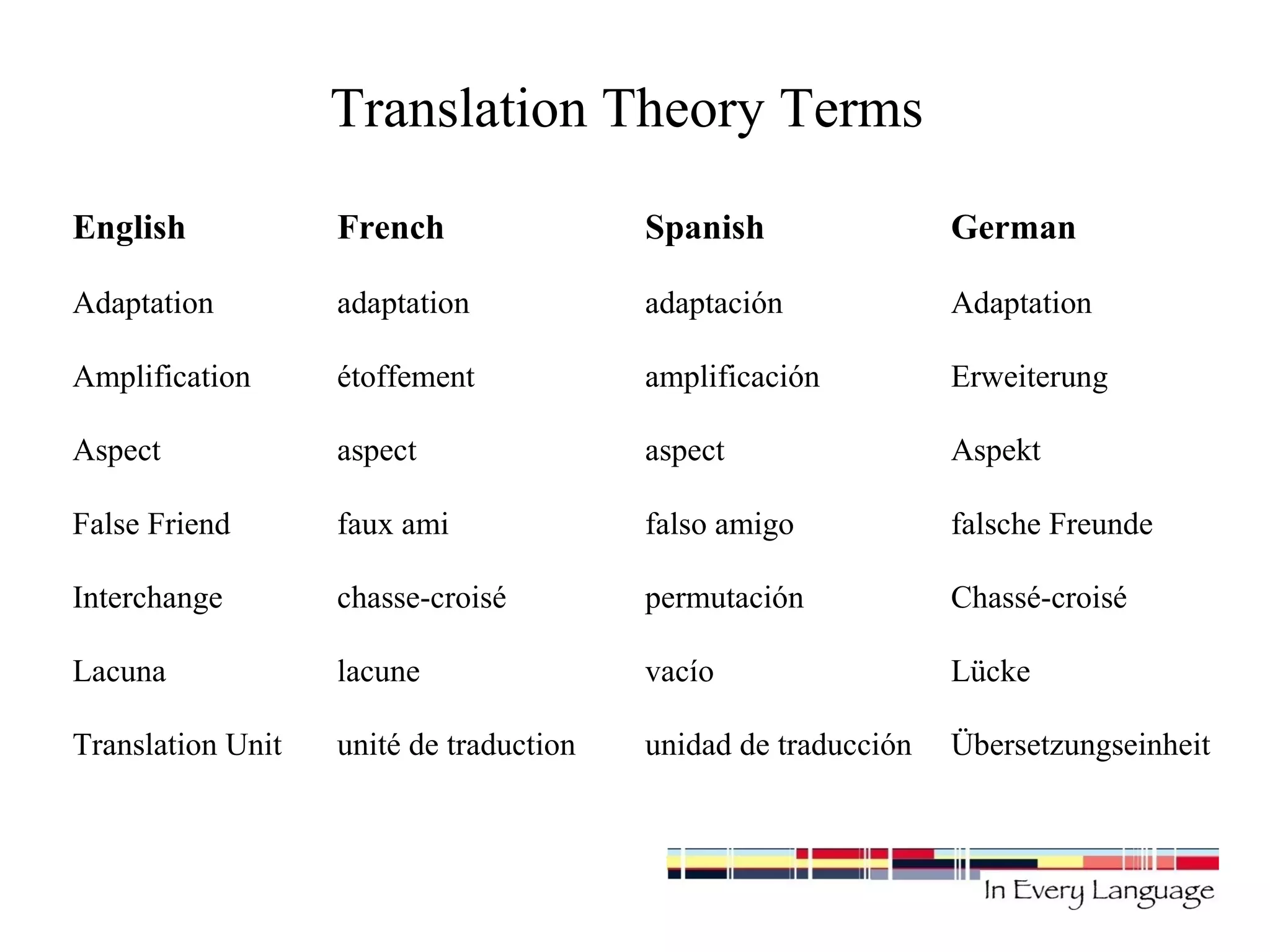
Translation Theory Terms 
English French Spanish German 
Adaptation adaptation adaptación Adaptation 
Amplification étoffement amplificación Erweiterung 
Aspect aspect aspect Aspekt 
False Friend faux ami falso amigo falsche Freunde 
Interchange chasse-croisé permutación Chassé-croisé 
Lacuna lacune vacío Lücke 
Translation Unit unité de traduction unidad de traducción Übersetzungseinheit
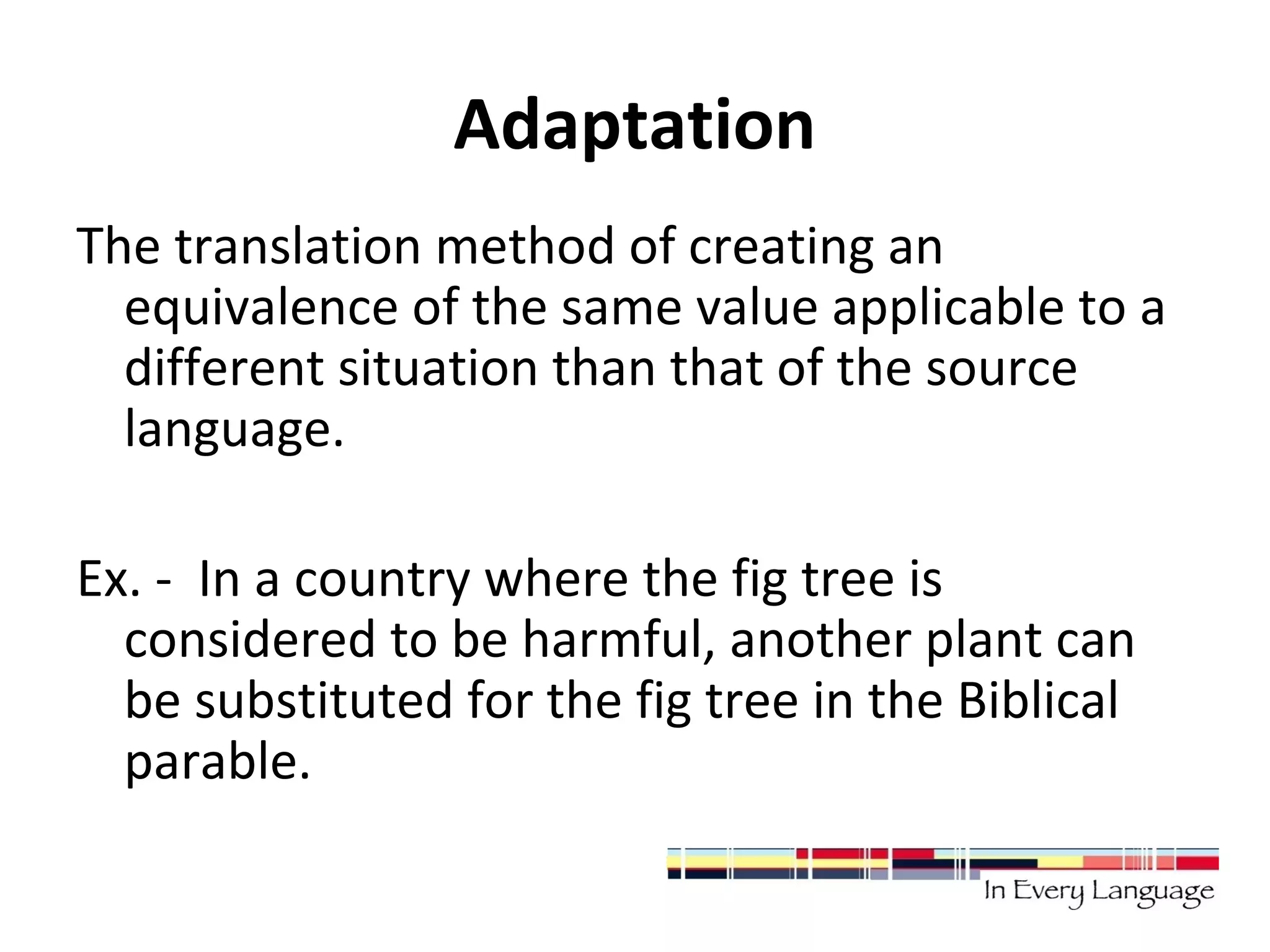
Adaptation 
The translation method of creating an 
equivalence of the same value applicable to a 
different situation than that of the source 
language. 
Ex. - In a country where the fig tree is 
considered to be harmful, another plant can 
be substituted for the fig tree in the Biblical 
parable.
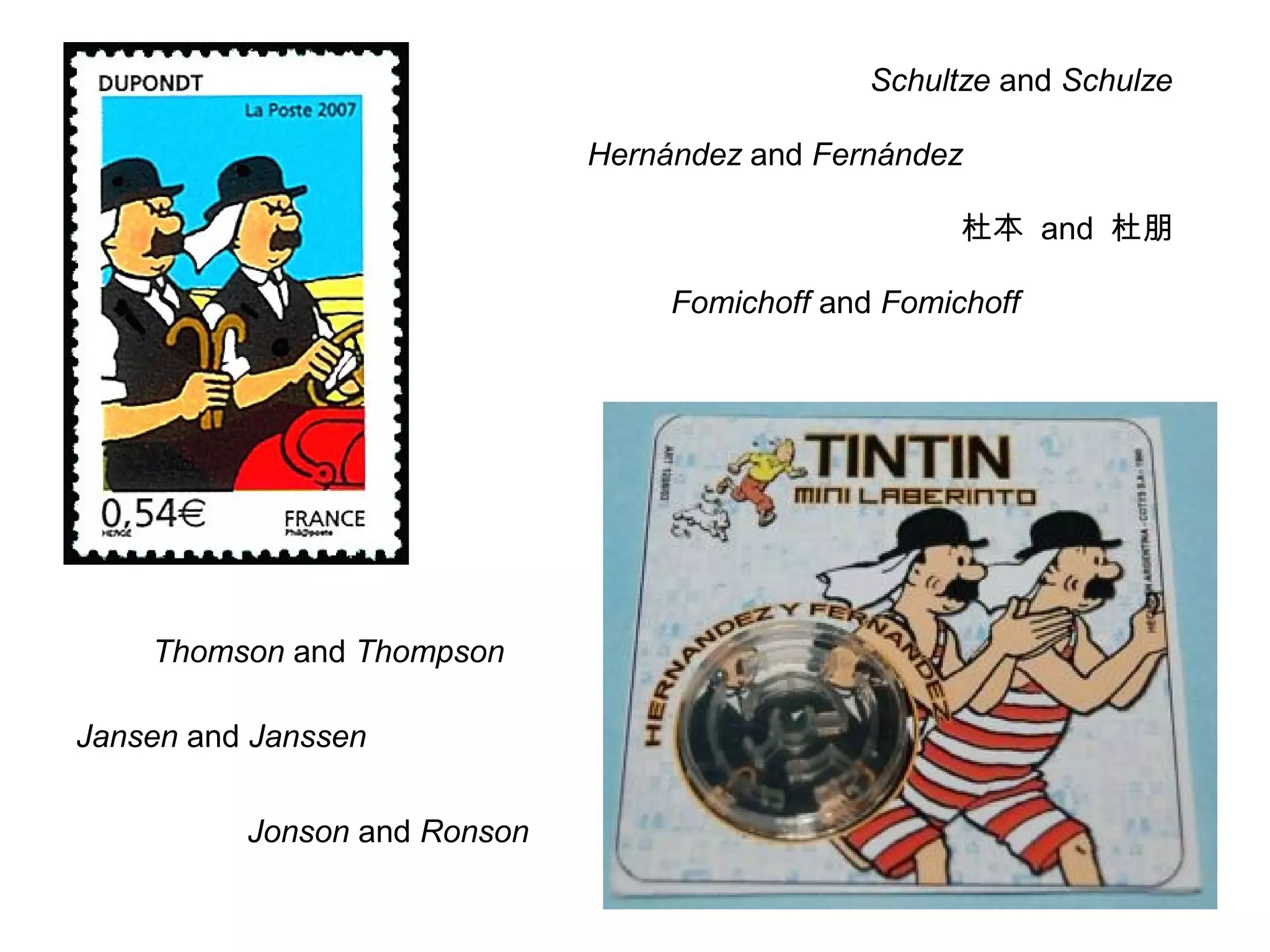
Thomson and Thompson 
Jansen and Janssen 
Jonson and Ronson 
Schultze and Schulze 
Hernández and Fernández 
杜本 and 杜朋 
Fomichoff and Fomichoff
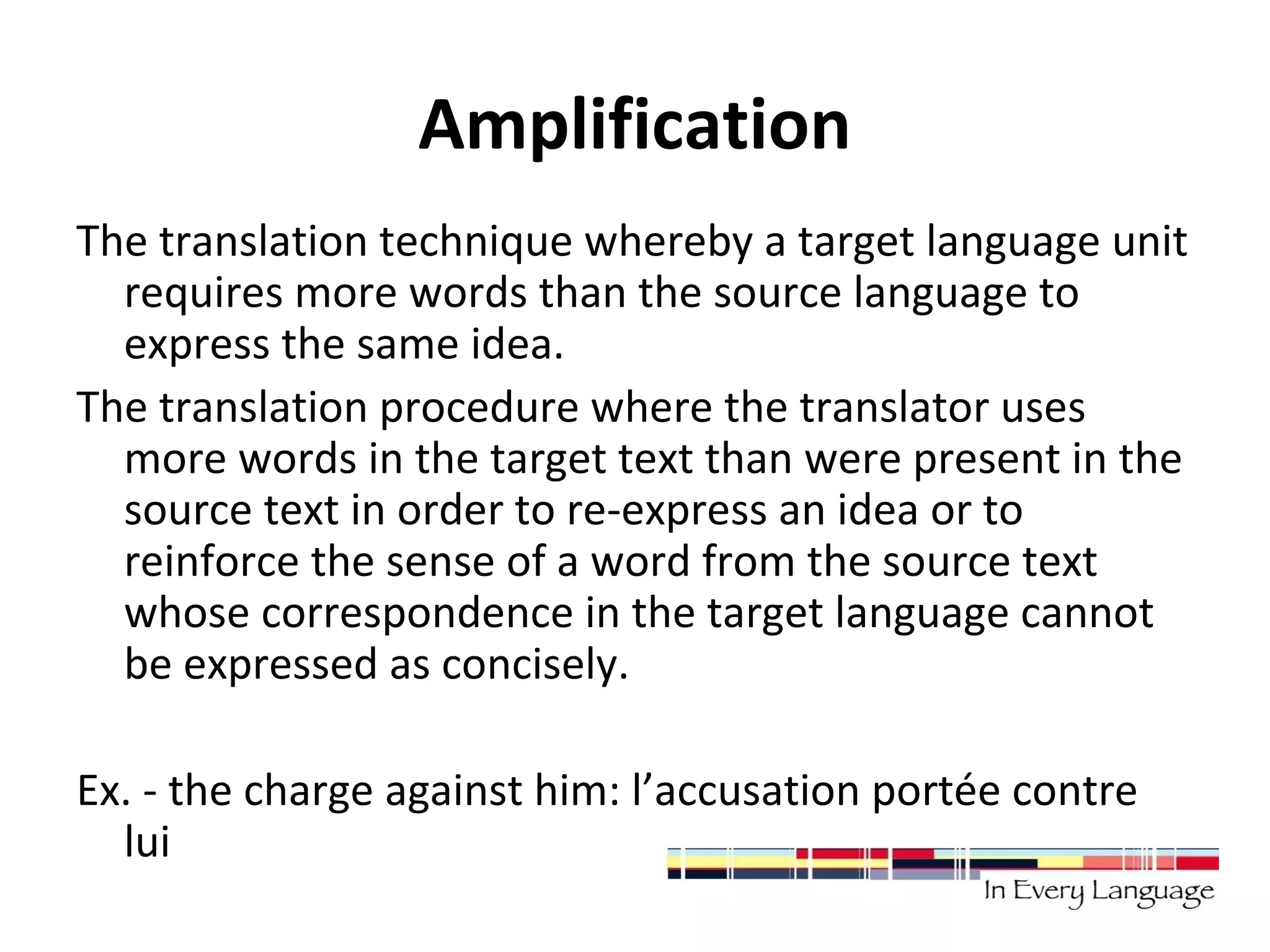
Amplification 
The translation technique whereby a target language unit 
requires more words than the source language to 
express the same idea. 
The translation procedure where the translator uses 
more words in the target text than were present in the 
source text in order to re-express an idea or to 
reinforce the sense of a word from the source text 
whose correspondence in the target language cannot 
be expressed as concisely. 
Ex. - the charge against him: l’accusation portée contre 
lui
Aspect 
The manner in which an action expressed by a verb or noun is situated 
in time. Note 1. – Aspect indicates the particular point of view from 
which the course of an action is considered or a specific phase 
during the course of an action. Note 2. – The same word can have 
several aspects. Thus, the word continuation is both durative and 
imperfective 
Ex. – (durative aspect) to reflect; reading 
Ex. – (instantaneous aspect) to explode; bursting 
Ex. – (inchoative aspect) to begin; start 
Ex. – (iterative or repetitive aspect) to shred; rereading 
Ex. – (perfective or terminative aspect) to close; outcome 
Ex. – (imperfect aspect or non-completion) to strive; development 
Ex. – (progressive aspect or continuity) to be growing; deceleration.
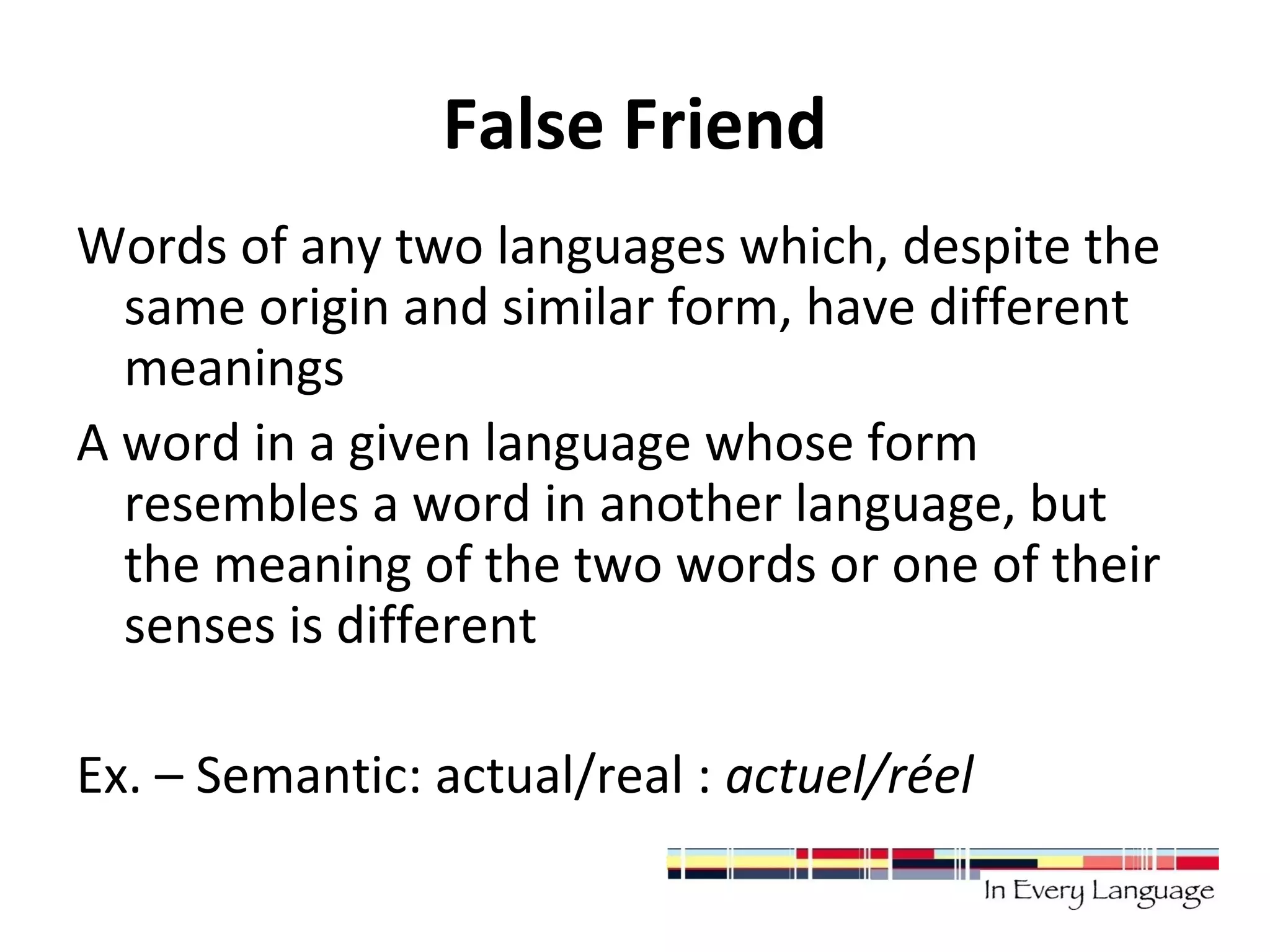
False Friend 
Words of any two languages which, despite the 
same origin and similar form, have different 
meanings 
A word in a given language whose form 
resembles a word in another language, but 
the meaning of the two words or one of their 
senses is different 
Ex. – Semantic: actual/real : actuel/réel
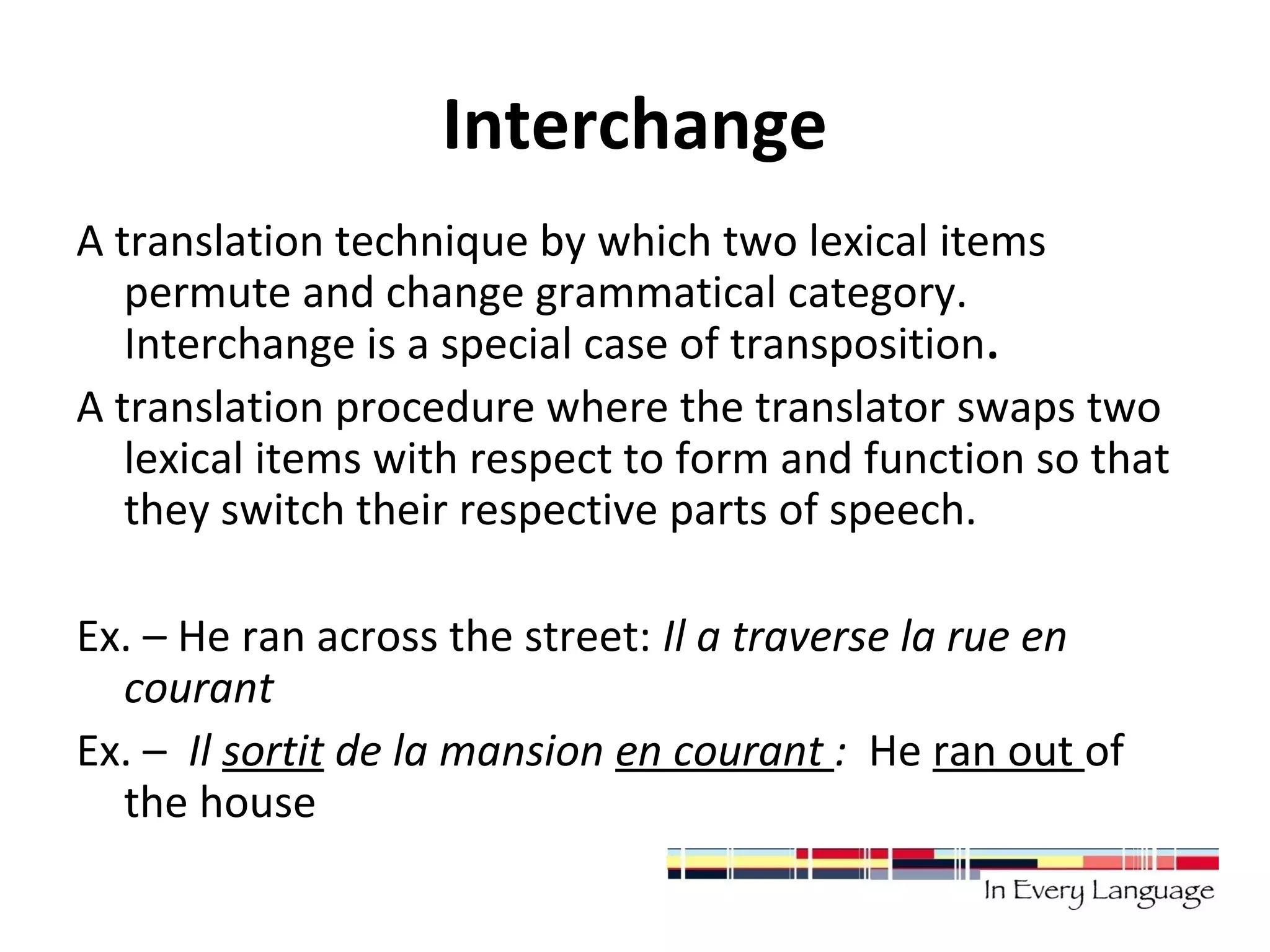
Interchange 
A translation technique by which two lexical items 
permute and change grammatical category. 
Interchange is a special case of transposition. 
A translation procedure where the translator swaps two 
lexical items with respect to form and function so that 
they switch their respective parts of speech. 
Ex. – He ran across the street: Il a traverse la rue en 
courant 
Ex. – Il sortit de la mansion en courant : He ran out of 
the house
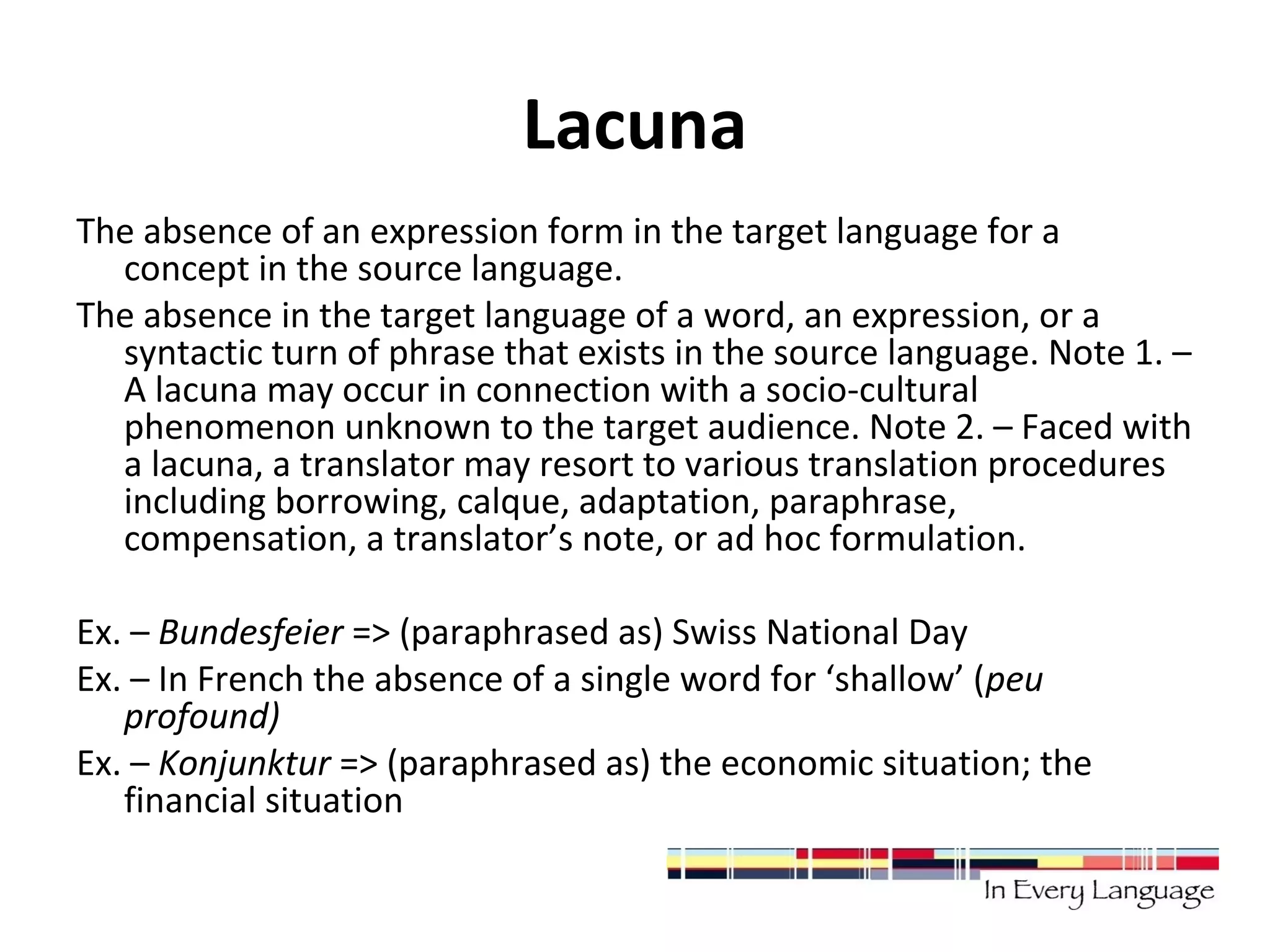
Lacuna 
The absence of an expression form in the target language for a 
concept in the source language. 
The absence in the target language of a word, an expression, or a 
syntactic turn of phrase that exists in the source language. Note 1. – 
A lacuna may occur in connection with a socio-cultural 
phenomenon unknown to the target audience. Note 2. – Faced with 
a lacuna, a translator may resort to various translation procedures 
including borrowing, calque, adaptation, paraphrase, 
compensation, a translator’s note, or ad hoc formulation. 
Ex. – Bundesfeier => (paraphrased as) Swiss National Day 
Ex. – In French the absence of a single word for ‘shallow’ (peu 
profound) 
Ex. – Konjunktur => (paraphrased as) the economic situation; the 
financial situation
HMO 
PPO 
SSN 
Medicaid 
Medicare
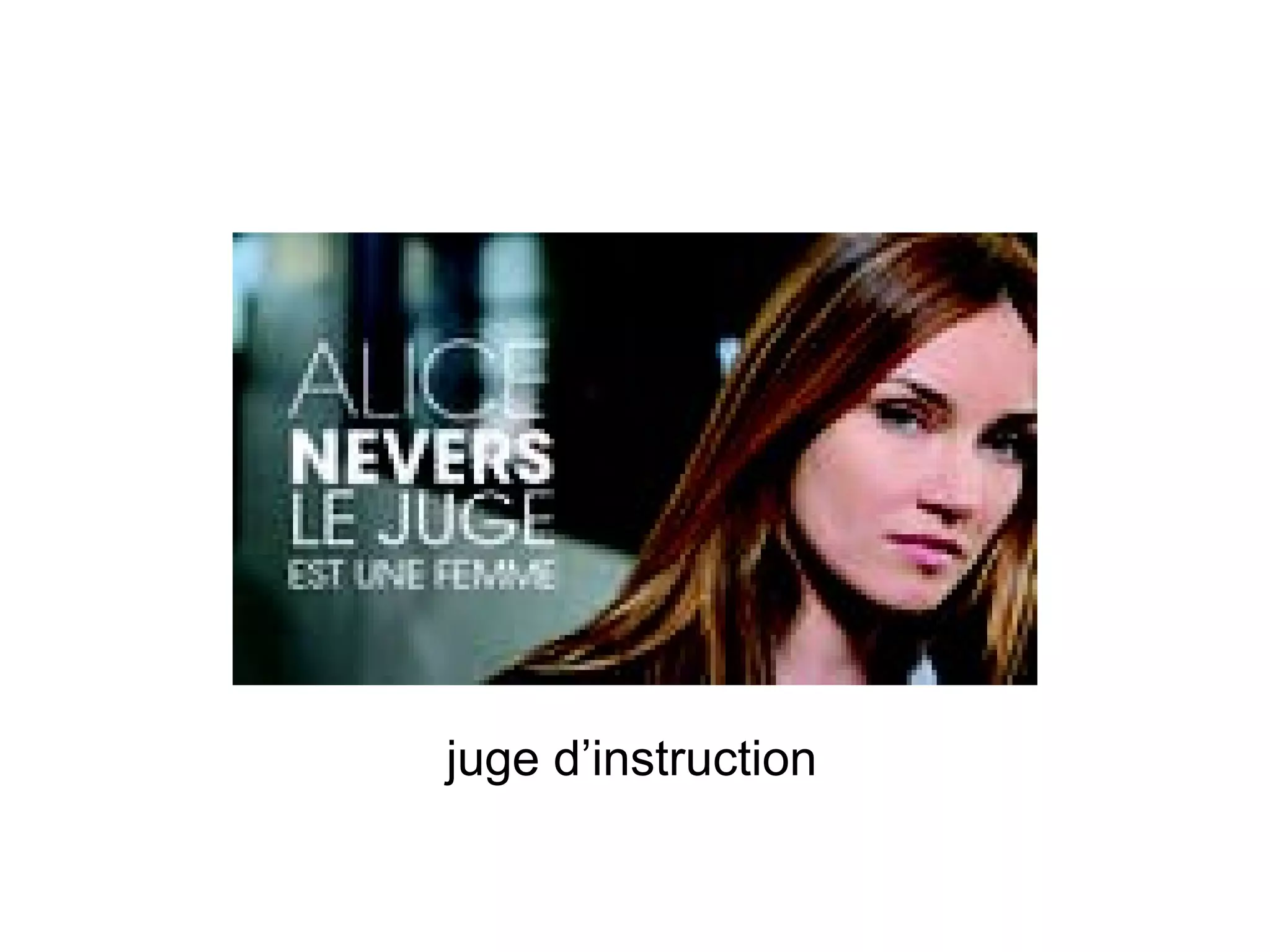
juge d’instruction
Translation Unit 
The smallest segment of the utterance in which the cohesion of signs is such that they must not be 
translated separately. Units of translation permit the segmentation of a text to be carried out. 
1. A text segment consisting of a single word, a phrase, a whole sentence, or even more than one 
sentence, which a translator treats as a single cognitive unit in establishing equivalence. 
2. A single element in the source text or a group of elements that are linked by semantic or formal 
features and which translators interpret as a single entity in association with their situational 
knowledge. Note 1. – The elements that constitute the translation unit may form a sequence within 
a phrase or may be dispersed throughout the text (transphraseological unit). These elements can 
take on their own semantic value in the framework of the text. Note 2. – Unifying elements that 
contribute to or function as translation units can be phonetic (ex.: alliteration), lexical, stylistic, (ex.: 
register), narrative (ex.: highlighting events, mode or tense of verbs), rhetorical (ex.: anaphora, 
argumentative progression), intertextual (ex.: allusion), etc. A single element can evoke several of 
these levels simultaneously. Note 3. – The entire text does not usually constitute a translation unit. 
Nevertheless, it provides a frame of reference on the holistic level that confers semantic value on 
elements in the text as the translator first identifies them and then interprets them. 
Synonym: unit of sense 
Ex. – prendre son élan, de demain en huit, battre à coups précipités.
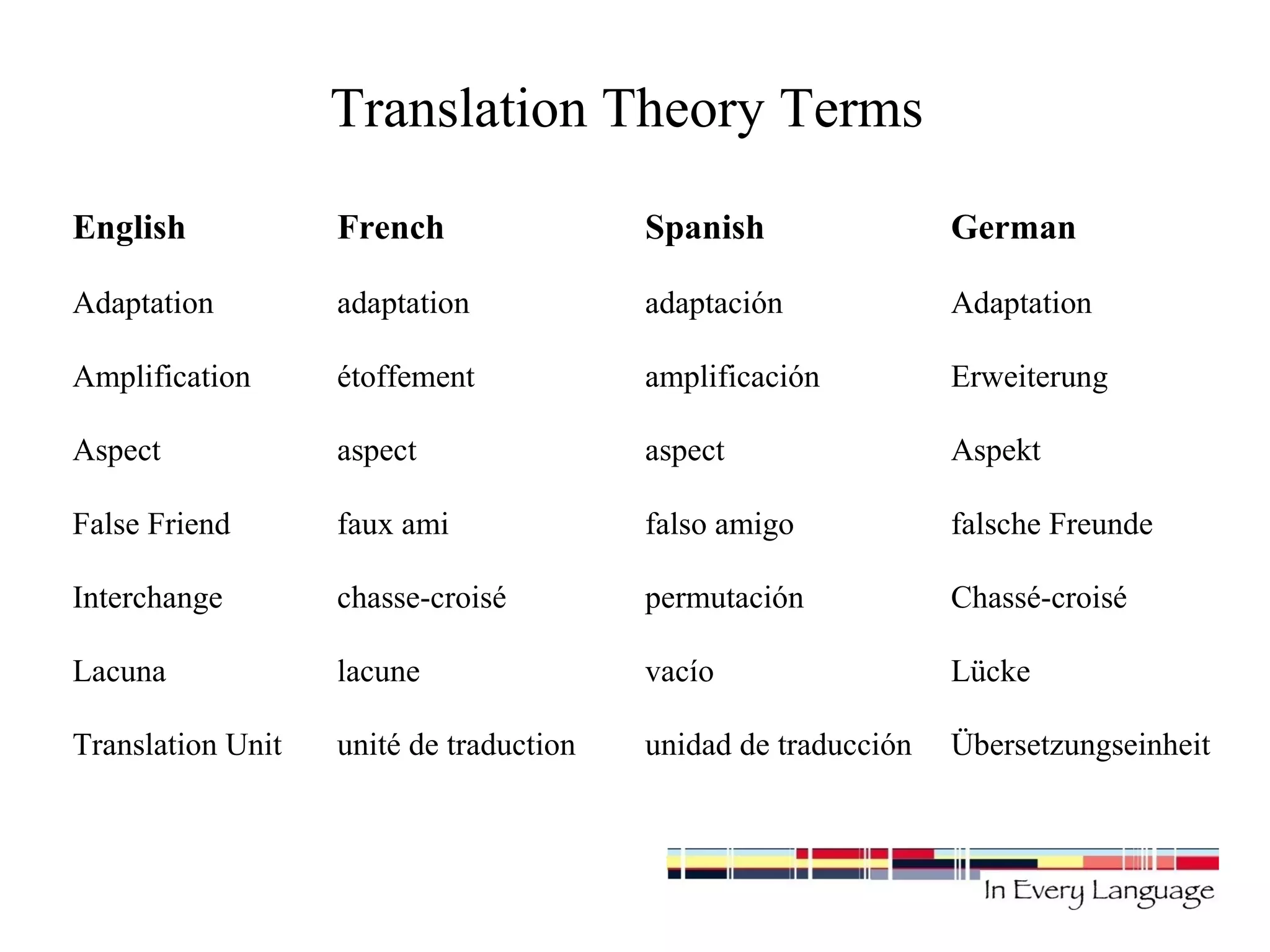
Translation Theory Terms 
English French Spanish German 
Adaptation adaptation adaptación Adaptation 
Amplification étoffement amplificación Erweiterung 
Aspect aspect aspect Aspekt 
False Friend faux ami falso amigo falsche Freunde 
Interchange chasse-croisé permutación Chassé-croisé 
Lacuna lacune vacío Lücke 
Translation Unit unité de traduction unidad de traducción Übersetzungseinheit
Practice Scenarios 
• A mother is at the GP’s, seeking treatment for 
her son with ADHD. 
• A father is enrolling his daughter in their local 
Big Brothers-Big Sisters program. 
• An abused woman has gone to the courts to 
file an EPO. 
• A refugee to the US is attending his first 
cultural orientation, which is the concept of 
time in America.
For More Information 
Delisle, Jean, Hannelore Lee-Jahnke and Monique C. Cormier, eds. Terminologie de la 
Traduction, Translation Termonology, Terminología de la Traducción, 
Terminologie der Übersetzung. Philadelphia, PA : John Benjamins Publishing Co., 
1999. 
Vinay, Jean Paul and Jean Darbelnet. Comparative Stylistics of French and English: A 
Methodology for Translation. Philadelphia, PA: John Benjamins Publishing Co., 
1995. 
www.ineverylanguage.com

What Interpreters Can Learn from Translation Theory

  • 1.
    What Interpreters CanLearn from Translation Theory FIT XIX World Congress August 1, 2011 Terena Bell, Speaker
  • 2.
    Translation Theory Terms English French Spanish German Adaptation adaptation adaptación Adaptation Amplification étoffement amplificación Erweiterung Aspect aspect aspect Aspekt False Friend faux ami falso amigo falsche Freunde Interchange chasse-croisé permutación Chassé-croisé Lacuna lacune vacío Lücke Translation Unit unité de traduction unidad de traducción Übersetzungseinheit
  • 3.
    Adaptation The translationmethod of creating an equivalence of the same value applicable to a different situation than that of the source language. Ex. - In a country where the fig tree is considered to be harmful, another plant can be substituted for the fig tree in the Biblical parable.
  • 5.
    Thomson and Thompson Jansen and Janssen Jonson and Ronson Schultze and Schulze Hernández and Fernández 杜本 and 杜朋 Fomichoff and Fomichoff
  • 6.
    Amplification The translationtechnique whereby a target language unit requires more words than the source language to express the same idea. The translation procedure where the translator uses more words in the target text than were present in the source text in order to re-express an idea or to reinforce the sense of a word from the source text whose correspondence in the target language cannot be expressed as concisely. Ex. - the charge against him: l’accusation portée contre lui
  • 7.
    Aspect The mannerin which an action expressed by a verb or noun is situated in time. Note 1. – Aspect indicates the particular point of view from which the course of an action is considered or a specific phase during the course of an action. Note 2. – The same word can have several aspects. Thus, the word continuation is both durative and imperfective Ex. – (durative aspect) to reflect; reading Ex. – (instantaneous aspect) to explode; bursting Ex. – (inchoative aspect) to begin; start Ex. – (iterative or repetitive aspect) to shred; rereading Ex. – (perfective or terminative aspect) to close; outcome Ex. – (imperfect aspect or non-completion) to strive; development Ex. – (progressive aspect or continuity) to be growing; deceleration.
  • 8.
    False Friend Wordsof any two languages which, despite the same origin and similar form, have different meanings A word in a given language whose form resembles a word in another language, but the meaning of the two words or one of their senses is different Ex. – Semantic: actual/real : actuel/réel
  • 11.
    Interchange A translationtechnique by which two lexical items permute and change grammatical category. Interchange is a special case of transposition. A translation procedure where the translator swaps two lexical items with respect to form and function so that they switch their respective parts of speech. Ex. – He ran across the street: Il a traverse la rue en courant Ex. – Il sortit de la mansion en courant : He ran out of the house
  • 12.
    Lacuna The absenceof an expression form in the target language for a concept in the source language. The absence in the target language of a word, an expression, or a syntactic turn of phrase that exists in the source language. Note 1. – A lacuna may occur in connection with a socio-cultural phenomenon unknown to the target audience. Note 2. – Faced with a lacuna, a translator may resort to various translation procedures including borrowing, calque, adaptation, paraphrase, compensation, a translator’s note, or ad hoc formulation. Ex. – Bundesfeier => (paraphrased as) Swiss National Day Ex. – In French the absence of a single word for ‘shallow’ (peu profound) Ex. – Konjunktur => (paraphrased as) the economic situation; the financial situation
  • 13.
    HMO PPO SSN Medicaid Medicare
  • 14.
  • 16.
    Translation Unit Thesmallest segment of the utterance in which the cohesion of signs is such that they must not be translated separately. Units of translation permit the segmentation of a text to be carried out. 1. A text segment consisting of a single word, a phrase, a whole sentence, or even more than one sentence, which a translator treats as a single cognitive unit in establishing equivalence. 2. A single element in the source text or a group of elements that are linked by semantic or formal features and which translators interpret as a single entity in association with their situational knowledge. Note 1. – The elements that constitute the translation unit may form a sequence within a phrase or may be dispersed throughout the text (transphraseological unit). These elements can take on their own semantic value in the framework of the text. Note 2. – Unifying elements that contribute to or function as translation units can be phonetic (ex.: alliteration), lexical, stylistic, (ex.: register), narrative (ex.: highlighting events, mode or tense of verbs), rhetorical (ex.: anaphora, argumentative progression), intertextual (ex.: allusion), etc. A single element can evoke several of these levels simultaneously. Note 3. – The entire text does not usually constitute a translation unit. Nevertheless, it provides a frame of reference on the holistic level that confers semantic value on elements in the text as the translator first identifies them and then interprets them. Synonym: unit of sense Ex. – prendre son élan, de demain en huit, battre à coups précipités.
  • 17.
    Translation Theory Terms English French Spanish German Adaptation adaptation adaptación Adaptation Amplification étoffement amplificación Erweiterung Aspect aspect aspect Aspekt False Friend faux ami falso amigo falsche Freunde Interchange chasse-croisé permutación Chassé-croisé Lacuna lacune vacío Lücke Translation Unit unité de traduction unidad de traducción Übersetzungseinheit
  • 18.
    Practice Scenarios •A mother is at the GP’s, seeking treatment for her son with ADHD. • A father is enrolling his daughter in their local Big Brothers-Big Sisters program. • An abused woman has gone to the courts to file an EPO. • A refugee to the US is attending his first cultural orientation, which is the concept of time in America.
  • 19.
    For More Information Delisle, Jean, Hannelore Lee-Jahnke and Monique C. Cormier, eds. Terminologie de la Traduction, Translation Termonology, Terminología de la Traducción, Terminologie der Übersetzung. Philadelphia, PA : John Benjamins Publishing Co., 1999. Vinay, Jean Paul and Jean Darbelnet. Comparative Stylistics of French and English: A Methodology for Translation. Philadelphia, PA: John Benjamins Publishing Co., 1995. www.ineverylanguage.com

Editor's Notes

  • #3 Have people sit in sections by language; rapid fire off words – as review each term, ask for volunteer to give example in her/his language Do English to English exercises (think LIKE your target language & show how it would be different – ex, say in EN, he went to the store by foot instead of saying il est alle a pied – so other languages can see & learn)
  • #5 Super Bowl  World Cup (when change, when leave?)
  • #6 Tintin commics, Dupont & Dupond  Thompson & Thomson Thomson and Thompson in English, Jansen and Janssen in Dutch, Jonson and Ronson in Bengali, Schultze and Schulze in German, Hernández and Fernández in Spanish, 杜本 and 杜朋 (Dùběn and Dùpéng) in Chinese, and Fomichoff andFomichoff in Russian.
  • #7 Example: Abari (SW)  In US we say hello before asking how people are. While Jambo exists, all this is contained in Abari
  • #8 Drink & drive – example came up when I was interpreting. I just said “boire et conduire.” He asked about all these people drinking coffee while driving. Errror “boire puis conduire” even more confused. Then asked speaker to clarify instead of interjecting info about alcohol myself as blood alcohol count is more complex. Could be Inchoative, iterative, termanative (drank at the bar, stopped drinking then left), progressive (drinking at the wheel even still). Example where this didn’t exist in EN or is a transparent given, but in FR it needed to be made more clear.
  • #9 Medical interpreting: the classic “intoxicado” example in Florida hospital
  • #10 Preservatives preservatifs
  • #11 That one. Dutch.
  • #12 Required for grammar/syntax (flew to San Francisco – don’t say vole a San Fran unless you were the pilot – alle a San Fran en avion) How effect pace of interpreting? No time for dictionaries (community interpreting vs conference – no telling what they’ll say in refugee resettlement, social service environment)
  • #13 Medical interpreting: PPO, HMO – which environments can you do this in & which ones can’t you? How community/medical interpreting is different from legal/conference/government (diplomacy). Even in legal, where ethically have to maintain, sometimes can’t. How do you say juge d’instruction in US EN? Doesn’t exist. Not quite sheriff or deputy, def not completely detective, certainly not judge. (Calque would be Greek deus ex machina.) (borrowing honeymoon  lune de miel) (good FR example esprit de l’escalier.) Another calque is minuterie (we don’t really use those automatic timers here for the stairwell lights or bathrooms—what do you say?) ES example, quincera. Does “15th birthday party really say enough?”
  • #15 juge d’instruction – also, adaptation: Nancy Drew
  • #16 Esprit de l’escalier
  • #17 Pacing of original speaker, client education, how to coach the client (ask for suggestions on this, as varies by language) – because of units in FR I prefer simultaneous, DE might do better in consec, though, as sentence structure similar -- all these feed into each other (knock down vs knock up also aspect) Look at the definition itself to determine its own units.