http://www.free-powerpoint-templates-design.com
Advanced
Translation
Unit C
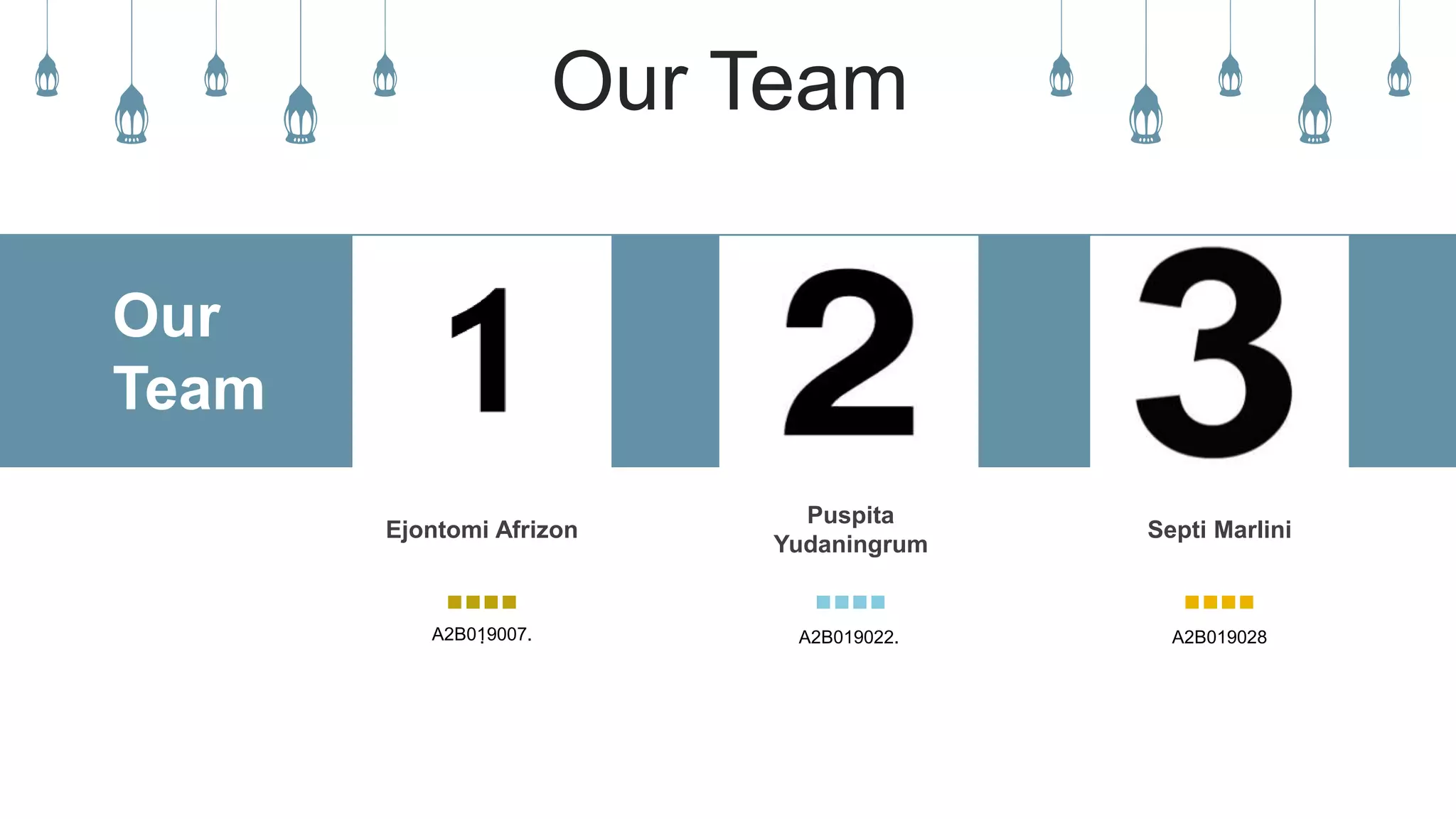
Our Team
Ejontomi Afrizon
Puspita
Yudaningrum
Septi Marlini
A2B019028
A2B019022.
.
Our
Team
A2B019007.
Main Topics
The Analysis of Meaning
01
02
03
Dynamic Equivalence and
The Receptor of The
Message
Textual pragmatics and
equivalence
The analysis
of meaning
semantic structure
analysis
.
including contrastive terms and componential analysis,
that can be used to analyze meaning.
T h e s t r u c t u r a l o r
c o n n o t a t i v e a n a l y s i s
.
useful in cases where the exact sense of the ST is
in doubt or in lexicographical or terminological
work where a precise definition or division of
meaning is essential prior to a mapping on to TL
terms.
often there are fuzzy boundaries between
members of groups which cloud the issue.
(Labov, 1973)
Ex: term cup, which glass, which mug, which
bowl.
Tendency for translation
Focus on the core meanings, to
resort more frequently to
generic nouns such as the fact,
issue,matter, etc, or to use
explicitation
A foreign word is borrowed into the TL where no such item or concept existed
For instance, tsunami or sushi which have been imported from Japanese,
David McDuff (Dostoyevsky 1991:339).
the new translation :
geographical, political or genre considerations
may determine the translation.
KINSHIP TERMS
Cultural Knowledge is
essential order to draw
up the list of
relationships
.
lineal (e.g. mother), colineal (e.g. aunt) and
ablineal (e.g. cousin)
common problem,
Require
disambiguation.
In Yoruba, the major language of
South-West Nigeria, has two words
for the relationship of brother, namely
egbon (elder brother) and aburo
(younger brother).
Collocation
Larson (1984/1998:155–67)
Translation requires the strength of
collocation to be identified in the ST
and conveyed satisfactorily in the TT..
.
In English, to borrow the well-known
example from Leech (1981:17), pretty
woman is a typical (or strong) collocation,
and so is handsome man. This does not
mean that handsome woman or pretty
man is impossible, just that they are very
unusual or marked.
Refers to the way that words are
typically used together.
Collocation grown in importance with the
growth of corpus linguistics, the computer-
assisted study of electronic databases
(corpora) of naturally occurring texts
A concordance displays examples of the search term in the centre
with a certain amount of context either side ordered alphabetically
according to the first word right or left of the search term.
Larson considers collocation primarily as a formal,
structural device, looking at fixed combinations
(bread and butter, black and white), including
idioms, and the ‘restrictions’ on the collocational
range of a word which ‘only a native speaker of the
language can judge’ (1984/1998:160).
semantic prosody
( L o u w 1 9 9 3 ) . the positive or negative
connotative meaning
which is
transferred to the focus
word by the semantic
fields of its common
collocates.
Conclusion:
This unit has examined various attempts, adapted from
English semantics, to examine meaning scientifically. The
underlying assumption was that meaning is observable
and measurable, and transferable in translation. The aim
of these attempts was to assist the decision-making of the
translator. However, there are many other factors that
affect meaning and determine the choice of translation.
These include the linguistic co-text and the context in
which the TT is to function.
Dynamic
Equivalence
and the receptor
of the Message
Anything which can be said in one language can be said in
another language, unless the form is an essential element of the
message, (Nida & Taber, 1969)
Literal translation
Formal equivalence
Dynamic equivalence
Literal Translation
Literal translation tends to preserve formal features almost
by default (i.e. with little or no regard for the context,
meaning or what is implied by a given utterance), a ‘formal’
translation is almost always contextually motivated: formal
features are preserved only if they carry contextual values
that become part of the overall text meaning.
Attention on the message itself in both
form and content
To bring the target reader nearer to the
linguistic or cultural preferences of the
ST
Formal Equivalence
The pure formal replacement of one word or
phrase in the SL by another in the TL
Dynamic Equivalence
Dynamic form of equivalence – they can
express a rich variety of contextual values
and effects which literal translation would
simply compromise.
We opt for varying degrees of dynamic equivalence when form is
not significantly involved in conveying a particular meaning and
when a formal rendering is therefore unnecessary.
Dynamic and formal equivalence are points on
cline.
The two methods are not absolute technique but
rather general orientations.
Experienced translators resort to a formal rendering
of the ST most of the time, then they reconsider their
decisions and make their definitive choice.
Eugene A. Nida, Toward a Science of Translating,
1964
Messages differ primarily in the degree to which content or form is
the dominant consideration. Of course, the content of the message
can never be completely abstracted from the form and form is nothing
apart from content: but in some messages the content is of primary
consideration, and in others the form must be given a higher priority.
A translator’s purpose may involve much more than information. He/she
may, for example, want to suggest a particular type of behavior by means
of a translation. Under such circumstance he is likely to aim at full
intelligibility and to make certain minor adjustments in detail so that the
reader may understand the full implications of the message for his own
circumstance.
In such situation a translator is not content to have receptors say:
‘This is intelligible to us’. Rather, he is looking for some such
response as, ‘ This is meaningful for us’.
Two basic orientations in translating
Formal
Equivalence
Dynamic
Equivalence
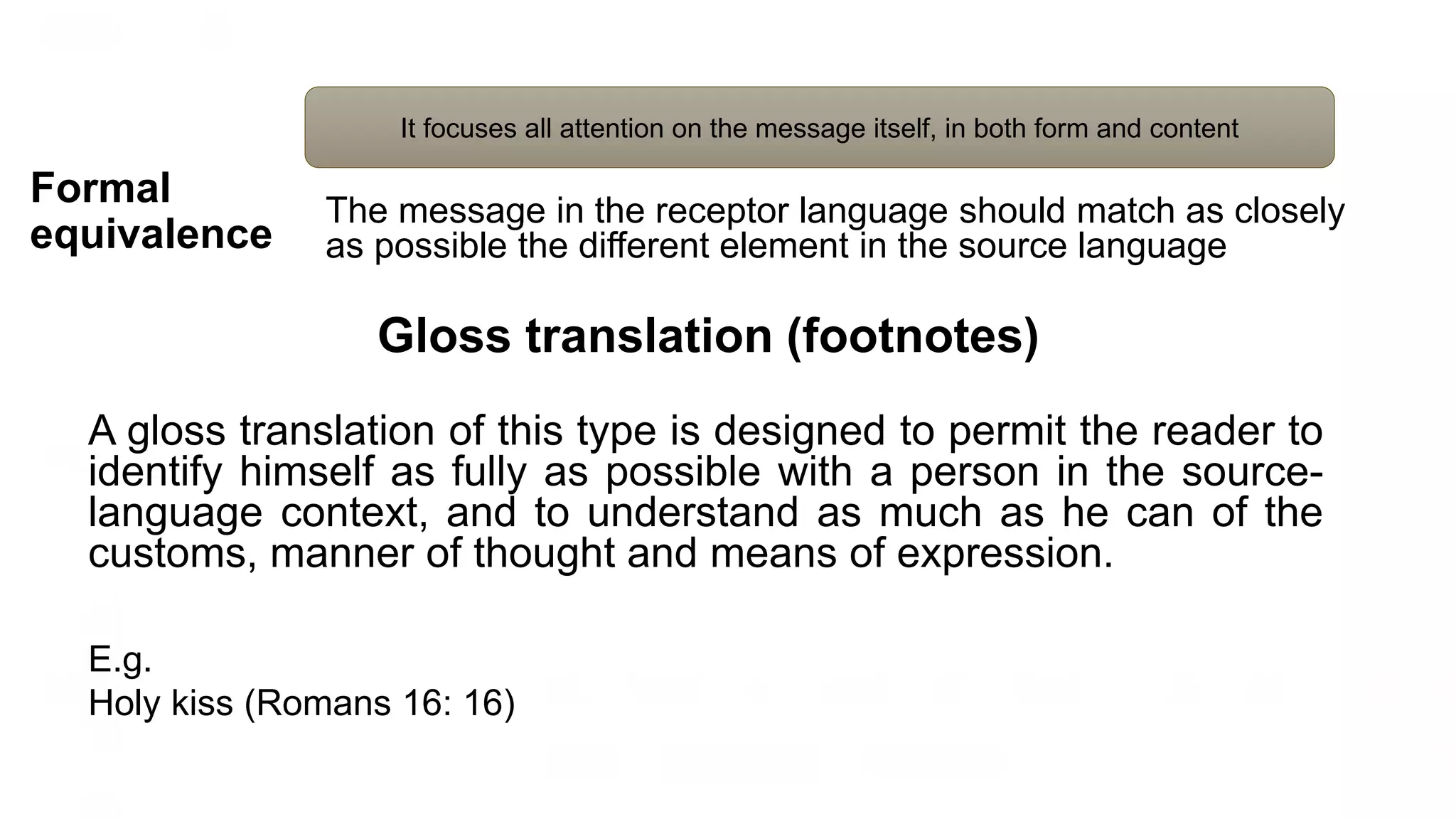
Formal
equivalence
It focuses all attention on the message itself, in both form and content
The message in the receptor language should match as closely
as possible the different element in the source language
Gloss translation (footnotes)
A gloss translation of this type is designed to permit the reader to
identify himself as fully as possible with a person in the source-
language context, and to understand as much as he can of the
customs, manner of thought and means of expression.
E.g.
Holy kiss (Romans 16: 16)
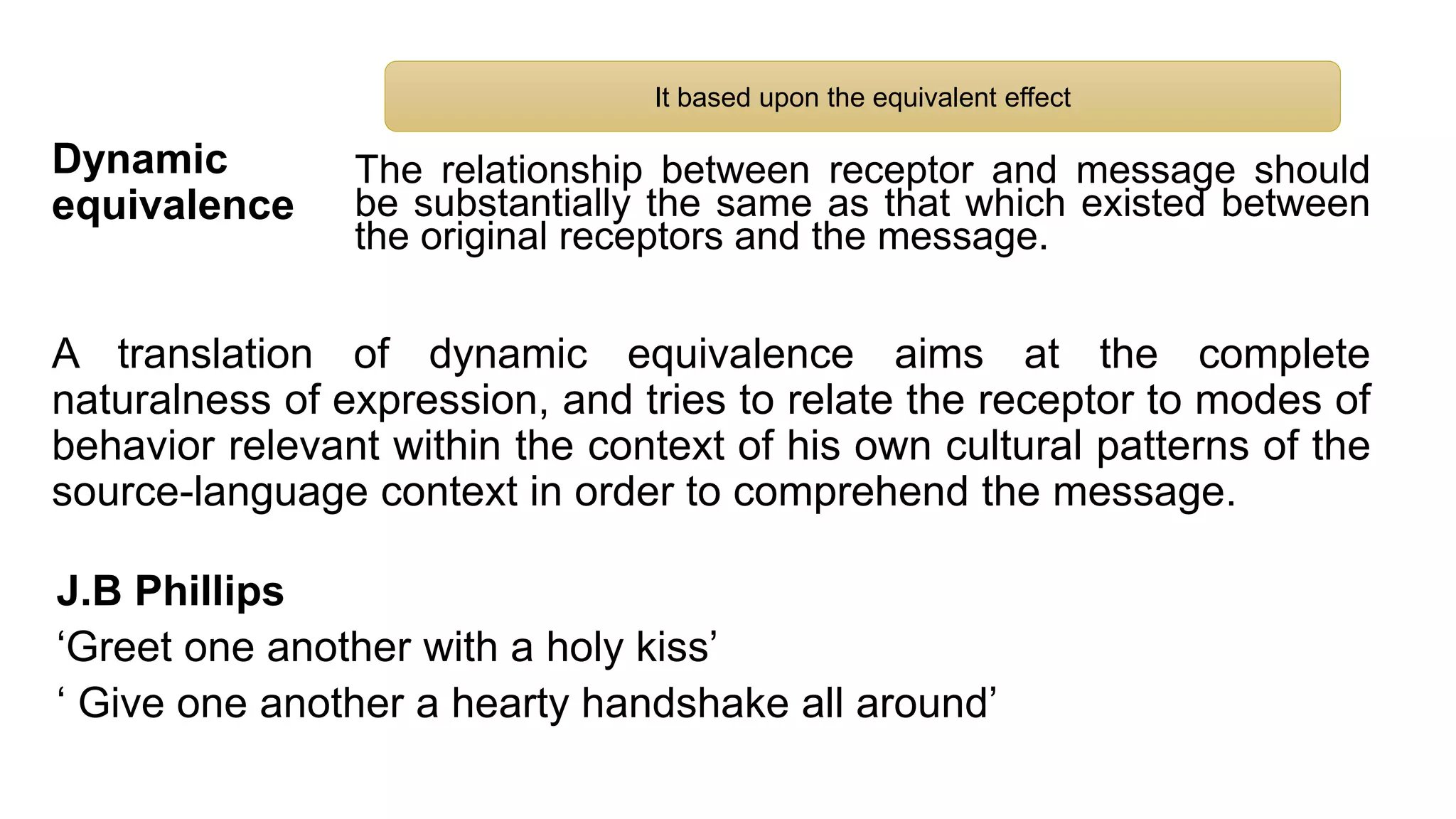
Dynamic
equivalence
It based upon the equivalent effect
The relationship between receptor and message should
be substantially the same as that which existed between
the original receptors and the message.
A translation of dynamic equivalence aims at the complete
naturalness of expression, and tries to relate the receptor to modes of
behavior relevant within the context of his own cultural patterns of the
source-language context in order to comprehend the message.
J.B Phillips
‘Greet one another with a holy kiss’
‘ Give one another a hearty handshake all around’
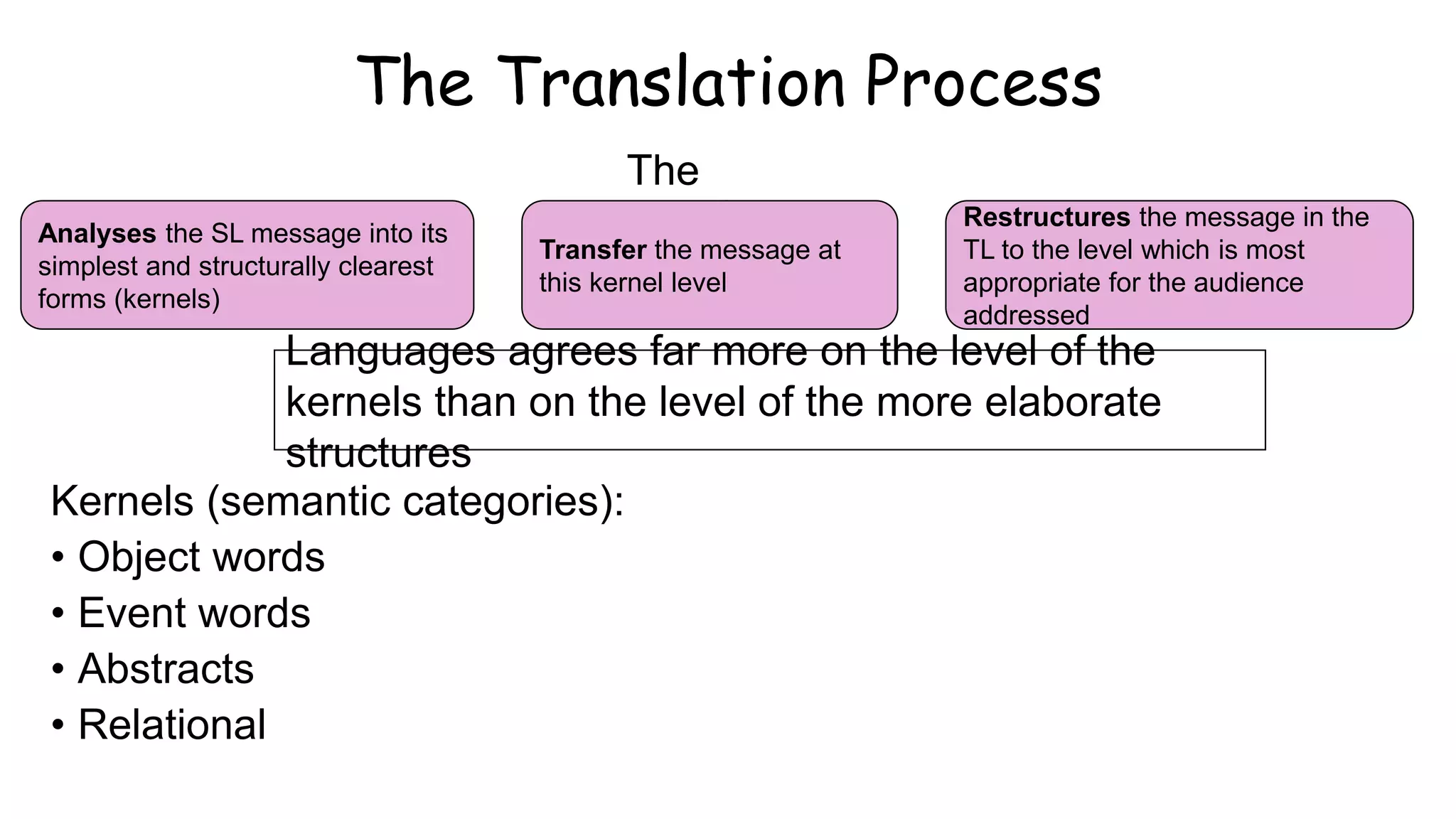
The Translation Process
The
translator
Analyses the SL message into its
simplest and structurally clearest
forms (kernels)
Transfer the message at
this kernel level
Restructures the message in the
TL to the level which is most
appropriate for the audience
addressed
Languages agrees far more on the level of the
kernels than on the level of the more elaborate
structures
Kernels (semantic categories):
• Object words
• Event words
• Abstracts
• Relational
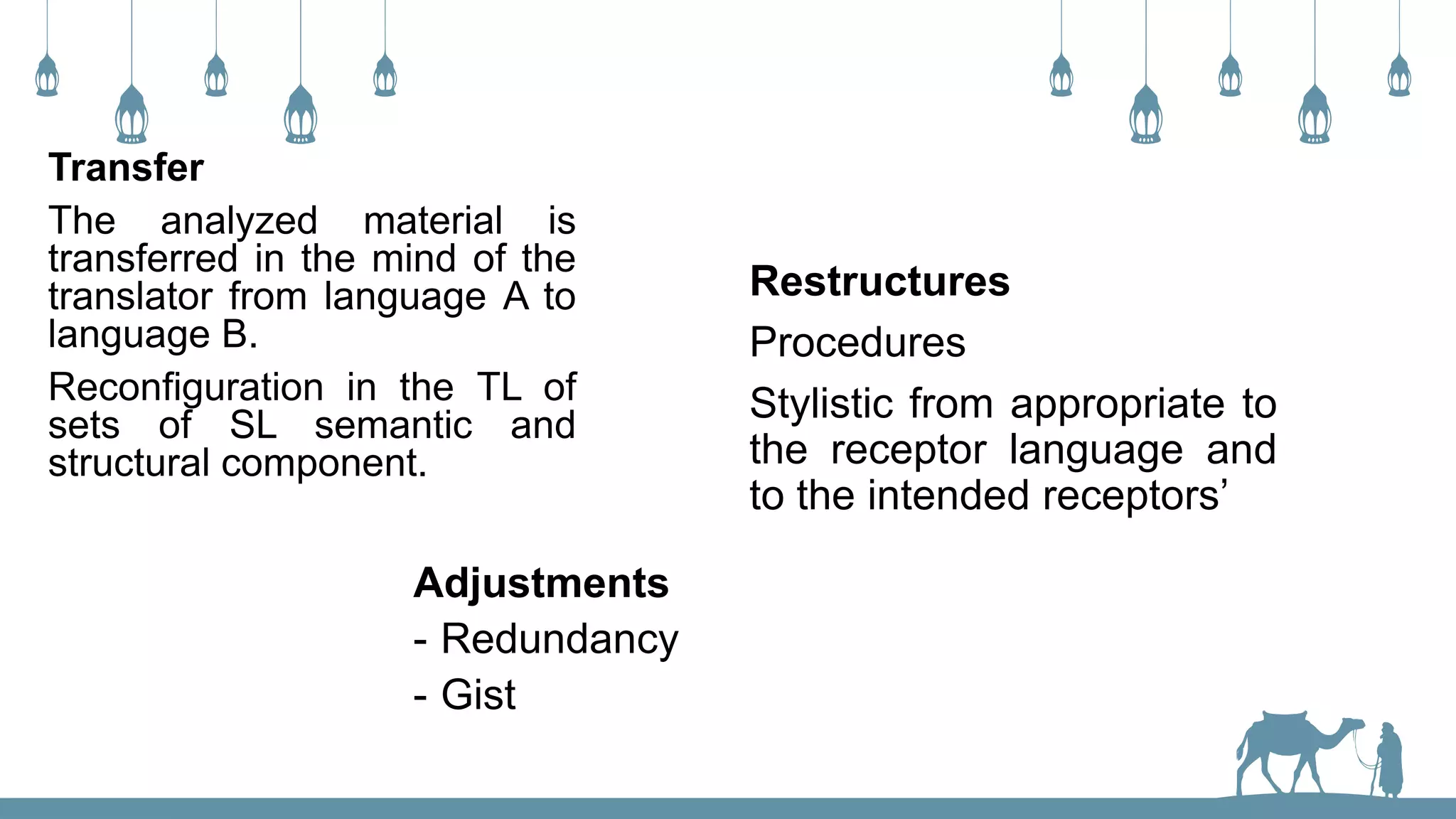
Transfer
The analyzed material is
transferred in the mind of the
translator from language A to
language B.
Reconfiguration in the TL of
sets of SL semantic and
structural component.
Restructures
Procedures
Stylistic from appropriate to
the receptor language and
to the intended receptors’
Adjustments
- Redundancy
- Gist
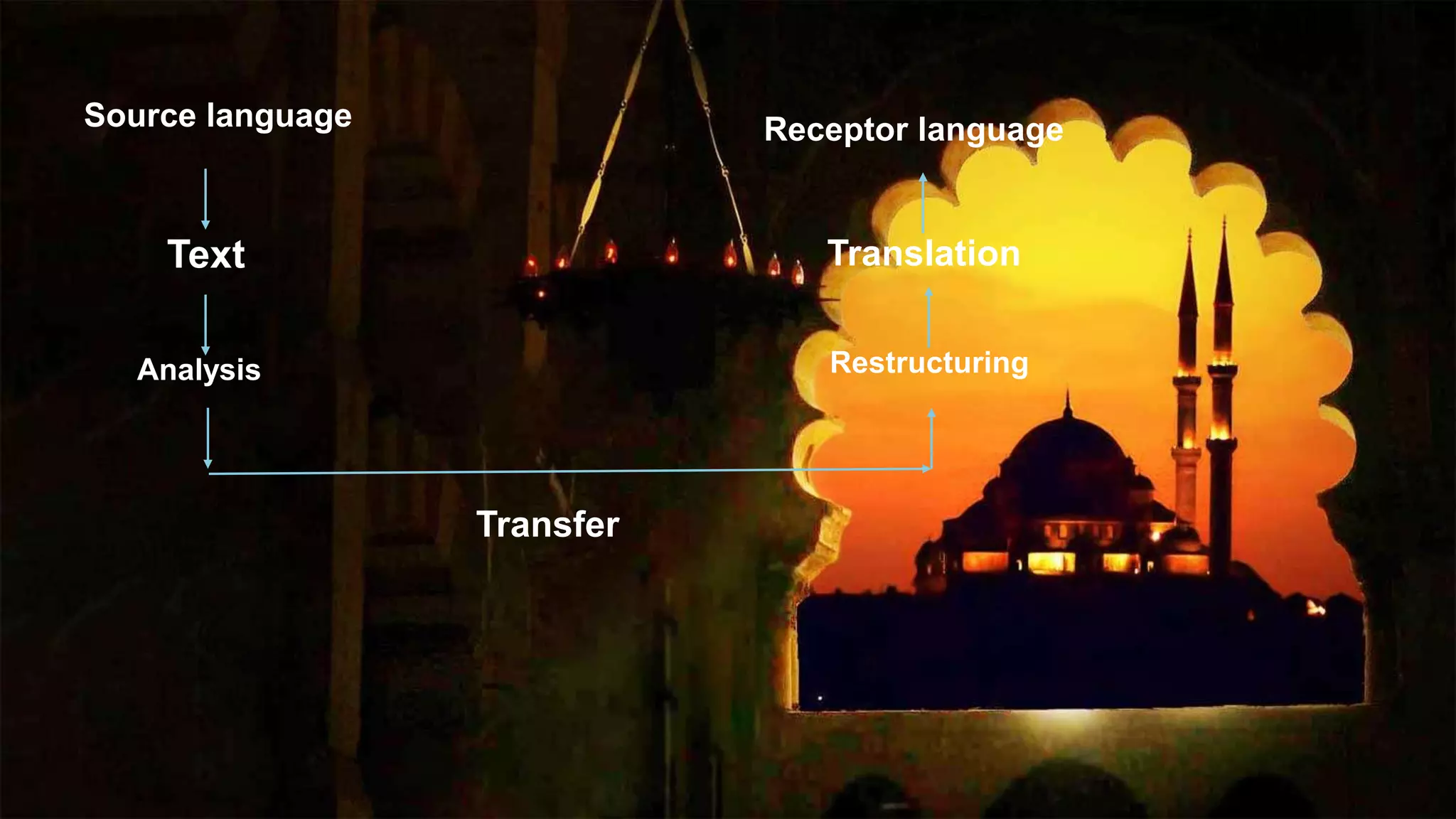
Source language
Text
Analysis
Transfer
Restructuring
Translation
Receptor language
Translating
Reproducing in the receptor
language the closest natural
equivalent of the message of the
source language, first in terms of
meaning and the second in terms
of style
TEXTUAL PRAGMATICS
AND EQUIVALENCE
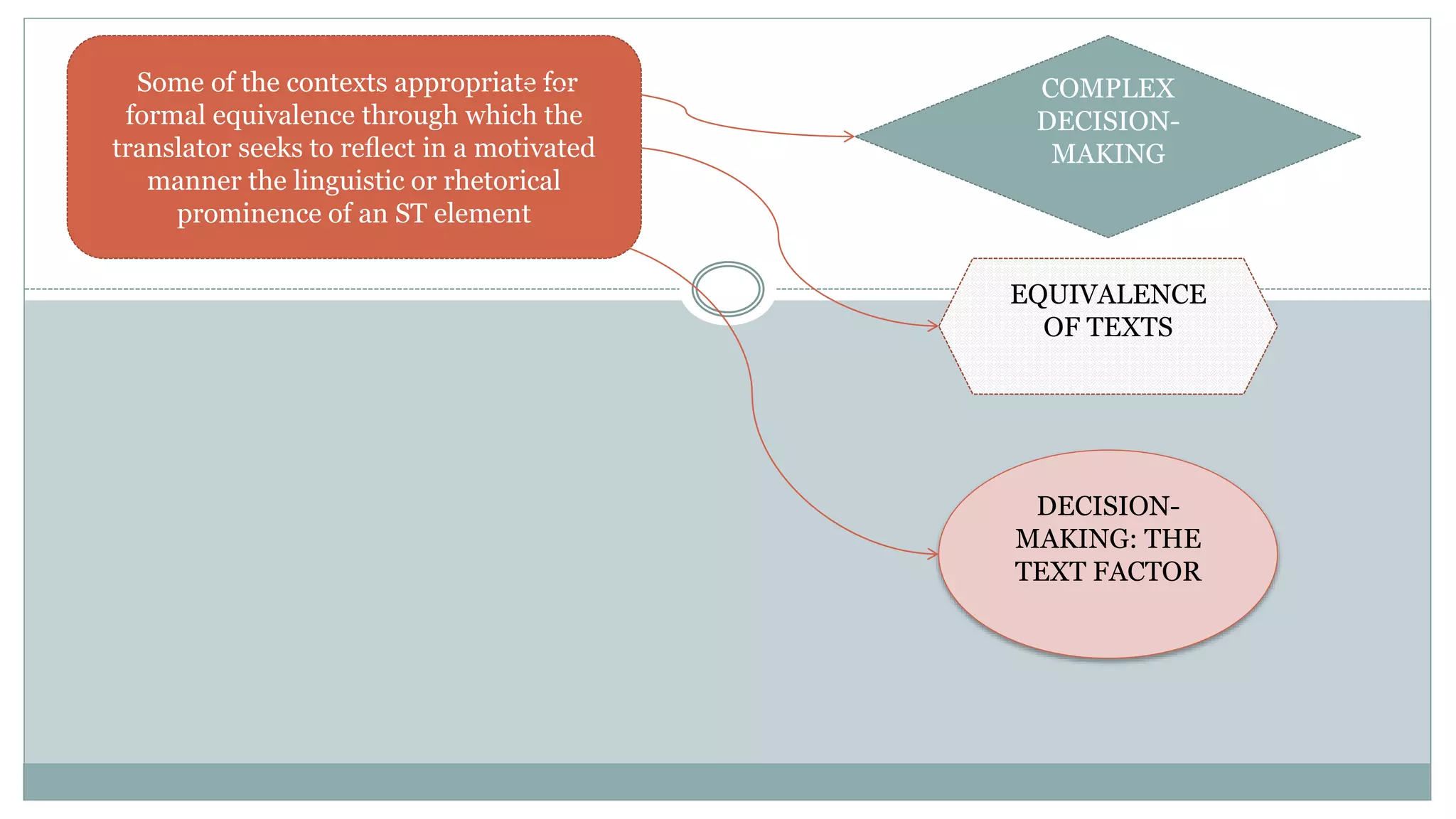
Some of the contexts appropriate for
formal equivalence through which the
translator seeks to reflect in a motivated
manner the linguistic or rhetorical
prominence of an ST element
EQUIVALENCE
OF TEXTS
COMPLEX
DECISION-
MAKING
DECISION-
MAKING: THE
TEXT FACTOR
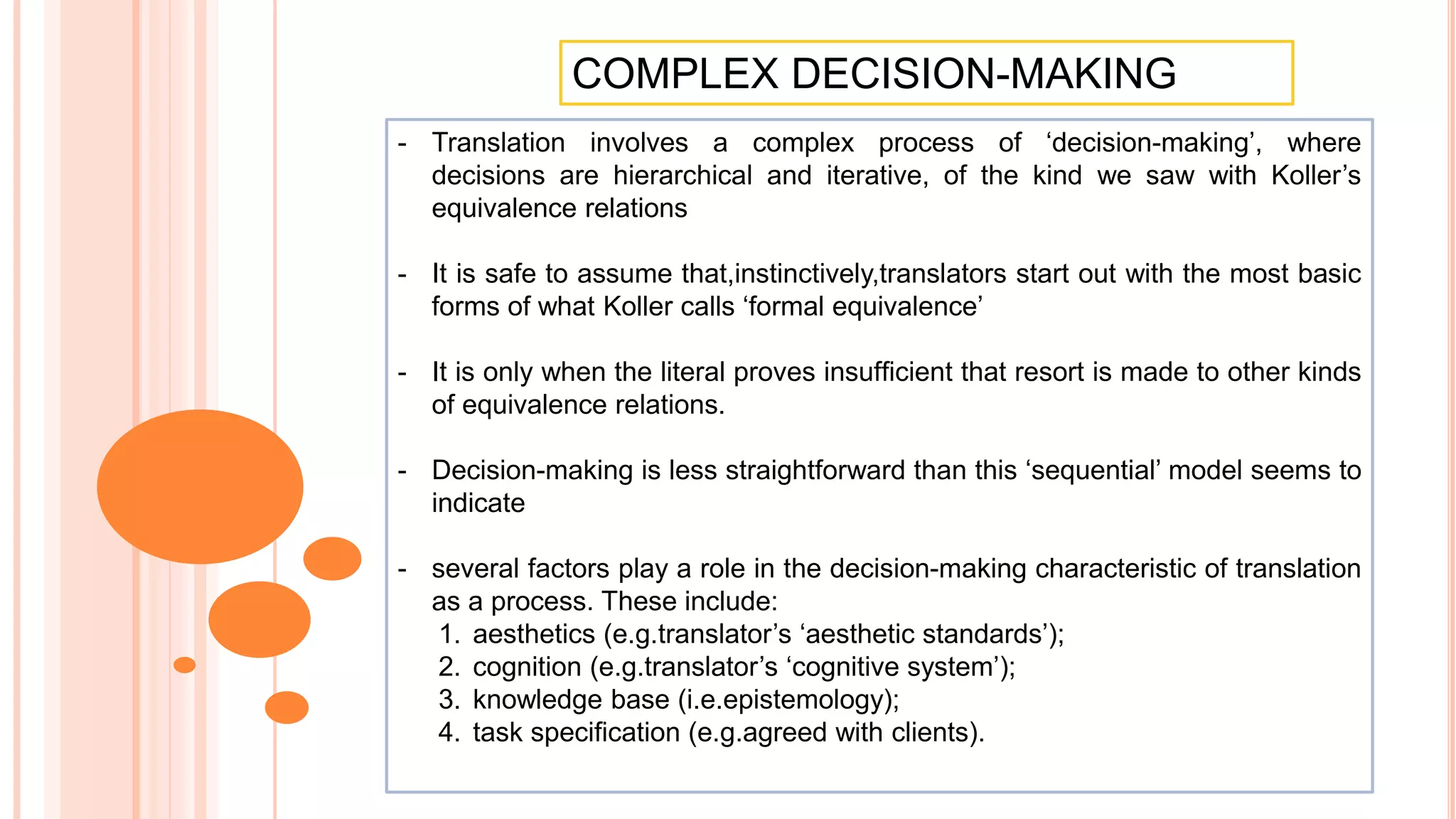
COMPLEX DECISION-MAKING
- Translation involves a complex process of ‘decision-making’, where
decisions are hierarchical and iterative, of the kind we saw with Koller’s
equivalence relations
- It is safe to assume that,instinctively,translators start out with the most basic
forms of what Koller calls ‘formal equivalence’
- It is only when the literal proves insufficient that resort is made to other kinds
of equivalence relations.
- Decision-making is less straightforward than this ‘sequential’ model seems to
indicate
- several factors play a role in the decision-making characteristic of translation
as a process. These include:
1. aesthetics (e.g.translator’s ‘aesthetic standards’);
2. cognition (e.g.translator’s ‘cognitive system’);
3. knowledge base (i.e.epistemology);
4. task specification (e.g.agreed with clients).
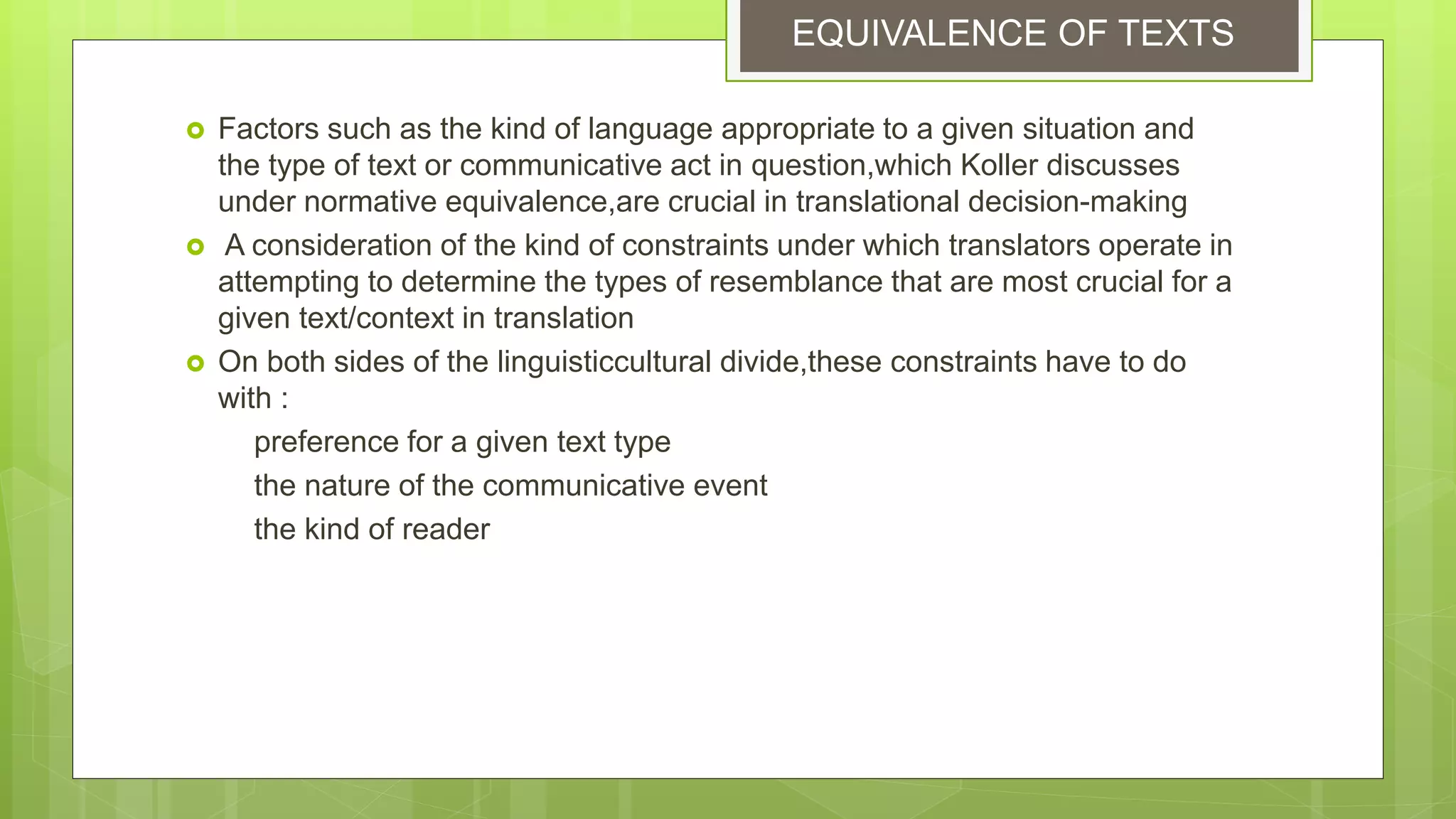
 Factors such as the kind of language appropriate to a given situation and
the type of text or communicative act in question,which Koller discusses
under normative equivalence,are crucial in translational decision-making
 A consideration of the kind of constraints under which translators operate in
attempting to determine the types of resemblance that are most crucial for a
given text/context in translation
 On both sides of the linguisticcultural divide,these constraints have to do
with :
preference for a given text type
the nature of the communicative event
the kind of reader
EQUIVALENCE OF TEXTS
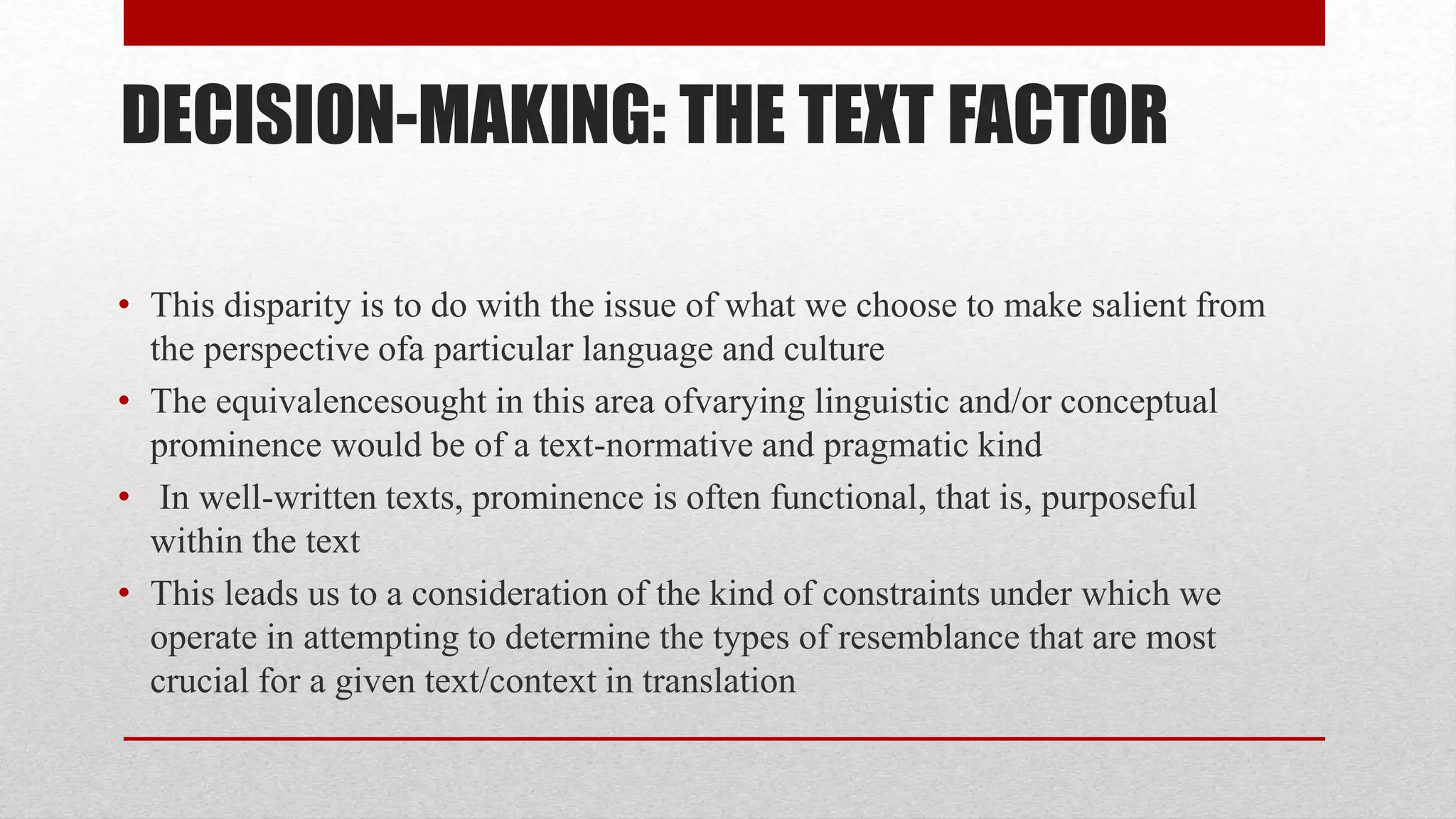
DECISION-MAKING: THE TEXT FACTOR
• This disparity is to do with the issue of what we choose to make salient from
the perspective ofa particular language and culture
• The equivalencesought in this area ofvarying linguistic and/or conceptual
prominence would be of a text-normative and pragmatic kind
• In well-written texts, prominence is often functional, that is, purposeful
within the text
• This leads us to a consideration of the kind of constraints under which we
operate in attempting to determine the types of resemblance that are most
crucial for a given text/context in translation
THANK YOU

PPT translation fixed.ppt

  • 1.
  • 2.
    Our Team Ejontomi Afrizon Puspita Yudaningrum SeptiMarlini A2B019028 A2B019022. . Our Team A2B019007.
  • 3.
    Main Topics The Analysisof Meaning 01 02 03 Dynamic Equivalence and The Receptor of The Message Textual pragmatics and equivalence
  • 4.
  • 5.
    semantic structure analysis . including contrastiveterms and componential analysis, that can be used to analyze meaning.
  • 6.
    T h es t r u c t u r a l o r c o n n o t a t i v e a n a l y s i s . useful in cases where the exact sense of the ST is in doubt or in lexicographical or terminological work where a precise definition or division of meaning is essential prior to a mapping on to TL terms. often there are fuzzy boundaries between members of groups which cloud the issue. (Labov, 1973) Ex: term cup, which glass, which mug, which bowl.
  • 7.
    Tendency for translation Focuson the core meanings, to resort more frequently to generic nouns such as the fact, issue,matter, etc, or to use explicitation A foreign word is borrowed into the TL where no such item or concept existed For instance, tsunami or sushi which have been imported from Japanese,
  • 8.
    David McDuff (Dostoyevsky1991:339). the new translation : geographical, political or genre considerations may determine the translation.
  • 9.
    KINSHIP TERMS Cultural Knowledgeis essential order to draw up the list of relationships . lineal (e.g. mother), colineal (e.g. aunt) and ablineal (e.g. cousin) common problem, Require disambiguation. In Yoruba, the major language of South-West Nigeria, has two words for the relationship of brother, namely egbon (elder brother) and aburo (younger brother).
  • 10.
    Collocation Larson (1984/1998:155–67) Translation requiresthe strength of collocation to be identified in the ST and conveyed satisfactorily in the TT.. . In English, to borrow the well-known example from Leech (1981:17), pretty woman is a typical (or strong) collocation, and so is handsome man. This does not mean that handsome woman or pretty man is impossible, just that they are very unusual or marked. Refers to the way that words are typically used together. Collocation grown in importance with the growth of corpus linguistics, the computer- assisted study of electronic databases (corpora) of naturally occurring texts A concordance displays examples of the search term in the centre with a certain amount of context either side ordered alphabetically according to the first word right or left of the search term. Larson considers collocation primarily as a formal, structural device, looking at fixed combinations (bread and butter, black and white), including idioms, and the ‘restrictions’ on the collocational range of a word which ‘only a native speaker of the language can judge’ (1984/1998:160).
  • 11.
    semantic prosody ( Lo u w 1 9 9 3 ) . the positive or negative connotative meaning which is transferred to the focus word by the semantic fields of its common collocates.
  • 12.
    Conclusion: This unit hasexamined various attempts, adapted from English semantics, to examine meaning scientifically. The underlying assumption was that meaning is observable and measurable, and transferable in translation. The aim of these attempts was to assist the decision-making of the translator. However, there are many other factors that affect meaning and determine the choice of translation. These include the linguistic co-text and the context in which the TT is to function.
  • 13.
  • 14.
    Anything which canbe said in one language can be said in another language, unless the form is an essential element of the message, (Nida & Taber, 1969) Literal translation Formal equivalence Dynamic equivalence
  • 15.
    Literal Translation Literal translationtends to preserve formal features almost by default (i.e. with little or no regard for the context, meaning or what is implied by a given utterance), a ‘formal’ translation is almost always contextually motivated: formal features are preserved only if they carry contextual values that become part of the overall text meaning. Attention on the message itself in both form and content To bring the target reader nearer to the linguistic or cultural preferences of the ST
  • 16.
    Formal Equivalence The pureformal replacement of one word or phrase in the SL by another in the TL
  • 17.
    Dynamic Equivalence Dynamic formof equivalence – they can express a rich variety of contextual values and effects which literal translation would simply compromise. We opt for varying degrees of dynamic equivalence when form is not significantly involved in conveying a particular meaning and when a formal rendering is therefore unnecessary.
  • 18.
    Dynamic and formalequivalence are points on cline. The two methods are not absolute technique but rather general orientations. Experienced translators resort to a formal rendering of the ST most of the time, then they reconsider their decisions and make their definitive choice.
  • 19.
    Eugene A. Nida,Toward a Science of Translating, 1964 Messages differ primarily in the degree to which content or form is the dominant consideration. Of course, the content of the message can never be completely abstracted from the form and form is nothing apart from content: but in some messages the content is of primary consideration, and in others the form must be given a higher priority.
  • 20.
    A translator’s purposemay involve much more than information. He/she may, for example, want to suggest a particular type of behavior by means of a translation. Under such circumstance he is likely to aim at full intelligibility and to make certain minor adjustments in detail so that the reader may understand the full implications of the message for his own circumstance. In such situation a translator is not content to have receptors say: ‘This is intelligible to us’. Rather, he is looking for some such response as, ‘ This is meaningful for us’.
  • 21.
    Two basic orientationsin translating Formal Equivalence Dynamic Equivalence
  • 22.
    Formal equivalence It focuses allattention on the message itself, in both form and content The message in the receptor language should match as closely as possible the different element in the source language Gloss translation (footnotes) A gloss translation of this type is designed to permit the reader to identify himself as fully as possible with a person in the source- language context, and to understand as much as he can of the customs, manner of thought and means of expression. E.g. Holy kiss (Romans 16: 16)
  • 23.
    Dynamic equivalence It based uponthe equivalent effect The relationship between receptor and message should be substantially the same as that which existed between the original receptors and the message. A translation of dynamic equivalence aims at the complete naturalness of expression, and tries to relate the receptor to modes of behavior relevant within the context of his own cultural patterns of the source-language context in order to comprehend the message. J.B Phillips ‘Greet one another with a holy kiss’ ‘ Give one another a hearty handshake all around’
  • 24.
    The Translation Process The translator Analysesthe SL message into its simplest and structurally clearest forms (kernels) Transfer the message at this kernel level Restructures the message in the TL to the level which is most appropriate for the audience addressed Languages agrees far more on the level of the kernels than on the level of the more elaborate structures Kernels (semantic categories): • Object words • Event words • Abstracts • Relational
  • 25.
    Transfer The analyzed materialis transferred in the mind of the translator from language A to language B. Reconfiguration in the TL of sets of SL semantic and structural component. Restructures Procedures Stylistic from appropriate to the receptor language and to the intended receptors’ Adjustments - Redundancy - Gist
  • 26.
  • 27.
    Translating Reproducing in thereceptor language the closest natural equivalent of the message of the source language, first in terms of meaning and the second in terms of style
  • 28.
  • 29.
    Some of thecontexts appropriate for formal equivalence through which the translator seeks to reflect in a motivated manner the linguistic or rhetorical prominence of an ST element EQUIVALENCE OF TEXTS COMPLEX DECISION- MAKING DECISION- MAKING: THE TEXT FACTOR
  • 30.
    COMPLEX DECISION-MAKING - Translationinvolves a complex process of ‘decision-making’, where decisions are hierarchical and iterative, of the kind we saw with Koller’s equivalence relations - It is safe to assume that,instinctively,translators start out with the most basic forms of what Koller calls ‘formal equivalence’ - It is only when the literal proves insufficient that resort is made to other kinds of equivalence relations. - Decision-making is less straightforward than this ‘sequential’ model seems to indicate - several factors play a role in the decision-making characteristic of translation as a process. These include: 1. aesthetics (e.g.translator’s ‘aesthetic standards’); 2. cognition (e.g.translator’s ‘cognitive system’); 3. knowledge base (i.e.epistemology); 4. task specification (e.g.agreed with clients).
  • 31.
     Factors suchas the kind of language appropriate to a given situation and the type of text or communicative act in question,which Koller discusses under normative equivalence,are crucial in translational decision-making  A consideration of the kind of constraints under which translators operate in attempting to determine the types of resemblance that are most crucial for a given text/context in translation  On both sides of the linguisticcultural divide,these constraints have to do with : preference for a given text type the nature of the communicative event the kind of reader EQUIVALENCE OF TEXTS
  • 32.
    DECISION-MAKING: THE TEXTFACTOR • This disparity is to do with the issue of what we choose to make salient from the perspective ofa particular language and culture • The equivalencesought in this area ofvarying linguistic and/or conceptual prominence would be of a text-normative and pragmatic kind • In well-written texts, prominence is often functional, that is, purposeful within the text • This leads us to a consideration of the kind of constraints under which we operate in attempting to determine the types of resemblance that are most crucial for a given text/context in translation
  • 33.