Pragmatics
Presented by: Bijar Zubeir
University of Duhok
Faculty of Humanities
Dept. of English
4th Year Group C
November 5, 2015
THIS DOCUMENT CONTAINS VISUAL EFFECTS,FOR BEST RESOLUTION USE IT ON PC IN FULL SCREEN MODE NOT ON PHONE PLEASE!
• The study of what speakers mean.
• The study of “invisible” meaning, or how we recognize
what is meant even when it isn’t actually said or
written.
• Communication clearly depends on not only
recognizing the meaning of words in an utterance, but
recognizing what speakers mean by their utterances.
• Shows how more is always being communicated than
is said.
• Descriptive.
What is
pragmatics
?
Context
Deixis
Inference
Reference
Anaphora
What is
pragmatics
?
Context
Deixis
Inference
Reference
Anaphora
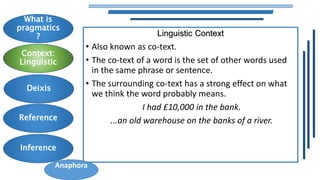
Linguistic Context
• Also known as co-text.
• The co-text of a word is the set of other words used
in the same phrase or sentence.
• The surrounding co-text has a strong effect on what
we think the word probably means.
I had £10,000 in the bank.
...an old warehouse on the banks of a river.
What is
pragmatics
?
Context:
Linguistic
Deixis
Inference
Reference
Anaphora
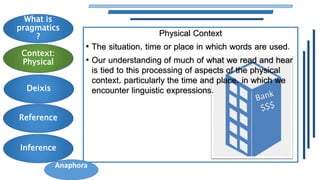
Physical Context
• The situation, time or place in which words are used.
• Our understanding of much of what we read and hear
is tied to this processing of aspects of the physical
context, particularly the time and place, in which we
encounter linguistic expressions.
What is
pragmatics
?
Context:
Physical
Deixis
Inference
Reference
Anaphora
You’ll have to bring it back tomorrow
because she isn’t here today.
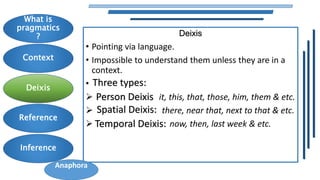
Deixis
• Pointing via language.
• Impossible to understand them unless they are in a
context.
• We use them to point to:
 Things& people: it, this, that, those, him, them & etc.
Places: here, there, near that, next to that & etc.
Time: now, then, last week & etc.
What is
pragmatics
?
Context
Deixis
Inference
Reference
Person Deixis
Spatial Deixis:
Temporal Deixis:
Three types:
Anaphora
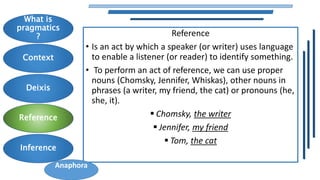
Reference
• Is an act by which a speaker (or writer) uses language
to enable a listener (or reader) to identify something.
• To perform an act of reference, we can use proper
nouns (Chomsky, Jennifer, Whiskas), other nouns in
phrases (a writer, my friend, the cat) or pronouns (he,
she, it).
 Chomsky, the writer
 Jennifer, my friend
 Tom, the cat
What is
pragmatics
?
Context
Deixis
Inference
Reference
Anaphora
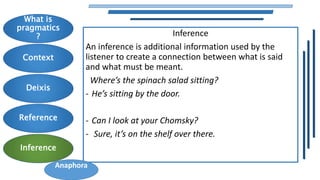
Inference
An inference is additional information used by the
listener to create a connection between what is said
and what must be meant.
Where’s the spinach salad sitting?
- He’s sitting by the door.
- Can I look at your Chomsky?
- Sure, it’s on the shelf over there.
What is
pragmatics
?
Context
Deixis
Inference
Reference
Anaphora
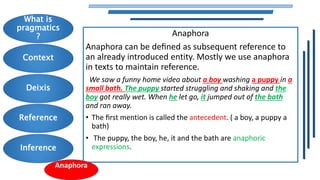
Anaphora
Anaphora can be defined as subsequent reference to
an already introduced entity. Mostly we use anaphora
in texts to maintain reference.
We saw a funny home video about a boy washing a puppy in a
small bath. The puppy started struggling and shaking and the
boy got really wet. When he let go, it jumped out of the bath
and ran away.
• The first mention is called the antecedent. ( a boy, a puppy a
bath)
• The puppy, the boy, he, it and the bath are anaphoric
expressions.
What is
pragmatics
?
Context
Deixis
Inference
Reference
Anaphora
Anaphora
• The connection between antecedents and anaphoric
expressions is often based on inference, as in these
examples.
We found a house to rent, but the kitchen was very
small.
I caught a bus and asked the driver if it went near the
downtown area.
What is
pragmatics
?
Context
Deixis
Inference
Reference
Anaphora
Pragmatics

Pragmatics

  • 1.
    Pragmatics Presented by: BijarZubeir University of Duhok Faculty of Humanities Dept. of English 4th Year Group C November 5, 2015 THIS DOCUMENT CONTAINS VISUAL EFFECTS,FOR BEST RESOLUTION USE IT ON PC IN FULL SCREEN MODE NOT ON PHONE PLEASE!
  • 2.
    • The studyof what speakers mean. • The study of “invisible” meaning, or how we recognize what is meant even when it isn’t actually said or written. • Communication clearly depends on not only recognizing the meaning of words in an utterance, but recognizing what speakers mean by their utterances. • Shows how more is always being communicated than is said. • Descriptive. What is pragmatics ? Context Deixis Inference Reference Anaphora
  • 3.
  • 4.
    Linguistic Context • Alsoknown as co-text. • The co-text of a word is the set of other words used in the same phrase or sentence. • The surrounding co-text has a strong effect on what we think the word probably means. I had £10,000 in the bank. ...an old warehouse on the banks of a river. What is pragmatics ? Context: Linguistic Deixis Inference Reference Anaphora
  • 5.
    Physical Context • Thesituation, time or place in which words are used. • Our understanding of much of what we read and hear is tied to this processing of aspects of the physical context, particularly the time and place, in which we encounter linguistic expressions. What is pragmatics ? Context: Physical Deixis Inference Reference Anaphora
  • 6.
    You’ll have tobring it back tomorrow because she isn’t here today.
  • 7.
    Deixis • Pointing vialanguage. • Impossible to understand them unless they are in a context. • We use them to point to:  Things& people: it, this, that, those, him, them & etc. Places: here, there, near that, next to that & etc. Time: now, then, last week & etc. What is pragmatics ? Context Deixis Inference Reference Person Deixis Spatial Deixis: Temporal Deixis: Three types: Anaphora
  • 9.
    Reference • Is anact by which a speaker (or writer) uses language to enable a listener (or reader) to identify something. • To perform an act of reference, we can use proper nouns (Chomsky, Jennifer, Whiskas), other nouns in phrases (a writer, my friend, the cat) or pronouns (he, she, it).  Chomsky, the writer  Jennifer, my friend  Tom, the cat What is pragmatics ? Context Deixis Inference Reference Anaphora
  • 10.
    Inference An inference isadditional information used by the listener to create a connection between what is said and what must be meant. Where’s the spinach salad sitting? - He’s sitting by the door. - Can I look at your Chomsky? - Sure, it’s on the shelf over there. What is pragmatics ? Context Deixis Inference Reference Anaphora
  • 11.
    Anaphora Anaphora can bedefined as subsequent reference to an already introduced entity. Mostly we use anaphora in texts to maintain reference. We saw a funny home video about a boy washing a puppy in a small bath. The puppy started struggling and shaking and the boy got really wet. When he let go, it jumped out of the bath and ran away. • The first mention is called the antecedent. ( a boy, a puppy a bath) • The puppy, the boy, he, it and the bath are anaphoric expressions. What is pragmatics ? Context Deixis Inference Reference Anaphora
  • 12.
    Anaphora • The connectionbetween antecedents and anaphoric expressions is often based on inference, as in these examples. We found a house to rent, but the kitchen was very small. I caught a bus and asked the driver if it went near the downtown area. What is pragmatics ? Context Deixis Inference Reference Anaphora

Editor's Notes

  • #7 Out of context, this sentence is really vague. It contains a large number of expressions (you, it, tomorrow, she, here, today) that rely on knowledge of the immediate physical context for their interpretation
  • #8 There are some very common words in our language that can’t be interpreted at all if we don’t know the context, especially the physical context of the speaker. These are words such as here and there, this or that, now and then, yesterday, today or tomorrow, as well as pronouns such as you, me, she, him, it, them. Some sentences of English are virtually impossible to understand if we don’t know who is speaking, about whom, where and when. For example: You’ll have to bring it back tomorrow because she isn’t here today.
  • #11 Picasso is in the museum or We saw Shakespeare in London or Jennifer is wearing Calvin Klein.