SOLID OXIDE FUEL CELL
TECHNOLOGY
ARRABIRI PAVAN REDDY
aryabiarypavan48@gmail.com
CELL NO: 8374559028
Contents
 Solid Oxide Fuel cell
 Characteristics and performance
 Features and History
 Design and operation
 Components requirement
 Components materials and cost
 Configuration
 System and Losses
 Applications
 Future challenges and Obstacles
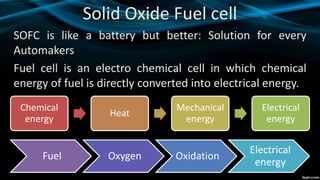
Solid Oxide Fuel cell
SOFC is like a battery but better: Solution for every
Automakers
Fuel cell is an electro chemical cell in which chemical
energy of fuel is directly converted into electrical energy.
Chemical
energy
Heat
Mechanical
energy
Electrical
energy
Fuel Oxygen Oxidation
Electrical
energy
Characteristics and performance
1. Electrolyte: ceramic zirconium and doped perovskite
2. Operating temperature: 600-1800°C.
3. Fuels: Natural gas, methane, propane, diesel gasoline.
4. Oxidant: O2 /air Efficiency: 45-60%
5. Cost (INR): 2700/KW (Based on 0.5W/cm2)
6.Performance: ΔH=Q-W where W=NFE
(N-no of electrons, F-faraday constant 96493columbs, E-cell voltage)
 Efficiency= W/Q =EI ΔT/Q
 Anode Reaction: 2H2 + 2O2− → 2H2O + 4e−
 Cathode Reaction: O2 + 4e− → 2O2−
 Total Reaction: 2H2 + O2 → 2H2O
Features
Ultra clean, efficient, economic and environmentally
reliable energy.
 Operate at high temperature up to 1000°C.
 Have a modular solid state in construction.
 Don’t have problem with electrolyte.
 Best suited to applications in distributed electricity
generation.
 Have a potential long life up to 40000-110000Hrs
 Have extremely low emission by eliminating CO.
History
 In 1930 Emil Baur and H Preis experimented on solid oxide
electrolyte (Zirconium, Yttrium, Cerium, Tungsten oxide).
 First SOFC operation at 1000°C in 1937.
 In 1940 OK Devtyan of Russia added monazite sand to sodium
carbonate, Tungsten tri oxide.
 In 1950 research into SOFC begin to accurate at Netherland.
 In 1959 New York Discussion of fuel cell problems and solutions
and 220KW SOFC running on natural gas with efficiency of 60%
and operated 16600Hrs long run.
Design and Operation
Components requirement
 Proper stability, conductivity, Chemical compatibility.
 Avoid thermal expansion cracking during operation.
 High strength and Toughness
 Fabricability with low cost and Higher power density.
 Dense electrolyte to prevent gas mixing.
 Silent in operations and vibration free.
Components materials and cost
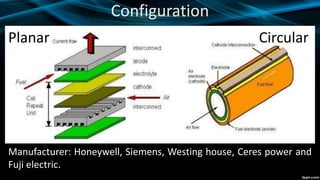
Configuration
Planar Circular
Manufacturer: Honeywell, Siemens, Westing house, Ceres power and
Fuji electric.
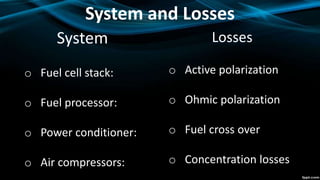
System and Losses
System
o Fuel cell stack:
o Fuel processor:
o Power conditioner:
o Air compressors:
Losses
o Active polarization
o Ohmic polarization
o Fuel cross over
o Concentration losses
Applications
• Rural areas residence commercial complex.
• Refrigeration and air-conditioning plant
• Automotive power plant.
• Manufacturing plants.
• Emergency power generation.
• Biological waste gas treatment.
• Locomotives, Aerospace and Marine.
• Large scale power plants to home scale power plant.
• Stationary power and military vehicles.
Future challenges
• Minimizing design and cost of materials. (Stainless Steel)
• Reducing the operating temperature. (Platinum)
• To develop electrolyte (Cerium Gadolinium oxide) to
decrease cell resistances and double the power out put.
• Lower the rate and size of fuel cell system.
• Making simple cost effective power plant.
• High efficient pollution free power generation.
• Developing Novel stacking geometry.
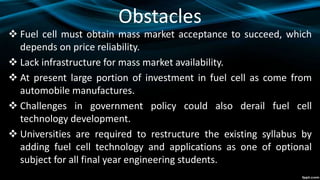
Obstacles
 Fuel cell must obtain mass market acceptance to succeed, which
depends on price reliability.
 Lack infrastructure for mass market availability.
 At present large portion of investment in fuel cell as come from
automobile manufactures.
 Challenges in government policy could also derail fuel cell
technology development.
 Universities are required to restructure the existing syllabus by
adding fuel cell technology and applications as one of optional
subject for all final year engineering students.
THANK YOU

Solid oxide fuel cell technology

  • 1.
    SOLID OXIDE FUELCELL TECHNOLOGY ARRABIRI PAVAN REDDY aryabiarypavan48@gmail.com CELL NO: 8374559028
  • 2.
    Contents  Solid OxideFuel cell  Characteristics and performance  Features and History  Design and operation  Components requirement  Components materials and cost  Configuration  System and Losses  Applications  Future challenges and Obstacles
  • 3.
    Solid Oxide Fuelcell SOFC is like a battery but better: Solution for every Automakers Fuel cell is an electro chemical cell in which chemical energy of fuel is directly converted into electrical energy. Chemical energy Heat Mechanical energy Electrical energy Fuel Oxygen Oxidation Electrical energy
  • 4.
    Characteristics and performance 1.Electrolyte: ceramic zirconium and doped perovskite 2. Operating temperature: 600-1800°C. 3. Fuels: Natural gas, methane, propane, diesel gasoline. 4. Oxidant: O2 /air Efficiency: 45-60% 5. Cost (INR): 2700/KW (Based on 0.5W/cm2) 6.Performance: ΔH=Q-W where W=NFE (N-no of electrons, F-faraday constant 96493columbs, E-cell voltage)  Efficiency= W/Q =EI ΔT/Q  Anode Reaction: 2H2 + 2O2− → 2H2O + 4e−  Cathode Reaction: O2 + 4e− → 2O2−  Total Reaction: 2H2 + O2 → 2H2O
  • 5.
    Features Ultra clean, efficient,economic and environmentally reliable energy.  Operate at high temperature up to 1000°C.  Have a modular solid state in construction.  Don’t have problem with electrolyte.  Best suited to applications in distributed electricity generation.  Have a potential long life up to 40000-110000Hrs  Have extremely low emission by eliminating CO.
  • 6.
    History  In 1930Emil Baur and H Preis experimented on solid oxide electrolyte (Zirconium, Yttrium, Cerium, Tungsten oxide).  First SOFC operation at 1000°C in 1937.  In 1940 OK Devtyan of Russia added monazite sand to sodium carbonate, Tungsten tri oxide.  In 1950 research into SOFC begin to accurate at Netherland.  In 1959 New York Discussion of fuel cell problems and solutions and 220KW SOFC running on natural gas with efficiency of 60% and operated 16600Hrs long run.
  • 7.
  • 8.
    Components requirement  Properstability, conductivity, Chemical compatibility.  Avoid thermal expansion cracking during operation.  High strength and Toughness  Fabricability with low cost and Higher power density.  Dense electrolyte to prevent gas mixing.  Silent in operations and vibration free.
  • 9.
  • 10.
    Configuration Planar Circular Manufacturer: Honeywell,Siemens, Westing house, Ceres power and Fuji electric.
  • 11.
    System and Losses System oFuel cell stack: o Fuel processor: o Power conditioner: o Air compressors: Losses o Active polarization o Ohmic polarization o Fuel cross over o Concentration losses
  • 12.
    Applications • Rural areasresidence commercial complex. • Refrigeration and air-conditioning plant • Automotive power plant. • Manufacturing plants. • Emergency power generation. • Biological waste gas treatment. • Locomotives, Aerospace and Marine. • Large scale power plants to home scale power plant. • Stationary power and military vehicles.
  • 13.
    Future challenges • Minimizingdesign and cost of materials. (Stainless Steel) • Reducing the operating temperature. (Platinum) • To develop electrolyte (Cerium Gadolinium oxide) to decrease cell resistances and double the power out put. • Lower the rate and size of fuel cell system. • Making simple cost effective power plant. • High efficient pollution free power generation. • Developing Novel stacking geometry.
  • 14.
    Obstacles  Fuel cellmust obtain mass market acceptance to succeed, which depends on price reliability.  Lack infrastructure for mass market availability.  At present large portion of investment in fuel cell as come from automobile manufactures.  Challenges in government policy could also derail fuel cell technology development.  Universities are required to restructure the existing syllabus by adding fuel cell technology and applications as one of optional subject for all final year engineering students.
  • 15.