Hydrogen as a FuelLow Carbon:  Innovation, Opportunities and Training Presented by: Dirk Kok
AgendaAn Urgent CaseHistory of HydrogenWhat is a Fuel Cell?Different fuel cellsFuture of Fuel Cells
An Urgent Case
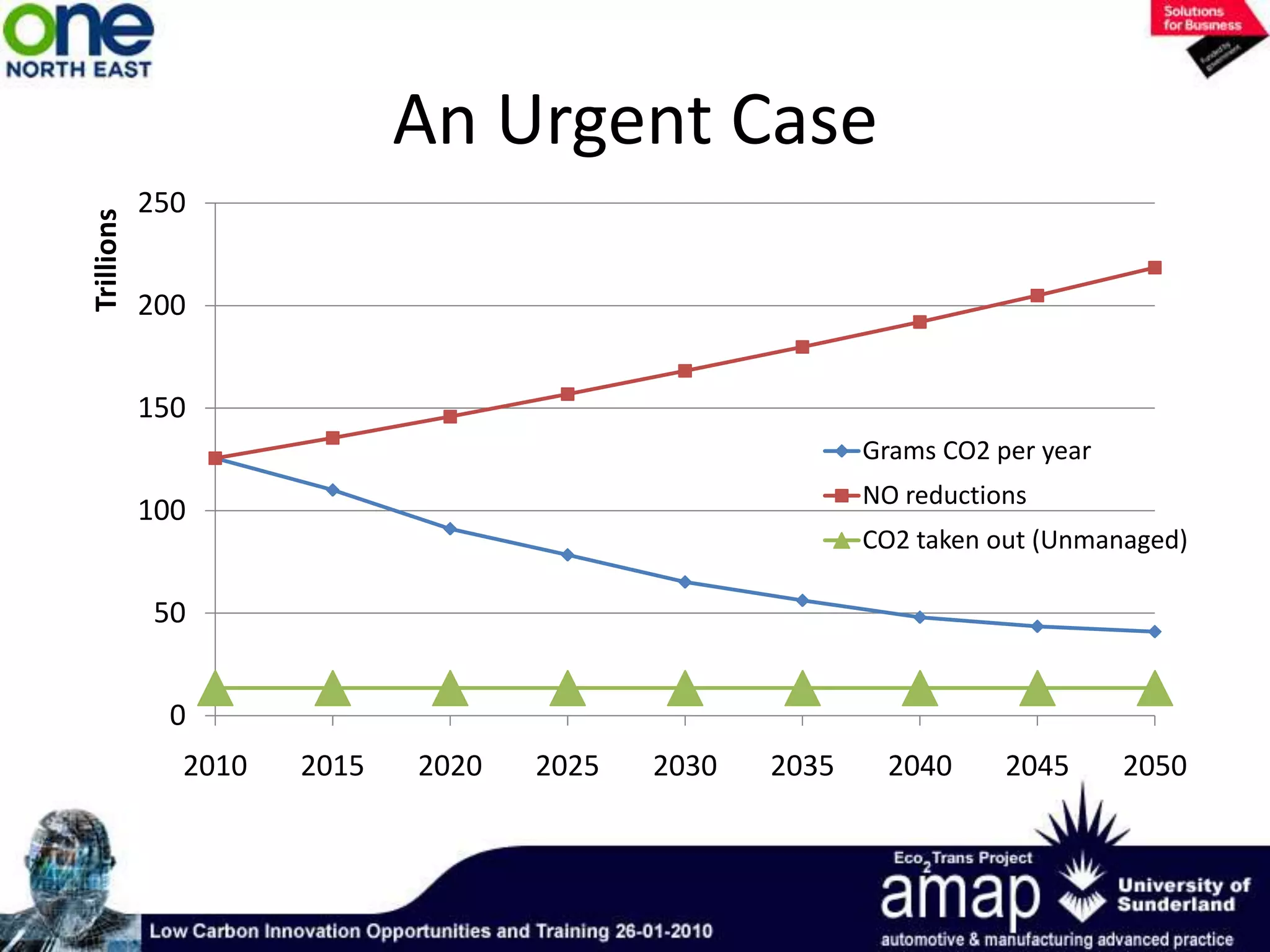
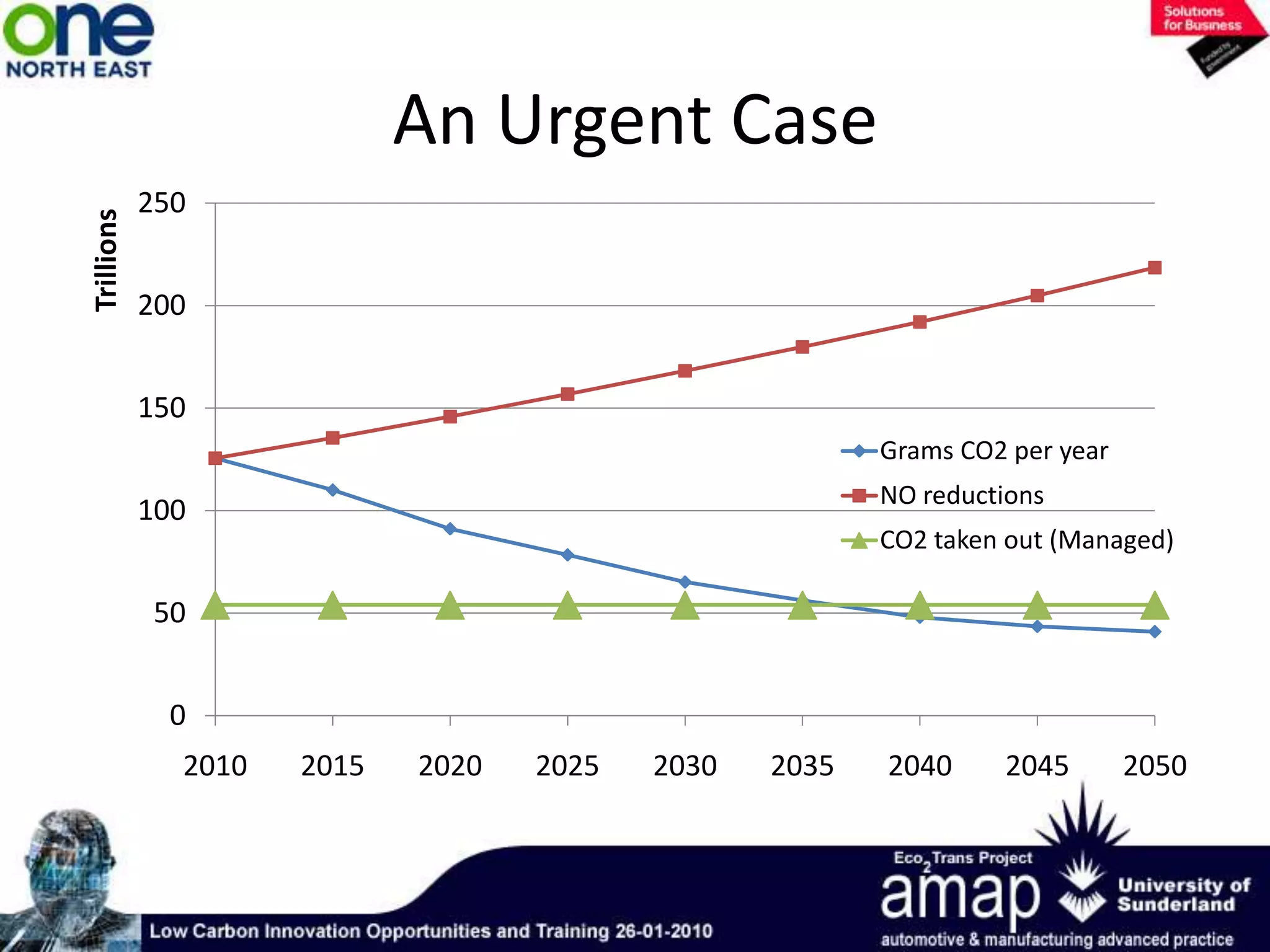
An Urgent Case
An Urgent CaseBBC Breakfast 07-012-2009The Climate Conference in Copenhagen, DenmarkHigher targets are needed
King report60% emissions reductionEvolutionary improvements guaranteed with current development80%Growth in Ultra Low Carbon Vehicles90-100% Complete change in paradigmPublic Transport most efficient in +10M
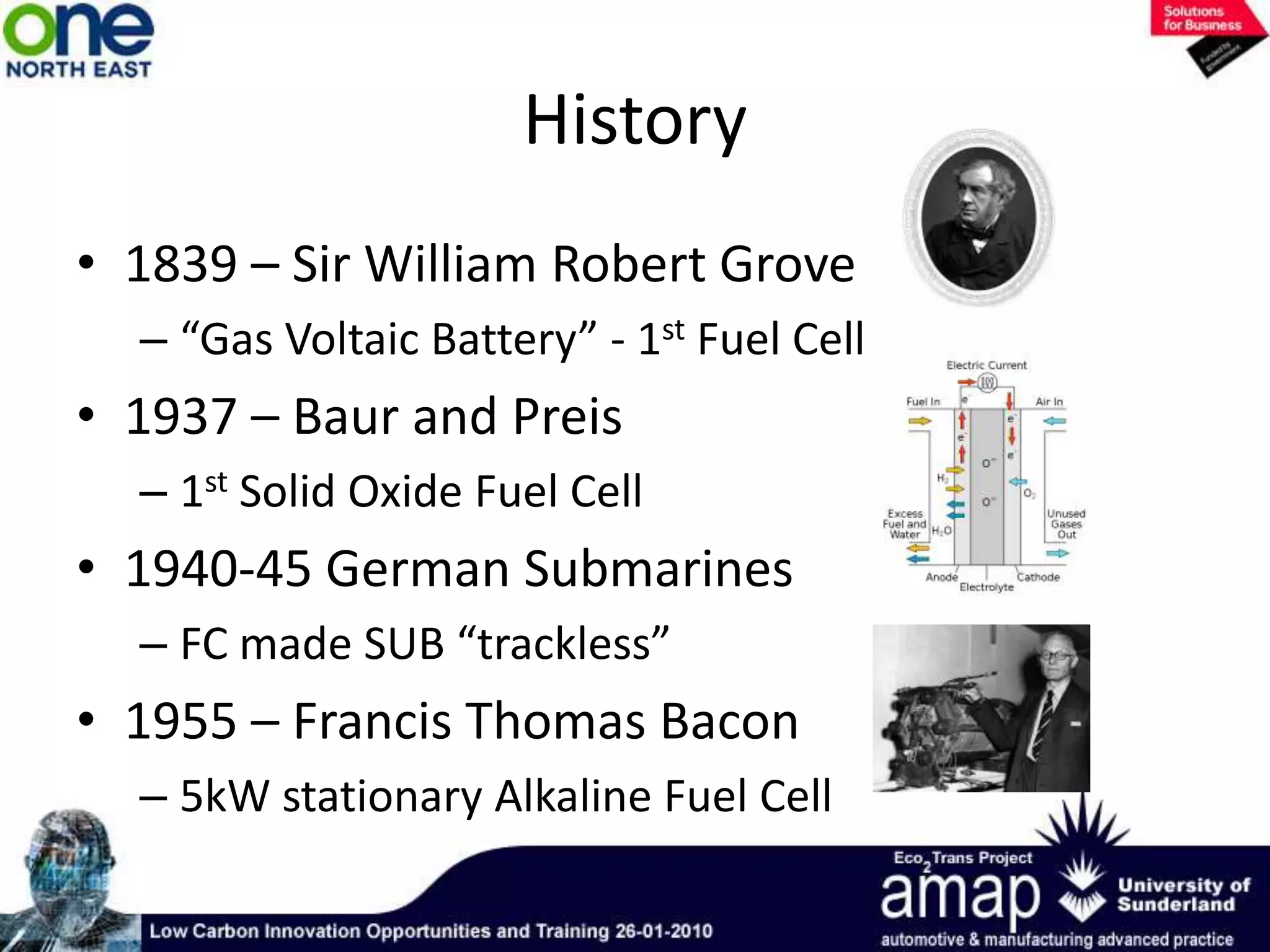
History1839 – Sir William Robert Grove“Gas Voltaic Battery” - 1st Fuel Cell  1937 – Baur and Preis1st Solid Oxide Fuel Cell1940-45 German SubmarinesFC made SUB “trackless”1955 – Francis Thomas Bacon5kW stationary Alkaline Fuel Cell
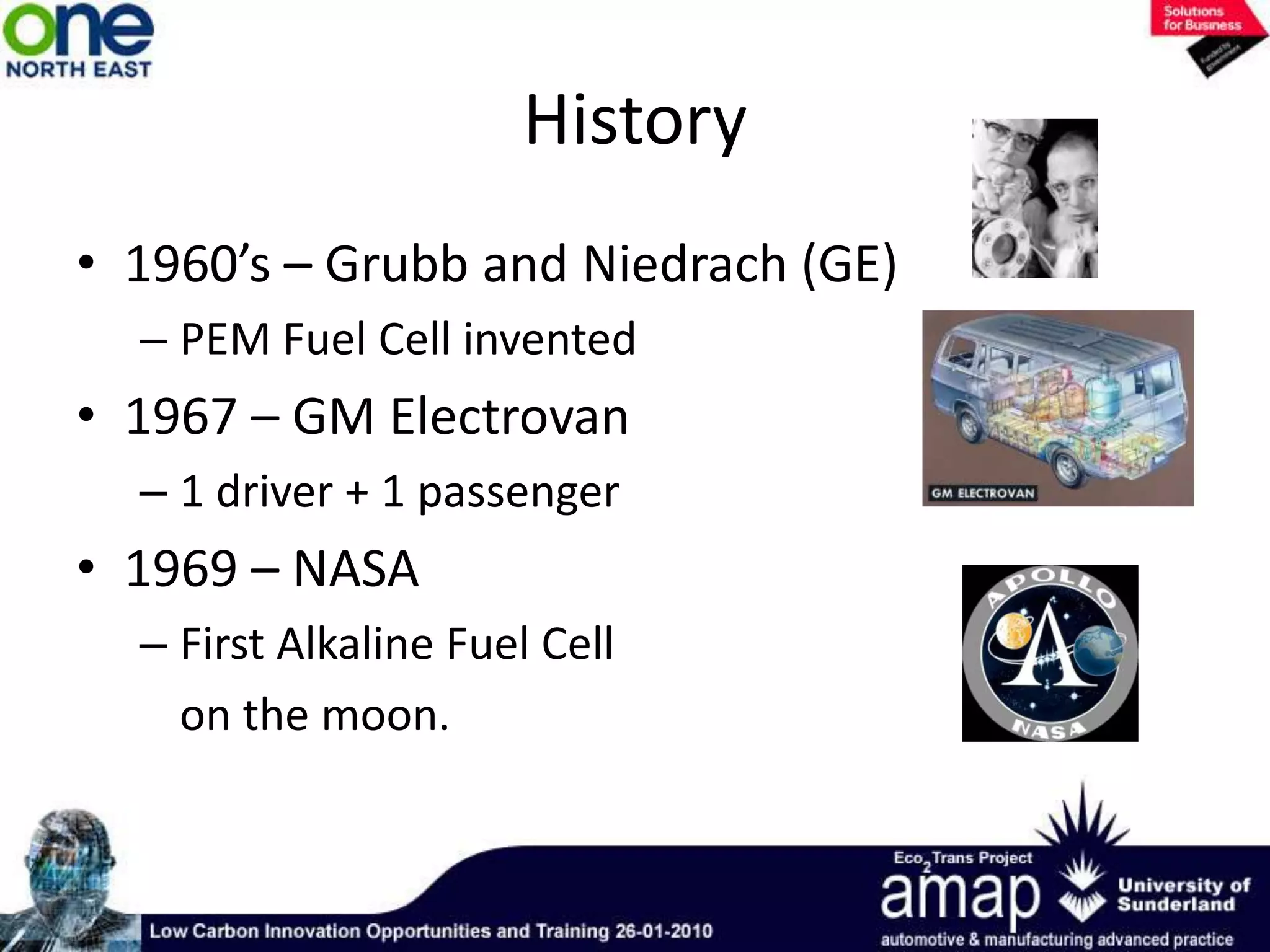
History1960’s – Grubb and Niedrach (GE)PEM Fuel Cell invented1967 – GM Electrovan1 driver + 1 passenger 1969 – NASAFirst Alkaline Fuel Cell 	on the moon.
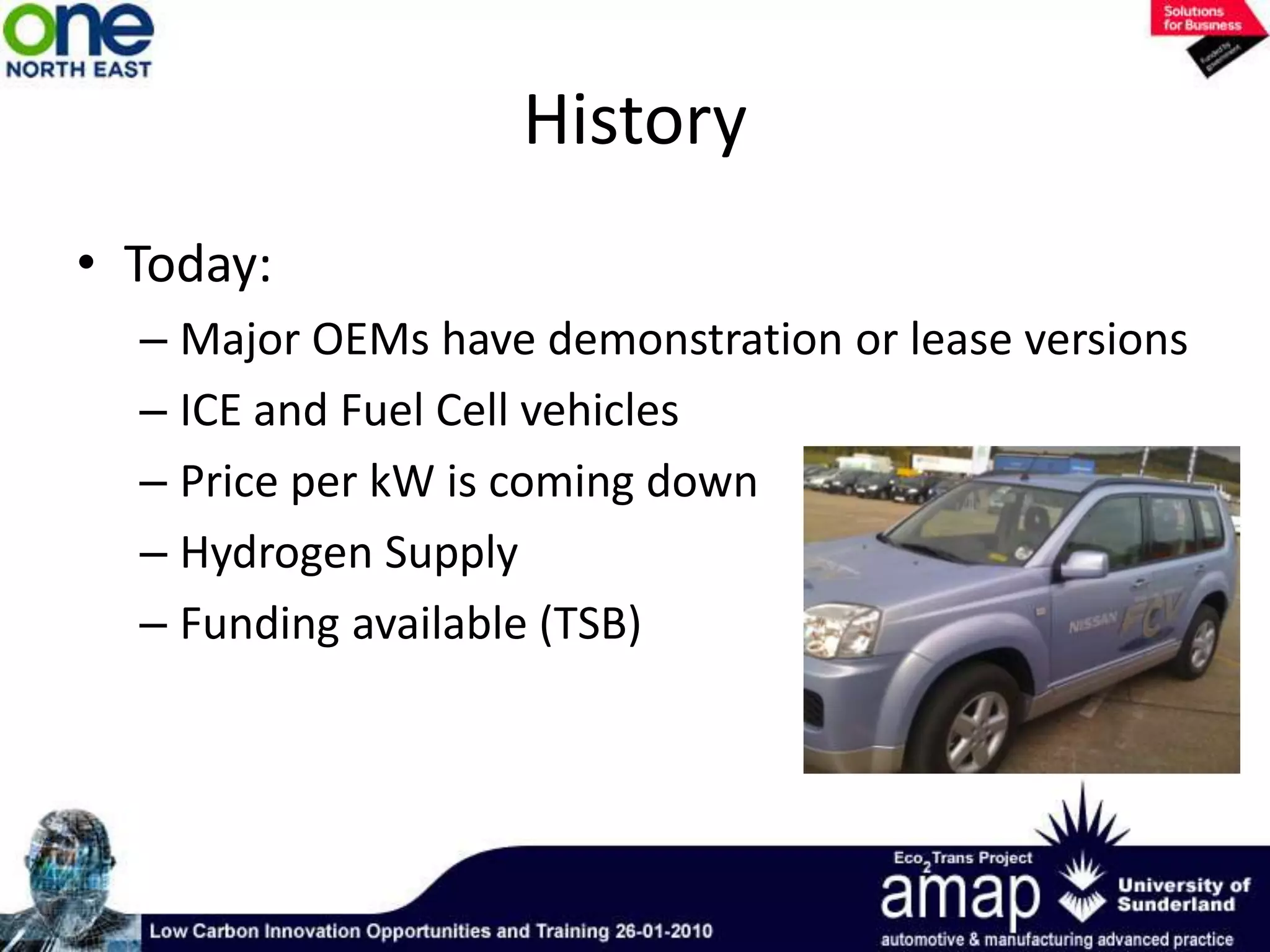
HistoryToday: Major OEMs have demonstration or lease versionsICE and Fuel Cell vehiclesPrice per kW is coming downHydrogen SupplyFunding available (TSB)
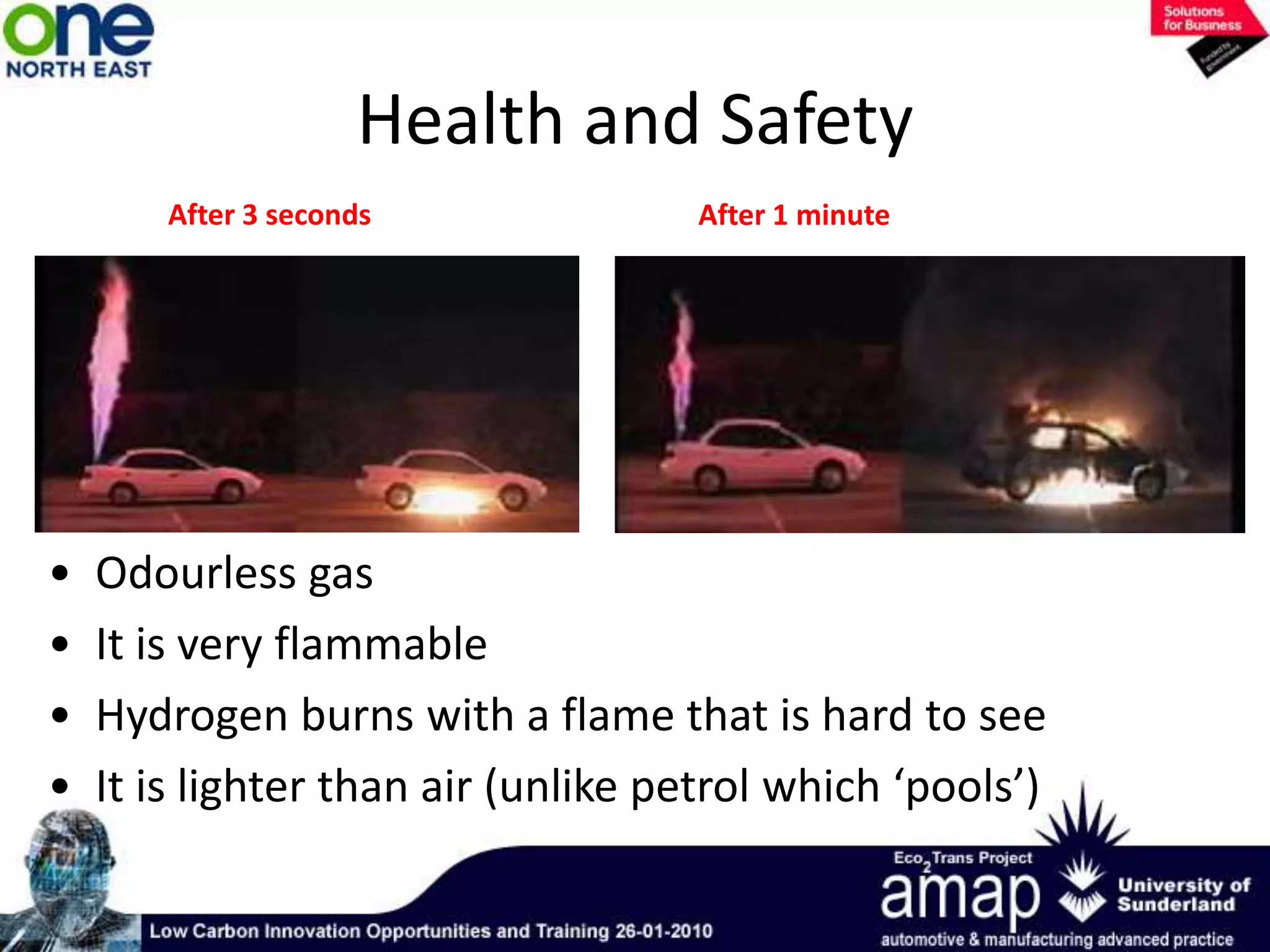
Health and SafetyAfter 1 minuteAfter 3 secondsOdourless gas
It is very flammable
Hydrogen burns with a flame that is hard to see
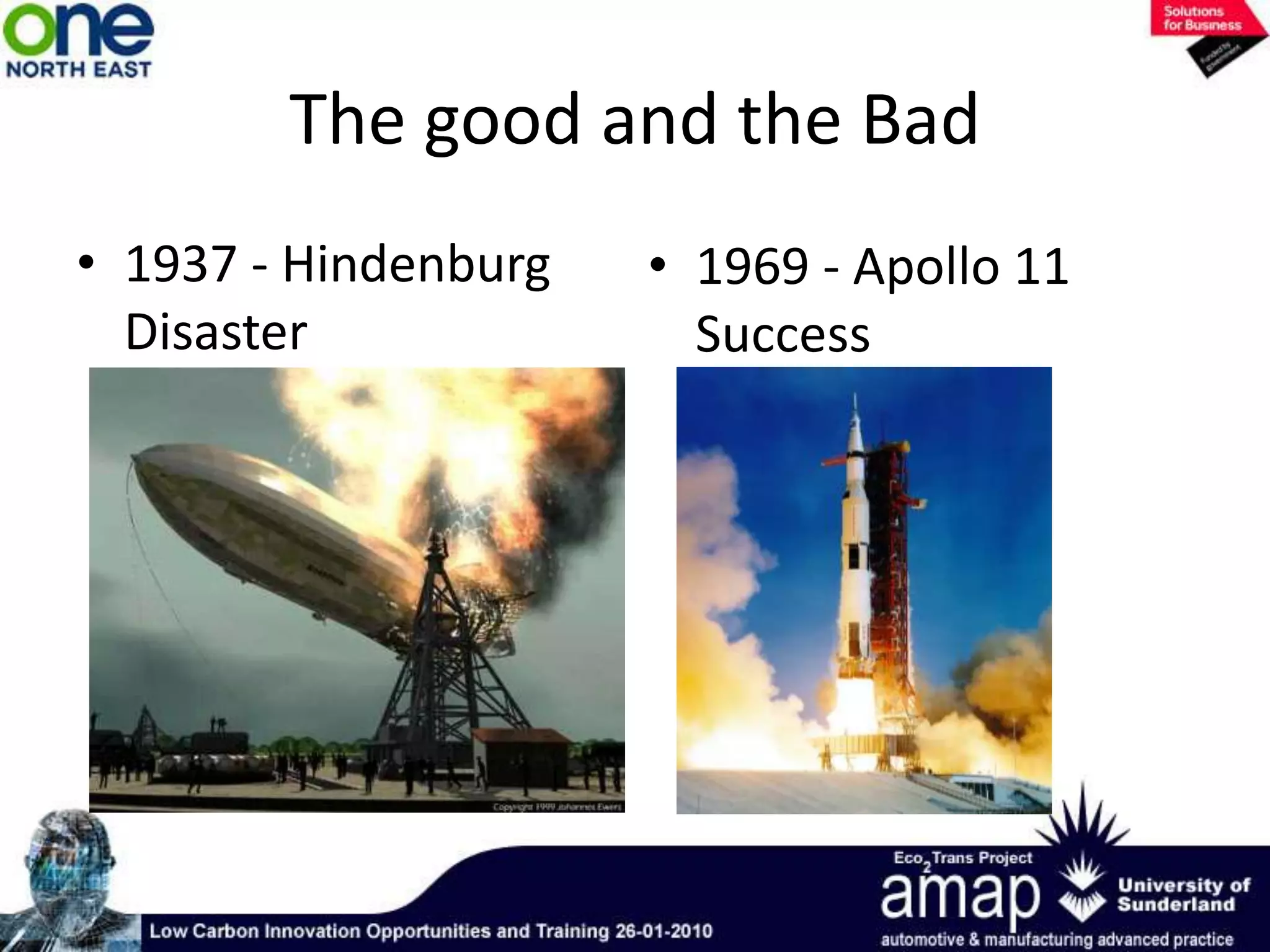
It is lighter than air (unlike petrol which ‘pools’)The good and the Bad1937 - Hindenburg Disaster1969 -Apollo 11 SuccessHydrogen Fuel AdvantagesCan be made anywhereElectricity (plug, solar, wind, etc)Can be stored without lossesBattery does not hold energy overtimeHigh Energy DensityMore efficient and cleaner
What is a Fuel CellA fuel cell is a device that converts energy from one form into anotherIt converts the ‘Chemical Energy’ in a fuel into Electrical Energy and Heat.It does this without burning the fuel. This is very different to the type of engine in a car!
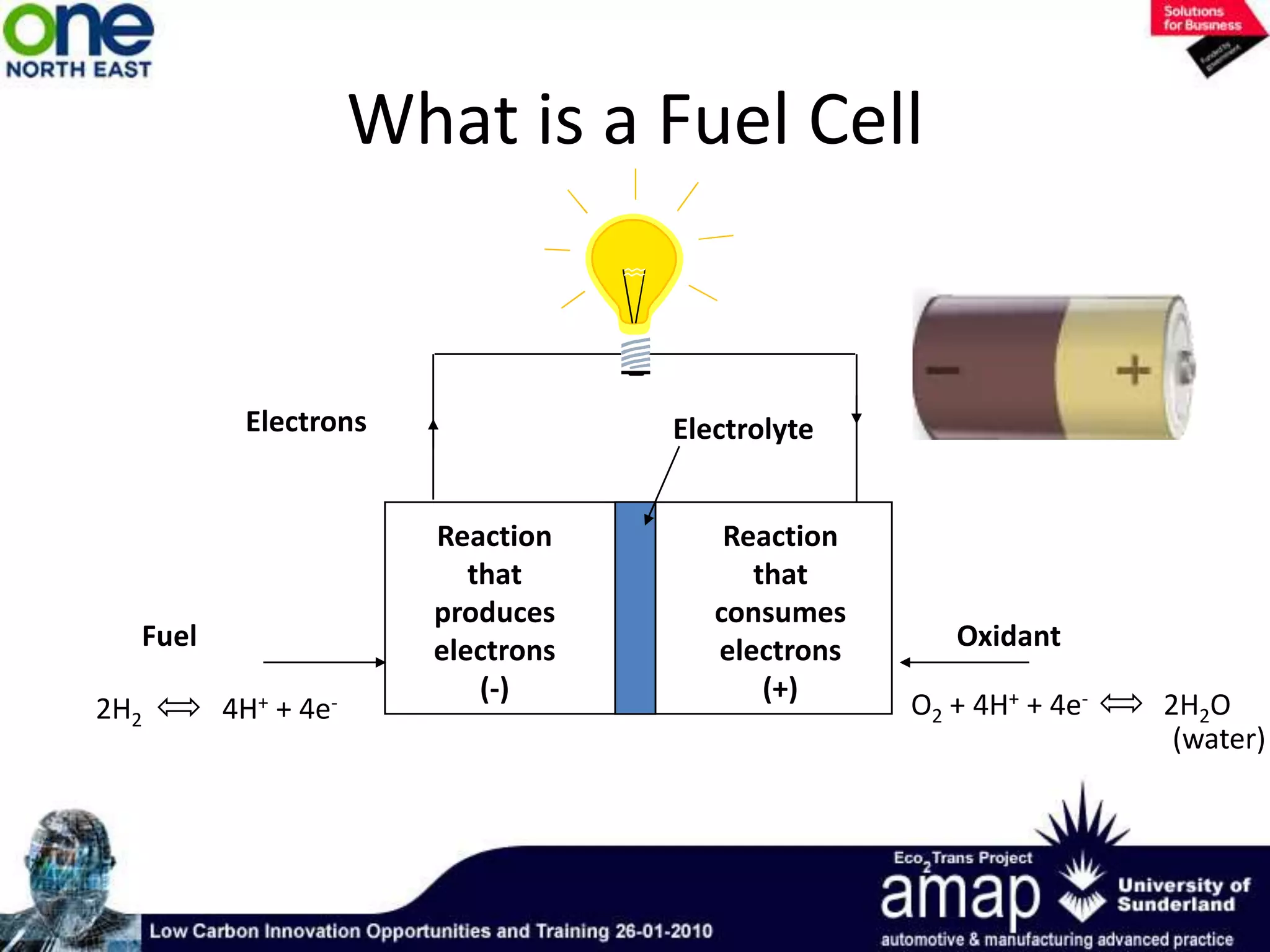
What is a Fuel Cell2H24H+ + 4e-O2+ 4H+ + 4e-           2H2OElectronsElectrolyteReactionthat produces electrons(-)Reactionthat consumes electrons(+)Fuel Oxidant(water)
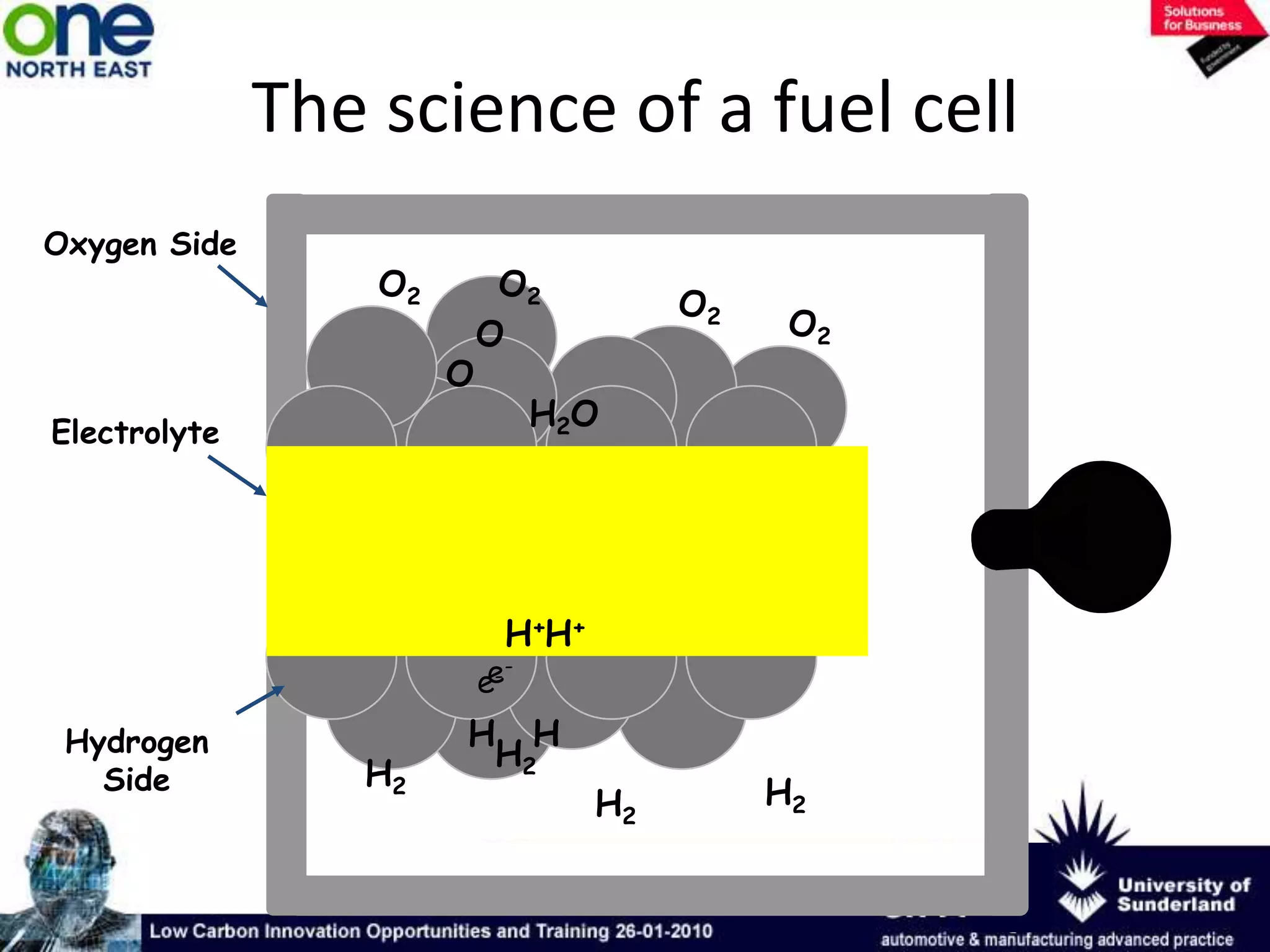
The science of a fuel cellOxygen SideO2O2O2O2OOH2OElectrolyte H+H+e-e-HHHydrogen SideH2H2H2H2
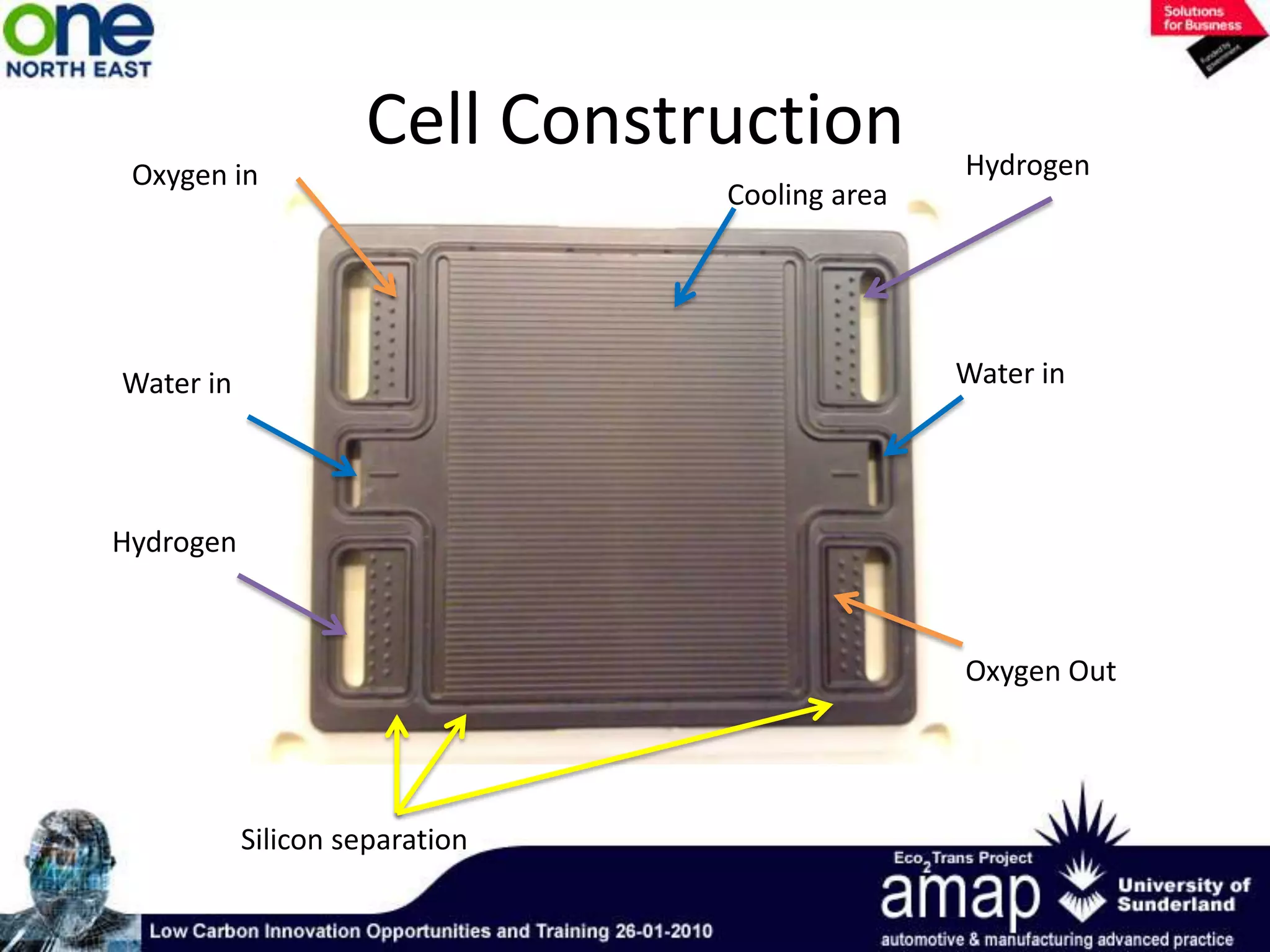
Cell ConstructionHydrogenOxygen inCooling areaWater inWater inHydrogenOxygen OutSilicon separation
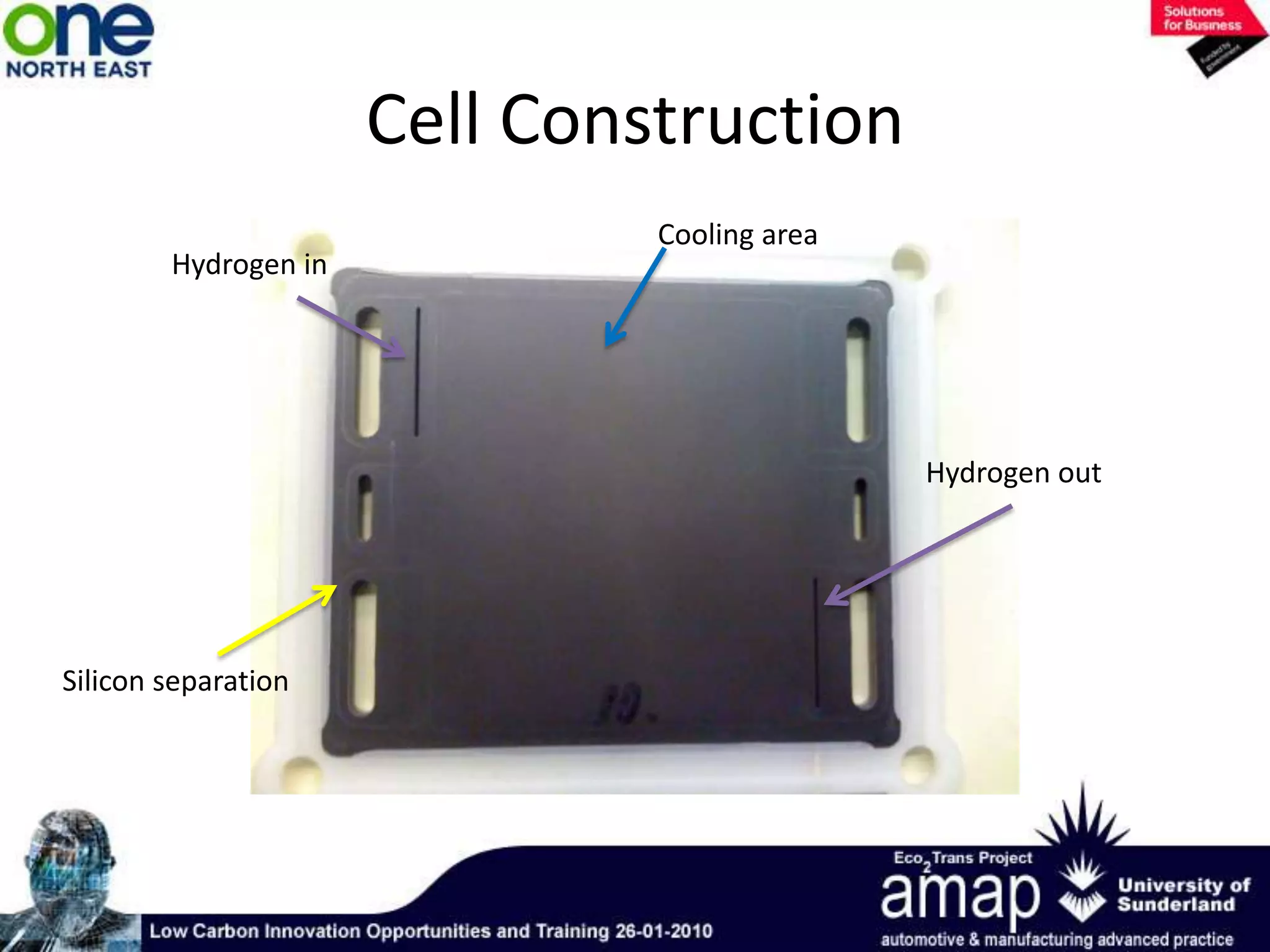
Cell ConstructionCooling areaHydrogen inHydrogen outSilicon separation
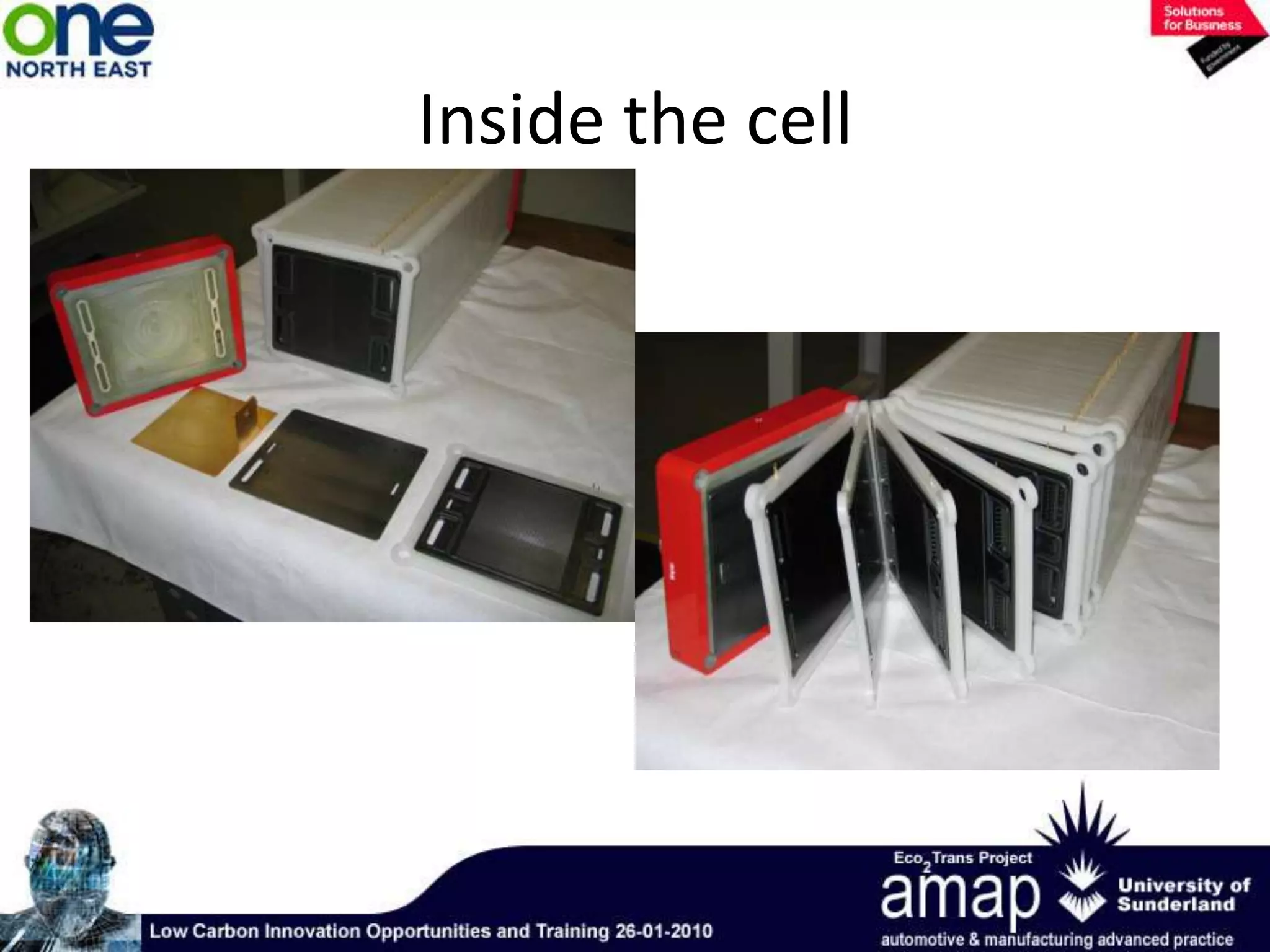
Inside the cell
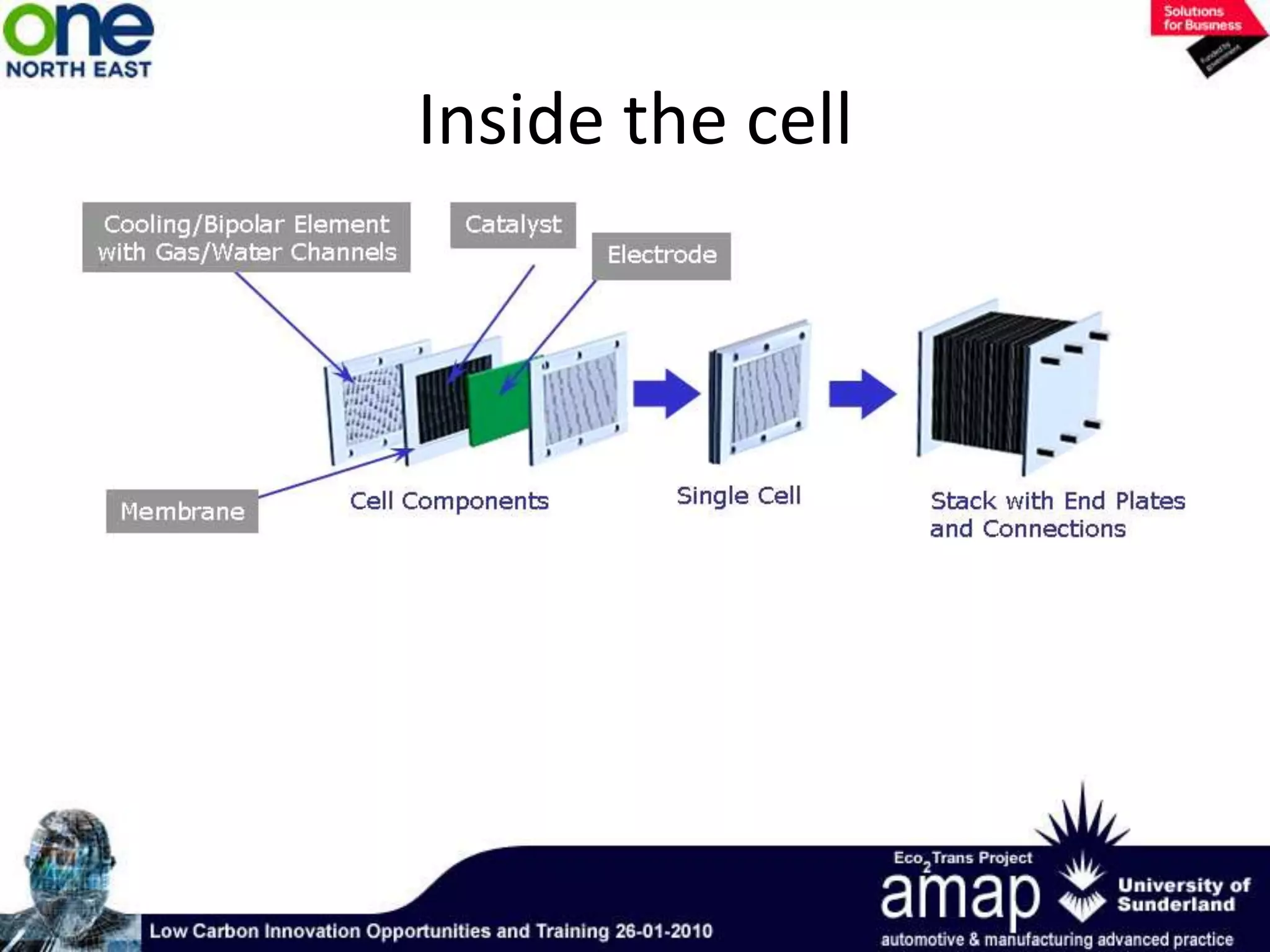
Inside the cell
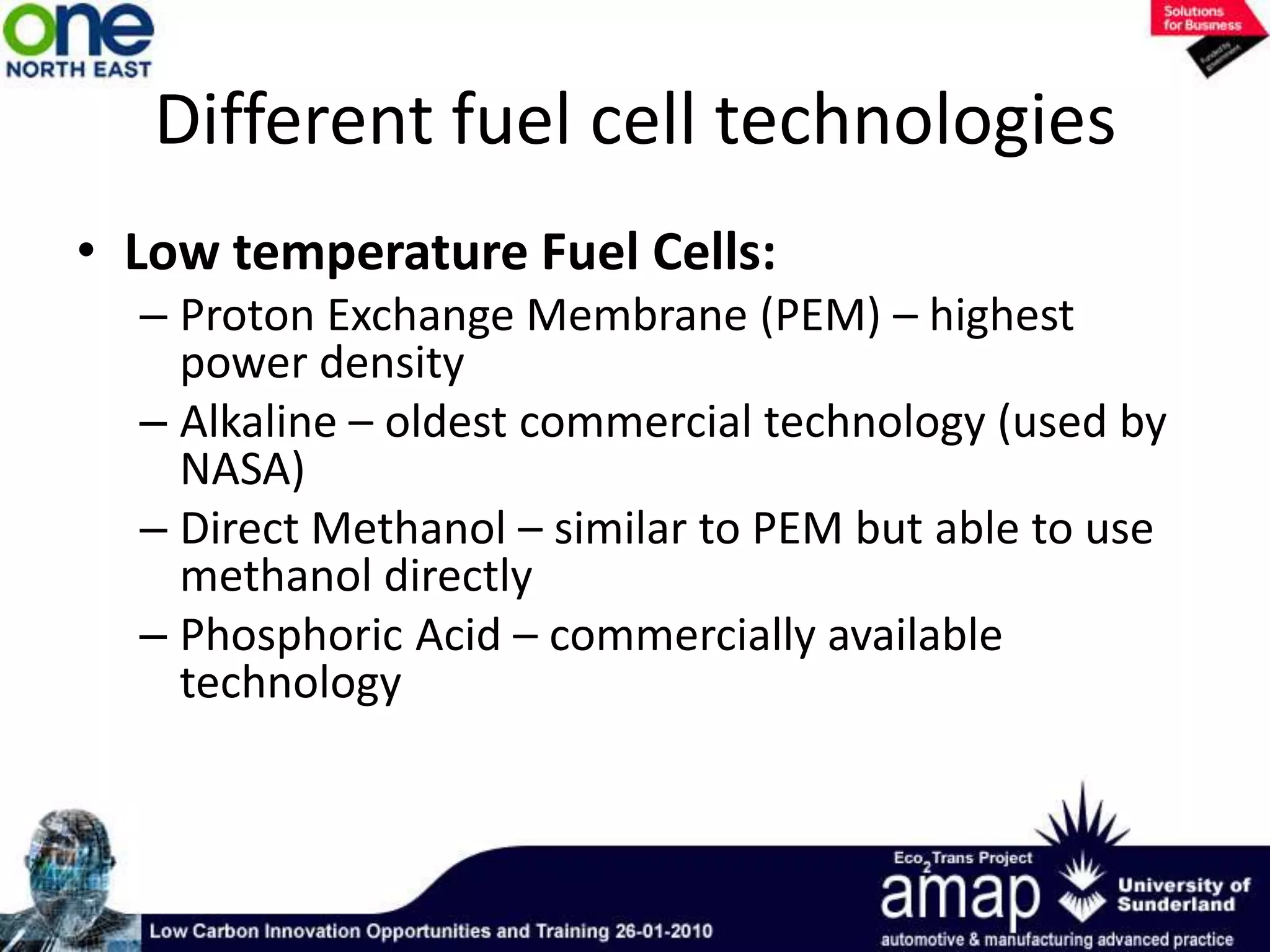
Different fuel cell technologiesLow temperature Fuel Cells:Proton Exchange Membrane (PEM) – highest power densityAlkaline – oldest commercial technology (used by NASA)Direct Methanol – similar to PEM but able to use methanol directlyPhosphoric Acid – commercially available technology
Different fuel cell technologiesHigh temperature fuel cells: Molten Carbonate – requires molten electrolyteSolid Oxide – high temperature oxides allow ion transport
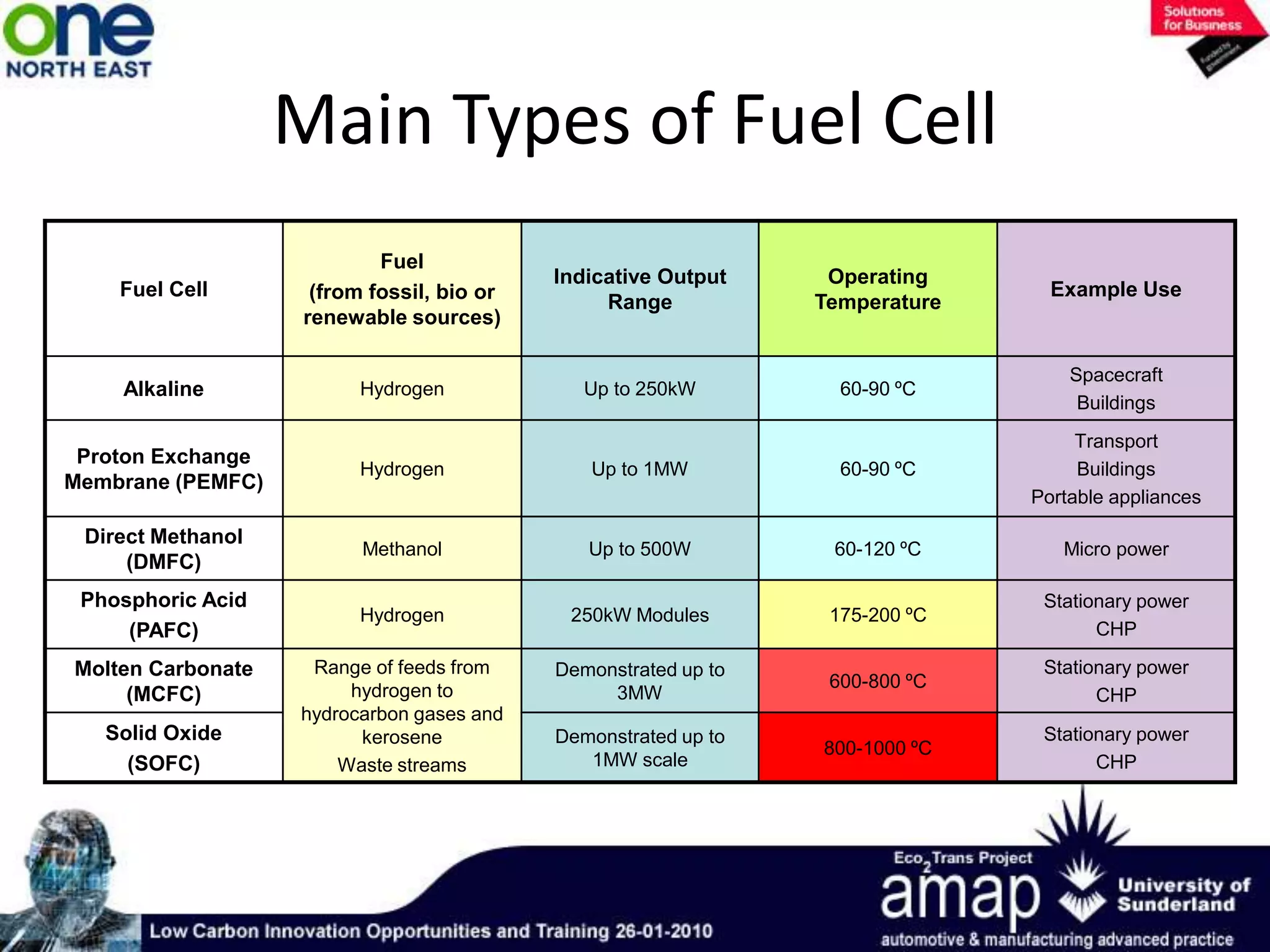
Main Types of Fuel Cell
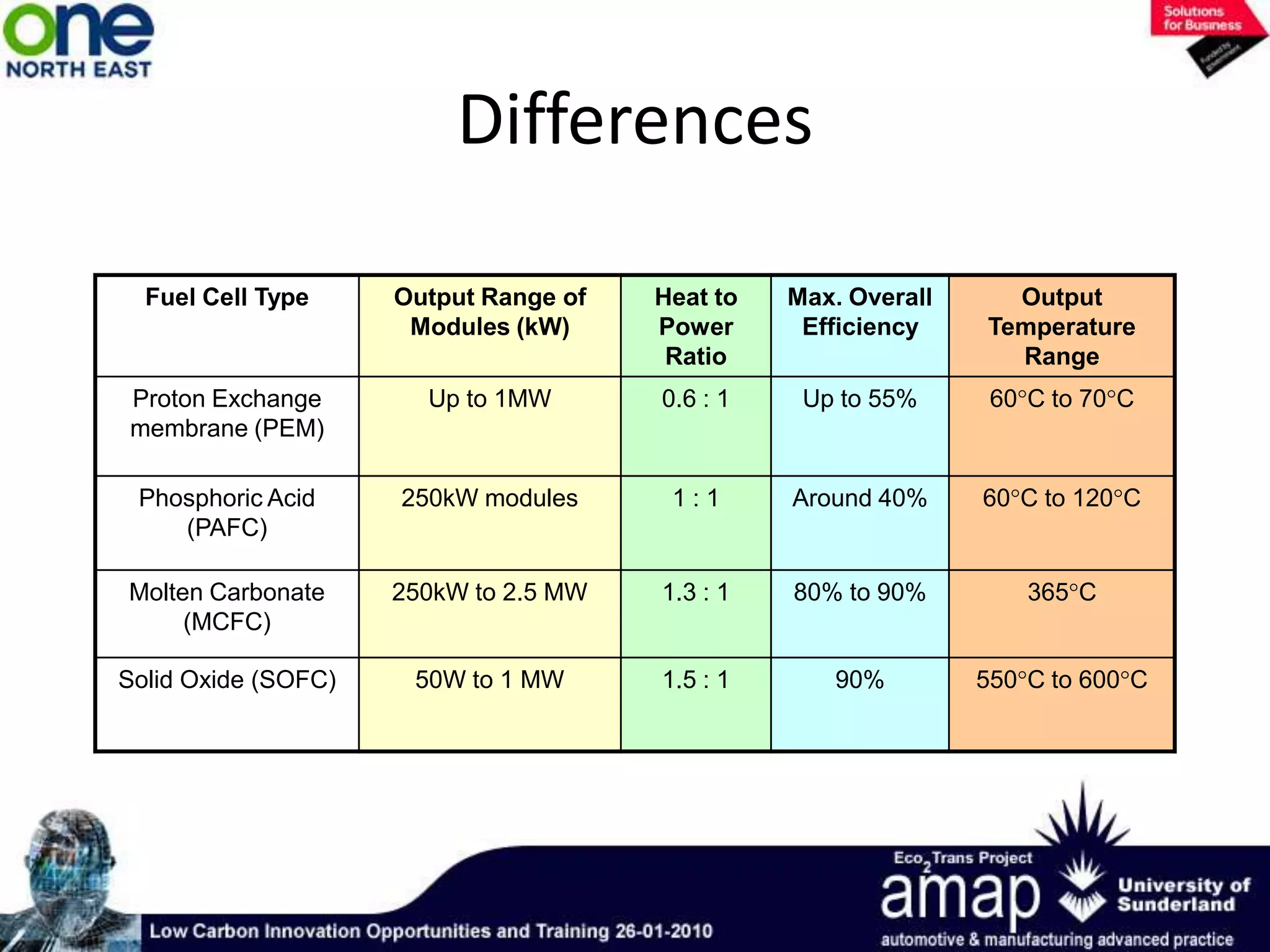
Differences
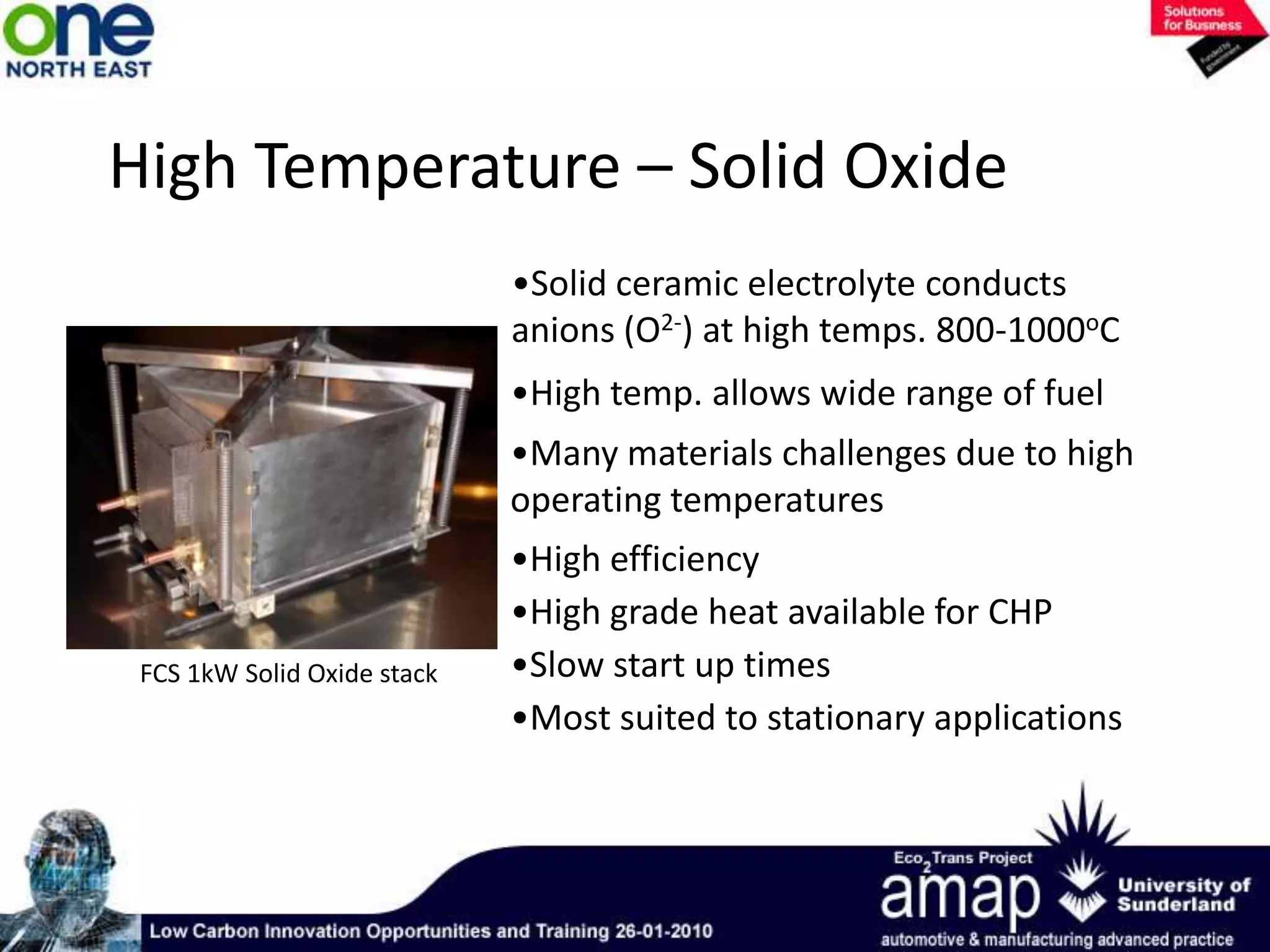
FCS 1kW Solid Oxide stackHigh Temperature – Solid OxideSolid ceramic electrolyte conducts anions (O2-) at high temps. 800-1000oCHigh temp. allows wide range of fuel
Many materials challenges due to high operating temperatures
High efficiency
High grade heat available for CHP
Slow start up times
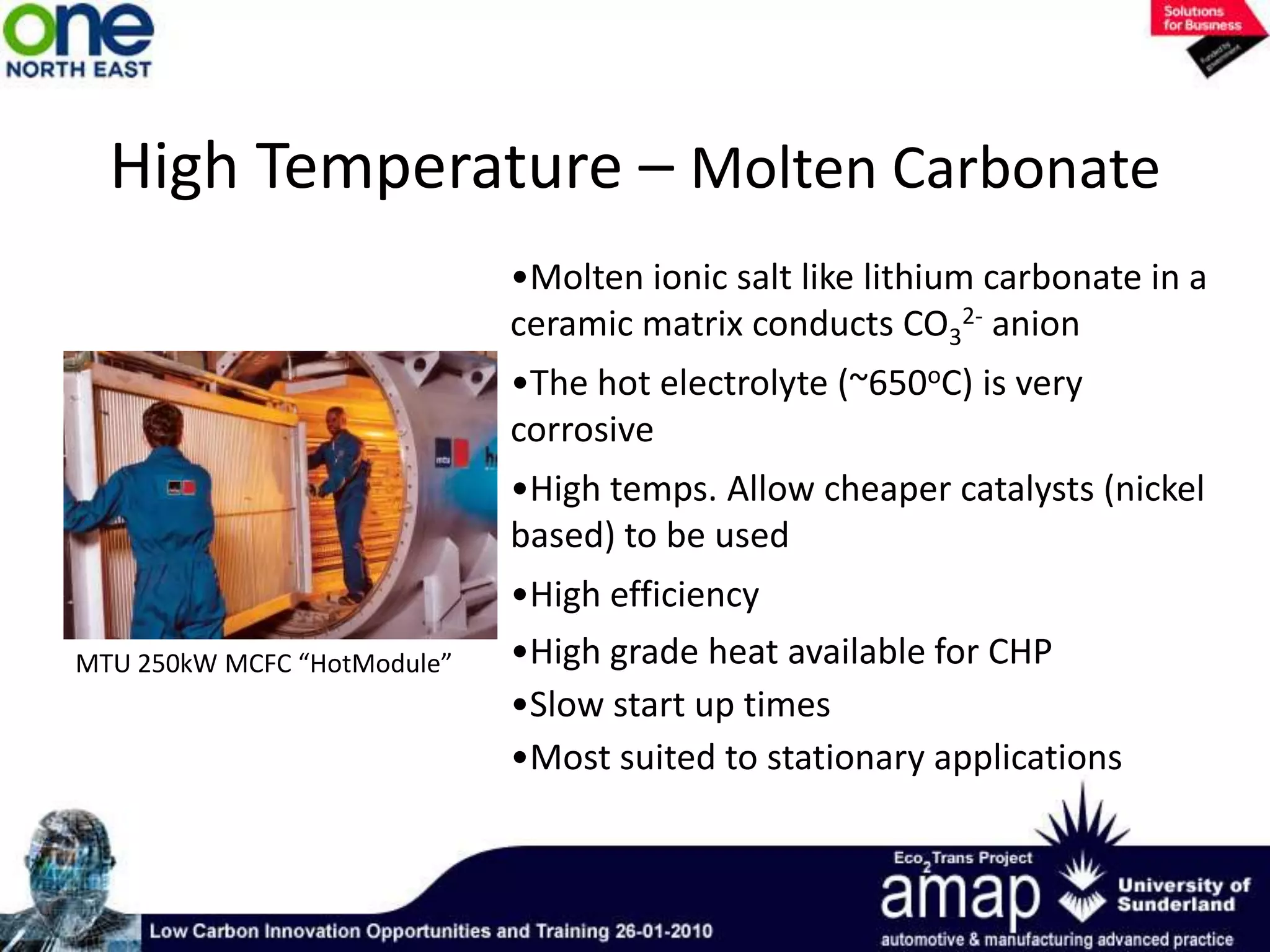
Most suited to stationary applicationsMTU 250kW MCFC “HotModule”High Temperature – Molten CarbonateMolten ionic salt like lithium carbonate in a ceramic matrix conducts CO32- anion
The hot electrolyte (~650oC) is very corrosive
High temps. Allow cheaper catalysts (nickel based) to be used
High efficiency
High grade heat available for CHP
Slow start up times
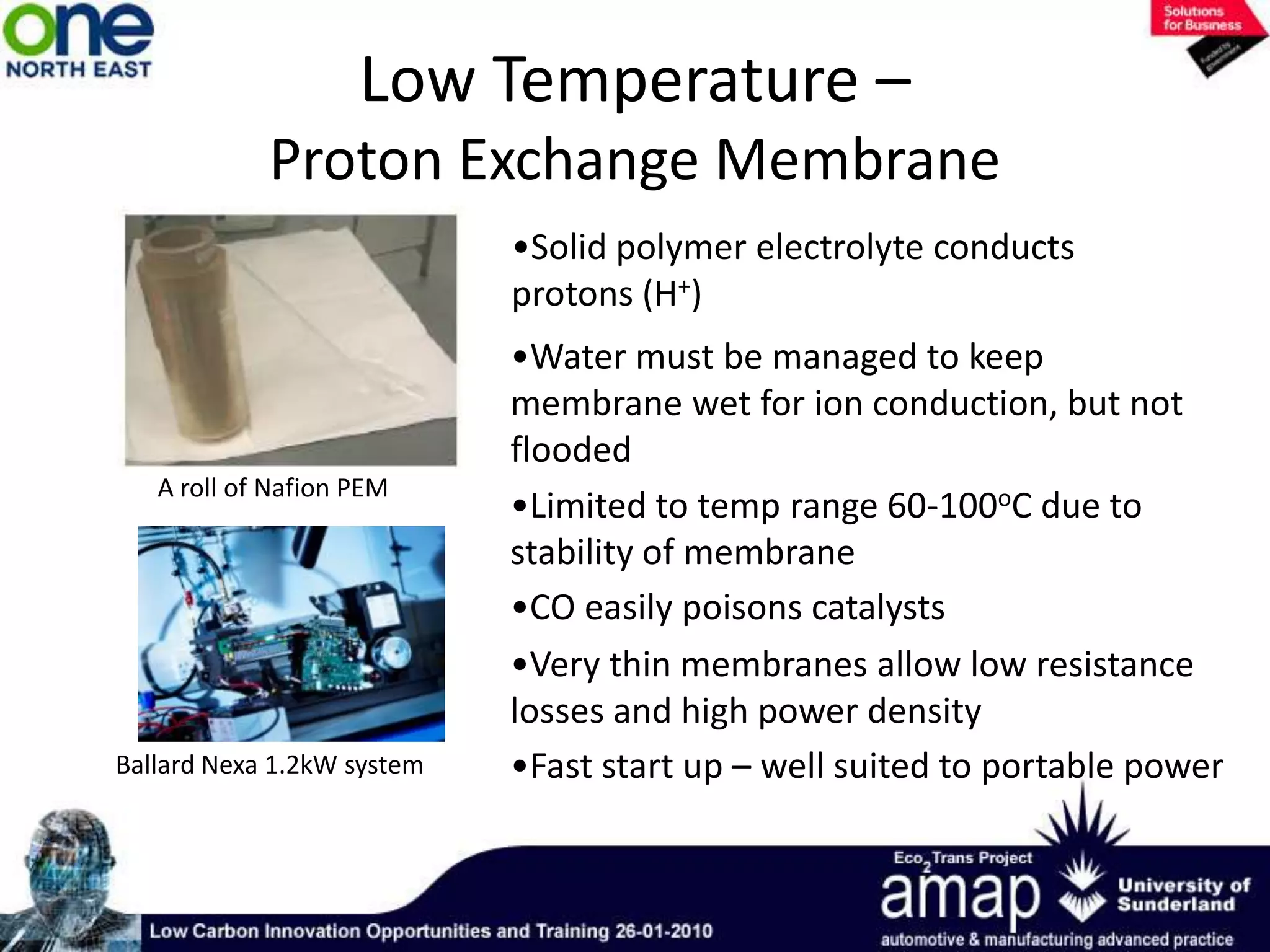
Most suited to stationary applicationsLow Temperature – Proton Exchange MembraneSolid polymer electrolyte conducts protons (H+)Water must be managed to keep membrane wet for ion conduction, but not floodedA roll of Nafion PEMLimited to temp range 60-100oC due to stability of membrane
CO easily poisons catalysts
Very thin membranes allow low resistance losses and high power density
Fast start up – well suited to portable powerBallard Nexa 1.2kW system
Advantages of PEMFCNo toxic chemicalsAll three products are useable: ElectricityWaterHeatHigh Efficiency60%
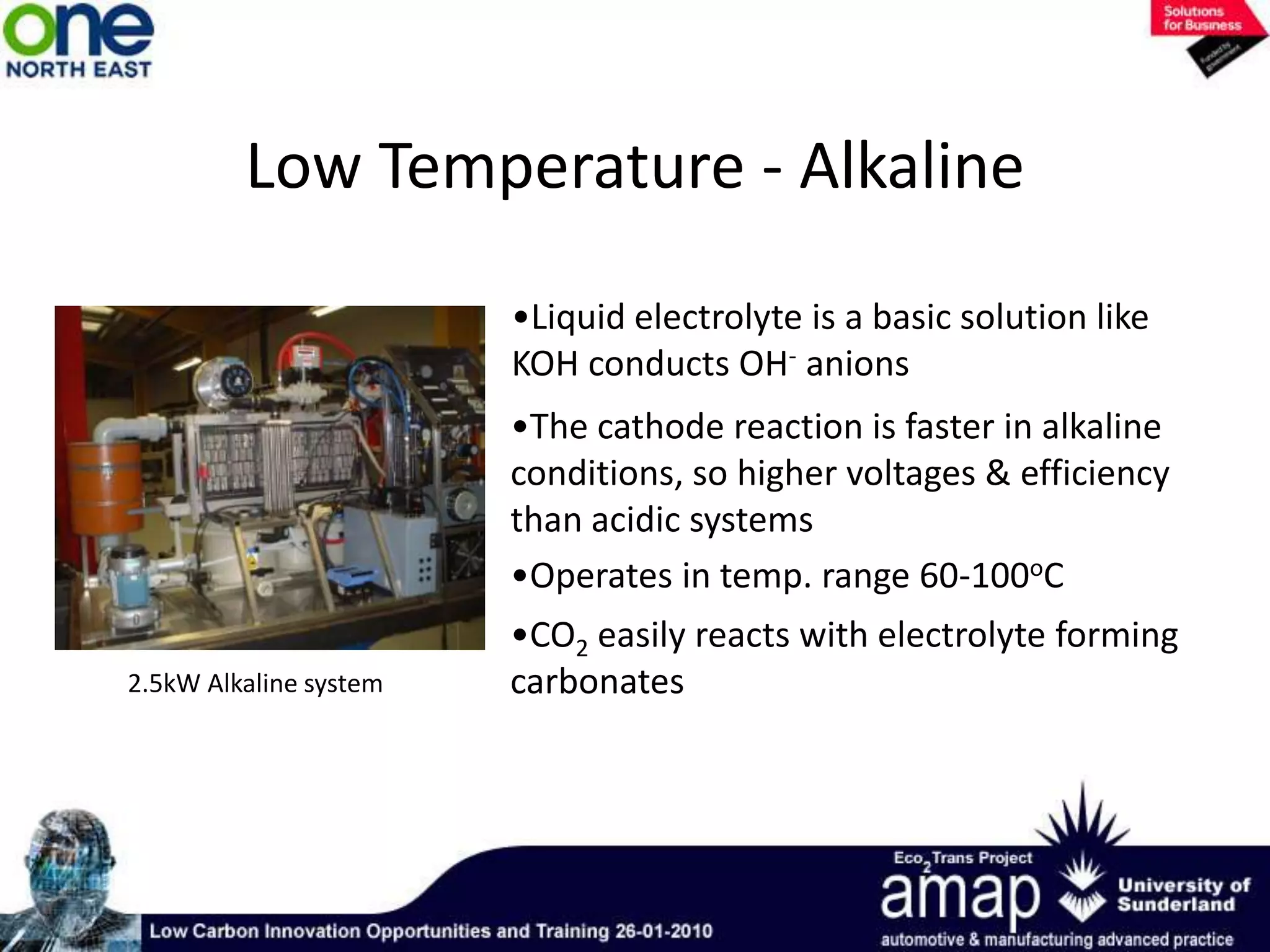
2.5kW Alkaline systemLow Temperature - AlkalineLiquid electrolyte is a basic solution like KOH conducts OH- anionsThe cathode reaction is faster in alkaline conditions, so higher voltages & efficiency than acidic systems

An Introduction To Hydrogen Fuel Cells

  • 1.
    Hydrogen as aFuelLow Carbon: Innovation, Opportunities and Training Presented by: Dirk Kok
  • 2.
    AgendaAn Urgent CaseHistoryof HydrogenWhat is a Fuel Cell?Different fuel cellsFuture of Fuel Cells
  • 3.
  • 4.
  • 5.
    An Urgent CaseBBCBreakfast 07-012-2009The Climate Conference in Copenhagen, DenmarkHigher targets are needed
  • 6.
    King report60% emissionsreductionEvolutionary improvements guaranteed with current development80%Growth in Ultra Low Carbon Vehicles90-100% Complete change in paradigmPublic Transport most efficient in +10M
  • 7.
    History1839 – SirWilliam Robert Grove“Gas Voltaic Battery” - 1st Fuel Cell 1937 – Baur and Preis1st Solid Oxide Fuel Cell1940-45 German SubmarinesFC made SUB “trackless”1955 – Francis Thomas Bacon5kW stationary Alkaline Fuel Cell
  • 8.
    History1960’s – Grubband Niedrach (GE)PEM Fuel Cell invented1967 – GM Electrovan1 driver + 1 passenger 1969 – NASAFirst Alkaline Fuel Cell on the moon.
  • 9.
    HistoryToday: Major OEMshave demonstration or lease versionsICE and Fuel Cell vehiclesPrice per kW is coming downHydrogen SupplyFunding available (TSB)
  • 10.
    Health and SafetyAfter1 minuteAfter 3 secondsOdourless gas
  • 11.
    It is veryflammable
  • 12.
    Hydrogen burns witha flame that is hard to see
  • 13.
    It is lighterthan air (unlike petrol which ‘pools’)The good and the Bad1937 - Hindenburg Disaster1969 -Apollo 11 SuccessHydrogen Fuel AdvantagesCan be made anywhereElectricity (plug, solar, wind, etc)Can be stored without lossesBattery does not hold energy overtimeHigh Energy DensityMore efficient and cleaner
  • 14.
    What is aFuel CellA fuel cell is a device that converts energy from one form into anotherIt converts the ‘Chemical Energy’ in a fuel into Electrical Energy and Heat.It does this without burning the fuel. This is very different to the type of engine in a car!
  • 15.
    What is aFuel Cell2H24H+ + 4e-O2+ 4H+ + 4e- 2H2OElectronsElectrolyteReactionthat produces electrons(-)Reactionthat consumes electrons(+)Fuel Oxidant(water)
  • 16.
    The science ofa fuel cellOxygen SideO2O2O2O2OOH2OElectrolyte H+H+e-e-HHHydrogen SideH2H2H2H2
  • 17.
    Cell ConstructionHydrogenOxygen inCoolingareaWater inWater inHydrogenOxygen OutSilicon separation
  • 18.
    Cell ConstructionCooling areaHydrogeninHydrogen outSilicon separation
  • 19.
  • 20.
  • 21.
    Different fuel celltechnologiesLow temperature Fuel Cells:Proton Exchange Membrane (PEM) – highest power densityAlkaline – oldest commercial technology (used by NASA)Direct Methanol – similar to PEM but able to use methanol directlyPhosphoric Acid – commercially available technology
  • 22.
    Different fuel celltechnologiesHigh temperature fuel cells: Molten Carbonate – requires molten electrolyteSolid Oxide – high temperature oxides allow ion transport
  • 23.
    Main Types ofFuel Cell
  • 24.
  • 25.
    FCS 1kW SolidOxide stackHigh Temperature – Solid OxideSolid ceramic electrolyte conducts anions (O2-) at high temps. 800-1000oCHigh temp. allows wide range of fuel
  • 26.
    Many materials challengesdue to high operating temperatures
  • 27.
  • 28.
    High grade heatavailable for CHP
  • 29.
  • 30.
    Most suited tostationary applicationsMTU 250kW MCFC “HotModule”High Temperature – Molten CarbonateMolten ionic salt like lithium carbonate in a ceramic matrix conducts CO32- anion
  • 31.
    The hot electrolyte(~650oC) is very corrosive
  • 32.
    High temps. Allowcheaper catalysts (nickel based) to be used
  • 33.
  • 34.
    High grade heatavailable for CHP
  • 35.
  • 36.
    Most suited tostationary applicationsLow Temperature – Proton Exchange MembraneSolid polymer electrolyte conducts protons (H+)Water must be managed to keep membrane wet for ion conduction, but not floodedA roll of Nafion PEMLimited to temp range 60-100oC due to stability of membrane
  • 37.
  • 38.
    Very thin membranesallow low resistance losses and high power density
  • 39.
    Fast start up– well suited to portable powerBallard Nexa 1.2kW system
  • 40.
    Advantages of PEMFCNotoxic chemicalsAll three products are useable: ElectricityWaterHeatHigh Efficiency60%
  • 41.
    2.5kW Alkaline systemLowTemperature - AlkalineLiquid electrolyte is a basic solution like KOH conducts OH- anionsThe cathode reaction is faster in alkaline conditions, so higher voltages & efficiency than acidic systems
  • 42.
    Operates in temp.range 60-100oC
  • 43.
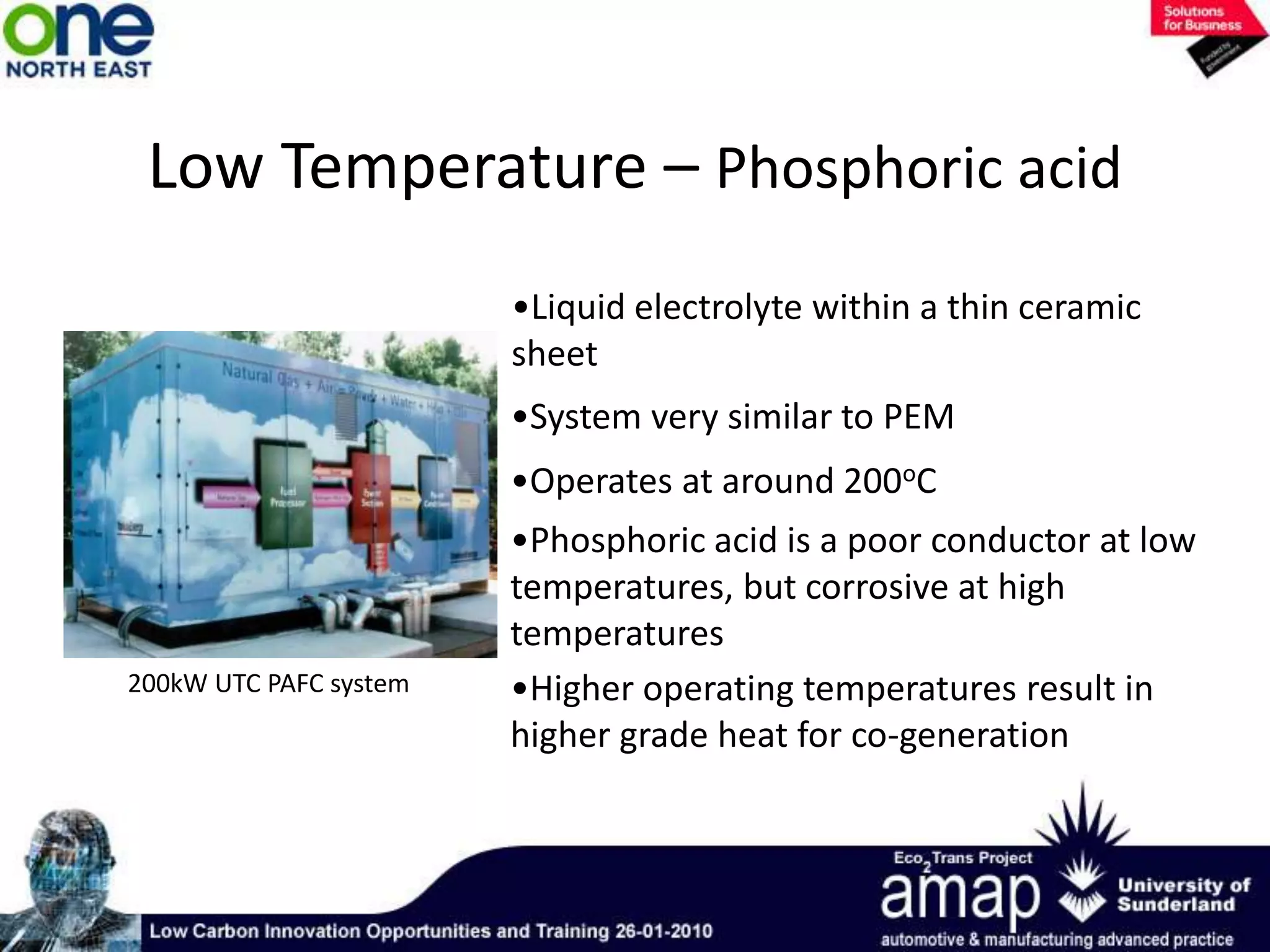
    CO2 easily reactswith electrolyte forming carbonatesLow Temperature – Phosphoric acidLiquid electrolyte within a thin ceramic sheetSystem very similar to PEM
  • 44.
  • 45.
    Phosphoric acid isa poor conductor at low temperatures, but corrosive at high temperatures
  • 46.
    Higher operating temperaturesresult in higher grade heat for co-generation200kW UTC PAFC system
  • 47.
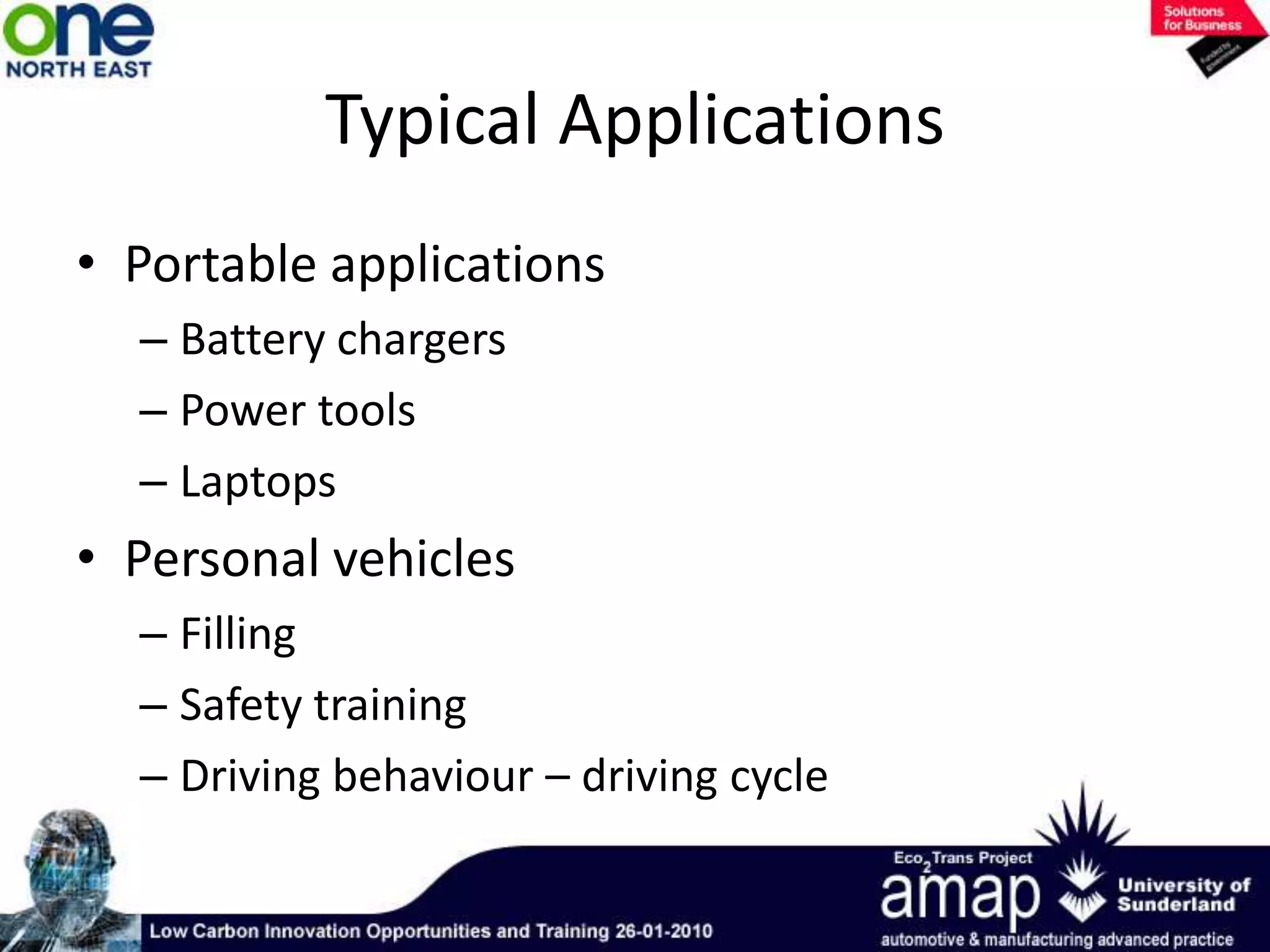
    Typical ApplicationsCentral HeatingPowerHigh temp can be used to increase efficiencyFork Lift Trucks1 off filling pointPublic transportFilling station for busesSpaceElectricity, Water, Heat
  • 48.
    Typical ApplicationsPortable applicationsBatterychargersPower toolsLaptopsPersonal vehiclesFillingSafety trainingDriving behaviour – driving cycle
  • 49.
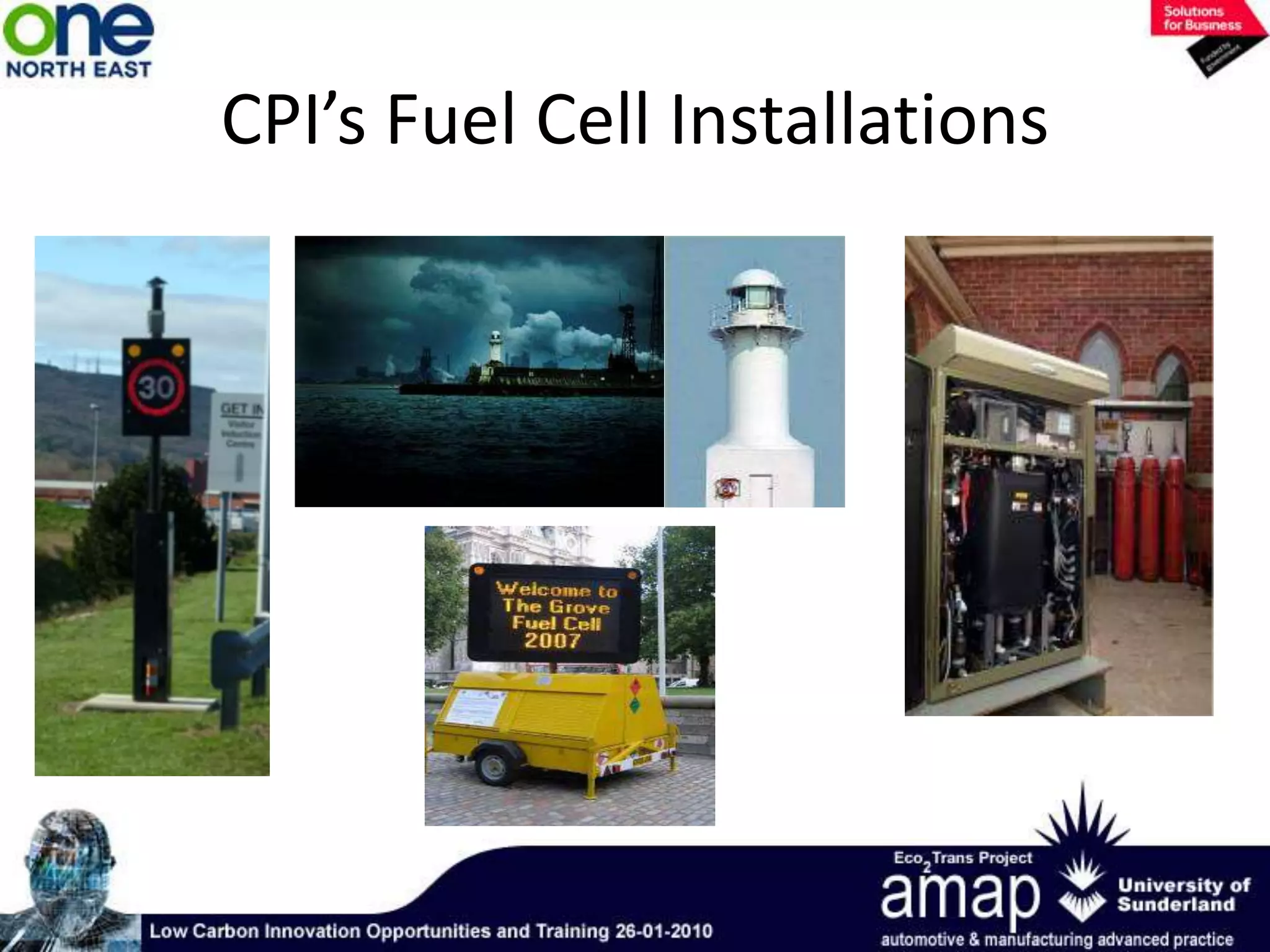
    CPI’s Fuel CellInstallations
  • 50.
    Future of FuelCellsFUEL CELL COMMERCIALISATION ‘STARTED IN 2007’Fuel Cell Shipments to Exceed 5 Million Units by 2013Source: www.fuelcellstoday.comPortable Fuel Cell Market to Reach $2.3 Billion by 2016Source: Pike Research at www.greencarcongress.com
  • 51.
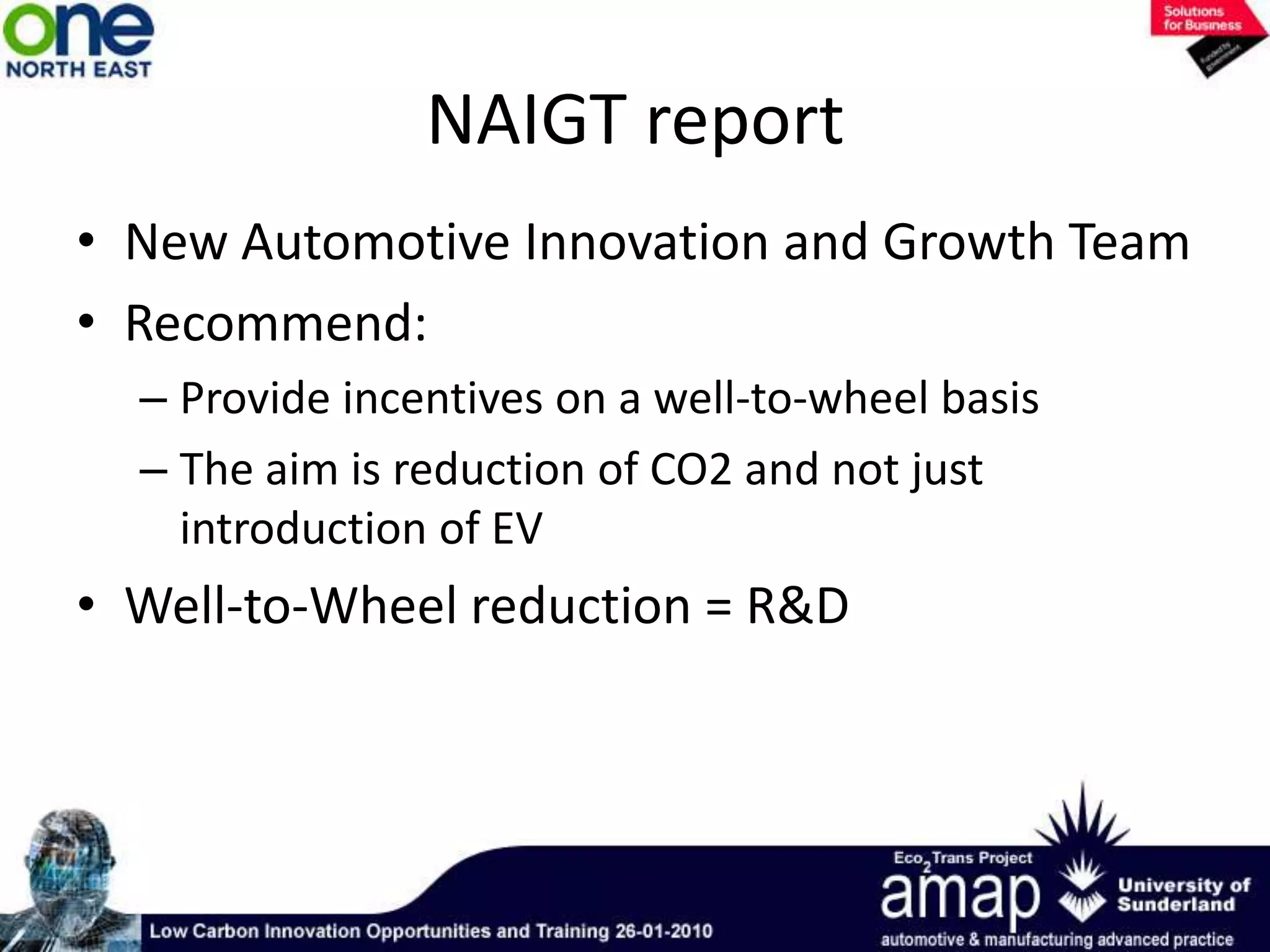
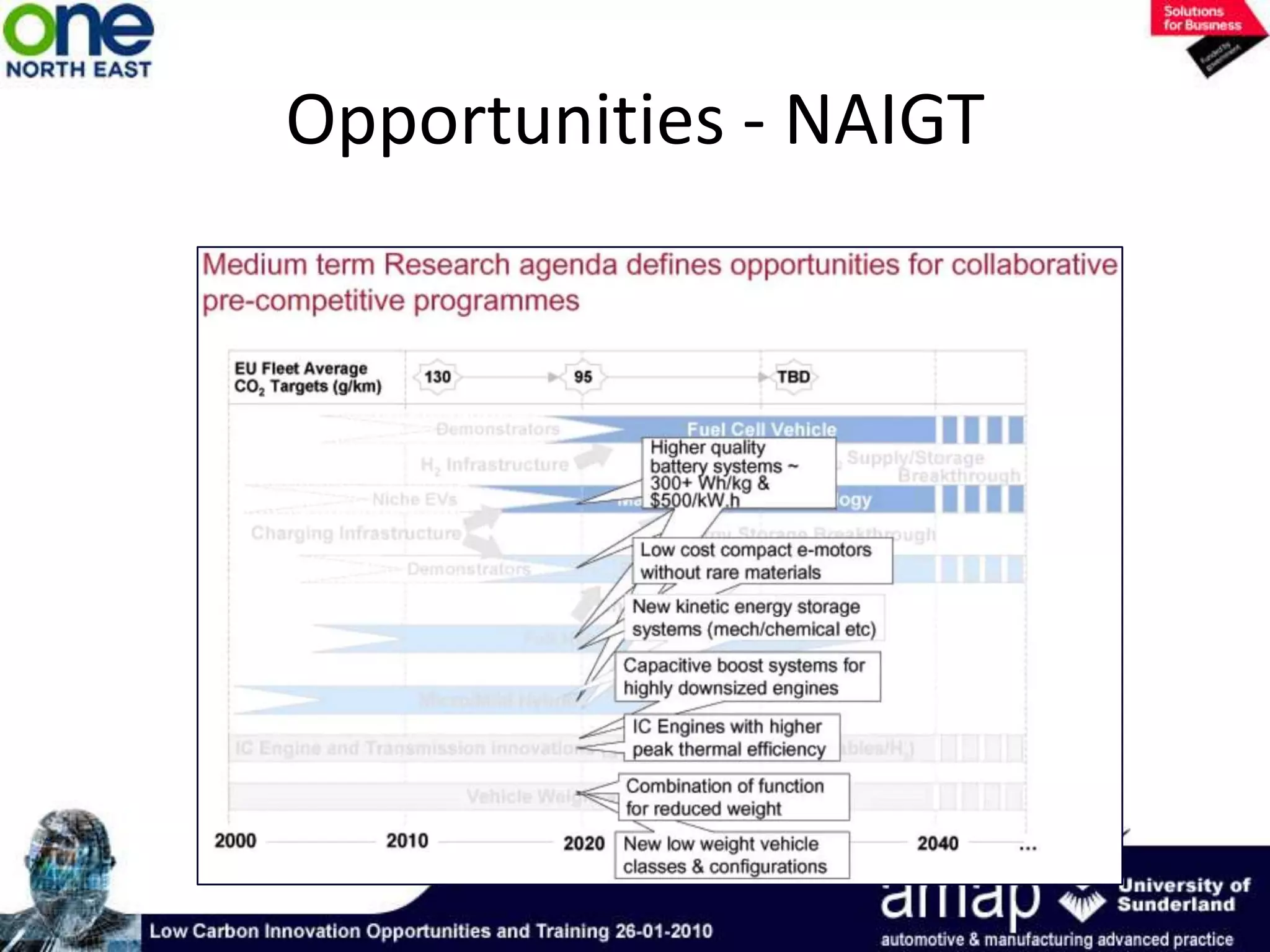
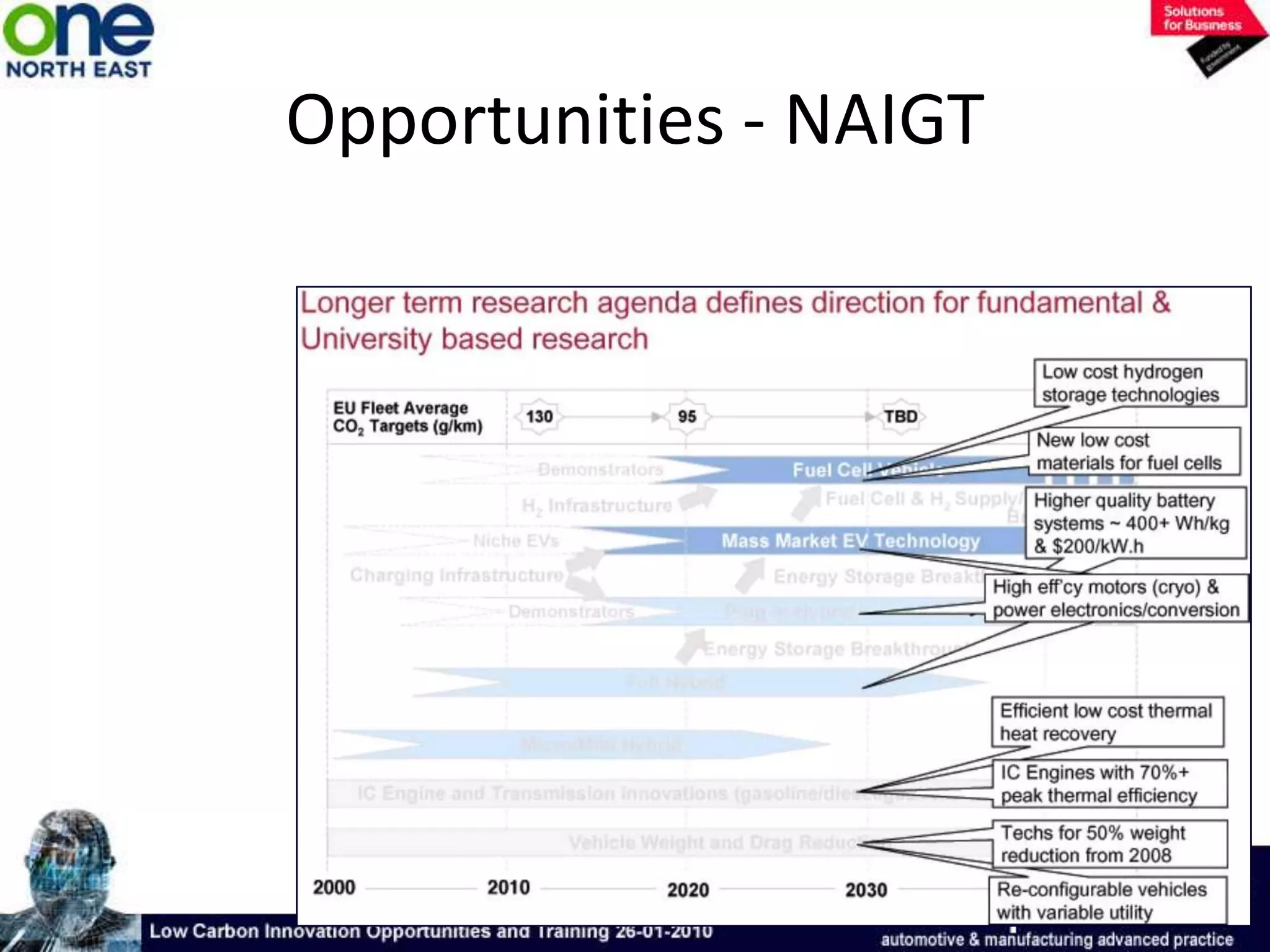
    NAIGT reportNew AutomotiveInnovation and Growth TeamRecommend:Provide incentives on a well-to-wheel basisThe aim is reduction of CO2 and not just introduction of EVWell-to-Wheel reduction = R&D
  • 52.
  • 53.
  • 54.
  • 55.
  • 56.
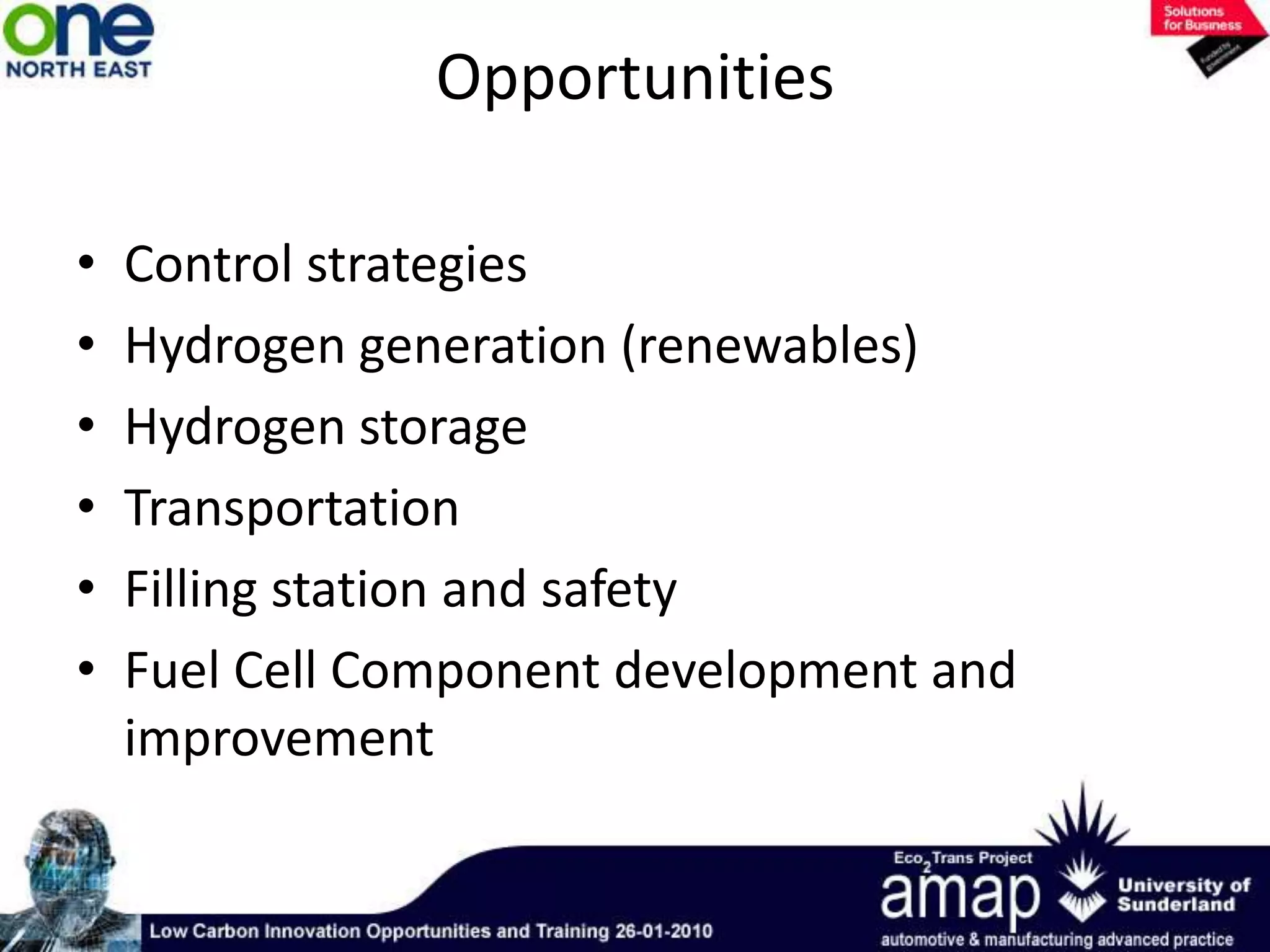
    OpportunitiesControl strategiesHydrogen generation(renewables)Hydrogen storageTransportationFilling station and safetyFuel Cell Component development and improvement
  • 57.
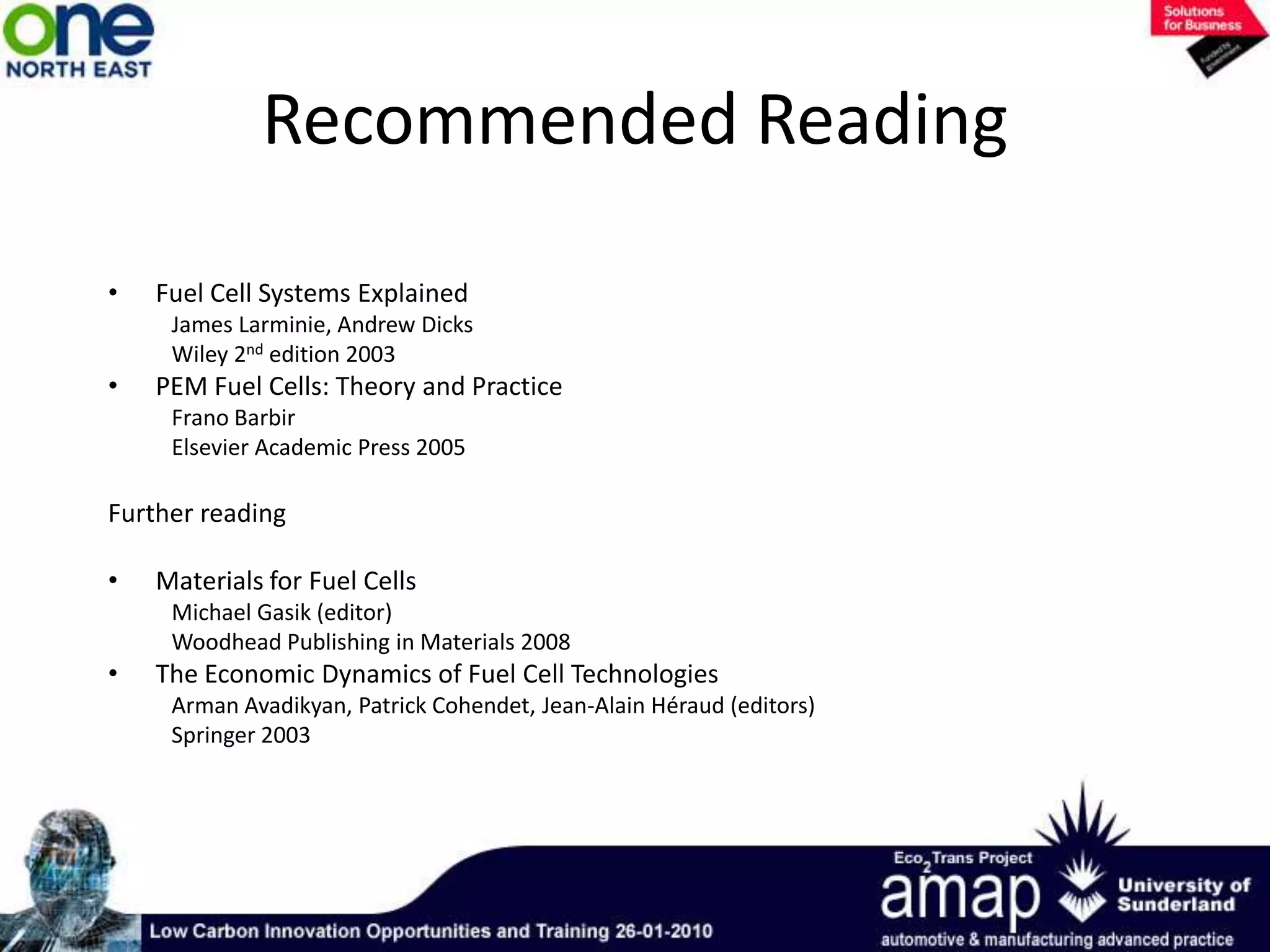
    Recommended ReadingFuel CellSystems ExplainedJames Larminie, Andrew DicksWiley 2nd edition 2003PEM Fuel Cells: Theory and PracticeFrano BarbirElsevier Academic Press 2005Further readingMaterials for Fuel CellsMichael Gasik (editor)Woodhead Publishing in Materials 2008The Economic Dynamics of Fuel Cell TechnologiesArman Avadikyan, Patrick Cohendet, Jean-Alain Héraud (editors)Springer 2003
  • 58.
    QuestionsDo you wantto know more about:Today’s presentationMentioned projectsOr discuss project ideas: adrian.morris@sunderland.ac.ukdirk.kok@sunderland.ac.uk0191 – 515 3888

Editor's Notes

  • #3 Good Morning. This is the first part of my presentation on Hydrogen Fuel Cell systems. This morning’s session will focus on a broad overview of the Fuel Cell. 1. What is a fuel cell?2. A bit of History3. I will focus most on the PEMFC. 4. a bit about different fuel cell systems.The afternoon session will delve further into how a fuel cell plant design issues and what kind health and safety items have to be taken into account. As well, as operating procedures and maintenance. For this presentation I have to extend my thanks to our partners in a previous project: Centrum for Process Engineering in Wilton of whom I use some of their training slides.
  • #4 It is expected that the use of energy and the population growth and the miles travelled as well as number of vehicles nearly all will increase exponentially. So over the next 40 years this is what we can expect (approximation) based on personal transport and drivable age group only.The graph shows the effect of the no reductions in CO2 against the government set targets, based on expected population, miles travelled per person (both are expected to increase exponentially. It also shows how much the trees take out of the air (CO2) and the number in H2 can be varied to show the effects.NAIGT expects that it will take 30 years for a switch to occur – but do we have 30 years?King report:
  • #5 The graph shows the effect of the no reductions in CO2 against the government set targets, based on expected population, miles travelled per person (both are expected to increase exponentially. It also shows how much the trees take out of the air (CO2) and the number in H2 can be varied to show the effects.So we show how much energy we can take out if we manage the vegetation population, but this is in an extreme case. We need to look for further reductions in CO2 emissions.
  • #6 This case of urgency was enhanced this morning on the BBC breakfast show, where they stated that during the climate conference higher target were needed to combat climate change.
  • #7 The current trend of development already guarantees a 60% reductions based on ICE development. A promise of 60% reduction does not add anything. A promise – as made by world leaders – of 80% increased the number of ULCV, but does not really change the ICE influence. To really make an impact it is necessary to aim for 90% emissions change. The reason why this is important is that personal transport will remain the preferred and best form of transport even within cities. It is estimated that public transport is most effective in cities of 10 million plus inhabitants. But most cities are in the region of 0.5 million, where personal transport is fastest mode of transportation.Switching to a hydrogen economy is a possibility to greatly reduce carbon emissions and achieve the paradigm shift necessary and with the right strategy have a profitable economy as well.
  • #8 Hydrogen has been around for as long as we live and possibly longer. We exist partially of hydrogen considering that 60 percent of our body is water and there are 2 H’s to every 1 O; this means that our body is actually almost 40 percent of hydrogen based on the water content alone. 1960 – People at General Electric invent the PEM Fuel Cell.
  • #9 1976 – GM’s Electrovan with limited space and very heavy the van provide a nice test bed but that was about it. 1969 – The reason for NASA to switch from PEM to Alkaline is the higher efficiency.
  • #10 Today: Major OEMs have demonstration or lease versionsICE and Fuel Cell vehiclesPrice per kW is coming downHydrogen SupplyFunding available (TSB)
  • #11 What you need to know about hydrogen- it exists all around us it is part of water and thus we have plenty. 1. You can not smell it.2. Like any fuel it can be dangerous. 3. It burns with a flame that is hard to see. 4. It is also lighter than air which means a flame will go upwards.We have seen -previously- what can go wrong with a battery. So now, lets have a look at a hydrogen fire and compare that to a petrol fire. This first picture shows a hydrogen fire on the left and a petrol fire on the right; this is three seconds in.Now we make a jump and let the fire burn for a minute. You can see that the hydrogen flame is almost going out while the petrol fire is really going. As you can see, petrol fires can actually be more dangerous than hydrogen fires.
  • #12 Hydrogen the good and the bad.Since the Hindenburg disaster and even in todays time, people are thinking about hydrogen as an extremely dangerous gas. But The Hindenburg disaster was an example of bad engineering and clever spin doctors who blamed hydrogen to save the at that moment very delicate political situation between America and Germany. But Hydrogen was not the cause of the fire although it did not help to stop it. During the 60’s NASA and the military had been conducting tests with hydrogen to use hydrogen as a fuel and in fuel cells. This resulted in conclusion that Hydrogen did not require more safety pre-cautions than working with petroleum. So, despite the history, hydrogen was used in the space program and got a little bit of popularity back.
  • #13 High energy Density, about 3x the amount of petrol. More efficient and clearer.
  • #15 What is a Fuel Cell? Well, a Fuel Cell is much like a battery. - Like a battery a fuel cell has got a Plus and a Minus side. - Unlike a battery a Fuel Cell does not contain the active chemicals instead you have to feed it. And this has to be done in a save and controllable fashion otherwise big accidents will happen.The active ingredients for the Hydrogen PEM FC are: Hydrogen, Oxygen in the form of air.Other Fuel Cell will be discussing later.
  • #16 In a schematic this works as follows: A fuel cell consists of a hydrogen side and an oxygen side separated by an electrolyte. An electrolyte allows only positive atoms to pass through. When hydrogen arrives at the barrier it splits into a positive and a negative part and the positive part travels through the electrolyte while the negative parts take the long way around and make the light go on. On the top side, the positive and negative parts combine with the oxygen out of the air to make water, which can be drunk.
  • #17 The slits are for the oxygen to enter and the larger holes for the gases to travel through.
  • #18 On the other side of the cell we can find the IN and OUT for the hydrogen. As well as still visible are the lines where the silicon from the cell below was set. This design has various manufacturing advantages: thanks to the silicon the cooling is on a large area on the top and bottom of every cell. Also, the tolerances are increased thus less accurate machining; you can see that if the slits or even the holes were bigger the silicon would still close the area of from every other part. And with the slits hydrogen can be brought to every cell individually. A big problem we found with this design is the effects of sudden pressure changes. Sudden pressure changes can cause the stack to loose its “cool” and the silicon does not close properly.
  • #19 Inside the cell there is a membrane with catalyst to separate the gases and speed up the reaction as well as an electrode to provide conductance for the electrons. Every Cell produces around 1 volt (depending on the control, design, humidity, age, etc) and the necessary voltage is created by stacking multiple cells.
  • #20 Inside the cell there is a membrane with catalyst to separate the gases and speed up the reaction as well as an electrode to provide conductance for the electrons. Every Cell produces around 1 volt (depending on the control, design, humidity, age, etc) and the necessary voltage is created by stacking multiple cells.
  • #22 They all have different characteristics Are suitable for different applications Use different fuels
  • #28 The advantages of the Proton Exchange Membrane are the combination of non toxic gasses. The usability of all the outputs: Electricity, Water and heat. And the high efficiency of the reaction about double that of an ICE.The disadvantages: high cost of manufacturing, the difficulty in control, the necessary addition of batteries for both the start-up and the temp or longer term storage.
  • #31 Central heating applications are ideal for the high temperature systems because the excess heat can be used to heat a building and thus increasing efficiency.Forklift trucks and Public transport provide a good market since they can be decide on their own filling sites; i.e. Not necessary to make it accessible to average Joe. Instead provide a trained engineer.
  • #32 There are potential future issues involved here: I am thinking about using your Fuel Cell powered Laptop on an airplane. For one there is the pressure influences, as well as bringing an fuel on the plane that maybe can be abused. It would greatly create acceptance if it gets to this level, but the repercussions of an terrorist attack or a mid air failure would set the entire economy back various decades.
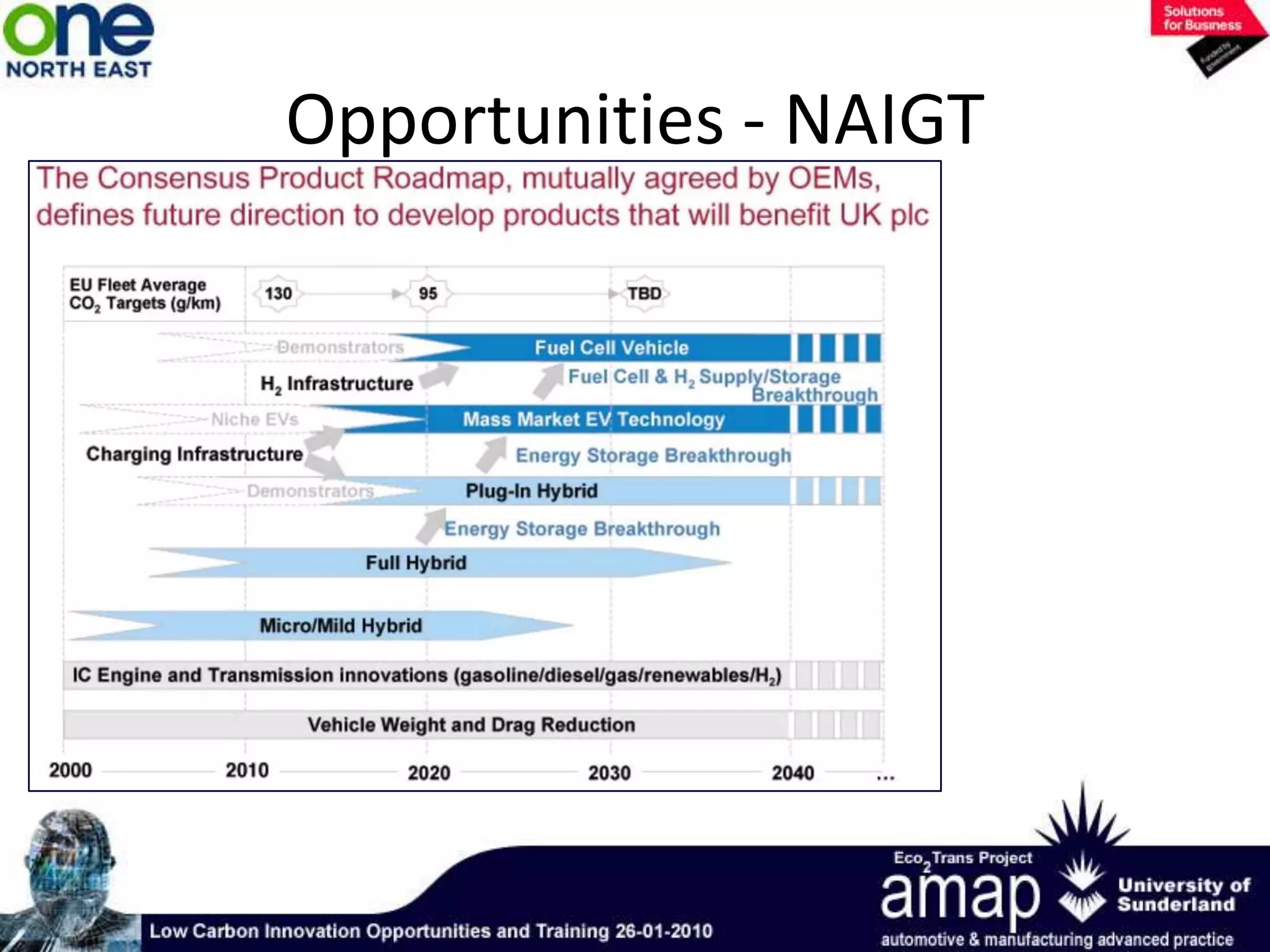
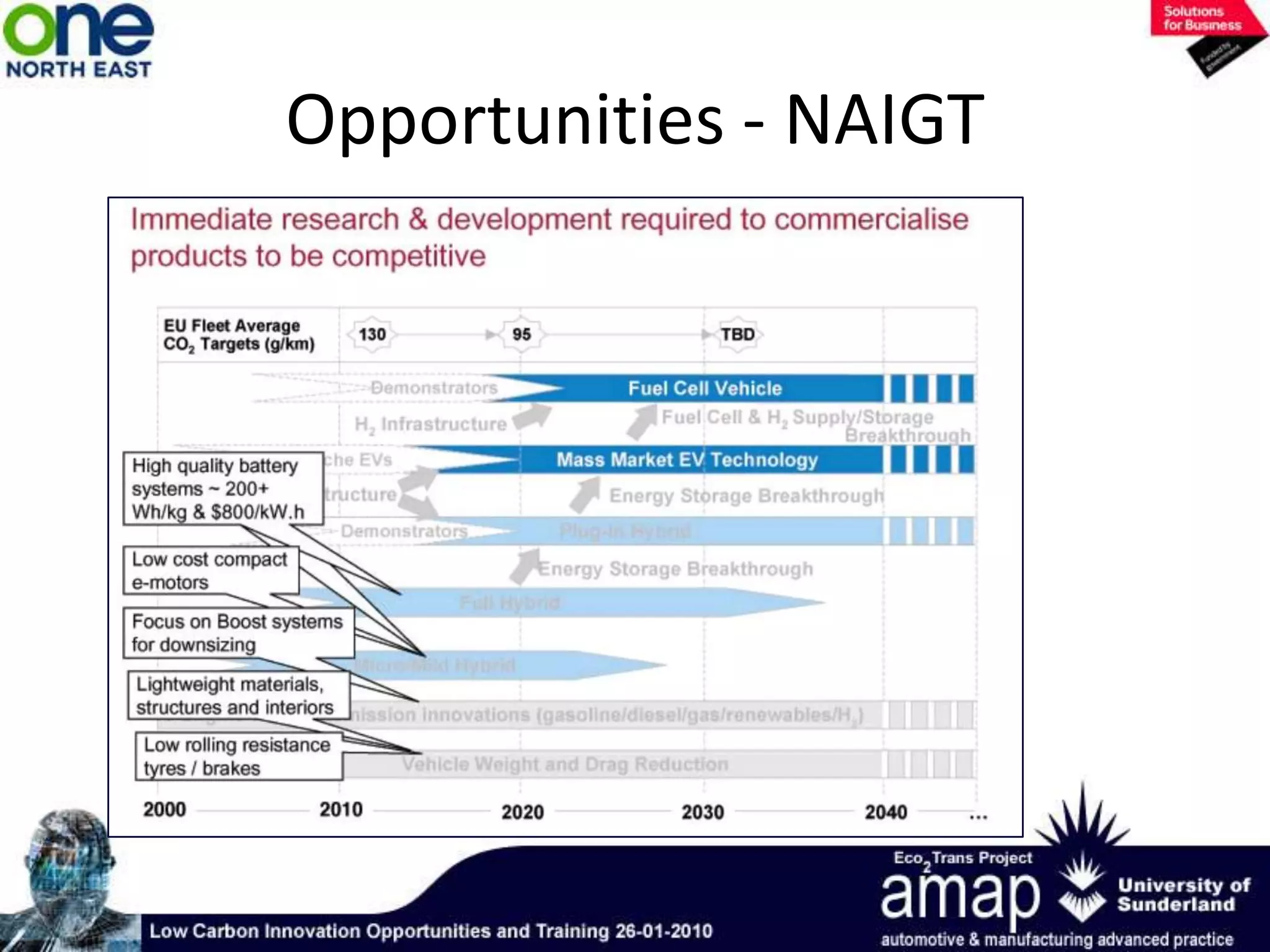
  • #35 If we now take step back to the beginning and the urgent case I was arguing. There is a report by the NAIGT team.The NAIGT team is a large group of representatives from across the industry: representing the major stakeholders in the sector.Do not think EV alone! This is were the research and development is.This includes development with the aim to commercially produce Ultra Low Carbon Vehicles.But largely ignores the development of Air vehicles and steam vehicles. Very much aimed at the current established manufacturers.
  • #36 Proposed development:Micro / mild Hybrids first, followed by full hybrids, to plugin hybrids to Electrically Powered VehiclesImmediate from now:Focus on ICE with a minor change to EVMedium research from around 2020 onwards:Improvements across the boardEV finally getting a footholdLong term from around 2030 onwards:Fuel Cell technologies finally affordableICE getting closer to 70% efficiency (with electric vehicles already >80% efficient)This proposed scenario is not providing the change in paradigm that we need to tackle climate change.
  • #37 Proposed development:Micro / mild Hybrids first, followed by full hybrids, to plugin hybrids to Electrically Powered VehiclesImmediate from now:Focus on ICE with a minor change to EVMedium research from around 2020 onwards:Improvements across the boardEV finally getting a footholdLong term from around 2030 onwards:Fuel Cell technologies finally affordableICE getting closer to 70% efficiency (with electric vehicles already >80% efficient)This proposed scenario is not providing the change in paradigm that we need to tackle climate change.
  • #38 Proposed development:Micro / mild Hybrids first, followed by full hybrids, to plugin hybrids to Electrically Powered VehiclesImmediate from now:Focus on ICE with a minor change to EVMedium research from around 2020 onwards:Improvements across the boardEV finally getting a footholdLong term from around 2030 onwards:Fuel Cell technologies finally affordableICE getting closer to 70% efficiency (with electric vehicles already >80% efficient)This proposed scenario is not providing the change in paradigm that we need to tackle climate change.
  • #39 Proposed development:Micro / mild Hybrids first, followed by full hybrids, to plugin hybrids to Electrically Powered VehiclesImmediate from now:Focus on ICE with a minor change to EVMedium research from around 2020 onwards:Improvements across the boardEV finally getting a footholdLong term from around 2030 onwards:Fuel Cell technologies finally affordableICE getting closer to 70% efficiency (with electric vehicles already >80% efficient)This proposed scenario is not providing the change in paradigm that we need to tackle climate change.
  • #42 Well, that is it for now. A little break for lunch and after we come back here to for the second part; Healt safety and maintenance.