A REPORT
ON
SOLAR LOAD CALCULATION
2017
SUBMITTED TO:
Ashish Shrestha
SUBMITTED BY:
Milan Ghimire
Ele 8th
sem
Roll:21
milanghimire.com.np
ABSTRACT: Weare well known that the rapidly growth of business and
population are putting more and more pressureon world power resources.
Photovoltaic Solar Power plant price will play a vital role in the larger
development of solar power generation. So it is most importance that to
developed new methodology and techniques for reduced costof solar power
plant.
How to reasonably utilize green energy and keep sustainabledevelopment is the
most importantchallenge for use. As a huge green energy sourcegenerated from
the sun, PV industry will gain the best opportunity to grow up. We should grasp
the opportunity to build the mostsuitable environmental friendly PV power plant,
and welcome a better tomorrow.
In this paper we study how to establish photovoltaic solar power plant Design as
well as calculation of power production, base on that to further we find
recommendation and techniques to optimized costof PV solar power plant. To
establishment of green and sustainable development of solar PV power plant to
reduce a burden of state electricity board.
Table of Contents
INTRODUCTION................................................................................................. 4
COMPONENTS OF SOLAR PV SYSTEM ................................................................ 5
Solar PV Module. ............................................................................................ 5
Solar charge controller.................................................................................... 5
Inverter.......................................................................................................... 6
Battery. .......................................................................................................... 6
DC-DC Converter............................................................................................. 7
Load............................................................................................................... 7
SOLAR PV SYSTEM SIZING.................................................................................. 8
Determine Power Consumption Demands ....................................................... 8
Calculate total watt-hours per day each appliance used. ......................... 8
Calculate total Watt-hours per day needed from the PV modules............ 8
Size the PV modules........................................................................................ 8
Calculate the total Watt-peak rating needed for PV modules................... 8
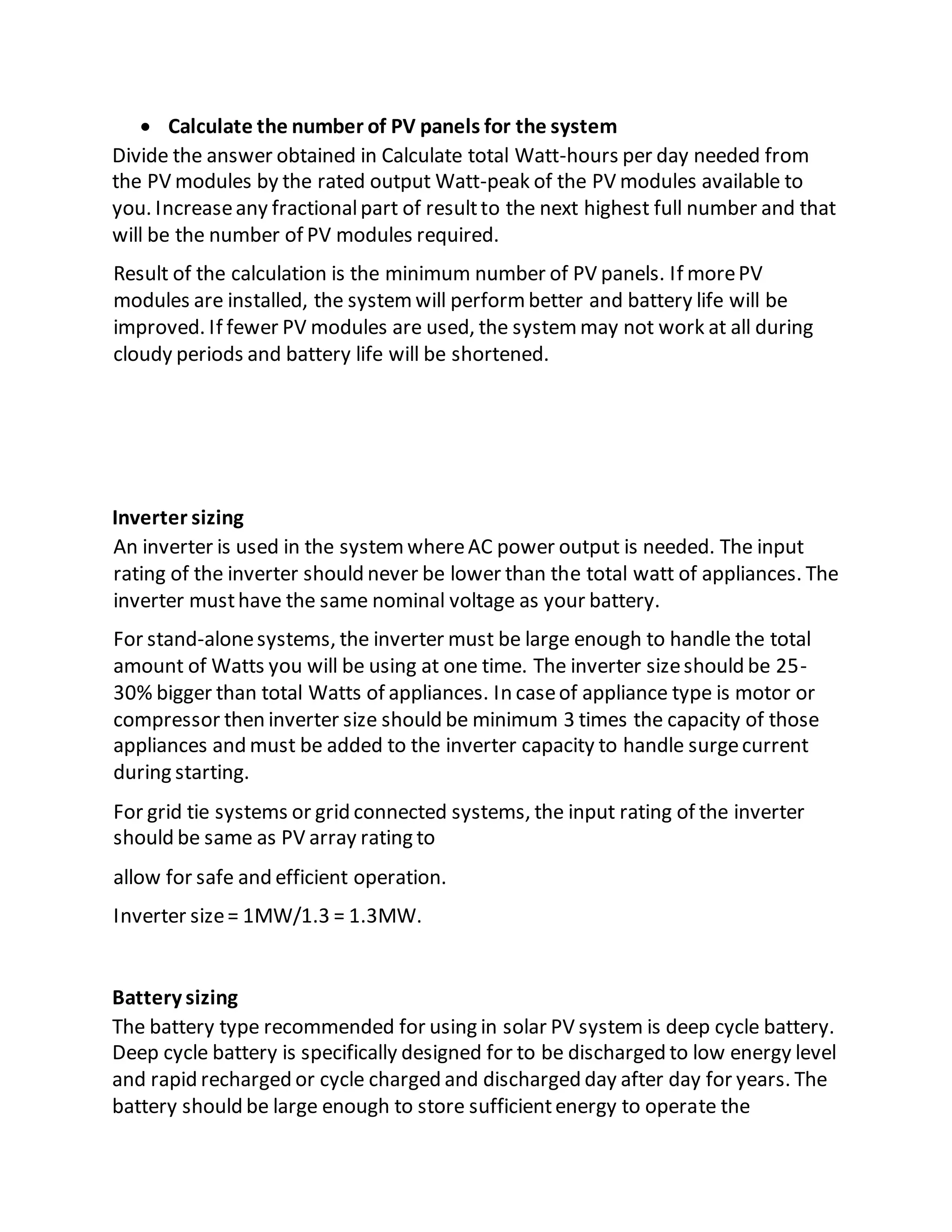
Calculate the number of PV panels for the system................................... 9
Inverter sizing................................................................................................. 9
Battery sizing.................................................................................................. 9
Solar charge controller sizing......................................................................... 10
LOAD CALCULATION........................................................................................ 12
CONCLUSION................................................................................................... 15
REFERENCES.................................................................................................... 15
INTRODUCTION
Nepal has very good conditions for the development of photovoltaic solar power
systems duemainly to the high mean daily radiation and the high number of
sunny days in most parts of the country. For this reason, the Administration and
companies working in the sector are developing policies and investing in
photovoltaic solar power systems. Oneof the best features of rooftop solar PV
systems is that they can be permitted and installed faster than other types of
renewable power plants. They are clean, quiet, and visually unobtrusive. Users
won’teven know that the rooftop plants are working there. Keeping in view the
impending shortfalls in conventional power generating sources and growing
demand of energy, it is important to go for non conventional sources.
In this research work to study renewable energy systemwhich is uses PV modules
to convert sunlightinto electricity. Solar PV system is very reliable and clean
sourceof electricity that can suit a wide range of applications such as residence,
industry, agriculture, livestock, etc.
PV systems aredesigned and sized to meet a given load requirement. PV system
sizing exercise involves the determination of the sizeand capacity of various
components, like PV panels, batteries, etc. PV systemdesign also involves a
decision on which configuration is to be adopted to meet the load requirement.
Once the systemconfiguration is decide then the size or capacity of the various
components are calculated. A low quality component (chargecontroller, for
instance) may be cheaper initially but probably will be less efficient and may not
last longer. On the other hand, a relatively expensive but higher quality
component is morelikely to performbetter (saving energy and thus cost) and
may be able to recover its costin the long run.
COMPONENTS OF SOLAR PVSYSTEM
Solar PV systemincludes differentcomponents depended on your systemtype,
site location and applications. The major components for solar PV systemare
solar charge controller, inverter, battery bank, auxiliary energy sources and loads
(appliances).
Major Components of PV System.
1. PV Module.
2. Solar Charge Controller.
3. Inverter.
4. Battery Bank.
5. Load.
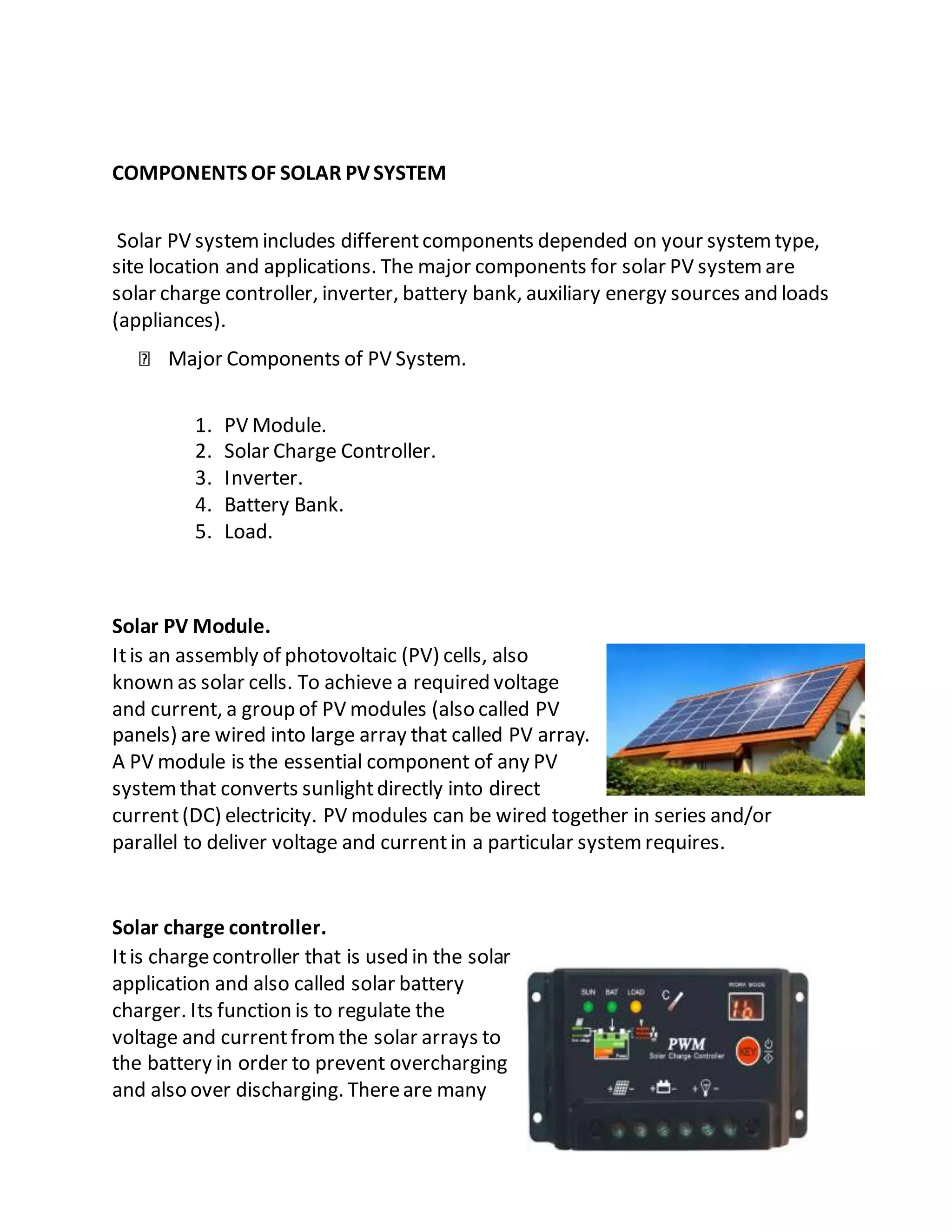
Solar PV Module.
Itis an assembly of photovoltaic (PV) cells, also
known as solar cells. To achieve a required voltage
and current, a group of PV modules (also called PV
panels) are wired into large array that called PV array.
A PV module is the essential component of any PV
systemthat converts sunlightdirectly into direct
current(DC) electricity. PV modules can be wired together in series and/or
parallel to deliver voltage and currentin a particular systemrequires.
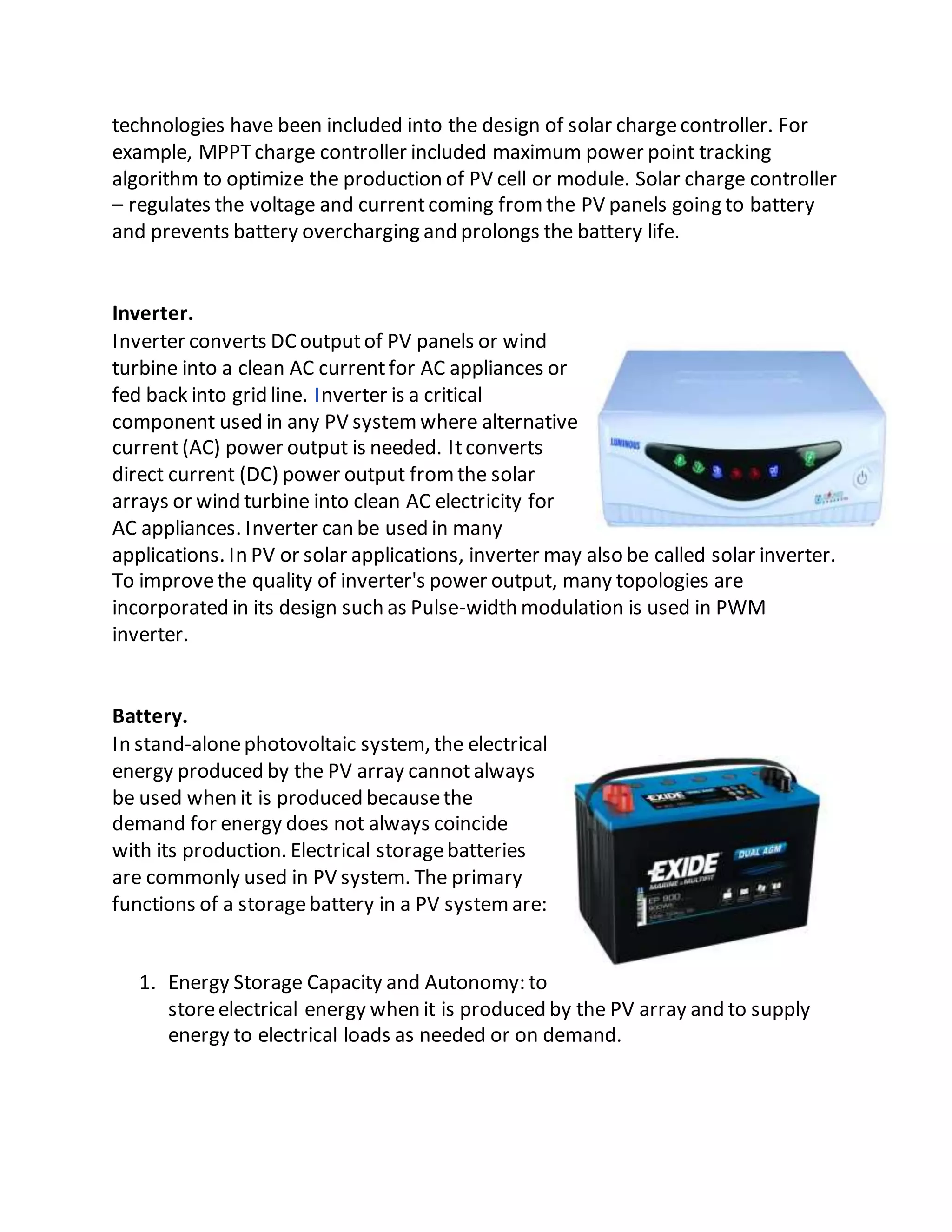
Solar charge controller.
Itis chargecontroller that is used in the solar
application and also called solar battery
charger. Its function is to regulate the
voltage and currentfromthe solar arrays to
the battery in order to prevent overcharging
and also over discharging. Thereare many
technologies have been included into the design of solar chargecontroller. For
example, MPPTcharge controller included maximum power point tracking
algorithm to optimize the production of PV cell or module. Solar charge controller
– regulates the voltage and currentcoming fromthe PV panels going to battery
and prevents battery overcharging and prolongs the battery life.
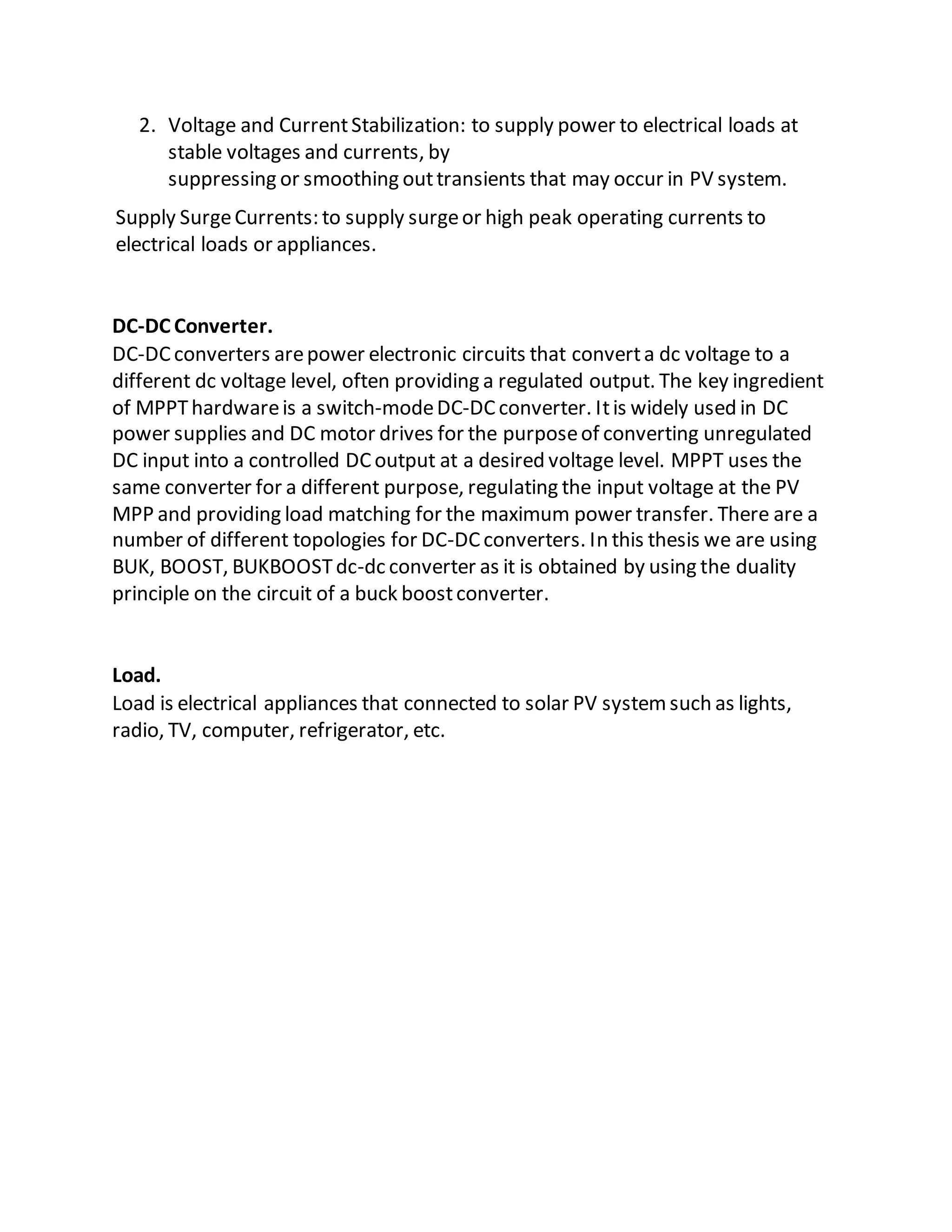
Inverter.
Inverter converts DCoutputof PV panels or wind
turbine into a clean AC currentfor AC appliances or
fed back into grid line. Inverter is a critical
component used in any PV systemwhere alternative
current(AC) power output is needed. Itconverts
direct current (DC) power output fromthe solar
arrays or wind turbine into clean AC electricity for
AC appliances. Inverter can be used in many
applications. In PV or solar applications, inverter may also be called solar inverter.
To improvethe quality of inverter's power output, many topologies are
incorporated in its design such as Pulse-width modulation is used in PWM
inverter.
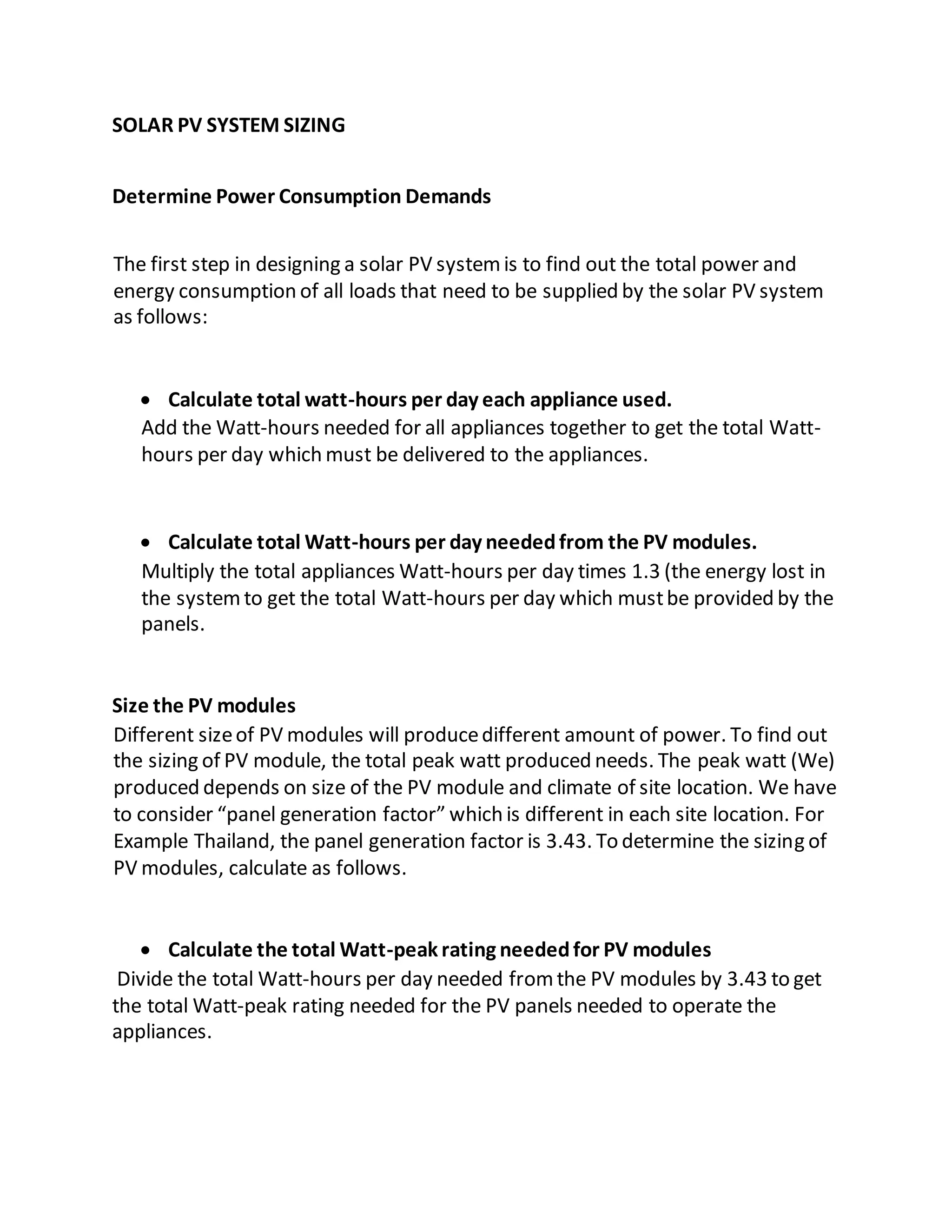
Battery.
In stand-alonephotovoltaic system, the electrical
energy produced by the PV array cannotalways
be used when it is produced becausethe
demand for energy does not always coincide
with its production. Electrical storagebatteries
are commonly used in PV system. The primary
functions of a storagebattery in a PV systemare:
1. Energy Storage Capacity and Autonomy: to
storeelectrical energy when it is produced by the PV array and to supply
energy to electrical loads as needed or on demand.
2. Voltage and CurrentStabilization: to supply power to electrical loads at
stable voltages and currents, by
suppressing or smoothing outtransients that may occur in PV system.
Supply SurgeCurrents: to supply surgeor high peak operating currents to
electrical loads or appliances.
DC-DC Converter.
DC-DC converters arepower electronic circuits that converta dc voltage to a
different dc voltage level, often providing a regulated output. The key ingredient
of MPPThardwareis a switch-modeDC-DCconverter. Itis widely used in DC
power supplies and DC motor drives for the purposeof converting unregulated
DC input into a controlled DCoutput at a desired voltage level. MPPT uses the
same converter for a different purpose, regulating the input voltage at the PV
MPP and providing load matching for the maximum power transfer. There are a
number of different topologies for DC-DCconverters. In this thesis we are using
BUK, BOOST, BUKBOOSTdc-dc converter as it is obtained by using the duality
principle on the circuit of a buck boostconverter.
Load.
Load is electrical appliances that connected to solar PV systemsuch as lights,
radio, TV, computer, refrigerator, etc.
SOLAR PV SYSTEM SIZING
Determine Power Consumption Demands
The first step in designing a solar PV systemis to find out the total power and
energy consumption of all loads that need to be supplied by the solar PV system
as follows:
 Calculate total watt-hours per day each appliance used.
Add the Watt-hours needed for all appliances together to get the total Watt-
hours per day which must be delivered to the appliances.
 Calculate total Watt-hours per day neededfrom the PV modules.
Multiply the total appliances Watt-hours per day times 1.3 (the energy lost in
the systemto get the total Watt-hours per day which mustbe provided by the
panels.
Size the PV modules
Different sizeof PV modules will producedifferent amount of power. To find out
the sizing of PV module, the total peak watt produced needs. The peak watt (We)
produced depends on size of the PV module and climate of site location. We have
to consider “panel generation factor” which is different in each site location. For
Example Thailand, the panel generation factor is 3.43. To determine the sizing of
PV modules, calculate as follows.
 Calculate the total Watt-peak rating neededfor PV modules
Divide the total Watt-hours per day needed fromthe PV modules by 3.43 to get
the total Watt-peak rating needed for the PV panels needed to operate the
appliances.
 Calculate the number of PV panels for the system
Divide the answer obtained in Calculate total Watt-hours per day needed from
the PV modules by the rated output Watt-peak of the PV modules available to
you. Increaseany fractionalpart of resultto the next highest full number and that
will be the number of PV modules required.
Result of the calculation is the minimum number of PV panels. If morePV
modules are installed, the systemwill performbetter and battery life will be
improved. If fewer PV modules are used, the systemmay not work at all during
cloudy periods and battery life will be shortened.
Inverter sizing
An inverter is used in the systemwhereAC power output is needed. The input
rating of the inverter should never be lower than the total watt of appliances. The
inverter musthave the same nominal voltage as your battery.
For stand-alonesystems, the inverter must be large enough to handle the total
amount of Watts you will be using at one time. The inverter sizeshould be 25-
30% bigger than total Watts of appliances. In caseof appliance type is motor or
compressor then inverter size should be minimum 3 times the capacity of those
appliances and must be added to the inverter capacity to handle surgecurrent
during starting.
For grid tie systems or grid connected systems, the input rating of the inverter
should be same as PV array rating to
allow for safe and efficient operation.
Inverter size= 1MW/1.3 = 1.3MW.
Battery sizing
The battery type recommended for using in solar PV system is deep cycle battery.
Deep cycle battery is specifically designed for to be discharged to low energy level
and rapid recharged or cycle charged and discharged day after day for years. The
battery should be large enough to store sufficientenergy to operate the
appliances at night and cloudy days. To find out the sizeof battery, calculate as
follows:
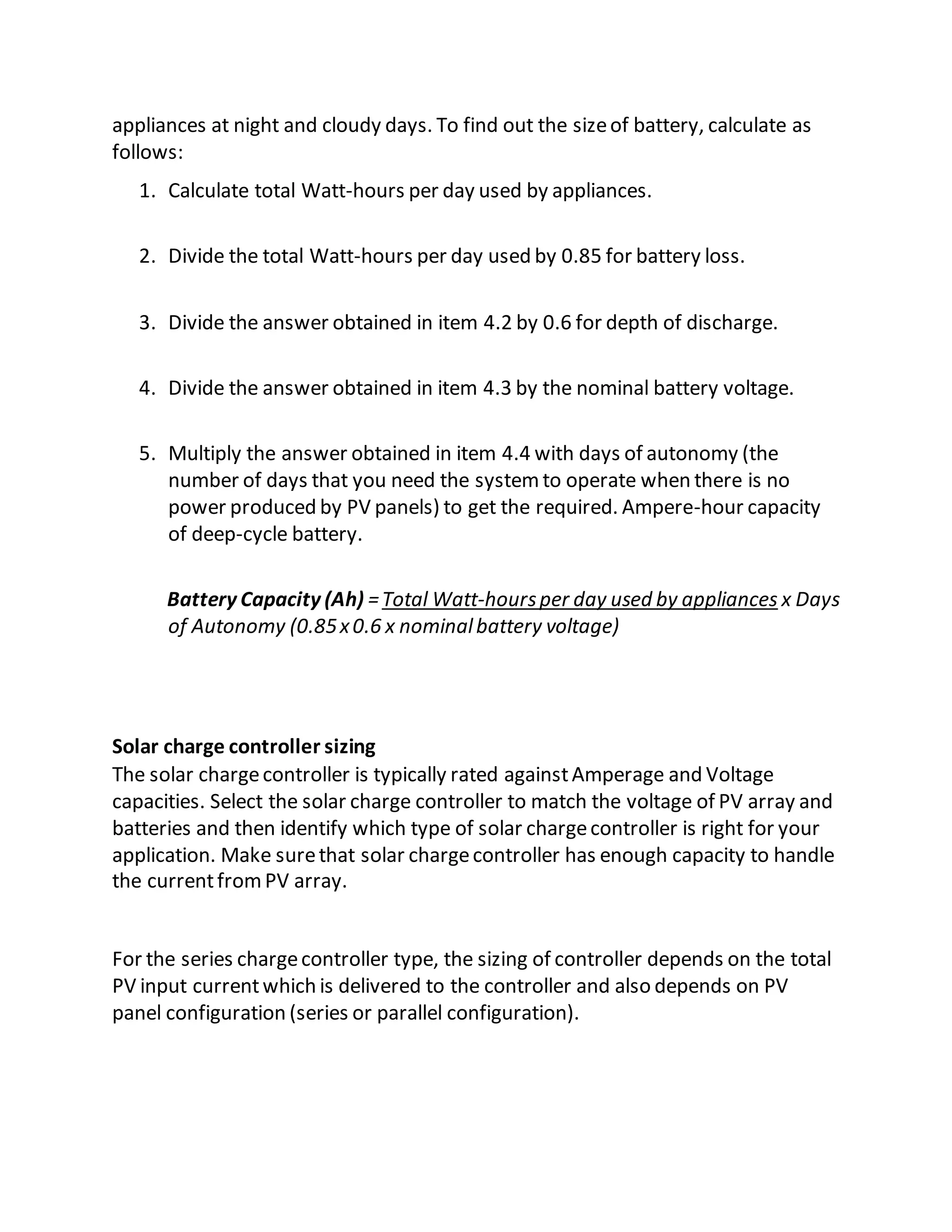
1. Calculate total Watt-hours per day used by appliances.
2. Divide the total Watt-hours per day used by 0.85 for battery loss.
3. Divide the answer obtained in item 4.2 by 0.6 for depth of discharge.
4. Divide the answer obtained in item 4.3 by the nominal battery voltage.
5. Multiply the answer obtained in item 4.4 with days of autonomy (the
number of days that you need the systemto operate when there is no
power produced by PV panels) to get the required. Ampere-hour capacity
of deep-cycle battery.
Battery Capacity (Ah) =Total Watt-hoursper day used by appliances x Days
of Autonomy (0.85x0.6 x nominalbattery voltage)
Solar charge controller sizing
The solar chargecontroller is typically rated againstAmperage and Voltage
capacities. Select the solar charge controller to match the voltage of PV array and
batteries and then identify which type of solar chargecontroller is right for your
application. Make surethat solar chargecontroller has enough capacity to handle
the currentfromPV array.
For the series chargecontroller type, the sizing of controller depends on the total
PV input currentwhich is delivered to the controller and also depends on PV
panel configuration (series or parallel configuration).
According to standard practice, the sizing of solar charge controller is to take the
shortcircuit current(Isc) of the PV array, and multiply it by 1.3
Solar charge controller rating = Total shortcircuit currentof PV array x 1.3
LOAD CALCULATION
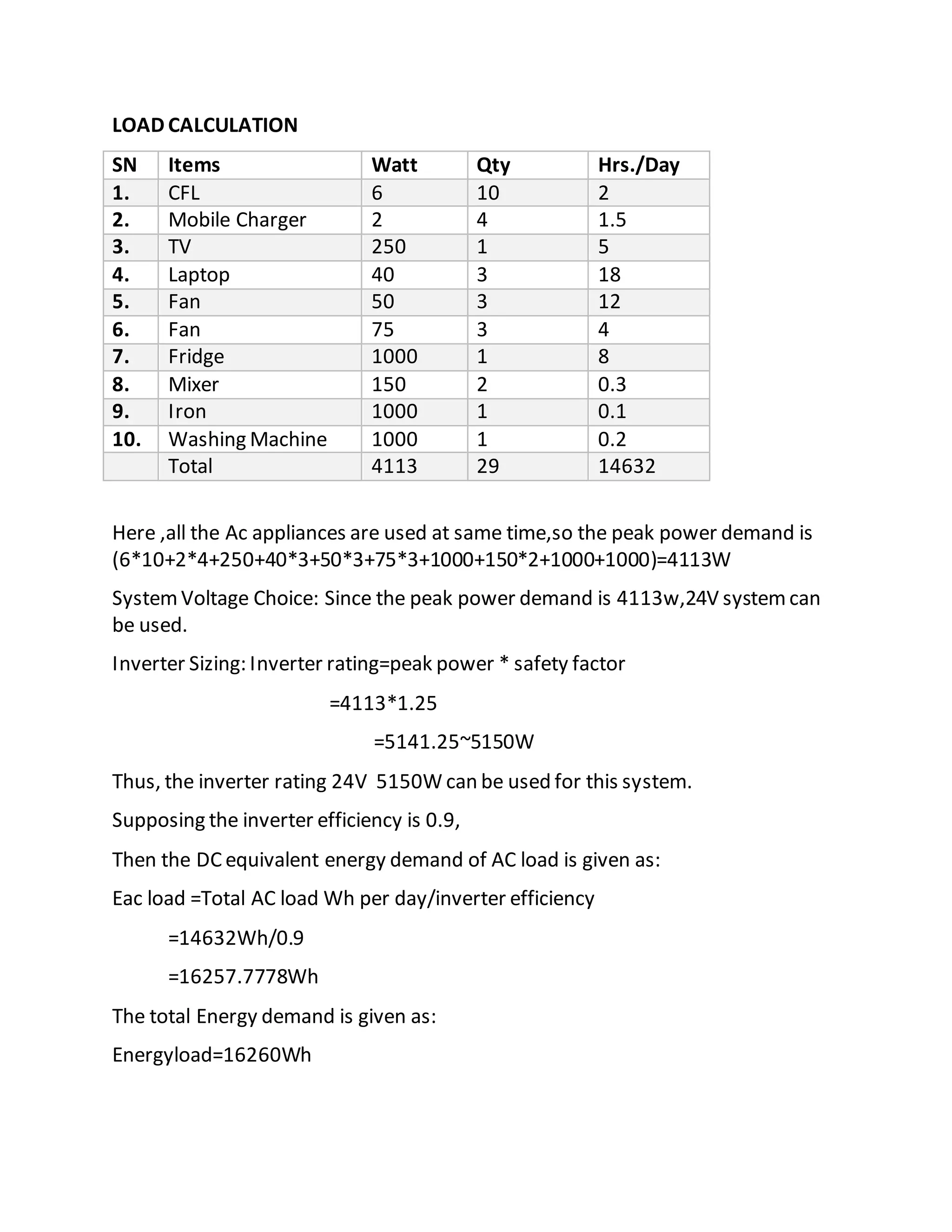
SN Items Watt Qty Hrs./Day
1. CFL 6 10 2
2. Mobile Charger 2 4 1.5
3. TV 250 1 5
4. Laptop 40 3 18
5. Fan 50 3 12
6. Fan 75 3 4
7. Fridge 1000 1 8
8. Mixer 150 2 0.3
9. Iron 1000 1 0.1
10. Washing Machine 1000 1 0.2
Total 4113 29 14632
Here ,all the Ac appliances are used at same time,so the peak power demand is
(6*10+2*4+250+40*3+50*3+75*3+1000+150*2+1000+1000)=4113W
SystemVoltage Choice: Since the peak power demand is 4113w,24V systemcan
be used.
Inverter Sizing: Inverter rating=peak power * safety factor
=4113*1.25
=5141.25~5150W
Thus, the inverter rating 24V 5150W can be used for this system.
Supposing the inverter efficiency is 0.9,
Then the DC equivalent energy demand of AC load is given as:
Eac load =Total AC load Wh per day/inverter efficiency
=14632Wh/0.9
=16257.7778Wh
The total Energy demand is given as:
Energyload=16260Wh
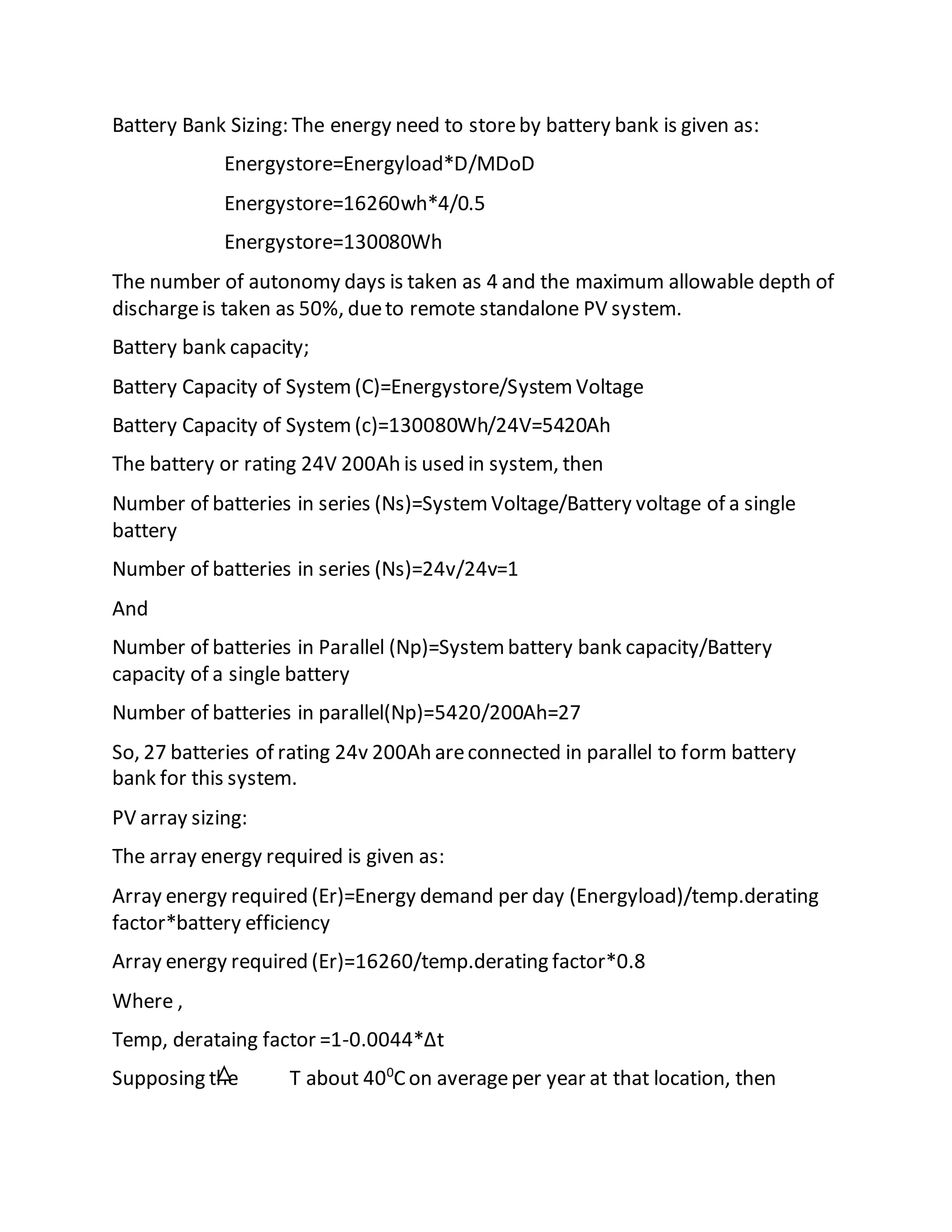
Battery Bank Sizing: The energy need to storeby battery bank is given as:
Energystore=Energyload*D/MDoD
Energystore=16260wh*4/0.5
Energystore=130080Wh
The number of autonomy days is taken as 4 and the maximum allowable depth of
dischargeis taken as 50%, dueto remote standalone PV system.
Battery bank capacity;
Battery Capacity of System(C)=Energystore/SystemVoltage
Battery Capacity of System(c)=130080Wh/24V=5420Ah
The battery or rating 24V 200Ah is used in system, then
Number of batteries in series (Ns)=SystemVoltage/Battery voltage of a single
battery
Number of batteries in series (Ns)=24v/24v=1
And
Number of batteries in Parallel (Np)=Systembattery bank capacity/Battery
capacity of a single battery
Number of batteries in parallel(Np)=5420/200Ah=27
So, 27 batteries of rating 24v 200Ah areconnected in parallel to form battery
bank for this system.
PV array sizing:
The array energy required is given as:
Array energy required (Er)=Energy demand per day (Energyload)/temp.derating
factor*battery efficiency
Array energy required (Er)=16260/temp.derating factor*0.8
Where ,
Temp, derataing factor =1-0.0044*Δt
Supposing the T about 400
Con averageper year at that location, then
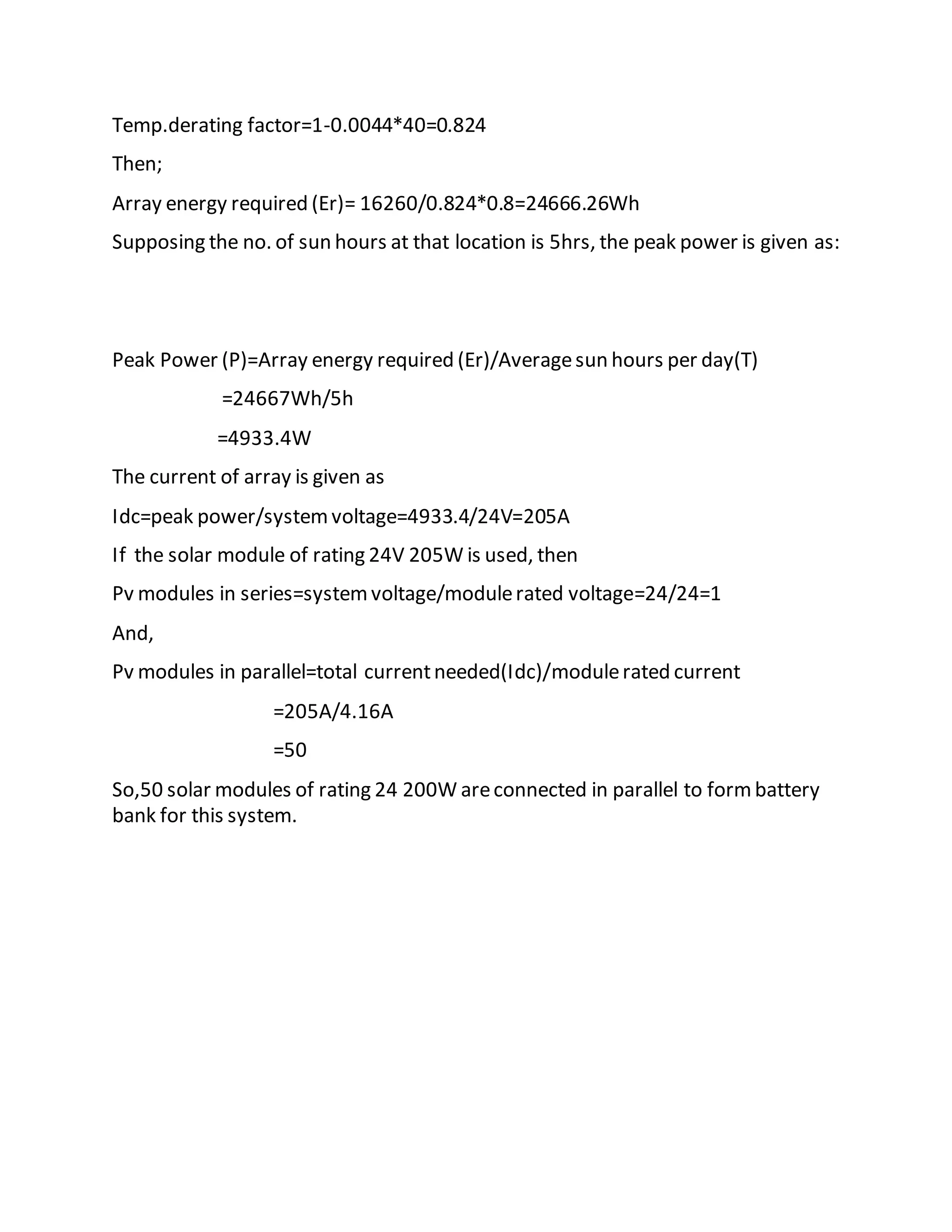
Temp.derating factor=1-0.0044*40=0.824
Then;
Array energy required (Er)= 16260/0.824*0.8=24666.26Wh
Supposing the no. of sun hours at that location is 5hrs, the peak power is given as:
Peak Power (P)=Array energy required (Er)/Averagesun hours per day(T)
=24667Wh/5h
=4933.4W
The current of array is given as
Idc=peak power/systemvoltage=4933.4/24V=205A
If the solar module of rating 24V 205W is used, then
Pv modules in series=systemvoltage/modulerated voltage=24/24=1
And,
Pv modules in parallel=total currentneeded(Idc)/modulerated current
=205A/4.16A
=50
So,50 solar modules of rating 24 200W areconnected in parallel to formbattery
bank for this system.
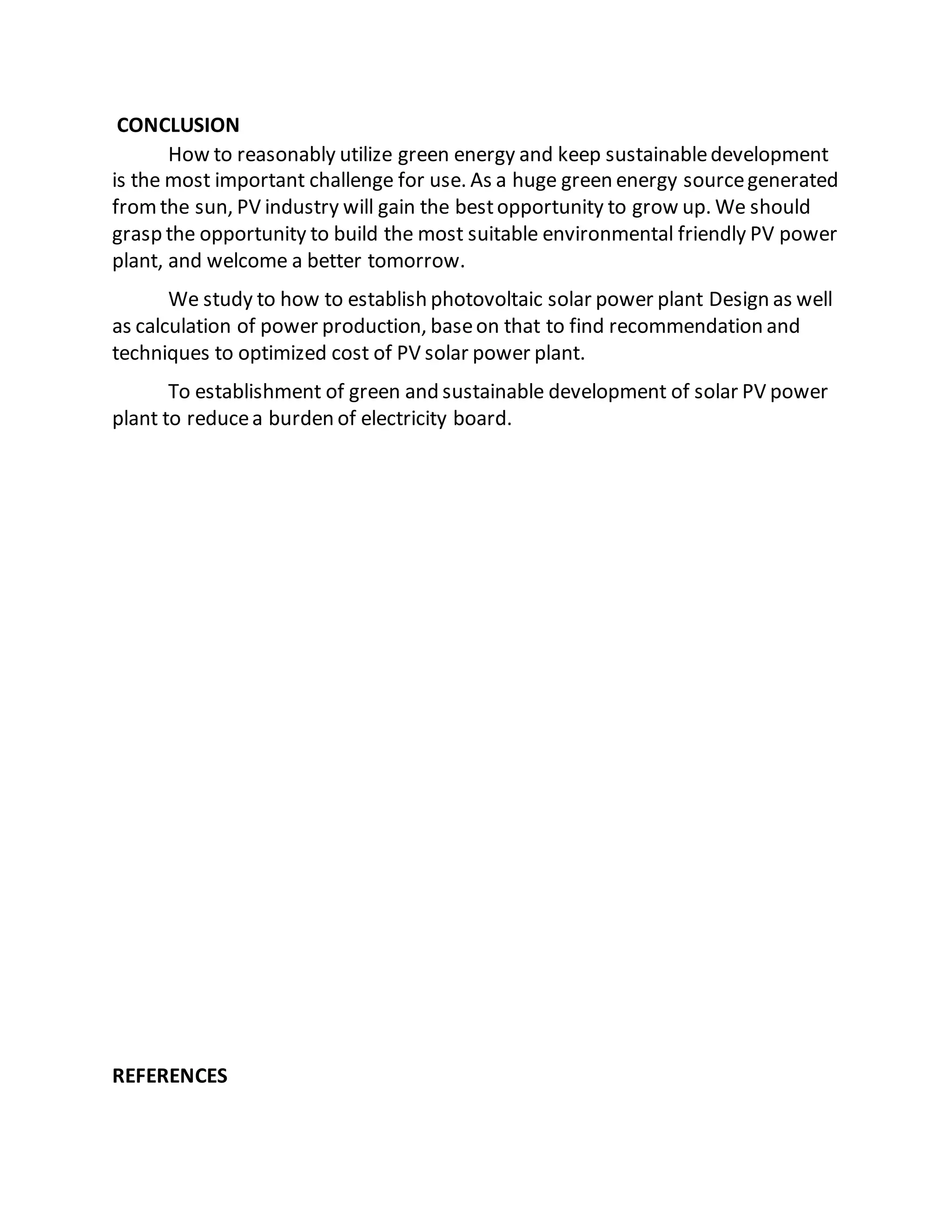
CONCLUSION
How to reasonably utilize green energy and keep sustainabledevelopment
is the most important challenge for use. As a huge green energy sourcegenerated
fromthe sun, PV industry will gain the bestopportunity to grow up. We should
grasp the opportunity to build the most suitable environmental friendly PV power
plant, and welcome a better tomorrow.
We study to how to establish photovoltaic solar power plant Design as well
as calculation of power production, baseon that to find recommendation and
techniques to optimized cost of PV solar power plant.
To establishment of green and sustainable development of solar PV power
plant to reducea burden of electricity board.
REFERENCES
[1]. Mevin Chandel, G. D. Agrawal, Sanjay Mathur, Anuj Mathur, “Techno-
Economic Analysis of Solar Photovoltaic power plant for garmentzone of
jaipur city.” ELSEVIER., (2013).
[2]. Hua Lan, Zhi-min Liao, Tian-gang Yuan, Feng Zhu, “Calculation of PV Power
Station Access”, ELSEVIER., (2012).
[3]. A.uzzi, K. Lovegrove, E. Filippi, H. Fricker and M. Chandapillai, “A 10 MWe
Base-Load Solar Power Plant” Siemens Power Generation, 207 Jalan Tun
Razak, 50400 Kuala Lumpur (Malaysia),(1997)
[4]. Souvik Ganguli1, Sunanda Sinha2, “Design of A 11 KWp Grid Connected
Solar Photovoltaic Plant On 100”, TUTA/IOE/PCU, (2010).
[5]. Tiberiu Tudorache1, Liviu Kreindler1, “Design of A Solar Tracker SystemFor
PV Power Plants”, Acta Polytechnica Hungarica, (2010).
[6]. P. J. van Duijsen, Simulation Research, The Netherlands, “Modeling Grid
Connection For Solar and Wind Energy’’, Frank Chen, Pitotech, Taiwan.
BOOK
[1]. “SOLARPHOTOVOLTAICS FUNDAMENTALS, TECHNOLOGIES AND
APPLICATION” by Chetan Singh Solanki,2nd
Edition 2012.

A report on Solar Load Calculation

  • 1.
    A REPORT ON SOLAR LOADCALCULATION 2017 SUBMITTED TO: Ashish Shrestha SUBMITTED BY: Milan Ghimire Ele 8th sem Roll:21 milanghimire.com.np
  • 2.
    ABSTRACT: Weare wellknown that the rapidly growth of business and population are putting more and more pressureon world power resources. Photovoltaic Solar Power plant price will play a vital role in the larger development of solar power generation. So it is most importance that to developed new methodology and techniques for reduced costof solar power plant. How to reasonably utilize green energy and keep sustainabledevelopment is the most importantchallenge for use. As a huge green energy sourcegenerated from the sun, PV industry will gain the best opportunity to grow up. We should grasp the opportunity to build the mostsuitable environmental friendly PV power plant, and welcome a better tomorrow. In this paper we study how to establish photovoltaic solar power plant Design as well as calculation of power production, base on that to further we find recommendation and techniques to optimized costof PV solar power plant. To establishment of green and sustainable development of solar PV power plant to reduce a burden of state electricity board.
  • 3.
    Table of Contents INTRODUCTION.................................................................................................4 COMPONENTS OF SOLAR PV SYSTEM ................................................................ 5 Solar PV Module. ............................................................................................ 5 Solar charge controller.................................................................................... 5 Inverter.......................................................................................................... 6 Battery. .......................................................................................................... 6 DC-DC Converter............................................................................................. 7 Load............................................................................................................... 7 SOLAR PV SYSTEM SIZING.................................................................................. 8 Determine Power Consumption Demands ....................................................... 8 Calculate total watt-hours per day each appliance used. ......................... 8 Calculate total Watt-hours per day needed from the PV modules............ 8 Size the PV modules........................................................................................ 8 Calculate the total Watt-peak rating needed for PV modules................... 8 Calculate the number of PV panels for the system................................... 9 Inverter sizing................................................................................................. 9 Battery sizing.................................................................................................. 9 Solar charge controller sizing......................................................................... 10 LOAD CALCULATION........................................................................................ 12 CONCLUSION................................................................................................... 15 REFERENCES.................................................................................................... 15
  • 4.
    INTRODUCTION Nepal has verygood conditions for the development of photovoltaic solar power systems duemainly to the high mean daily radiation and the high number of sunny days in most parts of the country. For this reason, the Administration and companies working in the sector are developing policies and investing in photovoltaic solar power systems. Oneof the best features of rooftop solar PV systems is that they can be permitted and installed faster than other types of renewable power plants. They are clean, quiet, and visually unobtrusive. Users won’teven know that the rooftop plants are working there. Keeping in view the impending shortfalls in conventional power generating sources and growing demand of energy, it is important to go for non conventional sources. In this research work to study renewable energy systemwhich is uses PV modules to convert sunlightinto electricity. Solar PV system is very reliable and clean sourceof electricity that can suit a wide range of applications such as residence, industry, agriculture, livestock, etc. PV systems aredesigned and sized to meet a given load requirement. PV system sizing exercise involves the determination of the sizeand capacity of various components, like PV panels, batteries, etc. PV systemdesign also involves a decision on which configuration is to be adopted to meet the load requirement. Once the systemconfiguration is decide then the size or capacity of the various components are calculated. A low quality component (chargecontroller, for instance) may be cheaper initially but probably will be less efficient and may not last longer. On the other hand, a relatively expensive but higher quality component is morelikely to performbetter (saving energy and thus cost) and may be able to recover its costin the long run.
  • 5.
    COMPONENTS OF SOLARPVSYSTEM Solar PV systemincludes differentcomponents depended on your systemtype, site location and applications. The major components for solar PV systemare solar charge controller, inverter, battery bank, auxiliary energy sources and loads (appliances). Major Components of PV System. 1. PV Module. 2. Solar Charge Controller. 3. Inverter. 4. Battery Bank. 5. Load. Solar PV Module. Itis an assembly of photovoltaic (PV) cells, also known as solar cells. To achieve a required voltage and current, a group of PV modules (also called PV panels) are wired into large array that called PV array. A PV module is the essential component of any PV systemthat converts sunlightdirectly into direct current(DC) electricity. PV modules can be wired together in series and/or parallel to deliver voltage and currentin a particular systemrequires. Solar charge controller. Itis chargecontroller that is used in the solar application and also called solar battery charger. Its function is to regulate the voltage and currentfromthe solar arrays to the battery in order to prevent overcharging and also over discharging. Thereare many
  • 6.
    technologies have beenincluded into the design of solar chargecontroller. For example, MPPTcharge controller included maximum power point tracking algorithm to optimize the production of PV cell or module. Solar charge controller – regulates the voltage and currentcoming fromthe PV panels going to battery and prevents battery overcharging and prolongs the battery life. Inverter. Inverter converts DCoutputof PV panels or wind turbine into a clean AC currentfor AC appliances or fed back into grid line. Inverter is a critical component used in any PV systemwhere alternative current(AC) power output is needed. Itconverts direct current (DC) power output fromthe solar arrays or wind turbine into clean AC electricity for AC appliances. Inverter can be used in many applications. In PV or solar applications, inverter may also be called solar inverter. To improvethe quality of inverter's power output, many topologies are incorporated in its design such as Pulse-width modulation is used in PWM inverter. Battery. In stand-alonephotovoltaic system, the electrical energy produced by the PV array cannotalways be used when it is produced becausethe demand for energy does not always coincide with its production. Electrical storagebatteries are commonly used in PV system. The primary functions of a storagebattery in a PV systemare: 1. Energy Storage Capacity and Autonomy: to storeelectrical energy when it is produced by the PV array and to supply energy to electrical loads as needed or on demand.
  • 7.
    2. Voltage andCurrentStabilization: to supply power to electrical loads at stable voltages and currents, by suppressing or smoothing outtransients that may occur in PV system. Supply SurgeCurrents: to supply surgeor high peak operating currents to electrical loads or appliances. DC-DC Converter. DC-DC converters arepower electronic circuits that converta dc voltage to a different dc voltage level, often providing a regulated output. The key ingredient of MPPThardwareis a switch-modeDC-DCconverter. Itis widely used in DC power supplies and DC motor drives for the purposeof converting unregulated DC input into a controlled DCoutput at a desired voltage level. MPPT uses the same converter for a different purpose, regulating the input voltage at the PV MPP and providing load matching for the maximum power transfer. There are a number of different topologies for DC-DCconverters. In this thesis we are using BUK, BOOST, BUKBOOSTdc-dc converter as it is obtained by using the duality principle on the circuit of a buck boostconverter. Load. Load is electrical appliances that connected to solar PV systemsuch as lights, radio, TV, computer, refrigerator, etc.
  • 8.
    SOLAR PV SYSTEMSIZING Determine Power Consumption Demands The first step in designing a solar PV systemis to find out the total power and energy consumption of all loads that need to be supplied by the solar PV system as follows:  Calculate total watt-hours per day each appliance used. Add the Watt-hours needed for all appliances together to get the total Watt- hours per day which must be delivered to the appliances.  Calculate total Watt-hours per day neededfrom the PV modules. Multiply the total appliances Watt-hours per day times 1.3 (the energy lost in the systemto get the total Watt-hours per day which mustbe provided by the panels. Size the PV modules Different sizeof PV modules will producedifferent amount of power. To find out the sizing of PV module, the total peak watt produced needs. The peak watt (We) produced depends on size of the PV module and climate of site location. We have to consider “panel generation factor” which is different in each site location. For Example Thailand, the panel generation factor is 3.43. To determine the sizing of PV modules, calculate as follows.  Calculate the total Watt-peak rating neededfor PV modules Divide the total Watt-hours per day needed fromthe PV modules by 3.43 to get the total Watt-peak rating needed for the PV panels needed to operate the appliances.
  • 9.
     Calculate thenumber of PV panels for the system Divide the answer obtained in Calculate total Watt-hours per day needed from the PV modules by the rated output Watt-peak of the PV modules available to you. Increaseany fractionalpart of resultto the next highest full number and that will be the number of PV modules required. Result of the calculation is the minimum number of PV panels. If morePV modules are installed, the systemwill performbetter and battery life will be improved. If fewer PV modules are used, the systemmay not work at all during cloudy periods and battery life will be shortened. Inverter sizing An inverter is used in the systemwhereAC power output is needed. The input rating of the inverter should never be lower than the total watt of appliances. The inverter musthave the same nominal voltage as your battery. For stand-alonesystems, the inverter must be large enough to handle the total amount of Watts you will be using at one time. The inverter sizeshould be 25- 30% bigger than total Watts of appliances. In caseof appliance type is motor or compressor then inverter size should be minimum 3 times the capacity of those appliances and must be added to the inverter capacity to handle surgecurrent during starting. For grid tie systems or grid connected systems, the input rating of the inverter should be same as PV array rating to allow for safe and efficient operation. Inverter size= 1MW/1.3 = 1.3MW. Battery sizing The battery type recommended for using in solar PV system is deep cycle battery. Deep cycle battery is specifically designed for to be discharged to low energy level and rapid recharged or cycle charged and discharged day after day for years. The battery should be large enough to store sufficientenergy to operate the
  • 10.
    appliances at nightand cloudy days. To find out the sizeof battery, calculate as follows: 1. Calculate total Watt-hours per day used by appliances. 2. Divide the total Watt-hours per day used by 0.85 for battery loss. 3. Divide the answer obtained in item 4.2 by 0.6 for depth of discharge. 4. Divide the answer obtained in item 4.3 by the nominal battery voltage. 5. Multiply the answer obtained in item 4.4 with days of autonomy (the number of days that you need the systemto operate when there is no power produced by PV panels) to get the required. Ampere-hour capacity of deep-cycle battery. Battery Capacity (Ah) =Total Watt-hoursper day used by appliances x Days of Autonomy (0.85x0.6 x nominalbattery voltage) Solar charge controller sizing The solar chargecontroller is typically rated againstAmperage and Voltage capacities. Select the solar charge controller to match the voltage of PV array and batteries and then identify which type of solar chargecontroller is right for your application. Make surethat solar chargecontroller has enough capacity to handle the currentfromPV array. For the series chargecontroller type, the sizing of controller depends on the total PV input currentwhich is delivered to the controller and also depends on PV panel configuration (series or parallel configuration).
  • 11.
    According to standardpractice, the sizing of solar charge controller is to take the shortcircuit current(Isc) of the PV array, and multiply it by 1.3 Solar charge controller rating = Total shortcircuit currentof PV array x 1.3
  • 12.
    LOAD CALCULATION SN ItemsWatt Qty Hrs./Day 1. CFL 6 10 2 2. Mobile Charger 2 4 1.5 3. TV 250 1 5 4. Laptop 40 3 18 5. Fan 50 3 12 6. Fan 75 3 4 7. Fridge 1000 1 8 8. Mixer 150 2 0.3 9. Iron 1000 1 0.1 10. Washing Machine 1000 1 0.2 Total 4113 29 14632 Here ,all the Ac appliances are used at same time,so the peak power demand is (6*10+2*4+250+40*3+50*3+75*3+1000+150*2+1000+1000)=4113W SystemVoltage Choice: Since the peak power demand is 4113w,24V systemcan be used. Inverter Sizing: Inverter rating=peak power * safety factor =4113*1.25 =5141.25~5150W Thus, the inverter rating 24V 5150W can be used for this system. Supposing the inverter efficiency is 0.9, Then the DC equivalent energy demand of AC load is given as: Eac load =Total AC load Wh per day/inverter efficiency =14632Wh/0.9 =16257.7778Wh The total Energy demand is given as: Energyload=16260Wh
  • 13.
    Battery Bank Sizing:The energy need to storeby battery bank is given as: Energystore=Energyload*D/MDoD Energystore=16260wh*4/0.5 Energystore=130080Wh The number of autonomy days is taken as 4 and the maximum allowable depth of dischargeis taken as 50%, dueto remote standalone PV system. Battery bank capacity; Battery Capacity of System(C)=Energystore/SystemVoltage Battery Capacity of System(c)=130080Wh/24V=5420Ah The battery or rating 24V 200Ah is used in system, then Number of batteries in series (Ns)=SystemVoltage/Battery voltage of a single battery Number of batteries in series (Ns)=24v/24v=1 And Number of batteries in Parallel (Np)=Systembattery bank capacity/Battery capacity of a single battery Number of batteries in parallel(Np)=5420/200Ah=27 So, 27 batteries of rating 24v 200Ah areconnected in parallel to form battery bank for this system. PV array sizing: The array energy required is given as: Array energy required (Er)=Energy demand per day (Energyload)/temp.derating factor*battery efficiency Array energy required (Er)=16260/temp.derating factor*0.8 Where , Temp, derataing factor =1-0.0044*Δt Supposing the T about 400 Con averageper year at that location, then
  • 14.
    Temp.derating factor=1-0.0044*40=0.824 Then; Array energyrequired (Er)= 16260/0.824*0.8=24666.26Wh Supposing the no. of sun hours at that location is 5hrs, the peak power is given as: Peak Power (P)=Array energy required (Er)/Averagesun hours per day(T) =24667Wh/5h =4933.4W The current of array is given as Idc=peak power/systemvoltage=4933.4/24V=205A If the solar module of rating 24V 205W is used, then Pv modules in series=systemvoltage/modulerated voltage=24/24=1 And, Pv modules in parallel=total currentneeded(Idc)/modulerated current =205A/4.16A =50 So,50 solar modules of rating 24 200W areconnected in parallel to formbattery bank for this system.
  • 15.
    CONCLUSION How to reasonablyutilize green energy and keep sustainabledevelopment is the most important challenge for use. As a huge green energy sourcegenerated fromthe sun, PV industry will gain the bestopportunity to grow up. We should grasp the opportunity to build the most suitable environmental friendly PV power plant, and welcome a better tomorrow. We study to how to establish photovoltaic solar power plant Design as well as calculation of power production, baseon that to find recommendation and techniques to optimized cost of PV solar power plant. To establishment of green and sustainable development of solar PV power plant to reducea burden of electricity board. REFERENCES
  • 16.
    [1]. Mevin Chandel,G. D. Agrawal, Sanjay Mathur, Anuj Mathur, “Techno- Economic Analysis of Solar Photovoltaic power plant for garmentzone of jaipur city.” ELSEVIER., (2013). [2]. Hua Lan, Zhi-min Liao, Tian-gang Yuan, Feng Zhu, “Calculation of PV Power Station Access”, ELSEVIER., (2012). [3]. A.uzzi, K. Lovegrove, E. Filippi, H. Fricker and M. Chandapillai, “A 10 MWe Base-Load Solar Power Plant” Siemens Power Generation, 207 Jalan Tun Razak, 50400 Kuala Lumpur (Malaysia),(1997) [4]. Souvik Ganguli1, Sunanda Sinha2, “Design of A 11 KWp Grid Connected Solar Photovoltaic Plant On 100”, TUTA/IOE/PCU, (2010). [5]. Tiberiu Tudorache1, Liviu Kreindler1, “Design of A Solar Tracker SystemFor PV Power Plants”, Acta Polytechnica Hungarica, (2010). [6]. P. J. van Duijsen, Simulation Research, The Netherlands, “Modeling Grid Connection For Solar and Wind Energy’’, Frank Chen, Pitotech, Taiwan. BOOK [1]. “SOLARPHOTOVOLTAICS FUNDAMENTALS, TECHNOLOGIES AND APPLICATION” by Chetan Singh Solanki,2nd Edition 2012.