Transactional Leadership
Presented by : Aglaia
Transactional leadership
• It emphasizes results, stay within the existing structure of an
organization and measures success according to that
organization’s system of rewards and penalties.
• They hold the formal authority and positions of responsibility
in an organization & responsible for maintaining routine by
managing individual performance and facilitating group
performance.
• Transactional, or managerial, leaders set the standards
for workers and does performance reviews are the most
common way to judge employee performance.
Transactional leaders are expected to do the following,
• Set goals and give specific direction about what they
demand from the employee and how they will be rewarded
for their efforts.
• Provide productive feedback on performance.
• Focus on increasing the efficiency of established routines
and procedures and show concern for following existing
rules rather than making changes.
• Establish and standardize practices that will help the
organization become efficient and productive.
• Respond to deviations from expected outcomes and identify
corrective actions to improve performance.
Definition of Transactional Leadership
• They are more concerned with maintaining the normal flow of
operations.
• They use disciplinary power and an array of incentives to
motivate employees to perform at their best.
• The term “transactional” refers to the fact that this type of
leader essentially motivates subordinates by exchanging
rewards for performance.
• They does not look ahead to strategically guiding an
organization to a position of market leadership; instead, these
managers are solely concerned with making sure everything
flows smoothly today.
• It is based on the setting of clear goals and objectives for
followers and the use of reward and punishments to encourage
compliance.
• They are those who guide or motivate their followers towards
established goals by clarifying role and task requirement.
• They sometimes referred to as managerial leadership; focuses on
the interactions between leaders and followers.
• The core of transactional leadership lies in the notion that the
leader, who holds power and control his or her employees or
followers, provides incentives for followers to do what the leader
wants.
• They utilize rewards and punishments to motivate .their
followers. While it has limitations, it can be effective in certain
situations.
• It can work well in cases where the problems are clear-cut and
simple.
• One of the major problems with this style is that it does not
encourage group members to look for solutions to problems or
to contribute creatively, which is why transactional leadership is
not the best choice in complex situations where input from group
members is required.
• It was first described by Max Weber in 1947 and then by
Bernard Bass in 1981.
• The exchange between leader and follower takes place to
achieve routine performance goals.
• Contingent Rewards: Transactional leaders link the goal to
rewards, clarify expectations, provide necessary resources, set
mutually agreed upon goals, and provide various kinds of
rewards for successful performance. They set SMART (specific,
measurable, attainable, realistic, and timely) goals for their
subordinates.
• Active Management by Exception: Transactional leaders
actively monitor the work of their subordinates, watch for
deviations from rules and standards and taking corrective action
to prevent mistakes.
• Passive Management by Exception: Transactional leaders
intervene only when standards are not met or when the
performance is not as per the expectations. They may even use
punishment as a response to unacceptable performance.
• Laissez-faire: The leader provides an environment where the
subordinates get many opportunities to make decisions. The leader
himself abdicates responsibilities and avoids making decisions and
therefore the group often lacks direction.
Assumptions of Transactional Theory
• Employees are motivated by reward and punishment.
• The subordinates have to obey the orders of the superior.
• The subordinates are not self-motivated.
• They have to be closely monitored and controlled to get the work
done from them.
Implications of Transactional Theory
• They overemphasize detailed and short-term goals, and standard rules
and procedures.
• They do not make an effort to enhance followers’ creativity and
generation of new ideas.
• This kind of a leadership style may work well where the
organizational problems are simple and clearly defined.
• Such leaders tend to not reward or ignore ideas that do not fit with
existing plans and goals.
• They are found to be quite effective in guiding efficiency decisions
which are aimed at cutting costs and improving productivity.
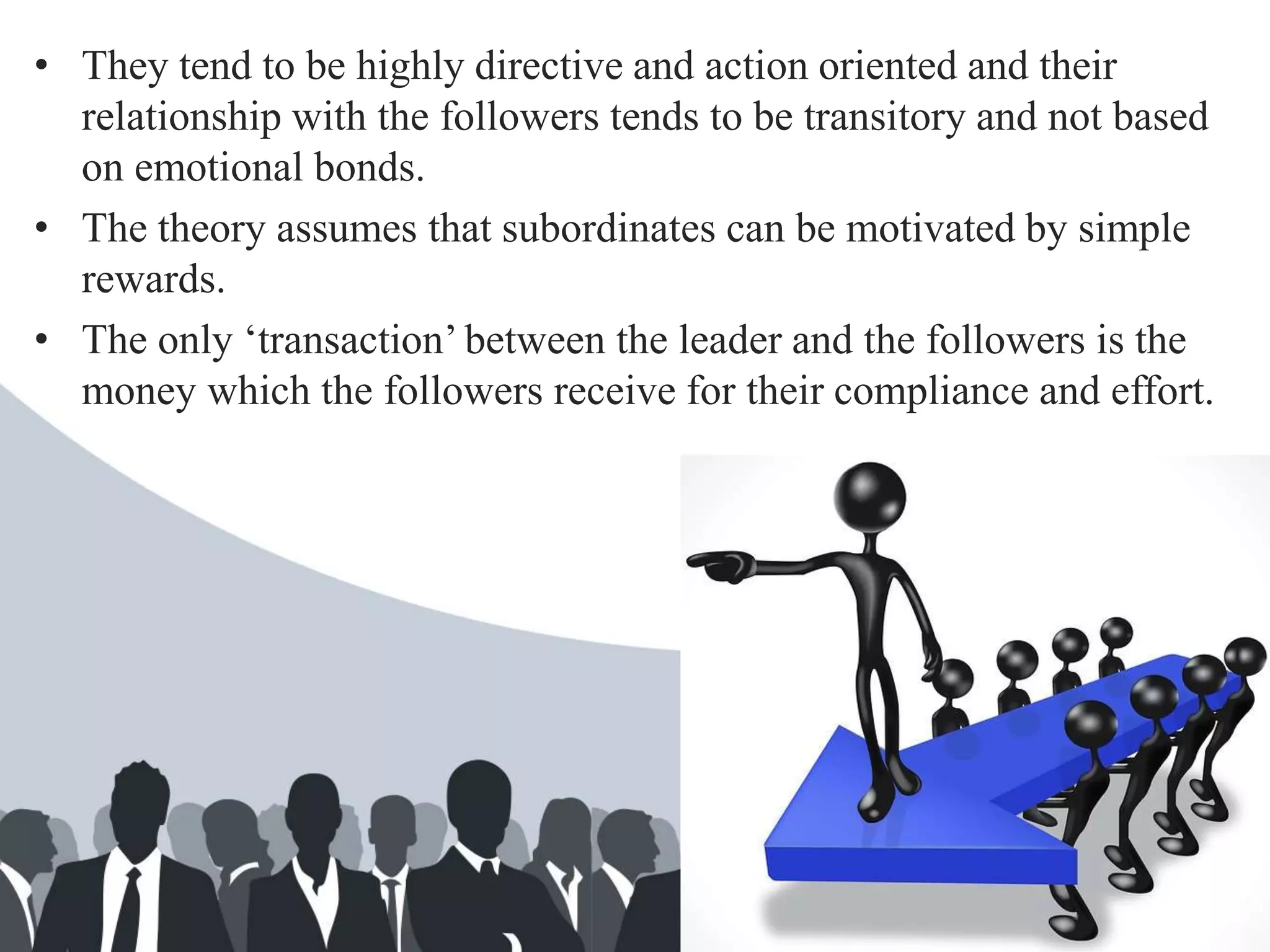
• They tend to be highly directive and action oriented and their
relationship with the followers tends to be transitory and not based
on emotional bonds.
• The theory assumes that subordinates can be motivated by simple
rewards.
• The only ‘transaction’ between the leader and the followers is the
money which the followers receive for their compliance and effort.
Characteristics of Transactional
Leadership
• Revel inefficiency.
• Very left-brained.
• Tend to be inflexible.
• Opposed to change.
• Focused on short-term goals.
• Favor structured policies and procedures.
• Thrive on following rules and doing things correctly.
Advantages of Transactional leadership
• Awards those who are motivated by self-interest to
follow instructions.
• Gives an unambiguous structure for large organizations,
systems requiring repetitive tasks and infinitely
reproducible environments.
• Achieves short-term goals quickly.
• Rewards and penalties are defined for workers.
Disadvantages of Transactional
leadership
• Rewards the worker on a practical level only, such as money
or perks.
• Creativity is limited since the goals and objectives are already
set.
• Does not reward personal initiative.
Examples of transactional leadership
• This model is likely to succeed in a crisis or in projects that
require linear and specific processes
• This model is also useful for big corporations, such as Hewlett-
Packard, a company known for its extensive use of management
by exception.
• Many high-level members of the military, CEOs of large
international companies, and NFL coaches are known to be
transactional leaders.
• They also works well with policing agencies and first responder
organizations.
• Bill Gates is a great example, a transactional leader.
• Bill Gates was born in Seattle in 1955. In his early teens, he met
Paul Allen at the Lakeside School, where they both developed
computer programs as a hobby.
• When Gates went to Harvard, Allen went to work as a
programmer for Honeywell in Boston. In 1975, they started
Microsoft, and by 1978, the company had grossed $2.5 million,
when Gates was 23. In 1985, Microsoft launched Windows.
• Bill Gates is now one of the richest and most influential people
in the world.
• As a transactional leader, he used to visit new product teams and
ask difficult questions until he was satisfied that the teams were
on track and understood the goal.
Thank you
For more…. Mail to aglaiaconnect2018@gmail.com

Transactional leadership

  • 1.
  • 2.
    Transactional leadership • Itemphasizes results, stay within the existing structure of an organization and measures success according to that organization’s system of rewards and penalties. • They hold the formal authority and positions of responsibility in an organization & responsible for maintaining routine by managing individual performance and facilitating group performance. • Transactional, or managerial, leaders set the standards for workers and does performance reviews are the most common way to judge employee performance.
  • 4.
    Transactional leaders areexpected to do the following, • Set goals and give specific direction about what they demand from the employee and how they will be rewarded for their efforts. • Provide productive feedback on performance. • Focus on increasing the efficiency of established routines and procedures and show concern for following existing rules rather than making changes. • Establish and standardize practices that will help the organization become efficient and productive. • Respond to deviations from expected outcomes and identify corrective actions to improve performance.
  • 5.
    Definition of TransactionalLeadership • They are more concerned with maintaining the normal flow of operations. • They use disciplinary power and an array of incentives to motivate employees to perform at their best. • The term “transactional” refers to the fact that this type of leader essentially motivates subordinates by exchanging rewards for performance. • They does not look ahead to strategically guiding an organization to a position of market leadership; instead, these managers are solely concerned with making sure everything flows smoothly today.
  • 6.
    • It isbased on the setting of clear goals and objectives for followers and the use of reward and punishments to encourage compliance. • They are those who guide or motivate their followers towards established goals by clarifying role and task requirement. • They sometimes referred to as managerial leadership; focuses on the interactions between leaders and followers. • The core of transactional leadership lies in the notion that the leader, who holds power and control his or her employees or followers, provides incentives for followers to do what the leader wants.
  • 7.
    • They utilizerewards and punishments to motivate .their followers. While it has limitations, it can be effective in certain situations. • It can work well in cases where the problems are clear-cut and simple. • One of the major problems with this style is that it does not encourage group members to look for solutions to problems or to contribute creatively, which is why transactional leadership is not the best choice in complex situations where input from group members is required. • It was first described by Max Weber in 1947 and then by Bernard Bass in 1981.
  • 8.
    • The exchangebetween leader and follower takes place to achieve routine performance goals. • Contingent Rewards: Transactional leaders link the goal to rewards, clarify expectations, provide necessary resources, set mutually agreed upon goals, and provide various kinds of rewards for successful performance. They set SMART (specific, measurable, attainable, realistic, and timely) goals for their subordinates. • Active Management by Exception: Transactional leaders actively monitor the work of their subordinates, watch for deviations from rules and standards and taking corrective action to prevent mistakes.
  • 9.
    • Passive Managementby Exception: Transactional leaders intervene only when standards are not met or when the performance is not as per the expectations. They may even use punishment as a response to unacceptable performance. • Laissez-faire: The leader provides an environment where the subordinates get many opportunities to make decisions. The leader himself abdicates responsibilities and avoids making decisions and therefore the group often lacks direction.
  • 10.
    Assumptions of TransactionalTheory • Employees are motivated by reward and punishment. • The subordinates have to obey the orders of the superior. • The subordinates are not self-motivated. • They have to be closely monitored and controlled to get the work done from them.
  • 11.
    Implications of TransactionalTheory • They overemphasize detailed and short-term goals, and standard rules and procedures. • They do not make an effort to enhance followers’ creativity and generation of new ideas. • This kind of a leadership style may work well where the organizational problems are simple and clearly defined. • Such leaders tend to not reward or ignore ideas that do not fit with existing plans and goals. • They are found to be quite effective in guiding efficiency decisions which are aimed at cutting costs and improving productivity.
  • 12.
    • They tendto be highly directive and action oriented and their relationship with the followers tends to be transitory and not based on emotional bonds. • The theory assumes that subordinates can be motivated by simple rewards. • The only ‘transaction’ between the leader and the followers is the money which the followers receive for their compliance and effort.
  • 14.
    Characteristics of Transactional Leadership •Revel inefficiency. • Very left-brained. • Tend to be inflexible. • Opposed to change. • Focused on short-term goals. • Favor structured policies and procedures. • Thrive on following rules and doing things correctly.
  • 15.
    Advantages of Transactionalleadership • Awards those who are motivated by self-interest to follow instructions. • Gives an unambiguous structure for large organizations, systems requiring repetitive tasks and infinitely reproducible environments. • Achieves short-term goals quickly. • Rewards and penalties are defined for workers.
  • 16.
    Disadvantages of Transactional leadership •Rewards the worker on a practical level only, such as money or perks. • Creativity is limited since the goals and objectives are already set. • Does not reward personal initiative.
  • 17.
  • 18.
    • This modelis likely to succeed in a crisis or in projects that require linear and specific processes • This model is also useful for big corporations, such as Hewlett- Packard, a company known for its extensive use of management by exception. • Many high-level members of the military, CEOs of large international companies, and NFL coaches are known to be transactional leaders. • They also works well with policing agencies and first responder organizations. • Bill Gates is a great example, a transactional leader.
  • 19.
    • Bill Gateswas born in Seattle in 1955. In his early teens, he met Paul Allen at the Lakeside School, where they both developed computer programs as a hobby. • When Gates went to Harvard, Allen went to work as a programmer for Honeywell in Boston. In 1975, they started Microsoft, and by 1978, the company had grossed $2.5 million, when Gates was 23. In 1985, Microsoft launched Windows. • Bill Gates is now one of the richest and most influential people in the world. • As a transactional leader, he used to visit new product teams and ask difficult questions until he was satisfied that the teams were on track and understood the goal.
  • 20.
    Thank you For more….Mail to aglaiaconnect2018@gmail.com