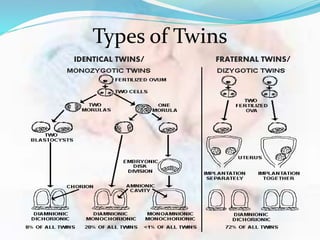
Types of Twins
IDENTICAL TWINS/ FRATERNAL TWINS/
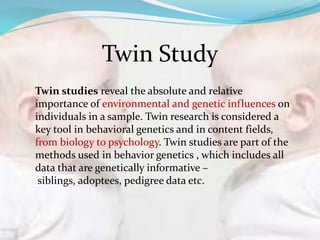
Twin studies reveal the absolute and relative
importance of environmental and genetic influences on
individuals in a sample. Twin research is considered a
key tool in behavioral genetics and in content fields,
from biology to psychology. Twin studies are part of the
methods used in behavior genetics , which includes all
data that are genetically informative –
siblings, adoptees, pedigree data etc.
Twin Study
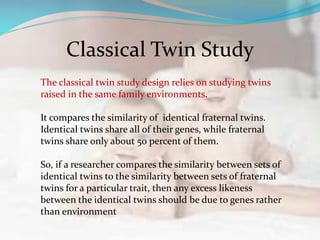
Classical Twin Study
The classical twin study design relies on studying twins
raised in the same family environments.
It compares the similarity of identical fraternal twins.
Identical twins share all of their genes, while fraternal
twins share only about 50 percent of them.
So, if a researcher compares the similarity between sets of
identical twins to the similarity between sets of fraternal
twins for a particular trait, then any excess likeness
between the identical twins should be due to genes rather
than environment
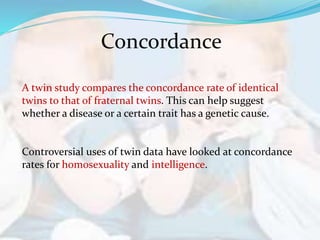
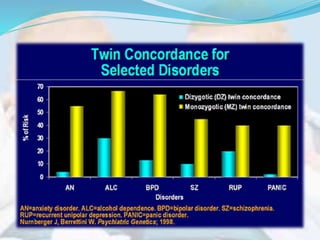
A twin study compares the concordance rate of identical
twins to that of fraternal twins. This can help suggest
whether a disease or a certain trait has a genetic cause.
Controversial uses of twin data have looked at concordance
rates for homosexuality and intelligence.
Concordance
Because identical twins are genetically virtually
identical, it follows that a genetic pattern carried by one
would very likely also be carried by the other.
If a characteristic identified in one twin is caused by a
certain genes, then it would also very likely be present in
the other twin.
Thus, the concordance rate of a given characteristic
helps suggest whether or to what extent a characteristic
is related to genetics.
Twin studies have produced a great deal of data in
support of biological roots of disorders; this has helped
psychologists to stress prevention for those who are
vulnerable to such disorders. There is a high cross-
cultural reliability of concordance level.
Assumptions in the design
1. Random mating
2. Equal environments
3. Gene-environment interaction
-Twin studies typically assume that genes and environment
have only separate and distinct contributions to a trait.
4. Genetic mechanisms
-Twin studies, in general, assume that only one type of
genetic mechanism--usually additive--is operating for a
particular trait. However, traits can be inherited through
different genetic mechanisms:
Drawbacks of
classical twin study
1. A given genetic pattern may not have 100% penetrance.
2. Developmental and environmental conditions may be
different for genetically identical individuals.
3. The logic is further complicated if the characteristic
is polygenic.
4. Epigenetic effects can alter the genetic expressions in
twins through varied factors.
5. Where in the absence of one or more environmental
factors a condition will not develop in an individual, even
with high concordance rates.
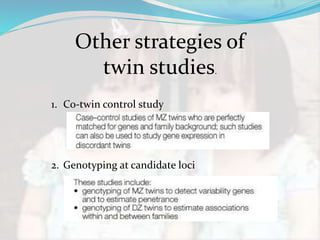
Other strategies of
twin studies.
1. Co-twin control study
2. Genotyping at candidate loci
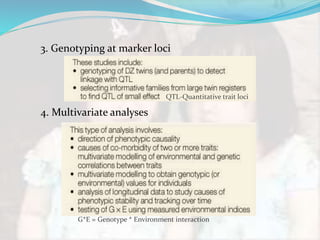
3. Genotyping at marker loci
4. Multivariate analyses
QTL-Quantitative trait loci
G*E = Genotype * Environment interaction
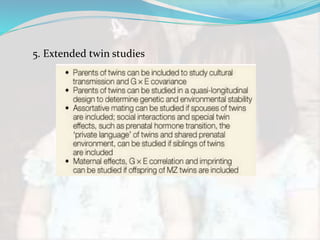
5. Extended twin studies
Twin  study

Twin study

  • 2.
    Types of Twins IDENTICALTWINS/ FRATERNAL TWINS/
  • 4.
    Twin studies revealthe absolute and relative importance of environmental and genetic influences on individuals in a sample. Twin research is considered a key tool in behavioral genetics and in content fields, from biology to psychology. Twin studies are part of the methods used in behavior genetics , which includes all data that are genetically informative – siblings, adoptees, pedigree data etc. Twin Study
  • 5.
    Classical Twin Study Theclassical twin study design relies on studying twins raised in the same family environments. It compares the similarity of identical fraternal twins. Identical twins share all of their genes, while fraternal twins share only about 50 percent of them. So, if a researcher compares the similarity between sets of identical twins to the similarity between sets of fraternal twins for a particular trait, then any excess likeness between the identical twins should be due to genes rather than environment
  • 6.
    A twin studycompares the concordance rate of identical twins to that of fraternal twins. This can help suggest whether a disease or a certain trait has a genetic cause. Controversial uses of twin data have looked at concordance rates for homosexuality and intelligence. Concordance
  • 7.
    Because identical twinsare genetically virtually identical, it follows that a genetic pattern carried by one would very likely also be carried by the other. If a characteristic identified in one twin is caused by a certain genes, then it would also very likely be present in the other twin. Thus, the concordance rate of a given characteristic helps suggest whether or to what extent a characteristic is related to genetics.
  • 8.
    Twin studies haveproduced a great deal of data in support of biological roots of disorders; this has helped psychologists to stress prevention for those who are vulnerable to such disorders. There is a high cross- cultural reliability of concordance level.
  • 10.
    Assumptions in thedesign 1. Random mating 2. Equal environments 3. Gene-environment interaction -Twin studies typically assume that genes and environment have only separate and distinct contributions to a trait. 4. Genetic mechanisms -Twin studies, in general, assume that only one type of genetic mechanism--usually additive--is operating for a particular trait. However, traits can be inherited through different genetic mechanisms:
  • 11.
    Drawbacks of classical twinstudy 1. A given genetic pattern may not have 100% penetrance. 2. Developmental and environmental conditions may be different for genetically identical individuals. 3. The logic is further complicated if the characteristic is polygenic. 4. Epigenetic effects can alter the genetic expressions in twins through varied factors. 5. Where in the absence of one or more environmental factors a condition will not develop in an individual, even with high concordance rates.
  • 12.
    Other strategies of twinstudies. 1. Co-twin control study 2. Genotyping at candidate loci
  • 13.
    3. Genotyping atmarker loci 4. Multivariate analyses QTL-Quantitative trait loci G*E = Genotype * Environment interaction
  • 14.