Twins
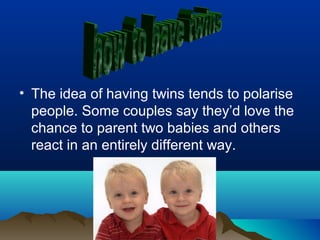
• The idea of having twins tends to polarise
people. Some couples say they’d love the
chance to parent two babies and others
react in an entirely different way.
• Many reproductive experts believe that as
humans we probably have more twin
pregnancies than any of us are aware of.
Not identical twins are
“dizygotic,” meaning that they
developed from two different
eggs fertilized by two different
sperm cells, while identical
twins are “monozygotic”
There are also, in very, very
rare cases, conjoined or
'Siamese' twins. These are
babies who are joined
together and may share some
parts of their bodies. Their
heads may be joined together,
or a different body part is
joined.
These twins come from the
same egg but it hasn't divided
properly. They are always the
same sex.
Twinning occurs one of two ways: either a
woman releases two eggs instead of the
usual one or she produces only one egg
that divides after fertilization. If she
releases two eggs, which are fertilized by
separate sperm, she has fraternal twins.
When a single, fertilized egg divides and
separates, she has identical or paternal
twins.
JAVIER BARAJA
PAULA BUNGARD
MANUEL
ARIAS
BY

Twins i

  • 1.
  • 2.
    • The ideaof having twins tends to polarise people. Some couples say they’d love the chance to parent two babies and others react in an entirely different way.
  • 3.
    • Many reproductiveexperts believe that as humans we probably have more twin pregnancies than any of us are aware of.
  • 4.
    Not identical twinsare “dizygotic,” meaning that they developed from two different eggs fertilized by two different sperm cells, while identical twins are “monozygotic”
  • 5.
    There are also,in very, very rare cases, conjoined or 'Siamese' twins. These are babies who are joined together and may share some parts of their bodies. Their heads may be joined together, or a different body part is joined. These twins come from the same egg but it hasn't divided properly. They are always the same sex.
  • 6.
    Twinning occurs oneof two ways: either a woman releases two eggs instead of the usual one or she produces only one egg that divides after fertilization. If she releases two eggs, which are fertilized by separate sperm, she has fraternal twins. When a single, fertilized egg divides and separates, she has identical or paternal twins.
  • 7.