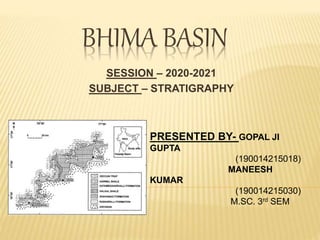
BHIMA BASIN
SESSION – 2020-2021
SUBJECT – STRATIGRAPHY
PRESENTED BY- GOPAL JI
GUPTA
(190014215018)
MANEESH
KUMAR
(190014215030)
M.SC. 3rd SEM
INTRODUCTION
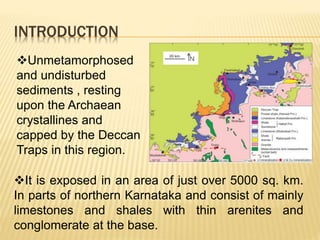
It is exposed in an area of just over 5000 sq. km.
In parts of northern Karnataka and consist of mainly
limestones and shales with thin arenites and
conglomerate at the base.
Unmetamorphosed
and undisturbed
sediments , resting
upon the Archaean
crystallines and
capped by the Deccan
Traps in this region.
CONTINUE.....
 It is one of the smallest of the
independently recognised “purana basins
of peninsular india”.
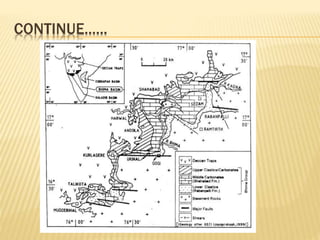
 Minerlisation has taken place in faulted
areas of the basin like Kurlagere-Gogi
fault.
GEOLOGICAL AGE
 U–Th–Pb and Rb–Sr (strontium) radiometric
dates of limestones and glauconite‐bearing
sandstones of the Bhima Group (Bhima
Basin). Indicate deposition at around 800–
900 Ma.
 That means it belongs to the neoproterozoic
Era of Proterozoic Eon.
TECTONIC CONDITION
 The age of the Bhima Basin has the time
period of Pannotia /Pan-Africa
supercontinent.
 The sigmoidal nature of the Bhima Basin
contact is significant and is attributed to the
pull apart mechanism.
 The isostatic adjustment of the area leads to
the faulting during pre-, syn-, post-
sedimentry periods.
CONTINUE......
 The fracturing and development of foliation
charcteristically seen in granites point out
involvement of reactivation processes which
leads to the ore grade uranium deposits
along the fault zones such as Gogi and other
places,
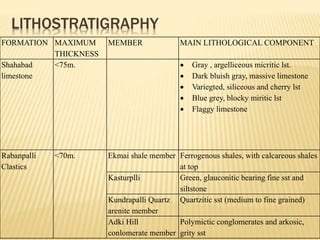
LITHOSTRATIGRAPHY
FORMATION MAXIMUM
THICKNESS
MEMBER MAIN LITHOLOGICAL COMPONENT
Shahabad
limestone
<75m.  Gray , argelliceous micritic lst.
 Dark bluish gray, massive limestone
 Variegted, siliceous and cherry lst
 Blue grey, blocky miritic lst
 Flaggy limestone
Rabanpalli
Clastics
<70m. Ekmai shale member Ferrogenous shales, with calcareous shales
at top
Kasturplli Green, glauconitic bearing fine sst and
siltstone
Kundrapalli Quartz
arenite member
Quartzitic sst (medium to fine grained)
Adki Hill
conlomerate member
Polymictic conglomerates and arkosic,
grity sst
CONTINUE......
MINERALIZATION
1. There is association of Uraniam with
Phosphatic limestone at Ukinal along fault
zone.
2. Hematite, coffinite and pichblend are low
temp. Minerals suggest the temperature of
formation of Ur is low.
3. The Shahabad limestone used in the
cement industry.
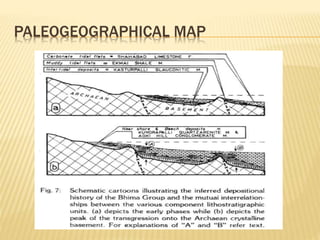
PALEOGEOGRAPHICAL MAP
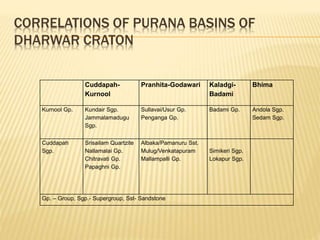
CORRELATIONS OF PURANA BASINS OF
DHARWAR CRATON
Cuddapah-
Kurnool
Pranhita-Godawari Kaladgi-
Badami
Bhima
Kurnool Gp. Kundair Sgp.
Jammalamadugu
Sgp.
Sullavai/Usur Gp.
Penganga Gp.
Badami Gp. Andola Sgp.
Sedam Sgp.
Cuddapah
Sgp.
Srisailam Quartzite
Nallamalai Gp.
Chitravati Gp.
Papaghni Gp.
Albaka/Pamanuru Sst.
Mulug/Venkatapuram
Mallampalli Gp.
Simikeri Sgp.
Lokapur Sgp.
Gp. – Group, Sgp.- Supergroup, Sst- Sandstone
REFERENCE
 Kale & Mudholkar, 1990, Stratigraphy of the
Bhima Group
 K.K. Dwivedy, K.K. Achar, S.A.Pandit,
V.Natrajan, M.K. Kumar, BHIMA BASIN,
KARNATAKA, INDIA URANIUM
MINERALISATION IN THE
NEOPROTEROZOIC
 Geology of India, vol. 1, M Ramakrishnan &
R Vaidyanadhan
THANK YOU

Bhima Basin Analysis.pptx

  • 1.
    BHIMA BASIN SESSION –2020-2021 SUBJECT – STRATIGRAPHY PRESENTED BY- GOPAL JI GUPTA (190014215018) MANEESH KUMAR (190014215030) M.SC. 3rd SEM
  • 2.
    INTRODUCTION It is exposedin an area of just over 5000 sq. km. In parts of northern Karnataka and consist of mainly limestones and shales with thin arenites and conglomerate at the base. Unmetamorphosed and undisturbed sediments , resting upon the Archaean crystallines and capped by the Deccan Traps in this region.
  • 3.
    CONTINUE.....  It isone of the smallest of the independently recognised “purana basins of peninsular india”.  Minerlisation has taken place in faulted areas of the basin like Kurlagere-Gogi fault.
  • 4.
    GEOLOGICAL AGE  U–Th–Pband Rb–Sr (strontium) radiometric dates of limestones and glauconite‐bearing sandstones of the Bhima Group (Bhima Basin). Indicate deposition at around 800– 900 Ma.  That means it belongs to the neoproterozoic Era of Proterozoic Eon.
  • 5.
    TECTONIC CONDITION  Theage of the Bhima Basin has the time period of Pannotia /Pan-Africa supercontinent.  The sigmoidal nature of the Bhima Basin contact is significant and is attributed to the pull apart mechanism.  The isostatic adjustment of the area leads to the faulting during pre-, syn-, post- sedimentry periods.
  • 6.
    CONTINUE......  The fracturingand development of foliation charcteristically seen in granites point out involvement of reactivation processes which leads to the ore grade uranium deposits along the fault zones such as Gogi and other places,
  • 7.
    LITHOSTRATIGRAPHY FORMATION MAXIMUM THICKNESS MEMBER MAINLITHOLOGICAL COMPONENT Shahabad limestone <75m.  Gray , argelliceous micritic lst.  Dark bluish gray, massive limestone  Variegted, siliceous and cherry lst  Blue grey, blocky miritic lst  Flaggy limestone Rabanpalli Clastics <70m. Ekmai shale member Ferrogenous shales, with calcareous shales at top Kasturplli Green, glauconitic bearing fine sst and siltstone Kundrapalli Quartz arenite member Quartzitic sst (medium to fine grained) Adki Hill conlomerate member Polymictic conglomerates and arkosic, grity sst
  • 8.
  • 9.
    MINERALIZATION 1. There isassociation of Uraniam with Phosphatic limestone at Ukinal along fault zone. 2. Hematite, coffinite and pichblend are low temp. Minerals suggest the temperature of formation of Ur is low. 3. The Shahabad limestone used in the cement industry.
  • 10.
  • 11.
    CORRELATIONS OF PURANABASINS OF DHARWAR CRATON Cuddapah- Kurnool Pranhita-Godawari Kaladgi- Badami Bhima Kurnool Gp. Kundair Sgp. Jammalamadugu Sgp. Sullavai/Usur Gp. Penganga Gp. Badami Gp. Andola Sgp. Sedam Sgp. Cuddapah Sgp. Srisailam Quartzite Nallamalai Gp. Chitravati Gp. Papaghni Gp. Albaka/Pamanuru Sst. Mulug/Venkatapuram Mallampalli Gp. Simikeri Sgp. Lokapur Sgp. Gp. – Group, Sgp.- Supergroup, Sst- Sandstone
  • 12.
    REFERENCE  Kale &Mudholkar, 1990, Stratigraphy of the Bhima Group  K.K. Dwivedy, K.K. Achar, S.A.Pandit, V.Natrajan, M.K. Kumar, BHIMA BASIN, KARNATAKA, INDIA URANIUM MINERALISATION IN THE NEOPROTEROZOIC  Geology of India, vol. 1, M Ramakrishnan & R Vaidyanadhan
  • 13.