The RenaissanceUnit Review
IntroductionWorldview
Worldview A collection of beliefs about life and the universe held by an individual or groupThe overall perspective from which one sees/interprets the worldWorldview is not a point of view or perspective
7 Worldview elementsValuesSociety Beliefs Time Geography Knowledge Economy
Chapter 1Times of Change
Feudalism Social Structure: People were born into a level of society and were expected to stay in that role for the rest of their livesEuropean society was organized by feudalism A hierarchyIn a hierarchy people are ranked according to their societal importanceFeudalism was based on land, loyalty and duty
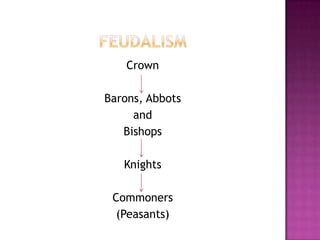
FeudalismCrownBarons, Abbots andBishops KnightsCommoners(Peasants)
FeudalismThe Crown (monarch) was in charge. Bishops had as much power as Barons. Nobles/Knights swore oaths of allegiance. They promised to fight for the king in exchange for manors or fiefsBishops received their land from the King (Crown), and the Church became a large land owner in time. The Church was very important to medieval people
Peasants Most people in the Middle Ages were peasants who lived in rural villages on a manorAssigned strips of land to plant/harvestIn exchange for use of the manor, peasants gave the lord a portion of their crops Were illiterate and uneducated Some were freemen, who rented land from the lord or worked for payMost were serfs, who couldn’t leave the manor without the lord’s permission
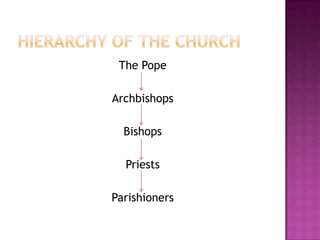
Hierarchy of the ChurchThe PopeArchbishopsBishopsPriestsParishioners
The ChurchReligious men became monks; joined monasteriesReligious women became nuns and joined conventsMany members of religious orders died as a result of caring for victims of the Black DeathWere well educatedSome monasteries became learning centers
The black death #1Made some people reconsider their faithThey believed that they had failed GodPeople began having a more critical attitude towards the church.Critics said that it cared more about luxur-ious living than spiritual values
Threats to feudalismPeasants Revolts1337: War started between England and France (The Hundred Years’ War)Peasants revolted cuz of high rents/taxes they had to pay to finance the war The revolts were put down by the authorities but the cause of their revolt was unresolved
Threats to FeudalismThe Black Death #2Millions of Europeans diedRegular outbreaks continued for the next several hundred yearsSevere labour shortages on manors, feudal estates, and became bankruptNobles began to sell their land to serfs Renaissance: a “rebirth” of classical knowledge and writing; started in Italy
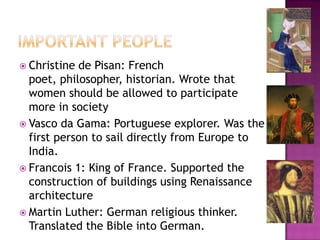
Important peopleChristine de Pisan: French poet, philosopher, historian. Wrote that women should be allowed to participate more in societyVasco da Gama: Portuguese explorer. Was the first person to sail directly from Europe to India.Francois 1: King of France. Supported the construction of buildings using Renaissance architectureMartin Luther: German religious thinker. Translated the Bible into German.
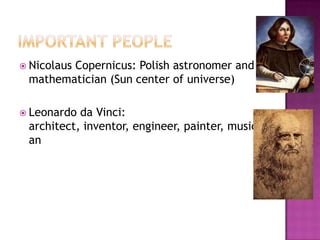
Important peopleNicolaus Copernicus: Polish astronomer and mathematician (Sun center of universe)Leonardo da Vinci: architect, inventor, engineer, painter, musician
Chapter 2The Expansion of Trade
The CrusadesPalestine was under Christian control for many years In the 7th Century, it was taken over by the Turks (later, Muslims)1095: Pope Urban 2 launched a Christian crusade to drive out the Muslims. Thousands walked across Europe to the Holy Land, but were taken out.Groups of knights set to do battle with the TurksThe 1st Crusade created a Christian kingdom in the Middle East for 100 yearsThe Muslims regained their land
City-statesMost countries in Europe were kingdoms ruled by monarchsItaly was a collection of City-StatesCity-State: a city that is politically independent, and the rural area around it
Italian City-state success 1. Geography: Italy was the closest to the port cities of Northern Africa/Eastern Mediterranean Sea (Trading was easier)2. Climate: Italy’s climate was warmer than Northern European countries, so trade/travel could continue throughout the year, and had a long growing season.3. Leadership: In pre-modern Europe, most countries were monarchies. Northern Italy was a collection of independent city-states.(Had their own government, armies, and controlled their own affairs).
Italian city-state Success4. Social Organization: Feudalism did not have a strong hold in Italy – Nobles tended to move into towns, and took their place in urban societyMerchants: purchased goods in one placeand sold them for a profit in another.
Venice and GenoaWere important because:Venice was easily defended by invasionBecame a good trading center as a result of its dealings with the EastHad thousands of ships travelling through the Mediterranean SeaThe Venice Arsenal was the largest ship building center in EuropeGenoa controlled a share of the trade in the East Mediterranean and the Black SeaControlled trade with Barcelona and ValenciaGenoa and Venice were on equal terms for centuriesThe Genoese fleet was destroyed in a battle in Venice, 1380Genoa never regained its former power
Chapter 3The Humanist Approach
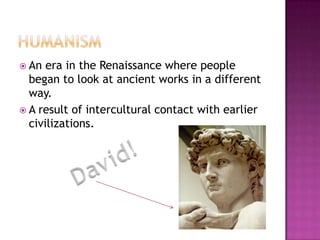
HumanismAn era in the Renaissance where people began to look at ancient works in a different way. A result of intercultural contact with earlier civilizations.David!
Humanism and the individualBelief in dignity/potential of the individualPeople could shape their lives through efforts/talentsBeings can use power of reason to find truthImportant to be curious/open/questioningCan achieve things through learningOne should be skilled in many different areas (Develop mind/body/spirit)Christian worldview: to develop one’s talents was to serve God, because He gave you those talents.
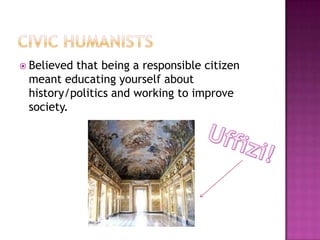
Civic humanistsBelieved that being a responsible citizen meant educating yourself about history/politics and working to improve society. Uffizi!
Humanist education“Never wasted time by loitering, but returned home after business and spent his time studying Greek or Latin” –Leonardo Bruni (in the eyes of a wealthy merchant)It was important to train children’s bodies/characters/minds (educating the whole child)Encouraged a curious/questioning attitude towards studentsHumanists were sometimes tutors for students
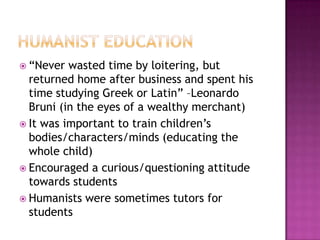
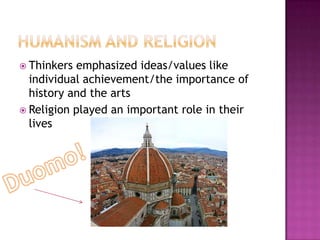
Humanism and religionThinkers emphasized ideas/values like individual achievement/the importance of history and the artsReligion played an important role in their livesDuomo!
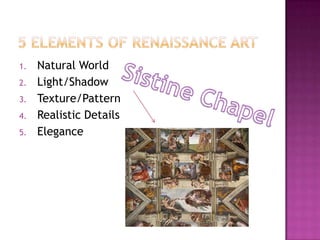
5 elements of renaissance artNatural WorldLight/ShadowTexture/PatternRealistic DetailsEleganceSistine Chapel
Chapter 4The Exchange of Ideas
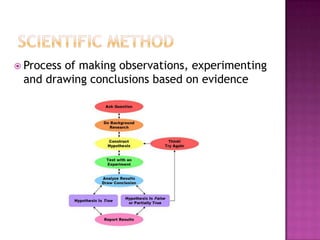
Scientific methodProcess of making observations, experimenting and drawing conclusions based on evidence
Important peopleJohannes Kepler: concluded that planets travelled in an elliptical orbit, not circles as Copernicus believedGalileo Galilei: confirmed Copernicus’ idea of a Sun-centered universe
MedicineDoctors had little knowledge of anatomy/diseaseRemedies based on astrology, superstition, etc, were commonDuring the Renaissance medical knowledge grewDoctors/scientists began applying the scientific methodAndreas Vesalius: dissected bodies while his students watched
Martin LutherA German monkConcluded that the Bible should be a Christian’s guide, not the Church1575: Luther nailed the 95 Theses, criticizing the selling of indulgences on the Church door in Wittenberg
The Protestant ReformationLuther’s Protestant translation of the Bible reached an unprecedented number of GermansA new Church was created (Lutheran Church)Luther’s ideas spread across EuropePeople who agreed with Luther were called Protestants – became known and the Protestant ReformationProtestants “protested” against the Church’s refusal to allow “reform”, and achieved a Reformation
Information was spread through:Universities:Early humanists taught at Italian universitiesShared their ideas through discussions and through their writingsSome humanists attracted students from all over Europe, and they went back to their home cities and shared their knowledge
Information was spread through:Travelling Celebrities:Famous Humanists were the celebrities of their timeThey were in demand all over EuropeTrained younger peopleEngaged in discussions with scholars all over Europe
Information was spread through:Royal Courts:Kings/Queens wanted scholars in their courts Francois 1’s court became a center of learningHe collected manuscripts, paintings and sculptures
The printing press1450: Johannes Gutenberg made the printing pressPrinters produced thousands of books in the time it had once taken to make oneCheaper because they were printed on paper instead of parchment
Chapter 5The Age of Exploration
definitionsIslam: The religious faith of MuslimsChristianity: Religion (Protestant, Orthodox, etc.)Circumnavigate: travel completely around something (circumnavigating the Earth)Expansionism: the actions and attitudes of a state/country whose goal is to expand its power and territory
The three m’s of exploration1. MindsetDefinition: a way of thinking that determines somebody’s behaviour/outlook
E.g.: personal accomplishment of finishing a race 2. MotivationDefinition: the act that drives or gives incentive to do something
E.g.: A medal (race)
3. Means
Definition: the equipment and resources that enable an action to be possibleMindsetThe ocean was still a frightening place to some Renaissance people. So why were explorers determined to venture off into the unknown and possibly dangerous territory?Because of:Curiosity/adventure
Role of the individual
Faith in the potential of human beings
European monarchs supported the voyages even though they might not succeed.
Increase in wealth, territory and power of acountMotivationEconomic factors that motivated exploration:Demand – luxury goods and spices
Expand Gold Supply
Expand Christianity
Expanding the Known World
Expanding Navigational TechnologyMotivationEuropeans believed that a sea route to the East was the solution to their trade problem. A sea route would give them control over their supply of goods. And they hoped to get rice by bringing in spices and other trade goods on the European market.The trading economy depended on the exchange of goods and resources for moneyEuropean mines were running out of gold and silver, and needed new sources of precious metals.
Religious factors that motivated exploration“Go into all the world, and proclaim the good news to the whole creator” – Mark, 16:15Renaissance explorers believed they were doing to work of the LordMuslims who follow the Qur’an have five religious duties to uphold the “Five Pillars of Faith”. One of these pillars include: If possible, make a pilgrimage to the city of Mecca during one’s lifetime.Europeans wanted to ensure the spread of Christianity and prevent the spread of Islam.
meansDespite European worldview to be open and curious of outside influences, their knowledge beyond their borders was very limited.Navigation: the science of determining the course, position and distance travelled by a shipIt comes from the Latin words:Navis: ship
Agere: to driveWhat factor might motivate a society to venture into unknown regions beyond its borders?Power: explorers and the government of the country sponsoring the explorer would have more power if the quest resulted in a newly discovered country, ocean, etc, they would receive more powerE.g.:Queen Isabella and King Ferdinand sponsored Columbus, but stated that any possible unknown oceans would be theirs
What elements of the worldview or Renaissance Europeans led to exploration and expansionism?The Renaissance belief of the potential of the individual lead people to explore (role of the individual, faith in the potential of human beings)Increase in wealth, territory and power of a country.
What are the similarities and differences between expanding Christianity and the five pillars of faith?Similarities: Both of them believed in some way that they were doing the work of their Lord, and each act was somewhat based on their religion.Differences: Christian explorers/monarchs were set on expanding Christianity, and preventing the spread of Islam, whereas the Islam's where more so set on defending their religion.
What instruments were important for successful navigation of the earth?Compass: used for finding the direction a ship is travelling; developed in China about1700 years ago, used by Muslim travelers in navigation.Astrolabe: used the North Star or Sun to calculate latitude, the distance north or south of the Equator; probably invented by ancient Greeks, further developed by Arab mathematicians and astronomers. Cross-staff: used to measure the altitude of the Pole star above the horizon to determine latitude; invented around 1342 for astronomy and first used around 1514 for navigationBack-staff: used to measure the altitude of the Sun to determine latitude; developed in 1594 as an improvement over the cross-staff.
Which country was the first European country to become involved in organized exploration and how did this affect other countries?Portugal was the first European country to become involved in organized exploration.They focused on travelling East to reach Asia by travelling around AfricaBartholomeu Dias lead the first Portuguese expedition around the Cape of Good Hope. His crew mutinied and prevented the exhibition from reaching India. When Columbus crossed the Atlantic, it put pressure on the Portuguese to explore and expandThey needed to reach the East before the Spanish.
continued5 years after Columbus’ voyage, Vasco da Gama sailed around Africa, across the Indian Ocean to CalicutHe returned with precious spices and established a sea route to the East.
The Battle of DiuAfter Vasco da Gama achieved the sea route to the East, Portuguese fleets made yearly trips to the East to trade. Arab merchants believed that the Portuguese were intrudingLarge Arab fleet and a small Portuguese fleetThe Portuguese had an advantage because of cannons1500s: Portugal became the most powerful trading country in Europe.
Explain how slavery was present before and after the Europeans ventured out to explore the world Slavery: a system under which people are treated as property (forced to work)Slavery has been a part of many country’s worldview.By the 1440s, the Portuguese were involved in the slave trade in Africa. They brought the African slaves to work on sugar plantations that they had established on islands in the Atlantic ocean. Slavery existed in Africa before the arrival of the Europeans
continuedDuring the next 3 centuries, Europeans captured and transported millions of Africans to the Americas as slavesMillions of them died on route from their terrible conditions on the slave ships or from overwork when they arrived
What are the advantages and disadvantages to slavery?Advantages: Europeans had people to work for them on their businesses; always had something to doDisadvantages: Slaves died from overwork and terrible conditions, lack of freedom, etc.
Why was the “Articles of agreement between the lords of catholic sovereigns and cristobal colon” important?It is important because it states the rules of Christopher Columbus’ exploration(s). Also, Spain wouldn’t have been able to claim territory, etc.How would this affect the New World inhabitants?It stated that Columbus had control over lands and goods, etc.
Who are they?Where are they from? What were their goals? What did they accomplish?Christopher ColumbusQueen Isabella and King FerdinandArab and Italian merchantsMansa Moussa Prester JohnPrince Henry Bartholomeu DiasGiovanni CabotoJacques Cartier
Christopher Columbus (1451 – 1506) His goal was to find a quicker route to the East, because spices and other goods were becoming too expensive because they were handled so much on the way to the countries in Europe, and a quicker route would lower the price immensely.Was sponsored by Spain, although he was Italian.  Queen Isabella and King Ferdinand (Spain) declared their sovereignty over unknown oceans, that any industry discovered or acquired would be claimed or bought. Columbus was given power to the places he visited. (pg. 125)
Columbus briefingHis goal was to go to Asia through the Atlantic OceanTook 3 voyages to the Caribbean. He died after his 4th voyage in 1506Was convinced until he died that he had reached Asia
Ferdinand magellanHe found the Philippines but was killed after getting involved in a local war. His voyage was the first recorded voyage to circumnavigate the world.

The Renaissance

  • 1.
  • 2.
  • 3.
    Worldview A collectionof beliefs about life and the universe held by an individual or groupThe overall perspective from which one sees/interprets the worldWorldview is not a point of view or perspective
  • 4.
    7 Worldview elementsValuesSocietyBeliefs Time Geography Knowledge Economy
  • 5.
  • 6.
    Feudalism Social Structure:People were born into a level of society and were expected to stay in that role for the rest of their livesEuropean society was organized by feudalism A hierarchyIn a hierarchy people are ranked according to their societal importanceFeudalism was based on land, loyalty and duty
  • 7.
    FeudalismCrownBarons, Abbots andBishopsKnightsCommoners(Peasants)
  • 8.
    FeudalismThe Crown (monarch)was in charge. Bishops had as much power as Barons. Nobles/Knights swore oaths of allegiance. They promised to fight for the king in exchange for manors or fiefsBishops received their land from the King (Crown), and the Church became a large land owner in time. The Church was very important to medieval people
  • 9.
    Peasants Most peoplein the Middle Ages were peasants who lived in rural villages on a manorAssigned strips of land to plant/harvestIn exchange for use of the manor, peasants gave the lord a portion of their crops Were illiterate and uneducated Some were freemen, who rented land from the lord or worked for payMost were serfs, who couldn’t leave the manor without the lord’s permission
  • 10.
    Hierarchy of theChurchThe PopeArchbishopsBishopsPriestsParishioners
  • 11.
    The ChurchReligious menbecame monks; joined monasteriesReligious women became nuns and joined conventsMany members of religious orders died as a result of caring for victims of the Black DeathWere well educatedSome monasteries became learning centers
  • 12.
    The black death#1Made some people reconsider their faithThey believed that they had failed GodPeople began having a more critical attitude towards the church.Critics said that it cared more about luxur-ious living than spiritual values
  • 13.
    Threats to feudalismPeasantsRevolts1337: War started between England and France (The Hundred Years’ War)Peasants revolted cuz of high rents/taxes they had to pay to finance the war The revolts were put down by the authorities but the cause of their revolt was unresolved
  • 14.
    Threats to FeudalismTheBlack Death #2Millions of Europeans diedRegular outbreaks continued for the next several hundred yearsSevere labour shortages on manors, feudal estates, and became bankruptNobles began to sell their land to serfs Renaissance: a “rebirth” of classical knowledge and writing; started in Italy
  • 15.
    Important peopleChristine dePisan: French poet, philosopher, historian. Wrote that women should be allowed to participate more in societyVasco da Gama: Portuguese explorer. Was the first person to sail directly from Europe to India.Francois 1: King of France. Supported the construction of buildings using Renaissance architectureMartin Luther: German religious thinker. Translated the Bible into German.
  • 16.
    Important peopleNicolaus Copernicus:Polish astronomer and mathematician (Sun center of universe)Leonardo da Vinci: architect, inventor, engineer, painter, musician
  • 17.
  • 18.
    The CrusadesPalestine wasunder Christian control for many years In the 7th Century, it was taken over by the Turks (later, Muslims)1095: Pope Urban 2 launched a Christian crusade to drive out the Muslims. Thousands walked across Europe to the Holy Land, but were taken out.Groups of knights set to do battle with the TurksThe 1st Crusade created a Christian kingdom in the Middle East for 100 yearsThe Muslims regained their land
  • 19.
    City-statesMost countries inEurope were kingdoms ruled by monarchsItaly was a collection of City-StatesCity-State: a city that is politically independent, and the rural area around it
  • 20.
    Italian City-state success1. Geography: Italy was the closest to the port cities of Northern Africa/Eastern Mediterranean Sea (Trading was easier)2. Climate: Italy’s climate was warmer than Northern European countries, so trade/travel could continue throughout the year, and had a long growing season.3. Leadership: In pre-modern Europe, most countries were monarchies. Northern Italy was a collection of independent city-states.(Had their own government, armies, and controlled their own affairs).
  • 21.
    Italian city-state Success4.Social Organization: Feudalism did not have a strong hold in Italy – Nobles tended to move into towns, and took their place in urban societyMerchants: purchased goods in one placeand sold them for a profit in another.
  • 22.
    Venice and GenoaWereimportant because:Venice was easily defended by invasionBecame a good trading center as a result of its dealings with the EastHad thousands of ships travelling through the Mediterranean SeaThe Venice Arsenal was the largest ship building center in EuropeGenoa controlled a share of the trade in the East Mediterranean and the Black SeaControlled trade with Barcelona and ValenciaGenoa and Venice were on equal terms for centuriesThe Genoese fleet was destroyed in a battle in Venice, 1380Genoa never regained its former power
  • 23.
  • 24.
    HumanismAn era inthe Renaissance where people began to look at ancient works in a different way. A result of intercultural contact with earlier civilizations.David!
  • 25.
    Humanism and theindividualBelief in dignity/potential of the individualPeople could shape their lives through efforts/talentsBeings can use power of reason to find truthImportant to be curious/open/questioningCan achieve things through learningOne should be skilled in many different areas (Develop mind/body/spirit)Christian worldview: to develop one’s talents was to serve God, because He gave you those talents.
  • 26.
    Civic humanistsBelieved thatbeing a responsible citizen meant educating yourself about history/politics and working to improve society. Uffizi!
  • 27.
    Humanist education“Never wastedtime by loitering, but returned home after business and spent his time studying Greek or Latin” –Leonardo Bruni (in the eyes of a wealthy merchant)It was important to train children’s bodies/characters/minds (educating the whole child)Encouraged a curious/questioning attitude towards studentsHumanists were sometimes tutors for students
  • 28.
    Humanism and religionThinkersemphasized ideas/values like individual achievement/the importance of history and the artsReligion played an important role in their livesDuomo!
  • 29.
    5 elements ofrenaissance artNatural WorldLight/ShadowTexture/PatternRealistic DetailsEleganceSistine Chapel
  • 30.
  • 31.
    Scientific methodProcess ofmaking observations, experimenting and drawing conclusions based on evidence
  • 32.
    Important peopleJohannes Kepler:concluded that planets travelled in an elliptical orbit, not circles as Copernicus believedGalileo Galilei: confirmed Copernicus’ idea of a Sun-centered universe
  • 33.
    MedicineDoctors had littleknowledge of anatomy/diseaseRemedies based on astrology, superstition, etc, were commonDuring the Renaissance medical knowledge grewDoctors/scientists began applying the scientific methodAndreas Vesalius: dissected bodies while his students watched
  • 34.
    Martin LutherA GermanmonkConcluded that the Bible should be a Christian’s guide, not the Church1575: Luther nailed the 95 Theses, criticizing the selling of indulgences on the Church door in Wittenberg
  • 35.
    The Protestant ReformationLuther’sProtestant translation of the Bible reached an unprecedented number of GermansA new Church was created (Lutheran Church)Luther’s ideas spread across EuropePeople who agreed with Luther were called Protestants – became known and the Protestant ReformationProtestants “protested” against the Church’s refusal to allow “reform”, and achieved a Reformation
  • 36.
    Information was spreadthrough:Universities:Early humanists taught at Italian universitiesShared their ideas through discussions and through their writingsSome humanists attracted students from all over Europe, and they went back to their home cities and shared their knowledge
  • 37.
    Information was spreadthrough:Travelling Celebrities:Famous Humanists were the celebrities of their timeThey were in demand all over EuropeTrained younger peopleEngaged in discussions with scholars all over Europe
  • 38.
    Information was spreadthrough:Royal Courts:Kings/Queens wanted scholars in their courts Francois 1’s court became a center of learningHe collected manuscripts, paintings and sculptures
  • 39.
    The printing press1450:Johannes Gutenberg made the printing pressPrinters produced thousands of books in the time it had once taken to make oneCheaper because they were printed on paper instead of parchment
  • 40.
    Chapter 5The Ageof Exploration
  • 41.
    definitionsIslam: The religiousfaith of MuslimsChristianity: Religion (Protestant, Orthodox, etc.)Circumnavigate: travel completely around something (circumnavigating the Earth)Expansionism: the actions and attitudes of a state/country whose goal is to expand its power and territory
  • 42.
    The three m’sof exploration1. MindsetDefinition: a way of thinking that determines somebody’s behaviour/outlook
  • 43.
    E.g.: personal accomplishmentof finishing a race 2. MotivationDefinition: the act that drives or gives incentive to do something
  • 44.
  • 45.
  • 46.
    Definition: the equipmentand resources that enable an action to be possibleMindsetThe ocean was still a frightening place to some Renaissance people. So why were explorers determined to venture off into the unknown and possibly dangerous territory?Because of:Curiosity/adventure
  • 47.
    Role of theindividual
  • 48.
    Faith in thepotential of human beings
  • 49.
    European monarchs supportedthe voyages even though they might not succeed.
  • 50.
    Increase in wealth,territory and power of acountMotivationEconomic factors that motivated exploration:Demand – luxury goods and spices
  • 51.
  • 52.
  • 53.
  • 54.
    Expanding Navigational TechnologyMotivationEuropeansbelieved that a sea route to the East was the solution to their trade problem. A sea route would give them control over their supply of goods. And they hoped to get rice by bringing in spices and other trade goods on the European market.The trading economy depended on the exchange of goods and resources for moneyEuropean mines were running out of gold and silver, and needed new sources of precious metals.
  • 55.
    Religious factors thatmotivated exploration“Go into all the world, and proclaim the good news to the whole creator” – Mark, 16:15Renaissance explorers believed they were doing to work of the LordMuslims who follow the Qur’an have five religious duties to uphold the “Five Pillars of Faith”. One of these pillars include: If possible, make a pilgrimage to the city of Mecca during one’s lifetime.Europeans wanted to ensure the spread of Christianity and prevent the spread of Islam.
  • 56.
    meansDespite European worldviewto be open and curious of outside influences, their knowledge beyond their borders was very limited.Navigation: the science of determining the course, position and distance travelled by a shipIt comes from the Latin words:Navis: ship
  • 57.
    Agere: to driveWhatfactor might motivate a society to venture into unknown regions beyond its borders?Power: explorers and the government of the country sponsoring the explorer would have more power if the quest resulted in a newly discovered country, ocean, etc, they would receive more powerE.g.:Queen Isabella and King Ferdinand sponsored Columbus, but stated that any possible unknown oceans would be theirs
  • 58.
    What elements ofthe worldview or Renaissance Europeans led to exploration and expansionism?The Renaissance belief of the potential of the individual lead people to explore (role of the individual, faith in the potential of human beings)Increase in wealth, territory and power of a country.
  • 59.
    What are thesimilarities and differences between expanding Christianity and the five pillars of faith?Similarities: Both of them believed in some way that they were doing the work of their Lord, and each act was somewhat based on their religion.Differences: Christian explorers/monarchs were set on expanding Christianity, and preventing the spread of Islam, whereas the Islam's where more so set on defending their religion.
  • 60.
    What instruments wereimportant for successful navigation of the earth?Compass: used for finding the direction a ship is travelling; developed in China about1700 years ago, used by Muslim travelers in navigation.Astrolabe: used the North Star or Sun to calculate latitude, the distance north or south of the Equator; probably invented by ancient Greeks, further developed by Arab mathematicians and astronomers. Cross-staff: used to measure the altitude of the Pole star above the horizon to determine latitude; invented around 1342 for astronomy and first used around 1514 for navigationBack-staff: used to measure the altitude of the Sun to determine latitude; developed in 1594 as an improvement over the cross-staff.
  • 61.
    Which country wasthe first European country to become involved in organized exploration and how did this affect other countries?Portugal was the first European country to become involved in organized exploration.They focused on travelling East to reach Asia by travelling around AfricaBartholomeu Dias lead the first Portuguese expedition around the Cape of Good Hope. His crew mutinied and prevented the exhibition from reaching India. When Columbus crossed the Atlantic, it put pressure on the Portuguese to explore and expandThey needed to reach the East before the Spanish.
  • 62.
    continued5 years afterColumbus’ voyage, Vasco da Gama sailed around Africa, across the Indian Ocean to CalicutHe returned with precious spices and established a sea route to the East.
  • 63.
    The Battle ofDiuAfter Vasco da Gama achieved the sea route to the East, Portuguese fleets made yearly trips to the East to trade. Arab merchants believed that the Portuguese were intrudingLarge Arab fleet and a small Portuguese fleetThe Portuguese had an advantage because of cannons1500s: Portugal became the most powerful trading country in Europe.
  • 64.
    Explain how slaverywas present before and after the Europeans ventured out to explore the world Slavery: a system under which people are treated as property (forced to work)Slavery has been a part of many country’s worldview.By the 1440s, the Portuguese were involved in the slave trade in Africa. They brought the African slaves to work on sugar plantations that they had established on islands in the Atlantic ocean. Slavery existed in Africa before the arrival of the Europeans
  • 65.
    continuedDuring the next3 centuries, Europeans captured and transported millions of Africans to the Americas as slavesMillions of them died on route from their terrible conditions on the slave ships or from overwork when they arrived
  • 66.
    What are theadvantages and disadvantages to slavery?Advantages: Europeans had people to work for them on their businesses; always had something to doDisadvantages: Slaves died from overwork and terrible conditions, lack of freedom, etc.
  • 67.
    Why was the“Articles of agreement between the lords of catholic sovereigns and cristobal colon” important?It is important because it states the rules of Christopher Columbus’ exploration(s). Also, Spain wouldn’t have been able to claim territory, etc.How would this affect the New World inhabitants?It stated that Columbus had control over lands and goods, etc.
  • 68.
    Who are they?Whereare they from? What were their goals? What did they accomplish?Christopher ColumbusQueen Isabella and King FerdinandArab and Italian merchantsMansa Moussa Prester JohnPrince Henry Bartholomeu DiasGiovanni CabotoJacques Cartier
  • 69.
    Christopher Columbus (1451– 1506) His goal was to find a quicker route to the East, because spices and other goods were becoming too expensive because they were handled so much on the way to the countries in Europe, and a quicker route would lower the price immensely.Was sponsored by Spain, although he was Italian. Queen Isabella and King Ferdinand (Spain) declared their sovereignty over unknown oceans, that any industry discovered or acquired would be claimed or bought. Columbus was given power to the places he visited. (pg. 125)
  • 70.
    Columbus briefingHis goalwas to go to Asia through the Atlantic OceanTook 3 voyages to the Caribbean. He died after his 4th voyage in 1506Was convinced until he died that he had reached Asia
  • 71.
    Ferdinand magellanHe foundthe Philippines but was killed after getting involved in a local war. His voyage was the first recorded voyage to circumnavigate the world.