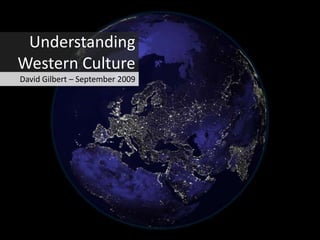
Understanding Western CultureDavid Gilbert – September 2009
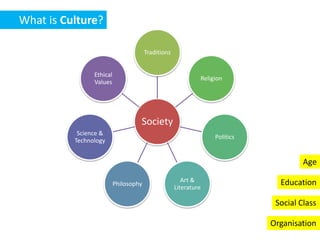
What is Culture?AgeEducationSocial ClassOrganisation
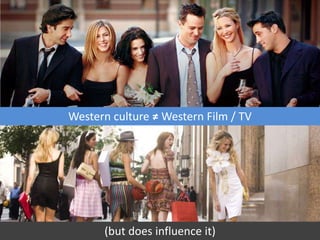
Western culture ≠ Western Film / TV(but does influence it)
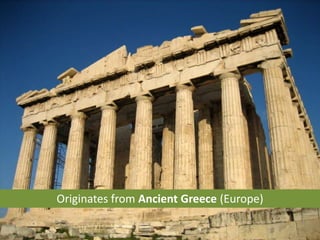
Originates from Ancient Greece (Europe)
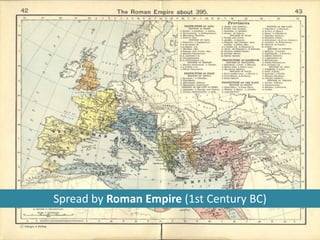
Spread by Roman Empire (1st Century BC)
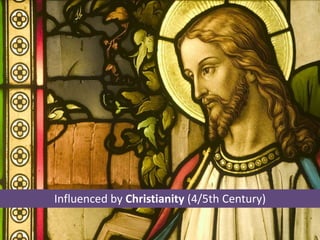
Influenced by Christianity (4/5th Century)
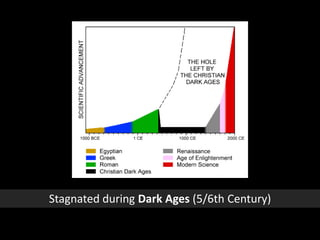
Stagnated during Dark Ages (5/6th Century)
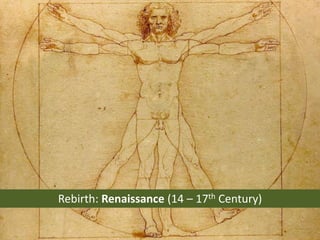
Rebirth: Renaissance (14 – 17th Century)
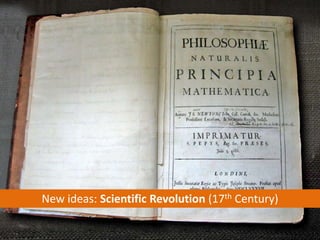
New ideas: Scientific Revolution (17th Century)
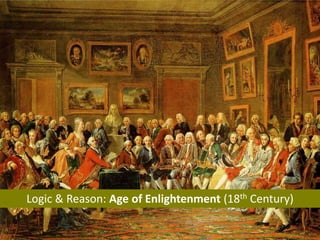
Logic & Reason: Age of Enlightenment (18th Century)
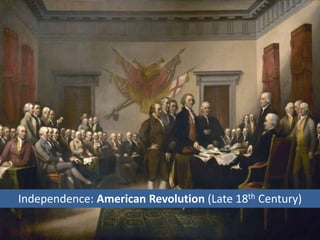
Independence: American Revolution (Late 18th Century)
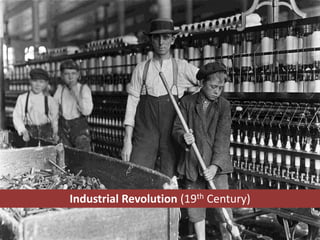
Industrial Revolution (19th Century)
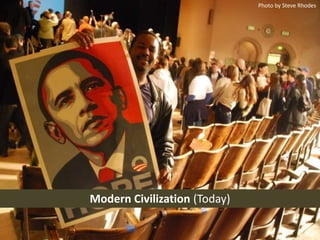
Photo by Steve RhodesModern Civilization (Today)
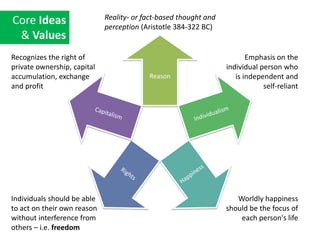
Reality- or fact-based thought and perception (Aristotle 384-322 BC)Core Ideas & ValuesEmphasis on the individual person who is independent and self-reliantRecognizes the right of private ownership, capital accumulation, exchange and profitWorldly happiness should be the focus of each person's lifeIndividuals should be able to act on their own reason without interference from others – i.e. freedom
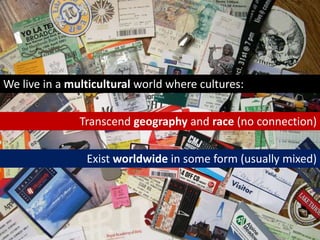
We live in a multicultural world where cultures:Transcend geography and race (no connection)Exist worldwide in some form (usually mixed)
East vs. WestWhat’s the difference?Illustrations by Yang Liu from “East meets West” book – www.yangliudesign.com
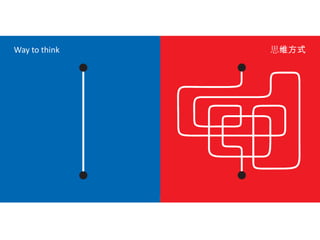
Way to think思维方式
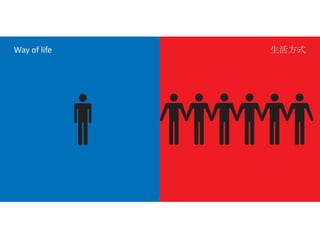
Way of life生活方式
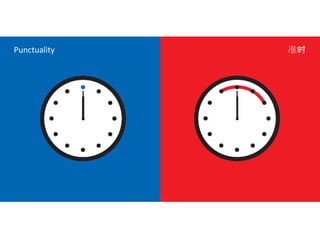
Punctuality准时
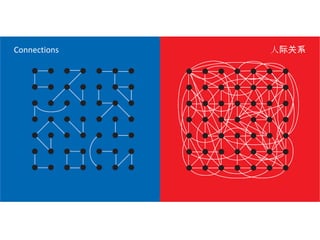
Connections人际关系
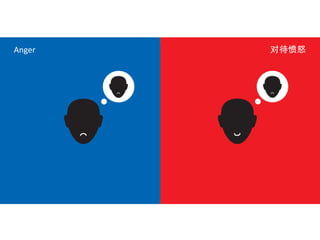
Anger对待愤怒
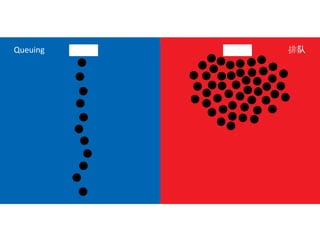
Queuing排队
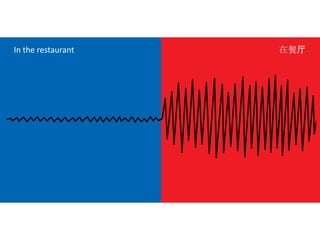
In the restaurant在餐厅
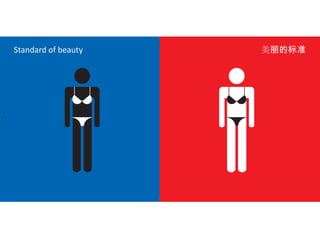
Standard of beauty美丽的标准
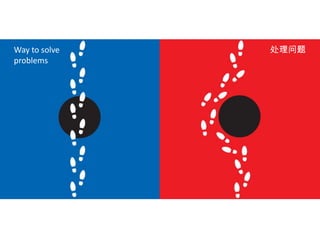
Way to solveproblems处理问题
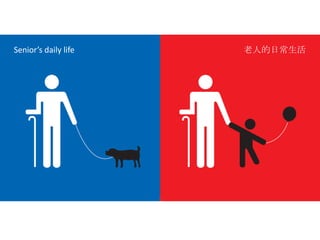
Senior’s daily life老人的日常生活
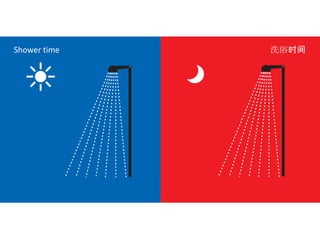
Shower time洗浴时间
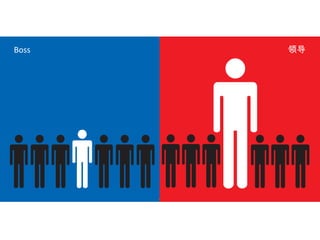
Boss领导
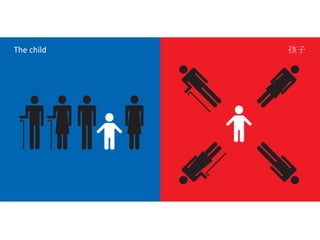
The child孩子
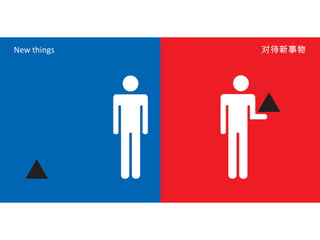
New things对待新事物
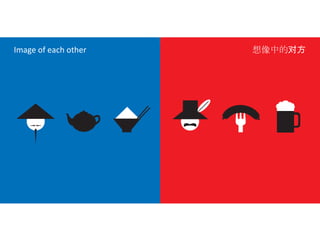
Image of each other想像中的对方
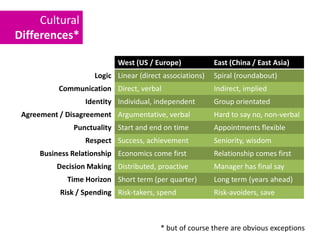
Cultural Differences** but of course there are obvious exceptions
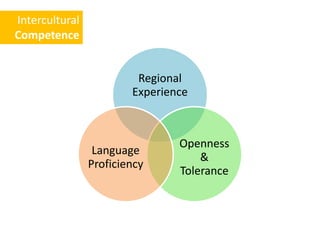
Intercultural Competence
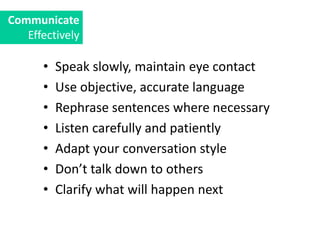
Communicate EffectivelySpeak slowly, maintain eye contactUse objective, accurate languageRephrase sentences where necessaryListen carefully and patientlyAdapt your conversation styleDon’t talk down to othersClarify what will happen next
Uncomfortable Situations
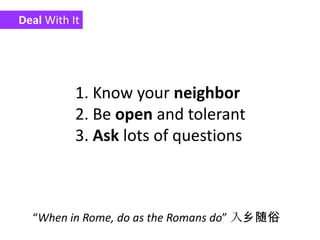
Deal With It Know your neighbor Be open and tolerantAsk lots of questions“When in Rome, do as the Romans do” 入乡随俗
Thank youwww.randomwire.com

Understanding Western Cultural

Editor's Notes

  • #2 Today we’re going to talk about culture and how cultural differences impact the way we interact and work with each other.Feel free to ask questions at anytime or tell me if you don’t understand something I say.Firstly we need to understand what culture is.Can anyone give me a definition of what the word culture means?
  • #4 People’s first impression of western culture often comes from Western TV and movies but this can be misleading and enforces stereotypes.Whilst TV and movies reflect and influence culture to an extent they are not a good indicatorIf we believed everything on TV I’d think all Chinese are Kung Fu masters and you’d think Westerners have affairs all the timeThere are elements of truth in both but neither is an accurate depictionSo where does western culture come from?
  • #5 The ancient philosophers Socrates, Plato, and Aristotle established the foundations of Western philosophy and first considered the meaning of lifeWho made me? Why am I here? What is my purpose in life?They started writing things down and developed early literature.Constructed monumental architecture to symbolize their power (Acropolis)Athens was the worlds first democracy with a cosmopolitanworld view (international culture).Developed political, military, social, and religious structuresFor all of their brilliant accomplishments, the Greeks were unable to rise above the divisions and rivalries that caused them to fight each other and undermine their own civilization. 
  • #6 The Romans (from Italy) conquer most of Europe and build roads everywhere – very efficient.Made achievements in language, law, engineering, and government (introduced coinage, long distance trade)Become gradually corrupt and stretched too thinlydue to invasions, civil wars, and economic decline. 
  • #7 Christianity grew and became widely accepted by the fourth century (from Jewish sect)It was made the official state religion of the Roman Empire.The Roman Catholic church played a crucial role in the growth of the new European civilization. The church developed an organized government under the leadership of the pope.
  • #8 But there was a problem… Christianity distrusted science, logic and reasonThe Dark Ages were a period of cultural decline or societal collapse that took place between the fall of Rome and the eventual recovery of learning.“600 years of degenerate, godless, inhuman behavior”
  • #9 Rebirth of art, education, science & literature.The Renaissance was a cultural movement that profoundly affected European intellectual life in the early modern period. As a cultural movement, it encompassed a resurgence of learning, art, andwidespread educational reform.Its influenceaffected literature, philosophy, art, politics, science, religion, and other aspectsVitruvian Man – Leonardo da Vinci (ideal human proportions)
  • #10 Rejection of old ideas, beginning to look for new ones. From flat earth to round earth. Religion -> Science/ReasonThe scientific revolution was a time when people began to look for the answers to questions regarding the make-up of the earth, and the people living on it. It was a period when new ideas in physics, astronomy, biology, human anatomy, chemistry, and other sciences led to a rejection of ideas from Ancient Greece and laid the foundation of modern science.Struck a conflict between ideas of individuals and the ideas of the church. From the shape of the world to the circulation of blood in a persons body many theories developed to find out how these things worked. Important people: Newton, Galileo, …
  • #12 The American Revolution refers to the political upheaval during the last half of the 18th century in which the Thirteen Colonies of North America overthrew the governance of the British Empire and then rejected the British monarchy to become the sovereign United States of America.
  • #13 Advances in science and technology led to big changes in …The Industrial Revolution was a period in the late 1800s and early 1900s when big changes in agriculture, manufacturing, production, and transportation had a huge effect on the conditions in Britain. The changes quickly spread throughout Europe, North America, and eventually the world.Effort to build factories for massive production. Greatly altered economic and social systems.
  • #14 Out culture is still changing and being recreated everydayObama is biggest event in recent history
  • #15 These are core ideas and values which underlie western culture
  • #16 There is no one “ideal” or “best” cultureWestern culture exists around the world in some form (inc. Japan, Korea & China)Cultures can be different not only between continents or nations, but also within the same company or even family.
  • #17 What differences have you experienced?
  • #18 West: Linear (direct associations)East: Spiral (roundabout and subtle)
  • #19 West: Individualistic, independent, values freedomEast: Group orientated, values harmony and stability
  • #20 West: Start and end on timeEast: Appointment times flexibleDon’t be late (rude). Call in advance if you can’t make it.
  • #21 West: Small number of close connectionsEast: Highly connected web
  • #22 West: Argumentative, verbalEast: Difficult to say no, non-verbalShow your feelings up front – people prefer to hear your problem before it becomes bigger
  • #23 West: Manors important (be polite)East: Each for his/her own
  • #25 West: like dark skinEast: like white skin
  • #34 How well you can adopt and communicate with other culturesIntercultural competence is the ability of successful communication with people of other cultures.Being equally comfortable in two or more culturesA person who is interculturally competent captures and understands, in interaction with people from foreign cultures, their specific concepts in perception, thinking, feeling and acting.
  • #35 Culture is communication and communication is culture