JNANA SAHYADRI, SHANKARAGHATTA
INDUSHREE SAHYADRI
BY ,
INDUSHREE SAHYADRI
INDUSHREE SAHYADRI
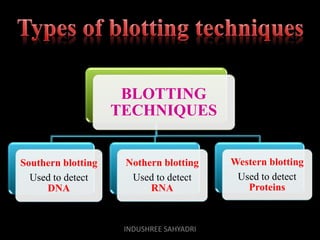
BLOTTING
TECHNIQUES
Southern blotting
Used to detect
DNA
Nothern blotting
Used to detect
RNA
Western blotting
Used to detect
Proteins
INDUSHREE SAHYADRI
Western blotting is a widely used analytical
technique in molecular biology to detect specific
protein in a sample of tissue homogenate or
extract.
 It works on the principle of gel electrophoresis.
Proteins are separated based on their size on
polyacrylamide gel
INDUSHREE SAHYADRI
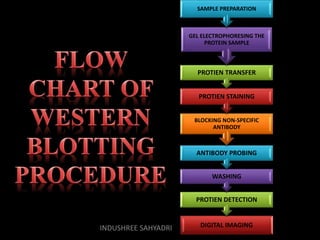
DIGITAL IMAGING
PROTIEN DETECTION
WASHING
ANTIBODY PROBING
BLOCKING NON-SPECIFIC
ANTIBODY
PROTIEN STAINING
PROTIEN TRANSFER
GEL ELECTROPHORESING THE
PROTEIN SAMPLE
SAMPLE PREPARATION
INDUSHREE SAHYADRI
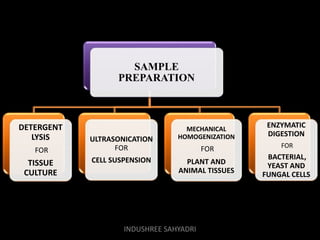
SAMPLE
PREPARATION
DETERGENT
LYSIS
FOR
TISSUE
CULTURE
ULTRASONICATION
FOR
CELL SUSPENSION
MECHANICAL
HOMOGENIZATION
FOR
PLANT AND
ANIMAL TISSUES
ENZYMATIC
DIGESTION
FOR
BACTERIAL,
YEAST AND
FUNGAL CELLS
INDUSHREE SAHYADRI
Electrophoresis is commonly used method
for separating proteins on the basis of size,
shape or charge.
 In Gel electrophoresis, protein of sample
extract are separated according to their
molecular weight.
INDUSHREE SAHYADRI
INDUSHREE SAHYADRI
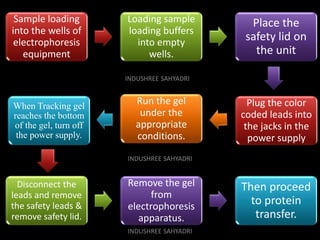
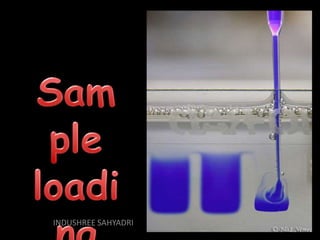
Sample loading
into the wells of
electrophoresis
equipment
Loading sample
loading buffers
into empty
wells.
Place the
safety lid on
the unit
When Tracking gel
reaches the bottom
of the gel, turn off
the power supply.
Run the gel
under the
appropriate
conditions.
Plug the color
coded leads into
the jacks in the
power supply
Disconnect the
leads and remove
the safety leads &
remove safety lid.
Remove the gel
from
electrophoresis
apparatus.
Then proceed
to protein
transfer.
INDUSHREE SAHYADRI
INDUSHREE SAHYADRI
INDUSHREE SAHYADRI
INDUSHREE SAHYADRI
INDUSHREE SAHYADRI
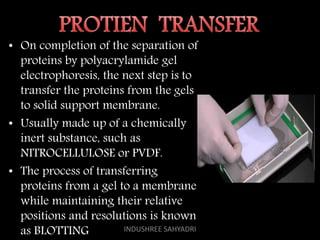
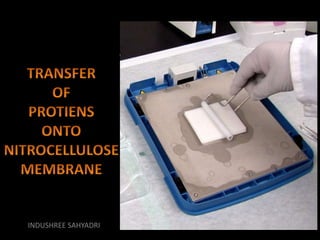
• On completion of the separation of
proteins by polyacrylamide gel
electrophoresis, the next step is to
transfer the proteins from the gels
to solid support membrane.
• Usually made up of a chemically
inert substance, such as
NITROCELLULOSE or PVDF.
• The process of transferring
proteins from a gel to a membrane
while maintaining their relative
positions and resolutions is known
as BLOTTING INDUSHREE SAHYADRI
INDUSHREE SAHYADRI
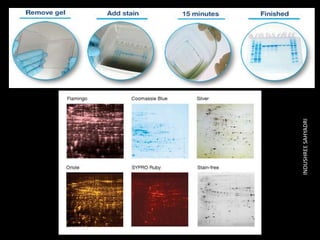
After gel electrophoresis, it may be necessary to
confirm that all the proteins in the gel have been
completely eluted.
As proteins are not directly visible in the gel, the
gel must be stained.
Proteins are usually stained with dyes such as
coomassie blue, silver stain, or deep purple.
After staining, a permanent record may be made
by imaging the gel with suitable instrument.
INDUSHREE SAHYADRI
INDUSHREESAHYADRI
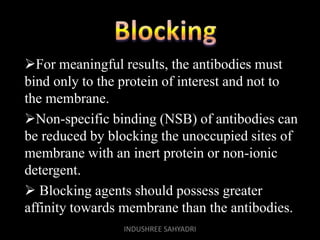
For meaningful results, the antibodies must
bind only to the protein of interest and not to
the membrane.
Non-specific binding (NSB) of antibodies can
be reduced by blocking the unoccupied sites of
membrane with an inert protein or non-ionic
detergent.
 Blocking agents should possess greater
affinity towards membrane than the antibodies.
INDUSHREE SAHYADRI
The most common blocking agents are:
a) Bovine serum albumin(BSA)
b) Non-fat milk
c) Casein
d) Gelatin
e) Dilute solution of Tween 20.
INDUSHREE SAHYADRI
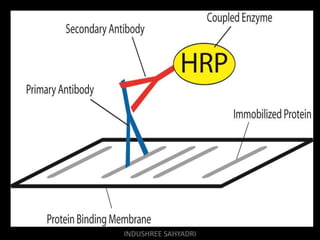
After blocking , the blot is incubated with one or more antibodies.
This uses specific antibody to detect a localize the protein blotted
to a membrane.
The specificity of antigen-antibody binding permits the
identification of a single protein in a complex sample
The non-labeled primary antibody directed against the target
protein, and specific labeled secondary antibody binds to the
primary antibody.
The secondary antibody is conjugated to an enzyme that is used to
indicate the location of the protein. INDUSHREE SAHYADRI
INDUSHREE SAHYADRI
Secondary antibodies can be a monoclonal or
polyclonal antibodies.
The secondary antibodies not only serves as a
carrier of the label, but it is also helps to
amplify the emitted signals.
The signal emitted by the labeled secondary
antibody is then measured and is proportional
to the quantity of protein of interest present on
the membrane.
INDUSHREE SAHYADRI
Unbound antibodies can cause high background
and poor detection.
Hence Washing the blot removes unbound
antibodies from the membrane.
A dilute solution of tween-20 in TBS or PBS
buffer is commonly used for washing.
INDUSHREE SAHYADRI
• After the unbound probes are washed away,
the western blotting is now ready for detection
of the probes that are labeled and bound to the
protein of interest.
• Enzymes such as alkaline phosphatase(AP), &
Horse-radish peroxidase(HRP) are widely used
in detection of proteins.
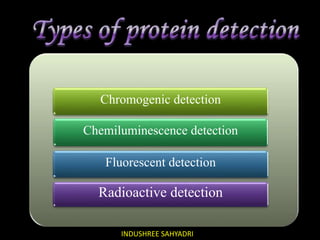
• There are four methods of detection can be
done & they are as follows:
INDUSHREE SAHYADRI
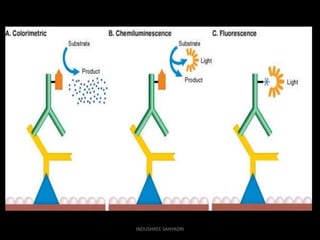
Chromogenic detection
Chemiluminescence detection
Fluorescent detection
Radioactive detection
INDUSHREE SAHYADRI
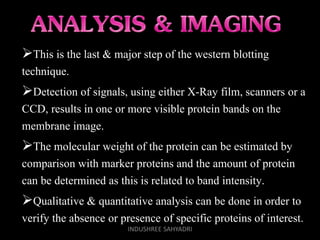
This is the last & major step of the western blotting
technique.
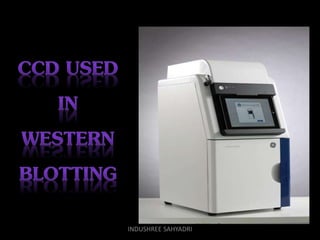
Detection of signals, using either X-Ray film, scanners or a
CCD, results in one or more visible protein bands on the
membrane image.
The molecular weight of the protein can be estimated by
comparison with marker proteins and the amount of protein
can be determined as this is related to band intensity.
Qualitative & quantitative analysis can be done in order to
verify the absence or presence of specific proteins of interest.
INDUSHREE SAHYADRI
INDUSHREE SAHYADRI
INDUSHREESAHYADRI
Analysis Of IgG Fractions purified from human plasma.
Diagnosis of HIV by ELISA, involves the western blotting technique.
Western blotting technique is also used to Detect Some Forms Of
Lyme Disease.
Western blotting technique is used in Definitive Test For BSE, which
is commonly know as Mad cow disease.
Confirmatory Test For Hepatitis-B involves western blotting
technique.
Western blotting test is used in the Analysis Of Biomarkers such as
hormones, growth factors & cytokines.
This technique is also employed in The Gene Expression Studies.
INDUSHREE SAHYADRI
INDUSHREESAHYADRI
Very delicate and time consuming process. A minute imbalance at
any level of the procedure can skew the results of the entire process.
Incorrect labeling of the protein can happen due to the reaction of
secondary antibody.
Cause erroneous in bands or no bands due to insufficient transfer.
Well trained technicians are required for this technique.
Primary antibody availability is crucial.
It is just a semi-quantitative at best. Only an approx estimation &
not a precise measurement of molecular weight of the protein is
possible.
INDUSHREE SAHYADRI
INDUSHREESAHYADRI
Western blotting technique is simply a way to identify unknown
proteins on a polyacrylamide gel.
It is sometimes called as protein blotting or immunoblotting.

It is a widely used analytical technique in the fields of molecular
biology, immunogenetics, and other biochemistry disciplines.
Western blotting technique is also used in the field of medical
diagnostics. i.e., in the analysis of various kinds of diseases.
Apart from the limitations of western blotting, it is more helpful
now a days. Hence, The discovery of Western blotting technique
has become boon in the field of science & technology.
INDUSHREE SAHYADRI
INDUSHREESAHYADRI
INDUSHREE SAHYADRI
INDUSHREE SAHYADRI

western blotting power point presentation.

  • 1.
  • 2.
  • 3.
  • 4.
    BLOTTING TECHNIQUES Southern blotting Used todetect DNA Nothern blotting Used to detect RNA Western blotting Used to detect Proteins INDUSHREE SAHYADRI
  • 5.
    Western blotting isa widely used analytical technique in molecular biology to detect specific protein in a sample of tissue homogenate or extract.  It works on the principle of gel electrophoresis. Proteins are separated based on their size on polyacrylamide gel INDUSHREE SAHYADRI
  • 6.
    DIGITAL IMAGING PROTIEN DETECTION WASHING ANTIBODYPROBING BLOCKING NON-SPECIFIC ANTIBODY PROTIEN STAINING PROTIEN TRANSFER GEL ELECTROPHORESING THE PROTEIN SAMPLE SAMPLE PREPARATION INDUSHREE SAHYADRI
  • 7.
  • 8.
    Electrophoresis is commonlyused method for separating proteins on the basis of size, shape or charge.  In Gel electrophoresis, protein of sample extract are separated according to their molecular weight. INDUSHREE SAHYADRI
  • 9.
  • 10.
    Sample loading into thewells of electrophoresis equipment Loading sample loading buffers into empty wells. Place the safety lid on the unit When Tracking gel reaches the bottom of the gel, turn off the power supply. Run the gel under the appropriate conditions. Plug the color coded leads into the jacks in the power supply Disconnect the leads and remove the safety leads & remove safety lid. Remove the gel from electrophoresis apparatus. Then proceed to protein transfer. INDUSHREE SAHYADRI INDUSHREE SAHYADRI INDUSHREE SAHYADRI
  • 11.
  • 12.
  • 13.
    • On completionof the separation of proteins by polyacrylamide gel electrophoresis, the next step is to transfer the proteins from the gels to solid support membrane. • Usually made up of a chemically inert substance, such as NITROCELLULOSE or PVDF. • The process of transferring proteins from a gel to a membrane while maintaining their relative positions and resolutions is known as BLOTTING INDUSHREE SAHYADRI
  • 14.
  • 15.
    After gel electrophoresis,it may be necessary to confirm that all the proteins in the gel have been completely eluted. As proteins are not directly visible in the gel, the gel must be stained. Proteins are usually stained with dyes such as coomassie blue, silver stain, or deep purple. After staining, a permanent record may be made by imaging the gel with suitable instrument. INDUSHREE SAHYADRI
  • 16.
  • 17.
    For meaningful results,the antibodies must bind only to the protein of interest and not to the membrane. Non-specific binding (NSB) of antibodies can be reduced by blocking the unoccupied sites of membrane with an inert protein or non-ionic detergent.  Blocking agents should possess greater affinity towards membrane than the antibodies. INDUSHREE SAHYADRI
  • 18.
    The most commonblocking agents are: a) Bovine serum albumin(BSA) b) Non-fat milk c) Casein d) Gelatin e) Dilute solution of Tween 20. INDUSHREE SAHYADRI
  • 19.
    After blocking ,the blot is incubated with one or more antibodies. This uses specific antibody to detect a localize the protein blotted to a membrane. The specificity of antigen-antibody binding permits the identification of a single protein in a complex sample The non-labeled primary antibody directed against the target protein, and specific labeled secondary antibody binds to the primary antibody. The secondary antibody is conjugated to an enzyme that is used to indicate the location of the protein. INDUSHREE SAHYADRI
  • 20.
  • 21.
    Secondary antibodies canbe a monoclonal or polyclonal antibodies. The secondary antibodies not only serves as a carrier of the label, but it is also helps to amplify the emitted signals. The signal emitted by the labeled secondary antibody is then measured and is proportional to the quantity of protein of interest present on the membrane. INDUSHREE SAHYADRI
  • 22.
    Unbound antibodies cancause high background and poor detection. Hence Washing the blot removes unbound antibodies from the membrane. A dilute solution of tween-20 in TBS or PBS buffer is commonly used for washing. INDUSHREE SAHYADRI
  • 23.
    • After theunbound probes are washed away, the western blotting is now ready for detection of the probes that are labeled and bound to the protein of interest. • Enzymes such as alkaline phosphatase(AP), & Horse-radish peroxidase(HRP) are widely used in detection of proteins. • There are four methods of detection can be done & they are as follows: INDUSHREE SAHYADRI
  • 24.
    Chromogenic detection Chemiluminescence detection Fluorescentdetection Radioactive detection INDUSHREE SAHYADRI
  • 25.
    This is thelast & major step of the western blotting technique. Detection of signals, using either X-Ray film, scanners or a CCD, results in one or more visible protein bands on the membrane image. The molecular weight of the protein can be estimated by comparison with marker proteins and the amount of protein can be determined as this is related to band intensity. Qualitative & quantitative analysis can be done in order to verify the absence or presence of specific proteins of interest. INDUSHREE SAHYADRI
  • 26.
  • 27.
  • 28.
    Analysis Of IgGFractions purified from human plasma. Diagnosis of HIV by ELISA, involves the western blotting technique. Western blotting technique is also used to Detect Some Forms Of Lyme Disease. Western blotting technique is used in Definitive Test For BSE, which is commonly know as Mad cow disease. Confirmatory Test For Hepatitis-B involves western blotting technique. Western blotting test is used in the Analysis Of Biomarkers such as hormones, growth factors & cytokines. This technique is also employed in The Gene Expression Studies. INDUSHREE SAHYADRI
  • 29.
  • 30.
    Very delicate andtime consuming process. A minute imbalance at any level of the procedure can skew the results of the entire process. Incorrect labeling of the protein can happen due to the reaction of secondary antibody. Cause erroneous in bands or no bands due to insufficient transfer. Well trained technicians are required for this technique. Primary antibody availability is crucial. It is just a semi-quantitative at best. Only an approx estimation & not a precise measurement of molecular weight of the protein is possible. INDUSHREE SAHYADRI
  • 31.
  • 32.
    Western blotting techniqueis simply a way to identify unknown proteins on a polyacrylamide gel. It is sometimes called as protein blotting or immunoblotting. It is a widely used analytical technique in the fields of molecular biology, immunogenetics, and other biochemistry disciplines. Western blotting technique is also used in the field of medical diagnostics. i.e., in the analysis of various kinds of diseases. Apart from the limitations of western blotting, it is more helpful now a days. Hence, The discovery of Western blotting technique has become boon in the field of science & technology. INDUSHREE SAHYADRI
  • 33.
  • 34.
  • 35.