INTRODUCTION
Knitting

KARTHIKA M DEV
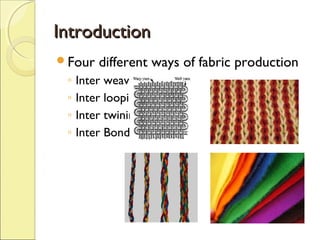
Introduction
Four

◦
◦
◦
◦

different ways of fabric production

Inter weaving
Inter looping
Inter twining
Inter Bonding
Knitting
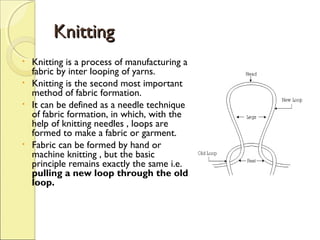
Knitting is a process of manufacturing a
fabric by inter looping of yarns.
• Knitting is the second most important
method of fabric formation.
• It can be defined as a needle technique
of fabric formation, in which, with the
help of knitting needles , loops are
formed to make a fabric or garment.
• Fabric can be formed by hand or
machine knitting , but the basic
principle remains exactly the same i.e.
pulling a new loop through the old
loop.
•
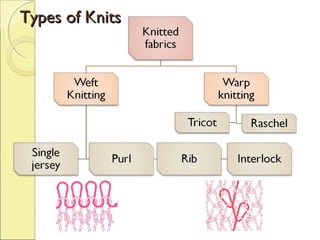
Types of Knits
Common Knitting terms
•

•

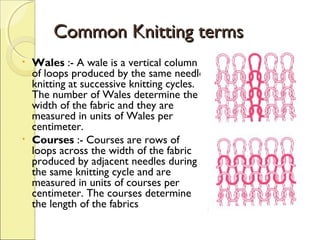
Wales :- A wale is a vertical column
of loops produced by the same needle
knitting at successive knitting cycles.
The number of Wales determine the
width of the fabric and they are
measured in units of Wales per
centimeter.
Courses :- Courses are rows of
loops across the width of the fabric
produced by adjacent needles during
the same knitting cycle and are
measured in units of courses per
centimeter. The courses determine
the length of the fabrics
Common Knitting terms
•

•

•

Stitch density :- Stitch density is a term frequently used in knitting and
represents the total number of needles loop in a given area. Stitch density
is the product of Courses and Wales per unit length and is measured in
units of loops per square centimeter.
Stitch Length :- the stitch length is one of the most important factor
controlling the properties of knitted fabrics. The stitch length , measured
in millimeter is the length of the yarn in the knitted loop. Generally longer
the stitch length, the more open and lighter the fabric.
Count :- the number of wales measured along the width of the fabric is
called wale count or wale density. Wale count is expresses as number of
wales per inch (WPI). The courses measured along the length of the fabric
is called course count or course density. Course count is usually
expressed as the number of courses per inch (CPI). Count of the fabric is
very important for the fabric analysis.
For Example: if a fabric is having 12 wales and 15 courses per inch, its
fabric count be expressed as ( 12x15 )
Development of Knitting


The word knitting is derived from the Sanskrit word Nahyati. According to the textile
history, it is said that finger knitting started since 1000 BC. In finger knitting, the fabric was
produced on the hand using the fingers. The looping was done on the fingers. The fabric was
produced by removing a new loop through an old loop.



Since the fabric produced on the hand was smaller in width the peg knitting was introduced.
The finger knitting had only 4 loops in width but in peg knitting more numbers of loops was
possible. According to the width of the fabric the number of pegs was decided.



Hand knitting with 2 pins was practiced since 256 AD. The knitted fabrics were prepared
with the help of 2 pins. In about 5th century AD an oldest knitted article (sock) was seen.



Reverent William Lee, in 1589 a resident of England invented the first knitting machine with
bearded needle. The gauge of the machine was 8npi and afterwards it was made upto 20npi.
The machine had a potential of knitting 10 times more than hand knitting with two pins.
Further many more warp and weft machines were developed but the principle remained the
same.



In the 18th century , rib knitting machine, warp knitting machines and circular knitting frame
was invented



In the 19th century, latch needle, compound needle, fashioning mechanism, seamless heal and
toe i.e. sock, flat knitting machine, interlock knitting were invented all over the world.



In the 20th century, double cylinder circular machine, electronic needle selection, relanit
principle, Pizo electronic jacquard etc were invented
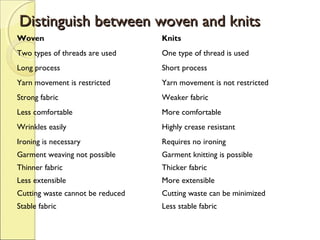
Distinguish between woven and knits
Woven

Knits

Two types of threads are used

One type of thread is used

Long process

Short process

Yarn movement is restricted

Yarn movement is not restricted

Strong fabric

Weaker fabric

Less comfortable

More comfortable

Wrinkles easily

Highly crease resistant

Ironing is necessary

Requires no ironing

Garment weaving not possible

Garment knitting is possible

Thinner fabric

Thicker fabric

Less extensible

More extensible

Cutting waste cannot be reduced

Cutting waste can be minimized

Stable fabric

Less stable fabric

INTRODUCTION Knitting

  • 1.
  • 2.
    Introduction Four ◦ ◦ ◦ ◦ different ways offabric production Inter weaving Inter looping Inter twining Inter Bonding
  • 3.
    Knitting Knitting is aprocess of manufacturing a fabric by inter looping of yarns. • Knitting is the second most important method of fabric formation. • It can be defined as a needle technique of fabric formation, in which, with the help of knitting needles , loops are formed to make a fabric or garment. • Fabric can be formed by hand or machine knitting , but the basic principle remains exactly the same i.e. pulling a new loop through the old loop. •
  • 4.
  • 5.
    Common Knitting terms • • Wales:- A wale is a vertical column of loops produced by the same needle knitting at successive knitting cycles. The number of Wales determine the width of the fabric and they are measured in units of Wales per centimeter. Courses :- Courses are rows of loops across the width of the fabric produced by adjacent needles during the same knitting cycle and are measured in units of courses per centimeter. The courses determine the length of the fabrics
  • 6.
    Common Knitting terms • • • Stitchdensity :- Stitch density is a term frequently used in knitting and represents the total number of needles loop in a given area. Stitch density is the product of Courses and Wales per unit length and is measured in units of loops per square centimeter. Stitch Length :- the stitch length is one of the most important factor controlling the properties of knitted fabrics. The stitch length , measured in millimeter is the length of the yarn in the knitted loop. Generally longer the stitch length, the more open and lighter the fabric. Count :- the number of wales measured along the width of the fabric is called wale count or wale density. Wale count is expresses as number of wales per inch (WPI). The courses measured along the length of the fabric is called course count or course density. Course count is usually expressed as the number of courses per inch (CPI). Count of the fabric is very important for the fabric analysis. For Example: if a fabric is having 12 wales and 15 courses per inch, its fabric count be expressed as ( 12x15 )
  • 7.
    Development of Knitting  Theword knitting is derived from the Sanskrit word Nahyati. According to the textile history, it is said that finger knitting started since 1000 BC. In finger knitting, the fabric was produced on the hand using the fingers. The looping was done on the fingers. The fabric was produced by removing a new loop through an old loop.  Since the fabric produced on the hand was smaller in width the peg knitting was introduced. The finger knitting had only 4 loops in width but in peg knitting more numbers of loops was possible. According to the width of the fabric the number of pegs was decided.  Hand knitting with 2 pins was practiced since 256 AD. The knitted fabrics were prepared with the help of 2 pins. In about 5th century AD an oldest knitted article (sock) was seen.  Reverent William Lee, in 1589 a resident of England invented the first knitting machine with bearded needle. The gauge of the machine was 8npi and afterwards it was made upto 20npi. The machine had a potential of knitting 10 times more than hand knitting with two pins. Further many more warp and weft machines were developed but the principle remained the same.  In the 18th century , rib knitting machine, warp knitting machines and circular knitting frame was invented  In the 19th century, latch needle, compound needle, fashioning mechanism, seamless heal and toe i.e. sock, flat knitting machine, interlock knitting were invented all over the world.  In the 20th century, double cylinder circular machine, electronic needle selection, relanit principle, Pizo electronic jacquard etc were invented
  • 8.
    Distinguish between wovenand knits Woven Knits Two types of threads are used One type of thread is used Long process Short process Yarn movement is restricted Yarn movement is not restricted Strong fabric Weaker fabric Less comfortable More comfortable Wrinkles easily Highly crease resistant Ironing is necessary Requires no ironing Garment weaving not possible Garment knitting is possible Thinner fabric Thicker fabric Less extensible More extensible Cutting waste cannot be reduced Cutting waste can be minimized Stable fabric Less stable fabric