Relations
and
Functions
Classify Me!
Each group will pick a piece of paper and each paper
has a name of an object written on it (5 paper each
group). You will group the following objects in such a
way that they have common property/characteristics
then write on the right corner of the board the object
and its group in the form (object, common name). For
example, (pen, school supplies).
I will give marker to the two groups and during the
activity, the first member will do the task then s/he will
give the chalk to the next member. The group who will
finish first the activity will be the winner.
Objectives
• Illustrates a relation and a
function;
• Verify if a given relation is a
function.
“Representing a Relation”
In this activity, you will describe the mapping
diagram by writing the set of ordered pairs. The
first two coordinates are done for you.
What is a Relation?
A relation is a set of ordered pairs.
When you group two or more points in a set, it is
referred to as a relation. When you want to show that a
set of points is a relation you list the points in braces.
For example, if I want to show that the points (-3,1) ;
(0, 2) ; (3, 3) ; & (6, 4) are a relation, it would be written
like this:
{(-3,1) ; (0, 2) ; (3, 3) ; (6, 4)}
Domain and Range
 Each ordered pair has two parts, an x-value
and a y-value.
 The x-values of a given relation are called the
Domain.
 The y-values of the relation are called the
Range.
 When you list the domain and range of a
relation, you place each (the domain and the
range) in a separate set of braces.
For Example,
1. List the domain and the range of the relation
{(-3,1) ; (0, 2) ; (3, 3) ; (6, 4)}
Domain: { -3, 0, 3, 6} Range: {1, 2, 3, 4}
2. List the domain and the range of the relation
{(-3,3) ; (0, 2) ; (3, 3) ; (6, 4) ; ( 7, 7)}
Domain: {-3, 0, 3, 6, 7} Range: {3, 2, 4, 7}
Notice! Even though the number 3 is listed twice in the
relation, you only note the number once when you list the
domain or range!
Aside from ordered pairs, a relation may be
represented in four ways:
Table
x -2 -1 0 1 2
y -4 -2 0 2 4
Mapping
-2
-1
0
1
2
-4
-2
0
2
4
Aside from ordered pairs, a relation may be
represented in four ways:
Graph Rule or Equation
Notice that the
value of y is twice
the value of x. In
other words, this
can be described by
the equation y = 2x,
where x is an
integer from -2 to 2.
What is a Function?
Function is the relation in which each element of the
domain corresponds to exactly one element of the
range.
A function is a relation that assigns each
y-value only one x-value.
What does that mean? It means, in order for the
relation to be considered a function, there cannot be
any repeated values in the domain.
Note: every function is a relation, but not all relations are
function.
Types of Function
One-to-one
{(-3,1) ; (0, 2) ; (3, 3) ; (6, 4)}
-3
0
3
6
1
2
3
4
This relation is a function because each x-value maps to only one y-value.
Types of Function
Many-to-one
{(-1,2) ; (1, 2) ; (5, 3) ; (6, 8)}
-1
1
5
6
2
3
8
Notice that even
though there are
two 2’s in the
range, you only
list the 2 once.
This relation is a function because each x-value maps to only one y-value.
It is still a function if two x-values go to the same y-value.
Types of Function
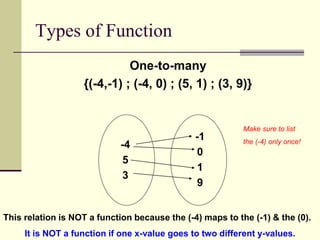
One-to-many
{(-4,-1) ; (-4, 0) ; (5, 1) ; (3, 9)}
-4
5
3
-1
0
1
9
This relation is NOT a function because the (-4) maps to the (-1) & the (0).
It is NOT a function if one x-value goes to two different y-values.
Make sure to list
the (-4) only once!
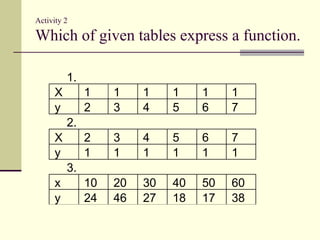
Activity 2
Which of given tables express a function.
1.
X 1 1 1 1 1 1
y 2 3 4 5 6 7
2.
X 2 3 4 5 6 7
y 1 1 1 1 1 1
3.
x 10 20 30 40 50 60
y 24 46 27 18 17 38
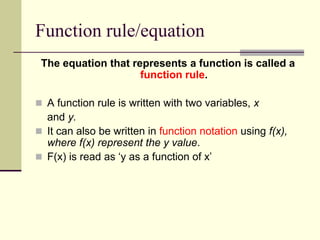
Function rule/equation
The equation that represents a function is called a
function rule.
 A function rule is written with two variables, x
and y.
 It can also be written in function notation using f(x),
where f(x) represent the y value.
 F(x) is read as ‘y as a function of x’
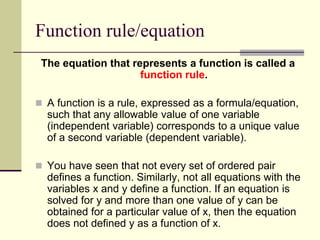
Function rule/equation
The equation that represents a function is called a
function rule.
 A function is a rule, expressed as a formula/equation,
such that any allowable value of one variable
(independent variable) corresponds to a unique value
of a second variable (dependent variable).
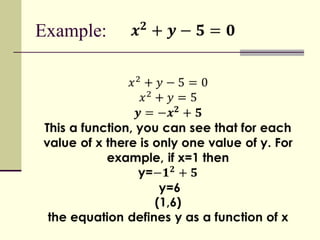
 You have seen that not every set of ordered pair
defines a function. Similarly, not all equations with the
variables x and y define a function. If an equation is
solved for y and more than one value of y can be
obtained for a particular value of x, then the equation
does not defined y as a function of x.
Example:
Example:
Activity 3
Which of given rule/equation a function.
Function Graph
 Every graph illustrate a set of ordered
pairs. But not every graph in the x-y plane
represent function. The vertical line test is
the simplest way of determining whether or
not a graph represent a function.
 Vertical line test means a graph represents
a function if and only if no vertical line
intersect the graph at more than one point.
Examples of the Vertical Line Test
function
function
Not a function
Not a function
……….
Example:
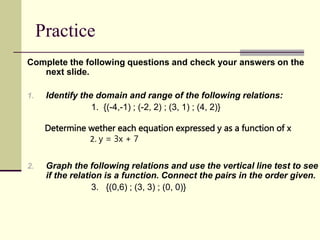
Practice
Complete the following questions and check your answers on the
next slide.
1. Identify the domain and range of the following relations:
1. {(-4,-1) ; (-2, 2) ; (3, 1) ; (4, 2)}
2. Graph the following relations and use the vertical line test to see
if the relation is a function. Connect the pairs in the order given.
3. {(0,6) ; (3, 3) ; (0, 0)}
Determine wether each equation expressed y as a function of x
2. y = 3x + 7
Quiz
Get one whole sheet of paper and answer the following. This will
serve as your quiz.
Test 1!
Assignment:
For your assignment, copy these equations and write your answer in a
one whole sheet of paper.
Determine whether each rule below represents a function or not.

relationsandfunctionsupdated-140102120840-phpapp01.ppt

  • 1.
  • 2.
    Classify Me! Each groupwill pick a piece of paper and each paper has a name of an object written on it (5 paper each group). You will group the following objects in such a way that they have common property/characteristics then write on the right corner of the board the object and its group in the form (object, common name). For example, (pen, school supplies). I will give marker to the two groups and during the activity, the first member will do the task then s/he will give the chalk to the next member. The group who will finish first the activity will be the winner.
  • 3.
    Objectives • Illustrates arelation and a function; • Verify if a given relation is a function.
  • 4.
    “Representing a Relation” Inthis activity, you will describe the mapping diagram by writing the set of ordered pairs. The first two coordinates are done for you.
  • 5.
    What is aRelation? A relation is a set of ordered pairs. When you group two or more points in a set, it is referred to as a relation. When you want to show that a set of points is a relation you list the points in braces. For example, if I want to show that the points (-3,1) ; (0, 2) ; (3, 3) ; & (6, 4) are a relation, it would be written like this: {(-3,1) ; (0, 2) ; (3, 3) ; (6, 4)}
  • 6.
    Domain and Range Each ordered pair has two parts, an x-value and a y-value.  The x-values of a given relation are called the Domain.  The y-values of the relation are called the Range.  When you list the domain and range of a relation, you place each (the domain and the range) in a separate set of braces.
  • 7.
    For Example, 1. Listthe domain and the range of the relation {(-3,1) ; (0, 2) ; (3, 3) ; (6, 4)} Domain: { -3, 0, 3, 6} Range: {1, 2, 3, 4} 2. List the domain and the range of the relation {(-3,3) ; (0, 2) ; (3, 3) ; (6, 4) ; ( 7, 7)} Domain: {-3, 0, 3, 6, 7} Range: {3, 2, 4, 7} Notice! Even though the number 3 is listed twice in the relation, you only note the number once when you list the domain or range!
  • 8.
    Aside from orderedpairs, a relation may be represented in four ways: Table x -2 -1 0 1 2 y -4 -2 0 2 4 Mapping -2 -1 0 1 2 -4 -2 0 2 4
  • 9.
    Aside from orderedpairs, a relation may be represented in four ways: Graph Rule or Equation Notice that the value of y is twice the value of x. In other words, this can be described by the equation y = 2x, where x is an integer from -2 to 2.
  • 10.
    What is aFunction? Function is the relation in which each element of the domain corresponds to exactly one element of the range. A function is a relation that assigns each y-value only one x-value. What does that mean? It means, in order for the relation to be considered a function, there cannot be any repeated values in the domain. Note: every function is a relation, but not all relations are function.
  • 11.
    Types of Function One-to-one {(-3,1); (0, 2) ; (3, 3) ; (6, 4)} -3 0 3 6 1 2 3 4 This relation is a function because each x-value maps to only one y-value.
  • 12.
    Types of Function Many-to-one {(-1,2); (1, 2) ; (5, 3) ; (6, 8)} -1 1 5 6 2 3 8 Notice that even though there are two 2’s in the range, you only list the 2 once. This relation is a function because each x-value maps to only one y-value. It is still a function if two x-values go to the same y-value.
  • 13.
    Types of Function One-to-many {(-4,-1); (-4, 0) ; (5, 1) ; (3, 9)} -4 5 3 -1 0 1 9 This relation is NOT a function because the (-4) maps to the (-1) & the (0). It is NOT a function if one x-value goes to two different y-values. Make sure to list the (-4) only once!
  • 14.
    Activity 2 Which ofgiven tables express a function. 1. X 1 1 1 1 1 1 y 2 3 4 5 6 7 2. X 2 3 4 5 6 7 y 1 1 1 1 1 1 3. x 10 20 30 40 50 60 y 24 46 27 18 17 38
  • 15.
    Function rule/equation The equationthat represents a function is called a function rule.  A function rule is written with two variables, x and y.  It can also be written in function notation using f(x), where f(x) represent the y value.  F(x) is read as ‘y as a function of x’
  • 16.
    Function rule/equation The equationthat represents a function is called a function rule.  A function is a rule, expressed as a formula/equation, such that any allowable value of one variable (independent variable) corresponds to a unique value of a second variable (dependent variable).  You have seen that not every set of ordered pair defines a function. Similarly, not all equations with the variables x and y define a function. If an equation is solved for y and more than one value of y can be obtained for a particular value of x, then the equation does not defined y as a function of x.
  • 17.
  • 18.
  • 19.
    Activity 3 Which ofgiven rule/equation a function.
  • 20.
    Function Graph  Everygraph illustrate a set of ordered pairs. But not every graph in the x-y plane represent function. The vertical line test is the simplest way of determining whether or not a graph represent a function.  Vertical line test means a graph represents a function if and only if no vertical line intersect the graph at more than one point.
  • 21.
    Examples of theVertical Line Test function function Not a function Not a function ……….
  • 22.
  • 23.
    Practice Complete the followingquestions and check your answers on the next slide. 1. Identify the domain and range of the following relations: 1. {(-4,-1) ; (-2, 2) ; (3, 1) ; (4, 2)} 2. Graph the following relations and use the vertical line test to see if the relation is a function. Connect the pairs in the order given. 3. {(0,6) ; (3, 3) ; (0, 0)} Determine wether each equation expressed y as a function of x 2. y = 3x + 7
  • 24.
    Quiz Get one wholesheet of paper and answer the following. This will serve as your quiz. Test 1!
  • 25.
    Assignment: For your assignment,copy these equations and write your answer in a one whole sheet of paper. Determine whether each rule below represents a function or not.