Relations
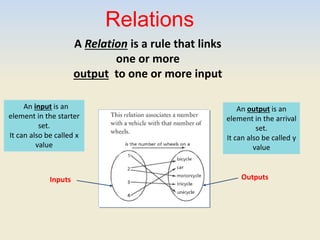
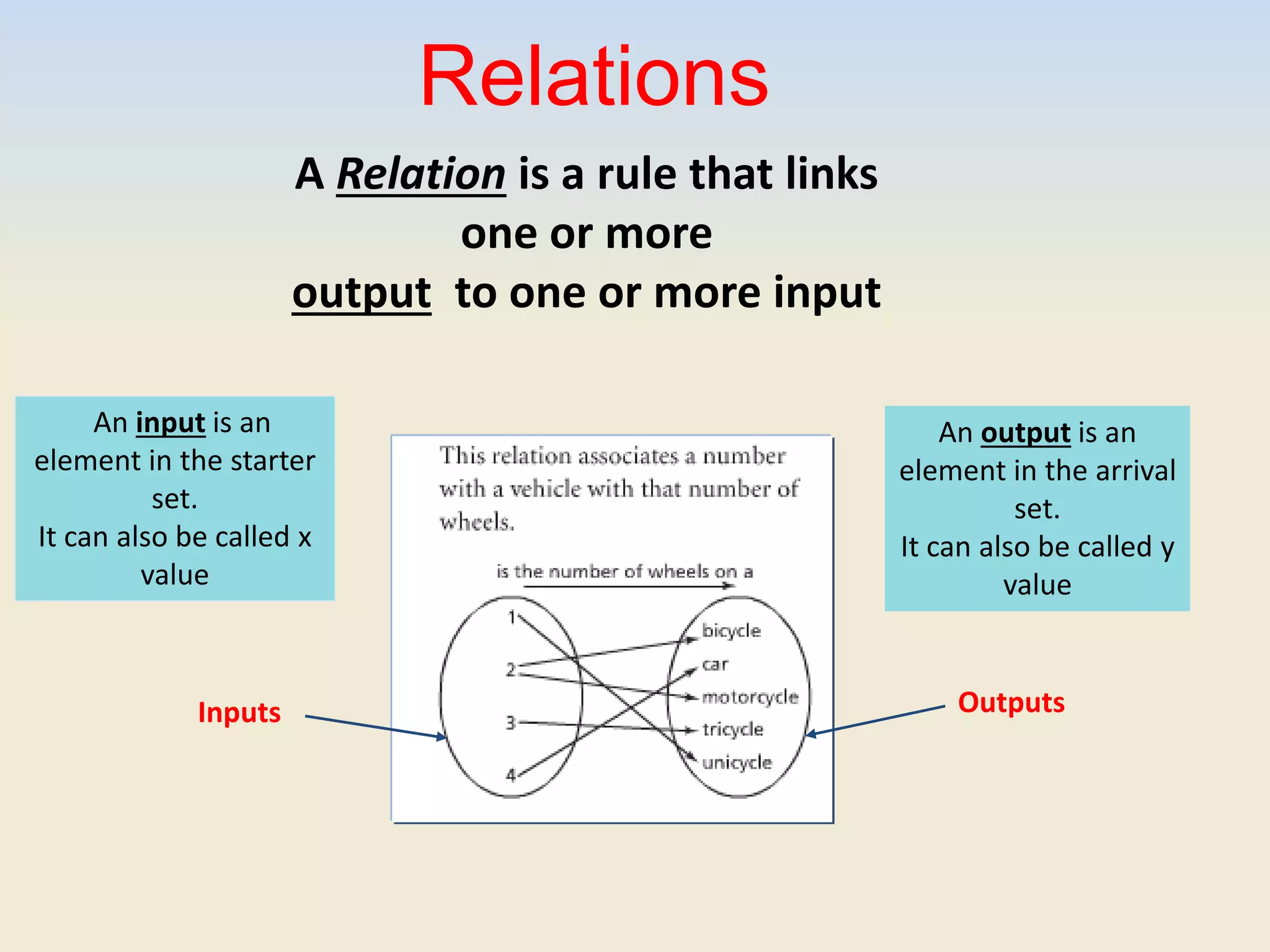
A Relation is a rule that links
one or more
output to one or more input
An input is an
element in the starter
set.
It can also be called x
value
An output is an
element in the arrival
set.
It can also be called y
value
Inputs Outputs
Functions
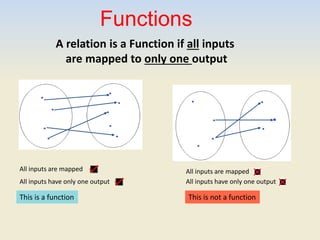
A relation is a Function if all inputs
are mapped to only one output
This is a function
All inputs are mapped
All inputs have only one output
All inputs are mapped
All inputs have only one output
This is not a function
For example…
State Capital
New Jersey Trenton
New York Albany
Colorado Denver
Rhode Island Providence
Person Grandparent
Eric Arthur
Eric Ellie
Maria Camine
Maria Susan
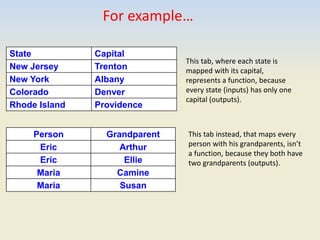
This tab, where each state is
mapped with its capital,
represents a function, because
every state (inputs) has only one
capital (outputs).
This tab instead, that maps every
person with his grandparents, isn’t
a function, because they both have
two grandparents (outputs).
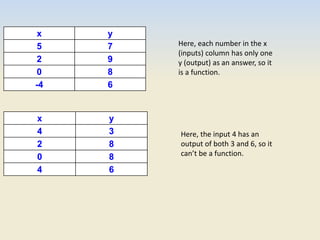
x y
5 7
2 9
0 8
-4 6
x y
4 3
2 8
0 8
4 6
Here, each number in the x
(inputs) column has only one
y (output) as an answer, so it
is a function.
Here, the input 4 has an
output of both 3 and 6, so it
can’t be a function.
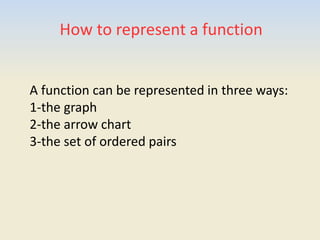
How to represent a function
A function can be represented in three ways:
1-the graph
2-the arrow chart
3-the set of ordered pairs
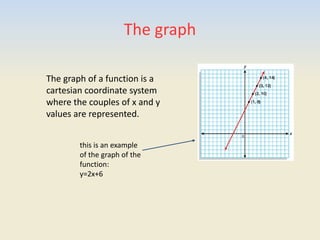
The graph
The graph of a function is a
cartesian coordinate system
where the couples of x and y
values are represented.
this is an example
of the graph of the
function:
y=2x+6
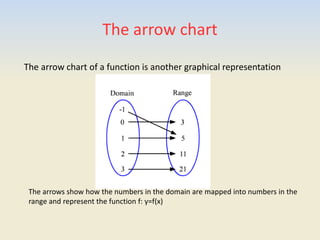
The arrow chart
The arrow chart of a function is another graphical representation
The arrows show how the numbers in the domain are mapped into numbers in the
range and represent the function f: y=f(x)
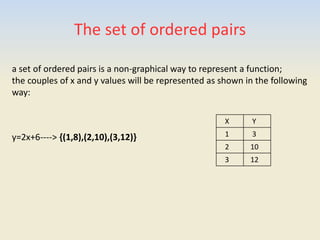
The set of ordered pairs
a set of ordered pairs is a non-graphical way to represent a function;
the couples of x and y values will be represented as shown in the following
way:
y=2x+6----> {(1,8),(2,10),(3,12)}
X Y
1 3
2 10
3 12
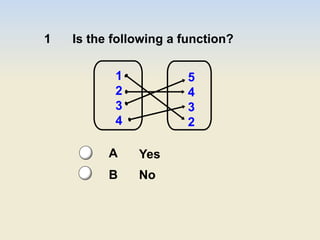
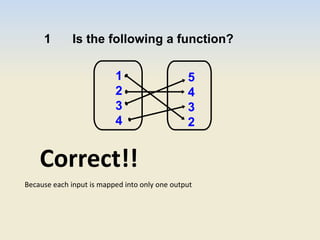
1 Is the following a function?
Yes
No
1
2
3
4
5
4
3
2
A
B
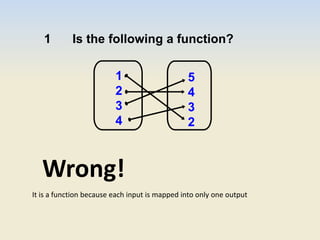
1 Is the following a function?
1
2
3
4
5
4
3
2
Because each input is mapped into only one output
Correct!!
1
1
2
3
4
5
4
3
2
Is the following a function?
Wrong!
It is a function because each input is mapped into only one output
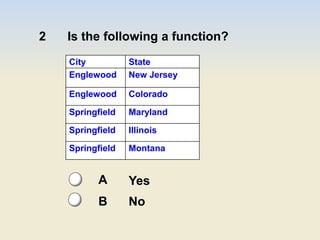
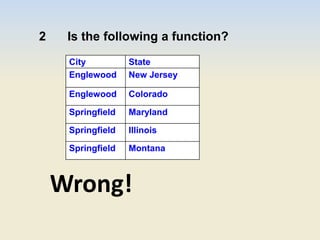
2 Is the following a function?
City State
Englewood New Jersey
Englewood Colorado
Springfield Maryland
Springfield Illinois
Springfield Montana
Yes
No
A
B
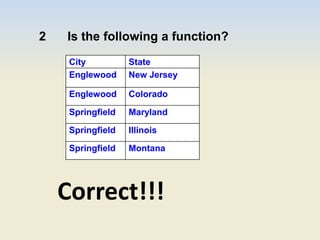
2 Is the following a function?
City State
Englewood New Jersey
Englewood Colorado
Springfield Maryland
Springfield Illinois
Springfield Montana
Correct!!!
2 Is the following a function?
City State
Englewood New Jersey
Englewood Colorado
Springfield Maryland
Springfield Illinois
Springfield Montana
Wrong!
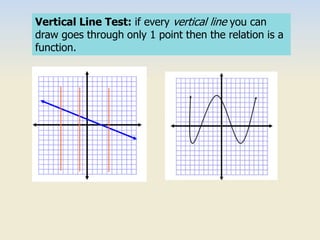
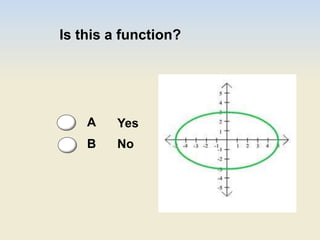
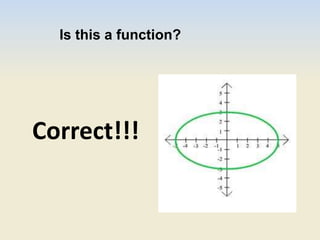
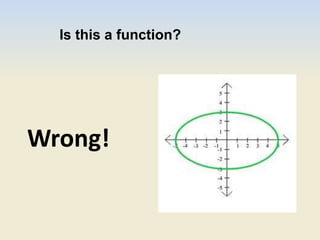
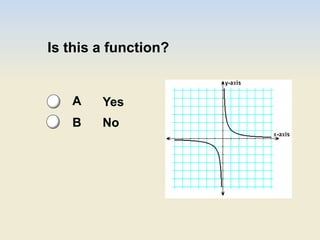
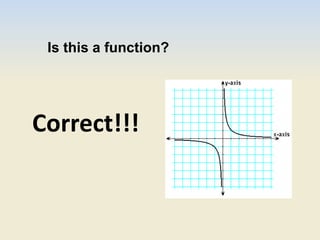
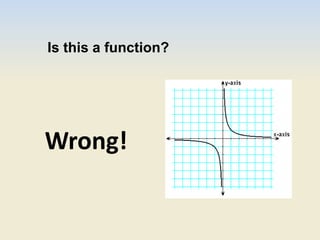
Vertical Line Test: if every vertical line you can
draw goes through only 1 point then the relation is a
function.
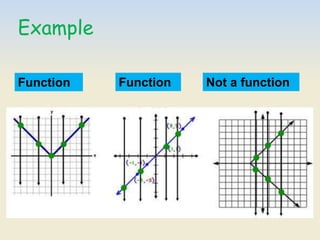
Function Function Not a function
Example
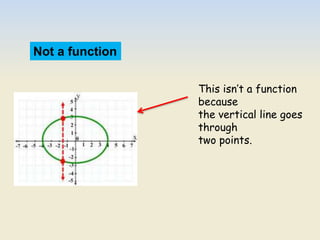
Not a function
This isn’t a function
because
the vertical line goes
through
two points.
Is this a function?
Yes
No
A
B
Is this a function?
Correct!!!
Is this a function?
Wrong!
Is this a function?
Yes
No
A
B
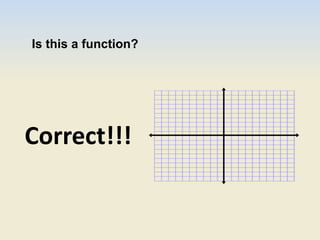
Is this a function?
Correct!!!
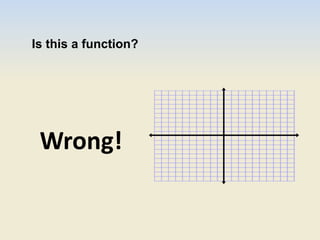
Is this a function?
Wrong!
Is this a function?
Yes
No
A
B
Is this a function?
Correct!!!
Is this a function?
Wrong!
Domain codomain and
range
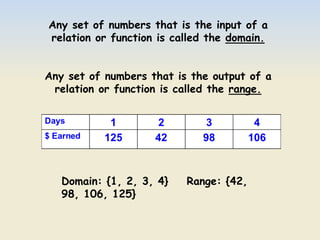
Any set of numbers that is the input of a
relation or function is called the domain.
Any set of numbers that is the output of a
relation or function is called the range.
Domain: {1, 2, 3, 4} Range: {42,
98, 106, 125}
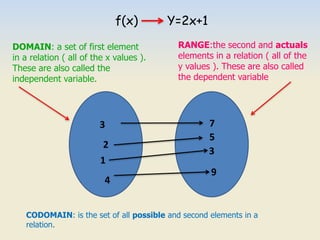
f(x) Y=2x+1
3
2
DOMAIN: a set of first element
in a relation ( all of the x values ).
These are also called the
independent variable.
RANGE:the second and actuals
elements in a relation ( all of the
y values ). These are also called
the dependent variable
1
3
4
5
7
9
CODOMAIN: is the set of all possible and second elements in a
relation.
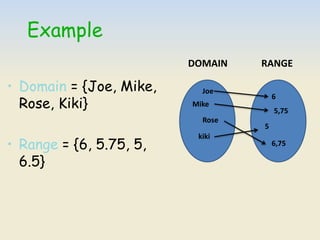
• Domain = {Joe, Mike,
Rose, Kiki}
• Range = {6, 5.75, 5,
6.5}
Example
Joe
Mike
Rose
kiki
DOMAIN RANGE
6
5,75
5
6,75
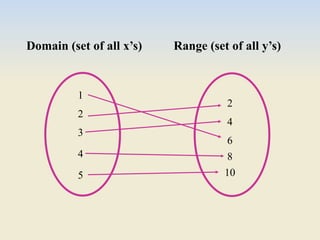
Domain (set of all x’s) Range (set of all y’s)
1
2
3
4
5
2
10
8
6
4
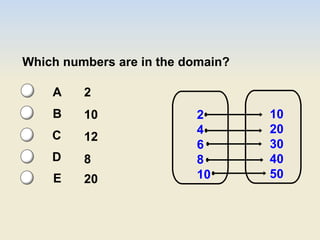
Which numbers are in the domain?
2
4
6
8
10
10
20
30
40
50
2
10
12
8
20
A
B
C
D
E
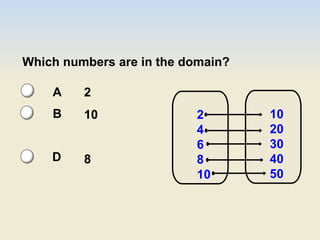
Which numbers are in the domain?
2
4
6
8
10
10
20
30
40
50
2
10
8
A
B
D
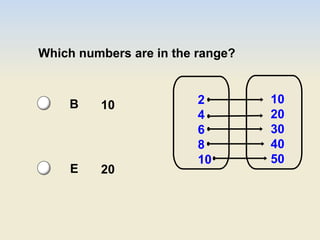
Which numbers are in the range?
2
4
6
8
10
10
20
30
40
50
2
10
12
8
20
A
B
C
D
E
Which numbers are in the range?
2
4
6
8
10
10
20
30
40
50
10
20
B
E
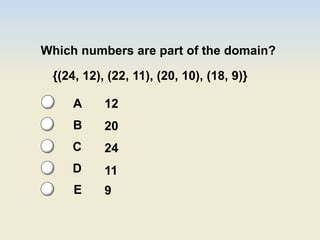
Which numbers are part of the domain?
{(24, 12), (22, 11), (20, 10), (18, 9)}
12
20
24
11
9
A
B
C
D
E
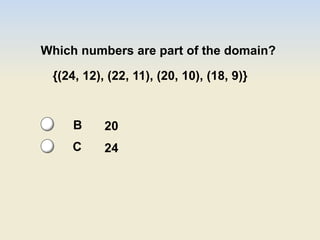
Which numbers are part of the domain?
{(24, 12), (22, 11), (20, 10), (18, 9)}
20
24
B
C
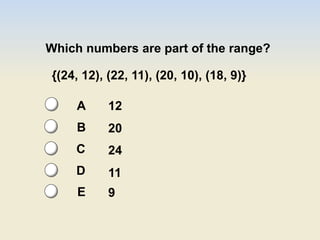
Which numbers are part of the range?
{(24, 12), (22, 11), (20, 10), (18, 9)}
12
20
24
11
9
A
B
C
D
E
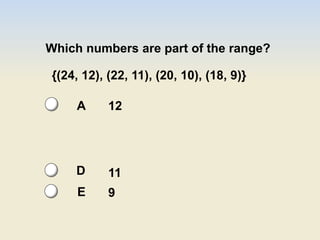
Which numbers are part of the range?
{(24, 12), (22, 11), (20, 10), (18, 9)}
12
11
9
A
D
E
INJECTIVE, SURJECTIVE and
BIJECTIVE FUNCTIONS.
•
•
•
• •
•
• •
X
Y
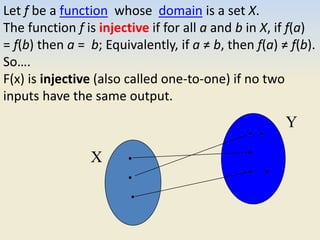
Let f be a function whose domain is a set X.
The function f is injective if for all a and b in X, if f(a)
= f(b) then a = b; Equivalently, if a ≠ b, then f(a) ≠ f(b).
So….
F(x) is injective (also called one-to-one) if no two
inputs have the same output.
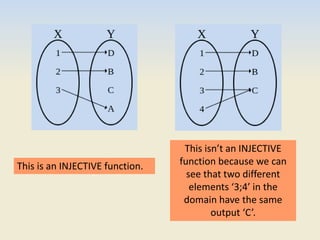
This is an INJECTIVE function.
This isn’t an INJECTIVE
function because we can
see that two different
elements ‘3;4’ in the
domain have the same
output ‘C’.
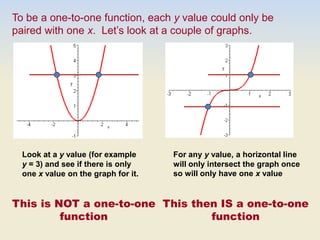
To be a one-to-one function, each y value could only be
paired with one x. Let’s look at a couple of graphs.
Look at a y value (for example
y = 3) and see if there is only
one x value on the graph for it.
This is NOT a one-to-one
function
For any y value, a horizontal line
will only intersect the graph once
so will only have one x value
This then IS a one-to-one
function
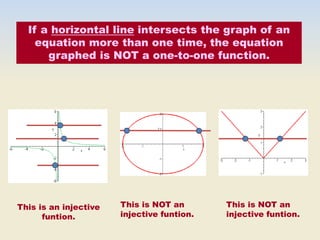
If a horizontal line intersects the graph of an
equation more than one time, the equation
graphed is NOT a one-to-one function.
This is an injective
funtion.
This is NOT an
injective funtion.
This is NOT an
injective funtion.
•
•
• •
•
•
•
X
Y
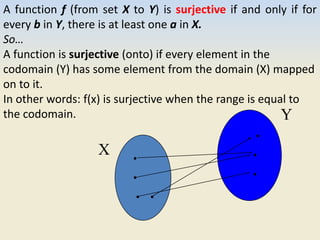
A function f (from set X to Y) is surjective if and only if for
every b in Y, there is at least one a in X.
So…
A function is surjective (onto) if every element in the
codomain (Y) has some element from the domain (X) mapped
on to it.
In other words: f(x) is surjective when the range is equal to
the codomain.
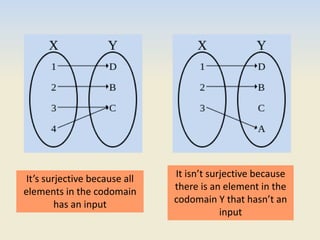
It’s surjective because all
elements in the codomain
has an input
It isn’t surjective because
there is an element in the
codomain Y that hasn’t an
input
•
•
•
•
•
•
A
B
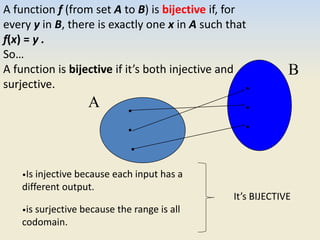
A function f (from set A to B) is bijective if, for
every y in B, there is exactly one x in A such that
f(x) = y .
So…
A function is bijective if it’s both injective and
surjective.
•Is injective because each input has a
different output.
•is surjective because the range is all
codomain.
It’s BIJECTIVE
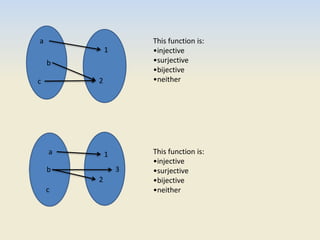
a
b
c
1
2
This function is:
•injective
•surjective
•bijective
•neither
a
b
c
1
2
3
This function is:
•injective
•surjective
•bijective
•neither
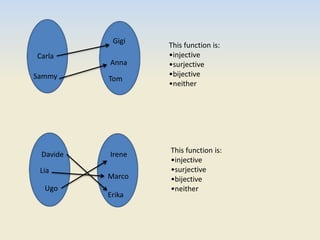
Davide
Lia
Ugo
Irene
Marco
Erika
This function is:
•injective
•surjective
•bijective
•neither
Tom
Gigi
Carla
Sammy
Anna
This function is:
•injective
•surjective
•bijective
•neither
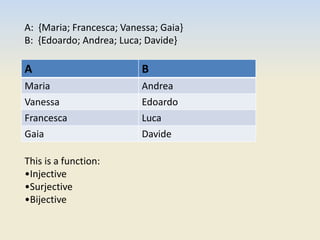
A: {Maria; Francesca; Vanessa; Gaia}
B: {Edoardo; Andrea; Luca; Davide}
A B
Maria Andrea
Vanessa Edoardo
Francesca Luca
Gaia Davide
This is a function:
•Injective
•Surjective
•Bijective
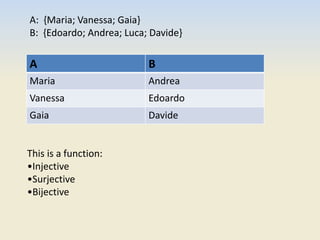
A: {Maria; Vanessa; Gaia}
B: {Edoardo; Andrea; Luca; Davide}
A B
Maria Andrea
Vanessa Edoardo
Gaia Davide
This is a function:
•Injective
•Surjective
•Bijective
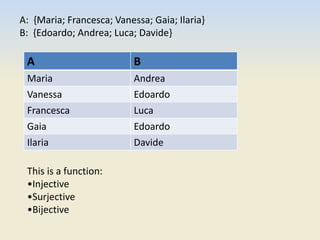
A: {Maria; Francesca; Vanessa; Gaia; Ilaria}
B: {Edoardo; Andrea; Luca; Davide}
A B
Maria Andrea
Vanessa Edoardo
Francesca Luca
Gaia Edoardo
Ilaria Davide
This is a function:
•Injective
•Surjective
•Bijective

Le funzioni matematiche in inglese

  • 1.
    Relations A Relation isa rule that links one or more output to one or more input An input is an element in the starter set. It can also be called x value An output is an element in the arrival set. It can also be called y value Inputs Outputs
  • 2.
    Functions A relation isa Function if all inputs are mapped to only one output This is a function All inputs are mapped All inputs have only one output All inputs are mapped All inputs have only one output This is not a function
  • 3.
    For example… State Capital NewJersey Trenton New York Albany Colorado Denver Rhode Island Providence Person Grandparent Eric Arthur Eric Ellie Maria Camine Maria Susan This tab, where each state is mapped with its capital, represents a function, because every state (inputs) has only one capital (outputs). This tab instead, that maps every person with his grandparents, isn’t a function, because they both have two grandparents (outputs).
  • 4.
    x y 5 7 29 0 8 -4 6 x y 4 3 2 8 0 8 4 6 Here, each number in the x (inputs) column has only one y (output) as an answer, so it is a function. Here, the input 4 has an output of both 3 and 6, so it can’t be a function.
  • 5.
    How to representa function A function can be represented in three ways: 1-the graph 2-the arrow chart 3-the set of ordered pairs
  • 6.
    The graph The graphof a function is a cartesian coordinate system where the couples of x and y values are represented. this is an example of the graph of the function: y=2x+6
  • 7.
    The arrow chart Thearrow chart of a function is another graphical representation The arrows show how the numbers in the domain are mapped into numbers in the range and represent the function f: y=f(x)
  • 8.
    The set ofordered pairs a set of ordered pairs is a non-graphical way to represent a function; the couples of x and y values will be represented as shown in the following way: y=2x+6----> {(1,8),(2,10),(3,12)} X Y 1 3 2 10 3 12
  • 9.
    1 Is thefollowing a function? Yes No 1 2 3 4 5 4 3 2 A B
  • 10.
    1 Is thefollowing a function? 1 2 3 4 5 4 3 2 Because each input is mapped into only one output Correct!!
  • 11.
    1 1 2 3 4 5 4 3 2 Is the followinga function? Wrong! It is a function because each input is mapped into only one output
  • 12.
    2 Is thefollowing a function? City State Englewood New Jersey Englewood Colorado Springfield Maryland Springfield Illinois Springfield Montana Yes No A B
  • 13.
    2 Is thefollowing a function? City State Englewood New Jersey Englewood Colorado Springfield Maryland Springfield Illinois Springfield Montana Correct!!!
  • 14.
    2 Is thefollowing a function? City State Englewood New Jersey Englewood Colorado Springfield Maryland Springfield Illinois Springfield Montana Wrong!
  • 15.
    Vertical Line Test:if every vertical line you can draw goes through only 1 point then the relation is a function.
  • 16.
    Function Function Nota function Example
  • 17.
    Not a function Thisisn’t a function because the vertical line goes through two points.
  • 18.
    Is this afunction? Yes No A B
  • 19.
    Is this afunction? Correct!!!
  • 20.
    Is this afunction? Wrong!
  • 21.
    Is this afunction? Yes No A B
  • 22.
    Is this afunction? Correct!!!
  • 23.
    Is this afunction? Wrong!
  • 24.
    Is this afunction? Yes No A B
  • 25.
    Is this afunction? Correct!!!
  • 26.
    Is this afunction? Wrong!
  • 27.
  • 28.
    Any set ofnumbers that is the input of a relation or function is called the domain. Any set of numbers that is the output of a relation or function is called the range. Domain: {1, 2, 3, 4} Range: {42, 98, 106, 125}
  • 29.
    f(x) Y=2x+1 3 2 DOMAIN: aset of first element in a relation ( all of the x values ). These are also called the independent variable. RANGE:the second and actuals elements in a relation ( all of the y values ). These are also called the dependent variable 1 3 4 5 7 9 CODOMAIN: is the set of all possible and second elements in a relation.
  • 30.
    • Domain ={Joe, Mike, Rose, Kiki} • Range = {6, 5.75, 5, 6.5} Example Joe Mike Rose kiki DOMAIN RANGE 6 5,75 5 6,75
  • 31.
    Domain (set ofall x’s) Range (set of all y’s) 1 2 3 4 5 2 10 8 6 4
  • 32.
    Which numbers arein the domain? 2 4 6 8 10 10 20 30 40 50 2 10 12 8 20 A B C D E
  • 33.
    Which numbers arein the domain? 2 4 6 8 10 10 20 30 40 50 2 10 8 A B D
  • 34.
    Which numbers arein the range? 2 4 6 8 10 10 20 30 40 50 2 10 12 8 20 A B C D E
  • 35.
    Which numbers arein the range? 2 4 6 8 10 10 20 30 40 50 10 20 B E
  • 36.
    Which numbers arepart of the domain? {(24, 12), (22, 11), (20, 10), (18, 9)} 12 20 24 11 9 A B C D E
  • 37.
    Which numbers arepart of the domain? {(24, 12), (22, 11), (20, 10), (18, 9)} 20 24 B C
  • 38.
    Which numbers arepart of the range? {(24, 12), (22, 11), (20, 10), (18, 9)} 12 20 24 11 9 A B C D E
  • 39.
    Which numbers arepart of the range? {(24, 12), (22, 11), (20, 10), (18, 9)} 12 11 9 A D E
  • 40.
  • 41.
    • • • • • • • • X Y Letf be a function whose domain is a set X. The function f is injective if for all a and b in X, if f(a) = f(b) then a = b; Equivalently, if a ≠ b, then f(a) ≠ f(b). So…. F(x) is injective (also called one-to-one) if no two inputs have the same output.
  • 42.
    This is anINJECTIVE function. This isn’t an INJECTIVE function because we can see that two different elements ‘3;4’ in the domain have the same output ‘C’.
  • 43.
    To be aone-to-one function, each y value could only be paired with one x. Let’s look at a couple of graphs. Look at a y value (for example y = 3) and see if there is only one x value on the graph for it. This is NOT a one-to-one function For any y value, a horizontal line will only intersect the graph once so will only have one x value This then IS a one-to-one function
  • 44.
    If a horizontalline intersects the graph of an equation more than one time, the equation graphed is NOT a one-to-one function. This is an injective funtion. This is NOT an injective funtion. This is NOT an injective funtion.
  • 45.
    • • • • • • • X Y A functionf (from set X to Y) is surjective if and only if for every b in Y, there is at least one a in X. So… A function is surjective (onto) if every element in the codomain (Y) has some element from the domain (X) mapped on to it. In other words: f(x) is surjective when the range is equal to the codomain.
  • 46.
    It’s surjective becauseall elements in the codomain has an input It isn’t surjective because there is an element in the codomain Y that hasn’t an input
  • 47.
    • • • • • • A B A function f(from set A to B) is bijective if, for every y in B, there is exactly one x in A such that f(x) = y . So… A function is bijective if it’s both injective and surjective. •Is injective because each input has a different output. •is surjective because the range is all codomain. It’s BIJECTIVE
  • 48.
    a b c 1 2 This function is: •injective •surjective •bijective •neither a b c 1 2 3 Thisfunction is: •injective •surjective •bijective •neither
  • 49.
  • 50.
    A: {Maria; Francesca;Vanessa; Gaia} B: {Edoardo; Andrea; Luca; Davide} A B Maria Andrea Vanessa Edoardo Francesca Luca Gaia Davide This is a function: •Injective •Surjective •Bijective
  • 51.
    A: {Maria; Vanessa;Gaia} B: {Edoardo; Andrea; Luca; Davide} A B Maria Andrea Vanessa Edoardo Gaia Davide This is a function: •Injective •Surjective •Bijective
  • 52.
    A: {Maria; Francesca;Vanessa; Gaia; Ilaria} B: {Edoardo; Andrea; Luca; Davide} A B Maria Andrea Vanessa Edoardo Francesca Luca Gaia Edoardo Ilaria Davide This is a function: •Injective •Surjective •Bijective