Principles of Sociology 5
Socialization
The Nature/Nurture Debate
• A debate over the relative importance of
heredity and/or environment in our
development as persons.
• What we are born with vs. what we
acquire.
• Debated with reference to personality
traits, religious experience, criminal traits,
sexual orientation, etc., etc.
The Nature/Nurture Debate
• Reductionistic approaches attempt to
explain things by pointing to a single factor:
•Marx & Engels = economics
•Freud = sexual conflicts in childhood
•Some psychologists = brain
chemistry
• Behaviorists = environment
• Some geneticists = DNA
The Nature/Nurture Debate
• Reductionistic approaches tend to be overly
simplistic.
• A Multi-Factored Approach is better:
• Acknowledges the complexity of human personality and
behavior.
• Assumes the presence of multiple interacting factors.
• Adopted – to varying degrees – by most contemporary
social scientists.
• It is both nature and nurture.
Defining Socialization
“the process by which we learn to
become members of society,
both by internalizing the norms
and values of society, and also
by learning to perform our social
roles (as worker, friend, citizen,
and so forth)”
(Gordon Marshall, The Concise Oxford Dictionary of Sociology, New York: Oxford, 1994, p. 497)
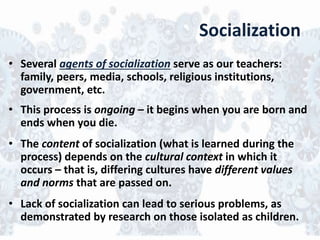
Socialization
• Several agents of socialization serve as our teachers:
family, peers, media, schools, religious institutions,
government, etc.
• This process is ongoing – it begins when you are born and
ends when you die.
• The content of socialization (what is learned during the
process) depends on the cultural context in which it
occurs – that is, differing cultures have different values
and norms that are passed on.
• Lack of socialization can lead to serious problems, as
demonstrated by research on those isolated as children.
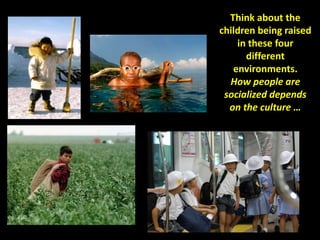
Think about the
children being raised
in these four
different
environments.
How people are
socialized depends
on the culture …
Social Isolation
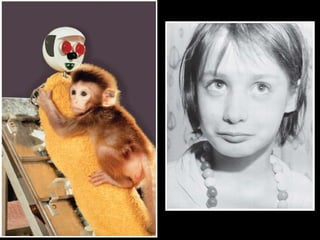
• Harlow experiments: using rhesus monkeys, the Harlows found
that the monkeys preferred the warmth of a cloth ‘mother’
over the fake ‘mother’ with the bottle. After being
reintroduced to the company of other monkeys after isolation,
they were unable to function socially.
• Isolated Children:
– Anna: found in 1938 at age 6 with little socialization, Anna required
a special school to acquire basic skills before her death at age 10.
– Genie: found in 1970 at age 13, having been severely abused all her
life and never having heard human speech. Attempts to socialize
Genie have had only limited success – as of the 1990s, she was living
in a home for retarded adults.
Sociological Theories: Cooley
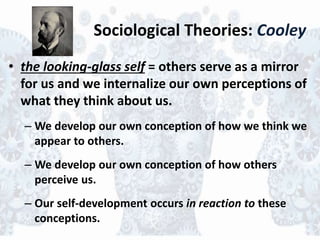
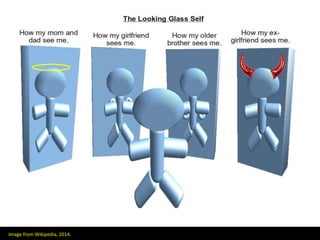
• the looking-glass self = others serve as a mirror
for us and we internalize our own perceptions of
what they think about us.
– We develop our own conception of how we think we
appear to others.
– We develop our own conception of how others
perceive us.
– Our self-development occurs in reaction to these
conceptions.
Image from Wikipedia, 2014.
Sociological Theories: Mead
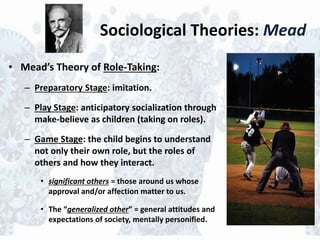
• Mead’s Theory of Role-Taking:
– Preparatory Stage: imitation.
– Play Stage: anticipatory socialization through
make-believe as children (taking on roles).
– Game Stage: the child begins to understand
not only their own role, but the roles of
others and how they interact.
• significant others = those around us whose
approval and/or affection matter to us.
• The “generalized other” = general attitudes and
expectations of society, mentally personified.
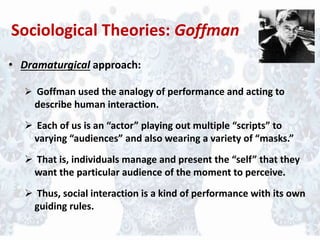
Sociological Theories: Goffman
• Dramaturgical approach:
 Goffman used the analogy of performance and acting to
describe human interaction.
 Each of us is an “actor” playing out multiple “scripts” to
varying “audiences” and also wearing a variety of “masks.”
 That is, individuals manage and present the “self” that they
want the particular audience of the moment to perceive.
 Thus, social interaction is a kind of performance with its own
guiding rules.
Sociological Theories: Goffman
• The dramaturgical approach is Goffman’s way of
saying that each of us plays multiple roles in society.
• We “know” each other (and ourselves) through
these roles.
• impression management = what we all engage in
continually: each of us attempts to ‘manage’ the
impressions others have of us.
• facework = the individual attempts to “save face”
when faced with rejection or embarrassment.
Sociological Theories
• Functionalist:
– primary socialization = “the process of learning that begins at birth and
occurs in the home and family” (86).
– secondary socialization = “refers to the process of learning that takes place
outside the home” with young adults (86).
– tertiary socialization = “takes place when adults move into new settings
where they must accept certain ideas or engage in specific behaviors that
are appropriate to that specific setting” (86).
• Conflict:
– Socialization facilitates false consciousness = a lack of awareness of class
position and conflict.
– For this reason, class inequality is simply reproduced from generation to
generation.
Agents of Socialization
1. Family
 #1 influence.
 Varies with culture.
 Includes factors like class, racial identity and gender roles.
 May be positive or negative, but always powerful.
2. School
 We all learn the history and basic cultural assumptions of our
society in educational institutions from kindergarten on up.
 This is the case in every culture.
Agents of Socialization
3. Peer Groups
 As children grow older, their peer groups tend to replace their family as
primary agents of socialization.
 Peer groups offer an interactive context featuring relative equality and
common ground among the members.
 Peer groups can be both positive and/or negative.
4. Mass Media & Technology
 Includes television, movies, music, cell phones, and the Internet.
 Can be positive or negative.
 Both socializes directly and impacts other agents of socialization.
Agents of Socialization
5. Workplace
 Learning how to behave and survive in the workplace is a fundamental
part of socialization.
 The level of teenage employment in the U.S. today is highest of
industrialized nations.
 This socialization continues throughout life due to: changing jobs,
advances in technology, completion of educational programs, etc.
6. Religion
 Throughout most the world, religious institutions and traditions remain
significant agents of socialization.
 Again, this may be positive and/or negative.
Agents of Socialization
7. The Government
Many functions traditionally handled by the family or
the individual have been taken over by the
government.
Our government directly impacts us through laws
and policies.
The influence of the state is often mediated by
representative groups.
Socialization & the Life Course
• At different transitions of the life course – childhood,
adolescence, adulthood, and old age – we experience things
differently:
 rites of passage = rituals marking transitions in life.
 midlife crisis = somewhere around age 40, most men and women in the
West begin to experience a time of questioning concerning what they have
not accomplished and how little time they have left.
 The Sandwich Generation = those caring for the needs of aging parents and
children at the same time.
 retirement = around 65, many Americans will retire from the workforce,
necessitating new life adjustments.
 The elderly may experience social devaluation or become the targets of
ageism.
Socialization & the Life Course
• resocialization = process of transition where
previous socialization is unlearned and new
behavior patterns are learned.
– Can be voluntary (EX: religious conversion) or involuntary (EX:
prison).
– Involves both unlearning previous socialization and learning
new socialization.
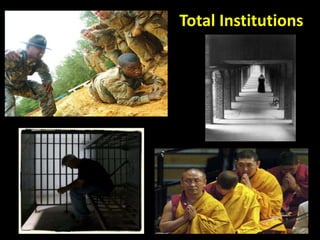
• total institution = a place where someone is
isolated from mainstream society, and every
aspect of their life is controlled by authority.
Total Institutions

Week 3: Socialization

  • 1.
    Principles of Sociology5 Socialization
  • 2.
    The Nature/Nurture Debate •A debate over the relative importance of heredity and/or environment in our development as persons. • What we are born with vs. what we acquire. • Debated with reference to personality traits, religious experience, criminal traits, sexual orientation, etc., etc.
  • 3.
    The Nature/Nurture Debate •Reductionistic approaches attempt to explain things by pointing to a single factor: •Marx & Engels = economics •Freud = sexual conflicts in childhood •Some psychologists = brain chemistry • Behaviorists = environment • Some geneticists = DNA
  • 4.
    The Nature/Nurture Debate •Reductionistic approaches tend to be overly simplistic. • A Multi-Factored Approach is better: • Acknowledges the complexity of human personality and behavior. • Assumes the presence of multiple interacting factors. • Adopted – to varying degrees – by most contemporary social scientists. • It is both nature and nurture.
  • 5.
    Defining Socialization “the processby which we learn to become members of society, both by internalizing the norms and values of society, and also by learning to perform our social roles (as worker, friend, citizen, and so forth)” (Gordon Marshall, The Concise Oxford Dictionary of Sociology, New York: Oxford, 1994, p. 497)
  • 6.
    Socialization • Several agentsof socialization serve as our teachers: family, peers, media, schools, religious institutions, government, etc. • This process is ongoing – it begins when you are born and ends when you die. • The content of socialization (what is learned during the process) depends on the cultural context in which it occurs – that is, differing cultures have different values and norms that are passed on. • Lack of socialization can lead to serious problems, as demonstrated by research on those isolated as children.
  • 7.
    Think about the childrenbeing raised in these four different environments. How people are socialized depends on the culture …
  • 8.
    Social Isolation • Harlowexperiments: using rhesus monkeys, the Harlows found that the monkeys preferred the warmth of a cloth ‘mother’ over the fake ‘mother’ with the bottle. After being reintroduced to the company of other monkeys after isolation, they were unable to function socially. • Isolated Children: – Anna: found in 1938 at age 6 with little socialization, Anna required a special school to acquire basic skills before her death at age 10. – Genie: found in 1970 at age 13, having been severely abused all her life and never having heard human speech. Attempts to socialize Genie have had only limited success – as of the 1990s, she was living in a home for retarded adults.
  • 10.
    Sociological Theories: Cooley •the looking-glass self = others serve as a mirror for us and we internalize our own perceptions of what they think about us. – We develop our own conception of how we think we appear to others. – We develop our own conception of how others perceive us. – Our self-development occurs in reaction to these conceptions.
  • 11.
  • 12.
    Sociological Theories: Mead •Mead’s Theory of Role-Taking: – Preparatory Stage: imitation. – Play Stage: anticipatory socialization through make-believe as children (taking on roles). – Game Stage: the child begins to understand not only their own role, but the roles of others and how they interact. • significant others = those around us whose approval and/or affection matter to us. • The “generalized other” = general attitudes and expectations of society, mentally personified.
  • 13.
    Sociological Theories: Goffman •Dramaturgical approach:  Goffman used the analogy of performance and acting to describe human interaction.  Each of us is an “actor” playing out multiple “scripts” to varying “audiences” and also wearing a variety of “masks.”  That is, individuals manage and present the “self” that they want the particular audience of the moment to perceive.  Thus, social interaction is a kind of performance with its own guiding rules.
  • 14.
    Sociological Theories: Goffman •The dramaturgical approach is Goffman’s way of saying that each of us plays multiple roles in society. • We “know” each other (and ourselves) through these roles. • impression management = what we all engage in continually: each of us attempts to ‘manage’ the impressions others have of us. • facework = the individual attempts to “save face” when faced with rejection or embarrassment.
  • 15.
    Sociological Theories • Functionalist: –primary socialization = “the process of learning that begins at birth and occurs in the home and family” (86). – secondary socialization = “refers to the process of learning that takes place outside the home” with young adults (86). – tertiary socialization = “takes place when adults move into new settings where they must accept certain ideas or engage in specific behaviors that are appropriate to that specific setting” (86). • Conflict: – Socialization facilitates false consciousness = a lack of awareness of class position and conflict. – For this reason, class inequality is simply reproduced from generation to generation.
  • 16.
    Agents of Socialization 1.Family  #1 influence.  Varies with culture.  Includes factors like class, racial identity and gender roles.  May be positive or negative, but always powerful. 2. School  We all learn the history and basic cultural assumptions of our society in educational institutions from kindergarten on up.  This is the case in every culture.
  • 17.
    Agents of Socialization 3.Peer Groups  As children grow older, their peer groups tend to replace their family as primary agents of socialization.  Peer groups offer an interactive context featuring relative equality and common ground among the members.  Peer groups can be both positive and/or negative. 4. Mass Media & Technology  Includes television, movies, music, cell phones, and the Internet.  Can be positive or negative.  Both socializes directly and impacts other agents of socialization.
  • 18.
    Agents of Socialization 5.Workplace  Learning how to behave and survive in the workplace is a fundamental part of socialization.  The level of teenage employment in the U.S. today is highest of industrialized nations.  This socialization continues throughout life due to: changing jobs, advances in technology, completion of educational programs, etc. 6. Religion  Throughout most the world, religious institutions and traditions remain significant agents of socialization.  Again, this may be positive and/or negative.
  • 19.
    Agents of Socialization 7.The Government Many functions traditionally handled by the family or the individual have been taken over by the government. Our government directly impacts us through laws and policies. The influence of the state is often mediated by representative groups.
  • 20.
    Socialization & theLife Course • At different transitions of the life course – childhood, adolescence, adulthood, and old age – we experience things differently:  rites of passage = rituals marking transitions in life.  midlife crisis = somewhere around age 40, most men and women in the West begin to experience a time of questioning concerning what they have not accomplished and how little time they have left.  The Sandwich Generation = those caring for the needs of aging parents and children at the same time.  retirement = around 65, many Americans will retire from the workforce, necessitating new life adjustments.  The elderly may experience social devaluation or become the targets of ageism.
  • 21.
    Socialization & theLife Course • resocialization = process of transition where previous socialization is unlearned and new behavior patterns are learned. – Can be voluntary (EX: religious conversion) or involuntary (EX: prison). – Involves both unlearning previous socialization and learning new socialization. • total institution = a place where someone is isolated from mainstream society, and every aspect of their life is controlled by authority.
  • 22.