MARXISM MARXISM
Overview Who was Karl Marx? How did Marx explain the development of history? What relationship did Marx see between history, economics and politics? What was Marx’s critique of democracy?
Karl Marx (1818-1883) German political/economic philosopher Bourgeois in background Began his career in journalism Famous works:  Das Kapital,  The Communist Manifesto, and Critique of Political Economy
Marx on History History unfolds because of materialist forces “ The history of all existing societies is the history of class struggle” Patricians v. Plebians Feudal Lords v. Serfs Bourgeois v. Proletariat
Marx on History Different social classes occasion different forms of oppression and struggle ([ sub]structure ) Social and political institutions or beliefs reflect the interests of the dominant class ( superstructure )
Bourgeois Society Characteristics: Two-fold division of the populace Bourgeois (Capitalist Class) Those who own property and control the means of production Proletariat (Labor Class) Those who cannot afford to own property and contribute their labor to production
Bourgeois Society Arises because of… Larger market for goods Need for large-scale production Industrialization of the production process Is accompanied by political centralization
The Contention “… for exploitation…[the bourgeois] has substituted naked, shameless, direct, brutal exploitation.”
Marx’s Economics Cost is king (i.e. key concept) The cost of a product is the sum of its  constant capital  and  variable capital Constant capital refers to the fixed capital provided by the capitalist Variable capital pertains to labor
Marx’s Economics However, capitalists only engage in production if it is profitable The profit comes from paying workers less than the value they produce Workers wages = subsistence The difference is known as surplus value
Marx’s Politics Workers find it difficult to fight against this arrangement There is a large reserve army of workers ready to take their jobs Government institutions cater to maintaining the capitalist arrangement Thus, democracy is also an instrument of exploitation
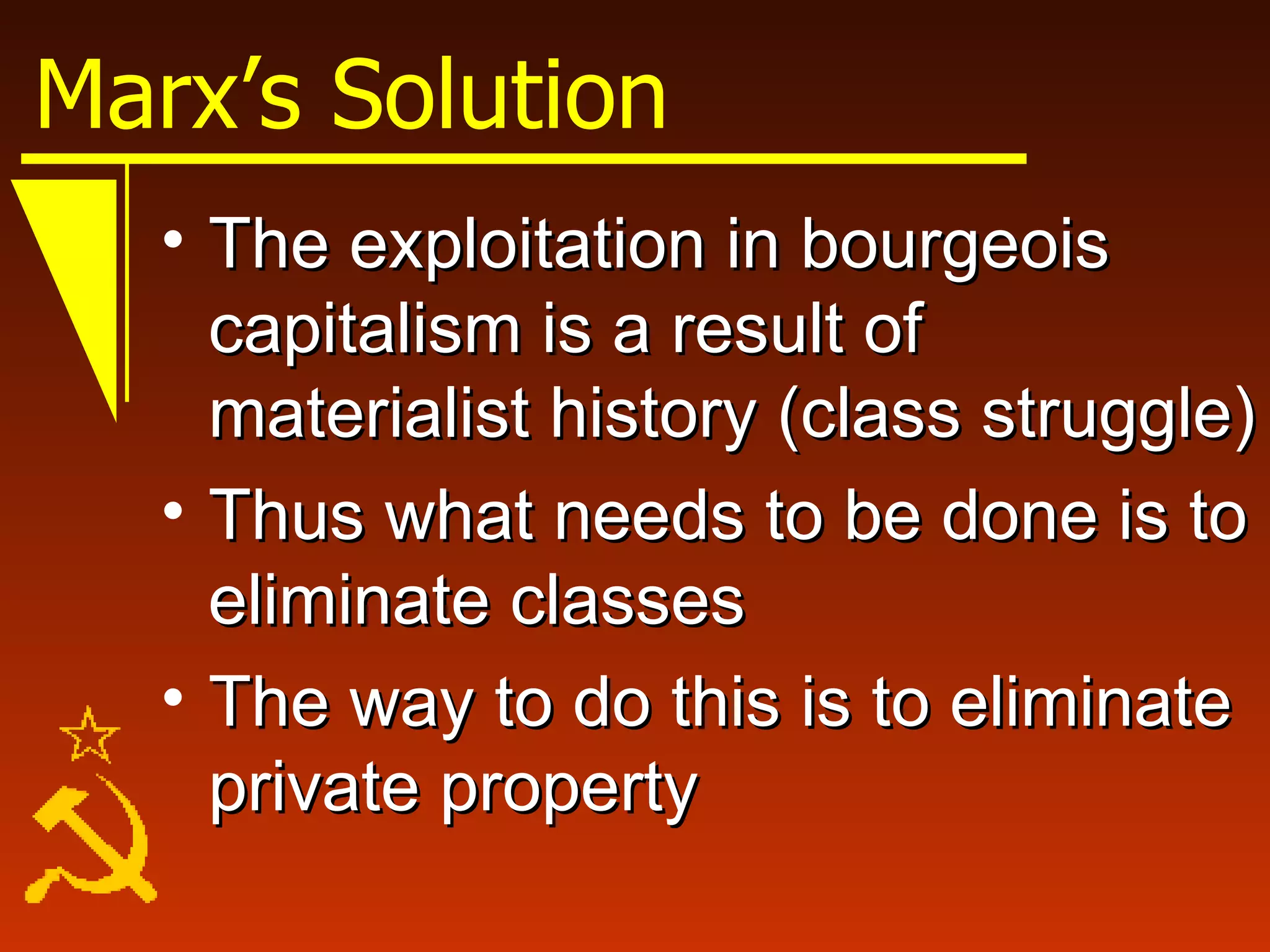
Marx’s Solution The exploitation in bourgeois capitalism is a result of materialist history (class struggle) Thus what needs to be done is to eliminate classes The way to do this is to eliminate private property
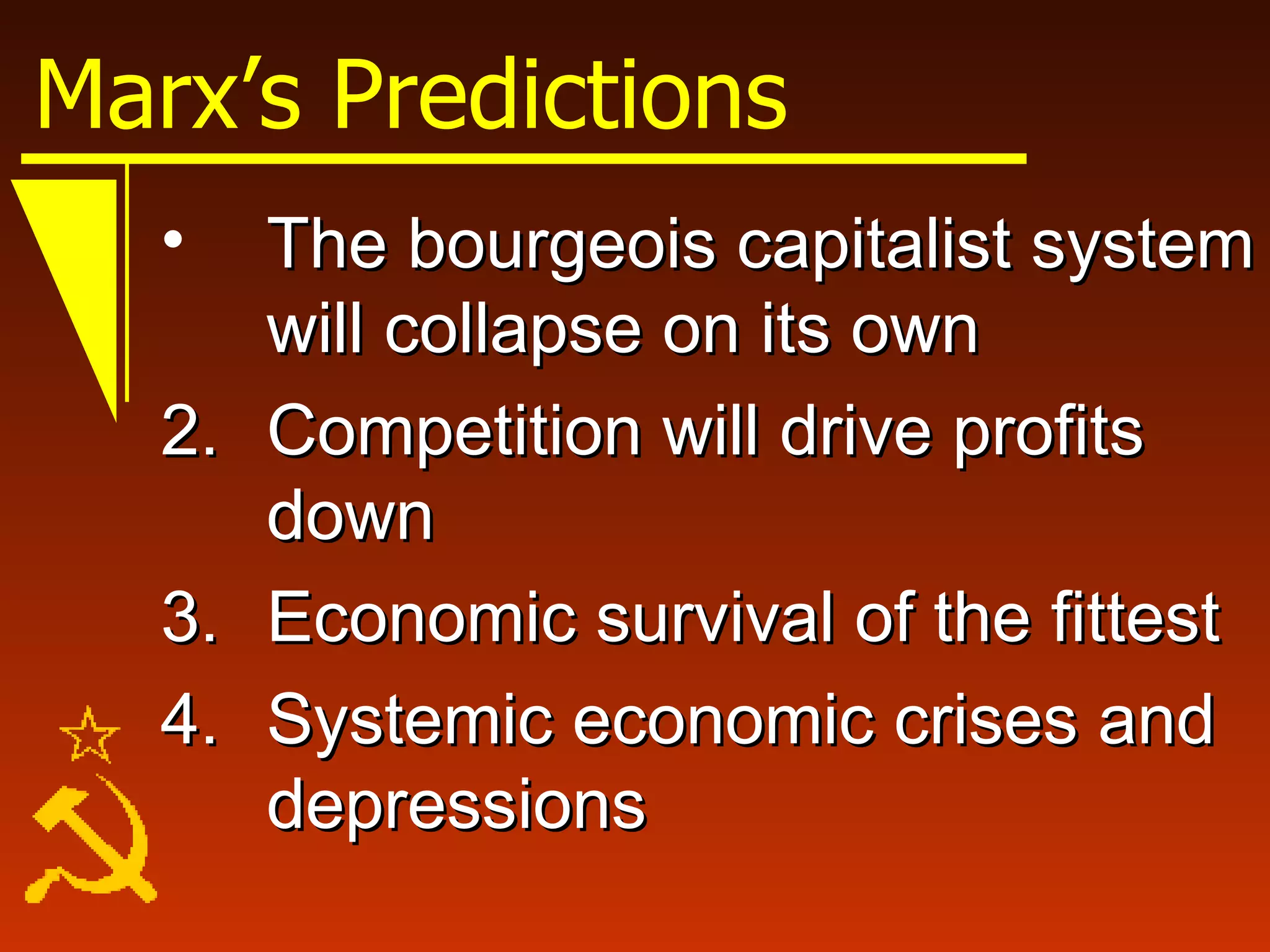
Marx’s Predictions The bourgeois capitalist system will collapse on its own Competition will drive profits down Economic survival of the fittest Systemic economic crises and depressions
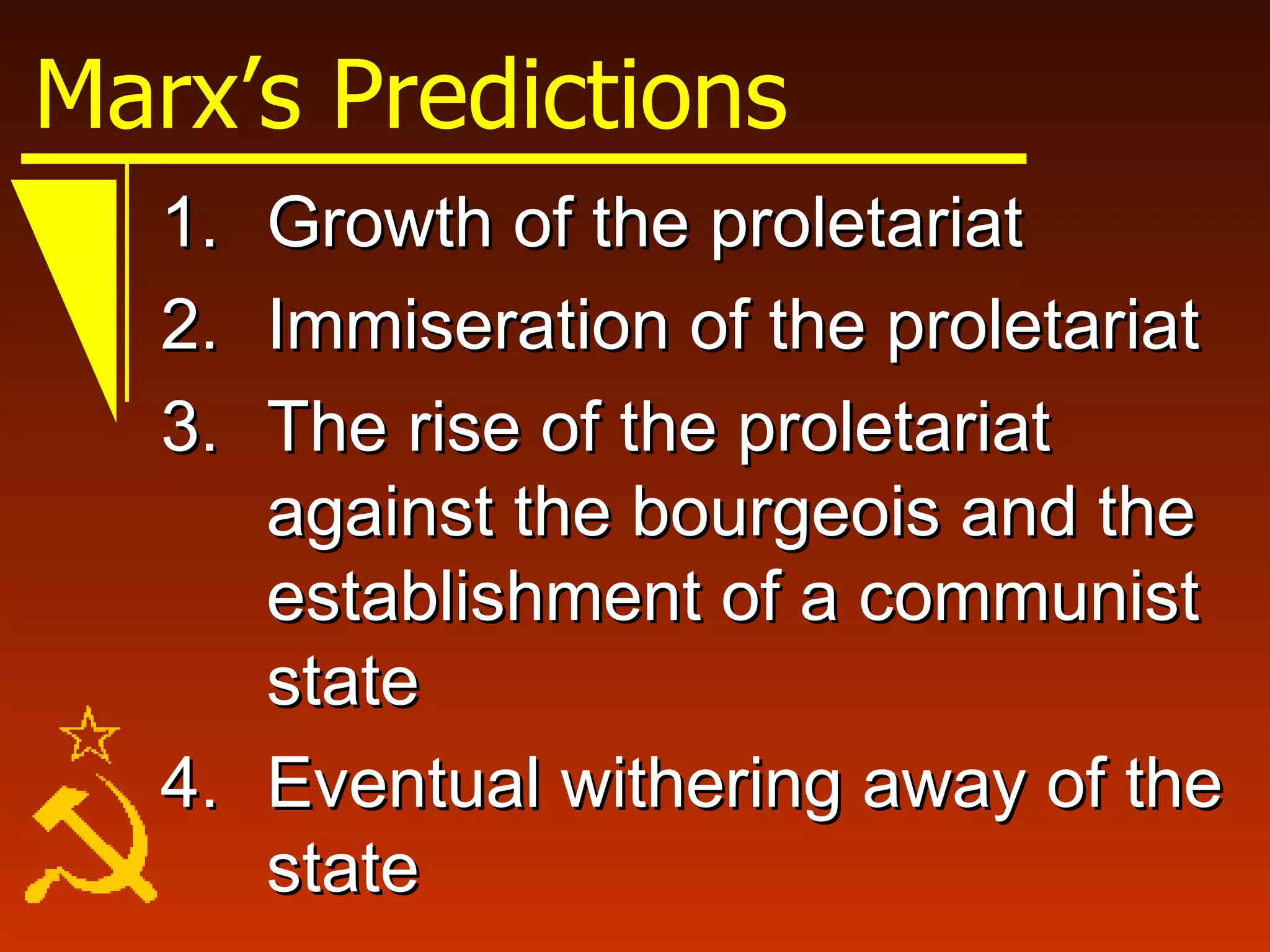
Marx’s Predictions Growth of the proletariat Immiseration of the proletariat The rise of the proletariat against the bourgeois and the establishment of a communist state Eventual withering away of the state

Marxism

  • 1.
  • 2.
    Overview Who wasKarl Marx? How did Marx explain the development of history? What relationship did Marx see between history, economics and politics? What was Marx’s critique of democracy?
  • 3.
    Karl Marx (1818-1883)German political/economic philosopher Bourgeois in background Began his career in journalism Famous works: Das Kapital, The Communist Manifesto, and Critique of Political Economy
  • 4.
    Marx on HistoryHistory unfolds because of materialist forces “ The history of all existing societies is the history of class struggle” Patricians v. Plebians Feudal Lords v. Serfs Bourgeois v. Proletariat
  • 5.
    Marx on HistoryDifferent social classes occasion different forms of oppression and struggle ([ sub]structure ) Social and political institutions or beliefs reflect the interests of the dominant class ( superstructure )
  • 6.
    Bourgeois Society Characteristics:Two-fold division of the populace Bourgeois (Capitalist Class) Those who own property and control the means of production Proletariat (Labor Class) Those who cannot afford to own property and contribute their labor to production
  • 7.
    Bourgeois Society Arisesbecause of… Larger market for goods Need for large-scale production Industrialization of the production process Is accompanied by political centralization
  • 8.
    The Contention “…for exploitation…[the bourgeois] has substituted naked, shameless, direct, brutal exploitation.”
  • 9.
    Marx’s Economics Costis king (i.e. key concept) The cost of a product is the sum of its constant capital and variable capital Constant capital refers to the fixed capital provided by the capitalist Variable capital pertains to labor
  • 10.
    Marx’s Economics However,capitalists only engage in production if it is profitable The profit comes from paying workers less than the value they produce Workers wages = subsistence The difference is known as surplus value
  • 11.
    Marx’s Politics Workersfind it difficult to fight against this arrangement There is a large reserve army of workers ready to take their jobs Government institutions cater to maintaining the capitalist arrangement Thus, democracy is also an instrument of exploitation
  • 12.
    Marx’s Solution Theexploitation in bourgeois capitalism is a result of materialist history (class struggle) Thus what needs to be done is to eliminate classes The way to do this is to eliminate private property
  • 13.
    Marx’s Predictions Thebourgeois capitalist system will collapse on its own Competition will drive profits down Economic survival of the fittest Systemic economic crises and depressions
  • 14.
    Marx’s Predictions Growthof the proletariat Immiseration of the proletariat The rise of the proletariat against the bourgeois and the establishment of a communist state Eventual withering away of the state

Editor's Notes

  • #2 Learning Objectives: 1.) To understand the basic premises of Marxist thought. 2.) To be able to articulate the Marxist criticism of democracy as bourgeois hegemony.